New Dawn – World's Most Unusual Magazine

Author: Reg Little

  • Yukio Mishima: The Man and the Mythology

    Yukio Mishima: The Man and the Mythology

    From New Dawn 123 (Nov-Dec 2010)

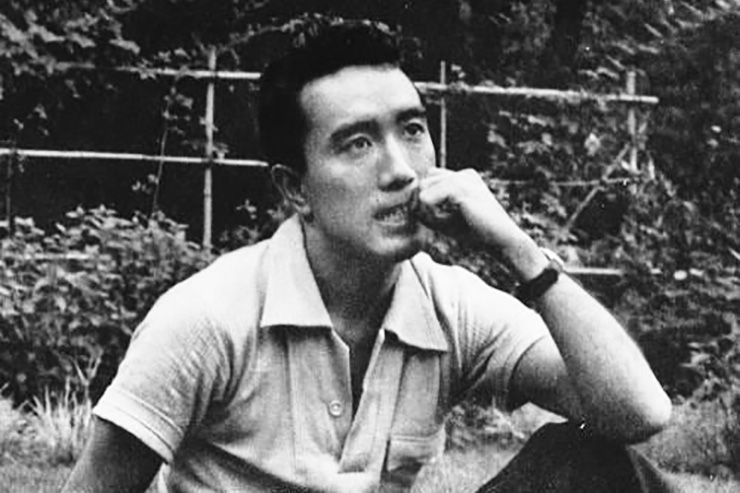
    Yukio Mishima (pen name of Kimitake Hiraoka) is perhaps the most commanding and tragic figure in 20th century Japan. Born into a samurai-bureaucrat family in 1925, he committed ritual suicide (seppuku) on 25 November 1970. He had just failed, predictably, in a call on the Japanese Self Defence Forces to revolt and re-establish the traditional authority of the Japanese Emperor. Mishima was at the peak of a brilliant literary career and on the day of his death he had completed the fourth and final volume of The Sea of Fertility, summing up his vision of the Japanese experience in the 20th century.

    Mishima’s life and work seems to be a continuous exercise in yin and yang, exploring the mutually nurturing activity of complementary (or contending) qualities like beauty and destruction, pride and shame, strength and weakness, loyalty and betrayal, sacrifice and indulgence. Of even more weighty and lasting importance, his work appeals as an exhaustive and exhausting exploration of mythologies that might revive and reinvigorate the Japanese spirit. Nothing was more important or more taunting after Japan’s humiliation and devastation – the result first of Western socialisation and second of Western conquest.

    No one could better represent and articulate the burden borne by the Japanese elite in the 20th century than Mishima. He won a citation from the Emperor as the highest ranking honour student at graduation from the Peers’ School in 1944, as Japan approached defeat and humiliation. He graduated from Tokyo Imperial University School of Jurisprudence in 1947, as Japan accommodated an alien occupation. He then joined the Ministry of Finance at the pinnacle of Japanese government and published his first novel in 1948. His samurai family’s code of complete control over mind and body, loyalty to the Emperor and the austerity and self sacrifice of Zen pervade his life and writing.

    The maturing years of a puny and youthful Mishima make it possible to see him as a mirror for the post-war growth of a weak, bewildered and defeated Japan. Both progressed through much painful soul-searching to build their strength and emerge, at least temporally, as giants in the Asian consciousness.

    Mishima’s life is a little less exotic than his stories. As a young boy he was captive to the needs and whims of a possessive grandmother with aristocratic airs. Nothing could better reflect the strict hierarchical and authoritarian values of his family and society or, perhaps, better nurture a young literary genius. His youth was a struggle towards self-assertion and self-empowerment in a competitive school environment where respect was not won easily and where his unmanly literary interests could invite aggression. Some coughing at his physical examination after being called up for military service gained him a diagnosis of incipient tuberculosis and a reprieve. He emerges as an elite bureaucrat, only to sacrifice that to become a widely celebrated novelist.

    His qualities of self-discipline and self-motivation rarely appear outside their social and political context. His later emergence with a strong and muscular, even beautiful body, all the product of dedicated discipline and purpose, is easily seen as the ultimate expression of a refined and socially conscious human being, albeit in a samurai spirit. The semi-military scenes with his “private army” appear as a statement of a profound determination not to lose touch with the political and historical processes of his time. Even his writing, undertaken to a strict schedule each evening, appears almost as part of a military routine. The odd homosexual dalliance and humiliation was hardly a distraction – seemingly subject to severe, if sensitive, formalities. Indeed, his homosexuality possibly reflected a military culture of encouraging same sex liaisons as a means of strengthening battlefield loyalties.

    Discovering Asian Civilisation

    40 years after Mishima’s death, I encounter a personal set of contradictions and confusions in re-examining and attempting to re-evaluate his life and work. I arrived in Tokyo in 1964 as a diplomatic language student and left in 1969. At a time that was critical in my discovery of Asian civilisation, Mishima loomed large in my imagination as the living embodiment of Japanese cultural and political consciousness. He loomed even larger when I was cross-posted to Laos where his brother was serving as First Secretary in the Japanese Embassy, only to be replaced before my arrival by another officer married to the sister of Mishima’s wife, evidence of the close-knit character of the elite Japanese bureaucracy.

    Mishima’s subsequent samurai seppuku while I was still in Vientiane provided a taunting comment on the Indo-China War, which was the focus of my then professional duties. Unlike the Pacific War where it defeated Japan, America did not succeed in the Indo-China War in defeating Vietnam. This echoed many of the troubling contradictions that haunted Mishima’s life.

    Mishima observed all the correct forms of Japanese surrender yet explored in the most relentless and captivating manner the need to keep the Japanese spirit alive until the time came to express his convictions in actions rather than words – actions that are likely to echo into the future as long as there is art and as long as there is a Japanese spirit. Moreover, perhaps no contradiction was more profound than Mishima’s criticism, common in his writing, of the Japanese capitalists who had usurped the authority of the samurai ethos.

    It is possible to see Mishima, his colleagues in the Ministries of Finance (and Foreign Affairs), and Japan’s capitalists all observing the same disciplined, politically correct forms of surrender, while all discreetly working in their own ways towards a victory (initially commercial) over an America that had humiliated Japan in war. By the end of the 1980s, American authors in books like Japan as Number One were warning of a possible Japanese victory that Mishima was most unlikely to have foreseen.

    These personal recollections and reflections and my own voyage of discovery of an even larger and more dynamic Asia, where China has taken a leadership role once thought reserved for Japan, cannot but colour the way I approach any evaluation of Mishima’s legacy. It places that legacy inescapably in the context of my own exploration of the remarkable character of East Asian civilisation and its economic and cultural renaissance over the past half century. During the four decades since Mishima’s death, I have become acutely aware of fundamental differences between an Anglo-American global order that has largely defined the past two centuries of global history (and all of modern Australian history) and an ascendant East Asian Confucian order likely to define the indefinite future.

    My recent reading of Thinking from the Han: Self, Truth and Transcendence in Chinese and Western Culture by the American authorities on Chinese civilisation, David Hall and Roger Ames, is of particular relevance to my recollection of Mishima. The idea of “self” often looms large for those who examine Mishima’s life and work from a Western perspective. Yet “self” seems to misrepresent totally the essence of Mishima’s life in the Japanese and East Asian environment. Mishima was unquestionably a product of Japan’s intellectual and administrative samurai aristocracy, whose energies and talents are today concentrated in achieving educational and intellectual excellence. The sentiments he evoked are unlikely to die away simply because China and Vietnam have won overt political successes seemingly denied Japan. At the same time, I suspect that Mishima’s elite colleagues and successors, now more than ever defined by relentless academic competition, will find more in common with counterparts in China, Vietnam and elsewhere in Asia than with partners distanced by vast oceans and even vaster cultural divides.

    Mishima and His Work

    Any choice of particular works from Mishima’s voluminous output will be invidious. Nominated three times for the Nobel Prize, Mishima wrote 40 novels, 18 plays, 20 books of short stories, at least 20 books of essays, one libretto and one film. More than 20 of his novels have been translated and published in English. The richness, maturity and insight of his work from an early age often make it difficult to place without careful thought a work in a particular period of his life. All were characterised by the heroic efforts of their protagonists to find a meaningful mythology for their own physical lives in a bewildering kaleidoscope of unrelenting and unpredictable cultural, social, and political change. Almost invariably, this was laced with various physical and spiritual temptations. A quick review of a few of these works offers a glimpse of Mishima’s virtuosity.

    It is surprising, for instance, to realise that a book like Forbidden Colours, which demonstrates Mishima’s uncompromising character in searching out the most difficult and confronting issues in human experience, was written when he was 28. This was the age at which I arrived in Tokyo, green, immature, inexperienced and ill-equipped to envisage such a reality, despite a university education in Russian and English literature.

    A brief outline of the story offers a glimpse of the author’s mastery of the darkest recesses and greatest heights of Japanese society in the immediate post war years.

    This major novel, regarded in Japan as Mishima’s masterpiece, is as much a vivid and shocking panorama of the corrupt life of Tokyo five years after the end of the war and an attack on oppressive Japanese marriage customs as it is the affecting story of Yuichi Minami, a handsome young man with homosexual inclinations.

    Yuichi is caught between his impulses and the demands of his family. Out of his loveless marriage his anguished homosexuality burgeons, and his wife’s dreams depart. The first chapter irresistibly brings to mind “Death in Venice.” An old and famous writer is captivated by Yuichi, and like Mann’s Aschenbach he is never again the man he was. He becomes Yuichi’s mentor, spouting satanic philosophies much like those Oscar Wilde imparted to the young Andre Gide.

    He persuades Yuichi to pursue and disappoint a number of beautiful women who have slighted the writer. Yuichi involves himself with lovers young and old, male and female. We meet ex-aristocrats dabbling in the black market, newly rich couples living promiscuously, blackmailers and male prostitutes. There are remarkable descriptions of parks of assignation, of gay bars and of gay parties, often frequented by Americans. The signs, the argot, the evasions, the frustrations, the humour, the joys and the tragedies of this strange and hidden world are brought out with sympathy and great candour, but also with irony and aversion.

    The richness of Mishima’s adventures can take the reader on a voyage of discovery into a world rarely imagined but full of taunting truths and undeniable realities. Many readers are likely to be left haunted by previously unimagined human interaction.

    The Temple of the Golden Pavilion was written three years later and captures the trials of another young man, Mizoguchi, who is disabled by a crippling stutter but is fascinated by the beauty of the Temple of the Golden Pavilion. Taken by his dying father, a poor rural priest, to become an acolyte at the Temple, he has heard throughout his childhood about its splendid beauty. But the beautiful things in his new life as a monk – the temple, sexual possibility, and personal autonomy – leave Mizoguchi feeling overwhelmed and insignificant, until he seeks to resolve his painful perplexity by burning down the Temple of the Golden Pavilion. It is not hard to see in it a theme that runs through much of Mishima’s work – namely a fascination with beauty leading to destruction, often self destruction.

    Three years later Mishima wrote Kyoko’s House, which was not well received and has not been translated into English. It explores four sides of Mishima through the stories of a boxer, a painter, an actor and a businessman. The American film director Paul Schrader has made the story of the actor available to English speakers in his film “Mishima: A Life in Four Chapters.” Interestingly, it was only included after the writer’s wife objected to the use of Forbidden Colours. The actor’s story is, however, just as confronting as any of Mishima’s other stories. It tells of an actor who becomes involved in a sado-masochistic sexual relationship to settle his mother’s debts. This plunges him into a double suicide for himself and his lover, his mother’s creditor. There is less of a sense of rarefied spirituality, fascination with beauty and struggle against carnal debasement than in The Temple of the Golden Pavilion, highlighting Mishima’s capacity to move amongst all areas and levels of society. He seems to have an unlimited ability to discover and reveal the grand dramas being played out in mundane life. The actor seems totally absorbed in carnal pursuits and yet to be willing to literally give up his life for both his mother and lover. This heroic dimension does not loom as large as the garish décor of the mother’s bar and the trivia of the dialogue. The pact to commit a dual suicide is entered into almost as a casual convenience. Described as “terrifying” by Mishima’s biographer and translator, John Nathan, the novel’s importance to Mishima was reflected in the unprecedented fifteen months it took to write and the fact that, unusually, it was not published in magazine instalments. It is reported that poor sales and reviews hurt him seriously.

    The following year (1960), Mishima wrote After the Banquet. Uncharacteristically, it is a story about a successful, worldly, head strong, older woman. She runs a business in the “water trade” and throws her heart and her money into a marriage with an aging, idealistic but naive aristocrat. When her support for his political aspirations becomes a source of conflict, highlighting irreconcilable values and life experiences, she has no practical option but to return to her trade – tending commercially the physical and psychological needs of her aristocrat’s political rivals. She again serves the very forces she had hoped to assist her idealist to defeat. The story can be described as a clash of love, politics and money but it also gives Mishima the means to explore characters and political activities that are rare in his work, offering an intriguing insight into the nature and processes of Japanese politics. The accuracy of Mishima’s story was subsequently confirmed by a successful law case mounted for invasion of privacy.

    Mishima followed this fine account of confused ideals and political machinations in Tokyo the next year with a work described by one reviewer as “barbaric lyricism.” The Sailor who Fell from Grace with the Sea (“Afternoon of Glory” reflects the Japanese title more accurately) can be expected to shock almost any reader. A group of adolescent boys resolve to revenge themselves on the sailor who disappoints their romantic sense of masculine life at sea by falling for and committing himself to the mother of one of them. The erstwhile hero is seduced by the boy’s apparent adulation to subject himself to the cruellest of fates, all depicted in Mishima’s finely crafted poetic style.

    This brief sampling of some of Mishima’s stories cannot reproduce his evocative and beautiful imagery or the way in which his genius invariably draws one into new and unfamiliar worlds in the most convincing ways, only to then present a shocking, almost unbelievable, conclusion. Desire and resentment are never far apart and one is often left asking questions that have never previously been encountered.

    It has been suggested that Mishima’s psychological exploration is so profound that it is possible to find in his stories an account of the obsession, the hopelessness, and the desperation inspired by types of spiritual purity that can motivate acts of terrorism. Rather than focusing on terrorism, however, I believe it is more accurate to see Mishima’s writing as an exploration of the obstacles and confusions that confront all human aspiration. He creates a sense of the great difficulty encountered in reconciling ideals nurtured by a lofty human imagination with the mundane, perplexing and corrupting realities of existence.
    The Sea of Fertility

    “The Sea of Fertility” (a reference to the Mare Fecunditatis, a “sea” on the Moon) is the four volume work that Mishima completed on his final day. It contains Spring Snow (1966), Runaway Horses (1969), The Temple of Dawn (1970) and The Decay of the Angel (1971). It stretches from 1912 to 1975 and in all four books uses the viewpoint of Shigekuni Honda, who matures from a law student to a wealthy retired, but world weary and desiccated, judge. Honda’s life focuses on four reincarnations of his school friend Kiyoaki Matsugae and his attempts to save them from early deaths. This results in Honda’s personal and professional embarrassment and eventual destruction, somehow symbolic of those who cannot rise above the inevitable corruption of respectable social goals. The ill fated Matsugae is successively a young aristocrat, an idealistic nationalist, an indolent Thai princess and a manipulative and sadistic orphan. Significantly, the idealistic nationalist foreshadows Mishima by committing seppuku, but after assassinating a prominent symbol of Japanese leadership. Described by Paul Theroux as “the most complete vision we have of Japan in the twentieth century,” the book reflects Mishima’s endless quest to explore and comprehend the workings of individual lives in the destructive context of contending and conflicting certainties.

    Some Concluding Thoughts

    For a foreigner who studied Japanese language and remains committed to trying to comprehend the powerful sense of civilisation that defines East Asia, Mishima has always represented an irreplaceable source of insight and inspiration. His exotic and defiant character seemed to guarantee an incisive, authentic quality that is usually difficult to find. Today’s problems of globalisation and recurring crises in the West give, perhaps, extra dimensions to Mishima’s thought.

    My memories of the mystique surrounding the living Mishima – the vital symbol of the Japanese spirit in the aftermath of defeat and occupation – manifests itself in almost infinite forms in his work. His task was made all the more problematic for someone with an elite sense of leadership responsibility at a time when the national character was burdened with a sense of defeat, humiliation and dishonour at the hands of an alien conqueror. Mishima’s achievement reflects the disciplined and self-effacing manner in which Japan accepted its defeat, apparently subjecting itself to all that it had fought so fiercely to reject.

    This quality of disciplined, self-sacrificing purpose, in the midst of all the temptations and confusions of modern life, is central to Mishima’s legacy. It is a quality that has distinguished the Vietnamese in Indo-China and the Chinese under Mao and his successors. It is a quality that has been taken from the Confucian tradition throughout history and throughout East, and also South East Asia, although often in a form that is not immediately recognisable. In Mishima’s case his energies were dedicated to recording in a highly literate and informed manner the toils of the Japanese soul in the aftermath of defeat and occupation. In this he reflected a complex sense of community awareness, a quality of literary and educational excellence and a depth of intuitive discipline that characterises Confucian civilisation, even when given a unique form of Japanese relevance.

    One must regret that Mishima is not alive today, wrestling at the age of 85 in his inimical way with the economic resurrection first of Japan, then of many other parts of Asia and finally of China. Most interesting would be his perception of an accompanying cultural renaissance that has been made possible by the victories of a leadership class of which he was critical.

    Would he find contemporary public notions of reform in Japan out of touch not only with his preferred Japanese traditions but also with an emerging mainland rejection of Western fashions and the rediscovery and reinvention of values close to those that he lamented had been swept away forever by the tide of Western modernisation?

    [alert type=”general” dismiss=”no”]This article was published in New Dawn 123.[/alert]

    [alert type=”success” dismiss=”no”]If you appreciate this article, please consider subscribing to help maintain this website.[/alert]

    © New Dawn Magazine and the respective author. For our reproduction notice, click here.

  • John Perkins: From Economic Hitman to Shaman

    John Perkins: From Economic Hitman to Shaman

    I remember John Perkins. He was a real jerk. A gold-plated, super-slick lying little butthole shill for corporate gangsters; a snake-oil salesman with a movie-star grin, shiny loafers, a crooked calculator and a tooled leather briefcase full of high-blown bullshit.
    – Greg Palast (www.gregpalast.com)

    Despite Greg Palast’s spleenish dismissal from an earlier time, John Perkins has emerged as a spiritual, intellectual and political authority. He is an important leader of contemporary neo-shamanism, one of today’s most effective critics of American corporate culture, and a story teller capable of overshadowing the legendary Ian Fleming, who created James Bond, when it comes a tales of imperial adventure and conquest.

    He is working to offer a vision, or a ‘dream change’ as he calls it, designed to rescue America, and the world it dominates, from the destruction of rampant corporate energy. He works to achieve these ends by recounting in a disarmingly honest and sensitive way the personal adventures and dilemmas he has experienced in diverse and exotic parts of the world.

    Perkins first gained a reputation in the 1990s for a series of books on shamanic cultures amongst remote tribes and peoples. Around a decade later and prompted by the events of 9/11, he published Confessions of an Economic Hit Man in 2005. This describes life as part of an elite group trained to “utilise international financial organisations to foment conditions that make other nations subservient to the corporatocracy running our biggest corporations, our government, and our banks.”

    After twenty-seven publishers turned it down, the book came out of nowhere to be an international best seller, and is about to be made into a Hollywood movie. It went to number four on Amazon during its first week and was quickly on all best-seller lists. This was achieved without receiving any mainstream media attention.

    Most importantly, Confessions of an Economic Hit Man has provided credibility, authority and celebrity in opening up new areas of thought. These range across corporate power, American empire, shaman spirituality and environmental consciousness.

    Perkins has become a rallying figure for critics of the American ‘corporatocracy’. The harm it inflicts with casual neglect on the environment and local tradition is identified wherever there is the potential to seize cheap resources or some other commercial windfall. A second book has now been published in this genre. The Secret History of the American Empire again recounts wild, troubling conspiracies to grab resources from vulnerable third world leaders through the peddling of unserviceable loans. This is what makes it tempting, even if it is an injustice, to say that its author is becoming America’s Ian Fleming, with conscience.

    Intriguingly, the American hit man is a much more sophisticated and reflective operator than the British secret agent. He never dirties his own hands with an actual act of execution or termination. That is left to the jackal, a scavenger that cleans up after others and a figure much closer to the persona of James Bond. Yet both Fleming and Perkins leave the feeling that they have witnessed a time of transition, as the challenges of empire begin to outweigh its rewards. Each captures his readers through the exposure of perversely heroic excesses.

    John Perkins both writes and plays the story of the economic hit man, as he reveals an institutionalised imperial strategy of which few had previously been aware. This exposure may well make a contribution to constraining the role of laissez faire corporate plundering in maintaining empire. It may also help construct a vision for an American future more in tune with the values of its founding fathers and its constitution.

    It is a comment on the paradoxical character of the contemporary world that the legacy from time as an economic hit man is now committed to opposing and constraining such activity. Rarely have the costs and destruction that go with exercising power over vast areas of the world and the enormous demands of imperial authority on energy, talent and resources been rendered more transparent.

    Perkins sketches a highly complex world, both at the personal and imperial level. His own heroic personality reflects a messy, if robust, form of schizophrenia. Simultaneously, he confesses to ghastly deeds as an economic hit man, articulates a rare sensitivity to diverse indigenous forms of spirituality, uses his experience of malevolent deeds to awaken readers to the destructive power of corporations and comments on the complex feelings and questionings that accompany his actions and reflections.

    A simple, powerful and authoritative style makes it easy to follow these stories of endless exotic adventure. It is also easy to follow the author’s feelings as he learns and grows through personal involvement in a world of calculated intrigue and exploitation that no one had ever explained to him.

    The experience of many bright, inexperienced young men is captured with rare honesty. These innocents are recruited to maintain and extend the reach of empire by means that it would be politically unacceptable to explain in an academic text or a university course. Such stories are a powerful means of mocking much of the economic doctrine taught at Western universities and wielded like a weapon by the minions of the IMF and World Bank as self-serving theoretical nonsense.

    Greg Palast, in a piece titled John Perkins: Jerk, Conman, Shill posted on his website www.gregpalast.com, captures the profound ambiguity in the author’s character in the following colourful language:

    To steal millions, you need a top team of armed robbers. But to steal billions, you need PhD’s with colour charts and economic projections made of fairy dust and eye of newt. Perkins had it all – including a magical thing called a computer-generated spreadsheet (this was well before Excel)…..

    But, as in every moral tale, Perkins, the modern Dr. Faust, found redemption in confession…..

    And in his writings today, Perkins’ heart goes out to the Third World targets of this new empire ruled by shock troops and spread sheets. His empathy extends to those in the occupied territory known as the USA. Because, says Perkins, when the wretchedly ripped-off of the Earth rise in rebellion, the lash of the backlash is felt by the children of the lobstermen of New Hampshire, shivering under Humvees in Falluja, and never the EHM’s clients’ fortunate sons, frolicking in their Ferraris.

    While Perkins is best known today for his Confessions of an Economic Hit Man, he is best understood in the context of his earlier writing. This explores the wisdom and understanding of shamans in contrasting parts of the world. These revelations can be even more startling than his hit man stories. They raise serious questions about most readers’ perceptions of reality and can leave an elated sense of new possibilities and enhanced insight into the nature of life. It is even possible to read in an exchange with an Amazonian shaman an early contribution to the idea of carbon trading.

    Stories of the profound practical wisdom mobilised by forms of shamanic spirituality make this unfamiliar world surprisingly accessible. The struggle for survival in a world threatened with destruction by economic hit men adds further credibility.

    Stories of spiritual discovery amongst native shamans are built around a deep but shifting sensitivity. Initial days as a wide-eyed Peace Corps volunteer are followed by subsequent hit man travels surrounded by privilege, sycophantic attendants and murky conspiracies, and then by a role as guide and leader of small groups of spiritual explorers venturing into the Amazon and other threatened environments. A capacity to recognise the mundane daily imperatives of human life in many contrasting environments is a basic strength of these stories. Readers are introduced in a most convincing manner to the surprisingly practical uses to which native spiritual powers are put. These range from the power to track down and destroy a rogue tiger in the jungle to the capacity to navigate vast distances at sea without charts or other recorded knowledge.

    Pychonavigation: Techniques for Travel Beyond Time in 1990 displayed a writer and activist deeply concerned with the preservation of native traditions, the understanding of shamanic spirituality and the protection of the environment. It also highlighted the manner in which the contemporary world offers unprecedented opportunities to those with wealth, interest, understanding and accidental opportunity. Such individuals are able to explore and identify with diverse forms of spirituality amongst peoples from many different traditions of belief and behaviour.

    The world of shamans may be under threat, but there is also a sense in which the advanced and scientific West needs to turn increasingly to these influences. Christian and scientific dogmas have destroyed essential human qualities in the rush of spread sheets and bottom line calculations.

    These discoveries have been followed up and explored further in other books, such as Shapeshifting: Techniques for Global and Personal Transformation. This 1997 book gives readers an almost tactile sense of experience in uncovering new wonders. This powerfully encourages an opening of the mind and spirit to new possibilities. Not only is the reader’s preparedness to explore the seemingly unbelievable tested, but penetrating reflections on the contemporary world challenge many familiar certainties.

    The assertion of a sympathetic mentor, a Norwegian engineer and corporate power-broker, that capitalism is here to stay provides the basis for reflections on the future. It is essential to understand as deeply as possible the nature of the corporation, which need not necessarily be predatory and destructive. This gives context and balance to devastating comments about corporate fostering of consumerism and emasculation of education. These products of the European Enlightenment, and the way they have diminished the spiritual qualities and understanding of people in the developed world, are rarely exposed so aptly.

    Concern with corporate realities leads to discussion with a Mayan shaman about the need to distinguish dreams from fantasy. While dreams can nourish fulfilment in life and a deep sense of spiritual reality, fantasies only encourage illusion and can be very harmful. This distinction has great practical usefulness because we all vacillate between dreams and fantasies. Yet we rarely pause to recognise the need to distinguish between them, nourish our dreams and discipline our fantasies.

    Explorations with the Mayan shaman suggest that critical to realising the potential of dreams is an understanding at the most fundamental level that energy is everything, that spirit is energy and that the sighting of spirits is synonymous with the sighting of energy. From this it follows that the aura that surrounds organic life and that some healers can use to restore well-being is an emanation of spirit and energy. In bold reflections such as these, Perkins offers himself with a genuine sense of humility – attributing his insights to ‘primitive’ shamans – as a serious and profound commentator on the ills of Western progress and development.

    Books such as Pychonavigation and Shapeshifting in the 1990s reveal the depth of Perkins experience, reflection and spirituality. While they won him a substantial readership and group of followers, it was the political and corporate expose of Confessions of an Economic Hit Man that catapulted him into the ranks of bestsellers and made him a celebrity leader with a potential to transform many of the spiritual ailments that trouble the contemporary American imperial character.

    John Perkins was born in New Hampshire in 1945. He attended Tilton Boys High School, and later Middlebury College and Boston University, before joining the Peace Corps and working in Ecuador in the Amazon. He claims he was vetted by the National Security Agency before being recruited by the Boston strategic consulting firm, Chas T Main, where he rose to the position of chief economist. Not surprisingly, his claims have been disputed by the US State Department.

    Then followed some years of internal struggle over the role of persuading third world governments to accept large, unserviceable loans for infrastructure projects contracted to major US corporations. This anguish deepened as understanding grew about subsequent joint US government and international aid agency action, designed to control these governments and dispose of their oil and other resources to serve US interests. Being a witness to such activities all over the world – in Africa, Asia, Europe, Latin America and the Middle East – led to a decision to quit. Little doubt is left, however, that those who desired silence about earlier work assisted in the success of a subsequent independent energy company.

    After the sale of the energy company in the late 1980s Perkins became involved with non-profit work around the world. In addition to his writing, he became active in shifting consciousness and promoting sustainable lifestyles for the individual and global community.

    It is possible to question the veracity of accounts of American skulduggery. But there is much evidence to support them and they are rarely subjected to serious critical cross-examination. To the contrary, Confessions of an Economic Hit Man has been followed by books like A Game as Old as Empire: The Secret World of Economic Hit Men and the Web of Global Corruption, a collection of chapters by a variety of writers, edited by Steven Hiatt, which explores the range of such activity.

    Even more important, perhaps, unrelated writers such as the German-American William Engdahl have shown in books like A Century of War: Anglo-American Oil Politics and the New World Order that Anglo-American power-brokers have long made devastating use of discreet partnerships between corporate and governmental interests. When the record of the English East India Company is put together with the work of contemporary writers, it is difficult to avoid the conclusion that Anglo-American empire has largely been the product of the corporation.

    These organisations have been effective fronts for imperial expansion. They have been characterised by a remarkable capacity to mobilise adventurous, risk-taking individuals, by skilful, discreet control and manipulation of financial and commodity resources and by the ability to shroud their activities in high-sounding rhetoric about progress and universal values.

    The impact of Perkins in exposing this reality has been enhanced by several factors. First, he tells a great story from the perspective of personal involvement and personal anguish. Second, his earlier writings on indigenous spirituality in scattered parts of the world provided him with an established reputation amongst informed and reflective readers in the decade before the appearance of Confessions of an Economic Hit Man. Third, there is apparent coherence linking his stories of spiritual adventure and discovery and his stories of political adventure and discovery. Finally, 9/11 has created a world, with its enhanced electronic communications and troubled questioning of what has gone wrong, that is disposed to explore the issues raised by corporate excess and economic hit men.

    In one sense, the linkage of spiritual and financial adventure and discovery has created a 21st century everyman or icon. Educated and reflective members of economically advanced communities will find it increasingly difficult to avoid the type of issues and questions that are central to these themes.

    The fact that Perkins does not claim great erudition but simply recounts a story and a succession of dilemmas enhances the accessibility of the work. The sense of surprised discovery of hidden realities is one that is shared by increasing numbers in a world where even advanced levels of education tend to be narrow and excessively functional. It is easy for even the best intentioned and most responsible of workers to become jerk, con-man, and shill as they toil to fit in, accommodate peer group pressure, win the favour of superiors and build the reputation and wealth needed to support a family.

    The modern corporation (or government) demands a certain ignorance and naïvetè of its employees if they are to serve its purpose of maximising profit (or voter support). Only a few are privileged to have the opportunity to see through illusions, opt out and warn others. It is a role where success is improbable.

    The title chosen for Perkins’ second book on American financial strategies, The Secret History of the American Empire, invites the reader to revisit and reconsider events like the 1997 Asian Financial Crisis and ponder on it as the product of a team of economic hit men. It also raises daunting questions about the longer-term viability of major global institutions like the World Bank and IMF.

    There is one story of carrying a book by Joseph Stiglitz during travels to Tibet and of reflections about closely related concerns. Globalization and Its Discontents explains spreading discontent and criticism about the international financial institutions. It does this from the perspective of one who served on President Clinton’s Council of Economic Advisors, was Chief Economist and Senior Vice President of the World Bank and was the winner of the 2001 Nobel Prize for Economics. Yet, it is important to understand why it is John Perkins and not Joseph Stiglitz who will have the greater impact on the popular American consciousness.

    However much the authority of the American State Department may dispute them, Perkins’ stories take the reader directly into the action and personalities of events that have shaped the latter half of the 20th century. They involve the reader in the excitement, the fulfilments and the angst of such action and make the most implausible of conspiracies seem commonplace and mundane, even as they unfold in exotic and alien environments. Ultimately, they intensify many dilemmas by focusing on discoveries of the shamanic spirituality and wisdom of peoples whose cultural survival in the contemporary world seems condemned – limited to decades.

    Unfortunately, there is little about Japan and China, two large nations that have preserved ancient forms of spirituality while building robust and vibrant modern economies. A chapter on geishas in Secret History hints at great subtlety in Japanese traditions. It recounts a platonic, hungering and fleeting relationship with two geishas who are revealed to be mixed blood daughters of Taiwanese mothers abandoned by American fathers and rescued and raised by a shrewd but kindly Japanese businessman. These, in a single forthright conversation, educate a still naïve American in the way their charms are used to advance Japanese corporate interests. One suspects these are rarely matched by American finesse. Sadly, apart from this early chapter in the latest book nothing more is said about Japan.

    Another chapter, The Quiet Giant, reflects in passing, and not unsympathetically, on China in the context of a visit to Tibet. There are no insights of particular interest, however, and China is not addressed again.

    Both Japan and China have sheltered and preserved shamanic traditions, generally in the form of Shintoism and Daoism, but also in Zen and Chan Buddhism and other forms. Despite the fact that both Japan and China have been remarkably successful in exporting products of this shamanism in the form of martial arts, physical therapy and spiritual disciplines, it is not popular to recognise such successes in the West.

    While this issue is not explored directly by Perkins, exploration of less imposing shamanic traditions invites the thoughtful reader to reflect further on the costs inherent in the West’s ‘intellectual apartheid’. Deployed as a means of advancing the West’s civilising mission and imperial ambitions, ‘intellectual apartheid’ blinded most observers to the power of Japanese and Chinese shamanic spirituality. East Asian nations have shown that educated, disciplined and organised communities can defend themselves against Anglo-American economic hit men, whether it is through the use of geishas or other aspects of traditional practice.

    Ultimately, one may question whether Perkins offers serious readers any realistic way forward. He cannot be faulted for his criticism of economic hit men and their plundering corporations and one cannot but applaud his revelations about endangered shamanic cultures. But does he address these issues strategically?

    The 21st century world of rapid global communications is ruthless in exposing the vulnerability of communities that are not organised to advance their own interests. Perkins’ Anglo-American world is one that has used the corporation to great effect as an empire-building tool but is one that has neither the disciplined subtlety of the Japanese geisha nor the strategic wisdom inherent in Chinese tradition. These are the areas where Asian shamans have displayed their power but they are not areas where Perkins is well equipped to comment.

    It would be misguided to criticise Perkins on these grounds. He is modest in his claims to expertise. Yet his writing covers such a broad spectrum and is so authoritative in speaking of hope derived from tribal shaman traditions that it becomes necessary to probe broader issues. It is a reflection of his value that he gives grounds to address weighty matters and encourages recognition of the growing frailties in aggressive contemporary corporate culture.

    Unquestionably, John Perkins is a figure with convincing and disarming talent, with spiritual and moral depth and with political and economic discernment. Men with these qualities who are prepared to speak clearly are rare in America.

    Should the continuation of economic hit man stories lead to a series of adventure films that recall James Bond, this is only likely to increase Perkins’ influence and importance. It will be hard for such films not to be educational in terms of the way the world works and sobering in terms of exposing the strategies that have constructed Anglo-American Empire. They may also begin to open the popular imagination to long neglected spiritual realities that challenge false certainties. Perhaps no greater service could be rendered in these days of imperial strain and insecurity.
    [alert type=”general” dismiss=”no”]This article was published in New Dawn 104.[/alert]

    [alert type=”success” dismiss=”no”]If you appreciate this article, please consider subscribing to help maintain this website.[/alert]

    © New Dawn Magazine and the respective author.
    For our reproduction notice, click here.

  • The I Ching, The Most Modern Ancient Wisdom Classic

    The I Ching, The Most Modern Ancient Wisdom Classic

    From New Dawn 100 (Jan-Feb 2007)

    In a changing and unpredictable world, no classical text is more rewarding, or more challenging, than the ancient Chinese I Ching or Book of Changes. This classic presents itself as a book of divination and invites dismissal on such grounds amongst educated Western circles, including even the great British sinologist and advocate of Chinese science and technology Joseph Needham. It is, however, the most modern of practical handbooks, being a remarkably wise and profound guide to that nagging imperative of contemporary personal and political life – self-organisation.

    This truth only grows as political authority shifts from West to East, as economic productivity travels from America to China, as industrial technology grows robustly throughout Asia and shrivels in the developed economies and as health and well-being wisdom is found more surely in Asian therapeutic traditions than in contemporary share market driven medical innovations.

    Indeed, the I Ching is not only the source of a profound personal, social and political wisdom but also of a scientific genius that is holistic and organic and that led the world for several millennia until the rise of Anglo-American power over the past two hundred years. Moreover, this scientific culture promises much for the future of a troubled global community. It contrasts with the culture that has turned contemporary life into one large uncontrolled and poorly understood scientific experiment, where the casino of the marketplace has ceased to respect the ecologies of life.

    Central elements of the text of the I Ching are attributed to men (King Wen and his sons King Wu and the Duke of Zhou) who were responsible for overthrowing the powerful tyrant who ruled a declining and corrupt Shang Dynasty, as the prelude to founding the Zhou Dynasty around 1045 BCE. As such, much of its wisdom can be read as a political text, informed by profound and holistic wisdom. This wisdom is shaped by a keen sense of the social morality needed to win widespread popular support, the human understanding needed to avoid the perils of carelessness and hubris and the acute insight into the dynamics of life and nature essential to prosper in this world.

    There is no more seminal influence in Chinese culture than the I Ching, with its history of over three thousand years and its roots in the wisdom that guided the founding of China’s longest and most culturally productive dynasty. Contrary to modern fashion, the authority of the I Ching tends to increase with the age and experience of the reader or interpreter. Japanese who lived during the Tokugawa Shogunate counseled against serious study before the age of fifty. At the same time, one of the most renown Chinese commentaries on the I Ching was completed by a scholar who died at the age of twenty three in 249.

    Despite the fact that the 17th and 18th century German philosopher Gottfried Leibnitz had been shocked to discover that his binary arithmetic was matched by an arrangement of the I Ching’s hexagrams, the West’s greatest authority on Chinese science and technology – the 20th century Joseph Needham – dismissed it as of little worth. Now, it has been shown by later scholars to have a mathematical structure similar to that of DNA, discovered in the West more than three thousand years later. In this, it is the world’s first, and possibly still only, serious guide to self-organisation at personal, social and political levels.

    Moreover, another scholar suggests that it may reveal an understanding of still poorly understood fundamentals that inform a wide variety of physical change, in both living and non-living structures. This all reflects the almost unbelievable Chinese genius for observing the minutiae of nature, a quality that long informed the world’s most innovative and productive scientific and technological civilisation.

    In many ways, the I Ching is an enigma. Apart from qualities noted above, it offers a unified understanding of what are often seen as China’s two main contending spiritual traditions – Confucianism and Daoism – and some even see in it the source of both these traditions of thought. Moreover, while the I Ching has always served as a book of divination, this article will treat it essentially as a book of moral, political and scientific wisdom.

    (It should be noted that I Ching is more accurately written as Yi Jing, as laid down in the transliteration system prescribed by the Chinese Government, but is presented here as I Ching in order to avoid confusion in referring to several book titles, which use a dated system of transliteration that is often preferred in the United States.)

    Contrasting Wisdom – East and West

    The use of the I Ching as a book of divination has worked since ancient times to give the I Ching an authority that has shaped all levels of Chinese society. Anything with related aspirations in the West has been marginalised either by the Christian Church or by the tradition of Greek rational thought. Consequently, despite its growing popularity in alternative Western circles, it is difficult for mainstream Western thought to accommodate or relate to the disciplines of the I Ching. Yet, the I Ching has made the mature management of inevitable and irresistible change one of the great art forms of the East Asian ruler, administrator and head of family. At the same time, it contains a gentle acumen that finds a fulfilling role for all who make up society and does not exclude the exceptional and idiosyncratic.

    Perhaps, the clearest and simplest explanation of the differences that derive from these two contrasting traditions has been given by Geoffrey Lloyd and Nathan Sivin in The Way and The Word: Science and Medicine in Early China and Greece. They conclude, with politically tactful deference to Western sensitivities, that neither China nor Greece uniquely monopolised the development of science. Each possessed the conceptual frameworks and institutional structures necessary to inquire systematically into organic physiologies, material nature and cosmic processes. Yet each displayed unique qualities.

    The Greek way sought predominantly foundations, demonstration, and incontrovertibility. Its central authority was found in the principles of clarity and deductive rigour. The Chinese approach was most strongly characterised by the search for correspondences, resonances and interconnections, which encouraged the exploration of holistic and organic relationships that integrate highly divergent areas of activity and order.

    The I Ching not only does not respond to a need for ‘clarity and deductive rigour’ but it will frustrate and irritate those with minds that insist on such convenience. Rather the I Ching inspires a seemingly infinite range of possible ‘correspondences, resonances and interconnections’ and warns against the impatient or thoughtless need for action.

    A little reflection may prompt recollection of the opening two lines of the Dao De Jing, the seminal Daoist classic. These assert effectively that words, concepts, rational structures and scientific theories may all be useful conveniences of the human mind but should not be mistaken for an accurate statement of the natural world.

    Once one has come to terms with what seems to the Western mind to be its counter-intuitive character, one can start to explore and discover in the I Ching a profound wisdom that has guided, shaped, preserved and advanced Chinese civilisation for more than three millennia.

    The Living I Ching

    Although deeply rooted in ancient Chinese history, the I Ching lives like perhaps no other classic form of wisdom. This is indicated by the commentary written by Wang Bi who lived almost thirteen hundred years after the founding of the Zhou Dynasty and who died at twenty-three. It can also be found in works translated respectively by the American Thomas Cleary as The Tao of Organisation, The Buddhist I Ching and The Taoist I Ching, which derive from texts attributed to the 11th century Neo-Confucian Cheng Yi, the 17th century Buddhist Chih-hsu Ou-I and the late 18th century Daoist Liu I-ming.

    The movement by some Westernising Chinese to marginalise and banish the I Ching from respectable intellectual company has, paradoxically, been parallelled by a contrasting movement in Western publishing, where it appears in diverse, numerous and multiplying forms of publication. At the same time, it assumes an identity that now ranks it for many at least on the same level of cultural authority as the Bible, even as some choose it in preference as a work that has nourished a more stable, prosperous and continuous sense of civilisation.

    The relevance of this may be most readily found in the manner in which one version, The Complete I Ching: The Definitive Translation by the Taoist Master Alfred Huang, introduces the work in a way that details the circumstances in which the founders of the Zhou Dynasty worked to replace the corrupt Shang Dynasty. This is given an acute sense of relevance because Alfred Huang makes it clear that the I Ching was a major form of spiritual and practical sustenance during difficult times for him and others personally after 1949.

    More pertinent, however, is the fact that contemporary leaders in Japan, Korea and China have emulated the qualities of patience and humility displayed by the Zhou founders as they have built their strength in a world that had earlier humiliated them. It might be going too far to liken the contemporary West with the self-indulgent and indiscriminately assertive Shang Dynasty. Even so, it is difficult to dismiss the thought that this parallel may present itself to many in East Asian communities.

    Any sensitive Westerner who has had the good fortune to live, work and reflect in contemporary East Asia is likely to have concluded that the certainties derived from a Western education are a poor guide for action in that part of the world. Many pleasant things will come one’s way but in a manner that defies explanation by familiar principles and in a manner that can invite an uneasy sense of losing control. In seeking to comprehend the reasons for such sentiments no better guide can be found than the classic texts that have shaped, informed and inspired its people. None of these is more seminal than the I Ching, even when today’s East Asian youth may feign disdain or ignorance of its wisdom.

    Yin and Yang

    The essence of the I Ching is to be found in the dynamic of yin and yang, complementary opposites that:

    •           lie at the heart of the I Ching and all Chinese thought

    •           require one always to adopt a holistic view of issues

    •           highlight the need for internal and external balance

    •           emphasise a constant state of flux

    •           are at the heart of all development

    •           are forever interdependent

    •           are essentially dynamic and creative in their interaction

    Five basic principles can be identified as inherent in yin and yang.

    •           all things have two facets: a yin aspect and a yang aspect

    •           yin and yang aspects can be divided into further yin and yang polarities

    •           yin and yang mutually create each other

    •           yin and yang control each other

    •           yin and yang transform into each other.

    It is customary to identify yin with qualities such as femininity, softness, darkness and receptivity and yang with the qualities of masculinity, hardness, brightness and assertiveness. At the same time, there is scope for endless discussion about yin and yang qualities in various specific situations.

    The important point rests, however, in the infinite range of dynamic reactions set up by the interplay of yin and yang. Most important, and infinitely complex, is the interplay of yin and yang within the sixty-four six line hexagrams that make up the I Ching. According to established procedures either yin or yang can transform into the other and the significance of yin and yang depends on which of the six positions is occupied by a yin or yang line and a variety of other complex relationships.

    In other words the use of the I Ching for divination creates an almost infinite range of possibilities for interpretation. This reinforces perceptions of the fundamental dynamism of the I Ching, of nature, of political fortune, of human relationships and, if one so chooses, of the sexes. The subtle interplay of eight basic three line sets of yin and yang that can be labeled heaven, earth, fire, water, valley, wind, mountain and thunder (two of which make up a six line hexagram) further strengthens the sense of forces of nature exercising an authority before which humanity must be humble and attentive.

    A most important consequence of the fluid sensitivity that flows from the use of the I Ching is the manner in which this reveals the rigid abstractions that have come to command Western thought as both limited and marginal. The cerebral universe that derives from the I Ching is incomparably more complex and dynamic. In just one example, it is difficult, not to say impossible, to apply Western notions of equality to a world where all nature and life is the product of the rich and intense interaction of yin and yang.

    Contingency

    The I Ching provides an endless flow of moving commentaries that remind continually of the need to recognise:

    •           the contingencies of chance

    •           the full environment of any action

    •           the possibilities of side-effects in any action

    •           the multiple layers of contingencies in organic beings

    •           the limitations of causality and rationality in managing life

    •           the need for mature reflection on all important actions

    The I Ching profoundly challenges Western intellectual and scientific certainties because:

    •           it is a unique mix of probabilistic science and timeless literary comment

    •           it portends to guide future behaviour, attracting Western derision as fortune telling

    •           it is integral to an organic and holistic sense of science

    •           it was part of a superior scientific culture until the beginning of the 19th century

    •           its formula for self-organisation has an unrivalled record of success in maintaining the continuity of Chinese civilisation.

    While Western commentators continue in a state of denial it is difficult to dispute that I Ching science:

    •           outperformed the West and rest of the world until the 19th century

    •           again today outperforms Western science and technology

    •           disdains the West’s mechanistic and reductionist scientific assumptions

    •           highlights an aggressive and shallow character in the European Enlightenment

    •           is genuinely holistic, organic and humanistic in ways denied Western science.

    The I Ching cultivates disciplines of the mind by encouraging continual questioning of and reflection on the dynamic and volatile forces that command natural and human processes. This commences with the acceptance of human humility before forces that will never be fully mastered but that must always be fully respected. Its seemingly infinite variety of possible readings nurtures an acute sensitivity to the contingencies that accompany action.

    Competing Medical and Scientific Cultures

    The contemporary West has gone in a very different direction: It has built a type of structured religious faith around a rational mythology that promises belief in endless progress. The associated human conquest and subjugation of nature is conducted through the use of experimentation to identify a variety of notionally universal truths. These are marketed as the fruits of medicine, science and technology even as they produce an exponentially mounting volume of environmental, ecological and health troubles.

    Problems inherent in this faith and mythology were compounded as the 20th century progressed by the annual allocation of many of the best brains and most vigorous spirits in each generation to intense training and lifetime service before the Gods of medicine, science and technology.

    Subsequently put in various ways at the service of large corporations, this talented and dedicated priesthood is then paid to sacrifice all for the corporation. It should surprise no one that this has produced scientific and medical cultures that are prone to systemic corruption. Highly educated, newly graduated and ambitious young souls quickly learn that this is the only way to gain a reasonable return on the investment of money, time, effort and hope spent in an exhausting and extended education. Some of the more obvious dubious aspects of the priesthood’s work is conducted:

    •           in relentless experimentation in artificial laboratories

    •           in high brow but often duplicitous marketing

    •           in peer reviewed, but misleading professional articles

    •           in misrepresentation or non-disclosure of research

    •           in the exercise of official responsibilities to serve corporate interests after being placed in government administration positions

    •           in some other use of prestigious, high sounding and daunting academic qualifications to fatten corporate bottom lines.

    Many of the certainties cultivated by Western beliefs and rational structures, ostensively verified by scientific processes of proof, are revealing themselves to be cruel hoaxes. These are often designed to persuade large communities to subject themselves to experiments that are neither understood nor controlled by their initiators. Increasingly, the profitable areas of a struggling American economy seem to fall into such categories, whether they be chemical agriculture, processed food, fast food, synthetic pharmaceuticals, bio-technology or nano-technology.

    The corporation, which is designed by its commercial nature and legal structure to maximise profit, has grown in reach and influence more or less in parallel with the advance of post-Enlightenment science and with the consolidation of Anglo-American political authority. With the exhaustion of new lands and new resources to discover and colonise, profit maximisation has increasingly focused on seizing a competitive advantage through innovation and the monopolisation of intellectual property. This frequently necessitates the authoritative denial and dismissal of the possibility of any harmful side-effects or consequences.

    In contrast, the I Ching scientific spirit advanced largely in harmony with environment, ecology and human health and achieved a record of diverse innovation predating many of the most critical European inventions. These included:

    •           developing a cybernetic machine 1,600 (possibly 3,000) years before Europe

    •           developing the compass 1,000 years before Europe

    •           inventing paper 1,500 years before Europe

    •           inventing printing 600 years before Europe

    •           developing a calendar 1,000 years before the ancient Greeks

    In fact, China preceded the West, in most cases by at least a millennium, in almost one hundred inventions and discoveries from a wide variety of fields of activity, including:

    •           agriculture

    •           astronomy and cartography

    •           engineering

    •           domestic and industrial technology

    •           medicine and health

    •           mathematics

    •           magnetism

    •           the physical sciences

    •           transport and exploration

    •           sound and music

    •           warfare

    Western communities have had neither the strength nor integrity to address the fact that this achievement did not involve the perils to the environment, living ecologies and human health generated by contemporary corporate science. This is not surprising because an adventurous, conquering corporate spirit has been fundamental to Western advance over the past two centuries. The cost has been high. Perversely, as it becomes more and more difficult to ignore the consequences so it also becomes more and more difficult to recognise their source.

    The West’s insistence on clarity and deductive rigour has conveniently enabled it to distract attention from many of the side effects of its scientific advances. It has made it easy to marginalise holistic concerns about identifying possible resonances, correspondences or inter-relationships that might compromise the desirability of some new energy source, innovative weapon or pharmaceutical breakthrough.

    The anomaly in all this is that in the early 21st century it is the economies of East Asia, long under the influence of the I Ching’s concern to cultivate sensitive attention to nature, its processes and its contingencies, which are proving most successful in the marketplace of catering to human needs. Unfortunately, communities programmed to compete blindly for economic growth, a legacy of the Anglo-American genius that has constructed the contemporary global order, are unlikely to find their way out of this Faustian dilemma.

    Caution, Humility and Patience

    No reading of the I Ching can leave an attentive auditor unimpressed by its concern to stress the importance of caution, humility and patience. In an important sense, this was probably the world’s first handbook on how to conduct a revolution in the face of overwhelming but intolerable power. It was imperative to emphasise the dangers inherent in the undertaking. In the process, however, it laid down standards that have informed Chinese politics and culture ever since, producing the world’s most resilient and robust civilisation. It also nurtured perhaps the world’s most deceptively cautious, humble and patient people.

    It is possible to see the Six Secret Teachings, a strategic classic that is attributed to a strategist and general credited with a major role in the founding of the Zhou Dynasty, Jiang Taigong, as being inspired by a similar ethos. These Teachings include the Twelve Civil Offensives, which lay out a strategy of essentially peaceful conquest, through the exploitation of an adversary’s moral weaknesses. These vulnerabilities are simply serviced and indulged by a more disciplined, purposeful and patient rival. Ultimately, dependence and excess ensures a favourable outcome for the more virtuous party. Such basic wisdom, which equates caution and humility with virtue, and ultimately strength, permeates the I Ching and the civilisations of East Asia.

    The two central lines (second and fifth) in the most auspicious hexagram with six yang lines (identified as Heaven) in the I Ching capture the judicious quality of the I Ching in all situations. In the popular Richard Wilhelm translation, the commentary on each of these lines is auspicious but concludes with the same caution ‘It furthers one to see the great man’. This reminds of the need to always seek guidance from those better qualified and hints that nothing can be taken for granted even in the most favourable circumstances.

    Equally, the hexagram composed of six yin lines (Earth) is characterised by ’receptive devotion’ and identifies the superior man as marked by breadth, purity and sustaining power, like the Earth capable of carrying and preserving all things that live upon it. In this way it quickly becomes apparent that the yin and yang distinction is one that enriches human perceptions and is far from the prejudicial attitudes that have come to characterise the contemporary West’s struggle with distinctions between male and female behaviour.

    The I Ching also reminds repeatedly that great success is often the prelude to difficulty and that great hardship is often the necessary preparation for subsequent achievement. In this manner this seminal Chinese classic works to inspire both caution and aspiration, with the emphasis being placed on life’s recurring rhythms and humanity’s endless challenges.

    Conclusion

    Like the Dao De Jing, the I Ching is a book that grows in significance and influence with familiarity and time. It continually surprises by revealing new dimensions and insights. These may be in the mathematical structure of its sixty-four hexagrams and their complex variations or in the philosophical and historical commentaries that it has accumulated over three millennia.

    Its role as a book of divination cannot be separated from its role as a book of wisdom, as one function complements and deepens the other. Ultimately, however, it is best evaluated as the product of the highly developed Chinese capacity to observe and order the minutiae of nature, whether personal, political or cosmic. In this it makes the clearest statement possible about the limitations inherent in the West’s preference for rational structures, which override the diversity and contingency of our world, simply to provide the often misleading convenience of clarity and deductive rigour.

    [alert type=”general” dismiss=”no”]This article was published in New Dawn 100.[/alert]

    [alert type=”success” dismiss=”no”]If you appreciate this article, please consider subscribing to help maintain this website.[/alert]

    © New Dawn Magazine and the respective author.
    For our reproduction notice, click here.