New Dawn – World's Most Unusual Magazine

Author: Reg Little

  • Western Disorder, China Rising….

    Western Disorder, China Rising….

    From New Dawn 164 (Sept-Oct 2017)

    Are we approaching the end of the English speaking world order? asks former Australian diplomat Reg Little  (1936-2019). This article, published in 2017, explains the reasons for the current state of affairs and the decline of the so-called “West.”

    Western decline is explored on a daily basis by anyone surfing a variety of websites addressing subjects like international finance, global geopolitics, advances in the China Russia partnership, troubles in any of America’s small wars, or technology advances in areas like quantum computing and hyper-sonic missiles. 

    Even a Pentagon study, “At Our Own Peril: DoD Risk Assessment in a Post-Primacy World,” which appeared in June 2017, explored aspects of the situation. This highlighted the problem as it was part of an effort to further raise the ineffective military spending that has already been a major contributor to US decline. In fact, the study provided evidence of a sense of desperation. Normally, Western political leaders and their mainstream media do their best to render any interest in such matters as evidence of folly and misguided loyalties.

    One sentence, randomly encountered in a daily commentary on precious metals, captures much of the widespread sentiment amongst informed observers: Watching America’s “leadership” destroy itself; aided and abetted by a vicious, yet self-immolating mainstream media that has, for all intents and purposes, been re-branded the “fake news,” it’s difficult to have hope for the future.

    As America has declined, China has become the world’s largest economy in real terms, the largest trading partner for most nations, the repository of the world’s largest financial reserves, the unrivalled leader in maintaining substantial rapid economic growth, and the pace-setter in critical technology innovation. It is also the leading global strategist, through its use of the Belt and Road initiative (BRI) to restructure the global trading community. This has the potential to marginalise recalcitrant English speaking, maritime nations accustomed to global authority.
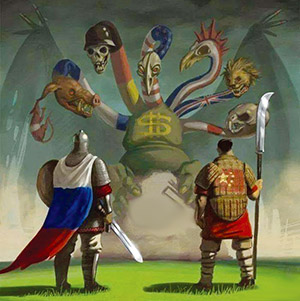
    Russia, despite inherent differences with its neighbour, has been thrust into a close partnership with China by clumsy and counter-productive Western policies. This has strengthened China’s economic and political position through facilitating access to energy, nurturing an unrivalled defence and technology partnership, and providing an unchallengeable foundation for the BRI, reaching across Eurasia, into Africa, and even commanding attention across vast oceans.

    In the past, native speakers of the English language have been privileged in a variety of ways to be at the forefront of unprecedented intellectual, political, economic and technological initiatives for more than three hundred years. These built first a global empire and then aspired to construct a new world order, only today to confront an End of Empire moment. 

    The challenge posed by the BRI and highlighted by a Beijing meeting, hosted by China’s President Xi Jinping in May 2017, is very poorly appreciated. Its vision of new-tech infrastructure spanning and uniting Eurasia, Africa and beyond represents a fundamental conceptual transformation of the international trading and cultural order. China is at the strategic centre, in terms of infrastructure capacity, financial organisation and technological vision.

    The BRI will create many newly empowered multi-lingual and multi-cultural trading communities where the authority of the English language and its associated ways and values will be a fading memory. High-speed rail networks, massive ports and a variety of free trade zones will marginalise the English speaking, maritime people who have shaped the past three centuries, unless they integrate fully. 

    End of Empire periods are characterised by a major dilemma. Loyalty demands a commitment to the values and actions that have defined the past and the construction of empire. Strategic response and action, in contrast, demands a fundamental re-evaluation of those past values and actions and a readiness to anticipate and manage often unattractive imperatives. As relationships evolve and shift, this is a troubled and confused process. Previously privileged groups find themselves struggling internally to defend accustomed, but fading, powers and privileges.

    While the above historical phenomena seems universal, it is best and most copiously recorded in one part of the world. China has extensive written histories, and more recently diverse television series, exploring and evaluating human behaviour in the course of successive rises and falls of dynasties. These offer many insights into the confusing and chaotic trials being experienced in the English speaking world today. The complacent certainties of Manchu aristocrats at the end of the 19th century can seem to foreshadow similar qualities in Wall Street bankers in the early 21st century. In both instances, the comforts and certainties of the recent past inhibit the development of any coherent strategies to manage the challenges of the present and future.

    Competing English & Chinese Strategic Wit 

    Unfortunately, in today’s English speaking world there is neither a similar body of historical experience nor any form of comparable historical record. This allows the Chinese leadership class to oversee Western decline with both passive inaction and superior understanding. 

    A Western leadership class educated in Chinese classics and history might have remarked that its problems began over seven decades ago. At that time, a conquered and occupied Japan resorted in a highly disciplined manner to utilising a strategy that could be traced back at least as far as the Zhou Dynasty three millennia ago. The Twelve Civil Offensives of the Six Secret Teachings attributed to Jiang Taigong, the major strategist in the founding of the Dynasty, outline a means of conquest through service. A more powerful adversary is made first dependent, then vulnerable, through immaculate service.

    Despite a type of Western counter attack against the Asian Economic Miracle with the 1997 Asian Financial Crisis, China and other Asian peoples have been able to continue emulating Japan’s post-1945 example. Even so, no relevant Western leader has remarked on, let alone responded strategically to, this type of disciplined dexterity that turns weakness into strength, when confronted with a more powerful adversary.

    This example is but one of many that illustrate the contemporary failings of the English speaking peoples. A mythology has been created around their leadership role in creating a culture of progress. This works to render the past irrelevant and eliminate the need to study the historical experience and wisdom of other peoples. The British historian John Hobson in The Eastern Origins of Western Civilization identified a British practice of “intellectual apartheid,” which mocked and looked down on people who did not share the progressive values of the European Enlightenment.

    The folly of this Western culture of progress also elevates a type of financial power and corporate calculation to a form of supreme authority. This is displayed in a major form of criticism levelled against the BRI. This argues that it is difficult to see how many of the projects can produce an acceptable return on capital but neglects to note:

    • China’s need to find new markets to replace uncertain, and often declining, Western markets
    • China’s need to address economic instability amongst people on its Western borders
    • China’s rewards from economic dynamism in its Western regions
    • China’s already advanced strategy of becoming the global infrastructure standard setter
    • China’s use of BRI as a productive outlet for its reserves of fragile US dollars 
    • China’s use of BRI to defuse attempts to pressure it geopolitically
    • China’s use of BRI to consolidate its important relationship with Russia and other neighbours
    • China’s use of BRI to bond with surrounding and distant regions
    • China’s use of BRI to assume a central and leading position in global geopolitics 
    • China’s use of BRI to reduce the power and influence of an often hostile English speaking world 
    • The neglect, deliberately or otherwise, of these issues by most English language commentators reflects a variety of deep-seated Western vulnerabilities, including:
    • Chinese strategic thought and action frequently escape Western recognition
    • Chinese strategic action is almost impossible to comprehend using Western corporate values and priorities
    • Chinese strategic action exploits a deep mastery of Western thought 
    • Chinese strategic action can be based on Western ignorance of Chinese thought
    • Chinese remember and Westerners forget a century of Chinese humiliation
    • Chinese easily master the financial and corporate stereotypes that dictate Western thought
    • Chinese classical and historical wisdom has an infinite variety 
    • Chinese language limits severely Western understanding
    • Chinese strategists can count on the untranslatable character of much of their wisdom

    Interestingly, a book has just appeared with the title Cracking the China Conundrum: Why Conventional Economic Wisdom Is Wrong.

    A Problem for Imperial Legacies 

    Peoples such as those in what might be termed legacies of empire, like Australia, confront unique challenges during end of empire times. The centres of empire do not want to surrender accustomed privileges, even in distant parts of the world. The outposts of empire are also accustomed to various privileges, even if they are in decline, and can be loath to take the initiative in preparing for a future that promises less favours. Even worse, many habits of thought and behaviour are the product of empire and people have little idea of other possibilities even as these assume a powerful role in distant places. In this situation past habits and practices can continue to rule even when they no longer serve their intended purFor example, people in a country like Australia can continue to believe in the superiority of American and English education, commerce and technology even as evidence mounts that global best practice standards are being set in Japan or China. These sentimental and customary attachments become most difficult to abandon when such an adjustment demands the mastery of a difficult language, an alien way of thinking and challenging forms of community coherence. A review of the Australian Cabinet reveals not one person with any education, experience or interest of significance in a major Asian language, culture or economy.

    Not surprisingly, such a leadership community looks constantly to declining centres of empire far from Australia for guidance on how to respond to unfamiliar challenges. Alternatively, it takes guidance from those educated to the standards and habits of thought of those declining centres of empire. These authoritative figures produce guidelines for policy makers with erudite think pieces with headlines in English like “Saving the Global Economic System.” A more appropriate theme would be “The Challenges of Prospering in an Unfamiliar Global Economic System.” 

    In reality, the English language has become a thought prison for most. They cannot begin to think from the perspective of an emerging Chinese global economic system. Of course, this is no simple matter. 

    Once out of the education system, few career focused individuals can afford to venture into such a challenging and alien environment. Those who might decide that this cannot be avoided are unlikely to progress far. It will simply be too hard to build a community of like educated and like-minded allies to exercise any influence on the mainstream, to advance a professional career or become more than an irritating critic on the sidelines.

    In fact, three decades, from early childhood rote learning of the classics to professional relevance, would be needed to educate a generation of China literate professionals. As a consequence, most of the English speaking world will become ever more dependent on ethnic Chinese native speakers to assume leadership roles in a bewildering environment, best understood from Beijing. This is easily foreseeable and predictable today. This assertion, however, will be bitterly, if ineptly, contested in the English speaking world.

    Inevitable economic difficulties and budget funding shortages are already pervasive. These will become increasingly acute, as English language leaders continue to neglect the development of a greater capacity to comprehend the character of Chinese thought culture. 

    This is transforming the world first constructed by the Honorable English East India Company, under the guidance of its discreet, strategic and knowledgeable financiers. Unfortunately, few English speaking political leaders comprehend in any depth either the financial strategists who have shaped the fading global order or the Chinese strategists who are creating a dynamic new global order. 

    Today the West’s financial strategists not only support a succession of self-defeating wars but continue to neglect the importance of effective industrial policy and infrastructure maintenance. American infrastructure is in an advanced stage of neglect and disintegration. The Australian Treasurer has just announced plans to spend $10 billion over the next decade on an inland rail upgrade. But this may symbolise Australia’s increasing backwardness in rail efficiency. On completion, it could lag Chinese standards by more than several decades. At a time of imperial decline, the cost of being a legacy of empire takes many forms.
    The British Imperial Legacy

    Australia, being placed geopolitically and geocommercially in close proximity to, if not as part of, the dynamic Asian region, offers perhaps the most acute study of the dilemmas posed by the legacy of the British empire. Its present government in Canberra displays no evidence of any serious understanding of BRI or other Chinese and Asian dynamics. 

    It is difficult to avoid the impression that its Ministers are more guided by influences from a fading imperial past than by any understanding of Australia’s geopolitical and geocommercial realities. The nation’s leaders seem restricted to developing policy shaped by ‘information’ from the Murdoch and Fairfax media, which rarely strays from the orthodoxies of mainstream New York media and its financial masters. 

    In a sense, Australia’s present leadership seems too indolent to explore information from alternative sources or from insights and evaluations shaped by other traditions of thought culture. In many respects, and despite Australia’s geocommercial Asian dependence, Australia’s leaders seem to be little more than modelled on global English language stereotypes. As such they are captives of the disorder that is the contemporary legacy of an English speaking empire or world order.

    After some of their predecessors tried but failed to give substance to rhetoric about an Australian Asian future, the present generation of leaders seem resigned to leaving the future to others who will come later. They seem content to limit themselves to managing domestic disappointments as the economy is unnecessarily marginalised in a global order offering fewer and fewer privileges to English speaking peoples. Democratic processes perform poorly in this environment as Ministers mostly come to power with little relevant education or experience and leave power before the consequences of their failings become evident. English language limitations and conventions ensure a minimum of informed criticism of this process, as the maintenance of the mythology of democracy takes priority. 

    In Australia’s case there is a faint but unnerving echo of the innocence of the Aboriginal people before the arrival of European settlers. Mono-cultural Australian leaders today have little more real understanding of their neighbouring Asian civilisations than earlier settlers had of European civilisation several centuries ago. Yet the imperial certainties that created today’s Australia are now under challenge.

    [alert type=”general” dismiss=”no”]This article was published in New Dawn 164.[/alert]

    [alert type=”success” dismiss=”no”]If you appreciate this article, please consider subscribing to help maintain this website.[/alert]

    © New Dawn Magazine and the respective author.
    For our reproduction notice, click here.

  • Modern Medicine: The New World Religion

    Modern Medicine: The New World Religion

    From New Dawn 99 (Nov-Dec 2006)

    East Asia and possibly South Asia have strong traditions that offer insight into Western medical and scientific follies, but many parts of the developing world are much more vulnerable. The French author, Olivier Clerc, in his 2004 publication, Modern Medicine: The New World Religion has exposed the complex and confused mix of Christian and Enlightenment forces unleashed on many communities without effective traditional spiritual and scientific defences.

    It is perhaps no accident that Clerc comes from a nation that, like those of East Asia, has sought ways to defend traditional agricultural and food cultures from the dictates of Anglo-American free trade and market forces. France is also a nation with a uniquely strong administrative tradition capable of exercising authority over corporate interests.

    Clerc offers a unique and powerful insight into the way in which contemporary life and thought in developing nations have been perverted by a wicked mix of the power of corporate marketing, the mystique of science and the superstition of religion. He shows how illusion operates at many levels in society and how medicine and religion become entangled and almost inseparable in popular faith.

    The following summary is derived from an outline on the web of Clerc’s book. He shows that illusion and faith are central qualities of Western civilisation, which are distinguished with difficulty. They are capable of destroying spiritual and health wisdom wherever they are found.

    Clerc remarks on how Christian missionaries of the last three or four centuries sought to evangelise ‘primitive people’ by destroying or burning the various cult objects of these people in order to eradicate their religions, superstitions and customs.

    Yet, whether it was conquistadors stamping out Inca culture, the Inquisition stamping out European heresies, or Christian missionaries stamping out Voodoo or other African and Asian religions, the destruction of objects of worship did not prevent the continuation of strongly rooted inclinations, albeit with different qualities.

    Clerc shows that the supposed secularisation of present day society is also just an illusion, with the beliefs and superstitions of Judeo-Christian culture remaining deeply embedded in the modern Western subconscious, becoming identified with many secular aspects of daily lives without people realising it.

    The daily evening television news bulletins, the stars of show-business and sport, humanitarian associations, cults and all sorts of other things in modern life have become the new gods that are venerated or feared. The field of medicine, however, most displays this unconscious transposition of the religious experience and enjoys an astonishing degree of undeserved credit out of all proportion to its actual results.

    While real health regresses and great medical ‘miracles’, such as vaccines and antibiotics, display their limitations, medicine and science have replaced religion as the only certain belief in an uncertain world. Doctors and scientists are seen as the priests of the new religion, delivering through the certainties of science what the old discredited gods were not able to deliver.

    If we can no longer believe in the miracles, the cures and the curses of the old religions, we can certainly believe in the miracles, the cures and the destructive powers of the new science.

    Medicine, like religion, has taken on a saving or messianic role, with qualities that have often characterised the Roman Catholic Church, such as autocracy, centralisation, the control and manipulation of people, censorship, propaganda, total obedience, infallibility, the destruction of heretics and the stamping out of individuality. All has been done for public health and the general good, just as the church acted for mankind’s salvation.

    People, whether within the medico-pharmaceutical industry or outside it, are being subconsciously influenced by deeply rooted myths, fears and superstitions, projected onto the new screens of science and medicine.

    Although medicine sees itself as exclusively scientific and rational with no room for spiritual or human dimensions (such as psychic healers or shamans who are dismissed as charlatans), it organises itself and functions in a way that is intrinsically religious. But, by rejecting a spiritual dimension medicine in fact becomes the toy of the forces and myths it tries to ignore and cannot control.

    Clerc holds that, even though Western society considers itself to be secular, it has remained as Christian as it was a century ago but with two major differences.

    Firstly, it is not aware of it. It fails to recognise that it is still observing the old religious rituals but under a new guise. Secondly, society now lives its religious experiences through secular forms – medical ones in particular – and has transferred its hopes and aspirations from the spiritual world to the material.

    Western medicine has sought to become the new world religion. The specific myths, beliefs and rites of Christianity have been projected over medicine since Pasteur. Physicians have taken the place of priests. Vaccination plays the same initiatory role as baptism and is accompanied by the same threats and fears. The search for health has replaced the quest for salvation.

    The fight against disease has replaced the fight against sin. Eradication of viruses has taken the place of exorcising demons. The hope of physical immortality (cloning, genetic engineering) has been substituted for the hope of eternal life. Pills have replaced the sacrament of bread and wine. Donations to cancer research take precedence over donations to the church. A hypothetical universal vaccine could save humanity from all its illnesses, as the Saviour has saved the world from all its sins.

    The medical power has become the government’s ally, as was the Catholic Church in the past. ‘Charlatans’ are persecuted today as ‘heretics’ were yesterday. Dogmatism rules out promising alternative medical theories. The same absence of individual responsibility is now found in medicine, as previously in the Christian religion.

    Patients are alienated from their bodies, as sinners used to be from their souls. People are still being manipulated by their fears and childish hopes. They are still told that the source of their problems is outside them and that the solution can only come from the outside.

    They are not allowed to do anything by themselves and they must have the mediation of priest-physicians, the administration of drug-hosts, and the protection of vaccine-absolutions. In other words, the secularisation of society happened only on the surface.

    Behind the different structures of medicine and the Church of Rome we find the same fundamental concepts, the same relationships, the same characteristics, the same fears, the same hopes and expectations.

    This substitution of medicine for religion has many unfortunate consequences.

    In medical research, it influences what should be looked for and what can be discovered. Any discovery or theory that is at odds with the overarching orthodoxy is rejected and its authors called heretics. Entire areas of research, as well as promising new lines of approach, are thus disqualified.

    Furthermore, the unconscious need to bring the medical world into ‘religious’ obedience frequently leads to (involuntary) falsifications of results, as became clear with Pasteur’s discoveries. The medical credo takes precedence over reality, which remains unacknowledged if it does not correspond with preconceived ideas.

    Lastly, the hidden religious dimension of modern medicine inhibits the free debating of already fixed beliefs. Dogmatism, irrationality and passions – all characteristic of the religious experience – take precedence over calm and carefully thought out argument.

    The vehemence that led Galileo to be condemned by the Church for his theories, in spite of the scientifically demonstrable facts, is now being used by medicine to reject any thesis that is contrary to its own dogmas. Science has learned its lessons from the Church.

    With the development of science and the rise of intellectualism, the Western world has tried to rationally justify these beliefs, under the cloak of medicine and life sciences and utilising three layers of false consciousness:

    • a core of fears, from which we have learned to protect ourselves by covering it with
    • a layer of beliefs, which make us feel safe (even though those fears have not disappeared), this layer being itself dissimulated under
    • an intellectual varnish, a rational facade, which give us the illusion of having transcended superstitions and beliefs, and which shelters us from our fears, keeping us barricaded behind intellectual knowledge.

    The use of religious fears and beliefs, under a cloak of rationality, for worldly ends has a long and prestigious political history in the West. This includes the prominent figures of the Roman Emperor Constantine and the English King Henry VIII, who each took major institutional initiatives and used the power of the Church to extend their own worldly reach.

    Arguably, much of the success of East Asia in recent years can be explained by spiritual and health traditions that place the emphasis on personal discipline and direct intuitive understanding and develop strong defences against fear, belief and intellectual varnish.

    Moreover, the Confucian, Daoist and Zen (or Chan) Buddhist traditions contrast starkly with the Western political practice of using peoples’ spiritual needs as a political tool. The Falun Gong movement has fallen foul not of communist intolerance but of a long and deep tradition of Chinese political wisdom.

    Clerc emphasises that taking personal responsibility for one’s own health, one’s own inner evolution, and one’s own life at every level, without rejecting any available help or advice, remains the safest and most rewarding attitude. This is hard to separate from the essential teachings that sustain East Asian spiritual traditions.

    Moreover, the practice of refined therapeutic disciplines like qi gong and taiji quan quickly develops for the attentive student sensitivities and dimensions of spiritual, mental and physical awareness. These can be highly effective in shaping and guiding healthy behaviour.

    On the one hand, the student become aware of stretching, breathing, internal and other exercises that help create a general sense of physical well-being and a confidence that ailments can be remedied with appropriate attention.

    On the other, the student is much more conscious of harmful behaviour, excessive pressure, nutritionless food, bad air and other modern realities that are best avoided where possible.

    Overall, the student develops practices of spiritual and mental reflection and calm that are self-empowering and that liberate from the fraudulent seductions exposed by Clerc.

    The gentle but demanding disciplines of qi gong and taiji quan highlight fundamental differences between Eastern and Western approaches to well-being, understanding and consciousness.

    At the physical level, they highlight an Eastern preference for a soft approach that nurtures and explores well-being in a manner that is sympathetic with the natural order of organic life. The Western preference is more often for forms of harsh activity that promise much but do so at the cost of distracting attention from sensitivity and awareness.

    At the intellectual level, they highlight an Eastern concern to remain free from the artificial constructs of the human mind and to retain the capacity to experience reality directly and without the distractions of hidden assumptions or excessive effort.

    The Western preference seems inclined to accept the authority of predetermined structures in ordering reality and to abandon personal independence to mass convictions, whether these be religious, ideological, scientific, rational or physical.

    At the spiritual level, they highlight an Eastern preference for a disciplined, reflective consciousness that empowers the individual with confidence in personal sensitivities and life fulfilment.

    The Western preference seems more disposed to mobilise people in forms of mass conviction with promises of postponed reward of one form or another, while being careless about the ravages inflicted by hidden political and worldly ambitions.

    Chinese qi and Japanese ki, like Indian yoga, disciplines offer a sensitive, realistic and exploratory understanding of and insight into one’s own spirit, mind and body. This, in turn, begins to develop an awareness of the perils of contemporary living and eating customs and expose the dangers of faith in the assertions of modern Western scientific and medical dogma.

    They also equip the practitioner with spiritual, mental and physical tools of defence against the pressures, fashions and distractions that pose as imperatives in modern Western life and lead people into behaviour that has produced today’s epidemic of degenerative diseases.

    In particular, by cultivating an acute and positive consciousness of one’s own natural organic being they nurture an immediacy and directness of perception that transfers to other areas and that strips away many of the confusing artifices that clutter the contemporary world.

    The independent strength, nurtured by these forms of Asian spiritual, mental and physical wisdom, can help explain much of the East Asian region’s unique success in competing with the West in terms of social, economic and health well-being.

    Once Mao Zedong ridded China of its opium plague, the people of East Asia have all worked on building societies as free as possible from the seductive follies that Clerc has identified. The therapeutic and meditative disciplines of traditional Daoist and Chan Buddhist wisdom work to expose and protect against corrosive religious, medical, scientific and other superstitions.

    [alert type=”general” dismiss=”no”]This article was published in New Dawn 99.[/alert]

    [alert type=”success” dismiss=”no”]If you appreciate this article, please consider subscribing to help maintain this website.[/alert]

    The above is reprinted from the section “Transferring Christianity and Science to the Developing World” in Reg Little’s book A Confucian-Daoist Millennium? (Connor Court Publishing, 2006).

    © New Dawn Magazine and the respective author.
    For our reproduction notice, click here.

  • The Untold Story of China’s Rise

    The Untold Story of China’s Rise

    This article was published in New Dawn Special Issue Vol 9 No 1 (Feb 2015)

    There are many untold stories about China’s rise. Initially, this story will begin almost four decades ago, but it will ultimately reach back as far as four millennia. It will close with the conclusion that we have today only witnessed the beginning of China’s rise.

    We begin in 1976 when the Australian Ambassador in Beijing completed a Dispatch exploring the implications for Australia were China to emulate Japan at that time and grow its economy by 10 percent each year. In Mao Zedong’s last year and at the end of the Cultural Revolution, this seemed improbable to most foreign policy officers, but Prime Minister Malcolm Fraser liked the Dispatch and used it to shape Australia’s China policy.

    The case for such rapid Chinese economic growth was based on a simple perception. After following Japan closely in the 1960s and as an Embassy officer who had studied economics at university, I was convinced that Japan’s unprecedented economic growth had little to do with the simple application of Western economic principles. Rather, it needed to be explained by distinctive cultural qualities.

    Considering much of Japan’s sense of civilisation, including the characters used in its language and the nature of its administrative class, derived from China, it was hard to see why the vast home of East Asian civilisation, China, would settle for second best, behind its off-shore, smaller neighbour. Moreover, by this time other Asian communities with a strong sense of Chinese tradition and civilisation were beginning to show the potential for economic growth similar to Japan.

    This line of thought poses many problems for the Western mind and for Western leaders. The implied irrelevance of ideologies like Capitalism and Communism has major implications not only for economic thought but also for political rhetoric and strategy.

    Consequently, although there was an emerging interest in the relationship between ‘Asian values’ and economic performance in the 1980s and 1990s, this was effectively killed off by the 1997 Asian Financial Crisis (AFC). A torrent of triumphalism about the failure of ‘Asian values’, Asian ‘crony capitalism’ and an associated unhealthy relationship between government and business seemed to discredit forever everything associated with the phrase ‘Asian values’. As a consequence, there has been little real follow up on the thought that inspired the 1976 Beijing Dispatch, although a public R G Neale Lecture in the Australian Department of Foreign Affairs and Trade in 2007, 31 years later, commended the foresight of the Dispatch.

    Even that lecture neglected to mention three books informed by the same insight that had used experience in Japan to predict China’s future rise. The Confucian Renaissance (1989), The Tyranny of Fortune: Australia’s Asian Destiny (1997), and A Confucian Daoist Millennium? (2007) were easily ignored as curiosities of no concern to men entrusted with practical commercial and political responsibilities.

    A decade after the 1997 AFC and a year after the 2007 R G Neale Lecture, the 2008 Global Financial Crisis revealed Western ‘crony capitalism’ to be far worse than the Asian version. Moreover, by this time Asia had again grown stronger. China had deftly managed Western attempts to exploit the AFC and was becoming the flag bearer of an Asian economic miracle that was transforming the global order. With typical discretion, however, this was branded ‘China’s peaceful rise’ and even used the 2008 Beijing Olympic Games to distract the attention of the West from its own rapidly declining economic power.

    In retrospect, global order has been discreetly reshaped since the American defeat and occupation of Japan in 1945 by the astute utilisation of China’s ancient cultural wisdom. This wisdom involved a form of ‘conquest through service’. It was first executed by Japan, then by other Asian communities and finally, and most critically and definitively, by China. Most remarkably, this strategy has continued, unrecognised by Western communities and their leaders for almost three quarters of a century.

    To a significant degree, this failure has been the unintended product of a political/intellectual strategy of ‘intellectual apartheid’ that marginalised and ridiculed in the Western mind all cultures but those shaped by the European Enlightenment and its ‘universal values’. By closing its own minds to the possibility of an alternative, more politically, administratively and strategically advanced culture, the West effectively ensured its own decline.

    While it might be suggested Australia used the 1976 Beijing Ambassador’s Dispatch to fully capitalise on the Asian economic miracle, this would be an exaggeration. Despite much rhetoric over more than half a century about being part of Asia, Australian leaders remain totally uneducated in terms of the Chinese classics that define Asian wisdom and success, and have done nothing to introduce such education for younger Australians. In addition, they have mirrored the folly of other Western nations in allowing themselves to be ‘conquered by service’, that is, for Australia, by the service of easily accessible and lucrative export markets.

    This may have been less insidious than in America and Europe, which have largely been stripped of their industry, technology and labour skills and left bankrupt and dependent on fiat currencies (printed paper serving as money) with less and less asset backing. Like Western communities in general, however, Australians have shown themselves to be incapable of understanding the irrelevance of their ideologies and, most importantly, their thought cultures in comprehending the transformation of the 21st century global community.

    The Source of Asian & Chinese Wisdom & Strategy

    It is critical to understand the sense in which Asia’s rise has been China’s rise. Everywhere in East and South East Asia, administrative and commercial elites are shaped and informed by Chinese tradition, classical wisdom and historical experience. This may be directly as in Japan, Korea, Vietnam and Singapore. Or it may be through elite minorities in the rest of the region, where Chinese traditions of education and thought set standards of excellence that other ethnicities must match to be competitive. Moreover, none of these peoples have been influenced in any comparable manner by their brief exposure to Western corporate and commercial intrusion and assertion.

    Today, there is a robust revival of traditional Chinese classical education in China and these other regions of Asia. In academies defined by ancient practices, children from the age of three learn the classics by rote and can recite whole chapters word perfect by the age of five.

    The best learning years of three to six are devoted to mastering texts in their original language from more than two thousand years ago. These texts are then effectively left in charge of shaping and guiding thought and life experience from a very early age. Early familiarity with classical Chinese language ensures ready access to China’s long, rich and continuously recorded historical experience.

    When one reflects on the content of the Confucian Analects, the Daodejing and the Book of Changes, it becomes obvious that this thought has many qualities not found in the Western tradition. Moreover, it is also evident the habit and discipline of learning that is nurtured at such an early age can be easily focused on mastering Western thought and tradition, but as an alternative and mostly less profound option. Consequently there are many educated Asians who are truly bicultural and capable of thinking and acting alternatively in competing thought cultures. For several reasons, there are very few, if any, comparably skilled Westerners.

    This poses a daunting challenge for most Western peoples. First, China has a thought culture that guides more than two billion people in East and South East Asia but that is little, if at all, understood in the West. Second, it also has deftly placed itself at the strategic and financial centre of new, potentially global initiatives like the BRICS Bank, an expanding Shanghai Cooperation Organisation and a transformative Eurasian trade zone. Third, it is becoming indisputably the world’s largest economy with the strongest financial reserves and almost certainly the global leader in educational depth and excellence as well as technological productivity. None of this fits comfortably with the mythologies that have guided the Anglo American powers over recent centuries in working towards a New World Order.

    All this is the contemporary manifestation of the renaissance of the world’s most remarkable continuous civilisation. Despite almost unanimous denial in Western communities, and, it must be recognised, much of the rest of the world, it is already impossible to think about the future in an informed and positive manner without basing one’s thought on the central and authoritative role that will be played by cities like Beijing and Shanghai.

    Even more important, wherever one goes in China, most parts of Asia and many parts of the world, it will be most advantageous to understand the pervasive and definitive role being played in contemporary affairs by the Chinese classics, Chinese history and Chinese political and commercial culture. Yet this will be made difficult by a common modesty, humility and discretion that characterises the behaviour of the classically educated Chinese gentleman or ‘junzi’.

    The Character of China’s Modern Rise

    In a major sense, it is a mistake to speak of China’s rise. It is more appropriate to speak of China’s renaissance. Until the Opium Wars in the middle of the 19th century, China had led the world in technology and economic production for much of human history. By the middle of the 20th century Mao Zedong’s revolution had begun to lay the foundations of China’s renaissance. This renaissance became apparent a little over a quarter of a century later when Deng Xiaoping took charge.

    The major new feature of contemporary China is the fact that the Anglo American powers have constructed a nascent global order and that China’s renaissance must take place at the centre of this global interconnectedness. This is the truly unique character of China’s contemporary rise, or renaissance. It is something which other powers have made unavoidable and not something that China’s leaders have taken the initiative in bringing about.

    Consequently, there is much in the rise of contemporary China that can only be understood by examining the interaction of modern Western influence with the renaissance of traditional Chinese culture. Until now, the impact of Western influence seems to have been dominant. Yet China’s success is only truly explicable in terms of the way in which its traditional culture has equipped it to out-strategise and out-compete the West.

    Equally, much Chinese activity has been dictated by imperatives imposed by the West’s modernity. Yet, as China becomes stronger, more independent and more Chinese in its choices, it is likely to expose many Western initiatives to profound re-evaluation.

    One needs only to look at the harm done to the environment, water, air, food and medicine by Western corporate imperatives to see possible benefits in this development. Of course, China today is a poor advertisement, having embraced many of these corporate imperatives in its rush to build its economy, re-establish its own cultural autonomy and gain some control over its future. It has, however, now largely achieved that and has the capacity to address such issues.

    China’s own traditions of law and government would seem much better designed to correct harmful corporate imperatives than common practices in Western democracies. Large corporations have increasingly demonstrated the capacity to write the policies and laws of elected governments through lobbyists, media influence, industry expertise and political funding, often with little regard to harm inflicted on the well-being of communities.

    In fact, exposure to the Chinese classics, history and political culture highlights the reality that many features of contemporary Anglo American civilisation have derived first from the imperial adventures of British corporations like the East India Company and more recently from the related initiatives of American corporations within a global institutional order constructed after victory in World War II.

    The rise of China and its Asian and other allies suggests that many Anglo American practices, values and priorities are likely to be reassessed from perspectives that have the capacity to surprise and marginalise today’s certainties. The failure of Anglo American strategists to understand vulnerabilities in their own culture and to explore the strengths of a culture with the world’s most outstanding historical record has led to both Western decline and Eastern rise. It is hard to see this situation now being reversed.

    Western peoples now have a diminishing period of time in which to educate and prepare themselves for a predictable future where past certainties and comforts will be subject to re-evaluation. The existing global order has been constructed on assertions of the superiority of Western values but these have proven vulnerable before an Asian challenge. It is still too early to outline the likely outcome of this competitive interaction of competing cultures but an understanding of traditional Chinese culture will be essential if Chinese approaches to the West are to be evaluated with any hope of strategic insight, accuracy and success.

    Classical Chinese Values

    China’s 21st century rise can only be appreciated in the context of the teachings of its classics. As already remarked, these are undergoing a revival of popularity as the foundation for shaping life and thought from a very early age. It must also be understood in the context of learnings from the use of those classics across several millennia, copiously recorded as a continuous account of the achievements and failings of the Chinese people. It is also critical to recognise that the fundamentals of traditional Chinese social, legal, economic and political behaviour are often very different from those of the modern West. Moreover, Western values are unlikely to have gained in authority from their failure to defend and preserve a position that seemed beyond challenge only several decades ago.

    It is also essential to appreciate that Chinese words and ideas rarely translate accurately into English or other European languages. The reverse also applies, as the respective cultures and histories are too different to allow simple verbal equivalences. Yet, even if one begins the examination of Chinese classics in translation, it is immediately apparent that the Western mind is entering unfamiliar territory. For instance, the first three lines of the Confucian Analects read in English translation:

    Is it not a pleasure, having learnt something, to try it out at due intervals?

    Is it not a joy to have like-minded friends come from afar?

    It is not gentlemanly not to take offence when others fail to appreciate your abilities?

    It is hard to deny that this seems immediately to be a strange way to commence perhaps China’s greatest classic text. A number of comments may be made. First, the Analects illustrate clearly the difficulty of translating Chinese, particularly classical Chinese, into contemporary English. Second, the Analects are best rote learned in the original language at an early age and then used as needed as a remarkable collection of guiding wisdom throughout life. Third, the Analects exude a type of practical, searching humility that contrasts starkly with the sense of intellectual or philosophical pride and superiority evident in key Greek classics.

    Nevertheless, having recognised those stumbling blocks for the Western reader in a foreign language, it is clear the text places the highest authority in life on a lifetime of practical education, on the cultivation of diverse and far-reaching friendships or networks and on the ultimate virtue in human life of humility. These qualities are readily identifiable in Asian elites and, as will be explained further, are fundamental to Asian strategic wisdom.

    It should also be remarked that the Analects and the Book of Changes constantly use the family and its continuity over time as a central organising theme that illustrates intuitively the importance of the group over the individual. This echoes the distinctive character of China’s flood story four thousand years ago. This does not show God’s preservation of a virtuous man but rather the virtuous man’s preservation of his community, through the practical construction of canals and embankments.

    This family and group focus serves to highlight something strange, even corrupting, about the contemporary West’s prioritising of the individual, freedom and equality. It is possible to see this fragmenting both family and society and working to reduce much of life to a quantitative calculation among contending individuals. Certainly, the group coherence of Asian economies seems to have played a central role in their success.

    The first two lines of the Daodejing also reward reflection, reading:

    The Dao which one can explain is not the unchanging Dao.

    The Name which one can name is not the unchanging Name.

    From personal experience, I know that it is possible to struggle with these words for twenty years and still be bemused by their meaning. Yet, then, in a flash they can assume a meaning that changes the whole character of one’s thought. For me, this was to conclude that while words, ideas, concepts, rational structures and theoretical frameworks can be critical in organising the thoughts of the human brain and in communicating between human beings, they do not capture the full organic complexity and dynamism of the natural world. In my experience, the Western tradition with its central role of belief, whether in Plato’s transcendent forms, the Church’s God, the Enlightenment’s ‘universal values’ or the economist’s marketplace, nurtures a type of rigid attachment to abstract ideas and theories which impose limits on practical opportunities if they do not fit established thought patterns.

    The Six Secret Teachings of Jiang Taigong, a strategist and general who helped King Wen establish the Zhou Dynasty three thousand years ago, needs to be mentioned here even if it is not one of the more commonly referenced classical or strategic texts. It contains Twelve Civil Offensives that detail how a weaker party can overcome a more powerful adversary, simply through disciplined humility. This explains the provision of a service that conquers, first through cultivating dependency and later vulnerability.

    Once familiar with East Asia and with the contents of this text, it becomes almost impossible not to conclude that it has been this strategic thought that made Asia rich and the West bankrupt since 1945. In particular, Japan’s behaviour in the face of defeat and occupation seems to have followed meticulously the prescriptions of this work as it built the foundations of its economic rise. Other Asian communities familiar with the work, and ‘conquest through service’, did not find it hard to follow Japan’s example.

    A comment on the importance of historical literacy and awareness also directs attention to an area where China has a strength that is little understood in the West, where end of empire talk often refers back almost two thousand years to the Roman Empire. The more recent Austro-Hungarian or Ottoman ends of empire are rendered irrelevant because of the fragmented character of Western experience and consciousness. In China, however, the sense of history embraces at least six major and a number of smaller end of empire experiences over the past two thousand years.

    A television series on the mid 19th century Han General Ceng Guofeng, who saved the Qing Dynasty and its Manchu aristocrats from the Taiping rebels, can be revealing. It shows Manchu aristocrats whose sense of privilege and certainty does not allow them to address the mounting challenges to their world in any coherent or strategic manner. It is remarkable how this invites comparison with contemporary Wall Street bankers and their neglect of the mounting challenges to their political certainties, all defined by the incestuous preoccupations of New York and Washington.

    It should also be noted that Chinese language and history are enriched with thousands of words and expressions that simply do not translate into English. One example is the opposing expressions ‘junzi’ (gentleman) and ‘xiaoren’ (small or petty man). Neither bracketed translation is adequate. ‘Junzi’ might be said to refer to those humbled and refined by classical knowledge and suitable for administrative responsibility. ‘Xiaoren’ refers to those with an eye to a quick, and possible nasty, profit. It is not difficult to raise a laugh with a Chinese friend by saying that an American MBA qualifies one to be a ‘xiaoren’, making an easy target for a ‘junzi’ aware of Jiang Taigong’s civil offensives.

    Any outline of Chinese classics, history and culture can hardly scratch the surface of this world. Many Chinese today understand it poorly, but all of China’s leaders since 1949, including Mao Zedong [see ‘Mao’s Communism’ on page 58], were deeply educated in it and this is unlikely to be any different with future leaders.

    The Challenges Inherent in the Untold Story of China’s Rise

    A recent American response to the challenge of civilisation posed by China’s rise has been remarkably misguided. It involves ramping up a campaign of misleading allegations against the Chinese attempt to share their understanding of civilisation through the expert and financial support of Confucius Institutes. This suggests that a continuing denial of obvious realities will characterise much of the Western response to China’s economic and cultural renaissance.

    In some ways, the challenge that confronts the West is comparable with that which confronted distant peoples colonised by the European people’s use of corporate organisation and aggressive technology to enhance their wealth several centuries ago. It is less violent but it is just as incomprehensible in terms of the familiar mythologies that shape Western certainties.

    History suggests that the Chinese custom of tributary states is much more benign and enriching than the West’s colonising or ‘civilising mission’. Yet this is dependent on an acceptance of reality in a peaceful and constructive way. Despite a widespread continuing assumption of Western pre-eminence, there is already much evidence there is little prospect of reversing established trends of growing Chinese strength and declining Western capacity. This seems true, whether in terms of political, military, technological or economic influence. Moreover, there is growing evidence that we have only seen the beginning of China’s rise, or renaissance.

    Any realistic assessment of the challenges ahead now needs to address questions related to the movement from the certainties of an Anglo American global order to the probabilities of a reborn Chinese civilisation that influences events in all parts of an interconnected global community. Policies that are already publicly understood, although minimally reported in mainstream Western media, make it clear that China is taking the lead in the construction of major infrastructure like very-fast trains, in the transformation of Siberia and Eurasia through unprecedented initiatives, in investing globally in previously undeveloped natural resources, and in acting independently of institutional forms long established and reinforced by Anglo American authority.

    The continued denial or distortion of such realities will only compound mistakes and misjudgments that have already damaged Western interests. Despite major failings in Australia’s response to China’s rise, its experience and that of other Western peoples offers evidence there can be as many opportunities as challenges in this rapidly changing environment. Political, commercial, educational and other leaders need to take the initiative. After all, Anglo American corporate and commercial culture has proven uncompetitive in a world where it made the rules. It is unlikely to do better in a world where it no longer makes the rules.

    An expectation and insistence that China conform with the often self-serving Anglo American norms of recent history can only prove increasingly counter-productive. In contrast, rewards will be won by those who display humility and initiative and commit to the arduous toil of mastering, if only in a limited way, the untold story of China’s remarkable economic and cultural rise, or renaissance.

    [alert type=”success” dismiss=”no”]If you appreciate this article, please consider subscribing to help maintain this website.[/alert]

    © New Dawn Magazine and the respective author.
    For our reproduction notice, click here.
  • The Counterfeit Culture & the Fall of the US Empire

    The Counterfeit Culture & the Fall of the US Empire

    “The Counterfeit Culture” is the title of an article on 2 September 2011 by Mike Adams in his widely distributed daily health email newsletter NaturalNews. He used it to express a dismay that is increasingly widespread, essentially as a result of the corporate takeover and corruption of America.

    Amongst his protests were the following:

    The Federal Reserve is in the business of counterfeiting money.

    The mainstream media is in the business of counterfeiting news.

    The pharmaceutical industry is in the business of counterfeiting medicine.

    The medical schools are in the business of counterfeiting medical degrees.

    Doctors are in the business of counterfeiting false medical authority.

    The mega-sized food corporations are in the business of counterfeiting food.

    The global consumer product companies counterfeit consumer products (“baby oil” from petroleum).

    Social networks like Facebook are in the business of counterfeiting friends.

    Home builders construct counterfeit homes (that won’t stand in 20 years).

    Public schools counterfeit school diplomas. (Who needs to learn to write?)

    The Pentagon counterfeits war. (Bomb the World Trade Centre & blame someone!)

    Mainstream historians counterfeit history.

    Apart from his initial noting of counterfeit money and counterfeit news, understandably Adams focuses mostly on healthcare counterfeits. His inclusion of the September 11, 2001 atrocity as “The Pentagon counterfeits war,” almost as an afterthought, captures something perverse about the contemporary American psyche. After all, this event transformed America more than any other nation in the following ten years, rarely for the better. Adams identifies it as a counterfeit but allows it to be hidden amongst a number of even more troublesome counterfeits.

    There are many more iatrogenic deaths each year than the 9/11 deaths in 2001, but they do not normally serve as a cause for public outrage (iatrogenic refers to complications caused by medical errors). Certainly, they are far from being a credible justification for bankrupting the nation with foreign invasions and unwinnable small wars. Indeed, a commentator of the insight, knowledge and judgement of Mike Adams is so overwhelmed by the corruptions and counterfeits pervading healthcare that he seems to be exhausted by simply recounting his grievances and unable to do much more than list the abundance of counterfeits.

    An article by Gary Null PhD et al reveals something of the extent of the medical counterfeits that preoccupy Adams.

    “A definitive review and close reading of medical peer-review journals, and government health statistics shows that American medicine frequently causes more harm than good. The number of people having in-hospital, adverse drug reactions (ADR) to prescribed medicine is 2.2 million. Dr. Richard Besser, of the CDC, in 1995, said the number of unnecessary antibiotics prescribed annually for viral infections was 20 million. Dr. Besser, in 2003, now refers to tens of millions of unnecessary antibiotics.

    “The number of unnecessary medical and surgical procedures performed annually is 7.5 million. The number of people exposed to unnecessary hospitalisation annually is 8.9 million. The total number of iatrogenic [induced inadvertently by a physician or surgeon or by medical treatment or diagnostic procedures] deaths is 783,936.

    “The 2001 heart disease annual death rate is 699,697; the annual cancer death rate is 553,251. It is evident that the American medical system is the leading cause of death and injury in the United States.”1

    Shocking as it sounds initially, the immediate death toll from 9/11 of close to 3,000 was nothing in comparison. Moreover, annual expenditure per person on American health care is more than double that in most comparable nations, dwarfing the comparable impact and cost of 9/11 and highlighting the pervasive nature of American counterfeits. The subsequent reactions and wars that followed 9/11 incurred costs to rival those of the American medical system.

    Related to the above, but still poorly understood, American deficit finance (the Fed’s counterfeit money), is beginning to threaten the viability of the US dollar as the world’s reserve currency. This casts dark clouds over the future authority of a nation that would have to reduce its spending (much of it medical and military) each year by at least $1.5 trillion were it not able to continue printing at whim the global currency.

    Like the other counterfeits, this attracts surprisingly little reflective analysis. The direct link between the problems of the Fed’s counterfeit money, the waste inherent in the American counterfeit medical system, and the never-ending War on Terror forever maintained by the counterfeit commemoration of 9/11, is rarely remarked. This reflects the pervasiveness of Adams’ “counterfeit culture.”

    The Cost of the US Response to 9/11

    Joseph Stiglitz, a Nobel laureate, notes in an article for Al Jazeera that:

    “The September 11, 2001, attacks by al-Qaeda were meant to harm the United States, and they did, but in ways that Osama bin Laden probably never imagined. President George W Bush’s response to the attacks compromised the United States’ basic principles, undermined its economy, and weakened its security.

    “The attack on Afghanistan that followed the 9/11 attacks was understandable, but the subsequent invasion of Iraq was entirely unconnected to al-Qaeda – as much as Bush tried to establish a link. That war of choice quickly became very expensive – orders of magnitude beyond the $60bn [billion] claimed at the beginning – as colossal incompetence met dishonest misrepresentation.
    “Indeed, when Linda Bilmes and I calculated the United States’ war costs three years ago, the conservative tally was $3-5tn [trillion]. Since then, the costs have mounted further. With almost 50 per cent of returning troops eligible to receive some level of disability payment, and more than 600,000 treated so far in veterans’ medical facilities, we now estimate that future disability payments and health-care costs will total $600-900bn. But the social costs, reflected in veteran suicides (which have topped 18 per day in recent years) and family breakups, are incalculable.”2

    Stiglitz captures succinctly the manner in which America often harms itself more than its “enemies.” Whether al-Qaeda was responsible or not for 9/11, and there are many who question the official story, the response has profoundly damaged US military, political, moral and financial credibility and authority. Moreover, the evolving situations in Libya and Syria could threaten to expose another counterfeit – increasing reports suggest that the US-led NATO alliance is relying on al-Qaeda identities, possibly originally part of some Saudi mercenary group, to advance rebellion in states that fall into disfavour.

    It is the counterfeiting in news, education and history however, that ensures that all these other counterfeits go largely unremarked in serious political, administrative and public debate and comment. This has created a major anomaly in the present global environment where the world is being precipitated into a new order by the ineptness and incomprehension of American and other Western elites. These are trapped in narrow, short-term frameworks of information and thought. They have become defined by rigid ideologies that make them subservient to a chaotic collection of corporate interests. Corporate profit seekers have captured control of critical political, legal, academic and other processes in the major English speaking powers, and through them they cling with self-destructive desperation to the power to dominate and define much international interaction.

    The Internal Decay of Corporate Power

    The attempt to shore up corporate privileges, often related to access to energy in less developed nations, has led to seemingly endless entanglement and draining of resources in small unwinnable wars. In this process, the Pentagon has been given unlimited license to plunge the US budget ever deeper into deficit and its own activities ever further into dependence on foreign, and not necessarily friendly, financiers.

    Moreover, the readiness of American corporations to become ever more dependent on cheaper and more efficient foreign production ensures both the increasing depletion of their own productive capacity and the growing vulnerability of their financial institutions. It is extremely difficult to identify anyone who has strategic responsibility for what seem to be a confusion of disjointed policies that plunge America ever further into a morass of crises.

    Policies are overseen by those who win a few minutes in the political spotlight. Yet they are forever distracted and preoccupied by trying to win favour and approval by servicing the corporate lobbies that fund and endorse their campaigns. They have no time left to even reflect on echoes of more productive strategies from a dimly recalled past.

    As the “counterfeit culture” suggests, the lack of coherent strategic thought has wreaked havoc within the United States. Although a multi-cultural community, America’s academia, media, corporate and political cultures display no capacity to generate meaningful policy discussion that allows for other than very narrow and stereotyped cultural assumptions. This cripples the capacity to comprehend the increasingly complex dynamics of the global community.

    Corporate America has brainwashed a priesthood of trained economists to rehearse endless counterproductive economic theory. This has been successful in deceiving domestic populations but has been disastrous by leaving the nation totally vulnerable and defenceless before other cultures that have mastered American corporate dogma and identified and exploited its weaknesses.

    The fragmented, short term and narrow corporate domination of the political process gives the highest priority to a cacophony of disputing corporate interests over any coherent recognition of community priorities and strategies. It makes it easy for external interests to associate closely with and achieve their goals through domestic corporate lobbies. In the midst of this self-serving and self-destructive corporate confusion, is it any wonder that medical and military systems have strayed far from the businesses of health care and national defence.

    [alert type=”info” dismiss=”no”]If you appreciate this article, please consider a subscription to New Dawn magazine.[/alert]

    An End of Empire Moment

    It is highly questionable that the events of 9/11 could have produced the outcome they did in any other than such a community as contemporary America. There is in the United States an almost total breakdown of culture, whether political, strategic, financial or military. In a sense the task for rivals is now simply a matter of feeding these weaknesses and being patient. Yet, the frenetic character of American society makes this seem unbelievable, only making it more inevitable and ever closer.

    The corporate adventurism that built the British Empire has become the corporate self-indulgence and corruption that devastates the contemporary American Empire. All the elite groups that exercise real power and influence in the United States – such as politicians, financiers, Pentagon strategists, corporate managers, pharmaceutical executives, food scientists and agricultural entrepreneurs – have assumed a type of unchallenged authority in their areas and a variety of alliances of convenience with the other groups. This ensures that little reform is imaginable, let alone possible. All politically correct information is designed to reinforce the interests of the very groups that have brought the country to its present plight. Deviation from such information signals the end of any personal professional aspirations. Even successful presidential candidates have no option but to negotiate a modus vivendi with such groups and, in the process, abandon any aspiration to dealing with the real challenges at the end of an empire. This shows some surprising similarities with those at the end of other empires, even including the Chinese Qing Dynasty.

    America’s end of empire moment is unique in an important respect. Even Britain was still controlled by a type of inherited aristocracy when it entered into decline. All previous empire collapses tended to be associated with aristocracies that had become ineffective. Apart from a few inter-generational banking families, America’s fate has been guided and dictated by privileged professional groups who have a monopoly on “expert knowledge.” They have become accustomed to a type of indolent privilege based on this “expert knowledge,” which, unfortunately for them, is no longer competitive, or even relevant, in a rapidly changing world. Consequently, they have become the guardians of little more than their own illusions, indulgent privilege and the nation’s decline. This is the source of dismay about the counterfeit culture, whether in medical, military of other areas.

    Disintegration of the Existing Global Order

    There is a growing body of observation, particularly but not exclusively in financial commentary, on the imminent collapse of a global system based on American pre-eminence. This takes on particular importance because it signals not just a decline in American power and authority but also the end of a period of what might be called loosely Anglo-American global order.

    Marc Faber, Mr. Doom and Gloom himself, who is well respected in the financial world, spells it out: “I think we are all doomed. I think what will happen is that we are in the midst of a kind of a crack-up boom that is not sustainable, that eventually the economy will deteriorate, that there will be more money-printing, and then you have inflation, and a poor economy, an extreme form of stagflation, and, eventually, in that situation, countries go to war, and, as a whole, derivatives, the market, and everything will collapse, and like a computer when it crashes, you will have to reboot it.”3

    Irish journalist Eamonn Fingleton recalled a pertinent observation by the late American historian Chalmers Johnson: “The United States today is like a cruise ship on the Niagara River upstream of the most spectacular falls in North America. A few people on board have begun to pick up a slight hiss in the background, to observe a faint haze of mist in the air on their glasses, to note that the river current seems to be running slightly faster. But no one yet seems to have realised that it is almost too late to head for shore.”4

    They foreshadow the end of an Anglo-American order that can be traced back more than four centuries to the founding of the British East India Company. This gave birth to a new form of dynamic human organisation, the corporation, largely independent of government oversight. This led to a freewheeling corporate form of foreign adventurism that built the foundations of the British Empire.

    Anglo-American power and authority, largely based on the discreet but ruthless use of corporate initiative, has established a global pre-eminence over the past two centuries. In the process it established forms and norms of modern life that have until recently assumed the character of certainties, largely beyond meaningful questioning or criticism.

    Mounting and varied American difficulties and uncertainties have, however, intensified serious doubts about the continued viability of this order. Indeed, many of the international organisations founded in 1945 after World War II, whether the United Nations itself, the World Bank, the International Monetary Fund, the GATT and later the World Trade Organisation, or other less prominent organisations like the World Health Organisation and CODEX, seem to be approaching a use-by date.

    The reason for this is simple. These were all defined by the leading victorious powers in 1945 to serve discreetly their own, particularly corporate, interests. Accordingly they have many built in privileges for the United States, the United Kingdom and their close allies. These are rapidly becoming anachronisms, and unacceptable burdens on newly empowered emerging states that can insist on fundamental reform.

    It is unlikely, however, that such reform will prove acceptable to the United States and its developed allies and it seems inevitable the existing international institutional system will become dysfunctional and marginal to important international activity. Already, the establishment of the BRICS (Brazil, Russia, India, China and South Africa) offers an indication of likely future developments. The rise of other important states like Turkey, Indonesia and Iran will likely advance this process as none of these communities has any interest in preserving Anglo-American privileges.

    The situation might be redeemable were America and its close allies not widely understood to be bankrupt, propped up only by the continued tolerance of creditors. Were that withdrawn, the US dollar would cease to be the global reserve currency, the Pentagon budget would collapse, American troops could not be maintained offshore, the impoverishment of large numbers of Americans could raise questions of civil unrest and the poor productivity and competitiveness of the “counterfeit” American economy would be exposed and leave little prospect of recovery.

    It is not surprising there is an increased body of English language commentary that implies a situation where global order and activity as it is known can no longer continue. Little effort is made, however, to explore the likely character of a new order with new opportunities. Why is there not more strategic realism and flexibility in the English language world that seemed dominant and assured for so long?

    The events of 9/11 have provided a great distraction from the deteriorating situation outlined above. Many of the aspects of counterfeit culture mentioned by Mike Adams predate 9/11 by decades and have long been corroding and undermining the foundations of the Anglo-American global order.

    The hyping of the 9/11 atrocity and the lust for crude vengeance met little resistance in a counterfeit culture where not only media but also academia had long been accustomed to serving causes backed by powerful corporate, political or other interests.

    The 9/11 psyche is a symptom and a symbol of a counterfeit culture. Vast resources are squandered on the preservation and promotion of a simplistic, misguided, popular sense of righteousness as Anglo-American corporate power and privilege declines and disintegrates.

    [alert type=”general” dismiss=”no”]This article was published in New Dawn 129.[/alert]

    [alert type=”success” dismiss=”no”]If you appreciate this article, please consider subscribing to help maintain this website.[/alert]

    Footnotes

    1. “The American Medical System Is The Leading Cause Of Death And Injury In The United States” by Gary Null PhD, Carolyn Dean MD ND, Martin Feldman MD, Debora Rasio MD, Dorothy Smith PhD, www.ourcivilisation.com/medicine/usamed.htm

    2. “The price of 9/11: Ten years after 9/11, al-Qaeda has been greatly weakened; but the price paid by the US was enormous, and unnecessary” by Joseph E Stiglitz, 5 Sep 2011, http://english.aljazeera.net/indepth/opinion/2011/09/20119572556433850.html

    3. http://marcfaberchannel.blogspot.com/2011/02/marc-faber-we-are-in-midst-of-crack-up.html

    4. Nemesis: The Last Days of the American Republic by Chalmers Johnson, Holt Paperbacks, www.americanempireproject.com/bookexcerpt.asp?ISBN=0805087281, cited in “Chalmers Johnson: The passing of a true scholar” by Eamonn Fingleton, www.fingleton.net/?p=712

    © New Dawn Magazine and the respective author.
    For our reproduction notice, click here.
  • Imperial End Times, Progress & the Water Dragon

    Imperial End Times, Progress & the Water Dragon

    English speaking people who have benefited from the past 200 years of Anglo-American global order have reason to view progress through 2012 with some sense of trepidation.

    Almost everywhere, comfortable certainties are under challenge, whether from the widespread sense of economic decline and overwhelming debt or from the sense of tectonic shifts in geopolitical power blocs. Clumsy responses to these challenges are beginning to raise serious questions about the viability of some leading democratic powers. This is particularly so as their ever more desperate initiatives engage them in lands where unfamiliar cultures and local resentment offer little more than quicksands to devour military and other already depleted resources.

    At the end of 2011 various commentators foreshadowed this from very diverse perspectives.

    The prolific Bartle Professor (Emeritus) of Sociology at Binghamton University New York, James Petras, titled an article that appeared on the Global Research website on 25 December 2011 Unrelenting Global Economic Crisis: A Doomsday View of 2012 and concluded it with the following words:

    “All indications point to 2012 being a turning point year of unrelenting economic crisis spreading outward from Europe and the US to Asia and its dependencies in Africa and Latin America. The crisis will be truly global. Inter-imperial confrontations and colonial wars will undermine any efforts to ameliorate this crisis.”

    The peripatetic Brazilian born journalist, Pepe Escobar, in a German interview by Lars Schall carried by Consortium News on 29 December 2011, gave a much more geopolitical slant. He commented on the evolving global scene with passages that highlighted the possible further substantial growth of the BRICS grouping, the Russian and Chinese dominance of Central Asia, the pervasive influence of the Chinese diaspora throughout South East Asia, the fact that US policy shapers know absolutely nothing about other cultures and don’t even travel and the way that US action and Chinese inaction is inevitably drawing Pakistan closer to China.

    The geopolitical environment was presented even more starkly by the Canadian based Mahdi Darius Nazemroaya in an article on the Global Research website on 1 January 2012:

    “Neither Russia nor China will be able to stand idly in the case that a war is launched against Iran. In one way or another, if Russia enters a war against the US and NATO then countries like Belarus, Ukraine, Kazakhstan, Kyrgyzstan, Tajikistan, and Moldova would all be dragged into the conflict as it broadens. The Collective Security Treaty Organisation (CSTO) and Shanghai Cooperation Organisation (SCO) would be collectively involved.”

    The Nobel prize winning economist, Joseph Stiglitz, in the Australian Financial Review of 2 January 2012, offered a profoundly gloomy assessment of leadership in the US, without even referring to the above geopolitical challenges:

    “Americans will have to choose between a leader who has proven that he can’t lead the US out of its economic morass and one who has not yet proven his inability to do so – but who could make matters even worse through policies that increase inequality and slow growth.”

    In other words, it will be difficult to emerge from 2012, the Chinese Year of the Water Dragon, without an escalation of recent trends that have witnessed a steady decline in Western economic strength and a discreet but relentless growth in Asian wealth. This has been accompanied by the restructuring of political and economic order beyond the effective reach of Western power. On occasions, these trends can prompt acts like the “humanitarian intervention” in Libya and activities in Syria and Iran that may provide brief pyrrhic victories that only serve to strip away the last remaining threads of Western (NATO) credibility and authority.

    While Escobar hinted that China often has to do little more than allow American misjudgements and misadventures to run their course to advance its interests, Nazemroaya suggested that the SCO, including China, may be approaching the moment where it is pressed to openly oppose American initiatives.

    The weight of evidence suggests that China has been intent on a peaceful rise, committed to preserving the post-1945 Anglo-American United Nations based global order. The desperation that increasingly seems to infuse US leaders confronted with problems on many fronts has the capacity, however, to lead to a hastened decline in the authority of American led institutional structures, adding further to a sense of disintegration throughout the West.

    As someone who has followed closely the rise of Asia and the decline of the US for almost half a century, since arriving in Tokyo as a diplomatic language student in 1964, it has been a matter of profound puzzlement that US policy has increasingly shown itself to be totally inept in responding to the creative energies of diverse Asian peoples. These have all at various times sought to align themselves closely, and as tacit subordinates, with the world’s “indispensable power.”

    Today, the ASEAN plus Three grouping comprises over 2 billion people who lead the world in financial reserves, manufacturing production, applied technology, educational excellence and much else, and who are all led by administrative and commercial elites shaped by the Confucian tradition that derives from China. Over more than a decade since the 1997 Asian Financial Crisis, they have been exploring prospects for a new currency order and the recent China-Japan currency arrangement confronts America with a number of challenges with which it is ill equipped to cope. These include the further weakening of the US dollar as the global reserve currency, the growing consolidation of understanding across ideological boundaries between the Confucian communities of Asia, heightened questions about the longer-term allegiance of assumed US allies like Japan and Korea and the increasingly irresistible attraction of China’s economic dynamic, particularly when compared with American decline and financial distress.

    East and South East Asia showcase perhaps the fundamental weakness of the US, which is an inability to think beyond popular stereotypes and work strategically with peoples of unfamiliar cultural character. American policy has proven vulnerable to over-reliance on using its financial leverage to buy alliances and wield military muscle, while neglecting serious diplomacy that seeks to build bonds informed by an understanding of educational, economic and political values and practices.

    While America’s takeover of the British heritage of empire was skilfully managed by Franklin D. Roosevelt prior to and after 1945, it might be suggested that it has failed to use the British legacy to innovate successfully its own imperial tools. Perhaps the two central aspects of British success might be seen as fundamental to US failure. The invention of the modern corporation was used brilliantly by British leaders to motivate and mobilise young men to adventure out and discover and exploit wealth far from British shores. Moreover, the British were first movers in identifying and exploiting the power of fossil fuels – coal and oil – in seeking to extend power across the world’s seas.

    Unfortunately, American corporations might be described as having gone feral, shipping American manufacturing and technology to countries that now do it better than the US and all too often harming human well-being and environments by focusing on short-term profit rather than on adding quality to human lives. Added to this, the concern to maintain a near-monopoly hold over fossil fuels seems to have been a major motive in initiating several recent disastrous wars. Moreover, there is growing evidence that the US has failed to master all the financial tricks that Britain developed as a centre of empire and may have fallen victim to practices of rehypothecation encouraged by the City of London.

    In contrast, the peoples of East Asia, led initially by Japan but now by China, informed by the world’s longest continuous written tradition, and matured by the most colourful and enduring experience of imperial strength and weakness, have responded with tact, caution, imagination and strategy to the opportunities offered by poorly educated American political and business leaders. Indeed, education is probably the critical factor in the success of Asian communities, shaped as it is largely by a Confucian tradition that placed it above almost any other human endeavour. Educational deficiencies also seem to be a critical factor in US failures, as it repeatedly ignores clear warnings about its declining capacities.

    Confucian education has qualities the West has never properly recognised and that place ignorant people from advanced economies at a serious disadvantage. These include early rigorous rote learning that builds a lifetime skill for mastering new subjects quickly, a knowledge of key classics and historical experience that is rare in today‘s West, a highly disciplined and social approach to life from an early age, a broad foundation in lifetime knowledge and skills and a lively and active intelligence behind the most discreet and obedient of manners. In many ways, it is the antithesis to the profit driven corporate spirit that initially built and then sought, with less success, to maintain an empire.

    [alert type=”info” dismiss=”no”]If you appreciate this article, please consider a subscription to New Dawn magazine.[/alert]

    The excellence of Asian and Chinese education is increasingly taking on a new relevance. Many, of course, still dismiss rote learning as being a poor preparation for life where innovation and adjusting to continuing change plays a critical role, but this is simply pandering to comforting and deceiving delusions and prejudices. Those educated by rote practices may be allowed a little longer by their societies to mature and apply the benefits of their learning but their success is demonstrated by the manner in which first Japan and later China have taken monopoly leadership positions in many of the hi-tech materials and components that are now fundamental in technological innovation. Moreover, competition for the world’s fastest computer seems now to be a two horse race between China and Japan. Asian graduates regularly make up large numbers in advanced courses in science, technology and engineering at Western universities where they tend to excel. And China is now said to graduate more students from domestic universities each year than America and India combined. As a consequence, it is difficult to see America even today retaining any technological military advantage, except in the minds of poorly educated political aspirants.

    The situation is made no better by a little examination of American corporate culture. With the growing employment of mercenaries to undertake US military initiatives this has become even more critical in the projection of US power. Unfortunately, whether it is synthetic pharmaceuticals that not infrequently kill people quickly, processed food that poisons more slowly, chemical agriculture that depletes nutrition or financial services that can bankrupt a nation, the focus of US corporations on short-terms profit results has failed to guarantee quality in their products. It is difficult to believe that US military-industrial corporate culture is fundamentally different in basic quality.

    The recent Iranian hacking and capture of a US drone with the latest technology can only reinforce such conjecture. Moreover, an article on 9 January 2012 titled The Heritage Foundation: Then and Now released by Counterpunch reveals fundamental and shocking inadequacies in the latest US fighters, F22 and F35, and is explicit about a web of institutional corruption that feeds defense mega-corporations:

    “Here is a paradigm of the moral decay so visible among contemporary Washington defense ‘intellectuals’. These dabblers in defense pretend to serve seriously the real needs of our national defense and our people in uniform – when, in fact, they are serving the needs of foundations, universities, non-profits or politicians funded by defense mega-corporations seeking to expand their sources of government largesse.”

    The unique and curious dilemmas posed by America’s decline and China’s peaceful rise for Australia, a country with Western history and culture but overtaken by Asian geo-political and geo-commercial realities, were captured acutely by another 2 January 2012 article, this by Andrew Clark, in the Australian Financial Review:

    “So China – Australia’s biggest trading partner, the biggest foreign investor in Australia, the nation that generated the resources boom, transformed Australia’s terms of trade and has accumulated more spare cash than any other country – is about to take another great leap forward. This means a pervasive Chinese presence spreading from mining to farming, services, education, manufacturing, high tech industries, medicine and tourism and presenting a dilemma for Australian foreign policy traditionally wedded to retaining a strong US presence in the western Pacific.”

    By highlighting apparent Australian dilemmas, without seriously addressing the sources of the West’s economic and political malaise or the East’s unique cultural and educational strengths, the article can be seen to illustrate the lack of informed forward strategising in even a front-line Western community like Australia. As elsewhere, a narcissistic assumption of Western, and American, superiority has caused a prosperous, but critically situated, nation to neglect even basic preparations for a world that would be profoundly reshaped by another decade of 10 percent per annum Chinese growth.

    Of course, recently there have been a number of commentators warning of a bust in Chinese real estate and the decline of Chinese manufacturing markets in Europe and America. These, however, often have the character of wishful thinking or some form of political posturing and correctness. Invariably, they ignore China’s internal development strategies, growth of domestic markets and external strategic positioning in alternative global markets. In other words, there has been little or no reflection in the West on how best to accommodate China’s “peaceful rise.” In contrast, the “peaceful rise” itself has been achieved through careful and far-sighted strategising and sensitive diplomatic manoeuvring.

    The harsh reality from a Western perspective is that numerous dangers and uncertainties loom large as the Mayan calendar foreshadows an approaching critical moment in December 2012. Yet these are likely to be viewed somewhat differently from an Asian perspective, where the Year of the Water Dragon accompanies a pervasive if discreet understanding of Chinese political and strategic tradition. It would seem that China has now advanced to a strategic position of economic and technological power and influence where anything other than informed and disciplined understanding and acceptance will prove highly damaging to would be rival powers. In other words, the biggest threat to a world already confronting a growing number of problems may derive from ignorant attempts to defend positions of privilege that have already been surrendered through neglect and complacency.

    It is from this position that it will become increasingly important to address China’s peaceful rise from a perspective informed by an understanding of Chinese culture and history and accept with some resolution that those who achieve the best deals are likely to negotiate them by anticipating Chinese needs, goals and intentions. In this respect Russia’s Vladimir Putin seems to be well ahead of his Western rivals as he continues to show a keen interest in Chinese martial culture and traditions during frequent visits to his dynamic neighbour.

    While it remains to be seen how Hu Jintao’s successor, Xi Jinping, defines his responsibilities, he dropped some hints in a 1 September 2011 address to the Communist Party school when he strongly recommended the careful study of Chinese history, particularly since the mid-19th century Opium Wars. Western behaviour in China in the second half of the 19th century is not something that puts it in the best light. The time may be approaching for some serious and objective work on strategies of how to negotiate with a revitalised Confucian civilisation and how to move on from the false and misleading stereotypes of Communist authoritarianism that remain popular in Western discourse.

    Yet some Western comment suggests that many recent developments have been driven by a determination to strengthen the influence of the inter-generational financial families that control the West’s central banks and move towards a new and dominant global order. If this is true, such interests are approaching a decisive moment where they are far from well positioned to achieve their goals. Rather they seem to have created a global situation where they are in inevitable retreat and where a reluctant China will find itself in a dominant economic, technological and political position, desperately seeking to define strategies that do not impose on it the burdens of a monolithic global order.

    Nevertheless, it is hard to see any other power that is positioned to play a comparable role in the post Anglo-American world. Given its likely role in shaping the ASEAN plus Three and SCO communities, with which it has geo-political and historical intimacies and its likely capacity to influence events in most parts of the world through the growing reach and importance of the BRICS community, both America and Europe may find themselves struggling to establish their relevance and importance if present trends continue. Their disposition to understand the character of changes taking place around them in terms of their recent, but declining, global dominance and to disparage unfamiliar cultural norms and standards leaves them particularly vulnerable to the unintended consequences of their own actions.

    In this context, it is possible to see a situation evolving where the US, the UK and their close allies are the least aware and clear-sighted about the increasingly likely consequences of present trends and policies. Corporate and financial power, which fragmented private interests exercise within democratic communities, has so taken over media and academia that only the most determined and experienced alternative thinkers are likely to be able to formulate a sense of the rising influence of groups like ASEAN plus Three, SCO and BRICS and the inept and self-destructive actions of the global communities erstwhile leaders.

    The processes touched on above are now so far advanced that attempts to address and reverse them are only likely to harm the personal and professional fortunes of those so bold to attempt such work. The corporate energies and fossil fuels that built and maintained imperial structures have not been able to nurture a more subtle and mature sense of civilisation and means of exercising power. The Chinese experience of imperial decline at various times over three millennia will suggest to them that these situations are rarely if ever reversed. The absence of a comparable interest in and knowledge of history in the contemporary West only further reinforces, through neglect, the dynamics leading to Western decline.

    The concluding words of an article, appearing in Global Research on 7 January 2012, by Dr. Paul Craig Roberts, a senior Treasury official in the Reagan administration, reminds that US policies offer little hope of reversing its present decline:

    “I cannot predict how long policymakers can hold economic armageddon at bay with spin, money creation, currency swaps, intervention in gold and silver markets, and outright lies. The onset could be sudden and take place this year, but we shouldn’t underestimate the power of spin over a gullible public that trusts ‘their’ government and fervently believes that Muslim terrorists are out to get them and that the demise of the Constitution, the product of an eight hundred year struggle that produced Anglo-American civil liberty, is worth the price of ‘safety’.

    “There is no safety in a police state and a debauched currency. The comfortable world that Americans have known is falling apart at the seams.”

    Of course, US attempts to maintain its standing in the world through increasing and disruptive involvement in the domestic politics of those who are not “with us” and the incessant rhetoric and posing about Muslim terrorists has made the movement towards “a police state” an almost inescapable defence measure, necessary to avoid the deployment of US tactics against “the home of the free.” The simultaneous peaceful rise of China is in some respects the restoration of a global order where China led the world with forms of production and political authority until the Western intrusion into China’s domestic affairs with the Opium Wars in the mid 19th century.

    A peculiar question emerges from the probable end of a period of Anglo-American Empire – does it also signify the end of the mythologies of universal values that derive from the European Enlightenment, such as democracy, rule of law, human rights and, most intriguing of all, progress? After all, the innovative culture of the modern world has depended on a close alliance between capital and science and it might in future be said that this must be seen to have failed in terms both of human politics and natural order. While the profoundly cyclical and holistic consciousness of Chinese civilisation is unlikely to surrender its recent technological conquests, it remains to be seen whether it will continue to be enamoured with the Western illusion that humanity can continuously reconstruct nature for the better.

    [alert type=”general” dismiss=”no”]This article was published in 2012 New Dawn Collector’s Edition.[/alert]

    [alert type=”success” dismiss=”no”]If you appreciate this article, please consider subscribing to help maintain this website.[/alert]

    © New Dawn Magazine and the respective author.
    For our reproduction notice, click here.