New Dawn – World's Most Unusual Magazine

Author: Richard Spence

  • Behold the Green Dragon: The Myth & Reality of an Asian Secret Society

    Behold the Green Dragon: The Myth & Reality of an Asian Secret Society

    From New Dawn 112 (Jan-Feb 2009)

    History certainly has no shortage of enigmatic or controversial brotherhoods, orders, lodges and societies. The Knights Templar, for instance, are a perennial object of fascination and speculation. Whether the Templars were the inspiration for the no less controversial Freemasons, a band of depraved heretics or the innocent victims of a conspiracy born of greed and envy remains a topic of lively debate.

    What no one can contest, however, is that the Knights existed. The beginning and formal end of the Order can be dated with precision, and the names of its leaders are a matter of historical record. Even a dubious organisation like the Priory of Sion can be shown to have had a genuine, if recent, existence, though its claims to centuries of tradition and hidden influence remain unsubstantiated. But there are other groups which seem to exist only in that gray zone between reality and imagination, ones whose origins, number, scope and purpose remain maddeningly vague.

    One such entity is the quasi-mythical Green Dragon Society (GDS), also known as the Order of the Green Dragon or simply the Green Dragon. It most often is mentioned as a Japanese secret society, but that is not necessarily the whole story. Other evidence, or at least allegation, argues that its true origins lay in China or Tibet and that its influence extended to the power centres of Tsarist Russia and Nazi Germany. Historical figures from the Emperor Hirohito, to Adolf Hitler to Rasputin have been tied to the Green Dragon, legitimately or not. The waters have been further muddied by role-playing games which have combined the Society with H. P. Lovecraft’s Cthulhu Mythos and other fictional elements. Determining what is “real” and what is the playful figment of someone’s imagination can be tricky.

    What follows will not solve the mystery of the Green Dragon, but it will try to separate fact from fiction and explain where claims and information came from. In doing so, it will offer a tantalising glimpse into a mysterious organisation that may have played a significant role in shaping modern history.

    Enter the Black Dragon

    The simplest explanation for the Green Dragon Society is that it is a muddled reference to the better known, and definitely real, Black Dragon Society (BDS) or Kokuryukai. The BDS first appeared about 1901 and was an offshoot of another, older Japanese secret society, the Black Ocean or Genyosha. Like its parent, the Black Dragon was a militant, “ultra-nationalist” body which worked to expand Imperial Japan’s influence on the Asian mainland. The BDS initially concentrated on combating Russian interests in the vast Chinese province of Manchuria. Indeed, the Society took its name from the “Black Dragon” or Amur River which separated Manchuria and Siberia. The Black Dragon’s network of spies and saboteurs took an active part in the subsequent Russo-Japanese War (1904-05) and the Black Dragons later expanded their operations and influence throughout Asia and Europe and even the Americas.

    The nominal founder and leader of the Black Dragon was Ryohei Uchida, but the true master, or “darkside emperor,” was Uchida’s shadowy and sinister mentor, Mitsuru Toyama, also a founding member of Genyosha. He reputedly was steeped in “extreme Eastern religious beliefs.”1 That suggests the mysticism and occultism attributed the Green Dragon Society. Might the scheming and secretive Toyama have played a guiding role in both societies?

    Were the Black and Green Dragons, if not one and the same, two sides of the same conspiratorial coin? For instance, just as the Black Dragon (Amur) River delineated the northern limit of Manchuria, further south the much smaller Qinglong or Green Dragon River roughly followed the dividing line between Manchuria and China proper. If the Black Dragon Society was primarily anti-Russian in its focus, might the Green Dragon have been anti-Chinese or anti-Western? While the Black Dragon focused on the political side, did the Green deal with the more secretive occult realm?

    One obscure but important reference which clearly distinguishes between the Black and Green societies appears in the memoir of Chinese strongman Chiang Kai-shek’s “second wife,” Ch’en Chieh-ju.2 She recalls that her husband contemplated a “completely secret system of private investigators” and considered as models the “Green and Black Dragon Societies of Japan and the Triad societies of Shanghai.”3 Thus, in Chiang’s mind at least, the two Dragons were entirely separate (though not necessarily unrelated), Japanese, and appropriate models for secret intelligence gathering.

    As noted, the Black Dragon Society was heavily involved in spying and the kindred spheres of propaganda and subversion. As such, it basically functioned as an extension of the Imperial Army’s “special organ,” the Tokumu Kikan. Not to be outdone in anything, the Japanese Imperial Navy maintained its own secret service, the Joho Kyoko. Just as the Army utilised the Black Dragon to augment or handle its “special needs,” might the Navy have used the Green Dragon in the same way?

    Trevor Ravenscroft & Karl Haushofer

    The identification of the Green Dragon as a fundamentally mystical order most evidently appears in Trevor Ravenscroft’s 1973 The Spear of Destiny. It is not insignificant that Ravenscroft was a follower of Anthroposophy and its founder Rudolf Steiner, and his book is a distinctly Anthroposophist take on the nefarious occult forces behind Hitler and his Nazi Regime. Ravenscroft firmly connects the Green Dragon to German geo-politician and mystic Karl Haushofer, one of Hitler’s presumed spiritual mentors. According to Ravenscroft, Professor Haushofer “gained… extraordinary gifts through membership of the Green Dragon Society of Japan in which the mastery of the Time Organism and the control of the life forces in the human body is the central aim of ascending degrees of initiation.” Ravenscroft adds that “one of the highest tests of this type of initiation in the Green Dragon Society demands the capacity to control and direct the life force in plants in a somewhat similar manner to the former powers of the Atlantean people.” “Only two other Europeans have been permitted to join this Japanese Order,” [and who, one wonders, were they?] continues Ravenscroft, “which demands oaths of secrecy and obedience of far more strict and uncompromising nature than similar secret societies in the Western world.”4

    The major problem with all this is that Ravenscroft’s sources are hazy or non-existent. He likely took a cue from the 1960 work of Louis Pauwels and Jacques Bergier, The Morning of the Magicians. Those authors claim that Haushofer “is said [by whom?] to have been initiated into one of the most important secret Buddhist societies and to have been sworn, if he failed in his ‘mission,’ to commit suicide in accordance with the time-honoured ceremonial.”5 Assuming this to be an allusion to the above GDS, we are still faced with the lack of any identifiable source for the authors’ information.

    Ravenscroft goes on the claim that members of the Green Dragon Society set-up shop in 1920s Germany and there joined forces with a group of Tibetan monks called the “Society of Green Men.” The latter were, in fact, the “Adepts of Agharti and Schamballah” and their leader was a mysterious “Man with the Green Gloves.”6 It also turns out that the Green Dragons and the Green Men had “been in astral communication for hundreds of years.”7 The united brethren soon established communication with the rising Herr Hitler.

    Others have since elaborated on the above by turning the Green Dragons into an “inner cabal” of both Genyosha and the Black Dragon, and making them “but an outpost of a much larger conspiracy based on the even more secretive group known and the Green Men.”8 While fascinating, such assertions appear not to have any basis in hard fact.

    But that is not to say they may not have a germ of truth. For instance, there was an occult figure in late Weimar Berlin sometimes referred to as the “Magician with the Green Gloves” who did become a short-lived soothsayer for Hitler and the Nazi Party. He was no Tibetan but, of all things, a Jew who went under the name of Erik Jan Hanussen. When he became inconvenient by accurately predicting the Reichstag Fire (or arranging it), his erstwhile Nazi pals killed him.9

    Likewise, there could very well be something to a Green Dragon-Tibet connection. A green dragon, or Zhug, plays an important role in Tibetan mythology where it symbolises the “God of Thunder… bravery and all-conquering force.”10 More to the point, perhaps, a Japanese Buddhist monk named Ekai Kawaguchi made two visits to Tibet in the years before World War I, around the same time Haushofer was in Tokyo. On the surface, Kawaguchi seemed a simple religious devotee, but he is known to have had contact with at least one Japanese secret agent while in the Land of Eternal Snows, Narita Yasuteru, as well as an operative of British Indian intelligence.11 Kawaguchi also had links to Annie Besant and her Theosophist sect, another group accused of subversion and general skullduggery.12 More significantly, Kawaguchi was a devotee of Zen Buddhism.

    In his 1989 The Unknown Hitler, Wulf Schwarzwaller claims that Haushofer was a master of various Eastern mystical traditions and “had familiarised himself with the Zen teachings of the Japanese Society of the Green Dragon.”13 More recent sources emphasise the Green Dragon’s intimate association with Zen, specifically its Soto branch, and claim that the “Green Dragon has had a tradition of secret propagation,” whatever that means.14

    The Buddhist connection may offer some important clues. Buddhism originated in India and spread to Tibet and China, and from there to Japan. Zen (Cha’an) doctrine also had its roots in China. One of the most revered Buddhist “saints” in Japan is Kukai, an 8th-9th century mystic who spent years studying in China. Interestingly, his main place of enlightenment was the Green Dragon Temple in Xian where he was trained in occult, tantric traditions originating in Tibet. Returning to Japan, Kukai incorporated these into his version of True Land (Shingon) Buddhism.15 The problem is that Shingon was and is quite distinct from Zen, so which, if either, is connected to the Green Dragon?

    To further complicate the picture, there are numerous references to a Chinese Green Dragon Society. Most are linked to the martial arts. Green Dragon kung fu societies are active throughout the world, but most appear to be of fairly recent origin. Oddly enough, during the 1960s, the Chicago-based Green Dragon Society was locked in a bitter feud with the rival Black Dragon Society! One version of the Chinese Green Dragon’s history pegs it as a Taoist secret society formed in response to the 17th century persecutions launched by the Jesuit-influenced Emperor Kiang Hsi. According to this, the secret society emerged from the Pure Thought Mystical School of Tao, and along with an implacable hatred for the Manchu Dynasty, it remained dedicated to the “practice of Taoist Alchemy and Immortalist Techniques.”16 That sounds a bit like what Ravenscroft described. The Green Dragon also reputedly operated under numerous aliases and disguises. A secretive and even sinister Green Dragon Society also shows up in at least two martial arts films: ‘The Deadly Sword’ (1978) and ‘Seven Promises’ (1980). Finally, a Green Society or Green Gang was (and arguably still is) a major force in the Chinese underworld.

    So, could there be two Green Dragon Society’s, one Japanese and Buddhist and the other Chinese and Taoist? This much seems clear: the inter-pollination of Chinese and Japanese Buddhism, and the sects and secret societies they spawned, is centuries old. Within that context, just about anything is possible.

    Other oddments, which may or may not mean anything, include the fact that during his marriage to another wife, Chiang Kai-shek paid a visit to a Green Dragon monastery. The late scholar Charles Rice, after sifting through everything he could find on the Green Dragon Society, wondered whether it might be nothing more than the karate club of the Japanese Emperor’s Imperial Guard!17 Strangest of all, perhaps, is a 2004 article from the South China Morning Post which describes the recent arrest of three members of the “Green Dragon Temple Cult” on charges of running a prostitution ring.18 The female victims were assured a place in heaven if they earned enough money for the cult.
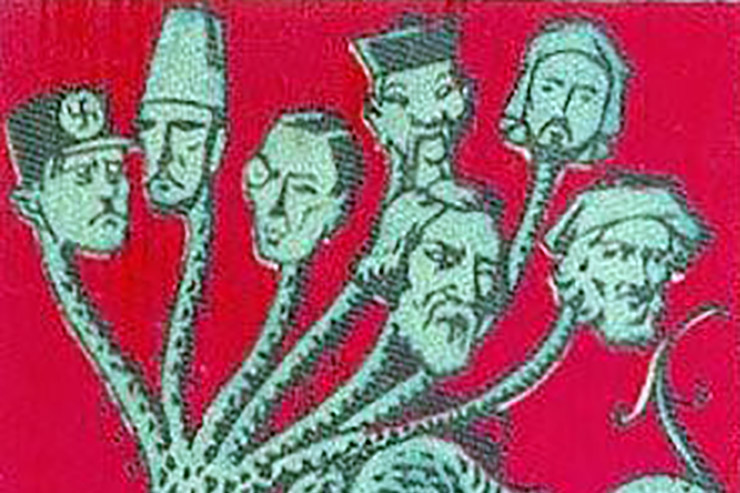
    Seven Heads of the Green Dragon

    There is another, more involved, though no less mysterious, description of the Green Dragon Society that predates Ravenscroft by forty years and Pauwels and Bergier by almost thirty. It is almost certainly the source for much of what he and others have had to say about the GDS since. The work in question is the 1933 Les Sept Tetes du Dragon Vert [“The Seven Heads of the Green Dragon”] by Teddy Legrand. The title evokes the dragon with “seven heads, ten horns, and seven crowns upon his heads” mentioned in Revelations 12:3, although that beast is red, not green. At first glance the book seems to be just an obscure piece of French pulp fiction, albeit one replete with real people and real events along with many invented ones.

    Basically, the book presents the Green Dragon or, more simply, “The Greens,” a sinister international cabal bent on world domination. An interesting detail is that these secretive conspirators number precisely 72 and were, presumably, the “72 unknown superiors” of conspiratorial legend.19 To achieve its nefarious aim, the Green Dragon generates war, revolution and chaos, and its hand is the unseen common denominator in such seemingly disparate events as the assassination of Franz Ferdinand, the instigation of the Bolshevik Revolution, the murder of the Romanovs, the 1922 killing of German foreign minister Walther Rathenau, the abduction of White Russian general A. P. Kutepov and the apparent suicide of millionaire Swedish “Match King” Ivar Kreuger. All in all, the Green Dragon sounds like another version of the infamous Illuminati who haunt so many conspiracy theories.

    At the time of the book’s action, 1929-30, the mysterious Greens are busy facilitating the rise of the “The Man of the Two Z’s” under whose “sharp spurs” Europe would soon tremble.20 The latter is a thinly-veiled and rather prophetic reference to Hitler who had barely come to power when the book was published. The “Two Z’s” were the interlocking arms of the Swastika.

    The central figure of Les Sept Tetes… is a British secret agent, the ace of L’Intelligence Service, James Nobody, who may be the original literary inspiration for James Bond. He had already starred in a series of pot-boiler spy novels by French writer Charles Lucieto, and the latest was an effort to continue the franchise after Lucieto’s recent death. Interestingly, Lucieto was a retired spy, having served the French secret service in World War I. He liked to claim that his Nobody and similar yarns were roman-a-clefs which revealed true, if hidden aspects of recent history and current events. His publishers later implied that this had something to do with his untimely demise.

    To no great surprise, Lucieto’s successor, “Teddy Legrand,” was a pseudonym. In fact, the author was Pierre Mariel who turns out to be a rather interesting fellow. Nominally he was a journalist, but like Lucieto he had ties to French intelligence. That has led to the claim that the latter “inspired” or even directed his literary efforts as it had his predecessor’s.21 More importantly, perhaps, he was a self-proclaimed expert on the occult. Some years later, under the name Werner Gerson, he would author one of the first books on Nazi occultism.22 Mariel himself was a member of both the Freemasonic Martinist Order and a one-time French grand master of the Ancient and Mystical Order Rosae Crucis (AMORC).23 Interestingly, in Les Sept Tetes… Mariel paints the Martinist Order as a conspiratorial sect which played a behind-the-scenes role in the French Revolution and later political upheavals, and which just might have links to the mysterious Green Dragon.24

    In the book, brother spies Nobody and Legrand are inspired by their common curiosity about the fate of the Russian Imperial family. The chief object of fascination is an icon on St. Seraphim, supposedly found on the Tsarina Alexandra’s body, which bears a puzzling inscription, in English: “S.I.M.P. The Green Dragon. You were absolutely right. Too late.”25 They quickly determine that the first element, which is accompanied by a six point “kabbalistic” symbol, stands for “Superieur Inconnu, Maitre Philippe” [Unknown Superior, Master Philippe], a French Martinist mystic who was an early guru to the Tsarina Alexandra.26 They also note the Tsarina’s predilection for the “Tibetan” Swastika as a good luck symbol. The rest of the story follows the duo’s efforts to discover who or what constitutes the Green Dragon.

    Some interest inevitably falls on Maitre Philippe’s successor as royal spiritual guide, Rasputin, who comes across as a tool of the Green Dragon, if not an outright member. Legrand/Mariel correctly observes that during World War I, the dissolute holy man maintained communication with mysterious “Greens,” or simply “The Green,” based in Stockholm in which Mariel portrays as another piece of a larger conspiracy.27 Interestingly, Colonel Stanislaus de Lazovert, one of the men later involved in the plot to kill the dissolute holy man, claimed that Rasputin was a member of the “Green Hand,” a secret order presumably backed by Russia’s Austrian enemies.28 Most recently and reliably, Russian investigator Oleg Shishkin linked Rasputin’s mysterious friends to a Berlin-inspired conspiracy which included German occult lodges and members of the ethnic-German Baltic nobility. Their secret brotherhood, Baltikum, used a green swastika as its symbol.

    Coincidentally or not, one of the antagonists encountered by Nobody and Legrand is a Baltic Baron, Otto von Bautenas, whom they identify as no less than one of the “72 Verts.” Bautenas turns out to have been a very real person: an ex-adherent of Baltikum, a close ally of Lithuanian politico Augustine Valdemaras and leader of the fascistic Iron Wolf movement.

    Mariel also implies that Anthroposophy kingpin Rudolf Steiner was mixed-up in all this skullduggery and “secret politics” through his connections to pan-German secret societies.29 He also drops Gurdjieff’s and Besant’s names in the same murky mess.

    While the book’s action stays within the geographic confines of Europe, shifting from Constantinople, to Scandinavia, to Paris to Berlin, there are numerous references to the Orient, especially Tibet. Legrand and Nobody enlist the aid of one of their old antagonists, Jewish-born “international spy” I.T. Trebitsch-Lincoln, whom has transformed himself into the Tibetan lama Dordji Den. Here again, there is at least a kernel of truth; in 1931 the chameleon-like Trebitsch was ordained a Buddhist monk and became “the Venerable Chao Kung.”30

    The pair eventually find themselves in Berlin, in the presence of The Man with the Green Gloves, an apparently Asian soothsayer who has set himself up much as the real Hanussen. They observed an eerie figure that seemed to have “complete mastery of his reflexes.”31 Was this the “control of the life forces” mentioned by Ravenscroft? Like a living statue, “not a muscle in his face moved” as the weird seer conversed in “excellent Oxford English.” Nobody and friend finally realise that they are standing face-to-face with “one of those famous Greens.” The description has led one recent author, Christian von Nidda, to conclude that the Greens were nothing less than “reptilian” beings!32

    In the end, Mariel never clearly defines just what the Green Dragon Society is and is not. Doubtless, that was never his intention. Interestingly, there is no suggestion of any Japanese connection. However, as the episode with the Man with Green Gloves suggests, there is the spectre of a powerful, mysterious Asiatic hand at work. The true purpose of the Russian Revolution, he believed, was to destroy Europe’s eastern barrier against Asiatic intrusion. Mariel sensed a kind of “permanent conspiracy against the white race – against Western Greco-Latin civilisation – which seeks to sap, fracture and shake the edifice of already unstable Europe.”33 When the time came, the conspirators would “substitute him” [the Man of the Two Z’s] as a means of bringing about a New Order.

    It also remains uncertain to what degree Mariel intended Les Sept Tetes… to be taken seriously. Clearly, that has not prevented some from doing so. Truth, fiction, or some strange amalgam of the two, Mariel’s little book is undoubtedly the inspiration for most of the claims about the Green Dragon Society which have sprung up since. We are still left to wonder whether, if all the exaggeration, obfuscation, superstitious dread and outright lies were cleared aside, there would be anything there at all. Maybe.

    [alert type=”general” dismiss=”no”]This article was published in New Dawn 112.[/alert]

    [alert type=”success” dismiss=”no”]If you appreciate this article, please consider subscribing to help maintain this website.[/alert]

    Footnotes:

    1. “Japan’s Dark Background, 1881-1945.” www.fortunecity.com/tatooine/lieber/50/bds1.htm [15 Oct. 2008].
    2. Chieh-ju Ch’en, Chiang Kai-shek’s Secret Past: The Memoir of His Second Wife, Westview Press: Boulder, 2000.
    3. Ibid.
    4. Trevor Ravenscroft, The Spear of Destiny: The Occult Power behind the Spear which Pierced the Side of Christ, Weiser Books: Boston, 1982, 246-247.
    5. Louis Pauwels and Jacques Bergier, The Morning of the Magicians, Avon Books: New York, 1960, 279.
    6. Ravenscroft, 256.
    7. Ibid.
    8. Gil Trevizo, “The Order of the Green Dragons” (2003), http://odh.trevizo.org/green_dragons.html [15 Oct. 2008]. This and like articles are connected to the Delta Green role-playing games.
    9. On Hanussen’s bizarre career, see Mel Gordon, Erik Jan Hanussen: Hitler’s Jewish Clairvoyant, Feral House: Los Angeles, 2001.
    10. “Tibet’s Dragon Culture,” courtesy of Charles Rice, August 2006.
    11. Alexander Berzin, “Russian and Japanese Involvement with Pre-Communist Tibet: The Role of the Shambhala Legend,” www.berzinarchives.com/web/en/archives/kalachakra/shambhala/russian_japanese_shambhala.html. [10 Sept. 2008]
    12. Richard Spence, Secret Agent 666: Aleister Crowley, British Intelligence and the Occult, Feral House: Los Angeles, 2008, 184, 189.
    13. Wulf Schwarz waller, The Unknown Hitler: Behind the Image of History’s Darkest Name, Berkley Books: New York, 1990, 100.
    14. For a highly critical view of “Green Dragon Zen,” See: groups.google.com/group/alt.philosophy.zen/browse_thread/thread/da7a81921050f728.
    15. Trevor Corson, “The Magic of Buddhism,” Kyoto Journal (1 July 2000), www.scrawlingclaw.com/blogs/ArticleArchive/Entries/2000/7/1_The_Magic_of_Buddhism.html [10 Nov. 2008].
    16. “The Green Dragon Society & Brotherhood, Chi Tao Ch’uan Gung Fu: A Recent History,” www.orientalherb.com/index.php?cPath=35 [1 Nov. 2008].
    17. Charles Rice to author, 3 July 2003.
    18. Clifford Lo, “Sex Cult Might Have Lured 30 Women,” South China Morning Post (16 Jan. 2004).
    19. Nolan Romy, Les Grandes Conspirations de Notre Temps, Bruxelles, 2002, 35-50.
    20. Teddy Legrand, Les Sept Tetes du Dragon Vert, Berger-Levrault: Paris, 1933, 78.
    21. Oleg Shishkin, Ubit’ Rasputina, Olma Press: Moscow, 2000, 36-37.
    22. Werner Gerson, Le Nazisme: Societe Secrete, Productions de Paris: Paris, 1969.
    23. Shishkin, 36.
    24. Legrand, 32.
    25. Legrand, 30-33.
    26. True name: Nizier Anthelme Philippe.
    27. Legrand, 39-40.
    28. “Stanislaus Lazovert and the Assassination of Rasputin, 29 December 1916,” www.firstworldwar.com/source/rasputin_stanislaus.htm.
    29. Legrand, 228-230.
    30. Bernard Wasserstein, The Secret Lives of Trebitsch Lincoln, Penguin Books: New York, 1989, 274.
    31. Legrand, 243-244.
    32. Christian Von Nidda, Our Secret Planet, Lulu Publications, 124-125.
    33. Legrand, 132

    © New Dawn Magazine and the respective author.
    For our reproduction notice, click here.
  • Red Star Over Shambhala: Soviet, British and American Intelligence & the Search for Lost Civilisation in Central Asia

    Red Star Over Shambhala: Soviet, British and American Intelligence & the Search for Lost Civilisation in Central Asia

    From New Dawn 109 (Jul-Aug 2008)

    On his way across the wastes of Mongolia in 1921, Polish writer and refugee Ferdinand Ossendowski witnessed some strange behaviour on the part of his Mongol guides. Stopping their camels in the middle of nowhere, they began to pray in great earnestness while a strange hush fell over the animals and everything around. The Mongols later explained that this ritual happened whenever “the King of the World in his subterranean palace prays and searches out the destiny of all people on Earth.”1

    From assorted lamas, Ossendowski learned that this King of the World was ruler of a mysterious, but supposedly very real, kingdom, “Agharti.” In Agharti, he was told, “the learned Panditas [masters of Buddhist arts and sciences] write on tablets of stone all the science of our planet and of the other worlds.”2 Whoever gained access to the underground realm would have access to incredible knowledge – and power.

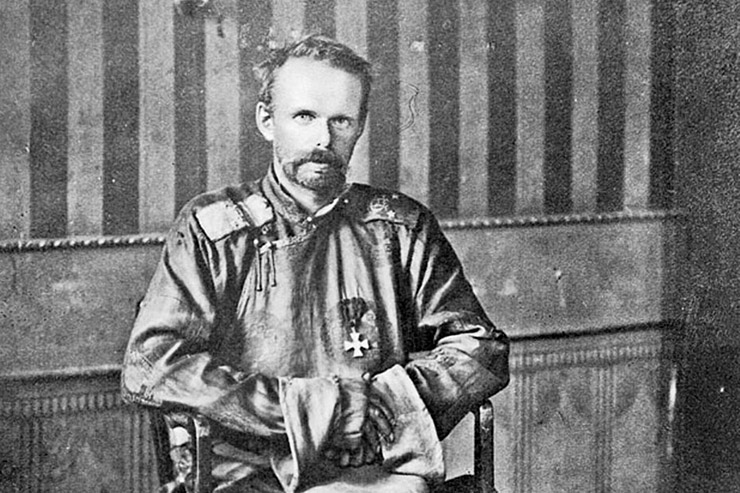
    Ossendowski was not exactly a casual listener. As noted in a previous article [The “Bloody” Baron von Ungern-Sternberg: Madman or Mystic?, New Dawn No. 108 (May-June 2008)], during 1921 he would become a key adviser to “Mad Baron” Roman von Ungern-Sternberg who established a short-lived regime in the Outer Mongolian capital of Urga.3 A self-proclaimed warrior Buddhist who dreamed of leading a holy war in Asia, the Baron allegedly tried to contact the “King of the World” in hopes of furthering his scheme.

    Ossendowski’s credibility later was assailed by the likes of Swedish explorer Sven Hedin.4 Among other things, Hedin accused the Pole of plagiarising the story of Agarthi from an earlier work by French esotericist Joseph Alexandre St.-Yves d’Alveydre.5 To one extent or another, that probably was true, but Hedin, a veteran seeker after lost cities, did not dismiss the possibility of a hidden Kingdom; indeed, he likely harboured the aim of finding it himself.

    In any event, Ossendowski did not invent the story of a fabulous land secreted somewhere in – or under – the vastness of Central Asia, be it called Agharti, Agarttha, Shangri-la, or, most commonly, Shambhala.6 Some believed it to be a physical, subterranean realm inhabited by an ancient, advanced race, while to others it was a spiritual dimension accessible only to the enlightened. The Shambhala legend is firmly grounded in Buddhist tradition which vaguely puts the Kingdom somewhere to the north of India. The legend also proclaimed that a time would come when the King of Shambhala and his mighty hosts would come forth to vanquish evil and usher in a golden age guided by pure Dharma. As noted, Baron von Ungern-Sternberg envisioned himself as the initiator of this “Shambhala War.” So would others.

    The tantalising possibility of a hidden trove of advanced knowledge and technical know-how did not just pique the curiosity of explorers and occultists. The practical advantages to be gained by accessing and exploiting such knowledge was not lost on certain politicians and intelligence officers, above all in Soviet Russia. But whatever attracted the attention of the Bolsheviks was bound to draw British curiosity as well, and where both those powers were concerned, the Americans, Germans and Japanese were unlikely to be far behind.

    This article focuses on the activities of three men, two Russians and one American: Aleksandr Vasil’evich Barchenko, the so-called “Bolshevik professor of the occult,” the artist-mystic-explorer Nicholas Roerich, and the man often cited as the real-life model for Indiana Jones, Roy Chapman Andrews. While, so far as can be told, none of the trio ever met, all were involved with expeditions roaming the deserts of Mongolia and the high valleys of the Himalayas in search of lost civilisation and ancient man. In the case of Barchenko and Roerich, the specific object was Shambhala. As we will see, these explorations were only the tip of a clandestine iceberg of intrigue and hidden agendas which included secret societies and a host of spies. Just who was doing what for whom – and why – remains uncertain.

    “Bolshevik professor of the occult” Aleksandr Barchenko

    A.V. Barchenko was born in Elets in 1881 and manifested an early interest in the “paranormal.” Part occultist, part scientist, part explorer, and maybe just a bit of a charlatan, Barchenko was, above all, a seeker. His interests came to focus on recovering the lost knowledge of a prehistoric civilisation, remnants of which he thought might still survive. It was in medical school, c. 1901-1905, that Barchenko gravitated to Masonic and Theosophist circles and their esoteric doctrines. One of his professors was acquainted with the above Saint-Yves d’Alveydre, and so introduced his pupil to the legend of Agarttha/Shambhala.

    D’Alveydre’s works also promoted the mystical-political doctrine of Synarchy, a system supposedly perfected by the denizens of the hidden Kingdom. Loosely defined, Synarchy signifies “rule by secret society” or enlightened elite. In the late 19th century, the idea was picked up by yet another French occultist, Gerard Encausse, better known as Papus, who combined it with another mystical current, Martinism, to form the quasi-Masonic Ordre Martiniste et Synarchie.7 During 1900-1905, Papus visited Russia where he established cells of his new order and even recruited members among the Romanovs.8 More intriguing are suggestions that Papus simultaneously functioned as a French “agent of influence” to counter German intrigue among the Russian elite and, more secretly, to foster social revolution. One associate of Papus later claimed that Martinism was the “germ of Sovietism.”9

    Prior to World War I, Barchenko embarked on a career as journalist and writer. At the same time, he joined the Martinist Order and the “Kabbalistic Order of the Rose & Cross.”10 His ever-widening interest in the occult came to include palmistry, the Tarot, alchemy, hypnosis, “radiant energy,” astrology and mind-reading. In 1911 he wrote an article for Priroda i liudi (“Nature and People”) on “thought transference.”11 His literary outpourings included two “fantastic” novels, Doktor Chernyi (“Dr. Black”) and Iz mrak (“From the Darkness”). His literary alter ego, Dr. Aleksandr Nikolaevich Chernyi, had spent years in India and Tibet studying arcane knowledge at the feet of mysterious mahatmas. Barchenko dreamed of doing the same.

    After brief service in World War I, Barchenko returned to Petrograd (the renamed St. Petersburg) where he moved deeper into occult circles. One self-proclaimed master of Eastern mysticism who frequented Petrograd in this period was George Gurdjieff. Whether Barchenko had direct contact with him is uncertain, but he was well-versed in Gurdjieff’s teachings and the two would be linked in curious ways in the years ahead.

    While Barchenko welcomed the overthrow of Tsar Nicholas in 1917, he was not enamoured of Lenin’s Bolsheviks. Still, to earn a living in the post-October environment, he began giving lectures on esoteric subjects to the revolutionary sailors of the Baltic Fleet. He used Shambhala as an example of a “primeval communist society,” which had been part of a prehistoric “great universal federation of peoples.”12 Such Bolshevik-sounding sentiments contrasted with his more private affiliations. In the “Sphinx” society, Barchenko associated with Martinists, Theosophists and “Christian pacifists” who were out-and-out enemies of Soviet power. He later confessed that the group harboured “conspiratorial quarters of the White Guards” and connived with militant anti-Bolsheviks such as Boris Savinkov.13 Savinkov, in turn, actively conspired with British and French agents, among them Ace-of-Spies Sidney Reilly who helped concoct an abortive effort to overthrow Lenin in the summer of 1918.14

    One result of that failed plot was the “Red Terror,” a wave of bloody reprisals spearheaded by the Bolshevik secret police, the Cheka. So, when Barchenko received a summons to the office of the Petrograd Cheka (P-Cheka) in the fall of 1918, it was an ominous sign. However, he found there a cadre of fellow Martinists and students of the occult who had no interest in shooting him as a counter-revolutionary.15

    The most important of these chekisty was Konstantin Konstantinovich Vladimirov, a self-described “psychographologist” who would do much to promote Barchenko and his ideas within the Soviet establishment. On the surface, it would appear that Vladimirov recruited Barchenko as an informer in occult circles, but things may not have been so simple.

    Vladimirov’s own loyalties are questionable. He soon was involved in the case of two Britons, Harold Rayner and G.H. Turner, arrested for supposed involvement in the August 1918 assassination of the chief of P-Cheka, Moisei Uritsky. The actual gunman was a follower of the above Boris Savinkov. Even more interesting, Vladimirov and comrades apparently nabbed the wrong men. Then, instead of being executed, one somehow managed to evade proletarian justice and make it back to England.
    Finally, Vladimirov became romantically involved with the widow of the second Englishman, a woman also identified as a British spy. As a result, he found himself booted from the Cheka, but somehow managed to get himself reinstated. However, in 1927 Vladimirov was again arrested and ultimately shot as an English spy, exactly as his protégé Barchenko would be a decade later.16 So, did Vladimirov recruit his fellow occultist to spy for the Cheka in 1918, or was he even then a British agent who enlisted the like-minded Barchenko into another, more secret conspiracy?

    One more twist is that some insist Vladimirov was identical with another clandestine operative, Yakov Blumkin.17 That they were one and the same is demonstrably untrue, but Blumkin and Vladimirov did move in the same murky circles in 1918. Through those same circles, Blumkin also came to know Barchenko. Thus, there is reason to suspect, if no more, that Blumkin was another British double-agent. As a supposedly renegade chekist, he assassinated the German ambassador in Moscow in July 1918. Nevertheless, like Vladimirov, he soon found his way back into the good graces of Soviet intelligence. A year after Vladimirov’s demise, however, Blumkin would stand before a firing squad as a Trotskyite conspirator.

    Barchenko also found friends in Soviet academia. With such backing, during 1921-22, he led an expedition to the remote Kola Peninsula, north of the Arctic Circle, where he found ancient petroglyphs and megalithic structures.18 This reinforced his belief in an advanced prehistoric civilisation linked to mysterious Shambhala.
    As early as 1920, Barchenko sought permission to mount a “scientific-propagandistic” expedition into Mongolia and Tibet to search for “Red Shambhala.”19 Recovery of its ancient science and wisdom, he argued, would expand Moscow’s influence throughout Asia. This early lobbying came to naught, though it may have influenced Moscow to dispatch two Baltic sailors, Barchenko’s former “pupils,” on a secret mission to Tibet in the early 20s.20

    At the same time, Barchenko founded a “Masonic” lodge dubbed the Edinoe Trudovoe Bratstvo, ETB, or the “United Labor Brotherhood.” The new Brotherhood included Vladimirov and numerous other current or former chekists. Closely associated with the ETB, if not a formal member, was Yakov Blumkin, back in the saddle as a special agent of Soviet intelligence.

    The Lodge’s name bears a curious resemblance to an earlier group formed by Gurdjieff’s followers, the Edinoe Trudovoe Sodruzhstvo (“United Labor Fellowship”), and at least one prominent member of ETB, P.S. Shandarovskii, was a devotee of Gurdjieff.21 Another link may have existed through Soviet sculptor Sergei Merkurov, who was Gurdjieff’s cousin.22 Interestingly, Gurdjieff had alleged ties to British intelligence, including the charge that he had for years served as a British asset in Central Asia and the Near East.23 What is undeniable is that among Gurdjieff’s pupils in pre-Revolutionary Russia was English composer Sir Paul Dukes, a man whose interests included not only Gurdjieff, but also esoteric Buddhism and Tibet. Dukes joined MI1c (MI6) during World War I and for much of 1919 headed the British spy network in Petrograd.24 Could Barchenko and Vladimirov have been linked to this?

    By far the most important brother of the ETB was chekist bigwig Gleb Ivanovich Bokii. Bokii, a veteran Bolshevik, had an equally venerable involvement in the occult. Among other things, he was a pre-Revolutionary member of the “Kabbalistic Order of the Rose & Cross.” Curiously, his advancement in that Order was approved by none other than Aleksandr Barchenko.25 More curious still, Bokii took over the P-Cheka after Uritsky’s death and was running the show when Barchenko was “recruited” in late 1918. Nevertheless, both men later swore that they never met until the early 1920s. Bokii would confess that for him the Revolution died with Lenin in early 1924. Growing disillusionment led him to oppose Stalin and to support Barchenko’s schemes, schemes that, he admitted, included espionage.26

    By 1924, Bokii sat in control of the OGPU’s (the renamed Cheka) Spetsotdel, or “Special Department.” This outfit handled codes and included an elite outfit, the 7th Section, which delved into paranormal issues ranging from hypnotism and ESP to the Abominable Snowman.27 The Spetsotdel also guarded the so-called “black dossiers,” the personal files of the Soviet leaders which included sexual kinks and, undoubtedly, any association with things occult.28

    Besides personal curiosity, Bokii had practical incentive to pursue paranormal research. Telepathic communication offered a perfect means to send and receive messages from agents abroad. Likewise, what we today call Remote Viewing offered the ability to spy on the imperialist enemy without leaving Moscow. Unlocking the secrets of hypnotism and mind control had potential application in propaganda. To explore such matters, Bokii put Barchenko in charge of a special “neuroenergetics” lab within the All-Union Institute for Experimental Medicine.29

    Still, the primary aim of Barchenko and the ETB was establishing direct contact with Shambhala. To this end, he exploited Bokii’s help and made common cause with other esoteric groups, most notably the “Great Brotherhood of Asia.” He connived with at least two members of the Brotherhood, a Tibetan lama, Naga Naven, who claimed to be a direct representative of Shambhala, and a Mongolian official, Khayan Khirva, future chief of the Mongolian secret police.30 In that role, Khirva would work side-by-side with Yakov Blumkin.

    In the spring of 1925, thanks to Bokii’s access to secret funds, the Shambhala expedition seemed set to go. Bokii picked Blumkin to head the expedition’s secret intelligence angle.31 But the plan ran into opposition. Dark rumours painted Bokii as a dangerous degenerate who drank human blood.32 A leading opponent was Mikhail Trilesser, head of the OGPU’s foreign intelligence branch (INO). He naturally felt that any activity outside the USSR fell into his bailiwick. By summer, Barchenko’s Shambhala expedition was dead. Or was it?

    In September 1925, a humble Muslim pilgrim crossed the Pamir passes into British-controlled Kashmir. In fact, the pilgrim was Yakov Blumkin who was on his way to even more remote Ladakh to rendezvous with an expedition led by Nicholas Roerich. Roerich’s aim was to enter Tibet and contact Shambhala. However, soon after crossing the frontier, tribal police seized Blumkin. Apparently, someone had tipped-off the British. The crafty chekist soon gave his captors the slip, and assuming a new guise as a Mongol lama, pressed on towards Roerich. Anyway, that is how Blumkin later told the story. There could be another explanation. The brief arrest and fortuitous escape also gave Blumkin convenient cover to check-in with British intelligence prior to joining Roerich.

    Russian Painter, Theosophist and Philosopher, Nicholas Roerich

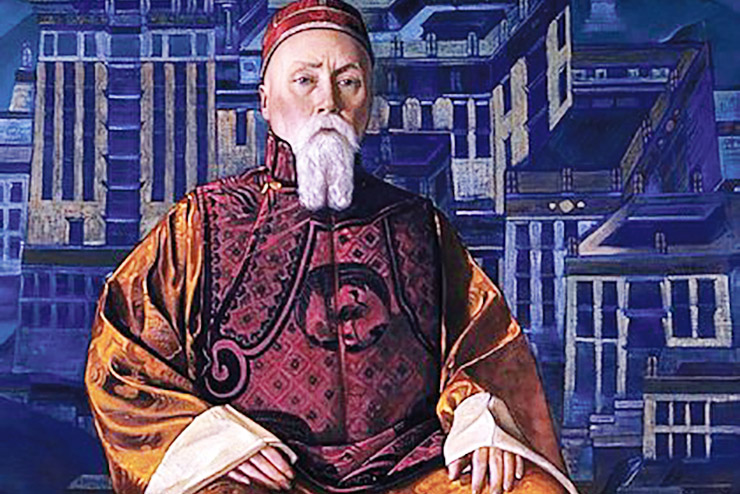
    Born in St. Petersburg in 1874, Nicholas (Nikolai) Konstantinovich Roerich is best known today as a painter and tireless advocate of Yoga and Buddhism in the West. He definitely was a Theosophist and probably a Martinist.33 He also became a secret Soviet agent-of-influence. Some of his admirers vociferously dispute this, and it may be true that Roerich used the Bolsheviks as much as they used him. Nevertheless, his ties to Soviet intelligence are too extensive to be denied.34
    By the time the Revolution hit Russia, Roerich had left the country, and he initially showed no interest in the Great Socialist Experiment. By 1920, he was in London where he joined the local Theosophist scene dominated by Annie Besant. Besant and her followers were outspoken supporters of Indian independence which brought them under the scrutiny of British security. By the early 20s, Moscow had become the main benefactor of anti-British agitation in Asia and in the view of MI6’s Desmond Morton (later one of Churchill’s most trusted spies) “nearly all these theosophist and theosophical societies are connected in some way with Bolshevism, Indian revolutionaries and other unpleasant activities.”35

    Roerich came to see British influence over Tibet as an evil he must combat, and during 1920 other things pushed him further towards Moscow. Roerich’s wife Elena (Helene), a medium, began receiving messages from an entity calling himself Master Morya, or Allal Ming, who claimed to be a member of the Great White Brotherhood and “spiritual teacher of Tibet.”36 Allal Ming convinced Roerich that he was the key to the fulfilment of a “Great Plan” which would end with creation of a vast, pan-Buddhist state that would encompass Tibet, Mongolia, parts of China, and much of Siberia. The first stage would be the “Shambhala War,” the end result of which would be the “earthly expression of the Invisible Kingdom of Shambhala.”37 The Plan is virtually identical to the one envisioned by Baron Ungern at almost the same time. However, whereas Ungern aimed to build his New Order by making war on the godless Bolsheviks, Roerich’s guide encouraged him to see the Soviets as allies and Lenin as a harbinger of a new, enlightened age. Perhaps the King of the World was hedging his bets.

    At the same time, Roerich acquired a new follower in the person of a young Russian Theosophist, Vladimir Anatol’evich Shibaev. Shibaev also happened to be an agent for the Communist International (Comintern) working with Indian nationalists. He introduced the Roerich’s to other Soviet officials and encouraged their plans to move to India as a first step in realising the Great Plan. London’s MI5 kept a close eye on Shibaev and his dealings with Roerich.38

    The Roerich’s moved to New York in October 1920. They thus evaded the hostile scrutiny of British authorities and secured support among wealthy Americans. One such benefactor was Wall Street broker Louis Levy Horch who helped found the Roerich Museum and became the Mystic’s financial manager and mainstay. Naturally, Horch, too, had a secret life. A successful businessman with important connections in American politics, he also was an underground operative for the Cheka/OGPU.39

    The Roerich’s next relocated to Darjeeling, India in late 1923. This put them under the watchful eyes of Frederick Marsham Bailey, the British “political resident” in nearby Sikkim, and a man intimately familiar with Russian activities in Central Asia.

    In spring 1925, Roerich was ready to launch his expedition into the Himalayas and beyond. The synchronicity with Barchenko’s plan seems more than coincidental and doubtless had something to do with the scuttling of that effort. Travelling under the American flag and backed by Yankee money, Roerich had the advantage of not being a blatant Soviet cat’s paw. Still, it is interesting that Bokii’s and Barchenko’s pal Blumkin should materialise at Roerich’s side. Whatever his connection to the British, did Blumkin maintain communication with his friends back in Moscow? Regardless, he and Roerich would roam the fringes of Tibet (never reaching Lhasa), and press on into Sinkiang and Mongolia. There was even time for a side-trip to Moscow where Roerich hob-nobbed with more Soviet officials. In fact, his expedition was Moscow-managed from beginning to end, whether Roerich fully realised it or not.

    That fact was not lost on the British. During this period, MI6 monitored Red activities in Asia through one of its men in the Moscow embassy, Arthur V. Burbury. In 1928, persons in London concluded that Roerich had been “illuminated” as to the “excellence of the Union of Soviet Socialist Republics.”40

    Real-Life Model for Indiana Jones, Roy Chapman Andrews

    In contrast to Barchenko and Roerich, American Roy Chapman Andrews had no obvious interest in the occult and paranormal.41 Of course, given his curiosity about natural mysteries, he must have harboured a little about supernatural ones. Born in Wisconsin in 1884, Andrews evidenced an early lust for knowledge and adventure. By World War I, he had acquired a degree from Columbia University, membership in the exclusive Explorer’s Club and employment at the American Museum of Natural History (MNH).

    His early explorations took him to China, which doubtless accounted for a new assignment that came his way in 1918. He travelled as a “naturalist” but he was really an officer of the US Office of Naval Intelligence (ONI) assigned to the American Legation in Beijing.42 Befitting a good spy, Andrews was subsequently very mum about what he did there, but he made at least two “reconnaissance” trips into turbulent Mongolia, visiting its capital of Urga (where Baron Ungern would soon take charge) and venturing into Siberia where the Russian Civil War raged.43 Andrews subsequently compiled a map of the “Southern Boundary Region of Asiatic Russia” which found its way to the US Army’s Military Intelligence Division (MID).44 In his travels, did Andrews hear the same whispers of Agharti/Shambhala that reached the ears of Ossendowski, Roerich, and Barchenko?

    Andrews left the Navy in the spring of 1919, but no sooner did he return to the States that he offered his services to the Army’s MID. His former boss in Beijing, US Naval Attaché Commander I.V. Gillis, vouched for Andrews as someone “who in case of emergency could be depended upon to do work with required skill and nerve,” and a colleague at the Museum of Natural History assured MID that Andrews was the “only American who is at all familiar with Mongolian.”45

    Between 1922 and 1930, Andrews led five expeditions into the Gobi Desert and adjoining regions of Mongolia. All were sponsored by the MNH and made notable fossil discoveries, including the first dinosaur eggs. However, the original goal of the explorations was not animal fossils, but evidence of early man. Andrew’s boss at the Museum, Henry Fairfield Osborn, was convinced that the origins of the human race lay somewhere in Eastern or Central Asia. Some of his theories echoed those of the Theosophists, or so thought the Theosophists.46

    From our perspective, the most interesting of Andrews’ forays was the one that commenced in early 1925 and took him and his companions deep into western Mongolia. The “mapmaking” team consisted of a US Army officer, Lt. Fred Butler, and a British officer, Lt. H.O. Robinson, detached from His Majesty’s Legation in Beijing.47 Butler’s later report also went to MID.48

    Andrews might have gleaned information about Roerich’s activities from another explorer then roaming the wastes of Central Asia, Ossendowski’s nemesis, Sven Hedin. The Swede told Andrews that his expedition was a “reconnaissance” of a projected Lufthansa air route across Central Asia to Beijing, but it may have been something more.49In any case, Andrews dutifully reported his conversation with Hedin to MID.

    In the end, Shambhala remained hidden, or so it seems. Roerich and Andrews went on to live out full lives and pass on, respectively, in 1947 and 1960. Barchenko, Bokii and the brethren of ETB were not so fortunate. All perished in the purges of the late 1930, condemned for crimes they did not – or did – commit.

    [alert type=”general” dismiss=”no”]This article was published in New Dawn 109.[/alert]

    [alert type=”success” dismiss=”no”]If you appreciate this article, please consider subscribing to help maintain this website.[/alert]

    Footnotes

    1. Ferdinand Ossendowski, Beasts, Men and Gods (New York: E. P. Dutton, 1922), 300.
    2. Ibid., 311.
    3. Richard Spence, “The ‘Bloody’ Baron von Ungern-Sternberg: Madman or Mystic?” New Dawn, No. 108 (May-June 2008), 31-36.
    4. Sven Hedin, Ossendowski und die Wahrheit (Leipzig: Brockhaus, 1925).
    5. Joseph Alexandre St.-Yves d’Alveydre, Mission de l’Inde (1910). D’Alveydre, arguably, was in turn influenced by two other works: Edward Bulwer-Lytton’s The Coming Race (1870) and fellow Frenchman Louis Jacolliot’s Les Fils de Dieu (1873).
    6. See, e.g., Jason Jeffrey, “Mystery of Shambhala,” New Dawn, No. 73 (May-June 2002), and Joscelyn Goodwin, Arktos: The Polar Myth in Science, Symbolism and Nazi Survival (Kempton, IL: Adventures Unlimited Press, 1996), 95-104.
    7. Ostensibly a school of mystical Christianity, Martinism takes its name from the 18th century French esoteric philosopher, Louis-Claude de Saint-Martin.
    8. Markus Osterrieder, “From Synarchy to Shambala: The Role of Political Occultism and Social Messianism in the Activities of Nicholas Roerich,” Paper presented at the conference on The Occult in 20th Century Russia, Berlin, March 2007, 11, n. 68.
    9. Ibid., 11, n. 67.
    10. Oleg Shishkin, Bitva za Gimalai ( Moscow: Eksmo, 2003), 31.
    11. Anton Pervushin, Okkul’tnyi Stalin (Moscow: Yauza, 2006), 133.
    12. Aleksandr Andreev, Okkul’tist Strany Sovetov (Moscow: Yauza/Eksmo, 2004), 101.
    13. Ibid., 74.
    14. On the intrigues of Reilly and Savinkov, see Richard Spence, Trust No One: The Secret World of Sidney Reilly (Los Angeles: Feral House, 2002), especially, Chapter Nine.
    15. Pervushin, 143-144.
    16. Andreev, 91.
    17. Aleksei Velidov, Pokhozhdeniia terrorista: Odisseia Yakova Bliumkina (Moscow: Sovremnik, 1998), 243.
    18. Pervushin, 144-152. The expedition centred on the region of Lovozero-Seidozero.
    19. Aleksandr Andreev, Soviet Russia and Tibet: The Debacle of Secret Diplomacy, 1918-1930s (Leiden: Brill, 2003), 108-109.
    20. Andreev, 101.
    21. Shishkin, 105-106.
    22. Ibid., 259.
    23. E.g., Peter Roberts, “Gurdjieff’s Origins,” www.promart.com/g.origins.html, (12 May 2008).
    24. See: Sir Paul Dukes, The Story of “ST 25”: Adventure and Romance in the Secret Intelligence Service in Red Russia (London: Cassell, 1938).
    25. Shishkin, 31.
    26. Protokol dopros [Interrogation] of Bokii, 18-18 May 1937, in Andreev (2004), 360-361.
    27. Shishkin, 177.
    28. Ibid., 367.
    29. Shishkin, 179, Pervushin, 171-173, and “Barchenko, Aleksandr Vasil’evich,” Liudi i sud’by, http://memory.pvost.org/pages/barchenko.html.
    30. Protokol dopros [Interrogation] of Bokii, 17-18 May 1937, in Andreev (2004), 354-355.
    31. Shishkin, 197.
    32. Ibid., 203.
    33. Osterrieder, 12 and n. 78.
    34. Ibid., 1 and n. 3, and Shishkin, passim.
    35. Gill Bennett, Churchill’s Man of Mystery: Desmond Morton and the World of Intelligence (Routledge: London, 2007), 72.
    36. Osterrieder, 2, 4 and n. 8.
    37. Ibid, 1.
    38. Shishkin, 48.
    39. Shishkin, 68.
    40. UK, Foreign and Commonwealth Office, notes on July 1928 exchange between India Office and Foreign Office.
    41. On Andrews, see: Charles Gallenkamp, Dragon Hunter: Roy Chapman Andrews and the Central Asiatic Expeditions (New York: Penguin Books, 2001).
    42. Andrews US Passport application, 18 June 1918.
    43. Gallenkamp, 72-73.
    44. US National Archives, Records of the Military Intelligence Division, MID, 10989-H-12/8, MID to George H. Sherwood, 20 Jan. 1922.
    45. MID, 2338-H-12/39, Report from N.A. China, 5 July 1921, and MID 2657-H-158/2, Clarence A. Manning to MID, 8 Nov. 1921.
    46. G. de Purucker, Theosophy and Modern Science, Pt. I [Reprint] (Whitefish, MT: Kessinger, 2003), 101.
    47. Gallenkamp, 188.
    48. MID, 2055-632-5, C of E to G2, 5 April 1926.
    49. MID, 2657-D-935/2, HA, 29 April 1927.

    © New Dawn Magazine and the respective author.
    For our reproduction notice, click here.
  • The “Bloody” Baron von Ungern-Sternberg: Madman or Mystic?

    The “Bloody” Baron von Ungern-Sternberg: Madman or Mystic?

    From New Dawn 108 (May-June 2008)

    My name is surrounded with such hate and fear that no one can judge what is true and what is false, what is history, and what is myth.1
    – Baron Roman Fedorovich von Ungern-Sternberg, 1921

    In Mongolia, there was a legend of the warrior prince, Beltis-Van. Noted for his ferocity and cruelty, he spilled “floods of human blood before he found his death in the mountains of Uliasutay.”2 His slayers interred the corpses of the Prince and his followers deep in earth, covered the graves with heavy stones, and added “incantations and exorcism lest their spirits again break out, carrying death and destruction.” These measures, it was prophesied, would bind the terrible spirits until human blood once more fell upon the site.

    In early 1921, so the story goes, “Russians came and committed murders nearby the dreadful tombs, staining them with blood.”3 To some, this explained what followed.

    At almost the same instant, a new warlord appeared on the scene, and for the next six months he spread death and terror across the steppes and mountains of Mongolia and even into adjoining regions of Siberia. Among the Mongols he became known as the Tsagan Burkhan, the incarnate “God of War.”4

    Later, the Dalai Lama XIII proclaimed him a manifestation of the “wrathful deity” Mahakala, defender of the Buddhist faith.5 Historically, the same individual is best known as the “Mad Baron” or the “Bloody Baron.” His detractors are not shy about calling him a murderous bandit or an outright psychopath.

    The man in question is the Baron Roman Fedorovich von Ungern-Sternberg. His exploits can be only briefly sketched here. In the wake of the Russian Revolution, Baron Ungern found himself in eastern Siberia where he aligned himself with the anti-Bolshevik “White” movement. However, his extreme monarchist sentiments and independent ways made him a loose cannon in that camp.

    In 1920, he led his “Asiatic Mounted Division,” a rag-tag collection of Russian, Mongol, Tatar and other troops, into the wilds of Mongolia, a land seething with unrest against Chinese occupation. Rallying Mongols to his banner, in early February 1921 Ungern scored a seemingly miraculous victory by wresting control of the Mongol capital, Urga (today Ulan Bator), from a large Chinese garrison. He then restored the Mongols’ spiritual and temporal leader, the “Living Buddha” Jebtsundamba Khutukhtu Bogdo Gegen, or, more simply, Bodgo Khan and established himself as warlord over Outer Mongolia and the scattered White Russian detachments that had taken refuge there.

    Surrounding himself with an inner circle of murderous sycophants and fortune-tellers, he instituted a reign of terror that claimed as victims Jews, real or suspected Reds, and hundreds of others who somehow aroused the Baron’s wrath or suspicion.6 In June of the same year, he launched an ill-fated invasion of Soviet Siberia which ended with his capture by the Red Army and his subsequent trial and execution on 17 September.

    This article focuses on Baron Ungern’s real and alleged mysticism and its influence on his actions. A key question is whether his perceived “madness,” in whole or in part, was a misreading of his devotion to esoteric Buddhist, and other, beliefs.

    Background and Early Years

    While the Baron spent most of his life in the service of the Romanovs, he was almost entirely German by blood. He entered the world as Robert Nicholaus Maximilian von Ungern-Sternberg on 10 January 1886 (new style) in Graz, Austria. In Russian-ruled Estonia, his father, Teodor Leonard Rudolf von Ungern-Sternberg, enrolled his son in the Tsar’s nobility as Roman Fedorovich. The Ungern-Sternbergs were an old and illustrious family. The Baron dated his line back at least a thousand years and boasted to his Bolshevik captors that seventy-two of his ancestors had given their lives in Russia’s many wars.7

    There is a suggestion of mental instability, even madness, in his immediate line. For instance, one late 18th century ancestor, Freiherr Otto Reinhold Ludwig von Ungern-Sternberg, earned infamy as a ship-wrecker and murderer who died in Siberian exile.8 Roman’s own father had a reputation as a “bad man” whose violence and cruelty led to divorce and a ban on him having any “influence” on his children.9

    As regards Roman von Ungern-Sternberg’s mental state, obviously a diagnosis of insanity can be made only after examination by a psychiatrist, something impossible in this case.10 However, Dmitry Pershin, an eye-witness who took a somewhat positive view of the Baron, still felt that Ungern suffered from a “psychotic abnormality” which made him lose his temper at the “least provocation,” often with terrifying result.11

    Later stories claimed that Roman’s aberrant behaviour was the result of a sabre cut to his head, but he manifested rebellious, violent tendencies much earlier. His school days were marked by constant problems; at the elite Naval Cadet Corps, he racked-up no less than twenty-five disciplinary charges before withdrawing in the face of certain expulsion.12 His education left him with a life-long aversion to “thinking” which he equated with “cowardice.”13

    As a junior officer before and during World War I, he established a reputation as a violent troublemaker with a penchant for hard-drinking. However, he also earned medals for wounds and reckless bravery. In the words of one superior, the young Baron was a “warrior by temperament,” who “lived for war” and adhered to his own set of “elemental laws.”14 The latter were influenced by an interest in mysticism and the occult, especially of the Eastern variety.

    The Baron as Mystic Warrior

    Just when and where this interest began is uncertain. Ungern’s personal brand of faith, if it was Buddhism at all, adhered to the mystical Tibetan Vajrayana or Tantric sect. Young Roman got his first taste of the East as an infantryman during the Russo-Japanese War, and he spent 1908 to 1914 as a Cossack officer in Siberia and Mongolia. It was then, he later claimed, that he formed an “Order of Military Buddhists” to serve the Tsar and fight against the evils of revolution. The rules of his Order included celibacy and the “limitless use of alcohol, hashish and opium.”15 The latter was to help initiates overcome their “physical nature” through excess, but as the Baron confessed, it did not work quite as he had planned. Later, in Mongolia, he enforced a strict ban on drink. Still, he asserted, he gathered “three hundred men, bold and ferocious,” and some who did not perish in the fighting against Germany and the Bolsheviks were still with him in 1921.

    Ungern resigned his regular commission at the end of 1913. Alone, he headed into the vastness of Outer Mongolia which had proclaimed independence from China. By one account, he rose to command the cavalry forces of the fledgling Mongolian Army, while another holds that he joined the marauding band of the bloodthirsty anti-Chinese rebel, Ja Lama. At some point, Ungern ended up in the western Mongolian town of Kobdo (Khovd) as a member of the guard of the local Russian consulate.

    One of his comrades recollected that “when one observed Ungern, one felt himself carried back to the Middle Ages…; [he was] a throwback to his crusader ancestors, with the same thirst for war and the same belief in the supernatural.”16 Another recalled that he displayed “a great interest in Buddhism,” learned Mongolian and took to frequenting lama fortune-tellers.17 According to Dmitri Aloishin, a later, unwilling member of the Baron’s army, Ungern’s “Buddhist teachers taught him about reincarnation, and he firmly believed that in killing feeble people he only did them good, as they would be stronger beings in the next life.”18

    The parallels between aforementioned Ja Lama and the Baron seem too close to be mere coincidence. Also known as the “Lama with a Mauser,” Ja Lama briefly made himself master of western Mongolia. Another “militant Buddhist,” he earned a fearsome reputation for ripping out the hearts of unfortunate captives and offering them up in skull-shaped bowls as bali (sacrifice) to the “Tibetan terror gods.”19 One such “Tantric” ritual slaughter occurred in Kobdo in the summer of 1912, just before Ungern arrived on the scene. In February 1914, the Russian consul in Kobdo arrested Ja Lama and Cossack troops, possibly including Ungern, and escorted the captive to exile in Russia. Did Ja Lama become a role model for the Baron, or even a religious inspiration?

    A Tibetan angle figures prominently in Ungern’s subsequent Mongolian escapade. The Living Buddha was himself a son of the Land of Eternal Snows, and a small Tibetan community dwelled in Urga. A hundred or so of these men formed a special sotnia (squadron) in the Baron’s forces and played a critical part in the assault on Urga by snatching the Bogdo from under the noses of his Chinese guards. The Chinese and Mongols were convinced that the feat had been accomplished through sorcery. These Tibetans maintained a distance from the rest of the Baron’s army; apparently others were put off by their habit of dining out of bowls made from gilded human skulls, perhaps the same sort of vessels used in Ja Lama’s sacrificial rites.

    The Tibetan nexus also provided the Baron with a link to Lhasa and the Dalai Lama, to whom he addressed personal letters. After his power in Mongolia collapsed, Ungern dreamed of leading the remnants of his division to far-off Tibet and putting himself at the service of the Buddhist holy man.20 The prospect of this gruelling, and potentially suicidal, trek was the final straw in provoking mutiny against the Baron.

    Also serving under Ungern in his Mongolian adventure were fifty or so Japanese soldiers. This has fuelled accusations that he was a cat’s paw of Japanese imperialism. While it is clear that the Japanese military monitored the Baron’s activities and thought he might be useful, it is equally evident that they had no real control over him. Still, his tiny Japanese contingent received better rations and the unique privilege of consuming alcohol.21 Japanese military records suggest that the men were “mostly petty adventurers” acting on their own accord, but that is far from clear.22 Their commander, a Major or Captain Suzuki, had met the Baron in 1919 at a “Pan-Mongol Congress” and the pair maintained a special and secretive friendship.

    An intriguing possibility is that Suzuki was not an emissary of the Mikado’s Army but of one of the secret societies that permeated it, such as the Black Dragon Society or the even more secretive Green Dragon Society. The latter was based in a sect of esoteric Buddhism, and its Pan-Asiatic, Pan-Buddhist agenda meshed with Ungern’s own beliefs.23 The Baron felt that the West had lost its spiritual moorings and had entered a stage of moral and cultural disintegration. The Russian Revolution was but a manifestation of this advanced corruption. Only in the East, specifically in Buddhism, did he see a force capable of resisting this decay and restoring spiritual order in the West.

    The Baron’s Lamas and Fortune-Tellers

    Ungern was fascinated by all forms of divination. He allegedly carried a deck of Tarot cards with him, even in the heat of battle. As noted, in Kobdo he consorted with lama soothsayers and in Urga he surrounded himself with a small army of fortune-tellers (tsurukhaichi), sorcerers and shamans.24 Aloishin recalls that the Baron’s diviners were forever consulting the roasted shoulder blades of sheep, pouring over the cracks “to determine where the troops must be stationed, and how to advance against the enemy.”25 On other occasions, Ungern ordered his troops to stop “at various places in accordance with old Mongolian prophecies.”26

    The Baron’s staff physician, Dr. N. M. Riabukhin, damned the fortune-tellers as “brazen, filthy, ignorant and bow-legged” and decried the fact that Ungern “never took any important step” without consulting them. The soothsayers convinced him that he was the incarnation of Tsagan Burkhan, the God of War. To White officer Boris Volkov, the Baron’s dependency on these types seemed proof of the “moronic mentality of the degenerate who imagined himself the saviour of Russia.”27

    Prior to his advance in Red Siberia, Ungern spent 20,000 precious Mexican dollars to hire thousands of lamas to “perform for him elaborate services in the temples and to call to his assistance all their mystic powers.”28 One drugged shamaness’s prediction of the Baron’s approaching doom proved eerily accurate, and helped convince him to undertake the disastrous invasion.29 The fortune-telling lamas failed him when they counselled a two day delay in the attack on Troitskosavsk, a key border town.30 This gave the Reds opportunity to bring up reinforcements and repel the assault. Later, officers bribed a Buriat fortune-teller to change his predictions, which led Ungern to call-off further advance and order retreat to Mongolia.31

    But if Ungern was influenced – and mislead – by the supernatural, he also knew how to use it to his advantage. Prior to his final attack on Urga, he dispatched fortune-tellers into the city where they “filled the Chinese soldiery with superstitious fear” by predicting his imminent arrival and spreading rumours that the White Baron was immune to bullets and could appear and disappear at will.32 He also ordered nightly bonfires set on the surrounding hills. His Mongol agents told the credulous Chinese that the fires were Ungern offering sacrifices to the spirits who would take their vengeance on the sons of China.33

    One person struck early by the Baron’s peculiar nature was mystical philosopher Count Hermann Keyserling who knew Roman and his brother Constantin from childhood. Keyserling later regarded the Baron as “the most remarkable person I have ever had the good fortune to meet,” but also a mass of contradictions.34 He saw Ungern as one whose “nature was suspended… in the void between heaven and hell,” someone “capable of highest intuition and loving kindness” alongside “the most profound aptitude for the metaphysics of cruelty.”35 The Baron’s metaphysical ideas, Keyserling believed, were “closely related to those of the Tibetans and Hindus.”36 Keyserling was convinced that Roman possessed the occult power of “second sight” and “the faculty of prophecy.”

    Keyserling was not the only one to come to such conclusions. Years later, fascist and occult philosopher Julius Evola opined that Baron Ungern possessed “supernormal faculties” including clairvoyance and the ability to “look into the souls” of others.37 Ferdynand Ossendowski claimed that he did exactly that at their initial meeting. “I have been in your soul and know all,” the Baron proclaimed, and Ossendowski’s life was secure.38

    Much the same is repeated in the testimony of others who knew Ungern. Aloishin thought the Baron patently insane but also felt that he “possessed a dangerous power of reading people’s thoughts.”39 He recounts how Ungern would inspect recruits by staring into each man’s face, “hold that gaze for a few moments, and then bark: ‘To the army’; ‘Back to the cattle’; ‘Liquidate’.”40 Riabukhin mentions that on their first meeting “it was as though the Baron wanted to leap into my soul.”41 Another anonymous officer recounts that “Ungern looked at everyone with the eyes of a beast of prey,” and this instilled fear in all who met him.42 A Polish soldier in Mongol service, Alexander Alexandrowicz, accepted the Baron’s “second sight,” but believed that it was his “superior” intellect that helped him “size up any man in a few minutes.”43

    The Mysterious Ferdynand Ossendowski

    Arguably, no one did more to create the prevailing image of Baron Ungern than the above noted Polish writer Ferdynand Ossendowski. However, he is a far from an impeccable source. Prior to his encounter with the Baron, Ossendowski had a long history as spy, intriguer and purveyor of fraudulent documents. He almost certainly was an agent of the Tsarist secret police, the Okhrana. In 1917-18 he was mixed-up with the infamous Sisson Documents, a fake (if fundamentally accurate) dossier on German-Bolshevik intrigues.44 Later, in Siberia, Ossendowski served White “Supreme Ruler” Admiral Kolchak as an economic adviser and, probably, a spy. Ossendowski arrived in Mongolia as a refugee from the Red tide. In his widely-read 1922 book Beasts, Men and Gods, the Pole describes his meeting with the “Bloody Baron” in vivid detail, and not without some sympathy for the subject. Nevertheless, Ossendowski knew that “standing before me was a dangerous man,” and that “I felt some tragedy, some horror in every movement of Baron Ungern.”45 Nor did Ossendowski mince words about the climate of fear that gripped Urga under the Baron. He describes Ungern’s brace of murderous underlings such as the psychotic “strangler” Leonid Sipailov, the equally repellent Evgeny Burdukovsky and the sadistic Dr. Klingenberg. What Ossendowski conveniently side-steps is the mystery of his own survival in that precarious environment.

    In the views of others who witnessed the Baron’s rule, Ossendowski was not just lucky and no innocent observer. Konstantin Noskov notes that from the moment of his arrival in Mongolia, “Professor” Ossendowski played “a strange role understood by no one.”46 “He interfered in everything,” adds Noskov, “quarrelled very skilfully [and] wove complicated political intrigue….” Pershin charges that Ossendowski was another who exploited Ungern’s obsession with the supernatural, a view echoed by one of the Baron’s officers, K.I. Lavrent’ev.47 By encouraging “the Baron’s faith in occultism and other things of the beyond,” Ossendowski became an “adviser” to the Baron, which may explain a later claim that the Pole became Ungern’s “chief of intelligence.”48

    Ossendowski, according to Pershin, “wormed his way into a position close to the Baron” and so “extracted all the advantages he wanted.”49 Those included money and safe passage to Manchuria “in comfort and, perhaps, with something more than that.” Dr. Riabukhin and Noskov both recall that Ossendowski was inexplicably the sole survivor among a group of refugees whose other members were murdered on Ungern’s orders.50 Boris Volkov adds that Ossendowski played a key role in formulating the Baron’s infamous and “mystical” Order #15, and so secured his life and a large sum of money.51 Noskov flatly declares that Ossendowski was the author of the Order.52

    “Order #15,” the closest Ungern ever came to outlining a philosophy or mission, deserves closer examination. Since the Baron was not in the habit of issuing numbered orders, the #15 is meaningless in that context. According to Aloishin, that number and the date of its issue were more work of the “learned lamas” who picked them as lucky numerals.53 Basically, the Order outlines a grandiose scheme to initiate an ever-expanding wave of counter-revolution that would cleanse Russia of its radical contagion and restore the Romanov throne under the late Tsar Nicholas’s brother, Mikhail Alexandrovich. The Baron, as many others, was not aware that Mikhail had been dead since June 1918. The Order proclaimed that “the evil which has come to Earth in order to destroy the divine principle of the human soul must be destroyed at the root,” and that “the punishment may be only one: the death penalty, in various degrees.”54

    The most notorious article, though, was #9 which declared that “Commissars, Communists and Jews, together with their families, shall be destroyed.” The Baron had a pathological hatred of Jews, and wherever his power held sway there was a ruthless extermination of that community. Even Pershin, who felt that “stories concerning [Ungern’s] mercilessness have been much exaggerated,” admitted that the mass killing of Jews was regrettably true and that the Baron was implacable on the matter.55 Volkov felt that Ungern used pogroms as a tool to exploit anti-Semitism among the émigrés and troops, but there was an almost religious zeal to his hatred. In a letter to a White Russian associate in Peking, the Baron warned against “international Judaism” and even the insidious influence of “Jewish capitalists” who were an “omnipresent, though very often undetected, enemy.”56 At his trial, the Baron assured his Jewish, Bolshevik prosecutor, Emelian Yaroslavsky, that “the Communist International was organised 3,000 years ago at Babylon.”57 In his feelings towards Jews, Ungern certainly prefigures the Nazi mentality, and much the same could be said for his whole weird mixture of mystical anti-modernism.

    In August 1921, the Baron’s despotic reign came to an end when desperate officers of the Asiatic Mounted Division staged a coup against him and his dwindling cadre of loyalists. Almost miraculously, Ungern escaped the general slaughter and found a brief, final refuge among his Mongol soldiers. They too soon abandoned him to the approaching Reds, but without harming a hair on his head; they were still convinced that he was the Tsagan Burkhan and could not be killed.58

    The Soviets suffered from no such delusions. At his trial in Novo-Nikolaevsk, he was a calm, even dignified, prisoner. He had foreseen his fate and accepted it. The prosecution was most interested in portraying him as an agent of the Japanese, which he denied. However, the Baron readily admitted to mass killings and other atrocities. So far as his brutal discipline was concerned, he proclaimed himself a believer in a system that had existed “since Frederick the Great.”59 He went before the firing squad quite convinced that someday he would be back.

    A final point brings us back to Ossendowski, who claimed that the Baron sought contact with the mythical subterranean kingdom of Agarthi and its mysterious ruler, the “King of the World.”60 Agarthi, of course, is identical with Agarttha or Shambhala, a mystical land enshrined in Hindu and Buddhist mythology. In the early twentieth century, the story was picked-up and elaborated by Western esoteric writers such as Alexandre Saint-Yves d’Alveydre and Nikolai Roerich who believed that it described an actual realm hidden somewhere in northern Tibet or a nearby Central Asia. By an interesting coincidence, another officer in Ungern’s Division was Vladimir Konstantinovich Roerich, Nikolai’s younger brother. Then again, perhaps it was no coincidence at all. But that brings us to a story that is best saved for a following article: “Red Star over Shambhala: Soviet, British and American Intelligence and the Search for Lost Civilisation in Asia.”

    [alert type=”general” dismiss=”no”]This article was published in New Dawn 108.[/alert]

    [alert type=”success” dismiss=”no”]If you appreciate this article, please consider subscribing to help maintain this website.[/alert]

    Footnotes:

    1. Ferdinand Ossendowski, Beasts, Men and Gods [BMG] (New York: Dutton, 1922), 238.
    2. Konstantin Noskov, The Black Year: The White Russians in Mongolia in the Year 1921 (Harbin, 1930), 75.
    3. Ibid.
    4. Tsagan Burkhan roughly translates as “White God” but can also be used to mean “White Buddha.” The use of the term for Ungern seems to have started among his Buriat troops and spread to other Mongols.
    5. Markus Osterrieder, “From Synarchy to Shambhala: The Role of Political Occultism and Social Messianism in the Activities of Nicholas Roerich,” presented at “The Occult in 20th Century Russia: Metaphysical Roots of Soviet Civilization,” Munich, March 2007, 10, n. 51.
    6. Boris Volkov, About Ungern (trans. Elena Varneck), 6 , Hoover Institution Archives [HIA], Stanford, CA,.
    7. Izvestiya (23 Sept. 1921). Standard genealogy puts the beginning of the line in the mid-13th century with one Hanss von Ungern or Johannes de Ungaria who took service under the Bishop of Riga: Genealogisches Handbuch des Adels (Glueksburg: C.A. Starke, 1952), 467.
    8. Marquis de Custine, Empire of the Czar: A Journey through Eternal Russia (New York: Anchor, 1989), 61-65.
    9. Vladimir Pozner, The Bloody Baron: the Story of Ungern-Sternberg (New York: Random House, 1938), 50-51.
    10. I. V. Ladygin, “Chetyre mifa o barone Ungerne,” http//army.armor.kiev.ua/hist/ungern.shtml.
    11. D. Pershin, “Baron Ungern, Urga, i Altan Bulak,” 113, HIA, Stanford.
    12. Paul du Quenoy, “Warlordism a la russe: Baron von Ungern-Sternberg’s Anti-Bolshevik Crusade, 1917-21,” Revolutionary Russia, Vol. 16, #2 (December 2003), 4. This article provides an excellent overview of Ungern’s career.
    13. Pozner, 81-82.
    14. Baron Petr N. Vrangel’ (Wrangel), “Yuzhnyi front,” Beloe delo, Vol. V (1927), 12-13.
    15. Ossendowski, “With Baron Ungern in Mongolia,” Asia, Vol. 22, #8 (1922), 618.
    16. Pershin, 53c.
    17. Boris Volkov, “On Ungern,” 45, trans. by Elena Varneck, HIA, Stanford.
    18. Dmitri Aloishin, Asian Odyssey (New York: Henry Holt, 1940), 230.
    19. Charles R Bawden, The Modern History of Mongolia (New York; Praeger, 1969), 198.
    20. N. M. Riabukhin, “The Story of Baron Ungern Sternberg As Told by His Staff Physician,” 30, trans. by Elena Varneck, HIA, Stanford.
    21. Volkov, 47.
    22. Fujiko Isono, “The Mongolian Revolution of 1921,” Modern Asia Studies, Vol. 10, #3 (1976), 388.
    23. My thanks to the late Charles Rice for this information.
    24. Pershin, 53c.
    25. Aloishin, 228. See also Ossendowski, BMG, 218.
    26. Aloishin, 231.
    27. Volkov, 5.
    28. Aloishin, 258.
    29. Osssendowski, “Baron,” 661-662.
    30. Riabukhin, 23, and Volkov, 42.
    31. Riabukhin., 28.
    32. Pershin, 45.
    33. Ibid., 49.
    34. Pozner, 81.
    35. Hermann Keyseling, Creative Understanding (New York: Harper, 1929), 276 and Pozner, 81-82.
    36. Ibid.
    37. Julius Evola, “Ungern-Sternberg, el Baron Sanguinario,” trans. from Roma (9 Feb. 1973).
    38. Ossendowski, “Baron,” 615.
    39. Aloishin, 229.
    40. Ibid.
    41. Riabukhin, 2.
    42. Ungernovets, “Memories of Ungern-Sternberg: Memories of a Participant” (c. 1933), 11, trans. by Elena Varneck, Varneck Collection, HIA.
    43. Rene Guenon. Theosophy: History of a Pseudo-Religion (Hillsdale, NY: Sophia Perennis, 2001), 311.
    44. George Kennan, “The Sisson Documents,” The Journal of Modern History, Vol. 28, #2 (June 1956), 130-154.
    45. Ossendowsky, BMG, 226.
    46. Noskov, 14.
    47. Pershin, 53c.
    48. Osterrieder, 11, n. 70.
    49. Pershin, 53c.
    50. Noskov, 16.
    51. Volkov, 6.
    52. Noskov, 26
    53. Aloishin, 258.
    54. “Order No. 15 issued by Baron Ungern Sternberg,” trans. by Elena Varneck, Varneck Papers, Hoover Institution Archives, 5.
    55. Pershin, 59, 59c, 66, 75. See also Volkov, 15, 20, 26, 50.
    56. Ungern to “Grigorii,” (20 May 1921), 7-8, “Letters Captured from Baron Ungern in Mongolia,” HIA, Stanford.
    57. “Trial of Ungern,” from Izvestiya (23 Sept. 1921), trans. by Elena Varneck, Varneck Collection, HIA, Stanford.
    58. Aloishin, 267-268.
    59. “Trial,” Ibid.
    60. Ossendowski, BMG, 301-312.

    © New Dawn Magazine and the respective author.
    For our reproduction notice, click here.