New Dawn – World's Most Unusual Magazine

Tag: afterlife

  • From Atlantis to Angels & the Afterlife: The Adventurous Life of Writer Ptolemy Tompkins

    From Atlantis to Angels & the Afterlife: The Adventurous Life of Writer Ptolemy Tompkins

    From New Dawn 155 (Mar-Apr 2016)

    The spiritual, the occult, the paranormal – these things have never sat well with the mainstream press. If they pay attention to such things, it is usually only briefly and with an eye to ridicule. Not surprisingly, the majority of writers on these topics are arrogant ignoramuses.

    This situation may be changing. A small cohort of writers has been developing who are willing to look intelligently, objectively, and engagingly at levels of reality that consensus opinion would rather ignore or condemn.

    One of these writers is Ptolemy Tompkins. The son of Peter Tompkins, best-known for his 1970s bestseller The Secret Life of Plants, Ptolemy (named after an ancient Gnostic philosopher, not the proponent of the geocentric theory) grew up in a world of the marvellous in the ’60s and ’70s, the heyday of the New Age. His stepbrother, Nicholas Vreeland, is a prominent Tibetan Buddhist abbot and was the subject of the 2014 film Monk with a Camera, which also features interviews with Ptolemy.

    As a writer, Ptolemy has staked out his own ground in these areas. His first book, Paradise Fever: Growing Up in the Shadow of the New Age, was a chronicle of his life and times as a child of the human potential movement. His other works include The Beaten Path: Field Notes on Getting Wise in a Wisdom-Crazy World; This Tree Grows out of Hell: Mesoamerica and the Search for the Magical Body; The Modern Book of the Dead: A Revolutionary Perspective on Death, the Soul, and What Really Happens in the Life to Come; and The Divine Life of Animals: One Man’s Quest to Discover Whether the Souls of Animals Live On.

    Ptolemy has also collaborated with Eben Alexander, M.D., on his bestselling books Proof of Heaven: A Neurosurgeon’s Journey into the Afterlife and The Map of Heaven: How Science, Religion, and Ordinary People Are Proving the Afterlife. For a number of years Ptolemy worked as a staff editor for the inspirational American magazines Guideposts and Angels on Earth. His latest book Proof of Angels: The Definitive Book on the Role of Angels and the Surprising Role They Play in Our Lives was published in February 2016. No matter what subject he covers, his prose is always fresh, lively, and candid.

    Ptolemy and I have been friends for several years, linked both by common interests and a number of mutual acquaintances. I conducted this e-mail interview with him in October 2015.

    RICHARD SMOLEY(RS): You had quite an upbringing. Your father, Peter Tompkins, was the author of The Secret Life of Plants and a well-known explorer of the metaphysical. What was it like to grow up in that environment?

    PTOLEMY TOMPKINS (PT): He was the coauthor, actually. His coauthor, Chris Bird, and his wife, Lois, were over at the Barn, the converted cow barn I grew up in, all the time. Chris was a great guy – bearish and jolly, and given to histrionics almost as much as my dad was. For the author photo for The Secret Life of Plants, it was decided that the two would look good posed among plants, so they had a shoot at the botanical gardens in DC. The two of them were arguing five minutes into the shoot.

    RS: What were some of the most interesting (and/or famous) personalities that you met when you were young?

    PT: I missed the night Liv Ullman came by for dinner. My dad was very taken with her. Ali McGraw was around a little bit, for reasons I don’t remember. In ’78 my father and my stepmother, Betty Vreeland, brought me along for a trip to Morocco during my spring break. I was in tenth grade at the time, and while in Tangier we went over to an old writer friend of Betty’s, a guy named Paul Bowles, who I’d never heard of. Bowles, astonishingly, had hash, and everyone had some social hits of it after dinner, as was the standard back then. I hardly ever opened my mouth at that age, or smiled either. But the hash was so strong, I’d never had anything like it. I retired to a corner of the living room and sort of dropped through a floor into a world of stoned-ness I’d not had any idea existed. My tendency at the time was to regard all the famous and fancy people my dad met with withering teenage disdain, but there was something about Bowles that I liked. He seemed oddly unphony. I rediscovered him in my early twenties as a reader. I think he’s one of the great prose stylists. As an adult, thinking back on that visit one day, I asked my dad what he’d thought of Bowles. “A bit potty,” my dad said. A typical response.
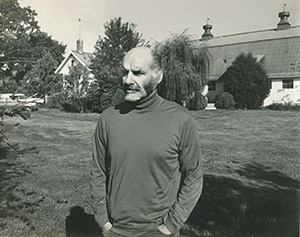
    Peter Tompkins, author of best selling titles in the fields of metaphysics and ancient mysteries, and co-author of The Secret Life of Plants. This photo, taken in 1971, is of Peter at the ‘Barn’, where Ptolemy grew up. Image courtesy of Ptolemy Tompkins

    RS: Your father had an amazing life in his own right. Wasn’t he an American spy behind the lines in Rome during World War II?

    PT: Yes, my dad was behind the lines. He wrote a book on it, A Spy in Rome. He posed as a Roman Fascist, and once had the SS officer in charge of finding him (they knew there was a spy somewhere about) over for dinner. He made him an omelette, an obvious luxury at the time, and the officer detailed the tortures they had in store for the American spy once they found him. Of course the rest of life pales a bit after something like that.

    RS: Your father at one point was vigorously engaged in the search for Atlantis. Could you talk a little about what it was like to take part in it? 

    PT: “Taking part” is probably an exaggeration. I was around. My dad was convinced that the Edgar Cayce readings about the rising of Atlantis were correct. He spent thousands and thousands of dollars photographing the limestone formations off Bimini – the so-called “Bimini Road.” My father loved the idea of Atlantis returning because he wanted the world to become a kind of new Eden. He was a true father of the New Age in this sense – he had the core New Age belief that the world once was, and would be again, a better place. But not better in some mundane sense, but in the sense of being elevated back into a spiritualised condition that it had fallen away from. That’s what the Bimini stuff was all about. Generally speaking, one had to be naked during the filming. There were often times when I was the only one aboard the various boats he hired with a bathing suit on. It drove my dad nuts.

    RS: With all of your exposure to the New Age counterculture, what things would you say are the most valuable that you learned?

    PT: My father taught me the fathomlessly valuable lesson that the mundane world we see around us isn’t all there is, and that if we’re impatient with the limitations of existence as it presents itself now, we are so with good reason. Deep within, we know there’s more. My dad was a pain in the neck to a lot of people. He was far from a perfect person, and he was, I’d say, genuinely a touch mad. But he had a certain nobility of character. He was, in his misguided and often destructive way, truly a great man. Many people think that about their fathers, of course. I think one of the reasons I’ve always been comfortable criticising and making fun of him is because I’m so convinced he had that core of greatness.

    RS: You’ve worked intensively with Eben Alexander in writing his two books, Proof of Heaven and Map of Heaven. Eben is best known for a long and powerful near-death experience he had when he was in a coma in 2008. Could you say a little bit about how you see his experience and how you regard him personally?

    PT: One belief about the world I hold very strongly is that, as the New Age adage has it, everything is significant. The problem, or rather the challenge, it seems to me, lies in celebrating that fact even when the significance one encounters is problematic. It’s great when you find a parking space just when you need one, but that doesn’t mean the world is some giant pinball machine rigged in your favour. Sometimes the odd synchronicities and resonances of life are much more challenging. In the case of Eben, my biggest struggle was just how similar my relationship to him was to my relationship to my dad. I was eleven when The Secret Life of Plants transformed my life overnight, and I got to see the effects of that kind of instant celebrity very close up. Yet at the same time I myself was completely invisible.

    The same thing happened with Proof of Heaven. I worked like a demon to get that book in shape for publication. It took me about four months, and by the time it was done, it was, experientially speaking, my book, not Eben’s. A great portion of the writing in it is by me, not Eben. At the same time, the book describes Eben’s life and his experience. I did not make anything up, and I had full faith in Eben’s honesty. When the book came out and went right to the top of the bestseller lists, and Eben was praised for his fine writing style, etc., I found myself in a situation that really did feel somewhat choreographed. Another person was being praised through the roof beams for a book that I had in large part written. I had, I realised, a couple of options, the only sensible one of which was to be completely unfazed by it. Who wants to be the kind of person who raises their hand at the back of class and says, “Hey, that was my idea, not his!” It began to seem quite clear to me, as the success of the book continued, that I should view the whole thing as a kind of lesson in humility. T.S. Eliot, in the Quartets, says that humility is endless. If T.S. Eliot says that, who am I to argue? So I just made a point of trying to celebrate the success of the book, the good that it was doing, and not get caught up in picayune gripes about not getting the attention myself.
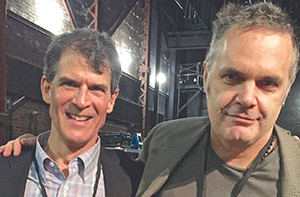
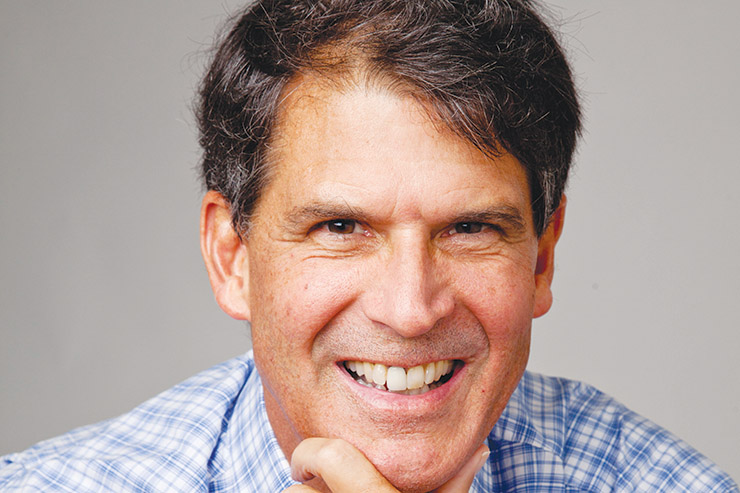
    Eben Alexander and Ptolemy at the Marion Institute in 2014. A great portion of the writing in Alexander‘s Proof of Heaven is by Ptolemy. Image courtesy of Ptolemy Tompkins

    It worked pretty well until that article came out in Esquire magazine which purported to rip the veil away and expose Eben as the calculating phony he really was. The article was full of errors, and made a very brief mention of me, three or four lines, most of them incorrect. I thought: Jesus, here this guy wants to discredit Eben, and he won’t even do me the service of using me as a tool to do so? Somehow I found this really irritating. Eben – again, like my dad – is a great guy, but he’s also frustrating.

    In the end, I came away feeling that his experience was true. There was something about the way he described it in our phone interviews that just made something in me click. It resonated. More than anything else, it reminded me of the visionary journeys made by a number of Persian mystics. One of my favourite books is Spiritual Body and Celestial Earth, an anthology of these experiences compiled and edited by the great French scholar of Islam, Henry Corbin. There were details in Eben’s narrative that brought that book to mind in a truly extraordinary way. Every detail of his journey, from his beginning in the subterranean murk to his meeting with the sister/angel figure to his journey beyond that meeting into the “dazzling darkness” where he encounters God… All of this was just so wildly resonant, and I somehow just knew he couldn’t have been making it up.

    RS: Could you talk about your own beliefs on the afterlife, for example as you discuss them in The Modern Book of the Dead?

    PT: For most of my adult and semiadult life, I have been obsessed with the idea of personal survival. That the you that is really you, and the me that is really me, does not fade away or fall apart with the death of the body, but continues on. Most importantly, I have been taken up with the idea that survival is above all else personal and individual. Nicholas Berdyaev, the Russian writer and philosopher, wrote a three-word sentence that sums all this up: “Personality is indestructible.”

    I was around in the ’70s when my stepbrother Nicholas Vreeland, the Buddhist abbot, first became interested in Buddhism. I looked up to Nicky a great deal, and as he wandered into Buddhist practice, I wandered into one Buddhist book after another. At first I was hugely taken with what I read. But gradually, something began to bother me. I realised the Buddhist focus on the unreality of self at all levels was something I could not accept. The key feature of life, for me, was that it was personal. People are personal, but so are animals and, for that matter trees and plants, just like my father said. Corbin said that in the world above this one, the primary question we ask about what we see there is not “what” but “who,” because up there, everything is a “who.” This is the root of why children love cartoons and fairy tales where everything is personalised, animated – that is, given an anima. The Buddhist suggestion that the self is actually not individual and eternal but aggregate and passing… well, by the time I was in my early twenties I found myself in open rebellion against this idea. I didn’t dislike Buddhism, and I continued to read Buddhist books. At the highest level, I do believe all faiths converge. But I believe that the level where this happens is, quite simply, so high that talking about it from our present vantage point is essentially impossible. I’ll tell you this: if there’s one belief I know I will absolutely never abandon, it is the value of personality – of the individual being. The fact that we, each of us, are both eternal and personal strikes me as the most interesting fact there is.

    RS: Another book of yours is The Divine Life of Animals. Many people are convinced that animals (especially their pets) do have a kind of afterlife. What did you discover in looking into this topic, and what do you think the truth is?

    PT: The Divine Life of Animals arose out of an article I wrote for a magazine called Guideposts where I worked for many years. The article was called “Will My Pet Go to Heaven?”, and it is not exactly a masterpiece of metaphysical speculation. What I discovered working at Guideposts is that there are a lot of wonderful people out there in America, and the world at large, who love their pets deeply and suffer intensely when they lose them. Imagine a woman living in, say, Iowa. Her husband served in World War II, and they live a long, happy, and traditional American middle-class life. Then, as so often happens, the husband dies first, and the wife, alone and heartbroken, begins to rely more and more on the company of her pet – a dog, let’s say. Then the dog dies. Suffering deeply, this woman turns to her clergyperson for reassurance that, just as her husband did not simply blip into nonexistence but exists still, in a world beyond this one, so too does her pet. Alas, her clergyperson, following a long (but far from unanimous) tradition among Christians, tells her that no, there are no dogs in heaven. This has the predictable result of devastating the woman. After all, she relies on her clergyperson for answers to the big questions, and what he or she says, she believes.

    I determined to marshal some evidence that the Christian faith (the faith of the vast majority of Guideposts readers) is far from unanimous on this point. The article received a mind-boggling number of letters in response. Some of these were from cranky by-the-book types assuring me I was wrong, but the vast majority were from people who had suffered the loss of a pet and were vastly grateful to hear, from a source they trusted, that there was more to the picture – that the essence of their pets had indeed survived. There’s a very popular poem called “The Rainbow Bridge” that describes how when a person dies, they will cross the Rainbow Bridge and be greeted by all the animals they have ever loved. This poem is saccharine to the point where it actually does hurt my teeth to read it. And yet, hidden beneath all the maple syrup, there is a core truth: there is a bridge between this world and the worlds above this one, and when we depart from this world, we do not vanish into an impersonal mush, but into a world that is specific and personal just as this world is, only more so. So that’s what I ended up enlarging into The Divine Life of Animals.

    Unfortunately – or perhaps just unavoidably – once I secured a contract for the book, I made it the kind of book I like. That is to say, a more complex one than most of those nice ladies who read Guideposts wanted. This has always been my problem as a writer. I’m too fancy for the people who like simple books, and too simple for the people who like fancy ones. So it goes!
    RS: Your latest book is called Proof of Angels, and you’ve spent a lot of time thinking and writing about people’s encounters with angels. What do you think about angels?

    PT: I think angels are real, and I wish I knew more about them. During my decade at Guideposts, I wrote regularly for Guideposts’ sister magazine, Angels on Earth. Once again, it has a readership largely composed of what you might call conventional, old-fashioned Christians. The original meaning of “angel” is, of course, “messenger,” and what chiefly interests me about angels is the way in which the appearance of one can instantly transform a person’s view of reality. You can’t really use the word “angel” anymore and have it convey any kind of genuine charge. It’s been too much doused in the maple syrup of market-driven spiritual writing (a problem that I know I myself contributed to). But originally, angels were beings characterised by their numinousness, their power, and what you might call their awfulness, taking the root of that word in its original sense, as something inducing awe.

    A crucial key to believing in angels today is to believe in demons too. This is much easier to do, or at least much easier for me to do, because while I bog down when I try to read Augustine or Aquinas on angels, I am riveted when a contemporary writer like Louis Proud or Joe Fisher describe their interactions with demonic beings. The whole succubus/incubus business, with people engaging in what, to hear them talk, is entirely satisfactory sexual congress with nonphysical beings, I find fascinating. There is much literature on this subject, and so much is just so believable. So belief in demons is a great sort of gateway drug to belief in angels.

    One of the single most momentous events in my adult life came when a friend demonstrated to me beyond all doubt that Ouija boards work. With patience and the right circumstances, the planchette really does move, and decidedly individual personalities, or subpersonalities, come through. Who or what are these entities? I don’t know. Is it a good idea to get involved with such entities? I would say no. But is there something real going on here? Absolutely. I’ve had it proved to me, and no one could de-convince me of what I experienced. So I’m very grateful to the demonic world. It had a hand in breaking down my culturally engrained positivist/materialist tendencies that were hardwired into me as a member of modern culture. I see a little more of the real world – the world that is partially material but in much larger part spiritual – as a result of that brief flirtation with the murkier levels of the spiritual world.

    RS: In this whole field, how do you personally separate fact from imagination?

    PT: I think one of the absolutely central keys to accepting the reality of the spiritual world is understanding that all perception is a collaborative event. We are co-builders of everything we see and experience. Ordinary, mundane reality is a creation that takes a fantastically complex amount of work on the part of our brains and unconscious minds to put together. The notion that anything we encounter in our world is just “there” and that we are seeing it objectively, with no help from our imaginative faculty, is, as Coleridge tried so hard to tell us, absurd. The world is a labyrinth, and separating the real from the unreal is a task that greets us anew each day when we wake up (and, if we listen to the traditions, one which will continue to challenge us after we die, only more intensely).

    What to hang on to in this carnival of mirrors? I think the Hungarian Anthroposophist Georg Kühlewind was on to something very important when he said that if we experienced the reality of ourselves – the inner “I” that is our true identity – with the concreteness that we experience an object that we can touch and feel in the material world, most of our problems would vanish. In line with that, I think I’d say that the first thing to do to stay oriented in the maze of existence – both incarnate and disincarnate – is to come to an unshakable belief in the reality of ourselves. Before we can believe anything “out there” can be real, we have to believe – to know – that we ourselves are real. The whole initiatory tradition, from Greece on back to Egypt and who knows where, seems to have that as its primary argument. I’d say that’s what my dad believed, so in that and many another respect, I’m very much his son.

    Ptolemy’s books – including his latest Proof of Angels – are available from all good bookstores and online retailers. His website is www.ptolemytompkins.com.

    Photos of Peter Tompkins/Ptolemy Tompkins courtesy of Ptolemy Tompkins.

    [alert type=”general” dismiss=”no”]This article was published in New Dawn 155.[/alert]

    [alert type=”success” dismiss=”no”]If you appreciate this article, please consider subscribing to help maintain this website.[/alert]

    © New Dawn Magazine and the respective author.
    For our reproduction notice, click here.
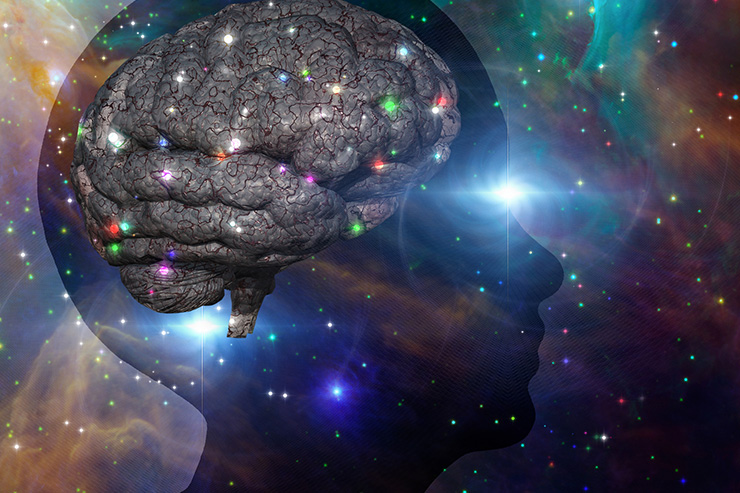
  • Where Does Consciousness Reside? Eben Alexander & the Brain-Mind Problem

    Where Does Consciousness Reside? Eben Alexander & the Brain-Mind Problem

    This article was published in New Dawn Special Issue Vol 9 No 3 (June 2015)

    Why has Eben Alexander’s story caught the public imagination so intensely? Admittedly, not everyone has looked favourably upon his revelations. Much of the materialistic press has groped around to find holes in his arguments (usually by casting aspersions upon his good faith), but their attempts to rebut him have been someplace between weak and nonexistent. As we shall see.

    To begin with, here is one of the most important challenges that Alexander makes to current scientific dogma: his experience strongly suggests that consciousness is not produced (or produced exclusively) by the brain.

    In the simplest possible terms, his argument goes like this. The standard scientific view says that all higher cognition – conscious, human experience – is the result of brain states. Furthermore, different parts of the brain govern different states. Higher cognition is performed mostly by the front part of the brain: the cerebral cortex. If this part of the brain doesn’t function, there is no cognitive experience.

    Alexander’s case shows something different. During his experience, his cortical areas showed no activity, according to the medical apparatus. The parts of the brain associated with higher cognition weren’t working. Thus he should have been in what he appeared to be in – a coma. So far, so good. But in this state he should have had no experience at all.

    That was not what happened. In fact Alexander went through a Dantesque journey starting with an abyssal kind of existence – what in his book he calls the “worm’s-eye view” – and ending in a sublime vision of cosmic illumination and love.

    Maybe you want to say that Alexander was only dreaming. But he shouldn’t even have been dreaming.

    Whatever metaphysical conclusions you might want to draw from his experience, the fact that he had it at all poses a strong challenge to conventional belief about the relation between mind and brain.

    Furthermore, Alexander is a neurosurgeon himself. That means he understands the neurology behind his own case – what the readouts on the machines were saying and what they meant, or should have meant.

    All of this is very difficult to explain away through any simplistic materialism. You might want to say that the brain functions in some way that is wildly different from what is now believed, but then you would have to tell us how it does work.

    Sam Harris, a spokesman for the new atheism, has challenged Alexander’s work in a 2012 blog posting. He quotes Mark Cohen, an expert in neuroimaging at UCLA, who responded thus to Alexander’s case: “Of course, science cannot explain consciousness anyway. In this case, however, it would be parsimonious to reject the whole idea of consciousness in the absence of brain activity. Either his brain was active when he had these dreams, or they are a confabulation of whatever took place in his state of minimally conscious coma.”

    Cohen’s statement is fascinating. Let’s look at it in more depth. Statement one: “Of course, science cannot explain consciousness anyway.” Very true. In fact, science hasn’t even told us what consciousness is. (Scientific attempts at defining it range from the vague to the circular to the hilarious.) Therefore you shouldn’t be too hasty to say when and how it can arise.

    Statement two: “It would be parsimonious to reject the whole idea of consciousness in the absence of brain activity.” Cohen is using the word “parsimonious” in a good sense. “Parsimonious” here doesn’t mean being stingy. It means being economical in a scientifically responsible way. Being translated, the sentence means, “It would be more scientifically rigorous to reject the whole idea of consciousness in the absence of brain activity.”

    The principle behind this reasoning is Ockham’s razor. Just for fun, I’ll give it to you in Latin: Entia non sunt multiplicanda praeter necessitatem: “Entities are not to be multiplied beyond necessity.” In this context, Cohen can only mean this: we know that consciousness is connected to brain states in many or most instances. Thus it’s more economical to assume that consciousness is always brain-based than to assume that there might also be some cases (like Alexander’s) when it isn’t.

    Why is this more economical? From a logical point of view, it isn’t really. It’s only simpler because it corresponds to current preconceptions. The British philosopher Mary Midgley comments on this type of thinking: “False economy is very common among people who rely too readily on it. As we are seeing, extravagance is not eliminated merely by becoming anti-religious, and thoughts which are designed to be sternly reductive often compensate by strange, illicit expansions elsewhere. In fact when we encounter a specially harsh reduction, officially launched in the name of parsimony, our first question should be ‘and what are these savings being used to pay for?’”

    In this case they’re being used to pay for a refusal to take the question seriously.

    Cohen shows this in his third statement: “Either [Alexander’s] brain was active when he had these dreams, or they are a confabulation of whatever took place in his state of minimally conscious coma.” This comes very close to the most elementary of logical errors – begging the question, since these are precisely the things that we are trying to figure out. They also show some reluctance to look at the data in any depth.

    Granted, Cohen’s responses were probably just off-the-cuff remarks given to Harris for his blog. I dwell on them because they show how cognitive science tends to behave toward the brain-mind issue. Here’s what it’s saying: (1) Actually we don’t know how or if the brain creates consciousness (as Cohen admits). (2) We believe that consciousness is the epiphenomenon of certain brain activities. We also believe that it cannot come from any other source. (3) We do not wish to look at evidence to the contrary.

    Note the contradiction here. It is more a matter of tone and implication rather than of logic per se. It’s true that “science cannot explain consciousness anyway.” The devotees of scientific materialism admit as much. Harris writes: “I remain agnostic on the question of how consciousness is related to the physical world.”

    But something about this agnosticism doesn’t smell good. Harris goes on: “There are, of course, very good reasons to believe that [consciousness] is an emergent property of brain activity, just as the rest of the human mind obviously is.” Suddenly we have gone from agnosticism to the “obvious” – even though it is anything but obvious that the mind is merely an emergent property of brain activity. That question is just as fraught as any of the others we are dealing with here.

    We see the same attitude in religious agnosticism. The agnostic sticks his tongue in his cheek and says, “I don’t know if there’s a God” – but he thinks, talks, and acts as if he knows there isn’t.

    Harris has his own sophisticated answer for Eben Alexander’s experience: it was a DMT trip. The psychedelic drug DMT creates a very short but intense high that makes the subject feel as if he has been zapped into other dimensions. Harris quotes psychedelic guru Terence McKenna: “Under the influence of DMT, the world becomes an Arabian labyrinth, a palace, a more than possible Martian jewel, vast with motifs that flood the gaping mind with complex and wordless awe. Colour and the sense of a reality-unlocking secret nearby pervade the experience.”

    Harris notes that DMT, unlike many drugs, occurs naturally in the human brain. He writes, “Does Alexander know that DMT already exists in the brain as a neurotransmitter? Did his brain experience a surge of DMT release during his coma? This is pure speculation, of course, but it is a far more credible hypothesis than that his cortex ‘shut down’, freeing his soul to travel to another dimension.”

    It’s not clear how DMT is going to send you on a wild trip when you are in a coma to begin with. To put it another way, you can’t get drunk when you’ve already passed out.

    In short, if you are absolutely dead set against believing something, you are going to do what Harris has done here: grab at any wild possibility (that makes no reference whatsoever to the actual facts of the case) to avoid believing it – at whatever cost to logic or accuracy.

    Much of today’s discussion about the relation between mind and brain shows these symptoms. Even if the materialistic view is right, there is no reason to believe it on the basis of arguments like these.

    Here is the truth, as far as I can see it: the relationship between consciousness and brain states is still very much a matter under investigation. Most of what is said about it has to be followed with a question mark. On the basis of what is now known, it’s premature and irresponsible to say that consciousness must be accompanied by brain activity. Even assuming that it is, is irresponsible.

    Alexander’s case may not serve as definitive proof that human consciousness exists apart from the brain, but it’s an important piece of evidence that can’t be dismissed just because it sounds too mystical.

    I have heard about a certain type of crab. When the fisherman catches it, he puts it in a bucket. He doesn’t put a lid on the bucket. He doesn’t have to – even though the crab is perfectly capable of climbing out. Why? Because whenever one of the crabs tries to get out, the other crabs pull it back down.

    I can’t think of the materialistic worldview without coming back to this image over and over. Whenever someone tries to free himself from this view of reality, the others – who are happy there or at any rate believe they have to be there – try to pull him back down.

    This is a pretty bad situation if you are a crab. It is utterly ridiculous and humiliating if you are a cognitive scientist.

    [alert type=”general” dismiss=”no”]This article was published in New Dawn Special Issue Vol 9 No 3.[/alert]

    [alert type=”success” dismiss=”no”]If you appreciate this article, please consider subscribing to help maintain this website.[/alert]

    Sources

    Sam Harris, “This Must Be Heaven”; http://www.samharris.org/blog/item/this-must-be-heaven, 12 Oct. 2012; accessed 25 March 2015

    Mary Midgley, Evolution as a Religion, Rev. ed., Routledge, 2002

    © New Dawn Magazine and the respective author.
    For our reproduction notice, click here.

  • A Neurosurgeon’s Journey to Worlds Beyond: An Interview with Dr. Eben Alexander

    A Neurosurgeon’s Journey to Worlds Beyond: An Interview with Dr. Eben Alexander

    From New Dawn Special Issue Vol 9 No 3 (June 2015)

    Today the intellectual world is facing an insurrection. It has nothing to do with politics or economics. It is about worldviews. Contemporary intellectual thought is hidebound by a materialistic view of the universe that automatically shuts out anything of the “spiritual,” or, God forbid, “mystical.” More and more evidence is coming to light that refutes this narrow view of reality. And more and more intellectuals are standing up against it.

    Eben Alexander is one of the most famous examples. An American neurosurgeon, in 2008, he fell into a coma during a case of severe meningitis and – at a time when, from the conventional point of view, he should have had no consciousness whatsoever – he had a profound and inspiring vision of worlds beyond this one.

    Alexander describes this journey in the best-selling Proof of Heaven: A Neurosurgeon’s Journey into the Afterlife. The book sent a shock through the United States, and gained Alexander a place on the cover of Newsweek as well as the usual attempts at debunking. Since then he has travelled and given lectures to many audiences. His latest book, The Map of Heaven: How Science, Religion, and Ordinary People Are Proving the Afterlife, co-authored with my good friend and Quest contributor Ptolemy Tompkins, was published last November.

    In July 2014, at the invitation of the Theosophical Society in America, Alexander spoke to an audience of some 450 people in Glen Ellyn, Illinois, and later addressed the TS’s Summer National Convention. He also did the following interview. Karen Newell was also present. She is his associate in Sacred Acoustics, a company that creates audio meditations combining various kinds of sound to stimulate higher states of consciousness.

    This interview originally appeared in Quest: Journal of the Theosophical Society in America, in the Winter 2015 issue.

    Richard Smoley (RS): Perhaps you could start by telling us a little bit about your journey. 

    Eben Alexander (EA): I’ve spent more than twenty years in academic neurosurgery and thought I had some idea of how brain-mind consciousness worked. I fully logged into the reductive materialistic mindset of neuroscience of the twentieth century, which says there is something about the neurons of the brain and their firing that gives you consciousness. Even though nobody had a clue of how that worked, I thought we just needed to study it more and figure it out.

    That’s why my illness, which came on in November 2008, was so revolutionary to my thinking. I had to go back and question everything I ever thought I knew about reality. I had a very severe case of bacterial meningitis. Only in looking back, months and months later, did I start to realise what a perfect model for human death meningitis is, especially the severe form that I had: it basically dissolves the neocortex.

    Modern neuroscience says the neocortex – the whole outer surface of the brain – is the part that gives rise to all the details of conscious experience. As this disease wipes out your neocortex, what is the next step? It would have been very clear to me as a neuroscientist that the next step is nothingness. Any doctor who knows anything about gram-negative bacterial meningitis and the details of my illness would realise that people don’t go in that state and come back with hallucinations, dreams, or exotic stories – they come back with nothing. In fact the reality is they usually don’t come back at all. Just the opposite happened, and that part was a mind-bender.

    The extraordinary odyssey that I went through, and that I describe in my book Proof of Heaven, should not have happened at all, according to all the modern notions saying that the brain creates consciousness. And yet I was left with this absolutely astonishing ultra-real experience and an odyssey that seemed to go on for months or years, although it fit within seven earth days.

    To me that was the central mystery. How is it that when you destroy the neocortex, you actually take the blinders off and allow consciousness of a far richer and more real and comprehensive knowing to come into existence? That was what drove me to come to some explanation.

    RS: How do you now view that relation between brain and mind?

    EA: Before the coma, as a neuroscientist who felt that the brain creates consciousness, I paid no attention to near-death experiences, because I would have said that they’re a flickering of a dying brain.

    But they’re far more than that. In fact, they are not created by a dying brain at all, they’re linked to a much more substantial, conscious, eternal spiritual being. Near-death experiencers have been telling us for decades about a reality that is much more real than this one. So has the afterlife literature going back thousands of years.

    I give talks around the world about all this. And I’ll have people who come up to me who know nothing about any of this literature but who share with me their own stunning personal stories of near-death experiences, after-death communications, past-life memories in children, and reincarnation stories. There’s just no way to pretend that it’s some mass hysteria, that it’s all some trick of the brain. This is something far more profound.

    So I’ve come to realise that consciousness, soul, or spirit is the thing that truly exists at the core of all that is. Before my coma I would have been tempted to try and tell you that, as conventional scientific teaching says, the brain, the chemistry, the biology creates an illusion of reality, an illusion of free will. In fact that is absolutely backwards. What truly exists is consciousness, soul, or spirit.

    Even modern physics is in a headlong rush to tell us that there is no material to the material world. It’s vibrating strings of energy and higher-dimensional space-time. And it is consciousness that is essential to emerging reality. The only thing we know exists is our own consciousness. But we’re so immersed in this consciousness that it’s very difficult to separate ourselves from it.

    Any possible model, or any kind of scientific explanation of the nature of reality, must begin with a far more robust explanation of what consciousness is, because it is not created by the brain. The brain is a reducing valve or filter. That idea was gaining in popularity in the late nineteenth century with very brilliant thinkers – William James, Carl Jung, Frederic Myers – and yet it lost its attraction during the heyday of the twentieth century, when science got sucked into purely materialistic explanations.

    [alert type=”info” dismiss=”no”]If you appreciate this article, please consider a subscription to New Dawn magazine.[/alert]

    RS: So what is consciousness?

    EA: Consciousness, I would say, at its core level, is the observer, the awareness. We’re so consumed with this worship of the ego, the self, the linguistic brain, and rational thought that we lose sight of the fact that our own consciousness is actually something far deeper and more mysterious. It is that awareness part of us, the part that knows of its own existence and of the existence of a universe.

    The little voice in my head, that linguistic human brain, which is so tightly tied to rational thought and also to ego and self, can make a request, state an intention, offer up some gratitude, but there is far greater wisdom as one gets deeper and deeper into consciousness. This is something that meditators, Tibetan monks, those who have been deeply into consciousness study over millennia, have been trying to tell us. And yet only now is science beginning to recognise that deep within consciousness itself we can find the evidence that we can be linked to something far, far greater than we are told by that minuscule view that the brain creates consciousness. In fact, when you realise it works the other way around, we can come in touch through deep meditation with consciousness. We come to realise consciousness is not local.

    Before my coma I was a conventional neuroscientist who believed that we can only know things through our physical senses. Since then I’ve come to realise that things like telepathy, precognition, near-death experiences, after-death communications, past-life memories in children, the tremendous scientific literature on reincarnation, are proving to us that consciousness is not local.

    It’s important to understand nonlocal consciousness. In the scientific community I steer people to that wonderful book from the University of Virginia, Irreducible Mind: Toward a Psychology for the Twenty-First Century by Edward Kelly. It’s 800 pages of hard-core scientific data and analysis showing very clearly that the brain does not create consciousness. As I said earlier, it’s more of a reducing valve or a filter. This helps us to understand that mystery of quantum mechanics, which was proving, a hundred years ago, that consciousness is fundamental in the existence of any part of reality emergent in this universe. Consciousness is filtered in through the brain; it is not created by the brain.

    RS: You say that the materialistic model of the brain and mind is being increasingly challenged within science itself. Do you see much evidence of this, particularly in psychology and neurology?

    EA: A number of respected scientists around the world, some of whom have their training in psychiatry, some in psychology, are realising that the “hard problem” of consciousness is the most vexing conundrum known to all of human thought. This is saying that, in spite of the increasing devotion of study to the brain, no neuroscientist on earth can offer the first sentence about how the physical brain might create consciousness.

    A lot of the neuroscientists who study this problem realise that the more we know about the physical brain, the more we realise it’s not the creator of consciousness. It’s very clearly related to consciousness, but again it’s more of a reducing valve or filter.

    Often colleagues will challenge me and say, “Wait a minute! You’re saying this whole mystery of being deep in your coma as your brain was being destroyed by bacterial meningitis actually was the blinders coming off – when your awareness was getting more crisp and real.” They say that makes no sense.

    I would reply by pointing out two commonly observed clinical phenomena. Neurologists and neuroscientists are aware of some of these examples. One is “terminal lucidity,” which I point out in my book Proof of Heaven. Often when they get closer to death, elderly and demented patients can have these oases of very clear thinking, memory, interaction, great clarity of thought that completely defies any kind of explanation.

    The other commonly observed phenomena have to do with what is called the idiot savant or acquired savant syndrome, where some kind of brain damage, like a stroke or head trauma, uncovers some oasis of superhuman mental functioning. These savant syndromes are very, very common. I had many of them when I was active in neurosurgery. I would see where people would have some kind of brain damage, and it actually uncovered this incredible superhuman ability – of memory, calculation, ability to graphically represent things, musical creativity – that emerged out of nowhere.

    Wilder Penfield, one of the most renowned neuroscientists of the twentieth century, probably still holds the record for electrical stimulation of the brain in awake patients – tens of thousands of episodes in his work on epilepsy. He worked in Montreal and wrote a book in 1975 called Mystery of the Mind: A Critical Study of Consciousness and the Human Brain. In the book, he gets clearly into his conclusions that never once, in all those tens of thousands of stimulations, did he uncover an event that seemed to be a free-will event of conscious experience. The patients always felt like they were puppets on a string, no matter what the memory, experience, whatever they went through – they always knew it was something “triggered.” Never once was there anything that resembled a free-will type event.

    To Penfield it was very clear. To me, the evidence for this is completely consistent with my journey as described in Proof of Heaven and my conclusions and understandings about consciousness. If you’re trying to find free-will and consciousness, or soul, or spirit, they’re just not created in the brain at all. In fact, the brain is basically shackles. That’s essentially what near-death experiencers have been trying to tell us for millennia. Mystics who have had similar spiritually transformative experiences have been trying to put it out there that in fact, when we’re freed from shackles of the physical brain and released from that illusion of here and now, we actually come into a much higher knowing.

    RS: My understanding of most near-death experiences is that they are overwhelmingly positive. But there are some negative experiences, where people encounter hells or devils or demons. How does this fit with your picture?

    EA: When you look at a large number of NDEs, say somewhere around 95-98 percent of them seem to be very positive, very loving. This can be quite independent of the circumstances around the demise of a given patient. They often are shown beautiful scenes of unconditional love, love of an infinitely powerful spiritual being, often messages conveyed by the souls and spirits of departed loved ones that are very positive and loving.

    As for the experiences that are negative: those who have read the book Proof of Heaven realise that I started out in a very dark, foreboding, underground realm, which I call the earthworm’s eye view. If I had come back from my near-death experience having only been to the earthworm’s eye view, I probably would have had what people describe as a hellish near-death experience.

    Talking with other near-death experiencers and reviewing thousands of near-death cases, I believe that in many ways the hellish ones are incomplete. They are not going in with the power and the oomph to blast through to those higher realms. To me it was very clear that unconditional love has tremendous power – to heal at all levels, to heal the individual soul, to heal soul groups, to heal all of humanity, to heal all of life on earth, to heal all of consciousness existent in this material universe.

    There can be dark forces, but by knowing that connection to the divine, the infinite power and love of that divine, we are able to bring that light and love into any realm we exist in. That includes this material realm; that includes the lower spiritual realms, including that earthworm’s eye view.

    In my journey, as I describe in Proof of Heaven, I would cycle through and ascend through higher and higher levels through a gateway realm with a beautiful idyllic valley, butterfly wings, and angelic choirs, with lots of spiritual beauty, but with earth-like features. I would then ascend to higher and higher realms all the way to the core: infinite inky blackness, but filled to overflowing with the divine, that power of unconditional love in its healing capacity and also the brilliant light of that orb, brighter than a million stars. I knew that completely outside of our duality.

    But then I would tumble back into that earthworm’s eye view. And very quickly in that journey I came to realise the importance of sound, music, vibration, which is part of the work I do now with Sacred Acoustics, with Karen Newell: using sound to enhance these abilities of our souls to transcend. That’s why the work of Sacred Acoustics has so much to do with meditation and getting into deep meditative states.

    All of that is coming to realise that love has infinite power to heal. And I came to see in my journey that this is not a battle between good and evil, where they are equal and counterbalanced and maybe good and love will win out or maybe evil and darkness. Evil and darkness are the absence of that love and that light. By remembering our divine connection to that oneness and to the infinite healing power of that creative source, we can bring that light and that love into any aspect of the material realm and the lower spiritual realms.

    RS: Could you say more about your work with Sacred Acoustics? What do you recommend for people who want to have a sense of that unconditional love while being connected with this earthly realm?

    EA: You don’t have to die, or almost die, to get this. As a conscious being, you have all the tools you need to go within consciousness to come to see much deeper truth. I recommend meditation, Centering Prayer – sometimes it comes to us as a gift of desperation through the hardships of life, because in fact those hardships and difficulties, even illness or injury, are often a beautiful gift. That is often how we get a revelation about our deep connectedness with each other and with the divine.

    About two years after my coma, I was introduced to the Monroe Institute and the work of Robert Monroe, who wrote three wonderful books on his journeys. He was a pretty straight-laced guy who ended up having spontaneous out-of-body experiences. Over four decades he came to realise that you can use sound – specifically slight differences in the frequency of sound presented to the two ears – to do some very interesting things with consciousness. I was attracted to it two years or so after my coma, when people approached me who knew a bit about hemispheric synchronisation, brain entrainment, what Monroe called hemi-sync. And they suggested to me that maybe I could revisit some of the realms that I had experienced in coma, when my neocortex was being ravaged by the meningitis. But I could do it in a reversible fashion by using two differential frequencies to the two ears.

    There’s a particular circuit in the brain that is a very accurate timing circuit. That circuit is right next door to a circuit in the brain stem that modern neuroscience would tell you (with our very primitive notions about consciousness) seems be an ignition system for all of consciousness. My idea was that with this synchronisation of electrical activity to the hemispheres using differential sound inputs to the two ears, I might synchronise the electrical activity. This would take away the information processing aspect of the neocortex and allow my consciousness to be set free, just as it was when meningitis was destroying my neocortex.

    This is the work that I now do in conjunction with Sacred Acoustics; those that are interested should visit sacredacoustics.com. It has to do with a sophisticated use of patterning of these sound inputs to the two ears to enable consciousness to be set free. 

    RS: Which spiritual figures have you found most inspiring?

    EA: I grew up in a Methodist church in Winston-Salem, North Carolina. My father was very influential in my life, and he had a very strong religious belief in his own right. He had grown up in eastern Tennessee during the Depression. He had been a combat surgeon in the Pacific during the Second World War, and then he went on to head up a neurosurgery training program. So he was very scientific, but also deeply religious and truly spiritual. And I had grown up trying to follow, as best I could, in his footsteps.

    Of course, being a child of the ’60s and ’70s, I realised that science is the pathway to truth. And as much as I wanted to believe what I was taught in my Methodist church, through those years of working in academic neurosurgery I found it more and more difficult to explain the survival of consciousness after the death of the brain and the body. As I said earlier, I bought into the modern twentieth-century neuroscientific view that the brain creates consciousness. And that, of course, means that it’s birth, death, and nothing more, and none of us has free will, and consciousness is an illusion.

    My coma journey showed me that every bit of that is false. As I started to study more and more about NDEs and was led into the afterlife literature and into the writings of mystics and prophets going back thousands of years, what struck me was their similarity: they all converge on a much deeper truth. It turns out that the linguistic brain is in many ways our enemy in trying to come to a much deeper understanding. We can actually communicate in deeper ways, too, that have to do with a much purer form of consciousness. This is why I’m such a tremendous fan of meditation and encourage people to develop a daily practice of meditation.

    The more I started giving talks about my experience, the more I started hearing back from Kabbalists, from Christian mystics, Sufis, Buddhists, Hindus, and atheists who had a very deep spiritual awareness through some experience. They were all talking about the same thing.

    RS: Is there anything you’d like to add?

    EA: A central message in Proof of Heaven is that consciousness is at the core of all existence. I think the most important aspect of that lesson, which is brought back by so many near-death experiencers and other spiritual journeyers, is that we are all eternal spiritual beings, and in fact our very consciousness is a direct link to the infinitely loving creative source at the core of all being. As so many who have had these experiences will tell you that unconditional love is infinitely healing.

    It’s important for all of us to realise that we’re eternal, spiritual beings, that we come back in multiple reincarnations in our ascendance toward that oneness, and that we’re all in this together. Consciousness binds us all, not just as humans, not just as all life on earth – all of conscious life throughout the universe.

    My journey showed me that the human brain and mind will never have a theory of everything. We can never possibly understand the grand workings of this universe in its greatest sense, the workings of that great creator. Never! But the journey is absolutely wonderful beyond description, and that is what we are all a part of, and we are all doing it as eternal spiritual beings bound together as one.

    Any frictions between schools of religious thought, frictions between science, philosophy, and religion and spirituality, are false boundaries that have to do with the linguistic brain trying to define and to limit. Whereas we really have to take a top-down approach. We can all do that by exploring our consciousness through prayer and meditation.

    [alert type=”general” dismiss=”no”]This article was published in New Dawn Special Issue Vol 9 No 3.[/alert]

    [alert type=”success” dismiss=”no”]If you appreciate this article, please consider subscribing to help maintain this website.[/alert]

    © New Dawn Magazine and the respective author.
    For our reproduction notice, click here.
  • Helping Stuck Souls Crossover

    Helping Stuck Souls Crossover

    When I was twelve years old, my brother – a Funeral Director – began introducing me into the business. Over the next several years, he taught me anatomy and physiology, principles of mortuary science as well as other aspects of the profession. By the time I was twenty-one, I had completed my mortuary apprenticeship, but decided to leave the profession and pursue a degree in psychology.

    Working in the funeral business gave me a rich understanding of the dying process, people’s experiences at death and personal experiences preparing the body for burial. It was here that I became acquainted with a phenomenon I call “the watchers.” Both my brother and I, at times while preparing the body, would feel the soul of the departed watching us. It was as though there were three people in the preparation room rather than two.

    The other interesting phenomenon I became acquainted with during this time was the many stories of deathbed visions. Families would often talk about the last hours or days before their loved ones died. It was during these times that family or friends who had died would visit the dying person and within hours or days, and sometimes a week or so, the person would die. Some dying people would see a closed golden or brilliant white door, and later report the door had opened, and soon they would be dead.

    Working with the Dying

    These experiences and stories stayed with me as I completed my undergraduate and graduate degrees in both psychology and counselling. I eventually set up a counselling and psychotherapy practice in the state of Ohio and within six years I was in an internship at the Cincinnati Health Department’s STD Clinic. During the first year at the STD clinic, I began working with the first AIDS case in the Cincinnati area, and eventually worked with others who were diagnosed with the disease.

    At the time, there was no treatment for AIDS, so I began helping people with this disease go through the dying process. Working with those dying of AIDS, I encountered much fear and anxiety regarding dying, death and the afterlife. I immersed myself in Eastern and Western literature on death, and began attending a local near-death experience group to find a solution to my client’s fears and anxieties. After accumulating a large body of information, I created guided imagery to take my clients into the light. This imagery was targeted to reduce their fears and anxieties. However, what occurred on their inward journeys were profound mystical experiences, in which they encountered deceased relatives and loved ones. I was simply awe-struck by this outcome.

    Discovering Some Souls Do Not Cross Over

    The stories I heard in the local near-death experience group helped me craft the guided imagery, but I also learned all souls do not go into the light at death. One of the men in the group was Howard Storm, an atheist, who had a hellish negative near-death experience in which he was lost in an agonising darkness taunted by shadowy creatures. He came to realise he was dead and after saying prayers his mother taught him in childhood, he was immediately escorted into the light by a light being. According to P.M.H Atwater1 about 15% of adults have had near-death experiences similar to Howard Storm. It soon became obvious the guided imagery I created not only helped my clients reduce their fears and anxieties, but I was taking them on an inward journey directly into the light, avoiding the hellish experience Howard Storm encountered. Decades later, Howard published his near-death experience in the book My Descent into Death: A Second Chance at Life.2

    A few years later, while working with The Monroe Institute, an organisation using sound frequencies to produce out-of-body experiences, I learned that they had helped a confused soul move into the light. An Institute facilitator using this technology connected with a man whose ship had sank in the early 1800s. This man was still in the water holding onto a wooden part of the ship, but unlike Howard Storm this soul did not know he was dead. The facilitator eventually convinced the man he was dead. He was told to look up and he would see a light. He reported he did see the light. The facilitator then convinced the man to let go of the wood and go toward the light, which he finally did.

    During this period, I began teaching a course in parapsychology at the University of Cincinnati, and soon the Psychology Department was sending me referrals of people who were having unusual experiences, primarily hauntings. I set up a small research team and began investigating these phenomena. I discovered these hauntings were caused by souls who had not gone on into the light at death because of various reasons. Some of these souls died a violent death, some saw the light but decided not to go into it because of unfinished earthly business, while others appeared to be lost or addicted to earthly pleasures, and some were just astral shells.

    There were some souls that appeared to have gone into the light, but their astral image was left behind imbedded in what Eliphas Levi called astral light.3 Astral light is the spiritual substance emanating from the upper and lower astral planes that interpenetrates physical reality. Astral planes are areas in spiritual reality manifesting intense feelings and emotions. The upper astral plane expresses positive feeling and emotions and the lower expresses negative feeling and emotions. When souls die a violent death, or sudden death, their soul image is fused into the astral light with intense emotions coming from the lower astral plane. These ghostly images are astral shells and have no soul essence or spiritual identity. These astral shells, as in most ghostly encounters, re-enact over and over the drama the soul experienced at death, which is usually traumatic.

    A few years later I encountered a totally different soul experience called twin souls. In this case, a soul named George decided not to go into the light, but remain in the hinterlands between the earth plane and the light waiting for his twin soul named Jean to die.4,5 According to George, as twin souls they needed to merge back into one soul and that can only be possible after Jean dies. Once Jean dies, she will be like George in spirit form, and they can both go into the light together, and eventually merge back into one soul.

    Up until this point, working with these unusual cases, I found myself becoming more open and receptive to souls who had died. With George, I could feel his presence and energy at times all around me – he would come into my meditations, and I could see him clearly. These experiences were laying the foundation for what was to come, which would change my life forever.

    Messages from the Other Side

    The major shift happened when an old friend died, an Episcopal Priest, I had known for years. I was distraught for weeks after his death. My melancholy mood suddenly lifted when in the middle of his memorial service he spoke to me. He said in his voice as though he was speaking to me in life, “This is Wayland, thanks for coming, I’m okay, I’ll see you later.” I was stunned! This was the first time anything like that had happened to me. I was now spiritually open and could not go back to the way I was.

    A few years later my father was diagnosed with lung cancer and it had metastasized to the brain. I made a decision to set aside specific career goals and instead listened to his concerns about the dying process and his inevitable death. I eventually asked him if any of his loved ones, who had died, visited him. He said his mother visited him several times. I knew at that point he would be joining her soon, and he did two weeks later.

    That following Memorial Day, my life partner and I visited my mother, and we all went to the cemetery to decorate my father’s grave. I was alone looking at his gravesite, reflecting on the many things we had done together in life, then like the experience I had with Wayland, my father spoke to me. In life, when he wanted to get my attention, he would address me by my middle name, which is “Wayne.” In his voice, he said, “Wayne I’m not there. Wayne I’m not there.” After that day, I only visited the gravesite once, when my mother died. I will never visit it again because he told me he was not there.

    These afterlife encounters opened up a portal between the earth plane and the light, and the landscape in-between. This portal has allowed me to connect with the deceased in the afterlife, in ways I had never thought possible before. Realising the fullness of the afterlife has added richness to my life, and given me a direction for my own spiritual journey. The experiences with Wayland and my father have opened a vast horizon, working with other departed souls.
    [alert type=”info” dismiss=”no”]If you appreciate this article, please consider a subscription to New Dawn magazine.[/alert]

    Helping Souls Go Into the Light

    After the Memorial Day encounter with my father, my personal armour was shattered, leaving me open to other afterlife experiences. About a year later, my life partner and I were visiting my mother when another life expanding experience flooded into a nightly dream. I had read several biographies of the actor James Dean, and had visited his hometown in Indiana. While at my mother’s, I had a dream of the late actor. Suddenly, the dream motif shifted, and I found myself in a grayish sepia-tone room. The room looked like a concentration camp cell with dingy bunk beds, two beds high. On one of the beds was Paul, a childhood and adolescent friend who died of an overdose a few years earlier. Besides me, he was the only one in the room. He looked gaunt and dishevelled lying on the bed. He looked up at me and said, “Gary, where am I?” I told him he was dead and that surprised him.

    During meditations, I worked with Paul helping him move out of the place he was in. Together we created a new home for him that was bright and sunny, overlooking a beautiful green valley. Paul continued to be with me for the next several years. At times, I could feel his presence and he would come into my meditations, to work on earthly issues, primarily his drug and alcohol addictions. Then one day he told me he was moving on, and thanked me for helping him. I saw Paul in my inner world or inner vision walking toward the light and disappeared. I haven’t felt his presence, nor has he visited me in my meditations, since that day. I feel he is now in a better place in the afterlife.

    Shortly after Paul left, another experience came into my meditations; it was my mother. She died a few months previously, and I thought my father was there to welcome her into the light. However, this was not the case. My mother was a very religious woman who tried to help many people in need, but she thought she was doomed to hell because of certain thoughts she had. She never revealed what those thoughts were. In the meditation she said, “Gary Wayne, I’m lost.” She repeated that over and over. Like my father using my middle name, my mother always referred to me as Gary Wayne. I immediately came out of the meditation. I could not see her, but I felt her presence and heard her voice.

    Knowing she was lost in some darkness she had created out of guilt regarding her thoughts, I began helping her move on. Over the next several weeks during meditation, she would come to me. I told her my father and her mother was waiting for her in the light. I told her to look for a white door with light shining all around the edges. It took her a while to find the door and slowly over the next few weeks I helped her move closer and closer to the door as her fears slowly abated. I continued to reinforce that my father and her mother were just beyond the door, and all she had to do was to open it and go through. I finally convinced her to put her hand on the levered door handle, and that was the last time I heard her or felt her presence.

    Being open to the afterlife has allowed other souls who have died to contact me. During the 2009 Christmas holiday season, another old friend entered my awareness. While sitting watching the fire in the fireplace a shadowy figure crossed the living room, and then in my inner awareness an image of Greg popped in, with a strong feeling of his presence. Somewhere in the centre of my mind he spoke to me about our last encounter, which wasn’t pleasant. I had known Greg for thirteen years from the time he was fifteen. His brother and I were life-partners for nine years, and finally broke-up. After the break up, Greg and I remained friends. However, Greg’s wife was in contact with my ex, which created insurmountable problems. So, I decided the only way to deal with the issues was to cut off all communication with Greg and his wife.

    In spirit, Greg told me he was devastated by my decision to cut off all communication because he felt we were like brothers, and this caused him to go through a severe depression. In the afterlife, he could not move on until we dealt with this unfinished business. During meditation, Greg would come to me and we went through a process of forgiveness. After forgiveness, he told me it was time for him to move on. Like the experience with Paul, I saw Greg walking toward the light and disappeared. I have not felt his presence since that day.

    Growing up in the racist South, I was influence by racism all around me. One night in a house on our property adjacent to the main house, I was playing an old piano. The door unexpectedly opened and there stood a black man whom at first I didn’t recognise. After a few moments, I recognised him; it was James, a former high school basketball player that came to our school during integration. At the time, I had no black friends and felt very uncomfortable with him being in my presence.

    However, over the next few weeks, James would drop by at night, and we would play the piano together. I was still uncomfortable with him, but I tolerated the situation. One night, full of bourbon and a strong dose of racism from a white neighbour, I was drunk, and ready for a confrontation. When I came home, I heard the piano playing, opened the door and there sat James at the piano with a big smile. A horrible confrontation ensued, and I ran James off our property with a cacophony of racial slurs. Weeks later, I felt horrible guilt and shame over the encounter, but never saw James again.

    Then in November 2011, he returned. I was reflecting on various students I have taught over the years. I was thinking about an African American student, I had helped work through a bad divorce. Suddenly, another African American replaced his image, a man I had long forgotten: James. It was as though his energy was all around me. I simply couldn’t shake it. It felt like one of those experiences where you feel a person’s presence, or they pop into your mind, and shortly afterwards they call you on the phone.

    The feeling was so intense. I looked on the Internet to try to find him because I wanted to apologise for what I did over forty years ago. I had no luck, but the feeling persisted. For two days, I felt possessed to find him. Finally, on the third day, I located his sister. She told me he married a woman in Scotland, had two daughters and died there in 1986 of Lou Gehrig’s disease. I was stunned!

    Knowing he was dead, I decided to use imagery I had learned from my Theosophical training. In the imagery, I created a room in my inner world in what Henry Corbin6 would call the imaginal realm, between the physical and the spiritual world. I decorated the room to my personal taste and specifications. I focused on the last image I had of James, and asked him to knock on the door to the room. Suddenly, there was a knock, I opened the door and there stood James as I last remembered him. James and I sat facing each other in deep conversation in front of a burning fire in the fireplace. Over the next two years, we worked things out and ended with forgiveness. The last time I saw James, he was walking toward the light and disappeared.

    Reflections on These Soul Encounters

    Why did these souls come to me? It is apparent all these souls wanted me to know something specific about their situation. Wayland and my father wanted me to know they were okay. Paul and my mother wanted me to help them out of the dire situation they had created for themselves. Greg and James wanted to bring closure to unfinished business between us.

    My interaction with these souls has totally changed my life, and has confirmed all souls do not go into the light at death. There are many ways to contact the deceased. My experiences are just a sampling of the experiences people have. One thing I know without question is there is no death, just a passage from one world into another. Keep in mind that whatever we physically acquire during this lifetime remains in this lifetime. At death our souls disconnect from our physical bodies and move on, taking none of the things acquired in this lifetime. Remember, we are just passing through here, so think about the kind of impression of yourself you want to leave behind.

    [alert type=”general” dismiss=”no”]This article was published in New Dawn 143.[/alert]

    [alert type=”success” dismiss=”no”]If you appreciate this article, please consider subscribing to help maintain this website.[/alert]

    Footnotes

    1. P.M.H. Atwater, The Big Book of Near-Death Experiences, Hampton Roads, 2007, 26.
    2. Howard Storm, My Descent into Death: A Second Chance at Life, Harmony, 2005.
    3. Eliphas Levi, Transcendental Magic, Samuel Weiser, 1972, 63, 66-67.
    4. Gary W. Duncan, “Twin Souls Merging, Another Look”, New Dawn 142 (Jan-Feb 2014).
    5. Jean A. Cline, Gary W. Duncan & Daryl I. Coston, Twin Souls Merging, Jillett Publications, 2007.
    6. Henry Corbin, Mundus Imaginalis or the Imaginary and the Imaginal. An Annuel of Archetypal Psychology and Jungian Thought; http://hermetic.com/moorish/mundus-imaginalis.html

    © New Dawn Magazine and the respective author.
    For our reproduction notice, click here.
  • Embraced by the Light: Journeys to the ‘Other Side’

    Embraced by the Light: Journeys to the ‘Other Side’

    Ancient religions including the shamanic traditions are replete with myths regarding the dying and death process. It was believed within these traditions that when a person died their soul was escorted into the afterlife by a special being called a psychopomp. In Greek psycho means soul and pomp means guide, so a psychopomp is a guide of the soul. In our modern world, the psychopomp tradition has changed to not only helping the dying, but also helping people develop their own specific spiritual path while living.

    In 1983, I began a two-year internship at the Cincinnati Health Department’s Sexually Transmitted Disease (STD) Clinic. At the time, I had no idea what was in store for me regarding my own talents in creating guided imageries, which eventually led me to become an ordained Gnostic Catholic Priest as well as a modern day psychopomp.

    Within a few months into my internship, one of the counsellors informed me that the clinic had received the first AIDS case in Cincinnati. He asked if I was interested in working with him on the case, and I jumped at the opportunity. Throughout the internship and months following, we worked together on that case as well as other AIDS cases. I became a specialist in HIV and AIDS as well as other sexually transmitted diseases.

    Creating Journey Into The Light Imagery

    Working with HIV and AIDS afforded me the opportunity to begin working with the terminally ill. At the time, AIDS was a death sentence and it wasn’t long before I began counselling the dying. It soon became evident that several of my clients with AIDS had intense fears and anxieties around dying and death, so I decided to create imagery to help relieve their fears.

    I plunged myself into various types of meditation, Kabbalistic pathworking, imagery techniques, hypnosis, as well as rituals from a variety of religious traditions. I searched the esoteric, spiritual and scientific literature, and attended workshops and seminars on dying and death. But what brought all the information together was the local near-death experience group. It was here I heard personal stories that enabled me to craft the imagery that would help my clients reduce their fears and anxieties regarding dying and death.

    The imagery utilised various components of the near-death experience as well as the Tibetan Buddhist bardo journey. I also felt music along with mindfulness meditation would help my clients settle into a relaxed posture. I experimented with various types of music and found the perfect compositions by Marcey Hamm called Inward Harmony. The reason I chose this composition was the way it sounded, coupled with a profound testimonial. After one of Marcey’s concerts a man came up to her and told her several years ago he had a heart attack that was accompanied by a near-death experience. When he went through the tunnel into the light, the music he heard in the experience was the same as Inward Harmony.

    Once finalised, I began using the imagery. I had my clients relax in a recliner and helped them move into a mindfulness meditation, while Inward Harmony played in the background. Once relaxed, I told my clients they have two bodies, a physical body and a soul body. I incorporated the Eastern religious belief that at death the soul moves out of the body through the crown or seventh chakra at the top of the head. Once their souls were out of their bodies, two beings of light were waiting for them. The beings of light escorted their soul bodies through a tunnel of darkness toward a dot of light that expanded, as their souls got closer. Once in the light, I left their soul bodies there for thirty minutes, and then had the beings of light escort the soul bodies back. Once back, I brought their soul bodies into their physical bodies, and then counted them out of the experience.

    Although the imagery was designed to alleviate fears of dying and death, which it did, there was also an unexpected effect. At the time I assumed the imagery was just a made up drama occurring in the mind, similar to other imageries I used professionally. But all the clients I used this imagery with had profound mystical experiences when their soul bodies were out of their physical bodies and in the light.

    Experiences With The Imagery

    The first client I used the imagery with was Mark, and he was in extreme physical pain and going blind, complications from AIDS. He had a fear of dying based on his Roman Catholic upbringing around sin. When I first took Mark’s soul body out of his physical body with the imagery, his physical body became very calm and peaceful as I gently guided him into the light. When I brought him back into his physical body and into ordinary reality, I asked what had happened? He told me he met his sister. Your sister who lives in a nearby town, I queried? “No my sister who died before I was born,” he answered. I was startled and stunned by his answer.

    In a later journey, Mark told me he met his grandmother who raised him and had died several years before I started seeing him professionally. At the time I couldn’t figure out what was happening inside Mark’s mind. Mark was slowly going blind but with these inward journeys into the light he was becoming calmer and more peaceful and could see the inner experiences clearly. Mark’s experiences were so profound he asked if I would promise him that when his life partner James was ready to die, who also had AIDS, I would take him through the imagery as well. I promised him I would.

    Within a few weeks Mark was completely blind. The imagery worked so well that he wanted to know of any method I knew that would allow him to see the physical world with a different set of eyes. The only method I could come up with was the out-of-body experience method pioneered by Robert Monroe at The Monroe Institute. The Monroe method I practiced myself, and it works. So over the next few weeks, I taught Mark the method and he began practicing it with success. He finally related that he could see the physical world, but it was different.

    Shortly after teaching Mark the Monroe method, he was admitted to the hospital for the last time. As Mark lay dying on the hospital bed, his father told me Mark came out of a deep sleep and said he saw me and his mother in the room. His father asked the physician about Mark seeing them and was told it was just the morphine. Maybe yes, maybe no.

    I became more baffled with the information Mark shared with me. I could not understand what was happening in the imagery process. I had believed the imagery experience was only occurring in the mind. I could not explain his unusual stories. I definitely did not think I was actually escorting Mark’s soul into the light.

    I continued using the imagery with people who were dying and they all had similar results until I met Phyllis. Phyllis was not dying, but in deep grief over the death of her father resulting from a severe long-term illness. I took Phyllis’s soul body on the inward journey into the light and left her there for thirty minutes. When I brought her back into her physical body, out of the experience, she began crying. I allowed her time to regain her composure and asked what happened in the experience. She reported meeting her father in the light and he had his dog with him. She revealed her mother hated dogs, and would not allow her father to have one. Her father kept in his wallet a picture of the breed of dog he loved, and when she met him in the light the dog in the picture was with him. This experience with her father in the light lifted the severe grief she had over his death and she now knew he was in a better place.

    Hearing these experiences only confused me further because I didn’t know what to make of them. What was I doing? Was I actually taking their souls or consciousness out of their bodies on a journey into the light? I was at a loss to explain what I was doing until I began working with Mark’s life partner James whose experience put it all together for me.

    James was Roman Catholic and, like his life-partner Mark, had a deep terrifying fear of death because of the extreme guilt of having AIDS. His dying process was painful and fraught with many bouts of denial. At times he could not bring himself to discuss death and had the delusion he would be cured. Working with James had a major impact on me, both psychologically and spiritually.

    As I watched James deteriorate, it became evident he was running out of time. The promised I had made to Mark kept running through my mind to help James with the imagery when the time came, and the time had come. It took several months to prepare James for the imagery experience with much resistance on his part. Even discussing the imagery produced extreme anxiety and fear because it signalled his death. However, during the imagery preparation, James was diagnosed with a resistant strain of bacteria that was infecting the frontal lobe of his brain, a complication from AIDS. Within a week after the diagnosis, he was in a semi-comatose condition and placed in a hospice.

    I began visiting the hospice weekly along with my life-partner Daryl, who also knew James. During those visits I was hoping James would become conscious enough so I could take him on the journey into the light. I explained to the hospice nursing staff about the imagery and how it worked and they were very supportive. On every visit, James’s nurse would give me the gloomy prognosis as he slid deeper into a semi-comatose condition.

    I would stand beside James’ bed and talk to him as if he was fully conscious with Daryl standing on the other side of the bed just observing. After leaving the hospice on several occasions, Daryl and I discussed James’ condition and his lack of response to any verbal communication. We decided, although James was semi-comatose, I should still take him through the imagery experience as promised. James would be the first semi-comatose client to experience the imagery and I didn’t know if it would work.

    The following week Daryl and I visited James with the intention of taking him through the imagery. James lay in bed shaking and screaming as I began playing the musical composition Inward Harmony. In James’ semi-comatose condition, I did not know if he could experience the music but I continued anyway. As before, Daryl stood on one side of the bed and I on the other.

    With music playing, I began talking to James, guiding him into a mindfulness meditation as his body continued to shake. Then I told James he has a soul body connected to his physical body. His soul body is disconnecting from his physical body and moving toward and through the top of his head. When I told James his soul body was out of his physical body, his physical body stopped shaking and he went silent. I looked at Daryl and he looked at me with a questioning expression. I shrugged and shook my head indicating I had no idea what was going on inside James. This experience was unexpected.

    I continued guiding James’ soul body through the ceiling and up through the next three floors of the hospice facility. On the roof there were two beings of light. One took James’ right hand and the other took his left hand and escorted him through the darkened tunnel into the light. In the light I told James he would meet his loved ones who had died, especially Mark, and I would leave him with them for thirty minutes and then guide him back.

    After thirty minutes, I had the beings of light escort James back to the hospice roof. I brought James’ soul body back down through the three floors. When I told James his soul body was re-entering his physical body, James screamed and his body started shaking again. I had performed the imagery many times and heard many experiences, but nothing compared to this. At that moment my worldview was shattered and knew I had experienced something profound. A new insight flooded my awareness; I suddenly became uncomfortable performing the imagery as a psychotherapist and knew I had a spiritual and religious calling. Moreover, I knew the clergy and not a psychotherapist should conduct the imagery because we are not trained to work with the mystical experiences unfolding before my eyes.

    A week later, still trying to understand the ramifications of the experience, I received a call from James’ mother informing me he had died. She requested I go to the hospice, gather his belongings and bring them to her. I agreed, went to the hospice and it so happened the nurse who was with James when he died was on duty. Gathering James’ belongings the nurse and I talked about his death. She informed me she had seen many people in semi-comatose conditions die, but James’ death was different. She said she watched him for a long time and noticed a subtle comfortableness slowly settling over him. He became so serene and then he was gone. She indicated it was a beautiful death and attributed it to the imagery.

    Forgiveness & Comfort by Way of the Light

    I had now used the imagery with the dying, and those in grief and in a semi-comatose condition, but had not used it with people in preparation for death long before they died. I started working with Jack who is one of the longest survivors of AIDS. His viral load was non-detectable and he was living an ordinary life given his condition. Jack contacted me for spiritual direction with an emphasis on preparing him for his eventual death. It took about a year to get Jack ready for the imagery experience.

    In preparing Jack, one of the issues he had to address was his parents, who were deceased. Jack came from a highly dysfunctional alcoholic family. He grew up feeling unloved and rejected by both his parents. He knew his father hated him and was physically abusive. His mother was critical and condescending; he felt totally rejected and unloved. Jack hated his father for physically abusing him and disliked his mother for constantly telling him how stupid he was. There was a lot of unfinished business between Jack and his parents.

    After working with Jack’s issues around his parents and those related to AIDS in conjunction with his psychiatrist, he felt ready to journey into the light. He felt going into the light would create a sacred path when his earthy journey finally ended. He had no expectations as to what would happen or what he would see. He just felt he would be closer to God.

    I took Jack on the journey into the light and after thirty minutes brought him back and out of the experience. He sat for several minutes with tears streaming down his face. As usual, I had Kleenex on hand and waited for him to gain composure. Between emotional outbursts, he informed me he met both his father and mother in the light. Until that moment, he had hated his father and disliked his mother intensely. In the light, Jack was able to forgive them both and they accepted his forgiveness and told Jack they regretted how they treated him and they both deeply loved him. As Jack sat crying, he told me they all hugged each other and all experienced total forgiveness. The experience changed Jack’s feelings toward his parents. Jack now knows when he takes his final journey his parents will be waiting to welcome him into the light.

    After working with Jack, I began wondering what healthy people would experience with the imagery. Within a few months, I was asked to present a lecture and a workshop at a local annual spiritual conference. I decided to present a lecture on near-death experience and reincarnation and a workshop on the imagery. The lecture was a packed house and the workshop had about seven participants. This was fine with me because the journey into the light with healthy people was purely experimental. I had no idea what the participants would experience, if anything.

    The workshop was a two-day affair. The first day I gave a lecture and taught the small group how the imagery was to be done, and ran through a practice session. It all ended with questions and answers. The group was very lively with two of the woman very talkative and humorous.

    The next morning I took the group through the imagery and after thirty minutes I brought them back. The two women who had been very talkative were in tears and would not discuss what they had experienced. One of the women did say she met her husband who had died the previous year. The other woman made no comment, she just sat with a glazed look. Two participants, a man and a woman, decided to share their experience with the group.

    The man said his wife was very beautiful in life. She died three years previously of Alzheimer’s. They had a wonderful life together and he stressed they made love all through their marriage until the disease took over. He recalled how when I took him into the light there she was, as beautiful as ever. He said she was so beautiful he became sexually aroused and wanted to make love with her, then suddenly realised where he was and decided that was not the place to make love. He thanked me for uniting them once again.

    The woman had a totally different experience involving her pet cat. She said she was so attached to her cat that when it was time for the veterinarian to put it to sleep, she could not bring herself to be there when it happened. She left the vet’s office in tears, leaving her cat alone to its fate. Afterwards, she felt extreme guilt over her reaction, leaving her poor cat to be put to sleep all alone. While in the light, she met her cat and it forgave her. Meeting her cat once again allowed her to let go of her guilt.

    These experiences with healthy people are similar to those I had worked with up until that point. The question I continue to ask myself: am I actually taking these people’s soul bodies into the light? I have also taken myself into the experience and had a profound awakening. My experience was very different. I found myself in the light and in front of a screen of white light with silhouette figures behind it. Then aspects of my younger life began to unfold before my eyes on the screen. Questions about my life I had meditated on for years were answered. The experience was similar to a life review, but just answers to the questions I had and not my total life’s experiences. I also knew if I crossed the screen of white light I would not return into my physical body.

    Conclusion

    As a modern day psychopomp, I find these experiences uplifting; they have given me an intimate knowing of our next journey. These experiences are similar to what near-death experiencer’s have. I have taken people into the light and brought them back, and they now have an understanding of that final journey. Each journey is shaped by the life experiences of the journeyer. What needs to be addressed in the experience is addressed. In all the cases I have worked with, after the journey there is no fear of death.

    Check out Rev. Gary’s other articles published in New Dawn: “Helping Stuck Souls Crossover” in New Dawn 143 & “Twin Souls Merging” in New Dawn 142.

    [alert type=”general” dismiss=”no”]This article was published in New Dawn 144.[/alert]

    [alert type=”success” dismiss=”no”]If you appreciate this article, please consider subscribing to help maintain this website.[/alert]

    References

    Marcey Hamm, Inward Harmony (Musical composition), www.musicbymarcey.com

    Robert A. Monroe, Journeys Out Of The Body, Doubleday, 1971

    © New Dawn Magazine and the respective author.
    For our reproduction notice, click here.