New Dawn – World's Most Unusual Magazine

Tag: afterlife

  • The Life After Death Project: Interview With Paul Davids

    The Life After Death Project: Interview With Paul Davids

    From New Dawn 139 (Jul-Aug 2013)

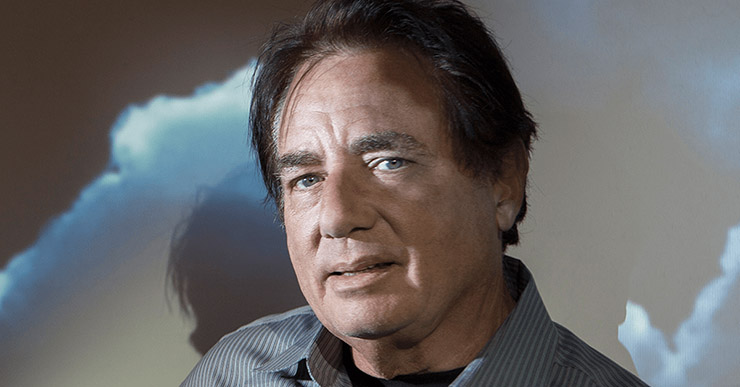
    PAUL DAVIDS is the author of widely-released books and acclaimed writer and director of highly original films including the controversial 2008 documentary film Jesus In India, discussed by Len Kasten in New Dawn Special Issue Vol 6 No 3.

    He is a leading expert on the history of science fiction cinema and the Hollywood connection to extraterrestrial-related phenomena. Davids was executive producer and co-writer of the Showtime film Roswell, starring Martin Sheen and Kyle MacLachlan.

    Paul earned a B.A. from Princeton University, where he won the university’s three top creative writing awards all in one year (including the F. Scott Fitzgerald Prize). Afterwards, he studied under full scholarship at the American Film Institute Center for Advanced Film Studies in Los Angeles.

    He is the noted author of six Star Wars books for Lucasfilm, was a producer of the popular Transformers animated TV series. Paul is also an accomplished artist and is generally well known and respected in Hollywood.

    We spoke to Paul about his latest film, The Life After Death Project, which recently aired on the SyFy Channel and is being made available on DVD.

    NEW DAWN (ND): In your films, you’ve taken on a lot of controversial issues – aliens in Roswell, LSD in Timothy Leary’s Dead, the high price of Van Gogh paintings in Starry Night – you even investigate Jesus’ missing years that aren’t mentioned at all in the New Testament, in your film Jesus In India. Now you take on one of the biggest controversial questions of all time – is there life after death? How did you end up there?

    PAUL DAVIDS (PD): I refer to The Life After Death Project as a personal confession. On March 7, 2009, the day of the large Hollywood tribute for science-fiction luminary Forrest J Ackerman at the Egyptian Theater, very strange things happened to two Canadian filmmakers who visited his crypt. The filmmakers had made a documentary about his life. Forry Ackerman, born in 1916, was the original editor of Famous Monsters of Filmland Magazine beginning in 1958, and his influence on the world of science-fiction (and horror and fantasy) and his impact on all the major filmmakers of that genre was huge – incalculable. I was one of the speakers at the tribute and the Canadians (Mike MacDonald and Ian Johnston) told me very sincerely why they were convinced they literally “heard from him” within an hour of Mike MacDonald knocking on his crypt to say “Hello Uncle Forry.” (All of his fans called him “Uncle Forry.”) I had known Forry and looked up to him since I was a teenager and became a winner in an amateur movie contest run by his magazine. He was a major influence in my decision to pursue a career in film and TV. In 1996 I made a film that was in part a tribute to him (The Sci-Fi Boys, which Universal released on DVD and which won the Saturn Award for Best DVD of that year.)

    I didn’t know what to make of the strange story of the Canadian filmmakers, and I wasn’t immersed in “the paranormal.” But about one week later, I was alone in my vacation house in Santa Fe, New Mexico when something simply impossible happened to me. It was a very precise inkblot that appeared on a document I was studying – it appeared while I was out of the room for just a few minutes. There had been nothing unusual at all about the document when I left the room. I want to say it again: What happened was IMPOSSIBLE in the world as we think we all know it. But it happened, and evidence in the form of ink was left behind. It took me awhile to catch on that it actually could have been a message to me from the late Forrest J Ackerman, done in his usual humorous style with a specific “word within a word” pun, his trademark. I realised it could have been a reference to the man who was his closest friend and caretaker for the last 10 years or more of his life… actually a sort of very personal “thank you” for the tribute to him. The detective work to figure that out was a long trail, and it took me first to the Chairman of the Chemistry Department of the University of Indiana, a world class expert in inks, paints and solvents. I brought my video camera along to document what he did in his lab. That was the beginning. I never knew then this would become a major documentary film that I would make. But it became a colossal adventure involving major authors and three universities, with repeating evidence that simply has to be seen to be believed. And it took me four very long years to make the film.

    ND: Recently there’s been quite a focus on life after death even in the mainstream media – particularly noteworthy is neurosurgeon Dr. Eben Alexander’s Near-Death Experience as documented in his book Proof Of Heaven. What makes your film unique?

    PD: It’s tough to take on subject matter that in a way has been “beaten to death.” Exploitation TV shows with dizzying fast cuts and irritating music and sound effects – a lot of those shows leave people thinking that all they need is an EMF meter and a creepy old house and they’ll be the next person to document a ghost. My film is not exploitation – it is a quiet and deliberate unfolding of a colossal mystery that unfolded from “one seed” – the inkblot.

    What really separates my film from the pack is that I am telling about a deceased man I had a personal relationship with that spanned decades. I knew his style, his humour – I had been “aboard” for many parts of the journey of his life. So there is a relationship to the departed who appears to have “dropped me a line.” It’s not about seeking out ghosts or spirits of people you never knew in creepy places. It is about evidence of a continuing relationship after death that was not just a single incident but was a long string of many incidents, continuing now for about four years. I never knew when these strange things would occur, but they kept happening – AND they started happening to people I involved in the case, including the scientists at the three universities. Things happened to them THEY couldn’t explain, many of which seemed to have Forry Ackerman’s “authorship.” He seems to be enjoying himself. I love him and welcome all this. I seem to have had extensive and continuing help from a “personality unseen” to enable me to build the very best case that there really is survival of consciousness and personality after a person dies. In this case it was an exceptional person who accomplished a lot in his lifetime and never seemed to be finished. I never would have taken this on even five years ago. Something had to happen to me first. What I have personally concluded, because no other explanation fits the data, is that I heard from Forry loud and clear, multiple times, after he had departed this world.

    ND: Life after death covers a lot of ground, from orthodox religious views of heaven and hell, to ghosts, spiritualism, reincarnation, poltergeists, mediums, angels, apparitions, materialisations and of course the Near Death Experience. How did you choose what to emphasise?

    PD: As I’ve said, I emphasised the Forry Ackerman case, which is a case of apparent After Death Communication, or ADC. Sometimes ADC is accomplished with ITC (Instrumental Transcommunication, which includes EVP, Electronic Voice Phenomena). So I get into all those topics, and I also deal with Sir Arthur Conan Doyle’s devotion to spiritualism, because there is a real history to this field. There have been impostors and phonies, but I think that science “threw out the baby with the bathwater.” I think there are real phenomena, there are mediums with genuine uncanny gifts. Many scientists apparently knew that over 100 years ago, but they have been drowned out by the modern skeptics and materialists who have dismissed this topic and think it’s dead and buried. I also deal with the phenomenon of aports or aportation (the appearance of objects in a way that cannot be explained) – and also there is one astonishing case involving photography which Dr. Lynne D. Kitei, M.D. brings to the film.

    I had so much material after years of interviews and research, it could not all go in one film. I did not want to leave lots of wonderful material “on the cutting room floor” as we say, so I created a sequel I call The Life After Death Project 2 – and that comes as a second DVD disc in the 2-DVD Set of The Life After Death Project available both at our website and at www.amazon.com The national release date for the US, where it will be available everywhere, was July 16, 2013. Our website (www.lifeafterdeathproject.com) will ship the all-region DVD all around the world.

    ND: Tell us more about the inexplicable inkblot incident which you personally experienced, and do you think you’ll be believed once people watch the film? (A photo of the inkblot can be seen in the magazine).

    PD: I think the incident of the inkblot is VERY important. Sometimes the answers to very big cosmic mysteries come in very small packages. Scientists deal at the level of individual atoms and sub-atomic particles. Others study photons or very faint astronomical phenomena from far off in space that has been traveling toward earth for billions of years. My first question was, does the blacking out of 4 words in my document, at 2 separate levels of opacity, contain clues as to its origin that can tell us how it was done or why it was done? Is there something “paranormal” about it that can be demonstrated? The 4 words on my document were clearly targeted and the ink obliteration was deliberate and done by “someone” or “something” other than me while I was out of the room, at a time when NO ONE else was physically present in the house. I knew this for a fact, but could I convince anyone else? It actually surprises me the overwhelming extent to which the two key chemists who worked on it (one of them, Dr. John Allison, continued the work for years) state categorically that it is still a huge mystery they cannot explain and cannot duplicate in any way they can conceive – and they have tried hundreds of ways to duplicate it. Both Dr. Allison and Dr. Jay Siegel are world class authorities on the chemistry of inks, paints and solvents. Dr. Siegel has testified in a massive number of court cases where someone was needed to testify about the chemistry of evidence.

    The other part of your question: Do I think I will be believed? I have learned that there are many hugely intolerant and bombastic closed-minded debunkers who, without leaving their armchair or educating themselves as to the real issues, will make horrifyingly stupid comments and declarations. As soon as the movie was announced, some declared that it had to be exploitation. It lends itself to a kind of tabloid slant, and interestingly the story was refused by Huffington Post’s Science Editors, but Huffington Post did have Lee Speigel, one of their best writers of stories for “Weird News,” do an article – and I must say his article was superb. He spent a lot of time digging out the scientific information and even linking to one of Professor Dr. Gary Schwartz’ peer-reviewed papers on scientific evidence of after death communication. But there is a taint in the fact that something with so much scientific basis usually is not treated as science because of the subject matter. Also I will say this, as to whether I will be believed, I will stand up to ANY debunker. I know this case is valid and true.

    ND: All of Forrest Ackerman’ bios online and in books emphasise the fact that he was a skeptic and an atheist who didn’t believe in an afterlife. Could you elaborate on that and – if it’s not giving away too much – do you know what type of afterlife he exists in?

    PD: He was an atheist and a skeptic about all things paranormal. At least that was his most public stance. But there were incidents in his life that showed his thinking was more complex than that. His grandfather, George Wyman, designed the famous Bradbury Building in Los Angeles (where they filmed some of Blade Runner). His grandfather was very hesitant to take the assignment until an incident with the Ouija Board where the message was: “Take the Bradbury Building and You Will Succeed.” Forry always kept that scrawled pencil Ouija message framed and on display in his home. He also once wrote a story called ‘Letter To An Angel’, about a hunchback boy who is thrilled when he gets to meet his hero, Lon Chaney (who played The Hunchback Of Notre Dame) in heaven – and the boy is equally thrilled to be alive in the afterlife without his debilitating body and its handicap. So Forry did imagine, at least as fiction, the possibility of us living in a non-physical form where we do not have the physical limitations we have in life. He occasionally said to close friends that he didn’t believe in an afterlife, but if he turned out to be wrong, if it were possible he’d try to “drop a line.” In my case, that’s exactly what I got. A line crossed out in a document which I could demonstrate had specific meaning related to the tribute for him.

    I surely do not have any knowledge of “what type of afterlife he exists in.” But it has been surprising to me that incidents that seem to “bear his signature” (I mean that metaphorically) have continued from March 7, 2009 to as recently as the last few weeks. Two of the oddest recent incidents are covered in the sequel The Life After Death Project 2 – Personal Encounters.

    At the end of that film I give an update on the Forry Ackerman case. First I have to tell you that I own a plastic mask that I obtained at his estate auction – it is his smiling face with his “trademark” moustache and thick glasses, and for decades it was in his 18-room Ackermansion along with 250,000 or more items of sci-fi and horror memorabilia. In that Ackermansion, which was both his home and his personal museum that he shared with the public, the mask was on top of a futuristic costume he wore at the First World Science-Fiction Convention in 1939. That mask has been in my home office for 4 years and had never moved for those years. It actually sits right on top of the case for the prop alien that we used in the Showtime film ROSWELL that I executive produced in 1993. The very day I learned that there would be a broadcast of THE LIFE AFTER DEATH PROJECT on Syfy, I went out to lunch for an hour and a half, and my home was locked with no one in it. When I returned, the Forry mask had moved – about 10 feet across the room, to the floor on top of a pile of wires for my many computer hard drives. I have no open windows, the door to my office was closed, the cat was outside the house, there was no breeze or known physical force that could cause the mask to move. (One friend speculates Forry was telling me that he’s going to be “getting his nose into my computer equipment,” which does seem to have been happening in many ways.) Another of several recent incidents was this: When I attempted to make the final computer Quicktime HD file from which the broadcast master of the film would be made, it inexplicably lost the soundtrack during the movie and became silent. This happened even though all the soundtrack info was there in the files, and it worked perfectly on another attempt without having to fix anything. The key was WHERE the film sell silent. EXACTLY at the moment that one of the people in the film discuses a painting of Forry where Forry is making a “Shush” gesture like the silence of death. Bingo. From that exact fraction of a second… all the way to the end of the film, total SILENCE.

    ND: A recent article in New Dawn Special Issue Vol 7 No 2 by Len Kasten was titled “Speaking to the Dead: The Pioneers Who Opened a Channel to the Other Side”. Len documented the incredible history of what is known as electronic voice communication (EVP) from the ‘other side’ or the afterlife. You and other people involved in making the film had some pretty amazing incidents of similar communication. Could you elaborate a little on what happened?

    PD: The incident of EVP in making my film is documented in the sequel, but the back-story is in the main movie. There was an actual tribal mask from Zimbabwe in a display case in the living room of my Santa Fe vacation house. I regarded it as an art object and it was on loan to me from a close friend who is a world traveller. The mask was right at the other side of the door from the bedroom where the inkblot appeared. The day after the inkblot incident, extensive EMF readings (electro-magnetic field readings) were made in various places in the house. Nothing unusual was found in the bedroom. But the mask, made entirely out of non-metal parts by natives in Zimbabwe, gave off EMF readings that were “off the charts.” The buzzing and beeping and lights on the meter were all at maximum. The camera was rolling when the testing was done to document it. The owner of the mask (Todd Mills) later promised he was going to locate the actual slides he took in 1983 when he bought the mask from natives – slides of it being danced in an African ceremony. To our astonishment, those slides have completely disappeared from the safe place he always kept them – they have not shown up even in four years since then. And he guarded those slides as precious keepsakes – no one had access to them. The Zimbabwe mask was the one object in my Santa Fe home that especially would have captured Forry’s attention. He was an avid collector of strange masks, and the Zimbabwe mask looked like something out of his favourite movie, KING KONG.

    Many months after the filming of the EMF reading of the mask I was doing post-production editing and I heard an EVP right at that point as the meter was being moved, between the beeping. There was no one there who ever actually said the word heard clearly on the videotape, but the voice was very clear: LENORE. One word said one time but very audible. (This is in the sequel.) What does Lenore make you think of? To me, it’s Edgar Allan Poe’s poem LENORE and also, Lenore is the lost love being mourned in his poem, THE RAVEN.

    Here is a synchronicity tying these very odd events together. Months later while going through memorabilia, I found the special delivery letter that Forrest J Ackerman sent to me notifying me that I was a winner in his Famous Monsters Magazine Amateur Movie Contest, when I was a teen. I was almost in shock when I saw the stamps on the envelope which had been sent to my childhood home in Maryland from Los Angeles over 40 years previously. There was a special delivery stamp, plus a stamp of EDGAR ALLAN POE plus 4 stamps of the Palace of the Governor of SANTA FE, New Mexico. The house with the inkblot incident and the Zimbabwe mask was in Santa Fe, and the EVP of “Lenore” was of one of the most famous names in Poe’s works. Forry was an incurable fan of Edgar Allan Poe. So here you see something specific from over 40 years ago (the selected stamps on the envelope from Forry) in a sense seemingly “predicting” that something significant would eventually happen to me involving both Santa Fe and Poe.

    The capper to this is that, soon after this incident happened, I began writing profuse amounts of rhyming poetry, which I had never done before – I created so much that these poems fill three published books (available at lulu.com) and some of the poems, especially in RIGHT BRAINED POEMS FOR LEFT BRAINED PEOPLE, are about Edgar Allan Poe. The other two books are humour: POEMS TO READ WHILE DRIVING ON FREEWAYS (AND OTHER WAYS TO DIE LAUGHING) and POEMS TO READ WHEN YOU RUN OUT OF WEED.

    ND: Your press release says there are four New York Times best‐selling authors in your film. Who are they, and what do they contribute?

    PD: Richard Matheson (Somewhere In Time, What Dreams May Come, I Am Legend) was a friend of Forrest J Ackerman. He offers his theories of communication with the deceased through dreams as sometimes being real cases of contact from the dead. He also says definitively that he has concluded that Forrest J Ackerman really did contact me after Forry died. Whitley Strieber (Communion, Transformation, Majestic and many other books) has an intense interest in life after death and mediums, as does his wife, Anne Strieber. My wife and I had lunch one day with the Striebers months after the inkblot incident happened to ask their opinions. They had much to say!

    The key thing was that they knew many experts in the field of life after death research, and Anne Strieber connected me to so many people who are in the film that she earned a credit as Executive Producer, along with my wife, Hollace Davids. Anne and Whitley appear in the film, and Whitley tells about the most astonishing “psychic hit” he ever experienced from a medium, Glennys MacKay of Australia.

    The third New York Times best-selling author is Dannion Brinkley (Saved By The Light, At Peace In The Light) who recounts his famous near death experience (NDE) of being struck by lightning and having been “clinically dead.” He insists there is life after death and his book tells of his experience during the time his heart had stopped, his breathing had stopped and he had no EKG. The fourth New York Times best-selling author in my film is Michael Shermer, President of the Skeptic Society and author of books such as Why People Believe Weird Things and The Believing Brain. He is also publisher of the magazine called Skeptic.

    ND: Everyone knows that Michael Shermer is an arch skeptic about all paranormal claims. He doesn’t usually show up in independent films – he’s sort of known as the hatchet man a network brings in when they need someone to contradict someone who has a claim. Did you choose him of your own free will to be in this film, and what does he add to the picture?

    PD: I did choose Michael Shermer “of my own free will” to be in my film, and he readily agreed and gave a very good interview. I chose him because I wanted someone “the Establishment” considers completely credible as a skeptic. He cannot and does not attempt to explain the events that are in my film. He does categorise most of it as “one-off” events that can’t be repeated in a lab and therefore of limited interest to him. Of course, in regard to the inkblot incident, lab scientists have spent hundreds of hours on it and are perplexed. And Dr. Gary E. Schwartz, who is in my film, performs university-sponsored experiments under laboratory conditions, but Michael Shermer never delves into that. He admits that weird things do happen to people that have not been explained, but he dismisses any possibility of a “paranormal” answer out of hand, conceding only that perhaps some of these phenomena will someday fall under theories covered by quantum physics.

    ND: The Life After Death Project builds to a pretty astonishing climax involving the research of Dr. Gary Schwartz, a psychology professor at the University of Arizona in Tucson. What is his research trying to show, and how does it apply to your apparent after death communication from Forrest Ackerman?

    PD: As far as I can see, Dr. Gary Schwartz is doing the most forward-thinking (and perhaps the most courageous) studies and experiments involving life after death today. There may be others whose work is of great importance with whom I’m not familiar, but I was fortunate to have Gary’s participation, and he gradually became more and more involved. Author and researcher Mark Macy in my film makes the statement that spirit life is not somewhere off in the distance, that it exists right here, right now, all around us, on different frequencies that we cannot see. He compares it to radio or TV transmission – you would need to be able to tune in the right frequency to be aware of it or attempt interaction with it. Gary Schwartz seems to accept that premise – that spirits are accessible, and that just as we can call someone on the phone, we can actually talk to spirits (of deceased people) and have them be aware we are thinking about them and talking to them. With that theory in mind, he asks, what would be necessary for them to communicate back in a way that could be measurable with our technology? To that end, he has developed computer software programs (and is developing more) to facilitate communication and actually measure “yes” and “no” responses to spirits when he asks questions. His experiments have been successful thus far, and he has published a peer-reviewed paper in a scientific journal on this. The climax of my film becomes so fascinating because Gary attempts actual communication with Forrest J Ackerman using his computer program – and we see it all unfold in real time – and there are very real and precise responses. He says that both my documentary, which he calls “historic,” and his research point to the fact that “Forrest is here.”

    ND: Synchronicities played an important role in the lead-up and production of The Life After Death Project. How do these ‘meaningful coincidences’ tie in with ‘Messages from the Other Side’?

    PD: Swiss psychiatrist Carl Jung first articulated the concept of synchronicity, describing it as a very improbable or unlikely coincidence that brings events together in a way that has meaning in the eye of the beholder. Statistics tells us that some synchronicities will and must occur by chance, because “almost all things are possible.” There is an old adage that says if a million monkeys typed on a million typewriters for a million years, by chance one of them would produce a perfect copy of Shakespeare’s “Hamlet.” No one has ever tested that theory! But we get the concept. One of the synchronicities I discuss here is the juxtaposition of stamps on an envelope from over 40 years ago, bringing Poe together with Santa Fe in a letter to me when I was a young teenager living in Maryland. (I had never been west of Virginia then!) Another synchronicity in The Life After Death Project is the wine bottle that just happened to be the same type as the wine served at Sean Fernald’s wedding, that Forry had attended, and the vintage of the wine was the same year as the wedding.

    I have experienced so many unusual synchronicities that the list would be long. Notably in The Celestine Prophecy and its sequels, synchronicities are extolled as having high spiritual significance as forms of guidance from spirit. Synchronicites make us think of an alternative reality that is sort of like the film, The Adjustment Bureau, but non-fiction!

    ND: Several of your films deal with life after death. In The Artist And The Shaman you speculate about whether a certain 3‐year old boy might be the reincarnation of your father. In Starry Night you bring Vincent van Gogh back from the dead for 100 days, a century after he died. In Jesus In India, there’s speculation about the accuracy of the reports of the disciples that Jesus died and rose from the dead. And now you have The Life After Death Project. Has this topic been a long time obsession for you?

    PD: The topic has not been an obsession, but it indirectly entered into those three other stories you mentioned. I do wonder about the theory of reincarnation. The studies of Ian Stevenson and others lend a lot of support for it, and great yogis, such as Paramahansa Yogananda, insist that it is true. But it would take at least a film to explore the evidence, and I have not produced such a film. There have been hundreds of books (or thousands) written about reincarnation, and I hope that someday I’ll read the best of them. As for Jesus In India, the claim of Jesus returning to life from the dead is central to Christianity. There is some exploration of that in my movie, which was covered in a previous issue of New Dawn in a Len Kasten article about Jesus’ purported travels in India. You can learn more about that at www.jesusinindiathemovie.com. Starry Night is strictly a fantasy. (www.starrynightmovie.com) When Vincent van Gogh’s ‘Sunflowers’ sold for 33 million dollars in the 1980’s, it made history. I thought to myself: If only Vincent could be here to know this happened and that he turned out to be one of the most successful artists in history. And so I created a fiction screenplay based on that premise and was fortunate to be able to make the movie (about 10 years after I wrote it!) Universal released it to DVD in around 2000, and it is still available.
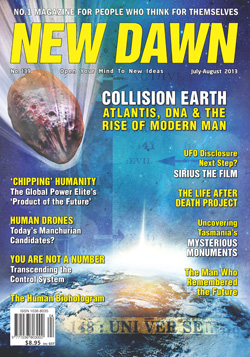
    Get the issue this article appears in

    ND: Your films are known for creating controversy in a good way, and we at New Dawn wholeheartedly support your intentions. Some Christians thought you’d overstepped the line in Jesus In India, while the US Air Force took you over the coals for your film Roswell: The UFO Coverup about the so‐called alien UFO crash at Roswell. You also angered some atheists who think you were much too kind to Catholicism in Before We Say Goodbye, your movie about a Hispanic‐American family. And you made Timothy Leary’s Dead about the ‘Prophet of LSD’ who President Richard Nixon described as “the most dangerous man in America.” How do you handle criticism?

    PD: I have had to develop what they call a “thick skin” in response to criticism, as does every artist in every creative field. There are as many opinions about things as there are people on this planet. A big change in our world, from when I was a child, is that now everyone can make his or her opinion count. People can go on message boards, they blog, they post comments about books and movies online. The professional critic is no longer the only force the artist has to deal with. And you get comments at every level. Some are intelligent, others are personal attacks, and sometimes anonymous people post profanity and obscenities. That’s what they want to do, and currently there’s no way to stop them.

    One of the traits that some people have that probably bothers me the most is a tendency to be absolutely fixed in rigid beliefs: hard-headed, not open to discussion or alternative approaches, and sometimes to the point of being bitter, furious, argumentative or insulted that anyone could contradict them or have another opinion. These traits have taken over politics to a large extent in the US. We see this trait creeping into religion at the point where it becomes “Fundamentalist” – some religions are so convinced that they have the Truth as handed down from “On High” that all others are wrong or damned or are infidels to be disposed of even with violence. People now actually kill one another every day in the name of God – and not just a few people, they blow up 100 or more at a time. As if God is looking to them to help him out by destroying the lives of His children that He lovingly and painstakingly nurtured from their days in the womb.

    I have often chosen topics, quite deliberately, because they challenge some cherished beliefs. I think it’s most worthwhile and productive when I choose a topic that, by exploring it, can help the human race grow in its thinking capacity, stretch the mind a little. But when it comes to the topic of life after death, I always tell people, I never chose that topic…. It chose me!

    ND: Could you give a brief overview of the sequel film The Life After Death Project 2 – Personal Encounters?
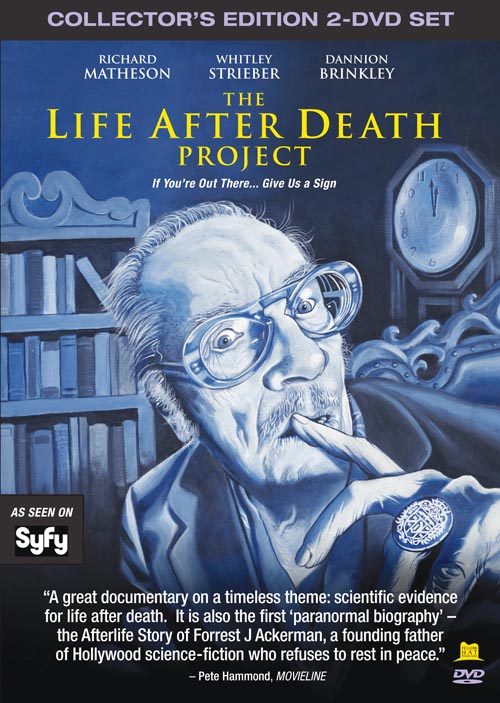
    LIFE AFTER DEATH PROJECT - DVD COVER

    PD: In the sequel, I let witnesses to many other life after death cases tell their stories. These are people from all walks of life. We hear from them, with very little editing (except for length) – we learn what happened and why they felt that it relates to unseen spirits or survival of consciousness and personality after death. A few might be considered “ghost stories,” but most have physical phenomena attached and were seen by more than one person. I am interested in what palliative care doctors have to say – end of life physicians who witness a lot of people die. And nurses who work with people during their final weeks and moments. It is surprising to hear how committed some of these people are to the concept that there is evidence of a “spirit” that departs the physical body at death. And these are for the most part not religious people – they do not hold these convictions because they were taught them as part of a religion in which they believe. Three exceptional people in the film are Dr. John Lerma, M.D., Dr. Lynne D. Kitei, M.D., and John B. Alexander, a former military man and author about non-lethal weaponry. Dr. Alexander extensively studied the issue of life after death and was the president of a non-profit organisation dealing with this topic. Also of interest is Dr. Stanislav O’Jack. His extraordinary abilities to take unusual, unexplained photos, sometimes while the lens cap is still on the camera, have been studied at length by a Stanford physics professor (now emeritus), Dr. William Tiller, who was in What The Bleep Do We Know. Dr. Tiller’s assessment gives credibility to Dr. O’Jack’s claims. One of those claims is that Dr. O’Jack’s wife appeared to him and one other colleague in body, in full physical form, after she was dead… and she then disappeared. John Alexander also tells of an incident that happened that was just like the O’Jack story – it happened to one of John Alexander’s mentors, Dr. Elizabeth Kubler-Ross. One of her deceased students appeared to her in physical form, spoke to her, wrote her name down, and then vanished down a hallway. So although the sequel is somewhat different than The Life After Death Project in style, and is less devoted to scientific evidence, I think viewers will find it compelling. In any event, a complete list of the people in the sequel and description of it can be found at www.lifeafterdeathproject.com For those who order the Collector’s Edition 2-DVD Set of The Life After Death Project, the sequel is included on the 2nd DVD as part of the package. I also want your readers to know of my two websites: www.pauldavids-artist.com and www.pauldavids.com.

    ND: Thank you very much Paul Davids for taking the time to answer these questions. We are confident your new film will take us one step closer to understanding the mystery of consciousness and life after death.

    You can learn more and follow what Paul Davids is up to through his website www.pauldavids.com.

    [alert type=”general” dismiss=”no”]This article was published in New Dawn 139.[/alert]

    [alert type=”success” dismiss=”no”]If you appreciate this article, please consider subscribing to help maintain this website.[/alert]

    © New Dawn Magazine and the respective author.
    For our reproduction notice, click here.

  • Is the Afterlife What We Think It Is? A Challenge from Near-Death Studies

    Is the Afterlife What We Think It Is? A Challenge from Near-Death Studies

    There are millions of stories now of near-death experiences from around the world; each a snippet, a teaser, of what appears to exist on the other side of death. No other human drama carries quite the power this phenomenon does to unmask traditions of a “grim reaper,” and reveal instead an aliveness that continues after our bodies take their last breath and our brains cease to function.

    This aliveness we call an “afterlife,” because in most cases, what near-death experiencers describe sounds like or certainly seems to be sparkling luminations of higher, finer aspects to what we know: cities, gardens, forests, landscapes, roads, rivers, busy people quite alive and doing things, schools, hospitals, opportunities of varied types to reassess earthly existence, to forgive, learn, and then advance toward a goal we can only term “spiritual.”

    Because the stories that come from experiencers are so compelling, I’d like to share a few from my research base. Surely after hearing them, you will be more than impressed that an afterlife must indeed exist and that life goes on after we die. Once I have shared these accounts, though, I intend to introduce others that will stretch what we think we know about life after death. The concept of “afterlife” may not be as previously stated or broadly believed.

    Afterlife Stories

    Arthur E. Yensen died in 1932, at least as near as we can tell he did, from severe injuries in an automobile accident. The vividness of what happened next remained fresh in his memory, not only after he revived, but throughout what later became a long and productive life. As Yensen put it: “Gradually the earth scene faded away, and through it loomed a bright, new, beautiful world – beautiful beyond imagination! For half a minute I could see both worlds at once. Finally, when the earth was all gone, I stood in a glory that could only be heaven.

    “In the background were two beautiful, round-topped mountains, similar to Fujiyama in Japan,” Yensen continued. “The tops were snowcapped, and the slopes were adorned with foliage of indescribable beauty. The mountains appeared to be about fifteen miles away, yet I could see individual flowers growing on their slopes. I estimated my vision to be about one hundred times better than on earth. To the left was a shimmering lake containing a different kind of water – clear, golden, radiant, and alluring. It seemed to be alive. The whole landscape was carpeted with grass so vivid, clear, and green, that it defies description. To the right was a grove of large luxuriant trees, composed of the same clear material that seemed to make up everything.”

    Yensen described the people there as young-looking and lively, yet possessing a weightless grace in their movements. Their bodies were somewhat translucent, so was the grass and trees; their clothing minimal. One man told him: “Everything over here is pure. The elements don’t mix or break down as they do on earth. Everything is kept in place by an all-pervading Master Vibration, which prevents aging. That’s why things don’t get dirty, or wear out, and why everything looks so bright and new.” Yensen learned how heaven could be eternal from this man (Atwater, 1994, 53-55).

    Muriel E. Kelly, weakened by rheumatic fever and a serious heart murmur, became very ill and passed into another world. “I found myself standing on a cobble-stone road with people around me dressed in bright robes – red, blue, pink. Everything was so bright and sunny. Birds were singing. Baby angels were smiling and flying around. I saw all different sizes of angels. The music was hauntingly beautiful.”

    Hearing her name called, Muriel turned to see Jesus beside her, dressed in a white-and-red robe. “He knelt down,” she said, “and gave me a hug and I hugged him back. He told me we were going somewhere to talk.” During the course of their time together, Jesus led her to an apartment building with many doors, and told her which door to knock on. A voice inside beckoned her to enter. It was her mother, who had died when Muriel was nine, leaving behind five children. Their reunion was love filled. “I asked Mama where Daddy was, and Cecil, Willie, John, and Paul. Mother told me they weren’t there ‘cause it wasn’t their time. I had no idea what she meant, so she took me to an area where we sat on a cloud and looked over the whole world. My mother located my dad and brothers riding in a car. We could see right through it. Dad was driving, and we heard my brothers and Dad crying, saying, ‘I wish Muriel was still here. We miss her.’” Muriel began to cry for her earthly family and wished to be back with them. She got her wish (Atwater, 1999 and 2003, 106-107).

    Cecil L. Hamilton told of swimming with his brother. “He had a problem. I tried to get him out of the water, but in his panic he pulled me under several times. We both drowned. He died, but I came back.” While Hamilton was in the grips of death, he suddenly found himself stepping into a light-filled world. “I noticed everything – sky, buildings, glass – emitted its own light. And everything was much more colourful ….a river meandered around. On the other side was a city, and a road running through it to another city, and another city, and another and another. Right in front of me but across the river were three men. They projected themselves to me. They didn’t walk or fly; they projected over. I didn’t recognise them, yet I knew one was Lynn Bibb.” Hamilton explained, “I was named after him. He died a matter of weeks before I was born.”

    Hamilton continued with his story: “I knew these three men were looking out for me, like a welcoming committee to escort me over the river to the first city. I had the feeling that if I went with them, there would be no coming back, so I hesitated. The first city was like first grade. People stayed there until they were ready to go to the next city – your eternal progression, from city to city. Behind me and to the left was a strong light source, very brilliant and filled with love. I knew it was a person. I called it God for lack of a better term. I could not see it; I felt what seemed like a male presence.”

    God and Hamilton engaged in a long conversation, the young man asking Him about the universe and reasons for everything. Then God questioned if Hamilton wanted to return to the physical world. “I do want to return,” he said. God asked why. “I said I would help my mother whom my father had left with four children and one on the way. God kind of chuckled and asked for the real reason. I said I would leave the earth a little better than I found it. ‘Then you may return with some of the knowledge of the things you have learned, but the rest will be veiled for a time. Live in such a way that you will not feel bad when you return here again.’ I woke up face down in the mud of the river bottom and was ‘lifted’ to the top” (Atwater, 1991 and 2003, 45-47).

    Each of these three accounts describes a particular arrangement of structures, shapes, people, and behaviours that are familiar to us – adding heft to the belief that the afterlife either reflects our earthly life or is an extension of it. The testimonies that follow, however, deviate from what I have just relayed. The focus with them is more fluid with an absence of structured form. I’ll begin with the near-death experience of Ray Kinman that he had as a teenager from an accidental overdose.

    “Now this is very difficult to describe,” cautioned Kinman. “Time ceased to exist. Past and future were completely nonexistent. I was traveling in an intense, burning ‘now.’ ‘Now’ was everything. I ceased to be a noun (person, place, or thing) and became a verb (an action). I was Ray-ing, instead of Ray. I was given a huge message. The Being told me, ‘This is Who You Really Are,’ as the Universe opened up to me. I could not tell the difference between myself and the infinite galaxies. I became all-powerful and all-knowing – yet I was still Ray. Then the Being introduced me to another Being of the most Incredible Beauty and Love that anyone could comprehend. It was a Greater Being of intense Light. It was God. The first Being guided me to this Light and let it enfold and swallow me up. I became one with Love times a million, billion, trillion forever and ever. We were made of the same stuff! Every Being that had ever existed in all of Creation was now part of this Greater Whole Being called God. I was one with all of them, and yet I was still Ray – all-powerful, little old me!

    “‘This is Who You Really Are,’ thundered the Light. It looked like a galaxy except the points of light were not stars, they were Beings. Every Being there was singing this incredibly beautiful music and praising God. After some indefinite length of Now-ness, I was told that I must go back. I was given another message that was very important. I was told I may return anytime I wished to. Coming back to my body felt like I was stuffed into a vessel of pain and exhaustion.” Kinman was very clear that this was not like any drug experience. This was truth – he was shown the way things really are (Atwater, 2007, 35-36).

    Tannis Prouten had a severe anxiety attack that seemed to claim her life. As she explains: “I felt like ducking as the ceiling was only an inch from me, then I was outside, moving through very dark, very vast space.” She saw small, round, glowing spheres around her that she came to realise were lost souls. Before she could react, “Very rapidly I was enveloped within this most divine, living, golden-white light, my HOME. The joy, bliss, humility, awe were beyond human capability to bear. The LIGHT was an infinite, loving, accepting BEING without form. IT had personality. IT communicated with me telepathically. IT was pure TRUTH.”

    As the intensity of her experience increased, she came to realise: “I was the LIGHT and the LIGHT was me. I was still a unique, separate, point of consciousness with the same sense of humour and awareness that I had always had, but the paradox is that I was MORE. I had become homogeneous with the LIGHT. I was all love, wisdom, truth, peace, joy, for all eternity. Human words fail to express this experience. Not only was the message of my true nature conveyed to me telepathically, but I experienced the SPIRIT of the message – I felt IT with every speck of my being. There was absolutely no possibility of hiding, distorting information, or lying in communicating with the LIGHT. I fell madly in love with the SPIRIT OF TRUTH! There was no concept of space or time in the GREATER REALITY. All takes place or exists in the ETERNAL NOW. That is my last conscious memory of the experience” (Atwater, 2007, 26-28).

    Neath-Death Experiences that challenge accepted notions

    Many near-death episodes are like these last two, seeming to counter the idea of biblical, religious, medieval, or even mythological traditions of an afterlife that features core imagery basic to the spread of culture and consensus throughout the human family. We have a long history of such commonalties especially in regards to death, the greatest of all mysteries, and what happens to us after we die. Findings in the field of near-death studies, though, are beginning to challenge not only traditional but non-traditional beliefs as well. Maybe there’s more to learn from our shared histories than what we thought.

    Scenarios are reported that openly defy the idea of an afterlife as an end point or a dwelling place or a platform for progressive states of learning. Here are some examples of these exceptions and the questions they invite:

    How can a future sibling exist concurrent with a present one?

    Merla Ianello recalls that as a child she saw a guest in her home who was three or four years old choke to death trying to eat a plastic-wrapped frozen juice treat called an Ice Pop. She insisted on naming them “Death Pops” after that, and one day she asked her mother who the child was. Her mother, staring in disbelief, said, “It was you.” Merla remembers her mother’s screams and how upset her father was, yet couldn’t identify with the distressed child because to her that child must have been really naughty to have caused such a fuss. Even though it took her years to admit that the child was her, one feature of the episode was never in doubt – the presence of her little brother Michael in the kitchen with the rest of the family. She talked a lot about Michael, much to the chagrin of her mother. You see, Michael wasn’t conceived until the following year. No mention had ever been made of a future child nor did the mother even want one. How then could he appear physically and fully present, even holding an Ice Pop, long before he was born? (Atwater, 1999 and 2003, 142-144.)

    Does the belief of an “afterlife” apply when incarnations are back-to-back?

    Rand Jameson Shields was hit on the head by a man diving into a swimming pool. Dazed, he ventured out into deep water and drowned. “The ceiling of the sky above me rolled back to reveal an infinite light universe, the earth below me dissolved away, and I intuitively understood my soul’s purpose and the nature of the spiritual universe.” A woman grabbed for him and he was resuscitated, yet during the following year his soul was pulled away from his body eighty times. “I was made to physically ‘re-experience’ sixty-eight events from previous lives. Thirty-four of these experiences were of my most recent life, including the entire period my soul spent between my last death and my birth in this life.” Years later he was able to visit one of the towns involved and uncovered “114 precise pieces of evidence verifying that every one of my thirty-four unique childhood re-experiences occurred to this man who died twenty-eight months prior to my birth, to the day. I have not found one piece of evidence that contradicted any of my past-life memories” (Atwater, 1999 and 2003, 140-141).

    What are we to think about continuous lives, one occurring soon after the other, rather than an individual taking up residence in some heavenly realm after dying? Or, the full manifestation of a future sibling, even participating in a family event, long before the child was born? Exceptional cases such as these are actually rather commonplace – like missing twins reappearing, aborted fetuses coming back as older or grown children, animals as much a part of “the other worlds” as they are in this one. And, here’s another “wrinkle,” there are group events that further stretch the time-honoured definitions of an afterlife.

    How can four separate experiences be the same – and – simultaneous?

    My very first encounters with the near-death phenomenon happened at St. Alphonsus Hospital in Boise, Idaho. The woman I was visiting had suffered a heart attack yet revived. She was white with fear when I arrived and told me that while clinically dead she had floated out of her body and into a dark tunnel which led toward a bright light. Once in the light, she saw a landscape of barren, rolling hills filled to overflowing with nude, zombie-like people standing elbow to elbow doing nothing but staring straight at her. This so horrified her that she started screaming and snapped back into her body. She continued to scream until sedated. As I listened to her, two other people entered the room, an elderly man and woman, both using canes. Each had suffered heart failure at the same time in the same hospital, were considered clinically dead, but were resuscitated. None knew each other before being rushed to the hospital, nor did they have the same doctor. They found out about each other thanks to nurses who heard their strange stories – the same as the woman I was visiting – which also matched that of one more person. I was unable to see this man as he was still sedated after screaming uncontrollably. None of these people had the same religion, background or lifestyle. None had mutual friends or common interests. All had lived long lives of varying degrees of hardship and success; two were still married to their original spouse and had several grown children. The others were divorced. The only common denominator I could find after asking a lot of questions to them or to people who knew them, was that their strange encounter at death strengthened the pain they already felt from deeply-held guilts and fears about how they had lived and what they had done in their lives (Atwater, 1988, 14-16).

    Why would 20 people have the same experience at the same time in the same place?

    Arvin S. Gibson shared with me a case of his where a 20-person fire-fighting crew called “Hotshots” all succumbed from lack of oxygen while trapped by a sudden burst of flames near a mountain top. One by one each of the men and women fell to the earth, suffocated. Each of the twenty saw each other leave their bodies and float upwards. One, by the name of Jake, looked down at a fellow crew member who had been born with a defective foot. As the man came out of his body, Jake said, “Look, Jose, your foot is straight.” A light brighter than sun shining on a snowy field appeared. Jake was met by his deceased great-grandfather, who acted as a guide throughout a long and extensive near-death scenario. Jake pleaded to stay, as he did not want to revive in a horribly burned body. He was then told that neither he nor any of his crew who chose to return would suffer ill effects from the fire. “This was done so that God’s power over the elements would be made manifest,” Jake affirmed. After rescue, each crew member confirmed the mutual event. Some claimed to have talked to each other while out-of-body. Separately, each of these claims was verified. All involved had met deceased relatives as part of their scenario, and had to choose whether or not they would return to earth (Atwater, 2000, 165-166).

    ‘Seeing’ Beyond the Veil of Death

    It is easy to assume that the four people who had matching hellish experiences met in dying what they had repressed during their lives – negative emotions that were still “eating away at them.” Such an assumption would be in keeping with the voluminous writings of Emanuel Swedenborg, an incredible scientist several centuries back who had also mastered the ability to “see” beyond the veil of death. It was his contention that after we died, we entered realms of our own making, based on our attitudes and beliefs (Atwater, 2000, 233-235, 424). We could expand on this idea by inferring that, because the hellish accounts were virtually identical, there could have existed at that hospital a type of energy (perhaps from previous emotional outbursts) that the four of them unconsciously activated in a similar fashion to outpicture their deeply-held beliefs. Possible? Yes, but there is more to consider.

    The group experience of twenty hotshot fire-fighters challenges the conclusions of Swedenborg and anyone else, myself included, who tried to tie near-death scenarios solely to the attitudes and beliefs of experiencers – the idea that “you get what you expect.” What appears to be obvious may not necessarily be as true as it seems.

    There are lots of shared experiences, such as between a parent and child in the same accident, between friends who die together and similarly revive, between people who never knew each other but found out about their mutual episodes years later once they started asking questions. People on opposite sides of the world can go through the same thing, at the same or different times, yet their separate lives, beliefs, feelings do not match nor did they ever – even though their near-death experiences did. And there are even incidents like what happened to Nadia McCaffrey.

    Nadia was a participant in the original research I conducted with child experiencers of near-death states (Atwater, 1999 and 2003, 86-88). Years later, while caring for a woman who was dying, she nearly died herself following severe seizures. Several days afterward, still in pain, she called me and we exchanged stories. The upshot was that Nadia’s seizures had begun at the same moment our granddaughter Myriam’s seizures had. When Nadia died, so had Myriam (from bacterial meningitis). The two met each other in spirit as they died. Myriam enabled Nadia to have another near-death experience, this time one that clarified and detailed her life’s mission. Myriam had always been unique in this regard, for she had the ability to force, push, or aid a person in accessing their own inner truth. Nadia’s first near-death experience had left her with many questions, especially about her purpose for being alive. Her second one, thanks to Myriam, filled in the missing pieces and helped her launch a new type of hospice (Atwater, 2004, 122-123).

    How can this incident be explained? Or any of those I’ve shared? Do our moments at the edge of death or while clinically dead really unveil an afterlife? Or, is there something else going on that we miss in our great hurry or even greater desire to accommodate what is before us and name it what our traditions claim it to be?

    Near-Death Episodes as Growth Events

    Two clues, present in almost every case I have worked on, caused me to toss the notion of “afterlife.” I no longer consider it relevant. To help you understand why I say this, a presentation of the clues and my observations follow.

    Clue #1 – almost to a person near-death experiencers say “I got what I needed.”

    To an extent, Swedenborg was right. What he missed is what people really meant when they spoke such words, and the broader perspective necessary to interpret what people experienced and what he himself actually witnessed. Being literal isn’t always productive. It’s like trying to see an aura. Aim your gaze a little past what is in front of you and suddenly you begin to see things you never recognised before. Do this with the phrase, “I got what I needed,” and you’ll notice as I did that the near-death experience unfolds in patterning that mimics an accelerated “growth event.” Life insists on growth and change. If we block these urges, something will happen to unblock them. That something is what I call a “growth event.”

    A growth event is any kind of sudden, unexpected twist in life that twirls you around and changes your attitudes and stretches your mind. Growth events, all of them, give us an opportunity to face our inner selves and be honest about what we find, to glimpse higher, more spiritual realities, to expand beyond limiting ideas, to discover the impossible and experience the “paranormal,” to become in some way transformed.

    I believe the near-death experience is a growth event, perhaps one of those that seems “reserved” for people who need a “good shove” in making life changes. Here is a brief synopsis of what I found that underscores this:

    • Most near-death episodes happen during major junctures or times of unusual stress in the individual’s life, when guidance or direction would be most helpful.
    • Young children, relatives and caregivers can be affected as well – to the degree that it is almost as if the child had the experience for them. Yet the extent to which the episode transformed the youngster becomes more apparent as he or she matures, and can be a quiet but powerful directive in the life path chosen.
    • Causes and conditions of death can reflect, at least symbolically, the experiencer’s past or current state of psychological growth.
    • Greeters on death’s threshold always match (accommodate to) whatever is necessary to alert or calm the experiencer.
    • As the episode deepens, the scenario’s message parallels almost exactly the subconscious needs of the individual at that moment in time.
    • Life reviews and “lecture” sessions cover material either omitted, ignored, or not yet learned in life by the individual involved. Life previews alert to what might be the future – for good or ill.
    • Afterward, the experiencer’s behaviour tends to shift to whatever has been undeveloped or partially developed – physically in the sense of brain function/-nerve sensitivity, and psychologically in the sense of personal growth/maturity – as if whatever traits are missing in the individual’s maturing process are now being “filled in” (Atwater, 2007, 244).

    Whatever the truth of this, and it may never be proved one way or the other, the need factor is plainly obvious as to the timing, storyline, and outcome of near-death states – not in the sense of predetermination, rewards/punishment, or wish fulfillment, but rather, in terms of a subconscious “agenda” of a higher order.

    Clue #2 – the most oft-repeated phrase near-death experiencers say after their episode is “Always there is life.”

    This fact struck me. If it is true, and I believe it is, then how can there be an afterlife? Or a before life? Or anything else but life? Implied here is that in some form, somewhere, somehow, eternal and forever, life exists as an ongoing extension of itself, acting upon and interacting within itself, ever conscious, intelligent, and aware…. life unending. Indicated as well is that we are that life, existent within the existence of a forever that can be counted on. These four words sum up and explain all else. They take us beyond attitudes, dictums, dogmas, preferences, traditions, even what we can imagine. These four words are as if a prayer answered.

    Once I recognised the import of this, all the experiencer narratives I had ever encountered or heard from other researchers made sense. If you allow yourself to step back from all the minutiae – who said what where and under what conditions – a different picture emerges that transcends the individual storylines from both adults and children. That “different picture” describes a vastness to the creation we are a part of, while focusing in on the souls that we are, as we participate in a journey of awakening to our real identity and purpose…. what reality really is.

    Tens of thousands of reported cases, not only in the Western world, but throughout Africa, China, India, the Pacific Rim, Russia, Israel, Thailand, Korea, Turkey, from jungle dwellers to desert clans, from the backs of buffalo riders to the canyons of Wall Street, this, the near-death phenomenon, if viewed as it occurs at the time that it does, offers a picture of the other side of death that mirrors what quantum physics seeks to uncover and explain…. that all is consciousness…. and everything else is illusion. With experiencer estimates running between four to five percent of the general population worldwide, umpteen million are involved. The phenomenon is that widespread.

    The 12 Heavens and Hells

    It is no small thing, then, for us to take a second look at what has been reported. The concept of heaven and hell changes when we do this.

    Near-death states show that once you leave your body in death, regardless of whatever comes next, you eventually find yourself moving to or present within an energy frequency you resonate with. What you find there corresponds for the most part to what you are capable of responding to, i.e., beings, shapes, forms, activities. These frequency realms resemble a “layer cake” of many levels, each separated from the other by degrees of lighter or heavier vibrations. The heavier more dense vibrations hold what most people call “hell” in that they consist of negative or lower forms of thought that reside in close proximity to the earthplane. Apparently you stay within this range of vibration for as long as it best serves your development as a soul. You do not leave until you have changed your attitudes, thoughts and feelings, and are ready for another opportunity to improve and advance. The faster, higher, more subtle vibrations are what most people term “heaven” and they also are in close proximity to the earthplane. There is a sense of benefit here, as if one has found one’s true home. You leave whatever level of this positive, supportive domain you are in once you have further advanced as an awakened soul and are more unified in spirit.

    I have counted from experiencer descriptions what appears to be the existence of twelve heavens and twelve hells. Yet, this “layer cake” of energy frequencies (layered thoughtform realms) seems to be open at both ends. I have found nothing to indicate otherwise. Claims of souls forever and eternally trapped or condemned in the heavier levels, or basking in the glory of ascension in the finer, lighter ones, do not hold up. When you really study the import of what people encounter on the other side of death, you come to realise that unlimited possibilities are available because of the power unleashed from awakenings. To whatever degree a soul awakens, consciousness expands – individually and universally.

    Yes, “detours” are reported, to places like borderlands or shadow areas where individuals in spirit form may tarry. It seems that in some cases where the ego personality refuses to merge with its soul, spirit can remain “apart” somehow, as if lost, disconnected, confused, or determined to fulfill a vow or promise before moving on. Spirits like this are often seen as “ghosts” by those who are still embodied. The idea, then, of “way stations” is upheld in near-death accounts, places where spirits reside until helped in some fashion. These “catch-all” places appear to be necessary diversions so that one can “shake” free of that which initially hinders. What matters most throughout this entire arrangement of heaven/hell/borderlands, though, is the resonance factor, i.e., “like attracts like.” Our religions insist that it is deeds done or not done that is the final determinate of where we wind up once dead, yet nothing from experiencer cases fully validates this. Their testimony indicates something else – that self-acceptance or self-rejection is what creates our energetic “signal.”

    Time and Space, Soul and God

    The concept of time and space also changes when we take that second look. Near-death experiencers are adamant in stating that neither time nor space exist. They claim that everything on the other side of death resides in a kind of “NOW” moment devoid of boundaries, limits or definitions other than that of the relationship between perception and perceivers. Time and space are seen as purposeful, however. From the bulk of near-death accounts, time is experienced by individuals as a type of “doorway” space moves through in sparkling waveforms of potential. That sparkle comes from light in the process of becoming dense enough within the “cradle” of space to take on the shapes and forms of what is termed matter. What becomes apparent from experiencer testimony, however, is that, in a way few can understand or explain, time not only enables but protects the manifestation of existence that space allows, so thought can reproduce itself. It’s consciousness. It’s as if all of life, every tiny speck of it, all of what we encounter on the other side of death, every vibratory “wiggle” of it, exists as it does within a giant brain processing thought… and we are projections of that thought, and so are planets, asteriods, solar systems, and so forth.

    This brings us to another way of considering soul.

    Near-death states illuminate the reality of soul, our soul, everybody’s soul, and establish soul as a power source without form or gender. Some call it our Higher Self or our Greater Self, and that we as a soul are immortal, an extension of The Divine. Soul is experienced as having its own will, and an agenda above and beyond anything we might relate to from the personality level of our egos. What emerges from this discovery is the realisation that souls go through learning cycles similar in purpose to people on earth, and that souls can and often do incarnate in groups to accomplish specific things of a larger nature. The soul-level of our being is recognised as possessing perfect memory and an almost unbelievable grasp of Creation’s Story and our place in its overall scheme. On this level, which most experiencers consider a higher level of being, the goal of continued incarnations in human or other forms, appears to be a furtherance of what can be experienced creatively as we seek to expand our roles as Co-Creators with the Creator. Winding our way through the peaks and valleys of humanness appears to aid in this process. You get a real sense that life and death and the forms we take on fulfill an even Higher Will for an even Greater Purpose.

    With that said, we can approach the topic of God or Deity.

    The greatest discovery the vast majority of near-death experiencers make after realising there is life on the other side of death, is that an intelligence beyond what we can fathom exists – there is a Deity. And that Deity or God is so massive, so powerful, so encompassing, that it is often described by experiencers as more brilliant and mighty than a million suns, existent as a Presence without need of name, identity or definition. The biblical injunction to call It “I AM THAT I AM” suffices as a reference. All that exists is seen to exist within this allness, this oneness. It is as if there is only One Mind, yet many thinkers. This, the One Mind, is often described as spreading out from a webbing or matrix field of Its Own Consciousness, embracing what exists from the stirring of Its Own Thought. Changeless as the Supreme Consciousness it is, The One appears ever changing once projections of Its Thought take on free will and the endless variation possible in that freedom. Life is God made visible. The awesomeness of this tends to dissolve any ideas or previous beliefs anyone ever had about religious dictums or mythological characterisations. A favourite phrase experiencers come to use is: We are one with The One.

    When reconsidering near-death cases, realise as you do that four patterns to the phenomenon exist, not just one. The spread that follows results if you also factor in deviations in experiencer behaviour and beliefs before and after their episode:

    • Initial Experience (very few elements): An introduction for the individual to other ways of perceiving reality… stimulus.
    • Unpleasant or Hellish Experience (frightening scenarios): A confrontation with distortions in one’s own attitudes and beliefs… healing.
    • Pleasant or Heavenly Experience (uplifting scenarios): A realisation of how important life is and how every effort that one makes counts… validation.
    • Transcendent Experience (limitless expanses): An encounter with Oneness and the collective whole of humankind… enlightenment (Atwater, 1999, 133).

    If you are objective about this spread, what you see here is a fascinating panorama, not about the existence of an afterlife and the do’s and don’ts of living, but of what very well could be the movement of our consciousness as it evolves through the human condition via stages of awakening. These stages of awakening extend from the first realisation of something greater, an initial awareness, to confrontations with the bias of perception followed by opportunities to cleanse and start anew. This leads to the bliss and the ecstasy of self-validation and the discovery of one’s worth, until at last the moment comes when unlimited realms of truth and wisdom are embraced.

    It’s all about consciousness, moving in and through our story and larger types of stories, as the One Mind experiences Itself through variations in Its Thought. Still, there is more to note here. Present in experiencer accounts is a deeper sense seldom vocalised that consciousness itself, by itself, as itself, is also awakening and expanding. To give this meaning, let me quote St. Teresa of Avila, the great Spanish mystic and reformer, who, near the end of her life, said: “The feeling remains that God is on the journey, too.” The invitation here is for us to move past defining concepts and ideas of an afterlife that are birth-to-death centred, and embrace instead a new vision of life as an emanation of spirit evolving in its capacity to handle the power from its Source. Why limit ourselves; experiencers don’t.
    [alert type=”general” dismiss=”no”]This article was published in New Dawn Special Issue 7.[/alert]

    [alert type=”success” dismiss=”no”]If you appreciate this article, please consider subscribing to help maintain this website.[/alert]

    References

    P. M. H. Atwater, L.H.D. with David Morgan (2000), The Complete Idiot’s Guide to Near-Death Experiences, Macmillan/Alpha Books, Indianapolis, IN.

    P. M. H. Atwater, L.H.D. (1988), Coming Back to Life, Dodd, Mead & Co., New York, NY.

    (1994), Beyond the Light, Birch Lane Press, New York, NY.

    (1999), Future Memory, Hampton Roads, Charlottesville, VA.

    (1999 and 2003), Children of the New Millennium, Three Rivers Press, New York, NY; replaced by The New Children and Near-Death Experiences, Bear & Co., Rochester, VT.

    (2004), We Live Forever, A.R.E. Press, Virginia Beach, VA.

    (2007), The Big Book of Near-Death Experiences, Hampton Roads, Charlottesville, VA.

    © New Dawn Magazine and the respective author.
    For our reproduction notice, click here.

  • Ouija: How the Spirit World Helped a Pulitzer Prize-Winning Poet

    Ouija: How the Spirit World Helped a Pulitzer Prize-Winning Poet

    From New Dawn Special Issue Vol 6 No 2 (April 2012)

    Sois sage dear heart & set my teachings down 
    If you do not your world will be undone
    & heaven itself turn to one grinning skull.1

    These lines appear in the poem “The Will,” by James Merrill (1926-1995), arguably the greatest American poet of the latter half of the twentieth century. Critics rarely mention that for most of his life Merrill was deeply involved with discarnate entities on a Ouija board, and that the poet’s 550-page masterpiece, The Changing Light at Sandover (Knopf, 1982), is based entirely on his conversations with those spirit guides. Fully one-third of the book consists of direct quotes from the numerous spirits with whom, with varying degrees of belief, ambivalence, and denial, Merrill hammered out the problems of the universe.

    The lines quoted above are channeled from “Ephraim,” the first spirit guide with whom Merrill communicated on the Ouija board. Ephraim’s words place a crushing burden on the poet’s shoulders. The spirit is telling Merrill that if he doesn’t tell the world everything the spirits have told him, the world will be “undone,” i.e., destroyed. And that isn’t all: “heaven” (the “afterworld,” the “divine”) will be destroyed as well.

    Ephraim seems to be implying (this is borne out by other quotes in The Changing Light at Sandover) that the afterworld exists, but that it needs man to give it definition, to give it shape and purpose. Behind this outlandish assertion lies the strange assumption that the spirits come to us, via the Ouija board or by whatever means, not because we need acknowledgement and answers, but because they need acknowledgement and answers. The German phenomenological philosopher Martin Heidegger has said, “God needs Being;”2 Ephraim’s statement seems to bear this out.

    Over the past 160 years, the West has seen a great flowering of interest in, and practice of, channeling, i.e., receiving messages ostensibly from the spirit world. During this period, four literary/philosophical figures of stature have, by dint of lengthy encounters with the spirit world and the records they’ve kept of those encounters, provided us with valuable information concerning the nature of channeling. James Merrill is the most recent of these four.

    The first was Victor Hugo (1802-1885), author of The Hunchback of Notre Dame and Les Misérables. Hugo’s feverish conversations with a hundred and twenty discarnate entities on Jersey island in 1853-1855 were at the centre of a sudden, ecstatic, upsurge of interest in channeling in England and France beginning in 1852. Instances of Ouija board-type channeling already went back a long way: In Rome, in 371 CE, a group of noblemen used an olive wood tripod supporting a circular metal dish with the alphabet engraved on the rim (a ring on a thread was suspended overhead) to obtain a message whose content led to all of the participants’ being executed for treason.3But from the time of the consolidation of Christianity up till the early nineteenth century, there are few records of such séances, no doubt because such activity usually led to a burning at the stake. By 1848, the grip of religion had relaxed sufficiently to allow the Fox sisters, of Hydesville, New York, who were channeling raps from the afterworld, to capture the attention of the world and bring about the birth of Spiritualism in the US and England and Spiritism in France.

    The Irish poet W.B. Yeats (1865-1939) was a third dominating literary influence to become immersed in channeling. In 1925, Yeats published A Vision, a summary of his three years of talks with the spirit world through the agency of his wife Georgie’s automatic writing. Nobody was much interested; by this time the anti-mystical influence of Freud and a growing disillusionment stemming from World War One had dampened interest in channeling. (In 1992, the University of Florida published all 4,000 pages of the transcripts of Yeats’s talks with the spirit world.) In 1916, the Swiss philosopher-psychiatrist Carl G. Jung (1875-1961), who had broken with Freud and was already exploring other dimensions of reality, had a frightening encounter with the spirit world whose full details became known only in 2008 with the publication of Jung’s personal diary, The Red Book. (There had been some mention of the encounter in Jung’s 1962 autobiography.) Carl Jung was the fourth towering figure of our times to take the phenomenon of channeling seriously.

    James Merrill and his lifetime companion David Jackson first used a Ouija board in 1955. (The planchette, a three-legged marker sliding over the letters of the board, had by now replaced the three-legged table, tapping with one leg, that Victor Hugo used.) By this time the influence of Jung, with its focus on transpersonal realms of archetype and collective unconscious, had superseded that of Freud. The wisdom of the East was opening up to seekers in the US and Europe. The stage was set for a second great upsurge of interest in channeling, one that reached its peak in the early 1980s and has only recently begun to wane.

    People tend to either dismiss channeling completely or hang on the spirits’ every word. This is too bad, since the truth of channeling is not only complex, but may be far different from anything we have imagined so far. Carl Jung found this out in the summer of 1916. One day, a huge host of unhappy spirits of the dead seemed to stream in and occupy his living room. Before he could ask them anything, they hurled questions at him: “What is the nature of man?” “What is the nature of the universe?” “Who is God?” “Is God dead?” They told Jung that the dead know nothing beyond what they know at the moment of death.4

    Was this an isolated incident? To say that the spirits come to us because they need help, and not the other way round, seems like a preposterous assertion. Yet there are hints here and there, especially in the writings of Hugo, Jung, Yeats and Merrill, that to pose such a question is at least to embark on a fruitful inquiry. This writer can’t hope to do anything more than point the reader in a few directions. To explore in depth what the spirits told James Merrill seems like a good way to start.

    James Merrill

    The future author of The Changing Light at Sandover was born in New York City on March 3, 1926, the second son of Charles Edward Merrill, co-founder and senior partner of the investment brokerage firm of Merrill-Lynch. The younger Merrill grew up in a milieu of wealth and privilege. He attended the best schools in New York and New Jersey and graduated from Amherst College with highest honors after having taken a leave of absence to serve in World War Two.

    At 28, Merrill, with several volumes of poetry under his belt and a well-received off-Broadway play, had established himself as a talent to be watched. That was when he and David Jackson, living in Stonington, Connecticut, came across a Ouija board, began playing with it, and watched with bewildered amusement as the heart-shaped marker moved rapidly from letter to letter of the alphabet laid out in two curving rows on the brown, placemat-sized, board. Ephraim had arrived; he claimed to be a bisexual Greek Jew strangled to death at age 32 in 36 CE at the court of the Emperor Tiberius;5and he was charming and witty enough to hold the attention of the ultra-sophisticated, very intelligent, very well-read, and very skeptical Merrill and Jackson. Their attention rarely wandered as, over the ensuing months, years, and decades, a steady stream of equally captivating spirits came gliding across the Ouija board to beguile them with enchanting tales of our multidimensional reality.

    By 1975, the hard-working Merrill had garnered a reputation as America’s leading poet. In that year, he put together his first volume of poetry devoted almost exclusively to his Ouija board adventures. Published in 1976 as Divine Comedies, it earned him a Pulitzer Prize. In 1978, Merrill published Mirabell: Books of Number, a continuation of the Ouija board saga; and in 1980 the final volume, Scripts for the Pageant, for which he earned a National Book Award. All three books were published together in 1982 as a single, 550-page poetic epic, The Changing Light at Sandover. James Merrill died suddenly of an AIDS-related heart attack on February 6, 1995. He was not quite sixty-nine.

    The Spirits on Ancient History

    Over more than thirty years, the spirits communicated to the two men a dazzling vision of our world as one set in motion by a God who is only one of a pantheon of gods, and who, like the deity of the Gnostics, has all but withdrawn from His creation. Our world, the spirits told them, was shaped and is controlled in its human and non-human dimensions by four archangels who are aided in their task by the discarnate spirits of a sentient species, long extinct, that preceded ours on earth. Reincarnation is a definitive, abiding principle of our world and the other levels of reality to which it is linked. But our universe is a troubled one; the gods are at war with one another, and our own God is failing for reasons that have entirely to do with us, his human creation. Only Merrill and Jackson – and all of us together – can help Him survive.

    The spirits call this God “God B,” or “God Biology.” The “youngest brother” of many gods, He was, eons ago, made custodian of the Milky Way galaxy and charged with the task of seeding our planet with sentient life.

    Four archangels, Michael, Gabriel, Emmanuel, and Raphael, work at his side. It was they who moulded our world, bringing it through geological age after geological age until it had been properly prepared for habitation.

    Two “root races” preceded our own, although that term – familiar to students of Madame Blavatsky, Rudolph Steiner, Edgar Cayce and their depictions of the Lemurians and the Atlanteans – is not used by Merrill’s spirit guides.

    The first sentient species God placed on earth was a race of intelligent, immortal, winged humanoids living in what is now China. The spirits allude to this species’ central city… a vast obsidian pile gleaming on the plain rutted by his machines. The winged humanoids destroyed themselves in an atomic war of such violence that God had to throw up a shield of positive matter6 – the Himalayas – to protect our planet from radioactive fallout.

    The second species, whom the spirit guides call the Atlanteans, was a race of unusually intelligent half-men/half-horses, resembling the centaurs of mythology. On the one hand these centaurs, in the beginning a grazing, pastoral breed, were limited in their ability to manipulate the environment because they had forelegs with hooves, not hands with opposable thumbs. On the other hand, this didn’t seem to hinder them from breeding a species of winged feathered servants by feeding uranium into the eggs of green grass flies. The centuries flashed by. The centaurs’ forehooves evolved into stubby fingers and they were able to store their grain in silos, using refracted sunlight to control the temperature. They continued to breed their winged servants in incubators, speeding them through 6,000 generations a year. When the servants emerged from their incubators, they were as tall as their masters, humanoid in shape, pitch-black in colour, and with burning red eyes. They resembled giant upright bats – and (coincidentally, or not) the “mothmen” described by John Keel in The Mothmen Prophecies.

    These bat-creatures became the centaurs’ engineers, constructing their masters’ arenas and cities and running their heating and lighting plants.

    There was a problem. The centaurs were immortal, and the Atlantean continents had become crowded with fenced-off areas containing all of the older generations of the centaurs down to the most primitive and ancient. The young, “witty” centaurs had taken to tormenting the very old trapt in their primitive form.7 The centaurs came up with a solution: They would annihilate the previous generations using atomic bombs. And they would get their servants, the bat-creatures, to do it for them.

    The servants faithfully carried out their duty. But now the bat-creatures, being themselves immortal, and proliferating quickly, began to fear that their masters would do the same thing to them. They rose up against the centaurs and, using atomic bombs, slaughtered all but a few.

    The bat-creatures now set out create an empire in the air. They forced the surviving centaurs to build landing strips and antigravitational skeins – continent-wide “crusts” sculpted with latticed cities and smooth plains. They forced the centaurs to man “anchor points,” huge stones glowing with radiation. This radiation, beamed up, would hold the floating continents in place in the ozone layer.

    The bat-creatures enjoyed their empire in the air for a thousand years. But earthly vegetation had encroached more and more thickly on the anchor points, which could no longer be manned by the centaurs since they had evolved into ravenous longnecked creatures / reptilian heads [ripping at] greenery – dinosaurs.8

    The radiation moorings frayed; the bat-creatures, arrogant and complacent, ignored this. Then one beam tore, then another; there was a sudden cataclysmic unravelling of the moorings; and the bat-creatures’ latticed cities shimmered, shred, and plunged to earth. All died; and all were damned, first for killing the centaurs, then for neglecting the mooring points. The bat-creatures, now a useless squeaking thinking cloud shunning light,9 were condemned by the four archangels never to take life again but to labour constantly in the service of mankind.

    God B took the fate of his first two creations (and of the bat-creatures) very seriously. He decided that what had brought about the downfall of these species was their immortality. Being immortal, they could kill each other only with nuclear weapons. And, being immortal, they had not overcome the need to fight because they had not been able to learn properly – because immortality had provided them with no deadlines.

    And so God brought homo sapiens, ourselves, into the world, and gave us mortality and a cycle of reincarnations.

    The Spirits on Reincarnation

    In The Changing Light at Sandover, the spirits have a great deal to say about reincarnation. They explain that all nature is suffused with soul; that “Mother Nature” is the resting place of soul,10 and that the reincarnational cycle of which humankind is a part demands that we live lives as animals, plants, and even rocks, as well as men and women. Merrill is told he is now living his 268th and last incarnation. Jackson is told that he has lived 289 lifetimes and must live several more. He is understandably dismayed, since this means he will be separated from Merrill.11 

    The spirits explain that, “Soul falls into two / Broad categories: run-of-the-mill / souls who / Life by life, under domed thicknesses, / Plod the slow road of Earth – billions of these / Whom nothing quickens, whom no powers indwell / …The other soul belongs to an elite: / At most two million relatively fleet / Achievers…”12

    The souls of the two million elite, whom the spirits call the movers and shakers of mankind, enjoy a privilege not available to the other souls on earth: they spend time between lifetimes being recalibrated. This process, called cloning, takes place in the “Research Lab” and is carried out by the shades of multitudes of bat-creatures who labour without rest. Merrill is told that, between this lifetime and his last, these workers

    wafted him hither, added the humus of / the Jew plus the gene of a chemist (& failed musician)

    with the result that

    et voilà U are not JM [James Merrill] what u might want to be / but a productive 5.5.13

    “5.5” is Merrill’s talent rating, so to speak, a component of his Basic Formula. A talent rating quantifies the soul’s aptitude for serving mankind; Merrill, a partial 5,14 is very high on the scale.

    Esoteric essences, called soul densities, may be injected into souls between lifetimes; one such is shooting, a special quality found only in plants. It is a cool upward thrust of / carbons. An intensity that might translate as pride; its insertion gives the soul, when reborn, spectacular vitality but a short lifespan. The poet Edwin Muir, the novelist Yukio Mishima, and the horticulturist Luther Burbank, all benefited from this lively brand of Lab cloning.15 

    In some schools of thought, such as Hinduism, and some channeling experiences, such as that of Victor Hugo, the rebirth of human being into animals, plants, and especially rocks, is seen as a punishment; according to Merrill’s guides, it’s a gift, an opportunity for enlightenment and exploration – a saintly elevation.16 The poet W.H. Auden (1907-1973), eventually one of the spirit guides on Merrill’s Ouija board, has been reborn as a soul romping through the mineral world; the spirits report one night that, Our witty poet surfacing off Alaska as a vein of pure / radium has havocked a nosy radio ship. 58 in lifeboats!

    Most of the world’s population – the “run-of-the-mill / souls who/ Life by life, under domed thicknesses / Plod the slow road of Earth”17 – spend no time in the Research Lab but instead “get a short pep-talk, then rejoin the race.”18It seems that Earth’s population explosion beginning in the nineteenth century has stretched the amount of available soul matter thin. The spirits tell Merrill that to rectify the situation,

    We have in the past century had to resort to / souls of domestic animals, most recently the rat./ By 2050 these too will be exhausted, & then?/ Wilder strains, mountain cats & forest monkeys. So / now u / Begin to see how without visibly interfering / We of the Lab must go about our work.19

    Only the souls of the elite two million are eventually able to graduate from the cycle of reincarnation. Then they move upward through nine levels of afterworld purity. Those that reach the top are the best that humanity is capable of. They are incorporated into a kind of celestial blood bank from which transfusions of their soul-matter are made available on the basis of need to earth’s most talented mortals, especially its geniuses. The spirits explain that,

    Since mid 19th cent. souls of the great scribes / Have been used 1/9 on earth reincarnated, 8/9 / as let us say safety deposits. We mine them… Proust / is deservedly enshrined. Tap him & as a statesman / at a dull banquet he converses, seems to be himself / But part of his mind literally wanders: Out on loan!20

    (Victor Hugo’s spirit guides describe a roughly analogous procedure to the French poet.)

    Merrill and Jackson are told that the shade of the French poet Arthur Rimbaud shared its soul matter with that of the living British-American poet T.S. Eliot; this afterworld-to-earth Vulcan mind meld gave birth to Eliot’s famous poem The Wasteland. W.H. Auden’s shade, often present at the séances, is connected to the living Merrill in the same way, while the largely silent presence of the shade of W.B. Yeats has the same kind of relationship with the mortal David Jackson.21

    The V Group of Gifted Souls

    A group of spectacularly gifted souls, numbering five and called “the Five” (or, “the V”), play a very particular role in the advancement of humanity. When we’re born, we have no memory of our past lives – except for the V. These five souls reincarnate again and again remembering every detail of all their previous lives. They are the spiritual leaders of mankind, whose “immortal” names are Laduman, Soriva, Rachel, Torro and Von.22 They take life again and again as athletes, artists, scientists, politicians and religious leaders.

    The spirits explain:

    These have lived centuries & live today heldover lives / Not in the scheme you know of the 9 stages. Remaining / Aware of it all, knowing the fruitlessness of speaking / Of their knowledge, they return to earth charged with / Energy / Beyond the norm.23

    The Five began as “reincarnations” of the archangels Michael, Raphael, Emmanuel and Gabriel, each of these archangels representing one of man’s five (“V”) senses. Michael is “God’s seeing on earth;” his earthly incarnations include Akhnaton, Madame Curie, and Galileo. The Archangel Raphael is God’s hearing on earth, and has been reborn as Homer, Mohammed, Mozart, and an East German astrophysicist (alive today, but anonymous), inter alia. The archangel Emmanuel, God’s touching on earth, has spent time among us as Montezuma, Noah, and George Cotzias. (Cotzias is a scientist/friend of Merrill who had been engaged in unlocking the genome governing aging and now speaks to Merrill from the afterworld.)24 Sometimes these supercharged beings return to earth to live completely anonymous lives. (These often our choicest agents, declare the spirits).25 

    The Spirits on a Curious Period in Ancient Egypt’s History

    The first two representatives of God B’s V were the twinned souls of Akhnaton and Nefertiti. The lifetime in ancient Egypt of this strange twinned soul is of particular importance, and the spirits spend some time explaining it to Merrill. His account in The Changing Light at Sandover reads like ancient Egyptian history seen through hallucinogenic glasses, or the acid trip of a genius.

    Akhnaton/Nefertiti were married at age thirteen and ruled for eighteen years, according to Merrill’s spirit guides. The royals oversaw a switch in religious belief and a leap forward of all the sciences. Polytheism was abolished; the temple priests were strangled; the slaves were freed; and the worship of a single god was introduced. A surge of creativity sweep across Egypt: Physicians found great cures; there were no fevers / A generation was born a hand taller than its parents / Light storage much like the battery was invented / both palaces and humble homes were lit and heated by the sun.26 Harnessing the power of the sun, the Egyptians controlled the tides up and down the Nile and closed the Straits of Gibraltar, allowing just enough water in to turn the Mediterranean into a tranquil lake.

    The crowning achievement of this epoch was the erection of a fifteen-metre-high rock crystal pyramid with dimensions sculpted in such a way as to harness every ray of the sun and enable Akhnaton to rule the world. For one year, 1,500 workers polished the capstone to perfection. On the night before it was to be lowered onto the top of pyramid, Akhnaton, watching with Nefertiti on a barge decorated with diamond pyramids, was so intensely thrilled his physicians fed him opium each hour.27

    The setting-in-place of the capstone, attempted at the first moment of dawn, was a cataclysmic failure. The proportions of the pyramid were a fractional millimetre wrong;28 there was a violent, fiery explosion, and the crystal pyramid rose, fell, then melted into a lake of molten crystal (which, the spirits tell Merrill, is still there, solidified beneath Thebes). Far away on the island of Crete, the volcano Thera erupted, destroying the city of Minoa. Akhnaton and Nefertiti, their twinned soul unutterably harrowed, cut their wrists, held their arms over the side of the barge, and bled to death into the Nile. The devastation was such as to render the surrounding deserts infertile for 1,200 years.

    This fiery ending to monotheistic Egypt (provoked by no less than His beloved, first two, “twinned,” V souls) devastated God B and made him rethink his plans.

    God B & the “No Accident Clause”

    Up until this time, it seems, mankind had complete free will; “Chance” prevailed upon the earth. God B now decided to invoke the “No Accident Clause,” that is, to remove an element of free will from the souls of the elite two million who guide the destinies of man. Hitherto, these movers and shakers were free to do whatever they liked – to remain open to the randomness of the universe. But God B now moved from a policy of, so to speak, total deregulation, to one of some regulation, commanding his archangels to clone certain controls into his ruling elite. As scholar Judith Moffett tries to explain, “Apparently the No Accident clause means that what happens to [God’s chosen] souls is planned and purposeful to the minutest detail.”29

    From the 14th century BCE to the 20th century, then, mankind has not had complete free will; through the movers and shakers of humankind, God B has exercised a high degree of control over our lives. But now the No Accident Clause is unravelling. This is because religious and moral standards are eroding quickly in our time, and also because human beings not belonging to the elite are increasingly acquiring the money, the power and the leisure time to do great damage, e.g., to buy and sell atomic bombs. Accidents have begun, the spirits tell Merrill. Like the first faint twirls of smoke / We see all the old signals.30

    The spirits hint that God B fears that mankind, his third sentient species upon earth, may also be about to destroy itself with atomic bombs. He has prepared for this contingency. A fourth sentient species, which God calls Alpha Man, waits in the wings. This race will be immortal (after a little time), winged, and without genius. The divine spark of genius is responsible for mankind’s greatest achievements, and also for his most hideous disasters; if homo sapiens fails, there will be no more genius. The new race of Alpha Man will – if it is needed – Swim & glide, / A simpler, less willful being. Duller too? / If so, is that sharp edge not well lost / Which has so variously cut and cost?31

    James Merrill on the Spirits

    What did James Merrill think about all this? Did he think the spirits really existed, and that the stories they told were really true?

    In an interview with this writer, the poet claimed to have “maintained an attitude of perfect ambivalence toward the spirits for twenty-five years,”32 never being quite able to accept them, and never being quite able to reject them. Either these “communicators,” as he called them, using Yeats’s terminology, were outside us working on our minds, which was fantastic, or they were inside us working through our total consciousness, which was also fantastic. We were all far more than we knew.

    What was the reality of these spirits? The poet said they often seemed to him to be metaphor and reality – subatomic reality – both at the same time. They were literally who they said they were – and they were also powers, energies, manifesting from “within the atom,” the elemental forces of nature itself. The bat-creatures’ story of building cities into the sky was exactly that. But it was also, somehow, the story of a fatal destabilising of the atom – or an account of the extension of man’s brain, in an earlier phase of our evolution, through the addition of a cortex.33

    Merrill insisted all his life that the spirit guides, if they possessed a measure of objective reality (and he tended to believe they did), were dependent for the expression of that reality on pictures and ideas created by the mind of man. These powers/energies would be “invisible, inconceivable,” he said, “if they’d never passed through our heads and clothed themselves out of the costume box they’d found there.” It followed from this that the spirits would manifest themselves differently from culture to culture, from epoch to epoch, from person to person. “A process that Einstein could entertain as a formula might be described by an African witch doctor as a crocodile,” said Merrill, adding that, “what’s tiresome is when people exclusively insist on the forms they’d imagined. Those powers don’t need churches in order to be sacred. What they do need are fresh ways of being seen.”34

    He wasn’t just “making it all up,” Merrill insisted. “I worked very hard,” he said, “in putting the poem together, to try to persuade the reader that these things actually happened… What does rather sadden me are the critics who think that we were pretending – that we didn’t have the experience.”35

    It seems that the disasters attended man on earth have also attended God B; that God’s welfare is intimately bound up with that of his creations.

    Towards the end of The Changing Light at Sandover, Merrill and Jackson are brought into the presence of God. The spirits empower them to use the Ouija board to “listen” to His “song.” What the Ouija board spells out is:

    Ive brothers hear me brothers signal me
    alone in my night brothers do you well
    I and mine hold it back brothers I and
    mine survive brothers hear me signal me
    do you well I and mine hold it back I
    alone in my night brothers I and mine
    survive brothers do you well I alone
    in my night I hold it back I and mine
    survive brothers signal me in my night
    I and mine hold it back and we survive 36

    The shade of W.H. Auden, listening in from the Other Side, tells them the Deity is like a shipwrecked sailor, alone / keeping up his nerve on a life raft.37

    Even such urbane and skeptical Ouija board adventurers as Merrill and Jackson are shocked and saddened by this encounter. It sets them to thinking; and, in this brief discussion, we can take up only one thread of that thinking.

    In the beginning, Merrill had thought the spirits were himself and David Jackson. Then he thought they were a kind of amalgam, some otherworldly energy necessarily filtered and distorted through his mind and sense organs.

    He had become increasingly aware that the spirits shifted and changed the more he got to know them, as if he were in some sense the author of this drama – and as if they too were the authors.

    Merrill now recalled the time when the spirit guide who spoke to them most often revealed that, when he began to serve them through the Ouija board, his form on the Other Side was as a black-and-white centaur. But, he says, as he had grown to love them, and they had grown to love him, he suddenly found himself transformed into a Technicolour peacock. He tells them:

    B4 [before] our meetings I was nothing no time passd but now / yr touch like a lamp has shown me to myself & I am / me! [the peacock].38

    The mortals’ “touch like a lamp” has been sorely lacking in mankind’s relations with God. There has been a reverse transformation: Over the past few centuries, our increasing indifference to God has drained Him of His power. Earlier “Great Scribes” (to whose number, the spirits tell Merrill, he belongs) have described, in function of the fullness of their faith, a God very different from what Merrill and Jackson have seen. The spirits tell Merrill this when, speaking directly in the afterworld to two deceased friends of the Ouija board adventurers, Maria and Wystan, while Merrill and Jackson listen in through the Ouija board, they say:

    Dante heard that song [God B’s desperate “shipwrecked sailor” plea] / The lyrics may be changing / Dante saw the rose in fullest bloom / Blake saw it sick / You and Maria [deceased friends of JM and DJ, observing from the other side] who have seen / The bleak unpetalled knob / Must wonder, can it last till spring? / Is it still rooted in the sun?39

    How the Spirit World Relies on the Living

    At séances, in some religious philosophies, in accounts of experiences in other aspects of multidimensional reality, other hints peek through that the paranormal beings with whom we speak need us as much as we need them. At a séance conducted by prominent South Florida medium Marilyn Raphael, one of the more forceful spirits, a frequent visitor at these séances, stated:

    We as inhabitants of the spirit world no longer have what you call a light around us. You are our light. The light is created by the living. The disembodied soul has no energy to create light. When we come into your room, we feed on your light and your energy. Now once we feed on your energy, we feel your thought patterns. You create the vision for us to see ourselves. Your energy is what we here live from. We become the apparition, we become the dialogue, we become the writer of ourselves when we can have your energy. But we do not take your energy unless we are invited.40 

    It is as if humankind were the sense organ of God; as if it were only through the human imagination, functioning in the incarnate mode, that the spirit world can sense and see itself. And, if that is so, then the exhortations of these beings to humankind to survive and expand are in a sense cries for help; they, too, are fighting to survive.

    Dannion Brinkley writes in Saved by the Light his classic account of a near-death experience, that, while communicating with a group of Light Beings, he was seized by “the amazing realisation that the Beings were desperately trying to help us, not because we were such good guys, but because without us advancing spiritually here on earth, they could not become successful in their world.”41

    In Abduction: Human Encounters with Aliens, Harvard Medical School Professor of Psychiatry and Pulitzer Prize-winning author John E. Mack wonders if the alien abductors aren’t extensions of ourselves seeking redemption through reintegration with us. “The alien identity seems to be connected in some way with the soul of the human self,” he writes, “and one of the tasks the abductee then confronts is the integration of their human and alien selves, which takes on the character of reensoulment of their humanity.”42

    Even astral-traveller Robert A. Monroe, in his three autobiographical volumes, hints at the importance of man to other dimensions of the universe when he says that we secrete an astral substance, called Loosh – that only we secrete – that is essential to beings in many levels of the universe, who periodically, and surreptitiously, come and “harvest” us.

    On a more conventional note: the importance of man to God was understood very well by the Kabbalistic scholars of long ago. Gershom Scholem, world authority on Jewish mysticism, sums it up:

    “Opposite poles, both man and God encompass within their being the entire cosmos. However, whereas God contains all by virtue of being its Creator and Initiator in whom everything is rooted and all potency is hidden, man’s role is to complete this process by being the agent through whom all the powers of creation are fully activated and made manifest. What exists seminally in God unfolds and develops in man… Man is the perfecting agent in the structure of the cosmos… He is also the ‘transformer’ who through his own life and deeds amplifies these forces to their highest level of manifestation and redirects them to their original source.”43 

    James Merrill’s spirit guides might have been dictating this.

    [alert type=”general” dismiss=”no”]This article was published in New Dawn Special Issue Vol 6 No 2.[/alert]

    [alert type=”success” dismiss=”no”]If you appreciate this article, please consider subscribing to help maintain this website.[/alert]

    Footnotes

    1. Merrill, Divine Comedies, 41; 2. Heidegger, 291; 3. Dodds, 222; 4. Chambers, Secret Life of Genius, 215-217; 5. Merrill, Sandover, 8; 6. Ibid., 459; 7. Ibid., 168; 8. Ibid; 9. Ibid., 122; 10. Ibid., 389; 11. Ibid., 143; 12. Ibid., 139; 13. Ibid., 145; 14. Ibid., 143; 15. Ibid., 151; 16. Ibid., 309; 17. Ibid., 511; 18. Ibid., 139; 19. Ibid., 145-146; 20. Ibid., 189; 21. Ibid., 217, 219; 22. Ibid., 131; 23. Ibid; 24. Ibid., 142-143; 25. Ibid; 26. Ibid., 227; 27. Ibid., 126; 28. Ibid., 127; 29. Moffett, 198; 30. Ibid., 476; 31. Ibid., 512; 32. Personal Communication, January 1978; 33. Moffett, 191-192; 34. Merrill, Recitative, 68; 35. Radio Interview, “Voices and Visions,” 1985; 36. Merrill, Sandover, 360; 37. Ibid., 362; 38. Ibid., 155; 39. Ibid., 363; 40. Unpublished manuscript: Night Out on the Earth Plane; 41. Brinkley, 46; 42. Mack, 49; 43. Scholem, qtd. in Reincarnation, 191-192.

    Works Consulted

    Dannion Brinkley, Saved by the Light: The True Story of a Man Who Died Twice and the Profound Revelations He Received, New York: Harper Collins, 2008.

    E.R. Dodds, Professor, “Supernormal Phenomena in Classical Antiquity,” Proceedings of the Society for Psychical Research, Vol. 55, Part 203 (March 1971): 189-237.

    C.A. Buckley, “Quantum Physics and the Ouija-Board: James Merrill’s Holistic World View,” Mosaic: A Journal for the Interdisciplinary Study of Literature 26 (2) (Spring 1993): 39-61.

    John Chambers, “The Channeled Myths of James Merrill,” The Anomalist 5 (Summer 1997): 41-58.

    John Chambers, The Secret Life of Genius: How Twenty-Four Great Men and Women Were Touched by Spiritual Worlds, Rochester, VA: Destiny Books/Inner Traditions, 2009.

    John Chambers, Night Out on the Earth Plane, Unpublished Manuscript.

    John Chambers, Victor Hugo’s Conversations with the Spirit World: A Literary Genius’s Hidden Life, Rochester, VA: Destiny Books/Inner Traditions, 2008.

    Martin Heidegger, Contributions to Philosophy (From Eknowning), [Beiträge zur Philosophie: Vom Ereignis], Bloomington: Indiana University Press, 1999.

    John E. Mack, Abduction: Human Encounters with Aliens, New York: Scribners, 1994.

    J.D. McClatchy, ed., Recitative, San Francisco: North Point Press, 1986.

    James Merrill, “The Art of Poetry, 31: James Merrill,” The Paris Review 84 (Summer 1982): 184-219.

    James Merrill, The Changing Light at Sandover, New York: Alfred A. Knopf, 1996.

    James Merrill, James Merrill: Voices from Sandover, Princeton, NJ: Films for the Humanities and Sciences, FFH 4182, VHS, 1990.

    James Merrill, Radio Interview, “Voices and Visions”: A Guided Tour of Revelations,” Documentary, Canadian Broadcasting Corporation, 1985.

    James Merrill, “The Will,” Divine Comedies, New York: Atheneum, 1976, 41.

    Judith Moffett, James Merrill: An Introduction to the Poetry, New York: Columbia University Press, 1984.

    Gershom Scholem, qtd. in Reincarnation: A New Horizon in Science, Religion, and Society. Sylvia Cranston and Carey Williams, New York: Julian Press/Crown Publishers, 1984.

    © New Dawn Magazine and the respective author.
    For our reproduction notice, click here.

  • Cheating the Ferryman: A New Paradigm of Existence?

    Cheating the Ferryman: A New Paradigm of Existence?

    From New Dawn Special Issue 14 (Dec 2010)

    What happens when we die? This is the ultimate question and one that we still have no real answer. From the first few moments that man became a self-aware being he has pondered upon this mystery.

    Every culture has attempted an explanation, and it is reasonable to conclude that all religions exist to give an account of what happens at that moment and, more importantly, where does the person go after their body dies.

    One of the most enduring myths is that of the Ancient Greeks. They believed that the recently dead would find themselves at the banks of a vast river, the River Styx. Out of the mists would appear Charon, the Ferryman. It was his job to ferry the soul, termed a “Shade,” across to the other side…. To the Land of the Dead.

    But he did not do this for free. He needed a payment. The relatives of the recently dead person made sure the Shade could pay the ferryman. This payment was usually a small coin called an obolus. Depending upon the tradition, either this would be placed under the tongue of the corpse or two oboli would be placed over each eye.

    This well known myth still resonates over three thousand years later. “To Pay The Ferryman” can still be heard today. However, there is a lesser known myth that suggests a deeper truth: The myth of the River Lethe.

    The Greeks believed that before getting to the banks of the Styx the Shade would encounter a much smaller tributary of the great river. This could be crossed with ease by wading from bank to bank. This small river was called the Lethe, and its waters contained a profoundly important quality.

    If the Shade or newly deceased soul drank of this water all their memories would evaporate. They would forget who they are and the events of their life. Their memories would become like those of a new born baby. Of course by doing so the Shade also forgot all of the lessons learned during that life.

    But before doing this the Shade had the option of drinking from a small pool next to the Lethe. This was the Spring of Mnemosyne. By drinking here the Shade’s past-life memories became sharp and distinct. Each action and its subsequent effects became crystal clear. Life’s lessons became precise and understood.

    If the Shade drank of the Spring of Mnemosyne they were allowed to pay the ferryman, board the boat, and sail across the Styx to the Elysian Fields.

    But if a drop of the waters of the Lethe was drunk by the Shade, then they were sent back to be reborn again with no memories of their previous life. Now this was not a form of reincarnation as it is understood by most people. It was a re-birth process in which the same life was lived again. The Shade found itself back in its mother’s womb waiting to start all over again.

    This concept is called “The Eternal Recurrence” and has been a long held alternative belief to that of the linear life found in most religions, even those who have reincarnation as their central belief.

    However, those who have long held this belief never shared it with the masses. Such a belief has always been found in the secret – esoteric – groups within most of the major religions. This is the great secret carried through the ages by the groups loosely termed as “Gnostics.”

    The Gnostic tradition can be found behind the great mystery traditions of the Middle East and Europe. From the Manicheans of Persia to the Cathari of Southern France, and from the Cabbalists of Southern Spanish Judaism to the Sufi’s of Arabia, this hidden knowledge is the real Holy Grail in whose defence the Knights Templar and the Albigenesians died in their thousands to protect.

    In my books I present evidence for this belief system, that at the moment of death we are catapulted back to our moment of birth. The theory is supported by a good deal of evidence from modern science, particularly quantum physics, neurology, psychiatry and consciousness studies.

    I call this theory “Cheating the Ferryman” because I suggest many of us never make it across the River Styx. We never step into Charon’s boat and we never pay him his obolus. We cheat the ferryman out of his fare and return to live our lives again.

    On what evidence do I base such a totally weird idea?

    Dreams & Precognitive Déjà Vus

    Well, for me, the whole theory started with one very peculiar dream. In this dream I experienced a déjà vu… yes a dream that contained the sensation that I was experiencing an event that I had dreamed before, if that makes sense.

    In the dream I had an inner dialogue with another me and this being stated that a déjà vu is a memory of an event that you have lived before in a different life. I then woke up with this idea echoing round my mind.

    I had for some time wanted to write a book and now it seemed that my dream self, or more accurately a part of my dream self, had given me both the theme and the incentive.

    I was surprised to discover that déjà vu is not only the most common anomalous psychological perception (70% of people will experience the sensation at least once in their lives) but also that experts have no real idea what causes it. Various suggestions have been made but none have been shown to be correct.

    As an example, for many years a proposal made by the psychiatrist Paul Efron was considered to have nailed the mystery. Efron suggested that one part of the brain processes information before the other. In this way we have the feeling of experiencing an event twice. This occurs because each hemisphere of the brain receives signals from the right and left visual fields of each eye. As such the non-dominant hemisphere processes the incoming images a split second before the dominant hemisphere. So, in effect, the consciousness receives the signal twice with a short time delay. As one signal is immediately, but not fully, over-written by another we feel as if we have experienced the images twice. But this curious message transferal only works for the eyes. It has recently been shown that congenitally blind individuals experience aural déjà vu sensations. As the brain processes sound in a totally different way to sight, the Efron thesis simply cannot explain this form of déjà vu.

    I wondered if déjà vu may not be simply what it feels it is: a curious sensation that suggests the observer has lived this moment before. The Seattle based psychiatrist Dr. Vernon Neppe has defined déjà vu as, “any subjectively inappropriate impression of familiarity of the present experience with an undefined past.”

    So the “undefined past” could be part of this life or a past life. However this ‘past life’ for me did not imply reincarnation for one simple reason: for a déjà vu sensation to be effective it has to be a memory of the exact circumstances, not a circumstance that is similar. For example, if my “subjectively inappropriate impression” consisted of me remembering being in this place in Victorian times, the two images would be quite different. The location may be the same but my clothing, my companions and the décor would be totally different. It would feel more like a time-slip than a doubling of consciousness. For a déjà vu to be a déjà vu the two impressions have to be identical, in all ways. My memory of the event is identical to my experiencing of the event. I am literally re-living an event from my own past, but a past that is, for the moment, the future.

    Indeed, I have now interviewed many people who experience precognitive déjà vu’s. The ‘memory’ includes a remembrance of what happens/happened next. The subject suddenly has very short-term clairvoyance.

    I found that these precognitive déjà vu sensations are usually reported by individuals who experience three brain-states: migraine, temporal lobe epilepsy (TLE) and schizophrenia. I was intrigued as to why this was the case and began researching what may link these three ‘illnesses’.

    Much to my delight I found there is one common factor, a neurotransmitter called glutamate.

    Perception and Time Distortion

    In a curious coincidence that was to have great significance to me later, I learned that neurotransmitters were first discovered by an Austrian scientist called Otto Loewi. Just like me, Loewi had a dream guider. On Easter Sunday 1920 he awoke in the middle of the night having experienced a really vivid dream. He wrote down what he had experienced and went back to sleep. The next morning he excitedly looked at his notes to find them to be illegible scrawl. He knew that he had dreamed something of profound importance so he went to bed early the next night. The dream came again and when he awoke he reproduced his dream experiment exactly as he experienced it that night. In doing so he isolated a substance that was to eventually be called acetylcholine. Such was the importance of this discovery that in 1936 Dr. Loewi and his English associate Sir Henry Dale were awarded the Nobel Prize.

    What Loewi’s dream had helped find was the first example of the chemicals that were later to be called neurotransmitters. These are internally-generated substances that facilitate the transmission of messages from cell to cell within the body. The most important group is found in the brain and glutamate is the most important of the brain neurotransmitters.

    Glutamate is directly responsible for the peculiar feelings described by migrainers, temporal lobe epileptics and schizophrenics, specifically a sensation that is technically known as “the aura.”

    The aura is a form of early warning system. It is triggered by over-production of glutamate and usually takes place a short time before an attack of migraine or a temporal-lobe seizure. (Glutamate’s role in schizophrenia is different but the overall outcome is similar). Experiencers report sensations of time slowing down, of hyper-sensitivity, of visual or aural hallucinations and profound déjà vu sensations. Déjà vu had been linked with both migraine and TLE for years before Loewi’s serendipitous discovery.

    Here was the link I had been looking for. Déjà vu has, as one of its causes, a flood of glutamate in the brain. It was then that I made my first big step to “Cheating the Ferryman.”

    Quite by chance I was reading an old book I had on Near-Death Experience (NDE). One of the more technical articles discussed the neurochemical causes of the NDE. Much to my surprise I found that glutamate was also connected to this well-reported experience. Another, and quite unrelated, article in the same book discussed one of the most commonly reported elements of the NDE, what is technically known as the “panoramic life review.”

    “My life flashed before my eyes” is a quotation recorded time and time again by people who have close encounters with death. Some report the experience as being a series of snapshots, others that they literally re-live every experience of their life but in super-speed. One person reported that it was as if somebody had recorded a movie of his life and was running it in fast-forward.

    I was fascinated by this link. Both déjà vu and the Panoramic Life-Review were linked by a specific brain-chemical, glutamate. After doing some subsequent research, I found that Dr. Karl Jansen of the Maudsley Hospital in London had been able to reproduce a full near-death experience in volunteers when he had them take small doses of the drug ketamine. Now ketamine is chemically almost identical to glutamate so here again we had an amazing link.

    I was later to find that ketamine, and by implication glutamate, also brings about another curious subjective sensation in the brain: time slows down or almost stops for the experiencer.

    In another fortuitous event I was to be given a first-hand description of a glutamate effect by a person who experienced TLE seizures.

    Temporal Lobe Epilepsy Breakthrough

    I received a phone call one afternoon. It was a lady from a recruitment agency who was wishing to discuss with me a vacancy she was handling. “Margaret” asked me whether I was working and I explained that I was driven to write a book. “What about?” she asked, “I don’t really know at the moment,” I truthfully responded. I then explained that I was reading a good deal about temporal lobe epilepsy and was making some fascinating links.

    She went very quiet and suggested that we should meet up to discuss the vacancy. Three days later I met her at a coffee shop nearby. As soon as she had sat down she explained to me that she had to meet me because she wished to discuss with me something she could not mention in her office where she would have been overheard.

    “Margaret” informed me that she had recently been diagnosed as a having temporal lobe epilepsy. She described to me how she had first discovered that something unusual was happening in her brain.

    She had been having lunch with a work associate in a crowded café. As her associate started to pour a cup of tea from a teapot she suddenly felt a snap over her right ear. Surprised by this she looked at her associate assuming that she too would have heard the noise. One look told her that her lunch companion had heard nothing. This was because she had stopped moving. The stunned recruitment consultant looked round the café and every person was frozen in time and space. It was as if she had suddenly found herself in a three-dimensional photograph. She could hear a low humming sound that seemed all around her. She then looked back at her companion to notice that she was not frozen at all, she was moving incredibly slowly.

    Margaret then realised that the low hum she could hear was, in fact, people’s voices! Her metabolic rate had increased to such an extent that time had slowed down to a crawl. She watched in amazement as the tea slowly appeared from the spout of the teapot and slowly fell into the cup. Margaret assured me that this took hours to take place in her mind.

    At that point she made a fascinating comment. She said that she could have been in this state for days, months, years, “even a lifetime.” Then, after what seemed like many hours, Margaret felt another snap over her right ear and her associate finished pouring the tea and sat back. “Are you okay,” she asked. “I am not sure,” replied Margaret. Her friend then explained that Margaret had suddenly stopped moving and had stared into space… for about twenty seconds! As Margaret explained to me, those twenty seconds had been hours for her. She went on to tell me that she feared she had a brain tumour but after a series of scans she was told that she had TLE.

    I was amazed at this story. Here was evidence that glutamate, when it floods the brain, does, indeed, slow subjective time to an absolute crawl. For some reason I then asked Margaret if she experienced déjà vu. “I get déjà vu’s to kill for” was her reply. “Not only that but when I am in this pre-seizure aura state I know what is going to happen next. I really do see the future!”

    My meeting with Margaret presented me with the final piece of a jigsaw puzzle that I had not known, until that moment, I was trying to complete. I knew then what the book would be about – not an explanation for déjà vu but something much bigger, an explanation as to what happens to human consciousness at the point of death!

    My theory was both simple but stunning. Déjà vu sensations are exactly what they seem to be: they are recollections of past events, otherwise known as lost memories.

    So how can we “remember” the future? Simple, because the future is also the past. Confused? Well the best way to explain this is to give a fictitious example based upon an amalgamation of many NDE reports.

    Get the issue this article appears in

    The Physics of the NDE – Cheating the Ferryman

    Our hero is a skydiver. He is a very unlucky skydiver because his parachute has refused to open and he forgot to pack his back-up ‘shute’. As he plummets to the ground there will be a point where the stress levels will be so high that glutamate floods the brain. In doing so it brings about the subjective slowing down of time. Indeed, for the skydiver the duration of time slows down to a virtual standstill. But his brain remains completely active.

    Just as he is about to hit the ground his motion through space is slowed by the fact that his motion through time has similarly been changed. As we know from the theories of Albert Einstein, time and space are the same thing and they are “relative” to the observer. This is where the word “Relativity” comes from.

    So “relative” to the skydiver, time duration has slowed down to a crawl. For him a split second can last days, weeks, years, even a lifetime. This is exactly what Margaret experienced in the canteen.

    What happens then? Well something very strange. Recall that many people who report Near-Death Experiences explain they see their lives “flash before my eyes.” This is a Near Death Experience. Our skydiver is in a Real Death Experience. There is no way he will survive the impact with the ground. In this case his life does not “flash” before his eyes but he experiences it in a literal, minute by minute, recreation of his life from the moment of his birth. In effect he lives his whole life again. And at the end of the second life it happens again, and again and again. It is like the movie “Groundhog Day,” but it is not a “day” but a “life” – and all this takes place in the split second before he hits the ground.

    This is how he “Cheats The Ferryman.” In his subjective time-frame he never reaches the point of death because it is always in his future.

    But there is more – and this where things get very interesting. I suggest each life-rerun is not like a pre-recorded movie that cannot be changed but more like a video game in which all consequences of all decisions are already programmed in. By applying the latest findings of quantum physics I present a model whereby the implications of something called the “Many-Worlds Interpretation” can be shown to allow such a scenario.

    Put simply, according to the MWI hypothesis there are literally billions of versions of each person and each one of these versions have the capacity to live out – and lay down re-playable memories – the outcomes of every decision made in a lifetime. There is available to each person a recording of every possible life they could live. I call this recording the “Bohmian IMAX.” Others may recognise it as the “Akashic Record” or the “Akashic Field” of Professor Ervin Laszlo.

    I further suggest that at the point of death consciousness splits into two elements. I term these the Eidolon and the Daemon. The Eidolon is the everyday being that calls itself “I” or “me” and it has no knowledge of its previous lives. The Daemon is different. It carries all the memories of the past life (or lives) and as such it acts as a form of “Higher Self” or “Guardian Angel.” In my books I present evidence from modern neurological research to suggest this may be the case.

    The “changes” that bring about a new “life-path” are instigated by the Daemon when it warns the Eidolon of potential dangers lying waiting in the future. These can be conveyed through dreams, precognitions, inklings, voices and many other subtle methods – possibly even a deja sensation.

    We don’t just “Cheat The Ferryman,” we are also given opportunities to change things and possibly put right the wrongs we do.

    I agree that on first encountering this hypothesis it is both bizarre and incredible. But the science does seem to work. Could this be the paradigm changer that we have all been waiting for?

    [alert type=”general” dismiss=”no”]This article was published in New Dawn Special Issue 14.[/alert]

    [alert type=”success” dismiss=”no”]If you appreciate this article, please consider subscribing to help maintain this website.[/alert]

    © New Dawn Magazine and the respective author.
    For our reproduction notice, click here.
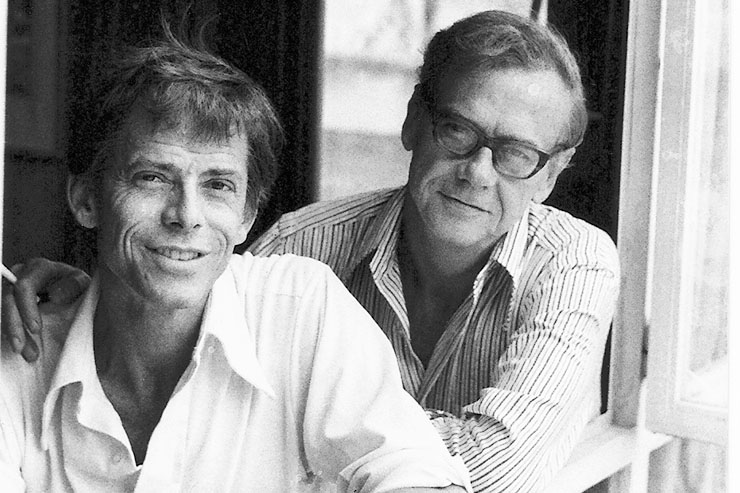
  • What Lives On? Investigating Life After Death

    What Lives On? Investigating Life After Death

    From New Dawn Special Issue 7

    Do we survive the death of our physical bodies? Is there such a thing as a postmortem continuation of the individual? If there is survival, what survives? Does everyone survive? What does it even mean to survive?

    Answers to these questions are central to the dogmas of many religions. These same issues are amongst the most refractory when addressed using the techniques of scientific inquiry: data gathering, hypothesis formulation and testing, logical analyses. Indeed, such topics are generally viewed as outside the scope of scientific inquiry, not worth serious thought. As Bertrand Russell commented, “most people would die sooner than think – in fact, they do so.”

    Sphinx Geology

    In my youth, I didn’t bother to give the afterlife much consideration. I never needed the threat of future hell and damnation to persuade me to be moral now. I identified with those ancient Hebrews who did not necessarily believe in an afterlife (de Vesme, 1931), yet still found it prudent to pursue an honourable life in this world. In college I pursued a very earthly field – the study of rocks – ultimately earning a Ph.D. in geology and geophysics from Yale University (1983).

    My life changed in 1990. At the invitation of independent Egyptologist John Anthony West, I took my first trip to Egypt – specifically to study the Great Sphinx from a geologic point of view. After several more trips, undertaking various tests and analyses, I came to the conclusion that the oldest portions of the Great Sphinx date back to a much earlier period than previously believed by most Egyptologists and historians. Conventional wisdom places the Great Sphinx in the reign of the Pharaoh Khafre (Chephren), circa 2500 BCE. My studies indicated that the oldest portions of the Great Sphinx (the statue has been repaired many times, and the head re-carved) date back to at least the period of 7000 BCE to 5000 BCE, and perhaps 9000 BCE or earlier.

    My Sphinx work immediately caused a firestorm and, though the controversy has abated somewhat two decades later, the implications have only deepened. Essentially, sophisticated culture and civilisation goes back much earlier than formally thought; “history must be rewritten.” Over the years I have been pleased to see confirmation of the crux of my work, as other very ancient sites have been uncovered. A good example is Gobekli Tepe in Turkey where a major monumental carved stone building phase dating to the period of 8000 BCE and earlier has been discovered.

    Egypt And Its Obsession With Death

    Working on the Great Sphinx, I could not help but become fascinated with the pyramids, temples, tombs, and other relics of ancient Egypt. According to the traditional view, what was the overriding preoccupation of ancient Egypt? Death and the afterlife. Say “Egypt” and pyramids (popularly interpreted as giant tombs), mummies, and the so-called Book of the Dead immediately come to mind.

    Having studied them in depth, it is clear to me that the pyramids, and the Great Pyramid in particular, were not solely or even primarily overblown mausoleums. Indeed, the Great Pyramid may have served both astronomical/astrological functions, literally being an observatory at one stage of its development, as well as ritualistic purposes. Many modern visitors describe powerful and life changing experiences in the Great Pyramid. One of the most famous is Napoleon Bonaparte. While in Egypt, August 1799, Napoleon visited the Great Pyramid. He entered the King’s Chamber and asked to be left alone. Upon emerging, Napoleon was pale, faint and silent. Asked by an aide what happened, Napoleon refused to say anything of substance, intimating that he had experienced a preview of his own fate. Just before his death in 1821, Napoleon appeared to be on the verge of telling a close friend what had occurred in the King’s Chamber. Then he hesitated. “No. What is the use? You would never believe me.”

    I have spent many hours, including several times almost the entire night (but not sleeping, mind you), in the Great Pyramid. And I have spent much time exploring other temples and tombs throughout Egypt, as well as pyramids, temples and sacred places elsewhere in the world. Initially I approached the ancient monuments as a geologist, focusing on the materials from which they were constructed. Soon, however, I became involved in studying not just the stones, but why past civilisations had erected the stones into magnificent edifices. The why behind the monuments, more often than not, apparently included religious beliefs and practices, initiation rites and rituals, which in many cases seemed to have an ostensible paranormal aspect, whether it was clairvoyance, divination or manifestations of higher levels of consciousness. Were, I asked myself, the ancient structures used to genuinely alter consciousness and possibly enhance paranormal phenomena? Or did superstition, perhaps combined with pious fraud on the part of a priest or priestess, account for the tales? Furthermore, I could not help but think about postmortem survival issues, particularly when studying ostensible tombs! Death, transformation, resurrection, union with the gods, attainment of immortality – was all this ritualistic hocus pocus and pure nonsense? Or were the ancients skilled psychic engineers, carefully manipulating the incorporeal with their megalithic stone monuments and occult practices?

    My formal training as a physical scientist certainly did not encourage the notion that paranormal and psychic phenomena, much less life after death, were anything other than imagination gone wild or charlatans preying on the gullible. According to a conventional materialistic and secular “scientifically rational” worldview, the paranormal does not exist and death is the final end. It was all too easy, and indeed comforting, to put such issues out of mind. Stick to the hard evidence of the rocks, the domain of the geologist.

    Exploring the Paranormal

    Issues of the paranormal and questions about survival kept nagging at me. Ultimately, I realised, I must address these topics head-on, if only for the sake of satisfying my intellectual curiosity. For me the first issue was to research various reputed anomalous psychic abilities among the living, such as telepathy (direct mind-to-mind transfer of information without utilising any of the conventional senses) and psychokinesis (PK, essentially the concept of mind-over-matter). I wanted to establish what, if anything, in terms of the paranormal is possible among the living before addressing the issue of postmortem survival.

    It took me over ten years from my first visit to Egypt to get to the point where I was prepared to take a serious look at the paranormal. I have taught fulltime at Boston University since 1984, and every year I have a new batch of students. Many simply want to take their courses and get a degree, but then there are those who really strive to go beyond their formal studies. One such student was Logan Yonavjak. She served as my field assistant on research expeditions to Egypt and Peru in 2003 and 2005, and she prodded me to take a serious look at the paranormal. She and I undertook a comprehensive survey of the serious scientific literature addressing psychical research and the paranormal (the field now generally referred to as parapsychology). We read literally thousands of papers, pro- and con-, and we both became involved with the field first-hand. The result of our collaboration was The Parapsychology Revolution: A Concise Anthology of Paranormal and Psychical Research.

    Our studies convinced me that, once the fraud, bunk, and self-delusion are eliminated, there is something to the paranormal. The best-documented class of paranormal phenomena is telepathy. There is strong laboratory evidence for telepathy, such as classic card-calling experiments as well as many more sophisticated tests. There is also a large and compelling body of evidence from spontaneous cases (non-laboratory experiments) supporting the reality of telepathy. For instance, crisis apparitions, veridical hallucinations, or “ghosts” are well known. The evidence for PK is also strong, including micro-PK studies at an atomic level using random event generators and similar devices, such as the evidence developed by the PEAR (Princeton Engineering Anomalies Research) labs over more than a quarter of a century, and the carefully studied incidents of macro-PK (affecting larger objects) associated with genuine spontaneous poltergeist cases. Another line of evidence for the reality of paranormal phenomena is research on presentiments or “pre-sponses,” essentially a form of short-term precognition as measured by physiological parameters (heart rate, electrodermal activity and so forth). Numerous replicated experiments have demonstrated the physiological responses of individuals to disturbing photographs, for instance, a second or two before they are actually viewed by the person. According to conventional science, this should not be possible.

    My research on parapsychological phenomena among the living continues, but at this point I agree with the following statement made by David Fontana, Professor of Transpersonal Psychology at Liverpool John Moores University and a well-known psychical researcher: “Psychic abilities are a matter of fact not of belief. What they are and what they mean for our view of reality is another matter, but one cannot dismiss them as fiction and yet retain credibility as an unbiased observer.” (Fontana, 2005, pp. 468-469)

    But how do we interpret paranormal phenomena? This brings us to the issue of postmortem survival.

    Survivalist Interpretations

    Serious study of psychical and paranormal phenomena dates back to at least 1882, the year when the Society for Psychical Research was founded. At that time, and right up to the present day, some psychical researchers have interpreted some of the phenomena they study as being communications from deceased persons or discarnate (non-bodily) entities. Indeed, among many people the prime interest in psychical studies is to establish the possibility of an afterlife. To give a classic example, let us suppose you attend a séance. The medium goes into trance and begins to speak in a different voice. The voice claims to have a message from the beyond, a message from your departed grandmother. Through the medium, you are told that your deceased grandmother still cherishes those moments you had with her, and a very private story is related, a story that you are certain you never shared with another person and only you and your grandmother knew about.

    So, is this proof that you received a communication from your beloved grandmother? Does she live on in the afterlife? Many people would say yes, absolutely (of course, we are assuming there is no fraud on the part of any involved in the séance). No one other than your grandmother knew the private story, and so it must be her who now relates it (indirectly through the medium). What other explanation can there be?

    Indeed, there is another explanation, and it gets to the crux of the arguments for and against postmortem survival. Instead of your grandmother contacting you from beyond the grave, perhaps the medium is telepathically picking up information from your brain, perhaps information that is stored away deep in the unconscious, and then relaying it in a form that is ostensibly a communication from your grandmother? (Granted, the medium is doing this unconsciously, and in no way intends to deceive. The medium truly feels that she or he is communicating with the dead on your behalf.)

    Let’s make the situation a little more complicated. What if the supposed communication from grandmother relays information unknown to you, perhaps concerning your aunt when she was young? After the séance you consult your aunt, and indeed the communication is true, and what is more, your aunt is shocked and flabbergasted because the information is something that only she and your grandmother shared, and absolutely no one else had ever known it. So, is this proof of the continued existence of your grandmother in the “ethers”? Some parapsychologists would counter that possibly the medium telepathically raided, if you will, your aunt’s mind to find interesting information that was then relayed to you at the séance, information that appeared to come from your grandmother.

    There are well-documented cases that become incredibly complex. For instance, at some séances entities, referred to as “drop-in communicators,” make themselves known (Gauld, 1971). Some such drop-ins are ostensibly deceased souls unknown to any of the séance sitters. The drop-in is simply taking advantage of the séance setting, attempting communication with the still living, perhaps asking that a relative or loved one (a living person unknown to any of the séance sitters) be contacted. Drop-ins can conveniently be dismissed by critics as simply figments of the imagination of the medium and/or séance sitters (the medium may pick up on the imagination of the sitters telepathically, expressing this imagination in the form of a supposed drop-in), except in the cases where the information given by a drop-in is verified later. For instance, a drop-in requests that a message be relayed to so-and-so at such-and-such address, and when a sitter at the séance goes to the indicated address it is found that the address exists, the person named lives there, and the message has significant private meaning for the indicated person. Could, just possibly, the medium have assessed all of the information paranormally and then created, unconsciously, the purported drop-in to “communicate” the information? (We assume that no fraud is involved, and in the best cases it seems clear that fraud is not an issue.) Yes, but to many this would seem a much more elaborate, concocted, and complex explanation than simply accepting that the drop-in was indeed a discarnate entity from the other side.

    Super ESP

    Basically, much of the evidence that ostensibly supports postmortem survival can conceivably be interpreted, with varying degrees of finesse, as due to the psychical and paranormal functioning (even if masked and at an unconscious level) of living persons. This is sometimes known as the Super-ESP hypothesis (ESP refers to extrasensory perception), but actually can include paranormal phenomena besides ESP, such as the movement of objects. Take poltergeist activity, unexplained movements of objects, such as items falling off shelves or being “thrown” through the air without any physical cause that can be observed, various unexplained noises and disturbances. Having observed a minor, but I believe absolutely genuine, poltergeist incident, I am convinced that such activities can be real.

    But is poltergeist activity due to literal ghosts (presumably mischievous departed spirits), or can the Super-ESP hypothesis adequately explain poltergeists? One theory is that many poltergeist manifestations are unconsciously caused by, or emanate from, the person who superficially appears to be the focus of the poltergeist activity. Poltergeist activity may be a method (at the unconscious level) of “working out” unresolved emotional and psychological tensions and conflicts.

    There are many other classes of evidence that some claim as support for the reality of survival beyond the grave. Classic séances sometimes include movements and levitations of tables and other items, strange sounds and voices, and even the supposed materialisation of objects and beings (deceased persons?). If, and it is a big if in many researcher’s minds given the amount of fraud documented in such settings, any of these types of phenomena are genuine, are they due to spirits from the “other side,” as is generally claimed by the medium? Or might a Super-ESP explanation be applicable?

    Near-Death experiences and Out-of-Body experiences are sometimes cited as supporting evidence for the survival hypothesis, but the counter argument is that many such experiences are subject to conventional (non-paranormal psychological and physiological factors) or Super-ESP explanations.

    Some researchers have attempted to utilise modern electronic apparatus as a means of communicating with those beyond the grave, a concept sometimes referred to as instrumental transcommunication. One form, known as electronic voice phenomena (EVP), consists of recording the static of a radio that is tuned to a frequency carrying no transmissions. When the recording is played back, perhaps at a different speed than originally recorded, voices or communications from the other side may be heard, or so it is claimed (Raudive, 1971). Even if such “voices” are independently verifiable, critics of the survivalist hypothesis can claim that the voices were encoded paranormally (and unconsciously) via a form of PK by those involved or associated with the experiments rather than by entities from the spirit world – Super-ESP strikes again!

    Reincarnation

    What about reincarnation? Isn’t reincarnation a type of afterlife, or the continuation of life after the dissolution of a particular physical body? While many supposed cases of reincarnation and past lives remain unsubstantiated by solid data, there are also a number of cases where something paranormal apparently is involved. The late Dr. Ian Stevenson (1918-2007), a psychiatrist associated with the University of Virginia (Charlottesville) for nearly half a century, collected, scrutinised, verified, and analysed literally thousands of cases of individuals who apparently demonstrated memories of former lives.

    Just because a living person claims memories of a past life, does that mean it is the same person inhabiting a new body? Or, is a person who appears to remember a past life (and in most cases it is simply bits and pieces of a presumed past life that are “remembered”) in reality paranormally accessing information about a former person and/or time, perhaps even from still living people? Many cases of supposed reincarnation, some would argue, are nothing more than the latter. That is, Super-ESP is the true explanation. Weakening the Super-ESP hypothesis in some presumed reincarnation cases, however, is the finding by Stevenson that in a few instances marks made on the body of a person after the person died apparently appear on the presumed incarnation of the deceased person. Here is a real example given by Stevenson. A young woman in Burma with congenital heart disease died during open-heart surgery. While preparing her body for burial, a mark was placed on the back of her neck with red lipstick. The woman’s presumed incarnation, born thirteen months later, had a prominent red birthmark at the back of her neck, a line of diminished pigment corresponding to the incision in her abdomen and chest made during the surgery, and when the baby began to speak she seemed to have knowledge of the previous life that she could not have acquired by normal means.

    If Stevenson’s data on birthmarks in subsequent presumed incarnations caused by marking or mutilation of a cadaver after death of the previous person stands up to scrutiny, it could have far-reaching implications. It is one thing to hypothesise that fragments or portions, or even the totality, of a personality might be transmitted from a dying person telepathically, including aspects of that person’s death, but to suggest that somehow a lingering discarnate personality is aware of what happens to its former physical body and incorporates marks or mutilations to the body in the next incarnation raises many theoretical and philosophical issues. Is this evidence for the existence of “ethereal beings,” “spiritual entities,” or “soul components”?

    Super ESP or Something Else?

    To quote Professor Fontana, “Given that the evidence supports the existence of psychic abilities, these abilities are either explicable as telepathy, clairvoyance, precognition and psychokinesis from the living (i.e. as Super-ESP), or as communications in one form or another from those who have survived death and live on in another dimension. There is no way around these two possibilities. The evidence either supports Super-ESP or supports survival.” (Fontana, 2005, p. 469)

    In his book Is There an Afterlife?, Fontana is adamant that he believes much of the evidence cannot be adequately explained by Super-ESP. The Super-ESP hypothesis becomes too complex and convoluted, and ultimately so complicated that many prefer, or even find it necessary, to discuss alternative explanations, such as postmortem survival.

    Fontana asserts there are two, and only two, ways to interpret the evidence: Super-ESP or survival (to be clear, Fontana leaves open the possibility that Super-ESP may explain some of the evidence while other evidence supports survival). But is it really an either/or situation? Are the only two viable alternatives Super-ESP and survival of humans (and possibly other organisms?) that once inhabited Earth in bodily form? It seems clear to me that there are additional possibilities (even if not actualities). What about the time-honoured notion of discarnate entities that perhaps never inhabited physical bodies: gods, angels, demons, spirits and so forth?

    Soul Components

    At another level, the concepts of Super-ESP and survival may not be totally distinct from one another. Another time-honoured concept is that of a World Soul, conscious of and remembering its past, that is all the past, and that individual souls may merge with and draw from this World Soul. Related to this is the concept of a spiritual record (sometimes known as the Akashic Records) of all that has transpired, a record that might be accessed from time to time by certain individuals or other beings.

    Rather than viewing the issue of postmortem survival as a simple dichotomy, you survive or you do not, I believe the issue is much more subtle, complex and nuanced. It is not simply is their life after death, yes or no? Rather is it a matter of which psychic components of a person may survive, in what states, for how long, and how such components may influence the living (for instance, via communication through a medium, haunting, reincarnation or possession).

    The ancient Egyptians took a much more sophisticated approach to afterlife issues than many modern people do. They had a number of terms for various psychic components of a person, not fully understood to this day, but we can list some as follows: ka (life force, vital force, spirit, double), ba (individual personality, soul), akh or khu (spirit form, transfigured spirit, ghost), ib or ab (heart, emotion, thought), sheut (shadow, hidden self), and ren (name, embodiment of power and personality). Upon death and dissolution of the body, the ancient Egyptians believed these components could separate and go their separate ways; part of Egyptian ritual involved reuniting the psychic components. When it comes to attempting to understand the subtleties of the psyche and the possibility of postmortem survival, I believe we can benefit by studying ancient wisdom.

    At this point I am not sure what exactly survives, what form or forms it takes, or how long it might survive (for a limited duration? forever?), but I believe the evidence supports the conclusion of the early psychical researcher F. W. H. Myers – something survives:

    I hold that certain manifestations of central individualities, associated now or formerly with certain definite organisms, have been observed in operation apart from those organisms, both while the organisms were still living, and after they had decayed. (Myers, 1907, p. 27)

    We have the foundation for serious studies of the survival issue, a topic that I will continue to pursue in this life – and perhaps the next.

    [alert type=”general” dismiss=”no”]This article was published in New Dawn Special Issue 7.[/alert]

    [alert type=”success” dismiss=”no”]If you appreciate this article, please consider subscribing to help maintain this website.[/alert]

    References:

    Caesar de Vesme, A History of Experimental Spiritualism. Vol. 2, Peoples of Antiquity (Translated from the French by Fred Rothwell), Rider, UK, 1931David Fontana, Is There An Afterlife?, O Books, UK, 2005
    Alan Gauld, “A Series of ‘Drop In’ Communicators”, Proceedings of the Society for Psychical Research, vol. 55, part 204, pp. 273-340 (1971)
    F. W. H. Myers, Human Personality and Its Survival of Bodily Death (edited and abridged by his son Leopold Hamilton Myers), Longmans, Green, USA, 1907
    Konstantin Raudive, Breakthrough: An Amazing Experiment in Electronic Communication with the Dead, Colin Smythe, UK, 1971
    Bertrand Russell, Mortals and Others: American Essays, 1931-1935, Routledge, USA, 1996 (quote cited originally published in Russell’s The ABC of Relativity, 1925.)
    Ian Stevenson, Where Reincarnation and Biology Intersect, Praeger, USA, 1997
    The Parapsychology Revolution: A Concise Anthology of Paranormal and Psychical Research

    © New Dawn Magazine and the respective author.
    For our reproduction notice, click here.