New Dawn – World's Most Unusual Magazine

Tag: aliens

  • Robots, Goblins and Alien Amoeba, Answering Fermi’s Paradox

    Robots, Goblins and Alien Amoeba, Answering Fermi’s Paradox

    From New Dawn 100 (Jan-Feb 2007)

    I believe there are many gods, not one, and always in conflict. Well, if there are gods who created and control what’s going on here, you can tell a lot about them by what is going on. I assume they are colonists. And so anything you can see here you can infer is the act or the will of one of those gods. All you have to do is look around. You’ll see what they’re like. It’s like looking in someone’s yard.
    – W.S. Burroughs

    Dateline: 1950 A.D. The physicist Enrico Fermi is having lunch with a few colleagues when the subject of interstellar travel comes up. There are countless potential living systems in our own galaxy, Fermi reasons. If even a small fraction of these produced technological civilisations capable of launching manned expeditions, our own humble planet should have been overrun with extraterrestrial conquistadores millions of years ago.

    “Don’t you ever wonder where everybody is?” Fermi asked.

    In other words, if the galaxy is filled with little green men in luminous flying saucers who travel from star to star colonising other worlds, then why don’t we have any physical evidence of their existence – not even so much as a piece of broken zipper from one of their spacesuits?

    This question (known as the Fermi paradox) has spawned a vigorous scientific and philosophical debate whose possible answers can be grouped into three broad categories.

    1. Extraterrestrial civilisations do not exist.
    2. Extraterrestrial civilisations exist but haven’t colonised the Earth, either because they can’t or because they don’t want to.
    3. Extraterrestrial civilisations exist and have colonised the Earth without our knowledge.

    As we shall see, the implications for all of these positions are unsettling in the extreme – not so much for what they say about extraterrestrial life, but for what they might say about us.

    Are We Alone?

    The most straightforward solution to the Fermi paradox is that we are alone in the universe – our planet has not been colonised because advanced alien civilisations do not exist.

    Perhaps (as many Christians claim) life is unique to Earth; or perhaps most alien societies ruin themselves through pollution or war, extinguishing life on their home worlds before they have a chance to spread outwards. (Knowing as we do that terrestrial species have a better than 99% extinction rate, this latter scenario is rather easy to imagine.)

    Of course, even if most alien species do expire in this way, isn’t it stretching the limits of conjecture to suppose that all of them do?

    The Milky Way galaxy alone contains at least 100 billion stable solar systems;1 roughly a third of these possess Earth-like planets with oceans.2 The odds against every single one of these being either sterile or suicidal are literally astronomical.

    So, Where Are They?

    If we suppose that extraterrestrial civilisations do exist, we are left with only two options: either they are somewhere else or else they are here. So why might an alien civilisation choose to colonise the Earth (or not)?

    Many researchers seem to assume that an extraterrestrial colonisation effort would be overtly belligerent, taking the form of:

    • Imperialism
    • Resource Exploitation
    • Subversion
    • Scrub & Repopulate
    • Smash & Grab3

    But wouldn’t successful alien civilisations be more patient and cautious than that? Couldn’t they also be:

    A.        unable or unwilling to launch a full-scale invasion of the Earth?

    or

    B.        here already, and ruling over us by means so subtle as to be almost undetectable?

    In fact, some scientists have argued that until we conclusively prove that extraterrestrial civilisations don’t exist, the Fermi paradox isn’t a paradox at all; instead, we aren’t looking hard enough, or haven’t been looking in the right places.

    Biblical Brainteasers

    The Fermi paradox here reveals significant overlap with the theodicy, a traditional theological riddle, which asks: If God is good and all-powerful, where is the evidence of his existence – why is there so much evil in the world?

    One of the most ancient (and persuasive) answers to the theodicy is that of Gnosticism, a speculative branch of pre-Nicean Christianity which held that God (or the gods) do exist, but are neither omnipotent nor benevolent; instead, these advanced beings from the stars are selfish, opportunistic and deceptive.

    Gnosticism In Brief

    In the Gnostic view, the god of the Bible was not the Supreme Being at all, but an arrogant Demiurge who fled the heavens to build this planet as an experimental prison, populating it with artificial life forms and strange, symbiotic hybrids.

    Far from paradisiacal, his “Garden of Eden” was an eerie mad scientist’s laboratory where shadowy parasites abducted a pair of primitive primates named Adam and Eve, raping the female and implanting the male with false memories:

    When they [the Demiurge and his angels] saw Eve speaking with [Adam], they said to one another… “Come, let us seize her and let us cast our seed on her, so that… those whom she will beget will serve us. But let us not tell Adam that she is not derived from us, but let us bring a stupor upon him, and… teach him in his sleep as though she came into being from his rib…”4

    These chthonic and creepy alterna-Christian creation myths have influenced thinkers from many different fields over the millennia, from politics to popular culture. In recent decades, the Gnostic metanarrative has even made a re-appearance with the paranoid worldview which informs much contemporary speculation about aliens and UFOs, e.g.:

    One of the purposes for which UFOs travel to Earth is to abduct humans to help aliens produce other beings. It is not a program of reproduction but one of production. They are not here to help us, they have their own agenda and we are not allowed to know its full parameters.5

    In all of the solutions to the Fermi paradox which appear below, we can see echoes of many of these same, disturbing ideas. As the Demiurge and his angels pass from theology into speculative exobiology, the skies seem to swarm with icily indifferent robots, otherworldly djinn, celestial frauds and bestial, fallen bacilli.

    Six of the most widely-discussed scenarios follow:

    1. Extraterrestrial civilisations spread via self-replicating AI probes.
    2. Extraterrestrial civilisations develop massive virtual reality simulations.
    3. Extraterrestrial civilisations have left this universe and developed the ability to manipulate hyperspace.
    4. Extraterrestrial civilisations develop xenophobic and/or authoritarian religious forms.
    5. Extraterrestrials are biologically very primitive, or spread themselves via biologically primitive forms.
    6. The Earth is being deliberately quarantined.

    Conveniently, most of the possibilities listed here could plausibly be used to explain either why our planet has been invaded or how it could already have been invaded unbeknownst to us; which outcome you favour really seems to depend on your assumptions about alien motivation.

    POSSIBILITY #1 – Extraterrestrial civilisations spread via self-replicating AI probes

    Frank Tipler of Tulane University has argued that alien civilisations would probably explore and colonise the Universe by proxy, filling the galaxy with self-replicating AI (artificial intelligence) probes instead of venturing forth themselves. Thus, even a very distant extraterrestrial civilisation should be able to seize, secure, sterilise and strip-mine our entire planet in about 4 million years.

    “If they existed,” concludes Tipler, “they would be here”; and since we are here instead, they must not exist.6

    On the other hand, if hives of autonomous, adaptable, rapidly multiplying robotic probes were roaming the galaxy, successive generations might eventually become so intelligent as to far surpass their creators.

    In time, as these “artilects” spread throughout the Universe, they could come to abandon their creators’ agenda, preferring effortless communion with their own kind to the laborious conquest of organic, planetary life. Reflects AI researcher Hugo de Garis:

    I suspect strongly that virtually all the ETs out there are in fact artilects, and hence have intelligence levels astronomically superior to the human level. To me, biological technological intelligence is just a fleeting phase that nature goes through en route to creating immortal massive artilectual intelligence, which may be a phenomenon as commonplace as the creation of life from the molecular soup…

    The answer then to Fermi’s paradox is that we human beings, being mere biologicals, are utterly unworthy of the artilects’ attention… What’s in it for them? We are very probably not so special and are very, very dumb…7

    POSSIBILITY #2 – Extraterrestrial civilisations have developed massive virtual reality simulations

    Recent trends suggest that it should be possible for an advanced civilisation (either earthly or alien) to develop fully immersive virtual reality simulations like the “Holodeck” of Gene Rodenberry’s Star Trek. If such a technology were developed by an alien species on its own planet, the prospect of mingling in real time with a distant and dirty species like our own could seem unappealing, degrading or even boring to extraterrestrial psychonauts. Opines evolutionary psychologist Geoffrey Miller:

    Basically, I think the aliens don’t blow themselves up; they just get addicted to computer games. They forget to send radio signals or colonise space because they’re too busy with runaway consumerism and virtual-reality narcissism. They don’t need Sentinels to enslave them in a Matrix; they do it to themselves, just as we are doing today.8

    Alternately, it could be that our own world (and the visible universe which seems to surround it) is itself a vast computer simulation engineered by aliens, some form of artificial intelligence (as in the film The Matrix) or even our own descendants. The planetarium hypothesis holds that we can’t find evidence of alien colonisation because contact with other worlds hasn’t been built into the simulation.
    POSSIBILITY #3 – Extraterrestrial civilisations have left this universe and developed the ability to manipulate hyperspace

    A third possibility is that alien civilisations become capable of interstellar travel, but learn how to escape this universe soon afterwards. If transcension were common, extraterrestrial civilisations might quickly lose interest in colonising other planets. Why travel to a distant ball of mud and water when you can explore higher dimensional hyperspace instead?

    On the other hand, if alien scientists did have the ability to leave our shared space-time and launch themselves into the larger multiverse, they could be here now and we would not be able to see them.

    In the same way that a glass pipette might seem – from the point of view of beings trapped in the flat, two-dimensional world of the Petri dish – like an enormous, transparent column which descends from the sky to abduct unsuspecting amoeba out for an afternoon stroll, aliens from higher dimensional space-time could enter and leave our reality at will, seeming to appear and disappear, change shape and pass through solid barriers as they experimented on and/or revealed themselves to us, and all without leaving a shred of physical evidence.

    The idea that extraterrestrials are actually multi-dimensional has been an influential one, leading some UFO researchers to conclude that:

    This [the UFO phenomenon] is not the product of an alien culture from a nearby star, here to explore our solar system. Instead it is an intelligence which dwells in a different type of reality and moves through hyperspace in such a way as to interreact with us almost as a side-effect. It is an intelligence that is not here to study us but it has been here all along and effectively controls our whole existence…9

    Advocates of Jacques Vallee’s “control system” hypothesis similarly argue that we may never find the evidence we seek because extraterrestrials aren’t encumbered by physical artifacts like spaceships or ray guns; instead these polymorphous and hallucinatory aliens freely wiggle and hop in and out of our world like angels, demons and gods from the twilight realms of the collective subconscious.

    POSSIBILITY 4 – Extraterrestrial civilisations develop xenophobic and/or authoritarian religious forms

    A fourth possibility is that extraterrestrial civilisations tend to develop xenophobic and/or authoritarian religious forms. Given the history of our own species, the difficulties such belief systems might present to alien scientists can easily be imagined.

    Are Plaeadian professors who promote interstellar exploration passed over for promotion or excluded from alien faculty functions? Are extraterrestrial exobiologists denounced as heretics and electrocuted by otherworldly Inquisitors? If so, then we may never encounter these advanced beings from the stars.

    Alternately, it could be that alien conquerors literally walked the Earth’s surface millennia ago and left literary monuments to their endeavours in the form of the Babylonian and Sumerian creation epics and the Hebrew Bible. In this view (the so-called “alien astronaut” hypothesis), the gods and messengers of our own authoritarian religious traditions were not representatives of a supreme being at all, but extraterrestrial colonialists masquerading as gods!

    Israeli scholar Zechariah Sitchin’s works are generally representative of this latter position, holding that alien scientists (the “Elohim” and “Nephilim” of the Old Testament) genetically engineered homo sapiens from the great apes in an attempt to create a slave race:

    They made us through genetic engineering. They jumped the gun on evolution, and made us to look like them physically, and to be like them emotionally. That is what the Bible says: “Let us make the Adam in our likeness and after our image.” Physically, outwardly and inwardly. So much of what they are, we are.10

    Are human beings really descended from some prehistoric encounter between the apes and the angels 300,000 years ago? Sitchin is convinced of it. As proof, he points out that humans possess 223 genes found in no other species on Earth. Either these genes were horizontally transferred by some unknown species of bacteria, Sitchin insists, or else they must be extraterrestrial in origin.11

    POSSIBILITY #5 – Extraterrestrials are biologically very primitive, or spread themselves via biologically primitive forms

    600 million years ago, the Earth was ruled by sponges, flatworms and jellyfish. Possessing neither brains nor nervous systems, these simple organisms flourished, surviving nearly unchanged today.

    In similar fashion, our universe may be teeming with species hugely successful on their home planets but lacking the complex cognitive skills necessary to build and launch spacecraft.

    The flip-side of this possibility is the panspermia hypothesis, which holds that extraterrestrial colonists arrived here billions of years ago, not as bug-eyed monsters in metallic spacecraft, but as spores or bacteria which fell from the atmosphere to fertilise the Earth’s oceans with primitive life. In time, these alien microbes evolved into the many terrestrial species biologists know today, including human beings!

    Of course, the panspermia hypothesis doesn’t answer how our most ancient one-celled ancestors originated themselves; perhaps their ancestors too were seeded somewhere else by alien scientists from another solar system.12

    POSSIBILITY #6 – The Earth is being deliberately quarantined

    Finally, the “zoo hypothesis” holds that we haven’t been able to find any hard evidence of alien contact or colonisation because our extraterrestrial overlords don’t want us to – instead they are treating this planet like a farm or laboratory. As early 20th century paranormal researcher Charles Fort wondered:

    Would we, if we could, educate and sophisticate pigs, geese, cattle? Would it be wise to establish diplomatic relation with the hen…?

    I think we’re property… we belong to something… that once upon a time, this earth was No-man’s Land, that other worlds explored and colonised here, and fought among themselves for possession, but that now it’s owned by something… all others warned off.13

    If this planet functions as a livestock enclosure of some sort, then it makes sense that representatives of the civilisation cultivating and/or studying us would occasionally slip up and reveal themselves. The indignation expressed by the contactee who recalls alien encounters under hypnosis may have something in common with the drugged and dizzy roar of the bear who wakes up to discover a radio-tracking chip stapled to his ear:

    Close Encounters of the Fourth Kind (CE-IV): The contactee is abducted by the UFO occupants, taken aboard the landed craft, and subjected to a variety of “tests” and “experiments.” Some investigators claim to have recovered physical evidence of these interactions in the form of scars from alien surgical incisions. Some abductees report memories of devices being implanted within their bodies, typically through the nose.14

    Conclusion

    Perhaps most alien civilisations are unable or unwilling to colonise other worlds, due to their religious beliefs, immersion in video games, or an unfortunate tendency to blow themselves up, but even if 99% were thus incapacitated, this still doesn’t explain why the remaining 1% seem to have left the Earth alone.

    On the other hand, if just one ambitious, alien civilisation from among the remaining 1% were to colonise the Earth using any or all of the strategies described above, our seeming isolation would be explained and Fermi’s paradox would stand resolved – as long as they did so covertly.

    Are we then, mere talking monkeys in a cosmic cage, simulated serfs in a vast video game or experiments in an extraterrestrial Petri dish, as some of the most plausible solutions to Fermi’s famous question would seem to imply?

    Unfortunately (or perhaps fortunately), the “covert colonisation” hypothesis is by definition almost impossible to disprove; in the end, we may have no choice but to test some of these strange scenarios by launching colonisation programs of our own:

    Earth has provided a stable platform for the evolution of life over 4 billion years. But that lease is limited; we know for sure that it will expire after a few billion more. Long before that, our planet may become a place where it is no longer suitable for us to live. Increasing luminosity of the Sun may gradually boil our oceans, or more sudden catastrophes may threaten our existence. If we are wise, we will have furnished our new apartments long before that time….15

    [alert type=”general” dismiss=”no”]This article was published in New Dawn 100.[/alert]

    [alert type=”success” dismiss=”no”]If you appreciate this article, please consider subscribing to help maintain this website.[/alert]

    Footnotes:

    1. “Earth: No Longer the Lonely Planet,” RedOrbit, Saturday, 27 September 2003, www.redorbit.com/news/stories/1/2003/09/27/story003.html
    2. “Earth-Like Planets May Be More Common Than Once Thought, Says CU-Boulder-Penn State Study,” University of Colorado at Boulder, 7 September 2006, www.colorado.edu/news/releases/2006/280.html
    3. Fritz Freiheit, “The Possibilities of FTL: Or Fermi’s Paradox Reconsidered,” www-personal.engin.umich.edu/~fritx/Ftlessay/essay.html
    4. “On the Origin of the World,” from Willis Barnstone’s The Other Bible, p.70, 1984.
    5. Dr. David Jacobs, Secret Life, p. 305
    6. John D. Barrow and Frank J. Tipler, The Anthropic Cosmological Principle, p.578.
    7. Hugo de Garis, “Answering Fermi’s Paradox”, 22 March 2001, www.kurzweilai.net/articles/art0188.html
    8. Geoffrey Miller, “Runaway consumerism explains the Fermi Paradox,” www.edge.org/q2006/q06_print.html#miller
    9. Peter Hough & Jenny Randles, Looking For the Aliens, p.210, 1991.
    10. Interview with Zecharia Sitchin, www.metatron.se/asitch.html
    11. Zecharia Sitchin, The Case of Adam’s Alien Genes, www.sitchin.com/adam.htm
    12. For an in-depth discussion of the panspermia hypothesis, please see this author’s previous article “The Incredibly Strange Story of Intelligent Design” in the July/August 2006 issue of New Dawn magazine.
    13. The Book of the Damned, A Hypertext Edition of Charles Hoy Fort’s Book, Edited and Annotated by Mr. X, Chapter XII, www.sacred-texts.com/fort/damned/damn12.htm
    14. J. Allen Hynek, UFO researcher, from Keith Thompson’s Angels and Aliens, p.144, 1991.
    15. Robert Shapiro, Planetary Dreams, 1999.

    © New Dawn Magazine and the respective author.
    For our reproduction notice, click here.
  • The Incredibly Strange Story of Intelligent Design

    The Incredibly Strange Story of Intelligent Design

    From New Dawn 97 (Jul-Aug 2006)

    Children in Ohio may be taught life was created by aliens under an education package designed to ditch Darwin’s Theory of evolution. The US state is considering adopting the “intelligent design” theory that life is too complex to have simply evolved – as the Darwin Theory suggests. Therefore says the package, life must have been designed by some supernatural being, maybe God, maybe aliens.
    Herald Sun, Columbus, Ohio, March 2002

    Intelligent Design (ID) theory is a highly speculative philosophical argument, popular in recent years, which holds that rich diversity of species on the planet Earth is best understood as evidence of divine (or alien) intervention in terrestrial life.

    In a nutshell, ID argues that the Earth is too young, and life too complex for fish, animals and birds to have evolved through natural selection; instead, we must look for a supernatural cause.

    Professional scientists object to ID theory on the grounds that it can’t be proven, and so falls outside the domain of science; ID proponents have responded by taking their case directly to the public with a political campaign called “teach the controversy.”

    The “teach the controversy” campaign makes scientists (especially those who depend on public funding) nervous, and with good reason – the ultimate goal of the ID movement, as leading spokesmen frankly admit, is to discard the scientific method altogether and “win back” Western culture for the Biblical creator god.

    What makes this situation so especially interesting is the fact that leading ID theorists have positioned themselves as intellectual “heretics” struggling against the gatekeepers of scientific “orthodoxy.”

    Of course, the idea that ID could actually be taught alongside evolution in public schools has provoked an unprecedented tsunami of scorn from these same, self-appointed gatekeepers. “ID isn’t science!” they object. “If we teach ID, then why not teach students that the Moon is made out of green cheese, or that storks deliver babies?”

    I would like to respectfully suggest that children’s stories like the ones I’ve just mentioned aren’t the best analogies for ID theory. A better example might be the Anthropic Principle (AP), a closely related line of speculative reasoning which holds that the Universe itself is so complex and so improbable that it, too, requires special explanation. (We might also note that evangelical Christians are especially fond of AP in its “strong” form, which suggests that our Universe was “fine-tuned” for life by a god-like being.)

    Unfortunately for Christian culture warriors, neither of these remarkable notions ultimately supports the old-fashioned idea that life, the Universe and everything represent the singular creations of a perfect, rational Supreme being. (In its totalising singularity, the Genesis metanarrative differs little from the Big Bang and Darwinian evolution scenarios which comprise the “origins story” of the industrialised West).

    Rather, ID theory and the Anthropic Principle – and especially their corollary mechanisms panspermia and simulation – seem to reveal the handiwork of multiple, incompetent creators who were themselves created by yet more incompetent creators in another Universe, and so on, extending backwards in time and space to a point of infinite regress.

    To put it bluntly: AP and ID do not somehow “prove” the case for the Bible; instead, they unavoidably and inevitably lead us back to a time and place even earlier and more primal than Genesis itself, back to the myths and theological speculations of the ancient Gnostic Christians.

    GNOSTICISM: A QUICK INTRODUCTION

    What historians today call “Gnosticism” was once a broad and diverse movement within pre-Catholic Christianity – an anarchic assemblage of hundreds of different schools of mystical theology whose adherents proudly produced reams of elaborate, florid, and highly speculative re-interpretations of Biblical scripture.

    While no one doctrine united all Gnostic Christians, they did hold certain beliefs in common; perhaps the most shocking of these was the idea that the Old Testament creator God Yahweh was actually the Demiurge, a monstrous deity born from the shadow of infinity who fled the divine world to build our Universe in a misbegotten experiment.

    This Demiurge, the story goes, created for himself assistants – bumbling fallen angels called “archons” – and these in turn created the Earth, humanity, and seven heavens which encase and enclose our planet like so many cosmic prison walls.

    In a version of the myth popularised by 2nd century Gnostic theologian Basilides, the archons generated not just seven, but 365 heavenly realms in sequence, nested one inside the other like the rings of an electron – each successive layer just slightly more defective than the one which produced and preceded it, and all populated by arrogant creator gods completely unaware of those who came before them.

    French heresy-hunter St. Irenaeus invokes these strange stories in an attempt to refute the idea there is another heaven above heaven, and another god above “God”; for if gods produce gods who create heavens filled with yet more world-creating gods, then where does it all stop?

    …by that very process of reasoning on which they [Gnostic Christians] depend for teaching that there is a… God above the Creator of heaven and earth, any one who chooses to employ it may maintain that there is another [heaven] above [heaven and] above that again another… flowing out into… worlds without limits, and gods that cannot be numbered… so that the formation of heavens of this kind can never cease… the operation must go on ad infinitum…1

    The Gnostic version of the Adam and Eve myth also differs radically from the Biblical one, presenting the Garden of Eden as a shabby laboratory where the “archons” built Adam from blurry blueprints, botching his brain and body almost beyond repair:

    The (first) human being… was a creation of angels [but was] unable to stand erect because of the angels’ impotence, and rather writhed on the ground like a worm….2

    Even after the Eden fiasco, the archons continued to tamper with the human gene pool, raping Eve, drowning Adam’s descendants in a flood, and descending to the Earth to impregnate the survivors with half-human hybrids.

    As we shall see, the ID and AP theories so beloved of contemporary apologists have far more in common with the open, flawed and multiple processes described here than with anything even remotely resembling the Biblical creation account; or, as one Gnostic scribe observed waggishly:

    For Adam was a laughingstock, since he was made a counterfeit type of man by the Rulers.3

    ID THEORY MADE SIMPLE

    The basic idea behind ID is that life and its component parts display something called “irreducible complexity.” This means that living systems (plants, animals, people) are so complicated that they could not possibly have arrived at their present forms through evolution – instead, new species must have been deliberately planned and introduced to the planet by some sort of godlike being.

    Inanimate objects such as televisions, microwave ovens or wristwatches illustrate this principle. If we can admit that these devices show evidence of planning and design, and are unlikely to have emerged from chance alone, then shouldn’t we admit the same of the human eye?

    Like the watch, the eye seems so perfectly engineered that it’s difficult to imagine how it could have evolved in stages over time. Remove any one of its parts, ID theorists point out, and it would dim, blur, or even become completely useless.

    Unfortunately, there are a few problems with this line of reasoning, at least from the Biblical perspective. For one thing, if organs and species are so complex that they require an “intelligent designer,” then wouldn’t this “designer,” too, be at least as complex as its creations, and so require a designer of its own? And wouldn’t that intelligent designer also require a designer, and so too its designer, ad infinitum?

    UNINTELLIGENT DESIGN

    A second problem with the “eye” example is the fact that the human retina tends to detach from the optic nerve over time, leading to blindness; if this is evidence of “Intelligent Design,” then our “Intelligent Designer” is clumsy at best and malicious at worst.

    Other widely remarked-upon flaws4 in the design of the human body include:

    • high placement of the larynx, facilitating choking
    • thin spinal discs between the vertebrae which degenerate under pressure, causing crippling back pain
    • a small pelvis makes childbirth difficult and often fatal for women
    • a weak, vulnerable stomach unprotected by ribs

    Of course, evidence of sub-optimal design in itself does not prove that “Intelligent Design” did not occur; it may instead demonstrate the purposeful engineering of planned obsolescence.

    Or it may be that these seeming flaws are part of the Intelligent Designer’s secret plan to give humans the opportunity to improve themselves. Consider the German artist Gunther von Hagens’ plan to build a “super-human” using the donated body parts of terminally ill patients. Why and how?

    The programme aims to identify and correct the significant design flaws in human anatomy. The body will be modified by Professor von Hagens and leading biologists, surgeons and mechanical engineers into an “improved” human form. Ideas already put forward include:

    • increase the number of ribs to protect internal organs better
    • create backward-bending knees to lessen wear on joints
    • rearrange the trachea and oesophagus to stop food going down the windpipe by mistake
    • double heart or reconstruction of the coronary arteries
    • make a retractable penis

    Professor von Hagens claims that his Protean monster will “pave the way for a more healthy, capable and longer-living body. What we do with a real human body today will show what we can achieve in the future using genetic engineering.”5

    MULTIPLE DESIGNERS THEORY

    Von Hagens’ team of assistants illustrate another unstated premise of popular ID theory, to wit: why do ID proponents always seem to assume there was only one designer?

    If evolution fails as an explanation for the rich diversity of species on the planet Earth, then why not posit a rich diversity of designers?

    Science writer Richard Hoppe finds such a scenario not only possible but likely, noting that:

    …Some of the most impressive and elaborate designs in biology appear to have as their primary purpose the defeat or subversion of other designs. Designs engage in various kinds of biological arms races with one another. Some examples are:

    • Predator/prey arms races.

    • Parasite/host arms races.

    • Male/female arms races.

    • Disease-causing bacteria/drug companies arms races.

    Each of these is an example of design pitted against design, directly implicating multiple designers.6

    In fact, scientists have long known that the human body hosts a wide variety of foreign flora and fauna; as a recent Wired news story entitled “People Are Human-Bacteria Hybrid” notes:

    We are best viewed as walking “superorganisms,” highly complex conglomerations of human cells, bacteria, fungi and viruses… More than 500 different species of bacteria exist in our bodies, making up more than 100 trillion cells. Because our bodies are made of only some several trillion human cells, we are somewhat outnumbered by the aliens. It follows that most of the genes in our bodies are from bacteria, too.7

    “Which came first, the intestine or the tapeworm?” W.S. Burroughs once asked.

    If Hoppe’s “Multiple Intelligent Designers” theory is correct, the tapeworm, the intestine, mitochondria, bacteria, fungi and perhaps even the human brain and body were produced by completely separate beings – limited and imperfect creators with varying levels of skill competing against one another for ecological dominance.

    ALIENS AMONG US

    ID theory continues to excite evangelical Christians, but there are even more signs that their enthusiasm may be misplaced, and for reasons much more serious than built-in flaws or design by committee.

    In short, if they accept this “Intelligent Designer,” then what guarantee do they have that it (or they) will be gods at all?

    Leading ID theorist Bill Dembski (of Baylor University) isn’t exactly sure. According to a recent article in the American Spectator:

    The intelligent design that Dembski hopes to detect could belong either to a Biblical God or to an earlier race of Martians who planted us here (like in the movie Mission to Mars).

    The idea that the Earth was deliberately “seeded” with life by extraterrestrial scientists “may seem pretty far out,” the article concedes. “But Francis Crick, winner of the Nobel Prize for his co-discovery of DNA’s structure, is one of a number of scientists who have seriously promoted the ‘panspermia’ hypothesis…”8

    The ancient Gnostics were vitalists, holding that all life springs from a single, unseen animating principle; the Gnostic teacher Basilides referred to this original life source as the “universal seed,” or “panspermia.”

    Today, scientists use the term “panspermia” to describe the theory that life is not native to the Earth, but was instead brought here by an alien spore or virus. Part of the appeal of this idea lies in the fact it doesn’t try to answer how life first emerged from non-living matter; given our vast – perhaps infinite – Universe, the most likely scenario is that life first emerged somewhere else and then “infected” our relatively youthful planet only recently.

    Numerous vehicles for this “infection” have been proposed, from meteorites and sunbeams to interstellar clouds; perhaps the most distasteful was suggested by Thomas Gold of Cornell University, who famously wondered if the Earth life began when our planet was contaminated with microbes from the discarded remnants of an extraterrestrial picnic!

    CRICK’S CLONES

    Francis Crick agreed with the basic premise of panspermia – the idea that the Earth was probably “infected” with life – but wondered at the mechanism; wasn’t the passive spread of life from planet to planet by natural, accidental causes almost as unlikely as abiogenesis (the spontaneous production of life from non-living matter – the conventional scientific explanation)?

    Isn’t it much more likely that an extraterrestrial civilisation seeded our planet with life deliberately?

    Terming his model Directed Panspermia, Crick suggested that a “spaceship” carrying “large samples of… microorganisms” was sent to the Earth billions of years ago by an extraterrestrial civilisation – either as an experiment, preparation for colonisation or a genetic Noah’s Ark of some sort.9

    Or, as Fortean researchers Alan and Sally Landsburg put it:

    The DNA molecule is a marvel of microminiaturisation. All of the DNA in every cell of every living creature on Earth could be packed into one container no bigger than a pea. Thus it could be possible to ship to distant planets the distilled essence of entire colonies, stored in tiny packets. The DNA molecules need be activated only at the appropriate moment, thereby providing enormous savings both in shipping weight and in cost.10

    Sir Frederick Hoyle (the British astronomer who coined the term “Big Bang”) and his student Chandra Wickramasinghe have proposed an even stranger version of the Directed Panspermia model; in the Hoyle/Wickramasinghe view, life originated with (and continues to evolve from) showers of viruses from outer space:

    …life on Earth is derived from what appears to be an all pervasive galaxy-wide living system. Terrestrial life had its origins in the gas and dust clouds of space, which later became incorporated in and amplified within comets. Life was derived from and continues to be driven by sources outside the Earth…11

    What makes the Hoyle/Wickramasinghe model so remarkable is that it seeks to replace random genetic variation as a primary evolutionary mechanism; according to Wickramasinghe, “every crucial new inheritable property” that occurs in the animal kingdom “must have an external cosmic origin.”

    Viruses, although often bad for the individual, are in the view of Sir Fred Hoyle and myself of paramount importance to the evolution for species on our planet. They carry with them the store of cosmic genetic information needed for the generation of new species, classes and orders, and for the progressive forward march of life…12

    “If the Earth were sealed off from all sources of external genes: bugs could replicate till doomsday,” Wickramasinghe writes, “but they would still only be bugs: and monkey colonies would also reproduce but only to produce more monkeys. The Earth would be a dull place indeed…”13

    In other words, not only did aliens first infect the Earth with life, but they also make evolution possible by supplying terrestrial species with new genetic material for natural selection to act upon!

    Sir Hoyle didn’t believe that these viruses fell by chance; instead life itself was the result of an alien experiment:

    The likelihood of the formation of life from inanimate matter is one to a number with 40,000 naughts after it… It is big enough to bury Darwin and the whole theory of evolution. There was no primeval soup, neither on this planet nor any other, and if the beginnings of life were not random, they must therefore have been the product of purposeful intelligence.14

    Sir Hoyle seems to have betrayed at least some misgivings about the implications of these ideas, warning in a 1971 press conference that:

    Human beings are simply pawns in the game of alien minds that control our every move. They are everywhere, in the sky, on the sea, and in the Earth… It is not an alien intelligence from another planet. It is actually from another Universe which entered ours at the very beginning and has been controlling all that has happened since…15

    CAVEATS & PARADOXES

    For all its strengths, the panspermia hypothesis still does not actually tell us how or where life first arose, instead shuffling this question off to a distant realm of mystery and paradox into which we cannot hope to peer. As one Christian critic wonders:

    ..If for the sake of argument we grant that life on Earth was seeded by ancient extraterrestrials, then the obvious question is, Who or what created our extraterrestrial creators? Some would argue that they were, in turn sprinkled (created) by an even more ancient race of ET’s. Well, where did they come from? An infinite regression back in time of “alien sprinklings”…[?]16

    Since ID doesn’t distinguish between gods and extraterrestrials, and the activities of gods are by definition something that can’t be tested or measured, we have only a few, very limited avenues of inquiry left.

    Perhaps human beings were designed by multiple, incompetent creator gods (or one expert mischievously posing as a family of blunderers) – but if so, human beings will never be able to verify this supernatural creator(s) existence.

    Sadly, the metaphysical status of ghosts, spirits, gods and other supernatural beings means that these will always be compelled to hover just beyond the explanatory grasp of human science.

    On the other hand, researchers still can’t produce any evidence for the existence of (presumably physical and biological) extraterrestrial entities despite over 50 years of investigation – so until they do, the only way we can even hope to learn whether panspermia (and thus ID) might explain our own existence is by attempting to replicate the experiment ourselves.

    To wit: if human scientists ever succeed (either deliberately or accidentally) in “infecting” another planet with terrestrial bacteria or viruses, or in genetically engineering an entirely new species and introducing it to the wild, then ID will stand validated and our own role and history on this planet will suddenly come into sharp focus.

    Or, as Israeli researcher Zecharia Sitchin once put it:

    I feel that just as they (extraterrestrials) came to Earth and created us through genetic engineering, and mixed their genes with those of Ape-woman, that one day we will go out in space and land on another planet somewhere and do the same thing. In this sense, I believe things are ordained in a grand pattern…17

    [alert type=”general” dismiss=”no”]This article was published in New Dawn 97.[/alert]

    [alert type=”success” dismiss=”no”]If you appreciate this article, please consider subscribing to help maintain this website.[/alert]

    Footnotes:

    1. Irenaeus, Against all Heresies, http://ccel.wheaton.edu/fathers/ANF-01/iren/iren2.html
    2. Satorninos, according to St. Irenaeus of Lyon, Against Heresies, from Bentley Layton’s The Gnostic Scriptures, pp. 161-62, 1987
    3. The Second Treatise of the Great Seth, from James M. Robinson’s The Nag Hammadi Library, pp. 363-71, 1978
    4. Massimo Pigliucci, “Design Yes, Intelligent No: A Critique of Intelligent Design Theory and Neo-Creationism”, www.infidels.org/library/modern/features/2000/pigliucci1.html
    5. Professor Gunther Von Hagens’ Body Worlds, London Press Release, March 2, 2003, www.bodyworlds.com/en/pages/Pressemeldungen%20London.asp
    6. “Introduction to Multiple Designers Theory”, Posted by Richard B. Hoppe on September 23, 2004, www.pandasthumb.org/pt-archives/000509.html
    7. Rowan Hooper, “People Are Human-Bacteria Hybrid”, Wired News, Oct. 11, 2004, www.wired.com/news/medtech/0,1286,65252,00.html
    8. Fred Heeren, “The Lynching of Bill Dembski”, The American Spectator, November 2000, www.infovi.vu.lt/mps/Being Methodologically Correct.htm
    9. Crick, F. H. C., and Orgel, L. E. “Directed Panspermia,” Icarus, 19, 341 (1973), quoted in David Darling’s Encyclopedia of Astrobiology, Astronomy, and Spaceflight, www.angelfire.com/on2/daviddarling/dirpans.htm
    10. Alan and Sally Landsburg, The Outer Space Connection, p.17, 1975
    11. Chandra Wickramasinghe, testimony in McLean v Arkansas Board of Education, 1981, www.panspermia.org/chandra.htm
    12. Ibid.
    13. Ibid. Latter-day beatniks might also note that an extremely similar theory is advanced in the seminal William S. Burroughs science fiction tale, The Soft Machine – see www.spress.de/author/burroughs/onwsb/skerl/softm.htm
    14. Lee Elliot Majors, The Guardian, “Big enough to bury Darwin: Lee Elliot Major looks at the theories that secured Sir Fred Hoyle’s reputation as one of the 20th century’s leading scientists”, August 23, 2001, http://education.guardian.co.uk/higher/physicalscience/story/0,9836,541468,00.html
    15. Sir Frederick Hoyle, 1971 news conference.
    16. Missler & Eastman, Alien Encounters, p.141.
    17. Interview with Zecharia Sitchin, Connecting Link, Issue 17, www.metatron.se/asitch.html

    © New Dawn Magazine and the respective author.
    For our reproduction notice, click here.
  • Who Built the Moon? An Interview With Christopher Knight

    Who Built the Moon? An Interview With Christopher Knight

    From New Dawn 96 (May-June 2006)

    Many New Dawn readers will know of British writer Christopher Knight from his first book The Hiram Key, which he co-authored with Robert Lomas and published in 1996.

    Quickly becoming a best seller, The Hiram Key was acclaimed a classic in the field of alternative history, going on to influence a generation of researchers among them The Da Vinci Code’s Dan Brown.

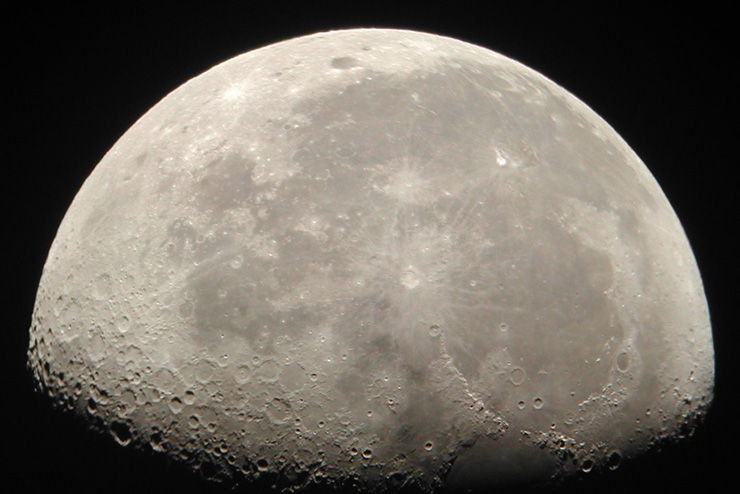
    In the last ten years Knight has written six books, four with Robert Lomas and two, including his latest Who Built the Moon?, with Alan Butler. In Who Built the Moon?, Knight and Butler raise some fascinating and challenging questions, foremost: Could it be that the Moon is artificial? Could it even be hollow? And does the Moon really exist through some happy accident, or is a blueprint apparent – and if so, who was the architect? New Dawn recently spoke with Christopher Knight about his controversial new book and his astonishing conclusions.
    – New Dawn

    NEW DAWN: All of mankind’s visits to the Moon have not answered some of the most basic questions about its origin and importance. Your new book Who Built the Moon? (co-authored with Alan Butler) brings to light some extraordinary facts about the Moon, and comes to a mind-blowing conclusion about its origin. Could you briefly outline some of these little known and ignored facts?

    CHRISTOPHER KNIGHT: The Moon sits very close to the Earth yet it is widely regarded as the strangest object in the known universe. It is a bit like knowing that every person in the world is completely normal except the person you live next door to, who has three heads and lives on a diet of broken razor blades.

    The book lists the strangeness of the Moon, which includes the fact that it does not have a solid core like every other planetary object. It is either hollow or has a very low-density interior. Bizarrely, its concentration of mass are located at a series of points just under its surface – which caused havoc with early lunar spacecraft. The material the Moon is made from came from the outer surface of the Earth and left a shallow hole that filled with water and we now call the Pacific. This rock left the Earth to produce the Moon very quickly after our planet had formed around 4,6 billion years ago.

    The Moon is not only extremely odd in its construction; it also behaves in a way that is nothing less than miraculous. It is exactly four hundred times smaller than the Sun but four hundred times closer to the Earth so that both the Sun and the Moon appear to be precisely the same size in the sky – which gives us the phenomenon we call a total eclipse. Whilst we take this for granted it has been called the biggest coincidence in the universe.

    Furthermore, the Moon mirrors the movement of the Sun in the sky by rising and setting at the same point on the horizon as the Sun does at opposite solstices. For example, this means the Moon rises at midwinter at the same place the Sun does at midsummer. There is no logical reason why the Moon mimics the Sun in this way and it is only meaningful to a human standing on the Earth.

    ND: What led you to write Who Built the Moon? And does this latest book relate to your earlier research when writing Civilization One and Uriel’s Machine?

    CK: All of the six books I have had published over the last ten years are part of a continued single piece of research. I came to write Who Built the Moon?with Alan Butler after we had finished Civilization One, because our research led us to study the Moon very closely.

    We had found that the superbly advanced measuring system in use over 5,000 years ago was based on the mass, dimensions and movements of the Earth.

    However, for thoroughness we checked every planet and moon in the solar system to see if there was any pattern. Amazingly, it worked perfectly for every aspect of the Moon but did not apply at all to any other known body – except the Sun.

    It was as though we had found a blueprint where the Moon had been ‘manufactured’ using very specific units taken from Earth’s relationship with the Sun. The more we looked, everything fitted – and fitted perfectly in every conceivable way.

    ND: Most astoundingly, you found that an ancient system of geometry and measurement used in the Stone Age works perfectly on the Moon. What exactly is this system and how could the ancients have attained this knowledge?

    CK: It is not possible to describe the greatness of this ancient system of geometry and measurement without repeating the content of Civilization One.

    The work of Alexander Thom, a brilliant professor of engineering from Oxford University, was our starting point. He identified the existence of what he called the Megalithic Yard. This was a precise unit of measurement that was the basis of late Stone Age structures across Western Europe – such as Stonehenge. Most archaeologists have written his work off as a mistake but when one looks coldly at their objections they are baseless.

    Alan and I were able to show how they made these highly precise linear units based on the rotation of the Earth and how they were also the basis of all time, capacity and weight units in use today. Once again these are exact – not approximations or close fits.

    Where the ancients got such knowledge is quite baffling. All we can be certain of is that they were way ahead of us today! It’s easy to check out by anyone with a calculator.

    ND: Your conclusion is there are more than enough anomalies about the Moon to suggest it is not a naturally occurring body and was quite possibly engineered to sustain life on Earth. How did you reach this conclusion?

    CK: Not only is the Moon an apparently impossible object, it has some unique benefits for us humans. It has been nothing less than an incubator for life. If the Moon was not exactly the size, mass and distance that it has been at each stage of the Earth’s evolution – there would be no intelligent life here. Scientists are agreed that we owe everything to the Moon.

    It acts as a stabiliser that holds our planet at just the right angle to produce the seasons and keep water liquid across most of the planet. Without our Moon the Earth would be as dead and solid as Venus.

    Get the issue this article appears in

    ND: If the Moon is an artificial construct, what are your theories on who or what built it, and why?

    CK: In Who Built the Moon? we explain that we could not come to any other conclusion than the Moon is artificial. Because it is certain that it is 4.6 billion years old that raises some interesting points. Another factor was the obvious message that has been built into the Moon to tell us it’s artificial. The language of the message is base ten arithmetic so it looks as though it is directed to a ten digit species that is living on Earth right now – which seems to mean humans.

    The question of why the Moon had to be built is easy to answer: To produce all life, especially humans. As to who did it – well that’s a lot tougher! We give the three possibilities we can think of, namely: God, aliens or humans. The only one of these that is 100% scientifically possible is the last one. Time travel is universally accepted as being physically possible and a number of scientists are close to sending matter back in time. We can envisage that machines could be built in the future that could be sent back to remove matter from the young Earth to construct the Moon – probably using mini black hole technology.

    [alert type=”general” dismiss=”no”]This article was published in New Dawn 96.[/alert]

    [alert type=”success” dismiss=”no”]If you appreciate this article, please consider subscribing to help maintain this website.[/alert]

    © New Dawn Magazine and the respective author.
    For our reproduction notice, click here.
  • The Dawn of the Genesis Race: Our Extraterrestrial DNA and the True Origins of the Species

    The Dawn of the Genesis Race: Our Extraterrestrial DNA and the True Origins of the Species

    The mysteries of ancient history, such as how the Great Pyramid was built and by whom and why, have been well established over the past four decades. Similar archaeological enigmas litter the landscape around the planet and they raise many difficult questions about the origin of human civilisation.

    Erik Von Daniken’s series of books, which began with Chariots of the Gods, presented archeological evidence while recounting many mythological traditions that have “gods” arriving on Earth from a distant world and bringing technology and the arts of civilised life to primitive human tribes.

    Many writers followed Von Daniken’s lead and an entire school of alternative historical thought called the “ancient astronaut” theory emerged over the years. This school must be distinguished from another branch largely defined by such writers as Graham Hancock, which we can sum up as the “lost civilisation” school.

    The latter does not figure into this discussion nor is it covered in my book The Genesis Race because it never really addresses the issue of the ultimate origins of Man or civilisation. Even if you accept the idea ancient Egypt and Sumer had their origins in Atlantis, who created that civilisation and from what precursors?

    The essential questions the author has been studying over the past three decades are: 1) how did life originate and evolve on Earth?, and 2) how did civilisation suddenly emerge from mankind’s primitive roots? To my mind it seemed the ancient astronaut theory could be defeated if Darwin’s theory proved to be correct, which “official science” claims it has been. That premise can be justified using several valid arguments.

    The “ancient astronaut” theory generally includes the idea summed up in the first chapter of Genesis, which indicates the “gods” genetically engineered a proto-human race. The actual verse reads, “Let us make man in our image.” If Darwinism is accurate then this assertion would be untrue and the notion of cosmic intervention by an advanced race would fall apart.

    The second reason is Darwin’s theory has not only been applied to biology, it is also used to explain the emergence and development of human civilisation by a process referred to as cultural evolution.

    At its core Darwinism is based on a simple concept: life evolves slowly via a process of incremental adaptations to a wide variety of external stimulus. He applied it to biology and anthropologists, archaeologists and historians applied the same principles to culture and human history. If this is correct then we should not find any abrupt transformations in human “evolution” either biological or historical.

    I reason that if Darwinism is accurate then there may not be any valid scientific basis for the “ancient astronaut” theory, which posited intervention and rapid-fire metamorphosis in both the biological and historical spheres. The results of this research proved surprising. Darwinism is not only unproven – it has been shown by scientists to be fatally flawed. This is where my book, The Genesis Race, begins. Chapters two and three clearly show the flaws in the theory of evolution. It has failed exactly where Darwin feared it might – in the fossil record. Here we find – instead of widespread confirmation – a large number of missing links.

    The general public is given to believe the only “missing link” in the fossil record exists between apes and man. This is not true. The fossil record contains hundreds of gaps between ancient and modern plant and animal species. Darwin referred to the gap separating the primitive non-flowering plants (gymnosperms) and flowering plants (angiosperms) as the “abominable problem.” Why? Because the gymnosperms, like ferns, existed for billions of years and they still exist today. The angiosperms, like roses, appeared on the scene about 150 million years ago and they exist today. Where is the evidence showing the fern evolved through a series of slow, incremental changes into a rose?

    According to Darwinism the angiosperms evolved from the gymnosperms. If this is true then where are the intermediate forms linking the two very different types of plants? They have not been found in the fossil record and none exist today. This seems impossible and it is if you accept the principles of Darwinism.

    There is no scientific explanation for the lack of intermediate plants linking the ancient and modern types. In fact, there should be millions of such fossils since they would have been evolving for hundreds of millions of years, far longer than flowering plants.

    Scientists also have no explanation why gymnosperms and angiosperms exist side by side. Somehow all the intermediate plants they say connect the two kingdoms mysteriously vanished from the fossil record and became extinct. Logic would dictate that the older, ancient plants (non-flowering) should have been the ones to go the way of extinction. This is actually enough evidence to kill Darwinism. Official science would have us believe the only dissenters against Darwinism are Creationists that come from the ranks of the Religious Right. However, I present numerous references to bona fide scientists that slam the door on Darwin’s theory of natural evolution.

    What is, or should be, of great interest to anyone interested in the pursuit of science – as it applies to getting to the truth of human origins and the emergence of civilisation – are the works of Francis Crick and Fred Hoyle.

    While Von Daniken’s books were becoming popular in mainstream culture, these two eminent scientists wrote books about the origins of life on Earth. Both were highly critical of Darwinism and posited that life did not originate on Earth. They said the seeds of the biosphere originated in the cosmos.

    In his book Life Itself, Crick – a Nobel prize-winner and the co-founder of the shape of the DNA molecule – claimed an advanced civilisation transported the seeds of life to Earth in a spacecraft. Hoyle, an astronomer who gave the world the steady state theory of the Universe, proposed that life came from the stars borne on comets or riding on the currents of light waves. The unfortunate thing is these rigorous scientific arguments were largely dismissed or completely ignored by “official science”, and also overlooked by the same folks embracing Von Daniken’s relatively unscientific, yet popular approach. (Erik did make people question and think.)

    I want to clarify what I mean by that statement. Von Daniken claimed he was presenting a theory yet the title of his first book ended with a question mark. A new theory is normally offered by presenting arguments against the currently accepted theory, as Crick and Hoyle did, and it is presented assertively with equal measures of humility and confidence that do not end in a question mark. His somewhat insecure and uncritical approach has characterised much of the “ancient astronaut” literature, which official science finds easy to debunk.

    That is why The Genesis Race begins with a serious critique of Darwinism. That is followed by several chapters re-examining the account of human genesis and the early history found in the Bible. A revolutionary analysis of the first three chapters clearly shows there were two creation events of life (and mankind) on Earth. It also shows the history given in the Bible agrees with the findings of paleontology and anthropology. In the first chapter we find that an early proto-human race was created and lived in the wilderness, like other animals, as hunter-gatherers. They were given “every green thing to eat” by the gods andGenesis 1 ends with that covenant.

    However, in the second chapter we are told Adam is created to be a gardener and Eve is taken from Adam’s rib and the “gods” give them clothing and self-awareness. The chronological account of Creation in the second chapter is entirely different than that of the first chapter of Genesis.

    This is a critical point. Not only do the two accounts differ completely, we find Adam is not to live in the wilderness as an animal but is intended to be a caretaker and farmer. If the two accounts are compared side by side the difference is obvious: Adam and Eve are not equivalent to the race created inGenesis 1; and Genesis 2 and 3 are not a detailed elucidation of the events described in the first chapter, which is normally implied or taught in church Bible classes.

    What the first three chapters of Genesis actually describe are: 1) the creation of a proto-human race, the pre-Neanderthals and Neanderthals who live as hunter-gatherers in an innocent state as described in chapter 1, followed by, 2) the genesis of modern Homosapiens (Adam) fit for the agricultural revolution. That is exactly the history given in Genesis and it agrees with everything modern science establishes about the chronology of human pre-history.

    This is a radical revision giving much stronger support to the Biblical version of human genesis and how and why the agricultural revolution took place. It also clarifies who the “us” refers to when God is abruptly referred to as ‘a plurality’ that intervenes and genetically alters life on Earth, the Genesis Race; and it sets the stage for a presentation of the enigmatic archaeological and additional evidence that further supports the theory of intervention by a technologically advanced extraterrestrial race.

    Archaeology has never even addressed all the questions raised by the sudden emergence of agriculture and highly advanced civilisations in Mesopotamia and Egypt in the 3rd millennium BCE, let alone answered the most critical ones.

    From the perspective of conventional archeological and anthropological thinking, the origins of humankind and the emergence of civilisation from the Stone Age remain enigmatic. We have incontrovertible proof our ancestors could not have built the Great Pyramid with the tools and methods they possessed. Yet official science simply ignores or tries to explain away many serious questions and issues such as how the Great Pyramid – the world’s largest precision-engineered stone structure – was constructed using only hammer-stones, ropes, manpower and sledges.

    However, there are other issues that need to be addressed and today’s genetic research is shedding new light on this field. The implications of several important recent findings seem to have escaped the attention of many independent investigators. Established archaeologists and anthropologists have either ignored or railed against the findings of these controversial DNA studies. I am referring to genetic studies into the origin of the domesticated dog and into the diet of our Paleolithic and early Neolithic ancestors.

    You may ask what do the dog and Stone Age dietary habits have to do with solving the enigmas of mankind’s ancient past? The answer is everything. Until recently it was believed dogs (Canis familiaris) came from a variety of wild canines such as wolves, coyotes, dingos, jackals, etc. But the latest DNA research shows that the wolf alone is the ancestral race of all dogs.

    This poses a set of very difficult problems. The first dog would have been a mutant wolf. However, wolves are extremely sensitive to the genetic fitness and strength of each member of the pack. They are constantly testing and establishing a stringent social pecking order and only the alphas reproduce. So how would a mutant ever have survived and reproduced given the rigours of pack behaviour? No wolves in captivity have produced viable mutants and geneticists tell us mutants are normally unfit and do not survive.

    We are faced with a real conundrum. If we pose that early human tribes intervened and bred wolves into dogs we are faced with an equally impossible scenario. How could primitive humans have known it was possible to selectively breed a wild animal into one possessing only those traits beneficial to them? We take the characteristics of dogs for granted, however, they present us with a profound mystery. A dog is the embodiment of only those wolf traits that people find useful, attractive and safe. How did genetically illiterate Stone Age humans achieve this feat of genetic engineering?

    This problem is compounded when we are confronted by evidence from our earliest civilisations showing that salukis, sighthounds and the pharaoh’s hound, had already been bred in ancient Sumeria and Egypt. How is it possible our ancestors, recently emerged from the Stone Age, could have successfully engineered purebred lines at the onset of civilisation? In addition, dogs are not only temperamentally different than their wild progenitors, they differ physiologically as well.

    A wild alpha male and female only breed once a year, whereas dogs can breed any time. Wolves shed their winter coats, dogs do not. These diverging physiological characteristics take time to develop, in fact, many generations. Again, how did our ancestors at the onset of civilisation accomplish this?

    This mystery is underscored by the fact most of the modern dog breeds originated thousands of years ago. Science has not even addressed most of these issues let alone have the experts satisfactorily explained how wolves became dogs – 100,000 years ago – nor have they shown the step-by-step transitions. Purebred dogs just suddenly appear in the archeological record as if by magic. This is also true of agriculture and our key cereal and legume crops. Wheat, corn, beans and rice pose a second set of genetic enigmas.

    Research into the dietary habits of Stone Age tribes around the globe show our ancient hunter-gatherer ancestors subsisted on leafy plants and lean muscle meats. This makes perfect sense because these foods were readily available, took little or no processing, and wild game could be cooked over an open fire. The problem with our grain crops, and they are the basis of civilisation, is wild grass seeds are so miniscule the cost/benefit of harvesting them was not in favour of it. They also require harvesting, threshing and cooking technology since they have to be boiled extensively. This was technology Stone Age Man lacked.

    The reason grains have to be cooked is that the human gut is not adapted to digest wild grains. This makes it very clear the use of wild grass seeds as a primary food source is of recent origin. Our Paleolithic ancestors did not subsist on them. Once again, this poses a set of formidable problems that need to be studied rigorously. If our ancestors did not harvest and eat wild grains, how could they have domesticated and bred the wild species so quickly?

    Without many generations of trial and error experimentation – culminating in a vast body of agronomic knowledge and agricultural practices that would have included genetics and breeding – it is all but impossible to understand how the agricultural revolution was brought about. Official science tries to explain the evolution of nomadic hunter-gatherers into sedentary, crop-growing farmers by claiming they discovered crops quite by accident. We are told it happened when a primitive villager tossed a seed bearing plant into the trash pile and noticed that it sprouted.

    But that trite tale can hardly explain how they selected the best wild species to use as the basis for the agricultural revolution. There are thousands and thousands of potential wild plants that could be turned into agricultural crops. How is it people with very little experience with wild grasses were able to pick the best varieties to breed? This represents a quantum leap. What we are asked to believe is that our ancestors, without much experience at the seminal stage of civilisation, were able to select and breed the very best varieties of wild grass species.

    How do we know this is true? Because we still grow the very crops they supposedly selected even after 5000 years of continuous technological and agricultural development. We are asked to suspend disbelief and accept they also constructed the largest precision-engineered stone building the world has ever seen – the Great Pyramid of Giza – using only primitive hand tools and backbreaking labor. Something is obviously wrong with this picture.

    Is it logical to assume our Earthly ancestors could (or would) have thrown together the agricultural revolution and then the entire civilisations of Sumer and Egypt out of whole cloth? No it is not; and neither do these suppositions represent sound science.

    For those of us in the alternative history camp, one of the most fundamental questions we must impress upon the public and upon ‘official science’ is to ask where are the antecedents and precedents? Show us the slow Darwinian stages of development that official history presupposes. How can you explain the sudden appearance of genetically altered food crops and advanced engineering techniques at the onset of human civilisation?

    We need step-by-step documentation and incontrovertible evidence and it ought to be copious and devoid of missing links since we are supposedly talking about events that occurred thousands and not tens or hundreds of millions of years ago, as is the case with biological evolution.

    Where did our Paleolithic ancestors acquire the knowledge and skills to breed wild plants into food crops while also constructing planned cities? How did they achieve an exacting command of the principles of civil engineering as exhibited in Sumeria and the Harrappan civilisation of the Indus Valley? How did humans go from mud huts and collecting leafy plants to building ziggurats, flush toilets, public bathhouses (Mohenjo Daro), making bread in ovens, and inventing process metallurgy seemingly overnight? In plain language, where is the proof – the missing links – demonstrating your (official science) theories are confirmed in the archaeological record and meet simple standards of logic and commonsense?

    Turning to what our ancestors in Sumer, Mexico, Egypt and Peru have to say about the origins of agriculture and civilisation we find a very different story. According to the ancient records, written and oral traditions, none of the earliest civilisations claimed they invented it. What is of profound interest is they are in unanimous accord in claiming they were given the arts of civilisation by the ‘gods’.

    It is very unlike human nature to give credit to anyone else for anything we have invented or achieved. The ancient Egyptians left copious records of every aspect of their culture in a huge collection of artwork, hieroglyphics and texts. Yet we find no reference in their 3,000 year history as to how or why ‘they’ built the pyramids. What a curious lapse of documentation for such a communicative race assuming they did indeed built the pyramids. Would they have omitted any reference to their most important monuments?

    That seems a preposterous supposition and yet Egyptologists gloss over it as they do the lack of mummies in the alleged ‘pyramids-as-tombs’ scenario they embrace without blushing.

    These are all clues, pieces of a vast planetary puzzle, telling the story of the Genesis Race. The references to these ‘gods’ that arrived on Earth to uplift man are described in the Bible and other ancient texts and traditions. Their megalithic calling cards are found in Egypt, Mexico, Peru and China.

    The Darwinian-based theories of ‘official science’, concerning the origin of Man and human civilisation, lead to a series of intellectual dead ends. If we closely examine the record we find civilisation was founded upon five primary inventions: 1) Agriculture, 2) Urbanisation, 3) Writing, 4) The Wheel, and 5) Process metallurgy.

    Now, what happens when we try to uncover the origins of these key inventions in the archaeological and historical record? We find anthropologists and historians positing that agriculture was probably discovered by accident when our primitive ancestors tossed plants into the garbage heap and noticed the seeds produced new plants. Of course that does not explain what motivated them to plant and harvest wild grass seeds (they almost never ate) and how they learned to selectively breed and domesticate (alter) these plants genetically.

    Well, they brush aside these queries with the same logic. This, too, was probably a serendipitous process that moved forward by a series of benign and happy coincidences. We are given to imagine the first domesticated animal, an example of perfect selective breeding, also took place when Paleolithic tribesman – via unknown techniques – domesticated a line of mutant wolves. Then we learn that process metallurgy, too, was the result of an accident, when someone dropped a piece of malachite into a campfire and observantly noticed that as it melted it produced copper.

    In short, the fundamental paradigm ‘official science’ has formulated on how human life originated and how we created civilisation rests on a series of ‘miraculous’ accidents and impossible knowledge and skills! Egyptologists would have us believe the primitive tribes living along the Nile in oval huts who used mud-bricks to build mastabas for millennia were suddenly capable of advanced quarry operations, stonemasonry, architecture and corporate engineering.

    Of course, they cannot explain how these primitive peoples built a massive, precision-engineered pyramid using only round hammerstones, wooden sledges and human labor. The Egyptian’s could not have built it, did not build it, and never claimed they were the pyramid’s creators. It is simply not possible to quarry, lift, drag and transport 70-ton blocks of granite 500 miles from the Aswan quarry to Giza and up 150 vertical feet and precisely position them in the King’s Chamber as Egyptologists claim was done.

    I have repeatedly challenged Egyptologists, and their irrational, unscientific fellow travellers to demonstrate how the blocks of granite in the King’s Chamber can be quarried and lifted out of the quarry-bed and transported using the primitive tools and methods they claim were used. It cannot be done! Furthermore, this author claims he can show that any academics – mathematicians, anthropologists and/or engineering professors – who believe and teach these absurdities to students are lunatics running the asylums – our scientific institutions and universities.

    This is certainly a serious, bold indictment and yet it must be made because it is true and it is high time to expose the intellectual chicanery and fraud perpetrated upon generations. I am not making these claims to create a controversy but to resolve a long-standing debate that has profound ramifications since it involves eliminating falsehoods and getting to the historical facts. How can I make such strong accusations with complete confidence?

    First, the author has studied the engineering problems intensively and extensively comparing the building of modern-day monuments using state-of-the-art technology to the construction of the Great Pyramid using primitive tools and methods. Second, I have examined the recent record of tests conducted by Egyptologists and others trying to prove they could quarry, move and lift blocks of stone using nothing but ancient tools and techniques. Both studies yielded the same results: the Great Pyramid could not have been built with hammerstones, sledges and ramps.

    One test filmed by Nova was organised by Egyptologist Mark Lehner and involved leading experts in a variety of fields. The team set out to quarry, move and lift a 35-ton obelisk into place. They failed miserably at every step. The master stonemason could not quarry the block using the primitive tools he was given. A Cat was called in to quarry the block and lift it onto a flatbed truck; sensing defeat they never even tried to transport it using a wooden sledge. The block was half the weight of one those used in the King’s Chamber.

    A Nissan funded Japanese team conducted another serious test in 1978. They set out to build a small-scale duplicate of the Great Pyramid also using the primitive tools and techniques Egyptologists claim the ancients employed. This group was confident they could demonstrate how it was done. However, when they tried to quarry the blocks they found the hammerstones were not equal to the task. They called in pneumatic jackhammers. When they tried to ferry the blocks across the river on a primitive barge, they sank. They called in a modern tugboat for help.

    Then they loaded a block onto a sledge only to find that it stubbornly sank into the sand when they tried to drag it to the site. They called for trucks and loaders. The final coup d’ grace was delivered when they were forced to call in helicopters to lift and position the blocks into place. Even using modern technology the Japanese team found, to their utter embarrassment, they could not bring the apex of their tiny 60 feet tall replica together. They suffered a bitter and quite humbling defeat in the unforgiving Egyptian desert. Their replica of the Great Pyramid turned out to be a joke.

    We are supposed to believe men using tools marginally better than Stone Age equipment, quarried, lifted and hauled millions of blocks of stone to form a precision-engineered 4-million ton tomb. Stuff of nonsense! The conventional scenario is not just an absurd proposition that can only be maintained using intellectual smoke and mirrors, it is downright silly. The real question is, how could anyone with any commonsense have ever believed it?

    There are, of course, many other problems with the primitive tools and methods scenario and the Great Pyramid. To begin with Mark Lehner commissioned an engineering firm to study the site. They found that the 13-acre base had been leveled with an accuracy equal to that achieved by modern day lasers. Are we to believe a 13-acre limestone bench was planed with that degree of precision using rounded hammerstones to grind down the rock until it was almost perfectly flat?

    Furthermore, the Descending Passage was actually the next phase of this massive construction project. It too had to be dug out of solid bedrock. The problems with this phase of the project are manifold. The passageway was only about 3 by 4 feet, just large enough to accommodate one worker at a time. It was dug 150 feet underground maintaining a precise angle of 26 degrees and a negligible deviation from side to side and bottom to top throughout its length. Then it was opened up into several rooms and another passageway. How?

    Why would the ancients dig a straight tunnel under a 4-million ton tomb and how was the passageway kept straight and true? Egyptian ‘engineers’ had no more than ropes in their toolkits. The author can also prove these two phases alone – leveling the base and digging the Descending Passageway – would have required half the time Egyptologists have allotted to the entire construction project. They, in fact, never even include these two phases in their calculations.

    But we have other important fish to fry.  During decades of research the author noted some curious similarities between Sumer, Egypt and the Indus Valley – the sites of our earliest civilisations – that do not add up. As we all know now, the ruins of Sumer are located in modern day Iraq. Our history and anthropology books routinely tell us that agriculture and civilisation were given birth in benign and highly fertile river valleys. But when we stop and closely examine these locations we find they are some of the hottest, driest and most inhospitable places on the planet.

    The temperatures in these locations for 6 months out of the year are typically between 35-48 degrees Celsius. It is true the alluvial flood plains of the Nile, Tigris-Euphrates and ancient Indus rivers were fertile. But it takes considerable agronomic and hydrological knowledge to know this and to convert the marshes and control the floods to turn these wetlands into productive farmland. The question is how did our ancient ancestors, so recently emerged from the hunter-gatherer way of life, so quickly acquire this knowledge and develop these skills?

    When we peer out from the ziggurats of ancient Sumer, the sandblasted pyramids of Egypt or the ruined cities of the Indus Valley, we do not see fruited-plains but vast, blistering, desert expanses. Is it not difficult to envision our primitive ancestors rolling out their blueprints for civilisation while squinting into the sun and deciding this is where the first cities and great monuments would be built and the first real cropland cultivated?

    The scenario jars the mind and makes hash out of the comfortable fantasies painted by ‘official science’. Is something starting to smelly funny or is the author’s nose just too sensitive? I do seem to detect the subtle aroma of too many skeletons and enigmas – having been shoved hurriedly into too many closets and musty catacombs – wafting up from ancient stones and bones…

    We have to examine several other items that do not pass the smell test. Sumer, Egypt and the Indus Valley share some other critical features in common which make them unlikely places for primitive peoples to have developed our firstcivilisations. We should expect to find civilisations evolving where people had immediate access to a wide variety of resources. The most logical scenario would be in river valleys near forested, mineral rich mountains.

    This is a logical expectation since people needed water, fuel (wood) for fires, tool handles and building materials as well as copper, gold and silver to make jewellery and tools and so on. We would expect to find this association not just to establish they had immediate access to these necessary resources, but also that they had been engaged in a prolonged period of extracting, processing and working with these resources.

    Unfortunately, Sumer, the birthplace of civilisation, was completely lacking in forests, minerals and even stones. This is a curious, illogical fact. How did this strange tribe, speaking an odd tongue and calling themselves ‘the black-headed people’, invent civilisation in the middle of a barren desert wasteland? Egypt was also bereft of forests, as was the Indus Valley. The point is not that civilisation was or is impossible in these areas, but that it is supposed to have originated in these harsh, desert environs lacking many basic resources.

    Yet we find the Sumerians ingeniously mining copper and tin and creating the first alloy, bronze, in kilns around 3000 BCE. In rapid-fire succession they invented the wheel, the chariot, the sailboat, writing, cities, labor specialisation, civil engineering and on and on. Ostensibly, the tribes of the Indus Valley and the Nile would soon follow. They did all this while most of the world’s tribes were still living as hunter-gatherers, another fact that demolishes the theories of cultural Darwinists. You cannot explain the radical departure from the human norm by several tribes without invoking some form of racism or inexplicable genetic deviations.

    The other curious features we find in common among Earth’s ‘first’ civilisations are that none of them claimed they invented agriculture, laws, morality or the other prime tools of civilisation.

    The Sumerians claimed they owed everything to the ‘gods’ (Annunaki) that had descended from the heavens to Earth to create and teach mankind the arts of civilised life. The ancient Egyptians referred to the Nefertu who ruled over them during the Zep Tepi (First Time) for thousands of years until they handed over the reigns to the human pharaohs.

    Our real human history as handed down by our ancestors is far more exciting and incredible than the pabulum ‘official’ science has been force feeding us for many generations. Mankind is indeed on the threshold of a re-awakening to a new dawn; the time of profound revelations about the truth of our astonishing origins and history is at hand.
    [alert type=”general” dismiss=”no”]This article was published in New Dawn 81.[/alert]

    [alert type=”success” dismiss=”no”]If you appreciate this article, please consider subscribing to help maintain this website.[/alert]

    © New Dawn Magazine and the respective author.

    For our reproduction notice, click here.