New Dawn – World's Most Unusual Magazine

Tag: Australia

  • Lemuria in Australia & the Pacific

    Lemuria in Australia & the Pacific

    From New Dawn 95 (Mar-Apr 2006)

    The most important questions we can ask are about ourselves, not only as individuals, but as a species. Where did we come from? How did we get here? A question that has bedevilled us for as long as we can remember is: Where and when did we take the step from savagery to civilisation?

    Mainstream historians, who write our textbooks, insist they know: in Mesopotamia, about 5500 years ago. But they are contradicted by places like Chatal Hueyuek, a 13-hectare condominium village that flourished as part of a much broader urban centre in central Turkey, 15 centuries earlier. More ancient still, archaeologists excavated a nine-metre-high, stone castle in the Near East, at Jerico, that is a 1000 years older. The sophisticated level of construction at Chatal Hueyuek, Jerico, and similar, pre-fourth millennium BCE sites proves they were not the first of their kind, but must have developed from much older precursors. Just who were these precursors, and how far back into prehistory did they lay the foundation for all subsequent civilisations, including our own?

    This was the question that sparked more than ten years of concerted research and world travel. I found clues left behind by the long-dead ‘Cliff-Dwellers’ of the American Southwest; among the living oral traditions of Polynesia, Micronesia, Melanesia, Australia, and New Zealand; and in the pre-Buddhist temples of Japan and Southeast Asia.

    The accumulated evidence compelled me to conclude that mankind’s first civilisation gradually arose in the Pacific around 50,000 years. This period coincided with the Upper Paleolithic, or Late Stone Age, famous for its cave-art in southwestern France, and lowered sea-levels, allowing for occupation of Australia by exposed land-bridges. For the next 38,000 years of relative peace and isolation, the Pacific islanders developed the scientific and spiritual arts to high degrees of sophistication through close observance of natural law.

    Their country was known as Mu, the “Motherland,” less a specific geographical territory, than a people and culture spread out over many lands from what is now west-coastal America, throughout Oceania, to Japan. The inhabitants were “Lemurians,” or the residents of sea-girt Mu. Although they venerated numerous deities, the Sun personified the literal and spiritual Enlightenment of a Compassionate Intelligence that ordered the Universe, and attached the eternity of the human soul to recurring patterns evidenced in the cycles of nature.

    The Motherland itself was mostly a low-lying, tropical country, much of it close to the equator, and therefore beset by a hot climate. Her population lived in small fishing villages or on farms. Cities were not unknown, but more ceremonial than urban centres. Step-pyramids, temples, plazas and other examples of sacred architecture, many oriented to various positions of the Sun, adorned the verdant landscape. Lemuria’s prolonged civilised idyll lasted until 12,000 years ago, when the last Ice Age came to an end, causing dynamic increases in sea-level. Much, but not all, of Mu was inundated, and large numbers of its inhabitants fled to the Americas and Asia, where the Jomon Culture arose in Japan.

    Lemurian refugees and their descendants migrated across China and the then-fertile Gobi Desert region. But Mu recovered from the Late Pleistocene devastation, and her people spent the next 69 centuries elevating their scientific spirituality to levels of achievement still unsurpassed, particularly in monumental construction and what would today be referred to as the development of “psychic powers,” still known throughout Polynesia as mana.

    In 3100 BCE, however, an aberrant comet passed near the Earth, provoking a global catastrophe. The lands of Mu were severely effected, and some slipped beneath the sea. Many immigrants escaped to South America, superseding a previous Lemurian colonisation of Pacific coastal Peru. The troublesome comet returned less than a thousand years later to unleash a bombardment of meteoritic material. Mu suffered, but endured, then revived yet again. Her agricultural engineers transformed the high hills of the Philippines into mountainous rice terraces, making Luzon the breadbasket of the Pacific.

    Then, in 1628 BCE, major volcanism and violent seismicity spawned by a final, cometary pass, afflicted the South Central Pacific. Most of the lands of Mu dropped beneath the sea, or were depopulated by hundred-foot-high tsunamis. With her ceremonial centres toppled, and infrastructure shattered beyond repair, the survivors abandoned what was left of their broken Motherland. Their arrival in other parts of the world acted as powerful stimuli for the beginning of new societies, forming the basis of new civilisations in Asia and America. The lost Motherland was subsequently remembered by numerous names – Rutas, Haiviki, Baralku, etc. – by the various peoples who shared in the Lemurian experience.

    During the eighth century BCE, early or proto-Romans began celebrating the annual Lemuria festival to mollify the restless spirits (lemures) of their ancestors. Four hundred years later, the Lemurian domination of Japan ended with the collapse of the Jomon Culture and the arrival of a Mongoloid people from Korea. They found the islands already inhabited by Caucasian indigenes, the degenerated descendants of once-civilised Lemurians. As recently as the early 19th century, the last Lemurians were exterminated by Polynesians in the Poike Ditch Massacre at Easter Island.

    Later that same century, English scientist, Philip Lutley Sclater, postulated the former existence of Lemuria to explain the occurrence of early primates on either side of the Indian Ocean. His contemporary, the German biologist, Ernst Haeckel, concluded that mankind first evolved in Lemuria. But the first popular discussion of the Pacific Motherland was not published until 1926, by British Army Colonel James M. Churchward. His Lost Continent of Mu, based on a translation of ancient tablets purporting to describe the drowned civilisation, ignited a controversy that persists to this day.

    Dismissed by most readers as a fantasy at best or a fabrication at worst, it found credibility 60 years later, when Kihachiro Aratake found a monumental building under water near Yonaguni, southernmost of the Japanese Ryukyu Islands. Its discovery was followed by at least a dozen other sunken structures observed off the shores of Japan, Taiwan, Pompei, Fiji, Peru and North America. This story, as incredible as it may appear to mainstream scholars, was not invented, but emerged entirely from an immense body of evidence, including related folk traditions, archaeological remains and artefacts, geology, and genetics.

    If Mu really existed and the natural catastrophe that destroyed her actually took place, we should expect at least something of this drama to have left its mark in Australia and New Zealand. Indeed, a people who never knew the written word, yet preserved a vivid knowledge of the Lemurian disaster, are the Australian Aboriginals. They tell of Mu-Mu-Na, the flaming rainbow serpent, also known as Mu-It, that fell from heaven to cause a world flood. When recounting the story, even today, Aboriginals swing a bull-roarer named after their mythic rendering of the deluge-inducing comet, because it imitates the fearsome sound produced by the falling “rainbow-serpent.” Their narrations often include descriptions of an ancestral paradise before it sank beneath the sea, remembered as Baralku.

    New Zealand’s Maori tell of a priest who prayed for salvation from a great celestial flame that threatened to incinerate the world when it was still new. His prayers were answered with a colossal flood that quenched all the fires, but wiped out a once splendid kingdom, killing most of its inhabitants. Australian Aborigines believe the tenets of their “Dream-time” cult arrived from the “land of Perfection” before it was engulfed by the sea. In Mangaian myth, Ru was the god of Avaiki, the undersea palace of the dead, and creator of an island at the centre of the world, Rangi-motia, yet another name for the sunken civilisation.

    The noted 19th century anthropologist Abraham Fornander researched a “Polynesian legend from Raiatea Society group, which states that the Deluge was occasioned by the wrath of Rua-Haku (‘Rua, the Lord’), the great ocean-god of that group.” The Deluge itself was known as Te tai o Rua-tapu after its flood-hero, Rua-tapa, in pre-Christian New Zealand. He was a legendary craftsman from Avaiki, who taught the Maori ancestors the art of woodcarving. Churchward’s statement that “the word tau (ta-oo) is one of the few of the Motherland that has been handed down” appears borne out in Hora-nui-a-Tau, “the Great Out-Stretched Land of Tau,” and Hau-papa-nui-a-Tau, “the Hilly Land of Tau.” In Maori folk tradition, these were the homelands from which the Tangata-Whenua, the original inhabitants of New Zealand, arrived in the ancient past.

    The Lemuria glyph symbolising their homeland was configured into a “T,” and pronounced ta-oo, identical to tau in the Greek alphabet. The same T-glyph is repeated in Aboriginal bark painting. It encloses seven sparkling figures corresponding to the Pleiades. Aboriginal myth recalls that the constellation belonged to a group of spirits, the Muramura, which combines the names of the sunken Motherland with that of the sun-god, Ra. They created human beings by smoothing out the limbs of unformed beasts, then gave them the first rites of initiation into sacred mysteries. The Muramura were said to have travelled over the world before being drawn up into the night sky by a long hair cord. Their name (a contraction of Mu, the Motherland, and the ‘Egyptian’ sun-god, Ra), function as creators of human life, and world-travellers, emphasising their Lemurian identity.

    The Hawaiians referred to the same constellation by the provocative name of Humu. Their tau-shaped “Cross of God” was known as the ta-ha-oo. Nearly 3000 miles from Hawaii, a colossal pyramidal platform, the Tauhala, stands in Mu’a, an ancient port-city on the Polynesian island of Tonga. These self-evidently Lemurian names spread across the vast ocean from Australia to Hawaii are invariably connected to enduring traditions of a lost homeland destroyed by an awesome act of nature.

    The Maoris believed that Te-Tumu was the ‘source’ which gave birth to mankind in the land of Mataaho, known in the Marquesas’ Deluge-chant, Tai-Toko, as Matahou. Sometime thereafter, it was overwhelmed by a killer-wave which some ancestral survivors escaped by sailing a great “canoe” called the Takitumu, “in remembrance of the original home they came from,” according to the ‘Travels of Tamatea’, an indigenous New Zealand chant transcribed in the late 19th century. It also mentions a place called Muri-wai-hou, a submarine realm reigned over by Limu, the god and guardian of the dead, from his vast palace in the depths of the sea. The chant describes the lost country of Irihia:

    “It was a great home of the Maori people, and in it was situated the whare-kura (or temple of learning) of Rongo-marae-roa. It was from this land that men and tribes dispersed to the islands of the great ocean.”

    Numerous oral traditions such as these have been confirmed by regional geologic evidence, which defines the three natural catastrophes that decimated Lemuria before 3000 BCE, around 2100 BCE, and in 1628 BCE. A submerged forest near Wellington in Hutt Valley, New Zealand, dated to circa 3100 BCE, shows a good correspondence with the similar submerged forest deposits of this age in western Europe. Along the west coast of Australia, a prominent ‘fresh’ submerged beach platform has been noted by divers at a depth of three to four meters below sea-level, which has also been tentatively dated to about 5000 years ago.

    American investigator Kenneth Caroli states that “the last known mega-tsunami in the Indian Ocean hit western Australia around 2000 B.C.” William Jett, a US anthropologist, says there was “severe climate change in Asia about 2100 B.C.”
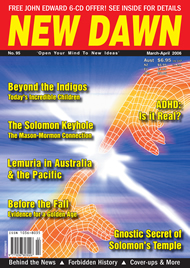
    Get the issue this article appears in

    The outstanding volcanic event of 1628 BCE, the final destruction of Mu, was a blast produced by New Zealand’s Taupo Valley centre. Says Caroli, “the Taupo volcanic zone is quite large, about two hundred fifty kilometres long by forty to fifty kilometres wide, encompassing more than just New Zealand’s north island. It is also broken down into sub-regions. Via carbon-14 dating, it could be exactly contemporary with Akiachak, in Alaska.” It generated a 200-foot high wall of water travelling several hundred miles per hour like an all-encompassing shock-wave throughout the entire Pacific Ocean. Islands standing in its way were overwhelmed and utterly swept clean of every obstruction. Whole archipelagos vanished or were depopulated. Others abruptly sank beneath the surface of the ocean in accompanying earthquakes.
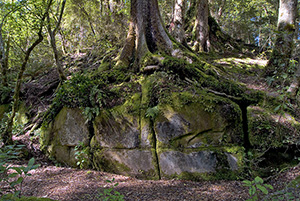
    Section of the Kaimanawa ‘Wall’

    Despite the trans-Pacific devastation of these natural catastrophes, the physical remains of Lemurian civilisation in New Zealand still exist. Immediately south of Lake Taupo, the Kaimanawa ‘Wall’ is more probably a step-pyramid or terraced, ceremonial marae of immense proportions. The American maverick archaeologist, David Hatcher Childress, who investigated the site in 1996, observed that “the blocks seem to be a standard 1.8 meters long by 1.5 meters high. The bottom block runs straight down to 1.7 meters and beyond. The blocks run for twenty five meters in a straight line from east to west and the wall faces due north. The wall consists of approximately ten regular blocks that are seemingly cut and fitted together without mortar.”

    The Lemurian impact on New Zealand and Australia was profound. And as more evidence emerges to confirm the ancient oral traditions of its native inhabitants, mankind gradually realises that our civilised origins are far more profound, technologically and spiritually greater than we have been led to believe.

    [alert type=”general” dismiss=”no”]This article was published in New Dawn 95.[/alert]

    [alert type=”success” dismiss=”no”]If you appreciate this article, please consider subscribing to help maintain this website.[/alert]

    © New Dawn Magazine and the respective author.
    For our reproduction notice, click here.
  • Mind Control in Australia

    Mind Control in Australia

    This article was published in New Dawn 153 (Nov-Dec 2015)

    Philosophers and pundits have long discussed the nature of ‘reality’ itself. For convenience and simplicity we might consider two parallel ‘realities’: one a ‘physical reality’ (the limitations of the body, the physical environment, the mechanical activities and necessities of day-to-day survival) and another ‘mental’ or ‘psychic reality’: the lens through which your mind organises, filters and constructs both an internal and external landscape – a worldview (or supposition of ‘how things are’) both tactile and emotional.

    It seems reasonable to suggest that while ‘physical reality’ (the acquisition of food, shelter, relationships, physical movement etc.) is doubtlessly of primal immediacy, the role of ‘psychic reality’ cannot be overstated in the human experience. We act (alone or in concert with others) according to our interpretation of events, information and stimuli: we move or react in concordance with a framework subtly (or overtly) instilled (or reinforced) by peers, family, media, social mores and the fabric of ‘history’ (as transmitted to us) – a collection of instincts, prejudices, short-cuts and assumptions navigating the approximation of a world our senses deliver to us each waking moment.

    Though somewhat falsely lionised as ‘individuals’ (through a century of aggressive marketing and social engineering), we are actually in essence herd animals – guided by the pack, we take verbal, non-verbal and visual cues from those around us – tribalised into class, socio-economic and other strata through myriad signals, feedback loops and pervasive (yet somehow ostensibly invisible) patterns.

    The herd instinct (in humans as in other creatures) is an invaluable tool for the study and organisation of large populations.

    Positioned in distant southern climes, far from the perceived centres of human civilisation – the thin coastal belt, broad plains and scorched deserts of Australia offer an enticing laboratory for the sciences of experimentation and herd manipulation.

    Wrenched from the hands of its native population through a bloody series of wars and oppression, the modern nation of Australia was established as a British penal colony in 1788. Doubtlessly much has changed and developed since then, but still it’s difficult to shake the image of Australia as contiguous and eternal penal colony.

    Since federation in 1901, examples of Australia as anything but felicitous imperial servant are few and far between. The nation cheerfully delivered its young to be blood sacrifices in the imperial territorial jousts of the twentieth century and various Anglo-American imperial intrigues throughout the latter twentieth century and early twenty-first.

    Beginning in the 1950s, Australia had the dubious pleasure of being Great Britain’s nuclear sandpit. All manner of outrageous and unforgivable atomic ‘experiments’ were conducted across West and South Australia, as unrelenting clouds of nuclear fallout drifted over the largest populations centres on the eastern Australian seaboard (the effects of which were covertly studied by the ‘mother country’ for decades thereafter). Like a serially abused child, this nation of ‘Larrikins’ and ‘Eureka Rebels’ barely raised a mute whimper.

    Among a mere handful of momentary blips (on an otherwise placid radar), one may have been the 1972 Whitlam government’s tepid resistance to the enormous, malevolent and largely secret US military base network that speckles the Australian landscape (like the first signs of approaching disease). Whitlam and his unruly gang were swiftly dispatched in a bloodless coup, and no Australian politician of note has dared rock the boat since.

    Another lonely blip may have been the 1985 ‘Australia Card’ – a national identity card that would have linked and collated personal information and mandatory identifying biometrics. A brazen totalitarian gesture (with a patriotic ‘green and gold’ branding and dazzling press launch), the confused populace felt a bovine unease around the proposal and, lest it spook the cattle, the card stumbled onto a slow oblivion two years later. Interestingly, every salient objective of the ‘Australia Card’ has since come to pass through one gladly received ‘initiative/convenience’ or another (many subsumed by the Medicare Card and Centrelink).

    While certainly queasily deferential to authority, perhaps the most instructional recent historical trait in the Australian experience has been that half-hearted rejection of the ‘Australia Card’ – a proposal so clumsily introduced as to resemble a deliberate provocation, designed to test the waters (and ultimately perhaps to fail – so as to set a line in the sand, demarcating exactly how far the gullible can ultimately be stretched).

    Australia is also a popular testing ground for corporate and consumer technologies. Politely referred to in marketing literature as “early adopters,” most Australians are guileless and enthusiastic proponents of convenient (but potentially sinister) technological innovations. From ATMs, EFTPOS payment systems and microchipped credit cards to mobile phones and wireless networks, Australia has reliably led the world in trialling and adopting these peerless developments in consumer profiling and data capture. Mastercard, Visa, Vodaphone and numerous other corporate behemoths consistently utilise Australia to trial new technologies and techniques.

    Unsurprisingly, Australia was an early and enthusiastic member of the Five-Eyes-Network, a globe-straddling post-WWII domestic and international surveillance co-operative that deployed nascent technologies (like ‘Echelon’) to monitor all electronic communications while ostensibly outsourcing the bulk of domestic spying to international partners (thus lending a [largely unnecessary] air of plausible deniability lest accidental public or journalistic exposure occur).

    Unmistakably fashioned around the twin primary aims of curbing domestic dissent and international commercial espionage, the Five-Eyes-Network would haughtily justify its existence – on the exceedingly rare occasion it had to – with a casual application of Bogey-Man-Of-The-Week™ lotion (Communism®, Terrorism® or whatnot).

    As befits a ‘former’ penal colony, Australia is over-governed and over-regulated (ironically, even a recent government audit decried the overwhelming saturation of legislation and registration). Australian adults are infantilised to the point where they are apparently untrustworthy enough to drink in public places, are sanctioned for riding pushbikes through public parks and must be locked into nightclubs during prescribed ‘volatile’ hours. Supposed private property is regulated behind a wall of incomprehensible bureaucracy, and membership of perfectly legal (but government proscribed) organisations becomes instantly and unquestionably illegal. Physical space in Australia is entirely over-regulated and captured, a timid populace cowered by an unrestrained police force (now empowered to force random fingerprinting), an unchallenged legislature (the Northern Territory has begun ‘paperless’ and therefore incontestable arrests), invincible intelligence agencies (endowed with gargantuan budgets and unaccountable powers) and unassailable rampant corporations.

    When it comes to the mental, political, philosophical and psychic landscape – things are even worse.

    Public discourse in Australia is incredibly narrow, bewilderingly staid, tediously predictable and heavily media-sedated. It’s essentially impossible to hear a publicly expressed homegrown opinion outside of the stultifying confines of mainstream ‘debate’. Some cleave to the ersatz alternatives of the ABC and SBS (both government funded) where a rigidly controlled and astoundingly toothless ‘opposition’ simply refines the mainstream dialogue through the lens of bourgeois political correctness.

    Examples are innumerable, but developments in recent memory will suffice.

    Tabloid flagship of the Police State, Melbourne’s Herald Sun, has for many years been a hysterical advocate for the Western imperial adventure branded as the ‘War On Terror’. Megaphoning a procession of serially unsubstantiated jingoisms (probably directly minted from Australia’s historically sinister intelligence agencies), headlines like “Beheading Plot Smashed,” “Evil Within,” “Thirty Jihadis Return Home” and “Lessons In How To Spot A Jihadi” are loud on volume, long on anonymous ‘official sources’ and forever short on facts.

    A massive police and security agency ‘anti-terror’ operation on 17 September 2014 (involving over 800 police officers, helicopters, bomb sniffing dogs etc. etc.) produced exactly two charges (both of tenuous value) and a firestorm of unquestioning, fevered media coverage (all photos, video and information helpfully supplied by the Australian Federal Police Media Liaison Unit). In Australia, ‘reporters’ no longer ‘report’, they simply cut and paste official media releases.

    With a handful of further ‘terrorist threats’, ‘incidents’ and ‘sieges’ successfully completed, and the herd now appropriately fearful, the then Abbott government introduced a raft of outrageous ‘national security’ laws – each a mortal assault on the limited range of ‘freedoms’ Australians already ‘enjoyed’. Perhaps the most onerous of the morbid bunch was a series of laws known as the ‘mandatory data retention laws’. These provisions stealthily legalised and normalised mass surveillance of the entire (and entirely) clueless Australian population. Not one officially sanctioned pundit bothered to mention that the laws are possibly in breach of at least three articles of the Universal Declaration Of Human Rights and commit Australia to being an official Police State.

    So Machiavellian is the sunburnt landscape, that droves of Australians casually promulgate and disseminate unhinged anti-Islamic diatribes and disinformation – fearful of a chimeric yet apparently approaching ‘Sharia Law’ and ‘Halal’ dictatorship. Egged on by shock-jocks and other media Svengali, the herd quiver at the sight of Mosques, hoax pederastic ‘mass-weddings’ and ‘alien’ attire.

    It would be laughable were it not so ugly.

    Manipulated, like so many head of cattle, by their media, corporate and government masters, Australians have allowed Islam to become the lightning rod for all their fears, prejudices and hatreds – a hoary old trick of tyrants – but forever a successful one to legitimise wars and domestic control.

    Philosophically and psychically manipulated against all their own best interests, Australians are simply unable to think, express themselves or even comprehend outside of the narrow officially designated allowable thought corridor.

    Recently returned from the US, tech entrepreneur Nick Holmes à Court derided Australians as gullible and apathetic, noting that “we as the people, have sat back and snoozed whilst the government passed Orwellian internet censorship laws.” Holmes à Court continued that “no one in Australia gives a f*ck. The lucky country? More like the lazy country.”

    If ever Australians needed a reminder that they labour under government by goon squad, they surely received it on 28 August 2015 when the ‘Australian Border Force’ warned they would be randomly checking people’s papers on the streets of Melbourne. The action was eventually cancelled in a snowstorm of farce, but the fact that it was even considered (and announced) speaks troubling volumes to the decayed corpse of Australian ‘freedom’.

    Docile, compliant and forever fawningly agreeable to its imperial and domestic ‘betters’, the Australian population is often incapable of even the most feeble acts of mental self-defence. Unconscious to the point of comatose, the ‘body politic’ knows nothing, couldn’t care less and drives blind – headlong into an unforgiving future. A slave-nation of idiot infants bewitched by shock-jock tirades and pop-culture baubles, unable to discern the psychic plantation walls that dwarf and surround it.

    Twenty-four million lost souls trapped in the penal mind, prisoners of push-polling, perfidious punditry and permanent war-footing propaganda.

    [alert type=”general” dismiss=”no”]This article was published in New Dawn 153.[/alert]

    [alert type=”success” dismiss=”no”]If you appreciate this article, please consider subscribing to help maintain this website.[/alert]

    © New Dawn Magazine and the respective author.
    For our reproduction notice, click here.
  • The Secret Origins of the First World War

    The Secret Origins of the First World War

    From New Dawn Special Issue Vol 9 No 1 (Feb 2015)

    The history of the First World War (1914–1918) is a deliberately concocted lie. Not the sacrifice, the heroism, the horrendous waste of life or the misery that followed. No, these were very real, but the truth of how it all began and how it was unnecessarily and deliberately prolonged beyond 1915 has been successfully covered up for a century. A carefully falsified history was created to conceal the fact that Britain, not Germany, was responsible for the war. Had the truth become widely known after 1918, the consequences for the British Establishment would have been cataclysmic.1

    To the victors go the spoils, and their judgment was reflected in the official accounts. At Versailles in 1919 Britain, France and the United States claimed that Germany had planned the war, deliberately started it, and rejected all Allied proposals for conciliation and mediation. Millions of documents were destroyed, concealed or falsified to justify that verdict. Germany rightly protested she had been forced into war by Russian aggression. German delegates at Versailles, under threat of occupation, dismemberment and starvation, were left with little choice but to accept the blame and agree to massive reparations. As The Economist put it, the Treaty of Versailles was the final crime whose harsh terms would ensure a second war.2

    Our research proves that the true origins of the war are to be found not in Germany, but in England. In the late nineteenth century a secret society of immensely rich and powerful men was established in London with the stated aim of expanding the British Empire across the entire world. They deliberately caused the South African War of 1899–1902 in order to grab the Transvaal’s gold from the Boers. Their responsibility for that war, and the horror of British concentration camps in which 20,000 children died,3 have been airbrushed from official histories. The second stage of their global plan was the destruction of the rapidly developing industrial and economic competitor, Germany.

    Carefully falsified history? Twenty thousand children dying in British concentration camps? A secret society taking control of the world? Britain responsible for the First World War? Should you jump immediately to the conclusion that this is some madcap conspiracy theory, please consider the work of Professor Carroll Quigley, one of the twentieth century’s most highly respected historians. Quigley’s greatest contribution to our understanding of modern history is presented in his book The Anglo-American Establishment. It carries explosive details of how the secret society of international bankers, aristocrats and other powerful men controlled the levers of politics and finance in Great Britain and the United States. Quigley explains that very few people knew about this because the society was able to conceal its existence and “many of its most influential members are unknown even to close students of British history.”4

    Plotting to Destroy the ‘Teutonic menace’

    Cecil Rhodes, the South African diamond millionaire, formed the secret society in London in February 1891.5 Its members aimed to renew the bond between Great Britain and the United States, spread all they considered worthy in English ruling-class values, and bring all habitable portions of the world under their influence and control. They believed that ruling-class men of Anglo-Saxon descent rightly sat at the top of a hierarchy built on predominance in trade, industry, banking and the exploitation of other races.

    Victorian England sat confidently at the pinnacle of international power, but could it stay there forever? That was the question exercising serious debate in the great country houses and smoke-filled parlours of influence. The elites harboured a deep rooted fear that unless they acted decisively, British power and influence across the world would be eroded and replaced by foreigners, foreign business, foreign customs and laws. The choice was stark. Either take drastic steps to protect and further expand the British Empire, or accept that the new, burgeoning Germany might reduce it to a minor player on the world’s stage. In the years immediately after the Boer War, the decision was reached. The ‘Teutonic menace’ had to be destroyed. Not defeated, destroyed.

    The plan began with a multi-pronged attack on the democratic process. They would: (a) Wield power in administration and politics through carefully selected and compliant politicians in each of the major political parties; (b) Control British foreign policy from behind the scenes, irrespective of any change of government; (c) Draw into their ranks the increasingly influential press-barons to exercise influence over the avenues of information that create public opinion, and (d) Control the funding of university chairs, and completely monopolise the writing and the teaching of the history of their own time.6

    Five principal players, Cecil Rhodes, William Stead, Lord Esher, Lord Nathaniel Rothschild and Alfred Milner, were the founding fathers, but the secret society developed rapidly in numbers, power and presence in the years before the war. Influential old aristocratic families that had long dominated Westminster were deeply involved, as was King Edward VII who operated within the inner core of the Secret Elite. The two great organs of imperial government, the Foreign Office and the Colonial Office, were infiltrated, and control established over their senior civil servants. They likewise took over the War Office and the Committee of Imperial Defence. Crucially, they also dominated the highest echelons of the armed forces through Field Marshall Lord Roberts7 in what we have termed the “Roberts Academy.”8 Party-political allegiance was not a given prerequisite for members; loyalty to the cause of Empire was. They have been referred to obliquely in speeches and books as ‘the money power’, the ‘hidden power’ or ‘the men behind the curtain’. All of these labels are pertinent, but we have called them, collectively, the Secret Elite.

    Leading Role Played by Alfred Milner

    The leading figure in the Secret Elite from around 1902 until 1925 was Alfred (later Viscount) Milner. Remarkably, few people have ever heard his name. Professor Quigley noted that all biographies of Milner had been written by members of the Secret Elite and concealed more than they revealed. In his view, this neglect of one of the most important figures of the twentieth century was part of a deliberate policy of secrecy. Milner became the undisputed leader of the Secret Elite. On his return from South Africa in 1905 he set about preparing the British Empire for war with Germany. Though not a member of parliament, he sat in the inner-circle of Lloyd George’s Imperial War Cabinet from 1916 onwards.9 What was so precious about Lord Alfred Milner that he has been virtually airbrushed from history?

    In goading the Boers into war, Milner displayed the cold objectivity that drove the cause. War was unfortunate but necessary. It had to be. The very future of the Secret Elite’s global ambitions depended on a victorious outcome. By May 1902, the Transvaal’s gold was in their hands at the cost of 32,000 deaths in the concentration camps. Though the Boer War finally ended in victory it came at a cost greater than the 45,000 Empire troops killed or wounded.10 Britain had fewer friends than ever. Up to that point, Britain didn’t care. Living in ‘splendid isolation’ and devoid of binding treaties with any other nation had not been viewed as a handicap as long as no other power on earth challenged the Empire.

    But in the early years of the twentieth century there was a serious challenger. If the Secret Elite were to achieve their dream of world domination, the first step had to be the removal of the upstart German competitor and destruction of her industrial and economic prowess. This presented considerable strategic difficulty. Friendless in her isolation, Britain could never destroy Germany on her own. As an island nation her strength lay in her all-powerful navy. Friendship and alliances were required. “It would have been impossible for Britain to have defeated Germany by itself. Therefore, it needed the large French army and the even larger Russian army to do most of the fighting on the continent.”11 Diplomatic channels had to be opened and overtures made to old enemies Russia and France. This was no mean task since Anglo-French bitterness had been rife over the previous decade and war between them a real possibility in 1895.12

    Step forward the Secret Elite’s most special weapon, Edward VII, whose greatest contribution lay in engineering the much-needed realignments, and addressing the Secret Elite’s prerequisite need to isolate Germany. Ultimate responsibility for British foreign policy lay, by precedent, with the elected government and not the sovereign, but it was the King who enticed both France and Russia into secret alliances within six short years. The great armies of France and Russia were integral to the mammoth task of stopping Germany in her tracks. Put simply, the Secret Elite required others to undertake much of their bloody business, for war against Germany would certainly be bloody.

    The treaty with France, the Entente Cordiale, was signed on 8 April 1904, marking the end of an era of conflict that had lasted nearly a thousand years. The talk was of peace and prosperity, but secret clauses signed that same day aligned the two against Germany. The Secret Elite then drew Russia into their web with a promise they never intended to deliver – Russian control of Constantinople and the Black Sea Straits following a successful war with Germany. This empty promise was the root cause of the Gallipoli disaster.

    Secret Elite Control Both Sides of Politics

    British democracy, with regular elections and changes of government, was portrayed as a reliable safety net against despotic rule. It has never been this. Both the Conservative and Liberal parties had been controlled since 1866 by the same small clique that consisted of no more than half a dozen chief families, their relatives and allies, reinforced by an occasional incomer with the ‘proper’ credentials.

    The Secret Elite made an art form out of identifying potential talent and putting promising young men, usually from Oxford University, into positions that served their future ambitions. With the demise of the Conservative government in 1905, the Secret Elite had already selected their natural successors in the Liberal Party: reliable and trusted men immersed in their imperial values. Herbert Asquith, Richard Haldane and Sir Edward Grey were Milner’s chosen men. Grey moved into the Foreign Office and Haldane the War Office, and within two years Asquith was Prime Minister. Continuity in foreign policy was assured. A complete root-and-branch reorganisation of the War Office began in preparation for the coming war with Germany. How the Secret Elite must have laughed in their champagne at the notion of parliamentary democracy.

    [alert type=”info” dismiss=”no”]If you appreciate this article, please consider a subscription to New Dawn magazine.[/alert]

    Secret Elite’s Propaganda Arm: The Press

    Control of politics had never been a problem, nor was control of the press. Lord Northcliffe, the most powerful press-baron, was a valuable contributor to the Secret Elite in their drive to vilify Germany and prepare the nation for eventual war. His ownership of The Times and Daily Mail allowed them to create the impression that Germany was the enemy. In story after story, the message of the German danger to the British Empire, to British products, to British national security, was constantly regurgitated. Not every newspaper followed suit, but the right-wing press was particularly virulent. A large and influential section of the British press worked to the rabid agenda of poisoning the minds of the nation. It was part of a propaganda drive sustained right up to, and throughout, the First World War. If The Times was their intellectual base, the popular dailies spread the gospel of anti-German hatred to the working classes. From 1905 to 1914, spy stories and anti-German articles bordered on lunacy in what was an outrageous attempt to generate fear and resentment.

    Tapping the Colonies for Cannon Fodder

    Sir Alfred Milner set himself the mammoth task of preparing the Empire for war. Britain had only a small, highly trained Expeditionary Force, but the Empire remained a vast untapped source with over six million men of military age. Milner knew that when war came he had to be sure Australia, New Zealand and Canada would stand shoulder to shoulder with Britain. A Colonial Conference was held in London in 1907 to wrap the Union Jack around the Empire. Australia’s Prime Minister Alfred Deakin was Milner’s prime target. They shared a platform at the Queen’s Hall on which Milner praised Deakin and Australia’s commitment to the Empire and stressed the links of race and loyalty that bound the two nations. They adopted a plan to organise the dominion military in line with the reorganised British army so that they could be integrated in “an emergency.” This led to the complete reorganisation of the Australian and New Zealand forces.13

    Canada, likewise, had a huge reserve of young men, and in 1908 Milner undertook a coast to coast rail tour praising Canadian spirit, patriotism and loyalty to the Empire.14 In June 1909 he threw his energies into an Imperial Press Conference in London that brought together over 60 newspaper owners, journalists and writers from across the Empire. Every effort was made to impress – indeed, overawe – the visitors, with lavish praise and hospitality. He was determined to rally the support of the Empire for the mother country in time of war. Travelling by private first class train, they visited armaments factories in Manchester and a shipyard in Glasgow where destroyers were being built for Australia. Honorary degrees were conferred on several leading newspapermen from Canada, Australia, India and South Africa. In the keynote address Lord Rosebery, a member of the Secret Elite, warned that never before in the history of the world was there “so threatening and overpowering a preparation for war.”15 Though Germany was not mentioned by name, the clear inference was that the Kaiser was preparing for war, and Britain and the Empire must quickly to be made ready. Lord Rosebery called on the delegates “to take back to your young dominions across the seas” the message that “the personal duty for national defence rests on every man and citizen of the Empire.”16 Milner later sent his most trusted acolytes to organise influential local groups throughout the Empire. Their message repeated the mantra of loyalty, duty, unity and the benefits of Empire… Empire… Empire. In the final analysis, Australia placed its navy under British command, and a total of 332,000 Australians went to war. New Zealand sent 112,000 men. The Empire did ‘its duty’, yet what have you ever heard about Lord Alfred Milner?

    A Convenient Assassination

    Two conditions had to be met before the Secret Elite could start their war. Firstly, Britain and the Empire had to be made ready. Secondly, in order to heap blame on Germany, she had to be goaded into making the first move. The assassination of the heir to the Austro-Hungarian throne, Arch-Duke Franz Ferdinand on 28 June 1914 provided the excuse for monstrous manipulation. It has often been cited as the cause of the First World War. What nonsense. On its own it was just one more political assassination in an era of such murders. The blame rested with a group of Serbian officials who trained, armed and aided the assassins, and Austrian retribution was generally accepted as a valid reaction. What we have demonstrated in our book, Hidden History, is that connections linked the Serbians, the Russian Ambassador in Belgrade, the Foreign Office in St. Petersburg and the Secret Elite in London.17 Austria demanded the Serbian government take specific action against the perpetrators and allow Austrian involvement in the investigation. Serbia refused. Russia, having assumed the spurious role of protector, voiced total support for Serbia.

    In London, the Secret Elite purposefully fanned the orchestrated antagonisms into a crisis. When Serbia and Austria squared up to each other in what should have been a localised conflict, Russia, with the full support of London and Paris, began in secret to mobilise her massive armies on Germany’s eastern border. Everyone was aware that once the general mobilisation of an army began, it meant war and there was no turning back. Germany faced invasion along her eastern front, and, as the French army mobilised to the west, the Kaiser repeatedly made valiant attempts to persuade his cousin the Tsar to stand down his armies. In the full knowledge that France had promised to join with her immediately, and that Britain, though not openly admitting her collusion, was secretly committed to war, the Tsar refused. Russia’s dream of taking Constantinople could at last be realised.

    Backed into a corner and forced into a defensive war, Germany was the last power in Europe to mobilise her army. In order to deal with the French who had secretly mobilised to the west, the Kaiser ordered the German army to advance into France through Belgium. He had little other option. Continental Europe was at war.

    The Secret Elite watched and waited. Though joint preparations for war had been ongoing since 1905, they had been kept so secret that only five out of twenty Cabinet ministers in the British government knew of Britain’s commitments. Sir Edward Grey addressed the House of Commons on 3 August and promised that no action would be taken without the approval of parliament, yet that approval was never put to a vote. The crux of his argument lay in Belgian neutrality though he knew full well that such neutrality was a grotesque charade. Among others, the American writer Albert J Nock later revealed that Belgium had been a secret, but solid ally of Britain, France and Russia long before August 1914.18 The fiction of Belgian neutrality provided the legal and popular excuse for Britain to declare war on Germany on 4 August 1914. Sir Edward Grey, loyal servant of the Secret Elite, lied the British Empire into war.

    Documentary Evidence Destroyed & History Falsified

    Over the last 100 years facts have been twisted and falsified by court historians. Members of the Secret Elite took exceptional care to remove traces of their conspiracy, and letters, telegrams, official reports and cabinet minutes which would have revealed the truth have disappeared. Letters to and from Alfred Milner were removed, burned or otherwise destroyed. Incriminating letters sent by King Edward were subject to an order that, on his death, they must be destroyed immediately.19 Lord Nathan Rothschild, a founder member of the Secret Elite, likewise ordered that his papers and correspondence be burned posthumously lest his political influence and connections became known. As his official biographer commented, one can but “wonder how much of the Rothschild’s political role remains irrevocably hidden from posterity.”20

    Professor Quigley pointed an accusatory finger at those who monopolised “so completely the writing and the teaching of the history of their own period.” There is no ambivalence in his damning accusation. The Secret Elite controlled the writing and teaching of history through numerous avenues but none more effectively than Oxford University. Milner’s men largely dominated Balliol College, New College and All Souls which, in turn, largely dominated the intellectual life of Oxford in the field of history. They controlled the Dictionary of National Biography which meant the Secret Elite wrote the biographies of its own members. They created their own official history of key members for public consumption, striking out any incriminating evidence and portraying the best public-spirited image that could be safely manufactured. They paid for new chairs of history, politics, economics and, ironically, peace studies.21

    There was a systematic conspiracy by the British government to cover all traces of its own devious machinations. Official memoirs covering the origins of the war were carefully scrutinised and censored before being released. Cabinet records for July 1914 relate almost exclusively to Ireland, with no mention of the impending global crisis. No effort has been made to explain why crucial records are missing. In the early 1970s, the Canadian historian Nicholas D’Ombrain noted that War Office records had been “weeded.” During his research he realised that as much as five-sixths of “sensitive” files were removed as he went about his business.22 Why? Where did they go? Who authorised their removal? Were they sent to Hanslope Park, the government repository behind whose barbed-wire fences over 1.2 million secret files, many relating to the First World War, remain concealed today?23 Incredibly, this was not the worst episode of theft and deception.

    Herbert Hoover, the man who fronted the Belgian Relief Commission and was later the 31st President of America, was closely linked to the Secret Elite. They gave him the important task of removing incriminating evidence from Europe, while dressing it in a cloak of academic respectability. Hoover persuaded General John Pershing to release 15 history professors and around 1,000 students serving with the American Forces in Europe and send them, in uniform, to the countries his agency was feeding. With food in one hand and reassurance in the other, these agents faced little resistance in their quest. They made the right contacts, “snooped” around for archives and found so many that Hoover “was soon shipping them back to the US as ballast in the empty food boats.” The removal of documents from Germany presented few problems. Fifteen carloads of material were taken, including “the complete secret minutes of the German Supreme War Council” – a “gift” from Friedrich Ebert, first president of the post-war German Republic.24 Hoover explained that Ebert was “a radical with no interest in the work of his predecessors,” but the starving man will exchange even his birthright for food. Where now is the vital evidence to prove Germany’s war guilt, had they been guilty? Had there been proof it would have been released immediately. There was none. What has been hidden or destroyed will never be known, and it is a startling fact that few if any war historians have ever written about this illicit theft of European documents: documents that relate to arguably the most crucially important event in European and world history. Why?

    Get the issue this article appears in

    Hidden History: The Secret Origins of the First World War

    The evidence for every statement in this article can be found in our book, Hidden History: The Secret Origins of the First World War. In addition, we have been blogging regular articles since June 2014 on what really happened 100 years ago, not the pre-packaged history on which the British government would like us to concentrate. Amongst the disturbing ‘history’ to be exposed as a lie is the disgraceful Gallipoli campaign, a sordid and unworthy ‘distraction’ which resulted in tragic consequences for so many Anzac lads. A few historians have questioned why the attack on the Straits was so badly mismanaged but we go further, much further. In our next article for New Dawn, we will prove that the Gallipoli disaster was not due to misjudgement in London or the incompetence of naval and military leaders on the spot. Young men from Britain, France, Australia and New Zealand were needlessly sacrificed on the damned beaches and slopes of the Dardanelles to serve a very different purpose. Gallipoli was deliberately designed to fail.

    After a century of propaganda, lies and brainwashing about the First World War, cognitive dissonance renders us too uncomfortable to bear the truth that it was a small, socially advantaged group of self-styled English race patriots, backed by powerful industrialists and financiers in Britain and the United States, who caused the First World War. The determination of this London-based Secret Elite to destroy Germany and take control of the world was ultimately responsible for the deaths of millions of honourable young men who were betrayed and sacrificed in a mindless, bloody slaughter to further a dishonourable cause.

    Today, tens of thousands of war memorials across the world bear witness to the great lie, the betrayal, that they died for ‘the greater glory of God’ and ‘that we might be free’. It is a lie that binds them to a myth. They were the victims. They are remembered in empty roll calls erected to conceal the war’s true purpose. What they deserve is the truth, and we must not fail them in that duty.

    To read exclusive extracts from their book Hidden History: The Secret Origins of the First World War and also their latest research, please visit the authors’ blog at firstworldwarhiddenhistory.wordpress.com. Hidden History is available from all good bookstores and online retailers.

    The authors contributed the article “Gallipoli: The Untold Story – ‘The first casualty of war is truth’” for New Dawn 149, March-April 2015.

    [alert type=”general” dismiss=”no”]This article was published in New Dawn Special Issue Vol 9 No 1.[/alert]

    [alert type=”success” dismiss=”no”]If you appreciate this article, please consider subscribing to help maintain this website.[/alert]

    Footnotes

    1. Gerry Docherty & Jim Macgregor, Hidden History: The Secret Origins of the First World War, Mainstream Publishing, 2013, 11
    2. The Economist, 31 December 1999
    3. www.sahistory.org.za, politics and society, 20th Century South Africa
    4. Carroll Quigley, The Anglo-American Establishment, G S G & Associates Pub, 1981, 4
    5. Ibid, 3
    6. Ibid, 197
    7. Nicholas D’Ombrain, War Machinery and High Policy, Oxford University Press, 1973, 143
    8. Docherty & Macgregor, Hidden History, 194-202
    9. A.M. Gollin, Proconsul in Politics: Study of Lord Milner, Blond, 1964, 390-441
    10. Will Podmore, British Foreign Policy since 1870, Xlibris Corporation, 2008, 29-30
    11. Pat Walsh, The Events of 1915 in Eastern Anatolia in the Context of Britain’s Great War on the Ottoman Empire: A Talk Given by Dr. Pat Walsh at the London School of Economics on February 15th 2013, 4
    12. Niall Ferguson, The Pity Of War: Explaining World War I, Basic Books, 1999, 41
    13. J. Lee Thompson, Forgotten Patriot: A Life of Alfred, Viscount Milner of St. James’s and Cape Town, FDU Press, 2007, 257
    14. Viscount Milner, Speeches delivered in Canada in the Autumn of 1908, 1-12, https://archive.org/details/cihm_72889
    15. J. Lee Thompson, Northcliffe: Press Baron in Politics 1865-1922, John Murray, 2000, 168
    16. Ibid, 169
    17. Docherty & Macgregor, Hidden History, 242-251
    18. Albert J Nock, The Myth of a Guilty Nation, B.W. Huebsch, 1922, 36-7
    19. Lord Arbuthnott Fisher, Memories and Records, Vol. 1, George H. Doran company, 1920, 21
    20. Niall Ferguson, The House of Rothschild: Volume 1: Money’s Prophets: 1798-1848, Penguin Books, 1999, 319
    21. An in-depth analysis of the extent of this control can be found in our blogs of 18-19 June 2014 at firstworldwarhiddenhistory.wordpress.com/2014/06/18/
    22. Nicholas D’Ombrain, War Machinery and High Policy, Oxford University Press, 1973, xiii
    23. firstworldwarhiddenhistory.wordpress.com/2014/08/25/
    24. http://whittakerchambers.org/articles/time-a/hoover-library/

    © New Dawn Magazine and the respective author.
    For our reproduction notice, click here.

  • Poisoned Mind: Social Media in the 21st Century

    Poisoned Mind: Social Media in the 21st Century

    From New Dawn 150 (May-June 2015)

    According to an article on the website of ‘Radio Free Europe’, a nondescript modern 4-storey building on Savushkina Street, St. Petersburg, houses the innocuously titled ‘Internet Research Centre’.

    Inside the building operate government controlled and tasked teams of professional ‘trolls’. Spread across approximately 40 rooms, the trolls prowl the Internet in 12 hour shifts, generating pro-Kremlin comments and ‘gaming’ Internet forums and online conversations.

    St. Petersburg blogger Marat Burkhard recently came forward to describe the apparent covert activities in detail. Burkhard describes his co-workers as “politically illiterate young people” who must be briefed on current topics at the beginning of each shift and continually supervised.

    At this point it would be pertinent to note the source of the article – Radio Free Europe – notoriously a CIA funded propaganda outlet for decades (now financed, more obtrusively, through the State Department and ‘private donors’). While only the congenitally naive would doubt the veracity of the article’s basic claims, what is (unsurprisingly) lacking is context. Whether financed and operated by Russia’s intelligence agency FSB, or some other shadowy enclave, it is estimated that the entire Russian security establishment currently operates with just one twentieth (1/20) of the US equivalent (not even including the UK and other close Western allies).

    What that means, in a nutshell, is that for every Internet Research Centre in Russia, the CIA/NSA/GCHQ/private contractor nexus would be operating the equivalent of (at least) 20 such centres. Flooding the social media networks, news and other sites of their domestic populations with thousands upon thousands of comments, posts, disruption, disinformation and propaganda bullets every day. Salvos in an escalating, but largely unseen, ‘Information War’.

    Furthermore, recent reports cite the development of software that actually scours the web, automatically switching between user names/identities and generating propaganda, provocations and automated comments as it goes. Coupled with Google’s recent announcement of A.I. software that can discern (Google’s version of) ‘the truth’, it doesn’t take much imagination to envisage any online expression of ‘untruth’, ‘heresy’ or ‘dissent’ being automatically swamped beneath a torrent of managed obscurity, cyber-troll bile, distraction and chicanery.

    Seismically underreported, similar allegations about the ‘troll farms’ or ‘web brigades’ of the West (such as GCHQ’s ‘77th Brigade’) have barely surfaced in the blinding mass of ‘Snowden Revelations’. Chilling images (reportedly leaked from internal GCHQ presentations) document operations in ‘virtual communities’, ‘social identity theory’, ‘herding’, ‘mimicry’ and the ‘psychology of deception’. Much of the language used seems best suited to neutralising dissent and activism in the ‘target’ (domestic) populations (and not the lame-duck excuse of ‘fighting terrorism’).

    As an astounding amount of human activity and intercourse migrates online, public spaces empty and forums/social media fill with a new species – homo digitalis – a being safely cubicled and shepherded into approved opinions, paradigms and navel gazing.

    Accordingly, corporations now view social media and online social networks as their plaything and happy-hunting-ground – each ‘like’, ‘trend’, ‘tweet’ and online action the precious raw material to map, direct and monetise consumer behaviour. Edward Bernays (pioneer marketeer, nephew of Sigmund Freud and author of the seminal text Propaganda) could hardly have dreamed of the marketing, perception management and social engineering possibilities now available at the press of a few attractive and endorphin-stimulating keystrokes. Today’s brave new keyboard-warrior looks an awful lot like yesterday’s plantation indentured servant or herd of cattle (in sleek, Apple designed ergonomic garb).

    A plethora of research (let alone common sense) suggests that our reliance/addiction to social media and its associated devices is already having a profoundly deleterious effect on basic cognitive skills, human interaction, attention spans and functional intelligence. Factor in a cocktail of narcissistic personality disorders and body dysmorphic disorders (with a chaser of smartphones and other hand-held devices) and humankind looks at last set to plunge over the precipice of unfathomable stupidity.

    Doubtlessly technologists (and the teams of psychologists who work for them), minutely design every latest gadget to further exploit the very human weaknesses of vanity and the desperate need to be endlessly and pointlessly distracted. A chronically self-obsessed, trivialised generation (like no other generation before it) of ‘selfie’ snappers and banal ‘tweeters’ is the technocrat’s utopia.

    Disinterested, disenfranchised and disengaged from the outside world, ‘Generation Now’ (the iGeneration) have become tyranny’s best enablers – politically, philosophically and spiritually ineffective – vapid consumers and mindless infants. Delivering themselves up ‘freely’ to the corporate-military-complex – their every mood, ‘status’, location, relationship and conversation accessible in real time or stored in vast information vaults secreted away in distant desert bunkers.

    The very architecture of social media seems intrinsically designed to be nothing more than a gargantuan electronic trap to collect as much data, biometric and psychological information as possible about the population.

    Facebook’s notorious ‘experiments’ in ‘emotional contagion’ and political herding become even more sinister when placed in their rightful context. Despite Facebook’s chummy image and branding, ostensible founder Mark Zuckerberg has made it clear in numerous interviews his desire to mould a future of what can only be described as pure techno-totalitarianism. A consumer’s/user’s every action and thought mediated through the ‘safe’ interface of Facebook – always surveilled, always stalked and tabulated – available to corporations and intelligence agencies at all times. ‘Dangerous’ physical interactions minimised and discouraged.

    Whilst Facebook may have a hidden nativity story, its birth secretly shepherded by funds channelled through In-Q-Tel (the CIA’s venture capital arm), the same in fact may also apply to the very foundational platforms of the Internet itself. Recent research by journalist Nafeez Ahmed has revealed the cosy (symbiotic even) relationship between (‘Don’t Be Evil’) Google and the entire American intelligence apparatus. Mediated through a decades-old shadowy group known as the ‘Highlands Forum’ – leading technologists, corporate heads and intelligence chiefs have met privately innumerable times to cross-pollinate innovations, strategies and policy.

    Ahmed makes it clear that the entire contemporary surveillance landscape may well have been seeded through the Highlands Forum, as business and the secret state pursue their (remarkably similar) aims. Much like the unspoken ‘revolving door’ that operates between the Pentagon and the armaments industries – the board members and senior officials of Google, Facebook and alike have the striking habit of being familiar faces from the recesses of the Pentagon, CIA, NSA and so on. So ubiquitous is this limited personnel pool, that ultimately the question must be asked whether Google and Facebook are simply not just clandestine arms of the national security state.

    No matter how earnestly we may choose to look the other way, even the bedrock technology of the Internet itself (developed apparently to protect communications in case of a devastating nuclear conflict at the height of the Cold War) are naturally products of ARPA (the predecessor of today’s DARPA) the research and development arm of the Pentagon.

    Does it take the mind of a paranoiac to wonder whether decades of social engineering research, think-tank profiling and Rand Corporation policy directives, coupled with the natural desires of bureaucrats, tyrants and salesmen (control of a captive market), has finally produced the perfect homogenised and pasteurised Panopticon Supermarket? An online, and global, Stepford village.

    The only rational reaction to such a possibility is disconnection. To remove oneself from the insidious web of trivia, celebrity inanities, prefabricated media events and puerile conversation. Escape from the moronic matrix. But who has the courage to do that?

    And anyway, I’ve got to check on the status update of my friend’s friend’s friend of a friend’s friend…

    [alert type=”general” dismiss=”no”]This article was published in New Dawn 150.[/alert]

    [alert type=”success” dismiss=”no”]If you appreciate this article, please consider subscribing to help maintain this website.[/alert]

    © New Dawn Magazine and the respective author.
    For our reproduction notice, click here.
  • The Mystique of the Manor: Australia’s Occult Centre Revealed

    The Mystique of the Manor: Australia’s Occult Centre Revealed

    From New Dawn 152 (Sept-Oct 2015)

    Pilgrims have been drawn to the other-worldly auras of hallowed sites, both natural and man-made, all around the globe since antiquity. One such sanctuary sits right in the heart of Sydney and, although it has slipped from prominence today, it played a significant role in Australia’s spiritual and esoteric history.

    While its narrative has primarily been expressed through the descriptions of the characters who have occupied it, the magnetism of the building and the ground it stands on are worthy of examination in their own right. Today it has become less visibly conspicuous, surrounded as it is by so many other grand dwellings. However, a century ago the world was a different place and it was quite the topic of conversation in Sydney society.

    The late nineteenth century saw a surge of spiritual and metaphysical pursuits in the Western world, springing from Europe and Britain and streaming into the United States, Canada, Australia and New Zealand. While the British Victorian era is generally associated with industrial and scientific advances, not to mention Darwinism, many Victorians (including the Queen herself) embraced Spiritualism, séances and other forms of mysticism. At what is now considered the birth of the New Age movement, independent thinkers in England freed themselves from centuries of religious dogma and placed their faith in the powers of ESP, experimenting in telepathy and clairvoyance. Many enthusiastically explored new branches of knowledge with exotic names like mesmerism, electro-biology and crystal-gazing.

    On the other side of the Atlantic, Americans felt no sense of conflict in having a Ouija board on their desk alongside the Bible. Spiritualism seemed quite compatible with Christianity inasmuch as it provided reassurance on the existence of souls and the afterlife. Madame Helena Petrovna Blavatsky (HPB) was the daughter of a White Russian princess and had been involved in the Spiritualist movement early on.1 On moving to the USA she befriended Henry Steel Olcott and together they founded the Theosophical Society (TS) in 1875. In the early twentieth century, as Americans were becoming fascinated with psychic phenomena, Harvey Spencer Lewis was initiated into a Rosicrucian order during a visit to France, thereby enabling him to establish the order known as AMORC on his return to the USA.

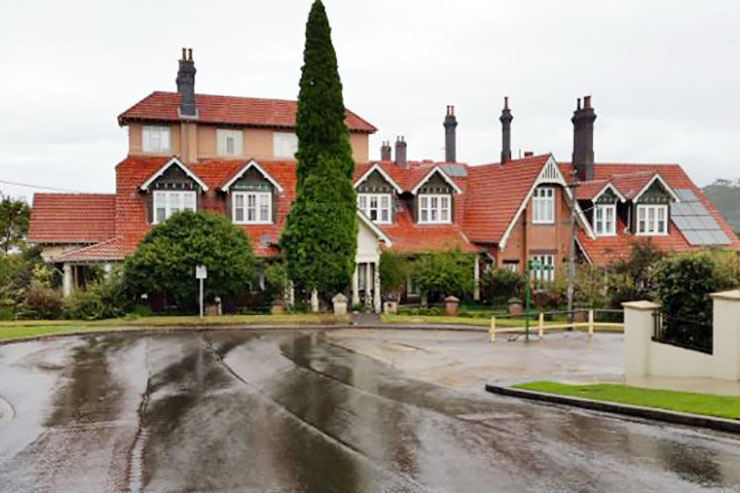
    Australia was not impervious to the ground-swell of New Age beliefs and Sydney became a focal point for their proponents – some of them more colourful than saintly – along with their mystical doctrines, which concocted a curious blend of Christianity with the occult. The popularity of Spiritualism soared, counting among its adherents such notables as Prime Minister Alfred Deakin and the newly arrived American architect Walter Burley Griffin. A hundred years ago, while James Wedgwood was founding the Liberal Catholic Church (LCC) back in Britain, his friend Charles Webster Leadbeater had already decided to settle in Sydney and would, in the succeeding years, establish the Australian headquarters of both the LCC and Theosophy, together with various other societies, at Mosman in Sydney. A number of theosophists first rented, then purchased under trust deed, the capacious 55-room mansion and its grounds at Clifton Gardens that was to be known as The Manor.

    Gateway to Heaven or Simply a Grand Old Mansion?

    While The Manor became the focal point for Theosophy and associated societies almost a century ago, it had originally been built by wealthy businessman William Bakewell and was known to the locals as ‘Bakewell’s Folly’. He purchased six building blocks of what is now prime real estate at Clifton Gardens. The entire district of Mosman is rich with Aboriginal heritage, with over a hundred known sites found across the municipality, particularly along the foreshore area. After the North Shore population of several thousand original inhabitants witnessed the arrival of the first British colonisers, their numbers were decimated by the smallpox epidemic of 1789.

    Was this grand and mysterious building at Mosman, which had been described by a TS member almost eight decades ago as a “specially selected Centre of the power of the Masters of the Wisdom,”2 really a kind of cosmic portal and, if so, should it be revered as a sacred site today? Perhaps we should consider the possibility that an other-worldly force guided even William Bakewell from the outset when he selected the location for his construction. Quoting Nicholas Van Gelder:

    He began with a simple purpose: to build an eight-room house. What passed through his mind over the next 8 years is not known. Suffice that by 1913 the house had become a rambling 55-room mansion with many rooms lined with copper. Perhaps he foresaw the days when the Australian security service could listen in on conversations by using laser or microwave devices.3

    The fact that most rooms have pressed metal ceilings, as well as copper lined walls, is claimed by some occultists to serve the purpose of conserving magnetism. Following his death in 1917, William’s family declined to live there and the house stood vacant for five years, until it was acquired by TS members.

    In 1922 the imposing building would become home to a commune of fifty-plus people. As explained by Theosophy Forward on their website:

    It was Theosophist Lucius Van Gelder who had the idea for an experimental community to make life more “reasonable, cheaper, and more useful” for the families and individuals concerned.… Leadbeater, who became the focus for the community, invited Van Gelder to assume the task of managing it; and the residence became known as “The Manor”…. A trust was formed, whose purposes were “the formation of a spiritual centre where people may be trained in religious matters and the formation of a community based on Theosophical ideals.” The appointment of trustees was placed in the hands of Annie Besant, then the International President of the Theosophical Society, and her successors.4

    According to the authoritative booklet The Manor: A Short History5, The Manor became an important centre for the Society and was regarded as a great “occult forcing-house.” Curuppumullage Jinarājadāsa (known simply as Raja), the Theosophical Society’s international vice-president, asserted that Leadbeater was directed to the house by command of the King of Shamballa, and promptly settled in it, declaring, “In June 1922, the Great White Brotherhood established in the City of Sydney an occult Centre, charged directly from Shamballa.” “Thus was born the notion that The Manor was the occult nexus for the Southern Hemisphere.” And writer C.V. Williams added: “In 1922 Theosophist families began to move in with him (Leadbeater), feeling secure in the idea that they were close to heaven.”

    What marks The Manor as a keystone in Australia’s alternative spiritual heritage is that it served as a passageway, like the neck of an hourglass, by which so many doctrines and societies were funnelled into this country, before being disseminated throughout the land. The sheer number of activities including Theosophy, Co-Freemasonry, the LCC and other less well-known societal offshoots anchored to this geographical location at Mosman, poses the question: was it, and is it still, an occult centre of power? Had it always been, as the commune’s founders believed, a kind of heavenly gateway, or did it really derive its power from the “égrégore”6 of its human participants?

    The following are some of the principal known organisations, alongside their commonly used acronyms:

    TS         The Theosophical Society
    OSE      Order of the Star in the East
    LCC      The Liberal Catholic Church
    ES         The Esoteric Section; also The Eastern School
    Co-M   Co-Masonry

    According to a biographical study of Charles Webster Leadbeater (CWL) by Gregory Tillett:

    The arrangement of a weekly schedule posed no small difficulty, since it involved regular meetings of the TS, both those for members only and those open to the public, and of the OSE, together with the ES and Co-Masonry, and now the Liberal-Catholic Church. The considerable overlap between the TS, the LCC and Co-Masonry can be seen from examining lists of Co-Masonic Lodge officers around this time: the officers of Sydney Lodge No.404 in 1918 included Mr and Mrs Kollerstrom, Leadbeater, Hazel, and L.W. Burt, all of them (as they were by then being described) TS, ES, OSE, LCC and Co-M.7

    Gregory Tillett adds, in a book co-written with Nevill Drury:

    Another ceremonial movement which he (CWL) established, the Egyptian Rite of Ancient Freemasonry, also meets there (The Manor); in this rite Leadbeater hoped to bring together the angels of Freemasonry and of the Church, and it was regarded as “the most powerful occult rite in the world.”8

    One newspaper article reports that, in the 1920s,

    The Manor had its own theatre company performing Shakespearean plays on the gently sloping lawns. Painters, writers and poets congregated in its meeting rooms to discuss modernism, materialism and the importance of patriotism in nation building. There were Greek garden fetes, fairy dances, light operas and musicals.9

    In keeping with the times, TS launched radio station 2GB in 1926, using The Manor and two outlying cottages on the property. The initials GB stood for sixteenth century philosopher Giordano Bruno, whom they believed was a former incarnation of Annie Besant. The station is still a household name in Sydney radio ninety years on. Alfred Edward ‘A.E.’ Bennett (not to be confused with Frank Bennett) was appointed general manager and the first broadcast took place on Armistice Day, 1926. Bennett wrote, “The intention is to conduct the station on ideal principles and solely with the object of uplifting our Australian people.”10 Raja, however, was concerned this sacred ground was being disturbed by the psychically enervating signals emanating from the antennae.

    A Hidden Fraternity

    What unseen guiding hand drew this array of key personalities together and why at this particular location? Was the torch being lit for an ‘Antipodean Utopia’ and, if so, did the flame fizzle out, or does it continue to flicker away from the public eye in preparation of a new Golden Age? Those confraternities we dub ‘secret societies’ always have twin facets: the overt aspect, consisting of their beliefs and philosophies, which these days can be readily researched in books and online; then their practical agenda which forms the basis of their secrecy – the initiation rites, rituals and techniques that are intended to raise consciousness, quicken one’s psychic abilities and ultimately allow communion with higher intelligence, sometimes including ‘invisible Masters’.

    Who are these ‘Masters’ that are said to have appeared to, and spoken with, the likes of Madame Blavatsky, Annie Besant, Alice Bailey and Charles Leadbeater? They are called by various names, including The Ascended Masters, The Great White Brotherhood, The Elder Brothers or The Secret College. They form a Hierarchy, which Phillip Lindsay defines as a “Group of spiritual beings on the inner planes of the solar system who are the intelligent forces of nature and who control the evolutionary processes. Divided into twelve hierarchies. The Occult Hierarchy or Masters of Wisdom, of which disciples and initiates are a reflection.”11 They exist on subtle planes known as the Etheric or the Astral, transparent to normal physical sight. In addition to Masters there are angelic, devic and elemental entities.

    [alert type=”info” dismiss=”no”]If you appreciate this article, please consider a subscription to New Dawn magazine.[/alert]

    Also known as Mahatmas, the Masters of Ancient Wisdom are those who once lived as human beings. The enlightened ones who most often imparted their teachings to Theosophists and other occultists from the late nineteenth century are identified as Morya, Kuthumi (or Koot Hoomi), Djwal Kul (usually just known by the initials DK), and Count Saint Germain – although there are many more. While many of these Masters dwell on a non-physical plane, some do take corporeal form and they often attach themselves to specific earthly retreats, the most well-known being in and around the Himalayas.

    Author Edmund Harold states:

    There are momentous periods in our evolution, times when we recommence the age-old search for self-purpose. At such times we re-acquire awareness of the existence of a spiritual hierarchy, one that is represented by highly evolved beings. These are known as The Great White Brotherhood, or the Brotherhood of the Light.12

    The voices of the masters have been silent at The Manor for a long time, but perhaps another one of these ‘times’ approaches again.

    The Pioneering Spirit

    The modern Theosophical movement first reached Australia in 1879 when Gilbert Elliot of Melbourne joined the TS. By 1891 when Henry Steel Olcott, as the Society’s international president, came for a brief tour, there were enough branches to form what was called “a Section.” While in Sydney, Olcott also chartered the Sydney Lodge. The Australian Section was given a further boost in 1894 when Annie Besant, a persuasive orator, arrived to give a series of lectures on Theosophical topics. In 1905 Charles Leadbeater toured the country to wide acclaim and then, three years later, membership skyrocketed on Besant’s return.

    The LCC and the Co-Freemasonry movement that developed alongside the TS in Sydney can be traced to one man: James Ingall Wedgwood (JIW). In 1915 Wedgwood, who first met Leadbeater in 1906, arrived in Sydney. As a gay clergyman, JIW suffered an ongoing inner turmoil between “the angel and the beast within” – a dilemma that haunts some clerics to this day. He swung between alternating extremes of spiritual fervour and the temptations of the flesh. Eminent British Theosophist E.L. Gardner said of him privately, “JIW was a ‘dual’ – at times skilled, able and impressive. Then, a bout of sensualism of the worst grade, sexual perversion.”13

    In 1909 Leadbeater identified the 14 year-old Jiddu Krishnamurti as a vehicle for the coming World Teacher, the Bodhisattva Maitreya, by way of clairvoyant perception of his aura. From then on Krishnamurti was groomed by both CWL and Annie Besant, eventually coming to Sydney in 1925. He did not stay at The Manor, but lived at a nearby house in Mosman with his brother, Nitya, with whom he was very close. The OSE’s raison d’être was to prepare the way for the arrival of this new messiah. With this advent in mind, CWL and Besant guided the construction of the ambitiously conceived Star Amphitheatre at nearby Balmoral Beach.14

    Built in ancient Greek style and completed in 1924, the Amphitheatre had seating accommodation for 2,500 people and was intended as a venue for lectures by the expected World Teacher, embodied by Krishnamurti. Just as The Manor earned the reputation of being a folly, surely the Amphitheatre is to be remembered as an extravagance – perhaps even an eccentric one at that. Stories circulated that it was located for the best view of the expected ‘second coming’ that would see “Jesus Christ come through the Heads of Sydney Harbour.”15 Clearly this never eventuated and, a quarter of a century later, the Star Amphitheatre was demolished. These days a rather ordinary looking apartment block stands on the site.

    In the same year The Manor was first occupied by TS members, Krishnamurti and Nitya travelled from Sydney to Ojai in California, where they experienced a new sense of freedom accompanied by a fresh perspective on worldly matters. A big upheaval for Krishnamurti came when he was asked to attend a function in India marking the golden anniversary of TS in 1925, while his brother stayed in Ojai. Nitya had been in poor health, but George Arundale (more about him shortly) had assured Krishna that he would not die, promising that the Masters would protect him. But Nitya did die, causing Krishnamurti’s dedication to the TS to wane, until finally in 1929 he dissolved the Order of the Star in the East (OSE) and stated he was not going to be the new messiah, with the famous words, “The moment you follow someone you cease to follow Truth.” He did not renounce public life, however, continuing on his own path with the Krishnamurti Foundation. His mentors at the TS felt sadly let down and distanced themselves from him over the years.

    The Momentum of The Arundale Years

    George Sydney Arundale joined the TS in England during 1895 and, seven years later, followed Annie Besant to India where he became principal of her Central Hindu College. Life there revolved around Krishnamurti, who had become Besant’s adopted son. Arundale instituted the OSE in Europe and also took on the role as regional bishop for LCC in India. Soon after, he claimed himself to be clairvoyant and then, late in 1925, began openly expressing doubts about Krishnamurti’s intended role as the earthly vehicle for Maitreya. This caused a slight rift with Besant, after which he transferred to Sydney to join Charles Leadbeater at Mosman.

    He launched himself so enthusiastically into the affairs of The Manor that the ensuing period is remembered as ‘The Arundale Years’. In quick succession he became general secretary, chairman of 2GB, editor of the Australian Theosophist, and co-editor of the Australian Star News. An able preacher and experienced publicist, he competently formulated political commentary and supported advanced causes, from a Theosophical angle. Together with his wife Shrimati Rukmini Devi, a well-known Indian dancer, he stayed at The Manor until 1931. It seems George Arundale’s assessment of Krishnamurti was correct and in fact the 1930s was the last great decade for the TS at The Manor.

    Attention Wanes

    The defection of Krishnamurti along with the deaths of Annie Besant and Charles Leadbeater led to a period of decline for the TS in the 1930s, from which it never fully recovered. It appears the Society, like many temporal vehicles on this material plane, carried at its nucleus the elements of its own decline. Author Nicholas Van Gelder portrays the Esoteric Section as the cause of the eventual downturn in the fortunes of the TS, although today’s Manorites deny there has ever been a schism in Theosophical ranks. HPB formed the ES as an inner group back in 1888, consisting of students who were members of the Society, but separate from it and controlled solely by her. Unfortunately it came to be seen by some non-members as an elitist group. It remains a separate entity today.

    Perhaps the reason that a number of the groups that put down roots at The Manor failed to endure is that Charles Webster Leadbeater held no clear vision for their future nurturing and growth. As noted by author Frank Joseph, he “departed for Australia, settling in Sydney in 1914, where he felt particularly called to fulfil some as yet ill-defined mission (italics added). His instinct was correct, judging from the profound public success he enjoyed there.”16 CWL left Australia for India in 1929, to take over the leadership of the TS from Annie Besant, whose health was failing. He returned to Sydney for short periods but died during a stopover in Perth in 1934.

    James Wedgwood left Australia and in the late 1920s resumed his activities with the TS in Holland, allegedly with increasingly frequent visions and meetings with masters, angels, archangels and denizens of the higher realms. He would eventually return to England in poor health and battling dementia, dying in 1951 after a heavy fall.

    George Arundale ended up returning to India where he died in 1945. The ‘Arundale Years’ had helped stabilise the TS and perhaps presented a more acceptable, scandal-free image to the Australian public.

    There is a conviction held by organisations and individuals concerned with esotericism that Australia has a special role to play in the dawn of a new Golden Age. In a series of lectures delivered in Sydney in August 1915, CWL had proclaimed “Australia and New Zealand as the home of a new sub-race.” He detected in Australia “children and young people of a distinctly new type.” A new antipodean human type characterised by intuition and the powers of synthesis.17 This is consistent with the New Age concept of ‘Indigo Children’. In the last years of his life, CWL claimed to have been instructed by the ‘World Mother’ to establish a ministry for her worship, including an apostolic succession to be passed on through women and for the foundation of a feminine religion to parallel the masculine-dominated Christianity. To date this has not made any public appearance, but the tradition is said to be perpetuated within Theosophical circles privately.

    Guarding its Secrets and its Grandeur, A Century On

    Today, as one approaches The Manor from the road above, its sprawling grandeur first reveals itself by way of the dormers and gables of the red tiled roof, including the impressive 18-metre long studio perched atop the eastern wing. Most first-time visitors can’t resist trying to count the host of chimney pots that crown it. The very ground that The Manor stands on exudes a palpable magnetism and benign spiritual presence. One does not have to be psychic to experience the peaceful calm emanating from the mansion’s walls, and it is not hard to see why many have claimed to feel closer to the divine here.

    Whether or not Australia fulfils its secret occult destiny and hosts a new Golden Age remains to be seen. So long as the Manorites maintain the high energy levels through their esoteric rites, this site will remain sacred and, should the Masters decide the time is right to publicise their messages once again and guide the populace, surely this will be the prime spot for their transmission.

    This article’s graphics are viewable in the print or digital version of New Dawn 152.

    [alert type=”general” dismiss=”no”]This article was published in New Dawn 152.[/alert]

    [alert type=”success” dismiss=”no”]If you appreciate this article, please consider subscribing to help maintain this website.[/alert]

    Footnotes

    1. It should be noted that Madame Blavatsky (and Theosophy) rejected Spiritualism, however: “By the early 1870s, Blavatsky was involved in the Spiritualist movement; although defending the genuine existence of Spiritualist phenomena, she argued against the mainstream Spiritualist idea that the entities contacted were the spirits of the dead.” (https://en.wikipedia.org/wiki/Helena_Blavatsky)
    2. ‘The Manor Family: Australia’s oldest urban commune’ by Bill Metcalf, JRAHS Vol 100, 9
    3. ‘The Manor: A Short History’ by Nicolas Van Gelder, Theosophical History Occasional Papers, Vol XIV, 1
    4. www.theosophyforward.com/theosophical-encyclopedia/521-manor-the
    5. Nicolas Van Gelder, 14-15
    6. An egregore is a ‘group thought form’ or ‘collective group mind.’ See: http://en.wikipedia.org/wiki/Egregore
    7. ‘Charles Webster Leadbeater 1854-1934: A Biographical Study’ by Gregory John Tillett, http://leadbeater.org/tillettcwlchap17.htm
    8. Other Temples Other Gods by Nevill Drury & Gregory Tillett, Hodder & Stoughton, 1982, 32-33
    9. ‘Age of reason’ by John Zubrzycki, Sydney Morning Herald, Good Weekend supplement, 29 Nov 2014
    10. Nicolas Van Gelder, 24
    11. Masters of the Seven Rays by Phillip Lindsay, Apollo Publishing, 2000, 119
    12. The Ascended Masters of The Great White Brotherhood by Edmund Harold, Grail Publications, 2002, 13
    13. http://en.wikipedia.org/wiki/J._I._Wedgwood
    14. “Mary Rocke, a retired doctor, member of the Theosophical Society, secretary and physician to Leadbeater, purchased three adjacent blocks of land sloping from Wyargine Street, Balmoral to the beach. With a loan of 4,000 pounds and the rest of the cost raised by selling subscription seats, the Star Amphitheatre was built on this site.” (www.mosman.nsw.gov.au/file_download/1865/The-Star-Amphitheatre-Balmoral.pdf)
    15. “Leadbeater, Charles” by Garry Wotherspoon, http://dictionaryofsydney.org/entry/leadbeater_charles
    16. ‘C.W. Leadbeater: Saint or Sinner?’ by Frank Joseph, New Dawn 96 (May-June 2006)
    17. ‘Esoteric Australia’ by Mehmet Sabeheddin, New Dawn Special Issue 3

    © New Dawn Magazine and the respective author.
    For our reproduction notice, click here.