New Dawn – World's Most Unusual Magazine

Tag: Australia

  • Gallipoli: The Untold Story – ‘The first casualty of war is truth’

    Gallipoli: The Untold Story – ‘The first casualty of war is truth’

    From New Dawn 149 (Mar-Apr 2015)

    The truth about Gallipoli has, unlike its victims, been buried deep. Historians like Peter Hart who describe it as “an idiocy generated by muddled thinking”1 are justified in their anger, but not their conclusions. The campaign was conceived in London as a grotesque, Machiavellian strategy to fool the Russians into believing that Britain was attempting to capture Constantinople for them. The paradox of its failure lay in its success. Gallipoli was purposefully designed to fail.

    A secret cabal of immensely rich and powerful men – the Secret Elite – was formed in England in 1891 with the explicit aim of expanding the British Empire across the entire globe. They planned a European war to destroy Germany as an economic, industrial and imperial competitor and, to that end, drew France then Russia into an alliance termed the Entente Cordiale. Their massive land armies were needed to crush Germany. France would be rewarded with Alsace and Lorraine, while Russia was conned into believing she would get Constantinople.2 Thereafter, seizing the Ottoman capital became a “widespread obsession, bordering on panic” in St Petersburg.3

    Had Britain encouraged the friendship of Turkey in 1914, the disaster of Gallipoli would never have happened.4 The Turks generally disliked the Germans and their growing influence,5 and made three separate attempts to ally with Britain. They were rebuffed on each occasion.6 They also pleaded in vain with the French to accept them as an ally,7 and protect them against their old enemy, Russia.8 Poor fools. The French and British alliance with Russia was at the expense of the Turks, not an alliance with the Turks to save them from Russia. Britain and France planned to carve up the oil rich Ottoman Empire. To that end, the Turks had to be pushed into the German camp and defeated.

    In July 1914 the majority of the Turkish cabinet was still well disposed towards Britain,9 but their faith was shattered by the seizure of two battleships being built for them in England. As an essay in provocation it was breathtaking.10 “If Britain wanted deliberately to incense the Turks and drive them into the Kaiser’s arms she could not have chosen more effective means.”11 Winston Churchill (a loyal servant of the Secret Elite) seized the dreadnoughts because they were “vital to Britain’s naval predominance.”12 The truth ran much deeper.

    Back in February, Russia laid plans for her Black Sea fleet to take Constantinople by landing 127,500 troops and heavy artillery from Odessa. Arrival of the dreadnoughts from England would destroy this plan.13 Russia’s Foreign Minister Sazonov issued a thinly veiled warning to London on 30 July: “It is a matter of the highest degree of importance that… these ships must be retained in England.”14 Fearful that Russia would renege on her commitment to war should the ships be released, the Secret Elite withheld them. It kept Russia on board and helped drive Turkey into the German camp (they signed a treaty on 2 August), but it created a major problem. How to prevent the Russian Black Sea fleet from seizing Constantinople? Two German warships provided the answer. On 4 August, while off the coast of Algeria, the battle cruiser Goeben and attendant light cruiser Breslau received orders to head for Constantinople.

    Vastly outnumbered (73 to 2) by French and British warships, the escape of the German cruisers to Constantinople, 1,200 miles away, is described as a “fiasco of tragic errors” by “fumbling” British Admirals.15 The British Admiralty supposedly had no idea where they were heading, but the reality was very different. On 3 August, Kaiser Wilhelm telegraphed King Constantine to say that both warships would be proceeding to Constantinople. This information was transmitted to London,16 and to the British naval mission in Athens.17 Naval Intelligence in London had intercepted and decrypted the actual encoded message from Berlin to Goeben: “Alliance concluded with Turkey. Goeben and Breslau proceed to Constantinople.” The Admiralty knew,18 but relayed information to the Mediterranean fleet that “was either useless or inaccurate.”19 Goeben and Breslau were allowed to escape in order to neutralise the Russian Black Sea fleet. Foreign Secretary Sazonov was outraged that the Royal Navy had failed to prevent it.20

    The Ottoman Ambassador in Berlin summed it up perfectly: “Considering the displeasure and complications which a Russian attack on Constantinople would produce in England, the British navy having enabled the German ships to take cover in the Sea of Marmora, has, with the Machiavellianism characteristic of the Foreign Office, foiled any possibility of action by the Russian Black Sea Fleet.”21 Safe arrival of the Goeben rendered a Russian amphibious operation well-nigh impossible,22 and the British Ambassador at Constantinople admitted that their presence served British interests, since “they protected the straits against Russia.”23

    On 9 September Admiral Arthur Limpus, head of the British naval mission in Turkey, was recalled. Turkey, although still neutral, closed and mined the Dardanelles. In late October Goeben and Breslau bombarded Sevastopol and other Black Sea ports. Infuriated, Tsar Nicholas insisted on war with Turkey and the seizure of Constantinople for Russia. British and French fears that he would make peace with Germany if Constantinople was denied him gave the Tsar overwhelming diplomatic leverage, and it was agreed that Turkey must now be brought into the war.24

    War Declared & the Secret Elites Initiate Gallipoli Campaign

    On 2 November Russia declared war on Turkey. Britain and France followed suit three days later. “November 1914 brought a kind of holy war fever to the Russian Foreign Ministry.”25 With over one million Russian casualties for no gain, anti-war protests and revolution stalked the streets of Petrograd. In London, fear of Russia signing a peace treaty with Germany loomed large. How was Russia to be kept in the war with the promise of Constantinople, without actually allowing it? The solution, an attack on Gallipoli, was fraught with pitfalls. The Tsar had to be tricked into believing Britain was generously responding in his hour of need by mounting an all-out effort to take Constantinople for Russia.

    The Gallipoli campaign supposedly arose from an urgent call for help from the Russian commander-in-chief Grand Duke Nikolay Nikolaevich on 31 December. Would Britain create a diversion to relieve pressure on Russian troops fighting in the Caucasus?26 This widely held view is wrong. The suggestion came not from Nikolaevich, but from the British military attaché at Petrograd, Sir John Hanbury-Williams. Intimately linked to the Secret Elite and their leader Lord Alfred Milner,27 Hanbury-Williams was frequently in close contact with Nikolaevich. He expressed anxiety about Russia’s domestic morale, but never even mentioned the Dardanelles. It was Hanbury-Williams who planted the idea of a British demonstration against the Ottoman Empire.28 Next day this was presented to the British War Council and magically transformed into a desperate plea for help from Russia.

    Having already decided their strategy to keep the Russians out of Constantinople, the Secret Elite now cleverly made it appear that the idea came from Russia. It was all pre-planned, “long before any kind of military imperative in the Ottoman theatre was apparent.”29 The Secretary of the Committee for Imperial Defence, Maurice Hankey, proposed a solution that met all requirements, and it is no coincidence that Hankey was himself a member of the Secret Elite.30 The Gallipoli campaign would be mounted as a sop to the Russians, but set up to fail.

    Days later the military dynamic changed. The Turkish 3rd Army was decimated in the Caucasus and, irrespective of whose suggestion it had been, there was no need whatsoever for any British intervention to help Russia. Nonetheless, on 20 January Britain informed Russia that she would undertake not just a demonstration, but a complete operation to penetrate the Dardanelles and Gallipoli. The Russians desperately wanted to take part, but were told to concentrate all efforts against Germany on the Eastern Front. The Secret Elite moved into top gear. An objective that required long months of careful preparation was rushed ahead at breakneck speed with disregard for the basic prerequisites for success.

    Churchill assumed command and chose men for their ineptitude rather than ability. He turned to Vice-Admiral Sackville Carden, recently appointed commander of the Mediterranean Squadron after years in a desk-bound job, as superintendent of the Malta dockyards. Slow and ineffective,31 Carden was tasked with drawing up a plan for a naval attack on the Dardanelles, and relaying it to Churchill within days for presentation to a War Council meeting.32 On 15 January Carden was informed that his plan had been accepted33 and that he would be in command. What had happened? The ‘plan’, rapidly cobbled together on the back of an envelope by a second rate officer, was to be used as the blueprint for the Gallipoli campaign. The reluctant Carden was given no option other than to get on with it,34 and was effectively set up to take the blame when it failed. For fail it must.

    Rear-Admiral Arthur Limpus, an eminently more experienced and knowledgeable man who had spent years in Turkey advising on all naval matters, including the defence of the Dardanelles, was overlooked.35 Here was the man “who knew the Turks and the Dardanelles intimately,”36 yet Churchill shunned him because “the Turks might be offended” and it would be “unfair and unduly provocative” to place in command a man with an inside knowledge of the Turkish fleet.37 Limpus “knew all their secrets,”38 and more about the Dardanelles and the Turkish navy than any other naval officer, yet we are asked to believe that he wasn’t given command because it was considered ungentlemanly – “not quite cricket.”39 Limpus had been sent to the Malta dockyards to sit at Carden’s old desk. Outrageous stupidity or cold calculation?

    Limpus was opposed to Churchill’s plan,40 stressing that the first stage must be an amphibious landing, not a naval attack.41 He was not alone in his opposition. In 1906, naval chiefs considered a naval assault too risky.42 Any attack on Gallipoli would “have to be undertaken by a joint naval and military expedition,”43 and Churchill himself stated in 1911 that it was “no longer possible to force the Dardanelles.”44 Rear-Admiral Carden was ignorant of the fact that any chance of success at Gallipoli was absolutely dependent on a combined naval and military operation. Without long, detailed joint planning, and a sufficient number of troops, it was impossible. Lord Kitchener, the British Secretary of State for War, refused to make troops available and Carden was ordered to proceed with a naval attack.

    The Russians were turning the screw. Pressure for immediate action influenced the War Council’s decision.45 On 14 February, Sazonov stated that the time for moderation had passed. Tsar Nicholas agreed, informing the French ambassador that his people were making terrible sacrifices in the war without reward. Constantinople must be incorporated into his empire.46 Sazonov implied to the British ambassador that he would resign, and be replaced by Sergei Witte, a pro-German sympathiser who would immediately seal a treaty with Germany.47 All warnings against a purely naval attack were ignored. The navy’s objective was to “bombard and take the Gallipoli peninsula with Constantinople as the objective.”48 After the disastrous failure the Dardanelles Commission asked, “How can a fleet take a peninsula? And how could it have Constantinople as its objective? If this meant… that the Fleet should capture and occupy the city, then it was absurd.”49 It was all absurd.

    Naval bombardment of the outer forts of the Dardanelles began on 19 February and ran for six days. It caused some damage but destroyed all hope of surprise and merely led the Turks to strengthen their defences.50 The main naval attack took place on 18 March. On the previous day Vice-Admiral De Robek had to take charge when Carden suffered a nervous breakdown. It was no surprise. He was never fitted for the task and felt completely undermined by the Admiralty’s refusal to provide custom-built minesweepers. They were utterly essential but he was given only North Sea trawlers that could barely make headway against the strong 5-6 knot current. Eight powerful destroyers, which could have been fitted with sweeps, remained idle that fateful day while the officers sat playing cards,51 and only two out of a total of 387 mines were cleared.52 A fleet of 16 British and French battleships bombarded the coast, but were unable to penetrate the minefield and six battleships were sunk or disabled by mines. The Bouvet sank within two minutes with over 600 men trapped inside. It was the disaster predicted as far back as 1906.

    [alert type=”info” dismiss=”no”]If you appreciate this article, please consider a subscription to New Dawn magazine.[/alert]

    A Campaign That Could Never Succeed

    Orchestrated chaos shrouded a campaign that could never succeed. Kitchener meantime had changed his mind and agreed to make troops available for a combined attack, but the naval assault had gone ahead before their arrival. Maurice Hankey, acting more as strategic adviser to the War Council than its Secretary,53 stated, “combined operations require more careful preparation than any other class of military enterprise. All through our history such attacks have failed when the preparations have been inadequate.”54 He listed ten points to be met if a joint attack was to succeed. Was he saying, “it will fail as long as we do not take the following measures”? According to the War Council minutes, Hankey’s plan was not even discussed.55 In the event, every point he made was studiously ignored.

    Military leadership, like naval, was barely functional. General Sir Ian Hamilton, a man in the twilight of his career who “knew little of the Dardanelles, the Turkish army or of modern warfare,” was chosen to command.56 Scared of Kitchener, and hamstrung by his long-subservience,57 he noted in his diary, “It is like going up to a tiger and asking for a small slice of venison.” During the Boer War he had witnessed Kitchener respond to an officer’s appeal for reinforcements by taking half his troops away.58 The genial Hamilton, like poor Carden, was a scapegoat made to order.

    Summoned by Kitchener on 12 March, Hamilton was brusquely informed, “We are sending a military force to support the fleet now at the Dardanelles and you are to have command.” Hamilton was stunned, later admitting, “My knowledge of the Dardanelles was nil, of the Turk nil, of the strength of my own forces next to nil.” When asked if a squadron of modern aircraft with experienced pilots and observers could be made available, Kitchener testily replied, “Not one.” 150,000 men was the minimum required strength for the task, but Kitchener insisted that “half that number” would do handsomely.59 No attempt was made to co-ordinate intelligence about the defences at Gallipoli, not even at strategic level.60 Hamilton was given a cursory briefing, two small tourist guidebooks and old, inaccurate maps.61 Detailed reports from Admiral Limpus and Lieutenant-Colonel Charles Cunnliffe-Owen, another officer with considerable knowledge of Gallipoli, were kept from him.62 Hamilton set off within 48 hours, together with some inexperienced members of staff who did not even know “how to put on their uniforms.”63 So much for detailed preparation.

    The chaos continued. There was no discussion, no plan, no naval/military coordination. Indeed, it was a worse situation than preceded the naval operation.64 Gallipoli was to be invaded with a mixed force of 80,000 men from Britain, France and the Empire. Raw Anzac troops and unseasoned French recruits were to be thrown into battle for the first time. Marshall Joffre, the French commander-in-chief, was profoundly opposed to the whole operation and initially refused to provide troops. Political expediency forced his hand.65 A French army Colonel who had spent years in Constantinople also opposed the attack, but like everyone else with intimate knowledge of the area, its topography and defences, he was dismissed.66 Lieutenant-Colonel Cunnliffe-Owen, the British military attaché at Constantinople in 1914, who had personally conducted a detailed survey of Gallipoli, was likewise deliberately overlooked. In London when staff were being scratched together for Hamilton’s team, Cunnliffe-Owen was passed over. His detailed reports on the peninsula were never shown to General Hamilton.67

    Kitchener agreed to the deployment of 18,000 men from the British army’s 29th Division. Its commander, Shaw, had served with distinction at Mons and was considered a highly competent and “impressively professional soldier.” Two days before leaving for Gallipoli, when continuity was all-important, Shaw was inexplicably replaced by Major-General Hunter-Weston. He immediately rejected his allocated ship because it lacked first class accommodation, and was transferred to the luxury liner Andania.68 Major-General Shaw suffered the same fate as Admiral Limpus. A competent, knowledgeable man was rejected in favour of Hunter-Weston, a laughing-stock in the British Army,69 spectacularly incompetent, and “one of the most brutal commanders of the First World War.”70 Ask yourself, what was going on?

    Hamilton arrived to find his army scattered in confusion over much of the Mediterranean. Some battalion commanders couldn’t trace their companies. Ships came from Britain with such poorly written orders that captains did not know their destination.71 On their arrival at Mudros, the ships were found to be loaded in a shambolic fashion, and had to be taken 700 miles to Egypt to be unloaded and repacked.72 Such was the lack of preparation that even the simplest questions could not be answered. “Was there drinking water on Gallipoli? What roads existed? Were troops to fight in trenches or the open? What sort of weapons were required? What was the depth of water off the beaches? What sort of boats were needed to get the men, the guns and stores ashore? What casualties were to be expected? How were they to be got off to the hospital ships? It was simply a case of taking whatever came to hand and hoping for the best.”73

    An “Amateurish, Do-It-Yourself Cock-Up”

    You couldn’t make it up. There was a shortage of guns, ammunition, aircraft and, above all, troops. Hamilton’s requests for additional supplies and reinforcements were either ignored or refused.74 Gallipoli veteran Charles Watkins described the campaign as an “amateurish, do-it-yourself cock-up.”75 It was designed to be exactly that. The quality of preparation and leadership guaranteed it. General Ian Hamilton was the Secret Elite’s Patsy-in-Chief, unwittingly abetted by the incompetent Admiral Carden. These were the men chosen to fail.

    The Gallipoli landings went ahead on 25 April 1915 with the terrible slaughter and wounding of many incredibly brave young men, dispensable pawns on Imperial Britain’s chessboard. Despite the fleet now having some thirty powerful destroyers equipped to sweep the mines, and many officers totally confident that the fleet could now get through, no further attempt was made to force the Dardanelles. The navy would play no further part other than ferrying the men ashore, taking off the wounded, and providing a safe haven off-shore for the likes of Hunter-Weston. Successful mine sweeping had always been the key to a successful naval assault, and with the new minesweepers and a clear run through to the Straits, the fleet could have greatly assisted the army with controlled bombardments of Turk positions from within the channel. It would, of course, also have been able to cripple Goeben and Breslau. For the above stated reasons, that would not be allowed to happen.

    For years knowledgeable men had insisted that a well planned and resourced combined naval and military attack was the only type of operation that might succeed, but never at any point in the entire Gallipoli campaign was a joint assault carried out. The elites in London ordered the shambolic attack by the navy when they knew it was bound to fail, and now ordered an equally shambolic attack by the army in the full knowledge that it too could never succeed.

    Gallipoli was a lie within the lie that was the First World War. The campaign ended in military defeat, but geo-strategic victory for the British Empire. By late 1915, with Russian forces pushed back on the eastern front and any likelihood of their intervention in Constantinople gone, the British government began planning withdrawal from the corpse strewn peninsula. The last Allied troops were taken off on 9 January 1916, leaving behind 62,266 of their comrades. The majority of the dead on both sides have no known graves. Many of the 11,410 Australians and New Zealanders who died76 suffered unspeakable deaths, deliberately sacrificed on the altar of British imperialism.

    Get the issue this article appears in

    A Myth Obscures the terrible Truth

    Over the last century, in both Britain and Australia, Gallipoli has been turned into a heroic-romantic myth,77 a myth promoted by court historians and pliant journalists in order to hide the stark truth. It was a ruse, a sop to the Russians to keep them in the war in the belief that allied forces would capture Constantinople on their behalf. Put into the hands of incompetent generals and admirals, starved of troops, determined leadership, ill-equipped, ill-advised and certain to fail, the attack on Gallipoli as an integral part of the imperial strategy was a stunning success.

    We are aware of at least one renowned Gallipoli historian and writer in Australia who agrees with our thesis. Like us, he proposes that “it was the intention of the British and French governments of 1915 to ensure that the Dardanelles and the Gallipoli campaign would not succeed” and was “conceived as a ruse to keep the Russians in the war…” He believes that while the proposition has circumstantial evidence to support it, there is “little or no documentary evidence.”78 He is very unlikely to find it. As revealed in our book Hidden History: The Secret Origins of the First World War, masses of crucial documents relating to the First World War were shredded or burned, or have been kept hidden away to this very day in a high security establishment at Hanslope Park in England. The individuals responsible for the war, responsible for Gallipoli, were many things, but they weren’t so stupid as to leave incriminating evidence lying around. Historians in Australia and New Zealand must stop protecting their comfortable careers and start acknowledging the terrible truth about Gallipoli. Peddling mythology as truth is an insult to the memory of those brave young men.

    Just as in Britain, the Government of Australia seeks to be the guardian of public memory, choreographing commemoration into celebration,79 ritually condemning war while the rhetoric gestures in the opposite direction.80 The War Memorial in Sydney’s Hyde Park proudly exhorts, “Let Silent Contemplation Be Your Offering,” yet the deafening prattle of political expediency mocks the valiant dead with empty words and lies. Don’t be fooled. Those young men died for the imperial dreams of wealthy manipulators, not for ‘freedom’ or ‘civilisation’. They died deceived, expendable, and in the eyes of the power-brokers, the detritus of strategic necessity. Remember that.

    To read exclusive extracts from their book Hidden History: The Secret Origins of the First World War, including their latest research on Gallipoli, please visit the authors’ blog at firstworldwarhiddenhistory.wordpress.com. Hidden History is available from all good bookstores and online retailers.

    The authors contributed the article “The Secret Origins of the First World War” to New Dawn Special Issue Vol 9 No 1.

    [alert type=”general” dismiss=”no”]This article was published in New Dawn 149.[/alert]

    [alert type=”success” dismiss=”no”]If you appreciate this article, please consider subscribing to help maintain this website.[/alert]

    Footnotes

    1. Peter Hart, Gallipoli, vii
    2. David Fromkin, A Peace to End All Peace, The Fall of the Ottoman Empire and the Creation of the Modern Middle East, 138; Niall Ferguson, The Pity Of War, 61
    3. Sean McMeekin, The Russian Origins of the First World War, p.28.
    4. J Laffin, The Agony of Gallipoli, 3
    5. Robert Rhodes James, Gallipoli, 8
    6. Hew Strachan, The First World War, 102
    7. Friedrich Stieve, Isvolsky and the World War, 177
    8. W W Gottlieb, Studies in Secret Diplomacy, 34
    9. Dan Van Der Vat, The Dardanelles Disaster, 28
    10. L A Carlyon, Gallipoli, 42
    11. Gottlieb, Studies, 42
    12. W.S. Churchill, The World Crisis, 221-2
    13. Sean McMeekin, The Russian Origins of the First World War, 30-34
    14. Ibid., 102
    15. Ulrich Trumpener, ‘The Escape of the Goeben and Breslau’, Canadian Journal of History, September 1971, 171
    16. Ibid., 178-9
    17. Geoffrey Miller, The Straits, ch. 16
    18. Alberto Santini, ‘The First Ultra Secret: The British Cryptanalysis in the Naval Operations of the First World War’, Revue Internationale d’Histoire Militaire, Vol. 63, 1985, 101
    19. Ulrich Trumpener, ‘The Escape of the Goeben and Breslau’, Canadian Journal of History, September 1971, 181-7
    20. Gottlieb, Studies, 45
    21. Ibid., 46
    22. McMeekin, The Russian Origins, 105-106
    23. Strachan, The First World War, Vol. 1, 674
    24. McMeekin, The Russian Origins, 96-97
    25. Ibid., 115
    26. Ronald P Bobroff, Roads to Glory, Late Imperial Russia and the Turkish Straits, 125
    27. Carroll Quigley, The Anglo-American Establishment, 56
    28. McMeekin, The Russian Origins, 129-30
    29. Ibid., 121
    30. Quigley, Anglo-American Establishment, 313
    31. Tim Travers, Gallipoli, 20-21
    32. Laffin, The Agony, 21-22
    33. Robin Prior, Gallipoli, The End of A Myth, 22
    34. Ibid., 52
    35. Rhodes James, Gallipoli, 63
    36. B. H. Liddell Hart, History of the First World War, 213
    37. Laffin, The Agony, 9
    38. Alan Moorehead, Gallipoli, 60
    39. Michael Hickey, Gallipoli, 27
    40. Harvey Broadbent, Gallipoli, The Fatal Shore, 21
    41. Laffin, The Agony, 9
    42. Memorandum by the General Staff, 19 December 1906, National Archives, PRO. CAB/4/2/92
    43. Hickey, Gallipoli, 28
    44. James, Gallipoli, 3-4
    45. Broadbent, Gallipoli, The Fatal Shore, 28
    46. Ronald P Bobroff, Roads to Glory, Late Imperial Russia and the Straits, 126-131
    47. McMeekin, The Russian Origins, 130-131
    48. Laffin, The Agony, 15-22
    49. Moorehead, Gallipoli 40
    50. Laffin, The Agony, 31
    51. Travers, Gallipoli, 29
    52. Prior, Gallipoli, 53
    53. Stephen Roskill, Hankey, Vol. 1, 156
    54. Ibid., 163
    55. War Council Minutes, 19 March, 1915, CAB 42/2
    56. Prior, Gallipoli, 67
    57. Peter Hart, Gallipoli, 63
    58. Laffin, The Agony, 39
    59. Ibid., 30
    60. Ibid., 19
    61. Ibid., 31
    62. Hickey, Gallipoli, 67
    63. Laffin, The Agony, 31
    64. Prior, Gallipoli, 70
    65. Laffin, The Agony, 35
    66. Edmond Delage, The Tragedy of the Dardanelles, 109
    67. Laffin, The Agony, 12-13
    68. Hickey, Gallipoli, 57-58
    69. Denis Winter, Haigs Command, 140
    70. Prior, Gallipoli, 80
    71. Laffin, The Agony, 31
    72. Moorehead, Gallipoli, 90
    73. Prior, Gallipoli, 242
    74. Moorehead, Gallipoli, 117
    75. Laffin, The Agony, 217
    76. Prior, Gallipoli, 242
    77. Jenny Macleod, Reconsidering Gallipoli, 7-14
    78. ‘Gallipoli: one great deception?’ by Harvey Broadbent, ABC, 29 Sep 2010, www.abc.net.au/news/2009-04-24/30630
    79. James Brown, Anzacs Long Shadow, 19-22
    80. Marilyn Lake and Henry Reynolds, What’s Wrong With Anzac? The Militarisation of Australian History, 8

    © New Dawn Magazine and the respective author.
    For our reproduction notice, click here.
  • C.W. Leadbeater: Saint or Sinner?

    C.W. Leadbeater: Saint or Sinner?

    This article was published in New Dawn 96 (May-June 2006)

    Rare is the man or woman whose controversy in life outlives their death into the next century. But such were H.P. Blavatsky and C.W. Leadbeater, the founder and promoter, respectively, of Theosophy. Their legacy of notoriety and fame are generated less by the unorthodox, even heretical ideas they espoused with such unrepentant vigour during an era of Victorian sensibilities, than their outrageous personal behaviour which, even today, would have gotten them both into deep trouble. But of the two, Charles Webster Leadbeater was the most influential Theosophic spokesperson of the twentieth century, the man who some now regard as the true founding-father of the so-called “New Age” movement.

    At a time when Western civilisation was almost exclusively Christian, he boldly presented an alternative spirituality based on the psychic powers innate in all human beings, obviating the need for any priestly intermediaries in a direct (or virtually direct) personal relationship with the Compassionate Mind that organises all Creation. To best achieve that gnostic awareness, teachers like himself and an occult college of elusive (if mostly invisible) Masters from the higher planes of existence exist to serve the nobler spiritual aspirations of man. It was an unlikely stance taken by an established English clergyman locally renowned for his devotion to conventional religion.

    Born in 1854, Leadbeater was a twenty nine year-old Anglican priest when he was welcomed into the Theosophical Society by Helena Petrovna Blavatsky, who celebrated his membership as a personal triumph over mainstream churchmen, with whom she was at logger-heads. “I was revenged,” she later recalled. Leadbeater’s defection stemmed from his restless dissatisfaction with contemporary Christianity, particularly as it was preached in Britain. He felt it had ossified over the centuries into a meaningless repetition of traditional ceremonialism that extinguished the original enlightenment initiated two thousand years ago by Jesus.

    To India With Madame HPB

    In Theosophy, whose followers strove to penetrate the mystical truth they believed was at the core of every religion, he found the authentic mystical experience he sought. They convinced him that a synthesis of Buddhist and Hindu beliefs combined with exercise of mankind’s innate psychic powers could elevate our species to its godlike destiny. Madame Blavatsky warned him, however, that attaining the lofty spiritual illumination he desired was no easy matter. She urged him to address a personal letter to the Master Kuthumi, a usually invisible entity of great wisdom who chose to interact with mortal men of particular promise.

    In his missive to this profound spirit, Leadbeater asked if he should go to India for enlightenment. Madame Blavatsky alone knew how to put his request before the Master, so it was entrusted to her. A response was promptly received in the affirmative, and the former church official set out with Madame Blavatsky, who undoubtedly forged the letter, the envelope of which, in fact, had been stamped with a London postmark indicating the very neighbourhood where she resided at the time. Nonetheless impressed, Leadbeater and his dowdy mentor sailed across the Eastern Mediterranean, through Suez, and into the Indian Ocean.

    While on board, Madame Blavatsky put her enthusiastic follower through a series of exercises meant to humble his spirit, all the better to strengthen him for the transformation ahead. As part of this preparatory regimen, she had him walk around the deck of the steamer carrying a chamber-pot brimming with human waste, something the other passengers could never forget. Nor, apparently, did Madame Blavatsky. In later years, she alluded to his on-board performance by addressing him as “W.C. Leadbeater.”

    Once at Adyar, the Theosophical headquarters located outside Madras, his unquestionable abilities as a writer and speaker combined with his impressive physical appearance as a kind-eyed, wise-bearded teacher. Even so, years were to pass before he gained the clairvoyant insight that was later to make his fame. How he acquired it was recounted by Leadbeater after he became Theosophy’s most articulate spokesman. He recalled his stay in 1885 at the Adyar headquarters, which was virtually empty, the Society having fallen on hard times. Until then, he said:

    I possessed no clairvoyant faculty, nor had I ever regarded myself as at all sensitive. I remember that I had a conviction that a man must be born with some psychic powers and with a sensitive body before he could do anything in the way of that kind of development, so that I had never thought of progress of that sort as possible for me in this incarnation, but had some hope that if I worked as well as I knew how in this life I might be born next time with vehicles more suitable to that particular line of advancement.

    One day, however, when the Master Kuthumi honoured me with a visit, He asked me whether I had ever attempted a certain kind of meditation connected with the development of the mysterious power called kundalini. I had of course heard of that power, but knew very little about it, and at any rate supposed it to be absolutely out of reach for Western people. However, He recommended me to make a few efforts along certain lines, which He pledged me not to divulge to anyone else except with His direct authorisation, and told me that He would Himself watch over those efforts to see that no danger should ensue.

    I worked at it for forty-two days, and seemed to myself to be on the brink of the final victory, when the Master Himself intervened and performed the final act of breaking through which completed the process, and enabled me thereafter to use astral sight while still retaining full consciousness in the physical body — which is equivalent to saying that the astral consciousness and memory became continuous whether the physical body was awake or asleep. It must not for a moment be supposed, however, that the attainment of this particular power was the end of the occult training. On the contrary, it proved to be only the beginning of a year of the hardest work that I have ever known. He would make a vivid thought-form, and say to me: “What do you see?”

    And when I described it to the best of my ability, would come again and again the comment: “No, no, you are not seeing true; you are not seeing all; dig deeper into yourself, use your mental vision as well as your astral; press just a little further, a little higher.”

    The result achieved is assuredly far more than worth while, for it leads directly up to the union of the lower and the higher self and produces an utter certainty of knowledge based upon experience which no future happenings can ever shake.2

    Thus enlightened, Leadbeater was credited with discovering Jiddu Krishnamurti, who was staying at the Theosophical Society’s headquarters with his family for some months. They met while walking along the private beach that formed part of the Adyar complex. Leadbeater declared to his companion Ernest Wood that the boy would become a great spiritual teacher and speaker. He also told Wood that Krishnamurti was in all probability to become the “Vehicle” for the coming “World Teacher” in the incarnational pattern of Moses, Buddha, Zoroaster, Christ, and Muhammad. Leadbeater personally supervised the raising of Krishnamurti, under conditions occasionally less than tender. Annoyed at the young man’s habit of sometimes staring with a blank expression into vacant space, with mouth open, he reprimanded Krishnamurti by striking him violently on the chin, an act of violence that spoiled the hitherto “blessed relationship” between them.

    Australia

    Thereafter, the temperamental tutor departed for Australia, settling in Sydney in 1914, where he felt particularly called to fulfill some as yet ill-defined mission. His instinct was correct, judging from the profound public success he enjoyed there. Attendance at his lectures swelled with overflow crowds of people to whom the ancient principles he described so beautifully were entirely new. For all the accusations of his critics, it was chiefly Charles Leadbeater, in the tradition of his predecessor Madame Blavatsky, who introduced the contemporary Western world to the age-old spiritual ideas of the East.

    In Sydney, he became a leading member of the Liberal Catholic Church. A flurry of booklets, manuals, and full-length books flowed from him in a spate of creativity that brought the Theosophical Society much-needed prestige, income and membership in the tens of thousands.

    As his modern biographer, Gregory Tillett, writes in The Elder Brother:

    The range of his writings, and the wealth of material that flowed from his prolific pen, was vast. Some forty volumes, even more pamphlets, and for much of his life probably five or six journal articles a week constituted his literary output. The modern occult revival owes more to him than to anyone else; his concepts and ideas, his popularising of occult and Theosophical terms and principles, run through all modern works on these subjects.

    Leadbeater’s written words were as successful as those he spoke, and his readership was truly international. A sampling from his very many published materials provides a glimpse of his active mind: “The Astral Plane: Its Scenery, Inhabitants and Phenomena”; “The Aura: An Enquiry into the Nature and Functions of the Luminous Mist Seen about Human and Other Bodies”; “Invisible Helpers: A Story of Helping at Night the So-called ‘Dead’ by Those Who Are Still in the Land of the Living”; “Dreams: What They Are and How They Are Caused”; “Thought-Forms: A Record of Clairvoyant Investigation”; “Man Visible and Invisible: Examples of Different Types of Men Seen by Means of Trained Clairvoyance”; “The Other Side of Death: Scientifically Examined by Clairvoyant Observation and Carefully Described”; “Guardian Angels and Other Unseen Helpers”; “The Perfume of Egypt and Other Weird Stories”; “The Life After Death, and How Theosophy Unveils It”; “To Those Who Mourn: Solace for Bereaved Person based on Principles of Evolution and Reincarnation”; “Vegetarianism and Occultism: On the Effects of Meat Eating and Slaughter of Animals”; “Australia and New Zealand as the Home of a New Sub-race”; “The Hidden Side of Christian Festivals”.

    As author Alvin Boyd Kuhn observed in Theosophy: A Modern Revival of Ancient Wisdom:

    He wrote elaborate descriptions of these things in a style of simplicity and clearness. He asserted that such powers enabled one to review any event in the past history of the race, inasmuch as all that ever happened is imprinted indelibly on the substance of the Astral Light or the Akasha, and the psychic faculties of trained occultists permit them to bring these pictures under observation. With the same faculties he asserted his ability to investigate the facts of nature in both her realms of the infinite and the infinitesimal. For years he stood as perhaps the world’s greatest ‘seer,’ and in books dealing with Clairvoyance, Dreams, The Astral Plane, The Inner Life, The Hidden Side of Things, etc., he labored to particularise and complement Madame Blavatsky’s sweeping outline of cosmic evolution and human character, as given in The Secret Doctrine.

    Scandal and Seership

    At the height of Leadbeater’s renown, however, serious moral charges were brought against him. As Nevill Drury and Gregory Tillett explain in their authoritative study of the occult in Australia, “the police undertook an investigation into Leadbeater and his relationships with his pupils, although Leadbeater himself would not be interviewed.

    The official conclusions of the enquiry were that there was no evidence to sustain any charge, however the officers undertaking the investigation were satisfied Leadbeater did have a sexual relationship with at least some of his young male pupils, although he denied this. He did not deny habitually sleeping with his pupils, or sharing his bath with them. The precise details of Leadbeater’s sexual relationship with his pupils, and his occult teachings of these matters remain one of the mysteries in his life.3

    Many of Leadbeater’s public pronouncements were igniting no less heated controversy, both inside and outside the Society. He stated that mankind originated on the Moon, eventually came to Earth several hundred thousand years ago, and is destined to some day leave this world, resettling on the planet Mercury. Mars, he said, was a pleasant place inhabited by human beings not much unlike ourselves, though more spiritually and intellectually elevated, and go around like Buddhist monks, bare-footed and dressed in common robes. In the midst of this balderdash, there nevertheless appear flashes of apparent psychic insight. For example, Leadbeater stated that Mars,

    is a smaller planet than the Earth and more advanced in age, and was in much the same condition as is the Earth at the present time; that is to say, there was much more water than land on its surface. Now it has passed into comparative old age, and the water surface is far less than that of the land. Large areas of it are at present desert, covered with a bright orange sandwich giving the planet the peculiar hue by which we so readily recognise it.4

    In his book The Masters and the Path, Leadbeater told of a secluded ravine in Tibet, where ancient records documenting an otherwise forgotten prehistory were preserved at an occult “museum” staffed by initiates of the Great White Brotherhood. “The museum houses images of every type of man which has existed on the planet,” he wrote, “from gigantic, loose-jointed Lemurians to pygmy remains of even earlier and less human races.”

    More than sixty years after the publication of The Masters and the Path, American scientists found suggestions of unusual early human habitation at Liang Bua, a “cool cave” in the local Manggarai language, extending 130 feet into a hillside on Flores, a remote Indonesian island east of Java and northwest of Australia. They eventually revealed a virtually complete human skeleton unlike any they had ever seen. Beginning in September 2003, excavators undertook the laborious task of reassembling and identifying each of its bones in a Jakarta laboratory. Thirteen months later, the restored skeleton represented “a fundamentally new being,” according to Joseph B. Verrengia, science writer for the Associated Press, “a discovery that could rewrite the history of human evolution. It would be the eighth species in the Homo category.”

    Homo floresiensis, or Flores Man, declared George Washington University anthropologist Bernard Wood, “is arguably the most significant discovery concerning our own genus in my lifetime.” The proportionally formed adult female stood just three feet tall, weighed no more than fifty-five pounds, and had a brain less than a third the volume of a modern human’s, small even for a chimpanzee. Although far smaller than any member of the genus Homo, her brain was complexly convoluted, suggesting a higher level of intelligence that belied its grapefruit size.

    Dean Falk, a paleoneurologist at Florida State University, declared that the creature’s brain “has features I’ve not seen in anything this size.” She was not “some kind of ‘freak’ that we just happened to stumble across,” added Richard G. Roberts from Australia’s University of Wollongong, but an example of the first-known human dwarf species, as additionally confirmed by six other specimens found in the Liang Bua cave. They range in age from 9,500 to 12,000 years old, although the best-preserved skeleton belonged to a woman who lived 18,000 years ago. Nicknamed “Hobbit” after J.R.R. Tolkien’s Lord of the Rings trilogy, she inhabited a real-life Middle Earth populated by giant tortoises large enough to ride, midget elephants no bigger than ponies, and monster rats the size of full-grown black Labrador hunting dogs.

    Leadbeater’s “pygmies of even earlier and less human races” had become anthropological reality.

    But it was his outspoken views on World War One that most divided his audiences. He seemed to contradict the concepts of humanity and compassion forming the bedrock of their faith, so much so, members, particularly new recruits and originally sympathetic followers, left the Theosophical Society in droves. The stampede of the disaffected had been prompted by Leadbeater’s uncharacteristically brutal remarks:

    I am stating the facts based on knowledge and not on supposition when I say that it is actually a kindness to these ruffians [common German soldiers] to kill their bodies, for in that way we save their souls from this madness; we actually help in carrying out the training which will show them that they must not again let themselves be misled and hypnotised as they have been at this time. They are simply dangerous wild beasts who must be sent back into the savage tribes to which they belong.5

    Leadbeater’s listeners were utterly divided by such comments, unsure he was speaking from a higher compassion or from his own, deeply engrained Tory conservatism. In any case, it seems strange that the founder of today’s New Age movement should have been almost totally forgotten by its modern followers. Throughout the early twentieth century, he was a father figure of global reputation, despised and revered by millions. Routledge & Kegan Paul, the publisher of Leadbeater’s biography, asked:

    Is he the world’s greatest occultist and psychic? Or the worst sort of charlatan and con-man? These widely ranging views of Charles Leadbeater were current in his lifetime and even now, years after his death in 1934, he remains a controversial icon even for Theosophists. His disciples hailed him as the greatest seer of their age. His enemies attacked him as a fraud or worse. Yet, he has exerted great influence on modern ideas about the occult.6

    Clearly, the controversy his life set in motion has not yet abated.

    [alert type=”success” dismiss=”no”]If you appreciate this article, please consider subscribing to help maintain this website.[/alert]

    Footnotes

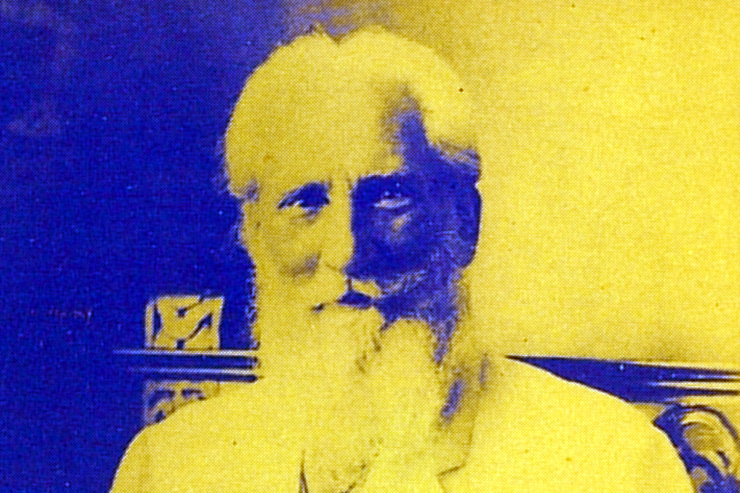
    1. Artist’s impression of C.W. Leadbeater which adorned the cover of a 1973 edition of his book The Inner Side of Christian Festivals published by the St Alban Press.
    2. “The Third Object of the Theosophical Society”, Adyar Pamphlet Number 184, Adyar, India, 1930.
    3. Other Temples, Other Gods: The Occult in Australia, Nevill Drury and Gregory Tillett, Hodder & Stoughton Australia Pty Ltd, 1982
    4. The Inner Life by C.W. Leadbeater, Madras, India:  Theosophical Pub. House, 1912.
    5. The Hidden Side of Christian Festivals by C.W. Leadbeater, as quoted in The Elder Brother: A Biography of Charles Webster Leadbeater by Gregory Tillett.
    6. The Elder Brother: A Biography of Charles Webster Leadbeater,  Routledge & Kegan Paul Books, 1982.

    © New Dawn Magazine and the respective author.
    For our reproduction notice, click here.
  • The Gympie Pyramid: Evidence of an Ancient Civilisation in Australia?

    The Gympie Pyramid: Evidence of an Ancient Civilisation in Australia?

    From New Dawn 132 (May-June 2012)

    The Gympie Pyramid near the town of Gympie in Queensland, Australia has long been a source of fascination for people from around the world as well as Australia, and the subject of a great many claims about its origin and true purpose.

    Archaeologist Greg Jefferys, who has worked on the pyramid, refers to it as “a serious, famous and unexplained archaeological anomaly.”1 Unfortunately, academia and the government dismiss the pyramid on the grounds that it is a nineteenth century or even more recent construction for the purpose of growing grapes, ignore evidence to the contrary and refuse to conduct an excavation which would settle the matter.

    What is known as the Gympie Pyramid is the rounded eastern end of a sandstone ridge north of the town of Gympie that had stone terraces cut into the sides, giving it a pyramidal shape. It is not a pyramid in the Egyptian or South American sense. The pyramid is approximately 5 km from the centre of Gympie, and is located north of the town on the Tin Can Bay road.

    Its interior remains unknown and has been a source of speculation, and there are believed to be three or four entrances, some blocked, leading into it. The pyramid is 30.4 metres (100ft) high and has six stone terraces varying from 10 metres wide at the bottom to two metres wide towards the top, and incorporate some natural rock features. Stone for many of the terraces has been shaped, and squared and some of the larger stones used would be extremely heavy.

    On the summit is a sort of ‘turret’, an upstanding section made of drystone walls with a depressed centre, and nearby there are two very heavy stone grinders, which may have been used to prepare ritual offerings. There is also a pile of stones that look like a collapsed building. Three large flat stones roughly shaped as diamonds have been found on the site. These have slots in the centre, which may have been for offerings and iron bars have been found on the site that fit the slots.2

    The terraces were believed to have been up to three metres high, but have become lower due to cattle and weathering. The pyramid is originally thought to have been terraced on three sides, but much of these were destroyed by bulldozing or early (or later) settlers carting away the stone for building purposes. An interesting little stone lined cell has recently been found at the base of the pyramid.

    The pyramid currently has large trees growing on it, which make it difficult to recognise at any distance, or to photograph.

    The would-be researcher of the Gympie Pyramid has to wade through a great deal of oral history and myth associated with it, and also try to sort out the different variations on the stories.

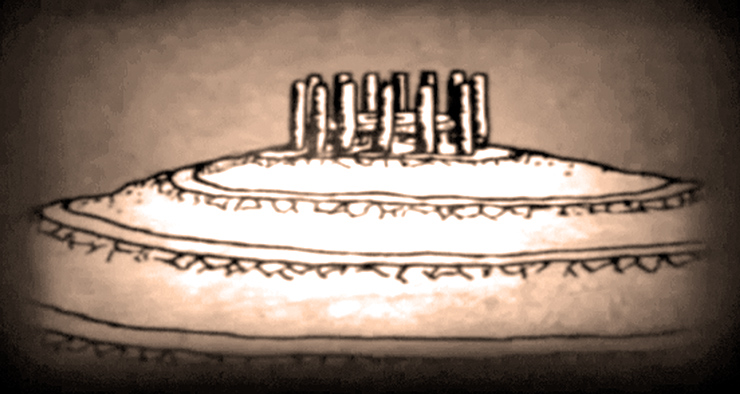
    When the pyramid was first discovered the summit is believed to have had thirteen pillars surrounding a round stone table with a hollow centre standing on the summit, and a stone gateway standing on the lower slopes of the pyramid, and other standing stones inscribed with symbols. Most of these are believed to have been removed by early settlers. Fortunately they were recorded in a diary by John Green, a great grandfather of Brett Green, a local historian who has spent much of his life researching the pyramid, and is the author of a book entitled The Gympie Pyramid Story.3

    Gold was found at Gympie in 1867, and settlement began from that year. Early settlers naturally regarded the pyramid as an easy source of stone and it was quarried to supply new buildings, doing much damage and removing all the inscribed stones. Inscribed stones from the gateway were apparently found quite recently under the floor of one of the Gympie churches – from where they vanished.4

    The pyramid became a source of much speculation and interest as unusual phenomena were reportedly seen or experienced on it, and unusual artefacts found nearby suggesting contact with earlier civilisations, and was given publicity by writer Rex Gilroy.

    Other Pyramids

    Another pyramid, or a building which looked like one, is believed to have existed at what is now Tin Can Bay, on the coast from Gympie. (Tin Can Bay has nothing to do with tin cans. The name is believed to be a corruption of tuncumba, the aboriginal name for dugong, possibly the indigenous name of the bay.) The area was taken over as an army base, and the story relates that the pyramid was covered with earth and used for target practice. However, subsequent damage to the pyramid resulted in the discovery of carved stones used in its construction. At this point the army became worried about losing land to heritage purposes, and destroyed the pyramid. The carved stones were reputedly crushed and used to fill a creek, or else taken out and dumped in deep water. This is believed to have taken place either in the 1940s, after World War II or in the 1950s. One of the people who took part agreed to be interviewed years later, and mysteriously died on the day of the interview, the large police presence at the death causing some surprise.5

    Other pyramids have reputedly been found around Australia. The well-known surveyor Len Beadell is said to have found a pyramid on the Nullabor plains, and was told by the local aborigines that the pyramid was outside the dreamtime, and that it was very bad luck to talk about it. This pyramid is said to be made of stone, and largely buried, which is why it has not been located on Google Earth.

    More recently, a passenger flying across central Australia saw a pyramid in the desert north of Alice Springs. One needs to bear in mind that central Australia used to be a lush area several millennia ago. A prophecy exists to the effect that a pyramid will be found in central Australia sometime this century, and that this site will be a major spiritual centre. Other pyramids are believed to have been seen in New South Wales.

    Archaeological Surveys

    There has been no major archaeological excavation of the Gympie Pyramid. An archaeological survey was undertaken by Michael Morwood in 1967 (for some unknown reason this report is unobtainable). He attributed the construction of the terraces to Italian wine growers or other immigrants in the nineteenth century. This idea was laid to rest by archaeologist Greg Jefferys, who did a survey while a student in 1990,6 and another survey and a limited excavation in 2007.7

    Jefferys found that the terraces were in some cases constructed with very heavy stones, some in excess of one ton in weight. And the terraces were too high for cultivation, the more so when you consider that they become more pronounced towards the top of the pyramid. Inspection of the soil in the terraces reveals only poor or rather thin native soils, becoming sandy in the top trenches, and show no sign of backfilling with more fertile soils. There is no trace of old vine stems, or roots or trellises, such as one would associate with former vine cultivation, and there is no equipment for wine making in the way of vats, etc. There would have been a major problem with watering the terraces, and there is no visible sign of any of the pipes and pumps that would be necessary.

    Greg also found that the existing side of the pyramid faces south-east, making it unsuitable for wine growing, Vine cultivators are advised to use areas facing north. He also found there had been no Italian community in Gympie before World War II, and research in the land titles office indicated that in any case the land had not been owned by the people credited with farming it. Greg points out that it would also be very unlikely for would-be cultivators to go to the trouble and effort of constructing the terraces when there is better and far more suitable land nearby.8 Terraces are not usually constructed for agricultural purposes unless there is a shortage of arable land, which is certainly not the case in Gympie. Work with a bobcat in 2007 revealed how very poor the soils in the terraces were.9

    The aborigines did not build the pyramid, and are not known too have constructed stone terraces anywhere in Australia, or to have shaped stones. If anything, they were afraid of the site and left it alone. Aboriginals taken to it in recent times declared they felt sick, and wanted to leave. Quite possibly it was regarded as a place of evil spirits. Jefferys has pointed out that the Polynesians had a tradition of terracing hills for forts and religious purposes, of which examples exist on Raiaiti and Tonga that bear a resemblance to the Gympie terraces, so the pyramid could be of Polynesian origin. If so, nothing else has been found on it to support this theory.10

    Dowsing has indicated there are a number of burials on the pyramid, but these have not been dug.11 If so, this would suggest a sacred site.

    The purpose of the pyramid is not known. Greg Jefferys points out that it would have made a good fort given its location,12 but there is no evidence for this, and it does not ‘feel’ like one. It quite possibly had a ritual function, particularly given the pillars on the summit, and was possibly also used as an observatory. If it involved a ritual function then very possibly there would have been connections with the stars. However, at the present time it can only be concluded the pyramid was built by unknown people for an unknown purpose.

    Reports from Dowsers & Psychics

    Dowsers have found the pyramid is on a major energy line, and energy rays out in four directions, like a Maltese cross. It is also connected by energy lines with what may be other pyramids or energy centres in the area.13 The pyramid may serve the function of drawing energy down (or up) and then radiating it over the countryside. Normally the destruction of such a centre would have very serious consequences. There is a powerful healing vortex at the top, near the grinders, and three people, including local resident and pyramid supporter Mick Dale, have, on separate occasions, experienced considerable healing for back problems there.14

    Psychics maintain the Gympie Pyramid has links with nearby and as yet undiscovered pyramids in the Gympie area, with pyramids in central Australia and the Nullabor, and with remains in Antarctica. It will be interesting when we are finally able to put together maps of the psychic centres around Australia.

    There has been considerable consistency in the findings of psychics and clairvoyants visiting the site. Brett Green mentions that local residents used to see ‘Nim Nim’ lights on top of the pyramid,15 and other phenomena have been encountered. One of the most frequently encountered apparitions are soldiers wearing bronze helmets and armour and holding shields. Since the 1960s people have encountered white-clad female spirits, who identified themselves as guardians of the site. Jefferys mentions a Betty Dodd who encountered a white clad apparition.16 

    The most recent encounter took place last August when clairvoyant Michael English, who had no knowledge of previous reports, encountered a soldier in bronze armour and then two white clad ladies on the summit. One of these was blond and wore a heavy gold necklace. She gave her name as Nitarla, and said she was one of three such guardians (this name was also given to Mick Dale by another source as the name of the guardian. Michael had no knowledge of this). Nitarla said they had lived on the pyramid in antiquity, which was when the pyramid was bombarded, but they had elected to stay to try to protect it. Unfortunately they had been unable to stop the damage to the pyramid.17 

    The present writer also unexpectedly encountered a white-clad lady, this one with black hair, a couple of days later on the topmost terrace. This lady said nothing but bade him welcome by gestures. People about to ascend the pyramid frequently experience being ‘stopped’ by invisible means, and have to obtain permission before going up. The writer also found that an L-shaped dowsing rod, when held loosely in the hand, spun around freely by itself on the pyramid, usually a sign of a powerful site.

    Michael English said the pyramid originally had a vortex on the top used to help spacecraft take off. This was destroyed when the pyramid was bombarded by banana shaped aircraft, possibly from Atlantis. This account has since been corroborated by another clairvoyant, Richard Shar, while using psychometry (reading the past) long distance from Adelaide.18 Visiting psychics report seeing an inner chamber in the pyramid containing various artefacts, and in particular, commonly report seeing a large dark crystal. If so, this crystal would very probably be essential to the energy functions of the pyramid.

    Individuals have had spiritual experiences equating to what is called ‘cosmic consciousness’ (a spiritual realisation of higher consciousness and unity with all things) on the pyramid, and others have seen what may be the future (one person saw New Zealand splitting in two and sinking).19 There is also thought to be antimony underground, which attracts lightning.20

    In the 1960s the summit of the pyramid was bulldozed by a person wanting to build a house. In doing so he is said to have destroyed the remaining two columns and dumped them in a mineshaft. Afterwards it is said he suffered illnesses, bad dreams and mechanical trouble, and started seeing figures in his house near the pyramid. He was thoroughly ‘spooked’ and left the area.21

    Unusual Objects

    Several unusual objects have been found in and around the Gympie area. These include among other things (refer to illustrations on page 50): a carved, yellow stone head suggesting South American influence; an ancient statuette of the Indian goddess Lakshmi; a Grecian urn; an ancient Chinese bronze teapot, and an apparent stone statue of an ape-like figure, known as ‘The Gympie Ape’. The archaeological value of these objects has been reduced by them being taken out of context, but they are still interesting. A piece of ‘bloomery’ iron was found more recently on the pyramid. According to aboriginal legend, lakes or seas used to extend from the coast almost to the base of the pyramid, which is apparently supported by geological evidence. This would account for foreign contact in the area, and seismic uplift has since emptied the lakes.22

    The carved yellow stone head was found next to the pyramid in 1985 after the construction of the railway line alongside the pyramid. The head is carved from a yellow conglomerate stone, usually an unlikely material for sculpture, which is not found anywhere near Gympie, if indeed it is found in Australia. The head has strong central or South American connotations, and it has been suggested it is of Olmec origin. The head has healing properties. It’s also suggested that in constructing the railway, workers found either an entrance to the pyramid, or a large underground chamber containing artefacts. Either way, the railway is said to have removed the artefacts and filled up the chamber. The yellow head is thought to have been one that was mistakenly dropped during the excavation.23

    What is known as ‘The Gympie Ape’ was found in a paddock diagonally opposite the pyramid, by Dell Barry and Ken Blakemore, a former owner of the pyramid. It was considered possibly to be a statue of the Egyptian god Thoth in ape form, or the Indian god Hanuman. The statue is in the Gympie Museum.24

    A bronze statuette depicting either the Indian goddess Lakshmi or the Tibetan goddess Tara was found in clay in a creek bed in the Gympie region. The amount of corrosion on the statuette suggests that it must be of ancient origin.25 

    An ancient and unusual bronze and copper Chinese teapot or wine pot was found on Fraser Island, near Tin Can Bay. The corrosion on it indicates its age, and it may possibly have come from a shipwreck. The fact that it has three legs suggests it was a wine pot.26

    A bronze Grecian urn was found in the hills north of Gympie by Brett Green.27 

    A piece of bloomery iron was found on the pyramid along with other fragments during the 2007 visit by Greg Jefferys suggested smelting on the pyramid. This form of smelting has not been used in Australia as it died out in the Middle Ages, with some exceptions in parts of Asia. Other smelting related objects were found on the site, suggesting that smelting was done on site. So far three iron bars have been found on the pyramid, and at least one of these fits exactly into the central piercing of the flat diamond shaped stones. To date their purpose in doing so remains unknown.28

    Australian Eucalyptus was apparently and inexplicably found in Tutankhamen’s tomb. So were boomerangs believed to be of Australian origin.29 Gympie was a gold-mining area, which would account for members of other civilisations being there. It is rumoured the gold in the funeral mask of Tutankhamen has been traced to Gympie.

    Pyramid Site to be Bulldozed

    The Gympie Pyramid is a tourist attraction for the town of Gympie, which otherwise does not have a great deal to offer, and has brought in people from around the world. For all that, many Gympie residents still dismiss it as a myth.

    Irrespective, the Queensland government intends to bulldoze the pyramid in the near future and put a highway through the site. Local objections have been overruled, and no attempt is being made to excavate or find out more about the pyramid while it still exists.

    A lecturer in archaeology at the University of Queensland, Dr. Pranganell, said in an interview with the editor of the Gympie Times on 9 September 2006: “The University has no intention of trying to test the myth as any digging on the site (of the Gympie Pyramid) would just give credibility to something that was impossible.”30 

    People feel there is much more to be learnt from the Gympie Pyramid, and it should at least be properly excavated. It is an energy centre, and also a tourist attraction for Gympie.

    Normally, destruction of a major energy centre such as this would have very serious consequences for the nearby community. In the Scottish highlands, moving even so small a sacred object as a standing stone is considered to bring bad luck, and crofters go to a lot of trouble to preserve the stones in situ. If so, destruction of a large site would result in more than bad luck. But the pyramid may have ways of striking back, which will be interesting to see.

    If the pyramid is bulldozed and skeletons found, it will create a serious problem for the plans of the Queensland government, since it would have to regard it as a sacred site.

    Efforts should be made to save the pyramid. One can also meditate on saving the pyramid, and ask meditation and ritual groups to work to preserve the pyramid. Much will be lost if the Gympie Pyramid is destroyed, especially if it goes unexcavated and unexplored.

    Thanks to Brett Green and Mick Dale for oral assistance and permission to use photos and drawings from The Gympie Pyramid Story. Thanks are also due to Daphne Salt for much help with the photographs, and to Laurie de Lia for making the visit to Gympie possible. You can view all the photos by downloading a copy of this issue of New Dawn.

    [alert type=”general” dismiss=”no”]This article was published in New Dawn 132.[/alert]

    [alert type=”success” dismiss=”no”]If you appreciate this article, please consider subscribing to help maintain this website.[/alert]


    Further Reading

    Brett J. Green, The Gympie Pyramid Story, De Grene Enterprises 2000, Tel: 07 5482 3909

    Brett J. Green and Mick Dale, The Gympie Pyramid Story, DVD.

    Greg Jefferys, The Gympie Pyramid – The Big Dig Report, 27 March 2007

    Greg Jefferys, The Gympie Pyramid; a nice little mystery that Australian Academia like to ignore (incorporating his 1990 archaeological report).

    Footnotes

    1. Greg Jefferys, The Gympie Pyramid – The Big Dig Report, 27 March 2007

    2. Ibid.

    3. Brett J. Green, The Gympie Pyramid Story, De Greene Enterprises 2000, page 148

    4. Mick Dale, Personal Communication (PC)

    5. Ibid.

    6. Greg Jefferys, The Gympie Pyramid; a nice little mystery that Australian Academia like to ignore, 2006, (incorporating his 1990 report on the site.)

    7. Jefferys, The Big Dig Report.

    8. Jefferys 2006.

    9. Jefferys 2007.

    10. Jefferys 2006, page 4.

    11. Mick Dale (PC).

    12. Jefferys 2006.

    13. Mick Dale and Michael English (PC).

    14. Mike Dale (PC).

    15. Greene, The Gympie Pyramid.

    16. Jefferys 2006, page 3.

    17, Michael English and Mick Dale (PC).

    18. Richard Shar (PC).

    19. Mick Dale (PC).

    20. Ibid.

    21. Mick Dale and Brett Greene (PC).

    22. Mick Dale (PC).

    23. Ibid.

    24. Ibid.

    25. Mick Dale (PC) and Jefferys 2007, page 2.

    26. Jefferys 2006, page 5 and Mick Dale (PC).

    27. Mick Dale (PC).

    28. Jefferys 2007 and Mick Dale (PC).

    29. Brett Greene, The Gympie Pyramid Story, page 82.

    30. Jefferys 2006, page 1.

    © New Dawn Magazine and the respective author.
    For our reproduction notice, click here.
  • The First Race: Out-of-Australia, Not Africa!

    The First Race: Out-of-Australia, Not Africa!

    Over the last decade, all manner of unexpected archaeological discoveries have led to many experts questioning much of what was assumed to be fact. Recent findings and field-work relating to little ‘hobbits’ in Flores Island, Siberian hominids with mtDNA connections to people of Papua New Guinea, the exclusivity of our distinct genetic Homo sapiens code being compromised by a 4% Neanderthal input, and a variety of unexpected findings have called into question many elemental assumptions held about the past.

    Professor Clive Gamble (Southampton University) succinctly summarised the current impasse and polarisation this has caused, when declaring we have to construct “a completely new map of the world and how we peopled it.”1 Granted, our response to Gamble’s call may seem radical, however, these discoveries, found not only in America but throughout the entire Indo-Pacific Region, all point to the same ancient southern inspiration.

    After extensive consultation and research, we are of the opinion that at some time in the distant past, no less than 50,000 years ago and possibly much earlier, Aboriginal men and women set sail from Australia and began exploring foreign lands. They were the bearers of new insights and options, and bequeathed humanity the cornerstones of civilisation: religion, culture, gender equality, art, sailing, democracy, astronomy, surgery, and their genes.

    Australian Aboriginal guardians of traditional Lore and Law have made it clear to us that they are indeed the “First Race.”2 They were not, as assumed by some of the general public, ignorant savages stagnating in their primitive inertia. As highly respected Dhungutti Elder Rueben Kelly states, “Centuries ago you white people chose the path of science and technology. That path will destroy the planet. Our role is to protect the planet. We are hoping you will discover that before it’s too late.”3

    Unlike others out in the field or laboratory, we’ve ‘discovered’ nothing: our role is to act as scribes and faithfully present their history. The rest is easy: find white-fella proof to substantiate black-fella truth.

    Questioning Out-of-Africa

    Before setting off on this ancient journey there is one destination and exodus that needs to be repositioned: Africa. According to academics and archaeological texts, Africa is the place from where modern humans evolved then spread their genes throughout the continents. The Out-of-Africa theory has over the years, since first proposed, transformed into fact. One of the original papers laying claim to charting our ancient ancestor’s movements and origin, The Recent African Genesis of Humans, written by Professors Alan Wilson and Rebecca Cann, is acknowledged as the closing chapter in this mystery. However, amongst the absolutes was one qualifier that has been conveniently and repeatedly overlooked. Wisely, with the benefit of hindsight, the authors stated Homo sapiens “probably,”4 never definitely, evolved in Africa.

    Wilson and Cann proposed all modern humans shared the same ancient mother, who they named Eve, and according to their calculations she lived in Africa at sometime between 150-200,000 years ago. Of crucial importance are two of the three assumptions that underpin their mathematics.

    The aboriginal (sic) populations of New Guinea and Australia are estimated to have been founded less than 50,000 to 60,000 years ago. The amount of evolution that has since occurred in each of those places seems about one third of that shown by the whole human species. Accordingly, we can infer that Eve lived three times 50,000 to 60,000 years ago, or roughly 150,000 to 180,000 years ago.5

    This declaration was regarded as the final word, and the resolution of “15 years of disagreement”6 between two branches of science. Wilson and Cann triumphantly proclaimed victory on behalf of the molecular geneticists declaring that “we won the argument, when the palaeontologists admitted we had been right and they had been wrong.”7

    With the case closed and bragging rights secured in perpetuity, science had once again provided certainty and an African ancestry. Or so it seemed. But not long after their paper was published Rebecca Cann realised they were mistaken. In 1982 she examined the mitochondrial DNA of 112 Indigenous people, including twelve full-descent Aboriginals, and the results were in total opposition to what they assumed was fully resolved.

    Nevertheless, Cann was obliged to contradict a central tenet of their paper, stating that “mitochondrial DNA puts the origin of Homo sapiens much further back and indicates that the Australian Aboriginals arose 400,000 years ago from two distinct lineages, far earlier than any other racial type.”8 Not only was the emergence of Aboriginal Homo sapiens “far earlier”9 than any Africans, she provided a sequence and motherland.

    The Australian racial group has a much higher number of mutations than any other racial group, which suggests that the Australians split off from a common ancestor about 400,000 years ago. By the same theory, the Mongoloid originated about 100,000 years ago, and the Negroid and Caucasian groups about 40,000 years ago.10

    The realignment and reversals were of immediate concern to Alan Wilson. If Cann was correct in detecting a “much higher number of mutations”11 they may as well tear up their original paper.

    Desperate to resolve the obvious inconsistencies, Wilson made two visits to Australia. In 1987, Wilson sampled the mtDNA of 21 full-descent Australian Aboriginals and provided 15 different strands. This number was well outside what anyone expected and compelled Wilson to unconvincingly conclude there were more than 15 pregnant females on the first boat. A second visit in 1989 increased the crew size to levels that quite literally sank the boat as it entered the water, and forced Wilson to abandon Africa as the place where Homo sapiens originated. From a second sampling of ten, a similar percentage (70%) of mutation was present. Upon receiving the results of his second mtDNA sampling Wilson immediately conceded the Out-of-Africa theory was wrong.

    The math wasn’t complicated: the agreed rate of mtDNA mutation for every new strand is 3,500 years, therefore 22 x 3,500 = 77,000 years. Wilson realised if he returned and increased the population surveyed, so too would the crew-size increase. He was left with no other option but to dismiss their original paper.

    It seems too far out to admit, but while Homo erectus was muddling along in the rest of the world, a few erectus had got to Australia and did something dramatically different – not even with stone tools – but it is there that Homo sapiens have emerged and evolved… Homo sapiens would have evolved free from competition out of a small band of Homo erectus 400,000 years ago.12

    Sadly, and somewhat puzzlingly, these findings were mostly ignored. In fact, opposition to the Out-of-Africa theory lost momentum. Perhaps this timid climate goes some way towards explaining the reactions to Alan Thorne’s research into the genetics and antiquity of Lake Mungo Man (WLH3). Re-dated to be over 60,000 years old and the oldest Homo sapiens yet found, this in itself raises serious doubts relating to the credentials of any theory claiming the first mariners reached the northern parts of Australia 60,000 years ago. Thousands of kilometres from any potential point of entry, the practicalities involved in reaching this distant in-land lake within days after disembarking are insurmountable. This date, coupled with the discovery that WLH3 had an “extinct DNA”13 which does not resemble any other population, surely calls into question the reality of an African migration.

    Referring back to Wilson and Cann’s original calculations, their proposed timing of somewhere between 50-60,000 years stands on no less shaky ground than their genetic miscalculation. There are at least ten Australian sites claimed to be older than 60,000 years, granted every date is challenged by conservative critics, but even so, all are the products of respected academics.

    What needs to be accepted is that if just one date proves to be correct, irrespective of whatever judgment is passed on the other nine, it can be confidently declared as a fact that Australia was not settled by African Homo sapiens 60,000 years ago. Whether the winning site turns out to be Lake George-fire-stick farming (120,000 years); Lake Eyre-skullcap (135,000 years); Jinmium-tools (176,000 years); Panaramittee-rock-engraving of saltwater crocodile (75,000 years); Rottnest Island-tools (70,000 years); Devonport-rock-engravings (>115,000 years); Jinmium-art (75-116,000 years); Great Barrier Reef-fire-stick farming (185,000 years); Lake Mungo (WLH3)-complete skeleton (61-65,000 years); or (WLH1)-cremated bones (61,000 years); one out of the ten is sufficient to deny African entry.

    The First Americans

    Compounding the inconsistencies of the Out-of-Africa theory is the recent discoveries of “hundreds of skeletal remains”14 in America that “look like Australian Aborigines.”15 

    In the October/November edition of Cosmos, Jacqui Hayes presented a compelling morphological case in support of Australian Aboriginal presence in America. According to Hayes, Aboriginal settlement of the Americas began at an indeterminate time before the second migration of people “with distinctive Mongoloid features”16 and left, within her by-line, a series of unresolved questions.

    When stating that “startling new finds suggest Australia’s first people made it all the way to South America more than 11,000 years ago,”17 the narrative is incomplete. How far back did these Aboriginal settlements span, and were other locations settled? If indeed Hayes is right in that Australian Aboriginal people were in America, any date obtained beyond 11,000 years must be due to the actions of people bearing Australian Aboriginal genes.

    The impossibility of any African migration, genes or antigens entering America, was confirmed through the examination of Aboriginal bones establishing the presence of distinctive antigens.

    Arnaiz-Vilena and his team looked at the human leukocyte antigen (HLA) system, which is a group of proteins on the surface of human immune cells. The HLAs are what the doctors test for to determine whether one person’s tissues are compatible for organ or bone transplants. HLA is a nuclear marker giving an even genealogy and genetic history for both sexes. The best test showing that HLA is a good genetic marker for studying population relatedness is that it usually correlates with geography.18

    As expected, the first nominee was Australian, but just as importantly the comparative results bore witness to one notable omission: it seems the Africans forgot to sign on.

    “So what did they find? Unique signatures only found in Australian Aborigines, Pacific Islanders, and peoples in Asia and even in Europe.”19 Missing in action and mention, the non-appearance of African HLA is yet another inconvenient piece of evidence that bears an Australian imprint.

    When recalibrating this Australian Aboriginal/American time-line, dates just exceeding the maximum Clovis (Mongoloid) entry date are certainly inconvenient, but not demanding of tearing out pages. Corroborating evidence of Aboriginal presence during the 10,000 years before the second migration from Asian began can be found at Tlapacoya, 21,700-25,000 B.P., Los Toldos Cave, Patagonia, 14-15,000 B.P., “Meadowbank Rockshelter 19,000 B.P. (southwest Pennsylvania), Tibito 14,400 B.P. (Columbia), Walker 15,000 B.P. (Minnesota) and Mud Lake 13,450 B.P. (Wisconsin).”20

    But it doesn’t stop there. Professor Silvia Gonzales, who is a leading advocate of the Out-of-Australia theory, was quite staggered21 by the dates obtained when analysing footprints found in a layer of volcanic ash at Lake Vasequillo (Mexico). “A variety of prints (human and animal) captured in this layer of rock were dated using O.S.L.”22 She found, much to her understandable surprise, that 40,000 years marked the “last time that these sediments were lit by the sun’s rays or the last time that the material was heated.”23 Gonzales is adamant these are Australian Aboriginal footprints, and that they reached America by boat through means of “island hopping”24 around the Pacific Basin.

    Such a date, 40,000 years, pushes the boundaries and affirms an extensive Aboriginal tenure, and does not stand alone. The corroborative timing at Albert Goodyear’s site, accentuated by the considerable distance between locations, cannot be a coincidence.

    Goodyear had been working at an archaeological site on the Savannah river, near Topper. It was agreed all the available evidence from the Clovis site had been gathered and their work was complete… He kept digging for another four metres before an assortment of stone tools, along with a hearth, were unearthed. A small piece of charcoal was then analysed by counting the residual Carbon 14 and a date of no less than 37,000 years was deemed appropriate.25

    Uncomfortable as these dates are in relation to when ancient Australian Aboriginals first came to America, it gets worse for any clinging to traditional theories.

    Not far from the Lake Vasequillo footprints Gonzales investigated is another site that was deliberately ignored for close to 30 years after a comprehensive investigation conducted by Cynthia Irwin-Williams. The dates are so sensational and numerous, and so obviously associated with objects made by Homo sapiens artists, the archaeologists downed tools and clipboards and vowed never to return. The dates returned by a variety of sound geological analyses were far too ancient, not only for occupation, but well outside the assumed period when Homo sapiens first appeared. To some extent the issue isn’t just a matter of whether these numbers are feasible, but more a case of open antagonism between two competing branches of science.

    Christopher Hardaker, author of The First American, created a fictional conversation between the two competing parties that graphically highlights how the argument over which group of academics is right has blinded the combatants.

    ARCHAEOLOGIST: You are asking us to believe that the sophisticated art and technology of the Upper Palaeolithic was actually invented over 200,000 years ago in Central Mexico by Homo erectus? Ridiculous. GEOLOGIST: You are asking us to believe that Science is off by a magnitude of 10? Ridiculous.26

    Often the result of cutting-edge technology, the chemicals analysed and computations made came from extremely reputable institutions and individuals. Some of the offending techniques and dates (which came from the layer of volcanic ash and debris deposited above the artefacts/or footprints) include: Uranium Series Dating (200,000 years); Zircon Fission Track (170-640,000 years); mineral solutions (200,000 years); Diatom analysis (80,000 years); U-Th/He (200,000 years); tephrahydration (250,000 years); magnetic shifts in rocks (790,000 years); and argon argon (1,300,000 years).

    The facts, and large figures, demand a response. What if just one date is actually right? Does that mean Homo sapiens were, as Christopher Hardaker claims, responsible for “600,000 year old art?”27 If so, does this alone suggest the often sniggered at talk of Mu, Atlantis and other ancient civilisations has real geological substance?

    As to whether Gonzales’ “island hopping”28 route from Australia, up through Asia, Japan, Siberia then America is plausible, it is often said a picture can act as a worthy substitute for quite a few words. The photograph (see page 27) of the Japanese full-descent Ainu Elder was taken in the late 19th century by German anthropologist Dr. Hermann Klaatsch. The physical characteristics displayed in this photograph, in association with the recent discovery of “a very well-preserved skeleton from Gua Gunung, Malaysia,”29 resonates to one ancient southern inspiration. The Malaysian “specimen is aged 10,200 B.P. and is said to be a late representative of a non-specialised morphology, similar to Australian Aborigines.”30

    The First Boat

    For the appearance of a population “similar to Australian”31 Aboriginals in Malaysia, Japan, America, or any other place, a boat is needed. The oft-proposed settlement of Australia from Africa by ramshackle raft, or through desperately clinging on to driftwood during storms, doesn’t measure up. This vessel must be able to withstand monsoons and weeks at sea, and accommodate a crew of close to 20 adults to negate in-breeding thus successfully repopulate an uninhabited continent. Nowhere today is anyone going to discover the actual ancient wooden remains of such an ancient sophisticated “ocean-going”32 vessel. But if seeking out everything else bar the planks there is only one place to look.

    Graham Walsh was “the widely recognised authority on the intriguing Bradshaw art of the Kimberley area… Within this area, he has discovered the oldest paintings of boats in the world, dated at a minimum age of 17,000 years, but with the strong possibility of being up to 50,000 years old…”33 Walsh insisted that the “high prow of the boat”34 is “unnecessary for boats used in calm, inland waters. The design suggests it was used on the open ocean.”35 Walsh was quite shocked by the function, antiquity, and most importantly dimensions of these vessels: “they are massive boats, totally alien.”36 Moreover not only was the sophistication and technology exhibited difficult for Walsh to assimilate, he still had to account for the reasons why there were “two paintings of ocean-going boats, one with 23 people on board, the other 29.”37

    These are ideal numbers as foundation populations when sailing towards distant lands, however diagrams and specifications do not make a boat. To have a clever idea is a promising first step, but there are some practicalities to be addressed before any idea takes form. There are materials, tools, and navigation skills required which supposedly did not exist for at least another 20,000 years. Irrespective of what is assumed, the first tool needed to build a ship that can comfortably cater for 30 people, is an axe. Wood in its prime, not the rotting logs that fall, is essential in manufacturing a vessel strong enough to sail across oceans.

    It should come as no surprise that the oldest axe in the world, dated at 40,000 years, was found at Huon Terrace PNG (which was part of the Australian mainland until 8,000 years ago), others discovered in Jaowyn land, Northern Territory (35,500 years), at Sandy Creek, Queensland (32,000 years) and Malangangerr Northern Territory (23,000), are all at least 8,000 years older than the first axe found outside Australia (Niah Cave, Sarawak, 15,000 years).

    With axe at hand, plans on the wall, and overseas bookings made, there still remains one vital navigational skill any journey beyond landfall demands. Hugh Cairns’ book Dark Sparklers is the first and only publication dedicated to the sharing of traditional Aboriginal astronomical knowledge. Cairns won the trust of Wardaman Elder Bill Harnley, who spoke of his ancestral knowledge of the stars, “great black shapes,”38 the movements and constellations in between, and of up “on top.”39 According to Cairns, there have been Aboriginal astronomers for “over 30,000 years.”40

    Not only the Pacific, but the Indian Ocean, was a path used to navigate then share so many esoteric gifts, technologies, guidelines, and of course, genes.

    “Dr. Raghavendra Rao and researchers from the Indian-backed Anthropological Survey of India project found unique mutations were shared between modern-day Indians and Aborigines.”41 They “identified seven people from central Dravidian and Austro-Asiatic tribes who shared genetic traits only found in Aborigines.”42 

    Much earlier linguistic studies of the Dravidian language had already identified the same relationship. Dravidian “fishermen of the Madras coast use almost the same words for I, thou, he, we, and you as some Aboriginal tribes. Many other key words in the Dravidian dialects are identical in Tasmanian Aboriginal terms both in pronunciation and meaning.”43 

    It needs to be appreciated that Tasmanian culture and language is a relatively recent event, and the island is the outcome of the final thawing at the end of the last Ice Age when the seas covered the low plains between Victoria and Tasmania. Over the last 8,000 years this isolation has been instrumental in the development of a distinctive Tasmanian culture.44

    With a language that came into existence no earlier than 8,000 years ago forming a substantial part of the basic Dravidian vocabulary, this mtDNA connection strongly suggests the Australian Aboriginals kept in contact with India for some considerable time.

    Especially since “Australian canoes are constructed identically to those of the coastal Dravidian tribes of India, and wild tribes in the Deccan region of India are the only culture known to use the boomerang outside Australia.”45 The oldest boomerang discovered in the world was found at Wyrie Swamp, South Australia, and is dated at 10,200 years.

    The dingo, accepted to have been brought into Australia from somewhere in Asia about 6,000 years ago, only strengthens the possibility of an extended Australo-Indian link. It would appear that the Dravidians adopted the Australian boomerang to hunt with, chose their better designed canoes to assist in fishing, and as is often the case when two cultures first meet, shared technology, friendship and genes.

    There is so much more to this ancient Aboriginal narrative. At best we have provided a brief geographical overview of where ancient Aboriginal people sailed, and hopefully presented evidence validating their belief that they are descendents of the “First Race.”46 

    Whether the African strand of Homo sapiens emerged 40,000 years ago is of no account, our focus is on the much earlier Australian genes, journeys and heritage. We have examined a few of the locations reached, but as for the religious legacy of the Dreaming as evidenced through the nine shared mystical principles, underpinned by equality of gender and species, that is yet another chapter of an ancient story that spans eons and geography. Their intimate awareness of the divine, along with the lesser gifts of sailing, astronomy, brain surgery, penicillin, burial/cremation/embalming, amputations, axe-making, democracy, bows and arrows, and so much more, is part of a forgotten origin that deserves to be heard once more.

    Steve Strong also contributed articles on the ancient Egyptian connection to Australia in New Dawn Special Issue 19 and New Dawn 130.
    [alert type=”general” dismiss=”no”]This article was published in New Dawn 125.[/alert]

    [alert type=”success” dismiss=”no”]If you appreciate this article, please consider subscribing to help maintain this website.[/alert]

    Footnotes

    1. “Australia’s ‘First Americans’,” Daily Telegraph, 8 September 2004, 3 (n).

    2. The Nephew of Reuben Kelly, 2010, Recounting Uncle Rueben Kelly From his Nephew, Personal Communication to Steven Strong.

    3. Anne Wilson Schaef, Native Wisdom for White Minds: Daily Reflections Inspired by the Native Peoples of the World (Random House, 1995).

    4. Allan C. Wilson & Rebecca L. Cann, “The Recent African Genesis of Humans: Genetic Studies Reveal That an African Woman of 200,000 Years Ago Was Our Common Ancestor,” Scientific American 266, no. 4. (April 1992), 68.

    5. Ibid. 72.

    6. Ibid. 68.

    7. Ibid. 68.

    8. Robert Lawlor, Voices of the First Day: Awakening in the Aboriginal Dreamtime (Inner Traditions International, 1991), 26.

    9. Ibid. 26

    10. Ibid. 26.

    11. Ibid. 26.

    12. Ibid. 26.

    13. Leigh Dayton, “DNA Clue to Man’s Origin: How Mungo Man Has Shaken the Human Family Tree,” The Australian, 9 January 2001, 1(n).

    14. Jacqui Hayes, “Ancient Odyssey,” Cosmos issue 35, 2010, 42.

    15. Ibid. 39.

    16. Ibid. 40.

    17. Ibid. Front Cover.

    18. Ibid. 45.

    19. Ibid. 45.

    20. Steven Strong & Evan Strong, Constructing a New World Map, 1st ed. (University Press of America Inc., 2008), 42.

    21. Martin Redfern (producer/reporter), Pauline Newman (producer) & Robyn Williams (presenter), “Oldest American Footprints” (transcript), The Science Show, ABC Radio National, 11 Feb. 2006, http://abc.net.au/rn/sciencesshow/stories/2006/1564746.htm

    22. Strong & Strong, Constructing a New World Map, 48.

    23. Redfern, Newman & Williams, The Science Show.

    24. Ibid.

    25. Strong & Strong, Constructing a New World Map, 49.

    26. Christopher Hardaker, The First American: The Suppressed Story of the People Who Discovered the New World (New Page Books, 2007), 187.

    27. Ibid. 45.

    28. Redfern, Newman & Williams, The Science Show.

    29. Walter A. Neves & Mark Hubbe, “Cranial Morphology of Early Americans from Lagoa Santa, Brazil: Implicatons for the Settlement of the New World,” Proceedings of the National Academy of Sciences of the United States of America 102, no. 51 (2005), www.pubmedcentral.nih.gov/articlerender.fcgi?artid=1317934, 467.

    30. Ibid. 467.

    31. Ibid. 467.

    32. Michael Winkler, “Rock Star of the Kimberley,” The Age, 20 Sept. 2004.

    33. Strong & Strong, Constructing a New World Map, 47.

    34. “First Americans Were Australian,” BBC News, 26 Aug. 1999, http://news.bbc.co.uk/2/hi/science/nature/430944.stm.

    35. Ibid.

    36. Winkler, “Rock Star of the Kimberley.”

    37. Ibid.

    38. Hugh Cairns & Bill Yidumbuma, Dark Sparklers, 2nd ed. (H.C. Cairnes, 2004), 42.

    39. Ibid. 39.

    40. Ibid. 42.

    41. AAP, “First Australians Were Indian: Research,” Sydney Morning Herald, 23 July 2009(n); Within Steven Strong & Evan Strong, Forgotten Origin (University Press of America, Inc., 2010), 16.

    42. AAP, “First Australians Were Indian: Research”; Within Strong & Strong, Forgotten Origin, 16.

    43. Lawlor, Voices of the First Day, 120.

    44. Strong & Strong, Forgotten Origin, 17.

    45. Lawlor, Voices of the First Day, 120-121.

    46. Kelly.

    © New Dawn Magazine and the respective author.
    For our reproduction notice, click here.
  • Ancient Egyptians in Australia! Could Mysterious Engravings Rewrite our History?

    Ancient Egyptians in Australia! Could Mysterious Engravings Rewrite our History?

    Until receiving a phone call from Nina Angelo (OAM), I knew nothing of neither the struggles involved in protecting the land around Kariong (near Gosford) nor that part of this land was now on the market. When on-site I had seen a lot of tagged trees, and a for sale sign somewhere along a main road, but being unfamiliar with the whole region, nothing registered.

    The land for sale contains the Gosford Glyphs, located near Kariong, about 60 km north of Sydney. This site features little known carved ‘ancient Egyptian’ hieroglyphs that were brought to light by various researchers in past decades.

    We are convinced that close to this site, and never before seen by non-Aboriginals until discovered very recently, is a rock platform covered with a set of sacred engravings of considerable significance. On this large platform we saw a fish, serpent, massive dolphin or whale, circles and a variety of shapes and symbols.

    Without doubt, it is an impressive gallery of ancient Aboriginal rock art deserving of protection. There is one life-sized engraving of Durramullan (son of Creation Spirit Biamie) that is so unique, utterly unexpected, and obviously sacred, decisions had to be made as to how it can be publicly described.

    There is nothing remotely like it anywhere in Australia. And that’s it. That is all we have agreed to reveal. The photographs taken late in the afternoon on this site, and in particular those of Durramullan, should never be reproduced or published through any form of the media but…

    Owing to the real possibility this land, irrespective of the credentials for or against the Gosford Glyphs, could be sold then developed, a different approach is compulsory. It has been our agreed stance to categorise all the sites/relics we are sharing as being ‘found within 2 hours of Sydney’, but that generalised approach doesn’t apply in this location. Those engravings, and other related platforms (one is actually located within this block) are now directly under threat.

    The distance between this unique site and that of the Gosford Glyphs is far too close for coincidence or comfort. As to determining the bona fides of this supposed Egyptian site, we have one advantage. According to Dr. Hans-Dieter von Senff, who has produced a draft paper on the site:

    These Hieroglyphs are real and have existed for some 4,500 years in Australia. In order to prove that these Proto-Egyptian glyphs are not graffiti, as claimed by various “Experts” and “Egyptologists,” but are the written record left by pre-historic man, written in a coherent and understandable language that makes sense even 4,500 years later. This site is no hoax, but a genuine archaeological discovery; as is proven by the newly discovered second set of glyphs.

    The critics who dispute the origin of these engravings numbering over 300 are not sensitive to the bigger picture, and if proven to be engraved by Egyptians, these glyphs form a pivotal and historic epitaph to an Australian history very few suspect. The engravings were first properly translated by Ray Johnson, claimed to be proto-Egyptian and accepted “as correct by the General Director of Cairo Museum, Dr. Dia’ Abou-Ghazi.”1 However, despite the endorsement of the resident expert in Cairo, Australian academics with less impressive credentials are adamant this is an elaborate hoax.

    The site includes an engraved Ankh (see image above courtesy of Steve Strong), an essential accompaniment to Thoth, placed alongside an Ibis footprint (Thoth’s recent animal counterpart) and what we believe to be the ‘River of Life’. Two Ibis-men engraved into rock, both in profile with the head of an ibis and body of a human, seem to resonate to the same ancient Egyptian theme. What really surprised us was that not only are the ibis and Thoth synonymous, but originally Thoth was depicted in ape-form. And it is this more ancient representation that is found twice in Australia, extending the horizons considerably. A statue found at Gympie, said to act as one of five sentries guarding the controversial seven-stepped pyramid at Gympie, is a depiction of Thoth in his more primal ape-like form and has been argued over and often ridiculed.

    The recent discovery of an engraving of Durramullan, again in profile, is less open to debate. The pronounced long forehead and protruding lips is reminiscent of a baboon or one of the larger apes, and so out of context when carved into a continent lacking ape or monkey. The engraving is ancient, carved by an artist aware of an African animal and Egyptian deity supposedly unknown until the British invasion. In what only adds to the quality and quantity of this cross-cultural partnership, there are two sets of Aboriginal engravings, one containing 31 separate and distinct human characters and the other five figures, of which three have human bodies and what appears to be crocodile heads.

    It is for these reasons, and many others, we are in complete agreement with Robert Lawlor, author of the highly regarded Voices of the First Day, when noting the same origin and sequence. “The Egyptian religious practices, zoomorphic pantheon of gods, concepts of death and rebirth, sorcery, magic and medicine all have their origins in the primal culture of the First Day.”2

    We see the presence of Egyptians in Australia beginning at around 5,000 years ago, entirely in keeping with a global history that saw, for a variety of reasons too complex to discuss now, the Australian Aboriginal mariners and explorers finally return to Australia at around the same time. We believe the glyphs and other Egyptian remains found ‘within two hours of Sydney’ bear testimony to a spiritual sabbatical to the place where Egyptian religion and culture began.

    That the Gosford Glyphs are so close to the sacred Durramullan site suggests an agreement between the first Australians and people from a distant continent. The Durramullan platform is undeniably special, and the Glyphs are an integral part of this arrangement, unique not only in Australia but the world. The Egyptian crypt and engravings, dedicated to the memory of the son of a Pharaoh, was constructed close to the Durramullan rock platform and could only be created with the consent of the local Aboriginals.

    Of course, if Australian Aboriginals did sail the globe in ancient times this journey is dependent upon ocean-going boats being constructed in Australia. Up at the Top End there are many engravings and paintings of boats which are mistakenly claimed to be inspired by Maccassan boats fishing for trepan. No such claims can be made for the engraving of an ocean-going boat found in the northern section of the Gosford site. The boat’s design, with a steep prow and stern, has one primary function: to sail through large waves. It would be a waste of time, effort and resources to construct a boat according to the shape and proportions engraved into the rock, if the vessel sailed in stiller waters. More importantly, this engraving goes a long way towards establishing the claims made by Ramindjeri Elders. If indeed, as they insist, their ancestors circumnavigated the globe in a figure eight then this sophisticated design would serve that purpose.

    That engraving and the Ramindjeri account provide answers to a series of unresolved questions that mainstream academia are unable to appreciate. The presence of Australian Aboriginal people in America was the focus of Issue 35 of the highly respected science magazine Cosmos. The front cover carried the following caption: “Did Aborigines discover America? Startling new finds suggest Australia’s first people made it all the way to South America more than 11,000 years ago.”3

    Of course, America was merely one port-of-call when the First Australians set sail. “Dr. Raghavendra and researchers from the Indian-government backed Anthropological Survey of India project found unique genetic mutations were shared between modern-day Indians and Aborigines.”4 They “identified seven people from central Dravidian and Austro-Asiatic tribes who shared genetic traits only found in Aborigines.”5 These facts, along with newly discovered Australian genetic links to a hominid in Siberia referred to as Denosovan, necessitate the same means of transport: a boat.

    However, the plan of a boat is insufficient. Also required are both the tools needed to construct such a vessel and navigational skills before sailing to India, America, Asia, Egypt or any other destination. An axe is an essential prerequisite if building a vessel capable of sailing across oceans. In keeping with all other firsts, it should come as no surprise that the oldest axes yet found are located within Sahul (the greater Australian continent which includes PNG, Tasmania, etc). The oldest axe was found at Huon Terrace (PNG) and is dated at 40,000 years, followed by an axe found in Jawoyn land (N.T.) claimed to be 35,500 years old. Remaining within Australia, an axe was discovered at Sandy Creek (QLD 32,000 years) and another at Malangangerr (N.T. 23,000 years). In what confirms the antiquity of Australian axe technology, and by association boats, Angel John Gallard has in his possession a hand-held chopper (the precursor to the axe) which he believes to be no less than 60,000 years old, with the real possibility it is over 100,000 years old. The oldest axe discovered outside Australia was found at Niah Cave (Sarawak) and is thought to be 15,500 years old.

    For such an epic journey to succeed, especially if circumnavigating the world in a figure eight, Aboriginal mariners must have navigated by the stars. Once again it all begins here. As announced by a team of scientists from the CSIRO, the oldest astronomical construction was found at Wurdi Youang (Victoria). “The strange stone arrangement”6 has “two points set in perfect alignment with the setting sun on a midsummer’s day.”7 CSIRO experts are of the opinion the “ancient Aboriginal sundial could be upwards of 10,000 years old.”8 Nor do these rocks stand in isolation – there are two sets of walls recently found in the Snowy Mountains, the first is aligned east-west, marking out the conjunction of planets and contains no less than 10,000 rocks. The second is at least four times bigger and runs down an extremely steep slope.

    Within ‘two hours from Sydney’ is a perfectly aligned five-rocked compass and another construction that is far more enigmatic, which for obvious reasons, we call ‘mini-Stonehenge’. It is made up of 46 stones in the inner circle and 18 rocks forming what we feel are clusters of stars. The four directions are marked out by arches with a horizontal stone supported by stone pillars. All four constructions, although separated by hundreds of kilometres, serve the same purpose: charting the heavens.

    There is one pattern exhibited by these sites that seems to openly contradict an artistic maxim we assumed held fast throughout Australia. It was our belief that traditional Aboriginal art was region specific. Within this area we have found over 25 styles/techniques, many of which are claimed to be created in one tribal estate. We found evidence of the following Aboriginal artistic styles: Panaramitee; X-Ray; Figurative; Mimi; Lightning Brothers; Wandjina; Papunya; Hand stencils (two types); Representational; Rock engraving; Rock Pecking; Stone Arrangements; Bands across the body; Egyptian symbols; Bird prints; Engraved shield design (found throughout Australia); Profiled spirits; and others we could not identify.

    Where does that leave us? Relying on textbooks and academics ‘dazed and confused’… Or there is an alternative route. We are convinced the First Australians are completely separate to the Africans and were the first homo sapien sapiens. It was from Australia, not Africa, the first migration originated, and it is from Australia that religion, gender equality, astronomy, burials, sailing, music, art, democracy and all the nobler pursuits began. And it is in Australia, in particular the area ‘within 2 hours from Sydney’, that proof of this global legacy can still be found.

    Steve Strong has contributed an article on the ancient Egyptian connection to Australia in New Dawn Special Issue 19.
    [alert type=”general” dismiss=”no”]This article was published in New Dawn 130.[/alert]

    [alert type=”success” dismiss=”no”]If you appreciate this article, please consider a contribution to help maintain this website.[/alert]

    Footnotes

    1. “The Kariong Glyphs and the Prohibited Egyptians: Research Proves the Kariong Glyphs to Be Genuine and Exposes the Critics as Hoaxters” by Hans-Dieter von Senff, 2011, 99.

    2. Voices of the First Day: Awakening in the Aboriginal Dreamtime by Robert Lawlor, Inner Traditions International, Ltd., 1991, 75.

    3. “Ancient Odyssey” by Jacqui Hayes, Cosmos, 2010, Front Cover.

    4. “First Australians Were Indian: Research,” Sydney Morning Herald, 23 July 2009, 16.

    5. Ibid.

    6. “Wurdi Youang Rocks Could Prove Aborigines Were First Astronomers,” 5 February 2011, www.news.com.au/technology/sci-tech/ancient-aboriginal-eyes-were-on-the-skies/story-fn5fsgyc-1226000523978

    7. Ibid.

    8. Ibid.

    © New Dawn Magazine and the respective author.
    For our reproduction notice, click here.