New Dawn – World's Most Unusual Magazine

Tag: Blavatsky

  • Freemasons, Secret Societies, Conspiracies, Consciousness & the Hidden Masters: An Interview with Gary Lachman

    Freemasons, Secret Societies, Conspiracies, Consciousness & the Hidden Masters: An Interview with Gary Lachman

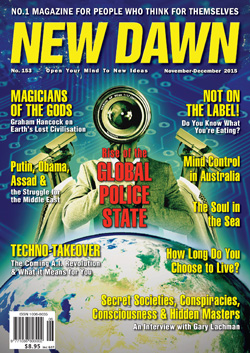
    From New Dawn 153 (Nov-Dec 2015)

    An overlooked but powerful current is flowing in our time. It’s found in a small group of writers and thinkers who are trying to overcome the materialism and rationalism of the present age and rediscover the perennial truths that lie behind all religion. These writers are grappling with the occult and esoteric paths of the past and present. They’re trying to explore these movements without falling into either credulity or blinkered scepticism. They include Jay Kinney, founder of Gnosis magazine and author of The Masonic Myth; Mitch Horowitz, a New York book editor whose own works include Occult America and One Simple Idea: How Positive Thinking Reshaped Modern Life; and Erik Davis, author of TechGnosis and Nomad Codes: Adventures in Modern Esoterica.

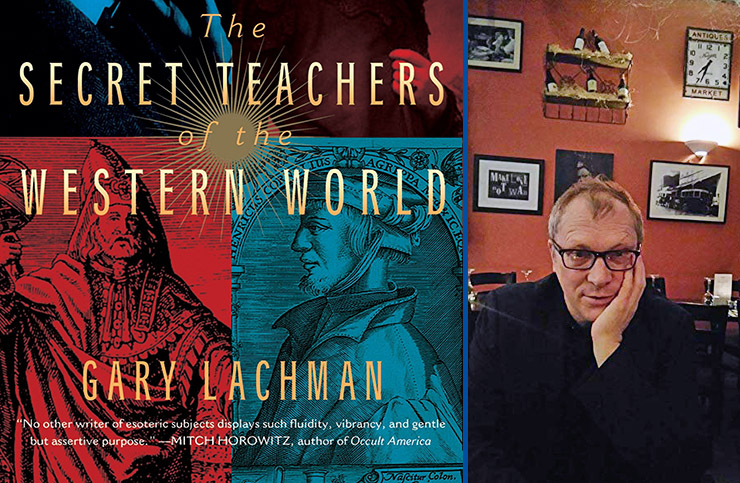
    In this small but distinguished company is Gary Lachman. He started out in the 1970s in the New York rock scene as one of the original members of the groundbreaking New Wave band Blondie. In 1996 he moved to London, where he established himself as a full-time writer, contributing to publications such as Fortean Times, The Guardian, and The Times Literary Supplement.

    Since 2001 Gary has produced a steady stream of books, including Turn Off Your Mind: The Mystic Sixties and the Dark Side of the Age of Aquarius; The Secret History of Consciousness; A Dark Muse: A History of the Occult; and Politics and the Occult: The Right, the Left, and the Radically Unseen. In recent years he has published biographies of major esoteric figures including P.D. Ouspensky, Emanuel Swedenborg, Rudolf Steiner, Carl Jung, and H.P. Blavatsky (see his interview in New Dawn 137).

    Gary’s latest work, published in December 2015 by Tarcher/Penguin, is The Secret Teachers of the Western World, a monumental work that unveils the esoteric masters who have shaped the intellectual development of the West, from Pythagoras and Zoroaster to little-known twentieth-century figures such as Jean Gebser and René Schwaller de Lubicz.

    In June 2015 I conducted an e-mail interview with Gary about secret currents in the Western tradition.

    RICHARD SMOLEY (RS): Many people have a sense, however dim, that what is going on in the news is only the thinnest skin upon a sea of struggles and forces that we can barely conceive of. Would you agree with this assessment?

    GARY LACHMAN (GL): I suspect that at most times what we are aware of is only a selection of what is actually taking place. I mean this in the broadest sense possible. In terms of the media, it’s reasonable to assume there are a variety of filters in place that result in an edited version of things getting to us. But then there are people who devote their energies to ‘uncovering’ the truth and ‘revealing’ the facts about this or that event. It does strike me that one could get lost in attempting to track down the ‘truth’ about things, in terms of the political, economic, social situation. I mean conspiracy theorists who pursue an elusive solution to the mystery of who ‘really’ is in power and what ‘really’ happened in this or that situation.

    I think it is important to be discriminating about what we accept from our sources and to be aware that every source has its bias. Personally, I am more interested in the kind of things that are outside this kind of ‘hermeneutics of suspicion’, in the philosopher Paul Ricoeur’s phrase. I mean philosophy, thought, etc. I think it’s always a good time to pursue the good, the true, and the beautiful, whoever is running the show. I also think there is less covert control than some people believe, but it seems de rigueur nowadays to feel that everything we see on the news is false. The show itself is ultimately unimportant. It is an unavoidable nuisance that we nevertheless need to be aware of in order to pursue our aims.

    RS: Novelist Ishmael Reed wrote, “Beneath or behind all political and cultural warfare lies a struggle between secret societies.” How much truth do you think there is in this statement?

    GL: Well, I don’t know. I first came across it, as many people did, in Robert Anton Wilson and Bob Shea’s conspiracy fantasy Illuminatus. Are there really secret societies at work, manipulating events and controlling the world? If there are, they don’t seem to be doing a particular good job of it.

    I think that at different times there have been societies or groups of people who have worked together to effect some change or introduce some idea into the societies of their time. I talk about some of them in my new book, The Secret Teachers of the Western World. But these were relatively small groups who were active at a certain time, and when you look at what they were doing, the aura of mystery and sensation around them being ‘secret’ dissolves. That isn’t what is important about them. Take the Fedeli d’Amore of Dante’s time and of whom Dante was a member. They weren’t secret in the way that we think of Skull and Bones or that kind of thing (and I should say here that my book isn’t about that kind of secret group). But they were a relatively private group of poets who wanted to introduce ideas about the divine feminine or Sophia into the consciousness of their time. They were more like what G.I. Gurdjieff and P.D. Ouspensky mean when they talk about the ‘inner circle of humanity’ or ‘esoteric school’. I’m not saying the Fedeli d’Amore were agents of esoteric schools, but that their objectives and practice were like theirs, rather than some cabal of powerful individuals directing events from behind the scenes, which is how secret societies are popularly imagined to be.

    In one sense I think conspiracy consciousness is a good sign, in the way that Jung said neuroses were, as an attempt by the psyche to deal with a problem. It shows that we have a hunger for meaning. We prefer feeling that someone is in charge, even if we don’t know who that is, to feeling that no one is and that everything is chance and arbitrary. The hunger for meaning is good; it’s the means of satisfying it that I find questionable. We are purposive beings who seek out patterns and meanings. The mainstream narratives – religion, progress – no longer satisfy our appetite for meaning, and so we seek it elsewhere. One of the ideas of the book is that the meaning is there, but we won’t find it by looking for it outside ourselves.

    RS: One period in which occult orders were especially influential was the eighteenth century, in which lodges like the Freemasons played a crucial role in transforming the old feudal and ecclesiastical order into the modern world. Do you have any thoughts or insights about this development?

    GL: Freemasonry was a very important means for some fundamental ideas about modernity to be disseminated. I mean ideas about tolerance, social justice, democracy, individual worth regardless of social or economic rank. It was the spread of these ideas through different lodges that helped prepare the eighteenth-century zeitgeist for the radical changes that happened with the American and French revolutions. It is a mistake, though, to think, with Abbé Barruel and more recent writers on the Masonic influence on these events, that Freemasonry arranged or stage-managed them. There were Masons on both sides of the American Revolution, and the Illuminati – the real society, not the popular romanticised idea of it that’s present on the Internet – wasn’t ‘responsible’ for the French Revolution. The ideas that informed Adam Weishaupt’s short-lived and ineffective Masonic offshoot certainly were active forces in the revolution, and they were spread through Masonic lodges. But I think we have to credit the zeitgeist more than Weishaupt and Co. for the storming of the Bastille. In fact in one sense we could say Freemasonry itself was a product of the shift in consciousness that began around that time.
    RS: Your new book is entitled The Secret Teachers of the Western World. If they were secret, how have they been able to have such influence?

    GL: Well, again, my secret teachers aren’t necessarily secret in the sense that no one knows about them. I mean, if they were that secret, how could I know about them? One can be a secret teacher by teaching secrets, or one can be a secret teacher in the sense that the influence and importance of your ideas haven’t been recognised or have been misunderstood. Or you can be secret in another sense, as with several important thinkers who have been marginalised or don’t fit into the standard model of Western consciousness. It’s a broad term referring to a variable status rather than specific group of people. Jesus Christ, for example, is one of my secret teachers, and most people know about him. But there is a whole school of thought that argues that what we have accepted as Christianity really has little to do with the original teachings associated with Jesus. The Gnostics, for example, are thought to be more in line with what Jesus actually taught then the Petrine church of Rome.

    Or take Madame Blavatsky. If people know about her at all, she is chalked up to be an entertaining but fraudulent nineteenth-century spiritualist with a lot of chutzpah. But she was enormously influential on the modern world, in everything from art, religion, and science to what became known as the ‘counterculture’. I am not saying that everything she said about science or religion is ‘true’. That’s not the point. True or not – and she is more often on the ball than you might think – her ideas were tremendously influential, and I am amazed that feminists haven’t appropriated her. I suspect the occult connotations put them off. She isn’t secret, but her influence is not generally recognised.

    I should say the central idea of my book is that the whole Hermetic, esoteric tradition is the victim of a war going on inside our heads. I mean the rivalry between our two cerebral hemispheres. One of the inspirations for the book came from reading Iain McGilchrist’s very important work The Master and His Emissary, which is about the left and right brain and the differences between them. Briefly put, McGilchrist revamps the left/right brain discussion by showing that the difference between them is not in what they do – as was originally believed – but in how they do it. They respond to the world in very different ways, and the way they present the world is also very different. In the simplest sense, the right brain presents a total picture of the world. Its mode of consciousness is relational, connective, holistic. It presents what McGilchrist calls the ‘big picture’, the overall pattern, but its picture is fuzzy, vague. It works with metaphor, symbols, and is focused on the living character of being. It is aware of implicit meanings, meanings that we know and feel but cannot express explicitly. (Think of our appreciation of music: we know a Beethoven string quartet means something, but we’d be hard pressed to say exactly what.)

    The left brain is aimed at breaking up the big picture into smaller bits and pieces that it can manipulate. Its main function, as Henri Bergson said long ago, is to help us survive. It reduces the living, flowing whole presented by the right brain to a kind of map that allows us to manoeuvre through the world effectively. It’s interested in the trees; the right brain is interested in the forest. One looks through a microscope, the other at a panorama.

    Both are necessary, and for the most part each gets along with the other in a system of checks and balances, each inhibiting the other’s excesses. But McGilchrist argues – convincingly, I believe – that in the last few centuries the left has increasingly gained an upper hand against the right and has, in a sense, gone on a smear campaign against it. One expression of right brain thinking that the left brain targeted was the Hermetic, esoteric tradition, which was cast into disrepute with the rise of mechanical science – itself an exemplar of left brain thinking. With the dismissal of the esoteric tradition it was transformed into what the historian James Webb called ‘rejected knowledge.’ What my secret teachers teach is this rejected knowledge.

    [alert type=”info” dismiss=”no”]If you appreciate this article, please consider a subscription to New Dawn magazine.[/alert]

    RS: Of the figures that you would include among these secret teachers, which do you consider the most influential?

    GL: That’s difficult to say, and I should point out that the book isn’t a ‘top ten’ or ‘ten best’ list or something like that. Plato is certainly one of the most influential; in many ways the esoteric, Hermetic roads all lead to him. He is believed to have ‘gone to school’ in Egypt, and whatever he learned there is supposed to inform his philosophy. But whether Plato studied in Egypt or not, his ideas about the Forms, the ideal essences of which the physical realities of time and space are merely shadows, is certainly at the heart of the esoteric tradition. And Platonism informed Christianity, Hermeticism, Gnosticism, and other esoteric teachings. We can argue with and reject or accept different aspects or elements of his philosophy, but I would say that for the West, Plato is certainly one of, if not the most, significant source of esoteric thought, or thought in general. Alfred North Whitehead said long ago that all Western philosophy is but a series of footnotes to Plato.

    In saying this I’m not saying I think Plato is the ‘best’. My own philosophical background is more in Nietzsche, Bergson, Whitehead, William James, and existentialism. But Plato is still there too.

    RS: Which of these figures do you admire the most?

    GL: I’m not quite sure how to answer that. There are plenty of admirable figures in the book, as well as more questionable ones, and also some martyrs, like Hypatia the Neoplatonist, and the Persian theosopher Suhrawardi, both of whom fell victim to religious persecution, as well as truly secret teachers like the so-called Dionysius the Areopagite who welded Neoplatonism to Christianity. We do not know who he really was, just as we have no names for the Hermeticists of ancient Alexandria.

    I can say who has been an influence on me. One of first writers on esotericism that I read was P.D. Ouspensky. His books Tertium Organum and A New Model of the Universe made a big impact on me, even before I read In Search of the Miraculous and became interested in Gurdjieff. I first read these books forty years ago, and Ouspensky seemed a model of the kind of thinker I wanted to be: he combined a romantic openness to ideas, and poetry and art with a rigorous critical mind and he remains the best writer from what I call the ‘golden age of modern esotericism’, which took place during the 1920s, when people like Ouspensky, Gurdjieff, Rudolf Steiner, Jung, Crowley, and others were all active. Again, I’m not saying Ouspensky is the ‘best’ – that’s as pointless as arguing about who’s the best guitarist. But reading his books excited me and made me want to learn more. I tend to like figures that combine imagination with critical thinking, which we can see as the right and left brain working together, which is another theme running through the book.

    RS: One theme that you advance in your new book is that the cosmos is a living, conscious being, and that we need to rediscover that fact. To what extent do you think this rediscovery is actually happening in the world today?

    GL: It seems some form of that idea has been revived and presented in a variety of different ways throughout the last century and into our own. Bergson argued a form of it as did Whitehead. In the nineteenth century we have Gustav Fechner, who wrote about the Earth as a living being well in advance of James Lovelock. The philosopher David Chalmers has argued for a kind of panpsychism, meaning that in some sense, the entire universe is conscious. What headway this idea has made in altering our ‘standard model’ of the cosmos is unclear. We’d have to interview lots of scientists, I guess, and go through the numbers. I think more people today have some sense of it than, say, in the nineteenth century – at least the kind of mechanistic picture of the world popular then is less so now. Of course, any scientist who takes the idea literally and talks about it is subject to the scorn of his peers. But that too is an expression of the rivalry between the two modes of thinking. The ‘hard’ left brain makes fun of the ‘soft’ right brain’s ‘need’ to see a nice, cozy universe that cares about him, while he shows how ‘tough’ he is by saying that he doesn’t need that and prefers the ‘truth’ about the cold, indifferent cosmos. I write about this in an earlier book, The Caretakers of the Cosmos, where the idea of a living cosmos is a central theme.

    RS: Thirty or forty years ago, it seemed possible to believe that we were on the verge of a new age of rising consciousness and compassion. It’s a little harder to believe this now. How do you personally respond to hopes and dreams of a coming new age (however imagined)?

    GL: I’m not that keen on predicting a new age. Western history is littered with them. I think the current pessimism, or, more accurately, nihilism is a kind of ‘sound barrier’ that our culture, our civilisation, has to break through. Nietzsche predicted it at the end of the nineteenth century. I think we have somewhat naïve ideas about a new age. I believe there are shifts in consciousness. One of the thinkers I refer to in the book and in others is the little-known German philosopher Jean Gebser, who talks about different ‘mutations’ of consciousness happening throughout history. But these come about through our own participation in them; I mean we are active players, not passive recipients of something happening in the stars or according to some ancient teachings.

    The real new age will come round when we learn how to master our own consciousness. This means coming to understand it. This takes hard, determined work. I don’t think the new age will come about because of nice thoughts or fun raves or because of a conference or a festival. It will start to appear in individuals who have an obscure hunger for some purpose higher or more demanding than what our ordinary life can provide. These types embody in embryonic form a new consciousness that demands a new kind of inner freedom.

    We tend to think of freedom as liberation, as being free from something. The new types want a more significant freedom, the freedom for some purpose greater than just fulfilling their individual needs. In The Caretakers of the Cosmos I borrow a term from the Russian existential philosopher Nikolai Berdyaev and talk of a ‘creative minority’. These are the individuals who quietly and solitarily confront the demands of the new consciousness emerging within them. We tend to think that a new form of consciousness will be lots of fun and full of ecstasy. But more often people experiencing a different kind of consciousness, with different needs and appetites, tend to feel like misfits and have to go through a long struggle to actualise their possibilities. I have a very evolutionary way of thinking. I feel that any important development at first makes life more difficult for those in whom it occurs. Those who can get through the initial difficulties develop a strength that will help them impose the new vision on the world around them.

    RS: Which living people do you consider to be most important and impressive in fostering this higher awareness?

    GL: The most important one for me has been Colin Wilson, who sadly died at the end of 2013 at the age of eighty-two. I have been a dedicated Wilson reader since 1975, when I first read The Occult. After that I tracked down and read as many of his books as I could find. I am in fact preparing to write a book about his work and ideas, which more or less form the basis for much of my own writing. Wilson spent a lifetime in a determined analysis of consciousness and developed what I find to be a very convincing argument for why our consciousness is how it is and what we can do to intensify it. It isn’t for everyone, but I personally have got the most out of following his leads.

    Gary Lachman’s The Secret Teachers of the Western World (Tarcher/Penguin) is available from all good bookstores and online retailers.

    [alert type=”general” dismiss=”no”]This article was published in New Dawn 153.[/alert]

    [alert type=”success” dismiss=”no”]If you appreciate this article, please consider subscribing to help maintain this website.[/alert]

    © New Dawn Magazine and the respective author.
    For our reproduction notice, click here.
  • The Mystique of the Manor: Australia’s Occult Centre Revealed

    The Mystique of the Manor: Australia’s Occult Centre Revealed

    From New Dawn 152 (Sept-Oct 2015)

    Pilgrims have been drawn to the other-worldly auras of hallowed sites, both natural and man-made, all around the globe since antiquity. One such sanctuary sits right in the heart of Sydney and, although it has slipped from prominence today, it played a significant role in Australia’s spiritual and esoteric history.

    While its narrative has primarily been expressed through the descriptions of the characters who have occupied it, the magnetism of the building and the ground it stands on are worthy of examination in their own right. Today it has become less visibly conspicuous, surrounded as it is by so many other grand dwellings. However, a century ago the world was a different place and it was quite the topic of conversation in Sydney society.

    The late nineteenth century saw a surge of spiritual and metaphysical pursuits in the Western world, springing from Europe and Britain and streaming into the United States, Canada, Australia and New Zealand. While the British Victorian era is generally associated with industrial and scientific advances, not to mention Darwinism, many Victorians (including the Queen herself) embraced Spiritualism, séances and other forms of mysticism. At what is now considered the birth of the New Age movement, independent thinkers in England freed themselves from centuries of religious dogma and placed their faith in the powers of ESP, experimenting in telepathy and clairvoyance. Many enthusiastically explored new branches of knowledge with exotic names like mesmerism, electro-biology and crystal-gazing.

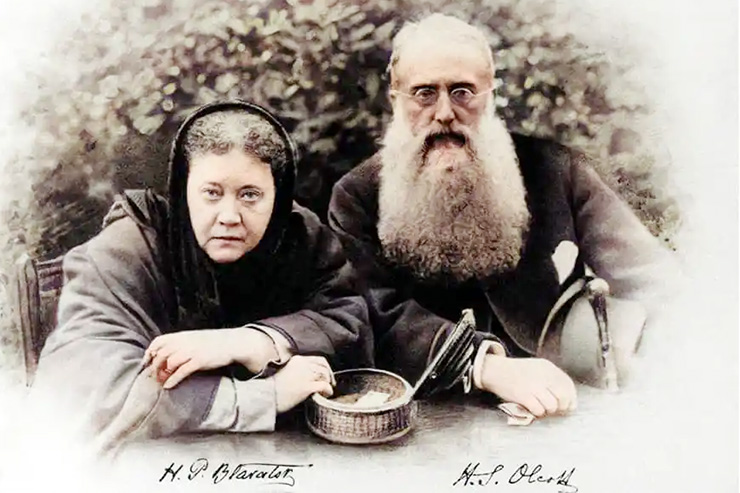
    On the other side of the Atlantic, Americans felt no sense of conflict in having a Ouija board on their desk alongside the Bible. Spiritualism seemed quite compatible with Christianity inasmuch as it provided reassurance on the existence of souls and the afterlife. Madame Helena Petrovna Blavatsky (HPB) was the daughter of a White Russian princess and had been involved in the Spiritualist movement early on.1 On moving to the USA she befriended Henry Steel Olcott and together they founded the Theosophical Society (TS) in 1875. In the early twentieth century, as Americans were becoming fascinated with psychic phenomena, Harvey Spencer Lewis was initiated into a Rosicrucian order during a visit to France, thereby enabling him to establish the order known as AMORC on his return to the USA.

    Australia was not impervious to the ground-swell of New Age beliefs and Sydney became a focal point for their proponents – some of them more colourful than saintly – along with their mystical doctrines, which concocted a curious blend of Christianity with the occult. The popularity of Spiritualism soared, counting among its adherents such notables as Prime Minister Alfred Deakin and the newly arrived American architect Walter Burley Griffin. A hundred years ago, while James Wedgwood was founding the Liberal Catholic Church (LCC) back in Britain, his friend Charles Webster Leadbeater had already decided to settle in Sydney and would, in the succeeding years, establish the Australian headquarters of both the LCC and Theosophy, together with various other societies, at Mosman in Sydney. A number of theosophists first rented, then purchased under trust deed, the capacious 55-room mansion and its grounds at Clifton Gardens that was to be known as The Manor.

    Gateway to Heaven or Simply a Grand Old Mansion?

    While The Manor became the focal point for Theosophy and associated societies almost a century ago, it had originally been built by wealthy businessman William Bakewell and was known to the locals as ‘Bakewell’s Folly’. He purchased six building blocks of what is now prime real estate at Clifton Gardens. The entire district of Mosman is rich with Aboriginal heritage, with over a hundred known sites found across the municipality, particularly along the foreshore area. After the North Shore population of several thousand original inhabitants witnessed the arrival of the first British colonisers, their numbers were decimated by the smallpox epidemic of 1789.

    Was this grand and mysterious building at Mosman, which had been described by a TS member almost eight decades ago as a “specially selected Centre of the power of the Masters of the Wisdom,”2 really a kind of cosmic portal and, if so, should it be revered as a sacred site today? Perhaps we should consider the possibility that an other-worldly force guided even William Bakewell from the outset when he selected the location for his construction. Quoting Nicholas Van Gelder:

    He began with a simple purpose: to build an eight-room house. What passed through his mind over the next 8 years is not known. Suffice that by 1913 the house had become a rambling 55-room mansion with many rooms lined with copper. Perhaps he foresaw the days when the Australian security service could listen in on conversations by using laser or microwave devices.3

    The fact that most rooms have pressed metal ceilings, as well as copper lined walls, is claimed by some occultists to serve the purpose of conserving magnetism. Following his death in 1917, William’s family declined to live there and the house stood vacant for five years, until it was acquired by TS members.

    In 1922 the imposing building would become home to a commune of fifty-plus people. As explained by Theosophy Forward on their website:

    It was Theosophist Lucius Van Gelder who had the idea for an experimental community to make life more “reasonable, cheaper, and more useful” for the families and individuals concerned.… Leadbeater, who became the focus for the community, invited Van Gelder to assume the task of managing it; and the residence became known as “The Manor”…. A trust was formed, whose purposes were “the formation of a spiritual centre where people may be trained in religious matters and the formation of a community based on Theosophical ideals.” The appointment of trustees was placed in the hands of Annie Besant, then the International President of the Theosophical Society, and her successors.4

    According to the authoritative booklet The Manor: A Short History5, The Manor became an important centre for the Society and was regarded as a great “occult forcing-house.” Curuppumullage Jinarājadāsa (known simply as Raja), the Theosophical Society’s international vice-president, asserted that Leadbeater was directed to the house by command of the King of Shamballa, and promptly settled in it, declaring, “In June 1922, the Great White Brotherhood established in the City of Sydney an occult Centre, charged directly from Shamballa.” “Thus was born the notion that The Manor was the occult nexus for the Southern Hemisphere.” And writer C.V. Williams added: “In 1922 Theosophist families began to move in with him (Leadbeater), feeling secure in the idea that they were close to heaven.”

    What marks The Manor as a keystone in Australia’s alternative spiritual heritage is that it served as a passageway, like the neck of an hourglass, by which so many doctrines and societies were funnelled into this country, before being disseminated throughout the land. The sheer number of activities including Theosophy, Co-Freemasonry, the LCC and other less well-known societal offshoots anchored to this geographical location at Mosman, poses the question: was it, and is it still, an occult centre of power? Had it always been, as the commune’s founders believed, a kind of heavenly gateway, or did it really derive its power from the “égrégore”6 of its human participants?

    The following are some of the principal known organisations, alongside their commonly used acronyms:

    TS         The Theosophical Society
    OSE      Order of the Star in the East
    LCC      The Liberal Catholic Church
    ES         The Esoteric Section; also The Eastern School
    Co-M   Co-Masonry

    According to a biographical study of Charles Webster Leadbeater (CWL) by Gregory Tillett:

    The arrangement of a weekly schedule posed no small difficulty, since it involved regular meetings of the TS, both those for members only and those open to the public, and of the OSE, together with the ES and Co-Masonry, and now the Liberal-Catholic Church. The considerable overlap between the TS, the LCC and Co-Masonry can be seen from examining lists of Co-Masonic Lodge officers around this time: the officers of Sydney Lodge No.404 in 1918 included Mr and Mrs Kollerstrom, Leadbeater, Hazel, and L.W. Burt, all of them (as they were by then being described) TS, ES, OSE, LCC and Co-M.7

    Gregory Tillett adds, in a book co-written with Nevill Drury:

    Another ceremonial movement which he (CWL) established, the Egyptian Rite of Ancient Freemasonry, also meets there (The Manor); in this rite Leadbeater hoped to bring together the angels of Freemasonry and of the Church, and it was regarded as “the most powerful occult rite in the world.”8

    One newspaper article reports that, in the 1920s,

    The Manor had its own theatre company performing Shakespearean plays on the gently sloping lawns. Painters, writers and poets congregated in its meeting rooms to discuss modernism, materialism and the importance of patriotism in nation building. There were Greek garden fetes, fairy dances, light operas and musicals.9

    In keeping with the times, TS launched radio station 2GB in 1926, using The Manor and two outlying cottages on the property. The initials GB stood for sixteenth century philosopher Giordano Bruno, whom they believed was a former incarnation of Annie Besant. The station is still a household name in Sydney radio ninety years on. Alfred Edward ‘A.E.’ Bennett (not to be confused with Frank Bennett) was appointed general manager and the first broadcast took place on Armistice Day, 1926. Bennett wrote, “The intention is to conduct the station on ideal principles and solely with the object of uplifting our Australian people.”10 Raja, however, was concerned this sacred ground was being disturbed by the psychically enervating signals emanating from the antennae.

    A Hidden Fraternity

    What unseen guiding hand drew this array of key personalities together and why at this particular location? Was the torch being lit for an ‘Antipodean Utopia’ and, if so, did the flame fizzle out, or does it continue to flicker away from the public eye in preparation of a new Golden Age? Those confraternities we dub ‘secret societies’ always have twin facets: the overt aspect, consisting of their beliefs and philosophies, which these days can be readily researched in books and online; then their practical agenda which forms the basis of their secrecy – the initiation rites, rituals and techniques that are intended to raise consciousness, quicken one’s psychic abilities and ultimately allow communion with higher intelligence, sometimes including ‘invisible Masters’.

    Who are these ‘Masters’ that are said to have appeared to, and spoken with, the likes of Madame Blavatsky, Annie Besant, Alice Bailey and Charles Leadbeater? They are called by various names, including The Ascended Masters, The Great White Brotherhood, The Elder Brothers or The Secret College. They form a Hierarchy, which Phillip Lindsay defines as a “Group of spiritual beings on the inner planes of the solar system who are the intelligent forces of nature and who control the evolutionary processes. Divided into twelve hierarchies. The Occult Hierarchy or Masters of Wisdom, of which disciples and initiates are a reflection.”11 They exist on subtle planes known as the Etheric or the Astral, transparent to normal physical sight. In addition to Masters there are angelic, devic and elemental entities.

    [alert type=”info” dismiss=”no”]If you appreciate this article, please consider a subscription to New Dawn magazine.[/alert]

    Also known as Mahatmas, the Masters of Ancient Wisdom are those who once lived as human beings. The enlightened ones who most often imparted their teachings to Theosophists and other occultists from the late nineteenth century are identified as Morya, Kuthumi (or Koot Hoomi), Djwal Kul (usually just known by the initials DK), and Count Saint Germain – although there are many more. While many of these Masters dwell on a non-physical plane, some do take corporeal form and they often attach themselves to specific earthly retreats, the most well-known being in and around the Himalayas.

    Author Edmund Harold states:

    There are momentous periods in our evolution, times when we recommence the age-old search for self-purpose. At such times we re-acquire awareness of the existence of a spiritual hierarchy, one that is represented by highly evolved beings. These are known as The Great White Brotherhood, or the Brotherhood of the Light.12

    The voices of the masters have been silent at The Manor for a long time, but perhaps another one of these ‘times’ approaches again.

    The Pioneering Spirit

    The modern Theosophical movement first reached Australia in 1879 when Gilbert Elliot of Melbourne joined the TS. By 1891 when Henry Steel Olcott, as the Society’s international president, came for a brief tour, there were enough branches to form what was called “a Section.” While in Sydney, Olcott also chartered the Sydney Lodge. The Australian Section was given a further boost in 1894 when Annie Besant, a persuasive orator, arrived to give a series of lectures on Theosophical topics. In 1905 Charles Leadbeater toured the country to wide acclaim and then, three years later, membership skyrocketed on Besant’s return.

    The LCC and the Co-Freemasonry movement that developed alongside the TS in Sydney can be traced to one man: James Ingall Wedgwood (JIW). In 1915 Wedgwood, who first met Leadbeater in 1906, arrived in Sydney. As a gay clergyman, JIW suffered an ongoing inner turmoil between “the angel and the beast within” – a dilemma that haunts some clerics to this day. He swung between alternating extremes of spiritual fervour and the temptations of the flesh. Eminent British Theosophist E.L. Gardner said of him privately, “JIW was a ‘dual’ – at times skilled, able and impressive. Then, a bout of sensualism of the worst grade, sexual perversion.”13

    In 1909 Leadbeater identified the 14 year-old Jiddu Krishnamurti as a vehicle for the coming World Teacher, the Bodhisattva Maitreya, by way of clairvoyant perception of his aura. From then on Krishnamurti was groomed by both CWL and Annie Besant, eventually coming to Sydney in 1925. He did not stay at The Manor, but lived at a nearby house in Mosman with his brother, Nitya, with whom he was very close. The OSE’s raison d’être was to prepare the way for the arrival of this new messiah. With this advent in mind, CWL and Besant guided the construction of the ambitiously conceived Star Amphitheatre at nearby Balmoral Beach.14

    Built in ancient Greek style and completed in 1924, the Amphitheatre had seating accommodation for 2,500 people and was intended as a venue for lectures by the expected World Teacher, embodied by Krishnamurti. Just as The Manor earned the reputation of being a folly, surely the Amphitheatre is to be remembered as an extravagance – perhaps even an eccentric one at that. Stories circulated that it was located for the best view of the expected ‘second coming’ that would see “Jesus Christ come through the Heads of Sydney Harbour.”15 Clearly this never eventuated and, a quarter of a century later, the Star Amphitheatre was demolished. These days a rather ordinary looking apartment block stands on the site.

    In the same year The Manor was first occupied by TS members, Krishnamurti and Nitya travelled from Sydney to Ojai in California, where they experienced a new sense of freedom accompanied by a fresh perspective on worldly matters. A big upheaval for Krishnamurti came when he was asked to attend a function in India marking the golden anniversary of TS in 1925, while his brother stayed in Ojai. Nitya had been in poor health, but George Arundale (more about him shortly) had assured Krishna that he would not die, promising that the Masters would protect him. But Nitya did die, causing Krishnamurti’s dedication to the TS to wane, until finally in 1929 he dissolved the Order of the Star in the East (OSE) and stated he was not going to be the new messiah, with the famous words, “The moment you follow someone you cease to follow Truth.” He did not renounce public life, however, continuing on his own path with the Krishnamurti Foundation. His mentors at the TS felt sadly let down and distanced themselves from him over the years.

    The Momentum of The Arundale Years

    George Sydney Arundale joined the TS in England during 1895 and, seven years later, followed Annie Besant to India where he became principal of her Central Hindu College. Life there revolved around Krishnamurti, who had become Besant’s adopted son. Arundale instituted the OSE in Europe and also took on the role as regional bishop for LCC in India. Soon after, he claimed himself to be clairvoyant and then, late in 1925, began openly expressing doubts about Krishnamurti’s intended role as the earthly vehicle for Maitreya. This caused a slight rift with Besant, after which he transferred to Sydney to join Charles Leadbeater at Mosman.

    He launched himself so enthusiastically into the affairs of The Manor that the ensuing period is remembered as ‘The Arundale Years’. In quick succession he became general secretary, chairman of 2GB, editor of the Australian Theosophist, and co-editor of the Australian Star News. An able preacher and experienced publicist, he competently formulated political commentary and supported advanced causes, from a Theosophical angle. Together with his wife Shrimati Rukmini Devi, a well-known Indian dancer, he stayed at The Manor until 1931. It seems George Arundale’s assessment of Krishnamurti was correct and in fact the 1930s was the last great decade for the TS at The Manor.

    Attention Wanes

    The defection of Krishnamurti along with the deaths of Annie Besant and Charles Leadbeater led to a period of decline for the TS in the 1930s, from which it never fully recovered. It appears the Society, like many temporal vehicles on this material plane, carried at its nucleus the elements of its own decline. Author Nicholas Van Gelder portrays the Esoteric Section as the cause of the eventual downturn in the fortunes of the TS, although today’s Manorites deny there has ever been a schism in Theosophical ranks. HPB formed the ES as an inner group back in 1888, consisting of students who were members of the Society, but separate from it and controlled solely by her. Unfortunately it came to be seen by some non-members as an elitist group. It remains a separate entity today.

    Perhaps the reason that a number of the groups that put down roots at The Manor failed to endure is that Charles Webster Leadbeater held no clear vision for their future nurturing and growth. As noted by author Frank Joseph, he “departed for Australia, settling in Sydney in 1914, where he felt particularly called to fulfil some as yet ill-defined mission (italics added). His instinct was correct, judging from the profound public success he enjoyed there.”16 CWL left Australia for India in 1929, to take over the leadership of the TS from Annie Besant, whose health was failing. He returned to Sydney for short periods but died during a stopover in Perth in 1934.

    James Wedgwood left Australia and in the late 1920s resumed his activities with the TS in Holland, allegedly with increasingly frequent visions and meetings with masters, angels, archangels and denizens of the higher realms. He would eventually return to England in poor health and battling dementia, dying in 1951 after a heavy fall.

    George Arundale ended up returning to India where he died in 1945. The ‘Arundale Years’ had helped stabilise the TS and perhaps presented a more acceptable, scandal-free image to the Australian public.

    There is a conviction held by organisations and individuals concerned with esotericism that Australia has a special role to play in the dawn of a new Golden Age. In a series of lectures delivered in Sydney in August 1915, CWL had proclaimed “Australia and New Zealand as the home of a new sub-race.” He detected in Australia “children and young people of a distinctly new type.” A new antipodean human type characterised by intuition and the powers of synthesis.17 This is consistent with the New Age concept of ‘Indigo Children’. In the last years of his life, CWL claimed to have been instructed by the ‘World Mother’ to establish a ministry for her worship, including an apostolic succession to be passed on through women and for the foundation of a feminine religion to parallel the masculine-dominated Christianity. To date this has not made any public appearance, but the tradition is said to be perpetuated within Theosophical circles privately.

    Guarding its Secrets and its Grandeur, A Century On

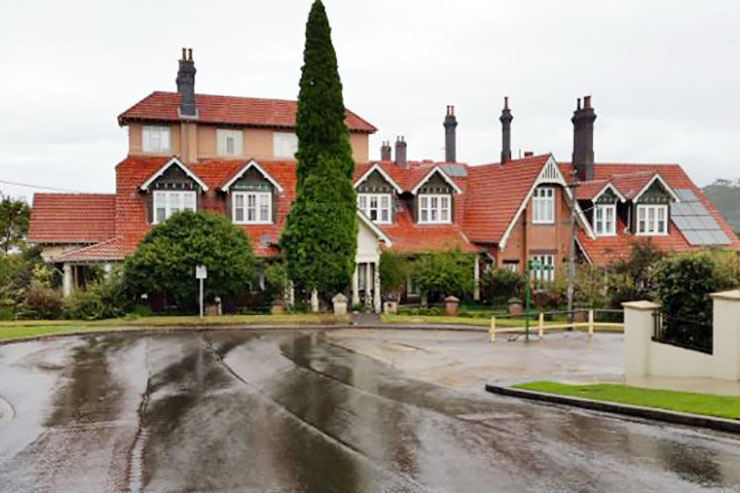
    Today, as one approaches The Manor from the road above, its sprawling grandeur first reveals itself by way of the dormers and gables of the red tiled roof, including the impressive 18-metre long studio perched atop the eastern wing. Most first-time visitors can’t resist trying to count the host of chimney pots that crown it. The very ground that The Manor stands on exudes a palpable magnetism and benign spiritual presence. One does not have to be psychic to experience the peaceful calm emanating from the mansion’s walls, and it is not hard to see why many have claimed to feel closer to the divine here.

    Whether or not Australia fulfils its secret occult destiny and hosts a new Golden Age remains to be seen. So long as the Manorites maintain the high energy levels through their esoteric rites, this site will remain sacred and, should the Masters decide the time is right to publicise their messages once again and guide the populace, surely this will be the prime spot for their transmission.

    This article’s graphics are viewable in the print or digital version of New Dawn 152.

    [alert type=”general” dismiss=”no”]This article was published in New Dawn 152.[/alert]

    [alert type=”success” dismiss=”no”]If you appreciate this article, please consider subscribing to help maintain this website.[/alert]

    Footnotes

    1. It should be noted that Madame Blavatsky (and Theosophy) rejected Spiritualism, however: “By the early 1870s, Blavatsky was involved in the Spiritualist movement; although defending the genuine existence of Spiritualist phenomena, she argued against the mainstream Spiritualist idea that the entities contacted were the spirits of the dead.” (https://en.wikipedia.org/wiki/Helena_Blavatsky)
    2. ‘The Manor Family: Australia’s oldest urban commune’ by Bill Metcalf, JRAHS Vol 100, 9
    3. ‘The Manor: A Short History’ by Nicolas Van Gelder, Theosophical History Occasional Papers, Vol XIV, 1
    4. www.theosophyforward.com/theosophical-encyclopedia/521-manor-the
    5. Nicolas Van Gelder, 14-15
    6. An egregore is a ‘group thought form’ or ‘collective group mind.’ See: http://en.wikipedia.org/wiki/Egregore
    7. ‘Charles Webster Leadbeater 1854-1934: A Biographical Study’ by Gregory John Tillett, http://leadbeater.org/tillettcwlchap17.htm
    8. Other Temples Other Gods by Nevill Drury & Gregory Tillett, Hodder & Stoughton, 1982, 32-33
    9. ‘Age of reason’ by John Zubrzycki, Sydney Morning Herald, Good Weekend supplement, 29 Nov 2014
    10. Nicolas Van Gelder, 24
    11. Masters of the Seven Rays by Phillip Lindsay, Apollo Publishing, 2000, 119
    12. The Ascended Masters of The Great White Brotherhood by Edmund Harold, Grail Publications, 2002, 13
    13. http://en.wikipedia.org/wiki/J._I._Wedgwood
    14. “Mary Rocke, a retired doctor, member of the Theosophical Society, secretary and physician to Leadbeater, purchased three adjacent blocks of land sloping from Wyargine Street, Balmoral to the beach. With a loan of 4,000 pounds and the rest of the cost raised by selling subscription seats, the Star Amphitheatre was built on this site.” (www.mosman.nsw.gov.au/file_download/1865/The-Star-Amphitheatre-Balmoral.pdf)
    15. “Leadbeater, Charles” by Garry Wotherspoon, http://dictionaryofsydney.org/entry/leadbeater_charles
    16. ‘C.W. Leadbeater: Saint or Sinner?’ by Frank Joseph, New Dawn 96 (May-June 2006)
    17. ‘Esoteric Australia’ by Mehmet Sabeheddin, New Dawn Special Issue 3

    © New Dawn Magazine and the respective author.
    For our reproduction notice, click here.

  • 2012, the Apocalypse  & the End of the Age

    2012, the Apocalypse & the End of the Age

    Cultures that view themselves as waning are usually those most likely to tap into doomsday scenarios, especially when the world’s end is followed by universal renewal.

    – Prof. Anthony Aveni, American anthropologist & astronomer

    An Apocalypse (Greek: ἀποκάλυψις apokálypsis; “lifting of the veil” or “revelation”) is a disclosure of something hidden from the majority of mankind in an era dominated by falsehood and misconception, i.e. the veil to be lifted…. By extension, apocalypse can refer to any End Time scenario, or to the end of the world in general.

    – Wikipedia (www.wikipedia.org)

    In 1997, a former reporter with the Wall Street Journal, Michael Dronin, wrote The Bible Code, based on the notion that hidden messages are embedded in the Bible. Not surprisingly, considering the uncertainty of the times, The Bible Code quickly became a best seller. Using a numerological system said to be derived from Jewish mysticism and facilitated by computer technology, Drosnin searched for signs of the ‘End Times’ and discovered the years 2006 and 2012 are of special importance. According to Dronin’s Bible Code system in 2012 the Earth will be hit by a devastating comet.

    In Dan Brown’s mega best-selling fictional tale, The Da Vinci Code, his lead character Robert Langdon, in answer to a question about ‘the end of the world’, explains:

    “Many religions speak of the End of Days. It refers not to the end of the world, but rather the end of our current age – Pisces, which began at the time of Christ’s birth, spanned two thousand years, and waned with the passing of the millennium. Now that we’ve passed into the Age of Aquarius, the End of Days has arrived.”

    For Dan Brown and many others we’re not talking about an ‘end of the world’ with all its connotations of the destruction of humanity or the planet, but the transition from one age to another. Bible scholars support this view pointing out that often when the Gospel writers mention the ‘world’, the original Greek word used is ‘aion’, meaning age, or system of things. The biblical ‘end of the world’ refers not to the destruction of all life on the planet but to the conclusion of an allotted period of time, or a system of things. The end of the zodiacal Age of Pisces and the transition to the new Age of Aquarius is marked by a change in consciousness.

    The Swiss psychologist C.G. Jung took an interest in the zodiacal ages and concluded we now live in an ‘End Time’ period, the transition from Pisces to Aquarius. Not long before his death in 1961, Jung experienced a series of visions of a future great catastrophe. His long-time associate, Marie-Louise von Franz, claimed Jung saw a worldwide conflagration occurring around the year 2010. Students of Mayan prophecy will be sure to note the close proximity of 2010 to the end date of the Mayan calendar.

    Michael Dronin, Dan Brown, and Carl G. Jung – three very different writers – but their speculations about the ‘End Times’ have gained considerable attention in the Western world.

    Less than a century ago, in the aftermath of the carnage and upheaval of the First World War, many of Europe’s most astute thinkers and writers concluded the Western world was in its death throes. They took the rationalism and materialism engulfing Europe in the first decades of the twentieth century as inevitable symptoms of the slow ‘decline of the West’. Many shared Oswald Spengler’s conviction, persuasively set forth in his 1918 book The Decline of the West, that Western civilisation was in an unstoppable process of spiritual and cultural disintegration.

    The great French writer and Noble Prize winner Romain Rolland was amongst those who believed Europe was dying and that the only hope for the world lay in Asia. The celebrated French novelist and adventurer André Malraux also looked to Asia for inspiration. After his first journey to South East Asia in 1923 he openly attacked the sterility of materialistic Western culture, and in the following years he devoted himself to the radical nationalist uprising against Western imperialism that was developing in Indo-China.

    A half a century earlier in 1888, the redoubtable Madame H.P. Blavatsky penned a controversial expose of the Catholic Jesuit order for an issue of her Theosophical journal Lucifer. After documenting the conspiratorial activities of the Jesuits, Madame Blavatsky left her reader in little doubt about the coming show down between the East and the West:

    “There is a prophecy in the heathen East about the Christian West, which, when rendered into comprehensible English, reads thus: ‘When the conquerors of all the ancient nations are in their turn conquered by an army of black dragons begotten by their sins and born of decay, then the hour of liberation for the former will strike’. Easy to see who are the ‘black dragons’. And these will in their turn see their power arrested and forcibly put to an end by the liberated legions. Then, perhaps, there will be a new invasion of an Atilla from the far East. One day the millions of China and Mongolia, heathen and Mussulman, furnished with every murderous weapon invented by civilisation, and forced upon the Celestial of the East, by the infernal spirit of trade and love of lucre of the West, drilled, moreover, to perfection by Christian man-slayers – will pour into and invade decaying Europe like an irrepressible torrent. This will be the result of the work of the Jesuits, who will be its first victims, let us hope.”

    One hundred years after Blavatsky penned these apocalyptic words, ‘decaying Europe’ which for centuries thanks to ‘the infernal spirit of trade and love of lucre’ had plundered the lands of Asia, Africa, and the Americas, found itself challenged by fast rising new global powers. The creation of the European Union and the absorption of the former socialist East European states were not enough to stop spiritual and cultural paralysis overtaking lands once identified as the ‘Christian West’.

    For much of the twentieth century the United States led the Western world. With the end of the British Empire after World War Two, American economic, social and cultural values steadily became almost synonymous with the ‘West’. Today in 2012 the United States desperately strives to maintain its ‘New World Order’ of global dominance. At home the United States is in major social and economic trouble. In a country where the wealthiest 5% control 60% of the nation’s wealth, many find themselves in agreement with the late American novelist Kurt Vonnegut who remarked just before his death, “Working people have no leverage whatsoever. I’m trying to write a novel about the end of the world. But the world is really ending!”

    The decline and fall of Europe and the USA may look like the end of the world. “This is going to be just like the Book of Revelation said it was going to be – the end of the world as we knew it,” the late Hunter S. Thompson wrote back in 2003.

    The Apocalypse and the ‘End Time’ loom menacingly on the horizon. But is it really the ‘end of the world’ or are we witnessing the end of a civilisation that long ago reached its high point and now is in rapid decline? The Piscean Age which dominated the world for roughly the last two thousand years, represented by the Christian West, is quickly fading as we experience the first influences of the coming Aquarian Age. These are tumultuous and challenging times, pregnant with great possibilities, both constructive and destructive. Though an atheist, André Malraux predicted that “the third millennium will be spiritual or there will be no third millennium.” In the end this remains the only guarantee of a future worth living.

    [alert type=”general” dismiss=”no”]This article was published in 2012 New Dawn Collector’s Edition.[/alert]

    [alert type=”success” dismiss=”no”]If you appreciate this article, please consider subscribing to help maintain this website.[/alert]

    © New Dawn Magazine and the respective author.
    For our reproduction notice, click here.
  • Madame Blavatsky & the Spirit World

    Madame Blavatsky & the Spirit World

    From New Dawn Special Issue Vol 6 No 2 (Apr 2012)

    Séances. Mediums. Apparitions. And fraud. These are a few of the things that come to mind when the subject of Spiritualism comes up. Like so many things in the world of the occult, Spiritualism presents a dual face of mystery and deception. The minute one begins to believe, one comes across evidence suggesting that the whole thing may be a hoax. The minute one starts to think it’s a hoax, evidence appears to suggest there might be something to it after all.

    So also it must have seemed during Spiritualism’s heyday during the mid-nineteenth century. The craze began in the US, when in March 1848 two sisters, Margaret and Kate Fox, began to experience strange rappings in their house that, they claimed, had been generated by spirits. Soon they were able to work out a kind of Morse code with the raps so they could exchange questions and answers with the visitors from the other world.

    Although the sisters’ evidence was eventually called into question – Margaret Fox later admitted the whole thing was a hoax, only to retract her confession afterward – Spiritualism became one of the great fads of the era, to the point where even Abraham Lincoln attended a séance at the White House in April 1863.

    Another figure associated with Spiritualism had a rather ambiguous connection with the movement. Helena Petrovna Blavatsky, a Russian noblewoman turned spiritual adventurer, initially associated herself with Spiritualism, only to decry it later.

    Blavatsky’s own story is surrounded by its own amount of shadows and haze. By her own account, in 1849, at the age of eighteen, she left her elderly husband (to whom she had been married for a mere three weeks) and began a worldwide search for spiritual truth that took her as far afield as England, Italy, Egypt, India, and possibly Tibet. Around 1851, she claimed, she met a master from India who agreed to give her training in occultism if she would take part in a larger mission to disseminate the teachings of universal brotherhood throughout the world.

    Much of the next twenty years of Blavatsky’s life is hard to document. Both in her own account and in those of her followers, fact and legend are inextricably mixed. But one of the earliest places for which there is proof of her appearance is Cairo in 1871, where she found herself stranded after a shipwreck. Here she started a “Société Spirite [“Spiritualist Society”] “for the investigation of mediums and phenomena.” The ill-fated organisation foundered within two weeks, as the mediums drank and cheated; once a madman broke in to interrupt the proceedings. While there is evidence that the society did regroup and continue at least into the following year, Blavatsky was not part of it: she had gone further afield, first to Odessa in her native Russia, then to Paris, finally sailing to New York, where she arrived in July 1873 and where she made her first impact on a spiritually hungry public.

    Indeed one of the most significant encounters of Blavatsky’s life took place through Spiritualism. In the improbable setting of a remote farmhouse in Vermont, a spirit medium named William Eddy allegedly materialised a range of ghostly beings, who appeared in period costume. Eddy would sit in a narrow closet in his farmhouse, and a blanket would be hung across the doorway. Shortly after Eddy entered the closet, the blanket would be pulled aside, and the ephemeral image of a dead person would appear, only to disappear soon afterward, sometimes in the full gaze of the spectators.

    At Eddy’s farmhouse in the autumn of 1874, the visiting Blavatsky met Henry Steel Olcott, a correspondent from a New York newspaper who had come to report on the phenomenon. Olcott later recounted that on the night of Blavatsky’s arrival, the Eddys’ closet produced the shades of “a Georgian servant boy from the Caucasus; a Mussulman merchant from Tiflis; a Russian peasant girl; and others… The advent of such figures in the séance room of those poor, almost illiterate Vermont farmers, who had neither the money to buy theatrical properties, the experience to employ such if they had had them, nor the room where they could have availed of them, was to every eye-witness a convincing proof that the apparitions were genuine.”

    What did Blavatsky believe about these phenomena? Her equivocal attitude toward Spiritualism is best illustrated by a clipping in her scrapbook. It is a copy of an article she wrote in 1875 entitled “The Science of Magic.” In the printed version of the article she states, “I am a Spiritualist,” but on the clipping she corrects the statement to “I am not a Spiritualist.”

    These contradictions are not necessarily the result of either schizophrenia or dishonesty. Blavatsky believed that the Eddy apparitions were real occult phenomena – but they were not the spirits of the dead. According to Olcott, she told him that if the Eddy phenomena were genuine, “they must be the [etheric] double of the medium escaping from his body and clothing itself with other appearances.”

    In an 1872 letter, Blavatsky explains her views: “[The Spiritualists’] spirits are no spirits but spooks – rags, the cast off second skins of their personalities that the dead shed in the astral light as serpents shed theirs on earth, leaving no connection between the reptile and his previous garment.” In the case of William Eddy, these astral shells would presumably have been using Eddy’s etheric body as a kind of subtle matter in order to manifest. In the Theosophical view, the astral body is discarded at a certain point after death. Usually it simply disintegrates as the physical body does, but under certain conditions, it can be inhabited by vortices of subtle energy that can make it appear to physical sight in the guise of the deceased.

    A similar, but not identical, phenomenon was displayed by Blavatsky herself. In November 1874 Olcott visited her in New York, “where,” he reported, “she gave me some séances of table-tipping and rapping, spelling out messages of sorts, principally from an intelligence called ‘John King’.” Supposedly the shade of the celebrated buccaneer Henry Morgan, “it had a quaint handwriting, and used queer old English expressions.”

    But Olcott eventually became convinced that “John King” was not the ghost of the long-dead Morgan. He later wrote, “After seeing what H.P.B. could do in the way of producing mayavic (i.e., hypnotic) illusions and in the control of elementals, I am persuaded that ‘John King’ was a humbugging elemental, worked by her like a marionette and used as a help toward my education. Understand me, the phenomena were real, but they were done by no disincarnate human spirit” (emphasis in the original).

    Elementals are, in the Theosophical view, nature spirits who live on the astral and mental planes. These entities are centres of force; they do not have any form in their own right. Hence they can be shaped and controlled by human thought, responding to the preconceptions of the perceivers, individual or collective. The so-called spirit of “John King” would have been an elemental that Blavatsky shaped with the force of her own will and concentration – as perhaps she had done in the Eddy farmhouse.

    The subtleties of these ideas are considerable, and it would be hard to disentangle them all in an article of this length. But the theory seems to go something like this: sometimes, as in Eddy’s case, a wandering astral shell can temporarily inhabit the etheric body of a medium and so make its presence known to the physical senses. In other instances, such as with Blavatsky’s phenomena, the will of an occultist can mould the subtle matter of the “astral light” into the shape desired.

    To dismiss these ideas out of hand would, in my view, be foolish. On the other hand, to verify them would require an intense training in esoteric practices that is difficult to come by. For our purposes, though, the essential point is clear. There is a middle ground between the allegations of the skeptics – that all spiritualistic phenomena are simply fraudulent – and the beliefs of the credulous, who take everything at face value. While there have been fraudulent mediums, it would be overhasty to dismiss every spiritualistic experience as a fraud. At least some of the phenomena associated with Spiritualism seem to be the play of forces in the astral realm, that domain of thoughts and images that is as plastic as the figments of our imaginations – and indeed contains them.

    [alert type=”general” dismiss=”no”]This article was published in New Dawn Special Issue Vol 6 No 2.[/alert]

    [alert type=”success” dismiss=”no”]If you appreciate this article, please consider a contribution to help maintain this website.[/alert]

    SOURCES

    H.P. Blavatsky, Collected Writings, vol. 1: 1874-78, Edited by Boris de Zirkoff, Adyar, India: Theosophical Publishing House, 1966.
    H.P. Blavatsky, The Letters of H.P. Blavatsky, vol. 1: 1861–79, John Algeo, ed, Wheaton, Ill.: Quest, 2003.
    Vicente Hao Chin, Jr., Theosophical Encyclopedia, Manila: Theosophical Publishing House, 2006.
    Joscelyn Godwin, The Theosophical Enlightenment, Albany, N.Y.: State University of New York Press, 1994.
    Mitch Horowitz, Occult America: The Secret History of How Mysticism Shaped Our Nation, New York: Bantam, 2009.
    Henry Steel Olcott, Old Diary Leaves, vol. 1, Adyar, India: Theosophical Publishing House, 1974.

    © New Dawn Magazine and the respective author.
    For our reproduction notice, click here.
  • The Return of the Elder Race & Opening the Gateway of the Fifth Kingdom

    The Return of the Elder Race & Opening the Gateway of the Fifth Kingdom

    René Guénon’s assertion, culled from ancient esoteric sources, that in the remote past humanity’s first civilisation arose in the ice-free Arctic zone is not without geological support. According to the well-known researcher J.S. Gordon, “there is no scientific doubt that the polar ice caps have melted and reformed many, many times over and that this has always affected human society (plus animal and plant species), often catastrophically.”1 

    He points out that the great Ice Age that lasted about two million years, ending about twelve thousand years ago, was made up of thirty or so minor Ice Ages, with warm intervals of polar deglaciation in between them, each creating periods of thousands of years of temperate conditions at the poles. Any one of these warm intervals would have been hospitable to a circumpolar civilisation.

    Charles Hapgood, who in the mid-sixties was the Professor of the History of Science at Keene University in New Hampshire, USA, became convinced that humanity did indeed enjoy a sophisticated civilisation a hundred thousand years or more ago, and that it must have been at least partly in a polar location. He derived his theory from cartographic research conducted on ancient portolans or seafaring maps, one of which had been in the possession of a l6th-century Turkish admiral, Piri Re’is.2

    “This map (and others also researched),” Gordon comments, summarising Hapgood’s conclusions, “clearly showed… that the polar regions had been cartographically surveyed when no ice cap existed,”3 and that in the case of the Antarctic Circle, rivers and mountains had been mapped in such detail that the land must have been inhabited – and by a people who understood spherical trigonometry.

    Other researchers, sifting and re-examining existing archaeological data from the past 150 years, have concluded from the evidence of human artefacts and fossil bones found under deep geological layers that anatomically modern humans with a modern intellectual capacity have existed from the beginning of the Quaternary period, some 1.65 million years ago – and that they were taller than modern man and with a brain capacity 15 – 20 per cent larger. Such findings reinforce the growing opinion of many people today that Hapgood’s theory, initially rejected by scientists of the day, has serious merit.

    In The Secret Doctrine, Helena Blavatsky said that in primeval times the earth had still not densified fully and was therefore larger than at present. All body forms would have been considerably lighter in weight and of a more plastic nature, the skeleton still not having hardened by then; and accordingly human beings could have been less affected by gravity and as much as sixty feet or more taller than they are today. She believed that over vast ages there have been several violent changes in earth’s climatic conditions, with corresponding diminutions of human stature, accompanied by many variations in human civilisation and culture.4

    Mainstream science has no real conception of how long modern homo sapiens has been in existence, or under what physical conditions, but certainly archaeologists are aware that homo sapiens skulls of an entirely modern type have been found that are over a hundred thousand years old. Swanscombe man from England is a quarter of a million years old, while Vertesszollos man from Hungary, equally modern in type, dates to an amazing four hundred thousand to seven hundred thousand years old.5 Such dates leave ample room in our human record for many modifications of climate and variations in the physical stature, cultural development and living conditions of human beings.

    The Hebrew Bible tells us:

    There were giants in the earth in those days; and also after that, when the Sons of God came in unto the daughters of men, and they bare children to them, the same became mighty men which were of old, men of renown. (Genesis 6:4)

    The information given in the Book of Genesis regarding the Sons of God, the giant-sized Elders who once lived on earth – “mighty men of old, men of renown” – was derived by Hebrew scribes from the scriptures of older surrounding races, such as the Indian Vedic texts, the Vedas and Puranas, and the Sumerian Epic of Gilgamesh.

    In the Sumerian illustrations of the doings of the gods it can readily be seen that the relative height of the Elders and ordinary humans was that of adult and child: in one such instance, a god is holding a human on his lap as though nursing an infant. The Egyptians also created statues of god-kings of enormous height juxtaposed to little figures of normal human stature; and while these statements in stone may have been intended symbolically, the alternative possibility exists that an entirely realistic rendition was intended, as more than one researcher has suggested.

    Helena Blavatsky, for example, contended that not only were the polar regions the cradle of humanity millions of years ago, but that due to a decrease of velocity in the Earth’s rotation conditions at the poles changed, and the size and weight of all the organisms living there was accordingly modified.

    The axle of the Wheel tilted… People [for the first time] knew snow, ice and frost, and men, plants and animals were dwarfed in their growth. Those that did not perish remained as half-grown babes in size and intellect. 6

    The other outstanding characteristic imputed to the Elders, whom Blavatsky called the Kumaras, was their huge skulls. Although there is less evidence in the ancient texts to support this legend, it is an astonishing fact that several such enormous skulls, relative to the size of the face, have been unearthed in Peru: one is on display in the museum in Lima.7 According to reports, others of similar immensity have been found in and around Egypt and Tibet, suggesting a correspondingly massive intelligence.8

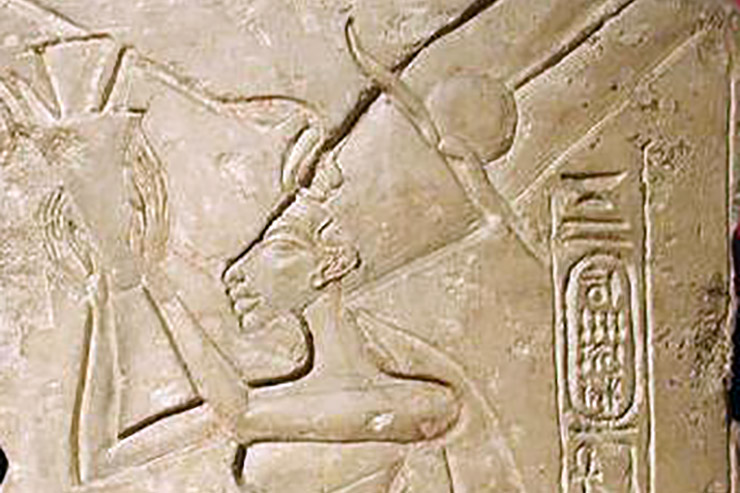
    Furthermore, carved busts of the family members belonging to the Egyptian pharaoh Akhenaton of the eighteenth dynasty demonstrate the same anomalous feature, including equally huge ears. Found in the underground desert ruins of Tel el Amarna in Egypt, little known statues of this strange family, which included Nefertiti, Akhenaton’s wife, and their daughters, exhibit other unusual features, including great body height. The body of a statue of Nefertiti is described below:

    She’s not wearing clothes because they didn’t believe in that at the time. She has a huge head, large ears, a long, skinny neck and a high waist. She also has a kind of bulging tummy. And… she has skinny legs and wide thighs.9

    This in fact is an equally good description of her husband’s famously strange appearance. The carved or painted likenesses of Nefertiti’s daughters, down to the youngest, a mere toddler, show exactly the same peculiar characteristics of enormous hairless skulls, high waists, skinny calves and huge ears.

    Could this Egyptian royal family, then, have been a throwback to the ancestral offspring of the Elders? And more pertinently, could its anomalous physical features support the idea of an intellectually advanced race alien to ours, either from another stellar system or a previous racial cycle?

    These Elders, also known as the beni ha-elohim, the Sons of God or Sons of the Fire Mist whom the Sumerians claimed had brought civilisation to humanity, are a perennial mystery. G.I. Gurdjieff regarded them as palaeolithic shaman adepts, men and women who in the remote past practised their mysteries in the underground caves along the Syr Darya, in Central Asia, and whose evolution due to their superior spiritual practices put them far in advance of their fellows.10

    But occult tradition goes a great deal further, contending the Elders were a wise and powerful race that came from the stars – possibly, say some, from the giant star Sirius. In the ancient Egyptian tradition they are called the “Watchers of Pe,” divine Intelligences who watch over and guide humanity, their progeny, from celestial heights. Alternatively, could they have been, as the noted Theosophist G. de Purucker suggests, the left-over remnant of an earlier human race that had incarnated on Earth but had originally come from the Pleiades system, and which had ended its racial cycle perhaps millions of years ago?

    Until recently such questions about the Elders could not profitably be asked except in the context of a closed initiatory society. Even stranger, until recently the rest of the world was not even aware that such questions entailed proscribed temple material that had been forbidden to the outside world for thousands of years. As already mentioned in the first part of this article (see New Dawn No. 112, January-February 2009), René Guénon, one of the foremost esotericists of the late nineteenth and early twentieth centuries, struggled as far as he dared against this occult embargo, believing that the time was fast approaching when humanity would be in need of a higher level of anthropological, cosmological and metaphysical understanding than was possible in his day.

    “This study,” he wrote, concerning the advanced Elder race that, according to Theosophical lore, had migrated from the Arctic zone to Central Asia many hundreds of thousands or perhaps millions of years ago, “has gone deeper than any preceding it, inviting reproach, perhaps, from some. We do, however, believe we have not said too much, nor anything that should not be disclosed…”11 Yet much knowledge regarded as too arcane or too dangerous for the profane populace would, Guénon was convinced, soon have to be released into the public domain. And it would seem he was right.

    A new order is dawning in this post-millennial era in which a great deal of the once proscribed sacred knowledge is being made available to all. Among many of yesterday’s underground secrets now freely emerging into the light of day are the secrets of human evolution and its tandem relationship to the evolution of earth and cosmos. These secrets have a direct relevance to the mysterious Elders, gods whom they suggest are actually human beings and members of a fifth kingdom in Nature.

    Thus the removal of the occult embargo, allied to an explosion of new scientific discoveries and hypotheses, is making it possible to approach the subject in an entirely new way.
    [alert type=”info” dismiss=”no”]If you appreciate this article, please consider a subscription to New Dawn magazine.[/alert]

    The Fifth Kingdom

    The medieval classification of Nature into four universal kingdoms, mineral, vegetable, animal and human, has been rendered obsolete by modern science, which has inductively evolved its own hierarchical system of subatomic particles, atoms and molecules before the mineral, and combined the animal and human in one category. Nevertheless, the old system of four kingdoms, based on an intuitive deductive vision of the truth and seen as an example of the Perennial Philosophy, is still entrenched in most of the Western esoteric schools that have emerged since medieval times: Theosophy, Anthroposophy, Rosicrucianism, modern Sufism, various New Age channellings, the Sri Aurobindo school and others.

    Four-kingdom proponents from these schools see the progression in Nature as a succession from inert mineral to the plant, that is alive but not apparently conscious, to the animal that has a limited reasoning power but is not self-aware, and to the human being who alone has self-awareness and conscious free will. To these four definitive classifications a fifth is occasionally added by medieval philosophers under variously named, rather obscure and even misleading headings; but whatever the designation, in esoteric circles any natural classification beyond the fourth is either nonexistent or only vaguely delineated, lacking the emphasis or clarity it requires.

    The ancient Egyptians made the matter a great deal clearer. They understood the goal of human evolution to be a transition or resurrection into a higher state, a higher natural kingdom, and illustrated the transition with admirable precision on the ceilings of certain very old tombs.12 In their depiction of the neters or gods undergoing spiritual resurrection, they show a row of animal-headed human figures marching along a horizontal base line, a red oval – the “egg of metamorphosis” – above each head, until suddenly the base line turns by 90 degrees to the vertical and one figure swings into ascension along it. Achieving what may be a rapid biological change into a new life form, he transforms into the royal fifth kingdom. Armed with what appears to be the staff of spiritual authority and lacking the oval over his head, which has presumably been absorbed into his being, he has metamorphosed into a king.13 In other words, from being a collective being of a lower order, he has become a royal singularity, a ruler of all kingdoms lower than the fifth.

    Ancient petroglyphs of sun-headed men found in various parts of the world, but especially in Central Asia, tell the same story.

    Because of the occult secrecy that has enshrouded the subject of the fifth kingdom over the past 2,000 years at least, we have failed to understand its crucial significance as our true evolutionary goal and our key to all those questions we have never been able to answer. The inclusion of a fifth kingdom in the natural order turns the fourth kingdom that we humans presently inhabit into a mere corridor of becoming, a transitional episode in which we are driven forward in a process of transformation from the animal state behind us to that of the true human ahead, as indeed Gautama Buddha recognised. Life, human life, he said, is never-ending change and the suffering of change – and indeed it is viewed as a journey of relentless development of intelligence and consciousness into the truly human kingdom, the fifth, wherein alone lies repose well earned.

    The idea of a potential fifth kingdom, a state of spiritual felicity and repose we may hope to enjoy some time in the future, is not new to us. But what the ancient mystery temples through to modern esoteric teachers like Guénon have been reluctant to disclose is that the fifth kingdom is not a future potential but a presently existing reality, a supremely enlightened human state coexisting with our own. Like the other four kingdoms of nature, it has extended and always will extend back into the illimitable past and forward into an equally illimitable future, with its own archetypal place in the cosmos.

    Indeed, it is esoterically acknowledged that beyond the fifth kingdom others also exist. Gordon speaks of the fourth, fifth, sixth and even the seventh kingdom of our planetary Nature. “All of these kingdoms exist together (even if we are unaware of the fact),” he says, “and all of them together comprise the evolving nature of Man. Hence humankind is but one partial expression of Man in general.”14 Given such a perspective, many possibilities open up that were not previously viable in our worldview.

    According to this perspective, the Elders of Akkadian-Sumerian legend and the gods of the Babylonians and the Assyrians were the higher-level final flowering of a previous human cycle many millions of years old, their privilege being to guide the evolution of the next cycle – our own. Freed by their advanced development from the limiting conditions of transitional fourth-level humanity, the universe was open to them, for fifth-kingdom space-time is said to possess multiple dimensions incomprehensible and inaccessible to the lower kingdoms. These so-called gods could travel between the stars on supramundane energy currents unknown to us, incarnating on other stellar bodies or on planet Earth as the need arose, and withdrawing as they chose into dimensions invisible to their charges on Earth.

    In the above scenario, not only is our past implicated in this new perspective; our future is equally involved. As we ascend with increasing rapidity into higher states of consciousness and hence into proximity with the fifth kingdom, we are finding the Elders in their various otherworld guises descending to meet us. As a part of the great human order, they are our future as well as our past. We shall find in fact that humanity is at home everywhere in the universe and its life has no beginning and no ending; it is co-eternal with the cosmos.

    Therefore, perhaps, it is time we gathered together all our ideas of aliens, extraterrestrials, Sirian cosmonauts and angelic visitors and categorise them all as members of our own human species who, along with their advanced technologies, have arrived in the fifth kingdom before us – our own kin already established in majesty and power; already, like the Egyptian priest-kings of old, free to traverse the cosmic pathways at will as the Sons of God – the lords of the universe.

    According to the Solar teachings of the ancient Pillar religion, the royal road to the fifth kingdom lies in an ascension up the World Tree, through its successive gateways, to the starry heavens. Kingly authority and the power to rule wisely rests on the royal initiate’s ability to ascend the axis mundi or World Tree to the divine centre of creation at the zenith of the heavens. There, and only there, he will find deification; there he will be able to access the heavenly powers from which all impulses of rulership, creativity and wisdom emanate; there he will find the freedom of the spiritual world.

    This idea of returning home to the stars is implicit in all the tribal totem systems found in early shamanic societies around the world, but was more fully realised in its religious form when the idea of kingship – of hierarchical rule from above – seized neolithic societies at the end of the last Ice Age. John Major Jenkins, a leading researcher of ancient cosmology, says:

    Sacred knowledge is won or achieved by undertaking visionary journeys up the World Axis to the cosmic centre. A ruler, having thus become fused with the divine source and emanating power of life and wisdom, constellates the beings and objects of lesser degrees.15

    Such a monarch stands as far more than an exemplary figurehead or an administrative symbol at the heart of his kingdom; he has become, by virtue of his conquest of the World Tree, a way-shower into a new order of being for the whole of his society. In the same way, so Jenkins believes, at certain critical junctures of the Earth’s history, this odyssey of transformation up the cosmic Pillar to the divine Centre at the zenith is possible for the race as a whole, which thereby advances further towards its next evolutionary goal – the supernal kingdom, the fifth.

    Revisiting the Pillar Religion

    The secret teachings of the very earliest sages of which we have cognisance claimed that all life, all wisdom and creative power is transmitted to the earth plane via a spiritual energy flowing down from the highest Source, and that it is by reascending the sacred current, symbolised as a Pillar or a World Tree connecting earth to heaven, that humanity comes to its most sublime perfection.

    A traditional symbol of this occult energy stream has been retained in the Qabalistic Tree of Life defined astrologically.The well-known British author Trevor Ravenscroft likens the Tree of Life to “the Yggdrasil tree of Norse mythology, the world-Ash which binds together heaven, earth and hell.” The crown of the tree, he says, “comprises the twelve constellations of the Zodiac, the spiralling branches symbolise the planets and the roots of the trunk dig deeply into the elements of the earth.”16 The Tree is thus a metaphor for the archetypal processes of the cosmos that are believed to underlie all evolutionary activity.

    From the earliest times, the World Tree was central to the shamanism of the nomadic tribes of the Central Asian steppes, as it was to the later Solar religion of the settled Aryan communities of that region. Indeed, if we are to believe Plato, in the days before the Great Flood and the sinking of Atlantis, the World Tree featured also in the primeval Atlantean religion with its monarchic system, its warlike bull cult and its concentric city planning; and according to Blavatsky, it was this Solar system that was eventually transplanted by great migrations into Central Asia.

    From west to east and from north to south, then, the Pillar religion in its various guises appears to have reigned universally as the earth’s primordial belief-system, the destiny of man being seen as the ultimate return of his soul via the World Tree to the power-realms of the stars.

    Where then on the planet is this World Tree that the Hebrews called Jacob’s Ladder? Although it would be natural to assume it is synonymous with the earth’s north-south axis of rotation, such is not the case. According to Guénon, there have been several successive locations of the World Axis on the surface of the globe that distinguish it from either the north-south axis of rotation or the magnetic axis. Opening up the secret metaphysical tradition, he asserts that basically nothing less than a new model of the world is needed if we are to understand the true nature of the World Axis.

    The esoteric reality, expressed long ago in the Pillar teachings, is that the earth incorporates a principle that connects it at all times to a greater spiritual world in the same way that a mirrored reflection is intrinsically connected to the reality. By virtue of this fact, the earth is multi-dimensional in structure – as indeed the physicist David Bohm has proposed in his theory of an implicate universal order lying behind the explicate physical order as its energetic template – and this radically modifies everything we can say about the planet, in the way we measure and describe it.

    The Pillar religion projected a worldview very different from our own. The planet was regarded as a living organism with its own hierarchy of elemental intelligences, plus a hierarchy of solar intelligences or devas, at work in the manifold organisation and running of the whole, and which we call today the work of Nature. The World Tree, in India known as Mt. Meru, was believed to be at the very heart of this great dynamic complex, a channel of evolutionary energy running through the centre of the planet, a path of psychospiritual transformation of the same order as the seven-fold spinal path of consciousness running through the human body.

    In fact, the name Meru is connected to the Sanskrit word merudanda, meaning a backbone, and hence the World Tree can be further qualified as the backbone of the planet, a chakric system analogous to that of the human spinal system, with seven or nine nodes of increasing psychospiritual awareness culminating in the Cosmic Centre at the summit. These nodes were clairvoyantly perceived as a succession of gateways up the trunk of the Tree leading into higher planes of existence, and the final entrance to the Cosmic Centre was therefore called the North Gate.

    Guénon’s Neoplatonic thesis contains the concept of a universal ether, renamed “the quantum fluid” by modern science, and states that behind the physical body of the earth lies its spiritual template, a permanent prephysical or etheric web of forces delineating the planetary structure in its essential form. In this inner light body – or, as Vedic cosmology calls it, the vajra body – is located the World Axis, the etheric source and intelligent regulator of all the energies of the planet. At the beginning of each great temporal cycle – and by that Guénon means at the very least one round of the Zodiac, one Sidereal Year of 25,920 years – the two bodies are in virtually perfect alignment, but as the cycle proceeds a separation occurs and the physical body falls increasingly out of alignment with its spiritual template.

    This non-alignment or tilting away of the planetary body from its inner template is the result of their differentiation from each other, which has the effect of creating all the earthly stresses and vicissitudes of time and change that we know so well, yet is the necessary precondition for evolutionary growth. From this circumstance comes all the suffering of becoming, all the so-called evils of our earthly existence.

    In such a spiritual cosmology the universe is the expression of a great Intelligence within which are the unchanging ideas or templates of form, the whole being in a state of ideal harmony and order. But although the spiritual world of pure Being is changeless, the natural state of its reflection, holographically projected onto a lower plane and thus an object of differentiation, is to become off-centre in relation to it and therefore in perpetual compensatory motion. This is the biblical “fall” of mankind without which there would be no evolutionary process. With the separating out of the physical plane, motion is created and the suffering of change begins; for the process of increasing differentiation of the physical body from its spiritual background inflicts on the planet and all its life-forms a local disturbance, the angst of movement, of disequilibrium, of continual adjustment to new conditions and new evolutionary demands – but also to the possibility of attaining a greater state of being.

    We can sum up this occult cosmology thus: At the beginning of the great precessional cycles, the north-south axis and the magnetic axis are in virtually perfect alignment with the World Axis and with each other. All three stand at that time apparently united at true North, so that the supreme spiritual centre is in a literally polar location; but as the cycles proceed, the poles fall progressively out of alignment with the World Axis and terrestrial changes develop. Today this mysterious noumenon known variously as the Sampo, the axis mundi and the Tree of Life has apparently shifted southward. Clairvoyantly visible, it has its locale in the Inner Asian region delineated by the Tarim Basin and its surrounding ring of great mountain ranges.

    Within the boundaries of this vast mountain encirclement, the World Axis is believed to have varied its location from time to time. But wherever it is found, it always remains functionally polar; it is always the central origin point – or as ancient peoples called it, the omphalos of the planet, the place of the first creation – from whence grand waves of acculturation have periodically issued.

    In Galactic Alignment Jenkins presents a similar cosmological picture. He calls the World Axis the evolutionary axis, by implication a third terrestrial axis presently unknown to science. Psychically accessible, this great current of psychospiritual conscious energy that runs through the centre of the earth is thought today to emerge somewhere north of Kashmir, soaring high into interstellar space above the Pamirs.17 It is in that vicinity, at the foot of the World Tree, that the peoples of Central Asia have traditionally located the hidden kingdom of the Elders known as Shambhala, an initiatory centre accessible on both a physical, an etheric and an astral plane.

    The North Gate, Jenkins contends, can be viewed as analogous at a cosmic level to the pineal gland in the human system, which is the most interior and creative centre in man and “the point from which spiritual gifts are given.”18 He sees the Cosmic Centre at the head of the World Axis as fulfilling the same function in a planetary context. However, while René Guénon has postulated a major polar-to-solar shift of the Cosmic Centre in man’s worship at some remote time in antiquity, Jenkins has argued that this shift would be better understood as a polar-to-galactic one.

    Thousands of years ago, he says, priest-astronomers realised that approximately every 6,450 years the North Gate was aligned with the galactic centre, and that such times offered a priceless evolutionary opportunity for the whole race. It is an astronomical fact, says Jenkins,

    that alignments of the solstices and equinoxes with the plane of our Milky Way galaxy occur periodically over the 26,000-year precession cycle. Such alignments, in fact, occur every 6,450 years. Joseph Campbell pointed out that knowledge of the precessional cycle is implied by the importance given the number 25,920 in Hindu, Nordic and Babylonian doctrines.19

    Jenkins equates the spiritual evolution of humanity with this periodic alignment of the Earth with the galactic plane and the Galactic Centre. The idea that the latter stimulates consciousness on this planet is, he says, “an intriguing and profound concept” that finds echoes in Mayan, Vedic and Egyptian cosmology. Gordon too observes that the earth is subject to celestial seasons of about 6,480 years, “which have a dramatic effect upon both the climate… and also upon the many and varied cultures and civilisations which exist at the time.”20

    The Tree is thus regarded as a planetary chakric system analogous to that of the individual tantrica in the practice of kundalini yoga. Even as the yogic consciousness ascends the spinal system, so activating a sequence of seven hierarchically ordered chakras or psychospiritual energy vortices which alter in subtle ways the entire spectrum of consciousness, so the ascension of the racial soul up the World Tree at certain precessional intervals of c.6,450 (or c.6,480) years corresponds with the opening up of a succession of celestial gateways for humanity as a whole.

    At each open gateway the flooding down of divine creative energies precipitates certain psychological and cultural modifications in society; the human body typology changes; new deities, new mores appear; the material technology advances or changes its base, a new world-civilisation is launched founded on newly imperative truths. It is a moment of supreme evolutionary importance, a collective initiation perhaps best conveyed by the teachings of the Mithraic mystery religion.

    This important Greco-Roman cult flourished until the fourth century CE, when it was extinguished by Christianity. Seven planetary spheres were opened up to the seeker through the seven grades of Mithraic initiation, allowing him ultimately to ascend to the highest, the Father (Saturn). However, beyond the seventh level was a secret teaching revealing an eighth and ninth level or “house” where the Hypercosmic Sun was located. This hypercosmic luminary, this “Star of Stars” as the first century philosopher Philo Judaeus of Alexandria called it, was identified with the Galactic Centre, to which access was gained only through the eighth and ninth celestial “doorway” above that of Saturn.21 This secret means of escape from Earth’s gravity into the freedom of the Universe has been closely guarded by occult tradition and is still not fully unveiled.

    The doctrine of the Hypercosmic Sun, according to Jenkins, is “fundamentally about the soul’s passage through the galactic gateways that open during eras of galactic alignment,” when the divine light of the Milky Way Centre pours down through the opened valves of the World Axis and irradiates the earth and all its inhabitants for a certain interval of time. It is in that critical interval that the great evolutionary mutations take place, civilisations are overthrown and reinstated in radically new forms and the potential exists for the fifth kingdom to be realised by at least some members of fourth-kingdom humanity.

    Jenkins is only one of countless observers who believe such a historic time has once again come around. Indeed, by now millions of people are watching and waiting for the end-of-the-world Mayan date of 2012 CE, believing it to be the beginning of a new World Age… a further stage in the journey towards the fifth kingdom.

    Eurasia Awakes

    In February of 1962 astrological pundits announced a major planetary conjunction that occurs only once in every c.6,500 (or 6,480) years – the previous one therefore having taken place in c.4500 BCE, and the one before that in c.11000 BCE, both of which occasions were prophetic of great earth changes.22 I remember well the report in the media, because immediately a cry of distress and foreboding went up right across India; for it was known by most Hindu astrologers that this rare stellar event, occurring only four times in the precessional cycle of 26,000 years, does indeed foreshadow great floods and catastrophic climatic changes.

    In response, the dawning New Age movement of the time predicted the return of the Elder race, the possibility of a pole shift, the birth of a new race of clairvoyants. To esotericists generally the conjunction signified a new World Age and an impending psychospiritual initiation of collective humanity, with all the social and ideological turmoil such an event implied. And confirming John Major Jenkins’ later theory to the hilt, the conjunction was seen by some star-gazers as the first sign of a coming revolution in geopolitical world affairs, with the rise of Asia and the decline of the western Anglo-American hegemony.

    At the time all these predictions were regarded as amazing and pretty farfetched. But nearly fifty years on, the events presaged in 1962 are now crystallising as post-millennial realities. Ominously, the ice caps and glaciers are melting, the seas rising, earth’s resources shrinking; the Anglo-American world order, built on predatory economic corporations, is unravelling, Asiatic power inexorably rising. A transformation in human consciousness is well underway; and there is increasing evidence that the vast natural, socio-political and consciousness changes we are seeing are now irreversible, for good or ill.

    Perhaps the most significant sign of the times is to be found in the growing vision of a unified Eurasia among the major Asian nations such as China, Mongolia, India, Iran (and also Brazil), as well as Kazakhstan and many other of the Central Asian Muslim states. Included in this growing Eastern bloc is Russia which, since the collapse of the Soviet regime, is increasingly turning away from Western Europe and towards Asia in its quest for identity. Geographically the largest nation on the earth, it extends right across northern Asia from Eastern Europe to the Bering Sea.

    Russia is rediscovering its Slavic roots; and especially since the discovery of Arkaim and the Land of Cities in the southern Urals, it is also exploring its Aryan past and its more recent connections to the Mongol Empire of Genghis Khan, who subjugated the whole of the Eurasian corridor as far as eastern Europe in the thirteenth century. Indeed, for many of Russia’s intellectuals the universal tolerance and freedom from dogma of the ancient Pillar religion of the Mongol/Turkic peoples has great valence and is displacing Christianity and Islam in the popular esteem. “Out of Russia,” says Alice Bailey, channelling the prophecies of her Tibetan guru, DK, “will emerge the new and magical religion about which I have so often told you.”23

    There have been a number of famous prophecies regarding Russia’s future pivotal role in world affairs generally, notably those of Rudolf Steiner and Edgar Cayce, as well as those of Gerard Encausse, the highly respected French occult master who went under the pseudonym of Papus (1865 – 1916). The author Mehmet Sabeheddin notes that “Papus knew of the key role to be played by Russia in unifying Eurasia and her occult destiny as the Empire of the End, the outward manifestation of the enigmatic power of ‘Northern Shambhala’.”24 Many others have seen Russia as destined to continue the work of Genghis Khan, who transformed the nomad tribal conglomerates of the Eurasian steppes into a unified and superbly organised political system that revolutionised international life for centuries to come.

    Across the steppes, where for countless centuries a melting pot of peoples, religions and empires from every quarter have traded and warred and sunk with their cities beneath the desert sands, a spirit of renaissance, of ecumenical reform, is undoubtedly taking hold. From the Far East to Moscow and from the Altai to Iran, a countervailing force, identifiable with the invisible spiritual powerhouse of Shambhala, is stirring throughout the region. Muslim, Buddhist, Zoroastrian, Christian, Jew, Taoist and shaman are finding common ground in a unitive vision of the future. Responding to the militaristic Anglo-American colonisation that has long dominated the Asian hemisphere, this new regional climate bodes well for the rebalancing of the globe’s spiritual, cultural and economic forces.

    The move to turn the tenuous Eurasian concept into a geopolitical reality composed of numerous independent but strongly affiliated nations committed to East-West amity must be regarded as a force for renewal, for the healing of the Atlantean/Hyperborean rupture that long ago shattered the primal unity of the life of the planet. The present thrust seeks instead to recapture the unity of the ancient Arctic accord and to set forth new terms for a viable future for humankind.

    What is truly remarkable is that we are witnessing all this happening in Central Asia at the very time of great astrological significance, when the stars again portend extreme danger and extreme opportunity for the life of Earth. Are we then seeing once again a mysterious intervention from the East, a salvific influence arising in the heart of Asia that seeks to sow the seeds of a new global order and a new type of civilisation in the face of apocalyptic geophysical change? Can the Elder race be coming to our aid yet again?
    [alert type=”general” dismiss=”no”]This article was published in New Dawn 113.[/alert]

    [alert type=”success” dismiss=”no”]If you appreciate this article, please consider subscribing to help maintain this website.[/alert]

    Footnotes:

    1. J.S. Gordon, The Rise and Fall of Atlantis, and the Mysterious Origins of Human Civilization, Watkins Publishing, London, 2008, 131.

    2. Charles Hapgood, Maps of the Ancient Sea Kings, Turnstone Press, London, 1979.

    3. Gordon, op. cit., 131.

    4. Ibid., 159.

    5. William Fix, Lake of Memory Rising, Council Oaks Books, LLC, San Francisco, 2000, 203.

    6. H.P. Blavatsky, The Secret Doctrine, Vol. 2., Theosophical Publishing House, Los Angeles, 1947, 324.

    7. Drunvalo Melchizedek, The Ancient Secret of the Flower of Life, Light Technology Publishing House, Flagstaff, AZ, 1990 – 8, 143.

    8. Ibid., 143.

    9. Ibid., 139.

    10. J.G. Bennett, Gurdjieff: Making a New World, Turnstone Books, London, 1976.

    11. René Guénon, The Lord of the World, Coombe Springs Press, U.K., 1983, 66.

    12. Melchizedek, op. cit., 43.

    13. Ibid., 43.

    14. J.S. Gordon, op. cit., 85.

    15. John Major Jenkins, Galactic Alignment, Bear & Co., Rochester, Vermont, 2002, 150.

    16. Trevor Ravenscroft & T. Wallace-Murphy, The Mark of the Beast, Vol. 3, Sphere Books, U.K., 1990, 67.

    17. Victoria LePage, Shambhala, Quest Books, Illinois, 1996, 180.

    18. Jenkins, op. cit., 140, citing Valentinia Straiton, The Celestial Ship of the North, 1927.

    19. Ibid., 42.

    20. J.S. Gordon, op. cit., 130.

    21. Jenkins, op. cit., 107.

    22. Sky and Telescope Magazine, December 1961, 320. On February 5, 1962, Mercury, Venus, Mars, Jupiter and Saturn were all within 13 degrees of the eclipsed Sun.

    23. Cited by Mehmet Sabeheddin, The Secret of Eurasia: The Key to Hidden History and World Events, New Dawn No. 68 (September-October 2001).

    24. Ibid. 

    © New Dawn Magazine and the respective author.
    For our reproduction notice, click here.