New Dawn – World's Most Unusual Magazine

Tag: Blavatsky

  • The Inscrutable Madame Blavatsky: An Interview with Gary Lachman

    The Inscrutable Madame Blavatsky: An Interview with Gary Lachman

    This article was published in New Dawn 137 (Mar-Apr 2013)

    I was in search of the unknown…
    – Madame H.P. Blavatsky (1831-1890)

    Gary Lachman is one of today’s most intelligent and prolific authors on the world of the occult. He started out in the 1970s in the New York rock scene as one of the original members of the groundbreaking New Wave band Blondie. In 1996 he moved to London, where he established himself as a full-time writer, contributing to publications such as Fortean Times, The Guardian, and The Times Literary Supplement.

    Since 2001 he has produced a steady stream of books, including Turn Off Your Mind: The Mystic Sixties and the Dark Side of the Age of Aquarius; The Secret History of Consciousness; A Dark Muse: A History of the Occult; and Politics and the Occult: The Right, the Left, and the Radically Unseen. In recent years he has published biographies of major esoteric figures including P.D. Ouspensky, Emanuel Swedenborg, Rudolf Steiner, and Carl Jung.

    I first came to know Gary in the ’90s, when he was a frequent contributor to the now-defunct Gnosis magazine, for which I was editor. Although we’ve been in constant touch over the years, the last time I saw him in person was in 2006, when he was in New York to be inducted into the Rock and Roll Hall of Fame as part of Blondie. We had a long conversation over lunch that led to his book Politics and the Occult. In 2012 Gary published Madame Blavatsky: The Mother of Modern Spirituality, a biography of the pioneering nineteenth-century spiritual figure H.P. Blavatsky (also known as HPB). In January 2013 I conducted an e-mail interview with him about the book and about Blavatsky.

    RICHARD SMOLEY (RS): To begin with, could you say a little bit about who H.P. Blavatsky was for those who aren’t familiar with her?

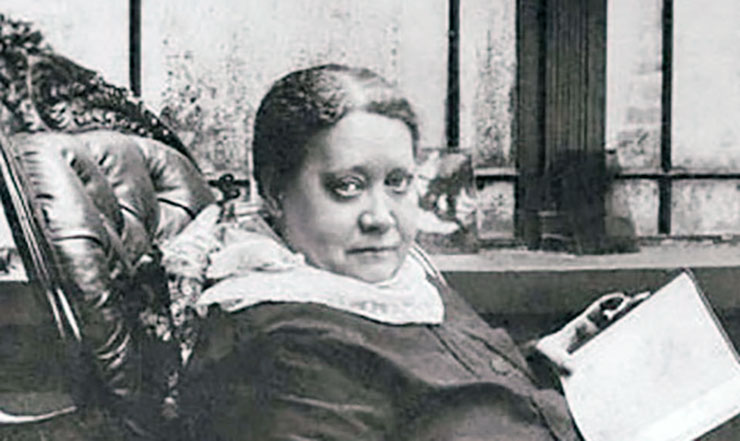
    GARY LACHMAN (GL): Helena Petrovna von Hahn was born in 1831 into a family of the lower Russian nobility. Around her eighteenth year, she fled a brief and unconsummated marriage to an older man, Nikifor Blavatsky, and embarked on what by all accounts was a twenty-odd-year-long global quest for secret knowledge, triggered by her reading of her great-grandfather’s occult library and her own mystical experiences. During this time, she said, she met her Master Morya in London, who charged her with a mission: to reach Tibet, where she would be tutored in the control of her psychic abilities. She surfaced in New York City in 1873, where she lived in a woman’s cooperative on the Lower East Side. A meeting with Colonel Henry Steel Olcott led to a lifelong Platonic relationship, and in 1875, she, Olcott, and William Quan Judge founded the Theosophical Society. The rest is history.

    RS: What made you choose her as the subject of a biography?

    GL: I had already written studies of Ouspensky, Jung, Swedenborg, and Rudolf Steiner. As I argue in the book, HPB was a seminal influence on practically the whole of modern spirituality and esotericism. All of my work is centred on the idea of an evolution of consciousness, both in the individual and in culture at large. It seemed to make sense to take a new, fresh look at someone who kick-started a whole movement dedicated to this idea. Also, it struck me that much of what we think we know about HPB was really a myth, made up of hearsay and misperception, repeated for more than a century. I can’t say I’ve told the truth about Blavatsky, but I’ve tried to point out what others haven’t.

    RS: What influence does Blavatsky continue to have on the current spiritual scene?

    GL: Well, the Theosophical Society, in its many different forms, continues today. Much of what we think of as New Age really has its roots in Blavatsky’s early work. Tibetan and Mahayana Buddhism, as we understand it in the West, for example, emerged from her and her early followers. W.Y. Evans-Wentz, who collected the funerary texts we know as The Tibetan Book of the Dead, was a Theosophist, and much of his work is informed by Theosophical ideas. Also, our contemporary interfaith and multifaith sensibilities, our striving toward a broad religious tolerance, has its roots in Blavatsky’s belief that all the major religions have their source in an ancient, ‘secret’ doctrine. She was very much ahead of her time.

    RS: There is a broad spectrum of opinion about Blavatsky. On one end there are those who regard her as a fraud pure and simple. On the other end are those who see her as a much-maligned saint. Where would you place yourself on this continuum?

    GL: Well, I don’t see her as a fraud or as a saint, so I guess I am in the middle, or rather, perhaps ‘above’ this either/or opposition. In the book I refer to a concept I borrow from the novelist Hermann Hesse. In an essay on Dostoyevsky, Hesse speaks of what he calls ‘Russian Man’, who is an antinomian character, “an hysteric, drunkard, criminal, poet and saint, all wrapped up in one.” Think of Rasputin, the ‘holy devil’. HPB was what we call a ‘trickster’, although that is something of a cliché. She wasn’t above mystical high jinks when she felt it was necessary – or when she got exasperated with the sanctimonious devotees who often wasted her time. But she was also a deeply spiritual, I would even say religious, moral character; I liken her to the Russian startzi – deeply spiritual individuals who gave off a kind of spiritual electricity. But she didn’t wear this on her sleeve.

    RS: After having done so much research on Blavatsky, do you personally believe that her alleged occult powers were genuine?

    GL: I keep an open mind about her powers. For one thing, I’ve had enough anomalous experiences to accept that the standard ‘scientific’ view of reality simply doesn’t cover all the bases, things like precognitive dreams, telepathy, and very convincing synchronicities. Of course, some of the things claimed about HPB – materialising teacups and other items – do seem impossible. But I point out in the book other examples of similar abilities. I look at a few of the most well known examples, and, given what we know about them – and we can only go by the accounts that have come down to us – I try to see how she could have faked them – if she did. Of course, because I can’t see how she could have faked the teacup or some other ‘materialisation’, doesn’t mean she couldn’t have. But I did rack my brain quite a bit about it, and I think I covered every possible angle. So my take is that, yes, they are incredible, but perhaps not impossible. I mean, look at what science tells us about dark matter, dark force, super strings, and n-dimensions. That seems pretty incredible too. Were her ‘phenomena’ important? That’s a different question.

    RS: Blavatsky made much of her connection with the hidden Masters Morya and Koot Hoomi, as well as other Masters. Some take these to be actual men endowed with superhuman capacities who guided her in her path and in the creation of the Theosophical Society. Others say they are figments of her imagination. What’s your own position on this issue?

    GL: Blavatsky’s Masters seem to me to be composed of several different things. There was the ‘mysterious Hindu of my dreams’ that came to her in her earlier life, and more than once saved her life – at least that was the story she told in her later years. Then there was the idea of ‘unknown superiors’, high-ranking individuals in the Rosicrucian Freemasonry her great-grandfather practised. Reading of these mysterious powerful but ‘hidden’ men, Blavatsky became committed to finding them and to realising the vision of a progressive, united Europe they championed. The Theosophical Society was her way of trying to make their goal of a universal fraternity come true. Then there were the actual men and women she encountered in her quest for knowledge; people like herself who were pursuing a similar quest. She considered many of these ‘Masters’ – a title of respect and gratitude. But of course the most significant Masters were Morya and Koot Hoomi, flesh-and-blood men who had mastered their own psychic powers and who taught her how to master her own. Whether they had the powers she claimed is still up for debate, but I believe they did exist. HPB lived out a myth and she saw these people as embodiments of the inner guides she believed were helping her on her path. So the Master she knew from her childhood dreams and the Master she met in London in 1851 may not have been the same actual person, but for her we can say that they fulfilled the same role.

    RS: In your book you allude to unseen hands that work behind the scenes of history. Do you think there are such forces, and if so, how did they use Blavatsky?

    GL: I’m not sure about the ‘hidden hand’ version of history – and the phrase ‘hidden hand’ comes from the esoteric scholar Joscelyn Godwin. That idea is a kind of staple of occult history, and also of our contemporary conspiracy consciousness. In one sense I’m not partial to it – I think we need to solve our problems ourselves, rather than expect a saviour, either some ‘inner circle’ of humanity or benevolent aliens or extradimensional beings or Mayan calendars, to do it for us. But on the other hand, given the dominance of the ‘rational’ view that history is meaningless, or, at best, the result of purely material forces, I think the idea of something at work ‘behind the scenes’ can be positive. At least it posits some meaning or intelligence at work. But the notion of some cabal of advanced individuals, holed up in the Himalayan fastness – or at the centre of the earth, or in the Arctic – does seem a bit de trop. I tend to see the idea as a metaphor for the evolutionary urge. But then perhaps there are angelic beings who drop us hints from time to time.

    RS: Could you tell us a bit about Blavatsky’s major works, Isis Unveiled and The Secret Doctrine?

    GL: In the book I say that I am more partial to Isis Unveiled than to The Secret Doctrine. One reason is that Isis Unveiled is often overlooked compared to her other major work. I think it is a remarkable achievement. It is one of the first occult compendiums, a fascinating, if often exhausting, collection of what esoteric and occult literature and philosophy was available at the time. It is the source of so much of what we see as ‘alternative’ literature today. In a way it is like Charles Fort’s books, only much better-written and containing more cogent argument. Basically, with Isis Unveiled Blavatsky tried to resurrect the Hermetic wisdom, which had been in eclipse since the 1600s. If nothing else she deserves credit for formulating the first philosophical – not religious – criticism of Darwinian evolution in it; credit for this is usually given to Samuel Butler (author of Erewhon), who wrote a remarkable series of books attacking Darwin in the 1870s and ’80s. Unfortunately these are forgotten today, but their arguments are still quite pertinent. (Someone should send copies to Richard Dawkins.) But Blavatsky got there ahead of Butler by a few months. She should be recognised in the history of ideas for this.

    The Secret Doctrine is a kind of bible of esoteric and occult thought. It presents a full scale esoteric history of humanity and the universe, and presents the occult wisdom that Blavatsky says she learned during her tutelage in Tibet. It has more of a ‘carved in stone’ character than Isis Unveiled and has given rise to numerous offshoots, some good, some not so good.

    RS: The Secret Doctrine presents an elaborate alternative history of human evolution, with references to things like Atlantis and Lemuria. What do you personally make of this history?

    GL: I found it most profitable to read HPB’s occult history as a gigantic sci-fi or fantasy epic, a modern mythology, something along the lines of, say, Olaf Stapledon’s ‘future histories’ Last and First Men and Starmaker. I felt the same about Rudolf Steiner’s similar readings of the akashic record. I also think, though, that while the details in both Steiner’s and Blavatsky’s readings of Atlantis and Lemuria and so on can seem frankly unbelievable, the general sense of an earlier form of consciousness they present has much of value. With most such spiritual visions – William Blake’s can fit in here, as can Jung’s as depicted in The Red Book – we have to sift through what is personal, what is simply the unconscious being creative, and what may be a symbolic presentation of our actual spiritual reality. At the same time, there is much cogent argument for the idea that civilisations existed well before what we considered the beginning of history. In fact, the ‘official’ accounts are regularly pushed further and further back. Will archaeology eventually prove HPB was absolutely right? I doubt it. But it may and probably will show that she was right in saying that we aren’t the first ones to spend time on our planet.

    RS: One criticism that is frequently levelled at Blavatsky was that she was a racist, and that her views on what she called the ‘Aryan root race’ inspired Nazism and similar ideologies. Where does the truth lie on this issue?

    GL: Basically, although some of HPB’s remarks about race break the cringe barrier and are unacceptable to us, she was no more racist than what the prevailing sensibilities of the time accepted. Sadly, her remarks about root and subraces in The Secret Doctrine inspired some proto-Nazi characters in Austria and Germany – if you can call what they did with her brief remarks ‘inspired’. We can’t hold her responsible for that, or for any other appropriation of her ideas by less tolerant characters. In a sense, HPB is in the same position Nietzsche was in when the Nazis appropriated some of his work – he was in no way racist, nor was he a war monger, but Nazi hacks presented him in this way. It wasn’t until serious scholars repaired his reputation that he was cleared of any Nazi taint. The same needs to be done for HPB, and if I’ve helped in this effort, I am glad. I saw no evidence of Blavatsky being personally racist, and indeed, she abandoned her white, European privilege to live with Hindus and Sinhalese during her time in India and Ceylon (Sri Lanka). She was more anti-European, even anti-white, we can say, given her remarks about the British Raj and the Christian missionary movement. Some have called her anti-Semitic, but what this really means is that she had little fondness for the Judeo-Christian religion. One forgets that her central mission was the founding of a universal fraternity, regardless of race, creed, sex, or colour. One also forgets that she had much more influence on Gandhi than she did on Hitler. Gandhi found his life’s work through his contact with Theosophy.

    RS: Could you say a little bit about the Theosophical Society and its place in twentieth- and twenty-first-century spiritual currents? What influence does it continue to have?

    GL: Well, I’m not a Theosophist and am not associated with any Theosophical group, so I can only speak of what I’m aware of peripherally, as it were. But the Theosophical Society in its different forms – there are quite a few different incarnations of it – is still alive and kicking. I know here in London the Theosophical Society is a centre for a wide-ranging series of talks, lectures, and other activities, all linked to the themes of spirituality, consciousness, and ‘lost knowledge’. There is quite a lively Theosophical presence on the Internet, with several different sites devoted to different aspects of Theosophy in general and Blavatsky in particular. My book itself seems to have stimulated some discussions. So I think it will continue to maintain an important place in the ‘alternative’ world. What I have found with practically all of the movements or groups associated with the people I’ve written about – Steiner, Swedenborg, Ouspensky, etc. – is that they are all looking for ways to reboot themselves, to attract a wider, younger audience, to make themselves more inclusive. I think this is also paralleled in the broader, outer world. I’ve been involved with some art events in Europe and England at major museums and galleries that have had spirituality at their centre, and Theosophy is a frequent element in these. In fact, I am supposed to be involved in a major retrospective of the work of the Swedish Theosophical painter Hilma af Klint in Stockholm later this year. I think in general the official world is starting to see what many of us have been aware of for years: that esotericism has had a much bigger influence on the modern world that we realise.

    RS: What are your own views of human evolution, particularly as it relates to the current era? What do you think is happening with the human race as a whole at this stage of the game?

    GL: As I say, pretty much all my work is focused on the idea of an evolution of consciousness. My view is informed by the work of people like Colin Wilson, Owen Barfield, Jean Gebser, and others; I write about it at length in my book A Secret History of Consciousness. In a general sense, I think we are seeing the beginning of the breakdown of the kind of scientific reductionism that has been the dominant mode of consciousness for the last four centuries. This doesn’t mean that a neon sign will rise up over the horizon announcing the start of a new age. It doesn’t work like that, and we shouldn’t look for signs of this change in the news. Changes in consciousness don’t necessarily mean immediate changes in society or the world. All work begins with the individual. But I do think that in the last century or so, more and more people have realised that science, or rather, scientism, is simply no help when it comes to the big questions, such as ‘What is this all about?’ Science is very good on know-how but useless on ‘know why’. The Higgs boson can’t tell me why I exist and what I am supposed to do now that I’m here. For a long time we went along with the notion that if science can’t answer these questions, then they are nonsense. But that doesn’t work any more. The main challenge is for us to understand how our own consciousness works, not try to explain it away, as much contemporary neuroscience and philosophy of mind have tried to do. Science can’t tell me the meaning of my life, and the established religions – which once were able to satisfy this need for meaning – seem no longer capable of it. I think the answer lies in ourselves, in our own minds. I think HPB would have agreed.

    Gary Lachman’s biography of the pioneering nineteenth-century spiritual figure H.P. Blavatsky is titled Madame Blavatsky: The Mother of Modern Spirituality (352 pages, Tarcher 2012). It’s available from all good bookstores. Gary Lachman’s website is www.garylachman.co.uk.
    [alert type=”general” dismiss=”no”]This article was published in New Dawn 137.[/alert]

    [alert type=”success” dismiss=”no”]If you appreciate this article, please consider subscribing to help maintain this website.[/alert]

    © New Dawn Magazine and the respective author.
    For our reproduction notice, click here.
  • Wise Men From the East: Is There a Secret Brotherhood of Masters Who Direct the Spiritual Progress of Humankind?

    Wise Men From the East: Is There a Secret Brotherhood of Masters Who Direct the Spiritual Progress of Humankind?

    From New Dawn 91 (Jul-Aug 2005)

    There is a strange and persistent legend that probably originates in the East. It proposes that in some hidden locations on the Earth (generally the highlands of Central Asia, particularly Tibet, although other sites, such as the Andes and even some mountains in the US, such as the Grand Tetons and Mt. Shasta, are mentioned at times), there exists a group of persons who possess both exceptional powers and a highly perfected character and consciousness. They are known variously as the Hierarchy of Adepts, the Great White Lodge, the Great White Brotherhood, the Masters, or simply the Hierarchy.

    While most sources emphasise the Eastern (particularly Indian and Tibetan) nationality of these persons, Western embodiments of the legend are not unknown. Some have suggested that portions of this legend travelled westward during the Crusades or even earlier and that their sources are thus primarily to be found in secret and semisecret Islamic traditions.

    Beginning with the publication of the mysterious Rosicrucian document Fama Fraternitatis in 1614, the existence of certain “unknown superiors” or “Brothers of the Rosy Cross” who live and work in secret and yet direct much of the spiritual destiny of the world became a part of the beliefs of many Western esotericists.

    To these transmissions may be added diverse strands of legends connected with Arabian poetry, wise men wandering among the troubadours, the fabled kingdom of an adept priest-king named Prester John in Africa, alchemical masters of an elusive and potent aspect led by Elias Artista, as well as the Templars and the esoteric Freemasons. By the 19th century, the foundations for a major unfolding of the adeptic myth were laid. This unfolding took place by way of the Theosophical movement, without which the entire myth would probably have remained forever in obscurity.

    Blavatsky and Her Masters

    The position of current wisdom about the Masters is well-stated by one of the better popularisers of esoterica, Richard Cavendish, who calls it “a glamorous simplification of the tradition common to both East and West from time immemorial, of the searching spirit who asked: ‘Master, what shall I do to inherit eternal life?’”1

    This question, of biblical origin, is not without poignancy. As Jesus was regarded as a master of things relating to the life beyond earthly existence, so the Theosophical tradition of the last 130 years has looked to personages of superior insight and power to assist mortals in gaining consciousness of a greater life. Not only did it proclaim the existence and availability of such personages, but it also regarded them as the fount and origin of its teachings.

    In one of the very first academic treatises on the subject, published in 1930 in a series sponsored by Columbia University, Alvin Boyd Kuhn wrote:

    Theosophists tell us that before the launching of the latest “drive” to promulgate Theosophy in the world, the councils of the Great White Brotherhood of Adepts, or Mahatmas, long debated whether the times were ripe for the free propagation of the secret Gnosis; whether the modern world… could appreciate the secret knowledge, without the risk of serious misuse of high spiritual forces, which might be diverted into selfish channels. We are told that in these councils it was the majority opinion that broadcasting the Ancient Wisdom over the Occidental areas would be a veritable casting of pearls before swine; yet two of the Mahatmas settled the question by undertaking to assume the karmic debts of the move, to take the responsibility for all possible disturbances and ill effects.2

    These two Mahatmas eventually became known as Morya and Koot Hoomi (or Kut Humi), and their contact person par excellence was Helena Petrovna Blavatsky.

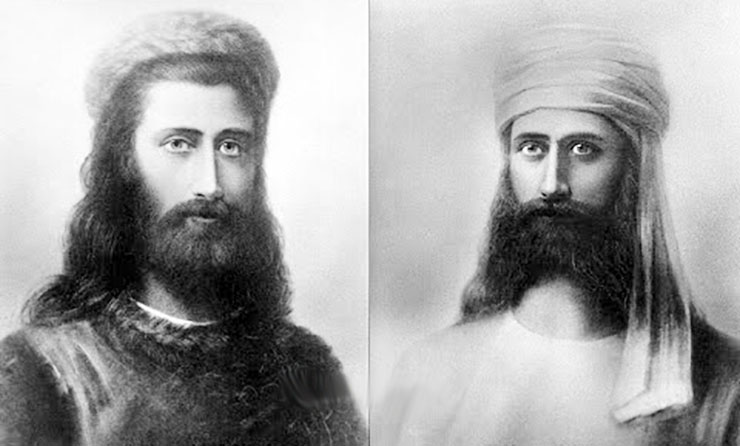
    Koot Hoomi (or Kut Humi), one of Mme. Blavatsky’s Masters, has been identified by the researcher K. Paul Johnson with a Sikh spiritual leader, Sirdar Thakar Singh Sadhanwalia.
    Koot Hoomi (or Kut Humi), one of Mme. Blavatsky’s Masters, has been identified by the researcher K. Paul Johnson with a Sikh spiritual leader, Sirdar Thakar Singh Sadhanwalia.

    The story of the colourful, controversial, erudite, and intuitive Mme. Blavatsky has been told many times, most recently and accurately by Sylvia Cranston.3 The issue of her involvement with her adeptic inspirers has also been thoroughly investigated by a most valiant researcher, K. Paul Johnson.4 Johnson’s work merits some comment here because in certain ways it represents a novel development of the treatment of the subject. It is Johnson’s thesis that the Adepts and Mahatmas of Blavatsky were all historical figures living in her lifetime, for whom she found suitable disguises in mysterious personae and a set of equally mysterious pseudonyms, under which they entered the mythos of Theosophy and of all modern occultism.

    According to Johnson, Morya was a Maharajah of Kashmir by the name of Ranbir Singh, while Koot Hoomi is identified with a Sikh spiritual leader, Sirdar Thakar Singh Sadhanwalia. Johnson also identifies other adeptic figures of Blavatsky’s, such as “the Chohan” (or Maha Chohan) and the “Master Djual Kul” (later publicised by Alice Bailey), with Sikh and Muslim gurus and leaders of the time.

    The Living Masters

    It is not without interest that Johnson should pick so many Sikh personages as the models for Blavatsky’s occult Masters. The variety of Indian spirituality that is most comparable to modern Theosophy is perhaps the Sant tradition, which some scholars regard as a close relative of Western Gnosticism. This tradition has been allied with the Sikhs since the time of Guru Nanak in the 16th century. Its latest embodiment, the Radhasoami movement, had just appeared on the scene in Blavatsky’s time in the person of Shiv Dayal Singh (1818-78), who was well-known in Indian religious circles and certainly came to the attention of the Theosophists.

    The Sant tradition has innumerable doctrinal similarities to Theosophy, including the teaching of the “living masters” who are the chief agents of the initiatory redemption of their followers.5 It is regrettable that in spite of recognising the Sikh connection, Johnson failed to trace it to the Sant tradition, where he might have found a far more valuable model for Blavatsky’s concept of the Masters. The subject is still in great need of exploration. We shall do so briefly here.

    Mahatma Morya, according to K. Paul Johnson, was a Maharajah of Kashmir by the name of Ranbir Singh.
    Mahatma Morya, according to K. Paul Johnson, was a Maharajah of Kashmir by the name of Ranbir Singh.

    For a Westerner the term “saint” denotes a person in whom the ordinary human virtues have been exercised to a heroic degree. The ancient Greeks may be credited with having first established a category of humans known as heroes, who stood between mortals and the immortal gods. The Sant tradition recognises persons of a similar kind. They are usually called sants (“saints” or “men of truth”) or satgurus (“true teachers”). Such persons have merged their own spiritual core with the Supreme Identity to the extent that they are no longer subject to any illusion or any sense of ego apart from the Divine.

    As one contemporary researcher says, “What we are confronted with in the [sat]guru is a classic hierophany: a profane object which manifests the sacred.”6 The satguru is an embodied being, a human, not a disembodied god or angel and for this reason is known as a “living master.” Neither is it sufficient in this tradition to follow a teacher who has died:

    According to the Sant tradition… one must follow a living guru. It is said that past Sants cannot take the soul back to God. This is due to two main reasons: (1) the original message of the Sants is believed to be misconstrued after the Sant passes away, while the teachings of a living Sant are pure and charged; and… devotion to one’s guru aids one’s spiritual progress; (2) it is believed to be easier to love someone alive and tangible than someone who has been dead for centuries.7

    Let us compare this with some statements concerning the Theosophical Mahatmas. According to Blavatsky,

    A Mahatma is a personage who, by special training and education, has evolved those higher faculties and has attained that spiritual knowledge, which ordinary humanity will acquire after passing through numberless series of reincarnations during the process of cosmic evolution… The real Mahatma is then not his physical body but that higher [mind] which is inseparably linked to the [spirit] and its vehicle.8

    We also have statements to this effect from what would appear to be the Mahatmas themselves. During Blavatsky’s residence in India after 1879, the Anglo-Indian journalist A.P. Sinnett became interested in her teachers. In 1880 he instituted a correspondence with Morya and Koot Hoomi. The replies to Sinnett’s letters have been preserved in the British Museum in London and have also been published in book form. In one of these letters, Koot Hoomi writes:

    An adept – the highest as the lowest – is one only during the exercise of his occult powers… Whenever these powers are needed, the sovereign will unlock the door to the inner man (the adept), who can emerge and act freely, but on condition that his jailer – the outer man – will be either completely or partially paralysed.9

    Allowing for certain differences in psychological orientation, such a statement could have readily come from a “living master” of the Sant tradition.

    Adepts Embodied and Disembodied

    These considerations leave little doubt that Blavatsky’s mysterious teachers were regarded as living human personages, albeit of a highly unusual order. At the same time it is also necessary to recognise that along with the mythos of the embodied Masters another mythos played an important part in the development of the idea of the adeptic Hierarchy. This was 19th century Spiritualism, a movement that attracted great numbers and much publicity in its day.

    Today Spiritualism is largely confined to the practice of attempting contacts with rather nondescript spirits. Professed Spiritualists are not very numerous and their social and intellectual standing is on the whole unremarkable. Yet another kind of Spiritualism has become much more prominent: the phenomenon of channelling. Here we primarily find attempts to disseminate occult information, often pertaining to humanity or the cosmos as a whole. Channellers in general do not have the personalistic preoccupations of Spiritualists, who often seem largely concerned with the exploits of their dead relatives in non-physical realms. Channellers’ utterances are frequently doctrinal, prophetic, even at times archetypal.

    It would be fair to say that Spiritualism has always possessed two sides, one personalistic and consequently shallow, the other revelatory and touching upon the numinous. The origins of the Theosophical adeptic myth are connected with the latter. At the time of the founding of the Theosophical Society in 1875, there was a spirit entity who made frequent appearances in Spiritualist gatherings in America and England and who identified himself as “John King.” Blavatsky seems to have thought quite highly of this entity and said he was in some way connected with her adeptic superiors.

    Although for some years she engaged in an uneasy cooperation with the Spiritualists and had been ordered to break with them by her superiors in 1875, her relationship with “John King” remained close. Eventually she identified him squarely as a messenger of the adepts who inspired her to found the Theosophical Society.10 It would seem that a disembodied spirit – and one who was, moreover, active in Spiritualist séances – could be an associate of the embodied adepts, who generally disapproved of the Spiritualists and their “spooks,” as Blavatsky called them.

    Another interesting episode inspired the launching of a major esoteric revival in French occult circles which still exists and has spread to several continents. Blavatsky had a friend living in France who was quite influential in the occult revival there. Her maiden name was Mary, Lady Caithness, and she was married to the Duc de Pomar. She resided in a large palace in Paris, complete with an ornate chapel in which occult activities were carried out.

    In the fall of 1889, a former Catholic seminarian, high-grade Freemason, and visionary poet named Jules Doinel was visited in this chapel by the spirit of the Cathar Bishop Guilhabert de Castres accompanied by the spirits of other medieval Cathars. The spirits, speaking through a seeress, commissioned Doinel to revive the Gnostic Church, of which he became the first Patriarch. Detailed instructions for the organisation of the Gnostic Church were given to Doinel at this time. This event marked the beginning of the Eglise Gnostique Universelle (Universal Gnostic Church, also known under other names), which became closely associated with the Martinist Order under Papus. The church has many branches in France, Haiti, and other countries.11

    Doinel’s founding of the modern Gnostic Church may be taken as an instance of a certain kind of adeptic inspiration, not entirely unlike that of Blavatsky, and possibly even known to her. Yet the messages here profess to come from disembodied beings who are of a different order from the entities encountered at most séances. As such they may be likened to some of the more valuable forms of contemporary channelling such as A Course in Miracles.

    The notion of spiritual guides who might or might not be associated with each other in some sort of mystical fraternity became widely accepted in many quarters. Even C.G. Jung, who was skeptical about many aspects of Theosophical and related teachings, was not immune to such ideas. In his Memories, Dreams, Reflections he wrote at great length about a mysterious “phantasy figure” whom he called Philemon and from whom he received much instruction. He also recounted a conversation he had with a “highly cultivated elderly Indian, a friend of Gandhi’s,” who, after informing Jung that his own guru was Shankaracharya, the long-deceased founder of Vedanta, went on to say, “Most people have living gurus. But there are always some who have a spirit for a teacher.” Jung said he was immediately reminded of Philemon.12

    A curious convergence between the Theosophical lore of embodied Masters and the channelling phenomenon occurred in 1972, when the British painter and medium Benjamin Crème, greatly influenced by Alice Bailey’s modified version of the Theosophical hierarchy of the Masters, began to channel messages stating that the appearance of the Lord Maitreya was imminent. (Maitreya, who is regarded in Buddhism as the coming Buddha, has been incorporated into the Theosophical hierarchy; early in this century Jiddu Krishnamurti was said to be Maitreya’s vehicle.) Crème fixed 1982 as the year of the reappearance of Maitreya. It was foretold that the event would be accompanied by various technological miracles, including the use of all public media in the world by the returning savior. Although the phenomenon failed to occur, devotees are still undaunted.

    Secret Directorate or Archetypal Myth?

    In the biblical legend of the Three Wise Men from the East we have an archetypal prefiguration of the myths and speculations about the mysterious adepts who are involved with the fate of the world. The term “Secret Directorate” was coined in this regard by British author Ernest Scott, who, drawing primarily on Islamic sources, has made an impressive plea for the reality of an assembly of men known in some Middle Eastern circles as the “Friends of God” or “People of the Secret.”13 Although the Theosophical dispensation of esotericism may have brought the subject into prominence, even now, when Theosophy functions mainly as a “grandfather movement” to innumerable teachings and organisations, the idea of the Adepts is far from outmoded.

    In this still quite vital idea of a hierarchy of adepts, we are faced with a mystery that no one has succeeded in solving. Recent efforts, such as K. Paul Johnson’s, have shed light on a few dark corners but have failed to illumine the whole subject. While new dimensions have been opened up, others remain obscure. The following thoughts are offered as feeble attempts to penetrate the mystery.

    First, is there evidence that the events of cosmic or terrestrial development, particularly the affairs of humankind, are subject to direction by a hierarchy of superhuman intelligences and that these intelligences have made contact with humanity at certain times? The answer, it would seem, is no. The sorrowful course of history, the fierce expressions of a “blind world-creating will” (to use Schopenhauer’s words) do not intimate the handiwork of such intelligences. If there is an “inner government” or a “secret directorate,” it would have to be a rather ineffectual one.

    By the same token, it is possible that some people possessing a high form of gnosis may indeed labor in concert, not as a hierarchical government but as a band of enlightened and compassionate helpers. Some of the statements purporting to have come from such personages (notably in connection with Blavatsky) would point to this possibility. Notions of godlike, omniscient beings pulling the strings of history from their secret residences may be inspiring to some of us, but they have little warrant in reality. Certainly Blavatsky’s Masters never claimed to be of that species. (Schools of occultism, such as the Alice Bailey movement or the descendants of the “I Am” movement of the 1930s, who insist most strenuously on the deific and all-powerful of such beings are generations removed from the original impulse of these teachings.)

    On the other hand, the image of the adept, whether as a living master or as a disembodied spiritual instructor, carries definite connotations of what might in Jungian terms be called an archetypal being. Some might counter that such a description is tantamount to substituting one mystery for another. Still it is undeniable that behind all science and mysticism, behind all the approaches of West and East, there is but one area of reality and realisation: the human psyche. Whatever preternatural realities might make themselves known to us, they must do so by way of the psyche or else go unnoticed.

    The psychic reality of archetypes may thus be taken to be of great relevance to the subject at hand. Archetypes possess many of the characteristics of numinosity, authority, and commanding power attributed to the Adepts. When indicating to her disciples how they might come closer to the greater mysteries of being, Blavatsky once stated that she “could tell them how to find those who will show them the secret gateway that opens inwardly only.” Is it so difficult to imagine that those who open such inner gateways must dwell at least in part, if not wholly, in the inward recesses of the psyche?

    And if the assembly of archetypal being resides largely within us and not in the Himalayas or on some secret plateau in Afghanistan, might it not also be present in the immediate environment of our lives? Certainly some have thought so. One was the French poet and esotericist Maurice Magre, who, in the epilogue of his book The Return of the Magi, wrote:

    There have been men whose names are unknown because they cared little for fame, and truth radiated from them without knowing it. There have been revealers who were unaware of the revelation that was in them; modest sages who mingled their wisdom with their daily life… We have all of us met, at least once in our lives, one of these unheralded initiators, and received from them a priceless gift, by a kindly word, a certain look of sadness, a sincere expression in the eyes.14

    It is in this direction that we might direct our inquires if we desire the greatest reward. Be that as it may, the myth of the adeptic assembly may still have secrets to disclose that might benefit us beyond measure.

    The article first appeared in Gnosis: A Journal of Western Inner Traditions, Vol.36, Summer 1995, and is reproduced here by the kind permission of the author.

    [alert type=”general” dismiss=”no”]This article was published in New Dawn 91.[/alert]

    [alert type=”success” dismiss=”no”]If you appreciate this article, please consider subscribing to help maintain this website.[/alert]

    Footnotes

    1. Richard Cavendish, Encyclopaedia of the Unexplained: Magic, Occultism, and Parapsychology (London: Routledge, 1974), p. 286.
    2. Alvin Boyd Kuhn, Theosophy: A Modern Revival of Ancient Wisdom (New York: Henry Holt & Co., 1930), p. 2.
    3. Sylvia Cranston, H.P.B.: The Extraordinary Life and Influence of Mme. Helena Petrovna Blavatsky, the Founder of the Theosophical Movement (New York: Jeremy P. Tarcher/Putnam, 1992).
    4. K. Paul Johnson, The Masters Revealed: Mme. Blavatsky and the Myth of the Great White Lodge (Albany, N.Y.: State University of New York Press, 1994) An earlier version of this work was In Search of the Masters: Behind the Occult Myth (South Boston, Va.: Privately published, 1990).
    5. Andrea Grace Diem, The Gnostic Mystery: A Connection between Ancient and Modern Mysticism (Walnut, Calif.: Mt San Antonio College Press, 1992).
    6. Ibid., p. 24.
    7. Ibid., p. 25. Emphasis here and in other quotes is in the original.
    8. H.P. Blavatsky, Collected Writings, vol. 6 (Los Angeles: Blavatsky Writings Publication Fund, 1954), pp. 239-41.
    9. A.T. Barker, ed., The Mahatma Letters to A.P. Sinnett, second edition (London: Rider & Co., 1948), p. 180.
    10. C. Jinarajadasa, ed., The Golden Book of the Theosophical Society (Adyar, Madras, India: Theosophical Publishing House, 1925), pp. 15-16.
    11. Massimo Introvigne, Il Ritorno dello Gnosticismo (Carnago, Italy: SugarCo Edizioni, 1993), pp. 106-08.
    12. Aniela Jaffe, ed., Memories, Dreams, Reflections by C.G. Jung (New York: Vintage Books, 1965), p. 184.
    13. Ernest Scott, The People of the Secret (London: Octagon Press, 1983).
    14. Maurice Magre, The Return of the Magi, trans. Reginald Merton (London: Sphere Books, 1975), pp. 223-24.

    © New Dawn Magazine and the respective author.
    For our reproduction notice, click here.
  • Are We Food for the Moon?

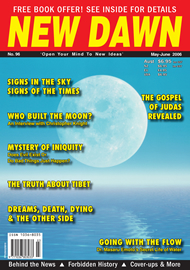
    Are We Food for the Moon?

    From New Dawn 96 (May-June 2006)

    If man is not affected in some way by the Moon, he is the only thing on Earth that isn’t.
    – Robert Millikan (1868-1953), US physicist & 1923 Nobel Prize winner

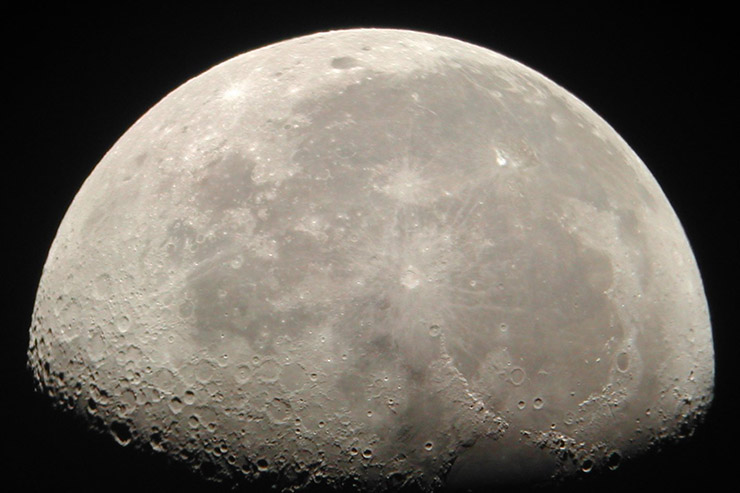
    Probably no heavenly body has received as much attention down through the ages as our Moon. The causes of this fascination are obvious: the Moon enlightens the night and appears as a remarkable and large object in the sky. As a regulator of Earth’s tides and life’s biological cycles, the Moon’s importance to our physical existence is second only to that of the Sun.

    Sacred scriptures, ancient myths, and even modern day pagans, all exalt the Moon in one way or another. Omens, spells, wishes, oracles, divination, and calendars cluster around it throughout history. Moon magic, the belief that working rituals at the time of different phases of the Moon brings about physical or psychological changes, is essential to various pagan and witchcraft systems. Witches in Greek and Roman literature were regularly accused of ‘drawing down the Moon’ by use of a magic spell.

    Nevill Drury, a respected authority on mystical and occult traditions, says “traditionally… the Moon has been regarded as a ‘funnel’ drawing on the light of the stars and constellations and transmitting their energies to the Earth.”1

    In Western astrology the Moon is said to represent the feeling intuitive nature of the individual as well our deepest personal needs, our basic habits and reactions, and our unconscious. In esoteric astrology the Moon represents attachment to form, and under certain circumstances a variety of limiting conditions are related to the Moon, ranging from blatant materialism to subtler forms of limitation such as debilitating nostalgia, sentiment and regret.

    The word “lunacy” – which derives from the Latin for Moon, “luna” – denotes the traditional link made in folklore between madness and the phases of the Moon. Several studies have tried to get to the bottom of this age-old belief. A 1976 report compared 34,318 crimes against lunar cycles. It found offences occurred more frequently during a full Moon. Other research, however, failed to find any firm link between the cycles of the Moon and irrational behaviour.

    England’s Lunacy Act of 1842 gave allowances for uncharacteristic crimes committed during the full and new Moon. This law distinguished between the chronically insane and the lunatic. It was argued the lunatic became deranged at these times because of the Moon’s power and thus could not be held accountable for his or her actions.

    Interestingly, a study of the Moon’s effect on mental health patients, conducted by the University of Liverpool in 2000, found a significant change at the time of the full Moon, but only in subjects with a diagnosis of schizophrenia.

    Whether we are conscious of it or not, the Moon exerts some sort of influence upon our biological and psychological states. But does it go any deeper than this?

    Gurdjieff and Ouspensky

    The Fourth Way philosophy claims to help individuals cease to be slaves of external and internal influences by building up a core of heightened consciousness. Its ultimate goal is the realisation of the full potential of human evolutionary possibilities. Its founder, George Gurdjieff (1872-1949), frequently spoke of the thoughtless mechanical behaviour of humanity, and was fond of commenting humans are “food for the Moon.”

    What did Gurdjieff mean by this phrase? Many interpreted “food for the Moon” as a figure of speech – perhaps Gurdjieff meant we are slave to our mechanical conditioning and feed our baser impulses. But while it can be interpreted in this fashion, Gurdjieff was primarily being literal.

    Peter Ouspensky, Gurdjieff’s most famous disciple, lectured at length concerning the Moon’s role in human affairs and its place in the cosmological scheme of things.

    Ouspensky said the Moon drives the individual’s mechanical aspects like a pendulum moves the gears of a clock. The degree to which one’s actions are driven by the Moon is proportional to one’s level of contact with higher influences. For people incapable of moving themselves through life by nobler spiritual impulses, the Moon provides a propulsive force. Without this force, mechanical individuals would be passive as puppets without a puppeteer.

    In the cosmological scheme proposed by Gurdjieff and Ouspensky, Earth is like a mother to the Moon which is still a fetus in the sense it cannot yet “breathe” on its own, hold an atmosphere, or support life. Someday, the Earth will evolve into a being like the Sun, while the Moon will transform into a second Earth. Humanity was simply a stage in this process.

    “The Moon is actually a fragment of this Earth, which must now constantly maintain the Moon’s existence,” Gurdjieff said.2 In that sense, the Moon is like a parasitic thought form. Nevertheless, the equation is balanced because in exchange for the Moon propelling our mechanical movement, we feed the Moon so that it may grow and one day be born as a living planet.

    As to how organic life feeds the Moon, Gurdjieff taught that most human beings are mere “slugs” with no souls and that following death their remaining psychic energy is “food for the Moon.” Like a magnet, the Moon draws the fine matter of human souls into it: “Everything living on the Earth, people, animals, plants, is food for the Moon. The Moon is a huge living being feeding upon all that lives and grows on the Earth.”

    Only through an intensive effort of conscious evolution – what he called “self-remembering” – was it possible for an individual to escape being eaten by the Moon. “The liberation that comes with the growth of mental powers and faculties is liberation from the Moon.” Gurdjieff always maintained Man is not truly conscious, and his actions are entirely mechanical: “Everything ‘happens,’ he cannot ‘do’ anything. He is a machine controlled by accidental shocks from outside.”

    To escape these deleterious lunar influences, Ouspensky said we must “create Moon within ourselves.”3 By this he meant we must develop within a driving mechanism that takes the place of the external lunar influence; in this way we can break free of the puppeteer.

    Boris Mouravieff, who was an associate of both Gurdjieff and Ouspensky, formulated an esoteric system for spiritual evolution founded upon the inner traditions of Eastern Orthodoxy and Fourth Way principles. His extensive three volume work, Gnosis, deals extensively with the question of lunar influences and spiritual development.

    He concurs with Gurdjieff and Ouspensky on the role of the Moon, but also warns “that organic life functions as a transmitter station sending refined energy to the Moon to assist its growth. Despite increases in the human population and thus an increase in quantity of energy transferred, times of peace do not produce sufficient energy and so catalysts for suffering such as wars and catastrophes arise to sustain the process.”4

    Mouravieff and Ouspensky emphasise that despite the hypnotic nature of the Moon and the urgent necessity for individuals to overcome its influence, there is still an important cosmological reason for its existence. If nothing else, the Moon’s unique position in relation to the Earth was paramount in making physical ‘conscious’ life possible.

    Theosophy

    Together with Henry Steel Olcott, Madame H.P. Blavatsky founded the Theosophical Society in 1875. Theosophy, the “grandmother” of today’s “New Age” movement, tells us the Moon was home to an earlier “life wave” which has since migrated to Earth.

    In The Secret Doctrine, Madame Blavatsky states the Moon served a dual purpose in religious rites: “Personified as a female goddess for exoteric purposes, or as a male god in allegory and symbol, in occult philosophy our satellite was regarded as a sexless Potency to be well studied, because it was to be dreaded… But whether male or female…, the Moon is the Occult mystery of mysteries, and more a symbol of evil than of good.”

    Perhaps the Moon is identified with evil rather than good because it is now what Madame Blavatsky calls “a dead planet.”

    How did this occur? An article by William Quan Judge elaborates: “in a remote period, when there was no Earth, the Moon existed as an inhabited globe, died, and at once threw out into space all her energies leaving nothing but the physical vehicle. Those energies revolved and condensed that matter in space nearby and produced our Earth; the Moon, its parent, proceeding towards disintegration but compelled to revolve around her child, this Earth.”5

    To fully appreciate why all this happened, a study of Theosophical cosmology is required, but space does not permit a full explanation here.

    Elsewhere in The Secret Doctrine, Madame Blavatsky’s view of the Moon’s relationship to the Earth is similar to Fourth Way thinking:

    “The moon is now the cold residual quantity, the shadow dragged after the new body, into which her living powers are transfused. She now is doomed for long ages to be ever pursuing the Earth, to be attracted by and to attract her progeny. Constantly vampirised by her child, she revenges herself on it, by soaking it through and through with the nefarious, invisible and poisonous influence which emanates from the occult side of her nature. For she is a dead, yet a living body. The particles of her decaying corpse are full of active and destructive life, although the body which they had formed, is soulless and lifeless.”

    Theosophy differs from the Fourth Way which holds the Moon is not yet ready to sustain life. But they both agree the Moon is vampirising the life forms of Earth.

    Are we food for the Moon, or are these warnings the ravings of lunatics? Although modern science tells us we have nothing to worry about, ancient wisdom and folklore paint a very different picture. Ignoring these dangers has perhaps left us wide open, more so when we do not recognise the signs or symptoms of the Moon’s ‘drawing up’ effect.

    Whatever the reality, the Fourth Way, Theosophy and all schools of esoteric philosophy have the solution. By overcoming our mechanical tendencies, we strengthen our resistance to the lunar effect, and for that matter all planetary influences. And by “creating Moon” within ourselves – that is, building up our essential self – we not only gain victory over the negative lunar influence, but awaken to a higher level of consciousness.

    [alert type=”general” dismiss=”no”]This article was published in New Dawn 96.[/alert]

    [alert type=”success” dismiss=”no”]If you appreciate this article, please consider subscribing to help maintain this website.[/alert]

    Footnotes

    1.  The Dictionary of the Esoteric by Nevill Drury, Watkins Publishing, London 2002
    2.  In Search of the Miraculous by P. Ouspensky, 1949
    3. The Fourth Way by P. Ouspensky, 1957
    4.  Gnosis II: Study And Commentaries On The Esoteric Tradition Of Eastern Orthodoxy, Book Two, Mesoteric Cycle, by Boris Mouravieff, Praxis Institute, 1992
    5.  “Moon’s Mystery and Fate”, Path, June, 1894

    © New Dawn Magazine and the respective author.
    For our reproduction notice, click here.
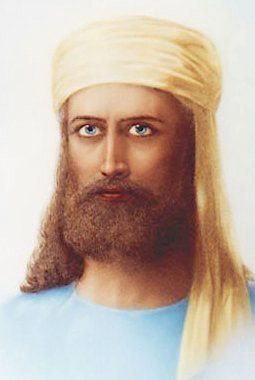
  • C.W. Leadbeater: Saint or Sinner?

    C.W. Leadbeater: Saint or Sinner?

    This article was published in New Dawn 96 (May-June 2006)

    Rare is the man or woman whose controversy in life outlives their death into the next century. But such were H.P. Blavatsky and C.W. Leadbeater, the founder and promoter, respectively, of Theosophy. Their legacy of notoriety and fame are generated less by the unorthodox, even heretical ideas they espoused with such unrepentant vigour during an era of Victorian sensibilities, than their outrageous personal behaviour which, even today, would have gotten them both into deep trouble. But of the two, Charles Webster Leadbeater was the most influential Theosophic spokesperson of the twentieth century, the man who some now regard as the true founding-father of the so-called “New Age” movement.

    At a time when Western civilisation was almost exclusively Christian, he boldly presented an alternative spirituality based on the psychic powers innate in all human beings, obviating the need for any priestly intermediaries in a direct (or virtually direct) personal relationship with the Compassionate Mind that organises all Creation. To best achieve that gnostic awareness, teachers like himself and an occult college of elusive (if mostly invisible) Masters from the higher planes of existence exist to serve the nobler spiritual aspirations of man. It was an unlikely stance taken by an established English clergyman locally renowned for his devotion to conventional religion.

    Born in 1854, Leadbeater was a twenty nine year-old Anglican priest when he was welcomed into the Theosophical Society by Helena Petrovna Blavatsky, who celebrated his membership as a personal triumph over mainstream churchmen, with whom she was at logger-heads. “I was revenged,” she later recalled. Leadbeater’s defection stemmed from his restless dissatisfaction with contemporary Christianity, particularly as it was preached in Britain. He felt it had ossified over the centuries into a meaningless repetition of traditional ceremonialism that extinguished the original enlightenment initiated two thousand years ago by Jesus.

    To India With Madame HPB

    In Theosophy, whose followers strove to penetrate the mystical truth they believed was at the core of every religion, he found the authentic mystical experience he sought. They convinced him that a synthesis of Buddhist and Hindu beliefs combined with exercise of mankind’s innate psychic powers could elevate our species to its godlike destiny. Madame Blavatsky warned him, however, that attaining the lofty spiritual illumination he desired was no easy matter. She urged him to address a personal letter to the Master Kuthumi, a usually invisible entity of great wisdom who chose to interact with mortal men of particular promise.

    In his missive to this profound spirit, Leadbeater asked if he should go to India for enlightenment. Madame Blavatsky alone knew how to put his request before the Master, so it was entrusted to her. A response was promptly received in the affirmative, and the former church official set out with Madame Blavatsky, who undoubtedly forged the letter, the envelope of which, in fact, had been stamped with a London postmark indicating the very neighbourhood where she resided at the time. Nonetheless impressed, Leadbeater and his dowdy mentor sailed across the Eastern Mediterranean, through Suez, and into the Indian Ocean.

    While on board, Madame Blavatsky put her enthusiastic follower through a series of exercises meant to humble his spirit, all the better to strengthen him for the transformation ahead. As part of this preparatory regimen, she had him walk around the deck of the steamer carrying a chamber-pot brimming with human waste, something the other passengers could never forget. Nor, apparently, did Madame Blavatsky. In later years, she alluded to his on-board performance by addressing him as “W.C. Leadbeater.”

    Once at Adyar, the Theosophical headquarters located outside Madras, his unquestionable abilities as a writer and speaker combined with his impressive physical appearance as a kind-eyed, wise-bearded teacher. Even so, years were to pass before he gained the clairvoyant insight that was later to make his fame. How he acquired it was recounted by Leadbeater after he became Theosophy’s most articulate spokesman. He recalled his stay in 1885 at the Adyar headquarters, which was virtually empty, the Society having fallen on hard times. Until then, he said:

    I possessed no clairvoyant faculty, nor had I ever regarded myself as at all sensitive. I remember that I had a conviction that a man must be born with some psychic powers and with a sensitive body before he could do anything in the way of that kind of development, so that I had never thought of progress of that sort as possible for me in this incarnation, but had some hope that if I worked as well as I knew how in this life I might be born next time with vehicles more suitable to that particular line of advancement.

    One day, however, when the Master Kuthumi honoured me with a visit, He asked me whether I had ever attempted a certain kind of meditation connected with the development of the mysterious power called kundalini. I had of course heard of that power, but knew very little about it, and at any rate supposed it to be absolutely out of reach for Western people. However, He recommended me to make a few efforts along certain lines, which He pledged me not to divulge to anyone else except with His direct authorisation, and told me that He would Himself watch over those efforts to see that no danger should ensue.

    I worked at it for forty-two days, and seemed to myself to be on the brink of the final victory, when the Master Himself intervened and performed the final act of breaking through which completed the process, and enabled me thereafter to use astral sight while still retaining full consciousness in the physical body — which is equivalent to saying that the astral consciousness and memory became continuous whether the physical body was awake or asleep. It must not for a moment be supposed, however, that the attainment of this particular power was the end of the occult training. On the contrary, it proved to be only the beginning of a year of the hardest work that I have ever known. He would make a vivid thought-form, and say to me: “What do you see?”

    And when I described it to the best of my ability, would come again and again the comment: “No, no, you are not seeing true; you are not seeing all; dig deeper into yourself, use your mental vision as well as your astral; press just a little further, a little higher.”

    The result achieved is assuredly far more than worth while, for it leads directly up to the union of the lower and the higher self and produces an utter certainty of knowledge based upon experience which no future happenings can ever shake.2

    Thus enlightened, Leadbeater was credited with discovering Jiddu Krishnamurti, who was staying at the Theosophical Society’s headquarters with his family for some months. They met while walking along the private beach that formed part of the Adyar complex. Leadbeater declared to his companion Ernest Wood that the boy would become a great spiritual teacher and speaker. He also told Wood that Krishnamurti was in all probability to become the “Vehicle” for the coming “World Teacher” in the incarnational pattern of Moses, Buddha, Zoroaster, Christ, and Muhammad. Leadbeater personally supervised the raising of Krishnamurti, under conditions occasionally less than tender. Annoyed at the young man’s habit of sometimes staring with a blank expression into vacant space, with mouth open, he reprimanded Krishnamurti by striking him violently on the chin, an act of violence that spoiled the hitherto “blessed relationship” between them.

    Australia

    Thereafter, the temperamental tutor departed for Australia, settling in Sydney in 1914, where he felt particularly called to fulfill some as yet ill-defined mission. His instinct was correct, judging from the profound public success he enjoyed there. Attendance at his lectures swelled with overflow crowds of people to whom the ancient principles he described so beautifully were entirely new. For all the accusations of his critics, it was chiefly Charles Leadbeater, in the tradition of his predecessor Madame Blavatsky, who introduced the contemporary Western world to the age-old spiritual ideas of the East.

    In Sydney, he became a leading member of the Liberal Catholic Church. A flurry of booklets, manuals, and full-length books flowed from him in a spate of creativity that brought the Theosophical Society much-needed prestige, income and membership in the tens of thousands.

    As his modern biographer, Gregory Tillett, writes in The Elder Brother:

    The range of his writings, and the wealth of material that flowed from his prolific pen, was vast. Some forty volumes, even more pamphlets, and for much of his life probably five or six journal articles a week constituted his literary output. The modern occult revival owes more to him than to anyone else; his concepts and ideas, his popularising of occult and Theosophical terms and principles, run through all modern works on these subjects.

    Leadbeater’s written words were as successful as those he spoke, and his readership was truly international. A sampling from his very many published materials provides a glimpse of his active mind: “The Astral Plane: Its Scenery, Inhabitants and Phenomena”; “The Aura: An Enquiry into the Nature and Functions of the Luminous Mist Seen about Human and Other Bodies”; “Invisible Helpers: A Story of Helping at Night the So-called ‘Dead’ by Those Who Are Still in the Land of the Living”; “Dreams: What They Are and How They Are Caused”; “Thought-Forms: A Record of Clairvoyant Investigation”; “Man Visible and Invisible: Examples of Different Types of Men Seen by Means of Trained Clairvoyance”; “The Other Side of Death: Scientifically Examined by Clairvoyant Observation and Carefully Described”; “Guardian Angels and Other Unseen Helpers”; “The Perfume of Egypt and Other Weird Stories”; “The Life After Death, and How Theosophy Unveils It”; “To Those Who Mourn: Solace for Bereaved Person based on Principles of Evolution and Reincarnation”; “Vegetarianism and Occultism: On the Effects of Meat Eating and Slaughter of Animals”; “Australia and New Zealand as the Home of a New Sub-race”; “The Hidden Side of Christian Festivals”.

    As author Alvin Boyd Kuhn observed in Theosophy: A Modern Revival of Ancient Wisdom:

    He wrote elaborate descriptions of these things in a style of simplicity and clearness. He asserted that such powers enabled one to review any event in the past history of the race, inasmuch as all that ever happened is imprinted indelibly on the substance of the Astral Light or the Akasha, and the psychic faculties of trained occultists permit them to bring these pictures under observation. With the same faculties he asserted his ability to investigate the facts of nature in both her realms of the infinite and the infinitesimal. For years he stood as perhaps the world’s greatest ‘seer,’ and in books dealing with Clairvoyance, Dreams, The Astral Plane, The Inner Life, The Hidden Side of Things, etc., he labored to particularise and complement Madame Blavatsky’s sweeping outline of cosmic evolution and human character, as given in The Secret Doctrine.

    Scandal and Seership

    At the height of Leadbeater’s renown, however, serious moral charges were brought against him. As Nevill Drury and Gregory Tillett explain in their authoritative study of the occult in Australia, “the police undertook an investigation into Leadbeater and his relationships with his pupils, although Leadbeater himself would not be interviewed.

    The official conclusions of the enquiry were that there was no evidence to sustain any charge, however the officers undertaking the investigation were satisfied Leadbeater did have a sexual relationship with at least some of his young male pupils, although he denied this. He did not deny habitually sleeping with his pupils, or sharing his bath with them. The precise details of Leadbeater’s sexual relationship with his pupils, and his occult teachings of these matters remain one of the mysteries in his life.3

    Many of Leadbeater’s public pronouncements were igniting no less heated controversy, both inside and outside the Society. He stated that mankind originated on the Moon, eventually came to Earth several hundred thousand years ago, and is destined to some day leave this world, resettling on the planet Mercury. Mars, he said, was a pleasant place inhabited by human beings not much unlike ourselves, though more spiritually and intellectually elevated, and go around like Buddhist monks, bare-footed and dressed in common robes. In the midst of this balderdash, there nevertheless appear flashes of apparent psychic insight. For example, Leadbeater stated that Mars,

    is a smaller planet than the Earth and more advanced in age, and was in much the same condition as is the Earth at the present time; that is to say, there was much more water than land on its surface. Now it has passed into comparative old age, and the water surface is far less than that of the land. Large areas of it are at present desert, covered with a bright orange sandwich giving the planet the peculiar hue by which we so readily recognise it.4

    In his book The Masters and the Path, Leadbeater told of a secluded ravine in Tibet, where ancient records documenting an otherwise forgotten prehistory were preserved at an occult “museum” staffed by initiates of the Great White Brotherhood. “The museum houses images of every type of man which has existed on the planet,” he wrote, “from gigantic, loose-jointed Lemurians to pygmy remains of even earlier and less human races.”

    More than sixty years after the publication of The Masters and the Path, American scientists found suggestions of unusual early human habitation at Liang Bua, a “cool cave” in the local Manggarai language, extending 130 feet into a hillside on Flores, a remote Indonesian island east of Java and northwest of Australia. They eventually revealed a virtually complete human skeleton unlike any they had ever seen. Beginning in September 2003, excavators undertook the laborious task of reassembling and identifying each of its bones in a Jakarta laboratory. Thirteen months later, the restored skeleton represented “a fundamentally new being,” according to Joseph B. Verrengia, science writer for the Associated Press, “a discovery that could rewrite the history of human evolution. It would be the eighth species in the Homo category.”

    Homo floresiensis, or Flores Man, declared George Washington University anthropologist Bernard Wood, “is arguably the most significant discovery concerning our own genus in my lifetime.” The proportionally formed adult female stood just three feet tall, weighed no more than fifty-five pounds, and had a brain less than a third the volume of a modern human’s, small even for a chimpanzee. Although far smaller than any member of the genus Homo, her brain was complexly convoluted, suggesting a higher level of intelligence that belied its grapefruit size.

    Dean Falk, a paleoneurologist at Florida State University, declared that the creature’s brain “has features I’ve not seen in anything this size.” She was not “some kind of ‘freak’ that we just happened to stumble across,” added Richard G. Roberts from Australia’s University of Wollongong, but an example of the first-known human dwarf species, as additionally confirmed by six other specimens found in the Liang Bua cave. They range in age from 9,500 to 12,000 years old, although the best-preserved skeleton belonged to a woman who lived 18,000 years ago. Nicknamed “Hobbit” after J.R.R. Tolkien’s Lord of the Rings trilogy, she inhabited a real-life Middle Earth populated by giant tortoises large enough to ride, midget elephants no bigger than ponies, and monster rats the size of full-grown black Labrador hunting dogs.

    Leadbeater’s “pygmies of even earlier and less human races” had become anthropological reality.

    But it was his outspoken views on World War One that most divided his audiences. He seemed to contradict the concepts of humanity and compassion forming the bedrock of their faith, so much so, members, particularly new recruits and originally sympathetic followers, left the Theosophical Society in droves. The stampede of the disaffected had been prompted by Leadbeater’s uncharacteristically brutal remarks:

    I am stating the facts based on knowledge and not on supposition when I say that it is actually a kindness to these ruffians [common German soldiers] to kill their bodies, for in that way we save their souls from this madness; we actually help in carrying out the training which will show them that they must not again let themselves be misled and hypnotised as they have been at this time. They are simply dangerous wild beasts who must be sent back into the savage tribes to which they belong.5

    Leadbeater’s listeners were utterly divided by such comments, unsure he was speaking from a higher compassion or from his own, deeply engrained Tory conservatism. In any case, it seems strange that the founder of today’s New Age movement should have been almost totally forgotten by its modern followers. Throughout the early twentieth century, he was a father figure of global reputation, despised and revered by millions. Routledge & Kegan Paul, the publisher of Leadbeater’s biography, asked:

    Is he the world’s greatest occultist and psychic? Or the worst sort of charlatan and con-man? These widely ranging views of Charles Leadbeater were current in his lifetime and even now, years after his death in 1934, he remains a controversial icon even for Theosophists. His disciples hailed him as the greatest seer of their age. His enemies attacked him as a fraud or worse. Yet, he has exerted great influence on modern ideas about the occult.6

    Clearly, the controversy his life set in motion has not yet abated.

    [alert type=”success” dismiss=”no”]If you appreciate this article, please consider subscribing to help maintain this website.[/alert]

    Footnotes

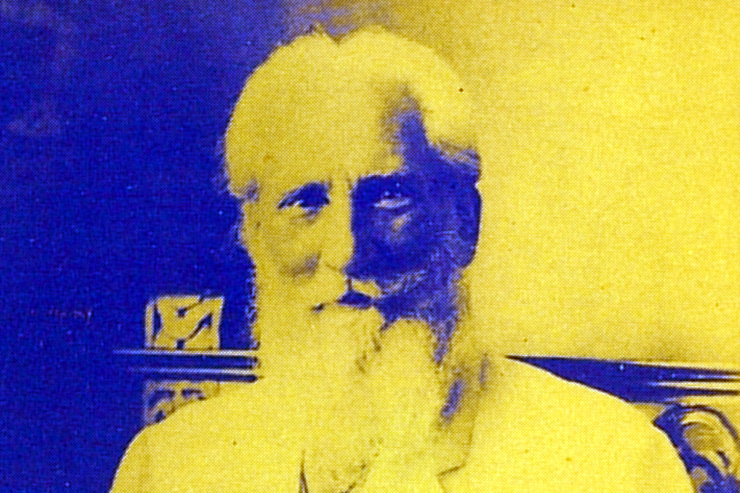
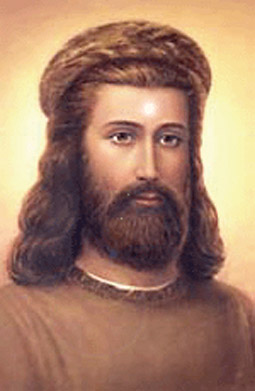
    1. Artist’s impression of C.W. Leadbeater which adorned the cover of a 1973 edition of his book The Inner Side of Christian Festivals published by the St Alban Press.
    2. “The Third Object of the Theosophical Society”, Adyar Pamphlet Number 184, Adyar, India, 1930.
    3. Other Temples, Other Gods: The Occult in Australia, Nevill Drury and Gregory Tillett, Hodder & Stoughton Australia Pty Ltd, 1982
    4. The Inner Life by C.W. Leadbeater, Madras, India:  Theosophical Pub. House, 1912.
    5. The Hidden Side of Christian Festivals by C.W. Leadbeater, as quoted in The Elder Brother: A Biography of Charles Webster Leadbeater by Gregory Tillett.
    6. The Elder Brother: A Biography of Charles Webster Leadbeater,  Routledge & Kegan Paul Books, 1982.

    © New Dawn Magazine and the respective author.
    For our reproduction notice, click here.
  • Esoteric Australia

    Esoteric Australia

    From New Dawn Special Issue 3 (June 2007)

    In 2001 as Australians celebrated the centenary of federation, no attention was paid to the role of mystic thinkers and esoteric ideas in Australian history. The vast majority of Australians know nothing of the “inner side” of their country’s political, cultural and religious evolution.

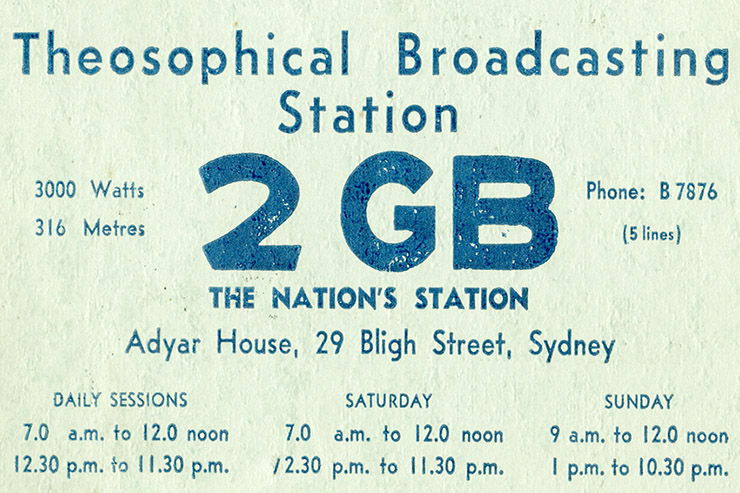
    How many people are aware, for example, that the call sign of Sydney’s pioneering radio station 2GB stands for the martyred sixteenth century mage Giordano Bruno (GB)? Or that Prime Minister Alfred Deakin, a major force in the foundation of the Australian Commonwealth, was heavily involved in spiritualism and an enthusiastic student of Madame Blavatsky’s writings? Who knows of Walter Burley Griffin’s use of occult principles in the design of Canberra, the national capital? Who today remembers the Star Amphitheatre built at Sydney’s Balmoral Beach to welcome the “World Teacher, when He Comes”? Or that in the 1920s Sydney was proclaimed a “great theosophical centre”, home of the renowned and controversial occult teacher, the Bishop Charles Webster Leadbeater. A prolific writer on metaphysics and one of the world’s greatest clairvoyants, Leadbeater predicted the “emergence of the new ‘sub-race’ in Australia and New Zealand.”

    In Other Temples, Other Gods, Nevill Drury and Gregory Tillett observe that, “despite its relative youth as a modern nation,” Australia, “has had a colourful and active history of occultists and occult movements.”1

    Some of the leaders of progressive politics in Australian were also students of esoteric wisdom. In 1892 the labour organiser William Lane’s political novel The Workingman’s Paradise was published in Sydney. In it the working girl Nellie says scornfully, “There is no God. How can there be?” But the mysterious socialist Geisner rebukes her in words straight from Madame Blavatsky’s Secret Doctrine. There is at least “the imperishable breath of the universe”. For Geisner explains, “the Purpose of Life is self-consciousness…. God seeking to know God. Eternal Force one immeasurable Thought. Humanity the developing consciousness of the little fragment of the universe within our ken.”2

    Disillusioned with the socialist movement in Australia, William Lane (1861-1917) established a communalist settlement in South America. A non-smoker and non-drinker, Lane was also a vegetarian who recognised the importance of a healthier attitude to diet. Inspired by Lane’s vision and example, hundreds of Australian workers sailed with him in 1893 to the “New Australia” colony in Paraguay.

    The first Gnostic study circle was established in Melbourne in 1886. A year earlier the Reverend Charles Strong led most of his congregation out of Victorian Presbyterianism to found a native, ethical church, the “Australian Church”. Strong’s Australian Church sponsored the Religious Science Club, a forum for all manner of independent thought and spiritual enquiry.

    AUSTRALIA & THE THEOSOPHICAL SOCIETY

    Such was the interest in mysticism and spiritualism at the turn of the century that Australia came to prominence in the largest international occult movement of the day – the Theosophical Society.

    “The occult movement which achieved the greatest publicity in Australian history,” explain Drury and Tillett, “and for which Australia was an international focus for many years, was the Theosophical Society.”3

    In the early 1890s study circles devoted to Theosophy as presented in the texts of Madame Blavatsky had formed around Australia, leading to the founding of the Australasian Section of the Theosophical Society in 1895.

    As Drury and Tillett explain:

    The progress of the T.S. [Theosophical Society] was steady; lectures given, meetings held, leaflets and publicity material produced, and journals published. Lodges were established throughout Australia…. But it was the lecture tours of one man which established Theosophy as a movement of public interest in Australia: Charles Webster Leadbeater toured the country in 1905, following a lecture tour of several years in the U.S.A. during which he attracted thousands of enthusiastic listeners, and in 1914 he settled in Sydney, remaining there more or less permanently until his death in 1934.4

    By the 1920s there were more paid-up members of the Theosophical Society than members of the Communist Party of Australia. The twenties witnessed a surge of Theosophical activism as Australian Theosophists sort to present a vibrant alternative to the mainstream, including the growing political ideologies of bolshevism and fascism. In addition to the public lectures, lodge meetings, and libraries, there was the Society owned Sydney Radio station 2GB as well as a successful publishing enterprise. Journals with titles like Advance! Australia and Theosophy in Australia, presented the society’s views and analysis of turbulent world events. Writing in Advance! Australia, one of the society’s leaders called for:

    purified patriotism, the promotion of a noble type of Australian citizenship, vitally Australian, eagerly conscious of Australia’s specific place and part in the building of the future, no less eagerly conscious of the wider and equally vital citizenship involved in Australia’s membership of the British Commonwealth, and recognising too… there is a World citizenship, the obligations of which may no longer be ignored.5

    Walter Burley Griffin wrote of “Building for Nature” and the “outdoor arts in Australia” in the pages of Advance! Australia. Together with Marion Mahoney Griffin, he set up an “organic” community at Castlecrag, Sydney. Griffin hoped for the awakening of “disused powers of the universal mind” and social renewal as people turned inward to reconnect with “the possibilities of co-operation between head and mind in social service and creative effort.”6

    Adyar Hall, the Theosophical Society’s impressive Sydney centre, served as the meeting place for many original social, political and spiritual groups, among them “The Australia First Movement”. Founded by P.R. Stephensen, a one time associate of Aleister Crowley, Australia First campaigned against Australian involvement in the Second World War.

    A.R. Mills, a Melbourne solicitor active in Australia First, had been on the fringe of the Theosophical Society. During the 1920s and 1930s, Mills formed the world’s first Odinist religion, a mixture of Nordic mythology and occultism.

    A persistent notion running through all the organisations and individuals concerned with esoteric wisdom is the conviction Australia has a special role to play in the dawn of a new Golden Age. Although popularised mainly by the Theosophists, the idea of Australia’s secret occult destiny surfaces in various mystical circles. In the early decades of the twentieth century the tireless Veni Cooper-Mathieson who founded – among other orders and institutions – the Home of Truth Esoteric College, the Church Universal, the Universal Truth Publication Company, taught that Australia was the “land of the dawning.”

    AUSTRALIA: HOME OF A NEW HUMANITY

    Madame Blavatsky, co-founder of the Theosophical Society, is credited with developing the theory that humanity evolves through a sequence of Seven Root Races, “four of which have already lived their day, the fifth still exists, and two are to appear in the future.”7

    In a series of lectures delivered in Sydney in August 1915, Bishop Leadbeater proclaimed “Australia and New Zealand as the home of a new sub-race.” He had detected in Australia “children and young people of a distinctly new type.” A new antipodean human type characterised by intuition and the powers of synthesis. Jill Roe in her book on Theosophy in Australia writes:

    Leadbeater urged his audience to align themselves with evolutionary law, assuring them that present confusions were merely transitional. He held that, despite distance and a small population, the Antipodes provided a favourable site for inauguration of a new era of brotherhood and cooperation, being neither decadent like Britain nor overblown by capitalist pride like America, and not yet delivered into unworkably democratic systems by ‘too young souls’. There was crudity, and reverse class legislation, but the wholesome environment held promise.8

    In Leadbeater’s view, however: “It would be important to purify child-rearing practices, by abstinence from alcohol, meat and tobacco, and to educate the next generation correctly…. The reward would be the coincidence of a new sub-race and the World Teacher in fifteen or twenty years’ time.”9

    By embracing techniques of physical and mental purification, Leadbeater believed in a couple of generations the whole of Australia would be controlled by a new people, who would constitute “what in Europe we should call the aristocracy of the country; that is to say, the best types”.10

    Of course the Bishop’s message was not taken up by the Australian people and no new “aristocracy” emerged to lead the Antipodes into a new Golden Age. Was there any truth in Leadbeater’s predictions?

    Nations, like individuals, have choices that eventually determine outcomes far beyond what can be recognised in the immediate. A collective – a group soul – like the individual soul must decide with which impulses to align. Nations can choose either the forces of materialism leading to decay and atrophy, or the higher influences of the spirit capable of leading to a New Beginning. In the case of Australia and New Zealand, the birth of the ‘new people’ was limited and distorted due to the infection of Mammonism. By concentrating on the search for outer happiness, following the path of the kingdoms of this world, the Australian nation stifled the quest for inner transcendence and the Kingdom of God.

    By taking the way of materialism Australians cut themselves off from the subtle influences of the spirit and cosmic destiny. Manning Clark, Australia’s greatest historian, expressed the spiritual crisis of modern Australia when he said:

    The decline of faith begat nihilism, and nihilism begat hedonism. It looked as though in the contest between Mammon and ‘millennial Eden’ Mammon had won. The dreams of all those who had migrated to the great south land had evaporated. The Aborigine had been corrupted and debased by contact with the white man. The voices of the Catholic who had spoken of a land dedicated to the Holy Spirit, the Dutch Protestants who had called for the discovery of a land that would yield ‘uncommonly large profit’, and the pleas of the followers of the Enlightenment with their faith in human perfectibility, had all dropped from a roar to a whisper, Mammon had won: Mammon had infected the ancient continent of Australia. The dreams of humanity had ended in an age of ruins.11

    Yet in every generation, and in every nation, there is always a remnant of men and women who have not succumbed fully to negative earthly bonds. They are the silent ones who stand among the ruins of the modern era, living testimonies to the higher world of the spirit. The ability of any nation or people to realise their spiritual potential and partake in the dawn of a new Golden Age depends on the vitality of this remnant.

    Have Australia and New Zealand forfeited their occult birthright?

    Certainly some of the ‘new people’ characterised by intuition and the powers of synthesis are found today in Australia, as well as in many other places throughout the world. The future depends on the ability of this remnant to impact the greater society and become a new Noah’s Ark capable of surviving the coming times of tribulation and transition. True, nearly every nation has a myth promising them a leading role in the dawn of a New Age. The universality of this myth in no way detracts from the responsibility it places on a people with ‘ears to hear’ the message of the times. Every people are called to turn within and align with the New Era. And Australasia is not impervious to this call, to this great Thought.

    Over a century ago, in 1892, the Australian socialist and mystic William Lane wrote:

    The brute-mother who would not be comforted because her young was taken gave birth in the end to the Christs who have surrendered all because the world sorrows. And we, in our yearning and our aspirations, in our longings and our strugglings and our miseries, may engender even in these later days a Christ whom the world will not crucify….12

    The earth still awaits the revelation of the Christ people, the new humanity destined to carry out the great work in which we all have a part to play. At the end of his book, William Lane challenged his readers with words that speak to us today:

    Let us not be deceived! It is in ourselves that the weakness is. It is in ourselves that the real fight must take place between the Old and the New. It is because we ourselves value our miserable lives, because we ourselves cling to the old fears and kneel still before the old idols, that the Thought still remains a thought only, that it does not create the New Order which will make of this weary world a Paradise indeed.13

    [alert type=”general” dismiss=”no”]This article was published in New Dawn Special Issue 3.[/alert]

    [alert type=”success” dismiss=”no”]If you appreciate this article, please consider subscribing to help maintain this website.[/alert]

    .

    Footnotes:

    1. Nevill Drury and Gregory Tillet, Other Temples, Other Gods
    2. As quoted in Jill Roe, Beyond Belief, Theosophy in Australia 1879-1939
    3. Nevill Drury and Gregory Tillett, Other Temples, Other Gods
    4. Ibid.
    5. As quoted in Jill Roe, Beyond Belief, Theosophy in Australia 1879-1939
    6. Ibid.
    7. H.P. Blavatsky, The Secret Doctrine
    8. Jill Roe, Beyond Belief, Theosophy in Australia 1879-1939
    9. As quoted in Jill Roe, Beyond Belief, Theosophy in Australia 1879-1939
    10. As quoted in Gregory Tillett, The Elder Brother: A Biography of Charles Webster Leadbeater
    11. Professor Manning Clark, A Short History of Australia
    12. ‘John Miller’ (William Lane), The Workingman’s Paradise
    13. Ibid.

    © New Dawn Magazine and the respective author.
    For our reproduction notice, click here.