New Dawn – World's Most Unusual Magazine

Tag: gnostic

  • Gnostic Mysteries of Sex: An Interview with Tobias Churton

    Gnostic Mysteries of Sex: An Interview with Tobias Churton

    From New Dawn Special Issue Vol 10 No 3 (June 2016)

    Tobias Churton is one of today’s most visible and prolific writers on the Western esoteric tradition. He first came to the attention of the public in the UK in 1987, with the release of a four-part television series called “Gnostics.”

    Since then he has written nineteen books, including Gnostic Philosophy, The Invisible History of the Rosicrucians, and biographies of William Blake, the seventeenth-century British esotericist Elias Ashmole, and Aleister Crowley. He holds a master’s degree in theology from the University of Oxford and is an honorary fellow of the University of Exeter in the UK. His website is tobiaschurton.com.

    Churton was featured in a New Dawn interview that I conducted in 2005 (see New Dawn 91). In November 2015, I conducted another e-mail interview with him, this time focusing on his recent book Gnostic Mysteries of Sex: Sophia the Wild One and Erotic Christianity.

    RICHARD SMOLEY (RS): Your latest book is called Gnostic Mysteries of Sex. Could you start by briefly sketching out who the Gnostics were?

    TOBIAS CHURTON (TC): Not all Gnostics called themselves by the name, but it is a name attached by orthodox Church leaders from the second to the fifth centuries CE to leaders and groups of spiritual deviants from orthodoxy who regarded their experience or “knowledge” (Greek: gnosis) as a superior aspect of salvation to that of other Christians. Since Gnostics prided themselves on originality, personal revelations, and esoteric insights, their views on any number of doctrines vary considerably, but they share some speculative doctrines in common.

    The first and most fundamental is that the universe perceptible to the senses derives from a deformation of spiritual being into something unintended by the source of being. This unknowable “Father,” knowledge of whom Jesus brings to the gnostic, is called the “Depth” – as in an unfathomable ocean or abyss. The material universe results from a primal catastrophe: a fall from ideal into relative being. In this deformation drama, sparks of divine seed have become alienated in an unfamiliar realm and experience pain and longing. Insofar as the universe is imperfect, it is the work of a Demiurge or “fashioner,” working with relative, not absolute being. This being knows no higher than himself, like the classic egotist. Sometimes identified with the Elohim (“God” or “gods”) of Genesis, the creator of the world is regarded as the enemy of Man as a spiritually conceived being, opposed implacably to Man’s enlightenment. “Lord of this world,” the maker senses there’s something special about Man. Man has something within him. The master of matter is jealous of this spiritual substance and, while incapable of understanding it, wants it, and failing that, determines to keep fallen Man ignorant of it, lest Man escape from the world’s finite grip and become free.

    The hylic or material being (the earthly Adam), belonging to the sensual universe, dies with it, for the material universe is constrained by time, unlike spirit, which is eternal.

    The only means of escape is realisation of divine origin and destiny – gnosis. This means to be spiritually awake, able thereby to see beyond the universe and the Demiurge. To effect realisation, Christ descended to earth, appearing as mortal flesh, to summon the awakened spirits and raise the weak by awakening the dormant psyches of the soulful, but lost, children of divine Wisdom (Sophia). Gnostic writers present Jesus as an esoteric philosopher holding the keys to the door to eternity, for which the world rulers conspire to destroy him and those who follow him.

    The Gnostics presented sometimes highly intelligent twists on every aspect of established Gospel teaching. From alleged secret sources, they created an esoteric religion of wide-ranging meaning and applicability to Man, seen as being in existential distress. Gnosis has nothing to say to those comfortable with and in the world as it is.

    Moral teachings among Gnostics vary widely, for in their view state of mind is of vital significance and superior in essence to actual conduct. There were somewhat contradictory streams of interpretations in Gnostic thought and practice, and their enemies were not scrupulous in delineating greater or lesser factors, since all Gnostics were deemed a mortal threat to orthodox faith. Gnostics were, generally speaking, indifferent to religious authorities, and their radical individualism became intolerable to the growing monarchic episcopacy of the Catholic or Orthodox church.

    Brilliant enemies of gnosis, such as Tertullian in the late second to mid-third centuries CE, simply dismissed Gnostics for trying to turn the “saving faith” into philosophy, that is, something conformable to Socratic reasoning. This is not altogether fair, since the Gentile Church had from its beginnings been required to express its doctrines to people who used philosophy to justify religious practices. One thinks of St Paul in the Areopagus (Acts 17:16–34). After all, the Jewish faith never explained why the universe was created in terms philosophically explicable to the existential condition of human life. God willed it and thought it good, whether men could see it, or like it, or not. It is also important to recognise that a dominant stream of gnosis served essentially as a magical religion that sought God in the lowest effects as well as the highest causes. That is to say, the divine spirit or pneuma was not only scattered in Man for some Gnostic schools, but hidden in the recesses of Nature: such insights vitalised alchemy. The divine seed has been sown everywhere, as gnostic alchemists, or “Hermetists,” maintained.

    Contemporary Western esotericism and its historical antecedents are impossible to conceive of without the Gnostic phenomenon of late antiquity. Insofar as esotericism still thrives, so does gnosis, though mediated, as ever, in diverse forms, including philosophy of religion.

    RS: One of the most fascinating figures in your book is Simon Magus. Could you say a little about him and his views on sex?

    TC: He is fascinating, isn’t he? This Samaritan magician gets a nasty walk-on part in Acts, and contradictory accounts of him appear in patristic and sundry apocryphal works. He was obviously a major threat to the apostolic efforts of the primitive Church. Just why is not altogether clear, especially from Acts, where he tries to buy the power of the Holy Spirit. This is telling, in its way, of the style of the magician. He recognised the Holy Spirit experience as a psychic phenomenon that could be induced if you knew the trick: nothing new to a magician for whom what we today call hypnosis was a stock in trade.

    Acts does not mention the crucial detail that Simon was accompanied by a whore, Helen (= the “torch”), whom he saved from a Tyrian brothel to be his consort. Groups of Gnostics worshipped them both, at least by the second century, and it became established in that century that he was the first Gnostic heretic and that all the Gnostic streams derived from him. As for his teachings, or rather alleged teachings (we have no first-century evidence for his specific doctrines), we have fascinating accounts in the second-century writings of the orthodox Christian Hippolytus.

    I may be the first to have realised that while Hippolytus’s accounts of Simon’s doctrines try to trash them as absurd Greek philosophy, Hippolytus’s accounts nevertheless transmit – probably without Hippolytus even realising it – a fairly complete system of sexual magic, expressed in symbols. What Hippolytus misunderstood as philosophy was, I think, the basis for working magical practice.

    Simonian doctrine takes the view that sex has magical potential: it could be “redeemed” as a means to make supermen and superwomen. Looking at Simon anew was one of the most exciting things I discovered when writing the new book, and it became a real mind-opener: shocking perhaps, but definitely revelatory. It is no surprise that Simon had a work attributed to him called The Great Revelation. More intriguingly, he seems to have had some important link to John the Baptist.

    [alert type=”info” dismiss=”no”]If you appreciate this article, please consider a subscription to New Dawn magazine.[/alert]

    RS: A main theme in your book is the connection between sex and enlightenment. How did the Gnostics see this relation?

    TC: This is too big a question to be adequately dealt with in a magazine interview; the answer represents the substance of the book. Very briefly, the Gnostic understanding of sex is informed by the Platonist view that in the eternal world, there is a unity of substance. The eternal world, or world of the aeons, provides the eternal “ideas” that are used to fashion a copy or reflection of it and to make it manifest under the finite conditions of time and space. Those eternal characteristics are deformed and dissolved in the process or drama of pure radiant spirit descending into “darkness.” In order to create, we must move from one, unity, to two: reflection and manifestation. All reflection involves a measure of distortion.

    Therefore, to manifest the divine mind, as Divine Wisdom (in the form of Lady Sophia) precociously endeavours to do imperfectly in Gnostic systems (creating the Demiurge in the process), is to make distortion inevitable. The idea of harmonious syzygies of divine powers becomes unbalanced through the act of creation. When this principle is linked to the existence of men and women, we note that the perfect Man, like God, is, in Gnostic thought, androgynous, containing masculine and female characteristics in perfect harmony.

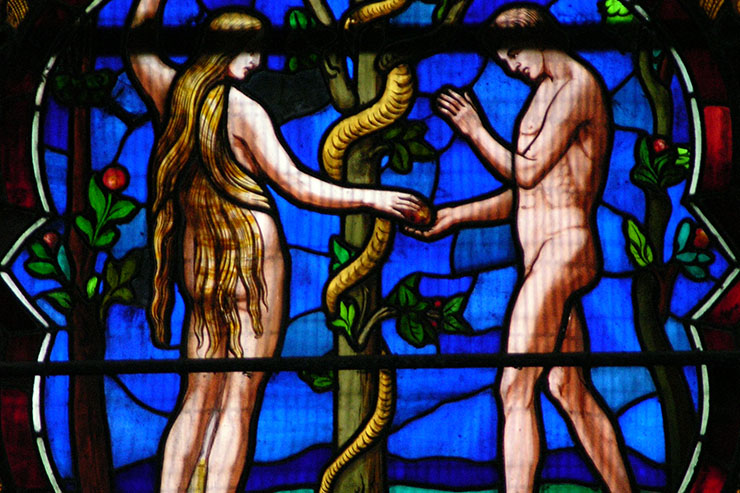
    In the sphere of manifestation, this harmony is lost, and man and woman appear separate and at odds. But gnosis can initiate the return to harmony. Gnostics made much of the Genesis story that Adam’s rib became the basis for woman, especially since it was extracted when Adam was asleep. Sleep, to a Gnostic, means the cosmic and spiritual unconsciousness or amnesia characteristic of material consciousness. Man and woman become each other’s tempters in the world of nature. This antipathy is reflected in the first human progeny, Cain and Abel, who are immediately opposed – opposition leading to the primal murder.

    Following the logic of androgyny as being the original human form in the spiritual sense, it followed that perfected sexual union could become a sacramental and spiritual pre-enactment of the ultimate destined unity of the Gnostic spirit, restored to the Pleroma or “Fullness” of the Godhead. The mutual infusion of male and female enacts and prefigures the apocatastasis, the restoration, or what Gnostics called “the healing of the passions of matter”: the return to the One.

    Obviously such sexual communion was a dedicated spiritual act. Interpretations of this essential dynamic of Gnostic sex varied very widely, but one can see echoes in the later theories associated with Hindu and Buddhist Tantric traditions. Enlightenment comes from manifestation and glorification of the divine seed. This seed is identified in many Gnostic traditions as the pneuma or spirit. In some groups, this identification was taken perfectly literally, but it is a feature I found to be of relevance to all Gnostic traditions, whether libertine or ascetic (the twin poles of Gnostic sexual morality).

    I think much that I have found will shock and perhaps awe those used to the contemporary “soft” exposition of Gnostic thought and practice. Not least is my discovery of the identity and origin of the Gnostic feminine archangel called Barbelo; it should change minds considerably, given time.
    RS: The Gnostics seem to have encompassed a wide range of attitudes toward sensuality, ranging from complete asceticism to a kind of hedonism. What inspired these differing stances?

    TC: The body is the locus both of union and disharmony. It is mortal and it contains, even imprisons, the immortal pneuma or spirit, which needs awakening. Since the body is mortal, what flesh does with itself may have no ultimate significance. Its role is strictly that of a vehicle of spirit.

    The body is linked to the lower worlds, so the Gnostic can afford to despise it, or, alternatively, use it for the spirit’s purposes. Gnostics, especially the followers of Carpocrates and those within the Sethian tradition, tended to believe that the spirit was so superior to flesh that flesh could not damage it. According to Irenaeus, these Gnostics said that the spirit is like gold: it can be mixed with dung but come up shining. On the other hand, the orthodox teaching was that acts of the body tarnish the spirit, injure it, and so such acts are culpable; moral choices indicate spiritual cleanliness or the lack of it.

    Gnostics of radical persuasion gave these kinds of teachings their own twists. Being radical in the face of the world for them meant turning the follies of matter and its creator on their heads: flouting decencies indicated that one had seen through the façade of conformity to the Demiurge’s spiritually destructive way, the false “God of the law.” The Law governed flesh, not spirit, for the governor of spirit is the heavenly Father, and the heavenly Father is not, in Gnostic thinking, the author of the Law. They took – or twisted – this idea from the liberty Paul offered to the redeemed Gentile: free of the Law through grace and, insofar as practicing spiritual love with conscience, a “law unto himself” (Romans 2: 10-15). So, in short, some Gnostics used sex as a weapon against the Demiurge and his order, and regarded such behaviour as heroic.

    There also appears to have been a movement that gained force in the third century and flourished in the fourth and fifth centuries called encratism (from the Greek enkrateia, meaning self-restraint). Encratite streams of gnosis advocated strict asceticism, bodily continence, and the maintenance of the seed in purity, as ordinarily understood. Sethian Gnostics, on the other hand, believed that sexual substances were changed in status when they were treated as sacraments, as bread and wine could be changed into body and blood of Christ by elevated intention. The book deals with all these complexities and sorts them out, I think; many are put in context for the first time. The subject remains highly charged, as it is so fundamental, and the basic issues are deeply relevant to us today, as we attempt to find a universal morality with spiritual authority behind it.

    RS: Catholic Christianity became increasingly puritanical over the centuries. It finally reached the point where it viewed all sex as bad to one degree or another. What inspired this trend?

    TC: We find encratism in the monastic movement with the third-century Egyptian Pachomius and his many followers, who persist to this day. Encratism’s essential fear of sex became critical in the final formation period of Catholic doctrine and is very much still with us, though finding itself greatly opposed by powerful commercialisation of the libido, and radically changed social mores. Originally seen as a heresy (by Clement of Alexandria, for example), encratism eventually triumphed over much of the Catholic and Orthodox churches, creating a two-tier morality: one for clergy, monks, and nuns, and one for the rest who were to aspire to the renunciation characteristic of the classes of the saved.

    Sex was the battleground. Curiously, Isaac Newton and others believed that encratism originated among Gnostic groups, on the basis of the ascetic wing of that “movement.” I rather think that encratism was a doctrine that insinuated itself through all the churches, including the Gnostic assemblies, eventually splitting and arguably dissipating the Gnostic ferment.

    There appears to have been a mood that hit the Roman Empire in the second century, a waning of the lamp, so to speak, when many considered having been born into this world a liability. In such a mood, it was not difficult to take on the widespread Christian doctrine that sin entered the world through the sin of Adam, transmitted every time a child was born. It was not difficult to conclude that by abstaining from procreation and sex, one was effectively contributing to the saving of souls, since it was deemed that lust conditioned most, if not all, births. Some countered that birth gave the opportunity for Christ and his Church to show God’s saving love. But this was, and is, something of a sop to comfort ordinary nonclerical Church members, while providing continued employment for the “sexless” pastors of the procreating sheep.

    RS: One part of your book I found particularly interesting was the discussion of the resurrection of the physical body as seen by different early Christian sects. To all appearances the apostle Paul specifically denied the idea of the physical resurrection, but a couple of centuries later it was a heresy not to believe in such a thing. Could you talk a bit about this process?

    TC: Paul inspired many Gnostics with his words that flesh and blood cannot inherit eternal life (1 Corinthians 15:50). It gave them fuel for the thought that only the destiny of the divine pneuma, spirit, mattered. The body had no part in salvation. However, the major heresiologists (Irenaeus, Tertullian, Hippolytus, Clement of Alexandria) considered it one of the Gnostics’ chief heresies that they regarded the body as being of no significance in salvation. So although the orthodox circles might have respected the writings of Paul, there was clearly a stronger tradition that the resurrection of the body, prefigured by Christ, was axiomatic, and supported in Old Testament prophecies such as that of the vivification of the valley of dry bones in Ezekiel. It was much more important to them than I think Christians today can possibly comprehend.

    As I say in the book, no one who accepts cremation really believes in the resurrection of the body, even though the Christian liturgy still explicitly refers to the resurrection of the body and the life everlasting. Now we know that cremation has only become acceptable recently in the Church’s history. Many modern Christians seem to share the priorities of the Gnostics nowadays where the body is concerned. That is, they don’t expect their flesh to be resurrected.

    Gnostics regarded the orthodox picture of Jesus’s body on the cross as “false vision.” The true body of Christ was spiritual. Rather – referring to the blindness of those without gnosis – it was “their man” who “they” nailed to the cross; it was in fact “their man,” their idea and their awareness of what they thought man was, that was seen being crucified. The enemies of Christ put themselves to death. The “lord of this world” defeated himself, as St Paul taught, for the “lord of this world” did not know the ancient secret of the Demiurge’s ultimate destruction by the secret processes of divine redemption. As Gnostics saw it, the real man, the spiritual, “living Jesus” was in reality above all that, high above the place of the skull (“Golgotha”) or “earth,” and was laughing at “their” folly, not so much laughing at the men who could not see spiritual reality, the crucifiers and blind onlookers, but the Demiurge himself, he who had thought in his jealousy he could frustrate the essential work of Christ by getting the powers-that-be to nail up Jesus of Nazareth to “their cross.” As the Gnostic Gospel of Philip has it: Jesus came “crucifying the world.” You see, there is a great subtlety to Gnostic doctrine here, and missing it makes it very easy for unsubtle orthodox evangelical minds simply to say that Gnostics were wicked because they denied that the Saviour suffered on the cross, and that therefore there is no salvation in gnosis. It’s not that simple.

    It is fascinating that today a key Gnostic doctrine has become accepted by most Christians in some way or other, even if they resort to Paul’s other doctrine of a “spiritual body” raised incorruptible. All this says a great deal. There may be more to the relation of “spirit” and “flesh” than we understand properly; certainly such debates used to enliven conferences of 1890s spiritualists in a manner we should definitely find strange today, but perhaps the wheel has turned and we must look again at what is meant by “body.”

    RS: There are many discussions of the sexual techniques of the Gnostics, but most of them are rather vague. What were they doing sexually, and what did they think it would accomplish?

    TC: One notable thing about my new book is that I have been able to locate actual techniques used by different Gnostic sodalities, and comparisons are made in technical detail between kundalini yoga, various Tantric practices, and the practices of Gnostic groups, especially Sethian, Simonian, and Valentinian groups. Understanding may have been vague before, Richard, but not so now. The Gnostics appear to have transmitted explicit practices of what, since Theodor Reuss’s time in the early twentieth century, esotericists have called “sexual magic” or “magick.” The Gnostic claims of some modern esoteric groups now have a greater basis in fact, I think.

    RS: Some Gnostic sects were accused of having a sacrament in which sexual fluids such as semen and menstrual blood were consumed. And in fact many magical traditions attribute considerable power to these substances. Do you think there is any truth to this idea?

    TC: Not for me to say. That is the belief of some persons. I describe what some Gnostics believed and practised and leave judgement to the reader’s interest and experience. I would simply offer these questions: Is the occult power of any substance in the substance itself, or in the way it is conceived? Or could it be that power lies in the relation between substance and mind? When pagans saw, or heard of, the Catholic eucharist, they could only conclude that eating the Saviour’s flesh and blood constituted gross cannibalism. The Gnostics of course had their own take on this, and it is revealed in the book.

    RS: You discuss William Blake and a tradition of sexual magic that he may have been heir to. Could you talk a little about Blake and how he fits into this theme?

    TC: I was very interested in the relation between Blake’s riddle in his epic poem Jerusalem (not the hymn called by that name):

    I give you the end of a golden string

    Only wind it into a ball

    It will lead you in at heaven’s gate

    Built in Jerusalem’s wall

    And Andrew Marvell’s poem “To his Coy Mistress,” written in the 1650s, a century and half earlier. In both there are clues to a powerful sexual magic, or mysticism if you prefer, consistent with Blake’s belief that the New Age would be characterised by the refinement of sensual knowledge, by which he was undoubtedly informed by the idea of an explosively sexual gnosis, which nonetheless had to be approached in a guarded form lest it be debased by debased minds.

    This is the perennial problem with esoteric sexual doctrines. They have been kept secret to try to prevent their perversion. Of course the enemy always thinks such matters are perverted, but that may only indicate the debasement of their own minds. Spiritual things are spiritually discerned.

    RS: To get more personal: what do think the connection is between sex and spirituality? Can sex really be used to move toward enlightenment?

    TC: At least in the fields enjoyed by readers of New Dawn, who doesn’t share this interest? We are sexual beings. We are, in essence, spiritual beings, if not actually, then at least in potentia. Sex is the means of creation. From one, two, from two: all. Spirituality raises the created to its highest potential, in theory.

    However, since you ask about my personal outlook, I rather accept that morality is not as relative as some antinomian Gnostics averred, and to understand the Ten Commandments seems to me to be a first vital step on the road to understanding divine love. We may approach spiritual things best with purity of mind, though I don’t think that means quite the same thing as puritanism of mind. In a sexual context, the Golden Rule might incur some moral debasement: do unto others as you would have them do unto you. Some folk want things done to themselves I think other folk might best avoid, or be protected from!

    Put in stark terms as you have – “sex used to move toward enlightenment” – well, I don’t really understand what that means. If I want “enlightenment,” I may go to the source of illumination. “Sexual magic,” as I understand it, is a discipline that is not for the foolhardy, or for anyone in search of a quick rush. In some ways, it may seem a very long way indeed up the hill, and clearly for most people it is far too long, difficult, and treacherous a process. There are abundant risks. But if the alternative to accepting that possibility is the idea that sex is a really bad thing and we’d be holier and safer without it, or that it’s solely for procreation, well, I think that’s pretty mechanical, uninteresting, and joyless.

    When we were young, was not sex an intimation of heavenly things? And did we not spoil it all as time went on and innocent romance turned to selfish lust? True marriage gives us a way back to the first intimation, so long as we understand what is really meant and implied by the word union. The Valentinian Gnostics really invented romantic, spiritual love, though as I show in the book, it was surprisingly different to what we might think when we hear those words today.

    Man is all potential, and precious little realisation. Gnostics give us a clue to what might be, perhaps even to what ought to be. Can we learn anything from their convictions, as well as their alleged errors? I think we can.

    Further reading: Gnostic Mysteries of Sex by Tobias Churton.

    [alert type=”general” dismiss=”no”]This article was published in New Dawn Special Issue Vol 10 No 3.[/alert]

    [alert type=”success” dismiss=”no”]If you appreciate this article, please consider subscribing to help maintain this website.[/alert]

    © New Dawn Magazine and the respective author.
    For our reproduction notice, click here.
  • Kindling the Divine Spark: The Secret to Awakening

    Kindling the Divine Spark: The Secret to Awakening

    From New Dawn 100 (Jan-Feb 2007)

    Blessed is he who has a soul, blessed is he who has none, but woe and grief to him who has it in embryo.1
    – G.I. Gurdjieff

    The United States Declaration of Independence proudly proclaims the mystical truth that “all men are created equal.” What happens after that, though, is anybody’s guess. Once we’ve been created equally, does that mean all our lives are the same? Do the essential differences between us come from genetics, environment, free will, the soul? Do we all end up in the same place again when we die? These questions have excited the myth-making faculties of humankind from antiquity down through to the present day.

    Working for a Soul

    The esoteric teachings of G.I. Gurdjieff, in many ways, fly in the face of traditional Western religious thought. Whereas it is accepted as a given within Judeo-Christian tradition that each human is born with a soul, Gurdjieff does not let us off so easy. Active in the early part of the 20th century, this Greek-Armenian mystic travelled the world, synthesising spiritual disciplines into a unique path called The Fourth Way. He taught that human existence is a kind of waking sleep, in which we live more or less automatically, unconscious and unaware of ourselves. He even went to the extreme of suggesting that humans are not born with souls at all, and that we can only create one while alive through intense personal suffering and what he called “work.” If we are not successful in this venture, he taught that our identities would not survive the shock of death, that we would “die like dogs” and that the ever-hungry Moon would gobble up our energy as part of its own evolution of consciousness.

    It’s a teaching which sounds strange to most people today, but which was perhaps more common to the ancient world. Consider the words of the Gospel of Philip, an ancient Gnostic codex recovered at Nag Hammadi in 1945:

    Those who say they will die first and then rise are in error. If they do not first receive the resurrection while they live, when they die they will receive nothing.2

    Like the other Gnostic texts recovered at Nag Hammadi, this type of information was declared heretical, banned and except for in a few lucky cases, completely destroyed by the early Catholic Church in an effort to consolidate both its teachings and its power structure. The Catholic story-system pivots around the idea that we will be resurrected at the end of time, not transmuted to higher levels of understanding and awareness here in our lifetimes. The Gnostic texts, on the other hand, seem to teach that humans are born with a spark of divinity which can either be left undeveloped or guarded and fanned into a full-on blaze.

    With the popularity of books like the Da Vinci Code, and a renewed interest in Gnosticism, many people today are left wondering why these alternative esoteric Christian teachings were so viciously eradicated. Who benefits by suppressing this ancient gnosis, and what happens to those of us left in the dark as a result?

    If Gurdjieff and the Gospel of Philip are at all correct in their teachings, then it may be that by waiting for our reward in the afterlife, by not working feverishly on our souls like a life raft on Gilligan’s Island, then we are lost. We miss our chance. We remain soulless automatons, vanishing at death or being consumed by insidious forces (if not well before then).

    The Inauthentic Human

    Science-fiction writer Philip K. Dick saw something very similar to this scenario happening in today’s world. Through the lens of trashy sci-fi novels, he explored questions of what is ultimately real, and what constitutes the authentic human. He used outlandish and bizarre plot devices to fling his characters through inverted realities and distorted mindscapes. And from his explorations, he came to believe that:

    … [T]he bombardment of pseudo-realities begins to produce inauthentic humans very quickly, spurious humans – as fake as the data pressing at them from all sides.… Fake realities will create fake humans. Or, fake humans will generate fake realities and then sell them to other humans, turning them, eventually, into forgeries of themselves. So we wind up with fake humans inventing fake realities and then peddling them to other fake humans.3

    Similar themes appear in popular and fringe culture. In the movie The Matrix, we see a false reality maintained by mysterious agents who can slip in and out of the bodies of ordinary people as though they were clothing. The paranormal investigations of people like John Keel, Jacques Vallee and others also posit the existence of ultraterrestrials, a race of entities who evolved right alongside us on the planet Earth. They are thought to camouflage themselves, adapting imagery pulled from the human minds and cultures they interact with. In other words, they appeared to the ancients as angels and demons, to medieval people as fairies and goblins, and to us today as alien visitors.

    Others threaten that the soulless human can play host to these and other types of entities and energies, acting as a sort of empty vessel, or organic portal.4 Carlos Castaneda’s don Juan echoes this sentiment in The Active Side of Infinity, suggesting that malicious beings or “predators” seek to control us by “giving us their mind” which is filled with “covetousness, greed, and cowardice,” and which keeps us “complacent, routinary and egomaniacal.”5

    Unfortunately for us though, it is not just science fiction authors and occultists who have explored ideas like this. In “real life,” similar notions of humans as fundamentally without soul took root among psychologists who espoused the philosophies of Behaviourism and Eliminative Materialism in the middle part of the 20th century. In short, these thinkers (perhaps paradoxically) believed that internal human states were nothing but a fiction, a primitive “folk psychology,” and that only externally observable behaviour had any real significance. They saw concepts such as belief, desire, fear, love – even the mind and soul – as untenable, unscientific and therefore ultimately unreal and useless. Noted Behaviourist B.F. Skinner encapsulated the quest to abolish “inner man” in his book Beyond Freedom and Dignity, with this chilling passage:

    What is being abolished is autonomous man – the inner man, the homunculus, the possessing demon, the man defended by the literatures of freedom and dignity.

    His abolition has long been overdue. Autonomous man is a device used to explain what we cannot explain in any other way. He has been constructed from our ignorance, and as our understanding increases, the very stuff of which he is composed vanishes. Science does not dehumanise man, it de-homunculises him, and it must do so if it is to prevent the abolition of the human species. To man qua man we readily say good riddance. Only by dispossessing him can we turn to real causes of human behaviour. Only then can we turn from the inferred to the observed, from the miraculous to the natural, from the inaccessible to the manipulable.6

    At first glance, strong thematic similarities tie together the cores of Skinner’s and esoteric philosophies such as that of Gurdjieff. Both strip humans of any kind of inherent soul. Skinner, however, seems to revel in the thought, because it means that human behaviour may be controlled by those with the power and drive to do so. It is, in essence, the Holy Grail of scientifically-driven totalitarian systems of governance. Applied to world events, it may help explain the inhuman atrocities we see played out on the global scale every day. On the other hand though, we have folks like Gurdjieff who follow in the footsteps of the ancient Gnostics, and after introducing us to our fundamental dilemma rather than celebrating it, chart for us a way out of the shackles of an empty, automatic and manipulable existence.

    Is God Insane?

    In his ground-breaking 1967 book, The Politics of Experience, psychiatrist R.D. Laing put forward the still-revolutionary idea that mental illness is not illness at all. Instead, it is (or can be) a healing process whereby an individual overcomes the impossibility of their own situation, and the insanity of the culture at large. In his vision, it was not individual humans who were fundamentally disturbed, but the culture which was dangerous and insane, warping and distorting the natural human into the artificial confines of local cultural existence.

    Ancient Gnostics took this idea several steps further. Certain sects taught that this material world was created by the Demiurge, an insane creator god who was conceived in error, and who egotistically took himself to be the only true god. Tradition identifies him either as the angry Yahweh of the Old Testament (“Thou shalt have no other gods before me”), as Satan in his role as Prince of this world, or with more overtly Gnostic variants such as Yaldabaoth, Samael or Saklas.

    Philip K. Dick mythologised this hierarchy of institutional insanity into what he called the Black Iron Prison, which is ruled over by a never-ending, infinitely destructive Empire. In his Tractates Cryptica Scriptura,7 an esoteric addendum to his novel VALIS, he wrote, “The Empire is the institution, the codification, of derangement; it is insane and imposes its insanity on us by violence, since its nature is a violent one.” Thus it would seem that the only rational course for an individual to become and stay sane is to overcome his culture, his society, and maybe even God himself (or at least the deranged being which the Gnostics believed masquerades as God).

    “Against the Empire,” Dick continued, “is posed the living information, the plasmate or physician…” Dick identified this cosmic force with the Holy Spirit, the Christian concept of the Logos, or the divine Word (hence, living information) which was made flesh in the person of Jesus Christ. Like the ancient Gnostics, Dick believed that this divine entity – the plasmate – could fuse with, not just Jesus, but with potentially anyone who was worthy. There is no indication that Dick believed humans fundamentally lacked souls, but he seems to have believed that the plasmate healed and restored people to sanity, and to their natural whole state.

    The Secret Gray-Robed Christians

    Dick himself underwent a series of transformative spiritual experiences which formed the basis of his understanding of the human situation. In his novels VALIS and Radio Free Albemuth, he fictionalised these experiences, describing numerous encounters in dreams, hallucinations and waking life with a benevolent higher order entity which he variously described as a cosmic artificial intelligence, ancient alien beings, the living information of the plasmate, and of divinity itself. Both his fictional characters and he himself underwent extreme pain, personal turmoil and intense soul-searching, which perhaps could be correlated to what Gurdjieff meant as the “work” required to fashion oneself a soul or subtle body with which to escape the obliteration of death.

    The exact nature of that work seems to deal with cultivating an intense awareness and a sustained “presence” within oneself at all times – as opposed to absent-mindedness, or living on auto-pilot, which seems to be the natural state of affairs. Here we may once again turn to the ancient Gnostics for inspiration and amplification. From The Apocryphon of John, another text recovered at Nag Hammadi, we find:

    When the life-spirit increases and the illuminating power of the body strengthens the soul, no one can lead you astray into the lessening of your humanity. But those on whom the counterfeit spirit preys are alienated from humanity and deviated…8

    In Dick’s worlds, once you have crossed that threshold and reconnected to the universal soul (or created a soul, as Gurdjieff’s teachings might indicate), others who have done the same will be revealed to you, so that you may strengthen one another and work toward a common goal. In VALIS, Dick referred to these kindred spirits as Secret Gray Robed Christians (or homoplasmates – those who had “cross-bonded” with the living information of Christ or the Holy Spirit, thereby attaining eternal life). Upon their shoulders lay the immense task of nothing less than the overthrow of the Black Iron Prison itself:

    Who had built the prison – and why – he could not say. But he could discern one good thing: the prison lay under attack. An organisation of Christians, not regular Christians such as those who attended church every Sunday and prayed, but secret early Christians wearing light gray-coloured robes, had started an assault on the prison, and with success. The secret, early Christians were filled with joy.

    Fat, in his madness, understood the reason for their joy. This time the early, secret, gray-robed Christians would get the prison, rather than the other way around.9

    The idea that not all humans have souls is a fascinating line of thought which invariably leads to dangerous and even violent territory when employed by the agents of Empire. One need look no further than Nazi Germany’s wholesale execution of what they claimed were the “sub-human” Jews as vivid examples of the extravagant danger of these ideas. It is one thing to explore mystical truth for the purposes of personal development; it is quite another altogether to use it as an excuse and explanation for violent, thoughtless, and inhuman action.

    The choice, ultimately, seems to rest in the hands of the individual as to whether or not we develop our divine spark into a full-fledged soul, or if we let it languish in darkness. We may all be created equal, but what do we do after that? The 12th century Sufi, Farid ud-Din Attar, in his “Conference of the Birds,” offered the following:

    A Sufi woke one night and said to himself “It seems to me that the world is like a chest in which we are all put and the lid is shut down, and we give ourselves up to foolishness. When death lifts the lid, he who has acquired wings, soars away to eternity, but he who has not, stays in the chest a prey to a thousand tribulations. Make sure then that the bird of ambition acquires wings of aspiration, and give to your heart and reason the ecstasy of the soul. Before the lid of the chest is opened become a bird of the spirit, ready to spread your wings.10

    [alert type=”general” dismiss=”no”]This article was published in New Dawn 100.[/alert]

    [alert type=”success” dismiss=”no”]If you appreciate this article, please consider subscribing to help maintain this website.[/alert]

    Footnotes:

    1. G.I. Gurdjieff, Gurdjieff’s Aphorisms, www.gurdjieff.org/aphorisms.htm
    2. The Gospel of Philip, www.gnosis.org/naghamm/gop.html
    3. Philip K Dick, “How to Build a Universe That Doesn’t Fall Apart Two Days Later,” 1978, http://deoxy.org/pkd_how2build.htm
    4. http://montalk.net/matrix/62/matrix-agents-profiles-and-analysis-part-i
    5. Carlos Castaneda, The Active Side of Infinity
    6. B.F. Skinner, Beyond Freedom and Dignity, see also www.conspiracyarchive.com/Commentary/Global_Skinner_Box.htm
    7. http://deoxy.org/pkd_tcs.htm
    8. The Apocryphon of John, see also www.metahistory.org/GnosticCatechism.php
    9. Philip K. Dick, VALIS
    10. Farid ud-Din Attar, The Conference of Birds

    © New Dawn Magazine and the respective author.
    For our reproduction notice, click here.

  • Eros & Gnosis: A Gnostic Study of Human Sexuality

    Eros & Gnosis: A Gnostic Study of Human Sexuality

    From New Dawn 121 (Jul-Aug 2010)

    Human beings are not only the funniest monkeys: they are the sexiest ones as well. In many ways we are a species singularly devoted to sex. We talk, write, read, joke and argue about it; we dress and undress for it, and, given favourable circumstances, we perform it regularly. More importantly, and sometimes lamentably, we have innumerable laws and commandments to organise, punish, curb, repress and otherwise influence sexual actions and feelings and have devised psychological penances of guilt and shame which we come to attach to our sexuality.

    Because of these and related circumstances, most people are confused and bewildered about sex much of the time, and those who profess not to be thus flummoxed tend to take umbrage under clichés and half truths which they have consciously accepted, but which are not in harmony with either their instinctual or their spiritual natures.

    It goes without saying that if the Gnostic worldview is any kind of a worldview at all, it must be able to address itself meaningfully to this predicament and thus to suggest spiritually sound ways in which men and women might successfully extricate themselves from the same. The present essay is an attempt to suggest some Gnostic ways of viewing and dealing with sexuality, and in offering it to the reader, the author is not unmindful of certain hazards.

    Psychoanalyst Edward Glover once suggested that writing on psychologically charged subjects should be classified as a dangerous occupation. When in the course of such writing one happens to expose the unconscious motives of some persons, pandemonium is certain to follow. The psychologically exposed individuals frequently relieve their anxiety by attacking the writer who has presumed to disturb their precarious and cherished peace of mind. Martyrdom is surely not an uncommon experience to the Gnostic, and if some form of it befall the author, the risk will hopefully have been worth taking!

    The ancient term “Gnosis” has two very useful modern analogues; they are the words “consciousness” and “meaning.” Both of these are vitally important to any useful consideration of sexuality. Without consciousness, in the psychological sense, sexuality is a mere expression of instinct: Useful in its domain, but unrelated to the enhancement of life, to the experience of the fullness of being. With the coming of consciousness, all experiences, including the sexual ones, acquire meaning. As consciousness adds a greatly needed component to experience, so meaning brings us the experience of totality, of the fullness (Pleroma) extolled by the Gnostics.

    Between the reality of our lives lived in time and the quality of life’s timelessness, between our personal and mundane experiences and the realm which transcends the tangible world, there exists a creative tensional relationship of opposites. The Apostle Thomas, reporting the words of Jesus, reminds us that the saving, or Christ principle, always comes to us to make the two into one, to unite the above and the below, the left and the right, the inner and the outer, and the male and the female into a single one.

    The reconciling agent of all such opposites is meaning. When, on the other hand, the tension between the poles of existence is lacking, then, as C.G. Jung has expressed it, human beings “have the feeling that they are haphazard creatures without meaning, and it is this feeling that prevents them from living their lives with the intensity it demands if it is to be enjoyed to the full. Life becomes stale and is no longer the exponent of the complete human being.” (Analytical Psychology and Weltanschauung).

    Sexuality is one of the most important tensional relationships of the opposites in life. It is therefore evident that it must have, it does have, great meaning. To leave such a rich mine of meaning, of Gnosis, unexplored would be a grave omission indeed. Let us then proceed with our exploration. As it is useful in such cases, we shall proceed from the ground upwards, as it were, and begin with the evidence of the physical aspect of humankind by reviewing the evidence of biology.

    The Gnosis of Biology

    The human species is a unique one in many ways, and not the least claim to such uniqueness is to be found in the sexual sphere. The human is the sexiest animal on earth. No other sexually reproducing species makes love with such frequency, and consequently, sexually toned behaviour saturates a large portion of the individual and social life of every man and woman. There is a biological reason for this. Unlike the female of every other species, the human female is capable of constant sexual arousal. She is biologically capable of copulating every single day of her adult life. She can make love during pregnancy, and she can become sexually active shortly after having a child. In fact, she can engage in sex whenever she pleases.

    Animals are far less sexy than humans. All female animals have a period of heat (the estrus) during which they copulate, and when this period is over, neither the females nor the males of the species engage regularly in sex. (Among caged baboons and chimpanzees one may observe some sexual activity outside of the period of heat, as one may among free chimps and orangutans, but their sexual activities at “unusual” times are minimal when compared to the human.) Unlike humans, female animals do not accept males while menstruating, they do not initiate sex during pregnancy, and they do not resume their menstrual cycle before their young are weaned.

    Due to the so-called “silent ovulation” (the absence of the signs of heat) of the human female, her fertility is never dramatically announced as it is among the animals. The result is that human couples do not know when a woman is ready to conceive. In order to insure the conception of offspring, humans thus must make love regularly, even past the time when conception has occurred. Similarly, especially where breast-feeding is not prolonged, human mothers are capable of resuming their ovulation about six weeks after delivering a child. There seems to be an unmistakable conspiracy of nature directed toward motivating human beings to make love daily, for the human female, alone of all other females, is uniquely designed to do so!

    Anthropologist Dr. Helen Fisher, in her book The Sex Contract (William Morrow and Co., 1982) traces the evolutionary development of the unique human sexual situation. She tells us that the genetic evolutionary process which led to the present condition of humanity in regards to sex began about 8 million years ago, when humans became accustomed to walking upright. Protohominid females who delivered their young in a relatively immature state had a better chance of surviving childbirth, because the smaller birth canal, developed as the result of walking, made the delivery of large, developed infants hazardous. The mothers, now forced to care for their children for a long period, were more prone to engage in sex outside of their limited periods of fertility than they were wont to do earlier in their evolution. Since the most popular females were fed and protected most adequately, they tended to survive in greater numbers and thus passed on their genetic traits to more offspring. Thus our present patterns of biologically unlimited sexual intercourse came into being.

    Dr. Fisher writes: “With the stimulus of constantly available sex, protohominids had begun the most fundamental exchange the human race would ever make.” The fundamental exchange consisted in bringing males and females more closely together than hitherto would have been possible. The bond of constant sexual interest kept them together in each other’s company; it made them divide their labours, to exchange food, to share the daily work and joys of living. Men and women became aware of each other emotionally, and eventually mentally and intuitively as the result of the sexual force which tied them together, creating a never abating forcefield of dynamic tension between them. Sex has become the progenitor of affection, love, relatedness, and above all, consciousness. From purely biological data we may thus infer with some justification that the coming of unlimited sexual expression became the fountain and origin of vast achievements of human consciousness which otherwise could and would not have come to pass. The implications of this insight for past, present and future are large indeed, and should be apparent to all.

    The Gnosis of Psychohistory

    Human biology has its history, and so does the human mind, or psyche. As one might expect, the importance of sexuality and of its influence on various aspects of human life are very much part of this history of the mind. Psychohistorians, whose theories contain elements relevant to the concerns of sexuality, are numerous. Among those inspired by Freud, singular distinction belongs to G. Rattray Taylor (Sex in History), while among C.G. Jung’s followers one needs to refer to Erich Neumann (The Great Mother and The Origin and History of Consciousness) as well as to Esther Harding (Psychic Energy; Its Source and Goal.) The considerations which are to follow here utilise the theories of these authors, and amplify their views by way of certain insights of the ancient Gnostics.

    The protopsychology of the ancient Gnostics (as well as of others in the Hellenistic culture) perceived three main divisions of the human person. The first of these is matter, or body (hyle, soma); the second mind, or soul (psyche); and the third spirit (pneuma). The existential point of gravity of a person’s life moves according to certain patterns from one of these three to the others, and an individual’s type (today called psychological type) would be determined by which one of these three principles acts as the primary focus of his or her consciousness. All people are capable of experiences of body, soul and spirit in some measure, but the seat of their principal identity is located within one only. Thus, there are people whose outstanding concerns are invariably material, while others function chiefly from a centre of consciousness lodged in their mind, while yet others look at all things from a point of view that is primarily of a character that we might call spiritual.

    The presence of any individual within one or the other of these three categories is not a matter of accident, but rather of a transformational growth and development or consciousness, which begins with the material plane and rises eventually to the spiritual.

    When we apply this Gnostic idea to the matter of human sexuality we may find some useful insights. There is, first of all, what we might call a hyletic (matter oriented) type of sexuality. To persons of this type sexuality is primarily a bodily urge, largely unrelated to any feeling or regard for the partner in sex, and originally even quite unaware of the possible results of copulation in reproduction. In a sense, we might say that persons in this stage of development are not participating in a sexual act, but they are identified with it. An interesting phenomenon connected with this is the identification of persons with their sexual organs, as evidenced by works of much primitive art, where men and women are represented with disproportionately large sexual organs. Similarly one may note the use of words denoting sexual organs when describing an individual in the idiom of obscene slang. All of these are evidences of the identification of the entire person with sex. Men are merely phallus bearers and women vagina-carriers; they are not persons, but embodiments of their sexuality. Hyletic sexuality in its later stages also becomes involved in the idea of offspring. Men thus come to look upon their mates not as persons but as the potential or actual mothers of their children, and women look upon men as beings capable of giving them children. In each case we are dealing with a primitive phenomenon, a manifestation of hyletic or biological urges. (It needs to be recognised that the urge to have offspring is just as primitive and unconscious an urge as the one moving to sexual intercourse. The notion that the desire for children is somehow more moral and refined than the desire for sex is nonsense!) Freudian psychohistorians tend to call the hyletic phase of sexuality “matrist,” by identifying it with the archaic domination of children by the Mother. Matrist sexuality is quite permissive, even promiscuous and polymorphous, and leads to the formation of “shame cultures” and the development of the incest taboo. The term “oral” is applied to its quality by Freudian writers.

    In the next stage of development, sexuality becomes linked with emotion and thinking. Ego-development having taken place, consciousness now wishes to subdue the unconscious and thus develops numerous devices for the control of impulse. This is the greatest period of sexual repression and the phase when issues of law and commandment take on a great importance. The Gnostic terminology calls this phase the psychic, for it is here that the mind-emotion complex called “psyche” (soul, or mind) becomes dominant. Mythologically and symbolically this ego or mind is frequently connected with the masculine principle, and thus we find that psychic humanity tends to be patriarchal and masculine in its orientation and consequently a negative view of femininity and of female sexuality predominates. Men in their desire for impulse control begin to view women as temptresses, as instinctual creatures who have to be subdued and controlled. Jungian psychology calls this the “patriarchal phase” while Freudian writers refer to it as “patrist” or father-identifying, and its predominant tendency is said to be “anal.” It is obvious that the dominant cultural influences of Western society are predominantly of this variety, and that most of these influences stem from religious roots within the semitic religiosity of Judaism, Islam and non-Gnostic Christianity. This phase of the development of consciousness is greatly attached to the institution of marriage, and its chief taboos are against adultery and homosexuality. Its result is the so-called “guilt culture.”

    The third, or pneumatic, phase is the most difficult to discuss, because it denotes a form or state of consciousness that is as rare today as it was in the second and third centuries A.D. There is little doubt, however, that several ancient Gnostic teachers, most notably Valentinus, envisioned this spiritual condition as a union of the masculine and feminine aspects of the human being with a consequent androgynation, which undoubtedly would have its reflection in the sexual sphere also. While the anti-Gnostic church fathers with fierce inconsistency accused the Gnostics of excessive asceticism and licentiousness in the same breath, the more recent discoveries of Gnostic writings indicate that the Gnostics were intent upon a mysterious pneumaticisation of sexuality, which process was embodied in the Valentinian sacrament of the bridal chamber. One of the chief results of the pneumatic state of Gnosis is the ability of the Gnostic to rise above the law (antinomianism) and to be motivated no longer by the external commandment of so-called revelation, but rather by the internal command of the indwelling divine spirit. This might be envisioned as the highest form of situation ethics, inspired by intuition, rather than by any rational considerations. The principle is compatible both with the ethics of existential philosophy and with Jungian psychology. The pneumatic Gnostic can no longer rely on any external commandment but must live by the existential courage of daily moral decisions. In Sartre’ swords, “he is doomed to freedom.” C.G. Jung also envisioned a condition within the individuation process where in the moral laws of society and church are relativated and indeed rendered meaningless by the spiritual growth of the individual. Right and wrong become a matter of personal choice based on spiritual insight, rather than standards derived from a code delivered by god or by society.

    The sexual implications of the pneumatic phase of the growth of consciousness are considerable. With the fusion of the masculine and feminine attitudes in the psyche, a fully mature sexuality may be expected to arise. Love becomes the fulfilling of the law, and it goes without saying that this love will have sexual expressions as well. Neither will the expressions of this love be in any way limited by human institutions and prejudices whether they concern marital status, the gender of the beloved or the permanence or impermanence of the love relationship. The spirit bloweth where it listeth; human institutions and earthly considerations must pale before the pneumatic love. The accusation of libertinism hurled against the Gnostics by Irenaeus, Hypolitus and others is thus revealed as the sort of misunderstanding the contemporary Gnostic might face also. The intuitive morality of the pneumatic can be readily confused by the uncomprehending with hyletic, immorality and amorality, while it is nothing of the sort. The pneumatic phase bears, incidentally, all the hallmarks of what Erich Neumann called the “integrative phase,” and its characteristics are to some extent identical with what Freudian psychologists envision as “genital” sexuality.

    Different Strokes for Different Gnostic Folks

    The above noted psychohistorical considerations raise important issues which might be of concern to contemporary Gnostics. Are all Gnostics obliged to follow the pneumatic ethic at all times? Is psychic morality, especially in the sexual area, still relevant to the Gnostic? Have we all successfully outgrown hyletic modes of behaviour? And how are the answers to these questions likely to affect the sexual behaviour of the contemporary Gnostic?

    Our situation might be summed up as follows: We live in a culture which ostensibly follows a psychic system of morality in sexual matters, but which is in practice more often than not composed of persons whose character is hyletic. Pneumatics are far and in between, and usually hidden away in the secret corners of contemporary life. Moreover, all persons possess hyletic, psychic, and pneumatic components in their character, with one or the other predominating. It is thus evident that most persons, including Gnostics, will express their sexuality sometimes in ways that are hyletic, at other times they may be attached to attitudes that are predominantly psychic and in some instances they may be capable of behaviour that may be properly recognised as pneumatic. Most people may also go through these phases in their own lifetimes. It is by no means unusual for early youth to be sexually quite hyletic (a sort of adolescent sexuality, as it were), for young adulthood to be involved in the marital and societal ambiance of a psychic sexual morality, and for the middle-aged person to achieve a matter-of-fact and liberated attitude toward sexuality, without serious inhibitions and guilts; in short, an attitude that approximates that of the pneumatic.

    Since it would be reasonable to say that modern Gnostics may thus find persons of all three orientations in their midst, it might be helpful to present here a few brief guidelines for all three types regarding sexuality.

    The hyletic needs to be reminded that, while hyletic sexuality is no more sinful or less virtuous than any other kind, it is still limiting and limited. Indiscriminate sexual behaviour is characterised by unconsciousness and this is a condition one ought to outgrow. Still, no one can be equally conscious of all aspects of life at all times, and a relatively high level of consciousness in one area may be accompanied by a relatively low level in another. The key concept must always be authenticity. If our behaviour has adduced to it as much consciousness as we could muster under the circumstances, this should be enough. There should be no judging of anyone for his or her sexual mores. Authenticity by nature is a highly personal issue. One person may be far more authentic and conscious while associating with multiple sexual partners than another locked into a rigid psychic cage of so-called monogamy. Striving for consciousness will inevitably bring its own reward and is far more useful than blind obedience to external rules.

    The psychic person may prove more troublesome within a Gnostic context than either the hyletic or the pneumatic. Unlike the happy-go-lucky hyletics, psychics tend to be rigid personalities with a strong proclivity for projecting their own shadows, especially their sexual shadows on others. They tend to be judgmental, intolerant and self-righteous. In short, they are a mess, or at least they appear as such. Psychics ought to remember that goodness, by anyone’s standards, including their own, is never enough. Wholeness, not goodness, is the objective of the Gnostic life. Jung was fond of saying in truly Gnostic fashion: “It is only the fullness of being that counts.” Rules exist in order to be outgrown. We may not always be ready to outgrow them yet, but the desirability of the prospect must always be kept in mind. When following rules after the fashion of the psychic we but see through a glass darkly, and we should aspire to the clear vision face to face with authentic reality. While we must be careful not to judge the hyletic, we must often dissuade the psychic from judging everyone. Psychics may also be reminded that it is the psychic law alone that creates sin. “I had not known sin but by the law” said a Hebrew prophet. The harsher our own standards of judgement the greater will be our own guilt and spiritual impotence and the more our potential for liberation will diminish. Sexual guilt has been the greatest single curse the demiurge and his minions have hurled against humanity; it has been the blight of our culture, the stifler of creativity and the enemy of Gnosis. It must be recognised and its suggestion rejected at all times.

    That rare bird known as the pneumatic, must above all, be discreet. Pneumatics have a divine right to their freedom, including their sexual freedom, but they have no right to bad manners. The spiritual nobility of the world must maintain decorum and discretion while exercising its prerogatives. The humourous adage often attributed to the British aristocracy of some time ago may be remembered here: “Do what you wish, but don’t do it in the road and frighten the horses.” Politicised sexuality, such as we have experienced in the era of the various liberation movements often comes under the heading of bad manners. Rigid psychics will not be converted to a pneumatic point of view by being confronted with sexual behaviour inappropriate to their level of consciousness. Ill advised action inevitably creates reaction. Pneumatics need not be apologetic about their liberated state, and they need not dissimulate or be guilty of hypocrisy. At the same time they must extend to the unliberated the same freedoms they demand for themselves. Persons who flaunt their sexual unconventionality and wish to force everyone to bear their sexual foibles without complaint are usually hyletics putting on the mask of pneumatics. “By their manners and their discretion ye shall know them” could be said of the true pneumatics.

    Conclusions for Daily – and Nightly – Life

    It is a cliché that we live in an era of great sexual confusion. Clichés, however, are not usually untrue, they have merely become clichés by excessive repetition. Can the Gnostic point of view bring some clarity into this confusion? Can the contemporary Gnostic offer meaningful suggestions on the sexual topics and perplexities of our times? We shall answer such questions by stating our Gnostic position regarding individual issues of sexual significance.

    Sex in general. Biology, psychology and Gnosticism indicate that sex is a beneficent, consciousness-enhancing factor in human life. Sexually active persons are healthier, more balanced, and generally more pleasant members of society then the sexually inactive. There is every indication that sex is good for you physically, psychologically and spiritually. All sex that is not injurious to anyone and does not violate the sovereignty of any person is good, although some kinds of sex, such as those among loving, concerned, compatible partners are no doubt better than others.

    Sex and the Sacred. In many religions, both pre-Christian and contemporary, sexual practices play some part. While there is nothing inherently wrong with the notion that sexual acts and religious acts can converge, one must exercise considerable care when trying to apply such principles within a contemporary context. Such magicosexual practices as one finds in the Hindu Tantras, in the “great rite” of the witches, and in the sex magic of the late Aleister Crowley, all suffer from the shortcoming that they tend to depersonalise the individuals who participate in them. Joseph Campbell in his splendid book Myths To Live By has pointed out that beginning with the mysticism of the Troubadours, the West came to espouse love-magic as against mere sex magic. C.G. Jung’s commentaries on the Rosarium Philosophorum indicate that a similar principle of love-magic was present in the system of Alchemy. The Gnostic tradition indicates that the early communities of knowers, particularly those attached to the teachings of Valentinus, practiced a supreme rite of pneumatic union, sometimes called the “mystery of the bridal chamber” which may have served as the prototype of many later rites of love-magic, symbolising the union of the lower personality with the heavenly pneuma, which may be envisioned as being of a contrasexual nature (female for men and male for women). The development of a conscious personality is one of the great achievements of Western spirituality. Persons love, unconscious beings merely copulate. Both actions are magical, but the former is preferable to the latter. There is no doubt that the magic of the sexes needs to be re-incorporated into religion, but we must take care that in attempting to do this we will not resort to archaic practices which were useful in periods of history when consciousness and personality were minimal compared to contemporary conditions.

    Marriage. The Christian sacrament of matrimony was the last to be formally accepted; it did not come to be generally used in the church for hundreds of years. The reason for this may be found in the unacknowledged fact that the early Church, along with the Valentinians, knew only one true marriage: the heavenly marriage of the personality to the spirit. The contractual relationship of two earthly personalities within the context of property, inheritance, and so forth, the church initially left purely to the state. Only when the Church allowed itself to become an agent of the secular power did she uniformly come to practice marriage as a sacrament. Thus the present practice of the sacrament of marriage is a deficient sacrament, a mere shadow of the mystery of the bridal-chamber. There is no reason why the church, even the Gnostic church, should not bless the contractual relationships of men and women when asked to do so, but it must be kept in mind that this is not a mystery of the same order as the Eucharist, or Holy Orders, or the other true mysteries. The notion that sexual congress without the benefit of such a contractual relationship is sinful cannot be accepted within a Gnostic context.

    Homosexuality, bisexuality, and androgyny. It is generally understood that at the non-physical level, people are not limited to their bodily gender. Jesus declared in the Gnostic scriptures that he “came to make the male and the female into a single one, so that the male will not be male and the female not be female.” We may take this to mean that in order to attain to the Wholeness of the Pleroma, all persons are striving toward a spiritual androgyny. In the hyletic phase of development this often manifests as polymorphous bisexuality, in the psychic phase as homosexuality, and in the pneumatic phase it moves increasingly into the area of a spiritually based androgyny. None of these are sinful or should be condemned in Gnostic thinking. The idea of a “crime against nature” is meaningless to the Gnostic, for our nature is not merely physical nature, such as our gender, but our total nature within which all dualities exist. When asked about homosexuality, the great modern Gnostic C.G. Jung merely said: “Well, they are the only people who are trying doing something against over-population.” The attraction of persons of the same gender toward each other meets with the most powerful taboos of the patriarchal-psychic phases of cultural development and is therefore encumbered by many unnecessary ideas and apprehensions.

    Birth control and abortion. Anthropologists have noted that agricultural societies tend to be opposed to the limiting of births, while nomadic-pastoral societies encourage the same. Many great religions came to adopt the mythos of the agricultural societies and have proscribed birth control and abortion. The theological justification brought forth in support of the position of these religions is more or less to the effect that the prevention of birth is a contravention of the will of God. Many religions believe that a distinct soul is attached to every foetus at conception and that therefore the destruction of the foetus is murder. This idea is highly speculative and, like all theological notions, not subject to any evidence. The Gnostic traditions hold that the soul’s connection with the foetus is minimal until the seventh month of pregnancy. The obsessive fury of various religionists in our days against both birth control and abortion ought to elicit no sympathy from Gnostics. It is obvious that the more conscious humanity becomes, the more it will exercise conscious control over the size of families and the less it will be inclined to place innumerable offspring heedlessly onto an overpopulated earth. That people simply ought to become sexually inactive when not desiring offspring is a notion that is as silly as it is unrealistic.

    Monogamy, celibacy, and chastity. While often confused, these three terms have very distinct meanings. Monogamy denotes sexual exclusiveness in favour of only one partner; it is an idea that acquired much importance in the psychic phase of psychohistory. Even today it may have merit for some, but it ought not be advocated or enforced generally. As consciousness expands, the affectionate and emotional needs widen also. It may be counterproductive to be attached to rigid ideas of monogamy in such instances. Celibacy is the unmarried state, as is customary among the clergy of the Roman Catholic Church. Gnostics make no rules about whether their clergy ought to marry or not, and thus the issue of celibacy is of no great import for us. Chastity implies abstention from sexual activity of any kind; it is a practice that puts a very heavy strain on the psyches of persons, and its benefits are minimal, if any.

    Family. Whenever this term is used today, it tends to denote the nuclear family unit of industrial society, which means, really, a phenomenon of the last hundred years. In the time of Jesus or even in that of Louis XIV the concept of family differed radically from the one of today. To go along with the moral reactionaries of our time and to hold up the nuclear family of recent vintage as the divinely decreed paragon of all virtue and goodness and the best possible cornerstone of society is, to say the least, unrealistic. While some sort of family structure is likely to continue to exist in humanity, we must possess an elastic vision regarding its future contours and character. Some modern research indicates that radical changes in the present family image would be highly beneficial to the psychological well-being of people in our society. Dr. David Cooper, existential psychiatrist, and associate of R.D. Laing, in his fine work The Death of the Family (Penguin Books, 1971) has built a convincing case for the need to develop alternatives to the nuclear family of conventional society. Once again it must be remembered that as human consciousness grows, the importance of ties and roots based purely in blood and soil tend to diminish. Relatively primitive, traditional societies are often so constructed that the individual is tyrannised and dwarfed by the family. In contrast with this, modern urban societies are moving more and more in a direction where the family loses its hold over individuals who thus need to develop their own lives and resources. For practical purposes it may be noted that the less closed off, the less insular and nuclear the family is, the less likely it is to destroy the sexual and social independence of the individual. A family ought to act as a springboard to life and to people and not as a fortress wherein a small nucleus of persons shuts itself in, while shutting the greater world out.

    Sex and the procreation of offspring. As one may deduce from various foregoing statements, the Gnostic cannot endorse the teaching that sex exists purely for the purpose of procreation. Such a view, even though held by theologians, is utterly un-spiritual and smacks of the worst kind of materialistic myopia. By this we mean that parenthood is but one of life’s functions, and it ought not to obtain ascendancy over all others. Children require “parenting” for only a certain period of their lives, and when parents fail to recognise this, untold unhappiness may result. Women, particularly, have been shunted by culture and religion into the over sentimentalised and inflated role of motherhood, and while starring in this role, have often forgotten how to be women. Monkish prudery being unable to accept the feminine in any other aspect but the maternal, the feminine ideal in Christendom became the mother, which condition in turn limited and constricted the psychic and physical lives of women.

    One of the great tasks of modern Gnosticism is to restore the dignity and importance of the feminine within a spiritual context and this task includes liberating the feminine from such confining expressions as “mother” and “virgin” (not to speak of the biological absurdity of “virgin mother.”) As motherhood and fatherhood are but one of the possible by-products of human sexuality, so it is obvious that sexuality has far more and vaster functions in life than merely serving as a vehicle for procreation. Love, affection, relatedness, spiritual bonding; all of these are facilitated and enhanced by sex. Sex, we need to state again, is beneficial to humanity physically, psychologically, and spiritually. Procreation, on the other hand, is assuredly not always beneficial to the human race. Gnostics ought to add their urgent voice to the ever swelling chorus calling for effective programs and concentrated action against the population explosion. It is obvious that what the world needs is not less sex but less offspring.

    Get the issue this article appears in

    Sexual Libertarianism

    Modern Gnostics are not antiquarians. It is not our purpose to try to resurrect the Gnostic tradition in its ancient form, rather we strive to retranslate the available elements of Gnostic wisdom into forms appropriate for the present. One of the most relevant features of ancient Gnosticism is what might be called the libertarianism of the Gnostics. The available documents authored by or attributed to such lights of the Gnosis as Valentinus, Basilides, Marcion, Carpocrates, Epiphanes and others are all thoroughly libertarian in spirit. All of these Gnostic teachers and leaders would have no difficulty in agreeing with the following example of libertarian reasoning: “You as a person are better able to control your life than I am. Your life is your personal affair, for· better or for worse, except as in the living of your life you may impair or endanger the life and livelihood of others. No person nor set of persons on this earth has any logical right to interfere with you except as you may do injury to them.” (A Libertarian’s Platform by James C. Ingebretsen). Even as the political, economic, and religious lives of people are their personal affair, so are their sexual lives. The talons of the authoritarian demiurges of this world must be made to retract from the bedrooms of free men and women. Sexual relations which do not harm or injure anyone should be of no concern to legislation and to the police. Vague conjectures, based on private prejudice, and masquerading as statements about the “public good” and the “moral health” of the body politic ought never to serve as the basis for laws and ordinances.

    It must be kept in mind that Gnostic libertarianism is not a mere matter of political or economic expediency. In reality this libertarianism is rooted in the most fundamental features of the Gnostic mythos, which has as its central theme the liberation of the incarcerated divine spirit from all bonds imposed upon it by the false cosmos of the demiurge. Early Christian leaders, even when not manifestly of the Gnostic fold, have often echoed the libertarian expressions of the Gnostic attitude. St. Paul the Apostle’s bold statement: “All things are permissible unto me,” as well as St. Augustine’s adage: “Love God and then do as you please” indicate that the Christian message was intended to replace the law of Jehovah, with the sovereignty of the individual soul restored by the new covenant of love. The relationship between freedom and love has been noted by many wise souls in many traditions, including in that of India, where we find a formulation of the five degrees of love through which the worshipper receives increase in what in our own tradition we might call Gnosis. The first degree of love, we are told, is the love of servant for the master, the second of comrade for comrade, the third that of parent for child, the fourth that of spouses for each other, and the fifth, or highest degree, is defined as passionate and illicit, that is, not sanctioned by any rule of society or of reason; a love totally unrestrained by any limitation whatsoever.

    This fivefold system of varieties of love shows not only an increase of intensity from stage to stage, but also, and most importantly, an increase of freedom. What began as servitude ends in total freedom. As restraint gives way to freedom, the force of love increases, until it becomes the supreme liberating influence of being. Now this concept, or rather reality, is not unknown in Western mysticism. Even as we may rightfully assume that the Gnostic mystery of the bridal chamber was a spiritual rite, which yet was not without the physically sexual concomitant, so we know that from a certain time onward the alternative mystical tradition of the West came to abrogate the dualism of orthodox Christianity regarding love, and came to replace it with a unitary experience which was at once spiritual and physical. Medieval Christian orthodoxy insisted on the duality of eros (fleshly, or sexual love) and agape (spiritual love, or charity). The Gnostic tradition, whether expressed by Valentinus in Alexandria, or by the troubadours in medieval France has as its objective to “make the two into one” by uniting eros with agape and replacing both with the higher synthesis, called by troubadours amor. Amor is neither fleshly nor ghostly, neither sensual nor spiritual, but partaking of both qualities represents a totally new quality. The whole is greater than the sum of its parts. This whole, or rather wholeness, is none other than the terrestrial epiphany of the Pleroma. Sexual and non-sexual love combine to bring forth the ineffable greatness in human life.

    Here then is to be found the royal secret of sexuality. As consciousness frees itself of the thraldom of the unconscious, and with it from the taboos, fears, and guilts inculcated by society and exoteric religion, the liberating force of eros joins the inspiring energy of agape. This mystic union then produces an explosion of freedom, a leap of liberty of unbelievable power. The sexual libertarianism of the Gnostic has now born its aeonial fruit, the great dénouement of the age long process has come. Sex is important because it liberates, and in order to liberate sexuality itself must possess an optimum degree of freedom.

    Humans are sexual and spiritual beings at once. When one or the other of these dualities is repressed or neglected, disunity and torment prevail. When both are united in freedom, true liberation and joy manifest. Therefore we must be free: Free to live intellectually, emotionally, and indeed sexually. We must be free to experiment, to fail and to succeed, to be perplexed and to be enlightened. The day of the old law of restriction must be declared defunct and the dawn of the new law of freedom must be ushered in. In stating this we are not proclaiming a novelty. We have the words of St. Paul to the Romans saying: “God has consigned all men to disobedience, that he may show his mercy to all.” Jesus said: “Judge not that you may not be judged.” And Heraclitus the Greek sage wrote: “To God all things are fair and good and right, but men hold some things wrong and some right. Good and evil are one.” The great and terrible truth is: That we must be free, lest we perish; that we are condemned to freedom, that the undying obligation of self-liberation has been imposed upon us before the world began, yea, even before the creator of this world came to be. We were not born to abide by the dark laws, and to wear the blackened chains of the rulers of this world, but to be free, liberated consciously divine children of the light. As a Gnostic hymn put it: “Ours is the voice of awakening in the eternal night.” Due to the design of heaven this voice is uttered not by one, but by two; not by man alone or by woman by herself but by both in unison. The voice of awakening is at least in part a sexual voice; the hymn is not merely one of praise but of passion. Today as ever the words of Goethe remind us of the Gnostic truth:

    “Mann und Weib, Weib und Mann,

    Reichenandie Gottheit an.”

    (Man and Woman, Woman and Man,

    Together they reach Divinity.)

    The above essay first appeared in Abraxas 84, published by Ecclesia Gnostica, 1984, and is reprinted here by permission of the author.

    [alert type=”general” dismiss=”no”]This article was published in New Dawn 121.[/alert]

    [alert type=”success” dismiss=”no”]If you appreciate this article, please consider subscribing to help maintain this website.[/alert]

    © New Dawn Magazine and the respective author.
    For our reproduction notice, click here.
  • The Eden Experiment: Aliens, Archons & the Associative Universe

    The Eden Experiment: Aliens, Archons & the Associative Universe

    From New Dawn 110 (Sept-Oct 2008)

    In the timeless library of human myths and legends, perhaps none are more primal and disturbing than the biblical story of the Fall. Responsible for everything from the demonisation of women to the Church’s pious horror for nature, sex and the body, there is scarcely a life-hating ideology or barbaric practice it hasn’t been used to justify.

    For all that, this strange and unsettling story has lost none of its melancholy power over the centuries, remaining as enigmatic and haunting as a dimly remembered nightmare – and almost no closer to being understood today than the day it was first told.

    If “God” is all-powerful, then why did He need to test Adam and Eve at all? Wouldn’t a real supreme being already know what was going to happen? Why did the serpent seem like the only one who really understood what was going on? And who was God talking to when he fretted that Adam had become “like one of us1?

    Observes libertarian “anti-psychiatrist” Thomas Szasz:

    Adam’s apple is so named because a piece of the biblical forbidden fruit is supposed to have stuck in his throat… Perhaps this is why the Forbidden Truth so often appears ‘chewed up’, transformed into metaphor, humour, satire, slang (or dream and myth, of course).2

    In this essay I’d like to take the unusual step of examining the Eden myth, not through the lens of traditional theology or atheist reductionism, but instead from the perspective of a few fringe phenomena it isn’t usually associated with: alien abductions and the occult “serpent power” of Eastern mysticism.

    As we shall discover, these apparent discrepancies aren’t mistakes at all, but instead represent the sole surviving keys to uncovering its true meaning – for the legend of Adam and Eve originally had nothing to do with human sin or divine punishment.

    Instead, the story of the “Garden Eden” comes to us as a distorted version of primitive man’s first recorded encounter with uncanny beings from the stars – a botched abduction attempt culminating in the spontaneous illumination of two very confused cavemen.

    What this means for religion in general, and monotheism in particular, I shall leave for the reader to divine on their own.

    We shall see that at which dogs howl in the dark, and that at which cats prick up their ears after midnight. We shall see these things, and other things which no breathing creature has yet seen. We shall overleap time, space, and dimensions, and without bodily motion peer to the bottom of creation.
    – H.P. Lovecraft, From Beyond

    UFOs – A Modern Problem?

    Since the dawn of the space age, man’s dreams have been haunted by strange visions of cigar or saucer shaped aircraft bearing vaguely foetal (or insectoid) passengers who kidnap, brainwash and even impregnate their human captives before erasing their memories and vanishing into the ether.

    Like “out of body” experiences or spirit possession, the UFO phenomenon stands as one of those baffling “psychic” anomalies which seems to exist for the sole purpose of mocking human reason. Claims one “victim”:

    I woke up in the middle of the night and everything looked odd and strangely lit. At the end of my bed was a 4 feet high grey alien. Its spindly, thin body supported a huge head with two enormous, slanted, liquid black eyes. It compelled me, telepathically, to follow and led me into a spaceship… examination room [where]… I was forced to lie down while they… implanted something in my nose. I could see jars containing half-human, half-alien fetuses and a nursery full of silent, sickly children. When I eventually found myself back in bed, several hours had gone by.3

    French astrophysicist Jacques Vallee studied the alien abduction phenomenon for decades, wondering continually at the arbitrary and illogical nature of most such reports. Why do these supposed “wise explorers from the stars” behave so bizarrely? If they have the advanced technology necessary for interstellar travel, why would they use it to visit this planet, let alone kidnap housewives, farmers and convenience store clerks for the purpose of anal probing? Observed Vallee’s mentor, J. Allen Hynek:

    To me, it seems ridiculous that super intelligences would travel great distances to do relatively stupid things like stop cars, collect soil samples, and frighten people. I think we must begin to re-examine the evidence. We must begin to look closer to home.4

    Vallee’s Rejection of the Extraterrestrial Hypothesis of Alien Contact

    Researching hundreds of “contactee” testimonials, folkloric narratives and world mythologies, Vallee eventually concluded that UFOs aren’t what they seem to be. They don’t hail from the Zeta Reticula galaxy, they aren’t here to explore or conduct genetic experiments and their presence on this planet isn’t a recent development at all. Instead, notes Vallee:

    Reports of uncanny visitors from the sky have plagued mankind for thousands of years – enough to rule out short-term exploration as a motive.

    Witnesses typically describe the “aliens” as humanoid bipeds able to breathe our atmosphere and see in our light spectrum – but wouldn’t genuine extraterrestrials be adapted to a completely different type of environment?

    The aliens’ supposedly “scientific” experiments are “crude to the point of being grotesque…. often accompanied by sadistic sexual manipulation [and] reminiscent of medieval encounters with demons” – not the sort of behaviour we might expect from an advanced civilisation!5

    Finally, since UFOs seem able to appear and disappear at will, they are probably “not just a bunch of spacecraft” but instead represent “a much more interesting technology that manipulates dimensions. It manipulates space-time. And if it can do that, then [the aliens could] be from anywhere and anytime.”6

    Frustrated with the unquestioned assumptions and cultish insularity of contemporary ufology, Vallee instead suggests three alternatives to the “Extraterrestrial Hypothesis” (EH) based on “second level” readings of the UFO phenomenon – speculative scenarios notable less for what they say about UFOs than about the structure of physical reality itself:

    The Inter-Dimensional Hypothesis

    One possibility is that aliens are not from another planet, but instead represent “evidence for other dimensions beyond spacetime”7extradimensional entities hailing from an uncanny world which overlaps but only occasionally intrudes upon our own, beings from the future (or a perhaps a ghostly copy of our own earth) using “four-dimensional wormholes for space and even time travel”8 through the “multiverse which is all around us.”9

    This “multiverse” could consist of parallel worlds existing alongside each other in different dimensions of space, alternate past and future worlds following one another in time, or even computer-generated “virtual worlds” stored in some vast cosmic database (as in the film ‘The Matrix’); if this latter instance is true, hints Vallee, then the seemingly stable and predictable world in which we find ourselves could be a much more magical (or even whimsical) place than we normally realise:

    If there is no time dimension as we usually assume there is, [then] the human brain may be traversing events by association… If we live in the associative universe of the software scientists rather than the sequential universe of the spacetime physicist, then miracles are no longer irrational events… [and the] illusion of time and space would be merely a side effect of consciousness as it traverses associations. In such a theory, apparently paranormal phenomena like remote viewing and precognition would be expected, even common, and UFOs would lose much of their bizarre quality…10

    The Electromagnetic Connection

    Another promising vein of inquiry originates with the work of Dr. Michael Persinger, a cognitive neuroscientist at Laurentian University in Canada whose 1975 “Tectonic Stress Theory” holds that UFOs, out-of-body experiences and mystical visions of saints and angels are the byproducts of electrical microseizures (i.e., epileptic episodes) resulting from exposure to electromagnetic fields generated by shifting plates in the Earth’s crust.

    Persinger’s experiments include the construction of the “God helmet,” a specially modified motorcycle helmet which uses weak EM fields to stimulate the parietal and temporal lobes of the brain. Shockingly, almost 80% of the 900 subjects thus tested report altered states of consciousness, visions of God and dead loved ones, and even full-blown alien abductions.11

    More radical still is Paul Devereux’s 1989 “Earth Lights” hypothesis, in which UFOs appear as some sort of “previously unrecognised terrestrial phenomenon” (think Will O’ the Wisps) which either rely upon or are attracted to the EM fields generated by seismic stress.

    Devereux notes that the strange balls of light which appear and hover near or around earthquake fault lines behave at times almost like “inquisitive animals” and speculates that they may be intelligent “macro-quantal” blobs of plasma energy capable of telepathy, mimicry and hypnosis.12

    Both theories in turn anticipate the research of Johnjoe McFadden, an English neuroscientist at the University of Surrey whose Conscious Electromagnetic Field Theory (CEMI) locates human thought outside the wet, grey labyrinth of the brain, identifying it instead with a weak electromagnetic field which surrounds and penetrates the skull.13

    If McFadden is correct, then the entire sensory environment we perceive all around us could be nothing more than an extremely sophisticated communications broadcast of some sort – perhaps just one of many “channels” available to the human nervous system.

    The Control System Hypothesis

    Vallee’s final alternative to the EH is his “Control System” Hypothesis, a fringe view in which aliens (or UFOs) appear as a non-human intelligence closely linked to the Earth, but not bound by it – not little green men from far-flung planets but hallucinatory imps from a dreamlike hyperspace who always seem to appear in just about the form we expect to see them.

    Once upon a time these interacted and appeared to us as gods, spirits and angels, accepting sacrifices, sending dreams and inspiring mankind’s great religions; then as fairies, goblins, elves and spirits, spreading fear and wonder in the lives of medieval peasants; and finally as space-faring “greys,” reptilian humanoids and noble “Plaeaidian” scientists, bearing cryptic warnings about the environment and seeding new mythologies for the Information age.

    So why have these protean tricksters chosen to visit us? Perhaps Vallee’s most controversial claim is that these mysterious visitors are themselves mere epiphenomena, shadows and reflections of a vast (and very ancient) “control system” which has been operating in the background to manipulate human belief systems since time immemorial, guiding our species towards some unknown purpose. Notes Vallee:

    If UFOs are having an action at [the level of myth] it will be almost impossible to detect it by conventional methods… because they are the means by which man’s concepts are being rearranged. All we can do is trace their effect…14

    This “control system,” Vallee hypothesises, could represent a projection of the collective unconscious, the activity of an unknown species or even some sort of ecosystemic feedback loop.15

    Vallee’s Control System and the Origins of Western Religion

    If mankind’s long flirtation with gods, ghosts, goblins and grays is anything to go by, Vallee’s alien “control system” has been with us since the very beginning – and for evidence of its influence, we need look no further than the origins of Abrahamic monotheism.

    Take, for example, the story of the Garden of Eden, an eerie tale which – with only a little imagination – can easily be read as a coded account of an alien abduction, an extraterrestrial interlude in which speaking primates are tested for obedience and adaptability:

    Omniscient keeper(s) create a man (or remove him?) from the “earth”;

    Test subject is anesthetised;

    Keepers produce a female specimen supposedly cloned from his “rib”;

    Test subjects are placed in a controlled environment and forbidden from eating a certain type of food;

    A writhing hologram appears (the “shining serpent”) and encourages them to violate the Keepers’ directives;

    Subjects are punished and returned to the wild to digest their encounter.

    Now, is this all there is to the story – ancient astronauts tampering with primitive man? Admittedly, that would be incredible if true – but wouldn’t alien scientists have been able to conceal even the most elaborate breeding and colonisation program from a pair of cavemen?

    What if the real agenda behind the Eden incident was not creation (or obedience testing) but something else entirely?

    Remarks Vallee:

    If the phenomenon is forcing us through a learning curve, then it has no choice but to mislead us. When Skinner designs a machine that feeds a rat only when the right lever is depressed, this is extremely misleading for the rat. But if the rat doesn’t depress the correct lever, he becomes extremely hungry. Man is hungry for knowledge and power, and if there is an intelligence behind the UFOs it must have taken this fact into account…16

    Perhaps instead of looking at the biblical “Fall” as a failed experiment, we should instead think of it as what Vallee calls an “open control system” – a metalogical labyrinth whose participants “graduate” to the next level when the correct sequence of stimuli are triggered – in this case, eating the “forbidden fruit.”

    In other words, “Adam” and “Eve” didn’t fail the test when they ate from the “Tree of Knowledge” – they passed it.

    Open Control Systems and Mythological Mashups

    This alternate reading of the Eden creation myth is reinforced in the scriptures of the ancient Gnostics, an unorthodox (some say “heretical”) movement in early Christianity that competed with the infant Catholic church for several centuries after the birth of Christ.

    Often dismissed as a primitive heresy that fell under the weight of its own obscurantist tendencies, Gnosticism was instead a sophisticated system of occult hermeneutics whose acolytes employed special neurolinguistic trance-inducing techniques to engage in a sort of memetic sabotage, splicing, remixing and mutating of biblical stories in a manner seemingly calculated to cause maximum offense and psychological discomfort. But why? Notes one literary critic:

    Drugs, sex, and power control the body, but “word and image locks” control the mind, that is, “lock” us into conventional patterns of perceiving, thinking, and speaking that determine our interactions with environment and society. The cutup is a way of exposing word and image controls and thus freeing oneself from them, an alteration of consciousness that occurs in both the writer and the reader of the text.17

    For the Gnostics, the biblical creation stories weren’t divine revelations, but the shattered fragments of a monstrous and malevolent spell – the control system. By rearranging and retelling Judeo-Christian myths, the Gnostics sought clues that might allow them to reprogram creation itself, changing the past, seizing control of the heavens, and overthrowing the phony god of the Bible.

    The Gnostic Version(s) of the Eden Myth

    In the Gnostic view, Eden was not a paradise, but a jungle laboratory where an opportunistic race of alien parasites conducted a series of bizarre experiments in an attempt to produce a compliant strain of biped slaves.

    Banished from the stars at the dawn of time, these “archons” (Greek for “rulers”) fled to the Earth where they abducted a caveman named “Adam” and sexually assaulted his mate “Eve,” implanting both with false (or screen) memories:

    When they [the archons] saw Eve speaking with [Adam], they said to one another… “Come, let us seize her and let us cast our seed on her, so that… those whom she will beget will serve us. But let us not tell Adam that she is not derived from us, but let us bring a stupor upon him, and… teach him in his sleep as though she came into being from his rib…18

    Feared and worshipped as “gods” and “angels,” the Archons depend for their very existence on the energy captured and siphoned from the human nervous system via various control systems – biological and memetic thermostats which allow them to regulate the flow of information and energy through words and images, pleasure and pain:

    They say that the soul is the food of the Archons and Powers without which they cannot live, because she is of the dew from above and gives them strength…19

    Adam and Eve “fell” when the archons programmed them with prohibitions and commandments, changing them from primates living in the eternal “now” to “soft machines” – biological automata at war with their own instincts, parasitised by selfish replicators and paralysed by double-binds:

    ….when the Rulers saw [Adam] and the woman who was with him, erring in ignorance… they rejoiced greatly… They came to Adam… [and] said to him, “Every tree which is in Paradise, whose fruit may be eaten, was created for you. But beware! Don’t eat from the Tree of Knowledge…” [T]hey gave them a great fright….20

    Unfortunately for the archons, this strange prohibition seems to have provoked its own violation – for, as the Gnostic scriptures inform us:

    [the archons] do not understand what they have said to [Adam]; rather… they said this in such a way that he might in fact eat…21

    Pushed to the brink by a mysterious talking serpent, Adam and Eve partook of the fruit and convulsed with ecstasy as the walls of the Garden fell away to reveal the larger world outside the Garden. Like lab rats suddenly lifted out of a maze, Adam and Eve could now perceive their own situation clearly for the very first time:

    Then their mind opened. For when they ate… they saw that they were naked, and they became enamoured of one another. When they saw their makers, they loathed them since they were beastly forms. They understood very much…22

    Serpent Power Rising

    A few more details complete this curious picture: Adam, we learn, was created with “seven souls”23; the “serpent” was actually a “hidden Mother” goddess named “Sophia” who fought against the archons from her secret location inside Adam’s “intestines”(!)24; and finally, when Eve fled from the archons, she took refuge inside the “Tree of Knowledge”25 (in biblical Hebrew, the word for “tree” can also mean “spine.”).

    If any of this sounds familiar, it should – for as countless researchers have noted, the entire story seems to be nothing more than an allegorical description of the Kundalini serpent of Buddhist and Hindu yoga:

    A Tantric yogi sees the great Mother present within his human body as the Kundalini. She lies hidden by her self-created ignorance, like a snake, coiled and fast asleep… at the bottom of the spinal cord. Through [meditation], the Tantric awakens the Mother and rouses her to go upward… [until he] becomes illumined…26

    Theories about the Kundalini Serpent

    Frequently misunderstood as an exotic oddity unique to Eastern mysticism, the kundalini instead represents a cross-cultural phenomenon of great antiquity (and plasticity) which (like the UFO phenomenon) has many features in common with OBEs, NDEs, spirit possession and shamanic initiation.

    In short, the belief is that the human body possess seven (sometimes more) energy centres called “chakras,” roughly located near or in the anus, genitals, stomach, heart, throat, brow and crest of the skull. Normally clogged with the traumata of everyday life, these “chakras” open when stimulated by a serpentine energy which normally lies sleeping and coiled at the base of the spine.

    In dreams, this serpent takes the form of a sleeping goddess who projects the illusion of the world; awakened, she climbs the spine to open the “third eye” at the crown of the head, bringing explosive emotional, psychological and spiritual growth, even ecstasy, enlightenment and the acquisition of occult powers.

    Although the scientific study of the kundalini is still in its infancy, there do exist many plausible theories which might some day explain how it works. Here are a few of them:

    Reichian/Bioenergetic

    Wilhelm Reich was a renegade disciple of Freud’s who discovered a type of libidinal energy called orgone which flows throughout the “seven segments”27 of the body, resembling nothing so much in its “slow undulation[s]” as “the movement of an intestine or snake.”28

    In most of us, social and cultural programming cause this elusive life force to become blocked in early childhood so that it pools up in the muscles and hardens into a rigid “body armour.” Thus diverted from life, the stagnant energy becomes a machine-like parody of itself which stunts and distorts human emotions, turning healthy expressions of love and sexuality into addiction, resentment and fear.

    In the long term, the suffocating obstacles imposed by this invisible exoskeleton cause untold misery by exacerbating the mind/body split and creating the conditions necessary for the emergence of cancer (in individuals) and fascism (in societies).

    Unimpressed with the slow pace and ineffectiveness of traditional talk therapy, Reich favoured a direct, hands-on approach designed to weaken the body armour itself. Over time, Reich and his followers found that unplanned events of great emotional intensity could trigger the orgone to ascend through the seven body segments spontaneously, purging vast reserves of repressed emotional energy and causing the body to vibrate uncontrollably as the noxious “body armour” crumbled once and for all.

    Mechanical

    Czech inventor Itzhak Bentov dedicated years to the study of human consciousness, eventually developing what is today known as the “holographic model” of the human brain.

    In Bentov’s view, the “kundalini experience” is primarily a mechanical phenomenon which arises when the brain begins to vibrate in sympathetic resonance with the heartbeat (7.5 hz), releasing terrific amounts of stored musculoskeletal stress as the nervous system is temporarily transformed into a polarised loop.

    This in turn causes the spinal column to oscillate like a tuning fork, allowing it to receive and transmit information directly from the ionosphere – the same part of the atmosphere responsible for bouncing electromagnetic waves back to Earth.29

    The Pineal Gland and the Third Eye

    Finally, former New Mexico University psychiatrist Rick Strassman hypothesises that kundalini yoga somehow stimulates the pineal gland to secrete larger than normal amounts of naturally-occurring DMT into the brain – making it the true “third eye.”30

    DMT is a powerful hallucinogen, also found in ayahuasca, the “vine of souls” used by Amazonian shamans to induce mystical visions; the pineal gland, meanwhile, has its own surprising analog in the photosensitive “third eye” found in many species of reptiles, a vestigial organ with full lens and retina buried under the skin in the centre of the forehead.31

    The connections to biblical myth here are many and obvious, so what does it all mean?

    Seeking to understand the roots of human religious experience, Strassman injected over 60 volunteers with high doses of DMT, conducting over 400 such sessions from 1990-1995; perhaps unsurprisingly, just over half his test subjects reported blissful visions of timeless, cosmic unity, communion with benevolent deities and “classic near-death experiences” which included flying through tunnels of “radiant light.”32

    The other 47% were not so lucky, reporting nightmarish beings drawn straight from the twilight horror-world of the Gnostic counter-Eden: menacing “clowns, elves [and] robots” who threatened and even attacked their human victims. Strassman finally ended his experiments ahead of schedule when one of his subjects reported being “eaten alive” by giant insects.

    Dragons in the Darkness

    Strassman’s findings here echo the eerie experiences of Michael Harner, an American anthropologist who penetrated the Amazon rainforest forty years earlier to experiment with the “vine of souls” potion himself.

    Harner reported seeing “giant reptilian creatures” dwelling in and around his own brain stem, “dragon-like” beings from deep space who colonised the Earth millennia ago; chillingly, these dark beings claimed to have seeded the Earth with life for the sole purpose of creating various host species they could hide themselves in.

    “I learned that the dragon-like creatures were thus inside of all forms of life, including man,” claims Harner. “They were the true masters of humanity and the entire planet, they told me. We humans were but [their] receptacles and servants…”33

    True to form, when Harner demanded an explanation from the medicine man who gave him the potion responsible for this ominous vision, the old man just laughed and explained that, “…they’re always saying that. But they are only the Masters of Outer Darkness…”34

    Conclusion

    Clearly Harner is speaking here of beings very much like the archons of Gnostic myth or the manipulative “greys” of modern Ufology – but are these entities nothing more than symbolic projections of the reptilian brain, as Harner’s narrative seems to imply?

    Do aliens and archons hail from outer space or inner space? Why is “contact” with aliens (or archons) so often accompanied by vibrations or tremors, either muscular or tectonic? How should we think about the “serpent” now that we know it is probably a dormant evolutionary mechanism of some sort? And are the “big three” Abrahamic religions of Islam, Judaism and Christianity really nothing more than hallucinatory control mechanisms employed by alien parasites to enslave and manipulate us?

    German Historian Klaus Theweleit has written what would seem to be the last possible word on the subject, noting that:

    …[T]he ‘fall of man’ depicts a failed revolution from the victor’s standpoint. For attempting to put into practice their slogan ‘Our bodies belong to us,’ the rebels were sentenced to a life of forced labor… ‘Your bodies belong to your Ruler!’ – that was the response. (The ‘paradise’ they were driven out of was the blissful state of being ruled without realising it. Even today, being driven out of ‘paradise’ is the penalty for trying to create a paradise.)35

    Whether the Eden story is really about UFOs or the kundalini, and whether such phenomena are electromagnetic or chemical in origin, I can’t say for sure (I’ve never even seen a UFO!), but I do know this:

    I have taken mushrooms and seen great, flying black mantas which pursued me across the desert floor, telepathically overwhelming me with thoughts of paranoia and despair. I’ve taken DMT and left my body to enter a crystalline world of euphoric decahedrons and four-dimensional pyramids, spread out beneath a great vaulted membrane which breathed, and knew at that instant that this membrane was the threshold between time and eternity.

    I’ve practiced tantric yoga with a dakini and been bruised and battered as I hyperventilated under the tutelage of a Reichian therapist; and I’ve been in dark rooms lit only by flickering candles, watching friends and family members pant as their eyes rolled back in their heads and their limbs shook uncontrollably, “mounted” by the spirits of the dead and personified forces of nature known to witch doctors the world over.

    Whatever the origins of these and related “psychic” phenomena ultimately prove to be – genetic memories, autonomous archetypal complexes, glitches in the Matrix or even the intrusive activities of extraterrestrial civilisations – nothing will change for our species until we finally rise to our feet, shake off the chains of superstition and ignorance and claim our inheritance – not as childlike “test subjects” to be ordered about and punished, but as adults striding forth into the cosmos with eyes wide open, ready to take responsibility for our own evolution.

    The Eden myth, like all myths, is meant to be lived; not studied but experienced – so let us treat the Bible with its endless commandments and airless authoritarianism not as the final authority on human life, but as a leaping off point for the rediscovery of the human body as a sacred text in its own right, a flesh and blood book with its own sounds, smells and textures and even wisdom too – for in the end, it may be the only thing we can ever really know anyway.

    Or, as the Gnostic scriptures put it:

    You are the Tree of Knowledge, which is in Paradise, from which the first man ate and which opened his mind, so that he became enamoured of his co-likeness, and condemned other alien likenesses, and loathed them.36

    [alert type=”general” dismiss=”no”]This article was published in New Dawn 110.[/alert]

    [alert type=”success” dismiss=”no”]If you appreciate this article, please consider subscribing to help maintain this website.[/alert]

    Footnotes:

    1. Genesis 3:22
    2. Thomas Szasz, The Untamed Tongue, p.58, pub. 1990
    3. Dr. Susan Blackmore, “Alien Abduction: The Inside Story,” New Scientist, November 19, 1994, pp.29-31
    4. Dr. Jacques Vallee, Forbidden Science: Journals, 1957-1969, p.426
    5. Ibid, p.17
    6. “Strange Encounters: An Interview with Jacques Vallee” by Daniel Blair Stewart, excerpted from Green Egg Magazine, Vol. XXTV, No. 95, Yule 1991, republished www.bibliotecapleyades.net/ciencia/ciencia_vallee03.htm
    7. Vallee, Dimensions: A Casebook of Alien Contact, p.253, pub. 1988
    8. Vallee, Revelations: Alien Contact and Human Deception, p.255, pub. 2008
    9. Vallee, Dimensions, p.253
    10. Ibid, p.257
    11. BBC – Science & Nature – Horizon – God on the Brain, www.bbc.co.uk/science/horizon/2003/godonbrain.shtml
    12. Paul Devereux, “Earth Lights: Abstracted from a presentation given at the Dana Center of the London Science Museum,” December 9, 2003, www.pauldevereux.co.uk/new/html/body_earthlights.html
    13. JohnJoe McFadden, The Conscious Electromagnetic Field Theory, www.surrey.ac.uk/qe/cemi.htm
    14. Vallee, Dimensions, p.246
    15. Vallee, Revelations, p.254
    16. Vallee, Dimensions, p.246
    17. Jenny Skerl, William S. Burroughs, quoted in “William S. Burroughs Cut-ups,” http://languageisavirus.com
    18. Willis Barnstone (editor), The Other Bible, “On the Origin of the World,” p.70, pub. 1984
    19. Hans Jonas, The Gnostic Religion, p.169, pub. 1958
    20. Barnstone, Ibid, p.71
    21. Barnstone, Ibid, “The Hypostasis of the Archons,” p.77
    22. Barnstone, Ibid, “On the Origin of the World,” p.71
    23. Marvin W. Meyer, The Secret Teachings of Jesus: Four Gnostic Gospels, “The Secret Book of John,” pp.69-70, pub. 1986
    24. Barnstone, Ibid, “The Sethian-Ophites,” p.664
    25. Willis Barnstone (editor), The Other Bible, “On the Origin of the World,” p.70, pub. 1984
    26. Elizabeth U. Harding, Kali: The Black Goddess of Dakshineswar, pp.70-71, pub. 1993
    27. Roger M. Wilcox, “A Skeptical Scrutiny of the Works and Theories of Wilhelm Reich as related to Psychiatric Orgone Therapy (character-analytic vegetotherapy)”, pub. July 25, 2005, http://members.dslextreme.com/users/rogermw/Reich/orgone_therapy.html
    28. Wilhelm Reich, The Cancer Biopathy: Volume II of the Discovery of the Orgone, pub. 1973
    29. Wikipedia Article on Kundalini, www.crystalinks.com/kundalini.html
    30. Ibid.
    31. Schwab & O’Connor, “The Lonely Eye,” March 2005, www.pubmedcentral.nih.gov/articlerender.fcgi?artid=1772576
    32. John Horgan, “The God Experiments: Five researchers take science where it’s never gone before,” Discover Magazine, November 20, 2006.
    33. Michael Harner, The Way of the Shaman, pp.4-5, 1980
    34. Ibid.
    35. Klaus Theweleit, Male Fantasies: Women, Floods, Bodies, History, pp.414-15, pub. 1987
    36. Barnstone, Ibid, “On the Origin of the World,” pp.67-68

    © New Dawn Magazine and the respective author.
    For our reproduction notice, click here.
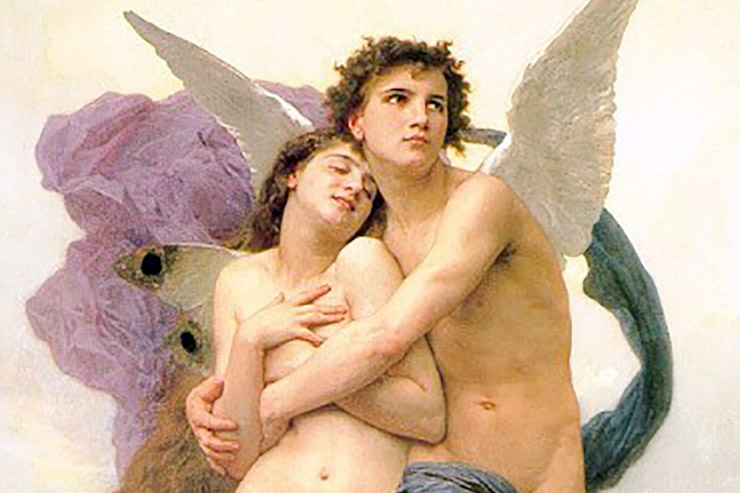
  • Robots, Goblins and Alien Amoeba, Answering Fermi’s Paradox

    Robots, Goblins and Alien Amoeba, Answering Fermi’s Paradox

    From New Dawn 100 (Jan-Feb 2007)

    I believe there are many gods, not one, and always in conflict. Well, if there are gods who created and control what’s going on here, you can tell a lot about them by what is going on. I assume they are colonists. And so anything you can see here you can infer is the act or the will of one of those gods. All you have to do is look around. You’ll see what they’re like. It’s like looking in someone’s yard.
    – W.S. Burroughs

    Dateline: 1950 A.D. The physicist Enrico Fermi is having lunch with a few colleagues when the subject of interstellar travel comes up. There are countless potential living systems in our own galaxy, Fermi reasons. If even a small fraction of these produced technological civilisations capable of launching manned expeditions, our own humble planet should have been overrun with extraterrestrial conquistadores millions of years ago.

    “Don’t you ever wonder where everybody is?” Fermi asked.

    In other words, if the galaxy is filled with little green men in luminous flying saucers who travel from star to star colonising other worlds, then why don’t we have any physical evidence of their existence – not even so much as a piece of broken zipper from one of their spacesuits?

    This question (known as the Fermi paradox) has spawned a vigorous scientific and philosophical debate whose possible answers can be grouped into three broad categories.

    1. Extraterrestrial civilisations do not exist.
    2. Extraterrestrial civilisations exist but haven’t colonised the Earth, either because they can’t or because they don’t want to.
    3. Extraterrestrial civilisations exist and have colonised the Earth without our knowledge.

    As we shall see, the implications for all of these positions are unsettling in the extreme – not so much for what they say about extraterrestrial life, but for what they might say about us.

    Are We Alone?

    The most straightforward solution to the Fermi paradox is that we are alone in the universe – our planet has not been colonised because advanced alien civilisations do not exist.

    Perhaps (as many Christians claim) life is unique to Earth; or perhaps most alien societies ruin themselves through pollution or war, extinguishing life on their home worlds before they have a chance to spread outwards. (Knowing as we do that terrestrial species have a better than 99% extinction rate, this latter scenario is rather easy to imagine.)

    Of course, even if most alien species do expire in this way, isn’t it stretching the limits of conjecture to suppose that all of them do?

    The Milky Way galaxy alone contains at least 100 billion stable solar systems;1 roughly a third of these possess Earth-like planets with oceans.2 The odds against every single one of these being either sterile or suicidal are literally astronomical.

    So, Where Are They?

    If we suppose that extraterrestrial civilisations do exist, we are left with only two options: either they are somewhere else or else they are here. So why might an alien civilisation choose to colonise the Earth (or not)?

    Many researchers seem to assume that an extraterrestrial colonisation effort would be overtly belligerent, taking the form of:

    • Imperialism
    • Resource Exploitation
    • Subversion
    • Scrub & Repopulate
    • Smash & Grab3

    But wouldn’t successful alien civilisations be more patient and cautious than that? Couldn’t they also be:

    A.        unable or unwilling to launch a full-scale invasion of the Earth?

    or

    B.        here already, and ruling over us by means so subtle as to be almost undetectable?

    In fact, some scientists have argued that until we conclusively prove that extraterrestrial civilisations don’t exist, the Fermi paradox isn’t a paradox at all; instead, we aren’t looking hard enough, or haven’t been looking in the right places.

    Biblical Brainteasers

    The Fermi paradox here reveals significant overlap with the theodicy, a traditional theological riddle, which asks: If God is good and all-powerful, where is the evidence of his existence – why is there so much evil in the world?

    One of the most ancient (and persuasive) answers to the theodicy is that of Gnosticism, a speculative branch of pre-Nicean Christianity which held that God (or the gods) do exist, but are neither omnipotent nor benevolent; instead, these advanced beings from the stars are selfish, opportunistic and deceptive.

    Gnosticism In Brief

    In the Gnostic view, the god of the Bible was not the Supreme Being at all, but an arrogant Demiurge who fled the heavens to build this planet as an experimental prison, populating it with artificial life forms and strange, symbiotic hybrids.

    Far from paradisiacal, his “Garden of Eden” was an eerie mad scientist’s laboratory where shadowy parasites abducted a pair of primitive primates named Adam and Eve, raping the female and implanting the male with false memories:

    When they [the Demiurge and his angels] saw Eve speaking with [Adam], they said to one another… “Come, let us seize her and let us cast our seed on her, so that… those whom she will beget will serve us. But let us not tell Adam that she is not derived from us, but let us bring a stupor upon him, and… teach him in his sleep as though she came into being from his rib…”4

    These chthonic and creepy alterna-Christian creation myths have influenced thinkers from many different fields over the millennia, from politics to popular culture. In recent decades, the Gnostic metanarrative has even made a re-appearance with the paranoid worldview which informs much contemporary speculation about aliens and UFOs, e.g.:

    One of the purposes for which UFOs travel to Earth is to abduct humans to help aliens produce other beings. It is not a program of reproduction but one of production. They are not here to help us, they have their own agenda and we are not allowed to know its full parameters.5

    In all of the solutions to the Fermi paradox which appear below, we can see echoes of many of these same, disturbing ideas. As the Demiurge and his angels pass from theology into speculative exobiology, the skies seem to swarm with icily indifferent robots, otherworldly djinn, celestial frauds and bestial, fallen bacilli.

    Six of the most widely-discussed scenarios follow:

    1. Extraterrestrial civilisations spread via self-replicating AI probes.
    2. Extraterrestrial civilisations develop massive virtual reality simulations.
    3. Extraterrestrial civilisations have left this universe and developed the ability to manipulate hyperspace.
    4. Extraterrestrial civilisations develop xenophobic and/or authoritarian religious forms.
    5. Extraterrestrials are biologically very primitive, or spread themselves via biologically primitive forms.
    6. The Earth is being deliberately quarantined.

    Conveniently, most of the possibilities listed here could plausibly be used to explain either why our planet has been invaded or how it could already have been invaded unbeknownst to us; which outcome you favour really seems to depend on your assumptions about alien motivation.

    POSSIBILITY #1 – Extraterrestrial civilisations spread via self-replicating AI probes

    Frank Tipler of Tulane University has argued that alien civilisations would probably explore and colonise the Universe by proxy, filling the galaxy with self-replicating AI (artificial intelligence) probes instead of venturing forth themselves. Thus, even a very distant extraterrestrial civilisation should be able to seize, secure, sterilise and strip-mine our entire planet in about 4 million years.

    “If they existed,” concludes Tipler, “they would be here”; and since we are here instead, they must not exist.6

    On the other hand, if hives of autonomous, adaptable, rapidly multiplying robotic probes were roaming the galaxy, successive generations might eventually become so intelligent as to far surpass their creators.

    In time, as these “artilects” spread throughout the Universe, they could come to abandon their creators’ agenda, preferring effortless communion with their own kind to the laborious conquest of organic, planetary life. Reflects AI researcher Hugo de Garis:

    I suspect strongly that virtually all the ETs out there are in fact artilects, and hence have intelligence levels astronomically superior to the human level. To me, biological technological intelligence is just a fleeting phase that nature goes through en route to creating immortal massive artilectual intelligence, which may be a phenomenon as commonplace as the creation of life from the molecular soup…

    The answer then to Fermi’s paradox is that we human beings, being mere biologicals, are utterly unworthy of the artilects’ attention… What’s in it for them? We are very probably not so special and are very, very dumb…7

    POSSIBILITY #2 – Extraterrestrial civilisations have developed massive virtual reality simulations

    Recent trends suggest that it should be possible for an advanced civilisation (either earthly or alien) to develop fully immersive virtual reality simulations like the “Holodeck” of Gene Rodenberry’s Star Trek. If such a technology were developed by an alien species on its own planet, the prospect of mingling in real time with a distant and dirty species like our own could seem unappealing, degrading or even boring to extraterrestrial psychonauts. Opines evolutionary psychologist Geoffrey Miller:

    Basically, I think the aliens don’t blow themselves up; they just get addicted to computer games. They forget to send radio signals or colonise space because they’re too busy with runaway consumerism and virtual-reality narcissism. They don’t need Sentinels to enslave them in a Matrix; they do it to themselves, just as we are doing today.8

    Alternately, it could be that our own world (and the visible universe which seems to surround it) is itself a vast computer simulation engineered by aliens, some form of artificial intelligence (as in the film The Matrix) or even our own descendants. The planetarium hypothesis holds that we can’t find evidence of alien colonisation because contact with other worlds hasn’t been built into the simulation.

    POSSIBILITY #3 – Extraterrestrial civilisations have left this universe and developed the ability to manipulate hyperspace

    A third possibility is that alien civilisations become capable of interstellar travel, but learn how to escape this universe soon afterwards. If transcension were common, extraterrestrial civilisations might quickly lose interest in colonising other planets. Why travel to a distant ball of mud and water when you can explore higher dimensional hyperspace instead?

    On the other hand, if alien scientists did have the ability to leave our shared space-time and launch themselves into the larger multiverse, they could be here now and we would not be able to see them.

    In the same way that a glass pipette might seem – from the point of view of beings trapped in the flat, two-dimensional world of the Petri dish – like an enormous, transparent column which descends from the sky to abduct unsuspecting amoeba out for an afternoon stroll, aliens from higher dimensional space-time could enter and leave our reality at will, seeming to appear and disappear, change shape and pass through solid barriers as they experimented on and/or revealed themselves to us, and all without leaving a shred of physical evidence.

    The idea that extraterrestrials are actually multi-dimensional has been an influential one, leading some UFO researchers to conclude that:

    This [the UFO phenomenon] is not the product of an alien culture from a nearby star, here to explore our solar system. Instead it is an intelligence which dwells in a different type of reality and moves through hyperspace in such a way as to interreact with us almost as a side-effect. It is an intelligence that is not here to study us but it has been here all along and effectively controls our whole existence…9

    Advocates of Jacques Vallee’s “control system” hypothesis similarly argue that we may never find the evidence we seek because extraterrestrials aren’t encumbered by physical artifacts like spaceships or ray guns; instead these polymorphous and hallucinatory aliens freely wiggle and hop in and out of our world like angels, demons and gods from the twilight realms of the collective subconscious.

    POSSIBILITY 4 – Extraterrestrial civilisations develop xenophobic and/or authoritarian religious forms

    A fourth possibility is that extraterrestrial civilisations tend to develop xenophobic and/or authoritarian religious forms. Given the history of our own species, the difficulties such belief systems might present to alien scientists can easily be imagined.

    Are Plaeadian professors who promote interstellar exploration passed over for promotion or excluded from alien faculty functions? Are extraterrestrial exobiologists denounced as heretics and electrocuted by otherworldly Inquisitors? If so, then we may never encounter these advanced beings from the stars.

    Alternately, it could be that alien conquerors literally walked the Earth’s surface millennia ago and left literary monuments to their endeavours in the form of the Babylonian and Sumerian creation epics and the Hebrew Bible. In this view (the so-called “alien astronaut” hypothesis), the gods and messengers of our own authoritarian religious traditions were not representatives of a supreme being at all, but extraterrestrial colonialists masquerading as gods!

    Israeli scholar Zechariah Sitchin’s works are generally representative of this latter position, holding that alien scientists (the “Elohim” and “Nephilim” of the Old Testament) genetically engineered homo sapiens from the great apes in an attempt to create a slave race:

    They made us through genetic engineering. They jumped the gun on evolution, and made us to look like them physically, and to be like them emotionally. That is what the Bible says: “Let us make the Adam in our likeness and after our image.” Physically, outwardly and inwardly. So much of what they are, we are.10

    Are human beings really descended from some prehistoric encounter between the apes and the angels 300,000 years ago? Sitchin is convinced of it. As proof, he points out that humans possess 223 genes found in no other species on Earth. Either these genes were horizontally transferred by some unknown species of bacteria, Sitchin insists, or else they must be extraterrestrial in origin.11

    POSSIBILITY #5 – Extraterrestrials are biologically very primitive, or spread themselves via biologically primitive forms

    600 million years ago, the Earth was ruled by sponges, flatworms and jellyfish. Possessing neither brains nor nervous systems, these simple organisms flourished, surviving nearly unchanged today.

    In similar fashion, our universe may be teeming with species hugely successful on their home planets but lacking the complex cognitive skills necessary to build and launch spacecraft.

    The flip-side of this possibility is the panspermia hypothesis, which holds that extraterrestrial colonists arrived here billions of years ago, not as bug-eyed monsters in metallic spacecraft, but as spores or bacteria which fell from the atmosphere to fertilise the Earth’s oceans with primitive life. In time, these alien microbes evolved into the many terrestrial species biologists know today, including human beings!

    Of course, the panspermia hypothesis doesn’t answer how our most ancient one-celled ancestors originated themselves; perhaps their ancestors too were seeded somewhere else by alien scientists from another solar system.12

    POSSIBILITY #6 – The Earth is being deliberately quarantined

    Finally, the “zoo hypothesis” holds that we haven’t been able to find any hard evidence of alien contact or colonisation because our extraterrestrial overlords don’t want us to – instead they are treating this planet like a farm or laboratory. As early 20th century paranormal researcher Charles Fort wondered:

    Would we, if we could, educate and sophisticate pigs, geese, cattle? Would it be wise to establish diplomatic relation with the hen…?

    I think we’re property… we belong to something… that once upon a time, this earth was No-man’s Land, that other worlds explored and colonised here, and fought among themselves for possession, but that now it’s owned by something… all others warned off.13

    If this planet functions as a livestock enclosure of some sort, then it makes sense that representatives of the civilisation cultivating and/or studying us would occasionally slip up and reveal themselves. The indignation expressed by the contactee who recalls alien encounters under hypnosis may have something in common with the drugged and dizzy roar of the bear who wakes up to discover a radio-tracking chip stapled to his ear:

    Close Encounters of the Fourth Kind (CE-IV): The contactee is abducted by the UFO occupants, taken aboard the landed craft, and subjected to a variety of “tests” and “experiments.” Some investigators claim to have recovered physical evidence of these interactions in the form of scars from alien surgical incisions. Some abductees report memories of devices being implanted within their bodies, typically through the nose.14

    Conclusion

    Perhaps most alien civilisations are unable or unwilling to colonise other worlds, due to their religious beliefs, immersion in video games, or an unfortunate tendency to blow themselves up, but even if 99% were thus incapacitated, this still doesn’t explain why the remaining 1% seem to have left the Earth alone.

    On the other hand, if just one ambitious, alien civilisation from among the remaining 1% were to colonise the Earth using any or all of the strategies described above, our seeming isolation would be explained and Fermi’s paradox would stand resolved – as long as they did so covertly.

    Are we then, mere talking monkeys in a cosmic cage, simulated serfs in a vast video game or experiments in an extraterrestrial Petri dish, as some of the most plausible solutions to Fermi’s famous question would seem to imply?

    Unfortunately (or perhaps fortunately), the “covert colonisation” hypothesis is by definition almost impossible to disprove; in the end, we may have no choice but to test some of these strange scenarios by launching colonisation programs of our own:

    Earth has provided a stable platform for the evolution of life over 4 billion years. But that lease is limited; we know for sure that it will expire after a few billion more. Long before that, our planet may become a place where it is no longer suitable for us to live. Increasing luminosity of the Sun may gradually boil our oceans, or more sudden catastrophes may threaten our existence. If we are wise, we will have furnished our new apartments long before that time….15

    [alert type=”general” dismiss=”no”]This article was published in New Dawn 100.[/alert]

    [alert type=”success” dismiss=”no”]If you appreciate this article, please consider subscribing to help maintain this website.[/alert]

    Footnotes:

    1. “Earth: No Longer the Lonely Planet,” RedOrbit, Saturday, 27 September 2003, www.redorbit.com/news/stories/1/2003/09/27/story003.html
    2. “Earth-Like Planets May Be More Common Than Once Thought, Says CU-Boulder-Penn State Study,” University of Colorado at Boulder, 7 September 2006, www.colorado.edu/news/releases/2006/280.html
    3. Fritz Freiheit, “The Possibilities of FTL: Or Fermi’s Paradox Reconsidered,” www-personal.engin.umich.edu/~fritx/Ftlessay/essay.html
    4. “On the Origin of the World,” from Willis Barnstone’s The Other Bible, p.70, 1984.
    5. Dr. David Jacobs, Secret Life, p. 305
    6. John D. Barrow and Frank J. Tipler, The Anthropic Cosmological Principle, p.578.
    7. Hugo de Garis, “Answering Fermi’s Paradox”, 22 March 2001, www.kurzweilai.net/articles/art0188.html
    8. Geoffrey Miller, “Runaway consumerism explains the Fermi Paradox,” www.edge.org/q2006/q06_print.html#miller
    9. Peter Hough & Jenny Randles, Looking For the Aliens, p.210, 1991.
    10. Interview with Zecharia Sitchin, www.metatron.se/asitch.html
    11. Zecharia Sitchin, The Case of Adam’s Alien Genes, www.sitchin.com/adam.htm
    12. For an in-depth discussion of the panspermia hypothesis, please see this author’s previous article “The Incredibly Strange Story of Intelligent Design” in the July/August 2006 issue of New Dawn magazine.
    13. The Book of the Damned, A Hypertext Edition of Charles Hoy Fort’s Book, Edited and Annotated by Mr. X, Chapter XII, www.sacred-texts.com/fort/damned/damn12.htm
    14. J. Allen Hynek, UFO researcher, from Keith Thompson’s Angels and Aliens, p.144, 1991.
    15. Robert Shapiro, Planetary Dreams, 1999.

    © New Dawn Magazine and the respective author.
    For our reproduction notice, click here.