New Dawn – World's Most Unusual Magazine

Tag: gnostic

  • William S. Burroughs: 20th Century Gnostic Visionary

    William S. Burroughs: 20th Century Gnostic Visionary

    From New Dawn 199 (Nov-Dec 2006)

    In 1984, in Boulder, Colorado, an interviewer asked William S. Burroughs (1914-1997), “What religious persuasion would you consider yourself?” Without hesitating, Burroughs replied, “Gnostic, or a Manichean.”1Upon reading those words, suddenly everything made sense.

    Perhaps it’s appropriate that the above conversation occurred in 1984. In many ways, Burroughs was a far more lucid and accurate analyst of twentieth century politics than even George Orwell, whose speculative concept of “newspeak” in his 1948 novel 1984 was quickly overshadowed by the real-world machinations of post-WWII Madison Avenue advertising techniques and Washington D.C. public relations firms.

    Superior to Aldous Huxley’s brilliant 1958 collection of essays, Brave New World Revisited, Burroughs’s 1974 book The Job is a must-not-live-without essential guide to charting the opaque labyrinth of obfuscation and lies regularly constructed by the Reality Studio to protect itself from the light of scrutiny. Unlike his more naïve contemporaries among the Beat literary movement, Burroughs never took his eye off the twitchy sharpshooter in the corner, the wild card in the deck known as Control.

    With the analytical eye of a surgeon (Burroughs studied medicine at Harvard, specialised knowledge that would eventually serve him well in his novels), Burroughs performed an autopsy on the body politic in a multitude of bleak and humorous novels, foremost among them Junky (1953), Naked Lunch (1959), The Soft Machine (1961), Nova Express (1964), and The Place of Dead Roads (1983).

    But Burroughs never limited his vision to merely charting out the intricate connections that make up the system of control. Like Huxley before him, who eventually followed his dystopian novel Brave New World with a Utopian counterpoint titled The Island, Burroughs himself attempted to construct his own vision of a Utopia in such novels as The Wild Boys (1971) and Cities of the Red Night (1981).

    In both cases, Burroughs seemed to suggest that a Utopia was not possible except within an isolated oasis, what Hakim Bey would call “a temporary autonomous zone.”2 In the first case, the autonomous zone takes the form of an all-male enclave in the jungles of North Africa; these commandos, trained in combat for defensive purposes, can reproduce without the aid of women and travel through the trees on prehensile hemorrhoids. In Cities of the Red Night, Burroughs’s Utopia is based on historical fact and manifests as an island settlement established by Captain Mission, an actual pirate who lived in the eighteenth century.Mission explored the Madagascar coast and found a bay ten leagues north of Diego-Suarez. It was resolved to establish here the shore quarters of the Republic – erect a town, build docks, and have a place they might call their own. The colony was called Libertatia and was placed under Articles drawn up by Captain Mission. The Articles state, among other things: all decisions with regard to the colony to be submitted to vote by the colonists; the abolition of slavery for any reason including debt; the abolition of the death penalty; and freedom to follow any religious beliefs or practices without sanction or molestation.3

    In both Wild Boys and Cities of the Red Night, Burroughs celebrates the notion of an autonomous zone kept separate from the madding hordes through potentially violent defensive measures, where a human being is allowed to pursue life free from the constant surveillance of overly authoritarian social structures. In Burroughs’s hands, William Golding’s Lord of the Flies would no doubt have a very different outcome.

    Burroughs’s libertarian brand of morality was based on Jack Black’s notions of the “Johnson family” as chronicled in Black’s 1926 autobiography You Can’t Win. The impact this book had on Burroughs when he was still a young man can’t be overestimated. In Burroughs’s own words, the Johnson creed can be described as follows:

    “The Johnson family” was a turn-of-the-century expression to designate good bums and thieves. It was elaborated into a code of conduct. A Johnson honours his obligations. His word is good and he is a good man to do business with. A Johnson minds his own business. He is not a snoopy, self-righteous, troublemaking person. A Johnson will give help when help is needed. He will not stand by while someone is drowning or trapped under a burning car.4

    Surely in Burroughs’s world this would be the only mandatory social stricture established for his personal temporary autonomous zone.

    Burroughs’s vision of a Utopian autonomous zone could be seen as a metaphor for the Gnostic concept of “the pneuma,” an infinitesimally small fragment of the divine that exists in all human beings.

    Gnosticism, an early form of Christianity, flourished in the Middle East until approximately the second century CE when the movement was violently suppressed by Roman Catholic authorities. Dr. Stephan Hoeller, the current bishop of the Gnostic Church in Los Angeles, distinguishes Gnosticism from traditional forms of Christianity in this way:

    [Gnosticism is] much more orientated toward the personal, spiritual advancement and transformation of the individual, regarding figures such as Jesus as being helpers rather than sacrificial saviours. It is a form of religion that has […] a much more ecumenical and universal scope in terms of its relationship to spiritual, religious traditions other than the Christian.5

    According to literary scholar Gregory Stephenson:

    …the attitude that characterises all the Gnostic systems is that the world, the body, and matter are unreal and evil. They are illusions that are the products of malevolent powers called Archons, chief among whom is Sammael (the god of the blind or the blind god), also called Ialdabaoth or the Demiurge. These creator-gods are not the Deity of the Supreme Being, though they make claim to being so. The Deity is completely transcendent – absolutely distinct, apart, and remote from the created universe. However, a portion of the divine substance, called the pneuma, is enclosed in the human body – within the human passions and the human appetites […]. The aim of Gnosticism is to liberate the pneuma from its material, delusional prison and to reunite it with the Deity. The Archons seek to obstruct this liberation and to maintain their dominion.6

    This basic theological structure applies to almost all of Burroughs’s work. Burroughs’s strong sense of morality, of the distinct difference between right and wrong, is often lost in the lurid morass of details concerning his personal life. His heroin addiction, his homosexuality, his arrest in Mexico for the accidental death of his wife, his early experimentation with yage in South America and his later fascination with Wilhelm Reich’s unorthodox theories regarding orgone energy – all of these unusual aspects of his life, though admittedly intriguing, are often reduced to gossipy anecdotes that threaten to diminish the importance of the work itself.

    Burroughs was never the star of his own novels, not even in his highly autobiographical debut, Junky. The central figure in all his novels is war – a continuous war between Freedom and Control, what Burroughs himself might very well refer to as “good and evil.”

    The conflict between good and evil is considered to be a hollow theme by most literary scholars. After all, is this not the purview of Tolkienesque sword and sorcery epics and four-colour superhero comics? Surely no major literary figure of the twentieth century ever bothered to waste his time on such silliness.

    But that’s not quite true. In the work of no other American writer do we find this theme explored in as complex and harrowing a manner as in the novels and essays of William Burroughs. At the beginning of this essay Burroughs described himself as a “Manichean.” Burroughs defined this term as follows:

    The Manichean believe in an actual struggle between good and evil, which is not an eternal struggle since one of them will win in this particular area, sooner or later. Of course, with the Christians there was this tremendous inversion of values where the most awful people are thrown up as this paragon of virtue for everyone to emulate…7

    The Manichean sect of Gnosticism spread across three continents over the course of eleven hundred years beginning, approximately, in CE 240. It was founded by the Persian prophet Mani, who was eventually imprisoned at the age of 61, tortured for 26 days, and assassinated. According to Dr. Hoeller, Mani is among “two of the great luminaries of the Gnostic tradition.”8

    Dr. Hoeller sums up Mani’s basic doctrine as follows:

    In the beginning, said Mani, the kingdoms of Light and Darkness coexisted in uneasy peace. While Light had no quarrel with the existence of Darkness and would have remained content existing side-by-side with it, Darkness would have it otherwise. Darkness was in a state of agitation and wrath and decided to attack and invade the realm of light.

    As the legions of Darkness approached the realm of Light, the primal light needed to defend itself. It called upon the Mother of Life to bring forth the Primal Man (a cosmic figure, not related to Adam or other human beings except in an indirect way). The Primal Man in turn had five sons, and together the six expelled the Dark forces from the kingdom of Light and pursued them onto the battlefield of the lower aeons. Unfortunately, on the battlefield the chief demons of Darkness overpowered the Primal Man and his five sons and devoured them, incorporating their luminous essence into their dark forms. This is how the first terrible intermingling of Light and Darkness occurred […].

    In the course of the rescue efforts the Primal Man is freed, and he gloriously ascends to the Godhead. The souls of the human beings, however, have been left behind, along with Light particles that derive from the captivity of the Primal Man and of his sons. It is only at this point that the material world as we know it comes into being. The Earth is created as an alchemical vessel of purification and transformation where the Light can be extracted from dark matter. The Sun and the Moon are both vessels of Light that serve as vehicles to transport Light upwards out of earthly darkness.9

    In Burroughs’s world, evil disguises itself as good and good disguises itself as evil. The Archons are Christians and politicians and “jus’ good folk.” The Gnostics are roving bands of criminals and thieves known only to themselves as “the Johnsons.” The visionaries, the ones who have attained genuine gnosis (i.e., “knowledge”) can see through the illusions forged by control, identify the face of the enemy, and from that point begin the quest for true freedom.

    These visionaries regularly employ unorthodox and seemingly “insane” methods to overthrow the hypnotic bonds of control: opiates, orgone energy, tape recorders that are used to cut up, analyse, and reconfigure the endless barrage of shallow mass media used to keep the masses docile, astral travel through time and space, hermetic magic, telepathy, etc. These are the tools of the twentieth century Gnostic in Burroughs’s revitalised Libertatia.

    The goal of these latter day Gnostics is to establish an autonomous zone, a physical approximation of the pneuma, while having as much fun as possible trying to “wise up the marks,” a paraphrase of a key sentence in the third chapter of his 1964 novel Nova Express: “And you can see the marks are wising up, standing around in sullen groups and that mutter gets louder and louder.”10

    The Archons are represented on Earth by parasite-infected control-freaks Burroughs aptly calls “the shits”: “…my contention is that evil is quite literally a virus parasite occupying a certain brain area which we may term the RIGHT centre. The mark of a basic shit is that he has to be right.11 The shits will use all the power they have on this planet in order to prevent the Johnsons from waking up the marks.

    This conflict between good and evil is played out in Burroughs’s fiction over and over again, perhaps most prominently in Nova Express. In this novel the Johnsons are called “The Nova Police” and the shits are called “The Nova Mob,” or simply “The Board”: “All right you board bastards, we’ll by God show you ‘Operation Total Exposure.’ For all to see. In Times Square. In Piccadilly.”12 Operation Total Exposure represents an attempt by the Nova Police to pull back the illusory curtain that protects the parasite-infected Reality Studio from being seen in its true form, to induce gnosis in the madding hordes, to transform the “marks” into “Johnsons.”

    In chapter one of Nova Express, Inspector J. Lee of the Nova Police addresses the human race:

    What scared you all into time? Into body? Into shit? I will tell you: ‘the word.’ Alien Word ‘the.’ ‘The’ word of Alien Enemy imprisons ‘thee’ in Time. In Body. In Shit. Prisoner, come out. The great skies are open.13

    Chapter two, titled “Prisoners, Come Out,” is an open letter addressed to the “peoples of the earth” and is signed by Inspector Lee. In this letter the Inspector explains that the purpose of his novels are

    …to expose and arrest Nova Criminals. In Naked Lunch, Soft Machine and Nova Express I show who they are and what they are doing and what they will do if they are not arrested. Minutes to go. Souls rotten from their orgasm drugs, flesh shuddering from their nova ovens, prisoners of the earth to come out. With your help we can occupy The Reality Studio and retake their universe of Fear Death and Monopoly.14

    In his 1978 collaboration with Brion Gysin, The Third Mind, Burroughs wrote in reference to Nova Express:

    A new mythology is possible in the space age where we will again have heroes and villains with respect to intentions toward this planet.15

    The central villain of Inspector Lee and his Nova Police is a Demiurge-like figure named Mr. Bradly-Mr. Martin who leads the extraterrestrial Nova Mob, and through this Mob he has kept the Earth enslaved for thousands of years. In The Third Mind, Burroughs describes Mr. Bradly-Mr. Martin in terms that are overtly Gnostic:

    Mr Bradly-Mr Martin, in my mythology, is a God that failed, a God of Conflict in two parts so created to keep a tired old show on the road, The God of Arbitrary Power and Restraint, Of Prison and Pressure, who needs subordinates, who needs what he calls “his human dogs” while treating them with the contempt a con man feels for his victims – But remember the con man needs the Mark – The Mark does not need the con man – Mr Bradly-Mr Martin needs his “dogs” his “errand boys” his “human animals” – He needs them because he is literally blind. They do not need him. In my mythological system he is overthrown in a revolution of his “dogs.”16

    Throughout the novel, Inspector Lee explicitly warns the people of Earth about some of the most insidious tools the Mob is using against them:

    Their drugs are poison designed to beam in Orgasm Death and Nova Ovens – Stay out of the Garden of Delights – It is a man-eating trap that ends in green goo – Throw back their ersatz Immortality – It will fall apart before you can get out of The Big Store – Flush their drug kicks down the drain – They are poisoning and monopolising the hallucinogen drugslearn to make it without any chemical corn – All that they offer is a screen to cover retreat from the colony they have so disgracefully mismanaged. To cover travel arrangements so they will never have to pay the constituents they have betrayed and sold out. Once these arrangements are complete they will blow the place up behind them.17

    The succeeding chapters introduce us to members of Mr. Bradly-Mr. Martin’s Archon-like Nova Mob:

    ‘Sammy the Butcher,’ ‘Green Tony,’ ‘Iron Claws,’ ‘The Brown Artist,’ ‘Jacky Blue Note,’ ‘Limestone John,’ ‘Izzy the Push,’ ‘Hamburger Mary,’ ‘Paddy the Sting,’ ‘The Subliminal Kid,’ ‘The Blue Dinosaur’.18

    In a section eerily redolent of current events, a chapter titled “Coordinate Points,” the Inspector does us the favour of outlining the Mob’s plan to bring about global destruction:

    The basic nova mechanism is very simple: Always create as many insoluble conflicts as possible and always aggravate existing conflicts – This is done by dumping life forms with incompatible conditions of existence on the same planet – There is of course nothing “wrong” about any given life form since “wrong” only has reference to conflicts with other life forms – The point is these forms should not be on the same planet – Their conditions of life are basically incompatible in present time form and it is precisely the work of the Nova Mob to see that they remain in present time form, to create and aggravate the conflicts that lead to the explosion of a planet that is to nova – At any given time recording devices fix the nature of absolute need and dictate the use of total weapons – Like this: Take two opposed pressure groups – Record the most violent and threatening statements of group one with regard to group two and play back to group two – Record the answer and take it back to group one – Back and forth between opposed pressure groups – This process is known as “feed back” – You can see it operating in any bar room quarrel – In any quarrel for that matter – Manipulated on a global scale feeds back nuclear war and nova – These conflicts are deliberately created and aggravated by nova criminals – […] In all my experience as a police officer I have never seen such total fear and degradation on any planet – We intend to arrest these criminals and turn them over to the Biological Department for the indicated alterations.19

    Jack Kerouac once wrote, “Burroughs is the greatest satirical writer since Jonathan Swift,” but the truth is that Burroughs never wrote a word of satire in his life. He was writing about life as he saw it, exactly as he experienced it. The Nova Mob and the virus parasites from outer space were not metaphors for him. They were real.

    Burroughs, perhaps more so than F. Scott Fitzgerald or even Ernest Hemingway, was the prime mimetic writer of the twentieth century. He never wrote anything other than realistic novels. Marshall McLuhan, author of Understanding Media and The Gutenberg Galaxy, might have been the first to catch onto this subtle but significant point when he wrote in 1964,

    It is amusing to read reviews of Burroughs that try to classify his books as nonbooks or as failed science fiction. It is a little like trying to criticise the sartorial and verbal manifestations of a man who is knocking on the door to explain that flames are leaping from the roof of our home.20

    Indeed, Burroughs wasn’t trying to satirise modern culture, nor was he trying to create a hypothetical, science fictional representation of it. He was simply explaining his society within the only context that seemed appropriate to him, and that context was undoubtedly a Gnostic one.

    Even the so-called science fictional elements of his books were not intended as satire or metaphor. Burroughs could very well have been introduced to the Nova Express model of invading extraterrestrials (and/or intrusions from alternate dimensions) at a very young age. In various interviews, for example, Burroughs has recounted one of his earliest childhood memories.

    When he was four, he woke up early in the morning and saw little gray men playing in a block house he had made. “I felt no fear,” he said, “only stillness and wonder.”21 When asked about this incident in 1987, interviewer Larry McCaffery offhandedly referred to such experiences as “hallucinatory.” Burroughs replied, “I wouldn’t call them hallucinatory at all. If you see something, it’s a shift of vision, not a hallucination. You shift your vision. What you see is there, but you have to be in a certain place to see it.”22

    This image of “little gray men” evokes more recent, popular conceptions of extraterrestrials as seen on the mass market covers of any number of books by Whitley Strieber, the author of Communion (1987), Transformation (1988) and several others in which his ostensible contacts with alien beings are delineated. Burroughs was so convinced of the reality of invading extraterrestrials that in 1989 he wrote a letter to Strieber asking to visit him and his family in their cabin in upstate New York. The 1996 revised edition of Victor Bockris’s With William Burroughs: A Report from the Bunker contains an in-depth interview about this meeting:

    I was very interested in his first books and I was convinced that he was authentic. I felt he was not a fraud or fake […]. I wrote a letter to Whitley Strieber saying that I would love to contact these visitors […]. His wife, Anne Strieber, wrote back saying, “We, after talking it over, would be glad to invite you to come up to the cabin.” So we spent the weekend there. I had a number of talks with Strieber about his experiences, and I was quite convinced that he was telling the truth […].

    Burroughs follows this comment by exploring the idea of “invasion” on all levels. He genuinely believed the human race was, and is, being infected by hostile intelligences on a regular basis:

    When I go into my psyche, at a certain point I meet a very hostile, very strong force. It’s as definite as somebody attacking me in a bar. We usually come to a standoff, but I don’t think that I’m necessarily winning or losing […]. Listen, baby, I’ve been coping with this for so many years. I know this invasion gets in. As soon as you get close to something important, that’s when you feel this invasion, and that’s the way you know there’s something there. I’ve felt myself just marched up like a puppy to go and do something that would get me insulted or humiliated. I was not in control […]. There are all degrees of possession. It happens all the time. What you have to do is confront the possession. You can do that only when you’ve wiped out the words. You don’t argue […]. You have to let it wash through. This is difficult, difficult; but I’ll tell you one thing: You detach yourself and allow this to wash through, to go through instead of trying to oppose, which you can’t do […]. The more you pull yourself together the further apart you get. You have to learn to let the thing pass through. I am a man of the world; I understand these things. They happen to all of us. All you have to do is understand them or see them for what they are, that’s all.23

    John Lash, co-founder of Metahistory.org, a website that concerns itself with Gnosticism and related topics, has many Burroughs-like perceptions regarding the Gnostic model of spiritual “intrusion.” Lash states:

    It might be said that Gnostics believed that only by confronting what is insane and inhumane in ourselves, can we truly define what is human. In essence, to define humanity is to defend it against distortion. Gnostics asserted that the capacity for distortion of humanitas, or dehumanisation, is inherent in our minds, but this capacity alone is not potentially deviant. Since we are endowed with nous, a dose of divine intelligence, we are able to detect and correct distorted thinking […]. In a practical sense, Gnostic teachers in the Mystery Schools instructed the neophytes in how to face the Archons both as alien intruders, comparable to the Greys and Reptilians of contemporary lore, and as tendencies in their minds. The detection of […] intrusion in both these modes of experience seems to be unique to the finely nuanced noetic science of the [Gnostic] Mysteries.24

    And it is this “finely nuanced science” that Burroughs attempted to keep alive in the form of fiction. Burroughs’s many readers were all potential recruits, “marks” who had “wised up” just enough to see a hint of light behind the illusion. His sincerest hope was that at least some of them were paying attention, would pick up the tools he left behind within his books, and use them to storm through the mass of Nova Mobsters whose unenviable job is to surround and protect the ramparts of the fragile Reality Studio until its dying day.

    [alert type=”general” dismiss=”no”]This article was published in New Dawn 99.[/alert]

    [alert type=”success” dismiss=”no”]If you appreciate this article, please consider subscribing to help maintain this website.[/alert]

    Footnotes:

    1. Gregory Corso Interview, “Attack Anything Moving.” Burroughs Live: The Collected Interviews of William S. Burroughs 1960-1997, Ed. Sylvere Lotringer, New York: Semiotext(e), 2000.

    2. Bey, Hakim, T.A.Z., Brooklyn: Autonomedia, 1991, p. 99.

    3. Burroughs, William S., Cities of the Red Night, New York: Holt, Rinehart and Winston, 1981, p. xii.

    4. Burroughs, William S., The Place of Dead Roads, New York: Henry Holt, 1983, p. ix.

    5. Robert Guffey Interview, “The Suppressed Teachings of Gnosticism.” Paranoia Magazine, www.paranoiamagazine.com/hoeller.html.

    6. Stephenson, Gregory, The Daybreak Boys: Essays on the Literature of the Beat Generation, Carbondale: Southern Illinois U P, 1990, p. 60.

    7. Gregory Corso Interview.

    8. Hoeller, Stephan A, Gnosticism: New Light on the Ancient Tradition of Inner Knowing, Wheaton: Quest, 2002, p. 135.

    9. Ibid, pp. 140-41.

    10. Burroughs, William S., Three Novels: The Soft Machine, Nova Express, The Wild Boys, New York: Grove P, 1988, p. 196.

    11. Burroughs, William S., The Adding Machine, New York: Seaver, 1986, p. 16.

    12. Three Novels, p. 197.

    13. Three Novels, p. 186.

    14. Three Novels, p. 189.

    15. Burroughs, William S. and Brion Gysin, The Third Mind, New York: Viking, 1978, p. 97.

    16. Ibid.

    17. Three Novels, p. 188.

    18. Three Novels, p. 236.

    19. Three Novels, pp. 235-36.

    20. Murphy, Timothy S, Wising Up the Marks: The Modern William Burroughs, Los Angeles: U of California P, 1997, p. 145.

    21. Bockris, Victor, With William Burroughs: A Report From the Bunker, New York: St. Martin’s Griffin, 1996, p. xx.

    22. Hibbard, Allen, Conversations with William S. Burroughs, Jackson: U P of Mississippi, 1999, p. 182.

    23. With William Burroughs: A Report From the Bunker, pp. 242-46.

    24. Lash, John, “A Gnostic Catechism: Encounters with Aliens in a Mystery School Text.” www.metahistory.org/GnosticCatechism.php.

    © New Dawn Magazine and the respective author.
    For our reproduction notice, click here.
  • The Incredibly Strange Story of Intelligent Design

    The Incredibly Strange Story of Intelligent Design

    From New Dawn 97 (Jul-Aug 2006)

    Children in Ohio may be taught life was created by aliens under an education package designed to ditch Darwin’s Theory of evolution. The US state is considering adopting the “intelligent design” theory that life is too complex to have simply evolved – as the Darwin Theory suggests. Therefore says the package, life must have been designed by some supernatural being, maybe God, maybe aliens.
    Herald Sun, Columbus, Ohio, March 2002

    Intelligent Design (ID) theory is a highly speculative philosophical argument, popular in recent years, which holds that rich diversity of species on the planet Earth is best understood as evidence of divine (or alien) intervention in terrestrial life.

    In a nutshell, ID argues that the Earth is too young, and life too complex for fish, animals and birds to have evolved through natural selection; instead, we must look for a supernatural cause.

    Professional scientists object to ID theory on the grounds that it can’t be proven, and so falls outside the domain of science; ID proponents have responded by taking their case directly to the public with a political campaign called “teach the controversy.”

    The “teach the controversy” campaign makes scientists (especially those who depend on public funding) nervous, and with good reason – the ultimate goal of the ID movement, as leading spokesmen frankly admit, is to discard the scientific method altogether and “win back” Western culture for the Biblical creator god.

    What makes this situation so especially interesting is the fact that leading ID theorists have positioned themselves as intellectual “heretics” struggling against the gatekeepers of scientific “orthodoxy.”

    Of course, the idea that ID could actually be taught alongside evolution in public schools has provoked an unprecedented tsunami of scorn from these same, self-appointed gatekeepers. “ID isn’t science!” they object. “If we teach ID, then why not teach students that the Moon is made out of green cheese, or that storks deliver babies?”

    I would like to respectfully suggest that children’s stories like the ones I’ve just mentioned aren’t the best analogies for ID theory. A better example might be the Anthropic Principle (AP), a closely related line of speculative reasoning which holds that the Universe itself is so complex and so improbable that it, too, requires special explanation. (We might also note that evangelical Christians are especially fond of AP in its “strong” form, which suggests that our Universe was “fine-tuned” for life by a god-like being.)

    Unfortunately for Christian culture warriors, neither of these remarkable notions ultimately supports the old-fashioned idea that life, the Universe and everything represent the singular creations of a perfect, rational Supreme being. (In its totalising singularity, the Genesis metanarrative differs little from the Big Bang and Darwinian evolution scenarios which comprise the “origins story” of the industrialised West).

    Rather, ID theory and the Anthropic Principle – and especially their corollary mechanisms panspermia and simulation – seem to reveal the handiwork of multiple, incompetent creators who were themselves created by yet more incompetent creators in another Universe, and so on, extending backwards in time and space to a point of infinite regress.

    To put it bluntly: AP and ID do not somehow “prove” the case for the Bible; instead, they unavoidably and inevitably lead us back to a time and place even earlier and more primal than Genesis itself, back to the myths and theological speculations of the ancient Gnostic Christians.

    GNOSTICISM: A QUICK INTRODUCTION

    What historians today call “Gnosticism” was once a broad and diverse movement within pre-Catholic Christianity – an anarchic assemblage of hundreds of different schools of mystical theology whose adherents proudly produced reams of elaborate, florid, and highly speculative re-interpretations of Biblical scripture.

    While no one doctrine united all Gnostic Christians, they did hold certain beliefs in common; perhaps the most shocking of these was the idea that the Old Testament creator God Yahweh was actually the Demiurge, a monstrous deity born from the shadow of infinity who fled the divine world to build our Universe in a misbegotten experiment.

    This Demiurge, the story goes, created for himself assistants – bumbling fallen angels called “archons” – and these in turn created the Earth, humanity, and seven heavens which encase and enclose our planet like so many cosmic prison walls.

    In a version of the myth popularised by 2nd century Gnostic theologian Basilides, the archons generated not just seven, but 365 heavenly realms in sequence, nested one inside the other like the rings of an electron – each successive layer just slightly more defective than the one which produced and preceded it, and all populated by arrogant creator gods completely unaware of those who came before them.

    French heresy-hunter St. Irenaeus invokes these strange stories in an attempt to refute the idea there is another heaven above heaven, and another god above “God”; for if gods produce gods who create heavens filled with yet more world-creating gods, then where does it all stop?

    …by that very process of reasoning on which they [Gnostic Christians] depend for teaching that there is a… God above the Creator of heaven and earth, any one who chooses to employ it may maintain that there is another [heaven] above [heaven and] above that again another… flowing out into… worlds without limits, and gods that cannot be numbered… so that the formation of heavens of this kind can never cease… the operation must go on ad infinitum…1

    The Gnostic version of the Adam and Eve myth also differs radically from the Biblical one, presenting the Garden of Eden as a shabby laboratory where the “archons” built Adam from blurry blueprints, botching his brain and body almost beyond repair:

    The (first) human being… was a creation of angels [but was] unable to stand erect because of the angels’ impotence, and rather writhed on the ground like a worm….2

    Even after the Eden fiasco, the archons continued to tamper with the human gene pool, raping Eve, drowning Adam’s descendants in a flood, and descending to the Earth to impregnate the survivors with half-human hybrids.

    As we shall see, the ID and AP theories so beloved of contemporary apologists have far more in common with the open, flawed and multiple processes described here than with anything even remotely resembling the Biblical creation account; or, as one Gnostic scribe observed waggishly:

    For Adam was a laughingstock, since he was made a counterfeit type of man by the Rulers.3

    ID THEORY MADE SIMPLE

    The basic idea behind ID is that life and its component parts display something called “irreducible complexity.” This means that living systems (plants, animals, people) are so complicated that they could not possibly have arrived at their present forms through evolution – instead, new species must have been deliberately planned and introduced to the planet by some sort of godlike being.

    Inanimate objects such as televisions, microwave ovens or wristwatches illustrate this principle. If we can admit that these devices show evidence of planning and design, and are unlikely to have emerged from chance alone, then shouldn’t we admit the same of the human eye?

    Like the watch, the eye seems so perfectly engineered that it’s difficult to imagine how it could have evolved in stages over time. Remove any one of its parts, ID theorists point out, and it would dim, blur, or even become completely useless.

    Unfortunately, there are a few problems with this line of reasoning, at least from the Biblical perspective. For one thing, if organs and species are so complex that they require an “intelligent designer,” then wouldn’t this “designer,” too, be at least as complex as its creations, and so require a designer of its own? And wouldn’t that intelligent designer also require a designer, and so too its designer, ad infinitum?

    UNINTELLIGENT DESIGN

    A second problem with the “eye” example is the fact that the human retina tends to detach from the optic nerve over time, leading to blindness; if this is evidence of “Intelligent Design,” then our “Intelligent Designer” is clumsy at best and malicious at worst.

    Other widely remarked-upon flaws4 in the design of the human body include:

    • high placement of the larynx, facilitating choking
    • thin spinal discs between the vertebrae which degenerate under pressure, causing crippling back pain
    • a small pelvis makes childbirth difficult and often fatal for women
    • a weak, vulnerable stomach unprotected by ribs

    Of course, evidence of sub-optimal design in itself does not prove that “Intelligent Design” did not occur; it may instead demonstrate the purposeful engineering of planned obsolescence.

    Or it may be that these seeming flaws are part of the Intelligent Designer’s secret plan to give humans the opportunity to improve themselves. Consider the German artist Gunther von Hagens’ plan to build a “super-human” using the donated body parts of terminally ill patients. Why and how?

    The programme aims to identify and correct the significant design flaws in human anatomy. The body will be modified by Professor von Hagens and leading biologists, surgeons and mechanical engineers into an “improved” human form. Ideas already put forward include:

    • increase the number of ribs to protect internal organs better
    • create backward-bending knees to lessen wear on joints
    • rearrange the trachea and oesophagus to stop food going down the windpipe by mistake
    • double heart or reconstruction of the coronary arteries
    • make a retractable penis

    Professor von Hagens claims that his Protean monster will “pave the way for a more healthy, capable and longer-living body. What we do with a real human body today will show what we can achieve in the future using genetic engineering.”5

    MULTIPLE DESIGNERS THEORY

    Von Hagens’ team of assistants illustrate another unstated premise of popular ID theory, to wit: why do ID proponents always seem to assume there was only one designer?

    If evolution fails as an explanation for the rich diversity of species on the planet Earth, then why not posit a rich diversity of designers?

    Science writer Richard Hoppe finds such a scenario not only possible but likely, noting that:

    …Some of the most impressive and elaborate designs in biology appear to have as their primary purpose the defeat or subversion of other designs. Designs engage in various kinds of biological arms races with one another. Some examples are:

    • Predator/prey arms races.

    • Parasite/host arms races.

    • Male/female arms races.

    • Disease-causing bacteria/drug companies arms races.

    Each of these is an example of design pitted against design, directly implicating multiple designers.6

    In fact, scientists have long known that the human body hosts a wide variety of foreign flora and fauna; as a recent Wired news story entitled “People Are Human-Bacteria Hybrid” notes:

    We are best viewed as walking “superorganisms,” highly complex conglomerations of human cells, bacteria, fungi and viruses… More than 500 different species of bacteria exist in our bodies, making up more than 100 trillion cells. Because our bodies are made of only some several trillion human cells, we are somewhat outnumbered by the aliens. It follows that most of the genes in our bodies are from bacteria, too.7

    “Which came first, the intestine or the tapeworm?” W.S. Burroughs once asked.

    If Hoppe’s “Multiple Intelligent Designers” theory is correct, the tapeworm, the intestine, mitochondria, bacteria, fungi and perhaps even the human brain and body were produced by completely separate beings – limited and imperfect creators with varying levels of skill competing against one another for ecological dominance.

    ALIENS AMONG US

    ID theory continues to excite evangelical Christians, but there are even more signs that their enthusiasm may be misplaced, and for reasons much more serious than built-in flaws or design by committee.

    In short, if they accept this “Intelligent Designer,” then what guarantee do they have that it (or they) will be gods at all?

    Leading ID theorist Bill Dembski (of Baylor University) isn’t exactly sure. According to a recent article in the American Spectator:

    The intelligent design that Dembski hopes to detect could belong either to a Biblical God or to an earlier race of Martians who planted us here (like in the movie Mission to Mars).

    The idea that the Earth was deliberately “seeded” with life by extraterrestrial scientists “may seem pretty far out,” the article concedes. “But Francis Crick, winner of the Nobel Prize for his co-discovery of DNA’s structure, is one of a number of scientists who have seriously promoted the ‘panspermia’ hypothesis…”8

    The ancient Gnostics were vitalists, holding that all life springs from a single, unseen animating principle; the Gnostic teacher Basilides referred to this original life source as the “universal seed,” or “panspermia.”

    Today, scientists use the term “panspermia” to describe the theory that life is not native to the Earth, but was instead brought here by an alien spore or virus. Part of the appeal of this idea lies in the fact it doesn’t try to answer how life first emerged from non-living matter; given our vast – perhaps infinite – Universe, the most likely scenario is that life first emerged somewhere else and then “infected” our relatively youthful planet only recently.

    Numerous vehicles for this “infection” have been proposed, from meteorites and sunbeams to interstellar clouds; perhaps the most distasteful was suggested by Thomas Gold of Cornell University, who famously wondered if the Earth life began when our planet was contaminated with microbes from the discarded remnants of an extraterrestrial picnic!

    CRICK’S CLONES

    Francis Crick agreed with the basic premise of panspermia – the idea that the Earth was probably “infected” with life – but wondered at the mechanism; wasn’t the passive spread of life from planet to planet by natural, accidental causes almost as unlikely as abiogenesis (the spontaneous production of life from non-living matter – the conventional scientific explanation)?

    Isn’t it much more likely that an extraterrestrial civilisation seeded our planet with life deliberately?

    Terming his model Directed Panspermia, Crick suggested that a “spaceship” carrying “large samples of… microorganisms” was sent to the Earth billions of years ago by an extraterrestrial civilisation – either as an experiment, preparation for colonisation or a genetic Noah’s Ark of some sort.9

    Or, as Fortean researchers Alan and Sally Landsburg put it:

    The DNA molecule is a marvel of microminiaturisation. All of the DNA in every cell of every living creature on Earth could be packed into one container no bigger than a pea. Thus it could be possible to ship to distant planets the distilled essence of entire colonies, stored in tiny packets. The DNA molecules need be activated only at the appropriate moment, thereby providing enormous savings both in shipping weight and in cost.10

    Sir Frederick Hoyle (the British astronomer who coined the term “Big Bang”) and his student Chandra Wickramasinghe have proposed an even stranger version of the Directed Panspermia model; in the Hoyle/Wickramasinghe view, life originated with (and continues to evolve from) showers of viruses from outer space:

    …life on Earth is derived from what appears to be an all pervasive galaxy-wide living system. Terrestrial life had its origins in the gas and dust clouds of space, which later became incorporated in and amplified within comets. Life was derived from and continues to be driven by sources outside the Earth…11

    What makes the Hoyle/Wickramasinghe model so remarkable is that it seeks to replace random genetic variation as a primary evolutionary mechanism; according to Wickramasinghe, “every crucial new inheritable property” that occurs in the animal kingdom “must have an external cosmic origin.”

    Viruses, although often bad for the individual, are in the view of Sir Fred Hoyle and myself of paramount importance to the evolution for species on our planet. They carry with them the store of cosmic genetic information needed for the generation of new species, classes and orders, and for the progressive forward march of life…12

    “If the Earth were sealed off from all sources of external genes: bugs could replicate till doomsday,” Wickramasinghe writes, “but they would still only be bugs: and monkey colonies would also reproduce but only to produce more monkeys. The Earth would be a dull place indeed…”13

    In other words, not only did aliens first infect the Earth with life, but they also make evolution possible by supplying terrestrial species with new genetic material for natural selection to act upon!

    Sir Hoyle didn’t believe that these viruses fell by chance; instead life itself was the result of an alien experiment:

    The likelihood of the formation of life from inanimate matter is one to a number with 40,000 naughts after it… It is big enough to bury Darwin and the whole theory of evolution. There was no primeval soup, neither on this planet nor any other, and if the beginnings of life were not random, they must therefore have been the product of purposeful intelligence.14

    Sir Hoyle seems to have betrayed at least some misgivings about the implications of these ideas, warning in a 1971 press conference that:

    Human beings are simply pawns in the game of alien minds that control our every move. They are everywhere, in the sky, on the sea, and in the Earth… It is not an alien intelligence from another planet. It is actually from another Universe which entered ours at the very beginning and has been controlling all that has happened since…15

    CAVEATS & PARADOXES

    For all its strengths, the panspermia hypothesis still does not actually tell us how or where life first arose, instead shuffling this question off to a distant realm of mystery and paradox into which we cannot hope to peer. As one Christian critic wonders:

    ..If for the sake of argument we grant that life on Earth was seeded by ancient extraterrestrials, then the obvious question is, Who or what created our extraterrestrial creators? Some would argue that they were, in turn sprinkled (created) by an even more ancient race of ET’s. Well, where did they come from? An infinite regression back in time of “alien sprinklings”…[?]16

    Since ID doesn’t distinguish between gods and extraterrestrials, and the activities of gods are by definition something that can’t be tested or measured, we have only a few, very limited avenues of inquiry left.

    Perhaps human beings were designed by multiple, incompetent creator gods (or one expert mischievously posing as a family of blunderers) – but if so, human beings will never be able to verify this supernatural creator(s) existence.

    Sadly, the metaphysical status of ghosts, spirits, gods and other supernatural beings means that these will always be compelled to hover just beyond the explanatory grasp of human science.

    On the other hand, researchers still can’t produce any evidence for the existence of (presumably physical and biological) extraterrestrial entities despite over 50 years of investigation – so until they do, the only way we can even hope to learn whether panspermia (and thus ID) might explain our own existence is by attempting to replicate the experiment ourselves.

    To wit: if human scientists ever succeed (either deliberately or accidentally) in “infecting” another planet with terrestrial bacteria or viruses, or in genetically engineering an entirely new species and introducing it to the wild, then ID will stand validated and our own role and history on this planet will suddenly come into sharp focus.

    Or, as Israeli researcher Zecharia Sitchin once put it:

    I feel that just as they (extraterrestrials) came to Earth and created us through genetic engineering, and mixed their genes with those of Ape-woman, that one day we will go out in space and land on another planet somewhere and do the same thing. In this sense, I believe things are ordained in a grand pattern…17

    [alert type=”general” dismiss=”no”]This article was published in New Dawn 97.[/alert]

    [alert type=”success” dismiss=”no”]If you appreciate this article, please consider subscribing to help maintain this website.[/alert]

    Footnotes:

    1. Irenaeus, Against all Heresies, http://ccel.wheaton.edu/fathers/ANF-01/iren/iren2.html
    2. Satorninos, according to St. Irenaeus of Lyon, Against Heresies, from Bentley Layton’s The Gnostic Scriptures, pp. 161-62, 1987
    3. The Second Treatise of the Great Seth, from James M. Robinson’s The Nag Hammadi Library, pp. 363-71, 1978
    4. Massimo Pigliucci, “Design Yes, Intelligent No: A Critique of Intelligent Design Theory and Neo-Creationism”, www.infidels.org/library/modern/features/2000/pigliucci1.html
    5. Professor Gunther Von Hagens’ Body Worlds, London Press Release, March 2, 2003, www.bodyworlds.com/en/pages/Pressemeldungen%20London.asp
    6. “Introduction to Multiple Designers Theory”, Posted by Richard B. Hoppe on September 23, 2004, www.pandasthumb.org/pt-archives/000509.html
    7. Rowan Hooper, “People Are Human-Bacteria Hybrid”, Wired News, Oct. 11, 2004, www.wired.com/news/medtech/0,1286,65252,00.html
    8. Fred Heeren, “The Lynching of Bill Dembski”, The American Spectator, November 2000, www.infovi.vu.lt/mps/Being Methodologically Correct.htm
    9. Crick, F. H. C., and Orgel, L. E. “Directed Panspermia,” Icarus, 19, 341 (1973), quoted in David Darling’s Encyclopedia of Astrobiology, Astronomy, and Spaceflight, www.angelfire.com/on2/daviddarling/dirpans.htm
    10. Alan and Sally Landsburg, The Outer Space Connection, p.17, 1975
    11. Chandra Wickramasinghe, testimony in McLean v Arkansas Board of Education, 1981, www.panspermia.org/chandra.htm
    12. Ibid.
    13. Ibid. Latter-day beatniks might also note that an extremely similar theory is advanced in the seminal William S. Burroughs science fiction tale, The Soft Machine – see www.spress.de/author/burroughs/onwsb/skerl/softm.htm
    14. Lee Elliot Majors, The Guardian, “Big enough to bury Darwin: Lee Elliot Major looks at the theories that secured Sir Fred Hoyle’s reputation as one of the 20th century’s leading scientists”, August 23, 2001, http://education.guardian.co.uk/higher/physicalscience/story/0,9836,541468,00.html
    15. Sir Frederick Hoyle, 1971 news conference.
    16. Missler & Eastman, Alien Encounters, p.141.
    17. Interview with Zecharia Sitchin, Connecting Link, Issue 17, www.metatron.se/asitch.html

    © New Dawn Magazine and the respective author.
    For our reproduction notice, click here.
  • Mary Magdalene, Apostle of the Apostles

    Mary Magdalene, Apostle of the Apostles

    From New Dawn Special Issue No. 2 (Autumn/Winter 2006)

    With the publication of Holy Blood, Holy Grail in the mid-nineties and the Gnostic Gospels found in Nag Hammadi, a new perspective on the role of Mary Magdalene in the revelation and dissemination of the esoteric teachings of Christ has emerged onto the public stage. With the release of The Da Vinci Code, she has been placed firmly in the public consciousness, her story awakening both excitement and controversy.

    It is my contention that Mary Magdalene was the carrier of a tradition of respect and reverence for the Divine Feminine, a secret initiatory tradition that leads back through Jesus, Gnosticism, the esoteric teachings of Judaism, and the Egyptian mysteries of Isis to the ultimate ground or source of all religions. By seeking out the alternative roads to understanding, by looking at the Gnostic texts, legends, symbols, and iconography, one discovers the distinct possibility Mary Magdalene was not only first witness to and herald of the Resurrection, but the chief disciple and recipient of Christ’s’ gnosis, as well as teacher and transmitter of these extraordinary Mysteries to the people of France.

    On the shores of the Mediterranean Sea outside Marseilles at Les Saintes Marie de la Mere there is a small chapel dedicated to Mary Magdalene and consecrated by Archbishop Roncalli (who later became Pope John XXIII). Given a place of prominence within this chapel are paintings of her arrival from Palestine in a small rudderless boat.According to legend, soon after the crucifixion and Resurrection, Mary Magdalene and her family were expelled from the Holy Land, set adrift on the Mediterranean Sea and made their way to this region, particularly the area around Southern France and Northern Spain. At this time in history, aside from the already established Celts, many Greeks, Arabs, Jews and others lived and travelled in this area. There was even a Jewish city known as Glanum Levi whose ruins can be found today in Provence.

    In the midst of this cosmopolitan confluence of cultures, along with the exchange of goods there must have been an exchange of philosophical and religious ideas. It is very possible that during this period many spiritual and symbolic links were discovered between these diverse peoples and their traditional belief systems that stretched back to the temples of Egypt. Before her arrival in Les Saintes Marie Sur Les Mere, France was riddled with Isis cults. The name Paris etymologically can be linked to the pre-Celtic ParIsis, the grove of Isis. Clearly this region was fertile ground for Mary Magdalene’s mission.Following her arrival in France, she was said to have travelled the land, preaching the authentic Gnostic gospel of Jesus, which had been directly transmitted to her during his time on Earth and in mystic visions after his return to the more subtle dimensions of light. French religious literature from the Middle Ages is filled with legends and stories of the life of Mary Magdalene from this period until her death. Tales abound of her miraculous healings, her performance of the ritual of baptism, her aid in fertility and childbearing and even her ability to raise the dead. There are even reports of a secret tradition of the healing arts that exists today in France and traces its roots back to Mary Magdalene.1

    After this prophetic mission was accomplished, Mary is reported to have withdrawn to a cave in Ste. Baum, where she spent the remainder of her days in pray and seclusion. She is believed to have been buried at Ste. Maximin where her remains were watched over by Cassianite monks from the fifth century until the Saracen invasion. Then in 1058, in a papal bull, Pope Stephen acknowledged the existence of her relics in the church of Vezeley, which became one of the major places of pilgrimage during the Middle Ages.

    But before we look at the evidence for her distinctive role as Apostle of the Apostles and prophetic mission, let us take a look at the hidden history of Gnosticism, the powerful doctrine of Divine grace, healing and illumination that she was said to have transmitted.

    The Gnostic Teachings

    It was during the Hellenistic period that the mystic knowledge of Egypt, the great symbols, myths, astronomical, scientific and metaphysical teachings passed into the heart of the Mystery Schools of Greece and Rome, which included the region of Gaul where Mary Magdalene is reported to have lived and preached. These secret initiatory teachings of the Egyptians were also retained and transmitted through the inner circles of Judaism to Jesus himself.

    At the heart of this lineage of transmission was an extraordinary metaphysical teaching known as Gnosticism. This teaching is believed to be the spiritual basis of his essential message to humanity, a message revealed to Mary Magdalene, his disciples and followers through the vehicles of metaphor, allegory and parable. Unlike the patriarchal, dogmatic, materially based teachings prevalent during this period, Gnosticism placed primary value on the feminine qualities of receptivity, intuitive perception, visionary experience and the art of healing. It was a teaching of love, selflessness, harmony and communion.

    The mystic experience of, and communion with, the essential grace and majesty of Divinity, lay at the heart of this Gnostic transmission. The clear and immediate experience of this awakening was known as gnosis or wisdom. Often translated from its Greek root as ‘knowledge’, Gnosticism goes much deeper than mere intellectual understanding. Like a brilliant flash of light arising from the darkness, this understanding arises in the individual as a bright lucid awareness – an intuitive realisation of the pure essence, nature and energy of Divinity as it flows within oneself, the luminous realms and all of creation.

    From the Gnostic viewpoint, the answers to all of life’s mysteries can only be found when one “opens oneself to this divine current and allows oneself to be penetrated by it to the point where one is fully transformed and illuminated by it.”2 From the viewpoint of many early Gnostic communities, this divine current was perceived as the feminine, healing and nurturing energy of God’s Holy Spirit.

    The fundamental doctrine of the Gnostics relates the dualistic nature of the world in which we reside, the eternal struggle between good and evil. They believed that Jehovah, the wrathful god of the Old Testament was a false god and expression of what they called the demiurge. For how could a fully enlightened divinity contain within him the base emotions of anger, jealousy and vengeance? For them, the real God was a loving deity equally and directly accessible to all. This God taught that love, compassion and the true sacrifice and transformation of the self, or ego, was the highest spiritual path.

    The Gnostics believed that the plan of this demiurge, or Satan, was to trap spirit in matter, and the Earth itself was a prison in which souls were exiled from their divine home. For them, the real world was the non-material world of spirit and all of their rituals and practices were designed to purify them and provide them with the means to find their way out of the impure world of matter, darkness and suffering and return to their true home in the Light.

    Clearly, these sacred esoteric teachings were revolutionary. Unlike the fixed, restrictive, hierarchical systems prevalent during this period, these teachings were open to all, female, male, rich, poor Jew or Pagan. This all-inclusive transmission of teachings formerly reserved for the elite was at odds with the practices of Orthodox Judaism and the emerging Church of Rome. For once the seeker had been touched by this Gnostic current, she or he came to recognise their own divine nature and perceive their place in the world from a whole new perspective. No longer did they need the intercession of a priest or rabbi to connect them with their spiritual inheritance.

    Evidence of Mary Magdalene’s primary role as disciple, visionary, mediatrix and herald of these revolutionary teachings can be found in a number of Gnostic texts. These include The Pistis Sophia, The Gospel of Philip, The Gospel of Mary and more.

    Apostle of the Apostles

    The Pistis Sophia is a Coptic Gnostic revelatory work composed and/or compiled in Egypt around the middle of the second century CE. It claims to disclose the “secret teachings of the Savior,” reserved for his inner circle of initiates during the eleven years following his Resurrection. Filled with powerful, poetic imagery, this text reveals the intimate connections between this emerging form of Christianity, Paganism and beliefs and rituals founds in the Egyptian Book of the Dead.3 It also clearly recognises and demonstrates Mary Magdalene’s essential role as foremost disciple, seer and prophetess.

    It appears the teachings found in the Pistis Sophia were created specifically for the apostles who would go forth and spread his gospel. It takes the form of a dialogue between Jesus and these apostles and consists primarily of questions and answers. It is fascinating to note that in this text, out of the forty-six questions asked of him, thirty-nine of them come from Mary Magdalene. Due to her sincerity, astute level of inquiry and ability to comprehend the essence of his words, time and time again she is praised and recognised by him for her clarity and insight.

    For example, after Jesus presents the first part of these mystical teachings concerning the aeons, orders and regions of the “Great Invisible,” he acknowledges Mary Magdalene’s superior capacity for contemplation, insight and revelation.

    It came to pass then, when Mary had heard the Savior say these words, that she gazed fixedly into the air for the space of an hour. She said: “My Lord, give commandment to me to speak in openness.” And Jesus, the compassionate, answered and said unto Mary:

    “Mary, thou blessed one, whom I will perfect in all mysteries, of those of the height, discourse in openness, thou, whose heart is raised to the Kingdom of Heaven more than all thy brethren.”

    Throughout the text, after listening to her interpretation of his teachings, he acknowledges her perceptive abilities,

    Well, said, Mary, for thou art blessed before all women on earth, because thou shalt be the fullness of all fullness and the perfection of all perfections.

    This is only the first of a number of texts that speak of Mary Magdalene’s gifts and unique relationship with Jesus. According to a group of Gnostic Gospels discovered in 1945 in a cave in Upper Egypt near the village of Nag Hammadi, she was said to be an inspired prophetess who continuously experienced the living presence of her Lord within her.

    In The Gospel of Mary, from this collection, Mary Magdalene, the visionary, reveals to the other disciples teachings that were transmitted to her through visionary experience. In this gospel, she clearly takes the lead, not only soothing and reassuring the male apostles who fear capture and death, but relating to them teachings of the Savior that she alone has been privileged to receive. As in the Pistis Sophia, the Savior blesses her for her visionary capacity. When Peter questions her vision, Levi responds with, “If the Teacher held her worthy, who are you to reject her? Surely the Teacher knew her very well, for he loved her more than us.”4

    In The Gospel of Philip, from the same collection, the disciples appear to be jealous of the intimate relationship between the Savior and Mary Magdalene.

    The Companion of the savior is Mary Magdalene. But Christ loved her more than all the disciples and used to kiss her often on the mouth. The rest of the disciples were offended by it and expressed disapproval. They said to him, “Why do you love her more than all of us?” The Savior answered and said to them, “Why do I not love you like her? When a blind man and one who sees are both together in darkness, they are no different from one another. When the light comes then he who sees will see the light, and he who is blind will remain in darkness.”

    Because I have no reason to doubt Philip’s account or the words found in these early texts, I feel that the Christianity brought to France by Mary Magdalene has a different feel about it because it was closer to the authentic teachings of Jesus. If Mary Magdalene truly was the Apostle of the Apostles, then Jesus transmitted more to her or perhaps she understood this transmission better than the rest of the apostles. Through this lens we can begin to perceive and acknowledge the different understanding and practice of Christianity that emerged in Southern France, one that lasted over 1,200 years and in a sense pervades the place to this day.

    Magdalene’s Legacy

    When one looks at the history of the region one finds evidence that with her arrival, a surge of spiritual awareness, code of ethics and respect for feminine values began, which wove itself into the very fabric of the psychic landscape of Europe. The Order of the Knights Templar was created in this region. The alchemists began their flurry of Cathedral building to preserve the secret metaphysical teachings passed down to them from ancient Egypt. The Crusades and the entire Back to Jerusalem movement began in this area. The mystical Kabbalistic texts the Bahir and Zohar emerged from this region, bringing to the Jewish people knowledge of the Shekhina, or ‘indwelling presence’ and ‘feminine potency of God’. The cults of the Virgin Mary, Mary Magdalene and Black Madonna, symbolically representing the three aspects of Isis in her role as Universal Goddess, arose here and spread throughout Europe.

    It was here the troubadours and poets such as Wolfram von Eschenbach, Robert de Bouron and others sang their songs of devotion to the feminine principle and wrote their fables of the Holy Grail. And it was here in the beautiful mountains and valleys of Provence and Languedoc that the Cathars, as carriers of the Gnostic transmission of Jesus and Mary Magdalene, rebelled against what they considered to be the excesses of the priestly hierarchy, renounced all worldly possessions and fully committed themselves to the path of spirit. Among the Cathars, women as well as men were priests who transmitted divine grace and healing power through the laying on of hands in their sacred initiatory rites that link back to Mary Magdalene, Isis and the healing traditions held by the temple priestess.

    As time marched on, the Church of Rome, threatened by the inroads these powerful Gnostic teachings were making among the local populace, labelled them heretical and moved to suppress them. To cement the rule of the Church of Rome, Pope Innocent III called for a Crusade against this Gnostic Cathar heresy. This crusade, which had as its focus the torture, murder and eradication of these loving and compassionate people was the starting point of a wave of fear, suffering and suppression of the feminine in both her divine and worldly aspects that would spread throughout Europe and become known as the Holy Inquisition.

    Closer to our time, there are the visions of Saint Bernadette and the healing waters of Lourdes, as well as the mystery of Father Sauniere, Rennes Le Chateau and his strange chapel dedicated to Mary Magdalene. Then there is the saga of Otto Rahn searching through the hills and valleys of this region for the Nazis trying to find the Holy Grail for the upper echelon of the SS. There are the legends of the secret alchemists who live in a magical castle somewhere in the Pyrenees recently popularised in the Harry Potter series. Finally, emerging from this region, is the mystery of the Alchemical Cross of Hendaye, the prophetic visions of Nostradamus and the Basque legend that John of the Apocalypse still lives in a cave in the Pyrenees and will leave that cave only at the end of time.5

    These events and stories reveal that Mary Magdalene and the Gnostic current may very possibly be the driving force behind the rich history of this region. Whether it is fact or legend that Mary Magdalene actually came to this area is less important than the power and impact her life and teachings had upon the people of France. It is obvious to anyone who opens their eyes to see, that early in the history of this grace-filled tradition, Mary Magdalene, Apostle of the Apostles entered and has remained at the heart of Christianity.

    [alert type=”general” dismiss=”no”]This article was published in New Dawn Special Issue 2.[/alert]

    [alert type=”success” dismiss=”no”]If you appreciate this article, please consider a contribution to help maintain this website.[/alert]

    Footnotes:

    1. From a conversation with minister and playwright Lila Sophia Tresemer, co-author of the play and DVD, Re-Discovering Mary Magdalene (written with her husband, David Tresemer), for which I created the choreography. In their travels through France, she discovered a tradition of using the healing oils of Mary Magdalene that was said to have been passed down to healers now living in the south of France.
    2. Sharron Rose, The Path of the Priestess; A Guidebook for Awakening the Divine Feminine (Inner Traditions, 2002) p.104
    3. From the forward by Leslie Shepard to G.R.S. Mead’s, Pistis Sophia (University Books, 1974), p. xvii
    4. From the recent translation by Jean-Yves Leloup, The Gospel of Mary Magdalene (Inner Traditions, 2002).
    5. For greater insight into these events see Weidner and Bridges, The Mysteries of the Great Cross of Hendaye: Alchemy and the End of Time (Destiny Books, 2003) and the Sacred Mysteries DVD, Secrets of Alchemy: The Great Cross and the End of Time.
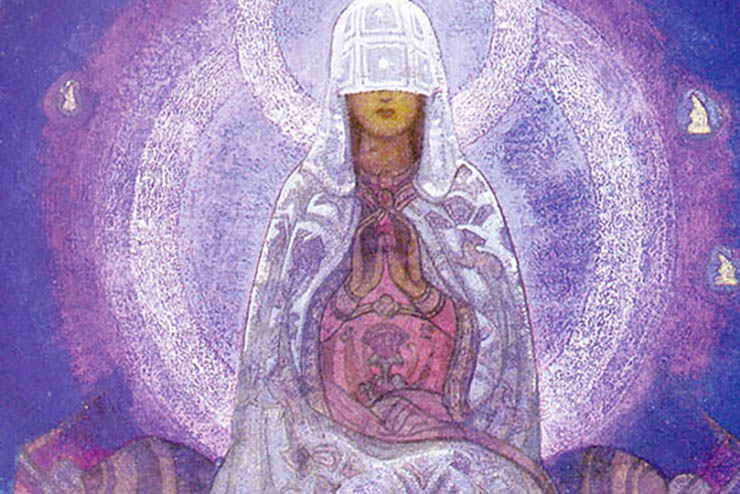
    Top image caption: The “Mother of the World” by mystic and artist Nicholas Roerich (1874-1947). Nicholas and his wife Helena taught that the World Mother has manifested many times over the millennia. (Image courtesy of the Nicholas Roerich Museum, New York, www.roerich.org).

    © New Dawn Magazine and the respective author.
    For our reproduction notice, click here.
  • New Dawn Interview With Tobias Churton

    New Dawn Interview With Tobias Churton

    From New Dawn 91 (Jul-Aug 2005)

    Tobias Churton is one of today’s most lively and spirited investigators of that underground stream of the Western tradition known as Gnosticism. He first became interested in the Gnostics while reading for a degree in theology at the University of Oxford in the 1970s.

    Soon after leaving, he became interested in exploring these ideas for television. “I’d got it into my head that there had never been any religious television – only programmes about religion,” he later recalled. “I had written a paper on the subject which recommended a new kind of television for this most neglected area, something on the lines of television, a kind of programme which would enter into the very nature of the religious experience and not simply observe it.” Churton got his opportunity in the mid-1980s, when he produced a series on the Gnostics for British television. To accompany his series, he wrote his first book, The Gnostics, a history of this elusive esoteric movement from early Christianity to modern manifestations in such figures as Giordano Bruno and William Blake, and even in Mary Shelley’s Frankenstein.

    In the years since then, Churton has pursued and deepened his appreciation for the Western esoteric traditions. He was the Founder Editor of Freemasonry Today magazine, and during the last year has published two new books. The Golden Builders: Alchemists, Rosicrucians, and the First Freemasons explores the background of Masonry from its antecedents in the alchemical and Hermetic traditions of antiquity through its modern manifestations. His latest book, Gnostic Philosophy: From Ancient Persia to Modern Times, casts an even wider net, tracing the Gnostic heritage from its roots in Zoroastrianism, Mithraism, and the Essenes to the 20th century magus Aleister Crowley and manifestations of gnosis in pop culture. Churton currently makes his home in Britain.
    – Richard Smoley

    How exactly would you describe gnosis? What does it mean to you?

    How would I describe gnosis? I should like to describe gnosis as the experience of knowing or having intimacy with what we call God. God, the Bible tells us, wishes to be known. The word ‘Gnostic’ – one who has experienced gnosis – was first used as a nickname by those who opposed the whole idea or thought it was all too much for human beings to claim.

    In a way, it really is the most enormous act of cheek to say that one has had experience of God! John’s Gospel for example says that “no man hath seen God at any time.” Hospitals for the mentally sick are full of people who claim the most extraordinary intimacy with powers beyond themselves. In the Gnostic tradition broadly, sanity or peace of mind is a fruit of gnosis. And ‘sanity’ means becoming clean, or ‘whole’ so there is a moral as well as a physical and psychological dimension to be considered. It might be argued that one has got to share in Christ to know God. But clearly there has been gnosis outside of the Christian tradition. So God obviously wants to be known by everyone!

    Gnosis to me personally means receiving a gift – a gift that carries with it certain responsibilities. It’s quite a heavy thing to be lightened – or enlightened! There’s a lot we carry that prevents us from rising and growing in divine knowledge. For me, gnosis means a love of truth, a sensitivity to the magical aspects of life, and above all, a permanent struggle with material consciousness. People would rather see a person burnt than their own money burnt. That, we would say, is only natural. Politicians are adept at appealing to us on this level. Being gnostic does involve an unusual attitude to the natural order. The merely human in us does come under scrutiny – the light shows up the shadows and darkness in us, if you like. Obviously, no one likes being ‘shown up’, so we persecute the light-bringers and hide ourselves behind images of who we think we are. Gnosis is light and, if I may say so, “my burden is light.”

    Is it possible to experience gnosis for oneself?

    I obviously believe it is possible to experience gnosis for oneself. One could hardly experience it for other people! But the experience changes and one might not always be aware that one is experiencing gnosis. It is not a single state. It is not the same as ‘instant satori’. The universe itself is a projection of gnosis, if limited. I should say that if one has no experience of gnosis, one can hardly say one has been truly alive.

    Could you explain a little about the Gnostic schools of antiquity, and what happened to them?

    There were many Gnostic schools in late antiquity, as far as we can tell, surrounding some particular teacher, or the self-proclaimed followers of such a teacher. They had visions, dreams, statements, stances and orders of followers. Some were probably charlatans and some ‘the real thing’, as one would expect.

    The orthodox Christian teachers who made it their business to denigrate and destroy the Gnostic movement in the Church always tended to isolate the teacher. Naming names was a big part of the anti-Gnostic propaganda. Thanks to their efforts, we have some dim records of men like Basilides, Carpocrates, Marcus, Marcion, Valentinus, Simon Magus, Dositheos. The orthodox apologists Irenaeus, Hippolytus, Epiphanius and Tertullian, for example, made it their business to present these Gnostic teachers as demented quacks leading their followers into what Irenaeus called – in about 180 CE – “an abyss of madness and blasphemy.” I don’t know how seriously one can take their presentations of the evidence. It’s a bit like asking George Bush whether he prefers Sergeant Pepper’s Lonely Hearts Club Band to Revolver!

    The Gnostics represented a kind of counter-culture and therefore exposed themselves to persecution and ridicule. You can’t imagine Gnostics wandering around in suits and ties with briefcases talking about real estate values! Some seem to have met in catacombs and private places. There were Gnostics in the first ever monasteries of Saint Pachom in the Thebaid of Egypt. Indeed, it is arguable that the first monastic movement was chiefly inspired by the desire for a place to get away from the world and experience God, i.e.: a Gnostic inspiration. Clearly the monasteries have always had a special role in promoting authentic spiritual life, if usually in secret. The walls had ears.

    Sadly, the British and German Reformations, in attacking the monasteries in the name of the Protestant tendency, tended to throw the baby out with the bath-water, so the position of today’s Gnostic has some kinship with that of the early Christian Gnostics. Where do we go?, they might ask. San Francisco obviously didn’t work for everyone!

    However, as we know from the story of the Nag Hammadi Library, even in the desert monasteries the Gnostics were not safe. Official visitations weeded out the offending literature and condemned it to the flames. Soon the offending Gnostics would meet the same fate. The Church hooked up with the State in the 4th century CE and the true Gnosis was exiled. Just one good reason to keep religion out of politics!

    How did this Gnostic legacy survive after the end of the old Gnostic schools? What sort of heritage did they bestow on our civilisation?

    Thanks be to God, the Gnostic experience and challenge did just survive the end of the Roman eagle’s flight. As one might expect, it survived on the fringes of the old Empire – in Syria, Iraq, Bulgaria, Turkestan and Bosnia – possibly Ireland. Even, for a while, in Mongolia and China. The flame was kept alive through untold numbers of military campaigns, massacres and violent conflicts of kings, sultans, demigods, semi-gods, dictators and emperors. It was carried into the bosom of the Islamic Empire after the 7th century in the form of Hermetic philosophy as an inspiration to science and philosophy – examining God in His works and wonders. The Sabians of Harran – who were not Muslims but Sabians and permitted by the Koran – their role is extraordinarily important in keeping the flame alive.

    The appearance of Islamic mysticism – or rather, gnosis – among the so-called Sufis in the ninth and tenth centuries was highly significant. Magic, philosophy, science, mysticism – in short, human progress, were fostered by the enlightened circles of the Islamic world – always playing, it should be noted, a kind of shadow-boxing game with the hard-line authorities who cared as little for personal experience of the divine kingdom as did the Roman Church in the west.

    The annihilation of the so-called ‘Cathars’ in southern France and northern Italy in the 13th century showed just how far the authorities were prepared to go in attempting to destroy spiritual existence that was not controlled by the status quo – the ever-present authorities we find in every age: the manifest powers of invisible spiritual opposition, as the Gnostic sees it. The Gnostics have been the light of the world and the leaven in the bread. A world without gnosis would be a very dark place indeed. The Gnostic greets the Sun, the ‘visible god’. He or she is first to see the dawn – first, you might say, in the garden of resurrection.

    Some scholars suggest that the term “Gnostic” is too problematic to be valuable, and should be replaced by something else. Do you agree?

    Some scholars, you say, suggest the term ‘Gnostic’ is too problematic and should be replaced. Well, I’m sorry for them. Gnosis itself will always be problematic in this world. The day it fits cosily into some scholar’s dictionary will be the day it has ceased to have power. No, ‘Gnostic’ – like ‘Christian’ – began as a nickname and like all such names should be borne with pride in a blind world. Yes, there are problems of definition. In 1966 there was a Colloquium of scholars at Messina intended to define the term ‘Gnosticism’, but it could not hold the term down. So I, without even the benefit of the Italian sun, cannot do it for you in this interview. The subject could fill a book. There is, however, another tack we can follow. That is, Why should it be defined? Definition – like a census – leads to control. Much better that the Gnostic tradition bears the unique quality of resisting definition! There is no doubt that the issue has been muddied by the activities of the Christian churches that dominate thinking in the West to a greater degree than we perhaps realise.

    When I was a student at Oxford University for example, it took me a long time to realise the full implications of the fact that the Theology courses were run by church leaders chiefly for their benefit. Admittedly, it would have been odd if they had been run by industrial chemists! But the point was that ‘Gnosticism’ for example dealt with a universal experience in terms only of its presence or exile from the orthodox Christian Church. Theologising it denied its root in authentic experience. If we cannot trust our deepest most personal and absolutely authentic experience, what can we trust? Anyhow, it would have been better, I think, in retrospect, to study the entire field of Gnostic philosophy, religion and so on as a stream of its own that interpenetrates – necessarily – with all of the so-called ‘great religions’ of the world.

    One of the interesting things about the orthodox Church – if we may for just a second see the plethora of conflicting bodies as a broad unity – is that it finds it can eventually accommodate everything – everything, that is, except gnosis! By this I mean that Darwin was more or less accepted by the Church of England by the time of World War One. Church leaders – by no means all, I know – made accommodations with Hitler, Stalin and Mussolini and – let’s face it, the Church has pretty well made its peace with the world. Gnostic types do not find themselves in such a comfortable position with regard to the world as it is.

    There are many people who are on the road to gnosis who perhaps do not realise it, who out of love of God and fear of God – and fear of themselves and others – find themselves wasting years in very unsatisfactory Church gatherings which – in the name of God – demand their sacrifice and allegiance. I’ve always found that it was the most selfish groups that preached self-abnegation.

    But to get back to the point, what other tame word could replace the tattered glory and battered bread of the words Gnostic, Gnosis – even that scholars’ word ‘Gnosticism’? Mysticism is too misty. Magick has been bowdlerised and Disneyfied. Spirituality – well! It used to have meaning, now it means anything and probably nothing. It’s only a matter of time before car manufacturers come up with a car that meets your spiritual needs! I really don’t know what people mean when they talk about ‘spirituality’. It’s so vague as to be useful to every pseudo-religious charlatan and greedy politician in the world! When you say ‘Gnostic’, you always have to explain it. And when you do, people are always fascinated, whether they admit it or not! So that’s what we’ve got and we have to make the best of it. Gnosis means knowledge. Get it?

    What do you make of current attempts to revive Gnosticism? What value do they have?

    You ask about recent attempts to revive Gnosticism. This is a difficult question for people like myself who prefer authentic experiences with some real history attached. This is the scholar and antiquarian in me speaking. My path is not your path.

    I don’t believe ‘Gnosticism’ – that word really refers to the Gnostic groups that came into conflict with Christian orthodox authorities in the first five centuries of the known life of the Christian Church – can or needs to be ‘revived’. The patient is not dead – though the world might well be. “The dead are not alive,” as the Gnostic gospel has it, “and the living will not die.” This is my personal favourite among the many great Gnostic logia. The dead are not alive and the living will not die. How true.

    Besides, there are several great authentic Gnostic streams still going strong – though at least one of them is severely persecuted. The Yezidis of northern Iraq, western Iran, Georgian Armenia – that is to say Transcaucasian Kurdestan – have the most unbelievably inspiring tradition. There’s nothing to compare with it in the whole world. It is in a class of its own. The Yezidis have been persecuted cruelly by those in power about them because they are not regarded as “people of a book” as defined – there’s that word again! – in the Koran. They have long been accused of ‘Devil worship’, but that kind of cruelty has been common among oppressors since Jesus was accused of being a devil’s mouthpiece all those years ago. It’s the oldest trick in the book and works because people fear every type of evil – except their own.

    Yezidis are today being attacked and killed in and around Mosul and denied police protection in Georgian Armenia. This is fact.

    The second tradition I was thinking of was that of the Mandaeans of lower Iraq, who claim John the Baptist as a special prophet and have referred, interestingly, to ‘Christ the Roman’. As far as ‘Gnostics’ go, these people are undoubtedly the ‘real thing’.

    When I made the TV series Gnostics in 1985-87, we wrote to the Iraqi Embassy in London, and they denied any knowledge of the Mandaeans. I was worried that they had been wiped out under the last miserable Iraqi regime, but to my delight, I now observe that they have survived – though still having to justify themselves, surrounded as they are by the various Islamic traditions. I think they qualify as Sabians in the Koran and are therefore protected. The wonderful Yezidis, on the other hand, have been persecuted for 1300 years and have no such protection.

    An independent Kurdistan would probably offer these unique and admirable people a future that may otherwise be in jeopardy. This would be a very good thing to come out of the current mess in Iraq. The great powers have been screwing up the Middle East since the fall of the Roman Empire, so one may legitimately question whether the mad, bad game of sharing out the property of the vulnerable will end in our lifetimes. We must hope, have faith and love. Spare some love for the Yezidis – even though most people have probably never heard of them.

    This, to answer your question, would be a good way to care for the Gnostic tradition – the tradition, I should say, of the authentic spirit of man, enslaved in, and by, the world. The love of money is the root of all evil. The way to revive Gnosis, is to be revived by Gnosis.

    Why are people so interested in Gnosticism these days?

    I think people are interested in Gnosticism these days because there is clearly a spiritual vacuum at the heart of our culture. Science and mass production have done much for the outside of the cup, but the inside is empty and cannot be sated by drugs, sex and rock ‘n’ roll. The promised liberation is a brief delight followed by a swift fall. Grace looks away and the victim, must, if he or she be lucky, look within.

    Even in countries which have not been so saturated by big business as we have – where washing machines, central heating and personal stereos and computers might be very welcome – there is a now well-articulated complaint that with all the money and the “promise of freedom and liberty for all” comes a great threat.

    The threat is to the life of the heart and the delicate, invisible life – the thousand links with God – which have kept people alive for centuries in the face of countless dangers and privations. I don’t wish to romanticise here, but one must ask, ‘Who needs the most help?’ The East or the West? Clearly both suffer from poverty – material poverty and spiritual poverty – and, of course there is plenty of material poverty in the West and doubtless spiritual poverty in the East. But can’t we help each other? And thereby help ourselves? But how do we do this?

    Well, Jesus offers a clue: “First clean the inside of the cup.” Clean it? we may cry – most of us don’t even know it’s there! Where is this ‘inside of the cup’? Where is this kingdom of heaven (a kingdom, note, not a democracy!) that is supposed to be “nigh and within” us? Well, the example and uncompromising commitment to spiritual reality is such a strong and powerful river surging through the Gnostic tradition, that it would be extraordinary if our bone-dry world did not desire to take a dip in its life-giving waters!

    Until we sort ourselves out, we can only export our own confusion.

    Could you say a little bit about the Western esoteric traditions as a whole? What is their situation today? What do they have to contribute to our civilisation?

    You have asked me to say a little bit about the Western esoteric traditions as a whole and what they may contribute to our civilisation. The second part of that question is simple. What they have to contribute is civilisation. What is civilisation? It is clearly not power and might or the ability to force change. Otherwise we must rank Attila the Hun and Chingiz Khan as leaders of civilisation! Civilisation really boils down to the ability of a range of people to live in a city, organise themselves and get on with each other without falling into chaos. That which promotes the life of the busy hive may be described as a civilising influence. Civilisation is not then an arbiter of truth but of what works well. However, wise men and women have tended – against the odds – to the ancient conviction that nothing works quite as well as the truth, and that a rotten branch – rotten with corruption – will not even support itself for very long – never mind the burden of civilisation. Truth is good.

    When I think of Western civilisation with all its inequalities of ability and social status, its wide variety of racial and religious types, its sheer density of pulsating human existence, its vulnerability to natural forces, disease, despair, hysteria, false expectation, boredom and so on, I can’t help thinking that organisations like Freemasonry and discreet societies of personal development are important. While corrupting forces always aim to work within the carcass, the healing agents must also work within the fabric of the human hive – not in fearful secrecy but with a modesty and love that is suspicious of fame, vainglory and social attention. The cool breeze works well unseen. This is perennial wisdom. I think the best of the masonic tradition has contributed hugely to understanding of tolerance and barrier-breaking social idealism. Occasionally, we even find a spiritual insight occurring in some of the most stubborn mental material!

    Whatever good men and women try to achieve with this floppy idiot called man, the sincere busy bee is always up against our biological and moral heritage. This inheritance is surely dark enough to make strong men and women weep and give ample reason to despair or take refuge in a cynical stoicism of the type that Gore Vidal, for example, exemplifies with such taste and class.

    There is much to be said for contemporary Rosicrucian societies for introducing people to the world of imaginative spiritual development. Many find insight in the worlds of Theosophy, Thelema and Anthroposophy, for example. This is all well and good, as far as it goes, but human society can be corrosive – even destructive.

    Human beings really aren’t very nice – unless they’re in some kind of love with one another – and even then… well! The divorce rates with all their sad tales of acrimony and greed testify to the fragility of oaths built on enthusiasm and a lottery win. The Psalmist was being simply realistic when he uttered the words: “None is righteous. No, not one.” Involving oneself in groups may stifle the creative and divine spirit. But aloneness can be hard, and loneliness is, as Jimi Hendrix sang, “a drag.” Perhaps we need to revive in some adapted way the concept of the monastery – not, may I stress, that sad alternative, the ‘commune’. The hippies were hip to everything but their own depravity. Peter Coyote and the Diggers would doubtless tell me I just never saw the real hippies. He would be right. Maybe I was one of them – and how often do we see ourselves?

    I suppose in the life of a person, one will, as one puts one’s hand into the hand of God – as much as we may know of Him – for guidance, one will find oneself encountering all kinds of groups and people. No one way works for all people or all occasions. That is how it must be. Those who require absolute certainties will be prepared to believe anything. The One is always present, if unseen.

    Experience shows that there are many hidden veins to the cosmic life of humanity and I – for one – am glad – and have reason to be glad – that they exist. Gnosis is, as I said earlier, a gift. One has to be in the right place to receive it. No organisation can do that for anyone. The Spirit bloweth where it listeth. Heed the Spirit above all – and keep the powder dry!

    Could you talk a little bit about your own background, how you came to be interested in this area, and what meaning it has for you personally?

    You ask about my background. I am an Englishman born in Birmingham – the English Midlands – in 1960, who grew up to believe that something was seriously ‘out of kilter’ in my own dear country and in the world at large. This was something I found in myself as I grew older and travelled about the busy world. I had no special financial or educational advantages, but my father – a railwayman by choice in his later years – said “Seek and ye shall find.” I loved the past and had great respect for the ancients. I was always suspicious of words like ‘modern’ and ‘new’. No one knows the future and if, as someone once said, “the future is a poor place to store our dreams,” then I should say that a dream stored is a dream over. King Arthur will sleep so long as we do.

    I cannot remember when I first became interested in the authentic tradition of spiritual life. It seems to have always been with me. I suppose studying the Gnostics at Oxford in the late 70s made me realise that I was not alone, but there were always shadows and intimations of gnosis in books, films – especially old films (the new stuff is generally too cocksure, superficial and loud to have anything to say worth hearing) – and in music.

    I have often tried to ‘get away’ from Gnosis, rather like Jonah sailing to sea to avoid Nineveh, but I keep coming back to port, whether I like it or not. Often, I don’t like it at all. I’ve spent a fair amount of time in the cold belly of the whale. The world, however, needs this insight, even if for me it now seems an old story. Somehow, it comes alive afresh again with each telling. And I discover so many new aspects to it, each time I willingly return to its study. It makes us wise and makes fools of us. Gnosis means creation because we do what we know. Creation is the fiery dragon whose scolding breath burns away the void and leaves the golden tree. We pick its fruit and create nothing.

    I was lucky (by modern standards) to have both parents and that both parents believed in the individual and believed in the mystery and magick of life, and that they were plain speaking, virtuous and down to earth as well as being receptive to higher influence. That was a gift too. Come to think of it – it’s all been a gift. I’ve done little to deserve such a theatre of sorrow and joy! There’s so much more to do and life is really both too long and too short. We’re here and we’d better make the best of it. Long may She reign over us.

    Could you tell us about your recent books, The Golden Builders and Gnostic Philosophy? What are they about?

    My books The Golden Builders and Gnostic Philosophy took me ten years to write and were continuations of a work begun in 1986 when I wrote my first book, The Gnostics, at the age of 25. You could say that the new books are the considered works of research and experience – an attempt to bring readers of the first book into deeper acquaintance with the extraordinary Gnostic tradition. I was very aware that some terrible books have appeared in the last 20 years which have exploited the whole subject area and confused people with a lot of journalistic twaddle and conspiracy tales. Some have inspired a recent best-selling novel that suggested Leonardo Da Vinci worked with a code that could be understood by an idiot demented by marijuana.

    I wanted to put the record straight. The truth is stranger than fiction and a good deal more interesting. The trouble with fiction is that you can’t live on it; you always want more. Perhaps if you wanted to define the Truth, you might – with tongue in cheek – call it NON FICTION. There is NON FICTION in magick, Gnosis, mysticism and spiritual understanding – but then, I suppose, your readers know this already, or they would not be suffering this interview with a distant star.

    [alert type=”general” dismiss=”no”]This article was published in New Dawn 91.[/alert]

    [alert type=”success” dismiss=”no”]If you appreciate this article, please consider subscribing to help maintain this website.[/alert]

    © New Dawn Magazine and the respective author.
    For our reproduction notice, click here.

  • Gnosticism: Ancient and Modern

    Gnosticism: Ancient and Modern

    From New Dawn 85

    Every dog has its day, so they say, and it looks like Gnosticism, an ancient approach to spiritual experience, may be having its day, once again. Of course, despite the best efforts of the early Catholic Church, Gnosticism never really disappeared, but its reappearance over the centuries has been fleeting and sporadic. Why, as we march into a new millennium, is this hidden stream of quasi-Christian mysticism triggering a fresh interest among both spiritual seekers and readers of popular novels?

    Dan Brown’s mega-bestseller, The Da Vinci Code, surely shares part of the credit. This publishing phenomenon, which sold over 6 million copies, took a simmering interest in the Knights Templar, the Divine Feminine, alleged secret societies such as the Priory of Sion, the Holy Grail, and the question of the historical Jesus, and stirred these ingredients together with a generous dollop of Gnosticism.

    The result was a blockbuster thriller that unexpectedly caught the popular imagination. Despite the fact that at least two other previous thrillers, The Da Vinci Legacy by Lewis Perdue (1983), and Kingdom Come (2000) by Jim Hougan, had overlapped much of the same territory, lightning struck Brown’s novel and sparked innumerable dinner-table discussions of heretofore-arcane topics such as Mary Magdalene’s real relationship to Jesus.

    But the success of The Da Vinci Code is just the culminating phase of a gradual public awareness of Gnostic matters that extends back at least a century to the great Occult Revival of the late 19th century. At that time, Gnosticism slowly re-emerged from the shadows, nudged by the French occultist Eliphas Lévi, and propelled along by Madame Blavatsky’s Theosophical Society, French neo-gnostics such as Papus and Jean Bricaud, and researchers such as G.R.S. Mead (whose pioneering discussion of the Gnostics, Fragments of a Faith Forgotten, was for many decades one of the few sourcebooks on the subject for general readers).

    However, it was the discovery of a cache of ancient Gnostic scriptures at Nag Hammadi in the Egyptian desert in 1945 that really set off the modern phase of the Gnostic revival. Although their translation into English was not complete until the late 1970s, early access to some of the writings inspired the great psychologist Carl Jung to draw parallels between the ancient Gnostics and modern depth psychology. The publication in 1977 of the Nag Hammadi Librarytranslations, followed in 1978 by religious scholar Elaine Pagels’ best-selling exposition, The Gnostic Gospels, guaranteed that Gnosticism would not go away anytime soon. But before we take a further look at the burgeoning phenomenon of modern Gnosticism, a review of the ancient Gnostic teachings is in order.

    Gnosis and the Church

    Though scholars argue there were Gnostic teachings that predated the early Christian era, what is most commonly thought of as Gnosticism consisted of numerous Christian sects that thrived in the immediate centuries after the ministry of Jesus. These sects, often gathered around charismatic mystics, certainly thought of themselves as Christian, and it was only their emphasis ongnosis, or divine knowledge, that later earned them the sweeping label of Gnostic.

    As Christianity spread outside the confines of a specifically Jewish faith, it was perhaps inevitable that some gentile Christians would reinterpret their conception of God to distinguish Him from the tribal “G-d of Israel” Whose Covenant with His people seemed anchored to their particular identity as Jews. Christian aspirations to a universal faith, applicable to anyone with ears to hear, led many Gnostics to posit that God the Father, of whom Jesus spoke, must be a different God altogether: a hitherto Unknown God Who existed far above the earthly realm and was free of ethnic contracts or favouritism. Christ functioned as the messenger from this remote and impartial God, and some Gnostic scriptures downgraded the Jealous God of the Old Testament to the role of Demiurge, a lesser creator-god who brought a flawed Creation into existence and mistakenly ruled it with a heavy hand as if he were the True God.1

    Thus, in the Gnostic view, salvation from this diminished material realm of suffering and injustice depended less on one’s mere beliefs or on the following of religious laws that the Demiurge put in place, than on the individual’s inner experience of gnosis – a divine knowledge of the cosmic order and one’s true identity. The Gnostic scriptures alluded to Christ’s secret teachings, which would aid the Gnostic to embrace gnosis, and armed with this knowledge, to escape the illusory realm of the Demiurge at the time of death.

    There are any number of reasons why Gnosticism was bound to come into conflict with that portion of the Church which was consolidating into an institutional monolith. Gnosis, by its very nature, was an individual experience that eluded systematisation. While the Gnostics had priests and even bishops, their leadership derived from their mystical bonafides, not from a bureaucratic position of authority. Furthermore, the canonical Gospels portrayed Jesus as the fulfillment of Old Testament prophecy and the Messiah promised to the Hebrews. The Gnostics’ break with what they considered the Demiurge was at cross purposes with this historical reading and undermined the working mythos of the institutional Church.

    In another example of scriptural reversal, some Gnostic versions of the Creation story of Adam and Eve portrayed the Serpent as Liberator, offering the apple as a means to knowledge unfairly denied to humankind by the despotic Demiurge. There was obviously no way to accept this counter-version and the traditional version at the same time.

    Divine Feminine

    The most common Gnostic revision of the Creation story spoke of Sophia (Wisdom), an extension of the True God, venturing forth from the Pleroma (the fullness of the ineffable divine realm), producing an aborted spiritual being, Ialdobaoth (the Demiurge), who in turn created the flawed material world. Sophia, seeing sparks of the divine entrapped in matter, descended to try and free them and was herself entrapped. It took the efforts of the Christ (pre-existing in the Pleroma) to extricate her and return her, past the Archons presiding over intermediate planes, to her rightful place beside Him: a tale symbolic of the plight of the soul enmeshed in illusion.

    Finally, the indications in Gnostic scriptures, such as the Gospel of Philip and the Gospel of Mary, that Mary Magdalene was closer to Jesus than the other disciples and received secret teachings denied to them, undercut both St. Paul’s misogynist version of Christianity and the Catholic Church’s claim to legitimacy based on St. Peter’s supposed selection as the “rock” on which the Church would be built. The prominent role given to the Divine Feminine via the Gnostic veneration of the Magdalene and Sophia was partly recuperated by the Roman Church through the significance it later afforded the Virgin Mary, but this status was subsumed within the overall supremacy of a Church run by celibate males.

    Whatever Gnosticism’s virtues as an effective path to gnosis and to unconditioned consciousness, it was simply too idiosyncratic and contrarian to make the grade as a stabilising component of Roman power. Its subversive counter-myths stood little chance of being integrated into a social order based on top-down power relations emanating from Rome and Constantinople. The prevailing Church absorbed those elements of the Gnostic worldview that best served its own ends and scuttled the rest, consigning the Gnostics to the oblivion of heresy and their scriptures to the bonfires of proscribed texts.

    Of course attempts to obliterate ideas or spiritual currents that remain attractive to some are never wholly successful. Pockets of Gnostic alienation persisted among the Eastern European Bogomils, and eventually influenced the Cathars of Languedoc (southern France). The scourge of the Inquisition originated as a response to the growing influence of the Cathars, whose 12th century challenge to the Catholic Church could no longer be tolerated. The Albigensian Crusade in the 13th century effectively wiped out the Cathars.2  Subsequent Gnostic impulses and teachings survived as heavily-cloaked myths and symbol systems within marginal esoteric currents of the West.

    It was only once the religious and social hegemony of the Church was diminished by the succeeding blows of the Protestant Reformation, the Renaissance, and the scientific rationalism of the Enlightenment, that there was sufficient elbow room for Gnosticism to re-emerge into the light of day.

    Yet, the question remains why Gnosticism should prove of special interest to increasing numbers today. Are there particular characteristics of today’s society that resonate with the Gnostic worldview? One answer is provided if we consider the popularity of “The Matrix” movies and the influential ideas of science fiction author Philip K. Dick.

    The Illusion of Daily Life

    Central to both the Matrix and to Dick is the creeping perception that things are not as they seem: our perception of reality, both individual and collective, is an artificial construct masking the unnerving truth. In ripping away the façade of normality, we come face to face with our true dilemma – we live in a maze of illusions and self-delusions from which we must extricate ourselves. This is, of course, a fundamentally Gnostic worldview.

    The ancient Gnostics were aware that material existence is, at its root, a beguiling and temporary illusion. (Hindus called this “Maya.”) Modern physics has confirmed this at the sub-molecular level, where one can see that apparently solid objects are, in fact, composed of moving bits of energy that are neither wholly particle nor wave. The closer one looks, the less there is to see. The vast emptiness of outer space is mirrored by the vast emptiness within matter itself.

    Esoteric traditions around the world teach that consciousness can exist independent of the body, and that the ability to deliver our consciousness from its addiction to sensory input and compulsive thought patterns can lead to an experience of divine consciousness (gnosis). The message of the Christ of the Gnostics was not that he considered himself the unique and only Son of God, but that each person has the potential to expand their consciousness across the vast emptiness to the level of godhood or Self-realisation.

    If the illusoriness of daily life was self-evident in the relatively simple world of two millennia ago, it is becoming even more so, for those with the eyes to see, in the present world of cybernetic virtual realities, Hollywood dream-worlds, instant messaging, corporate branding campaigns, and information warfare. The ancient Gnostics were resigned to the fact that the majority of humans were fatally caught in the illusion, and for this they were called elitists.  Similarly, modern Gnostics perceive that most people around them are inextricably locked into a delusory existence in which their potential consciousness is siphoned off in exchange for corporate profit and material survival. This, too, is a minority perception, but it is steadily growing.

    The Gnostic rush many of us felt upon first seeing the Wachowski Brothers’ “The Matrix” was the heady sensation that somehow a deprogramming meme had made it through the corporate maze of AOL-Time-Warner, and that the dream factory itself had been tricked into promulgating a flash of gnosis. Millions responded and suddenly there was much more money on the table. All too predictably, the second and third Matrix films smothered the first film’s spark of insight under tons of ever more dazzling special effects, violence, and pretentious symbolism. The still small voice of the wake-up call embedded in film one was drowned out by the din of its own success. The series’ degeneration was an uncanny recapitulation of the suppression of ancient Gnosticism by the early Church. In the end, the Matrix – like the Church before it – emerged triumphant.

    Of course, it is a bit of a leap from perceiving daily life as delusory to embracing an ancient cosmology that specifies a false god, a True God, a malevolent pantheon of Archons, and a hieros gamos (divine marriage) of Christ and Sophia. Unless one is in the market for a ready-made dramatic cast of spiritual entities to believe in, the Gnostic myths best serve as metaphors for one’s dilemma – and, in fact, that may have been the role they played for the early Gnostics, as well.

    There are two ways to view the Gnostic myths as potent metaphors: one inner and one outer. The inner way is to see the Gnostic cosmology as a visionary description of the hurdles one must leap in meditation. In trying to ascend to a contemplative state of pure consciousness, one must move beyond the incessant activity of the mind (the Demiurge), and past one’s fears and compulsions (the Archons), before one can arrive at a consciousness beyond time and space (the Pleroma). The successful achievement of this gnosis while still “in the body” prepares one for the similar passage that one’s consciousness must take after death.

    An outer reading of the Gnostic cosmology, on the other hand, might consider the Demiurge to be anyone’s flawed and limited image of God, which must be seen through and surpassed on the way to true spiritual insight. The Archons would be the many social laws, institutions, and corporate entities that hamstring one’s existence. On this level, a kind of external gnosis would be one’s realisation of the ultimate inability of these earthly captors to imprison our higher self. In this reading, Christ’s crucifixion and resurrection serve as metaphors for our own daily immolation and extrication. In this instance, a Gnostic motto might be: “Don’t let the bastards get you down!”

    Wandering Bishops

    Reading The Da Vinci Code or The Gnostic Gospels or watching “The Matrix” are all very well, but such books and movies do not by themselves constitute a Gnostic revival. Revivals or movements require actual social vehicles to engage and embody people’s interests. One place this is happening – albeit on a small scale – is in the low-profile milieu of small independent Gnostic churches. An examination of this phenomenon leads us to the quirky turf of “wandering bishops” – a curious subculture of purported Catholic, Orthodox, and Gnostic bishops who usually (and painstakingly) trace their lines of apostolic succession back to (wait for it) St. Peter or one of the other apostles. This requires some explaining.

    The mainstream Roman Catholic Church hangs its legitimacy on unbroken lines of consecration from bishop to bishop, extending all the way back to St. Peter. Only bishops (or higher clergy) can ordain priests or consecrate other bishops – a form of organisational quality-control, as well as a narrow conduit for the divine grace that is said to be conveyed in the sacrament of ordination. Since an ordination or a consecration makes the recipient “a priest forever unto the order of Melchizadek,” a priest or bishop who later turns heretic, or otherwise runs afoul of the Church’s hierarchy, retains legitimate Orders – even if forbidden to celebrate Mass or excommunicated from the Church.

    Employing a liberal interpretation of this curious rule, schismatic churches such as the Jansenist Dutch Church, which broke with Rome in 1723, could claim legitimate apostolic succession despite their status outside the Roman Church’s umbrella.  Taking this logic one step further, some bishops consecrated by bishops of the Dutch Church (later the Old Catholic Church, following an alignment with other “national” churches in 1889) claimed the right to start their own churches and pass on the line of “valid” consecration. For instance, Bishop James Ingall Wedgewood was consecrated a bishop in the Old Catholic Church in 1916 and within two years had founded the Liberal Catholic Church, which became a kind of esoteric house church for the Theosophical Society.3

    One of the most influential of these independent bishops was Joseph René Vilatte, an Old Catholic missionary in Wisconsin, who sought and received consecration as bishop from the Syrian Jacobite Church in 1892 in Ceylon and subsequently consecrated several other bishops in North America and France who consecrated numerous other bishops in turn.

    Needless to say, notions of doctrinal fidelity or consistency – which were understandably a key concern of Rome – were lost in the shuffle, with the result that independent bishops, who were often “more Catholic than the Pope,” sometimes shared the same apostolic lines as esoterically inclined bishops with Gnostic leanings. Over time, this led to a new generation of Gnostic bishops who could now claim apostolic succession. Exactly why apostolic succession would matter to latter-day Gnostics is something of a mystery, particularly since whatever legitimacy the original Gnostics claimed derived from gnosis itself, not from institutional standing. One suspects that even heretics desire approval, and in the absence of Gnostic lines of succession, most latter-day Gnostic bishops are quite happy to gain succession from St. Peter, illicit though it may be – especially if it tweaks the nose of the Vatican.4

    One Gnostic “Patriarch” in France, Jules Doinel (Tau Valentin II), sidestepped the issue altogether by receiving “a double spiritual consecration; the first by Jesus in person, the second during a spiritualist séance by two Bogomile bishops.”5  Doinel, who founded the Universal Gnostic Church, went on to consecrate the noted French occultists Papus and Sédir, thus empowering further Gnostic lines, some of which have continued to the present. Another Gnostic group of French origin, the elusive Holy Order of Miriam of Magdala, has cited traditions of a female apostolic line extending back to Mary Magdalene, but has attached no importance to providing verification of such traditions. The spurious Priory of Sion, celebrated in The Da Vinci Code and hyped in Holy Blood, Holy Grail – and likely of no earlier origin than 1956 – avoided ecclesiastical trappings altogether, preferring to concoct a lineage based on the supposed bloodline of Jesus and Mary Magdalene which the Priory claimed to guard.6

    Perhaps representative of the Gnostic branch of bishops in the English-speaking world was one Richard Duc de Palatine, an Australian originally named Ronald Powell, who was initially ordained in the Liberal Catholic Church and, in 1953, consecrated a bishop by Mar Georgius I (Hugh George de Willmott Newman), Patriarch of Glastonbury, one of the most fecund independent bishops. Palatine then founded his own Pre-Nicene Gnostic Catholic Church. Palatine, whose penchant for organising esoteric orders was second to none, also founded the Order of the Pleroma, the Brotherhood of the Pleroma, the Disciplina Arcani, and the Hermetic Brotherhood of Light. These appear to have led a largely mail-order existence.7  Palatine’s episcopal concerns were intermingled with esoteric, magical, and even Freemasonic preoccupations, but in spite of this – or perhaps due to it – some serious modern Gnostics became associated with him. The most notable is Bishop Stephan Hoeller, arguably the foremost proponent of a contemporary Gnosticism.

    Hoeller was consecrated by Palatine in 1967 and for a number of years worked within the fold of his Church and other groups. His Los Angeles-based Ecclesia Gnostica (Church of Gnosis) grew out of his work with the Pre-Nicene Church, and Hoeller has been an indefatigable author and synthesizer, drawing upon ancient Gnostic sources, Jungian psychology, and esoteric Christian concepts, in an effort to construct a modern Gnostic presence.

    Secret Teachings of Jesus

    As a diligent search of the Web will show, there are an ever increasing number of fledgling Gnostic churches, most of them situated in, or derived from, the “wandering bishop” milieu. Many of them consist of little more than a bishop and a local congregation, if that. This is not, in and of itself, a bad thing. After all, the ancient Gnostic sects amounted to the same thing: scattered groups with little uniformity between them. But it also presents the would-be seeker of gnosis with a certain dilemma: Can gnosis be taught? And if it can, who is qualified to teach it?

    The ancient Gnostics claimed to be guardians of the secret teachings of Jesus, teachings that were lost when Gnosticism was defeated. Formal issues of apostolic succession aside, no modern Gnostics can claim to perpetuate those teachings in unaltered form, because the chains of transmission have been lost. Even the scriptures that have been recovered – as fascinating as they may be – retain an opaque quality, because the original interpretive keys are absent.

    Thus, any modern Gnostic group or teacher must be carefully evaluated, based on subtle qualities that evidence real spiritual depth and understanding. Impressive lists of titles, degrees, and credentials mean little if there is no indication of a voice that speaks from the experience of gnosis. While it may be too much to expect that any given Gnostic teacher is going to be the embodiment of divine illumination, one still has the right to expect that those who talk the talk can walk the walk.

    Divine knowledge may be gained in a variety of ways – after all, it was not the exclusive possession of the Gnostics, any more than the True God is the possession of any single religion. If teachers of real attainment choose to use the metaphors of ancient Gnosticism to encourage self-discovery, then the Gnostic revival may fulfill its promise. But if the rekindled interest in Gnosticism is going to amount to anything besides a few books and movies and an unsatisfied hunger for enlightenment, we need to see a growing indication of the true discovery of inner godhood, not a fruitless scramble to decipher a few fragments of someone else’s gnosis.

    [alert type=”general” dismiss=”no”]This article was published in New Dawn 85.[/alert]

    [alert type=”success” dismiss=”no”]If you appreciate this article, please consider subscribing to help maintain this website.[/alert]

    Footnotes:

    1. Some scholars have suggested that this reframing of G-d was first done by Jewish intellectuals who were themselves dissatisfied with the Torah’s portrayal of the deity. Thus early Christian Gnosticism may have been influenced by, or may have been an extension of, a Jewish Gnosticism intent on reinterpreting the Jewish religious traditions. See: Birger A. Pearson, “The Problem of ‘Jewish Gnostic’ Literature,” in Nag Hammadi, Gnosticism, and Early Christianity, edited by Charles W. Hedrick and Robert Hodgson, Jr. (Peabody, Mass: Hendrickson Publishers, 1986), pp. 15-35.
    2. Yuri Stoyanov, The Hidden Tradition in Europe (London: Penguin/Arkana, 1994).
    3. The premiere exposition of this milieu is Peter F. Anson’s Bishops at Large (London: Faber & Faber, 1964), which is both droll and exhaustively detailed. It is, sadly, long out of print. A more recent (and apologetic) discussion of the phenomenon can be found in Lewis Keizer’s The Wandering Bishops: Apostles of a New Spirituality (2000), available in PDF format at:www.hometemple.org/WanBishWeb%20Complete.pdf.
    4. The Vatican, for its part, seems to have nothing encouraging to say about independent bishops. One of the more common claims of Vatican recognition for the sacraments and orders of the Liberal Catholic Church, for instance – a supposed positive ruling by the Roman Congregation of Rites – has been exposed as a hoax. (See: “Rome and Liberal Catholic Orders,” by Rev. L. K. Langley at: www.lcc.cc/tlc/lxvi1/rome.htm) The Vatican’s stance appears to be that so-called valid orders are worthless without the Church’s recognition.
    5. Anson, p. 307.
    6. See: Robert Richardson, “The Priory of Sion Hoax,” GNOSIS Magazine #51, pp. 49-55, (www.gnosismagazine.com). Reprinted in New Dawn No. 61 (July-August 2000).
    7. Anson, pp. 492-495, and J. Gordon Melton, The Encyclopedia of American Religions, Second Edition (Detroit, Mich: Gale Research, 1987), pp. 612, 618.

    © New Dawn Magazine and the respective author.

    For our reproduction notice, click here.