New Dawn – World's Most Unusual Magazine

Tag: magic

  • Magic in Mind

    Magic in Mind

    From New Dawn 98 (Sept-Oct 2006)

    A question frequently put to me by newcomers to magical practice is whether there is a reliable way of distinguishing subjective experience from what exists independently of their perception of it. In other words, how can they be sure that what they witness during a particular ritual, even when it impinges on their surroundings, is something other than the product of their own – or the group’s – creative imagination.

    It is a question some magical orders are reluctant to answer or at times even deign to consider. In them may lurk the fear that once they acknowledge the subjective nature of any phenomena associated with their work, that immediately devalues it. And the new recruit, persuaded it’s all in the mind, may then drift away.

    After all, if you’re after mental magic, it’s far less hassle (and a lot more fun!) to watch Derren Brown strut his stuff than spend hours in an airless, incense-filled room, sporting fancy dress and mouthing incantations.

    Or perhaps the question is avoided because it can never be satisfactorily answered, if only because, as with much else in occultism, there is no clear-cut answer to be had.

    For even if the imposing figure of, let us suppose, a venerable Druid were to turn up during a rite associated with the Celtic mysteries, his appearance, while seeming to be objectively real, might nevertheless be the projection of an image inside the leading celebrant’s head and telepathically conveyed to everyone else.

    On the other hand the selfsame figure might well be the real thing, an inhabitant not (or no longer) of our three-dimensional world but briefly granted access to it thanks to our magical efforts. So not surprisingly, when asked by a student how to distinguish which of the two he is, I’ve often been hard put to answer.

    A further complication is that entities – and let’s stick to these for now, though ritual can generate a variety of other phenomena – which are the constructs of the human mind can, once created, assume a life of their own. Well, perhaps ‘life’ is not the right word for what they enjoy is, strictly speaking, only a similitude of life, since they are of synthetic origin and, as such, animated by the vital energy they draw from living beings. To that extent theirs is what might be called a vampiric existence.

    Dion Fortune spoke of such entities several times, having by her own, perhaps obsessive, account been the unwilling recipient of their attentions. And by coincidence it was her husband, T. Penry Evans, then married to his second (and not at all occult minded) wife, Anne, who first talked to me about them.1

    Not yet in my teens, I had been introduced to magic and encountered – the details are unimportant – an entity whose nature and intentions he thought it prudent to investigate. For him there were two questions to be answered: had the entity been visualised beforehand by me (or suggested to me by my then mentor, a friend of both Dr. Evans and my father); and would it return permanently to where it had come from after being ritually banished. The answer to the first was no and the second, happily, turned out to be yes.

    To Dr. Evans this demonstrated that the entity was not mentally connected to me in any integral way. It had, in other words, an independent life of its own and so, to return to where we started, was objectively real and not the product of human imagining.

    Contrast this with the tulku created by the well-known explorer Mme. Alexandra David-Neel. In her book, With Mystics and Magicians in Tibet she describes how during her time in that country she set about creating from her thoughts a fat and jolly monk who, initially at least, was content to do her bidding. Others in her group could see him and he even performed small chores when requested.

    But over time his appearance coarsened and his demeanour became less benign, so much so that his alarmed creator resolved to put an end to the experiment. It was no good attempting to banish him, as was successfully done in my case, because the creature had emerged from – and been sustained by – her own self.

    She had no choice but to re-absorb it into her ethero-astral bodies, exactly as Dion Fortune claimed to have done on one occasion when she involuntarily created a version of Fenris, the wolf–fiend of Norse mythology. According to both women the process is extremely distressing.2

    These induced thought forms are, I suspect, the correct explanation for those materialised spirits – a contradiction in terms but never mind – that used to be a feature of spiritualist seances. Or at least of those seances where the apparitions on display were not fabricated from regurgitated cheese-cloth or masticated lavatory paper. (It is noteworthy that the sudden decline in this kind of seance coincided with the invention of infra-red equipment and miniature cameras capable of taking pictures in the dark.)

    That genuine materialisation did occur from time to time is, however, likely. One of my compatriots, Jack Webber, was especially prolific, as was – on those occasions when she didn’t cheat – the eminent Scottish medium, Helen Duncan. (I attended one of her seances as a small boy while staying with an eccentric aunt in South Wales but that story belongs elsewhere.)

    I am satisfied that in seances of this kind, the phantoms that used to turn up and, it must be said, were identified as true likenesses of their dear departed by those attending the performance, were in fact their own thoughts exteriorised in a way similar to what occurs in magical operations.3

    The difference, however, is that in the latter everything is structured and deliberate, as well as under strict control. And the forms themselves are more subtly built, requiring nothing so crude as the ectoplasm extruded by mediums from their bodies. (Only in a rarely attempted and extremely intimate operation, one I have been privileged to witness, might a substance resembling ectoplasm be involved. I refer here to the creation of a so-called magical child.)4

    Anyway the point I am making is that in trying to decide what is objectively real per se and what, though apparently real, is mind-generated and essentially dependent on its creator, the Penry Evans test seems to me valid. And since first learning of it many years ago, I have come across another of my own which, though less reliable, is not without merit.

    I discovered it in the 1980s when asked to participate in an attempt to save the life of a man desperately ill in New York. The order to which he belonged followed an Egyptian tradition with which I was familiar. Indeed, they had come across it from hints contained in a book I had previously written.5

    You will not expect me to disclose further details, but I can reveal – and many of you will understand why – that the rite reached its climax with a dramatic (and, I still recall, extremely beautiful) psycho-sexual conjunction involving the lower and higher realities present that afternoon.

    The operation over, I undertook to keep vigil at the sick man’s bedside – only to fall asleep, I regret to say, before scarcely an hour had passed. When I woke up, it was to find the room infused with a pale green luminosity, strangely iridescent yet at the same time curiously still. And at the end of the bed, arms folded, stood two dark-skinned Egyptians who, to my huge disappointment, resembled nothing other than extras in one of those technicolour epics, set along the Nile, that used to star Burt Lancaster (or was it Charlton Heston?). They just didn’t look right. Not right at all. Small wonder that I closed my eyes and fell asleep again.

    I am pleased to report that the patient survived. Indeed by the next morning all vestiges of what had purportedly been a terminal illness were gone. Only later, did he tell me how, in a state of what he took to be delirium, he had watched two Egyptian hierophants bestow a blessing on him.

    And that’s how I came to realise that the Egyptians I took to be fake were for that very reason something other than the product of my imagination. For had I simply imagined them, I’d have come up with something far more plausible, at least in my eyes, than the pair I’d observed. (To me, as I said, these looked as if they’d just stepped out of central casting.)

    And that’s how I came to realise that if one is unsure whether something one has seen is imagined or objectively real, the more its appearance diverges from what you would have expected, the more likely it is to be independent of you. It may not work every time. But it’s worth remembering.

    Does any of this help the newcomer I mentioned at the beginning? Perhaps just a little. The separation between the subjective and objective in magical practice is in any case always slightly blurred. So, too, is the division between a “higher” reality and that “lower” (or vibrationally more limited) one we currently occupy.

    Our supreme task as occultists is to reconcile the two. Initiates know beyond doubt that only when that happens will duality beget the One whose conquest of Time is destined to bring about the apotheosis of our race. And, with it, the ultimate redemption of the world.

    But that heady prospect carries us far beyond our starting point. Naturally, we should never lose sight of it but neither should we neglect the basics of our craft. Above all, questions put to us by newcomers, however naive or irritating, should on no account be side-lined or dismissed, even if, as with the one discussed here, we can offer no hard and fast answers.

    Of late I have become increasingly concerned about the tendency among some contemporary esoteric orders (fortunately a minority) with high-falutin names and grandiose pretensions, to lose themselves in lofty speculation or indulge in ceremonial which, like that of Freemasonry, looks hugely impressive but is bereft of magical vitality.

    Magic requires a lot of hard graft. And it requires answers, even if only provisional ones, to a lot of awkward questions. Let us not forget it.

    This article first appeared in Mandrake Speaks Ezine. Sign up to their mailing list here: http://mandrake.uk.net/blog/ Mandrake Publishers web site located at www.mandrake.uk.net.

    [alert type=”general” dismiss=”no”]This article was published in New Dawn 98.[/alert]

    [alert type=”success” dismiss=”no”]If you appreciate this article, please consider subscribing to help maintain this website.[/alert]

    Footnotes

    1. Dr. Evans came from Llanelli in South Wales and had married Dion Fortune in 1927. (He died, I think, in 1958 or 1959.) He was acquainted with a friend of my father’s, a magician – about whom I have spoken elsewhere – who subsequently introduced the two men to each other. Both shared an interest in springer spaniels and, of all things, the commercial potential of soya beans. Strangely enough, Dion Fortune or, as she then was, Violet Mary Firth, had been born in Llandudno, my mother’s birthplace, and the two sets of parents had been on friendly terms. Out of consideration for the second Mrs. Evans, however, this coincidence was not mentioned, at least not to my knowledge, when she and her husband called on us during a stay in Aberystwyrh.
    2. Dion Fortune’s ordeal is described in her book Psychic Self-Defence (1930). Mme. David-Neel’s account is calmer. In it she describes how her little monk resisted all attempts to remove him. “My mind-creature,” she writes, “was tenacious of life” (With Mystics and Magicians in Tibet, Penguin, London, 1936, pp. 283-4, re-issued by the same publisher as Magic and Mystery in Tibet, 1971). In total she spent fourteen years in Tibet, enduring great hardship but fortified by the practice of magic which, as she would reveal years later, included Tantric sexual rites. She died, aged 101, in 1969.
    3. The materialised forms are said to not only resemble the deceased but to speak like them as well, referring to matters known only to them and whichever sitter they’re addressing. (In the case of Mrs. Duncan’s revenants, the conversation was sometimes conducted in a variety of languages.) In all such cases, however, little that is new or original is said, as one would expect if these are merely thought projections or, as Mme. Blavatsky and others maintain, “astral shells.”)
    4. It will be recalled that Aleister Crowley claimed to have performed the same operation. So, apparently, did Alex Sanders, though he also stated that the infant immediately took up residence on the Inner Planes, later communicating in the manner of a spirit guide. Mrs. Duncan – never one to be outdone – likewise had her spirit babies. By all accounts her entranced self would frequently stroll about the seance room with a small white bundle – yelling its heart out – clasped against her bosom. Sometimes she even carried a baby on each arm! There was also a parrot (named Bronco) that put in a guest appearance from time to time.
    5. David Conway, Magic: An Occult Primer (Cape, London 1972, subsequently The Complete Magician, Aquarian Press, various editions). There is also some background information in Secret Wisdom: The Occult Universe Explored (Cape, 1984, new edition – Secret Wisdom: The Occult Universe Revealed, Vega/Chrysalis, London 2002).

    © New Dawn Magazine and the respective author.
    For our reproduction notice, click here.
  • Homage to Pan: Rosaleen Norton – The Witch of Kings Cross

    Homage to Pan: Rosaleen Norton – The Witch of Kings Cross

    From New Dawn Special Issue 3 (June 2007)

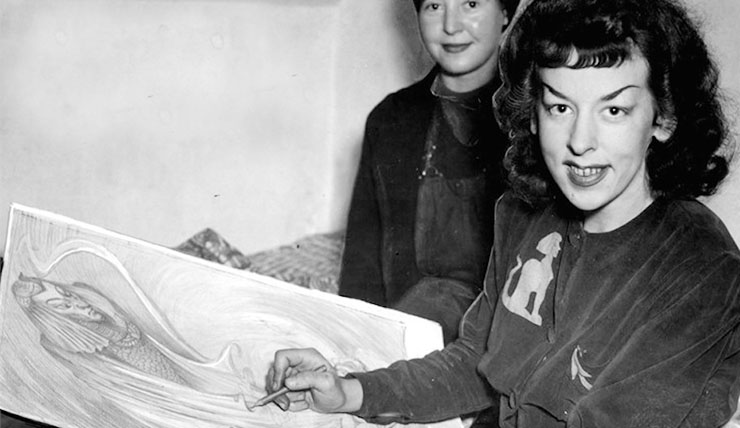
    Rosaleen Norton (1917-1979) has been described as Australia’s best known witch. She was a controversial and ‘colourful’ character in Sydney’s Kings Cross district during the 1950s and 1960s and was known to the public as an eccentric, bohemian witch-lady and artist. She wore flamboyant, brightly coloured blouses and vivid bandanas, puffed on an exotic engraved cigarette holder, and plucked her eyebrows so that they arched in a somewhat sinister curve. Norton also claimed certain distinctive body markings that she possessed were a sign that she was “born a witch.”

    Slight in build with curly black hair and a smile that revealed irregular teeth, Norton always had something of a magnetic presence that made her stand out in the crowd. The publication of her limited edition art book The Art of Rosaleen Norton in Sydney in 1952 – which also contained poems by her lover Gavin Greenlees – aroused considerable media controversy. Norton’s publisher and sponsor, Walter Glover, was charged in Sydney with releasing an obscene publication and copies sent to New York were confiscated and burnt by US Customs.

    During this period of extensive media publicity Rosaleen Norton became known in the public mind as an artist whose provocative paintings of half-human, half-animal forms were even more controversial than Norman Lindsay’s risqué nude figures. Norton depicted naked women wrestling with reptilian elementals or flying on the backs of winged griffins, gods who were both male and female, and demonic forms with menacing claw-tipped wings. During the 1950s Norton’s controversial paintings and drawings seemed to embody a deep-seated pagan impulse and ran counter to orthodox religious sensibilities.

    Norton’s Background

    Rosaleen Norton was born in Dunedin in 1917, the third of three sisters. Her father, Albert, was a captain in the merchant navy and a cousin of composer Vaughan Williams. The Nortons migrated from New Zealand in 1925 and settled in the Sydney suburb of Lindfield. As a teenager Norton was expelled from high school because of her allegedly “depraved nature” which her headmistress claimed “would corrupt the innocence of the other girls.” She then studied for two years at East Sydney Technical College under the sculptor Rayner Hoff. During this time she became interested in studying everything she could find about witchcraft, sorcery and magic and she was soon well versed in the occult writings of notable magical practitioners like Dion Fortune, Aleister Crowley and Eliphas Levi. In 1940, at the age of 23, she began to experiment with self-hypnosis as a means of inducing automatic drawing.

    Norton was already familiar with the trance methods of the Surrealists and especially admired the work of Salvador Dali and Yves Tanguy who, like the other artists in their movement, had explored techniques of encouraging the subconscious mind to manifest its visionary contents. Sometimes the surrealists drew rapidly so that forms came through unimpeded by the intellect. Others experimented with drugs or documented their dream experiences with great detail in order to develop a greater knowledge of the ‘alternative reality’ of the subconscious mind.

    Norton found that she could shut off her normal consciousness by means of self-hypnosis and could transfer her attention to an inner plane of awareness. As she noted in a lengthy interview conducted in an interview with the psychologist L.J. Murphy at the University of Melbourne in 1949: “These experiments [with self-hypnosis] produced a number of peculiar and unexpected results… and culminated in a period of extra-sensory perception, together with a prolonged series of symbolic visions.” Norton spent several years after this studying various systems of occult and mystical thought, including Buddhist and other examples of Eastern literature as well as standard works on Kabbalah, Theosophy and Western magic.

    During this period Norton also began to focus more specifically on the magical forces associated with the Great God Pan, whose spirit she felt pervaded the entire earth. Her studies had taught her that the ancient Greeks regarded Pan as lord of all things – symbolising the totality of the elements and all forms of manifest being. He was therefore, in a very real sense, the true god of the world. Pan was a maintainer of the balance of Nature and also had at his command an invisible hierarchy of lesser spirits who could help him in his work of ruling and sustaining the earth.

    Norton painted a large-scale interpretation of Pan, complete with horns, pointed ears, cloven hooves and musical pipes, and mounted it on the wall of her Kings Cross flat, where it effectively became the focal point of her magical altar. She also conducted magical ceremonies dressed in a tiger-skin robe to honour his presence, and would often experience him as a living reality when she entered a trance state. Meanwhile, her art continued to reflect the entities she encountered in her visions, including a variety of devilish creatures, half animal-half human pagan deities, and various supernatural motifs.

    The Gods, In Their Own Right

    Many occultists have drawn on Swiss psychoanalyst Carl Jung’s concept of the ‘collective unconscious’ to explain their relationship with the archetypal forces of the mind. Jung believed that at a deep, collective level of the psyche lay a rich and potent source of sacred archetypal imagery, and that these numinous forms provided the very basis of religious and mystical experience, irrespective of the cultural context involved. In other words, gods and sacred mystical images were really an extension of the universal human experience.

    A number of occultists have rejected this view, however, claiming instead that the gods live apart from the collective minds of humanity and are not merely projected ‘thought-forms’. Rosaleen Norton agreed with this latter perspective. For her, the gods existed in their own right. She believed she was able to encounter Pan, Hecate and Lucifer, not as extensions of her own consciousness, but as mythic beings from a higher plane of reality who would grace her with their presence if it pleased them, and not subject to her will. She believed she had discovered some of the qualities of these gods within her own temperament, and that this provided a sense of natural affinity. This made their invocation much easier and more effective than would have been the case had there not been some sort of innate bond. Norton maintained that she entered the realm of the gods on the astral planes – an inner world of spirit accessed through magical trance – and that on different occasions the gods would reveal different dimensions of their own magical potency.

    Rosaleen Norton regarded Lucifer, for example, not so much as an embodiment of ‘evil’ as humanity’s natural adversary. He bound and limited man when it appeared that he was growing too big for his boots. He tried to trick man, not out of malice but with the positive intent of exposing the limitations of the ego and revealing the essential falseness of man’s pride in his own existence. Rosaleen also regarded Pan as a very significant deity for the present day, a force in the universe which protected and conserved the natural beauty and resources of the environment. For her, Pan was alive and well in the anti-pollution lobbies and among the Friends of the Earth!

    Hecate, on the other hand, she felt to be more imposing – an often frightening, shadowy goddess flanked by cohorts of ghouls and night-forms, a dealer in death and a purveyor of curses. But there was a magical bond to be found here too. Norton regarded magic and witchcraft as her protection and an inspiration in a hostile, ungenerous world. However, her own brand of witchcraft hardly brought her abundance. She lived simply, with few possessions, and certainly without any measure of wealth. If ever she cursed people with “witch current,” she said, it was a means of redressing the balance of events – a legitimate use of the magical art.

    Rosaleen Norton’s paintings show a certain similarity of style to those of Norman Lindsay, for whom she occasionally posed as an artist’s model. But while for Lindsay the world of the supernatural could only offer decadent and exotic themes for his art-making, for Norton this realm was a perceptual reality – and this is very much reflected in her work. There are fire elementals, ablaze with light; devils with dual banks of eyes, indicative of their different planes of perception; cats with magical awareness; horned beings with sensual cheeks and a strange eerie light playing on their brow.

    Norton maintained that her art arose as the result of the direct magical encounter. Energies filtered through her, she said, as if she were a funnel. She transmitted the current during a state of self-induced hypnotic trance. If the gods were alive in her, her artistic skills would then allow these gods to manifest, in varying degrees, in her drawings and upon her canvases. Norton always denied that she portrayed the totality of the god. She could depict only those qualities the god chose to show. The gods existed in their own right, on a plane far removed from the everyday world of human consciousness – but were directly accessible to her through her techniques of magical trance.

    Was Norton a Satanist?

    During her colourful career as the ‘Witch of Kings Cross’ Rosaleen Norton was frequently accused of being a Satanist. When she exhibited her paintings and drawings at the Apollyon and Kashmir coffee-shops in Kings Cross during the 1950s, both locations were described in the tabloid press as the haunt of the “Devil’s cult” and on occasions visitors to these coffee-shops would mischievously request a cup of “bat’s blood.”

    When New Zealand migrant Anna Hoffmann claimed in September 1955 that she had attended a Black Mass with Norton in Kings Cross, the story was featured with sensationalist headlines on page one of a daily newspaper. Even though Hoffmann’s charges were later found to be fabrications and Hoffmann herself was jailed for two months and described as a “menace” by the presiding magistrate, the image of Norton as a ‘Satanist’ or ‘Devil-worshipper’ persisted during the 1950s, and even up into more recent times. For her own part, Norton went to great lengths, both during media interviews and sometimes also during various court proceedings, to explain that the “horned god” Pan was a pagan deity from the tradition of ancient Greek mythology and that her practice of witchcraft had no connection with the Christian Devil. Nevertheless, it is easy to see how members of the public may have misconstrued Norton’s occult imagery in the conservative social climate of post-World War Two Australia.

    Norton was unquestionably drawn to the ‘night’ side of the psyche and she herself described her art in those terms. Black Magic, one of several controversial artworks exhibited at the University of Melbourne in 1949, and against which charges of obscenity were subsequently brought, could certainly cause offence to any practising Christian, with its imagery of bestial lust, a winking nun, and a bare-breasted woman mounted on a crucifix. However, while many of Norton’s paintings and drawings feature provocative and irreverent subject matter, it is quite another matter to assume they promote a Satanic perspective.

    When Norton was accused in the popular media of overseeing blood-sacrifice rituals during a “Kings Cross Black Mass” she was both upset and offended by the remarks. Norton had always had a strong affinity with Nature, and with animals in particular, since her early childhood. As visitors to her apartment invariably attested, Norton was always accompanied by numerous pets, including cats, lizards, frogs, turtles and mice, and she always maintained that she would never cause animals harm. The very notion of ritualistic, Satanic ‘blood sacrifice’ was completely abhorrent to her. The evidence provided by her own artistic work and comments made to the popular press and in journalistic articles strongly suggests that while Norton was unquestionably both pagan and “heathen,” and often provocative in her presentation of “images of the night,” she was not a practising Satanist in the literal sense. Her witchcraft cult in Kings Cross included altars dedicated specifically to Pan and Hecate, and her coven rituals made no reference to the Christian Devil.

    So how can we sum up the magical personality of the ‘Witch of Kings Cross’? Rosaleen Norton was a colourful bohemian eccentric, a gifted trance-magician and a controversial visionary artist who developed her occult persona during a conservative period of Australian history when the populace at large was unsympathetic to the pagan beliefs she espoused. Most did not understand her ritual homage to the Great God Pan and branded her simplistically as a Devil-worshipper – a distortion of her actual perspective. When Norton’s limited edition art book was withdrawn from sale in 1952 on a charge of obscenity it was only allowed back into the marketplace when two “offending” erotic magical images had been blacked out. So Rosaleen Norton can be seen as a perennial ‘occult outsider’, an urban misfit in post-War Sydney. Nevertheless, she remains one of Australia’s most significant esoteric figures and can be considered a precursor of the more recent worldwide neo-pagan revival. She was also a competent mystical poet. Norton regarded the following poem, Dance of Life, as an expression of her personal magical credo:

    In the spiral horns of the Ram,

    In the deep ascent of midnight,

    In the dance of atoms weaving the planes of matter is Life.

    Life spins on the dream of a planet,

    Life leaps in the lithe precision of the cat,

    Life flames in the thousandth Name,

    Life laughs in the thing that is ‘I’.

    I live in the green blood of the forest,

    I live in the white fire of Powers,

    I live in the scarlet blossom of Magic,

    I live.

    [alert type=”general” dismiss=”no”]This article was published in New Dawn Special Issue 3.[/alert]

    [alert type=”success” dismiss=”no”]If you appreciate this article, please consider subscribing to help maintain this website.[/alert]

    © New Dawn Magazine and the respective author.
    For our reproduction notice, click here.
  • Toxic Prayer: Be Careful What You Ask For…

    Toxic Prayer: Be Careful What You Ask For…

    From New Dawn 114 (May-June 2009)

    You might be under the impression that authors choose the titles of their own books. That isn’t true – at least not always. If the publishers don’t like the title, they will change it.

    Such was the fate of a book published in 1997 by the noted mind-body researcher Larry Dossey, M.D., author of Healing Words and Prayer Is Good Medicine. Dossey had written on a provocative subject: if thoughts and prayers have the power to heal, do they also have the power to harm? He called his book Toxic Prayer, but the publishers, Harper San Francisco (now Harper One), were extremely uncomfortable with this title. They feared a backlash from fundamentalist Christians, who, they imagined, would take up arms against the idea that any kind of prayer could ever be harmful. After an anxious discussion that went all the way to the top of the company’s hierarchy, another, safer, though more flavourless title was chosen: Be Careful What You Pray For…You Might Just Get It.

    Whether the decision was a wise one or not (controversy sells books, after all), the whole story raises an awkward issue: is prayer a morally ambiguous force? Can it be used to curse as well as bless? If so, how?

    Of course it depends upon what you mean by prayer. In the conventional monotheistic view, prayer is addressed to the one true God (or sometimes his subordinates, such as Mary or the saints or the angels). Since God is all-good, he will either grant this request if it is beneficial or ignore it if it isn’t.

    This belief, although engagingly simple and clear, begins to erode if we also accept the idea that thoughts have power in and of themselves. By this view, a thought, whether positive or negative or neutral, has effects that can be felt in the psychic dimension and sometimes physically as well. This perspective, which takes us out of the sphere of religion per se and into that of magic, provides a far more equivocal picture of prayer.

    Magic and Invocation

    Magic, wrote the notorious twentieth-century occultist Aleister Crowley, is “the Science and Art of causing Change to occur in conformity with Will.” This definition, while correct up to a point, is too general to be entirely adequate. If I move a coffee cup around my table with my hand, I am effecting change in conformity with will, but no one would claim that that is magic as such. Magic has to do with effecting change by occult means – that is, by means invisible to ordinary sight and inadmissible by ordinary consciousness. If I were to move the same coffee cup around the table without touching it, this would start to look like magic, since the cause of the movement, whatever it is, cannot be seen.

    There are many forms of magic, ranging from sleight-of-hand (that is, using the standard tricks of stage magicians) to suggestion to more genuinely paranormal means. The boundaries between these categories – like the boundary between prayer and magic – are fluid and permeable, but generally we can say that occult magic is believed to work through two principal methods.

    The first has to do with spirits. Most occultists believe that there are unseen creatures inhabiting dimensions of reality that intersect with our own: these beings are variously known as spirits, elementals, angels, demons, devas – the lore has countless names for them. According to the magical world view, it’s possible to engage with these creatures. The magicians of the Renaissance, for example, evoked certain spirits using occult rites. If these spirits were approached the right way (through seals, signs, rituals, invocations, and so on), it was believed that they could be beseeched or, more often, forced to obey the magician’s will. The moral status of these spirits was ambiguous – they were often thought to be demons – but that could prove an advantage when there was dirty work to be done.

    Here is one invocation, of a spirit called Mirael. Taken from a fifteenth-century manuscript of necromancy found in Munich, it is designed to make someone lose his mind: “May Mirael enter into your brain and dissolve and destroy all wisdom, sense, discretion, and thought. I conjure you, Mirael, by all the princes and elders, and by all that you wish to do, that for as long as it pleases me you will flow through the person I look upon and daze him, and that he lose everything that he does not recognise. Otherwise I shall cast you into the depths of the sea so that you shall not escape for eternity.”

    As unsavoury as these practices may sound, they are universal or practically so. Here is another example, this one from the other end of the world. Max Freedom Long, the redoubtable investigator of the Hawaiian form of shamanism known as huna, discusses the death prayer as practiced by the shamans or kahunas: “To become able to use the ‘death prayer’ a kahuna had to inherit from another kahuna one or more ghostly subconscious spirits. (Or he might, if sufficiently psychic, locate subconscious spirit or ghosts, and use hypnotic suggestion to enslave or capture them.)”

    Once a kahuna had some of these spirits under his will, he would offer them food and drink so as to imbue them with mana or vital force and then give them very specific instructions about what to do with this energy. They might, for example, be told to find a given person and enter his body or attach themselves to it. Once they had done this, they would suck up the victim’s vital force. When the victim died, the spirits would return to their master, further strengthened by having absorbed the dead person’s mana.

    Spirits thus require an infusion of energy or life force. There are a number of ways of supplying it. In ancient times the method of choice was blood sacrifice; as the victim’s blood spilled, the vital force would, as it were, evaporate so that the spirits could consume it.

    Homer’s Odysseus describes a sacrifice he has made: “When I had prayed sufficiently to the dead, I cut the throats of the two sheep and let the blood run into the trench, whereon the ghosts came trooping up from Erebus – brides, young bachelors, old men worn out with toil, maids who had been crossed in love, and brave men who had been killed in battle, with their armour still smirched with blood; they came from every quarter and flitted round the trench with a strange kind of screaming sound that made me turn pale with fear.”

    How The Death Prayer Works

    While blood sacrifice is much less common today than it was in antiquity, it is still used, for example, in Santería, Voudun, and other religions of African origin that are practiced in the Caribbean Islands and South America.

    To show how the death prayer works, Long tells of a young Irishman who went to Honolulu and worked as a taxi driver. He became involved with a Hawaiian girl, who then ended her engagement with a Hawaiian boy. The girl’s grandmother, not trusting the young Irishman’s intentions, tried to break up the affair, but without success.

    One day, writes Long, the Irishman’s feet “went to sleep.” The pricking numbness that afflicted his feet gradually crept up his body, making him unable to move. The young man did not believe in magic or death prayers or any such nonsense, so he called in conventional American doctors. They were unable to help him. The numbness had spread to his waist by the time an old doctor who had practiced in the islands for many years was summoned. He recognised the symptoms of the death prayer, and making inquiries of the patient, soon learned about the girl and her grandmother. The doctor paid a visit on the grandmother, who said, “Well, I know nothing about the matter and I am no kahuna – as you know. But I think that if the man would promise to take the next ship for America and never return or even write back, he might recover.”

    The doctor tried to explain the situation to the still-unbelieving Irishman. Although he resisted at first, finally the patient was persuaded to take the grandmother’s advice. The same day he was able to walk again, and that evening he caught a Japanese ship headed for the West Coast of the US.

    How do the kahunas themselves see this whole process? Kahana, a Hawaiian ana’ana priest (priest of the dark forces), explained in an interview: “You are releasing the spirit from this encasement so it can go and get cleansed and purified and come back. It’s time to take it out.”

    One detail in Long’s story raises an issue that has long been disputed: does the victim have to believe in these powers in order to be susceptible to them? Dossey cites one researcher who contends that in such cases, “the victim, family members, and all acquaintances must accept the ability and power of the hexer to induce death. This belief must be commonly held with no exceptions.”

    Long’s story contradicts this claim. The victim did not believe in such things and continued to scoff at them even as he was dying; moreover, nobody even told him that the death prayer had been aimed at him. Attempting to write off such effects purely as a matter of suggestion would then be inaccurate (although it is easier for scientists to accept, since they feel obliged to dismiss actual occult causes from the outset). Indeed Michael Harner, the noted scholar of shamanism, observed that the Jivaro shamans of South America prefer the victim to be unaware of the psychic attack, because then he would take no measures to counter it. “Distant hexing is a security measure,” he told Dossey in conversation.

    [alert type=”info” dismiss=”no”]If you appreciate this article, please consider a subscription to New Dawn magazine.[/alert]

    Creating Thought Forms

    Working with spirits is one time-honoured way to cause harm; another way is closely related to it. This second approach involves sending not spirits but thought forms – mental images infused with vital energy that can thus make their effects felt in the physical world. The difference between the two methods is in the tools: a spirit is usually regarded as a living, more or less conscious entity, whereas a thought form is the creation of a human mind and has no independent existence.

    Admittedly, the line between these two types of magic can be a thin and wavering one. In his Meditations on the Tarot, a contemporary classic of Christian esotericism, Valentin Tomberg writes that this method of creating a thought form is precisely how you create a demon.

    As with all generation, that of demons is the result of the cooperation of the male principle and the female principle, i.e., the will and the imagination, in the case of generation through the psychic life of an individual. A desire that is perverse or contrary to nature, followed by the corresponding imagination, together constitute the act of generation of a demon.

    A term used in the occult literature for such entities is egregor or egregore, a term supposedly derived from the Greek gregoreuein (“to watch, to stay awake”). One famous instance of the creation of an egregor is related by Alexandra David-Neel, a Frenchwoman of the early twentieth century who penetrated the then-forbidden country of Tibet to learn its occult practices. By dint of intense meditation, she was able to generate the form of a monk that took on a quasi-autonomous existence and even made its presence felt to other people. When the entity started to make a nuisance of itself, David-Neel had to devote another several months of intense meditation to destroying it.

    Harming by means of thought forms does not necessarily require the generation of quasi-autonomous psychic entities. Dossey mentions the case of a patient of his, a woman afflicted with chronic fatigue syndrome. The woman was domineering and manipulative while her husband was extremely unassertive. He had always resented his wife; after she fell ill, he started to hate her.

    One night, after a bitter argument, the husband stormed out of the house; when he returned, he found his wife dead. The man was overcome with guilt, convinced that his hatred had killed his wife. He refused to enter psychotherapy and instead joined an extremely conservative fundamentalist church, where he was able to assuage his conscience by believing that her death was the will of a wrathful God.

    Psychologists sometimes employ the term magical thinking. This involves the belief that an inner wish or emotion somehow caused an effect that later happened in reality. A four-year-old child, for example, may hate his brother and wishes he were dead. The brother then dies; the child then believes that somehow he was the cause of the death. It is a version of the old logical fallacy Post hoc, ergo propter hoc: “After this, therefore because of this.”

    Clearly not every case of misfortune can be traced to someone else’s negative thoughts, even if that person really did have those thoughts. Nor is it absolutely clear what the determining factor might be, but it very likely includes the intensity of the desire. A passing irritation that leads a person to say, “I wish he were dead!” probably does not have much effect in most cases. But when the thought is fed and nurtured with intense emotional energy, even unintentionally, it can begin to gain power. The man who thought he had killed his wife had probably directed a huge amount of hatred at her.

    I once had a curious experience in this regard myself. A number of years ago I lived next to neighbours who were causing me a great deal of disturbance with their noise. I had spoken to them about it, but it did no good except to change the source of the noise: their rock band practicing in the garage was supplanted by dogs who got on their roof and barked obnoxiously at everything. I felt the negative energy accumulating in myself, and although I intended no harm to them – I merely wanted them to stop disturbing me – a strange thing happened one day. I put a letter in their mailbox asking them yet again to deal with these issues; it was the only time I ever did that. Then I drove to work as usual and was gone for the rest of the day, only getting back late in the evening. The next morning I noticed something strange: a tall tree that had been directly next to their mailbox was gone. Neighbours later told me that a truck had hit the tree that day, and it had to be taken down.

    There is, of course, no way that I could prove that my thoughts had this entirely unintended effect, but I had never put anything in their mailbox before and never did again. The coincidence was disturbing, and I had the uncanny feeling of being at psychic war with these neighbours; moreover I began to feel an intense psychic charge around my house. A few months later, not wanting the situation to escalate any further, I solved the problem by moving away.

    Thus thought forms, in order to have power, need not have energy directed consciously at them; they can receive this force even when it arises spontaneously and unintentionally. But like spirits, these thought forms do require some energy or vital force in order to operate.

    The Dangers Posed by Toxic Prayer

    Having briefly surveyed some powerful though unsavoury occult practices, what practical lessons can we draw? In the first place, wishing for harm to someone else is remarkably common; one poll indicated that 5 percent of American surveyed had done it (and we have to assume that this is a low figure, since it only accounts for those who were willing to admit as much). In the second place, it is remarkably dangerous. Indeed magical practices of any kind are dangerous, even when one’s intention is reasonably pure; almost invariably something goes awry, producing results that are not exactly what you might have wanted. Occult magic is rather like trying to sculpt something out of nitroglycerin – a sloppy but also highly explosive material.

    The problem is compounded when one is working with an intent to harm. It is extremely difficult, perhaps impossible, to create a thought form or invoke a spirit and remain totally disconnected from it. Thus if you are creating something negative, you can be sure that it will return to you in some form or another, just as in huna the spirits return to the kahuna after they have consumed a victim’s energy. And they are not always easy to control when they are aroused, even by their supposed master.

    To illustrate this point, Max Freedom Long tells another story, which happened to his mentor and informant about huna, an American scientist named William Tufts Brigham. During a trip to the Mauna Loa volcano to collect native plants, Brigham found that one of his servants, a twenty-year-old boy, started to fall ill. Although there was ostensibly nothing wrong with him, he began to waste away and, like the Irishman, lost feeling in his legs. The boy believed that he was being prayed to death, and Brigham’s servants, who regarded him as a great kahuna, begged him to send the spirits back to the one who had launched them.

    “This is perhaps the easiest thing an amateur magician could be called upon to do,” said Brigham. “The spell had been initiated and the trained spirits sent out. All I had to do was to put up the usual big arguments to talk the brainless things over to my side…. I stood over the boy and began to advance arguments to the spirits. I was smoother than a politician. I praised them and told them what fine fellows they were…. Little by little I worked around to tell them how sad it was that they had been made slaves by a kahuna instead of being allowed to go on to the beautiful heaven that awaited.”

    Finally, mustering a supreme concentration of power and will, Brigham let out a tremendous roar. Soon the suffering boy felt better, and in an hour he was up and eating. Later Brigham learned that the kahuna who had sent the curse had neglected to cover himself with the usual occult protection, and by the next morning he was dead.

    Much the same is true with thought forms of the more impersonal variety. To begin with, the thought form, in order to have any effect upon the recipient, must find some resonance in him or her.

    The Theosophists Annie Besant and C.W. Leadbeater write: “In cases in which good or evil thoughts are projected at individuals, those thoughts, if they are to fulfil directly their mission, must find, in the aura of the object to whom they are sent, materials capable of responding sympathetically to their vibrations.” Otherwise the thought form will bounce off. “That is why it is said that a pure heart and mind are the best protectors against inimical assaults…. If an evil thought, projected with malefic intent, strikes such a body, it can only rebound from it, and it is flung back with all its own energy; it then flies backward along the magnetic line of least resistance, that which it has just traversed, and strikes its projector; he… suffers the destructive effects he had intended to cause to another.”

    The Best Protection

    These observations go far toward answering the final and perhaps most pressing question connected with toxic prayer: how do you protect yourself against it? A positive mindset is a good start, so purging thoughts of hatred, judgment and violence from your mind is a necessity. It’s also helpful to clear away negative thoughts that are aimed at yourself: recognise that thoughts of your own weakness, inferiority, vulnerability and sickness are poisons and rid yourself of them. If this kind of thinking has been a lifetime habit, it may prove difficult to break, but even the smallest efforts can bring results and will also create a momentum that gradually builds.

    For those with some ability at visualisation, some of the standard forms of occult protection can be useful. The most common is probably envisaging yourself as surrounded by a sphere or ovoid form of white light. But the exact technique you use is probably less important than the clarity and power you bring to the thought, so you will probably do best by experimenting which methods work for you. Conventional prayers can also be employed, such as the Lord’s Prayer, which after all includes the petition “Deliver us from evil.” Again, the specific form of the prayer is not as important as whether it arouses a powerful and positive emotional response in yourself.

    Perhaps the chief thing to remember is not to fear. Fear is a negative emotion and weakens you far more than it strengthens you, and it is probably no coincidence that the cultures in which psychic attack is most common are those pervaded by fears of black magic. For this reason, a healthy, grounded, common-sense mindset may be the best protection of all.

    [alert type=”general” dismiss=”no”]This article was published in New Dawn 114.[/alert]

    [alert type=”success” dismiss=”no”]If you appreciate this article, please consider subscribing to help maintain this website.[/alert]

    Sources

    Anonymous [Valentin Tomberg], Meditations on the Tarot: A Journey into Christian Hermeticism, Translated by Robert A. Powell, Warwick, N.Y.: Amity House, 1985

    Annie Besant and C.W. Leadbeater, Thought Forms, Adyar, Madras, India: Theosophical Publishing House, 1978 [1901]

    Aleister Crowley, Magick in Theory and Practice, New York: Castle, n.d.

    Alexandra David-Neel, Magic and Mystery in Tibet, New York: Dover, 1971

    Larry Dossey, Be Careful What You Pray For…You Might Just Get It, San Francisco: Harper San Francisco, 1997

    S.E. Hertel, “Kahuna Ana’Ana: The One Who Walks in Darkness”, Gnosis 14 (winter 1990), 30-33

    Homer, The Odyssey, Translated by Samuel Butler, http://classics.mit.edu/Homer/odyssey.html; March 10, 2009.

    Richard Kieckhefer, Forbidden Rites: A Necromancer’s Manual of the Fifteenth Century, University Park, Pa.: Penn State Press, 1997

    Max Freedom Long, The Secret Science Behind Miracles, Santa Monica, Calif.: DeVorss, 1948

    Richard Smoley, “Man as God and Creator”, Gnosis 28 (summer 1993), 56-60

    © New Dawn Magazine and the respective author.
    For our reproduction notice, click here.
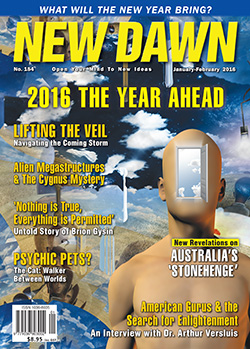
  • Nothing Is True, Everything is Permitted: The Untold Story of Brion Gysin

    Nothing Is True, Everything is Permitted: The Untold Story of Brion Gysin

    From New Dawn 154 (Jan-Feb 2016)

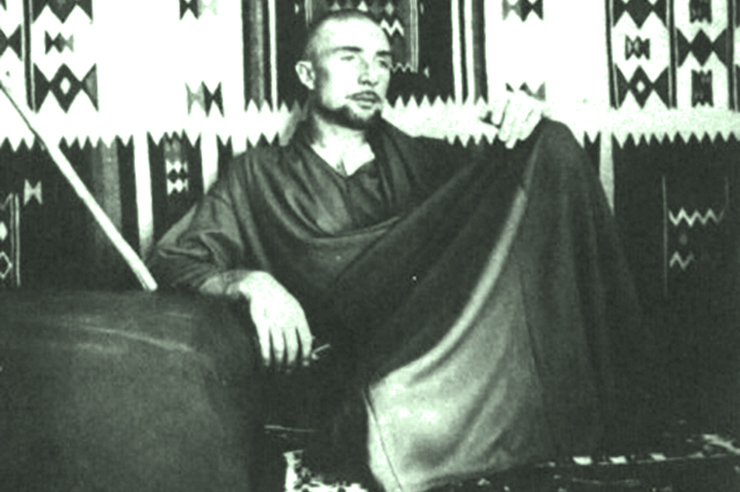
    If Brion Gysin had not existed, it probably would have been necessary to invent him, as the saying goes. Pre-eminent multimedia psychedelic shaman of the latter-half of the twentieth century, Gysin was something of a jack-of-all-trades: artist, calligrapher, entrepreneur, kinetic sculptor, novelist, performance artist, photographer, poet, raconteur, restaurateur, and traveller in this-and-other worlds. Brion did it all.

    Even a brief list of the names he crossed paths with sounds like a veritable who’s who: Laurie Anderson, Francis Bacon, David Bowie, Paul Bowles, Ira Cohen, Ornette Coleman, Max Ernst, Marianne Faithfull, Leonor Fini, Jean Genet, Keith Haring, Billie Holliday, Brian Jones, Timothy Leary, Iggy Pop, Genesis P-Orridge, Patti Smith, Gore Vidal – and, of course, his long-term friend and collaborator, William Burroughs – are among the friends, fellow-travellers and sometimes collaborators that have spoken of their admiration for the man and his work. As his biographer, John Geiger, wrote:

    Brion Gysin may be the most influential cultural figure of the twentieth century that most people have never heard of.

    ‘Brion Gysin’ was originally John Clifford Brian Gysin, born 19 January 1916 in Taplow, Buckinghamshire, England. He never knew his English-born father, who had emigrated to Canada, just in time to marry and father a child, before joining up and getting sent back to Europe to die in the First World War. After moving back to Edmonton in Canada with his young widowed mother, Gysin always preferred to stress his Swiss ancestry via his paternal grandfather, but even then he would complain later in life concerning the ‘delivery’ of his birth:

    Wrong address! Wrong address! There’s been a mistake in the mail. Send me back. Wherever you got me, return me. Wrong time, wrong place, wrong colour.

    The young Gysin wanted to “have adventures and see visions” and figured that Paris was the place. Moving there at 18, his career as a painter should have got off to a spectacular start: a chance encounter with Marie-Beth Aurenche – then still the first Mrs Max Ernst – gave access to the hottest scene in town, the Surrealists. Without formal art tuition, Gysin got some basic tips from the Argentinian spitfire, Leonor Fini, but the main lesson came from visiting Ernst’s studio and seeing that the objective was “to make the paint make the painting.” Barely 19, Gysin was soon invited to exhibit alongside Ernst, Fini, and Valentine Hugo – as well as Dali, Magritte and Picasso – but before the show’s opening his work was taken down by poet Paul Eluard, on orders of the ‘Pope’ of Surrealism, André Breton. Gysin never really found out why, but he was sure the fact he had just come out as homosexual had something to do with it. Whatever the reason, it was a crushing blow.

    Disillusioned, Gysin took off travelling, first to Greece and then Algeria. On his return to the States in 1939 he met a number of former Surrealists who had fled war in Europe. He shared a studio with the Chilean Roberto Matta, the beginning of a lifelong friendship, and also worked on Broadway as a scene painter, befriending the successful songwriter John La Touche. A lifelong enthusiast of cannabis, Gysin also started to hang out and ‘turn on’ with Black Jazz musicians such as Billie Holliday. Another significant connection was Eileen Garrett, celebrated society medium and psychic, whose abilities landed her in trouble with the authorities. During a séance, Garrett had apparently been contacted by the spirit of the captain of the British dirigible R-101, who gave such convincing details concerning the airship’s terrible crash that she was arrested under the Official Secrets Act on suspicion of espionage!

    “That’s My Music!”

    Serving during the Second World War, Gysin became a naturalised American, changing his name officially from ‘Brian’ to ‘Brion’. In the army Gysin was sent on a 18-month course to learn Japanese, including calligraphy, later to have a major impact on his art. He also met Tex Hanson, grandson of Josiah Hanson – inspiration and basis for Harriet Beecher Stowe’s 1852 bestselling novel Uncle Tom’s Cabin. Through this friendship and the access it gave him to the world of Black Canadians, Gysin wrote To Master – A Long Goodnight, which was published in 1946 thanks to Eileen Garrett. This and the related text, A History of Slavery in Canada, won Gysin one of the first-ever Fullbright Scholarships. He used the money to travel to Tangier, Morocco with his new friend, composer and novelist Paul Bowles. Together they would explore the trance music of the ecstatic brotherhoods, and one day in 1950, attending a festival on the beach outside Tangier, Gysin had what would be for him a decisive encounter:

    …it was the first time I’d seen large groups of people going into trance – [that in itself] was enough to have kept my attention, but beyond and above all of that I heard this funny little music, and I said: “Ah! That’s my music! – I just want to hear that music for the rest of my life. I wanna hear it every day all day.”

    It turned out to be the music of the Master Musicians of Joujouka, a collective of Berber Sufi trance musicians originating from the small village of that name, south of Tangier in the foothills to the west of the Rif Mountains in northern Morocco. As Gysin would later write in respect of his first encounter with the stirring, primal, hypnotic music of reeds, pipes, and goat-skin drums:

    Magic calls itself The Other Method for controlling matter and knowing space. In Morocco, magic is practiced more assiduously than hygiene though, indeed, ecstatic dancing to music of the brotherhoods may be called a form of psychic hygiene. You know your music when you hear it one day. You fall into line and dance until you pay the piper.

    After managing to attend the Festival of Bou Jeloud in Joujouka for the first time, Gysin recognised that:

    Their secret, guarded even from them, was that they were still performing the Rites of Pan under the ragged cloak of Islam.

    Gysin’s interpretation was that Bou Jeloud was an avatar of the Greek god Pan that survived from pagan times, as had been put forward by the pioneering socio-biologist, Edvard Westermarck, in his 1933 study Pagan Survivals in Mohammedan Civilization. So, the “magical music” of the Master Musicians was, quite literally, a manifestation of the Pipes of Pan.

    Meeting William S. Burroughs

    In Tangier, Gysin would also meet the American writer William S. Burroughs – who later became his greatest friend and collaborator – but at first neither made a particularly favourable impression. Burroughs was still in the throes of a full-on heroin addiction, and had not yet written the monstrous masterpiece, Naked Lunch, that would make his name. He dismissed Gysin as catering – quite literally – to Tangier’s expat community of “uppity queens” with his restaurant, The 1001 Nights. It boasted Arab dancing boys, an in-house residency by the Master Musicians of Joujouka, and Gysin’s friend Hamri – ‘The Painter of Morocco’ – was main cook. It all ended in tears, though. Brion would later tell how he had been the target of a curse intended to oust him from his business:

    …while getting the restaurant ready I found a magic object, which was an amulet of sorts, a rather elaborate one with seeds, pebbles, shards of broken mirror, seven of each, and a little package in which there was a piece of writing, and the writing when deciphered by friends who didn’t even want to handle it, because of its magic qualities, which even educated Moroccans were not anxious to get in touch with, but it said something like, an appeal to one of the devils of fire, the devil of smoke – to take Brion away from this house: as the smoke leaves this chimney may Brion leave this house and never return…

    The Third Mind

    Relocating to Paris, after briefly enjoying the hospitality of the Princess Ruspoli, Gysin moved to completely the other end of the social spectrum, moving in to the nameless fleapit hotel at 9 Rue Gît-le-Cœur in the Latin Quarter. It was here in Paris that Gysin would run into Burroughs again, and this time they hit it off. Burroughs, likewise, moved into the so-called ‘Beat Hotel’ and the two of them embarked on their own equivalent of the poet Rimbaud’s “sustained and systematic derangement of all the senses” – the psychic fusion they referred to as “The Third Mind.” Gysin helped steer his new friend through the emotional rapids of heroin withdrawal, and allowed Burroughs to watch him at work on his art. Burroughs was wide open without the safety blanket of junk, and Gysin felt vulnerable and exposed working in front of his new friend. He rarely if ever let people see him paint, saying it was a more private act than masturbation. It must have been incredibly raw bonding indeed. It was as if the first cut-up they created together, this “project for disastrous success” as they called it, was with their very souls: and it was out of this commingling that all their subsequent collaborations would proceed. The very notion of ‘The Third Mind’ was itself a kind of psychic cut-up, named for the idea in Napoleon Hill’s 1937 self-help book, Think and Grow Rich:

    No two minds ever come together without, thereby, creating a third, invisible, intangible force which may be likened to a third mind.

    The atmosphere around Burroughs and Gysin in those early days at the Beat Hotel was steeped in the occult, with daily experiments in mirror-gazing, scrying, trance and telepathy, all fuelled by a wide variety of mind-altering drugs. Scrying is the very old and almost universal practice of gazing into a crystal ball, mirror, or other reflective surface, so as to access a form of spirit vision, usually for the purpose of divination. Brion conducted scrying marathons, sitting cross-legged in front of the mirrored armoire in his tiny room for up to 36 hours, tears streaming down his face from unblinking eyes, as friends passed the occasional cigarette, cup of coffee, or joint to help keep him going. He described how:

    …you see great galleries of characters, running through… scientists… in their sort of 19th century labs… whole events or whole scenes sort of frozen… And faces which never existed, and great chieftains of unknown races, and so forth and so on, going back and back further and further in time and history… after certainly more than 24 hours of staring… where there seemed it was a limited area that one could see only a certain distance into, uh, where everything was covered with a gently palpitating cloud of smoke which would be about waist-high… that was the end, there was nothing beyond that…

    From tales of Hassan-i Sabbāh, Old Man of the Mountain and Master of the Assassins, to magic and music in Morocco, Brion was a spellbinding storyteller. As psychedelic guru Timothy Leary later wrote:

    Brion dispenses blessings, visions, communications, poetic sermons, and wicked gossip – the world of the occult is his planet. Gysin is one of the great hedonic mystic teachers.

    [alert type=”info” dismiss=”no”]If you appreciate this article, please consider a subscription to New Dawn magazine.[/alert]

    The Cut-Up Technique

    September 1959, and Brion Gysin was using a Stanley knife to cut through paper to make mounts for some drawings he was working on. In the process Gysin sliced into copies of the New York Herald Tribune spread out as a cutting mat. Seeing the various strips of paper and reading the chance combinations his blade had produced, he laughed so uproariously the neighbours were concerned for his sanity. When Burroughs returned, Gysin showed him the results – almost as an afterthought, “an amusing Surrealist diversion” – but Burroughs was immediately struck by the technique and its potential:

    The cut up method brings to writers the collage which has been used by painters for fifty years. And used by the moving and still camera… And photographers will tell you that often their best shots are accidents… writers will tell you the same. The best writing seems to be done almost by accident but writers until the cut up method… had no way to produce the accident of spontaneity. You cannot will spontaneity. But you can introduce the unpredictable spontaneous factor with a pair of scissors.

    Gysin himself felt that, ultimately, he was unable to make the cut-ups work for him the way they worked for Burroughs. Instead, he focused more on permutations: he would take short, simple phrases and run them through every conceivable combination and juxtaposition, producing hypnotic, mantra-like formulae, such as:

    Come to free the words
    To free the words come
    Free the words to come
    The words come to free
    Words come to free thee!

    But even with such an apparently impersonal process as this, Brion the self-mythologiser was able to see occult forces at work, claiming:

    The permutations discovered me – because permutations have been around for a long time; in the whole magic world permutations are part of the Cabalistic secret…

    The notion of ‘Cabalistic secrets’ also applied to the latest developments in Gysin’s visual art: he had begun painting calligraphic works, based on the writing of Japanese in vertical columns and Arabic to be read right-to-left, overlaid in grids inspired by the very ‘magic square’ that had been used to curse him in Tangier. The results ranged from the subtle to the truly complex, each uniquely his own. As the painter George Condo would later remark:

    [Gysin] built up an authentic Eastern painting in an authentic Western manner.

    The Dreamachine

    A startling visionary experience Gysin had in the back of a bus in December 1958 lead to the next experimental revelation. As he recorded in his diary:

    Had a transcendental storm of colour visions today in the bus going to Marseilles. We ran through a long avenue of trees and I closed my eyes against the setting sun. An overwhelming flood of intensely bright colours exploded behind my eyelids: a multidimensional kaleidoscope whirling out through space. I was swept out of time. I was out in a world of infinite number. The vision stopped abruptly as we left the trees. Was that a vision? What happened to me?

    When Burroughs later read The Living Brain by W. Grey Walter, he made the connection with his friend’s strange visionary experience immediately. Walter, an American-born British neurophysiologist, had been researching the effect of controlled flicker on states of consciousness via the use of precisely calibrated stroboscopes, and with the help of early EEG equipment had put forward a model of varying brainwave frequencies corresponding to different states of consciousness. Apparently a flicker rate of 8-to-13 cycles a second induced what Walter dubbed “alpha rhythms” which “predominantly originate… during wakeful relaxation with closed eyes” and, interestingly, also during REM sleep (i.e. during dreaming.) Obviously Brion had experienced a spontaneously-occurring flicker experience, no doubt caused by the exact rhythm of the sunlight flickering through the trees as the bus drove past, thought Burroughs. The question was, though, how to reliably reproduce the flicker effect? The answer came from their young friend, Ian Sommerville, a gifted mathematician, who had also read Walter’s book, and wrote:

    I have made a simple flicker machine; a slotted cardboard cylinder which turns on a gramophone at 78 rpm with a light bulb inside. You look at it with your eyes shut and the flicker plays over the eyelids. Visions start with a kaleidoscope of colours on a plane in front of the eyes and gradually become more complex and beautiful, breaking like surf on a shore until whole patterns of colour are pounding to get in…

    Gysin was quick to promote both the ‘Dreamachine’ and his discovery of it – going so far as to register a patent, Procedure and apparatus for the production of artistic visual sensations (although many later felt that the credit really should have gone to Sommerville.) Ever the charismatic raconteur and self-mythologiser, Gysin spun a web of wonder about “his” flicker device, creating a suitably esoteric and esteemed pedigree, telling interviewers:

    …one knows of cases – in French history, Catherine de Medici for example, had Nostradamus sitting up on the top of a tower… and he used to sit up there and with the fingers of his hands spread like this would flicker his fingers over his closed eyes, and would interpret his visions in a way which were of influence to her in regard to her political powers… they were like instructions from a higher power… Peter the Great also had somebody who sat on the top of a tower and flickered his fingers like that across his closed eyelids…

    Of course, it was too good to be true. For all that the “cosmonauts of inner space” of the Beat Hotel thought that the Dreamachine could be “the drugless turn-on of the 60s” illuminating the world for the price of a light-bulb, it was never really going to have the kind of mass appeal they might have hoped for. Marianne Faithfull – who would meet Gysin for tea in Mayfair during her “lost years” – recalled her first impressions of the Dreamachine, and her answer gives some sense of the associations that probably stopped the device from catching on commercially:

    I remember going to an exhibition of Brion Gysin, and there was the Dreamachine… I mean I knew it was really special ‘cos I think I was tripping… Only a magical creature could think up something like that – it is like a wonderful idealistic idea, but you know it’s never gonna fly…

    Here To Go

    In his 1969 novel The Process, Gysin declared rather grandly:

    Of course the sands of Present Time are running out from under our feet. And why not? The Great Conundrum: ‘What are we here for?’ is all that ever held us here in the first place. Fear. The answer to the Riddle of the Ages has actually been out in the street since the First Step in Space. Who runs may read but few people run fast enough. What are we here for? Does the great metaphysical nut revolve around that? Well, I’ll crack it for you, right now. What are we here for? We are here to go!

    In 1974 Gysin was hit badly by a diagnosis of cancer, followed first by unsuccessful cobalt treatment and then a colostomy. He returned to Paris “to die” he said – but eventually began to rally, and with the help and encouragement of friends resumed work. He wrote to William Burroughs:

    …I have decided to come back and finish my life’s work. Like the Old Chinese Painter I intend to work on to the point where I can bow three times and disappear into my picture.

    At the recommendation of David Bowie, Iggy Pop looked up Brion in Paris, later remembering: “Brion Gysin – what a beautiful guy. His painting is beautiful. He was a real human being.” English Cut-Up writer Terry Wilson recorded interviews with Gysin for what would become his definitive statement, Here To Go: Planet R-101, and also helped edit The Last Museum. New York graffiti artist Keith Haring visited Brion and later paid this moving tribute:

    I feel honoured to have known Brion and shared a short but timeless moment of our lives. He was my teacher, a role he took on with great passion. Perhaps the greatest teacher I will ever have, for he taught by example…

    Others that made the pilgrimage to Paris to see Gysin included Genesis P-Orridge and Peter ‘Sleazy’ Christopherson of Industrial music pioneers Throbbing Gristle. They had been vocal about the influence of Burroughs, Gysin, Cut-Ups and the Third Mind from the beginning, and continued to pay tribute in successive projects Psychic TV and Coil. P-Orridge would later write, “Gysin was a transmediator, a 20th century renaissance man, a multi-media explorer and innovator,” and also that he and Burroughs were “cultural alchemists and practicing magicians,” while Christopherson’s partner in Coil, John Balance, simply acknowledged “Brion Gysin is a Teacher.” After his death, in a video tribute recorded for the Dublin Here To Go Show in 1992, Burroughs stated unequivocally:

    Brion Gysin is the only man I have ever respected, the only person of either sex. He was completely enigmatic because he was completely himself.

    In the final analysis, Gysin was perhaps right to complain that, as well as being born the “wrong colour” in the “wrong place,” he had also been born in the “wrong time”: what becomes more clear with each passing decade is that the single biggest misfortune of his various lives and careers was to have been born too soon. Brion Gysin is a prime example of the 21st century magical multimedia artist, psychedelic explorer, and techno-shaman, and he belongs to the Future. His Time is Now.

    I talk a new language. You will understand. I talk about the springs and traps of inspiration. Who Runs May Read.
    – Brion Gysin (1916–1986)

    [alert type=”general” dismiss=”no”]This article was published in New Dawn 154.[/alert]

    [alert type=”success” dismiss=”no”]If you appreciate this article, please consider subscribing to help maintain this website.[/alert]

    FURTHER READING

    Back In No Time: The Brion Gysin Reader, ed. Jason Weiss (Wesleyan Univ. Press, 2001)

    Brion Gysin: Dream Machine by L. Hoptman, w/ J. Geiger, J. Grauerholz, et al. (Merrell, 2010)

    Brion Gysin: Tuning in to the Multimedia Age, ed. J. Ferez Kuri (Thames & Hudson, 2003)

    Here To Go: Planet R-101 by Brion Gysin & Terry Wilson (RE/Search, 1982; Creation, 2001)

    The Last Museum by Brion Gysin (Grove/Atlantic, 1986)

    Nothing Is True, Everything Is Permitted: The Life of Brion Gysin by John Geiger (Disinformation, 2005)

    The Process by Brion Gysin (Jonathan Cape, 1969; Overlook, 2005)

    The Third Mind by William S. Burroughs & Brion Gysin (Viking, 1978; Grove, 1982)

    William S. Burroughs, Throbbing Gristle, Brion Gysin, ed. Vale & Juno (RE/Search, 1982)

    © New Dawn Magazine and the respective author.
    For our reproduction notice, click here.
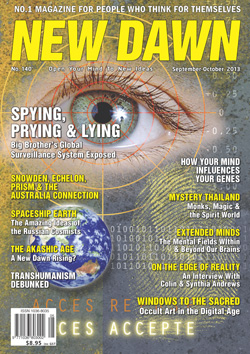
  • Mystery Thailand: Monks, Magic & the Spirit World

    Mystery Thailand: Monks, Magic & the Spirit World

    From New Dawn 140 (Sept-Oct 2013)

    What country is the most occult in the world? Lying smack dab in the heart of Southeast Asia, Thailand arguably fits the bill. This is a country that truly believes in spirits and supernatural power. Thailand has it all. With sorcerers who collect oil from the chin of corpses to perform black magic, spirit mediums who channel Hindu deities, a festival to the gods involving possessed devotees sticking sharp objects through their bodies, and monks who use their supernatural powers to charge amulets, this country is about as occult as it gets.

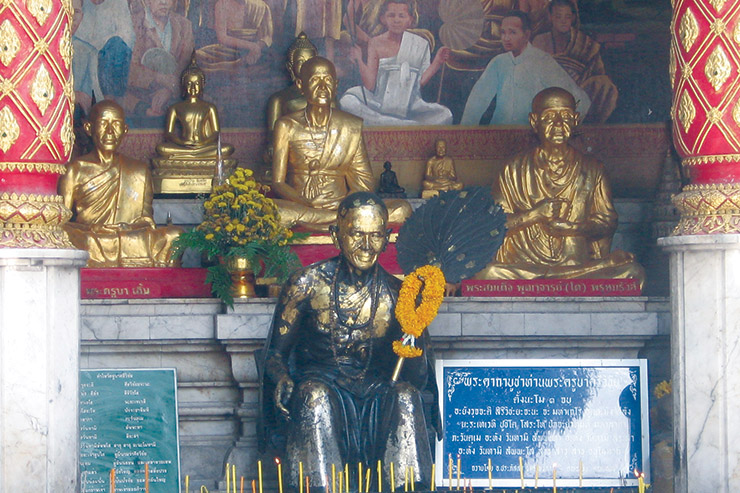
    Buddhism is the main religion in Thailand and much of Asia, although in Thailand there is a syncretistic mix of Buddhism, Hinduism, and Animism. Therefore, the people worship and pay homage to a number of Hindu deities and local animistic spirits right alongside the Buddha and famous monks. Thailand is a melting pot of many different religious beliefs. However, Buddha and the community of monks (Sangha) are elevated above the rest. Buddha is always at the top of peoples’ spirit altars and famous monks are revered as much or more than Hindu deities.1 In Thailand, monks are revered for possessing supernatural power and for their high standing in the spiritual hierarchy. It is for these reasons that Buddhist monasteries (Wats) are considered sacred ground where no evil spirit would dare step foot. Due to their exalted status, monks are also protected from harm by evil spirits.

    Karma, Heaven & Hell

    Buddhists believe in the concept of karma, whereby any good action leads to merit (beneficial karma) and any bad action leads to demerit (negative karma). This concept is very important in the minds of the Thai people because your store of karma, positive or otherwise, determines not only your success and happiness in this and future lives, but also determines your place in the afterlife.

    Indeed, there are supposedly 136 levels of hell in the Buddhist cosmology, none of which are very pleasant. Based on the kind of sinning you did when alive, a judge in the afterlife will send you to one of these hells. For instance, adulterers in this life, it is said, will climb a thorn tree continually in the afterlife. The adulterer tries to reach his/her lover at the top of the tree but upon reaching the top the adulterer is taken away and placed back at the bottom to begin the arduous journey once more. Those who were greedy or stole will become hungry ghosts (Phii Pret) who are continually hungry but unable to satisfy their hunger. Others may have their heads turned into animal heads and undergo disembowelment or other such horrors.2

    Conversely, if your store of good karma is high, you may end up spending time in the company of deities in one of the many magnificent heavens. There you can enjoy hours of bliss and pleasure until your store of good karma has run out and it’s time to be reborn. If your karma is good enough, you may even be exalted to the status of a deity yourself in the afterlife.3 With what’s at stake, you can imagine that acquiring good karma is important to the Thai. Mostly though, it’s not the afterlife they are worried about, but success in this life.

    This gives monks a prominent place in society and in peoples’ lives. For by giving alms (food or money) to monks, or by donating to a monastery, you can acquire beneficial karma. Helping monks in some way is thought to generate a great deal of merit. This not only helps you have a better afterlife and future life on Earth, but also gives you instantaneous protection and good luck in this life.4 Even just being in their presence as they meditate or chant is thought to be auspicious and beneficial for one’s karma.5

    Beneficial Energy Radiated by Monks

    Monks are thought to radiate a kind of beneficial, protective energy. Monks gain their power through a variety of means. One way is through meditation and chanting sacred Pali texts (which comprise the Buddhist scriptures). During the time they are engaged in one of these activities, monks generate a beneficial force/energy which radiates outwards, and nearby things can become charged with this energy.6

    The entire lifestyle of monks emanates a kind of sacredness and austerity, if not holiness. A Buddhist monk lives a lifestyle whereby he eats his meals before noon, regularly chants holy texts based on the life of Buddha, meditates and studies. Monks also abide by an amazing 227 precepts, or rules, formulated on the teachings of the Buddha Gautama. Among these, four are critical: 1. Abstain from intercourse 2. Do not steal 3. Do not intentionally kill any human creature and 4. Do not lie about your magical power.7 Surely, some of their holy power in the eyes of commoners stems from their obedience to these and a great number of other rules they adhere to. As scholar and specialist in the social and cultural history of Thailand, Barend Jan Terwiel, says:

    Many of these rules of behaviour are closely related to the ideas on the monks’ sanctity current among the rural population. The traditional knowledge of the rules can in general be described under two rubrics: activities that are prescribed and those that are forbidden. In the view of the Wat Sanchao people [the area studied by Terwiel] the monks’ prescriptions are intended to increase their beneficial power, while the prohibitions are there to prevent the loss of this sacred protective force.8

    It is interesting to note that part of a monk’s magical power is thought to stem from their celibacy.9 Professor of Religious Studies at Rice University, Jeffrey Kripal, shares an interesting observation related to comic book superheroes in his landmark book Mutants and Mystics. He writes that “the superpowers of a comic book hero and the sexual powers of its creator (or most devoted readers) are inversely related: the more superpowers, the less sex; the less superpowers, the more sex.” In other words, the powers of sexuality and of supernatural power “are the same power on some deeper metaphysical level.” The same energy that manifests outwardly in sexual desire and orgasm can also be internally “transformed into a kind of radiation” which transforms the body and leads to supernatural power.10

    Although not a specifically Thai belief, it is widely believed that a serpent power, or kundalini energy, is located at the base of the spine (also the position of the sex organs) ready to be activated through meditation or other spiritual practice. Once activated, this supernatural energy winds its way up through the chakras and explodes out of the crown chakra to produce enlightenment. This power is said to transform the body and may lead to psychic or other spiritual power.11 It seems the sexual organs and sexual energy can be powerfully expressed internally. This could be a key reason why celibacy is seen as important in many religious traditions, including Thai Buddhism, as a way to increase spiritual sanctity and power.

    The late Professor of Anthropology, Buddhism and Thai Studies at the National University of Singapore, Pattana Kitiarsa, focused on a different factor. He said that monks acquire their perceived supernatural power “during extended periods of wandering in the forest and dwelling away from the mundane.”12 These forest dwelling monks are relatively isolated from the outside world and have the ability to focus on meditation and improving themselves spiritually. Furthermore, many learn and practice magical incantations from a Master Teacher. They use this knowledge and power to help others.

    Blessings, Offerings & Spirit Shrines

    Monks, due to their powers, are called upon regularly to perform services. When moving to a new house, or having built a new house, it is customary to invite monks over to bless the establishment. The same goes for the erection of a new spirit shrine. A common sight in Thailand, spirit shrines are small houses erected on a post or platform, and always near the main house. They provide a shelter for the spirit of the land, known as Phra Phum, meaning ‘lord of the land’. This spirit is said to protect the house and land and bring prosperity to it.13 A picture or figurine of the Phra Phum is placed inside this miniature home and offerings are regularly made to it.14

    The wife of a department store president in Bangkok explained why a spirit house to Phra Phum was erected outside the department store:

    We have to do it for our fortune. Most of the Thai people believe in Buddha… and they believe in the spirits. So (the spirit houses) are for our staff, for their families and for our customers too. When they come here, they can have peace. They are safe. They are protected.15

    The owners consider the store’s success to be in large part due to the careful tending of the spirit house and the regular offerings they make there. Every year Buddhist monks are called in to bless the spirit house. This blessing is the same for a household who erects a shrine to the venerable Phra Phum. During the ceremony, a candle and incense is lit and placed on a table in front of the shrine. At the same time the Phra Phum spirit is informed of the ceremony. Then, a sacred cotton thread (sai sin) is attached to the top of the shrine and unwound towards the house making sure it doesn’t touch the ground. The thread is unwound in a clockwise direction around the house and then is taken through a window and wound around the Buddha image which has been placed on a pedestal for the ceremony. The monks hold the string which is also wound around a vessel of water. While holding the string the monks chant auspicious texts from the Pali Canon.16 As Barend Terwiel explains:

    It is believed that beneficial, protective power is emitted by the monks as they chant the Pali texts and that this travels through the cotton thread. This power is reinforced by the Buddha image and causes the water to be charged.17

    Foremost Thai scholar Phya Anuman Rajadhon describes the sai sin “as an electric wire, carrying the sacred words as recited by the monks at one and the same time to every place and corner where the sacred cord reaches.”18 The vessel of water around which this cord has been placed during the recitation of holy texts becomes charged with beneficial power and is sprinkled around the home. It is thought “capable of warding off illness, unhappiness and misfortune.”19

    The entire area of the house and spirit house is consecrated via the monks’ chanting which emanates a beneficial force that travels through the cord to consecrate all areas and bring happiness and blessings upon the residence and people therein. Furthermore, this will ensure that the spirit of the land is happy and that no evil spirits intrude upon the residence.

    [alert type=”info” dismiss=”no”]If you appreciate this article, please consider a subscription to New Dawn magazine.[/alert]

    Unhappy Spirits

    Journalist and author Tiziano Terzani had first-hand experience with the occult nature of Thai society. Travelling around Southeast Asia in search of fortune tellers, he settled for a while in a beautiful house in Bangkok that was built over a pond. The house had no spirit altar, but he was told that the protecting spirit of the house belonged to a huge meat-eating turtle who lived in the pond upon which the house was built. He was told by the previous residents to feed the turtle everyday to keep it happy. However, after moving in the turtle seemed disturbed by his presence and failed to show itself. The turtle hid itself, preventing Terzani from making offerings of food to it.

    With the spirit unhappy, misfortune loomed in the air. Indeed, Terzani reports that the people who worked at the house “began complaining of one ailment after another: the gardener coughed non-stop, the cook could not stand on her feet, and my secretary had a constant headache. Some of their relatives had road accidents; two died.”20 Terzani didn’t waste any time, knowing that in the eyes of everyone these misfortunes were due to the wrath of the unhappy turtle spirit. He went to a famous Buddhist monastery to bow before the Buddha. He then had monks come to his house and consecrate it via chanting and the sacred thread which was wound around the house and pond. After the monks left, he reports, a swarm of wild bees came and made a honeycomb in a tree in the garden. This was a sign of great luck for the house, and sure enough the troubles ceased. The monks’ beneficial power consecrated the residence and protected it from misfortune.

    We have to ask ourselves: Was the angry spirit of the turtle really causing the illnesses and misfortunes that affected the workers at the house? Or were they psychologically conditioned to believe that unhappy spirits cause illness, so when they saw the turtle was not coming around and being fed they manifested illness psychosomatically via a reverse placebo effect?

    Another event where monks are called to is a death. Especially when someone dies a sudden or violent death, it is believed their spirit can remain on Earth and cause harm to others. Their life being unexpectedly and abruptly ended makes their spirit unwilling to leave this world due to unfinished business or a yearning for worldly things. Plus, they may be angry for not having a chance to finish their life. Also, during a funeral other evil spirits of the land (Phii) may be attracted to the ceremony. Thus, monks are called in to chant Buddhist scripture from the Pali Canon. The recitation by monks of these sacred texts is believed to keep the evil Phii at bay and protect everyone participating at the funeral from attack or possession by the angry spirit of the deceased or other lurking spirits.21

    Why are Amulets Popular?

    Monks are also tasked in Thailand with consecrating and imbuing amulets with power. These are usually worn around the neck and contain images of famous monks, deities, or kings and may also contain mystical designs (Yantra) or sacred mantras that are associated with the specific power of the amulet. The mantras and designs are different depending upon the intended purpose of the amulet (i.e. protection from danger, success in business, finding a lover, etc…) Amulets can be constructed of many different materials. Some are clay tablets imprinted with the image of the Buddha, or a famous monk, etc. Others are made of silver and gold. Still others are made from objects like a bullet or the tooth of a tiger. Sacred ingredients often go into making amulets, such as “ash obtained from burning the oldest handwritten sacred books of the monastery,”22 sacred powders, rare metals, wood from a temple, or even human flesh.23

    You can buy these amulets online and prices range considerably. Just to give you an example, for $220 you can buy a locket which contains an image of a diva (a master of seduction). The locket contains sacred writing and powerful magical herbs and powders. Of course, it is empowered by a senior monk by chanting sacred words over it. You could say that in this way it is “charged” with power by a monk. Its suggested uses include Seduction, Personal & Corporate Spying, Gambling, and Love & Marriage. By wearing it, it is believed you can be successful in these endeavours!24

    Most of the amulets on the market are for helping people gain success in business, increase their luck in gambling, love and marriage, and accrue wealth. Another common theme is protection. If you work in a dangerous job, you might want to consider an amulet that protects you. Some of the more powerful amulets made or empowered by the most esteemed monks are even said to protect one from bullets! Apart from the inherent powers of amulets’ ingredients and designs, all their different powers are endowed via the correct chants, or magical incantations spoken by a powerful monk.25

    There are some amazing stories of people who were saved from death by protective amulets. One such story is of a man who had a kind of amulet known as a takrut placed under the skin of his arm by one of the most revered magic monks around, Luang Pho Khun, of Wat Baan Rai, Dan Khun Thot, Nakhon Ratchasima province. A takrut is a kind of amulet that is essentially a tiny scroll or sheet of paper on which is drawn a mystical design or some sacred mantra. Luang Pho Khun uses a thin sheet of gold and inserts it underneath the skin on the upper right arm for protection.

    Professor Pattana Kitiarsa tells of a businessman who ran a competitive business and wanted protection from enemies who might wish to harm him and his business. Attacked one night by an unknown gunman, he found himself under fire from an M16 rifle. Bullets pelted his body and he fell to the ground unconscious. However, he later regained consciousness and found that none of the bullets had pierced his skin and he only suffered from minor pain. Amazed, he thought of Luang Pho Khun’s amulet inserted underneath the skin of his right arm and attributed it to his miraculous escape from death.26 Other such stories abound.27

    Another remarkable story regarding Luang Pho Khun’s protective amulets involves the collapse of the Royal Plaza Hotel in downtown Korat, Thailand. In this disaster 137 people died and another 227 were injured. Subsequent media reports focused on those survivors who were wearing amulets blessed by Khun and his fame and reputation were enhanced.28 And so it is that the belief in the supernatural and the benefit of amulets is driven by the culture, and popular media in particular. Stories of the monks’ powers and miracles connected to them are presented on TV and in the popular press. Endorsements by politicians or military leaders also contribute to the thriving amulet industry in Thailand.29 Advertisements are key, too, in promoting amulets.

    The BBC reported on one popular series of amulet that was advertised on the side of Bangkok’s tallest building – the Baiyoke Tower. Considering the Thai amulet business is estimated to be worth upwards of 22 billion baht ($650 million) a year, the aggressive advertising is not surprising.30 Buddhist temples, or monasteries, often sell amulets to pay for temple construction projects or to acquire money for charity. However, it’s just as much a commercial business with amulets being sold all over Thailand for profit. Thai amulets are even revered in other parts of Asia such as China and Hong Kong, where celebrities and others dish out loads of cash for them. One Hong Kong celebrity, Cecilia Chung, reportedly spent around 1 million baht (around $32,000) for one amulet.31

    One wonders why the amulet business is so lucrative. A possible answer, already alluded to, is that the amulets work. Whether it’s protection from danger or winning money at a casino, success stories of wearing certain amulets abound. This leads more people to believe in their power. The media, which propagates such stories, feeds the craze. On a deeper level though, amulets serve a basic psychological purpose. Amulets provide “protective assurance” and peace of mind to people hoping to be successful in business, gain wealth, or avert danger.32 It gives them psychological comfort in a perilous and fraught world. The amulets, you could say, help them believe in something (like protection or the success of their business dealings), thus erasing doubts which might otherwise cause anxiety and depression.

    Get the issue this article appears in

    Controversies

    We see that monks are a key part of Thai society, in the main providing spiritual nourishment and advice. Other services they offer that I did not discuss include using magic to combat sorcery, enhancing one’s lifespan, forecasting the future, and providing tips for picking winning lottery numbers.33

    Some of these other services have led to controversies and scandals. For instance, one of the rules Buddhist monks are supposed to abide is not handling money.34 Although this rule is routinely broken due to the necessities of modern life, every once in a while a scandal breaks out that reminds people of the danger of corruption that can come when a monk accrues a great deal of wealth through the provision of his services to the public.

    A recent scandal involves a monk who accrued millions of dollars, regularly travelled in a private jet, did drugs, and had sex with teenage girls.35 In other words, he was living the life of a rock star. This invariably outrages Thai Buddhists who believe in the sanctity of the monks. With this in mind, some see the wealth acquired by some monks as blasphemy. Pravit Rojanaphruk, writing for The Nation, expresses this sentiment:

    …look at how many temples in Thailand are needlessly and lavishly built in poor communities upcountry. This money could go to help build a hospital, school, library or even an agricultural cooperative – but it goes instead into building and maintaining grand, pricey and fancy temples and nothing is being done to condemn it…36

    Again, he writes:

    Next, there’s widespread belief in praying for health, wealth, and whatever you want from monks, Buddha statues, Hindu statues, Buddhist and Hindu amulets by those who are supposedly Buddhists. Never mind if the Buddha himself said one should depend of oneself and not on others. Such practice is not just un-Buddhist in its thinking, but also constitutes one of the roots of a culture of bribery as people invariably promise to give something in return if and when their wishes are granted.37

    Monks are supposed to renounce all desire for the pleasures of this life and instead live a modest life filled with compassion for others, all the while focused on the goal of trying to obtain release from future worldly existence (nibbāna or nirvana). It’s sort of a catch 22 when you take into consideration that Thai people believe that the more they give to monks, the better their karma and future life. Monks – usually on behalf of the temples they reside – will in all probability continue to receive lots of money.

    Although Buddhism dominates life in Thailand, the people still retain a strong animistic belief system. Buddhist monks aren’t the only ones Thai people turn to in times of need. The Thai people also believe in the power of spirits to protect, harm, or confer blessings. Shrines to these powerful spirits collect thousands of dollars in donations from Thai people who are eager to give offerings to the spirits in return for what they ask for. Who are these great and powerful spirits? Why do the Thais spend so much money placating them? And what do these spirits want in return for their services?

    [alert type=”general” dismiss=”no”]This article was published in New Dawn 140.[/alert]

    [alert type=”success” dismiss=”no”]If you appreciate this article, please consider subscribing to help maintain this website.[/alert]

    Footnotes

    1. P. Kitiarsa, Mediums, Monks, & Amulets: Thai Popular Buddhism Today, University of Washington Press, 2012, 11
    2. M. Guelden, Thailand: Into the Spirit World, Times Editions Pte Ltd, 1995, 50-52, 71; C. Lamar, “Spend a lovely day with the kids at Thailand’s hell torture theme park.” IO9, 5 June 2012, http://io9.com/5915890/spend-a-lovely-day-with-the-kids-at-thailands-hell-torture-theme-park
    3. Barend J. Terwiel, Monks and Magic: Revisiting a Classic Study of Religious Ceremonies in Thailand, 4th ed. NIAS Press, 2012, 240
    4. Ibid., 127
    5. Thailand, 43-46
    6. Ibid., 43; Monks and Magic, 130
    7. Monks and Magic, 109-110
    8. Ibid., 112
    9. Ibid., 113
    10. Jeffrey J. Kripal, Mutants and Mystics: Science Fiction, Superhero Comics, and the Paranormal, University of Chicago Press, 2011, 168-171
    11. Gopi Krishna, The Evolutionary Energy in Man, Stuart & Watkins, 1970. (www.kundaliniawakeningsystems1.com/downloads/kundalini-the-evolutionary-energy-in-man_gopi-krishna_(89pg).pdf)
    12. Mediums, Monks, & Amulets, 37
    13. Thailand, 89; The Phra Phum is one of the many kinds of spirits (Phii). Although this will be the subject of a future article, it suffices to say that the Phii can grant protection, help someone in some way, or cause harm if angered.
    14. Phya A. Rajadhon, Popular Buddhism in Siam and Other Essays on Thai Studies, Thai Inter-Religious Commission for Development, 1986, 128-129
    15. Thailand, 83
    16. For more information about this ceremony, see: Monks and Magic, 211-213; Other places and things can also be blessed in this way, like a car or airplane.
    17. Monks and Magic, 212
    18. Popular Buddhism, 59
    19. Monks and Magic, 213
    20. T. Terzani, A Fortune-Teller Told Me, Three Rivers Press, 1997, 35
    21. J. Gorin, “Worship of Phii in Thailand: Spirit Cults and their Relationship to Buddhism,” ReliJournal 14 December, 2012. http://relijournal.com/buddhism/worship-of-phii-in-thailand-spirit-cults-and-their-relationship-to-buddhism/
    22. Monks and Magic, 70
    23. Mediums, Monks, & Amulets, 118
    24. Thailand Amulet, “Mae Nang Prai Pasanee (Ongk Kroo) – Civet Oil Phial, Hand Inscription, 2 Takrut Maha Sanaeh, Wan Dork Tong Powders – AC Perm Prai Dam.” SKU 02349, Retrieved June 24, 2013, from http://thailandamulet.net/#!/~/product/category=3848009&id=23875141
    25. Monks and Magic, 116-117
    26. Mediums, Monks, & Amulets, 89-90
    27. For other stories, see: Monks and Magic, 270 note 1; Thailand, 131
    28. Mediums, Monks, & Amulets, 90-92
    29. Ibid., 92-94
    30. J. Head, “Thailand’s frenzy for amulets,” BBC News, 3 September 2007, http://news.bbc.co.uk/2/hi/asia-pacific/6976705.stm
    31. W. Woo, “The Price of Faith?” Retrieved June 24, 2013, from http://waynedhamma.blogspot.kr/2013/05/the-price-of-faith.html
    32. Mediums, Monks, & Amulets, 109, 113
    33. Ibid., 39
    34. Monks and Magic, 126
    35. L. Intathep, “Pilot lifts lid on monk’s depravity,” Bangkok Post, 7 July 2013, www.bangkokpost.com/news/local/358796/monk-depraved-life-revealed
    36. P. Rojanaphruk, “Thai Buddhism: Much deeper things have gone wrong,” The Nation, 10 July 2013: www.nationmultimedia.com/politics/Thai-Buddhism-Much-deeper-things-have-gone-wrong-30210084.html
    37. Ibid.

    © New Dawn Magazine and the respective author.
    For our reproduction notice, click here.