New Dawn – World's Most Unusual Magazine

Tag: NDE

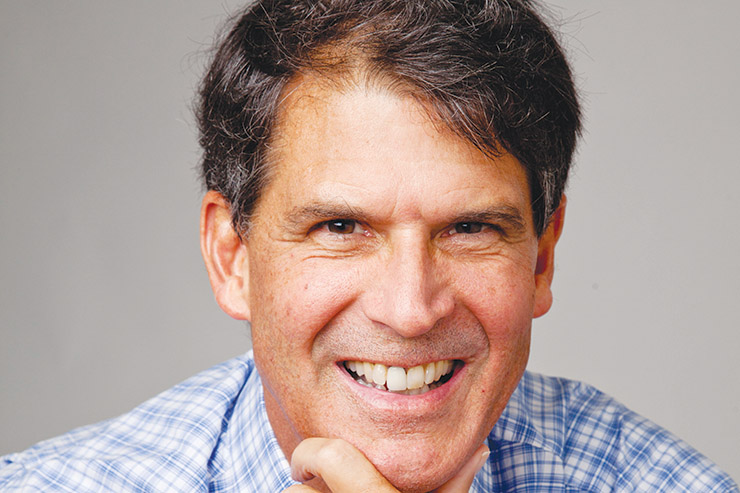
  • A Neurosurgeon’s Journey to Worlds Beyond: An Interview with Dr. Eben Alexander

    A Neurosurgeon’s Journey to Worlds Beyond: An Interview with Dr. Eben Alexander

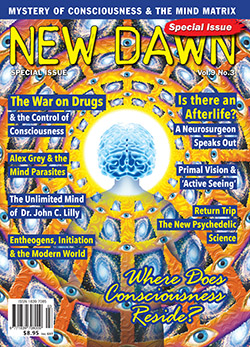
    From New Dawn Special Issue Vol 9 No 3 (June 2015)

    Today the intellectual world is facing an insurrection. It has nothing to do with politics or economics. It is about worldviews. Contemporary intellectual thought is hidebound by a materialistic view of the universe that automatically shuts out anything of the “spiritual,” or, God forbid, “mystical.” More and more evidence is coming to light that refutes this narrow view of reality. And more and more intellectuals are standing up against it.

    Eben Alexander is one of the most famous examples. An American neurosurgeon, in 2008, he fell into a coma during a case of severe meningitis and – at a time when, from the conventional point of view, he should have had no consciousness whatsoever – he had a profound and inspiring vision of worlds beyond this one.

    Alexander describes this journey in the best-selling Proof of Heaven: A Neurosurgeon’s Journey into the Afterlife. The book sent a shock through the United States, and gained Alexander a place on the cover of Newsweek as well as the usual attempts at debunking. Since then he has travelled and given lectures to many audiences. His latest book, The Map of Heaven: How Science, Religion, and Ordinary People Are Proving the Afterlife, co-authored with my good friend and Quest contributor Ptolemy Tompkins, was published last November.

    In July 2014, at the invitation of the Theosophical Society in America, Alexander spoke to an audience of some 450 people in Glen Ellyn, Illinois, and later addressed the TS’s Summer National Convention. He also did the following interview. Karen Newell was also present. She is his associate in Sacred Acoustics, a company that creates audio meditations combining various kinds of sound to stimulate higher states of consciousness.

    This interview originally appeared in Quest: Journal of the Theosophical Society in America, in the Winter 2015 issue.

    Richard Smoley (RS): Perhaps you could start by telling us a little bit about your journey. 

    Eben Alexander (EA): I’ve spent more than twenty years in academic neurosurgery and thought I had some idea of how brain-mind consciousness worked. I fully logged into the reductive materialistic mindset of neuroscience of the twentieth century, which says there is something about the neurons of the brain and their firing that gives you consciousness. Even though nobody had a clue of how that worked, I thought we just needed to study it more and figure it out.

    That’s why my illness, which came on in November 2008, was so revolutionary to my thinking. I had to go back and question everything I ever thought I knew about reality. I had a very severe case of bacterial meningitis. Only in looking back, months and months later, did I start to realise what a perfect model for human death meningitis is, especially the severe form that I had: it basically dissolves the neocortex.

    Modern neuroscience says the neocortex – the whole outer surface of the brain – is the part that gives rise to all the details of conscious experience. As this disease wipes out your neocortex, what is the next step? It would have been very clear to me as a neuroscientist that the next step is nothingness. Any doctor who knows anything about gram-negative bacterial meningitis and the details of my illness would realise that people don’t go in that state and come back with hallucinations, dreams, or exotic stories – they come back with nothing. In fact the reality is they usually don’t come back at all. Just the opposite happened, and that part was a mind-bender.

    The extraordinary odyssey that I went through, and that I describe in my book Proof of Heaven, should not have happened at all, according to all the modern notions saying that the brain creates consciousness. And yet I was left with this absolutely astonishing ultra-real experience and an odyssey that seemed to go on for months or years, although it fit within seven earth days.

    To me that was the central mystery. How is it that when you destroy the neocortex, you actually take the blinders off and allow consciousness of a far richer and more real and comprehensive knowing to come into existence? That was what drove me to come to some explanation.

    RS: How do you now view that relation between brain and mind?

    EA: Before the coma, as a neuroscientist who felt that the brain creates consciousness, I paid no attention to near-death experiences, because I would have said that they’re a flickering of a dying brain.

    But they’re far more than that. In fact, they are not created by a dying brain at all, they’re linked to a much more substantial, conscious, eternal spiritual being. Near-death experiencers have been telling us for decades about a reality that is much more real than this one. So has the afterlife literature going back thousands of years.

    I give talks around the world about all this. And I’ll have people who come up to me who know nothing about any of this literature but who share with me their own stunning personal stories of near-death experiences, after-death communications, past-life memories in children, and reincarnation stories. There’s just no way to pretend that it’s some mass hysteria, that it’s all some trick of the brain. This is something far more profound.

    So I’ve come to realise that consciousness, soul, or spirit is the thing that truly exists at the core of all that is. Before my coma I would have been tempted to try and tell you that, as conventional scientific teaching says, the brain, the chemistry, the biology creates an illusion of reality, an illusion of free will. In fact that is absolutely backwards. What truly exists is consciousness, soul, or spirit.

    Even modern physics is in a headlong rush to tell us that there is no material to the material world. It’s vibrating strings of energy and higher-dimensional space-time. And it is consciousness that is essential to emerging reality. The only thing we know exists is our own consciousness. But we’re so immersed in this consciousness that it’s very difficult to separate ourselves from it.

    Any possible model, or any kind of scientific explanation of the nature of reality, must begin with a far more robust explanation of what consciousness is, because it is not created by the brain. The brain is a reducing valve or filter. That idea was gaining in popularity in the late nineteenth century with very brilliant thinkers – William James, Carl Jung, Frederic Myers – and yet it lost its attraction during the heyday of the twentieth century, when science got sucked into purely materialistic explanations.

    [alert type=”info” dismiss=”no”]If you appreciate this article, please consider a subscription to New Dawn magazine.[/alert]

    RS: So what is consciousness?

    EA: Consciousness, I would say, at its core level, is the observer, the awareness. We’re so consumed with this worship of the ego, the self, the linguistic brain, and rational thought that we lose sight of the fact that our own consciousness is actually something far deeper and more mysterious. It is that awareness part of us, the part that knows of its own existence and of the existence of a universe.

    The little voice in my head, that linguistic human brain, which is so tightly tied to rational thought and also to ego and self, can make a request, state an intention, offer up some gratitude, but there is far greater wisdom as one gets deeper and deeper into consciousness. This is something that meditators, Tibetan monks, those who have been deeply into consciousness study over millennia, have been trying to tell us. And yet only now is science beginning to recognise that deep within consciousness itself we can find the evidence that we can be linked to something far, far greater than we are told by that minuscule view that the brain creates consciousness. In fact, when you realise it works the other way around, we can come in touch through deep meditation with consciousness. We come to realise consciousness is not local.

    Before my coma I was a conventional neuroscientist who believed that we can only know things through our physical senses. Since then I’ve come to realise that things like telepathy, precognition, near-death experiences, after-death communications, past-life memories in children, the tremendous scientific literature on reincarnation, are proving to us that consciousness is not local.

    It’s important to understand nonlocal consciousness. In the scientific community I steer people to that wonderful book from the University of Virginia, Irreducible Mind: Toward a Psychology for the Twenty-First Century by Edward Kelly. It’s 800 pages of hard-core scientific data and analysis showing very clearly that the brain does not create consciousness. As I said earlier, it’s more of a reducing valve or a filter. This helps us to understand that mystery of quantum mechanics, which was proving, a hundred years ago, that consciousness is fundamental in the existence of any part of reality emergent in this universe. Consciousness is filtered in through the brain; it is not created by the brain.

    RS: You say that the materialistic model of the brain and mind is being increasingly challenged within science itself. Do you see much evidence of this, particularly in psychology and neurology?

    EA: A number of respected scientists around the world, some of whom have their training in psychiatry, some in psychology, are realising that the “hard problem” of consciousness is the most vexing conundrum known to all of human thought. This is saying that, in spite of the increasing devotion of study to the brain, no neuroscientist on earth can offer the first sentence about how the physical brain might create consciousness.

    A lot of the neuroscientists who study this problem realise that the more we know about the physical brain, the more we realise it’s not the creator of consciousness. It’s very clearly related to consciousness, but again it’s more of a reducing valve or filter.

    Often colleagues will challenge me and say, “Wait a minute! You’re saying this whole mystery of being deep in your coma as your brain was being destroyed by bacterial meningitis actually was the blinders coming off – when your awareness was getting more crisp and real.” They say that makes no sense.

    I would reply by pointing out two commonly observed clinical phenomena. Neurologists and neuroscientists are aware of some of these examples. One is “terminal lucidity,” which I point out in my book Proof of Heaven. Often when they get closer to death, elderly and demented patients can have these oases of very clear thinking, memory, interaction, great clarity of thought that completely defies any kind of explanation.

    The other commonly observed phenomena have to do with what is called the idiot savant or acquired savant syndrome, where some kind of brain damage, like a stroke or head trauma, uncovers some oasis of superhuman mental functioning. These savant syndromes are very, very common. I had many of them when I was active in neurosurgery. I would see where people would have some kind of brain damage, and it actually uncovered this incredible superhuman ability – of memory, calculation, ability to graphically represent things, musical creativity – that emerged out of nowhere.

    Wilder Penfield, one of the most renowned neuroscientists of the twentieth century, probably still holds the record for electrical stimulation of the brain in awake patients – tens of thousands of episodes in his work on epilepsy. He worked in Montreal and wrote a book in 1975 called Mystery of the Mind: A Critical Study of Consciousness and the Human Brain. In the book, he gets clearly into his conclusions that never once, in all those tens of thousands of stimulations, did he uncover an event that seemed to be a free-will event of conscious experience. The patients always felt like they were puppets on a string, no matter what the memory, experience, whatever they went through – they always knew it was something “triggered.” Never once was there anything that resembled a free-will type event.

    To Penfield it was very clear. To me, the evidence for this is completely consistent with my journey as described in Proof of Heaven and my conclusions and understandings about consciousness. If you’re trying to find free-will and consciousness, or soul, or spirit, they’re just not created in the brain at all. In fact, the brain is basically shackles. That’s essentially what near-death experiencers have been trying to tell us for millennia. Mystics who have had similar spiritually transformative experiences have been trying to put it out there that in fact, when we’re freed from shackles of the physical brain and released from that illusion of here and now, we actually come into a much higher knowing.

    RS: My understanding of most near-death experiences is that they are overwhelmingly positive. But there are some negative experiences, where people encounter hells or devils or demons. How does this fit with your picture?

    EA: When you look at a large number of NDEs, say somewhere around 95-98 percent of them seem to be very positive, very loving. This can be quite independent of the circumstances around the demise of a given patient. They often are shown beautiful scenes of unconditional love, love of an infinitely powerful spiritual being, often messages conveyed by the souls and spirits of departed loved ones that are very positive and loving.

    As for the experiences that are negative: those who have read the book Proof of Heaven realise that I started out in a very dark, foreboding, underground realm, which I call the earthworm’s eye view. If I had come back from my near-death experience having only been to the earthworm’s eye view, I probably would have had what people describe as a hellish near-death experience.

    Talking with other near-death experiencers and reviewing thousands of near-death cases, I believe that in many ways the hellish ones are incomplete. They are not going in with the power and the oomph to blast through to those higher realms. To me it was very clear that unconditional love has tremendous power – to heal at all levels, to heal the individual soul, to heal soul groups, to heal all of humanity, to heal all of life on earth, to heal all of consciousness existent in this material universe.

    There can be dark forces, but by knowing that connection to the divine, the infinite power and love of that divine, we are able to bring that light and love into any realm we exist in. That includes this material realm; that includes the lower spiritual realms, including that earthworm’s eye view.

    In my journey, as I describe in Proof of Heaven, I would cycle through and ascend through higher and higher levels through a gateway realm with a beautiful idyllic valley, butterfly wings, and angelic choirs, with lots of spiritual beauty, but with earth-like features. I would then ascend to higher and higher realms all the way to the core: infinite inky blackness, but filled to overflowing with the divine, that power of unconditional love in its healing capacity and also the brilliant light of that orb, brighter than a million stars. I knew that completely outside of our duality.

    But then I would tumble back into that earthworm’s eye view. And very quickly in that journey I came to realise the importance of sound, music, vibration, which is part of the work I do now with Sacred Acoustics, with Karen Newell: using sound to enhance these abilities of our souls to transcend. That’s why the work of Sacred Acoustics has so much to do with meditation and getting into deep meditative states.

    All of that is coming to realise that love has infinite power to heal. And I came to see in my journey that this is not a battle between good and evil, where they are equal and counterbalanced and maybe good and love will win out or maybe evil and darkness. Evil and darkness are the absence of that love and that light. By remembering our divine connection to that oneness and to the infinite healing power of that creative source, we can bring that light and that love into any aspect of the material realm and the lower spiritual realms.

    RS: Could you say more about your work with Sacred Acoustics? What do you recommend for people who want to have a sense of that unconditional love while being connected with this earthly realm?

    EA: You don’t have to die, or almost die, to get this. As a conscious being, you have all the tools you need to go within consciousness to come to see much deeper truth. I recommend meditation, Centering Prayer – sometimes it comes to us as a gift of desperation through the hardships of life, because in fact those hardships and difficulties, even illness or injury, are often a beautiful gift. That is often how we get a revelation about our deep connectedness with each other and with the divine.

    About two years after my coma, I was introduced to the Monroe Institute and the work of Robert Monroe, who wrote three wonderful books on his journeys. He was a pretty straight-laced guy who ended up having spontaneous out-of-body experiences. Over four decades he came to realise that you can use sound – specifically slight differences in the frequency of sound presented to the two ears – to do some very interesting things with consciousness. I was attracted to it two years or so after my coma, when people approached me who knew a bit about hemispheric synchronisation, brain entrainment, what Monroe called hemi-sync. And they suggested to me that maybe I could revisit some of the realms that I had experienced in coma, when my neocortex was being ravaged by the meningitis. But I could do it in a reversible fashion by using two differential frequencies to the two ears.

    There’s a particular circuit in the brain that is a very accurate timing circuit. That circuit is right next door to a circuit in the brain stem that modern neuroscience would tell you (with our very primitive notions about consciousness) seems be an ignition system for all of consciousness. My idea was that with this synchronisation of electrical activity to the hemispheres using differential sound inputs to the two ears, I might synchronise the electrical activity. This would take away the information processing aspect of the neocortex and allow my consciousness to be set free, just as it was when meningitis was destroying my neocortex.

    This is the work that I now do in conjunction with Sacred Acoustics; those that are interested should visit sacredacoustics.com. It has to do with a sophisticated use of patterning of these sound inputs to the two ears to enable consciousness to be set free. 

    RS: Which spiritual figures have you found most inspiring?

    EA: I grew up in a Methodist church in Winston-Salem, North Carolina. My father was very influential in my life, and he had a very strong religious belief in his own right. He had grown up in eastern Tennessee during the Depression. He had been a combat surgeon in the Pacific during the Second World War, and then he went on to head up a neurosurgery training program. So he was very scientific, but also deeply religious and truly spiritual. And I had grown up trying to follow, as best I could, in his footsteps.

    Of course, being a child of the ’60s and ’70s, I realised that science is the pathway to truth. And as much as I wanted to believe what I was taught in my Methodist church, through those years of working in academic neurosurgery I found it more and more difficult to explain the survival of consciousness after the death of the brain and the body. As I said earlier, I bought into the modern twentieth-century neuroscientific view that the brain creates consciousness. And that, of course, means that it’s birth, death, and nothing more, and none of us has free will, and consciousness is an illusion.

    My coma journey showed me that every bit of that is false. As I started to study more and more about NDEs and was led into the afterlife literature and into the writings of mystics and prophets going back thousands of years, what struck me was their similarity: they all converge on a much deeper truth. It turns out that the linguistic brain is in many ways our enemy in trying to come to a much deeper understanding. We can actually communicate in deeper ways, too, that have to do with a much purer form of consciousness. This is why I’m such a tremendous fan of meditation and encourage people to develop a daily practice of meditation.

    The more I started giving talks about my experience, the more I started hearing back from Kabbalists, from Christian mystics, Sufis, Buddhists, Hindus, and atheists who had a very deep spiritual awareness through some experience. They were all talking about the same thing.
    RS: Is there anything you’d like to add?

    EA: A central message in Proof of Heaven is that consciousness is at the core of all existence. I think the most important aspect of that lesson, which is brought back by so many near-death experiencers and other spiritual journeyers, is that we are all eternal spiritual beings, and in fact our very consciousness is a direct link to the infinitely loving creative source at the core of all being. As so many who have had these experiences will tell you that unconditional love is infinitely healing.

    It’s important for all of us to realise that we’re eternal, spiritual beings, that we come back in multiple reincarnations in our ascendance toward that oneness, and that we’re all in this together. Consciousness binds us all, not just as humans, not just as all life on earth – all of conscious life throughout the universe.

    My journey showed me that the human brain and mind will never have a theory of everything. We can never possibly understand the grand workings of this universe in its greatest sense, the workings of that great creator. Never! But the journey is absolutely wonderful beyond description, and that is what we are all a part of, and we are all doing it as eternal spiritual beings bound together as one.

    Any frictions between schools of religious thought, frictions between science, philosophy, and religion and spirituality, are false boundaries that have to do with the linguistic brain trying to define and to limit. Whereas we really have to take a top-down approach. We can all do that by exploring our consciousness through prayer and meditation.

    [alert type=”general” dismiss=”no”]This article was published in New Dawn Special Issue Vol 9 No 3.[/alert]

    [alert type=”success” dismiss=”no”]If you appreciate this article, please consider subscribing to help maintain this website.[/alert]

    © New Dawn Magazine and the respective author.
    For our reproduction notice, click here.
  • Embraced by the Light: Journeys to the ‘Other Side’

    Embraced by the Light: Journeys to the ‘Other Side’

    Ancient religions including the shamanic traditions are replete with myths regarding the dying and death process. It was believed within these traditions that when a person died their soul was escorted into the afterlife by a special being called a psychopomp. In Greek psycho means soul and pomp means guide, so a psychopomp is a guide of the soul. In our modern world, the psychopomp tradition has changed to not only helping the dying, but also helping people develop their own specific spiritual path while living.

    In 1983, I began a two-year internship at the Cincinnati Health Department’s Sexually Transmitted Disease (STD) Clinic. At the time, I had no idea what was in store for me regarding my own talents in creating guided imageries, which eventually led me to become an ordained Gnostic Catholic Priest as well as a modern day psychopomp.

    Within a few months into my internship, one of the counsellors informed me that the clinic had received the first AIDS case in Cincinnati. He asked if I was interested in working with him on the case, and I jumped at the opportunity. Throughout the internship and months following, we worked together on that case as well as other AIDS cases. I became a specialist in HIV and AIDS as well as other sexually transmitted diseases.

    Creating Journey Into The Light Imagery

    Working with HIV and AIDS afforded me the opportunity to begin working with the terminally ill. At the time, AIDS was a death sentence and it wasn’t long before I began counselling the dying. It soon became evident that several of my clients with AIDS had intense fears and anxieties around dying and death, so I decided to create imagery to help relieve their fears.

    I plunged myself into various types of meditation, Kabbalistic pathworking, imagery techniques, hypnosis, as well as rituals from a variety of religious traditions. I searched the esoteric, spiritual and scientific literature, and attended workshops and seminars on dying and death. But what brought all the information together was the local near-death experience group. It was here I heard personal stories that enabled me to craft the imagery that would help my clients reduce their fears and anxieties regarding dying and death.

    The imagery utilised various components of the near-death experience as well as the Tibetan Buddhist bardo journey. I also felt music along with mindfulness meditation would help my clients settle into a relaxed posture. I experimented with various types of music and found the perfect compositions by Marcey Hamm called Inward Harmony. The reason I chose this composition was the way it sounded, coupled with a profound testimonial. After one of Marcey’s concerts a man came up to her and told her several years ago he had a heart attack that was accompanied by a near-death experience. When he went through the tunnel into the light, the music he heard in the experience was the same as Inward Harmony.

    Once finalised, I began using the imagery. I had my clients relax in a recliner and helped them move into a mindfulness meditation, while Inward Harmony played in the background. Once relaxed, I told my clients they have two bodies, a physical body and a soul body. I incorporated the Eastern religious belief that at death the soul moves out of the body through the crown or seventh chakra at the top of the head. Once their souls were out of their bodies, two beings of light were waiting for them. The beings of light escorted their soul bodies through a tunnel of darkness toward a dot of light that expanded, as their souls got closer. Once in the light, I left their soul bodies there for thirty minutes, and then had the beings of light escort the soul bodies back. Once back, I brought their soul bodies into their physical bodies, and then counted them out of the experience.

    Although the imagery was designed to alleviate fears of dying and death, which it did, there was also an unexpected effect. At the time I assumed the imagery was just a made up drama occurring in the mind, similar to other imageries I used professionally. But all the clients I used this imagery with had profound mystical experiences when their soul bodies were out of their physical bodies and in the light.

    Experiences With The Imagery

    The first client I used the imagery with was Mark, and he was in extreme physical pain and going blind, complications from AIDS. He had a fear of dying based on his Roman Catholic upbringing around sin. When I first took Mark’s soul body out of his physical body with the imagery, his physical body became very calm and peaceful as I gently guided him into the light. When I brought him back into his physical body and into ordinary reality, I asked what had happened? He told me he met his sister. Your sister who lives in a nearby town, I queried? “No my sister who died before I was born,” he answered. I was startled and stunned by his answer.

    In a later journey, Mark told me he met his grandmother who raised him and had died several years before I started seeing him professionally. At the time I couldn’t figure out what was happening inside Mark’s mind. Mark was slowly going blind but with these inward journeys into the light he was becoming calmer and more peaceful and could see the inner experiences clearly. Mark’s experiences were so profound he asked if I would promise him that when his life partner James was ready to die, who also had AIDS, I would take him through the imagery as well. I promised him I would.

    Within a few weeks Mark was completely blind. The imagery worked so well that he wanted to know of any method I knew that would allow him to see the physical world with a different set of eyes. The only method I could come up with was the out-of-body experience method pioneered by Robert Monroe at The Monroe Institute. The Monroe method I practiced myself, and it works. So over the next few weeks, I taught Mark the method and he began practicing it with success. He finally related that he could see the physical world, but it was different.

    Shortly after teaching Mark the Monroe method, he was admitted to the hospital for the last time. As Mark lay dying on the hospital bed, his father told me Mark came out of a deep sleep and said he saw me and his mother in the room. His father asked the physician about Mark seeing them and was told it was just the morphine. Maybe yes, maybe no.

    I became more baffled with the information Mark shared with me. I could not understand what was happening in the imagery process. I had believed the imagery experience was only occurring in the mind. I could not explain his unusual stories. I definitely did not think I was actually escorting Mark’s soul into the light.

    I continued using the imagery with people who were dying and they all had similar results until I met Phyllis. Phyllis was not dying, but in deep grief over the death of her father resulting from a severe long-term illness. I took Phyllis’s soul body on the inward journey into the light and left her there for thirty minutes. When I brought her back into her physical body, out of the experience, she began crying. I allowed her time to regain her composure and asked what happened in the experience. She reported meeting her father in the light and he had his dog with him. She revealed her mother hated dogs, and would not allow her father to have one. Her father kept in his wallet a picture of the breed of dog he loved, and when she met him in the light the dog in the picture was with him. This experience with her father in the light lifted the severe grief she had over his death and she now knew he was in a better place.

    Hearing these experiences only confused me further because I didn’t know what to make of them. What was I doing? Was I actually taking their souls or consciousness out of their bodies on a journey into the light? I was at a loss to explain what I was doing until I began working with Mark’s life partner James whose experience put it all together for me.

    James was Roman Catholic and, like his life-partner Mark, had a deep terrifying fear of death because of the extreme guilt of having AIDS. His dying process was painful and fraught with many bouts of denial. At times he could not bring himself to discuss death and had the delusion he would be cured. Working with James had a major impact on me, both psychologically and spiritually.

    As I watched James deteriorate, it became evident he was running out of time. The promised I had made to Mark kept running through my mind to help James with the imagery when the time came, and the time had come. It took several months to prepare James for the imagery experience with much resistance on his part. Even discussing the imagery produced extreme anxiety and fear because it signalled his death. However, during the imagery preparation, James was diagnosed with a resistant strain of bacteria that was infecting the frontal lobe of his brain, a complication from AIDS. Within a week after the diagnosis, he was in a semi-comatose condition and placed in a hospice.

    I began visiting the hospice weekly along with my life-partner Daryl, who also knew James. During those visits I was hoping James would become conscious enough so I could take him on the journey into the light. I explained to the hospice nursing staff about the imagery and how it worked and they were very supportive. On every visit, James’s nurse would give me the gloomy prognosis as he slid deeper into a semi-comatose condition.

    I would stand beside James’ bed and talk to him as if he was fully conscious with Daryl standing on the other side of the bed just observing. After leaving the hospice on several occasions, Daryl and I discussed James’ condition and his lack of response to any verbal communication. We decided, although James was semi-comatose, I should still take him through the imagery experience as promised. James would be the first semi-comatose client to experience the imagery and I didn’t know if it would work.

    The following week Daryl and I visited James with the intention of taking him through the imagery. James lay in bed shaking and screaming as I began playing the musical composition Inward Harmony. In James’ semi-comatose condition, I did not know if he could experience the music but I continued anyway. As before, Daryl stood on one side of the bed and I on the other.

    With music playing, I began talking to James, guiding him into a mindfulness meditation as his body continued to shake. Then I told James he has a soul body connected to his physical body. His soul body is disconnecting from his physical body and moving toward and through the top of his head. When I told James his soul body was out of his physical body, his physical body stopped shaking and he went silent. I looked at Daryl and he looked at me with a questioning expression. I shrugged and shook my head indicating I had no idea what was going on inside James. This experience was unexpected.

    I continued guiding James’ soul body through the ceiling and up through the next three floors of the hospice facility. On the roof there were two beings of light. One took James’ right hand and the other took his left hand and escorted him through the darkened tunnel into the light. In the light I told James he would meet his loved ones who had died, especially Mark, and I would leave him with them for thirty minutes and then guide him back.

    After thirty minutes, I had the beings of light escort James back to the hospice roof. I brought James’ soul body back down through the three floors. When I told James his soul body was re-entering his physical body, James screamed and his body started shaking again. I had performed the imagery many times and heard many experiences, but nothing compared to this. At that moment my worldview was shattered and knew I had experienced something profound. A new insight flooded my awareness; I suddenly became uncomfortable performing the imagery as a psychotherapist and knew I had a spiritual and religious calling. Moreover, I knew the clergy and not a psychotherapist should conduct the imagery because we are not trained to work with the mystical experiences unfolding before my eyes.

    A week later, still trying to understand the ramifications of the experience, I received a call from James’ mother informing me he had died. She requested I go to the hospice, gather his belongings and bring them to her. I agreed, went to the hospice and it so happened the nurse who was with James when he died was on duty. Gathering James’ belongings the nurse and I talked about his death. She informed me she had seen many people in semi-comatose conditions die, but James’ death was different. She said she watched him for a long time and noticed a subtle comfortableness slowly settling over him. He became so serene and then he was gone. She indicated it was a beautiful death and attributed it to the imagery.

    Forgiveness & Comfort by Way of the Light

    I had now used the imagery with the dying, and those in grief and in a semi-comatose condition, but had not used it with people in preparation for death long before they died. I started working with Jack who is one of the longest survivors of AIDS. His viral load was non-detectable and he was living an ordinary life given his condition. Jack contacted me for spiritual direction with an emphasis on preparing him for his eventual death. It took about a year to get Jack ready for the imagery experience.

    In preparing Jack, one of the issues he had to address was his parents, who were deceased. Jack came from a highly dysfunctional alcoholic family. He grew up feeling unloved and rejected by both his parents. He knew his father hated him and was physically abusive. His mother was critical and condescending; he felt totally rejected and unloved. Jack hated his father for physically abusing him and disliked his mother for constantly telling him how stupid he was. There was a lot of unfinished business between Jack and his parents.

    After working with Jack’s issues around his parents and those related to AIDS in conjunction with his psychiatrist, he felt ready to journey into the light. He felt going into the light would create a sacred path when his earthy journey finally ended. He had no expectations as to what would happen or what he would see. He just felt he would be closer to God.

    I took Jack on the journey into the light and after thirty minutes brought him back and out of the experience. He sat for several minutes with tears streaming down his face. As usual, I had Kleenex on hand and waited for him to gain composure. Between emotional outbursts, he informed me he met both his father and mother in the light. Until that moment, he had hated his father and disliked his mother intensely. In the light, Jack was able to forgive them both and they accepted his forgiveness and told Jack they regretted how they treated him and they both deeply loved him. As Jack sat crying, he told me they all hugged each other and all experienced total forgiveness. The experience changed Jack’s feelings toward his parents. Jack now knows when he takes his final journey his parents will be waiting to welcome him into the light.

    After working with Jack, I began wondering what healthy people would experience with the imagery. Within a few months, I was asked to present a lecture and a workshop at a local annual spiritual conference. I decided to present a lecture on near-death experience and reincarnation and a workshop on the imagery. The lecture was a packed house and the workshop had about seven participants. This was fine with me because the journey into the light with healthy people was purely experimental. I had no idea what the participants would experience, if anything.

    The workshop was a two-day affair. The first day I gave a lecture and taught the small group how the imagery was to be done, and ran through a practice session. It all ended with questions and answers. The group was very lively with two of the woman very talkative and humorous.

    The next morning I took the group through the imagery and after thirty minutes I brought them back. The two women who had been very talkative were in tears and would not discuss what they had experienced. One of the women did say she met her husband who had died the previous year. The other woman made no comment, she just sat with a glazed look. Two participants, a man and a woman, decided to share their experience with the group.

    The man said his wife was very beautiful in life. She died three years previously of Alzheimer’s. They had a wonderful life together and he stressed they made love all through their marriage until the disease took over. He recalled how when I took him into the light there she was, as beautiful as ever. He said she was so beautiful he became sexually aroused and wanted to make love with her, then suddenly realised where he was and decided that was not the place to make love. He thanked me for uniting them once again.

    The woman had a totally different experience involving her pet cat. She said she was so attached to her cat that when it was time for the veterinarian to put it to sleep, she could not bring herself to be there when it happened. She left the vet’s office in tears, leaving her cat alone to its fate. Afterwards, she felt extreme guilt over her reaction, leaving her poor cat to be put to sleep all alone. While in the light, she met her cat and it forgave her. Meeting her cat once again allowed her to let go of her guilt.

    These experiences with healthy people are similar to those I had worked with up until that point. The question I continue to ask myself: am I actually taking these people’s soul bodies into the light? I have also taken myself into the experience and had a profound awakening. My experience was very different. I found myself in the light and in front of a screen of white light with silhouette figures behind it. Then aspects of my younger life began to unfold before my eyes on the screen. Questions about my life I had meditated on for years were answered. The experience was similar to a life review, but just answers to the questions I had and not my total life’s experiences. I also knew if I crossed the screen of white light I would not return into my physical body.

    Conclusion

    As a modern day psychopomp, I find these experiences uplifting; they have given me an intimate knowing of our next journey. These experiences are similar to what near-death experiencer’s have. I have taken people into the light and brought them back, and they now have an understanding of that final journey. Each journey is shaped by the life experiences of the journeyer. What needs to be addressed in the experience is addressed. In all the cases I have worked with, after the journey there is no fear of death.

    Check out Rev. Gary’s other articles published in New Dawn: “Helping Stuck Souls Crossover” in New Dawn 143 & “Twin Souls Merging” in New Dawn 142.

    [alert type=”general” dismiss=”no”]This article was published in New Dawn 144.[/alert]

    [alert type=”success” dismiss=”no”]If you appreciate this article, please consider subscribing to help maintain this website.[/alert]

    References

    Marcey Hamm, Inward Harmony (Musical composition), www.musicbymarcey.com

    Robert A. Monroe, Journeys Out Of The Body, Doubleday, 1971

    © New Dawn Magazine and the respective author.
    For our reproduction notice, click here.

  • The Life After Death Project: Interview With Paul Davids

    The Life After Death Project: Interview With Paul Davids

    From New Dawn 139 (Jul-Aug 2013)

    PAUL DAVIDS is the author of widely-released books and acclaimed writer and director of highly original films including the controversial 2008 documentary film Jesus In India, discussed by Len Kasten in New Dawn Special Issue Vol 6 No 3.

    He is a leading expert on the history of science fiction cinema and the Hollywood connection to extraterrestrial-related phenomena. Davids was executive producer and co-writer of the Showtime film Roswell, starring Martin Sheen and Kyle MacLachlan.

    Paul earned a B.A. from Princeton University, where he won the university’s three top creative writing awards all in one year (including the F. Scott Fitzgerald Prize). Afterwards, he studied under full scholarship at the American Film Institute Center for Advanced Film Studies in Los Angeles.

    He is the noted author of six Star Wars books for Lucasfilm, was a producer of the popular Transformers animated TV series. Paul is also an accomplished artist and is generally well known and respected in Hollywood.

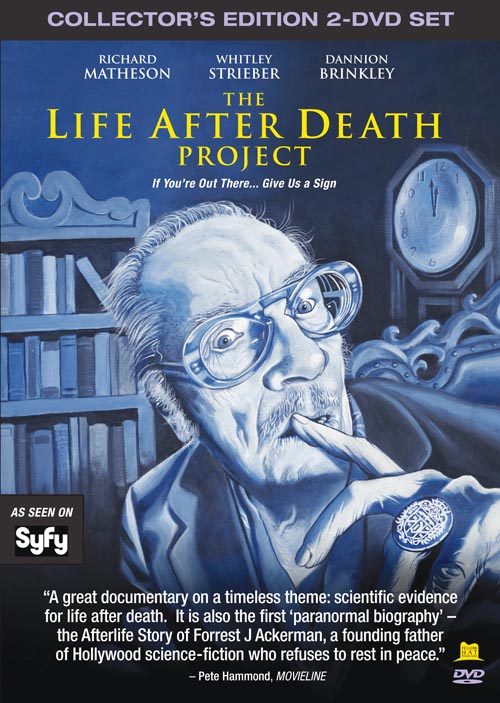
    We spoke to Paul about his latest film, The Life After Death Project, which recently aired on the SyFy Channel and is being made available on DVD.

    NEW DAWN (ND): In your films, you’ve taken on a lot of controversial issues – aliens in Roswell, LSD in Timothy Leary’s Dead, the high price of Van Gogh paintings in Starry Night – you even investigate Jesus’ missing years that aren’t mentioned at all in the New Testament, in your film Jesus In India. Now you take on one of the biggest controversial questions of all time – is there life after death? How did you end up there?

    PAUL DAVIDS (PD): I refer to The Life After Death Project as a personal confession. On March 7, 2009, the day of the large Hollywood tribute for science-fiction luminary Forrest J Ackerman at the Egyptian Theater, very strange things happened to two Canadian filmmakers who visited his crypt. The filmmakers had made a documentary about his life. Forry Ackerman, born in 1916, was the original editor of Famous Monsters of Filmland Magazine beginning in 1958, and his influence on the world of science-fiction (and horror and fantasy) and his impact on all the major filmmakers of that genre was huge – incalculable. I was one of the speakers at the tribute and the Canadians (Mike MacDonald and Ian Johnston) told me very sincerely why they were convinced they literally “heard from him” within an hour of Mike MacDonald knocking on his crypt to say “Hello Uncle Forry.” (All of his fans called him “Uncle Forry.”) I had known Forry and looked up to him since I was a teenager and became a winner in an amateur movie contest run by his magazine. He was a major influence in my decision to pursue a career in film and TV. In 1996 I made a film that was in part a tribute to him (The Sci-Fi Boys, which Universal released on DVD and which won the Saturn Award for Best DVD of that year.)

    I didn’t know what to make of the strange story of the Canadian filmmakers, and I wasn’t immersed in “the paranormal.” But about one week later, I was alone in my vacation house in Santa Fe, New Mexico when something simply impossible happened to me. It was a very precise inkblot that appeared on a document I was studying – it appeared while I was out of the room for just a few minutes. There had been nothing unusual at all about the document when I left the room. I want to say it again: What happened was IMPOSSIBLE in the world as we think we all know it. But it happened, and evidence in the form of ink was left behind. It took me awhile to catch on that it actually could have been a message to me from the late Forrest J Ackerman, done in his usual humorous style with a specific “word within a word” pun, his trademark. I realised it could have been a reference to the man who was his closest friend and caretaker for the last 10 years or more of his life… actually a sort of very personal “thank you” for the tribute to him. The detective work to figure that out was a long trail, and it took me first to the Chairman of the Chemistry Department of the University of Indiana, a world class expert in inks, paints and solvents. I brought my video camera along to document what he did in his lab. That was the beginning. I never knew then this would become a major documentary film that I would make. But it became a colossal adventure involving major authors and three universities, with repeating evidence that simply has to be seen to be believed. And it took me four very long years to make the film.

    ND: Recently there’s been quite a focus on life after death even in the mainstream media – particularly noteworthy is neurosurgeon Dr. Eben Alexander’s Near-Death Experience as documented in his book Proof Of Heaven. What makes your film unique?

    PD: It’s tough to take on subject matter that in a way has been “beaten to death.” Exploitation TV shows with dizzying fast cuts and irritating music and sound effects – a lot of those shows leave people thinking that all they need is an EMF meter and a creepy old house and they’ll be the next person to document a ghost. My film is not exploitation – it is a quiet and deliberate unfolding of a colossal mystery that unfolded from “one seed” – the inkblot.

    What really separates my film from the pack is that I am telling about a deceased man I had a personal relationship with that spanned decades. I knew his style, his humour – I had been “aboard” for many parts of the journey of his life. So there is a relationship to the departed who appears to have “dropped me a line.” It’s not about seeking out ghosts or spirits of people you never knew in creepy places. It is about evidence of a continuing relationship after death that was not just a single incident but was a long string of many incidents, continuing now for about four years. I never knew when these strange things would occur, but they kept happening – AND they started happening to people I involved in the case, including the scientists at the three universities. Things happened to them THEY couldn’t explain, many of which seemed to have Forry Ackerman’s “authorship.” He seems to be enjoying himself. I love him and welcome all this. I seem to have had extensive and continuing help from a “personality unseen” to enable me to build the very best case that there really is survival of consciousness and personality after a person dies. In this case it was an exceptional person who accomplished a lot in his lifetime and never seemed to be finished. I never would have taken this on even five years ago. Something had to happen to me first. What I have personally concluded, because no other explanation fits the data, is that I heard from Forry loud and clear, multiple times, after he had departed this world.

    ND: Life after death covers a lot of ground, from orthodox religious views of heaven and hell, to ghosts, spiritualism, reincarnation, poltergeists, mediums, angels, apparitions, materialisations and of course the Near Death Experience. How did you choose what to emphasise?

    PD: As I’ve said, I emphasised the Forry Ackerman case, which is a case of apparent After Death Communication, or ADC. Sometimes ADC is accomplished with ITC (Instrumental Transcommunication, which includes EVP, Electronic Voice Phenomena). So I get into all those topics, and I also deal with Sir Arthur Conan Doyle’s devotion to spiritualism, because there is a real history to this field. There have been impostors and phonies, but I think that science “threw out the baby with the bathwater.” I think there are real phenomena, there are mediums with genuine uncanny gifts. Many scientists apparently knew that over 100 years ago, but they have been drowned out by the modern skeptics and materialists who have dismissed this topic and think it’s dead and buried. I also deal with the phenomenon of aports or aportation (the appearance of objects in a way that cannot be explained) – and also there is one astonishing case involving photography which Dr. Lynne D. Kitei, M.D. brings to the film.

    I had so much material after years of interviews and research, it could not all go in one film. I did not want to leave lots of wonderful material “on the cutting room floor” as we say, so I created a sequel I call The Life After Death Project 2 – and that comes as a second DVD disc in the 2-DVD Set of The Life After Death Project available both at our website and at www.amazon.com The national release date for the US, where it will be available everywhere, was July 16, 2013. Our website (www.lifeafterdeathproject.com) will ship the all-region DVD all around the world.

    ND: Tell us more about the inexplicable inkblot incident which you personally experienced, and do you think you’ll be believed once people watch the film? (A photo of the inkblot can be seen in the magazine).

    PD: I think the incident of the inkblot is VERY important. Sometimes the answers to very big cosmic mysteries come in very small packages. Scientists deal at the level of individual atoms and sub-atomic particles. Others study photons or very faint astronomical phenomena from far off in space that has been traveling toward earth for billions of years. My first question was, does the blacking out of 4 words in my document, at 2 separate levels of opacity, contain clues as to its origin that can tell us how it was done or why it was done? Is there something “paranormal” about it that can be demonstrated? The 4 words on my document were clearly targeted and the ink obliteration was deliberate and done by “someone” or “something” other than me while I was out of the room, at a time when NO ONE else was physically present in the house. I knew this for a fact, but could I convince anyone else? It actually surprises me the overwhelming extent to which the two key chemists who worked on it (one of them, Dr. John Allison, continued the work for years) state categorically that it is still a huge mystery they cannot explain and cannot duplicate in any way they can conceive – and they have tried hundreds of ways to duplicate it. Both Dr. Allison and Dr. Jay Siegel are world class authorities on the chemistry of inks, paints and solvents. Dr. Siegel has testified in a massive number of court cases where someone was needed to testify about the chemistry of evidence.

    The other part of your question: Do I think I will be believed? I have learned that there are many hugely intolerant and bombastic closed-minded debunkers who, without leaving their armchair or educating themselves as to the real issues, will make horrifyingly stupid comments and declarations. As soon as the movie was announced, some declared that it had to be exploitation. It lends itself to a kind of tabloid slant, and interestingly the story was refused by Huffington Post’s Science Editors, but Huffington Post did have Lee Speigel, one of their best writers of stories for “Weird News,” do an article – and I must say his article was superb. He spent a lot of time digging out the scientific information and even linking to one of Professor Dr. Gary Schwartz’ peer-reviewed papers on scientific evidence of after death communication. But there is a taint in the fact that something with so much scientific basis usually is not treated as science because of the subject matter. Also I will say this, as to whether I will be believed, I will stand up to ANY debunker. I know this case is valid and true.

    ND: All of Forrest Ackerman’ bios online and in books emphasise the fact that he was a skeptic and an atheist who didn’t believe in an afterlife. Could you elaborate on that and – if it’s not giving away too much – do you know what type of afterlife he exists in?

    PD: He was an atheist and a skeptic about all things paranormal. At least that was his most public stance. But there were incidents in his life that showed his thinking was more complex than that. His grandfather, George Wyman, designed the famous Bradbury Building in Los Angeles (where they filmed some of Blade Runner). His grandfather was very hesitant to take the assignment until an incident with the Ouija Board where the message was: “Take the Bradbury Building and You Will Succeed.” Forry always kept that scrawled pencil Ouija message framed and on display in his home. He also once wrote a story called ‘Letter To An Angel’, about a hunchback boy who is thrilled when he gets to meet his hero, Lon Chaney (who played The Hunchback Of Notre Dame) in heaven – and the boy is equally thrilled to be alive in the afterlife without his debilitating body and its handicap. So Forry did imagine, at least as fiction, the possibility of us living in a non-physical form where we do not have the physical limitations we have in life. He occasionally said to close friends that he didn’t believe in an afterlife, but if he turned out to be wrong, if it were possible he’d try to “drop a line.” In my case, that’s exactly what I got. A line crossed out in a document which I could demonstrate had specific meaning related to the tribute for him.

    I surely do not have any knowledge of “what type of afterlife he exists in.” But it has been surprising to me that incidents that seem to “bear his signature” (I mean that metaphorically) have continued from March 7, 2009 to as recently as the last few weeks. Two of the oddest recent incidents are covered in the sequel The Life After Death Project 2 – Personal Encounters.

    At the end of that film I give an update on the Forry Ackerman case. First I have to tell you that I own a plastic mask that I obtained at his estate auction – it is his smiling face with his “trademark” moustache and thick glasses, and for decades it was in his 18-room Ackermansion along with 250,000 or more items of sci-fi and horror memorabilia. In that Ackermansion, which was both his home and his personal museum that he shared with the public, the mask was on top of a futuristic costume he wore at the First World Science-Fiction Convention in 1939. That mask has been in my home office for 4 years and had never moved for those years. It actually sits right on top of the case for the prop alien that we used in the Showtime film ROSWELL that I executive produced in 1993. The very day I learned that there would be a broadcast of THE LIFE AFTER DEATH PROJECT on Syfy, I went out to lunch for an hour and a half, and my home was locked with no one in it. When I returned, the Forry mask had moved – about 10 feet across the room, to the floor on top of a pile of wires for my many computer hard drives. I have no open windows, the door to my office was closed, the cat was outside the house, there was no breeze or known physical force that could cause the mask to move. (One friend speculates Forry was telling me that he’s going to be “getting his nose into my computer equipment,” which does seem to have been happening in many ways.) Another of several recent incidents was this: When I attempted to make the final computer Quicktime HD file from which the broadcast master of the film would be made, it inexplicably lost the soundtrack during the movie and became silent. This happened even though all the soundtrack info was there in the files, and it worked perfectly on another attempt without having to fix anything. The key was WHERE the film sell silent. EXACTLY at the moment that one of the people in the film discuses a painting of Forry where Forry is making a “Shush” gesture like the silence of death. Bingo. From that exact fraction of a second… all the way to the end of the film, total SILENCE.

    ND: A recent article in New Dawn Special Issue Vol 7 No 2 by Len Kasten was titled “Speaking to the Dead: The Pioneers Who Opened a Channel to the Other Side”. Len documented the incredible history of what is known as electronic voice communication (EVP) from the ‘other side’ or the afterlife. You and other people involved in making the film had some pretty amazing incidents of similar communication. Could you elaborate a little on what happened?

    PD: The incident of EVP in making my film is documented in the sequel, but the back-story is in the main movie. There was an actual tribal mask from Zimbabwe in a display case in the living room of my Santa Fe vacation house. I regarded it as an art object and it was on loan to me from a close friend who is a world traveller. The mask was right at the other side of the door from the bedroom where the inkblot appeared. The day after the inkblot incident, extensive EMF readings (electro-magnetic field readings) were made in various places in the house. Nothing unusual was found in the bedroom. But the mask, made entirely out of non-metal parts by natives in Zimbabwe, gave off EMF readings that were “off the charts.” The buzzing and beeping and lights on the meter were all at maximum. The camera was rolling when the testing was done to document it. The owner of the mask (Todd Mills) later promised he was going to locate the actual slides he took in 1983 when he bought the mask from natives – slides of it being danced in an African ceremony. To our astonishment, those slides have completely disappeared from the safe place he always kept them – they have not shown up even in four years since then. And he guarded those slides as precious keepsakes – no one had access to them. The Zimbabwe mask was the one object in my Santa Fe home that especially would have captured Forry’s attention. He was an avid collector of strange masks, and the Zimbabwe mask looked like something out of his favourite movie, KING KONG.

    Many months after the filming of the EMF reading of the mask I was doing post-production editing and I heard an EVP right at that point as the meter was being moved, between the beeping. There was no one there who ever actually said the word heard clearly on the videotape, but the voice was very clear: LENORE. One word said one time but very audible. (This is in the sequel.) What does Lenore make you think of? To me, it’s Edgar Allan Poe’s poem LENORE and also, Lenore is the lost love being mourned in his poem, THE RAVEN.

    Here is a synchronicity tying these very odd events together. Months later while going through memorabilia, I found the special delivery letter that Forrest J Ackerman sent to me notifying me that I was a winner in his Famous Monsters Magazine Amateur Movie Contest, when I was a teen. I was almost in shock when I saw the stamps on the envelope which had been sent to my childhood home in Maryland from Los Angeles over 40 years previously. There was a special delivery stamp, plus a stamp of EDGAR ALLAN POE plus 4 stamps of the Palace of the Governor of SANTA FE, New Mexico. The house with the inkblot incident and the Zimbabwe mask was in Santa Fe, and the EVP of “Lenore” was of one of the most famous names in Poe’s works. Forry was an incurable fan of Edgar Allan Poe. So here you see something specific from over 40 years ago (the selected stamps on the envelope from Forry) in a sense seemingly “predicting” that something significant would eventually happen to me involving both Santa Fe and Poe.

    The capper to this is that, soon after this incident happened, I began writing profuse amounts of rhyming poetry, which I had never done before – I created so much that these poems fill three published books (available at lulu.com) and some of the poems, especially in RIGHT BRAINED POEMS FOR LEFT BRAINED PEOPLE, are about Edgar Allan Poe. The other two books are humour: POEMS TO READ WHILE DRIVING ON FREEWAYS (AND OTHER WAYS TO DIE LAUGHING) and POEMS TO READ WHEN YOU RUN OUT OF WEED.

    ND: Your press release says there are four New York Times best‐selling authors in your film. Who are they, and what do they contribute?

    PD: Richard Matheson (Somewhere In Time, What Dreams May Come, I Am Legend) was a friend of Forrest J Ackerman. He offers his theories of communication with the deceased through dreams as sometimes being real cases of contact from the dead. He also says definitively that he has concluded that Forrest J Ackerman really did contact me after Forry died. Whitley Strieber (Communion, Transformation, Majestic and many other books) has an intense interest in life after death and mediums, as does his wife, Anne Strieber. My wife and I had lunch one day with the Striebers months after the inkblot incident happened to ask their opinions. They had much to say!

    The key thing was that they knew many experts in the field of life after death research, and Anne Strieber connected me to so many people who are in the film that she earned a credit as Executive Producer, along with my wife, Hollace Davids. Anne and Whitley appear in the film, and Whitley tells about the most astonishing “psychic hit” he ever experienced from a medium, Glennys MacKay of Australia.

    The third New York Times best-selling author is Dannion Brinkley (Saved By The Light, At Peace In The Light) who recounts his famous near death experience (NDE) of being struck by lightning and having been “clinically dead.” He insists there is life after death and his book tells of his experience during the time his heart had stopped, his breathing had stopped and he had no EKG. The fourth New York Times best-selling author in my film is Michael Shermer, President of the Skeptic Society and author of books such as Why People Believe Weird Things and The Believing Brain. He is also publisher of the magazine called Skeptic.

    ND: Everyone knows that Michael Shermer is an arch skeptic about all paranormal claims. He doesn’t usually show up in independent films – he’s sort of known as the hatchet man a network brings in when they need someone to contradict someone who has a claim. Did you choose him of your own free will to be in this film, and what does he add to the picture?

    PD: I did choose Michael Shermer “of my own free will” to be in my film, and he readily agreed and gave a very good interview. I chose him because I wanted someone “the Establishment” considers completely credible as a skeptic. He cannot and does not attempt to explain the events that are in my film. He does categorise most of it as “one-off” events that can’t be repeated in a lab and therefore of limited interest to him. Of course, in regard to the inkblot incident, lab scientists have spent hundreds of hours on it and are perplexed. And Dr. Gary E. Schwartz, who is in my film, performs university-sponsored experiments under laboratory conditions, but Michael Shermer never delves into that. He admits that weird things do happen to people that have not been explained, but he dismisses any possibility of a “paranormal” answer out of hand, conceding only that perhaps some of these phenomena will someday fall under theories covered by quantum physics.

    ND: The Life After Death Project builds to a pretty astonishing climax involving the research of Dr. Gary Schwartz, a psychology professor at the University of Arizona in Tucson. What is his research trying to show, and how does it apply to your apparent after death communication from Forrest Ackerman?

    PD: As far as I can see, Dr. Gary Schwartz is doing the most forward-thinking (and perhaps the most courageous) studies and experiments involving life after death today. There may be others whose work is of great importance with whom I’m not familiar, but I was fortunate to have Gary’s participation, and he gradually became more and more involved. Author and researcher Mark Macy in my film makes the statement that spirit life is not somewhere off in the distance, that it exists right here, right now, all around us, on different frequencies that we cannot see. He compares it to radio or TV transmission – you would need to be able to tune in the right frequency to be aware of it or attempt interaction with it. Gary Schwartz seems to accept that premise – that spirits are accessible, and that just as we can call someone on the phone, we can actually talk to spirits (of deceased people) and have them be aware we are thinking about them and talking to them. With that theory in mind, he asks, what would be necessary for them to communicate back in a way that could be measurable with our technology? To that end, he has developed computer software programs (and is developing more) to facilitate communication and actually measure “yes” and “no” responses to spirits when he asks questions. His experiments have been successful thus far, and he has published a peer-reviewed paper in a scientific journal on this. The climax of my film becomes so fascinating because Gary attempts actual communication with Forrest J Ackerman using his computer program – and we see it all unfold in real time – and there are very real and precise responses. He says that both my documentary, which he calls “historic,” and his research point to the fact that “Forrest is here.”

    ND: Synchronicities played an important role in the lead-up and production of The Life After Death Project. How do these ‘meaningful coincidences’ tie in with ‘Messages from the Other Side’?

    PD: Swiss psychiatrist Carl Jung first articulated the concept of synchronicity, describing it as a very improbable or unlikely coincidence that brings events together in a way that has meaning in the eye of the beholder. Statistics tells us that some synchronicities will and must occur by chance, because “almost all things are possible.” There is an old adage that says if a million monkeys typed on a million typewriters for a million years, by chance one of them would produce a perfect copy of Shakespeare’s “Hamlet.” No one has ever tested that theory! But we get the concept. One of the synchronicities I discuss here is the juxtaposition of stamps on an envelope from over 40 years ago, bringing Poe together with Santa Fe in a letter to me when I was a young teenager living in Maryland. (I had never been west of Virginia then!) Another synchronicity in The Life After Death Project is the wine bottle that just happened to be the same type as the wine served at Sean Fernald’s wedding, that Forry had attended, and the vintage of the wine was the same year as the wedding.

    I have experienced so many unusual synchronicities that the list would be long. Notably in The Celestine Prophecy and its sequels, synchronicities are extolled as having high spiritual significance as forms of guidance from spirit. Synchronicites make us think of an alternative reality that is sort of like the film, The Adjustment Bureau, but non-fiction!

    ND: Several of your films deal with life after death. In The Artist And The Shaman you speculate about whether a certain 3‐year old boy might be the reincarnation of your father. In Starry Night you bring Vincent van Gogh back from the dead for 100 days, a century after he died. In Jesus In India, there’s speculation about the accuracy of the reports of the disciples that Jesus died and rose from the dead. And now you have The Life After Death Project. Has this topic been a long time obsession for you?

    PD: The topic has not been an obsession, but it indirectly entered into those three other stories you mentioned. I do wonder about the theory of reincarnation. The studies of Ian Stevenson and others lend a lot of support for it, and great yogis, such as Paramahansa Yogananda, insist that it is true. But it would take at least a film to explore the evidence, and I have not produced such a film. There have been hundreds of books (or thousands) written about reincarnation, and I hope that someday I’ll read the best of them. As for Jesus In India, the claim of Jesus returning to life from the dead is central to Christianity. There is some exploration of that in my movie, which was covered in a previous issue of New Dawn in a Len Kasten article about Jesus’ purported travels in India. You can learn more about that at www.jesusinindiathemovie.com. Starry Night is strictly a fantasy. (www.starrynightmovie.com) When Vincent van Gogh’s ‘Sunflowers’ sold for 33 million dollars in the 1980’s, it made history. I thought to myself: If only Vincent could be here to know this happened and that he turned out to be one of the most successful artists in history. And so I created a fiction screenplay based on that premise and was fortunate to be able to make the movie (about 10 years after I wrote it!) Universal released it to DVD in around 2000, and it is still available.

    Get the issue this article appears in

    ND: Your films are known for creating controversy in a good way, and we at New Dawn wholeheartedly support your intentions. Some Christians thought you’d overstepped the line in Jesus In India, while the US Air Force took you over the coals for your film Roswell: The UFO Coverup about the so‐called alien UFO crash at Roswell. You also angered some atheists who think you were much too kind to Catholicism in Before We Say Goodbye, your movie about a Hispanic‐American family. And you made Timothy Leary’s Dead about the ‘Prophet of LSD’ who President Richard Nixon described as “the most dangerous man in America.” How do you handle criticism?

    PD: I have had to develop what they call a “thick skin” in response to criticism, as does every artist in every creative field. There are as many opinions about things as there are people on this planet. A big change in our world, from when I was a child, is that now everyone can make his or her opinion count. People can go on message boards, they blog, they post comments about books and movies online. The professional critic is no longer the only force the artist has to deal with. And you get comments at every level. Some are intelligent, others are personal attacks, and sometimes anonymous people post profanity and obscenities. That’s what they want to do, and currently there’s no way to stop them.

    One of the traits that some people have that probably bothers me the most is a tendency to be absolutely fixed in rigid beliefs: hard-headed, not open to discussion or alternative approaches, and sometimes to the point of being bitter, furious, argumentative or insulted that anyone could contradict them or have another opinion. These traits have taken over politics to a large extent in the US. We see this trait creeping into religion at the point where it becomes “Fundamentalist” – some religions are so convinced that they have the Truth as handed down from “On High” that all others are wrong or damned or are infidels to be disposed of even with violence. People now actually kill one another every day in the name of God – and not just a few people, they blow up 100 or more at a time. As if God is looking to them to help him out by destroying the lives of His children that He lovingly and painstakingly nurtured from their days in the womb.

    I have often chosen topics, quite deliberately, because they challenge some cherished beliefs. I think it’s most worthwhile and productive when I choose a topic that, by exploring it, can help the human race grow in its thinking capacity, stretch the mind a little. But when it comes to the topic of life after death, I always tell people, I never chose that topic…. It chose me!

    ND: Could you give a brief overview of the sequel film The Life After Death Project 2 – Personal Encounters?

    LIFE AFTER DEATH PROJECT - DVD COVER

    PD: In the sequel, I let witnesses to many other life after death cases tell their stories. These are people from all walks of life. We hear from them, with very little editing (except for length) – we learn what happened and why they felt that it relates to unseen spirits or survival of consciousness and personality after death. A few might be considered “ghost stories,” but most have physical phenomena attached and were seen by more than one person. I am interested in what palliative care doctors have to say – end of life physicians who witness a lot of people die. And nurses who work with people during their final weeks and moments. It is surprising to hear how committed some of these people are to the concept that there is evidence of a “spirit” that departs the physical body at death. And these are for the most part not religious people – they do not hold these convictions because they were taught them as part of a religion in which they believe. Three exceptional people in the film are Dr. John Lerma, M.D., Dr. Lynne D. Kitei, M.D., and John B. Alexander, a former military man and author about non-lethal weaponry. Dr. Alexander extensively studied the issue of life after death and was the president of a non-profit organisation dealing with this topic. Also of interest is Dr. Stanislav O’Jack. His extraordinary abilities to take unusual, unexplained photos, sometimes while the lens cap is still on the camera, have been studied at length by a Stanford physics professor (now emeritus), Dr. William Tiller, who was in What The Bleep Do We Know. Dr. Tiller’s assessment gives credibility to Dr. O’Jack’s claims. One of those claims is that Dr. O’Jack’s wife appeared to him and one other colleague in body, in full physical form, after she was dead… and she then disappeared. John Alexander also tells of an incident that happened that was just like the O’Jack story – it happened to one of John Alexander’s mentors, Dr. Elizabeth Kubler-Ross. One of her deceased students appeared to her in physical form, spoke to her, wrote her name down, and then vanished down a hallway. So although the sequel is somewhat different than The Life After Death Project in style, and is less devoted to scientific evidence, I think viewers will find it compelling. In any event, a complete list of the people in the sequel and description of it can be found at www.lifeafterdeathproject.com For those who order the Collector’s Edition 2-DVD Set of The Life After Death Project, the sequel is included on the 2nd DVD as part of the package. I also want your readers to know of my two websites: www.pauldavids-artist.com and www.pauldavids.com.

    ND: Thank you very much Paul Davids for taking the time to answer these questions. We are confident your new film will take us one step closer to understanding the mystery of consciousness and life after death.

    You can learn more and follow what Paul Davids is up to through his website www.pauldavids.com.

    [alert type=”general” dismiss=”no”]This article was published in New Dawn 139.[/alert]

    [alert type=”success” dismiss=”no”]If you appreciate this article, please consider subscribing to help maintain this website.[/alert]

    © New Dawn Magazine and the respective author.
    For our reproduction notice, click here.
  • A Western Book of the Dead

    A Western Book of the Dead

    I have known since I was a very small boy in Australia that there are worlds beyond physical reality, and that we can journey to those worlds and gain first-hand knowledge of the multidimensional universe and about what actually happens after death.

    When I was nine years old, I was woken up to these possibilities during a crisis of illness. I was rushed to hospital in Melbourne after complaining of a pain in my lower right abdomen. The medical staff found that my appendix was about to burst and I was wheeled into an operating room in short order for an emergency appendectomy.

    Under anesthesia on the operating table, I found myself hovering above my body, somewhere up near the ceiling. I decided I didn’t want to watch the bloody work with the scalpel and flowed through the door and along the corridor to where my mother sat hunched and weeping. I couldn’t stand her pain, so I drifted off to a window, to the brightness outside, to the colours of spring and the laughter of young lovers seated at a sidewalk table, drinking each other’s smiles. I felt the pull of the ocean. I could not see the beach from the hospital window, so I floated through the glass and out onto a ledge where a blackbird squalled at me and shot straight up into the air. I followed the bird and sailed over the rooftops.

    I saw a huge moon-round face, its mouth opened wide to form the gateway to Luna Park. I swooped down through the moon-gate – and plunged into darkness. I tried to reverse direction, but something sucked me downwards. It was like tumbling down a mineshaft, mile after mile beneath the surface of the earth.

    I fell into a different world. It was hard to make out anything clearly in the smoke of a huge fire pit. A giant with skin the colour of fine white ash lifted me high above the ground, singing. The people of this world welcomed me. They were tall and elongated and very pale, and did not look like anyone I had seen in my nine years in the surface world. They told me they had dreamed my coming, and raised me as their own. For the greater part of my schooling, I was required to dream – to dream alone, in an incubation cave, or to dream with others, lying in a cartwheel around the banked ashes of the fire in the council house.

    Years passed. As I grew older, my recollection of my life in the surface world faded and flickered out. I became a father and grandfather, a teacher and elder. When my body was played out, the people placed it on a funeral pyre. As the smoke rose from the pyre, I travelled with it, looking for the path among the stars where the fires of the galaxies flow together like milk.

    As I spiralled upward, I seemed to burst through the Earth’s crust into a world of hot asphalt and cars and trams – and found myself shooting back into the body of a nine-year-old boy in a Melbourne hospital bed.

    It was a little hard to discuss these experiences with the adults around me at that time, and we did not yet have Raymond Moody’s useful phrase “near-death experience” to describe an episode of this kind. One of the doctors said simply, “Robert died and came back” – with memories that made me quite certain of the existence of worlds beyond the obvious one, and of the fact that consciousness survives physical death.

    There is great contemporary interest in the NDE in Western society, and this is a very healthy thing, because to know about the afterlife, we require first-hand experience, and need to be ready to update our geographies and itineraries frequently in the light of the latest reliable travel reports. In ancient and traditional cultures where there is a real practice of dying, near-death experiencers – who may be called shamans or initiates – have always been heard with the deepest attention and respect.

    There is a Tibetan name for such a person, delog, pronounced “day-loak”. It means someone who has gone beyond death and returned. The famous Tibetan Book of the Dead, with its detailed account of the possible transits of spirit after death, emerged from the experiences of such travellers.

    But to have first-hand knowledge of what lies beyond death, we do not have to go through the physical extremity of an NDE. We can learn through our dreams, the dreams in which we receive visitations from departed loved ones and others who are at home on the Other Side, and the dreams in which we travel beyond the body and into their realms.

    Our dreams open portals into the multidimensional universe, including the places we may travel after physical death. As we become active dreamers, we come to realise that dreaming is not so much about sleeping as about waking up – to a deeper reality and a deeper meaning in life, and death.

    The Departed are Dreaming with Us

    One of my driving purposes in writing The Dreamer’s Book of the Dead was to help some of the many people in our society who are hungry for confirmation that communication with the departed is not “weird” or “unnatural”, let alone impossible, and that it is possible to extend love and forgiveness and healing across the apparent barrier of death. We encounter our departed, especially in dreams, because they are still around (sometimes because they have unfinished business or are not actually aware they are dead); or because they come visiting; or because we travel, in dreams or visions, into astral realms where the departed are entirely at home.

    It’s not just that we dream of the dead; our departed are dreaming of us, and trying to reach us through dreams. Sometimes our departed return as counsellors or “family angels”, as my father returned to me, many times, in the year after his death in Australia in 1987, with loving messages and practical guidance for the family. Sometimes our departed need us to play guides, because they are confused or stuck between the worlds, clinging to old appetites and attachments – which can be extremely unhealthy for the living, who may pick up the feelings and addictions and even the past physical symptoms of the dead.

    One of the cruelest things that mainstream Western culture has done is to suggest that communication with the departed is either impossible or unnatural.  There is nothing spooky or “supernatural” involved, though these experiences take us into realms beyond physical reality. It is especially easy to meet our departed in dreams (if we are willing to listen to our dreams) for three reasons:

    Our Departed are Still With Us

    Quite frequently dreams reveal that the departed are present because, quite simply, they never left. The departed may linger because they have unfinished business, or wish to act as guide and protector to the family, or are attached to people and places they loved in waking life, and this may be a perfectly happy situation for a year or two.

    But there comes a time when our departed need to move on, for their own growth, and so they do not become a psychic burden to the living. Because our society does a poor job in preparing people for the afterlife, many people who have passed on do not know they are dead, and hover in a limbo close to familiar people and places on this Earth. After death, we continue to be driven by our ruling interests, appetites and addictions. Some of those who have died but not truly “passed on” continue to try to feed their cravings via the living. When the departed remain earthbound, the effects are unhealthy both for those who have died and those among the living to whom they are connected. When the dead are enmeshed with the living, the result is mutual confusion, loss of energy, and the transfer of addictions, obsessions and even physical ailments from the departed to the person whose energy field he or she is sharing.

    Helping the departed may involve a loving dialogue, a simple ritual of honouring and farewell, and invoking spiritual helpers. As we become active dreamers, familiar with the geography of the afterlife, we may find we are called on to provide personal escort services and help to instruct some of our departed on their options on the other side. William Butler Yeats noted, with a poet’s insight, that “the living can assist the imaginations of the dead.”

    Our Departed Come Calling

    Most people who remember dreams can recall one in which someone on the other side made a phone call, sent a letter, or simply turned up at the door or the bedside. Our departed return to us in dreams for all the reasons they might have called on us in physical life – including the simple desire to tell us how they are doing and see how we are coping – and for larger reasons: to bring emotional healing, to bring us helpful information, to instruct us on life beyond death and the reality of worlds beyond the physical.

    Our departed may come visiting to offer or receive forgiveness. They may come to show us how they are doing on the other side.

    Our departed can be excellent psychic advisers when they achieve clarity on the other side and are aware that they are not confined to the rules of space and time.

    Our departed may come as health advisors and family counsellors. My friend Wanda Burch had received many dreams containing possible health advisories, but was finally driven to seek medical attention when her deceased father turned up in her dreams in a doctor’s white coat and yelled at her, “You have breast cancer!” Her father’s dream intervention helped put her on the path of healing and recovery.

    Our departed may visit us in dreams to help us prepare for our own deaths and reassure us that we have friends on the other side.

    In Dreams, We Travel to Realms of the Departed

    In our dreams, we are released from the laws of physical reality, and travel into other dimensions, including environments where the departed may be living. Through dreams of this kind, we can begin to develop a personal geography of the afterlife, which will be vastly enriched when we learn the art of conscious dream travel, which is at the heart of my own teaching and practice.

    In my workshops, I often invite participants to focus on a dream or memory of a departed person and make it their intention to journey – with the help of shamanic drumming – to seek timely and helpful communication with that person and to learn about the environment where that person is now living. From these journeys, we have collected multifarious and fascinating details of reception centres, transition zones, places of recovery and further education and communications arrangements on the other side. We have learned that more than one vehicle of soul survives physical death, and each has a different destiny. We have explored many afterlife locales shaped by human imaginations and collective belief systems.

    Dreaming is the Best Preparation for Dying

    A second reason I wrote The Dreamer’s Book of the Dead is that I believe that dreaming is the best preparation for dying, and that through dreams we can gain first-hand knowledge of the transitions of spirit after death. Active dreamers have no doubt there is life after death. We become familiar with many alternative neighbourhoods and transition zones on the Other Side. We may develop the understanding – again through direct experience – that consciousness survives the body in more than one energy body, and that different vehicles of consciousness have different fates.

    By helping someone who is approaching death to open to their dreams, we help them to find their way home, and approach the last stage of physical life with greater courage and clarity, as a time of growth and awakening.

    All we need do, to begin with, is to suggest to the dying person that if he or she happens to remember a dream, we would love to hear it, and to cherish the moment of sharing.

    Open a safe space for dreaming, and beautiful things can happen. Katy’s octogenarian father Ed moved into hospice care after a debilitating series of strokes. His doctors thought he would probably succumb to kidney failure within a month. In fact, he survived for another six months, a time of deepening pain and frustration over the failures of the flesh that was nonetheless a period of immense learning and high adventure thanks to his discovery of dreaming. In each of her frequent visits, Katy gently encouraged him to share any dreams he remembered.

    As dream sharing became daily practice for Katy’s father, many varied gifts came through. Some of his dreams rehearsed him for physical adjustments he needed to make as his body declined, easing these passages for a proud and once strong man. Dreams of broken plumbing and laying pipes, for example, prepared Ed for the catheterization that was eventually required.

    In an intriguing series of dreams, he was excited to find himself doing new work and feeling really good about it – an unlikely scenario, in ordinary reality, for a sick man in his 80s. In one of these dreams, he was working on an “angel machine.” When Katy asked him what that was, he explained, “I’m supposed to comb out the feathers on the angel wings” and giggled like a happy child, full of wonder.

    Towards the end, Katy’s father often slipped into waking dreams, moving between the worlds with increasing fluency, learning the art of re-entering a sleep dream to gather more insight and energy effortlessly, without any formal instruction.

    One of his big dreams seemed to promise a happy landing on the other side and opened a fascinating personal locale in the possible afterlife. He dreamed that on a day of heavy snow, he attended a magnificent banquet in a beautiful mansion. Everyone was dressed to the nines, and an elegant, distinguished man wearing an ambassador’s sash with his dinner jacket showed Ed around and poured him a delicious drink “like white champagne” but beyond anything available in ordinary reality. Delighted by his welcome, Katy’s father had the feeling he would be going back to the mansion of the dream ambassador. On the day he passed, it was snowing heavily for the first time in months, as in the dream.

    Through their days and nights of dream sharing, father and daughter deepened their loving connection. Katy confirmed and validated her father’s experiences as he opened to realities beyond the physical, an inspiring example of how we can help each other on the roads of dying (and living). Katy believes that dreaming provided her father with a vehicle in which he could travel to the other side. “He was fearful of leaving this life that he loved so much, but with the dreaming he grasped that perhaps there really is a life ‘over there’ that is just as much fun.” His fear of death gave way to a willingness to let go.

    The story of Ed’s dreaming does not end with his passing. Within days, he started turning up in the dreams of his loved ones. He appeared to the one family member who had not been able to visit him in the hospice, sat with her under a tree for what seemed like hours, and made her laugh. He returned Katy’s visits in the dreamtime. In Katy’s dreams, he often appeared doing things (like skiing) that he had failed to do, or to master, in the life he had left.

    This moving episode confirms the wisdom of the Lakota Indian saying that “the path of the soul after death is the same as the path of the soul in dreams.” This is why dreaming is the best preparation for dying.

    The Poet as Guide to the Other Side

    I had another reason for undertaking The Dreamer’s Book of the Death. I have noticed that most of us tend to live with more courage and clarity – and cope with the challenges of everyday life with better grace – when we have looked Death in the face.

    As we do this, we may enlist the support of personal guides who are quite familiar with conditions on the Other Side.

    I was well advanced on my work, a little after Samhain/Halloween in 2004, when I learned that I had drawn a most interesting helper. On a raw day on the Connecticut coast, I was leading a visionary journey for a circle of my advanced students. We had made it our shared intention to travel to a location in nonordinary reality that I call the House of Time, a place from which onward journeys to other times and other life experiences are usually easy, and where encounters with master teachers sometimes take place. I was drumming for the group and watching over them while – at the same time – I let part of my consciousness travel into the Library of the House of Time.

    I found Yeats waiting for me, on an upper level. He asked me, “What better guide to the Other Side than a poet?” The answer that came to me was: none. I remembered how Virgil appears as Dante’s guide through the Inferno, drawn by Dante’s “love and long study” of his poetry. Whether the Yeats who was appearing to me now was a projection of a part of myself, or some essence of his life and work, or the individual spirit of the dead poet, I could hardly refuse his offer to guide me.

    So my work took on a further dimension. This, of course, was not my first encounter with Yeats. He had appeared in my dreams many times. In one series of dreams, he demonstrated experiments in “mutual visioning” that he had conducted with Florence Farr, and attempts to build his Celtic Castle of the Heroes on the astral plane with his great (but forever lost) love Maud Gonne.

    But after that post-Halloween encounter in 2004, things picked up. While I immersed myself in fresh study of the books and papers in which Yeats had recorded his efforts to communication with the dead and to monitor the soul’s journey between death and rebirth, the play of dreams and visions and synchronicity in my own life became intense and wonderful. That benign entity that Koestler called “the Library Angel” worked overtime, arranging bookish discoveries at the most unlikely times and places. In a screened and protected psychic environment, I was introduced to many “dead” people who described their experiences of afterlife transitions in vivid and fascinating detail. Sometimes I felt that the dead were holding a séance for the living – specifically myself.

    I gained a new depth of understanding of what Yeats had laboured to convey about death and dreaming in the two versions of his fascinating, difficult book A Vision. He concluded that the main difference between the dream state during physical life and the dream state after death is that prior to death the soul remains in “exclusive association with one body.”

    In the 1925 edition of A Vision, Yeats made his simplest and most important observation about the connection between death and dreaming: “In sleep we enter upon the same life as that we enter between death and birth.” He explains that in dreaming, the spirit may travel through some of the levels of being that are accessible after death. In rare cases, moving beyond the astral plane, the spirit may discover “a new centre of coherence” in the celestial body. So dreaming may be an exact rehearsal for the progression of the spirit after death as it gradually disentangles itself from lower energy bodies to move to higher planes.

    In the 1937 edition of A Vision, Yeats develops the provocative thesis that our dreams of the departed are frequently the result of the departed reaching for us. Yeats describes an early phase in the after-death transition that he calls “Dreaming Back,” through which the departed seek to review, understand and resolve the issues of the life experience that has ended. With the help of “teaching spirits” a soul in this phase “may not merely dream through the consequences of its acts but amend them, bringing this or that to the attention of the living.” During this phase the dead often appear to the living in dreams.

    Yeats wrote that “the souls of enlightened men return to be schoolmasters of the living, who influence them unseen.” I believe this has been my experience, and that it is an experience open to all of us, which will unfold according to our interests and affections, and our willingness to do the work.

    In The Dreamer’s Book of the Dead I have sought to honour Yeats’s grand design of producing a Western Book of the Dead that shows a little of what happens in the soul’s journey between death and rebirth. At its heart, the message of my Book of the Dead is as simple, and as urgent, as this: We don’t need to wait for death to remember what the soul knows: how and why we came into our present bodies, and where we will go when we leave them.
    [alert type=”general” dismiss=”no”]This article was published in New Dawn 96.[/alert]

    [alert type=”success” dismiss=”no”]If you appreciate this article, please consider subscribing to help maintain this website.[/alert]

    © New Dawn Magazine and the respective author.
    For our reproduction notice, click here.
  • Is the Afterlife What We Think It Is? A Challenge from Near-Death Studies

    Is the Afterlife What We Think It Is? A Challenge from Near-Death Studies

    There are millions of stories now of near-death experiences from around the world; each a snippet, a teaser, of what appears to exist on the other side of death. No other human drama carries quite the power this phenomenon does to unmask traditions of a “grim reaper,” and reveal instead an aliveness that continues after our bodies take their last breath and our brains cease to function.

    This aliveness we call an “afterlife,” because in most cases, what near-death experiencers describe sounds like or certainly seems to be sparkling luminations of higher, finer aspects to what we know: cities, gardens, forests, landscapes, roads, rivers, busy people quite alive and doing things, schools, hospitals, opportunities of varied types to reassess earthly existence, to forgive, learn, and then advance toward a goal we can only term “spiritual.”

    Because the stories that come from experiencers are so compelling, I’d like to share a few from my research base. Surely after hearing them, you will be more than impressed that an afterlife must indeed exist and that life goes on after we die. Once I have shared these accounts, though, I intend to introduce others that will stretch what we think we know about life after death. The concept of “afterlife” may not be as previously stated or broadly believed.

    Afterlife Stories

    Arthur E. Yensen died in 1932, at least as near as we can tell he did, from severe injuries in an automobile accident. The vividness of what happened next remained fresh in his memory, not only after he revived, but throughout what later became a long and productive life. As Yensen put it: “Gradually the earth scene faded away, and through it loomed a bright, new, beautiful world – beautiful beyond imagination! For half a minute I could see both worlds at once. Finally, when the earth was all gone, I stood in a glory that could only be heaven.

    “In the background were two beautiful, round-topped mountains, similar to Fujiyama in Japan,” Yensen continued. “The tops were snowcapped, and the slopes were adorned with foliage of indescribable beauty. The mountains appeared to be about fifteen miles away, yet I could see individual flowers growing on their slopes. I estimated my vision to be about one hundred times better than on earth. To the left was a shimmering lake containing a different kind of water – clear, golden, radiant, and alluring. It seemed to be alive. The whole landscape was carpeted with grass so vivid, clear, and green, that it defies description. To the right was a grove of large luxuriant trees, composed of the same clear material that seemed to make up everything.”

    Yensen described the people there as young-looking and lively, yet possessing a weightless grace in their movements. Their bodies were somewhat translucent, so was the grass and trees; their clothing minimal. One man told him: “Everything over here is pure. The elements don’t mix or break down as they do on earth. Everything is kept in place by an all-pervading Master Vibration, which prevents aging. That’s why things don’t get dirty, or wear out, and why everything looks so bright and new.” Yensen learned how heaven could be eternal from this man (Atwater, 1994, 53-55).

    Muriel E. Kelly, weakened by rheumatic fever and a serious heart murmur, became very ill and passed into another world. “I found myself standing on a cobble-stone road with people around me dressed in bright robes – red, blue, pink. Everything was so bright and sunny. Birds were singing. Baby angels were smiling and flying around. I saw all different sizes of angels. The music was hauntingly beautiful.”

    Hearing her name called, Muriel turned to see Jesus beside her, dressed in a white-and-red robe. “He knelt down,” she said, “and gave me a hug and I hugged him back. He told me we were going somewhere to talk.” During the course of their time together, Jesus led her to an apartment building with many doors, and told her which door to knock on. A voice inside beckoned her to enter. It was her mother, who had died when Muriel was nine, leaving behind five children. Their reunion was love filled. “I asked Mama where Daddy was, and Cecil, Willie, John, and Paul. Mother told me they weren’t there ‘cause it wasn’t their time. I had no idea what she meant, so she took me to an area where we sat on a cloud and looked over the whole world. My mother located my dad and brothers riding in a car. We could see right through it. Dad was driving, and we heard my brothers and Dad crying, saying, ‘I wish Muriel was still here. We miss her.’” Muriel began to cry for her earthly family and wished to be back with them. She got her wish (Atwater, 1999 and 2003, 106-107).

    Cecil L. Hamilton told of swimming with his brother. “He had a problem. I tried to get him out of the water, but in his panic he pulled me under several times. We both drowned. He died, but I came back.” While Hamilton was in the grips of death, he suddenly found himself stepping into a light-filled world. “I noticed everything – sky, buildings, glass – emitted its own light. And everything was much more colourful ….a river meandered around. On the other side was a city, and a road running through it to another city, and another city, and another and another. Right in front of me but across the river were three men. They projected themselves to me. They didn’t walk or fly; they projected over. I didn’t recognise them, yet I knew one was Lynn Bibb.” Hamilton explained, “I was named after him. He died a matter of weeks before I was born.”

    Hamilton continued with his story: “I knew these three men were looking out for me, like a welcoming committee to escort me over the river to the first city. I had the feeling that if I went with them, there would be no coming back, so I hesitated. The first city was like first grade. People stayed there until they were ready to go to the next city – your eternal progression, from city to city. Behind me and to the left was a strong light source, very brilliant and filled with love. I knew it was a person. I called it God for lack of a better term. I could not see it; I felt what seemed like a male presence.”

    God and Hamilton engaged in a long conversation, the young man asking Him about the universe and reasons for everything. Then God questioned if Hamilton wanted to return to the physical world. “I do want to return,” he said. God asked why. “I said I would help my mother whom my father had left with four children and one on the way. God kind of chuckled and asked for the real reason. I said I would leave the earth a little better than I found it. ‘Then you may return with some of the knowledge of the things you have learned, but the rest will be veiled for a time. Live in such a way that you will not feel bad when you return here again.’ I woke up face down in the mud of the river bottom and was ‘lifted’ to the top” (Atwater, 1991 and 2003, 45-47).

    Each of these three accounts describes a particular arrangement of structures, shapes, people, and behaviours that are familiar to us – adding heft to the belief that the afterlife either reflects our earthly life or is an extension of it. The testimonies that follow, however, deviate from what I have just relayed. The focus with them is more fluid with an absence of structured form. I’ll begin with the near-death experience of Ray Kinman that he had as a teenager from an accidental overdose.

    “Now this is very difficult to describe,” cautioned Kinman. “Time ceased to exist. Past and future were completely nonexistent. I was traveling in an intense, burning ‘now.’ ‘Now’ was everything. I ceased to be a noun (person, place, or thing) and became a verb (an action). I was Ray-ing, instead of Ray. I was given a huge message. The Being told me, ‘This is Who You Really Are,’ as the Universe opened up to me. I could not tell the difference between myself and the infinite galaxies. I became all-powerful and all-knowing – yet I was still Ray. Then the Being introduced me to another Being of the most Incredible Beauty and Love that anyone could comprehend. It was a Greater Being of intense Light. It was God. The first Being guided me to this Light and let it enfold and swallow me up. I became one with Love times a million, billion, trillion forever and ever. We were made of the same stuff! Every Being that had ever existed in all of Creation was now part of this Greater Whole Being called God. I was one with all of them, and yet I was still Ray – all-powerful, little old me!

    “‘This is Who You Really Are,’ thundered the Light. It looked like a galaxy except the points of light were not stars, they were Beings. Every Being there was singing this incredibly beautiful music and praising God. After some indefinite length of Now-ness, I was told that I must go back. I was given another message that was very important. I was told I may return anytime I wished to. Coming back to my body felt like I was stuffed into a vessel of pain and exhaustion.” Kinman was very clear that this was not like any drug experience. This was truth – he was shown the way things really are (Atwater, 2007, 35-36).

    Tannis Prouten had a severe anxiety attack that seemed to claim her life. As she explains: “I felt like ducking as the ceiling was only an inch from me, then I was outside, moving through very dark, very vast space.” She saw small, round, glowing spheres around her that she came to realise were lost souls. Before she could react, “Very rapidly I was enveloped within this most divine, living, golden-white light, my HOME. The joy, bliss, humility, awe were beyond human capability to bear. The LIGHT was an infinite, loving, accepting BEING without form. IT had personality. IT communicated with me telepathically. IT was pure TRUTH.”

    As the intensity of her experience increased, she came to realise: “I was the LIGHT and the LIGHT was me. I was still a unique, separate, point of consciousness with the same sense of humour and awareness that I had always had, but the paradox is that I was MORE. I had become homogeneous with the LIGHT. I was all love, wisdom, truth, peace, joy, for all eternity. Human words fail to express this experience. Not only was the message of my true nature conveyed to me telepathically, but I experienced the SPIRIT of the message – I felt IT with every speck of my being. There was absolutely no possibility of hiding, distorting information, or lying in communicating with the LIGHT. I fell madly in love with the SPIRIT OF TRUTH! There was no concept of space or time in the GREATER REALITY. All takes place or exists in the ETERNAL NOW. That is my last conscious memory of the experience” (Atwater, 2007, 26-28).

    Neath-Death Experiences that challenge accepted notions

    Many near-death episodes are like these last two, seeming to counter the idea of biblical, religious, medieval, or even mythological traditions of an afterlife that features core imagery basic to the spread of culture and consensus throughout the human family. We have a long history of such commonalties especially in regards to death, the greatest of all mysteries, and what happens to us after we die. Findings in the field of near-death studies, though, are beginning to challenge not only traditional but non-traditional beliefs as well. Maybe there’s more to learn from our shared histories than what we thought.

    Scenarios are reported that openly defy the idea of an afterlife as an end point or a dwelling place or a platform for progressive states of learning. Here are some examples of these exceptions and the questions they invite:

    How can a future sibling exist concurrent with a present one?

    Merla Ianello recalls that as a child she saw a guest in her home who was three or four years old choke to death trying to eat a plastic-wrapped frozen juice treat called an Ice Pop. She insisted on naming them “Death Pops” after that, and one day she asked her mother who the child was. Her mother, staring in disbelief, said, “It was you.” Merla remembers her mother’s screams and how upset her father was, yet couldn’t identify with the distressed child because to her that child must have been really naughty to have caused such a fuss. Even though it took her years to admit that the child was her, one feature of the episode was never in doubt – the presence of her little brother Michael in the kitchen with the rest of the family. She talked a lot about Michael, much to the chagrin of her mother. You see, Michael wasn’t conceived until the following year. No mention had ever been made of a future child nor did the mother even want one. How then could he appear physically and fully present, even holding an Ice Pop, long before he was born? (Atwater, 1999 and 2003, 142-144.)

    Does the belief of an “afterlife” apply when incarnations are back-to-back?

    Rand Jameson Shields was hit on the head by a man diving into a swimming pool. Dazed, he ventured out into deep water and drowned. “The ceiling of the sky above me rolled back to reveal an infinite light universe, the earth below me dissolved away, and I intuitively understood my soul’s purpose and the nature of the spiritual universe.” A woman grabbed for him and he was resuscitated, yet during the following year his soul was pulled away from his body eighty times. “I was made to physically ‘re-experience’ sixty-eight events from previous lives. Thirty-four of these experiences were of my most recent life, including the entire period my soul spent between my last death and my birth in this life.” Years later he was able to visit one of the towns involved and uncovered “114 precise pieces of evidence verifying that every one of my thirty-four unique childhood re-experiences occurred to this man who died twenty-eight months prior to my birth, to the day. I have not found one piece of evidence that contradicted any of my past-life memories” (Atwater, 1999 and 2003, 140-141).

    What are we to think about continuous lives, one occurring soon after the other, rather than an individual taking up residence in some heavenly realm after dying? Or, the full manifestation of a future sibling, even participating in a family event, long before the child was born? Exceptional cases such as these are actually rather commonplace – like missing twins reappearing, aborted fetuses coming back as older or grown children, animals as much a part of “the other worlds” as they are in this one. And, here’s another “wrinkle,” there are group events that further stretch the time-honoured definitions of an afterlife.

    How can four separate experiences be the same – and – simultaneous?

    My very first encounters with the near-death phenomenon happened at St. Alphonsus Hospital in Boise, Idaho. The woman I was visiting had suffered a heart attack yet revived. She was white with fear when I arrived and told me that while clinically dead she had floated out of her body and into a dark tunnel which led toward a bright light. Once in the light, she saw a landscape of barren, rolling hills filled to overflowing with nude, zombie-like people standing elbow to elbow doing nothing but staring straight at her. This so horrified her that she started screaming and snapped back into her body. She continued to scream until sedated. As I listened to her, two other people entered the room, an elderly man and woman, both using canes. Each had suffered heart failure at the same time in the same hospital, were considered clinically dead, but were resuscitated. None knew each other before being rushed to the hospital, nor did they have the same doctor. They found out about each other thanks to nurses who heard their strange stories – the same as the woman I was visiting – which also matched that of one more person. I was unable to see this man as he was still sedated after screaming uncontrollably. None of these people had the same religion, background or lifestyle. None had mutual friends or common interests. All had lived long lives of varying degrees of hardship and success; two were still married to their original spouse and had several grown children. The others were divorced. The only common denominator I could find after asking a lot of questions to them or to people who knew them, was that their strange encounter at death strengthened the pain they already felt from deeply-held guilts and fears about how they had lived and what they had done in their lives (Atwater, 1988, 14-16).

    Why would 20 people have the same experience at the same time in the same place?

    Arvin S. Gibson shared with me a case of his where a 20-person fire-fighting crew called “Hotshots” all succumbed from lack of oxygen while trapped by a sudden burst of flames near a mountain top. One by one each of the men and women fell to the earth, suffocated. Each of the twenty saw each other leave their bodies and float upwards. One, by the name of Jake, looked down at a fellow crew member who had been born with a defective foot. As the man came out of his body, Jake said, “Look, Jose, your foot is straight.” A light brighter than sun shining on a snowy field appeared. Jake was met by his deceased great-grandfather, who acted as a guide throughout a long and extensive near-death scenario. Jake pleaded to stay, as he did not want to revive in a horribly burned body. He was then told that neither he nor any of his crew who chose to return would suffer ill effects from the fire. “This was done so that God’s power over the elements would be made manifest,” Jake affirmed. After rescue, each crew member confirmed the mutual event. Some claimed to have talked to each other while out-of-body. Separately, each of these claims was verified. All involved had met deceased relatives as part of their scenario, and had to choose whether or not they would return to earth (Atwater, 2000, 165-166).

    ‘Seeing’ Beyond the Veil of Death

    It is easy to assume that the four people who had matching hellish experiences met in dying what they had repressed during their lives – negative emotions that were still “eating away at them.” Such an assumption would be in keeping with the voluminous writings of Emanuel Swedenborg, an incredible scientist several centuries back who had also mastered the ability to “see” beyond the veil of death. It was his contention that after we died, we entered realms of our own making, based on our attitudes and beliefs (Atwater, 2000, 233-235, 424). We could expand on this idea by inferring that, because the hellish accounts were virtually identical, there could have existed at that hospital a type of energy (perhaps from previous emotional outbursts) that the four of them unconsciously activated in a similar fashion to outpicture their deeply-held beliefs. Possible? Yes, but there is more to consider.

    The group experience of twenty hotshot fire-fighters challenges the conclusions of Swedenborg and anyone else, myself included, who tried to tie near-death scenarios solely to the attitudes and beliefs of experiencers – the idea that “you get what you expect.” What appears to be obvious may not necessarily be as true as it seems.

    There are lots of shared experiences, such as between a parent and child in the same accident, between friends who die together and similarly revive, between people who never knew each other but found out about their mutual episodes years later once they started asking questions. People on opposite sides of the world can go through the same thing, at the same or different times, yet their separate lives, beliefs, feelings do not match nor did they ever – even though their near-death experiences did. And there are even incidents like what happened to Nadia McCaffrey.

    Nadia was a participant in the original research I conducted with child experiencers of near-death states (Atwater, 1999 and 2003, 86-88). Years later, while caring for a woman who was dying, she nearly died herself following severe seizures. Several days afterward, still in pain, she called me and we exchanged stories. The upshot was that Nadia’s seizures had begun at the same moment our granddaughter Myriam’s seizures had. When Nadia died, so had Myriam (from bacterial meningitis). The two met each other in spirit as they died. Myriam enabled Nadia to have another near-death experience, this time one that clarified and detailed her life’s mission. Myriam had always been unique in this regard, for she had the ability to force, push, or aid a person in accessing their own inner truth. Nadia’s first near-death experience had left her with many questions, especially about her purpose for being alive. Her second one, thanks to Myriam, filled in the missing pieces and helped her launch a new type of hospice (Atwater, 2004, 122-123).

    How can this incident be explained? Or any of those I’ve shared? Do our moments at the edge of death or while clinically dead really unveil an afterlife? Or, is there something else going on that we miss in our great hurry or even greater desire to accommodate what is before us and name it what our traditions claim it to be?

    Near-Death Episodes as Growth Events

    Two clues, present in almost every case I have worked on, caused me to toss the notion of “afterlife.” I no longer consider it relevant. To help you understand why I say this, a presentation of the clues and my observations follow.

    Clue #1 – almost to a person near-death experiencers say “I got what I needed.”

    To an extent, Swedenborg was right. What he missed is what people really meant when they spoke such words, and the broader perspective necessary to interpret what people experienced and what he himself actually witnessed. Being literal isn’t always productive. It’s like trying to see an aura. Aim your gaze a little past what is in front of you and suddenly you begin to see things you never recognised before. Do this with the phrase, “I got what I needed,” and you’ll notice as I did that the near-death experience unfolds in patterning that mimics an accelerated “growth event.” Life insists on growth and change. If we block these urges, something will happen to unblock them. That something is what I call a “growth event.”

    A growth event is any kind of sudden, unexpected twist in life that twirls you around and changes your attitudes and stretches your mind. Growth events, all of them, give us an opportunity to face our inner selves and be honest about what we find, to glimpse higher, more spiritual realities, to expand beyond limiting ideas, to discover the impossible and experience the “paranormal,” to become in some way transformed.

    I believe the near-death experience is a growth event, perhaps one of those that seems “reserved” for people who need a “good shove” in making life changes. Here is a brief synopsis of what I found that underscores this:

    • Most near-death episodes happen during major junctures or times of unusual stress in the individual’s life, when guidance or direction would be most helpful.
    • Young children, relatives and caregivers can be affected as well – to the degree that it is almost as if the child had the experience for them. Yet the extent to which the episode transformed the youngster becomes more apparent as he or she matures, and can be a quiet but powerful directive in the life path chosen.
    • Causes and conditions of death can reflect, at least symbolically, the experiencer’s past or current state of psychological growth.
    • Greeters on death’s threshold always match (accommodate to) whatever is necessary to alert or calm the experiencer.
    • As the episode deepens, the scenario’s message parallels almost exactly the subconscious needs of the individual at that moment in time.
    • Life reviews and “lecture” sessions cover material either omitted, ignored, or not yet learned in life by the individual involved. Life previews alert to what might be the future – for good or ill.
    • Afterward, the experiencer’s behaviour tends to shift to whatever has been undeveloped or partially developed – physically in the sense of brain function/-nerve sensitivity, and psychologically in the sense of personal growth/maturity – as if whatever traits are missing in the individual’s maturing process are now being “filled in” (Atwater, 2007, 244).

    Whatever the truth of this, and it may never be proved one way or the other, the need factor is plainly obvious as to the timing, storyline, and outcome of near-death states – not in the sense of predetermination, rewards/punishment, or wish fulfillment, but rather, in terms of a subconscious “agenda” of a higher order.

    Clue #2 – the most oft-repeated phrase near-death experiencers say after their episode is “Always there is life.”

    This fact struck me. If it is true, and I believe it is, then how can there be an afterlife? Or a before life? Or anything else but life? Implied here is that in some form, somewhere, somehow, eternal and forever, life exists as an ongoing extension of itself, acting upon and interacting within itself, ever conscious, intelligent, and aware…. life unending. Indicated as well is that we are that life, existent within the existence of a forever that can be counted on. These four words sum up and explain all else. They take us beyond attitudes, dictums, dogmas, preferences, traditions, even what we can imagine. These four words are as if a prayer answered.

    Once I recognised the import of this, all the experiencer narratives I had ever encountered or heard from other researchers made sense. If you allow yourself to step back from all the minutiae – who said what where and under what conditions – a different picture emerges that transcends the individual storylines from both adults and children. That “different picture” describes a vastness to the creation we are a part of, while focusing in on the souls that we are, as we participate in a journey of awakening to our real identity and purpose…. what reality really is.

    Tens of thousands of reported cases, not only in the Western world, but throughout Africa, China, India, the Pacific Rim, Russia, Israel, Thailand, Korea, Turkey, from jungle dwellers to desert clans, from the backs of buffalo riders to the canyons of Wall Street, this, the near-death phenomenon, if viewed as it occurs at the time that it does, offers a picture of the other side of death that mirrors what quantum physics seeks to uncover and explain…. that all is consciousness…. and everything else is illusion. With experiencer estimates running between four to five percent of the general population worldwide, umpteen million are involved. The phenomenon is that widespread.

    The 12 Heavens and Hells

    It is no small thing, then, for us to take a second look at what has been reported. The concept of heaven and hell changes when we do this.

    Near-death states show that once you leave your body in death, regardless of whatever comes next, you eventually find yourself moving to or present within an energy frequency you resonate with. What you find there corresponds for the most part to what you are capable of responding to, i.e., beings, shapes, forms, activities. These frequency realms resemble a “layer cake” of many levels, each separated from the other by degrees of lighter or heavier vibrations. The heavier more dense vibrations hold what most people call “hell” in that they consist of negative or lower forms of thought that reside in close proximity to the earthplane. Apparently you stay within this range of vibration for as long as it best serves your development as a soul. You do not leave until you have changed your attitudes, thoughts and feelings, and are ready for another opportunity to improve and advance. The faster, higher, more subtle vibrations are what most people term “heaven” and they also are in close proximity to the earthplane. There is a sense of benefit here, as if one has found one’s true home. You leave whatever level of this positive, supportive domain you are in once you have further advanced as an awakened soul and are more unified in spirit.

    I have counted from experiencer descriptions what appears to be the existence of twelve heavens and twelve hells. Yet, this “layer cake” of energy frequencies (layered thoughtform realms) seems to be open at both ends. I have found nothing to indicate otherwise. Claims of souls forever and eternally trapped or condemned in the heavier levels, or basking in the glory of ascension in the finer, lighter ones, do not hold up. When you really study the import of what people encounter on the other side of death, you come to realise that unlimited possibilities are available because of the power unleashed from awakenings. To whatever degree a soul awakens, consciousness expands – individually and universally.

    Yes, “detours” are reported, to places like borderlands or shadow areas where individuals in spirit form may tarry. It seems that in some cases where the ego personality refuses to merge with its soul, spirit can remain “apart” somehow, as if lost, disconnected, confused, or determined to fulfill a vow or promise before moving on. Spirits like this are often seen as “ghosts” by those who are still embodied. The idea, then, of “way stations” is upheld in near-death accounts, places where spirits reside until helped in some fashion. These “catch-all” places appear to be necessary diversions so that one can “shake” free of that which initially hinders. What matters most throughout this entire arrangement of heaven/hell/borderlands, though, is the resonance factor, i.e., “like attracts like.” Our religions insist that it is deeds done or not done that is the final determinate of where we wind up once dead, yet nothing from experiencer cases fully validates this. Their testimony indicates something else – that self-acceptance or self-rejection is what creates our energetic “signal.”

    Time and Space, Soul and God

    The concept of time and space also changes when we take that second look. Near-death experiencers are adamant in stating that neither time nor space exist. They claim that everything on the other side of death resides in a kind of “NOW” moment devoid of boundaries, limits or definitions other than that of the relationship between perception and perceivers. Time and space are seen as purposeful, however. From the bulk of near-death accounts, time is experienced by individuals as a type of “doorway” space moves through in sparkling waveforms of potential. That sparkle comes from light in the process of becoming dense enough within the “cradle” of space to take on the shapes and forms of what is termed matter. What becomes apparent from experiencer testimony, however, is that, in a way few can understand or explain, time not only enables but protects the manifestation of existence that space allows, so thought can reproduce itself. It’s consciousness. It’s as if all of life, every tiny speck of it, all of what we encounter on the other side of death, every vibratory “wiggle” of it, exists as it does within a giant brain processing thought… and we are projections of that thought, and so are planets, asteriods, solar systems, and so forth.

    This brings us to another way of considering soul.

    Near-death states illuminate the reality of soul, our soul, everybody’s soul, and establish soul as a power source without form or gender. Some call it our Higher Self or our Greater Self, and that we as a soul are immortal, an extension of The Divine. Soul is experienced as having its own will, and an agenda above and beyond anything we might relate to from the personality level of our egos. What emerges from this discovery is the realisation that souls go through learning cycles similar in purpose to people on earth, and that souls can and often do incarnate in groups to accomplish specific things of a larger nature. The soul-level of our being is recognised as possessing perfect memory and an almost unbelievable grasp of Creation’s Story and our place in its overall scheme. On this level, which most experiencers consider a higher level of being, the goal of continued incarnations in human or other forms, appears to be a furtherance of what can be experienced creatively as we seek to expand our roles as Co-Creators with the Creator. Winding our way through the peaks and valleys of humanness appears to aid in this process. You get a real sense that life and death and the forms we take on fulfill an even Higher Will for an even Greater Purpose.

    With that said, we can approach the topic of God or Deity.

    The greatest discovery the vast majority of near-death experiencers make after realising there is life on the other side of death, is that an intelligence beyond what we can fathom exists – there is a Deity. And that Deity or God is so massive, so powerful, so encompassing, that it is often described by experiencers as more brilliant and mighty than a million suns, existent as a Presence without need of name, identity or definition. The biblical injunction to call It “I AM THAT I AM” suffices as a reference. All that exists is seen to exist within this allness, this oneness. It is as if there is only One Mind, yet many thinkers. This, the One Mind, is often described as spreading out from a webbing or matrix field of Its Own Consciousness, embracing what exists from the stirring of Its Own Thought. Changeless as the Supreme Consciousness it is, The One appears ever changing once projections of Its Thought take on free will and the endless variation possible in that freedom. Life is God made visible. The awesomeness of this tends to dissolve any ideas or previous beliefs anyone ever had about religious dictums or mythological characterisations. A favourite phrase experiencers come to use is: We are one with The One.

    When reconsidering near-death cases, realise as you do that four patterns to the phenomenon exist, not just one. The spread that follows results if you also factor in deviations in experiencer behaviour and beliefs before and after their episode:

    • Initial Experience (very few elements): An introduction for the individual to other ways of perceiving reality… stimulus.
    • Unpleasant or Hellish Experience (frightening scenarios): A confrontation with distortions in one’s own attitudes and beliefs… healing.
    • Pleasant or Heavenly Experience (uplifting scenarios): A realisation of how important life is and how every effort that one makes counts… validation.
    • Transcendent Experience (limitless expanses): An encounter with Oneness and the collective whole of humankind… enlightenment (Atwater, 1999, 133).

    If you are objective about this spread, what you see here is a fascinating panorama, not about the existence of an afterlife and the do’s and don’ts of living, but of what very well could be the movement of our consciousness as it evolves through the human condition via stages of awakening. These stages of awakening extend from the first realisation of something greater, an initial awareness, to confrontations with the bias of perception followed by opportunities to cleanse and start anew. This leads to the bliss and the ecstasy of self-validation and the discovery of one’s worth, until at last the moment comes when unlimited realms of truth and wisdom are embraced.

    It’s all about consciousness, moving in and through our story and larger types of stories, as the One Mind experiences Itself through variations in Its Thought. Still, there is more to note here. Present in experiencer accounts is a deeper sense seldom vocalised that consciousness itself, by itself, as itself, is also awakening and expanding. To give this meaning, let me quote St. Teresa of Avila, the great Spanish mystic and reformer, who, near the end of her life, said: “The feeling remains that God is on the journey, too.” The invitation here is for us to move past defining concepts and ideas of an afterlife that are birth-to-death centred, and embrace instead a new vision of life as an emanation of spirit evolving in its capacity to handle the power from its Source. Why limit ourselves; experiencers don’t.
    [alert type=”general” dismiss=”no”]This article was published in New Dawn Special Issue 7.[/alert]

    [alert type=”success” dismiss=”no”]If you appreciate this article, please consider subscribing to help maintain this website.[/alert]

    References

    P. M. H. Atwater, L.H.D. with David Morgan (2000), The Complete Idiot’s Guide to Near-Death Experiences, Macmillan/Alpha Books, Indianapolis, IN.

    P. M. H. Atwater, L.H.D. (1988), Coming Back to Life, Dodd, Mead & Co., New York, NY.

    (1994), Beyond the Light, Birch Lane Press, New York, NY.

    (1999), Future Memory, Hampton Roads, Charlottesville, VA.

    (1999 and 2003), Children of the New Millennium, Three Rivers Press, New York, NY; replaced by The New Children and Near-Death Experiences, Bear & Co., Rochester, VT.

    (2004), We Live Forever, A.R.E. Press, Virginia Beach, VA.

    (2007), The Big Book of Near-Death Experiences, Hampton Roads, Charlottesville, VA.

    © New Dawn Magazine and the respective author.
    For our reproduction notice, click here.