New Dawn – World's Most Unusual Magazine

Tag: NDE

  • Reincarnation, the ‘Interlife’, Universal Consciousness & the Holographic Soul

    Reincarnation, the ‘Interlife’, Universal Consciousness & the Holographic Soul

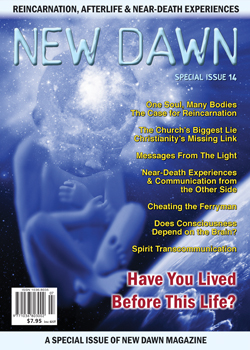
    This article was published in New Dawn 116 (Sept-Oct 2009)

    Modern studies repeatedly suggest that a significant proportion of people in the Western world now believe in reincarnation. Although this phenomenon can be traced back to various esoteric movements that flourished from the second half of the 19th century, it gained significant ground with the explosion of popular interest in Eastern spiritual approaches in the 60s. And it was reinforced by a proliferation of therapists offering to regress people into their past lives.

    Yet now the tide seems to be turning again. For some years the emphasis has been moving more towards the idea that we are all part of the One, the All, the Source, the Absolute, the Ultimate, the Great Spirit or whatever we choose to call the ‘universal consciousness’. Of course this is not a new idea. But what is changing is that especially more intellectually minded spiritual seekers are tending towards the view that anything outside of the ‘One’ is mere ‘illusion’.

    In fact this word illusion is used a great deal in spiritual circles these days, although actually in quite different contexts, and it is perhaps worth considering what these are. Of course readers would all agree that the physical world itself is to some extent an illusion, at least inasmuch as it is underpinned by the nonphysical planes and states of being that science is increasingly pointing towards. But what about the idea that we only reincarnate for as long as we fail to see through the ‘illusion’, and that as soon as we gain ‘enlightenment’ we can ‘break the bonds of karma’ and ‘reunite with the Source’? More radical still, what about the idea that any notion of individuality is completely illusory on all levels, and that as soon as we die there is no sense of continuation of any sort of individual soul consciousness?

    Whether or not they make it explicitly clear, these latter two are the ‘illusion models’ supported by a significant proportion of our best-known spiritual commentators of modern times – be they proponents of, for example, the ‘power of now’, or of ‘cosmic ordering’, or of ‘quantum mysticism’. Yet to see the world in this way is entirely at odds with what we might call the ‘experience model’, which holds that we lead many lives in order to see all sides of every emotional coin, and to learn to deal with the manifest challenges that life on this planet provides. In other words, a model in which the emphasis is on an individual soul growing by experience over many lifetimes.

    If we are to adopt a rational approach then, rather than relying on ‘revealed wisdom’ ancient or modern, it is surely sensible to consider which of these models is best supported by logical analysis and the available evidence.

    We can start with the premise that there must exist some sort of ultimate force or energy that underlies the entire universe, both seen and unseen, which is the Origin or Source of everything in it. However ineffable it may be, this principle of a universal consciousness is almost a logical necessity, and it is certainly supported by scientific research at both the quantum and the macrocosmic level. The idea that ‘we are all one’ is also a common element of transcendental experiences, whether spontaneous, meditative or induced by hallucinogens. So our next step must be to investigate whether, at the same time, there is any real evidence to support the idea of an individual consciousness that exists or survives independent of the physical body.

    The most relevant area of research here is near-death experiences. In particular we are interested in cases that involve subjects returning with factual information that is subsequently verified, and yet so obscure that they could not reasonably have acquired it in any ‘normal’ way.

    Near-Death Experience & Reincarnation Cases

    One of the most fascinating cases on record took place in the early 70s, and involves a gifted young Russian scientist called George Rodonaia. His work on chemical brain transmitters was sufficiently valued by the KGB that they were not prepared to lose his expertise to the US by letting him take up an invite to further his research at Yale. On the day of his departure, as he stood on the pavement in Tbilisi waiting for a taxi to the airport, he was deliberately mown down by a car and pronounced dead at the scene. His body lay in a morgue for three days, but as the autopsy began his eyelids flickered and he was rushed to surgery.

    As a man of science George had never had any time for religion. So those close to him were bewildered when, three days into his lengthy recovery, he began to describe what had happened while he was ‘dead’. In fact his was a relatively non-typical and highly transcendental experience, but for our current purposes he also claimed he had also been able to travel anywhere he liked while ‘out of body’. In particular he was drawn to a newborn baby in the hospital adjoining the morgue because she would not stop crying, and doctors had been unable to diagnose the problem. Much to his surprise he found that he was able to communicate with her telepathically, and also to scan her body and establish that her hip had been broken, probably at birth. Incredibly, as soon as George was well enough to pass on this information, the doctors x-rayed the baby and found that she did indeed have a fractured hip.

    There are other, similar cases of near-death experiences involving obscure, factual information that combine to strongly suggest that our individual awareness or consciousness does indeed continue to exist even when the physical brain is absolutely non-functional. So far so good. But is there any evidence to support the further idea that individual souls have many lives?

    Here we encounter two important areas of research, the first involving children who have spontaneous memories of past lives. Although historically most of these cases have come from Asia, one of the finest involves a young American boy called James Leininger of Lafayette, Louisiana. Born in 1998, his fascination with toy planes from the earliest age took a more sinister turn as he approached his second birthday, when vivid nightmares began. He would thrash around in his sleep, kicking out with his legs up in the air and moaning: “Airplane crash, on fire, little man can’t get out.” His mother Andrea had no particular religious convictions but, when her mother suggested these might be memories of a past life, she began to encourage little James to talk about them. And he began to reveal startling details, such as that the pilot of the plane was also called James; that he had been shot down by the Japanese; that he had flown Corsairs; and that one of his fellow pilots went by the name of Jack Larsen. He also mysteriously mentioned the single word Natoma.

    His father Bruce remained dubious about any sort of spiritual explanation, but he knew that neither he nor any other member of their family had any particular interest in aircraft or the war. So he began to research, and quickly established that an aircraft carrier called the USS Natoma Bay had been stationed in the Pacific during World War II and had taken part in the notorious battle for the Japanese island of Iwo Jima early in 1945. He ordered a book about this, and was flicking through it one day when James pointed to the island of Chichi Jima on a map and exclaimed, “Daddy, that is where my plane was shot down.” He then made contact with the ‘Natoma Bay Association’, who confirmed that Jack Larsen had been one of the pilots, and also that only one pilot had been lost at Chichi Jima: 21-year-old Lt James M. Huston Jr.

    Bruce also knew that Huston had flown Wildcats, not Corsairs, on the Natoma Bay. But when he made contact with Huston’s elderly sister she kindly sent him some photos – including one of her brother standing proudly next to a Corsair. Military records then showed he had originally been part of an elite special squadron who test-flew these planes. But the real clincher involves three ‘GI Joe’ dolls. When Bruce asked his son why he called them Leon, Walter and Billie he replied, “Because they greeted me when I went to heaven.” Again military records confirmed that three of Huston’s fellow Natoma Bay pilots were Lt Leon S. Conner, Ensign Walter J. Devlin and Ensign Billie R. Peeler – and that all three had died before Huston on other engagements. None of this detailed information is available on the internet pages about the Natoma Bay even now, let alone in popular books and so on.

    Past Lives & Hypnotic Regression

    The second area of past-life research is hypnotic regression. With this we must first appreciate that the human brain appears to store a complete record of everything we have ever been exposed to, no matter how briefly or how long ago, and that although most of these memories remain inaccessible to our normal consciousness they can be accessed in trance. So apparently authentic and detailed past lives, even including strong emotions and strange accents and so on, have sometimes been proved to come from perfectly normal sources – not least historical fiction, which is often overlooked by spiritual researchers. Nevertheless, there remain some cases involving information so obscure that only a paranormal explanation seems appropriate.

    One of the finest involves a young woman dubbed Jane Evans, who was one of many subjects regressed by the Welsh hypnotherapist Arnall Bloxham. She first visited him in the late 60s and proved a responsive subject who, over the course of a number of sessions, regressed into six separate lives from Roman times onwards. She would go on to be the star of a 1976 documentary made by the initially sceptical BBC producer Jeffrey Iverson, entitled ‘The Bloxham Tapes’. Her most celebrated past life was that of a persecuted Jewess in 12th century York, but on close investigation this case is somewhat inconclusive. In fact her strongest life in terms of obscure evidence involved Alison, a young servant to the 15th century French financier and merchant, Jacques Coeur.

    Some of the historical information Jane came up with in trance was relatively obscure, and could only be verified by professional French historians. For example, she said that Charles VII’s nickname was “heron legs”; that his son Louis had poisoned his wife; that his mistress Agnes Sorel had two pet dogs clothed in “coats of white fur with jewelled collars”; and that Coeur was Jewish and his father was a goldsmith. Perhaps more impressive was her knowledge that Coeur was an avid collector of art, with paintings by Jean “Fouquet,” the court painter to the king and one of Coeur’s debtors; by Jan “van Eyck,” the court painter to the nearby Duke of Burgundy; by “Giotto,” an Italian master from the previous century; and by the little-known “John of Bruges” who, Iverson established only with great difficulty, was also known as John Bondolf and was a Flemish court painter for the king’s grandfather. More impressive again was her report that Coeur had a “body servant” called Abdul, who was “dressed differently from the others” – because it was only from obscure French court records of the time that Iverson was able to confirm that he did indeed have an Egyptian body slave.

    Impressive enough, yet the clincher in this case is Jane’s recall of a “beautiful golden apple with jewels in it” that she said had been given to Coeur by the Sultan of Turkey. All of Iverson’s initial attempts to verify the existence of such a piece drew a blank until his last night in Coeur’s home town of Bourges, when he returned to his hotel to find a message from a local historian. The latter reported that he had been searching through contemporary archives when he found “an obscure list of items confiscated by the Treasury from Jacques Coeur”; and in that list was a “grenade” of gold – a pomegranate. Of course this is so like an apple in shape and size that the English word contains the French root pomme. It is also worth noting that one sceptic’s supposed attempt to trace all these details to a historical novel is a complete travesty, because the novel has an entirely different plot and contains virtually none of these obscure details.

    Again there are other, similar cases of both childhood recall and regression that involve equally obscure yet verifiable information about past lives. But could all these merely result from subjects tapping into some sort of universal memory, or even from possession by the deceased? Probably the strongest evidence that these are indeed memories from the subjects’ own, individual, past lives comes from subjects also being regressed into the time between lives, or ‘interlife’.

    This stems from the research of a number of pioneering psychologists and psychiatrists around the world, who each stumbled on the interlife independently in the 70s and 80s. Their subjects’ reports are extremely consistent, so that the experience can be broken into five main elements: transition and healing, past-life review, soul group interaction, next-life planning and returning. This evidence from what now constitute thousands of subjects from diverse backgrounds suggests strongly that there is a continuity of individual soul identity across many lives.

    The Holographic Soul

    So how do we properly bring this evidence of individual soul survival and reincarnation together with the idea of a universal consciousness that underlies everything? Although the most profound spiritual sources have hinted at the truth throughout the ages, the most simple yet elegant solution has only become available to us in recent decades with the discovery of the hologram. And it involves applying this principle not to the brain, nor to memory, nor even to the universe as a whole, but instead to soul consciousness itself:

    Soul consciousness is holographic. We are both individual aspects of the Source, and full holographic representations of it, all at the same time. However this does not mean that soul individuality is in itself an illusion. The principle of the hologram is that the part contains the whole, and yet is clearly distinguishable from it.

    The other message that comes through loud and clear from interlife research, as well as from the most profound spiritual sources, is that free will and personal responsibility reign supreme. This is what allows us to learn from our mistakes, and to grow as souls. So any next-life previews seen between lives merely represent major probabilities and lesser possibilities, and there is no karmic punishment or predestiny. Indeed the idea of karma itself has arguably outlived its usefulness, because it is clear that the dynamics of how our attitudes, intentions and experiences feed into the futures we create for ourselves, both across and within lives, are far too complex to be reduced to simplistic ‘laws’.

    In conclusion it appears that there are no ‘flaws in the grand plan’. The physical world is not an abomination created by fallen angels. Nor is the reincarnation cycle something to be escaped from at all costs, either by suddenly gaining the enlightenment to see through the illusion, or by learning to give up all ‘attachment’ so as to generate no more karma. Although we would do well to aim for a degree of emotional detachment and balance, and regular meditation is absolutely invaluable in trying to bring our ‘higher selves’ to the fore, life is to be lived and experienced!

    So where does it all end? Interlife evidence, again backed by the most profound spiritual sources, suggests that we continue to reincarnate until we have exhausted all the possibilities for growth in the physical plane. And this is only the ‘end of the beginning’ of the soul’s journey, because there are many other opportunities for new experiences in other realms. As for the idea of ‘reuniting with the Source’, the concept of the Holographic Soul suggests that we never split off from It in the first place, and that It is always within us and us within It.

    What about the million dollar question from which ‘illusionists’ tend to shy away? What is the whole point of the universe in the first place, and how do we humans fit into the ‘big picture’?

    The Source’s primary aim, in diversifying into all the billions of holographic soul aspects of itself that operate in the various realms throughout the universe, is to experience all that is and can be. So as individualised aspects of the Source who have chosen to reincarnate on this planet, we are merely fulfilling a small part of that objective by gaining a balance of all the experiences available via this route.

    James Leininger’s amazing story is documented in the book Soul Survivor: The Reincarnation of a World War II Fighter Pilot

    [alert type=”success” dismiss=”no”]If you appreciate this article, please consider subscribing to help maintain this website.[/alert]

    © New Dawn Magazine and the respective author.
    For our reproduction notice, click here.
  • At the Threshold: How Near-Death Experiences Transform People

    At the Threshold: How Near-Death Experiences Transform People

    From New Dawn Special Issue Vol 6 No 2 (April 2012)

    My research has shown me that the near-death experience is not some kind of anomaly, but is, rather, part of the larger genre of transformations of consciousness. The clue most researchers miss is stress; specifically, the intensity which comes from that stress (known in shamanism as “high stress”). The entire pattern of aftereffects and the degree to which people change, can be traced to that factor. It’s the intensity that shifts experiencers into what is called a “threshold experience” – one that straddles the boundary between this world and other worlds, between the brain and that which lies beyond what the brain can access, between reality and miracles, mind and spirit, life and death, heaven and hell, sanity and insanity.

    Once we understand this shift, we can begin to unravel how the transformational process works. At the threshold of who we think we are and what lies beyond body and brain, is the core of ancient mysteries. We are transformed by the Oneness we find there.

    My research of near-death states spans 33 years and covers nearly 4,000 adult and child experiencers. Not counted in this are the many sessions I held with significant others. Before my own near-death experiences in 1977, I was equally involved for over a decade studying and experimenting with altered and mystical states, psychic phenomena, and the transformational process, involving over 3,000 people. For some reason unknown to me, my research projects were never small. I have always preferred looking at things from multiple angles and differing views. Police investigative techniques have been my protocol throughout. Since this method relies heavily on observation, comparison, and analysis, it is never constrained by words, language, or culture. Numerous sources of verification are used, and this can include questionnaires for double checking previous findings.

    This work has enabled me to recognise that near-death experiences are not some kind of anomaly, but are rather part of the larger genre of transformations of consciousness. We single them out as “different” because near-death states occur mostly at accident scenes, in hospitals, or in environments where devices are available to record vital signs thanks to trained emergency personnel. Contrary to the notion of how these episodes form, the scenarios they cover, and the pattern of physiological and psychological aftereffects that usually increase overtime – is the fact that near-death-like experiences (where death is not imminent) and impactual spiritual transformations (regardless of how caused) manifest the same patterning.

    What links these types of in-depth transformational experiences is stress; more importantly the intensity of that stress.

    Before such an episode occurs there are stressors, conditions in the experiencer’s life, that point to either unrest or inattention. And these are present universally. What caught my eye with near-death and near-death-like states were episodes that occurred under these conditions:

    • during major life junctures;
    • when a decision needed to be made, and at times of deep dissatisfaction,
    • disappointment, frustration;
    • when feeling hurried all the time or excessively strained;
    • while “running a tight ship,” insisting on personal control;
    • as lifestyle maintenance toppled one’s ability to keep it going;
    • alongside pushing limits – at work, at play, in everything;
    • when demanding and strict rules limit one’s beliefs and activities;
    • without existence of meaningful goals, or when in strong denial;
    • during “happy” times that were really a façade;
    • when overly satisfied or complacent.

    The common thread present in each situation is stress. Even with babes and the unborn. Mother’s stress, as well as that of the father, can readily become the child’s stress. Sometimes it’s as if children have their experience for parents or doctors or significant others… to relieve or heighten their stress.

    And the type of stress I recognised was the kind that pushes a person beyond his or her limits, beyond that which is “safe”… a threshold experience.

    On February 29, 2000, the Daily Progress Newspaper in Charlottesville, Virginia, reported that Bruce Greyson, M.D., a professor of psychiatry and near-death researcher at the University of Virginia, was able to show a link between the phenomenon of near-death experiences and a natural physical response to trauma. He found that experiencers have more dissociative episodes – the normal kind, not the pathological kind – than those who were close to dying but did not have a near-death experience. Greyson was quoted as saying: “It’s basically narrowing your focus so much that you block out things that are going on around you.”

    What he is describing is what shamans, spiritual, and mystical folk have for aeons of time referred to as the goal of “high stress”… what it takes to push one past the threshold or boundary of what is known.

    Reaching the Stress Threshold

    Through the ages sacred initiations of the greatest order demanded a “death” – seldom physical. They required the death of the ego. One had to “die unto the self,” leaving behind previous desires and wants, to take on the trusted role of healer-guide who then dedicated the rest of his or her life in service to others. The core of shamanic vision quests (“calling for a vision” – or asking the spirits for guidance) still today consists of ceremonial rituals that mimic or come close to actual physical death. Probationers are prepared for this; still, there is no real preparation for that overwhelming, “over the top” fear that pushes one’s panic button. Once that threshold is breached, the individual either passes into madness or breaks through the passageway into otherworlds of spirit that engender a transformation of consciousness.

    Consider the mythological traditions of the “hero’s journey” or the making of “wise ones.” High stress was always the deciding factor: how the individual faced “the watcher at the gate” (fear at the stress threshold), overcame that fear (passed through/ascended), entered into the otherworlds of spirit (that null space where everything is said to converge/suspend/expand into the collective whole), and is imprinted from the aftereffects (bears the “mark” of ascension). This “journey” is what establishes the extent to which the individual changes or is transformed.

    The formula then for a transformation of consciousness (the basic energetics) is: intense period of change, high stress that narrows one’s focus, feeling driven or accelerated beyond states of fear/panic, encountering a threshold or boundary, maybe meeting a greeter of some kind, passing into a null space of energy convergence, becoming infused with knowing, imprinted or altered by null space exposure, returning as one who has been expanded or enhanced by the experience – as if forever “marked” by the pattern of aftereffects.

    I’ve seen this thousands of times – experiencers who behave as if they have been punched, jerked, hit, pushed, or somehow spun around. Something physical happened to them, something separate from any mind play or otherworldly visitation or event that put them at death’s door. And that “something” shifted their futures by pushing them into a unique arena of experience. The “something” that set them apart I call a “power punch.” It is a force. It is an energy. It is intense.

    This intensity, what narrows a person’s focus in high stress, is the key, the hinge, to understanding near-death and near-death-like experiences and impactual spiritual transformations.

    Of the 21% in my near-death research who claimed they did not have aftereffects worth mentioning, or any at all, these were the people whose episode seemed so superficial to them that they described it as if a fleeting dream. Sixty percent were openly expressive about how intense their episode was and how it had altered their lives in dramatic ways. These experiencers exhibited most or all of the aftereffects pattern. Many seemed stunned at how much they had changed once they compared “before” with “after.”

    The 19% who were so radically affected that it seemed as if they had become a different person or at least an altered version of who they had once been, bore the full brunt of the “power punch” – and showed it. Before and after photos illustrated the depths of what they had been through and how it had changed them. Almost to a person they displayed the full pattern of physiological and psychological aftereffects.

    And, with the 73% in my research who had electrical sensitivity afterwards, I was able to establish that it was the intensity of their near-death episode that had been the determining factor in causing this condition – not how long or short their episode, or, how much light they had been exposed to during their scenario. No matter how I approached this, cross-comparing brief and longer near-death states, complicated and simple – regardless even of imagery or how it was described – I still reached the same conclusion: what mattered most in every respect was the intensity of the episode, not the episode itself.

    The Colloidal Condition

    Reaching the threshold, or boundary between realities, and then crossing through, compares almost exactly with what science calls a colloidal condition.

    A colloidal condition is where forces suddenly collapse and then converge. This in-between state creates antiforce, which is antigravity. Particles caught in this unique state between implosion and explosion transmute, and remain forever changed by that transmutation. On a molecular level, these particles show evidence of enlargement and of having taken on different and enhanced characteristics. An example of this is what happens when water is stirred.

    There are several ways water can be stirred. For the sake of this discussion, we’ll rotate it. Spin the water. Round and round. Faster and faster. Really spin it. Stop suddenly and reverse the direction. When the spin stopped, the water collapsed into itself, creating an implosion. But just before a reverse spin could be initiated, where the water could explode back out again, conditions mysteriously changed. Both the water and everything contained within it were briefly held in suspension. This is called a colloidal condition; the particles caught therein are referred to as colloids.

    The same thing can happen to the human brain if suddenly hit, jarred, or severely jiggled, especially during trauma or in an accident or fall. Typically, a colloidal-like suspension of consciousness will follow whereby the environment appears to expand out as time slows to a standstill. The individual feels somehow caught in-between realities, as if he or she slipped through a crack in time and space and suddenly became resident of a world neither here nor there. This peculiar feeling of being suspended in between realities affects a person so deeply that it can permanently alter the way the individual regards the world at large and his or her place in it.

    The colloidal condition best describes what we can know of passing into and through a threshold experience. Once again, here’s how it works:

    • forces suddenly collapse, then converge;
    • a momentary state of suspension results;
    • everything caught in that suspension expands and enlarges as antigravity is created;
    • inherent or unlimited potential is released;
    • whatever is present is imprinted (becomes permanently altered by what happened);
    • whatever is present then transmutes (takes on different characteristics);
    • as reversal of motion is completed, forces are restored, suspension ends, but the imprinting (transmutation) remains.

    The majority who go through such a process experience an enlargement and expansion of consciousness, exhibit the sudden surfacing of latent abilities, face a confusing array of psychological and physiological aftereffects, and are never quite the same again.

    It is my belief that the reason this process of convergence and transmutation is universal, is because all of us, now and through the ages, are and have always been imprinted by the same creative impulse that originated us. The mark of our creation is what we display whenever our consciousness is set free to rediscover itself and the source of its being. After a threshold experience, we feel as if we have found “home” because the home we think we’ve found already exists within us – and always has. We recognise the place because we never left it to begin with.

    High stress pushes us to where we must face that legendary boundary that separates worlds readily accessible (what we know), from those either infra or ultra to our sense of perception (what seems as if fantasy, imagination, or mystery). In mythology, fear is the “watcher” at the threshold gate. Intercessories who can act as guides are loved ones who have previously died, angels, religious figures, visitors from other worlds, special animals, maybe birds. The final arbitrator, though, is always the heart.

    The Key Role of Our Heart

    Tradition says that it is the heart that decides: if you make it through the threshold gateway, where you go once you pass, and if you can return to the life you left. Drawings from ancient Egypt illustrated this final step by showing a set of scales for weighing a person’s heart at death. If the heart was weightless like a feather (indicative of a selfless life), the individual passed into the worlds of spirit. If heavy (indicative of being ego bound), the individual was rejected and had to face punishment or some type of abandonment.

    How can the heart organ, unique as it is, be the final arbitrator of what happens at the passageway?

    Let’s take a moment to examine how this might be true. Research has shown that 60 to 65% of all heart cells are neural cells. This enables the heart to function in many ways like our brain does. Yes, the heart is the major glandular structure in the body, but it also produces an electromagnetic field 5,000 times more powerful than that of the brain. Shaped like a torus doughnut, the heart field busily converts one form of energy into another as it generates an infinite number of harmonic waves. These harmonics run throughout all bodily systems, and are so sensitive that they react to conditions four to five minutes before actual occurrence. This futuristic awareness tells the heart if what’s coming is positive or negative so it can prepare. First the heart feels the coming event, then the brain is aware of it, then the eyes see it. The heart, literally, is our first responder.

    Harmonic heart-waves come into coherence when you feel good, are in love, experience happiness, have bonded with someone in a positive way, or are in a supportive relationship. When the heart’s energy coheres, it taps into higher energy fields to empower itself, while emoting feelings of love and connectedness. This feeling sense operates like a thinking mind and with an unbelievable memory. Heart harmonics entwine worldwide. Spiritual traditions claim this is so because our heart is the centre of our soul. A soul set free by these harmonics, serves – as foretold in ancient Egypt and from wise ones who recognise the power of the heart.

    Love, or lack of it, dominates near-death, near-death-like, and spiritually transforming experiences. The fullness of love, being loved, and discovering the power of love appears to determine the overall effect transformational states have on experiencers, their significant others, and anyone who hears their stories. It is no exaggeration to say that the majority of threshold experiencers return “in love with love.” Being bathed in love beyond measure, pales anything less. A challenge experiencers have afterwards is to “step down” this power a few degrees so as not to freak out people.

    The heart’s code is love: love of Source, love of others, love of self. To talk about threshold experiences is to talk about the heart’s ability to expand, embrace, and include the fullness of waveform harmonics. Where does this take us? Always to the same place… Oneness.

    All transformative experiences throughout what we can know of time reflect this… what is now termed “the perennial philosophy.” All the great thinkers have spoken of this, going back to Plato and beyond. All native peoples draw pictures of this or speak of it in their songs and stories. All of those who successfully passed the “tests” of the hero’s journey, who made it through the boundary and returned infused with a new wisdom and a new knowledge – described what they discovered as Oneness:

    • One God.
    • One people.
    • One family.
    • One existence.
    • One law – love.
    • One commandment – service.
    • One solution to problems – forgiveness.

    This, the perennial philosophy, is what many believe to be the only true religion. All religious thought, irrespective of denomination, creed, or messiah figure, takes its root from this type of experience. If threshold energy is intense enough, and affects experiencers deeply enough, individuals return as if “God instructed.” This is why so many near-death researchers believe that religion itself sprang from individual narratives of near-death experiences.

    In whatever manner this is debated, there is a wonderful corollary that comes from China. Historically, there is a lineage in China of Tibetan Storytellers, usually illiterate peasants, who are known as “Gesar Artists.” These storytellers recount numerous lines of extraordinary sophistication – tales of their most venerated hero, Gesar, a Knight from the Kingdom of Heaven, sent to earth to save and protect Tibetans. Gesar’s story has been passed from generation to generation, but not by memorising it! To be a true Gesar Artist (not just a story-teller), one must experience something akin to a near-death state or what shamans call “dying unto the self” (an ego death)… in order to achieve the personal experience of what Gesar came to earth to teach. They must become as if “God instructed.”

    There is no denying that the early teachers of humankind came from the otherworlds beyond the passageway. Shamanic beings, visionary images, spirit manifestations, near-death and near-death-like experiences, the dead come to life – what some label as paranormal occurrences – are actually more akin to spiritual awakenings than to what is often tossed off as paranormal or psychic phenomena.

    We have endowments to assure life’s continuance: procreation/birth. We also have endowments to assure life’s evolution: renewal/rebirth. This is not imagination. The spiritual, what enables renewal and rebirth, is real.

    Human Transformation & The Master Plan

    After a total of 43 years researching, experimenting, and studying a gamut of historical and first-hand, spiritually-transforming states, I can say that there is a biological imperative not only for life to exist and to continuously evolve in form, capacity, and intellect, but to reach an even higher order as if following a “Master Plan.” What happens as a result of transformational states feeds that plan because of how an individual’s experience and the consequences of that experience, can be passed from parent to child, generation to generation, biologically. Many have suspected this, but thanks to the DNA research currently being conducted, the markers of how this happens have been found. Jean-Baptiste Lamarck (1744-1829) was a French naturalist who argued that traits acquired in life by parents could be passed on to their offspring (in violation of Darwin and his theory of natural selection). His work was shunned in his time. Scientists have now rediscovered his work; naming what they have verified… “Lamarckism” (refer to www.qimr.edu.au/research/labs/emmaw/index.html).

    Take a good look at historical patterns. Each sudden evolutionary lift and/or period of discovery, as well as each renaissance, was preceded by stories of people who described threshold-type experiences, and to the degree that, it appeared as if the masses were “waking up.” These physical and spiritual energetics led to bursts of new ideas, creativity, invention, and healing. Each breakout period seeded generations to follow, as if a biological imperative existed to ensure that the human race could reach a greater potential. We know now that if the numbers of those who change are high enough, evolutionary adaptation – even of this magnitude – can happen in a single generation.

    The science that puts this into perspective is the study of fluid dynamics.

    Fluid dynamics shows how birds in flight maintain organised formations even when individual birds make mistakes, how rotating colonies of bacteria stay together regardless of challenge, how a herd of buffalo maintains order even in full gallop, how crowds of people pour out from an event as if “directed.” Whenever an energetic wave pattern forms, a natural rhythm of movement emerges. Whatever is present when this happens functions as if “one mind.”

    Fluid dynamics tells us that it only takes 4 to 5% of any group, condition, or situation to change, for the whole assembly to follow. Once that tipping point of 4 to 5% is reached, energy excites and becomes highly charged. This creates what is called “superfluidity”… a state of energy that cannot be contained.

    Currently the conservative estimate worldwide for people having had a near-death experience is 4 to 5% of the general population. This estimate does not take into consideration near-death-like and spiritually transforming experiences that are also intensely life changing. Counting them too could easily double or triple that figure, indicating that a realignment of global consciousness toward a higher order is well on its way to becoming highly charged.

    Freedom tops that higher order, along with open communications, human rights, improved health benefits, equality in education, participatory governance, cooperative incentives for advancement, creativity and the arts.

    The idea that near-death aftereffects constitute “a benevolent virus” is true. Regardless of whether one thinks in terms of a “Christ Consciousness” that can be achieved by anyone willing to follow the teachings of Jesus, or the act of becoming “god instructed” by practicing the disciplines of Gesar Artists, today’s revolution bears all the markings of a “soulquake.” Forget any linkage to the so-called “New Age” beliefs of the 1960s. This is more of a “New Thought,” the validation of a higher order of existence, of reality.

    The goal of every spiritual and religious tradition is to “release the soul from exile,” to teach that no one is ever separated from his or her divine essence. It is the transformational process, though, that actually reconnects soul with Source. Near-death states model this, the reawakening we can all attain.

    For further research, please read Near-Death Experiences: The Rest of The Story by P.M.H. Atwater, L.H.D., Charlottesville, VA; Hampton Road, 2011.

    [alert type=”general” dismiss=”no”]This article was published in New Dawn Special Issue Vol 6 No 2.[/alert]

    [alert type=”success” dismiss=”no”]If you appreciate this article, please consider subscribing to help maintain this website.[/alert]

    References

    P.M.H. Atwater,  Near-Death Experiences: The Rest of the Story, Charlottesville, VA: Hampton Road, 2011

    H. W. Dresser, A History of the New Thought Movement, New York, NY: Thomas Y. Crowell, 1919.

    T. Hongkai, “Legacy of a Tibetan Storyteller”, China Daily.

    F. O’Brien, A Benevolent Virus, Norwich, England: John Hunt, 2010.

    R. Rees, “Electrophysiology of Intuition”, Paper presented at the ChildSpirit Conference, Chattanooga, TN, 2007.

    A. Rogers, “Going With the Flow”, Newsweek Magazine, 1998.

    C. B. Schmitt, “Perennial Philosophy: From Agostino Steuco to Liebniz”, Journal of the History of Ideas, 27, 505–532, 1966.

    D. Williams, “At the Hour of Our Death”, Time Magazine. Available at www.time.com/time/magazine/article/0,9171,1657919,00.html. I originally picked up on the issue after reading the article, “The Sins of the Fathers, Take 2”, written by Sharon Begley, Newsweek Magazine, 26 January 2009.

    Daniel K Morgan & Emma Whitelaw, “The Case for Transgenerational Epigenetic Inheritance in Humans”, Mammalian Genome: Official Journal of the International Mammalian Genome Society; 19 (6): 394-7, 2008.

    © New Dawn Magazine and the respective author.
    For our reproduction notice, click here.

  • Messages from The Light: Near-Death Experiences & Communication from the Other Side

    Messages from The Light: Near-Death Experiences & Communication from the Other Side

    The closest contact with our afterlife is when we have a near-death experience (NDE). More and more people report such an experience. The reason being, that medical science gets better every day. We are more capable to bring back to life a growing number of people who go through a critical medical situation. But also without a critical medical situation people can have a NDE.

    What messages do near-death experiencers (NDErs) get out of this? And what messages can non-experiencers get out of it? A lot I can assure you, and these messages are extremely valuable. When we learn to understand them, they can lead to a much better and more rewarding life.

    NDEs are extraordinary experiences. They overwhelm those who have had them and their lives completely change. They are absolutely convinced these experiences are real. Many even assert they are more real than everyday life. This is because their awareness grows tremendously. They seem to become awareness themselves. They can sense everything there is to sense. All knowledge is freely available to them and they just need to tap into it. Every question is answered immediately. On top of all this there appear to be no physical limitations, and neither does time form a limitation. It doesn’t exist, or rather, it exists all at the same time.

    The most overwhelming aspect of their experience is that NDErs feel they are immersed in the most wonderful feeling of peace, acceptance and unconditional love. Especially the unconditional nature of the love they feel is something that leaves a lasting impression on the NDEr, because just think of what it means. Unconditional love means that there are no conditions to be met in order to receive this love. We don’t have to do anything specific in order to get it. In addition, the love that is felt is indescribable due to its completeness and all-embracing aspect. An NDEr described it as follows: “When I would add all the love I had received throughout my life together, it would still be a fraction of what I felt there.”

    Many NDErs feel that what they have experienced is their “Home.” They are sure that it is where they originate from and they know they belong there. They are also convinced this home is where we will eventually go back to when we die. This apparently means that the moment we are born we acquire the right to return to this wonderful place. It is our birthright. As a consequence, their fear of death completely disappears.

    All of this seems too good to be true. Actually, there is a slight problem, because NDErs start to long to return back to that place again. This is why they often become seriously homesick after their NDE. On average it takes about seven years for an NDEr to settle with the idea they are here and not there, and there is a purpose to it. So having the experience has its little drawbacks.

    Except for the good news that there is a wonderful place where we will all go to, there is also a bit of “other” news. It needs to be acknowledged that a non-negligible number of people haven’t experienced a completely blissful NDE, and some people have even experienced terrifying NDEs.

    At this moment it still isn’t clear what causes this kind of NDE. Apart from the problem we have in defining ‘bad’ and ‘good’, there is no way we can assert that terrifying NDEs are there only for ‘bad’ people, and positive ones only for ‘good’ people.

    Are these experiences not just the result of a lack of oxygen, or of some chemical reactions and neurological processes in the brains of a dying patient?

    Good scientific so-called prospective research indicates this is not the case. In this kind of research a specific procedure was followed to create an objective pool of people who had experienced a cardiac arrest. A number of people from that pool turned out to have had an NDE. These people could then be compared with the people of the same pool that didn’t have one. Differences between both groups would be interesting, because they could give an indication of what causes NDEs.

    This kind of research was conducted in different countries throughout the world, and in none of these did the researchers find any significant differences between the two groups.

    For instance, no differences were found with respect to physiological changes in the brain, because people from both groups had a loss of oxygen and had brain cells dying. This means these factors cannot be the cause for NDEs, something that has often been asserted. In some research, pharmacological factors (drug treatments during resuscitation) and psychological reactions to approaching death were investigated, but neither could these factors explain NDEs.

    The Light

    From a scientific point of view it is still to be determined what really causes NDEs, but for me it is clear these experiences truly are the first step into heaven, or however you want to call it. I have several reasons to believe this. One of them is The Light that some NDErs get into contact with. Like everything else in a NDE, The Light is something NDErs find very difficult to describe. It communicates as if it is some kind of intelligent being, but then again there are NDErs who find themselves to be part of this Light. The Light is often described as the centre of all unconditional love.

    In the presence of The Light some NDErs have their life-review, which to me is a second reason to believe NDEs are true. They see their life as a film, but in fast forward mode, or they just see pictures. Some describe their life-review as a stream of memories. The overall feeling was something like “this is you.”

    Interestingly, the life-review can be extremely detailed. The smallest details of our life are still there and we are able to relive them. Moreover, we can relive these details in a very peculiar way. We can feel our life from our own point of view, but also from the viewpoint of everyone else. It means that we are able to feel what we did to others as if we are those others.

    In this way we can feel the wonderful things we did to others, but also the less optimal things. The remarkable thing is that there is no judgement. The Light doesn’t judge us, nor does anyone else. If there is anyone judging us, it is ourselves. An NDEr said that the life-review seems not to be a matter of wrong or right, but a matter of becoming conscious of what happened and how we chose between the many options we get in life.

    Unity Universe

    This very direct kind of feeling of what others felt is extraordinary and in a way unearthly. It can only be possible when there is a profound interconnectedness between all people. Even without life-review NDErs say they experienced a very deep connection with others, with nature and even with The Light. This interconnection is so complete that one could even conclude that, in fact, I am you, and you are me, and we are nature. There is no difference. NDErs feel we all have a particle of The Light within us, which actually means that we all participate in The Light. And to briefly come back to people who had a distressing NDE: The Light is also within them and they will always have the possibility to return home to where The Light is. A full separation from The Light is utterly impossible, because we all are and will always be an indispensable part of it.

    When we consider this profound interconnection and also remember the other aspects of NDEs such as a tremendous awareness, limitless and freely available knowledge, no physical or time constraints, we can only conclude that we are part of one Unity Universe.

    No Lesser Souls

    There is more good news. Since we are all interconnected and all carry The Light within us, we are all important. There are no lesser souls. One NDEr said:

    No-one is more than another. God wants the best for us, more than we can ever dare to dream of. But He wants the best for all of us. He doesn’t draw boundaries. God is also freedom. We pose restrictions on ourselves. We make prisons in our own head. We even allow others to make prisons in our own head by accepting the restrictions they pose upon us.

    Our importance is not only based on us partaking in The Light, but also because we all have an important task to fulfil while here on earth. As one NDEr put it: “No-one would be here unless we have a task.” The exact task is unknown. NDErs who return to their body are unable to recall what that task is. They are unable to take with them all the knowledge that seemed so freely available during their experience. It simply is too much and too elaborate to hold on to. Moreover, our physical body and brain are inadequate to take it all in. Only a few people were able to remember what their task is, but the majority only knows they are here for a purpose.

    Creative Power

    One task that NDErs seem to agree on is to learn about love. We do that in a world limited by time and space where we have to make our choices. Many NDErs will agree we have a free will and we are free to choose our way through our world. But since we are part of a Unity Universe our interconnectedness makes that everything we do has an effect somewhere else. All our actions, even the seemingly insignificant ones, ripple through the universe. They have an effect. They do something. They create. Actually, we create. We have a creative power through what we do and think. One NDEr said:

    Everything I do has influence on everything.… Nothing is lost. It is a kind of law of conservation of energy. That is why we shouldn’t do to others what we don’t want for ourselves. Moreover, what we send, we’ll attract. We should also be mindful of our thoughts, because we create with our thoughts.

    Through our choices we learn about love. From life-reviews we know that we always have many options in life. And the more difficulties we have in life, the more interesting the options become that we can choose from. It seems to be very beneficiary when we would choose for those options that bring love and peace. This means that it is best to act in accordance with our inner core, which is our particle of The Light. When we do that, we create positive ripples that travel through the universe. They have a soothing, healing, energising and/or inspiring effect somewhere, and it is bound to return to us in some or other form.

    Much Needed Changes

    In the last few decades we used our freedom of choice to pursue only our ‘short-term self-interest’. We were indifferent to other people’s suffering and indifferent to the suffering of nature. By doing that we created an ‘I don’t care about you’ society. Our system is primarily focused on our own financial wealth. There is little place for spiritual wealth. Many people have even started to believe that ‘greed is good’ and there are too many who think it is perfectly acceptable to cheat other people with the only intention of benefiting themselves.

    Somehow we have acquired the idea that we are not interconnected and that we are immune for the consequences of our actions. The negative ripples we created have backfired at us through the Great Recession, which still affects especially the US, Europe and Japan. We in fact created this ourselves. One NDEr explicitly told me that the crisis was based on the combination of greed and indifference. And another NDEr had a clear warning, because she says that our extreme self-interest also has to do with how we treat nature: “The credit crisis is really just the tip of the iceberg. Our greed is bringing disorder to the whole system of earth.”

    From my many interviews with NDErs I strongly got the impression that our world is going through a period of much needed changes. These are crucial times, for we have arrived at a crossroads. One NDEr told me: “At the moment humanity is going through the struggles of its adolescence. Who am I now? Who do I want to be? Will we choose for our soul or for our ego?” And another NDEr said: “There is a different way of living and loving that does justice to ourselves, others and the earth. We live on the edge of a number of crises that can give humanity a very rough time.”

    Long Term “Our-Interest”

    It is my assumption that the Great Recession is there to remind us that we can’t just do something and have the illusion that we can simply walk away from what we did. We can’t think that the fallout of our actions would not affect us even if we run away fast. The recession shows that we are interconnected in a profound way. Therefore, it would be better if we were to abandon the flawed idea that we are not interconnected. This means that we should take the next step in our development. We should expand our short-term self-interest to include everyone else’s interest and the interest of nature, and it should be a focus on the longer term. In short: We should start focusing on a long-term “our-interest.” This is the most important message that can be derived from NDEs.

    What does it mean to focus on a long-term “our-interest”? At least it means that we have to develop respect for each other, for the animal world and nature as a whole. This means to have good intentions; to cherish integrity within ourselves and others; to be honest, incorruptible and non-greedy; to allow others to have something we would like to have and still be genuinely happy for them; to be truly satisfied with the many things we have and to be grateful; to continuously create positive ripples. This list can be extended because it is far from complete, but in short it means that it would be more optimal if we would use our free will to become aligned with The Light.

    Align with The Light

    How do we become aligned? Praying and meditating to get closer to the Light is ok. But not everyone wants to pray or is able to meditate. Fortunately, both are not necessary. It can be much easier than praying or meditating. Remember, The Light is very close by. Actually, it is part of us. It is within us. We just have to start realising that, every day. Realise that we are participating in The Light and that through this Light we are profoundly interconnected with all and everyone. If we would realise that every day, over and over again, then this awareness of our interconnectedness will automatically lead to the alignment with The Light.

    Read more in Christophor Coppes’ book Messages from The Light: True Stories of Near-Death Experiences and Communication from the Other Side (New Page Books, 2010), available from all good bookstores or www.amazon.com.

    [alert type=”general” dismiss=”no”]This article was published in New Dawn Special Issue 14.[/alert]

    [alert type=”success” dismiss=”no”]If you appreciate this article, please consider subscribing to help maintain this website.[/alert]

    © New Dawn Magazine and the respective author.
    For our reproduction notice, click here.

  • Cheating the Ferryman: A New Paradigm of Existence?

    Cheating the Ferryman: A New Paradigm of Existence?

    From New Dawn Special Issue 14 (Dec 2010)

    What happens when we die? This is the ultimate question and one that we still have no real answer. From the first few moments that man became a self-aware being he has pondered upon this mystery.

    Every culture has attempted an explanation, and it is reasonable to conclude that all religions exist to give an account of what happens at that moment and, more importantly, where does the person go after their body dies.

    One of the most enduring myths is that of the Ancient Greeks. They believed that the recently dead would find themselves at the banks of a vast river, the River Styx. Out of the mists would appear Charon, the Ferryman. It was his job to ferry the soul, termed a “Shade,” across to the other side…. To the Land of the Dead.

    But he did not do this for free. He needed a payment. The relatives of the recently dead person made sure the Shade could pay the ferryman. This payment was usually a small coin called an obolus. Depending upon the tradition, either this would be placed under the tongue of the corpse or two oboli would be placed over each eye.

    This well known myth still resonates over three thousand years later. “To Pay The Ferryman” can still be heard today. However, there is a lesser known myth that suggests a deeper truth: The myth of the River Lethe.

    The Greeks believed that before getting to the banks of the Styx the Shade would encounter a much smaller tributary of the great river. This could be crossed with ease by wading from bank to bank. This small river was called the Lethe, and its waters contained a profoundly important quality.

    If the Shade or newly deceased soul drank of this water all their memories would evaporate. They would forget who they are and the events of their life. Their memories would become like those of a new born baby. Of course by doing so the Shade also forgot all of the lessons learned during that life.

    But before doing this the Shade had the option of drinking from a small pool next to the Lethe. This was the Spring of Mnemosyne. By drinking here the Shade’s past-life memories became sharp and distinct. Each action and its subsequent effects became crystal clear. Life’s lessons became precise and understood.

    If the Shade drank of the Spring of Mnemosyne they were allowed to pay the ferryman, board the boat, and sail across the Styx to the Elysian Fields.

    But if a drop of the waters of the Lethe was drunk by the Shade, then they were sent back to be reborn again with no memories of their previous life. Now this was not a form of reincarnation as it is understood by most people. It was a re-birth process in which the same life was lived again. The Shade found itself back in its mother’s womb waiting to start all over again.

    This concept is called “The Eternal Recurrence” and has been a long held alternative belief to that of the linear life found in most religions, even those who have reincarnation as their central belief.

    However, those who have long held this belief never shared it with the masses. Such a belief has always been found in the secret – esoteric – groups within most of the major religions. This is the great secret carried through the ages by the groups loosely termed as “Gnostics.”

    The Gnostic tradition can be found behind the great mystery traditions of the Middle East and Europe. From the Manicheans of Persia to the Cathari of Southern France, and from the Cabbalists of Southern Spanish Judaism to the Sufi’s of Arabia, this hidden knowledge is the real Holy Grail in whose defence the Knights Templar and the Albigenesians died in their thousands to protect.

    In my books I present evidence for this belief system, that at the moment of death we are catapulted back to our moment of birth. The theory is supported by a good deal of evidence from modern science, particularly quantum physics, neurology, psychiatry and consciousness studies.

    I call this theory “Cheating the Ferryman” because I suggest many of us never make it across the River Styx. We never step into Charon’s boat and we never pay him his obolus. We cheat the ferryman out of his fare and return to live our lives again.

    On what evidence do I base such a totally weird idea?

    Dreams & Precognitive Déjà Vus

    Well, for me, the whole theory started with one very peculiar dream. In this dream I experienced a déjà vu… yes a dream that contained the sensation that I was experiencing an event that I had dreamed before, if that makes sense.

    In the dream I had an inner dialogue with another me and this being stated that a déjà vu is a memory of an event that you have lived before in a different life. I then woke up with this idea echoing round my mind.

    I had for some time wanted to write a book and now it seemed that my dream self, or more accurately a part of my dream self, had given me both the theme and the incentive.

    I was surprised to discover that déjà vu is not only the most common anomalous psychological perception (70% of people will experience the sensation at least once in their lives) but also that experts have no real idea what causes it. Various suggestions have been made but none have been shown to be correct.

    As an example, for many years a proposal made by the psychiatrist Paul Efron was considered to have nailed the mystery. Efron suggested that one part of the brain processes information before the other. In this way we have the feeling of experiencing an event twice. This occurs because each hemisphere of the brain receives signals from the right and left visual fields of each eye. As such the non-dominant hemisphere processes the incoming images a split second before the dominant hemisphere. So, in effect, the consciousness receives the signal twice with a short time delay. As one signal is immediately, but not fully, over-written by another we feel as if we have experienced the images twice. But this curious message transferal only works for the eyes. It has recently been shown that congenitally blind individuals experience aural déjà vu sensations. As the brain processes sound in a totally different way to sight, the Efron thesis simply cannot explain this form of déjà vu.

    I wondered if déjà vu may not be simply what it feels it is: a curious sensation that suggests the observer has lived this moment before. The Seattle based psychiatrist Dr. Vernon Neppe has defined déjà vu as, “any subjectively inappropriate impression of familiarity of the present experience with an undefined past.”

    So the “undefined past” could be part of this life or a past life. However this ‘past life’ for me did not imply reincarnation for one simple reason: for a déjà vu sensation to be effective it has to be a memory of the exact circumstances, not a circumstance that is similar. For example, if my “subjectively inappropriate impression” consisted of me remembering being in this place in Victorian times, the two images would be quite different. The location may be the same but my clothing, my companions and the décor would be totally different. It would feel more like a time-slip than a doubling of consciousness. For a déjà vu to be a déjà vu the two impressions have to be identical, in all ways. My memory of the event is identical to my experiencing of the event. I am literally re-living an event from my own past, but a past that is, for the moment, the future.

    Indeed, I have now interviewed many people who experience precognitive déjà vu’s. The ‘memory’ includes a remembrance of what happens/happened next. The subject suddenly has very short-term clairvoyance.

    I found that these precognitive déjà vu sensations are usually reported by individuals who experience three brain-states: migraine, temporal lobe epilepsy (TLE) and schizophrenia. I was intrigued as to why this was the case and began researching what may link these three ‘illnesses’.

    Much to my delight I found there is one common factor, a neurotransmitter called glutamate.

    Perception and Time Distortion

    In a curious coincidence that was to have great significance to me later, I learned that neurotransmitters were first discovered by an Austrian scientist called Otto Loewi. Just like me, Loewi had a dream guider. On Easter Sunday 1920 he awoke in the middle of the night having experienced a really vivid dream. He wrote down what he had experienced and went back to sleep. The next morning he excitedly looked at his notes to find them to be illegible scrawl. He knew that he had dreamed something of profound importance so he went to bed early the next night. The dream came again and when he awoke he reproduced his dream experiment exactly as he experienced it that night. In doing so he isolated a substance that was to eventually be called acetylcholine. Such was the importance of this discovery that in 1936 Dr. Loewi and his English associate Sir Henry Dale were awarded the Nobel Prize.

    What Loewi’s dream had helped find was the first example of the chemicals that were later to be called neurotransmitters. These are internally-generated substances that facilitate the transmission of messages from cell to cell within the body. The most important group is found in the brain and glutamate is the most important of the brain neurotransmitters.

    Glutamate is directly responsible for the peculiar feelings described by migrainers, temporal lobe epileptics and schizophrenics, specifically a sensation that is technically known as “the aura.”

    The aura is a form of early warning system. It is triggered by over-production of glutamate and usually takes place a short time before an attack of migraine or a temporal-lobe seizure. (Glutamate’s role in schizophrenia is different but the overall outcome is similar). Experiencers report sensations of time slowing down, of hyper-sensitivity, of visual or aural hallucinations and profound déjà vu sensations. Déjà vu had been linked with both migraine and TLE for years before Loewi’s serendipitous discovery.

    Here was the link I had been looking for. Déjà vu has, as one of its causes, a flood of glutamate in the brain. It was then that I made my first big step to “Cheating the Ferryman.”

    Quite by chance I was reading an old book I had on Near-Death Experience (NDE). One of the more technical articles discussed the neurochemical causes of the NDE. Much to my surprise I found that glutamate was also connected to this well-reported experience. Another, and quite unrelated, article in the same book discussed one of the most commonly reported elements of the NDE, what is technically known as the “panoramic life review.”

    “My life flashed before my eyes” is a quotation recorded time and time again by people who have close encounters with death. Some report the experience as being a series of snapshots, others that they literally re-live every experience of their life but in super-speed. One person reported that it was as if somebody had recorded a movie of his life and was running it in fast-forward.

    I was fascinated by this link. Both déjà vu and the Panoramic Life-Review were linked by a specific brain-chemical, glutamate. After doing some subsequent research, I found that Dr. Karl Jansen of the Maudsley Hospital in London had been able to reproduce a full near-death experience in volunteers when he had them take small doses of the drug ketamine. Now ketamine is chemically almost identical to glutamate so here again we had an amazing link.

    I was later to find that ketamine, and by implication glutamate, also brings about another curious subjective sensation in the brain: time slows down or almost stops for the experiencer.

    In another fortuitous event I was to be given a first-hand description of a glutamate effect by a person who experienced TLE seizures.

    Temporal Lobe Epilepsy Breakthrough

    I received a phone call one afternoon. It was a lady from a recruitment agency who was wishing to discuss with me a vacancy she was handling. “Margaret” asked me whether I was working and I explained that I was driven to write a book. “What about?” she asked, “I don’t really know at the moment,” I truthfully responded. I then explained that I was reading a good deal about temporal lobe epilepsy and was making some fascinating links.

    She went very quiet and suggested that we should meet up to discuss the vacancy. Three days later I met her at a coffee shop nearby. As soon as she had sat down she explained to me that she had to meet me because she wished to discuss with me something she could not mention in her office where she would have been overheard.

    “Margaret” informed me that she had recently been diagnosed as a having temporal lobe epilepsy. She described to me how she had first discovered that something unusual was happening in her brain.

    She had been having lunch with a work associate in a crowded café. As her associate started to pour a cup of tea from a teapot she suddenly felt a snap over her right ear. Surprised by this she looked at her associate assuming that she too would have heard the noise. One look told her that her lunch companion had heard nothing. This was because she had stopped moving. The stunned recruitment consultant looked round the café and every person was frozen in time and space. It was as if she had suddenly found herself in a three-dimensional photograph. She could hear a low humming sound that seemed all around her. She then looked back at her companion to notice that she was not frozen at all, she was moving incredibly slowly.

    Margaret then realised that the low hum she could hear was, in fact, people’s voices! Her metabolic rate had increased to such an extent that time had slowed down to a crawl. She watched in amazement as the tea slowly appeared from the spout of the teapot and slowly fell into the cup. Margaret assured me that this took hours to take place in her mind.

    At that point she made a fascinating comment. She said that she could have been in this state for days, months, years, “even a lifetime.” Then, after what seemed like many hours, Margaret felt another snap over her right ear and her associate finished pouring the tea and sat back. “Are you okay,” she asked. “I am not sure,” replied Margaret. Her friend then explained that Margaret had suddenly stopped moving and had stared into space… for about twenty seconds! As Margaret explained to me, those twenty seconds had been hours for her. She went on to tell me that she feared she had a brain tumour but after a series of scans she was told that she had TLE.

    I was amazed at this story. Here was evidence that glutamate, when it floods the brain, does, indeed, slow subjective time to an absolute crawl. For some reason I then asked Margaret if she experienced déjà vu. “I get déjà vu’s to kill for” was her reply. “Not only that but when I am in this pre-seizure aura state I know what is going to happen next. I really do see the future!”

    My meeting with Margaret presented me with the final piece of a jigsaw puzzle that I had not known, until that moment, I was trying to complete. I knew then what the book would be about – not an explanation for déjà vu but something much bigger, an explanation as to what happens to human consciousness at the point of death!

    My theory was both simple but stunning. Déjà vu sensations are exactly what they seem to be: they are recollections of past events, otherwise known as lost memories.

    So how can we “remember” the future? Simple, because the future is also the past. Confused? Well the best way to explain this is to give a fictitious example based upon an amalgamation of many NDE reports.

    Get the issue this article appears in

    The Physics of the NDE – Cheating the Ferryman

    Our hero is a skydiver. He is a very unlucky skydiver because his parachute has refused to open and he forgot to pack his back-up ‘shute’. As he plummets to the ground there will be a point where the stress levels will be so high that glutamate floods the brain. In doing so it brings about the subjective slowing down of time. Indeed, for the skydiver the duration of time slows down to a virtual standstill. But his brain remains completely active.

    Just as he is about to hit the ground his motion through space is slowed by the fact that his motion through time has similarly been changed. As we know from the theories of Albert Einstein, time and space are the same thing and they are “relative” to the observer. This is where the word “Relativity” comes from.

    So “relative” to the skydiver, time duration has slowed down to a crawl. For him a split second can last days, weeks, years, even a lifetime. This is exactly what Margaret experienced in the canteen.

    What happens then? Well something very strange. Recall that many people who report Near-Death Experiences explain they see their lives “flash before my eyes.” This is a Near Death Experience. Our skydiver is in a Real Death Experience. There is no way he will survive the impact with the ground. In this case his life does not “flash” before his eyes but he experiences it in a literal, minute by minute, recreation of his life from the moment of his birth. In effect he lives his whole life again. And at the end of the second life it happens again, and again and again. It is like the movie “Groundhog Day,” but it is not a “day” but a “life” – and all this takes place in the split second before he hits the ground.

    This is how he “Cheats The Ferryman.” In his subjective time-frame he never reaches the point of death because it is always in his future.

    But there is more – and this where things get very interesting. I suggest each life-rerun is not like a pre-recorded movie that cannot be changed but more like a video game in which all consequences of all decisions are already programmed in. By applying the latest findings of quantum physics I present a model whereby the implications of something called the “Many-Worlds Interpretation” can be shown to allow such a scenario.

    Put simply, according to the MWI hypothesis there are literally billions of versions of each person and each one of these versions have the capacity to live out – and lay down re-playable memories – the outcomes of every decision made in a lifetime. There is available to each person a recording of every possible life they could live. I call this recording the “Bohmian IMAX.” Others may recognise it as the “Akashic Record” or the “Akashic Field” of Professor Ervin Laszlo.

    I further suggest that at the point of death consciousness splits into two elements. I term these the Eidolon and the Daemon. The Eidolon is the everyday being that calls itself “I” or “me” and it has no knowledge of its previous lives. The Daemon is different. It carries all the memories of the past life (or lives) and as such it acts as a form of “Higher Self” or “Guardian Angel.” In my books I present evidence from modern neurological research to suggest this may be the case.

    The “changes” that bring about a new “life-path” are instigated by the Daemon when it warns the Eidolon of potential dangers lying waiting in the future. These can be conveyed through dreams, precognitions, inklings, voices and many other subtle methods – possibly even a deja sensation.

    We don’t just “Cheat The Ferryman,” we are also given opportunities to change things and possibly put right the wrongs we do.

    I agree that on first encountering this hypothesis it is both bizarre and incredible. But the science does seem to work. Could this be the paradigm changer that we have all been waiting for?

    [alert type=”general” dismiss=”no”]This article was published in New Dawn Special Issue 14.[/alert]

    [alert type=”success” dismiss=”no”]If you appreciate this article, please consider subscribing to help maintain this website.[/alert]

    © New Dawn Magazine and the respective author.
    For our reproduction notice, click here.