New Dawn – World's Most Unusual Magazine

Tag: occult

  • Homage to Pan: Rosaleen Norton – The Witch of Kings Cross

    Homage to Pan: Rosaleen Norton – The Witch of Kings Cross

    From New Dawn Special Issue 3 (June 2007)

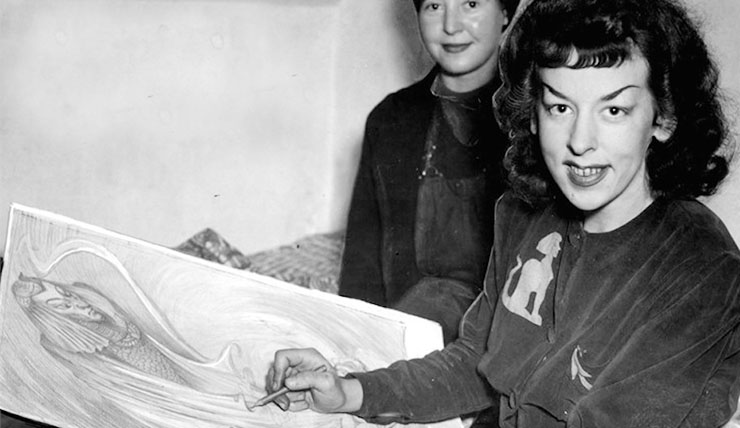
    Rosaleen Norton (1917-1979) has been described as Australia’s best known witch. She was a controversial and ‘colourful’ character in Sydney’s Kings Cross district during the 1950s and 1960s and was known to the public as an eccentric, bohemian witch-lady and artist. She wore flamboyant, brightly coloured blouses and vivid bandanas, puffed on an exotic engraved cigarette holder, and plucked her eyebrows so that they arched in a somewhat sinister curve. Norton also claimed certain distinctive body markings that she possessed were a sign that she was “born a witch.”

    Slight in build with curly black hair and a smile that revealed irregular teeth, Norton always had something of a magnetic presence that made her stand out in the crowd. The publication of her limited edition art book The Art of Rosaleen Norton in Sydney in 1952 – which also contained poems by her lover Gavin Greenlees – aroused considerable media controversy. Norton’s publisher and sponsor, Walter Glover, was charged in Sydney with releasing an obscene publication and copies sent to New York were confiscated and burnt by US Customs.

    During this period of extensive media publicity Rosaleen Norton became known in the public mind as an artist whose provocative paintings of half-human, half-animal forms were even more controversial than Norman Lindsay’s risqué nude figures. Norton depicted naked women wrestling with reptilian elementals or flying on the backs of winged griffins, gods who were both male and female, and demonic forms with menacing claw-tipped wings. During the 1950s Norton’s controversial paintings and drawings seemed to embody a deep-seated pagan impulse and ran counter to orthodox religious sensibilities.

    Norton’s Background

    Rosaleen Norton was born in Dunedin in 1917, the third of three sisters. Her father, Albert, was a captain in the merchant navy and a cousin of composer Vaughan Williams. The Nortons migrated from New Zealand in 1925 and settled in the Sydney suburb of Lindfield. As a teenager Norton was expelled from high school because of her allegedly “depraved nature” which her headmistress claimed “would corrupt the innocence of the other girls.” She then studied for two years at East Sydney Technical College under the sculptor Rayner Hoff. During this time she became interested in studying everything she could find about witchcraft, sorcery and magic and she was soon well versed in the occult writings of notable magical practitioners like Dion Fortune, Aleister Crowley and Eliphas Levi. In 1940, at the age of 23, she began to experiment with self-hypnosis as a means of inducing automatic drawing.

    Norton was already familiar with the trance methods of the Surrealists and especially admired the work of Salvador Dali and Yves Tanguy who, like the other artists in their movement, had explored techniques of encouraging the subconscious mind to manifest its visionary contents. Sometimes the surrealists drew rapidly so that forms came through unimpeded by the intellect. Others experimented with drugs or documented their dream experiences with great detail in order to develop a greater knowledge of the ‘alternative reality’ of the subconscious mind.

    Norton found that she could shut off her normal consciousness by means of self-hypnosis and could transfer her attention to an inner plane of awareness. As she noted in a lengthy interview conducted in an interview with the psychologist L.J. Murphy at the University of Melbourne in 1949: “These experiments [with self-hypnosis] produced a number of peculiar and unexpected results… and culminated in a period of extra-sensory perception, together with a prolonged series of symbolic visions.” Norton spent several years after this studying various systems of occult and mystical thought, including Buddhist and other examples of Eastern literature as well as standard works on Kabbalah, Theosophy and Western magic.

    During this period Norton also began to focus more specifically on the magical forces associated with the Great God Pan, whose spirit she felt pervaded the entire earth. Her studies had taught her that the ancient Greeks regarded Pan as lord of all things – symbolising the totality of the elements and all forms of manifest being. He was therefore, in a very real sense, the true god of the world. Pan was a maintainer of the balance of Nature and also had at his command an invisible hierarchy of lesser spirits who could help him in his work of ruling and sustaining the earth.

    Norton painted a large-scale interpretation of Pan, complete with horns, pointed ears, cloven hooves and musical pipes, and mounted it on the wall of her Kings Cross flat, where it effectively became the focal point of her magical altar. She also conducted magical ceremonies dressed in a tiger-skin robe to honour his presence, and would often experience him as a living reality when she entered a trance state. Meanwhile, her art continued to reflect the entities she encountered in her visions, including a variety of devilish creatures, half animal-half human pagan deities, and various supernatural motifs.

    The Gods, In Their Own Right

    Many occultists have drawn on Swiss psychoanalyst Carl Jung’s concept of the ‘collective unconscious’ to explain their relationship with the archetypal forces of the mind. Jung believed that at a deep, collective level of the psyche lay a rich and potent source of sacred archetypal imagery, and that these numinous forms provided the very basis of religious and mystical experience, irrespective of the cultural context involved. In other words, gods and sacred mystical images were really an extension of the universal human experience.

    A number of occultists have rejected this view, however, claiming instead that the gods live apart from the collective minds of humanity and are not merely projected ‘thought-forms’. Rosaleen Norton agreed with this latter perspective. For her, the gods existed in their own right. She believed she was able to encounter Pan, Hecate and Lucifer, not as extensions of her own consciousness, but as mythic beings from a higher plane of reality who would grace her with their presence if it pleased them, and not subject to her will. She believed she had discovered some of the qualities of these gods within her own temperament, and that this provided a sense of natural affinity. This made their invocation much easier and more effective than would have been the case had there not been some sort of innate bond. Norton maintained that she entered the realm of the gods on the astral planes – an inner world of spirit accessed through magical trance – and that on different occasions the gods would reveal different dimensions of their own magical potency.

    Rosaleen Norton regarded Lucifer, for example, not so much as an embodiment of ‘evil’ as humanity’s natural adversary. He bound and limited man when it appeared that he was growing too big for his boots. He tried to trick man, not out of malice but with the positive intent of exposing the limitations of the ego and revealing the essential falseness of man’s pride in his own existence. Rosaleen also regarded Pan as a very significant deity for the present day, a force in the universe which protected and conserved the natural beauty and resources of the environment. For her, Pan was alive and well in the anti-pollution lobbies and among the Friends of the Earth!

    Hecate, on the other hand, she felt to be more imposing – an often frightening, shadowy goddess flanked by cohorts of ghouls and night-forms, a dealer in death and a purveyor of curses. But there was a magical bond to be found here too. Norton regarded magic and witchcraft as her protection and an inspiration in a hostile, ungenerous world. However, her own brand of witchcraft hardly brought her abundance. She lived simply, with few possessions, and certainly without any measure of wealth. If ever she cursed people with “witch current,” she said, it was a means of redressing the balance of events – a legitimate use of the magical art.

    Rosaleen Norton’s paintings show a certain similarity of style to those of Norman Lindsay, for whom she occasionally posed as an artist’s model. But while for Lindsay the world of the supernatural could only offer decadent and exotic themes for his art-making, for Norton this realm was a perceptual reality – and this is very much reflected in her work. There are fire elementals, ablaze with light; devils with dual banks of eyes, indicative of their different planes of perception; cats with magical awareness; horned beings with sensual cheeks and a strange eerie light playing on their brow.

    Norton maintained that her art arose as the result of the direct magical encounter. Energies filtered through her, she said, as if she were a funnel. She transmitted the current during a state of self-induced hypnotic trance. If the gods were alive in her, her artistic skills would then allow these gods to manifest, in varying degrees, in her drawings and upon her canvases. Norton always denied that she portrayed the totality of the god. She could depict only those qualities the god chose to show. The gods existed in their own right, on a plane far removed from the everyday world of human consciousness – but were directly accessible to her through her techniques of magical trance.
    Was Norton a Satanist?

    During her colourful career as the ‘Witch of Kings Cross’ Rosaleen Norton was frequently accused of being a Satanist. When she exhibited her paintings and drawings at the Apollyon and Kashmir coffee-shops in Kings Cross during the 1950s, both locations were described in the tabloid press as the haunt of the “Devil’s cult” and on occasions visitors to these coffee-shops would mischievously request a cup of “bat’s blood.”

    When New Zealand migrant Anna Hoffmann claimed in September 1955 that she had attended a Black Mass with Norton in Kings Cross, the story was featured with sensationalist headlines on page one of a daily newspaper. Even though Hoffmann’s charges were later found to be fabrications and Hoffmann herself was jailed for two months and described as a “menace” by the presiding magistrate, the image of Norton as a ‘Satanist’ or ‘Devil-worshipper’ persisted during the 1950s, and even up into more recent times. For her own part, Norton went to great lengths, both during media interviews and sometimes also during various court proceedings, to explain that the “horned god” Pan was a pagan deity from the tradition of ancient Greek mythology and that her practice of witchcraft had no connection with the Christian Devil. Nevertheless, it is easy to see how members of the public may have misconstrued Norton’s occult imagery in the conservative social climate of post-World War Two Australia.

    Norton was unquestionably drawn to the ‘night’ side of the psyche and she herself described her art in those terms. Black Magic, one of several controversial artworks exhibited at the University of Melbourne in 1949, and against which charges of obscenity were subsequently brought, could certainly cause offence to any practising Christian, with its imagery of bestial lust, a winking nun, and a bare-breasted woman mounted on a crucifix. However, while many of Norton’s paintings and drawings feature provocative and irreverent subject matter, it is quite another matter to assume they promote a Satanic perspective.

    When Norton was accused in the popular media of overseeing blood-sacrifice rituals during a “Kings Cross Black Mass” she was both upset and offended by the remarks. Norton had always had a strong affinity with Nature, and with animals in particular, since her early childhood. As visitors to her apartment invariably attested, Norton was always accompanied by numerous pets, including cats, lizards, frogs, turtles and mice, and she always maintained that she would never cause animals harm. The very notion of ritualistic, Satanic ‘blood sacrifice’ was completely abhorrent to her. The evidence provided by her own artistic work and comments made to the popular press and in journalistic articles strongly suggests that while Norton was unquestionably both pagan and “heathen,” and often provocative in her presentation of “images of the night,” she was not a practising Satanist in the literal sense. Her witchcraft cult in Kings Cross included altars dedicated specifically to Pan and Hecate, and her coven rituals made no reference to the Christian Devil.

    So how can we sum up the magical personality of the ‘Witch of Kings Cross’? Rosaleen Norton was a colourful bohemian eccentric, a gifted trance-magician and a controversial visionary artist who developed her occult persona during a conservative period of Australian history when the populace at large was unsympathetic to the pagan beliefs she espoused. Most did not understand her ritual homage to the Great God Pan and branded her simplistically as a Devil-worshipper – a distortion of her actual perspective. When Norton’s limited edition art book was withdrawn from sale in 1952 on a charge of obscenity it was only allowed back into the marketplace when two “offending” erotic magical images had been blacked out. So Rosaleen Norton can be seen as a perennial ‘occult outsider’, an urban misfit in post-War Sydney. Nevertheless, she remains one of Australia’s most significant esoteric figures and can be considered a precursor of the more recent worldwide neo-pagan revival. She was also a competent mystical poet. Norton regarded the following poem, Dance of Life, as an expression of her personal magical credo:

    In the spiral horns of the Ram,

    In the deep ascent of midnight,

    In the dance of atoms weaving the planes of matter is Life.

    Life spins on the dream of a planet,

    Life leaps in the lithe precision of the cat,

    Life flames in the thousandth Name,

    Life laughs in the thing that is ‘I’.

    I live in the green blood of the forest,

    I live in the white fire of Powers,

    I live in the scarlet blossom of Magic,

    I live.

    [alert type=”general” dismiss=”no”]This article was published in New Dawn Special Issue 3.[/alert]

    [alert type=”success” dismiss=”no”]If you appreciate this article, please consider subscribing to help maintain this website.[/alert]

    © New Dawn Magazine and the respective author.
    For our reproduction notice, click here.
  • Awakening Your Psychic Powers: An Interview with Kurt Leland

    Awakening Your Psychic Powers: An Interview with Kurt Leland

    This article was published in New Dawn Special Issue Vol 10 No 3 (October 2016)

    Kurt Leland is one of today’s most intrepid explorers of the inner planes. A musician and author as well as a visionary, he has written books including Otherwhere: A Field Guide to Nonphysical Reality for the Out-of-Body Traveler and The Multidimensional Human. His latest work is Invisible Worlds: Annie Besant on Psychic and Spiritual Development (Quest Books, 2013). It is an anthology of writings by the Theosophist Annie Besant (1847–1933). Kurt’s website is www.KurtLeland.com.

    I met Kurt during his visit to the Theosophical Society’s American headquarters in Wheaton, Illinois, in the fall of 2011. I was immediately impressed with the depth of his knowledge of, and experience in, the astral and mental realms, which are for most people little more than vaguely understood concepts. He is one of the most lucid and intelligent writers on the inner planes working today. The following conversation was conducted by e-mail in April 2016.

    RICHARD SMOLEY (RS): A lot of people these days are interested in developing their psychic powers. What advice would you give them?

    KURT LELAND (KL): The mind tends to conceptualise a term such as psychic powers, thinking of them as something other than normal, from an unknown realm or level of being – something to be afraid of or acquired by force of will or perpetual practice. Typically such powers come under headings such as telepathy, precognition, clairvoyance (seeing auras), second sight (perceiving ghosts), remote viewing, astral travel, even magical influence over people and events. Some people want to prove to themselves and others that such things are possible and they can do them, not once only (spontaneously or by accident) but regularly (at will or on demand).

    However, I think of psychic powers as the natural concomitant of living within and evolving our subtle bodies:

    An etheric body, having to do with life force and health and offering us the ability to perceive such things as nature spirits, fairies, the recently dead, even angels, as well as to sense events hours or days before they occur;

    An astral body, having to do with desire and emotion, and allowing us to experience our dreams and visit the dead in the afterlife;

    A mental body, having to do with our thoughts and beliefs and allowing us to perceive and travel within a world of ideas and sometimes to contact and learn from them; worldviews of famous dead people;

    A causal or soul body, allowing us to know our past lives, meld minds with others, and perceive and alter the forces in play that create the events of our present life;

    And other bodies whose abilities are less easy to describe.

    My advice to people who want to develop so-called psychic powers is not to target specific name-brand abilities, but rather to develop the subtle bodies and see what shows up. The will- and proof-based approach often leads to frustration and feelings of failure. The approach of developing the special senses of subtle bodies can unfold naturally and organically and enrich our lives with a multitude of adventures in consciousness we may never have heard of before.

    For example, one of my first psychic experiences was sensing the fear of a tree in a wooded area in my neighbourhood after I’d climbed it. At seventeen, I didn’t know trees could feel fear, and I didn’t know this was a psychic experience – until I went back to climb the tree a few days later and it was no longer there, having been bulldozed down to clear the land for a new house. That was an etheric-body experience, not one that could be easily sought after or named or conceptualised. It just showed up, indicating a possible avenue to explore, and gradually developed into a more or less constant, wonderfully enriching awareness of the beingness and inner life of trees.

    RS: How did you develop your own abilities?

    KL: My grandfather on my mother’s side introduced me to the writings of the famous American psychic Edgar Cayce when I was ten or eleven years old. My grandfather knew how to read palms and had some predictive ability, but renounced palm reading when he accurately predicted the age of onset of a serious illness in one of my aunts. Though he taught me the mechanics of palm reading, I can’t say I had any notable psychic experiences when I was a child – yet, after reading about Cayce, I desperately wished for such experiences.

    It wasn’t until I met a woman in college who was a natural psychic from birth that I began regularly having experiences of my own. She had recurring dreams that came true, including dreams about meeting me before we both arrived on campus in the fall of 1976. She knew when people close to her had died, scolding her mother for withholding the information so as not to bother her at school. We developed a telepathic rapport that climaxed with my inventing a place in my imagination that she could see and describe back to me. Whenever I added anything to it, she could tell me what it was. Somehow in the process of hanging out with her, my own abilities began to develop. She had nothing to teach me, she knew nothing about how her abilities worked. Yet somehow my being near her opened up new possibilities for me. Now I understand she was awake and aware within, and could use the senses of a subtle body I had little or no access to – perhaps the etheric body – and that her being awake in that body somehow stimulated mine.

    Otherwise, I’ve never had a formal teacher. I learned much from books, especially the Seth material channelled by the American medium Jane Roberts. When I began to experiment with the Ouija board and automatic writing in the fall of 1980, there was no evidence that I had any talent for such things. Yet I was persistent. It was as if I never stopped knocking on the door, and finally someone let me in. I met my inner teacher by means of these experiments about six months later.

    It certainly seems that my college friend represented nature and I represented nurture. But using the Theosophical framework of subtle bodies, there may be another explanation that encompasses both the notion of being born psychic and that of developing psychic abilities. If we’ve developed any of our subtle bodies in a past life to the point of being able to use their inner senses for clairvoyant (seeing) or projective (travelling) abilities, then we can carry those capacities with us into a subsequent life. The real issue is how soon we recall and realise them – a process I call self-remembering. By this light, my friend self-remembered her use of the etheric body very early and therefore seemed to be a born psychic, whereas I self-remembered my use of this body much later and seemed to develop psychic abilities.

    To extrapolate from this, any spontaneous psychic experience may indicate the possibility of self-remembering the use of a particular body, as in my case with the fearful tree. The challenge is not so much developing psychic powers as finding a way to recall the proper use of one or more of our subtle bodies. Even so, there may be a leading edge of our growth – a body we haven’t mastered yet, which challenges us to develop new inner-sense abilities and the powers of awareness and action within that body.

    RS: Why would you say people today feel so distant from the unseen, subtle levels?

    KL: They’re locked in their mental bodies, a result of family and social conditioning along the lines of scientific materialism, rationality, scepticism, and agnosticism. An overdeveloped mental body is like an overdeveloped physical body – it’s muscle-bound; the focus on increasing size and strength (mathematical, linguistic, and reasoning abilities) has reduced its flexibility or receptivity. The result is alienation from the physical and emotional bodies on one side and from the soul or causal body on the other. The mental body becomes like a fearful teenager hiding in his or her bedroom, with thoughts speeded up through overstimulation by social media, electronic devices, and computer games, and dominated by what one spiritual teacher calls “the tyranny of likes and dislikes.” This results in anxiety, indecisiveness, and black-and-white thinking. To the mental body isolated in this way, the physical body seems bent on betraying us, there’s no soul to guide us, and the whole purpose of life seems to be managing our anxiety.

    The physical body needs quality sense experience – exercise, healthy food, beautiful surroundings, bare feet on the grass or beach, a tempered yet satisfying sex life. The emotional body needs authentic heart-to-heart connection with others. The mental body needs the experience of a community of others who share our beliefs and values. The causal body needs a sense of usefulness and purpose, usually along the line of service to humanity. When the subtle bodies are nurtured in these ways, the boundaries between them soften and we start using them for more than we normally do (acting, feeling, thinking, and serving). That’s when our spiritual powers begin to unfold. We start seeing with the eyes of each body, its inner senses, providing new ways of looking at the world we normally experience and glimpses of the invisible worlds beyond. Eventually we learn to travel in those worlds.

    [alert type=”info” dismiss=”no”]If you appreciate this article, please consider a subscription to New Dawn magazine.[/alert]

    RS: One major issue with psychic powers is self-delusion. You see something uncanny, either visually or with the mind. It seems real. But sometimes it isn’t. How does a person develop discrimination with such things?

    KL: There are many tests and challenges in developing accurate perception from the perspective of each subtle body. I’ve experienced them as a graded course set up by inner teachers and guides, unfolding in projections from the dream state over decades. One example would be learning to identify the same guide under different appearances. Another would be learning the difference in inner-sense impressions associated with a dream character, a deceased individual, a guide, a nonhuman entity, and so on.

    In Invisible Worlds, my anthology of Annie Besant’s Theosophical writings on psychic and spiritual development, she says that the more excited you are about what you’ve perceived, the less likely it is to be real – for example, seeming to receive a mission from some high being. A real experience of receiving such a mission would come with a sobering sense of responsibility and self-examination about what might be required and how to achieve it, not an orgy of self-congratulation over one’s putative spiritual status. 

    RS: Another area of interest is astral travel – the ability to go out of the body in a trance state. Could you start by telling us a bit about this?

    KL: I’m interested in your use of the phrase trance state. Some people may project in that way. My adventures along these lines generally begin from a dream.

    In its simplest form, astral projection is an out-of-body experience in which the etheric body separates from the physical body in a twilight state between waking and sleeping, often accompanied by so-called sleep paralysis (indicating that one’s consciousness is no longer primarily focused in the physical body and so can’t control its movements), a loud vibration during separation, and the ability to view the physical body from a vantage point several inches or feet away. Such experiences are often spontaneous rather than intentionally produced, as a trance state would be.

    Some people report that they can free up a higher body, such as the astral, mental, or causal body, through meditative states, and go travelling on the physical plane or some higher plane. I suppose an intentionally produced trance state, as by self-hypnosis, would be just as effective. But it seems to me that the actual mechanism of so-called astral travel is that we shift the focus of our consciousness from one layer of our energy field (aura) to another. Each layer is actually one of our subtle bodies. When such a shift is successful, we can perceive the plane associated with that body and perhaps travel on that plane. Thus the word astral in the term astral travel is used in a general way to describe any experience in a nonphysical body.

    For most people, the hope or aim is to travel in the astral body on the physical plane to distant places or people. A related ability is remote viewing, which places you on location without the sense of travel. I suppose the only difference between projection and travel is that the first term emphasises the act of leaving the location of the physical body and the other only the experience away from the physical body. Not everyone recalls the actual exit from or return to the physical body. In the case of shifting the focus of consciousness to a different layer of the energy field, there may be no sense of exit or travel from one plane or location to another. You’re just there, wherever it is. 

    RS: Is it a good idea to learn to do astral travel?

    KL: I believe astral travel to be an inevitable outcome of the process of developing our subtle bodies. First, we have what Besant calls a sheath. It allows us to act at the physical, feel in the emotional, think in the mental, and serve in the causal levels of being. Then we develop a body, which begins to perceive on the physical, astral, or mental planes. We all have a well-developed physical body in that sense. Our dreams indicate that we have an astral body capable of perceiving on the astral plane. Mental and causal body dreams are less common. Finally, we develop a vehicle of consciousness, capable not only of perceiving, but also of moving through every level of the physical, astral, mental, or some higher plane. Lucid dreamers and people who can project on the astral plane, knowing the difference between dream characters and locations and the actual scenes, dwellers, and phenomena of the astral plane, are developing the astral body as a vehicle of consciousness.

    My first projections took place when I was fourteen. They terrified me and I avoided them for several years. Subsequently, I learned to develop my etheric, astral, and mental bodies under the guidance of teachers encountered in such projections. Forty-five years later, I think it safe to say that I have fully functional vehicles of consciousness on the physical, astral, and mental planes.

    RS: Whom would you advise not to undergo psychic development?

    KL: Anyone who is anxious, depressed, or prone to exaggerated states of enthusiasm or elation or to obsessive or addictive behaviour. These indicate strains in the relationship between the bodies and the occupying consciousness that we call ourselves. Such strains need to be overcome (along the lines recommended in connection with what our bodies need) before psychic development can be pursued safely.

    The problem with anxieties and fears is that they attract what we’re afraid of, resulting in interactions with undesirable scenes, dwellers, and phenomena of the astral plane. Undesirable interactions may also occur with depression. The problem with enthusiasm or elation is that it makes everything we experience seem more glamorous than it really is, resulting in self-deception or deception by prankish or malevolent astral entities. Obsessive or addictive behaviour can result in our coming under the control of negative entities, as in possession.

    In the end, each of these situations is nothing more than a challenge to be overcome in the development of the bodies. We need to learn how to maintain a balanced, clear-headed perspective as we investigate the possibilities of these bodies. The real shame is when we do so prematurely and frighten ourselves off from further exploration because some passing mood has distorted our perception or attracted unpleasant experiences or made us seem foolish to ourselves or others.

    RS: Is there a connection between the astral level and the post-mortem state?

    KL: I like to think of the astral plane as comprising a number of realms or zones. One such realm is the astral Dream Zone, where our dreams ordinarily take place. Another is the astral Afterdeath Zone, where the initial stages of our journey through the afterlife take place. I’ve explored both realms for many years in projections from the dream state. They’re similar in that their primary function is dealing with emotions and desires. Dreams frequently allow us to satisfy our unfulfilled desires and experience our unexpressed emotions, such as fear, lust or anger. We purge such things through our dreams so we don’t have to act them out on the physical plane. In the astral stage of the afterlife, we perform similar purges of a lifelong accumulation of unfulfilled desires and unexpressed emotions, thus rising from darker to lighter experiences of this realm, as in the Catholic notion of purgatory.

    On the mental plane, there is also a Dream Zone and an Afterdeath Zone. These realms involve exploring our lives in terms of learning and growth – what we have or haven’t learned among the lessons our soul may have intended for us. They’re full of exciting opportunities for exposure to the world’s great minds and cultural achievements. For example, I once visited an area in which it was possible to experience any opera from the vantage point of each of its characters. In the mental Afterdeath Zone, we review our life on earth and fulfil the plans for learning and growth that we were blocked from implementing there, because of lack of courage or extenuating circumstances. This can be a joyful, even heavenly experience.

    RS: Can you contact dead people through psychic means?

    KL: I believe this is possible and I’ve experienced it, though not in the way most people expect. I don’t ordinarily perceive people who have passed on in the auras of others or as ghostly presences hanging about with a desire to give messages. Nor do I go into a trance state so that others can communicate through me with people who have died. When I channel, the being who works through me is almost exclusively the inner teacher I call Charles. I suppose he could be described as a dead person, since as far as I know he’s not currently embodied on the physical plane.

    But I think you mean dead relatives and friends. My interactions with the latter take place in astral projections, usually from the dream state. I visit them in situ, wherever they may be in their progression through the afterlife, from the death of the current body to their preparation for reincarnation. Usually these are people I have a close association with.

    For example, I tracked the afterlife progress of one of my uncles through several stages over a course of eight years – his orientation to the afterlife, the beginning and completion of his long and detailed life review, and his being informed of certain lessons to be learned in his next life just prior to rebirth. Though I observed my uncle without communicating with him, others among the dead have shared with me their thoughts and feelings about their earth life and post-mortem existence. One was a counselling client who died of a reaction between prescription and recreational drugs and was passing through a rehabilitation program on the Other Side because his death had been classified as an unpremeditated suicide.

    I’ve rarely gone looking for people whom I’ve never met at someone else’s request – though Charles has sometimes commented on the progress of a client’s deceased loved one through the afterlife. This is not my favourite kind of work, since some elements of the afterlife can seem distressing to people who think only in terms of happiness in heaven

    RS: Why is so much of society today dead set against believing in the existence of the psychic realms? 

    KL: Religious teachings in many cultures indicate that such things are at best distractions on the spiritual path and at worst the product of malevolent beings such as the Christian devil. Scientific materialism has persuaded us that psychic realms, spiritual paths, malevolent beings, and the devil are nothing but superstitions. Yet I believe such things are what the Buddha called views. The point isn’t to dismiss one view in favour of another, but to try each on for size, to meditate on it, and investigate and explore where it takes us, what it does for us.

    The scientific view that the physical body is a machine that gradually wears out and needs to be ‘fixed’ by an ever-expanding medicine chest of only partially effective remedies isn’t terribly hopeful or inspiring, though it provides the opportunity to explore the function and dysfunction of body parts in relation to each other, time, and illness. The metaphysical view that the body is a conscious entity that needs care, that it could be our friend, that we might have ways of learning from and dialoguing with it, is unprovable in scientific terms, but can yield favourable results when explored as a provisional belief or object of meditation, to be lived as if it were true to see where it takes us. Notions of an etheric, astral, mental, or causal body could be treated in the same way.

    RS: One of your books is called The Multidimensional Human. In what ways are we multidimensional?

    KL: I believe reality consists in as many descriptions of it (views) as we have tolerance for. Each view opens up new possibilities for exploration – new dimensions – and none absolutely excludes another. I’ve gotten the best results in my personal exploration of psychic and spiritual development by adopting the Theosophical view of multiple bodies, each fitted to a particular plane of existence by a specialised set of inner senses that carry us from sheath to body to vehicle of consciousness. The planes themselves are ranged along a continuum of human potential from lowest physical to highest spiritual, and each body and its corresponding level of being is an adventuresome dimension to be explored as we develop our multidimensional humanity – our ability to respond appropriately to each other and to other realms and beings for the mutual benefit of all.

    Kurt Leland’s Spiritual Orienteering website is www.KurtLeland.com, which lists his books and services.

    [alert type=”success” dismiss=”no”]If you appreciate this article, please consider subscribing to help maintain this website.[/alert]

    © New Dawn Magazine and the respective author.
    For our reproduction notice, click here.
  • The Amazing Story of the Clairvoyants Who Observed Atoms

    The Amazing Story of the Clairvoyants Who Observed Atoms

    From New Dawn Special Issue Vol 6 No 4 (Aug 2012)

    In few, if any, science textbooks or records of Nobel laureates will you find the name of a bona fide and publicly acknowledged occultist or clairvoyant. This, however, is not because such individuals never contributed anything to the history of science. On the contrary, it is due to a profound hubris and acute myopia within the institution of Science that talented metaphysical pioneers have not been credited with scientific discoveries and insights that were ahead of their time. In this material, excerpted from Chapter 6 of my book The Grand Illusion (Vol. 1), we hone in on the startling work of two such metaphysicists in particular.

    Occult Chemistry: Leadbeater and Besant

    From 1895 to 1933, Annie Besant (1847-1933) and Charles Leadbeater (1854-1934), two of the best known theosophists and metaphysicians of the 20th century, conducted clairvoyant investigations into all of the then known elements and certain compounds in order to observe the so-called “fundamental building blocks” that composed them, as well as their general structure. This involved the apprehension of visual information at sub-microscopic levels far beyond the ability of the eyes to perceive. The term for this kind of clairvoyant perception today is micro-psi (Besant and Leadbeater referred to it as “magnifying clairvoyance”).

    The initial investigations were collected and published in the first edition of Occult Chemistry in 1908 (the book was subtitled Investigations by Clairvoyant Magnification into the Structure of the Atoms of the Periodic Table and Some Compounds). A second edition of the 1908 material was issued in 1919. The sum total of Besant and Leadbeater’s clairvoyant observations of the chemical elements were collected and published posthumously in a third edition of Occult Chemistry in 1951.

    An article entitled “Occult Chemistry” appeared in the Theosophical publication Lucifer in 1895 (the year Leadbeater and Besant began their collaboration) and was reprinted as a separate pamphlet in 1905. In it, three chemical elements, hydrogen, nitrogen, and oxygen, were clairvoyantly examined and their analyses presented tentatively to the public by Besant and Leadbeater.

    Hydrogen, the first chemical atom selected for analysis, and possessing the lowest atomic weight, was found to be composed of eighteen smaller entities. Clairvoyantly it was seen to consist of six small bodies, contained in an egg-like form. According to Leadbeater/Besant, it rotated with great rapidity on its own axis, vibrating at the same time, and the internal bodies performed similar gyrations. “The whole atom spins and quivers, and has to be steadied before exact observation is possible,” they wrote.

    The six little bodies are arranged in two sets of three, forming two triangles that are not interchangeable. Further, the six bodies are not all alike; they each contain three smaller bodies – each of these being an ultimate physical atom – but in two of them the three atoms are arranged in a line, while in the remaining four they are arranged in a triangle.1

    The Ultimate Physical Atom (UPA)

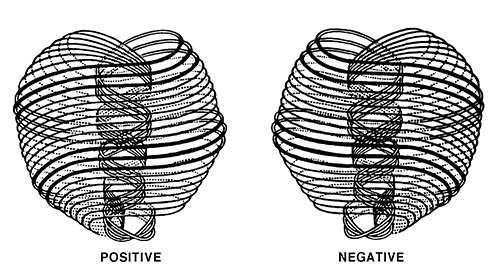
    Figure 1. The hydrogen “micro-psi atom.” The UPAs are the heart-shaped objects designated a plus or minus sign denoting either an inflow (minus) or outflow (plus) of energy. Stephen M. Phillips argues that each triangle is a single hydrogen nuclei and that the micro-psi observation has somehow bonded two together. The mid-sized circles are therefore quarks, and the heart-shaped entities sub-quarks. (Source: Occult Chemistry by Annie Besant and C.W. Leadbeater.)
    Figure 1. The hydrogen “micro-psi atom.” The UPAs are the heart-shaped objects designated a plus or minus sign denoting either an inflow (minus) or outflow (plus) of energy. Stephen M. Phillips argues that each triangle is a single hydrogen nuclei and that the micro-psi observation has somehow bonded two together. The mid-sized circles are therefore quarks, and the heart-shaped entities sub-quarks. (Source: Occult Chemistry by Annie Besant and C.W. Leadbeater.)

    As noted, in 1895 – when physical atoms were still thought to be the most basic unit of matter – Leadbeater and Besant observed in the early stages of their investigation that hydrogen was not a unity but was composed of eighteen smaller units. These smaller units they dubbed an “ultimate physical atom” (UPA), and later took to referring to them as “Anu” (singular and plural) – the Sanskrit term for this new entity. They had no way to determine the exact size of the UPA but they found it existed in two varieties: positive and negative (or Yin and Yang). The positive and negative aspects wound around each other in opposite directions (somewhat like the snakes on the caduceus, or the helical structure of DNA), forming the UPA.2

    According to Besant and Leadbeater, the UPA was a very complex entity, with only its main characteristics provided in their diagram. “It is composed entirely of spirals, the spiral being in its turn composed of spirillae, and these again of minuter spirillae.”3 In addition to this reference to the subatomic fractality of “matter,” they correctly declared that the Anu was definitely not the electron. The spirals composing the UPA, if unwound, would actually be found to be circles or strings – twisted around on themselves many times to create the helical form depicted.

    Oxygen was found to consist of 290 minor atoms and nitrogen of 261. Now, this is where it gets even more interesting. When Besant and Leadbeater divided the number of UPAs in oxygen by the number of UPAs comprising hydrogen (18), they arrived at 16.11, almost exactly the atomic weight of the oxygen atom (16). This procedure yielded the same precision with nitrogen, an even more complex structure than oxygen, and therefore much more challenging to apprehend clairvoyantly for the occultists. In fact, this uncanny precision continued right through the entire table of known elements of the time (minor human counting errors notwithstanding).

    Although science had not identified such a thing as the ultimate physical atom, Besant and Leadbeater had identified this tiny entity as comprising physical atoms. Moreover, by using hydrogen as the standard (being the first element in the periodic table – itself being composed of eighteen UPA), they were able to ascertain the atomic weight of the elements by dividing the number of UPA they observed by eighteen. Should Besant and Leadbeater have been merely “delusional cranks,” we should not expect this kind of amazing result.

    As a matter of fact, this ability to deduce the accepted atomic weights of the elements from the number of UPAs they observed was the only thing Occult Chemistry had in common with the chemistry of 1895.4

    Noteworthy is the way the UPA was depicted by Leadbeater/Besant as being created by an upwelling of force from a higher-dimensional source – just as in the hyperdimensional physics advocated by Paul LaViolette, David Wilcock, Richard Hoagland, and others researching aether physics. (Those readers interested in the notion of an aetheric medium and its false elimination from mainstream science are referred to in my The Grand Illusion 1.) The models of physics on the cutting edge have been left with no choice but to incorporate other dimensions or ‘levels’ of reality to account for today’s scientifically observable phenomena. Furthermore, Leadbeater and Besant’s clairvoyant analysis provides intimate and detailed verification of the hyperdimensional torsion and/or spin forces embedded in the ‘aether’, which I write about extensively in The Grand Illusion 1.
    [alert type=”info” dismiss=”no”]If you appreciate this article, please consider a subscription to New Dawn magazine.[/alert]

    How They Arrived at the UPA

    Leadbeater and Besant explained: “Any gaseous chemical atom may be dissociated into less complicated bodies; these, again, into still less complicated… [T]he fourth dissociation gives the ultimate physical atom. This may vanish from the physical plane, but it can undergo no further dissociation on it.”5 (emphasis added)

    Note that in their description of the UPA is a hint of multidimensional behaviour (this becomes relevant shortly). Interestingly, in 1888, the co-founder of Theosophy (it was founded in 1875), Helena P. Blavatsky, pre-empting Leadbeater and Besant by at least seven years, explained in The Secret Doctrine that on the next higher plane (etheric), what then-current science considered an undecomposable unity would – to higher perception – prove very complex. Water, for example would feature “many other constituents” besides just hydrogen and oxygen.

    As theosophists, Leadbeater and Besant would have anticipated the composition of the elements they clairvoyantly inspected (having obtained some hard-to-get samples via Sir William Crookes) to be much more complex than scientists of their time believed. They were right.

    Believe it or not, there appears to have been another earlier clairvoyant ahead of the game. At a time when Isaac Newton (a Hermeticist, though not clairvoyant) was arguing that matter was composed of impenetrable atoms given motion by outside forces, Emmanuel Swedenborg taught that matter was made up of a series of particles in ascending order of size, each of which was composed of a closed vortex of energy which spiralled at infinite speeds to give the appearance of solidity.6

    Two types of UPAs were observed by Besant and Leadbeater (see Figure 2), and they were identical in every way except “the direction of their whorls and of the force which pours through them. In the one case force pours in from the ‘outside,’ from fourth-dimensional space, and passing through the atom, pours into the physical world [‘male’]. In the second, it pours in from the physical world, and out through the atom into the ‘outside’ again, i.e., vanishes from the physical world.”7 (This was the “female” UPA.)

    Figure 2: The Two Types of Ultimate Physical Atoms, Male and Female (Source: Occult Chemistry by Annie Besant and C.W. Leadbeater)
    Figure 2: The Two Types of Ultimate Physical Atoms, Male and Female (Source: Occult Chemistry by Annie Besant and C.W. Leadbeater)

    In agreement with present-day aether researcher Paul LaViolette, David Yurth states in Seeing Past the Edge that these two opposite or mirror image particles constitute what we now refer to as matter and anti-matter states.8 This makes sense in light of Leadbeater and Besant’s comments that the positive/male UPA flows its creative energy outwards into our reality while the negative/female (anti-matter) counterpart transmutes energy from our reality back into the aether.

    Leadbeater and Besant said that if the higher-dimensional energy flow was stopped even momentarily, the whole manifest universe would disappear, “as a cloud melts away in the empyrean. It is only the persistence of that flow which maintains the physical basis of the universe.”9 LaViolette (among many others) has vindicated our two eminent occultists on this point, agreeing that without this constant flow,

    the subatomic particles and energy waves composing our physical universe would gradually dissipate, disolving [sic] into a state of uniformity. What would remain would be the ever-present, vast, and unfathomable multi-dimensional consciousness, of which we are a part, and whose now featureless calm “surface” had once generated our beautiful physical universe.10

    Physicist Nassim Haramein also supports this view, stating that, “without spin, none of reality can come to exist. All things spin!” Haramein agrees that “spin is fundamental to creation and objects that appear to be inanimate exist solely because spinning atoms within allow the objects to radiate, and hence, appear in our reality.”11 How did Leadbeater and Besant (and Swedenborg) know with such certainty so far in advance of science that our “physical” world’s source of origin is the aetheric medium’s spin dynamics?

    Besant and Leadbeater described the ultimate physical atom as a sphere, slightly flattened, with a depression at the point where the force flows in, causing a “heart-like” form. “Each atom is surrounded by a field,” they wrote, “formed of the atoms of the four higher planes, which surround and interpenetrate it.”12 If this is accurate, then etheric, astral and mental particles are of increasingly large size (physicists are searching for these “super particles” without realising they have already been quietly discovered).

    Leadbeater and Besant’s depiction of the UPA was fundamentally toroidal and way ahead of their time: “It turns incessantly upon its own axis, spinning like a top; it describes a small circle with its axis, as though the axis of the spinning top moved in a small circle; it has a regular pulsation, a contraction and expansion, like the pulsation of the heart.”13 Spin was first proposed in physics thirty years later by Goudsmit and Uhlenbeck in 1925 and was confirmed in electrons by Phipps and Taylor in 1927. The circular precessional motion described by the axis of the spinning UPA would later become known in physics as Larmor precession. Though the expansion and contraction (radial pulsation) described by Leadbeater and Besant is still unknown to physicists today, LaViolette points out that this description is quite plausible in the context of the ancient aether physics.14

    The UPA’s spinning motion is common to globules in complex plasmas,15 and as we see in Chapter 9 of The Grand Illusion, many of Leadbeaters’ and other metaphysicists’ clairvoyant observations can be accounted for in light of plasma dynamics. For instance, when exposed to an electric current the UPAs, as depicted by Besant and Leadbeater in 1919, arranged themselves in physical rows of “particle chains” – just like globules in complex plasma, as illustrated by A. Piel et al.16 In this UPA formation the depression of one UPA receives the aetheric flow of its neighbouring particle and then passes it out through its own apex, and so on.

    In Occult Chemistry Leadbeater refers to the UPA as having a certain level of apparent consciousness, and our best occultists and mystics (and scientists) all seem to agree that the universe is indeed conscious at all levels. It is interesting, as Jay Alfred points out, that David Bohm’s research into plasmas yielded the observation that electrons in a plasma configuration began to act as if they were part of a larger, interconnected whole, so much so that he frequently had the impression that the electron sea was “alive.” Mircea Sanduloviciu and colleagues have even created plasma spheres that can grow, replicate and communicate, fulfilling most traditional requirements for biological/living cells.17

    The links between consciousness and the spiralling energy inherent in the multidimensional fabric of the cosmos are increasingly being elaborated on by modern science. It is interesting to note some of the parallels between modern toroidal models and the fundamentally toroidal model Besant and Leadbeater described during their clairvoyant investigations. While Wilcock states that the aether’s substance naturally forms itself into a spherical formation because of the near-uniformity of the aetheric pressure on all sides, as well as the fact that it is the most ‘harmonic’ shape, he acknowledges that changing energy densities in the aether can cause these spheres to warp to some extent. For instance, they may stretch and flatten to create a donut-like shape, otherwise known as the torus, a model employed by Wilcock, Haramein18 and string theory.

    Occultists’ Vindication Arrives Via Dr. Phillips

    In the late 1970s Stephen Phillips, then a physics graduate student at the University of California, happened across some of the diagrams from Occult Chemistry. Contrary to what we might expect of most physicists, he took a serious interest in the material, and the end result was a major technical validation of the data obtained by Leadbeater and Besant.

    Dr. Phillips discovered that “Besant and Leadbeater’s clairvoyant descriptions of the chemical elements are completely consistent with the Quark, Quantum Chromodynamic and Super-String theories of modern subatomic physics.”19 This he detailed in depth in his 1980 book The Extra-Sensory Perception of Quarks, in which Phillips reconciled Occult Chemistry with modern physics. Because of his work, “Occult Chemistry now stands as a glittering testimony to the validity of Besant and Leadbeater’s claims.”20

    To clarify, a UPA’s ‘whorls’ are the ‘strings’ of modern string theory. Phillips suggests, based on comparisons between the occultists’ whorls and the ‘strings’ of string theory, that “[a] whorl is a closed, 26-dimensional, bosonic string (the reported presence of spherical ‘bubbles in koilon’ in 7th-order spirillae imply that whorls extend beyond the sixth, compactified dimension, so that they must be 26-, not 10-, dimensional strings,)” and also that “[t]he UPA is a subquark state of a superstring composed of ten strings, i.e. the superstring is itself a composite object.”21

    Thus, Phillips has reinterpreted Besant and Leadbeater’s observations to be not those of atoms, but of subquarks and quarks. The notion of quarks was only introduced into modern physics decades later in 1964 by Gell-Mann and Zweig.22 Quarks are the building blocks of so-called ‘elementary’ particles, and are generally accepted as existing by the scientific community today.

    However, Phillips’ model is actually a subquark (or composite quark) model. In it subquarks make up quarks, quarks make up elementary particles (protons, etc.), elementary particles make up atoms, and so on. Thus, Phillips has identified the UPAs as subquarks, and, as Donald DeGracia reports in Beyond the Physical: A Synthesis of Science and Occultism, he calls his subquarks “omegons” to indicate they are the final and smallest form of physical matter (omega is the final letter of the Greek alphabet). Phillips shows, through rigorous quantitative procedures, that “the sub-quark combinations predicted by his model are almost in exact agreement with the detailed structures presented by Besant and Leadbeater.”23 He has successfully correlated the structure of the UPA with superstring models: the UPA itself is the ‘superstring’ of modern subatomic physics.

    However, please note: the only way Phillips could get the numbers generated by his theory to match the actual observations of Besant and Leadbeater was to infer that when they were observing the subquark structure of an atom, they were not observing one atom but two atoms that had somehow fused together – as a result of their interference with and observations of these entities – to create a diatomic arrangement. This might have resulted from the spreading of the particles’ wave packets/de Broglie waves caused by the mental stabilisation of the particles by the theosophists, removing the uncertainty in their momentum, therefore increasing the uncertainty of their spatial locations.

    From a slightly different angle, the procedure, in effect, may have ‘teased out’ some of the inherent non-locality of the particles’ de Broglie waves/wave packets in time-space or ‘reciprocal space’ so as to influence their locations in space-time:

    [E]ach particle would become so delocalised that there would now be just as much chance of finding it near an adjacent atomic nucleus as there was in finding it in the much smaller space occupied by the nucleus prior to its coming under observation… their wave functions would eventually overlap significantly, leading to a non-vanishing probability of their mutual strong interaction.24

    The clairvoyantly observed structure of micro-psi atoms (MPAs) consisted of two overlapping triangular formations, with each triangle containing nine UPAs, while the contemporary view of hydrogen is of a lone electron orbiting a nucleus of one proton. However, from the viewpoint of modern quark theory, that lone proton is actually an arrangement consisting of three quarks. Phillips further claims that each quark is in turn made up of three subquarks, meaning the hydrogen atom consists of nine subquarks. Because in Besant and Leadbeater’s hydrogen there were two triangles each of nine UPAs, Phillips’ conclusion is that each triangle must correspond to an atom of hydrogen as understood by modern science, meaning that the hydrogen structure observed by Besant and Leadbeater was actually made up of two atoms of hydrogen.

    In the end, there are far too many correspondences between what Besant and Leadbeater observed and what is now scientifically known about subatomic behaviour, to dismiss their work.

    The shapes they described, the fact that they observed isotopes… before isotopes were widely recognised in science… and a host of other relevant observations; all of these are ideas that were completely unknown to the science of their day.25

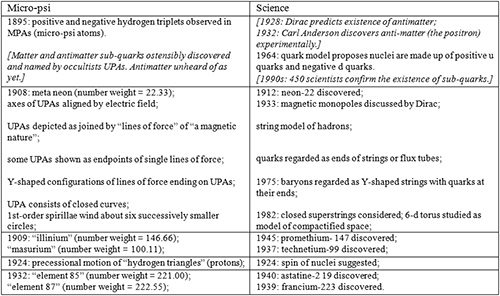
    The table on page 62 provides a partial overview of Leadbeater and Besant’s clairvoyant observations as compared with subsequent scientific discoveries.

    “Some micro-psi anticipations of scientific discoveries and ideas.” Note: Brendan Murphy’s comments in italicised brackets. (Source: Stephen Phillips, Extrasensory Perception of Subatomic Particles, Journal of Scientific Exploration, 9(4), 489–525, 1995.)
    “Some micro-psi anticipations of scientific discoveries and ideas.” Note: Brendan Murphy’s comments in italicised brackets. (Source: Stephen Phillips, Extrasensory Perception of Subatomic Particles, Journal of Scientific Exploration, 9(4), 489–525, 1995.)

    As DeGracia points out, Phillips has shown that to comprehend the finer points of Occult Chemistry one requires an advanced understanding of modern physics. Besant and Leadbeater described the quantum nature of physical matter in 1895, exactly as science would thirty years later and more. How did they know about quarks and subquarks so far in advance of their official scientific discovery?

    To gain some comprehension of how controversial the terrain we tread here, the existence of sub-quarks was only recently scientifically accepted, and even then not unanimously. Yurth reports that in the 1990s an armada of 450 scientists confirmed the existence of sub-quarks with an “unprecedented” level of scrutiny, and still physicists at the American Physical Society, MIT, Princeton and Columbia University succeeded in suppressing the publication of the research data in such mainstream publications as Scientific American, Physics Letters, Physics Review and Nature.26 Thank goodness for free scientific enquiry, eh?

    Regardless, Besant and Leadbeater were obviously capable of perceiving the fundamental nature of matter using occult means, the siddhis. According to Leadbeater, there is a tube-like structure that protrudes from the Ajna, or third-eye chakra of the etheric body, and it is by means of utilising this tube as an organ of vision that one can exercise micro-psi. As we can see, there is good reason to believe him. This psi faculty/ability is one of the siddhis Patanjali wrote about in his Yoga Sutras circa 400 BCE.

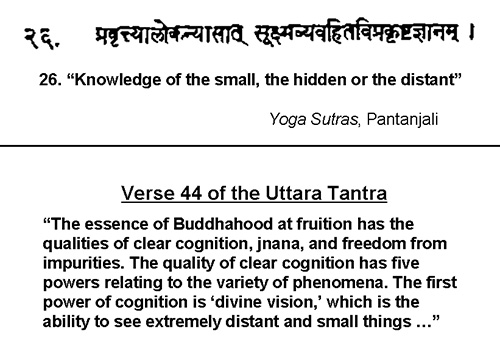
    In Aphorism 3.26 of the Yoga Sutras (c. 400 BCE), the earliest known treatise on yoga, its author Patanjali refers to a particular siddhi in which a yogi can gain “knowledge of the small, the hidden or the distant by directing the light of a superphysical faculty.”
    In Aphorism 3.26 of the Yoga Sutras (c. 400 BCE), the earliest known treatise on yoga, its author Patanjali refers to a particular siddhi in which a yogi can gain “knowledge of the small, the hidden or the distant by directing the light of a superphysical faculty.”

    One more interesting thing about sub-quarks highly pertinent to our occult leitmotif: the sub-quark’s track looks the way it does because in our space-time continuum the particle exists and then does not exist, exists and then does not exist. The discovery of the sub-quark constituted the very first scientifically verified instance of multi-dimensional behaviour in a measurable physical entity: “…in the rarified environment of the particle accelerator, the sub-quark exists-disappears-exists-disappears with a consistent, repeated, predictable frequency pattern…”27

    Leadbeater and Besant stated that the UPA – like the sub-quark today – could vanish from its plane but could undergo no further subdivision. It is truly the most fundamental aspect of physical matter at our density level. The scientific verification of Leadbeater and Besant’s observations clearly indicates the human ability to peer into domains non-existent to our ordinary senses and science’s conventional equipment – domains our most fundamental known ‘particles’ (standing wave structures) venture rhythmically in and out of. Yurth comments that this brings us “literally to the Edge of creation.”28 Do pause and let all of that sink in for a moment.

    Conclusions

    Our occultists are quantitatively and qualitatively vindicated from almost every conceivable angle. (I cover more angles than we have space for here in The Grand Illusion 1.) If we accept Phillips’ conclusion that ultimate physical atoms (UPAs) are sub-quarks rather than atoms, as Leadbeater/Besant once thought, then it is from dedicated occultists that we have obtained the first and possibly most accurate and detailed depictions of them and the aetheric medium that spawns them. On top of that, we must credit the initial discoveries of several isotopes to Leadbeater and Besant.

    Overall, the interrelated combination of clairvoyant observations, string theory, and ‘anomalous’ research findings that the Standard Model cannot explain – but which aether models easily incorporate – is too powerful to ignore.

    Brendan D. Murphy’s website is http://www.brendandmurphy.net.

    [alert type=”general” dismiss=”no”]This article was published in New Dawn Special Issue Vol 6 No 4.[/alert]

    [alert type=”success” dismiss=”no”]If you appreciate this article, please consider subscribing to help maintain this website.[/alert]

    Footnotes:

    1. Annie Besant & Charles W. Leadbeater, Occult Chemistry: Clairvoyant Observations on the Chemical Elements, 1919
    2. Annie Besant & Charles W. Leadbeater, Occult Chemistry, 1950
    3. Ibid
    4. Donald DeGracia, Beyond the Physical, 109
    5. Besant & Leadbeater, 1919
    6. See Victor Zammit, A Lawyer Presents the Case for the Afterlife, Ch. 2, www.victorzammit.com
    7. Besant & Leadbeater, 1919
    8. David Yurth, Seeing Past the Edge, 252
    9. Besant & Leadbeater, 1919
    10. Paul LaViolette, Subquantum Kinetics: A Systems Approach to Physics and Cosmology
    11. Nassim Haramein, What is the Origin of Spin?, www.theresonanceproject.org/pdf/origin_of_spin.pdf
    12. Besant & Leadbeater, 1919
    13. Ibid
    14. Paul A. LaViolette, Genesis of the Cosmos, 238-9
    15. Jay Alfred, Our Invisible Bodies, 49
    16. Ibid., 50
    17. Ibid., 65-8, 133-4
    18. See www.theresonanceproject.org/research.html for Haramein’s model
    19. DeGracia, 110
    20. Ibid. See also Phillips
    21. Stephen Phillips, Extrasensory Perception of Subatomic Particles, Journal of Scientific Exploration, Vol. 9, No. 4, 1995, 489-525
    22. Ibid., 110-11
    23. Ibid., 111
    24. Phillips, 1995
    25. DeGracia, 113-5
    26. Yurth, 255
    27. Ibid, 54-5
    28. Ibid, 55

    © New Dawn Magazine and the respective author.
    For our reproduction notice, click here.

  • The Magical Universe of William S. Burroughs

    The Magical Universe of William S. Burroughs

    From New Dawn 142 (Jan-Feb 2014)

    When the American writer William S. Burroughs passed away at the ripe old age of 83 back in August 1997, the media coverage was definitely more in keeping with his status as a counter-cultural icon than it was for his literary fame – or infamy – alone. All the usual well-rehearsed lines were trotted out, about how he was the Harvard-educated product of the WASP elite and scion of the family that founded the Burroughs Corporation, who had turned his back on it all to become a junkie queer, trawling the steaming jungles of South America, sleazy ‘Interzone’ of Tangiers, and shady back-streets of Paris and London for drugs and boys. That somewhere along the line he became an unlikely mentor to Jack Kerouac, Allen Ginsberg and the Beats, who had opened the way for the Cultural Revolution of the 1960s.

    William Burroughs had originally exploded onto the literary scene back in 1959 with his breakthrough novel, Naked Lunch, causing hip critics everywhere to claim they had seen the future – even if nobody was really sure that they understood it. With his three-piece suit, glasses, hat and raincoat, Burroughs seemed like the ultimate undercover hipster, and that voice certainly didn’t hurt: pitched somewhere between T.S. Eliot and W.C. Fields, mixing camp twang and knowing drawl with the educated tones of an old-fashioned Southern gentleman. From the moment he received that ultimate 1960s imprimatur of cool, being included by The Beatles on the cover of Sgt. Pepper (he’s in there between Marilyn Monroe and Fred Astaire), William Burroughs was the rock rebel’s choice of Literary Outlaw: from David Bowie and Jimmy Page to Patti Smith and Tom Waits, experimental bands like Throbbing Gristle, Psychic TV, and Coil, even Nirvana’s Kurt Cobain – generations of alternative rock stars have collaborated and paid homage.

    Norman Mailer once famously said that William S. Burroughs was, “The only American novelist living and working today who may conceivably be possessed of genius,” and as often as this was repeated down the years, Burroughs himself was at pains to point out that it was not saying he had genius or was a genius, but that he may at times had been lucky enough to be possessed by genius. When I interviewed him at the October Gallery in London in 1988, he had this to say on the subject:

    To me ‘genius’ is the nagual: the uncontrollable – unknown and so unpredictable – spontaneous and alive. You could say the magical.

    The fact that his answer uses a term, nagual, derived from the world of the Yaqui Indian sorcerer, as described by Carlos Castaneda in The Teachings of Don Juan and subsequent books, is telling indeed…

    There is also another kind of ‘possession’ that was very much a concern for William Burroughs, Man and Writer. From an early age, as much as he felt a definite sense of being ‘Other’ and not really belonging or fitting in anywhere, as much as he knew he was homosexual, he also believed in the idea of the Magical Universe. He was aware that an integral part of that universe was that there were inimical – even hostile – forces that threaten us, that may need to be bargained with and from time-to-time appeased, and that one of the dangers posed is that of possession:

    My concept of possession is closer to the medieval model than to modern psychological explanations, with their dogmatic insistence that such manifestations must come from within and never, never, never from without (as if there were some clear-cut difference between inner and outer). I mean a definite possessing entity.

    Later, in the foreword for the autobiographical Queer (written in the 1950s but unpublished until 1985), Burroughs talks about the appalling circumstances of the so-called ‘William Tell’ shooting accident that caused the death of his common-law wife, Joan Vollmer:

    I live with the constant threat of possession, and a constant need to escape from possession, from Control. So the death of Joan brought me in contact with the invader, the Ugly Spirit, and manoeuvred me into a lifelong struggle, in which I have had no choice except to write my way out.

    The simple truth is that William Burroughs had always been a scribbler: in numerous articles and interviews he describes at length his literary efforts from childhood on, and the somewhat precocious sense that the bookish, physically awkward, shy young Billy had of himself as an aspirant writer – an image that was as hopelessly Romantic as it was coloured by a flouting of moral convention:

    As a young child I wanted to be a writer because writers were rich and famous. They lounged around Singapore and Rangoon smoking opium in a yellow pongee silk suit. They sniffed cocaine in Mayfair and they penetrated forbidden swamps with a faithful native boy and lived in the native quarter of Tangier smoking hashish and languidly caressing a pet gazelle.

    The Cut-Up Technique

    As well as the monstrous masterpiece that is Naked Lunch, William Burroughs is perhaps also best remembered for championing the experimental technique of the ‘cut-ups’ – what appears to be at first glance the almost ludicrously simple idea of introducing collage techniques into writing. Collage, in all its various forms, may very well be the pre-eminent creative breakthrough of the 20th century: for better or worse, such techniques probably more accurately mirror the way the world is experienced by most people in an increasingly accelerated, fragmentary, and seemingly random datascape. Sampling, montage, collage: these methods really do come closer to representing or expressing what the facts of perception are for most of us in this post-technological, post-modernist, information overload. As William Burroughs put it again and again throughout his career:

    As soon as you walk down the street… or look out the window, turn a page, turn on the TV – your awareness is being cut: that sign in the shop window, that car passing by, the sound of the radio… Life IS a cut-up.

    Almost from the beginning, there was another aspect to the cut-ups acknowledged just as emphatically: they had the potential to be oracular. To William Burroughs, who would undoubtedly become the greatest champion of the technique, they introduced an element of randomness and also of Time: as he would later put it, whereas the basis of fiction was “once upon a time” – with the cut-ups it was “once in future time.”

    Among Burroughs’ earliest cut-ups were phrases that meant nothing at the time, but in hindsight took on an eerie prescience. This was like the seemingly arbitrary content of dreams, which lead Burroughs to speculate:

    Perhaps events are pre-written and pre-recorded and when you cut word lines the future leaks out.

    In Here to Go: Planet R101, Brion Gysin described how Burroughs would work with the material – and I think his choice of words is instructive:

    On the wall hangs a nest of three wire-trays for correspondence which I gave him to sort out his cut-up pages. Later, this proliferated into a maze of filing cases filling a room with manuscripts cross-referenced in a way only Burroughs could work his way through, more by magic dowsing than by any logical system. How could there be any? This was a magic practice he was up to, surprising the very springs of creative imagination at their source.

    The cut-ups would get a more public airing when UK publisher John Calder arranged for Burroughs to appear at the Edinburgh Conference in August 1962. After Burroughs stole the show with his presentation of an attempted “new mythology for the Space Age” – and an explanation of the innovative techniques that had made it possible, the cut-ups and their further extension in the newly-developed fold-in – a curious comparison was made by Stephen Spender, who queried the analogy between science and writing:

    It sounds to me like a rather medieval form of magic rather than modern science.

    It is in fact informative to compare this with a statement Burroughs made himself, in which his comparison of cut-ups with mediumship is explicit:

    Cut ups often come through as code messages with special meaning for the cutter. Table tapping? Perhaps.

    Experiments in Magic – Subverting Control

    It is to be remembered that the atmosphere around Burroughs and Gysin in those early days at the Beat Hotel at 9 Rue Gît-le-Cœur in the Latin Quarter of Paris was steeped in the occult, with daily experiments in mirror-gazing, scrying, trance and telepathy, all fuelled by a variety of mind-altering drugs. It is not surprising to think they may have considered these new developments in such terms.

    Burroughs, for all his Harvard education and intellect, also possessed a worldview that was informed – you might even say overshadowed – by a fear and fascination with the supernatural that had been shaped in childhood, and stayed with him ever since. His first biographer, Ted Morgan, states in Literary Outlaw that the single most important thing about Burroughs was his belief in what he referred to as “the Magical Universe.” Gysin himself was naturally inclined to intrigue and mystery, and come back from Morocco full of tales of black magic, curses and possession. Burroughs was an all-too-eager audience for the spellbinding storyteller. He felt his own travels in exotic parts had opened his eyes to a Bigger Picture:

    Now anyone who has lived for any time in countries like Morocco where magic is widely practiced has probably seen a curse work. I have.

    When Gysin, allegedly in trance, told Burroughs, “The Ugly Spirit shot Joan because…,” he thought he had the answer that no amount of psychoanalysis or self-examination had been able to provide: the unforgiveable slip that caused the death of his common-law wife, Joan Vollmer, come about because he was literally possessed by an evil spirit. This was indeed a War Universe, and Brion had identified The Enemy. If the Word was indeed the basic mechanism or unit of Control – the ‘virus’ by which Control or the Ugly Spirit exerted its malevolent influence – then surely a real understanding of the Word, what words are and what can be done with them – was essential.

    All these explorations and obsessions were not merely diversions, experiments for artistic or literary amusement, or the creation of novelty, but part of a deadly struggle with unseen, invisible – perhaps even evil – psycho-spiritual enemies. The only hope for deprogramming and self-liberation was to subvert the methods of Control and its various agencies, understand the tools used so that they could become weapons to turn back on the Control Machine itself.

    Gradually, as the 1960s progressed, it was clear the cut-ups were an idea whose time had come. Helped by Burroughs and Gysin’s gradually emerging status as counter-culture gurus, their ideas and influence began to spread. By the 1970s William Burroughs was the epitome of hip as far as drug savvy musos with literary pretensions were concerned: a coked-out David Bowie explained how he used “the Burroughs cut-up method” in Alan Yentob’s 1974 BBC profile, Cracked Actor, and then demonstrated it (badly). His friend Brian Eno would name a track ‘Dead Finks Don’t Talk’ as a nod to Burroughs’ Dead Fingers Talk, but would also look for ways to introduce chance with his Obliques Strategies, a set of cryptic aphorisms intended to encourage creative solutions by lateral thinking. Jimmy Page would be interviewed by Burroughs for Crawdaddy magazine, and as the clarion call of Punk was heard in New York, Patti Smith was the first to cheer the return of the Beat Godfather to his native land.

    [alert type=”info” dismiss=”no”]If you appreciate this article, please consider a subscription to New Dawn magazine.[/alert]

    Genesis P-Orridge

    Around the same time that Punk was emerging in the UK, another home-grown genre drawing inspiration from Burroughs, Gysin and the cut-ups was the ‘Industrial’ music of Throbbing Gristle (TG) and related bands like Cabaret Voltaire and later, 23 Skidoo. TG prime-mover Genesis P-Orridge had actually met Burroughs while he was living on Duke Street in London in the early 1970s, and he and band-mate Peter ‘Sleazy’ Christopherson were directly inspired by the Outsider stance of the ‘Literary Outlaw’ as much as they were influenced by his theories. Along with Chris Carter and Cosey Fanni Tutti, P-Orridge and Christopherson would help to invent a new genre of music they dubbed ‘Industrial’ – stripping back music even further than the back-to-basics of Punk to create a kind of Garage musique concrète, in which the processing and manipulation of found sound was a key part of the semi-improvised mayhem that was as often sonic assault as it was about the alchemy of sound.

    When P-Orridge first visited Burroughs on Duke Street in 1973, he asked him, “Tell me about magick?” and whether or not he still used cut-ups in writing. Burroughs replied, “No, I don’t really have to anymore, because my brain has been rewired so it does them automatically.” He cracked open a bottle of Jack Daniels, poured them both a stiff drink, then put on the TV to watch The Man From U.N.C.L.E., explaining, “Reality is not really all it’s cracked up to be, you know…” He then began hopping through the channels on the TV with the remote – at the same time mixing in pre-recorded cut-ups from the Sony tape-recorder – until P-Orridge was experiencing a demonstration of cut-ups and playback in real-time – right there where he was sitting:

    I was already being taught. What Bill explained to me then was pivotal to the unfolding of my life and art: Everything is recorded. If it is recorded, it can be edited. If it can be edited then the order, sense, meaning and direction are as arbitrary and personal as the agenda and/or person editing. This is magick.

    As part of his explanation, Burroughs showed P-Orridge one of his journal scrapbooks in which he had posted two photos: a simple black and white street scene, with the relevant building clearly visible, and then another beneath it from which he had carefully sliced out the ‘target’ with a razor blade, gluing the two halves of the photo back together so as to create an image of the street with the offending institution removed. The same principle could clearly be applied to photos of people that you wanted to ‘excise’ from your life, he said. These principles would have a profound effect on P-Orridge and Christopherson, as well as many of the ‘anti-musicians’ and sound-artists that they would collaborate with or inspire in their turn. It wasn’t just the sonic application of the cut-ups with tape-recorders, but rather the whole approach to challenging conventional wisdom, deprogramming the self from the imposed beliefs and values of mainstream society.

    After TG had split, P-Orridge and Christopherson went on to form ‘Psychic Television Limited’ – with its attendant Conceptual Art gag masquerading as fan club pretending to be a cult, ‘Thee Temple ov Psychick Youth’, or TOPY as it was known. For a while there was an inner circle that revolved around a strange hybrid of the ideas of occultists Aleister Crowley and Austin Osman Spare regarding consciousness alteration, dream control, and sex-magic. The life and work of Burroughs and Gysin, with their cut-ups, Dreamachine, playback, and Third Mind equally offered a kind of toolkit for similar ends. It looked like if the Revolution was going to be televised after all, then Psychic TV were going to be first in line to put in their bid for the franchise…

    But all too soon cracks began to show, and P-Orridge and Christopherson parted company: Sleazy with partner John Balance to create a whole new world of magick and music as Coil, Genesis to develop PTV increasingly in the direction of Rave music. Each would continue finding ways to apply the cut-up methods of sampling, cut-and-paste and appropriation to the development of new music. TOPY became increasingly an umbrella for New Age Merry Prankster-style utopian tribalism, and Gen’s role as figurehead for these disparate anti-movements, and the cultural memes he was engineering – from cut-ups and sex-magick, to tattooing, piercing, and body modification – inevitably lead to conflict with the authorities, and P-Orridge had to flee England for a life of exile in the United States. Eventually he would come to perhaps the most radical application of his interpretation of the ideas of Burroughs and Gysin of all: Pandrogeny, in which P-Orridge and his spouse Lady Jaye would literally try and cut-up gender.

    Engaging the Magical Universe

    When I first met William S. Burroughs in London at the time of The Final Academy series of events in 1982, I asked him about magic, and whether he would care to recommend any books on the subject. Without hesitation, he mentioned Dion Fortune’s Psychic Self-Defense, even though he qualified it as “a bit old-fashioned.” As he began to talk of black magic and curses in North Africa, travelling with medicine men up the Amazon, and describing his experiments with tape-recordings and playback on the streets of London’s West End and in the midst of the 1968 Chicago Democrat’s Convention and ensuing riots, I realised that for Burroughs this was utterly real. He told me about a dream he had as a young man, working as an exterminator in Chicago: watching from a helpless out-of-body point of view floating above the bed as his body got up and went out with some unknown and sinister purpose that he was powerless to influence… with a shudder, he told me that possession was “still the basic fear.”

    Even towards the end of his life, William S. Burroughs’ engagement with the Magical Universe (and struggle against the Ugly Spirit) did not wane. The magical, psychic, spiritual and occult appear in his later fiction like never before, from depictions of astral travel and “sex in the Second State” to descriptions of actual rituals, referencing everything from Crowley and the Golden Dawn to the myths of ancient Egypt and even the Necronomicon… all interwoven with increasingly ‘neo-pagan’ concerns for the environment, the impact on Man and Nature of the Industrial Revolution with its emphasis on ‘quantity, not quality’ and standardisation – as well as perceived turning points in history. His adoption of the ancient Egyptian model of the Seven Souls, continuing development of a very personalised myth of Hasan-i Sabbah and the Assassins of Alamut, made him of increasing interest and relevance to the new occultists who were emerging from successive generations of counter-culture that Burroughs had helped to shape through the example of his Life and Work.

    There was also still the loss, the pain, and – perhaps more than ever – the Ugly Spirit. After settling in Lawrence, Kansas – a small university town, far from the distractions and temptation of New York, and very much a reminder of his mid-Western background in St. Louis, Burroughs became friends with William Lyon, a Professor of Anthropology who had been apprenticed to Sioux medicine man Black Elk. A full sweat-lodge purification ceremony was arranged in an attempt to evict the Ugly Spirit, which was described by the shaman as:

    A spirit with a white skull face, but no eyes, and sort of… wings.

    Burroughs was impressed by the “strength and heart” of the medicine man, and felt that just to clearly identify the enemy in such terms was in itself something of a victory:

    If you see it, you gain control of it. It’s just a matter of, well, if you see it outside, it’s no longer inside.

    In the early 1990s, the elderly Burroughs was initiated into the Illuminates of Thanateros, the leading Chaos Magic group. Perhaps this was not such a surprising development. Chaos Magic clearly felt a debt to Burroughs and his peers, sharing many of the same concerns as Thee Temple ov Psychick Youth: demystifying magic, yet at the same time distilling the best from Aleister Crowley and Austin Osman Spare, while taking advantage of the latest ideas emerging in computers, maths, physics and psychology.

    With the experiments started at the Beat Hotel that he then took out onto the streets of London, Paris and New York, William S. Burroughs was recognised as a pioneer and precursor: and with the later connections established through a younger generation of artist-occultists, the link from ‘cosmonaut of inner space’ to ‘psychonaut’ was assured.

    For more information about Matthew Levi Stevens, please see http://whollybooks.wordpress.com. The book-length version of his The Magical Universe of William S. Burroughs is available from Mandrake of Oxford. To order go here: http://mandrake.uk.net/the-magical-universe-of-william-s-burroughs/

    [alert type=”general” dismiss=”no”]This article was published in New Dawn 142.[/alert]

    [alert type=”success” dismiss=”no”]If you appreciate this article, please consider subscribing to help maintain this website.[/alert]

    © New Dawn Magazine and the respective author.
    For our reproduction notice, click here.
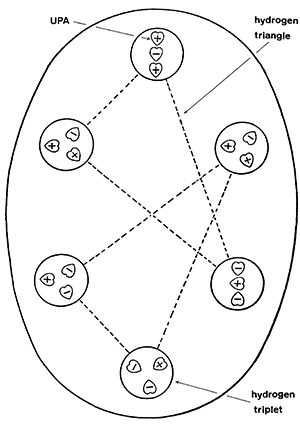
  • Rudolf Steiner, Secret Societies & ‘The Ahrimanic Deception’

    Rudolf Steiner, Secret Societies & ‘The Ahrimanic Deception’

    From New Dawn 136 (Jan-Feb 2013)

    Many believe there is an ‘occult’ or ‘spiritual war’ taking place between forces of ‘light’ and ‘darkness’, or ‘good’ and ‘evil’, and that this ‘war’ manifests on the material and mortal planes politically, culturally, spiritually, and economically.

    It is often surprisingly difficult to discern the affiliations in this ‘battle’, with the multitude of occult Orders, Schools and personalities. These often use similar or even identical terminologies and symbols, and draw on the same traditions and origins. In such a situation well-meaning people are easily duped into supporting long-range aims of which they do not understand.

    Occult War: Adepts ‘Black’ & ‘White’

    The definition of ‘good and evil’, or ‘light and dark’, metaphysically can – from an esoteric perspective – be regarded as a dichotomy between those who seek a higher spiritual path for mankind, and those who seek to enchain man to matter. This dichotomy is well portrayed in the standard depictions of ‘The Devil’ trump in the Tarot Major Arcana.1 Paul Foster Case, founder of the Builders of the Adytum, gave a particularly apt explanation:

    In its most general meanings, it signifies Mammon and thus big business, the conventions of society, the injustice and cruelty of a social order in which money takes the place of God, in which humanity is bestialised, in which war is engineered by greed masquerading as patriotism, in which fear is dominant. Students of astrology will have no difficulty in seeing how this corresponds to Capricorn, the sign of big business, and the sign of world fame.2

    One sees in this Trump a male and female human each starting to take on the appearance of wild beasts – with horns and tails – enchained to a solid block, representing matter, with the Devil enthroned. As Case states, it is symbolic of the reign of Mammon, which is ushered in by materialistic doctrines such as Capitalism and Marxism, keeping humanity focused on lower pursuits in the guise of ‘progress’ and ‘freedom’.

    Occultists such as René Guenon, Aleister Crowley and Julius Evola3 have sought to identify contending Schools as ‘White’ and ‘Black’ Brotherhoods, or as ‘Right’ and ‘Left’ Hand Paths.

    Given the confusion that exists – because individuals and occult currents that are diametrically opposed often claim to represent the same traditions – the biblical injunction ‘by their fruits ye shall know them’ is the best formula for identifying motives, although this also is often obscure. For example, the notorious English occultist Aleister Crowley, whose ‘evil’ antics played up to the tabloid press, could easily be regarded as a ‘Black Adept’. Although Crowley claimed to work in the tradition of, among others, and for unclear reasons, the 18th century Black Adept Adam Weishaupt and his crypto-Masonic Illuminati, Crowley sought to expose the spiritual war that was taking place between the ‘White’ and ‘Black’ Adepts,4 while his doctrine of Thelema is antithetical to the doctrine of the Illuminati.5 Also, while having been a Freemason, as was Eliphas Levi,6 Rene Guenon7 condemned the Black Adepts who had subverted and redirected Masonry.8

    Steiner and The Ahrimanic Deception

    Rudolf Steiner (1861-1925), founder of Anthroposophy, whose influence has gone far beyond ‘occult’ circles for his prominence in alternative education, architecture, and organic agriculture, was one of those seminal personalities who believed in the existence of such an ‘occult war’. Again, as with Crowley, difficulties are encountered due to Steiner’s own affiliations with Freemasonry.9 However, Steiner, like Guenon, Evola, Levi and Crowley, forthrightly sought to expose a Dark current at work within the secret societies, and in particular within Freemasonry, whose influence was being directed in the world politically.

    In a 1919 lecture delivered in Zurich entitled ‘The Ahrimanic Deception’, Steiner stated that, “a great part of mankind today is already under the control, from one side or another, of Ahrimanic forces of a cosmic nature which are growing stronger and stronger.” Steiner had an unusual perception of what he called the “Luciferic Impulse,” which he stated manifested on Earth in 3000 BCE. The Luciferic Impulse prepared the way for the “Christ Impulse” in Steiner’s cosmology. Both ‘Impulses’ began to fade and mankind has therefore become increasingly materialistic. Steiner stated this Ahrimanic Deception emanates from an actual being:

    The Ahrimanic impulse proceeds from a supersensible Being different from the Being of Christ or of Lucifer.… The influence of this Being becomes especially powerful in the Fifth Post-Atlantean Epoch. If we look at the confused conditions of recent years we shall find that men have been brought to such chaotic conditions mainly through the Ahrimanic powers.10

    While the Luciferic Impulse pushed humanity into what Nietzsche might have called the Dionysian passion that gives birth to arts and brings humanity outside of itself, albeit, according to Steiner, with a “false spirituality,” “Ahriman is the power that makes man dry, prosaic, philistine – that ossifies him and brings him to the superstition of materialism.”11 Ahriman would seem to equate with the Christian perception of the Antichrist. The Christ Impulse balances the two poles, in what in some respects seems akin to a Hegelian dialectic.

    And the true nature and being of man is essentially the effort to hold the balance between the powers of Lucifer and Ahriman; the Christ Impulse helps present humanity to establish this equilibrium…. [T]he Ahrimanic influence has been at work since the middle of the fifteenth century and will increase in strength until an actual incarnation of Ahriman takes place among Western humanity.12

    Preparing the Way for Ahriman

    The relevance of this concept of the Ahrimanic Deception in regard to an ‘occult war’ for world rule, is that:

    Now it is characteristic of such things that they are prepared long in advance. Ahrimanic powers prepare the evolution of mankind in such a way that it can fall a prey to Ahriman when he appears in human form within Western civilisation… Ahriman will appear in human form and the only question is, how he will find humanity prepared. Will his preparations have secured for him as followers the whole of mankind that today calls itself civilised, or will he find a humanity that can offer resistance.13

    The way in which humanity looks at the cosmos under the Ahrimanic Deception is not with the spiritual awe and sense of place of those of past Civilisations, including, we could add, those of Gothic man in Western Civilisation’s cycle of youth, as the philosopher-historian Oswald Spengler pointed out,14 but as merely part of a mechanical and mathematical process. Steiner said of this:

    Today man gazes from his earth up to the star-world and to him it is filled with fixed stars, suns, planets, comets, and so on. But with what means does he examine all that looks down to him out of cosmic space? He examines it with mathematics, with the science of mechanics. What lies around the earth is robbed of spirit, robbed of soul, even of life. It is a great mechanism, in fact, only to be grasped by the aid of mathematical, mechanistic laws.…15

    We might state of this Ahrimanic Deception that it motivates Rationalism and Materialism, the dominant ideologies of the Late West.16 Steiner warned that the Ahrimanic Deception aims to imbue Man with “scientific superstition,” an “external illusion,” that while necessary (it was far from Steiner’s intent to repudiate the sciences) has made what we can identify as Rationalism and Materialism into a dogma.

    The second method of the Ahrimanic Deception is to split society into contending factions. Steiner aptly identified Marxism, a product of Scientism, as a primary method of the Ahrimanic Deception.

    Since the times of the Reformation and the Renaissance the economist has emerged as the new priest into the increasingly materialistic world, while Steiner also pointed out that Christian religion had also become desacralised.

    Since that time the economist has been in command. Rulers are in fact merely the handymen, the understrappers of the economists. One must not imagine that the rulers of modern times are anything but the understrappers of the economists.17

    Steiner next alludes to a very important matter, the power that the bankers have assumed:

    In the nineteenth century the ‘economical’ man is replaced for the first time by the man thinking in terms of banking, and in the nineteenth century there is created for the first time the organisation of finance which swamps every other relationship. One must only be able to look into these things and follow them up empirically and practically.18

    This statement provides the key to the history of the ‘modern world’ for the past several hundred years, and the human agency pushing for a world state – a ‘New World Order’ – enchained to the dead weight of matter.19 The power of the international banking cabals prepares the way for an Ahrimanic World Order by reorienting the spirit of Man:

    If men do not realise that the rights-state and the organism of the Spirit must be set against the economic order called up through the economists and the banks, then again, through this lack of awareness, Ahriman will find an important instrument for preparing his incarnation.20

    Role of Secret Societies

    The ‘Ahrimanic Deception’ equates with what Guenon and Evola referred to as the ‘Counter-Tradition’. The secret societies it uses behind the façade of the Perennial Tradition are the ‘Anti-Tradition’. Steiner lectured on the role of these secret societies in the occult war.

    While referring to both the “humanitarian works” and the spiritual evolution that is supposedly at the foundation of Freemasonry,21 Steiner, like Levi, Crowley, Evola and Guenon, also spoke of the manner the ‘Ahrimanic Deception’ operates through Freemasonry. Steiner even went further than anti-Masonic ‘conspiracy theorists’ such as Nesta H Webster22 and the eminent Scottish scholar, Prof. John Robison,23 himself a Grand Lodge Freemason, both of whom accepted English Masonry’s innocence of intrigue. Steiner, however, made a particular point of discussing the origins of Continental Masonry in the English Lodges. Despite its repudiation of ‘irregular’ Grand Orient Masonry that predominates on Continental Europe and Latin America, English Grand Lodge Masonry, stated Steiner, was also involved in a struggle for world power. He said the British Government was subverted by the secret societies, and that in particular foreign affairs was taken over by “an inner committee.”24 Steiner, in tracing the origins of Grand Orient Masonry to the Grand Lodge, wrote that:

    But everywhere in a different way, in many places outside the actual British realm, Freemasonry pursues exclusively or mainly political interests. Such political interests in the most palpable sense are pursued by the ‘Grand-Orient de France’, but also by other ‘Grand Orients’. One might now say: what has that to do with the English?… But view this in conjunction with the fact that the first High-degree Lodge in Paris was founded from England, not France! Not French people but Britons founded it; they only wove the French into their Lodge…25

    After listing the Lodges that were founded under the impetus of the English Grand Lodge, from Spain to Russia, Steiner adds that, “these Lodges were founded as the external instruments for certain occult-political impulses.” These impulses included the “fury of the Jacobins,”26 (who launched a Reign of Terror over France in the name of ‘Liberty, Equality, Fraternity’); Weishaupt’s Illuminati and the Italian Carbonari. Although Steiner admits these began without “evil” intent (which I would dispute), they “continued their underground work in many different forms,” after being driven underground. Steiner alludes to the disingenuousness of Grand Lodge Masonry in being able to say:

    ‘[L]ook at our Lodges, they are very respectable – and we are not concerned with the others’. But if one can see through the historical connection and the driving forces in an interplay of mutual opposition to one another, then it is indeed high British politics that is concealed behind it.27

    Of the “occult-political” societies, Steiner observed they serve a materialistic aim behind the façade of spirituality: what Guenon and Evola called “Anti-Tradition,” and Levi called “profanity.” These “various Orders” are “not spiritual, because of their purposes and goals.” They are the secret societies that work in the name of “democracy” and a “universal republic” (as did the Jacobins and the Illuminati). Steiner warned:

    If one wants as a person of modern times to see clearly in order to meet the world openly and understand it, then one should not let oneself be blinded by democratic logic, which is justified only in its own sphere, or by phrases concerning democratic progress etc. One would have also to point to the interposing of something that reveals itself in the attempt to give rulership to the few through the means available within the Lodges – namely, ritual and its suggestive effect.28

    While genuine mystical lodges exist(ed) – even Guenon sought initiation in them, as did Steiner – both pointed out that one must be cognisant of those Orders with mystical trappings and claims to ancient pedigree as a mask for other motives, as they are “often nebulous, maybe even fraudulent”… “For power is of special importance for these secret societies, not insight.”29

    [alert type=”general” dismiss=”no”]This article was published in New Dawn 136.[/alert]

    [alert type=”success” dismiss=”no”]If you appreciate this article, please consider subscribing to help maintain this website.[/alert]

    Footnotes

    1. For example, the popular ‘Rider-Waite Tarot Deck’.

    2. Paul Foster Case, Oracle of The Tarot: A Course on Tarot Divination, Chapter 6, ‘The Major Trumps: 15. Le Diable’, http://tarotinstitute.com/free/Oracle2.pdf.

    3. Julius Evola, Men Among the Ruins, Inner Traditions, 2002, 250-251.

    4. Aleister Crowley, Magick Without Tears, Falcon Press, 1983, 66.

    5. K R Bolton, ‘Aleister Crowley as Political Theorist’, Crowley: Thoughts & Perspectives Vol. II, Troy Southgate, editor, Black Front Press, 2011, 5-27; Keith Preston, ‘The Whole of The Law: The Political Dimensions of Crowley’s Thought, ibid., 68-84.

    6. Eliphas Levi, The History of Magic, translated by A E Waite, 1913, Rider, 1982, 310. Levi in condemning the “profanity” of Freemasonry and its involvement in political subversion, including the French Revolution, was doing so as an initiate of the 18°, the Rosicrucian Degree. This is indicated in a footnote to his History of Magic, where he states: “Having attained by our efforts to a grade of knowledge which imposes silence, we regard ourselves as pledged by our convictions even more than by an oath.… and we shall in no wise fail to deserve the princely crown of the Rosy Cross….” (286). Levi here states that he was staying true to what he considered the genuine Tradition of Masonry, whilst condemning what he saw as the perversion of Masonry by the Counter-Tradition. His reference to the Masonic oath attached to the ‘Rosy Cross’ indicates he had reached as far as the 18° of Knight of the Pelican & Eagle & Sovereign Prince Rose Croix of Heredom.

    7. Robin Waterfield, René Guenon & the Future of The West, Sophia Perennis, 2002, 21.

    8. René Guenon, The Reign of Quantity and the Signs of the Times, New York, Sophia Perennis, 2001, 260-261.

    9. ‘Was Rudolf Steiner a Freemason?’, www.fourhares.com/freemasonry/Steiner_and_masonry.html

    10. Rudolf Steiner, ‘The Ahrimanic Deception’, Zurich, 27 October 1919, http://wn.rsarchive.org/Lectures/AhrDec_index.html

    11. Ibid.

    12. Ibid.

    13. Ibid.

    14. Oswald Spengler , The Decline of The West, George Allen & Unwin, 1971. Spengler, writing in the early 20th century, contended that history is not lineal-progressive, but that each Civilisation is self-contained and goes through its own analogous organic cycles of birth, youth, maturity, old age and death. During the latter epochs of a Civilisation, culture becomes ossified and materialistic and money-thinking dominates. This is the cycle of present Western Civilisation. Broadly, the historical-cyclic theories of both Steiner and Spengler can be used in tandem.

    15. Rudolf Steiner, ‘The Ahrimanic Deception’, op. cit.

    16. Vide, Spengler, op. cit.

    17. Ibid.

    18. Ibid.

    19. For the political agendas of the International Bankers, including the connections with Marxism, see: K R Bolton, Revolution from Above, Arktos Media Ltd, 2011.

    20. Rudolf Steiner, ‘The Ahrimanic Deception’, op. cit.

    21. Rudolf Steiner, ‘The Work of the Secret Societies in the World’, Berlin, 23 December 1904, http://wn.rsarchive.org/Lectures/19041223p02.html

    22. Nesta H Webster, Secret Societies & Subversive Movements, Britons Publishing Co., 1964, Chapter 6, ‘The Grand Lodge Era’, 128-129.

    23. John Robison, 1798, Proofs of a Conspiracy, Western Islands, 1967, ‘Introduction’, 6.

    24. Rudolf Steiner, ‘The Karma of Untruthfulness’, ‘Rudolf Steiner Archive, GA 173’, 18 December 1916, www.rsarchive.org/Lectures/GA/index.php?ga=GA0173

    25. Rudolf Steiner, ‘Karma of Untruthfulness, Part II’, GA 174, 8 January 1917, www.rsarchive.org/GA/index.php?ga=GA0174

    26 Ibid.

    27. Ibid.

    28. Ibid.

    29. Rudolf Steiner, ‘The History & Actuality of Imperialism’, Dornach, Switzerland, 21 February 1920.

    © New Dawn Magazine and the respective author.
    For our reproduction notice, click here.