New Dawn – World's Most Unusual Magazine

Author: Charlie Nash

  • The Secret History & Modern Legacy of HP Lovecraft

    The Secret History & Modern Legacy of HP Lovecraft

    From New Dawn 198 (May-June 2023)

    As an example of militant action in favour of the greatest possible degree of open-mindedness, and as an initiation into the cosmic consciousness, the works of Charles Fort have been a direct source of inspiration for the greatest poet and champion of the theory of parallel Universes, H.P. Lovecraft…
    – Louis Pauwels & Jacques Bergier, The Morning of the Magicians

    Many people know of Howard Phillips Lovecraft’s (1890–1937) existential and otherworldly horror stories – or at least have seen some adaptation. Lovecraft’s influence across fiction, film, gaming, and beyond is vast and immeasurable, and celebrated artists cite the author as a major creative inspiration, from novelist Stephen King (IT, The Shining), graphic novelist Alan Moore (V For VendettaWatchmen), and author Jorge Luis Borges, Japanese writer Chiaki J. Konaka (Serial Experiments Lain, Marebito), manga artist Junji Ito (UzumakiTomie), and directors Guillermo Del Toro (Pan’s LabyrinthThe Shape of Water) and John Carpenter (The ThingHalloweenThey Live) – the list goes on and on.

    Despite his influence, few people know that HP Lovecraft was a prolific political writer who railed against both the soulless greed of American capitalism and the culture-destroying wrecking ball of Soviet communism.

    In Lovecraft’s early political writings, published in his amateur journal The Conservative, the primary target of his tirades was bolshevism. This ‘aristocrat of the soul’ feared communism would destroy high art and culture by demolishing the aristocratic (or, in the case of the United States, WASP pseudo-aristocratic) hierarchy.
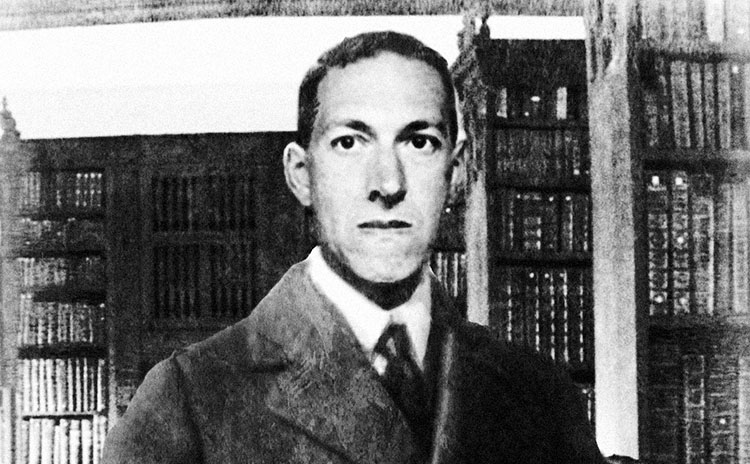
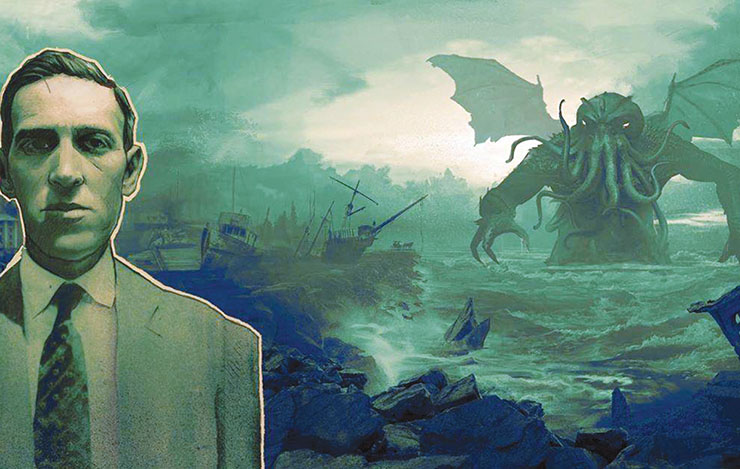
    Howard Phillips Lovecraft (1890–1937)

    Lovecraft also criticised the concept of democracy, making similar observations to those that the Italian philosopher and occultist Julius Evola offered more than a decade later in his 1934 book Revolt Against the Modern World.

    “There is no such thing – there will never be such a thing – as good and permanent government among the crawling, miserable vermin called human beings,” Lovecraft declared in an October 1921 article titled Nietzscheism and Realism

    “Aristocracy and monarchy are the most efficient in developing the best qualities of mankind as expressed in achievements of taste and intellect; but they lead to unlimited arrogance,” he continued. “That arrogance in turn leads inevitably to their decline and overthrow. On the other hand, democracy and ochlocracy [‘mob rule’] lead just as certainly to decline and collapse through their lack of any stimulus to individual achievement. They may perhaps last longer, but that is because they are closer to the primal animal or savage state from which civilised man is supposed to have partly evolved.”

    In the same article, Lovecraft called for a Roman-style aristocracy that would accept any man who could prove himself “aesthetically and intellectually fitted for membership,” before channelling Schopenhauer and the future works of nihilist philosopher Emil Cioran with the line: “Universal suicide is the most logical thing in the world – we rejected it only because of our primitive cowardice and childish fear of the dark. If we were sensible we would seek death – the same blissful blank which we enjoyed before we existed.”

    Later, as the Great Depression crippled Americans and Lovecraft became increasingly ill and destitute, he altered his worldview – ridiculing the out-of-touch laissez-faire mentality of politicians and industrialists and warning that some form of American socialism would be necessary to prevent the rise of communism in the US.

    In a 1933 piece, Lovecraft criticised the “artificial finance-and-business tradition” which had become dominant in the US and argued that the capitalist class was willing to do anything – including kill off the masses through war – to “save the sacred cultural principles of ‘sound business’, ‘rugged individualism’, and bigger profits for people who do not need them.”

    “It is by this time virtually clear to everyone save self-blinded capitalists and politicians that the old relation of the individual to the needs of the community has utterly broken down under the impact of intensively productive machinery,” Lovecraft observed before warning that America would have to make radical changes – including guaranteed work for every American and the limitation of private property – to deter a revolution he claimed would start with good intentions, but ultimately result in “ruthless destruction of cultural values which such an upheaval would bring.”

    In another article, dated November 1933, Lovecraft complained that industrial laissez-faire capitalism had led only to America’s resources becoming concentrated in the hands of an increasingly small few.

    On the “pompous financiers” and politicians who had caused such a state of affairs, Lovecraft said that the “Americanism” and “freedom” they spoke of no longer meant anything more than “certain technical business principles” which “enable 2% of the population to corral 80% of the national resources and condemn an ever-increasing minority to unemployment and starvation.”1

    He lambasted the “capitalistic class” for regarding “the now-passing economic order” – as the Great Depression ended – to be “a good one.” 

    Lovecraft attacked: “All our smug ‘solid men’ and ‘best citizens’ have habitually condemned thousands to slow starvation and hundreds to actual death through industrial policies designed to give a few luxurious stockholders the added profits enabling them to keep three motor cars instead of two.”

    Many of Lovecraft’s observations and criticisms are eerily relevant today, nearly a hundred years on. With the ongoing decline of the US empire, the same out-of-touch cliches and policies that Lovecraft cited as responsible for the destruction of the American community back in his day still repeat today.

    Politicians on both the left and right use the same calls for “freedom” and “Americanism” as they did in the early 20th century, only this time to justify expensive, far-away wars while ordinary Americans suffer the effects of inflation and plummeting quality of life.

    Although Lovecraft started out politically conservative and later advocated some socialist positions in response to the devastation wrought by the Great Depression, for the most part, he remained a social conservative and continuously supported the concepts of aristocracy and hierarchy throughout his life.

    Lovecraft believed that the “old aristocracy” – which still held sway in 1930s America – would ultimately support the necessary changes to avoid communism due to their indifference to the “moneyed bourgeois element” with the most to lose. Ironically, he cited the British fascist leader Oswald Mosley and US President Franklin D. Roosevelt as two examples of aristocrats “who actively lead the quest for a workable social order.”

    Lovecraft laid out his vision for men like Mosley and Roosevelt:

    Indeed, the salvation of society really depends on the faithful and diligent services of disinterested gentlemen – since the inflamed masses without leaders can only tear down without building up. The people as a whole are densely and hopelessly ignorant – mere blind forces either cowed to silent suffering or bursting into resistless fury under too much goading – hence democracy is and always has been and will be a joke… or a tragedy. Salvation rests wholly with the trained man of vision and cultivation without the profit motive – namely, the fascistic leader.

    At the time of Lovecraft’s article, Mosley had recently launched the British Union of Fascists and – despite his aristocratic connections – was interned in 1940 in a British concentration camp for more than three years due to his beliefs. Roosevelt led America into World War 2 before passing away just months before the detonation of two atomic bombs on Hiroshima and Nagasaki.

    Ultimately, Lovecraft never saw the war or the era of prosperity that the US would experience in the decades following. He would never see the fall of fascism or the fall of the Soviet Union, and he would never see American capitalism reach new levels of horror. Even his own creative mind would have struggled to foresee it. He would never see his work – widely ignored and maligned during his lifetime – become some of the most popular stories in horror and science fiction history.

    Get the issue this article appears in

    Lovecraft died in his native Providence, Rhode Island, from intestinal cancer on 15 March 1937, age 46. He left this world in poverty and in severe pain.

    While Lovecraft died more than 86 years ago, his work and the intricate world he created continue to inspire and fascinate new generations. Despite the fact that the bulk of Lovecraft’s legacy can be seen in the cinema, comic books, video games, and other entertainment, it also appears in more serious fields such as the occult and even the military.

    In a September 2022 article for 19FortyFive titled “Read H. P. Lovecraft To Understand War,” James Holmes – chairman of Maritime Strategy at the US Naval War College and a former US Navy officer – argued that reading Lovecraft and other weird fiction “primes military practitioners and analysts to notice weird or eerie anomalies in the profession of arms.”2

    “Detecting a phenomenon is the first step toward adapting to it or turning it to advantage,” he wrote, adding that Lovecraft’s stories could help military strategists “make sense of the past, survey the world around us, and potentially glimpse the future.”

    Could that same argument be made for the study of conspiracies, cover-ups, and Fortean activity? Could this also be why Lovecraft’s ideas are so ingrained in much of the modern occult?

    Charles Fort and his investigations into the paranormal influenced Lovecraft, who was also obsessed with the unknown, the unexplained, and the concept of forbidden knowledge. Lovecraft referenced “the extravagant books of Charles Fort with their claims that voyagers from other worlds and outer space have often visited the earth” in his 1931 science-fiction horror story The Whisperer in Darkness.

    In his article, Holmes cites examples of how Lovecraft’s work could help NATO and Ukraine in their conflict against Russia – an interesting observation since Russia is among the countries where Lovecraft’s tales are most widely read.

    Shelf of Lovecraft titles in a Moscow bookstore.

    Russian translations of Lovecraft can be found in abundance in Moscow bookstores, with some outlets holding dedicated shelves to his weird fiction – a rare sight in even English-speaking countries. Remarkably, Russian President Vladimir Putin himself addressed the topic of Cthulhu, the fictional cosmic entity that appears in several of Lovecraft’s stories, after questions about the apocalyptic awakening of the sleeping, underwater tentacle god were the fourth most popular at a Q&A in 2006!

    While some critics of the Russian president have accused him of holding a “dark pact” with Cthulhu, Putin told Lovecraft-mad Russian youth: “I am generally suspicious of any otherworldly forces. If someone wants to turn to true values, then it is better to read the Bible or the Koran. It will be more useful.”3

    [alert type=”general” dismiss=”no”]This article was published in New Dawn 198.[/alert]

    [alert type=”success” dismiss=”no”]If you appreciate this article, please consider subscribing to help maintain this website.[/alert]

    Footnotes

    1. hplovecraft.hu/index.php?page=library_etexts&id=771&lang=angol
    2. 19fortyfive.com/2022/09/read-h-p-lovecraft-to-understand-war/
    3. majikthise.typepad.com/majikthise_/2006/07/vladimir_putin_.html

    © New Dawn Magazine and the respective author.
    For our reproduction notice, click here.
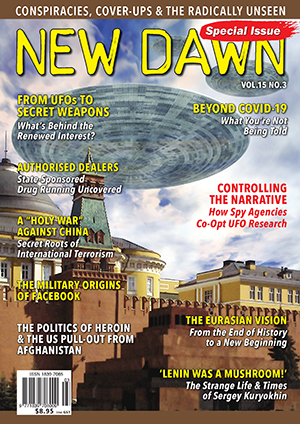
  • ‘Lenin was a Mushroom’! The Strange Life & Times of Sergey Kuryokhin

    ‘Lenin was a Mushroom’! The Strange Life & Times of Sergey Kuryokhin

    From New Dawn Special Issue Vol 15 No 3 (June 2021)

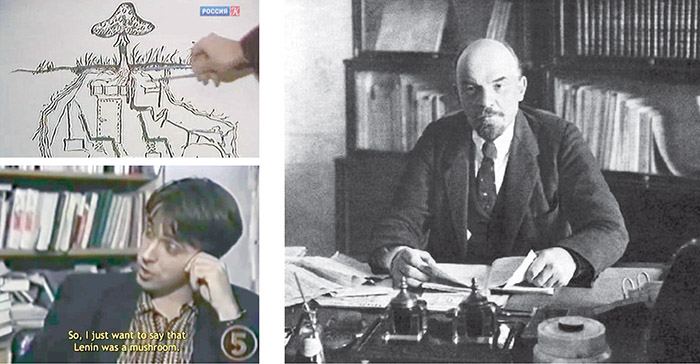
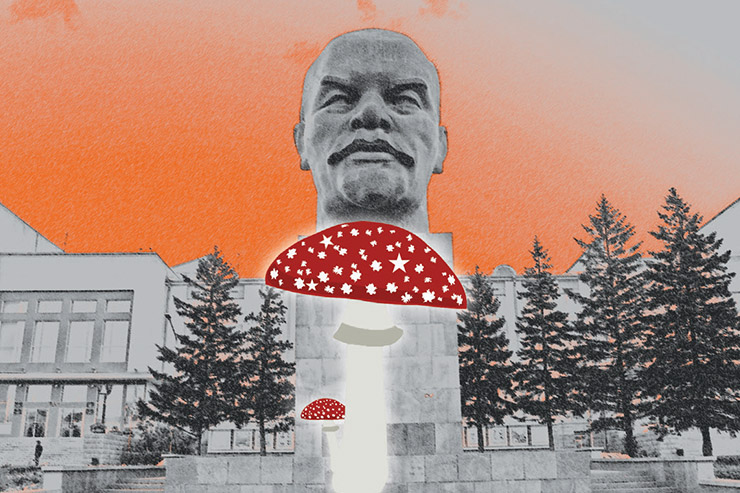
    Lenin was a mushroom! At least according to Sergey Anatolyevich Kuryokhin, the pioneering Russian musician, activist, and prankster from St. Petersburg who convinced viewers of Leningrad Television in January 1991 that the leader of the Bolshevik Revolution and father of the Soviet Union had eaten so many psychedelic mushrooms, he ended up becoming one. 

    In 1990s Soviet Russia, citizens read Pravda, the official newspaper of the Communist Party of the Soviet Union. They were conditioned to believe state propaganda, and an easy target in Kuryokhin’s Lenin mushroom prank.

    It’s hard to believe such a claim could be taken at face value by anyone, but Russians under communism had long been conditioned to believe whatever appeared on State-run television. 

    Delivering his argument with a straight face and a serious tone, and citing the work of genuine sources, Kuryokhin was able to convince his audience of Lenin’s secret fungi metamorphosis – though a large part of the prank’s success also came from the fact that he was speaking about a man who Soviet citizens had been brought up to revere, someone never publicly mocked or satirised. 

    Sergey Anatolyevich Kuryokhin (1954–1996) is recognised as a pioneering Russian musician, artist, activist, and founder of the now legendary music group Pop Mechanics.

    In a paper on the incident, University of California, Berkeley Professor Alexei Yurchak claimed that if Kurykohin had “been speaking of anyone else, his words would easily have been dismissed as a joke.”1

    “But Lenin! How could one joke about Lenin? Especially on Soviet television,” Yurchak explained. “Audiences could not help but attribute some credibility to the revelation.” 

    Not only did Kuryokhin claim to have “absolutely irrefutable proof that the October Revolution was carried out by people who had been consuming certain mushrooms for many years” but that the mushroom consumption had in turn “displaced their personalities.” 

    The day after the broadcast, a delegation of old Bolsheviks approached Galina Barinova, who oversaw a regional committee of the Communist Party, and demanded to know, “Could it be true that Lenin was a mushroom.” “NO!” answered Galina Barinova. “But…” the Bolsheviks insisted, “they said so on TV yesterday.” “It’s not true,” she responded. “Because a mammal cannot possibly be a plant.” 

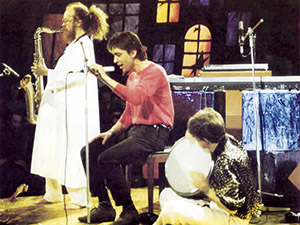
    In this Pop Mechanics performance, Kuryokhin is lead singer with Sergey Letov on saxophone.

    Ironically, in 2003, then US Secretary of State Colin Powell claimed at the United Nations to have “irrefutable” evidence that Iraq possessed weapons of mass destruction – a false claim that, like Kuryokhin’s, was believed by many, but tragically unlike Kuryokhin’s led to the death of hundreds of thousands of people.

    Kuryokhin’s mushroom prank aired on TV less than a year before the collapse of the Soviet Union, but the artist was just getting started. His rebellion against the rigidity of communist Russia would soon take on the nation’s new capitalist form too. 

    In 1991, months before the collapse of the USSR, Soviet audiences witnessed a shocking scene on television program Pyatoe Koleso (The Fifth Wheel). Two serious-looking men – Sergey Sholokhov, the host, and his guest, the underground musician and writer introduced as “politician and actor” Sergey Kurekhin – sat in a studio discussing the 1917 October revolution. Suddenly, Kurekhin offered an astounding hypothesis – that Vladimir Lenin, the Bolshevik leader, was not a human being but a mushroom. Kurekhin used graphics to back up his hypothesis including this picture of Lenin (above right) with a round “strange object” on the bottom right of the photo. Kurekhin mesmerised viewers with a complex scientific-sounding explanation, and some misdirection, that linked the object to hallucinogenic mushrooms, as well as citing much “evidence” of Lenin’s affinity for mushrooms!

    With the end of the Soviet Union, Kuryokhin like many artists was optimistic at the prospect of a new Russia. However, as reality began to set in, Kuryokhin and other dissidents soon came to see this new Russia as a state even worse than the previous. 

    “He was very disappointed with liberals at that time, plus by senseless post-modernity, by the chillness of the people surrounding him in the liberal artist circles, and he was in search of something different,” said Aleksandr Dugin, the Russian philosopher, author, and political strategist who was close friends with Kuryokhin in his final two years. 

    Kuryokhin was among the first of the liberal artists who, upon seeing the reality of a post-Soviet Russia, became disillusioned with the vacuousness of liberal capitalism and sought to replace it with something new and spiritually substantial. Thus came the creation of the National Bolshevik movement. A radically syncretic and paradoxical movement co-founded by Dugin, Kuryokhin, writer Eduard Limonov, and punk musician Yegor Letov, the National Bolsheviks combined anti-liberalism, the Situationist Avant Garde, the metaphysical, and the absurd with loud imagery and anti-government protest. 

    A man who enjoyed pushing the envelope and making waves wherever he went – including through his experimental music group Pop Mechanics – Kuryokhin’s involvement with National Bolshevism was no different, and he used politics as another vehicle for his art, even inserting Dugin and Limonov into the final Pop Mechanics performance, which was dedicated to the British occultist Aleister Crowley. 

    According to Professor Fabrizio Fenghi in his book It Will Be Fun and Terrifying: Nationalism and Protest in Post-Soviet Russia, Limonov “read a text about ‘fallen angels’ and sang” during the concert, while Dugin read excerpts from Aleister Crowley’s work as Kuryokhin “performed some pseudo-ritualistic and seemingly mocking gestures” from behind. 

    “He was much larger than a party. He used National Bolshevism as a line of his conceptual music, one of the melodies in the sequence,” Dugin explained, adding that one core element of Kuryokhin’s personality was irony. 

    “When it looked like he was joking, he was saying serious things. When it looked like he said serious things, he was joking,” Dugin continued, calling Kuryokhin one of the master ‘trolls’ before ‘trolling’ was even a thing. 

    But Kuryokhin was also “really serious about religion, about metaphysics, about death, about philosophy” and “about the basic structure of human being,” Dugin said – using his art and his stunts to push a greater message, concept, or ideal. 

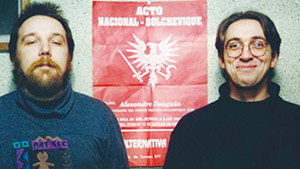
    Aleksandr Dugin & Sergey Kuryokhin in the mid-90s.

    In their ‘Manifesto of the New Magi’ (on page 70 of this issue of New Dawn), Kuryokhin and Dugin called for a return to ‘magic’ to bring on the revitalisation of politics and art, which they argued had degenerated to the lowest point. 

    “Only the direct, total replacement of art and politics with MAGIC can save this situation,” the manifesto declared, claiming that the source of magic in both institutions “has gradually been lost sight of.” 

    “Instead of a separate art, separate politics, and separate magic, a new synthetic discipline should be introduced, that of MAGIC, which directly establishes its own politics and its own art,” they said, concluding that art and politics should become the ritual itself. 

    Get the issue this article appears in

    The National Bolshevik movement is often considered to have been Kuryokhin’s last major stunt, or work of art, before he tragically died of a heart condition in 1996 at the age of just 42. 

    Yegor Letov passed away in 2008 and Eduard Limonov died in 2020, making Dugin the last of the co-founders of the National Bolsheviks still standing. 

    Kuryokhin was never a well-known figure in the West, and his international obscurity continues today, though with the advent of the internet his work has reached small new audiences online in the United States, United Kingdom, Australia, and beyond. 

    Perhaps more importantly, the conditions that led to Kuryokhin’s art are still present around the world, though largely in the West, where another generation of youth find themselves at the precipice of societal change, in a late state of decline.

    [alert type=”general” dismiss=”no”]This article was published in New Dawn Special Issue Vol 15 No 3.[/alert]

    [alert type=”success” dismiss=”no”]If you appreciate this article, please consider subscribing to help maintain this website.[/alert]

    Footnote

    1. www.academia.edu/633795/A_Parasite_From_Outer_Space_How_Sergei_Kurekhin_proved_that_Lenin_was_a_mushroom

    © New Dawn Magazine and the respective author.
    For our reproduction notice, click here.

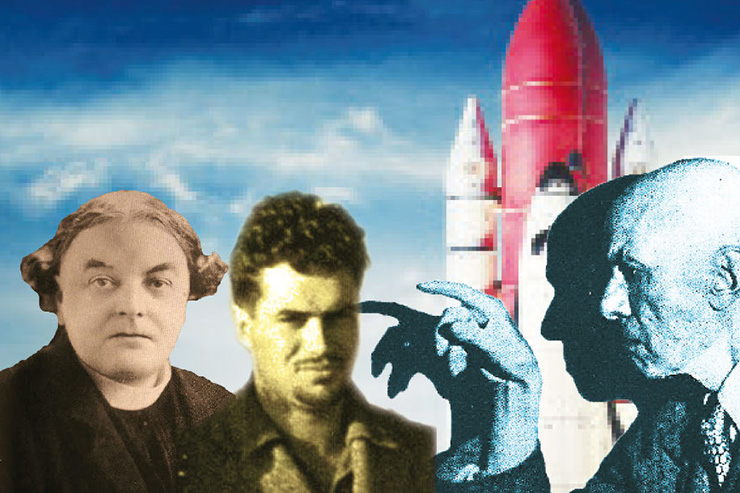
  • The Ties That Bind – Spies & the Occult: The Connections Between Aleister Crowley, a Rocket Scientist, a Priest, & a British Spymaster

    The Ties That Bind – Spies & the Occult: The Connections Between Aleister Crowley, a Rocket Scientist, a Priest, & a British Spymaster

    This article was published in New Dawn Special Issue Vol 13 No 3 (June 2019)

    Dr Richard Spence, a history professor and author of Secret Agent 666: Aleister Crowley, British Intelligence and the Occult (published by Feral House), is an expert on intelligence and the occult.

    In this interview with New Dawn magazine, Spence details his years of research into the little known connections between intelligence agencies, spies, and occult activity. Dr Spence explains the ties between occultist Aleister Crowley, rocket scientist and dissident Jack Parsons, British spymaster Maxwell Knight, along with author and priest Montague Summers.

    Crowley, described by the British press of the time as “the wickedest man in the world,” founded the spiritual philosophy Thelema and led the occult fraternal organisation Ordo Templi Orientis (OTO). He remains at the centre of conspiracies.

    CHARLIE NASH (CN): You’ve written a book about Aleister Crowley and his connections to British intelligence, but for readers of New Dawn who haven’t read the book, could you tell us a bit about Crowley’s alleged intelligence connections and what you found from your research?

    RICHARD SPENCE (RS): Aleister Crowley would make allusions, or in some cases direct comments, about being involved with intelligence. He would mention specifically the admiralty’s intelligence and the name of a particular official who had been connected to that during the First World War, a fellow by the name of Captain Guy, or earlier, Commander Guy Gaunt. Gaunt, whenever asked about this, would waffle on the question or say that he knew nothing about what Crowley was talking about. And it’s fairly easy considering his dubious reputation and lack of any kind of documentary evidence, like a spy card, or something to back that up. Most people would dismiss that as an act of either desperation or a fantasy he had.

    Dr Richard Spence

    I was actually working on a subject about another person, another spy, who was active in and around New York City during the First World War, and one of the things that I was looking for was any possible cross-pollination. It’s always interesting to see who’s put in the same place at the same time, or even the same room. 

    In the States, you can get through the Freedom of Information Act older FBI files, which at the time was called the Bureau of Investigation. You can also access a kind of semi-defunct agency that functioned at the time, as part of the US Army – the Military Intelligence Division. One of the interesting things is that the Military Intelligence Division in the United States during the First World War was the agency that handled domestic counter-intelligence. Handily, for us historians, all of the MID’s pre-1941 records were declassified many years ago, and they’re available in the national archives.

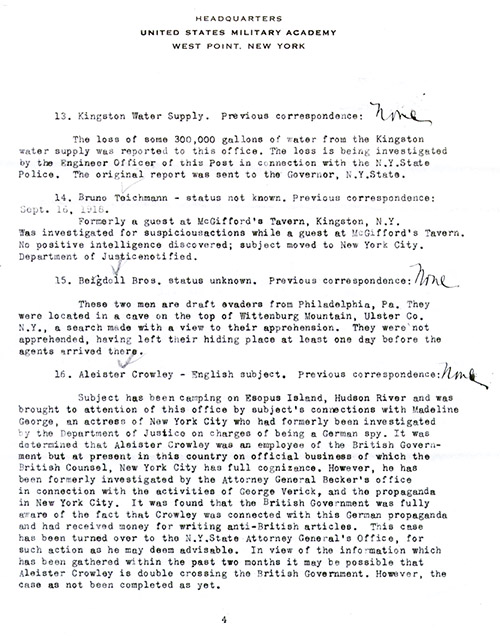
    Keep in mind here we’ve got this guy Crowley running around New York at the same time, and he’s claiming to have been connected to British intelligence, and the guy I’m looking at has some connections in the same period… Is there a possibility? Is there anything to it? I decided, partly out of curiosity, to send off to the national archives to see if the MID files had anything on Crowley, and lo and behold they did, and I got the file. This is from July 1918, and it deals with Aleister Crowley, English subject. The key elements say, “Subject has been camping on Esopus Island, Hudson River, and was brought to the attention of this office by subject’s connections with Madeleine George, an actress in New York City, who had been formally investigated by the Department of Justice on charges of being a German spy.” Now the key part is what follows: “It was determined that Aleister Crowley was an employee of the British government but at present in this country on official business of which the British Counsel, New York City has full cognisance.” Skip down a couple of lines, “It was found that the British Government was fully aware of the fact that Crowley was connected with German propaganda and received money for writing anti-British articles.”

    That was kind of interesting… The British Consulate was reluctant to say anything about it because they wanted to prevent the Americans from arresting him. They said, “Leave him alone,” and they did. 

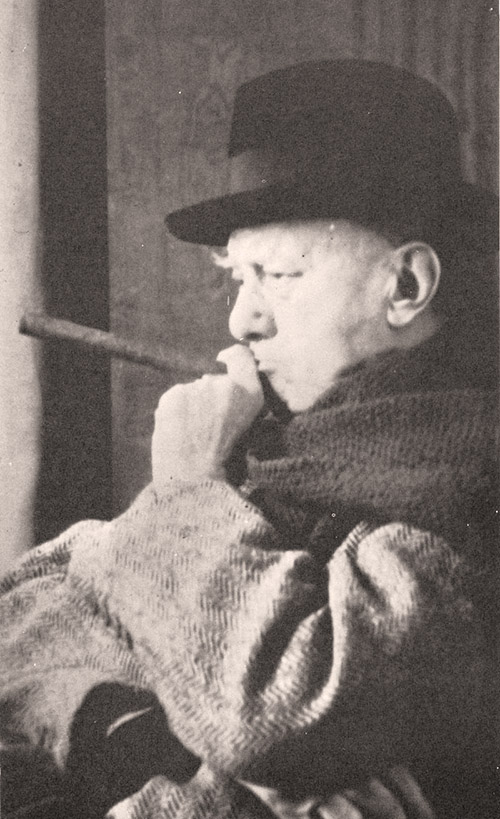
    A war time photo of Aleister Crowley imitating Britain’s Prime Minister Winston Churchill, for whom he claimed to have invented the “V for Victory” hand sign.

    CN: That proves Crowley had a connection with intelligence?

    RS: One of the things you’ll find if you’re looking for people dealing with intelligence, almost never is that ever explicitly stated. No, people don’t carry spy cards, people don’t walk around with cards saying, “I am a spy,” that would be a bad thing to do. In the entire realm of intelligence, the single guiding principle, at least in terms of any kind of active operations, is secrecy. These are agencies which are essentially dedicated to concealing their own secrets and discovering other people’s secrets, so they do not operate openly. There’s no sort of general list of everybody who is an agent for this agency or another one. 

    The other thing which goes along with secrecy is the compartmentalisation of information, which means only people with an important and legitimate reason to know what this person is doing would be aware of that. In a sense, this is the closest thing you’re ever going to get to an admission from any kind of official that, ‘This person is an agent for us’. He’s an employee of the British government, and in this country on official business, which is known to us, and this official business is connected to him writing what appears to be treasonous propaganda, and we want you to leave him alone. When Crowley eventually returns to the UK, after the war, there’s not the slightest indication of any problems. He waltzed through the whole thing. He came back and went about his business. It was just before Christmas, and he went to his aunt’s house. He had a Christmas dinner and everything was fine until the British press caught on he was in the country, raised a stink about what he had been doing in New York, and then he very quickly left for France.

    Here’s the type of thing you have to imagine. You have an individual who arrived in America on the Lusitania on Halloween, in 1914, and he spent the entire war in the States, returning again in late 1919, and during that time he had indeed worked quite openly as a German propagandist. He had written articles, rather scathingly and insulting anti-British articles, for a publication in New York called the Fatherland. You might figure that when Crowley returned home there would’ve been some issue. But there’s none. The other thing is that to get back home in 1919 he had to go to the same British consulate that a year before said, “He’s okay leave him alone,” and he essentially had to get his passport renewed, because the passport that he carried with him when he came in 1914 was no longer valid. If a British official in New York simply wanted to keep him out of the country, they could’ve done so. They could’ve arrested him when he arrived. Instead, he goes to the consulate, they give him a new passport, and he goes home. There’s no problem until it becomes a public issue that he’s there, in which case he quietly moved across the channel until things died down. 

    Page of the US Army Military Intelligence Division file obtained by Prof. Richard Spence that discusses Crowley’s activities in America.

    Crowley was a controversial figure, he was a lousy businessman, he always seemed to be short of money, yet one of the things to notice is that he’s never without some money to live, and he’s never without food, and he’s never without associates. He’s not just lucky. There are people looking out for him, and some of those are his followers, and some of them I think were mysterious forces at work in that case. But he tends to get in trouble if he starts talking about these things because another rule in intelligence is that you keep your mouth shut. Basically works this way: You never say what you did for us, and we’ll never talk about what you did for us, and that’s the way the situation ought to be. The British consulate in New York is saying this guy is doing official business. What official business? If you look at Crowley’s visible activities, he’s going camping on Esopus Island, he’s up at Montauk Point, or he’s consorting with his ‘Scarlet Woman’, and seems to be doing a lot of nothing, other than travelling around, consorting with some other occultists. And yet he’s on official business from the British government. So, the mere fact that you cannot visibly see that business gives you an idea.

    CN: Interesting…

    RS: After a while you learn what to look for, and remember you’re dealing with a realm which is not intended to be obvious. None of this should be apparent to someone who is looking from the outside. That is the last thing a spy is supposed to do, to act like a spy. That defeats the entire purpose. I think people get these ideas very often from films in which spies tend to be quite obvious, but there’s always supposed to be some sort of cover to what it is that they’re doing. Anyone who is an intelligence operative in the field needs some reason to be where they are, other than the fact that they’re a spy. You have to have an excuse to be in this particular place at the time. That’s why journalist is a great cover, missionary is a great cover, explorer is a great cover, and in the same way, occultist can be a great cover. I think it even works well in this case because people say, “Aleister Crowley can’t be an intelligence asset because he’s just too weird, he’s too controversial in some way.” Well actually, in that way, it almost qualifies him for the job. “This person cannot possibly be a spy” is the very thing that qualifies them to be a spy.

    CN: Crowley wasn’t the only occultist who was alleged to have connections with intelligence. There are allegations that Jack Parsons was also connected to an intelligence agency. What do you think about Parsons?

    RS: For anyone who’s not acquainted with him,Jack Parsons is generally known for two things. Most commonly he is known as a rocket scientist. He was a kind of natural genius in the area of propulsion and explosives, and responsible for the creation, pretty much, of solid fuel rocket engines. He was one of the daddies of the American space program. That’s why he has a crater named after him on the dark side of the Moon. He was also connected to the Jet Propulsion Laboratory, GALCIT [Caltech Aerospace] – the whole background to American rocketry in the space program. But simultaneously he was a devoted practitioner of the occult, in particular as defined and refined by Aleister Crowley. The two of them, of course, were associated for a period of time. Parsons came to believe that he was Crowley’s successor. The other thing about Parsons that people would know is he’s blown up in his lab in the early 1950s. 

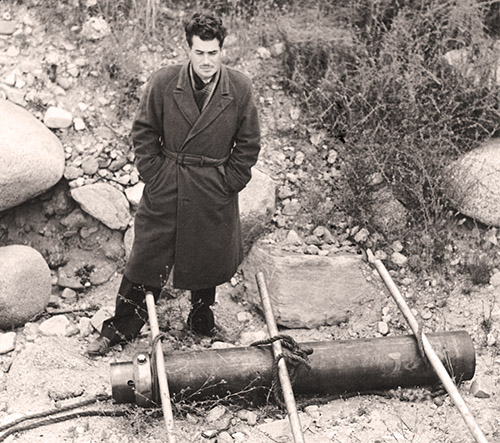
    Jack Parsons standing above a canister at the Jet Propulsion Laboratory (JPL), June 1943.   

    One of the things that began to intrigue me, and it started with Crowley, but then the more I began to look around the number of people you run across who were connected to intelligence in one form or another and had some sort of interest or connection to the occult… This isn’t just one of those things that’s an oddity. It’s almost commonplace. There is a serious overlap between the two realms, and I will admit that I’m not sure why that overlap exists. I can only tell you that it is there. You tend to find occult is all over the place.

    Consider the context of that period. You’ve got Parsons, who is connected with JPL and the aerospace industry. He has a security clearance because he’s working on classified projects, and he’s working side by side with other people who are involved in classified projects. And in his spare time he is trying to encourage these people to join him in his occult activities. Would it be insane to imagine that Jack Parsons was working for someone in an effort to compromise and recruit American scientists, or people working in classified areas of aerospace? It’s a reasonable suspicion. 

    Parson’s association with Crowley’s OTO is the thing that lost him his first security clearance. He was eventually able to get it back, which is fairly interesting, and then he lost it again. He lost it the second time – I think he was working for Hughes Aircraft – because for inexplicable reasons he decided to take home classified documents from a project he was working on, and that’s just one of those things you don’t do. Anybody in that circumstance would have been terminated from the project. I can’t see Parsons ever came up with a good explanation as to why he did that. Was it to take home for his own satisfaction? Was it with the intent to deliver them to somebody else? 

    In 1938, Jack Parsons’ testimony as an explosives expert helped convict the Los Angeles police intelligence chief, Earl Kynette, for the attempted murder of private investigator Harry Raymond. In court, Parsons reconstructed the bomb Kynette had planted, establishing his expertise in the public eye.

    Afterwards, he’s become unemployable in the aerospace field. There’s talk he’s going to Mexico to set up a fireworks factory, and the idea he had been invited by the Israeli government to come to Tel Aviv and help them develop their missile program. I’ve seen that stated, I’ve never seen anything from the Israeli end that might support it. Of course, you’re not going to get Mossad or someone to say, “Yeah we tried to recruit this guy.” Those are the type of things you don’t talk about. 

    There’s a third possibility. Are all those really blinds for the fact that what you’re going to do is go to Mexico, then pretend you’re going to Israel, but end up in Moscow? That is what I think some people on the American end were afraid of. You’ve got a guy who’s certainly a religious and social dissident… I mean Parsons had penned this thing called Manifesto of the Antichrist, in which he stated that he was opposed to all existing governments and wouldn’t submit to their authority. That makes him a problematic employee. And then you have someone who had briefly flirted with the Communist Party back in the late ‘30s, and at the JPL was associated with people who were past or present members of the Communist Party. This, by the way, was also a period, the late ‘40s and ‘50s, when a secret program known as the Venona Project was becoming increasingly aware that it was infested with Soviet agents. Lots of them. I mean the Manhattan Project was infiltrated. You have to place the whole thing with Parsons and his activity in that time frame to understand how people saw it. Their fears were not entirely irrational. They might have been wrong, but it wasn’t irrational to have those suspicions. 

    Parsons was a genius. He would have been the perfect guy to go after if I was a Soviet agent or recruiter operating in California at that time. There would be great advantage to that, and I would be very much surprised if no Soviet approached him… It’s a possibility that has to be considered.

    CN: What do you personally think happened?

    RS: His wife believed he was murdered. She believed it wasn’t an accidental explosion. I’m an agnostic on that point because while Parsons knew his way around explosives probably better than most people, maybe anybody, accidents happen. That to me would still seem to be the most likely explanation. But, it’s an interestingly timed accident, and if someone, let’s say, wanted to make sure their opponents can’t use him, well there’s only one way to be sure of that. I don’t think it’s the most likely explanation that Parsons was murdered, but again, I think it is a possibility that can’t be ruled out.

    CN: Where does British spymaster Maxwell Knight fit into things?

    RS: Maxwell Knight. Here’s another guy also involved with intelligence, and that’s what connects him to Crowley. Aside from whatever may have connected them in terms of intelligence work, they also shared a common personal interest in the occult sphere. I think that’s often important to draw people together. Knight’s a strange character. He’s a guy that starts out in the ‘20s, ostensibly as a kind of fascist. I think at one point he’s the chief of intelligence for one of the fascist organisations. By the ‘30s his organisation is infiltrating and spying on the Right in Britain. That’s one of the things he tends to be quite successful at, putting his eyes and ears inside things like the Right Club. These were essentially pro-fascist organisations in Britain that were suspected, and quite rightly in most cases, of being vehicles for German, and to some degree Italian, intelligence operations. A place where the Nazis could find fellow travellers who could be recruited for one purpose or another. 

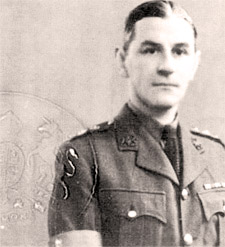
    Maxwell Knight’s official file photograph. 

    You’ve got a guy who essentially starts out apparently working for these organisations, who then a decade or so later is now spying on very similar organisations. This always brings up the fascinating point about where their true loyalties actually lie. Do they have any? 

    The codename Maxwell Knight used, or one of them, was ‘M’, and there is a connection in the ‘30s. Someone using the codename M was supplying information to the Vatican about Crowley and other people’s activities. They’re supplying it to a fellow by the name of Father Joseph who was attached to the Vatican in the late ‘30s and essentially ran a kind of minor intelligence operation that was very interested in keeping track of certain individuals and occult activities. He was very interested in Crowley and other people, and he was getting these reports from England, from a British source. There’s some discussion about who this M actually was… the first conclusion you would jump to is that it must be Maxwell Knight. Why? Because Maxwell Knight was known to use the cover name or identifier M, and it would make sense that Knight had some acquaintance through Crowley, through interest in the occult… Crowley might have been someone he was keeping track of. Maxwell Knight seemed to be the kind of logical candidate for this particular M because the connections were there. The occult connections, his involvement with intelligence, the fact that Crowley was connected to unsavoury characters, or appeared to be, on both the left and the right… So he could have been M. I’d give you a 95 percent assurance, however, that it wasn’t Maxwell Knight.

    CN: Who do you think M was?

    RS: Montague Summers. Montague Summers was also British, and a man with a fascination with the occult, but apparently from the other side. Montague Summers wrote a series of popular books on occult subjects like werewolves, vampires, and witchcraft. Montague Summers was a peculiar character. He at one point had been ordained in the Anglican church and then had been defrocked for the reasons that priests often get defrocked. He apparently had an acute interest in young boys, and that got him kicked out of the Church of England. But then he was re-ordained, if my memory serves me correctly, in one of those kind of fringe… Not the regular Roman Catholic Church, but the Old Catholic Church, one of these semi-dissident bodies that still maintains connections to Catholicism.

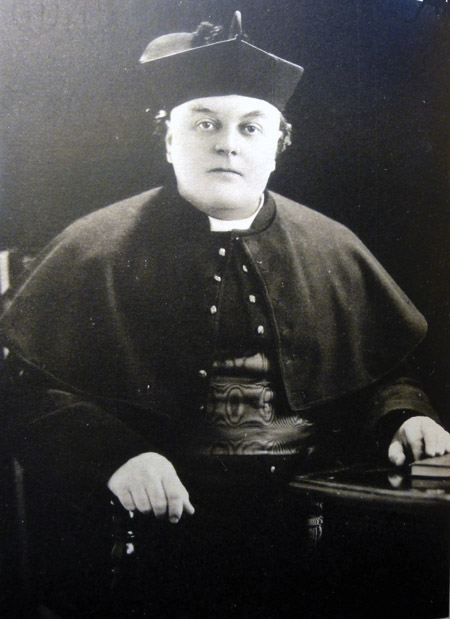
    The English author and clergyman Montague Summers (1880–1948)

    From the standpoint of Montague Summers, witches, vampires, werewolves, and that kind of thing are bad. He doesn’t see anything positive in them. But notice there’s still this common interest. His interest in the occult may be from exposing its negativity, whereas Crowley is more of a proponent in some respects of its positive aspects, but outside their stage personas they hung out together. You have people who can indeed put Montague Summers and Crowley in the same room together. They don’t seem to have been fast friends, but they would talk. There was a common bond between them, and that’s why I think Montague Summers was M.

    Here you have another occultist or someone who was immersed in it, serving another purpose. The other thing that tends to reinforce this, and I got this from a fellow who was the descendant of Montague Summers’ personal secretary: When Summers died, which was around the same time or a little after Crowley did in ‘47, the story goes that after Summers’ death some men showed up and took a bunch of his papers, and when the secretary asked, “Who are you, and why are you taking these papers?” the answer was, “We’re from the government.” That’s a little interesting anecdote.

    I think that Maxwell Knight is the most obvious candidate for M, but sometimes the most obvious answer is not the correct one. 

    [alert type=”general” dismiss=”no”]This article was published in New Dawn Special Issue Vol 13 No 3.[/alert]

    [alert type=”success” dismiss=”no”]If you appreciate this article, please consider subscribing to help maintain this website.[/alert]

    © New Dawn Magazine and the respective author.
    For our reproduction notice, click here.