New Dawn – World's Most Unusual Magazine

Category: Secret History

  • Jack Parsons & the ‘Babalonian Apocalypse’

    Jack Parsons & the ‘Babalonian Apocalypse’

    From New Dawn 204 (May-June 2024)

    The religion of Thelema, founded by British occultist Aleister Crowley (1875–1947) last century, proclaimed a new “Aeon of Horus” based on “force and fire.” According to its ‘bible’, Liber Al vel Legis (The Book of the Law), it is a stellar or star-oriented religion. 
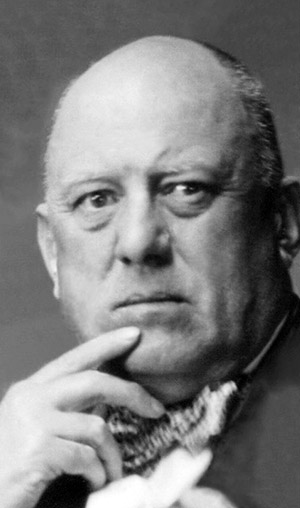
    British occultist Aleister Crowley claimed to have channelled Liber Al vel Legis (The Book of the Law).

    In his introduction to Liber Al, Crowley states that Liber Al “explains the universe.” The Thelemic dictum, “every man and every woman is a star,” places humanity in a stellar context, with each ‘star’ having its own ‘orbit’ through which it expresses its own ‘will’ (Greek = Thelema). The opening lines of Liber Al proclaim Nuit, the Egyptian sky goddess representing space, “invoking the company of heaven.” Nuit is to be “invoked under the stars.” 

    Crowley claimed to have received his ‘revelation’ astrally from a ‘praeterhuman’ intelligence – Aiwass – representing the gods of a certain equinox. There are three aeons in Thelema based on three Egyptian gods: Isis (goddess worship), Osiris (dying and resurrected god – including Christianity), and Horus, the hawk-headed god that presides over the new (incoming) aeon. 

    While stellar references are used allegorically, Crowley wondered whether there is also “some real connection between a given persona and a given star.” 
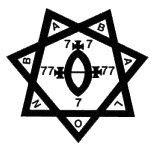
    The seal of Babalon.

    Among the sundry bohemians and intellectuals attracted to Thelema, including artists, poets, and academics, was one John (Jack) Whiteside Parsons (1914–1952), a seminal figure in setting humanity on the exploration of outer space. 

    As we will explore later, Parsons attempted to invoke Babalon, the ‘Scarlet Woman’ of Thelema, as the manifestation of Nuit. He also penned what he proclaimed to be the ‘fourth chapter’ of Liber Al (given to Crowley in three chapters), ushering the Aeon of Babalon. 

    Thelemic ‘War Machine’

    Jack Parsons with Marjorie Cameron, his second wife and ‘Scarlet Woman’.   

    The Aeon of Horus was to be ushered by cataclysmic events. As a sign of the times, Crowley referred to “war, the atrocities which occur on a daily basis and leave us unmoved and hardly worried.” 

    Book III of Liber Al, relating to the Aeon of Horus, is a martial doctrine that refers to Horus as “a god of war and of vengeance,” stating that he would deal harshly with his enemies. Next, a “war machine” is referred to as something to be given to Thelemites. Liber Al states, “With it ye shall smite the peoples; and none shall stand before you.” 

    Such apocalyptic visions of creating a “war machine” for Thelema would motivate Parsons. 

    Crowley refers to another aeon after that of Horus and the emergence of “another prophet” to assume Crowley’s “throne.” He refers to this new prophet who would “bring fresh fever from the skies.” 

    There were several claimants to this mantle while the current aeon and Crowley were still around. Parsons declared himself and that his aeon was Babalon. Crowley did not like the idea of a prophet emerging while he still lived. Crowley considered Parsons dangerously foolish, and Parsons broke with Crowley. 

    Both Crowley and Parsons based their magickal workings on Enochian. Beginning in 1581, Dr John Dee and his assistant Edward Kelley devised a system of astral communication with so-called ‘angels’ using a system of ‘Calls’, inscribed tablets, and the Enochian alphabet and language. The eighteen ‘Enochian Calls’ are full of fiery imagery. The ‘Tenth Call’ refers to the Earth “burning day and night, and vomit out the heads of scorpions, and live sulphur mingled with poison.” 

    In a magickal ritual performed in the Tunisian desert on 7 November 1923, Crowley “quizzed a discarnate intelligence about what The Book of the Law’s third chapter meant by a ‘war engine’, described as a gift of Ra Hoor Khuit, the Sun in its martial aspect.” In a note, Crowley wrote that the ritual brought a vision “not incongruous with my idea of the new Energy.” 

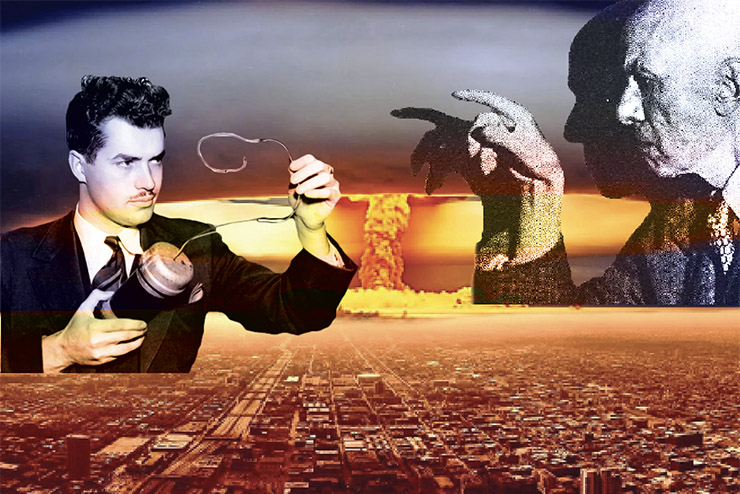
    Crowley sent the material drawn from the ritual to Thelemite mathematician Prof. Norman Mudd for interpretation. Crowley biographer Tobias Churton comments: “The notes show drawings, images, and algebraic concepts suggestive of nuclear fission. Extraordinarily striking for a North African vision in 1923, the notes, with hindsight, suggest the ‘war engine’ was nothing less than an atomic bomb.”

    Founding of Jet Propulsion Laboratory

    In 1945, Crowley wrote to the novelist Louis Umfraville Wilkinson, a Thelemite, that “The Atomic Bomb is interesting, not only because of Liber Al, chapter III, verses 7 and 8, but because one of the men who were working on it was for some time at the Abbey in Cefalu.” For a period, Crowley’s Abbey of Thelema (in Cefalu, Sicily) was where his community of disciples practised the doctrines of Thelema and performed magickal rituals.
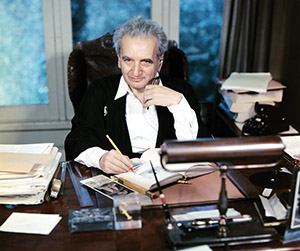
    Dr. Theodore von Kármán

    In 1936, Dr. Theodore von Kármán, director of the Guggenheim Aeronautical Laboratory at the California Institute of Technology (GALCIT), founded the Aerojet rocket motor company with Frank Malina, a Communist sympathiser, and Jack Parsons. The Jet Propulsion Laboratory (JPL) emerged from GALCIT in 1943 after the project came under the auspices of the US military. 

    Kármán was a descendant of the famous Hasidic (Cabalistic) Rabbi Yehuda Loew ben Bezalel, the 16th century ‘Exalted’ Rabbi of Prague, astronomer, and, according to Jewish legend, creator of the ‘Golem of Prague’. Kármán was the great-grandson of Moses ben Menachem Mendel Kuntitz, a scholar of the Zohar, the main body of Cabalistic mysticism. 

    Parsons, Malina and several others became known as the ‘Suicide Squad’ for their dangerous use of explosives and were subsequently moved from the CALTECH campus. From 1941, the US military lavished funding on GALCIT, and the Aerojet Engineering Corporation was founded in 1942 to meet its expanding requirements. 

    Parsons’ contributions to solid propellant rocketry led to the development of the solid motors on the Space Shuttle and the motors in the Minuteman missile. A crater on the Moon’s dark side is named in his honour. After World War II, the work that Parsons undertook on liquid and solid-state fuel led directly to the US space programme. 

    Liber 49 
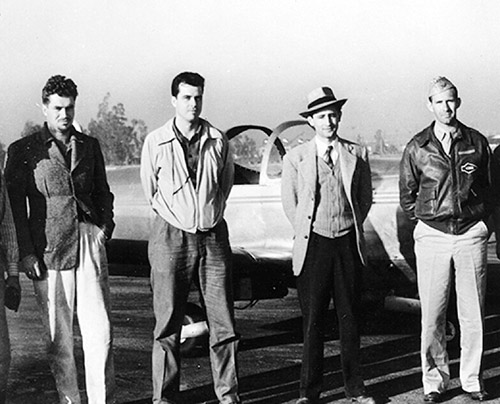
    (from left) Rocketeers Jack Parsons, Ed Forman and Frank Malina. 

    Parsons became a devotee of Crowley in 1939. He joined Agape Lodge, the Los Angeles branch of Crowley’s organisation, Ordo Templi Orientis (OTO), and was initiated in 1941. After his first wife left him for the lodge’s head, Wilfred Smith, he assumed leadership in 1943. The OTO temple was moved to Parsons’ mansion in Pasadena. 

    When Parsons undertook his ‘Babalon Working’ in 1946, Crowley responded by stating, “I get fairly frantic when I contemplate the idiocy of these goats.” With artist, poet and actress Marjorie Cameron as his ‘Scarlet Woman’, they intended to evoke Babalon to worldly manifestation by creating a magickal child, although Parsons later considered Cameron to be that incarnation.

    According to Kenneth Grant, Crowley “wrote Parsons off as yet another failure,” and Parsons resigned from the OTO in August 1946. 

    As a result of the Babalon Working, Parsons proclaimed himself “Belarion Antichrist” and issued a new revelation, Liber 49 – a fourth chapter of Crowley’s Liber Al – ushering the Age of Babalon.

    Like the ‘Enochian Calls’, Liber 49 is reminiscent of the Apocalypse of St. John. While John’s Revelation announces the return of Christ after an apocalypse, Parsons believed that an apocalypse would bring forth a New Aeon of the Antichrist and Babalon. 

    In martial spirit, continuing the legacy of Horus, Babalon proclaims that she will come via her daughter as a “penelous (sic) flame,” “a trumpet in judgement halls,” “a banner before armies,” to “judge nations” with “force and fire.” Those who resist will be destroyed: “None shall resist thee, whom I lovest. Though they call thee harlot and whore, shameless, false, evil, these words shall be blood in their mouths, and dust thereafter.” 

    Parsons, as Antichrist, had undertaken his “black pilgrimage” in the Mojave Desert on Babalon’s command. He swore that he would fulfil Babalon’s rule on Earth and published his manifesto: “And in my name BELARION shall they work miracles, and confound our enemies, and none shall stand before us.”

    Enochian 

    The occult scholar Donald Tyson writes of the Enochian workings that John Dee believed the ‘angels’ he was evoking were servants of God, whereas Edward Kelley thought they might be deceivers. Tyson says these ‘angels’, by fooling Dee, used him to introduce a ritual working that would usher the Apocalypse. The working was aimed at opening the gates of the Watchtowers that guard against the intrusion of satanic powers into this universe. Tyson states that Dee was blind as to the true function of the ‘Enochian Keys’. He also claims Crowley failed to complete the entire apocalyptic Enochian Working despite his exuberance for the subject and his claim to be the Antichrist.

    Parsons took on that mantle, broke with Crowley, and aimed to bring forth the Apocalypse by more direct means. Parsons is said to have recited Crowley’s poem ‘Hymn to Pan’ and danced at the launching of rockets by the JPL. It seems that he regarded each rocket launch as a ritual working.

    Babalon

    An academic study has been written on Babalon. Manon Hedenborg White references the Enochian magickal working of Crowley and Victor Neuburg in the Algerian desert in 1909, in which Crowley had a vision of the apocalyptic Whore of Babylon. He rendered this as “Babalon,” and incorporated it into Thelema as the primary goddess, who had been prophesied in Liber Al five years previously. In origin, Babalon is a generic name for ‘wicked’ in Enochian and related to the word ‘babalond’ meaning ‘harlot’. Apparently, she also communicated through her ‘daughter’ in the form of “a spirit called Madimi” to Dee and Kelley.

    Chapter 5 of White’s study is devoted to Parsons’ interpretation of Babalon. After rituals with Cameron during January and February, Parsons went alone into the Mojave Desert, where he evoked Babalon and transcribed Liber 49 as the fourth chapter of Liber Al. Of course, Crowley had already disowned Parsons. 

    While the Aeon of Babalon was intended to balance the “force and fire” of the martial Aeon of Horus, Parsons’ conception of Babalon nonetheless gloried in the biblical image of the Great Whore of Babylon foretold in the Revelation of John, “drunken with the blood of the saints, and with the blood of the martyrs.” 

    Where the biblical Whore of Babylon is generally considered to describe a corrupt system, to Crowley and Parsons, Babylon rendered as Babalon describes a terrible goddess bringing apocalyptic desolation to the world before ushering a new aeon. Hence, Parsons describes Babalon as “the dark mother of anarchy and abominations,” which he compares to Kali and Lilith. 

    Parsons & Israel

    Parsons drew the attention of the FBI. He was noted as a bohemian living with various other suspect characters, indulging in orgies and black magic rites at his mansion. 
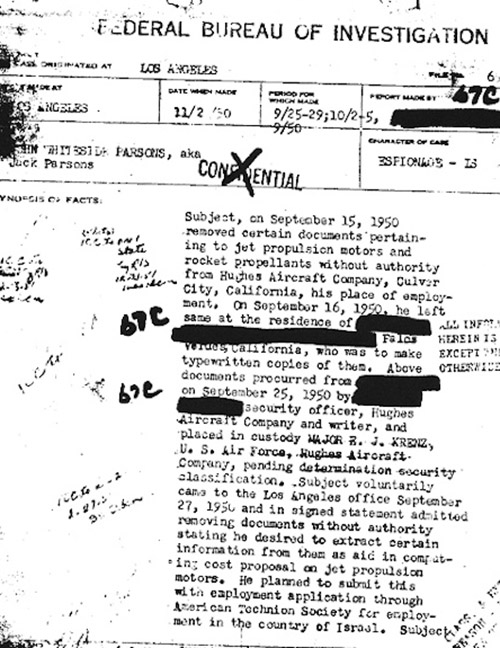
    FBI file about Parson’s outreach (or recruitment) to Israel to share his advanced knowledge about rocket science. 

    In September 1950, Parsons was identified as having removed restricted, confidential and classified documents on jet propulsion motors and rocket propellants from Hughes Aircraft Company, California. Parsons had worked there since 1949 as “group leader” in charge of propellants, propulsion and launching systems. In a statement to the FBI dated 27 September 1950, Parsons declared that he had taken the classified material for the purpose of preparing proposals for work in Israel.

    In his astral visions, Parsons “arrived at Chorazin in the dominion of the Antichrist.” Manon Hedenborg White writes that in Parsons’ astral vision, he emerges as the Antichrist at Chorazin. 

    Located near the Seas of Galilee in present-day Israel and now in ruins, Chorazin is mentioned in the Bible as one of three villages cursed by Jesus for failing to accept his teachings. Some medieval theologians believed that the Antichrist might come to be born in Chorazin. This notion clearly influenced Parsons, who explicitly calls the location “the city of the Anti-Christ” and believed that his astral journey marked his transition into the figure. 

    Here, we begin to see why the State of Israel might have assumed central importance in Parsons’ belief he was the Antichrist at the inauguration of the Aeon of Babalon. 

    The FBI files state that Parsons had read in technical magazines about research in Israel. In September or October 1949, that is to say, the year of his assumption to the role of Antichrist, he made contact with an Israeli agent who requested him to prepare a proposal “regarding the building of an explosives plant in Israel and data concerning rockets and other armaments which Parsons would be able to conduct research work on in Israel.” In August 1950, he was asked to submit costs for “a jet propulsion development program on which Parsons could do research work in Israel.” The initial contact with what Parsons said to the FBI was a “business consultant,” whom the FBI identified as “a representative of the Israeli Government” living in North Hollywood, came through the American Technion Society. 

    The FBI report states that the Technion Society was designated officially by both the Israeli Government and Israeli industry as the “American body” through which the latest in US technology was conveyed to Israel. The Technion Society was another name for the “American Society for the Advancement of the Hebrew Institute of Technology in Haifa, Palestine, Inc.” (Los Angeles File, a-27-49). The file states that “this organisation publishes the Technion Yearbook and the society is also known as the ‘American Technion Society’.” A statement dated 2 December 1950 in the FBI files mentions that Dr. Theodore von Kármán had recommended Parsons contact what seems to be (the words are blacked out) the American Technion Society. It seems that Kármán, Parsons’ mentor and one of the most distinguished names in rocket science, had facilitated his communication with Israel for the purposes of espionage. 

    Parsons had his security clearance suspended in 1948 because of his involvement with a “cult” and associating with an “alleged Communist Party member.” This suspension was removed the following year. US Assistant Attorney General McEachen declined to prosecute due to a lack of evidence that taking classified documents for use by Israel was “injurious to the USA or to the advantage of another nation,” but Parsons’ security clearance was again revoked on 9 January 1952.

    As the self-declared Antichrist who would usher the Apocalypse, Parsons was uniquely positioned to do so as one of the fathers of US rocketry. It is significant that he intended to settle in Israel and sought to persuade the Israelis that he could establish a missile programme. In his role as Antichrist, it seems credible that Parsons envisaged settling in Israel at the location where the Apocalypse is supposed to unfold from the battle of Armageddon. 
    It also seems likely that Parsons saw a vision of nuclear devastation in the fiery Apocalypse described by St John in The Revelation. One of the world’s most eminent experts in rocket chemistry, someone with such a mission as Parsons, was uniquely placed to complete the Enochian Working with the benefits of modern apocalyptic science that he helped in large measure to create.

    Parsons’ hopes of going to Israel did not eventuate. It is debated as to whether the enormous explosion that killed Parsons on 17 June 1952 when he was handling chemicals on his property was an accident, murder, or suicide. 

    Or perhaps it was a self-immolation rite to Babalon, a final fiery embrace intended as a sacrifice to inaugurate the Aeon?

    [alert type=”general” dismiss=”no”]This article was published in New Dawn 204.[/alert]

    [alert type=”success” dismiss=”no”]If you appreciate this article, please consider subscribing to help maintain this website.[/alert]

    Footnotes

    1. Crowley, Liber Al (York Beach, Maine, 1976), 1: 1-3.
    2. Ibid., 1: 57. 
    3. Aleister Crowley, The Law is for All (Arizona: Falcon Press, 1985), 72-73. 
    4. Crowley, Introduction to Liber Al, IV: The New Aeon, 13. 
    5. Ibid., 3: 6-8, 39. 
    6. Ibid., 3: 34, 42-43. 
    7. Donald C. Laycock, The Complete Enochian Dictionary (London: Askin Publishers, 1978), The Tenth Call, 257. 
    8. Tobias Churton, Aleister Crowley: The Biography (London: Watkins Publishing, 2011), 274. 
    9. Ibid.
    10. Crowley to Wilkinson, 7 August 1945, cited by Kenneth Grant, Cults of the Shadow (London: Frederick Muller, 1975), 115. 
    11. S. Goldstein, ‘Theodore von Kármán’, Biographical Memoirs of Fellows of the Royal Society, Vol. 12, November 1966, 334-365. 
    13. Kenneth Grant, The Magical Revival (London: Frederick Muller, 1972), 166. 
    12. Henrik Bogdan, The Babalon Working 1946: L. Ron Hubbard, Jack Whiteside Parsons, and the Practice of Enochian Magic, Numen, No. 63, 2016, 28. 
    14. Jack Parsons, Liber 49, The Book of Babalon (1946) v. 10, sacred-texts.com/oto/lib49.htm
    15. Ibid., v. 40.
    16. Ibid., v. 41. 
    17. Jack Parsons, Liber 49, Part II: The Manifesto of the Antichrist. 
    18. Donald Tyson, The Enochian Apocalypse, Gnosis Magazine, Summer 1996, bibliotecapleyades.net/bb/bluebook418.htm
    19. Geoffrey Landis, The Three Rocketeers, American Scientist, July-August 2005, americanscientist.org/article/the-three-rocketeers
    20. Manon Hedenborg White, The Eloquent Blood: The Goddess Babalon & the Construction of Femininities in Western Esotericism (Oxford University Press, 2020)
    21. Donald C. Laycock, 83. 
    22. Revelation 17:6. 
    23. Manon Hedenborg White, 136. 
    24. Manon Hedenborg White, 138.
    25. Ibid., 139. 
    26. ‘John Whitside Parsons’, FBI File No. 65-59589, 2 November 1950, ia902704.us.archive.org/27/items/marvel-whiteside-parsons/John%20Parsons%2001_text.pdf
    27. Ibid., 29 September 1950. 
    28. Ibid.
    29. Ibid., McEachen to Parsons, 13 November 1951. 

    © New Dawn Magazine and the respective author.
    For our reproduction notice, click here.
  • The Abbey: Custodian of an Esoteric Legacy in Australia

    The Abbey: Custodian of an Esoteric Legacy in Australia

    From New Dawn 157 (Jul-Aug 2016)

    Every July, thousands gather in Queensland, Australia, for one of the Southern Hemisphere’s largest medieval festivals. But past the jousting and pageantry lies a far stranger reality: the site was originally built as an esoteric sanctuary. Founded by Cambridge scholar and mystic J.S.M. Ward, the Abbey was created to safeguard sacred relics and ancient stained glass rescued from a collapsing Europe. Decades on, the Abbey stands as a rare, tangible link to preserved ancient wisdom.

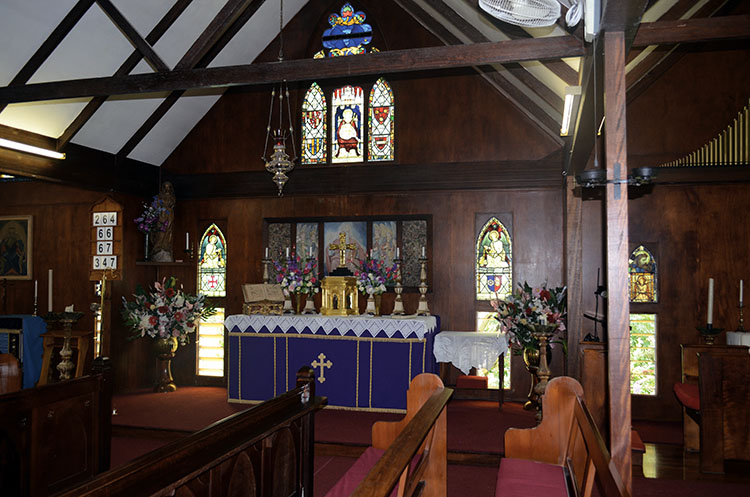
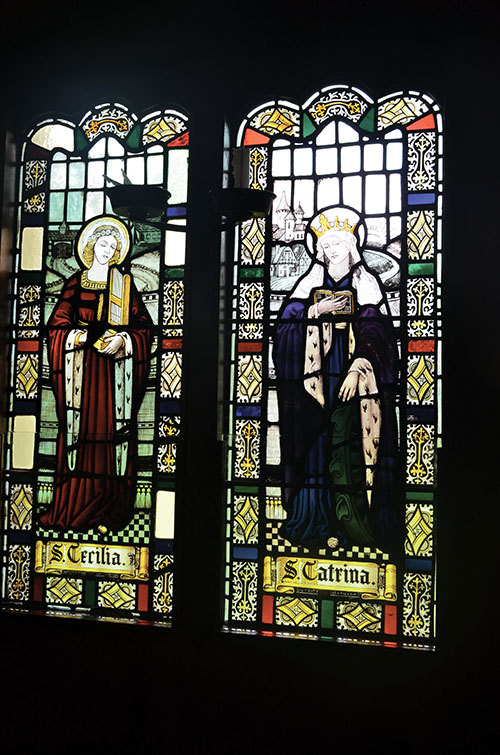
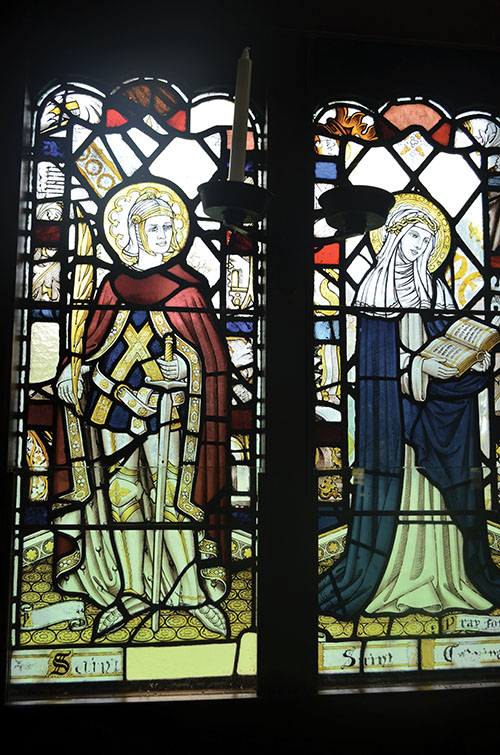
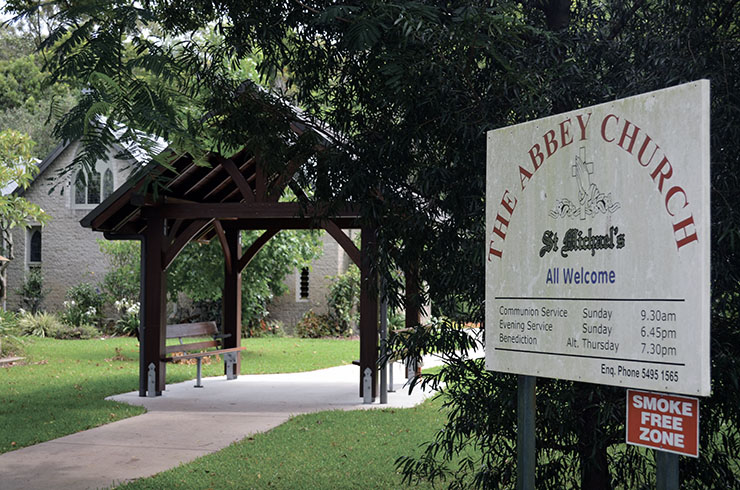
    On a 135 hectare property 60 km north of the Queensland state capital Brisbane, a religious community maintains a museum, church and college. Many Brisbane residents are familiar with the annual Medieval Tournament and Banquet held on its grounds every winter, and the Abbey Museum is well-known and loved by school students and local history buffs alike. While the small Abbey Church, boasting windows that contain imported historical stained glass panels (including fragments from Winchester Cathedral), is a popular choice for weddings, baptisms and funerals, not all of its admirers are aware of its fascinating heritage.

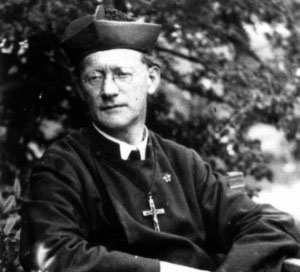
    John Sebastian Marlow Ward (1885–1949)

    Known today as the Orthodox Catholic Church of Christ the King, the Confraternity is linked to the Great Schism of the Western and Eastern Orthodox Churches in the 11th century, thus featuring a blend of Eastern and Western Rites. However, the Abbey represents something more than just an East/West mix, having been established by the followers of J.S.M. Ward, an enigmatic Englishman who drew his inspiration from Christianity, Freemasonry, Spiritualism and a number of other esoteric traditions.

    JSM Ward – A Complex Character

    The Abbey owes its existence to the vision and dynamism of John Sebastian Marlow Ward. This snippet taken from his autobiographical recollections less than two years before his death, and quoted in the final pages of Geoffrey Ginn’s insightful book on Ward’s life, captures a glimpse into his background:

    I was born in Belize, British Honduras in Central America on Dec. 22nd 1885. What terrible changes have taken place, since I was born, in world affairs. My lifetime has seen the decline and fall of Europe and her leadership in the world, particularly is this true of her loss of control in Asia.1

    He referred, of course, to the two World Wars and he especially lamented the apparent unravelling of the British Empire. He enjoyed a stint as a headmaster in Burma just as World War I broke out, and was saddened at its independence from Britain in 1948, the year before he died.

    John’s father, an Anglican minister, had returned to England from Belize with his wife and young son in 1888, just prior to the birth of their second child, Rex. Growing up in the culturally stimulating atmosphere of Victorian times, John developed a love of history and heritage buildings, amassing a large collection of artefacts and natural curiosities during his boyhood. 

    His dutiful Christian upbringing gave rise to a sense of enquiry, which would later broaden to encompass Mysticism, Spiritualism, Theosophy and Metaphysics. It was during his time at Cambridge University, at the age of 20, that he was initiated into Freemasonry, which was considered quite a respectable step to take for a modern middle class man, in what was by then the Edwardian Era. This would provide valuable introductions into the social and professional arenas, while also satisfying Ward’s attraction to the intrigue of the esoteric underground of the day. Soon after graduating in 1908, he took up teaching history and literature, and also married his cousin Carrie.

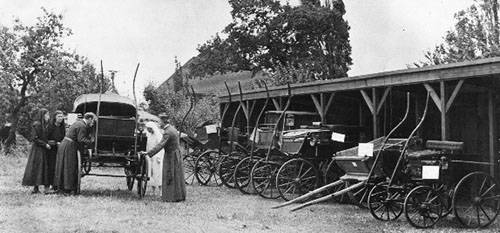
    John Ward and members of his community with some of the carriages that formed part of the Abbey Folk Park in London.

    Psychic occurrences, which were to guide John throughout his adult life, first began five years later with the regular visitation of his late uncle (also Carrie’s father), Henry Lanchester (HJL), to him during lucid dreams. The visions would occur at regular times of night on set days of the week and provided personal messages as well as information about the afterlife. Contact with the astral plane expanded to include his brother Rex who died in 1916 (identified in John’s writings as RLW); it later became a dominant feature of his life and work, with his introduction to the angelic ‘Master of the Work’.

    Ward with his second wife, Jessie about 1936.

    Carrie, although a believer in her husband’s visions, did not share his preoccupation with spiritual matters and this led to their separation in 1923. John had already met the woman who would prove to be his soul-mate, the schoolmistress and Theosophist Jessie Page, with whom he had co-founded a publishing imprint to promote his own works a couple of years earlier. The couple married soon after Carrie’s death in 1926, embarking on a lifelong partnership during which they shared their prophetic visions. They actually began to participate in one another’s dreams when, it is claimed, “they both dreamt that they were summoned into the presence of a great Angel, told that Christ was about to begin His Descent through the Celestial Planes to the Earth and asked to help in the Preparation for His Coming. This great Angel, of the order of the Thrones, was to become their constant Guide and helper in the years ahead.”2

    John Ward’s beliefs and practices comprised elements that many Christians today would feel uncomfortable with. We should keep in mind that Spiritualism was popular in England a century ago. During the onset of World War I, Ward spent time teaching in Burma where he took a keen interest in Buddhism, Hinduism and Eastern traditions, strengthening his own convictions about reincarnation. It was these esoteric influences, combined with his sometimes turbulent association with Freemasonry, that paved the way for what he came to consider his life’s mission.

    Freemasonry Woven into the Rich Tapestry

    John Ward was born into a world of blossoming spiritual exploration and experimentation. The esoteric landscape of late Victorian England was dotted with communities devoted to Eastern mysticism, the Kabbalah and Hermetic texts, as well as scores of Rosicrucian and Theosophist groups. Geoffrey Ginn points out: “Although Freemasonry was not generally seen as occult, initiates were able to use its lodge meetings and reading groups to pursue esoteric topics and interests. Consequently, active Freemasons were in the vanguard of the occult revival at the end of the nineteenth century.”3 A number of Masonic researchers argued that the symbols and rituals of the Craft derived their roots from ancient Egyptian mystery cults. With the objective of establishing this claim, John became the founding secretary of the Masonic Study Society (MSS) in 1921. It was a pursuit he relished, continuing to attend the MSS meetings even after he later severed other links to Freemasonry and delivering more than a dozen papers to them over the next fifteen years.4

    Not only did Ward appear untrue to his Christian origins as he delved deeper into ancient mysticism, he also succeeded in alienating many of his fellow Masons. He saw in Freemasonry the characteristics of, “The ancient Egyptian Mysteries, the Eleusinian Mysteries of Greece, the Mithraic Mysteries of Persia, the Adonaic Mysteries of Syria, the Cabiric Mysteries of the island of Samothrace, the Druidic Mysteries of primordial Britain, and the Gnostics of the early Christian era…”5 For him, these mysteries concurred with the knowledge of the afterlife imparted to him by his beloved departed relatives, HJL and RLW.

    It was in 1929 that John and Jessie Ward began their ‘public work’ as religious leaders, establishing the original ‘Confraternity of the Kingdom of Christ’ and setting up an altar in a spare room in their house. John adopted the title ‘Reverend Father’ and celebrated communion in the traditional Christian manner, at the same time conducting a group of devotees in prayers and hymns that he had written himself. Jessie would come to be known by their followers as ‘Reverend Mother’. Notwithstanding the use of Christian titles, their practices continued to embrace the essence of Hinduism and Buddhism, mingled together with the doctrines of Spiritualism and reincarnation. 

    The small band of founding members – some of whom stayed in the Confraternity for the rest of their lives – pooled their assets and, when John resigned his job of twelve years and could add his generous separation bonus of seven hundred and fifty pounds, they purchased Hadley Hall on London’s northern outskirts. This mansion had been designed as two houses under one roof and sat on three acres of gardens. One of these dwellings now became The Abbey of Christ the King.

    The Original Abbey in England

    Life at London’s Abbey in the 1930s could best be described as monastic, with a strict daily routine of work and prayer. In addition to Father Ward’s study and library, the basement became a gallery for his treasured collectibles: antiquities, rare books and artefacts, tapestries and paintings. A small private school was set up on the estate and named St Michael’s College – a forerunner of today’s school bearing the same name alongside the Abbey in Queensland, Australia. And, like the modern-day Abbey complex, the founding members put their greatest effort into establishing a substantial and well-respected museum. As the Wards continued to add thousands of items to their collection, the exhibition extended out into the gardens in the form of replica historic and prehistoric buildings, eventually christened as the Abbey Folk Park. It proved extremely popular with the public, providing much-needed income for the community. 

    Surviving site plans of the Folk Park reveal how far the Confraternity went in not only entertaining but educating students and adults alike. It included a Roman Villa, African Bazaar, Chinese Temple of Initiation, Japanese garden, a conservatory, greenhouse, a forge and smithy shop and even a witch’s cottage. 

    John Ward had another motivation for developing the site that was not well known to the general public: he believed the world was in the ‘End Times’ and expected the imminent return of Christ, making The Abbey Folk Park an ‘ark for the ages’, a kind of time-capsule to preserve part of the old civilisation for the coming New Age. He envisaged it as the ‘Kingdom of the Wise’.

    The Threads of Christian Traditions & Western Orthodoxy

    One challenge to be met was the fact that neither John Ward nor any of his followers were ordained clergy, making their celebration of communion and other sacraments technically invalid. Soon after moving into The Abbey, ‘Father Ward’ managed to secure an endorsement as an affiliate of the Church of England from the Bishop of St Albans, on the recommendation of a mutual friend who was an Anglican Canon and fellow Freemason. However, this was only meant to authorise him as a lay preacher to his own community and the Anglicans made it clear it did not allow him to ‘minister the word of God’. A rift between them was inevitable and, after it occurred at the start of 1935, Ward would go on to have himself ordained in no less than three different religious organisations.

    Inside the Abbey Church, Caboolture, Queensland, Australia.

    John Ward was what church officials called an episcopi vagantes, meaning ‘wandering bishop’ or ‘bishop at large’. His first affiliation outside the Anglicans was with the Autonomous African Universal Church when he was consecrated as a bishop by its London-based Primate, Mar Kwamin. Soon after that, when doubt was cast over Mar Kwamin’s authority to hold office in England, Father Ward sought advice from the elderly Archbishop John Sibley of the Orthodox Catholic Church. The two men clicked and agreed that the Abbey of Christ the King should be incorporated into the Orthodox Catholic Church, contributing much needed numbers to Sibley’s congregation, while at the same time granting Ward’s Abbey Church the institutional affiliation it craved. His second ordination is recorded by Geoffrey Ginn thus: 

    Ward was baptised and re-confirmed, ordained deacon and, finally, solemnly admitted to the Sacred Office of the Priesthood by the authority of Archbishop Sibley’s hand and seal. In further ceremonies the following day, Ward was solemnly consecrated as a Bishop in the Church of God and commissioned as its Chancellor of the Province (England).6

    During World War II John and Jessie Ward struggled financially and were dragged through a court case brought by the parents of a teenage girl in their community, the charge being enticement of a minor. This resulted in damages of five hundred pounds being awarded against them, taking a toll on their funds as well as their health, reputation and confidence. Wartime saw membership numbers and income of many other itinerant English bishops flounder too, leading to an initiative to unify the various strands of the episcopi vagantes – and to the third ordination of Father Ward.

    The Abbey Church features many beautiful stained glass windows.

    A group of six autonomous Christian churches merged under the leadership of Hugh George de Willmot Newman, who had recently been disavowed by the Syrian Orthodox (Jacobite) Patriarch on whose authority he depended. Forming a council, they declared the Syrian Church to be in schism and re-constituted themselves as a Western Orthodox Church. This was in contrast to Eastern Orthodoxy, which sprang from the first century Christian missionaries in the Eastern, Greek-speaking part of the Roman Empire. Newman took for himself the title Mar Georgius, Archbishop of Glastonbury, which he called the Occidental Jerusalem. Thus Father Ward received from this new church his third consecration as its ‘Archbishop of Olivet’, thereby bringing his Orthodox Catholic Church into its fold.

    “Orthodox Catholicism offered itself to Ward as a religious vehicle that was necessarily flexible in matters of formal doctrine, but charged with a sense of history and a living heritage of faith,” writes Geoffrey Ginn in his departmental journal, Crossroads, adding, “In the first instance, then, Orthodox Catholicism appealed to his sense of historical drama. Ward took seriously the claims of Orthodox Catholicism to be an historic rapprochement between Christianity’s two great warring factions: ‘the Orthodox Catholic Church in itself’, he wrote, ‘marks the reunion of the Eastern and Western Churches, which mutually excommunicated each other in the 11th century, since when Christendom has been divided into camps’.”7

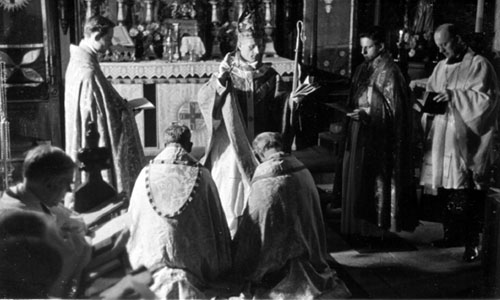
    Conditional consecration of John Sebastian Marlow Ward as Archbishop of Olivet in the Catholicate of the West by Mar Georgius assisted by other prelates; Abbey Church of Christ the King, Barnet, 25 August 1945.

    This refers to the mutual excommunication of the Eastern and Western Orthodox Churches in 1054. The identity of today’s Orthodox Catholic Church at the Abbey in Caboolture can be further linked to a later separation in 1870, when a number of Roman Catholics renounced their allegiance to Pope Pius IX following his declaration of infallibility. Having no bishops of their own, the breakaways could not be confirmed or ordained, so they contacted the Old Catholic Church of Holland, which had already become disassociated from the Vatican but retained valid Orders. Another historical figure, the priest Francis Xavier Alvarez and his followers in India, severed ties with the Papacy and obtained consecration by turning to the Syrian Christians, whose bishops on the Malabar Coast were under the jurisdiction of the Patriarch of Antioch, thereby adding to the bewildering melting pot of ‘bishops at large’.

    Thus these ‘Old Catholics’ (the breakaways) could claim two possible lines of ordination: the first from St Peter and the Western Church in Rome via St Augustine, the fourth century Bishop of Hippo; the other from the Eastern Church, this lineage tracing itself back directly to the church founded in Antioch in 34 AD by St Peter himself. 

    Stations on the Journey

    By 1945 the effects of the war and the legal proceedings against them left the Wards disillusioned with Britain, and it occurred to them that their Kingdom of the Wise might be destined to emerge in a foreign land. Fortuitously, John Ward’s old friend Gerald Gardner, who had designed the witch’s cottage for him, expressed an interest in taking over the cottage and its artefacts in exchange for a piece of land with a farmhouse he owned in Cyprus and wanted to offload. Cyprus held great appeal for the Confraternity – it was an English territory in the Eastern Mediterranean with a pleasant climate and, most importantly, it already embraced the tradition of Orthodox Christianity. The following year, after selling off the more valuable of their antiquities and library books, the small community packed up whatever they had left and made the two-week voyage from Southampton to Cyprus.

    The Abbey Church features many beautiful stained glass windows.

    Disappointingly, Gardner’s farmhouse turned out to be derelict and sat on barren land but, undeterred, they simply walked away from it and immediately purchased a more suitable property on the coast close to Limassol. This land was more than a hectare and boasted an orange orchard with a furnished two-storey house plus gardener’s cottage, outdoor brick oven and a chicken house with poultry. At a cost of two and a half thousand pounds, it was a drain on their funds, so they were relieved a few months later when they received over four thousand pounds from the sale of Hadley Hall back in London. Here they would stay for more than eight years, earning their living from farming and handicrafts they produced.

    For the Reverend Father John Ward, Cyprus was to be the last station on his life journey. Before his passing due to a stroke in mid-1949, he fathered a child with one of the ladies among his flock, Ursula Cuffe, and their son John was raised by Jessie Ward as her own. Growing up with Father Ward’s tradition and principles, the mature son would go on to be known as Bishop John Cuffe, presiding over an off-shoot of the present-day Orthodox Catholic Church in Queensland. A number of the older members of the original Confraternity were to pass away soon after Ward and the remaining followers had become restless by the mid-fifties, scouting around for a new home base. After looking first at Ceylon (Sri Lanka) and India, they decided to head for Australia where they settled briefly in Sydney and then in the Blue Mountains. When Jessie suffered a bout of pneumonia, she decided to head to the warmer climate of Queensland to recover, accompanied by a few others, including the nine year-old John Cuffe.

    The influence of John Sebastian Marlow Ward lives on and the depth and diversity of his legacy can be gleaned from the titles of some of his books: Gone West: Three Narratives of After-Death Experience; Freemasonry and the Ancient Gods; The Hung Society; The Kingdom of the Wise: Life’s Problems; The Psychic Powers of Christ; and articles: ‘The Hindoo Symbol of the Point Within the Circle’, ‘The Knights Templar’, ‘The Aims and Ideals of Freemasonry’, ‘Chinese Secret Societies’.8 Author Geoffrey Ginn neatly sums up his character in the final paragraph of his book: 

    In J.S.M. Ward we find, indisputably, a man of many parts. A historian with a strong sense of the romantic, a visionary with heightened spiritual sensibilities, he was a questing soul, curious until his last days about the human past, how we might comprehend its mysteries, and the life beckoning beyond that of everyday sense experience.9

    Get the issue this article appears in

    The Ongoing Legacy in Queensland

    The community began settling at its present site of the Abbey at Caboolture, Queensland, half a century ago, and Jessie Ward survived until three years later, providing a clear link back to the organisation she co-founded with her husband in the late 1920s. What makes today’s Orthodox Catholic Church stand out from other Christian sects are their teachings on the afterlife, their representation of the Holy Spirit as the feminine aspect of the Godhead, and how at the very core is their belief in the imminent return of Christ. Concerning reincarnation they say, “that the journey of each Soul encompasses many lives to complete its journey back to God”; and concerning Catholic traditions, they affirm their church “holds to the tenets of the Christian Faith as enunciated in the Nicene Creed.”10

    Its followers seek spiritual development, both on a personal level and also collectively as a Confraternity. According to their publicity material:

    Community members strive to live a balanced life that revolves around attending Church Services, devotion and personal prayer and the practicalities of everyday life. The four main areas of the work of the Confraternity include the Church, the Farm, the College and the Museum. Holding public services, visiting the sick, undertaking works of charity and giving public lectures form part of the ongoing work of the Confraternity members.11

    In keeping with the values established at the original Abbey Folk Park in England over eighty-five years ago, the tranquil setting at Caboolture is also home to the Abbey Museum, as well as the independent co-ed school, St Michael’s College. Describing itself as a welcoming community, their church and museum at The Abbey Place are open to the public.

    Further reading: Archangels & Archaeology: J.S.M. Ward’s Kingdom of the Wise by Geoffrey Ginn

    [alert type=”general” dismiss=”no”]This article was published in New Dawn 157.[/alert]

    [alert type=”success” dismiss=”no”]If you appreciate this article, please consider subscribing to help maintain this website.[/alert]

    Footnotes

    1. Geoffrey Ginn, Archangels & Archaeology: J.S.M. Ward’s Kingdom of the Wise, Sussex Acad. Press 2012, 261 
    2. ‘Orthodox Catholic Church of the New Age, Life of J. S. M. Ward’, http://orthodoxcatholicnew.tripod.com/id7.html
    3. Geoffrey Ginn, Op. cit. 29
    4. Ibid 106
    5. Ibid 109, quoting from Secret Societies by Noel Gist, 1940
    6. Ibid 197
    7. Crossroads, Special Issue 2006, AEN Conference (page 11) www.uq.edu.au/crossroads/Archives/Vol%205/Issue%201%202010/Vol5Iss110%20-%207.Ginn%20%28p.45-57%29.pdf
    8. For full catalogue of publications, see Archangels & Archaeology, Op. cit., 297–310
    9. Geoffrey Ginn, Op. cit. 265
    10. http://abbeychurch.com.au/history-of-the-church/ 
    11. http://abbeychurch.com.au/history-of-the-confraternity/

    © New Dawn Magazine and the respective author.
    For our reproduction notice, click here.
  • Mysterious Britain: The Secrets of Glastonbury

    Mysterious Britain: The Secrets of Glastonbury

    From New Dawn Special Issue Vol 16 No 2 (April 2022)

    Most people think of Glastonbury as a quiet little town in Somerset, England, that occasionally hosts the “Glasto,” otherwise known as the Glastonbury Festival. This five-day event has in the past featured, since its inception in 1970, some of the biggest names in the performing arts, music artists like U2, David Bowie, Coldplay, T-rex, Oasis, Billie Eilish, Bruce Springsteen, Jay-Z, Lady Gaga and Tom Jones, as well as theatre, dance, comedy, cabaret and circus acts on smaller stages.

    The Festival typically brings in about 200,000 people and raises money for various charities. It has all the trappings of the American 60s counterculture Woodstock festival, but with modern touches added over the decades.

    Many people attending the Festival may not realise they are walking upon sacred ground. Ground that Joseph of Arimathea once walked upon. Ground that King Arthur once walked upon. Ground that some believe Jesus Christ himself once walked upon.

    The Town By the Tor

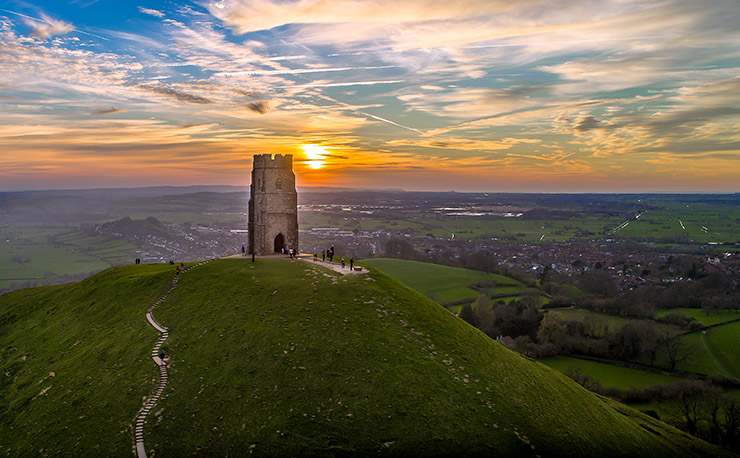
    The town of Glastonbury, at last census, boasted a population under ten thousand people. The civil parish of Somerset, Glastonbury is about 23 miles south of Bristol and a mile across the River Brue from Street. Once a centre of commerce with its Glastonbury Canal and the Street railway station, it nowadays looks like a sleepy town at the foot of the enigmatic Glastonbury Tor, a dramatic hill in the distance, about ten minutes from the centre of town. At the top of the hill stands St. Michael’s Tower.

    The Glastonbury Thorn in November 2010. Unfortunately, one month after this photograph was taken, it was cut down by vandals.

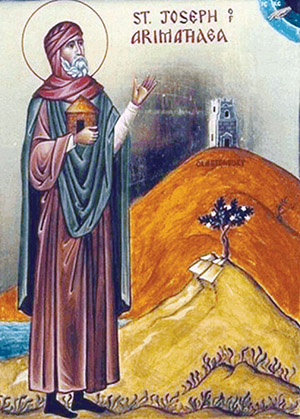
    It is rumoured that beneath the Tor is a hidden hollow cave that can take you to the fairy world of Annwn, where the lord of the Celtic Underworld, Gwyn ab Nudd, lives with the Cauldron of Rebirth. Annwyn has been associated with Avalon of Arthurian legend, the land of the dead, with the Tor as the gateway to this otherworld. This may have led to a more recent rumour of the Tor being the place where Jesus’s alleged great uncle, Joseph of Arimathea, brought the Holy Grail to keep in hiding. As part of the legend of King Arthur, the Grail was the main object of his knightly quests and Glastonbury Tor has long been thought to be the famed Isle of Avalon where the body of King Arthur was sent to rest in eternal slumber.


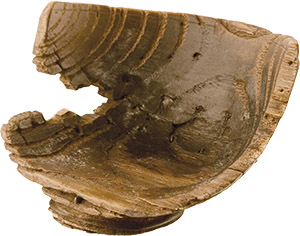
    The Nanteos Cup, from the 14th–15th century, is located in the National Library of Wales.

    The Tor is often referred to as “Ynys yr Afalon” which means “the Isle of Avalon” by the Britons, also known as the Isle of Glass because of how the Tor was reflected in the waters that once surrounded it. The Tor is close to the Glastonbury Abbey where legend places the burial coffins of King Arthur and Lady Guinevere, and the Welsh monastery that housed the Nanteos Cup. The Nanteos Cup is a medieval wood mazer bowl held for many years at Nanteos Mansion, Rhydyfelin, near Aberystwyth in Wales. Up to the late 19th century, it was said to have the supernatural ability to heal those who drank from it and traditionally believed to be fashioned from a piece of the True Cross of the crucifixion.

    Near the Tor stand two ancient oak trees known as Gog and Magog, named after the prophesied invader of Israel and the land he came from, marking the entrance to the land of Avalon.

    Shrouded in its mysterious past, the low-lying damp ground around the Tor produces a visual effect known as a Fata Morgana, during which the Tor seems to be literally rising out of the silvery mist. The Italian term Fata Morgana comes from the name of the powerful sorceress of the King Arthur legend, Morgan le Fay. This strange optical illusion is referred to in the title of the hugely popular book series The Mists of Avalon by Marion Zimmer Bradley.

    A Visit From a Boy King

    Religious art depicts Joseph of Arimathea at St. Michael’s Tower, which is the remnant of a church that once stood on the Tor.

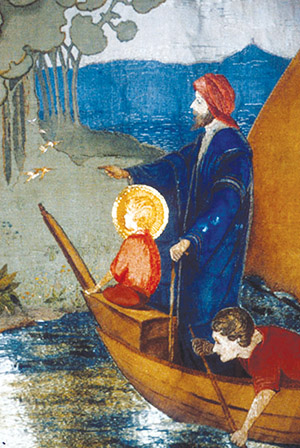
    Rich with Arthurian legend and lore, the Glastonbury town and Tor also hold secrets to an even greater kingly visitation, that of Jesus Christ himself. Legend has it that Jesus came to Glastonbury as a boy with his great uncle Joseph of Arimathea, and his mother Mary, on a boat over the then flooded Somerset Levels. When Joseph arrived, he stuck his staff into the ground where it miraculously bloomed into the famed Glastonbury Thorn, also known as the Holy Thorn, a giant hawthorn tree that grew just a few miles from the town and flowered twice each year, once in the spring, the time of “resurrection,” and once around Christmas to mark the birth of Christ.

    There was a tradition where a sprig was cut each year from the tree by the oldest child attending the St. John’s School and sent to the Queen. The Holy Thorn became a centre of pilgrimages during the Middle Ages but was cut down during the English Civil War. Replacement trees in the immediate spot didn’t fare too well, and now there are numerous hawthorn trees all over Glastonbury, including on the grounds of the Glastonbury Abbey, the St. John’s Church, and the Chalice Well.

    Poet William Blake wrote of the legend of the boy Jesus visiting Glastonbury in his poem, ‘Jerusalem’:

    And did those feet in ancient time
    Walk upon England’s mountains green?
    And was the Holy Lamb of God
    On England’s pleasant pastures seen?

    Glastonbury’s rich legends label it the western cradle of Christianity, at least in the British Isles. The Roman Empire, the centre of Christianity, had established trade links in the region, and Glastonbury bustled with a thriving arts community because of it. It was already an established centre for Celtic traditions and beliefs with a high level of culture, and Christian missionaries eager to convert pagans no doubt saw Glastonbury as a prized jewel, possibly even bringing relics back with them on their travels there.

    The grounds of Glastonbury Abbey were located near the base of the Tor and consisted of a wattle and daub building, possibly the first church ever built in the British Isles, dedicated to the Virgin Mary. It has been posited that disciples of Christ built the church in the 1st century AD.

    We have read of the missing or lost years of Jesus between the ages of 12 and 30, and that he travelled to India and the Far East to pursue spiritual studies. But he may have visited the British Isles much earlier after the death of his father, Joseph.

    This was not uncommon during the time of Jesus. People often travelled from the Middle East to Britain, seeking trade or sending Roman-raised children to receive an education elsewhere. Despite the hardships of travel and the perception of isolation of the British Isles, this kind of journey happened all the time.

    In this painting on the banner of the parish church of Pilton, east of Glastonbury, Joseph of Arimathea and the boy Jesus sail up the Brue River to Glastonbury. 

    Who Was Joseph of Arimathea?

    Joseph of Arimathea was the man responsible for the burial of Jesus Christ. His account can be found in the four Gospels: Matthew 27:57–60; Mark 15:42–46; Luke 23:50–53; and John 19:38–42. He came from the Judean town of Arimathea and was a part of the Sanhedrin – the council of Jewish religious leaders who called for Jesus’ crucifixion. Joseph was opposed to the council’s decision and was a follower of Jesus, but because of his position on the Sanhedrin, he kept it secret.

    He was also very wealthy, although the source of his wealth is unknown (he is noted according to numerous sources to have done much travelling for trade in tin, wool, and other commodities). Joseph of Arimathea may have been a merchant in metals who often bartered in tin and took young Jesus with him on his journeys to England, India, and even to South America. Britain led the world at this time in tin mining, and Joseph was referred to as ‘Nobilis Decurio’ or Minister of Mines to the Roman Government by Gildas the Wise, a British monk who lived from 500-750 AD.

    After Jesus’ crucifixion, Joseph went to Roman governor Pontius Pilate to request his body. Nicodemus, a Pharisee, accompanied Joseph, and they were granted custody of Jesus’s body, immediately preparing it for burial. Following Jewish custom, they wrapped the body in linen strips mixed in myrrh and aloe. On the Day of Preparation before the Jewish Sabbath, they quickly placed Jesus in Joseph’s own tomb. The day after, the chief priests and Pharisees went to Pilate to request that the stone Joseph had placed in front of the tomb be sealed, and a guard posted for three days to prevent Christ’s disciples from stealing the sacred body to fabricate a resurrection and match the prophecy. Despite the precautions, Jesus rose from the dead on the third day.

    As for Joseph being a blood relative of Jesus, there is no such connection directly stated in the Bible itself, but the argument can be made that the members of the Sanhedrin would have never given the body of Jesus to someone who was not a blood relative. According to Jewish and Roman law, only the next of kin could accept the body of an executed criminal, so unless the wealthy Joseph of Arimathea found a way to buy the body and the Sanhedrin’s silence, he very well may have been Jesus’s great uncle.

    It is said Joseph made many trips to Britain for trade and eventually brought the gospel to that country. Glastonbury legend holds that he returned to the same area some thirty years after the crucifixion and resurrection of Jesus, leading the twelve disciples there in 63 AD. The local king allowed them to settle on the Isle of Glass (Avalon), then an island in the marsh waters, where they fasted, prayed, and built the Old Church to honour the Virgin Mother. After they died, Pope Eleutherius restored the Old Church and founded a community of twelve hermits that eventually became the medieval monastic community.

    Crossroads of Legend and History

    We forget that legend is often a fictionalised truth and reflects actual events and people, embellished over time in the same manner as the famous game Chinese Whispers (aka Telephone) in which people whisper a phrase in the ear of the next person down the line. By the time the last person receives the phrase, it most likely has been added onto, if not outright changed from its original form. But it contains most aspects of its original form.

    Numerous writings refer to Joseph visiting Glastonbury with the boy king, lending credence to the legends.

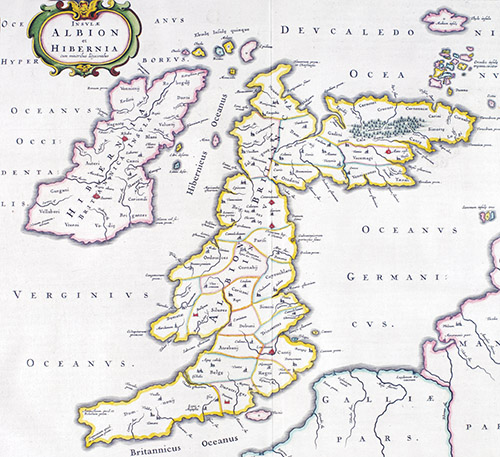
    An ancient map of Great Britain. Its earliest-known name was Albion.

    In his book, The Missing Years In the Life of Christ, Bertrand L. Comparet says: “Another Cornish tradition is to the effect that Joseph of Arimathea came in a boat to Cornwall and brought the boy Jesus with him, and the latter taught him how to extract tin and purge it of the wolfram. When the tin is flashed, then the tinner shouts ‘Joseph was in the trade’.”

    Traditional tales told in Somerset include stories of Jesus and Joseph coming in a “ship of Tarshish to the Summerland, and sojourned in a place called ‘Paradise’.” “Summerland” is Somerset and at the mouth of the River Brue lies Burnham. An old Ordnance Survey Map gives the name of the area around Burnham as “Paradise.” Glastonbury appears in ancient writings by the name “Paradise.”

    The greatest kings, bishops, saints, and heroes of the British race were buried at Glastonbury Abbey for a thousand years. There are historical references that suggest Jesus’s visit was real, including that of Taliesin, the Druid and Welsh prince and bard of the 6th century, who wrote: “Christ, the Word from the beginning, was from the beginning our teacher, and we never lost His teaching.”

    Church Historian Hugh Paulinus de Cressy wrote in 1668 AD: “This our land of Brittany, though called by the Romans another word, as being divided from the whole then discovered habitable earth, yet by the riches of Divine mercy received the beams of the Sun of Righteousness before many other countries nearer approaching to the place where He first rose.”

    There are numerous references to the presence of early Christianity in Britain from the likes of Tertullian, who wrote of the parts of Gaul and regions of Britain to receive the teachings of Christ and which were never penetrated by the reach of the Romans. The Roman Christian theologian Sabellius wrote in 250 AD that although Christianity was privately practised in other regions, Britain was the first nation to publicly proclaim its following of Christ’s teachings.

    Gildas the Wise proclaimed in the 6th century that, “These islands, stiff with cold and frost, and in distant region of the world, remote from the visible sun received the beams of light, that is the holy precepts of Christ, at the latter part, as we know, of the reign of Tiberius Caeser.” There are numerous references of the “light” coming to Britain alongside those of the introduction of Christianity.

    Cardinal Baronius, Church Historian, Librarian to the Vatican, quotes a Vatican manuscript, dated 35 AD, that in the same year the Jews arrested Joseph of Arimathea, they put Lazarus, Mary, Martha, and two other Christians on a boat and cast it adrift in the Mediterranean. When they reached land, they trekked by foot or four-legged beast to Britain. St Gregory of Tours, an early historian, writes in his History of the Franks about Joseph of Arimathea preaching the gospel of Christianity in Britain.

    De Cressy says: “Now the most eminent of the primitive disciples, and who contributed most to this heavenly building, was St. Joseph of Arimathea, and eleven of his companions along with him, among whom is reckoned his son of the same name.” Could that son of the same name really have been Jesus?

    Historians of the time noted that British King Arviragus granted to Joseph of Arimathea a considerable area at Glastonbury as a site for a church and its accessory buildings and fields. This was proven as fact in 1066 AD when William the Conqueror surveyed the kingdom’s lands for tax purposes and published it in the “Domesday Book.” Completed in 1088 AD, it contains the following: “The Domus Dei, in the great Monastery of Glastonbury, called The Secret of the Lord. This Glastonbury church possesses in its own Villa XII hides of land which have never paid tax.” The name of the early church, “Domus Dei,” means “The Home of God” and “The Secret of the Lord.”

    When the Glastonbury Abbey was destroyed by fire in 1134 AD, King Henry II of England issued a royal charter to rebuild it, calling the Abbey “the mother and burying-place of the saints, founded by the very Disciples of our Lord.”

    At the burial place of Joseph of Arimathea at Glastonbury is a sarcophagus. Upon it, there is a Latin epitaph said to have been recorded by the 14th-century monk Roget of Boston when it was exhumed in 1345 AD: “To the Britons I came after I buried Christ. I taught. I have entered my rest.”

    If Jesus did walk the grounds of Glastonbury, and we have only the witnesses of ancient times to tell us he did, then one wonders how many other places he walked with his great uncle in search of trade routes? One wonders if Jesus as a child and later as a young man visited numerous places over the course of those missing 18 years which now remain a mysterious enigma… much like that of King Arthur, who many writers and scholars to this day believe is the Celtic equivalent of the story of the Christ.

    Get the issue this article appears in

    Two Legends, One King?

    There are obvious similarities between the stories of Jesus Christ and King Arthur. References abound that link Joseph of Arimathea to Arthurian legend, as with the stories of the Grail and his travels with Mary and Jesus and eventual burial at Glastonbury Abbey. In 540 AD, the historian Maelgwyn of Avalon, in Historia de Rubus Britannicis, writes: “In this church they worshipped and taught the people the true Christian faith. After about fifteen years Mary died and was buried at Glastonbury. The disciples died in succession and were buried in the cemetery.” Another book, St Joseph of Arimathea at Glastonbury by historian Lionel Smithett Lewis, quotes another historian, John of Glastonbury, who claimed to have traced the lineage of King Arthur through his mother, Igraine, through her paternal line, to Joseph, and it was his belief all twelve round table knights descended from Joseph.

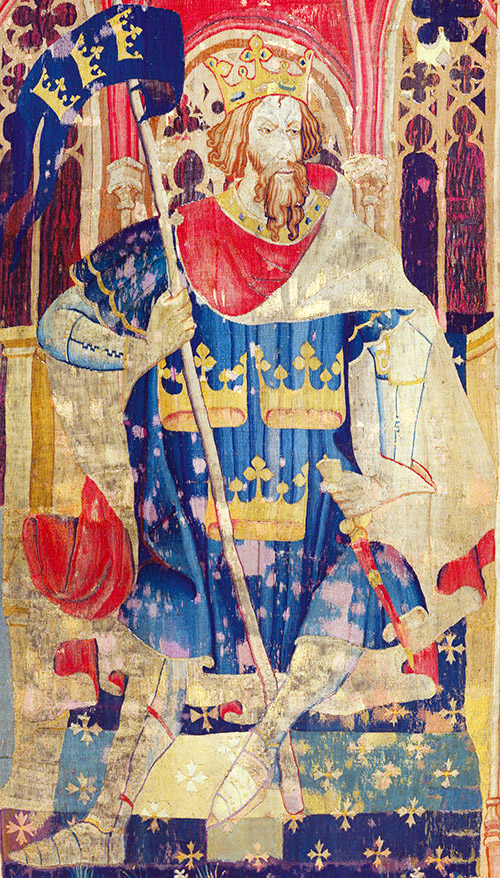
    King Arthur as one of the Nine Worthies, detail from the “Christian Heroes Tapestry” in The Cloisters, New York. Dated c. 1385.

    Were Jesus and Arthur different interpretations of the same story?

    Both were conceived in a mystical way. Jesus was the result of the “virgin birth” when the Holy Spirit impregnated Mary. Arthur was born of a man looking like his father who impregnates his mother under enchantment.

    Both were considered saviours, messianic figures with twelve devoted followers who carried out their missions.

    Both were considered kings in their own right and gained their followings due to supernatural or “miraculous” acts. Both men fulfilled a prophecy. Both were betrayed.

    Arthur was married to Guinevere, an adulteress. Jesus was said to have been married to Mary Magdalene, an alleged prostitute. Both women were powerful influences upon these men.

    Both are associated with the symbols of swords and stones. Jesus proclaimed he was not here to bring peace but a sword and referred to his disciples as stones. Arthur is associated with the famed sword in the stone, Excalibur.

    Both men were believed to walk between the earthly and spiritual worlds.

    Both were said upon their deaths to one day return to help restore humanity.

    There are challenges proving either man really existed in the same fashion that we currently believe because we are interpreting legends that passed down through the ages. Yet the circumstantial evidence, especially with the links between Joseph of Arimathea and the Christian and Arthurian worlds, and the ongoing research by those who seek proof in the physical historical records, is there for those willing to extend their faith beyond pure fact.

    No matter if they were one and the same king, their stories are interwoven into the fabric of Glastonbury’s rich history and lore.

    [alert type=”general” dismiss=”no”]This article was published in New Dawn Special Issue Vol 16 No 2.[/alert]

    [alert type=”success” dismiss=”no”]If you appreciate this article, please consider subscribing to help maintain this website.[/alert]

    © New Dawn Magazine and the respective author.
    For our reproduction notice, click here.
  • Matgioi – Warrior Metaphysician

    Matgioi – Warrior Metaphysician

    From New Dawn 207 (Nov-Dec 2024)

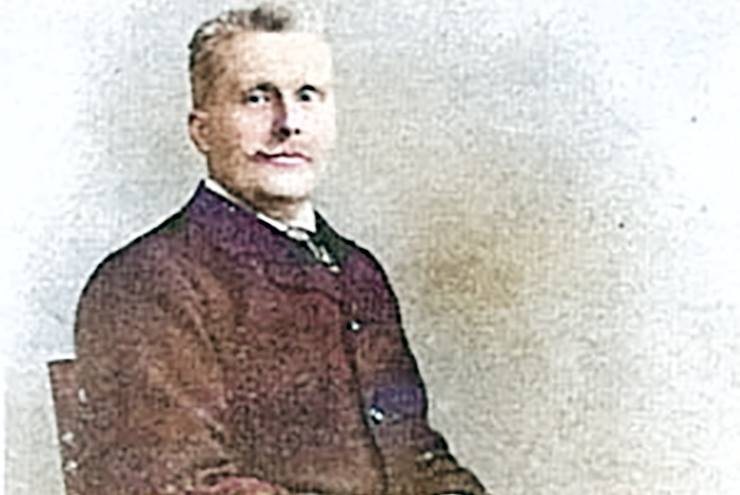
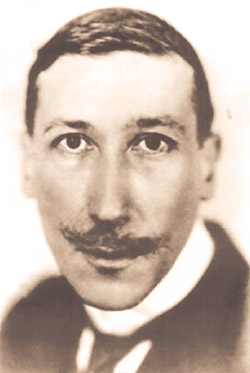
    One could not wish for a better example of the Kshatriya or warrior path than Albert, Comte de Pouvourville (1861-1939). He was born an “army brat” in a minor aristocratic family, richer in honours than in land or wealth. They lived in Lorraine, facing the ever-present threat of German invasion. Albert’s childhood was overshadowed by the Franco-Prussian war and France’s humiliation (1870). As he recalls, he learnt to read from the daily orders of the imperial camp at Châlons, and shot at his first paper targets with General Saussier’s pistols. As the eldest son, there was no doubt he would follow the family’s patriotic path to revenge.

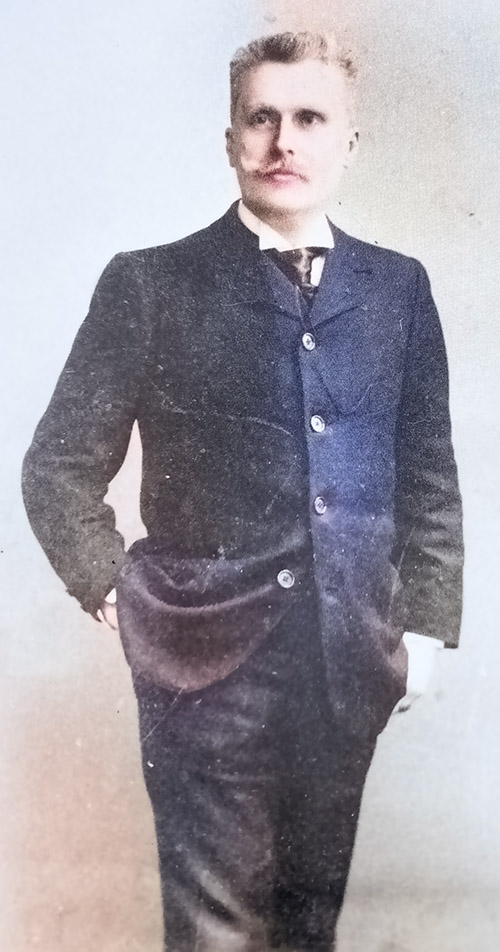
    Albert, Comte de Pouvourville

    A different world opened to Albert at his high school in Nancy, where his classmates included Stanislas de Guaita, Maurice Barrès, and Paul Adam. They formed a clique of aesthetes and poets, all destined for literary or political fame. Albert’s best friend Guaita would become a pillar of the French occult revival; Barrès, a popular novelist and right-wing politician; Adam, an anarchist and leader of the Symbolist school of literature. 

    After this inspiring interlude, Albert attended the academy of Saint-Cyr, a breeding ground of France’s generals. He distinguished himself by all-round brilliance and absolute intolerance of authority. This persisted in his first military posting, where his father kept him from its worst consequences. Eventually, Albert took the historic leap of anarchic warriors and joined the French Foreign Legion.

    Posting to Vietnam

    He was posted to Indochina (then called Annam, now Vietnam), where the colonists held a fragile balance between European traders, mandarin and peasant classes, Chinese interference, brigands and pirates. Corruption and violence were the order of the day. Sickly horrors awaited those sent up-country to map the jungle and pacify its denizens. Thanks to his Saint-Cyr training, Albert had better surveying skills than anyone in the colony and used them to prepare the territory for roads, forts, and telegraph. During his first tour of duty, he collected enough material for three books describing his campaigns and criticising colonial policy. He was sure that he could have run things much better.

    Arrogant he may have been, Albert had a natural sympathy with the Annamite people and respect for their ways. On his second tour of duty, he commanded a native militia corps and crushed a pirate gang that had massacred scores of civilians and soldiers alike. He writes impassively of scenes one would rather not read about. Always curious, he studied the Annamite executioner’s technique of striking between the cervical vertebrae and felt confident that he could do it if required.

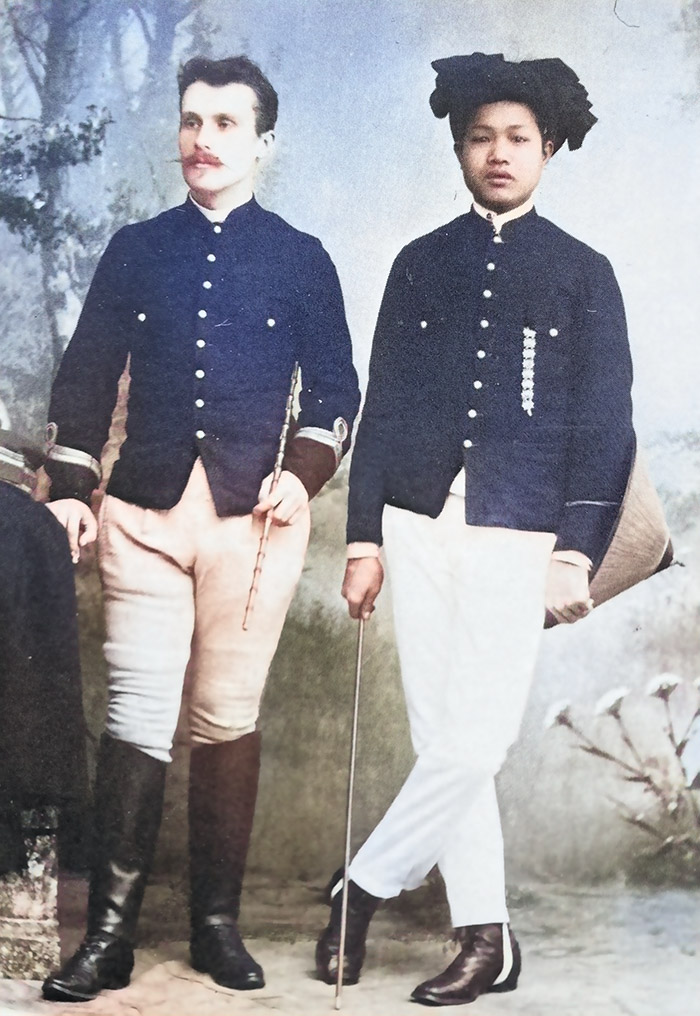
    Matgioi with Nguyen Van Cang.

    He also made friends with a village chief and physician, who authorised his younger son Nguyen Van Cang to join the militia under Albert’s personal care. The document was written in classical Chinese with interpolations in Vietnamese script. Albert became competent, up to a point, in both languages. The Annamite chief instructed him in Daoist philosophy and, in some sense, initiated him into a secret society. What actually happened is obscure, the narratives mixing fact with fiction. But it sufficed for Albert to pass forever after as a Daoist initiate. He took the Chinese name of Matgioi, meaning “eye of day,” under which he published the relevant works, while Albert de Pouvourville continued his parallel career as novelist and colonial expert.

    Matgioi’s third and final tour, ending in 1892, was more cultural than military. The resulting book on the arts and crafts of the region showed both an aesthete’s eye and a scientist’s attention to techniques and materials. It also contained the germ of the Traditionalist or “Perennialist” doctrine of art, as later preached by A. K. Coomaraswamy and Titus Burckhardt. This rejects the Western exaltation of the artist’s originality, style, and character in favour of the anonymous craftsman who aims for perfection in timeless forms endowed with spiritual symbolism.

    Devotion to Opium

    Matgioi’s time in Indochina, barely adding up to four years, yielded a mass of memoirs, novels, and cultural, geographical, and statistical studies. It also gave him a lifelong devotion to opium, on which he later ranked as a scientific expert. His nephew Guy de Pouvourville had childhood memories from the 1930s of his uncle’s extreme caution in admitting visitors and the odd smell permeating his house. Matgioi maintained that opium, properly prepared and used, protects one from most diseases and has no ill effects if kept within sensible limits: never more than fourteen pipes a day.

    Another advantage of opium, in Matgioi’s scheme of things, is its anti-aphrodisiac effect. He approves of the Annamite attitude to sex as merely the means of propagating male descendants who will continue the cult of the Ancestors. Thus, “the man dispenses with the passionate longings, the time wasted in love, jealousy, and all the sentimentality in which, among the Whites, woman reigns exclusively.” There is no evidence that he had lovers of either sex. Later, he had a brief marriage which produced one daughter and a quick separation, and in his old age a second wife appears, of whom nothing further is known.

    Occult Revival

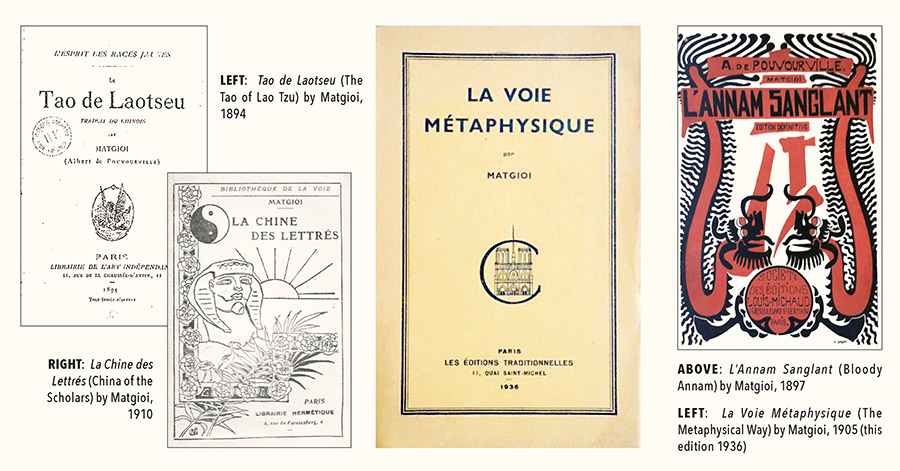
    On his final return from Indochina in 1892, Matgioi found the French occult revival at its height and its informal centre at the bookshop of Edmond Bailly near the Paris Opera. There, one could meet alchemists and kabbalists, symbolist painters, decadent poets, and musicians such as Debussy and Satie. Bailly aimed higher than the popular psychic and spiritualist fads. His publisher’s emblem was a sinister-looking siren with the motto: “Not everyone’s kettle of fish” (Non hic piscis omnium). His journal, La Haute Science (The High Science), presented translations of esoteric classics of all nations and eras. This suited Matgioi’s taste, while his Daoist initiation gave him a unique flair. In 1894, Bailly’s journal published his translation of Laozi’s Daodejing (Tao Te Ching), which credited Nguyen Van Cang, the village chief’s son, as collaborator for the “paraphrase of the Chinese characters.” Matgioi included so many put-downs of previous translators that the editor felt obliged to apologise, saying that they weren’t in the spirit of the journal. According to modern experts, this so-called “exact translation” contains gross errors, and it certainly does not resemble the standard French or English versions. Nonetheless, it shows how the famous text was understood by some educated Annamites given to a Francophone public avid for Eastern wisdom.

    Matgioi turned to Guaita’s friend Papus, the uncrowned despot of Parisian occultism, to publish his subsequent works: a series called “The Spirit of the Yellow Races.” This treated such themes as opium, Chinese medicine and poisons, popular ideas of the afterlife (mostly hellish), and Daoist secret societies. Meanwhile, “A. de Pouvourville” turned out novels and reportage set in Indochina. The most successful, Annam Sanglant (Bloody Annam), reached its 45th thousand by 1933. It is a superbly decadent work, glamorising the rebel as a superior and spiritual being, combining luscious description with gruesome violence, and promoting opium as the panacea for all ills.

    Guaita’s death in 1897, aged only 36, was deeply felt by Matgioi and the whole esoteric community. The following year, Pouvourville put his rebellious past behind him and joined the French Colonial Institute, probably alongside secret work for the intelligence services. Given his family origin, he moved easily in establishment circles. There are hints of returns to Indochina and missions to North African colonies. Like Guaita, Pouvourville left no progeny, and whatever documents survived after WWII seem to be lost now.

    Matgioi returned to the esoteric scene in 1904, directing his own journal, La Voie (i.e. “The Way” of Daoism). At last, he realised the project inspired by his Annamite master: “confronting the Truths of East and West with one another, which are really only one.” It would be a trilogy: La Voie Métaphysique (The Metaphysical Way, based on the Yijing), La Voie Rationnelle (The Rational Way, based on the Daodejing), and La Voie Social (The Social Way, based on Confucius). The first two were issued in monthly instalments, then as books in 1905 and 1907. The third volume never appeared.

    Paris in the 1890s seethed with cults, conventicles, and tiny churches with huge claims. One of these, the Universal Gnostic Church, originated at a séance in 1889, on the instructions of the spirit of a medieval Cathar. Gnosticism claimed to be the true Christianity, distorted and persecuted by the Roman church. This suited the anticlerical Matgioi, who was consecrated as “Simon, Bishop of Tyre and the Orient.” Together with “Théophane, Bishop of Versailles,” he wrote a short doctrinal book called “The Secret Teachings of Gnosis” (Enseignements secrets de la Gnose). Like his Daoist work, it reframed traditional wisdom in modern terms. These included concepts such as Being and Non-Being, Universal Possibility, the nature of the Demiurge, the equivalence of death and birth, and the contrast of the Primordial Tradition with its distortions by “revealed” religions. All this offered “a practical doctrine, in the sense that it seeks to influence men and guide them, through multiple transformations, towards what it knows to be their final and excellent end.”

    The Metaphysical Way & Yijing

    Matgioi’s biography opens some revealing windows into his times, both in Indochina and Paris. His writings are another matter. Are they worth reading, much less translating? In the case of The Metaphysical Way, I have no hesitation. It is a forbidding title. But if one is looking for solutions to the enigma of life, as I was when I read it fifty years ago, it can be a landmark and even a lifeline.

    My attention was first caught by mention of Matgioi in René Guénon’s Les États multiples de l’Être (The Multiple States of Being), which I was translating. La Voie Métaphysique was my first introduction to Daoism, apart from a friend who started each day by casting the I Ching, as it was known then. Matgioi’s approach could hardly have been more different. His interest is not in divination but in the Yijing as the earliest witness to the Primordial Tradition, as old as humanity. 

    According to Matgioi’s understanding of prehistory, which was derived from esoteric sources such as Fabre d’Olivet and Theosophy, humanity originated in central Asia. Climate change, or mere curiosity, caused it to descend to the plains, where it divided into the four races, distinguished by skin colour. Aeons later, the mythical Chinese emperor Fuxi (Fo-Hi) adapted the Tradition by giving it a geometrical expression. The straight line represents “active Perfection,” which in theistic terms is God’s own nature; the broken line, “passive Perfection,” which is the manifested universe. Their combination yields the system of the 64 hexagrams of the Yijing. None of this has anything to do with an anthropomorphic God but the impersonal process by which universes are governed. Here, I will summarise the conclusions to which his study of the Yijing and his Daoist initiation led him.

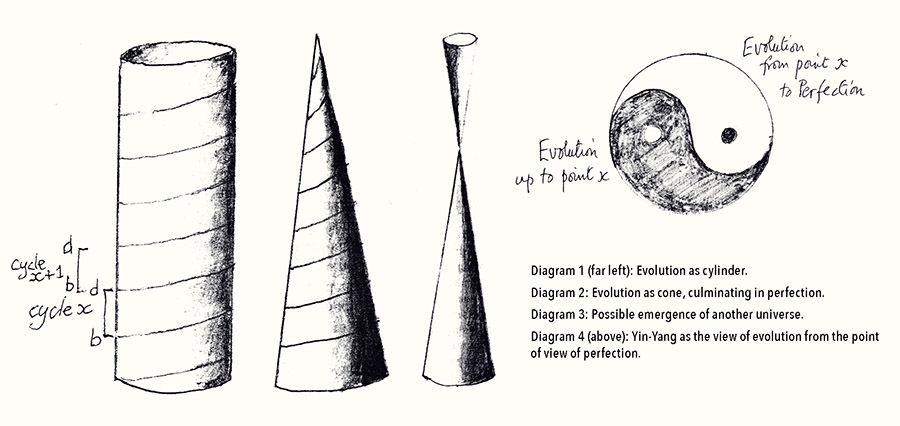
    There is nothing special or privileged about Humanity. It is one of the universe’s innumerable forms, and earthly humanity is but one modification of that form. From our point of view, the human form is one of a multitude of others through which we pass. The process can be symbolised by a spiral inscribed on a cylinder (diagram 1). Each turn of the spiral represents one life, for example, that of an earthly man or woman. It begins with birth, which is, in fact, death to our previous and lower state (the preceding turn). It ends with death, which is birth into our next and higher state. The rising pitch of the spiral symbolises the Law of Harmony or “The Good,” which governs the evolutionary process on every scale – personal, collective, planetary, cosmic, and universal.

    In geometry, a cylinder projected to mathematical infinity becomes a cone. This is the more appropriate symbol for the evolutionary process (diagram 2). At its vertex, in Daoist terms, is the Will of Heaven, which draws the universe to its ultimate Perfection and reabsorption. Matgioi leaves open the question of whether, once that is attained, another universe begins. If so, its symbol would be the double cone (diagram 3).

    The Yin-Yang symbol (diagram 4) is like a slice through the evolutionary cylinder. It symbolises our present state, the dark half representing our emission from Perfection, the light half our future reintegration therein.

    There is no freedom or chance in this grand process of universal evolution. Humans are not free to choose either their birth or death. But the human state is unique in one respect: between those limits, the Will of Heaven is not felt. Consequently, humans do have freedom, which they can use for better or worse. This alone is the locus of good and evil, along with their repercussions in this or a future life. Since evil does not exist as an independent entity, no punishment can be eternal. All beings are eventually destined for Perfection.

    What joins our successive lives, these turns on the spiral of our evolution, is the Personality, a completely distinct entity. It is immortal, containing an indefinite number of individuals whose births and deaths do not affect it. It absorbs them all, the heritage of former cycles, and nothing of them is absolutely lost. All positive acts and emotions contribute to its ultimate goal of unity. This also ensures that personalities which were emotionally close will remain so in future cycles, as they were in past ones.

    These metaphysical studies have a practical corollary. Our current state as humans gives us the freedom to conform to the Will of Heaven. If we rely on its principle, disengage from passions, and rationally weigh the consequences of each act, then every step we take – every effort, thought, even dream – is part of our inevitable spiral ascent to the Centre and the Truth. 

    One can see from this summary that Matgioi’s is an optimistic philosophy, in contrast to Traditionalists like Guénon who dwell with good reason on the negative aspects of humanity’s current state. Whereas they emphasise the devolutionary cycle of four Ages or Yugas, Matgioi takes the broader, evolutionary view, symbolised by the rising turns of the spiral. Each turn would then comprise an entire Yuga cycle, its components apparently declining as they accelerate, but each cycle being “higher” than the previous one. This would be the macrocosmic equivalent of the individual’s life, which is, in a sense, a decline from the Golden Age of infancy to debility and death, but for whom death to this state is immediate birth into a higher one. Incidentally, there is no support here for the Yuga theory invented for political purposes by Sri Yukteswar Giri (see my article “When Does the Kali Yuga End?” in New Dawn 138.)

    Guénon & Matgioi

    René Guénon

    Having mentioned Guénon, I return to his role in Matgioi’s biography. In 1908, a group of Martinists held a séance in which the spirit of Jacques de Molay, last Grand Master of the Templars, manifested. He commanded that the Order of the Temple be renovated and headed by René Guénon. The young philosopher had already attracted attention by joining every possible esoteric, occultist, or Masonic group in Paris, and he consented – if, indeed, he did not precipitate the whole affair. The new Order’s first session of automatic writing produced a flood of information that included themes and even titles of Guénon’s future books, including The Multiple States of Being and The Symbolism of the Cross. The following year, the Gnostic Church, in which he was “Palingénius, Bishop of Alexandria,” started a monthly journal, La Gnose, under his direction. Just as La Voie had pre-published Matgioi’s books, so La Gnose served for Guénon’s. It also presented the Archéomètre, the great posthumous work of Saint-Yves d’Alveydre, and articles on Islamic esotericism by Ivan Aguéli, a Swedish painter who had been initiated in Egypt into a Sufi order. Matgioi contributed an article on “The Metaphysical Error of Sentimentally-Based Religions.”

    Guénon, like Saint-Yves, claimed to have received teachings from mysterious Hindus. Together with Matgioi’s Daoism, Aguéli’s Sufism, and a Gnostic approach to Christianity, the foundations were being laid for a Traditionalist movement dedicated to the transcendent unity beyond the diversity of exoteric religions. Theosophy had been proclaiming this for thirty years, but the Theosophical Society was riven by squabbles and scandals following Blavatsky’s death. The new movement, which soon forgot its spooky origins, preferred to go straight to the ancient sources and the symbols of a primordial wisdom.

    Matgioi later reflected on his Daoist initiation with a humility that other pretenders would do well to heed:

    Beside certain incidental but still valuable notions, I mainly acquired the certitude of my imperfections, my ignorance, and my unworthiness. This, it seems, is the first step of wisdom. I greatly fear that I have not risen to others. But this poor ascent has nevertheless been extremely useful in my existence: it has given me defiance of the ego and disdain for the universe. (Chasseurs de Pirates! 1928, p. 185)

    Get the issue this article appears in

    Matgioi’s Writings Post-WWI

    The First World War effectively ended the French occult revival and with it Matgioi’s metaphysical works. He remained all the more active as a writer on colonial and military studies, beginning even in the heat of the war with close analyses of its progress. His fiction ranged from pirate and spy stories to prophetic visions of the next war. These were aimed at a popular audience and published in cheap “pulp novel” format. 

    By 1934, after the re-arming of Germany and the Nazi ascent to power, another war seemed inevitable. This time, it would not be fought by infantry in trenches but in the air, in tanks, and with unheard-of weapons that scientists, to their shame, were already inventing. This was the subject of his epic novel, published during 1934-35 under the authorship of “A. de Pouvourville, de l’Institut Colonial.” The first six parts were called La Guerre Prochaine (The Coming War), the following twenty-four parts L’Héroïque Aventure (The Heroic Adventure). It appeared in weekly instalments of 96 pages, promising “three hours of the most gripping reading.” The lurid covers and illustrations show ray guns, “navigyres,” “aquatanks,” “Z-rays,” and other fantasies of Art Deco science fiction. Germany is the eternal enemy; France the ultimate victor, allied with Mussolini’s Italy, Czechoslovakia and, in a minor role, Britain. A separate novel, Griffes Rouges sur l’Asie, depicts the coming Communist takeover of Asia, but Pourvourville’s future war, with a sad lack of foresight, takes place exclusively in the European theatre. It concludes with the upstart Chancellor “Heizler” crushed by a Berlin mob and a peace conference in Rome under the presidence of the Pope.

    Was Matgioi, like that other warrior-author Ernst Jünger, turning Catholic in his old age? One wonders, for in 1934 he also published a book about Saint Theresa of the Child Jesus (1873-1897). Affectionately known as “The Little Flower,” Theresa represents an emotional Christianity for which Matgioi had always shown contempt. Guénon, when he heard about it, said that if Pouvourville was still alive, Matgioi was certainly dead! My interpretation is that with war clouds gathering, the ageing author felt a responsibility to his compatriots. His futurist epic warned readers of popular war stories, largely young and male, who would soon be on the front lines. The book on Theresa addresses devout Catholics in their own style, preparing them to face suffering with confidence in France’s protectors: Saints Genevieve, Clotilde, Joan of Arc, and Theresa. Now that the war has come and gone, those works are mainly of historical interest, while The Metaphysical Way, true to its subject, is a timeless contribution.

    Thanks to Dr. Jean-Pierre Laurant, first authority on Matgioi, for his guidance in the world of Parisian esotericism and his indispensable work Matgioi, un aventurier taoiste (Paris: Dervy, 1982), and to Dr. Davide Marino for his later discoveries and friendly advice.

    The author’s translation of Matgioi’s masterwork, The Primordial Tradition of Ancient China: The Esoteric Foundation of the I Ching and Chinese Cosmology, is published by Inner Traditions. Order your copy here.

    [alert type=”general” dismiss=”no”]This article was published in New Dawn 207.[/alert]

    [alert type=”success” dismiss=”no”]If you appreciate this article, please consider subscribing to help maintain this website.[/alert]

    © New Dawn Magazine and the respective author.
    For our reproduction notice, click here.
  • Mystical Elvis: From Rock Star to American Shaman

    Mystical Elvis: From Rock Star to American Shaman

    From New Dawn 209 (Mar-Apr 2025)

    Elvis Presley remains one of culture’s greatest icons and solo pop stars today. At best, he’s viewed as an innovative, profoundly talented performer who led rock music into the heart and psyche of Western (and parts of Eastern) culture. At worst, he’s a symbol of American excess and consumerism, the musical version of McDonalds or Mountain Dew. 

    As music critic Bill Holdship said: “Elvis is loved, and he is hated. He was a genius, a fraud. A saint, the devil. The king, the clown. Even more than when he was alive, Elvis has come to symbolise everything great and everything hideous about America.”

    Regardless of one’s view of Elvis’s legacy, most consider the entertainer a mainstream figure. His idiosyncrasies and quirks were publicly known and never concealed, yet idiosyncrasies and quirks are an accepted part of being a mainstream entertainer.

    However, it might be shocking for many to know that Elvis was deeply immersed in all manner of alternative spirituality. In my book, The Occult Elvis, I propose that the King of Rock’n’Roll was arguably the greatest magician of modernity, regardless of how one defines “magic” (performative sleight of hand, consciousness manipulation, reality-bending, co-creation with the universe, etc.). More importantly, he was the chief American Shaman and the eternal egregore of the postwar American Dream.

    Elvis was so mystical that he went from a musical star to interacting with the very denizens of the stars. Keep in mind that this research avoids the countless tabloid stories about Elvis that were ubiquitous in the eighties and nineties (the fake news before fake news). The findings come from those close to Elvis: Priscilla, family, the Memphis Mafia, and intimate friends and colleagues.

    In short, you’ll find that this ain’t your grandma’s Elvis.

    Elvis the Seeker

    Elvis grew up in a Pentecostal family and community, which partly means that as a child, he was taught less about God and more about how to experience God. It’s no secret that Pentecostal and various Black churches in the Depression Era paralleled ancient Mediterranean religions’ shamanistic/mystery school vibe. Instead of being possessed by Dionysus, the attendee was invaded by the Holy Spirit for transformation and healing. That was the life of young Elvis. Furthermore, as a youth, he was always curious about metaphysics and the meaning of life.

    His Protestant beliefs began to waver after he had conquered the world as history’s first and greatest rock star. In the late fifties, Elvis began to expand his spirituality, dabbling with aromatherapy, embracing Eastern modalities, and speculating that reincarnation was a theological possibility. The Bible was still his go-to inspiration, but The Prophet by Kahlil Gibran came in second. Why the shift when the world had given him fame, money, and adoring fans? Wasn’t he the epitome of the conservative alpha male curried for the general public? There are two reasons, and both have to do with trauma, that great puncturer of belief systems:

    Evangelical leaders turned on him in the mid-fifties. His own pastor stated that he was caught in a web spun by Satan, and the country’s most famous preacher, Billy Graham, doubted Elvis’s faith. These allegations wounded Elvis, and he began questioning the authenticity of Christian pastors and church structures.

    The death of his mother, Gladys, in 1958. The shock of losing a person he loved more than anyone in the world sent him down a spiral of despair and reflection, and it didn’t help that he would spend the next two years in the army in faraway Germany.

    Nevertheless, it wasn’t until a third crisis that the floodgates of the occult opened. The predicament was years later, in 1964, when Elvis had morphed from a performer to a successful movie star yet was disillusioned by his career, life, and relationships. Why did he feel empty if he had reached the mountain top of stardom? Did he have a higher purpose, or was his destiny to become yet another washed-up celebrity eventually? 

    Larry Geller was Elvis Presley’s personal hairstylist and spent two hours a day with The King of Rock from 1964 until his dying day on 16 August 1977.

    As they say, when the student is ready, the master will appear. In a series of fortuitous events, Elvis met Larry Geller, a hairdresser for many Hollywood celebrities and a profoundly experienced esotericist with vast arcane knowledge. What started as a haircut evolved into a master/student relationship.

    Geller first introduced Elvis to The Impersonal Life by Joseph Benner. Deeply moved by its nondualist message, it became his favourite book. The work taught him that the ego is an illusion that must be transcended to uncover one’s true nature. Benner encouraged readers to release limiting beliefs and focus on their divine essence, the “I AM” presence, enabling connection with universal consciousness. Any individual can manifest their highest, divine potential. Elvis realised for the first time that the concept of the “Universal Christ” was present in everyone, further understanding that all religions share a common faith in God’s message.

    With the concept of the Universal Christ (or Christ Consciousness, as it is known in current times), Elvis was freed from the dogmas of fundamentalist Christianity. With Geller at his side, he explored a galaxy of alternative spirituality. He studied influential nineteenth and twentieth-century occultists, including H. P. Blavatsky, Manly P. Hall, G. I. Gurdjieff, and P. D. Ouspensky. He became a devotee of the Indian yogi Paramahansa Yogananda. He learned and applied esoteric practices such as sex magic, meditation, astrology, and numerology. He gained a workable understanding of Kabbalah, Gnosticism, Theosophy, and various Eastern mystical traditions.

    Knowledge is power, as they say, and power grew from Elvis, translating into extraordinary abilities. From his Pentecostal background, Elvis always believed in healing and other miracles (and he and his family had a gift for these abilities, indicating some genetic witch line). Elvis continued his healing abilities – from removing Priscilla’s headaches with a touch to curing cancer in his backup singer with prayer – fueled by the perennial wisdom of different traditions. Soon, he began to manipulate the weather, telekinetically move objects with his will, read minds, and astral travel. To him, these abilities were not the end-all of his quest, as Yogananda’s teachings said, they were merely indications one was getting closer to enlightenment. That’s what mattered to him the most.

    Elvis’s embrace of the occult extended to other arenas, such as conspiracy theories, parapolitics, secret societies, and more (isn’t that what always happens when one goes down the rabbit hole of what is possible? Asking for a friend, Terence McKenna, Philip K. Dick, William Burroughs, and other modern magicians?)

    This evolution, naturally or perhaps supernaturally, led Elvis to beliefs and eventual encounters with extraterrestrials.

    Close Encounters of the Elvis Kind

    Today, we live in a time where the UFO and the angel, the saucer-hunter and the priest, are deeply intertwined. From government reports to Ancient Aliens on the History Channel, the many ideas of extraterrestrials are no longer fringe but rather conventional. As with his other ideas and practices, Elvis was ahead of the curve. 

    In the sixties, Elvis concluded that the imagery (which he sketched) in Ezekiel surely must be alien technology. He loved Erich von Däniken’s Chariot of the Gods. He was familiar with The Book of Enoch and read The Urantia Book, two constant favourites for blurring the lines between extraterrestrials and angelic visitations. 

    He and Geller would have been right at home conversing with Philip K. Dick or a UFO Discord group. 

    Elvis experienced three direct UFO encounters (in between two major mystical experiences). While driving through the New Mexico desert on Route 66 from Memphis to Los Angeles, he and his entourage witnessed a bright disk streaking across the night sky. The UFO descended but abruptly halted, made a right-angle turn, and accelerated until it vanished from their eyesight.

    “That object maneuvered like a flying saucer,” Geller said afterwards.

    Elvis remarked, “It’s ridiculous to think we’re the only life with millions of planets in the universe.”

    “If they want to tell us something,” Geller said, “Why don’t they land on the White House lawn or the Pentagon and contact our leaders instead of visiting an occasional individual out in the boondocks in the middle of the night?”

    “I’ve thought about that,” said Elvis. “Maybe they don’t want to cause panic, plus they want us to evolve spiritually by giving us a chance to make our own decisions. They’ll work quietly behind the scenes, influencing us without appearing to.” 

    “And how will they do that?” Geller asked.

    “By the power of their minds,” Elvis answered, “which must be vastly superior to ours, or they couldn’t be flying across the sky.”

    Elvis and Geller would also have been right at home before a US government hearing on UAPs or participating in a podcast about how aliens are the reason humanity hasn’t extinguished itself in nuclear fire.

    The other two extraterrestrial encounters occurred in his Los Angeles and Graceland homes in Memphis, respectively. Elvis wasn’t alone on each occasion and was far more filled with curiosity and wonder than any dread. The details are in my book and how Elvis perhaps saw himself as more than an earthling but part of an alien federation. 

    His father, Vernon, claimed that when Elvis was born, a blue light appeared above their home in Tupelo, Mississippi, halting suddenly and freezing everything in the area. What is the alien stork dropping off a stranger in a strange land or a cosmic herald as happened with the births of Julius Ceasar, Genghis Khan, Jesus, and other historic figures?

    Elvis fan Wanda June Hill believed in the former. During a late-night conversation, Elvis once revealed to her that he wasn’t from this planet. He mentioned encountering “light form” men who predicted his future, including his interest in karate and his iconic white suits in Las Vegas. Towards the end of his life, he spoke of a “blue star planet,” referring to Jupiter and its advanced civilisations. He claimed his true home was Jupiter’s 9th moon. At one point, Hill alleged that his eyes glowed and an aura surrounded him.

    Hill’s testimony falls closer to the tabloid genre and many of today’s radical social media posts. However, when coupled with Elvis and his communing with space entities, there’s a strong argument that something fantastic kept happening to the King of Rock n’Roll.

    Get the issue this article appears in

    Caught in a Karmic Trap

    As most know, Elvis led a tumultuous life that ended when he was only forty-two. His spiritual peaks, meditation breakthroughs, and supernatural experiences were sandbagged by too many bouts of drug addiction, unhealthy living, and other poor life choices. 

    As I write in the book, Elvis was doomed as soon as the alien blue light descended on his home, his life paralleling many shamans across the globe that end their lives as broken, drug-addicted savants – the Wounded Healer trope we find even beyond Indigenous cultures. Elvis, as America’s Shaman, fell into that category, unable to battle his demons even as he exorcised so many demons in his millions of fans across decades – and even today. Carrying the spiritual weight and sins of a tribe is not easy, and the spirit world is replete of dark things that go bump in the astral flight. 

    Perhaps he returned to Jupiter’s 9th moon or has reincarnated as an internet conspiracy buff in some small town in Idaho. Wherever he is, Elvis has earned his rest. His past incarnation was not only of a history-changing figure but also of a person who was a deep seeker who wanted more than anything to find a sacred purpose and commune with higher forms of consciousness.

    Miguel Conner’s new book The Occult Elvis: The Mystical and Magical Life of the King is available from all good bookstores.

    [alert type=”general” dismiss=”no”]This article was published in New Dawn 209.[/alert]

    [alert type=”success” dismiss=”no”]If you appreciate this article, please consider subscribing to help maintain this website.[/alert]

    © New Dawn Magazine and the respective author.
    For our reproduction notice, click here.