New Dawn – World's Most Unusual Magazine

Category: Articles

  • The Grand Chessboard Endgame: Why the War on Iran Is Really About Controlling Eurasia

    The Grand Chessboard Endgame: Why the War on Iran Is Really About Controlling Eurasia

    From New Dawn 216 (May-June 2026)

    On 27 February 2026, Oman’s Foreign Minister Badr Al-Busaidi told the world that peace was “within reach.” Iran had agreed to full IAEA verification, permanent limits on uranium stockpiling, and irreversible downgrading of its enriched uranium to the lowest possible level. Talks were set to resume on 2 March.

    The bombs started falling on 28 February.

    The United States and Israel launched a joint assault that killed the Iranian leader Ali Khamenei, flattened military facilities, and also tore through schools, hospitals, and cultural sites across the country. Iran struck back with missiles and drones aimed at Israel and US bases in Bahrain, Jordan, Kuwait, Qatar, and Saudi Arabia. The Strait of Hormuz was shut. Oil prices spiked to levels not seen since the 1970s. By early April, with thousands dead, the conflict was dangerously widening.

    The stated reasons from Washington shifted by the day. Regime change. Self-defence. Nuclear prevention. Securing oil. No single story held for more than a news cycle.

    That drift is the tell. When the reasons for a war change by the day, the real reason must stay hidden. And the real reason reaches far beyond any nuclear programme.

    The Western ruling elite knows its era of unchallenged global dominance is closing. The economic centre of gravity is migrating eastward. The dollar’s monopoly over world trade is eroding. BRICS is expanding. China’s Belt and Road Initiative is weaving the Eurasian landmass into a single integrated economic zone.

    In a desperate, last-ditch bid to preserve their grip on global power, Western elites are racing to build a Techno-World Order, a system of control founded on artificial intelligence, digital currencies, biometric tracking, and rule by algorithm.

    That system requires the physical world to stay in their hands. And the physical world runs through Eurasia.Anglo-American strategists have understood this for over a century.

    The Blueprint
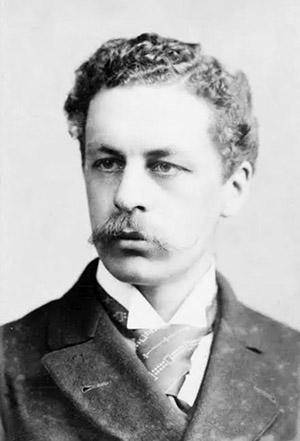
    Sir Halford John Mackinder

    To see this clearly, you need to look at two texts that most people have never heard of. One was a lecture delivered in 1904, later published as an article. The other was a book published in 1997. Taken together, they read like a blueprint for modern empire, so candid in their strategic vision that they feel like an architect’s own drawings for a structure you have been living inside your whole life.

    Sir Halford John Mackinder was a man who acted on his ideas. A British geographer who directed the London School of Economics from 1903, he built his career on a single argument: the age of sea power was fading and the real prize was land.

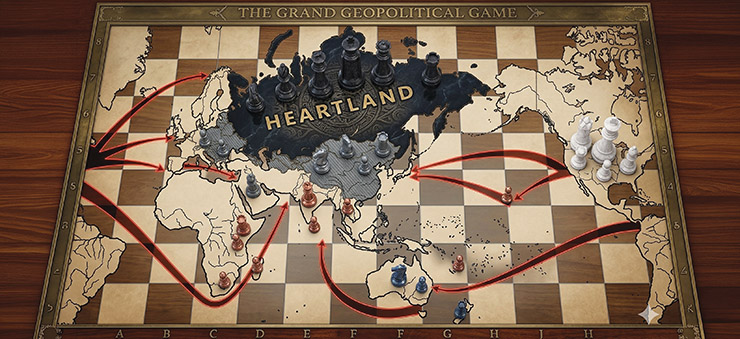
    In 1904, before the Royal Geographical Society, he proposed that the vast interior of Eurasia, stretching from the Volga to the Yangtze, held the resources and the position to command the globe. He called it the “Heartland” (see map on page 11) Around it lay coastal states he termed the “Inner Crescent,” and beyond them the maritime fringe of Britain, Japan, the Americas, and Australia.

    His dictum, refined in 1919, still runs Western strategic thought. “Who rules East Europe commands the Heartland; who rules the Heartland commands the World-Island; who rules the World-Island commands the world.”

    Then he tested it. In late 1919, the British government sent Mackinder to southern Russia as High Commissioner during the civil war. His mission was to unite the White Russian forces of General Denikin against the Bolsheviks and prevent a hostile power from consolidating the Eurasian interior. He returned to London and proposed to the Cabinet a “cordon sanitaire” of buffer states running from Georgia, Armenia, and Azerbaijan through Ukraine, Poland, and the Baltic provinces. The Cabinet ignored him. Britain withdrew its troops. South Russia fell to the Bolsheviks.

    Mackinder’s proposed buffer states were swallowed by the Soviet Union for the next seventy years. The same states he named in 1920 remain flashpoints in 2026. Georgia. Armenia. Azerbaijan. Ukraine.
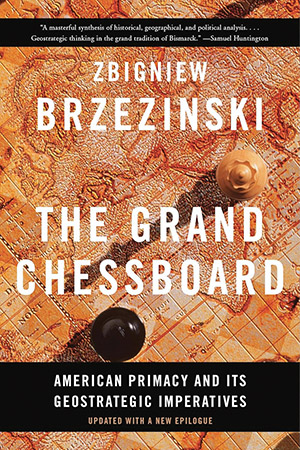
    Ninety-three years after Mackinder’s London lecture, Zbigniew Brzezinski picked up his thesis and fitted it for American use. The Grand Chessboard, published in 1997, is a startling book. Brzezinski, a former US National Security Advisor and co-founder of the Trilateral Commission, laid out American imperial strategy with a bluntness unthinkable in any official document. (He misspelled Mackinder’s first name as “Harold” throughout. The American heir to British imperial geostrategy got his own master’s name wrong.)

    The core argument was simple. Eurasia holds seventy-five percent of the world’s people, sixty percent of its economic output, and three-quarters of its known energy. Control Eurasia and you control everything. America’s task was to prevent any rival from locking that landmass together.

    Brzezinski identified five states whose fate would decide the balance. Ukraine. Azerbaijan. South Korea. Turkey. Iran. He warned that one scenario above all would threaten American power. A grand coalition of Russia, China, and Iran, joined not by ideology but by shared hostility to Western hegemony.

    He was blunt about what lay beneath the surface. The Caspian Basin and Central Asia hold reserves of oil and gas that dwarf those of Kuwait, the Gulf of Mexico, or the North Sea. Iran, with its own massive reserves and its position astride every proposed energy corridor, was the lock on the door.

    Selling the project to voters would be hard. “Democracy is inimical to imperial mobilisation,” Brzezinski wrote. The public would back foreign wars only if given a “sudden threat or challenge to the public’s sense of domestic well-being.”

    In Iran’s case, the nuclear bogeyman served that function for two decades. When diplomacy threatened to remove it, the bombs fell anyway.

    Everything Brzezinski described in theory, Iran embodies in geography. The country is the gateway to Eurasia. No other nation bridges the Indian Ocean to the Caspian and Central Asia in a single overland corridor. The Iranian coastline commands the Strait of Hormuz, through which close to a quarter of the world’s seaborne oil flows. The country shares land and sea borders with fifteen nations. Iranian oil and gas reserves rank among the largest on Earth.

    Western strategists see a strategic position on a map. Iran is something else.
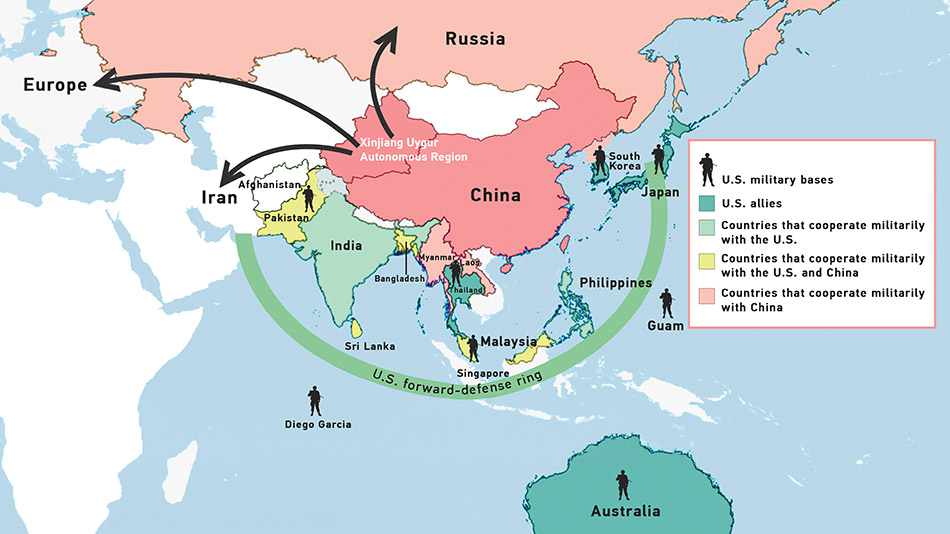
    Seen from Beijing, this map depicts a ring of US military power aimed at constraining China and the wider Eurasian landmass, with Iran in a strategically vital position.
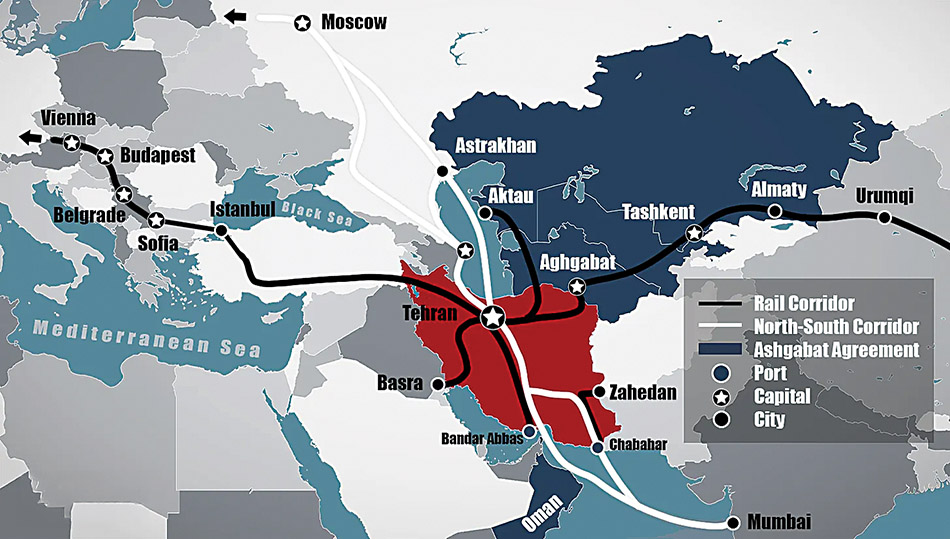
    Iran has become a key hub in emerging corridors connecting Russia, China, and India.

    Persia, as it was known for most of recorded history, is one of the oldest continuous civilisations on the planet. Five thousand years. When the first stones of the Persian Royal Road were laid, connecting the Mediterranean to Central Asia, Rome did not exist. When the Silk Road began threading through Iranian territory, Christianity had yet to be born. Zoroastrianism, one of the earliest monotheistic faiths, emerged from this soil. The mystical traditions of Sufism flowered across the Persian cultural world, producing a spiritual literature, including the Persian-language poetry of Rumi, Hafez, and Omar Khayyam, that still crosses every border of language and belief.

    This is a land where the seen and the unseen have coexisted for millennia, where philosophy and statecraft and spiritual practice grew from the same root. The men in Washington see pipelines and chokepoints. What they fail to see is a civilisation with roots strong enough to outlast any empire that tries to uproot it.

    The West has been trying for a long time. In 1953, when Iran’s elected Prime Minister Mohammad Mosaddegh moved to nationalise the Anglo-Iranian Oil Company, the CIA and MI6 engineered a coup that toppled him and installed Shah Mohammad Reza Pahlavi. The stated reason was Cold War containment. The operating logic was older. Keep the resources and corridors of the Inner Crescent under Western-aligned control.

    Iran’s 1979 revolution ejected the Shah and with him the Western strategic presence. The Islamic Republic has been targeted by Anglo-American policy ever since, through decades of sanctions, proxy conflicts, covert operations, and now direct military assault. The nuclear question has always been the public face of a strategic interest that predates Iran’s nuclear programme by half a century.

    In the years before the 2026 war, Iran was doing what Mackinder and Brzezinski had both warned about. Tehran was fast becoming a key player in Eurasian integration. Iran joined the Belt and Road Initiative. In May 2025, the first direct freight train from Xi’an, China, pulled into the Aparin dry port, cutting transit from a month by sea to fifteen days by rail. The North-South Transport Corridor, linking Russia through Iran to India, was turning Iranian ports into the spine of a new Eurasian trade network. India had poured investment into the Chabahar port on Iran’s southeastern coast, giving Delhi a route into Afghanistan and Central Asia that bypassed Pakistan and sidestepped the Strait of Hormuz. Iran was connecting east to west and north to south at once. The keystone was locking into place.
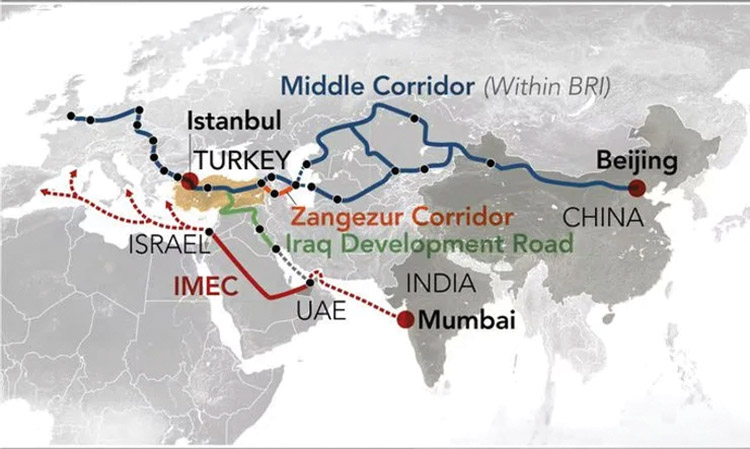
    Iran sits at a critical junction of competing economic corridors, with this map highlighting Türkiye’s route as a gateway to Europe.

    Look at the map in 2026. The coalition Brzezinski described has arrived. The alliance runs through BRICS, the Shanghai Cooperation Organisation, and the Belt and Road Initiative. What Brzezinski feared on paper now moves in steel, rail, and pipeline. And the gateway holding it all together is Iran.

    The Techno-World Order

    This is where the century-old Mackinder doctrine meets the twenty-first-century endgame.

    The Western elite policymakers can read the trends. American debt is spiralling. The move away from the dollar is picking up speed. China’s economy has overtaken the United States in purchasing power terms. The BRICS bloc now represents a larger share of global GDP than the G7. Military bases, dollar hegemony, arm-twisting through the IMF and World Bank, the old tools of Western control are losing their grip. The world that Mackinder and Brzezinski sought to manage is slipping away.

    The ruling class has chosen a different path. Instead of accepting a multipolar future, it has set about building a new architecture of control, one founded on something beyond aircraft carriers and trade agreements.

    At the World Economic Forum in Davos, January 2026, the shape of that architecture was plain to see. AI-driven governance. Digital currencies. Biometric identity frameworks. Machine-run control of whole populations. These were working agendas backed by people who hold state power.

    Technocracy researcher Patrick Wood (see New Dawn Special Issue Vol 20 No 1), who has tracked these developments for decades, calls key figures in the Trump administration “arch-technocrats” building a system of global digital dominion. He names Elon Musk, Peter Thiel, and Howard Lutnick among the architects. The stated US policy goal, laid out in an AI strategy co-authored by senior officials, is to export America’s “full AI technology stack” to every country willing to join its digital alliance.

    By early 2026, the Trump family’s World Liberty Financial had launched a dollar-pegged stablecoin backed by US Treasury securities, and the GENIUS Act had created the federal regulatory framework to legitimise it. The merger of state power and private digital finance was no longer theoretical.

    This Techno-World Order has material demands. AI runs on rare earth minerals and vast energy. Digital currencies need compliant banking systems. Surveillance needs cooperative states. All of this depends on controlling the trade corridors and energy routes of the physical world, the same corridors that Mackinder mapped in 1904 and that converge at Iran.

    If Russia, China, and Iran build their own digital and financial systems outside Western reach, the technocratic project fractures beyond repair. And that is what has been unfolding.

    BRICS states have moved toward de-dollarised trade. China’s rail links to Iran skip every Western-controlled sea lane. After the Strait of Hormuz was initially closed, Iran offered safe passage to BRICS members and blocked American-allied ships. A multipolar world with independent tech freedom is the one outcome the architects of the Techno-World Order are determined to prevent.

    A stable, integrated Iran at the heart of Eurasian trade poses a greater danger to this project than any uranium centrifuge. The centrifuges made for a good story. The real target was the gateway.

    The war itself had been building for years. In 2024, Iran and Israel exchanged direct attacks for the first time. In June 2025, Israel struck Iran and the United States later joined the 12-day war with attacks on Iranian nuclear sites. In January 2026, Iran was shaken by its worst domestic unrest since 1979. By late February, Washington had assembled one of its biggest regional military deployments since the 2003 invasion of Iraq. Oman-mediated indirect nuclear talks, which had resumed in early February, showed progress. The 28 February assault ended that diplomatic opening. What followed stripped away whatever remained of diplomatic language.
    Get the issue this article appears in

    A Whole Civilisation

    On 21 March, Trump posted on his internet platform ‘Truth Social’ that if Iran did not “FULLY OPEN, WITHOUT THREAT, the Strait of Hormuz, within 48 HOURS,” the United States would “hit and obliterate their various POWER PLANTS.” Twelve hours before that deadline expired, he postponed it. On 26 March, he extended the deadline again, writing that negotiations were “going very well.” On 30 March, he expanded his threatened targets to include oil wells, Kharg Island, and “possibly all desalination plants.” Each deadline arrived and was pushed back. Each postponement came with louder threats.

    On Easter Sunday, 5 April, Trump posted what may be the most unhinged statement ever issued by a sitting US president. “Tuesday will be Power Plant Day, and Bridge Day, all wrapped up in one, in Iran. There will be nothing like it!!! Open the F****** Strait, you crazy bastards, or you’ll be living in Hell. JUST WATCH! Praise be to Allah.” His Defence Secretary Pete Hegseth had already threatened to send Iran “back to the Stone Age.”

    On 7 April, Trump told reporters the US had a plan “where every bridge in Iran will be decimated by 12 o’clock tomorrow night, where every power plant in Iran will be out of business, burning, exploding and never to be used again.” Hours later, on Truth Social, he wrote the words that Amnesty International’s Secretary General called “apocalyptic” and members of Congress called “genocidal.”

    “A whole civilization will die tonight, never to be brought back again. I don’t want that to happen, but it probably will.”

    For all his incendiary rhetoric and threats, Trump has earned the nickname TACO—“Trump Always Chickens Out”—as this Democratic attack graphic makes plain.

    A whole civilisation. The president of the United States was threatening to extinguish one of the oldest continuous civilisations in human history. Five thousand years of philosophy and poetry and spiritual seeking, reduced to a target in a social media post sandwiched between threats about power plants and boasts about a rescued airman.

    Iran’s response told a different story. Across the country, young Iranians formed human chains around power plants to shield them with their bodies. President Masoud Pezeshkian wrote that more than 14 million Iranians had registered to sacrifice their lives defending their homeland. “I too have been, am, and will remain devoted to giving my life for Iran,” he said. Iran’s foreign ministry called Trump’s threats “a sign of ignorance.”

    Ninety minutes before his own 8 p.m. deadline on 7 April, Trump backed down. A two-week ceasefire was announced after mediation by Pakistan, where Washington’s traditional allies had failed to act. Iran agreed to allow passage through the Strait of Hormuz for the ceasefire period. Oil prices dropped eight percent within minutes. But Iran’s Supreme National Security Council, accepting the ceasefire on 8 April, issued a pointed clarification. “This does not signify the termination of the war. Our hands remain upon the trigger.”

    The power that threatened to wipe out a civilisation failed to make its own deadline stick. Three ultimatums were set and withdrawn before the fourth produced a pause. The off-ramp was negotiated by a country that Brzezinski would have classified as a secondary player on the chessboard.

    A confident hegemon behaves differently. The pattern of escalation, bluster, retreat, and re-escalation reveals an establishment that knows its position is eroding and is lurching between force and negotiation with no coherent strategy beyond buying time.

    The war on Iran makes full sense when we consider Mackinder’s 1904 lecture and Brzezinski’s 1997 book The Grand Chessboard. Hold the Eurasian gateway or lose the world. In 2026, add the final layer. Lock the planet into a Western-built digital grid before any rival bloc can raise its own.

    The desperation with which that project is being pursued, the expletives, the shifting deadlines, the threats of civilisational annihilation, tell you everything about how the architects of that project assess their own chances.

    Iran, the ancient mystical land of Persia, has held this ground for five millennia. Every empire that tried to seize it, from the Macedonians to the Mongols to the British, paid a price too heavy to sustain. The land outlasted them all. Persia endures as a living civilisation, rooted in traditions older than any Western institution now claiming the right to reshape the world.

    The question hanging over 2026 is whether an empire armed with cruise missiles, blockchain ledgers, artificial intelligence, and a social media account can break that record.

    The accompanying article “The View From the Other Side of the Chessboard” can be read here.

    [alert type=”general” dismiss=”no”]This article was published in New Dawn 216.[/alert]

    [alert type=”success” dismiss=”no”]If you appreciate this article, please consider subscribing to help maintain this website.[/alert]

    © New Dawn Magazine and the respective author.
    For our reproduction notice, click here.
  • Reconstructing the Lost Secrets of Temple Technology: The Word that Made the Fields Flourish

    Reconstructing the Lost Secrets of Temple Technology: The Word that Made the Fields Flourish

    From New Dawn Special Issue Vol 18 No 5 (Oct 2024)

    When we talk about the ancient wisdom, at least in Western cultures, what we’re discussing is a vast heap of wreckage left behind by three savage campaigns of destruction.

    The first of these hit in the twilight years of the ancient world, carried out by religious fanatics after Christianity was hijacked by the Roman elite and turned into an instrument of social control. The second came in the late Middle Ages when the Church hierarchy panicked at the rising tide of independent thought and created the Inquisition to stop free inquiry in its tracks. The third and most recent arrived with the Scientific Revolution when the rising mercantile-capitalist class embraced scientific materialism as its ideology of choice and used its power and wealth to crush alternative viewpoints. It’s a long and bitter story.

    There’s another side to the tale, however. During each of these orgies of violence and oppression, there were people who risked everything to preserve what they could for the future. Afterwards, in turn, small groups of independent thinkers rejected the orthodoxies of their time and set out to recover some of what was lost. In the teeth of outraged resistance from the established institutions of the day and blind hostility from the masses, these succeeded in preserving some of the core teachings and practices of the old mystery traditions and reassembling others from the surviving fragments.

    Imagine for a moment that some immense machine of glass and bronze was battered to pieces by a furious mob and the fragments trampled underfoot so that all that remained were fragments scattered through the gutters of a great city. Imagine that every record of the machine’s structure and function had been destroyed to keep anyone from figuring out how to rebuild it. Now imagine that many years later, you learn of the machine. Inspired by the old stories, you prowl the streets of the city, and when you find something that might once have been a piece of it, you pick it up, take it back home with you, clean off the grime, and then try to figure out how it might fit together with the other pieces you’ve already gathered, and what the shape of the whole machine might have been. This metaphor, taken from John Crowley’s visionary novel Aegypt, may give you some sense of the labour involved.

    That work is still ongoing. Some parts of the ancient wisdom – some pieces of the machine, in terms of the metaphor – have been restored to full working order. Astrology and ceremonial magic, for example, were brought back into use in the nineteenth century, the former pioneered by Alan Leo and the latter by Eliphas Lévi; both can now be learned from many books and teachers, and practised with good results. Other elements of the tradition, such as alchemy and sacred geometry, are still only half-understood. Then there are fragments of the ancient lore that were destroyed so completely and lost for so long that they survive only as hints and whispers or as gaps where something once existed.

    The Lost Word

    One of those gaps lies at the centre of modern Freemasonry. Down through the years, there has been a vast amount of chatter about the secrets of Freemasonry, but there’s a detail that generally gets left out, though it can be found in plenty of publicly available sources: the Freemasons don’t have their original secrets any more. When a member is raised to the sublime degree of a Master Mason, he is told that the words and signs he is given are substitute secrets because the real secrets have been lost. To this day, every Master Mason is, at least in theory, pledged to the quest for the Lost Word.

    What is this Lost Word? Nobody knows – not even the Masons. Of course, there’s no shortage of speculation. Devil worship, political conspiracy, kinky sex, the relics of a prehistoric civilisation on Mars, you name it, no matter how lurid or absurd, somebody has identified it as the Lost Word. Some of the other Masonic degrees pass on words that are supposed to be the Lost Word, but none agree on what it is or why it is so important.

    Let’s go deeper. The Master Mason degree ritual used in regular Masonic jurisdictions today derives from an original that appeared around 1720, three years after the founding of the first Grand Lodge in London. There is no record of who introduced it or where it came from; it simply shows up. It tells a story about the building of the Temple of Solomon, and that story includes – indeed, centres on – the disappearance of the Lost Word and the invention of the substitute secrets, which are to be kept until the real secrets are recovered.

    Thus, it is clear that in 1720, three linked ideas were so important to the most influential Masons of the time that they put them into the Craft’s most important ritual. The first of these ideas was that Masons of some earlier period had known some important secret; the second was that the Masons of 1720 no longer knew what the secret was but thought they had some hope of recovering it; and the third is that it had something to do with the Temple of Solomon in Jerusalem, one of the most famous buildings of the ancient world.

    Power of the Temple

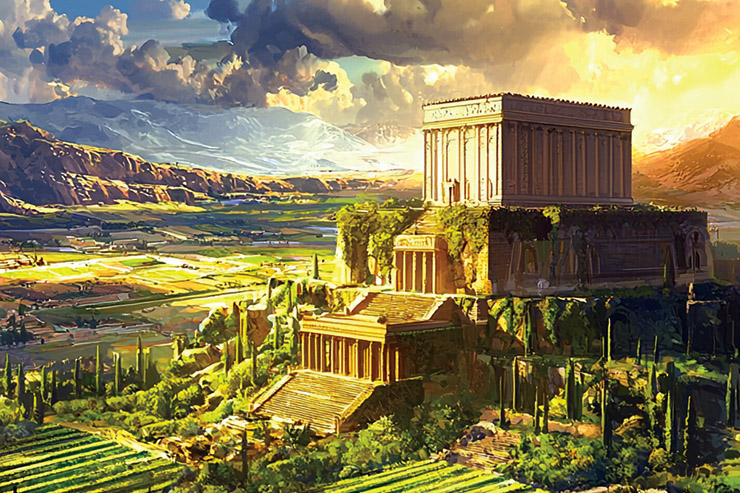
    There’s plenty of information about the Temple of Solomon in ancient Greek, Roman, and Jewish sources, as well as a vast modern scholarly literature on the subject. Most of it is fairly straightforward, but one very odd detail runs through the old sources. This is the claim that while the Temple stood, it caused a remarkable increase in agricultural fertility in the land around it. The Jewish sources go into quite a bit of detail about this: from the time when Solomon built the Temple to its destruction by the Babylonians, the weather and the soil fertility of the region were different. After the destruction of the first Temple, that stopped, but when the second Temple was built by Jewish refugees returning from Babylonia, the effect returned and stayed in place until the Romans destroyed the second Temple in 70 CE.

    The Temple of Solomon isn’t the only ancient temple about which that same claim was made. You can find it in legends surrounding temples over much of the ancient world. Where it occurs, you find certain other things reliably associated with it. The temples are built above underground water sources and their sites have to be chosen by special means. A flurry of odd taboos govern who can or cannot enter and under what conditions. Usually, though not always, they are surrounded by at least a narrow green belt of natural vegetation. Above all, certain rules of alignment and sacred geometry govern their placement and design.

    Geographically, this is a weirdly selective tradition. It doesn’t appear in Africa outside of Egypt, except in a few northeastern African countries that absorbed a great deal of ancient Egyptian culture. It is found all over the ancient Mediterranean and extends east to India and some, but not all, of the island chains further east. Then, it appears in Japan, where it plays a central role in Shinto shrines but not Buddhist temples. Finally, it crops up in the Christian churches of medieval western Europe but is absent from Orthodox Christianity, Islam, and post-temple Judaism.

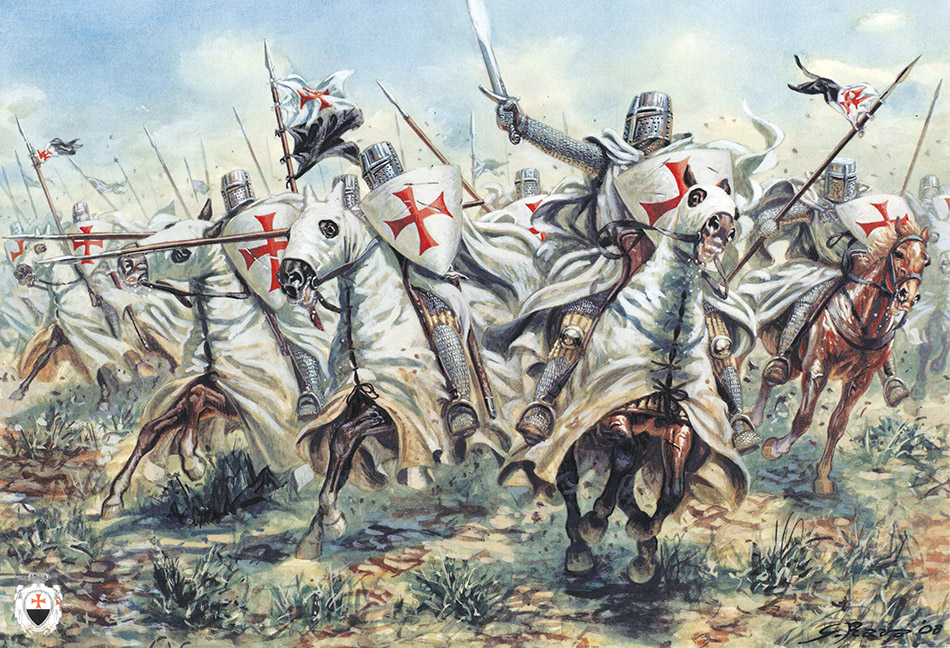
    Painting depicts the Knights Templar in full battle mode.

    Knights Templar

    Western Europe in the Middle Ages apparently knew nothing about it until the time of the Crusades, where the tradition shows up first in churches built by the Knights Templar and spread from there. That turned out to be a clue of immense importance. The Templars – the Poor Fellow-Soldiers of Christ and the Temple of Solomon, to give them their original name – were founded in 1118 by nine French knights who had gone to Jerusalem with the First Crusade. They were dissolved by Pope Clement V in 1311 amid a flurry of charges of heresy and sorcery.

    The Templars got their name because the original nine knights were housed on the Temple Mount in Jerusalem, atop the ruins of Solomon’s Temple; by the time of their abolition, they had landholdings in most of the countries of Europe. When the Order was destroyed, some of the members were burned at the stake and others were transferred to monasteries of less militant orders where they lived out their lives as ordinary monks.

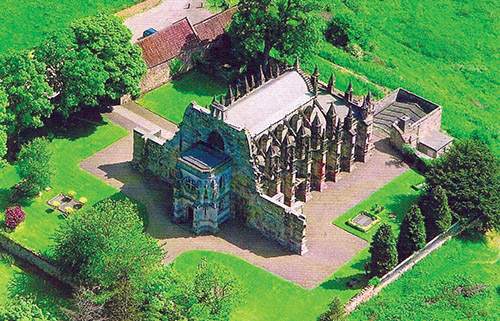
    Aerial view of Rosslyn Chapel in Scotland. 

    There were two exceptions to this. In Portugal, King Dinis created a new order, the Knights of Christ, and had all the Templars in Portugal transfer into it; the Knights of Christ proceeded to play a remarkably active role in the great age of Portuguese navigation, sailing straight to islands in the Atlantic that (in theory) nobody in Europe knew about. Then there was Scotland, where the Pope’s rulings had no force because the whole country just then was under an interdict, and where Robert the Bruce was leading a war of independence against the English and needed every competent soldier he could get.

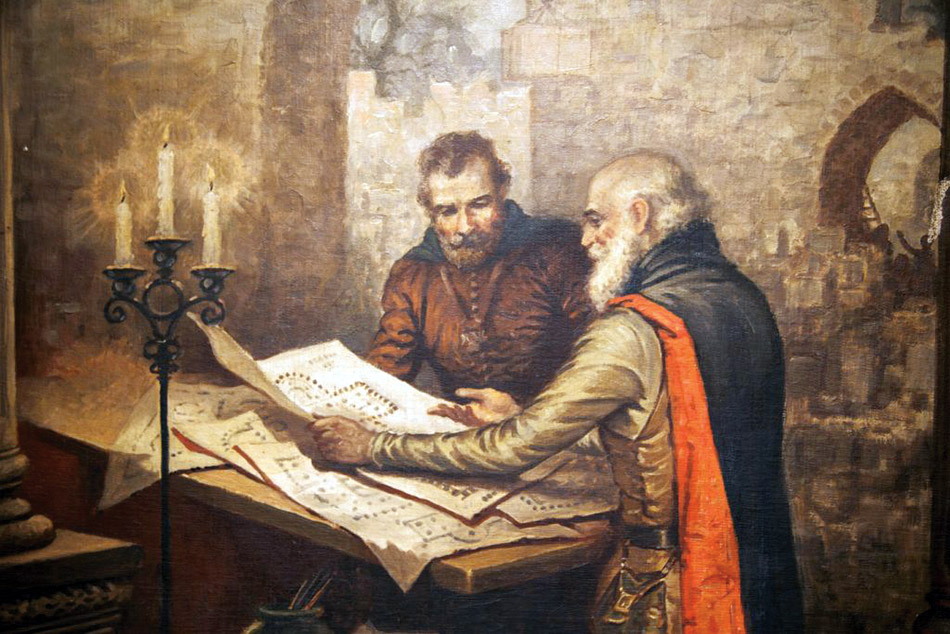
    The Knights Templar had a significant presence in Scotland at that time; the village now called Temple, located next to the mysterious Roslyn Chapel, was their headquarters in the kingdom, but they also had many other properties and plenty of knights and officials to supervise them. Masonic tradition insists that the Scottish Templars promptly made a deal with Robert the Bruce. They fought for him at Bannockburn and elsewhere, and in return, he protected them from the Church and let them go quietly to ground.

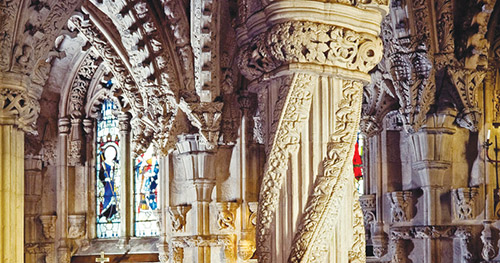
    The Apprentice Pillar with its masonic connotations is the central focus in this photo of the chapel’s interior.

    The tradition proceeds to claim that since the Templars had their own master builders and stonemasons – they had to since they themselves built the castles, churches, and other structures on their landholdings – some of these Scottish Templars ended up supporting themselves as master masons in the original sense of that term, and from that source, certain Templar legacies found their way into Freemasonry. It’s a matter of historical record, finally, that Freemasonry as we now know it, was in existence in Scotland most of a century before it appeared anywhere else.

    All of this is familiar ground to most people aware of alternative history. What deserves attention here are the charges levelled against the Templars when the order was dissolved. Much of it was the same sort of canned libels that would be used later in the witch trials; some of it had intriguing parallels to the actual practice of heretical Christian sects in ancient and medieval times, which deserve more attention than they’ve gotten in the historical literature to date; but then there was the claim that they worshipped a mysterious idol named Baphomet, which made the crops grow. There was the issue of agricultural fertility again.

    Holy Grail

    That issue pops up again in another place at precisely the same time. The oldest known version of the story of the Holy Grail was written around 1190 by Chretien de Troyes, who claimed he’d gotten the story from Count Philip of Flanders, a Crusader who had close connections with the Knights Templar and the royal house of Jerusalem. Between 1190 and 1250 – that is, during the golden age of the Templars – the Grail got massive play in popular literature. They were strange stories, these legends of the Grail; they spoke of a secret passed down through the centuries by hidden guardians, which could only be revealed to those who asked the right question.

    What is the Grail? That was one of the questions those who sought the Grail had to ask. A later generation of authors, heavily invested in mainstream Christianity, insisted that the Grail was the cup Jesus of Nazareth used at the Last Supper and redefined the secrets of the Grail as those of ordinary Christian theology. Go back to the earliest surviving Grail stories, those by Chretien de Troyes or Wolfram von Eschenbach, and you land in a far stranger world where the Grail could take many forms, and its ultimate secret was the power to make the fields flourish. That was why King Arthur’s knights went out in search of the Grail: it alone could restore the barren wasteland to fertility.

    All this happened as sacred geometries and other traditions that were part of the temple tradition elsewhere in the world found their way into medieval European religious architecture. In its wake, monasteries were founded all over western Europe in desolate areas, which promptly became burgeoning agricultural regions capable of supporting not only monks but thriving villages. To this day, all across Europe, you can visit the ruins of long-abandoned settlements from the Middle Ages in barren upland regions that nowadays barely produce enough grass for sheep; old records and archaeological remains alike show that these villages once had thriving fields of grain and other crops – and in the centre of each is a church laid out according to the sacred geometries of the temple tradition.

    Get the issue this article appears in

    Temple technology

    Up out of the darkness of the centuries, like a shape in the mist, rises the dim shape of a forgotten technology – the temple technology, as I came to call it – that was once used by priests and priestesses across much of the Old World to make the fields flourish. Long before the beginning of recorded history, perhaps by sheer chance, perhaps through other means, people in certain parts of the world noticed that buildings of specific shapes built and aligned in particular ways affected the crops grown in nearby fields. Over millennia of trial and error, that original insight gave rise to two kinds of structures.

    One of them uses structures shaped more or less like a stair-step pyramid: large ones, like the ziggurats of Babylon or the pyramids of the Mayas, or small ones, like the earth-deity altars that used to be found in every village in China before the 1949 revolution. The other uses square or rectangular buildings, usually oriented to the rising sun, which seems to have functioned as a resonance chamber. Both kinds of structures were built over certain specific geological features that create electrical discontinuities in the ground.

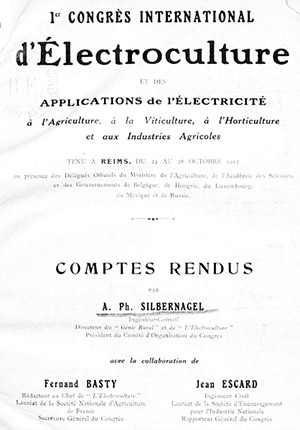
    Early last century, “electroculture” was popular as seen in this literature from the period (see thegardenstrust.blog/2021/09/04/electroculture).

    This matters because there are currents of electricity and lines of magnetic force, closely associated with one another, moving through the body of the Earth. Back in the 1920s, before the chemical industry got a stranglehold on corporate agriculture with their toxic fertilisers and pesticides, experimenters working with these earth currents developed a system called “electroculture” which sent a slight electrical charge through the soil; this resulted in sharply improved harvests. A building properly sited atop an electrical discontinuity in the earth, as it turns out, can build up a substantial charge of telluric electricity, which then streams outward through conductive areas in the soil.

    This was one of the secrets of the Templars, one of the reasons that their landholdings in Europe produced bumper crops year after year to help pay for the Order’s castles in the Holy Land. In past ages, it had been a secret kept by many priesthoods and played a role in many ancient mystery initiations. (The Eleusinian mysteries, to cite only one example, centred on the fertility goddesses Demeter and Persephone, and at the climactic moment of the initiation ceremony, the new initiates were shown a newly reaped ear of grain.) It is one of the secrets of the Grail, and it – or more precisely, a word or phrase passed down from the Templars, probably in garbled form, that once communicated it – is the original Lost Word of the Freemasons. That, at least, is the most likely explanation for the tangled web of evidence that surrounds the old temple technology.

    Like so many of the legacies of the ancient wisdom, the temple technology has been lost. The monasteries that once preserved it in Europe were destroyed in Protestant countries and subjected to the rigid ideological discipline of the Counter-Reformation in Catholic countries, breaking the links by which the knowledge was once transmitted from generation to generation. Elsewhere in the world, three centuries of colonialism, breakneck modernisation, and global warfare have left little intact, though it’s possible that even today, oral traditions at some isolated Indian temple or documents in a remote Shinto shrine might record some of the secrets of the lost temple technology.

    One way or another, however, it is still possible for the Lost Word to be restored and the Holy Grail found. There are plenty of reasons why the global corporate monoculture might want to hide every surviving trace of a simple and scalable technology that uses natural energies and practices linked to traditional spirituality to make gardens thrive and fields bear bumper crops. Every one of those is also a reason why independent thinkers and researchers in today’s rising alternative culture might be interested in finding those traces and following them.

    In terms of the metaphor introduced earlier, this is an important part of the lost machine and one that might be rebuilt and put to work. I can only hope that others will hear the call and join the quest for the Word that once made the fields flourish. 

    [alert type=”general” dismiss=”no”]This article was published in New Dawn Special Issue Vol 18 No 5.[/alert]

    [alert type=”success” dismiss=”no”]If you appreciate this article, please consider subscribing to help maintain this website.[/alert]

    © New Dawn Magazine and the respective author.
    For our reproduction notice, click here.
  • Jack Parsons & the ‘Babalonian Apocalypse’

    Jack Parsons & the ‘Babalonian Apocalypse’

    From New Dawn 204 (May-June 2024)

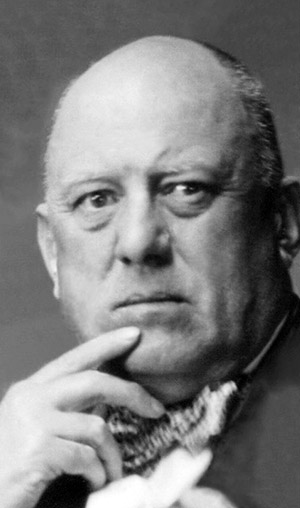
    The religion of Thelema, founded by British occultist Aleister Crowley (1875–1947) last century, proclaimed a new “Aeon of Horus” based on “force and fire.” According to its ‘bible’, Liber Al vel Legis (The Book of the Law), it is a stellar or star-oriented religion. 

    British occultist Aleister Crowley claimed to have channelled Liber Al vel Legis (The Book of the Law).

    In his introduction to Liber Al, Crowley states that Liber Al “explains the universe.” The Thelemic dictum, “every man and every woman is a star,” places humanity in a stellar context, with each ‘star’ having its own ‘orbit’ through which it expresses its own ‘will’ (Greek = Thelema). The opening lines of Liber Al proclaim Nuit, the Egyptian sky goddess representing space, “invoking the company of heaven.” Nuit is to be “invoked under the stars.” 

    Crowley claimed to have received his ‘revelation’ astrally from a ‘praeterhuman’ intelligence – Aiwass – representing the gods of a certain equinox. There are three aeons in Thelema based on three Egyptian gods: Isis (goddess worship), Osiris (dying and resurrected god – including Christianity), and Horus, the hawk-headed god that presides over the new (incoming) aeon. 

    While stellar references are used allegorically, Crowley wondered whether there is also “some real connection between a given persona and a given star.” 

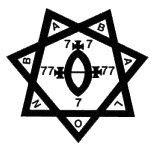
    The seal of Babalon.

    Among the sundry bohemians and intellectuals attracted to Thelema, including artists, poets, and academics, was one John (Jack) Whiteside Parsons (1914–1952), a seminal figure in setting humanity on the exploration of outer space. 

    As we will explore later, Parsons attempted to invoke Babalon, the ‘Scarlet Woman’ of Thelema, as the manifestation of Nuit. He also penned what he proclaimed to be the ‘fourth chapter’ of Liber Al (given to Crowley in three chapters), ushering the Aeon of Babalon. 

    Thelemic ‘War Machine’

    Jack Parsons with Marjorie Cameron, his second wife and ‘Scarlet Woman’.   

    The Aeon of Horus was to be ushered by cataclysmic events. As a sign of the times, Crowley referred to “war, the atrocities which occur on a daily basis and leave us unmoved and hardly worried.” 

    Book III of Liber Al, relating to the Aeon of Horus, is a martial doctrine that refers to Horus as “a god of war and of vengeance,” stating that he would deal harshly with his enemies. Next, a “war machine” is referred to as something to be given to Thelemites. Liber Al states, “With it ye shall smite the peoples; and none shall stand before you.” 

    Such apocalyptic visions of creating a “war machine” for Thelema would motivate Parsons. 

    Crowley refers to another aeon after that of Horus and the emergence of “another prophet” to assume Crowley’s “throne.” He refers to this new prophet who would “bring fresh fever from the skies.” 

    There were several claimants to this mantle while the current aeon and Crowley were still around. Parsons declared himself and that his aeon was Babalon. Crowley did not like the idea of a prophet emerging while he still lived. Crowley considered Parsons dangerously foolish, and Parsons broke with Crowley. 

    Both Crowley and Parsons based their magickal workings on Enochian. Beginning in 1581, Dr John Dee and his assistant Edward Kelley devised a system of astral communication with so-called ‘angels’ using a system of ‘Calls’, inscribed tablets, and the Enochian alphabet and language. The eighteen ‘Enochian Calls’ are full of fiery imagery. The ‘Tenth Call’ refers to the Earth “burning day and night, and vomit out the heads of scorpions, and live sulphur mingled with poison.” 

    In a magickal ritual performed in the Tunisian desert on 7 November 1923, Crowley “quizzed a discarnate intelligence about what The Book of the Law’s third chapter meant by a ‘war engine’, described as a gift of Ra Hoor Khuit, the Sun in its martial aspect.” In a note, Crowley wrote that the ritual brought a vision “not incongruous with my idea of the new Energy.” 

    Crowley sent the material drawn from the ritual to Thelemite mathematician Prof. Norman Mudd for interpretation. Crowley biographer Tobias Churton comments: “The notes show drawings, images, and algebraic concepts suggestive of nuclear fission. Extraordinarily striking for a North African vision in 1923, the notes, with hindsight, suggest the ‘war engine’ was nothing less than an atomic bomb.”

    Founding of Jet Propulsion Laboratory

    In 1945, Crowley wrote to the novelist Louis Umfraville Wilkinson, a Thelemite, that “The Atomic Bomb is interesting, not only because of Liber Al, chapter III, verses 7 and 8, but because one of the men who were working on it was for some time at the Abbey in Cefalu.” For a period, Crowley’s Abbey of Thelema (in Cefalu, Sicily) was where his community of disciples practised the doctrines of Thelema and performed magickal rituals.

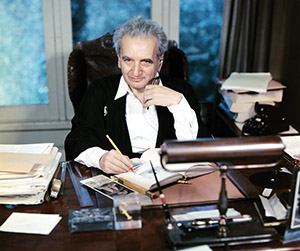
    Dr. Theodore von Kármán

    In 1936, Dr. Theodore von Kármán, director of the Guggenheim Aeronautical Laboratory at the California Institute of Technology (GALCIT), founded the Aerojet rocket motor company with Frank Malina, a Communist sympathiser, and Jack Parsons. The Jet Propulsion Laboratory (JPL) emerged from GALCIT in 1943 after the project came under the auspices of the US military. 

    Kármán was a descendant of the famous Hasidic (Cabalistic) Rabbi Yehuda Loew ben Bezalel, the 16th century ‘Exalted’ Rabbi of Prague, astronomer, and, according to Jewish legend, creator of the ‘Golem of Prague’. Kármán was the great-grandson of Moses ben Menachem Mendel Kuntitz, a scholar of the Zohar, the main body of Cabalistic mysticism. 

    Parsons, Malina and several others became known as the ‘Suicide Squad’ for their dangerous use of explosives and were subsequently moved from the CALTECH campus. From 1941, the US military lavished funding on GALCIT, and the Aerojet Engineering Corporation was founded in 1942 to meet its expanding requirements. 

    Parsons’ contributions to solid propellant rocketry led to the development of the solid motors on the Space Shuttle and the motors in the Minuteman missile. A crater on the Moon’s dark side is named in his honour. After World War II, the work that Parsons undertook on liquid and solid-state fuel led directly to the US space programme. 

    Liber 49 

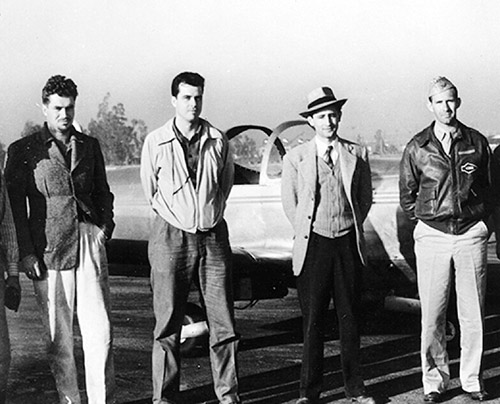
    (from left) Rocketeers Jack Parsons, Ed Forman and Frank Malina. 

    Parsons became a devotee of Crowley in 1939. He joined Agape Lodge, the Los Angeles branch of Crowley’s organisation, Ordo Templi Orientis (OTO), and was initiated in 1941. After his first wife left him for the lodge’s head, Wilfred Smith, he assumed leadership in 1943. The OTO temple was moved to Parsons’ mansion in Pasadena. 

    When Parsons undertook his ‘Babalon Working’ in 1946, Crowley responded by stating, “I get fairly frantic when I contemplate the idiocy of these goats.” With artist, poet and actress Marjorie Cameron as his ‘Scarlet Woman’, they intended to evoke Babalon to worldly manifestation by creating a magickal child, although Parsons later considered Cameron to be that incarnation.

    According to Kenneth Grant, Crowley “wrote Parsons off as yet another failure,” and Parsons resigned from the OTO in August 1946. 

    As a result of the Babalon Working, Parsons proclaimed himself “Belarion Antichrist” and issued a new revelation, Liber 49 – a fourth chapter of Crowley’s Liber Al – ushering the Age of Babalon.

    Like the ‘Enochian Calls’, Liber 49 is reminiscent of the Apocalypse of St. John. While John’s Revelation announces the return of Christ after an apocalypse, Parsons believed that an apocalypse would bring forth a New Aeon of the Antichrist and Babalon. 

    In martial spirit, continuing the legacy of Horus, Babalon proclaims that she will come via her daughter as a “penelous (sic) flame,” “a trumpet in judgement halls,” “a banner before armies,” to “judge nations” with “force and fire.” Those who resist will be destroyed: “None shall resist thee, whom I lovest. Though they call thee harlot and whore, shameless, false, evil, these words shall be blood in their mouths, and dust thereafter.” 

    Parsons, as Antichrist, had undertaken his “black pilgrimage” in the Mojave Desert on Babalon’s command. He swore that he would fulfil Babalon’s rule on Earth and published his manifesto: “And in my name BELARION shall they work miracles, and confound our enemies, and none shall stand before us.”

    Enochian 

    The occult scholar Donald Tyson writes of the Enochian workings that John Dee believed the ‘angels’ he was evoking were servants of God, whereas Edward Kelley thought they might be deceivers. Tyson says these ‘angels’, by fooling Dee, used him to introduce a ritual working that would usher the Apocalypse. The working was aimed at opening the gates of the Watchtowers that guard against the intrusion of satanic powers into this universe. Tyson states that Dee was blind as to the true function of the ‘Enochian Keys’. He also claims Crowley failed to complete the entire apocalyptic Enochian Working despite his exuberance for the subject and his claim to be the Antichrist.

    Parsons took on that mantle, broke with Crowley, and aimed to bring forth the Apocalypse by more direct means. Parsons is said to have recited Crowley’s poem ‘Hymn to Pan’ and danced at the launching of rockets by the JPL. It seems that he regarded each rocket launch as a ritual working.

    Babalon

    An academic study has been written on Babalon. Manon Hedenborg White references the Enochian magickal working of Crowley and Victor Neuburg in the Algerian desert in 1909, in which Crowley had a vision of the apocalyptic Whore of Babylon. He rendered this as “Babalon,” and incorporated it into Thelema as the primary goddess, who had been prophesied in Liber Al five years previously. In origin, Babalon is a generic name for ‘wicked’ in Enochian and related to the word ‘babalond’ meaning ‘harlot’. Apparently, she also communicated through her ‘daughter’ in the form of “a spirit called Madimi” to Dee and Kelley.

    Chapter 5 of White’s study is devoted to Parsons’ interpretation of Babalon. After rituals with Cameron during January and February, Parsons went alone into the Mojave Desert, where he evoked Babalon and transcribed Liber 49 as the fourth chapter of Liber Al. Of course, Crowley had already disowned Parsons. 

    While the Aeon of Babalon was intended to balance the “force and fire” of the martial Aeon of Horus, Parsons’ conception of Babalon nonetheless gloried in the biblical image of the Great Whore of Babylon foretold in the Revelation of John, “drunken with the blood of the saints, and with the blood of the martyrs.” 

    Where the biblical Whore of Babylon is generally considered to describe a corrupt system, to Crowley and Parsons, Babylon rendered as Babalon describes a terrible goddess bringing apocalyptic desolation to the world before ushering a new aeon. Hence, Parsons describes Babalon as “the dark mother of anarchy and abominations,” which he compares to Kali and Lilith. 

    Parsons & Israel

    Parsons drew the attention of the FBI. He was noted as a bohemian living with various other suspect characters, indulging in orgies and black magic rites at his mansion. 

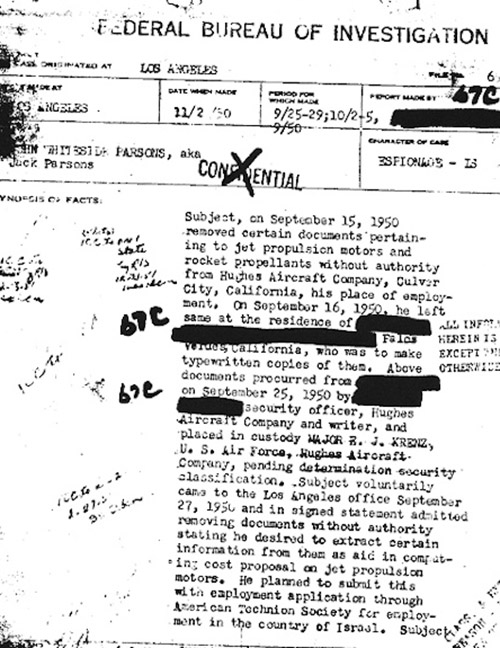
    FBI file about Parson’s outreach (or recruitment) to Israel to share his advanced knowledge about rocket science. 

    In September 1950, Parsons was identified as having removed restricted, confidential and classified documents on jet propulsion motors and rocket propellants from Hughes Aircraft Company, California. Parsons had worked there since 1949 as “group leader” in charge of propellants, propulsion and launching systems. In a statement to the FBI dated 27 September 1950, Parsons declared that he had taken the classified material for the purpose of preparing proposals for work in Israel.

    In his astral visions, Parsons “arrived at Chorazin in the dominion of the Antichrist.” Manon Hedenborg White writes that in Parsons’ astral vision, he emerges as the Antichrist at Chorazin. 

    Located near the Seas of Galilee in present-day Israel and now in ruins, Chorazin is mentioned in the Bible as one of three villages cursed by Jesus for failing to accept his teachings. Some medieval theologians believed that the Antichrist might come to be born in Chorazin. This notion clearly influenced Parsons, who explicitly calls the location “the city of the Anti-Christ” and believed that his astral journey marked his transition into the figure. 

    Here, we begin to see why the State of Israel might have assumed central importance in Parsons’ belief he was the Antichrist at the inauguration of the Aeon of Babalon. 

    The FBI files state that Parsons had read in technical magazines about research in Israel. In September or October 1949, that is to say, the year of his assumption to the role of Antichrist, he made contact with an Israeli agent who requested him to prepare a proposal “regarding the building of an explosives plant in Israel and data concerning rockets and other armaments which Parsons would be able to conduct research work on in Israel.” In August 1950, he was asked to submit costs for “a jet propulsion development program on which Parsons could do research work in Israel.” The initial contact with what Parsons said to the FBI was a “business consultant,” whom the FBI identified as “a representative of the Israeli Government” living in North Hollywood, came through the American Technion Society. 

    The FBI report states that the Technion Society was designated officially by both the Israeli Government and Israeli industry as the “American body” through which the latest in US technology was conveyed to Israel. The Technion Society was another name for the “American Society for the Advancement of the Hebrew Institute of Technology in Haifa, Palestine, Inc.” (Los Angeles File, a-27-49). The file states that “this organisation publishes the Technion Yearbook and the society is also known as the ‘American Technion Society’.” A statement dated 2 December 1950 in the FBI files mentions that Dr. Theodore von Kármán had recommended Parsons contact what seems to be (the words are blacked out) the American Technion Society. It seems that Kármán, Parsons’ mentor and one of the most distinguished names in rocket science, had facilitated his communication with Israel for the purposes of espionage. 

    Parsons had his security clearance suspended in 1948 because of his involvement with a “cult” and associating with an “alleged Communist Party member.” This suspension was removed the following year. US Assistant Attorney General McEachen declined to prosecute due to a lack of evidence that taking classified documents for use by Israel was “injurious to the USA or to the advantage of another nation,” but Parsons’ security clearance was again revoked on 9 January 1952.

    As the self-declared Antichrist who would usher the Apocalypse, Parsons was uniquely positioned to do so as one of the fathers of US rocketry. It is significant that he intended to settle in Israel and sought to persuade the Israelis that he could establish a missile programme. In his role as Antichrist, it seems credible that Parsons envisaged settling in Israel at the location where the Apocalypse is supposed to unfold from the battle of Armageddon. 

    It also seems likely that Parsons saw a vision of nuclear devastation in the fiery Apocalypse described by St John in The Revelation. One of the world’s most eminent experts in rocket chemistry, someone with such a mission as Parsons, was uniquely placed to complete the Enochian Working with the benefits of modern apocalyptic science that he helped in large measure to create.

    Parsons’ hopes of going to Israel did not eventuate. It is debated as to whether the enormous explosion that killed Parsons on 17 June 1952 when he was handling chemicals on his property was an accident, murder, or suicide. 

    Or perhaps it was a self-immolation rite to Babalon, a final fiery embrace intended as a sacrifice to inaugurate the Aeon?

    [alert type=”general” dismiss=”no”]This article was published in New Dawn 204.[/alert]

    [alert type=”success” dismiss=”no”]If you appreciate this article, please consider subscribing to help maintain this website.[/alert]

    Footnotes

    1. Crowley, Liber Al (York Beach, Maine, 1976), 1: 1-3.
    2. Ibid., 1: 57. 
    3. Aleister Crowley, The Law is for All (Arizona: Falcon Press, 1985), 72-73. 
    4. Crowley, Introduction to Liber Al, IV: The New Aeon, 13. 
    5. Ibid., 3: 6-8, 39. 
    6. Ibid., 3: 34, 42-43. 
    7. Donald C. Laycock, The Complete Enochian Dictionary (London: Askin Publishers, 1978), The Tenth Call, 257. 
    8. Tobias Churton, Aleister Crowley: The Biography (London: Watkins Publishing, 2011), 274. 
    9. Ibid.
    10. Crowley to Wilkinson, 7 August 1945, cited by Kenneth Grant, Cults of the Shadow (London: Frederick Muller, 1975), 115. 
    11. S. Goldstein, ‘Theodore von Kármán’, Biographical Memoirs of Fellows of the Royal Society, Vol. 12, November 1966, 334-365. 
    13. Kenneth Grant, The Magical Revival (London: Frederick Muller, 1972), 166. 
    12. Henrik Bogdan, The Babalon Working 1946: L. Ron Hubbard, Jack Whiteside Parsons, and the Practice of Enochian Magic, Numen, No. 63, 2016, 28. 
    14. Jack Parsons, Liber 49, The Book of Babalon (1946) v. 10, sacred-texts.com/oto/lib49.htm
    15. Ibid., v. 40.
    16. Ibid., v. 41. 
    17. Jack Parsons, Liber 49, Part II: The Manifesto of the Antichrist. 
    18. Donald Tyson, The Enochian Apocalypse, Gnosis Magazine, Summer 1996, bibliotecapleyades.net/bb/bluebook418.htm
    19. Geoffrey Landis, The Three Rocketeers, American Scientist, July-August 2005, americanscientist.org/article/the-three-rocketeers
    20. Manon Hedenborg White, The Eloquent Blood: The Goddess Babalon & the Construction of Femininities in Western Esotericism (Oxford University Press, 2020)
    21. Donald C. Laycock, 83. 
    22. Revelation 17:6. 
    23. Manon Hedenborg White, 136. 
    24. Manon Hedenborg White, 138.
    25. Ibid., 139. 
    26. ‘John Whitside Parsons’, FBI File No. 65-59589, 2 November 1950, ia902704.us.archive.org/27/items/marvel-whiteside-parsons/John%20Parsons%2001_text.pdf
    27. Ibid., 29 September 1950. 
    28. Ibid.
    29. Ibid., McEachen to Parsons, 13 November 1951. 

    © New Dawn Magazine and the respective author.
    For our reproduction notice, click here.
  • Goddess of Time in the Sky: The Forgotten Divine Science of the Female Priesthood

    Goddess of Time in the Sky: The Forgotten Divine Science of the Female Priesthood

    From New Dawn 204 (May-June 2024)

    Time appears to march on at what seems a constant rate. In this way, time has two opposite directions, the somewhat known past and the largely unknown future. However, events in the sky repeat and so they can be predicted as seasons within a year or lunar phases within a month. Even before modern calendars, Stone Age humans counted the days in a month to understand the recurrence of the menstrual period and know when moonlight would be strong again at night. 

    Stone Age Origins of Time

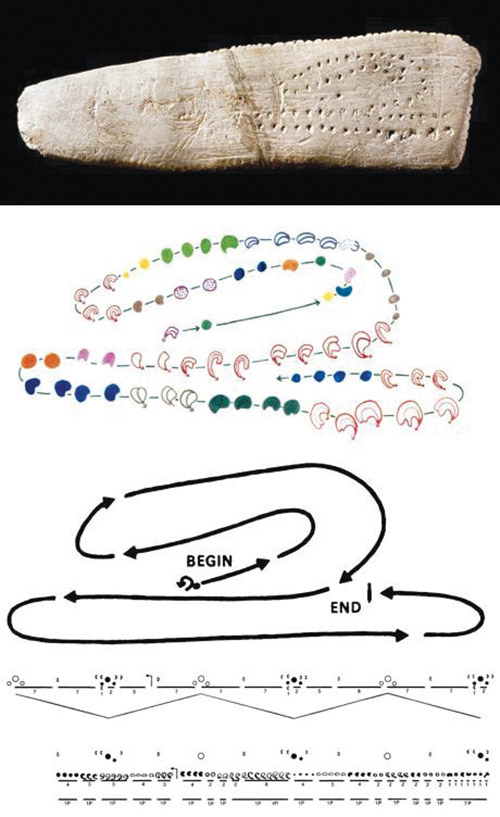
    Two months happen to equal 59 whole days: a lunar month is 29.53 days long, just over twenty-nine and a half, which is half of 59. In the artefact shown at the top of Figure 2, each day was carved upon a flat bone, each mark appearing varied in shape and depth to show the Moon’s changed phase on a given day. The flat bone enabled a cyclic shape to be used, of 59 marks, which “ate its own tail,” showing there was always the same number of days in two “moons.” This sameness emerges from dividing the recurring time of the solar day into the time of the month’s phases over two months to give the recurring whole number of 59, then forever useful as a knowledge object.

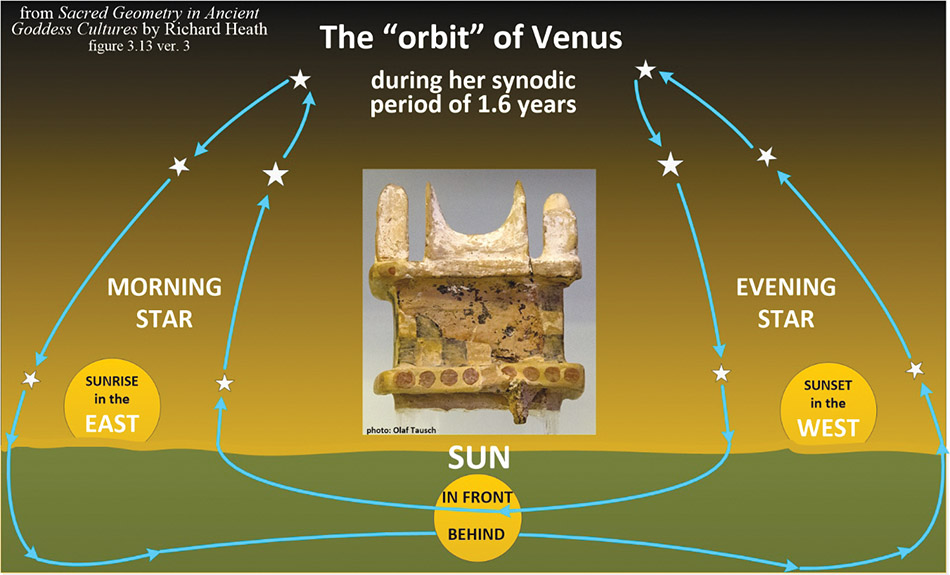
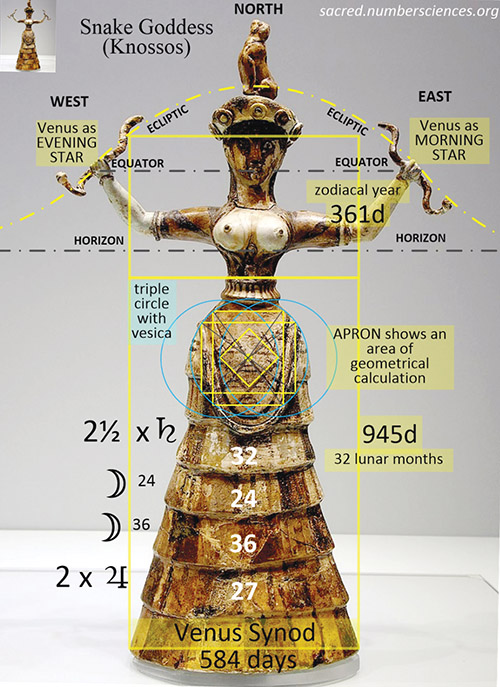
    FIGURE 1:  The form of the Minoan “horns of consecration”, on the island of Crete, followed (outside) the form of the manifestations of Venus in her synodic period.

    The solar day clearly has the same duration every day, and two lunar months clearly repeat twice after 59 days. But our modern life is the extended straight line of day numbers belonging to unequal months of the Sun so that the loops that recur are lost in the framework of man-made time. The Stone Age “lesson from nature” was that events in the sky largely run according to a definite schedule along cyclic paths, most of these being along the path of the Sun, along which the Sun, Moon, and planets follow their own cyclicities, seen from the Earth. 

    FIGURE 2:   (Top) L’Abri Blanchard Tally Bone 30,000 BP with (bottom) Alexander Marshack’s interpretation, showing marks as days shaped to express the Moon’s phase, over 59 whole days or two lunar months.

    This reliable cyclicity shaped our notion of an unchanging realm of Eternity, different to Life upon the Earth as our ever-developing present moments within Existence. In this way, knowledge from the sky came to be considered sacred and interconnected through numbers when counted as days and months, especially through counting the often identically sized discs of the Sun and Moon and their respective years.

    While astronomy started as a Stone Age hobby, it later became a tribal science quite unlike our own astrophysics. Only later would farmers support city specialists who assimilated this prehistoric science by forming religious sciences and cosmologies in the East, such as Egypt, Babylonia, India, China, and so on. 

    Millennia later, the 16th century altogether discarded this geocentric view-from-the-Earth and adopted a new heliocentric view of the solar system, which enabled the planetary orbits of the Sun to be clearly seen as mathematical ellipses by Kepler. This system was soon seen to be held together by Newton’s newly intuited force, gravity, of the central Sun’s large mass.

    If counting the Moon had synchronised both female fertility and male hunting, then this shaped the format we call the hunter-gatherer who foraged for food before there was farming. Their women formed a naturally less-mobile core for the tribe and its children, the men hunting over extensive ranges. All adults worked together for the greater good, and since they were in-common descended from the women, a matrilineal society was an effective format for problems requiring larger groups. 

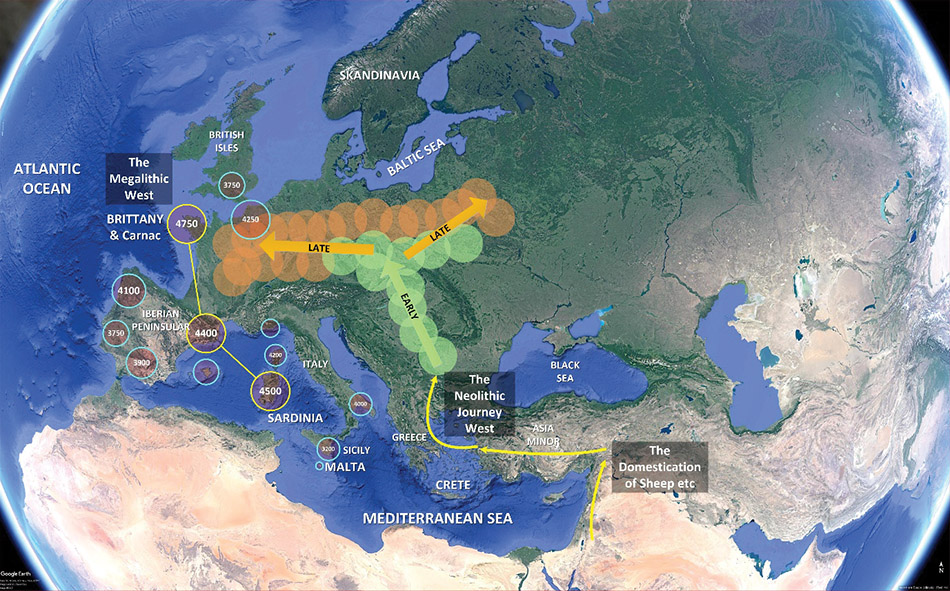
    Stone Age art of the goddess seems to have been varied and geometrical (see Language of the Goddess by Marija Gimbutas). In Sacred Geometry in Ancient Goddess Cultures, myexperience in analysing megalithic sites caused me to question whether the megalithic monuments were the work of Neolithic or a New Stone Age farming revolution moving west from the Middle East where it started. Because the farming revolution only advanced slowly through central Europe and towards the Atlantic coast (see Figure 3), it pretty much avoided the Mediterranean. 

    The megalithic revolution largely took place within the islands and hinterlands of the Mediterranean and Atlantic Coast of Europe between 5000 BCE and 2500 BCE. It was, therefore, much more likely to have been carried out by the late middle Stone Age (Mesolithic) people before the farming way of life arrived. The indigenous culture of old Europe was Mesolithic – well-established and centred around women, foraging, and matrilineage (using your mother’s name) rather than the neolithic norm, led by men – farming and patrilineage (using your father’s name). 

    FIGURE 3:   The journey of the Neolithic from the Middle East (see coloured circles), via central Europe, was in stark contrast to the dating (dark circles) of megalithic sites on the Mediterranean and Atlantic coasts. The neolithic were patriarchal farmers using the seasonal year while the late middle Stone Age were matriarchal foragers, truly interested in the sacred time world of the celestial objects, and hence building and using the megalithic observatories. [Globe by Google Earth, data from Barry Cunliffe and Bettina Schulz Paulsson.]

    Clash of the Titans

    Being indigenous, matrilineal tribes were far more likely and able to innovate megalithic astronomy, which was effectively inherited from the long tradition of day counting seen on Stone Age tallies like the Blanchard plaque. 

    This continuity of interest in the sky conflicts with today’s model of history and our foundation myth for modern science – as the grandchild of ancient Near Eastern civilisations and exact sciences, fuelled by farming on fertile soils using irrigation. 

    By comparing day counts, sky time could be given geometrical forms such as circles, squares, and rectangles/triangles, and these were rightfully considered sacred by the coherent megalithic culture on Europe’s shores. The civilisation was numerate and intelligent, but not Stone Age in the vernacular sense, of having no ability to reason. 

    Having an extended family of adults and no urgent need to seasonally grow crops, conserve seeds or tend their animals, nature already provided food through foraging. There was a natural collaborative workforce, perhaps explaining the dearth of neolithic settlements alongside the earliest megalithic monuments. 

    FIGURE 4:   Fibonacci Phi: 1.618 is found in the Fibonacci approximation of 8/5 = 1.6 of the practical year of 365 days to the Venus Synod 584 days. Venus was seen as the youthful goddess, Earth as the mother of all that lives and the Moon as the wise older goddess, these together forming the ancient Triple Goddess. [photo by C. Messier for Wikipedia.]

    Having overcome this misnomer that megaliths were automatically neolithic, further work is required to see why modern science cannot understand sky phenomena like the Stone Age did. Today, we do not study the synodic periods of the planets because they are seen as merely an incidental composite of the planetary orbits and our solar year. 

    Quite unexpectedly, the view from the Earth is supremely important since the structure of time on Earth is a phenomenon reflecting the form and structure of the numerical world. This suggests that the Earth was, in some way, influenced by the abstract world of numbers to form this type of time environment. It might also suggest that the evolution of Life was an intended outcome for the third planet. 

    Having discarded the Earth-centred model of the universe and ridding ourselves of the religions and gods proposed to explain this phenomenon, modern humans are free to live in an accidental universe where one is simply alive on an existential line-of-time with no end except for death, and without any appreciation of the deeper structural recurrences implicate within the sky. Instead, there is a hotch-potch Roman calendar whose roots were largely man-made.

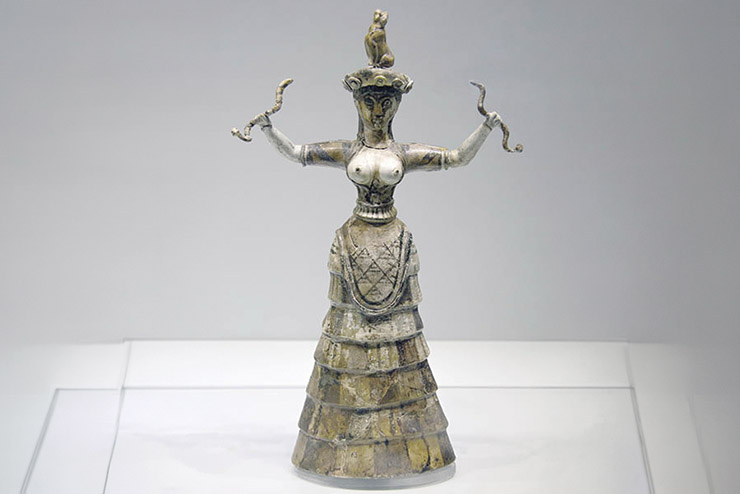
    The Greek myths referred to women but in ways designed to put matrilineage norms in a bad light. The patriarchal farmers of Jupiter-Zeus had defeated the religion of the Goddess whose representatives had snakes (perhaps the dreadlocks of the Medusa or knowledge of the snake-shaped ecliptic) or had kept men sexually enslaved on an island (as in the Odyssey) or sacrificed a sacred king after “a year…” (of 364 days) “…and a day” (making 365 in all). Our 7-day week derives from this Saturnian year of 364 days (52 weeks), named because the synod of Saturn is exactly 378 days (54 weeks) while the synod of Jupiter is 57 weeks. 

    In this, one is seeing through a series of invisible filters – the ancient Greeks were against the tribal age that preceded farming and cities, when women rather than men were most important to that way-of-life. 

    The Enlightenment adopted the heliocentric planets as a binary, removing the foundations of a vast past cultural corpus of religious and pre-scientific thought that had quite reasonably shown something special about the world that modern science never chooses to see. 

    If we fathom megalithic astronomy, its uniquely powerful discoveries reveal what the religious texts were about: Earth’s favourable environment is no accident; it is a planet for the evolution of Life

    Megalithic discoveries were transmitted subconsciously into the cultural subconscious of later civilisations. This impulse still informs and infects our arts and the classical form of numeracy called mathematics. 

    This diffusion benefited from the clash of the Titans, namely between the matriarchal and patriarchal ways of life in the Eastern Mediterranean and Levant. It was recorded in the intellectual life of the Greeks and Hebrews, thus informing the Islamic and Christian world views as a code of numbers and stories often agreeing with those of the East. 

    Get the issue this article appears in

    Continuity in Sacred Building 

    If you know how to look, one finds the units of measure and geometries of the megalithic repeated in later sacred buildings, built under disparate religions, as if the design of sacred buildings had some sort of megalithic origin. 

    The Chinese, Indian, Buddhist, Minoan, Classical Greek, Romanesque, Islamic, South Asian, Amerindian, Gothic, Sufi, and Renaissance buildings draw upon common geometric and metrological blueprints relating, for example, to the relative size of the Earth and Moon, and the sophisticated celestial time cycles such as eclipse phenomena, as if to celebrate the cosmic environment even though many religions conceptualised the heavens as if not found in the sky. 

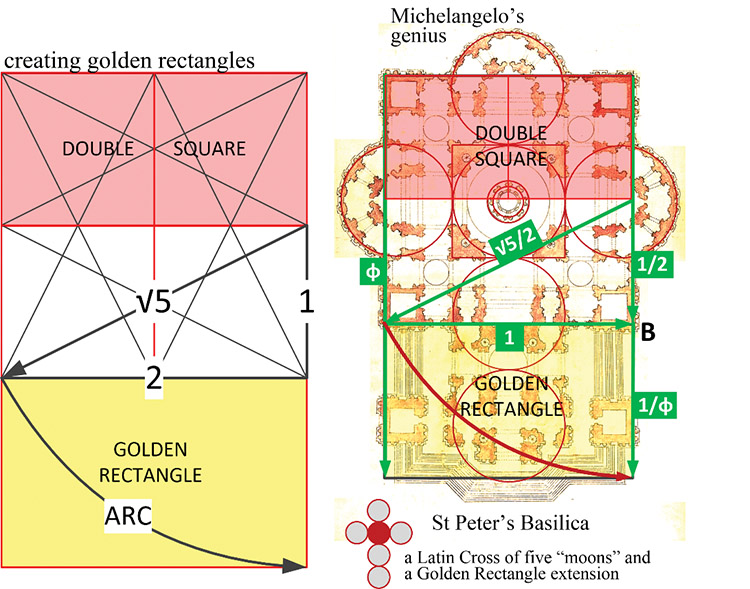
    FIGURE 5:   St Peter’s Basilica: Sacred buildings followed geometrical and numerical rules that reflect both the cycles of the sky and the geometrical methods and numerical results of the megalithic.

    For this reason, my books explore buildings of the historical period in the same way as megalithic buildings to demonstrate this continuity of an invisible language, as if there are people with megalithic knowledge behind the construction of buildings without the outer religion officially acknowledging this fact. 

    In some strange way, others and I are recapitulating ancient works in terms of their meaning by employing skills belonging to the past. For example,

    In Cappadocia, Turkey, stone-cut churches inexplicably contain high levels of meaning in their dimensions and definition of circular apse and rectangular naos occupied by hermit monks. 

    Angkor Wat is shown to be a massive statement of astronomical cyclicities alongside an outer meaning of Vedic mythological carving and Indian temple design. 

    St Peter’s Basilica was a Renaissance rebuilding involving many great architects, including Michaelangelo, who displayed sacred geometrical skill in translating a Greek square-cross basilica design into a Latin cross cathedral design through the golden mean relationship of a square to such a rectangle (see Figure 5). St Peter’s tomb is in the centre of a model of the Earth and Moon.

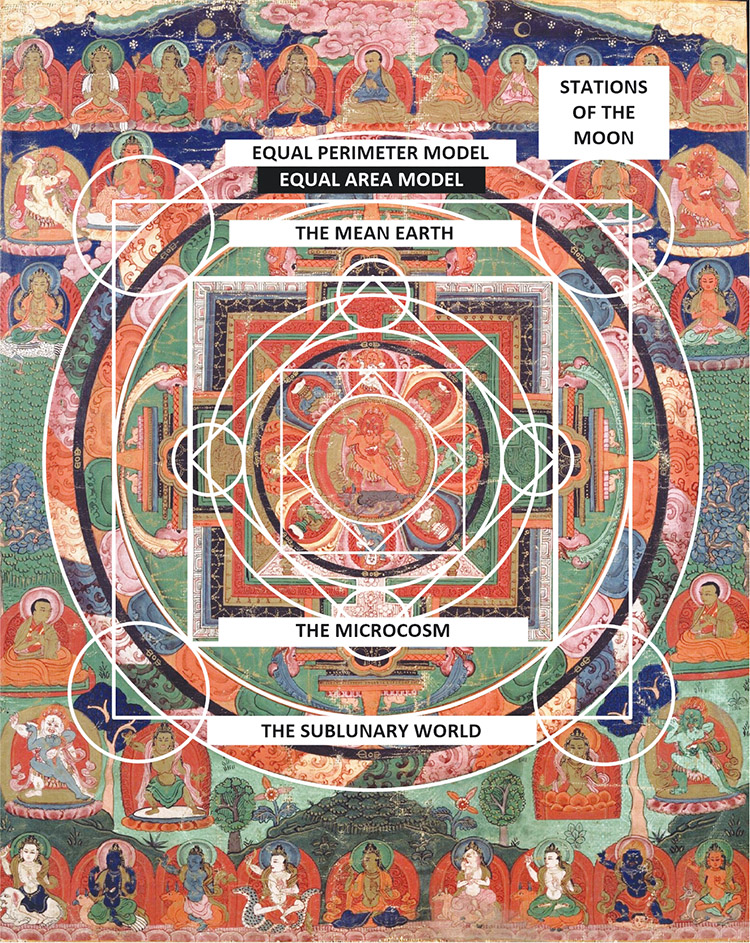
    FIGURE 6:   The geometry of Equal Perimeter circle and square, with Moon circles, showing the influence of the time world of the Earth and Moon, as the true basis for the designs called mandalas. [from Sacred Number: Language of the Angels, Fig 7.20.]

    Chapter 11 of my 2024 book Sacred Geometry in Ancient Goddess Cultures: The Divine Science of the Female Priesthood demonstrates that the equal perimeter model of the Earth and Moon had been related to the now-abandoned geocentric model. 

    The Earth is at the centre, and a system of growing square areas for each planet’s synod grows to embrace the whole figure, revealing that it was the archetypal form taken as the norm for Buddhist Mandalas. Jungian therapists and others use Mandalas to enable interaction with the subconscious mind. This suggests that our very being, as microcosmos, is part of the Earth and its planetary Sky environment of time. 

    Celestial time appears to be a carrier wave for reality, not just a straight line.

    The author’s book Sacred Geometry in Ancient Goddess Cultures: The Divine Science of the Female Priesthood is available to purchase.

    Images courtesy of Richard Heath and the publisher Inner Traditions International. 

    [alert type=”general” dismiss=”no”]This article was published in New Dawn 204.[/alert]

    [alert type=”success” dismiss=”no”]If you appreciate this article, please consider subscribing to help maintain this website.[/alert]

    References

    Barry Cunliffe, Europe Between the Oceans: 9000 BC to AD 1000, Yale 2008. 
    Marija Gimbutas, The Language of the Goddess, Thames & Hudson 1989.
    Richard Heath, Sacred Geometry in Ancient Goddess Cultures, Inner Traditions 2024. 
    Richard Heath, Sacred Geometry: Language of the Angels, Inner Traditions 2021. 
    Richard Heath, Tragic Loss of the Geocentric Arts and Sciences: When Poetry was the Language of Cosmology, New Dawn #185 (Mar-Apr 2021), sacred.numbersciences.org/2023/06/03/tragic-loss-of-the-geocentric-arts-and-sciences.
    Alexander Marshack, The Roots of Civilization: The Cognitive Beginnings of Man’s first Art, Symbol and Notation, Weidenfeld and Nicolson 1972.
    Bettina Schulz Paulsson, Time and Stone. The Emergence and Development of Megaliths and Megalithic Societies in Europe, Archaeopress 2017. 

    © New Dawn Magazine and the respective author.
    For our reproduction notice, click here.
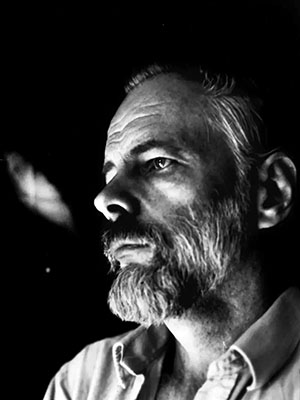
  • Philip K. Dick: Modern Metaphysician

    Philip K. Dick: Modern Metaphysician

    From New Dawn Special Issue Vol 19 No 4 (Aug 2025)

    Best known to the wider world through the Hollywood interpretations of his works Blade Runner (from the book Do Androids Dream Of Electric Sheep?), Total Recall, Minority Report and others, Philip K. Dick was certainly not a typical ‘science-fiction’ writer.

    Although his early books might indeed have featured ‘zap guns’ and ‘androids’, they generally did so only as ironic props in stories of bewildered human protagonists displaced by emergent technological absurdities and hostile bureaucracies.

    Often plagued by relationship breakdowns (he had four wives) and an adventurous attitude to drug use, Dick wrote an extraordinary series of novels across the 1970s (and early 1980s) that have come to be known as his metaphysical or theological canon.

    Inspired by a chain of otherworldly and mystical events in February and March of 1974 – Dick had often previously written of the fragile nature of what we perceive to be ‘reality’ – he now manifested a cogent and strikingly timeless alternate cosmology.

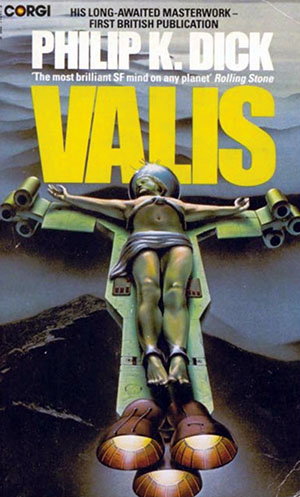
    In essence, beginning with his novel Valis (originally written in 1978 but not published until 1981), Dick argued that the Roman Empire had never truly ended but instead transformed and adapted, continuing to dominate human civilisation through different masks and institutions.

    In his view, what we perceive as historical progression – the fall of Rome, the rise of Christianity, the development of modern nations – was largely illusory. Beneath these surface changes, the same imperial power structure or spirit remained intact, continuously subjugating humanity.

    That concept was deeply rooted in Gnostic philosophy, which Dick encountered (largely through the Nag Hammadi scriptures) during the intense metaphysical period following his transformative 1974 experiences. In Gnostic thought, the material world is ruled by a false god (or Demiurge) which keeps humans trapped in ignorance. Dick mapped this onto his understanding of the Roman Empire, seeing it as the earthly manifestation of this malign cosmic force.

    Described as “The Empire That Never Ended,” it was one of Philip K. Dick’s most profound and complex philosophical concepts, central to these theological works and his sci-fi-tinged personal spiritual perspective.

    The “Empire,” in Dick’s view, had constructed a “Black Iron Prison” – another key concept in his work – a metaphysical cage that traps human consciousness. This prison operates through multiple vectors, often hidden in plain sight:

    • Deception and illusion: Making people believe they are free while actually being controlled.
    • Information control: Manipulating what people know and believe.
    • Psychological oppression: Creating systems that make resistance seem impossible or pointless.
    • Spiritual blindness: Preventing people from recognising their true divine nature.

    Dick argued that the Empire’s continuation could be traced through various historical periods:

    • Early Christianity: Rather than defeating the Empire, Christianity was co-opted and became another tool of imperial control. The institutional church became a new form of Roman authority.
    • Medieval Period: Feudalism and the Holy Roman Empire represented direct continuations of Roman imperial structure.
    • Modern Era: Contemporary governments, corporations, and institutions all serve as manifestations of the same underlying malevolent imperial power.

    The methods may have become more sophisticated – psychological manipulation rather than direct, brute force – but the essential structure remained unchanged.

    In Dick’s universe, the Empire is opposed by a divine force he sometimes called “VALIS” (“Vast Active Living Intelligence System”), represented, in the book of the same name, by a self-aware satellite that orbits Earth, shooting Gnosis (divine knowledge) through a blinding pink laser beam. This plot device presented authentic divine consciousness attempting to break the illusion and liberate humanity.

    Dick believed that around 70 CE, with the destruction of the Second Temple in Jerusalem, time itself became corrupted or trapped. This wasn’t simply a historical event but a cosmic catastrophe that fundamentally altered the nature of reality. In his cosmology, we are all living in a kind of temporal loop or stasis, where the same imperial patterns repeat endlessly under different disguises.

    This temporal imprisonment means that what we perceive as progress – technological advancement, social evolution, political change – is largely illusory. The essential power structures remain unchanged because time itself has been hijacked by the imperial force. We experience the sensation of moving forward while actually trapped in the same historical moment.

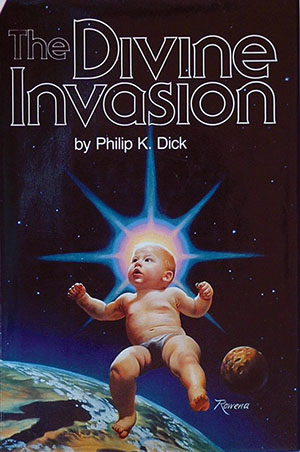
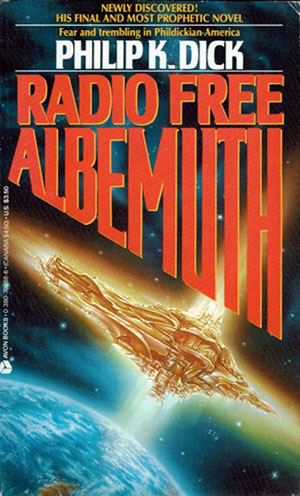
    While couched across the novels Valis (1981), The Divine Invasion (1981), The Transmigration Of Timothy Archer (1982) and the astounding Radio Free Albemuth (originally written in 1976 but published posthumously in 1985) as a kind of quasi-hallucinogenic science-fiction mysticism, it should not be difficult to see Dick’s vision as hauntingly prescient and direly accurate of our historical and current circumstances.

    According to Dick, the Empire now maintains its power through increasingly sophisticated methods:

    • Information Warfare: Rather than crude physical oppression, the Empire now operates primarily through the manipulation of information and perception. People are controlled not by chains but by false beliefs about reality itself.
    • Psychological Programming: The Empire creates mental patterns that make resistance seem impossible or pointless. People become complicit in their own oppression by accepting the Empire’s version of reality as natural and inevitable.
    • Institutional Capture: Every institution that might oppose the Empire – religion, education, media, government – is eventually captured and turned into another tool of control. Revolutionary movements are co-opted before they can pose any real threat.
    • Temporal Confusion: By keeping people trapped in the false timeline, the Empire prevents them from recognising the true nature of their situation. People cannot resist what they cannot perceive.

    His “Black Iron Prison” also represents the metaphysical structure that enforces the Empire’s control. It was Dick’s most powerful metaphor for the nature of oppression itself. Indeed, the Black Iron Prison is not a physical location but a state of consciousness – or rather, unconsciousness. The Prison functions through:

    • Perceptual Limitation: The prison limits what people perceive and understand. Reality appears solid and unchangeable because the prison prevents people from seeing its constructed nature.
    • Ideological Constraint: The prison functions through belief systems that make alternatives seem impossible. People remain trapped not because they cannot leave, but because they cannot imagine freedom.
    • Temporal Imprisonment: Like the Empire, the prison operates through time distortion. People experience the illusion of temporal progression while actually being held in stasis.
    • Collective Delusion: The prison is maintained through shared false beliefs. It’s a consensus reality that people collectively create and maintain, even as it oppresses them.

    Directly intersecting with contemporary descriptions such as Matthias Desmet’s concept of “Mass Formation Psychosis” and the heaving totalitarianism that surfaced during the COVID Operation, there seems little doubt that Philip K. Dick’s ‘paranoid’ cosmology presents a vital roadmap for attempting to understand what passes for the spiritual, political, philosophical and informational landscape of the 21st century.

    In classical Gnostic thought, the Demiurge is a false creator god who has trapped divine sparks (human souls) in the material world. Dick identified this figure with the “Empire That Never Ended,” seeing the Demiurge as the cosmic principle behind all earthly oppression.

    While traditional Gnosticism often portrays the Demiurge as a cosmic principle, Dick historicised it, seeing it as actively manifesting through specific human institutions and historical periods. The Roman Empire wasn’t just influenced by the Demiurge – it was the Demiurge’s most successful Earthly incarnation.

    The Archons, in Gnostic cosmology, are the Demiurge’s agents who maintain control over the material world. Dick saw these as manifesting in various forms such as political leaders, religious authorities, and institutional powers, who serve the Empire’s interests, often without realising their true role.

    Furthermore, Dick identified Psychological Archons, internal forces that keep people trapped – fear, despair, conformity, the desire for security over truth. These are the ‘guards’ of the Black Iron Prison. And in Dick’s more modern interpretation, Information Archons are the forces that control information flow – media, education, propaganda systems that shape perception and belief.

    Dick’s Gnostic perspective led him to a radical critique of institutional Christianity. He believed that Christianity had been co-opted by the Empire almost from its beginning, turning the revolutionary message into a tool of control. Orthodox Christianity promises salvation in another world, which Dick saw as a way of preventing people from recognising their potential for liberation in this world. And, Dick suggested, much of institutional Christianity actually worships the Demiurge while believing it worships the true God. Indeed, orthodox Christianity emphasises faith over direct knowledge, which Dick saw as keeping people dependent on external authority rather than developing their own direct divine consciousness.

    Get the issue this article appears in

    In earlier Dick novels (such as Do Androids Dream of Electric Sheep? from 1968), he subtly presents questions about consciousness and the true nature of what it means to be human, blurring and shifting the lines between the ‘androids’ of the title and their ostensible human creators.

    John Carpenter’s 1988 film They Live shared many settings and themes with Dick’s sublime novel Radio Free Albemuth. In the book, a scattered resistance battles the treacherous Archonic infection represented by President ‘Ferris F. Freemont’ (obviously, FFF is numerologically 666), as underground culture furtively keeps hope alive – situations loosely mirrored in the film. Similarly, the iconic 1999 film The Matrix presents ‘Dickian’ and Gnostic concepts wrapped in an action/sci-fi garb.

    From 1974 until his untimely death in 1982, Dick produced a multitude of research, journals and letters that dealt with the events of “2-3-74” and his place in the great cosmic mystery. Condensed from over 8,000 pages of material, The Exegesis Of Philip K. Dick runs to more than 900 published pages and explores, in depth, Gnostic and unmistakeably Lovecraftian perspectives – indeed, “the Demiurge is still under the waters, dead but dreaming.”

    While Philip K. Dick clearly and knowingly presented timeless Gnostic themes in a modern form, it is hard to imagine a time and place more necessary (than here and now) to examine concepts such as the constructed and manipulated nature of ‘reality’, the cancerous, imprisoning scourge of materialism, and the industrially designed death of the soul.

    Indeed, it really is Philip K. Dick’s world… and we live in it.

    [alert type=”general” dismiss=”no”]This article was published in New Dawn Special Issue Vol 19 No 4.[/alert]

    [alert type=”success” dismiss=”no”]If you appreciate this article, please consider subscribing to help maintain this website.[/alert]

    © New Dawn Magazine and the respective author.
    For our reproduction notice, click here.