
New Dawn – World's Most Unusual Magazine

Author: Dean Radin

  • A Convergence of Science &  Real Magic

    A Convergence of Science & Real Magic

    From New Dawn Special Issue Vol 12 No 5 (Oct 2018)

    The word “real” in the title distinguishes the type of magic we’re discussing. This is not about the fictional magic of Harry Potter or the fake magic of Harry Houdini. This is about real magic, which falls into three main categories: divination, or perception of events distant in space or time; force of will, or mental influence of the physical world; and theurgy, or interactions with nonphysical entities.

    In my book Real Magic (Harmony, 2018), I describe how these traditional, esoteric forms of magic (occultists use the term “magick”) have been scientifically studied for over a century, and why the accumulated evidence in favour of real magic is now overwhelmingly positive. This assertion might be surprising given that college textbooks teach us that magic is merely an ancient superstitious belief. But textbooks are regularly revised and updated as science marches on, and at the leading edge of science today we’re finding that some of the ancient ideas about magic are actually correct. Science and magic appear to be converging.

    How do we know this?

    One strong indication appeared in May 2018. The American Psychological Association (APA) is the principal organisation for academic and clinical psychologists, with nearly 120,000 members worldwide. Its flagship journal is the august American Psychologist. In the May 2018 issue, a lead article was entitled, “The Experimental Evidence for Parapsychological Phenomena: A Review.” The author was Etzel Cardeña, a psychology professor at Lund University in Sweden. After analysing ten classes of experiments exploring psychic effects (“psi” for short), the article’s conclusion was unequivocal: “The evidence for psi is comparable to that for established phenomena in psychology and other disciplines.” That this article appeared in the conservative voice of academic psychology cannot be overstated.

    There are many other signs. For example, University of California statistics professor Jessica Utts was President of the American Statistical Association (ASA) in 2016. The ASA is the world’s largest organisation of academic and professional statisticians. In her Presidential Address in 2016, Utts mentioned that one area she had studied in detail for the US government was parapsychology. She said: “The data in support of precognition and possibly other related phenomena are quite strong statistically and would be widely accepted if they pertained to something more mundane.” 

    These are just two examples, but there is an increasing number of scientists who are willing to say to their peers, in public, that based on evaluation of the experimental evidence, psi exists. This is hardly news to the majority of the general public who already believe this, but among many scientists the mere possibility that psi might be real has been such a contentious issue that few were willing to express such positive opinions in public. The reason for the ongoing debate has had very little to do with the evidence and very much to do with the scientific worldview – that collection of ideas that form how science understands reality and our place in it.

    The debate over psi has persisted for hundreds of years because generations of students have been taught that psi violates one or more unspecified laws of physics, and so any claims about it, either experiential or experimental, must be mistaken. This belief has forced psi out of the academic mainstream, and its marginal status has had important consequences. As the late Irvin Child, former chair of the psychology department at Yale University, wrote in 1985 in American Psychologist

    Books by psychologists purporting to offer critical reviews of research in parapsychology do not use the scientific standards of discourse prevalent in psychology. Experiments… on possible extrasensory perception (ESP) in dreams… have received little or no mention in some reviews to which they are clearly pertinent. In others, they have been so severely distorted as to give an entirely erroneous impression of how they were conducted.

    We see these distortions starkly reflected in the contemptuous way that Wikipedia articles describe topics in parapsychology. This is a pity, not only because psi phenomena are extremely common human experiences, but because the state of the scientific evidence is so strong. Still, many journalists within the “serious” media continue to portray such experiences at best as spooky or silly, and at worst as a sign of mental illness. Despite the evidence, it’s not surprising that this topic has become an entrenched taboo.

    I explored where this taboo came from, and why it persists, in Real Magic. I surveyed the history of the esoteric traditions, the classes of magical practices, magic’s relationship to psi, what scientific tests tell us about magic, and why leading-edge scientific ideas are suggesting a science/magic convergence. The bottom line was as follows: When you survey 10,000 years of esoteric history, ranging from shamanism through Neoplatonism, Hermeticism, the Kabbalah, Gnosticism, the Rosicrucians, the Free Masons, and so on, you find that they are all based on a single perennial wisdom that can be summarised in three words: Consciousness is fundamental.

    By consciousness, I mean a primordial, universal awareness, a perplexing type of “substance” that’s woven into the fabric of reality. From this esoteric worldview, scientific concepts like space, time, energy, and matter are said to emerge out of a universal consciousness. It also means that our personal sense of awareness, our self-consciousness, is composed of the same stuff. The esoteric traditions tell us that ultimately you are the universe. That is, universal awareness is the source of everything, including our bodies, brains, minds, and that spark of awareness within you that you call “me.” This is the source of the affirmation mantra “you create your own reality,” and it is meant in a literal sense. The esoteric worldview makes it far easier to understand psi experiences like telepathy and clairvoyance because the idea that awareness spans all space and time, and that it can manifest the physical world, is simply a consequence of the nature of consciousness itself. 
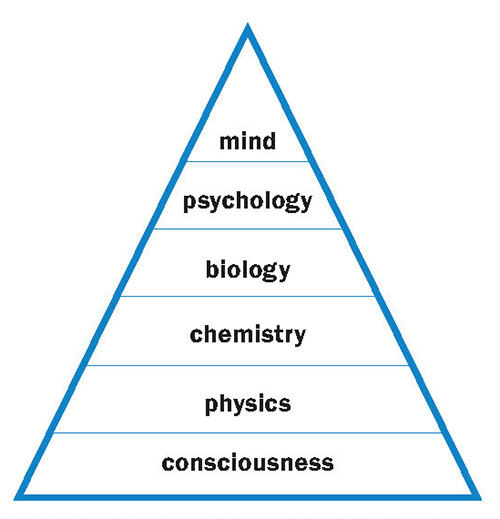
    Dean Radin proposes a more comprehensive knowledge hierarchy which places Consciousness (C) at the bottom to indicate where the physical world emerges from. At the top of the pyramid is Mind, meaning the brain’s machinery involved in information processing, cognition and perception. From this perspective, he says, “we enjoy conscious awareness not because the brain generates it, but because (C) permeates every layer of the physical world, just like electrons permeate every later ‘above’ the discipline of physics. Based on his hierarchy, which maintains everything currently known in science… magic is no longer an impossible anomaly.”

    What does this have to do with real magic? 

    Real magic is the pragmatic application of the esoteric worldview, just like today’s technologies are the application of the scientific worldview. That is, if consciousness is indeed as fundamental as the esoteric traditions claim, then magic must be genuine because awareness is primary over the physical world. Thus, we have the capacity to transcend the limits of space and time, and we can determine (to a small extent) how the physical world emerges. Further, human embodiment can now be seen as just one way, among a potentially infinite number of other ways, that consciousness can manifest into a physical being. 

    Why aren’t there university-based departments of magic? Why can’t we earn an accredited advanced degree in magical practice? The usual answer is that the esoteric worldview is so radically different from today’s scientific worldview that it cannot possibly be true. But that’s only because the scientific worldview as portrayed in the typical college textbook is five to ten years out of date. The leading edge today in science, represented by articles and books written by mainstream thought-leaders in physics, mathematics, and the neurosciences, is proposing that reality is literally made out of information. That is, the emerging scientific worldview tells us that reality is not composed of matter or energy, but rather of something far stranger, more abstract, and much closer to the esoteric worldview than the materialistic perspective that’s commonly associated with science.

    Theoretical concepts aside, how can science study magic? Here’s an example involving tests of the magical force of will. These studies were sparked by asking why ancient practices of blessing food, water, and wine are still vibrantly alive in the modern world. Indeed, proposing toasts with wine and spirits are as popular today as they have been throughout history.

    Anthropologists who study these practices have found that wine has been a popular beverage for at least 8,000 years. Its popularity was partially due to its pleasant psychoactive properties, but also because it was much safer to drink than water. Drinking from a pond, a river, or a well can be dangerous because the water might be contaminated. In ancient times (and still today), it was not easy to tell if water was safe or hazardous, and the alcohol in wine tended to neutralise most of those dangers. 

    Besides becoming a common beverage, wine was also associated with special or “holy” properties. It was celebrated by devotees of the Greek god Dionysus, and it was incorporated into the Catholic belief of transubstantiation. In these contexts, the belief was that divinely inspired intentions could alter the properties of wine, and this belief remains an act of faith for many today. But here’s the rub: Does anything actually happen to the wine that can be detected without having to rely on faith or anecdotal reports?

    Research anthropologist Stephan Schwartz conducted a series of experiments to find out. In each test, he took a bottle of Cabernet Sauvignon, separated it into two carafes of equal volume, and then asked a small group of meditators to intentionally bless one of the carafes for 20 to 30 minutes. Then he randomly labelled one A, the other B, and set the two carafes aside. Later, he asked a host of a dinner party to run a taste test. The host didn’t know that one carafe contained blessed wine and the other contained unblessed or “control” wine. The host told her guests that a friend was considering buying several cases of wine and he wanted to see which one was preferred. The guests tasted each wine and marked on a card which one they preferred. The host then evaluated the group’s preference, told them the result, and thanked them for participating.

    Over 12 such parties, involving a total of 93 meditators involved in blessing the wine, and 84 party guests, the results were clear. In 11 of the parties the tasters preferred the blessed wine, and in one party the preference was a tie. The odds against chance for this outcome was 2,000 to 1, indicating that under double-blind conditions the blessed wine tasted better than the non-blessed wine. This is an astounding outcome because wine-tasting is a highly complex process involving not just taste and smell, but sophisticated forms of cognitive processing, and neither the host or the party guests knew that they were tasting wine from exactly the same bottle. Something had happened to the wine as a result of the blessing.

    This was not the only experiment to find that focused intention altered properties of a beverage. The late Dr Masaru Emoto claimed that conscious intention could change the shape of frozen water crystals, such that pleasant thoughts would result in beautiful, symmetric crystals, while bad thoughts would result in displeasing, misshaped crystals. Emoto published many books showing results of his tests, but much of that work was more along the lines of artistic efforts rather than controlled experiments, so most scientists were not impressed by his claims. 

    Dr Masaru Emoto (1943–2014), the Japanese scientist and water researcher, revealed the true nature of water and how thoughts and vibrations affect the molecular structure of water.

    After attending a lecture Emoto presented in 2005, we asked if he would be willing to participate in a double-blind, scientific study. He agreed, and in our collaboration the technician who took the photos of the frozen water crystals did not know if the water used to create the crystals was blessed or not blessed. The blessing in our study was performed by a group of 2,000 people who focused their intentions on bottled water from a commercial source. The unblessed, control water, was another bottle from the same source and purchased at the same time. The results showed that the blessed water produced more beautiful crystals, as assessed by independent judges. This supported Dr Emoto’s claim. Later, we conducted a more rigorously controlled triple-blind study, which again supported his claim.
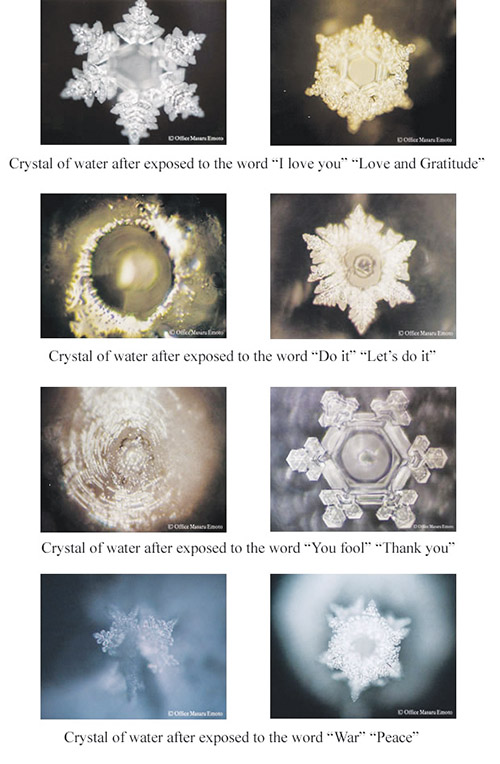
    In his years of water research, through high speed photography of thousands of water crystals, Dr Emoto showed the most beautiful crystals are those formed after the water is exposed to the words ‘love’ and ‘gratitude’. His claims were subsequently backed up by rigorous scientific experiments completed by Dean Radin and associates. (Source: www.masaru-emoto.net/english/water-crystal.html)

    We followed that up by testing if pieces of a gourmet brand of chocolate blessed by Buddhist monks and a Mongolian shaman would improve the mood of people who ate that chocolate, as compared to people who ate the same but not-blessed chocolate. Again, under double-blind, placebo-controlled conditions, we found a statistically significant elevation in mood among those who ate the blessed chocolate. Later, we tried a similar experiment with people in Taiwan using oolong tea blessed by Buddhist monks. Again, people drinking the blessed tea reported statistically significant elevations in mood as compared to people drinking unblessed tea from the same source.

    In these studies, we did not investigate which physical properties of wine, water, or food were altered by the blessing. But something clearly was affected. 

    Over the past century, many other scientific experiments have explored the effects of focused intention on physical systems ranging from elementary particles, to water, bacteria, seeds, plant growth, red blood cells, electronic circuits, and human physiology (I describe these in Real Magic). 

    These experiments demonstrate that modern scientific tools and techniques can be applied to ancient magical beliefs, and that when the lens of science is used to inspect magic, to our surprise we find that some of those beliefs are actually true. As science on these topics slowly advances, we may be rediscovering why these ancient practices have persisted for millennia: because they work. Explaining exactly how they work is becoming a topic of discussion at the leading edges of science today.

    Despite evidence for an imminent science/magic convergence, we may not see Harvard announcing its new Department of Magical Studies any time soon. Ancient taboos about magic are still very much alive, and those prohibitions tend to reinforce all sorts of fears: Fear of the unknown, of being thought weird, of being shunned by one’s peers, and of stories about demons and black magic. Such concerns have prevented the academic world from openly and seriously acknowledging the coming convergence, even though it’s unfolding right in front of our eyes.

    Fortunately, the taboo is beginning to crumble because of the popularity of books on affirmations and the law of attraction, the fast-rising mainstreaming of alternative healing therapies, development of new tools for enhancing intuition, the popularity of mindfulness meditation, the blockbuster success of superhero feature films, and in general the flourishing of “positive psychology.”

    Given the many challenges faced by the modern world, I believe we would all benefit by encouraging the unprejudiced study of real magic, especially because this topic is really about gaining a better understanding of the nature of consciousness

    Indeed, a case can be made that expanding what we know about consciousness may be a prerequisite for humanity to evolve from our present adolescence phase – which like all adolescents is chronically permeated by angst and emotion – to a more mature phase where concepts like wellness for all and “peace on Earth” become genuine, realistic possibilities.

    The convergence of science and magic is the theme of Dean Radin’s book Real Magic: Ancient Wisdom, Modern Science, and a Guide to the Secret Power of the Universe, available from all good bookstores.

    [alert type=”general” dismiss=”no”]This article was published in New Dawn Special Issue Vol 12 No 5.[/alert]

    [alert type=”success” dismiss=”no”]If you appreciate this article, please consider subscribing to help maintain this website.[/alert]

    © New Dawn Magazine and the respective author.
    For our reproduction notice, click here.

  • What Gorilla? Why Some Can’t See Psychic Phenomena

    What Gorilla? Why Some Can’t See Psychic Phenomena

    From New Dawn 112 (Jan-Feb 2009)

    Imagine you’re watching a basketball game. Your favourite team is wearing white and the other team is in black. In the midst of the action, someone in a dark gorilla suit calmly walks to the centre of the court, waves to the crowd, then walks off the court. Do you think you would notice this peculiar event? Most people might say yes. Most people would be wrong. 

    Our perceptual system unconsciously filters out the vast majority of information available to us. Because of this filtering process, we actually experience only a tiny trickle of information, by some estimates a trillionth of what is actually out there. And yet from that trickle our minds construct what we expect to see. So when we pay attention to our favourite white-shirted basketball team, the likelihood of clearly seeing darker objects moving about is substantially reduced. That includes even obvious objects, like gorillas. Psychologists call this phenomenon “inattentional blindness,” and it’s just one of many ways in which our prior beliefs, interests and expectations shape the way we perceive the world and cause us to overlook the obvious.

    Because of these blind spots, some common aspects of human experience literally cannot be seen by those who’ve spent decades embedded within the Western scientific worldview. That worldview, like any set of cultural beliefs inculcated from childhood, acts like the blinders they put on skittish horses to keep them calm. Between the blinders we see with exceptional clarity, but seeing beyond the blinders is not only exceedingly difficult, after a while it’s easy to forget that your vision is restricted.

    An important class of human experience that these blinders exclude is psychic phenomena, those commonly reported spooky experiences, such as telepathy and clairvoyance, that suggest we are deeply interconnected in ways that transcend the ordinary senses and our everyday notions of space and time.

    Exclusion of these phenomena creates a Catch 22: Human experiences credibly reported throughout history, across all cultures, and at all educational levels, repeatedly tell us that psychic phenomena exist. But Big Science – especially as portrayed in prominent newspapers and popular magazines like Scientific American – says it doesn’t.

    Well then, is this gorilla in the basketball game, or not? One way to find out is to study the question using the highly effective tools of science while leaving the worldview assumptions behind. That way we can study the question without prejudice, like watching a basketball game without preferring either the white or black team. Neutral observers are much more likely to spot a gorilla, if one is indeed present.

    This form of investigation has been going on for over a century, and despite official denials, the jury is in: Some psychic phenomena do exist. But like blindingly obvious gorillas, not everyone can see them. (Actually, like the majority of the general public, many scientists do have these experiences, but as in the parable of the Emperor’s New Clothes, fledgling science students quickly learn in college that it is not politically expedient to talk about it.)

    Here’s an example of not seeing. In the July/August 2008 issue of the Skeptical Inquirer (the Playboy of the enthusiastic debunker), neuroscientist Amir Raz and psychologist Ray Hyman describe their impressions of an invitation-only scientific meeting held on “anomalous cognition” at the University of British Columbia (UBC) in July 2007. Anomalous cognition is a neutral euphemism for psychic or “psi” phenomena, one that avoids the connotation of séances and ghostbusting associated with the touchy p-words. I was a co-organiser of the UBC meeting. Sixty prominent scientists and physicians were invited to the meeting, including a couple of Nobel Laureates, representing a variety of disciplines and perspectives.

    Not surprisingly, given the skeptical focus of the magazine in which their essays appeared, Raz and Hyman both concluded that they were not persuaded by what they heard at the meeting, that nothing interesting was going on, and that the scientific pursuit of anomalous cognition is akin to a misguided search for the Tooth Fairy (Raz’s term).

    Now, let me preface what I’m about to say by first noting that I respect Raz’s and Hyman’s opinions and I’m glad that they attended the UBC meeting. There is always room for critical debate in science; as President Dubya once said in another context, “Bring it on.” But what I am concerned about is that sometimes holding a fruitful debate stalls before it can get off the ground because one side regards the topic as fantasy. And so to make a point I’ll be ruthless in pointing out problems with these two authors’ opinions.

    One of Raz’s principal complaints was that he would “be curious to see compelling scientific demonstrations of psi (i.e., a string of multiple successful experiments by several independent investigators producing lawful and replicable outcomes). Alas, I have found none to date.”

    When I first read that statement I felt like I increasingly do these days when driving past a gas station. What did that sign say? A gallon of gas costs what? Didn’t we discuss several classes of repeatable experiments at the UBC meeting? For example, I presented an overview of “presentiment” experiments, an unconscious precognitive effect that has been independently and successfully replicated numerous times. (Nearly all of the 20 experiments I’m aware of to date have produced results in the predicted direction, and of those 10 were independently statistically significant.)

    And among researchers who have closely studied the psi literature, the vast majority have little doubt that something interesting is going on, something not easily attributable to chance or to any known conventional artefacts. These effects are in principle no more difficult to demonstrate than the efficacy of new pharmaceutical drugs or medical procedures. Such effects tend to be small in magnitude, they are highly reactive to the psychosocial context and other environmental factors, and they take substantial amounts of careful data collection to overcome the statistical noise generated by dozens of poorly understood interactive factors. But they are real, and they are repeatable in the laboratory.

    Real and repeatable, and yet what Raz meant by a “compelling” demonstration does not exist for him, at least not yet. When one regards evidence from a position where the claimed phenomenon is viewed as exceedingly unlikely, like a gorilla on a basketball court, then the evidence required to change one’s mind must be super-powerful. Not merely a string of successful experiments by independent investigators, as Raz calls for, but effects that are robust enough to be easily repeatable by anyone, anywhere, any time, and highly stable over long periods of time. And better yet, the effect should be predicted by a theory that doesn’t do much violence to orthodox dogma about how the world works.

    This is what I call the “UFO landing on the White House lawn” type of evidence. Alas, such robust evidence is rarely available when dealing with phenomena at the bleeding edge of the known. And it’s true that the evidence for psi today does not quite achieve the status of a Special New Bulletin interrupting the season finale of ‘Lost’ by reporting a UFO landing on the White House lawn (would anyone believe such a story, even if it were true?). Instead, the evidence available today for psi is more like a formation of UFOs repeatedly flying over the US Capitol, captured on film and spotted simultaneously by radar, jet pilots, and hundreds of witnesses on the ground. Well, surely that would convince a few people.

    Oh, wait. Such a UFO sighting actually did occur in Washington DC in 1952. All the major newspapers carried the story. But who remembers that today?

    Perhaps Ray Hyman does. Hyman earned his PhD in 1953 at John Hopkins University, near Washington DC. Today, Hyman is a retired psychology professor who has been one of the premier academic critics of parapsychology for over 50 years. In his essay in Skeptical Inquirer, his major complaint was the lack of easy repeatability of psi effects. To support his claim he cited “a psi proponent reported a meta-analysis of [a class of telepathy experiments] with an average effect size that significantly differed from zero with odds of more than a trillion to one while another meta-analysis… concluded that the average effect size was consistent with zero.” (A meta-analysis is a quantitative review of many similar experiments.) He bolstered this assertion by citing a few parapsychologists who have acknowledged difficulties in producing “UFO on the White House lawn” form of evidence. From this viewpoint, he concluded that parapsychology does not deserve serious scientific attention. He’s been repeating this opinion for 50 years.

    Except there’s a small problem. The parapsychologists mentioned by Hyman were expressing well known difficulties in producing robust repeatable effects on demand. But none of them doubt that the preponderance of evidence strongly indicates the presence of genuine anomalies. Hyman’s selective reporting is akin to dismissing as worthless a clearly visible formation of UFOs flying over the US Capitol, because of a stubborn insistence that the only acceptable data are UFOs landing on the White House lawn precisely at high noon, followed by alien pilots emerging from their crafts, offering tea and biscuits to the President and Vice President of the United States, and then soberly shooting the VP in the face with a projectile weapon (due to regarding that act as a sign of diplomatic friendship, having unfortunately misinterpreted a news story regarding the former Vice President’s shooting his friend in the face – but I digress).

    There’s another problem, one more substantial. Hyman’s damning denouement was that not all meta-analyses of telepathy experiments were judged to be positive. By mentioning the meta-analysis where the “average effect size was consistent with zero,” he reinforced his contention that telepathy experiments are slippery and unrepeatable, and not to be trusted. The study he cited appeared in a 1999 publication by British psychologists Julie Milton from the University of Edinburgh and Richard Wiseman from the University of Hertfordshire. They analysed a selected subset of telepathy experiments, ended up with a positive but statistically non-significant result, and then quite reasonably concluded that nothing interesting was going on. Well, as I said, there’s always room for debate. Except when conclusions are based on a mistake. It turns out that their analysis was miscalculated.

    Jessica Utts, a professor of statistics at the University of California at Irvine, explained at the UBC meeting that Milton and Wiseman had employed a technique that underestimated the actual telepathy effect. If they had used the same (simpler and more powerful) technique employed in all of the other published telepathy meta-analyses, they would have reached the same conclusion that everyone else did: There is indeed significant positive and repeatable evidence for telepathy obtained under controlled laboratory conditions.

    Hyman was in the audience during Utts’ presentation. I don’t know why he chose to ignore her analysis, although if he had acknowledged it that would have neutralised his own arguments. So perhaps its exclusion is not so puzzling.

    Speculations aside, one thing is crystal clear: It can take a White House lawn party to overcome one’s long-held beliefs, so if nothing obviously wrong can be found in a reported experiment, skeptics will still worry if the experiment was conducted by “believers,” because they imagine that believers would not be as rigorously careful as “non-believers.” Indeed, fervent skeptics are quite vocal in asserting that non-believers cannot get the same results in these experiments. Unfortunately, the fact is that skeptics hardly ever conduct these studies, and on the scant occasions when they do, they rarely publish them in sufficient detail to evaluate the results. So we really don’t know whether the suspicion is justified or not.

    That is, until recently. In 2005 two keenly skeptical psychologists, Edward Delgado-Romero from the University of Georgia and George Howard from the University of Notre Dame, conducted the same type of telepathy experiment under consideration here. To their chagrin, they not only obtained a significant positive outcome after conducting a series of eight studies, but their results were perfectly in alignment with the earlier meta-analytic estimates. That is, based on thousands of previous trials, it is possible to estimate the “hit rate” one should get when running a standard telepathy experiment. Delgado-Romero and Howards obtained exactly that value. To their credit, they published their results.

    But their article also included an astounding twist: They ended up rejecting their own experimental evidence based on a single additional study they conducted, which they based on an ad hoc, untested design they proposed, and which ultimately resulted in a statistically significant negative outcome! Strong negative outcomes are just as important statistically speaking, and just as unlikely to occur by chance, as strong positive outcomes. Both indicate that something interesting is going on.

    Another way of illustrating the invisibility of gorillas is by revealing an asymmetry in how psi experiments are reported in newspapers. In January 2008, newspapers around the world hailed the first conclusive test for telepathy conducted by two Harvard University researchers. According to the Boston Globe: “Brain scan tests fail to support validity of ESP. Research on parapsychology is largely taboo in academia, but two Harvard scientists recently set out to settle, once and for all, the age-old question: Is extrasensory perception, or ESP, real? Their sophisticated experiment answers: No, at least, not as far as they can tell using high-tech brain scanners to detect neural evidence of it.”

    Finally. Once and for all. A sophisticated magnetic resonance imaging brainscanner was used (technically, an fMRI), for the first time, to answer this age-old question. The high-tech “no” answer seems conclusive unless you read the actual article, which reported that one of 16 tests conducted showed a stupendously significant outcome exactly in alignment with what was predicted if psi were real. But the authors then took pains to explain why that result was probably an artefact, and so the newspapers didn’t mention that one intriguing outcome. (It also makes one question why they employed an experimental design which allowed positive results to be explained away so easily.)

    But the study was conducted at Harvard, for goodness sake, so surely that’s the last word on ESP. After all, for the first time ever Harvard scientists used one of those expensive and mysterious fMRI brainscanners to peer deep inside the brain, and they didn’t see any psi in there. End of story, no?

    Well, no. Was this really the first psi study conducted using an fMRI? No, it wasn’t even the second such study. Or the third. Or fourth. Or fifth. It was the sixth. And all of the earlier experiments, all conducted since 2000, showed significant evidence for psi effects. Somehow the newspapers overlooked this, despite the fact that most of those studies are freely available in an instant via PubMed.gov, the National Institutes of Health massive online bibliography of scientific articles related to health and healing.

    I could continue along the same vein ad nauseum when it comes to how scientific evidence for psi is often ignored or distorted beyond recognition. Unfortunately, there are countless other tales of ignoring other invisible gorillas at the frontiers of knowledge. They include serious scientific arguments that global warming is not being caused by human activities, analyses suggesting that HIV does not cause AIDS, repeatable electrochemical-nuclear reactions once known as “cold-fusion,” credible reports of UFOs, and so on. All of these ideas encounter strong sociopolitical resistance in academia, so credible counter-arguments are difficult to locate and even more difficult to discuss in scientific forums unless you have a phalanx of beefy bodyguards watching your back. One of the best sources of information about these “frontier” science topics is the Journal of Scientific Exploration, a peer-reviewed multidisciplinary journal published by the Society for Scientific Exploration.

    Without belabouring the point, such tales expose a skeleton in the closet of Big Science. From the popular perspective, science is portrayed as a flawlessly rational enterprise, where accumulating evidence slowly but surely overcomes stubborn skepticism. In reality, science is like any other human activity, and as such, emotions always trump reason. There is as least as much pig-headedness and motivated inattention in science as in politics and religion.

    Given the non-rational skeleton, will mainstream science ever be prepared to admit that psychic phenomena warrants serious investigation? I believe the answer is yes. Acceptance someday is inevitable. We are dealing with human experiences reported since the dawn of human history, experiences that do not go away in tightly controlled laboratory tests using the most sophisticated experimental tools and designs. So some of these phenomena will eventually become integrated into the mainstream. Exactly when I cannot say. Perhaps one to five decades.

    Will this happen because the accumulated data will overwhelm skepticism? Probably not. As Max Planck, the physicist who dreamt up the idea of the “quantum” in quantum mechanics, once wrote, “A new scientific truth does not triumph by convincing its opponents and making them see the light, but rather because its opponents eventually die, and a new generation grows up that is familiar with it.”

    Some of the 60 participants at the UBC meeting represented that younger generation, and while a handful of the older crowd are certain to remain mulishly skeptical to their deaths, based on the written opinions of many of the participants collected before, during and after the meeting, it was clear that the majority were more open to anomalous cognition after the meeting than they were before.

    I expect that trend to continue, and then one day a threshold will be crossed, and on that day some of the invisible gorillas in our midst will become a bit easier to see. The very next day no one will remember that this topic was once considered controversial.

    [alert type=”general” dismiss=”no”]This article was published in New Dawn 112.[/alert]

    [alert type=”success” dismiss=”no”]If you appreciate this article, please consider subscribing to help maintain this website.[/alert]

    © New Dawn Magazine and the respective author.
    For our reproduction notice, click here.