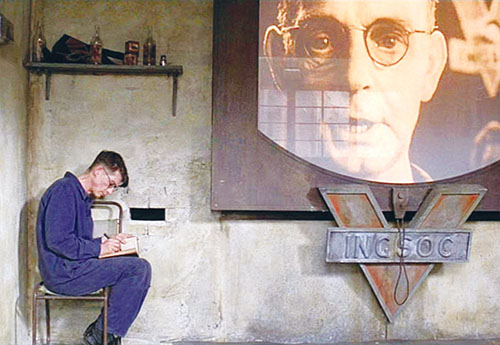
In his classic novel Nineteen Eighty-four, author Eric Blair (better known as George Orwell), famously laid out how a totalitarian technocracy would look. The phrase Orwellian has justifiably become an utter cliché, but despite the familiar territory it is worth looking at the aspect of the book that deals with the Ministry of Truth and its employees, who were tasked by the regime with “memory holing” history and rewriting dictionaries (“newspeak”) to reduced language and thus thought to simplistic, binary concepts, such as people and unpeople.
Consider how the definition of “vaccine” has been altered in recent years to appease the designers of mRNA technology. Birmingham and Lambert define vaccination as “the practice of artificially inducing immunity.”1 A book with a foreword written by Bill Gates defines vaccine-induced immunity as follows. “The quality of […] antibody responses, eg, their avidity or specificity, has been identified as a determining factor of efficacy.”
The authors continue: “long-term protection requires the persistence of vaccine antibodies and/or the generation of immune memory cells capable of rapid and effective reactivation with subsequent microbial exposure.”2
But the purported Covid-19 vaccines stimulate antibodies for months at a time, requiring multiple boosters. By a definition endorsed by Gates, the injectable products are not vaccines despite Gates’s use of the term.
The pre-pandemic definition of vaccine has been memory-holed. Putting aside the changes in definition confluent with technological developments, the former definition of vaccine offered by Merriam-Webster was “a preparation… that is administered to produce or artificially increase immunity to a particular disease.”3 The Covid-era definition is: “a preparation that is administered… to stimulate the body’s immune response.”
Notice that the threshold has been lowered from increasing immunity to merely stimulating an immune response. The same big tech that suppresses web search results promotes articles that support the given narrative. In this case, we are being told outright lies: that mRNA is not new, untested technology; that vaccines can indeed be developed within months, not years; that humans are not experimental subjects; and that the injectable products are safe.4
Polymerase chain reactions (PCR) work by amplifying nucleic acids to detect virus particles.
In the late-1980s, virologists were concerned that PCR tests were contaminated by two sources: the carry-over of material from one tube to another and the presence of dead human skin cells. When controlled and uncontrolled PCR tests were compared, the authors of one study found high rates of false-positives.5
A decade later, another study searching for respiratory adenoviruses (Ad) in humans had a 94 per cent efficacy rate when using primers for Ad7 proteins called hexons. But when the primers were not included, the results were much less effective. Detection efficacy for enzyme immunoassays and time-resolved fluroimmunoassys were between 53 and 46 percent.6
Ten years on, Applied Biosystems produced the TaqMan real-time PCR (RT-PCR) which detects viral and bacterial particles via processes called Plus/Minus and Allelic Discrimination. When testing the Plus/Minus to detect Escherichia coli, “an inordinately high proportion of false-positive signals was observed.” Correct thresholds require template controls.7 In one 2015 study using assays, PCR test estimation was over 40 per cent.8
The most common SARS-CoV-2 detector is the Nucleic Acid Amplification Test RT-PCR. “[N]one of the tests have sufficient clinical sensitivity to detect virus during the first several days after infection, nor are they 100% sensitive at the time of peak infectiveness.”9
Recall the late-‘80s PCR test problems mentioned above. In 2020, the same issues plagued the Covid tests: “Technical problems including contamination during sampling (eg, a swab accidentally touches a contaminated glove or surface), contamination by PCR amplicons, contamination of reagents, sample cross-contamination, and cross-reactions with other viruses or genetic material could also be responsible for false-positive results.”10
In addition, the duration of viral infection affects PCR detection ability. The longer the infection, the lower the chances of detection. One kit had an average 77 per cent efficacy (depending on the assays) up to four days. The kit’s efficacy declined to as low as 38 per cent after 10 days of infection.
5. P.A. Kitchin, Z. Szotyori, C. Fromholc and N. Almond (1990) “Avoidance of PCR false positives,” Nature, 344: 201
6. R. Räty, M. Kleemola, K. Melén, M. Stenvik and I. Julkunen (1999) “Efficacy of PCR and other diagnostic methods for the detection of respiratory adenoviral infections,” Journal of Medical Virology, 59(1):66-72
7. Forough L. Nowrouzian, Ingegerd Adlerberth, and Agnes E. Wold (2009) “High frequency of false-positive signals in a real-time PCR-based ‘Plus/Minus’ assay,” APMIS, 117(1):68-72
8. David Svec, Ales Tichopad, Vendula Novosadova, Michael W. Pfaffl, and Mikael Kubistaa (2015) “How good is a PCR efficiency estimate: Recommendations for precise and robust qPCR efficiency assessments,” Biomolecular Detection and Quantification, 3: 9-16
9. Glenn D. Braunstein, Lori Schwartz, Pamela Hymel, and Jonathan Fielding (2021) “False Positive Results With SARS-CoV-2 RT-PCR Tests and How to Evaluate a RT-PCR-Positive Test for the Possibility of a False Positive Result,” Journal of Occupational Environmental Medicine, 63(3): e159-62
10. Elena Surkova, Vladyslav Nikolayevskyy, and Francis Drobniewski (2020) “False-positive COVID-19 results: hidden problems and costs,” Lancet, 8(12): 1167-68
In Brave New World, author Aldous Huxley wrote that the slaves of the future are happy. Drugged and genetically modified, their personalities are blunted and their bodies and minds configured by a technocracy whose scientists design humans to maximise their outputs for the benefit of the ruling classes.
Outside the world of fiction, the World Economic Forum (WEF) is an umbrella of multibillion-dollar, mostly US-based corporations and billionaires; a think tank in which the rulers of the world meet to discuss and try to shape the general direction of the global order. With permanent strikers in the US, for instance, refusing to work in what the late anthropologist David Graeber eloquently called “bullshit jobs,” the WEF’s academics and researchers understand that they could lose their grip on power. Global financial inequalities are widening as anti-democratic sentiments grow within “democratic” societies, whose populations realise that they have no control over their lives.
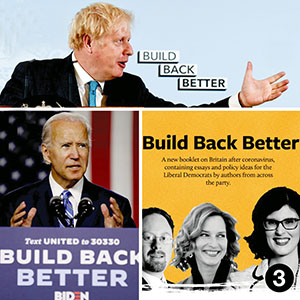
Rather than risk revolutions in numerous countries from strikers – now called The Great Resignation – the WEF seeks to ideologically capture potential revolutionary leaders and re-programme them to favour the WEF system (e.g., Greta Thunberg’s platform at the annual conference). The businesses that fund and join WEF’s Davos meetings recognise that real estate remains the physical basis on which profitable assets are constructed. Under slogans like the Great Reset, the Fourth Industrial Revolution, and Build Back Better, WEF elites want to cement their new world order.
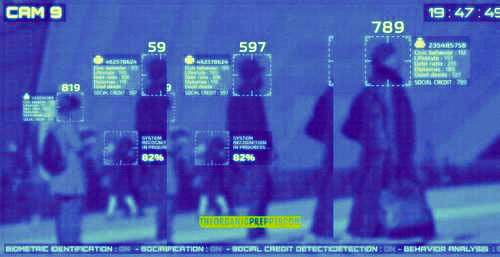
But what will that new order look like for non-elites? Unlike the present global malaise, the “new normal” – or “next normal” as WEF elites are calling it – aims to use hi-technology and data collection to tailor environments to the needs and wishes of the public who will be expected to participate in “sustainable” infrastructure and be data points for constant public health monitoring.
Like the hapless victims of Huxley’s dystopia, tomorrow’s society will be happily enslaved, at least in the minds of WEF planners. Workspaces will blur the lines between personalisation and professionalism, feelings of being cheated by the system will be reconceived as consuming less to help the environment, and the pains of reality will be soothed with immersion into joyous, incessant virtual reality like Facebook’s new Meta concepts.
BUILD BACK BETTER
Mega-wealth in the global economy is a house of cards: it consists of digits on bank account computer screens that increase when the rich buy and sell repackaged debts to each other. When the gravy train derails every decade or so, the public bails out the perpetrators. Yet, the three main bases on which the intangible economy is constructed are tangible: precious metals, hydrocarbons, and real estate.
The new rulers of the world are the asset managers who hold the stocks, shares, bonds, and portfolios of the banks, hedge funds, insurers, pension companies, and real estate holdings. They include BlackRock, State Street, UBS, and Vanguard. Their fake wealth would not exist without the physical ownership of land. Real estate is the skin of the balloon in which they blow the hot air of money markets.
The WEF corporations understand the importance of real estate in relation to wealth inequality and uber-profits. They also understand that the younger generations are getting more and more desperate. In terms of size, housing quality is leading to mental health issues as younger people live and work in increasingly crowded and expensive cities. Not only is property ownership a dream for the majority of young westerners, renting is becoming harder as owners are reluctant to let their property to people in the insecure work of the expanding gig economy.
WEF corporations fear a brain and labour drain from cities as work-from-home youngsters flee to the countryside where dwellings are bigger and cheaper. The WEF notes that cities generate 80 per cent of global GDP, yet their revenues (e.g., from local taxes and property sales) are expected to fall as fewer people use public transport and reduced council budgets lead to disinvestment from public services. Asset companies want to keep workers locked into cities and are looking to redesign urban hellholes to make them more appealing: eco-friendly, health conscious, and tailored to the psychology of the individual.1
WEF authors say that the new agenda will take place via “an increase in public-private cooperation,” meaning the taxpayer foots the bill, as usual. New urban slums will be greenwashed and prettied via the harnessing of personalised big tech data collection for “customisation.” While the rich continue to plunder, the working classes will have to get used to “adaptive reuse”; an eco-friendly normalisation of second-hand products; or “pre-loved” as they now call them. The WEF says that, “The private sector can also play an instrumental role in helping the public sector craft legislation that is viable for business.” What could possibly go wrong?
WEF emphasises that a whole tenth of global GDP is concentrated in a single sector: real estate. Commenting on the above, Christian Ulbrich, Global Chief Executive Officer and President of the real estate services company JLL, confirms: “The world will look different in the coming years; our cities and urban centres especially so.”2
On greenwashing in response to public pressure, Ahmed Galal Ismail, Chief Executive Officer of the holding company Majid Al Futtaim Properties, says “global investors, pension funds and financial institutions are demanding that their investee companies incorporate, track and report ESG [environmental, social and governance] performance into the risk-adjusted returns that they deliver.”3
As we shall examine in more detail, artificial intelligence and the instantaneous advertising and automated services markets are exploding. In so-called smart homes, the wishes and intentions of the occupant will be sales opportunities for programmed machines, from fridges to heating systems, as the very biology of the tenant is tracked and analysed under the PR-friendly cover of public health monitoring.
Under counter-Covid biosurveillance, prospective AI in smart homes might also be tailored to provide commercial services. AI could, for instance, offer to adjust the solar-controlled room temperature if in-home cameras sense that the occupant might be too hot or cold. “Autonomous buildings autotune, adapting to dynamic indoor and outdoor conditions, create optimal working conditions.” Through bastardised communitarianism designed by WEF to prevent the poor from ever attaining wealth under the slogan of “equity,” the buildings will be designed with “cost-sharing mechanisms.”
Existing examples, not yet fully authoritarian like the above, include the hub at Causeway, Boston, Massachusetts: a mixed-use revitalisation project that includes heat-regulating glass, airflow-supported balconies, and local food production. Another is Hong Kong’s Taikoo Place: an interconnected business hub. Citing patents per head of population, the WEF notes that increased population density – i.e., big cities – is linked to increased creativity and productivity. But the people who do the hard work don’t share in the patent wealth. Taxpayers, for instance, funded the vaccines that low-paid nurses administer, yet big pharma reaps the rewards.
In other words, they want people crammed into cities to boost innovation, but they also want to polish the turd of urbanisation by making dystopian dives look like efficient, modern pockets of eco-friendly mingling.
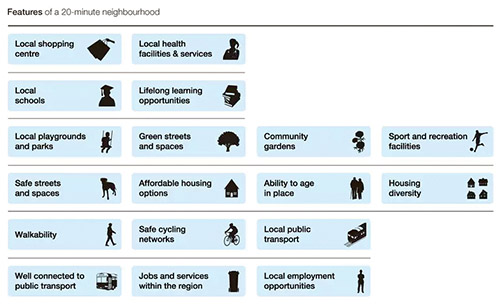
For instance, knowing that most people prefer the more relaxed atmosphere of villages to crowded and impersonal cities, the government of Victoria, Australia supports the 20 Minute City concept in which the village – grocer, butcher, baker, pharmacy, health clinic, bus stop – is integrated into the city.4
“Sustainable McDonald’s” is an oxymoron, yet Australia once again serves as a testbed for the Fourth Industrial Revolution (4IR) with “sustainable” fast-food outlets that allegedly cut CO2 emissions by a third. The solar-powered “smartly” ventilated takeaway/restaurant in Melton South is a prototype for other sites. Through Podium, Australia is also pioneering the end-to-end digitisation of real estate: from design, purchase, lease, and construction, to repurchase, letting, contract, and the new age of tailored living. This will create a new blockchain for real estate markets.
In this part of the new world order, constant labour is normalised. “From focus zones to work cafes, the space integrates ‘external’ elements such as coworking and the home office.” Happy slaves must also be healthy slaves. Design concepts include an “ergonomically supportive home office with limited distractions.” There will be a “blend of social spaces with productivity enablers,” such as colleagues who give unconscious prompts to others to work harder. This will be achieved through the design of the building itself. For instance, computers on which people work might be strategically placed near the coffee machine so that the idler sees their colleagues labouring and is prompted to return to work. Exercise machines might be placed near the snack bar so that workers tempted by candy are also guilted into doing a few minutes’ exercise before returning to their toil.
THE FOURTH INDUSTRIAL REVOLUTION
Covid has given WEF corporations the chance to integrate public health concepts via constant social biosurveillance in their existing 4IR agenda. Over the last few decades, the phrase “new normal” became normal as politicians, intellectuals, and the media sought to brainwash us into believing that terrorism would make total surveillance and travel restrictions a new normal, as would limitations on freedom and growth caused by anthropogenic climate change.
Since Covid, the WEF asks: “What will the ‘next normal’ look like?” (Emphasis added). WEF’s message is confused. On the one hand, its authors lessen mental health concerns by promoting community, but on the other, they note that the structure of the socioeconomic order will increase isolation. Facebook is notorious for keeping people isolated in echo chambers, but the new Meta rebranding, as we shall see, will blend isolation and community in augmented, virtual reality (VR) settings. The happy slave will be alone in their tiny, greenwashed hovel but feel emotionally connected with friends in a VR universe.
When it comes to online shopping, there will be less “face-to-face interaction.” The last-minute deliveries spurred by Covid “will persist beyond the pandemic”5 and be delivered by the kinds of people whom the WEF envisages occupying the above properties. Jab mandates for working people are part of the “next normal,” and patents on the vaccines are of primary interest to the mega-rich. But the WEF is less interested in ensuring the safety and efficacy of Covid vaccines and more concerned with bolstering “vaccine confidence.” Even though the jab appears to be effective only in reducing hospitalisations, the WEF was quick to ask how its thought leaders could work to promote “trust” in big pharma’s rushed products.6
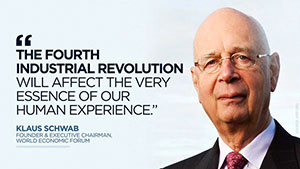
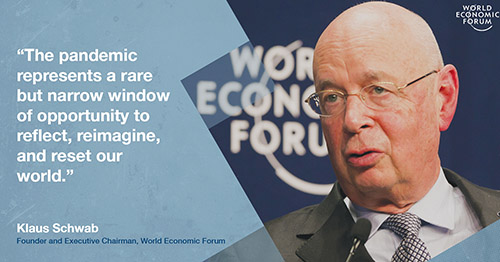
It is important to distinguish between words and actions. Sometimes, WEF founder and chairman Klaus Schwab speaks truth and horrifies those familiar with his words. Examples include references to microchipping the population and replacing humans with robots.7 At other times, Schwab seems to say the opposite, acknowledging that what is erroneously called “capitalism” – which actually means state-backed monopoly corporatism – has damaged the younger generations, stagnated the middle classes, and fuelled the climate crisis. In order to look good and paint the global elite’s WEF as some kind of progressive or “woke” (as the right-wing say) face of “capitalism,” Schwab points out that which is wrong with the “capitalist” order.
The reality is that pretty words and agreement with those injured by profit-driven corporatism is a cover. It is as if an abuser consoles their victim while continuing to abuse them. In his introduction to the WEF’s report on youth, Schwab plays this game, writing things many of us would agree with: that long-term planning is better than short-term profit and that intergenerational parity is better than growing inequality.8
As part of its pyramid structure, the WEF claims that its global reach on this issue was over two million people, the vast majority of whom were journalists, intellectuals, businesspeople, and community leaders; in other words, rungs on the ladder of hierarchy, not ordinary people. These so-called cultural leaders will shape the doctrines for those below them through entertainment, education, media, and the workplace.
The report pays lip service to getting corporations to disinvest from fossil fuels and working with Generation Z’s thought leaders to create a new agenda for sustainability. In reality, it is the same old monopoly corporatism in which ordinary people are the flotsam and jetsam in the plans of those higher than them in the social order. For example, one Lab held in Luxembourg concluded that the WEF should decide what is or is not ethical consumption: “It would be unfair and naïve to put all the burden on consumers having to educate themselves in order to avoid greenwashing.”9
If, for instance, someone decides not to buy the latest Apple gadget because ‘child mining’ in Congo extracted the device’s coltan, ‘forced labour’ in China created the product, ‘air miles’ brought the item to the West, and ‘tax avoidance’ enables the company to be a monopoly, a WEF messaging campaign might greenwash and claim that the gadget’s production was ethical and its carbon footprint neutral.
Another event in Australia concluded that the WEF should harness the wisdom of indigenous people when promoting the new agenda so that people resonate with ancient ways of living whilst continuing to work for corporate overlords.
This is a form of mind control in which the labouring masses have internal freedom and believe they participate in a spiritual society, when in fact the limits of their reality are set by superiors who pretend to consult with and gain the approval of those they are controlling. The Davos Lab’s Millennium Manifesto is jam-packed with empty verbiage such as, “We will ask big questions to advance bold solutions.”10
THE GREAT RESET
Another aspect of the WEF agenda is what Schwab calls the Great Reset: a professed plan to promote economic and social equity while cementing the structures that guarantee worsening inequality. In addition to trapping working people in properties designed to enhance their productivity and monetise their idiosyncrasies (like the AI temperature control example above), the revolutionary potential of the exploited classes as well as their dissatisfaction will, if the WEF planners get their way, be quelled by the promotion of transhumanism and virtual reality, in which humanity is “reset” to begin anew with biological and digital enhancements.
One of the methods of control is trapping people in social media bubbles. After US President Donald Trump came to power (2017–21) and threatened the neoliberal agenda, ideological managers such as mainstream media, think tanks, and political unions, took action against what they call “fake news.” Fact-check organisations have morphed into the guardians of neoliberal elites. Often “populists” like Trump and his supporters lie, misreport, and publish fake news. Fact-checkers expose those lies, but they have a deeper agenda.
In most cases, so-called fact-checkers simply argue over interpretations of truth, which the fact-checkers then use to delegitimise real populism. The ideological basis from which they operate promotes the agenda of the World Economic Forum and others. But who fact checks the fact-checkers? Researchers have uncovered their connections to the political, corporate, and media establishment. In this revolving door system, former mainstream corporate media editors and journalists take up new roles as self-professed fact-checkers whose targets are those opposed to the neoliberal order.
In addition, social media have, for years, been on a deplatforming crusade as part of “woke washing” (while keeping oppressive and prejudicial structures in place) and under the influence of the intelligence services. In their evidence to US Congress after the 6 January Capitol insurrection, both Facebook co-founder Mark Zuckerberg and Twitter co-founder Jack Dorsey confirmed that because of “security” concerns, domestic US intelligence agencies advised (i.e., leaned on) them to deplatform accounts, including the President’s.
All of the above serves to blandify social media content and constrain users to the boundaries of what is acceptable within neoliberal culture. Anything too progressive (e.g., the World Socialist Web Site) or regressive (e.g., Breitbart News) is censored, pushing the entire user base of hundreds of millions of people into a giant corporate-approved echo chamber (e.g., CNN, New York Times).
This process is called “digital literacy” by the WEF and others. Without “digital literacy,” people might fall for dangerous “fake news” (i.e., news not approved by WEF corporations). But people might also create and share real news and real information that does not fall within the bounds of accepted neoliberal ideology, such as questioning the efficacy of big pharma-produced vaccines or pointing out the serious problems with the corporate-political elite. In making the world “digitally literate,” the WEF employs doublethink: “Steps must be taken to prevent abuse and harm while maintaining the freedom to openly exchange ideas.”11
Slaving for the ultra-rich in personally-tailored smart cities, the younger generations censored into the neoliberal sheep pen by social media will, according to the WEF model, augment their capacities with technology. The transhumanist agenda is specifically harnessed for the older, infirm generations who have gone from being useless eaters – from the WEF perspective – to potential data points for augmentative technologies. As part of the WEF propaganda campaign, the organisation is preparing to “Articulate the potential benefits of artificial intelligence,” particularly for the older generations.12
For “older” people, which we assume means the over-60s, WEF suggests placing representatives in the design process, the reasoning being that over-60s tend to have different aesthetic tastes, practical preferences, and physical and cognitive requirements to young people. The young are born into the new technological changes, and those changes become part of their environment. In contrast, the over-60s must adapt. Pursuing profit, companies are using the WEF as a vehicle to help turn the over-60s into transhumanist augmentation technology consumers: home-help robots, implants for better eyesight, time-released painkillers, etc. The WEF does not seek solutions for ending the collection and selling of personal data but rather for more transparency. This way companies can cheat consumers whilst being honest that they are cheating them. The aim is to make consumers feel less angry because they appreciate the honesty.
WEF suggests that companies “Disclose the data being collected.” They hope that older people will thus be more willing to have their information sold. The WEF also wants to “Obtain meaningful consent.” The clue is in the word “meaningful,” suggesting that up until now, consent has not been meaningful. One of the more insidious agendas is to “Design for appropriate trust.” Just as they seek to make the younger generations “digitally literate,” i.e., keep them in a mental prison, WEF corporations aim to protect the elderly from “deception,”13 but not the deceptions on which their system is built.
The WEF is aware that the general public might, if left on their own, form groups, communities, parties, and movements that spread an anti-“capitalist” message and develop new social models. If such a long-term grassroots revolution succeeded, it would not only hurt the profits of the owner-classes but threaten the system they spent so long developing. Repackaging profit-driven agendas as some form of third position between capitalism and socialism is achieved, in part, by rhetorically emphasising “corporate responsibility.”14
The WEF also seeks to capture potential revolutionaries by appealing to “social justice.” The WEF intellectuals are aware that young people tend to be driven more than old people by outrage. The right-wing dismisses these young, conscious activists as “social justice warriors.” Instead of encouraging people to change the system in their own image, WEF intellectuals want to make people feel like they have – without actually having – input into their conditions. “[R]ecognising, co-designing, partnering and learning with impacted stakeholders… must be at the centre of any corporate action on equity and social justice in our unequal world.”15
Another factor profitable to the corporate class is social impact bonds. Historically, the underclasses – those below the working classes – were a financial negative. They claimed benefits, needed free healthcare, public housing, etc. The working classes laboured, the middle classes paid the most relative taxes, and the rich lived off the labour of the poor, profits generated by the consuming middle classes, and hording through tax avoidance.
But over the last decades, banks figured out ways of profiting from the underclasses: social impact bonds. Under such systems, government cuts back on social welfare and relies instead on charities to keep offenders out of prison and reach homelessness reduction targets, etc. The banks that fund the charities are then reimbursed by government, and the loans of the banks are serviced by taxpayers. This social impact bond system creates an incentive to have a permanent underclass and champion the alleged virtues of “charity” instead of systemic change that brings genuine inclusivity and democratic empowerment.16 Gerbrand Haverkamp, Executive Director of the World Benchmarking Alliance, is quoted as saying: “[W]e need businesses that can profitably solve societal problems, without profiting from societal harms.”17 This model incentivises the creation of a permanent underclass.
There is a sinister, occultic element to the WEF’s agenda. Certain members who currently practice what they believe to be online “meme magic(k)” are also involved in the development of Facebook’s VR world: the Metaverse.
A near-billionaire developer and Trump supporter, Palmer Luckey, used social media to boost Trump’s profile and deflate his rival Hillary Clinton in the run-up to the 2016 US presidential election. Luckey made his fortune selling the Oculus VR headset to Zuckerberg. Luckey’s benefactor, a lobby called Nimble America, believed that “meme magic is real.” The Millennial generation started to use images with text circulated online to boost their agendas and attack their enemies (memes). One famous meme was Pepe the Frog, an innocent cartoon hijacked by racists and right-wingers (usually both) to signal their political allegiances. The cultists behind the spread of such memes believed that they could invoke spiritual power (“meme magic(k)” to vanquish enemies. Pepe, to give one of many examples, is drawn with light reflecting in both eyes in the shape of a Freemasonic dot-triangle.
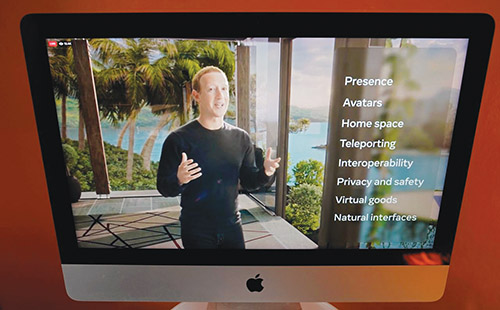
Mark Zuckerberg’s digital avatar introduces the wonders of the Metaverse, his new project for a virtual world that overlays the real one. For the physical human, most interaction inside these VR worlds would be like something out of the 1999 movie The Matrix.
Regardless of his involvement or lack of involvement in such practices, the executive director of Oculus, Jason Rubin, sent his 50-page report on the Metaverse to Zuckerberg. Just as US military planners devised a “shock and awe” terror campaign to inflict on the Iraqi people in 2003, Rubin said that “shock and awe” tactics would condition the user to accept their new digital life in the Metaverse. CNBC has seen leaked policy documents: “It imagined users floating through a digital universe of virtual ads, filled with virtual goods that people buy.”18
Chillingly (no pun intended), FB Oculus’s Michael Abrash says: “It all started with Snow Crash,” the futuristic ‘90s novel written by Neal Stephenson. The Guardian, which picked up the Abrash quote, conveniently omits a crucial detail about the novel: that the fictional online world on which the new scheme is based contains a mind virus that can infect users as they merely look at the screen. Likening it to Snow Crash, though providing no evidence, certain individuals claim that the Pepe meme that evolved into something else has, for many years, contained a hidden mind virus.
Whether the mind virus is real or not is beside the point. Certain online occultists, including Luckey, are using the fear of mind control, coupled with what Rubin calls “shock and awe,” to get users to submit to the dialectic: a “progressive” Zuckerberg world order of Joe “Build Back Better” Biden in a virtual reality, or a more overtly fascistic world order of “meme magic(k)” and mind warfare using Trump as a frontman.
Part of the Trump meme war and the fake news hysteria surrounding the President had the effect of making ‘truth’ a vague and flexible concept. As the concept of truth becomes fuzzy, that which is real is set to become fuzzier. WEF says of Meta: “This could manifest itself in several ways, but many experts believe that ‘extended reality’ (XR) – the combination of augmented, virtual and mixed reality – will play an important role.”19 The WEF hopes that once we have been bombarded into the new system, we will all be Huxleyan happy slaves in their Brave New World, playing with intangible VR toys and mingling with avatars of our loved ones.
[alert type=”success” dismiss=”no”]If you appreciate this article, please consider subscribing to help maintain this website.[/alert]
Footnotes
1. World Economic Forum and BCG, Insight Report, April 2021, www3. weforum.org/docs/WEF_A_Framework_for_the_Future_of_Real_Estate_2021.pdf
2. Quoted in ibid.
3. Ibid.
4. Ibid.
5. WEF and McKinsey, “Pandemic, Parcels and Public Vaccination: Envisioning the Next Normal for the Last-Mile Ecosystem,” Insight Report, April 2021, www3.weforum.org/docs/WEF_Pandemic_Parcels_and_Public_Vaccination_report_2021.pdf
6. WEF, Insight Report, May 2020, www3.weforum.org/docs/WEF_How_ to_Build_Trust_in_Vaccines_2021.pdf
7. Interview with Radio Télévision Suisse, 10 January 2016, www.youtube.com/watch?v=IJcey1PPiIM
8. Klaus Schwab, “Introduction,” “Davos Lab: Youth Recovery Plan,” Insight Plan, WEF, August 2021, www3.weforum.org/docs/WEF_Davos_Lab_Youth_Recovery_Plan_2021.pdf
9. WEF, ibid.
10. Ibid.
11. Ibid.
12. WEF,” Insight Report, August 2021, www3.weforum.org/docs/WEF_ Designing_Artificial_Intelligence_Technologies_for_Older_Adults_2021.pdf
13. Ibid.
14. WEF, Business for Social Responsibility and Laudes Foundation, Insight Report, September 2021, www3.weforum.org/docs/WEF_Lighthouse_ Action_Social_Justice_Stakeholder_Inclusion_2021.pdf
15. Ibid.
16. Ibid.
17. Quoted in ibid.
18. Salvador Rodriguez, CNBC, 30 October 2021, www.cnbc.com/2021/10/30/facebooks-meta-mission-was-laid-out-in-a-2018-paper- on-the-metaverse.html
19. Stefan Hall and Cathy Li, WEF, 29 October 2021, www.weforum.org/agenda/2021/10/facebook-meta-what-is-the-metaverse
A few years ago, commentators argued that “data is the new oil”:1 a precious commodity that makes the world go ‘round. Instead of wars for control over natural resources, à la Iraq, Libya, and Syria, the new battles will be fought across informational landscapes by tyrannical tech monopolies whose software is based on designs that emerged from the state-funded military sector and whose power is too vast for governments to break.
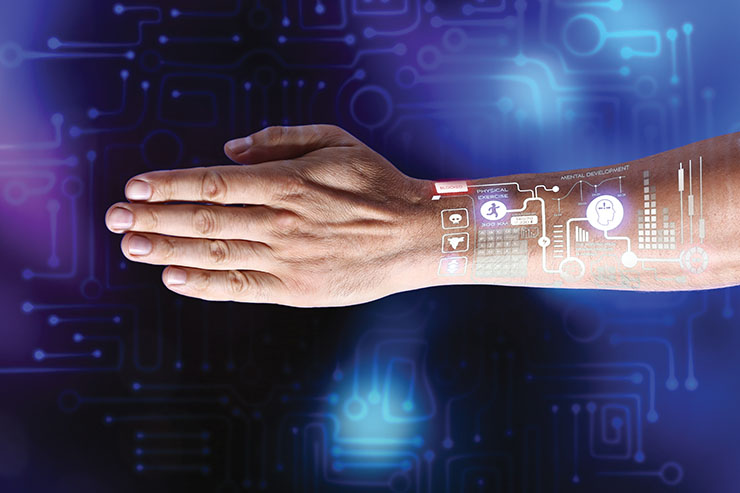
For-profit transhumanism was the plan all along. Referring to brain implants, the founder and head of what became the World Economic Forum, Klaus Schwab, said in 2016: “first we will implant them in our clothes as ‘wearables’ and then we could imagine that we will implant them in our brains or in our skin.” Schwab said that this will eliminate the boundaries between digital and physical space.2 In 2017, Jun Wang, co-founder of the health company iCarbonX, said: “We want an exact 3-D figure of you: the fat, the muscle – your entire body shape, plus facial recognition, and what’s going on with your skin.”3
Governments’ responses to the Covid pandemic worldwide have given our new biotech overlords the perfect opportunity to roll out and impose a myriad of next-generation gadgets for the control of humanity.
SELLING YOUR DATA
Consider how anti-democratic forces have exploited national health services for profit. Billionaire tech entrepreneur Peter Thiel once wrote: “I no longer believe that freedom and democracy are compatible.”4 In-Q-Tel is a US Central Intelligence Agency seed-funding company whose investments, with others, helped to set up Google and Thiel’s Palantir: an AI and analytics company.5 Palantir was awarded US Defense Department contracts in foreign battlefields, including Afghanistan, to build biometric databases of the world.6
NHSX is a unit of the British National Health Service (NHS) designed to put the final nails in the NHS coffin by digitising patient care. In July 2019, long before the world was aware of the growing pandemic, Palantir UK’s Louis Mosley dined with the chair of NHS England, David Prior. The pair discussed selling NHS data to the US-based firm.7 In 2020, with Covid ripping through Britain, Palantir was awarded a £23 million contract under the secret Crown Commercial Services G-Cloud 11 Framework.8 The NHS later developed its own App for track and trace, which in April 2021 the Transport Secretary, Grant Shapps, said could be used for vaccine travel passports.9
GenVis is an Australian company specialising in surveillance analytics. It describes itself and its products as building and presenting “compelling criminal cases underpinned by video forensics,” “real time intelligence,” and “people management.”10 A snazzy GenVis video promotes Australia’s 500 per cent increase in CCTV over the last decade, adding that 80 per cent of footage is unused due to monitoring costs. GenVis’s “intelligence path mapping” software can rectify this alleged problem by tracking targets and using visuals to make data easy to understand.11 The authorities in both South and Western Australia gave GenVis a contract to monitor Covid patients in quarantine via the G2G Now app, which the police also utilise to enforce travel restrictions.12
VACCINES AND TRACKING
Accenture is a company with an Australian presence that provides numerous services, including artificial intelligence, cybersecurity, and data analytics.13 Accenture has also won military consultation contracts and promotes the aerospace sector on its website.14 In March 2021, the Australian government teamed up with numerous companies, including Accenture, to deliver vaccines to the population. Greg Hunt, the Minister for Health and Aged Care, said: “Accenture will provide tracking of vaccine doses as well as enabling overall program implementation monitoring.”15 Vaccine bookings would be managed by HealthEngine: a company that boasts 1.5 million monthly users, most of whom are Australia’s 70,000 GPs and health clinics. But the company had already been fined for unlawfully sharing patient data.16
International Business Machines (IBM) provided Hollerith punch-card systems to Nazi Germany, which the regime used to code and tabulate non-Aryans for slave labour and extermination.17 IBM also made money off the back of the US taxpayer. By the 1950s, for example, the IBM 701 computer was processing 17,000 instructions per second for researchers and the US government.18 The pandemic has given IBM an opportunity to utilise its data-gathering and processing for public health services. The US government contracted IBM to develop a Digital Health Pass. The operation is described as follows: “Pharmacies and labs can issue verifiable credentials – such as test results or Covid-19 vaccine certificates – and send to an individual’s smartphone.”19
According to the New York State, the Excelsior Pass “provides a free, fast and secure way to present digital proof of Covid-19 vaccination or negative test results.”20 The Excelsior Pass is based on IBM’s Digital Health Pass.21 Carbon Health, the Commons Project, the CARIN Alliance, Evernorth, the Mayo Clinic, Microsoft, the MITRE Corporation and many others have spawned a mini vaccine/test passport industry via apps and initiatives like Change Healthcare, FirstVitals, and VaxYes.22
LIFE IN CHAINS
IBM’s systems are built on a new model of data storage that creates new endpoints tied to previous information: blockchain. Blockchain advocates reckon that end-to-end data can fast-track test results and vaccine certificates.23 But blockchain potentially threatens privacy by including in the chain all the informational points about the given person.
For decades, privacy advocates have warned about the incremental steps toward a cashless society in which every transaction by every citizen is not only tracked, recorded, and analysed but marketised in the form of surveillance capitalism. Buying habits form personal profiles of the consumer from which insurance companies, data brokers, and advertisers profit. Blockchain was created specifically for cashless digital money transactions called cryptocurrency.24 Fear of catching Covid has made growing numbers of consumers and shop assistants increasingly reluctant to handle cash, so much so that by November 2020, nearly six in 10 consumers were willing to pay bank fees in order to make non-physical transactions.25
As with data companies, cryptocurrency designers have used Covid as an opportunity to promote their products. “Governments are very interested in the cashless society,” says the Financial Times. In the US, the Federal Reserve has quarantined its cash. The e-commerce-friendly Chinese Community Party, which had already encouraged payment by QR codes, has literally disinfected its money. The Reserve Bank of India has actively encouraged electronic payments.26
YOU ARE DATA
Financial technology (fintech) is another sector actively stimulated by governments. FinTech Magazine reports that the kind of biometrics envisaged by the likes of Klaus Schwab originated in the 19th century with the eugenicist Francis Galton. As growing numbers of apps and software on iPhones, iPads and other devices give users the option or indeed require having fingerprint recognition, palm prints, voice recognition, and eye scans, cryptocurrencies go hand-in-hand with biometrics. Set up by the entrepreneur Mihai Draghici, PayByFace, for instance, uses recognition algorithms to enable instant transactions. Similar companies have focused on eye recognition in light of mask mandates that render whole-of-face recognition software useless.27
In America, the Scripps Research Translational Institute “aim[s] to make individualised medicine a reality for everyone. We use the tools of genomics and digital medicine combined with cutting-edge informatics techniques to better understand each individual and ultimately render more effective healthcare.”28 Over the years, the Institute has received money from the US Department of Defense, including grants to build an artificial immune system.29 In August 2020, employees of the San Diego Metropolitan Transit System wore the Institute-produced Fitbit watch designed to identify early Covid symptoms.30
In 2018, Amazon acquired Wholefoods for $13.4 billion. A few months ago, it was reported that in Wholefoods stores in Seattle, customers will be able to wave their palms over biometric payment devices as they previously had at Amazon One stores.31 The news comes at a time when Amazon Prime drivers are quitting over company demands that they consent to yield their biometric data in the form of in-car surveillance that monitors them to authenticate their identity and track their levels of fatigue as they drive.32
In an era of what the US Pentagon calls “full-spectrum dominance,” these separate nodes of technology create a cohesive whole that scans, tracks, and monitors not only every movement and digital transaction but, increasingly, the very intimate and sovereign inner space of the human being. The ancient wisdom that teaches lack of separation between the human and the infinity of god is being replaced with a new philosophical paradigm: the human as a data point in the infinite universe of 0s and 1s, whose gods are the surveillance capitalists and transhumanists, like Jun Wang and, more powerfully, Klaus Schwab and his technofascist ilk.
[alert type=”general” dismiss=”no”]This article was published in New Dawn 187.[/alert]
[alert type=”success” dismiss=”no”]If you appreciate this article, please consider subscribing to help maintain this website.[/alert]
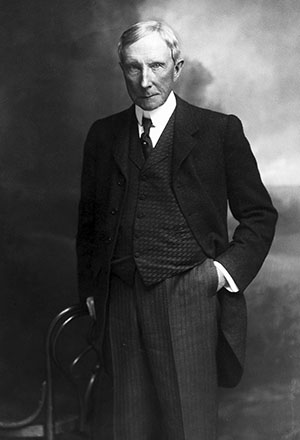
Born in New York, John Davison Rockefeller (1839-1937) was the world’s first billionaire1 (he’d be worth around $13.7 billion in today’s money). As a Republican, Rockefeller supported Abolition, back when southern Democrat-voting industrialists profited from their human property. He was also a Methodist/Baptist Christian who believed that god had made him rich.
In 1864, he founded the grain and produce company, Clark, Rockefeller, & Co., with business partner, Maurice Clark (1827-1901). The company profited from the American Civil War (1861-65)2 and Rockefeller used his money to establish the company that made him his fortune: Standard Oil of California. With notions of the Protestant work ethic and Christian charity, Rockefeller and his employees attempted to craft an image of the family dynasty as philanthropic.
John Davison Rockefeller (1839-1937)
Rockefeller’s various institutes and foundations spawned other entities, including the University of Chicago, the General Education Board, and the eponymous Institute for Medical Research. But diary entries, papers, letters, and memos from the time confirm that the motive was primarily to make the public healthier and more educated in order to get them to work for the businesses in which Rockefeller had invested. By the mid-20th century, it was clear that “philanthropy” was also a massive, legal tax dodge.3
Rockefeller’s profit-making agenda included the promotion of so-called “scientific medicine,” which has now become the norm. Although Rockefeller personally championed natural remedies, including homeopathy, publicly he funded allopathic medicine and was a major cog in the machine that brought America’s medical practices up to Europe’s technological standards. But institutions, be they religious, corporate, or national, are not self-containing. They expand. Rockefeller’s philanthropy was de facto colonialism in countries including China and the Philippines, where the offshoots of his Foundation trained indigenous elites to use Western “scientific medicines” and lessen their traditional, natural cures.
THE FOUNDATION AT HOME: “HEALTH IS PROFITABLE”
Former US President Bill Clinton (in office 1993-2001) says: “The academic study of public health owes its origins to Rockefeller, who financed the earliest programs at institutions like Johns Hopkins and Harvard [Universities].”4
Not all 19th century US physicians had formal qualifications. Founded in 1846-47, the American Medical Association lobbied to ensure that physicians were qualified and trained up to particular standards.5 But the formalisation of healthcare training reinforced the race, gender, and class structure in that females, poor people, and non-whites were typically excluded.6 In addition to producing young, white, male doctors from the middle- and upper-classes, the system also battled natural health in favour of the new “scientific medicine.”7 By contrast, the Popular Health Movement was a natural health lobby which, in the 1850s, sought to remove legal protections for reckless physicians.
Despite Rockefeller’s private belief in homeopathy, one of the effects of his Foundation’s work in medicine was to undermine natural alternatives to chemical prescriptions. The formalisation of GP training led to monopolies. Most medical courses were offered by just three universities: Dartmouth, Harvard, and Pennsylvania.8 As late as the early-20th century, US doctors typically trained in Europe. Rockefeller’s agenda was to bring the US medical profession up to Europe’s standards.9 Rockefeller modelled his health foundation on Berlin’s Koch Institute (founded 1891) and Paris’s Pasteur Institute (1887).
After studying in France and Germany, the American parasitologist, Charles Wardell Stiles (1867-1941), went to work at the Rockefeller Foundation’s forerunner, the Rockefeller Sanitary Commission. Stiles advised on the abdominal disease hookworm, which mainly affected agricultural workers and thus Rockefeller et al.’s profits in his textiles investments. Stiles believed that hookworm caused “some of the proverbial laziness of the poorer classes of the white population.”10
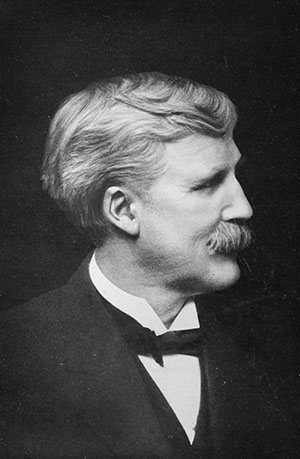
Frederick Taylor Gates (1853-1929)
One of Rockefeller’s main ideologues was the Baptist clergyman, Reverend Frederick Taylor Gates (1853-1929, no relation to Bill). In the capitalist spirit of the age, Gates saw the human body as an amalgam of separate parts, akin to a factory. Gates’s view was that “the great organs of the body like the liver, stomach, pancreas, kidneys, gall bladder, are great local manufacturing centres, formed of groups of cells in infinite number, manufacturing the same sorts of products, just as industries.”11
Gates initially advised Rockefeller’s Standard Oil before promoting the magnate’s health ventures. Gates noted that at any one time, 20 per cent of staff in any given institution was home sick each day and said that “health is found in a variety of ways to be profitable.”12 He objected to the Rockefeller-founded University of Chicago’s 1898 efforts to align with the pro-homeopathy Rush Medical College. After studying in Germany, the bacteriologist and pathologist William H. Welch (1850-1934) co-founded the Johns Hopkins School of Hygiene and Public Health. Gates asked Welch to run the Rockefeller Institute for Medical Research, which by 1928 had received $28m in funding (around $385m today).13
Hookworms are parasitic organisms that live in the abdomen and are typically picked up by affected persons when walking barefoot and consuming soils near to which people have defecated. The roots of the Foundation’s global health hegemony were planted in the American south, where Black agricultural labourers continued to toil in cotton fields.14 The Foundation’s failed efforts to eradicate hookworms nevertheless gave the planners enough confidence that their work could be exported. But their methods sought to integrate foreign traditional healers into “scientific” medical practices.
Historian Angela Matysiak writes that during the 1917 campaign to eradicate hookworm in Brazil, civil society feared that Rockefeller’s International Health Board (IHB) would replace curanderos: natural healers. “To address these tensions, the staff of the IHB in Brazil, Costa Rica, and other countries looked for ways to integrate native healers into public health campaigns.” But Rockefeller opposed domestic natural medicines; at least for the public. For example, it was only when the supply of the drug thymol was disrupted by the First World War (1914-18) that Rockefeller’s IHB gave patients oil of chenopodium (the flower of the goosefoot plant). With zero ethical protocols in place, Rockefeller’s doctors poisoned to death 222 children with the oil between 1914 and 1932, something that natural healers were unlikely to have done.15
ROCKEFELLER ABROAD: “HEALTH HAS ADVANTAGES OVER MACHINE GUNS”
The Rockefeller Foundation established a series of successive health entities to exploit foreign medicines and assimilate other people’s traditional practices into Western-led methods. The International Health Board and its successors spent billions of dollars (tens of billions in today’s money) in over 100 countries, establishing 25 schools and institutes, and sponsoring over 2,500 nurseries.16
The entities included the International Health Commission (1913-16) and International Health Board (a.k.a., Division, 1916-27). At the time, representatives of the global body, the League of Nations, described Rockefeller’s International Health Board as “the only existing truly international agency which is working at present to further constructive work in the domain of public health all over the world.”17 The motives were profit-driven. Rockefeller Foundation President, George E. Vincent (1864-1941), said that when it came to conquering foreigners, public health had “advantages over machine guns.”18 The Philippines International Health Commission visited the Moro tribes and acted, in the words of Foundation officers, as “wedge for permanent civilising influences.”19
After the British Empire’s occupation (circa 1842-1912), but before the economic nationalism of Chairman Mao (1893-1976), US investors sought to exploit China’s huge working population and raw materials. Rockefeller and his successors funded the Peking Union Medical College to the tune of $45m (or half a billion today). Chinese traditional medicine includes but is not limited to acupuncture, cupping, diet, herbs, and qigong. It has been used for thousands of years and is regularly attacked in the West by advocates of Big Pharma. Rockefeller money started the anti-traditional medicine movement in China while taking some of its ideas and products to synthesise them as modern drugs.
For instance, ephedra plants are shrubs that grow in most countries and produce certain green teas. Known in Chinese medicine as ma-huang (right, above), ephedra shrubs have been used for 5,000 years and were first catalogued by Emperor Shen Nung in 2700 BCE.20 The Japanese Professor, Nagayoshi Nagai, isolated ephedrine from the shrub in 1885 to produce synthetic chemicals for blood pressure treatment. The Rockefeller-funded Peking Union Medical College took credit for isolating and synthesising the chemical. The Lancet reports that the College “spread modern medical sciences throughout China.”21
Today, we hear about the dangers of “vaccine nationalism.”22 Russia’s Sputnik V vaccine against Sars-CoV-2 (COVID-19) was demonised by Western media23 before being accepted as >90 per cent efficacious by Western journals.24 The UK’s AstraZeneca-Oxford vaccine was sold to the British public as effective,25 yet several heads of state at the European Union, which is promoting the US-German Pfizer-BioNTech vaccine, publicly cautioned against the UK vaccine.
Vaccine nationalism began with the Rockefeller Foundation. Yellow fever is a deadly (50 per cent death-rate) mosquito-derived, tropical virus.26 Rockefeller’s International Health Board stoked controversy by pointing to side effects in yellow fever vaccines developed by rival institutes, such as the Pasteur Institute, which was operating in France’s colonial subject, Tunisia. Rockefeller’s vaccines were initial failures. The authors of an article on biological history state: “the success of [Rockefeller-]sponsored anti-yellow fever campaigns was obtained through a traditional means: the elimination of the disease’s vector, the mosquito.”27
“Paris Green” was named after its use against rats in the sewers of the famous French capital. It is an arsenic-based toxin that was used as an insecticide. It was mass-produced in New York. The Bulletin of the Industrial Commission reported at the time that “[c]onsiderable illness has been found to exist among many of the workers engaged in this production.” The Department of Labor described it as “a dangerous poison and sickness results from the breathing of air containing it, through broken skin, and through the mouth.”28 The Rockefeller International Health Board experimented in anti-malaria techniques in Brazil, Bulgaria, El Salvador, India, Italy, the Netherlands, Nicaragua, Palestine, the Philippines, and Puerto Rico. The League of Nations argued that sanitation was key to beating disease, but Rockefeller lobbyist and physician Lewis Hackett (1884-1962) argued for the use of “Paris Green.” The International Health Board used its propaganda to promote the results of a dubious, preliminary study in Italy.
One historian writes: “the anti-mosquito strategy… laid the groundwork for the subsequent DDT revolution in malariology.”29 DDT is also a toxin trialled by the US Typhus Commission. During the Second World War (1939-45), the Rockefeller Foundation’s health institutes tested DDT on German and Italian prisoners of war, as well as on Algerian inmates before heralding DDT operations a success in Sardinia.30
Rockefeller’s motives for eradicating mosquitos are exemplified by the case of Mexico. Disease historians note that the yellow fever virus mainly affected the nation’s shipping ports that were crucial for US corporate profits, including Rockefeller’s Standard Oil. The company relied on the malaria-ridden port of Veracruz.31 In addition to using poison to blitz mosquitos to clear ports for profit, the Foundation used its eugenics ideas to encourage Mexican women to produce “strong” babies that could grow into healthy workers.32
After WWII, the Foundation lost its direction. The so-called third world became a battleground between US imperialism and Soviet dominance, with the Rockefeller Foundation struggling to design an internationalist, post-War policy. The giant, US, post-War machine referred to by future President Dwight D. Eisenhower as the “military-industrial complex” meant that research grants were awarded through the government’s National Science Foundation, making Rockefeller money less immediately appealing to young researchers. The Rockefeller Foundation initially succeeded by funding the shift in research from chemistry to biology, particularly the study of proteins for vaccination. “That decision has been widely viewed as stimulating the rise of the new field of molecular biology.” What began as schools for research turned into captive instruments that awarded funding for clear proposals, not for theoretical research. But theoretical research is where major breakthroughs tend to occur.33
The founding of the World Health Organization in 1948 coincided with the dissolution of the Rockefeller Foundation’s International Health Board, which was subsumed into the Division of Medicine and Public Health in 1951.34 The Rockefeller Foundation failed to make the shift from protein to DNA research and lost ground to big biotech firms, like Monsanto (now Bayer). But cultural changes began to take shape.
The Foundation started out taking natural plants from traditional medicine practitioners and using them to promote synthetic pharmaceuticals. But, having been part of the mechanisms that destroy the world with their interests in oil, banking, and pesticides, the Rockefellers have now seen profit-potential in solutions to the problems they allegedly helped to create. In more recent years, the Foundation and Rockefeller’s successors have come to recognise the value of naturopathy.
A few years ago, scientists contrived a new epoch: the Anthropocene. In the Anthropocene, the dominant species causing potentially irreversible destruction to the planet’s ecosystem is the human. The Rockefeller Foundation and The Lancet published a report stating: “Far-reaching changes to the structure and function of the Earth’s natural systems represent a growing threat to human health.”
Having gone from seeing the human body as a factory comprised of separate parts in the 19th century and promoting molecular biology to stimulate biotech profits in the 20th, the Foundation now decries “an increasingly molecular approach to medicine, which ignores social and environmental context.”35
Sometimes, the parasitic greed of the ruling classes destroys the host, in this case the planet, forcing our “betters” to modify their propaganda in the new ages they contrive.
[alert type=”general” dismiss=”no”]This article was published in New Dawn 186.[/alert]
[alert type=”success” dismiss=”no”]If you appreciate this article, please consider subscribing to help maintain this website.[/alert]
Footnotes
1. Natalie Burclaff, “Rockefeller: Making of a Billionaire,” Inside Adams Science, Technology and Business, Library of Congress, 14 January 2020, https://blogs.loc.gov/inside_adams/2020/01/rockefeller-billionaire
2. Ron Chernow (1998) Titan: The Life of John D. Rockefeller, London: Random House, 25-31
3. Berrien C. Eaton (1949) “Charitable Foundations, Tax Avoidance and Business Expediency,” Virginia Law Review, 35(7): 809-61
4. Bill Clinton, “Introduction” in Eric John Abrahamson (2013) Beyond Charity: A Century of Philanthropic Innovation, New York: Rockefeller Foundation, 23
5. American Medical Association, “AMA history,” no date, www.ama-assn.org/about/ama-history/ama-history
6. Robert B. Baker (2014) “The American Medical Association and Race,” American Medical As-sociation Journal of Ethics, 16(6): 479-88
7. J.T.H.J. Dekkers (2009) What about Homeopathy? A comparative investigation into the causes of current popularity of homeopathy in The USA, The UK, India and The Netherlands, Master’s thesis, University of Utrecht, 20-24, https://dspace.library.uu.nl/bitstream/handle/1874/35695/ScriptieJorisDekkers.pdf
8. Robert G. Slawson (2012) “Medical Training in the United States Prior to the Civil War,” Journal of Evidence-Based Complementary and Alternative Medicine, 17(1): 11-27
9. J. Andrew Mendelsohn (2002) “‘Like All That Lives’: Biology, Medicine and Bacteria in the Age of Pasteur and Koch,” History and Philosophy of the Life Sciences, 24(1): 3-36
10. Quoted in E. Richard Brown (1980) Rockefeller Medicine Men: Medicine and Capitalism in America, Berkeley: University of California, 115-16
11. Quoted in Brown, op. cit., 120
12. Quoted in Brown, op. cit., 113
13. Brown, op. cit., 105
14. Centers for Disease Control and Prevention (US), “Hookworm FAQs,” no date, www.cdc.gov/parasites/hookworm/gen_info/faqs.html
15. Angela Matysiak (2014) Health and Well-Being: Science, Medical Education, and Public Health, New York: Rockefeller Foundation, 59-75
16. A.E. Birn (2014) “Backstage: the relationship between the Rockefeller Foundation and the World Health Organization, Part I: 1940s-1960s,” Public Health, 128: 129-40
17. Ilana Löwy and Patrick Zylberman (2000) “Medicine as a Social Instrument: Rockefeller Foundation, 1913–45,” Studies in History and Philosophy of Biological and Biomedical Sciences, 31(3): 365-79
18. Quoted in Brown, op. cit., 124
19. Quoted in Brown, op. cit., 124
20. M.R. Lee (2011) “The history of Ephedra (ma-huang),” Journal of the Royal College of Physicians of Edinburgh, 41: 78-84
21. Editorial (2014) “China Medical Board: a century of Rockefeller health philanthropy,” The Lancet, 384: 717-19
22. United Nations News, “WHO chief warns against COVID-19 ‘vaccine nationalism’, urges support for fair access,” 18 August 2020, https://news.un.org/en/story/2020/08/1070422
23. One of many: Denise Chow, “‘Reckless and foolish’: Why Russia’s vaccine has experts alarmed,” NBC News, 11 August 2020, www.nbcnews.com/science/science-news/reckless-foolish-why-russia-s-vaccine-has-experts-alarmed-n1236466
24. Ian Jones and Polly Roy (2021) “Sputnik V COVID-19 vaccine candidate appears safe and effective,” The Lancet, 2 February 2021, https://doi.org/10.1016/S0140-6736(21)00191-4
25. Maria Deloria Knoll and Chizoba Wonodi (2020) “Oxford–AstraZeneca COVID-19 vaccine efficacy,” The Lancet, 397(10269): 72-74
26. World Health Organization, “Yellow fever,” 7 May 2019, www.who.int/news-room/fact-sheets/detail/yellow-fever
27. Löwy and Zylberman, op. cit.
28. Monthly Review of the U.S. Bureau of Labor Statistics, “Dangers in the Manufacture of Paris Green and Scheele’s Green,” 5(2): 78-83
29. Darwin H. Stapleton (2004) “Lessons of History? Anti-Malaria Strategies of the International Health Board and the Rockefeller Foundation from the 1920s to the Era of DDT,” Public Health Reports, 119(2): 206-15
30. Ibid.
31. Andrew L. Knaut (1997) “Yellow Fever and the Late Colonial Public Health Response in the Port of Veracruz,” Hispanic American Historical Review, 77(4): 619-44
32. Linnete Manrique (2016) “Dreaming of a cosmic race: José Vasconcelos and the politics of race in Mexico, 1920s–1930s,” Cogent Arts & Humanities, 3(1218316): 1-2, 11n5
33. P. G. Abir-Am (2010) “The Rockefeller Foundation and the Post-WW2 Transnational Ecology of Science Policy: from Solitary Splendor in the Inter-war Era to a ‘Me Too’ Agenda in the 1950s,” Cenataurus, 52: 323-37
34. Rockefeller Foundation, “International Health Division,” Archive, https://rockfound.rockarch.org/international-health-division
35. Sarah Whitmee et al. (2015) “Safeguarding human health in the Anthropocene epoch: report of The Rockefeller Foundation–Lancet Commission on planetary health,” The Lancet, 386: 1973-2028
In Nineteen Eighty-Four, George Orwell described three competing tyrannies: Oceania, Eastasia, and Eurasia. As the great powers fight endless wars (or so their publics are told), the domestic population of Oceania is suppressed by Big Brother’s omniscient surveillance, the Ministry of Truth’s dictation of reality, and the compliance of the public, who report any dissent to the ruling Ingsoc party. It has long been a cliché to say that we live in Orwellian times.
The first Cold War lasted roughly from 1945 to 1991, with the collapse of the Soviet Union. The second began in 2000 with the election of Russia’s President Vladimir Putin and continues to the present. Examples of events that support a Cold War 2.0 hypothesis include proxy wars on Russia’s borders (Ukraine) and against its allies (Syria), as well as accusations that Russia is interfering in Euro-American politics (election hacking). The mounting war against China can either be seen as part of the overall nexus of Cold War 2.0, perhaps Cold War 2.1, or as a Cold War 3 with an entirely different set of dynamics. For instance, blaming China for the Covid virus is far more serious than accusing Russia of meddling in foreign elections.
Covid has been used as an excuse by both the US administrative state and the Chinese CCP to push ahead with their respective agendas. The Euro-American plan is called The Great Reset, a World Economic Forum (WEF) initiated project that envisages a major restructuring of the so-called capitalist order to pre-empt revolution by the disenfranchised. China’s long-term plan is the Belt and Road: a series of investment and infrastructure projects across neighbouring states designed to build literal bridges to lucrative trade with Europe via Central Asia. As the WEF wants to “Build Back Better,” emphasising health data and green technologies, China wants to update the Belt and Road with next-generation climate infrastructure. Generally, these developments are known as the Fourth Industrial Revolution.
Echoing the British colonialists of bygone centuries, US President Jimmy Carter’s National Security Advisor, the late Zbigniew Brzezinski – whose daughter Mika co-hosts a show on MSNBC (an example of the permanent administrative state) – wrote a book about geopolitics entitled The Grand Chessboard. Just as 9/11 put “the pieces… in flux,” as Britain’s then-Prime Minister Tony Blair said, Covid-19 has shaken the chessboard. The pieces are being reset by the major US financial institutions and tech oligarchs. As they seek to crack China’s lucrative, highly populated, data-driven economy, China in the eyes of many – like war-hawk Steven Bannon – seeks to subvert American institutions by stealing intellectual property and funding its cultural programmes under the pretext of outreach projects.
This article examines some of the contours of the new world order and its impact on ordinary working people.
LOSING CHINA, BUILDING A PERMANENT WAR ECONOMY
After World War II, the US built a perpetual war machine to conquer the world (“full spectrum dominance” the military later called it) and stimulate research and development science and technology that could create a new economy.
In his farewell address, US President Dwight D. Eisenhower famously described this arrangement as the “military-industrial complex,” under which nuclear energy emerged from US-led atomic weapons development at Los Alamos. Climate science owes its origins to the Pentagon’s ILLIAC IV supercomputer. Modern PCs and Macs take their blueprints from systems developed by the Department of Defense, as does the internet – originally developed under Raytheon contracts with the Advanced Research Projects Agency. The satellites that allow for instantaneous global communications were originally built for the armed forces’ missile guidance systems and surveillance. The cargo ships that transport goods and materials from the third to first worlds are based on designs culled from naval destroyers, just as the jet aeroplanes that transport hundreds of millions of people around the world take their designs from WWII-era bomber planes. The GPS systems that guide such logistics also come from military R&D, as do the touchscreens on iPhones and iPads: touchscreens being originally designed for Air Force pilots. And on and on it goes.
Crucially, these technologies became the very instruments of oppression in “democratic” America and the West generally, as the US National Security Agency used computers, the internet, and satellite signals intelligence to spy on its own citizens, and indeed the world, via the Five Eyes network. Declassified State Department and CIA reports reveal that the main US interest in China was preventing a Sino-Soviet alliance that would create the kind of unified, anti-US “communist” super-region envisaged in Orwell’s Nineteen Eighty-Four.
During World War II, Formosa (now Taiwan) was under the occupation of fascist Japan. Between 1945 and 1949, when the Chinese Communist Party fought a civil war to overthrow the ruling Kuomintang, US administrations gave $2bn ($14bn in today’s money) of taxpayer money to the latter. The geostrategic importance of Taiwan was considered to be of utmost importance to the US military because of Taiwan’s potential to host US military bases. After their defeat, the Kuomintang based themselves in Taiwan where they ruled until the 1990s. The US agreed at the Cairo Conference (1943) that Taiwan belonged to China but backtracked in an effort to use Taiwanese sovereignty as a strategic weapon against the CCP. American commentators refer to the CCP victory over the Kuomintang as the “loss of China.” But US fears that China would become a Soviet puppet were unfounded.
There is little to suggest that the US directly involved itself in Chinese affairs until the Nixon administration visited in 1972. Major progress from the US corporate perspective was made after the death of Mao (1976), who was replaced by Deng Xiaoping. The CIA already had an eye on Deng as a counterweight to the Soviets. In 1979, Deng began a series of “reforms.” Mao’s rural collectivism came to an end when the US-led International Monetary Fund issued loans that were serviced, in part, by the expansion of private landlords. Major infrastructure projects triggered mass migration from the rural to new urban areas. The process of privatising China’s healthcare system was initiated, creating what US drug companies called a “China market,” which included flooding the country with the antibiotics that have now caused a global bacteriological resistance crisis.
In 2001, China joined the World Trade Organization (WTO). Many US exports assembled in Mexico and other countries by inexpensive, exploitable labour went to China instead. Pointing to the numbers, some argue that America’s economic decline is a myth. The share of China’s state-owned enterprises in the processing and assembly sectors declined from 40% in 1995 to 6% in 2015, meanwhile 60 per cent of China’s assembly economy is controlled by foreign corporations, like Apple: the world’s first trillion-dollar company. Because US companies own the intellectual property rights to the products they have assembled on the cheap in China, it is the US companies, not the Chinese assembly plants, that make most of the profits.
China aims to redress the imbalance via a domestic production and design initiative called China 2025 that will grow over the next century. The US Council on Foreign Relations has already reacted by asking whether it will negatively impact global trade, which translates as hurt US corporate profits. Empires, be they national or corporate or mixtures of the two, hate competition.
CHINA RESISTS
But China never fully yielded to US corporate demands. In addition to joining the WTO, it forged international pacts, trade deals, and alliances. In 1991, China joined the Asia-Pacific Economic Cooperation group (APEC). China is not a member of the Association of Southeast Asian Nations (ASEAN) but has associate status through various treaties. One of which is the ASEAN-China Free Trade Area signed in 2002. Members include Brunei, Cambodia, Indonesia, Laos, Malaysia, Myanmar, Philippines, Singapore, Thailand and Vietnam.
In 2001, China, Kazakhstan, Kyrgyzstan, Russia, and Tajikistan formed the Shanghai Cooperation Organization (SCO). In 2017, both India and its enemy Pakistan joined SCO. The project is designed to integrate countries in the region, cooperate on military affairs, and expand infrastructure projects. In 2006, the APEC states entered into negotiating the Free Trade Area of the Asia-Pacific (FTAAP). At the ASEAN Summit in Cambodia 2012, several countries entered into negotiations with China for a Regional Comprehensive Economic Partnership (RCEP). The agreement created one of the biggest economies in the world ($49.5 trillion) and included 3.4bn people.
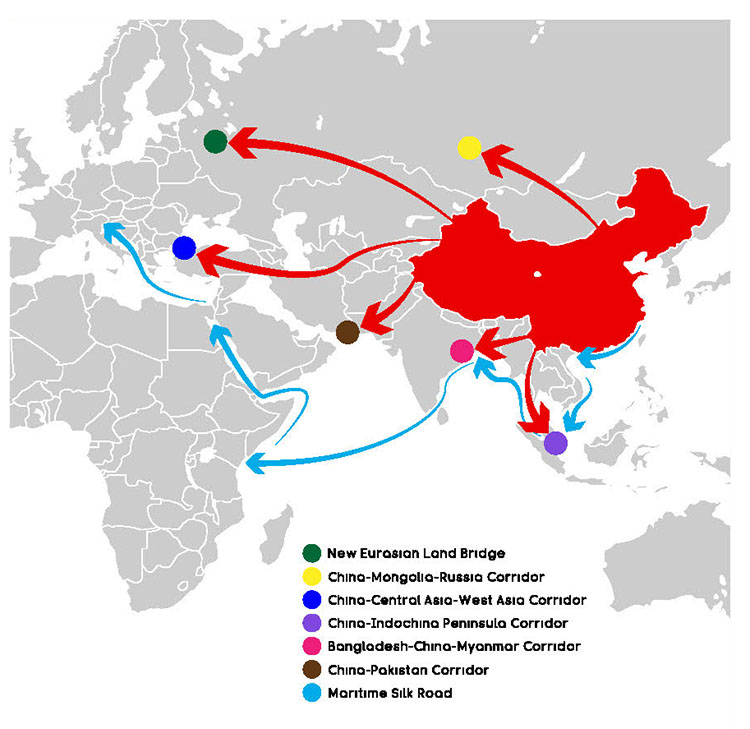
In 2013, President Xi Jinping announced China’s new Silk Road Economic Belt (“Belt and Road Initiative”) in a speech delivered in Kazakhstan. The professed aim is to foster economic trade and cultural cooperation across Eurasia and Southeast Asia. This is a rival to America’s Silk Road Strategy Act 1999, which sought to absorb some of the ex-Soviet states into the “free market”: Armenia, Azerbaijan, Georgia, Kazakhstan, Kyrgyzstan, Tajikistan, Turkmenistan, and Uzbekistan. In 2011, having occupied Afghanistan (a key route along the “Silk Road”) for a decade, US President Barack Obama announced a New Silk Road of America to capture “South Asia’s… population of more than 1.6 billion,” including its “vast energy resources – including oil, gas, and hydropower.”
After 9/11, US government initiatives expanded the R&D-based economy of computers, internet, GPS, etc. to hi-tech and big data. The CIA seed-funded what became Google. Google Maps started life as the CIA’s EarthViewer. The kind of massive data gathering, analysis, sharing, and cybersecurity engaged in by the NSA and other Western intelligence agencies is similar to how tech firms gather blanket data on consumers and sell them to advertisers and brokers. After the millennium, the CCP began constraining some US corporate influence in China, particularly reversing its healthcare privatisation and copying US e-commerce. Where the US has Google, China has Baidu. Where China has Alibaba, America has Amazon.
Like the US, China also started using public money to create a new biotech economy, which will soon be linked to big data. Under its “full spectrum dominance” doctrine, the US is continuing its “dual-use” policy, in which touchscreens that work for the Air Force, for instance, are adapted to commercial iPhones. The phones that allow for personal and business communications also have backdoor technologies that allow the NSA to snoop on private citizens. China recently developed a similar doctrine called “fusion.”
BUILD BACK BETTER VS. BELT AND ROAD
World War II created the military-industrial complex that gave us computers etc. September 11 ballooned the military-intelligence establishment that gave us Total Information Awareness (TIA) and big data. Covid-19 has accelerated the trend towards the merging of the military-industrial complex (infrastructure), the military-intelligence establishment (TIA and big data), and the military-corporate-biotech complex that collects, analyses, modifies, and sells genetic and medical information for profit and social control.
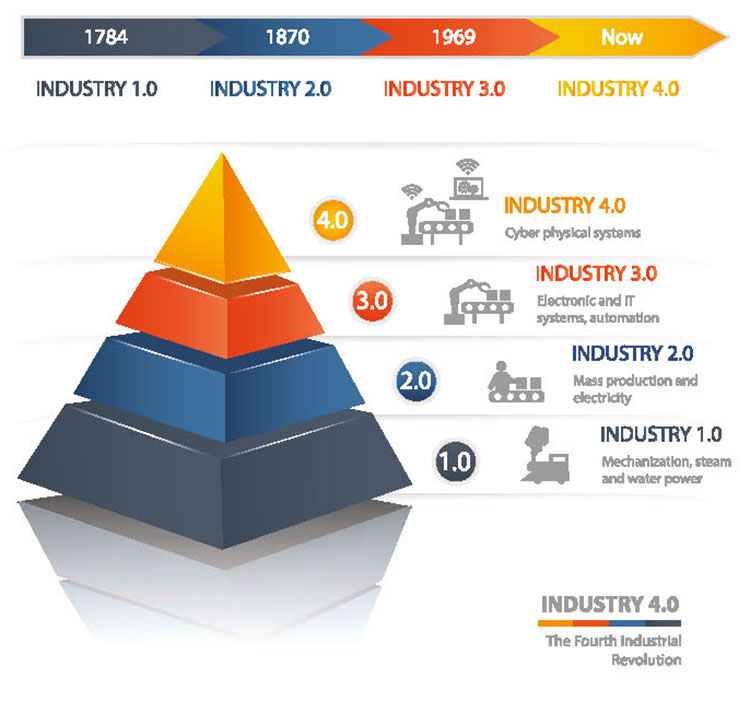
“We stand on the brink of a technological revolution that will fundamentally alter the way we live, work, and relate to one another,” said Klaus Schwab, founder of the World Economic Forum (WEF), in 2016. WEF is the annual meeting of the Global Power Elite: academics, asset managers, big tech, energy magnates, inventors, investors, the pharmaceutical industry, and politicians. Schwab was talking about the Fourth Industrial Revolution or Industry 4.0. The First Industrial Revolution was mechanic, the Second electric, the Third automated, the Fourth “is characterised by a fusion of technologies that is blurring the lines between the physical, digital, and biological spheres.”
The technologies that constitute Industry 4.0 include “artificial intelligence, robotics, the Internet of Things, autonomous vehicles, 3-D printing, nanotechnology, biotechnology, materials science, energy storage, and quantum computing.” But monopolies and the military-intelligence-complex control these technologies. “Engineers, designers, and architects are combining computational design, additive manufacturing, materials engineering, and synthetic biology to pioneer a symbiosis between microorganisms, our bodies, the products we consume, and even the buildings we inhabit.” The pandemic gave promoters of Industry 4.0 the perfect opportunity to accelerate their agenda: funding for big pharma, the integration of nanotech with therapeutics, tracking apps synched to geo-locational data as vaccine passports, and more.
Schwab co-authored a book subtitled The Great Reset with the economist Thierry Malleret. They state: “In the post-pandemic era, COVID-19 might be remembered as the turning point that ushered in a ‘new type of cold war’.” The novelty, according to the authors, is that China is not attempting to force its ideology on the world, unlike, they claim, the Soviet Union. “The absolute prerequisite for a proper reset is greater collaboration and cooperation within and between countries.”
The goal of the WEF is not to get rid of the “capitalist” system that they acknowledge had created unprecedented inequality. Rather Build Back Better (B3) will be a way of “future-proofing capitalism,” from demographic changes, revolutions opposing inequality, and push-backs against corporate globalisation. “Despite the tragedy, we must leverage the COVID-19 pandemic, and make sure that it becomes the catalyst for a profoundly positive transformation of the global economy, taking us closer to a world in which everyone can live well, within planetary boundaries.”
Around the same time as the B3 announcement, governments in the West launched what we are supposed to believe are identical initiatives for their supposedly sovereign states. US President Biden announced that – with the kind of fiscal stimulus and state economic planning that he and his Democratic Wall Street puppeteers could have introduced forty years ago – he will “rebuild an economy where every American enjoys a fair return for their work and an equal chance to get ahead.” But B3 will exacerbate the very class divisions that WEF claims to want to reduce. B3 focuses on the middle, not lower, working, or destitute classes. B3 includes the American Families Plan, “an ambitious, once-in-a-generation investment to rebuild the middle class and invest in America’s future.”
It turns out that B3 was part of the Build Back Better World Partnership (B3W), described by the White House. “Through B3W, the G7 and other like-minded partners will coordinate in mobilising private-sector capital in four areas of focus – climate, health and health security, digital technology, and gender equity and equality – with catalytic investments from our respective development finance institutions.” Voice of America (VOA), which used to be – and maybe still is – funded by the CIA, reports that B3W was “presented by Biden as an explicit challenge to China.” VOA notes that B3W’s focus on “climate, health and health security, digital technology, and gender equity and equality… are not really in direct competition with much of what China has been doing through the Belt and Road program.”
Like Western countries, the CCP has also used Covid to accelerate elements of its Belt and Road Initiative (BRI). Over 60 per cent of BRI has been affected by the pandemic. Chinese lenders could face losses in third countries. BRI is shifting instead to the Digital, Green, and Health Silk Roads (as the CCP calls them) of data, environment, and vaccines. The CCP also introduced a dual circulation concept, in which any foreign investment should yield returns for Chinese consumers.
US corporations are pre-empting the “dual circulation” model by tapping into China’s demographically-stalling mega-population of 1.4 billion people. Chinese workers tend to have higher relative personal savings than Westerners, particularly with their wealth tied into property. China’s asset management market is worth an estimated $18.9 trillion (Rmb121.6 trillion). The wealth is locked up in the older generations who are beginning to outnumber the young. Asset firms and private equity companies, such as BlackRock and the financial arms of Goldman Sachs and JPMorgan, are accessing personal wealth as investments and portfolio boosters.
Goldman has partnered with the state-owned Industrial and Commercial Bank of China. The deal could allow the Wall Street firm to draw on the savings of hundreds of millions of the bank’s Chinese customers. BlackRock has partnered with the China Construction Bank, and JPMorgan Asset Management will invest $415m in the China Merchants Bank. To quote the Financial Times: “some investors say the biggest risk is not getting into China quickly enough.”
THE END OF PERSONAL SOVEREIGNTY
Build Back Better following the Great Reset triggered by Covid will lock big data and finance monopolies into the very infrastructure of town and city plans, health and elder-care providers, the Internet of Things, and increasingly intimate surveillance: the Big Brother of Orwell’s novel. Growing numbers of workers will programme apps from their “homes”: tiny, barely-affordable studio apartments for the renting young, and small mortgaged houses for the middle-aged, middle-class. The real wealth is owned by the likes of BlackRock through investments in land, social infrastructure, and even private health and genomic data.
We’ve heard of the “new normal,” but the WEF introduces the “next normal,” in which the “everything from home” concept confines humans to cell-like dwellings where necessities and luxuries are delivered to the door by robots and humans in the precarious proletariat class (“precariat”). “Work from anywhere” connects the human to endless labour, destroying the boundary between work and leisure. The so-called “integrated response” to health will see private data shared among academics and big data firms. The concept of free healthcare vanishes in a fog of privatisation. To prevent flights to the rural areas where the elites live in mansions and keep property prices high by owning huge tracts, hyperconnectivity will keep “talent” attracted to megacities like New York and Tokyo.
With the headline, “The Drones Were Ready for This Moment,” the New York Times (NYT) sings the praises of autonomous and semi-autonomous vehicles during the pandemic. Smaller versions of the drones that blow children to pieces in the Middle East can enforce pandemic laws, but they can also deliver products to the new “everything from home” class. Companies like San Francisco’s Zipline used the crisis as an opportunity to deliver medicines by drone to self-isolating patients. Echoing earlier observations, the NYT piece notes: “Just as World War II hurried the development of emerging technologies like computers, rocketry, jet aircraft and atomic energy, the pandemic may speed the development, and adoption of, drone technology.”
Much of the above was pioneered in China, so when Wuhan was locked down in early-2020, e-commerce and home-delivery companies already had their logistics coordinated.
At the start of the pandemic, the monopolies Amazon, Google, and Facebook coordinated their data-sharing responses with the World Health Organization. Civil servants, frontline workers, and private employees alike have been obliged by various agencies, governments, and corporations to download health apps onto their phones in order to upload and receive data on their Covid and vaccination statuses, as well as provide their geolocation info to employers, leisure and hospitality services, and federal authorities. This has created a huge private-sector telemedicine/tracking market.
Another dystopian trend hastened by Covid is data brokerage. Since the mid-2010s, the industry has “expanded aggressively in what amounted to a virtual regulatory vacuum,” to quote the Financial Times. By 2020, the industry was worth $200bn. The brokers tracking as much of your life as possible to sell your data to advertisers and insurers include Acxiom, Corelogic, Experian, Equifax, and Nielsen. Guarded by blockchain, wearable health trackers – like watches – coupled with real-time Covid-status monitoring apps synchronised to central healthcare databases could feed intimate information about smart city dwellers.
As the US and China employ the so-called soft power of investment and hi-tech to absorb states in their respective spheres of orbit, the internal control over their populations increases. One of the most sinister, recent developments is the creation of a market for your very DNA. Biotech giants have been patenting the genes of life for five decades. In more recent years, ancestry tracing companies have acclimatised us to yielding our most intimate and wide-reaching genetic materials: the very keys to our existence. As we have seen with gain-of-function and vaccine research, such technologies can be essentially weaponised to create super-viruses. The other application for this new era of research is selling genomic data to big pharma, big data, and credit brokers.
Companies like 23&Me analyse customer’s genetic information to screen their clients for diseases. Big pharma is keen to access such information. One report notes of GlaxoSmithKline: “GSK invested $300 million in 23&Me for an exclusive license to their informational database.” It concludes: “The race is now on to gather large biological and clinical datasets with China and the UK sequencing significant cohorts in their population.” The US, too, of course.
A scene from the film version of Orwell’s novel Nineteen Eighty-Four. Winston Smith (played by actor John Hurt) works while under the watchful eye of Ingsoc’s ‘Big Brother’ telescreen. Human existence under the Fourth Industrial Revolution may be one of constant remote monitoring and trustworthiness scores.
In Nineteen Eighty-Four, the antihero Winston Smith thinks that he has evaded Big Brother and broken his employer the Ministry of Truth’s conditioning. But the all-encompassing environment in which he is conditioned proves too overpowering. With internal rebellions in the form of freedom of thought pulverised by the party, Ingsoc remains unopposed in its endless quest to demonise Eurasia and Eastasia led by regimes that, if they exist, also demonise Oceania to justify the internal repression of their own peoples.
Orwell’s book is an apt metaphor for the present geopolitical struggle and related expansion of the Fourth Industrial Revolution on both sides. Industry 4.0 requires all populations to be held prisoner under a long-planned agenda called “full-spectrum dominance.” The question is: are some strong enough to resist, or will we all meet the same fate as Mr Smith?
[alert type=”success” dismiss=”no”]If you appreciate this article, please consider subscribing to help maintain this website.[/alert]
Footnotes
1. George Orwell, Nineteen Eighty-Four, 1949, Secker & Warburg
2. Joseph Smith (1997, 2nd) The Cold War: 1945-1991, Wiley
3. The UN Secretary-General, António Guterres, does not date Cold War 2.0 but stated: “The cold war is back – with a vengeance, but with a difference. The mechanisms and the safeguards to manage the risks of escalation that existed in the past no longer seem to be present.” UN, 13 April 2018, SG/SM/18986-SC/13294
4. Kees van der Pijl (2018) Flight MH17, Ukraine and the New Cold War: Prism of Disaster, Manchester University Press
5. Dmitri Trenin, “The New Cold War Is Boiling Over in Syria,” Foreign Policy, 14 April 2018
6. Kathleen Hall Jamieson (2018) Cyberwar: How Russian Hackers and Trolls Helped Elect a President: What We Don’t, Can’t, and Do Know, Oxford University Press
7. Few have said Cold War 3, but plenty have said Cold War 2.0, which means simultaneous Cold Wars with Russia. For the latter, see, for instance: Ken Dilanian, “As the U.S. and China spar on the world stage, Cold War 2.0 may already have begun,” NBC News, 15 July 2020
8. Quoted in Andrew Tyrie, “The road to anarchy,” Guardian, 6 November 2001
12. Hercules E. Haralambides (2019) “Gigantism in container shipping, ports and global logistics: a time-lapse into the future,” Maritime Economics and Logistics, 21(1): 1-60
13. Stephen Dowling, “The Boeing 747: The plane that shrank the world,” BBC Future, 28 September 2018
14. Mariana Mazzucato, “A strong industrial strategy has many benefits,” Financial Times, 1 December 2016
15. Anthony R. Wells (2020) Between Five Eyes: 50 Years of Intelligence Sharing, Casemate Publishing
16. Binghui Liao, David Der-wei Wang and Dewei Wang (2006) Taiwan Under Japanese Colonial Rule, 1895-1945: History, Culture, Memory, Columbia University Press
17. Cited and quoted in Russell D. Buhite (1978) “‘Major Interests’: American Policy toward China, Taiwan, and Korea, 1945-1950,” Pacific Historical Review, 47(3): 425-51
18. www.cia.gov/readingroom/docs/polo-34.pdf
19. Chao Hsiang-ke and Lin Hsiao-ting (2011) “Beyond the carrot and stick: the political economy of US military aid to China, 1945–1951,” Journal of Modern Chinese History, 5(2): 199-216
21. See my President Trump, Inc.: How Big Business and Neoliberalism Empower Populism and the Far-Right, Clairview Books, 139
22. See my Capitalism and Coronavirus: How Institutionalized Greed Turned a Crisis Into a Catastrophe (2020), Ursa Major
23. See my Privatized Planet: “Free Trade” as a Weapon Against Democracy, Healthcare and the Environment, 2019, New Internationalist.
24. Ibid.
25. Ibid.
26. Ibid.
27. Nafeez Ahmed, “How the CIA made Google,” Insurge Intelligence, 22 January 2015, https://medium.com/insurge-intelligence/how-the-cia-made-google-e836451a959e
28. Leanna Garfield, “The CIA’s EarthViewer was basically the original Google Earth,” Business Insider, 30 December 2015