New Dawn – World's Most Unusual Magazine

Author: David Jones

  • Are We Food for the Moon?

    Are We Food for the Moon?

    From New Dawn 96 (May-June 2006)

    If man is not affected in some way by the Moon, he is the only thing on Earth that isn’t.
    – Robert Millikan (1868-1953), US physicist & 1923 Nobel Prize winner

    Probably no heavenly body has received as much attention down through the ages as our Moon. The causes of this fascination are obvious: the Moon enlightens the night and appears as a remarkable and large object in the sky. As a regulator of Earth’s tides and life’s biological cycles, the Moon’s importance to our physical existence is second only to that of the Sun.

    Sacred scriptures, ancient myths, and even modern day pagans, all exalt the Moon in one way or another. Omens, spells, wishes, oracles, divination, and calendars cluster around it throughout history. Moon magic, the belief that working rituals at the time of different phases of the Moon brings about physical or psychological changes, is essential to various pagan and witchcraft systems. Witches in Greek and Roman literature were regularly accused of ‘drawing down the Moon’ by use of a magic spell.

    Nevill Drury, a respected authority on mystical and occult traditions, says “traditionally… the Moon has been regarded as a ‘funnel’ drawing on the light of the stars and constellations and transmitting their energies to the Earth.”1

    In Western astrology the Moon is said to represent the feeling intuitive nature of the individual as well our deepest personal needs, our basic habits and reactions, and our unconscious. In esoteric astrology the Moon represents attachment to form, and under certain circumstances a variety of limiting conditions are related to the Moon, ranging from blatant materialism to subtler forms of limitation such as debilitating nostalgia, sentiment and regret.

    The word “lunacy” – which derives from the Latin for Moon, “luna” – denotes the traditional link made in folklore between madness and the phases of the Moon. Several studies have tried to get to the bottom of this age-old belief. A 1976 report compared 34,318 crimes against lunar cycles. It found offences occurred more frequently during a full Moon. Other research, however, failed to find any firm link between the cycles of the Moon and irrational behaviour.

    England’s Lunacy Act of 1842 gave allowances for uncharacteristic crimes committed during the full and new Moon. This law distinguished between the chronically insane and the lunatic. It was argued the lunatic became deranged at these times because of the Moon’s power and thus could not be held accountable for his or her actions.

    Interestingly, a study of the Moon’s effect on mental health patients, conducted by the University of Liverpool in 2000, found a significant change at the time of the full Moon, but only in subjects with a diagnosis of schizophrenia.

    Whether we are conscious of it or not, the Moon exerts some sort of influence upon our biological and psychological states. But does it go any deeper than this?

    Gurdjieff and Ouspensky

    The Fourth Way philosophy claims to help individuals cease to be slaves of external and internal influences by building up a core of heightened consciousness. Its ultimate goal is the realisation of the full potential of human evolutionary possibilities. Its founder, George Gurdjieff (1872-1949), frequently spoke of the thoughtless mechanical behaviour of humanity, and was fond of commenting humans are “food for the Moon.”

    What did Gurdjieff mean by this phrase? Many interpreted “food for the Moon” as a figure of speech – perhaps Gurdjieff meant we are slave to our mechanical conditioning and feed our baser impulses. But while it can be interpreted in this fashion, Gurdjieff was primarily being literal.

    Peter Ouspensky, Gurdjieff’s most famous disciple, lectured at length concerning the Moon’s role in human affairs and its place in the cosmological scheme of things.

    Ouspensky said the Moon drives the individual’s mechanical aspects like a pendulum moves the gears of a clock. The degree to which one’s actions are driven by the Moon is proportional to one’s level of contact with higher influences. For people incapable of moving themselves through life by nobler spiritual impulses, the Moon provides a propulsive force. Without this force, mechanical individuals would be passive as puppets without a puppeteer.

    In the cosmological scheme proposed by Gurdjieff and Ouspensky, Earth is like a mother to the Moon which is still a fetus in the sense it cannot yet “breathe” on its own, hold an atmosphere, or support life. Someday, the Earth will evolve into a being like the Sun, while the Moon will transform into a second Earth. Humanity was simply a stage in this process.

    “The Moon is actually a fragment of this Earth, which must now constantly maintain the Moon’s existence,” Gurdjieff said.2 In that sense, the Moon is like a parasitic thought form. Nevertheless, the equation is balanced because in exchange for the Moon propelling our mechanical movement, we feed the Moon so that it may grow and one day be born as a living planet.

    As to how organic life feeds the Moon, Gurdjieff taught that most human beings are mere “slugs” with no souls and that following death their remaining psychic energy is “food for the Moon.” Like a magnet, the Moon draws the fine matter of human souls into it: “Everything living on the Earth, people, animals, plants, is food for the Moon. The Moon is a huge living being feeding upon all that lives and grows on the Earth.”

    Only through an intensive effort of conscious evolution – what he called “self-remembering” – was it possible for an individual to escape being eaten by the Moon. “The liberation that comes with the growth of mental powers and faculties is liberation from the Moon.” Gurdjieff always maintained Man is not truly conscious, and his actions are entirely mechanical: “Everything ‘happens,’ he cannot ‘do’ anything. He is a machine controlled by accidental shocks from outside.”

    To escape these deleterious lunar influences, Ouspensky said we must “create Moon within ourselves.”3 By this he meant we must develop within a driving mechanism that takes the place of the external lunar influence; in this way we can break free of the puppeteer.

    Boris Mouravieff, who was an associate of both Gurdjieff and Ouspensky, formulated an esoteric system for spiritual evolution founded upon the inner traditions of Eastern Orthodoxy and Fourth Way principles. His extensive three volume work, Gnosis, deals extensively with the question of lunar influences and spiritual development.

    He concurs with Gurdjieff and Ouspensky on the role of the Moon, but also warns “that organic life functions as a transmitter station sending refined energy to the Moon to assist its growth. Despite increases in the human population and thus an increase in quantity of energy transferred, times of peace do not produce sufficient energy and so catalysts for suffering such as wars and catastrophes arise to sustain the process.”4

    Mouravieff and Ouspensky emphasise that despite the hypnotic nature of the Moon and the urgent necessity for individuals to overcome its influence, there is still an important cosmological reason for its existence. If nothing else, the Moon’s unique position in relation to the Earth was paramount in making physical ‘conscious’ life possible.

    Theosophy

    Together with Henry Steel Olcott, Madame H.P. Blavatsky founded the Theosophical Society in 1875. Theosophy, the “grandmother” of today’s “New Age” movement, tells us the Moon was home to an earlier “life wave” which has since migrated to Earth.

    In The Secret Doctrine, Madame Blavatsky states the Moon served a dual purpose in religious rites: “Personified as a female goddess for exoteric purposes, or as a male god in allegory and symbol, in occult philosophy our satellite was regarded as a sexless Potency to be well studied, because it was to be dreaded… But whether male or female…, the Moon is the Occult mystery of mysteries, and more a symbol of evil than of good.”

    Perhaps the Moon is identified with evil rather than good because it is now what Madame Blavatsky calls “a dead planet.”

    How did this occur? An article by William Quan Judge elaborates: “in a remote period, when there was no Earth, the Moon existed as an inhabited globe, died, and at once threw out into space all her energies leaving nothing but the physical vehicle. Those energies revolved and condensed that matter in space nearby and produced our Earth; the Moon, its parent, proceeding towards disintegration but compelled to revolve around her child, this Earth.”5

    To fully appreciate why all this happened, a study of Theosophical cosmology is required, but space does not permit a full explanation here.

    Elsewhere in The Secret Doctrine, Madame Blavatsky’s view of the Moon’s relationship to the Earth is similar to Fourth Way thinking:

    “The moon is now the cold residual quantity, the shadow dragged after the new body, into which her living powers are transfused. She now is doomed for long ages to be ever pursuing the Earth, to be attracted by and to attract her progeny. Constantly vampirised by her child, she revenges herself on it, by soaking it through and through with the nefarious, invisible and poisonous influence which emanates from the occult side of her nature. For she is a dead, yet a living body. The particles of her decaying corpse are full of active and destructive life, although the body which they had formed, is soulless and lifeless.”

    Theosophy differs from the Fourth Way which holds the Moon is not yet ready to sustain life. But they both agree the Moon is vampirising the life forms of Earth.

    Are we food for the Moon, or are these warnings the ravings of lunatics? Although modern science tells us we have nothing to worry about, ancient wisdom and folklore paint a very different picture. Ignoring these dangers has perhaps left us wide open, more so when we do not recognise the signs or symptoms of the Moon’s ‘drawing up’ effect.

    Whatever the reality, the Fourth Way, Theosophy and all schools of esoteric philosophy have the solution. By overcoming our mechanical tendencies, we strengthen our resistance to the lunar effect, and for that matter all planetary influences. And by “creating Moon” within ourselves – that is, building up our essential self – we not only gain victory over the negative lunar influence, but awaken to a higher level of consciousness.

    [alert type=”general” dismiss=”no”]This article was published in New Dawn 96.[/alert]

    [alert type=”success” dismiss=”no”]If you appreciate this article, please consider subscribing to help maintain this website.[/alert]

    Footnotes

    1.  The Dictionary of the Esoteric by Nevill Drury, Watkins Publishing, London 2002
    2.  In Search of the Miraculous by P. Ouspensky, 1949
    3. The Fourth Way by P. Ouspensky, 1957
    4.  Gnosis II: Study And Commentaries On The Esoteric Tradition Of Eastern Orthodoxy, Book Two, Mesoteric Cycle, by Boris Mouravieff, Praxis Institute, 1992
    5.  “Moon’s Mystery and Fate”, Path, June, 1894

    © New Dawn Magazine and the respective author.
    For our reproduction notice, click here.

  • Earthquakes: Natural or Man-Made?

    Earthquakes: Natural or Man-Made?

    From New Dawn 89 (Mar-Apr 2005)

    Precautions against unconventional arms must be intensified as potential terrorists develop chemical and biological weapons and electromagnetic methods that could create holes in the ozone layer or trigger earthquakes or volcanoes.
    – Former US Secretary of Defense William Cohen speaking at the University of Georgia, 1997

    The devastating tsunami created December 26, 2004 by a magnitude 9.0 earthquake that killed more than 300,000 people on the shores of the Indian Ocean caught the world off guard. It was the largest earthquake since the 9.2 magnitude Good Friday Earthquake off Alaska in 1964, and ties for fourth largest since 1900.

    The earthquake that struck the Indonesian island of Sumatra occurred in a location geologists know is susceptible to powerful earthquakes. The quake occurred along a “subduction zone,” in which the Indian tectonic plate is being subducted, or pulled beneath, the Burma tectonic platelet. The overlying plate jumped upward more than 4.5 metres, lifting the water above it and setting off the tsunami.

    For some, the finger of blame doesn’t point squarely at nature but at top secret military testing in the waters of the Indian Ocean.

    The Egyptian weekly magazine Al-Osboa claimed the earthquake that triggered the tsunami “was possibly” caused by an Indian nuclear experiment in which “Israeli and American nuclear experts participated”.

    An Australian researcher, Joe Vialls, in his article “Did New York Orchestrate The Asian Tsunami?” analyses how easy it would be to deliver “a multi-megaton thermonuclear weapon to the bottom of the Sumatran Trench, and then detonate it with awesome effect.”

    Days after the disaster, Canadian Professor Michel Chossudovsky wrote an article titled “Foreknowledge of A Natural Disaster: Washington was aware that a deadly Tidal Wave was building up in the Indian Ocean”.1 He noted “the US Navy was fully aware of the deadly tidal wave, because the Navy was on the Pacific Warning Centre’s list of contacts. Moreover, America’s strategic Naval base on the island of Diego Garcia had also been notified. Although directly in the path of the tidal wave, the Diego Garcia military base reported ‘no damage’.”

    “With modern communications, the information of an impending disaster could have been sent around the world in a matter of minutes, by email, by telephone, by fax, not to mention by live satellite television,” he adds.

    Others see the catastrophe as a ‘sign of the times’ in which we live, and a portent of what is to come as the Earth and humanity experience even more changes as part of the end of a world cycle.

    Natural Earthquakes

    Natural earthquakes are caused by the movement of tectonic plates over the Earth’s mantle. Sandwiched between Earth’s crust and molten outer core, the vast mantle accounts for 83 percent of the planet’s volume. It is filled with solid rock but, heated by the core and by its own radioactive decay, it circulates like a pot of impenetrable soup. That circulation is the driving force behind the surface motion of tectonic plates, which builds mountains and causes earthquakes.

    The destructive power of an earthquake comes from the momentum gathered when two opposing “faults” or tectonic plates that may have been locked together for decades, suddenly move apart. The result is that solid rock which normally moves only with the passing of geological ages accelerates briefly to 8000 kmh, unleashing huge quantities of energy and creating a shaking movement of up to a metre a second.

    Most people consider earthquakes to be natural in origin, but what if there was such a thing as man-made earthquakes? Well, there are. There is the official version of what constitutes a man-made earthquake, and then there is a body of suppressed research pointing to a more insidious agenda.

    Artificially-Induced Earthquakes

    Officially, there is an area of research devoted to man-made earthquakes. Geologists and seismologists agree earthquakes can be induced in five major ways: fluid injection into the Earth, fluid extraction from the Earth, mining or quarrying, nuclear testing and through the construction of dams and reservoirs.

    In fact, there are officially recorded instances of earthquakes caused by human activity.

    Geologists discovered that disposal of waste fluids by means of injecting them deep into the Earth could trigger earthquakes after a series of quakes in the Denver area occurred from 1962-1965; the periods and amounts of injected waste coincided with the frequency and magnitude of quakes in the Denver area. The earthquakes were triggered because the liquid, which was injected under very high pressure, released stored strain energy in the rocks.

    Man-made earthquakes may seem like something out of the X-Files, and it’s probably only a matter of time before the idea is picked up by Hollywood.

    The plotline of Hammer of Eden, written by best-selling author Ken Follett, revolves around a terrorist group threatening to level San Francisco with a man-made earthquake. When asked by Salon magazine how real is the idea of a man-made earthquake, Follett replied that, “Some of the seismologists told me, ‘There’s no way this could happen.’ But others gave sad little shrugs and said, ‘It’s hard to say. Who knows? Maybe. It’s within the realm of possibly.’”

    Suppressed Research: Tesla Technologies

    Born in Belgrade, Yugoslavia, Nikola Tesla is one of the 20th century’s greatest scientists. A prodigious inventor of electronic devices and pioneer of free energy, Tesla never gained the recognition he deserved because his scientific breakthroughs were deemed too ‘sensitive’ by the corporate and government powers of the day.

    In a book entitled Tesla – The Lost Inventions, a section is headed “Man-Made Earthquake”. It discloses Tesla’s fascination with the power of resonance and how he experimented with it not only electrically but on the mechanical plane as well. In his Manhattan lab, Tesla built mechanical vibrators and tested their powers. One experiment got out of hand.

    Tesla attached a powerful little vibrator driven by compressed air to a steel pillar. Leaving it there, he went about his business. Meanwhile, down the street, a violent quaking built up, shaking down plaster, bursting plumbing, cracking windows, and breaking heavy machinery off its anchorages.

    Tesla’s vibrator had found the resonant frequency of a deep sandy layer of subsoil beneath his building, setting off a small earthquake. Soon Tesla’s own building began to quake. It is reported that just as the police broke into his lab, Tesla was seen smashing the device with a sledge hammer, the only way he could promptly stop it.

    In a similar experiment, on an evening walk through the city, Tesla attached a battery powered vibrator, described as being the size of an alarm clock, to the steel framework of a building under construction. He adjusted it to a suitable frequency and set the structure into resonant vibration.

    The structure shook, and so did the earth under his feet. Tesla later boasted he could shake down the Empire State Building with such a device. If this claim was not extravagant enough, he went on to say a large-scale resonant vibration was capable of splitting the Earth in half.

    An article from the July 11, 1935 issue of the New York American entitled ‘Tesla’s Controlled Earthquakes’, stated Tesla’s “experiments in transmitting mechanical vibrations through the Earth – called by him ‘the art of telegeodynamics’ – were roughly described by the scientists as a sort of controlled earthquake.”

    The article quotes Tesla as saying:

    The rhythmical vibrations pass through the Earth with almost no loss of energy. It becomes possible to convey mechanical effects to the greatest terrestrial distances and produce all kinds of unique effects. The invention could be used with destructive effect in war…

    The January 1978 edition of Specula magazine ran an article describing an incredibly profound phenomenon that could be produced within the Earth by what is called the ‘Tesla Effect.’

    According to the article, electromagnetic signals of certain frequencies can be transmitted through the Earth to form standing waves in the Earth itself. In certain cases, coherence to this standing wave can be induced wherein a fraction of the vast, surging electromagnetic current of the Earth itself feeds into and augments the induced standing wave.

    In other words, “much more energy is now present in the standing wave than the …amount being fed in from the Earth’s surface.” By interferometer techniques, giant standing waves can be combined to produce a focused beam of very great energy. This can then be used to produce earthquakes induced at distant aiming points.

    Tesla expressed grave concerns about the effects of this technology because it is exactly the type of thing that could easily get out of control once it begins vibrating within the Earth – and it could actually cause the Earth to vibrate to pieces.

    Another leading Tesla researcher and nuclear engineer, Lt. Col. Thomas Bearden, lecturing at a Symposium of the US Psychotronics Association (USPA) in 1981, stated:

    Tesla found that he could set up standing waves… in the Earth (the molten core), or, just set it up through the rocks – the telluric activity in the rocks would furnish activity into these waves and one would get more potential energy in those waves than he put in. He called the concept the Tesla Magnifying Transmitter (TMT).

    Bearden goes on to explain how TMTs worked:

    They will go through anything. What you do is that you set up a standing wave through the Earth and the molten core of the Earth begins to feed that wave (we are talking Tesla now). When you have that standing wave, you have set up a triode. What you’ve done is that the molten core of the Earth is feeding the energy and it’s like your signal – that you are putting in – is gating the grid of a triode… Then what you do is that you change the frequency. If you change the frequency one way (start to dephase it), you dump the energy up in the atmosphere beyond the point on the other side of the Earth that you focused upon. You start ionising the air, you can change the weather flow patterns (jet streams etc) – you can change all that – if you dump it gradually, real gradually – you influence the heck out of the weather. It’s a great weather machine. If you dump it sharply, you don’t get little ionisation like that. You will get flashes and fireballs (plasma) that will come down on the surfaces of the Earth… you can cause enormous weather changes over entire regions by playing that thing back and forth.

    HAARP: The Pentagon’s Ultimate Weapon

    In an Arctic compound 450 kilometres east of Anchorage, Alaska, the Pentagon has erected a powerful transmitter designed to beam more than a gigawatt of energy into the upper reaches of the atmosphere. Known as Project HAARP (High-frequency Active Auroral Research Program), the experiment involves the world’s largest “ionospheric heater,” a device designed to zap the skies hundreds of kilometres above the Earth with high-frequency radio waves.

    Why irradiate the charged particles of the ionosphere (which when energised by natural processes make up the lovely and famous phenomenon known as the Northern Lights)? According to the US Navy and Air Force, co-sponsors of the project, “to observe the complex natural variations of Alaska’s ionosphere.” As well, admit the Pentagon, to develop new forms of communications and surveillance technologies to enable the military to send signals to nuclear submarines and to peer deep underground.

    Ever since the existence of HAARP became public, a number of independent researchers have warned the operation has a secret agenda including weather modification, mind control, hi-tech military experiments, and the triggering of earthquakes.

    HAARP transmissions may also be used for the detection and monitoring of electromagnetic or “plasma” phenomena, precursors of seismic activity and tectonic movement. Researchers believe HAARP transmissions are actually being used to activate or trigger exactly the same electromagnetic conditions that can cause tectonic movement.

    Jerry Smith in his book HAARP: The Ultimate Weapon of the Conspiracy, warns many atmospheric scientists working on the secretive military project might be unaware of HAARP’s grave potential to wreak havoc on the Earth. He writes:

    If HAARP is a TMT [Tesla Magnifying Transmitter], and these researchers correctly understand Tesla’s work, we could be in a lot of trouble. It is quite possible that the scientists working on HAARP do not know what they are playing with… Beyond that their ignorance might be compounded if HAARP is indeed a secretive black-ops military project. The military has devised a way of keeping secrets called ‘compartmentalisation’ where each unit knows only what it needs to know… Only the control group knows what’s going on… If there is a control group familiar with TMTs directing the actions of scientists unschooled in Tesla technology, those lower level operatives could be directed to wreak havoc with created weather or manufactured earthquakes….

    The key technology behind HAARP is the brainchild of scientist Bernard Eastlund. Judging from his APTI patent, Tesla was a major inspiration for Eastlund’s ionospheric heater. A New York Times story, dated December 8, 1915, describes one of Tesla’s ideas which are remarkably similar to Eastlund’s.2

    In 1966, Professor Gordon J.F. MacDonald was associate director of the Institute of Geophysics and Planetary Physics at the University of California, Los Angeles, a member of the US President’s Science Advisory Committee, and later a member of the US President’s Council on Environmental Quality.

    He published papers on the use of environmental-control technologies for military purposes. MacDonald made a revealing comment: “The key to geophysical warfare is the identification of environmental instabilities to which the addition of a small amount of energy would release vastly greater amounts of energy.”

    World-renowned scientist MacDonald developed ideas for using the environment as a weapon system and he contributed to what was, at the time, only in the wildest dream of a futurist. When he wrote his chapter, “How To Wreck The Environment,” for the book Unless Peace Comes, he was not kidding around. In it he describes the use of weather manipulation, climate modification, polar ice cap melting or destabilisation, ozone depletion techniques, earthquake engineering, ocean wave control and brain wave manipulation using the planet’s energy fields.

    He speculated these types of weapons would be developed and, when used, would be virtually undetectable by their victims. Is HAARP one such weapon?

    In her book Planet Earth: The Latest Weapon of War, renowned scientist and nuclear activist Dr. Rosalie Bertell says such electromagnetic weapons “have the ability to transmit explosive and other effects such as earthquake induction across intercontinental distances to any selected target site on the globe with force levels equivalent to major nuclear explosions.”

    Her book explains that pulsed, extremely low frequency (ELF) waves can be used to convey mechanical effects and vibrations at great distances through the Earth.

    Such manipulation of the Earth, she states, “has the capability to cause disturbance of volcanoes and tectonic plates, which in turn, have an effect on the weather,” creating storms and torrential rains over an area. Anyone notice the world’s weather has been very strange in recent months?

    Beachings and Seismic Tests

    On November 28, 2004, Reuters reported that during a three day span, 169 whales and dolphins beached themselves in Tasmania, an island off the southern coast of mainland Australia. The cause for these beachings is not known, but Bob Brown, a senator in the Australian parliament, said “sound bombing” or seismic tests of ocean floors to test for oil and gas had been recently carried out near the sites of the Tasmanian beachings.

    According to Jim Cummings of the Acoustic Ecology Institute, seismic surveys utilising airguns have been taking place in mineral-rich areas of the world’s oceans since 1968. Among the areas that have experienced the most intense survey activity are the North Sea, the Beaufort Sea (off Alaska’s North Slope), and the Gulf of Mexico; areas around Australia and South America are also current hotspots of activity.

    The impulses created by the release of air from arrays of up to 24 airguns create low frequency sound waves powerful enough to penetrate up to 40km below the seafloor. The “source level” of these sound waves is generally over 200dB (and often 230dB or more), roughly comparable to a sound of at least 140-170dB in air.

    According to the Australian Conservation Foundation, these 200dB – 230dB shots from the airguns are fired every 10 seconds or so, from 10 metres below the surface, 24 hours a day, for 2 week periods of time, weather permitting.

    These types of tests are known to affect whales and dolphins, whose acute hearing and use of sonar is very sensitive.

    On December 24, 2004 there was a magnitude 8.1 earthquake more than 800 kilometres southeast of Tasmania near New Zealand, with a subsequent aftershock 6.1 a little later in the morning that same day.

    Then on December 26 the magnitude 9.0 earthquake struck leading to the devastating tsunami that killed more than 300,000 people.

    On December 27, 20 whales beached themselves 180 kilometres west of Hobart on the southern island state of Tasmania.

    Interestingly, the locations of the whale beachings over the previous 30 days correlates with the same general area struck by the 8.1 Australian earthquake. The seismic testing also took place in the same area. Then two days after the Australian tectonic plate shifted, the 9.0 earthquake shook the coast of Indonesia.

    There is strong evidence suggesting oil exploration activities have induced earthquakes in the past, although a link is yet to be established in this case.

    A paper “Seismicity in the Oil Field” by Russian academics admit, “Scientists have observed that earthquakes can be triggered by human action…. Some geophysicists, including the authors of this article, believe that if the natural tectonic regime had been taken into account during the planning of hydrocarbon recovery, the earthquakes might have been avoided.”

    This is a sobering admission when we consider that some geologists say the Australian quake was the likely trigger for the Indonesian quake.

    Sign of the Times?

    The death and devastation caused by major earthquakes around the world can only worsen in years to come, as growing urban development and unprecedented population growth compound the lethal effects of natural and, as some researchers claim, man-made seismic hazards.

    With the world’s population nearing an estimated 6.5 billion, there are fewer unpopulated places for quakes to strike. And with ever more people to accommodate, there is more multistoried construction in vulnerable fault zones.

    Frightening and controversial projects like HAARP, with applications ranging from weather modification to mind control, should be of great concern to us all. And most worrying is mounting evidence the US military now has the ability to create earthquakes – the ultimate weapon of war.

    Was the earthquake of December 26 man-made or the result of natural forces? There are many who believe such events are part of a cyclic period of earth changes. Strange weather patterns, an increase in earthquake activity, and natural disasters across the planet, are anticipated at the end of major world cycles.

    Christians often call attention to the Gospel account where Jesus says a sign of the end of the world age would be “earthquakes in diverse places” (Matthew 24:7). Many believe this verse refers to the times in which we live.

    In traditional Hindu cosmology, we are now nearing the end of the Kali Yuga which is the final and most negative of four evolutionary cycles which are Satya Yuga (Golden Age), Treta Yuga (Silver Age), Dwapara Yuga (Bronze Age), and Kali Yuga (Iron Age).

    Similarly, the ancient Greeks traced the lineage of mankind through five successive “ages” or “races” from the “Golden Age” to the present “Iron Age.”

    The Visuddhimagga, a compendium of Theravada Buddhist philosophy, gives further details about the recurring cycles that destroy mankind and cleanse the Earth. The text relates there are 64 world destruction cycles in which the world perishes seven times by fire, and an eighth time by water. This cycle of eight destructions repeats itself seven times, and then at the end of the eighth cycle the final destruction is by wind rather than water. Then the cycle of 64 begins anew.

    Man’s most ancient traditions tell us these cycles reflect the creative process of the cosmos. The memories of a lost ‘Golden Age’, found in all earthly cultures, point to a time in the distant past when harmony and balance prevailed. This harmony is upset during the Iron Age, which is prophesied to end amid a proliferation of inverted spiritual values and rampant materialism, accompanied by devastating natural disturbances.

    Act of man or act of nature, the recent earthquake and tsunami may indeed be another ‘sign of the times’ signalling the last days of the present world order. We do well to recall the words of the gifted French esotericist Rene Guenon:

    This end only appears to be the “end of the world,” without any reservation or specification of any kind, to those who see nothing beyond the limits of this particular cycle;… the end now under consideration is undeniably of considerably greater importance than many other, for it is the end of a whole Manvantara [world age]… this end will itself immediately become the beginning of another Manvantara… if one does not stop short of the most profound order of reality, it can be said in all truth the “end of a world” never is and never can be anything but the end of an illusion.

    [alert type=”general” dismiss=”no”]This article was published in New Dawn 89.[/alert]

    [alert type=”success” dismiss=”no”]If you appreciate this article, please consider subscribing to help maintain this website.[/alert]

    Footnotes:

    1. www.globalresearch.ca/articles/CHO412C.html
    2. www.rense.com/ufo3/tesla.htm

    © New Dawn Magazine and the respective author.
    For our reproduction notice, click here.

  • The Gospel of Mary Magdalene

    The Gospel of Mary Magdalene

    From New Dawn 84 (May-June 2004)

    Of all the earliest followers of Christ, none has sparked the level of interest generated by one particular woman – the biblical figure known as Mary Magdalene. Revered as a saint, maligned as a prostitute, imagined as the literal bride of Christ, Mary of Magdala stands apart as an enigmatic individual about whom little is actually known, despite centuries of scholarly scrutiny and wild conjecture.

    All that most Western Christians know about her is presented in the New Testament Gospels, and even that information is disputed. But there is some general agreement: She was a faithful disciple of Jesus Christ whom he had delivered from “evil spirits and infirmities.” Along with several other women, she ministered to Christ and witnessed his death on the Cross. She was there when his body was placed in the tomb, when the stone was rolled away to reveal an empty chamber, when an angel announced that Christ had risen from the dead – and when he made his first post-Resurrection appearance to the living. She brought the news of his Resurrection to the other disciples.

    For 1,500 years, Mary Magdalene was portrayed, in art and theology, as a prostitute whose life was transformed by Jesus’ forgiveness. This notion, based on Luke 7:38, was the result of an erroneous sermon preached in 591 by Pope Gregory the Great. Noted French author Jean-Yves Leloup states that “only in 1969 did the Catholic Church officially repeal Gregory’s labeling of Mary Magdalene as a whore, thereby admitting their error.”

    The stain of immorality attached to the figure of Mary Magdalene averted attention away from the significant role she plays in the unfolding of Christ’s teachings. The importance of Mary is especially apparent in Gnostic texts – some among the earliest accounts of Jesus’ ministry – which have been largely suppressed and ignored by Church authorities.

    The Gnostic picture of Mary departs – in some ways, dramatically – from the historical and biblical image of perhaps the most significant female follower of Jesus.

    The second-century Gospel of Mary was found in the late 19th century by archaeologists but remained largely ignored and untranslated for 50 years. It is the only account named for a woman and offers a different view of Christianity – one that describes an “interior spirituality,” says Karen L. King, author of The Gospel of Mary of Magdala: Jesus and the First Woman Apostle.

    In the Mary Magdalene account, “salvation is not something that comes from an external saviour,” says King. “One has to seek salvation within.” Thus, the Magdalene gospel depicts Jesus as a teacher rather than as a saviour who dies to atone for humanity’s sins.

    In her introduction in The Complete Gospels, King says:

    …the Gospel of Mary communicates a vision that the world is passing away, not toward a new creation or a new world order, but toward the dissolution of an illusory chaos of suffering, death, and illegitimate domination. The Saviour has come so that each soul might discover its own true spiritual nature, its ‘root’ in the Good, and return to the place of eternal rest beyond the constraints of time, matter, and false morality.

    Another Gnostic text – the Gospel of Thomas – reveals that women were disciples of Christ. However the New Testament only includes gospels written by men and distinguishes between the women of Christ’s life, and the ‘disciples’ – who are all male.

    “You find in the [Gnostic] Gospel of Thomas that six disciples are named: Matthew and Thomas, James and Peter, Mary Magdalene and Salome,” says Prof. Elaine Pagels, professor of religion at Princeton University, and author of The Gnostic Gospels and Beyond Belief: The Secret Gospel of Thomas.

    “Here, explicitly, Mary Magdalene is Jesus’ disciple. In the Gospel of Thomas and also the Gospel of Mary Magdalene, she is seen as an evangelist and a teacher, somebody who is gifted with revelations and teachings from Jesus which are very powerful and which enable her to be a spiritual inspiration to others.”

    The Gnostics honoured equally the feminine and masculine aspects of nature, and Prof. Pagels argues Christian Gnostic women enjoyed a far greater degree of social and ecclesiastical equality than their orthodox sisters.

    For Jean Yves-Leloup, the founder of the Institute of Other Civilisation Studies and the International College of Therapists, Mary Magdalene is the intimate friend of Jesus and the initiate who transmits his most subtle teachings.

    His translation of the Gospel of Mary is presented in his book The Gospel of Mary Magdalene along with a commentary on the text which was discovered in 1896, nearly 50 years before the Gnostic Gospels at Nag Hammadi were found.

    The Gospel of Mary can easily be divided into two parts. The first section (7,1-9,24) describes the dialogue between the risen Christ and the disciples. He answers their questions concerning matter and sin.

    “Christ teaches that sin is not a problem of moral ignorance so much as a manifestation of imbalance of the soul,” says James Robinson, Professor Emeritus of Religion at Claremont Graduate University in The Nag Hammadi Library in English. “Christ then encourages the disciples to spread his teachings and warns them against those who teach of spirituality as an external concept rather than as an internal, Gnostic experience,” says Robinson.

    After he departs, however, the disciples are grieved and in considerable doubt and consternation. Mary Magdalene comforts them and turns their hearts toward the Good and a consideration of Christ’s words.

    The second section of the text (10,1-23; 15,1-19,2) contains a description by Mary of special revelation given to her by Christ. At Peter’s request, she tells the disciples about things that were hidden from them. The basis for her knowledge is a vision of the Lord and a private dialogue with Him. Unfortunately four pages of the text are missing here so only the beginning and end of Mary’s revelation are available.

    This fragment of the gospel describes Mary’s vision of the soul’s ascent beyond the “powers” including the powers of fear. For the Gnostics, these “powers” are the Archons which act as cosmic prison wardens, attempting to prevent souls ascending to the True God. “It (the soul) has to overcome the powers of fear and the powers that threaten it as it proceeds into a life beyond death,” Prof. Elaine Pagels explains.

    After Mary finishes recounting her vision to the disciples, Andrew and then Peter challenge her on two grounds. First of all, Andrew says, these teachings are strange. Secondly, Peter questions, would Christ really have told such things to a woman and kept them from the male disciples. Levi admonishes Peter for contending with the woman as against their adversaries and acknowledges that Christ loved her more than the other disciples. He entreats them to be ashamed, to put on the “perfect man”, and to go forth and preach as Christ had instructed them to do. They immediately go forth to preach and the text ends.

    This confrontation between Mary and Peter is well documented in a number of Gnostic scriptures. Mary exposes the small mindedness and superficiality of Peter and Andrew who find it difficult to comprehend, let alone accept, the deeper spiritual understanding Mary acquired through her personal experience and closer relationship with Christ.

    James Robinson observes:

    Indeed Peter and Andrew seem to prefer the very thing against which Christ warned them – a religion based on arbitrary ideas (in this case represented by Peter’s male chauvinism and Andrew’s ignorance). And yet many of their ideas have shaped modern Christianity while, paradoxically, Mary Magdalene’s spirituality, which here seems more consistent with the teachings of Christ, is unheard of today.

    [alert type=”general” dismiss=”no”]This article was published in New Dawn 84.[/alert]

    [alert type=”success” dismiss=”no”]If you appreciate this article, please consider subscribing to help maintain this website.[/alert]

    © New Dawn Magazine and the respective author.

    For our reproduction notice, click here.

  • Mystery of Shambhala

    Mystery of Shambhala

    From New Dawn 72 (May-June 2002)

    I believe the idea of Shambhala has not yet come to full flower, but that when it does it will have enormous power to reshape civilisation. It is the sign of the future. The search for a new unifying principle that our civilisation must now undertake will, I am convinced, lead it to this source of higher energies, and Shambhala will become the great icon of the new millennium.
    – Victoria LePage, Shambhala

    For thousands of years rumours and reports have circulated that somewhere beyond Tibet, among the icy peaks and secluded valleys of Eurasia, there lies an inaccessible paradise, a place of universal wisdom and ineffable peace called Shambhala – although it is also known by other names.

    James Hilton wrote about it in the 1933 book Lost Horizon, Hollywood portrayed it in the 1960s film ‘Shangri-la’, and recent films such as ‘Kundun’, ‘Little Buddha’ and ‘Seven Years in Tibet’ allude to the magical utopia. Even author James Redfield, noted for his New Age best seller The Celestine Prophecy, has written a book called The Secret of Shambhala: In Search of the Eleventh Insight.

    Shambhala, which in Sanskrit means “place of peace, of tranquillity,” is thought of in Tibet as a community where perfect and semi-perfect beings live and are guiding the evolution of humanity. Shambhala is considered to be the source of the Kalachakra, which is the highest and most esoteric branch of Tibetan mysticism.

    Legends say that only the pure of heart can live in Shambhala, enjoying perfect ease and happiness and never knowing suffering, want or old age. Love and wisdom reign and injustice is unknown. The inhabitants are long-lived, wear beautiful and perfect bodies and possess supernatural powers; their spiritual knowledge is deep, their technological level highly advanced, their laws mild and their study of the arts and sciences covers the full spectrum of cultural achievement, but on a far higher level than anything the outside world has attained.

    By definition Shambhala is hidden. Of the numerous explorers and seekers of spiritual wisdom who attempt to locate Shambhala, none can pinpoint its physical location on a map, although all say it exists in the mountainous regions of Eurasia. Many have also returned believing that Shambhala lies on the very edge of physical reality, as a bridge connecting this world to one beyond it.

    The Sanskrit and Tibetan Shambhala has also been identified by no less an authority than Alexandra David-Neel, who spent years in Tibet, with Balkh – in the far north of Afghanistan – the ancient settlement known as “the mother of cities”. Present day folklore in Afghanistan asserts that after the Muslim conquest, Balkh was known as the “Elevated Candle” (“Sham-i-Bala”), a Persianisation of the Sanskrit Shambhala.

    Tibetan lamas spend a great deal of their lives in spiritual development before attempting the journey to Shambhala. Perhaps deliberately, the guidebooks to Shambhala describe the route in terms so vague that only those already initiated into the teachings of the Kalachakra can understand them.

    As Edwin Bernbaum says in The Way to Shambhala:

    As the traveller draws near the kingdom, their directions become increasingly mystical and difficult to correlate with the physical world. At least one lama has written that the vagueness of these books is deliberate and intended to keep Shambhala concealed from the barbarians who will take over the world.1

    The lama’s reference to the barbarians “who will take over the world” is directly connected to the prophecy of Shambhala. This prophecy tells of the gradual deterioration of mankind as the ideology of materialism spreads over the earth. When the “barbarians” who follow this ideology are united under an evil king and think there is nothing left to conquer, the mists will lift to reveal the snowy mountains of Shambhala. The barbarians will attack Shambhala with a huge army equipped with terrible weapons. Then the 32nd king of Shambhala, Rudra Cakrin, will lead a mighty host against the invaders. In a last great battle, the evil king and his followers will be destroyed.

    As the cultures of the East and West collide, the myth of Shambhala rises out of the mists of time. We now have access to numerous Buddhist texts on the subject, along with reports by Western explorers who set out on the arduous journey in search of Shambhala. There is much we can learn for our own individual journey of spiritual understanding.

    The Lost World of Agharta

    The idea of a hidden world beneath the surface of the planet is a very ancient one indeed. There are innumerable folk tales and oral traditions found throughout many countries speaking of subterranean people who have created a kingdom of harmony, contentment and spiritual power.

    The early European travellers to Tibet consistently told the same tale of a hidden spiritual centre of power. Adventurers recounted fantastic tales of a hidden kingdom near Tibet. This special place is known by numerous local and regional names, which no doubt caused much confusion among early travellers as to the kingdom’s true identity. These early travellers knew it as Agharta (sometimes spelt Agharti, Asgartha or Agarttha), although it is now commonly known as Shambhala.

    Taking the legend in its most basic form, Agharta is said to be a mysterious underground kingdom situated somewhere beneath Asia and linked to the other continents of the world by a gigantic network of tunnels. These passageways, partly natural formations and partly the handiwork of the race which created the subterranean nation, provide a means of communication between all points, and have done so since time immemorial. According to the legend, vast lengths of the tunnels still exist today; the rest have been destroyed by cataclysms. The exact location of these passages, and the means of entry, are said to be known only to certain high initiates, and the details are most carefully guarded because the kingdom itself is a vast storehouse of secret knowledge. Some claim that the stored knowledge is derived from the lost Atlantean civilisation and of even earlier people who were the first intelligent beings to inhabit the earth.

    The first Westerner to popularise the legend of Agharta was a gifted French writer named Joseph-Alexandre Saint-Yves (1842-1910). Saint-Yves was a self-educated occultist and political philosopher who promoted in his books the establishment of a form of government called ‘Synarchy’. He taught that the body politic should be treated like a living creature, with a ruling spiritual and intellectual elite as its brain.

    In his quest for universal understanding, he decided in 1885 to take lessons in Sanskrit, the classical and philosophical language of India. He learnt far more than he expected. Saint-Yves’s tutor was a certain Haji Sharif, who was believed to be an Afghan prince. Through this mysterious personage, Saint-Yves learnt a good deal about Oriental traditions including Agharta.

    The manuscripts of Saint-Yves’ Sanskrit lessons are preserved in the library of the Sorbonne, written in exquisite script by Haji. According to Joscelyn Godwin, writing in Arktos:

    Haji signed his name with a cryptic symbol and styled himself “Guru Pandit of the Great Agarthian School.” Elsewhere he refers to the “Holy Land of Agarttha”… In due course he informed Saint-Yves that this school preserves the original language of mankind and its 22-lettered alphabet: it is called Vattan, or Vattanian.2

    Saint-Yves soon discovered his training enabled him to receive telepathic messages from the Dalai Lama in Tibet, as well as make astral journeys to Agharta. The detailed reports of what he found there became the crowning volume of his series of politico-hermetic “Missions”: Mission des Souverains, Mission des Ouvriers, Mission de Juifs, and finally Mission de l’Inde (The Mission of India).

    In The Mission of India we learn that Agharta is a hidden land somewhere in the East, below the surface of the earth, where a population of millions is ruled by a “Sovereign Pontiff”, who is assisted by two colleagues, the “Mahatma” and the “Mahanga”. His realm, Saint-Yves explains, was transferred underground and concealed from the surface-dwellers at the start of the Kali Yuga, which he dates around 3200 BCE. According to Saint-Yves, the “mages of Agarttha” had to descend into the infernal regions below them in order to work at bringing the earth’s chaos and negative energy to an end. “Each of these sages,” Saint-Yves wrote, “accomplishes his work in solitude, far from any light, under the cities, under deserts, under plains or under mountains.”3 Now and then Agharta sends emissaries to the upper world, of which it has perfect knowledge.

    Agharta also enjoys the benefits of a technology advanced far beyond our own. Not only the latest discoveries of modern man, but the whole wisdom of the ages is enshrined in its libraries. Among its many secrets are those of the relationship of soul to body, and of the means to keep departed souls in communication with incarnate ones.

    To Saint-Yves, these superior beings were the true authors of Synarchy, and for thousands of years Agharta had “radiated” Synarchy to the rest of the world, which in modern times has chosen foolishly to ignore it. When the world adopts Synarchical government the time will be ripe for Agharta to reveal itself.

    Much of what Saint-Yves reveals in his books about Agharta, to the modern reader, appears of a bizarre nature. His writings are in a similar vein to the reports of strange worlds visited by numerous out-of-body explorers over the ages. After his own investigation of Saint-Yves, the respected historian of esotericism Joscelyn Godwin wrote:

    I believe Saint-Yves did ‘see’ what he described, and that he did not consider himself, to the slightest degree, to be writing fiction or deriving anything from anyone else. The proof is in his utter seriousness of character, and in the publications and correspondence of the rest of his life, which take Agartha… for unquestionable realities. But it is quite another matter to accept his Agartha in all the actuality and physicality that he attributed to it.4

    Until the start of the twentieth century, the legend of Agharta remained very much… a legend. Stories of Agharta had widely spread in Europe since the publication of Saint-Yves’s books, but evidence to support the claims remained as elusive as ever. Indeed, it might well have been expected that in the rational and materialistic new century, such stories would finally be confined to the realms of fantasy: a colourful tradition to be ranked alongside other ancient mysteries such as the lost continents of Atlantis and Mu.

    But such a supposition did not allow for the remarkable discoveries of two intrepid explorers who in the 1920s went into the vastness of Asia and there unearthed evidence about Agharta which far exceeded that of any previous reports. Their accounts, indeed, became the cornerstone of our present knowledge of the secret kingdom.

    Strangely, neither man knew each other, yet both were of Russian extraction. One made his discoveries about Agharta while fleeing for his life from the Bolsheviks in Russia; the other came shortly after from self-imposed exile in America, seeking to penetrate the mysteries of Tibet. Their names were Ferdinand Ossendowski and Nicholas Roerich.

    The King of the World

    Writing in the early part of last century, Russian traveller Ferdinand Ossendowski said he noticed there were times in his Mongolian travels when men and beasts paused, silent and immobile, as though listening. The herds of horses, the sheep and cattle, stood fixed to attention or crouched close to the ground. The birds did not fly, and marmots did not run and the dogs did not bark. “Earth and sky ceased breathing. The wind did not blow and the sun did not move…. All living beings in fear were involuntarily thrown into prayer and waiting for their fate.”5

    “Thus it has always been,” explained an old Mongol shepherd and hunter, “whenever the King of the World in his subterranean palace prays and searches out the destiny of all peoples on the earth.”6 For in Agharta, he said, “live the invisible rulers of all pious people, the King of the World or Brahatma, who can speak with God as I speak with you, and his two assistants: Mahatma, knowing the purposes of future events, and Mahinga, ruling the causes of those events…. He knows all the forces of the world and reads all the souls of mankind and the great book of their destiny.”7

    Ferdinand Ossendowski (1876-1945), a polish scientist who spent most of his life in Russia, was as intrigued with legends and with the occult as he was with politics. As he fled through “Mysterious Mongolia… the Land of Demons,” he paused frequently to speak with Buddhist monks and lamas about the traditions associated with lakes, caves and monasteries. There was one story he said he encountered everywhere in Eurasia: he called it the “Kingdom of Agharti”, regarding it as nothing less than “the mystery of mysteries.”8

    Ossendowski’s knowledge of the hidden kingdom came about after he fell into the company of a remarkable fellow Russian speaker, a priest named Tushegoun Lama, who had also fled the Russian Revolution, and could claim personal friendship with the Dalai Lama, then the supreme ruler of Tibet.

    It was from Tushegoun Lama that Ossendowski heard the first hints about Agharta and be inspired to investigate the stories and ultimately produce the first detailed modern report on the subterranean kingdom. He called this report, Beasts, Men and Gods (1922), and it is now a rare and much sought-after book.

    During their journeying, Tushegoun Lama told Ossendowski of the miraculous powers of the Tibetan monks, and the Dalai Lama in particular – powers, he said, that foreigners could scarcely begin to appreciate. Then, he went on: “But there also exists a still more powerful and more holy man… The King of the World in Agharti.”9

    At that point, according to Ossendowski’s account, the Lama did not wait around to answer questions, but rode off on his horse. The poor Russian was left standing in the settling dust with a series of whirling questions rushing through his head. He had to wait several months before he began to get any answers to these questions.

    Later, another Tibetan called Prince Chultun Beyli told Ossendowski that sixty thousand years ago a holy man had led a tribe of his followers deep into the earth. They settled there, beneath Central Asia, and through the use of the holy man’s incredible wisdom and power, and the labours of his people, Agharta became a paradise. Its population now numbered in the millions, and all were happy and prosperous.

    The Prince also added the following details:

    The kingdom is called Agharti. It extends throughout all the subterranean passages of the whole world…. These subterranean peoples and spaces are governed by rulers owing allegiance to the ‘King of the World’… You know that in the two greatest oceans of the east and the west there were formerly two continents. They disappeared under the water but their people went into the subterranean kingdom. In underground caves there exists a peculiar light which affords growth to the grains and vegetables and long life without disease to the people.10

    Ossendowski, understandably, found much that was puzzling as well as confusing in these accounts. Nonetheless he was convinced that he had come across something more than just a legend – or even an example of hypnosis or mass vision – but more likely a powerful ‘force’ of some kind, evidently capable of influencing the course of life on planet earth.

    Interestingly, Ossendowski reports that the enormous powers the people of Agharta were believed to control could be used to destroy whole areas of the planet, but equally could be harnessed as the means of propulsion of the most amazing vehicles of transport. It has been suggested that this could be a prediction of nuclear energy and flying saucers! (Beasts, Men and Gods was, of course, published in 1922, long before such topics were even being discussed).

    Ossendowski closes off his book with the prophecy of the King of the World (see “A Prophecy From the Inner Earth!”, page 33), in which it is stated materialism will devastate the earth, terrible battles will engulf the nations of the world, and at the climax of the bloodshed in 2029, the people of Agharta will rise out of their cavern world.

    Emissary of Shambhala

    It would be easy to dismiss Agharta/Shambhala as pure fantasy, were it not for a very credible explorer who searched for, found and returned to tell us something about his experiences.

    Nicholas Roerich (1874-1947), a Russian born artist, poet, writer, mystic and distinguished member of the Theosophical Society, led an expedition across the Gobi Desert to the Altai mountain range from 1923 to 1928, a journey which covered 15,500 miles across thirty-five of the world’s highest mountain passes.

    As Victoria LePage puts it in her book Shambhala:

    Roerich was a man of unimpeachable credentials: a famous collaborator in Stravinsky’s Rite of Spring, a colleague of the impresario Diaghilev and a highly talented and respected member of the League of Nations.11

    He was also influential in the Franklin Delano Roosevelt United States administration, and was the pivotal force behind placing the Great Seal of the United States on the dollar bill.

    Nicholas Roerich was first exposed to Buddhism and heard of Shambhala in St. Petersburg, Russia during his involvement with the construction of the Buddhist temple under the guidance of Lama Agvan Dordgiev.12

    One of the reasons for Roerich’s expedition may have been to return a stone said to be part of a much larger meteorite possessing occult properties called the Chintamani Stone, alleged to have come from a solar system in the constellation of Orion. The stone, says LePage, “was capable of giving telepathic inner guidance and effecting a transformation of consciousness to those in contact with it.”13

    According to Lamaist legend, a fragment of this Chintamani Stone is sent forth to help establish spiritual missions vital to humanity, and is returned, when missions are completed, to its rightful home in the King’s Tower in the centre of Shambhala.14 Such a stone was said to be in the possession of the failed League of Nations, its return being entrusted to Roerich. Though it is not known whether he was able to return the fragment or not, his expedition helped those who believed that Shambhala was more than a myth.

    Roerich believed in the transcendental unity of religions – in the notion that one day the Buddhist, the Muslim, and the Christian would realise their separate dogmas were husks obscuring the kernel of truth within. All his works embraced the belief that all faiths awaited a new age in which this chaff of dogma would be stripped away, humanity would toss aside its discords, and all would come together in a paradise of universal brotherhood. His symbol for the coming paradise was Shambhala.

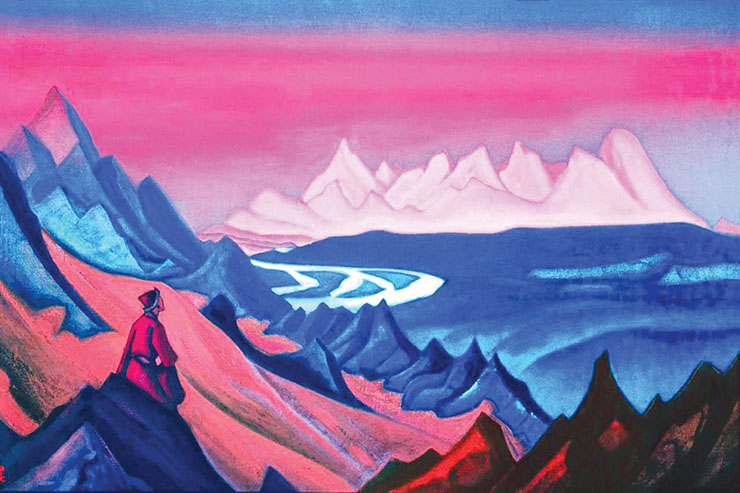
    Roerich kept a diary during the trip (published as Altai-Himalaya: A Travel Diary)15 and, while in Mongolia, noted that, “belief in the imminence of the era of Shambhala was very strong.” In his book, Heart of Asia, Roerich describes both his scientific observations and his personal spiritual quest. Although he was ready to listen to tales of underground cities as part of the adventure, his main interest centred on the spiritual dynamics of Shambhala and its importance as a symbol of the coming age of peace and enlightenment. This blending of the scientific and the spiritual is also present in the hundreds of paintings Roerich made throughout the expedition.

    “His eye captured the shapes and colours of the mountains, monasteries, rock carvings, stupas, cities and peoples of Asia,” writes Jaqueline Decter inNicholas Roerich. “His soul understood their spirit; and his brush forged a synthesis of beauty.” Throughout his life, Roerich strove to link all scientific and creative disciplines to advance true culture and international peace, citing the power of art and beauty to accomplish such a feat.

    The Roerich Peace Pact, which obligated nations to respect museums, cathedrals, universities and libraries as they did hospitals, was established in 1935 and became part of the United Nations organisational charter. The connection between Shambhala and the Peace Pact is clearly evident in the following speech given at the Third International Roerich Peace Banner Convention in 1933:

    The East has said that when the Banner of Shambhala would encircle the world, verily the New Dawn would follow. Borrowing this Legend of Asia, let us determine that the Banner of Peace shall encircle the world, carrying its word of Light, and presaging a New Morning of human brotherhood.16

    “Today,” notes LePage, “every major Russian city has a Roerich organisation that expresses his ideas for a new type of enlightened civilisation based on the utopian principles of Shambhala.”17

    The Sign of Shambhala

    Shambhala itself is the Holy Place, where the earthly world links with the highest states of consciousness. In the East they know that there exists two Shambhalas – an earthly and an invisible one.
    – Nicholas Roerich, The Heart of Asia

    Nicholas Roerich and party set out in 1924 to explore India, Mongolia and Tibet. Like Ossendowski before him, Roerich soon encountered stories about a secret underground kingdom. He jotted down his thoughts on this hidden kingdom and these notes were later published in a remarkable record of the expedition entitled Altai-Himalaya: A Travel Diary.18

    In the summer of 1926, Roerich reported a strange event in his travel diary. He was encamped with his son, Dr. George Roerich, and a retinue of Mongolian guides in the Sharagol valley near the Humboldt mountain chain between Mongolia and Tibet. At the time of the event in question, Roerich had returned from a trip to Altai and built a stupa, “a stately white structure,” dedicated to Shambhala.

    In August the shrine was consecrated in a solemn ceremony by a number of notable lamas invited to the site for the purpose, and after the event, writes Roerich, the Buriat guides forecast something auspicious impending. A day or two later, a large black bird was observed flying over the party. Beyond it, moving high in the cloudless sky, a huge, golden, spheroid body, whirling and shining brilliantly in the sun, was suddenly espied. Through three pairs of binoculars the travellers saw it fly rapidly from the north, from the direction of Altai, then veer sharply and vanish towards the southwest, behind the Humboldt mountains.

    One of the lamas told Roerich that what he had seen was “the sign of Shambhala,” signifying that his mission had been blessed by the Great Ones of Altai, the lords of Shambhala. They had also been witness to a classic UFO, twenty years before the “official” beginning of the phenomenon with Kenneth Arnold’s sighting in 1947.

    Roerich’s account of such a sighting aroused great interest in Europe and, corroborated as it was by George Roerich, brought to the West the first concrete evidence that there might be something present in Eurasia that defied understanding. Victoria LePage describes its significance as such:

    In its vivid colour and factuality, its bizarre but unarguable reference to an unknown golden aircraft that behaved as no ordinary airplane could, the Roerich story could rightly be called the first reliable intimation that the kingdom of Chang Shambhala was perhaps knowable as more than an intellectual curiosity, a popular Asian fable… and from about 1927 onward the world centre in the northern mountains exerted on Western occult circles the fascination of an idea whose time has come.19

    Which brings us to the very nature of reality. Paranormal experiences, including UFO sightings, are always indicative of an altered state of consciousness that allows the witness to see other realities. Often the experience is similar to a lucid dream, where ordinary space-time physics no longer applies.

    The Eastern mystical view of the world can be quite different from the Western scientific view of it. It maybe that the guidebooks to Shambhala are describing a landscape transformed by the visions of a yogi taking the journey there: Where we would see a mountaintop gleaming with snow, he would see a golden temple with a shining god. In that case, we might be able to travel the same path, but with a different view of reality.

    To travel to Shambhala, as Nicholas Roerich journeyed, is to undertake at one and the same time an inner mystical journey and an outer physical one through desolate and mountainous territory to a cosmic powerhouse.

    An old Tibetan story tells of a young man who set off on the quest for Shambhala. After crossing many mountains, he came to the cave of an old hermit, who asked him, “Where are you going across these wastes of snow?”

    “To find Shambhala,” the youth replied.

    “Ah, well then, you need not travel far,” the hermit said. “The kingdom of Shambhala is in your own heart.”20

    [alert type=”general” dismiss=”no”]This article was published in New Dawn 72.[/alert]

    [alert type=”success” dismiss=”no”]If you appreciate this article, please consider subscribing to help maintain this website.[/alert]

    Footnotes:

    1. Edwin Bernbaum, The Way to Shambhala: A Search for the Mythical Kingdom Beyond the Himalayas, 2001, p.25.
    2. Joscelyn Godwin, Arktos: The Polar Myth in Science, Symbolism and Nazi Survival, 1993, p.83.
    3. Subterranean Worlds: 100,000 Years of Dragons, Dwarfs, the Dead, Lost Races & UFOs from Inside the Earth, Walter Kafton-Minkel, 1989, p.188.
    4. Joscelyn Godwin, Arktos: The Polar Myth in Science, Symbolism and Nazi Survival, 1993, p.85.
    5. Ferdinand Ossendowski, Beast, Men and Gods, 1922, p.300.
    6. Ibid, p.300.
    7. Ibid, p.303.
    8. Ibid, p.300.
    9. Ibid, p.118.
    10. Alec Maclellan, The Lost World of Agharti, The Mystery of Vril Power, 1982, p. 66.
    11. Victoria LePage, Shambhala: The Fascinating Truth Behind the Myth of Shangri-la, 1996, p.11.
    12. See New Dawn No. 68, p. 85.
    13. Victoria LePage, Shambhala: The Fascinating Truth Behind the Myth of Shangri-la, 1996, p.10.
    14. Andrew Tomas, Shambhala: Oasis of Light, 1976, p.32.
    15. Nicholas Roerich, Altai-Himalaya: A Travel Diary (1929); Other books by Roerich: The Heart of Asia (1930); Shambhala (1930)
    16. Speech by Francis Grant in The Roerich Pact and Banner of Peace, 1947
    17. Victoria LePage, Shambhala: The Fascinating Truth Behind the Myth of Shangri-la, 1996, p.12.
    18. Nicholas Roerich, Altai-Himalaya: A Travel Diary (1929).
    19. Victoria LePage, Shambhala: The Fascinating Truth Behind the Myth of Shangri-la, 1996, p.12.
    20. As quoted in Edwin Bernbaum, The Way to Shambhala: Jacques Bacot, Introduction a l’histoire du Tibet, 1962, p.92N.

    © New Dawn Magazine and the respective author.
    For our reproduction notice, click here.
  • Hyperborea & the Quest for Mystical Enlightenment

    Hyperborea & the Quest for Mystical Enlightenment

    From New Dawn 58 (Jan-Feb 2000)

    Far north, somewhere near the icy regions of the North Pole, legend speaks of an ancient and mostly forgotten civilisation. Mythical in character, the Hyperborean civilisation is said to have flourished in the northern most region of planet Earth at a time when the area was suitable for human habitation.

    According to certain esoteric systems and spiritual traditions, Hyperborea was the terrestrial and celestial beginning of civilisation. The home of original Man. Some theories postulate Hyperborea was the original Garden of Eden, the point where the earthly and heavenly planes meet. And it is said Man transgressed Divine Law in this Golden Age civilisation, the ultimate price being his banishment to the outside world. Man ventured into other regions of Earth, establishing new civilisations, bringing to an end this great and glorious Golden Age.

    The Golden Age is central to manifold ancient traditions and myths. Significantly, the Golden Age appears most frequent in the traditions of cultures stretching from India to Northern Europe — the area directly beneath the Polar regions. Joscelyn Godwin, in Arktos, The Polar Myth in Science, Symbolism and Nazi Survival, says:

    The memory or imagination of a Golden Age seems to be a particularity of the cultures that cover the area from India to Northern Europe… But in the ancient Middle East there is an obvious relic of the Golden Age in Genesis, as the Garden of Eden where humanity walked with the gods before the Fall. The Egyptians spoke of past epochs ruled by god-kings. Babylonian mythology… had a scheme of three ages, each lasting while the vernal [Spring] equinox precessed through four signs of the zodiac; the first of these, under the dominion of Anu, as a Golden Age, ended by the Flood. The Iranian Avesta texts tell of the thousand-year Golden Reign of Yima, the first man and the first king, under whose rule cold and heat, old age, death and sickness were unknown.1

    The most fully developed theory of this kind, and probably the oldest one, is the Hindu doctrine of the Four Yugas. The four ages in this system are the Krita or Satya Yuga (four units), Treta Yuga (three), Dvapara Yuga (two), and Kali Yuga (one), the whole tenfold period making up one Mayayuga. The Kritayuga corresponds to the Golden Age, the Kali Yuga to the current period of time.

    Every description of the Golden Age period relates how the ‘gods’ walked with men in a perfect and harmonious environment balanced between the terrestrial and celestial. Humanity suffered no sickness and no aging in this timeless paradise. After the Fall, man ‘fell’ into Time and suffering, forfeiting the gift of immortality.

    Madame Blavatsky, the founder of Theosophical Society, claimed the ‘second root race’ originated in Hyperborea, before the later races of Lemuria and Atlantis. The Russian metaphysician Alexandre Dugin says that it was the home of the “solar people”, connected to what is now northern Russia. “Solar people,” Alexandre Dugin explains, are a “cultural-spiritual type” who are creative, energetic and spiritual. They are the opposite of “lunar people”, a psycho-spiritual type who are materialistic, conservative and wary of change.

    The ancient Greeks had a legend of Hyperborea, a land of perpetual sun beyond the “north wind”. Hecataeus (circa 500 BC) says that the holy place of the Hyperboreans, which was built “after the pattern of the spheres”, lay “in the regions beyond the land of the Celts” on “an island in the ocean.” According to popular accounts, the God Apollo’s temple at Delphi was founded by individuals from Hyperborea. The Greek lyric poet Alcaeus (600 BC) sang of the actual or mystical journey of Apollo to the land of the Hyperboreans:

    O King Apollo, son of great Zeus, whom thy father did furnish forth at thy birth with golden headband and lyre of shell, and giving thee moreover a swan-drawn chariot to drive, would have thee go to Delphi… But nevertheless, once mounted, thou badest thy swans fly to the land of the Hyperboreans.

    The wearing of a star-embroidered robe by the King and ‘Ruler of the World’ — the heavenly sphere serving as a symbol of the earthly one — is a custom that can be traced to the Hyperboreans. Embroidered in gold on blue silk were the figures of the sun, moon and stars. Such robes were worn by the kings of Ancient Rome and Julius Ceasar, as well as Augustus and the Roman Emperors.

    Earthenware statuettes found in a grave in Yugoslavia show the ‘Hyperborean Apollo’ in a chariot drawn by swans. The god wears, on his neck and breast, yellow figures of the sun and stars; on his head is a rayed crown with a headband that has a zigzag pattern. His robe, which reaches to the ground, is dark blue with yellow designs.

    Collapse of Hyperborea

    One of the most popular theories for the collapse of Hyperborea was a physical inclination (catastrophe) of the Earth’s axis. Man’s transgression of Divine Law caused a shift in the metaphysical balance, the effect of which was catastrophic on the Earth plane. Julius Evola, the noted Italian metaphysician, explains that at this point the first cycle of history closed, and that of the second, the Atlantean, began:

    The memory of this Arctic seat is the patrimony of the traditions of many people, in the form either of real geographic allusions, or of symbols of its function and original significance, often transferred to a super-historical significance, or else applied to other centres that may be considered as copies of the original one… Above all, one will notice the interplay of the Arctic theme with the Atlantic theme… It is known that the astrophysical phenomenon of the inclination of the earth’s axis causes a change of climate from one epoch to another. Moreover, as tradition tells, this inclination took place at a given moment, and in fact through the alignment of a physical and a metaphysical fact, as if a disorder in nature were reflecting a certain situation of a spiritual order… At any rate, it was only at a certain moment that ice and eternal night descended on the polar region. Then, with the enforced emigration from that seat, the first cycle closed and the second opened, initiating the second great era, the Atlantean Cycle.2

    The memory of a Golden Age, although rendered in an archetypal or mythological form, serves a super-historical purpose. This is why the remembrance of the ancient civilisation of Atlantis is sometimes enmeshed with that of Hyperborea. We cannot expect to ‘prove’ the physical existence of these civilisations. All myths are known to have a historical basis. Transmitted primarily by oral tradition, they are wrapped in a catchy and simple tale that ensures their survival and transmittal down through the ages. Myth serves an extremely vital function — a recollection of our beginnings, a knowledge of where we are heading, and what we are supposed to do. It is only now in the Kali Yuga that we have disconnected from tradition, losing the ability to correctly interpret and understand myths with historical kernels of truth.

    Hyperborea Revived

    The legend of Hyperborea revived during the 18th and 19th centuries when a flurry of books were published dealing with the idea that civilisation had first appeared not in the Middle East, but somewhere else.

    The popular theory of the day postulated that the so-called ‘Aryans’ (Europeans) were superior and more intelligent than Semites (Middle East peoples). Therefore, logically, civilisation could not have originated in the Middle East and Hebrew was probably not the first language.

    The Frenchmen of the Enlightenment were in no doubt that “Eden” was situated on higher ground. The Germans similarly, who were looking for their Aufklarung, also sought to be free of a history tied to the Mediterranean and Middle East regions. British and German scholars studied ancient Indian (Vedic) civilisation and leant the Sanskrit language. Many believed Sanskrit the original language of the ‘Aryans’.

    With new sources of knowledge from ancient Egypt, Chaldea, China and India, researchers were treading on dangerous ground as far as questioning Man’s origins. Biblical history was still strictly upheld and moving too far from this historical boundary could have you silenced.

    Writers such as Jean-Sylvain Bailly (1736-1793), the Rev. Dr. William Warren (1800s), Bal Gangadhar Tilak (1856-1929) and H.S. Spencer (1900s), developed out theories, often borrowing from earlier sources, attempting to prove man’s origins in the Polar region.

    Tilak’s book Arctic Home (published 1903) begins by stating the well known fact that warm weather remains in the Arctic regions, which shows the climate was far different during the interglacial period. According to Tilak, scientists do concede the existence, in the past, of a warm circumpolar continent, and the circumstances there would not have been nearly unfavourable as imagined.

    Tilak was convinced the ancient Indian Vedic texts point unmistakably to a “realm of the gods” where the sun rises and sets once a year, showing that their writers could understand the astronomical conditions at the North Pole.

    Tilak, who had a perfect mastery of Vedic language, placed the original Arctic home existing around circa 10,000 BC, just prior to its destruction and the beginning of the last Ice Age.

    His book had little impact in the West but was popular in India. When the learned Zoroastrian H.S. Spencer wrote his book The Aryan Ecliptic Cycle (1965), a development of Tilak’s work, he was able to obtain endorsements from Sir S. Radhakrishna, then President of India. As well as from dignitaries of the Theosophical Society in Adyar and the Sri Aurobindo Ashram in Pondichary.

    Spencer’s approach commenced not with the Vedic but the Zoroastrian scriptures, going further than Tilak in tracing the progress of the ‘Aryans’ from the North to their new homes, and the schisms that beset them on the way.

    Spencer’s ‘Aryans’ made their presence felt after they travelled far and wide. They moulded the religions and cultures of Egypt, Sumeria, Babylon, and of the Semites, hitherto worshippers of feminine lunar deities.

    However, the search for a terrestrial ‘Hyperborea’ by many researchers and the movement of an original ‘race’ has been extremely difficult and presumptuous. Proving human habitation possible at the North Pole somewhere between 8000 and 10,000 BC is no mean feat, particularly if you were living in the 18th century. The numerous theories posited offering contradictory or tendentious ‘evidence’ has served only to discredit the whole notion of Hyperborea. The same could be said of theories attempting to prove the existence of the ‘lost continent of Atlantis’. The drive to prove the actuality of a terrestrial Hyperborea has overshadowed its occult and symbolic importance.

    The Spiritual Pole

    In the quest to discover the ‘physical’ location of Hyperborea, most writers overlooked the possibility that the mythology served a special symbolic and spiritual purpose. What if the truth behind the legend was esoteric, and not exoteric as some even today still maintain?

    Many traditions speak of a supreme spiritual centre or ‘supreme country’. The ‘supreme country’ that does not necessarily lay at a specific earthly point, but exists in a primordial state, unaffected by terrestrial cataclysms.

    The ‘supreme country’, commonly regarded as ‘polar’ in orientation, symbolically is always represented as being at the ‘Axis of the world’ — and in most cases is referred to as a ‘Sacred Mountain’. Rene Guenon in his book The Lord of the World says:

    Almost every tradition has its name for this mountain, such as the Hindu Meru, the Persian Alborj, and the Montsalvat of Western Grail legend. There is also the Arab mountain Qaf and the Greek Olympus, which has in many ways the same significance. This consists of a region that, like the Terrestrial Paradise, has become inaccessible to ordinary humanity, and that is beyond the reach of those cataclysms which upset the human world at the end of certain cyclic periods. This region is the authentic ‘supreme country’ which, according to certain Vedic and Avestan texts, was originally sited towards the North Pole, even in the literal sense of the word. Although it may change its localisation according to the different phases of human history, it still remains polar in a symbolic sense because essentially it represents the fixed axis around which everything revolves.3

    The Vedic texts say the ‘supreme country’ is known as Paradesha, also called the ‘Heart of the World’. It is the word from which the Chaldeans formed Pardes, and Westerners Paradise.

    There is notably another name for it probably even older than Paradesha. This name is Tula, called by the Greeks Thule. Common to regions from Russia to Central America, Tula represented the primordial state from which spiritual power emanated.

    It is known that the Mexican Tula owes its origin to the Toltecs who came, it is said, from Aztlan, the ‘land in the middle of the water’, which is evidently Atlantis. They brought the name Tula from their country of origin and gave it to a centre which consequently must have replaced, to a certain extent, that of the lost continent. On the other hand, the Atlantean Tula must be distinguished from the Hyperborean Tula, which latter represents the first and supreme centre….4

    In this case — Tula — representing a centre of spiritual authority — does not remain fixed in a geographical location. Guenon states that the Atlantean cycle, successor to the Hyperborean cycle, is associated with Tula. The Atlantean Tula is an image of the original primordial state situated in a northern or Polar location. As world cycles progress onward, the supreme seat of spiritual power regresses further and further into hiding and obscurity. This, of course, is deliberate and predictable as humanity descends into the end of the age (Kali Yuga), progressively enmeshing itself in the material plane until the reversal of established world order is imposed.

    It should be emphasised here that Tula, or the centre of spiritual authority, constitutes the fixed point known symbolically to all traditions as the ‘pole’ or axis around which the world rotates. Metaphysically speaking, the world rotates around this seat of power even if it’s not geographically North or South.

    In the Buddhist tradition ‘Chakravarti’ literally means “He who makes the wheel turn”, which is to say the one who, being at the centre of all things, directs all movement without himself participating, or who is, to use Aristotle’s words, the “unmoving mover”.

    The turning of the world, the ‘Pole’ and axis, combine to depict a wheel in the Celtic, Chaldean and Hindu traditions. Such is the true significance of the swastika, seen worldwide from the Far East to the Far West, which is intrinsically the ‘sign of the Pole’.

    The Pole and Mystical Enlightenment

    It is in medieval Iran that we find extant literature on the Spiritual Pole and the experience of mystical ascent to it. The Iranian Sufis, drawing not only on Islam but on the Mazdean, Manichean, Hermetic, Gnostic and Platonic traditions, blended a sacred knowledge said to be ‘scientific’, mystical and philosophically practical.

    Esoterically… the Persian theosophers situated their “Orient” neither to the East, nor to the South, wither they faced in prayer towards the Ka’ba. “The Orient sought by the mystic, the Orient that cannot be located on our maps, is in the direction of the north, beyond the north.” [The Man of Light in Iranian Sufism by Henry Corbin, 1978] About this Pole reigns a perpetual Darkness, says the Recital of Hayy ibn Yaqzan, one of the visionary recitals of Avicenna (Ibn Sina). “Each year the rising sun shines upon it at a fixed time. He who confronts that Darkness and does not hesitate to plunge into to it for fear of difficulties will come to a vast space, boundless and filled with light.” [Ibid] This Darkness, says Corbin, is the ignorance of the natural man. “To pass through it is a terrifying and painful experience, for it ruins and destroys all the patencies and norms on which the natural man lived and depended…” [Ibid] But it must be faced consciously before one can acquire the saving gnosis of the light beyond.

    The Darkness around the Pole, annually pierced by the sun’s rays, is at once terrestrial and symbolic. On the one hand, this is the situation at the North Pole, where there are six months of night and six of day. It is characteristic of esoteric tradition that the same image is valid on two or more levels. But as Corbin and Guenon never tired of pointing out, the symbolic level is not a fanciful construct on the basis of hard terrestrial fact: it is quite the other way round. In the present case, the mystical experience of penetrating the Darkness at the Pole is the fundamental reality and the authentic experience of the individual. The fact that the set-up of the material world reflects the celestial geography is what is contingent. In brief, in this teaching as in Platonism, it is the supersensible realm that is real, and the material realm that is a shadow of it.5

    The seeker, through deep meditation on spiritual matters, succeeds in entering a world of mystical experience, and makes a pilgrimage to Hyperborea that can not be discovered from maps. Aristeas, the Greek poet, in shamanic rapture, is said to have travelled to Hyperborea while “possessed by Apollo”. Mystical soul-travel to Hyperborea is common in ancient Greek literature.

    The journey to this Pole is sometimes illustrated as the ascent of a column of light, extending from the depths of hell to the lucid paradise in the cosmic North.

    As previously mentioned, the Pole is also a Mountain, called Mount Qaf in Islamic tradition, whose ascent, like Dante’s climbing of the Mountain of Purgatory, represents the pilgrims progress through spiritual states.

    Guenon, in The Lord of the World, explains “the idea evoking the representation under discussion is essentially one of ‘stability’, that is itself a characteristic of the Pole.” The Mountain, referred to as an ‘Island’, “remains immovable amidst the ceaseless agitation of the waves, a disturbance that reflects that of the external world. Accordingly, it is necessary to cross the ‘sea of passions’ in order to reach the ‘Mount of Salvation’, the ‘Sanctuary of Peace’.”

    Our search for Hyperborea is our desire to return to Paradesha or Paradise — the primordial spring of Man’s original existence. The importance of knowing the terrestrial location of a lost civilisation at the northern regions is thus overshadowed by its symbolic relevance.

    To seek Hyperborea is to quest for spiritual enlightenment. The Mountain, the Island, the immovable Rock, fixed in a Polar orientation, relays a symbolic representation of our search for Ultimate Reality. Its immovability anchors us to this important task.

    [alert type=”general” dismiss=”no”]This article was published in New Dawn 58.[/alert]

    [alert type=”success” dismiss=”no”]If you appreciate this article, please consider subscribing to help maintain this website.[/alert]

    Footnotes:

    1. Arktos, The Polar Myth in Science, Symbolism and Nazi Survival by Joscelyn Godwin, p. 16.
    2. Quoted in Arktos, The Polar Myth in Science, Symbolism and Nazi Survival, p. 58-9, original source Revolt Against the Modern World by Julius Evola, 1951.
    3. The Lord of the World by Rene Guenon, p. 50.
    4. Ibid, p. 56
    5. Arktos, The Polar Myth in Science, Symbolism and Nazi Survival by Joscelyn Godwin, p. 167-8.

    © New Dawn Magazine and the respective author.

    For our reproduction notice, click here.