In 2014, at the annual meeting of United Russia, the Russian Federation’s dominant political party, amidst the standard rhetoric of party politics, Russian President Vladimir Putin gave his regional governors a list of books he said they should read.
Putin likes to come across as a reader – Dostoyevsky is a favourite writer of his – and he isn’t averse to name dropping some classics in the middle of an interview. But the list he gave to his governors at that meeting didn’t include Crime and Punishment, War and Peace, or Dead Souls, to mention just a few of the contributions to world literature that Mother Russia has made, by way of Dostoyevsky, Tolstoy, and Gogol.
The names that drew attention from political commentators in the West wouldn’t be easy to find on Kindle or in an airport bookstall on your way to Vladivostok, Irkutsk, or wherever your regional office might be. They were names of philosophers, individuals who, traditionally, are not known for producing page-turners.
Putin wanted his governors to become familiar with them because the Russia he saw on the horizon would be informed with the spirit of their thought.
A lot has happened since that meeting in both Russia and the world. Among other things, the United States had some new presidents. Putin, of course, has remained in power, seemingly as fixed in place as the tsars of old.
No doubt Joe Biden has advisers guiding him on how best to establish a new relationship with Russia. But if he finds himself with time to kill en route to wherever his proposed summit with the Russian leader might be, he might up his game a bit by skimming through the weighty volumes that Putin assigned to his governors.
The three thinkers that Putin suggested the governors should read were Vladimir Solovyov (1853–1900), a friend of Dostoyevsky and, according to the late American Russian scholar James Scanlan, the greatest and most influential of Russian philosophers; Nikolai Berdyaev (1874–1948), an aristocratic, fiercely independent thinker who combined a passionate religious temperament with an existential commitment to freedom; and Ivan Ilyin (1883–1954), a much more political thinker than Solovyov and Berdyaev.
All three were part of a remarkable period in Russia’s cultural history known as the Silver Age, a time of deep spiritual and mystical experiment and excitement aborted by the rise of the Bolsheviks.
In recent years, Putin has looked back to this time in an attempt to revive the character of “Holy Russia” as a way of resolving the identity crisis Russia has struggled with since the collapse of the Soviet Union. For some critics in the West, the philosophers Putin namechecked were simply examples of a kind of “mystical exceptionalism,” a reheating of nineteenth-century ideas about Russia’s “messianic role in world history.”1
Whatever Putin’s real aims in namedropping these thinkers may be – and of course he is a cagey politician before anything else and has his own purposes in mind – they deserve to be read. If nothing else, if Biden did read them, he might get an angle on Tsar Vladimir that might otherwise escape him.
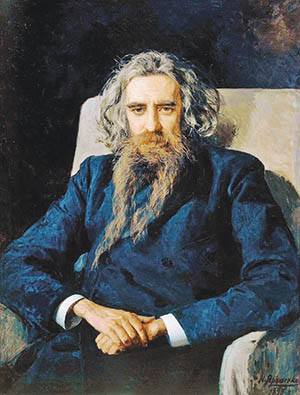
Vladimir Solovyov
Portrait of Vladimir Solovyov by Nikolai Yaroshenko, 1892.
Solovyov’s The Justification of the Good, for example, which is on Putin’s list, is a long, detailed, eminently logical and rigorously rational argument for the supreme value of the “good in-itself,” the Good in a Platonic sense, that is.
Since the eighteenth century, the West has seen the “good” in a purely utilitarian sense, a “practical” good, one that can be seen and measured in material things: a new car, a new computer, a holiday in the tropics. Or it sees the good in terms of the consequences of some action. Hence the notions of “the greatest good for the greatest number” and “the ends justify the means,” formulas that historically have had disastrous results.
This idea of a measurable good is at the root of Western consumerism, as well as that of the various socialist alternatives to it; both see the good in terms of higher living standards, more and better things.
While it is undeniably good that all should be fed, clothed, and housed decently – a belief Solovyov, who gave away what money he had, put into practice – a society that defines the good in this way forgets the truth of the Gospel: that man does not live by bread alone.
Solovyov saw that the dominance of rationalism in the West had eclipsed the perception of the spiritual dimension of life, an argument he made in his first major work, The Crisis of Western Philosophy. The series of lectures he gave on the “God-Man,” the path of theosis, our evolution into a higher, more spiritual consciousness, were attended by Tolstoy and Dostoyevsky and influenced both. Russia, he believed, could be the birthplace of such a consciousness, and his ideas informed the Silver Age. He died in 1900.
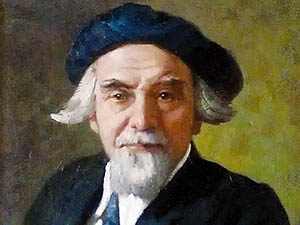
Nikolai Berdyaev
Nikolai Berdyaev
Nikolai Berdyaev was one of the many Russian thinkers, poets, critics and other members of the intelligentsia who in 1922 were aboard the “philosophy steamers” that carried them out of their homeland and into exile in the West, courtesy of Comrade Lenin.
A devout if eccentric Christian, Berdyaev started out as a Marxist but after reading Solovyov rejected Marx’s materialism. He became a radical religious existentialist, obsessed we can say with the idea of freedom. His early work, The Philosophy of Inequality, another on Putin’s reading list, was a response to the enforced egalitarianism of the Revolution.
He argued that the intelligentsia’s passion for the “people” and the “proletariat” had become little more than idolatry. Truth in itself, like Solovyov’s good in itself, had fallen away, and only those truths that were helpful to the Revolution were embraced. (Is there a parallel with our own times, perhaps?) But without real truth, existential truth, human beings fall prey to the forces of materialism and become little more than the property of the state or the market.
Berdyaev continued his philosophical struggle for freedom from Berlin and then Paris, writing book after book, with titles like The Destiny of Man, Slavery and Freedom, and Spirit and Reality, his remarkable autobiography, until his death in 1948.
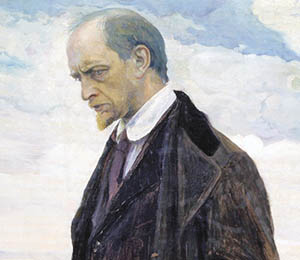
Ivan Ilyin
Portrait of Ivan Ilyin by Mikhail Nesterov, 1921.
Ivan Ilyin started out as a political idealist, believing that if people could grasp what he called “legal consciousness,” a kind of intuition of the need of rule of law, government would not be necessary, as we could govern ourselves. This naivety received a buffeting with the 1905 Revolution, and Ilyin’s views changed radically.
From a kind of spiritual anarchist, he became the advocate of the need for a small group of dedicated men who had achieved “legal consciousness” to guide the vast majority who hadn’t. This was rather the same view as Lenin, except that his small band of dedicated revolutionaries would usher in the new, classless, godless society.
Ilyin’s view was much more that of Dostoyevsky’s Grand Inquisitor in The Brothers Karamazov, who argues that men do not want freedom but bread and that the church, which rules the state, must shoulder the burden of their freedom for them. Like Berdyaev, Ilyin was shipped out of Russia on the “philosophy steamers,” and until his death in 1954, he was a voice of opposition to the Soviets.
Our Tasks is a collection of Ilyin’s writings that Putin put on his list. One essay, “What the Dismemberment of Russia Means for the World,” written in the 1950s, spells out in eerily prescient detail what will happen to Russia with the collapse of communism and the introduction of Western democracy and the free market. In the chaos that would follow what he called “the Balkanization of Russia” – and which actually did happen – Ilyin predicted that a strong man would arise, who would re-establish order and control and reunite the nation… No wonder that of the three, Ilyin’s name turns up the most in Putin’s speeches.
Of course, here I can only suggest why readers might want to take a look at Putin’s philosophers. They all warrant attention; Solovyov and Berdyaev for their own sake; Ilyin, I would say, to get an idea of what’s on the Russian President’s mind.
For more on this subject, read Gary Lachman’s book The Return of Holy Russia, which covers Vladimir Putin, the Silver Age, Solovyov, Berdyaev, Ilyin and the other remarkable figures making up Russia’s tumultuous spiritual history.
Some weeks ago I had an odd experience. Like many other people, I have spent the past few months under a voluntary “house arrest,” following the rules the government has set out in order to combat COVID-19, the coronavirus that has stopped the world in its tracks.
I am not the most gregarious of people and so being asked to practice social distancing, to self-isolate and stay at home, was not, as it was for many others, that much of a hardship. I missed being able to see friends or to sit at a café or loiter in bookshops, but to be honest I spend most of my time reading or writing at home anyway, and my neighbourhood in North London has many quiet, leafy backstreets, so my daily ration of exercise, taking a walk or riding my bicycle, was pleasant. I also have a small garden where I can stretch my legs and putter around outdoors. Lockdown, then, was more of an inconvenience for me than a burden.
I hasten to add that I am aware of how lucky I am. The last thing I would want to appear is callous, insensitive to how difficult things have been for many people less fortunate. In fact, the odd experience mentioned above is directly related to this, the inveterate human habit of “taking things for granted.”
What happened is this. One morning, when the usually dull London spring had brightened and the day promised to be fine, I stepped out of my backdoor and into my little patch of garden, a cup of coffee in hand. The air was unusually fresh – a collateral benefit of lockdown, which left hardly any traffic on the streets – and as I took a deep breath, I stretched and looked up. Whether it was the cleaner air or simply the fine weather, what I saw surprised me. I can think of no better word.
What did I see? The sun. The sun had surprised me.
When I say that the sun surprised me, I don’t mean that it poked its head from behind a cloud and said “Peekaboo!,” although, to be sure, that would have been even more surprising and perhaps cause for concern. No, the sun didn’t do anything unusual. It was just there, as it usually is, bright, yellow-white, and too dazzling to do more than glance at. Nevertheless, I found myself asking “What is that?” As soon as I did, I realised what I had asked.
What is that? It’s the sun, of course, something you’ve seen all your life and which has been around for close to five billion years and which is expected to be around for another five billion. It is a middling size star set in a galaxy among billions of other stars, in a universe of billions of galaxies. It is a great ball of fire, ninety-three million miles away, in which hydrogen is being transformed into helium, and it could swallow more than a million earths. And so on. I “knew” all this, but this knowledge somehow didn’t answer my question, nor did it explain why I should suddenly see something as ubiquitous as the sun as strange. I was genuinely surprised by it, and if any of my neighbours were in earshot that morning, they may have wondered what it was that I was giggling about.
This sense of being surprised by something I took for granted and rarely devoted much thought to, was related to an odd exhilaration I felt at the beginning of the corona crisis. Although I was not as badly affected as many others, I still had to change my routine. After a few trips to my usual market resulted in a tour of empty shelves, I decided to go to smaller ones that hadn’t yet been pillaged by hysterical hoarders. Even there I had to make do with what they had. The smaller shops were further away, so I used the daily food run as an extra bit of exercise, pulling on my backpack and heading out on my bike. I took all the advised precautions, wore gloves – at that point touch seemed the main means of transmission – wiped down my supplies with antibacterial agents, and washed my hands after that. I was in “crisis mode,” but the odd thing was that I found myself feeling more that I was on holiday.
Again, I know these past months have been anything but a holiday for many people, and my sympathy goes out to them, and to all the frontline workers who had to deal with a very dangerous and very deadly situation – and are still dealing with it. What was odd was that, as I mentioned, I was not actually doing anything very different from my ordinary routine. Yes, I had made a few changes but nothing too upsetting. But there was something odder still. Recognising that something unusual was happening to me, I decided to try to analyse exactly what that was, to apply a bit of phenomenology to my consciousness. The result was that I realised that the essence of the strange exhilaration I felt was paradoxically a sense of freedom.1
Freedom? During lockdown when my movements were severely proscribed and what I was allowed of them were saddled with various precautionary measures? How could I feel free, in a very real sense – certainly more than I usually do – when, to all intents and purposes, my freedom was limited, more than it usually was? And if this wasn’t paradoxical enough, my reflections led to an even odder insight. It was that the “freedom” I was feeling was not one that I had recently been granted – as some people, celebrating the easing of lockdown in some places may be feeling now. No. It was a feeling for the freedom I already possessed but had become used to. It was a freedom the “crisis” had reminded me of, just as I had been reminded of the strange reality of the sun, although I thought I knew all about that. I had taken the freedom I already possess for granted, just as I had taken the sun for granted. The sun had surprised me and so had my freedom.
When it came to me that this was the source of the odd happiness – I can’t think of a better word – I was experiencing, I had to laugh. Why? Because I realised that I was experiencing exactly the kind of shift in consciousness that Colin Wilson describes in many of his books, a shift from what he calls “the robot” to “real me,” or, in your case, to “real you.” This odd transition is at the heart of Wilson’s work, and it was apparently something I already knew, as I had written a book about Wilson’s life and work entitled Beyond the Robot. I may have known it, but I had taken it for granted, just as I had taken the sun for granted. Now I saw that I had had an experience of this phenomena, and I knew, with the kind of knowledge that comes from experience, that Wilson was right.
What is the robot? It is a labour-saving device that we have developed over thousands of years of human evolution. Its main function is to perform laborious, repetitive tasks with a minimum of energy, thus freeing up consciousness for more complex operations. Think of some skill that you now possess but which cost an immense amount of effort when you were first learning it. It can be anything, from tying your shoes or learning how to type, to riding a bicycle or playing a musical instrument. At first, it is discouragingly difficult; we have to expend much energy and focus our attention on each little step, making sure we put our finger on the right letter on the keyboard or turn the handlebar in the right way. We fail, make mistakes, fall down, grumble.
But if we keep at it, one day something miraculous happens. We discover that we can ride our bicycle, type a letter – or email, these days – or play a tune. We have learned how to do these things, which means we no longer have to think about where to put our fingers on the keyboard but can think instead about what we want to say in our email. What has happened is that our robot has taken over the grunt work, freeing “us” up to consider other things. He is a kind of automatic pilot that keeps us flying while we can enjoy the view and think about what we’ll do when we reach our destination.
This is why the philosopher Whitehead said that “Civilisation advances by extending the important operations which we can perform without thinking about them.”
If it wasn’t for the robot we would never learn anything and would have to start from scratch each time we wanted to type, ride a bicycle, or use any other learned skill. Animals have robots, but theirs are not as versatile or capable as ours. You can teach a young dog new tricks, but even their capacity to acquire new skills is severely limited. A dog may fetch your morning paper – although these days I suspect that is a lost art – but it can’t learn French or how to sew (and of course this is also true of many people…)
So the robot is a handy, indispensable tool and we simply couldn’t do without it. But there’s one hitch. He does his job too well. The robot is like a valet who is eager to do everything for us. He is happy to take things out of our hands and never complains about the tasks he has to perform. Such an eager helper can overstep his brief. He begins to do things that we would rather do ourselves. He is such a good automatic pilot that we forget that we really should get back at the controls. And this is not his fault. To extend my metaphor, he hasn’t hijacked the plane from us; we have allowed him to infer that we would like him to take control. And, accommodating fellow that he is, he is happy to oblige.
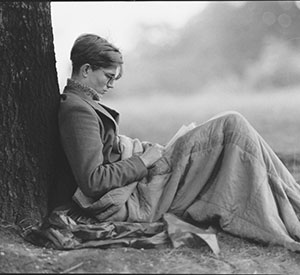
A young Colin Wilson on Hampstead Heath, London, 1956. His seminal work The Outsider was published the same year.
The problem is when we allow the robot to do everything for us, life begins to lose its savour. As Wilson writes, the robot has “one enormous disadvantage.” What is that?
“If I discover a new symphony that moves me deeply,” Wilson writes, “or a poem or a painting, this bloody robot promptly insists on getting into the act. And when I listen to the symphony for the third time, he begins to anticipate every note. He listens to it automatically, and I lose all the pleasure. He is most annoying when I am tired, because then he tends to take over most of my functions without even asking me. I have even caught him making love to my wife.”2
(Wilson does not mention it, but one wonders if his wife ever caught her own robot in the act as well.)
Eventually, by allowing the robot to do everything for us, life begins to feel slightly unreal, or at least not as real as it used to feel. It is not a sudden change; it happens gradually, imperceptibly. But at some point, the moments of delight that we used to feel at a sunset, a starry night, or simply relaxing with music and a glass of wine, begin to dwindle. “The shades of the prison-house begin to close,” as Wordsworth tells us, and the “intimations of immortality” we received in our youth no longer arrive. We have “grown-up.” That is why we have a nostalgia for our childhood, although, as Wilson points out, we develop our robot precisely in order to help us deal with the emotional and psychological turbulence of youth. In “The Rock,” T.S. Eliot asks, “Where is the life we have lost in living?” Wilson answers: “In the hands of the robot.”
Sometimes the feeling of being cut off from life is so acute that it can lead to suicide or, conversely, to sudden outbursts of violence, just in order to “feel alive” again. This is the thesis behind Wilson’s “existential” study of murder and sex crime, in books such as his Encyclopaedia of Murder and Order of Assassins. Some individuals, who have allowed their lives to become almost completely automatic, periodically erupt into a murderous rage, the violence throwing off the robot temporarily. More often, we resort to expedients like alcohol or drugs, which achieve their effect by putting the robot to sleep for a while. That is why after a glass of wine or two, things that struck us as uninteresting take on a strange glow of meaning. It’s no coincidence that poetry and wine have long been linked. The problem here is that by putting the robot to sleep, our own efficiency is hampered; that is why we are advised not to drive while drunk. Wine may inspire poetry, but the actual writing is best done while sober.
Wilson discovered there was another way to get the robot out of the driver’s seat. Crisis has the effect of putting the robot in his place – or rather, of putting “us” in ours. This is why so many of the “outsiders” Wilson wrote about – people with a high appetite for purpose and meaning, “life more abundant,” which the modern world can’t provide – followed Nietzsche’s advice and “lived dangerously.”
As an example, Wilson offers the existentialist Jean-Paul Sartre who said he never felt as free as when he was a member of the resistance during the German occupation of Paris and was in danger of being arrested by the Gestapo. Another more extreme example is the novelist Graham Greene. As a teenager, Greene suffered from acute boredom, and when he discovered his brother’s revolver, he decided to play Russian Roulette. He put a bullet in a chamber, spun the cylinder, took the gun out to the common, and put the barrel to his head. Then he pulled the trigger. When Greene heard the hammer click on an empty chamber, he experienced an “extraordinary sense of jubilation… as if a light had been turned on… and I felt that life contained an infinite number of possibilities.”3
Greene had been so bored that the thought of blowing his brains out seemed appealing. Nothing had changed except something in him. The “infinite possibilities” were always there; Greene had simply been blind to them. He didn’t see them because his robot was on the watch, and he isn’t programmed to see possibilities but to perform functions with a minimal expenditure of effort.
As Wilson points out, as he pulled the trigger the thought that he could die caused Greene to concentrate his mind in a sudden psychic spasm, into a kind of mental fist. When he heard the hammer hit an empty chamber, he relaxed. The sudden contraction of his attention, in effect, told his robot that “this is important,” and so it handed over control to Greene. That is why when he relaxed, “he” was seeing life’s infinite possibilities. “He” was living again, briefly, not the robot.
Something similar, Wilson tells us, happened to Dostoyevsky when he faced execution and received a sudden reprieve: an immediate, overwhelming insight that “all is good.”
Greene’s experience is summed up in a quotation from the English man of letters Doctor Johnson that Wilson is fond of quoting: “when a man knows he is to be hanged in a fortnight, it concentrates the mind wonderfully.” Greene’s mind was thus concentrated. So were Sartre’s and Dostoyevsky’s. This is why the philosopher Heidegger and the esoteric teacher Gurdjieff both suggested that the one sure way for humans to overcome their “forgetfulness of being” was to maintain an awareness of their inevitable death. The thought of the reality of our death causes us to make a sudden inner effort and we momentarily push the robot aside.
I was not going to be hanged in a fortnight, nor was I in danger from the Gestapo. But the change in my routine prompted by the “crisis mode” I had adopted had, I believe, a similar effect. I somehow felt more alive. This, I believe, is the same phenomenon that led many Londoners who survived the Blitz to remember it as the most exciting times of their lives. Many of them said that they never felt more alive or more free. They could be blown up at any moment, and this added a certain savour to everything. What had happened, in Wilson’s terminology, is that I had lowered my “indifference threshold.”4
This is the term Wilson uses to highlight the fact that when we have allowed the robot to take over our lives, things that we would otherwise find pleasant and agreeable elicit no response from us. We are indifferent to them. “We” do not enjoy the music we listen to or the book we are reading or even the love we are making, because “we” are not really involved. We all know how difficult it is to cheer someone up when they are deeply depressed or bored. Wilson discovered, though, that where something pleasant fails, an inconvenience can succeed. It can shake us out of our indifference and break through the “I can’t be bothered barrier” many of us spend much time behind. Somehow, the inconvenience prompts us to respond, and when it is overcome we find ourselves in a better mood than we were in before the inconvenience. Paradoxically, it has “cheered us up.”
When I was surprised by the sun, it was because “I” was seeing it that morning, not the robot. And because “I” was more real, so was the sun. Gurdjieff captured this in the title of his last, unfinished book, Life is Real Only Then, When “I Am.” Gurdjieff knew about the robot; his way of speaking about it was to say that we are all mechanical, machines, not real human beings. Or that we are all asleep, believing we are awake. This is the most dangerous part of “living on the robot”: we accept this half-life as the real thing and don’t realise that we are actually unconsciously “de-valuing” life by involuntarily ignoring a great deal of it. Not in some physical sense – I hadn’t ignored the sun all these years and now suddenly got a glimpse of it. The robot edits out everything that he considers inessential, so the world he presents to “us” is stripped down to practical concerns; all the “extras” are omitted. Just the facts, no meaning. This is why when he is given a holiday, everything seems more “interesting,” rather like the effect of colour being added to a black and white sketch, or a sumptuous soundtrack to a silent film.
We simply don’t understand that most of the time we are “living” in name only, and accept our moments of non-robotic consciousness as “gifts” or “treats,” short breathing spaces we deserve before getting back into harness. These moments, what the psychologist Abraham Maslow called “peak experiences,” are really moments when our consciousness is working as it should, and not at the “energy-saving” levels the robot usually has it set at. We all have much more energy and power than we know, but because we have come to accept the minimum levels that the robot limits us out of habit, we never draw on these supplies. Gurdjieff again knew this; that’s why he developed a whole system of what we can call “artificial inconvenience” or “induced crisis,” to push his students past those limits.
Yet, like genuine crisis, the artificial kind can become habitual too. Greene eventually stopped playing Russian Roulette because the kick of not blowing his brains out lost its thrill; it’s a wonder he survived to write his gloomy novels. Gurdjieff had to develop more and more difficult exercises and create more inconvenience in order to keep his students on their toes. In his last days in Paris, Gurdjieff’s students “lived dangerously” by piling into his car and driving at breakneck speed to parts unknown until the petrol ran out; Gurdjieff was an appalling driver, and they would have to find petrol in order to get back. As some reports suggest, at times the crisis Gurdjieff induced proved too great and a student collapsed. And as Wilson points out, we have created civilisation in order to minimise crisis, so there is something absurd about having to put a gun to your head in order to feel alive.
This led to Wilson’s insight that we can apply two other methods to free ourselves of the robot, neither of which involve actual physical danger. One is to put more effort and attention into everything we do. Wilson often quotes this line from Hermann Hesse’s allegorical novel The Journey to the East: “A long time devoted to small details exalts us and increases our strength.” Devoting time to small details strikes us as a bore, and as soon as we feel this, the robot is there to take over. But if we put, say, twice as much attention into some “boring” task – such as cleaning our flat – we can find that we actually enjoy doing it.5 Why? Because “we” are doing it, not the robot. The enjoyment is not from the task itself but from our being “alive” while doing it.We can see this as a version of the exercises Gurdjieff gave to his students; the sense of “being alive” is what he called “self-remembering,” which, in fact, is what we are doing when we “feel alive.”
Another method is to use the imagination to create a crisis “in the mind.” This is the same as Heidegger suggesting we maintain an awareness of the reality of our death. You can try this right now. Take a look at your life and focus on everything that is important to you. Now, imagine how you would feel if those things were threatened. Say your house has burned down or you have been diagnosed with a fatal, incurable disease. Imagine, as Doctor Johnson suggests, that you will be hanged in a fortnight. If you are able to imagine this vividly enough, you should get a taste of what it would feel like if it was real.
But we can go a step further. If you can imagine the loss of what is important to you, you can also use your imagination to evoke a sense of the reality of those things you would lose, for this is what the crisis does: it puts the robot in the back seat so that “you” are in touch with reality. So, rather than focus on the negative impact of loss, you can focus on the positive impact of remembering that you now possess what you would regret losing. The essence of both exercises is to evoke a sense of reality, and the shock of a positive reality can be just as effective as that of a negative one, as well as being a lot less gloomy.
This, I believe, is what happened when I was surprised by the sun, and when I felt an odd exhilaration at the start of the corona crisis. I had taken my freedom for granted. Now, when that freedom was constrained, this inconvenience reminded me of it; hence the paradox that I felt more free. The crisis mode I had adopted made “me” more “present” and I remembered how much I possessed and had to feel grateful for. It was a collateral benefit of a difficult time. With any luck I will not need another crisis to be reminded again.
[alert type=”general” dismiss=”no”]This article was published in New Dawn 182.[/alert]
[alert type=”success” dismiss=”no”]If you appreciate this article, please consider subscribing to help maintain this website.[/alert]
Footnotes
1. “A single obsessional idea runs through all of my work: the paradoxical nature of freedom.” Colin Wilson The Occult (London: Watkins Publishing, 2015) p. xxiii.
2. Colin Wilson “Existential Psychology: A Novelist’s Approach” in The Bicameral Critic (Salem, NH: Salem House, 1985) p. 39.
3. Quoted in Colin Wilson Frankenstein’s Castle (Sevenoaks, UK: Ashgrove Press, 1980) p. 122.
4. Space does not allow me to tell it here, but the story of how Wilson arrived at this insight is worth telling. I do in Beyond the Robot: The Life and Work of Colin Wilson (New York: Tarcher/Penguin, 2016) pp. 33-34.
5. We can also employ what we can call the “Tom Sawyer effect,“ and pretend that we are enjoying it and then find that we actually do. This refers to the scene in Mark Twain’s novel when Tom pretends he is enjoying painting the fence and by doing so, tricks his friends into paying him to let them have a go. They do enjoy it, so the trick is really on Tom. He has convinced them that painting is fun and their enjoyment ironically proves him right.
The Council of Ferrara-Florence, held from 1438 to 1445 in, not surprisingly, the Italian cities of Ferrara and Florence, had as one of its main objectives the possible reunion of the two branches of Christianity, Roman Catholic and Orthodox Byzantine, that had been separated since 1054. Agreement over doctrinal differences was not the guiding principle of the proposed merger. The true motive was realpolitik. The Turk was edging closer to Constantinople, and the Greek Orthodox Church knew it needed help to keep him at bay. When Emperor John VIII Palaeologus decided to put together a crack team of negotiators to plead the Byzantine church’s case, he included among his top men someone from outside the fold, a secular thinker he respected. Some thought this strange. Yet the appearance at the Council of the emperor’s man turned out to be one of the most important events in what we can call the “secret history” of the West.
Who was this mystery man and why was his participation in the Council so important? It certainly wasn’t because of his ostensible reason for being there. The Council itself was a failure. The two churches did not reunite and less than a decade later, just as the emperor feared, the Ottomans overran Constantinople. Oddly enough, the ransacking of the Byzantine capital by the Turk was itself a major factor in the same secret history for which the Council of Ferrara-Florence set the stage.
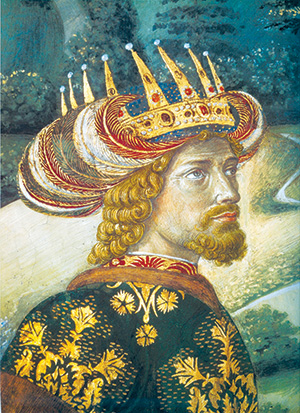
John VIII Palaiologos, the penultimate reigning Byzantine Emperor, who ruled from 1425 to 1448.
The mystery man in question was the Byzantine Neo-Platonic philosopher George Gemistos Plethon. It wasn’t in fact until he attended the Council that he took or was given the name Plethon. This was a variant on the name of a philosopher who was still something of a mystery himself at the time, Plato. Why Gemistos took the name of the father of Western philosophy will become clear as we go along.
Gemistos was born in 1355 in Constantinople to a well-off family who had him educated there and in Adrianople. Adrianople at the time was the capital of the Ottoman empire and had become an important centre of learning. Gemistos must have been something of a prodigy; he was said to have accompanied the emperor on a visit to western Europe when he was in his teens and seems to have been primed to become a teacher of philosophy. In this regard, Gemistos was lucky to be born in Constantinople. After the fall of the pagan world and the onset of the Dark Ages, more of Greek philosophy survived in the eastern empire than in the west. What there was of it that he could find, Gemistos absorbed greedily.
Gemistos was a passionate lover of the ancient world and devoted student of Plato; in the Aristotelian atmosphere of the Orthodox – and Catholic – church, this held certain dangers. While Aristotle could be harnessed for the church’s purposes, Plato was seen as a threat. But Gemistos’ Platonising also meant that his learning, wisdom, and dialectical skill were highly prized. Hence, the decision of John VIII Palaeologus to send him to the Council. Gemistos was an old man by then – he lived to be nearly 100, amazing for the time – but in many ways it was the defining event of his life.
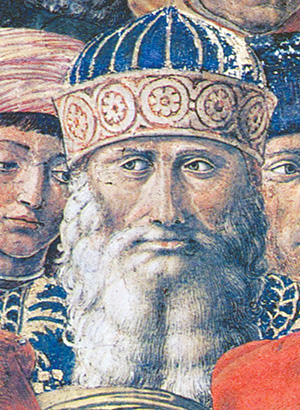
Byzantine Neo-Platonic philosopher George Gemistos Plethon, as depicted on a fresco painted by Benozzo Gozzoli in 1459, inside the Chapel of the Magi, Palazzo Medici Riccardi, Florence, Italy.
Gemistos had no appetite for doctrinal disputes; he also had no love of the Catholic church although he did his best to get it on Constantinople’s side. When his services were not needed, he let his companions split dogmatic hairs while he killed time by giving lectures on Plato, Aristotle, and a strange idea that he had retrieved from his studies of a mystical text known as the Chaldean Oracles. This was what he called the prisca theologia, a “primal” or “ancient theology,” the fundamental knowledge of God, that had been revealed to mankind in the dim past, but which had, over the centuries, become obscured.
Gemistos believed that the Chaldean Oracles had been written by one of the sages to whom this ancient wisdom had been given, the Persian Zoroaster, who lived in the dim past and who had himself passed this wisdom on to those who came after him. Sadly, Gemistos was wrong about Zoroaster – at least about him being the author of the Chaldean Oracles. Today we are fairly sure that these strange texts were actually written in second-century Rome by a family of magicians and seers known as the Juliani, who used various forms of what we would call mediumship and trance states to produce them.
For Gemistos the Oracles were a fount of the primal theology, the ancient wisdom that had been vouchsafed to man before the Flood. Since that time it had been kept and periodically disseminated by what became known as the aurea cantena or “golden chain of adepts,” a lineage of secret teachers whose mission it was to pass on the ancient wisdom to those who could grasp it. Plethon’s own stream of transmission had Zoroaster at the start, with Eumolpus – the founder of the Eleusinian Mysteries – King Minos of Crete, the oracle of Dodona, Chiron, the wisest of centaurs, the Seven Sages, as well as Pythagoras, Plato, Plotinus, and his disciples Porphyry and Iamblichus, following after him.
Gemistos enjoyed lecturing on the ancient wisdom and its teachers, but as the Council dragged on, he left Florence and returned to his home in Mystras, near ancient Sparta, where he began a kind of “mystery school.” He also devised a plan to reorganise the failing Byzantine empire along the lines of Plato’s Republic, wrote about the need to revive the pagan religions, and produced studies of Neo-Platonism, astrology, Hindu philosophy and Sufism. He seemed to have a premonition of a coming crisis and wanted to preserve what he could of his beloved ancient past. He died in 1452. A year later Gemistos’ premonition proved correct. Constantinople fell, and as the Turk entered the city, scores of Christian Greek scholars fled, selling off their libraries to fuel their departure.
Marsilio Ficino
One of the people who had heard Gemistos lecture while he was in Florence was Cosimo de’ Medici, the city’s great power broker. The Byzantine’s words had inspired him. Gemistos’ championing of Plato and, even more, his belief in the “ancient wisdom” of which Plato himself was a student, had fired Cosimo’s soul. So inspired was Cosimo that he decided to revive the Platonic philosophy right there in Florence. The best way to do this, Cosimo saw, was to reopen the Platonic Academy, which had been closed for business since the Emperor Justinian I shut its metaphorical doors in 529, effectively calling time on the pagan world. Luckily for Cosimo, just the man for the job was close at hand.
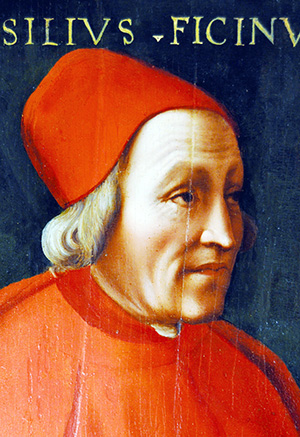
Marsilio Ficino (1433–1499)
Marsilio Ficino was a young Florentine Greek scholar, and after an interview with him, in 1462 Cosimo entrusted to him the newly revived Platonic Academy, putting all he needed for it at his disposal. Along with a villa in the hills above Florence, Cosimo, an obsessive book collector, gave Ficino access to his library. Recently, precisely because of the fall of Constantinople, many items previously unavailable in the west had come on the market, and several works by Plato had been snatched up by Cosimo’s book scouts. Cosimo hoped to read these as soon as possible, so he put Ficino on the job of translating them into Latin. No sooner had the young scholar got down to work than his boss told him to delay that order. Something else, more important than Plato, had come into his possession. Ficino had to put the father of philosophy aside and get to work immediately on this.
What could have been so important that it forced Plato into the backseat? None other than the Corpus Hermeticum, the collection of mystical, magical, and metaphysical writings that were attributed to the greatest sage of the antediluvian world, Hermes Trismegistus, fabled “thrice greatest Hermes.” Hermes, an even more misty figure than Zoroaster – he is in fact an amalgam of the Egyptian god of magic Thoth and the Greek god of writing Hermes, born in ancient Alexandria – was considered to be even more important or fundamental a secret teacher than the great Persian sage. When Cosimo heard that a collection of these texts had come into his possession, he told Ficino to get them into Latin post haste. By one of those twists of fate that suggest some guiding hand at work, the very catastrophe that Gemistos Plethon, teacher of the ancient wisdom, had tried to prevent, led to perhaps the greatest work in this tradition coming to the mind most ready at that time to appreciate it and, more importantly, to pass it on.
Ficino put down Plato and picked up Hermes. Soon his Latin translations of these primordial texts were informing the shift in western consciousness that we know as the Renaissance. In school, we are taught that the Renaissance was about the rediscovery of the great works of ancient philosophy, such as Plato’s dialogues, and the birth of humanism, the belief in humanity as something more than a race of wretched sinners. This is true. But as the historian Frances Yates argued in Giordano Bruno and the Hermetic Tradition, it was also as much about the rediscovery of the Hermetic texts, and Ficino’s belief that they presented the very prisca theologia and “ancient wisdom” which Plato and the whole aurea catena had called upon since time immemorial.
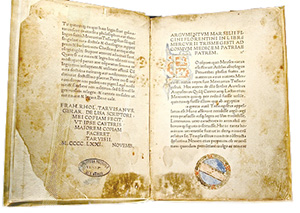
A rare 15th century edition of the Corpus Hermeticum (translated by Marsilio Ficino)
Along with informing and inspiring works such as Botticelli’s Venus and Michelangelo’s masterpieces, among others, what is remarkable about the Hermetic Renaissance is that for a time, Hermes Trismegistus was considered a kind of precursor to Christ or at least a very important fellow traveller. There were influential people within the church who argued for the “ancient wisdom” to be incorporated into church teaching. I tell this story, along with that of the Corpus Hermeticum itself, in my book The Quest for Hermes Trismegistus. One product of this sadly unsuccessful attempt to unite the ancient wisdom with Christianity – which devotees of the prisca theologia believed was an expression of the ancient wisdom itself – was what has become known as the philosophia perennis, or “perennial philosophy.”
The Perennial Philosophy
This term was coined in 1540 by the humanist, biblical scholar and Catholic apologist Agostino Steuco, to account for the harmony he and many others saw among Christianity, pagan philosophies, and the Hermetic teaching, and which argued that they should be united and not antagonists. This was further extended to include the differences between Protestant and Catholic, Aristotle and Plato, Jew and Christian, and has since come to mean a central timeless spiritual teaching from which all religions, including those of the East, emerge. Steuco’s arguments convinced others, such as François Foix de Candale, Bishop of Aire, who believed that the Hermetic writings should be made canonical, and the Venetian philosopher Francesco Patrizi, who petitioned Pope Clement VIII to have Hermetic ideas taught in Christian schools. Although the notion made some headway, in the end the church insisted that Christianity, rather than being the best or most perfect expression of this perennial wisdom – as its advocates needed to concede – was unique, incomparable, and in a league of its own, and did not need other adepts.
Although clearly similar and often used interchangeably, there is nevertheless a difference between the ancient wisdom and the perennial philosophy. The difference lies in the ancient wisdom positing a historical revelation, a “giving” of this knowledge to mankind in the dim past, which has subsequently become obscured over time. Hence the Renaissance obsession with the “source” or “fount” of wisdom, which it considered the purest expression of it, rather as a mountain stream is clearest at its source, not muddied as it gets into the lowlands. Hence also the belief that what is oldest is best, and the prestige given to the Corpus Hermeticum, which was believed to have been written before the Flood. For a culture coming out of the Dark Ages, such an appetite for the “real thing” is not surprising.
For the perennial philosophy, however, the source is not that important because it is always present; it is a-temporal. It does not lie in the vaults of time but in the Eternal Now. We can say it presents an “evergreen wisdom” rather than an ancient one. This is the sense in which it became popularly known and first widely appreciated, through Aldous Huxley’s influential anthology The Perennial Philosophy, which draws on spiritual and mystical texts from all sources – although it must be said that Huxley’s interpretation falls heavily on the side of the East. He also mistakenly credits the philosopher Leibniz with coining the term philosophia perennis. This is understandable, as Leibniz was the first to make it widely known outside the church.
Another school likewise associated with that of the ancient wisdom, which is also different from it, and from the perennial philosophy, with which it is also confused – all three are often mixed and matched – is what is known as Traditionalism. Like the ancient wisdom, Traditionalism posits a “primordial” revelation and also believes that this pristine appearance of sacred Truth has over time become obscured. As does the ancient wisdom, it believes that this revelation is at the heart or essence of the great religions. But where they differ is in Traditionalism’s belief that access to this primordial knowledge can come only through strict adherence to one of the great religious traditions. We can see this as a kind of esoteric fundamentalism. René Guénon, the recognised founder of Traditionalism, sought this “true” stream of knowledge first in Hinduism, then in Islam. That said, other important Traditionalists, such as Frithjof Schuon and Julius Evola, took the idea in directions rather different from Guénon’s, and it is not unusual today for contemporary Traditionalists to follow paths not necessarily laid down by the great religions.
While in its early days, the proponents of ancient wisdom did seek for unity among different beliefs, and adherence to a strict tradition was not part of their method. As in ancient Alexandria, the birthplace of the Hermetic teachings, the Renaissance in which these teachings re-emerged was a melting pot of different ideas and visions, and the synthesis of these was of more importance than any putative purity – see, for example, Pico della Mirandola’s Oration on the Dignity of Man. Hence the syncretism characteristic of Alexandria and of the esoteric and mystical teachings that appeared there. It is one of the ironies of esoteric history that Traditionalism, whose roots can be traced back to Ficino’s version of the aurea catena, came to be known as a vociferous condemner of the Renaissance, and a fierce opponent of the “modernity” to which it gave rise, as well as of the syncretism which it saw as the sign of what it called “counter-initiation.” If we can accept the Renaissance as the time when the notion of an ancient wisdom or lost tradition gained intellectual and cultural momentum, then Traditionalists of the “revolt against modernity” school seem to want to pull away at their own roots.
Yet that modernity itself undermined its Hermetic foundations. In 1614 the prestige of Hermes Trismegistus declined when the humanist scholar and church historian Isaac Casaubon declared that, based on the Greek in which the Corpus Hermeticum was written, it could not have been “revealed” to mankind in the misty past, but was most likely produced – as we have subsequently come to accept – in Alexandria circa 100-200 CE. At a single blow, the authority of the ancient wisdom and the Renaissance worship of the oldest as best had the rug pulled out from under them. Although Hermetic thinkers like Robert Fludd fought gallantly against it, with Casaubon’s bombshell the Hermetic philosophy quickly lost its street cred. Now the modern, new, up to date and rigorously “scientific” had pride of place.
What happened to the ancient wisdom? For one thing, its links to the philosophia perennis helped in this crisis; if the source of wisdom was ever-present, then fixing it at a one-time-only point in history seems redundant, although its various appearances, at different times and places, could be traced. But perhaps more important, the ancient wisdom went underground. First with the Rosicrucian brotherhood – that mysterious secret society of invisible sages – and subsequently in a variety of forms, which have come down to us as the Western “esoteric,” “mystery,” or “inner tradition,” or, more popularly, “occultism.” This is a body of “rejected knowledge,” jettisoned by the rise of rationalism and, in our time, “scientism,” which insists nevertheless in maintaining its important and indispensable place in the human spiritual economy. In fact, we can say that since the late nineteenth century, the ancient wisdom has been making a fragmentary but persistent comeback, filled with detours, dead ends, and wrong turns, but gaining ground nonetheless.
This began with the most influential appearance of the ancient wisdom in modern times, the founding of the Theosophical Society by Helena Petrovna Blavatsky and her colleagues in 1875, and the mammoth texts Blavatsky produced – Isis Unveiled and The Secret Doctrine – to get the wisdom across to the reading public. As in the Renaissance, Blavatsky and Co. believed that the ancients knew quite a bit that had been forgotten; they also believed that at root all religions share the same source and are moving, however clumsily, in the same direction. Science, in its own befuddled way, is too.
Blavatsky’s ancient wisdom was global; she found it in the rejected Hermetic tradition, and in the Eastern traditions she did so much to translate to the West. After her, others sought this wisdom too, and brought some of it back from their journeys: Rudolf Steiner from the Akashic Record, Gurdjieff from the Sarmoung Brotherhood, Ouspensky from his search for “the miraculous,” to mention only some of the most insightful and influential of those “seekers of truth” that followed, often literally, in Blavatsky’s footsteps. Today, almost a century and a half later, ancient wisdom, perennial philosophies, and a variety of Traditions crowd the electronic noösphere we call the Internet.
And what precisely is the ancient wisdom? That would require another article. But I would think that by now the reader would have enough to find out for themselves.
[alert type=”general” dismiss=”no”]This article was published in New Dawn 170.[/alert]
[alert type=”success” dismiss=”no”]If you appreciate this article, please consider subscribing to help maintain this website.[/alert]
The Hermetic revival in the Renaissance was inspired by a belief that humanity could remake its own destiny. Was this promethean arrogance, or the recognition of powers that we need to acknowledge?
The philosopher Jean Gebser argued that a profound shift in human consciousness took place in 1336 when the Italian Renaissance poet Francesco Petrarch made his ascent of Mt. Ventoux in France.1 This, Gebser said, was the first time someone had bothered to climb a mountain in order to see the view. Men had, of course, encountered mountains before, but always as obstacles. Petrarch made his climb on purpose.
Gebser relates Petrarch’s climb to the rise of perspective in European painting, and to a “new, realistic, individualistic, and rational understanding of nature.” No longer “fixed” in place, one creature among others, as their medieval ancestors were, human beings could now “rise above their station,” survey the vast landscape of creation and map out their destiny.
Gebser, I believe, is correct. And I would argue that perhaps some of the greatest exponents of this new consciousness were the Hermeticists of the Italian Renaissance.
In her classic work Giordano Bruno and the Hermetic Tradition, the British scholar Frances Yates writes that “The great forward movements of the Renaissance all derive their vigour, their emotional impulse, from looking backwards.”2 That the Renaissance was a time of rediscovery, of the resurrection of classical learning, is a truism. But what is not so well known is that it was also a return to the ancient teachings of the most famous magician of all time, Hermes Trismegistus, “thrice-greatest Hermes.” The writings that came to be known as “Hermetic” – including the Emerald Tablet, perhaps the most famous magical text in history – were considered by the Renaissance to be of profound antiquity. They were believed to have been set down in a distant Golden Age when men and gods still walked and talked together. For Hermeticists like Marsilio Ficino (1433–1499), Giovanni Pico della Mirandola (1463–1494), and Giordano Bruno (1548–1600), the rediscovery of the Hermetic books meant that the way back to an original divine state, to mankind’s true heritage, had been given to them.
A 15th-century edition of the Corpus Hermeticum (translated by Marsilio Ficino).
As the Greek god of writing, learning, language, and speech, Hermes held tremendous importance for Renaissance man, whose consciousness was profoundly attuned to the text. It is difficult for us to grasp just how central he was. In 1460, when the humanist patron Cosimo de’ Medici received a Greek copy of the Corpus Hermeticum, a collection of magical texts believed to be authored by Hermes, he ordered his scribe, Marsilio Ficino, to break off translating Plato in order to start work immediately on the Hermetic texts. Even Plato, to whom all of Western philosophy is said to be a “footnote,” must step aside for the thrice-greatest one, presumably so that Cosimo could read him before he died.3
The Renaissance desire to drink the waters of wisdom at their source dictated this urge. For the Renaissance mind, Hermes Trismegistus was identified with the Egyptian god Thoth and his profound knowledge of occult mysteries; hence he was far older than Plato and was, in fact, the source of the divine Plato’s mystical philosophy. As Yates writes, “Renaissance respect for the old, the primary, the far-away, as nearest to the divine truth, demanded that the Corpus Hermeticum should be translated before Plato’s Republic or Symposium.”4
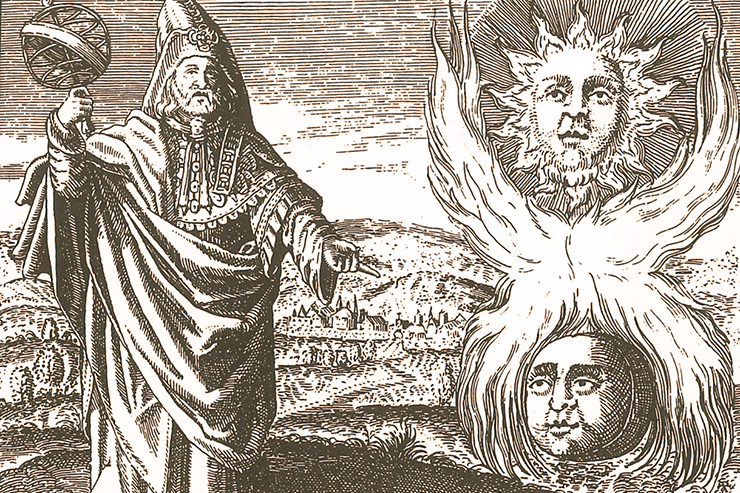
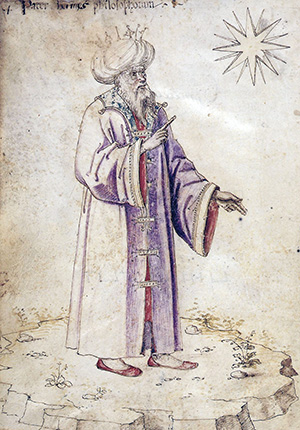
Hermes Trismegistus portrayed as an ancient sage with turban and royal crown in an alchemical manuscript, c.1475.
Yet as Yates points out, this Renaissance reverence for a Golden Age of Hermetic wisdom, however pious, was misguided. The works which inspired the Renaissance magician, and which he believed to be of ancient, primordial pedigree, are now thought to have been written in the early centuries of the Christian era, c.200-300 CE, products of the gnostic syncretism that characterised the decline of Greek philosophy.
Far from being contemporary with Moses, farther still from the pristine rays of the original Egyptian sun, the Hermetic texts that ousted Plato were written not in the ancient past by a philosopher god, but by unknown scribes a little more than a millennium earlier. Nevertheless, the “historical truth” about the author of the Emerald Tablet, Picatrix, and the Divine Pimander seems less important than the influence he and the works attributed to him had on a pivotal time in the evolution of Western consciousness.
The Hermetic message of knowledge, symbolised in Hermes’ role as guide and scribe, offers the central contrast with the medieval image of man as a sinful creature whose only chance of salvation lies in the consciousness of his imperfections: Knowledge is power for Hermetic man – power over nature, himself, and his destiny. As Virgil (who resembles Hermes in his role of psychopomp) guided Dante through the darkness of the nether realms, so Hermes Trismegistus, fount of wisdom and source of the prisca theologia – the ancient wisdom behind the religions of the world – guided Renaissance man through the shadows of his lower nature and the snares of the astral demons to his true heritage as magus, master of the world.
Escape from the Stars
For Renaissance man, the universe was a living intelligence, a hierarchy of powers whose influence was felt through the emanations of the stars. We who read our daily horoscopes half tongue-in-cheek, half eager for instruction, can barely grasp the fascination of astrology for the Renaissance mind. The untutored endured their destiny, solaced only, if at all, by the thought that their misfortunes were the result of their fallen nature.
Hermetic knowledge meant that Renaissance man was no longer wholly subject to this astral influence; he now had it in his power to modify, even master, his fate. Knowing the correspondences between microcosm and macrocosm, the Hermeticist could create a magical “strange attractor,” drawing or repelling what astral influence he chose. Understanding the links among the various symbols, scents, colours, metals, numbers, dates, times, places, states of mind, and astral influences, the Renaissance Hermeticist had gained a power his medieval brother lacked – or avoided, as such knowledge was considered demonic. To challenge fate was a mark of hubris, rejection of divine providence, and alliance with the Evil One. The hurdle facing the Renaissance Hermeticist was to show that the wisdom of the thrice-greatest one was not antithetical to the received Christian doctrine. Some, like Giordano Bruno, were not successful. Others, like Marsilio Ficino, were.
Ficino’s Natural Magic
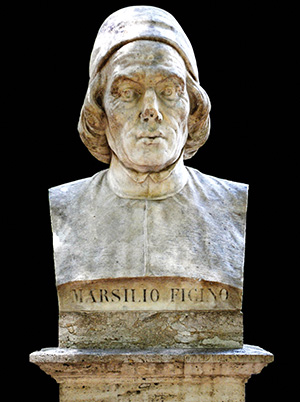
Bust of Marsilio Ficino
The world of Marsilio Ficino’s magic has a strange, melancholy atmosphere, an eerily familiar landscape of anxiety and dread. As in Kafka’s fictions, the sense of an overarching power whose ebb and flow determines our fate pervades his Hermetic investigations. Author of the influential Commentarieson Plato’s Symposium (1469), Ficino was subject, he believed, to the restrictive influence of Saturn, a complaint common to students and scholars. He sought to escape its melancholic emanations by surrounding himself with the symbols of more beneficent solar, jovial, and venereal powers. For James Hillman and the school of archetypal psychology, Ficino’s magic represents an attempt to “consider all events in terms of their meaning and their value for soul.”5
Yates, writing some years earlier than Hillman, had ironically previsioned Ficino’s value for psychotherapy. Commenting on his prescriptions for a non-Saturnian environment, she remarks, “We might be in the consulting room of a rather expensive psychiatrist who knows that his patients can afford plenty of gold and holidays in the country.”6 Ficino’s Hermetic antidotes to devitalising Saturn are collected in his treatise on medicine, Libri de vita, first published in 1489.
It was not unusual for a Renaissance medical text to offer astrological advice; assumptions about the relation between different zodiacal signs and parts of the body and the influence of the planets on temperament were as fundamental then as our ideas about genetics are now. What was daring about Ficino’s prescriptions were his use of magical talismans, a practice condemned by the Church Fathers.
In Ficino’s time it was still possible to advocate a “good,” “natural” magic that employed the beneficent forces of the anima mundi, or “soul of the world,” rather than the demonic energies of the stellar spirits. But time was running out on this tolerance. Hedging his advocacy of the Hermetic art with detailed qualifications, Ficino suggested that the use of talismanic magic was a natural outcome of the Platonic wisdom that ran parallel to religious dogma. The basic idea behind his “astral magic” – and behind Hermeticism in general – is that correspondences exist between the world of the Divine Intellect (Plato’s Ideal realm) and the created world. The magician’s own imagination is the bridge linking the two.
Intermediary between these is the “soul of the world,” an idea prominent in Plotinus and the Neoplatonists of late antiquity. This “soul” was found in images which, in true Platonic fashion, were not mere signs but symbols, potent vessels retaining an element of the original, supersensible Idea. For the Renaissance Hermeticist, the images found in the Hermetic texts, close to the fundamental source, had exceptional power.
One aspect of this magic was a kind of “reparation” of the sensible world, which, through its distance from the divine source, was subject to deterioration. By refashioning images of the external world in his imagination, the Renaissance magus could channel the divine influence into the imperfect world of the senses. By thus employing the talismanic devices fashioned through his knowledge of the Hermetic books, Ficino had delivered to Renaissance man the means of becoming co-creator with God. This was a far cry from the humble, sinful creature of the Middle Ages.
Pico Della Mirandola and the Dignity of Man
With Giovanni Pico della Mirandola, the hesitancy that characterises Ficino’s magic disappears and the new-found confidence in man as a spiritual power arrives in full force. Where Ficino was content to open the natural forces of the anima mundi to the philosopher-magus, Pico is determined to bring human consciousness to the very source of being itself. In the technical magical sense, this means mastering the arcane secrets of Cabala, the ancient Hebrew mystical tradition of deciphering the divine import, the hidden logos, locked in numbers and the alphabet. In the broader sense of humankind’s consciousness of itself, it means a new awareness of our powers and strengths, our “dignity,” a term hardly applicable to medieval man.
The influence of Hermes on Pico is evident in the opening paragraph of his most famous work, Oration on the Dignity of Man, which he delivered in Rome in 1486, at the hoary age of 24. He begins by remarking that the esteemed Abdala the Saracen, when asked what in the world was most worthy of wonder, had answered “man.” Pico supports this conclusion by quoting Hermes. “What a great miracle is man,” the thrice-greatest one remarks in the Hermetic text known as Asclepius. Pico sets off his rhetorical fireworks in order to state this case as persuasively as possible.
Pico’s Cabalistic investigations opened doors for Christian variants on an adamantly Jewish tradition. It made possible the kind of Cabalistic magic associated with modern Hermetic societies such as the Hermetic Order of the Golden Dawn, whose membership included luminaries like W.B. Yeats and dark stars like Aleister Crowley. Critical of Ficino’s merely “natural” magic, Pico argued that for magic to be effective, it must reach beyond the stars, into the higher, supercelestial spheres. Pico’s Cabalistic magic tapped the forces that lay behind the sensible world: angels, archangels, the ten sefirot or powers of God of the Cabalistic Tree of Life, even God himself – as aspiration the cautious Ficino would never openly avow.
Instead of merely manipulating astral effluvia, knowledge of the secret import of numbers and the Hebrew alphabet meant the Cabalist magus could refashion the very matrix of being. But Pico’s Hermetic message is not limited to this specific magical practice. His basic argument is that man is a god who, as a contemporary writer put it, “has forgotten his heritage and come to accept that he is a beggar.”7 It is Pico’s mission to remind us of our roots.
Central to Pico’s message is that unlike all other created beings, man has no fixed nature. “The Supreme Maker decreed,” he states in the Oration, that man “should have a share in the particular endowment of every other creature…. We have given you, O Adam, no visage proper to yourself”8 – a belief echoed centuries later by Jean-Paul Sartre, who argued that man had existence but not essence. Thus man is protean, able to participate in all dimensions and spheres of reality.
The microcosm is the macrocosm, at least potentially. “We have made you a creature neither of heaven nor of earth, neither mortal nor immortal, in order that you may, as the free and proud shaper of your own being, fashion yourself in the form you may prefer”9 – a Hermetic proposition if there ever was one. No longer secure in his medieval slot, man now can make of himself what he will. He can “descend to the lower, brutish forms of life,” or ‘’rise again to the superior orders whose life is divine… Whichever of these a man should cultivate, the same will mature and bear fruit in him.”10 With the works of Plato, the Gospels, the writings of the Church Fathers and, above all, the books of the incomparable Hermes Trismegistus at his disposal, Pico goes for the alchemical gold, opts for the life divine, and strives to actualise his high inheritance.
This supreme self-confidence is a sign of the hubris that for some is the most pervasive gift our Renaissance forefathers have left us. Yet, as Yates writes, ‘’The profound significance of Pico della Mirandola in the history of humanity can hardly be overestimated.”11 After him, European man had the confidence to act upon the world and to control his destiny through knowledge. Unfortunately, Pico himself did not long enjoy his newly won status, dying of fever at the age of 31. His incendiary rhetoric suggests a bright but short-lived flame.
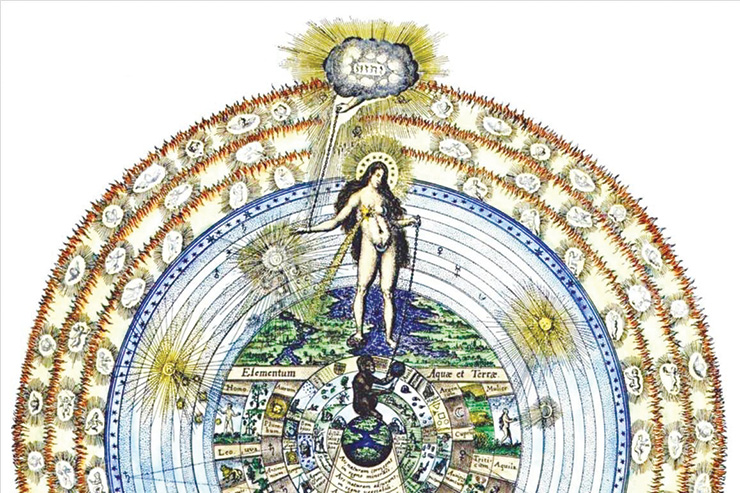
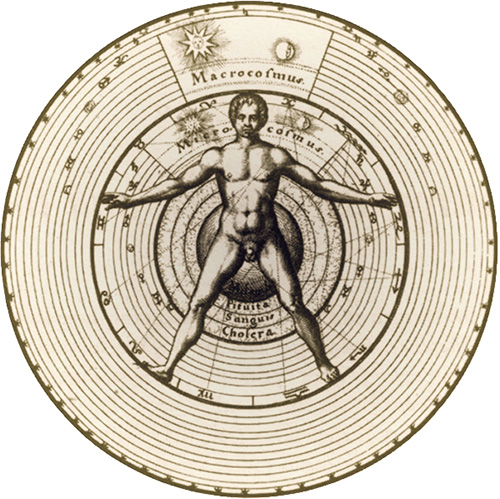
Robert Fludd’s famous illustration of man as the microcosm within the universal macrocosm, inspired by the Hermetic axiom, “As above, so below.”
Bruno and the Egyptian Revival
Speaking of flames in the context of Giordano Bruno brings other images to mind. Bruno is remembered as a martyr for the Copernican heliocentric solar system: he was burned at the stake by the Catholic Church in 1600 for his heresies. Yet the picture of Bruno as a champion of a “modern” cosmology is inaccurate. The godless, meaningless universe of big bangs and black holes that grew out of the Copernican revolution would have been as repellent to Bruno as his own Hermetic aspirations were to the churchmen who immolated him.
Bruno did not burn because he favoured a cosmos reduced to mere energy and matter, drained of its magical, spiritual character. Bruno took Pico’s challenge to reclaim our divine heritage so seriously that he attempted to revive the ancient Egyptian, Hermetic religion – an injudicious if heroic project. Bruno wished to break the hold of the Church over men and to erect in its place the pantheon of mankind’s true spiritual guides, the gods of ancient Egypt. It is for this, and not for his place in the standard histories of “the warfare between science and religion,” that he should be remembered.
Bruno’s contribution to the Hermetic Renaissance is central and cannot be adequately reviewed here. But two aspects of his work stand out: his proposed Egyptian revival and his mastery of the Art of Memory.
Yates has written at length on this ancient art, and the interested reader can get a definitive account of it in her book The Art of Memory. Known to the rhetoricians of antiquity, revived by Renaissance scholars, and used in magical practices by modern esotericists, “magical memory,” as Bruno’s mnemonic discipline is known, is a sine qua non of the true magus. A central theme in Bruno’s Hermetic magic was the reflection of the universe in the mind of the magus.
In The Mind to Hermes, book XI of the Corpus Hermeticum, the mens, or Divine Mind, addresses Hermes about this discipline. “Unless you make yourself equal to God, you cannot understand God,” the Divine Mind advises the thrice-greatest one. “Like is not intelligible save to like. Make yourself grow to a greatness beyond measure, by a bound free yourself from the body; raise yourself above all time, become Eternity; then you will understand God.”12
One way in which Bruno strove to accomplish this end was by engraving on his consciousness the divine images, the celestial archetypes, which, as the title of his early work De umbris idearum (1582) suggests, were the shadows of the Platonic Ideas. He used a method familiar to rhetoricians of antiquity. The ancient Roman orators would memorise a series of places in an imaginary building and attach to these places images to remind them of the points of their speech. As they gave the speech, they mentally “walked” through the building, prompted by the memorised images. If we think of a virtual reality tour of an architectural site or a trip through a castle in a video game, we have a fair idea of the process, except that the practitioners of the art used nothing but their own powers of imagination. As Yates points out, it is difficult for us to imagine a memory capable of the complex, vivid detail achieved by the ancient mnemotechnicians.
Reviving this practice, Bruno adapted it to his magical projects. Taking the divine images from the Hermetic books, the Renaissance magus fixed these in his imagination, thus furnishing his inner world with a blueprint of the universe. In the process, he acquired magical powers enabling him to act upon the world.
By thus reflecting the universe in his mind, the Renaissance magus became a co-creator with God, fulfilling Pico’s injunction that man must embody the highest and greatest good, a privilege vouchsafed to him alone. The magical images were arranged in the mnemonic system with images of the terrestrial world – plants, animals, minerals – and with the sum of human knowledge symbolised by the images of great thinkers and inventors. The possessor of this system thus stood above space and time, reflecting within his consciousness the entire universe of nature and man. He thus met the Hermetic challenge of “becoming Eternity.”
In practising this magical memory, Bruno hoped to break through the dense matter of the terrestrial world and to return to his true stature as an agent of the divine mind. This gnostic heresy – that man is not a mere creature but embodies the archetypal energies behind the world of appearances – is a radical development of Ficino’s more subtle “astral magic.” It is a move away from manipulating natural forces toward actualising the divine powers dormant within us.
Bruno’s “Egyptian revival,” in which he hoped to bring back the ancient Hermetic religion with its appreciation of man as magus, was powered by his profound antipathy to the image of man promulgated by the Church. A central part of the Asclepius is the lament over the decline of the ancient teachings, the darkening of mankind’s spiritual light, and the fall into forgetfulness of its divine heritage.
Hermes Trismegistus was identified with the Egyptian god Thoth, depicted here in this artwork by Jean-François Champollion, 1823 (on display in the Brooklyn Museum).
For Bruno, the Christian church was one of the agents responsible for this decline. Like Pico, Bruno considered it his mission to awaken men to their true place in the cosmos. In the Spaccio della bestia trionfante (1584), Bruno glorifies the magical, Hermetic religion of the Egyptians, and throws Ficinian caution to the wind by declaring that the return of that religion is nigh. There are no half-measures here: Bruno’s reformation begins with a cleansing of the zodiac by the divine Sophia, Isis, and Momus, archetypal powers of the Hermetic doctrine. Not only man’s life on earth, but the entire cosmos, must regain its magical heritage.
In the Cena de le ceneri (1584), a satire on the academic pedants who reject his Hermetic wisdom, Bruno proclaims the new Copernican theory of a heliocentric solar system as evidence that the Hermetic revival has come. His use of Copernicus, coupled with the bombastic, aggressive personality often found in men of genius and spirit, led to his death. After years of bitter struggle against the papal forces, the avatar of the new Hermetic age was burned alive at the hands of the Inquisition in 1600 on the Campo de’ Fiori in Rome.
In recent years a critical attitude toward the Renaissance magicians has grown up among some “anti-modern” thinkers. The eco-feminist Charlene Spretnak, recognising that the “core concept of the Ancient Wisdom is that man is a terrestrial god who can shape his own destiny and control nature,” sees the Renaissance magicians as ultimately “triumphal selfproclaimed titans, desperately denying the existence of a larger reality… of which human intelligence is only a part.”13 Their patriarchal, egocentric world views are out of touch with the more feminine, “nature-friendly” sensibilities that Spretnak advocates.
That our contemporary abuse of nature has its roots in the rise of modern science, associated with the Renaissance, is, I think, true. Yet the urge to “put man in his place” exhibited by “ecologically correct” thinkers carries some dangers of its own, not the least of which is a dampening of self-belief and a nurturing of cosmic laziness. As the eighteenth-century theosopher Louis Claude de Saint-Martin wrote of the men of his time, “They have believed themselves to be obeying the dictates of humility when they have denied that the earth and all that the universe contains only exists on man’s account, on the ground that the admission of such an idea would be only conceit. But they have not been afraid of the laziness and cowardice which are the inevitable result of this affected modesty…. Where is the pilot that will guide us between these hidden reefs of conceit and false humility?”14
Nearly three centuries later, we are still faced with Saint-Martin’s question. Humility, acceptance of fate, and knowing our station in the scheme of things may make for a more secure cosmos. Yet having once glimpsed our powers, it would be inauthentic, not humble, to turn away from them. We are still faced with the choice given to Renaissance man: to actualise our godlike potentials or to ignore them. Extravagance, passion, fierce individualism: our modern consciousness has its roots in these Renaissance virtues. Our task is to refine, not deny them.
This article was originally published in GNOSIS #40 (Summer 1996) under the title ‘The Renaissance of Hermetic Man’ and later incorporated into Gary Lachman’s book The Quest for Hermes Trismegistus (Floris Books 2011).
In the spring of 1915 the writer and journalist Peter Demianovich Ouspensky, a familiar name in Russian Theosophical circles, gave a series of lectures in Moscow about his recent “search for the miraculous” in Egypt, Ceylon, and India. Ouspensky, a popular author on occult themes, had gone East in search of “schools,” teachers from whom he could learn a knowledge “unlike anything known or used by us” – the modern, scientific West that is.1 Such knowledge, he believed, was the only thing that could offer a way out of the “labyrinth of contradictions” that make up modern life. Ouspensky was convinced that through this knowledge the “thin film of false reality” – of money, prestige, and the pursuit of power – that we take to be real, could be dissolved and another reality, that of the “miraculous,” could be revealed.2
Ouspensky did not find what he was looking for in the East. He met many interesting people and travelled to many sacred places, but in the end he had to admit that the miraculous had eluded him. But the miraculous was not to be balked. It was waiting for Ouspensky, and if he could not find it, it would come to him.
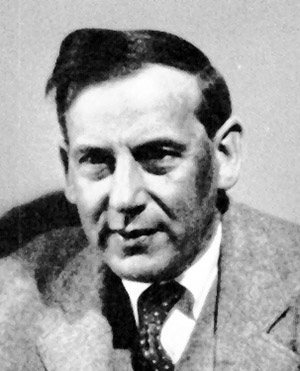
Peter Demianovich Ouspensky (1878–1947) went in search of the miraculous and found the enigmatic Armenian esoteric teacher George Ivanovitch Gurdjieff.
Apparently, it was much closer than he thought. In fact, it appeared one afternoon in small café in a busy Moscow side street in the form of a “certain G., a Caucasian Greek,” whom Ouspensky remembered was the author of a strange ballet, “The Struggle of the Magicians,” a notice for which he had recently seen in a newspaper. He had agreed to this meeting only after one of G’s students, who had attended his lectures, had persisted in inviting him. Ouspensky had finally said yes to his requests just to stop his pestering. Ouspensky had had his fill of gurus and had returned from the East not a little disillusioned. His interest in Theosophy and other occult ideas was more than a little bruised, and he was sure all that would come from this encounter was more confirmation of his scepticism. But what he learned from this “certain G.” changed all that.
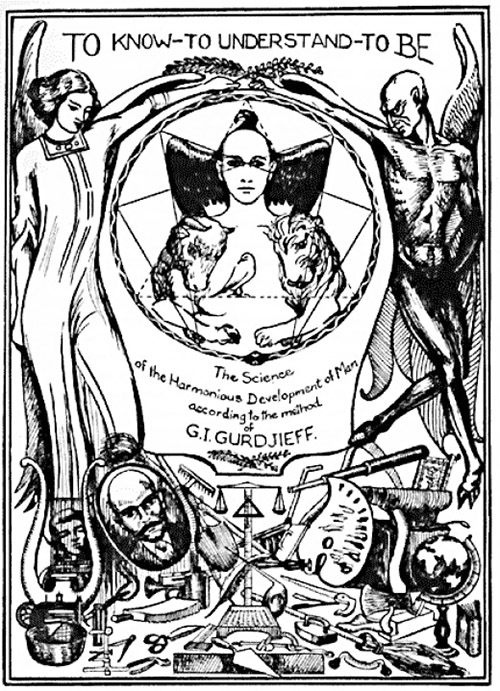
Ouspensky’s “certain G.” was the enigmatic Armenian esoteric teacher George Ivanovitch Gurdjieff. Together the two were responsible for introducing to the West a startlingly new and often brutally demanding system of self-development, what Ouspensky later dubbed “the psychology of man’s possible evolution.” Today it’s widely known as the Fourth Way – to differentiate it from those of the fakir, yogi, or monk – or, more familiarly, “the work.” Gurdjieff had already been working with groups of students in Moscow for a few years before stage managing this meeting and had purposefully set out to attract Ouspensky, whom he wanted to secure as a Plato to his Socrates, that is, as a good interpreter and expositor of his ideas. He had his students read Ouspensky’s books – the most impressive of which, Tertium Organum, about higher dimensions and mystical states of consciousness, had made his name – and then sent them out to ensnare the philosopher. If Gurdjieff’s students had not been successful in getting a wary Ouspensky to this café, there is every chance that “the work” might not have survived the historical eruptions – World War I, the Bolshevik Revolution and Russian civil war – that were the backdrop to Ouspensky’s true encounters with the miraculous.
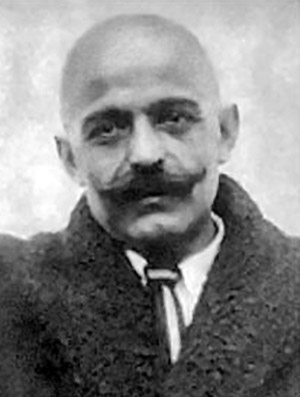
George Ivanovitch Gurdjieff (1866–1949)
Ouspensky was immediately impressed by Gurdjieff as a man who knows, a man, that is, who possessed the kind of knowledge that he had sought in the East. But although it soon became clear through their conversation that Gurdjieff was as well versed in religious, spiritual, and mystical traditions as he was, and was equally if not better travelled – indeed, he had been to places that Ouspensky had only wished to visit – there was something more. Gurdjieff himself had a strange undeniable presence. This man “of an oriental type” with a “black moustache and piercing eyes” astonished Ouspensky because he seemed to be purposefully poorly disguised. His face, which reminded Ouspensky of “an Indian raja or Arab sheik,” did not suit the black overcoat and bowler hat he wore, as did the many small businessmen that frequented the place. But his disguise was obvious, and Ouspensky was not a little disconcerted to feel that while he knew this certain G. was in disguise, he also knew that he had to pretend that he wasn’t, and that he had to carry on their conversation as if all was perfectly normal. This was Ouspensky’s first experience of the kind of psychodrama and “role-playing” that Gurdjieff performed with his students and which, in the end, would drive him away.
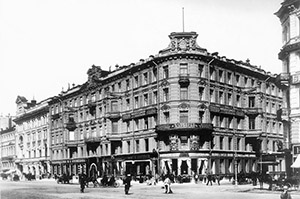
Nevsky Prospect, St Petersburg, circa 1900. After first meeting Gurdjieff in Moscow in 1915, P.D. Ouspensky returned to St Petersburg and joined Gurdjieff’s core six-member St Petersburg group.
But that was in the future. From that meeting until the summer of 1918, while Russia exploded into chaos, Ouspensky submitted himself to Gurdjieff’s tutelage and began to learn the “system,” a story he tells in his posthumous masterpiece, In Search of the Miraculous. And if Gurdjieff himself impressed with an aura of strength and knowledge, the system he began to unfold to an increasingly ensnared Ouspensky made an even greater impact. It was logical, consistent, based on experience and observation and free of the kind of wishful thinking that Ouspensky had found in many other mystic teachings. In fact, it was almost specifically designed to attract a rigorous, critical intellect that had recently shorn itself of much of its romanticism. Whether this was so or not, in Ouspensky’s case it’s exactly what happened.
The Teachings
What was Gurdjieff’s teaching? When Ouspensky remarked on how life in big cities like London, where he had just been, was becoming more mechanical and increasingly turning people into machines, Gurdjieff corrected him. They already are machines, he said, and would be whether they lived in the city or not. “This must be understood,” Gurdjieff impressed on Ouspensky. “All the people you see, all the people you know, all the people you may get to know, are machines, actual machines working solely under the power of external influences.” Ouspensky was already concerned about the increasing mechanisation of modern life, but he believed that some things, the most important ones – thought, art, poetry – could stand against it. Gurdjieff told him he was wrong. These, too, can be and regularly are performed mechanically. He put up a fight, but it was not long before Ouspensky, himself a novelist and short story writer – witness Strange Life of Ivan Osokin and Talks With the Devil, respectively – agreed.
The most important question Ouspensky asked Gurdjieff was whether it was possible to stop being a machine? It was, Gurdjieff told him, but it was difficult and demanded much knowledge and effort. The problem is that man is asleep. What we take to be our waking consciousness is really just another kind of sleep; true wakefulness is something different. There are many reasons for this sleep. One is that human beings possess different minds or “centres,” each responsible for certain actions and behaviours. We have an intellectual, an emotional, a moving, and an instinctive centre, and also two “higher centres” from which we are cut off by our mechanicalness. When these work properly, all is good, but in modern man the centres are all confused, with one doing the work of another or stealing energy from other centres in order to do its own work. What is important for wakefulness is that each centre do its own work with its own energy and that all are in balance. It is then that the insights of “higher centres” can reach us. Such balancing is what Gurdjieff taught and his aim was to produce the “harmonious development of man.”
Another hurdle to wakefulness is that while we believe we possess a single “I,” a stable, reliable ego, the truth is that “we are legion,” as the man possessed by devils tells Jesus in Mark 5:9. We are not one but many. Our “I’s” shift with every mood. We decide to get up early tomorrow; when the alarm bell rings we turn it off and stay in bed. We decide to start a diet; when dinner time arrives we conveniently forget this. Our “I’s” shift because we are subject to a kind of hypnosis Gurdjieff called “identifying.” We lose our identity, our “I-ness” by giving it over to practically everything around us. Some of these disparate “I’s” can congeal into what is known as “false personality,” a picture of ourselves that allows us to ignore the contradictions that run rife through our lives but which are obvious to others.
Personality – let alone a false one – is itself an obstacle. Gurdjieff taught that we are made of two parts, what he called “essence” and “personality.” Essence is our own, it is what we are born with and is through essence that we can grow. But around essence accumulates our “personality.” This is what we learn or imitate from others and is the face we turn towards “life.” The problem is that personality becomes too rich, obscuring essence, rather like a bad orange whose thick rind covers a small bit of fruit. The aim of Gurdjieff’s system was to break down personality, to dismantle it and through the suffering that this entails, enable essence to grow.
Self-Remembering
What impressed Ouspensky most was what Gurdjieff had to say about a strange third state of consciousness he called “self-remembering.” There are four states or levels of consciousness. First there is sleep, which we pass through each night. Then there is what we normally call “waking consciousness,” but which is really another layer of sleep. This is our usual mechanical state of consciousness, which we falsely believe to be true consciousness. True consciousness, “self-consciousness,” only comes in the third level, what Gurdjieff called “self-remembering.” Normally our attention is directed outwards, toward the external world. Because we usually “identify” with things outside us, we “forget” about our own inner world. We forget that it is “I” – “you” – who is conscious and is actually in this moment engaged in the act of perceiving the world. Gurdjieff knew, as did Edmund Husserl, the founder of phenomenology, the philosophical method that gave birth to existentialism, that perception is intentional. He also knew that the less intentional and more passive we remain, the deeper our forgetfulness becomes.
Self-remembering is having the awareness of your own self, the observer and what you are observing, simultaneously. It is essentially a vivid sense of your own being, the fact that “you” exist, here and now. It can come to us out of the blue, and many examples of self-remembering can be found in literature; the episode of the madeleine in Proust’s Remembrance of Things Past is a classic example, although, of course, Proust doesn’t use the term “self-remembering.” In this sense, Gurdjieff shares much with the existential philosopher Martin Heidegger, who also believed that man’s greatest problem is what he called “forgetfulness of being,” loss of the sense of our own existence. Gurdjieff and Heidegger also arrive at the same remedy for this. Our forgetfulness or sleep in the face of being can be broken by a vivid grasp of the reality of our own finitude – our death – a medicine Heidegger prescribes in Being and Time and with which Gurdjieff agreed in his own perplexing jawbreaker of an esoteric masterpiece, Beelzebub’s Tales to His Grandson.
There is a fourth state of consciousness, “objective” or “cosmic consciousness,” in which we perceive reality as it truly is, and not obscured by our subjective perspectives. It is then that certain laws, the Law of Three and the Law of Seven, and an understanding of Gurdjieff’s version of the Great Chain of Being, the Ray of Creation, among other otherwise incomprehensible things, seem obvious. But this is far beyond us at present and actually useless to us unless we can maintain “self-remembering” for more than brief flashes.
Ouspensky’s Breakthrough
A. R. Orage (1873–1934)
These and other ideas first became widely known when Lady Rothermere, wife of a powerful British newspaper baron, rescued Ouspensky from White Russian refugee status in Constantinople by inviting him to London all expenses paid. An English translation of Tertium Organum – which Ouspensky knew nothing about – had become a surprise best-seller in America and England; one of its most devoted readers was Lady Rothermere, and a handsome royalty check accompanied her invitation. In September 1921 Ouspensky found himself in Lady Rothermere’s luxurious St. John’s Wood salon, addressing an audience that included T. S. Eliot, Aldous Huxley, Algernon Blackwood, Gerald Heard among other London literary luminaries. Also among his listeners were A. R. Orage, editor of the leading journal of ideas The New Age, and Maurice Nicoll, a successful Harley Street physician and C. G. Jung’s main disciple in Great Britain. By the end of Ouspensky’s lecture on the system he had learned from G. – which surprised all and disappointed some who had come to hear something more along the lines of Tertium Organum – both Orage and Nicoll would become his students.
Ouspensky’s tutelage of Orage was short-lived. In February 1922, Gurdjieff himself arrived in London. As always, the appearance of this remarkable man caused disruption. Ouspensky had already impressed with his intellect and seriousness. But Gurdjieff was something else. The same solidity and sheer being that had convinced Ouspensky that Gurdjieff knew now bowled over Ouspensky’s students. And when Gurdjieff announced that he was establishing his Institute for the Harmonious Development of Man in Fontainebleau, just outside Paris, many who had metaphorically sat at Ouspensky’s feet – he really was an unlikely guru – now were eager to make their way across the English Channel. The New Age lost an editor and Jung an apostle. But while Orage remained with Gurdjieff until his own break with him not long before his death in 1934, Nicoll studied with Gurdjieff for a year, and then returned to London to work with Ouspensky.
Representation of a design for Gurdjieff’s Institute for the Harmonious Development of Man, 1923 (from Teachings of Gurdjieff by C.S. Nott).
By this time Ouspensky had already ended his schooling with Gurdjieff and had set out to teach the system on his own, always giving Gurdjieff credit for it. Or at least for bringing it to the West. Gurdjieff said he had learned it during his time with the Sarmoung Brotherhood, a Central Asian version of Madame Blavatsky’s Tibetan masters, a story he tells in Meetings with Remarkable Men, the most immediately readable of his writings. But at other times Gurdjieff spoke of the system as “his,” so it is unclear how much belonged to him and how much he was “transmitting” from what he called the “inner circle of humanity.” Either way, Ouspensky had come to the conclusion that while he believed the system offered the sole method of “waking up,” he felt that he could no longer work with Gurdjieff himself.
During their time together, Gurdjieff taught in a more or less traditional way, through lectures, relating ideas and various exercises or methods of fighting “sleep.” This, along with Ouspensky’s clarity and rigour as a writer and thinker, makes In Search of the Miraculous still the best introduction to “the work.” Ouspensky believed that somewhere along the line, Gurdjieff changed and that his methods and aims were no longer the same as when he first began to learn from him. They had become, as mentioned, more geared toward a kind of psychodrama or role-playing and had also become more focused on the kind of “shock tactics” familiar to one branch of “the work.” The “movements,” incredibly difficult postures and “sacred dances,” designed to outwit our mechanicalness and awaken slumbering parts of ourselves, were part of this. It also entailed making more and more of what Gurdjieff called “super-efforts,” pushing oneself beyond one’s usual limits. When Orage, a portly man and heavy smoker, arrived at Fontainebleau, he was given a shovel and told to dig. He did until his body ached and he sobbed with pain. When he felt he could no longer go on, a sudden influx of energy hit him; he had broken through his mechanical limits. Gurdjieff also made outlandish claims about the success of his Institutes in other cities, most, if not all untrue. Gurdjieff was much more of a “crazy guru” than Ouspensky, a more traditional serious philosopher. And to make things worse, in 1924, a year after it opened, except for a small group, Gurdjieff turned away practically all of his students, said the Institute was closing down, and furthermore, that hewas breaking off all relations with Ouspensky.
Exactly why teacher and student fell out remains unclear, although in my book In Search of P.D. Ouspensky, I take a stab at answering this question, the essential one in the psychohistory of “the work.” Probably the most likely reason is that they were two very different men and that whatever his faults – I don’t spare them in my book – Ouspensky had a genius of his own, as many of his readers know. However remarkable a teacher Gurdjieff was, Ouspensky could not have remained a student for very long. The strange thing is that he continued to teach the system – to which he added his own ideas about time, as spelled out in his magnum opus A New Model of the Universe – while having many troubling doubts about his teacher. One concern was reports of Gurdjieff enjoying the intimate favours of some of his students. At first Ouspensky dismissed these as gossip; later he wondered about their veracity. Gurdjieff, he knew, was no angel. Indeed, some who encountered him painted him as quite the devil. In any case, he kept everyone on their toes and Ouspensky had had enough of it.
Ouspensky taught the system in London and, during World War II, in New York and New Jersey, for some twenty-five years. Then, in a series of lectures held in London in 1947, a few months before his death, Ouspensky rejected it, telling his audience they had to think for themselves and start again from the beginning. Exactly what this meant remains one of the mysteries in the psychohistory of “the work.” Some think it was an expression of searing honesty by a man who realised he had made a mistake. Others see it as a grand “work” strategy, a “shock” sent to force people to wake up. Perhaps we will never know. Gurdjieff spent some time in New York in the 1930s, but his main base of operation, following the closing of his Institute, was Paris. There, in his small flat in the rue des Colonels-Renard, which he maintained during the Nazi occupation, he gathered his many students for enormous dinners that would last for hours, and during which he would get them drunk on vodka and pierce their personality to get to their essence. He died in 1949.
A simple way to see the difference between the two is this. Ouspensky’s approach was to create a method that could be applied by anyone with the will and determination to master it, independently of the personal power or baraka of the teacher, rather as Husserl’s phenomenological method can be learned by anyone with the necessary patience and persistence. But no one could learn how to be like Gurdjieff, although somehow his presence, which so impressed Ouspensky, was in some way able to help others to be like themselves, perhaps for the first time. We might say that Ouspensky’s was the way of knowledge, whereas Gurdjieff taught through being. And, of course, he knew some things too.
If that is the case, then we are lucky that Ouspensky laboured to capture what he learned from Gurdjieff and to present it in such a brilliant, vivid, and gripping way, as this is what remains for us today. We may not be able to benefit from Gurdjieff’s presence, but we may be able, through his and Ouspensky’s efforts, to make something of our own.
[alert type=”general” dismiss=”no”]This article was published in New Dawn 167.[/alert]
[alert type=”success” dismiss=”no”]If you appreciate this article, please consider subscribing to help maintain this website.[/alert]
Footnotes
1. P. D. Ouspensky, In Search of the Miraculous, Harcourt Brace and Co. 1949, 3