New Dawn – World's Most Unusual Magazine

Author: Gary Lachman

  • On the Trail of Occulture

    On the Trail of Occulture

    From New Dawn 166 (Jan-Feb 2018)

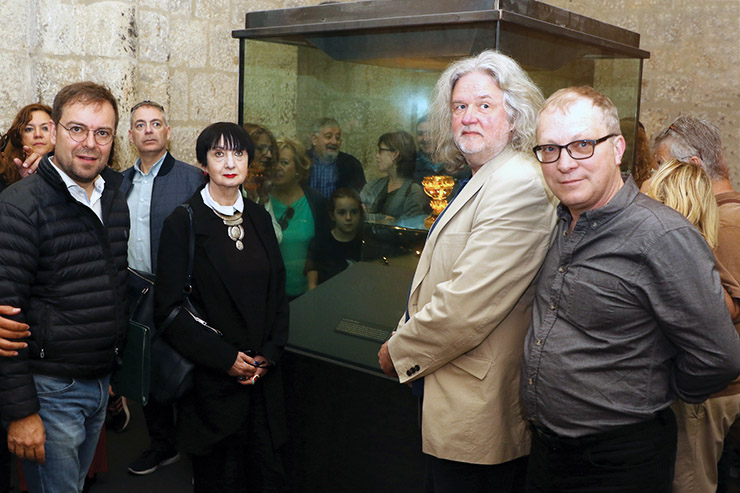
    Recently I returned to London after a week in Spain promoting a new translation of one of my books, and taking part in an International Occulture Conference held in León, an ancient city in northern Spain that is an important site on the Santiago de Compostela pilgrim trail. An ‘International Occulture Conference’ you might say? What is that and why in Spain? The second part of this question is easier to answer than the first. 

    The conference was held in Spain because it was organised by one of that country’s most popular writers, Javier Sierra. While he is not necessarily a household name in the English speaking world, Sierra has had considerable success with some translations of his work, most notably La Cena Secreta (2004) which, as The Secret Supper (2006), found a place on the New York Times bestseller list and stayed there for some time. Other works of what Sierra calls “investigative fiction,” like El Maestro del Prado (2013) – The Master of the Prado (2015) – have also done well in the UK and US. But in Spain Sierra is something of a phenomenon. I got a sense of this at the conference, watching the many fans of his books queue up for him to autograph their copies and to take a selfie with their favourite author.
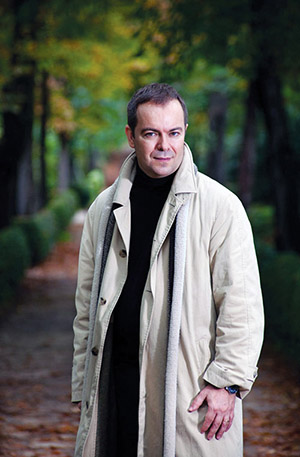
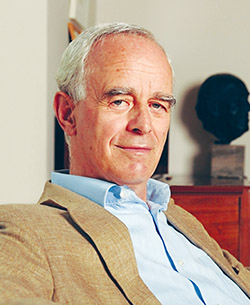
    Javier Sierra (photo courtesy of Javier Sierra)

    Sierra’s fictions deal with occult and esoteric themes, but not in a way aimed at shocking or titillating his readers. His books are thrillers, detective stories in the mould of Dan Brown or Umberto Eco’s The Name of the Rose, but what Sierra aims at giving his readers aren’t thrills and shivers but knowledge. He uses the structure of a mystery to uncover the traces of what for convenience sake we can call the Hermetic or Gnostic influence on Western culture. We can say that he uses one mystery to reveal another. At least this is the theme of the two books of his I’ve read. The Secret Supper – translated by Alberto Manguel – deals with the heretical ideas and teachings that Leonardo Da Vinci secretly embedded in his painting The Last Supper, and the efforts of a kind of papal secret police to wipe out those few who can read the code. In The Master of the Prado a young man meets a mysterious older gentleman in Madrid’s famous museum, and is instructed in the subtle art of reading the strange symbolism inserted into some of the world’s most famous paintings, works by Hieronymus Bosch, El Greco, Botticelli, and others. 

    The knowledge the heroes of Sierra’s fictions acquire is doubly ‘occult’, in that not only is it about ‘hidden’ things – the soul, the spirit world, and visionary states of consciousness, all deemed verboten by the religious authorities – but is itself hidden, coded in a language that only devotees of the lost wisdom can decipher. Sierra’s aim seems to be to teach this language to his readers so they can look at some of the most well-known works of Western art with new eyes, and grasp the deeper meanings that, for the uninitiated, are hidden in plain sight.

    What is Occulture?
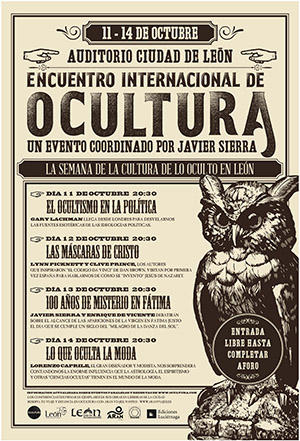
    Brochure for the International Occulture Conference.

    Here I would say we can begin to answer the second part of our question: what is occulture? It is what happens when what we call the occult and what we know as culture come together, in ways that illuminate both in an unusual light and allow us to understand each from new and different angles. In Sierra’s books Neoplatonism, Hermeticism, Kabbalah, art history, hermeneutics and mysticism come together in narratives that not only entertain but instruct.

    Sierra’s success led to the launch of a new publishing line, Ocultura, which specialises in titles hand-picked by him and whose covers receive his imprimatur. Hence the conference and my appearance at it. My book Politics and the Occult had been chosen for translation as was The Masks of Christ by Lynn Picknett and Clive Prince, who were the other English-speaking presenters at the conference. Picknett and Prince’s The Templar Revelation had been an inspiration for Sierra’s The Secret Supper as it had been for Dan Brown’s The Da Vinci Code – they even make a cameo appearance in the film. My book looks at the many examples of occult or esoteric ideas that have influenced politics in the modern west, and argues, contra Umberto Eco, that there is plenty of evidence for a ‘progressive’ occult politics, and not only for the more well-known far-right version. In The Masks of Christ Picknett and Prince analyse the actual evidence we have for who exactly Christ was – or wasn’t, as the case may be. As readers of their other books – like The Stargate Conspiracy and The Turin Shroud – have come to expect, their conclusions are, if nothing else, challenging and thought-provoking. The other speakers were Sierra himself, who engaged in a dialogue with the Spanish author and occult mover and shaker Enrique De Vincente on the true meaning of the visions of Fatima, celebrating their hundredth anniversary in 2017, and the top-flight designer Lorenzo Caprile, who spoke about the growing influence of occult ideas in the fashion world.

    Politics, religion, haute couture and esotericism do not usually mix, but for the week of the conference they seemed to get on well. The huge León civic auditorium, where the conference was held, was packed and the audience engaged. Local, regional and national newspapers, radio and television covered the event, with shots of the speakers and Sierra standing before the remarkable cathedral at León – a masterpiece of French gothic transported to northern Spain – and at the Basílica de San Isidoro. It claims, among its many other worthy features, to house a good candidate for the Holy Grail, at least according to the historian Margarita Torres Sevilla who argues for its authenticity.1 At the start of our Spanish adventure, in Madrid, I was surprised at the media attention Sierra’s new Ocultura editions drew. Lynn, Clive and I ran a marathon of radio, newspaper, and web interviews, enabled by our excellent translator. But in León there was even more, and when the head of the town council greeted us, I was surprised that he didn’t hand us the key to the city.

    Most of this had to do of course with our host’s popularity and the attention and business he was bringing the town, which is already a well-trod pilgrimage site. But it also could not hurt the ‘occulture’ cause, if there is such a thing. I had already taken part in several similar events all held under the occulture banner, in London, New York, and Trondheim, Norway. I had spoken at symposia and conferences in Germany, France, Denmark and Sweden in which the theme was the close links between art and the occult, in the past and present, and had written essays about this for art magazines and catalogues for ‘occulture’ exhibitions held in Europe and South America. So, whatever occulture is, it is certainly getting around.

    But what exactly is it? The term occulture is said to have been coined by the performance artist Genesis P–Orridge sometime in the 1980s. What exactly he meant by it remains unclear – at least to me – but it received its academic bona fides some years later. In 2004 Professor Christopher Partridge of Lancaster University defined it as a concern with “hidden, rejected and oppositional beliefs and practices associated with esotericism, theosophy, mysticism, New Age, Paganism,” and other ideas belonging to the “occult subculture.”2

    That is indeed a mouthful, but the gist of it was expressed more succinctly by the Swedish writer and publisher Carl Abrahamsson, who summed up occulture as “anything cultural but decidedly occult/spiritual.” Abrahamsson, to whose forthcoming book Occulture I contributed a Foreword, sees this union taking place more in the odd mashups between pop culture and the avant-garde, in the films of the Aleister Crowley devotee Kenneth Anger, the ‘cut-ups’ of William S. Burroughs and Brion Gysin, and other forms of ‘trangressive’ art. But “anything cultural but decidedly occult/spiritual” is a wide brief. It includes, for example, the work of the comic writer Alan Moore, the Russian painter and guru Nicholas Roerich, and the ‘traditionalist’ composer John Tavener. And if Sierra’s ideas are correct, it includes many of the great works of Western art.

    To be sure, most self-conscious works of contemporary occulture tend toward the transgressive, the antinomian, for the simple reason they aim to challenge not only the social but the ontological status quo, to upset ‘consensus reality’. As Sierra shows, much of the old traditional art that later rebels transgress against is itself already transgressing – against the religious dogmas and repressions of the time. It is not out to disturb, as by definition transgressive art is, but to instruct. What it wants to trigger is not so much a reaction as a response. It does not want to convey a shock, but knowledge. And to acquire this knowledge it is necessary to know where to look for it and, even more, how to read it. And for this, one must understand the language in which it is written, a symbolic code or lost alphabet that is at the heart of esotericism.

    Of course, there is much art that does not qualify as occulture, just as there is much occultism that does not qualify as culture. Occulture inhabits that intermediary realm between the artwork and the ritual, the inner journey and the poetic experience, where the transformative power lies not only in the secret knowledge revealed but in the symbols that convey it. Here knowledge and experience, symbol and symbolised, are one. The magic of a work of art lies first in its power to compel our attention. It is only when it grabs us that we can begin to see it clearly.

    The idea of a hidden alphabet or secret code of some kind can be taken too literally, as can the notion of some lost or forgotten knowledge. Then what is sought is some explicit information, some concrete secret – like the password to your bank account – just as military codebreakers seek to decipher the enemy’s messages, which remain meaningless until the key is found. The process, the codebreaking itself is irrelevant; if the information could be obtained otherwise it would be just as useful. The destination, not the journey, is what counts.

    Transforming the Imagination

    Learning the hidden alphabet of occulture is another matter because here the language and the knowledge revealed through it are one. It cannot be given in another way. The knowledge and the process of acquiring it are one and the same. Because of this, they are transformative.

    What brings about this transformation and is itself transformed is the imagination. The artworks at the centre of Sierra’s tales are products of the imagination. But the ability to read them too requires an imaginative effort. Their meaning does not simply pass into our consciousness passively, although to be sure many of us assume that if we stand before an El Greco, a Botticelli, or a Da Vinci, we have ‘seen’ it. But we haven’t. To see in the way that the artist wants you to, and to know what to look for, requires work. It necessitates acquiring what we might call the ‘learning of the imagination’.

    That, in fact, is the theme of my recent book, Lost Knowledge of the Imagination, which looks at imagination not as a way of escaping reality or of creating some substitute for it, but as a way of knowing it, as a cognitive faculty. Imagination, I argue, is what enables us to grasp the reality of the world around us in its fullness, which means being aware of dimensions and meanings beyond the physical and sensory, the ‘here’ and ‘now’. This means ‘unseen’ or ‘occult’ dimensions which are nevertheless as real as those revealed through the senses – perhaps more so – but which are grasped not by the senses but by the mind, by what the German writer Ernst Jünger called our “inner claws.” Learning how to grasp in this way is part of the ‘learning of the imagination.’ More times than not the first lesson in this is simply becoming aware that such claws exist and that you possess them. And this means becoming aware of the mind as an active power reaching out into the world and not merely a passive mirror simply reflecting it. This awareness of ourselves as active agents and not merely passive subjects is, I would say, one of the central teachings of esotericism.

    Hermetic Wisdom

    The Hermetic wisdom that Sierra’s heroes discover in the great artworks of the past says as much. Since the ground-breaking research of the historian Frances Yates, we’ve known that much of the Renaissance and the masterpieces it produced – and which fill museums like the Prado, which I had the opportunity to visit – were informed with the Hermetic belief that man is a microcosm, a little universe, and something more than a wretched sinner. “Within God,” the Hermetic writings tell us, “everything lies in imagination.” Man was made in the image of God and, “If you do not make yourself equal to God you cannot understand him,” so says the universal Mind to its student, the great sage Hermes Trismegistus. The message is clear: the way to God is through the imagination. 

    Through the translations of the Corpus Hermeticum – the supposed writings of Hermes – by the Renaissance Platonist Marsilio Ficino, ideas and beliefs like these informed the work of masters like Michelangelo. For a brief time it seemed the church would embrace the Hermetic wisdom, seeing in it another expression of the perennial philosophy it itself had emerged from, although it was loathe to admit it. In the end the Hermetic knowledge proved too threatening and, as history shows, was forced underground. Hence the need for the artists aware of these ideas to convey their knowledge secretly, in symbols that only their fellow initiates understand and which pass before the watchful eye of the authorities, seen but not understood. Hence the storyline for Sierra’s ‘investigative fictions’ in which modern-day visitors to the world’s great museums become privy to this lost knowledge, and by learning where and how to look, can read the wisdom hidden for all to see. 

    Sierra’s message, and perhaps that of occulture, seems to be getting across. When I returned to London I heard the news that he had just been awarded one of Spain’s top literary prizes, the Premio Planeta, for his novel El Fuego Invisible (2017) – The Invisible Fire – which centres around the Holy Grail – which, as mentioned, is believed to reside in León. Most likely this will help the pilgrim business there, and bring in some literary esotourism. Copies of El Maestro del Prado already guide readers to some of that museum’s many treasures, if the stacks of them in the Prado bookshop is anything to go by. Sierra’s belief is that “literature should not only entertain its readers but awaken them.” I would only extend that mission to culture at large, and make it the purpose of art en total.

    [alert type=”general” dismiss=”no”]This article was published in New Dawn 166.[/alert]

    [alert type=”success” dismiss=”no”]If you appreciate this article, please consider subscribing to help maintain this website.[/alert]

    Footnotes

    1. Margarita Torress Sevilla and José Miguel Ortega del Rio, Kings of the Grail: Tracing the Historic Journey of the Holy Grail From Jerusalem to Spain, Michael O’Mara Books, 2015
    2. Quoted in Here to Go: Art, Counter Culture, and the Esoteric, ed. Carl Abrahamsson, Edda Publishing, 2012, 7

    © New Dawn Magazine and the respective author.
    For our reproduction notice, click here.

  • Will I Survive? A Look at the Afterlife

    Will I Survive? A Look at the Afterlife

    From New Dawn Special Issue Vol 11 No 6 (Dec 2017)

    What happens when we die? Human beings have asked this question probably more than any other, with “Does God exist?” and “What is the meaning of life?” coming in as close seconds. All three, of course, are intertwined, but while the reality of the deity and the solution to life’s riddle may be grasped in the here and now, what happens when we give up the ghost seems to be something we can know only by doing just that. It seems that the only way we can know for certain what happens after death is by dying. And while the attraction of that ultimate mystery is strong, the means of solving it appear, to most of us at least, somewhat less attractive.

    But is it really the case that the answer to what happens after death lies beyond a threshold which, once crossed, cannot be uncrossed? While messages from the dead fill folklore, myth, and séances, and religions around the world and through the ages have in different ways assured their devotees of the reality of an afterlife, many of us are nevertheless not entirely certain that anything awaits us beyond the grave – except perhaps annihilation, which is, of course, the standard modern view. In recent times, however, assurances of a continuity of consciousness beyond the brain have come, not from the camp of religion, mysticism, or the occult, but from that of their often sworn enemy, science.

    Dutch cardiologist Pim van Lommel

    In 2001 a paper appeared in the prestigious medical journal The Lancet purporting to show evidence supporting the reality of Near-Death Experiences, or NDEs. In “Near-death experiences in survivors of cardiac arrest: a prospective study in the Netherlands,” the Dutch cardiologist Pim van Lommel and his research team presented the results of a twenty-year long study of the strange experiences reported by patients who survived heart failure. That these patients reported being aware of anything during cardiac arrest was strange enough. The standard view is that when the heart and lungs stop so do the brain and consciousness. What should have happened was that they experienced nothing at all. Nevertheless they did.

    The patients Lommel studied reported that during the period of unconsciousness brought on by their seizure, they experienced some very remarkable things indeed. Many recounted feelings of bliss and intense happiness; many spoke of a bright white light, of a tunnel, of seeing deceased relatives and of going through a kind of “life review,” in which their entire lives, as the cliché goes, “passed before their eyes.” Many spoke of having an “out-of-the-body experience,” of seeing themselves and their nurses and doctors from some vantage point near the ceiling. Many spoke of guides, angels and spirits, come to comfort them. Many also assured Lommel that the experience was entirely beneficial, that it relieved them of their fear of death, that it had transformed them in some way, and that it gave them the certainty that the life we know here on earth is not the only one.

    Lommel’s Lancet paper understandably caused an uproar, yet the research was impressive. The statistics Lommel and his team provided seem to show that the usual explanations given to account for NDEs – from the mainstream scientific view – did not, at least in these cases, work. Lommel studied some 562 survivors of cardiac arrest and he discovered that up to 18% of them reported having had a NDE. Of these, none could be chalked up to oxygen deficiency to the brain, the effects of drugs, or the other physiological or psychological reasons usually offered as a way of explaining the phenomenon. Lommel and his team concluded the NDE was an actual, objective event and that it argued in favour of some kind of ‘post-death’ survival. 

    Perhaps even more controversial, the findings also seemed to offer proof that consciousness can exist outside or even without the brain. While most mainstream scientists will merely snort at the idea of an afterlife, they will positively bellow at the suggestion consciousness is anything more than a by-product of that three-pound mass of grey matter. According to a number of prestigious neuroscientists and philosophers of mind – I talk about some of them in my book A Secret History of Consciousness – consciousness is absolutely, positively, 100% produced by the brain.

    Lommel was unrepentant and in 2007 he produced a book, Consciousness Beyond Life [available from New Dawn, see page 79], based on his paper, presenting his case studies in greater depth and bringing his research to a wider public. The results were encouraging. The book was a bestseller in the Netherlands, then repeated its success in Germany, the UK and the US. Lommel has presented his ideas in interviews and videos and on television. Lommel’s work has, of course, attracted criticism. Yet his findings seem to stand and for the open-minded provide the kind of ‘hard’ evidence that scientists dismissive of any non-materialist accounts of consciousness demand, in order for them to consider changing their minds in any way about the matter.

    A Neurosurgeon Visits “Heaven”

    Lommel was not the only medical practitioner to take NDEs seriously and to subject them to study. Even more controversial than Lommel’s findings was the account by the American neurosurgeon Eben Alexander of his own NDE. Alexander had twenty-five years’ experience studying the brain and teaching others how to study it, at institutions such as the Harvard Medical School. Like most of his colleagues, he accepted the dogma that the brain produces consciousness. Then, in 2008, a bacterial infection – a rare form of meningitis – had him in a coma for a week and taught him otherwise. His chances of recovery were slim at best, and his family was advised that if he did survive, he would be little more than a vegetable: the infection had caused irreparable brain damage. Yet on the seventh day under a ventilator Alexander opened his eyes and came to. This was miracle enough. But the story Alexander had to tell was even more remarkable.

    The white light was there, and also beautiful melodies, angelic choirs, fantastic landscapes with strange plant life, waterfalls, crystal pools, and thousands of beings, dancing, and a girl who came to him on a butterfly wing. During the week of his coma, when his brain shouldn’t have produced the slightest hallucination – should have produced no consciousness at all – Alexander went on a journey to “higher realms” and eventually to what he calls the “Core,” a centre of reality “filled with the infinite healing power of the all-loving deity,” the source of everything. He was privy to fundamental realities, for which “God seemed too puny a little human word.” He speaks of experiencing a “higher dimensional multiverse” and an “oversphere” and that his notions of time, space, and everything else were radically changed. During his coma he underwent a kind of spiritual evolution, from what he calls the “Earthworm’s Eye View” to the Core, many times, learning truths about the nature of existence and our part in it. One truth was about the reality of the afterlife, knowledge of which Alexander has tried to pass on to his many readers in his bestselling books Proof of Heaven and Maps of Heaven.

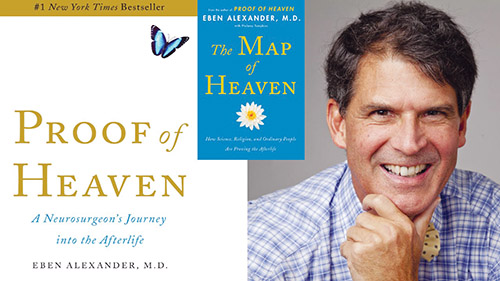
    American neurosurgeon Eben Alexander and the covers of his best-selling books.

    Like Pim van Lommel, Alexander came to believe that human beings are much more than their physical bodies and consciousness is something more than a by-product of the brain. They disagree with the philosopher John Searle who argues that the brain produces consciousness as the liver does bile. Consciousness, they argue, is not localised in or produced by the brain because consciousness itself is the ultimate reality, not the physical world – an insight echoed down the ages by mystics and visionaries, but which in recent times it seems some scientists are cottoning on to as well. They see it as a way out of the cul-de-sac reached by trying to solve the ‘hard problem’ in mainstream neuroscience: how does a neuron, a physical phenomenon, become a thought, a mental one? The answer is it doesn’t. It’s the other way around.

    Filtering Reality

    Whatever we might think of Alexander’s account of the afterlife and his ideas about mankind’s spiritual evolution – he has since become a popular advocate of the union of science and spirituality with appearances on ‘Oprah Winfrey’ and other talk shows – the notion of a non-local consciousness has a history. What was remarkable about the cases Lommel studied and Alexander’s own, was that they reported vivid inner, transformative experience during a time when the brains involved should have been incapable of ‘producing’ anything. If brains ‘produce’ consciousness, this should have been impossible, rather like a flashlight shining without the battery. Some studies done in the 1960s suggest consciousness may not need much brains at all. In 1965 John Lorber, a specialist in hydrocephalus – “water on the brain” – published a paper as remarkable as Lommel’s. In “Hydranencephaly with Normal Development,” published in Developmental Medicine and Child Psychology for December 1965, Lorber presented several case studies in which people with little or no cerebral cortex functioned normally. In one case the subject had an IQ of 126 and an honours degree in mathematics. Two girls born in the 1960s had fluid where their cerebrums should have been, with no evidence of a cerebral cortex, yet both had perfectly normal intelligence. Unlike ‘The Wizard of Oz’s Scarecrow, they, and the other cases Lorber studied seemed to get on perfectly well without a brain.

    Such cases, though well documented, may push the believability barrier, but we need not resort to these extremes to argue the brain does not ‘produce’ consciousness. In the late nineteenth century the philosopher Henri Bergson argued eloquently that, rather than produce consciousness, the brain served an eliminatory function, acting as a reducing valve, filtering reality and allowing only what was necessary for survival to reach conscious awareness. Rather than produce consciousness, the brain edits it down to something manageable, otherwise we would be overwhelmed by reality’s complexity, a condition common to many mystics. Aldous Huxley resorted to Bergson’s idea when, in The Doors of Perception, he tried to account for the effects of the drug mescaline on his consciousness. The mystical effects of the drug, Huxley believed, were due to its ‘opening’ the filters of the brain, allowing more consciousness than needed for mere survival to flood into awareness. The fact that in the cases Lommel studied and in Alexander’s own, the brain was out of commission, seems to support the Bergson/Huxley thesis. With the filters off, much more of Reality – what Huxley called “Mind at Large” – became available. If the brain “mutes” reality, allowing, as Huxley said, only a “thin trickle” to enter consciousness, in the NDE the taps seem to be on full blast. The analogy is apt as our kitchen taps do not ‘produce’ the water in our sinks, but quite the opposite, they stop it from running. It’s already there in the pipes.

    Some variant of Bergson’s idea is popular among ‘alternative’ scientists, such as the biologist Rupert Sheldrake who speaks of the brain acting as a kind of “tuner,” “selecting” different “wavelengths” of reality, rather as a radio works by cutting out all transmissions except the one you wish to hear, or as a television that picks up a broadcast but is not responsible for it. Neither my radio nor my television ‘produces’ the programs they play. They ‘receive’ them from the broadcaster, and Sheldrake and other scientists and philosophers like him, see the brain as a kind of inner TV, picking out different ‘channels’, broadcast by – well, we’re not quite sure. The general idea is that consciousness is the fundamental reality; rather than being stuffed into the cramp confines of our skulls, it pervades the universe. This is the “panpsychism” that philosopher David Chalmers advocates, following in the philosophical footsteps of Bergson and his contemporary Alfred North Whitehead, who, in different ways, envisioned some version of Mind at Large. Needless to say – or perhaps not – such an idea as an all-pervasive consciousness or mind is, of course, a staple part of many pre-modern worldviews.

    Another who accepted the idea of Mind at Large was, oddly enough, an early investigator into NDEs, although in his aptly posthumous Human Personality and Its Survival of Bodily Death (1903), the first “scientific” study of the afterlife, F.W.H. Myers did not call them that. Myers spoke of the “subliminal mind,” by which he meant something different than Freud’s “unconscious,” which Myers’ coinage preceded by some years. It was Huxley who in his foreword to Myers’ classic compared his “subliminal mind” to an “upstairs” in the “house of the soul,” rather than Freud’s “garbage-littered basement.” This upstairs had some unusual characteristics and in the late nineteenth century Myers and his fellows in the Society for Psychical Research devoted their lives to studying them. Take, for example, the remarkable experience of Dr A. S. Wiltse who in 1889 “died” from typhoid fever. Wiltse was pronounced dead but found himself “waking up” inside his body, and gradually being “released” from it. He felt himself emerge from his body and found that he could walk away from it. No one noticed him and, stranger still, he found that he could walk through people. Wiltse then found himself confronting huge rocks standing beneath storm clouds. A voice told him that if he continued past them he would enter eternity but if desired he could return to life, a common choice in many modern NDEs. He then “woke up,” four hours after being pronounced dead, and told of what he saw. 

    Myers’ account of Dr Wiltse’s experience was preceded by an even earlier one. In 1871 Albert Heim, a professor of geology, fell some seventy metres while climbing in the Alps. During the few seconds of his fall, Heim experienced a panoramic “life review,” seeing his whole past “take place in many images, as though on a stage at some distance from me.” Like many who have experienced an NDE, he saw a “heavenly light” and was free from fear and anxiety. Conflict was “transmuted into love” and he found himself moving “painlessly and softly” into a “splendid blue heaven.” Heim survived his fall but the experience so moved him that he began to collect accounts of similar experiences by other climbers. Forgotten for years, Heim’s work was re-discovered when what we might call the “NDE and afterlife boom” of the 1970s and 80s, in the work of Elizabeth Kübler-Ross, Raymond Moody, Kenneth Ring and others, brought it back to light. Another fairly well-known account of a NDE is that of C. G. Jung, who, in 1944, following a heart attack, found himself orbiting the earth and confronting a strange temple and Hindu floating in space. Jung was about to cross the threshold like Dr Wiltse when he found himself whisked back to earth, disappointed at the prospect of coming back to life.

    Do Lommel and Alexander bring anything new to this study? Their scientific and medical credentials certainly bring new attention to it, although to be sure, not all of it is positive, and the claims and expertise of both have come under heavy scrutiny and criticism. But part of what makes their and other studies convincing – at least to the open-minded – is the similarity between the accounts they study and older reports on what happens when we die. As Ptolemy Tompkins in The Modern Book of the Dead makes clear, there is much overlap between accounts of the afterlife found in the Egyptian Book of the Dead and the Tibetan Book of the Dead, to speak of only the two most famous earlier reports on the beyond. And these two share much with recent investigations, such as the insights about the “life between death and rebirth” gleaned by the “spiritual scientist” Rudolf Steiner through his access to the “Akashic Record.” For instance, Steiner too makes the “life review” a central part of the process of dying, in preparation for reincarnation. 

    But, as Tompkins makes clear, there are also differences. The Swedish scientist and religious philosopher Emanuel Swedenborg, who wrote much about the brain, journeyed to heaven, hell, and also to an intermediary realm he called the “spirit world,” not through a NDE but through inducing visionary states. He gave his own “proof” of the higher spheres in his book Heaven and Hell, yet his account is somewhat different from Eben Alexander’s, while both Swedenborg’s and Alexander’s differ considerably from Steiner’s. 

    Enough similarities exist among these accounts to suggest that in some way they and other voyagers were encountering different parts of the same inner landscape. And if the ‘proofs’ of heaven we have glanced at here are at all reliable, it is one that, at some point, we all will have an opportunity to journey through, in this life and the next.

    [alert type=”general” dismiss=”no”]This article was published in New Dawn Special Issue Vol 11 No 6.[/alert]

    [alert type=”success” dismiss=”no”]If you appreciate this article, please consider subscribing to help maintain this website.[/alert]

    Footnotes

    1. www.ebenalexander.com

    2. John Searle The Mystery of Consciousness, Granta Books, 1997, 6

    3. Gary Lachman A Secret History of Consciousness, Lindisfarne Books, 2003, xxv-xxvi

    4. Aldous Huxley, Foreword, F. W. H. Myers, Human Personality and Its Survival of Bodily Death, Dover Publications, 2005, 7

    5. Ibid. 212-217

    6. The “life review” has a solid basis in the brain, as the neurosurgeon Wilder Penfield discovered. While operating on a patient who was conscious – the brain feels no pain – Penfield discovered that when certain parts of the brain were stimulated, the patient “relived” experiences of his past with what we would call “total recall.” It seems the brain in some way stores every experience we’ve ever had and, with the requisite trigger, can “replay” them. The “life review” seems a more intense and total experience of this.

    7. Quoted in Colin Wilson, Afterlife, Doubleday, 1987, 215-16

    8. Gary Lachman, Jung the Mystic, Tarcher/Penguin, 2010, 186-88

    9. Gary Lachman, Swedenborg, Tarcher/Penguin, 2012, 87-98

    © New Dawn Magazine and the respective author.
    For our reproduction notice, click here.
  • What Is Jordan B. Peterson Really Saying?

    What Is Jordan B. Peterson Really Saying?

    If you are an English speaker and have had access to the Internet, television, radio, or newspapers anytime within the last few months, odds are you have heard the name Jordan B. Peterson. A year or so ago you might have shaken your head in ignorance and muttered an innocent ‘who?’ at the mention of Peterson and not been accused of cultural illiteracy. But not anymore. With the release of his book, 12 Rules For Life: An Antidote to Chaos, at the start of 2018, Peterson shot to the top of the bestselling lists in Canada – his native land – the United States, the United Kingdom and Australia practically overnight, and is maintaining his dominance, an important word for Peterson, even as I write, with successful book tours and sold-out audiences. Before this he was a prestigious but relatively little-known Canadian professor and psychologist who did important work at Harvard in studying the links between aggression and drug and alcohol abuse and who had a long and passionate obsession with the place of evil and suffering in human existence.

    This obsession with what C.G. Jung, a central influence on Peterson, called ‘the shadow’ in the human psyche gave rise to a fascination in him with totalitarian ideologies and the question of how human beings can be so enamoured of their belief systems that they were willing to engage in global conflict – even annihilation – rather than abandon them. Nightmares of nuclear catastrophe and nihilistic dread informed much of Peterson’s early years.

    Peterson’s research material was ready to hand: the Cold War that he had lived under since his birth in 1962 – in Fairview, Alberta – until the fall of the Soviet Union, the Stalin purges that preceded it and the atrocities of National Socialism that hit a high water mark for human inhumanity. His first book, Maps of Meaning: The Architecture of Belief (1999) was an ambitious if not entirely successful attempt to come to grips with how human beings generate ‘meaning’ – how we create order out of chaos, a central theme for Peterson – with the help of behavioural psychology, ancient myths, and healthy doses of then current neuroscience. It took Peterson thirteen years to write and it had its readers. Not as many as 12 Rules for Life, although the success of his second-born is benefiting his first. His publishers, keen to capitalise on Petersonmania, are bringing out a new edition of the work. This is not sheer opportunism. The 12 rules for life Peterson sets his new readers to follow are anchored in the insights of his earlier book, and adventurous readers of his later work may want to follow his ideas to their roots.

    What took Peterson out of relative academic obscurity and into the media spotlight was controversy. In 2016 he came to public attention, at first in Canada then farther afield, when he refused to comply with rules of ‘compelled speech’ – his term – that would come into effect on the University of Toronto campus, where he taught, when the hotly debated Bill C-16 was passed, as it seemed sure to be, by the Canadian government. This proposition would add “gender identity or expression” as prohibited grounds of discrimination under the Canadian Human Rights Act. It would also widen the definition of what committing a ‘hate crime’ meant under Canada’s criminal code.

    Peterson had by this time attracted attention by his vocal objection to ‘political correctness’, which for him is a form of leftist social authoritarianism, an outgrowth of postmodernism, an intellectual and cultural movement that he considers a kind of nihilistic Marxism. For Peterson the demand that he use neologisms like zhe and zher, as C-16 would compel him to, when addressing a student or faculty member that ‘identified’ as a non-binary gender, was bad news. Innocuous as such a demand seemed, he believed it was the thin edge of the wedge that would open the door to more immediately recognisable and less easily resisted consequences. As he put it, such compulsion marked “the vanguard of a postmodern radical leftist ideology that I detest, and which is… frighteningly similar to the Marxist doctrines that killed at least 100 million people in the 20th century.”1

    The links between contentious personal pronouns, postmodernism, and the evils of Pol Pot may not be immediately obvious. But Peterson had his reasons for believing they exist and he was not shy about letting people know.

    Introducing Jordan Peterson

    I first became aware of Peterson when a Facebook friend suggested I watch the videos of his classroom lectures that were on YouTube. Peterson had been posting them since 2013 and in 2017 he hired a production crew to do a professional job of it. They did. Peterson may in fact be the first YouTube philosopher; it was certainly through these videos, and not the demanding pages of Maps of Meaning, that he became a grassroots sensation. Peterson is an engaging speaker, committed and feisty, something like a prairie Jeremiah come to call the corrupt to account; it’s not surprising that he draws a great deal on the Judeo-Christian tradition, with equal helpings of Dostoevsky, Nietzsche, Orwell and Solzhenitsyn. One of his most popular lecture series deals with his reinterpretation of biblical symbols. He also has a sense of humour.

    When I clicked on one link my correspondent had sent, I was taken to a video of an exchange between Peterson and a transgender student which was warm to begin with but quickly heated up. Peterson, however, didn’t lose his temper and stuck to his point, expressing it as clearly as he could. He gave his reasons calmly but firmly, maintaining a composure that has served him in good stead.2 He was serious. A crowd gathered and soon shouting started. But he kept to the issue: that while there are things he agreed he shouldn’t say – he is no fan of ‘hate speech’ – he would not comply with words that he was compelled to say. He was being told what he had to say, what he must say, and he refused. Period.

    I got his point. It was, as Peterson maintained, a question of freedom of speech, which ultimately means freedom of thought. Words are what we have to think with and what we use to express thought. Being compelled to use certain words means being compelled to think certain thoughts. That, of course, is the whole idea of Orwell’s 1984 in which the dictionary of the English language becomes smaller and smaller with each new edition, leaving fewer and fewer words with which to express one’s fewer and fewer thoughts. Eventually all that are left are grunts and groans, or in our case, emojis.3 Paranoid? Perhaps. But Peterson’s point came home to me and I had to say that I agreed with him.

    I watched a few other videos, read some articles about the pronoun scandal and others, and learned that at campuses and other sites Peterson had been shouted down and his talks cancelled because of student protests and disruptions that became increasingly familiar to him and his followers.4 This happened to some other academics who were also deemed not politically correct.5 Even teaching assistants were being interrogated for not denouncing Peterson as an evil equal to Hitler.6 It was also happening to advocates of more obviously far-right ideas, putting the notion of ‘tolerance’ through several difficult twists.7 They, too, were shouted down and suddenly it seemed that ‘free speech’ had become a conservative issue, a neat turnaround. Predictably, Peterson, who declares himself a centrist and “old style British liberal” with no interest in the far-right, got entangled in this, and has been picked up by some fans of the alt-right. In recent times he has gone out of his way to make his political position more clear.8

    When we think of student protest we generally have in mind the 1960s, and the civil rights and anti-Vietnam war demonstrations. But there were students before the 1960s and they did not always protest in favour of peace and love. In the 1930s, in Nazi Germany, students harassed Jewish professors until they resigned, were fired, or worse; they also burned books.9 And in the 1960s, many leftist student radicals were not averse to using violence to attain their aims.10 Protest in itself is neither here nor there; who is protesting and for what are the important questions. And there is a difference between a protest and a mob. Free speech means being able to say things that others disagree with. It also ensures that those who disagree can voice their arguments in reply. The aim of this exchange is to think things through. It is not so much a right, as Peterson points out, as a responsibility. It is through this dialogue that civilisation carries on, and bad ideas get weeded out. Shouting down voices you do not want to hear, as a mob does, is a sign of barbarism, not civilisation.

    There was another reason I found myself agreeing with Peterson. I was aware of the dominance of leftist ideas and sensibilities on American universities, of the spread of postmodernism and deconstructionism through the humanities, having experienced some of the effects of this myself, years earlier. While getting my undergraduate degree in California in the late 1980s, I was advised not to be seen reading Allan Bloom’s The Closing of the American Mind, which sounded a warning about precisely the situation that Peterson, and many others, believe we are in. Thirty years ago Bloom warned that the student radicals of the 1960s were now tenured professors – ‘tenured radicals’ as another book had it – and in their classrooms were spreading the medley of half-digested Nietzsche, Heidegger and the Frankfurt School that fed the postmodernist monster.11 A few years later I hit this wall myself when I embarked on a PhD track in English Lit at a prestigious southern California university. The department was dominated by the fashionable postmodern schools and I soon realised that had I continued I would most likely not have found a job. I was a white male mature student who had no interest in deconstructing anything. I dropped out after a year and abandoned the idea of an academic career – a good decision, as it turned out. Now Peterson seemed to be taking on practically singlehandedly the fully grown behemoth that I had encountered in its infancy and I found myself thinking ‘good for him!’

    The Post Modernist Project

    What does Peterson have against postmodernism and the politically correct shibboleths to which it has given rise such as the ‘patriarchy’, ‘equity’, ‘white privilege’ ‘cultural appropriation’ and others, which increasingly seem aimed at giving modern white males a guilt-complex and undermining Western civilisation, if not seriously impacting on children’s Halloween costumes?12 The short answer is that he sees postmodernism and its fellow traveller, deconstructionism, as Marxism 2.0.

    Peterson points out that by the late 1960s and early ‘70s, the belief in Marxism as an ideology furthering the human project had bottomed out. Although many French intellectuals, such as Jean-Paul Sartre and Maurice Merleau-Ponty, had bent over backward to absolve Stalin of his crimes – at least six million Russians were killed in Ukraine alone during the agricultural collectivisation of the 1920s – or at least to ignore them, the events of the Prague Spring and the publication of Alexander Solzhenitsyn’s The Gulag Archipelago (1973) made it apparent that, as the title of an early critique of Communism had it, the Soviet experiment was a “god that failed.”13

    Yet old intellectual habits and political resentments die hard. What happened, according to Peterson, was that the new crop of anti-Western ideologues, the generation of May ’68, abandoned the old economic class war as the basis for their detestation, which they could no longer uphold and be taken seriously, and widened their brief. Now economic oppression need not carry the weight of their condemnation alone. It was no longer simply that the bourgeoisie oppressed the worker. The entire structure of Western civilisation was built on the principle of oppression. From day one the system was geared to favour white European males and the mechanics of oppression inform it from top to bottom. It is rooted in our language and in the very attempt at using logic and reason to understand the world – which, sadly, the West has been trying to do since around 500 BCE, give or take a century, with admittedly debatable results.

    Although versions of this assessment had earlier been voiced by Nietzsche and Heidegger, this last indictment was made most influentially by the doyen of deconstructionism, the French philosopher Jacques Derrida, an avowed Marxist. Derrida argued against the very idea of logic, a neat trick for a philosopher, or anyone, as argument itself relies on it. But no matter. Yet that is precisely the point. As Peterson spells out in lecture after lecture, the whole idea of logic and argument is anathema to postmodernism. Logic is a tool of white European male oppression. Technically it is termed ‘phallogocentricism’, a Derridean coinage highlighting a male organ not usually associated with logical thinking. To avoid it, many promoters of political correctness rely on emotion and what Peterson calls “weaponised compassion” to support their ideology. Hence the attempts to paint Peterson as a bully when he merely tries to be logical and stick to a point. But that is what an oppressive white male would do, wouldn’t he?

    Derrida took the work of the nineteenth century Swiss linguist Ferdinand Sausurre who argued that language was based on a system of arbitrary signs, and ran with it. There are signifiers – words – and the signified – things – but there is no necessary relation between them. Words point, they do not ‘mean’, in the sense that they do not point to a meaning that is there, waiting to be discovered. Meanings are culturally generated, which is not far from Marx’s belief that all ‘meanings’ and ‘values’ are socially produced, are the products of ‘history’, that is, relative, not absolute. Truth, in the sense that the Western mind has pursued it since Plato, does not exist; nor for that matter do the Good or the Beautiful. Even worse: all three are agents of oppression and have been used to secure and maintain the dominance of one view of the world to the exclusion of others: that of Dead White European Males, or DWEMs. This meant Plato, Shakespeare, Dante, Newton, Goethe, Beethoven, and the rest of what we consider the A list of Western culture. What it also means is that all criteria of truth produced by this culture are suspect. Does 2+2=4? For a diehard postmodernist, it does only for those who benefit from such an equation – which, one assumes, includes the postmodern professor, when it comes to his pay-check.

    As Peterson points out, this is an expression of the postmodern belief which has practically come to be accepted as fact – forgetting that postmodernism itself denies the reality of facts – that everything we know, believe, and understand about ourselves is ‘socially constructed’. What is behind this process, Derrida and company say, is power, nothing more. How could there be if there is no Truth but only ‘truths’ relative to the cultures that produce them? What a postmodernist would say about the ‘truths’ of National Socialism is unclear, although one prestigious deconstructionist, the Belgian Paul de Man, was able to accommodate some aspects of it.14 Just as for Marx, religion, philosophy, literature, art – all culture in fact – were merely part of the ‘superstructure’, the pleasant façade of Western society camouflaging the ugly truth that everything depended on the ‘means of production’ – which, of course, was in the hands of the hated bourgeoisie – so, too, for postmodernism all ideas about Truth are simply many disguises concealing the ugly truth – we can’t escape the word – that what is at work here is simply power, who has it and how they keep it.

    ‘Existential Self-Help’: 12 Rules for Life

    These concerns have trickled down from the academic heights and infiltrated everyday life, Peterson says, affecting how we live and what we think, hence his worry. The social and political influence of postmodernism, he believes, is wholly pernicious because, among other things, it denies the reality of human nature and the unique differences and potentialities with which each individual is born. For postmodernism, the idea there are things about us that are not ‘socially constructed’ but simply given – such as gender and its differences – is merely another weapon in the hands of the oppressor. It hates the idea of a human nature because it suggests something resistant to its desire to create a perfect world through social planning and legislature, as previous Marxist experiments attempted – with, as Peterson points out, disastrous results. This would be a world of ‘equality’ where there are no winners or losers, no differences between people, only a homogenous sameness – an odd target for utopians concerned about ‘diversity’. In the meantime, what this leaves, Peterson warns, is a culture of victims and perpetrators, a society of the ‘oppressed’ which is encouraged by postmodern ideology to take out its revenge – called ‘social justice’ – on its oppressor, in order to level the playing field.

    What this amounts to for Peterson is an attack on the individual and the value of personal responsibility. For politically correct reasons, he or she is reduced to being merely a member of a group; as such they are responsible for the perceived guilt or privilege of that group, regardless of their own individual conduct. Just as Marxism does, postmodernism denies the autonomous ego. They – we – do not exist. There are only representatives of different communities – racial, economic, national, sexual, etc. – who are embroiled in a ‘war of all against all’ in the scramble for power. Hence ‘identity politics’ and ‘tribalism’. This is Hobbes’ vision of our natural state before civilisation, enshrined as its summit.

    For Peterson, such a vision enables one of the darkest, most shadowy aspects of human reality, what Nietzsche called ressentiment, to arise. This is the sour grapes attitude toward life. It blames its own shortcomings on others and disparages what it is unable to achieve. In the worst cases it takes revenge on life itself – or ‘being’, as Peterson prefers – for not going out of its way to make things easier for it, and for allowing others to do well. This existential spite, Peterson argues, is behind much of human evil, from Cain’s slaying of his brother Abel, to violent revolutions, serial killers, and totalitarian governments.

    Peterson’s 12 Rules for Life is his prescription for the exact opposite attitude. It is a personal and professional pep talk and day-planner for taking responsibility for one’s life. As a motivational work, which it is, it is less combative and more inspirational than his videos. At times it does not avoid an eyebrow raising earnestness. But for a self-help book – Peterson is, after all, a psychotherapist – this is not unusual and shouldn’t take away from the main message. Which is: don’t blame anyone else – the ‘system’, your parents, your wife, your boss, the ‘patriarchy’ – for your failings. This, he tells us, is the first step in overcoming them. No wonder that ‘clean your room’, ‘get your act together,’ and similar admonitions are his mantras.

    I call this a work of ‘existential self-help’. It begins with the fact – one not socially constructed – that we find ourselves in a world we do not understand, having no idea where we came from, why we are here, and what we are supposed to do now that we are. But we nevertheless have the capacity – the responsibility, Peterson insists – to face these dark unknowns honestly, authentically, and with some dignity. This means, as Peterson points out, taking on the burden of being and consciousness, embracing the pain, suffering, confusion and failure that are inextricable parts of life – perhaps its most important parts – without trying to avoid them or resent them as the work of some oppressor. This is an existential attitude, and he finds it in Dostoevsky and Nietzsche, but it could also be called a religious one.

    As I followed Peterson through his rules – I leave the reader to discover them if they haven’t already – it struck me that they all emerge from what we can see as his own Golden Rule #6 in the book: Set your house in perfect order before criticising the world.15 If you want to change the world, the best place to start is with yourself. You can start with something small and go from there. As the Swedish savant Swedenborg said long ago, do the good that you know. It is not hard to find. Usually it is right there, in front of you.

    It’s this call to the individual to stand up for his or herself – straight and with your shoulders back, Rule #1, that is responsible for Peterson’s popularity, especially with young people. He challenges them to own their own lives rather than whine about them, and to fix what they can rather than save the world. His message seems to be getting across. His audience is growing. His YouTube subscribers number more than one million and his videos have been seen by over 50 million viewers. 12 Rules for Life remains on the bestseller lists and his Patreon forum, which raises a not inconsiderable sum, has nearly 10,000 supporters.16 If Petersonmania carries on like this, we may be post-postmodernists sooner than we think.

    Top image credit: https://www.flickr.com/photos/gageskidmore/29054996858

    [alert type=”general” dismiss=”no”]This article was published in New Dawn 168.[/alert]

    [alert type=”success” dismiss=”no”]If you appreciate this article, please consider subscribing to help maintain this website.[/alert]

    Footnotes

      1. “The right to be politically incorrect: Why I refuse to use genderless pronouns” by Jordan Peterson, National Post, 8 Nov 2016, http://nationalpost.com/opinion/jordan-peterson-the-right-to-be-politically-incorrect
      2. Witness his remarkable exchange with the UK Channel 4 newsperson Cathy Newman: www.theguardian.com/commentisfree/2018/jan/21/banning-jordan-peterson-causing-offence-cathy-newman-free-speech
      3. An opposite but equally effective method is to purposely inflate the language, to burden it with empty terms that obscure their own vacuity, as much of postmodernism and other recent critical studies do.
      4. www.youtube.com/watch?v=uMsi61OtkE4
      5. “A Campus Argument Goes Viral. Now the College Is Under Siege” by Anemona Hartocollis, New York Times, 16 June 2017, www.nytimes.com/2017/06/16/us/evergreen-state-protests.html
      6. “The Interrogation of a TA” by Scott Jaschik, Inside Higher Ed, 22 Nov 2017, www.insidehighered.com/news/2017/11/22/university-faces-uproar-over-recording-showing-how-teaching-assistant-was-questioned
      7. “’Go home, racist!’ Richard Spencer shouted down at University of Florida speech”, USA Today, 19 Oct 2017, www.usatoday.com/story/news/nation-now/2017/10/19/richard-spencer-shouted-down-university-florida-speech/781966001/
      8. www.youtube.com/watch?v=lhEG69ZGwUI
      9. David Clay Large, When Ghosts Wake: Munich’s Road to the Third Reich, W. W. Norton and Com., 1997, 245
      10. Colin Wilson, A Criminal History of Mankind, Diamond Books, 1993, 626-35
      11. Allan Bloom, The Closing of the American Mind, Simon and Schuster, 1987; Roger Kimball, Tenured Radicals, HarperCollins, 1990
      12. “Is it OK for a white kid to dress up as Moana for Halloween? And other cultural appropriation questions” by Alia E. Dastagir, USA Today, 24 Oct 2017, www.usatoday.com/story/news/2017/10/23/halloween-cultural-appropriation-questions/780479001/
      13. Richard Grossman, ed., The God That Failed: A Confession, Harper & Brothers, 1949. This was a collection of essays by ex-Communists such as Arthur Koestler and André Gide, on why they lost the faith.
      14. “Paul de Man Was a Total Fraud” by Robert Alter, New Republic, 6 April 2014, https://newrepublic.com/article/117020/paul-de-man-was-total-fraud-evelyn-barish-reviewed
      15. www.youtube.com/watch?v=awTgtA3BuRY
      16. www.patreon.com/jordanbpeterson

    © New Dawn Magazine and the respective author.
    For our reproduction notice, click here.
  • Have YOU Been Here Before?

    Have YOU Been Here Before?

    From New Dawn 101 (Mar-Apr 2007)

    Belief in reincarnation is one of the oldest and most durable of human traits, so old and persistent, in fact, that the psychologist C. G. Jung went so far as to call it an archetype. “Rebirth,” Jung wrote, “is an affirmation that must be counted among the primordial affirmations of mankind. These primordial affirmations are based on what I call archetypes.”1 This meant for Jung that regardless of its truth or falsity, the idea that we have lived previous lives and will, after our deaths, return in other lives, is somehow ingrained in our psyche. 

    We are, to use computer-speak, programmed to think it, and although not all of us accept the idea, it seems to share prominence with other fundamental ideas about the meaning of death and what, if anything, happens to us after it.

    These ideas seem to be surprisingly few. There’s the possibility of reincarnation or rebirth, as mentioned, with the belief that eventually one will have worked off one’s karmic debt and so have escaped the wheel of lives; one is then absorbed in some way into the all. There is also the idea of an afterlife in some “other” realm, whether the heaven of Christianity, the paradise of Islam, the Valhalla of Norse legend, or the Elysian fields of ancient Greece. I should point out that not all afterlives are desirable: fire and brimstone await the wicked in Christianity’s hell, and the Greeks, perhaps the greatest lovers of earthly life in history, regarded the idea of a shadowy eternity in the underworld with abhorrence. In any case, all these scenarios posit only one life on earth. Once we get through it, depending on how we conduct ourselves, we then go to our just reward or punishment, as the case may be.

    The pagans believe that once we die and our bodies decay, the matter they are made of returns to Nature along with the spirit or soul. We may then possibly enjoy a kind of afterlife as flowers, trees, or grass.

    There also is the belief that once we are dead, that’s the end. We no longer exist; our beliefs, ideas, feelings, values – everything important to us – are obliterated when the brain stops working. In this view, our present life is all there is, and after it is nothingness. Many associate this view with modern science, but its roots are in fact very old. The ancient Greek philosopher Democritus, who proposed an early version of the atom, argued that everything was made of little bits of matter that he called atoms (meaning “indivisible”). When we die, he suggested, the atoms that make up the self disperse.

    To these classic ideas about death we may be tempted to add one very new one: cryonics, the practice of freezing ones diseased body with the hope that in the future medical science will have discovered a cure for the illness. One can then be thawed, repaired, and brought back to life. On consideration, however, this seems to indicate less idea belief about what happens after death than a faith not only in modern medical science but in the robustness of the cryonics companies offering the service. Surely, as you lie in the freezer awaiting resurrection, the one pressing worry is whether the company keeping you on ice will stay in business. And if it doesn’t, what then? Unless you buy the notion that is hyped periodically that science will one day soon “conquer death,” this seems to me more of an attempt to put off facing death than any kind of engagement with it.

    My own feelings about death and what may possibly transpire after it fall into the camp of the agnostic. I simply don’t know – which isn’t to say that I don’t recognise the importance of having some idea about it. In truth, I’ve always been partial to the view presented by the playwright George Bernard Shaw in Back to Methuselah. Here Shaw argued that human beings die not from disease or old age but from discouragement, from loss of purpose and the will to live. Decades later, in his book Man’s Search for Meaning, the psychologist Victor Frankl corroborated this insight in the gruesome setting of a Nazi concentration camp, when he observed that the prisoners who had something to look forward to survived, while those who gave up hope were often the first to perish.

    Shaw argued that our present life span was far too short, because it is only toward the end of a long life that some people begin to have a glimpse of its value. To die at eighty just when you are beginning to have some insight into the whole affair seems pointless. Shaw envisioned the possibility that some people might learn how to live longer, so long that, barring accident, they might reach the age of three hundred. This, he thought, would allow them the time to put to some use the insights the rest of us take to the grave.

    I should point out that Shaw’s long livers – whom he calls the Ancients –  gain their longevity not through any technological or chemical means, nor through following a strict healthy regimen, although Shaw himself, who lived to be ninety-four, was a vegetarian. They accomplish this through their sheer will to live – and their willingness to fulfil the purposes of what Shaw calls “the life force,” a kind of evolutionary drive that compels life to understand and transcend itself. In his earlier play Man and Superman, Shaw spells out the philosophy of his “life force worshippers” in dramatic and comic detail, and for a time after reading Back to Methuselah I became fascinated by accounts of writers, artists, and thinkers who lived well into old age. There was Shaw himself. There was also the novelist John Cowper Powys, who died at ninety-one, the literary critic and philosopher Owen Barfield, who died at ninety-nine, the German novelist and essayist Ernst Jünger, who died at 101, and many others, including the composer Jean Sibelius, and the philosopher Bertrand Russell, whom lived into their nineties.

    In his science fiction novel The Philosopher’s Stone, Colin Wilson – a Shawian himself – suggested that there was some connection between the pursuit of ideas and longevity. His insight was that an interest in objective values – mathematics, philosophy, and, in a similar way, the kind of impersonal beauty that we find in, say, Sibelius’s symphonies, with their deep feeling for nature – is in line with the designs of “the life force,” which urges us to transcend our all too limited personal and subjective aims and goals. Someone who could perceive the objective beauty and “interestingness” of reality and sustain this would, Wilson argued, never be bored and hence have every reason to want to go on living.

    Now, whenever I’ve mentioned this idea to friends or acquaintances, the usual reply is something along the lines of “Three hundred? God, who would want to live that long? Wouldn’t you get tired and want to move on?” This is interesting, because I get a similar response whenever I bring up another idea that, for better or worse, has always had a strange appeal to me. Rather than reincarnation, which has us returning to earth again but in a different body and as a different person in a different time (though somehow with the same soul or spirit), ever since I first came upon it as a teenager in the writings of the philosopher Nietzsche, I’ve had an odd interest in the notion of “eternal recurrence.” This idea suggests that we have, as Rudolf Steiner calls them, “repeated earth lives,” but instead of different lives, we have the same one, over and over. This means that I have sat down in front of my computer an infinite number of times in the past to write this essay and that you also have read it an equally infinite number of times, and that both of us will continue to do so ad infinitum. I will be born to my parents again, go through the same childhood traumas and delights, leave home and have the same experiences, the same failures and successes, eventually die – and the whole wheel will turn around to the beginning and start again.

    Most of us on hearing this will reject the idea, wincing either at some past incident we would very much want to avoid or, more generally, at the prospect of eternal boredom such a notion offers. The idea of coming back to earth again as a different person seems much more appealing, and even the notion of complete annihilation seems preferable to going through the same round over and over again. I understand this perfectly, and I’m in no way arguing that eternal recurrence is true or preferable to reincarnation or to other ideas of what, if anything, happens after death. But I have to say that coming back to my books, friends, children, joys, and sorrows does strike me as more appealing than the eternity of blissful contentment spent floating amid cherubs and clouds that some forms of afterlife offer.

    I have to admit that one reason (and not the most important one) I’ve remained partial to this idea of eternal recurrence is precisely because of the reactions it elicits from others. Several years ago I worked at a metaphysical bookstore in Los Angeles. Among the fads and crazes of the time – crystals, the goddess, neuro-linguistic programming – one of the most popular was the idea of exploring one’s past lives. Among the many people interested in this who came to the store, I was surprised to discover that all of them seemed to have had infinitely more interesting lives before their present one. No one ever said, “God, how boring that past life was,” or “Gee, I’m glad I’m living this life now.” There were also a good number of people who, if not famous in their past lives, were still somehow important. Priestesses in Egypt, magicians in Atlantis, kings, queens. Not many tailors, butchers, or farmers. Sadly, whatever the truth about reincarnation, many of the people who spoke about it seemed to regard it as a way of making themselves more interesting in this life. So when I remarked that I was always more attracted to the idea that there is only this life and we live it countless numbers of times, I received looks implying that I was either crazy or lying. Despite the incredulous reactions it causes – or perhaps because of them – Nietzsche’s philosophy of recurrence deserves consideration.

    Far from some Machiavellian figure, Nietzsche was most troubled by the problem of human suffering, which I think he rightly saw as the central question from which the great religions emerged. Through poor translations and tragic appropriations by racist thugs like the Nazis, Nietzsche acquired a reputation as a philosopher of cruelty and tyranny, his übermensch or superman popularly depicted as a muscular fascist, lording it over the masses. In reality, however, Nietzsche was a very gentle, considerate, even timid man, so shy that he had to ask a friend to propose marriage for him to the woman he loved (not surprisingly, she declined). In fact, Nietzsche was burdened with an almost morbid sensitivity to suffering, whether human or animal. This fact is enshrined in a famous story of his final collapse, which occurred when he was already suffering from what scholars suppose was late-stage syphilis. In this story, Nietzsche saw a coachman whipping a horse. Tears in his eyes, he threw his arms around the neck of the poor creature, trying to comfort it. He then fell to the ground and when he awoke was no longer sane.

    Nietzsche didn’t believe in an afterlife in any form, and especially not the heaven of the hypocritical Christianity he attacked in one of his last books, The Antichrist. He did, though, have a powerful appreciation of the meaning and beauty of this life, a poignant, almost mystical sense of the value of our present world, an insight into its drama and mystery that most of us lack. In fact, Nietzsche believed that all ideas about an afterlife were really the product of an inability to face the uncertainty and sometimes terrifying facts of this life; they were, he felt, a kind of slander against life, a rejection of what, to him, was precious and almost painfully valuable. Rather than accept the conditions of life – which include pain, suffering, and tragedy along with beauty – and make something of it, Nietzsche believed that many preferred to consider it worthless, when compared to an ideal “other” world that we would enter after death. In many ways, ideas about an afterlife were, to him, a kind of sour grapes.

    In his notebooks – published after his death – Nietzsche did try to prove that recurrence was a fact, drawing on the science of the late nineteenth century and the enshrined law that matter can be neither created nor destroyed but only transformed. His arguments, however, are not very convincing. Given a limited amount of matter and energy but an eternity of time, he tells us, the universe will necessarily go through its astronomical but ultimately finite number of combinations. After this, it will start repeating itself, and the arrangement of forces that led to my writing this essay and you reading it will eventually recur. Subsequent philosophers have shown where Nietzsche confused things – he was never good at math – but the force of his ideas about recurrence doesn’t lie in these proofs, and, in any case, Nietzsche wasn’t really interested in devising some explanation for the mechanics of the cosmos. What appealed to him about recurrence was its poetry, the insight that such an idea invested life with a new and dramatic meaning. It was this sense that led the novelist Milan Kundera to draw upon Nietzsche’s ideas in his book The Unbearable Lightness of Being.

    The thought of recurrence, Kundera believed, gives weight to our existence, a gravity without which it is in danger of floating away in inconsequence. This is so because the idea that our actions will recur again prompts us to consider them differently. Is what I am doing now something I wish to do for eternity? Nietzsche believed that the thought of recurrence could act as a kind of test, a challenge to determine one’s attitude toward life. Think of your own life. How does the idea that it will return in all its details strike you? Are you, Nietzsche asks, crushed by the thought, meaning that your life has been such a burden that going through it again would seem the worse kind of punishment? Or have you instead experienced moments of such joy and fulfilment that you would accept the times of suffering, embarrassment, or just plain boredom in order to experience them again? Nietzsche’s view was holistic: everything was linked, part of the great chain of fate, and to say yes to one joy, he tells us, necessitates saying yes to all the pain and discontent that accompanied it.

    In The Gay Science, written in 1881 – the title refers to the kind of philosophy he proposed, light-footed and able to dance – Nietzsche summed up this idea in a motto. Amor fati, “love of fate,” was, for Nietzsche, the test of one’s character. “I want to learn more and more to see as beautiful what is necessary in things; then I shall be one of those who make things beautiful. Amor fati: let that be my love henceforth.” In his brilliant if unusual autobiography Ecce Homo, written just before his final mental breakdown, Nietzsche put it more forcefully. “My formula for greatness in a human being is amor fati: that one wants nothing other than it is, not in the future, not in the past, not in all eternity. Not merely to endure that which happens of necessity… but to love it.”

    For Nietzsche to arrive at such a philosophy was no small achievement. Throughout his life he suffered incessantly from an assortment of ailments: migraine, near blindness, and intolerant digestion are only a few. He also was one of the loneliest of men, living in poverty and forever moving from one cheap pension to another, constantly in search of the right climate, to possibly gain some brief respite from his condition. He was practically friendless and for the most part unread. Today he is one of the most discussed thinkers of the nineteenth century, on a par with Darwin or Marx, but during most of his lifetime he was unknown or ignored. That someone with such an experience of life should embrace the idea that it will be repeated eternally gives one pause.

    Other thinkers have taken up the idea of recurrence. The Russian writer P. D. Ouspensky, for example, made it the theme of his novel Strange Life of Ivan Osokin. Ouspensky looked at recurrence rather differently than did Nietzsche, and his ideas influenced another “time haunted man,” the writer and playwright J. B. Priestley. Priestley’s popular plays I Have Been Here Before and Time and the Conways are perhaps the most accessible treatments of the idea. Where Nietzsche argued that everything in our life recurs exactly as it did before, Ouspensky offered some hope of change, suggesting that in each life there are slight variations and that through these we have a chance to alter things for the better.

    In a sense, if we think about it, Nietzsche’s insistence on the exact recurrence of each detail actually leads to the conclusion that all we really have is this moment. If everything recurs exactly as it did – if it is, as he also called it, “the return of the same”  – then each recurrence is really only this moment. The next recurrence and the previous one were exactly like our present one, and so there is really no means of distinguishing one from the other. And so, in a practical sense, all we ever experience is now. Ouspensky’s version is somewhat closer to reincarnation, in that he posits the possibility that with each recurrence we have the chance to make some changes for the better and so can develop ourselves and eventually escape the treadmill.

    Nietzsche would have thought Ouspensky’s theory simply another attempt to escape the demands of life. My own feeling is that while it may be interesting to debate the two, in the end they really serve the same function. Personally, I don’t think we can ever prove recurrence one way or another. And in any case, if it is true, and if it ever was proven, then by necessity it always was. The real value of the idea for me is the meaning and significance it can give to our lives. Granted, a paranoid take on it could have us worrying about every little action, concerned that it may be the start of some infinite series of mistakes. But then, we could also say that if something is happening now, it must have already happened. In that case, we might fall prey to Kundera’s feeling of inconsequence: what does it matter what we do, if it has already been done countless times before?

    For myself, however, the idea that my life might not be merely so many years of meaningless activity but might instead have some connection to the vast eternal scheme of things is at times encouraging, even inspiring. I may or may not have been here before, but I can act as if I have. Recognising this, I can look forward to another visit.

    This article is reprinted with permission from Quest Magazine, Journal of the Theosophical Society, www.theosophical.org, March-April 2006, pages 57-60.

    [alert type=”general” dismiss=”no”]This article was published in New Dawn 101.[/alert]

    [alert type=”success” dismiss=”no”]If you appreciate this article, please consider subscribing to help maintain this website.[/alert]

    Footnote

    1. Cranston, Sylvia and Joseph Head. Reincarnation and World Thought. New York: Julian Press, 1967.

    © New Dawn Magazine and the respective author. For our reproduction notice, click here.