New Dawn – World's Most Unusual Magazine

Author: James O’Neill

  • Lies of Our Times: Fake News & the Weaponisation of (Dis)Information

    Lies of Our Times: Fake News & the Weaponisation of (Dis)Information

    From New Dawn 173 (Mar-Apr 2019)

    According to an aphorism attributed to Benjamin Disraeli and later popularised by Mark Twain, there were three kinds of lies: lies, damn lies and statistics. To this might be added a fourth category: the lie by omission.

    They may, of course, be linked. An initial lie is told, but when information later comes to hand that discredits the initial untruth, that information is concealed or withheld from publication, or alluded to, but discredited with some epithet such as ‘it’s just a conspiracy theory’.

    The past 100 years have seen multiple examples of this form of information management. So prevalent has it become that ‘news organisations’ are no longer properly labelled as such, but rather more accurately referred to as ‘news management’.

    The first Great War, 1914-18, owed more to the machinations of the British and the French seeking to thwart Germany as a competitor to their colonial ambitions, as McGregor and Docherty1 comprehensively reveal, than it did to any assassination of a minor royal in an obscure Bosnian city. Yet we are still regaled with folk mythology, variously blaming the Turks, the Germans and even the Russians. Military disasters, such as Gallipoli, are lauded as a colonial coming of age.

    The Bolshevik Revolution in 1917 gave rise to a ‘Red Scare’ campaign that persists to this day. One early illustration of this, which as we will see has contemporary echoes, was the Zinoviev letter. This was a letter allegedly written by Gregory Zinoviev, the head of the Comintern (Communist International) in 1924, outlining a Bolshevik plot to paralyse the UK Army and Navy and plunge the UK into civil war.
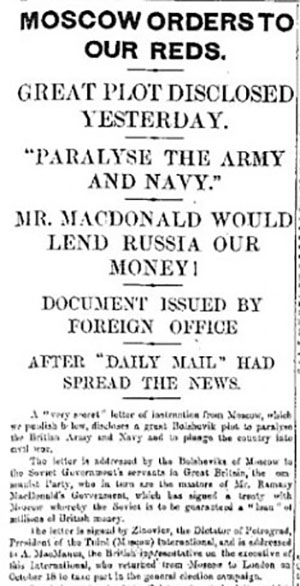
    The faked Zinoviev letter was published in the Daily Mail on 25 October 1924.

    The UK Daily Mail, to this day a regular source of fake news, released the letter four days before the UK general election in October 1924. The aim was clearly to discredit the minority Labour government of Ramsay MacDonald. The letter was a fake, most likely written by Ivan Pokrovsky, an anti-Bolshevik former Tsarist officer with connections to British Intelligence.

    According to a new book by British scholar Gill Bennett,2 the most likely leakers of the letter to the Daily Mail were Desmond Morton and Joseph Ball, the then heads of what were to become MI6 and MI5 respectively. Again, there are echoes with relevance to the present day.

    UK intelligence agencies made similar attempts against Harold Wilson (UK Prime Minister 1964-70 and 1974-76), Michael Foot (prominent Labour frontbencher) and Jeremy Corbyn ([former] UK Labour leader), all smeared as “Russian agents,” “puppets of the Kremlin” or, ironically borrowing Lenin’s phrase, “useful idiots.”

    The Big Lies of the 60s

    The 1960s provided a number of classic examples of the big lie, the illicit involvement of State agencies, and an extended cover-up of the truth in which the so-called mainstream media were more than willing accomplices.

    On 22 November 1963 US President John F. Kennedy was shot by multiple gunmen. The fatal shot was fired from in front of Kennedy, blowing out the back of his skull.4 The evidence is now overwhelming that the CIA was the chief plotter against Kennedy, although multiple others were involved, and none of them by the name of Lee Harvey Oswald.5

    All of this is now well documented in many scholarly studies,6 yet those books are not reviewed in the mainstream media, and the forensic, medical and other proofs established are never discussed in the mainstream media. Although most of the principals involved are now long dead, the cover-up continues, including the blatant refusal of the CIA to release documents mandated for release under the JFK Records Act.

    Five years later, on 5 June 1968, JFK’s younger brother Bobby was also assassinated in Los Angeles while celebrating his victory in the California primary race. As with his brother, a patsy was readily identified and languishes in jail to this day.
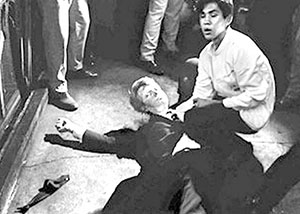
    On 5 June 1968, US presidential candidate Robert F. Kennedy was mortally wounded shortly after midnight at the Ambassador Hotel in Los Angeles. 

    Sirhan Sirhan was in front of Kennedy, and it is not disputed that he fired several shots. He was certainly influenced by some external forces, a classic Manchurian candidate. More shots were fired than Sirhan’s gun was capable of firing. The fatal wound was from a bullet of a different calibre than Sirhan’s gun.

    The LA County Coroner, Thomas Naguchi, concluded from the post mortem examination that the fatal shot to Senator Kennedy’s head was from behind at a distance of less than 5 cm. The firer of that fatal shot was identified as Thane Eugene Cesar, a security guard and right-wing extremist with known CIA ties.7 His gun was recovered from a lake some years later and forensically matched with Kennedy’s fatal head wound.

    Naguchi’s report with its damning evidence has never received the attention it deserved. Neither has the fact that the LAPD destroyed the crime scene, including removal of the evidence of multiple gunshots from different guns.

    Two months before Bobby Kennedy’s death, civil rights leader Martin Luther King was assassinated in Memphis, Tennessee. Again, a patsy, James Earl Ray, was blamed.

    Thane Eugene Cesar

    Thanks to the efforts of the King family and a British barrister William Pepper, a civil trial (King v Jowett) was held in Memphis, Tennessee in 1999. After a three-week trial, which heard from 70 witnesses, the jury took less than three hours to find for the King family as plaintiffs. They effectively exonerated Ray and found that a conspiracy existed that included agents of the city of Memphis, the State of Tennessee and the US government.

    Only two news media representatives attended the trial. One was Wendell Stacey, the local Memphis anchorman. None of his reports from the trial were broadcast or published. The other was James Douglass, later the author of the seminal book on the JFK assassination.8 The mainstream media, which ignored the trial, immediately attacked the verdict, criticising the judge, the defence counsel and the jury. Well-known apologists for the government such as Gerald Posner were given huge air and TV time. It was yet another classic example of news management at the expense of the truth. In this case, yet again, the government had violently removed a troublesome critic or threat to its agenda.9

    The pattern was repeated in the attacks on 11 September 2001 (‘9/11’). The government expounded a fantastic tale. That key elements of the official conspiracy theory10 were literally impossible was ignored. When the FBI gave evidence at the trial of Zachariah Moussaoui, the so-called 20th hijacker, that evidence destroyed key parts of the government’s version, especially the alleged phone calls from the planes that formed a substantial portion of the 9/11 Commission Report.11 That evidence was not reported.

    This false flag attack was used to justify the ‘war on terror’ that thus far has resulted in the invasion and destruction of at least four countries (Afghanistan, Iraq, Syria and Libya); the creation of terrorist groups (many as proxies of the US and its allies) and the deaths and injuring of millions; as well as creating a refugee crisis of unprecedented proportions.

    But the official mythology lives on. The mainstream media refuse to publish anything that contradicts the government’s version of what happened on 9/11 and belittle and denigrate those who raise well-founded objections. This cannot be by chance.

    Dangerous Statecraft Plots & Lies
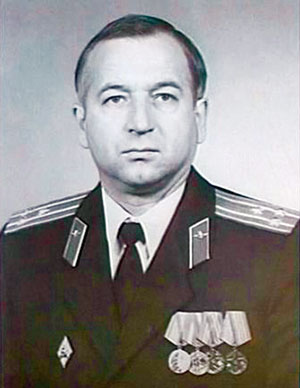
    Double agent Sergei Skripal was once a colonel in Russian military intelligence.

    In March 2018, former Russian spy and traitor Sergei Skripal and his daughter Yulia were found in an incapacitated state on a park bench in Salisbury, England. Within a very short time, UK Prime Minister Theresa May was making a statement in the House of Commons that the Skripals were the victims of a dastardly Russian plot involving the use of nerve agent Novichok.

    As a result of these allegations, for which there is no evidence that would withstand examination, sanctions were applied to Russia, and the already substantial vilification of that country was stepped up, following the reabsorption of Crimea into the Russian Federation.12

    More than 20 countries allied to the UK (including lapdog Australia) expelled Russian diplomats. Each and every element of the UK government’s allegations against Russia has collapsed. The story itself has descended to farcical proportions. The UK government continues to offer different and conflicting versions of what allegedly happened.

    As with the Kennedy and King assassinations, and 9/11, the absurdities and impossibilities in the official stories were simply ignored by the mainstream media.13

    The significance of one event, the prompt issuing of a D Notice by the British government suppressing the naming of one of the parties involved, Pablo Miller, was only appreciated in the light of subsequent revelations.

    Miller was a friend and neighbour of Skripal. He was the link man to Skripal for MI6 when Skripal worked for Russian intelligence and betrayed his country. Miller worked on the Skripal betrayal with his friend and colleague Christopher Steele. Steele is the supposed author of the dossier commissioned (through cut-outs) by the Hillary Clinton campaign to discredit Trump in the unlikely event – so they thought – that he would win the 2016 US presidential election.

    Far from being retired and living quietly in Salisbury (where he went after a spy swap with the Russians), Skripal appears to have been actively working for MI6. According to at least one scholar, a native Russian speaker wrote the “Steele dossier.”14 That person may have been Skripal who was undoubtedly linked with all the principals involved in that dossier, as well as having contacts in and knowledge of Russian intelligence. Russian sources were used for some of the more lurid allegations made in the dossier.

    That much is no more than informed speculation and is likely to remain so as the Skripals have in essence been kidnapped and remain incommunicado, not least to Russian consular authorities, a breach of international law.15

    There continue to be further twists to the Skripal tale. In January 2019 it was revealed that a person described as a “nurse” who “happened” to be at the scene where the Skripals were found incapacitated, was not just a “nurse.” She was, in fact, Colonel Alison McCourt, the head of the Nursing Unit of the British Army and a senior consultant to the Ministry of Defence.16

    Colonel McCourt is the holder of an OBE, awarded for services in combatting the Ebola epidemic in Sierra Leone. In that role, she had regular contact with the biological unit at Porton Down, the British facility for chemical and biological warfare research, which just happens to be close to both Salisbury and Larkhill where McCourt lives.
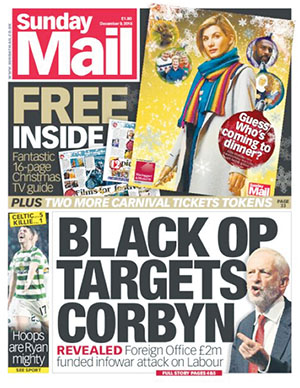
    Sunday Mail newspaper story about leaked documents that revealed the Integrity Initiative – which is funded by the UK Foreign Office and run by military intelligence specialists – led a disinformation attack on UK Labour Party leader Jeremy Corbyn.

    At about the same time as these revelations came to light, an anonymous leaker disclosed details of a hitherto unknown organisation called the Institute for Statecraft (“I for S”), and its subsidiary arm the “Integrity Initiative.” The “I for S” is a charity registered in Scotland, although its address in official records is an abandoned derelict building in Fife. The real headquarters are in Temple Place, the Embankment district of London, a decidedly more expensive piece of real estate.

    The “I for S” and the Integrity Initiative claim to be set up to promote “western values” and to counter Russian and other unfriendly countries’ “propaganda and disinformation.” In a written reply in the House of Commons, a Foreign Office Minister, Sir Ian Duncan, admitted that the “I for S,” “whose work seeks to improve governance and national security,”was financed in part by the Foreign Office to the tune of just under two million pounds sterling in the 2018-2019 financial year.

    We now know that this Institute has other sources of income, including from NATO, the US Department of State, and the Lithuanian government. The Director of the Institute is Christopher Donnelly who holds the rank of Colonel in British Intelligence. Members of the advisory board include Howard Body, Assistant Head of Scientific Support at Porton Down; Helen Boaden, a senior executive with the BBC; Duncan Allen from the Foreign Office; Zachary Harkenrider (likely CIA station chief in London), and no less a person than Pablo Miller.

    In the Bond film ‘Goldfinger’, based on Ian Fleming’s book of the same name, the eponymous villain says to Bond: “In Chicago they have a saying: once is happenstance, twice is coincidence, the third time is enemy action.”

    The interplay of various characters, only some of whom are named here,17 definitely puts the events into the realm of enemy action.

    Contrary to its protestations, the “I for S” is not just seeking “to improve governance and national security.” As admitted by its head Donnelly,18 it relies on “clusters” of individuals in various countries, including academics, journalists, military personnel and politicians, to conduct campaigns.

    These campaigns include the blocking of dissenting voices, overt attacks on critics of government policy (including smearing people such as Jeremy Corbyn as noted above), promoting anti-Russian propaganda, and what Donnelly refers to as “waging a new kind of warfare in which everything becomes a weapon, including disinformation which gives conflict a third dimension.”19

    The Institute for Statecraft also has links with a US company with similar aims, the Rendon Group, which played a prominent role in ‘selling’ the Iraq war.20
    Get the issue this article appears in

    A Catastrophe “to wake people up”

    A further extraordinary coincidence is found in a briefing paper prepared for the Institute in early 2015 in which they called for “a catastrophe to wake people up and demand a response.”21 This is reminiscent of the 2001 Project for the New American Century (PNAC) paper, ‘Rebuilding America’s Defences’, which called for a New Pearl Harbor. That paper was immediately followed by 9/11.

    The 2015 Institute paper called for steps to be taken in the event of this “catastrophe” occurring, including the mass expulsion of Russian diplomats and other actions against the Russian government. An attack on individuals or institutions in the UK was seen as a possible trigger.

    Those steps were taken following the “catastrophe” of an alleged nerve agent attack on persons in the UK by or at the instigation of the Russian government. That those steps were taken without a shred of evidence that Russia was indeed involved (as seems the remotest of possibilities) is as telling as the fact that immediately before the Skripal incident then Australian Prime Minister Malcolm Turnbull was in the UK.

    Notwithstanding the legal training both he and the (then) Foreign Minister Julie Bishop have, they were remarkably quick to condemn Russia for its alleged involvement. Their disregard for basic legal principles such as the presumption of innocence, and the requirement of admissible evidence to a high standard as prerequisites for conviction, is on a par with their alleged adherence to international law when joining illegal ventures such as attacking Afghanistan, Iraq and Syria.

    The Institute for Statecraft is far from benign. Its agenda, personnel, its connections and its modus operandi, all point to it being a malign influence on the flow of information, respect for international law, and the proper conduct of relations between nations.

    A Google search in the Guardian Australia, ABC, SBS, News Corporation and Fairfax Media websites reveal not a single mention of the Institute for Statecraft or the Integrity Institute. This is unlikely to be a coincidence. This is an important story, the surface of which has barely been scratched. As with the long history of the suppression of vital information, some examples of which are cited above, this is another illustration of that fourth type of lie: the lie by omission.

    If the current remnants of our democracy are not to be completely demolished, this latest version of Operation Mockingbird22 – where the mainstream media were thoroughly infiltrated by ‘journalists’ whose primary role was to faithfully reflect whatever version the government of the day proffered – must be exposed for the insidious danger that it is – and destroyed.

    [alert type=”general” dismiss=”no”]This article was published in New Dawn 173.[/alert]

    [alert type=”success” dismiss=”no”]If you appreciate this article, please consider subscribing to help maintain this website.[/alert]

    Footnotes

    1. G. Docherty & J. Macgregor, Hidden History: The Secret Origins of the First World War,MainstreamPublishing 2014
    2. G. Bennett, The Zinoviev Letter, Oxford University Press 2018
    3. S. Cohen, War with Russia?, Hot Books 2018
    4. C. Crenshaw, JFK: A Conspiracy of Silence, Mass Market 1992; J. de Eugenio, Reclaiming Parkland, Skyhorse 2013
    5. J. Armstrong, Harvey & Lee, Quasar 2003
    6. J. De Eugenio, Destiny Betrayed, 2nd ed., Skyhorse 2011
    7. www.maryferrell.org for copious citations
    8. J. Douglass, JFK and the Unspeakable, Simon & Schuster 2010
    9. W. Pepper, The Plot to Kill King,Skyhorse 2016
    10. www.ae911truth.org
    11. D Griffin & E. Woodworth, 9/11 Unmasked: An International Review Panel Investigation, Olive Branch Press 2018
    12. M Kramer, ‘The Transfer of Crimea from Soviet Russia to Soviet Ukraine’, www.wilson
    center.org, 19 March 2014
    13. R. Slane, ‘Summing Up the Official Claims in the Salisbury Poisonings’, www.theblogmire.com, 9 January 2019
    14. J. Gilbert & J Cashill, ‘Did Christopher Steele Write His Dossier or did a Russian Associate’, www.americanthinker.com, 19 January 2019
    15. Vienna Convention on Consular Relations, 1963
    16. ‘Coincidence?’ www.moonofalabama.org, 19 January 2019
    17. For a comprehensive listing, see P. McKeigue, et al., ‘Briefing Note on the Integrity Initiative’, www.syriapropagandamedia.org, 21 December 2018
    18. T. Kevin, ‘Dad’s Army’s Cover Blown’, www.off-guardian.org, 8 January 2019
    19. Ibid
    20. www.private-eye.co.uk, 10 January 2019
    21. K. Klarenberg, ‘Anonymous Exposes UK Hybrid Warfare Project’, www.sputniknews.com, 4 January 2019; T. Secker, ‘Was the Integrity Initiative Behind the Salisbury Poisoning’, www.themindrenewed.com, 4 January 2019
    22. C. Bernstein, ‘The CIA and the Media’, www.rollingstone.com, 20 October 1977

    © New Dawn Magazine and the respective author.
    For our reproduction notice, click here.
  • The New Silk Roads: The Quiet Revolution

    The New Silk Roads: The Quiet Revolution

    From New Dawn 155 (Mar-Apr 2016)

    The late Australian geopolitical analyst James O’Neill wrote this article for New Dawn 155, published in 2016. As you will read, James accurately analysed and foretold the events that are unfolding today.

    In 1904 Sir Halford Mackinder gave a lecture to the Royal Geographical Society in London in which he set out a blueprint for change in the world’s geopolitical footprint. The centrepiece of Mackinder’s vision was the great land mass he called Euro-Asia, now better known as Eurasia.

    The heartland of this great landmass, a “world island,” was an area stretching in Mackinder’s vision from the Persian Gulf to the Yangtze River. We would now see it as from Vladivostok to the Baltic. Who rules the heartland, Mackinder argued, rules the World Island. Who rules the World Island “rules the world.”

    In Mackinder’s vision the less consequential hemispheres outside this controlling land mass included the United States and Australia. It might be argued that Mackinder underestimated the rise to dominance of the US in the hundred years following his address, but that dominance may be seen, in the broader sweep of history, as an aberration.

    American power, so dominant in the latter half of the twentieth century, is fading, being replaced by the re-emergence of Eurasia as the centre of economic, financial and geopolitical power. The self-styled “exceptional nation” (the US) has a fundamental problem with accepting the reality of that shift.

    One says re-emergence because the domination of the Western nations’ maritime, colonial and military power existed for a relatively brief period from the mid-16th to the latter 20th century.

    American foreign policy post-World War II has sought to maintain control of the world’s resources by building a comprehensive system of military bases that now number between 800 and 1,000, depending on definition, around the world. When viewed on a world map, the European, Asian and Pacific network of bases may be seen as effectively an encirclement of the Eurasian landmass, especially aimed at “containing” any expansion of Chinese and Russian influence.

    The military bases have been supplemented by a number of military alliances, of which the better-known ones are NATO, SEATO and ANZUS. Their common denominators are American control and the serving of American interests. Australians like to think of ANZUS as the bulwark of their defence network, but the treaty only requires the parties to “consult” in the event of an attack upon them. It is one of Australia’s more dangerous delusions.

    Asymmetrical Warfare

    More important than the military alliances, which are publicly portrayed as defensive in character, is the huge effort and resources devoted to asymmetrical warfare. This takes many forms. One form is the use of quasi-governmental organisations such as the US National Endowment for Democracy to finance and organise opposition groups with the aim of “regime change” to ensure a government in the target country that is amenable to American imperial interests. It is known that more than 70 countries since World War II have been subject to that kind of attention.

    Another form this asymmetrical warfare takes is the staging of false flag attacks that can be blamed on (generally) left wing groups, thereby ensuring the retention of power of conservative pro-American governments. Operation Gladio is the best documented of this type of subversion.

    A third favoured technique is the use of extremist proxy groups, of which the current incarnation is radical Islamists. That is not a new phenomenon, however, as its origins can be traced back at least to Operation Cyclone. That particular operation began in Pakistan in the 1980s where Muslim radicals (including the later infamous Osama bin Laden) were trained by the Americans to infiltrate and disrupt non-compliant governments.

    An obvious target was the leftist nationalist government of Afghanistan, but in fact the intended targets for infiltration, subversion, sabotage, assassinations and general mayhem included Iran, the then Soviet republics to the north of Afghanistan, and the Muslim Chinese region of Xinjiang.

    The CIA was the source of many of these policies. Finance for the operations, which had to be shielded from US congressional scrutiny, came largely from control of the production, distribution and sale of illegal narcotics.

    As Peter Dale Scott, Alfred McCoy and others have documented, CIA control of the world’s narcotics trade can be traced to the South East Asia Golden Triangle, for which the American War in Vietnam provided so many lucrative opportunities, to Afghanistan’s heroin. The latter provided 93% of the world’s supply. The Taliban government had virtually eliminated that industry during their period in power in the 1990s. It was no coincidence that following the invasion and occupation of Afghanistan by the US and its allies including Australia, one of the earliest major changes was a reinstatement of the heroin industry. Bagram air base north of Kabul became the major departure point for heroin distribution. Camp Bond Steel in Kosovo, the largest American base in Europe, but almost completely absent from the pages of the Western press, functions inter alia as a major transit point for heroin into Europe.

    Colombian cocaine performs a similar function for the American market. Daniel Hopsicker has brilliantly exposed the interconnections between Colombian cocaine, the CIA and American politicians at the highest levels of government.

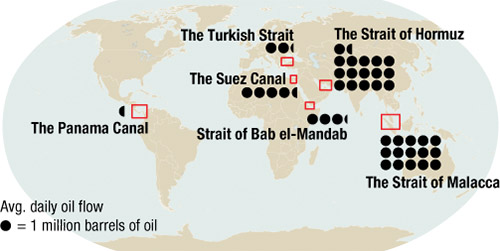
    The final component of this strategy was for the US Navy to control the world’s great maritime “choke points.” These are the narrow sea-lanes through which the great preponderance of the world’s maritime trade must pass.

    There are seven such great choke points. In each of these there is either direct US control (e.g. the Panama Canal); a significant American military presence that either controls the choke point (Persian Gulf, Straits of Malacca, Straits of Hormuz); or has a significant military presence (air, sea and land based) in close proximity. The US 6th Fleet in the Mediterranean (Suez Canal) and the 7th Fleet in Bahrain supplement land bases also in close proximity.

    Such unipolar dominance and actual or implied military threats is clearly intolerable to the other great powers of Eurasia – Russia and China. The pressure to respond has become increasingly acute in recent years as the US, through its NATO arm, has steadily moved further East in direct contradiction to assurances given to Russia at the end of the Cold War. The American organised coup d’état in Ukraine clearly crossed a red line as far as the Russians are concerned.

    One Belt, One Road

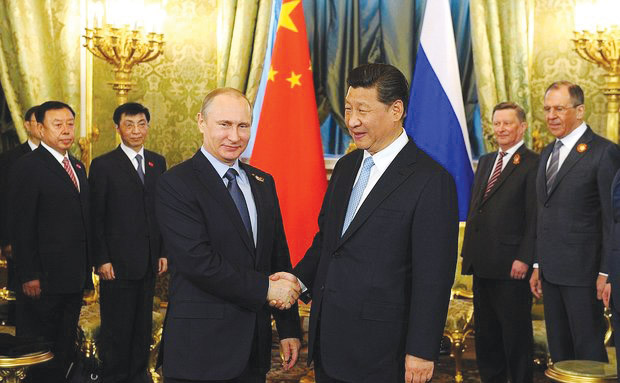
    The response of China and Russia to these endless provocations has taken many forms, which either individually or collectively, amount to a quiet revolution that is fundamentally reshaping the post World War II geopolitical structure. This revolution is being achieved without a single coup, invasion, acts of subversion or assassination of an unfriendly leader. Much less are there threats or sanctions. The revolution is predicated upon what Chinese President Xi Jinping likes to refer to as a “win-win” policy. 

    Xi first presented his vision of a One Belt, One Road policy in a speech to the Indonesian parliament in October 2013. Chinese attempts to reform existing financial and trade institutions were repeatedly stalled or rebuffed. US foreign policies, of the type noted above, showed no inclination to change. If China was not to be eventually trapped by the tightening US noose, a bold new initiative was required.

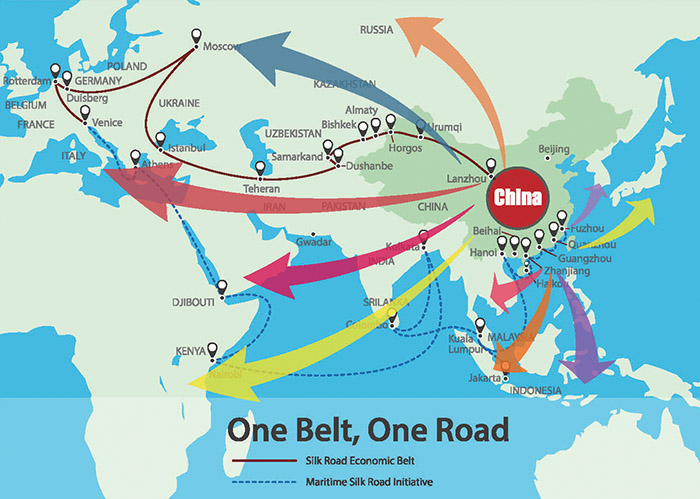
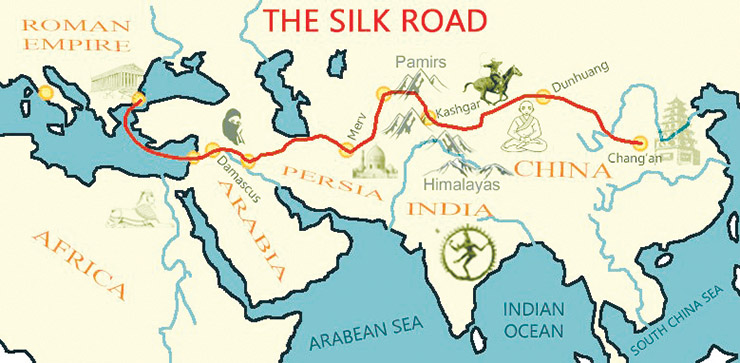
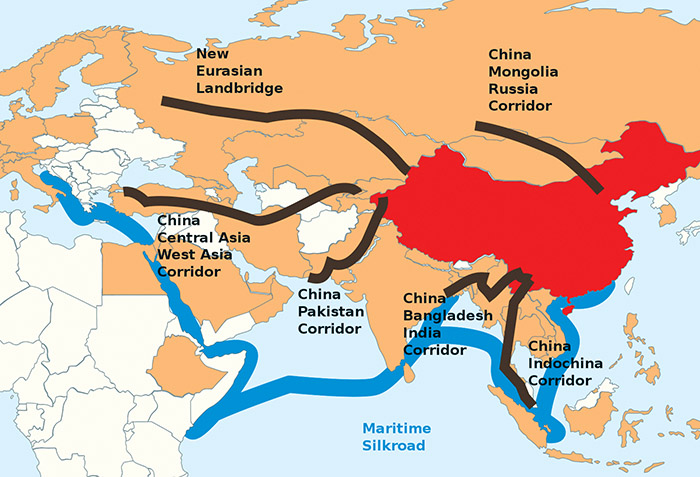
    Since then, events regarding the New Silk Roads, as the policy is known in the West, have moved with dizzying speed. Scarcely a week passes without major new announcements, and any listing would rapidly become obsolete. The framework for Xi’s initiative was already in place as discussed below. The interested reader can readily ascertain details of the land and maritime routes that are incorporated in the plan.


    Chinese President Xi Jinping

    The main focus here is to put the New Silk Roads into their geopolitical context, and then to examine the implications for the changing world order and the challenges it poses for countries such as Australia.

    Chronologically, the first development was the creation of the Shanghai Cooperation Organisation (SCO) in 1996. There are currently six member nations: China, Kazakhstan, Kyrgyzstan, Russia, Tajikistan and Uzbekistan.

    There are a further six states with “observer status”: Afghanistan, Belarus, India, Iran, Mongolia and Pakistan. India and Pakistan have been granted membership and will formally become full members in 2016.

    Iran’s accession to full status has been hampered by Western inspired sanctions. The ostensible reason for the sanctions was Iran’s “nuclear weapons program.” All 16 US intelligence agencies have on two occasions concluded there was no such program.

    That did not stop the customary belligerence from Israel, an actual nuclear-armed state, that the Western press carefully avoids acknowledging. Neither did it lessen the sanctions regime imposed by the West [Editor’s note: In January 2016, the West lifted sanctions against Iran following the implementation of a deal negotiated in 2015. In 2018, under President Trump, the US reneged on the deal and reimposed sanctions on Iran]. The real reason for the sanctions had more to do with placating Israel and Saudi Arabia and the lingering dislike for Iran by the Americans for having the temerity to overthrow the US backed dictator. The Shah had been imposed on Iran following the CIA-MI6 organised coup against the secular Mosaddegh government in 1953. The coup was on behalf of the Anglo-American Oil Company (now BP) whose assets had been nationalised by the Iranian government.

    As with so much of the politics of south-west Asia, an understanding of geopolitics is only ascertainable when one appreciates the central role of oil and gas resources, and the insatiable desire of the West to control those resources for their own benefit.

    The execrable Saudi regime is only tolerated by the West because it is the world’s largest source of oil. Its importance to the West was reinforced by the then secret agreement entered into in 1973 between the Saudis and the Americans that all oil sales were to be denominated in US dollars.

    This latter fact has been a principal reason why the US dollar has been able to defy economic logic and maintain its position, until very recently, as the world’s sole reserve currency.

    The decisions by Saddam Hussein in Iraq and Muammar Qadhafi in Libya to accept payment for oil and gas in other than US dollars was undoubtedly a major factor in the illegal regime change imposed on their countries in 2003 and 2011 respectively. That both countries have among the world’s largest known reserves of oil and gas was also a significant factor. The blowback from those two disastrous interventions reverberates today. 

    Brazil, Russia, India, China and South Africa (BRICS) were the next major geopolitical grouping. Preliminary discussions began in 2006, although the first formal summit was not until 2009. South Africa joined in 2010.

    China, India and Russia are the common basis of membership of both the SCO and BRICS. Between them they account for approximately 40% of the world’s population. China, India and Russia are all major components, geographically as well as in population terms, of Mackinder’s World Island. Brazil is by far the largest nation of South America, and South Africa was until 2015 the richest African nation. Both South America and Africa are key elements of China’s diversification in the supply of its raw materials.

    BRICS Bank & AIIB

    An important but little reported upon event, in the Western press at least, is the formation of the BRICS Bank, and the decision by its members to trade in their own currencies rather than through the medium of the US dollar. This is a significant move in a wider series of moves to fundamentally alter the dollar based financial system that has dominated world trade in the post World War II era.

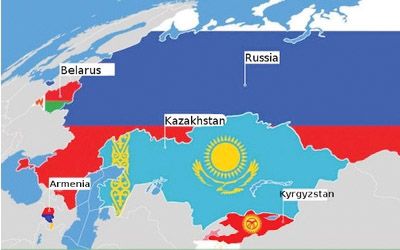
    The third major Eurasian development was the creation of the Eurasian Economic Union (EEU), the formal establishment treaty for which was signed in May 2014 with the customs union coming into force from 1 January 2015. Its members are Armenia, Belarus, Kazakhstan, Kirghizstan and Russia. Again, the overlap with membership of the SCO is readily apparent.

    Some observers have derided this development as Russian President Vladimir Putin’s attempts to recreate the old Soviet bloc. This is typical of the ideologically driven comment that passes for analysis where Russia is concerned. The Russian leadership had for some years tried to interest the European Union in a grand free trade area from “Lisbon to Vladivostok.” It was only when these efforts were repeatedly rebuffed that the EEU was born.

    There have already been formal links established between the EEU and the SCO covering a wide range of areas of co-operation. Again, one of the most significant developments is that the trade relations between the member countries of the two groupings are denominated in other than US dollars.

    The fourth development in this context of enormous significance is the establishment of the China led Asian Infrastructure Investment Bank (AIIB). It was formed in 2014 and 57 countries have already signed up, including Australia, Germany, France, Italy, New Zealand and the United Kingdom.

    The conspicuous absentees from the founding nations are Japan and the United States. The European nations, Australia and New Zealand signed up in the face of significant American pressure not to do so. This was a rare example of those countries acting in their own national interests, as opposed to American interests.

    One of the functions of the AIIB will be to fund the huge infrastructure projects that are a central element of Chinese President Xi’s vision for an alternative world order to one that is run by and on behalf of the Americans.

    To nobody’s surprise the Americans have not quietly acquiesced in this fundamental realignment from a unipolar to a multipolar world. Their response has taken a number of forms, two of which may be briefly noted here. 

    The American Response

    The first is a series of military and political moves designed to exert pressure on Russia and China in particular. In Russia’s case that has included the almost unparalleled demonisation of Russia in general and President Putin in particular. 

    The coup in Ukraine noted above was followed in quick succession by Crimea rejoining Russia, and the shooting down over eastern Ukraine of Malaysian Flight MH17. Despite Crimea’s long history as an important part of Russia, and that the decision by Crimea to leave Ukraine and apply to join the Russian Federation followed an overwhelming popular vote for that course, it is consistently portrayed in the Western media as an example of “Russian aggression,” an “annexation” and a demonstration of Mr Putin’s alleged imperialistic ambitions.

    Despite very strong evidence that the shoot down of MH17 was carried out by Ukrainian forces, the Western media portrayed it as “Putin’s missile.” All evidence to the contrary, as with the recent Dutch Safety Board Report into the crash, is simply ignored or misrepresented. Appendix T of the Report, for example, said that the missile was fired from an area contested by both the separatists and Ukrainian forces. The Report also said there was no evidence separatists had possession of BUK missiles or the technical capacity to fire them.

    Notwithstanding this clear evidence, [then]-Australian Foreign Minister Julie Bishop claimed that separatists from a separatist controlled area had fired the missile. This blatant misrepresentation was simply reported by the media without correction or comment.

    The American led sanctions against Russia for its alleged transgressions in Ukraine have hurt the European nations more than it has hurt Russia. A direct consequence of these ill-conceived policies has been the acceleration of co-operation and mutual assistance by Russia and China. Throughout 2014 and 2015 these two countries have signed a plethora of agreements in trade, defence, and infrastructure development that are worth significantly more than two trillion dollars.

    In the Asia-Pacific region the American response has been to step up its so-called pivot to Asia. In reality, this is no more than a continuation of long standing American interference in the region. The devastation wrought on Cambodia, Laos and Vietnam from the 1950s to the 1970s is only one such example.

    The current policy is clearly to engage in a series of provocations against China in the South China Sea. When one looks at a map of American bases in near proximity to China, and the concentration of naval, air and land forces at those bases, just who is being belligerent is immediately obvious.

    Get the issue this article appears in

    New Silk Roads

    One of the most important features of the New Silk Roads policy being developed at a rapid pace by China and its allied countries in BRICS, the EEU and the SCO, is that the vast energy and mineral resources of Russia, Mongolia and others in these groupings, are capable of meeting all of China’s needs without recourse to Australian resources. China also has the option of sourcing its energy and mineral needs from its rapidly expanding links in Africa and Latin America.

    When China is contemplating further large scale purchases of iron ore, copper, bauxite etc., is it more likely to turn to its land based neighbours and other friendly nations in Africa and Latin America, or will it continue to buy from an Australia that persists in its slavish adherence to US foreign policy imperatives? The answer to that question is something that should be giving Australian policy makers serious concern.

    The New Silk Roads therefore is a great deal more than just the world’s largest infrastructure project. It is much more than the linking, through multiple high speed rail links over 12,000 kilometres of the Eurasian landmass from Vladivostok to Berlin.

    As important and frankly exciting as these huge infrastructure projects are, the longer-term significance lies in the development of a wholly different financial structure. The major instruments of Western economic hegemony, the IMF and the World Bank, the interbank credit system and many more, have proved incapable of reform. A range of financial institutions is progressively replacing them in arrangements created by the SCO, BRICS and EEU.

    Perhaps most significantly of all, countries trading in their own currencies, or through Special Drawing Rights that now include the Yuan, are steadily replacing the US dollar. The scramble by traditional financial centres such as London and Frankfurt to be part of this financial revolution is a very clear indicator they at least recognise the emerging geopolitical reality.

    The overriding geopolitical question is whether so-called Western nations such as Australia recognise these changing realities and adapt accordingly, or whether they remain mired in the old Anglo-American world and its increasingly irrelevant certainties. Making the right choices dictates whether the future is one of prosperity as an active and vital component of Mackinder’s World Island, or as one of the losers in a nuclear showdown that existing Western policies almost certainly foreshadow.

    [alert type=”general” dismiss=”no”]This article was published in New Dawn 155.[/alert]

    [alert type=”success” dismiss=”no”]If you appreciate this article, please consider subscribing to help maintain this website.[/alert]

    © New Dawn Magazine and the respective author.
    For our reproduction notice, click here.
  • Major Geopolitical Changes Now Underway

    Major Geopolitical Changes Now Underway

    From New Dawn Special Issue Vol 16 No 4 (Aug 2022)

    The following was one of the final pieces written by the late Australian geopolitical analyst James O’Neill. For several years, James had been writing on these matters for New Dawn. Today we are witnessing the beginning of the new multipolar world.

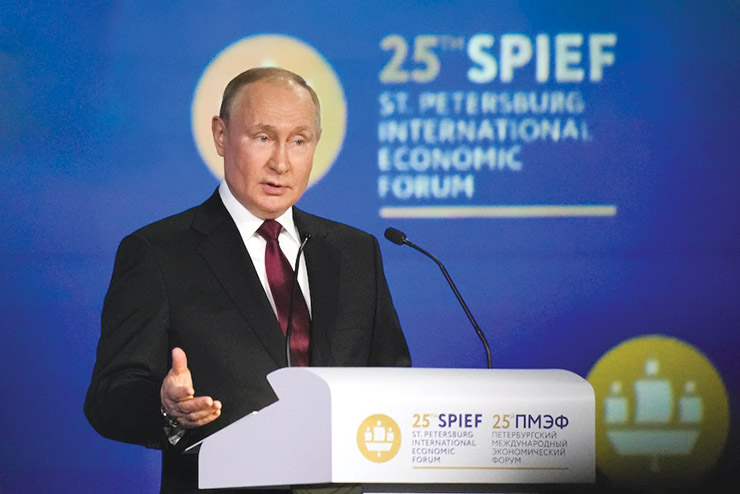
    The annual meeting of the Saint Petersburg International Economic Forum (STIEF) was held in June 2022. As usual, it received very little coverage in the Western mainstream media, which prefers to ignore developments in Russia or, if it mentions them at all, denigrate the importance of what is happening.

    The theme of the 2022 meeting was appropriately ‘New Opportunities in a New World’. Representatives of 115 countries and regions attended. Absent were representatives of Western countries.

    This year’s conference was notable on several grounds. It featured a groundbreaking speech by Russian President Vladimir Putin (of which more below), but perhaps even more importantly, it foreshadowed major changes in geopolitics and the world economic system.

    The war in Ukraine has undoubtedly triggered many of the responses observed in Saint Petersburg, but they have been in the making for some time. Developments such as China’s Belt and Road Initiative (BRI) have instigated new relations between countries that mark a significant transition away from the system created and dominated by the Western powers of Europe, North America and Australasia over the past 300 years. That era is rapidly drawing to a close. However, it won’t be a peaceful transition and things will likely get a lot more fractious before the new world order is established.

    The BRI has several smaller groupings, each important and contributing to the fundamental realignment of the world’s nations. But, again, these developments scarcely rate a mention in the Western media, long transformed by its own sense of importance and used to dealing with the developing world in other than an exploitative way.

    This has included the use of force by the Western powers to sustain what it perceives as its right to dominate the world and force recalcitrant countries to comply with its image of how the world should be run.

    Western interventions are almost invariably based on lies. One only needs to recall the invasions of Afghanistan and Iraq by United States-led forces based on allegations that Afghanistan was sheltering Osama bin Laden, the alleged mastermind of the “9/11” attacks in the United States in Sept 2001, and in the case of Iraq that they possessed weapons of mass destruction. Bin Laden died from natural causes in December 2001. His obituary was even reported in the New York Times. However, his death did not result in the Americans and their allies withdrawing from Afghanistan with apologies.

    There was a similar complete absence of apology and withdrawal when the American allegations about Iraq’s alleged weapons of mass destruction also proved to be a complete lie. Now, 20 years later, the Americans still occupy Iraq and show no inclination to leave that country, much less apologise and pay compensation. They are joined by their Australian colleagues who similarly refused a 2001 demand by the Iraqi government to vacate their country.

    Even the fake arrest and death of “bin Laden” in May 2011 did not result in the Americans and their friends withdrawing from Afghanistan. On the contrary, they stayed a further decade before staging an ignominious retreat.

    This prolonged occupation of the country gave rise to several theories about the real reasons for the invasion and occupation. Thwarting the development of Afghanistan was one reason. Others included control of the world’s opium trade, a long-standing American preoccupation where Afghanistan was responsible for more than 80% of the world’s opium supplies. Preventing Afghanistan from joining the Chinese-led Belt and Road Initiative was also a motivation. Unfortunately, none of these real motives for the invasion and prolonged occupation of Afghanistan were ever given much coverage in the Western media.

    BRICS & Putin’s Speech

    The Saint Petersburg forum was also crucial in connecting to other developments helping transform the world economy. The first of these is the emergence of what some have called the “new G8,” which combines four of the BRICS nations (Brazil, China, India and Russia – but excluding South Africa) with four other emerging nations: Iran, Indonesia, Mexico and Turkey. The BRICS heads of state recently participated via video link in the 14th BRICS Summit held in China.

    The combined gross domestic product of these eight nations exceeds the GDP of the original eight (as it was when Russia belonged.) The inclusion of Turkey in the grouping is perhaps the only surprise, given that country’s membership of NATO, but it marks the increasingly independent stance taken by Turkey in managing its affairs.

    Putin highlighted these developments in his speech at the Saint Petersburg meeting. It is worth noting some of the highlights of the speech that the official news outlet of the Kremlin noted was “extremely important.” Putin said that new centres of power had emerged and that the old unipolar world order was not coming back. Its colonial “way of thinking” had proven a failure.

    Putin noted that the United States had declared itself the victor of the Cold War and subsequently saw itself as the leader of the world in which its views were paramount. Putin rejected United States unilateralism. He referred to the “truly revolutionary, tectonic changes in geopolitics, in the global economy, and the technological sphere, and in the entire system of international relations.” Those changes were, he said, “fundamental, pivotal and inexorable.”

    Over the past two years, Putin noted, the money supply in the United States has grown by 38%. In the past, similar rises took decades but now it grew by 38% or $5.9 trillion in two years. The European Union money supply also dramatically increased over the same period. It grew by about 20% or €2.5 trillion.

    While at the end of 2020, imports of goods to the United States amounted to about $250 billion a month, now it has grown to about $350 billion a month. They printed and distributed money and used it, Putin alleged, to wipe out goods from third-world markets.

    The Western world tried to undermine and even crash the Russian economy with its sanctions. The reverse has been the case with the cost of living in Europe being driven up. The European Union has lost its political sovereignty and instead of damaging Russia it damaged its own population and economy. The direct cost of the sanctions imposed on Russia will cost the European economies over $400 billion in one year.

    The West says high energy prices are “Putin’s price hike,” which is a profoundly ignorant attempt at misdirection. Putin labelled this a “stupidity, designed for people who could neither read nor write.” The Russian leader assessed that the Western establishment’s disconnection from the people “will inevitably lead to a surge in populism and extremist and radical movements, major socioeconomic changes, degradation and a change of elites in the short term.”

    Troubles with the food supply did not arise over recent months but can be traced back several years. The West caused those problems, Putin argued, in what he described as the “short-sighted actions of those who are accustomed to solving their problems at the expense of others.” Trade flows have been disrupted and distorted by printing money and what he described as a “predatory colonial policy.”

    On Russia’s intervention in Ukraine, Putin described it as a forced consequence of the genocidal policies pursued by the Kiev regime, whose “neo-Nazis have received the full protection of the West.” It is difficult to argue against that analysis. The Kiev regime did nothing to implement the provisions of the Minsk accord of 2015, and their total lack of action in this regard, apart from the inevitable breaking away of the two Donbass republics and Crimea, led directly to the war that has now broken out.

    The Ukrainian government has just banned two more political parties, bringing the total number of banned parties to nine. This is an open power grab by the Ukrainian president and his government, removing any opposition to their rule. This power grab and the cancellation of the legitimate existence of opposition parties receives no attention in the Western media. Instead, the Ukrainian president appears to be the darling of the West, with a willingness to overlook his manifest flaws and anti-democratic tendencies and policies to an astonishing degree.

    Ukraine’s president still indulges in the fantasy of Crimea being returned to Kiev’s control, a fantasy shared with Western nations who disregard entirely the history of how Crimea became part of Ukraine in 1954 and, more recently, the overwhelming vote of its population to reunite with Russia. This is an event the Western media persistently misreports as Russia’s “annexation” of Crimea.

    The President of China, Xi Jinping, delivered an address by video at the Saint Petersburg conference. Xi’s message was clearly directed to the whole of the global South. He evoked what he called “true multilateralism” in which the emerging economies of the world – not coincidentally making up the bulk of the nations in China’s Belt and Road Initiative – had to have “a say in global economic management.”

    The world, said Xi, is now entering a new period of turbulence and transformation amid the ongoing radical changes and the coronavirus pandemic. The growing divide between the South and the North and weakening cooperation in the area of development could plunge the erratically reviving global economy into a deep recession. Xi quoted in his speech what he described as ancient Chinese words of wisdom, where a clever man sees a seed of crisis in every opportunity and an opportunity in every crisis.

    Constructing an Alternative World Order

    A good example of the emerging nature of key economic groupings is the focus on the increasingly important relationship between members of the Eurasian Economic Union (Armenia, Belarus, Kazakhstan, Kyrgyzstan and Russia) and membership of the ASEAN Group of nations (Brunei, Cambodia, Indonesia, Laos, Malaysia, Myanmar, the Philippines, Singapore, Thailand and Vietnam).

    These two groups of largely developing nations are uniting in a common interest of closer international agreement. Countries that have been outside the Western-centred economic structure are combining to promote a genuine system of international cooperation.

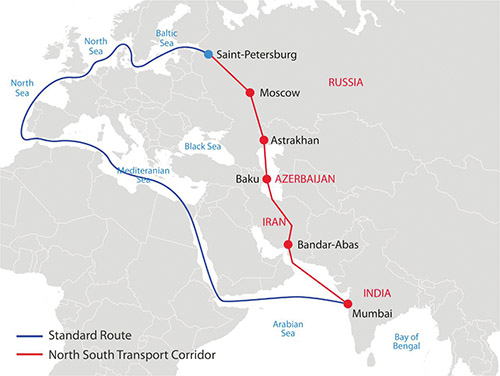
    Russia and Iran are accelerating the construction of a new International North-South Transport Corridor from Mumbai to the Baltic through Iran, the Caspian Sea, South, and Central Russia. Launched in 2002, the route is a shorter and cheaper alternative to the Suez Canal route.

    This is marked, among other things, by a rejection of the United States and the so-called “rules-based international order” which in practice means following the rules devised by, and for the benefit of, the United States. The development of a new order was one of the themes developed by Putin in his speech. This theme is finding favour not only in the international groupings noted above but is symbolised by developments on the ground like the International North-South Transport Corridor linking Russia with the Persian Gulf via the Caspian Sea and Iran. Russia has started using this new route to ship goods, bypassing the Mediterranean Sea/Suez Canal route.

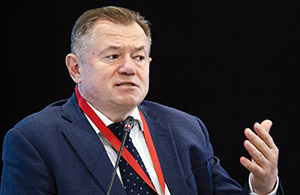
    During STIEF’s ‘Russia – Africa’ Business Dialogue, the Russian academician and Eurasian Economic Union (EEU) Minister for Integration and Macro-Economics, Sergei Glazyev, pointed out that the time has come to go beyond shifting payments to national currencies. He advocates creating a unified exchange space in the EEU for price formation in national currencies rather than relying on currency exchange rates based on the US dollar.

    The liberal, “rules-based” order is under challenge, both from a recognition induced by economic crisis and war, and the unfair advantage it offers Western powers. An alternative economic order is now taking shape. For example, at the recent 23-24 June BRICS+ summit, Russian President Vladimir Putin announced that BRICS (Brazil, Russia, India, China, South Africa), is “exploring the possibility of creating an international reserve currency based on the basket of BRICS currencies.” Eurasian Economic Union official, Sergei Glazyev (above), is the leading proponent for an independent international monetary and financial system based on sovereign equality of all nations.

    Glazyev argued for a completely different attitude to partnership and cooperation. In the hybrid war that the Western world is currently waging against the whole of humanity, he emphasised common interests with African countries. He says we are on the same front line, and to survive this war we need to strengthen economic ties, especially if a common exchange base was created to unite the Eurasian, Asian and African continents. Glazyev invited listeners to develop cooperation in creating this new monetory, financial, trade and economic architecture.

    Mikhail Myasnikovich, chairman of the board of the EEU’s Eurasian Economic Commission, told the forum that it was urgent the EEU discuss the development of not only trade and payments in national currencies but construction of an independent monetary system.

    These new organisations represent a major break from the old Western-dominated arrangements. They are the way of the future for countries like Australia, which has largely ignored the realities of its geography and will face considerable challenges as it is forced to turn away from the United States to ensure its economic survival.

    The Belt and Road Initiative, the largest of these emerging developments, represents an existential threat to the United States’ view of the world. One can expect the United States to take steps, which it is already doing, to combat this challenge to their previous supremacy. The pressure put on Germany to cancel the Nord Stream 2 project is one example of the United States fighting the emergence of a new system that challenges its previous dominance.

    As the Russia affairs expert Gilbert Doctorow (www.gilbertdoctorow.com) recently noted, Putin “argued the case that the present grave challenges to the global economic, financial and political systems have their source in wrong-headed policies in the collective West.” In Putin’s view, he wrote, “the West has not absorbed the lessons handed down in elementary school and are now trying, in the global Information War, to put the blame” for their inflation on Putin.

    The emergence of new multinational arrangements and multiple new trade routes approve a more powerful force than the old United States-dominated system. This is not to suggest the transition will be easy. The United States can be expected to fight hard and dirty to try and retain its previous dominance. To invoke a Chinese curse: we live in interesting times. The trick will be to maintain the changes without a war. That may prove the greatest challenge.

    It is clear from the meeting in Saint Petersburg and the BRICS summit in China that the world is undergoing epochal changes to the European system that has dominated the past 300 years. It will not be a change without challenges. It is the chance to recreate the world’s economic and social system in a new way. The challenge should be welcomed.

    [alert type=”general” dismiss=”no”]This article was published in New Dawn Special Issue Vol 16 No 4.[/alert]

    [alert type=”success” dismiss=”no”]If you appreciate this article, please consider subscribing to help maintain this website.[/alert]

    © New Dawn Magazine and the respective author.
    For our reproduction notice, click here.
  • The Post West World: How China & Russia Are Shaping Tomorrow

    The Post West World: How China & Russia Are Shaping Tomorrow

    From New Dawn Special Issue Vol 12 No 1 (Feb 2018)

    In 1904 the British geographer Halford Mackinder addressed the Royal Geographical Society in London.1 He advanced a geopolitical theory that is now known as the “Heartland Theory.” Mackinder divided the world into three major regions: the “World Island” comprising the continents of Africa, Asia and Europe; the “Offshore Islands,” which included the UK and Japan; and the “Outlying Islands” which included the North and South American continents and Australia.

    At the centre of the World Island was an entity he described as the “Heartland”; an arc stretching from the Volga (in modern Russia) to the Yangtze in China. That is the region we now describe as Eurasia. After World War I, Mackinder summarised his theory in these terms:

    Who rules East Europe commands the Heartland.

    Who rules the Heartland commands the World Island

    Who rules the World Island commands the world.2

    The world was a very different place in 1904. Russia was a feudal monarchy; China was weakened by colonial occupation and exploitation; most of Africa was ruled by European colonial powers; and the US was yet to emerge as a significant military and geopolitical force.

    The hundred years following Mackinder’s presentation to the Royal Society saw unprecedented change in the world’s geopolitical structure. Two world wars, the Bolshevik Revolution, the decolonisation of Africa and Asia, the relative collapse of European colonial imperial power and the rise of an aggressively expansionist United States, saw a fundamental shift of power in the period from 1914 to 1990. As will be argued, the explanatory power of Mackinder’s vision is an effective tool for understanding contemporary geopolitical structures and the likely course of future events.

    The seeds of US foreign policy, which dominated the past several decades, were planted in the 19th century. In 1853 a US naval convoy under the command of Commodore Matthew Perry sailed into Tokyo Harbour. On behalf of the US government, Perry demanded a treaty with Japan that would allow trade between Japan and the United States. Japan had no navy and was forced to acquiesce to the American demands. A treaty was duly signed permitting trade and opening Japanese ports to US merchant shipping.

    A similar exercise in gunboat diplomacy occurred in 1866 when the USS General Sherman steamed up the Taedong River in an attempt to open up Korea to trade by force. The attempt was repelled, but a US flotilla returned five years later and attacked Korean forts. Although the Americans withdrew after inflicting heavy losses, traditional Korean society was weakened, and within a few years Korea had been forced into unequal treaties with Japan, the US, Britain, Russia and other countries.3 

    World War II wrought devastating losses on the two powers that might have been able to challenge American post-war hegemony – Russia and China. They each lost between 25 and 30 million people fighting off the German and Japanese invasions respectively.

    The scale of these losses is scarcely acknowledged in the Western popular media. Countless films, books and TV programs inculcate images of a heroic British empire fighting alone until Pearl Harbor in December 1941 brought the Americans into the war. The British element of the war was then fought in a long slog across North Africa, Italy, and then with the Americans in Italy and the D Day landings of June 1944. The Americans fought the Japanese across the Pacific, island by island.

    Total British casualties in World War II (civilian and military) were 451,000. American losses, primarily military, were 419,000. Total Canadian, Australian and New Zealand casualties were 106,000. To put those numbers into perspective, Russia had 1.1 million casualties in the Battle of Stalingrad (July 1942 to January 1943) alone.

    China’s war with Japan began in 1937 and continued until August 1945. Accurate statistics are hard to come by, but the number of civilian deaths is variously placed at between 10 and 25 million, and up to four million military deaths.4 Clearly, once again, these deaths dwarf Western-allied casualties, but there is even less acknowledgment in the Western media than is the case with Russia.

    These figures are mentioned because the scale of those casualties has exerted a dominant influence over Russian and Chinese strategic thinking ever since. It is impossible to understand modern geopolitical structures without appreciating how both governments are driven to avoiding being placed in that position again.

    Full Spectrum Dominance

    The end of World War II did not see the end of military action by the West. The US, in particular, has sought to exercise a level of control over nations around the world that is best encapsulated in the doctrine of “full spectrum dominance.”5 By this, it was intended that the US would be without military parallel at sea, on the land, in the air, and in cyberspace. 

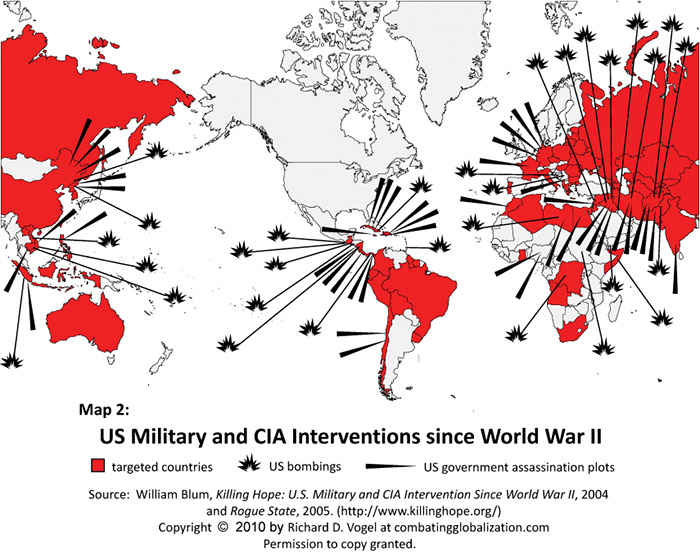
    In pursuit of that doctrine, the US has since World War II invaded, occupied, bombed and/or overthrown the governments of 70 nations, killing between 30 and 40 million people in the process.6

    Its troops currently occupy or are fighting in, either directly or through proxies, Afghanistan, Iraq, Somalia, Sudan, Syria and Yemen. None of these wars have any legitimacy in international law, the defiance of which is a dominant characteristic of US foreign policy.7 In addition to direct military intervention, the US is a major sponsor of hybrid warfare on every continent.8

    The experiences of Russia and China have been very different. After World War II, the Soviet Union occupied those Eastern European countries it had captured from German occupation or who were part of the Axis coalition during the war. Western propaganda persistently portrayed that occupation as evidence of a Soviet desire to conquer the world. It is more accurately viewed as the creation of buffer states to insulate Russia from further Western invasions. That invasion history did not begin with the German invasion in July 1941.9

    The agreement between Presidents Mikhail Gorbachev and Bush the Elder that allowed the reunification of the two parts of Germany had been accompanied by a pledge by the Americans that NATO would “not advance one inch further east.”10 The subsequent history of Eastern Europe is a perfect illustration of why American assurances are not to be trusted. 

    Despite there now being foreign troops stationed on Russia’s borders, the installation of missile systems directed at Russia, and the regular carrying out of large-scale military exercises, again clearly aimed at Russia, it is Russia that is portrayed in the Western media as being aggressive. It is this capacity for hypocrisy and doublethink that again is a prominent feature of Western policy.

    In 1990 the Soviet Union collapsed. That collapse was followed by a disastrous decade under Yeltsin when Russia’s resources were plundered by homegrown oligarchs and Western corporations. Life expectancy fell and living standards plummeted. Yeltsin was succeeded by Vladimir Putin who has achieved a miraculous turnaround in Russia’s fortunes.11 It is this, more than any other single factor, which probably explains the constant demonisation of Putin by the American media.12

    China’s Experience

    China’s post-war history was also disruptive. After the Japanese had been defeated, the civil war resumed, concluding with victory under Mao in 1949. The Korean War commenced the following year, and it was US General McArthur’s threat to cross the Yalu River that brought China into that war. We now know that the Americans seriously considered the use nuclear weapons on China.13

    That war was barely concluded when Mao embarked on his Great Leap Forward (da yue jin) program (1958–1962). Although intended to transform China from an agrarian to an industrial society, it was in many respects a disaster. Widespread famine was one consequence. Internal party criticism of Mao by people such as Deng Xiaoping led to Mao’s marginalisation within the Party. The Cultural Revolution (1966–1976) was aimed at restoring Mao’s control, but it had disastrous consequences on China’s economy and society. It was Deng Xiaoping, who led China from 1978 until 1989 with his “four Modernisations” first proposed by Zhou Enlai in 1963, that began the transformation of China into its current status. Those four pillars of modernisation were agriculture, industry, defence, and science and technology.

    Ever since China has sustained a level of development unparalleled anywhere in the world. More than half a billion people have been lifted out of poverty into the middle class. Huge infrastructure developments including more high-speed rail than the rest of the world combined, and the development of centres of technological excellence as in the transformation of Shenzhen from a small fishing village to a world-class centre of excellence in less than 40 years. Shenzhen is one of China’s Special Economic Zones where investment strategies owe more to entrepreneurial capitalism than they do to the outmoded depiction of China as a communist nation.

    On the basis of parity purchasing power, China’s economy is now larger than that of the United States, and the disparity grows wider every day. The United States did not have anything as dramatic as the collapse of the Soviet Union or the transformation of China, but it did have a geopolitical event, the consequences of which have profoundly affected the direction of US policy, and contributed to a rebalancing of the world’s geopolitical structure.

    The Geopolitical Event of 9/11

    That event was the attacks within the United States of 11 September 2001 (‘9/11’). These attacks were attributed to 19 Muslim hijackers directed by Osama bin Laden from his cave in Afghanistan. It is outside the scope of this article to discuss those events and the official explanation that rapidly emerged and was reinforced by the Report of the 9/11 Commission.14 Suffice to say for present purposes that the US government’s version of events is completely unsupported by the scientific evidence, as has been conclusively demonstrated in a number of excellent studies.15

    The significance of 9/11 for present purposes is that it provided the springboard for a sustained attack by the US and its coalition allies, including Australia, upon a number of countries. Afghanistan was the first victim; falsely attributed with harbouring the alleged mastermind of 9/11, bin Laden, and refusing to hand him over for “justice.”16 We now know, for example, that the decision to invade Afghanistan was made in July 2001. The real motives had nothing to do with bin Laden.17 

    Afghanistan was followed by Iraq in 2003, Libya in 2011 and Syria in 2014, among many other targets. They all had a common theme. All were based upon lies of one sort or another, and none of them had any basis in international law. All were justified in the name of being part of a “war on terror” which, apart from being singularly ironic coming as it does from the world’s greatest perpetrator of terror by a considerable margin,18 provided a perfect smokescreen for the erosion of civil liberties,19 the exploitation of foreign resources,20 the massive expansion of the military budget, and a continued expansion of what was already a worldwide network of bases.21

    The invasions of Afghanistan and Iraq may have seemed successful at first, but the longer the occupation continued (now 16 and 14 years respectively) the greater the destruction of those societies and the greater the internal resistance. On the positive side, there has been a growing realisation, including in Australia, that there has to be a better alternative to the relentless destruction and plundering that has marked the “American century.”

    What has transpired, especially in the past 16 years, is a geopolitical realignment that has given fresh impetus to Mackinder’s prescient view of the emergence of the “Heartland,” that is, Eurasia, as the focus and dynamic centre for the 21st century.

    A Coming Together in the Heartland

    To facilitate this development a number of organisations and agreements were established. Most of these, until very recently, have flown under the radar of the Western media. The first, chronologically, was the Eurasian Economic Community, a grouping of six former members of the Soviet Union, with Russia the largest and most economically and politically important member. This evolved into the Eurasian Economic Union (EAEU) in 2010 and currently incorporates the six original members. Its focus is on interregional trade and investment and moving toward a common currency zone.

    More recently, the EAEU has begun forming links outside the original six with other trading groups and also individual countries. Of these, the most significant is Turkey, which in 2017 began negotiating a free trade deal with the EAEU and talking about possible future membership. This is significant as it marks the final disenchantment of Turkey with the European Union with whom it has been holding negotiations for the past 30 years without obvious progress.

    Turkey is also a member of NATO and its reorientation to the East has further ramifications. Turkey recently signed a multibillion-dollar deal with Russia to be supplied with the Russian S400 antimissile defence system, much to the consternation of the Americans whose own missile defence system is inferior to the Russian version, but who have always seen NATO as providing a captive market for its own military sales.

    In March 2017 the prime ministers of Iran and the six EAEU member states signed cooperation agreements, and further integration is anticipated. Russia has also sold its S400 system to Iran and Iran has provided an airbase for the Russian military at Hamadan, located 47 km from the city of the same name.

    Iran is also a key link in the North South Transportation Corridor (NSTC) that links India with Russia via Iran and Azerbaijan. To facilitate the NSTC and the other developments discussed below, Iran is investing in major infrastructure projects with the financial and technical assistance of Russia and China. This notably includes upgraded rail linkages.

    Iran also made a recent agreement with Qatar to jointly develop the huge natural gas resources in the Persian Gulf, known as the South Pars field in Iran and the North Dome field in Qatar. This agreement was a major factor in the recent threats, demands and economic moves against Qatar made by Saudi Arabia, from which the Saudis have largely resiled.

    Another important factor in the Saudi-Qatar dispute was the decision by Qatar to sell $50 billion of natural gas to China, the key fact being that the deal was not denominated in US dollars. It was an important milestone in the disappearance of the petrodollar,22 a fact of more significance to the US on whose behalf Saudi Arabia was undoubtedly acting.

    Another grouping is BRICS, an acronym coined in 2001 by Jim O’Neill, chairman of Goldman Sachs, with the initials representing the (original) four countries of Brazil, Russia, India and China. The ‘S’ represents South Africa that did not join until 2010. The first meeting of the BRIC nations was in 2006 at Foreign Minister level with the first full-scale conference in Yekaterinburg, Russia, in June 2009.

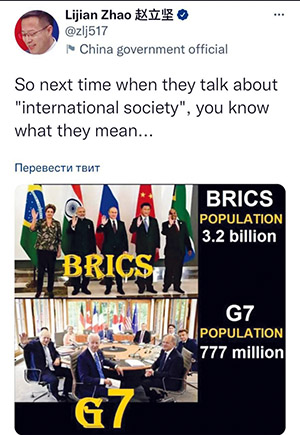
    BRICS is significant not only for its membership, representing as it does a significant percentage of the world’s population and GDP, and not only its geographical spread, but also that it is taking increasing steps to separate itself from the US and European dominated World Bank and IMF by setting up its own development bank. It is also instrumental in setting up CHIPS, an alternative to SWIFT, the interbank trading system that has been used as a tool in imposing financial sanctions on, among others, Iran and Russia. Those sanctions have been a form of financial imperialism.

    Arguably the most important grouping, however, is the Shanghai Cooperation Organisation (SCO), the details and significance of which is almost entirely absent from most Western media analysis. The SCO was formed in 2001 and initially comprised China and Russia, plus Kazakhstan, Kyrgyzstan, Tajikistan and Uzbekistan. It had six Observer States and six Dialogue Partners.

    Iran is an Observer State and has applied for full membership, with the strong backing of Russia. It is likely to become a full member in 2018.

    Two other Observer States that achieved full membership in July 2017 were India and Pakistan. Egypt and Syria have applied for Observer State status, and another Observer State, Turkey, has applied for full membership. Afghanistan is another Observer State, although its attempts to have a fuller level of cooperation with other SCO members and benefit from infrastructure investment have been blocked by the US. President Trump has openly stated that Afghanistan’s significant natural resources, estimated by the US geological survey in 2012 at up to $3 trillion, should be exploited by the US.23 Significantly, that resource includes more than one million tonnes of rare earth elements, a key component of modern technology.24

    The US is unlikely to relinquish its role in Afghanistan any time soon as, apart from its mineral wealth, it provides 93% of the world’s heroin25 of which the US is a significant beneficiary,26 and has military bases designed to form part of its containment policy of China. [As of April 2021, the US announced it was finally going to withdraw from Afghanistan. We are yet to learn the exact details of what that really means including how many US private contractors stay on and how many troops remain to protect military bases.]

    The US has also, since at least Operation Cyclone in the 1970s, used Afghanistan as a springboard for the infiltration of Muslim extremists into Iran, China and Central Asia as part of its hybrid warfare role in the destabilisation of those countries.27

    Perhaps, needless to add, none of these facts form part of the Western narrative with regard to Afghanistan, particularly in Australia, that prefers to perpetuate its myth of being there in a “training and advisory role.”28 A role that after 16 years has been spectacularly unsuccessful in achieving anything approaching positive results.

    Since 2004 the SCO has also had a security cooperation component (CSTO) aimed at coordinating responses by SCO members to security (including terrorist) threats to member states. Other areas of focus include combatting drug trafficking, organised crime and religious extremism. Unlike NATO, SCO does not need an external enemy to justify its existence. Covering a quarter of the world’s population and three-fifths of the Eurasian landmass, it again provides an alternative model for tackling common problems, many of which are generated outside its borders.

    The reader will have noted that BRICS, the EAEU, the NSTC and the SCO have considerable overlapping memberships. While that is not without its problems, as with the recent confrontation of India and China over the Donglang region of the China-Bhutan border and elsewhere on their common frontier, these problems have thus far been resolved without resort to war. Dialogue has been the key, a factor notably lacking with the US in, for example, Afghanistan and Korea.29

    One Belt One Road: Will Australia Ruin its Continued Prosperity?

    Towering over all these developments, however, is a project that is transforming Eurasia in its scope and ambition. It is the world’s largest infrastructure project by a significant margin. Publicly announced by China’s President Xi Jinping in 2014, it’s been variously described as the New Silk Roads, One Belt One Road (Yi dai Yi lu) (Xi’s original description) and its current nomenclature, the Belt and Road Initiative (BRI). I have previously discussed this project in New Dawn30 and will not repeat that here.

    As may be seen from the various graphic representations, the BRI has both land and maritime components, linking Eurasia with Africa and South America. Its land component is a combination of road, high-speed rail and fibre optic communications. One illustration is the China-Pakistan Economic Corridor (CPEC), itself a $50 billion project linking China with the Pakistan port of Gwadar.

    Among its many virtues, CPEC bypasses the narrow Strait of Malacca through which more than 80% of China’s oil imports currently pass. Australia regularly joins with the US in an exercise, Operation Talisman Sabre, that practices blockading the Malacca Strait. Unsurprisingly, this is seen as an unfriendly act by China. Australian governments seem not to appreciate that the countries (now more than 60) that have joined the BRI also produce the same commodities that Australia has grown rich on selling to China over the past 50 years. If Australia persists in its unfriendly acts towards China, for example by joining with the Americans in hostility toward China over Korea and the South China Sea, then the day will surely come when China switches its preferred suppliers from Australia to friendlier nations reachable by high speed rail.31

    Looked at from a broader perspective, American military misadventures since the 2001 invasion of Afghanistan may be seen as symptomatic of the disintegration and collapse of the American empire. Ironically, this has been recognised by the Pentagon itself, as detailed in a recent study.32 Their proposed “solution,” however, is more of the same policies that led to America’s decline in the first place: more surveillance; more strategic manipulation of perception (i.e. propaganda); and more military interventions. The contrast with President Xi’s “win-win” philosophy and his geopolitical analysis outlined in Switzerland in 201733 could not be greater.

    How likely is it that the US empire will collapse and be replaced by, at the very least, a multi-polar alternative world? The American historian Alfred McCoy in his latest book34 sees the decline in the US’s ability to retain global hegemony as attributable to a number of factors. One important factor is the decline in US educational standards resulting from years of underinvestment as crucial spending was subsumed to the needs of an ever more bloated military establishment. The F35 debacle is a classic metaphor for all that is wrong with military investment and an inability to produce a quality product.

    Another factor that McCoy identifies is the dollar’s disappearance as the world’s sole reserve currency; a status that has enabled the US to live beyond its means for decades. The de-dollarisation of the world is growing rapidly, not least as noted above in the Eurasian trading blocs and separate deals (e.g. Qatar) outside those blocs. Trading is increasingly in local currencies like the Ruble or Yuan, or through constructs such as Special Drawing Rights or gold based convertible notes.35 China’s increasing economic dominance will accelerate that trend.

    The new world order that is emerging is fulfilling Mackinder’s vision of 114 years ago. For the reasons set out above, Russia and China are central to that realignment. Ironically, the Russophobia of America’s Deep State and their fundamental inability to grasp the nature and the consequences of the re-emergence of Chinese power has expedited the strategic relationship between these two powers.

    The US will undoubtedly continue to strive to undermine the Eurasian partnership through a range of manoeuvres. Its provocative conduct in the South China Sea; its bellicosity to North Korea; its trouble making between China and India; its conduct in Ukraine and elsewhere in Eastern Europe; and its continuing addiction to hybrid warfare show no signs of abating.

    The fundamental fact of the 21st century is that the US no longer has the power to impose its will as it was largely able to do from 1945 to 2000. A new model, centred on the World Island Heartland is taking shape, with China and Russia as its major drivers. 

    [alert type=”general” dismiss=”no”]This article was published in New Dawn Special Issue Vol 12 No 1.[/alert]

    [alert type=”success” dismiss=”no”]If you appreciate this article, please consider subscribing to help maintain this website.[/alert]

    Footnotes

    1. H. Mackinder, The Geographical Journal, April 1904 

    2. Mackinder, Democratic Ideals and Reality: A Study in the Politics of Reconstruction(1919)

    3. P. Duus, The Abacus and the Sword: the Japanese Penetration of Korea, University of California Press (1998); Y-L Chung, Korea Under Siege 1876-1945, OUP (2005)

    4. R Rummel, China’s Bloody Century, Transaction (1991)

    5. US Department of Defence, Joint vision 2020 (2000)

    6. W. Blum, Killing Hope (2008); Blum, America’s Deadliest Export: Democracy (2014); Blum, Rogue State (rev.ed) (2016)

    7. C. Doebbler, American Hypocrisy in International Law, www.counterpunch.org, 6 March 2014

    8. A. Korybko, Hybrid Wars, www.orientalreview.org August 2015

    9. D. Stone, A Military History of Russia, Greenwood Publishing (2006)

    10. U. Klussmann et al, Did the West Break its Promise to Moscow, www.spiegel.de 26 November 2009

    11. S. Djankov, Russia’s Economy Under Putin, www.piie.com, September 2015

    12. S. Cohen, Stop the Pointless Demonization of Putin, www.thenation.com, 7 May 2012

    13. C. Posey, How the Korean War almost Went Nuclear, www.airspacemag.com July 2015; B. Guertzman, US Papers Tell of 1953 Policy to A-Bomb Korea, www.nytimes.com, 8 June 1984

    14. The 9/11 Commission Report, July 2004

    15. D. Griffin, Bush and Cheney: How they Ruined America and the World, Olive Branch Press, 2017

    16. Ibid.

    17. J. O’Neill, Trump and Afghanistan: A Hidden Agenda, www.journal-neo.org, 25 August 2017

    18. Blum, op cit. N6

    19. T. Stephens, Civil Liberties After September 11, www.
    counterpunch.org, 11 July 2003

    20. M. Chossudovsky, The War is Worth Waging: Afghanistan’s Vast Reserves of Minerals & Natural Gas, www.globalresearch.ca, 22 August 2017

    21. D. Vine, The US Probably has more Bases than any Other People, Nation or empire in History, www.thenation.com, 14 September 2015

    22. J. O’Neill, The Demise of the Petrodollar and the New Multipolar World, www.independentaustralia.net, 4 July 2017

    23. M. Landler & J. Risen, Trump finds Reason for the US to Remain in Afghanistan: Minerals, www.nytimes.com, 25 July 2017

    24. www.newsecuritybeat.org, 27 July 2017

    25. UN Office of Drugs and Crime, World Drug Report 2016

    26. P. Scott, Drugs, Oil and War: The US in Afghanistan, Colombia and Indochina, Rowman & Littlefield (2004)

    27. Z. Brzezinski, The Grand Chessboard, Basic Books (1998); S. Coll, Ghost Wars, Penguin (2004)

    28. J. O’Neill, Myths, Legends and Lies: Australia’s Policy in Afghanistan, www.gumshoenews.com, 26 July 2017

    29. US Skips Out on Afghan-Taliban Conference in Moscow, www.dw.com, 14 April 2017

    30. J. O’Neill, The New Silk Roads: The Quiet Revolution, New Dawn155 (Mar-Apr 2016)

    31. B. Habib & V. Faulkner, The Belt and Road Initiative, www.theconversation.com, 17 May 2017

    32. US Army War College, At Our Own Peril (2017)

    33. President Xi’s Opening Plenary Speech at Davos, www.
    weforum.org, 17 January 2017.

    34. A. McCoy, In the Shadow of the American Century: The Rise and Decline of US Global Power, Haymarket Books (2017)

    35. K. Rapoza, Much to the Dismay of China Haters the Yuan Goes Global on October 1, www.forbes.com, 30 September 2016; JN. Willie, Gold Trade Note sighted, www.goldseekers.com, 16 February 2017

    © New Dawn Magazine and the respective author.
    For our reproduction notice, click here.
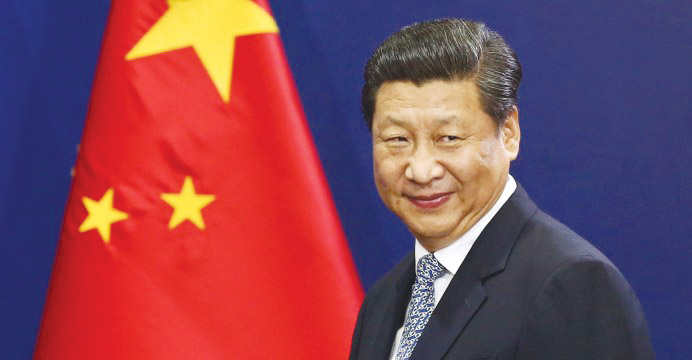
  • False Flags & Geopolitical Objectives: From the Reichstag Fire to Douma

    False Flags & Geopolitical Objectives: From the Reichstag Fire to Douma

    From New Dawn Special Issue Vol 12 No 3 (June 2018)

    The easiest way to gain control of a population is to carry out acts of terror. [The public] will clamour for such laws if their personal security is threatened.
    – Joseph Stalin

    Stalin’s statement has been taken as a guiding principle by several governments in the past century. The objective is not just to “gain control” of their citizens, although that is certainly a by-product. An examination of history shows that the false flag attack is also designed to serve a wider geopolitical purpose.

    Wikipedia defines a false flag as a “covert operation designed to deceive; the deception creates the appearance of a particular party, group or nation being responsible for some activity, disguising the actual source of responsibility.”

    This article examines some of the more notable false flags, but the focus needs to be on the underlying geopolitical objective. In other words, what was the false flag designed to achieve, beyond Stalin’s adage of being a means to control one’s population.

    It is also necessary to broaden the scope of the definition to include a frequent corollary of a fictitious argument designed to serve the same geopolitical purposes. A third aspect is the blatant coup designed to effect ‘regime change’. Those three aspects are not necessarily discrete but often shade into one another with, for example, lies about an alleged attack serving as a pretext to influence a change in an opposing government’s policy short of a coup.

    Ukraine in 2014 was a blend of several different forms of the regime change paradigm whose actual target was a third country – in that case, Russia. The false flag shooting down of MH17 followed the February 2014 American organised coup. The complete misrepresentation of the circumstances around Crimea re-joining the Russian Federation has been part of an unparalleled demonisation of Russia in the Western media. Anyone who raises any questions about allegations against Russia, of which there are many, is attacked in a manner not seen since the worst days of the late US Senator Joe McCarthy.

    On 27 February 1933, the German parliament (Reichstag) building burned down.

    One of the best-known false flag attacks of modern history was the Reichstag fire of 1933. At the Nuremberg war crimes trials in the late 1940s, Hermann Goering admitted German government responsibility for the fire. The fire was used to blame the communists, thus demonising a potential counterforce to Nazi rule. It also enabled the Nazis to pass a series of laws allowing them to arrest designated groups who were then tried and executed after ‘trials’, or held in concentration camps, or used as slave labour.

    Martin Niemoller wrote about the consequences in his famous poem in which he refers to “they” who came for the communists, then the trade unionists, then the Jews and finally for him, by which time there was no one left to speak for him. It is a salutary reminder of the perils of remaining silent.

    Operation Gladio was a post-World War II program that incorporated many different elements of the broader false flag. It was initially established in the immediate postwar years as a plan to have ‘stay behind’ resistance fighters in the event of a Soviet invasion of western, northern and southern Europe.

    In August of 1980, Gladio operatives bombed a train station in Bologna, Italy, killing 85 people.

    The idea was that if a country was occupied, trained resistance fighters could carry out acts of sabotage against the occupying forces, much as for example French partisans continued to fight German occupying forces during the period 1940-1945.

    Whatever the initial plans of Operation Gladio, they rapidly morphed into a program to carry out sabotage and murder that could be blamed on leftist or communist groups. The general public was thereby to be frightened into voting for conservative right-wing parties who could be relied upon to follow the US’s geopolitical wishes.

    The fear, largely imagined, of a Soviet takeover of the countries not allocated to it by the Yalta agreement was part of the driving ideology. Hatred of the Soviet Union and its successor States was always uppermost in Western political leader’s minds. 

    Operation Unthinkable was an actual plan devised by Winston Churchill in 1945. It called for an attack upon the Soviet Union immediately after the war had ended. The plan envisaged using recently defeated German troops as part of the spearhead.

    Winston Churchill ordered the planning of Operation Unthinkable in 1945.

    Churchill’s hatred of the ‘Bolsheviks’ had a long history. He was instrumental in sending British forces into Russia to fight in the civil war on the anti-communist side, for the so-called ‘White Russians’. An Australian warship was used in the Black Sea in 1918 to gather intelligence on behalf of the same operation.

    Operation Gladio (which was the Italian version) carried out a series of terrorist attacks. One of the better-known incidents was the bombing of the Bologna railway station which killed scores of people. The bombings, blamed on the Red Brigades, were a powerful propaganda tool against Italy’s Communist Party. The actual perpetrators were right-wing fascist groups such as Ordine Nuovo, organised, financed and armed by the CIA.

    The CIA had barely been formed when it organised the rigging of the 1948 Italian elections. In a genuinely free election, the communists would undoubtedly have emerged the largest and strongest party. Since 1948 the CIA has accumulated a long and dishonourable history of interfering in foreign elections. It is a point always worth recalling in the current hysteria being generated over alleged Russian interference in the 2016 US presidential election.

    Ironically, one of the more blatant examples of US interference in foreign elections was the engineering of Boris Yeltsin’s ‘victory’ in the Russian presidential elections of 1995. Time magazine even ran a cover story boasting about the manipulated result.

    Next Major False Flag – Target Iran

    The United States CIA and Britain’s MI6 also organised the 1953 coup that overthrew the democratically elected government of Mohammad Mosaddegh in Iran. Iran’s crime? It nationalised the Anglo Persian oil company (now BP). That a country should control its own resources was intolerable to these two imperial powers. In 2013 the CIA admitted it was behind the coup. In documents released that year, it was also clear that the British opposed the release of any documents disclosing its role in the Iranian coup. The British still refuse to acknowledge they were the instigators of the coup, and that they needed American help in order to carry it off.

    That coup is significant on a number of levels. The then British Prime Minister Anthony Eden saw Mosaddegh as a serious threat to Britain’s strategic and economic interests. Iran’s national interests were not considered.

    The coup saw the installation of the Shah’s regime, whose brutal secret police, the Savak, trained by the Americans, became a byword for cruelty and oppression.

    The third lesson was that the Shah’s brutalities lead to the 1979 Islamic revolution, putting Iran on America’s “axis of evil” list. Hybrid warfare by the Americans including assassinations, cyber attacks, sanctions and support for the terrorist group MEK have followed ever since.

    Iran’s government is still designated for violent overthrow as set out in the Brooking Institution’s “Which Path to Persia” (2009). That publication is nothing less than a blueprint for violent regime change. Again, something to remember when one hears protestations from Western leaders about their commitment to such concepts as the rule of law and respect for national sovereignty.

    Iran was one of the seven countries designated for regime change as disclosed by US General Wesley Clark in a revealing interview he gave on the American TV programme ‘Democracy Now’ in 2007. Clark was talking about a document he had seen in the Pentagon shortly after the events of September 2001. The seven countries referred to were Iran, Iraq, Lebanon, Libya, Somalia, Sudan and Syria.

    In a 2007 interview US General Wesley Clark revealed knowledge of a Pentagon document that called for regime change in seven countries after 9/11.

    The United States and its allies have directly attacked five of those seven since Clark’s revelations. Lebanon was previously attacked and occupied by Israel, the United States’ staunchest ally in the Middle East.

    Iraq, Syria and Libya have all been devastated by the United States and its allies in regime change operations. They have a number of features in common, not least that they are rich in natural resources, particularly oil and gas. They were and continue to be the objects of sustained vilification through propaganda, false flag attacks and outright lies used to justify invasion and occupation.

    In Iraq’s case, for example, the first Gulf War in 1990 featured in its build up the US Senate testimony of a 15-year-old girl identified only as Nayirah. She testified that Iraqi soldiers who had occupied Kuwait (following a green light from the US ambassador to Iraq, April Gillespie) took babies from their incubators in Kuwait’s hospital and threw them onto the “cold hard floor” to die.

    It was a complete lie, told by the daughter of Kuwait’s ambassador to the United States, and coached by the public relations firm Hill and Knowlton. None of this was, of course, told to the American public.

    In May 1996, 60 Minutes interviewed Madeleine Albright. Correspondent Leslie Stahl said to Albright, “We have heard that a half-million children have died. I mean, that’s more children than died in Hiroshima. And — and, you know, is the price worth it?” Albright replied, “I think this is a very hard choice, but the price — we think the price is worth it.”

    The decade of sanctions on Iraq following its defeat in that war caused the death of more than half a million civilians, mainly women and children. This was a price that the then US Ambassador to the UN, Madeleine Albright, considered “worth it.”

    First Gulf War, Vietnam & 9/11

    The 1990 first Gulf War was bracketed by two other major wars based on false flags and lies. The American war in Vietnam got its major reboot (it had been going on in one form or another for the preceding ten-plus years) from the so-called Gulf of Tonkin incidents.

    These incidents involved two US warships operating in the Gulf of Tonkin, the USS Maddox and the USS Turner Joy. On 2 August 1964, North Vietnamese gunboats attacked the Maddox. The US said the attack was “unprovoked.” It was anything but. The Maddox was gathering intelligence on the North Vietnamese and giving that intelligence to the South Vietnamese, which in turn used it in attacking the North.

    Two days later, the US said the Maddox was attacked again, and also the Turner Joy. In fact, there was no attack at all. The false allegation was used by US President Lyndon Johnson to obtain the Gulf of Tonkin resolution, giving him the power to wage warfare on the North.

    The resulting war, which ended in 1975 with the undignified scramble for evacuation by helicopter from Saigon’s rooftops, killed more than three million Vietnamese, devastated the countryside, and left a toxic legacy from chemical warfare that reverberates to this day.

    No legal consequences have flowed from this or any other attack upon nation states undertaken by the US and its allies, including the ever-willing Australians.

    The other ‘bracket’ to the first Gulf War was the October 2001 attack on Afghanistan. It was ostensibly justified by the ‘9/11’ attacks in New York City and Washington. The whole 9/11 saga ranks as one of the major false flag operations of the past 100 years. To accept the US government’s version of that event requires a total suspension of disbelief. It also requires one to reject as false basic scientific principles, common sense, and a now overwhelming body of evidence demonstrating the falsity of the official conspiracy theory.

    The events of 9/11 have a much broader significance. Exactly as with the Reichstag fire 68 years earlier, 9/11 was used to implement a legislative program and policy changes that dismantled basic constitutional protections, to wage war on dissent, and to justify a series of foreign wars and occupations under the false rubric of a “war on terror.” A series of wars of terror would be a more accurate nomenclature.

    The events of 9/11 were blamed on ‘former’ CIA asset Osama bin Laden and the Taliban government of Afghanistan who the United States alleged were sheltering him and refusing to turn him over. As noted, none of the official story relating to 9/11 could possibly be true, and that extends to the invasion of Afghanistan. We now know that the decision to invade Afghanistan was made in July 2001, two months before 9/11, and immediately after the Taliban government had refused an American offer to build and control a gas pipeline from the Caspian Sea. 

    The decision to invade was only partly due to the pipeline issue. Afghanistan has a very lucrative opium crop, and the proceeds from the sale of its refined product – heroin – finances much of the US’s clandestine operations. Afghanistan is now part of a string of nearly 400 military bases designed to ‘contain’ China. 

    Although the Taliban government was quickly overthrown, the United States and its allies (including Australia) have shown no intention of leaving. Nearly 17 years after the invasion, there is precious little progress for the Afghan people that can be demonstrated. The Taliban now control more Afghan territory than at any time since the 2001 invasion. The Australian government periodically makes statements about staying to complete its ‘mission’ of training Afghan security forces. It is silent on the question of what it hopes to achieve in the future that it has been unable to realise in the past 17 years.

    Since Operation Cyclone in the 1970s, the US geopolitical objectives in Central Asia have been control of its oil and gas resources, fomenting unrest in the Muslim republics of the then Soviet Union and China’s Xinjiang province (also with a significant Muslim population), and undermining the capacity of China and Russia to challenge the full spectrum dominance ambitions of the US government and its Deep State operatives.

    Yinon Plan for the Middle East

    Another key to understanding the geopolitical dynamics of the Middle East is the Yinon Plan, named after Oded Yinon, an advisor to former Israeli prime minister Ariel Sharon. In an article published in the Hebrew journal Kivunim (Directions) in February 1982, Yinon sets out what he termed “a strategy for Israel in the 1990s.”

    The plan envisaged the dismemberment of Egypt with Israel annexing the Sinai Peninsula. The Palestinians were to be squeezed out of the West Bank. Jordan was to be liquidated as a State, Lebanon was to be cantonised along ethno-nationalist lines, and Iraq split into its Shi’ite, Sunni and Kurdish components.

    Syria was similarly to be split into smaller states. Israeli foreign policy has essentially followed this plan, although there have been setbacks including the expulsion from Lebanon and Iraq retaining its territorial unity. Syria is an ongoing project, although thanks to Russian, Hezbollah and Iranian intervention, that plan has also, at least for the time being, been thwarted. The ethnic cleansing of Palestinians, blatant murders of Palestinians including children, and the theft of their land has, however, continued unabated. 

    Israel continues to illegally occupy the Golan Heights, seized from Syria in the 1967 war. It does so in defiance of international law and multiple UN General Assembly resolutions (Security Council resolutions are invariably vetoed by the United States). On all these issues they have the tacit support of the Australian government, either through silence or voting in Israel’s favour on UN resolutions.

    Iran represents far too big a challenge for Israel on its own, and accordingly the US has been recruited to fight Iran on Israel’s behalf. That is also likely to fail, not only because the US has failed for the past 39 years to achieve its geopolitical goals in Iran, but that Iran’s increasing integration into the wider Russia-China geopolitical realignment through organisations such as the SCO, BRI, NSTC and EAEU means Iran’s security is increasingly underwritten by both China and Russia.

    The progressive destruction of the US dollar’s role as the principal medium of exchange in world trade will greatly accelerate the diminution of the US’s capability to wage endless war. The changing financial structure of the world, including but not limited to the demise of the petrodollar, is quite probably the single most important change to the dynamics of the geopolitical world likely to occur in the very near future.

    In countries like Australia, the political leadership of both major parties seems singularly unable to grasp the significance of these changes. Major political and economic risks will flow from maintaining the ‘joined at the hip’ US alliance. China, which currently takes a third of Australia’s total exports, has already issued several increasingly blunt warnings about the economic consequences to Australia of being shown “a friendly face but a cold shoulder.” The import of this warning is seemingly lost on Australia’s political class.

    False Flags that Flopped – Salisbury & Douma

    It is in this context of the rapidly changing geopolitical balance that one has to interpret the two latest false flag initiatives by the Anglo-American duopoly – the Skripal poisoning in Salisbury, England, and the Douma ‘chemical attack’ in Syria.

    Although some thousands of kilometres apart, they are linked both in their characteristics and what they signal about modern geopolitical realities. Almost everything said by the British government about the Skripal attack is false. The same is true about the alleged ‘chemical attack’ in Douma.

    The significance of these two events is not just their manifest absurdity. Anyone with a modicum of intelligence, common sense and the ability to conduct basic research, rapidly ascertained the contradictions, implausibility and sheer scientific nonsense of the official story.

    An important and encouraging factor is that the histrionic response to both events was limited almost exclusively to a small number of mostly Western nations. Africa, Latin America and most of Asia conspicuously failed to support the UK/US version of events about either Salisbury or Douma.

    Those Western countries who supported the UK’s version of the Skripal poisoning and the illegal missile attack on Syria following the Douma allegations, including Australia, simply ignored the conventions that underlie their much-vaunted belief in the “rules-based international order” and the “rule of law.”

    These conventions include a presumption of innocence until the contrary is established. The contrary can only be established by admissible evidence proven to a very high standard. The accused, whether an individual or a nation, is entitled to know the evidence against them. A true rule of law system does not argue by assertion, and following Alice in Wonderland’s ‘Mad Queen’, demand the sentence before the verdict. 

    These and other fundamental conventions were simply ignored. The British simply pronounced Russian guilt, told blatant lies, tried to pre-empt any valid scientific inquiry, defied several international conventions to which they were a party, imposed sanctions before evidence had even being gathered, and launched in the case of Douma a missile attack that was a blatant violation of international law.

    More evidence emerges, both in Salisbury and Douma, discrediting the original wild claims by the British, the Americans and others including Australia. But rather than withdraw their wild allegations and apologise, government ministers simply ignore that evidence and repeat their fabrications ad nauseum.

    In this they are unquestionably supported by a mainstream media for whom notions of fair and accurate reporting are but a distant memory. Important revelations are unreported, and the original lies repeated in the confident expectation they will be contradicted neither by other parts of the mainstream media or by politicians.

    The lessons we draw from the experiences of the past eighty years are that in increasingly important respects our democracy is a sham. The abdication of the media, the pro-war consensus of the politicians, and the complete absence of accountability in any meaningful sense for the endless breaches of international law, strongly indicate there are effectively no longer any limits that the citizens can impose on their political leaders.

    George Orwell’s 1984, rather than being seen as a warning of a dystopian future, is instead treated by our political leaders as a training manual. We have every right to be fearful.

    [alert type=”general” dismiss=”no”]This article was published in New Dawn Special Issue Vol 12 No 3.[/alert]

    [alert type=”success” dismiss=”no”]If you appreciate this article, please consider subscribing to help maintain this website.[/alert]

    © New Dawn Magazine and the respective author.
    For our reproduction notice, click here.