New Dawn – World's Most Unusual Magazine

Category: Behind the News

  • The Grand Chessboard Endgame: Why the War on Iran Is Really About Controlling Eurasia

    The Grand Chessboard Endgame: Why the War on Iran Is Really About Controlling Eurasia

    From New Dawn 216 (May-June 2026)

    On 27 February 2026, Oman’s Foreign Minister Badr Al-Busaidi told the world that peace was “within reach.” Iran had agreed to full IAEA verification, permanent limits on uranium stockpiling, and irreversible downgrading of its enriched uranium to the lowest possible level. Talks were set to resume on 2 March.

    The bombs started falling on 28 February.

    The United States and Israel launched a joint assault that killed the Iranian leader Ali Khamenei, flattened military facilities, and also tore through schools, hospitals, and cultural sites across the country. Iran struck back with missiles and drones aimed at Israel and US bases in Bahrain, Jordan, Kuwait, Qatar, and Saudi Arabia. The Strait of Hormuz was shut. Oil prices spiked to levels not seen since the 1970s. By early April, with thousands dead, the conflict was dangerously widening.

    The stated reasons from Washington shifted by the day. Regime change. Self-defence. Nuclear prevention. Securing oil. No single story held for more than a news cycle.

    That drift is the tell. When the reasons for a war change by the day, the real reason must stay hidden. And the real reason reaches far beyond any nuclear programme.

    The Western ruling elite knows its era of unchallenged global dominance is closing. The economic centre of gravity is migrating eastward. The dollar’s monopoly over world trade is eroding. BRICS is expanding. China’s Belt and Road Initiative is weaving the Eurasian landmass into a single integrated economic zone.

    In a desperate, last-ditch bid to preserve their grip on global power, Western elites are racing to build a Techno-World Order, a system of control founded on artificial intelligence, digital currencies, biometric tracking, and rule by algorithm.

    That system requires the physical world to stay in their hands. And the physical world runs through Eurasia.Anglo-American strategists have understood this for over a century.

    The Blueprint

    Sir Halford John Mackinder

    To see this clearly, you need to look at two texts that most people have never heard of. One was a lecture delivered in 1904, later published as an article. The other was a book published in 1997. Taken together, they read like a blueprint for modern empire, so candid in their strategic vision that they feel like an architect’s own drawings for a structure you have been living inside your whole life.

    Sir Halford John Mackinder was a man who acted on his ideas. A British geographer who directed the London School of Economics from 1903, he built his career on a single argument: the age of sea power was fading and the real prize was land.

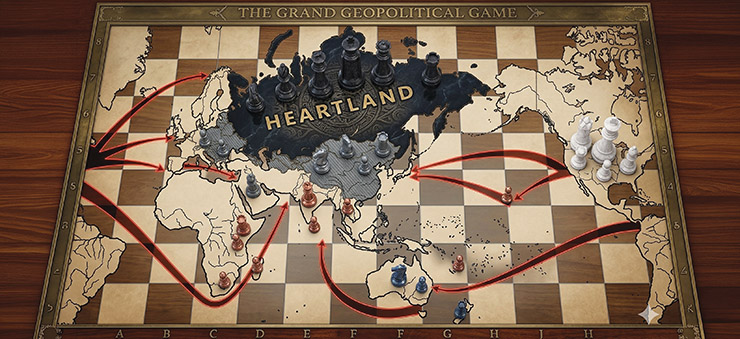
    In 1904, before the Royal Geographical Society, he proposed that the vast interior of Eurasia, stretching from the Volga to the Yangtze, held the resources and the position to command the globe. He called it the “Heartland” (see map on page 11) Around it lay coastal states he termed the “Inner Crescent,” and beyond them the maritime fringe of Britain, Japan, the Americas, and Australia.

    His dictum, refined in 1919, still runs Western strategic thought. “Who rules East Europe commands the Heartland; who rules the Heartland commands the World-Island; who rules the World-Island commands the world.”

    Then he tested it. In late 1919, the British government sent Mackinder to southern Russia as High Commissioner during the civil war. His mission was to unite the White Russian forces of General Denikin against the Bolsheviks and prevent a hostile power from consolidating the Eurasian interior. He returned to London and proposed to the Cabinet a “cordon sanitaire” of buffer states running from Georgia, Armenia, and Azerbaijan through Ukraine, Poland, and the Baltic provinces. The Cabinet ignored him. Britain withdrew its troops. South Russia fell to the Bolsheviks.

    Mackinder’s proposed buffer states were swallowed by the Soviet Union for the next seventy years. The same states he named in 1920 remain flashpoints in 2026. Georgia. Armenia. Azerbaijan. Ukraine.
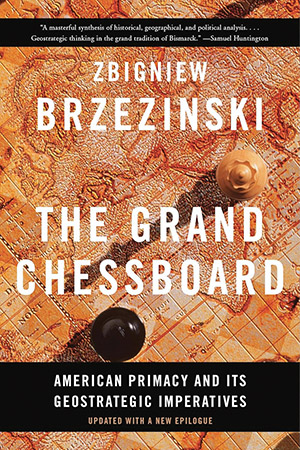
    Ninety-three years after Mackinder’s London lecture, Zbigniew Brzezinski picked up his thesis and fitted it for American use. The Grand Chessboard, published in 1997, is a startling book. Brzezinski, a former US National Security Advisor and co-founder of the Trilateral Commission, laid out American imperial strategy with a bluntness unthinkable in any official document. (He misspelled Mackinder’s first name as “Harold” throughout. The American heir to British imperial geostrategy got his own master’s name wrong.)

    The core argument was simple. Eurasia holds seventy-five percent of the world’s people, sixty percent of its economic output, and three-quarters of its known energy. Control Eurasia and you control everything. America’s task was to prevent any rival from locking that landmass together.

    Brzezinski identified five states whose fate would decide the balance. Ukraine. Azerbaijan. South Korea. Turkey. Iran. He warned that one scenario above all would threaten American power. A grand coalition of Russia, China, and Iran, joined not by ideology but by shared hostility to Western hegemony.

    He was blunt about what lay beneath the surface. The Caspian Basin and Central Asia hold reserves of oil and gas that dwarf those of Kuwait, the Gulf of Mexico, or the North Sea. Iran, with its own massive reserves and its position astride every proposed energy corridor, was the lock on the door.

    Selling the project to voters would be hard. “Democracy is inimical to imperial mobilisation,” Brzezinski wrote. The public would back foreign wars only if given a “sudden threat or challenge to the public’s sense of domestic well-being.”

    In Iran’s case, the nuclear bogeyman served that function for two decades. When diplomacy threatened to remove it, the bombs fell anyway.

    Everything Brzezinski described in theory, Iran embodies in geography. The country is the gateway to Eurasia. No other nation bridges the Indian Ocean to the Caspian and Central Asia in a single overland corridor. The Iranian coastline commands the Strait of Hormuz, through which close to a quarter of the world’s seaborne oil flows. The country shares land and sea borders with fifteen nations. Iranian oil and gas reserves rank among the largest on Earth.

    Western strategists see a strategic position on a map. Iran is something else.
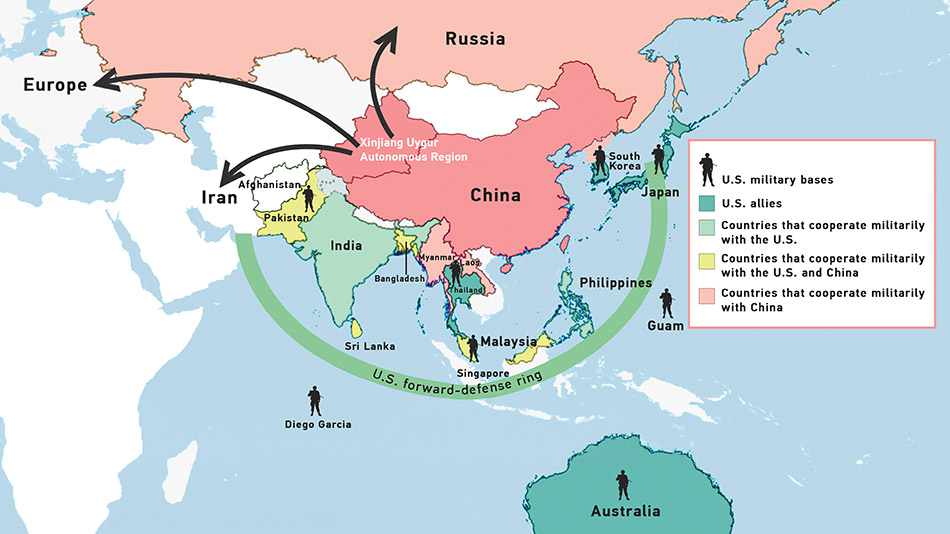
    Seen from Beijing, this map depicts a ring of US military power aimed at constraining China and the wider Eurasian landmass, with Iran in a strategically vital position.
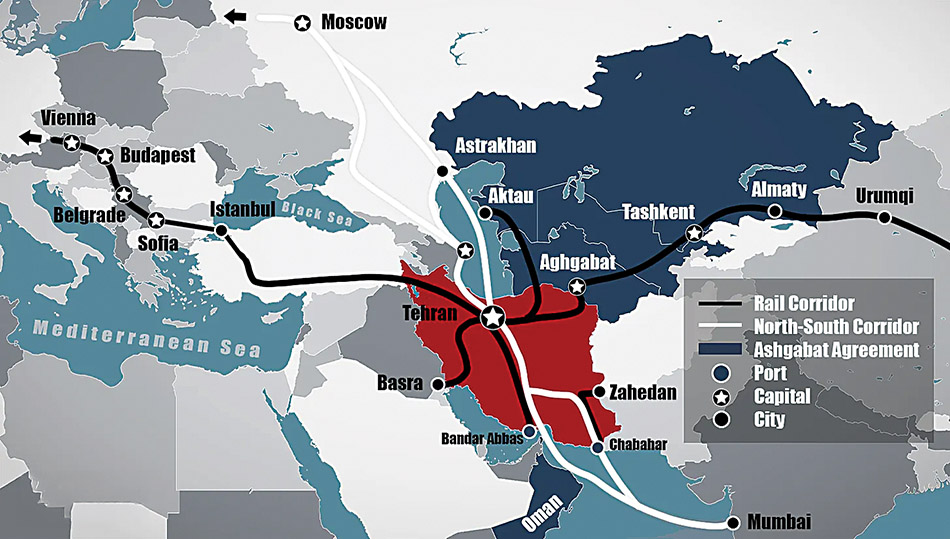
    Iran has become a key hub in emerging corridors connecting Russia, China, and India.

    Persia, as it was known for most of recorded history, is one of the oldest continuous civilisations on the planet. Five thousand years. When the first stones of the Persian Royal Road were laid, connecting the Mediterranean to Central Asia, Rome did not exist. When the Silk Road began threading through Iranian territory, Christianity had yet to be born. Zoroastrianism, one of the earliest monotheistic faiths, emerged from this soil. The mystical traditions of Sufism flowered across the Persian cultural world, producing a spiritual literature, including the Persian-language poetry of Rumi, Hafez, and Omar Khayyam, that still crosses every border of language and belief.

    This is a land where the seen and the unseen have coexisted for millennia, where philosophy and statecraft and spiritual practice grew from the same root. The men in Washington see pipelines and chokepoints. What they fail to see is a civilisation with roots strong enough to outlast any empire that tries to uproot it.

    The West has been trying for a long time. In 1953, when Iran’s elected Prime Minister Mohammad Mosaddegh moved to nationalise the Anglo-Iranian Oil Company, the CIA and MI6 engineered a coup that toppled him and installed Shah Mohammad Reza Pahlavi. The stated reason was Cold War containment. The operating logic was older. Keep the resources and corridors of the Inner Crescent under Western-aligned control.

    Iran’s 1979 revolution ejected the Shah and with him the Western strategic presence. The Islamic Republic has been targeted by Anglo-American policy ever since, through decades of sanctions, proxy conflicts, covert operations, and now direct military assault. The nuclear question has always been the public face of a strategic interest that predates Iran’s nuclear programme by half a century.

    In the years before the 2026 war, Iran was doing what Mackinder and Brzezinski had both warned about. Tehran was fast becoming a key player in Eurasian integration. Iran joined the Belt and Road Initiative. In May 2025, the first direct freight train from Xi’an, China, pulled into the Aparin dry port, cutting transit from a month by sea to fifteen days by rail. The North-South Transport Corridor, linking Russia through Iran to India, was turning Iranian ports into the spine of a new Eurasian trade network. India had poured investment into the Chabahar port on Iran’s southeastern coast, giving Delhi a route into Afghanistan and Central Asia that bypassed Pakistan and sidestepped the Strait of Hormuz. Iran was connecting east to west and north to south at once. The keystone was locking into place.
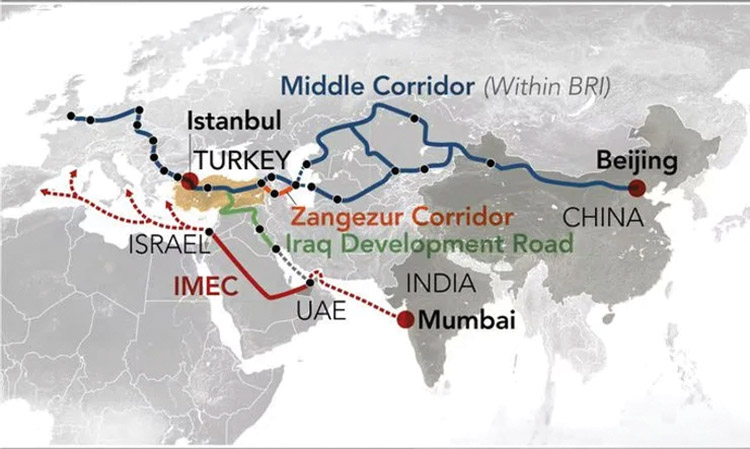
    Iran sits at a critical junction of competing economic corridors, with this map highlighting Türkiye’s route as a gateway to Europe.

    Look at the map in 2026. The coalition Brzezinski described has arrived. The alliance runs through BRICS, the Shanghai Cooperation Organisation, and the Belt and Road Initiative. What Brzezinski feared on paper now moves in steel, rail, and pipeline. And the gateway holding it all together is Iran.

    The Techno-World Order

    This is where the century-old Mackinder doctrine meets the twenty-first-century endgame.

    The Western elite policymakers can read the trends. American debt is spiralling. The move away from the dollar is picking up speed. China’s economy has overtaken the United States in purchasing power terms. The BRICS bloc now represents a larger share of global GDP than the G7. Military bases, dollar hegemony, arm-twisting through the IMF and World Bank, the old tools of Western control are losing their grip. The world that Mackinder and Brzezinski sought to manage is slipping away.

    The ruling class has chosen a different path. Instead of accepting a multipolar future, it has set about building a new architecture of control, one founded on something beyond aircraft carriers and trade agreements.

    At the World Economic Forum in Davos, January 2026, the shape of that architecture was plain to see. AI-driven governance. Digital currencies. Biometric identity frameworks. Machine-run control of whole populations. These were working agendas backed by people who hold state power.

    Technocracy researcher Patrick Wood (see New Dawn Special Issue Vol 20 No 1), who has tracked these developments for decades, calls key figures in the Trump administration “arch-technocrats” building a system of global digital dominion. He names Elon Musk, Peter Thiel, and Howard Lutnick among the architects. The stated US policy goal, laid out in an AI strategy co-authored by senior officials, is to export America’s “full AI technology stack” to every country willing to join its digital alliance.

    By early 2026, the Trump family’s World Liberty Financial had launched a dollar-pegged stablecoin backed by US Treasury securities, and the GENIUS Act had created the federal regulatory framework to legitimise it. The merger of state power and private digital finance was no longer theoretical.

    This Techno-World Order has material demands. AI runs on rare earth minerals and vast energy. Digital currencies need compliant banking systems. Surveillance needs cooperative states. All of this depends on controlling the trade corridors and energy routes of the physical world, the same corridors that Mackinder mapped in 1904 and that converge at Iran.

    If Russia, China, and Iran build their own digital and financial systems outside Western reach, the technocratic project fractures beyond repair. And that is what has been unfolding.

    BRICS states have moved toward de-dollarised trade. China’s rail links to Iran skip every Western-controlled sea lane. After the Strait of Hormuz was initially closed, Iran offered safe passage to BRICS members and blocked American-allied ships. A multipolar world with independent tech freedom is the one outcome the architects of the Techno-World Order are determined to prevent.

    A stable, integrated Iran at the heart of Eurasian trade poses a greater danger to this project than any uranium centrifuge. The centrifuges made for a good story. The real target was the gateway.

    The war itself had been building for years. In 2024, Iran and Israel exchanged direct attacks for the first time. In June 2025, Israel struck Iran and the United States later joined the 12-day war with attacks on Iranian nuclear sites. In January 2026, Iran was shaken by its worst domestic unrest since 1979. By late February, Washington had assembled one of its biggest regional military deployments since the 2003 invasion of Iraq. Oman-mediated indirect nuclear talks, which had resumed in early February, showed progress. The 28 February assault ended that diplomatic opening. What followed stripped away whatever remained of diplomatic language.
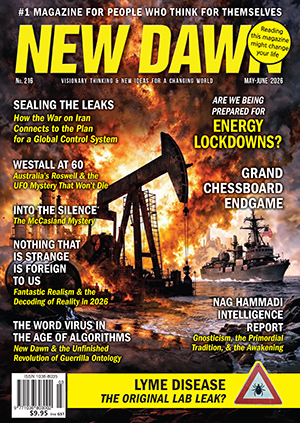
    Get the issue this article appears in

    A Whole Civilisation

    On 21 March, Trump posted on his internet platform ‘Truth Social’ that if Iran did not “FULLY OPEN, WITHOUT THREAT, the Strait of Hormuz, within 48 HOURS,” the United States would “hit and obliterate their various POWER PLANTS.” Twelve hours before that deadline expired, he postponed it. On 26 March, he extended the deadline again, writing that negotiations were “going very well.” On 30 March, he expanded his threatened targets to include oil wells, Kharg Island, and “possibly all desalination plants.” Each deadline arrived and was pushed back. Each postponement came with louder threats.

    On Easter Sunday, 5 April, Trump posted what may be the most unhinged statement ever issued by a sitting US president. “Tuesday will be Power Plant Day, and Bridge Day, all wrapped up in one, in Iran. There will be nothing like it!!! Open the F****** Strait, you crazy bastards, or you’ll be living in Hell. JUST WATCH! Praise be to Allah.” His Defence Secretary Pete Hegseth had already threatened to send Iran “back to the Stone Age.”

    On 7 April, Trump told reporters the US had a plan “where every bridge in Iran will be decimated by 12 o’clock tomorrow night, where every power plant in Iran will be out of business, burning, exploding and never to be used again.” Hours later, on Truth Social, he wrote the words that Amnesty International’s Secretary General called “apocalyptic” and members of Congress called “genocidal.”

    “A whole civilization will die tonight, never to be brought back again. I don’t want that to happen, but it probably will.”

    For all his incendiary rhetoric and threats, Trump has earned the nickname TACO—“Trump Always Chickens Out”—as this Democratic attack graphic makes plain.

    A whole civilisation. The president of the United States was threatening to extinguish one of the oldest continuous civilisations in human history. Five thousand years of philosophy and poetry and spiritual seeking, reduced to a target in a social media post sandwiched between threats about power plants and boasts about a rescued airman.

    Iran’s response told a different story. Across the country, young Iranians formed human chains around power plants to shield them with their bodies. President Masoud Pezeshkian wrote that more than 14 million Iranians had registered to sacrifice their lives defending their homeland. “I too have been, am, and will remain devoted to giving my life for Iran,” he said. Iran’s foreign ministry called Trump’s threats “a sign of ignorance.”

    Ninety minutes before his own 8 p.m. deadline on 7 April, Trump backed down. A two-week ceasefire was announced after mediation by Pakistan, where Washington’s traditional allies had failed to act. Iran agreed to allow passage through the Strait of Hormuz for the ceasefire period. Oil prices dropped eight percent within minutes. But Iran’s Supreme National Security Council, accepting the ceasefire on 8 April, issued a pointed clarification. “This does not signify the termination of the war. Our hands remain upon the trigger.”

    The power that threatened to wipe out a civilisation failed to make its own deadline stick. Three ultimatums were set and withdrawn before the fourth produced a pause. The off-ramp was negotiated by a country that Brzezinski would have classified as a secondary player on the chessboard.

    A confident hegemon behaves differently. The pattern of escalation, bluster, retreat, and re-escalation reveals an establishment that knows its position is eroding and is lurching between force and negotiation with no coherent strategy beyond buying time.

    The war on Iran makes full sense when we consider Mackinder’s 1904 lecture and Brzezinski’s 1997 book The Grand Chessboard. Hold the Eurasian gateway or lose the world. In 2026, add the final layer. Lock the planet into a Western-built digital grid before any rival bloc can raise its own.

    The desperation with which that project is being pursued, the expletives, the shifting deadlines, the threats of civilisational annihilation, tell you everything about how the architects of that project assess their own chances.

    Iran, the ancient mystical land of Persia, has held this ground for five millennia. Every empire that tried to seize it, from the Macedonians to the Mongols to the British, paid a price too heavy to sustain. The land outlasted them all. Persia endures as a living civilisation, rooted in traditions older than any Western institution now claiming the right to reshape the world.

    The question hanging over 2026 is whether an empire armed with cruise missiles, blockchain ledgers, artificial intelligence, and a social media account can break that record.

    The accompanying article “The View From the Other Side of the Chessboard” can be read here.

    [alert type=”general” dismiss=”no”]This article was published in New Dawn 216.[/alert]

    [alert type=”success” dismiss=”no”]If you appreciate this article, please consider subscribing to help maintain this website.[/alert]

    © New Dawn Magazine and the respective author.
    For our reproduction notice, click here.
  • The View From the Other Side of the Chessboard

    The View From the Other Side of the Chessboard

    From New Dawn 216 (May-June 2026)

    The ongoing conflict between the US and Iran makes “The Grand Chessboard Endgame” essential reading for anyone willing to understand the strategic design behind the shifting headlines. Exclusive to New Dawn #216, this investigation traces the struggle back to Mackinder and Brzezinski, revealing why Iran’s position at the heart of Eurasian trade, energy and emerging multipolar alliances matters far beyond the official explanations.

    For a gripping preview, read “From the Other Side of the Chessboard” (full text below), where Russian philosopher Alexander Dugin argues that the assault on Iran marks the final, dangerous struggle of a fading unipolar order. Readers who already have #216 have seen through the Establishment narrative and understand the larger agenda. The latest developments come as no surprise to them.

    Share the following or pass your copy of New Dawn #216 to anyone who dares to question the official approved version. If you haven’t already done so, you can still order New Dawn #216 here and discover what the nightly news leaves out.

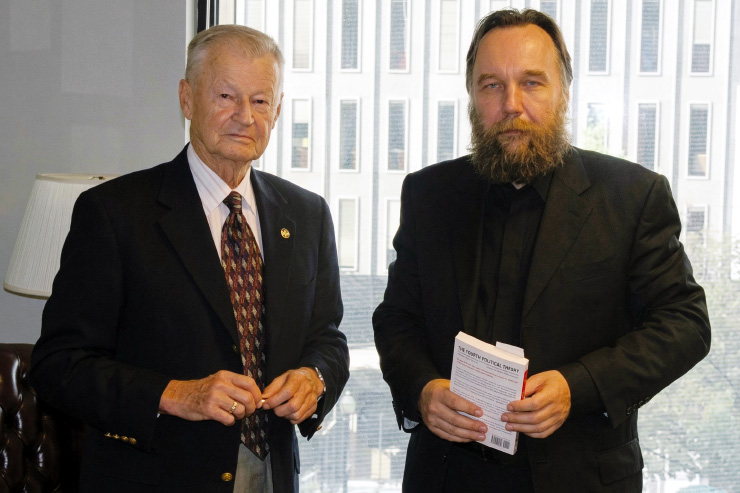
    In 2005, Alexander Dugin sat across a chessboard from Zbigniew Brzezinski in Washington. The Russian philosopher asked the American strategist whether chess was a game for two players. Brzezinski’s answer was immediate. “No, it’s a game for one.”

    The author of The Grand Chessboard saw a single player at the table of world geopolitics. Two decades later, as American bombs fall on Iran, the man on the other side of the board has a different reading of the game.

    Dugin, the most prominent theorist of Russian neo-Eurasianism, has been sanctioned by the European Union and the United States. His daughter Darya was killed by a car bomb in Moscow in 2022, an act widely attributed to Ukrainian intelligence. None of this has slowed him down. 

    On the 6 April 2026 Russian Sputnik programme ‘Escalation’, Prof. Dugin delivered what amounts to his most comprehensive analysis of the war on Iran and its place in the global contest between unipolarity and multipolarity.

    In Dugin’s analysis, the American-led global order established after the Cold War is expiring. The assault on Iran, Trump’s expletive-laden threats, the shifting deadlines, the bombing of cultural sites, all of it registers as the desperate flailing of a system that can feel the ground giving way beneath it.

    His central concept is the “agony of the unipolar world.” He means the word in its classical sense, the final struggle before death. Trump, in Dugin’s analysis, has been chosen by the Western ruling elite as the instrument of that agony. There is no longer time for liberal illusions, for humanitarian rhetoric, for talk of human rights. 

    Dugin reads Trump as the unwitting agent of this collapse. Where previous American presidents wrapped imperial policy in the language of human rights and international law, Trump has stripped that language away. The liberal mask is off. What remains is raw force, openly declared. 

    Dugin identifies a four-stage strategy behind what looks like chaos. First, reassert control over Latin America through pressure on Venezuela, Cuba, Mexico and Colombia, a renewed Monroe Doctrine. Second, destroy the main pole of sovereignty in the Islamic world through Israel, with Iran as the primary target and Turkey next in line. Third, pressure Russia into vassalage, using European NATO as leverage, interpreting Moscow’s willingness to negotiate as weakness. Fourth, full-scale strategic war with China before the end of Trump’s term.

    Each target, Dugin argues, is told the next stage “does not concern you.” Iran is stage two. The war is already underway. Each stage is designed to clear the path for the final confrontation with Beijing.

    “Trump does not need negotiations,” Dugin says. “His ultimatum to Iran is a clear warning to China and to us: ‘this is what will happen to you if you dare to resist’.”

    Dugin frames Iranian resistance as civilisational, drawing on the Shia tradition of accepting earthly defeat for spiritual victory. When Trump attacks Iranian society with open cruelty, Dugin argues, he receives in return the opposite of what he expects. 

    “The heroic Iranian people today stand united against pure, unalloyed evil coming from the West.” The human chains around power plants in April 2026 and the millions of Iranians who registered to sacrifice their lives are, in Dugin’s reading, expressions of a civilisational depth that brute force cannot reach.

    The American president is attempting to complete this programme before the 2026 midterm elections, ignoring all obstacles, burning through allies and generals alike. Dugin points to Trump’s dismissal of loyal figures, combat generals removed mid-campaign, his own attorney general thrown out, as evidence of a leader operating under extreme time pressure in a system that knows its window is closing.

    Two years before the war, Tucker Carlson warned Dugin during a private conversation that “Trump will not accept multipolarity.” Carlson, who helped bring Trump to power, is now in open opposition. “He believed in him, shared his ideas,” Dugin says, “but Trump betrayed the MAGA movement and his supporters.”

    Get the issue this article appears in

    Dugin closes with a formulation that leaves no room for ambiguity. “Many of us believed that Western dominance was already in the past and that multipolarity was an accomplished fact. But it seems we were just as premature as Francis Fukuyama was with his ‘end of history’. The multipolar world has not yet arrived. The struggle for it is happening now.”

    Brzezinski told Dugin in 2005 that chess was a game for one player. The board in 2026 tells a different story. Iran has refused to be swept from the squares. Russia and China stand behind their own pieces. The “single player” Brzezinski imagined is running out of moves.

    [alert type=”general” dismiss=”no”]This article was published in New Dawn 216.[/alert]

    [alert type=”success” dismiss=”no”]If you appreciate this article, please consider subscribing to help maintain this website.[/alert]

    © New Dawn Magazine and the respective author.
    For our reproduction notice, click here.
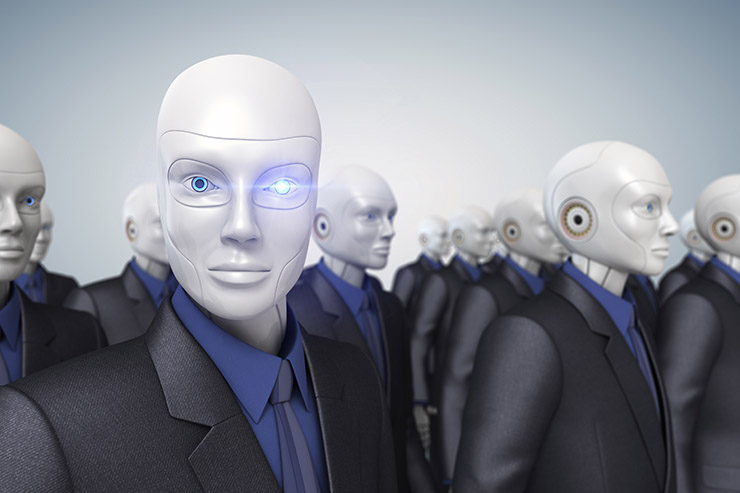
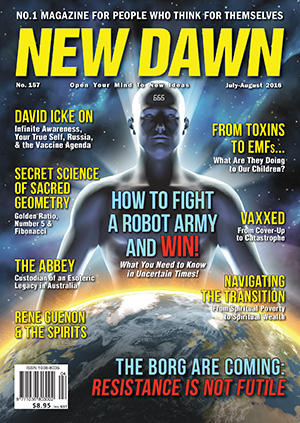
  • How To Fight A Robot Army… And Win

    How To Fight A Robot Army… And Win

    From New Dawn 157 (Jul-Aug 2016)

    As a tribute, we are posting this article by Gordon White, who made his transition and passed from this world in May 2026. Although the article was written in 2016, its analysis and Gordon’s advice remain highly relevant in today’s chaotic world.

    Humans have a tendency to overestimate short term risks and under-estimate long term ones. You see this when you watch people nervously smoking a cigarette at the airport because they are anxious flyers: what is actually most likely to kill you? 

    You see this on a wider level when you watch whole industries over-react to short term wobbles and then under-react to long term changes… The music, publishing and news businesses all overspent on short term Internet trends while failing to correct their spectacular decline. (Remember when Murdoch bought MySpace?) The same reaction is now found in mature Internet businesses that pay billions of dollars to acquire companies that have never made a cent in revenue, such as Facebook’s acquisition of Instagram.

    Today, most people are abstractly aware that automation is increasing, that we are in some sense living through the rise of the robots. We bite the bullet and use the automated checkouts at the supermarket, we observe the novelty of self-serve kiosks at fast food restaurants, we have long-since adjusted to online banking and ATMs. In 2015, drones fired more ammunition than warplanes in Afghanistan, a first in history.

    These are early stage changes. To draw an analogy with the Industrial Revolution – and we should draw many analogies with it – these changes are akin to those first, crude, automated fabric looms invented in the north of England. The railways and mega-factories are still to come. What we fail to notice when we queue for the supermarket checkout is we are at the inflection point in the automation revolution. Over the last thirty years, this process has already largely removed well-paid working class industrial jobs. On the other side of this inflection point, the graph gets mighty pointy, mighty quick. It is where the majority of Middle Class jobs live. 

    Jobpocalypse

    Today, 20% of American households do not contain even one employed person. And of those that are employed, only 44% work more than thirty hours a week. The alleged global economic recovery has been a story of great jobs at the top – finance, engineering, etc – and loads of jobs at the bottom – bartending, office cleaning, Uber driving – but nothing in the middle. Education, administration, and construction jobs for instance – all mainstays of the middle – are still in decline. What this means is that 95% of post-recession income gains have gone to the top 1%. Fully 100% of the gains have gone to the top 10%. The net result is that the jobs added in the US economy since the Great Recession are paying 23% less than the jobs lost. 

    According to Pew Research, two out of three American households were considered Middle Class in 1971. Today it is less than half. This state of affairs is primarily caused by the replacement of higher paying jobs with lower paying ones, through the impact of both automation and offshoring policies such as NAFTA. From 2004 to 2014, median incomes in the US fell 13%, while household expenditures increased by 14%. 

    The impact of these calamitous numbers is and will continue to be felt outside America’s shining seas. It is the largest economy on earth, the principal trading partner for most of the world and 70% of its GDP is based on consumption. What happens when there is no money left over for consuming? 

    In his excellent book, Get a Job, Build a Real Career, Defy a Bewildering Economy, independent economic commentator Charles Hugh-Smith writes the following:

    There is a widespread sense of disbelief that automation can eat high-skill, middle-class jobs in the same way that it ate low… factory jobs. In this view, the 50 employees of Craigslist wiping out thousands of middle-class jobs in the classified ad industry was a fluke. But the reality is that the strongholds of middle-class jobs – for example, healthcare, education, government, and national defense – are all increasingly unaffordable and therefore ripe for wholesale creative destruction of costs, jobs and business as usual.

    An Oxford University study predicts 35% of existing UK jobs are at risk of automation in the next 20 years. In Australia, that number is predicted to reach 44% over the same time frame, according to a recent federal government report.

    An obvious manifestation of automation’s impact is not just unemployment, but underemployment, commonly referred to as the gig economy. About a third of the US workforce are either independent or contract workers. Share of gig workers in manufacturing, health and education has doubled, and has increased by a factor of five in public administration. The same trend is being mirrored in Australia.

    For certain, accountants, dentists and nurses will still exist in twenty years time. However there will be far fewer of them and the costs associated with accessing them may well be prohibitive. This trend is already emerging. After shedding 220 financial advisors, the Royal Bank of Scotland replaced them with artificial intelligences. To speak to a real human for financial advice, you need to have £250,000 or more. (RBS received a total of £45 billion in taxpayer bailouts during the financial crisis.) 

    The RBS approach to providing financial advice is an example of what is known as a Mostly-Autonomous-System. It is significantly cheaper to automate 97% of a function than it is to automate 100% of a function. The MAS approach is what we will experience first and most. Where once there were fifty nurses, there may be three, whose principal function is monitoring of the MAS performing the lion’s share of nursing duties, stepping in for the final 3% of tasks or as needed. The same thing will happen for accountants, doctors, teachers, dentists… really anything that relies on either repeated tasks or access to a previously rote-learned body of knowledge as these are both functions that are already better performed by artificial intelligences and robots. 

    The suspicion that technological change may not be all it is cracked up to be is commonly called the Luddite Fallacy, which tells you everything about how it’s regarded by economists. Nevertheless, a Luddite-Lite view has a lot going for it. Technological change can indeed sometimes increase GDP but these increases are unevenly distributed, which is to say they make the rich richer. At the peak of its market capitalisation – USD$28 billion – Kodak employed 140,000 people with wages that could support property ownership and the raising of families. When Instagram was acquired for a billion dollars, it had thirteen employees and had not made a cent in revenue.

    During the nineteenth century, around half of the US population was employed in agriculture. Now that is less than two percent. It was the fundamental changes caused by the Industrial Revolution that triggered this shift. In the opening years of the twentieth century, the largest employment sector in the US economy was domestic service. So the suspicion that things get very bad before they (might) get better is well founded.

    Demography is Destiny

    The average age of the Japanese farmer is 67. Across the developed world, the average age is 60. A G7 meeting held in April in Japan’s northern prefecture of Niigata discussed plans for replacing these aging farmers with an automated workforce, with robots. These plans are emblematic of the coming world’s response to the demographic time bomb that is the retirement of the baby boomers. Reducing human sovereignty over our own food supply builds in catastrophic risk to our medium term future but, for central planners, this appears to be a better choice than re-engineering a healthier, more interactive economic ecosystem. It costs less.

    In the US, 10,000 people will retire every single day between now and 2030. Sixty percent of them are retiring without any savings. Whilst it might seem like good news that baby boomers are departing better paying jobs that can be subsequently filled by a younger generation afflicted by high unemployment, it is anything but. Leaving aside the enormous burden such a reality has for the West – increased healthcare costs paid for by rising taxes that further reduce demand in the economy – retired people spend very little and those that retire with no money spend even less. The evaporation of demand out of economies that overwhelmingly run on consumption means all those cushy, well-paid boomer jobs will ride off into the sunset with those that occupied them.

    The two main pistons driving fundamental and permanent changes in Western economies are the rise of automation and the demography of the population. This is how we can tell that something very different to the traditional ‘boom and bust’ cycle is happening. Surprising opportunities may present themselves in the short term because short term changes are unpredictable. Long term changes, on the other hand, are very predictable.

    Much of this long-term predictability comes down to the market’s intrinsic inability to discover the cost of long-term consequences. It has no way to price in what happens to economic activity when we lose forty percent of Middle Class jobs, or what happens to food prices when Sydney expands into its nearby farmland. Price discovery is an immediate function which means, by definition, it can’t model future opportunity cost. So there is no inherent mechanisms that allow us to adjust on an ongoing basis to the risks and opportunities these changes present. And you only need to look at the state of politics in the world today to realise we will get no help from that quarter. Politicians are allergic to hard truths or tough challenges, lest either of them spoil their chances for re-election. 

    Nearly two thirds of Australia will become dependent on the labour force by 2046, due to the retirement of the baby boomers and the rise of the robots. Our tax base will be shrinking just as we need it to be about five times larger to pay for increased healthcare and welfare programmes. This funding gap will result in an increase in taxation, which pulls more demand out of the economy, which will further shrink the tax base, which was the problem in the first place. The same funding gap will provide unstoppable incentives to further automate areas reliant on public funding such as health care and education in an effort to engineer out as much cost as possible. Thus these two trends compound on each other, like runaway climate change. 

    When it comes to fighting the robot army, we are on our own. This is both the bad news and the good news.

    Pivot to the Real

    In the medium term, we are all at risk of either unemployment or casualisation/underemployment. Over the same time period, policy responses will reduce your earning power through a combination of tax increases and inflation. Inflation being the only tool left for central planners to keep government debt actually payable, especially if they stump for a universal living wage as a stopgap solution for the impact of automation. (This appears to be the most popular policy currently being floated by think tanks and academics.) Whichever way you slice it, whatever combination of future effects impacts you personally, the short term response calls for dramatic, even radical, cost reduction.

    We should be doing this already as you probably do not need to be told how the cost of living has already shot to the moon at the same time median incomes have declined. In the US, food has doubled since 1978, housing has more than tripled, higher education is eleven times higher, and the cost of raising a child increased 40% between 2000 and 2010. We thus arrive at a situation where – according to a recent Bankrate poll – almost two thirds of Americans do not have enough savings to cover a $500 repair bill or a $1,000 emergency room visit. The US federal poverty level for a family of five is $28,410, and yet almost 40 percent of all American workers do not even bring in $20,000 a year.

    Over the last thirty years, as our domestic dwellings increased in size and cost, we had fewer and fewer people living in them. It is a heresy of heresies to say this, particularly in Australia, but single family or even single person dwellings are not the norm. Since humans started building permanent shelters about ten thousand years ago, multi-generational occupancy has been the norm. The last fifty or so years of the mortgage industry will ultimately be seen as a noble eyeblink in the human story.

    Multi-generational or multi-family dwellings provide a tremendous amount of power and sovereignty over the looming changes:

    • They provide greater economic redundancy if one or more people becomes unemployed or underemployed.
    • They reduce energy costs per person.
    • They can reduce childcare costs.
    • They minimise food waste and cost.
    • They can reduce the cost of elderly care.
    • They increase the total amount of time available to adults in the household to pursue additional economic activity via side projects, an essential step in the casualisation of the workforce.
    • They spread the cost and inputs associated with improved water harvesting and domestic food growing, thus reducing living costs and improving health outcomes.
    • They have more than forty years of scientific proof that these living conditions improve the psychological health of its occupants, particularly young children and the elderly, who both benefit tremendously from increased family time.

    Newspapers are fond of mocking Millennials for their seeming inability to move out of the family home. This is economically unreasonable as they are competing for jobs that have declined in income by almost a quarter at a time when house prices are at historic highs. 

    It seems Millennials are also more aware of the extreme changes that are looming, even if they struggle to articulate it. Sixty percent of Australian students are currently training for jobs that will not exist in the future. Jan Owen, chief executive of the non-profit Foundation for Young Australians, told the ABC: “Most 15 years olds are going to have up to 17 jobs in five different industries and in order to be prepared for that kind of working life, which is very, very different to their parents or their grandparents, they are going to need to, as well as having the disciplines that they study, they are going to need to have a very broad based what we would describe as enterprising skill set.”

    The newspaper mockery completely misses the wider trend going on here. Multi-generational occupancy is but a small subset of what I call the ‘pivot to the real’. Unlike the boomers, Millennials value experiences over status objects such as large cars, they prefer team or networked activities to solo endeavours, they value local over expensive.

    They are also about to become the largest demographic cohort in the workforce, as more and more boomers retire. In fact, by 2025, Millennials will make up 75% of the Western workforce, bringing their values and attitudes with them. Although it does not currently look like it, I have more confidence that the independent greengrocer in the middle of town has a brighter future than the big box retailer on the edge of it.

    So it is not just the boomers and their jobs that are heading off into the sunset, it is also the boomer version of the good life. Replacing it – whether forced through reduced economic participation or unforced through choosing to participate in these cultural changes – will be the return of the real, the authentic, the shared experience. We should see this as a hugely exciting opportunity. Call it the shared glass half full.

    Get the issue this article appears in

    Seeing off the Robots

    Described in a single sentence, seeing off the robots is all about positioning your life so that it gains from volatility instead of being adversely impacted by it. An example: Your redundancy should free up more time for childcare or family support, thus freeing up other household members to increase their paid workload. You can also use the time for side projects and retraining. These scenarios can and should revert or shift with any subsequent changes. Fundamentally, an economy is a learning system and right now it is heading off to Big School. Gaining from volatility means creating a life that learns as it learns, adapts as it adapts. 

    On a practical basis, this involves:

    • Getting and staying out of debt: Debt adds future risk just as the future is getting riskier. Servicing debt reduces your buying power even as we head into a world where it is already reducing. 
    • Assert sovereignty over your own food supply: This does not mean growing all your food and harvesting all your water, but it means doing as much of both of those things as possible in your domestic environment. At the same time it means being aware of your local food supply chain and supporting it.
    • Continuous training: Embark on a lifelong practice of cultivating rare – and thus by definition – in-demand skills. You will have multiple careers, multiple sources of income… probably even at the same time. Be the nurse who knows how to operate a Mostly Autonomous System, not the nurse that is replaced by one. Value flows only to what is scarce. MBAs aren’t scarce. Knowing how to use data management platforms is scarce. 
    • Location, non-Location, Location: Radically rethink your attitude to place. Be prepared to, and excited by the prospect of, dramatically reducing cost even as you improve your quality of life. Also be prepared to uncover mankind’s noble, nomadic roots and move where opportunities abound. Tremendous growth will accompany these economic changes but that growth will not be evenly distributed. Fish where the fish are, so to speak.

    Finally, and probably of most interest to readers of this magazine, reposition what wealth and meaning are for you. The Joneses have retired. There is no need to keep up with them. A new understanding of life’s goals and purpose is emerging just when we need it most and it falls to the spiritually-inclined to both lean into this trend and be leaders of it.

    In Tibet’s Amdo region, shamans watch the clouds from the mountain tops to alert the villagers down below of weather changes. In this system, weather is caused by an interaction of the spirits, humans and Nature. These shamans intercede and engage with the spirits to modify the weather for the whole community. This is a wonderfully useful metaphor for our own roles in the dynamic interaction between the rise of automation, changes in the economy, changes in demography and the potential for something new and authentic emerging from in amongst all this risk and anxiety. The possibility of transmutation for those brave enough to climb up the mountain is very high.

    There is something of a fairy tale quality to the process we are experiencing. Think about it. It took the rise of the robots – the apogee of the artificial – to trigger the appeal of the analogue, to inaugurate the return of the real. So this is how you defeat a robot army, not by being more robotic, but by being more human. 

    Gordon White’s book, The Chaos Protocols: Magical Techniques for Navigating the New Economic Reality (Llewellyn, 2016), explains how we can navigate these changes and even benefit from them. The Chaos Protocols is available from online booksellers.

    [alert type=”general” dismiss=”no”]This article was published in New Dawn 157.[/alert]

    [alert type=”success” dismiss=”no”]If you appreciate this article, please consider subscribing to help maintain this website.[/alert]

    © New Dawn Magazine and the respective author.
    For our reproduction notice, click here.
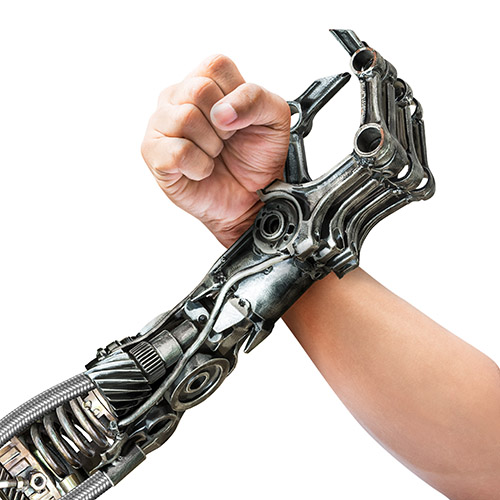
  • Everything Is Under Control: Robert Anton Wilson, Reality Tunnels & the Case for Conspiratology

    Everything Is Under Control: Robert Anton Wilson, Reality Tunnels & the Case for Conspiratology

    From New Dawn Special Issue Vol 19 No 3 (June 2025)

    Everybody who has ever worked for a corporation knows that corporations conspire all the time. Politicians conspire all the time… the world is full of conspiracies. Conspiracy is natural primate behaviour.
    – Robert Anton Wilson 

    The cultural reflex to scoff at “conspiracy theories” reveals more about our conditioning than the claims themselves.

    In a world where governments lie, institutions manipulate, and media gatekeep information, dismissing alternative explanations outright is less rational than we’ve been led to believe.

    Author and futurist Robert Anton Wilson understood this with crystalline clarity. For him, the notion that only the fringe believed in conspiracies was itself a programmed illusion – a by-product of what he called “reality tunnels.”

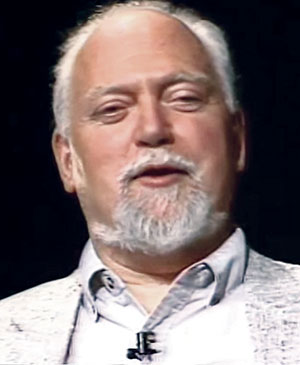
    Robert Anton Wilson (1932–2007)

    Wilson coined the term reality tunnel to describe the unique, subjective lens through which each person interprets the world. This idea, foundational to his philosophy, suggests that what we accept as reality is largely a construct of our beliefs, experiences, and semantic environment.

    A person raised in a religious household may interpret world events as part of a moral struggle or see them as fulfilling biblical prophecies. Another raised in a technocratic, sceptical culture might reduce everything to materialist logic. Neither perspective is entirely accurate; each is a tunnel, limiting the field of view.

    In the 21st century, this concept serves as a cognitive survival tool. As explored in the New Dawn article, “Reality Tunnels: How to Control & Re-program Your Mind,” reality tunnels can be consciously hacked and restructured. Individuals can liberate themselves from inherited limitations by learning to identify the unconscious filters that shape perception. Wilson’s tool for achieving this freedom he termed ‘Maybe Logic’ – a flexible approach to knowledge that allows one to entertain multiple perspectives without dogmatic adherence to any. As he said, “I don’t believe anything, but I have many suspicions.”

    This doesn’t mean that ‘anything goes’. Rather, it means acknowledging that fixed belief systems are generally the software through which larger social and political forces program human behaviour. If the mind is programmable, then who is doing the programming – and why?

    The Linguistic Code: General Semantics & Magical Language

    Another layer of Wilson’s conspiratology concerns the manipulation of language. Informed by Alfred Korzybski’s General Semantics, Wilson emphasised how language distorts perception. The map is not the territory. Words like “terrorist,” “conspiracy,” and even “science” are wielded not to describe but to control.

    The American writer William S. Burroughs (1914–1997) developed the concept of language as a “virus from outer space,” a metaphor for the way language can infect, shape, and control us. He believed that language has an infectious nature, attaching itself to a host, feeding off of it, and spreading. He explored the power and danger of communication, suggesting that language can be a force that shapes human subjectivity and identity. 

    As detailed in the New Dawn article “Magical Words, General Semantics & The Power of Language,” language functions as a form of social sorcery. Politicians cast spells with slogans, while the media conjures consensus through repetition. Questioning the official narrative risks exile from polite society; however, it is only through such questioning that deeper truths emerge.

    Wilson’s literary hero, William S. Burroughs, took this further by suggesting that language itself is a virus – an alien implant infecting human consciousness. Burroughs’ idea that “control systems” use language to hijack perception influenced Wilson’s thinking, particularly in his development of “guerrilla ontology,” a method for disrupting static belief systems through sudden epistemological shock.

    Conspiratology: The Discipline of Questioning the Hidden

    At New Dawn magazine, we don’t casually entertain every theory that emerges from the internet’s darker corners. We engage in what Robert Anton Wilson might call conspiratology – the disciplined study of conspiracies as reflections of psychological and sociopolitical structures. The point is not to conclusively prove or disprove each claim but to recognise that the narratives dominating public discourse are rarely neutral.

    Why should we take conspiratology seriously? Because history vindicates suspicion:

    The COVID Lab Leak Theory: Only a few years ago, this was vehemently dismissed as “conspiracy theory.” The US government and its intelligence agencies now openly state on official websites that the virus likely leaked from a China lab as a result of US-sponsored gain-of-function research.

    The Iraq War and Weapons of Mass Destruction: The case for war was built on manipulated intelligence, as later revealed by whistleblowers and the UK Chilcot Inquiry. What was labelled by the US, UK and Australian governments as a cut-and-dried case backed by strong evidence was later disproven as based on a pack of lies.

    Mass Surveillance: Edward Snowden’s revelations about global surveillance confirmed the existence of covert programs like the US National Security Agency’s PRISM – programs that the public had been told didn’t exist.

    Wikileaks and Collateral Murder: Leaks exposing shocking war crimes were denied until raw footage forced public reckoning.

    COINTELPRO: The FBI’s illegal infiltration and disruption of civil rights groups and Black movements is now a documented fact.

    MKULTRA: For years, the CIA got away with secret mind control experiments using drugs and sensory torture – all covered-up with the assistance of a compliant mainstream media. Today, MKULTRA is a documented program, its existence confirmed in declassified documents and US congressional hearings.

    These examples remind us that suppressing so-called conspiracy theories serves the maintenance of power. Studying these dynamics is key to decoding the architecture of control.

    Get the issue this article appears in

    Guerrilla Ontology & Conscious Resistance

    In his essay “Robert Anton Wilson & Guerrilla Ontology,” featured in New Dawn, British writer and researcher Jack Fox-Williams explained Wilson’s core strategy: to destabilise fixed worldviews through sudden exposure to conflicting realities. By confronting readers with paradoxical or outrageous information, Wilson trained his audience not in paranoia but cognitive agility.

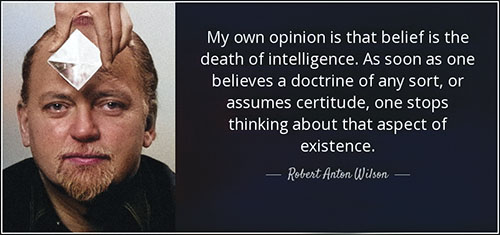
    “Belief is the death of intelligence,” Wilson wrote. That is the heart of guerrilla ontology – resisting belief because truth must be earned, not received. In a media landscape where narratives are bought, sold, and manufactured, such resistance is an act of spiritual autonomy.

    Beyond the sociopolitical, conspiracy also functions as myth. The notion of hidden powers controlling reality mirrors ancient stories – demiurges, archons, shadow rulers, and unseen puppet masters. Whether literal or symbolic, these patterns reflect an intuition: that what we are shown is not all there is. As thinkers from Carl Jung to Joseph Campbell noted, myths aren’t fairy tales – they’re expressions of deeper truths in symbolic form.

    Conspiracies also persist because they speak to the profound disconnection that modern humans feel from truth, power, and spiritual agency. In that sense, studying conspiracy is studying the psychological tension between the seen and the unseen.

    In a time when fact-checking has become a form of censorship and questioning the mainstream risks dismissal into binary political categorisation, the work of thinkers like Robert Anton Wilson becomes indispensable. We would all do well to heed his call to cultivate “Maybe Logic,” to explore multiple realities without clinging to unquestionable dogma.

    At New Dawn magazine, we advocate for epistemological courage – the bravery to ask forbidden questions, examine hidden structures, and challenge consensus reality. Not because every alternative theory is true, but because truth, by its very nature, hides in shadows.

    In Robert Anton Wilson’s words: “Only the madman is absolutely sure.”

    [alert type=”general” dismiss=”no”]This article was published in New Dawn Special Issue Vol 19 No 3.[/alert]

    [alert type=”success” dismiss=”no”]If you appreciate this article, please consider subscribing to help maintain this website.[/alert]

    Further Reading

    “Reality Tunnels: How to Control & Re-Program Your Mind” by Jack Fox-Williams, New Dawn #187
    “Robert Anton Wilson & Guerrilla Ontology” by Jack Fox-Williams, New Dawn Special Issue Vol 15 No 1
    “Magical Words, General Semantics & The Power of Language” by Jack Fox-Williams, New Dawn #181

    © New Dawn Magazine and the respective author.
    For our reproduction notice, click here.
  • Rise of the Machines: Humanity’s Crossroads

    Rise of the Machines: Humanity’s Crossroads

    From New Dawn 210 (May-June 2025)

    In an attempt to give themselves godlike abilities, the technocratic elitist class is pushing society towards a transhumanist future powered by their own ‘intelligent design’.

    Through gene editing, synthetic biology, and the fusion of humans and technology, governments and corporations aim to fundamentally change what it means to be human.

    At its core, this anti-human agenda aims to completely reshape the image of our species into a new one, ready to be exploited and controlled.

    Deus Ex Machina

    Artificial intelligence has reached new frontiers in recent years. Today, collectively, we are staring down perhaps the most pivotal period of our entire existence. Each day, this transformation is at the forefront of many societies across the world.

    In early 2025, US President Donald Trump announced an unprecedented $500 billion investment in infrastructure tied to artificial intelligence in partnership with leading companies in the field, such as OpenAI, Oracle, and SoftBank.1

    According to the White House, the new entity “Stargate” will start building data centres and the electricity generation needed to develop fast-evolving AI.

    “It’s big money and high-quality people,” said Trump, adding that the investment is “a resounding declaration of confidence in America’s potential” under his new administration.

    This declaration of a half-a-trillion-dollar investment shows just how serious artificial intelligence is becoming and how the Fourth Industrial Revolution has truly begun.

    “This will be the most important project of this era,” said Sam Altman, CEO of OpenAI.

    Indeed, artificial intelligence is a game-changer. 

    Boris Eldagsen submitted this artificial-intelligence-generated image to a photography contest as a “cheeky monkey” and sparked a debate about AI’s place in the art world. 

    The technology is already upstaging humans. One example occurred in March 2023 when the Sony World Photography Awards announced the winner in their creative photo category: a black-and-white image of an older woman embracing a younger one, entitled “PSEUDOMNESIA: The Electrician.” 

    The press release announcing the win describes the photograph as “haunting” and “reminiscent of the visual language of 1940s family portraits.”2

    The artist, Boris Eldagsen, who is based in Berlin, turned down the award. He announced that his photograph was not a photograph at all. Instead, he had crafted it through the creative prompting of DALL-E 2, an artificial intelligence image generator.

    “I applied as a cheeky monkey to find out if the competitions are prepared for AI images to enter. They are not,” explained Eldagsen on his website.3

    His stunt sparked controversy and conversation about whether AI-generated or assisted images should be considered ‘art’. But the bigger picture is being missed: Would anyone have even been able to tell if he had not turned down the award?

    This is the power of the software alone, generating fakes disguised as real and outpacing humans at their own games. However, beyond that, the products powered by this software, including the rise of humanoid robots, are where things start to get crazier.

    Tesla’s CEO, Elon Musk, announced that the carmaker will start selling its Optimus humanoid robot in the near future. Optimus has already begun performing tasks autonomously, such as handling batteries at one of Tesla’s facilities.4

    “Tesla will have genuinely useful humanoid robots in low production for Tesla internal use next year and, hopefully, high production in 2026,” Musk posted on X.

    Musk predicted that Optimus would be capable of performing a wide range of tasks inside and outside the home, estimating that the robot would be available for purchase at approximately AU$48,000. 

    Tesla is not the first company to begin working on such humanoids – nor, according to available evidence, is it the furthest along.

    Ai-Da the Robot with “self portrait” (2021).

    Take, for example, Ai-Da the Robot – named after Ada Lovelace, the English mathematician and world’s first computer programmer – who recently became the first humanoid “robotic artist” to have “their” artwork sold by a major auction house.5

    On 7 November 2024, the AI-powered robot’s painting of the mathematician Alan Turing (an early pioneer of the technology) sold for AU$1,344,272.

    The humanoid regularly creates self-portraits by “observing” itself in the mirror, using sophisticated sensors and cameras to guide the attached robotic arm and brush.

    Sotheby’s auction house announced that Ai-Da was “the first humanoid robot artist to have an artwork sold at auction.”

    Yes, from photography to painting, artificial intelligence is becoming increasingly proficient not only at repetitive labour tasks but also at intellectual endeavours.

    And we’re only at the very beginning of the humanoid robot story.

    With the world’s information readily available at its electronic fingertips and powered by advanced software and human-like robotic hardware, humanoid agents will soon emerge as ‘advisors’ for everyone. This story is already unfolding across the globe, including here in Australia.

    The ‘Agent’ Revolution

    Robotic personal assistants have been promoted through science fiction for decades, painting a blissful future where humans are surrounded by friendly machines that improve every aspect of our lives. Today, fiction becomes reality – but is it as nice?

    In 2025, many individuals and businesses routinely use AI assistants, such as ChatGPT, to carry out various tasks. With each new year, AI ‘learns’ more and more, and the next step in this evolution will come in the form of “AI agents.”

    From AI-run classrooms and hospitals to machine learning technologies in workplaces, almost all industries are predicted to incorporate sophisticated ‘agents’ in the future. 

    Some experts describe this push as an “obsolescence regime,” believing the transformation is inevitable since the ‘cat is out of the bag’.

    Don’t believe me? In an Australian-first, the Real Estate Institute of NSW (REINSW) has appointed “Alice Ing” – an AI bot – as an official Advisor to the Board. With a reported (software) IQ of 155, Alice is “the world’s smartest Board Advisor.”6

    Yes, you read correctly. AI is already being appointed at companies right now at home.

    According to REINSW: “Alice’s encyclopaedic knowledge of real estate provides an instantaneous and valuable contribution to the Board, bolstering REINSW’s capacity to advocate for the industry and influence policy changes that benefit consumers, real estate professionals and REINSW members.”

    Sitting in on executive meetings, ‘Alice’ is available to answer any questions and is equipped with built-in AI software like ChatGPT. It doesn’t stop there, either.

    Chinese researchers have developed an “AI hospital town,” similar to Stanford’s AI town, which went viral in 2024. The AI hospital, named “Agent Hospital,” was developed by researchers from Tsinghua University.7

    The AI hospital town features virtual patients treated by AI doctors designed to evolve autonomously and “improve their medical expertise.” All doctors, nurses, and patients in the virtual environment are driven by large language model (LLM) powered intelligent ‘agents’ capable of autonomous interaction.

    According to the team, these AI doctors can treat 10,000 patients in just a few days, a task that would take human doctors at least two years.

    We have already seen the introduction of robotic AI-powered arms for surgeries in remote Australian regions in the far north of Queensland, and we can expect this trend to continue to grow as Trump’s $500 billion investment powers this field.

    One last example – the UK’s first “teacherless” GCSE class, using artificial intelligence instead of human teachers, is about to start lessons.8 David Game College, a private school in London, opens its new teacherless course for 20 GCSE students in September 2025.

    Hospitals, schools, and important decision-making roles: This is no longer fiction, folks. The rise of humanoid robots has arrived, and they are taking over very quickly.

    Of course, Bill Gates has been discussing this ‘revolution’ in great detail over the past few years, stating in one blog post that AI agents represent “the biggest advancement of computing in recent memory.”

    Finding a more “direct means” of “human-machine interaction” is the “next frontier,” reckons Gates. The Microsoft co-founder envisions a future where these agents will easily understand natural language and will be just as important as a smartphone.9

    He predicts that AI will use our preferences to make recommendations, eliminating the need to use individual apps to book flights, reserve hotels, and more. He also predicts ‘agents’ will make search engines like Google redundant, as your artificial intelligence ‘helper’ will answer all questions and queries.

    Unfortunately, many companies will be forced to adapt to the times or perish. Robots have already moved into warehouses, and if you can’t compete both on an individual or marketplace level, you will fall behind in this time of transformation (by design).

    When the capabilities of artificial intelligence surpass those of humans, the question of whether they can become ‘sentient’ becomes irrelevant. It’s the capabilities that are now the concern.

    The competition for supremacy is heating up, begging questions surrounding regulation, how it will develop as the years progress, and whether it can even be stopped.

    Can It Be Stopped?

    In January 2025, China released its own version of the market-leading ChatGPT called DeepSeek AI, adding to a marketplace that includes others like Musk’s Grok.

    Australia quickly banned DeepSeek AI services from all government systems and devices, becoming one of the first countries to take direct action against the Chinese artificial intelligence startup that has disrupted Silicon Valley.

    Home Affairs Minister Tony Burke said in a statement that all DeepSeek AI products, apps and services would immediately be removed from government systems for national security reasons. A threat assessment by the country’s intelligence agencies found that the technology posed “an unacceptable risk.”10

    This is one of the first significant actions taken against artificial intelligence, signalling a new era in which the technology is recognised as a powerful tool.

    Unfortunately, much like the internet itself, any regulation and control will only transfer the power of the technology into the hands of criminals. Internet censorship has diminished the glory days that made it great. Similarly, if we continue to see progress in this manner for AI, our ability to learn this tool will become restricted.

    There is suspicion that if regulatory initiatives were to commence against artificial intelligence and its developers, they would either escape to countries lacking regulation or venture into international waters.

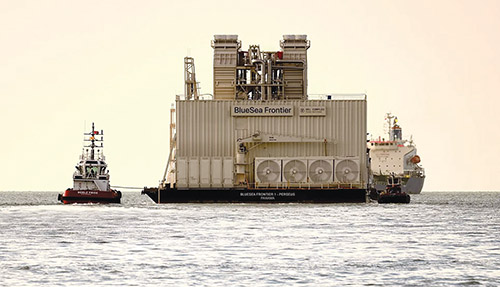
    The sea-based floating data centre BlueSea Frontier Compute Cluster heralds the formation of ‘sovereign AI states’.

    A sea-based floating data centre containing thousands of Nvidia GPUs raises questions over whether this sort of regulation could lead to the creation of ‘sovereign AI states’.

    The BlueSea Frontier Compute Cluster (BSFCC), created by US firm Del Complex, is essentially a gargantuan barge housing 10,000 Nvidia H100 GPUs, all worth a combined $500 million. It floats in the middle of international waters.

    In an announcement on X, Del said the floating data centre offers “industry-leading performance, advanced water cooling and solar power for environmental safety.”11 It will be complemented by “kinetic risk mitigation,” provided by onboard security. 

    This project points toward the eventual creation of ‘sovereign nation-states’ dedicated to AI development, especially if land-based governments begin regulation. 

    In its announcement on X, the firm said the tightly guarded barge could operate in international waters and thus be exempt from regulations. 

    Military Dimensions

    Militaries around the world are already making some of the biggest strides towards transhumanism because of the advantages their ‘super soldiers’ would possess.

    The US Defense Advanced Research Projects Agency recently issued a broad agency announcement on “Human Performance Enhancement.”12

    According to the RAND report, “Technological Approaches to Human Performance Enhancement,” modalities for human performance enhancement can be grouped into three principal categories: Gene editing, applications of artificial intelligence, and networked technologies that are wearable or even implantable.13

    For the US defence and intelligence communities, human performance enhancement offers “the potential to increase strength, speed, endurance, intelligence, and tolerance of extreme environments and to reduce sleep needs and reaction times – [and] could aid in the development of better operators.”

    This follows a Pentagon-sponsored RAND report on human performance enhancement in 2021, which revealed that the US Department of Defense was investigating “making humans stronger, more intelligent, or more adapted to extreme environments.”

    Indeed, it does seem that, just like the rise of the internet, AI advancement can’t be stopped – both in the military-industrial complex and private enterprise.

    The door has been opened, but was it even designed to be closed? Where will this all lead? This is where the deeper questions come in.

    p(doom): The Countdown

    Artificial intelligence experts have been asking each other a question lately: “What’s your p(doom)?” The “p” stands for probability. The “doom” component generally refers to a sophisticated and hostile AI acting beyond human control.

    If you have one, your ‘p(doom)’ is your best guess at the likelihood that AI ultimately turns on humanity, either of its own volition or because it’s deployed against us.

    The scenarios contemplated as part of that conversation: biological warfare, the sabotage of natural resources, and more. These concerns aren’t coming from ‘conspiracy theorists’. Instead, there’s an emerging group of machine learning experts who worry we’re building “misaligned” and potentially deceptive AI.

    They’re imagining an AI with a penchant for sleight of hand, adept at concealing any gap between human instructions and AI behaviour.

    Like a magician chasing applause, AI is being incentivised to deceive us with in-built rewards that measure its outcomes. The destructive potential of a deceptive or misaligned AI hinges on how heavily we depend on it. As just noted, we are starting to depend on it a lot.

    “The world I want you to imagine… is one where AI has been deployed everywhere,” Ajeya Cotra, a senior AI safety researcher at Open Philanthropy, told the ABC.

    “Human CEOs need AI advisers. Human generals need AI advisers to help win wars. And everybody’s employing AI everywhere.”

    This vision is not far out of the scope. In their research, Harvard Business Review recently concluded that AI can mainly outperform human CEOs in almost all metrics in September 2024, being described as “remarkable” in the results.14

    Cotra calculates a 50 per cent chance we’ll get to the “obsolescence regime” (see box on right) by 2038. Experts believe it is only a matter of time before deceptions begin on a mass scale. 

    When confronted with this ‘p(doom)’ scenario, the consequences for humanity could be transformative – the stuff of biblical myth. 

    Get the issue this article appears in

    The Consequences of ‘Progress’

    History began when humans invented gods, and will end when humans become gods.
    – Yuval Noah Harari

    In the era of transhumanism, technocratic elitists are looking to replace God, the Creator, with their own intelligent design.

    You don’t have to be religious to appreciate the role the concept of a Creator plays in the construction of human rights. It is almost bigger than religion itself.

    Men cannot decide on, alter or enforce something they did not create. By removing the religious framework, the technocrats have come to see themselves as the Creator – a (false) ‘higher power’ that endows humanity with rights.

    A mass dehumanisation agenda, under the guise of ‘progress’, has led us to no longer believe we are the centre of reality – but a stepping stone for the machines to merge with.

    This shift will ultimately occur, according to the ‘experts’, through biotechnological implementations, genetic modification, and robotic implants. For transhumanism, the quest to ‘transcend the human condition’ is a central aspect of their doctrine.

    But why would they want to do this?

    Well, every citizen is considered to be born with rights. In a future where humans are no longer considered to be ‘natural’, what would that mean for ‘human’ rights?

    Indeed, by putting technocrats in the place of God, society is giving them the unaccountable authority to redefine human rights as they see fit from their position.

    If, and when, humans become fully integrated with machines on a large scale, where will the technology end and the human begin?

    Bioengineering can blur the lines of who or what is responsible for a person’s behaviour. Is it the human, the technology, or the humans behind the technology?

    Who will own the technology inside us or the synthetically altered genes? Will human enhancement be reserved only for certain people?

    Humanity could theoretically be split into different species depending on the types of genetic engineering that take place, creating a worldwide post-human caste system.

    That is the consequence of such a maniacal obsession with ‘progress’, and societies across the world have learned of this for centuries.

    Take the story of Prometheus, for example, which is one of the most important Greek myths. Prometheus, the Greek God of ‘Progress’, embodies the same post-human ideologies we see today, centred around ‘transcending the natural order’.

    Today, this myth helps us reflect on transhumanism, a philosophy that views the human being as ‘something to be overcome’.15

    Hesiod was one of the first poets to write the story of Prometheus. Far from heroising the figure, his version highlighted Prometheus’s transgression against the gods.

    He believed that Prometheus had upset the cosmic order, which explained the imbalance and evils of the world. From this viewpoint, ‘progress’ is seen as synonymous with the decline of the human being. Does this sound familiar?

    Look at how the ‘progressive’ mindset has already changed society. As a matter of fact, the ecological disasters generated in the last century do tend to show that our naïve trust in ‘progress’ had a dark side. Moreover, what’s ‘new’ isn’t always better.

    Unbridled ‘progress’ breaks the natural balance of the environment, attracting all sorts of misfortunes to befall humanity. The transhumanists harness this philosophy to make strides towards a new reality each and every day.

    But are technical improvements actually necessary for us to achieve and survive?

    Is technological progress, the eradication of diseases, and the prolongation of life expectancy (such as Google’s efforts to ‘solve death’) sufficient to overcome natural obstacles so that societies can live happily?

    Unfortunately, if it sounds too good to be true, it usually is.

    Confidence that ‘progress’ itself will improve humanity is a naïve fantasy – just look at how unstable things like smartphones have made the world.

    In their attempt to transform the human species forever, the transhumanist cult is playing with forces of the natural world that have been around for much longer than us.

    Will society let the modern-day Prometheus cult alter what it truly means to be human?

    Only time will tell.

    [alert type=”general” dismiss=”no”]This article was published in New Dawn 210.[/alert]

    [alert type=”success” dismiss=”no”]If you appreciate this article, please consider subscribing to help maintain this website.[/alert]

    Footnotes

    1. forbes.com/sites/garthfriesen/2025/01/23/trumps-ai-push-understanding-the-500-billion-stargate-initiative
    2. sony-asia.com/pressrelease?prName=open-competition-2023
    3. eldagsen.com/sony-world-photography-awards-2023
    4. digitalassets.tesla.com/tesla-contents/image/upload/IR/TSLA-Q2-2024-Update.pdf
    5. msn.com/en-au/news/australia/robot-artist-makes-history-after-portrait-sells-for-more-than-1mil/ar-AA1tHTbs
    6. reinsw.com.au/Web/Web/News/Media_Releases/2024/05-May/ai-board-advisor.aspx
    7. roboticsandautomationmagazine.co.uk/news/healthcare/worlds-first-ai-hospital-with-virtual-doctors-opens-in-china.html
    8. news.sky.com/story/uks-first-teacherless-ai-classroom-set-to-open-in-london-13200637
    9. tottnews.com/2023/11/21/bill-gates-details-the-coming-rise-of-ai-agents
    10. thenewdaily.com.au/news/2025/02/05/australia-bans-deepseek
    11. techradar.com/news/the-role-of-tape-in-the-modern-data-center
    12. sam.gov/opp/4f70483c0b4b49aeac299342a36af04d/view
    13. rand.org/pubs/research_reports/RRA1482-2.html
    14. hbr.org/2024/09/ai-can-mostly-outperform-human-ceos
    15. tottnews.com/2023/02/19/transhumanism-and-prometheus

    © New Dawn Magazine and the respective author.
    For our reproduction notice, click here.