New Dawn – World's Most Unusual Magazine

Author: Dr Kerry Bolton

  • Living at the End of an Age

    Living at the End of an Age

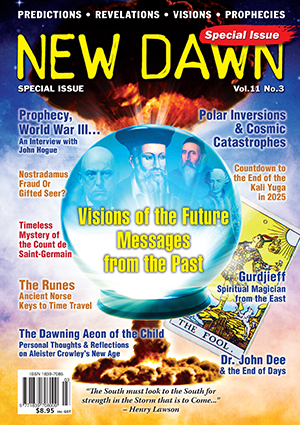
    This article was published in New Dawn Special Issue Vol 11 No 3 (June 2017)

    Turning and turning in the widening gyre

    The falcon cannot hear the falconer;

    Things fall apart; the centre
    cannot hold;

    Mere anarchy is loosed upon the world,

    The blood-dimmed tide is loosed,
    and everywhere

    The ceremony of innocence is drowned;

    The best lack all conviction,
    while the worst

    Are full of passionate intensity 

    – W. B. Yeats, The Second Coming

    Apocalyptic literature and prophecies are found throughout history. But as the ‘world’ has not ‘ended’, our modern day smug intelligentsia – imbued with a belief in ‘progress’ and the Darwinian concept of history that sees a ‘march of humanity’ – scoffs at such notions. Dr. A. R. Wallace, a leading Darwinian scientist of the Victorian era, in a book optimistically entitled The Wonderful Century (1898), wrote of this as the best of all times:

    Not only is our century superior to any that have gone before it but… it may be best compared with the whole preceding historical period. It must therefore be held to constitute the beginning of a new era of human progress…1

    The philosopher-historian Oswald Spengler predicted the ‘decline of the West’ in the aftermath of World War I. The word most commonly used to describe him, even by his admirers, was that of a ‘pessimist’. Does one, however, become a ‘pessimist’ to acknowledge the mortality of organisms, and acknowledge they have life cycles that end in death? Such is life; such is history. Spengler explained:

    I see in place of that empty figment of ONE linear history… the drama of a number of mighty cultures, each having its own life; its own death… Each culture has its own new possibilities of self-expression which arise, ripen, decay and never return…. I see world history as a picture of endless formations and transformations, of the marvellous waxing and waning of organic forms… The professional historian on the other hand, sees it as a sort of tapeworm industriously adding to itself one epoch after another.2

    Entitling the first chapter of his treatise on alchemy ‘The Plurality & Duality of Civilisations’, Julius Evola – Spengler’s Italian translator – states:

    Recently in contrast to the notion of progress and the idea that history has been represented by more or less continuous upward evolution of collective humanity, the idea of a plurality of the forms of civilisation and of a relative incommunicability between them has been confirmed. According to this second and new vision of history, history breaks down into epochs and disconnected cycles.… A civilisation springs up, gradually reaches a culminating point, and falls into darkness and, more often than not, disappears. A cycle has ended….3

    Today’s liberal-democratic intelligentsia actually refer to our era as ‘the end of history’, the term used by Francis Fukuyama as the title of an essay and a subsequent book. Our liberal-democratic ideals, epitomised and imposed over the world by the USA, have supposedly reached such perfection there is nothing left other than to establish a liberal dispensation over the universe for all time, and nothing more need be done. Another name for it is ‘American millennialism’.

    Romans, Greeks, Chinese, Moors, Iranians, Assyrians, regarded their empires as eternal. They had their ‘prophets of doom’ who predicted the empire would fall if they forgot their traditions. These doomsayers arose at those very epochs where their civilisations were at the height of wealth and power, typically at the empire-state. Here stands the dilemma, the paradox. When a High Culture (Civilisation) has reached its external limits – as when a human organism reaches middle age – sudden or gradual disintegration is the only course possible. A slow decline may be largely imperceptible. It is what T. S. Eliot referred to when writing of the end of Western civilisation, “not with a bang but with a whimper.”

    Oswald Spengler stated that he could show the West is going through the same cycles as Greece and Rome in their epochs of decay. He revealed through studying analogous eras of the history of civilisations, that there is nothing unique about the West’s cycle. It is therefore nonsense to refer to something as ‘progress’ when it has appeared many times before over thousands of years. This is especially true of liberal and left-wing ideas implemented as ‘progressive’, such as the West’s birth control and high abortion rates. A sage from ancient Greece, Rome, India, Egypt, Israel, would say in regard to Western social doctrines called ‘progressive’: ‘been there, done that, and it does not end well’.

    Universality of Cyclic Outlook

    Traditional societies, that is, those societies that intuited and maintained a connection with divinity and saw their place in a cosmos, regarded cultures as living organisms that passed through cycles of birth, youth, maturity, old age, decay and death.

    The Greeks and Romans referred to four eras named after the four metals: gold, silver, bronze and iron. Between the Bronze and Iron cycles was an intervening Heroic cycle, where the Heroes resist encroaching Chaos. The Hindus have four cyclic divisions called yugas: Satya, Treta, Dvapara and Kali, a demon not to be confused with the goddess Kālī; the Kali Yuga being the Dark Age of decline and chaos. The Persians had four cycles named after gold, silver, steel and an iron compound. The Chaldean view was similar. The Mayans had solar cycles, with a fifth Heroic cycle in which giants are fought. Chinese tradition recounts ten former Ages called ‘kis’ that have passed in succession. The Chinese also have an historical perspective based on ‘dynastic cycles’. The Buddhists have ‘Seven Suns’ or epochal cycles.

    The Hopi of Arizona say there have been three prior ‘world cycles’ or ‘Suns’. According to Hopi lore, this cycle will end if people do not change their ways. The spirit of the world will become frustrated. A Hopi elder commented to author Graham Hancock that, “There are no values at all any more – none at all – and people live any way they want, without morals or laws. These are the signs that the time has come.” The elder stated that the only chance is “that the Hopi do not abandon their traditions,” and that the Hopi impart their Traditionalism to the rest of the world. He explained that all is fated according to divine law.4

    In the Old Testament ‘Daniel’ this rise and fall is represented by a statue of four civilisations symbolised by a head of gold, chest and arms of silver, stomach and thighs of brass, and the legs of iron and feet of iron and clay.5

    According to Islam, there is a succession of ‘prophetic cycles’, each ending with the corruption of that cycle and the nexus with the divinity restored by a new prophet.

    Warnings from the Past

    The whole cosmic order is under Me. By My will it is manifested again and again, and by My will it is annihilated at the end. 
    – Bhagavad Gita6

    A High Culture is maintained by its adherence to Tradition. This typically includes a symbolic axis, such as Mount Olympus or Fuji, or perhaps one that is imaginative such as Yggdrasil of the Norse. The ruler often is a god-king or at least a priest-king whose primary function is to maintain the balance between the terrestrial and divine order, such as the annual rituals performed by the Chinese Emperor at the temple of the Forbidden City. He is responsible for nothing less than the balance between Earth and Cosmos.

    If a culture reaches the civilisation stage, the focus is diverted from the internal to the external, from ethos to wealth, from spirit to matter. The degradation is manifested in every facet of society. Religions lose their inner meaning, and become Reformations for example; kings become at most figureheads in a democracy, the social classes reflect money rather than élan, aristocracy gives way to oligarchy and plutocracy in the name of ‘democracy’. This is all called ‘progress’, but has occurred many times before as the symptoms of decay. The process is analogous to a cancer that destroys the cells of an organism, the cells being the classes and institutions of the social organism. In this situation, to quote W. B. Yeats, “the centre does not hold,” ‘progress’ (chaos) destroys the axis around which a culture is maintained, and everything falls apart like spokes falling from a wheel whose axis has broken.

    During epochs of decay, those who maintained traditional beliefs are warned of impending culture-death. Religious texts also mention the cyclical character of the cosmos. The Norse referred to the final culture-cycle as the Wolf Age-Axe Age. The focus is on moral decay:

    Brothers shall battle and slay one another

    Blood ties of sisters’ sons shall be sundered.

    Harsh is the world. Fornication is rife,

    Luring to faithlessness spouses of others.7

    The Hindu text Visnu Purana describes the Kali Yuga in terms that could just as well have been written by a contemporary critic of modern Western society:

    Wealth (inner) and piety (following one’s dharma) will decrease day by day until the whole world will be entirely depraved. Then property alone will confer rank; material wealth will be the only source of devotion; passion will be the sole bond between the sexes; falsehood will be the only means of success in litigation… Earth will be venerated for its mineral treasures… He who gives away much money will be the master of men, and family descent will no longer be a title of supremacy… Men will fix their desires upon riches, even though dishonestly acquired.8

    The Greek poet Hesiod referred to successive ages, the final being the ‘Iron Age’, in which,

    men never rest from labour and sorrow by day, and from perishing by night; and the gods shall lay sore trouble upon them…. The father will not agree with his children, nor the children with their father, nor guest with his host, nor comrade with comrade; nor will brother be dear to brother as aforetime. Men will dishonour their parents as they grow quickly old, and will carp at them, chiding them with bitter words, hard-hearted they, not knowing the fear of the gods. They will not repay their aged parents the cost their nurture, for might shall be their right: and one man will sack another’s city. There will be no favour for the man who keeps his oath or for the just or for the good; but rather men will praise the evil-doer and his violent dealing. Strength will be right and reverence will cease to be; and the wicked will hurt the worthy man, speaking false words against him, and will swear an oath upon them. Envy, foul-mouthed, delighting in evil, with scowling face, will go along with wretched men one and all. And then Aidos and Nemesis, with their sweet forms wrapped in white robes, will go from the wide-pathed earth and forsake mankind to join the company of the deathless gods: and bitter sorrows will be left for mortal men, and there will be no help against evil.9

    Polybius (born circa. 200 BCE) observed this phenomenon in Hellenic Civilisation like Spengler did of ours, writing:

    In our time all Greece was visited by a dearth of children and generally a decay of population, owing to which the cities were denuded of inhabitants, and a failure of productiveness resulted, though there were no long-continued wars or serious pestilences among us. If, then, any one had advised our sending to ask the gods in regard to this, what we were to do or say in order to become more numerous and better fill our cities, – would he not have seemed a futile person, when the cause was manifest and the cure in our own hands? For this evil grew upon us rapidly, and without attracting attention, by our men becoming perverted to a passion for show and money and the pleasures of an idle life, and accordingly either not marrying at all, or, if they did marry, refusing to rear the children that were born, or at most one or two out of a great number, for the sake of leaving them well off or bringing them up in extravagant luxury.10

    The words were echoed by Roman historians centuries later, as Rome underwent the same cycle of decay. Tacitus remarked that regardless of state efforts to encourage the birth rate, “childlessness prevailed.”11 At the beginning of the second century, Pliny the Younger wrote that his was “an age when even one child is thought a burden preventing the rewards of childlessness.” Plutarch observed that the poor had lost the confidence to sire children.12 By the middle of the second century Hierocles stated that “most people” seemed to regard children as interfering with their lifestyle.13 Marriage was no longer regarded a crucial institution, even considered a burden to a hedonistic existence. As early as 131 BCE the Roman Censor Quintus Caecilius Metellus Macedonicus proposed to the Senate that marriage be made compulsory, as too many males were opting to remain unmarried. A century later Augustus Caesar quoted Quintus in proposing his own marriage laws, but met no more favour in the Senate than had the Censor. Prostitution was so widespread it became a substitute for marriage. Roman cities also abounded with male prostitutes as homosexuality and bisexuality had become common.14

    Rome, in its decay, sounds all very ‘modern’, very ‘Western’.

    In Egypt Nefer-rohu warned Pharaoh of the inversion of the social order that will destroy the cosmic nexus:

    The weak of arm is now the possessor of an arm. Men salute respectfully him whom formerly saluted. I show thee the undermost on top, turned about in proportion to the turning about of my belly. The top man will make wealth. It is the paupers who eat the offering bread, while the servants jubilate. The Heliopolitan Nome, the birthplace of every god, will no longer be on earth.15

    The predicament sounds like today’s ‘progressive’ theories of equality.

    Ibn Khaldun (1332–1406), a well-travelled sage, grappled with the same problems confronting Islamic Civilisation as those Spengler confronted in regard to the West. Like the Greeks, he referred to ‘progressively’ decaying ‘generations’, each further removed from the founding tradition of the culture:

    When a tribe has achieved a certain measure of superiority with the help of its group feeling, it gains control over a corresponding amount of wealth and comes to share prosperity and abundance with those who have been in possession of these things. It shares in them to the degree of its power and usefulness to the ruling dynasty. If the ruling dynasty is so strong that no-one thinks of depriving it of its power or of sharing with it, the tribe in question submits to its rule and is satisfied with whatever share in the dynasty’s wealth and tax revenue it is permitted to enjoy…. Members of the tribe are merely concerned with prosperity, gain and a life of abundance. (They are satisfied) to lead an easy, restful life in the shadow of the ruling dynasty, and to adopt royal habits in building and dress, a matter they stress and in which they take more and more pride, the more luxuries and plenty they acquire, as well as all the other things that go with luxury and plenty.

    As a result the toughness of desert life is lost. Group feeling and courage weaken. Members of the tribe revel in the well-being that God has given them. Their children and offspring grow up too proud to look after themselves or to attend to their own needs. They have disdain also for all the other things that are necessary in connection with group feeling…. Their group feeling and courage decrease in the next generations. Eventually group feeling is altogether destroyed…. It will be swallowed up by other nations.16

    Amidst the corrupt opulence of the eunuch-ridden Chinese court, while the Manchus approached, General Shih K’o-fa addressed his Emperor in Spring 1645:

    Whilst Your Majesty is banqueting on choice viands and quaffing wine from beakers of jade, it behoves you to remember your starving servants in the North. If, in spite of all his efforts, the late Emperor was unable to ward off disaster, how much more should you, inferior to him in ability, tremble as one who stands on the brink of a precipice. If you perform your duties with zeal and vigilance, it may be that your ancestors’ spirits in Heaven will intercede with the Almighty on your behalf, and that your heritage may be regained. But if you remain in idle dalliance in Nanking, lavishing favours on sycophants and forgetful of the welfare of your troops, if you proclaim our secret plans from the housetops and fail to distinguish between loyal devotion and treason, if you show yourself so lacking in dignity that the worthy men about you are constrained to retire from official life, and the brave hesitate to serve you, then assuredly your ancestors will regard you as unworthy of their aid, and destruction, inevitable and final, will come upon you.17

    China fell to the Manchu and another cycle of dynasties proceeded, until the Manchu also succumbed to decay.
    Get the issue this article appears in

    Seeing the Present in the Past

    While each High Culture and Civilisation is self-contained, the corresponding culture-epochs between each have been noted by present day historian-philosophers, most notably Spengler. The Traditionalists Julius Evola and Rene Guénon both stated that nothing can stem the tide of decay during the Kali Yuga/Iron Age/Axe Age. However, those with perception of what is taking place around them might, to use a biblical reference, ‘live in the world, but be not of it’. Evola used the Eastern phrase, ‘ride the tiger’, and Guénon explained:

    If the elect of which we spoke could be formed while there is still time, they could so prepare the change that it would take place in the most favourable conditions possible, and the disturbances that must inevitably accompany it would in this way be reduced to a minimum; but even if they cannot do this, they will still have before them another yet more important task, that of helping to preserve the elements which must survive from the present world to be used in building up the one that is to follow. Once one knows that a re-ascent must come, even though it may prove impossible to prevent the downward movement first ending in some cataclysm, there is clearly no reason for waiting until the descent has reached its nadir before preparing the way for the re-ascent. This means that whatever may happen the work done will not be wasted: it cannot be useless in so far as the benefit that the elect will draw from it for themselves is concerned, but neither will it be wasted in so far as concerns its later effects on mankind as a whole.18

    The writings of sages in Greece, Rome, Egypt, and India seem remarkably familiar, distinctly ‘modern’, as though their observations were warnings for our own time. Rome and Greece, in particular, were so very ‘modern’ in their dismissal of family and childrearing, as ‘burdens’ to hedonistic enjoyment. Today, ‘progressives’ congratulate themselves on how enlightened they are, and celebrate the demographic demise of Western societies, where aging populations are replenished by emigrants with alien manners and thinking, whose assimilation is based not on their adaption to the host cultures, vestiges of which are now few, but in a common pursuit of material gain. The Late West is barely sustained by a money nexus which replaced a spiritual nexus, and the resulting culture is one in which everything becomes a commodity, life is reduced to a banal consumer existence devoid of higher purpose.

    The West, existing in name only, proceeds as an infection upon the world, purveying its culture-pathogens on any remaining societies that are attempting to maintain some degree of tradition. When such societies resist Western pathogens, they are called ‘undemocratic’ and targeted for destruction. History does not ‘end’, however. Our epoch of decay is nothing unique, and has been seen many times before across time and place. As Spengler foresaw, with indications even in his own time, after the West something new arises: an era led by a people who maintain their vigour and hold high a torch of the next Civilisation.

    [alert type=”general” dismiss=”no”]This article was published in New Dawn Special Issue Vol 11 No 3.[/alert]

    [alert type=”success” dismiss=”no”]If you appreciate this article, please consider subscribing to help maintain this website.[/alert]

    Footnotes

    1. Quoted by Asa Briggs (ed.), The Nineteenth Century: The Contradictions of Progress, Bonanza Books, 1985, 29
    2. Oswald Spengler, The Decline of The West, Allen and Unwin, 1972, Vol. 1, 21-22
    3. Julius Evola, The Hermetic Tradition, Inner Traditions, 1995, 13
    4. Graham Hancock, Fingerprints of the Gods, 1995, 533
    5. Daniel 2
    6. Bhagavad-Gita, Ch.9:8
    7. Voluspa, v. 46
    8. Vishnu Purana, Elysium Press, 1896, 310
    9. Hesiod, Works and Days, ca. 700 BCE, translated by Hugh G. Evelyn-White, 1914
    10. Polybius, Histories, 37.9
    11. Tacitus, Annals of Imperial Rome, iii, 25
    12. Plutarch, Moralia, Book iv
    13. Stobaeus, iv, 24, 14
    14. Rodney Stark, The Rise of Christianity: A Sociologist Reconsiders History, Princeton University Press, 117
    15. ‘The Prophesy of Nefer-rohu’, translated by John A. Wilson, The Ancient Near East, Vol. I, Princeton University Press, 1973
    16. Muhammad Ibn Khalud, The Muqaddimah, Franz Rosenthal, ed., Dawood, Princeton, 1969, 107
    17. E. Backhouse and J. O. P. Bland, Annals and Memoirs of the Court of Peking, Houghton Mifflin, 1914
    18. R. Guénon, La crise du monde modern [Crisis of the Modern World], Paris, Bossard, 1927

    © New Dawn Magazine and the respective author.
    For our reproduction notice, click here.
  • The Great Beast on Politics: Aleister Crowley’s Thelemic State Revealed

    The Great Beast on Politics: Aleister Crowley’s Thelemic State Revealed

    From New Dawn Special Issue Vol 10 No 3 (June 2016)

    For those who believe the spiritual realm intersects with the mundane, there are a multitude of references across time and place that warn of a spiritual ‘combat’. Saint Paul and John of Patmos spoke of such things, as did Hopi elders, Jeremiah, the Hindu holy texts, the Voluspa of the Norse, the Muslim historical philosopher Ibn Khaldun, and our Western counterparts Oswald Spengler and Julius Evola, as well as René Guénon who wrote of the present era as the ‘reign of quantity’. Many thinkers such as Evola, Guénon and Rudolf Steiner, speaking from first-hand experiences, identified a conspiracy by ‘Black Adepts’ to enslave humanity to matter (the physical realm), detached from the cosmos and separated from the Divine.

    Among those who warned of this increasing dehumanisation was the ‘infamous’ British occultist Aleister Crowley, scourge of respectable English society during the 1920s, portrayed by the tabloid press as a ‘Satanist’ and ‘the wickedest man in the world’, but also an operative for the British secret service in both the major 20th century world wars.1 Far from being a ‘Black Magician’, Crowley sought to oppose the ‘Black Adepts’ in what he, along with Steiner, Evola and Guénon, et al, saw as an occult war. Crowley’s doctrine, when applied to the political, social and economic spheres, is contrary to that of the Anti-Traditionalist and Counter-Traditionalist currents addressed by Evola and Guénon. Thelema is aristocratic rather than communistic, despite incongruous allusions by Crowley to Adam Weishaupt and the Illuminati.2 Thelema is the antithesis of Illuminism, Jacobinism, secular humanism and other such currents that emerged from Freemasonry.

    Crowley explained that while the Yellow School “stands aloof,” “the Black School and the White are always more or less in active conflict.”3 He wrote of the nexus between the Black School and Freemasonry, and how Masonry had been taken over and redirected by the Black Masters and their adepts. According to Crowley:

    The meaning of masonry has either been completely forgotten or has never existed, except insofar as any particular rite might be a cloak for political or even worse intrigue.4

    Crowley also referred to English Masons “in official relationship with certain masonic bodies whole sole raison d’etre is anti-clericalism, political intrigue and trade benefit,” despite English Masonry supposedly eschewing such motives.5

    Thelema & Nietzsche

    To the mass movements and doctrines that were sprouting in the name of ‘the people’ but can only result in tyranny, Crowley offered what he intended to be the religion of a new Aeon, Thelema, the Greek word for Will.

    “There is no law but do what thou wilt”6 is the dictum of Thelema, misunderstood precisely for what it is not: anarchism and ego-driven individualism of the type promoted by the ‘Black Adepts’ in the name of democracy, liberalism, human rights and other popular clichés designed to fracture and deconstruct society as a dialectical process for reconstructing a ‘new world order’. Crowley unequivocally stated that “do what thou wilt” “must not be regarded as individualism run wild.”7

    The essence of Thelema is the philosophy of Friedrich Nietzsche. Crowley lists Nietzsche as one of the ‘saints’ of Thelema in the Gnostic Catholic Mass.8 It is Nietzsche dressed up with mysticism and religious garb. But Nietzsche also presented his doctrines in quasi-religious and mystical ways, calling his most well-known book after the name of the founder of Zoroastrianism, Zarathustra, and writing Thus Spoke Zarathustra in the style of an Old Testament prophet. The dictum of Nietzsche’s Zarathustra is Will. The means of achieving one’s will is through “self-overcoming”9 that requires the sternest discipline upon oneself. Nietzsche wrote in opposition to Darwinian evolution,10 stating that human evolution would be willed, not the result of random genetic mutations. This next step of human evolution would result – if able to ‘cross the abyss’ of self-destruction – in the Over-Man. In this – misconceptions to the contrary – one is most brutal towards oneself, not others.

    True Self

    Schooled in the occult by the Hermetic Order of the Golden Dawn, where Egyptian mythology was in vogue, Crowley coated Thelema with a largely Egyptian façade. His ‘bible’, ‘The Book of the Law’, Liber Legis, an automatic writing scripted in Cairo by Crowley in 1904, is said to be a transmission from “the Gods” through an entity named Aiwass, or Aiwaz, depending on the numerological significance, which Crowley on other occasions referred to as his own ‘Holy Guardian Angel’, or ‘Higher Self’.

    In Thelema this is the ‘True Self’. The only purpose in life is to discover one’s True Self and follow that path regardless of the hardships; equivalent to Nietzsche’s self-overcoming, the individual’s battle against his or her own weaknesses and all obstacles that stand in the way of following one’s path. This requires, states Crowley, the harshest self-discipline, and is far removed from hedonism and self-indulgence. It is what the Muslims call the ‘greater Jihad’, the fight within oneself. It does not justify any sociopathic disregard for others.

    Thelema’s other primary dictum is “Every man and every woman is a star.”11 Since every star has its own orbit, the course of one’s star should not, if the law of Thelema is correctly applied, conflict with another’s orbit or the path of a True Self. Again Crowley was clear: “The highest are those who have mastered and transcended accidental environment… There is a good deal of the Nietzschean standpoint in this verse.”12

    Thelema, in recognising that everyone has a True Self, does not recognise that the brightness of all stars is equal. Hence, Thelema eschews socialist and other neo-Jacobin – and New Age – ideologies that demand universal equality. Again, Crowley is clear when describing Thelema as a stellar religion, “reflecting the highly organised structure of the universe,” which includes “stars that are of greater magnitude and brilliance than the rest.”13 Equality is rejected: “The is no creature on earth the same. All the members, let them be different in their qualities, and let there be no creature equal with another.”14

    Thelema was intended for the creation of a new aristocracy, one neither blood nor money based, but the merit of one’s own struggle. Crowley advocated the Nietzschean revival of a “master morality and a slave morality,”15 meaning that the great mass of people would always have servile characteristics, hence, “the slaves shall serve”:16 their characteristics are to follow those who are innately aristocratic and capable of fulfilling their True Will to the fullest extent. The masses are “that canting, whining, servile breed of whipped dogs which refuses to admit its deity”; “the natural enemy of good government.”17 The new aristocracy would be able to pursue long-range goals without the encumbrances of pandering to democratic whims.18 This aversion to mass politics shuns the democratic vote, “the principle of popular election [being] a fatal folly,” resulting in the election of “mediocrity”: “the safe man, the sound man, and therefore never the genius, the man of progress and illumination.”19

    [alert type=”info” dismiss=”no”]If you appreciate this article, please consider a subscription to New Dawn magazine.[/alert]

    Thelemic State

    That is not to say any Thelemic state would be a crushing tyranny as per socialism. To the contrary, Crowley eschewed all levelling doctrines. He shared the views of other creative types of the time, including his arch rival in the Golden Dawn, W.B. Yeats, and the Italian philosopher Julius Evola, that all arising mass movements including Bolshevism, Fascism, and the emerging consumer society with its cultural levelling, were very much negative developments.

    Thelema was also intended as a fighting creed or more aptly, a knightly creed, to wage a Thelemic holy war against creeds that aim to suppress freedom. The ‘new Aeon’ is, after all, one of ‘force and fire’, presided over by the hawk-headed god Horus. Crowley saw an era of conflict preceding the new Aeon, in which the new “aristocrats” would be in conflict with the masses: “and when the trouble begins, we aristocrats of freedom, from castle to the cottage, the tower or the tenement, shall have the slave mob against us.”20 Again one sees the focus for the new aristocracy on character rather than either wealth or birth; a new aristocracy that, like Nietzsche’s Over-Man, emerges through struggle.

    Crowley described a government following a Thelemic course as one in which, far from a hedonistic free-for-all, “set[s] limits to individual freedom. For each man in this state which I propose is fulfilling his own True Will by his eager Acquiescence in the Order necessary to the Welfare of all, and therefore of himself also.”21

    Crowley advocated the organic state, or what was in his time known as corporatism, of which Fascism was an effort. The doctrine of the organic or corporate state (as in corpus, or body) was a broad movement across the world, often influenced by Catholic social doctrine as a vestige of Tradition, contending with both capitalism and Bolshevism. In the organic state, as the term implies, society is regarded as analogous to a living organism: the government is the brain co-ordinating each organ (classes, professions), while the body is composed of cells (individuals). This organic conception of society parallels Traditional societies, as explained by Evola,22 in which the socio-economic structure was a pyramidal hierarchy with the guilds at its foundation. Again, Crowley was specific, describing the organic state very cogently:

    In the body every cell is subordinated to the general physiological Control, and we who will that Control do not ask whether each individual Unit of that Structure be consciously happy. But we do care that each shall fulfil its Function, with Contentment, respecting his own task as necessary and holy, not envious of another’s. For only mayst thou build up a Free State, whose directing will shall be to the Welfare of all.23

    In fulfilling one’s True Will the individual (cell) contributes to the social organism. This is a Traditional view of society where every individual’s calling is a reflection of his character as part of the cosmos. Anything subverting this order, such as class struggle – “not envious of another’s” task as Crowley put it – could be described as a cancer in the social organism, disrupting the correct function of the cells and organs of society.

    The socio-economic structure of a Thelemic state would return to the guilds as in Medieval society, in which work is not economic drudgery but one’s divine calling. There was no class struggle in the Medieval world, whether of a capitalist or Marxist nature. Economic competition was alien to the Medieval mind. In the European Medieval period, guilds were the fundamental organs of society. Crowley alluded to the guilds when describing the structure of his magickal order, Ordo Templi Orientis (OTO):

    Before the face of the Areopagus24 stands an independent Parliament of Guilds. Within the Order, irrespective of Grade, the members of each craft, trade, science, or profession form themselves into a Guild, making their own laws, and prosecute their own good, in all matters pertaining to their labour and means of livelihood. Each Guild chooses the man most eminent in it to represent it before the Areopagus of the eighth Degree, and all disputes between the various guilds are argued before that Body, which will decide according to the grand principles of the Order.25

    Crowley’s OTO is here seen as a society in microcosm. Crowley’s ideas on the organic state, and the role of the arts, are most closely reflected in the very brief time of the Free State of Fiume, created by Italian war hero and eminent man of letters, Gabrielle D’Annunzio. The Free State of Fiume attracted idealists from all over Italy – Anarchists, Fascists, Futurists and Traditionalists – into a remarkable experiment,26 albeit one that seems to have been oddly unmentioned by Crowley, despite existing when he was present in Italy (1920).

    Economics of Leisure & Art

    Crowley said that once obligations to the social order are met, there should be “a surplus of leisure and energy” that can be spent “in pursuit of individual satisfaction.”27 Again, we hark back to the pre-industrial epoch of Europe, when the artisan and peasant in a village-based economy, worked according to his social obligations, but had an abundance of leisure that today seems utopian.

    Such a renewed social order would include a realistic approach to money as a means of exchange rather than as the commodity it became over the course of centuries. As mentioned in New Dawn,28 Crowley addressed the issue:

    What is money? A means of exchange devised to facilitate the transactions of business. Oil in the engine. Very good then: if instead of letting to flow as smoothly and freely as possible, you baulk its very nature, you prevent it from doing its True Will. So every “restriction” on the exchange of wealth is a direct violation of the Law of Thelema.29

    It seems likely that Crowley was introduced to new economic theories through A. R. Orage, editor of The New Age, from whence T.S. Eliot, Ezra Pound and the New Zealand poet Rex Fairburn also learned about economics.30

    In a Thelemic state, one might envisage usurers being dragged through the streets and pilloried in stocks, if not worse, and then declared a literal outlaw.

    Once the material needs of the people are met there would be leisure to pursue higher callings in life. It suggests the ‘self-realisation’ and ‘hierarchy of human needs’ model of the humanistic psychology of Maslow et al, if one seeks a current theory.

    Again, this returns to a bygone era where the peasantry and townsfolk had an abundance of holy-days. The work week was five and a half days.

    People also rested on the day of the patron saint of their guild and of their parish, and there was, of course, a complete holiday on Sundays and on holy days of obligation. These were very numerous in the Middle Ages – 30 to 33 a year, according to the province.31

    The work day was based on sun-rise and sun-set, which meant fewer working hours during winter, and a few hours longer in summer. Popular theatre was lively, and actors were widely drawn from the village folk. Not only religious themes but burlesque, satire, romance and history were themes.

    Crowley proposes a state in which people are free to pursue higher cultural attainments.

    These things being first secured, thou mayst afterward lead them to the Heavens of Poesy and Tale, of Music, Painting and Sculpture, and into the love of the mind itself, with its insatiable Joy of all Knowledge.32

    Realising that ‘stars’ are of unequal brilliance, Crowley condemned “the cant of democracy,” stating it was “useless to pretend that men are equal,” and that most are content to “stay dull.”33 Given every opportunity, most would be content satisfying their material needs, with no horizons beyond “ease and animal happiness.” Those whose True Wills are to ascend the social hierarchy would form “a class of morally and intellectually superior men and women.”34

    Crowley addressed the problems of the machine age, relevant to the present technocratic era, where man is becoming an economic cog. What Crowley said about industrialisation is prescient in light of the modern technological age, with its ongoing dehumanisation and life increasingly virtual and detached from interpersonal bonds, whether individual, family, or community. Paradoxically, the oligarchic interests promoting all this do so behind catchcries of ‘brotherhood’ and a ‘new world order’. Hence Crowley, like Oscar Wilde,35 W.B. Yeats, et al, lamented the destruction of craftsmanship that proceeded apace after the Industrial Revolution. One might say prior to that since the mercantile spirit of the Reformation made economics the master, again in the name of ‘freedom’. Crowley wrote:

    Machines have already nearly completed the destruction of craftsmanship. A man is no longer a worker but a machine-feeder. The product is standardised; the result mediocrity… Instead of every man and every woman being a star, we have an amorphous population of vermin.36

    Today, in place of the machine-feeder there is the data-feeder, while products remain standardised, including the arts, aggravated by mass techno-entertainment.

    Crowley’s vision was that of the Thelemite as Knight fighting every tyranny that suppressed the human will:

    We have to fight for freedom against oppressors, religious, social or industrial, and we are utterly opposed to compromise, every fight is to be a fight to the finish; each one of us for himself, to do his own will, and all of us for all, to establish the law of Liberty… Let every man bear arms, swift to resent oppression… generous and ardent to draw sword in any cause, if justice or freedom summon him.37

    It seems we still await the emergence of such Knights of Thelema, although one suspects that like Yukio Mishima, the modern age Samurai, these Knights would be quickly liquidated by the weapons of mass destruction in the hands of religious lunatics, whether in the name of Jesus, Allah or YHWH, leaving little scope for chivalric combat.

    [alert type=”general” dismiss=”no”]This article was published in New Dawn Special Issue Vol 10 No 3.[/alert]

    [alert type=”success” dismiss=”no”]If you appreciate this article, please consider subscribing to help maintain this website.[/alert]

    Footnotes

    1. Richard Spence, ‘The Magus was a Spy: Aleister Crowley and the Curious Connections Between Intelligence and the Occult’, New Dawn 105, November-December 2007, 25-30
    2. Weishaupt is listed as a ‘saint’ in Crowley’s Gnostic Catholic mass. Magick in Theory and Practice, Samuel Weiser, 1984, 430
    3. Aleister Crowley, Magick Without Tears, Falcon Press, 1983, 66
    4. Crowley, 1986, 68-69. Crowley also writes here of Masonic ‘Christian’ degrees being changed in the USA to enable the initiation of ‘Jewish bankers’.
    5. Crowley, The Confessions of Aleister Crowley, Routledge & Kegan Paul, 1986, 697. Rudolf Steiner was also similarly critical of English Masonry.
    6. Crowley, Liber Legis, Samuel Weiser, 1976, 3:60
    7. Crowley, The Law is for All, Falcon Press, 1985, 321
    8. Crowley, Magick, 430
    9. Friedrich Nietzsche, Thus Spoke Zarathustra, Penguin Books, 1969, 136-138
    10. KR Bolton, ‘Nietzsche Contra Darwin’, in Southgate, ed., Nietzsche: Thoughts & Perspectives, Vol. 3, Black Front Press, 2011, 5-19
    11. Liber Legis, 1: 3
    12. Crowley, The Law is for All, 175
    13. Crowley, The Law is for All, 143-145
    14. Crowley, The Law is for All, 228
    15. Friedrich Nietzsche, Beyond Good & Evil, Penguin, 1984, 175
    16. Liber Legis, 2: 58
    17. Crowley, The Law is for All, 192
    18. Crowley, The Law is for All, 193
    19. Crowley, Liber CXCIV, ‘OTO. An intimation with references to the Constitution of the Order’, para. 10, The Equinox, Vol. III, No. 1, 1919
    20. Crowley, The Law is for All, 192
    21. Crowley, The Book of Wisdom or Folly, Samuel Weiser, 1991, Liber Aleph Vel CXI, De Ordine Rerum, clause 39
    22. Julius Evola, Men Above the Ruins, Inner Traditions, 2002, 224-234
    23. Crowley, The Law is for All, 251-252
    24. Supreme court.
    25. Crowley, ‘OTO. An intimation with references to the Constitution of the Order’, para. 21
    26. Bolton, Artists of the Right, Counter-Currents Publishing, 2012, 27-30
    27. Crowley, The Law is for All, 230
    28. Bolton, ‘A Secret History of Money Power’, New Dawn Special Issue Vol. 10, No. 2, 55, 58
    29. Crowley, Magick Without Tears, Falcon Press, 1983, 346
    30. Bolton, New Dawn, 58
    31. Hugh O’Reilly, ‘Medieval Work and Leisure’,
      www.traditioninaction.org/History/A_021_Festivals.htm
    32. Crowley, The Law is for All, 251
    33. Crowley, The Law is for All, 192
    34. Crowley, The Law is for All, 227
    35. Oscar Wilde, The Soul of Man Under Socialism, Black House Publishing, 2012
    36. Crowley, The Law is for All, 281
    37. Crowley, The Law is for All, 317

    © New Dawn Magazine and the respective author.
    For our reproduction notice, click here.
  • A Secret History of Money Power

    A Secret History of Money Power

    From New Dawn Special Issue Vol 10 No 2 (May 2016)

    The most hated sort [of moneymaking], and with the greatest reason, is usury, which makes a gain out of money itself, and not from the natural use of it. For money was intended to be used in exchange, but not to increase at interest. And this term usury which means the birth of money from money, is applied to the breeding of money, because the offspring resembles the parent. Wherefore of all modes of making money this is the most unnatural.
    – Aristotle (384-322 BCE)1

    Aristotle’s definition of usury is perhaps the most cogent ever made. Usury, as originally defined, is any money made from a loan. The Christian and particularly Catholic opposition to usury was founded on the dictum in the Gospel of Luke about giving without expecting anything in return, and on the Old Testament precepts against charging interest.

    Opposition to usury seems to have been instinctive in many diverse civilisations and cultures, with an intuition it is something unnatural, parasitic and outright sinful. When a civilisation accepts usury as normal business practice, as does Western civilisation, it is symptomatic of an advanced cycle of decay.

    The Vedic scripts of ancient India (2000-1400 BCE) call the “usurer” kusidin, a lender charging interest. Brâhmanas (priests) and Kshatriyas (warriors) were prohibited from practicing usury. The Sacred Laws of the Aryas states:

    God weighed in the scales the crime of killing a learned Brâhmana against the crime of charging interest; the slayer of the Brâhmana remained at the top, the charger of interest sank downwards.2

    As in the Western and Classical civilisations, the definition of usury was compromised over time. By the second century CE the Laws of Manu defined usury as beyond a “legal” interest rate, after which the interest cannot be recovered. The fact there is now a legal rate of interest, rather than an outright prohibition, indicates compromise of the type that arose in Western Christendom and Classical Greece and Rome. Additionally, like the exemption of the Jews from laws on usury under Mediaeval Christendom, the Hindu merchant caste were permitted trade in usury:

    To invest money on interest, to be a jeweller, to tend cattle, tillage and trade – these are declared as occupations for the Vaisya caste.3

    Siddharta Gautama Buddha offered a more unequivocal stance:

    One discerns wrong livelihood as wrong livelihood, and right livelihood as right livelihood. And what is wrong livelihood? Scheming, persuading, hinting, belittling, and charging interest. This is wrong livelihood.4

    Plutarch (46–127 CE), in his essay “Against Running In Debt, Or Taking Up Money Upon Usury,” described usurers as “wretched,” “vulture-like,” and “barbarous.” Cato the Elder (234–149 BCE) compared usury to murder. Cicero (106–43 BCE) stated, “these profits are despicable which incur the hatred of men, such as those of… lenders of money on usury.”

    Contemporary financial analysts Sidney Homer, who worked for Salomon Bros., and Professor Richard Sylla, in their historical study of interest rates, state that the first known law on the issue was that of Hammurabi, 1800 BCE, during first dynasty Babylonia, who set the maximum rate of interest at 33⅓% per annum “for loans of grain, repayable in kind, and at 20% per annum for loans of silver by weight.”5 Sumerian documents, circa 3000 BCE, “show the systematic use of credit based on loans of grain by volume and loans of metal by weight. Often these loans carried interest.”

    As early as 5000 BCE in the Middle East, dates, olives, figs, nuts, or seeds of grain were probably lent to serfs, poor farmers, or dependants, and an increased portion of the harvest was expected to be returned in kind…. Earliest historic rates were reported in the range of 20–50% per annum for loans of grain and metal.6

    In Greece, 600 BCE, Solon established laws on interest when excessive debt caused economic crisis. Likewise, in Rome the “Twelve Tables” of 450 BCE, establishing the foundations of Roman law, after pervasive debt was causing servitude and crisis, established a maximum interest rate of 8⅓% per annum. When Brutus tried to charge the City of Salmais 48% for a loan, Cicero reminded him that the legal maximum was 12%. The interest rate was often 4%. Some Greek “loan sharks” charged 25% per annum, and even 25% per day.7

    In the Old Testament, Jews were prohibited from usury: “Thou shalt not lend upon usury to thy brother; usury of money; usury of victuals; usury of anything that is lent upon usury” (Deut. 23:19). Critically, for history, the Jews were allowed to charge usury to non-Jews: “Unto a stranger thou mayest lend upon usury; but unto thy brother thou shalt not lend upon usury, that the Lord thy God may bless thee in all that thou settest thine hand to in the land whither thou goest to possess it” (Deut. 23:20).

    Those prohibitions, as well as the general ethical character of the New Testament, and the Classical heritage including the Aristotlean, inherited by the Catholic Church, established the basis for Catholic social doctrine in which opposition to usury was a key element. In 325 CE the Council of Nicaea banned usury among clerics. Under Emperor Charlemagne (768–814 CE) the prohibition was extended to laymen. Here usury simply meant the extraction of more than what was lent. This is in accord with what Jesus in the Gospel of Luke (6:35) stated, that one should not expect back more than one gives. In 1139, the Second Lateran Council in Rome declared usury theft, and usurers would have to give restitution. In the 12th and 13th centuries, strategies that concealed usury were also condemned. In 1311 the Council of Vienne declared that anyone claiming usury not a sin was a heretic and should be excommunicated.8

    Dante (1265–1321) placed usurers in the seventh rung of Hell, where the usurer would spend eternity with a heavy bag of money around his neck. Dante wrote:

    From each neck there hung an enormous purse, each marked with its own beast and its own colours like a coat of arms. On these their streaming eyes appeared to feast.9

    But the Church often allowed the Jews to practice usury. Moreover, when laws against usury slackened the pretext was an adaptation of Deut. 23:20, allowing Christian lenders to charge usury on loans to non-Christians, such as Muslims, who for their part were also forbidden usury, which the Qur’an calls the sin of riba (Al-Baqarah, 2:275). Likewise, the loophole for the Muslim lender has been that of being able to charge a “fee” for a loan, rather than interest.

    The Church attitude from Medieval times was inconsistent – in some places usury remained prohibited while in other places what was instead called “interest” was permitted and justified for the recovery of “losses” by the lender, such as late payment. Hence the Lombards who, like the Jews, also became identified with money-lending, did not charge “usury” but “interest” as high as 100%. Genoa became a centre of merchant banking where usury was pursued and the Church felt powerless to act.

    In Medieval England personal loans could range from 52-120% a year, depending on collateral. Frederick the Fair of Austria was borrowing at 80%, while merchants in Italy could borrow at 5-10%. The Crown of Spain was paying 40% for short-term loans, while Dutch merchants could borrow at 1¼%.10

    Usury Triumphant

    The Reformation ushered in a revolt against the traditional order of Europe. The Protestant attitude towards usury was in flux but soon clarified with Zwingli, Luther and Calvin stating there are circumstances in which usury is acceptable. Under the division of Church and State, economic theorists began to write in defence of usury as a “progressive” form of commerce, laying the basis for the amoral merchant outlook that now grips most of the world. Money-lending was defended as a “service,” a concept that is, of course, now taken for granted by almost everyone, as argued by the French jurist Molinaeus in his 16th century Treatise on Contracts and Usury. The Church banned Molinaeus’ book and forced him into exile, but his ideas spread. It is significant that England was the first to establish a legal rate of interest, at 10%, in 1545 under Henry VIII, after he embraced the Reformation. According to Homer and Sylla:

    During the Reformation many Protestant leaders defended interest and credit. As a result, the usury doctrine, which had held a firm grip on Jews and Christians for 2,000 years, was weakened and finally deserted.11

    A century later the focus on economic thinking shifted to Holland where usury was defended as productive and essential by economic theorists such as Claudius Salmasius (1588–1653). Holland became the centre of banking, and the model for the Bank of England. English utilitarian philosophers such as Adam Smith and Jeremy Bentham who wrote A Defence of Usury, justified the social utility of usury. Other fathers of English economics, David Ricardo, Jean Baptiste Say and John Stuart Mill, went further in stating there should be no restraints on contracting parties in money-lending.

    In the 17th century the Bank of England was founded as a private institution lending to the state. The Napoleonic war plunged Europe into colossal debt with its subsequent social, moral and political devastation. It set the pattern for the “modern age.” This era of revolutionary upheaval throughout Europe, reaching to its far off colonies, and ending with Napoleon’s defeat in 1815, saw the rise of the Rothschilds and other money-lenders to become the real masters of Europe. While Metternich of Austria tried to establish a new social order for Europe based around Throne and Altar, the real rulers would henceforth be the bankers. Historian Adam Zamoyski writes:

    Every government in Europe taxed whatever it could to pay off war time borrowing. Britain had spent more in real terms than it would on the First World War, and its national debt was astronomical. Russia’s had multiplied by twenty times between 1801 and 1809, and would more than double again by 1822. Austria was technically bankrupt: over the next three decades an average of 30 per cent of state revenue would be siphoned off to service this debt.12

    Zamoyski states that the five Rothschild brothers (who had been placed strategically throughout the capitals of Europe by their father Mayer Amschel Rothschild):

    and particularly James in Paris and Salomon in Vienna, had lent most of the governments of Europe, and particularly those of Austria and France, large sums of money in return for government bonds… Metternich had close links with Rothschild, who had resolved many difficulties for him in the past and who had now arranged for his mother-in-law’s 400,000-franc debt to be written off.13

    As for the Church’s traditional bulwark against usury:

    The Papal states were bankrupt by 1832, and Metternich saved the pope by persuading the Viennese banking house of Rothschild to provide him with a loan.14

    The Great Depression & Social Credit

    Moving forward in history to the Great Depression of 1929-1939. This spurred a widespread awakening among all sectors of society as to the character of the banking system. Proponents of a “new” yet traditional economics began appearing in many lands across the world around the same time. During the 1930s Major C.H. Douglas’ lectures on Social Credit impacted on nations such as Britain, Canada, New Zealand, Japan, Norway and Australia (see ‘What is Social Credit?’ on page 53). The famous New Zealand Labour politician John A. Lee remarked that the problems of credit and banking were discussed widely everywhere, in pubs, on buses, in the home. The First Labour Government in New Zealand was largely elected on the issue of banking.

    Who now, in this era of universal communications and education, gives five minutes to such questions, especially in pondering how to exercise one’s futile vote? Our grandparents and great grandparents, although they might not have gone to school beyond the primary level, knew immensely more about such matters than subsequent generations. They saw the effects of “poverty amongst plenty.”

    As the Hermetic dictum goes: “As above so below.” What occurs in the mundane, earthly realm is a manifestation of a spiritual dichotomy. As discussed at the start of this article, the great philosophers, the primary religions, and most civilisations during those eras in which they remained attuned to their original divine origins, knew that money was a source of “evil” if it was permitted to be used beyond its original purpose and assume a power of its own. The Bible succinctly references the “love of money” as “a root of all kinds of evils”:

    But those who desire to be rich fall into temptation, into a snare, into many senseless and harmful desires that plunge people into ruin and destruction. For the love of money is a root of all kinds of evils. (I Tim. 6:9-10).

    Paul stated this fight is against more than terrestrial powers, but those emanating from another realm:

    For we wrestle not against flesh and blood, but against principalities, against powers, against the rulers of the darkness of this world, against spiritual wickedness in high places. (Eph. 6: 12)

    Like the great religious codes that formed the spiritual foundations of civilisations over millennia and across the Earth, those who have sought a return to traditional values cannot but see the role of usury and money as a commodity in the demise of our spiritual, moral and cultural being.

    The influential English occultist Aleister Crowley, founder of the religion and philosophy of Thelema, was fully awake to the character of money, writing:

    What is money? A means of exchange devised to facilitate the transition of business. Oil in the engine. Very good then: if instead of letting it flow as smoothly and freely as possible, you baulk its very nature; you prevent it from doing its True Will. So every restriction on the exchange of wealth is a direct violation of the Laws of Thelema.15

    Apparently Social Credit is Thelemic. This might be more than coincidence. While it is reasonable to suppose that Crowley was aware of the strictures on usury by traditional religions, Crowley knew of A.R. Orage’s literary and political journal The New Age. Orage was a guild-socialist, and a prominent Fabian. He was also a follower of Russian mystic G.I. Gurdjieff, and had been a theosophist to the point of being called “The Mystic of Fleet Street.”16

    Orage was the most avid and earliest promoter of Major C.H. Douglas’ Social Credit theory, and had a primary influence on the doctrine. Ezra Pound and New Zealand poet Rex Fairburn were familiarised with Major Douglas’ ideas through Orage. They would both become lifelong champions of Social Credit as the means by which the rule of Mammon could be dethroned and culture again allowed to bloom. For Orage the economic question had to be dealt with for spiritual rebirth to succeed. Hence, his commitment to both Gurdjieff and Social Credit were part of the same process. T.S. Eliot, who also adopted Social Credit, stated of Orage, whom he met in 1922:

    [A]ny real change for the better meant a spiritual revolution; and he [Orage] said that no spiritual revolution was of any use unless you had a practical economic scheme.17

    Get the issue this article appears in

    Kibbo Kift & the Green Shirts

    In Britain, John Hargrave’s Kibbo Kift woodcraft movement was a particularly unusual development into what became one of the most militant Social Credit movements of the Depression era: the Green Shirts. Among those who publicly supported the Green Shirts was the “father of tank warfare,” Gen. J. F. C. Fuller, who had previously been one of Crowley’s most avid supporters, but who later turned to Sir Oswald Mosley and the British Union of Fascists while retaining his interest in mysticism and the esoteric. Fuller is quoted on a Hargrave leaflet as stating:

    The science of credit is the secret of the limitation of wars. Therefore I welcome Social Credit, because in the clearest terms it reveals this secret to all.18

    Hargrave, or White Fox, his nom de plume in Scouting journals, was a 26 year old war veteran and Commissioner for Woodcraft and Camping in Baden Powell’s movement when he and other Scout masters formed the Kindred of the Kibbo Kift. The term derives from archaic Kentish meaning “a proof of great strength.” The movement was inspired by Medievalism, Saxon heritage, Indian totemism, and other archaic influences. Folkmoots and Althings were organised in heathen tradition, with initiates wearing green, home-made Saxon-like tunics. Training included woodcraft, the forming of craft guilds, cultural development and the use of Norse and Saxon type rituals. Kinsmen were organised into Clans and Tribes.

    Hargrave’s experiences as a sergeant with the stretcher-bearers in the world war (he was at the time a pacifist from a Quaker family) led to his belief that civilisation had failed and that only a few individuals could recreate themselves by withdrawing from corrupt industrial society. One can see the raison d’etre of Kibbo Kift with its harking back to pre-industrial and pre-capitalist English society to reinstate values that were beyond materialism and aligned with nature and the folk. The moral, social, political, and economic crises of the world had evoked a similar movement across Germany in the Wandervogel of young people who hiked through the country, singing as they went and forging a new camaraderie. Indeed, there were contacts between the two. Hargrave’s woodcraft books had been translated into German, and Kinsmen attended Wandervogel camps.

    Employed as a draughtsman for an advertising agency, in 1923 Hargrave was introduced by the agency to Major C.H. Douglas. While Kibbo Kift enabled its members to devote themselves to a life as individuals cleansed of the corruption of industrial civilisation by harking back to a pre-capitalist ethos, Hargrave saw that Social Credit could free the whole of society.

    Hargrave wrote:

    Half our problem is psychological and the other half is economic. The psychological complex of industrial mankind can only be released by solving the economic impasse.

    The conclusion is similar to Orage’s concerns. By 1927 most Kibbo Kift leaders had converted to Social Credit.

    In 1930 the Legion of the Unemployed was established in Coventry. In 1931 the legion adopted a military style green shirt and beret. Soon the Legion was affiliated to Hargrave’s movement as the Green Shirts of Kibbo Kift. At the annual Kindfest of January 1931 Hargrave stated it was the duty of Kibbo Kift to break the power of the “money mongers.” This could not be done by party politics but by a movement to show the people “that absolute, that religious, that military devotion to duty without which no great cause was ever brought to a successful issue.” In 1932 Kibbo Kift adopted the green shirt uniform, and the name was changed to the Green Shirt Movement for Social Credit.

    Hargrave advocated a new strategy. Social Credit until then had been quietly discussed in study groups and written of in journals of limited circulation. A militant campaign would break the silent treatment of the press, and take the issue to the streets, with marches, street corner meetings, banners and drums, publicity stunts and tabloid newspapers. Major Douglas gave the movement his approval.

    With opposition from both the news media and the Communists, the Green Shirts were noted for their discipline and order in the face of provocation. They joined or organised hunger marches and demonstrations by the unemployed workers’ movement. On 9 June 1932 the first open air meeting of the Green Shirts was held in Lewisham High Street. From then until October 1934, numerous meetings and demonstrations were held, and hundreds of thousands of newspapers sold and leaflets distributed.

    With the end of the war, the Social Credit Party was reactivated, and a Social Credit Envangel formed. Despite the constant activism, mass apathy reigned in the post-war world. After a poor showing of votes in April 1951 for Hargrave, the Social Credit Party was dissolved.

    One of the enduring Social Credit movements founded during the Depression era is the Pilgrims of St. Michael based in Quebec, Canada. The Pilgrims are among the few movements to maintain the original crusading zeal of the Social Crediters and other opponents of usury, perhaps due to the religious basis and character of their crusade.

    Ignorance of the dire effects of usury is all pervasive in this era where Mammon stands victorious over most of the Earth, where everyone from the individual credit-card holder to entire states groan under compounding mountains of debt as never before. Burdened by debt is, we are assured by politicians, bankers and economists, actually regarded as normal, until an individual or entire nation defaults. Then the bailiffs arrive, or there is an embargo or even a war.

    The Austrian philosopher and social reformer Rudolf Steiner referred to the present worldly dispensation as the “Ahrimanic” power, the aim being to enchain humanity to matter. One cannot break Mammon without breaking the system that upholds its power: usury.

    [alert type=”general” dismiss=”no”]This article was published in New Dawn Special Issue Vol 10 No 2.[/alert]

    [alert type=”success” dismiss=”no”]If you appreciate this article, please consider subscribing to help maintain this website.[/alert]

    Footnotes

    1. Aristotle, Politics (Book I: 10: 5)
    2. The Sacred Laws of the Aryas, Part II, Ch. 2: 40-42
    3. Parasara smrti 1.63
    4. Sermon on the Eightfold Path, Majjhima Nikaya Suttra, 117:5
    5. Sidney Homer & Richard Sylla, A History of Interest Rates, Wiley, 2005
    6. Ibid.
    7. Ibid.
    8. www.papalencyclicals.net/Councils/ecum15.htm#can29
    9. Inferno, Canto XVII
    10. Homer & Sylla, Op. cit.
    11. Ibid., 77
    12. Adam Zamoyski, Phantom Terror, Harper Collins, 2014, 97
    13. Ibid., 384-385
    14. Ibid., 473
    15. Aleister Crowley, Magick Without Tears, Falcon Press, 1983, 346
    16. Paul Beekman Taylor, Gurdjieff and Orage: Brothers in Elysium, Weiser Books, 2001, 14
    17. Ibid., 19
    18. “These Names Make Social Credit News,” Hargrave, Green Shirts/Social Credit Party of Great Britain.

    © New Dawn Magazine and the respective author.
    For our reproduction notice, click here.
  • Russian President Steers a Straight Course

    Russian President Steers a Straight Course

    From New Dawn Special Issue Vol 7 No 6 (Dec 2013)

    Today we need new strategies to preserve our identity in a rapidly changing world, a world that has become more open, transparent and interdependent. This fact confronts virtually all countries and all peoples in one form or another: Russian, European, Chinese and American – the societies of virtually all countries.
    – V. V. Putin, Valdai Club, 19 September 2013

    Vladimir V. Putin has maintained his ideological position, and reiterated Russia’s determination to maintain her sovereignty and identity in the face of globalisation. Putin’s course for Russia was unequivocally stated in a September 2013 speech at a plenary session of the Valdai Club, which included foreign dignitaries and Russian luminaries from politics, academia and media. (https://valdaiclub.com/a/highlights/vladimir_putin_meets_with_members_the_valdai_international_discussion_club_transcript_of_the_speech_/)

    Putin stated that while every nation needs its technical strength, at the basis of all is “spiritual, cultural and national self-determination” without which “it is impossible to move forward.” “[T]he main thing that will determine success is the quality of citizens, the quality of society: their intellectual, spiritual and moral strength.” Putin rejects the economic determinism of the modern era, stating:

    After all, in the end economic growth, prosperity and geopolitical influence are all derived from societal conditions. They depend on whether the citizens of a given country consider themselves a nation, to what extent they identify with their own history, values and traditions, and whether they are united by common goals and responsibilities. In this sense, the question of finding and strengthening national identity really is fundamental for Russia.

    Putin pointed to the threat posed to Russian identity by “objective pressures stemming from globalisation,” as well as the blows to Russia inflicted by the attempts to erect a market economy, which it might be added, was sought by internal oligarchs and outside plutocrats; attempts that are ongoing. Putin moreover points to the lack of national identity serving these interests:

    In addition, the lack of a national idea stemming from a national identity profited the quasi-colonial element of the elite – those determined to steal and remove capital, and who did not link their future to that of the country, the place where they earned their money.

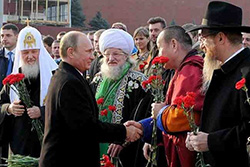
    President Putin meets Russia's religious leaders
    President Putin meets Russia’s religious leaders

    What the globalists and oligarchs wish to impose on Russia from the outside cannot form an identity, which must arise from Russian roots, and not as a foreign import in the interests of commerce:

    Practice has shown that a new national idea does not simply appear, nor does it develop according to market rules. A spontaneously constructed state and society does not work, and neither does mechanically copying other countries’ experiences. Such primitive borrowing and attempts to civilise Russia from abroad were not accepted by an absolute majority of our people. This is because the desire for independence and sovereignty in spiritual, ideological and foreign policy spheres is an integral part of our national character. Incidentally, such approaches have often failed in other nations too. The time when ready-made lifestyle models could be installed in foreign states like computer programmes has passed.

    “Russia’s sovereignty, independence and territorial integrity are unconditional,” states Putin. He has called for unity among all factions, above ethnic separatism and urges an ideological dialogue among political factions.

    Putin also recognises that what is today called the “West,” with the USA as the “leader of the Western world,” as the media and US State Department constantly remind us, shows little evidence of any vestige of its traditional foundations:

    Another serious challenge to Russia’s identity is linked to events taking place in the world. Here there are both foreign policy and moral aspects. We can see how many of the Euro-Atlantic countries are actually rejecting their roots, including the Christian values that constitute the basis of Western civilisation. They are denying moral principles and all traditional identities: national, cultural, religious and even sexual.

    In this demise of Western values, Putin attacks “political correctness,” where religion has become an embarrassment, and Christian holidays are, for example, changed or eliminated. This nihilism is being exported over the world and will result in a “profound demographic and moral crisis,” resulting in the “degradation” of humanity. While multiculturalism is problematic for many states in Europe, Russia has always been multiethnic and this diversity should be encouraged in forging local identities, but within the context of a Russian state-civilisation.

    Simultaneous with the moral and religious decline is the attempt to impose a “standardised, unipolar world” where nations become defunct, rejecting the “God-given diversity” of the world in favour of “vassals.” Above this, Putin is promoting a “Eurasian Union,” a geopolitical bloc that will enable the states of the region to withstand globalisation.

    Putin’s Valdai speech shows that he has a fully developed world-view on which to base Russia’s future course. It also indicates that while Putin might have his faults (and I can’t think of what they might be offhand) he is the only actual statesman in the world today, and has established Russia as the most likely axis of a new civilisation and a new era.

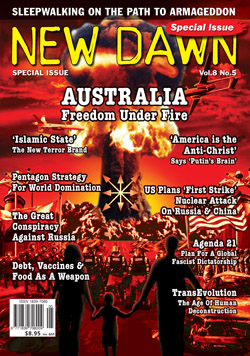
    Gain a deeper understanding of the conflict between Putin's Russia and the West. Check out New Dawn Special Issue Vol 8 No 5, with an article by KR Bolton entitled "The Great Conspiracy Against Russia: What is Really Behind the Campaign Against Putin". 

    [alert type=”general” dismiss=”no”]This article was published in New Dawn Special Issue Vol 7 No 6.[/alert]

    [alert type=”success” dismiss=”no”]If you appreciate this article, please consider subscribing to help maintain this website.[/alert]

    © New Dawn Magazine and the respective author.
    For our reproduction notice, click here.
  • The Great Conspiracy Against Russia: What is Really Behind the Campaign Against Putin?

    The Great Conspiracy Against Russia: What is Really Behind the Campaign Against Putin?

    From New Dawn Special Issue Vol 8 No 5 (Oct 2014)

    When the war-drums start beating in Washington against a state or statesman, one is entitled to wonder what transgression might have been made against the ‘New World Order’. Over the past few decades we have seen one nation after another succumb to either financial blandishments, or when those fail, long-planned, well-funded ‘spontaneous’ colour revolutions, and as a last resort bombs. The states of the ex-Soviet bloc largely succumbed to ‘colour revolutions’ orchestrated by the Soros network, aligned with the National Endowment for Democracy (NED), USAID and a host of other funds and NGOs.

    Milosevic’s Serbia, Qadhafi’s Libya and Saddam’s Iraq were bombed into submission, with ground support for jihadists. The globalists have no objection to jihadists when they serve to keep the world in a state of ‘constant conflict’, in accordance with globalist aims. The USA will use ‘Islamists’ where they can, both as dupes and bogeymen.

    There is one major spanner in the world: Russia – again. Russian President Vladimir Putin has been vilified relentlessly from the start of his leadership of Russia. A second ‘Cold War’ followed so soon in the aftermath of the first that the two can be regarded as one.

    Russia Stymied World State

    There was a fleeting interregnum when it looked as though Russia would finally succumb to globalisation. This encompassed the Yeltsin years, however it was prepared while the Communist Party still held power, during the Gorbachev era. The sudden implosion of the mighty Soviet edifice, seemingly overnight, was long prepared by a combination of US-based subversion, backing ‘dissidents’ such as Solidarity in Poland, coupled with a planned scuttle by Gorbachev, who envisioned himself as an internationally-feted globalist celebrity.

    Russia had succumbed to the nexus of money and revolution in 1917. The revolutionary movement had been well funded since 1905 when the anti-Tsarist journalist George Kennan was sent over to Japan to propagandise Russian POWs, with funds from Jacob Schiff of Kuhn, Loeb & Co., Wall Street. Kennan remarked that 50,000 revolutionary cadres were sent back to Tsarist Russia. Schiff’s contribution to the overthrow of the Tsar was lauded in New York in March 1917.1 There quickly followed the Bolshevik coup led by Lenin and Trotsky. Lenin was backed by the Germans to get Russia out of the war, and Trotsky was backed by the Americans and British to keep Russia in the war. Trotsky was in close association with R. H. Bruce Lockhart, British War Cabinet special agent in Russia, to such an extent that Lockhart’s wife commented that many of his colleagues quipped he was turning Bolshevik. The lines were drawn when Trotsky resigned as minister of foreign affairs because of Lenin’s insistence that Russia sign an armistice with Germany.2

    After the war, there was a scramble by international finance to get concessions from the Soviets, at a time when their existence was very precarious at best, and the American ‘intervention’ under General Graves was doing its best to backstab the White Armies in favour of the Reds.3 H. Wickham Steed, editor of The London Times, observed at the Paris Peace Conference that it was the international financiers such as Schiff who were pushing for worldwide recognition of the Bolsheviks.4 Matters proceeded well for international capitalism under the regime of Lenin and Trotsky. Russia opened up to foreign capital and technology. With Lenin’s death and the resulting power struggle, Stalin eliminated the influence of Trotsky and his coterie in 1928.

    The common fight against the Axis in the Second World War opened up a further opportunity for the USSR to be brought into a world order. The USA proposed such a world state via the United Nations General Assembly as a world parliament. The USSR recognised that the USA would control any such parliamentary vote, and insisted that authority be vested in the Security Council with the right of veto for permanent members. The second premise for a post-war new world order rested with the US proposal to ‘internationalise’ atomic energy under United Nations aegis, outlined in the ‘Baruch Plan’, named after Bernard M. Baruch, so-called ‘elder statesman’ of the USA. Again, the USSR said no.5

    The USSR alone prevented the creation of a world state. The conservative Right remains confused about Russia till today, and much of it continues the old Cold War anti-Russia line against Putin who, to them, is the new Stalin.

    How the Soviet Bloc Imploded

    While the globalists opportunity to erect a world state in the name of ‘world peace’ after the defeat of the Axis was scuttled by the USSR, the implosion of the Soviet bloc provided another opportunity. The oligarchs in the West are so conceited that they assume the whole world yearns for the ‘freedom’ of their ‘Brave New World’, in a narcosis of production and consumption. They assumed that with the demise of the Soviet Union they would be linking with their counterparts in Russia to form an international exploitative regime. Mikhail Gorbachev was their man, as Lenin and Trotsky had been.

    Gorbachev has indeed become part of the globalist elite, as indicated by the 2011 celebration of his 80th birthday at the Royal Albert Hall, London, where “movie stars, singers and politicians showed up, underlining the celebrity status Mr Gorbachev enjoys in the West where he is widely perceived as the man who freed Eastern European from Soviet rule and ended the Cold War.”6 Guests included Lech Walesa, father of post-Soviet Poland, whose Solidarity movement received largesse from the National Endowment for Democracy (NED), CNN founders Ted Turner, Israeli President Shimon Peres, and unnamed “oligarchs.”

    On his birthday, Gorbachev warned Putin not to seek a third presidential term and menacingly referred to the revolts in the Arab world.

    Back in 1988 Gorbachev openly invited revolt in the Soviet states by declaring before the United Nations that the USSR would not defend their Eastern bloc colleagues. This was the year that the Soviets pulled out of Afghanistan, ‘Russia’s Vietnam’. He also announced there would be a massive reduction of Soviet armed forces from the Eastern bloc states.7 Gorbachev stated to his advisors his commitment to a “new world” under the auspices of the United Nations Organisation.8 The groundwork had been laid previously, with the sponsoring of Solidarity in Poland, which Carl Gershman, head of the National Endowment for Democracy (NED), stated set in motion the “velvet revolutions” that toppled the Warsaw Pact bloc.9 The NED contrived Polish-Czech-Slovak Solidarity Foundation supported dissident publishing in the Czech Republic, Slovakia, the Ukraine, Belarus, Russia, Moldova, the Caucasus and Central Asia. The Foundation for Education for Democracy, an outgrowth of the Solidarity Teachers Union, trained teachers and NGO leaders throughout the former Soviet Union, and the East European Democratic Center created dissident media in the Ukraine and Central Asia.10 The destruction of the Soviet bloc was orchestrated by a combination of Gorbachev’s treachery, globalist funded subversion, and the US sponsored Afghanistan imbroglio.

    In 1991 Gorbachev established the International Foundation for Socio-Economic and Political Studies to add his input to the dazzling array of interconnected globalist NGOs, foundations and think tanks. The North American branch founded in 1997 states the purpose is to spread “economic liberalisation.”11

    “Wrong Direction”

    Throughout the 1990s things seemed to be going well for the globalists. Russia had at last been deconstructed, and was ready for bringing into the ‘New World Order’. Gorbachev gave the green light for the dismantling of the Eastern bloc, and paved the way for idiot democracies of the Westminster style. Appropriately a drunken buffoon, Boris Yeltsin, who started his climb to power under Gorbachev in 1985 as a member of the Politburo, Mayor of Moscow and other senior posts, was offered up to usher in the new democratic Russia that could take her place in the world as another colony of finance-capitalism. He had earned his credentials as a liberal when criticising the lack of haste in reform in 1987. The first democratically elected president of Russia, he lasted from 1991-1999. Under Yeltsin Russian assets were sold off at knock down prices to oligarchs in the name of economic liberalisation. From the start of his presidency Yeltsin brought in advisors from the IMF, World Bank and US Treasury. His 1996 presidential campaign was funded by the oligarchy and promoted by their controlled media. Boris Berezovsky was described by a Council on Foreign Relations (CFR) analyst, Daniel Treisman (who served in a 1997 US team in Russia on tax reform), as the “godfather of godfathers,” the oligarch who sat at the top of the dung-heap.12

    Having devastated Russia, Yeltsin resigned, begging Russians for forgiveness for the ruin he had brought. The presidency was assumed by Prime Minister Vladimir Putin in December 1999. It was anticipated that Putin would continue to allow Russia to be vampirised, but he took what the globalists have ever since been calling a “wrong direction,” the title of a Council on Foreign Relations position paper “Russia’s wrong direction.” Written in 2006, the CFR paper recommended increased funding for the Freedom Support Act, in this instance referring specifically to the 2007-2008 presidential elections. Authors of the CFR report included Jack Kemp, Republican Party politico; Mark F. Brzezinski, who served on the National Security Council as an advisor on Russian and Eurasian affairs under President Clinton, as his father Zbigniew had served in the Carter Administration; Antonia W. Bouis, founding executive director of the Soros Foundations; James A. Harmon, senior advisor to the Rothschild Group, et al.13

    President Putin relaxing
    President Putin relaxing

    While Putin has been criticised for associating with a coterie of oligarchs of his own, these businessmen have been incorporated into the strengthening of the Russian state, not its undermining for globalist interests. Those who acted otherwise have been purged, and are celebrated as ‘dissidents’ and champions of ‘human rights’ by anti-Russia interests. These include the ‘godfather of oligarchy’ Berezovsky, who was living in exile in England where he was found hung,14 and Mikhail Khodorkovsky (hailed as a hero in the West), onetime owner of Yukos, jailed for ten years, while his oil empire was taken back for Russia. His son Pavel heads the Institute of Modern Russia to continue the work of his father’s Open Russia Foundation to promote “Russia’s integration into the community of democracies,”15 which is to say, Russia’s subordination to international finance.

    In particular, Putin has challenged the notion of “the New American Century” as one prominent think tank optimistically termed the 21st century. Putin has moved to limit the influence of the same subversive networks that undermined the Eastern bloc via ‘velvet revolutions’ by obliging employees of NGOs to register as ‘foreign agents’, and the state started an investigation of these subversives in March 2013. In that year NED provided $8,226,487 to NGOs, programmes and seminars in Russia for the undermining of the state in the name of “human rights.”16 NED receives funding from US Congress. Imagine the outrage of ‘world opinion’ if Russia funded groups to undermine the US government. Added to this are the millions that have poured in to undermine Russia by the George Soros network, USAID, and a host of others. In 2012 Putin expelled USAID, a governmental agency, stating that it was undermining Russia’s sovereignty.

    IMG_1047

    Geopolitically, the globalists aim to encircle Russia. The alliances created by Putin in central Asia and further afield have meant this has not entirely succeeded, with the Shanghai Cooperation Organisation including China, Kazakhstan, Kyrgyzstan, Tajikistan and Uzbekistan; and with India, Iran, Mongolia and Pakistan having observer status. Belarus and Sri Lanka are dialogue partners, and Turkmenistan has guest attendance.

    However, states such as Georgia and the Ukraine are targeted for takeover as important elements in this strategy. NED avidly sponsored young cadres in various sectors of Ukrainian society, including ‘educating’ electorates on how to vote in the October 2012 elections. The 2012 NED financial report lists the NGOs in the Ukraine that received $3,380,834 during that year.17 The amount represents the upper end of funds sent by NED throughout the world.

    Pro-Moscow separatists in eastern Ukraine who would in other circumstances be lauded by the world media and politicians as ‘freedom fighters’, have been characterised as ‘terrorists’. The enemies of Russia have through the most illogical of rhetoric charged the Russian president with being personally responsible for the downing of a Malaysian airliner. The only thing known for sure as this is written is that Russian interests were in no way served by the targeting of the airliner, but it serves as grist for the anti-Russian agenda. Russia in turn is being pushed further from Europe, and into the embrace of China.

    The Russians remain one of the few residues of a tough people still relatively uncorrupted by the moral, cultural and spiritual rot of a West in its epoch of death. With Russia there are still at least possibilities. “The Russian people are the people of the future,” wrote the philosopher Nikolai Berdyaev. “They will decide questions which the people of the West has not yet the strength to decide, which it does not even pose in their full depth.”18 

    Gain a deeper understanding of the conflict between Putin’s Russia and the West. Check out all the articles in New Dawn Special Issue Vol 8 No 5.

    [alert type=”general” dismiss=”no”]This article was published in New Dawn Special Issue Vol 8 No 5.[/alert]

    [alert type=”success” dismiss=”no”]If you appreciate this article, please consider subscribing to help maintain this website.[/alert]

    FOOTNOTES

    1. K. R. Bolton, Revolution from Above, Arktos Media Ltd., 2011, 57-58

    2, K. R. Bolton, Stalin: The Enduring Legacy, Black House Publishing, 2012, 104-106

    3. K. R. Bolton, Revolution from Above, op. cit., 66-97

    4. Ibid., 61-62

    5. K. R. Bolton, Stalin, op. cit., 125-134

    6. Reuters, ABC News, ‘Stars honour Gorbachev at gala birthday bash’, 31 March 2011, www.abc.net.au/news/stories/2011/03/31/3178823.htm

    7. Dr. Svetlana Savranskaya and Thomas Blanton (ed.), ‘Previously Secret Documents from Soviet and U.S. Files n the 1988 Summit in New York, 20 Years Later’, National Security Archive Electronic Briefing Book No. 261, 8 December 2008

    8. M. Gorbachev, ‘What are we going to take to the United Nations?’, Conference with advisors, 31 October 1988, Attended: Shevardnadze, Yakovlev, Dobrynin, Falin, Chernyaev, Archive of the Gorbachev Foundation. Fond 2. Notes of A.S. Chernyaev. On file at the National Security Archive. Translated by Svetlana Savranskaya. www.gwu.edu/~nsarchiv/NSAEBB/NSAEBB261/sov03.pdf

    9. C. Gershman, ‘Giving Solidarity to the world’, Georgetown University, 19 May 2009, www.ned.org/about/board/meet-our-president/archived-remarks-and-presentations/051909

    10. C. Gershman, ‘Giving Solidarity to the world’, Ibid

    11. The Gorbachev Foundation of North America, ‘Mission’, www.gfna.net/staff.php

    12. Daniel Treisman, ‘Blaming Russia First’, Foreign Affairs, Council on Foreign Relations, November/December 2000, www.foreignaffairs.com/articles/56649/daniel-treisman/blaming-russia-first

    13. Jack Kemp, et al, ‘Russia’s Wrong Direction: What the United States Can and Should Do’, Independent Task Force Report no. 57, Council on Foreign Relations, 2006, xi. The entire publication can be downloaded at: www.cfr.org/publication/9997/

    14. Ian Cobain, ‘Boris Berezovsky inquest returns open verdict on death’, The Guardian, 27 March 2014, www.theguardian.com/world/2014/mar/27/boris-berezovsky-inquest-open-verdict-death

    15. ‘Russia : A Postmodern Dictatorship?’, NED forum, 2013, www.ned.org/events/russia-a-postmodern-dictatorship

    16. ‘Russia’, 2013 NED Annual Report, www.ned.org/where-we-work/eurasia/russia

    17. National Endowment for Democracy, NED 2012 Annual report, www.ned.org/where-we-work/eurasia/ukraine

    18. Nikolai Berdyaev, The Russian Idea, Macmillan, 1948, 70

    © New Dawn Magazine and the respective author.
    For our reproduction notice, click here.