The religion of Thelema, founded by British occultist Aleister Crowley (1875–1947) last century, proclaimed a new “Aeon of Horus” based on “force and fire.” According to its ‘bible’, Liber Al vel Legis (The Book of the Law), it is a stellar or star-oriented religion.
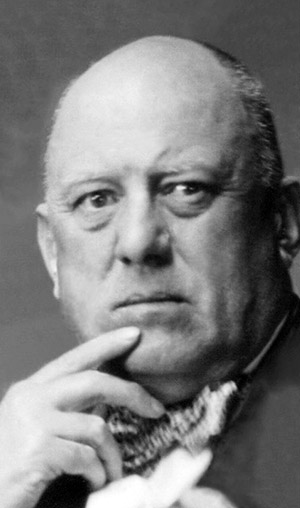
British occultist Aleister Crowley claimed to have channelled Liber Al vel Legis (The Book of the Law).
In his introduction to Liber Al, Crowley states that Liber Al “explains the universe.” The Thelemic dictum, “every man and every woman is a star,” places humanity in a stellar context, with each ‘star’ having its own ‘orbit’ through which it expresses its own ‘will’ (Greek = Thelema). The opening lines of Liber Al proclaim Nuit, the Egyptian sky goddess representing space, “invoking the company of heaven.” Nuit is to be “invoked under the stars.”
Crowley claimed to have received his ‘revelation’ astrally from a ‘praeterhuman’ intelligence – Aiwass – representing the gods of a certain equinox. There are three aeons in Thelema based on three Egyptian gods: Isis (goddess worship), Osiris (dying and resurrected god – including Christianity), and Horus, the hawk-headed god that presides over the new (incoming) aeon.
While stellar references are used allegorically, Crowley wondered whether there is also “some real connection between a given persona and a given star.”
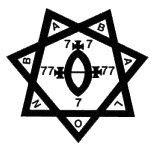
The seal of Babalon.
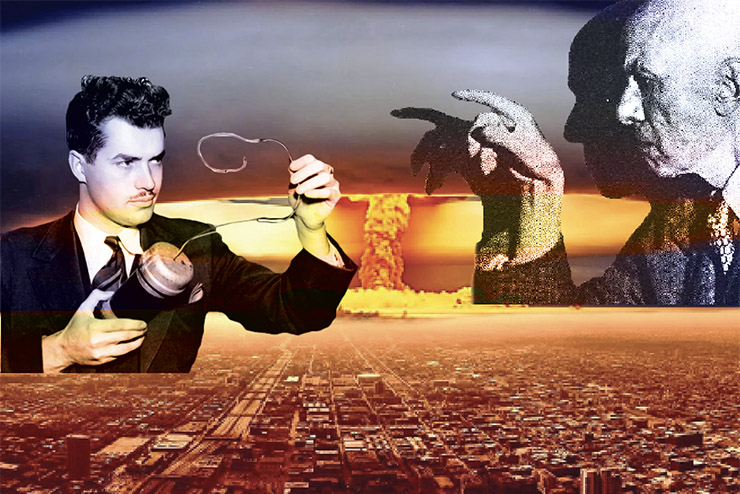
Among the sundry bohemians and intellectuals attracted to Thelema, including artists, poets, and academics, was one John (Jack) Whiteside Parsons (1914–1952), a seminal figure in setting humanity on the exploration of outer space.
As we will explore later, Parsons attempted to invoke Babalon, the ‘Scarlet Woman’ of Thelema, as the manifestation of Nuit. He also penned what he proclaimed to be the ‘fourth chapter’ of Liber Al (given to Crowley in three chapters), ushering the Aeon of Babalon.
Thelemic ‘War Machine’
Jack Parsons with Marjorie Cameron, his second wife and ‘Scarlet Woman’.
The Aeon of Horus was to be ushered by cataclysmic events. As a sign of the times, Crowley referred to “war, the atrocities which occur on a daily basis and leave us unmoved and hardly worried.”
Book III of Liber Al, relating to the Aeon of Horus, is a martial doctrine that refers to Horus as “a god of war and of vengeance,” stating that he would deal harshly with his enemies. Next, a “war machine” is referred to as something to be given to Thelemites. Liber Al states, “With it ye shall smite the peoples; and none shall stand before you.”
Such apocalyptic visions of creating a “war machine” for Thelema would motivate Parsons.
Crowley refers to another aeon after that of Horus and the emergence of “another prophet” to assume Crowley’s “throne.” He refers to this new prophet who would “bring fresh fever from the skies.”
There were several claimants to this mantle while the current aeon and Crowley were still around. Parsons declared himself and that his aeon was Babalon. Crowley did not like the idea of a prophet emerging while he still lived. Crowley considered Parsons dangerously foolish, and Parsons broke with Crowley.
Both Crowley and Parsons based their magickal workings on Enochian. Beginning in 1581, Dr John Dee and his assistant Edward Kelley devised a system of astral communication with so-called ‘angels’ using a system of ‘Calls’, inscribed tablets, and the Enochian alphabet and language. The eighteen ‘Enochian Calls’ are full of fiery imagery. The ‘Tenth Call’ refers to the Earth “burning day and night, and vomit out the heads of scorpions, and live sulphur mingled with poison.”
In a magickal ritual performed in the Tunisian desert on 7 November 1923, Crowley “quizzed a discarnate intelligence about what The Book of the Law’s third chapter meant by a ‘war engine’, described as a gift of Ra Hoor Khuit, the Sun in its martial aspect.” In a note, Crowley wrote that the ritual brought a vision “not incongruous with my idea of the new Energy.”
Crowley sent the material drawn from the ritual to Thelemite mathematician Prof. Norman Mudd for interpretation. Crowley biographer Tobias Churton comments: “The notes show drawings, images, and algebraic concepts suggestive of nuclear fission. Extraordinarily striking for a North African vision in 1923, the notes, with hindsight, suggest the ‘war engine’ was nothing less than an atomic bomb.”
Founding of Jet Propulsion Laboratory
In 1945, Crowley wrote to the novelist Louis Umfraville Wilkinson, a Thelemite, that “The Atomic Bomb is interesting, not only because of Liber Al, chapter III, verses 7 and 8, but because one of the men who were working on it was for some time at the Abbey in Cefalu.” For a period, Crowley’s Abbey of Thelema (in Cefalu, Sicily) was where his community of disciples practised the doctrines of Thelema and performed magickal rituals.
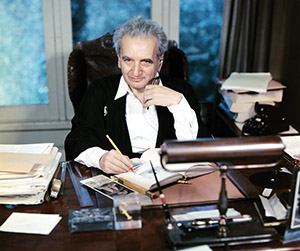
Dr. Theodore von Kármán
In 1936, Dr. Theodore von Kármán, director of the Guggenheim Aeronautical Laboratory at the California Institute of Technology (GALCIT), founded the Aerojet rocket motor company with Frank Malina, a Communist sympathiser, and Jack Parsons. The Jet Propulsion Laboratory (JPL) emerged from GALCIT in 1943 after the project came under the auspices of the US military.
Kármán was a descendant of the famous Hasidic (Cabalistic) Rabbi Yehuda Loew ben Bezalel, the 16th century ‘Exalted’ Rabbi of Prague, astronomer, and, according to Jewish legend, creator of the ‘Golem of Prague’. Kármán was the great-grandson of Moses ben Menachem Mendel Kuntitz, a scholar of the Zohar, the main body of Cabalistic mysticism.
Parsons, Malina and several others became known as the ‘Suicide Squad’ for their dangerous use of explosives and were subsequently moved from the CALTECH campus. From 1941, the US military lavished funding on GALCIT, and the Aerojet Engineering Corporation was founded in 1942 to meet its expanding requirements.
Parsons’ contributions to solid propellant rocketry led to the development of the solid motors on the Space Shuttle and the motors in the Minuteman missile. A crater on the Moon’s dark side is named in his honour. After World War II, the work that Parsons undertook on liquid and solid-state fuel led directly to the US space programme.
Liber 49
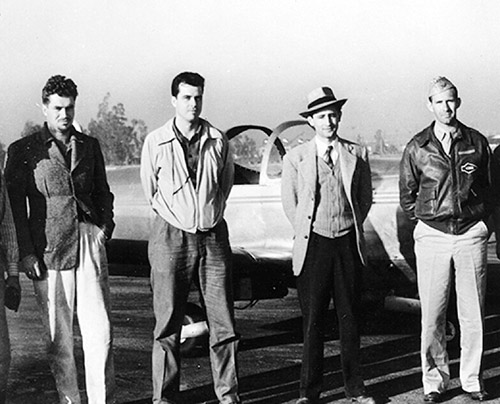
(from left) Rocketeers Jack Parsons, Ed Forman and Frank Malina.
Parsons became a devotee of Crowley in 1939. He joined Agape Lodge, the Los Angeles branch of Crowley’s organisation, Ordo Templi Orientis (OTO), and was initiated in 1941. After his first wife left him for the lodge’s head, Wilfred Smith, he assumed leadership in 1943. The OTO temple was moved to Parsons’ mansion in Pasadena.
When Parsons undertook his ‘Babalon Working’ in 1946, Crowley responded by stating, “I get fairly frantic when I contemplate the idiocy of these goats.” With artist, poet and actress Marjorie Cameron as his ‘Scarlet Woman’, they intended to evoke Babalon to worldly manifestation by creating a magickal child, although Parsons later considered Cameron to be that incarnation.
According to Kenneth Grant, Crowley “wrote Parsons off as yet another failure,” and Parsons resigned from the OTO in August 1946.
As a result of the Babalon Working, Parsons proclaimed himself “Belarion Antichrist” and issued a new revelation, Liber 49 – a fourth chapter of Crowley’s Liber Al – ushering the Age of Babalon.
Like the ‘Enochian Calls’, Liber 49 is reminiscent of the Apocalypse of St. John. While John’s Revelation announces the return of Christ after an apocalypse, Parsons believed that an apocalypse would bring forth a New Aeon of the Antichrist and Babalon.
In martial spirit, continuing the legacy of Horus, Babalon proclaims that she will come via her daughter as a “penelous (sic) flame,” “a trumpet in judgement halls,” “a banner before armies,” to “judge nations” with “force and fire.” Those who resist will be destroyed: “None shall resist thee, whom I lovest. Though they call thee harlot and whore, shameless, false, evil, these words shall be blood in their mouths, and dust thereafter.”
Parsons, as Antichrist, had undertaken his “black pilgrimage” in the Mojave Desert on Babalon’s command. He swore that he would fulfil Babalon’s rule on Earth and published his manifesto: “And in my name BELARION shall they work miracles, and confound our enemies, and none shall stand before us.”
Enochian
The occult scholar Donald Tyson writes of the Enochian workings that John Dee believed the ‘angels’ he was evoking were servants of God, whereas Edward Kelley thought they might be deceivers. Tyson says these ‘angels’, by fooling Dee, used him to introduce a ritual working that would usher the Apocalypse. The working was aimed at opening the gates of the Watchtowers that guard against the intrusion of satanic powers into this universe. Tyson states that Dee was blind as to the true function of the ‘Enochian Keys’. He also claims Crowley failed to complete the entire apocalyptic Enochian Working despite his exuberance for the subject and his claim to be the Antichrist.
Parsons took on that mantle, broke with Crowley, and aimed to bring forth the Apocalypse by more direct means. Parsons is said to have recited Crowley’s poem ‘Hymn to Pan’ and danced at the launching of rockets by the JPL. It seems that he regarded each rocket launch as a ritual working.
Babalon
An academic study has been written on Babalon. Manon Hedenborg White references the Enochian magickal working of Crowley and Victor Neuburg in the Algerian desert in 1909, in which Crowley had a vision of the apocalyptic Whore of Babylon. He rendered this as “Babalon,” and incorporated it into Thelema as the primary goddess, who had been prophesied in Liber Al five years previously. In origin, Babalon is a generic name for ‘wicked’ in Enochian and related to the word ‘babalond’ meaning ‘harlot’. Apparently, she also communicated through her ‘daughter’ in the form of “a spirit called Madimi” to Dee and Kelley.
Chapter 5 of White’s study is devoted to Parsons’ interpretation of Babalon. After rituals with Cameron during January and February, Parsons went alone into the Mojave Desert, where he evoked Babalon and transcribed Liber 49 as the fourth chapter of Liber Al. Of course, Crowley had already disowned Parsons.
While the Aeon of Babalon was intended to balance the “force and fire” of the martial Aeon of Horus, Parsons’ conception of Babalon nonetheless gloried in the biblical image of the Great Whore of Babylon foretold in the Revelation of John, “drunken with the blood of the saints, and with the blood of the martyrs.”
Where the biblical Whore of Babylon is generally considered to describe a corrupt system, to Crowley and Parsons, Babylon rendered as Babalon describes a terrible goddess bringing apocalyptic desolation to the world before ushering a new aeon. Hence, Parsons describes Babalon as “the dark mother of anarchy and abominations,” which he compares to Kali and Lilith.
Parsons & Israel
Parsons drew the attention of the FBI. He was noted as a bohemian living with various other suspect characters, indulging in orgies and black magic rites at his mansion.
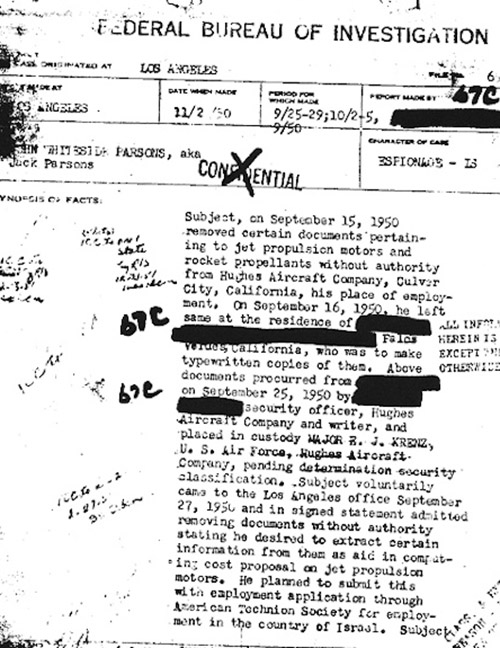
FBI file about Parson’s outreach (or recruitment) to Israel to share his advanced knowledge about rocket science.
In September 1950, Parsons was identified as having removed restricted, confidential and classified documents on jet propulsion motors and rocket propellants from Hughes Aircraft Company, California. Parsons had worked there since 1949 as “group leader” in charge of propellants, propulsion and launching systems. In a statement to the FBI dated 27 September 1950, Parsons declared that he had taken the classified material for the purpose of preparing proposals for work in Israel.
In his astral visions, Parsons “arrived at Chorazin in the dominion of the Antichrist.” Manon Hedenborg White writes that in Parsons’ astral vision, he emerges as the Antichrist at Chorazin.
Located near the Seas of Galilee in present-day Israel and now in ruins, Chorazin is mentioned in the Bible as one of three villages cursed by Jesus for failing to accept his teachings. Some medieval theologians believed that the Antichrist might come to be born in Chorazin. This notion clearly influenced Parsons, who explicitly calls the location “the city of the Anti-Christ” and believed that his astral journey marked his transition into the figure.
Here, we begin to see why the State of Israel might have assumed central importance in Parsons’ belief he was the Antichrist at the inauguration of the Aeon of Babalon.
The FBI files state that Parsons had read in technical magazines about research in Israel. In September or October 1949, that is to say, the year of his assumption to the role of Antichrist, he made contact with an Israeli agent who requested him to prepare a proposal “regarding the building of an explosives plant in Israel and data concerning rockets and other armaments which Parsons would be able to conduct research work on in Israel.” In August 1950, he was asked to submit costs for “a jet propulsion development program on which Parsons could do research work in Israel.” The initial contact with what Parsons said to the FBI was a “business consultant,” whom the FBI identified as “a representative of the Israeli Government” living in North Hollywood, came through the American Technion Society.
The FBI report states that the Technion Society was designated officially by both the Israeli Government and Israeli industry as the “American body” through which the latest in US technology was conveyed to Israel. The Technion Society was another name for the “American Society for the Advancement of the Hebrew Institute of Technology in Haifa, Palestine, Inc.” (Los Angeles File, a-27-49). The file states that “this organisation publishes the Technion Yearbook and the society is also known as the ‘American Technion Society’.” A statement dated 2 December 1950 in the FBI files mentions that Dr. Theodore von Kármán had recommended Parsons contact what seems to be (the words are blacked out) the American Technion Society. It seems that Kármán, Parsons’ mentor and one of the most distinguished names in rocket science, had facilitated his communication with Israel for the purposes of espionage.
Parsons had his security clearance suspended in 1948 because of his involvement with a “cult” and associating with an “alleged Communist Party member.” This suspension was removed the following year. US Assistant Attorney General McEachen declined to prosecute due to a lack of evidence that taking classified documents for use by Israel was “injurious to the USA or to the advantage of another nation,” but Parsons’ security clearance was again revoked on 9 January 1952.
As the self-declared Antichrist who would usher the Apocalypse, Parsons was uniquely positioned to do so as one of the fathers of US rocketry. It is significant that he intended to settle in Israel and sought to persuade the Israelis that he could establish a missile programme. In his role as Antichrist, it seems credible that Parsons envisaged settling in Israel at the location where the Apocalypse is supposed to unfold from the battle of Armageddon.
It also seems likely that Parsons saw a vision of nuclear devastation in the fiery Apocalypse described by St John in The Revelation. One of the world’s most eminent experts in rocket chemistry, someone with such a mission as Parsons, was uniquely placed to complete the Enochian Working with the benefits of modern apocalyptic science that he helped in large measure to create.
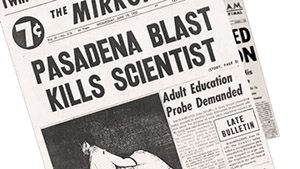
Parsons’ hopes of going to Israel did not eventuate. It is debated as to whether the enormous explosion that killed Parsons on 17 June 1952 when he was handling chemicals on his property was an accident, murder, or suicide.
Or perhaps it was a self-immolation rite to Babalon, a final fiery embrace intended as a sacrifice to inaugurate the Aeon?
[alert type=”general” dismiss=”no”]This article was published in New Dawn 204.[/alert]
[alert type=”success” dismiss=”no”]If you appreciate this article, please consider subscribing to help maintain this website.[/alert]
Footnotes
1. Crowley, Liber Al (York Beach, Maine, 1976), 1: 1-3.
2. Ibid., 1: 57.
3. Aleister Crowley, The Law is for All (Arizona: Falcon Press, 1985), 72-73.
4. Crowley, Introduction to Liber Al, IV: The New Aeon, 13.
5. Ibid., 3: 6-8, 39.
6. Ibid., 3: 34, 42-43.
7. Donald C. Laycock, The Complete Enochian Dictionary (London: Askin Publishers, 1978), The Tenth Call, 257.
10. Crowley to Wilkinson, 7 August 1945, cited by Kenneth Grant, Cults of the Shadow (London: Frederick Muller, 1975), 115.
11. S. Goldstein, ‘Theodore von Kármán’, Biographical Memoirs of Fellows of the Royal Society, Vol. 12, November 1966, 334-365.
13. Kenneth Grant, The Magical Revival (London: Frederick Muller, 1972), 166.
12. Henrik Bogdan, The Babalon Working 1946: L. Ron Hubbard, Jack Whiteside Parsons, and the Practice of Enochian Magic, Numen, No. 63, 2016, 28.
14. Jack Parsons, Liber 49, The Book of Babalon (1946) v. 10, sacred-texts.com/oto/lib49.htm
15. Ibid., v. 40.
16. Ibid., v. 41.
17. Jack Parsons, Liber 49, Part II: The Manifesto of the Antichrist.
18. Donald Tyson, The Enochian Apocalypse, Gnosis Magazine, Summer 1996, bibliotecapleyades.net/bb/bluebook418.htm
19. Geoffrey Landis, The Three Rocketeers, American Scientist, July-August 2005, americanscientist.org/article/the-three-rocketeers
20. Manon Hedenborg White, The Eloquent Blood: The Goddess Babalon & the Construction of Femininities in Western Esotericism (Oxford University Press, 2020)
In the West, there’s a common misconception that ‘all Muslims are the same’. In reality, Islam comprises distinct branches, primarily Sunni and Shi’a, each with unique theological and eschatological beliefs. These eschatological views, which relate to end times and final events, significantly influence global politics and conflicts, despite often being overlooked.
The differing Sunni and Shi’a conceptions of a messiah, or saviour figure, often provoke anxiety among Jewish and Christian Messianists, as well as their more secular counterparts in the armed forces and governments of Israel and the USA. Regardless of whether these beliefs are taken literally, the perception of them plays a crucial role in international relations.
Historically, colonial powers faced fierce opposition from those who believed they were under divine protection, often manifesting as a belief in invincibility in battle. For example, the Sudanese Mahdi, Muhammad Ahmad, led a successful revolt against the British in the late 19th century, claiming divine support and inspiring his followers to believe they were invincible. Similarly, during the South Asian resistance to Western colonialism, various leaders and groups invoked religious and messianic beliefs to bolster their opposition to British rule, fostering a sense of divine mission and protection among their followers.
The signs of the times in which we live have prompted many in the Islamic world to wonder if al-Mahdi will arrive soon.
In Islam, there is an expectation of the coming of the Mahdi, a descendant of Muhammad, who will appear at the end times to eradicate evil. This event is anticipated to occur just before the return of Jesus, esteemed in Islam as a Prophet. The Mahdi is expected to lead Muslims in establishing a righteous world order. Christianity and Judaism have analogous figures in the militant, conquering Jesus of Revelations and the Jewish melekh mashiach, respectively. The Mahdi is referenced in Sunni hadith literature, with the first mention dating back to the 7th century.
Judaism has had multiple messianic claimants over the centuries. Historical figures such as Simon bar Kokhba and Sabbatai Zevi have had significant followings. While bar Kokhba’s revolt against the Romans ended in failure, Zevi’s legacy persisted through his followers, despite his eventual conversion to Islam. Zevi’s influence continued through his successor Jacob Frank, who led the Frankist movement in 18th-century Europe, promoting a syncretic blend of Judaism, Christianity and Islam. Additionally, the Donmeh, a group of crypto-Jews in Turkey who outwardly practice Islam while maintaining Judaic beliefs in secret, trace their origins to Zevi’s followers. Various esoteric sects keep Sabbatean ideas alive, blending them with mysticism and other spiritual practices. In contemporary times, the Chabad Lubavitch movement venerates the seventh Rebbe, Menachem Schneerson (d. 1994), with some adherents believing he will resurrect as the long-awaited Messiah.
In Shi’a Islam, the Mahdi, also known as al-Qa’im (Arabic, meaning ‘he who will rise’), is synonymous with the personage of the ‘Hidden Imam’, who is the Twelfth Imam, Muhammad ibn Hasan al-Mahdi. According to Shi’a belief, this Imam entered occultation (ghayba) in the 9th century to escape persecution. Despite being hidden, he is believed to continue guiding and protecting the faithful.
Shi’a doctrine holds that the Hidden Imam will reappear as the Mahdi in the end times to usher in an era of justice and peace. This belief underscores the importance of continuous, divinely guided leadership in Shi’a Islam. In contrast, Sunni Islam also acknowledges the Mahdi but does not emphasise occultation and generally believes the Mahdi has not yet been born. Sunni views on the Mahdi’s lineage and role vary, and he is not as central a figure as in Shi’a Islam.
They Seek Him Here, They Seek Him There…
The search for the Mahdi, specifically the Hidden Imam of Shi’ite tradition, has taken on an intriguing dimension involving espionage and international politics. According to former Iranian President Mahmoud Ahmadinejad, American academics conducted detailed studies in 2015 to locate this elusive figure. Ahmadinejad claimed these efforts were part of a broader plan by US intelligence to prepare a case for the Mahdi’s arrest.1
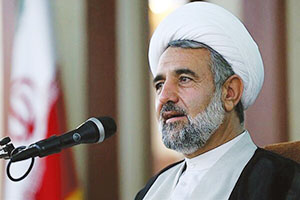
Mojtaba Zolnour
In 2009, Ahmadinejad made similar claims, echoed the following year by Mojtaba Zolnour, deputy representative of Iran’s supreme leader in the Revolutionary Guard. Zolnour stated, according to Radio Free Europe: “Zionists have security plans for Muslim sites including Mecca, Karbala, and other sites where he said it was likely that the Hidden Imam could appear. The Hidden Imam or the Promised Mahdi is the 12th Imam of Shi’ite Islam, who [Shia] Muslims believe will appear to bring peace and justice on Earth and put an end to tyranny. ‘They’ve told their soldiers to kill immediately whomever they see with the characteristics [of the Hidden Imam] and not even take the risk to arrest him because he is a very awesome and dangerous person’.”2
Reports from Middle Eastern sources indicate that Muslim prisoners held by the US military had been subjected to harsh interrogation methods in an effort to find the Mahdi. The Shi’a News Association reported in 2015 that: “During the US occupation of Iraq, it was routine to torture Iraqis in prisons like Abu Ghraib whose prison guards were using tactics learnt in Israeli training camps as Robert Fisk pointed out in ‘Abu Ghraib torture trail leads to Israel’; one of the most baffling questions asked during interrogation was ‘Where is the man called Imam Mahdi, where is he hiding?’”3
The intense focus on locating a figure central to Shi’ite eschatology underscores the complex interplay between Messianic beliefs and geopolitical strategies.
High-Level Analysis of Mahdism in Iran
Is this Muslim conspiracism run amok? Numerous reports highlight the Mahdi’s influence on Iran. The long-running think tank, the Middle East Institute, issued a report prepared by two senior analysts at the Tony Blair Institute for Global Change about the growth of Mahdism among the Iranian Revolutionary Guard Corps. The think tank states that “one fundamental aspect of [Iran’s] ideology that until now has been overlooked is the doctrine of Mahdism.”4
“There are signs today that the preparations for the return of the 12th divinely ordained Shi’a imam are becoming of pivotal importance to the IRGC’s lens on the world. The rise of a militaristic Mahdist cult among the senior ranks of the IRGC is now not inconceivable and the repercussions far-reaching.”
“Mahdism in the IRGC remains a complete blind spot for Western policymakers and experts, and yet its implications could have major consequences.”
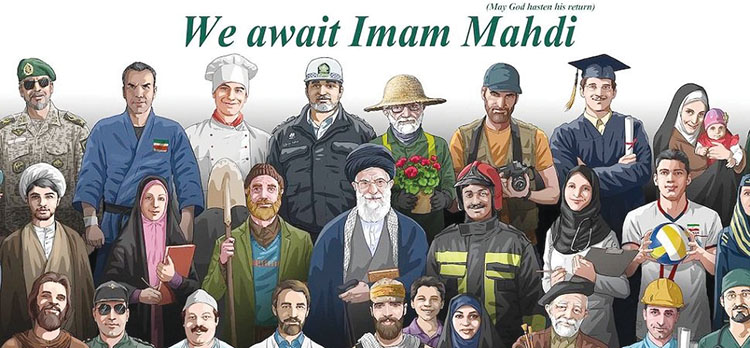
The official website of Ayatollah Khamenei has a special page devoted to answering questions about “Imam Mahdi” and displays this collage representing people from all sectors of Iranian society with the Ayatollah in the centre.
An entire section of the report is entitled “What is Mahdism?” The report explains that: “As a Shi’a Islamist force, the IRGC’s worldview hinges on Mahdism: the return of the 12th divinely ordained Shi’a imam, Muhammad al-Mahdi (or the Hidden Imam), whom Shi’a Muslims believe was withdrawn into a miraculous state of occultation (hiddenness) by God in 874 CE. The concept of Mahdism is rooted in the belief that Imam Mahdi will one day return to rid the world of evil and injustice. His coming will bring about ‘one final apocalyptic battle’ between two armies, in which Shi’as believe that Mahdi and his forces will prevail over evil.”
Since 1990, Iran is said to have become a “society based on Mahdism.” The Iranian government declares that it is in a caretaker role until the return of the Mahdi. Ahmadinejad, elected president in 2005, is quoted as stating: “We have a mission – to turn Iran into the country of the Hidden Imam.” The report adds: “Ahmadinejad would give special importance to the Jamkaran Mosque, which hosts the Well of Jamkaran, where some Shi’a Muslims believe the 12th Imam will return. Ahmadinejad’s administration would allocate $17 million in state funds to Jamkaran Mosque as well as expand its facilities, transforming it from a small mosque to a multimillion-dollar shrine.”
The Revolutionary Guard is accorded a special mission, according to the report, to prepare the way for the Mahdi. In 2012, Hojatoleslam Ali Saeedi, the supreme leader’s representative to the IRGC, asserted: “The IRGC is one of the tools for paving the way for the emergence of the Imam of the Age (Mahdi) in the field of a regional and international awakening.” Saeedi is cited as stating that the continuing US presence in Iraq is an impediment to the appearance of the Mahdi.
Support for the Houthis in Yemen is regarded as significant in preparing for the Mahdi, as is the fight against not only Zionism but also against the Wahhabist Islam of terrorist organisations such as ISIS, which serve the USA’s and Israel’s interests. Consequently, many Iranians fought against ISIS in Syria. Iran also sees Russia’s fight with Ukraine in terms of the end times that prelude the Mahdi’s return, Iran taking a pro-Russian position.
The blend of Messianic beliefs and geopolitical strategies in Iran, particularly regarding the return of the Mahdi, shows how deeply ‘End Times’ prophecies and today’s politics can intertwine. Although controversial, Ahmadinejad’s claims reveal the significant role Messianic ideas can play in shaping national and international policies. Preparing for the Mahdi’s return has become a key focus for some Iranian leaders.
While Ahmadinejad was criticised by the Western media for not citing specific examples of the alleged US intelligence reports on the Mahdi, these reports are readily locatable. For instance, Lieutenant Colonel Kurt Crytzer’s publication, “Mahdi and the Iranian Nuclear Threat” by the US Army War College in 2007, questions: “Is the Iranian Government attempting to set conditions for the return of the 12th Imam in accordance with Shi’ite beliefs? If so, what threats are associated with these actions and how can the West counter these threats?”5
The fusion of Mahdist beliefs and Iran’s political manoeuvres is a captivating blend of geopolitics and eschatology. As Iran positions itself as a nation in waiting for the Mahdi, it’s crucial to understand the deep spiritual and political layers of this issue. This unique mix of prophecy and power offers fresh insights into Iran’s bold actions on the global stage. The way these ancient beliefs drive modern strategies could reshape international relations in ways no one ever imagined. Prepare for a world where ‘End Times’ prophecy and politics are intertwined like never before.
Additional material for the above was contributed by New Dawn editors.
[alert type=”success” dismiss=”no”]If you appreciate this article, please consider subscribing to help maintain this website.[/alert]
Footnotes
1. Toi Staff, Ahmadinejad: US is after Hidden Imam, Times of Israel, June 23, 2015
2. Golnaz Esfandiari, Zionists Waiting to Kill Hidden Imam, Says Iranian Cleric, Radio Free Europe/Radio Liberty, September 1, 2010
3. Are the Mossad and Western powers looking for Imam Mahdi?, Shia News Association, June 3, 2015
4. Saeid Golkar and Kasra Aarabi, Iran’s Revolutionary Guard and the Rising Cult of Mahdism: Missiles and Militias for the Apocalypse, Middle East Institute, May 2022
5. Lieutenant Colonel Kurt S. Crytzer, Mahdi and the Iranian Nuclear Threat, Strategy Research Project, U.S. Army War College, March 2007
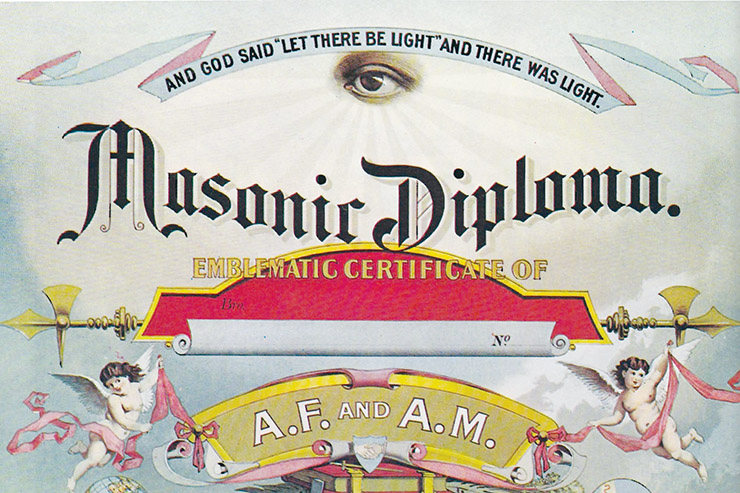
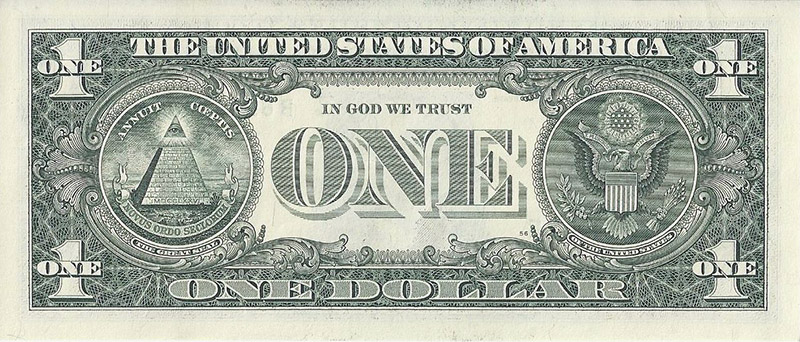
The symbol of the All Seeing Eye appears regularly among writings by conspiracy theorists. It is alleged the reverse of the Great Seal of the USA is a Masonic symbol and proves that Masonry helped found the United States of America.1 It is also widely believed the All Seeing Eye is the symbol of the Illuminati,2 and where the symbol appears that is evidence of a continuing Illuminatist influence.
While there is much exaggeration and outright falsification based on individual bias, often religiously based, there is also the antithetical position of certain Masons, especially from the Anglophone ‘United Grand Lodge’, who hold there is little significance to the symbol, and that where the symbol appears in association with subversive movements, these are not “genuine Masons.”3 Although this writer has not been able to find any reliable evidence that the All Seeing Eye is in fact the symbol of the Illuminati, the debunkers of all critiques of Masonry are also often in error or are disingenuous. This article examines some examples of the All Seeing Eye as a graphic indicator of conspiracies.4
The Great Seal of the United States: A Masonic Symbol?
Some branches of Masonry, particularly the Grand Orient of France with its tradition of radicalism, atheism and rationalism, acknowledge that many brethren were involved in the American, French and other revolutions.5 The enigmatic symbols on the reverse side of the Great Seal of the USA, more familiarly seen on the US One Dollar Bill, have long caused speculation as to whether this is a sign of Masonic influence. There have recently been attempts at refutation, contending that the combination of the All Seeing Eye and triangle or pyramid motif is not a symbol of Masonry, or at least was not until after the American Revolution and the designing of the Great Seal; and that any subsequent use of the symbol by Masonry was not widespread.
The British Columbia and Yukon Grand Lodge, for example, operates a website with a section devoted to refuting anti-Masonic theories. On the US Great Seal, the Canadian Masons write:
Of the four men involved in designing the USA seal in 1776, only Benjamin Franklin was a freemason, and he contributed nothing of a Masonic nature to the committee’s proposed design for a seal…
Congress declined the first committee’s suggestions as well as those of its 1780 committee. Francis Hopkinson, consultant to the second (1782) committee, used an unfinished pyramid in his design. Charles Thomson, Secretary of Congress, and William Barton, artist and consultant, borrowed from earlier designs and sketched what at length became the United States Seal. None of the final designers of the seal – William Baron, Charles Thomson, Sir John Prestwick – were freemasons.
The single eye was a well-established artistic convention for an ‘omniscient Ubiquitous Deity’ in the medallic art of the Renaissance…
The first ‘official’ use and definition of the all-seeing eye as a Masonic symbol seems to have come in 1797 with The Freemason’s Monitor of Thomas Smith Webb – 14 years after Congress adopted the design for the Seal…
Neither the eye nor the pyramid have ever been uniquely Masonic symbols, although a few Grand Lodge jurisdictions incorporate them into their seals. The combining of the eye of providence overlooking an unfinished pyramid is a uniquely American, not masonic, icon. There are no available records showing the all-seeing eye, with or without a pyramid, associated with freemasonry prior to 1797…6
This Masonic refutation has widely appeared elsewhere in both Masonic and non-Masonic sources including an entry in Wikipedia. There are a number of important points that need questioning.
Early Masonic Use of All Seeing Eye
The website ‘Pietre Stones Review of Freemasonry’ only accepts articles from Master Masons of the United Grand Lodge (UGL) and those recognised by the UGL. It is therefore an authoritative source from that perspective. In a section illustrating ‘Masonic Tracing Boards’7 there are a number which depict the All Seeing Eye as a major symbol. The earliest shown is not from the USA or from the American Colonies, but from Germany going back to 1770, well before the designing of the US Great Seal. Illustrations of early tracing boards incorporating the All Seeing Eye motif include:
‘Ancient Tracing Board, Germany, 1770’.8
‘Lodge Union No. 129 Kendal 1772’.9
‘1796 Union Lodge, Boston’.10
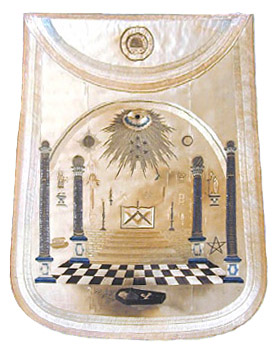
George Washington’s Masonic Apron (left), given to him as a gift from the revolutionist General LaFayette, includes the All Seeing Eye, and dates to 1784.11
Ironically, the Canadian Masonic website includes a section headed ‘Masonic Art’. One of the examples is a painting by the Florentine artist Jacopo Carucci, entitled ‘Supper at Emmaus’ (1525). The Masons involved with this website have isolated the All Seeing Eye and triangle detail from the painting, and present three enlarged images of it.12 Of twelve examples of ‘Masonic art’ given by the Canadian Masons, three feature the All Seeing Eye. One is labelled ‘eye in a triangle’.13 Another is Washington’s Apron featuring the All Seeing Eye.14
In an article entitled ‘The Masonic Landmarks’ by Dr. Athena Stafyla, written for ‘Pietre Stones Review of Freemasonry’, she (or the graphic artist) includes illustrations of both the Great Seal of the USA and a painting (presumably Masonic) of Egyptian ‘masons’ working on an incomplete pyramid.15 The pictures are carried without explanation. The pyramid without its capstone symbolises the work of Masonry, which is to complete the perfection of humanity, as per the Enlightenment and the humanistic and often communistic doctrines which were used as a means of subverting the Traditional social order of Europe and elsewhere from the 18th century. The Masonic doctrine is that the initiated Freemason is working to craft humanity towards Perfection.
All Seeing Eye on Dollar Bill
Reporting on an exhibition of Rosicrucian MSS at the Rosicrucian Museum (San Jose, USA), Gary Singh writing in Metro reports a conversation he had with the curator on the Great Seal and the All Seeing Eye:
We then come back to Roerich’s volume and discuss the Great Seal of the United States and the all-seeing eye. I mention it’s amazing that it took so long for the seal to make it onto the back of the dollar, and that I wonder why George Washington and crew didn’t put it there from the beginning. “Yeah,” said Armstrong. “Considering they were all Masons.”16
Discussing a book by the Rosicrucian author, mystic and painter Nicholas Roerich:
Roerich, a Rosicrucian, played an influential role in the administration of Franklin Delano Roosevelt, as he was the mover and shaker behind FDR putting the Great Seal of the United States and the all-seeing eye on the back of the $1 bill. The eye is a Masonic and Rosicrucian symbol dating back centuries.17
The influence on the Roosevelt Administration to get the All Seeing Eye on the Dollar Bill came via Vice President Henry Wallace, a devotee of Roerich and a 32º Mason. If the All Seeing Eye was not a Masonic symbol, one must wonder why it was considered so important by Roerich, Wallace and President Roosevelt?
Masonic authority Manly P. Hall18 believed the Great Seal represents a specific occult influence on the founding of the USA:
On the reverse of our nation’s Great Seal is an unfinished pyramid to represent human society itself, imperfect and incomplete. Above floats the symbol of the esoteric orders, the radiant triangle with its all-seeing eye… There is only one possible origin for these symbols, and that is the secret societies which came to this country 150 years before the Revolutionary War… There can be no question that the Great Seal was directly inspired by these orders of the human Quest, and that it set forth the purpose for this nation.19
Henry Wallace was imbued with occult doctrine, particularly that inspired by Masonry. He regarded the USA as having a manifest destiny to lead the world into a new world order, and he saw that mission symbolised in the Great Seal. Alluding to the Masonic significance of the unfinished pyramid, the Masonic conception of God as the Great Architect of the Universe, and the motto on the Great Seal referring to a ‘new order of the ages’, Wallace wrote:
It will take a more definite recognition of the Grand Architect of the Universe before the apex stone [capstone of the pyramid] is finally fitted into place and this nation in the full strength of its power is in position to assume leadership among the nations in inaugurating ‘the New Order of the Ages’.20
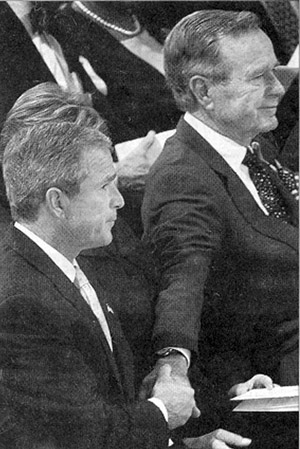
Masonic handshake between George H.W. Bush Snr and George W. Bush, at the inauguration of a ‘new world order’ after the first Gulf War
Wallace’s interpretation of the ‘new order of the ages’ was that of a ‘new world order’, not simply a new era for the USA (hence the reference to the USA leading the ‘nations’ into this international regime). This ‘new world order’ has now become quite familiar after US President George H.W. Bush Snr announced its official inauguration, being ushered in after the first Gulf War war against Iraq.21 His son, President George W. Bush, reiterated the aim fourteen years later when stating, in specific reference to the motto of the Great Seal: “When our Fathers declared a ‘new order of the ages’, they were acting on an ancient hope which is meant to be fulfilled.”22 The reference to an “ancient hope” implies something arcane that would be recognised by the initiated.
All Seeing Eye of Grand Orient Masonry
The All Seeing Eye is an important symbol in Grand Orient and associated forms of Masonry on Continental Europe. United Grand Lodge Masonry can eschew the subversive nature of the Grand Orient and others by the simple expedient of stating they are not “true Masons.” Be that as it may, this oft-cited difference did not prevent important figures such as Benjamin Franklin being initiated into the revolutionist Lodge of the Nine Sisters in Paris, nor Thomas Jefferson lauding the noble virtues of Illuminatist Adam Weishaupt.23
Grand Orient Masonry and its derivatives are of an Illuminatist nature, aiming to overthrow all traditional social orders, to inaugurate a world order ushered in by a faithless, materialistic rationalism, as a prelude to establishing a universal cult as was seen in the aftermath of the French Revolution when rival cults contended on the ruins of the Church and unleashed new forms of un-reason.
The Grand Orient of France (GODF), the mother of Grand Orient throughout the world, does not disguise its rationalist, humanistic and revolutionary pedigree:
But in this period when the new ideas of Liberty, and Equality were to be born, which would lead to the French Revolution and the Republic, France entered the age of enlightenment. From being a sort of ‘Club’ as in England, the Masonic Lodges which very quickly spread in our country became a sounding board for these great new ideas and turned into places where debates about the emancipation of Man and Society took place. The Grand Orient de France which was set up in 1733 and was, until the end of the 19th century, the only Masonic Order in France, is still fighting for these ideals.24
The motto of the GODF is that of the French Revolution, Liberty, Equality, Fraternity. That is to say, the Revolutionaries adopted the motto from the Freemasons. The GODF adds:
Thus Lafayette received a sword from George Washington in honour of the part played by French Freemasons in the American War of Independence. In this way, the preparation of the ideas of Liberty and Equality in the Masonic Lodges contributed to the great reforms of the French Revolution…25
The GODF claims to be continuing the legacy of various revolutionary thinkers and activists including the most extreme anarchists Blanqui and Bakunin whom they identify as Grand Orient Masons:
For the freemasons of the Grand Orient de France, the search for progress has always been the force behind their reflection and their activities, to such an extent that this principle is an integral part of the tradition of this form of Masonry. We are the heirs of men and women who all, in their own way, worked to improve Humankind: Voltaire,26 La Fayette,27 Garibaldi,28 Auguste Blanqui,29 Victor Schoelcher, Emir Abd-El-Kader, Louise Michel, Bakounine,30 Jean Zay, Félix Eboué, Pierre Brossolette and so many others whom we are proud to know have enriched our Lodges with their presence. Therefore, the Grand Orient de France is a vigilant defender of the principles contained in its motto which is also that of the Republic: ‘Liberty, Equality, Fraternity’.31
Therefore, when academics have a clichéd tendency to ridicule ‘conspiracy theories’ on Masonry as simplistic and ignorant, they would do well to consult the Masonic literature, including that of the present day.
As one would expect, the All Seeing Eye makes its looming appearance in the symbology of both the Grand Orient and the French Revolution.
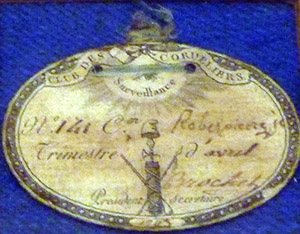
The card of the Cordeliers Club that depicts the All Seeing Eye above the word ‘Surveillance’.32 It is pertinent to ask whether this supposed ‘Eye of Providence’ or ‘Eye of God’ is in reality the eye that sees all under a totalitarian state?
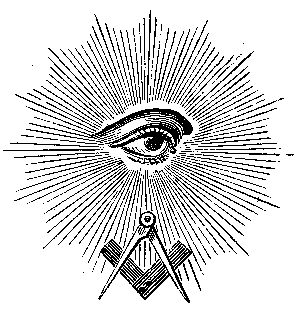
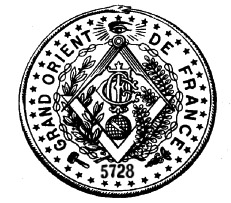
The Symbol of the Grand Orient de France includes an All Seeing Eye above the Masonic Compass & Square, surrounded by the Ouroboros serpent.33
The Temple of the GODF features the All Seeing Eye at centre place.34
1848 GODF medal commemorating the French Republic. This shows an All Seeing Eye within a triangle, around which is the GODF motto: ‘Liberty, Equality, Fraternity’.35
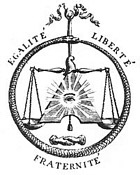
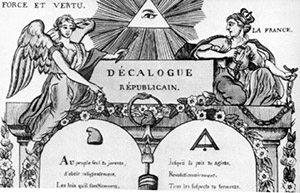
The symbols illustrating the French Revolutionary ‘Declaration on the Rights of Man and the Citizen’ feature the All Seeing Eye radiating above Moses-type tablets etched with the Declaration. Below that symbol is the self-devouring serpent, Ouroboros.36
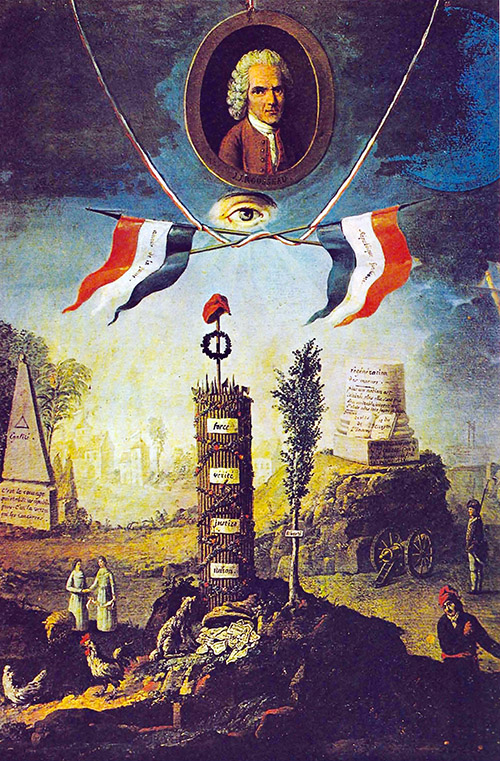
As the French Revolution progressed, Christian symbols were removed from churches and replaced by busts of such heroes of the Revolution as the anti-Catholic Voltaire, or Rousseau who accepted that man and Nature had been created by the Supreme Being but believed that Church institutions corrupted human nature:Homage to Rousseau by Jeaurat de Bertry, showing the philosopher presiding over the ‘Eye of Truth’.
It is also of interest that the title page of the seminal Encyclopedie,37 compiled by the rationalist philosophers38 under the direction of Denis Diderot, intended as a compendium of scientific knowledge to repudiate the ‘superstition’ of Christianity, is decorated with esoteric symbolism. Leading American atheist Conrad Goeringer, in writing on the contribution of Freemasonry to revolutionary ferment, states that the central figure of the title page is Lucifer, surrounded by the compass and square symbols of Masonry:39
If the bible was the holy book of the Christian enlightenment, then the Encyclopedia was the inspiration of the Enlightenment. Here was a compendium of human knowledge dealing with arts, sciences, mechanics and philosophy which swelled to some 36 volumes by 1780. Begun by the atheist Diderot in 1751, the Encyclopedia bore the imprints of Voltaire, Montesque, Rousseau, Buffon, Turgot and others. Gracing the title page of Diderot’s compendium in the first edition was a drawing of Lucifer, symbol of light and rebellion,40 standing beside the masonic symbols of square and compass.41
Why did the rationalists and humanists of the French Revolution, supposedly eschewing ‘superstition’, decorate their new holy writ with arcane symbolism? The answer is that such creeds are intended not as the end of religious worship, but as a stepping-stone by which traditional faiths are destroyed, to be replaced by a universal humanistic religion where man replaces God, and where the ultimate step is to enthrone a leader as Man-become-God.
The symbols illustrating the French Revolutionary Declaration on the Rights of Man and the Citizen feature the All Seeing Eye radiating above Moses-type tablets etched with the Declaration. Below that symbol is the self-devouring serpent, Ouroboros.
The French Revolution was the forerunner of communist revolutions that attempted to abolish Christianity. Amongst the anti-Christian fervour, babies were baptised not to the ‘Father, Son and Holy Ghost’, but to ‘Liberty, Equality, Fraternity’. In 1793 the word Sunday (dimanche) was dropped, the Gregorian calendar was replaced by a French Revolutionary Calendar, and it was prohibited to ring Church bells, display the crucifix, or hold religious processions. Robespierre’s Cult of the Supreme Being was officially inaugurated in 1794,42 opened by hymns to the Supreme Being sang by the Paris Opera choir.43 Yet these subterranean forces did not intend Paris as the capitol of the world, nor even Washington, but Jerusalem, a dream kept alive for centuries in the secret societies.
Jerusalem, World Capitol, Under the Gaze of the All Seeing Eye
In Jerusalem, the United Nations (a truly United Nations) will build a Shrine of the Prophets to serve the federated union of all continents: this will be the seat of the Supreme Court of Mankind, to settle all controversies among the federated continents, as prophesied by Isaiah. – David Ben Gurion, First Prime Minister of the State of Israel44
Jerusalem holds a central place not only for the three Abrahamic faiths of Christianity, Judaism and Islam, but for Freemasonry, possibly the result of the influence of the Knights Templar whom some researchers regard as the fathers of Masonry,45 and whom the Masons themselves acknowledge as such in their tradition. A major aim of the Freemasons, like the messianic Jews, is the rebuilding of the Temple of Solomon, around which Masonic rituals and allegories are based. Therefore, Masonry can be expected to have a special interest in the creation of the State of Israel.
The importance of Jerusalem to Masonry was stated by Albert Pike, when describing the 30° of Knight Kadoth, when the initiate learns of Masonry’s Templar origins, where it is explained that the Templars seeking to destroy the Papacy aligned themselves with the Patriarch at Constantinople, the Templars’“secret object [being] the re-building of the Temple of Solomon on the model prophesied by Ezekiel.”46 Leon Zeldis, 33° Adjunct Grand Master, Supreme Council of the Scottish Rite for the State of Israel, describes the importance of Jerusalem to Masonry, which happens to corresponds to messianic Judaism:
…King Solomon’s Temple already appears in the Old Charges of Operative Masons used by medieval Lodges and many legendary and ritual features of various Masonic degrees are related to its construction and architecture. For both Christians and Jews, Jerusalem is the focal point of the world, the place where heaven and earth touch each other (Heavenly and Earthly Jerusalem).47
Masonry staked its mark on the borders of Israel. On the Egyptian-Israeli border a marker has been erected by Masonry consisting of a pyramid, the dividers and compass symbol of Masonry and the two columns or pillars, Binah and Chokmah, of the Cabalistic Tree of Life, a feature of Masonic Temples.48
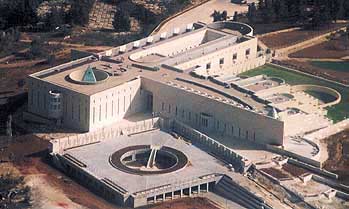
The Supreme Court building of Jerusalem, Israel, is replete with Masonic symbolism.
One of the most overt displays of Masonic symbolism is to be found in the Supreme Court building of Jerusalem. The building is replete with Masonic symbolism, and the crowning glory is the All Seeing Eye. Jerry Golden, a researcher resident in Israel, has numerous photographs of the Supreme Court building. In accord with many conspiracy theorists, Golden ultimately attributes this to the Illuminati. While there is no direct evidence of this, the Masonic symbolism is nonetheless apparent. Of additional interest is the involvement of the Rothschild banking dynasty in the construction of the building. Golden writes:
Showing the architectural design of the New Israeli Supreme Court Building designed and paid for by the Rothschilds reflects the presence of Free Masonry… The Supreme Court building sits on a plot of land opposite the Knesset [Parliament] and next to the Foreign Ministry and the Central Bank of Israel.49
The Rothschild involvement in this overtly Masonic construction is perhaps the first reliable evidence of a Rothschild connection with Masonry. Golden writes:
The Engineers who were chosen for this job by the Rothschild’s were the grandson and granddaughter of Ben-Zion Guine from Turkey who worked for Baron Rothschild, Ram Kurmi, born in Jerusalem in 1931, and Ada Karmi-Melanede born in Tel-Aviv in 1936.50
A plaque dedicated to the Rothschilds has been placed on the Supreme Court building. The emblem at the top left of the plaque is a radiating All Seeing Eye. Most evident, however, is the All Seeing Eye on a large pyramid that stands on the top of the Supreme Court building looking over Jerusalem. Golden states of this:
The first thing you will notice is the pyramid with the All Seeing Eye just like the one you will see on the American dollar bill. It sits in a circle to the left.51
These occult and Masonic correspondences suggest the Supreme Court building, in which the Rothschilds took an intimate interest, was constructed for purposes other than merely handing out sentences in the Israeli justice system. Such a building crowned with the pyramid and All Seeing Eye accord with the requirements of a World Court for a New World Order, the aim of the ages’ old traditions of occult societies to establish Jerusalem as the capitol of the universal republic.
[alert type=”success” dismiss=”no”]If you appreciate this article, please consider subscribing to help maintain this website.[/alert]
Footnotes
1. For a scholarly work on the founding of the USA by Freemasons and the dichotomy that occurred between Masons and Puritans see: Nicholas Hagger, The Secret Founding of America: The Real Story of Freemasons, Puritans & the Battle for the New World (London: Watkins Publishing, 2007).
2. The Order of the Illuminati was a crypto-Masonic secret society founded by Professor Adam Weishaupt in Bavaria, Germany, in 1776, to overthrow the Church and all monarchies, and to establish a communistic universal republic. See: Prof. J Robison (1798) Proofs of a Conspiracy (Massachusetts: Western Islands, 1967).
3. There are branches of Grand Lodge Masonry, or ‘Regular Masonry’, that do however proudly cite the involvement of other forms of Masonry in revolutions as part of a wider Masonic heritage.
4. While allegations of ‘conspiracy’ often appear exaggerated, even less scholarly is the stance of those ‘sceptics’ who insist that any form of conspiratology is delusional or ignorant. Scholarship accepts that the Thuggee was a criminal conspiracy based on religion, or that the Mafia is a criminal conspiracy based around Sicilian families reaching back centuries and spreading out from Sicily to encompass the world. Yet when someone suggests that Freemasonry, Illuminati, Bilderberger, Zionism or the Council on Foreign Relations might be involved in political and economic conspiracies, this is laughed out of academe with arrogant derision.
5. For example, the Portuguese revolution of 1910: A M Goncalves, Breve historical da Maconaria em Portugal, Pel Irmao Mestre Macom, R L Anderson No. 16 Grande Loja Regular de Portugal/GLLP, 14° Grau do Rito Escoces Antigo e Aceite. A Shortened History of Freemasonry in Portugal. English translation by W. Bro. Don Falconer, Pietre-Stones Review of Freemasonry, www.freemasons-freemasonry.com/arnaldoGeng.html. On the March 1917 Russian Revolution see: Richard L Rhoda, ‘Freemasonry in Russia’, www.mastermason.com/hempstead749/RussiaMas.htm
6. Grand Lodge of British Columbia & Yukon, ‘Anti-Masonry Frequently Asked Questions’, Section 2, version 2.9, II SYMBOLS, 3. ‘Is the eye and pyramid a Masonic symbol? No’. http://freemasonry.bcy.ca/anti-masonry/anti-masonry02.html
7. Masonic Tracing Boards comprise symbols for the instruction of Masons as they are initiated into each degree. They are laid out on the chamber floor and form the basis for lectures on Masonic allegory, history, ritual and doctrine relevant to that degree. Any symbol on a Tracing Board is therefore of importance to Masonry.
8. R. Robinson, ‘Collection of Masonic Tracing Boards’, www.freemasons-freemasonry.com/TBs.html
9. Ibid.
10. Ibid.
11. ‘Brother Washington’s Masonic Apron’, Grand Lodge of Free & Accepted Masons of Pennsylvania, www.pagrandlodge.org/mlam/apron/
12. ‘Eye of God’, Masonic Art, Grand Lodge of Yukon & British Columbia, http://freemasonry.bcy.ca/art/pontormo.html
13. ‘Eye in a triangle,’ Ibid., http://freemasonry.bcy.ca/art/eye_triangle.html
15. Dr. A Stafyla, ‘The Masonic Landmarks’, Pietre-Stones Review of Freemasonry, www.freemasons-freemasonry.com/athena1.html
16. G. Singh, ‘Mystic Pages’, Metro, 24-31 March 2004, www.metroactive.com/papers/metro/03.24.04/rosicrucian-0413.html
17. Ibid.
18. Hall was a 33º Scottish Rite Mason who founded the Philosophical Research Society in Los Angeles, USA. He was honoured by Scottish Rite Journal which called him ‘The Illustrious Manly P. Hall’ in September 1990, and honoured him as ‘Masonry’s Greatest Philosopher’.
19. Manly P. Hall, The Secret Destiny of America (Los Angeles: The Philosophical Research Society, Inc., 1944), 174.
20. H.A. Wallace, Statesmanship and Religion (New York: Round Table Press, 1934), 78-79.
21. George H.W. Bush, US Congress, 6 March 1991.
22 George W. Bush, Second Inaugural Address, United States Capitol, 20 January 2005.
23. V Stauffer, New England and the Bavarian Illuminati (Columbia University Press, 1918), 312; cited by N Hagger, op. cit., 142.
24. Grand Orient de France, ‘History’, www.godf.org/foreign/uk/histoire_uk.html
25. Ibid. (These entries seem to have been deleted since accessed in 2006).
26. Voltaire and Rousseau were the primary ideological inspirers of the French Revolution. They are depicted on the posters of the Declaration of the Rights of Man & the Citizen, along with Masonic symbolism. G. Hancock and R. Bauval, Talisman: Sacred Cities, Sacred Faith (London: Penguin Books, 2005), 21. Voltaire was escorted during his initiation into the Nine Sisters Lodge in 1778 by de Gebelin and Benjamin Franklin. G. Hancock and R. Bauval, Ibid., 460.
27. Lafayette served with the American revolutionary army, and later drafted France’s Declaration on the Rights of Man & the Citizen.
28. Garibaldi along with Mazzini, were the primary Italian revolutionaries, the latter founding a worldwide movement of which Young Italy was a constituent. Garibaldi became the first Grand Master of Memphis-Misraim Masonry, G. Hancock and R. Bauval, op. cit., 422.
29. Blanqui was a precursor of Karl Marx, and the Communist League derived from Blanqui’s League of Just. D. Conway, A Farewell to Marx (Harmondsworth: Penguin Books, 1987), 146.
30. Mikhail Bakounine was the organiser of the Anarchist movement and the primary rival to Karl Marx for leadership of the First Internationale.
31. ‘Our Values’, Grand Orient de France, www.godf.org/index.php/pages/details/slug/nos-valeurs
32. www.histoire-fr.com/revolution_francaise_monarchie_constitutionnelle_2.htm. The ‘Club of the Cordeliers’ or ‘Society of the Friends of the Rights of Man and of the Citizen’, were ultra-revolutionaries founded in 1790 to guard the ideological purity of the French Revolution. Significantly, the Club was named after the place of its foundation, a former monastery that had been seized from the Church and taken over as state property; a forerunner of communism. The Cordeliers seem to have acted as the Trotskyites of their day.
33. A depiction of the GODF symbol appears at ‘The secession of the Grand Orient de France’, Loja Luz Do Oriente No. 80, http://luzoriente.blogspot.com/2008_05_01_archive.html
34. A depiction of the GODF Temple appears at: C Hoddap, ‘Women not flocking to the Grand Orient of France’, http://freemasonsfordummies.blogspot.com/2011/04/women-not-flocking-to-grand-orient-of.html. Hoddap is a 33º Scottish Rite Mason.
35. H. Nguyen, ‘Symbols of Revolution’, http://halleynguyen294.wordpress.com/category/symbols-of-revolution/
36. Declaration of the Rights of Man & the Citizen, http://libertyeverywhere.blogspot.com/2010/12/declaration-of-rights-of-man-and.html
37. Encyclopédie, ou dictionnaire raisonné des sciences, des arts et des métiers was published in France between 1751 and 1772.
38. The so-called Encyclopedists.
39. Rt. Hon. Dr. J. Morley, M.P., ‘Denis Diderot (1713-1784)’, Encyclopaedia Britannica, Ninth Edition, 1902, www.1902encyclopedia.com/D/DID/denis-diderot.html
40. 18 and 19th century radicals, including Freemasons such as the anarchist leaders Proudhon and Mikhail Bakunin, regarded Lucifer or Satan in romantic terms as the archetypal rebel. Bakunin, for example, wrote: “Satan is the eternal rebel, the first freethinker and the emancipator of worlds.”M. Bakunin (1883), God & State (New York: Dover Publications, 1970), 112. Karl Marx wrote plays and poems extolling Satanic themes, including The Player and Oulanem. According to Australian Labour history scholar Dr. Bob James, Marx was an initiate of the Loge des Philadelphes, as were the French radical Blanc, and Italian revolutionaries Garibaldi and Mazzini. R. James, Secret Societies and the Labour Movement, Biennial Conference of the Australian Society for the Study of Labour History, Wollongong, 1999; Radical Tradition, www.takver.com/history/secsoc01.htm. Carducci, a leader of Italian Republicanism and of Scottish Rite Masonry, wrote a lengthy poem, Inno a Satana (1863) lauding a revolutionary Satan.
41. C. Goeringer, Conrad. The Enlightenment, Freemasonry, and The Illuminati, Part I – The Enlightenment, www.atheists.org/Atheism/roots/enlightenment/
42. G. Hancock and R. Bauval, op. cit., 15-16.
43. Ibid., 20.
44. David Ben Gurion, Look Magazine, 16 January 1962.
45. M. Baigent and Richard Leigh, The Temple and the Lodge (London: Jonathan Cape, 1989).
48. J. Golden, ‘Mason’s making a move in Israel, and a closer look at the Road Map’, Golden Report, 23 February 2005, ‘Masonic Monument in Eilat’, Cassiopaea Forum, 9 August 2010, http://cassiopaea.org/forum/index.php?topic=19165.0
49. J. Golden, ‘The Roots of Evil in Jerusalem’, 21 February 2011, www.thegoldenreport.com/special-reports/5-the-roots-of-evil-in-jerusalem
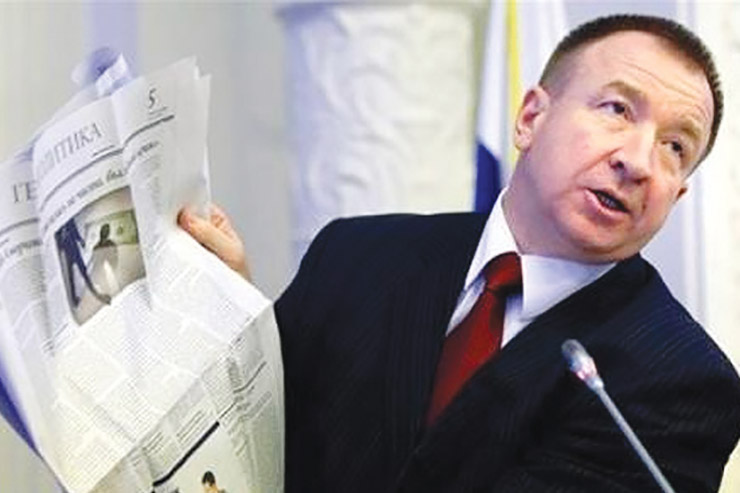
Igor Nikolaevich Panarin (b. 1958), dean of the Russian Foreign Ministry’s school for future diplomats, is a geopolitical analyst, political scientist and media commentator, with significant influence on Russian thinking. An examination of his views and public pronouncements is therefore important in discerning the outlook of Russia’s leading academic and political circles, as well as considering what influences are shaping Russian national consciousness. Panarin is a former officer of the KGB. In 1991 he reached the rank of colonel in the Federal Agency of Government Communications and Information, then the Russian equivalent of the US National Security Agency.
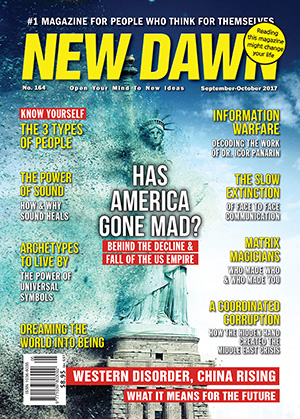
Dr. Panarin outlines two eras of US psycho-war against Russia. The first was during the Cold War. The second era, that continues today, is the period after Vladimir Putin became president of Russia. Psychological warfare is Panarin’s specialty, about which he wrote his doctoral thesis. As a strategist, his methodology is based on five stages of response: Forecasting and planning; Organisation and stimulation; Feedback; Operation adjustment; and Performance control. In response to US belligerence, Panarin proposes a centrally controlled information warfare campaign using propaganda, intelligence, analysis, secret agents, and the news media, in defence of Russia’s sovereignty and identity.
Dr. Panarin believes Russia’s destiny is Eurasia. He proposed his own version of the Eurasian Economic Union, ‘Eurasia-Rus’, an interstate formation modelled after the European Union. Panarin has called attention to the messianic legacy of Russia as the ‘Third Rome’, the centre of a new civilisation based on a sacred mission that is an inherent part of the Russian soul. This is an attitude one can discern in much of what Vladimir Putin says. The United States’ opposition to a revived Russia can thus be understood as part of a clash of world outlooks.
USA: Centre of World Revolution
This messianic outlook endures in Russia regardless of the outward mode of political expression. It is the ‘eternal Russia’ articulated in various forms by novelist Fyodor Dostoyevsky, an array of writers, thinkers and artists of the late 19th century, and the present-day advocates of ‘Eurasia’ such as Alexander Dugin and Igor Panarin. Panarin discerns the contours of ‘eternal Russia’ even under what was nominally called ‘Bolshevism’, but which owed little to Marxism after the purging of Leon Trotsky and others from 1928 onward.1 Panarin explained this dichotomy as a struggle between the world outlooks of international Marxism, under Trotsky, and what has been called ‘National Bolshevism’, under the auspices of Joseph Stalin. He points out:
On 3 July 1941 when Stalin addressed the Soviet people as “Brothers and sisters,” this doctrine became the dominant geopolitical idea of the USSR-Rus and replaced Lenin-Trotsky’s idea of world revolution which was an external (imported) geopolitical project. The Pan-Eurasian nationalism of Trubetzkoy, fused with the “Moscow–Third Rome” idea realised in the conditions of the Soviet order, yielded a result – the USSR won a victory in the global skirmish with Fascism. And the Trotskyist ideas were victorious at the end of the 20th century in the USA, vividly manifested in the ideology of the liberal globalism of the contemporary American political elite.2
Dr. Panarin’s analysis shows a depth of understanding one cannot readily find in the West’s political and scholarly circles. Although it continued using Marxist rhetoric and symbolism, after the elimination of Trotsky the Union of Soviet Socialist Republics (USSR) transfigured the doctrine of ‘world revolution’ into the old Russian messianic mission. Soviet officials and ideologues, even under the guise of ‘Bolshevism’, evoked Mother Russia, which included an end to the persecution of the Orthodox Church, much to the outrage of Trotsky and his followers in the West.
Of particular note, Panarin sees the United States as the custodian of Trotskyite ‘world revolution’. This will perplex superficial observers, especially the banal academics of the West who understand little of history’s depth. The so-called ‘neocons’, or ‘neoconservatives’, are either ‘former’ Trotskyites or the intellectual heirs of those Trotskyites who took over US foreign policy. Such was their hatred of Joseph Stalin that Trotskyism would eventually metamorphose into a primary ingredient of US foreign policy doctrine – resolute opposition to the Soviet Union.
Founded in 1949 by the CIA, the Congress for Cultural Freedom was a major ideological instrument opposing and undermining the Soviet Union. Its positions were filled with Trotskyites and their apologists. Trotsky’s widow, Natalia Sedova, publicly broke with the Trotskyite Fourth International, charging that her late husband would have supported the United States against the USSR. She stated it was the Soviet Union, not the USA, which was the primary obstacle to “world revolution.”3 Leading Trotskyite ideologue Max Shachtman became another ‘Cold Warrior’ for the USA. After the Congress for Cultural Freedom had been thoroughly exposed as a CIA front, a ‘Shachtmanite’ leader of the American Federation of Labor, Tom Kahn, was instrumental in getting the US Congress to fund the National Endowment for Democracy (NED) in 1983. The NED remains the primary centre for world revolution as a leading sponsor of the so-called “colour revolutions.”4
Gorbachev, ‘Velvet Revolution’ & the ‘Information War’
The ‘colour revolutions’ including the ‘Arab Spring’ and those in the former Soviet bloc states are recognised by Panarin as having been fostered by Washington. He has labelled the Soviet Union’s last leader, Mikhail Gorbachev, the “Antihero of Russia” for his pivotal role in the destruction of the USSR.
Gorbachev is feted among the globalist elite for bringing the Soviet bloc to ruin. He was given a gala celebration on his 80th birthday, at London’s Royal Albert Hall in 2011, where he was lauded by Israeli Prime Minister Shimon Peres, among others, as having “ended the Cold War.” Like every good retired head of state in the service of globalism, he has established his own foundation. On the occasion of his birthday celebration Gorbachev publicly threatened Vladimir Putin that should he stand for a third presidential term he might face a revolution.
Igor Panarin is acutely aware of the methods used by the United States to bring down reticent nation-states that do not comply with globalist diktats. Among these are the ‘colour’ or ‘velvet’ revolutions.
It is ironic or, better said, hypocritical, that the US ‘Deep State’ is vociferous in its allegations of Russia having ‘interfered’ in the American presidential election, although evidence is elusive. The United States has been interfering in the political processes of nations for generations. When subversion and political manipulation do not work, mass bombing as in Yugoslavia, Iraq and Libya is the final resort.
Dr. Paranin’s perception of the USA as the leader of a “neo-Trotskyist world revolution” makes him an astute political observer. He has defined precisely the character of a world struggle between two antithetical outlooks, both messianic, and both having their own world-missions: Russia, the katechon, holding back the Antichrist with an enduring self-perception of its holy mission, as expressed by such writers as Dostoyevsky; and the USA, the Great Whore, heralding the system of the Antichrist. Whether interpreted literally or symbolically, this is the reality of the world-conflict between Russia and the USA. With Europe and Australasia acting as the dupes of the USA, in the name of a ‘West’ that lost any inner meaning centuries ago.
Hence Panarin sees the ‘velvet revolution’ in Czechoslovakia (1989), and the ‘colour revolutions’ in other former Soviet bloc states, along with the ‘Arab Spring’, as manifestations of American geopolitical strategy. A primary element of this subversion is the ‘information war’, in which he specialises. Panarin lists eight different components of information operations.
The first two are “social control” and “social maneuvering” which revolve around “influencing society” to achieve “intentional control of the public aimed at gaining certain benefits.” “Disinformation,” “fabrication of information,” and “information manipulation” all relate to supporting information operations through leveraging incorrect information.5
These tactics are clearly seen in operation against Russia, including the propaganda offensive to undermine Russia’s role in Syria.
The way information war unfolds was first noted in Czechoslovakia in 1971. A nihilistic, no-talent music group called ‘Plastic People of the Universe’ was established, and became a cause célèbre, lauded by The New York Times, Voice of America, etc. From this milieu Charter 77, a key initiative of the ‘velvet revolution’, was founded. Liaising with the Solidarity movement in Poland, these groups received sponsorship from globalist foundations in the US. Vaclav Havel was chosen by the globalists as the first president of a post-Soviet Czech state.6 Like Gorbachev, he was feted by the globalists, awarded the NED’s medal for service, and served on the board of George Soros’ Drug Policy Alliance, among others.
The Soviet geopolitical bloc, once the primary bulwark against globalist hegemony, was brought down by cultural subversion and political agitation sponsored first by the US Congress for Cultural Freedom, then by NED. Later, billionaire financier George Soros and a myriad of other Western-funded NGOs spread the pernicious values of globalism in the emerging nation-states of the former Soviet bloc.
That today Russia is accused of waging ‘information war’ – directed, no less, by Dr. Panarin – is hard to beat for pure chutzpah, even by the standards of US hypocrisy and cant. Historically, the United States sponsored information and culture war of colossal proportions in the name of spreading ‘freedom’. This was described by American geopolitical strategist Major Ralph Peters as nothing short of a contagion designed to undermine the traditional fabric of states reticent about entering the brave new world.7 What Peters called “constant conflict” is tantamount to what Trotsky called “permanent revolution.”
Bret Perry in his well-researched but antagonistic article, states of Dr. Panarin:
Although not officially confirmed, it is believed that the Russian government worked with Panarin to set up an office managed by a presidential special adviser “to oversee an international network of NGOs, information agencies and training institutions” for coordinating Russia’s whole-of-government information operations.8
An article by Matthew Sussex (National Security College, Crawford School of Public Policy, College of Asia and the Pacific, Australian National University) for the Lowy Institute’s The Interpreter, focuses on the measures of ideological counter-insurgency that Russia is allegedly taking under the direction of Dr. Panarin. Sussex comments: “The West is understandably reluctant to openly engage in similar behaviour. One of the main constraints of deliberately manipulating information is that it is deceitful and dishonest.”9 To claim such moral rectitude for the “West” enters the realm of tragicomedy.
It would be naïve to assume that Russia would not respond to an information war waged against it. It is difficult to discern that Russia has anything approaching the network of NGOs, information agencies and training institutions operated by the globalist Russophobes and their dupes around the world, with vast funding from the NED, the George Soros network and a multiplicity of others. One should readily see Putin’s expulsion of this NGO network from Russia as an obvious requirement in the interests of Russia, despite the squeals about ‘democracy’ from the Machiavellian subversives who were given the boot.
Panarin’s view is that Russia needs to respond to the information war for her own “protection.” Russophobia has escalated in recent years, especially after Russia acted to defend her interests in the Ukraine, where US interference was blatant. In a 2015 interview, Panarin explained in regard to the creation of a “Russian internet” that it “is not censorship and regulation, but ‘protection’.” This was condemned as an encroachment on ‘freedom’, but the United States has long used such ‘freedom’ to propagandise and agitate. Panarin’s concern is that ‘colour revolution’ is planned for Russia. It was social media that played a pivotal role, with sponsorship from globalist interests, in the fomenting of ‘colour revolutions’ in the former Soviet bloc states and across North Africa. Russian paranoia? Not at all.
In 2008, with the backing of globalist corporations, an organisation was founded to specifically utilise social media to agitate youth. The Alliance of Youth Movements or Movements.org10 was co-founded by Jason Liebman of Howcast. This group worked with the US State Department and Defense Department. Among its corporate sponsors were: Google, Music TV, Pepsi, CBS News, Mobile Accord, Youtube, Facebook, MSN/NBC, National Geographic, Omnicom Group, Access 360 Media, and Gen Next. The ‘public partnerships’ were with Columbia Law School and the US State Department. Now its partners include the National Endowment for Democracy and Free Russia Foundation (FRF). This is how the Free Russia Foundation is described:
‘The Free Russia Foundation is a nonprofit, nonpartisan, nongovernmental US-based organization, led by Russians abroad that seeks to be a voice for those who can’t speak under the repression of the current Russian leadership. Free Russia represents and coordinates the Russian diaspora and is focused on developing a strategic vision of a free and democratic Russia and a concrete program for the transition period.11
The Washington-based SAIS Center for Transatlantic Relations is another ‘partner’, acting as a nexus between the US government, NGOs and corporations. It “engages international scholars and students directly with government officials, journalists, business executives, and other opinion leaders from both sides of the Atlantic on issues facing Europe and North America. The goal of the Center is to strengthen and reorient transatlantic relations to the dynamics of the globalizing world.”12
The Free Russian Foundation openly states: “We are focused on developing a strategic vision of Russia ‘After Putin’ and ‘Without Putinism’ and concrete programs for the transition period.” The administrators include those who have worked with the International Republican Institute, Chatham House, US Defense Department, Council on Foreign Relations and the Pentagon.13 The FRF sponsors so-called “civil society”14 which involves so-called ‘activists’ destabilising Russia.
Regardless of what one thinks of Vladimir Putin, the fact remains that Igor Panarin and others are accurate in stating there is a vast network directed against Russia, with sponsorship by the US government. What type of Russia is sought “After Putin” can be discerned from FRF partner the Committee for Russian Economic Freedom (CREF), an organisation comprised of lawyers founded in 2009 to promote ‘free market’ ideology.15 The chairman and founder of CREF, Pavel Ivlev, was “long time legal counsel for YUKOS,” an oil company that Putin nationalised, and its CEO Mikhail Khodorkovsky16 is one of the primary oligarchs Putin purged from Russia’s economic life.
Perhaps now the reader clearly understands the actual aims behind the rhetoric about ‘democracy’ and ‘human rights’ in Russia?
According to America’s apologists such as Australian academic Matthew Sussex, the ‘West’ would not consider such nefarious activities as interfering in the internal politics of a country. Rather, we are told, it is unscrupulous Russians such as Igor Panarin who have the audacity to advocate countermeasures that intrude on ‘democracy’, including the freedom of oligarchs to pillage Russia.
Balkanisation of the USA
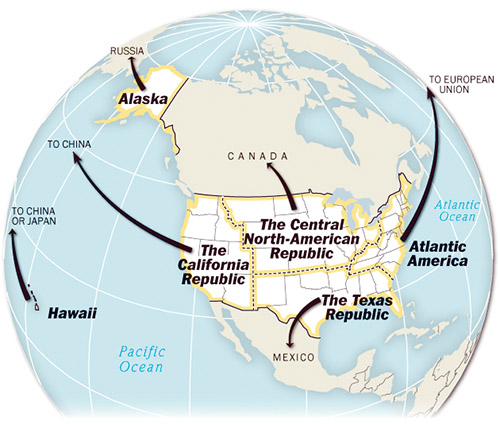
In 2010 Dr. Panarin predicted the USA would balkanise, amidst social conflict, and split into separate states. Certainly the proposition of a ‘United States’ based on constitutionalism rests on weak foundations and has nothing of an organic character about it. There is no defining feature of an American ‘ethnos’, and no basis for a positive symbiotic relationship enduring between the sundry ethnicities. Panarin claims the United States is on course to balkanise due to the stressors of its huge debt, deficit and social protests. “The overlapping financial, economic and social challenges may eventually cause the world’s strongest superpower of the 20th century to collapse,” notes Panarin.17
Map illustrating Dr. Panarin’s predicted breakup of the USA.
Far from being a fanciful scenario, the US military recently addressed the same problems emerging from rapid urbanisation in ‘megacities’.
The US military regards ‘megacities’ (populations of 10,000,000 or more) as an approaching problem of instability. The US Army comments that megacities are a unique environment that they do not fully understand.18 One of their reports gives a picture of proliferating criminal networks and underground economies, natural disasters and the inability of decaying infrastructures to withstand stressors. A predicted feature is the breakdown of civic order through ethnic and religious conflict among diverse groups that are forced together to share diminishing resources and utilities.
As resources become constrained, illicit networks could potentially fill the gap left by over-extended and undercapitalized governments. The risk of natural disasters compounded by geography, climate change, unregulated growth and substandard infrastructure will magnify the challenges of humanitarian relief. As inequality between rich and poor increases, historically antagonistic religions and ethnicities will be brought into close proximity in cities. Stagnation will coexist with unprecedented development, as slums and shanty towns rapidly expand alongside modern high-rises. This is the urban future.19
The report comments on the increasingly heterogeneous populations inherent in a megacity as potentially “explosive.”
One of the hallmarks of megacities is rapid hetero and homogeneous population growth that outstrips city governance capability. Many emerging megacities are ill-prepared to accommodate the kind of explosive growth they are experiencing.20
Radical income disparity, and racial, ethnic and sub cultural separation are major drivers of instability in megacities. As these divisions become more pronounced they create delicate tensions, which if allowed to fester, may build over time, mobilize segments of the population, and erupt as triggers of instability.21
The US Army analysis accords with the 2010 analysis of Dr. Igor Panarin. The time has indeed come to seriously consider Panarin’s unique insights into the geopolitics of today’s world and his predictions for the years ahead.
[alert type=”general” dismiss=”no”]This article was published in New Dawn 164.[/alert]
[alert type=”success” dismiss=”no”]If you appreciate this article, please consider subscribing to help maintain this website.[/alert]
Footnotes
1. K. R. Bolton, Stalin: The Enduring Legacy, Black House Publishing, 2012
2. Ivor Panarin, ‘From united Russia to Eurasian Rus’, Cyril and Methodius, 12 January 2006
3. Natalia Sedova Trotsky, letter to the Socialist Workers Party, 9 May 1951, Labour Action (17 June, 1951). See Bolton, Stalin: The Enduring Legacy, 114-119
4. Bolton, Stalin: The Enduring Legacy, 121-124
5. Jolanta Darczewska, ‘The Anatomy of Russian Information Warfare: The Crimean Operation, A Case Study’ (Warsaw, Poland: Ośrodek Studiów Wschodnich im. Marka Karpia, Centre for Eastern Studies, May, 2014); quoted by Bret Perry, ‘Non-Linear Warfare in the Ukraine: The Critical Role of Information Operations and Special Operations’, Small Wars Journal, 14 August 2015
6. C. Gershman, ‘Giving Solidarity to the World’, Georgetown University, Washington, D.C.’, 19 May 2009
7. Ralph Peters, ‘Constant Conflict’, Parameters, Summer 1997, 4-14: US Army War College, www.informationclearinghouse.info/article3011.htm
8. Bret Perry, op. cit.
9. Matthew Sussex, ‘Trump, Putin and Information Warfare’, The Interpreter, Lowy Institute, 27 July 2016
10. Tony Cartalucci, ‘Google’s Revolution Factory – Alliance of Youth Movements: Color Revolution 2.0’, Global Research, 23 February 2011, www.globalresearch.ca/index.php?context=va&aid=23283; www.movements.org
17. Igor Panarin, ‘U.S. Break-up: Myth or Reality?, Russia Times, 27 October 2011; www.rt.com/politics/panarin-usa-collapse-economy-905/
18. Colonel Marc Harris, et al., Megacities and the United States Army: Preparing for a Complex and Uncertain Future, Chief of Staff of the Army, US Army Strategic Studies Group, June 2014, 4, www.army.mil/e2/c/downloads/351235.pdf
‘The City’ – or, ‘The Square Mile’ – refers to the City of London Corporation. Together with Wall Street, The City forms the hub of the plutocratic system that controls most of the world, and is presently engulfing the few remaining states that it does not control, through the time-proven tactics of plutocracy: revolution ostensibly in the name of ‘the people’.1
Because The City is situated in England, and because it is often confused with the ancient capital, London, there has been a lot of obfuscation as to the character of the plutocratic system that is partially based in The City. Hence, there has been a great deal stated, even by the well-informed, in regard to the British Empire and even the British Crown, being intrinsically a part of this international oligarchy. This is to misunderstand the nature of international capital, which owes no steadfast loyalty to any system of government, head of state, religion, ethos, nation, ethnicity or culture. Any such allegiance is conditional.
What is ‘The City’?
The City of London Corporation is described in its promotional statements as “the world’s leading financial centre,” and as “the financial and commercial heart of Britain, the ‘Square Mile’.”2
The City of London is at the heart of the world’s financial markets. It is a unique concentration of international expertise and capital, with a supportive legal and regulatory system, an advanced communications and information technology infrastructure and an unrivalled concentration of professional services…3
Since the demise of the British Empire, worn out by two world wars that benefited it not a jot, Wall Street has popularly become identified as the international financial capital. Again, this is due to the error in thinking that Britishimperial interests were synonymous with international plutocracy, and because Britain is no longer a world power, ‘London’ is subordinated to New York. However, The City of London Corporation is neither synonymous with Britain nor British interests, other than when these happen to coincide with the interests of international finance. That is why, even though the British Empire has been defunct for over half a century, The City remains, in the words of its promoters, “at the heart of the world’s financial markets.”
Hence while Britain and the Commonwealth has a symbolic Head-of-State in the Monarch, the analogous Head-of-State for The City has precedence over the British Sovereign. The Lord Mayor of the City of London Corporation is “not the Mayor of (Greater) London”; nor is he a ‘mayor’ in the limited sense of the word. He assumes the position as ‘Head-of-State’, not of merely a borough or a county. This Lord Mayor is elected for one year, and acts as a global ambassador for the international financial institutions situated in The City, and is “treated overseas as a Cabinet level Minister.”4 He lives in the palatial 250-year-old ‘Mansion House’. On state visits the British Monarch waits at the Gate of The City to seek permission to enter and is presented with the sword of The City by the Lord Mayor.5
This tradition has been preserved for more than 400 years, and the ceremony now is carried out on major state occasions where the Queen halts at Temple Bar to request permission to enter the City of London and is offered the Lord Mayor’s Sword of State as a sign of loyalty.6
No matter how one rationalises the ceremony as an ostensible mark of ‘loyalty’ by The City towards the British Monarch, it is nonetheless the Monarch who is placed in a subordinated position in seeking permission for entry and waiting for a symbolic affirmation of loyalty from The City on each occasion.
International Finance
It should be kept in mind that ‘international finance’ is exactly that: international; not Dutch, German, British, or American. Jewish bankers might be loyal to Judaism or to Israel, and the French Huguenots who went to London had a religious identity. But international finance is not bound to the states of its residence.
The ‘modern’ financial system did not originate in Britain, or even in the Occident. Ezra Pound, the famous poet who was also an avid opponent of usury-banking and an advocate of Social Credit banking reform, traced the premises of the ‘modern’ usurious financial system back to “the loans of seed-corn in Babylon in the third millennium BC.”7
As indicated above, international finance can shift focus over the world as the requirements of commerce dictate. As for the shift of the Money Power to England, this can be traced to the English Civil War, and even to the Reformation, where a Cromwell was significant in both. Thomas Cromwell, Secretary of State, who “represented the mercantile community,”8 as distinct from the traditional landed interests, urged Henry VIII to suppress the religious Orders in 1533. Brooks Adams states of this in his historical masterpiece, The Law of Civilisation and Decay, that:
In 1533 Henry’s position was desperate. He confronted not only the pope and the emperor, but all that remained of the old feudal society, and all that survived of the decaying imaginative age. Nothing could resist this combination save the rising power of centralised capital, and Henry therefore had to become the mouthpiece of the men who gave expression to this force. He needed money, and money in abundance, and Cromwell rose to a practical dictatorship because he was fittest to provide it.9
Adams details how the era of Henry VIII and the Reformation was the beginning of the speculative, capitalistic system.10 Additionally, “The sixteenth-century landlords were a type quite distinct from the ancient feudal gentry. As a class they were gifted with the economic, and not with the martial instinct, and they throve on competition.”11
The expansion of commerce in the wake of the Age of Exploration, and the formation of the British East India Company in 1600, five years after the East India Company in Holland, were symptoms of this historical trend that had already been set in motion by the Reformation. The merchant interests felt constrained by the Monarchy and another Cromwell, Oliver, came forward, like his great-great-grand-uncle Thomas, to radically change England in the interests of money. The British Empire was expanding towards Asia and buccaneering was establishing fortunes. However,
As the city grew rich it chafed at the slow movement of the aristocracy, who, timid and peaceful, cramped it by closing the channels through which it reached the property of foreigners; and, just when the yeomanry were exasperated by rising rents, London began to glow with that energy which, when given vent, was destined to subdue so large a portion of the world. Perhaps it is not going too far to say that, even from the organisation of the East India Company, the mercantile interest controlled England. Not that it could then rule alone, it lacked the power to do so for nearly a hundred years to come; but, after 1600, its weight turned the scale on which side soever thrown.
Macaulay has very aptly observed that but for the hostility of The City, Charles the First would never have been vanquished, and that, without the help of The City, Charles the Second could scarcely have been restored.12
From the middle of the 16th century capital accumulated, and “the men adapted to be its instruments grew to be the governing class.”13 Adams states of the era, “In 1688, when the momentum of England suddenly increased, the change was equivalent to the conquest of the island by a new race.”14 London became the centre of this global expansionist acquisition, a new Rome, where the wealth of the world was deposited:
These hoards, the savings of millions of human beings for centuries, the English seized and took to London, as the Romans had taken the spoil of Greece and Pontus to Italy. What the value of the treasure was, no man can estimate, but it must have been many millions of pounds – a vast sum in proportion to the stock of the precious metals then owned by Europeans.15
What Adams calls a regime of merchants ruled England from 1688 to 1815. The wealth they accumulated, states Adams, became the primary source of power, and it was in the hands of a new breed of merchant: the bankers. “With the advent of the bankers, a profound change came over civilisation, for contraction began.”16 The value of money as distinct from the mercantile concern at the value of wares was the concern of the bankers. At the close of the 18th century “the great hoards of London” passed into the hands of the bankers, the “most conspicuous example” being the Rothschilds.17
It is here that we see a dichotomy arising between the old merchant, including the mercantile adventurers, such as Robert Clive of India to Cecil Rhodes, and on the other hand, the merchant bankers epitomised by the Rothschilds. It is here where the two are often mistaken as forming a common power elite.
Dr. Carroll Quigley18 described the character of international finance and the move of its centre to The City: “Financially, England had discovered the secret of credit. Economically, England had embarked on the Industrial Revolution.”19 Here we discern immediately a dichotomy operating within British power-politics: that of usury-based finance, which is cosmopolitan and parasitic; and that of the ingenuity of the Englishman and Scott as inventor and entrepreneur, as creator. It was this creativity and inventiveness, coupled with the bravery of the British military and the dedication of the British administrator, that was pressed into the service of parasitic finance, behind the cover of the British flag and Crown. These two factors at work: one cosmopolitan and one British, are often confused as being one and the same. Quigley continues:
Credit had been known to the Italians and the Netherlanders long before it became one of the instruments of English world supremacy. Nevertheless, the founding of the Bank of England by William Paterson and his friends in 1694 is one of the great dates in world history.20
Quigley explained, far more succinctly than economists, that the basis of the debt finance system is “fractional reserves.” This method had its origin in the realisation by goldsmiths that they did not need to hold the equivalent of gold reserves in their vaults to the amount of paper certificates issued representing the value of gold. As there was unlikely to be a run on the vault by its depositors all demanding at once the return of their gold deposits, the goldsmith could issue paper certificates far in excess of the value of the amount of gold in his vaults.21
Fractional reserves remains the method of international finance, albeit no longer with the need for gold reserves. In particular, it should be kept in mind that the basis of the system is usury, where interest is charged for the loan of this bogus credit. Not only must the principal be paid back in real wealth – productive labour or creativity – but added interest.
Quigley remarks that “in effect, this creation of paper claims greater than the reserves available means that bankers were creating money out of nothing.” According to Quigley, William Paterson, having obtained the Royal charter for the Bank of England in 1694 remarked, “The Bank hath benefit of interest on all moneys which it creates out of nothing.”22
The centre of gravity for the merchant bankers had long been Amsterdam. The “Republic of the United Provinces,” which included Holland, had from the start accorded Jews, as the catalysts of incipient international free trade, equal protection.23 According to Dr. Stanley Chapman, Professor of Economic History at Nottingham University, the Sephardic Jewish community in Amsterdam had become adroit as lenders to foreign governments.24
Shall we, then, say there had been a ‘conspiracy of Dutch merchants to rule the world’? I think not. Yet neither can it be said in justice this was a ‘Jewish conspiracy’. The establishment of the Bank of England was a Protestant affair with anti-Catholic underpinnings. From France came the Huguenots who, like the Dutch Sephardim, had established international connections through family networks across Europe and had also formed a community in The City, by the mid 18th century.25 The English Revolution of 1642-1648, which established the republican Commonwealth under Oliver Cromwell in 1649, enduring under his son Richard until 1659, had opened the way for a shift of international banking from Amsterdam to London. The impetus for British imperial expansion had started under Cromwell. The merchant coterie of Amsterdam, which had backed Cromwell, was permitted entry into England. Menasseh ben Israel had appealed to Cromwell on the grounds of mercantile profitability to any nation that gave the Jewish merchant bankers freedom, as Amsterdam had done. Menasseh assured Cromwell that profit was the best reason why the merchant bankers should be permitted into England:
Profit is a most powerfull motive, and which all the World preferres before all other things: and therefore we shall handle that point first. It is a thing confirmed, the merchandising is, as it were, the roper profession of the Nation of Jews…26
Menasseh proceeded with explanations as to why this is so, due to the lack of opportunity from the time of the Exile, to possess a state of their own and to till the land, leading Jews to “give themselves wholly unto marchandising.” Their dispersion throughout the world enabled them to form networks across borders, to engage in commerce, with a common language that transcended the linguistic barriers of others.27
While the supremacy of Money in England was set in motion by Henry VIII’s Reformation, and the English Revolution a century later heralded the triumph of the merchant, it was not until the usurpation of the Throne by William III of Orange in 1688, with the deposing of James II, that the Bank of England was established. From then on a National Debt was owed to the usurers.
From the time of King Henry I talley sticks had served as the King’s currency. These talley sticks were carved sticks broken lengthwise. The Chancellor of the Exchequer kept one half, and the King spent the other half into circulation,28 like President John F Kennedy did in 1963, when he issued $4 billion ‘United States Notes’ directly into circulation via the US Treasury, circumventing the Federal Reserve Bank.29 Eventually, the two halves would be matched to prevent counterfeiting. The talley sticks could be used as exchange for commerce and in payment of taxes. They circulated in England for 726 years until eliminated on the demand of the Bank of England in 1826.30
Although William was the maternal grandson of Charles I, he was born in Holland and destined to fulfil the legacy of Cromwell in placing England under the bondage of the merchant bankers, then centred in Holland. The anti-Catholic sentiment that had started under Henry VIII was a catalyst in assuring William support in driving James II from the Throne. Under William the authority of the Monarchy was reduced, and that of Parliament enhanced. The epochal act of William was to grant the Charter to William Paterson to establish the Bank of England. This acquiescence might be explained by William having “heavily borrowed in Amsterdam to fight his continental wars.”31 The link between the bankers of Amsterdam and of London was maintained even into the 19th century, and by the mid 18th century there was a considerable colony formed in the City by the scions of the Amsterdam banking families.32
The idea for the Bank of England came from the example of the Wisselbank, founded in 1609 which, according to the Bank of England’s account, was the lender to the City of Amsterdam, the Province of Holland and the Dutch East India Company, exercising a monopoly over state borrowing and coinage.33 The move to establish such a bank in England gained momentum “after the Glorious Revolution of 1688 when William of Orange and Queen Mary jointly ascended the throne of England.” The political economist Sir William Petty wrote that the power of England would be magnified if there were a bank to lend the Throne credit.34 He did not explain why it could not be a state bank issuing its own credit, and had to be a private bank accruing interest on credit that it makes out of nothing, as its founder, William Paterson, explained. According to Petty such a bank would “furnish Stock enough to drive the Trade of the whole Commercial World.”35
The Bank of England explains that after the rejection by Parliament of several proposals the bank and a “Fund for Perpetual Interest” were accepted, having gained support from The City on recommendation by Michael Godfrey, “a leading merchant.”36
In 1734 the Bank of England moved into a ‘vast’ purpose-built building, nicknamed ‘The Old Lady of Threadneedle Street’, in The City.37 It was from the founding of the Bank of England that “the funded National Debt was born.”38 The present-day description of credit by the Bank of England is quite illuminating. The Bank’s historical account states that at the time credit was called “imaginary money.” Until then ‘the man in the street’ had simply thought of money as coins, but this ‘shibboleth’ was now overturned. Money could take other forms “that had no intrinsic value.” “The 18th century was a period dominated by governmental demand on the Bank for finance: the National Debt grew from £12 million in 1700 to £850 million by 1815, the year of Napoleon’s defeat at Waterloo.”39
In 1946 the Bank was ‘nationalised’, but as in the nationalisation of other such banks, such as New Zealand’s Reserve Bank in 1936, this means little, as the real authority comes from the creation of credit by the international merchant bankers. However, as the Bank’s account states, in 1997 the Government formally handed its financial authorities over to the Bank and it “thus rejoined the ranks of the world’s ‘independent’ central banks.”40
The purpose of these ‘central banks’, which the general public believes are controlled by governments, was to bring into their
financial network the provincial banking centres… to form all of these into a single financial system on an international scale which manipulated the quantity and flow of money so that they were able to influence, if not control, governments on one side and industries on the other. The men who did this… aspired to establish dynasties of international bankers…41 The centre of the system was in London, with major offshoots in New York and Paris, and it has left, as its greatest achievement, an integrated banking system…42
Rothschilds: Lords of International Finance
From the establishment of the Rothschild banking dynasty in England by Nathan M Rothschild, The City becomes synonymous with that dynasty. Further still, these suddenly ‘British’ Rothschilds become ‘British’ imperialists in the manner a chameleon changes his colour according to survival needs. It is the insinuation of the Rothschilds into the British power-structure that has generated much discussion of a ‘British’ imperial conspiracy centred around Cecil Rhodes and Alfred Milner, and the so-called ‘Round Table Group’ that they founded to extend British influence throughout the world. It is further frequently claimed this emerged as an ‘Anglo-American’ conspiratorial ‘network’ that continues to the present in attempting to establish ‘Anglo-American’ global hegemony.
Theorists of this ‘Anglo-American network’ most frequently cite Harvard historian Dr. Carroll Quigley, who had access to what were presumably the papers of the Council on Foreign Relations. For reasons not known to this writer, Dr. Quigley, informative on so much in the course of his magnum opus, Tragedy & Hope, erred in thinking that an oligarchic ‘Anglo-American network’ was formed in the aftermath of World War I and continues to the present. We shall briefly examine this error in due course. However, for the moment Quigley had some pertinent things to say about both the Rothschilds and the “international system of control” that was developing.
Quigley stated that one of the primary reasons the centre of international finance shifted to London was because the British upper class, which was not as rooted in noble birth as in money, “was quite willing to recruit both money and ability from lower levels of society and even from outside the country, welcoming American heiresses and central-European Jews to its ranks.” This allowed the power structure to take on a cosmopolitan flavour. (We might note this vulgarisation of the English ruling-class seems to have begun during the time of Henry VIII).
Quigley described the development of the financial network by the international bankers into a world control system, and the assumption of the Rothschild dynasty to primacy:
In time they brought into their financial network the provisional banking centres, organised as commercial banks and savings banks, as well as insurance companies… The greatest of these dynasties, of course, were the descendents of Meyer Amschel Rothschild… whose male descendants, for at least two generations, generally married first cousins or even nieces. Rothschilds five sons, established at branches in Vienna, London, Naples, and Paris, as well as Frankfort, cooperated together in ways which other international banking dynasties copied but rarely excelled.43
Quigley pointed out these bankers were “cosmopolitan and international rather than nationalistic,”44 and this, by the very nature of their business, is what they remain.
Brooks Adams states that towards the close of the 18th century the boards of The City passed from the merchants to merchant bankers, “the most conspicuous example [being] the family of Rothschild.”45
Mayer Amschel had established his fortune by handling the financial affairs of William IX of Hesse-Kassel, who had been paid well by the British Government for supplying troops against the American revolt. At the time Amsterdam had been the capital of international banking, but the Napoleonic invasion of Holland had led to the closing of the Amsterdam Bourse, “the leading Continental exchange.” Mayer Amschel and several others were situated to provide William IX with funds.46 Additionally, in 1800 Mayer Amschel had become Imperial Crown Agent for the Emperor of Austria. He was what Derek Wilson described as “one of the first of a new breed of businessmen – the truly international merchant banker.” Wilson states that for centuries the Jews had played a prominent part in “long distance commerce” due to their communal loyalty with which they were able to create a “commercial sub-culture.” However, they were reliant on the patronage of rulers. Now, the revolutionary tumult in Europe had swept away traditional rulers and placed money on a footing of power.
In 1798 Nathan Rothschild set up shop in England and in 1806 he became a “naturalised Englishman.”47 The Rothschilds were backing the coalition against Napoleon, who was upsetting the Continental system of finance. In 1808 Nathan took over the financial affairs of the Landgrave William IX in England. That year he moved his business to 12 Great Helen’s Street, The City, under the name of N M Rothschild and Brothers.48 With agents throughout Europe, the Rothschilds were valuable allies in organising smugglers and couriers in the war against Napoleon. By now, on the initiative of Nathan Rothschild, “the nerve centre of Rothschild operations had shifted from Frankfurt to London.”49 Wilson reiterates that through Nathan’s family and his “large network of agents and couriers he was better informed about European affairs than any man in London – including members of the government.”50 Wilson is altogether too charitable in ascribing ‘patriotic’ – British – motives to Nathan, in contrast to what he frankly says about the lack of national ‘patriotism’ among the other Rothschild brothers toward anything other than “loyalty and responsibility to the Chosen People.”51 Rather, Nathan and the rest of the dynasty were assisting in the fight against Napoleon because the upstart was undermining the financial system.
Quigley explains that the credit creation mechanism developed by the international bankers, as previously described, was to become one of the chief weapons in the victory over Napoleon in 1815. “The emperor, as the last great mercantilist, could not see money in any but concrete terms, and was convinced that his efforts to fight wars on the basis of ‘sound money’, by avoiding the creation of credit, would ultimately win him a victory by bankrupting England.”52 Hence, the war against Napoleon was in part a war between two systems of economics involving the reorganisation of Europe.
The British Empire & Cecil Rhodes
It is a significant error of interpretation for historians such as Carroll Quigley or E C Knuth53 to suppose there is an ‘Anglo-American’ network working for world rule on the edifice of English sentiments. It is also erroneous to assume that because the merchant bankers found it opportune to lend credit to governments that ruled over empires, these bankers, who are cosmopolitan, have an enduring commitment to some type of nationally based imperialism, whether it be ‘British’, ‘American’, ‘German’, ‘Dutch’, etc.
The theory of the ‘Anglo-American’ network written about by Quigley was adopted by conspiracy theorists such as W Cleon Skousen.54 The basis of these theories centres on Lord Rothschild being the banker to Cecil Rhodes. The theory states that Lord Natty Rothschild was part of Rhodes’ secret society, the Round Table Groups, that aimed to spread the benevolence of British imperialism over the world.55 These imperial ideals were said to be motivated by the teachings of the Oxford art historian John Ruskin, who exhorted his students to take British culture to the ends of the Earth. While Lord Rothschild saw the Empire as the means by which commerce could be spread and maintained by force of arms, the support was pragmatic, and owes nothing to a commitment to any British ideals as envisaged by Rhodes et al. Derek Wilson writes of this in relation to Lord Rothschild’s opposition to Gladstone’s ‘flabby’ foreign policy: “But Lord Rothschild was not an unbridled expansionist. This is clearly shown by his relationship with a man who was an unbridled expansionist – Cecil Rhodes.”56
When diamonds were discovered in South Africa, the Rothschilds bought into the Anglo-African Diamond Mining Company Ltd., which was amalgamated with DeBeers. In 1887 Rhodes returned from South Africa to Britain to ask Lord Rothschild for financial backing. Lord Rothschild saw this as the means of establishing commercial stability in South Africa against their main rival, the Barnato Diamond Mining Company, which also ended up merging with DeBeers.57 For Rhodes, making money was a means of spreading British imperial ideals. Not so for Rothschild, although Rhodes persuaded himself Natty was of like mind. “He was wrong. Lord Rothschild was not an unreserved imperialist, as Rhodes gradually discovered.” In 1888 Rhodes made a will nominating Natty to administer most of his estate for funding The Round Table Groups. Wilson writes:
In response to Rhodes’ suggestion that company funds be used to finance territorial expansion, his banker advised: “if… you require money to finance territorial expansion, you will have to obtain it from other sources than the cash reserves of the DeBeers Company.” And Rhodes cannot have been very pleased to learn, in 1892, that Rothschilds had floated a loan for the Boer government of the Transvaal.58
The Rothschilds were interested in commercial stability, not British imperial expansion. By the time of the abortive Jameson Raid organised by Rhodes against the Boer Transvaal Republic in 1895,
he had long ceased to have close and cordial relations with Natty. Probably he never grasped the fact that, though the Rothschilds disliked Gladstone’s policy of colonial retrenchment, they were not advocates of unbridled imperialism for its own sake.59
Hence, when a few decades later imperialism became a hindrance to unbridled international free trade, the international bankers used the newly emergent power of the USA to scuttle the old European Empires over the course of half a century, and the oligarchs moved into the power-vacuum of the new decolonised states.60
This myth of the ‘Anglo-American network’ for world control is centred around a supposed alliance between the Royal Institute of International Affairs (RIIA) and the US globalist think tank, the Council on Foreign Relations (CFR),61 founded in the aftermath of World War I by the US power elite. Again, this assumed alliance is erroneous: the proffered alliance between the two bodies never eventuated. Far from there being accord between supposed ‘Anglophiles’ on both sides of the Atlantic, there was a breach. Peter Grose, the CFR’s historian, mentions that both sides soon rejected the suggested alliance before it eventuated.62
The Rothschilds were concerned with Britain’s imperial links “for sound commercial reasons,” but with “maximum freedom of trade.”63 It was inevitable that ‘free trade’ and the old European imperialism were going to conflict. The role assumed by the USA in subverting and destroying the old empires can be discerned by ‘The Fourteen Points’ decreed by President Woodrow Wilson as the blueprint for the post-war world in 1918;64 and by the ‘Atlantic Charter’,65 imposed on Britain by President F D Roosevelt in 1945, both of which focus on international free trade as the basis for the world economy and specifically repudiate the old empires.66
Soon after World War II the Rothschilds increased their focus on Wall Street, and their hitherto relatively small Amsterdam Incorporated was reformed as an investment bank named New Court Securities, its share capital being taken up by the Rothschild banks in Paris and London. Where hitherto the Rothschilds had mainly been concerned with negotiating loans with states, they were now involved in the rapid post-war expansion of Western commerce and industry,67 freed up by the destruction of the old empires, and the inauguration of a new era of international financial agreements, formalised by the Bretton Woods Agreement.
This is what the biographer Wilson calls the Rothschilds’ “new, deliberate internationalism”;68 no longer constrained by nation-states and imperial ideals. However, The City remains a focus. The Rothschilds led the way in forging links between Tokyo and London. Edmund co-led a delegation from The City to Tokyo in 1962 and received The Order of the Sacred Treasure from Emperor Hirohito.
Regardless of these new avenues opened up for post-war globalisation and free trade, certain plutocratic traditions remain features of The City: the ‘Gold Fixing Room’ at the Rothschild offices, New Court, continue to be the place where the leading London bullion dealers daily sit around a table “to agree on the price of gold.” N M Rothschild “continues to be the most important bullion dealer” in Britain.69 Of the “four hundred and eighty banks in the city,” Rothschild remains supreme.70
However, other avenues for profit besides the traditional dealings in gold bullion are emerging. The one for our era is credits for greenhouse emissions, and with this profit also comes new schemes for world control.
In 2008 Simon Linnett, Executive Vice Chairman of N M Rothschild, wrote a policy document on the issue.71 Linnett defines “greenhouse emissions” as the new form of “social market.” He states that while it must be free trade that operates in defining the value of the carbon emission exchange, what is required is an “international institution.” He writes that “such a market has to be established on a world basis coordinated by an international institution with a constitution to match.”72 Linnett frankly states that this involves a “new world order”:
That, perhaps, it might be regarded as having wider benefits than merely ‘saving the planet’ – perhaps it might be the basis of a new world order…73
Of various methods suggested to limit carbon emissions, carbon trading is held by Linnet to be the most effective.74 Implicit in the various measures, including funding new technology and changing the consumption habits of individuals is, “that nations have to be prepared to subordinate, to a certain extent, some of their sovereignty to this world initiative.”75 “When countries are already foregoing the right of direct control over monetary policy through the creation of independent central banks, this could be a relatively small price to pay for such inclusion.”76 The system being proposed by Linnett, in the cause of “saving the planet,” is the consolidation of the international banking system under a central authority. Linnett states that the European nations have already ceded their sovereignty to the European Union; the next step being, “to yield sovereignty to a bigger world body on carbon trading.”77 “If such a route map could be found, then perhaps we might be at the beginning of a new world constitution and a new world order.”78
The world authority that Linnett proposes he calls the World Environment Authority (WEA). This would be based in what he calls a “world city.”79 Linnett suggests that this “world city” should be London, The City, due to it being “a world financial centre (possibly ‘the’ world financial centre).”80
Whatever might be said about Wall Street, or the shift of global political power to Washington and New York, clearly The City still holds sway in the thinking of some of the primary oligarchs of international finance.
[alert type=”general” dismiss=”no”]This article was published in New Dawn 133.[/alert]
[alert type=”success” dismiss=”no”]If you appreciate this article, please consider subscribing to help maintain this website.[/alert]
Footnotes
K R Bolton, Revolution from Above, London: Arktos Media Ltd., 2011, passim.
City of London, ‘What is the City of London?’, www.cityoflondon.gov.uk/Corporation/LGNL_Services/Council_and_democracy/Council_departments/whatis.htm
Ibid., ‘The Lord Mayor of the City of London’, www.cityoflondon.gov.uk/Corporation/LGNL_Services/Council_and_democracy/Councillors_democracy_and_elections/The_Lord_Mayor/
‘History of Temple Bar’, www.thetemplebar.info/history
Ibid.
Ezra Pound (1944), America, Roosevelt & the Causes of the Present War, London: Peter Russell, 1951, 6.
Brooks Adams, The Law of Civilisation, London: MacMillan, 1896, 230.
Ibid., 233.
Ibid., 245.
Ibid., 245.
Ibid., 292-293.
Ibid., 294.
Ibid., 298.
Ibid., 305.
Ibid., 321.
Ibid., 321.
Carroll Quigley, of Harvard University, and the Foreign Service School at Georgetown University, was a scholar of considerable reputation, until he wrote a few dozen pages on the conspiratorial nature of international finance – albeit in a sympathetic light – in his 1,300 page magnum opus Tragedy & Hope in 1966.
‘The Estates General of the Republic of the United Provinces: Declaration Protecting the Interests of Jews Residing in Holland’, 13 July 1657; in Paul R Mendes-Flohr and Jehuda Reinharz (ed) The Jew in the Modern World: A Documentary History, New York: Oxford University Press, 1980, 16.
Stanley Chapman, The Rise of Merchant Banking, Oxon: Routledge, 2006, 2.
Ibid., 4.
Menasseh ben Israel, ‘How Profitable the Nation of the Jews Are’, ‘to His Highness the Lord Protector of the Commonwealth of England, Scotland and Ireland’, in Paul R Mendes-Flohr and Jehuda Reinharz (ed) The Jew in the Modern World, op. cit., 9.
Ibid., 10. The editors remark that although Menasseh’s mission to Cromwell in 1655 was “ostensibly unsuccessful, it did prepare the way for the resettlement of the Jews in England.” (Ibid., 12 Note 1).
L. LaBorde, ‘The Unholy Alliance’, Silver Trading Company, Article #18, 12 February 2012, www.silvertrading.net/articles_metals_18_the_unholy_alliance.html
J F Kennedy, ‘Executive Order 11110’, 4 June 1963.
L. LaBorde, op. cit.
Stanley Chapman op. cit. 2.
Stanley Chapman, Ibid., 3.
‘Major Developments’, Bank of England, www.bankofengland.co.uk/about/history/major_developments.htm
Peter Grose, Continuing The Inquiry:The Council on Foreign Relations from 1921 to 1996, New York: Council on Foreign Relations, 2006. The entire book can be read online at: Council on Foreign Relations: www.cfr.org/about/history/cfr/index.html; K R Bolton, Revolution from Above, op. cit., 24-25, Note 5.
Derek Wilson, op. cit., 305.
W Wilson, ‘Fourteen Points’, 1918, www.fordham.edu/halsall/mod/1918wilson.html
Franklin D Roosevelt and Winston S. Churchill, ‘The Atlantic Charter’, 14 August 1941, http://usinfo.org/docs/democracy/53.htm
E Roosevelt, As He Saw It, New York: Duell, Sloan and Pearce, 1946, 31, 35.
Derek Wilson, op. cit., 397.
Derek Wilson, Ibid.
Ibid., 436.
Ibid.
Simon Linnett, Trading Emissions: Full Global Potential, London: The Social Market Foundation, January 2008. Online at: www.smf.co.uk/assets/files/publications/SMF_Trading_Emissions.pdf