New Dawn – World's Most Unusual Magazine

Author: Dr Kerry Bolton

  • Putin, Russia, & the Rise of a New Era

    Putin, Russia, & the Rise of a New Era

    From New Dawn Special Issue Vol 7 No 6 (Dec 2013)

    The Asia-Pacific region has become the focus for the USA, China and Russia. Australia and New Zealand have sought to create an alignment with both the USA and China, while recently there have been trade overtures between Russia and New Zealand. Antipodeans might find themselves caught between super-power rivalries while our political and business elite cannot see beyond trade and economic relations, which are always secondary forces in the playing out of history.

    Perceptive Australians and New Zealanders are fortunate they have New Dawn magazine, a medium that looks at history with breadth and depth. Hence, New Dawn has long viewed Russia as the place where great historical forces will unfold.

    Despite the misgivings of some Russian patriots, Vladimir Putin has emerged as a new Russian strong-man. New Dawn saw the possibilities for Russia under Putin at the earliest days of his political ascent. For one New Dawn commentator, the rise of Putin had mystical implications that could impact on the world in an epochal way: Putin’s inauguration as Prime Minister on 9 August 1999 occurred during the week of the solar eclipse and the planetary alignment of the Grand Cross, “a highly auspicious astrological event… traditionally held to be the end of an epoch.”1

    Multipolar vs. Unipolar World

    In 2001 a story in New Dawn entitled ‘Russia vs. the New World Order’ reported Venezuelan President Hugo Chavez predicting the 21st century would give rise to a multipolar world. What some important elements in US governing circles call the “new American century”2 would be nothing of the kind, despite their increasingly aggressive efforts. Chavez, a leader of rare statesmanship, believed this would be a century of power blocs.3 Vladimir Putin’s Russia has pursued the building of a ‘multipolar’ world.

    Multipolarity is a doctrine that permeates much of the academic and ruling elite of Russia. Its most well-known proponent is Dr. Alexander Dugin, who heads the Centre for Conservative Studies, Sociology Department, at Moscow State University.4 What Chavez was referring to as unified continental power blocs, Dugin refers to as “vectors.”5

    As for Dugin’s influence in Russia, two antagonistic academics lament of him: “The growing interest among political scientists and other observers in Dugin and his activities is the result of his recent evolution from a little-known marginal radical right-winger to a notable and seemingly influential figure within Russia’s mainstream.”6

    Dugin calls his geopolitical concept “Eurasianism,” writing of this:

    In the broad sense the Eurasian Idea and even the Eurasian concept do not strictly correspond to the geopolitical boundaries of the Eurasian continent. The Eurasian Idea is a global-scale strategy that acknowledges the objectivity of globalisation and the termination of nation-states, but at the same time offers a different scenario of globalisation, which entails no unipolar world or united global government. Instead it offers several global zones (poles). The Eurasian Idea is an alternative or multipolar version of globalisation, but globalisation is the currently fundamental world process that is deciding the main vector of modern history.7

    Hence, Dugin agrees that the days of petty states are numbered and were a manifestation of a phase of history. Dugin postulates therefore something beyond petty-statism, imperialism or globalism, power blocs based on organic geopolitical realties, although details should remain open to question. Such geopolitical thinking is very much to the fore in Russia, among the highest echelons of academia and politics.

    Vladimir V. Putin

    One of the numerous globalist NGOs directed at Russia, The Jamestown Foundation,8 offered several opinions in regard to the direction of Russia with Putin’s re-election in 2012. A major concern is whether Putin’s anti-American expressions during the elections were based on electoral rhetoric in drumming up Russians against an external enemy, or a genuinely held perception of the USA as intrinsically inimical to Russia. Certainly Putin would be naïve if he regards the USA as anything other than being committed to the subordination of Russia to economic predation and cultural decay. The USA has been the home-base for the destruction of Russia as a world power since Stalin’s rejection of the USA’s vision of the post-war world in 1945,9 inaugurating the ‘Cold War’.

    Citing a report from Chatham House by James Nixey, entitled “Russia’s Geopolitical Compass,” Nixey points to four “geostrategic axes for Russia: the West, Russia’s many ‘souths’ – the Black Sea region and the Islamic world – Russia’s Far East and the Arctic North.” Nixey states that Russia no longer views the “West”10 as all-powerful, and that Obama’s post-Bush so-called “Reset” policy for rapprochement with Russia is “losing direction.” What is particularly interesting is that Nixey agrees with Sinologist Bobo Lo, Senior Research Fellow at the Centre for European Reform in London, who states “that Russia’s relations with China are nothing more than an ‘alliance of convenience’ by which Russia seeks to leverage influence with the West to gain acceptance. In this context, China is only a ‘geopolitical counterweight to the West’.”11

    There are those both on the ‘fringes’ of politics and in influential positions who see Russia as an ally rather than as a threat to Europe, a united Europe. France having more than the usual number of geopolitical realists, has a strong Russophile element that looks to Russia, including during its Soviet days, as a counterweight to US hegemony contrary to the propaganda of the Soviet bogeyman poised to ravish the Occident. It reminds one of President Charles de Gaulle’s call for a united Europe “from the Atlantic to the Urals.” The Jamestown Foundation’s article cites a view offered by Marc Rousset, a French historian and political analyst and author of La nouvelle Europe: Paris-Berlin-Moscou [The New Europe: Paris-Berlin-Moscow] (2009):

    According to Rousset, Putin would bring “bravery, foresight and pragmatism” to Russian policy in the interest of creating a geopolitical order from the Atlantic to Vladivostok. Rousset emphasised that Putin is a European from St. Petersburg working toward closer ties among Russia, Ukraine and Belarus. His conception of a Eurasian union had the possibility of creating an imperial order to rival that of the American empire and the emerging new orders in China and India12 (Rossiiskaia Gazeta, 6 March). Rousset was quoted in November of last year as seeing the emergence of an axis of Paris, Berlin and Moscow being the answer to the present crisis in the Eurozone and the means to restore Europe’s position as a major player in the international system (Rossiiskaia Gazeta, 17 November 2011). Sergei Karganov answered that line of thought in December of last year by calling on Russia to turn away from Europe and make its future with a dynamic Asia-Pacific region led by China (Rossiiskaia Gazeta, 18 December 2011).13

    Rousset’s ideal is in my opinion the preferred. While Sergei Karganov14 is in accord with the Dugin conception of “Eurasianism” vis-à-vis Russia’s place with China in Asia, Dugin also sees Russia in alliance with united Europe, and her historical relationship with “Hindustan.”15

    Dugin’s Analysis

    Indicating the seriousness with which Alexander Dugin is taken by Russia’s friends and enemies alike, Jacob W. Kipp of the Jamestown Foundation comments on Dugin’s reaction to the re-election of Putin:

    In the aftermath of Putin’s election, Aleksandr Dugin, the chief ideologue of anti-Western Eurasianism, stated that Putin stood at a moment of strategic choice: embrace the liberalism and Westernism of Russia’s bourgeois elite or the nationalism of the Russian common folk – historically the victims of the corruption of Russia’s liberal elite, which champions Russia’s subservience to the West. Dugin wrote that by promoting a Eurasian Union, Putin had already spoken the word that defined his choice. This was the path to national revival and to an economy based upon the reconstruction of Russia’s defence sector. Dugin states: “Both sides want reforms from Putin but they desire direct opposites. The elites want democratisation, modernisation, liberalisation and growing closer to the West. The people want the national idea, a firm hand, a strengthening of sovereignty, a great power state, paternalism and social justice.” This choice for Putin comes at a particularly critical moment, according to Dugin. The hegemony of the US and its allies is being tested in an emerging multipolar world. The immediate challengers are Syria and Iran. But once those two states have been defeated by military intervention, Russia itself will have to face the threat of such intervention. “…after the prepared attacks on Syria and Iran, the logical next target will be Russia. Of course, Russia will not survive such a confrontation with the West alone.”16

    However, China remains the thorny question among those who seek a revived Russia, with Dugin and his movement seeing China as a crucial ally,17 while others see China as a future rival.18

    US actions against Putin’s Russia remain as determined as those against the USSR during the Cold War. Dr. Paul Craig Roberts, US Assistant Secretary of the Treasury under the Reagan Administration, has written of the subversion of Russia:

    The Russian government has finally caught on that its political opposition is being financed by the US taxpayer-funded National Endowment for Democracy and other CIA/State Department fronts in an attempt to subvert the Russian government and install an American puppet state in the geographically largest country on earth, the one country with a nuclear arsenal sufficient to deter Washington’s aggression.19

    Roberts was referring to an Act passed by the Russian Duma (parliament) requiring the registration of NGOs receiving foreign funds, similar to the requirements of US laws that have long been in place. Roberts continued:

    The Washington-funded Russian political opposition masquerades behind “human rights” and says it works to “open Russia.” What the disloyal and treasonous Washington-funded Russian “political opposition” means by “open Russia” is to open Russia for brainwashing by Western propaganda, to open Russia to economic plunder by the West, and to open Russia to having its domestic and foreign policies determined by Washington.20

    Globalists are aiming to deconstruct Russia as they did the USSR. Fortunately, Putin is no Gorbachev. His ambition seems to be that of leading a strong Russia, as distinct from Mikhail Gorbachev’s ambition to become a globalist celebrity posturing on the world stage. When on his 80th birthday in 2011 Hollywood stars hosted a ‘gala celebration’ at the Royal Albert Hall, London, ABC News commented that the “movie stars, singers and politicians” who turned out for the show, “underlined the celebrity status Mr Gorbachev enjoys in the West, where he is widely perceived as the man who freed Eastern Europe from Soviet rule and ended the Cold War.”21 On the occasion of his birthday Gorbachev delivered what might be construed as an ultimatum to Putin on behalf of the globalist elite, “advising” him “against running for a third term as president and warning about the dangers of Arab-style social revolt.”22 As is now clear, those “Arab social revolts,” like the “colour revolutions” in the former Soviet states, were stage-managed by the globalist NGOs.

    The globalist think tanks are blatant in their intentions. The Council on Foreign Relations (CFR) opines that “Russia is heading in the wrong direction.”23 One of the CFR recommendations is to interfere with the Russian political process, urging US Congress to fund opposition movements by increased funding for the Freedom Support Act, in this instance referring specifically to the 2007-2008 presidential elections.24 Authors of the CFR report include Mark F Brzezinski, who served on the National Security Council as an adviser on Russian and Eurasian affairs under Clinton, as his father Zbigniew served in the Carter Administration; Antonia W Bouis, founding executive director of the Soros Foundations; James A Harmon, senior advisor to the Rothschild Group, et al.

    US ruling circles have a messianic mission to create a world revolution, and it is no surprise that the ideological foundations of the US ‘world revolution’ were developed by Russophobic Trotskyites during the Cold War.25 The task of publicly announcing the post-Soviet world revolution was allotted to President George W. Bush. Speaking before the National Endowment for Democracy in 2003, Bush stated that the war on Iraq was a continuation of a “world democratic revolution” that started in the Soviet bloc: “The revolution under former president Ronald Reagan freed the people of Soviet-dominated Europe, he declared, and is destined now to liberate the Middle East as well.”26
    Russia and the New World Order

    Putin has embraced “Eurasianism” as the alternative to a “new world order” based around US hegemony. In a major foreign policy article in 2012, Putin outlined the main premises. He stated that Russian would be guided by her own interests first, based on Russia’s strength, and would not be dictated to by outsiders. While Putin uses the term “new world order,” it is one that is antithetical to the globalist version. He questions the US missiles being placed on Russia’s borders, and the continuing belligerence of NATO, stating that, “The Americans have become obsessed with the idea of becoming absolutely invulnerable.”27 Importantly, Putin is fully aware that globalist agendas are being imposed behind the facade of “human rights,” and criticises the selectivity by which this morality is applied:

    The recent series of armed conflicts started under the pretext of humanitarian aims is undermining the time-honoured principle of state sovereignty, creating a moral and legal void in the practice of international relations.28

    Putin refers to the “Arab Spring,” noting outside interference in a “domestic conflict.” “The revolting slaughter of Muammar Gaddafi… was primeval,” Putin states, and the Libyan scenario should not be permitted in Syria. He adds of the “regime changes,”

    It appears that with the Arab Spring countries, as with Iraq, Russian companies are losing their decades-long positions in local commercial markets and are being deprived of large commercial contracts. The niches thus vacated are being filled by the economic operatives of the states that had a hand in the change of the ruling regime. One could reasonably conclude that tragic events have been encouraged to a certain extent by someone’s interest in a re-division of the commercial market rather than a concern for human rights.29

    Putin sees Russia developing her historic relations with the Arab states, despite the “regime changes.” He also points out the political uses that are being made of social media which played such a significant role in mobilising and agitating masses during the “Arab Spring,” and indeed in the “colour revolutions” on Russia’s doorstep.30 Putin also acknowledges the subversive role of the NGOs not least of whose actions are being directed against Russia, stating, “…the activities of ‘pseudo-NGOs’ and other agencies that try to destabilise other countries with outside support are unacceptable.” He remarks on the failure of US and NATO intervention in Afghanistan and mentions Russia’s historic relationship with that country.31

    While Russia is seen as having an important role in the Asia-Pacific region, and Putin puts stress on alignment with a strong China, he also declares:

    Russia is an inalienable and organic part of Greater Europe and European civilisation. Our citizens think of themselves as Europeans. We are by no means indifferent to developments in united Europe. That is why Russia proposes moving toward the creation of a common economic and human space from the Atlantic to the Pacific Ocean – a community referred by Russian experts to as ‘the Union of Europe’, which will strengthen Russia’s potential and position in its economic pivot toward the ‘new Asia’.32

    Putin refers to an exciting new vision of a bloc expanding from “Lisbon to Vladivostok.” He sees Russia’s acceptance to membership of the World Trade Organisation as “symbolic,” while having defended Russian’s interests. With Russia looking at the Asia-Pacific region, will she be a nexus between this region and Europe, or will she enter the region as a junior partner with China? Some geopolitical analysts are referring to a new geopolitical bloc, challenging both the USA and China, as Eurosiberia33 rather than Eurasia.

    In an act of statesmanship, Putin pre-empted President Obama’s determination to bomb Syria by suggesting Syria place its chemical weapons stockpiles for disposal with the United Nations – a plan Syria accepted.

    Putin sees the offensive against Syria in world historical terms in determining what type of world is being moulded. While Russian ships face US and some French and British ships, he has rebuked Obama’s statements – like those of US presidents before him – that the USA has “an exceptional role.” In his appeal to the American people published in the New York Times, Putin questions the USA’s strategy stating that, “It is alarming that military intervention in internal conflicts in foreign countries has become commonplace for the United States.” Condemning the basis of the “new world order” that is being imposed with US weaponry, Putin writes that having studied Obama’s recent address:

    …I would rather disagree with a case he made on American exceptionalism, stating that the United States’ policy is ‘what makes America different. It’s what makes us exceptional’. It is extremely dangerous to encourage people to see themselves as exceptional, whatever the motivation. There are big countries and small countries, rich and poor, those with long democratic traditions and those still finding their way to democracy. Their policies differ, too. We are all different, but when we ask for the Lord’s blessings, we must not forget that God created us equal.34

    Gain a deeper understanding of the conflict between Putin’s Russia and the West. Check out New Dawn Special Issue Vol 8 No 5, with an article by KR Bolton entitled “The Great Conspiracy Against Russia: What is Really Behind the Campaign Against Putin”. 

    [alert type=”general” dismiss=”no”]This article was published in New Dawn Special Issue Vol 7 No 6.[/alert]

    [alert type=”success” dismiss=”no”]If you appreciate this article, please consider subscribing to help maintain this website.[/alert]

    Footnotes

    1. Viacheslav N Lutsenko, ‘Who are you Mr Putin?’, New Dawn, September-October 2001, 86.

    2. For example, as in the name of the neocon globalist think-tank, ‘Project for a New American Century’, www.newamericancentury.org

    3. Susan Bryce, ‘Russia vs. the New World Order’, New Dawn, January-February 2001, 25.

    4. www.konservatizm.org

    5. K R Bolton, ‘An ANZAC-Indo-Russian Alliance? Geopolitical Alternatives for New Zealand and Australian’, India Quarterly, Vol. 66, No. 2 (2010), 183-201. Also: K R Bolton, Geopolitics of the Indo-Pacific: Emerging Conflicts, New Alliances (London: Black House Publishing, 2013). I do not see why Australia (and presumably New Zealand) should come under a ‘vector’ that is focused either on the USA or China, and believe that Dugin is being overly generous towards those two hegemonistic powers.

    6. Anton Shekhovtsov, and Andreas Umland, ‘Is Aleksandr Dugin a Traditionalist? ‘Neo-Eurasianism’ and Perennial Philosophy’, The Russian Review, October, 2009, 662–78.

    7. A Dugin, The Eurasian Idea, 2009.

    8. The Jamestown Foundation, ‘Mission’, www.jamestown.org/aboutus/

    9. K R Bolton, ‘Origins of the Cold War: How Stalin Foiled a New World Order’, 31 May 2010, www.foreignpolicyjournal.com/2010/05/31/origins-of-the-cold-war-how-stalin-foild-a-new-world-order Also see: K R Bolton, Stalin: the Enduring Legacy (London: Black House Publishing, 2012), 125-139.

    10. ‘The West’ is a misnomer, more accurately termed the ‘post-West’ under plutocratic control, as any notion of Western Culture has long since been smothered by Mammon.

    11. Jacob W Kipp, ‘The Elections are over and Putin won: whither Russia?’, 30 March 2012, www.jamestown.org/programs/edm/single/?tx_ttnews[tt_news]=39215&cHash=5bc45dc36c8f713aa6f5e393e5eae5b4

    12. There need be no rivalry between Russia and India, but rather the continuation of the historical alignment between them.

    13. Jacob W Kipp. op. cit.

    14. Interestingly, Sergei Karganov, founder of think tank Council for Foreign and Defense Policy, has been a member of the Rockefeller-founded globalist think tank The Trilateral Commission since 1998, and a member of the International Advisory Board of the Council on Foreign Relations, 1995-2005; http://karaganov.ru/en/pages/biography

    15. K R Bolton, ‘An ANZAC-Indo-Russian Alliance’, op. cit.

    16. Jacob W Kipp, op. cit.

    17. Aleksandr Dugin, Argumenty i Fakty, March 14, 2012, cited by Kipp. Ibid.

    18. See: K R Bolton, ‘Russia and China: an approaching conflict?’, op. cit.

    19. Paul Craig Roberts, ‘War on all fronts’, Foreign Policy Journal, 19 July 2012, www.foreignpolicyjournal.com/2012/07/19/war-on-all-fronts/

    20. Ibid.

    21. Reuters, ABC News, ‘Stars honour Gorbachev at gala birthday bash’, 31 March 2011, www.abc.net.au/news/stories/2011/03/31/3178823.htm).

    22. H Klaiman, “Peres attends Gorbachev’s birthday bash in London,” 31 March 2011, www.ynetnews.com/articles/0,7340,L-4050192,00.html

    23. Jack Kemp, et al, Russia’s Wrong Direction: What the United States Can and Should Do, Independent Task Force Report no. 57 (New York: Council on Foreign Relations, 2006) xi. The publication can be downloaded at www.cfr.org/publication/9997/

    24. Ibid.

    25. K R Bolton, ‘America’s “World Revolution”: Neo-Trotskyist Foundations of US foreign policy’, Foreign Policy Journal, 3 May 2010, www.foreignpolicyjournal.com/2010/05/03/americas-world-revolution-neo-trotskyist-foundations-of-u-s-foreign-policy/

    26. Fred Barbash, ‘Bush: Iraq Part of “Global Democratic Revolution”: Liberation of Middle East Portrayed as Continuation of Reagan’s Policies’, Washington Post, 6 November 2003.

    27. Vladimir Putin, ‘Russia and the changing world’, RiaNovosti, 27 February 2012, http://en.rian.ru/world/20120227/171547818.html

    28. Ibid.

    29. Ibid.

    30. K R Bolton, ‘Twitters of the World Revolution: The Digital New-New Left’, Foreign Policy Journal, 28 February 2011, www.foreignpolicyjournal.com/2011/02/28/twitterers-of-the-world-revolution-the-digital-new-new-left/ Also: K R Bolton, Revolution from Above, op. cit., 235-240.

    31. V Putin, op. cit.

    32. Ibid.

    33. Guillaume Faye, ‘The New Concept of “Eurosiberia”’, Counter-Currents Publishing, www.counter-currents.com/2010/08/faye-on-eurosiberia/

    34. Vladimir V Putin, ‘A Plea for Caution from Russia’, New York Times, 11 September 2013, www.nytimes.com/2013/09/12/opinion/putin-plea-for-caution-from-russia-on-syria.html?_r=0

    © New Dawn Magazine and the respective author.
    For our reproduction notice, click here.
  • Rudolf Steiner, Secret Societies & ‘The Ahrimanic Deception’

    Rudolf Steiner, Secret Societies & ‘The Ahrimanic Deception’

    From New Dawn 136 (Jan-Feb 2013)

    Many believe there is an ‘occult’ or ‘spiritual war’ taking place between forces of ‘light’ and ‘darkness’, or ‘good’ and ‘evil’, and that this ‘war’ manifests on the material and mortal planes politically, culturally, spiritually, and economically.

    It is often surprisingly difficult to discern the affiliations in this ‘battle’, with the multitude of occult Orders, Schools and personalities. These often use similar or even identical terminologies and symbols, and draw on the same traditions and origins. In such a situation well-meaning people are easily duped into supporting long-range aims of which they do not understand.

    Occult War: Adepts ‘Black’ & ‘White’

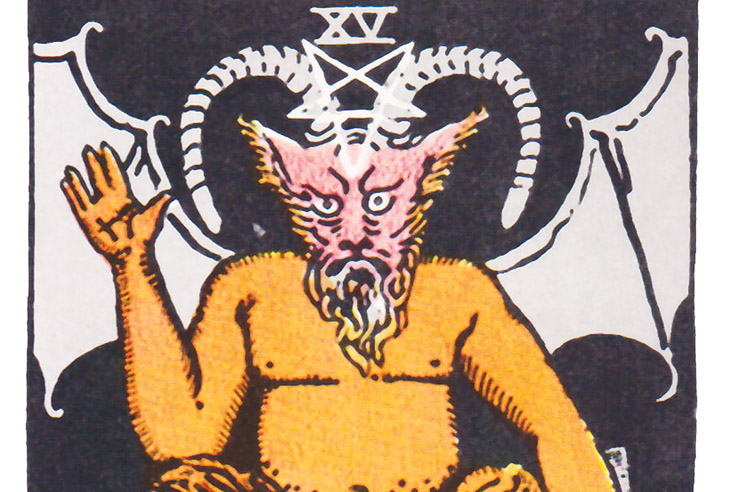
    The definition of ‘good and evil’, or ‘light and dark’, metaphysically can – from an esoteric perspective – be regarded as a dichotomy between those who seek a higher spiritual path for mankind, and those who seek to enchain man to matter. This dichotomy is well portrayed in the standard depictions of ‘The Devil’ trump in the Tarot Major Arcana.1 Paul Foster Case, founder of the Builders of the Adytum, gave a particularly apt explanation:

    In its most general meanings, it signifies Mammon and thus big business, the conventions of society, the injustice and cruelty of a social order in which money takes the place of God, in which humanity is bestialised, in which war is engineered by greed masquerading as patriotism, in which fear is dominant. Students of astrology will have no difficulty in seeing how this corresponds to Capricorn, the sign of big business, and the sign of world fame.2

    One sees in this Trump a male and female human each starting to take on the appearance of wild beasts – with horns and tails – enchained to a solid block, representing matter, with the Devil enthroned. As Case states, it is symbolic of the reign of Mammon, which is ushered in by materialistic doctrines such as Capitalism and Marxism, keeping humanity focused on lower pursuits in the guise of ‘progress’ and ‘freedom’.

    Occultists such as René Guenon, Aleister Crowley and Julius Evola3 have sought to identify contending Schools as ‘White’ and ‘Black’ Brotherhoods, or as ‘Right’ and ‘Left’ Hand Paths.

    Given the confusion that exists – because individuals and occult currents that are diametrically opposed often claim to represent the same traditions – the biblical injunction ‘by their fruits ye shall know them’ is the best formula for identifying motives, although this also is often obscure. For example, the notorious English occultist Aleister Crowley, whose ‘evil’ antics played up to the tabloid press, could easily be regarded as a ‘Black Adept’. Although Crowley claimed to work in the tradition of, among others, and for unclear reasons, the 18th century Black Adept Adam Weishaupt and his crypto-Masonic Illuminati, Crowley sought to expose the spiritual war that was taking place between the ‘White’ and ‘Black’ Adepts,4 while his doctrine of Thelema is antithetical to the doctrine of the Illuminati.5 Also, while having been a Freemason, as was Eliphas Levi,6 Rene Guenon7 condemned the Black Adepts who had subverted and redirected Masonry.8

    Steiner and The Ahrimanic Deception

    Rudolf Steiner (1861-1925), founder of Anthroposophy, whose influence has gone far beyond ‘occult’ circles for his prominence in alternative education, architecture, and organic agriculture, was one of those seminal personalities who believed in the existence of such an ‘occult war’. Again, as with Crowley, difficulties are encountered due to Steiner’s own affiliations with Freemasonry.9 However, Steiner, like Guenon, Evola, Levi and Crowley, forthrightly sought to expose a Dark current at work within the secret societies, and in particular within Freemasonry, whose influence was being directed in the world politically.

    In a 1919 lecture delivered in Zurich entitled ‘The Ahrimanic Deception’, Steiner stated that, “a great part of mankind today is already under the control, from one side or another, of Ahrimanic forces of a cosmic nature which are growing stronger and stronger.” Steiner had an unusual perception of what he called the “Luciferic Impulse,” which he stated manifested on Earth in 3000 BCE. The Luciferic Impulse prepared the way for the “Christ Impulse” in Steiner’s cosmology. Both ‘Impulses’ began to fade and mankind has therefore become increasingly materialistic. Steiner stated this Ahrimanic Deception emanates from an actual being:

    The Ahrimanic impulse proceeds from a supersensible Being different from the Being of Christ or of Lucifer.… The influence of this Being becomes especially powerful in the Fifth Post-Atlantean Epoch. If we look at the confused conditions of recent years we shall find that men have been brought to such chaotic conditions mainly through the Ahrimanic powers.10

    While the Luciferic Impulse pushed humanity into what Nietzsche might have called the Dionysian passion that gives birth to arts and brings humanity outside of itself, albeit, according to Steiner, with a “false spirituality,” “Ahriman is the power that makes man dry, prosaic, philistine – that ossifies him and brings him to the superstition of materialism.”11 Ahriman would seem to equate with the Christian perception of the Antichrist. The Christ Impulse balances the two poles, in what in some respects seems akin to a Hegelian dialectic.

    And the true nature and being of man is essentially the effort to hold the balance between the powers of Lucifer and Ahriman; the Christ Impulse helps present humanity to establish this equilibrium…. [T]he Ahrimanic influence has been at work since the middle of the fifteenth century and will increase in strength until an actual incarnation of Ahriman takes place among Western humanity.12

    Preparing the Way for Ahriman

    The relevance of this concept of the Ahrimanic Deception in regard to an ‘occult war’ for world rule, is that:

    Now it is characteristic of such things that they are prepared long in advance. Ahrimanic powers prepare the evolution of mankind in such a way that it can fall a prey to Ahriman when he appears in human form within Western civilisation… Ahriman will appear in human form and the only question is, how he will find humanity prepared. Will his preparations have secured for him as followers the whole of mankind that today calls itself civilised, or will he find a humanity that can offer resistance.13

    The way in which humanity looks at the cosmos under the Ahrimanic Deception is not with the spiritual awe and sense of place of those of past Civilisations, including, we could add, those of Gothic man in Western Civilisation’s cycle of youth, as the philosopher-historian Oswald Spengler pointed out,14 but as merely part of a mechanical and mathematical process. Steiner said of this:

    Today man gazes from his earth up to the star-world and to him it is filled with fixed stars, suns, planets, comets, and so on. But with what means does he examine all that looks down to him out of cosmic space? He examines it with mathematics, with the science of mechanics. What lies around the earth is robbed of spirit, robbed of soul, even of life. It is a great mechanism, in fact, only to be grasped by the aid of mathematical, mechanistic laws.…15

    We might state of this Ahrimanic Deception that it motivates Rationalism and Materialism, the dominant ideologies of the Late West.16 Steiner warned that the Ahrimanic Deception aims to imbue Man with “scientific superstition,” an “external illusion,” that while necessary (it was far from Steiner’s intent to repudiate the sciences) has made what we can identify as Rationalism and Materialism into a dogma.

    The second method of the Ahrimanic Deception is to split society into contending factions. Steiner aptly identified Marxism, a product of Scientism, as a primary method of the Ahrimanic Deception.

    Since the times of the Reformation and the Renaissance the economist has emerged as the new priest into the increasingly materialistic world, while Steiner also pointed out that Christian religion had also become desacralised.

    Since that time the economist has been in command. Rulers are in fact merely the handymen, the understrappers of the economists. One must not imagine that the rulers of modern times are anything but the understrappers of the economists.17

    Steiner next alludes to a very important matter, the power that the bankers have assumed:

    In the nineteenth century the ‘economical’ man is replaced for the first time by the man thinking in terms of banking, and in the nineteenth century there is created for the first time the organisation of finance which swamps every other relationship. One must only be able to look into these things and follow them up empirically and practically.18

    This statement provides the key to the history of the ‘modern world’ for the past several hundred years, and the human agency pushing for a world state – a ‘New World Order’ – enchained to the dead weight of matter.19 The power of the international banking cabals prepares the way for an Ahrimanic World Order by reorienting the spirit of Man:

    If men do not realise that the rights-state and the organism of the Spirit must be set against the economic order called up through the economists and the banks, then again, through this lack of awareness, Ahriman will find an important instrument for preparing his incarnation.20

    Role of Secret Societies

    The ‘Ahrimanic Deception’ equates with what Guenon and Evola referred to as the ‘Counter-Tradition’. The secret societies it uses behind the façade of the Perennial Tradition are the ‘Anti-Tradition’. Steiner lectured on the role of these secret societies in the occult war.

    While referring to both the “humanitarian works” and the spiritual evolution that is supposedly at the foundation of Freemasonry,21 Steiner, like Levi, Crowley, Evola and Guenon, also spoke of the manner the ‘Ahrimanic Deception’ operates through Freemasonry. Steiner even went further than anti-Masonic ‘conspiracy theorists’ such as Nesta H Webster22 and the eminent Scottish scholar, Prof. John Robison,23 himself a Grand Lodge Freemason, both of whom accepted English Masonry’s innocence of intrigue. Steiner, however, made a particular point of discussing the origins of Continental Masonry in the English Lodges. Despite its repudiation of ‘irregular’ Grand Orient Masonry that predominates on Continental Europe and Latin America, English Grand Lodge Masonry, stated Steiner, was also involved in a struggle for world power. He said the British Government was subverted by the secret societies, and that in particular foreign affairs was taken over by “an inner committee.”24 Steiner, in tracing the origins of Grand Orient Masonry to the Grand Lodge, wrote that:

    But everywhere in a different way, in many places outside the actual British realm, Freemasonry pursues exclusively or mainly political interests. Such political interests in the most palpable sense are pursued by the ‘Grand-Orient de France’, but also by other ‘Grand Orients’. One might now say: what has that to do with the English?… But view this in conjunction with the fact that the first High-degree Lodge in Paris was founded from England, not France! Not French people but Britons founded it; they only wove the French into their Lodge…25

    After listing the Lodges that were founded under the impetus of the English Grand Lodge, from Spain to Russia, Steiner adds that, “these Lodges were founded as the external instruments for certain occult-political impulses.” These impulses included the “fury of the Jacobins,”26 (who launched a Reign of Terror over France in the name of ‘Liberty, Equality, Fraternity’); Weishaupt’s Illuminati and the Italian Carbonari. Although Steiner admits these began without “evil” intent (which I would dispute), they “continued their underground work in many different forms,” after being driven underground. Steiner alludes to the disingenuousness of Grand Lodge Masonry in being able to say:

    ‘[L]ook at our Lodges, they are very respectable – and we are not concerned with the others’. But if one can see through the historical connection and the driving forces in an interplay of mutual opposition to one another, then it is indeed high British politics that is concealed behind it.27

    Of the “occult-political” societies, Steiner observed they serve a materialistic aim behind the façade of spirituality: what Guenon and Evola called “Anti-Tradition,” and Levi called “profanity.” These “various Orders” are “not spiritual, because of their purposes and goals.” They are the secret societies that work in the name of “democracy” and a “universal republic” (as did the Jacobins and the Illuminati). Steiner warned:

    If one wants as a person of modern times to see clearly in order to meet the world openly and understand it, then one should not let oneself be blinded by democratic logic, which is justified only in its own sphere, or by phrases concerning democratic progress etc. One would have also to point to the interposing of something that reveals itself in the attempt to give rulership to the few through the means available within the Lodges – namely, ritual and its suggestive effect.28

    While genuine mystical lodges exist(ed) – even Guenon sought initiation in them, as did Steiner – both pointed out that one must be cognisant of those Orders with mystical trappings and claims to ancient pedigree as a mask for other motives, as they are “often nebulous, maybe even fraudulent”… “For power is of special importance for these secret societies, not insight.”29

    [alert type=”general” dismiss=”no”]This article was published in New Dawn 136.[/alert]

    [alert type=”success” dismiss=”no”]If you appreciate this article, please consider subscribing to help maintain this website.[/alert]

    Footnotes

    1. For example, the popular ‘Rider-Waite Tarot Deck’.

    2. Paul Foster Case, Oracle of The Tarot: A Course on Tarot Divination, Chapter 6, ‘The Major Trumps: 15. Le Diable’, http://tarotinstitute.com/free/Oracle2.pdf.

    3. Julius Evola, Men Among the Ruins, Inner Traditions, 2002, 250-251.

    4. Aleister Crowley, Magick Without Tears, Falcon Press, 1983, 66.

    5. K R Bolton, ‘Aleister Crowley as Political Theorist’, Crowley: Thoughts & Perspectives Vol. II, Troy Southgate, editor, Black Front Press, 2011, 5-27; Keith Preston, ‘The Whole of The Law: The Political Dimensions of Crowley’s Thought, ibid., 68-84.

    6. Eliphas Levi, The History of Magic, translated by A E Waite, 1913, Rider, 1982, 310. Levi in condemning the “profanity” of Freemasonry and its involvement in political subversion, including the French Revolution, was doing so as an initiate of the 18°, the Rosicrucian Degree. This is indicated in a footnote to his History of Magic, where he states: “Having attained by our efforts to a grade of knowledge which imposes silence, we regard ourselves as pledged by our convictions even more than by an oath.… and we shall in no wise fail to deserve the princely crown of the Rosy Cross….” (286). Levi here states that he was staying true to what he considered the genuine Tradition of Masonry, whilst condemning what he saw as the perversion of Masonry by the Counter-Tradition. His reference to the Masonic oath attached to the ‘Rosy Cross’ indicates he had reached as far as the 18° of Knight of the Pelican & Eagle & Sovereign Prince Rose Croix of Heredom.

    7. Robin Waterfield, René Guenon & the Future of The West, Sophia Perennis, 2002, 21.

    8. René Guenon, The Reign of Quantity and the Signs of the Times, New York, Sophia Perennis, 2001, 260-261.

    9. ‘Was Rudolf Steiner a Freemason?’, www.fourhares.com/freemasonry/Steiner_and_masonry.html

    10. Rudolf Steiner, ‘The Ahrimanic Deception’, Zurich, 27 October 1919, http://wn.rsarchive.org/Lectures/AhrDec_index.html

    11. Ibid.

    12. Ibid.

    13. Ibid.

    14. Oswald Spengler , The Decline of The West, George Allen & Unwin, 1971. Spengler, writing in the early 20th century, contended that history is not lineal-progressive, but that each Civilisation is self-contained and goes through its own analogous organic cycles of birth, youth, maturity, old age and death. During the latter epochs of a Civilisation, culture becomes ossified and materialistic and money-thinking dominates. This is the cycle of present Western Civilisation. Broadly, the historical-cyclic theories of both Steiner and Spengler can be used in tandem.

    15. Rudolf Steiner, ‘The Ahrimanic Deception’, op. cit.

    16. Vide, Spengler, op. cit.

    17. Ibid.

    18. Ibid.

    19. For the political agendas of the International Bankers, including the connections with Marxism, see: K R Bolton, Revolution from Above, Arktos Media Ltd, 2011.

    20. Rudolf Steiner, ‘The Ahrimanic Deception’, op. cit.

    21. Rudolf Steiner, ‘The Work of the Secret Societies in the World’, Berlin, 23 December 1904, http://wn.rsarchive.org/Lectures/19041223p02.html

    22. Nesta H Webster, Secret Societies & Subversive Movements, Britons Publishing Co., 1964, Chapter 6, ‘The Grand Lodge Era’, 128-129.

    23. John Robison, 1798, Proofs of a Conspiracy, Western Islands, 1967, ‘Introduction’, 6.

    24. Rudolf Steiner, ‘The Karma of Untruthfulness’, ‘Rudolf Steiner Archive, GA 173’, 18 December 1916, www.rsarchive.org/Lectures/GA/index.php?ga=GA0173

    25. Rudolf Steiner, ‘Karma of Untruthfulness, Part II’, GA 174, 8 January 1917, www.rsarchive.org/GA/index.php?ga=GA0174

    26 Ibid.

    27. Ibid.

    28. Ibid.

    29. Rudolf Steiner, ‘The History & Actuality of Imperialism’, Dornach, Switzerland, 21 February 1920.

    © New Dawn Magazine and the respective author.
    For our reproduction notice, click here.
  • The New World Order Vs. The New Age: Separating Truth from Falsehood

    The New World Order Vs. The New Age: Separating Truth from Falsehood

    From New Dawn Special Issue Vol 6 No 6 (Dec 2012)

    There are numerous difficulties in trying to discern what among the proliferation of new or revived faiths might be regarded as working to usher forth a New Age based on eternal values, and those that work to establish the rule of malignant, matter-bound forces. The problem is that there are often superficial resemblances that occur between them. Even within the same occult orders, such as Freemasonry, there are a range of views that might be in opposition but are mistaken as being part of a single, all-embracing conspiracy. There is a tangle of terminology, groups, personalities, ‘Hidden Masters’, accusations and counter-accusations of black magic, and so forth. This article considers ways in which the positive and negative currents within the ‘New Age’ might be identified.

    The Cycles of Rise and Fall

    The school of Perennial Tradition regards traditional cultures, religions and spiritualities as sharing core beliefs, values of an eternal nature, on which are founded Civilisations and societies in their cycles of health. Hence, in the analogous cycles of cultures as far removed geographically and ethnically as the Japanese, Hindu, Norse, and Arabian, all will possess analogous beliefs in regard to social hierarchy, chivalric ethos, and a nexus that exists between the Divine and the temporal. In such a society one’s highest calling, whether as peasant or prince, is to work in accord with one’s cosmic duty, or what the Hindus call dharma. In such a society castes reflect the Divine order on earth: ‘as above, so below’, and degenerate into contending economic classes in the cycle of decline.1

    This cyclical view of history2 is another shared featured of various Traditional cultures, expressed in the Norse,3 Hindu,4 Hopi oral lore,5 and many others. In our own era the German historian-philosopher Oswald Spengler provided empirical evidence for the cyclicity of cultures.6 The two primary Traditionalist exponents of cultural cyclicity in our era are Rene Guenon7 and Julius Evola.8 Esoterically, it is the cycle of life expressed in ‘The Wheel’ of the ‘Major Arcana’ of the Tarot, which is derived from the Medieval ‘Wheel of Fortune’ or Rota Fortuna depicted in Gothic Churches.9 

    Tradition, Anti-Tradition & Counter-Tradition

    A glance at cultural cycles is necessary to identify the occult forces that work in the context of Tradition for a return to eternal values based on a reconnection with the Divine, and those that want to enslave humanity to matter. Again, recourse to Tarot symbolism is instructive. Here we see that the Counter-Tradition that stands behind Anti-Tradition, is in the esoteric sense, literally satanic. Paul Foster Case10 provides a meaning for ‘The Devil’ trump that is particularly relevant:

    In its most general meanings, it signifies Mammon and thus big business, the conventions of society, the injustice and cruelty of a social order in which money takes the place of God, in which humanity is bestialised, in which war is engineered by greed masquerading as patriotism, in which fear is dominant. Students of astrology will have no difficulty in seeing how this corresponds to Capricorn, the sign of big business, and the sign of world fame.11

    In this one paragraph Case says much. He cogently differentiates the Traditionalist from the Anti-Traditionalist in what is an occult war. Case identifies the Counter-Tradition that controls Anti-Tradition as ‘Mammon’. Mammon infers something more than simply plutocracy; it is the spirit behind plutocracy. Plutocracy controls the present era. Oswald Spengler pointed out that Money rules in the epoch of decline of a Civilisation. It is not merely the temporal influence of Money which Spengler is referring to, but the spirit behind Money, or what Case calls Mammon. “The dictature of money marches on, tending to its material peak in the Faustian [Western] Civilisation as in every other.”12 

    The other significant point raised by Case is the ‘bestialisation’ of humanity. In this trump ‘The Devil’ is depicted enchaining the human pair to matter. Like the ‘Devil’, the human pair is depicted with tail and horns. This is suggestive of the esoteric belief in cyclic regression rather than lineal progression, when humanity regresses from a higher state of Being, of a spiritual mode, descending ever more into a baser, material existence. Anti-Tradition is the agency for this decline and enslavement. The modern world is therefore, according to the Traditionalist perspective, not ascending upward toward the Godhead, nor toward manifesting the God within; but is in a downward spiral towards – metaphorically – ‘The Devil’ – the master of our base drives.

    A problem of identifying who belongs to what arises because forces work behind the guise of Tradition, while they are in reality the initiates of Anti-Tradition and Counter Tradition, or what Aleister Crowley called the ‘Black Magick School’. The purpose of Anti-Tradition is that of subversion and the sowing of confusion to pave the way for Counter-Tradition. ‘Anti-Tradition’ was stated by Perennial Traditionalist scholar and initiate Rene Guenon to be “pure negation and nothing more.”13 In regard to Counter-Tradition there is a “counter-initiation,”14 representing a satanic current of those who seek the severing of the nexus between the terrestrial and the divine. Guenon wrote of this:

    After having worked always in the shadows, to inspire and to direct invisibly all modern movements, it will in the end contrive to ‘exteriorise’, if that is the right word, something that will be as it were, the counterpart of a true tradition, at least as completely and as exactly as it can be so within the limitations necessarily inherent in all possible counterfeits as such.15

    To Guenon the Counter-Traditionalist movements are void of spiritual content. This can be seen in the many movements and ‘orders’ professing a ‘tradition’ and having a mystical or spiritual façade, yet who expound a materialistic universal republic. This is why various esoteric orders can be seen to be promoting materialistic doctrines such as Marxism, and such Anti-Traditional dogmas as those expressed in slogans like “liberty, equality, fraternity,” to usher in the “reign of quantity.”16 Anti-Traditionalist movements and ideologies are only a means, and not the end. Guenon aptly uses the term “satanic”17 to describe these currents.

    Of these Counter-Traditions, Guenon states that they can never be anything other that a “parody,” an “inverted spirituality” involving organisations of “counter-initiation.”18 Guenon regarded these movements as being of supernatural origin, as satanic and believed that a figure analogous to the “The Anti-Christ” will manifest at the head of a world order.19

    Guenon described the order which Counter-Tradition tries to impose by at first using the doctrine of “egalitarianism” as a means of overthrowing the remnants of Tradition and spirituality, after which will be erected in place of the divine hierarchies a “counter-hierarchy,” atop which sits an individual that seems analogous to “The Anti-Christ,” Guenon describing him as “nearest to the very bottom of the ‘pit of hell’.”20

    Of the numerous orders that were emerging, especially in France during the 19th century, Guenon referred to them, regardless of their pretensions, as “anti-tradition.” One might say that they reflect the zeitgeist21 of the present epoch of Western decline. Guenon refers to the numerous orders that claimed to be “Rosicrucian.”22 Of these, the primary order is that of Freemasonry, from which much of the current “occult revival” derives, including cults purporting to represent a “New Age.” They are, in Guenon’s term, “counterfeits,” and as counterfeits are intended to be, often difficult to detect.

    Profanation of Tradition

    Eliphas Levi23 was one of the primary theoreticians of the modern occult revival. Among Levi’s books, The History of Magic provides insights into the history, nature and influence of Anti-Traditional, Counter-Traditional and counter-initiatory currents. Levi was well-placed to offer informed opinion. He had been a prominent socialist propagandist, having been jailed for his views24 and seems to have been a highly initiated Freemason.25 However, Levi rejected socialism in favour of a conservative, monarchical position, and came to see Freemasonry as having had a noble tradition that had been “profaned” by Anti-Tradition. Having defended what he regarded as the genuine traditional and spiritual legacy of Masonry, Levi then posed and answered the question:

    Now if Masonry is thus holy and thus sublime, we may be asked how it came to be proscribed and condemned so often by the Church?… Masonry is the Gnosis and the false Gnostics caused the condemnation of the true.26

    Levi contends that the Traditionalists were driven underground for fear of being associated with the “sacrilege” of the “false interpreters… the enemies of all belief and all morality”:

    Masonry has not merely been profaned but has served as the veil and pretext of anarchic conspiracies descending from the secret influence of the vindicators of Jacques de Molay,27 and of those who continued the schismatic work of the Temple. In place of avenging the death of Hiram28 they have that of his assassins. The anarchists have resumed the rule, square and mallet, writing upon them the words Liberty, Equality, Fraternity – Liberty, that is to say, for all the lusts, Equality in degradation and Fraternity in the work of destruction. Such are the men whom the Church has condemned justly and will condemn forever.29

    Levi states that during the 18th century,

    A schism took place in illuminism:30 on the one hand, the wardens of the traditions concerning Nature and science wished to restore the hierarchy; there were others, on the contrary, who desired to level all things by disclosing the Great Arcanum, thus rendering the royalty and priesthood alike impossible in the world. Among the latter, some were ambitious and unscrupulous, seeking to erect a throne for themselves over the ruins of the world. Others were dupes and zanies. The true initiates held with dismay the launching of society toward the abyss, and they foresaw all the terrors of anarchy.31

    Levi is here referring to the Order of the Illuminati, founded in Bavaria in 1776 by Adam Weishaupt, with the purpose of inaugurating a communistic universal republic; and similar cabals generally emanating from Freemasonry, including the French revolutionary Jacobin Club and Lodges that formed after the French revolutionary tumult from whence came the subversive creeds, including that of Karl Marx.

    The revolutionary atheists, rationalists and humanists flocked to the Lodges during the 18th and 19th centuries, where they “worked the degrees” of the ancient Mysteries for their own counter-initiatory purposes. Of the type of profanation Levi referred to, we can state the following.

    Philippe Buonarroti, the Italian exponent of the French Revolution, was initiated into Masonry in 1786. In 1808 he formed Les Sublimes Maîtres Parfaits. Buonarroti had a major influence on revolutionist Auguste Blanqui, and through his book Conspiration pour l’Egalité dite de Babeuf, suivie du procès auquel elle donna lieu he was also a seminal influence on the revolutions that erupted throughout Europe in 1848. Buonarroti also advised Mazzini and other revolutionaries in Italy.32

    Buonarroti had co-founded with Francois Babeuf, another significant revolutionist, the Society of the Pantheon, one of the first of the revolutionary secret societies to emerge from the French Revolution, believing the Revolution had failed; and he organised a group of ‘Philadelphe’ Masonry within the Lodge ‘Amis Sincères’. Dr. J M Roberts states:

    What may be termed the first international political secret society, the Sublimes Maîtres Parfaits, was founded by Buonarroti, perhaps in 1808. Only freemasons were admitted to it. The Elect were aware that they were to work for a republican form of government; only the Areopagites knew that the final aim of the society was social egalitarianism, and the means to it the abolition of private property.33

    Marxism was the 19th century culmination of this Anti-Traditional current of a long line of secret societies. Although numerous conspiratologists have written of the alleged role of the Illuminati in ‘hiring’ Marx to write the Communist Manifesto, via the League of the Just, reliable documentation is infrequent. However, there is scholarly evidence that Marx was part of the Anti-Traditionalist current. Blanqui organised the League of the Just, which was called the League of Outlaws by German exiles in Paris. This became the Communist League, and in 1847 this cabal asked Marx to write the Communist Manifesto. It is from Blanqui that the dictum now credited to Marx, the “dictatorship of the proletariat,” originated.34 Marx was initiated into the Mysteries of Memphis-Mizraim Masonry. Prof. Mark Lause, a scholar of labour history,35 writes:

    …Certainly, the tangled history of freemasonry has largely mirrored the political and social views of those drawn to the craft, and some of those drawn to the more peculiar pseudo-Egyptian forms of the order reflected views that were accordingly distinctive.36

    The 18th century Cabalistic mystic Cagliostro founded the Rite of Memphis in 1779. He insinuated himself into the French Court, like Philippe de Lyon insinuated his way into the Court of the ill-fated Czar Nicholas II.37

    Lause cites I Nicolaevsky38 as an authoritative source in stating “that the nineteenth century Order of Memphis actually did mask the ongoing revolutionary activism of French radicals both at home and abroad, strikingly so in the case of émigré circles at London.”39 This confirms the statement by occult historian Lewis Spence, who in a laudatory entry on Cagliostro writes that the Mizraim Rite included the communistic doctrines of the Illuminati.

    In 1785 Cagliostro was implicated in a scandal in the French Royal Court and exiled himself to England where he wrote revolutionary propaganda against the monarchy and declared that the French Throne would be overthrown. His 1786 ‘Letter to the French People’ declared prophetically that the Bastille would be stormed and the governor killed.40 

    Spence states that Mizraim had been set up to subvert the traditional society of Europe and, significantly, received large financial backing:

    There is a small question that the various Masonic lodges which he [Cagliostro] founded and which were patronised by persons of ample means, provided him with extensive funds, and it is a known fact that he was subsidised by several extremely wealthy men, who, themselves dissatisfied with the state of affairs in Europe, did not hesitate to place their riches at his disposal for the purpose of undermining the tyrannic powers which then wielded sway.41

    London was the centre of revolutionary intrigue where political refugees from throughout Europe sought refuge and, with the help of English Masons, founded the Internationale.42 Masonry provided acceptance for diverse and radical views, and a model for a secret revolutionary structure. Lause writes of this:

    In any event, if your declared purpose was something as radical as that of the Philalethes, the perfection of the human race, it helped legitimise the goal by describing oneself as an “Ancient and Primitive Rite of Masonry.”43

    Lodges were established in England and elsewhere, the most important being La Grand Loge des Philadelphes at London in 1851. Lause states that the Order of Memphis “fostered what became the International Association in March 1855 [and] provided almost all of the French members of the General Council of the later International Workingmen’s Association.”44 Another prominent socialist historian, Dr. Bob James, identifies as Masons Garibaldi, Mazzini,45 Charles Bradlaugh46 and Karl Marx, stating this was “neither an accident nor an aberration.”47

    Crowley on the Schools of Black and White Magick

    Aleister Crowley is perhaps the best example of how unclear can be the identification of Traditional, Anti-Traditional and Counter-Traditional currents.48 Crowley claimed Adam Weishaupt, the founder of the Illuminati, among the “saints” of his religion, Thelema.49 However, the doctrines of Thelema and the Illuminati are polar opposites. Crowley, in contrast to the communistic doctrines of Illuminism, sought the establishment of a neo-aristocratic society: the revival of hierarchy.50 It is notable that the German philosopher Friedrich Nietzsche, the antithesis of communistic and liberalistic doctrines, is also a “Saint” of Thelema.51

    Evola acknowledged Crowley as a genuine initiate of Tradition. Evola also regarded the Hermetic Order of the Golden Dawn, under which Crowley served his magickal apprenticeship and which was a seminal influence on the modern occult revival as, “to some extent,” a successor “to those of an initiatic character.”52 Evola granted that Crowley’s system of Magick was drawn from Traditional initiatic practices: “It is certain that in Crowleyism the inoculation of magico-initiatic applications is precise, and the references or orientations of ancient traditions are evident.”53

    Why then did Crowley identify with Adam Weishaupt and the Illuminati, whose doctrines are antithetical to Thelema? Perhaps the reason is that Crowley took on a certain role when assuming the mantle of leadership of the Ordo Templi Orientis (OTO) founded by Theodor Reuss, who was in the employ of the German secret service. Reuss is said to have revived the Order of the Illuminati by virtue of what he claimed to be family connections with the 18th century cabal.54 He was an initiate of Martinist and Mizraim Masonry headed by ‘Papus’.55 He was also in contact in 1902 with Dr. William Wynn Westcott, a high initiate of Grand Lodge Masonry, head of the Societas Rosicrucia in Anglia and founder of the Golden Dawn.56 Reuss had influential international connections.57 As Dr. Richard Spence of the University of Idaho has shown, Crowley was involved with the British secret service at least from 1913, when he was acting for British interests in Moscow,58 and was called on during both World Wars.59 Reuss was obviously a valuable asset to the Germans, and Crowley was ideally placed to track him.60 

    At any rate, Crowley’s identification of the White, Yellow and Black Schools of Magick show that the Illuminati and Freemasonry can be identified with the Black School or what Guenon called the Counter-Tradition and Anti-Tradition. Crowley explained that each School has its own “Hidden Masters.” While the Yellow School “stands aloof,” “the Black School and the White are always more or less in active conflict.”61 The Yellow School regards the universe as “neutral.” The Black regards it as a curse and a sorrow.62 Hence we might summarise the three Schools of Magick in regard to their philosophy of life as being: Yellow: Neutral, Black: Negative, White: Positive.

    Crowley, like Eliphas Levi and Guenon, saw Masonry as having been subverted by the ‘Black School’ and referred to English Masons as being “in official relationship with certain masonic bodies whose sole raison d’etre is anti-clericalism, political intrigue and trade benefit,” despite English Masonry supposedly eschewing such motives.63 These critical sentiments towards the subversion of English Masonry are not consistent with anyone who would be an adherent of Weishaupt and Illuminism, whose raison d’etre was anti-clericalism and political intrigue.

    Crowley saw anarchism sweeping the world of the type that had been initiated by the Illuminati and other forms of Masonry during the 18th and 19th centuries. Again, it can be seen that Crowley’s attitude was anything but Illuminist. “The last quarter of a century had swamped”64 the monarchies, and for Crowley the world was poorer for it:

    The world is seething from the dissatisfaction that springs from insecurity. Men can adapt themselves to pretty well any conditions, but when they do not know from one day to another where some fundamental principle may not be abolished in the interests of progress, they no longer know where they are. They tend to adopt the principles of the man who flits from one place to another… Civilisation has become a hysterical scramble for momentary material advantage…65

    Syncretic Religion and the Perennial Tradition

    The centuries of subversion of Tradition by Black adepts and their dupes has caused a confusion of cults, religions, and spiritualities, most of which claim to offer humanity the path to peace and happiness, and even to Godhood. As has been indicated throughout this article, it is not an easy matter to determine the real motives of many claiming the mantle of the Ageless Wisdom.

    There is an abysmic gulf between adherents of the Perennial Tradition and the Anti- and Counter-Traditions, yet they will often appear similar, because of the ‘counterfeit’ nature of the latter. The Perennial Traditionalist sees a commonality between faiths over expanses of time and space, the assumption generally being that they all derived from a primordial source and differ in so far as they reflect differences of ethnos, geography and historical circumstances. The Perennial Traditionalist will seek to maintain the distinctiveness of these faiths.

    The Black adept, while masquerading as a Traditionalist, aims to amalgamate the world’s faiths into one new syncretic faith, the altar to which all humanity will be chained under the guise of ‘universal brotherhood’, preludes of which were the bloody Reigns of Terror in Jacobin France and Bolshevik Russia. Therefore, when a State’s secular politicians, who also happen to be adherents of the aim of a ‘new world order’, start talking about ‘inter-faith dialogue’, under the guise of ‘representing all religions’, and of ‘tolerance’, one should be suspicious.

    Those who adhere to the Ageless Wisdom of many faiths eschew materialistic agendas. The World Forum of Spiritual Culture, formed on the initiative of the President of Kazakhstan, Nursultan Nazarbayev, brings together those who seek a new civilisation, in the aftermath of what they regard as a technical civilisation that is “anti-cultural.”66 Significantly, Nazarbayev is also a champion of a Eurasian geopolitical bloc67 that would challenge the very possibility of a ‘New World Order’. Such a bloc could serve as the axis for a New Age founded on spiritual and cultural principles, and freed from the bonds of matter.

    [alert type=”general” dismiss=”no”]This article was published in New Dawn Special Issue Vol 6 No 6.[/alert]

    [alert type=”success” dismiss=”no”]If you appreciate this article, please consider subscribing to help maintain this website.[/alert]

    Footnotes

    1. J Evola, Revolt Against the Modern World, Inner Traditions International, 1995.

    2. In contrast to the progressive-lineal, darwinistic view of history as a straight line running from primitive to modern.

    3. Voluspa, reprinted in The Masks of Odin: Wisdom of the Ancient Norse, Elsa-Brita Titchenell, Theosophical University Press, 1985.

    4. Bhagavad-Gita, Ch.9:8.

    5. G Hancock, Fingerprints of the Gods: A Quest for the Beginning and the End, Mandarin, 1996, 532-533.

    6. Oswald Spengler, The Decline of The West, George Allen & Unwin, 1971.

    7. Rene Guenon, The Reign of Quantity and the Signs of the Times, Sophia Perennis, 2001.

    8. J Evola, Revolt Against the Modern World, op. cit.

    9. D Phillips, ‘Wheel’, Man, Myth & Magic, Purnell, 1970, Vol. 7, 3014-3015.

    10. Case can be regarded as an adept of Tradition. He was initiated into the Golden Dawn, Crowley’s OTO, and in 1926 into 3º Masonry, and founded the Builders of the Adytum. His adherence was to the ‘Ageless Wisdom’. Lee Moffitt, Case Timeline, 26 September 1997, http://kcbventures.com/pfc/documents/timeline.pdf

    11. John Foster Case, Oracle of The Tarot: A Course on Tarot Divination, Chapter 6, ‘The Major Trumps: 15. Le Diable’, http://tarotinstitute.com/free/Oracle2.pdf

    12. However, Spengler also points out that at the cycle of decline – Kali Yuga, etc. – Money exhausts its possibilities and is met by a Traditional resurgence which he called “blood”: “the conflict between money and blood.” Oswald Spengler, op. cit., Vol. II, 506.

    13. Rene Guenon, The Reign of Quantity and the Signs of the Times, Sophia Perennis, 2001, 260.

    14. Ibid., 261.

    15. Ibid., 261.

    16. Ibid., 271.

    17. Ibid., 261.

    18. Ibid., 267.

    19. Ibid., 271-273. Guenon draws on both Islamic and Christian traditions here.

    20. Ibid., 271.

    21. ‘Spirit of the Age’ which, as Spengler, Evola and Guenon showed is, in the epoch of Western decline, materialism and the rule of money. This ‘spirit’ will be reflected even in movements intended to be in opposition to it. Hence as Oswald Spengler pointed out, Marxism is the mirror image of capitalism, both being doctrines of the materialistic zeitgeist. Oswald Spengler, op. cit. Vol. 2, 402, 464.

    22. Rene Guenon, op. cit., 251.

    23. The pseudonym of Alphonse Louis Constant (1810-1875).

    24. J W Revak, ‘Eliphas Levi: Clergyman, Radical, Magus’, www.villarevak.org/bio/levi_1.html

    25. Levi’s Masonic initiation can be construed from a comment he makes in The History of Magic (1860), indicating that he was an initiate of the 18º of Knight of the Pelican & Eagle & Sovereign Prince Rose Croix of Heredom. Levi writing: “Having attained by our efforts to a grade of knowledge which imposes silence, we regard ourselves as pledged by our convictions even more than by an oath… and we shall in no wise fail to deserve the princely crown of the Rosy Cross….” The History of Magic, Rider, 1982, 286.

    26. Eliphas Levi, Ibid., 286.

    27. Last Grand Master of the Knights Templar, executed for heresy.

    28. Hiram Abif, one of mythical architects of the Temple of Solomon whose murder Masons are sworn to avenge; a central motif of Masonic ritual.

    29. Eliphas Levi, op. cit., 286.

    30. By which Levi here means adepts of Gnosis; not the Order of Illuminati, the ‘schism’ among the adepts resulting in the formation of the Illuminati by “the ambitious and unscrupulous.”

    31. Eliphas Levi, op. cit., 305.

    32. Dr. John M Roberts, The Mythology of the Secret Societies, Secker & Warburg, 1972, 230.

    33. Ibid., 266.

    34. D Conway, A Farewell to Marx, Penguin Books, 1987, 146.

    35. Lause specialises in the history of the labour movement. An associate professor of history at McMicken College of Arts & Sciences, University of Cincinnati, his faculty biography states that he “teaches specialised courses in American Labor History, Comparative Labor History, and the Age of Jackson… For years, he has presented his work or participated in panels at the Annual North American Labor History Conference at Detroit… and the centennial conferences on Eugene V. Debs and Henry George.”

    36. M A Lause, ‘Walking Like an Egyptian: The American Destinies of a Revolutionary French Secret Society’; http://archives.econ.utah.edu/archives/marxism/2004w23/msg00109.html

    37. Philippe de Lyon was the protégé of Gerard Encausse, alias Papus, 33º Mason, who became Grand Master of Memphis-Mizraim, and the Grand Master of the Supreme Council of Martinist Masonry. Martinism had been founded in 1754 by Martinez de Pasquales who was, according to Bernard Lazare, an Illuminist who established Lodges of the Order in France. B Lazare (1894) Antisemitism: Its History & Causes, Britons, 1967, 153. Hence, there is a line of descent from the Illuminati to Memphis-Mizraim and Martinist Masonry. It is from this milieu, incidentally, that the Protocols of Zion might have emerged, rather than either as ‘Zionist’ records or a Czarist forgery.

    38. According to Lause, I Nicolaevsky based his work on the origins of the Internationale on the records of the organisation: “Clearly, when Nicolaevsky found the manuscript records on this society a century later, he opened a window into a genuine revolutionary conspiracy with far-reaching influences.”

    39. I Nicolaevsky, Secret Societies and the First International, The Revolutionary Internationals, 1864-1943, ed. Milorad M. Drachkovitch, Stanford University Press for the Hoover Institution on War, Revolution, and Peace, 1966, 37.

    40. L Spence (1920), An Encyclopaedia of Occultism, Citadel Press, 1960, ‘Cagliostro’, 90.

    41. Ibid., 92.

    42. International Workingmen’s Association, which included the rival followers of Karl Marx and of the anarchist Bakunin.

    43. M A Lause, op. cit.

    44. Ibid.

    45. The Italian revolutionaries.

    46. With Charles Braudlaugh there is another intriguing example of England’s leading atheist professing the arcane Mysteries as a Freemason. Annie Besant, who assumed the presidency of the Theosophical Society and leadership of Co-Masonry, was a close colleague. J J Lewis, ‘Annie Besant – Heretic’, http://womenshistory.about.com/od/freethought/a/annie_besant.htm

    47. Dr. Bob James is the Convenor and Co-ordinator of the Australian Centre for Fraternal Studies. He states of himself: “I make these claims on the basis of 25 years of research, of ten years or so as Secretary of the Hunter Labor History Society, and as organiser of a National Labor History Conference.”

    48. Nicholas Roerich, the Russian mystic, is another significant example of a Traditionalist initiate with anti-Traditionalist connections, which included US President F D Roosevelt and Vice President Henry Wallace and Soviet luminaries Maxim Gorky, Education Minister Lunarchsky, and Foreign Minister Chicherin. Roerich aimed to create a pan-Buddhist geopolitical and spiritual bloc that would embrace parts of the USSR. He seems to have been a genuine initiate of the Perennial Tradition trying to resist those of the Counter-Tradition through his own high level diplomacy. See: M Pashkovsky, ‘Nicholas Roerich: Secret Agent of Hidden Masters’, New Dawn Special Issue No. 3, Winter 2007, 9-14.

    49. A Crowley (1911), ‘Liber XV OTO Ecclesiae Gnosticae Catholicae Canon Missae’, Magick, Samuel Weiser, 1984, 430. Appendix VI, ‘The Saints’.

    50. K R Bolton, ‘Aleister Crowley as Political Theorist’, Crowley: Thoughts & Perspectives Vol. II, ed. T Southgate, Black Front Press, 2011, 5-28. Also: K Preston, ‘The Whole of the Law: The Political Dimensions of Crowley’s Thought’, ibid., 68-85.

    51. A Crowley (1911), op. cit.

    52. J Evola, ‘Aleister Crowley’, Crowley: Thoughts & Perspectives Volume 2, op. cit., 208.

    53. Ibid., 212.

    54. Reuss claimed in 1914 in his magazine Oriflamme to have ‘revived’ the Illuminati in 1880. It had been founded in Munich and called the Ludwig Lodge. It was from these origins that the OTO emerged.

    55. Lady Queenborough, Edith Starr Miller (1933), Occult Theocracy, California: 1980, Appendix IV, 42-43.

    56. Letters between Reuss and Westcott reproduced in: Lady Queenborough, ibid., Appendix IV, 8-35.

    57. According to testimonials for Reuss reproduced by Lady Queenborough, he was commended by the Military attaché to the US Embassy in Germany, and in 1896 was recommend by the First Secretary of the Embassy in Berlin to be Berlin correspondent for the NY Herald. Central News Ltd. (London), United Press and many others accredited him as a journalist. Lady Queenborough, ibid., Appendix IV, 2-5.

    58. Dr. R Spence, ‘The Magus Was A Spy: Aleister Crowley & the Curious Connections Between Intelligence and the Occult’, New Dawn 105, November-December 2007, 26.

    59. Crowley, masquerading as an Irish republican, served British Intelligence during World War I by infiltrating a German propaganda coterie in the USA. That the OTO under Crowley’s leadership served as a means of keeping tabs on esoterically inclined German agents is indicated by the involvement of Hanns Heinz Ewers, a German agent in New York. R Spence, ibid., 27. As for Reuss, Spence states that this association may have enhanced Crowley’s credibility among German agents. Reuss had worked for the German secret service since the 1880s, when he infiltrated the Socialist League in London. Crowley maintained contact with Ruess during World War I. Interestingly Reuss went to Switzerland where he attempted to recruit exiled radicals via another occult order, the Anational Lodge and Mystic Temple, where Crowley’s Gnostic Mass was among the ceremonies (Spence, ibid., 28). Again we see an example of a crypto-Masonic order being used for political purposes. Crowley meanwhile denounced Reuss to New York authorities as a German agent.

    60. Dr. Spence replies in this regard: “Basically, yes, I think your supposition about Crowley and Reuss is correct though the spying went both ways. The nagging question to me is Reuss’s exact connection to German Intelligence. He fits the profile of a spotter/recruiter and Crowley, with his connections… would have been a useful asset. From that vantage, Crowley could then funnel information back to his British handlers. The man who likely held the strings in all this was the eminence grise of pre-war British Intelligence, William Melville. In the 1880s and 90s, Melville had led Scotland Yard’s efforts against the anarchists, many of whom were German. He had informants among the German anarchists and it’s not inconceivable that Reuss was one of them. German and British Intelligence were generally very cooperative prior to 1900.” R Spence to K R Bolton, e-mail 10 September 2011. It could therefore be that both Reuss and Crowley were working against the anti-Traditional current, and that the crypto-masonic societies founded by Reuss were a means of subverting the subverters.

    61. A Crowley, Magic Without Tears, Falcon Press, 1983, 66.

    62. Ibid., 72-73.

    63. A Crowley, The Confessions of Aleister Crowley, Routledge and Kegan Paul, 1986, 697.

    64. Ibid., 284

    65. Ibid.

    66. ‘World Forum of Spiritual Cultures’, New Dawn 126, May-June 2011, 7-8.

    67. Régis Genté, ‘Kazakhstan or Eurasian geopolitics’, Le Monde Diplomatique, 18 November 2010, http://mondediplo.com/2010/11/18osce

    © New Dawn Magazine and the respective author.
    For our reproduction notice, click here.
  • ‘In the Interests of Money’: America, Big Business & Revolution

    ‘In the Interests of Money’: America, Big Business & Revolution

    From New Dawn Special Issue Vol 6 No 3 (Aug 2012)

    There is no proletarian, not even communist movement, that has not operated in the interests of money, in the directions indicated by money, and for the time permitted by money – and that without the idealist amongst its leaders having the slightest suspicion of the fact. 
    – Oswald Spengler1

    One of the great myths of history is the concept of the mass people’s revolt against tyranny, epitomised in our era by the 1917 Bolshevik Revolution. Much political analyses have focused on the supposed clash between socialism and capitalism. The philosopher-historian Oswald Spengler was one of the first in our era to point out that revolts in the name of ‘the people’ operate in the service of the moneyed class:

    Herein lies the secret of why all radical (i.e. poor) parties necessarily become the tools of the money-powers, the Equites, the Bourse. Theoretically their enemy is capital, but practically they attack, not the Bourse, but Tradition on behalf of the Bourse. This is as true today as it was for the Gracchan age, and in all countries…2

    The concepts of Liberalism and Socialism are set in effective motion only by money. It was the Equites, the big-money party, which made Tiberius Gracchu’s popular movement possible at all; and as soon as that part of the reforms that was advantageous to themselves had been successfully legalised, they withdrew and the movement collapsed.3

    The socialist triumphs, whether by revolt or by the ballot box, have generally been no more directed by ‘the people’ than the present so-called ‘Arab Spring’, or the sundry ‘velvet revolutions’ funded and prompted by George Soros’ Open Society Institute, the US State Department, National Endowment for Democracy, Freedom House, and sundry other plutocratic think tanks.4

    Russia Targeted

    New York financial interests marked Russia for revolt at least a dozen years before the Revolution. It was first necessary to sour the hitherto friendly relations existing between Americans and Russians, by portraying the Czar as the pinnacle of antiquated tyranny. A journalist, George Kennan, was chosen for the purpose. Historian Thomas A. Bailey stated of Kennan that “no person did more” to turn Americans against the Czar.5

    The opportunity for undermining Czarism came with the 1905 Russo-Japanese War. During this time Kennan was in Japan organising Russian POWs into “revolutionary cells,” and claimed to have converted “52,000 Russian soldiers into ‘revolutionists’.” Cowley comments that such activities were “well-financed by groups in the United States.”6 The financial patron was primarily Jacob Schiff, senior partner of Kuhn, Loeb & Co, New York.

    World War I provided the opportunity to deal a deathblow to the Czar, serving as a catalyst for the March 1917 Revolution. Kennan reported of a celebratory event in New York by the “Friends of Russian Freedom,” that the dissemination of revolutionary propaganda among Russian soldiers in 1905, who formed the cadres of the 1917 Revolution, had been “financed by a New York banker you all know and love,” Jacob Schiff. The New York Times reported that a telegram was read from Schiff to the gathering referring to “what we had hoped and striven for these long years.”7

    Writing to The Evening Post in response to a question about revolutionary Russia’s new status on the world financial markets, Schiff stated:

    Replying to your request for my opinion of the effects of the revolution upon Russia’s finances, I am quite convinced that with the certainty of the development of the country’s enormous resources, which, with the shackles removed from a great people, will follow present events, Russia will before long rank financially amongst the most favoured nations in the money markets of the world.8

    This reflected the generally jubilant attitude of the international financiers. John B. Young of the National City Bank, who had been in Russia in 1916 in regard to a US loan, stated of the revolution that it was discussed widely when he had been there. He regarded those involved as “solid, responsible and conservative.”9 In the same issue of The New York Times it was reported there had been a rise in Russian exchange transactions in London 24 hours preceding the revolution, and that London had known of the revolution prior to New York. The article reported that most prominent financial and business leaders in London and New York had a positive view of the revolution.10 Another report states that while there had been some disquiet about the revolution, “this news was by no means unwelcome in more important banking circles.”11

    ‘The Bolshevik of Wall Street’

    The March Revolution was the prelude to the November Bolshevik Revolution. Again, international financial interests were involved from the start. This was primarily undertaken under the guise of the American Red Cross Mission to Russia, which comprised mostly Wall Street rather than medical personnel.12 The Mission was under the direction of William Boyce Thompson, a director of the NY Federal Reserve Bank, who funded the Mission along with International Harvester. According to Thompson’s assistant, Cornelius Kelleher, the mission was “nothing but a mask” for business interests.13

    Such was Thompson’s enthusiasm for Bolshevism that he was nicknamed “the Bolshevik of Wall Street” by his business comrades. Thompson gave an interview with The New York Times shortly after his four-month tour with the American Red Cross Mission, expressing his favourable views on the still precarious Bolshevik regime. The article states that Thompson’s “opinion is that Russia needs America, that America must stand by Russia.” He stated: “The Bolsheviki peace aims are the same as those of the Untied States.” The Times commented:

    Colonel Thompson is a banker and a capitalist, and he has large manufacturing interests. He is not a sentimentalist nor a ‘radical’. But he has come back from his official visit to Russia in absolute sympathy with the Russian democracy as represented by the Bolsheviki at present.14

    Thompson stated that in reply to surprise at his pro-Bolshevik sentiments he did not mind being called “red” if that meant sympathy for 170,000,000 people “struggling for liberty and fair living.” He said that “the present government in Russia is a government of workingmen. It is a Government by the majority, and, because our Government is a government of the majority, I don’t see how we can fail to support the Government of Russia.”15 

    Trotsky’s Business Connections

    While the manner by which Russian revolutionary Vladimir Lenin and his entourage made their way by train to Russia courtesy of the German General Staff, facilitated by the wealthy and well-connected Marxist ‘Parvus’ (Israel Helphand), is well documented,16 the manner by which Leon Trotsky reached Russia from New York has been obscure.

    Dr. Richard Spence of Idaho State University has provided the best research. While Lenin and Co. were backed by German interests, Spence provides convincing evidence that the British were backing Trotsky. However, behind both stood international financiers, centred on Kuhn, Loeb & Co. in Wall Street, and the Warburg banking dynasty, which encompassed simultaneously Allied and German business. In the centre of these interests around Trotsky was Sir William Wiseman,17 de facto head of the British Secret Service in the USA who, interestingly, stayed in America after the war to work with Kuhn, Loeb & Co. becoming a partner in 1929.

    When Trotsky arrived in New York with his family, despite later claims that he was “penniless,” he carried at least $500 (the equivalent of $10,000 today) and had been booked into the elite Hotel Astor. After a brief stay, the Trotsky’s were provided with a spacious apartment in the Bronx, and were taken under wing by Dr. Julius Hammer, who lived nearby.18 Like Parvus, Dr. Hammer was another example of a millionaire Marxist, whose son Armand, as head of Occidental Petroleum, became a mainstay of commercial relations with the USSR for decades,19 interrupted only by the Stalinist interregnum.20 

    Spence further traces associations between the enigmatic British master spy Sidney Reilly, whose dealings seem to have been duplicitous, having traded with the Germans as a director of Allied Machinery Co. He was associated in business with Abram Zhivotovskii, an international banker who was Trotsky’s maternal uncle.21 Zhivotovskii in turn was associated with Olof Aschberg,22 head of the Nye Banken, Stockholm, who channelled funds to the Bolsheviks, earning Aschberg the title of “Bolshevik banker.” Uncle Abram, suspected of being a German agent while supposedly working for the Russian Government, was described by the US State Department as laundering large sums to the Bolsheviks, while professing to be anti-Bolshevik.23

    As for Aschberg, Dr. Antony Sutton of the Hoover Institution cites a US State Department File Green Cipher message from the US Embassy in Christiania (Oslo), dated 21 February 1918, stating that Bolshevik funds were deposited in the Nye Banken.24 When the Bolsheviks established their international bank Ruskombank in 1922, it was headed by Aschberg, with Max May, vice president of the JP Morgan bank Guaranty Trust Co., as director of the Foreign Division.25

    However, to return to Trotsky, when the call came to get back to Russia, en route he was detained at Nova Scotia, Canada by British authorities, on suspicion of being a German agent.26 Spence points out that Trotsky was just the type of revolutionary that Wiseman would seek out to direct the movement. Spence believes that Trotsky’s brief detention at Nova Scotia on suspicion of pro-German sympathies would make sense as a pretext for allaying suspicions as to a pro-British agenda. He was soon allowed to proceed.

    Pro-Bolshevik Agendas

    The Bolsheviks took several years of a very bloody civil war to consolidate their hold over Russia. Their initial position did not extend much beyond Moscow and Petrograd (now St Petersburg). Both socialist and mainstream Western history maintain the Bolsheviks were engaged in a life and death struggle with reactionaries who received largesse from the capitalist powers. As will be seen below, this is not correct. However, diplomatically, plutocratic interests lost no time in advocating for the Bolshevik cause in the aftermath of World War I. We have already considered the actions of William Boyce Thompson and the merchant interests that comprised the bulk of the Red Cross Mission to Russia. There was also high-powered lobbying behind the scenes at the peace conferences.

    Two prominent sources, one conservative, and one socialist, observed the same machinations of High Finance on behalf of Bolshevism. Henry Wickham Steed, editor of The London Times, with the backing of the newspaper’s proprietor, Lord Northcliffe, was a one-man lobby against the powerful international forces trying to secure support for Bolshevik Russia. The extent of his success was due to his position in being able to publicly expose these machinations while also publicising the atrocities of the Bolsheviks.

    In a first-hand account of the Paris Peace Conference of 1919, Wickham Steed stated that proceedings were interrupted by the return from Moscow of William C. Bullitt and Lincoln Steffens, who had been sent to Russia by Colonel Edward M. House27 and US Secretary of State Robert Lansing, to study political and economic conditions and report back to the US Commissioners plenipotentiary at the peace conference. Steed observed that Jacob Schiff was particularly “eager to secure recognition” of the Bolsheviks, also writing that, “Potent international financial interests were at work in favour of the immediate recognition of the Bolshevists.”28 House met Steed and expressed concern at the publicity Steed was giving to the machinations. Steed replied that it was Schiff, Warburg and other bankers who were behind the diplomatic moves in favour of the Bolsheviks in order to secure the exploitation of Russia. I have written on this subject that:

    House disingenuously asked Wickham Steed to compromise; to support a move that would supposedly secure benefits for both the pro-Bolshevik and non-Bolshevik Russian masses in terms of humanitarian aid. Wickham Steed agreed to consider this, but soon after talking to House found out that British Prime Minister Lloyd George and Wilson were to proceed with recognition the following day. Steed therefore wrote the leading article for the Paris Daily Mail of March 28th, exposing the manoeuvres and asking where a pro-Bolshevik stance stood with Wilson’s high moral principles for the post-war world?29

    Steed was visited again by House, who stated that Steed’s article in the Paris Daily Mail, “had got under the President’s hide”; while the publicity also bothered Prime Minister Lloyd George as it was preventing him from recognising the Bolsheviks.

    Several years later, on the other side geographically and politically, Samuel Gompers, president of the American Federation of Labor, also observed that it was capitalistic interests that were lobbying for the Bolsheviks. On 1 May 1922 The New York Times reported that Gompers, reacting to negotiations at the international economic conference at Genoa, declared that a group of “predatory international financiers” were working for the recognition of the Bolshevik regime for the opening up of resources for exploitation. He also noted that prominent Americans who had a history of anti-labour attitudes were advocating recognition of the Bolshevik regime.30

    The American ‘Intervention’

    If capitalistic interests were really supporting the Bolsheviks, the sceptical reader might ask, what is one to make of the Allied ‘intervention’ on the side of the White Armies against the Red Army during the Russian Civil War? Again we are faced with the simplifications and obfuscations of socialist propaganda and Western mainstream academia. The Allies sent troops into Russia when there was an impending collapse of the Russian Home Front, for the purpose of ensuring that Allied war supplies sent to Russia would not fall into German hands. While there were those in military, diplomatic and political circles that did want to assist the White Army and fight the Bolsheviks, these never prevailed. Many others of much greater influence sought a policy that was a literal ‘stab in the back’ to the forces fighting the Red Army.

    US State Department Russia expert George F. Kennan31 stated that when the Americans sent their first representative to Archangel in 1917, at the time the Bolsheviks had seized power, Archangel was an important strategic port where war supplies that had been shipped by the Allies had accumulated in large quantities.32 This materiel included 2,000 tons of aluminium, 2,100 tons of antimony, 14,000 tons of copper, and 5,230 tons of lead, etc.33 With the possibility of Russia concluding an armistice with Germany, the Allies were anxious to recover the stocks. The Bolsheviks dispatched a commission to Archangel to deliver the war materials to the interior.34 Despite the arrival of two British ships, the British sat by for several months while the Bolsheviks removed the war materiels.35 The second factor was to ensure the safety of Czech soldiers who had been prisoners-of-war in Russia and wished to fight Germany with the aim of gaining support for Czech nationhood after the war. Their release was agreed by the Bolshevik regime and the Americans and Japanese were responsible for their transport by rail to Vladivostok.36

    The attitude of the Bolsheviks in regard to armistice with Germany was far from clear. Trotsky in particular did not support Lenin’s priority to withdraw from war, and after aggravating the German representatives at Brest-Livotsk, resigned as Commissar for Foreign Affairs, assuming the position of Commissar for Military Affairs and head of the Red Army. This resulted in the Germans launching another offensive on the Eastern Front against the embryonic Red Army. This caused a sense of “solidarity” between the Allies and the Bolsheviks.37 Trotsky remained a focus of efforts to secure Bolshevik support for the Allied war effort. There is no sense, therefore, in the perception that the Allies invaded Russia to destroy Bolshevism.

    The resistance to Bolshevism formed around Admiral A.V. Kolchak, who created the White Army and established control over Siberia, while other White forces were pressing against the only two Bolshevik strongholds, Petrograd and Moscow. Kolchak was pro-British by inclination, but if not given any choice would be obliged to turn to the Germans for assistance. The USA therefore established a military presence in Siberia under the command of Major-General Robert Graves, whose hatred of the opponents of Bolshevism, and of Kolchak in particular, ensured Kolchak’s defeat and death. While Gajda, head of the Czech soldiers, and British General Knox tried to pursue an anti-Bolshevik position, Graves told Gajda that “as long as he was in command no American soldiers would be used against the Bolsheviks.”38 Graves’ real policy, however, was far from neutral: he pursued a pro-Bolshevik agenda wherever he was able. To what level this antagonism descended can be seen by the situation with the American Red Cross, which Graves slandered as having “no sympathy for the aspirations of the Russian people.” When the Red Cross was found to be providing Kolchak’s forces with warm underwear and running hospitals for the troops, Graves responded that no further guards would be available for Red Cross trains unless this humanitarian aid ceased.39

    In March 1919 Captain Montgomery Schuyler, Chief of Staff of the American Expeditionary Force in Siberia, reporting from Omsk to Lt. Colonel Barrows in Vladivostok, wrote of his misgivings, stating that, “It is very largely our fault that Bolshevism has spread as it has and I do not believe we will be found guiltless…”40

    By late 1919 the Kolchak forces were in retreat, and the White offensive was beginning to be crushed throughout Russia. The White Army had never received training and weaponry from the Allies, and were scuttled by Allied withdrawal. Lack of diplomatic recognition had also been a major factor in undermining the Kolchak Government at Omsk.

    The New York Times, reporting on the routing of Kolchak by the Red Army, placed the blame on the Allies, particularly the US Administration. The Admiral’s White Army had been beaten back over 800 miles, “because he had not sufficient gun power, no airplanes, no tanks, and little food.”

    The Allies withheld the necessary supplies, especially the supplies of arms and ammunition from the Omsk Government… [T]he Allies have given no officers to Kolchak, not even a non-commissioned officer to train the undisciplined privates he has in some fashion dragged together. So Kolchak, without ammunition, food or other supplies, and with a patriotic mob he cannot discipline by himself without aid, has done wonders and has finally been routed…41

    In the midst of this Allied scuttle of the White Army, the USA kindly allowed Kolchak to receive the weapons he had paid for several years previously. However, Graves still ensured that even now there were delays and ill-will attached to the late delivery. The New York Times reported on the situation:

    Major General Graves recently refused delivery of the arms to the Russian authorities at Vladivostok, his action resulting in criticism of the American command by the Russian authorities in the Far East, as well as by General Knox, chief of the British Military Mission at Omsk, who said that General Graves had held up the delivery of arms which the Russians had bought and paid for.42

    In December 1919 a revolt by an army regiment against Kolchak in Irkutsk resulted in the proclamation of a revolutionist Government, whose forces captured the railway station. Kolchak threatened to bomb the station but was prevented from doing so by the Allies, and the station was declared “neutral.” Kolchak drove the revolutionists across the Irkutsk River. However, several days later he was detained at Nijnie Udinsk after the establishment of a revolutionary authority. Several hundred of Cossack Ataman Semenoff’s soldiers arrived and clashed with the revolutionists. On 12 January 1920 American troops clashed with Semenoff’s troops.43 Thus, one of the final acts of the American forces had been to fight against the desperate remnants of the White movement under Semenoff, Kolchak’s successor, as he attempted to assist the Admiral.44

    The American forces guarding the Trans-Siberian railway left Vladivostok amidst wild acclaim from the revolutionist regime. The New York Times reported:

    Parades, street meetings and speechmaking marked the second day today of the city’s complete liberation from Kolchak’s authority. Red flags fly on every Government building, many business houses and homes. There is a pronounced pro-American feeling evident. In front of the American headquarters the revolutionary leaders mounted steps of buildings across the street, making speeches calling the Americans real friends, who at a critical time saved the present movement.45

    In 1920, in the midst of defeat, Kolchak stated that “the meaning and essence of this intervention remains quite obscure to me.”46 Kolchak was captured after being betrayed by his Czech guard and was shot by the Revolutionist regime on 7 February.47 

    The New York Times editorialised with pertinent analysis of the Allied “intervention” and the impending collapse of the White remnants:

    There can be no doubt that the allied Governments must bear a large part of the blame for the collapse of this movement. As The New Europe recently observed, ‘the publicly proclaimed vacillations of our statesmen are worth a whole army corps to the Bolsheviki’.48

    Big Business and the Soviets

    Big business is by no means antipathetic to Communism. The larger big business grows the more it approximates to Collectivism. It is the upper road of the few instead of the lower road of the masses to Collectivism.
    – H.G. Wells

    In 1920, when the Allies were in Vladivostok to supposedly assist the Whites, an American businessman, Washington Vanderlip, representing a consortium of US business interests and the US Government, was negotiating a concession with Lenin for what would have virtually made the whole region a protectorate of the USA. This involved a sixty-year lease of the Far Eastern Kamchatka Peninsula to secure important oil and mining concessions.49 Vanderlip embarked on his mission at a time when the Soviets did not control the region, and undertook the trip with the authority of the US State Department.

    At the time the ‘ownership’ of Kamchatka was not even known to Lenin, but the Japanese were in possession, and did not withdraw until signing a Treaty with Soviet Russia in 1925. Lenin pointed out that an American presence, including a naval base, would act as a “buffer” to Japanese aggression, stating: “Actually the Japanese are in possession, and they do not relish the idea of our giving it away to the Americans.”50 Hence the statement often made that the Vanderlip concession never became operative because of opposition from the US Government and “big business” is incorrect.51 However, American “big business” had initiated commercial relations with the Bolsheviks as early as 1920, the press reporting that “on the initiative of American businessmen a new international organisation had been formed in Denmark to exchange raw materials for manufactured goods after ‘lengthy discussions with Maxim Litvinoff’, Commissar for Foreign Affairs.”52

    It was a chance meeting between Fabian-socialist, pro-Bolshevik historian and novelist H.G. Wells with Washington Vanderlip in Russia that prompted Wells to comment:

    The only Power capable of playing this role of eleventh-hour helper to Russia single-handed is the United States of America. That is why I find the adventure of the enterprising and imaginative Mr. Vanderlip very significant. I doubt the conclusiveness of his negotiations; they are probably only the opening phase of a discussion of the Russian problem upon a new basis that may lead it at last to a comprehensive world treatment of this situation. Other Powers than the United States will, in the present phase of world-exhaustion, need to combine before they can be of any effective use to Russia. Big business is by no means antipathetic to Communism. The larger big business grows the more it approximates to Collectivism. It is the upper road of the few instead of the lower road of the masses to Collectivism.53

    In 1923 the omnipresent think tank, the Council on Foreign Relations (CFR),54 whose luminaries such as Warburg, Schiff and Edward M. House, had been involved in attempting to secure support for the Bolshevik regime when it hardly held Russia, issued its report on the Soviets. As has been seen, however, Big Business had been busy enough in its dealing with the Bolsheviks since 1917. CFR historian Peter Grose, in his semi-official history of the Council, states:

    The impetus for this first study was Lenin’s New Economic Policy, which appeared to open the struggling Bolshevik economy to foreign investment. Half the Council’s study group were members drawn from firms that had done business in pre-revolutionary Russia, and the discussions about the Soviet future were intense. The concluding report dismissed “hysterical” fears that the revolution would spill outside Russia’s borders into central Europe or, worse, that the heady new revolutionaries would ally with nationalistic Muslims in the Middle East to evict European imperialism. The Bolsheviks were on their way to “sanity and sound business practices,” the Council study group concluded, but the welcome to foreign concessionaires would likely be short-lived.55

    The CFR was correct in warning that the opening up of the USSR to exploitation under Lenin and Trotsky might be short-lived. Four years later Joseph Stalin had consolidated absolute power, and the plutocrat’s favourite, Trotsky, was gone. Armand Hammer, head of Occidental Petroleum, reminisced that he had intimately known every Soviet leader from Lenin to Gorbachev – except for Stalin. In 1921 Armand Hammer was in the USSR concluding business deals when he met Trotsky (whom it should be recalled was a guest of Armand’s father Julius in New York) who wanted to know whether financial circles in the USA “regard Russia as a desirable field of investment?” Trotsky remarked to Hammer that “capital was really safer in Russia than anywhere else” because capitalists who invested there would have their investments protected even after the “world revolution.”56 Hammer states that Trotsky remarked to him that, “no true Marxist would allow sentiment to interfere with business.” The comments “startled” Hammer at the time, “but they wouldn’t surprise me today.”57 In contrast, Hammer said he never had any dealings with Stalin and that by 1930 “Stalin was not a man with whom you could do business. Stalin believed that the state was capable of running everything without the support of foreign concessionaires and private enterprise.”58

    Despite the temporary alliance against the Axis during World War II, the hoped for ‘new world order’ that would see the friendly relations with Stalin continue did not transpire, and Stalin disdainfully rejected US plans for the establishment of a United Nations world government and the “internationalisation” of nuclear energy via the Baruch Plan. The result was the Cold War.59 This, however, only prompted the revolutionary zeal of Big Business, which proceeded to create and fund an anti-Russian Left, which metamorphosed into both the ‘New Left’, and into a post-Trotskyite movement misnamed ‘neo-conservatism’.60 Proceeding from these have been the ‘velvet revolutions’ that continue to convulse the world, and the persistent attitude of suspicion towards Russia, which seems as reluctant now to enter the ‘new world order’ as it did under Stalin.61

    Also see Dr. Bolton’s article “Empire of Mammon: Secret History of the World’s Financial Capital” published in New Dawn 133.

    [alert type=”general” dismiss=”no”]This article was published in New Dawn Special Issue Vol 6 No 3.[/alert]

    [alert type=”success” dismiss=”no”]If you appreciate this article, please consider subscribing to help maintain this website.[/alert]

    Footnotes

    1. Oswald Spengler, The Decline of The West, London: George Allen & Unwin, 1971, Vol. 2, 402.

    2. Ibid., 464.

    3. Ibid. 402.

    4. ‘Who’s Plotting World Government?’, various authors, New Dawn Special Issue 16.

    5. Robert Cowley, ‘A Year in Hell’, America and Russia: A Century and a Half of Dramatic Encounters, ed. Oliver Jensen, New York: Simon and Schuster, 1962, 92-121, quoting Thomas A. Bailey, 118.

    6. Ibid., 120.

    7. New York Times, 24 March 1917.

    8. ‘Loans easier for Russia’, The New York Times, 20 March 1917.

    9. ‘Is A People’s Revolution’, The New York Times, 16 March 1917.

    10. ‘Bankers here pleased with news of revolution’, ibid.

    11. ‘Stocks strong – Wall Street interpretation of Russian News’, ibid.

    12. Of the 24 members of the American Red Cross Mission, seven had medical backgrounds.

    13. Antony Sutton, Wall Street and the Bolshevik Revolution, New York: Arlington House Publishers, 1974, ‘The American Red Cross Mission in Russia – 1917’, Chapter 5, 71.

    14. ‘Bolsheviki Will Not Make Separate Peace: Only Those Who Made Up Privileged Classes Under Czar Would Do So, Says Col. W B Thompson, Just Back From Red Cross Mission’, The New York Times, 27 January 1918.

    15. Ibid.

    16. Parvus had made a fortune as an arms and grain dealer in Constantinople. Pearson writes: “Though he still had socialist ambitions, he had become a caricature tycoon with an enormous car, a string of blondes, thick cigars and a passion for champagne – often a whole bottle for breakfast.” M. Perason, The Sealed Train: Journey to Revolution, Lenin – 1917, London: Macmillan, 1975, 58.

    17. R.B. Spence, ‘Spies, Lies & Intrigue Surrounding Trotsky’s American Visit January-April 1917’, Revolutionary Russia, London: Francis & Taylor Group, Vol. 21, Issue 1, 2008, 33-55.

    18. Ibid. Spence concludes that Julius Hammer is probably the mysterious “Dr M” that Trotsky refers to in his memoirs as befriending the family and taking them for excursions in his chauffeured car. Spence also believes Julius to have been the provider of the Bronx apartment and its furnishings, and the provider of financial largesse that exceeded Trotsky’s meagre income as a socialist journalist.

    19. A. Hammer (with N. Lyndon), Hammer: Witness to History, London: Hodder & Stoughton, 1988, 188-221.

    20. Ibid., 221. Hammer states that he got out of Russia in 1930, discerning that Stalin would not be as favourable to foreign business dealings as Lenin and Trotsky.

    21. R.B. Spence, op. cit.

    22. Ibid.

    23. Ibid.

    24. Antony Sutton, op. cit., 60.

    25. Ibid., 60-63.

    26. However, when Trotsky became Commissar of Foreign Affairs he maintained friendly relations with Bruce Lockhart, who represented the British War Cabinet in Russia, Trotsky hoping for US and British assistance. Trotsky was angrily at odds with Lenin’s policy of armistice with Germany.

    27. House was President Woodrow Wilson’s principal adviser and acted for the international banking and business interests. Discerning students of history will recall he was the founder of the omni-present globalist think tank The Council on Foreign Relations, and its predecessor, The Inquiry.

    28. Henry Wickham Steed, Through Thirty Years 1892-1922 A Personal Narrative, ‘The Peace Conference, The Bullitt Mission’, Vol II., New York: Doubleday Page and Co., 1924, 301.

    29. K.R. Bolton, Revolution from Above: Manufacturing ‘Dissent’ in the New World Order, London: Arktos Media Ltd., 2011, 64-65; Henry Wickham Steed, ‘Peace with Honour’, Paris Daily Mail, 28 March 1922; quoted in Steed, op. cit.

    30. S. Gompers, ‘Soviet Bribe Fund Here Says Gompers, Has Proof That Offers Have Been Made, He Declares, Opposing Recognition. Propaganda Drive. Charges Strong Group of Bankers With Readiness to Accept Lenin’s Betrayal of Russia’, The New York Times, 1 May 1922.

    31. Not to be confused with the anti-Russian writer and revolutionary propagandist George Kennan, a relative, previously cited.

    32. George F. Kennan, The Decision to Intervene, New Jersey: Princeton University Press, 1958, 17.

    33. ‘Memorandum regarding allied war stores lying at Archangel’, US National Archives, Foreign Affairs Branch, Petrograd Embassy, 800 File; March 20, 1918.

    34. George F. Kennan, op. cit., 20.

    35. Ibid., 21.

    36. William S. Graves, America’s Siberian Adventure 1918-1920, New York: Peter Smith, 1941, ‘Aid to the Czechs’.

    37. George F. Kennan, op. cit., 35.

    38. Michael Sayers & Albert E. Kahn, The Great Conspiracy Against Russia, London: Collet’s Holdings, 1946, 64.

    39. William S. Graves, op. cit., ‘The Railroad Agreement’.

    40. Capt. Montgomery Schuyler, Report of March 1, 1919, Record Group 120, Records of the American Expeditionary Forces, 383.9 Military Intelligence Report, 2.

    41. ‘Kolchak Beaten’, The New York Times, Editorial, August 13, 1919.

    42. ‘Semenoff demanded arms of Americans’, The New York Times, November 2, 1919.

    43. ‘Says Kolchak’s Staff Joined Revolution. Happenings in Irkutsk Region Before and After Admiral’s Overthrow’, The New York Times, 25 January 1920.

    44. ‘Revolt in Irkutsk. Admiral Kolchak Resigns Command. Russian Leader said to be Ill, Names Semenoff as Military Successor’, The New York Times, 28 December 1919.

    45. ‘Vladivostok Pro-American. Revolutionist Staff Thanks Graves for Preserving Neutrality’, The New York Times, 15 February 15 1920.

    46. J. Smele, Civil War in Siberia: The Anti-Bolshevik Government of Admiral Kolchak 1918-1920, New York: University of Cambridge, 1996, 201

    47. ‘Kolchak Sought to Save Companions. 48 Officers and Civilians Refused to Leave Him when Miners Halted Train. Czech Guard Gave Him Up’, The New York Times, 22 February 1920.

    48. ‘Kolchak’s Fall’, The New York Times, 30 December 1919.

    49. ‘The Vanderlip Concession, an alternate history’, 26 December 2009, www.articlesbase.com/politics-articles/the-vanderlip-concession-an-alternate-history-1626435.html

    50. Lenin, 22 December 1920; ‘Speech To The R.C.P.(B.) Group At The Eighth Congress Of Soviets During The Debate On The Report Of The All-Russia Central Executive Committee And The Council Of People’s Commissars Concerning Home And Foreign Policies’, Lenin Internet Archive (2003), www.marxists.org/archive/lenin/works/1920/dec/x01.htm

    51. The Vanderlip project was still proceeding in 1922 when Standard Oil purchased one-quarter of the stock and exclusive rights for oil exploration in the area. However the concession could not become operative until diplomatic recognition. ‘Standard Oil Joins Vanderlip Project’, The New York Times, 11 January 1922.

    52. ‘Americans to Trade with Reds’, The New York Times, 15 February 1920.

    53. H.G. Wells, Russia in the Shadows, Chapter VII, ‘The Envoy’. Wells went to Russia in September 1920 at the invitation of Kamenev, of the Russian Trade Delegation in London, one of the leaders of the Bolshevik regime. Russia in the Shadows appeared as a series of articles in The Sunday Express. The whole book can be read online at: gutenberg.net.au/ebooks06/0602371h.html

    54. K.R. Bolton, Revolution from Above, op. cit., 32-49. 

    55. Peter Grose, Continuing The Inquiry: The Council on Foreign Relations from 1921 to 1996, New York: Council on Foreign Relations, 2006, ‘Basic Assumptions’. The entire book can be read online at: Council on Foreign Relations: www.cfr.org/about/history/cfr/index.html

    56. Armand Hammer with Neil Lyndon, Hammer: Witness to History, Kent: Hodder and Stoughton, 1988, 160.

    57. Ibid., 201.

    58. Ibid., 221.

    59. K.R. Bolton, ‘Origins of the Cold War and How Stalin Foiled a New World Order’, Foreign Policy Journal, 31 May 2010, www.foreignpolicyjournal.com/2010/05/31/origins-of-the-cold-war-how-stalin-foild-a-new-world-order/all/1

    60. K.R. Bolton, ‘Trotsky, Stalin and the Cold War: The Historic Implications and Continuing Ramifications of the Trotsky-Stalin Conflict’, The Occidental Quarterly, Vol. 10, No. 3 Fall 2010, 75-105.

    61. K.R. Bolton, ‘Mikhail Gorbachev: Globalist Super-Star’, Foreign Policy Journal, 3 April 2011, www.foreignpolicyjournal.com/2011/04/03/mikhail-gorbachev-globalist-super-star/

    © New Dawn Magazine and the respective author.
    For our reproduction notice, click here.