New Dawn – World's Most Unusual Magazine

Author: New Dawn Magazine

  • Donald Trump & ‘Positive-Thinking’: An Interview with James Wasserman

    Donald Trump & ‘Positive-Thinking’: An Interview with James Wasserman

    From New Dawn 161 (Mar-Apr 2017)

    Believe in yourself! Have faith in your abilities! With sound self-confidence you can succeed.
    – Dr. Norman Vincent Peale, Trump family pastor, inspiration to President Donald J. Trump & the Father of ‘Positive-Thinking’

    US presidents have long spoken of their religious faith. Ronald Reagan and George W. Bush referred to the Bible and openly identified with Evangelical Christianity. Even Hillary Clinton made no secret of her commitment to liberal Protestant Christianity stating, “I am a person of faith. I am a Christian. I am a Methodist.”

    America’s 45th president Donald J. Trump is different from his predecessors and his Democrat opponent. President Trump has spoken of attending the New York City congregation of the Reverend Dr. Norman Vincent Peale. A dynamic preacher and author, Rev. Peale has been called “one of the 20th century’s most powerful figures” and the “father of Positive-Thinking.” “I still remember his sermons,” Trump said in July 2015. “It was unbelievable. And what he would do is he would bring real-life situations, modern day situations into the sermon. And you could listen to him all day long. When you left the church, you were disappointed that it was over. He was the greatest guy.”

    So who was Norman Vincent Peale, what did he preach, and how have his ideas impacted America’s new president? We asked James Wasserman, a keen observer of American religion and respected author on the Western Mystery Tradition, to share his insights.

    NEW DAWN (ND): Who was Norman Vincent Peale, the maverick Christian minister Donald Trump describes as “one of the greatest speakers” he’d ever seen?

    JAMES WASSERMAN (JW): Norman Vincent Peale (1898–1993) was the long-lived author of The Power of Positive Thinking, first published in 1952. (The 2015 edition from Simon and Schuster proclaims five million copies have been sold.) Peale was the foremost voice for what might be called Christian New Thought, having interwoven the idea of biblical faith with “the right to happiness.” This is a uniquely American appreciation of man’s place in the grand cosmic scheme, what Thomas Jefferson (1743–1826) identified in the Declaration of Independence as the unalienable right to “the pursuit of happiness.” Jefferson stated we were endowed with that right by our Creator – allowing for no equivocation as to the legitimacy of the source of happiness. Jefferson further suggested that the duty of the State is to protect the Natural Rights of the People.
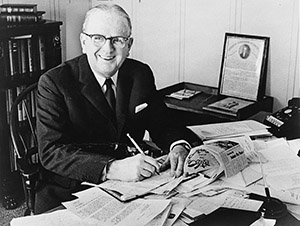
    Norman Vincent Peale

    Peale is an appealing writer and must have been an appealing figure as well. He took over a ramshackle church in New York City, the Marble Collegiate Church on 5th Avenue and 29th Street in 1932, during the Great Depression, and turned it into one of the most successful ministries in the city, America, and the world. He made extensive use of the media of the day: including radio, TV, magazines, pamphlets, and books. New Thought scholar Mitch Horowitz calls Peale the founder of “the most influential self-help philosophy of the twentieth century.”

    Peale, a 33° Freemason, was the Trump family pastor and young Donald regularly attended his services. Peale officiated at his first marriage, the weddings of both his sisters, and the funerals of Donald’s parents. The first chapter of Peale’s classic is called “Believe in Yourself,” a message Trump apparently took to heart and which may have allowed him to survive the almost universal waves of hatred directed at him by politicians of both parties, media mavens and their designated talking heads, and the assembled glitterati of the entertainment industry.

    ND: How does Rev. Peale’s philosophy of ‘positive-thinking’ differ from both ‘born-again’ Evangelical Christianity and the liberal wing of American Protestantism?

    JW: Peale was unapologetically both a Bible-based Christian and a political conservative. An American patriot, he supported the Republican Party and many of its candidates, being quite the Manhattan renegade for that! However, his writings and philosophy are clearly aligned with New Age beliefs. He advocated for the belief in the ability of properly directed thought to improve health and produce material improvements in daily life, rather than just the more intangible and ‘spiritual’ benefits sought by other Christian movements.

    For example, Evangelical Christianity is more accepting of pain and punishment as a corrective for the imperfection of Creation – the world as the Valley of the Shadow of Death, the scene of the Trials and Tribulations of Life through which the soul of the religious aspirant must pass on its way to Perfection in the Afterlife, God’s Kingdom for the Righteous.

    The Liberal Protestant is, in my opinion, more committed to being a liberal than a Protestant. Liberal Protestants are similar to left-wing Jews who support the anti-Israel policies of the Democrat Party, or pro-abortion Catholics who disdain the ignorance of their pope.

    Peale felt the Earth was to be enjoyed through right-thinking and ethical balance. Man was empowered to be God’s custodian on this planet, as noted in Genesis. Peale also made clear that our creative mental ability is so powerful it must be well-regulated in order not to produce unwilled negative results in the lives of those who fail to appreciate its import.

    ND: So Norman Vincent Peale’s ‘positive-thinking’ is virtually synonymous with New Thought? What are the origins of New Thought? And how does it connect with the ‘Law of Attraction’ widely popularised in recent years in The Secret, etc…

    JW: The New Thought Movement is particularly rooted in America. There have been European luminaries among its proponents, but it is an indigenous philosophy that shares the ‘can do’ spirit on which this country is based. Its most immediate roots are among the New England Transcendentalists, especially Ralph Waldo Emerson (1803–1882). Emerson was a prolific writer and lecturer, an ordained clergyman, a scholar of Indian spiritual thought, Buddhism, Zoroastrianism, and Hermeticism. Having openly reached into the Wisdom of the East for spiritual sustenance, he is credited with having influenced the American religious broadening of the nineteenth century and beyond, to include Mormonism, Psychism, and New Thought. Emerson is referenced by name in Peale’s work.

    On the other hand, the Transcendentalists were hardly New Thought proponents. Their high-minded idealism went far beyond the earthly concerns of New Thought. But Emerson’s brand of religious and spiritual experimentation opened a series of options to America in which many contemporary trends could manifest. The mid-nineteenth century was the time of Eliphas Lévi, Edward Bulwer-Lytton, Madame Blavatsky, P. B. Randolph, the flourishing of Freemasonry (and the concomitant scandals associated with some of its excesses), the establishment of alternative utopian communities, the rise of Spiritualism, and the publicising of psychic phenomena. Even Abraham and Mary Todd Lincoln were believed to have sought communication with their deceased son in White House séances. Emerson’s efforts helped foster the explosive burst of religious creativity of the time.

    Mitch Horowitz dates the first of the actual New Thought proponents to the 1830s in the person of Phineas P. Quimby in Maine. Quimby’s most noted disciple was Mary Baker Eddy, the founder of Christian Science. Her singular obsession with mental influence controlling physical events was the most extreme denial of physical reality within the New Thought movement.

    Wallace D. Wattles (1860–1911) was the direct precursor of the Law of Attraction teachings made popular by The Secret. I remember when Destiny Books opened its publishing doors in the mid-1970s. Among its first titles was a mass market paperback version of Wattles’ Financial Success, now retitled The Science of Getting Rich and still in print. Wattles was also a social reformer who ran for political office as a socialist before his death. He was joined in his idealism by Elbert Hubbard, Ralph Waldo Trine, and Ernest Holmes (1887–1960). Holmes started the Church of Religious Science in Los Angeles in 1932 and was the author of The Science of Mind, a vastly influential text in the canon of New Thought. Holmes was the direct link between Dr. Peale and New Thought. Peale read Holmes in the early 1920s, just before entering the School of Theology at Boston University.

    At the same time as the New Thought Movement was flourishing, the early twentieth century brought out a number of spiritual teachers whose work lives on today. Foremost among these is, of course, Manly Palmer Hall (1901–1990). His opening of the higher Mysteries of myth, religion, and philosophy to a wider audience continues to resonate in his bestselling books. It is likely he and Holmes crossed paths on the Los Angeles lecture circuit of the day.

    ND: Today positive-thinking is universally identified with Oprah, other ‘New Age’ celebrities, and supporters of Trump’s rival for the presidency, Hillary Clinton. Many of them active in a range of progressive social movements. Yet Norman Vincent Peale, the Trump family pastor, as you point out, was a traditional American conservative. He’s even been quoted as saying the choice is between “Christ or Communism” and “Christ or the police state.” Rev. Peale comes across as no friend of progressives.

    JW: Communism, the Police State, Sharia Law, Hillary Clinton, and Oprah all share an adherence to a common principle: Collectivism. This is the idea that the interests of the individual are, and must/should be, subservient to those of the group. This pernicious philosophy was enunciated in Europe by Jean Jacques Rousseau (1712–1778) and Georg Wilhelm Friedrich Hegel (1770–1831), the intellectual godparents of Karl Marx (1818–1883). Collectivists assume that the ills of society and the flaws of the human design can be corrected by ‘experts’ – if only they are given enough time and control.

    Opposed to all of them are the writings of philosophers like John Locke (1632–1704) the intellectual founder of the concept of limited government. Locke’s philosophy was ultimately embodied in Thomas Jefferson’s Declaration of Independence and the strict binding of government from mischief by the chains of law as outlined in the United States Constitution. Individualism presupposes that the greatest good will come to the greatest number by respecting the inherent Liberty of each person – the unalienable rights we mentioned earlier. Peale’s conservatism and anti-Communism would put him in the individualist camp.

    The powers of positive thinking and the link to the universal mind proclaimed by Peale and the New Thought movement seems to me more amenable to Individualism than Collectivism. Although I was born Jewish, I accept the concept of America as a ‘Christian nation’ because I believe the Judeo-Christian tradition is the home of Individualism. Our concept of a human relationship with God is very personal. Abraham was prepared to sacrifice his only son at God’s command. Jesus is constantly speaking to people who must make decisions, accept responsibilities, commit to tasks in their personal lives. This all bespeaks the freedom and necessity to choose.

    ND: New Thought, Mind Science, Positive Thinking… This is as you say quintessential American philosophy, a big part of the ‘New Age’. How has this very American worldview shaped Donald Trump? Is he America’s first ‘Positive Thinking’ President?

    JW: Pride, common values, culture, and a sense of national purpose are what bring a people together. As Trump said in his inaugural speech, nationalism offers the potential for a transformative and positive reshaping of a society: “At the bedrock of our politics will be a total allegiance to the United States of America, and through our loyalty to our country, we will rediscover our loyalty to each other. When you open your heart to patriotism, there is no room for prejudice.”

    While I appreciate differences among our people, I reject ‘diversity’ as a goal in and of itself. I think countries should welcome those who embrace the dominant national identity. For example, my grandparents fled the Russian pogroms at the beginning of the twentieth century. But once arrived here, even though none of them spoke English, they became Americans. Their kids taught them English as they learned it in school. No multi-culturalism in those days! My grandparents contributed to the economy and strength of their new homeland. And they influenced their grandchildren to love America as a beacon of light and freedom. Trump’s family had the same dynamics I would expect.

    I think Donald Trump’s first inaugural address of January 20, 2017 was remarkable. I have already said that I think his vision of America First is one that can be shared by all countries as an embrace of national self-interest. I think this is one reason Trump is willing to entertain the idea of good relations with Vladimir Putin, clearly a proponent of Russia First, or Benjamin Netanyahu, an Israel First leader. I see nothing wrong with politicians binding themselves to their citizens. To quote the President, “At the center of this movement is a crucial conviction: that a nation exists to serve its citizens.”

    But Trump went on to state what I believe is the most important belief of the New Thought movement and the reason Donald Trump will be correctly identified as America’s first New Thought President.

    “Americans want great schools for their children, safe neighborhoods for their families, and good jobs for themselves. These are the just and reasonable demands of a righteous public.”

    Trump’s profound acceptance of the “just and reasonable demands of a righteous public” is precisely why people like Wattles, Holmes, Peale, and the authors of The Secret tell us it is OK to visualise prosperity and success and the good things of life. As long as we use them wisely – in tune with the cosmic purpose – they are ours for the taking. Crowley used different language (like Trump he is a bit of a provocateur). “Do what thou wilt shall be the whole of the Law.” Crowley later referred to this as “the most sublimely austere ethical precept ever uttered, despite its apparent license.”

    ND: You mention the British occultist Aleister Crowley whose life and teachings you have studied and written about for more than four decades. You also have a long personal involvement with Crowley’s magickal orders – even described as a ‘founding father’ of the modern O.T.O – as documented in your 2012 book In the Center of the Fire, A Memoir of the Occult. Do you believe Donald J. Trump is an example of Aleister Crowley’s teachings of Thelema (Will)?
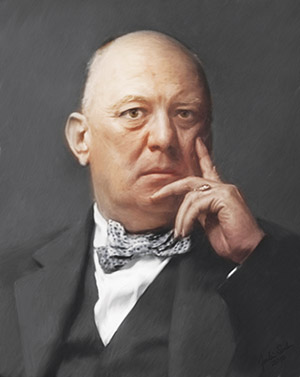
    Aleister Crowley

    JW: You ask if I consider Trump an example of Thelema and the law of Do what thou wilt. (And you seem unconcerned that I could be tarred and feathered by the majority of modern Crowley supporters who are as progressive in their politics as the liberal Protestants we discussed earlier!) But my answer is yes. I listen to Trump and observe him in action, and he seems every bit the creative, take-no-prisoners example of a person who is living his own inner truth despite the cackling and caterwauling of his detractors. I watch his speeches and detect his love for his supporters and America. I see him with his family, and I know for all his brashness, arrogance, and bull-in-the-china-shop personality, that here is a man who understands the second part of our Thelemic equation, Love is the law.

    ND: Aleister Crowley proclaimed the dawn of a new age he called the ‘Aeon of Horus’, which would overturn outdated, ossified codes and beliefs. This New Aeon, while offering humanity unprecedented opportunities for self-realisation and self-actualisation, would also be marked by terrible conflicts, strife and upheavals of all kind. Where is humanity today in relation to the incoming ‘Aeon of Horus’? Do you see the election of outsider Donald Trump as a significant part of this period of transition into a new age?

    JW: The Aeon of Horus was announced in The Book of the Law, received by Aleister Crowley in 1904. Extending some 2,000 years, the New Aeon or Aeon of the Child supersedes the previous period of the Aeon of Osiris or Aeon of the Father. Crowley pointed out in 1938 some of the characteristics of this New Aeon, “Superficially, they appear appalling. We see some of them already with terrifying clarity. But fear not!” The disruption of virtually all norms would refresh the opportunity for the self-discovery of the human race.

    Crowley noted various psychological, biological, and cultural changes as part of this Aeonic shift. “Observe for yourselves the decay of the sense of sin, the growth of innocence and irresponsibility, the strange modifications of the reproductive instinct with a tendency to become bisexual or epicene, the childlike confidence in progress combined with nightmare fear of catastrophe, against which we are yet half unwilling to take precautions.”

    Noting contemporary trends and “infantile cults” in politics, pacifism, health crazes, occultism, sentimentalised religion, and the pop culture of his day, he concluded, “We are children.”

    Crowley raised a point that bears repeating to understand the rise of Donald Trump as the antithesis of the collectivist Obama and his defeated successor: “Above us today hangs a danger never yet paralleled in history. We suppress the individual in more and more ways. We think in terms of the herd. War no longer kills soldiers; it kills all indiscriminately. Every new measure of the most democratic and autocratic governments is Communistic in essence. It is always restriction. We are all treated as imbecile children… they won’t trust us to cross the roads at will.”

    Every day in America – and more and more in Europe – citizens are rejecting this elitist bunch of self-proclaimed know-it-alls whose policies seek to destroy centuries of Western culture and national identity in the name of the chimera of “internationalism.”

    I hope Trump accomplishes the goals he has set forth of rebuilding the nation state. If he is able to succeed as a leader, America will retain its design as a Thelemic country whose long-lived written Constitution enshrines the principle of the sacred Liberty of the Individual as its sovereign goal. We shall certainly see.

    (I must add the disclaimer that I speak for myself. Sadly, most of those associated with the formal Thelemic movement hold leftist and “progressive” political positions.)
    ND: In your book The Secrets of Masonic Washington you detail the Masonic influences on the birth and development of the American Republic. You show that in the New World, free of monarchy and aristocracy, the ideas of the Enlightenment were able to flourish. Do you think the values and vision of America’s Founding Fathers can be revived today under a Trump presidency?

    JW: I do. I find it interesting that Trump is a builder, like Solomon in the Bible and the Freemasons whose vision and principles built America. Trump is the ultimate pragmatist. I wish he had a more ideological mindset that would place philosophy above the deliberative process, but I think he has good instincts. And good influences around him to steer him away from potential overreaches. I also believe he sincerely loves this country. When I heard him say, “We do not seek to impose our way of life on anyone, but rather to let it shine as an example for everyone to follow,” I thought even Thomas Jefferson might not have said it better. Humility, love of Liberty, and the role of the Creator in the pursuit of our national destiny are values I believe are shared by the Founding Fathers, Dr. Peale, and President Trump.

    If America can come together under a President Trump, it seems to me that every day, in every way, we’ll get better and better as a nation and a world!

    „James Wasserman’s revealing article ‘Crowley & Trump: A Magickal Connection?’ accompanies the above interview. It is available by purchasing this issue.

    [alert type=”general” dismiss=”no”]This article was published in New Dawn 161.[/alert]

    [alert type=”success” dismiss=”no”]If you appreciate this article, please consider subscribing to help maintain this website.[/alert]

    © New Dawn Magazine and the respective author.
    For our reproduction notice, click here.
  • Quest for Hidden Wisdom: An Interview with Richard Smoley

    Quest for Hidden Wisdom: An Interview with Richard Smoley

    This article was published in New Dawn 98 (Sept-Oct 2006)

    Richard Smoley and Jay Kinney need no introduction to New Dawn readers. After successful careers as editors of Gnosis (1985-1999), the highly respected US journal of esoteric knowledge, in 1999 Richard and Jay published Hidden Wisdom: A Guide to the Western Inner Traditions to much acclaim (in May 2006, a revised edition of Hidden Wisdom incorporating new material and insights, was released).

    Richard Smoley has contributed numerous articles to New Dawn magazine, many of which can be found on the New Dawn website.

    In the following interview, Richard Smoley talks about Hidden Wisdom, spirituality, and the esoteric traditions….

    There seems to be a huge resurgence in interest in the hidden side of the Western tradition lately. There’s so much talk about Gnosticism, the Masons, the Templars, the hidden teachings of Jesus. What’s behind it all?

    Well, until fairly recently the story of Western religion was pretty much taken for granted. The Bible was seen as an accurate historical record, and the story the churches told about themselves was taken as the truth. But more and more people have come to see that isn’t the whole story.

    Over the last 200 years paleontologists came to realise that the earth really hadn’t been created 6,000 years ago. New Testament scholars took a closer look at the Gospels and decided that the life of Jesus they portrayed contains a lot of myth. Today archaeologists are saying that Moses couldn’t have led the children of Israel to freedom from Egypt in the land of Canaan, because Canaan was an Egyptian province at that time. The supposedly magnificent Jerusalem of King Solomon was probably a hill village with maybe 200 or 300 people. And so on.

    Much of this is not exactly news. “The quest for the historical Jesus,” as Albert Schweitzer famously called it, goes back to the 19th century. But it’s only in the last generation or so that this knowledge has begun to reach a widespread public. It’s led people to ask what was really going on back then. And it’s fueled a lot of speculation about the religious history of the West. Much of this speculation is pretty wild, but it shows that people are eager – maybe desperate – for some answers about their past that isn’t mostly propaganda.

    So what is this hidden truth? Was it true, for example, that Jesus was married to Mary Magdalene and that they had children?

    I’ve never seen any proof of this that seemed even remotely conclusive. There is a strange, fragmentary passage in a text called the Gospel of Philip saying that Jesus was very fond of Mary Magdalene and used to kiss her often on the mouth. The other disciples got jealous and said, “Why don’t you love us the way you love her?” And Jesus replies, “Why don’t I love you the way I love her?” The answer presumably being obvious.

    But the Gospel of Philip is very late. Most scholars date it to the third century CE. As such, it can’t be trusted as a terribly accurate historical source. All I can say is that there are legends, and it’s known that legends naturally accumulate around powerful figures. You only need look at the strange hagiography that’s congealed around Elvis Presley to see how this happened in very recent years. So the story of Jesus being married to Mary Magdalene is not something I personally would put any faith in.

    We may never know what happened in the time of Christ, how much of our information is factual, how much of it is suspect. For example, the Gospel in the Bible that is considered to be the most historically accurate is the Gospel of Mark. Strangely enough, the last page of this Gospel is missing. It was lost in antiquity, probably soon after it was written. What you find in the Bible – and most versions have these – are several different endings, all of them supplied later. This missing part of Mark would have told what happened after the Resurrection. Was this lost accidentally, or did somebody tear out the page and replace it with something more politically convenient? We may never know. And yet ultimately the hidden truth about our past is not some collection of buried facts.

    Then what’s the point of your work? 

    I do think there are buried truths, what in the title of our book Jay Kinney and I have called “hidden wisdom.” But it’s not factual knowledge as such. One of the key concepts in our book is gnosis, which is a term that’s bandied about a lot these days. Gnosis is knowledge, but knowledge of a very special kind. It’s not factual knowledge, not knowledge of something, but rather an inner awakening, an inner illumination. It’s quite similar, I would say, to what Eastern traditions often call enlightenment.

    Viewed in this way, the Bible becomes a story, not about people who lived in an increasingly remote past, but about our own inner awakening. In this way it becomes much more interesting and much more immediate. The story of Exodus is not about the liberation of several tribes of people from literal slavery, but about liberation from inner slavery. The story of Christ is not so much about a man, however remarkable, who lived 2,000 years ago, but about a process that begins in us as we awaken.

    But this just sounds like allegorising to me. People have been doing this for centuries. And it’s all very nice and good, but it doesn’t seem to have much to do with hard, cold facts.

    And what would facts prove? For example, the conventional Christian view is that Jesus literally rose from the dead. Not so long ago, I read a book about witchcraft in southern Africa, written by a very prosaic and down-to-earth British doctor who practiced there in the days of colonialism. He told this story of a chieftain who was dead and buried – and whose death he himself as a physician had verified. And he witnessed a ceremony in which this same chieftain was resurrected, sat on his throne, and ate a meal.

    Of course you can play the skeptic and doubt that this really happened. But beyond a certain point, what difference does it make? Would you believe something like that even if you saw it? Or would you laugh it off and tell yourself you just imagined it? People do this all the time with experiences that go past their concepts of reality. It’s that much harder to either accept or reject miracles that may or may not have happened thousands of years ago.

    Speaking of witchcraft, do you cover that topic in Hidden Wisdom?

    Yes, as a matter of fact we do.

    What is witchcraft about?

    Most people who call themselves witches are not Satanists. They are not cranky old ladies in black who live at the edge of town; nor are they playing at being Sabrina or Samantha Stevens. They are laying claim to what they call the “Old Religion” – the pagan tradition that thrived in Europe before Christianity.

    Witchcraft, Wicca, Neopaganism – these are all terms that loosely encompass a number of highly individualistic groups and people, not all of whom see things in the same way. In fact, they take many different forms. But one key thing they have in common is a reverence for the forces of nature, conceived as spiritual powers in their own right, and the belief that we can work with these powers consciously and creatively. Similarly with the powers of the mind.

    What you’re talking about is magic – not the sleight-of-hand type but the occult type. In your experience, does this kind of magic work?

    Not always, and not usually very well. But not for the reasons you might expect. From my experience, I’m convinced that these forces are real. But they’re difficult to master. It’s very hard to do anything like that that somehow doesn’t backfire or simply fail.

    Why?

    It’s not like a scientific experiment. In a scientific experiment, if you’re going into a lab to bombard subatomic particles or inject substances into some rat, your state of mind has very little to do with the results. In fact, it shouldn’t. A scientific experiment has to be replicable. Your report has to be like a cookbook recipe that a scientist on the other side of the earth can follow.

    Magical work is exactly the opposite. The state of mind you’re in, your concentration and your will – not only at the conscious but at the subconscious levels ­are the all-important factors, far more than whatever procedures you might use. And very few have the will and concentration to accomplish results anything like what they want.

    So is magic dangerous?

    Well, take the typical teenager who starts to dabble in such things. Either nothing happens, or the kid starts to get some results. He or she then usually gets scared and drops it right away. Very few are going to take magic to the point where they are going to get any effective results at all. If you do – and for some it is a true spiritual path – then your motivation becomes the question. Are you doing this for disinterested reasons – to form a link between heaven and earth, so to speak? Or are you just trying to find a shortcut to wealth and power? If it’s the latter, you may as well drop magic and take up stock brokering or politics or something that’s much more likely to achieve your aims. And if you’re doing anything for purely selfish motives, whether it’s magic or trading stocks, you will probably regret it eventually.

    What about the Kabbalah? That’s something we’re hearing a lot about lately.

    We have a chapter on it in Hidden Wisdom. Essentially the Kabbalah is the mystical tradition behind Judaism. It goes back to antiquity, but it took its present form in medieval times, in the twelfth and thirteenth centuries. By the time of the Renaissance, Christian intellectuals became interested in it, and after about 1500 it became incorporated into the general esoteric heritage of the West.

    Just now I mentioned serving as a link between heaven and earth. For many Kabbalists, this is the essential point of the enterprise. We are the only beings – at least the only ones we know of – who are capable of being aware of both the visible and invisible realms, and some Kabbalists say that this is our function here on Earth, to serve as a link between the two.

    By the way, “Kabbalah” comes from a Hebrew verb meaning “to receive.” And it means receiving in two ways. One is receiving the teachings as handed down over time, which is why Kabbalah is sometimes translated as “tradition.” But it’s also a matter of receiving spiritual impulses and translating them into action in this world. Apparently kabbalah is the word used in modern Hebrew for TV reception.

    What do you think of the pop versions of Kabbalah that are out there now?

    I don’t have a lot of direct experience of them. But generally speaking, you can say that the pop versions of any spiritual tradition are likely to be pretty watered-down. Zen and yoga, for example, were originally very intense and austere disciplines, but in the form in which they’ve made it to the public, they’re very bland and trite.

    It’d be easy to jump to conclusions about this fact, to deride all these things as mere vulgarisations. So they may be. But they do serve an important function. In the first place, they communicate some key ideas to the general public that aren’t likely to make it any other way. To take one fairly obvious example, it’s become almost a cliche to talk about living in the present, “the power of now,” and so on. But to be aware in the present is actually a very profound (and quite difficult) practice. It’s interesting, and I think, beneficial, to have these ideas out there, even if they’re often in rather a cliched form.

    You keep using the word “esoteric,” and that seems to be a central concept in your book. What does “esoteric” really mean?

    It comes from a Greek root that means “further in.” To really understand what these teachings are about, you have to go further into yourself. You have to look past the surface of your social identify, your bodily desires, and see what’s beneath. This may take you very deeply into yourself, and at some point you realise that what you really are is something very small and silent. It is nothing you can see, because it’s always what sees. St. Francis said, “What you are looking for is what is looking.” If you understand this point, a lot of highly cryptic mystical texts become remarkably clear.

    There is no end point to this process of going “further in” – none that I’ve ever seen in my own experience or from what I can tell of others’ experience. There’s always further to go.

    Where do you see these traditions going in the 21st century?

    That’s a very difficult question. There is a long, intricate, and poorly understood process by which esoteric ideas eventually make themselves public property. Things that were communicated only under the strictest secrecy 50 or 100 years ago can now be found in self-help bestsellers – for example, the simple truth that you are not your conditioning. It sounds obvious to say this now, but in the past it would have been a piece of knowledge that would have been communicated privately, often obliquely, possibly through some sacred rite of initiation.

    Some may decry this popularisation as a profanation of sacred knowledge. I don’t see it that way. Rather I see that over a very long period of time, humanity begins to accept certain truths and makes them its own. These are first known only to an extremely small vanguard – an elite, if you like, although I know that’s a dirty word these days. Gradually these ideas are disseminated and become common knowledge.

    Now if this so-called elite is doing its job, it won’t try to squirrel away its discoveries and keep them for itself. Rather, it will keep disseminating its discoveries in whatever form that makes most sense in the context of the times. It will also keep moving forward and trying to make new discoveries.

    If much of what was previously hidden is now in the public domain, where do these traditions have to go?

    I don’t have a clear answer to that at present. Much of it will depend on how much the mainstream religions will digest these insights. At this point esoteric teachings are often used as little more than marketing techniques. The rabbi talks about Kabbalah to get people back to the synagogue, or the Christian churches try to unearth some half ­forgotten contemplative tradition as a way of presenting an alternative to, say, Buddhist meditation.

    Will it go past this point? Possibly; possibly people will go on soon to the next new thing. Even so, out of all those numbers, a few actually do see beyond the surface and decide to go “further in” themselves. They become the esotericists of the next generation, and the chain continues.

    [alert type=”general” dismiss=”no”]This article was published in New Dawn 98.[/alert]

    [alert type=”success” dismiss=”no”]If you appreciate this article, please consider subscribing to help maintain this website.[/alert]

    Interview courtesy of Quest Books and copyright 2005 by Richard Smoley. Hidden Wisdom: A Guide to the Western Inner Traditions is available from all good bookstores & online retailers. Richard’s website is http://www.innerchristianity.com.

    © New Dawn Magazine and the respective author.
    For our reproduction notice, click here.

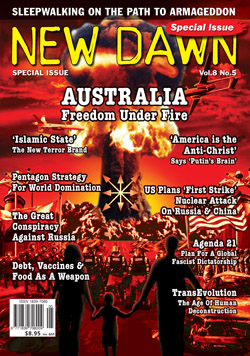
  • TransEvolution: The Age of Human Deconstruction

    TransEvolution: The Age of Human Deconstruction

    From New Dawn Special Issue Vol 8 No 5 (Oct 2014)

    Mr Daniel Estulin is an award winning investigative journalist and best selling author of The True Story of the Bilderberg Group, published in 64 countries and translated into 41 languages. In August 2010 he was invited by Fidel Castro for a personal meeting in Havana after Castro read his book. In October 2010 Mr Estulin became the first journalist to give a speech to the Joint Chiefs of Staff of the Venezuelan armed forces on global financial structures and the Bilderberg Group – an annual invitation-only conference of the elites in the fields of business, finance, media, military and politics.

    Mr Estulin has authored 12 books, five of them international bestsellers, including The Invisible Empire, Conspiracy Octopus, Deconstructing Wikileaks, and The Lords of Shadows.

    Daniel Estulin

    His latest book, TransEvolution: The Age of Human Deconstruction, suggests that the depth of progress and technological development is such that people in the very near future may no longer be fully human. He asks: Is humanity in danger because of this domination of science and technology?

    In the following interview with New Dawn magazine, Mr Estulin discusses the rise of transhumanism, the ‘Age of Transition’, post-humanity, synthetic biology, cybernetic immortality, new technologies of control, and the reasons why the global elite are interested in population control.

    NEW DAWN (ND):  Most New Dawn readers are acquainted with your best selling book The True Story of the Bilderberg Group, in which you expose the secretive global elite planning group that meets annually. You reported that at this year’s Bilderberg meeting they expressed grave concern about the rise of Iran, Russia and China. And of course the volatile situation in Ukraine. Before we discuss your latest book TransEvolution: The Coming Age of Human Deconstruction, could you elaborate on your approach to understanding world events?

    DANIEL ESTULIN (DE):  We are witnessing first hand the destruction of the world’s economy and the work of supranational forces. When one speaks of policy we often mean foreign or national executed by national governments. But we have to understand that Presidents and Prime Ministers are messengers of those who rule the world from behind the scenes. Which is why to understand what is happening in the world we have to frame issues in terms of global policy decisions. These decisions are not made at the White House or Downing Street but rather in the back rooms of the supranational elite. What is taking place in the Ukraine, the revolts in Venezuela, the utter destruction of the American economy (read Detroit), drug wars in Colombia and beyond, Kosovo, Yugoslavia in the 1990s, Syria, Colour Revolutions, etc, etc. – these are not isolated events but rather part of the continuum to change the very paradigm of modern society and take us to hell through deindustrialisation, zero growth, demand destruction, perpetual wars, etc.

    ND:  Your book warns about the imminent “transhumanist” revolution which seeks to integrate human with machine. What exactly is transhumanism and how is it connected directly to the global elites you’ve written extensively on in the past?

    DE:  Transhumanism is an ultra high tech dream of computer scientists, philosophers, neural scientists and many others. It seeks to use radical advances in technology to augment the human body, mind and ultimately the entire human experience. To most people this sounds like something from a science fiction film. Few are aware of constant breakthroughs in technology, which makes the transhumanist vision a very real possibility for the near future.

    For example, neurochip interfaces, computer chips that connect directly to the brain, are being developed right now. The ultimate goal of a brain chip would be to increase intelligence thousands of time over – basically turning the human brain into a super computer. Lifelong emotional well-being is also a key concept within transhumanism. This can be achieved through a recalibration of the pleasure centres in the brain. Pharmaceutical mood renderers have been suggested, which will be cleaner and safer than mind-altering drugs. This is Aldous Huxley’s 21st century scientific dictatorship without tears.

    Transhumanism was born out of humanism, which is yet another clever disguise of “scientism,” created specifically so that global eugenics operations could be carried out without being noticed.

    ND:  At the start of TransEvolution you make a link between the 2005 Bilderberg Group meeting and the 2006 British government document ‘Strategic Trends Report 2007-2036’. Was the discovery of this link one of the reasons you wrote the book?

    DE:  Exactly. At the end of the 2005 Bilderberg Conference in Germany, I was given a first draft of what later turned into a UK government report, ‘Strategic Trends Report 2007-2036’, a secret source document on the future of humanity. This 91-page report is a blueprint for the UK’s future strategic national requirements through the analysis of key risks and future shocks to the world’s financial, economic, political, demographic and technological areas and markets.

    But it wasn’t the only report. In my investigation I came across two additional very important reports published over a decade ago by the British government and the US government. One is called ‘The Age of Transition’ which dealt with nanotechnologies, biology, information technology and cognitive technology. The other is ‘Russia 2045 Global Future’.

    It was the hope of three conferences, ‘The Age of Transitions’, the ‘Global Future 2045 International Congress’ and the ‘NBIC’ conference, to integrate humanity with nature to save Planet Earth from mankind. Visions laid out included robotics, cybernetics, artificial intelligence, life extension, brain enhancement, brain-to-brain interaction, virtual reality, genetic engineering, teleportation, human-machine interfaces, neuromorphic engineering and enhanced human capabilities for defence purposes.

    Once you break down the Orwellian speak, you realise that we, the people, are the enemy of the elite and through technological advancement and enhancement they will be able to control the future of humanity.

    ND:  The controversial Russian philosopher Alexander Dugin, who has been dubbed “Putin’s brain” by the globalist CFR journal Foreign Affairs, warns in regard to the transhumanist agenda: “There will be some black magic yet, and certain things that will outright petrify. I think genetic engineering – we’re only now seeing the last people; we haven’t yet seen the first post-people, which are very soon to come. These should be mutants, clones, and they aren’t just fantasies or science fiction.” What do you think will happen?

    DE:  Our children are the last truly human generation of human beings on the planet. We will have transhuman children – post human, man-machine, cyborgs who are not totally human as a result of synthetic biology.

    Now, in one of the biggest breakthroughs in recent history, scientists have created a synthetic genome that can self-replicate. They have taken a cell and modified the genes of a cell by inserting DNA from another organism. And the bacteria replicated itself thus creating a second generation of the synthetic DNA. The organism will do exactly what the scientist intended: a living thing, but under the control of Man.

    If the 19th century was all about the revolution of harnessing energy from fossil fuels, and the 20th century was about exploiting the power of data, this century will be about controlling biology.

    What’s amazing is that the cell was assembled and sparked into life in a laboratory. This technology takes mankind across a threshold. A turning point that marked a coming of age of a new science called synthetic biology, founded on the ambition that one day it will be possible to design and manufacture a human being.

    In other words, you can get DNA of anything here on Earth and create organisms that never before existed entirely from non-living materials. Scientists are creating new life forms that the human immune system and the world have never so far experienced. As such, it will revitalise perennial questions about the significance of life – what it is, why it is important and what role humans should have in its future.

    ND:  Most people seem oblivious to what is just around the corner in terms of technology and its impact on human life. You say in your book that transhumanism is “steered by the elite” and that “we, the people, have not been invited.” What are some of the visible strategies being employed by the elites to dumb down the population so they sleepwalk into this so-called transhumanist “utopia”?

    DE:  Media, social media in all of its manifestations, and especially Hollywood – GIJoe 2, Prototype, Transcendence, Gatacca, I am Legend, Moon, Minority Report, AVATAR. Video games like ‘Deus Ex’. These are films, but the reality is far more dangerous.

    Once they see some of these same gadgets employed in real life, people think they are still watching a ‘cool’ Hollywood ‘flick’. For example, in Minority Report Tom Cruise’s character John Anderton has a radical surgery to replace his eyes so that he can get past security systems that scan his retina to identify him. As he’s lying in a tub recovering from his black-market procedure, tiny robots sneak into the room and scan his eyes in an attempt to track down the fugitive Future Crime officer. The ability to scan retinas to identify people is straight out of a sci-fi film but, outside of the use of spider-like drone bots, this is very much present and near future. In fact, soon your eyes may not even need to be in close proximity to the scanner to be identified.

    Engineers at Southern Methodist University are working closely with the US Defence Advanced Research Projects Agency to develop a new type of eye scanner that could identify a room full of people without their knowledge. The new image sensors, called Panoptes, could locate and scan a person’s iris regardless of distance, and even if they’re not looking directly at the camera. The system, dubbed Smart-Iris, is impervious to problems like poor lighting, glare, eye-lashes, or movement. And, with the help of a new algorithm, it can function with only a partial scan.

    One of the most talked about areas of research is something called the “Active Denial System,” ADS. ADS is a by-product of a larger ongoing research effort looking for technology that could delete and then replace a person’s memories via the use of electromagnetic radiation.

    If you are thinking Men in Black Hollywood science fiction, you are absolutely right. Except the technology, called “Amnesia Beam,” is here, ready to be used at a moment’s notice. What’s more, a team of neuroscientists has actually developed a brain scan based on finding hints about what a subject is intending to do. This is a nightmare version of Minority Report made reality.

    Scientists claim that the seeds of criminal and anti-social behaviour can be found in children as young as three. More researchers believe that violent tendencies have a biological basis, and that tests and brain imaging can pick them up in children. By predicting which children have the potential to be trouble, treatments could be introduced to keep them on the straight and narrow. If the tests are accurate enough, then a form of screening could be introduced in the same way we test for some diseases. The theories were put forward by two leading criminologists at the American Association for the Advancement of Science in Washington.

    Please understand, these are not publicly funded projects for the betterment of humanity, but they are mostly secret experiments sanctioned in the name of defence, which when put on its head is crime prevention. Extrapolated into the future it’s tailor-made to put down any rebellion by the 99% of the world’s population destined to live in abject poverty in crime infested Mega-Cities of the future.

    Let me give you another example. Last year FOX showed a TV series called Almost Human where one of the main characters is a cyborg cop interacting with humans in society. Almost Human is about neuroscience, a key element of the elite’s control. Neuroscience is the study of the nervous system. With advances in chemistry, computer science, engineering, medicine and other disciplines, neuroscience now also includes the study of the molecular, cellular, developmental, structural, functional, evolutionary, computational, and medical aspects of the nervous system. From molecular and cellular studies of individual nerve cells to imaging of sensory and motor tasks in the brain, neuroscience has crossed the threshold of science and has become a key element of national security apparatus the world over.

    The development of sophisticated neuro-weapons will create a perpetual state of uncertainty with the promise and peril of the development of neuro-warfare and its effects. Emotional detection systems will pervade public areas as global surveillance networks seek out terrorists and criminals.

    These technologies are not being developed to stop the terrorists but rather to stop you! The laws to justify these technologies are not written on a whim. They are specifically designed to give the government carte blanche authority over the people during the chaos and confusion of the ‘Age of Transitions’. Transition to a planetary civilisation.

    You see, the future Bin Ladens and Qadhafis are not the enemy. In fact, they never were. You are the enemy. Whether at airports, border crossings or on the street corner, from now on we will be mind-probed by amazing new technology developed by the Human Factors Division of the Department of Homeland Security’s Science & Technology directorate [this is an actual division of US Homeland Security].

    ND:  You write that: “Transhumanism fills people’s hopes and minds with dreams of becoming superhuman, but the fact of the matter is that the true goal is the removal of that pesky, human free will itself.” Do you believe the elites are planning this coming age of machine and robots (which are very sophisticated and will replace many human jobs) as a way to eventually eliminate the excess of humanity, the “useless eaters” as they’ve been termed?

    DE:  There is an effort by the mainstream press to focus on the work issue and completely miss the bigger picture. First, let’s look at the technology. Brain machine interfaces would allow the control of machinery with the brain itself. Implantable brain chips would also be able to store information and enhance cognitive function. The ultimate human machine symbiosis would be to download the actual copy of a person’s brain into a super computer.

    I repeat, this would allow someone to effectively live forever in a computer-generated virtual simulation. And, of course, the military implications of convergence are quite obvious. A cybernetic enhancement of human performance is inevitable. Achieving these visions requires the decoding and understanding of complex systems. The most important complex system being the human brain. After all, it is the driving force behind human performance.

    Augmentation can be a huge business for these corporations. We have been integrating ourselves with technology for decades now, replacing damaged limbs with mechanical limbs, implanting data chips into our bodies which give away huge amounts of information to governments and corporations all across the world. Has it come to the point when we will be actively encouraged to exchange our perfectly functional body parts for upgraded applications?

    But it comes at a price. You will have to take the drugs for the rest of your lives to make sure the augmentation works. These drugs are both dangerous and addictive and expensive. If you don’t, your body will reject your augmentation. The elite will have their technology in you. They have the power to turn off your limbs, the potential to turn off your eyes, send messages to your brain and control your thoughts as if they have the power of God.

    The technology doesn’t end there: Intel is working on implantable sensors in the brain that will be able to directly control computers and cell phones. By the year 2020 you won’t need a keyboard and mouse to control your computer. Instead, users will open documents and surf the web using nothing more than their brain waves.

    The potential ‘benefits’ of such technology are almost beyond imagination. An article on the website of the Science Channel put it this way: “If you could pump data directly into your gray matter at, say, 50 mb per sec – you’d be able to read a 500-page book in just under two-tenths of a second. How would the world change if you could download a lifetime of learning directly into your brain in a matter of weeks?”

    The possibilities are endless. But so is the potential for abuse. Through interaction, implantable microchips can ‘talk’ directly to the brain, bypassing sensory receptors. This would give a tyrannical government an ultimate form of control. If you could download thoughts and feelings directly into the brains of your citizens, you could achieve total control and never have to worry about them turning on you.

    We haven’t even scratched the surface. Called Remote Neural Monitoring (RNM), this technology is already in use in the USA, UK, Spain, Sweden, Germany and France. It allows them to see through your eyes, hear your thoughts, and upload photos and scents into your brain as real as if you saw or smelled it in the natural environment.

    Needless to say, the perpetrators can hear what you hear because you become a unit of the mainframe. They can change your behaviour, affect memory functions and emotions. This is not a plotline of a dystopian novel. This is real and it is being implemented today, every day by the governments who profess to protect us from evil.

    In fact, you could potentially program these chips to make your citizens feel good all the time: The ultimate goal of Huxley’s scientific dictatorship without tears – soma personified. The future is now.

    Instead of drugs like cocaine and marijuana giving you a natural high, you could have these chips produce a ‘natural high’ that never ends. Drug dependency replaced by a fully government sanctioned chip dependency. The way of the future.

    Post-humanity will be a new human, genetically engineered and brain-chipped for total control. Part man and part machine, the new man will no longer have a need of the sexual reproductive function. If the elite’s plan is to reduce the world’s population, can you think of a better way to do that?

    ND:  What’s the connection between elite control of the world’s food supply and the depopulation agenda?

    DE:  There is no better or cheaper way to reduce population than through starvation. And in order to starve a people to death you must take control of their food production away from independent farmers and put it into the hands of giant corporations subservient to the interests of World Company Inc.

    Ten to twelve pivotal companies, assisted by another three dozen, run the world’s food supply. This cartel has complete domination over world cereals and grains supplies, from wheat to corn and oats, from barley to sorghum and rye. But it also controls meat, dairy, edible oils and fats, fruits and vegetables, sugar, and all forms of spices.

    While these firms maintain the legal fiction of being different corporate organisations, in reality this is one interlocking syndicate with a common purpose and multiple overlapping boards of directors.

    Please understand, this interlocked self-perpetuating syndicate decides who eats and who doesn’t, who lives and who dies. It is a virtual spider web of financial, political, economic and industry interests with the Venetian ultramontane fondi model at the centre. These people own and manage the affairs of an interlocking corporate apparatus that dominates choke points within the global economy, especially finance, insurance, raw materials, transportation, and consumer goods.

    But it does not end there. The control of food supplies is a matter of national security. The US Department of Agriculture is one of the key elements in a national security edifice attempting to control the world food market.

    Food is power. When it is used to cull the population, it becomes a weapon of mass destruction. You may not realise it, but the elite certainly do.

    ND:  In light of these alarming behind-the-scenes developments, can you elaborate on the global elite’s long-term plan?

    DE:  There are currently seven billion people on Planet Earth, a small blue orb meandering through space with limited natural resources and an ever-expanding population. Food and water are becoming scarcer. The elite understand this: a larger population equals fewer natural resources and more food and water supply shortages. Therefore, from the point of view of an oligarchical elite, if they want to completely control a planet, they must reduce the population to a more ‘manageable’ number. Remember, seven billion people and growing is a lot of mouths to feed. For the elite to eat, you and I have to die. How is that for a solution?

    ND:  How can aware people resist this diabolical ‘TransEvolution’?

    DE:  We have to understand that all of us have a place in the universe. Immortality, the way I understand it, is assuring the survival of the human species. Human beings are the most divine element of the known Universe. Nothing compares to our divine spark of reason. Technology and progress must be used to increase Man’s power in the Universe, not to destroy humanity.

    Readers are encouraged to obtain a copy of Daniel Estulin’s book TransEvolution: The Age of Human Deconstruction, in which he lays out the full evidence for the points covered in this interview (and much more). The book can be purchased from all good bookstores or www.amazon.com. Check out Mr Estulin’s latest work at https://www.youtube.com/user/DanielEstulinVideos & https://vipwebinars.org/

    [alert type=”general” dismiss=”no”]This article was published in New Dawn Special Issue Vol 8 No 5.[/alert]

    [alert type=”success” dismiss=”no”]If you appreciate this article, please consider subscribing to help maintain this website.[/alert]

    © New Dawn Magazine and the respective author.
    For our reproduction notice, click here.

  • For Nobody’s Eyes Only: The Truth About Missing Govt. Files & the Most Enduring Conspiracy Theories

    For Nobody’s Eyes Only: The Truth About Missing Govt. Files & the Most Enduring Conspiracy Theories

    From New Dawn 141 (Nov-Dec 2013)

    Government agencies have, under duress, declassified millions of pages of documents in recent years. But we also know more unreleased files are suspiciously “missing” or inaccessible, as are mountains of Top- Secret papers that various agencies admit do exist but are kept hidden from public view.

    Government secrecy over famous cases like Roswell, JFK, the CIA’s MKUltra, and the death of Princess Diana, add weight to ‘conspiracy’ theories. In fact, many of us suspect the official version of events is a lie, a smokescreen hiding some terrible truth that threatens the carefully constructed narrative of the powers-that-be.

    To help get to the bottom of all this, we spoke to one of the world’s most sought -after speakers and media spokespersons on the subject of government conspiracies, hidden files and classified information.

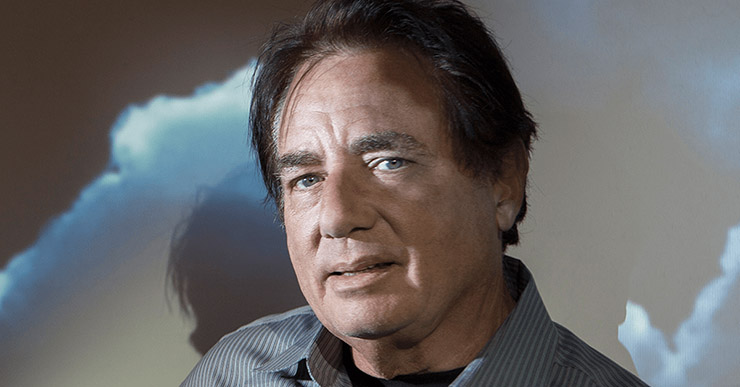
    Nick Redfern is a full time journalist, researcher and author of numerous books about unsolved mysteries and government conspiracies. In the following interview he discusses some of the fascinating material covered in his recent book For Nobody’s Eyes Only: Missing Government Files and Hidden Archives That Document the Truth Behind the Most Enduring Conspiracy Theories.

    NEW DAWN (ND): What is the Freedom of Information Act? How does it operate in the US and UK?

    NICK REDFERN (NR): It was on Independence Day, 1966 that US President Lyndon B. Johnson signed a historic piece of documentation that brought into being the Freedom of Information Act (FOIA). The FOIA permits members of the general public and the media the right to file a request with government agencies to (a) obtain copies of files that may already be declassified; or (b) request that files which are currently withheld either in whole or in part be declassified into the public arena. The FOIA is not a tool that is guaranteed to open all doors, however.

    There are many clauses within the Act that permit government, military, and intelligence-based bodies to withhold their files, if they deem it appropriate to do so. The grounds for denial of access to files via the FOIA include national security concerns, matters having a bearing on the defence of the nation, privacy issues, data relative to legal and criminal subjects, and the internal operations of the relevant agency or agencies.

    In the same precise way that official documentation in the United States is subject to varying levels of secrecy, such is the situation in the UK, too. At the turn of the 21st century the Labor Government of the day passed the Freedom of Information Act 2000, which followed broadly similar guidelines to those present in the United States’ FOIA.

    A glance at the rest of the world shows that many developed nations have followed in the tracks of both the US and the UK. Freedom of Information laws apply in numerous nations, including Australia, Brazil, Canada, Denmark, France, Mexico, Norway, Sweden and Turkey.

    Like Britain and the United States, all of the above countries have laws that permit agencies to keep files under lock and key as they pretty much see fit, providing that justification is seen as being firmly warranted.

    ND: What are Special Access Programs and how do they help secrets to be kept?

    NR: Contrary to what is often assumed or claimed by alleged whistleblowers of distinctly dubious credibility, there are absolutely no levels of secrecy that extend beyond Top Secret. Not a single one. That does not mean, however, that having a Top Secret clearance provides a person with carte blanche access to every secret, every conspiracy, and every cover-up under the face of the sun. In fact, quite the opposite is the general rule of thumb.

    Here we come to something termed “need to know.” Person “A” might have the same level of clearance, let’s say Top Secret as person “B.” But, here’s the important thing: to protect the security and secrecy of the project on which “A” is working, he or she is given a classified piece of data that acts as a key to open the door to that same project. That key might be in the form of a piece of documentation, such as a sternly-worded, non-disclosure agreement.

    Alternately, it might be a classified code word that, without which, access to the program would be denied at all times. So, we have a situation where “A” and “B” possess the exact same clearance level of Top Secret, but only “A” knows what is afoot in the classified world of “Project X.” Such Project X-type operations are termed SAPs: Special Access Programs.

    In the United States, where SAPs are far more prevalent than anywhere else, they primarily relate to (a) the “research, development, testing, modification and evaluation or procurement” of new and sophisticated technologies; (b) the “planning and execution of especially sensitive intelligence” operations; and (c) the “execution and support” of classified military programs. It is within the arena of SAPs that some of the most guarded of all secrets remain deeply buried.

    ND: Will you tell us the story of the missing files on the Roswell UFO crash of 1947?

    NR: In early 1993, United States Congressman Steven Schiff began probing into the many complexities of the Roswell affair. His first port of call, as he sought out the files on the controversial saga, was the Department of Defense (DoD). In a March 11, 1993 letter to Secretary of Defense, Les Aspin, Schiff explained that during the previous fall he “became aware of a strange series of events beginning in New Mexico over 45 years ago and involving personnel of what was then the Army Air Force.”

    It was specifically on the matter of this “strange series of events” that Schiff wanted definitive answers. And he wanted them soon. Thus began an inquiry that ultimately led to major, official revelations concerning missing and unaccounted for, files on the Roswell controversy. During the course of their search for records to try and understand what had really taken place in New Mexico in early July 1947, the Government Accountability Office (GAO) learned that a massive amount of official documentation generated from within the confines of the Roswell Army Air Force, between March 1945 and December 1949, had vanished.

    Moreover, that same documentation had disappeared under very questionable circumstances. When GAO investigators asked for an explanation, they were told by the Chief Archivist for the National Personnel Records Center that its staff had been unable to ascertain how, why, and under whose jurisdiction, the files had vanished.

    ND: What is the truth about the vanished files on England’s famous alien landing at Rendlesham Forest in 1980?

    NR: Between the nights of 26 and 29 December 1980, multiple, extraordinary UFO events occurred within Rendlesham Forest, Suffolk, England that involved military personnel from the nearby Royal Air Force stations of Bentwaters and Woodbridge. Since that now long gone period, countless US Air Force personnel, who were stationed in the area at the time, have spoken out regarding their knowledge of a small, triangular-shaped object that was seen manoeuvring in the forest.

    Others described seeing in the dark woods almost ghostly, extraterrestrial-type beings of short size and with eerie, feline-like eyes. Strange and unknown lights were seen dancing around the night skies, circling both the forest and the twin military facilities. There were stories that the amazing movements of the UFOs were caught on radar. And there was even hushed talk of those military personnel involved in the incident being silenced by ominous Men in Black-style characters.

    In May 2011, as the UK’s Freedom of Information Act revealed, 11 years earlier the British Ministry of Defense received a request, from a member of the public, for copies of its own records on the Rendlesham Forest incident. In dealing with the request, government officials discovered what they termed a “huge” gaping hole where there should have been stacks of papers of a specifically defence-intelligence nature.

    The hunt was soon on to find out where those papers had gone. It was a quest that led one official to speculate that perhaps someone with access to the Rendlesham files had “taken them home.” A far more intriguing document notes that the disappearance of certain files on Rendlesham, the specific contents of which remain unknown to this very day, might be interpreted to mean that “a deliberate attempt had been made to eradicate the records covering this incident.”

    ND: Do you have any stories in the book about missing official files in Australia?

    NR: Yes, I do. In one of those surreal situations where truth really is stranger than the strangest of all fictions, in early June 2011, the Australian Department of Defence revealed to the world that it had “lost” its collection of UFO files. The revelation surfaced in the immediate wake of a two-month-long quest to find the records. The search itself had been prompted by a Freedom of Information Act request, submitted by the Sydney Morning Herald newspaper, for Australia’s UFO papers to be declassified.

    Only when senior military intelligence staff went looking to decide what could, and what could not, be declassified did they find that it didn’t really matter after all, since there was nothing to declassify. At least, that is, aside from one solitary file titled, Report on UFOs/Strange Occurrences and Phenomena in Woomera.

    Staff at Australia’s Freedom of Information office said that searches were undertaken at a variety of official establishments, including the Headquarters Air Command RAAF Base Glenbrook; the Canberra-based National Archives and the Defence Record Management System. It was all to no avail: “…the files could not be located and Headquarters Air Command formally advised that this file is deemed lost.” [Source: ‘Alien abduction? Defence’s X-Files are lost in space’ by Linton Besser, Sydney Morning Herald, 7 June 2011]

    Since, officially, at least, the Australian Government had been out of the UFO game since 1996, it was seen as nothing but normal administrative procedure to destroy the files, the FOI office added. Curiously, however, it wasn’t just the files that were missing: the surrounding documentation that gave the order for the files to be destroyed was gone, too.

    ND: How many documents on the JFK assassination of 1963 remain classified?

    NR: The problem with the JFK case is not so much what remains classified, but what was shredded and destroyed decades ago and which, if it had survived, might have shed further light on the matter. As one perfect example, when, in the 1970s, the House Select Committee on Assassinations (HSCA) was busily trying to determine who shot and killed JFK, it discovered that nothing less than Lee Harvey Oswald’s Army Intelligence file had been destroyed.

    Suspecting there was far more than just mere bureaucracy at the heart of the destruction of the Oswald records, the HSCA demanded that the Department of Defense provide it with a full explanation of the circumstances that led to the irreversible loss of the Oswald file. The DoD replied that while the file was noted for shredding on 1 March 1973, it was “not possible” to ascertain, precisely, the date on which the “physical destruction was accomplished.” The DoD assured the HSCA that the destruction had been a purely routine matter, and not in any way suspicious.

    There was, however, a lot that could not be ascertained: “It is not possible to determine who accomplished the actual physical destruction of the dossier,” said the DoD, adding: “The individual ordering the destruction or deletion cannot be determined.” And, perhaps, most significant of all, on the matter of the actual contents of the file, the DoD told the HSCA: “The exact material contained in the dossier cannot be determined.”

    In light of the above, it’s worth noting the HSCA’s conclusions on this particular matter: “The committee found this ‘routine’ destruction of the Oswald file extremely troublesome, especially when viewed in light of the Department of Defense’s failure to make this file available to the Warren Commission.”

    ND: Is the British Government withholding files concerning its secret surveillance of the late Diana, Princess of Wales?

    NR: In the final weeks of 1998, the US National Security Agency (NSA) confirmed that it possessed more than 1,000 pages of classified documents on Princess Diana. That statement prompted a lot of debate about what, precisely, those NSA files contained. The NSA chose not to provide much by way of an answer. That didn’t stop Britain’s popular, mainstream newspapers from having their say, however.

    The Daily Mirror suggested the material was being withheld because its release would confirm Diana’s secret affairs during her marriage to Prince Charles. The Daily Record offered the theory that the files, if declassified, might show the full and shocking extent to which the NSA had spied on Diana, possibly right up until the time of her death in 1997.

    The Washington Post took a less sensational view of the matter. It opined that the truth of the NSA’s surveillance was most likely far less lurid than suggested by the British press. The Post added some useful data, which outlined at least some of the facts relative to what was being withheld from public view. As the newspaper noted, although the NSA refused to release its files on Diana, it did confirm that one such file amounted to 1,056 pages, and that 39 additional files, totalling 124 pages, also existed. Those particular records, the NSA was at least willing to admit, were deemed non-releasable for national security reasons relative to how the agency undertakes its surveillance operations.

    The National Security Agency is not the only US Government agency that has admitted to possessing files relative to Princess Diana that it flatly refuses to declassify. The CIA has an undisclosed number of records on file, which might, therefore, mean ten or ten thousand, we just don’t know. The Defense Intelligence Agency confirms it has what it describes as “product” on Diana.

    Rather notably, in 1999, Britain’s Guardian newspaper, which had been digging into the matter of the NSA’s papers on Diana, uncovered something very interesting. A number of the files that the National Security Agency possessed on Diana had been forwarded to the American eavesdropping agency by Britain’s MI5 and MI6. Not only that, they were classified Top Secret. The Guardian noted, of the discoveries its reporters had made, that the files were not focused so much on Diana herself, but on certain company that she kept.

    ND: Why were numerous documents on the CIA’s “mind control” program, MKUltra, destroyed in the 1970s?

    NR: In late 1972, Richard Helms, who held the position of CIA director from June 1966 to February 1973, learned to his complete and utter consternation, that certain people within the US media had been given snippets of data on the ins and outs of MKUltra. The source of the leaks was never identified or proved, but Helms considered it very possible that the leaks came from right within the heart of the agency itself.

    Realising quickly and astutely that any mainstream media exposure of the story pertaining to the work of MKUltra could prove disastrous, Helms knew there was no alternative but to ensure that as many of the MKUltra documents as possible never, ever saw the light of day. To many people, this might seem very strange. After all, Helms was ordering the obliteration of – literally – tens of thousands of pages of historical material on a project of undeniably ground-breaking proportions. But, there’s an important reason why Helms’ decision made complete sense to both him, and to those within the CIA working in the mind control arena.

    By 1972, the decades-old files in question were certainly of historical significance, as they told and revealed the scope of the program, as well as some of the controversial things that had been done in the name of national security back in the early to mid 1950s. Their continued existence in 1972, however, wasn’t seen as necessarily being crucial to the CIA. By the early 1970s, the research and development work was long over, the programs were all up and running in stealth, and there was no need to commit anything to paper anymore.

    So, destroying the original research material spawned way back in the 1950s bothered Helms not a single bit. In fact, trashing the whole lot serve a very good purpose, from Helms’ position – it would help prevent the secrets surrounding the extent to which mind control programs were part and parcel of everyday life at the CIA from falling into what Helms saw as being the wrong hands.

    ND: What prompted the destruction of the late J. Edgar Hoover’s “Secret Files” after his death in 1972?

    NR: J. Edgar Hoover was noted for his dedication to the compilation of files on just about anyone and everyone that he saw as being ripe and relevant for covert surveillance. But, as well as the regular files that the FBI created and updated on a daily basis, Hoover had at his disposal another collection of documentation, a very different and unique collection.

    It was one deemed for his eyes only. That collection was highly sensitive and filled with all sorts of gossip, scandal, national security data and deep secrets on a lot of high-profile individuals. The voluminous document collection in question has become infamously known as the Secret Files.

    Unfortunately for historians, after Hoover’s death, from heart disease, on 2 May 1972, those same files were quickly destroyed. The secrets those voluminous papers told went, just like Hoover, himself, to the grave. It was all the work of an old lady, a septuagenarian, who was fiercely loyal to her boss, J. Edgar Hoover. Her name was Helen Gandy and she pretty much outwitted everyone as she sought to ensure Hoover’s secrets didn’t become open knowledge.

    ND: What is the story of the missing evidence in the 2003 death of United Nations weapons inspector David Kelly?

    NR: Dr. David Kelly was a man with a great deal of fingers in many secret and sensitive pies. Back in 1984, Kelly accepted the prestigious position of Head of Microbiology at Porton Down, near Wiltshire, England. Kelly also served as the British Ministry of Defence’s Chief Scientific Officer and Senior Adviser to the Proliferation and Arms Control Secretariat, and to the Foreign Office’s non-proliferation department. And, on top of that, he was Senior Adviser on Biological Weapons to the United Nations.

    On the afternoon of 17 July 2003, Kelly took a stroll to an area of picturesque English woods known as Harrowdown Hill. He was not seen alive again. The official story is that Kelly swallowed a considerable number of strong painkillers, 29 in total, and sliced into his left wrist with an old knife which he had had in his possession since boyhood (a blunt knife, as an examination of it by police showed). Death soon followed. Kelly’s body was found, after his wife reported him missing, the following morning.

    In October 2007, thanks to documentation that surfaced under the terms of the Freedom of Information Act, a baffling and disturbing revelation was made: the knife that was used to slice into Kelly’s artery was totally lacking in fingerprints. But that’s not all.

    Kelly’s glasses, his cellphone, a water bottle and the packet that contained the co-proxamol pills which Kelly swallowed (or that he was forced to swallow), were also completely clean of prints. Why Kelly would have wanted to carefully wipe every single print off of every one of the above items is a mystery that still lingers on to this very day. Unless, of course, Kelly wasn’t the person who carefully wiped them all clean.

    Some might say, well, perhaps Kelly was wearing gloves at the time. Then, having wiped the items clean, he left no further prints on them. That would be fine, except for one glaring issue: Kelly was not wearing gloves when he left the house the day before his body was found, and no gloves were found on his hands, near his body or anywhere at the scene.

    If the absent blood and fingerprints weren’t enough to convince people that Kelly had been murdered, the next revelation most certainly changed the minds of many. Kelly’s glasses, which he routinely wore, lacked any and all signs of tell-tale DNA. Glasses, which fit snuggly against the skin of the wearer, should be teeming with minute DNA. Not with Kelly’s glasses, though. The cleaning of the glasses had been achieved to such an incredible extent that not even one microscopic DNA cell could be found anywhere on what was, without doubt, an item that Kelly used every day of his life.

    Clearly, the scene had been cleaned up by sources unknown, and any evidence suggesting suicide wasn’t the cause, was destroyed.

    Get the issue this article appears in

    ND: Considering what has come to light about the US invasion of Iraq and non-existence of Saddam’s WMDs, can we expect that in the near future more documents will come to light on 9/11, the Iraq War, etc. and will this rewrite the currently accepted version of events?

    NR: I think it’s very hard to say as I’ve found it usually takes decades for the full picture (or, as close as we can get to the full picture) to come out. Take, for example the Roswell story. The mass of missing files from the old base to where the Roswell debris was taken, back in 1947, could, in theory, have vanished back in the 1940s or 1950s. But the fact they were missing remained totally unknown until the 1990s. Plus, we should not forget there are a number of pieces of legislation that allow the continued withholding of official files for significant periods of time.

    ND: How did your research into this classified material reinforce or change your view of government cover-ups and the official version of history?

    NR: For me, at least, when files go missing and on a massive scale, it points to one thing and one thing only. It’s very simple: history as we perceive it is not as it should be perceived.

    For Nobody’s Eyes Only: Missing Government Files and Hidden Archives That Document the Truth Behind the Most Enduring Conspiracy Theories (New Page Books, 2013) is available from all good bookstores and online retailers.

    [alert type=”general” dismiss=”no”]This article was published in New Dawn 141.[/alert]

    [alert type=”success” dismiss=”no”]If you appreciate this article, please consider subscribing to help maintain this website.[/alert]

    © New Dawn Magazine and the respective author.
    For our reproduction notice, click here.
  • The Life After Death Project: Interview With Paul Davids

    The Life After Death Project: Interview With Paul Davids

    From New Dawn 139 (Jul-Aug 2013)

    PAUL DAVIDS is the author of widely-released books and acclaimed writer and director of highly original films including the controversial 2008 documentary film Jesus In India, discussed by Len Kasten in New Dawn Special Issue Vol 6 No 3.

    He is a leading expert on the history of science fiction cinema and the Hollywood connection to extraterrestrial-related phenomena. Davids was executive producer and co-writer of the Showtime film Roswell, starring Martin Sheen and Kyle MacLachlan.

    Paul earned a B.A. from Princeton University, where he won the university’s three top creative writing awards all in one year (including the F. Scott Fitzgerald Prize). Afterwards, he studied under full scholarship at the American Film Institute Center for Advanced Film Studies in Los Angeles.

    He is the noted author of six Star Wars books for Lucasfilm, was a producer of the popular Transformers animated TV series. Paul is also an accomplished artist and is generally well known and respected in Hollywood.

    We spoke to Paul about his latest film, The Life After Death Project, which recently aired on the SyFy Channel and is being made available on DVD.

    NEW DAWN (ND): In your films, you’ve taken on a lot of controversial issues – aliens in Roswell, LSD in Timothy Leary’s Dead, the high price of Van Gogh paintings in Starry Night – you even investigate Jesus’ missing years that aren’t mentioned at all in the New Testament, in your film Jesus In India. Now you take on one of the biggest controversial questions of all time – is there life after death? How did you end up there?

    PAUL DAVIDS (PD): I refer to The Life After Death Project as a personal confession. On March 7, 2009, the day of the large Hollywood tribute for science-fiction luminary Forrest J Ackerman at the Egyptian Theater, very strange things happened to two Canadian filmmakers who visited his crypt. The filmmakers had made a documentary about his life. Forry Ackerman, born in 1916, was the original editor of Famous Monsters of Filmland Magazine beginning in 1958, and his influence on the world of science-fiction (and horror and fantasy) and his impact on all the major filmmakers of that genre was huge – incalculable. I was one of the speakers at the tribute and the Canadians (Mike MacDonald and Ian Johnston) told me very sincerely why they were convinced they literally “heard from him” within an hour of Mike MacDonald knocking on his crypt to say “Hello Uncle Forry.” (All of his fans called him “Uncle Forry.”) I had known Forry and looked up to him since I was a teenager and became a winner in an amateur movie contest run by his magazine. He was a major influence in my decision to pursue a career in film and TV. In 1996 I made a film that was in part a tribute to him (The Sci-Fi Boys, which Universal released on DVD and which won the Saturn Award for Best DVD of that year.)

    I didn’t know what to make of the strange story of the Canadian filmmakers, and I wasn’t immersed in “the paranormal.” But about one week later, I was alone in my vacation house in Santa Fe, New Mexico when something simply impossible happened to me. It was a very precise inkblot that appeared on a document I was studying – it appeared while I was out of the room for just a few minutes. There had been nothing unusual at all about the document when I left the room. I want to say it again: What happened was IMPOSSIBLE in the world as we think we all know it. But it happened, and evidence in the form of ink was left behind. It took me awhile to catch on that it actually could have been a message to me from the late Forrest J Ackerman, done in his usual humorous style with a specific “word within a word” pun, his trademark. I realised it could have been a reference to the man who was his closest friend and caretaker for the last 10 years or more of his life… actually a sort of very personal “thank you” for the tribute to him. The detective work to figure that out was a long trail, and it took me first to the Chairman of the Chemistry Department of the University of Indiana, a world class expert in inks, paints and solvents. I brought my video camera along to document what he did in his lab. That was the beginning. I never knew then this would become a major documentary film that I would make. But it became a colossal adventure involving major authors and three universities, with repeating evidence that simply has to be seen to be believed. And it took me four very long years to make the film.

    ND: Recently there’s been quite a focus on life after death even in the mainstream media – particularly noteworthy is neurosurgeon Dr. Eben Alexander’s Near-Death Experience as documented in his book Proof Of Heaven. What makes your film unique?

    PD: It’s tough to take on subject matter that in a way has been “beaten to death.” Exploitation TV shows with dizzying fast cuts and irritating music and sound effects – a lot of those shows leave people thinking that all they need is an EMF meter and a creepy old house and they’ll be the next person to document a ghost. My film is not exploitation – it is a quiet and deliberate unfolding of a colossal mystery that unfolded from “one seed” – the inkblot.

    What really separates my film from the pack is that I am telling about a deceased man I had a personal relationship with that spanned decades. I knew his style, his humour – I had been “aboard” for many parts of the journey of his life. So there is a relationship to the departed who appears to have “dropped me a line.” It’s not about seeking out ghosts or spirits of people you never knew in creepy places. It is about evidence of a continuing relationship after death that was not just a single incident but was a long string of many incidents, continuing now for about four years. I never knew when these strange things would occur, but they kept happening – AND they started happening to people I involved in the case, including the scientists at the three universities. Things happened to them THEY couldn’t explain, many of which seemed to have Forry Ackerman’s “authorship.” He seems to be enjoying himself. I love him and welcome all this. I seem to have had extensive and continuing help from a “personality unseen” to enable me to build the very best case that there really is survival of consciousness and personality after a person dies. In this case it was an exceptional person who accomplished a lot in his lifetime and never seemed to be finished. I never would have taken this on even five years ago. Something had to happen to me first. What I have personally concluded, because no other explanation fits the data, is that I heard from Forry loud and clear, multiple times, after he had departed this world.

    ND: Life after death covers a lot of ground, from orthodox religious views of heaven and hell, to ghosts, spiritualism, reincarnation, poltergeists, mediums, angels, apparitions, materialisations and of course the Near Death Experience. How did you choose what to emphasise?

    PD: As I’ve said, I emphasised the Forry Ackerman case, which is a case of apparent After Death Communication, or ADC. Sometimes ADC is accomplished with ITC (Instrumental Transcommunication, which includes EVP, Electronic Voice Phenomena). So I get into all those topics, and I also deal with Sir Arthur Conan Doyle’s devotion to spiritualism, because there is a real history to this field. There have been impostors and phonies, but I think that science “threw out the baby with the bathwater.” I think there are real phenomena, there are mediums with genuine uncanny gifts. Many scientists apparently knew that over 100 years ago, but they have been drowned out by the modern skeptics and materialists who have dismissed this topic and think it’s dead and buried. I also deal with the phenomenon of aports or aportation (the appearance of objects in a way that cannot be explained) – and also there is one astonishing case involving photography which Dr. Lynne D. Kitei, M.D. brings to the film.

    I had so much material after years of interviews and research, it could not all go in one film. I did not want to leave lots of wonderful material “on the cutting room floor” as we say, so I created a sequel I call The Life After Death Project 2 – and that comes as a second DVD disc in the 2-DVD Set of The Life After Death Project available both at our website and at www.amazon.com The national release date for the US, where it will be available everywhere, was July 16, 2013. Our website (www.lifeafterdeathproject.com) will ship the all-region DVD all around the world.

    ND: Tell us more about the inexplicable inkblot incident which you personally experienced, and do you think you’ll be believed once people watch the film? (A photo of the inkblot can be seen in the magazine).

    PD: I think the incident of the inkblot is VERY important. Sometimes the answers to very big cosmic mysteries come in very small packages. Scientists deal at the level of individual atoms and sub-atomic particles. Others study photons or very faint astronomical phenomena from far off in space that has been traveling toward earth for billions of years. My first question was, does the blacking out of 4 words in my document, at 2 separate levels of opacity, contain clues as to its origin that can tell us how it was done or why it was done? Is there something “paranormal” about it that can be demonstrated? The 4 words on my document were clearly targeted and the ink obliteration was deliberate and done by “someone” or “something” other than me while I was out of the room, at a time when NO ONE else was physically present in the house. I knew this for a fact, but could I convince anyone else? It actually surprises me the overwhelming extent to which the two key chemists who worked on it (one of them, Dr. John Allison, continued the work for years) state categorically that it is still a huge mystery they cannot explain and cannot duplicate in any way they can conceive – and they have tried hundreds of ways to duplicate it. Both Dr. Allison and Dr. Jay Siegel are world class authorities on the chemistry of inks, paints and solvents. Dr. Siegel has testified in a massive number of court cases where someone was needed to testify about the chemistry of evidence.

    The other part of your question: Do I think I will be believed? I have learned that there are many hugely intolerant and bombastic closed-minded debunkers who, without leaving their armchair or educating themselves as to the real issues, will make horrifyingly stupid comments and declarations. As soon as the movie was announced, some declared that it had to be exploitation. It lends itself to a kind of tabloid slant, and interestingly the story was refused by Huffington Post’s Science Editors, but Huffington Post did have Lee Speigel, one of their best writers of stories for “Weird News,” do an article – and I must say his article was superb. He spent a lot of time digging out the scientific information and even linking to one of Professor Dr. Gary Schwartz’ peer-reviewed papers on scientific evidence of after death communication. But there is a taint in the fact that something with so much scientific basis usually is not treated as science because of the subject matter. Also I will say this, as to whether I will be believed, I will stand up to ANY debunker. I know this case is valid and true.

    ND: All of Forrest Ackerman’ bios online and in books emphasise the fact that he was a skeptic and an atheist who didn’t believe in an afterlife. Could you elaborate on that and – if it’s not giving away too much – do you know what type of afterlife he exists in?

    PD: He was an atheist and a skeptic about all things paranormal. At least that was his most public stance. But there were incidents in his life that showed his thinking was more complex than that. His grandfather, George Wyman, designed the famous Bradbury Building in Los Angeles (where they filmed some of Blade Runner). His grandfather was very hesitant to take the assignment until an incident with the Ouija Board where the message was: “Take the Bradbury Building and You Will Succeed.” Forry always kept that scrawled pencil Ouija message framed and on display in his home. He also once wrote a story called ‘Letter To An Angel’, about a hunchback boy who is thrilled when he gets to meet his hero, Lon Chaney (who played The Hunchback Of Notre Dame) in heaven – and the boy is equally thrilled to be alive in the afterlife without his debilitating body and its handicap. So Forry did imagine, at least as fiction, the possibility of us living in a non-physical form where we do not have the physical limitations we have in life. He occasionally said to close friends that he didn’t believe in an afterlife, but if he turned out to be wrong, if it were possible he’d try to “drop a line.” In my case, that’s exactly what I got. A line crossed out in a document which I could demonstrate had specific meaning related to the tribute for him.

    I surely do not have any knowledge of “what type of afterlife he exists in.” But it has been surprising to me that incidents that seem to “bear his signature” (I mean that metaphorically) have continued from March 7, 2009 to as recently as the last few weeks. Two of the oddest recent incidents are covered in the sequel The Life After Death Project 2 – Personal Encounters.

    At the end of that film I give an update on the Forry Ackerman case. First I have to tell you that I own a plastic mask that I obtained at his estate auction – it is his smiling face with his “trademark” moustache and thick glasses, and for decades it was in his 18-room Ackermansion along with 250,000 or more items of sci-fi and horror memorabilia. In that Ackermansion, which was both his home and his personal museum that he shared with the public, the mask was on top of a futuristic costume he wore at the First World Science-Fiction Convention in 1939. That mask has been in my home office for 4 years and had never moved for those years. It actually sits right on top of the case for the prop alien that we used in the Showtime film ROSWELL that I executive produced in 1993. The very day I learned that there would be a broadcast of THE LIFE AFTER DEATH PROJECT on Syfy, I went out to lunch for an hour and a half, and my home was locked with no one in it. When I returned, the Forry mask had moved – about 10 feet across the room, to the floor on top of a pile of wires for my many computer hard drives. I have no open windows, the door to my office was closed, the cat was outside the house, there was no breeze or known physical force that could cause the mask to move. (One friend speculates Forry was telling me that he’s going to be “getting his nose into my computer equipment,” which does seem to have been happening in many ways.) Another of several recent incidents was this: When I attempted to make the final computer Quicktime HD file from which the broadcast master of the film would be made, it inexplicably lost the soundtrack during the movie and became silent. This happened even though all the soundtrack info was there in the files, and it worked perfectly on another attempt without having to fix anything. The key was WHERE the film sell silent. EXACTLY at the moment that one of the people in the film discuses a painting of Forry where Forry is making a “Shush” gesture like the silence of death. Bingo. From that exact fraction of a second… all the way to the end of the film, total SILENCE.

    ND: A recent article in New Dawn Special Issue Vol 7 No 2 by Len Kasten was titled “Speaking to the Dead: The Pioneers Who Opened a Channel to the Other Side”. Len documented the incredible history of what is known as electronic voice communication (EVP) from the ‘other side’ or the afterlife. You and other people involved in making the film had some pretty amazing incidents of similar communication. Could you elaborate a little on what happened?

    PD: The incident of EVP in making my film is documented in the sequel, but the back-story is in the main movie. There was an actual tribal mask from Zimbabwe in a display case in the living room of my Santa Fe vacation house. I regarded it as an art object and it was on loan to me from a close friend who is a world traveller. The mask was right at the other side of the door from the bedroom where the inkblot appeared. The day after the inkblot incident, extensive EMF readings (electro-magnetic field readings) were made in various places in the house. Nothing unusual was found in the bedroom. But the mask, made entirely out of non-metal parts by natives in Zimbabwe, gave off EMF readings that were “off the charts.” The buzzing and beeping and lights on the meter were all at maximum. The camera was rolling when the testing was done to document it. The owner of the mask (Todd Mills) later promised he was going to locate the actual slides he took in 1983 when he bought the mask from natives – slides of it being danced in an African ceremony. To our astonishment, those slides have completely disappeared from the safe place he always kept them – they have not shown up even in four years since then. And he guarded those slides as precious keepsakes – no one had access to them. The Zimbabwe mask was the one object in my Santa Fe home that especially would have captured Forry’s attention. He was an avid collector of strange masks, and the Zimbabwe mask looked like something out of his favourite movie, KING KONG.

    Many months after the filming of the EMF reading of the mask I was doing post-production editing and I heard an EVP right at that point as the meter was being moved, between the beeping. There was no one there who ever actually said the word heard clearly on the videotape, but the voice was very clear: LENORE. One word said one time but very audible. (This is in the sequel.) What does Lenore make you think of? To me, it’s Edgar Allan Poe’s poem LENORE and also, Lenore is the lost love being mourned in his poem, THE RAVEN.

    Here is a synchronicity tying these very odd events together. Months later while going through memorabilia, I found the special delivery letter that Forrest J Ackerman sent to me notifying me that I was a winner in his Famous Monsters Magazine Amateur Movie Contest, when I was a teen. I was almost in shock when I saw the stamps on the envelope which had been sent to my childhood home in Maryland from Los Angeles over 40 years previously. There was a special delivery stamp, plus a stamp of EDGAR ALLAN POE plus 4 stamps of the Palace of the Governor of SANTA FE, New Mexico. The house with the inkblot incident and the Zimbabwe mask was in Santa Fe, and the EVP of “Lenore” was of one of the most famous names in Poe’s works. Forry was an incurable fan of Edgar Allan Poe. So here you see something specific from over 40 years ago (the selected stamps on the envelope from Forry) in a sense seemingly “predicting” that something significant would eventually happen to me involving both Santa Fe and Poe.

    The capper to this is that, soon after this incident happened, I began writing profuse amounts of rhyming poetry, which I had never done before – I created so much that these poems fill three published books (available at lulu.com) and some of the poems, especially in RIGHT BRAINED POEMS FOR LEFT BRAINED PEOPLE, are about Edgar Allan Poe. The other two books are humour: POEMS TO READ WHILE DRIVING ON FREEWAYS (AND OTHER WAYS TO DIE LAUGHING) and POEMS TO READ WHEN YOU RUN OUT OF WEED.

    ND: Your press release says there are four New York Times best‐selling authors in your film. Who are they, and what do they contribute?

    PD: Richard Matheson (Somewhere In Time, What Dreams May Come, I Am Legend) was a friend of Forrest J Ackerman. He offers his theories of communication with the deceased through dreams as sometimes being real cases of contact from the dead. He also says definitively that he has concluded that Forrest J Ackerman really did contact me after Forry died. Whitley Strieber (Communion, Transformation, Majestic and many other books) has an intense interest in life after death and mediums, as does his wife, Anne Strieber. My wife and I had lunch one day with the Striebers months after the inkblot incident happened to ask their opinions. They had much to say!

    The key thing was that they knew many experts in the field of life after death research, and Anne Strieber connected me to so many people who are in the film that she earned a credit as Executive Producer, along with my wife, Hollace Davids. Anne and Whitley appear in the film, and Whitley tells about the most astonishing “psychic hit” he ever experienced from a medium, Glennys MacKay of Australia.

    The third New York Times best-selling author is Dannion Brinkley (Saved By The Light, At Peace In The Light) who recounts his famous near death experience (NDE) of being struck by lightning and having been “clinically dead.” He insists there is life after death and his book tells of his experience during the time his heart had stopped, his breathing had stopped and he had no EKG. The fourth New York Times best-selling author in my film is Michael Shermer, President of the Skeptic Society and author of books such as Why People Believe Weird Things and The Believing Brain. He is also publisher of the magazine called Skeptic.

    ND: Everyone knows that Michael Shermer is an arch skeptic about all paranormal claims. He doesn’t usually show up in independent films – he’s sort of known as the hatchet man a network brings in when they need someone to contradict someone who has a claim. Did you choose him of your own free will to be in this film, and what does he add to the picture?

    PD: I did choose Michael Shermer “of my own free will” to be in my film, and he readily agreed and gave a very good interview. I chose him because I wanted someone “the Establishment” considers completely credible as a skeptic. He cannot and does not attempt to explain the events that are in my film. He does categorise most of it as “one-off” events that can’t be repeated in a lab and therefore of limited interest to him. Of course, in regard to the inkblot incident, lab scientists have spent hundreds of hours on it and are perplexed. And Dr. Gary E. Schwartz, who is in my film, performs university-sponsored experiments under laboratory conditions, but Michael Shermer never delves into that. He admits that weird things do happen to people that have not been explained, but he dismisses any possibility of a “paranormal” answer out of hand, conceding only that perhaps some of these phenomena will someday fall under theories covered by quantum physics.

    ND: The Life After Death Project builds to a pretty astonishing climax involving the research of Dr. Gary Schwartz, a psychology professor at the University of Arizona in Tucson. What is his research trying to show, and how does it apply to your apparent after death communication from Forrest Ackerman?

    PD: As far as I can see, Dr. Gary Schwartz is doing the most forward-thinking (and perhaps the most courageous) studies and experiments involving life after death today. There may be others whose work is of great importance with whom I’m not familiar, but I was fortunate to have Gary’s participation, and he gradually became more and more involved. Author and researcher Mark Macy in my film makes the statement that spirit life is not somewhere off in the distance, that it exists right here, right now, all around us, on different frequencies that we cannot see. He compares it to radio or TV transmission – you would need to be able to tune in the right frequency to be aware of it or attempt interaction with it. Gary Schwartz seems to accept that premise – that spirits are accessible, and that just as we can call someone on the phone, we can actually talk to spirits (of deceased people) and have them be aware we are thinking about them and talking to them. With that theory in mind, he asks, what would be necessary for them to communicate back in a way that could be measurable with our technology? To that end, he has developed computer software programs (and is developing more) to facilitate communication and actually measure “yes” and “no” responses to spirits when he asks questions. His experiments have been successful thus far, and he has published a peer-reviewed paper in a scientific journal on this. The climax of my film becomes so fascinating because Gary attempts actual communication with Forrest J Ackerman using his computer program – and we see it all unfold in real time – and there are very real and precise responses. He says that both my documentary, which he calls “historic,” and his research point to the fact that “Forrest is here.”

    ND: Synchronicities played an important role in the lead-up and production of The Life After Death Project. How do these ‘meaningful coincidences’ tie in with ‘Messages from the Other Side’?

    PD: Swiss psychiatrist Carl Jung first articulated the concept of synchronicity, describing it as a very improbable or unlikely coincidence that brings events together in a way that has meaning in the eye of the beholder. Statistics tells us that some synchronicities will and must occur by chance, because “almost all things are possible.” There is an old adage that says if a million monkeys typed on a million typewriters for a million years, by chance one of them would produce a perfect copy of Shakespeare’s “Hamlet.” No one has ever tested that theory! But we get the concept. One of the synchronicities I discuss here is the juxtaposition of stamps on an envelope from over 40 years ago, bringing Poe together with Santa Fe in a letter to me when I was a young teenager living in Maryland. (I had never been west of Virginia then!) Another synchronicity in The Life After Death Project is the wine bottle that just happened to be the same type as the wine served at Sean Fernald’s wedding, that Forry had attended, and the vintage of the wine was the same year as the wedding.

    I have experienced so many unusual synchronicities that the list would be long. Notably in The Celestine Prophecy and its sequels, synchronicities are extolled as having high spiritual significance as forms of guidance from spirit. Synchronicites make us think of an alternative reality that is sort of like the film, The Adjustment Bureau, but non-fiction!

    ND: Several of your films deal with life after death. In The Artist And The Shaman you speculate about whether a certain 3‐year old boy might be the reincarnation of your father. In Starry Night you bring Vincent van Gogh back from the dead for 100 days, a century after he died. In Jesus In India, there’s speculation about the accuracy of the reports of the disciples that Jesus died and rose from the dead. And now you have The Life After Death Project. Has this topic been a long time obsession for you?

    PD: The topic has not been an obsession, but it indirectly entered into those three other stories you mentioned. I do wonder about the theory of reincarnation. The studies of Ian Stevenson and others lend a lot of support for it, and great yogis, such as Paramahansa Yogananda, insist that it is true. But it would take at least a film to explore the evidence, and I have not produced such a film. There have been hundreds of books (or thousands) written about reincarnation, and I hope that someday I’ll read the best of them. As for Jesus In India, the claim of Jesus returning to life from the dead is central to Christianity. There is some exploration of that in my movie, which was covered in a previous issue of New Dawn in a Len Kasten article about Jesus’ purported travels in India. You can learn more about that at www.jesusinindiathemovie.com. Starry Night is strictly a fantasy. (www.starrynightmovie.com) When Vincent van Gogh’s ‘Sunflowers’ sold for 33 million dollars in the 1980’s, it made history. I thought to myself: If only Vincent could be here to know this happened and that he turned out to be one of the most successful artists in history. And so I created a fiction screenplay based on that premise and was fortunate to be able to make the movie (about 10 years after I wrote it!) Universal released it to DVD in around 2000, and it is still available.

    Get the issue this article appears in

    ND: Your films are known for creating controversy in a good way, and we at New Dawn wholeheartedly support your intentions. Some Christians thought you’d overstepped the line in Jesus In India, while the US Air Force took you over the coals for your film Roswell: The UFO Coverup about the so‐called alien UFO crash at Roswell. You also angered some atheists who think you were much too kind to Catholicism in Before We Say Goodbye, your movie about a Hispanic‐American family. And you made Timothy Leary’s Dead about the ‘Prophet of LSD’ who President Richard Nixon described as “the most dangerous man in America.” How do you handle criticism?

    PD: I have had to develop what they call a “thick skin” in response to criticism, as does every artist in every creative field. There are as many opinions about things as there are people on this planet. A big change in our world, from when I was a child, is that now everyone can make his or her opinion count. People can go on message boards, they blog, they post comments about books and movies online. The professional critic is no longer the only force the artist has to deal with. And you get comments at every level. Some are intelligent, others are personal attacks, and sometimes anonymous people post profanity and obscenities. That’s what they want to do, and currently there’s no way to stop them.

    One of the traits that some people have that probably bothers me the most is a tendency to be absolutely fixed in rigid beliefs: hard-headed, not open to discussion or alternative approaches, and sometimes to the point of being bitter, furious, argumentative or insulted that anyone could contradict them or have another opinion. These traits have taken over politics to a large extent in the US. We see this trait creeping into religion at the point where it becomes “Fundamentalist” – some religions are so convinced that they have the Truth as handed down from “On High” that all others are wrong or damned or are infidels to be disposed of even with violence. People now actually kill one another every day in the name of God – and not just a few people, they blow up 100 or more at a time. As if God is looking to them to help him out by destroying the lives of His children that He lovingly and painstakingly nurtured from their days in the womb.

    I have often chosen topics, quite deliberately, because they challenge some cherished beliefs. I think it’s most worthwhile and productive when I choose a topic that, by exploring it, can help the human race grow in its thinking capacity, stretch the mind a little. But when it comes to the topic of life after death, I always tell people, I never chose that topic…. It chose me!

    ND: Could you give a brief overview of the sequel film The Life After Death Project 2 – Personal Encounters?

    LIFE AFTER DEATH PROJECT - DVD COVER

    PD: In the sequel, I let witnesses to many other life after death cases tell their stories. These are people from all walks of life. We hear from them, with very little editing (except for length) – we learn what happened and why they felt that it relates to unseen spirits or survival of consciousness and personality after death. A few might be considered “ghost stories,” but most have physical phenomena attached and were seen by more than one person. I am interested in what palliative care doctors have to say – end of life physicians who witness a lot of people die. And nurses who work with people during their final weeks and moments. It is surprising to hear how committed some of these people are to the concept that there is evidence of a “spirit” that departs the physical body at death. And these are for the most part not religious people – they do not hold these convictions because they were taught them as part of a religion in which they believe. Three exceptional people in the film are Dr. John Lerma, M.D., Dr. Lynne D. Kitei, M.D., and John B. Alexander, a former military man and author about non-lethal weaponry. Dr. Alexander extensively studied the issue of life after death and was the president of a non-profit organisation dealing with this topic. Also of interest is Dr. Stanislav O’Jack. His extraordinary abilities to take unusual, unexplained photos, sometimes while the lens cap is still on the camera, have been studied at length by a Stanford physics professor (now emeritus), Dr. William Tiller, who was in What The Bleep Do We Know. Dr. Tiller’s assessment gives credibility to Dr. O’Jack’s claims. One of those claims is that Dr. O’Jack’s wife appeared to him and one other colleague in body, in full physical form, after she was dead… and she then disappeared. John Alexander also tells of an incident that happened that was just like the O’Jack story – it happened to one of John Alexander’s mentors, Dr. Elizabeth Kubler-Ross. One of her deceased students appeared to her in physical form, spoke to her, wrote her name down, and then vanished down a hallway. So although the sequel is somewhat different than The Life After Death Project in style, and is less devoted to scientific evidence, I think viewers will find it compelling. In any event, a complete list of the people in the sequel and description of it can be found at www.lifeafterdeathproject.com For those who order the Collector’s Edition 2-DVD Set of The Life After Death Project, the sequel is included on the 2nd DVD as part of the package. I also want your readers to know of my two websites: www.pauldavids-artist.com and www.pauldavids.com.

    ND: Thank you very much Paul Davids for taking the time to answer these questions. We are confident your new film will take us one step closer to understanding the mystery of consciousness and life after death.

    You can learn more and follow what Paul Davids is up to through his website www.pauldavids.com.

    [alert type=”general” dismiss=”no”]This article was published in New Dawn 139.[/alert]

    [alert type=”success” dismiss=”no”]If you appreciate this article, please consider subscribing to help maintain this website.[/alert]

    © New Dawn Magazine and the respective author.
    For our reproduction notice, click here.