New Dawn – World's Most Unusual Magazine

Author: New Dawn Magazine

  • Giza – The Tesla Connection: An Interview with Christopher Dunn

    Giza – The Tesla Connection: An Interview with Christopher Dunn

    From New Dawn Special Issue Vol 18 No 2 (April 2024)

    Unlimited, inexhaustible, clean energy – free for everyone. Fantasy or real? According to Christopher Dunn, ‘free energy’ is not only possible but was a reality for the Ancient Egyptians.
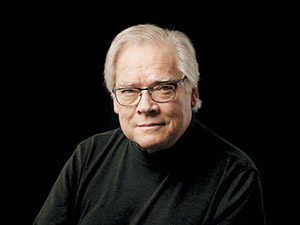
    Christopher Dunn

    A lifelong master craftsman, machinist, and engineer with experience in aerospace and a focus on precision and laser application, Dunn became fascinated with the Great Pyramid at Giza after reading Peter Tompkins’ iconic book The Secrets of the Great Pyramid. He spent more than 20 years studying the Great Pyramid and other Egyptian sites.

    Due to his engineering background, Dunn saw things in the Pyramid’s construction that others missed. Most people marvelled at the Pyramid’s size and asked, “How did they do it?” Dunn examined its precision and asked, “Why was it necessary?”
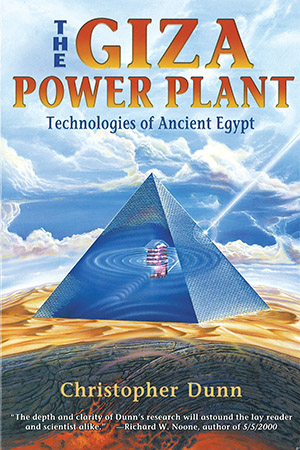
    Dunn burst into the limelight with the 1998 publication of The Giza Power Plant: Technologies of Ancient Egypt. Dunn revealed that the Great Pyramid was a giant power generator – an acoustical device that created harmonic resonance with the Earth and converted the planet’s natural vibrations into usable energy for an ancient civilisation. He showed that the Pyramid’s numerous chambers and passageways were positioned with deliberate precision to maximise acoustical qualities.

    In 2010, he followed up with Lost Technologies of Ancient Egypt: Advanced Engineering in the Temples of the Pharaohs, a unique study of the engineering and tools used to create Egyptian monuments, proving beyond a shadow of a doubt that advanced knowledge and machining was utilised.

    Dunn’s new 2024 book, Giza: The Tesla Connection: Acoustical Science and the Harvesting of Clean Energy, expands his hypothesis that the Great Pyramid at Giza was built as an advanced energy-harvesting machine.

    Dunn proposes that the Ancient Egyptians used the Great Pyramid to generate clean free energy, similar to what genius inventor Nikola Tesla later envisioned, as indicated in the title of his new book.

    Today, the world is suffering an energy crisis. The solution to our woes might be literally staring us in the face – on the Giza plateau. Will anyone listen? New Dawn recently spoke to Christopher Dunn.
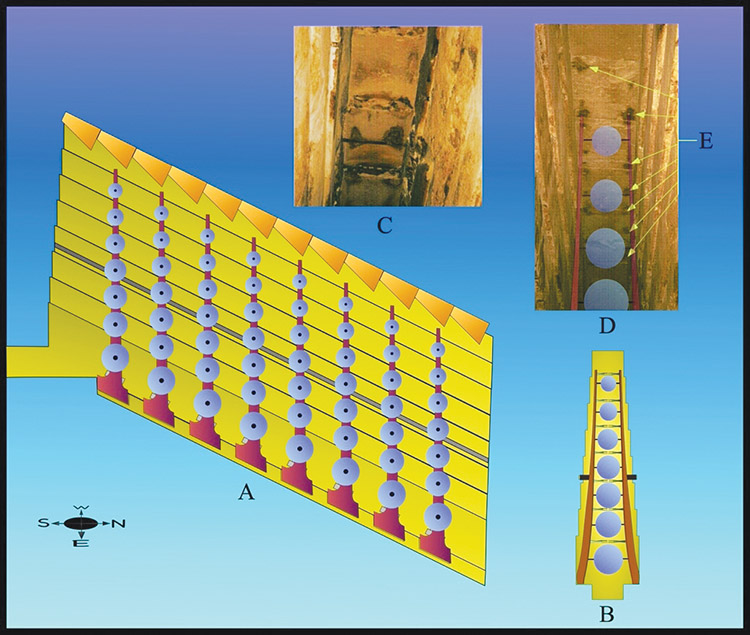
    A: East to West cross section of Grand Gallery with 8 of 27 installed resonators. B: North to South view along the length of the Grand Gallery. C: Close up of ceiling showing scorch marks. D: Ceiling scorch marks with resonator frame illustrating its correlation.

    NEW DAWN (ND): What discoveries have been made since the publication of The Giza Power Plant?

    CHRIS DUNN (CD): For those not familiar with the book, The Giza Power Plant: Technologies of Ancient Egypt is a reverse engineering exercise that began in 1977. The objective was to find a reason why every feature discovered in and around the pyramid exists. In a nutshell, it describes the Great Pyramid as a machine, the function of which was to draw energy from the Earth and distribute it to the inhabitants at that time. This ultimately led to the publication of the book in 1998.

    While there has been a lot of discussion about lost civilisations and ancient cataclysms, my intention while writing the book was to focus primarily on the physical evidence inside and around the Great Pyramid. Having said that, it is becoming clearer now, with the fine work of other investigators and their introduction of new evidence, that a cataclysm occurred in antiquity and the Great Pyramid, along with everything else existing in physical form that sustained a sophisticated society, was damaged beyond repair, as was the civilisation that built it.

    Since The Giza Power Plant was published, quite a few discoveries have been made in and around the Great Pyramid that support and allow refinements and strength to the theory. In chronological order, they are:

    • In 2001, while being filmed for a documentary on the Giza Plateau near Cairo, Egypt, I received permission from Zahi Hawass [Egypt’s Minister of State for Antiquities Affairs at that time] to go inside the Great Pyramid, which had been closed for cleaning. While inside the Grand Gallery, I noticed and photographed scorch marks on the ceiling. The pattern matched my theorised design of the frames that held a series of acoustic resonators. In The Giza Power Plant, I posited there was a hydrogen explosion inside the King’s Chamber that pushed out the walls and cracked the ceiling beams. I did not believe that evidence to support this theory would exist in the Grand Gallery, but in consideration of all other evidence, it would have been perfectly reasonable to do so. I just didn’t think of it at the time.

    • In 2002, the Queen’s Chamber South Shaft was explored by a robot named Pyramid Rover, designed and built by iRobot in Massachusetts, USA. The hydrogen that exploded, I theorised, was created in the Queen’s Chamber. This conclusion was reached by examining evidence that had been discovered related to the chamber and its North and South Shafts.

    With much fanfare and an audience that had been primed to be glued to their televisions for the intended broadcast of new pyramid discoveries, the Pyramid Rover prepared to climb the shaft and drill through a limestone block at the end. This blockage was first discovered by robotics engineer Rudolph Gantenbrink in 1993 and subsequently labelled “Gantenbrink’s Door.” While preparing to drill through the blockage, the thickness of the door was measured using an impact-echo probe and determined to be 3.25 inches thick. My illustration of this “door” showed a thickness of 3.6 inches.

    The image captured by an endoscopic camera inserted through the hole showed another blockage approximately 10 inches from the “door.” Not much else that was remarkable was revealed in the South Shaft at this time. No other theory offered at the time regarding what would be revealed was correct. However, what was revealed did not negate my theory, but for it to be proven 100% correct, more information was needed.

    Little did I know at the time that further validation of the theory was discovered after the iRobot team completed their work in the South Shaft and the documentary production crew departed. Before packing up their equipment and exiting the pyramid, the iRobot crew sent the Pyramid Rover robot up the North Shaft. Gantenbrink had attempted to explore the North Shaft in 1993, but could not navigate beyond two long exploratory rods that had somehow become stuck where the shaft turns on an angle to the left. Using a different tactic, by turning their robot 90 degrees so that it gripped the walls instead of the floor and ceiling, the Pyramid Rover was able to ride over these obstructions.
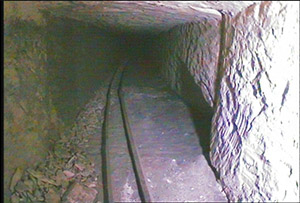
    Evidence of chemical inlet shaft.

    Pyramid Rover revealed two pieces of evidence supporting my theory about using these shafts. One was an opening in the East wall near one of the bends approximately 90 feet up the shaft from the Queen’s Chamber. I theorise that chemicals were introduced into the shaft behind the blockage, but this evidence showed that the entrance for the chemicals was lower down.

    The other evidence revealed was the existence of another blockage, similar to the South Shaft, but with electrodes that were not corroded and with one that was recessed and showed signs of electroplating.
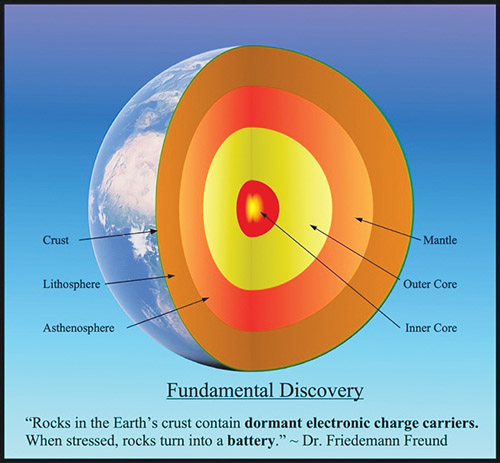
    Dr. Friedemann Freund’s discovery.

    • In 2006, Dr. Friedemann Freund, a NASA physicist, completed his laboratory experiment confirming his theory that earthquake lights were the result of electron flow propagating through the lithosphere when peroxy defects in their minerals were subjected to stress. His conclusion was that under certain conditions, igneous rock beneath our feet turns into a giant battery.

    • In 2010, another robot team from Leeds University in the UK, and headed by Chinese dentist Dr. TC Ng, fashioned a different style of robot which Dr Zahi Hawass named Djedi, the name of Khufu’s magician [in reference to Pharaoh Khufu of the 4th Dynasty who is said to have commissioned the Great Pyramid]. The Djedi robot was equipped with a snake camera that was able to look around the small space and even look behind Gantenbrink’s “door.” The images it captured allowed me to slightly modify my engineering design, but overall supported my proposed function for these features.

    • In 2017, the Scan Pyramid Mission released the muography images taken inside the Great Pyramid. Muons passing through the Great Pyramid would impinge on special plates set up inside the Queen’s Chamber and Grand Gallery. The image that resulted from the interaction identified voids inside the pyramid. Of particular interest was a large void above the Grand Gallery. Discussing this with aerospace engineer Eric Wilson, he offered the idea that it would have been used to pre-amplify microwaves travelling down the shaft before they entered the King’s Chamber. In association with that, drawings made available by Rudolph Gantenbrink of the King’s Chamber’s North Shaft have made it possible in my new book Giza: The Tesla Connection to illustrate this shaft with greater accuracy and point out features that are consistent with waveguide design.

    • On 20 July 2018, the Journal for Applied Physics published an article entitled “Electromagnetic Properties of the Great Pyramid: First Multipole Resonances and Energy Concentration” by Mikhail Balezin, Kseniia V. Baryshnikova, Polina Kapitanova, and Andrey B. Evlyukhin. In this article they reveal the results of their findings of the electromagnetic nature of the pyramids: “Electromagnetic field distributions inside the Pyramid at the resonant conditions are demonstrated and discussed for two cases, when the Pyramid is located in a homogeneous space or on a substrate. It is revealed that the Pyramid’s chambers can collect and concentrate electromagnetic energy for both surrounding conditions. In the case of the Pyramid on the substrate, at the shorter wavelengths, the electromagnetic energy accumulates in the chambers providing local spectral maxima for electric and magnetic fields.” (doi.org/10.1063/1.5026556 124, 034903)

    ND: Of those, which do you think is the most significant discovery?

    CD: Without hesitation, I would say the most significant discovery was Dr. Friedemann Freund’s. While Dr. Freund was only focused on developing the means to predict when an earthquake was about to happen, his proven lab experiments demonstrating his physics correct provide confidence that his discovery has the potential to solve the world’s energy needs.

    Moreover, when it comes to the reason behind building pyramids around the world – knowing that an abundant supply of electrons can be stimulated to rush to the surface as well as the new research showing that pyramids focus electromagnetic energy – there is solid proof that the Great Pyramid was part of a larger global system. For alerting me to Freund’s work, I must thank researcher Robert Vawter, who recently passed away.

    ND: Did The Giza Power Plant anticipate or predict this discovery?

    CD: The Giza Power Plant discussed earthquake lights, ball lightning and other natural phenomena but focused more on the piezoelectric effect of quartz crystals. Freund identified a new physics more related to semiconductors that does not rely on the piezo-effect. In fact, Freund found that one igneous rock called Gabbro has no silicon quartz crystals in it and was more effective in producing electron flow than other igneous rocks.

    ND: What discoveries could have been or were predicted since the publication of The Giza Power Plant?

    CD: All the evidence discovered in the Queen’s Chamber shafts was predicted to exist. The only difference is between my engineering design and that subsequently discovered. Scorch marks in the Grand Gallery could have been, but were not, predicted. Eric Wilson had stressed to me that the MASER needed a preamp to function properly. The “Big Void” may eventually be proven to have functioned in this way.
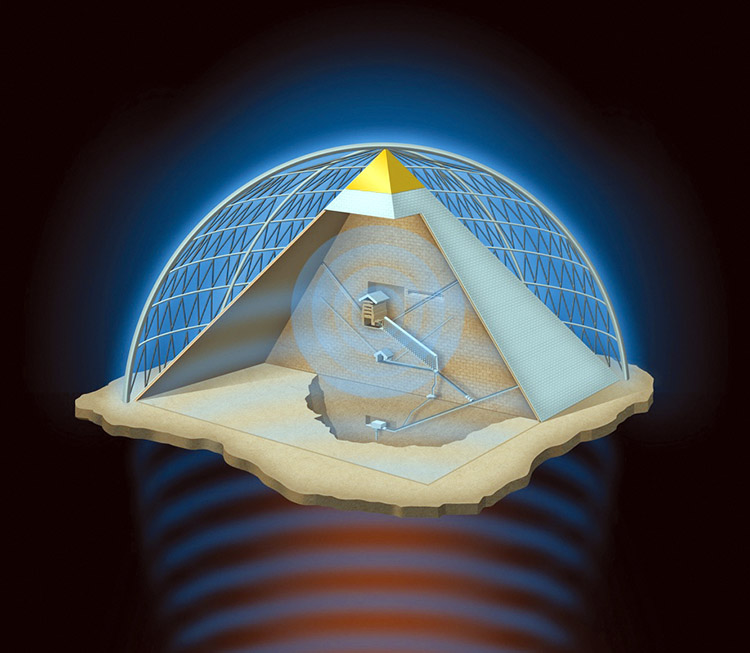
    Electron Harvester with Tesla Connection.

    ND: How would such an advanced power system shape our society?

    CD: Considering that we have been burning fossil fuels to produce electricity for over 100 years, reducing this method can only benefit the environment. In 2021, America burnt enough coal to build a pyramid that would be 76 times the size of the Great Pyramid. Current methods are highly inefficient and expensive compared to drawing electricity from directly beneath our feet. From a psychosocial perspective, the mental health of humans would improve if we were not depleting the Earth’s natural resources and polluting the atmosphere.

    ND: What other areas of science and engineering do you envision will evolve from this system?
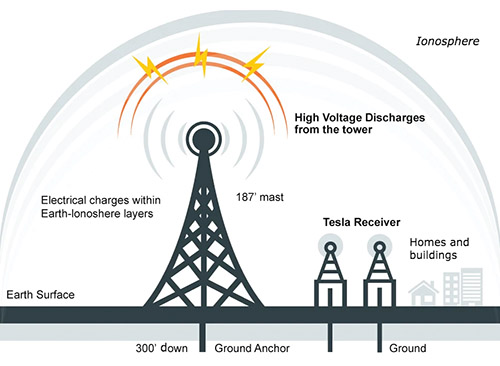
    Graphical representation of Wardencliffe Tower (Source: allaboutcircuits.com/technical-articles/teslas-towers-pikes-peak-wardenclyffe-and-wireless-power-transmission)

    CD: One area of improvement is the transmission of electricity. Electric vehicles are gaining in capabilities and efficiency. I envision a delivery system that transmits electricity without wires, as Nikola Tesla proposed with his Wardencliffe Tower project. I believe car companies could benefit from developing this technology by building their own electron harvesters that would wirelessly deliver power to vehicles and reduce, or eliminate, the need for batteries.

    The recent disclosure of UAPs navigating our airspace and displaying capabilities that we can only dream of possessing provides an indication of what is physically possible. It would seem, though, that breakthroughs in physics, as demonstrated by Freund, for example, are necessary before reaching this level of technological competence. One hundred years of technological advancement has resulted in a world that looks nothing like the world I lived in 78 years ago. If technology improves at the same pace into the future, our children and grandchildren will see a world that looks nothing like the world we live in today.

    ND: How are the Egyptian people reacting to your theories about their monuments?

    CD: Many Egyptians are now abandoning the pyramids as tombs theory and seeing their monuments in a different light. After the publication of The Giza Power Plant, it became clear to me that Western scholars were not accepting the evidence I presented that elevated the capabilities of the ancient Egyptians. After 10 years, I decided to appeal directly to Egyptian engineers with my book Lost Technologies of Ancient Egypt. In the book, I identified and analysed artefacts to conclude they must have been machined and challenged Egyptian engineers to inspect the artefacts themselves. I’m happy to report that an Egyptian engineer, Ahmed Adly, took up the challenge and created a series of YouTube videos where he presented his results.

    An important artefact he inspected was one of the boxes in the Serapeum. He concluded that I was right and provided me with a Foreword for Giza: The Tesla Connection. In his Foreword, Adly reports on a meeting he had with Dr. Ashraf Sherbini, a physicist at Cairo University, who agreed with my theory that the Great Pyramid was a machine. Adly’s videos have been well-received in the Arabic-speaking world, especially among Egypt’s youth. I believe that if Egypt’s history is to be rewritten, that task should be performed by the Egyptians, not outsiders.

    A chapter in Giza: The Tesla Connection is devoted to the Serapeum and also introduces new revelations on pre-dynastic vases that have recently been subject to modern inspection methods.
    Get the issue this article appears in

    ND: Has there been any interest expressed by energy companies?

    CD: An energy company from Malaysia has expressed a keen interest in developing the technology. My philosophy is that any entity wishing to develop it should be free to do so without barriers or exclusivity.

    ND: Is there more to reveal in the Great Pyramid?

    CD: Yes. Further research is ongoing. Of some I am aware, and I’m sure there are others I do not know about.

    ND: Are you currently working on any other writing project?

    CD: I do not plan on writing any more books. However, the recent metrological inspection of pre-dynastic vases has created quite a stir. Several have been inspected using conventional mechanical inspection methods, as well as structured light and CT scanning. The results are simply mind-blowing. STL files are available on UnchartedX.com and have been downloaded and analysed by engineers around the world. The mechanical inspection of the vases can be viewed at youtube.com/watch?v=QzFMDS6dkWU&t=425s. One analysis was performed by cryptographer and mathematician Mark Qvist and his colleague. His article can be read at unsigned.io/granite-artifact. This research, which now involves the Egyptians, is ongoing and articles targeting specific audiences need to be written. 

    Diagram images courtesy of Chris Dunn and Inner Traditions International. There are more images inside the published version of this article.
    Read the full story and contemplate all the convincing evidence in Chris Dunn’s new book Giza The Tesla Connection: Acoustical Science and the Harvesting of Clean Energy. Order your copy from all good bookstores.

    [alert type=”general” dismiss=”no”]This article was published in New Dawn Special Issue Vol 18 No 2.[/alert]

    [alert type=”success” dismiss=”no”]If you appreciate this article, please consider subscribing to help maintain this website.[/alert]

    References

    Freund, Friedemann. “Rocks that Crackle and Glow: Predicting Earthquakes.” Filmed at the 33rd annual Society for Scientific Exploration (SSE) Conference in 2014 at the Hyatt Regency San Francisco Airport, Burlingame, California, USA, youtube.com/watch?v=aRXlk26TcGc
    Freund, Friedemann. 2016. “Using Semiconductor Physics to Forecast Earthquakes.” TEDx Talk Christchurch, NZ. youtube.com/watch?v=B1yno8RjaFE
    Freund, Friedemann, Ouillon G., Scoville J., and Sornette D. 2018. “Earthquake precursors in the light of peroxy defects theory: critical review of systematic observations,” European Physical Journal (EPJ)
    Pyramid Rover exploration of the Queen’s Chamber North Shaft. Ancient Architects YouTube channel, youtube.com/watch?v=Ki0405ulvIY

    © New Dawn Magazine and the respective author.
    For our reproduction notice, click here.

  • RFK Jr.: “Conspiracy Theories” Keep Turning True

    RFK Jr.: “Conspiracy Theories” Keep Turning True

    From New Dawn Special Issue Vol 18 No 3 (June 2024)

    Robert F. Kennedy Jr. (RFK) has been appointed by US President Donald Trump to head the Health and Human Services Department. He leads the “Make America Healthy Again” movement. Here is a selection of his statements from recent interviews.

    “A conspiracy theory is just something the government doesn’t want you to hear and doesn’t want you to think about.”

    “The cost of autism is now a trillion dollars a year. My generation, I’m 70… I had eleven siblings [and] 70 cousins – nobody with a peanut allergy. Why do five of my seven kids have allergies? The autism rate in my generation today, right now, 2024, one in 10,000. 70-year-old men have autism. In my kid’s generation, it’s one in every 34 kids. One in every 22 boys, according to CDC. Nobody’s talking about this? This is bankrupting our country. It’s a trillion dollars a year just for autism… Nobody’s talking about why is this happening?”1

    • • •

    “Americans didn’t suddenly get lazy. We’re being mass poisoned by a food industry that is highly subsidised, and that owns Congress… We’re the only country in the world that allows public funding for food to go to soft drinks. 10% of food stamps are going to sugar water that is designed to make you diabetic.”

    Over 90% of US medicare bills are going towards treating chronic disease, a health epidemic that Kennedy describes as “gravy trains for pharma.”2

    • • •

    “When I was a kid, a typical paediatrician would see one case of diabetes in his entire career, juvenile diabetes. Today, one out of every three kids who walks through his door is either prediabetic or diabetic.”

    “Something’s wrong. It’s high fructose corn syrup, and it’s glyphosate and neonicotinoids and atrazine and all the other crap that is in our food. We’re not feeding people; we’re poisoning them.”3

    • • •

    Three jury trials have now ruled that Roundup causes non-Hodgkin lymphoma and cancer. “We’re being poisoned,” says Kennedy.

    Kennedy said cell phone radiation causes glioblastomas (a type of brain cancer) and penetration of the blood-brain barrier. A case in front of a full court of appeals panel ruled that “conspiracy theory” to be true.4

    • • •

    “When Columbine happened, [families of the victims] sued [Luvox]. And there are SSRIs [antidepressants]. I’ve talked about this. I’m not saying this is the answer. [I’m] saying it’s something that we should look at – that SSRIs have black box labels and benzos that say, ‘known to cause suicidal and homicidal behaviour.’ It says that.”5

    • • •

    “The money-making scheme goes as follows: 60% of Americans have at least one chronic disease. Who does that benefit? Big Pharma. Who owns portions of all major pharmaceutical companies? The answer: BlackRock. It goes even deeper. People are sick because they’re eating processed foods with ingredients that are banned in European countries. Who owns portions of all major processed food companies? The answer is BlackRock. And who is one of the biggest donors to both the Republican and Democratic parties? Once again, the answer is BlackRock.”

    Kennedy says both parties are “not allowed to solve” the chronic disease epidemic. Why? “Because there are people making money on that problem who are giving them money.”6

    • • •

    “The worst thing that you can do in a democracy is to censor speech… If you have a government that can silence its critics, it has license for any atrocity.”

    “Today, they’re letting pharmaceutical companies censor doctors and scientists who differ with the official orthodoxies on COVID. But I’ve been around long enough to know that once the Big Tech firms know that they can get away with that, the oil companies will be back next in line to censor their critics. The coal companies, the chemical companies, the processed food industry. Everybody else is going to get in line. Once we say, ‘That’s okay,’ we’ve let a genie out of the bottle.”7

    • • •

    Pandemic policies “destroyed an entire generation of kids and their learning.” The government “violated every pandemic protocol that we’ve developed over 50 years.”

    “You do not shut down a country for respiratory illness because everybody knows it’s going to go through anyway. And it was an illness that spread indoors, not outdoors. And we knew that from the beginning.”8

    • • •

    “There are only two entities in America who are immune from litigation: the US Army Corps of Engineers and pharmaceutical companies in their production of vaccines. That’s it. And the rest of us are held accountable when we harm someone — but not Big Pharma’s vaccines.”

    “Why do you think these drug companies are spending so much money on ads during the news? It’s not to sell their products. They’re doing just fine with that. It’s because they want to control the message.”9

    • • •

    Get the issue this article appears in

    RFK on the War Business Model

    “This is a war [Russia vs Ukraine] that should have never happened. It’s a war that Russians tried repeatedly to settle, on terms that were very beneficial to Ukrainians. The major thing they [the Russians] wanted was for us to keep NATO out of the Ukraine. The big military contractors want to add new countries to NATO all the time. Why? Because that country has to conform its military purchases to NATO weapons specifications. Which means certain companies – Northrop Grumman, Raytheon, General Dynamics, Boeing and Lockheed – get a trapped market…

    “[US Senate Republican leader] Mitch McConnell was asked can we really afford to send billions to Ukraine? He said don’t worry, it’s not really going to Ukraine but to American defence manufacturers. So he admitted it’s a money laundering scheme.

    “And who do you think owns every one of these companies? BlackRock….

    “So they are doing this right in front of us. They dont even care that we know anymore because they know they can get away with it. How do they know that? Because they have a strategy. And that strategy is an old, old strategy, which is they keep us at war with each other. They keep us hating each other.”10

    [alert type=”general” dismiss=”no”]This article was published in New Dawn Special Issue Vol 18 No 3.[/alert]

    [alert type=”success” dismiss=”no”]If you appreciate this article, please consider subscribing to help maintain this website.[/alert]

    Footnotes

    1. youtube.com/watch?v=1BFWR3FC2t8
    2. youtube.com/watch?v=oxXiS-HAkLA
    3. rumble.com/v4li860-rfk-jr-were-being-mass-poisoned-by-our-food.html
    4. open.spotify.com/episode/3DQfcTY4viyXsIXQ89NXvg
    5. youtube.com/watch?v=1BFWR3FC2t8
    6. youtube.com/watch?v=YJqjOPUOujQ
    7. vigilantnews.com/post/rfk-jr-issues-grave-warning-that-everyone-needs-to-hear
    8. vigilantnews.com/post/rfk-jr-hits-chris-cuomo-with-a-series-of-covid-truth-bombs
    9. x.com/RobertKennedyJr/status/1786816692611592223
    10. x.com/RobertKennedyJr/status/1756561127557718286?s=20

    © New Dawn Magazine and the respective author.
    For our reproduction notice, click here.

  • The Power of Premonitions: An Interview with Larry Dossey, MD

    The Power of Premonitions: An Interview with Larry Dossey, MD

    When Larry Dossey was in his first year of medical practice, he experienced a week of premonitions about patients, all of which came true. He later became intrigued by patients who were blessed with “miracle cures,” remissions that clinical medicine could not scientifically explain.

    Searching for an understanding of the interaction between mind, body and spirit, Larry Dossey embarked on a life-long study of religion, philosophy, meditation, oriental literature, parapsychology and quantum physics.

    Today, he is a respected leader in bringing scientific understanding to spirituality and an internationally influential advocate of the role of spirituality in healthcare and wellness.

    During his distinguished career as a practitioner of integrative medicine, he helped establish the Dallas Diagnostic Association and served as Chief of Staff of Medical City Dallas Hospital. The author of eleven books, including the New York Times bestseller Healing Words, he is executive editor of Explore: The Journal of Science and Healing.

    Dr. Dossey has lectured all over world and at major medical schools and hospitals in the United States – Harvard, Johns Hopkins, Cornell, and the Mayo Clinic, among others. A native Texan, he lives in Santa Fe, New Mexico.

    In the following interview, Dr. Dossey introduces his latest book The Power of Premonitions: How Knowing the Future Can Shape Our Lives, taking readers through documented cases of premonitions, an examination of recent science, and practical techniques for inviting premonitions.


    What’s your book about?

    Larry Dossey (LD): Premonitions – knowing what’s about to happen.

    What’s a premonition?

    LD: “Premonition” literally means “forewarning.” Premonitions are a heads-up about something just around the corner, something that is usually unpleasant. It may be a health crisis, a death in the family, or a national disaster.

    But premonitions come in all flavours. Sometimes they provide information about positive, pleasant happenings that lie ahead – a job promotion, where the last remaining parking place is, or, in some instances, the winning lottery numbers.

    A favourite example of yours?

    LD: Amanda, a young mother in Washington State, was awakened one night by a horrible dream. She dreamed that the chandelier in the next room had fallen from the ceiling onto her sleeping infant’s crib and crushed the baby. In the dream she saw a clock in the baby’s room that read 4:35, and that wind and rain were hammering the windows. Extremely upset, she awakened her husband and told him her dream. He said it was silly and to go back to sleep. But the dream was so frightening that Amanda went into the baby’s room and brought it back to bed with her. Soon she was awakened by a loud crash in the baby’s room. She rushed in to see that the chandelier had fallen and crushed the crib – and that the clock in the room read 4:35, and that wind and rain were howling outside. Her dream premonition was camera-like in detail, including the specific event, the precise time, and even a change in the weather.

    Why are premonitions about unpleasant things? Why don’t we have premonitions about winning the lottery, the right stocks to pick, or when to bail out of the stock market?

    LD: Most researchers believe premonitions are trying to do us a favour. They are mainly about survival. If you know that something life-threatening is approaching, you have a chance to avoid it. This would increase your chance of staying alive and reproducing – our evolutionary imperative. That’s probably why premonitions are often about threats to our existence, why they have become built into our biology, and why probably everyone has a premonition sense to some degree.

    Why did you write this book?

    LD: I actually tried not to write it. I largely ignored this stuff for years, but this didn’t work very well. My own experiences of premonitions grabbed me and wouldn’t let go.

    During my first year in medical practice as an internist, I had a dream premonition that shook me up and made me realise the world worked differently than I had been taught.

    Briefly, I dreamed about a detailed event in the life of the young son of one of my physician colleagues. It turned out to be so accurate it scared me. There was no way I could have known about the event ahead of time.

    Then patients of mine began telling me about their own premonitions. Even my physician colleagues would occasionally open up and share their premonitions with me. So I decided this was a well-kept secret in medicine that needed telling.

    The time is right for this book because science has come onto the premonitions scene. There are now hundreds of experiments that confirm premonitions, which have been replicated by researchers all over the world.

    So there’s a new story to tell. It’s no longer only about people’s experiences, but it’s also about science. Many people still think this stuff is just mumbo-jumbo and that there’s no science to back it up. It’s the “everybody knows” argument – “everybody knows” you can’t see the future, so proof of premonitions cannot possibly exist.

    That’s wrong. We now know we can see the future, because that’s what careful scientific studies show.

    If people can see the future, why don’t they get rich playing the stockmarket?

    LD: Some do. Bill Gates says, “Sometimes, you have to rely on intuition.” Oprah Winfrey says, “My business skills have come from being guided by my inner self – my intuition.” Donald Trump says in The America We Deserve, “I’ve built a multibillion empire by using my intuition.”

    George Soros, the billionaire investor, has all sorts of theories to back up his decisions. But according to his son, “At least half of this is bull… [T]he reason he changes his position on the market or whatever is because his back starts killing him. He literally goes into a spasm, and it’s this early warning sign.”

    Researchers have tested CEOs of successful corporations for their ability to see the future, such as predicting a string of numbers they will be shown later. The CEOs who are good at this are usually those who are also highly successful in running their corporations. In other words, their precognitive ability correlates with their corporate success. CEOs who did not have this ability tend to have mediocre success rates in their corporations. So business success and premonition ability seem to go hand in hand.

    In one study, experimenters were able to predict in advance the most successful corporate balance sheets by how well the CEOs did on tests that measured their ability to predict the future, such as a string of numbers they’d be shown later.

    This ability was not dependent on reason or logic or inference. You can’t “reason” and “analyse” what a randomly chosen string of numbers is going to be.

    Interestingly, these CEOs were shy about owning their premonition sense. They didn’t call their abilities premonitions, but good “business sense.” The polite word for premonitions in business is “business intuition.” There’s a growth industry in teaching business intuition. Google “business intuition” and you’ll come up with nearly a half million hits.

    Do premonitions work for people in business who are not CEOs?

    LD: Yes. I discuss several experiments in which people used their premonitions to make large sums of money in the silver futures market. One of these experiments was featured on the front page of the Wall Street Journal.

    So what keeps people from getting rich?

    LD: The limiting factor seems to be greed. When the subjects focused on making modest sums of money, the experiments worked; when they got greedy and tried to break the bank, the experiments flopped.

    This reminds us of what happened on Wall Street beginning in the fall of 2008. Nearly all the pundits say the primary underlying reason for the crash was unbridled greed.

    You talk about “evidence” for premonitions. But isn’t the evidence just anecdotes and people’s stories?

    LD: This field used to be only about stories, but that’s changed. There’s now a science of premonitions. For the first time in history, we can now use “premonition” and “science” in the same sentence.

    Take the “presentiment” experiments that have been pioneered by consciousness researcher Dean Radin. Briefly, a person sits in front of a computer, which will make a random selection from a large collection of images that are of two types – calming or violent. Calming images may be a lovely scene from nature; violent images deal with death, carnage, grisly autopsies, and so on. The subject has some physiological function being measured, such as the electrical conductivity of the skin or the diameter of the pupil. The bodily function begins to change several seconds before the image is randomly selected by the computer and shown on the screen. Here’s the shocker: the physiological change occurs to a greater degree if the image to be shown is violent in nature. How is this possible? How does the body know which image is going to be shown in the future?

    Dozens of these studies have been done by various researchers. They show that we have a built-in, unconscious ability to know the future. Somehow the body knows before our awareness kicks in.

    There’s a charming quotation in the book The Secret Life of Bees that captures this. Fourteen-year-old Lilly says, “The body knows things a long time before the mind catches up to them.”

    Another type of experiment is called “remote viewing,” in which people can consciously know highly detailed information up to a week before it happens. These studies were pioneered at Stanford Research Institute and have been replicated at Princeton University and elsewhere.

    How can we know when to take a premonition seriously?

    LD: If the premonition is about your health or if it involves images of death, it’s wise to take it seriously. You might not get a second chance.

    A patient of mine had a dream premonition of “three little white spots” on her left ovary. She feared this meant she had ovarian cancer. We checked it out. Her sonogram showed she was accurate; she indeed had three little “white spots” on her left ovary, but they were benign ovarian cysts, not cancerous. She did the right thing; she had a health-related premonition, and she checked it out.

    If the premonition is extremely vivid – if it seems “realer than real” – take it seriously.

    A cardiologist I know had a vivid dream that a patient of his had a stroke while he was doing a cardiac catheterisation, which was scheduled for the next day. He wondered whether he should cancel the study, but he told himself that dreams mean nothing and pressed ahead. The next day, while actually doing the catheterisation, his patient had a stroke in precisely the same pattern he dreamed. It shook him up and completely shifted his attitude about premonitions. Now he takes them seriously.

    People can become very skilled in knowing when to take a premonition seriously. They develop a refined sense over time. Practice makes perfect.

    What do your colleagues in medicine think about your book?

    LD: Nearly all of them are supportive. I’ve discussed premonitions with hundreds of physicians in lectures at medical schools and hospitals all over the country. I was hesitant at first, thinking they’d all probably get up and walk out. The opposite happens. They open up and share their own stories.

    Following a lecture at a Harvard-sponsored conference, one female internist told me, “I see numbers in my dreams – the actual lab values of my patients’ tests – before I even order them.”

    Dr. Larry Kincheloe, an OB-GYN in Oklahoma City, knows ahead of time when his patients are going to deliver because he gets strange feelings in his chest when the time is near. It’s like an alarm goes off. This is so reliable that the OB nurses caring for his patients have learned to ask him how his chest feels, as a guide to when a patient will deliver.

    This is like the presentiment experiments, in which the body knows something is going to happen and starts reacting before awareness kicks in. It’s a premonition in the form of physical symptoms.

    Nurses have been very supportive of my ideas. They are more open to premonitions than just about anyone. They spend more time at the bedside than doctors do. Over the years, nurses often become very precognitive. Many of them say they “just know” when a stable patient is going to have trouble, such as a cardiac arrest.

    The subtitle of your book is “how knowing the future can shape our lives.” How can it?

    LD: Knowing the future can help you have a future. Premonitions are often about survival. They warn us of future dangers – health problems, impending accidents, disasters, and so on.

    For example, research shows that people often avoid riding on trains the day they crash, compared to normal days. On days of the crash, the vacancy rate on the train is unusually high.

    This type of premonition is usually unconscious. People don’t say, “The train is going to crash. I’m cancelling my reservation.” They usually report a vague sense that something is wrong or doesn’t feel right, and they find some reason to change their plans.

    People may avoid doomed planes as well. The vacancy rate on the four planes that crashed on 9-11 was 79 percent. This suggests that lots of people found some reason not to travel on those planes that day. (We don’t know for certain what this means, however, because the airlines won’t release vacancy rates for travel on the same flights for the preceding months, so there’s no way to know for sure how unusual these high vacancy rates actually were.)

    But perhaps the main way premonitions affect our lives is by giving us a different way of thinking about our own consciousness, our own mind.

    I discuss experiments in which consciousness can operate both into the future and into the past. This suggests that time does not limit what our consciousness can do.

    This raises the possibility that our consciousness is timeless. This opens up the possibility of immortality and the survival of some aspect of our consciousness following death.

    Can we learn to have premonitions? Can we cultivate them?

    LD: Yes. The main thing is not to try too hard. Premonitions usually come unbidden. They largely “do” us; we don’t “do” them. So the trick is to invite them, not compel them, into your life.

    First, simply realise that these experiences are extremely common, and that it’s likely that you will experience them.

    Second, keep a dream journal, because premonitions occur most frequently during dreams. Record your dreams as soon as possible on waking. Most people find that premonitions become more frequent when they do this.

    Third, learn to quiet your body and mind. Sit down, shut up, be quiet, and pay attention. Some people call this meditation; others simply call it “getting quiet.” Research shows that skilled meditators perform better on premonition experiments than just about anyone. Meditation opens a door to premonitions and helps us notice them when they occur.

    Fourth, read about premonitions. What are they like for other people? This will help you recognise your own premonitions, and when to take them seriously.

    You say that most premonitions are unconscious?

    LD: Yes. Most premonitions occur in dreams. Dreams by definition are unconscious. And many experiments show that people’s bodies react to future events even before they happen, without their being aware of it.

    But if premonitions are largely unconscious, how can we make use of them?

    LD: Premonitions don’t have to be a detailed snapshot of the future, of which we’re fully aware, to be helpful. They can be just a hunch or a gut feeling that we act on without consciously knowing why.

    Some researchers believe unconscious premonitions are the most valuable kind.

    If we unconsciously know something is going to happen, we can react without processing this information by thinking about it. Thinking takes time. In dangerous situations we need to act quickly, immediately, without wasting time through reason and intellectual analysis.

    As a battalion surgeon in Vietnam, I knew many soldiers who swore they had some sixth sense that kept them alive by alerting them to danger. They’d react instantly without thinking, as if “on automatic.” I suggest they were using premonitions.

    I discuss an event in which an entire group of church members were late for choir practice one weekday night at a little church in Beatrice, Nebraska. The church exploded, and would almost certainly have killed them had they been there. The odd thing is that none of them had any conscious premonition that the explosion would occur, but they stayed away nonetheless. Being late was an unconscious behaviour, and it saved their life.

    This sort of behaviour is very common among mothers. They often have “just a feeling” their baby is headed for trouble, and they act on this impression without knowing why. The term “mother wit,” once very common, captured this idea.

    Is there a downside to premonitions?

    LD: Yes. Anything can be taken to extremes. I’ve known a few individuals who won’t make major decisions without consulting a psychic. They become slaves to somebody else’s premonitions about the future.

    Premonitions can be false. The mind plays tricks – sometimes dirty tricks. Hallucinations happen. Just like we can have false memories of the past, we can have false impressions of the future.

    So how can we avoid being misled by premonitions?

    LD: It’s pretty simple. Premonitions are a single way of knowing the future, not the only way. Whenever possible – in non-emergencies – we should rely on multiple sources of information – logic, reason, and analysis, plus intuition, hunches, and premonitions. Multiple strands of information help guard against bad decisions. When we rely on only one source of knowing, we can get into trouble. This is common sense: Don’t put all your eggs in one basket.

    Skeptics say we can’t know the future. When we appear to do so, it’s just a chance happening. What about this?

    LD: The skeptics have a point. No doubt some premonitions that seem to come true are nothing more than chance happenings or lucky hits.

    But to say that all the billions of people throughout human history who have experienced premonitions that turned out to be valid are deluded seems highly unlikely.

    Skeptics often single out examples of premonitions that are silly or nutty, then generalise to condemn all premonitions. This is irrational. Or they say that people have selective memories. They only remember the premonitions that come true, and forget those that don’t. This is simply not true; people often recall premonitions that don’t pan out.

    But even if valid premonitions are statistically unlikely, as the skeptics claim, that doesn’t necessarily mean they are false. Many things that are rare are nonetheless real. It is extremely unlikely that any particular individual can run a four-minute mile. But a few people can. It’s unfair to use statistics to dismiss rare events.

    Most skeptics are poorly informed. They simply ignore the experiments showing that people can sense the future, because these studies create huge holes in their arguments. Many skeptics will not be persuaded that premonitions are real, no matter how compelling the evidence is. Personal experience is probably the best argument against the skeptics of premonitions.

    I give several examples in which a skeptical spouse profoundly disagreed about whether or not his or her partner’s premonition should be taken seriously. But when the premonition came true, the skeptical spouse came around to a different way of thinking. An example is Amanda’s precognitive dream that a falling chandelier would crush their baby in its crib. The husband dismissed it as silly. But when she removed the baby from the crib and the chandelier actually fell and demolished the crib, precisely as she had dreamed, her doubting husband changed his tune.

    Cases like this suggest that the best evidence for premonitions is not argument or even experimental evidence, but personal experience.

    OK, so there’s evidence that premonitions are real. It’s still mind-boggling. How could these things possibly happen?

    LD: I agree that premonitions seem impossible – but only if we hold onto our common-sense beliefs about how the world works.

    Most people believe that our minds are confined to the present and to the brain and body. To make a place for premonitions, we have to go beyond these core beliefs. True, it seems as if we’re locked into our individual brains and bodies and the present, but the evidence from hundreds of experiments shows that this is an illusion.

    Scientists don’t really know what time is. We assume it flows in one direction, which prohibits premonitions. But no experiment in the history of science has ever shown that time flows in one direction, or that it flows at all. Alternative views of time are downright cordial to premonitions.

    For example, physicists talk about “closed time-like loops” that can carry information from the future into the present. This is one way premonitions might work.

    Others suggest that the future is already present, already laid out, in what is called a “block universe.” During premonitions, we might gain access to this already-present information.

    Other researchers suggest that the mind is nonlocal, which is a fancy word for infinite. According to this idea, consciousness is present everywhere in space and time. This means that we have access to all the information that has ever existed or will exist – past, present, and future. This opens the door for premonitions.

    These are all hypotheses, of course. The main point is that our common-sense ideas about time, space, matter, and our own minds are flawed. The universe works differently than we supposed.

    In view of our ignorance, we need to stay open to the evidence for premonitions and not fall back into our prejudices, as when skeptics say, “Everybody knows premonitions are impossible.”

    Often in science and medicine we know that something happens before we understand how it happens. Explanations sometimes come much later. So it may be with premonitions.

    If I can see the future, doesn’t that mean it is already in place and is fixed? Don’t premonitions do away with free will and freedom of choice?

    LD: No. Just because you glimpse how the future is likely to unfold does not mean you can’t act to change it. When Amanda dreamed that the chandelier fell and crushed her sleeping infant, she removed the baby from the crib. The chandelier did fall, but the baby’s life was saved. She exercised her freedom of choice, and it made a life-and-death difference. There are thousands of similar examples.

    Philosophers often argue against premonitions because they say premonitions destroy freedom of choice. But people who have premonitions usually don’t see it that way. Like Amanda, their personal experiences with premonitions say they do have a choice. They can act, and they do, to change the future they’ve glimpsed.

    I agree with the idea that the future is probable, not fixed. According to this view, the future is fluid and subject to change. So a premonition is not inevitable.

    Probability varies, of course. This means that some futures may be easier to change than others. It was easier for Amanda to act on her premonition and remove her baby from danger than for an individual to prevent an earthquake she dreamed about. Some futures may be so probable they will happen; others, perhaps most, are malleable.

    What’s the Big Lesson from premonitions?

    LD: Premonitions are an incredible gift. Although they are an aid to our physical survival, their main contribution is in providing us with an expanded vision of who we are and what our destiny may be. They show that we’re more than a physical brain and body. Brains can’t operate outside the present or beyond the body. But our consciousness can, as premonitions show.

    Premonitions reveal that we’re not slaves to the body or to the present. We can operate outside of time; something about us is timeless. The implications are quite wonderful, because they imply immortality. Not a small contribution.

    Dr. Larry Dossey’s website is www.dosseydossey.com. The Power of Premonitions: How Knowing the Future Can Shape Our Lives is available from all good bookstores.
    [alert type=”general” dismiss=”no”]This article was published in New Dawn Special Issue 9.[/alert]

    [alert type=”success” dismiss=”no”]If you appreciate this article, please consider a contribution to help maintain this website.[/alert]

    © New Dawn Magazine and the respective author.
    For our reproduction notice, click here.
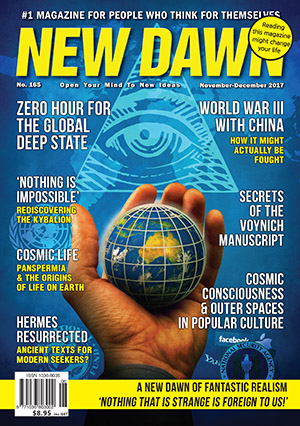
  • A New Dawn of Fantastic Realism: ‘Nothing that is Strange is Foreign to us!’

    A New Dawn of Fantastic Realism: ‘Nothing that is Strange is Foreign to us!’

    From New Dawn 165 (Nov-Dec 2017)

    “The paths of Fantastic Realism… do not resemble the ordinary paths of knowledge.”
    – Louis Pauwels & Jacques Bergier, The Morning of the Magicians

    As Richard Smoley rightly pointed out, “a noted predecessor” of New Dawn magazine “was the French review Planète (‘Planet’), published by Louis Pauwels and Jacques Bergier as a follow-up to the sensational success of their book Morning of the Magicians.” Inspired directly by Pauwels’ and Bergier’s book and Planète journal, New Dawn continues a subversive tradition of delving into subjects as fascinating and wide-ranging as secret societies, ancient mysteries, conspiracies, arcane prophecies, vanished civilisations, UFOs, supernatural phenomena, the awakened state….

    Like the French Planète (published 1961–1972), New Dawn was founded on the premise that reality is far more fantastic than how we limit it under conventional scientific, political, historical and cultural models. “If New Dawn magazine,” wrote editor David Jones in the March-April 2014 issue, “has a guiding philosophy or general orientation,” it would be, “Fantastic Realism with its slogan ‘Nothing that is strange is foreign to us!’”

    Grounded in the worldview of Fantastic Realism, New Dawn magazine is dedicated to exploring what Jacques Bergier and Louis Pauwels identified in The Morning of the Magicians, namely:

    Trends of thought that escape the notice of the trained observer; writings and works to which the sociologist pays scant attention, together with social phenomena that he considers too insignificant or too odd to worry about, are perhaps a sure indication of events to come than facts that are there for all to see and the openly expressed opinions and general trend of thinking which cause him serious concern.

    What exactly is Fantastic Realism? The answer is clearly outlined in The Morning of the Magicians:

    We call our point of view fantastic realism. It has nothing to do with the bizarre, the exotic, the merely picturesque. There was no attempt on our part to escape the times in which we live. We were not interested in the ‘outer suburbs’ of reality: on the contrary we have tried to take up a position at its very hub. There alone, we believe the fantastic is to be discovered – and not a fantastic leading to escapism but rather to a deeper participation in life…. The fantastic is usually thought of as a violation of natural law, as a rising up of the impossible. That is not how we conceive it. It is rather a manifestation of natural law, an effect produced by contact with reality – reality perceived directly and not through a filter of habit, prejudice, conformism.

    Long before the ‘X-Files’, ‘Ancient Aliens’ and the contemporary fascination with conspiracies and cover-ups, Fantastic Realism raised questions like: Are we all in a collective conspiracy to hide the truth, and is science such a conspiracy? Do secret societies exist and have they influenced history? What special knowledge did the ancients possess that we may not possess now? What role did occult forces play in the origins and rise of Nazism? What does the future promise for our civilisation? Are there Mutants among us? Does extrasensory perception reveal that human consciousness has advanced beyond its currently accepted limits? What connects the ancient art of alchemy and modern atomic physics?

    Readers of New Dawn magazine will immediately realise they are on familiar territory. Some readers may even find themselves in agreement with author and esoteric scholar James Wasserman when he described Fantastic Realism as a look behind “the many masks of God.” Fantastic Realism, Wasserman noted, “declares that an objective appreciation of the material world is a means by which we may attain an awakened state of consciousness, the next step in human evolutionary destiny.”

    Implicit in the approach pioneered by Fantastic Realism is a rejection of all reductionism, conformity, as well as the false dichotomy of Either/Or, Black-White thinking. Presenting hypotheses, examining the ‘outer limits’ of the human experience, and highlighting modern scientific and social falsehoods, does not mean embracing crusading dogmas or sentimental simplistic answers. It does, however, require leaving behind the ‘accepted wisdom’ of the herd.

    “Real intelligence,” the French writer Aimé Michel said, “lies in being able to think further than is allowed.” Aimé Michel, a Fantastic Realist collaborator and influential UFO researcher, always focused on “all that goes beyond the human,” maintaining that his objective was not to be limited by any external constraint. “It’s time to discover that all systems of thought,” Michel asserted, “are actually systems to AVOID thinking!”

    The task then, as summed up in the slogan of the New Dawn masthead ‘Open Your Mind to New Ideas’, is to transcend the narrow confines and closed-minded thinking of consensus reality. But first, the reader must not be afraid to question conventional knowledge, put aside all prejudice and assumption, and consider a different method of interpreting reality. As Louis Pauwels urged his readers all those years ago, what is needed is to look at reality with new eyes or, more accurately, with “awakened eyes.”

    A former student of George Gurdjieff, Pauwels made a key component of Fantastic Realism Gurdjieff’s observation that Man is asleep and must be shocked into an awakened state in order to perceive true reality. With this in mind, the astute reader of New Dawn gains a deeper awareness and understanding of what this magazine is all about. New Dawn magazine is a magic portal to another way of seeing Man and the world, a doorway to a new consciousness, a new humanity, and a new era.

    “Reality is not only queerer than we suppose but queerer than we can suppose.”
    – J. B. S. Haldane (1892–1964), outstanding scientist and polymath

    [alert type=”general” dismiss=”no”]This article was published in New Dawn 165.[/alert]

    [alert type=”success” dismiss=”no”]If you appreciate this article, please consider subscribing to help maintain this website.[/alert]

    © New Dawn Magazine and the respective author.
    For our reproduction notice, click here.
  • What Are UFOs? Terrestrial, Extraterrestrial & Metaterrestrial Theories…

    What Are UFOs? Terrestrial, Extraterrestrial & Metaterrestrial Theories…

    This article was published in New Dawn Special Issue 17 (Sept 2011)

    If there’s one thing we learn from studying UFOs, there is no simple answer to what it’s all about. Most of the public – and even many Ufologists – tend to lump together all UFO incidents into a single phenomenon. But the evidence indicates there is no single explanation for all the material categorised under “UFO experience.” 

    According to author and researcher John White, we are actually looking at a multilevelled phenomenon – terrestrial, extraterrestrial and metaterrestrial – and each is qualitatively different from the others. Each has its own unique forms of UFOs, and each form has to be distinguished from the others of that level. 

    John White has extensive experience in the fields of consciousness research and paranormal phenomena. He has personally investigated the UFO phenomenon. 

    John holds degrees from Dartmouth and Yale, and is the author of 15 books. He has lectured at educational institutions and spiritual centres throughout the United States and Canada, and before public and professional organisations.

    He is a contributor to a newly compiled collection of the knowledge and insight of the world’s leading experts on modern Ufology. Exposed, Uncovered, and Declassified: UFOs & Aliens reveals startling evidence of famous sightings and contact with aliens, and uncovers classified files from archives. 

    In the following interview with New Dawn magazine, John White defines ‘UFO’ and outlines three different levels of understanding this mysterious phenomenon that has both a physical and metaphysical dimension.

    NEW DAWN (ND): What is the definition of UFO?

    JOHN WHITE (JW): I use the one developed by the Mutual UFO Network, or MUFON, which is an international group of lay people and scientists who’ve been investigating the subject for decades. MUFON says UFOs are objects observed in the skies or on the surface of the Earth which defy conventional explanation after a thorough study and investigation by competent people.

    Now, lots of sightings have been shown to be due to misperception of more familiar things such as balloons, planets, meteors, satellites, stars, advertising aircraft, falling aerospace debris, and so forth. These are IFOs or identified flying objects. The sightings which are yet to be explained are what MUFON calls daylight discs – objects with unusual lights which are simultaneously tracked visually and on radar at fantastic speeds. Also, some sightings involve objects which leave physical evidence after landing. Still other sightings involve authenticated photographs. And of course there are cases involving visitations or close encounters by humanoids or entities.

    The UFO phenomenon is multilevelled and can’t be explained in a unified fashion. Little green men in spaceships with Martian license plates may be part of the puzzle, but that is only one piece of it. There is much more.

    ND: Such as?

    JW: In my judgment, the evidence of Ufology falls into three major categories, and so I say there are three “answers” to the UFO problem – three qualitatively different answers. Those answers – all genuine, all real – relate to what can be called different levels of reality or different aspects of our existence.

    To put it simply, the levels or aspects are: terrestrial, extraterrestrial and metaterrestrial. Metaterrestrial is a term coined by Dr. J. Allen Hynek, the US astronomer-ufologist. He meant it to denote an unseen world beyond the familiar three-dimensional world we know. (He also coined the term “close encounters of the first, second and third kind.”) This three-part explanation for the UFO problem is the overview I hold. We don’t have time to go into the evidence in detail, so I’ll just sketch it in very broad strokes in order to give an outline of the overview I’ve come to hold of the UFO phenomenon.

    EXTRATERRESTRIAL 

    I’ll start with the most common idea of what UFOs are, namely, extraterrestrial. It’s most common simply because it’s been around longest and has gradually gained widespread acceptance.

    ND: The question is whether there’s any truth to it.

    JW: I think there is. In fact, judging from the Humanoid Catalog data base of more than 3,000 modern UFO sightings in which a wide variety of humanoids were present, I regard Earth as one of the major crossroads of local space. Some UFO experiences seem best understood exactly as the public does – namely, as constructed physical vehicles occupied by ETs. The case for the existence of ETs somewhere in the universe has been solidly established over the last five decades by astrobiology, quite apart from the data of Ufology. Astrobiologists are pushing SETI, or the search for extraterrestrial intelligence, by using radio telescopes to listen for signals from space. And although the scientific community, by and large, does not accept Ufology as a colleague discipline, that rejection really is illogical and unscientific. But even that is changing as astronomy discovers planets revolving around other stars than the Sun – and the list of planets is now more than 1,200.

    ND: What is the evidence astrobiologists should consider?

    JW: There’s the world-famous case of Barney and Betty Hill, which was reported in a 1965 book entitled The Interrupted Journey. For me, the most persuasive aspect of the case is the Hill Star Map.

    ND: Tell our readers about it.

    JW: While driving on a deserted road near Exeter, New Hampshire in 1961, the Hills were reportedly abducted by small, thin, gray beings with large heads who took the couple aboard a UFO. Betty was shown a hologram-like map of space with the route indicated which the beings followed from their home star to Earth. She saw the route which the aliens followed and she saw it in full 3-D, as if she were looking out a porthole into space.

    In 1964, Betty and Barney underwent hypnotic therapy for symptoms which, they discovered, arose from their abduction experience. At the suggestion of their therapist, Boston psychiatrist Benjamin Simon, Betty drew a picture of the three-dimensional map she’d seen on board the craft in 1961. Her map was a flat reconstruction on paper which showed our Sun and other stars from the perspective of the aliens’ home star. When it was published in The Interrupted Journey, an Ohio school teacher named Marjorie Fish saw the picture and got the idea to use an astronomical catalogue of stars to help her build a model of space by stringing beads on a wooden framework. The beads represented stars up to 40 light-years away, accurately placed around the centre, representing Earth, in accordance with the astronomical catalogue data. It took Fish three years, working off and on, to finish her model. When she was done, she looked at it from every angle in an attempt to find the pattern of stars which matched Betty Hill’s map. But she couldn’t find a matching pattern. All her attempts at the time failed.

    Then, in 1969, a new catalogue with revised astronomical data made it possible for Fish to construct a more accurate model of nearby space. It took another three years, but when she was done, she found a pattern of beads which matched the pattern in the Hill Star Map almost perfectly. The home base of the aliens appeared to be the star Zeta Reticuli, in the constellation Reticulum, about 37 light-years from Earth. Astronomers and Ufologists debated the matter and it is now settled in favour of Fish rather than being just a random matching of stars.

    Now, here’s the reason this is persuasive. The Hill Star Map was drawn in 1964 yet it contained information unknown to anyone on Earth at the time. Fish had to wait until the revised astronomical catalogue was published in 1969, before human knowledge was sufficient for her to construct an accurate representation of local space. So how did Betty Hill get her knowledge of stars in space eight years before the catalogue? Logic tells us that the holographic map she claimed to see aboard a UFO was real and thus the information on which Betty Hill based her map strongly suggests that it was of extraterrestrial origin.

    TERRESTRIAL 

    ND: What about the second category of UFOs you mention – the terrestrial?

    JW: It would be nice if all UFO cases proved to be extraterrestrial in nature, but some are best understood as originating from Earth itself. In other words, these are terrestrial.

    Some UFO sightings have taken place at sea and on large bodies of water, and involve craft which observers say burst through the surface of the water and take off into the sky. The late American biologist Ivan Sanderson wrote about this in his book Invisible Residents, which gives the best description of this aspect of the UFO phenomenon. Sanderson felt these sightings might be due to the presence of an undersea civilisation native to Earth. He reasoned that since life began in the sea, when some organisms came ashore it slowed their development while sea-living organisms continued to evolve. Look at cetaceans, Sanderson said. Although porpoises, dolphins and whales are not technological, they are highly intelligent. We humans are able to weld metal under water and we can mix concrete which sets under water. So today there may be advanced forms of sea life more intelligent than humans and capable of UFO technology, living invisibly on Earth under the oceans and other large aquatic bodies. Of course, it may also be that ETs have established undersea bases.

    ND: What else is in the terrestrial category?

    JW: Some UFO experiences seem best understood as human contact with a lower form of animal life native to Earth’s atmosphere. The discovery of these strange aerial creatures is told in Trevor James Constable’s 1976 book The Cosmic Pulse of Life. He simply calls them “critters.” His text and photographs reveal a class of elemental fauna unknown to official science. These amoeba-like aeroforms are neither solid, liquid nor gas. The exist in the fourth state of matter – plasma – and are normally invisible for several reasons. First, their native habitat is high in the atmosphere far beyond human gaze but nevertheless well below the astronomers’ usual telescopic focus. Second, they are bioenergetically propelled and move at a very high speed – thousands of miles per hour. Last, their usual condition is in the infrared portion of the electromagnetic spectrum. However, they have the capacity to change their density and thereby pass from one level of tangibility to another. Thus, they sometimes do appear in the visible portion of the spectrum where, if seen by humans, they are quickly labelled UFOs – which, of course, they are. But they are not mechanical spacecraft; they are living creatures. They grow anywhere from the size of a coin to at least half a mile in diameter. They give a solid radar return, even though invisible to the naked eye. When they’re visible, they pulsate with a reddish-orange glow. They can change their form, but generally are seen as discs or spheroids. Their diaphanous structure allows a limited view of the interior. When Ivan Sanderson saw Constable’s photos, he said they made him feel like he was looking through a fishbowl. Some critters have been seen close up on the ground in full physical density, according to Constable’s research.

    ND: Do you have other evidence for terrestrial UFOs?

    JW: Still another plausible terrestrial explanation for some UFO sightings is given in the term “earth lights.” It was coined by the English researcher Paul Devereux in his 1982 book Earth Lights and amplified in his 1989 book Earth Lights Revelations. The books present evidence to show that geophysical activity in crystalline rock structures, especially along fault lines, produces a piezoelectric effect. That subsurface pressure generates electromagnetic fields above the fault lines, and in those fields, hot electrified balls of gas are formed – ionized plasmas. Those ionized plasmas are luminous atmospheric phenomena, and that is what Devereux calls earth lights.

    Now, aerial luminosities have been noted throughout history around the world, but their origin has been attributed to supernatural causes and labelled as “will-o’-the-wisp,” ignis fatuus, ghost lights, and so forth. Dr. Michael Persinger, a psychologist at Laurentian University in Canada, and Gyslaine Lafrenière, a research scientist there, demonstrated in their 1977 book entitled Space-Time Transients and Unusual Events that such phenomena may have a terrestrial origin and be capable of inducing many effects in the minds of human observers, depending on their distance from the site, such as have been noted in UFO sightings and even abductions. Devereux and his colleagues’ research, independent of Persinger and Lafrenière’s, has enlarged upon the possibility that tectonically generated earth lights may account for some UFO sightings and mysterious ghostly figures.

    This line of research is collectively known as the tectonic strain theory. Geophysicists have investigated this phenomenon for a long time because of reports during earthquake activity that the shaking earth was accompanied by aerial lights. The lights weren’t called UFOs, of course – just strange luminosities which sometimes appeared in association with earthquakes. In the mid-1980s, the US Geological Survey, in its journal Earthquakes and Volcanoes, published the first photo of one ever. It was snapped by someone with enough presence of mind to shoot it during an earthquake here in the US. A vaguely defined ball of light about six feet wide is clearly visible in the air.

    So there you have several terrestrial-based phenomena which seem to me to explain some UFO sightings and, except for the possibility of undersea ET bases, they have absolutely nothing to do with craft from outer space. But the list of terrestrial-based explanations needs to be enlarged by one – and a very strange one, indeed. It takes us right up to the border of physical nature and passes over into the metaphysical, or more precisely, into the parapsychological. I’ll call it the psychokinetic explanation.

    ND: Psychokinetic? As in mind over matter?

    JW: Yes. The Swiss psychiatrist Carl Jung is known for his contribution to psychology of the concept he termed “the collective unconscious.” He hypothesised that we human beings have not only a personal unconscious, which Freud demonstrated, we also have a deeper layer of mind which is somehow shared by everyone, and this aspect of our minds includes memories of human experiences from the beginnings of our race. Ancient symbols reside in our minds, such as the Wise Old Man, the Hero and the Evil One, representing the collective experience of humanity in certain basic categories. In his book Flying Saucers: A Modern Myth of Things Seen in the Sky, Jung proposed that UFOs are symbolic projections of deep human yearnings for wholeness and transformation in the collective psyche of humanity. Without denying their physical nature – because, of course, UFOs have been photographed and tracked on radar – Jung speculated that UFOs are either our own psychic projections perceived objectively in the sky or they are the appearance of real objects which afford humans an opportunity to project mythological symbols from deep in the collective psyche. The oldest symbol of wholeness or totality is the circle. So flying saucers, Jung said – those round shining objects in the sky – require a psychological interpretation as a symbol of the human yearning for certainty and completeness in an age of rapid change and uncertainty.

    Some UFOs may be the creation of our own minds. Sounds wild, doesn’t it? But there is some research supporting that. In the 1970s, Dr. Gertrude Schmeidler, a parapsychologist at City College of New York, conducted research with the well-known psychic Ingo Swann. In a completely darkened laboratory, she photographed Swann as he used mental intention and his psychokinetic power of mind over matter to envision light streaming from his outstretched arms. Guess what? The photos showed a visible glow around Swann’s hands. So if one person’s mental intention can produce a physical effect such as that, what might the collective intention and unconscious psychic ability which everyone seems to have in some degree produce?

    I don’t think that’s far-fetched. In fact, one psychic I know, Stella Lansing of Massachusetts, used to get photos of UFOs which no one else ever saw in the sky. They were beautiful 35 mm colour slides of well-formed, clearly visible, apparently metallic craft. The only problem with her photos was this: in at least one instance which I examined, the image of a UFO extended from one frame across the intervening section of film onto the succeeding frame! Now, as you know, that intervening section of film is not exposed to light from outside the camera. It’s mechanically impossible to do that. There’s absolutely no way those two frames could represent an actual object in space outside the camera. So the image had to have been generated directly inside the camera by Stella’s own psychokinetic power. This psychic phenomenon is called thoughtography, and psychiatrist Jules Eisenbud, who investigated the phenomenon in a man named Ted Serios, has established the case for such mind over matter photography.

    This interaction between mind and matter, between the physical brain and the metaphysical mind, and taking place at a distance, points toward the last major category of UFO phenomena which I see as yet another piece of the puzzle.

    METATERRESTRIAL 

    Metaterrestrial means something which originates outside the ordinary three-dimensional space-time framework in which we normally function. The word is synonymous with metaphysical, meaning “beyond the physical,” but it has a more scientific connotation to it, like hyperspace and quantum space do. Some people call that realm extradimensional, interdimensional, ultraterrestrial and supraphysical. Whatever word we use for it, this category of answer provides evidence that some UFO experiences are due to nonphysical but real entities which come not from other locations in our physical universe but from other sets of dimensions or other realms which interpenetrate our more familiar space-time.

    In short, and as Dr. Jacques Vallée first pointed out in his 1968 book Passport to Magonia, many UFO incidents appear to be contemporary versions of what was recorded long ago in mythology, religious scripture and spiritual traditions as encounters with angels, demons and the various inhabitants of other planes of existence. Through a process we don’t understand, these metaterrestrial beings materialise into our space-time from other levels or other realms of reality. Those levels or realms have a wide range of beings which are native to them, just as our own level of reality has creatures ranging from viruses to whales and from algae to redwoods.

    I think the best case to illustrate this is the famous miracle at Fatima, Portugal, which occurred in 1917. It’s popularly known in Roman Catholic tradition as “the day the Sun danced” and as “the day the Sun fell” because a brilliant Sun-like object came near the ground. Thousands of people witnessed it.

    Some Ufologists regard the Fatima events as a display of advanced technology in which ETs are manipulating human belief systems via holographic projections. I acknowledge that possibility. But there is another tradition – namely, Eastern religion – which offers detailed information about a class of celestial beings whose characteristics are remarkably similar to what was seen at Fatima.

    Moreover, some UFO contactees describe meetings with nonphysical entities who materialise into our space-time continuum from other sets of dimensions or higher planes of existence. Those nonphysical entities have been called names such as Space Brothers, extradimensionals and ultraterrestrials, and their existence is said to be on a scale enormously beyond the human, just as ours is beyond that of insects, which in turn are similarly beyond microbes. From the metaterrestrial level of reality, it is said, these higher forms of life influence and even guide human affairs.

    The most common name for them is deva, a Sanskrit word which means “shining one” or “radiant being.” It is the conceptual equivalent of what we moderns call an angel. More generally, it means a being of light. Devas are said to belong to another kingdom of life. They are a separately created, very high order of existence which has the role of supervising lower orders. Devas exist in a nonphysical but ontologically real form magnitudes of cosmological order beyond the human level. Considered abstractly in scientifically oriented terms, devas can be described as conscious, formative principles which guide and regulate life forms below them in the ladder of creation or the great chain of being, irrespective of space-time coordinates.

    Hinduism and Tibetan Buddhism are especially rich in information about devas. Some signs which announce the presence of these normally unseen entities are the sudden appearance of rainbows and perfume, multicoloured flower blossoms falling from the air, sudden high winds, various celestial phenomena such as shooting stars and lights in the sky, and multicoloured clouds forming themselves into unusual shapes. That sounds a lot like the Fatima UFO to me.

    ND: Please sum up what you’ve told our readers.

    JW: The UFO phenomenon appears to be multifaceted and there is no neat, simple answer to what it’s all about. In my judgment, the public and even many Ufologists are indiscriminately lumping together UFO sightings and incidents into a single phenomenon. But the evidence indicates that no single explanation can cover all the experiences and events brought together under the label “UFO experience.” It is a multilevelled phenomenon. And each level – terrestrial, extraterrestrial and metaterrestrial – is qualitatively different from the others. Each has its own unique forms of UFOs, and each form has to be distinguished from the others of that level.

    Our understanding of the UFO phenomenon can be compared to our evolving understanding of the atom. In ancient Greece, the atom was regarded as the ultimate unit of matter. However, the rise of science demonstrated that the atom was not “rock-bottom reality.” Rather it was composed of protons, electrons and neutrons. Thus, a new level of reality emerged – the subatomic. Continuing scientific research discovered a host of new particles, such as neutrinos, quarks, mesons, bosons, and other exotic forms of matter below that of the atom. Most recently, science has discovered a still more basic or fundamental aspect of reality, the quantum level. Our present understanding regards it as the level from which all the particles and the four fundamental forces – gravity, electromagnetism and the weak and strong nuclear forces – arise.

    The UFO experience can be regarded in a somewhat similar manner. There is no single “unit” of the UFO experience. There are different phenomena, outwardly appearing to be the same thing, but actually qualitatively distinct from one another. And they can be classified not only in the horizontal dimension as discrete phenomena, they also can classified vertically as belonging to one or another level of reality.

    Only when we understand the UFO phenomenon as multilevelled and multifaceted will we move to a deeper understanding of this intriguing and mysterious topic, and begin to solve the puzzle called the UFO experience.

    [alert type=”success” dismiss=”no”]If you appreciate this article, please consider subscribing to help maintain this website.[/alert]

    © New Dawn Magazine and the respective author.
    For our reproduction notice, click here.