New Dawn – World's Most Unusual Magazine

Author: Robert Feather

  • Where Did Christianity Really Come From?

    Where Did Christianity Really Come From?

    This article is a brief examination of the nature and historical roots of the Qumran community that lived and worked on the western shore of the Dead Sea around 150 BCE to 68 CE and the connections that may be discerned between it and the preaching of John the Baptist, the ministry of Jesus, and the origins of Christianity. It looks through the eyes of scholars like Jozef Milik, one of the first to discover the nature of the Dead Sea Scrolls and to analyse them in depth, back in the 1950s, and the author’s analysis of the latest research now that translations of most of the Dead Sea Scrolls, discovered near Qumran, have been officially published.My previous book The Mystery of the Copper Scroll of Qumran,1 dealt with aspects of the Dead Sea Scrolls and, more particularly, one of the scrolls that had been engraved on copper by the strange community of Essenes that inhabited Qumran. As a trained metallurgist, the use of copper by a devout Jewish sect, living by the Dead Sea around the first century BCE, had aroused my curiosity – especially as the Hebrew text seemed to be a list of buried treasures that apparently had never been found (see New Dawn No. 80, September-October 2003).

    Identifying the location of some of the treasures described in the Copper Scroll was only one of the claims substantiated in that book; treasures I identified as being in various museums around the world. Furthermore, a detailed analysis arose from my reading of the name of an Egyptian pharaoh encrypted in the text of the scroll – an interpretation confirmed as “not unreasonable” by both Professor John Tait of University College London and Professor Rosalie David of Manchester University.

    The profound conclusion was that the Hebrews must have been present at the court of Pharaoh Akhenaten and the origins of monotheism date back to his time.For my next book I had planned to take a closer look at the Qumran community’s beliefs and way of life, examining how these may have influenced the beginnings of Christianity and its emergence as a daughter religion of Judaism. However, while discussing the project with Jozef Milik, one of the scholars who originally worked on deciphering the Dead Sea Scrolls back in the early 1950s, my research took a strange and totally unexpected twist. Jozef Milik had been the leader of the team of translators based at the École Biblique in East Jerusalem; he had also been, at that time, an ordained Catholic priest.What Monsieur Milik revealed to me, in the course of many intriguing conversations he and I shared about the Essene community, inspired me to write a new book and informs a substantial part of it.

    During my researches I have come across many further pieces of evidence that confirm a connection between a uniquely monotheistic pharaonic period in Egyptian history and the Essenes of Qumran, who lived a thousand years later and a thousand miles distant. As remarkable as this connection may appear to be, to date the relationship has been criticised but not refuted, and a number of eminent scholars have indicated that it begins to explain some anomalies in their own research. As I progressed further along the “Jozef Milik trail,” many more examples came to light that supported my conjectures regarding this link and these have a considerable bearing on early Judaism and the story of Jesus and his epoch.

    The main thrust of the current search, however, was the nature of the people who lived at Qumran between, perhaps, 150 BCE and 68 CE, when their settlement was destroyed by the Romans, the secrets they kept, their relationship to the earliest followers of Jesus, and the incredible revelations of Monsieur Milik. It was not until my third visit, in October 1999, when I returned to present him with a copy of my book on one of the Dead Sea Scrolls, that Jozef Milik started to talk more freely about his early life and work, volunteered his date of birth as March 24, 1922, and told me why he had left the Catholic Church. Ostensibly it was to marry his rather delightful wife, Yolanta, née Zaluska, but there were other reasons, reasons connected with what he had found and interpreted in the scrolls of the Dead Sea. Two hours into our conversation he quietly and almost casually spoke of certain events near Qumran. It was one of those nerve tingling moments; my mind reeled with the impact of what he was saying.

    Those dramatic words of Jozef Milik started me on a journey of discovery to determine how the circumstances at the time of Jesus might confirm or disprove his revelation. It was a quest that was to take me from the cold dampness of a Parisian autumn day to the remote dryness of Egypt, to the holy places of Jerusalem, to an offshore haven on the Isle of Man, to catacombs in Rome, to Washington and New York, to a Gothic building in Germany, and back to the barren shores of the Dead Sea in Israel. As my journeys and investigations progressed, it became increasingly clear that something extraordinary, as yet not revealed, may have occurred at or near to Qumran, and there were others who were party to this knowledge but were not keen for the evidence to become public.

    Qumran

    The Qumran Essenes, a mysterious Jewish sect that suddenly vanished from its habitat by the Dead Sea in Judaea around 68 CE, was a unique community in Jewish history, and in many ways practiced a form of Judaism very different from that being pursued elsewhere in the Second Temple period. No one is certain of the origins of the strange, reclusive sect that wrote and possessed what are now known as the Dead Sea Scrolls. Nor is there agreement as to the degree of influence the sect had on early Christianity, or its relationship to John the Baptist and Jesus. Such is the intensity of feelings about who exactly these Essenes were that it is not uncommon to see professors shouting across conference rooms at each other as they defend their respective pet theories. Whilst there is consensus on many issues, there are also large areas where there are just no accepted answers. Perhaps part of the reason is there are basic misunderstandings with regard to the origins of the community. As archaeologist Magen Broshi, of the Israel Museum, likes to put it: “There are at least ten different theories about the origins and function of Qumran. By definition, nine of them are wrong.” As our story unfolds, it will become increasingly evident that the activities of the Essenes are central to the plot, and of profound significance to Judaism, Christianity, and Islam, as well as many other religions. It is useful to set the scene with a Timeline of Events in the period in question. After the discovery of the Dead Sea Scrolls in the late 1940s and early 1950s, it soon became apparent that the type of Judaism practiced by the authors/possessors of the scrolls – a minority Essene group that numbered perhaps less than four thousand, or 2 percent of the Jewish population – was far more similar to early Christian practices and beliefs than that of any previous group. Previously it had been assumed Christianity emerged out of Pharisaic Judaism. The worry for modern Christian authorities was not so much that they had got their suppositions wrong, regarding which strand of Judaism had given birth to Christianity, but that it was becoming increasingly difficult to distance Christianity from this previously little-known new slant on Judaism, namely Essenism. The first sensational claim relating the Dead Sea Scrolls to Christianity came from a respected Sorbonne University professor, André Dupont-Sommer who wrote in 1950 that he saw Jesus in the “pierced messiah” mentioned in one of the Dead Sea Scrolls: “The Galilean Master… appears in many respects as an astonishing reincarnation of the Teacher of Righteousness.” When who this Teacher of Righteousness really was becomes apparent, it is clear that Dupont-Sommer was quite wrong in his assumptions about the Teacher as “the exact prototype of Jesus.” As an outsider from the predominantly Catholic translation team (he had once been an abbé), Dupont-Sommer was immediately criticised by his peers for jumping to preposterous conclusions. Nevertheless, Edmund Wilson, a respected American literary journalist and columnist for The New Yorker, picked up the theme and subsequently published a book entitled The Scrolls from the Dead Sea, in which he claimed that Qumran, “with its ovens and its inkwells, its mill and its cesspool, its constellation of sacred fonts and the unadorned graves of its dead, is perhaps, more than Bethlehem or Nazareth, the cradle of Christianity.” A few years later John Marco Allegro, the only Methodist among the predominantly Catholic original Dead Sea Scrolls translation team in Jerusalem, broke ranks and claimed that one of the Dead Sea Scrolls included mention of messianic crucifixion and resurrection. He was undoubtedly a brilliant scholar, but his claims became more extreme with the publication of his book The Sacred Mushroom and the Cross in 1970, which claimed Christianity was born out of Jesus’ followers imbibing hallucinatory drugs. In 1979 he went even farther down this hypothetical trail, claiming Jesus was no more than a fanciful legend developed by the Essenes to extemporise on their own Teacher of Righteousness. Allegro conceived of this Teacher figure as an Exodus period Joshua/Jesus incarnate who was killed, or perhaps crucified, by the Israelite Wicked Priest, Alexander Jannaeus, around 88 BCE. Allegro was pilloried by his peers in an open letter to The Times, of London, in 1956, and never really recovered from the personal attacks on his character that followed. Perhaps the record is put right in his daughter’s recent biography of her father published this year.2 In the mid-1980s Robert Eisenman, a professor of Middle Eastern religions at California State University, published a number of works attempting to relate the Qumran Essenes to characters in the Christian Scriptures. One of Eisenman’s ongoing themes has been the idea that James the Just, the brother of Jesus, was the leader of the Qumran-Essene community. When more of the Cave 4 Dead Sea Scrolls material became available in 1991, Eisenman, together with Michael Wise, associate professor of Aramaic at the University of Chicago, continued the theme in their book The Dead Sea Scrolls Uncovered. In this work, they also discuss what they believe is a reference in the Dead Sea War Scroll to a suffering, wounded, and ultimately slain messianic figure. Two journalist protégés of Robert Eisenman, Michael Baigent and Richard Leigh, expanded on Eisenman’s theories in their book The Dead Sea Scrolls Deception, published in 1991. In addition, they accused Catholic authorities and the Vatican of a cover-up conspiracy designed to distance the teachings and beliefs of the Qumran Essenes from early Christianity. The controversies were added to dramatically by an Australian academic from Sydney University, Barbara Thiering. She claimed there had been a complete misunderstanding of the Dead Sea Scrolls. Thiering maintains that the Teacher of Righteousness and his rival the Wicked Priest corresponded to John the Baptist and Jesus. For her, Jesus did not die on the cross but lived on at Qumran after his experience of near death. Some other commentators could not even find a real Jesus in historical terms and suggest he was a fictitious figure culled from Greek myths and pagan legends. The overall conclusion, nevertheless, from sources external to the Christian Scriptures, both literary and archaeological, is that someone who fulfilled many of the biblical claims relating to Jesus really did exist. Furthermore, whatever attributes he possessed, divine or otherwise, they inspired a devoted religious following that eventually grew into a movement whose influence swept the entire world.

    The Messiahs of Qumran

    Two central concepts need to be kept in mind when attempting to understand the motivations behind the beliefs and behaviour of the Essenes, and, more particularly, the Qumran Essenes and their messianic hopes. First, although they put immense store in traditional Hebrew teachings, they followed an apparently aberrational form of Judaism that yearned for and echoed the early days of Mosaic Sinai and which, I maintain, dates back even further to the ancient monotheism of Akhenaten and Jacob. Second, if the early Jesus movement owed a powerful debt to the beliefs practiced at Qumran, which I suggest will become even more apparent from the evidence presented in my new book, then it would not be surprising to find that some of Akhenaten’s teachings and imagery would be transferred across and reflected in the early Jesus movement and later Christianity. It is evident from the Dead Sea Scrolls that the Essenes of Qumran considered themselves an elite messianic group; they had retreated from the fray of the Temple and the priesthood and sought refuge in the wilderness to protect their piety. The opening verses of Isaiah, chapter 40, aptly describe their role:

    The voice of him that crieth in the wilderness, Prepare ye the way of the Lord, make straight in the desert a highway for our God.

    For some of the Essenes, the need to retreat was part of their search for a reaffirmation of the divine covenant given to Moses on Mount Sinai, a quest for the purity and essence of Torah and Hebrew teachings. They looked upon themselves as the ancestral custodians of the “light of truth.” Their fundamental beliefs and manner of practicing their special religion were essentially at odds with the rest of the Jewish community, and they followed an extreme form of ritualistic behaviour and strict adherence to their interpretation of the Law. So who were the Qumran Essenes waiting for? The answer is contained in a number of the Dead Sea Scrolls texts that indicate they were waiting for two, and some scholars read three, messiahs. These messiahs, one priestly and one royal, are given various titles in different scrolls:

    Priestly: Interpreter of the Law, the Star; the Messiah of Aaron, who was of princely descent

    Royal: Prince of the Congregation, the Scepter; the Messiah of Israel; the King Messiah

    In addition, they expected the return of a prophet similar to Moses. Fortunately, there are quite detailed descriptions of these messiahs in a number of the scrolls, so one would assume it should be relatively easy to identify who they were talking about. Unhappily, that is not the case, and conventional scholarship makes little attempt to utilise this information. As Joseph Fitzmyer, professor emeritus at Catholic University in Washington, notes: “It is a surprise to see a priestly figure become part of the Qumran community’s messianic expectations, because there is little in the Hebrew Scriptures itself about a future ‘priest’.” He finds no reasonable explanation for this phenomenon. In fact, I believe both the name of Akhenaten, preserved in the text of the Copper Scroll, and a variation on the name Meryra, his High Priest, as a title for a leader of the Qumran community, reflect this priestly connection, among many other indicators. Another clear example comes from the community’s War Scroll: “And on the banner of Merari they shall write… God’s offerings [and the name of the Prince of Merari]” (4QM).

    A Line of Priests

    The Book of Jubilees, which emanated from the Essenes, makes it quite clear the patriarch Jacob passed his teachings on down through the line of Levi, one of his sons, giving rise to the so-called Levitical priests. Yet these hereditary priests were not, according to the Hebrew Scriptures, appointed as priests until the time of Aaron several hundred years later. At the time of Jacob, there was no Israelite sanctuary or temple of worship, and yet the Dead Sea Scrolls repeatedly insist that priests were appointed at the time of Jacob. The only explanation that makes sense is that there were hereditary priests in Jacob’s time, that there was a place of worship, and that it was almost certainly the Great Temple at Akhetaten, modern day Amarna.

    The Messiah(s) Awaited by the Rest of the Jewish Population

    The generalised Jewish view of the awaited messiah can be understood in terms of the messianic age that the messiah would bring about. The End Days eschatology has essentially two elements: one of material restoration and one of a spiritual utopia. The Jewish concepts differ from Christian ideas of redemption in that they involve the visible world, whereas Christianity envisages a spiritual and personal redemption reflected in the soul. Tracing the quotations in the Christian Scriptures to their assumed original Qumran-Essene and Hebrew Scriptures sources is the flavour of the decade and preoccupies hundreds if not thousands of scholars around the world. Texts like the Dead Sea Scrolls; the Genizah Collection – found in Cairo, Egypt, in the late 19th century; and the John Rylands fragment – the earliest example of text from the New Testament dated to c 125 CE, have stimulated endless debate on the origins of Christianity. Despite the fact that large chunks of the Hebrew Scriptures have been shown to have been based on much earlier Egyptian texts, little attempt has been made to investigate these texts in the light of these blazing neon signs. Although early Christian writers could in theory have obtained some of their information from versions of text in general circulation, it seems likely that much of the Qumran Essenes’ literature from which they were quoting was available only to the Qumran Essene membership. The significance of these correlations is that the early Christians must have had access to sectarian texts with limited circulation and had a much closer relationship with the Qumran Essenes than has previously been acknowledged. Ideas and theology exclusively promoted by the Qumran Essenes, that appear in the Christian Scriptures or Christian practice and are not apparent in other Jewish sources, include: • Belial as a personalised incarnation of the powers of evil • The temple as a metaphor for community • Dualism in terms of light (good) and darkness (evil) • Equating righteousness with the Sun • The demand to keep separate from the way of darkness and to walk in the light • Courts of justice at Qumran and Corinth following the same novel judicial system • A conviction of humankind’s hopeless sinfulness • A humble teacher of justification through grace (recognised by Paul as Christ) • Knowledge of mysteries (creational and eschatological) of God is revealed only to the absolutely righteous • The terms wisdom, knowledge, and understanding used in the same sense • Three cardinal sins of fornication, impurity, greed (which leads to idolatry) • Foolishness and silliness as punishable offenses • An imperative for mutual fraternal correction – that is, the urgent need to make people aware they are sinning and bring them back to the light of goodness • The Qumran community and the Christian Church as the “chosen ones” • Liturgical times of prayer, vigils, quarter-tense (days of fasting and abstinence) coming to the church from Qumran • Tendencies toward monasticism and male chauvinism The possibility that John the Baptist had an association with the Qumran Essenes is for most modern and many early scholars much stronger than they would allow for Jesus. The enigmatic last verse of Luke regarding John living in the desert, as pointed out by l’Abbé René Laurentin, a French authority of the Church Council, makes little sense unless it is saying that John the Baptist was, from his childhood, a member of the Qumran community. The verse becomes clear, asserts l’Abbé, when the testimony of Flavius Josephus, the 1st century CE Jewish/Roman historian, is considered, when he says of the Qumran community it was their custom to adopt “children from others, at an age when their spirit is still malleable enough to easily accept instruction.” (Jewish Wars) John Allegro has also pointed out that the Baptist’s parents were elderly, and when his father died he may have been adopted by the community as it is difficult to envisage what he was doing as a child wandering around in the wilderness of Judaea. The only logical deduction, from all the evidence, is that he spent at least part of his early life at Qumran. John the Baptist’s prime activity was baptism, and this too can be linked to the practices at Qumran where initiates were accepted into the Community with a final ‘graduation’ baptism that confirmed their obedience and spiritual commitment to God. The obvious question to ask is: “What were the origins of baptism?” How did it commence as a religious ritual? The required presence of water in the Tabernacle of Moses indicates the importance of water from a very early time in Hebrew history. That it was also used in religious rites across the Middle East prior to this time is also apparent from various pictorial sources. Its use for baptism as an initiation rite, however, appears to have originated in Egypt. The explanation for John the Baptist’s extension of this ritual, I believe, lies in the same thread that connects religious practices of Akhenaten to those of the Qumran Essenes, as can be seen in the above illustration. Here, in a relief discovered at Amarna dating to circa 1350 BCE, one of Akhenaten’s princesses is seen being blessed as purifying water is poured over her head from a jar held in the hand of a projecting ray from the Aten – the name the Pharaoh gave to his God. Only further external proof can confirm this probability of John’s, and/or other members of the early Jesus movement’s connection to Qumran, and that some kind of extraordinary evidence might be forthcoming would seem unlikely on the face of it two thousand years after the events. That evidence is, however, presented in The Secret Initiation of Jesus at Qumran, published by Inner Traditions, in July 2005.
    [alert type=”general” dismiss=”no”]This article was published in New Dawn 93.[/alert]

    [alert type=”success” dismiss=”no”]If you appreciate this article, please consider subscribing to help maintain this website.[/alert]

    Footnotes:

    1. Published by Inner Traditions International, June 2003. An earlier version, The Copper Scroll Decoded, was published by HarperCollins in June 1999, and under other titles in Italy, Holland, and Japan. 2. Judith Brown, John Marco Allegro: The Maverick of the Dead Sea Scrolls, Wm. B. Eerdmans Publishing Company, 2005.

    © New Dawn Magazine and the respective author. For our reproduction notice, click here.
  • Unfolding the Secrets of the Copper Scroll of Qumran

    Unfolding the Secrets of the Copper Scroll of Qumran

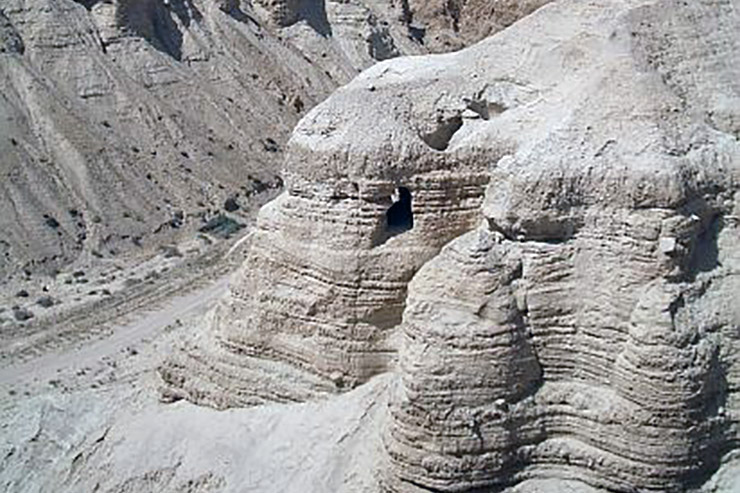
    Qumran lies close to the Dead Sea at its north western end, some 40 km east of Jerusalem. Here, in an incredibly dry and sun bleached area there is, strangely enough, no need for zinc oxide protective blocker, or life guards. Lying some 1200 feet below sea level at the lowest point on earth, the damaging rays of the sun are screened out by the extra layer of atmosphere, and the concentration of salts in the Dead Sea is so high that anyone falling in immediately pops to the surface and cannot sink.

    If a settlement is ever reached between Israel and the Palestinian Arabs, under the so-called Road Map for Peace, due to reach its conclusion in 2005, it is likely Qumran will fall into the area of a new Palestinian State and one of the most important of all the Jewish historical sites will no longer be under Israeli jurisdiction. Prior to 1967 the area around Qumran was controlled by the Jordanians and had been since the end of the war which saw Israel established as an independent State in 1948.

    So why is Qumran so important in historical and biblical terms?

    Part of our modern awareness of its significance derives from a day back in the Spring of 1947 when the first of some 85,000 textual items, ranging from tiny fragments to almost complete scrolls were discovered in hillside caves behind Qumran. They turned out to contain biblical texts, written in ancient Hebrew, Aramaic, and Greek from virtually every book of the Old Testament, and as such, predated any previously found Hebrew material by over 1,000 years. For the first time scholars and theologians had the astounding opportunity to look at parts of the Bible in its original language, rather than from handed down versions copied, and re-copied, and altered over the intervening millennium.

    In essence these biblical texts, which comprise part of what are known as the Dead Sea Scrolls, showed we received most of the Old Testament in its authentic ancient form – but there were significant differences. These variations are now being incorporated into modern translations of the Bible. There are also commentaries amongst the scrolls which help explain and enhance, not only parts of the Old Testament but also the New Testament.

    A third group of texts describes the peculiar monastic like sect that lived at Qumran between about 150 BCE and 68 CE, who wrote and collected the Dead Sea Scrolls.

    Generally understood to be part of the Essene movement of the Second Temple period, the community at Qumran had a strong hierarchical structure with the ‘right teacher’ as its leader. He was backed by priests aided by Levites, who dictated the doctrine of the group. At any one time there were about 200 members living near Qumran and all members could vote in an assembly on other non doctrinal matters, whilst general day-to-day administration was in the hands of a triumvirate of three priests and 12 helpers. Everyone had a ‘pecking order’ in relation to their level of learning and holiness, as determined by their peers.

    The Qumran Essenes considered themselves ‘Sons of Light’ destined to fight the ‘Sons of Darkness’ – those who did not believe in their ultra-strict code of Judaism. They thought of themselves as the keepers of the original Covenant of Moses and as part of a direct line of priests that attended the Tabernacle during the Exodus from Egypt. For them the Second Temple, reconstructed by Herod the Great, who ruled Judaea on behalf of the Roman conquerors, from 37 to 4 BCE, was a corrupt place they would not visit.

    One of the most startling of their beliefs related to the calendar, which for them had to be solar based, giving a year containing 364 days. The intriguing thing about this practice is the Essene calendar differs from the Rabbinic Jewish calendar, which was based, and still is based, on lunar movement giving a year of 354 days. This meant the Essenes celebrated religious festivals at different times to the rest of their Jewish counterparts.

    Discovery of the Copper Scroll

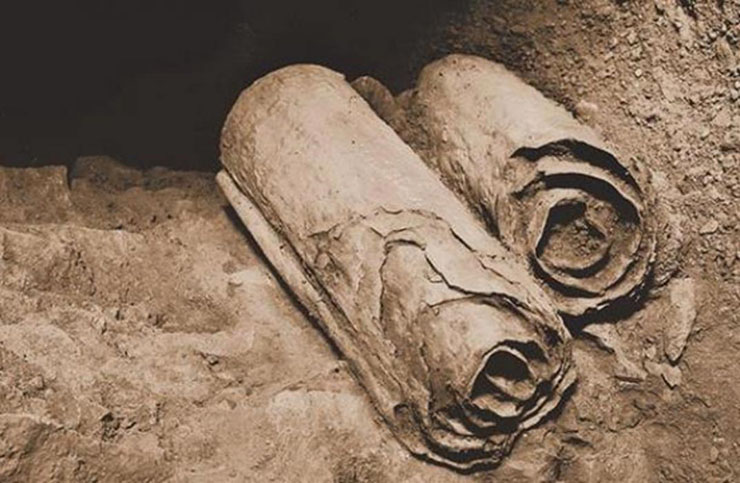
    In March 1952, Henri de Contenson, an archaeologist seconded from France to work with the team at the École Biblique in East Jerusalem, was leading a team of ten Bedouin, when he discovered two lumps of what is now known as the Copper Scroll, in a hillside cave, some 2 km from Qumran.

    The Copper Scroll was in an highly oxidised condition, and had broken into two separate rolled up sections. In its original state it measured 0.3 m in width, 2.4 m in length, and was about 1 mm thick. No one knew quite how to open it up without damaging the text. One lunatic suggestion was to try to reduce the copper oxides with hydrogen, or even electrolysis, to recover the copper! After considerable preparatory research, John Allegro of Oxford University, a member of the original international translation team working on the Dead Sea Scrolls in Jerusalem, persuaded the École Biblique team to let him take one of the copper pieces to England. There the first piece of scroll was finally ‘opened’ by Professor H. Wright Baker at Manchester College of Science and Technology (now UMIST) in 1955, followed by the second piece in 1956. The technique Wright Baker used was to coat the outside of the scroll with Araldite adhesive and then slice the scroll, using a 4,000th/inch thick saw, into 23 separate sections. Ever since that time Manchester has retained a special interest in the Copper Scroll.

    Language of the Scroll

    In academic circles the Copper Scroll is known as 3Q15, the 3Q indicating it was found in Cave 3 at Qumran. It was written in an early form of Hebrew – a square form script – and has been shown to have linguistic affinities to pre-Mishnaic Hebrew and Aramaic, with some terms only comprehensible through study of Arabic and Akkadian. Other Dead Sea Scrolls were written in square form Aramaic script, or the so-called ‘Paleo-Hebrew’ script, derived from ‘Proto-Canaanite’ – itself an evolution from ‘Ugarit’, Egyptian hieroglyphs and ‘Phoenician’.

    The language was a major puzzles for scholars. The Hebrew palaeography (style of script) and orthography (spelling) in the Copper Scroll is quite unlike anything found in other texts of the time, from Qumran or from elsewhere. It has, nevertheless, been almost unanimously classified as one of the Dead Sea Scrolls, and now resides in the Archaeological Museum of Amman, in Jordan.

    John Allegro, a religious renegade, amongst a team of predominantly Catholic members, must have been the first person to translate the ancient Hebrew of the Copper Scroll into English. What he read, started a controversy that has raged for over 50 years amongst scholars. It contained a list of some 64 locations where fabulous treasures had been hidden, over a wide geographical area, including large quantities of gold, silver, jewellery, precious perfumes, ritual clothing, and other scrolls.

    The Jerusalem team refused to let him publish his findings, nervous that treasure hunters would come swarming down to disturb their work at the Qumran site. They had also already made up their minds the Qumran Essenes were essentially uninterested in worldly goods and shared their possessions amongst themselves.

    This mind set attitude runs throughout the academic and theological community studying the Dead Sea Scrolls, and as we shall see later on, they have preconceived ideas on what many of the scrolls ought to say and dare not entertain new ideas that conflict with long established dictums. New Dawn’s approach of trying to free up these types of entrenched views is highly pertinent to this particular field of study.

    The mixture of frustration and excitement soon became too much for Allegro as he began to realise there were other more sinister reasons for the strictures being put on him. He relieved his excitement about the prospect of rolling in treasure by mounting two archaeological expeditions to Jordan, in December 1959 and again in March 1960. Like many who get lost in the desert, he wandered around in a circle eventually coming back to where he started from, having found absolutely nothing.

    His frustration was, in the end, vented when Allegro disregarded his ‘masters orders’ and published his English version of the translation in 1960, under the title The Treasure of the Copper Scroll.

    Scholars, notably Father P’ere de Vaux, Head of the École Biblique et Archéologique Française de Jerusalem, and Father Joseph Milik, members of the original Dead Sea Scrolls translation team, denounced Allegro’s translation as defective and even cast doubts on the authenticity of the Copper Scroll’s contents, assigning them to folklore. Others were not so sure, and today the generally accepted view is the Copper Scroll contains a genuine list of real treasures.

    The Jerusalem team’s translation came out in 1962, entitled ‘Les “Petites Grottes” de Qumran, in the Discoveries in the Judaean Desert series. Although it is the ‘official’ version there is no accepted ‘definitive’ translation of the Copper Scroll to date, and all of the numerous editions published have many significant variants.

    In conventional translations of the Copper Scroll the weight of gold mentioned in various locations is generally given as adding up to a staggering 26 tonnes and silver 65 tonnes.

    When the weights of the treasures itemised in the Copper Scrolls are totalled, we come to the following:

    Gold – 1285 Talents
    Silver – 666 Talents
    Gold and Silver – 17 Talents
    Gold and silver vessels – 600 Talents
    Mixed precious metals – 2,088 Talents

    Items with unspecified weights are as follows:

    Gold ingots – 165
    Silver bars – 7
    Gold and Silver vessels – 609

    In Biblical Talent terms the sheer weight of the gold and silver is enormous. One Talent is estimated to be about 76 lb or 34.47 kg.

    The Copper Scroll seems to be referring to precious metals worth around $2 billion at current prices, but whose intrinsic historic value would be many times this figure!

    Where Did the Treasures Come From?

    The Scroll does not reveal by whom, or when, the treasures were buried, let alone why. But from some of the recognisable place names mentioned, the treasures are generally assumed to have been hidden within Judaea or near to Mount Gerizim, in Samaria (parts of modern Israel) and to relate to treasures of the Second, or possibly First Temple of Jerusalem. Both temples were known to be places where considerable wealth was accumulated through the donation of sacrificial gifts and ‘tithes’ by the general community.

    Controversy over the origins of the treasures listed in the Copper Scroll has led to the proposition of almost as many ‘conspiratorial’ theories as those promulgated for the President Kennedy assassination.

    There are over-riding problems with all of the current theories which, until now, have not been resolved. Scholars have puzzled over how so much gold could have come from the First or Second Temples of Jerusalem, let alone come into the ownership of an ascetic, relatively impoverished sect like the Qumran Essenes. More significant is the fact none of the conventional theories have led to the discovery of any of the treasures listed in the Copper Scroll.

    My own view is rather different. Whilst part of the treasures may well have come from the First or Second Temples at Jerusalem, as descriptions in the Copper Scroll certainly refer to Temple associated objects, when the secrets of the Copper Scroll are unravelled it becomes patently clear that another Temple is involved in the descriptions – and the Qumran Essenes were guardians, not just of treasure.

    Although, from palaeographic studies, the Copper Scroll is now thought to have been copied at a date between 150 BCE and 70 CE, there are enigmatic passages which correspond to early Biblical Hebrew, dating back to 700 or 800 BCE, and it contains many unique word constructions not in use in mainstream Judaism at the time of its production.

    The presence of Greek letters interspersed at the end of sections of the text aroused my curiosity, as their meaning was not understood and they appeared to be some kind of cryptic code. Many theories have been put forward to try to explain these apparently random Greek letters. They are variously considered to be made by scribes as reference marks of some sort, initials of place names, entry dates, or location directions, but none of these explanations is accepted as conclusive and they remain a puzzle.

    The numbering units given in the text, which relate to the amounts of treasure, are also not clearly understood by modern translators. The numerals are in an unsophisticated long-hand form involving apparently unnecessary duplication.

    There were other ‘anomalies’ for which there appeared to be no satisfactory answers. No other Dead Sea Scroll was engraved on copper, nor any known Hebrew texts from anywhere else, prior to the period.

    Why should this be? Why should a non materialistic community go to such trouble to preserve the information on the Copper Scroll? Where did they get the extremely pure copper (99%) from? How could they afford its very high cost ?

    When my metallurgical background attracted me to the subject, these questions were not being confronted.

    When I looked closely at the numbering units and weights used in the scroll, it soon became clear they were not of Canaanite or Judaean origin, where the Qumran Essenes resided, but Egyptian! Indeed, the numbering system in the Copper Scroll is typical of that in use in Egypt around 1300 BCE. The Egyptian system used repetitive single vertical strokes, up to the number 9, combined with repetitive decimal units for larger numbers.

    If the numbering system was Egyptian, why not the weight terms also? The ancient Egyptians had developed a system of weights specifically designed for weighing precious metals, and this system was based on the ‘Kite’, a unit weighing approximately 10g, but sometimes used as a double unit (KK) of 20.4g. I believe it is no coincidence the ‘hard ch’ sound of the weight term used in the Copper Scroll text equates to the Egyptian ‘K’ in ‘Kite’! When these ancient Egyptian weight units are applied, typical of the period prior to 1000 BCE, to calculate the quantities of gold, silver and jewellery mentioned in the Scroll, rather more realistic weights are obtained than those given earlier. The approximate totals of precious metals mentioned in the scroll now become:

    Gold – 26 kg
    Silver – 13.6 kg
    Mixed precious metals – 55.2 kg

    We were now looking at weights which are a fraction of those given in modern translations of the Copper Scroll, but they are at least plausible values, quite consistent with the amounts of gold and silver in circulation for the period. For example, if we look at the Harris Papyrus, an ancient text in the British Museum, dating to about 1180 BCE, it gives the total gold holdings accumulated over a 31 year period by Egypt (by far the most wealthy country in the ancient Middle East), as 387 kg. The downside is that the value of our treasure has diminished somewhat! However, we are still talking about hundreds of millions of dollars in real terms.

    The strange thing is that, although the type of numbering system used in the Copper Scroll might have persisted in Egyptian temple writing for some time after the Greek conquest of Egypt (in 330 BCE), its use was always specific to Egypt and it was not in use outside Egypt, except in the period of Egypt’s campaigns in Canaan from 1400 to 1100 BCE. The use of the ancient Egyptian system for weighing metals died out around 500 BCE and had previously always been specific to Egypt.

    Why would a document, ostensibly written by a devout, unorthodox Jewish community living near the Dead Sea in Judaea around the time of Jesus, have so many Egyptian characteristics? And why would the writing material, numbering system and system of weights used, be typical of Egyptian usage from a period at least 1,000 years earlier?

    Egyptian Influences

    From as early as 3000 BCE right up to 1200 BCE, Egypt had maintained an armed presence in Canaan, often as a stepping stone to further conquests to the east. Egypt’s shadow had obviously been cast over the early Hebrew’s experience, and yet, like other blind spots, modern theology shies away from considering the Egyptian connection too closely. Yet, all the major characters of the Bible, from Abraham and Sarah, to Jesus and Mary, had strong links to Egypt. Joseph, Jacob, all the founders of the 12 tribes of Israel, as well as Moses, Aaron and Miriam, Joshua, Jeremiah and Baruch, all lived for long periods in Egypt and were influenced by its culture and religions.

    After a lengthy analysis I came to the conclusion that Joseph had interacted with a pharaoh by the name of Akhenaten – a monotheistic pharaoh – and many of the basic tenets of Judaism, and by extension Christianity and Islam, came out of Egypt. The river that branches from the Nile at Amarna (ancient Akhetaten), Pharaoh Akhenaten’s capital city, is to this day know as ‘Bahr Yusuf’, ‘Joseph’s River’, and there are many other clues.

    When I started comparing descriptions of the treasure locations given in the Copper Scroll with sites at Amarna, it soon became apparent there were many close parallels. Not only that, some of the locations have already yielded archaeological finds of treasures that match very closely the descriptions and weights given in the Copper Scroll. Many of these treasures can be seen in Museums in Britain and Egypt. Having made a connection for the Copper Scroll to Akhenaten’s Holy city in middle Egypt, it was not surprising a most powerful piece of evidence emerged when I looked again at the strange Greek letters scattered in the Scroll. When the first 10 are put together they spell out the name Akhenaten!

    The validity of this conclusion is re-enforced by the opinion of Professor John Tait, of University College London, who considers the reading of the Greek letters as quite plausibly the name of the Pharaoh in question.

    Academic Responses

    Since publication of the first edition of my book, The Copper Scroll Decoded, in 1999, the main theory has been tested against a broad spectrum of academic and scholarly opinion, and in many instances response to the main thrust of the theory has been favourable and enthusiastic. Where there has been a negative response, it has been in the form of guarded scepticism, particularly as the theory presents a radically new view of religious evolution which strongly conflicts with enshrined orthodoxy.

    Response from academics, on specific areas of their own expertise, has generally been supportive. On alternative interpretations of the meaning of the Copper Scroll, for example, particularly in the context of the weight and number terms given in the Scroll, there has been a considerable consensus of acknowledgement that previous interpretations have not been correct. Amongst those scholars conceding previous translations are deficient, one of the world’s experts on the Copper Scroll, Judah Lefkovits, of New York, has reiterated the Scroll is much more problematic than some scholars would allow. He has written a number of books on the subject, including a recent classic work The Copper Scroll 3Q15: A Reevaluation; A New Reading, Translation, and Commentary, and now does not think the conventional translation of the weight term as a Biblical talent is necessarily correct. He has suggested it might be a much smaller weight, such as the Persian karsch. In supporting my claim, against the views of previous researchers, he now believes the total precious metal weights have been greatly exaggerated.

    One eminent scholar, Professor Harold Ellens, of the University of Michigan, has come out strongly in favour of the generalised theory, which he says is almost certainly basically correct.

    If there is a partial acceptance of the possibility of a connection between the Qumran Essenes and the Jacob-Joseph-Pharaoh Akhenaten period, it is in demonstrating the detailed historical links that most hesitancy arises.

    In the Kingdom of the Blind….

    Ben Zion Wacholder is a partially blind Professor of the Hebrew University in Cincinnati, but he has the ability to see through the tangled undergrowth of intertwined scrolls and is a king and much respected father figure in the land of his peers. In the celebratory 50th anniversary conference of the finding of the first of the Dead Sea Scrolls, held in Jerusalem, he created a major sensation by going against his colleagues in claiming Ezekiel as the first Essene.

    He perceives many of the sectarian Dead Sea Scrolls of the Qumran Essenes, such as the Temple Scroll, New Jerusalem Scroll, the Aramaic Testament of Levi, Qahat, and Amran, Jubilees, and the Cairo-Damascus documents, as derivative of Ezekiel’s thinking in refusing to recognise the legitimacy of the Second Temple and standing outside normative Judaistic authority. In a sense he recognises two quite separate sets of biblical texts – Ezekielian and non-Ezekielian.

    One of the most interesting aspects of this theory relates to Ezekiel descriptions of a Temple, which is generally taken to be a visionary Temple that would one day be built in Jerusalem. However, when you compare the descriptions Ezekiel gives in the Old Testament to those of the archaeological reconstructions of the Great Temple that stood in Akhenaten’s Holy City, it is quite clear he was talking about that actual Temple and not one which would one day stand in Jerusalem.

    Other Dead Sea Scrolls confirm this finding in incontrovertible detail. The New Jerusalem Scroll, for example, which by the way never mentions Jerusalem, ties its descriptions to Akhenaten’s Holy Temple. Recently Michael Chyutin, and Shlomo Margalit, Israeli architects, have conducted independent studies on the Scroll and come to the conclusion it is almost certainly describing Akhenaten’s city at modern day Amarna. Without the explanation I have put forward, for a link from Amarna down to the possessors and authors of the New Jerusalem Scroll, conventional history has no answer to the problem.

    Incidentally these studies show that two other Egyptian cities also exhibited similar characteristics to those described in the New Jerusalem Scroll – namely Sesebi, a city located between the second and third cataract of the Nile, and the Hebrew settlement on the Island of Elephantine, near Aswan in southern Egypt. A connection to Sesebi is not so surprising as it was, like Akhetaten, built by Akhenaten. Why the strange pseudo-Hebrew settlement on Elephantine Island, which is dated to at least the 7th century BCE, should show similarities is more intriguing. The people there worshipped Yahwe, the Israelite name for God, and built a temple as a place of worship. The explanation of how this isolated community came into existence has never been satisfactorily resolved.

    My own theory is they were a residual enclave that formed after the destruction of Akhenaten’s Holy City when survivors, mainly the earliest monotheistic Hebrews, fled south for safety. An Australian scholar, E. Maclaurin, of the University of Sydney, adds weight to my theory in a paper entitled Date of the Foundation of the Jewish Colony at Elephantine’, published in The Journal of Near Eastern Studies, Volume 27, 1968. He concluded that the style of worship at Elephantine, “…was of a form which could not have existed in a Hebrew group which had been exposed to the influences of Sinai and Canaan after the settlement.”

    In other words Maclaurin rules out any possibility of the community at Elephantine having derived from outside Egypt after the Exodus (c. 1200 BCE) let alone at the time of Solomon or the kings of Israel. Another Australian scholar, Ian Wilson, seems to date the Exodus to around 1500 BCE, but the general consensus is it took place some time in the 13th century BCE. These are not the only students of Dead Sea Scroll study with an Australian connection. I, too, have a warm affection for the country, having spent seven years of my early life in Sydney, where my mother was born!

    Another scroll, the Temple Scroll, spells out the dimensions of the longest Temple wall as 1600 cubits, equivalent to 800 m. Conventional scholarship has nowhere to go in Jerusalem to accommodate the Qumran Essenes’ concept of this building. The Temple Mount in Jerusalem measure only 550 m x 185 m. So they conclude it must be the description of a fictitious temple. The length of the longest wall of the Great Temple at Amarna has been measured, from detailed archaeological excavations, as being 800 m.

    The logical conclusion is the information in the Temple Scroll, in its original form, existed before Moses, and it described the plan of a real temple that was not the Temple at Jerusalem. The details must have been handed down in secret through a distinct line of Levitical priests, to the Qumran Essenes, who based their copy on the original version.

    When the Qumran Essenes built their main settlement building at Qumran in ‘exact’ alignment to the main walls of Akhenaten’s Temple, and constructed 10 ritual washing pools, they were echoing a recorded memory of that Temple. Uniquely, and unknown from anywhere else in Israel, one of the ritual washing ‘Mikvaot’ has four divisions  just as one of the ritual washing basins in the Temple at Akhetaten exhibited.

    That the name of Aten or Aton, the name by which Akhenaten knew his God, is embedded throughout the Old Testament, has many attesters, from Sigmund Freud onwards. Many Egyptian names are read with the letter ‘D’ or the letter ‘T’  Touchratta or Douchratta, Taphne or Daphne, and in Egyptian Coptic the letter D can be pronounced ‘D’ or ‘T’ . Thus, Aton could well be written ‘Adon -ai’ where ‘ai’ relates God to the Hebrews in the sense of ‘my master’.

    Earlier in this article the question was posed as to why Qumran was so important to historical and biblical history. Part of the explanation has now been outlined in this article, and is described in more detail in my latest book The Mystery of the Copper Scroll of Qumran, published by Bear & Co, part of Inner Traditions, in June 2003. However, as yet there is no complete answer to the question as the modern story of Qumran is still being written. There are more secrets to be revealed and I hope to do that in a sequel book now in preparation.
    [alert type=”general” dismiss=”no”]This article was published in New Dawn 80.[/alert]

    [alert type=”success” dismiss=”no”]If you appreciate this article, please consider subscribing to help maintain this website.[/alert]

    © New Dawn Magazine and the respective author.

    For our reproduction notice, click here.