The study of mystical religious experience was introduced into psychological studies in the late nineteenth century. Curiously, this somewhat novel interest was initially stimulated by researchers of medical psychology who observed that phenomena resembling those experienced by mystics frequently resembled the experiences of mental patients.
One outstanding example that attained seminal status was the work of Theodore Flournoy, From India to the Planet Mars: A Study of a Case of Somnambulism with Glossolalia, published in the year 1900 (the year when Sigmund Freud published his work Interpretation of Dreams). Flournoy’s work influenced Pierre Janet, C.G. Jung, and Freud himself.
In 1913, C.G. Jung developed a technique for inducing visions that he named “active imagination.” In such experiences, hypnagogic states were combined with visualisation techniques with the objective of inducing waking imaginations of an autonomous character. (Autonomous in this context means that the vision is not consciously directed but acts on its own. This feature distinguishes Jung’s procedure sharply from the “guided imaginations” and reveries popular in New Age circles.)
Summing up the major conclusions drawn from the studies of mystical and related states by depth psychologists, mystical experiences are states of consciousness that bring about a radical elevation of awareness and at times a deep and abiding union of the individual mind with a realm of transcendence which extends beyond all features of terrestrial embodiment. These states of radical awareness and mystical union have become the definition of certain Western and Eastern exalted states of consciousness, the former known as Gnosis and the latter as Enlightenment. Upon these states are based the traditions known as Gnosticism and Buddhism.
The Twin Traditions
The present writer contends that there are two paramount traditions of mystical spirituality in the world. They are so closely related to each other that it may be justified to give them the metaphorical label of twins. They are named Gnosticism and Buddhism. To familiarise oneself with the “twins” and their relationship, one needs to attempt a comparison of their origins as far as these might be discerned historically.
As the child is father to the man, so Vedic Hinduism is the forerunner of Buddhism. It is known that Buddhism evolved out of Hinduism by way of its founder, Gautama the Buddha. It is said that one’s ancestry is always important, and this may be true of religious traditions as well. The Hindu religious matrix, out of which Buddhism arose, had a significant influence on this tradition.
For an unknown length of time prior to Buddha, Hinduism possessed a classical school of Yoga, in Sanskrit called Jnana, meaning “the way to union through knowledge.” The structure and composition of Hindu religious life are not unlike those of ancient Gnosticism. It has been said that Hinduism is not so much a religion as it is a family of religions. The diversity of ancient Gnostic traditions is undoubtedly similar. Individual Guru figures are certainly present in both traditions, as are diverse sacramental ritual practices designed as aiding the transformation of consciousness.
On the side of doctrine, there are significant similarities also. Perhaps the most important of these is the belief in the presence of the Divine in the human spirit. The Atman is identical with Brahman, so the Advaita school of Vedanta declares – universal divinity is present in miniature within each person. In Gnosticism, the Pneuma (individual human spirit) is seen as a spark sprung from the divine flame. As noted, self-knowledge in-depth thus is knowledge of God.
Another teaching that makes Buddhism’s background and Gnosticism similar is the teaching that declares the existence of many divinities in realms between the ultimate and the material dimensions, yet all connected with a supreme spiritual fullness. These few examples might indicate that the doctrinal foundations underlying Buddhism are akin to Gnosticism itself.
Although akin to Judaism and even more closely to Christianity, Gnosticism was undoubtedly inspired by the mystical experiences of the initiates of the various Mysteries of Greece, Egypt, Rome, and perhaps Persia. These Mysteries afforded many persons very impressive individual mystical experiences. Their tradition survived in diverse forms among the Gnostics, Hermeticists, and Neo-Platonists. Thus, along with others, the Gnostics became the heirs of the Mysteries of antiquity.
The Wisdom of the Knowing Ones
When it comes to Buddhism itself, the signs that join it to Gnosticism are numerous and powerful. The supreme objective of Buddhism is identical with the ultimate aim of Gnosticism. This is none other than Liberation, meaning freedom from embodied existence and thereby from all suffering. This liberation is brought about not by belief or by the following of moral precepts, but rather by a radical altering of consciousness, an experience of inexpressible liberating power called by Buddhists Bodhi, often translated as Enlightenment, and known to Gnostics as Gnosis, the latter translated by G.R.S. Mead as “the knowledge of the things that are.” The supreme quality to be cultivated in the quest for Enlightenment/Gnosis by the Buddhist is called Compassion, while the Gnostic Christian cognate quality is known as Love.
Some students in the West have chosen to believe that the Mahayana doctrine of Bodhisattva-hood makes it incumbent on Buddhists to keep reincarnating until there is no one to be helped any longer. Some years ago, H.H. the Dalai Lama, within the hearing of the present writer, replied to such a question: “You just get Enlightenment, then you will know”!
The pioneer present-day Gnostic scholar, Elaine Pagels, pointed out in her Gnostic Gospels that it is legitimate to translate the term Gnosis as used by the ancient Gnostics as insight, for it involves an intuitive process of knowing oneself. Pagels also goes on to emphasise that this knowing oneself at the deepest level is simultaneously to know the Divine and that this is the true secret of Gnosis.
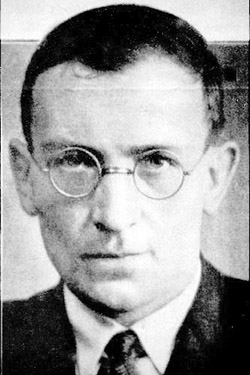
Edward Conze (1904–1979), photo c.1930.
Many highly informative statements were made by the late renowned Buddhist scholar Edward Conze, who openly called Buddhism “the Gnosticism of Asia.” The following paragraphs are in part based on a lecture by Prof. Conze that I attended some decades ago in the Pacific Northwest of the United States. The lecture concerned the convergence of Gnosticism and Buddhism. Here are some of the outstanding points:
Salvation (Liberation) is achieved through Gnosis, or Enlightenment. Gnosis offers insight into the enslaving structure of the archonic creation; Buddhism practices insight into the dependent origination of manifest existence. These insights bring liberation.
Ignorance is the true root of evil. In Gnosticism it is called agnosis, and in Buddhism avidya. The absence of liberating insight creates wickedness and evil actions.
The knowledge, cherished by both Gnostic and Buddhist, is arrived at not by ordinary means of information and reasoning but as the result of internal revelation.
Spiritual attainment differs with what might be called psycho-spiritual types. There are levels of insight that range from foolish materialism (hyletic consciousness) to illumined Gnosis (pneumatic states).
Regarding rules of behaviour and commandments, a certain mystically informed relativism is inherent in both systems. While at the lower levels of spiritual ascent, rules of behaviour are often regarded as being of great importance; in exalted spiritual states, their significance diminishes. (Accusations of antinomianism have been levelled against both Gnostics and Buddhists by their critics.)
When opting for preference between myth and fact, both Gnosticism and Buddhism show an inclination toward myth. Modern mythologists, including Mircea Eliade and Joseph Campbell, concluded that insights gained by the Enlightenment of the Buddhist and by the Gnosis of the Gnostic are best understood in terms of myth.
One of the most potent mythologems appearing in both Gnosticism and Buddhism is the feminine deific principle of wisdom – Sophia and Prajna, respectively. Conze was fond of quoting the Hevajra Tantra: “Prajna is called Mother because she gives birth to the world.” In fact, there are other important feminine figures among the deities of Mahayana Buddhism that may be considered cognate to Sophia, such as Tara and Kwan Yin. It may be noted that in Western Christianity (Roman Catholicism and Protestantism), the figure of Sophia has been driven underground, but this did not occur in the Orthodox Churches of the East. The obscured Sophia was brought into a renewed prominence by the Russian Sophiologist theologians, beginning in the late 19th century and continuing to the present, starting with the magnificent scholar and poet Vladimir Soloviev (1853–1900). A very large number of artists, literati, philosophers and theologians became advocates and devotees of “the feminine wisdom of God.” It may be stated that the Russian Sophiologists came as close as anyone to rediscovering a feminine deity similar to such figures in Buddhism.
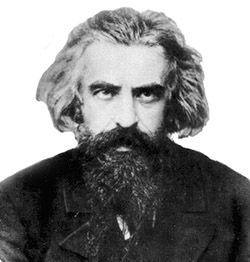
Vladimir Soloviev (1853–1900)
After noting several similarities in the teachings and spiritual ambiance of Buddhism and Gnosticism, a penultimate evaluation of their relationship may be important. The origins, both historical and other, of the two traditions are cognate. Both had their beginnings with a founder who experienced exalted spiritual states and whose example helped generate a tradition oriented toward such experience. Even as the Buddhist tradition moved outside of Hinduism, so the Gnostic tradition, in Christian garb, separated from Judaism. The similarity of the story of the two ends here, for the majority within Christendom cast out the Gnostic minority, condemning it to a mostly underground existence. Buddhism, on the other hand, for the most part, morphed into folk-religiosity, although esoteric communities continued. Both traditions maintained their orientation toward transcendental experience, which allowed for great, even ultimate transformations. Thus, we may conclude that even in the midst of their frequent misapprehensions, the early leaders of depth psychology have discovered something of momentous significance in regard to mystical consciousness.
Not only were the mystics of East and West not to be seen as victims of psychosis, but rather as persons who gained access to an insight so profound that it supersedes all worldly knowledge and information. Gnostic and Buddhist sages always had their successors in history.
It may be appropriate to close this article with a passage, part meditation, part sermon, heard many years ago from the lips of a teacher, and remembered by the present writer:
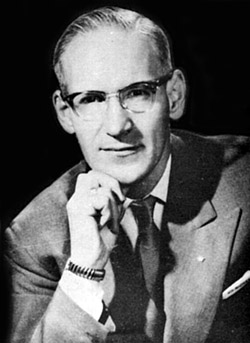
Richard, Duc de Palatine (1916–1977)
“You are not of this world. You are not this body that you inhabit. You are not these emotions, these thoughts, this ego you identify with. You are not even your life and death. When you are able to distance yourself from these things, then the true you, the Gnostic you, comes into the focus of your cognition. Purer than the ether, more radiant than the sun, purer than the driven snow, filled with life and taken out of the context of death, this is the self you are. To help you know this, Jesus and Buddha and all the other great messengers of light have come into this world, making the sacrifice to come from the fullness into the emptiness to bring you this. You must know this, and you must do this, because without it you are not really alive, you are not really conscious, but with it, you are all things, you have all things, and the All has become you. This is the message of Gnosis!”
(This meditation was conducted for his students by the late Richard, Duc de Palatine during his visits to the USA.)
[alert type=”general” dismiss=”no”]This article was published in New Dawn 186.[/alert]
[alert type=”success” dismiss=”no”]If you appreciate this article, please consider subscribing to help maintain this website.[/alert]
There is a strange and persistent legend that probably originates in the East. It proposes that in some hidden locations on the Earth (generally the highlands of Central Asia, particularly Tibet, although other sites, such as the Andes and even some mountains in the US, such as the Grand Tetons and Mt. Shasta, are mentioned at times), there exists a group of persons who possess both exceptional powers and a highly perfected character and consciousness. They are known variously as the Hierarchy of Adepts, the Great White Lodge, the Great White Brotherhood, the Masters, or simply the Hierarchy.
While most sources emphasise the Eastern (particularly Indian and Tibetan) nationality of these persons, Western embodiments of the legend are not unknown. Some have suggested that portions of this legend travelled westward during the Crusades or even earlier and that their sources are thus primarily to be found in secret and semisecret Islamic traditions.
Beginning with the publication of the mysterious Rosicrucian document Fama Fraternitatis in 1614, the existence of certain “unknown superiors” or “Brothers of the Rosy Cross” who live and work in secret and yet direct much of the spiritual destiny of the world became a part of the beliefs of many Western esotericists.
To these transmissions may be added diverse strands of legends connected with Arabian poetry, wise men wandering among the troubadours, the fabled kingdom of an adept priest-king named Prester John in Africa, alchemical masters of an elusive and potent aspect led by Elias Artista, as well as the Templars and the esoteric Freemasons. By the 19th century, the foundations for a major unfolding of the adeptic myth were laid. This unfolding took place by way of the Theosophical movement, without which the entire myth would probably have remained forever in obscurity.
Blavatsky and Her Masters
The position of current wisdom about the Masters is well-stated by one of the better popularisers of esoterica, Richard Cavendish, who calls it “a glamorous simplification of the tradition common to both East and West from time immemorial, of the searching spirit who asked: ‘Master, what shall I do to inherit eternal life?’”1
This question, of biblical origin, is not without poignancy. As Jesus was regarded as a master of things relating to the life beyond earthly existence, so the Theosophical tradition of the last 130 years has looked to personages of superior insight and power to assist mortals in gaining consciousness of a greater life. Not only did it proclaim the existence and availability of such personages, but it also regarded them as the fount and origin of its teachings.
In one of the very first academic treatises on the subject, published in 1930 in a series sponsored by Columbia University, Alvin Boyd Kuhn wrote:
Theosophists tell us that before the launching of the latest “drive” to promulgate Theosophy in the world, the councils of the Great White Brotherhood of Adepts, or Mahatmas, long debated whether the times were ripe for the free propagation of the secret Gnosis; whether the modern world… could appreciate the secret knowledge, without the risk of serious misuse of high spiritual forces, which might be diverted into selfish channels. We are told that in these councils it was the majority opinion that broadcasting the Ancient Wisdom over the Occidental areas would be a veritable casting of pearls before swine; yet two of the Mahatmas settled the question by undertaking to assume the karmic debts of the move, to take the responsibility for all possible disturbances and ill effects.2
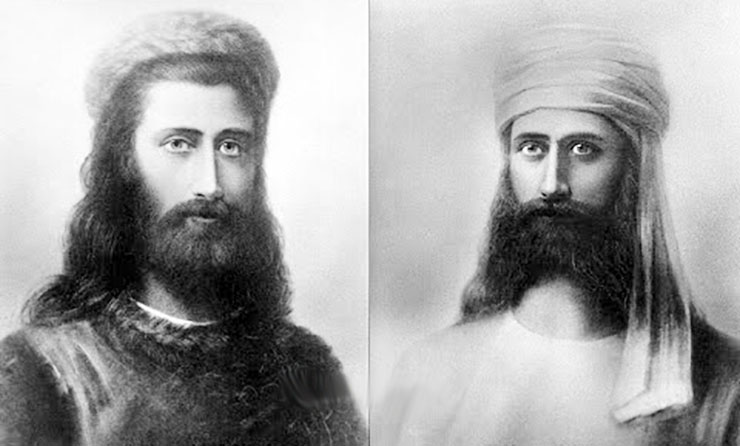
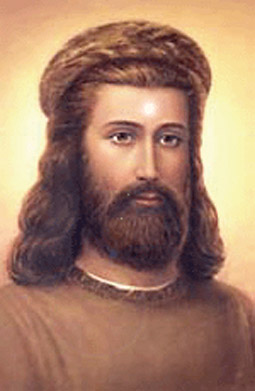
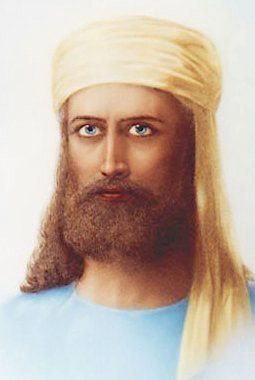
These two Mahatmas eventually became known as Morya and Koot Hoomi (or Kut Humi), and their contact person par excellence was Helena Petrovna Blavatsky.
Koot Hoomi (or Kut Humi), one of Mme. Blavatsky’s Masters, has been identified by the researcher K. Paul Johnson with a Sikh spiritual leader, Sirdar Thakar Singh Sadhanwalia.
The story of the colourful, controversial, erudite, and intuitive Mme. Blavatsky has been told many times, most recently and accurately by Sylvia Cranston.3 The issue of her involvement with her adeptic inspirers has also been thoroughly investigated by a most valiant researcher, K. Paul Johnson.4 Johnson’s work merits some comment here because in certain ways it represents a novel development of the treatment of the subject. It is Johnson’s thesis that the Adepts and Mahatmas of Blavatsky were all historical figures living in her lifetime, for whom she found suitable disguises in mysterious personae and a set of equally mysterious pseudonyms, under which they entered the mythos of Theosophy and of all modern occultism.
According to Johnson, Morya was a Maharajah of Kashmir by the name of Ranbir Singh, while Koot Hoomi is identified with a Sikh spiritual leader, Sirdar Thakar Singh Sadhanwalia. Johnson also identifies other adeptic figures of Blavatsky’s, such as “the Chohan” (or Maha Chohan) and the “Master Djual Kul” (later publicised by Alice Bailey), with Sikh and Muslim gurus and leaders of the time.
The Living Masters
It is not without interest that Johnson should pick so many Sikh personages as the models for Blavatsky’s occult Masters. The variety of Indian spirituality that is most comparable to modern Theosophy is perhaps the Sant tradition, which some scholars regard as a close relative of Western Gnosticism. This tradition has been allied with the Sikhs since the time of Guru Nanak in the 16th century. Its latest embodiment, the Radhasoami movement, had just appeared on the scene in Blavatsky’s time in the person of Shiv Dayal Singh (1818-78), who was well-known in Indian religious circles and certainly came to the attention of the Theosophists.
The Sant tradition has innumerable doctrinal similarities to Theosophy, including the teaching of the “living masters” who are the chief agents of the initiatory redemption of their followers.5 It is regrettable that in spite of recognising the Sikh connection, Johnson failed to trace it to the Sant tradition, where he might have found a far more valuable model for Blavatsky’s concept of the Masters. The subject is still in great need of exploration. We shall do so briefly here.
Mahatma Morya, according to K. Paul Johnson, was a Maharajah of Kashmir by the name of Ranbir Singh.
For a Westerner the term “saint” denotes a person in whom the ordinary human virtues have been exercised to a heroic degree. The ancient Greeks may be credited with having first established a category of humans known as heroes, who stood between mortals and the immortal gods. The Sant tradition recognises persons of a similar kind. They are usually called sants (“saints” or “men of truth”) or satgurus (“true teachers”). Such persons have merged their own spiritual core with the Supreme Identity to the extent that they are no longer subject to any illusion or any sense of ego apart from the Divine.
As one contemporary researcher says, “What we are confronted with in the [sat]guru is a classic hierophany: a profane object which manifests the sacred.”6 The satguru is an embodied being, a human, not a disembodied god or angel and for this reason is known as a “living master.” Neither is it sufficient in this tradition to follow a teacher who has died:
According to the Sant tradition… one must follow a living guru. It is said that past Sants cannot take the soul back to God. This is due to two main reasons: (1) the original message of the Sants is believed to be misconstrued after the Sant passes away, while the teachings of a living Sant are pure and charged; and… devotion to one’s guru aids one’s spiritual progress; (2) it is believed to be easier to love someone alive and tangible than someone who has been dead for centuries.7
Let us compare this with some statements concerning the Theosophical Mahatmas. According to Blavatsky,
A Mahatma is a personage who, by special training and education, has evolved those higher faculties and has attained that spiritual knowledge, which ordinary humanity will acquire after passing through numberless series of reincarnations during the process of cosmic evolution… The real Mahatma is then not his physical body but that higher [mind] which is inseparably linked to the [spirit] and its vehicle.8
We also have statements to this effect from what would appear to be the Mahatmas themselves. During Blavatsky’s residence in India after 1879, the Anglo-Indian journalist A.P. Sinnett became interested in her teachers. In 1880 he instituted a correspondence with Morya and Koot Hoomi. The replies to Sinnett’s letters have been preserved in the British Museum in London and have also been published in book form. In one of these letters, Koot Hoomi writes:
An adept – the highest as the lowest – is one only during the exercise of his occult powers… Whenever these powers are needed, the sovereign will unlock the door to the inner man (the adept), who can emerge and act freely, but on condition that his jailer – the outer man – will be either completely or partially paralysed.9
Allowing for certain differences in psychological orientation, such a statement could have readily come from a “living master” of the Sant tradition.
Adepts Embodied and Disembodied
These considerations leave little doubt that Blavatsky’s mysterious teachers were regarded as living human personages, albeit of a highly unusual order. At the same time it is also necessary to recognise that along with the mythos of the embodied Masters another mythos played an important part in the development of the idea of the adeptic Hierarchy. This was 19th century Spiritualism, a movement that attracted great numbers and much publicity in its day.
Today Spiritualism is largely confined to the practice of attempting contacts with rather nondescript spirits. Professed Spiritualists are not very numerous and their social and intellectual standing is on the whole unremarkable. Yet another kind of Spiritualism has become much more prominent: the phenomenon of channelling. Here we primarily find attempts to disseminate occult information, often pertaining to humanity or the cosmos as a whole. Channellers in general do not have the personalistic preoccupations of Spiritualists, who often seem largely concerned with the exploits of their dead relatives in non-physical realms. Channellers’ utterances are frequently doctrinal, prophetic, even at times archetypal.
It would be fair to say that Spiritualism has always possessed two sides, one personalistic and consequently shallow, the other revelatory and touching upon the numinous. The origins of the Theosophical adeptic myth are connected with the latter. At the time of the founding of the Theosophical Society in 1875, there was a spirit entity who made frequent appearances in Spiritualist gatherings in America and England and who identified himself as “John King.” Blavatsky seems to have thought quite highly of this entity and said he was in some way connected with her adeptic superiors.
Although for some years she engaged in an uneasy cooperation with the Spiritualists and had been ordered to break with them by her superiors in 1875, her relationship with “John King” remained close. Eventually she identified him squarely as a messenger of the adepts who inspired her to found the Theosophical Society.10 It would seem that a disembodied spirit – and one who was, moreover, active in Spiritualist séances – could be an associate of the embodied adepts, who generally disapproved of the Spiritualists and their “spooks,” as Blavatsky called them.
Another interesting episode inspired the launching of a major esoteric revival in French occult circles which still exists and has spread to several continents. Blavatsky had a friend living in France who was quite influential in the occult revival there. Her maiden name was Mary, Lady Caithness, and she was married to the Duc de Pomar. She resided in a large palace in Paris, complete with an ornate chapel in which occult activities were carried out.
In the fall of 1889, a former Catholic seminarian, high-grade Freemason, and visionary poet named Jules Doinel was visited in this chapel by the spirit of the Cathar Bishop Guilhabert de Castres accompanied by the spirits of other medieval Cathars. The spirits, speaking through a seeress, commissioned Doinel to revive the Gnostic Church, of which he became the first Patriarch. Detailed instructions for the organisation of the Gnostic Church were given to Doinel at this time. This event marked the beginning of the Eglise Gnostique Universelle (Universal Gnostic Church, also known under other names), which became closely associated with the Martinist Order under Papus. The church has many branches in France, Haiti, and other countries.11
Doinel’s founding of the modern Gnostic Church may be taken as an instance of a certain kind of adeptic inspiration, not entirely unlike that of Blavatsky, and possibly even known to her. Yet the messages here profess to come from disembodied beings who are of a different order from the entities encountered at most séances. As such they may be likened to some of the more valuable forms of contemporary channelling such as A Course in Miracles.
The notion of spiritual guides who might or might not be associated with each other in some sort of mystical fraternity became widely accepted in many quarters. Even C.G. Jung, who was skeptical about many aspects of Theosophical and related teachings, was not immune to such ideas. In his Memories, Dreams, Reflections he wrote at great length about a mysterious “phantasy figure” whom he called Philemon and from whom he received much instruction. He also recounted a conversation he had with a “highly cultivated elderly Indian, a friend of Gandhi’s,” who, after informing Jung that his own guru was Shankaracharya, the long-deceased founder of Vedanta, went on to say, “Most people have living gurus. But there are always some who have a spirit for a teacher.” Jung said he was immediately reminded of Philemon.12
A curious convergence between the Theosophical lore of embodied Masters and the channelling phenomenon occurred in 1972, when the British painter and medium Benjamin Crème, greatly influenced by Alice Bailey’s modified version of the Theosophical hierarchy of the Masters, began to channel messages stating that the appearance of the Lord Maitreya was imminent. (Maitreya, who is regarded in Buddhism as the coming Buddha, has been incorporated into the Theosophical hierarchy; early in this century Jiddu Krishnamurti was said to be Maitreya’s vehicle.) Crème fixed 1982 as the year of the reappearance of Maitreya. It was foretold that the event would be accompanied by various technological miracles, including the use of all public media in the world by the returning savior. Although the phenomenon failed to occur, devotees are still undaunted.
In the biblical legend of the Three Wise Men from the East we have an archetypal prefiguration of the myths and speculations about the mysterious adepts who are involved with the fate of the world. The term “Secret Directorate” was coined in this regard by British author Ernest Scott, who, drawing primarily on Islamic sources, has made an impressive plea for the reality of an assembly of men known in some Middle Eastern circles as the “Friends of God” or “People of the Secret.”13 Although the Theosophical dispensation of esotericism may have brought the subject into prominence, even now, when Theosophy functions mainly as a “grandfather movement” to innumerable teachings and organisations, the idea of the Adepts is far from outmoded.
In this still quite vital idea of a hierarchy of adepts, we are faced with a mystery that no one has succeeded in solving. Recent efforts, such as K. Paul Johnson’s, have shed light on a few dark corners but have failed to illumine the whole subject. While new dimensions have been opened up, others remain obscure. The following thoughts are offered as feeble attempts to penetrate the mystery.
First, is there evidence that the events of cosmic or terrestrial development, particularly the affairs of humankind, are subject to direction by a hierarchy of superhuman intelligences and that these intelligences have made contact with humanity at certain times? The answer, it would seem, is no. The sorrowful course of history, the fierce expressions of a “blind world-creating will” (to use Schopenhauer’s words) do not intimate the handiwork of such intelligences. If there is an “inner government” or a “secret directorate,” it would have to be a rather ineffectual one.
By the same token, it is possible that some people possessing a high form of gnosis may indeed labor in concert, not as a hierarchical government but as a band of enlightened and compassionate helpers. Some of the statements purporting to have come from such personages (notably in connection with Blavatsky) would point to this possibility. Notions of godlike, omniscient beings pulling the strings of history from their secret residences may be inspiring to some of us, but they have little warrant in reality. Certainly Blavatsky’s Masters never claimed to be of that species. (Schools of occultism, such as the Alice Bailey movement or the descendants of the “I Am” movement of the 1930s, who insist most strenuously on the deific and all-powerful of such beings are generations removed from the original impulse of these teachings.)
On the other hand, the image of the adept, whether as a living master or as a disembodied spiritual instructor, carries definite connotations of what might in Jungian terms be called an archetypal being. Some might counter that such a description is tantamount to substituting one mystery for another. Still it is undeniable that behind all science and mysticism, behind all the approaches of West and East, there is but one area of reality and realisation: the human psyche. Whatever preternatural realities might make themselves known to us, they must do so by way of the psyche or else go unnoticed.
The psychic reality of archetypes may thus be taken to be of great relevance to the subject at hand. Archetypes possess many of the characteristics of numinosity, authority, and commanding power attributed to the Adepts. When indicating to her disciples how they might come closer to the greater mysteries of being, Blavatsky once stated that she “could tell them how to find those who will show them the secret gateway that opens inwardly only.” Is it so difficult to imagine that those who open such inner gateways must dwell at least in part, if not wholly, in the inward recesses of the psyche?
And if the assembly of archetypal being resides largely within us and not in the Himalayas or on some secret plateau in Afghanistan, might it not also be present in the immediate environment of our lives? Certainly some have thought so. One was the French poet and esotericist Maurice Magre, who, in the epilogue of his book The Return of the Magi, wrote:
There have been men whose names are unknown because they cared little for fame, and truth radiated from them without knowing it. There have been revealers who were unaware of the revelation that was in them; modest sages who mingled their wisdom with their daily life… We have all of us met, at least once in our lives, one of these unheralded initiators, and received from them a priceless gift, by a kindly word, a certain look of sadness, a sincere expression in the eyes.14
It is in this direction that we might direct our inquires if we desire the greatest reward. Be that as it may, the myth of the adeptic assembly may still have secrets to disclose that might benefit us beyond measure.
The article first appeared in Gnosis: A Journal of Western Inner Traditions, Vol.36, Summer 1995, and is reproduced here by the kind permission of the author.
[alert type=”general” dismiss=”no”]This article was published in New Dawn 91.[/alert]
[alert type=”success” dismiss=”no”]If you appreciate this article, please consider subscribing to help maintain this website.[/alert]
Footnotes
1. Richard Cavendish, Encyclopaedia of the Unexplained: Magic, Occultism, and Parapsychology (London: Routledge, 1974), p. 286. 2. Alvin Boyd Kuhn, Theosophy: A Modern Revival of Ancient Wisdom (New York: Henry Holt & Co., 1930), p. 2. 3. Sylvia Cranston, H.P.B.: The Extraordinary Life and Influence of Mme. Helena Petrovna Blavatsky, the Founder of the Theosophical Movement (New York: Jeremy P. Tarcher/Putnam, 1992). 4. K. Paul Johnson, The Masters Revealed: Mme. Blavatsky and the Myth of the Great White Lodge (Albany, N.Y.: State University of New York Press, 1994) An earlier version of this work was In Search of the Masters: Behind the Occult Myth (South Boston, Va.: Privately published, 1990). 5. Andrea Grace Diem, The Gnostic Mystery: A Connection between Ancient and Modern Mysticism (Walnut, Calif.: Mt San Antonio College Press, 1992). 6. Ibid., p. 24. 7. Ibid., p. 25. Emphasis here and in other quotes is in the original. 8. H.P. Blavatsky, Collected Writings, vol. 6 (Los Angeles: Blavatsky Writings Publication Fund, 1954), pp. 239-41. 9. A.T. Barker, ed., The Mahatma Letters to A.P. Sinnett, second edition (London: Rider & Co., 1948), p. 180. 10. C. Jinarajadasa, ed., The Golden Book of the Theosophical Society (Adyar, Madras, India: Theosophical Publishing House, 1925), pp. 15-16. 11. Massimo Introvigne, Il Ritorno dello Gnosticismo (Carnago, Italy: SugarCo Edizioni, 1993), pp. 106-08. 12. Aniela Jaffe, ed., Memories, Dreams, Reflections by C.G. Jung (New York: Vintage Books, 1965), p. 184. 13. Ernest Scott, The People of the Secret (London: Octagon Press, 1983). 14. Maurice Magre, The Return of the Magi, trans. Reginald Merton (London: Sphere Books, 1975), pp. 223-24.
On June 10, 1991, a cover story appeared in Time magazine on the topic of evil. The author, Lance Morrow, did not argue for a particular thesis and did not reach any conclusions. What he did, however, was in a sense more important. He began by stating three propositions:
God is all-powerful.
God is all-good.
Terrible things happen.
Citing several sources, Morrow said that you can match any two of these propositions, but not all three. You can declare that there is an all-powerful God who allows terrible things to happen, but this God could not be all-good. On the other hand, there might be an all-good God who lets terrible things happen because he does not have the power to stop them; thus he is not all-powerful.
This analysis might easily have been stated by a Gnostic of the first three or four centuries of the Christian era, or for that matter by a contemporary Gnostic, such as the present writer. Not that Gnostics were the only ones who recognised this uniquely monotheistic predicament. The supreme medieval luminary of Catholic theology, St. Thomas Aquinas, admitted in his Summa Theologiae that the existence of evil is the best argument against the existence of God. If the concept of the monotheistic God is to be accepted, then the issue of evil has no viable explanation. Conversely, if evil exists, then the monotheistic God as presented by the mainstream religious traditions cannot exist.
Whence Cometh Evil?
Throughout history, religious traditions have accounted for the existence of evil in a number of ways. In primeval times, the undifferentiated nature of human consciousness allowed people to say that both good and bad come from the Divine. Thus archaic shamans would not have found it difficult to say that good and evil are visited upon human beings by the Great Spirit. In the more sophisticated context of Sumero-Babylonian traditions, it was believed that the gods amused themselves by creating terrible things – freakish beings, evil demons, and horrible conditions for human life.
To employ a psychohistorical rationale, one might say that when people did not yet possess a differentiated consciousness (which we may equate with the conscious ego), it was relatively easy for them to envision God or the gods as being like themselves, so that the coincidence of good and evil was part of their nature. More advanced spiritual traditions have inherited some of this attitude; thus in mystical Jewish theology we find the notion that God partakes of both good and evil tendencies (yetzirim).
With the growth of consciousness, the mind begins to differentiate between the beneficent and the malefic sides of being. The tension induced by trying to hold a God concept that unites good and evil becomes unbearable, so that it becomes necessary for the mind to separate the two. The notion of radical dualism thus arises. The most prominent example is that of Zoroastrianism. Here the true and good God, Ahura Mazda (sometimes called Ormazd), possesses a divine antagonist known as Angra Mainyu (Ahriman). The two are engaged in a perennial cosmic struggle for supremacy. Although Ahura Mazda is supreme and his ultimate victory is assured, as long as creation endures Angra Mainyu will continue to fight him and bring suffering into the world.
A sophisticated but very impersonal view of evil and its origins can be found in the great religions that originated in India. Most of these imply that evil is part of the unenlightened state of existence, and that the cause of evil is ignorance (avidya). If one attains to a transformed or enlightened consciousness and thus rises above all dualities, one is liberated from karma and from all other conditions in which evil plays a role. Whether such liberation inevitably leads to the cessation of incarnate existence is not always clear, but it is clear that life as one has known it ceases, and with it evil ceases also.
The fourth category is that of classical monotheism as found in mainstream Judaism and Christianity. As some of the other traditions ascribe the existence of evil to God, a malign counter-God, or human ignorance, this position ascribes the origin of evil to human sin.
The creation myth of the mainstream Judeo-Christian tradition, with its story of the Garden of Eden and of the curious events that are said to have transpired there, forms the foundation for this view. This belief holds that the transgressions committed by the first human pair brought about a “Fall” of creation, resulting in the present state of the world. The sin of the original pair passed by inheritance to all members of the human race, who are born corrupt, afflicted by the weight of this “original sin.” Such evils as we find in this world, including natural disasters, plagues, and the ruthlessness of the food chain, are all somehow part of the momentous consequences of the Fall.
As some scholars, notably Elaine Pagels, have pointed out, these mythologems inevitably exercise a profound influence on the cultures founded on them. Even in a secularised age like our own, the powerful shadow of such beliefs continues to cast a pall on our minds. One may wonder how differently our history would have proceeded had the guilt of the Fall not been present to oppress the souls of men and women in our culture!
The Gnostic View
All spiritual traditions acknowledge that the world is imperfect; they differ only in how they believe this happened and in what is to be done about it. Gnostics have always had their own views of these matters. They hold that the world is flawed not because of human sin, but because it was created in a flawed manner.
Buddhism (regarded by many scholars as the Gnosticism of Asia) begins with the recognition that earthly life is filled with suffering. Gnostics, both ancient and modern, agree. Suffering is indeed the existential manifestation of evil in the world. Although humans, with their complex physiology and psychology, are subject to torments of a singularly refined nature, the fear, pain, and misery of all other creatures is evident as well. To recall St. Paul’s insight, all creation groans and travails in pain. Yet Gnostics have not been inclined to attribute such misfortunes to the sin of the first human pair. They reasoned that it makes much more sense to say that the world has not fallen but was made in a sadly imperfect manner to begin with. To put it in slightly more abstract terms, evil is part of the fabric of the world we live in; it is part and parcel of the existential reality of earthly life. If indeed there is a creator of this reality, then it is assuredly this creator who is responsible for the evil in it. Since, for the monotheistic religions, this creator is God, the Gnostic position appears blasphemous to conventional believers, and is often viewed with dismay even by those who consider themselves unbelievers.
The Gnostic position may need to be considered in the light of the historical roots of the tradition. According to most contemporary scholars, Gnosticism originated in the Jewish religious matrix (probably in its heterodox manifestations) and then came to ally itself with the Jewish heresy that became Christianity.
Thus the Gnostics were confronted with the image of the monotheistic God in the Old Testament and its adaptations in the New Testament. They faced a God who was often capricious, wrathful, vengeful, and unjust. It was easy for them to conclude that this flawed God might have created a world in his own flawed image. The greatest of all questions the Gnostics asked was this: is this flawed creator truly the ultimate, true, and good God? Or is he a lesser deity, who is either ignorant of a greater power beyond himself or is a conscious impostor, arrogating to himself the position of the universal deity?
The Gnostics answered these questions by saying this creator is obviously not the true, ultimate God, but rather a demiurgos (“craftsman”), an intermediate, secondary deity. This Demiurge whom they equated with the deity of the Old Testament was the originator of evil and imperfection in the world.
Thus the apparent blasphemy of attributing the world’s evil to the creator is revealed as originating in the Gnostics’ confrontation with the monotheistic God. Kindred movements, such as Hermeticism, did not face this predicament: being pagans, the Hermeticists did not inherit the dark, ambivalent figure of the Old Testament God, so they were able to adopt a less harsh position. (Ironically, today many people tend to favour Hermeticism over Gnosticism for this very reason.)
Many have tried to evade recognition of this flawed creation and its flawed creator, but none of their arguments have impressed Gnostics. The ancient Greeks, especially the Platonists, advised people to look to the harmony of the universe, so that by venerating its grandeur they might forget their own afflictions as well as the innumerable grotesqueries of ordinary life. “Look at this beautiful world:” they said; “see its superbly orderly way of functioning and perpetuating itself, how can one call something so beautiful and harmonious an evil thing?” To which Gnostics have always answered that since the flaws, forlornness, and alienation of existence are also undeniable, the harmony and order of the universe are at best only partial.
Those influenced by Eastern spirituality have at times brought up the teaching of karma whereby one’s misdeeds generate misfortune later in life or even in another life as explaining the imperfection of the manifest world. Yet a Gnostic might counter that karma can at best only explain how the chain of suffering and imperfection works. It does not tell us why such a sorrowful system should exist in the first place.
Qualified Dualism
As we noted earlier, one way of explaining the existence of evil was radical dualism, of which the Zoroastrian faith is a possible example. The Gnostic position, by contrast, is not of a radically dual nature; rather it might be called “qualified dualism.” In a simplified form one might define this position as declaring that good and evil are mixed in the manifest world; thus the world is not wholly evil, but it is not wholly good either. If the evil in the world should not blind us to the presence of good, neither should the good blind us to the reality of evil.
Here we might resort to the approach that was most favoured by the Gnostics themselves – the mythological. (The power of this method has been rediscovered by such contemporary figures as C. G. Jung and Joseph Campbell.)
Myths telling of the commingling of good and evil in creation predated the Gnostics. One of these tales is the Greek myth of Dionysus. When this god was torn apart by the Titans, Zeus came to his aid and blasted the malefactors with a thunderbolt. The bodies of both the Titans and Dionysus were reduced to ashes and mixed. When all sorts of creatures, including humans, rose from these ashes, the divine nature of Dionysus was mingled with the evil nature of the Titans. Thus light and darkness are at war with each other within human nature and in the natural world.
The Gnostics had their own myth about the origins of good and evil. They began by speaking of a boundless, blissful fullness (Pleroma) that dwells beyond all manifest existence. The Pleroma is the abode of and constitutes the essential nature of the true, ultimate God (alethes theos).
Before time and memory, this ineffable fullness extended itself into the lower regions of being. In the course of this emanation, it came to manifest itself in a number of intermediate-deities who were rather like great angels endowed with enormous talents of creativity and organisation. Some of these beings, or demiurgoi, became alienated from their supernal source, thus becoming replete with evil tendencies.
Thus the world-creating will was tainted with self-will, arrogance, and the hunger for power; through the works performed by these alienated agencies, evil came to penetrate creation. Ever since then, as the Gnostic teacher Basilides reportedly said, “Evil adheres to created existence as rust adheres to iron.” As one of these created beings, the human entity partakes of the nature of his flawed creators. The human body, being a material creation, is subject to disease, death, and various other evils; even the soul (psyche) is not free from imperfection. Only the spirit (pneuma), deeply hidden within the human essence, remains free from the admixture of evil and tends toward the true God.
Such mythic statements can convey insights in a fashion that is not possible through other methods of communication. At the same time it must be admitted that these myths were formulated long ago and far away and so may profit from certain amplifications and clarifications within a contemporary context.
Contemporary Conclusions
Terrible things do happen, as the Time essay stated. The world is filled with evil, with grotesque horror and universal suffering. Fiendish humans, often possessing great power, torment and slay others daily. The history of the twentieth century offers much proof of rampant wickedness in the world. Believers in the monotheistic God and/or in karma often tell us that this does not matter all that much, because in the final analysis evil really promotes good. They seem to be saying that evil is not really evil at all, but good masquerading in an unpleasant disguise. Yet this kind of topsy-turvy argument is an affront to all those who have looked evil in the face. To present this argument to survivors of the Holocaust or the Gulag or the killing fields would be insulting as well as ridiculous. For these victims, evil is evil, and all else is but an evasion.
Moreover many terrible things happen that are in no way due to human volition. While the perversities of the human condition are responsible for some of the suffering in this world, much of it is not our fault. Frequently, however, we believe that it is. Yet, whether occasioned by the myth of Adam and Eve or by the propaganda of some trendy folk today who make out humans to be the sole villains in the environment, the cultivation of guilt in the human mind is no remedy for evil. On the contrary, guilt usually begets more sorrow in the long run. Let us be done with this self-flagellation and try to mitigate the evils over which we have some control while remembering that it is beyond our powers to eradicate misfortune altogether.
Like the world, humans are a mixture of good and evil. Just as it is impossible to exorcise evil from the fabric of creation, so we cannot entirely get rid of it in ourselves. If human schemes and techniques were able to eliminate evil from human nature, they would have succeeded in doing so long ago.
This is why so many spiritual traditions teach the need for redemption from outside. Every spiritual tradition worth its salt has always possessed a soteriology – a teaching about salvation. Gnostics ancient and modern do not perceive liberating gnosis as a do-it-yourself project. We cannot purify or psychoanalyse evil away by our own strength. The Messengers of Light recognised in the Gnostic tradition, such as Jesus, Mani, and others, have always been envisioned as the great facilitators of salvation. Their salvific mission is to enable the consciousness of the individual to experience gnosis. An early Gnostic source, Excerpta de Theodoto, defines this gnosis as the knowledge of “who we were, what we have become; where we were, whereinto we have been thrown; whither we hasten, whence we are redeemed; what is birth and what rebirth.”
Many have noted the similarities between these Gnostic teachings and those of Hinduism and Buddhism. In all of these traditions, insight into the origin and nature of the manifest world is seen as liberating us from it and its evils, reuniting our spirits with transcendental reality. Unlike the great Eastern religions, however, Gnosticism specifically identifies the root of all evil as the faulty creation brought about by spiritual agencies of limited wisdom and goodness.
The Gnostic view of the human condition thus also differs from the modern secular view. Gnostics do not share the assumption of many in our culture that there is a purely naturalistic and humanistic remedy for evil.
Contemporary Gnostics for the most part agree with the fundamental insights of their ancient counterparts. Do modern Gnostics believe in the Demiurge? Do they believe in Messengers of Light? Do they regard such ideas as metaphysical truths or as mythologems hinting at more subtle and mysterious realities? The answer is that some Gnostics may believe these things more in a literal sense, while others may believe them symbolically; still others may hold a mixture of both views.
What matters is not the precise form of these teachings but their substance. And this is clear enough. It speaks of the reality and power of evil, of its fundamental presence in all of manifest existence. It declares that while we may not be able to rid the world or ourselves of evil, we may and indeed will rise above it through gnosis. And when the task of this extrication is accomplished, then we shall indeed no longer fear the noonday devil or the terror that walks by night.
This essay appeared in Gnosis: A Journal of the Western Inner Traditions, Winter 1999, and is reproduced here by permission of the author.
Dr. Stephan A. Hoeller has produced a series of recordings on metaphysical related subjects including Gnosticism. For further details, visit http://bcrecordings.net/store/
[alert type=”general” dismiss=”no”]This article was published in New Dawn 96.[/alert]
[alert type=”success” dismiss=”no”]If you appreciate this article, please consider subscribing to help maintain this website.[/alert]
Human beings are not only the funniest monkeys: they are the sexiest ones as well. In many ways we are a species singularly devoted to sex. We talk, write, read, joke and argue about it; we dress and undress for it, and, given favourable circumstances, we perform it regularly. More importantly, and sometimes lamentably, we have innumerable laws and commandments to organise, punish, curb, repress and otherwise influence sexual actions and feelings and have devised psychological penances of guilt and shame which we come to attach to our sexuality.
Because of these and related circumstances, most people are confused and bewildered about sex much of the time, and those who profess not to be thus flummoxed tend to take umbrage under clichés and half truths which they have consciously accepted, but which are not in harmony with either their instinctual or their spiritual natures.
It goes without saying that if the Gnostic worldview is any kind of a worldview at all, it must be able to address itself meaningfully to this predicament and thus to suggest spiritually sound ways in which men and women might successfully extricate themselves from the same. The present essay is an attempt to suggest some Gnostic ways of viewing and dealing with sexuality, and in offering it to the reader, the author is not unmindful of certain hazards.
Psychoanalyst Edward Glover once suggested that writing on psychologically charged subjects should be classified as a dangerous occupation. When in the course of such writing one happens to expose the unconscious motives of some persons, pandemonium is certain to follow. The psychologically exposed individuals frequently relieve their anxiety by attacking the writer who has presumed to disturb their precarious and cherished peace of mind. Martyrdom is surely not an uncommon experience to the Gnostic, and if some form of it befall the author, the risk will hopefully have been worth taking!
The ancient term “Gnosis” has two very useful modern analogues; they are the words “consciousness” and “meaning.” Both of these are vitally important to any useful consideration of sexuality. Without consciousness, in the psychological sense, sexuality is a mere expression of instinct: Useful in its domain, but unrelated to the enhancement of life, to the experience of the fullness of being. With the coming of consciousness, all experiences, including the sexual ones, acquire meaning. As consciousness adds a greatly needed component to experience, so meaning brings us the experience of totality, of the fullness (Pleroma) extolled by the Gnostics.
Between the reality of our lives lived in time and the quality of life’s timelessness, between our personal and mundane experiences and the realm which transcends the tangible world, there exists a creative tensional relationship of opposites. The Apostle Thomas, reporting the words of Jesus, reminds us that the saving, or Christ principle, always comes to us to make the two into one, to unite the above and the below, the left and the right, the inner and the outer, and the male and the female into a single one.
The reconciling agent of all such opposites is meaning. When, on the other hand, the tension between the poles of existence is lacking, then, as C.G. Jung has expressed it, human beings “have the feeling that they are haphazard creatures without meaning, and it is this feeling that prevents them from living their lives with the intensity it demands if it is to be enjoyed to the full. Life becomes stale and is no longer the exponent of the complete human being.” (Analytical Psychology and Weltanschauung).
Sexuality is one of the most important tensional relationships of the opposites in life. It is therefore evident that it must have, it does have, great meaning. To leave such a rich mine of meaning, of Gnosis, unexplored would be a grave omission indeed. Let us then proceed with our exploration. As it is useful in such cases, we shall proceed from the ground upwards, as it were, and begin with the evidence of the physical aspect of humankind by reviewing the evidence of biology.
The Gnosis of Biology
The human species is a unique one in many ways, and not the least claim to such uniqueness is to be found in the sexual sphere. The human is the sexiest animal on earth. No other sexually reproducing species makes love with such frequency, and consequently, sexually toned behaviour saturates a large portion of the individual and social life of every man and woman. There is a biological reason for this. Unlike the female of every other species, the human female is capable of constant sexual arousal. She is biologically capable of copulating every single day of her adult life. She can make love during pregnancy, and she can become sexually active shortly after having a child. In fact, she can engage in sex whenever she pleases.
Animals are far less sexy than humans. All female animals have a period of heat (the estrus) during which they copulate, and when this period is over, neither the females nor the males of the species engage regularly in sex. (Among caged baboons and chimpanzees one may observe some sexual activity outside of the period of heat, as one may among free chimps and orangutans, but their sexual activities at “unusual” times are minimal when compared to the human.) Unlike humans, female animals do not accept males while menstruating, they do not initiate sex during pregnancy, and they do not resume their menstrual cycle before their young are weaned.
Due to the so-called “silent ovulation” (the absence of the signs of heat) of the human female, her fertility is never dramatically announced as it is among the animals. The result is that human couples do not know when a woman is ready to conceive. In order to insure the conception of offspring, humans thus must make love regularly, even past the time when conception has occurred. Similarly, especially where breast-feeding is not prolonged, human mothers are capable of resuming their ovulation about six weeks after delivering a child. There seems to be an unmistakable conspiracy of nature directed toward motivating human beings to make love daily, for the human female, alone of all other females, is uniquely designed to do so!
Anthropologist Dr. Helen Fisher, in her book The Sex Contract (William Morrow and Co., 1982) traces the evolutionary development of the unique human sexual situation. She tells us that the genetic evolutionary process which led to the present condition of humanity in regards to sex began about 8 million years ago, when humans became accustomed to walking upright. Protohominid females who delivered their young in a relatively immature state had a better chance of surviving childbirth, because the smaller birth canal, developed as the result of walking, made the delivery of large, developed infants hazardous. The mothers, now forced to care for their children for a long period, were more prone to engage in sex outside of their limited periods of fertility than they were wont to do earlier in their evolution. Since the most popular females were fed and protected most adequately, they tended to survive in greater numbers and thus passed on their genetic traits to more offspring. Thus our present patterns of biologically unlimited sexual intercourse came into being.
Dr. Fisher writes: “With the stimulus of constantly available sex, protohominids had begun the most fundamental exchange the human race would ever make.” The fundamental exchange consisted in bringing males and females more closely together than hitherto would have been possible. The bond of constant sexual interest kept them together in each other’s company; it made them divide their labours, to exchange food, to share the daily work and joys of living. Men and women became aware of each other emotionally, and eventually mentally and intuitively as the result of the sexual force which tied them together, creating a never abating forcefield of dynamic tension between them. Sex has become the progenitor of affection, love, relatedness, and above all, consciousness. From purely biological data we may thus infer with some justification that the coming of unlimited sexual expression became the fountain and origin of vast achievements of human consciousness which otherwise could and would not have come to pass. The implications of this insight for past, present and future are large indeed, and should be apparent to all.
The Gnosis of Psychohistory
Human biology has its history, and so does the human mind, or psyche. As one might expect, the importance of sexuality and of its influence on various aspects of human life are very much part of this history of the mind. Psychohistorians, whose theories contain elements relevant to the concerns of sexuality, are numerous. Among those inspired by Freud, singular distinction belongs to G. Rattray Taylor (Sex in History), while among C.G. Jung’s followers one needs to refer to Erich Neumann (The Great Mother and The Origin and History of Consciousness) as well as to Esther Harding (Psychic Energy; Its Source and Goal.) The considerations which are to follow here utilise the theories of these authors, and amplify their views by way of certain insights of the ancient Gnostics.
The protopsychology of the ancient Gnostics (as well as of others in the Hellenistic culture) perceived three main divisions of the human person. The first of these is matter, or body (hyle, soma); the second mind, or soul (psyche); and the third spirit (pneuma). The existential point of gravity of a person’s life moves according to certain patterns from one of these three to the others, and an individual’s type (today called psychological type) would be determined by which one of these three principles acts as the primary focus of his or her consciousness. All people are capable of experiences of body, soul and spirit in some measure, but the seat of their principal identity is located within one only. Thus, there are people whose outstanding concerns are invariably material, while others function chiefly from a centre of consciousness lodged in their mind, while yet others look at all things from a point of view that is primarily of a character that we might call spiritual.
The presence of any individual within one or the other of these three categories is not a matter of accident, but rather of a transformational growth and development or consciousness, which begins with the material plane and rises eventually to the spiritual.
When we apply this Gnostic idea to the matter of human sexuality we may find some useful insights. There is, first of all, what we might call a hyletic (matter oriented) type of sexuality. To persons of this type sexuality is primarily a bodily urge, largely unrelated to any feeling or regard for the partner in sex, and originally even quite unaware of the possible results of copulation in reproduction. In a sense, we might say that persons in this stage of development are not participating in a sexual act, but they are identified with it. An interesting phenomenon connected with this is the identification of persons with their sexual organs, as evidenced by works of much primitive art, where men and women are represented with disproportionately large sexual organs. Similarly one may note the use of words denoting sexual organs when describing an individual in the idiom of obscene slang. All of these are evidences of the identification of the entire person with sex. Men are merely phallus bearers and women vagina-carriers; they are not persons, but embodiments of their sexuality. Hyletic sexuality in its later stages also becomes involved in the idea of offspring. Men thus come to look upon their mates not as persons but as the potential or actual mothers of their children, and women look upon men as beings capable of giving them children. In each case we are dealing with a primitive phenomenon, a manifestation of hyletic or biological urges. (It needs to be recognised that the urge to have offspring is just as primitive and unconscious an urge as the one moving to sexual intercourse. The notion that the desire for children is somehow more moral and refined than the desire for sex is nonsense!) Freudian psychohistorians tend to call the hyletic phase of sexuality “matrist,” by identifying it with the archaic domination of children by the Mother. Matrist sexuality is quite permissive, even promiscuous and polymorphous, and leads to the formation of “shame cultures” and the development of the incest taboo. The term “oral” is applied to its quality by Freudian writers.
In the next stage of development, sexuality becomes linked with emotion and thinking. Ego-development having taken place, consciousness now wishes to subdue the unconscious and thus develops numerous devices for the control of impulse. This is the greatest period of sexual repression and the phase when issues of law and commandment take on a great importance. The Gnostic terminology calls this phase the psychic, for it is here that the mind-emotion complex called “psyche” (soul, or mind) becomes dominant. Mythologically and symbolically this ego or mind is frequently connected with the masculine principle, and thus we find that psychic humanity tends to be patriarchal and masculine in its orientation and consequently a negative view of femininity and of female sexuality predominates. Men in their desire for impulse control begin to view women as temptresses, as instinctual creatures who have to be subdued and controlled. Jungian psychology calls this the “patriarchal phase” while Freudian writers refer to it as “patrist” or father-identifying, and its predominant tendency is said to be “anal.” It is obvious that the dominant cultural influences of Western society are predominantly of this variety, and that most of these influences stem from religious roots within the semitic religiosity of Judaism, Islam and non-Gnostic Christianity. This phase of the development of consciousness is greatly attached to the institution of marriage, and its chief taboos are against adultery and homosexuality. Its result is the so-called “guilt culture.”
The third, or pneumatic, phase is the most difficult to discuss, because it denotes a form or state of consciousness that is as rare today as it was in the second and third centuries A.D. There is little doubt, however, that several ancient Gnostic teachers, most notably Valentinus, envisioned this spiritual condition as a union of the masculine and feminine aspects of the human being with a consequent androgynation, which undoubtedly would have its reflection in the sexual sphere also. While the anti-Gnostic church fathers with fierce inconsistency accused the Gnostics of excessive asceticism and licentiousness in the same breath, the more recent discoveries of Gnostic writings indicate that the Gnostics were intent upon a mysterious pneumaticisation of sexuality, which process was embodied in the Valentinian sacrament of the bridal chamber. One of the chief results of the pneumatic state of Gnosis is the ability of the Gnostic to rise above the law (antinomianism) and to be motivated no longer by the external commandment of so-called revelation, but rather by the internal command of the indwelling divine spirit. This might be envisioned as the highest form of situation ethics, inspired by intuition, rather than by any rational considerations. The principle is compatible both with the ethics of existential philosophy and with Jungian psychology. The pneumatic Gnostic can no longer rely on any external commandment but must live by the existential courage of daily moral decisions. In Sartre’ swords, “he is doomed to freedom.” C.G. Jung also envisioned a condition within the individuation process where in the moral laws of society and church are relativated and indeed rendered meaningless by the spiritual growth of the individual. Right and wrong become a matter of personal choice based on spiritual insight, rather than standards derived from a code delivered by god or by society.
The sexual implications of the pneumatic phase of the growth of consciousness are considerable. With the fusion of the masculine and feminine attitudes in the psyche, a fully mature sexuality may be expected to arise. Love becomes the fulfilling of the law, and it goes without saying that this love will have sexual expressions as well. Neither will the expressions of this love be in any way limited by human institutions and prejudices whether they concern marital status, the gender of the beloved or the permanence or impermanence of the love relationship. The spirit bloweth where it listeth; human institutions and earthly considerations must pale before the pneumatic love. The accusation of libertinism hurled against the Gnostics by Irenaeus, Hypolitus and others is thus revealed as the sort of misunderstanding the contemporary Gnostic might face also. The intuitive morality of the pneumatic can be readily confused by the uncomprehending with hyletic, immorality and amorality, while it is nothing of the sort. The pneumatic phase bears, incidentally, all the hallmarks of what Erich Neumann called the “integrative phase,” and its characteristics are to some extent identical with what Freudian psychologists envision as “genital” sexuality.
Different Strokes for Different Gnostic Folks
The above noted psychohistorical considerations raise important issues which might be of concern to contemporary Gnostics. Are all Gnostics obliged to follow the pneumatic ethic at all times? Is psychic morality, especially in the sexual area, still relevant to the Gnostic? Have we all successfully outgrown hyletic modes of behaviour? And how are the answers to these questions likely to affect the sexual behaviour of the contemporary Gnostic?
Our situation might be summed up as follows: We live in a culture which ostensibly follows a psychic system of morality in sexual matters, but which is in practice more often than not composed of persons whose character is hyletic. Pneumatics are far and in between, and usually hidden away in the secret corners of contemporary life. Moreover, all persons possess hyletic, psychic, and pneumatic components in their character, with one or the other predominating. It is thus evident that most persons, including Gnostics, will express their sexuality sometimes in ways that are hyletic, at other times they may be attached to attitudes that are predominantly psychic and in some instances they may be capable of behaviour that may be properly recognised as pneumatic. Most people may also go through these phases in their own lifetimes. It is by no means unusual for early youth to be sexually quite hyletic (a sort of adolescent sexuality, as it were), for young adulthood to be involved in the marital and societal ambiance of a psychic sexual morality, and for the middle-aged person to achieve a matter-of-fact and liberated attitude toward sexuality, without serious inhibitions and guilts; in short, an attitude that approximates that of the pneumatic.
Since it would be reasonable to say that modern Gnostics may thus find persons of all three orientations in their midst, it might be helpful to present here a few brief guidelines for all three types regarding sexuality.
The hyletic needs to be reminded that, while hyletic sexuality is no more sinful or less virtuous than any other kind, it is still limiting and limited. Indiscriminate sexual behaviour is characterised by unconsciousness and this is a condition one ought to outgrow. Still, no one can be equally conscious of all aspects of life at all times, and a relatively high level of consciousness in one area may be accompanied by a relatively low level in another. The key concept must always be authenticity. If our behaviour has adduced to it as much consciousness as we could muster under the circumstances, this should be enough. There should be no judging of anyone for his or her sexual mores. Authenticity by nature is a highly personal issue. One person may be far more authentic and conscious while associating with multiple sexual partners than another locked into a rigid psychic cage of so-called monogamy. Striving for consciousness will inevitably bring its own reward and is far more useful than blind obedience to external rules.
The psychic person may prove more troublesome within a Gnostic context than either the hyletic or the pneumatic. Unlike the happy-go-lucky hyletics, psychics tend to be rigid personalities with a strong proclivity for projecting their own shadows, especially their sexual shadows on others. They tend to be judgmental, intolerant and self-righteous. In short, they are a mess, or at least they appear as such. Psychics ought to remember that goodness, by anyone’s standards, including their own, is never enough. Wholeness, not goodness, is the objective of the Gnostic life. Jung was fond of saying in truly Gnostic fashion: “It is only the fullness of being that counts.” Rules exist in order to be outgrown. We may not always be ready to outgrow them yet, but the desirability of the prospect must always be kept in mind. When following rules after the fashion of the psychic we but see through a glass darkly, and we should aspire to the clear vision face to face with authentic reality. While we must be careful not to judge the hyletic, we must often dissuade the psychic from judging everyone. Psychics may also be reminded that it is the psychic law alone that creates sin. “I had not known sin but by the law” said a Hebrew prophet. The harsher our own standards of judgement the greater will be our own guilt and spiritual impotence and the more our potential for liberation will diminish. Sexual guilt has been the greatest single curse the demiurge and his minions have hurled against humanity; it has been the blight of our culture, the stifler of creativity and the enemy of Gnosis. It must be recognised and its suggestion rejected at all times.
That rare bird known as the pneumatic, must above all, be discreet. Pneumatics have a divine right to their freedom, including their sexual freedom, but they have no right to bad manners. The spiritual nobility of the world must maintain decorum and discretion while exercising its prerogatives. The humourous adage often attributed to the British aristocracy of some time ago may be remembered here: “Do what you wish, but don’t do it in the road and frighten the horses.” Politicised sexuality, such as we have experienced in the era of the various liberation movements often comes under the heading of bad manners. Rigid psychics will not be converted to a pneumatic point of view by being confronted with sexual behaviour inappropriate to their level of consciousness. Ill advised action inevitably creates reaction. Pneumatics need not be apologetic about their liberated state, and they need not dissimulate or be guilty of hypocrisy. At the same time they must extend to the unliberated the same freedoms they demand for themselves. Persons who flaunt their sexual unconventionality and wish to force everyone to bear their sexual foibles without complaint are usually hyletics putting on the mask of pneumatics. “By their manners and their discretion ye shall know them” could be said of the true pneumatics.
Conclusions for Daily – and Nightly – Life
It is a cliché that we live in an era of great sexual confusion. Clichés, however, are not usually untrue, they have merely become clichés by excessive repetition. Can the Gnostic point of view bring some clarity into this confusion? Can the contemporary Gnostic offer meaningful suggestions on the sexual topics and perplexities of our times? We shall answer such questions by stating our Gnostic position regarding individual issues of sexual significance.
Sex in general. Biology, psychology and Gnosticism indicate that sex is a beneficent, consciousness-enhancing factor in human life. Sexually active persons are healthier, more balanced, and generally more pleasant members of society then the sexually inactive. There is every indication that sex is good for you physically, psychologically and spiritually. All sex that is not injurious to anyone and does not violate the sovereignty of any person is good, although some kinds of sex, such as those among loving, concerned, compatible partners are no doubt better than others.
Sex and the Sacred. In many religions, both pre-Christian and contemporary, sexual practices play some part. While there is nothing inherently wrong with the notion that sexual acts and religious acts can converge, one must exercise considerable care when trying to apply such principles within a contemporary context. Such magicosexual practices as one finds in the Hindu Tantras, in the “great rite” of the witches, and in the sex magic of the late Aleister Crowley, all suffer from the shortcoming that they tend to depersonalise the individuals who participate in them. Joseph Campbell in his splendid book Myths To Live By has pointed out that beginning with the mysticism of the Troubadours, the West came to espouse love-magic as against mere sex magic. C.G. Jung’s commentaries on the Rosarium Philosophorum indicate that a similar principle of love-magic was present in the system of Alchemy. The Gnostic tradition indicates that the early communities of knowers, particularly those attached to the teachings of Valentinus, practiced a supreme rite of pneumatic union, sometimes called the “mystery of the bridal chamber” which may have served as the prototype of many later rites of love-magic, symbolising the union of the lower personality with the heavenly pneuma, which may be envisioned as being of a contrasexual nature (female for men and male for women). The development of a conscious personality is one of the great achievements of Western spirituality. Persons love, unconscious beings merely copulate. Both actions are magical, but the former is preferable to the latter. There is no doubt that the magic of the sexes needs to be re-incorporated into religion, but we must take care that in attempting to do this we will not resort to archaic practices which were useful in periods of history when consciousness and personality were minimal compared to contemporary conditions.
Marriage. The Christian sacrament of matrimony was the last to be formally accepted; it did not come to be generally used in the church for hundreds of years. The reason for this may be found in the unacknowledged fact that the early Church, along with the Valentinians, knew only one true marriage: the heavenly marriage of the personality to the spirit. The contractual relationship of two earthly personalities within the context of property, inheritance, and so forth, the church initially left purely to the state. Only when the Church allowed itself to become an agent of the secular power did she uniformly come to practice marriage as a sacrament. Thus the present practice of the sacrament of marriage is a deficient sacrament, a mere shadow of the mystery of the bridal-chamber. There is no reason why the church, even the Gnostic church, should not bless the contractual relationships of men and women when asked to do so, but it must be kept in mind that this is not a mystery of the same order as the Eucharist, or Holy Orders, or the other true mysteries. The notion that sexual congress without the benefit of such a contractual relationship is sinful cannot be accepted within a Gnostic context.
Homosexuality, bisexuality, and androgyny. It is generally understood that at the non-physical level, people are not limited to their bodily gender. Jesus declared in the Gnostic scriptures that he “came to make the male and the female into a single one, so that the male will not be male and the female not be female.” We may take this to mean that in order to attain to the Wholeness of the Pleroma, all persons are striving toward a spiritual androgyny. In the hyletic phase of development this often manifests as polymorphous bisexuality, in the psychic phase as homosexuality, and in the pneumatic phase it moves increasingly into the area of a spiritually based androgyny. None of these are sinful or should be condemned in Gnostic thinking. The idea of a “crime against nature” is meaningless to the Gnostic, for our nature is not merely physical nature, such as our gender, but our total nature within which all dualities exist. When asked about homosexuality, the great modern Gnostic C.G. Jung merely said: “Well, they are the only people who are trying doing something against over-population.” The attraction of persons of the same gender toward each other meets with the most powerful taboos of the patriarchal-psychic phases of cultural development and is therefore encumbered by many unnecessary ideas and apprehensions.
Birth control and abortion. Anthropologists have noted that agricultural societies tend to be opposed to the limiting of births, while nomadic-pastoral societies encourage the same. Many great religions came to adopt the mythos of the agricultural societies and have proscribed birth control and abortion. The theological justification brought forth in support of the position of these religions is more or less to the effect that the prevention of birth is a contravention of the will of God. Many religions believe that a distinct soul is attached to every foetus at conception and that therefore the destruction of the foetus is murder. This idea is highly speculative and, like all theological notions, not subject to any evidence. The Gnostic traditions hold that the soul’s connection with the foetus is minimal until the seventh month of pregnancy. The obsessive fury of various religionists in our days against both birth control and abortion ought to elicit no sympathy from Gnostics. It is obvious that the more conscious humanity becomes, the more it will exercise conscious control over the size of families and the less it will be inclined to place innumerable offspring heedlessly onto an overpopulated earth. That people simply ought to become sexually inactive when not desiring offspring is a notion that is as silly as it is unrealistic.
Monogamy, celibacy, and chastity. While often confused, these three terms have very distinct meanings. Monogamy denotes sexual exclusiveness in favour of only one partner; it is an idea that acquired much importance in the psychic phase of psychohistory. Even today it may have merit for some, but it ought not be advocated or enforced generally. As consciousness expands, the affectionate and emotional needs widen also. It may be counterproductive to be attached to rigid ideas of monogamy in such instances. Celibacy is the unmarried state, as is customary among the clergy of the Roman Catholic Church. Gnostics make no rules about whether their clergy ought to marry or not, and thus the issue of celibacy is of no great import for us. Chastity implies abstention from sexual activity of any kind; it is a practice that puts a very heavy strain on the psyches of persons, and its benefits are minimal, if any.
Family. Whenever this term is used today, it tends to denote the nuclear family unit of industrial society, which means, really, a phenomenon of the last hundred years. In the time of Jesus or even in that of Louis XIV the concept of family differed radically from the one of today. To go along with the moral reactionaries of our time and to hold up the nuclear family of recent vintage as the divinely decreed paragon of all virtue and goodness and the best possible cornerstone of society is, to say the least, unrealistic. While some sort of family structure is likely to continue to exist in humanity, we must possess an elastic vision regarding its future contours and character. Some modern research indicates that radical changes in the present family image would be highly beneficial to the psychological well-being of people in our society. Dr. David Cooper, existential psychiatrist, and associate of R.D. Laing, in his fine work The Death of the Family (Penguin Books, 1971) has built a convincing case for the need to develop alternatives to the nuclear family of conventional society. Once again it must be remembered that as human consciousness grows, the importance of ties and roots based purely in blood and soil tend to diminish. Relatively primitive, traditional societies are often so constructed that the individual is tyrannised and dwarfed by the family. In contrast with this, modern urban societies are moving more and more in a direction where the family loses its hold over individuals who thus need to develop their own lives and resources. For practical purposes it may be noted that the less closed off, the less insular and nuclear the family is, the less likely it is to destroy the sexual and social independence of the individual. A family ought to act as a springboard to life and to people and not as a fortress wherein a small nucleus of persons shuts itself in, while shutting the greater world out.
Sex and the procreation of offspring. As one may deduce from various foregoing statements, the Gnostic cannot endorse the teaching that sex exists purely for the purpose of procreation. Such a view, even though held by theologians, is utterly un-spiritual and smacks of the worst kind of materialistic myopia. By this we mean that parenthood is but one of life’s functions, and it ought not to obtain ascendancy over all others. Children require “parenting” for only a certain period of their lives, and when parents fail to recognise this, untold unhappiness may result. Women, particularly, have been shunted by culture and religion into the over sentimentalised and inflated role of motherhood, and while starring in this role, have often forgotten how to be women. Monkish prudery being unable to accept the feminine in any other aspect but the maternal, the feminine ideal in Christendom became the mother, which condition in turn limited and constricted the psychic and physical lives of women.
One of the great tasks of modern Gnosticism is to restore the dignity and importance of the feminine within a spiritual context and this task includes liberating the feminine from such confining expressions as “mother” and “virgin” (not to speak of the biological absurdity of “virgin mother.”) As motherhood and fatherhood are but one of the possible by-products of human sexuality, so it is obvious that sexuality has far more and vaster functions in life than merely serving as a vehicle for procreation. Love, affection, relatedness, spiritual bonding; all of these are facilitated and enhanced by sex. Sex, we need to state again, is beneficial to humanity physically, psychologically, and spiritually. Procreation, on the other hand, is assuredly not always beneficial to the human race. Gnostics ought to add their urgent voice to the ever swelling chorus calling for effective programs and concentrated action against the population explosion. It is obvious that what the world needs is not less sex but less offspring.
Modern Gnostics are not antiquarians. It is not our purpose to try to resurrect the Gnostic tradition in its ancient form, rather we strive to retranslate the available elements of Gnostic wisdom into forms appropriate for the present. One of the most relevant features of ancient Gnosticism is what might be called the libertarianism of the Gnostics. The available documents authored by or attributed to such lights of the Gnosis as Valentinus, Basilides, Marcion, Carpocrates, Epiphanes and others are all thoroughly libertarian in spirit. All of these Gnostic teachers and leaders would have no difficulty in agreeing with the following example of libertarian reasoning: “You as a person are better able to control your life than I am. Your life is your personal affair, for· better or for worse, except as in the living of your life you may impair or endanger the life and livelihood of others. No person nor set of persons on this earth has any logical right to interfere with you except as you may do injury to them.” (A Libertarian’sPlatform by James C. Ingebretsen). Even as the political, economic, and religious lives of people are their personal affair, so are their sexual lives. The talons of the authoritarian demiurges of this world must be made to retract from the bedrooms of free men and women. Sexual relations which do not harm or injure anyone should be of no concern to legislation and to the police. Vague conjectures, based on private prejudice, and masquerading as statements about the “public good” and the “moral health” of the body politic ought never to serve as the basis for laws and ordinances.
It must be kept in mind that Gnostic libertarianism is not a mere matter of political or economic expediency. In reality this libertarianism is rooted in the most fundamental features of the Gnostic mythos, which has as its central theme the liberation of the incarcerated divine spirit from all bonds imposed upon it by the false cosmos of the demiurge. Early Christian leaders, even when not manifestly of the Gnostic fold, have often echoed the libertarian expressions of the Gnostic attitude. St. Paul the Apostle’s bold statement: “All things are permissible unto me,” as well as St. Augustine’s adage: “Love God and then do as you please” indicate that the Christian message was intended to replace the law of Jehovah, with the sovereignty of the individual soul restored by the new covenant of love. The relationship between freedom and love has been noted by many wise souls in many traditions, including in that of India, where we find a formulation of the five degrees of love through which the worshipper receives increase in what in our own tradition we might call Gnosis. The first degree of love, we are told, is the love of servant for the master, the second of comrade for comrade, the third that of parent for child, the fourth that of spouses for each other, and the fifth, or highest degree, is defined as passionate and illicit, that is, not sanctioned by any rule of society or of reason; a love totally unrestrained by any limitation whatsoever.
This fivefold system of varieties of love shows not only an increase of intensity from stage to stage, but also, and most importantly, an increase of freedom. What began as servitude ends in total freedom. As restraint gives way to freedom, the force of love increases, until it becomes the supreme liberating influence of being. Now this concept, or rather reality, is not unknown in Western mysticism. Even as we may rightfully assume that the Gnostic mystery of the bridal chamber was a spiritual rite, which yet was not without the physically sexual concomitant, so we know that from a certain time onward the alternative mystical tradition of the West came to abrogate the dualism of orthodox Christianity regarding love, and came to replace it with a unitary experience which was at once spiritual and physical. Medieval Christian orthodoxy insisted on the duality of eros (fleshly, or sexual love) and agape (spiritual love, or charity). The Gnostic tradition, whether expressed by Valentinus in Alexandria, or by the troubadours in medieval France has as its objective to “make the two into one” by uniting eros with agape and replacing both with the higher synthesis, called by troubadours amor. Amor is neither fleshly nor ghostly, neither sensual nor spiritual, but partaking of both qualities represents a totally new quality. The whole is greater than the sum of its parts. This whole, or rather wholeness, is none other than the terrestrial epiphany of the Pleroma. Sexual and non-sexual love combine to bring forth the ineffable greatness in human life.
Here then is to be found the royal secret of sexuality. As consciousness frees itself of the thraldom of the unconscious, and with it from the taboos, fears, and guilts inculcated by society and exoteric religion, the liberating force of eros joins the inspiring energy of agape. This mystic union then produces an explosion of freedom, a leap of liberty of unbelievable power. The sexual libertarianism of the Gnostic has now born its aeonial fruit, the great dénouement of the age long process has come. Sex is important because it liberates, and in order to liberate sexuality itself must possess an optimum degree of freedom.
Humans are sexual and spiritual beings at once. When one or the other of these dualities is repressed or neglected, disunity and torment prevail. When both are united in freedom, true liberation and joy manifest. Therefore we must be free: Free to live intellectually, emotionally, and indeed sexually. We must be free to experiment, to fail and to succeed, to be perplexed and to be enlightened. The day of the old law of restriction must be declared defunct and the dawn of the new law of freedom must be ushered in. In stating this we are not proclaiming a novelty. We have the words of St. Paul to the Romans saying: “God has consigned all men to disobedience, that he may show his mercy to all.” Jesus said: “Judge not that you may not be judged.” And Heraclitus the Greek sage wrote: “To God all things are fair and good and right, but men hold some things wrong and some right. Good and evil are one.” The great and terrible truth is: That we must be free, lest we perish; that we are condemned to freedom, that the undying obligation of self-liberation has been imposed upon us before the world began, yea, even before the creator of this world came to be. We were not born to abide by the dark laws, and to wear the blackened chains of the rulers of this world, but to be free, liberated consciously divine children of the light. As a Gnostic hymn put it: “Ours is the voice of awakening in the eternal night.” Due to the design of heaven this voice is uttered not by one, but by two; not by man alone or by woman by herself but by both in unison. The voice of awakening is at least in part a sexual voice; the hymn is not merely one of praise but of passion. Today as ever the words of Goethe remind us of the Gnostic truth:
“Mann und Weib, Weib und Mann,
Reichenandie Gottheit an.”
(Man and Woman, Woman and Man,
Together they reach Divinity.)
The above essay first appeared in Abraxas 84, published by Ecclesia Gnostica, 1984, and is reprinted here by permission of the author.
[alert type=”general” dismiss=”no”]This article was published in New Dawn 121.[/alert]
[alert type=”success” dismiss=”no”]If you appreciate this article, please consider subscribing to help maintain this website.[/alert]