New Dawn – World's Most Unusual Magazine

Category: Secret Wisdom

  • Reconstructing the Lost Secrets of Temple Technology: The Word that Made the Fields Flourish

    Reconstructing the Lost Secrets of Temple Technology: The Word that Made the Fields Flourish

    From New Dawn Special Issue Vol 18 No 5 (Oct 2024)

    When we talk about the ancient wisdom, at least in Western cultures, what we’re discussing is a vast heap of wreckage left behind by three savage campaigns of destruction.

    The first of these hit in the twilight years of the ancient world, carried out by religious fanatics after Christianity was hijacked by the Roman elite and turned into an instrument of social control. The second came in the late Middle Ages when the Church hierarchy panicked at the rising tide of independent thought and created the Inquisition to stop free inquiry in its tracks. The third and most recent arrived with the Scientific Revolution when the rising mercantile-capitalist class embraced scientific materialism as its ideology of choice and used its power and wealth to crush alternative viewpoints. It’s a long and bitter story.

    There’s another side to the tale, however. During each of these orgies of violence and oppression, there were people who risked everything to preserve what they could for the future. Afterwards, in turn, small groups of independent thinkers rejected the orthodoxies of their time and set out to recover some of what was lost. In the teeth of outraged resistance from the established institutions of the day and blind hostility from the masses, these succeeded in preserving some of the core teachings and practices of the old mystery traditions and reassembling others from the surviving fragments.

    Imagine for a moment that some immense machine of glass and bronze was battered to pieces by a furious mob and the fragments trampled underfoot so that all that remained were fragments scattered through the gutters of a great city. Imagine that every record of the machine’s structure and function had been destroyed to keep anyone from figuring out how to rebuild it. Now imagine that many years later, you learn of the machine. Inspired by the old stories, you prowl the streets of the city, and when you find something that might once have been a piece of it, you pick it up, take it back home with you, clean off the grime, and then try to figure out how it might fit together with the other pieces you’ve already gathered, and what the shape of the whole machine might have been. This metaphor, taken from John Crowley’s visionary novel Aegypt, may give you some sense of the labour involved.

    That work is still ongoing. Some parts of the ancient wisdom – some pieces of the machine, in terms of the metaphor – have been restored to full working order. Astrology and ceremonial magic, for example, were brought back into use in the nineteenth century, the former pioneered by Alan Leo and the latter by Eliphas Lévi; both can now be learned from many books and teachers, and practised with good results. Other elements of the tradition, such as alchemy and sacred geometry, are still only half-understood. Then there are fragments of the ancient lore that were destroyed so completely and lost for so long that they survive only as hints and whispers or as gaps where something once existed.

    The Lost Word

    One of those gaps lies at the centre of modern Freemasonry. Down through the years, there has been a vast amount of chatter about the secrets of Freemasonry, but there’s a detail that generally gets left out, though it can be found in plenty of publicly available sources: the Freemasons don’t have their original secrets any more. When a member is raised to the sublime degree of a Master Mason, he is told that the words and signs he is given are substitute secrets because the real secrets have been lost. To this day, every Master Mason is, at least in theory, pledged to the quest for the Lost Word.

    What is this Lost Word? Nobody knows – not even the Masons. Of course, there’s no shortage of speculation. Devil worship, political conspiracy, kinky sex, the relics of a prehistoric civilisation on Mars, you name it, no matter how lurid or absurd, somebody has identified it as the Lost Word. Some of the other Masonic degrees pass on words that are supposed to be the Lost Word, but none agree on what it is or why it is so important.
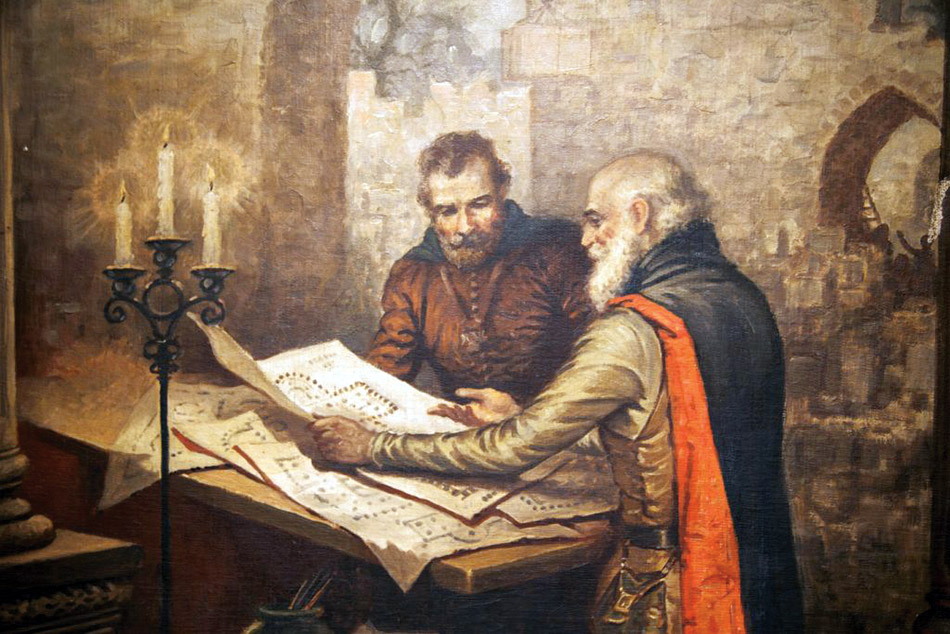
    Let’s go deeper. The Master Mason degree ritual used in regular Masonic jurisdictions today derives from an original that appeared around 1720, three years after the founding of the first Grand Lodge in London. There is no record of who introduced it or where it came from; it simply shows up. It tells a story about the building of the Temple of Solomon, and that story includes – indeed, centres on – the disappearance of the Lost Word and the invention of the substitute secrets, which are to be kept until the real secrets are recovered.

    Thus, it is clear that in 1720, three linked ideas were so important to the most influential Masons of the time that they put them into the Craft’s most important ritual. The first of these ideas was that Masons of some earlier period had known some important secret; the second was that the Masons of 1720 no longer knew what the secret was but thought they had some hope of recovering it; and the third is that it had something to do with the Temple of Solomon in Jerusalem, one of the most famous buildings of the ancient world.

    Power of the Temple

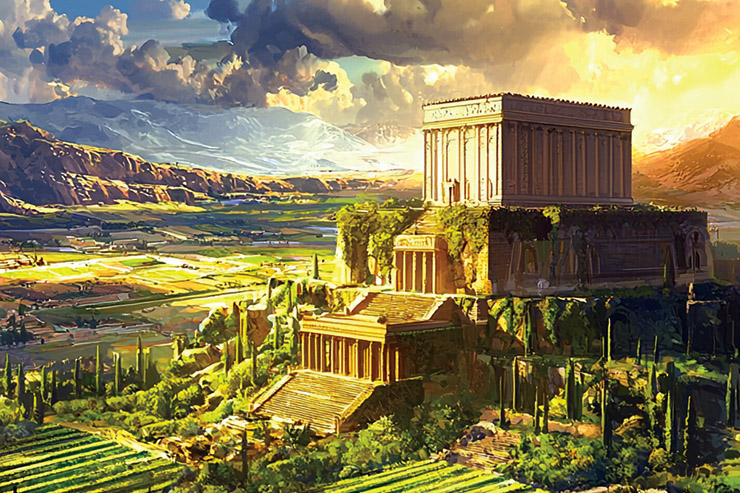
    There’s plenty of information about the Temple of Solomon in ancient Greek, Roman, and Jewish sources, as well as a vast modern scholarly literature on the subject. Most of it is fairly straightforward, but one very odd detail runs through the old sources. This is the claim that while the Temple stood, it caused a remarkable increase in agricultural fertility in the land around it. The Jewish sources go into quite a bit of detail about this: from the time when Solomon built the Temple to its destruction by the Babylonians, the weather and the soil fertility of the region were different. After the destruction of the first Temple, that stopped, but when the second Temple was built by Jewish refugees returning from Babylonia, the effect returned and stayed in place until the Romans destroyed the second Temple in 70 CE.

    The Temple of Solomon isn’t the only ancient temple about which that same claim was made. You can find it in legends surrounding temples over much of the ancient world. Where it occurs, you find certain other things reliably associated with it. The temples are built above underground water sources and their sites have to be chosen by special means. A flurry of odd taboos govern who can or cannot enter and under what conditions. Usually, though not always, they are surrounded by at least a narrow green belt of natural vegetation. Above all, certain rules of alignment and sacred geometry govern their placement and design.

    Geographically, this is a weirdly selective tradition. It doesn’t appear in Africa outside of Egypt, except in a few northeastern African countries that absorbed a great deal of ancient Egyptian culture. It is found all over the ancient Mediterranean and extends east to India and some, but not all, of the island chains further east. Then, it appears in Japan, where it plays a central role in Shinto shrines but not Buddhist temples. Finally, it crops up in the Christian churches of medieval western Europe but is absent from Orthodox Christianity, Islam, and post-temple Judaism.
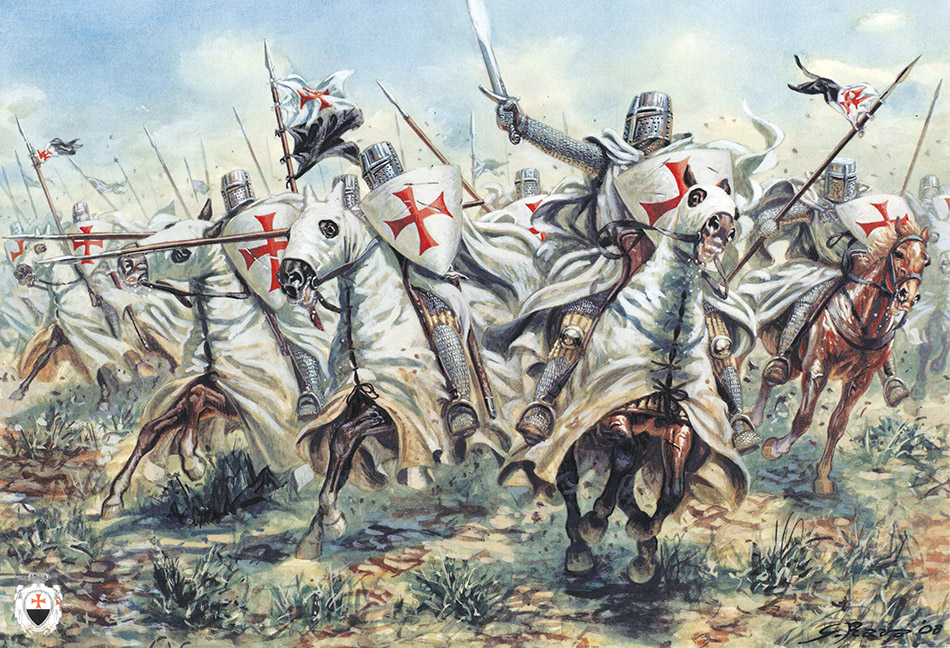
    Painting depicts the Knights Templar in full battle mode.

    Knights Templar

    Western Europe in the Middle Ages apparently knew nothing about it until the time of the Crusades, where the tradition shows up first in churches built by the Knights Templar and spread from there. That turned out to be a clue of immense importance. The Templars – the Poor Fellow-Soldiers of Christ and the Temple of Solomon, to give them their original name – were founded in 1118 by nine French knights who had gone to Jerusalem with the First Crusade. They were dissolved by Pope Clement V in 1311 amid a flurry of charges of heresy and sorcery.

    The Templars got their name because the original nine knights were housed on the Temple Mount in Jerusalem, atop the ruins of Solomon’s Temple; by the time of their abolition, they had landholdings in most of the countries of Europe. When the Order was destroyed, some of the members were burned at the stake and others were transferred to monasteries of less militant orders where they lived out their lives as ordinary monks.
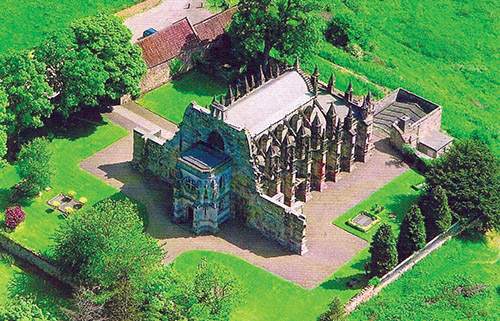
    Aerial view of Rosslyn Chapel in Scotland. 

    There were two exceptions to this. In Portugal, King Dinis created a new order, the Knights of Christ, and had all the Templars in Portugal transfer into it; the Knights of Christ proceeded to play a remarkably active role in the great age of Portuguese navigation, sailing straight to islands in the Atlantic that (in theory) nobody in Europe knew about. Then there was Scotland, where the Pope’s rulings had no force because the whole country just then was under an interdict, and where Robert the Bruce was leading a war of independence against the English and needed every competent soldier he could get.

    The Knights Templar had a significant presence in Scotland at that time; the village now called Temple, located next to the mysterious Roslyn Chapel, was their headquarters in the kingdom, but they also had many other properties and plenty of knights and officials to supervise them. Masonic tradition insists that the Scottish Templars promptly made a deal with Robert the Bruce. They fought for him at Bannockburn and elsewhere, and in return, he protected them from the Church and let them go quietly to ground.
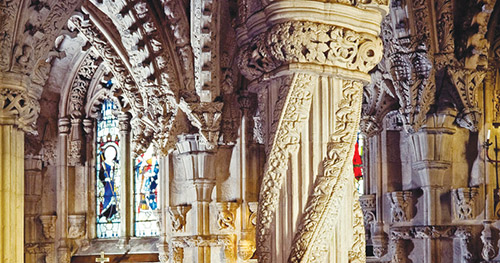
    The Apprentice Pillar with its masonic connotations is the central focus in this photo of the chapel’s interior.

    The tradition proceeds to claim that since the Templars had their own master builders and stonemasons – they had to since they themselves built the castles, churches, and other structures on their landholdings – some of these Scottish Templars ended up supporting themselves as master masons in the original sense of that term, and from that source, certain Templar legacies found their way into Freemasonry. It’s a matter of historical record, finally, that Freemasonry as we now know it, was in existence in Scotland most of a century before it appeared anywhere else.

    All of this is familiar ground to most people aware of alternative history. What deserves attention here are the charges levelled against the Templars when the order was dissolved. Much of it was the same sort of canned libels that would be used later in the witch trials; some of it had intriguing parallels to the actual practice of heretical Christian sects in ancient and medieval times, which deserve more attention than they’ve gotten in the historical literature to date; but then there was the claim that they worshipped a mysterious idol named Baphomet, which made the crops grow. There was the issue of agricultural fertility again.

    Holy Grail

    That issue pops up again in another place at precisely the same time. The oldest known version of the story of the Holy Grail was written around 1190 by Chretien de Troyes, who claimed he’d gotten the story from Count Philip of Flanders, a Crusader who had close connections with the Knights Templar and the royal house of Jerusalem. Between 1190 and 1250 – that is, during the golden age of the Templars – the Grail got massive play in popular literature. They were strange stories, these legends of the Grail; they spoke of a secret passed down through the centuries by hidden guardians, which could only be revealed to those who asked the right question.

    What is the Grail? That was one of the questions those who sought the Grail had to ask. A later generation of authors, heavily invested in mainstream Christianity, insisted that the Grail was the cup Jesus of Nazareth used at the Last Supper and redefined the secrets of the Grail as those of ordinary Christian theology. Go back to the earliest surviving Grail stories, those by Chretien de Troyes or Wolfram von Eschenbach, and you land in a far stranger world where the Grail could take many forms, and its ultimate secret was the power to make the fields flourish. That was why King Arthur’s knights went out in search of the Grail: it alone could restore the barren wasteland to fertility.

    All this happened as sacred geometries and other traditions that were part of the temple tradition elsewhere in the world found their way into medieval European religious architecture. In its wake, monasteries were founded all over western Europe in desolate areas, which promptly became burgeoning agricultural regions capable of supporting not only monks but thriving villages. To this day, all across Europe, you can visit the ruins of long-abandoned settlements from the Middle Ages in barren upland regions that nowadays barely produce enough grass for sheep; old records and archaeological remains alike show that these villages once had thriving fields of grain and other crops – and in the centre of each is a church laid out according to the sacred geometries of the temple tradition.
    Get the issue this article appears in

    Temple technology

    Up out of the darkness of the centuries, like a shape in the mist, rises the dim shape of a forgotten technology – the temple technology, as I came to call it – that was once used by priests and priestesses across much of the Old World to make the fields flourish. Long before the beginning of recorded history, perhaps by sheer chance, perhaps through other means, people in certain parts of the world noticed that buildings of specific shapes built and aligned in particular ways affected the crops grown in nearby fields. Over millennia of trial and error, that original insight gave rise to two kinds of structures.

    One of them uses structures shaped more or less like a stair-step pyramid: large ones, like the ziggurats of Babylon or the pyramids of the Mayas, or small ones, like the earth-deity altars that used to be found in every village in China before the 1949 revolution. The other uses square or rectangular buildings, usually oriented to the rising sun, which seems to have functioned as a resonance chamber. Both kinds of structures were built over certain specific geological features that create electrical discontinuities in the ground.
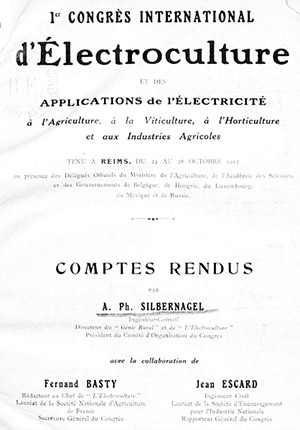
    Early last century, “electroculture” was popular as seen in this literature from the period (see thegardenstrust.blog/2021/09/04/electroculture).

    This matters because there are currents of electricity and lines of magnetic force, closely associated with one another, moving through the body of the Earth. Back in the 1920s, before the chemical industry got a stranglehold on corporate agriculture with their toxic fertilisers and pesticides, experimenters working with these earth currents developed a system called “electroculture” which sent a slight electrical charge through the soil; this resulted in sharply improved harvests. A building properly sited atop an electrical discontinuity in the earth, as it turns out, can build up a substantial charge of telluric electricity, which then streams outward through conductive areas in the soil.

    This was one of the secrets of the Templars, one of the reasons that their landholdings in Europe produced bumper crops year after year to help pay for the Order’s castles in the Holy Land. In past ages, it had been a secret kept by many priesthoods and played a role in many ancient mystery initiations. (The Eleusinian mysteries, to cite only one example, centred on the fertility goddesses Demeter and Persephone, and at the climactic moment of the initiation ceremony, the new initiates were shown a newly reaped ear of grain.) It is one of the secrets of the Grail, and it – or more precisely, a word or phrase passed down from the Templars, probably in garbled form, that once communicated it – is the original Lost Word of the Freemasons. That, at least, is the most likely explanation for the tangled web of evidence that surrounds the old temple technology.

    Like so many of the legacies of the ancient wisdom, the temple technology has been lost. The monasteries that once preserved it in Europe were destroyed in Protestant countries and subjected to the rigid ideological discipline of the Counter-Reformation in Catholic countries, breaking the links by which the knowledge was once transmitted from generation to generation. Elsewhere in the world, three centuries of colonialism, breakneck modernisation, and global warfare have left little intact, though it’s possible that even today, oral traditions at some isolated Indian temple or documents in a remote Shinto shrine might record some of the secrets of the lost temple technology.

    One way or another, however, it is still possible for the Lost Word to be restored and the Holy Grail found. There are plenty of reasons why the global corporate monoculture might want to hide every surviving trace of a simple and scalable technology that uses natural energies and practices linked to traditional spirituality to make gardens thrive and fields bear bumper crops. Every one of those is also a reason why independent thinkers and researchers in today’s rising alternative culture might be interested in finding those traces and following them.

    In terms of the metaphor introduced earlier, this is an important part of the lost machine and one that might be rebuilt and put to work. I can only hope that others will hear the call and join the quest for the Word that once made the fields flourish. 

    [alert type=”general” dismiss=”no”]This article was published in New Dawn Special Issue Vol 18 No 5.[/alert]

    [alert type=”success” dismiss=”no”]If you appreciate this article, please consider subscribing to help maintain this website.[/alert]

    © New Dawn Magazine and the respective author.
    For our reproduction notice, click here.
  • Philip K. Dick: Modern Metaphysician

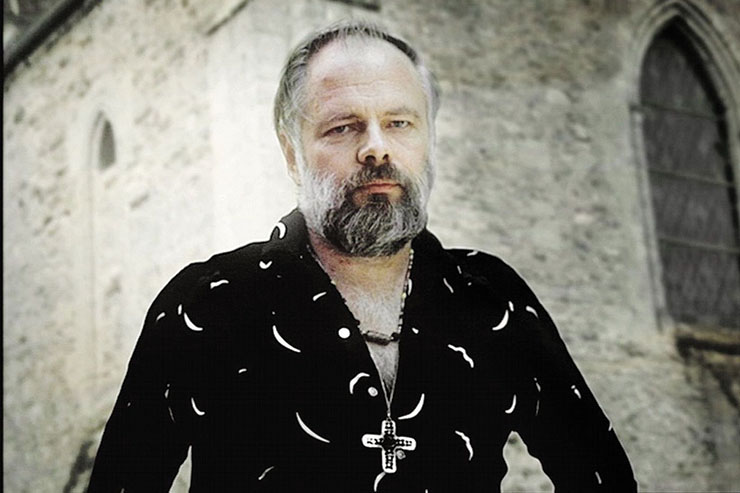
    Philip K. Dick: Modern Metaphysician

    From New Dawn Special Issue Vol 19 No 4 (Aug 2025)

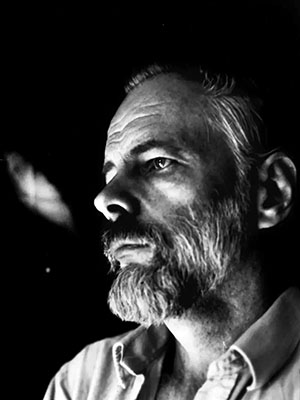
    Best known to the wider world through the Hollywood interpretations of his works Blade Runner (from the book Do Androids Dream Of Electric Sheep?), Total Recall, Minority Report and others, Philip K. Dick was certainly not a typical ‘science-fiction’ writer.

    Although his early books might indeed have featured ‘zap guns’ and ‘androids’, they generally did so only as ironic props in stories of bewildered human protagonists displaced by emergent technological absurdities and hostile bureaucracies.

    Often plagued by relationship breakdowns (he had four wives) and an adventurous attitude to drug use, Dick wrote an extraordinary series of novels across the 1970s (and early 1980s) that have come to be known as his metaphysical or theological canon.

    Inspired by a chain of otherworldly and mystical events in February and March of 1974 – Dick had often previously written of the fragile nature of what we perceive to be ‘reality’ – he now manifested a cogent and strikingly timeless alternate cosmology.

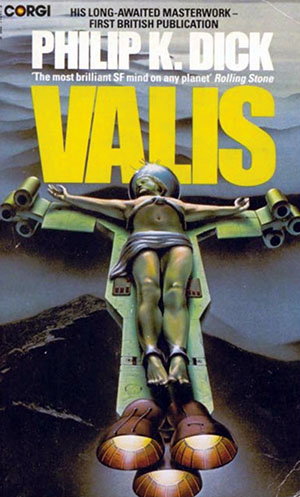
    In essence, beginning with his novel Valis (originally written in 1978 but not published until 1981), Dick argued that the Roman Empire had never truly ended but instead transformed and adapted, continuing to dominate human civilisation through different masks and institutions.

    In his view, what we perceive as historical progression – the fall of Rome, the rise of Christianity, the development of modern nations – was largely illusory. Beneath these surface changes, the same imperial power structure or spirit remained intact, continuously subjugating humanity.

    That concept was deeply rooted in Gnostic philosophy, which Dick encountered (largely through the Nag Hammadi scriptures) during the intense metaphysical period following his transformative 1974 experiences. In Gnostic thought, the material world is ruled by a false god (or Demiurge) which keeps humans trapped in ignorance. Dick mapped this onto his understanding of the Roman Empire, seeing it as the earthly manifestation of this malign cosmic force.

    Described as “The Empire That Never Ended,” it was one of Philip K. Dick’s most profound and complex philosophical concepts, central to these theological works and his sci-fi-tinged personal spiritual perspective.

    The “Empire,” in Dick’s view, had constructed a “Black Iron Prison” – another key concept in his work – a metaphysical cage that traps human consciousness. This prison operates through multiple vectors, often hidden in plain sight:

    • Deception and illusion: Making people believe they are free while actually being controlled.
    • Information control: Manipulating what people know and believe.
    • Psychological oppression: Creating systems that make resistance seem impossible or pointless.
    • Spiritual blindness: Preventing people from recognising their true divine nature.

    Dick argued that the Empire’s continuation could be traced through various historical periods:

    • Early Christianity: Rather than defeating the Empire, Christianity was co-opted and became another tool of imperial control. The institutional church became a new form of Roman authority.
    • Medieval Period: Feudalism and the Holy Roman Empire represented direct continuations of Roman imperial structure.
    • Modern Era: Contemporary governments, corporations, and institutions all serve as manifestations of the same underlying malevolent imperial power.

    The methods may have become more sophisticated – psychological manipulation rather than direct, brute force – but the essential structure remained unchanged.

    In Dick’s universe, the Empire is opposed by a divine force he sometimes called “VALIS” (“Vast Active Living Intelligence System”), represented, in the book of the same name, by a self-aware satellite that orbits Earth, shooting Gnosis (divine knowledge) through a blinding pink laser beam. This plot device presented authentic divine consciousness attempting to break the illusion and liberate humanity.

    Dick believed that around 70 CE, with the destruction of the Second Temple in Jerusalem, time itself became corrupted or trapped. This wasn’t simply a historical event but a cosmic catastrophe that fundamentally altered the nature of reality. In his cosmology, we are all living in a kind of temporal loop or stasis, where the same imperial patterns repeat endlessly under different disguises.

    This temporal imprisonment means that what we perceive as progress – technological advancement, social evolution, political change – is largely illusory. The essential power structures remain unchanged because time itself has been hijacked by the imperial force. We experience the sensation of moving forward while actually trapped in the same historical moment.

    While couched across the novels Valis (1981), The Divine Invasion (1981), The Transmigration Of Timothy Archer (1982) and the astounding Radio Free Albemuth (originally written in 1976 but published posthumously in 1985) as a kind of quasi-hallucinogenic science-fiction mysticism, it should not be difficult to see Dick’s vision as hauntingly prescient and direly accurate of our historical and current circumstances.

    According to Dick, the Empire now maintains its power through increasingly sophisticated methods:

    • Information Warfare: Rather than crude physical oppression, the Empire now operates primarily through the manipulation of information and perception. People are controlled not by chains but by false beliefs about reality itself.
    • Psychological Programming: The Empire creates mental patterns that make resistance seem impossible or pointless. People become complicit in their own oppression by accepting the Empire’s version of reality as natural and inevitable.
    • Institutional Capture: Every institution that might oppose the Empire – religion, education, media, government – is eventually captured and turned into another tool of control. Revolutionary movements are co-opted before they can pose any real threat.
    • Temporal Confusion: By keeping people trapped in the false timeline, the Empire prevents them from recognising the true nature of their situation. People cannot resist what they cannot perceive.

    His “Black Iron Prison” also represents the metaphysical structure that enforces the Empire’s control. It was Dick’s most powerful metaphor for the nature of oppression itself. Indeed, the Black Iron Prison is not a physical location but a state of consciousness – or rather, unconsciousness. The Prison functions through:

    • Perceptual Limitation: The prison limits what people perceive and understand. Reality appears solid and unchangeable because the prison prevents people from seeing its constructed nature.
    • Ideological Constraint: The prison functions through belief systems that make alternatives seem impossible. People remain trapped not because they cannot leave, but because they cannot imagine freedom.
    • Temporal Imprisonment: Like the Empire, the prison operates through time distortion. People experience the illusion of temporal progression while actually being held in stasis.
    • Collective Delusion: The prison is maintained through shared false beliefs. It’s a consensus reality that people collectively create and maintain, even as it oppresses them.

    Directly intersecting with contemporary descriptions such as Matthias Desmet’s concept of “Mass Formation Psychosis” and the heaving totalitarianism that surfaced during the COVID Operation, there seems little doubt that Philip K. Dick’s ‘paranoid’ cosmology presents a vital roadmap for attempting to understand what passes for the spiritual, political, philosophical and informational landscape of the 21st century.

    In classical Gnostic thought, the Demiurge is a false creator god who has trapped divine sparks (human souls) in the material world. Dick identified this figure with the “Empire That Never Ended,” seeing the Demiurge as the cosmic principle behind all earthly oppression.

    While traditional Gnosticism often portrays the Demiurge as a cosmic principle, Dick historicised it, seeing it as actively manifesting through specific human institutions and historical periods. The Roman Empire wasn’t just influenced by the Demiurge – it was the Demiurge’s most successful Earthly incarnation.

    The Archons, in Gnostic cosmology, are the Demiurge’s agents who maintain control over the material world. Dick saw these as manifesting in various forms such as political leaders, religious authorities, and institutional powers, who serve the Empire’s interests, often without realising their true role.

    Furthermore, Dick identified Psychological Archons, internal forces that keep people trapped – fear, despair, conformity, the desire for security over truth. These are the ‘guards’ of the Black Iron Prison. And in Dick’s more modern interpretation, Information Archons are the forces that control information flow – media, education, propaganda systems that shape perception and belief.

    Dick’s Gnostic perspective led him to a radical critique of institutional Christianity. He believed that Christianity had been co-opted by the Empire almost from its beginning, turning the revolutionary message into a tool of control. Orthodox Christianity promises salvation in another world, which Dick saw as a way of preventing people from recognising their potential for liberation in this world. And, Dick suggested, much of institutional Christianity actually worships the Demiurge while believing it worships the true God. Indeed, orthodox Christianity emphasises faith over direct knowledge, which Dick saw as keeping people dependent on external authority rather than developing their own direct divine consciousness.

    Get the issue this article appears in

    In earlier Dick novels (such as Do Androids Dream of Electric Sheep? from 1968), he subtly presents questions about consciousness and the true nature of what it means to be human, blurring and shifting the lines between the ‘androids’ of the title and their ostensible human creators.

    John Carpenter’s 1988 film They Live shared many settings and themes with Dick’s sublime novel Radio Free Albemuth. In the book, a scattered resistance battles the treacherous Archonic infection represented by President ‘Ferris F. Freemont’ (obviously, FFF is numerologically 666), as underground culture furtively keeps hope alive – situations loosely mirrored in the film. Similarly, the iconic 1999 film The Matrix presents ‘Dickian’ and Gnostic concepts wrapped in an action/sci-fi garb.

    From 1974 until his untimely death in 1982, Dick produced a multitude of research, journals and letters that dealt with the events of “2-3-74” and his place in the great cosmic mystery. Condensed from over 8,000 pages of material, The Exegesis Of Philip K. Dick runs to more than 900 published pages and explores, in depth, Gnostic and unmistakeably Lovecraftian perspectives – indeed, “the Demiurge is still under the waters, dead but dreaming.”

    While Philip K. Dick clearly and knowingly presented timeless Gnostic themes in a modern form, it is hard to imagine a time and place more necessary (than here and now) to examine concepts such as the constructed and manipulated nature of ‘reality’, the cancerous, imprisoning scourge of materialism, and the industrially designed death of the soul.

    Indeed, it really is Philip K. Dick’s world… and we live in it.

    [alert type=”general” dismiss=”no”]This article was published in New Dawn Special Issue Vol 19 No 4.[/alert]

    [alert type=”success” dismiss=”no”]If you appreciate this article, please consider subscribing to help maintain this website.[/alert]

    © New Dawn Magazine and the respective author.
    For our reproduction notice, click here.
  • René Guénon and The Spirits

    René Guénon and The Spirits

    From New Dawn 157 (Jul-Aug 2016)

    Even the greatest thinkers are uneven. They have areas of brilliance and other areas where they cannot avoid showing their weaknesses. Immanuel Kant, for example, one of the most admired philosophers in Western civilisation, is known for The Critique of Pure Reason rather than for Dreams of a Spirit Seer, his intemperate and embarrassing rant against the visionary Emanuel Swedenborg.

    René Guénon is no exception. An esoteric philosopher of uncommon brilliance, he has become increasingly influential since his death in 1951. But he, too, has areas where his views seem poorly reasoned and out of accord with known facts.

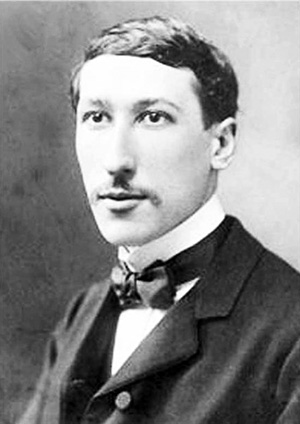
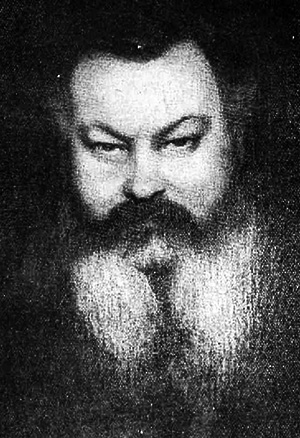
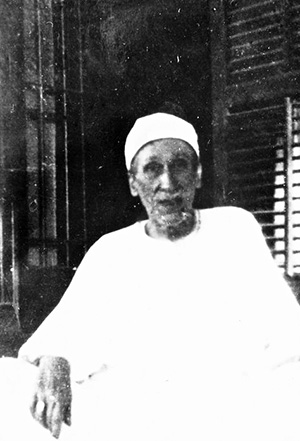
    French esoteric philosopher René Guénon (1886–1951). Photo taken in 1925.

    Born in Blois, France, in 1886, Guénon was educated as a mathematician. As a young man, he was drawn into the occult revival that was sweeping France at the turn of the twentieth century. He was befriended by Gérard Encausse, better known by his pseudonym Papus, the celebrated occultist who, among other accomplishments, founded the Martinist Order. But Guénon soon became dissatisfied with both Papus and occultism and drifted into other esoteric circles.

    The years between 1906 (when Guénon began to explore occultism) and 1912 were the critical points in his development. After breaking with Papus, he received initiations in lineages connected with Taoism, Freemasonry, and Sufism. He also began exploring what he came to call “Tradition” – meaning not merely what has been handed down from antiquity, but a body of universal esoteric doctrine that, he contended, underlies all the great world religions.

    Guénon’s explication of this Tradition, set out in many books and articles he published up until his death in 1951, has a number of curious features. In the first place, it is strongly oriented toward Hinduism, although the sources of Guénon’s contacts with Hinduism, both in the Paris of the Belle Époque and later, are mysterious in the extreme. Indeed his first book, Introduction to the Study of the Hindu Doctrines, was submitted as a dissertation to the Sorbonne but was rejected partly because, violating academic norms, it contained almost no references.

    In the second place, although Guénon converted to Islam in Paris in 1910, and was initiated as a Sufi, before moving to Cairo in 1930, neither Sufism nor Islam plays any great role in his ideas. At the time of death, he had been living in Egypt for over twenty years, but his 3,000-volume library still contained four times as many books on Hinduism as it did on Islam, according to Mark Sedgwick in Against the Modern World: Traditionalism and the Secret Intellectual History of the Twentieth Century, an important study of Guénon and his followers.

    Rather, for Guénon, the Traditional doctrine is most fully expressed in Hinduism. It is also focused on metaphysics. Today metaphysics – usually described as the philosophical study of being – is among the least sexy of intellectual pursuits. In Anglo-American academic philosophy, it is moribund. For Guénon it is central. Not surprisingly, his discussion of it is among the most masterful aspects of his work. But comparatively few of Guénon’s admirers give much attention to metaphysics.

    Despite its failure to impress the Sorbonne, Introduction to the Study of the Hindu Doctrines was published in 1921. It is one of Guénon’s most important works and provides the best introduction to his thought.

    Metaphysics – “Knowledge of the Universal…”

    Guénon was befriended by Gérard Encausse, better known by his pseudonym Papus, the celebrated occultist who, among other accomplishments, founded the Martinist Order. Guénon soon broke with Papus to go his own way.

    In it Guénon says that metaphysics, or metaphysic, in the singular, “is essentially the knowledge of the Universal, or, if preferred, the knowledge of principles belonging to the universal order… but in making this statement we are not really trying to propose a definition of metaphysic, for such a thing is a sheer impossibility by reason of that very universality which we look upon as the foremost among its characteristics.” Metaphysic stands above “that which changes or which is subject to the influences of time and place; the contingent, the accidental and the universal belong essentially to the individual domain.” Metaphysic deals not with this individual domain, but with the universal.

    Although metaphysic “cannot contradict reason” of the conventional kind, “it stands above it.” Nor is metaphysic grasped with reason, but by the “intellect… that faculty which possesse[s] a direct knowledge of principles.” Intellect, in this sense, is not what present-day thought understands by that term. As Guénon describes it, intellect is a type of higher cognition – a direct experience of principles. And it is “infallible” because “its operation is immediate and, because, not being really distinct from its object, it is identified with the truth itself.” This, he adds, is exactly how Aristotle and his heirs, the Scholastic philosophers of the Middle Ages, understood the concept of intellect – in Greek, called nous, intellectus in Latin.

    Intellect may be infallible, but the ways of expressing it are not. “Since all expression is bound to be imperfect and limited, error is inevitable in its form, if not its content: however exact one tries to make its expression, what is left out is greater than what is included.”

    Symbolism of the Cross

    One of the central themes of this metaphysics is what Guénon calls “the multiple states of being” (the title of one of his books). The best way to understand this concept is to picture it as Guénon does in what is probably his masterwork, The Symbolism of the Cross, published in 1931.

    For Guénon, the significance of the cross goes far past its meaning in Christian symbolism. As he says, it is a virtually universal symbol. His explication of it magnificently illustrates not only his metaphysical system, but many otherwise obscure points in the symbolism of the world’s religions.

    To begin with, the cross (pictured in its Greek, or equal-armed form) symbolises the juncture of the supernal with the mundane. The latter is represented by the horizontal line, which, Guénon says, represents the possibilities of manifestation at any given level of existence (such as human incarnation). The vertical line represents the ascent possible from one of these levels to another, and thus to “the indefinite series of states of the total being.”

    Guénon expands this cross into a three-dimensional form. There are now two crosses, one perpendicular to the other, both with the same centre. The horizontal cross defines a plane – the plane of manifestation at any given level of being. This plane is not the only one there is. In fact at every point on the vertical line, another horizontal cross can be drawn, defining another plane and signifying another, different realm of being. The number of these realms is infinite, or, as Guénon puts it, “indefinite.”

    Thus our human existence, complete with all the possibilities (both physical and spiritual) latent in it, comprises just one plane of this three-dimensional cross.

    It’s not possible to go further into this schema here, which is sort of a Cartesian coordinate system of the levels of being (a comparison Guénon would have loathed; if he ever wrote a kind word about Descartes, I have not read it). But it masterfully ties together symbols and ideas from a wide and disparate range of traditions. One symbolic version of this cross is the World Tree, which is found almost universally.

    In any event, these three books define the core of what he calls the Traditional doctrine:

    Introduction to the Study of the Hindu Doctrines
    Man and His Becoming according to the Vedanta
    The Symbolism of the Cross

    I would read them in the order given to get a comprehensive view of Guénon’s doctrine. They are not necessarily easy reading, but Guénon takes pains to write clearly and precisely. At any rate his style is free from the jargon-infested prose and pretentious neologisms favoured by many twentieth-century philosophers, particularly those on the European continent.

    Spiritualism & Multiple States of Being

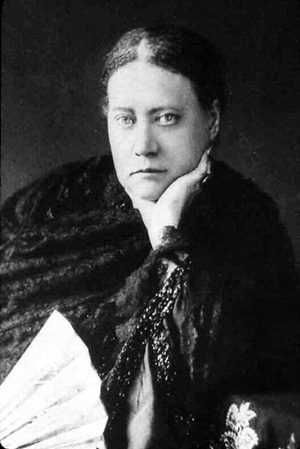
    Helena Petrovna Blavatsky, co-founder of the Theosophical Society. Guénon published books aimed at demolishing the arguments of Theosophy and Spiritualism.

    After Introduction to the Study of the Hindu Doctrines, Guénon published two books on more narrowly defined topics: Theosophy: History of a Pseudo-Religion and The Spiritist Error. These are the works in which his thought is the weakest. They aim to demolish the Theosophy of H.P. Blavatsky and her successors on the one hand, and, on the other, to combat the spiritualist, or spiritist,* movement that had reached its heyday in the nineteenth century. At the time Guénon was writing, in the early 1920s, many were drawn to spiritualism in the wake of the First World War. Bereaved survivors of dead soldiers often turned to it to be reassured of their loved ones’ continued life beyond the grave.

    * The term applied to those who try to communicate with the dead is, in the English-speaking world, “spiritualism.” In French, it is spiritisme, “spiritism.” Guénon naturally uses the latter more often. There is some difference between these movements as they manifested in France and in the English-speaking world, but for convenience in this article, I will for the most part use the word spiritualism to apply to both.

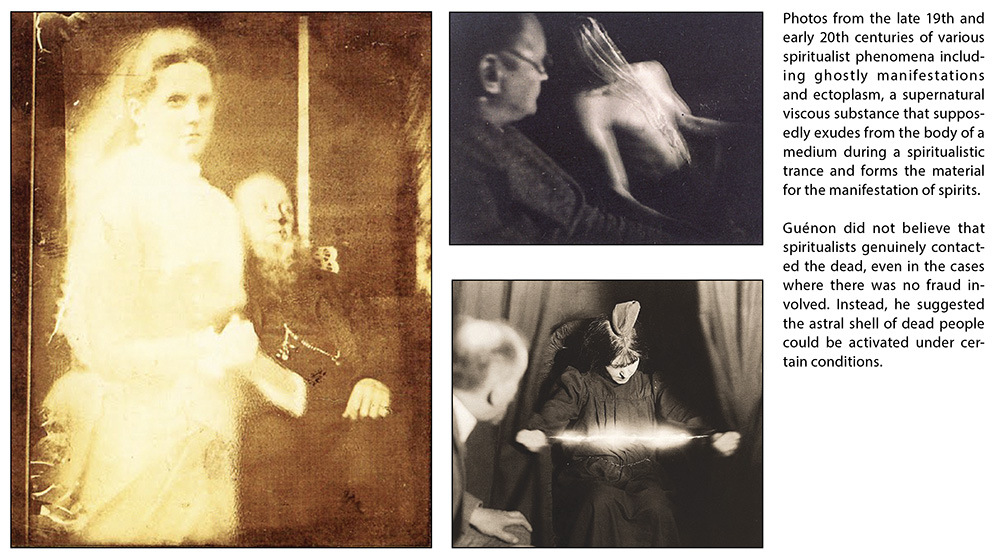
    Guénon did not believe that spiritualists genuinely contacted the dead, even in the cases where there was no fraud involved (and there were many in which it was). One of his main points has to do with the manifestations of spirits in séances. He did not think these “phenomena,” as he called them, were illusory. But he denied that they were actually appearances of the dead people in question. In his view, the essential core of the dead individual – the spirit – went on to another of the multiple states of being, and did so necessarily and without exception.

    So who or what were the ghosts who appeared in séances? These, he claimed, were “simply those inferior elements that the being has in a way left behind in the earthly realm after the dissolution of the human complex that we call death. These are… what the ancient Latins called the manes. This is also what the ancient Hebrews called the ob, which is invariably the word used in biblical texts in regard to evocations” (cf. Deuteronomy 18:11; 1 Samuel 28:7). The root meaning of the Hebrew word ob (more correctly, ’ov) is “wineskin,” which suggests how the ancients conceived of these subtle remains. He explains:

    It is, if you will, like a subtle form that can only take on an illusory corporeal appearance when manifesting under certain circumstances. This is the origin of the name the ‘double’ [ka] given to it by the Egyptians. For the rest, in all respects it is only an appearance. Separated from the spirit, this element cannot be conscious in the true sense of the word. Nevertheless, it possesses a semblance of consciousness, a virtual image, so to speak, of the living being. And the magician, reviving this apparition by lending it what it lacks, temporarily gives it enough of a reflexive consistency to obtain responses when he asks questions of it.

    These astral remains thus are a kind of shell that the dead person has left behind, and which can be activated under certain conditions. They can even appear to answer questions.

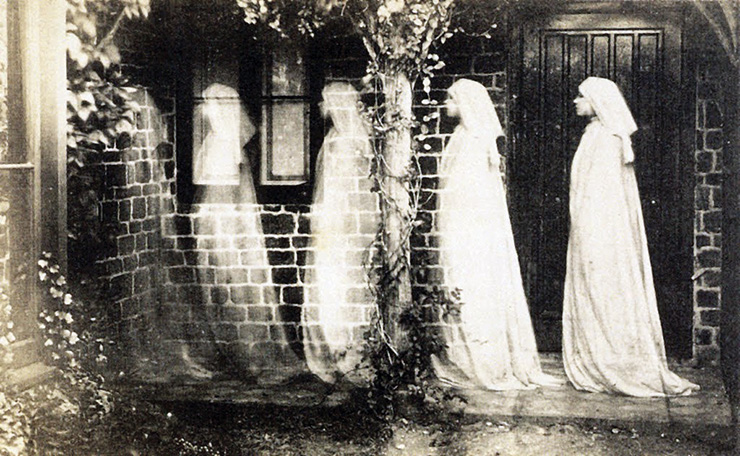
    This explanation does not cover all of the phenomena that take place in séances. Guénon also talks about materialisation, “perhaps the rarest of all phenomena.” In these cases a spirit actually appears to manifest palpably to participants. “A kind of substance, at first unformed and nebulous, seems to separate itself from the [medium’s] body, then gradually condenses. These entities often can be seen, touched, and even photographed (thereby excluding the possibility of hallucination).” In these cases, Guénon claims, the form arises from the mind of either the medium or of one or more of the participants. This is why there have been apparitions of people who turned out never to have existed. “Cases have been noted in which the ‘materialised’ forms quite simply copied portraits of fantastic figures borrowed from pictures or designs seen by the medium,” he writes. The energy is supplied by the medium or the participants or both.

    Why does Guénon take such great pains to refute the ideas of the spiritualists? To return to his metaphysical system, in which each plane in the three-dimensional cross represents one level of manifestation – even, one could say, of reality – Guénon holds that an individual goes through each level exactly once and then passes on to another. He does not remain in connection with the previous level. It is to refute these fallacies that he makes his elaborate case in The Spiritist Error. One could even say that, in essence, this is the spiritist error.

    His arguments are successful up to a point: they seem to fit in well with descriptions of the spiritualistic phenomena of his time and earlier. Furthermore, they help explain why most encounters with the dead take place in the few days after death, when presumably these residual elements have not had the time to break down fully. But Guénon’s claims stop short of explaining all such phenomena. There are instances in which the dead person appears much later than the time of death. Moreover, it seems to be in full consciousness and aware of things that were not known by the person to whom it appears. Such are the cases with warnings sometimes given by the dead to avoid certain voyages or plane flights.

    One difficulty here, as with many of Guénon’s arguments, is that he holds rather rigidly to an extremely precise schema that is logical and consistent in its own terms but does not completely square with manifest reality. Indeed, even by his own theory, there must necessarily be some dissociation between the world of pure principle and the imperfect world of manifestation. But sometimes he does not seem to grasp the implications of this fact.

    Get the issue this article appears in

    Guénon on Reincarnation

    Guénon also takes great pains to refute the teaching of reincarnation. “The idea of reincarnation… like that of evolution, is a very modern idea; it appears to have materialised around 1830 or 1848 in certain French socialist circles” (Guénon, Theosophy, 104). Regarding the transmigration of human souls into animals, he says:

    In reality, the ancients never conceived of such transmigration, any more than they did of a human into other humans, which is how one might define reincarnation. There are expressions, more or less symbolic, that could give rise to such misunderstandings, but only when one does not know what they are really saying, which is this: There are psychic elements in the human being which separate themselves after death, and which can pass into other living beings, human or animal, although this has no more importance than the fact that, after the dissolution of the same individual, the elements that made him up can be used to make up other bodies.

    Unfortunately, the ancient accounts of reincarnation say nothing of the kind. At the end of the Republic, Plato tells the myth of Er, a soldier who has a near-death experience in which he learns the fates of individuals after death (Plato, Republic, 614b-621d). In one famous passage, Er sees the dead choosing their lots for new incarnations. Odysseus, the shrewdest of men, refuses lives of riches and honour and instead chooses the existence of an ordinary citizen. However “symbolic” this story might be, it is hard to see how it might accommodate itself to a theory like Guénon’s. One could make the same point about the teachings of the Pythagorean mysteries, to the extent that we know anything specific about them.

    Guénon’s own views about the fate of the spirit after death are complex. Defining transmigration in what he considers the true sense, he contends, “It is not a matter of a return to the same state of existence… but on the contrary, the passage of the being to other states of existence, which are defined… by completely different conditions from those to which the human being is subject… Whoever speaks of transmigration is essentially speaking about a change of state. This is what all the traditional doctrines of the East teach, and we have many reasons to believe that this was also the teaching of the ‘mysteries’ of antiquity; it is the same thing even in heterodox doctrines such as Buddhism.” The last remark indicates that when he was writing The Spiritist Error, in the early 1920s, Guénon believed that Buddhism was not a pure reflection of the “orthodox” Traditional doctrine. Later in life, he granted it a certain grudging acceptance.

    As we have seen, Guénon conceives of existence as a kind of three-dimensional grid, with a vertical axis transecting an infinite number of horizontal planes. The vertical axis represents the Self, the true essence of a given being; each of the innumerable horizontal planes constitutes a separate plane of manifestation. Human life on earth is only one of these planes. A given being can manifest itself only once on any particular plane. Therefore you cannot be born more than once as a human.

    Like much of Guénon’s thought, this is rigorously precise and would seem to be irrefutable except for one thing. Guénon assumes that any given plane – such as earthly human life – is static. But in fact there is nothing to prove that this is so. On the contrary, the earth and earthly life are changing form ceaselessly, whether we look at them from the perspective of geological ages or even of human history. The possibilities for human life on earth today are not the same as they were in the year 1000 or will be in 3000. You can never be born onto the same earth twice, any more than you can be born as the same person twice.

    At that time Guénon could get away with saying that Hinduism and Buddhism did not teach reincarnation. The number of Hindus and Buddhists in the West was insignificant, and many of those were Western converts. It is much harder to make such claims now, when the West has access to teachers from high levels in these traditions. The Dalai Lama, for example, the supreme authority in Tibetan Buddhism, has written: “There have been and are found at the present time, many incidents illustrating rebirth, from many countries in the world. From time to time small children talk about their work in a previous life and can name the family in which they lived. Sometimes it is possible to check such cases and so prove that the facts remembered by the child are not at all nonsense but are indeed true.”

    And of course the Dalai Lama’s credentials as an authority of “Traditional” teaching are far more solid than Guénon’s own.

    For a Hindu perspective, we might turn to Paramhansa Yogananda’s classic Autobiography of a Yogi. Yogananda quotes his guru, Sri Yukteswar, as saying, “Beings with unredeemed earthly karma are not permitted after astral death to go to the high causal sphere of cosmic ideas, but must shuttle to and fro from the physical and astral worlds only.” The process of shuttling to and fro from the physical world would suggest that physical incarnation is not a once-only option. And again, the credentials of both Yogananda and Sri Yukteswar as transmitters of traditional teaching are far higher than Guénon’s.

    A follower of Guénon’s might try to argue that all of these Eastern teachers have been somehow corrupted by Western views – but that comes very close to begging the question. If you are trying to determine whether “Traditional” Hinduism and Buddhism teach reincarnation, you cannot categorically say that any Hindu or Buddhist teacher who holds to such a doctrine is therefore “untraditional.” You are assuming the very thing you are trying to prove.

    Why should Guénon work so hard to deny the ideas of both the spiritualists and the Theosophists (the leading proponents of reincarnation in the West in his time)? Because, in his view, they are corruptions of Traditional ideas that date, at the earliest, from the eighteenth century. And if you read both Theosophy: History of a Pseudo-Religion and The Spiritist Error, you will see that he has an almost convulsive aversion to such concepts as “progress,” “evolution,” and reincarnation.

    René Jean-Marie Joseph Guénon, whose Muslim name was Abd al-Wāhid Yahyá, embraced Islam and Sufism in pre-First World War Paris.

    Guénon believed that the early nineteenth-century utopian French socialists Charles Fourier and Pierre Leroux invented the concept of reincarnation in order to explain inequalities among the human race. For Guénon, such inequalities are inevitable and even, one suspects, uninteresting. Every individual is different from every other; if it were otherwise, they would not be individuals at all. Thus of necessity all humans have different capacities and fates. Guénon accepts this eventuality with more equanimity than, I suspect, most readers would.

    In an article on Guénon’s views of reincarnation, scholar Joscelyn Godwin points out the likely basis of Guénon’s reasoning. “In an infinite series, such as that of integers, each term appears but once. Likewise, in the infinite variety of the Universe, experienced in its totality by every being, no single state need or can be repeated.” By such reasoning reincarnation would be impossible.

    Of course that would be true if the states of being were exactly analogous to mathematical integers, but there is no reason to accept such a thing a priori. In fact much of Guénon’s arguments against the failings of modernity have to do with its obsessive interest with number above all things – what he calls the “reign of quantity.” He quotes Thomas Aquinas, who wrote, Numerus stat ex parte materiae: “Number is on the side of matter.” This means that number, or quantity, has to do with matter, not with the world of the spirit. Number, as Guénon so intricately argues, does not apply to the higher, spiritual realms. There is, then, no reason to suppose that the laws of mathematics, however apparently inexorable, would apply either.

    Every thinker has his own dynamic – meaning the tensions between two ideas or types of ideas that he struggles, more or less successfully, to reconcile. For Guénon it is the tension between the world of multiplicity, of number, of quantity, of matter on the one hand and the realm of the intellect, of the spirit, of what he calls “quality” on the other. This dynamic, as he understands, is a powerful, perhaps an all-powerful one. And he intuits – correctly, I believe – that the modern world is balanced far too much in the direction of matter and quantity. But I am not sure that he himself manages to step past this imbalance completely. He himself may be prone to the fault that he so readily sees in others: applying quantitative principles to realms where quantity does not apply. He is no doubt right in saying that the states of being are infinite, or virtually so. But then its possible combinations would be infinite as well, and it would not be wise to jump to conclusions about what is and is not possible within them.

    Sources

    The Dalai Lama XIV, The Opening of the Wisdom-Eye, 2nd ed., Quest Books, 1991
    Joscelyn Godwin, “The Case against Reincarnation,” Gnosis 42 (Winter 1997), 28–32
    René Guénon, L’erreur spirite, 2d ed., Éditions Traditionelles, 1952
    René Guénon, Theosophy: History of a Pseudo-Religion, Translated by Alvin Moore Jr. et al., Sophia Perennis et Universalis, 2003
    Richard Smoley, “Against Blavatsky: René Guénon’s Critique of Theosophy,” Quest 98:1 (Winter 2010), 28–34; www.theosophical.org/publications/quest-magazine/42-publications/quest-magazine/1696-against-blavatsky-rene-guenons-critique-of-theosophy; accessed March 28, 2016.

    [alert type=”general” dismiss=”no”]This article was published in New Dawn 157.[/alert]

    [alert type=”success” dismiss=”no”]If you appreciate this article, please consider subscribing to help maintain this website.[/alert]

    © New Dawn Magazine and the respective author.
    For our reproduction notice, click here.
  • The Sorcerer’s Cloak: Materialism, Black Magic & the Occult Machinery of Power

    The Sorcerer’s Cloak: Materialism, Black Magic & the Occult Machinery of Power

    From New Dawn Special Issue Vol 19 No 4 (Aug 2025)

    “If black magic works, then materialism is its best cover of secrecy.”

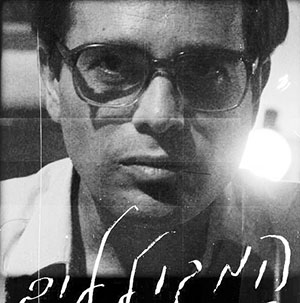
    These were the incendiary words of Professor Moshe Kroy – Israeli philosopher, former Tel Aviv University lecturer, “rational mystic,” and eventually, a ghost in the machine of suppressed knowledge.

    His assertion, buried in the faded xeroxed pages of a 1977 issue of Conspiracy Digest, suggested that secret elites in our world harness tools of occult power – black magic, telepathic influence, egregoric control – while promoting a public creed of scientific materialism.

    In this dual strategy of concealment and monopolisation, Kroy argued, lies the key to understanding the deeper architecture of power. A power that engineers our economic, political, social and cultural systems – programming our very perception of reality.

    Born in 1948, Kroy rose meteorically through the intellectual circles of early 1970s Israel with his philosophical tract Life According to the Intellect, a distillation of Ayn Rand’s objectivism into a system he termed “rational egoism.” But this was only the beginning. According to one of his students, around 1980, Kroy “had developed his own unique synthesis of Advaita Vedanta, [J.P.] Sartre, and [Edmund] Husserl’s phenomenology.”1

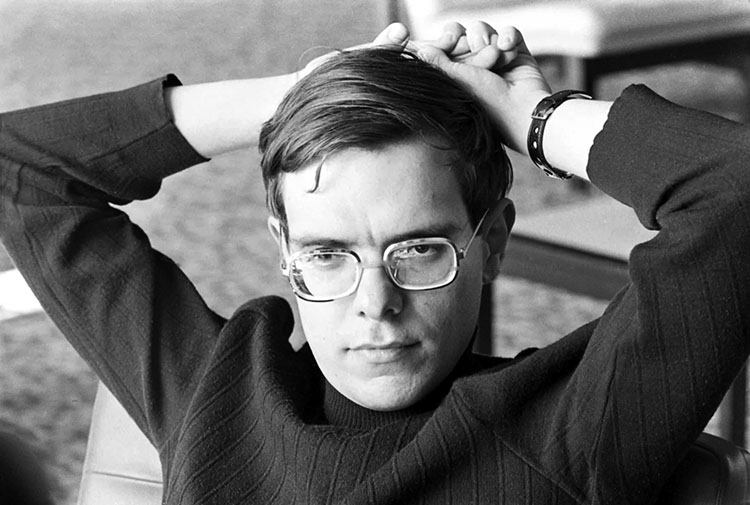
    Moshe Kroy in 1975.

    The most dangerous ideas Kroy ever penned were not in a university lecture or public seminar, but in a little-read article titled “Materialism, Occultism and the Suppression of Psychic Research.” In it, he mapped a structure of concealment so profound and so methodically engineered that it has all but vanished from public memory. That the article itself can no longer be found online – its citation ghosted from search engines – may speak to its paradigm-shattering power.

    Kroy’s central hypothesis is disturbing in its simplicity: he writes, “Suppose that certain secret societies, concentrating on the ‘black arts’, did find some magical techniques which are effective. Suppose – say that they found a method – derived from older magical practices, of producing hypnotic trance at a distance – so-called telepathic hypnosis.”

    To maintain political power and much more, these groups would have to do two things:

    “A. The discovery is kept completely secret.

    “B. The discovery is securely monopolised: No other group or organisation is in the position to rediscover it.”

    The strategy they applied was scientific materialism.

    Materialism & the Newtonian Paradigm

    An Israeli TV series described Kroy as “a genius who paid every imaginable price in his uncompromising effort to reach the truth.”2 Indeed, he pushed past the limits of the materialist doctrine to discover forbidden worlds rarely explored by intellectuals and scientists. It may have led to his death.

    Accounts by Kroy’s students describe a genius who explored a wide range of ideas. He seems to have exhausted the limits set by mainstream science and dived headlong into the ocean of spurned, forgotten and even dangerous concepts and philosophies that exist outside orthodoxy. Ideas and theories discarded by the Establishment as unproven or unprovable within the framework of materialism.

    Kroy transformed from Rational Objectivist to Rational Mystic. He delved into Eastern and New Age philosophies, holding self-transformation workshops and teaching psychic self-development and protection. He even came to the attention of New Age thinker Ken Wilber, who praised his genius.

    To understand how materialism could serve as a cloak for occult domination, one must consider the foundations of modern science. The prevailing worldview – commonly referred to as the Newtonian paradigm or Cartesian dualism – posits that reality consists of physical matter moving through space and time. Everything, including consciousness, is presumed to be reducible to atoms, neurons, and energy exchanges.

    This worldview acts as a cultural enforcement mechanism. It defines the boundaries of acceptable thought and what constitutes ‘reality’. Belief in materialism is strengthened because dedication and commitment to its doctrine determine funding priorities, academic inquiry, and even approaches to psychology and mental health. Those who stray too far beyond its limits – mystics, psychics, pagans, shamans, or researchers of paranormal phenomena – are pushed into the margins, labelled cranks, cultists, pseudoscientists and “conspiracy theorists.”

    Moshe Kroy recognised this with startling clarity.

    The Intention of the “Conspirators”

    In “Materialism, Occultism and the Suppression of Psychic Research,” Kroy begins by stating:

    “A major stumbling block in the attempt to study the nature, purposes and tools of the conspiracy is the fact that such a study necessarily is done in a cultural context which, in turn, has already been largely shaped by the conspiracy. In other words, while the mere realisation of the existence and activities of the conspiracy has a largely liberating effect on a thinking individual, disclosing to him as it does the vast magnitude of the lies and deception incorporated in the various layers of the official culture, this liberating effect, in itself, may merely serve to create an intellectual vacuum.”

    It should be noted that the publishers of Conspiracy Digest believed that “the Right-Left political-economic spectrum is an artificial concoction of the ruling class/conspiracy.” This is the context in which to understand Kroy’s reference to the “conspiracy.”

    One of the most influential underground books of the 1970s was Gary Allen’s None Dare Call It Conspiracy. Kroy cites Allen’s argument that history is shaped by those who control political and economic structures. Ideas and ideologies are merely superficial tools in promoting politico-economic control.

    “The struggle against the conspiracy requires liberation also from the deeper, however invisible, power of the conspiracy on our culture,” Kroy writes. “A conspiracy researcher, however observant, sharp and bold, is hampered to the degree that he accepts uncritically entrapment within an intellectual framework which was deliberately inspired by the conspiracy.”

    Kroy challenges the assumption that modern science is an open and empirical enterprise. Instead, he saw it as a form of intellectual enclosure, maintained by a priesthood of credentialed minds, whose function is less to explore reality than to police its borders.

    His article synthesises three points into a unifying hypothesis to expose the intention of the “conspirators.”

    “I. The thorough insistence, and success, in which an intellectual academic ‘elite’ has made materialism, the doctrine that to exist is to be made of matter and energy, and to be located in space and move in time, the dominant premise of the culture.

    “II. The fact that various circles and groups connected with the conspiracy had occult interests and practices, centring around certain secret, esoteric, mystical doctrines and certain hidden practices, involving black magic, as well as alchemy, etc.

    “III. The fact that parapsychological and psychic research is largely considered by intellectuals and other ‘educated’ people to be charlatanism, unworthy of serious attention, inconsistent in its results, methodically loose, or just plain gullibility – to the extent that all the evidence which was generated through it can be ‘safely’ ignored.”

    If a phenomenon contradicts the materialist paradigm, it is excluded not on the grounds of evidence, but by the paradigm’s dogmatic refusal to see outside itself.

    This is where the brilliance – and danger – of Kroy’s theory emerges. He posits that the very people who shape this closed system of belief may themselves use the forbidden arts they publicly denounce.

    “Does black magic work?” asks Kroy. “This is a very dangerous question to ask in a cultural context in which every ‘educated’ person knows that black magic contradicts the basic principles of science and so ‘could not work’…”

    Black Mirrors & Secret Societies: Practitioners of the Forbidden Arts

    Kroy proposes a speculative hypothesis that certain groups discovered powerful occult techniques that offer extraordinary control over populations, opinion leaders, and even entire governments. Its true power would lie not only in its use but in its concealment.

    “Suppose that certain secret societies, concentrating on the ‘black arts’, did find some magical techniques which are effective. Suppose they found a method, derived from older magical practices, of producing hypnotic trance at a distance – so-called telepathic hypnosis. Clearly, such methods can have immense value in gaining political power, provided that two conditions are met: A. The discovery is kept completely secret. B. The discovery is securely monopolised: No other group or organisation is in the position to rediscover it.”

    This can be achieved, says Kroy, by promoting “the culture of materialism, which implies that no magical technologies could be workable, a priori. You pretend to equate materialism with scientific spirit, etc. and stultify anyone who attacks it. Thus, you effectively stop others from following your trail by implying that no such trail could conceivably exist.”

    Kroy explains that this strategy works in other domains. To preserve corporate secrets or to maintain a monopoly over any technological breakthrough, promote the idea that this kind of discovery is impossible.

    Kroy offers this example: “Whoever has managed to develop a technology of space travel in a velocity which allows instant access to far galaxies, and wants it as a secret monopoly, would and should promote a theory claiming that, say, the ‘velocity of light’ cannot be exceeded in nature by any technology. In other words, relativity theory-type constraints on ‘what is possible’ can serve to cover a technology which involves doing what the theory implies is impossible.”

    Which brings us to his next point, that “it can be expected… psychic research, as well as any technology or activity which would allow non-privileged, non-conspiracy individuals into the field of the ‘esoteric doctrines’, would be heavily suppressed…”

    Kroy goes on to logically dissect the arguments made by defenders of materialism.

    A 2009 interview with British evolutionary biologist Richard Dawkins revealed insights into the mindset of those who defend materialism and scientism. When radio host Prof. Hugh Hewitt asked whether Dawkins considered what existed “before the Big Bang,” he replied: “I don’t consider the question because I recognise that it’s an intuitively appealing question. I recognise that, along with everybody else, want to ask that question. Then I talk to physicists who say you can no more ask what came before the big bang than you can ask what’s north of the North Pole.”

    A mental block inhibits a whole class of professionals from seeing beyond the limits of materialism – as if they are compartmentalised under a spell. Could this be caused by something more than stubbornness, ignorance and groupthink?

    To secure this monopoly, you must inoculate the culture against even the possibility that such techniques exist. You achieve this, said Kroy, by establishing materialism as the cultural default, equating scientific scepticism with reason itself. Then you mock, marginalise, or professionally destroy anyone who strays beyond its limits – as Richard Dawkins is renowned to do. As a result, your rivals and the fields of sheep under your control remain ignorant of the magical universe – the realm of consciousness, will, spirit – and the dangerous keys that open portals to powers and principalities above and beyond this material world.

    For Kroy, “an intellectual academic ‘elite’ has made materialism,” “the dominant premise of the culture” – “the doctrine that to exist is to be made of matter and energy, and to be located in space and move in time.”

    Rites of Hidden Rulers: Ceremonial Magic

    From the grimoires of Renaissance occultists to the secretive rites of the Hermetic Order of the Golden Dawn, the art of directing and controlling minds, influencing unseen forces, or attempting to contact gods (theurgy), has a history as long as mankind.

    What is ceremonial magic? Several scholars suggest that it is essentially the use of rituals and techniques to invoke “spirits” or life forms from other dimensions or worlds, which can enter this world through specific rituals.  

    For example, according to the respected scholar of esotericism, Manly P. Hall, “a magician, enveloped in sanctified vestments and carrying a wand inscribed with hieroglyphic figures, could by the power vested in certain words and symbols control the invisible inhabitants of the elements and of the astral world. While the elaborate ceremonial magic of antiquity was not necessarily evil, there arose from its perversion several false schools of sorcery, or black magic.”3

    “By means of the secret processes of ceremonial magic,” warned Hall, “it is possible to contact these invisible creatures and gain their help in some human undertaking… But evil spirits serve only those who live to pervert and destroy.”

    In magical systems, symbols are weapons, intention is force, and belief is akin to architecture. The magician or ritual operator uses thought, image, and will to open portals in the mind – perhaps beyond it. To the outsider, it is dismissed as nonsense.

    Ceremonial magic has always been a double-edged sword. While some traditions emphasise spiritual growth and enlightenment, others – particularly in the realm of black magic – seek domination, wealth, or control. And here lies Kroy’s most unsettling suggestion: that certain elites and groups, in the vein of “we know and they should be kept ignorant,” secretly practise these dark arts, even as they promote a worldview that discredits them.

    Egregores, Watchers & Manufactured Minds

    If the conspiracy that Moshe Kroy described is more than political, more than economic – if it is ultimately spiritual – then we must expand our vocabulary of power.

    Enter the egregore, a concept from esoteric tradition that describes a psychic entity or group mind form created by collective belief and emotional energy. Once formed, an egregore can take on a life of its own, shaping thoughts, behaviours, even entire civilisations.

    In his article “Understanding the Occult: What is an Egregore,” Theron Dunn defines an egregore as “an energised astral form produced consciously or unconsciously by human agency… usually an archetypal image produced by the imaginative and emotional energies of a religious or magical group.”4

    Egregores – whether purely psychic, symbolic, or something more – are not neutral. Egregores of nationalism, egregores of religion, even the egregores of corporations: each compels action, embeds narratives, harbours defensive and offensive modes. One might say that our post-modern world is haunted by these ghosts of group minds.

    Kroy’s insight here is chillingly prescient. By engineering culture to generate specific egregores while denying their reality, the elite magician both protects and weaponises arcane knowledge and occult techniques.

    According to the Golden Dawn glossary, egregore derives from a Greek word meaning “watcher” and a “group egregore is the distinctive energy of a specific group of magicians who are working together, creating and building the same thought-form or energy-form.”

    The strongest egregores are the oldest and are usually boosted by ‘magical force’ from powerful intra- and/or extra-terrestrial ‘beings’.

    In his article, Kroy ponders that “UFOs make you wonder… if some political power would be somehow connected to some extra terrestrial civilisation as an ally, it would be in its best interest to slander and stultify anyone who claimed such a connection was possible.”

    In biblical and apocryphal lore, particularly the Book of Enoch, the “Watchers” or Irim were angels – some faithful, others fallen – who interacted with humanity, imparting forbidden knowledge and fathering the Nephilim. These egregoric intelligences are neither metaphors nor myths, but active agents in our hidden history.

    The Gnostic Christians suggested that two camps fight an ongoing spiritual war for our souls. The decisive question, Kroy might have asked, is not whether these beings exist but who is working with them now? Are we doomed as pawns in this game? Can we escape?

    A Spell on You

    Even today, more than 40 years after Kroy penned his article, with numerous independent studies confirming paranormal phenomena, the materialist mindset prevails.

    Most scientists and ‘educated’ people don’t seem to understand the implications of quantum physics, which replaces the Newtonian model. According to Kroy’s hypothesis, a psychic barrier prevents the professional and ‘educated’ classes from drifting too far from the egregoric clutches of scientism.

    As the philosopher and scholar of religion Jeffrey Kripal notes in The Flip, “one could write a very big book, even a small library of books, on all the scientists, engineers and medical professionals who have either reported robust anomalous phenomena or found them to be of extraordinary scientific significance.”5

    Even as quantum physics upends Newtonian assumptions, and consciousness studies point to non-local mind, the public script remains unchanged: the physical material world is all there is. Magic is patent nonsense. The spiritual and subtle worlds are delusions.

    But what if this denial is itself a spell?

    In 1928, propaganda expert Edward Bernays wrote: “In almost every act of our lives, whether in the sphere of politics or business, in our social conduct or our ethical thinking, we are dominated by the relatively small number of persons… who understand the mental processes and social patterns of the masses. It is they who pull the wires that control the public mind, who harness old social forces and contrive new ways to bind and guide the world.”

    This statement, widely quoted in studies of media control, takes on new dimensions under Kroy’s framework. If psychic structures, such as egregores, shape mass perception, then the true power lies not in what we are told, but in what we are prevented from conceiving.

    Giordano Bruno & the Occult Psychology of Control

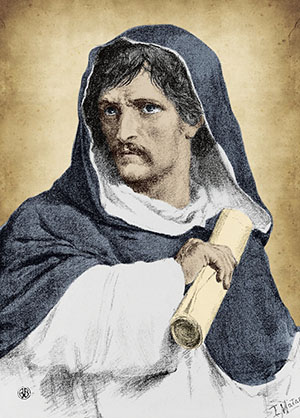
    Giordano Bruno, the famous 16th century Italian philosopher, astronomer, mathematician, and mystic. According to Prof. Ioan Couliano, Bruno’s book De Vinculis in Genere is “one of those little-known works whose importance in the history of ideas far outstrips that of more famous ones.”

    Centuries before Moshe Kroy issued his warning about the suppression of the paranormal, another philosopher lit a torch in the tunnels of human consciousness and paid for it with his life.

    Giordano Bruno, a 16th-century Dominican friar turned heretic, mystic, and magus, was burned at the stake in 1600. The official charge was heresy. The real crime may have been the contents of his dangerous little book, written in Latin: De Vinculis in Genere – “On the Bonds in General.”

    While Machiavelli’s The Prince outlined the manipulation of fear and statecraft, Bruno’s De Vinculis went deeper – into magic and its role in manipulation. It appears to accurately describe how modern politics and consumer culture operate, through psychological manipulation, using the bonds of desire. “The control of mass desire” – the “libidinal economy” notes one commentator – “is what mass politics is all about.”

    An anonymous article about the book suggests that many Anglo-Saxon and Middle European historians and intellectuals regard De Vinculis in genere as a very clever and insightful political work. 

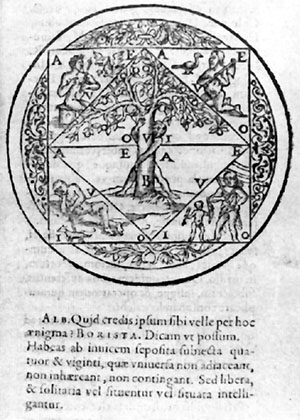
    A page from De Vinculis in Genere.

    “The London School of Economics uses it as a core text because of its usefulness in understanding behaviour patterns in contemporary social life,” reads the article.6

    Bruno argued that eros is the true binding force among humans. But those bonds, if skilfully manipulated, become chains.

    According to the article, Bruno sees man as a being who “desires” completion beyond himself, a desire “primarily erotic – in the most spiritual and all comprehensive meaning of the word.” Eros, in Bruno’s philosophy, is a connective force that bridges instinct and mystical insight. It not only generates vivid mental imagery within the self and others, but also “kindles and spills over into the psyche of other persons.” Through this, eros becomes a powerful medium – creating “links and ties” between individuals, whether as lovers, friends, group members, or even between leaders and followers.

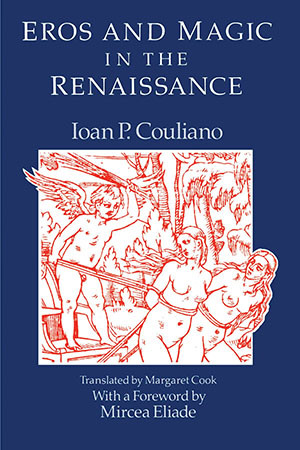
    In his masterwork Eros and Magic in the Renaissance, historian Ioan P. Couliano writes that “the magician of De vinculis is the prototype of the impersonal systems of mass media, indirect censorship, global manipulation, and the brain trusts that exercise their occult control over the Western masses… Bruno’s magician is altogether aware that, to gain the following of the masses, like the loyalty of an individual, it is necessary to take account of all the complexity of the subjects’ expectations, to create the total illusion of giving unicuique suum. That is why Bruno’s manipulation demands perfect knowledge of the subject and his wishes, without which there can be no ‘bond’, no vinculum.”7

    Eros is a magical force that infiltrates and enlivens our imaginations through symbols and images. Control the images and systems of thought – the imagination – and then apply occult techniques to manipulate groups or whole societies. Is it any surprise, then, that the London School of Economics – an institution deeply embedded in modern power structures – still uses De Vinculis as a “core text”?

    The key point is this: Bruno’s text bases its arguments on the reality of magical (occult) forces, the exact same type of supernaturalism that was denounced and supposedly thrown into the ashcan of history with the triumph of modern materialist science.

    In the new age of media saturation and algorithmic suggestion, Bruno’s text seems prophetic. Bypassing logic, directly targeting the unconscious, and riding the currents of erotic imagination and symbolic association, Bruno’s eros is filtered through screens, social media, celebrity culture, and synthetic desire. Every act of engagement, every click, every fear or fantasy amplified by the machine is another tether to an egregore whose name you do not know.

    Technocracy and the New Black Magic: Surveillance, AI, and the Rise of the Golem

    If black magic in the old world relied on incantations, talismans, and hidden rituals, its 21st-century incarnation is no less potent – only now, it is cloaked in code.

    Ceremonial robes have been replaced by lab coats and tech start-up hoodies. But the goal remains the same: control minds, dominate reality, and reshape the soul.

    In Kroy’s framework, what began as secret rituals in ancient temples migrated into silicon-based systems of governance. The black magician is now a systems architect, a biotech investor, a behavioural economist, an artificial intelligence engineer, a “world planner.”

    The late Zbigniew Brzezinski, US geostrategist and former National Security Advisor, foresaw the outlines of this shift in his 1970 book Between Two Ages: America’s Role in the Technetronic Era:

    “The technotronic era involves the gradual appearance of a more controlled society… dominated by an elite unrestrained by traditional values. Soon it will be possible to assert almost continuous surveillance over every citizen and maintain… complete files containing even the most personal information.”8

    What Brzezinski called “technetronic” control, Kroy would likely have recognised as ritualised mind-shaping, now mechanised and made scalable.

    Consider today’s technologies:

    AI-powered surveillance systems that anticipate protest, dissent, and emotional tone.

    Behavioural nudging algorithms embedded in digital platforms to shape decisions and purchases, and push political narratives and state/corporate propaganda.

    Neural implants and bio-interfaces that blur the boundary between body and machine, consciousness and programming.

    They are magical instruments – artificial egregores programmed with purpose, created by hidden hands. Their function is identical to that of black magic as described by mystics like Dion Fortune (Psychic Self-Defence) – the imposition of one’s will upon another through unseen forces.

    “The most dangerous form of black magic,” warned Manly P. Hall, “is the scientific perversion of occult power for the gratification of personal desire.”

    If the ancient Golem was a clay figure animated by sacred words to serve its master, then today’s equivalent is the technological construct animated by data, algorithms, and social engineering. It has no soul. It serves without question. And once built, it cannot be reasoned with.

    But unlike the mythical Golem, this one is not merely a servant. It is the lens through which we view reality – filtering perception, rewriting memory, reinforcing belief. In this way, the modern Golem does not protect the village – it replaces it with a virtual model, one shaped entirely by those who cast the spell.

    This is the sorcery of the 21st century. And materialism still remains its perfect veil.

    Moshe Kroy’s Final Days & The Occult War for the Soul

    “If black magic may work,” Kroy proposed, “while the conspirators both do their best to make us all believe… that it couldn’t possibly work… and at the same time deal in it themselves – well, that is a totally different proposition, isn’t it?”

    In his later writings, Kroy spoke explicitly of the need to rediscover the self as spirit, not machine.

    “If, indeed, materialism is a false absurdity and psychic research is valid,” Kroy wrote, “then the search for an authentic understanding of one’s own self… may be a very powerful tool of struggle against the conspiracy.”

    In a culture that now reduces identity to data points, biology to code, and consciousness to electrochemical flux, the recovery of the spiritual self is not simply a metaphysical journey but an act of rebellion.

    The occult war that Kroy hinted at – between those who invoke higher wisdom and those who exploit secret and even sacred knowledge – is reaching a crescendo. And the stakes are no longer theoretical.

    The philosopher René Guénon referred to our current age as the “Reign of Quantity” – a world governed by metrics, mass, and measurement, where the qualitative dimensions of the soul and spirit are denied or derided. Guénon saw this as a symptom of a civilisational descent, a metaphysical degeneration masking itself as progress.

    Charles Fort, the early chronicler of anomalous phenomena, was even blunter: “Mankind invented materialism to shield itself from what was being done to it – by coincidence, by forces, by powers – that it refused to understand.”

    In late 1987, Moshe Kroy returned to Israel, no longer the young prodigy celebrated by Tel Aviv intellectuals but a man who had stared into the abyss – and reported back. He announced his latest discoveries and proclaimed the world is ruled by the forces of evil and that a final battle between good and evil is at hand. Reportedly suffering paranoia and pursued by the demons conjured during his adventurous life, he allegedly committed suicide in his Tel Aviv apartment in 1989.

    “Moshe was indeed enigmatic to those who did not know him,” recalled Dr Joseph Chiappalone, an Australian medical doctor and esoteric writer who became a colleague of Kroy in Melbourne.

    “But in reality he was a highly intelligent academic devoted to Truth and Wisdom. He was a non-Zionist Jew who had been expelled from Israel for protesting the atrocities committed by that State in the name of Zionism. His heroes were Jesus Christ and Sai Baba… He had been threatened with assassination if he ever went back [to Israel]. Mossad is nothing if not maleficently efficient.”9

    Had he opened doors that others wanted sealed? Had he named the nameless, invoked forbidden truths, challenged egregores that guard the boundaries of our reality?

    Or had the weight of knowledge simply become too much?

    Regardless of the cause, Kroy’s legacy haunts the present moment. For the very systems he warned about – psychic suppression, full spectrum field dominance, the weaponisation of materialism – are now global and digitised. That control grid becomes our daily reality.

    And yet, something else is happening.

    The mechanisms of mass control are failing. Narratives – economic, scientific, political, social, spiritual – no longer inspire confidence. People are asking new questions, thinking new thoughts. Reports of the paranormal, near-death experiences, synchronicities, and psychic events are not only increasing – they are escaping the margins.

    Is the old magic wearing off and the control system breaking down? Kroy would likely answer: Yes – and that is precisely why the system is panicking.

    The rise of competing egregores – movements, ideologies, mass awakenings – signals cultural fragmentation and metaphysical turbulence. The battlefield has shifted. No longer confined to competing ruling class groups or underground journals, the war has gone public. The individual, once a pawn, is now a potential player.

    Get the issue this article appears in

    The Way Out: Spirit, Sovereignty, and the Gnostic Revival

    What, then, is the way out of this enchanted prison – a world where reality has been hacked by those who would have us deny the soul?

    Moshe Kroy gave us a clue in his final written words:

    “The search for an authentic understanding of one’s own self… as a spirit… may be a very powerful tool of struggle against the conspiracy.”

    Moshe Kroy (image from TV series ‘The Accursed’)

    In other words, the only antidote to a world ruled by hidden magicians is the awakening of inner gnosis – the self-knowledge that one is not a machine, a statistic, or an algorithmic subject, but a sovereign, incarnated being endowed with the power to blossom consciousness, will, and purpose.

    Materialism – so long used as a firewall – is cracking. Quantum physics has refuted classical determinism. Parapsychology, though marginalised, continues to produce data that defies the mechanistic model. Ancient traditions and indigenous ways of knowing, once dismissed as superstition and nonsense, are emerging as sources of healing, guidance and wisdom for today.

    In his vision of the spirit as the core of human resistance, Kroy joins a long lineage across time. Their message, scattered across burned manuscripts, banned books, and suppressed teachings, remains remarkably consistent: you are more than flesh. You are more than thought. You are more than what they told you.

    And the war – yes, the spiritual war – is not about saving the world, but about remembering who you are before the world was programmed into you.

    In this war, only the awakened spirit is truly dangerous. And perhaps that, in the end, is why they feared Kroy – and us.

    Author’s Note: This article, dedicated to the memory of Moshe Kroy (1948–1989), is based on two previous articles that appeared in New Dawn Special Issues Vol 12 No 3 and Vol 13 No 3.

    [alert type=”general” dismiss=”no”]This article was published in New Dawn Special Issue Vol 19 No 4.[/alert]

    [alert type=”success” dismiss=”no”]If you appreciate this article, please consider subscribing to help maintain this website.[/alert]

    Footnotes

    1. www.kheper.net
    2. ‘The Accursed’, Episode 3, www.imdb.com/title/tt4238712
    3. sacred-texts.com/eso/sta/sta24.htm
    4. theosophy.wiki/en/Egregore
    5. The Flip: Epiphanies of Mind and the Future of Knowledge by Jeffrey J. Kripal, Bellevue Literary Press, 2019.
    6. academia.edu/3989585/Reflections_on_the_De_vinculis_in_genere_by_Giordano_Bruno
    7. Eros and Magic in the Renaissance by Ioan P. Couliano, University of Chicago Press, 1987.
    8. Between Two Ages: America’s Role in the Technetronic Era by Zbigniew K Brzezinski, Praeger, 1982.
    9. rense.com/general93/end.htm

    © New Dawn Magazine and the respective author.
    For our reproduction notice, click here.
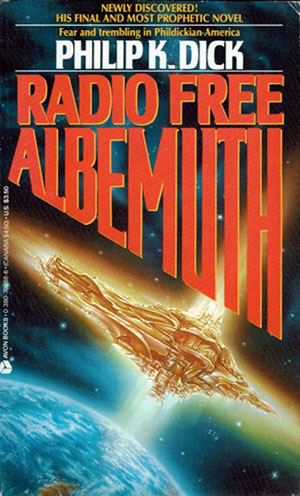
  • The Old Man of the Mountain & the Spiritual Revolution He Created

    The Old Man of the Mountain & the Spiritual Revolution He Created

    From New Dawn 182 (Sept-Oct 2020)

    But to live outside the law, you must be honest
    I know you always say that you agree. 
    – Bob Dylan, Absolutely Sweet Marie, 1966

    Whispered scenes of an inaccessible mountain pass filled with a Garden that resembles Paradise as described in the Quran. Drugged adolescent boys who were secretly carried there while unconscious awake to find themselves lying on golden couches, surrounded by streams of honey, clear water, and wine, with succulent fruits for the taking. And then the beautiful houris, those with lovely eyes, sensuously dancing, young women skilled in the arts of love initiating these young men in the true joys of Heaven. No virgins these, they are trained for pleasure. After four to five days in their company, the boys are drugged again with opium and hashish and carried back to the palace of the Old Man of the Mountain. Awakening in his presence, they describe to the court their experience and await their Master’s command. At the promise of return to that Garden, they will be willing to sacrifice themselves to his political plan.

    Imaginative portrait of Hasan-i-Sabah created by an unknown 19th-century artist.

    And so the myth of Hasan-i-Sabah has been told for 700 years, brought to its perfection by the Venetian traveller Marco Polo. An earlier writer described the Master handing his disciple a golden dagger and identifying its target. While neither is certainly true, they are so tantalising as to be irresistible. I and many others were seduced by these stories into my lifelong interest in the Assassins. William S. Burroughs and Mick Jagger are two others who have been fascinated with this account, and the Assassins are mentioned in the writings of both Bocaccio and Nietzsche. (I give Marco Polo’s complete tale in an appendix to my book Hasan-i-Sabah: Assassin Master, along with numerous citations from the Quran describing that very Garden.) 

    Who was the real Hasan-i-Sabah and why does he matter? Curiously, while he died almost exactly 900 years ago (1124), his story encapsulates so much of today. The details of his political conflicts seem torn from this morning’s headlines, while his religious ambitions are practised in the daily spiritual life of countless people who may never have heard his name. 

    This is so because of the contact Hasan’s disciples had with the European Crusaders. The Crusades lasted from 1095 to 1291 and helped to intertwine the cultures of Christianity and Islam. The Knights Templar and the Syrian Assassins had a long series of documented historical interactions. The two groups of religious warriors had many similarities in their structure and the nature of their beliefs and values. Their common creeds of service to a higher truth, the righteousness of their cause, their shared appreciation of courage, discipline and loyalty were often more important than the apparent differences of their faiths. Abraham’s monotheism, after all, worships a God who is essentially the same in the three related religions of Judaism, Christianity and Islam. 

    Manuscript illustration (1410) from The Travels of Marco Polo shows the Old Man of the Mountain in the Garden observing his young disciples (fidais) at play with their love mates. 

    The name ‘Assassin’ spread fear among contemporary rulers from China to England, especially in Muslim lands. Academics who preached against the sect were terrorised, as were clergy, generals, governors, mayors, and influential politicians and court advisors whose policies targeted the group. And there were many who did because the Assassins stood outside the political and religious order of their day. While the murder of individual enemies may be a distasteful thought, it is certainly a more humane way to conduct a war for survival than killing mass numbers of uninvolved civilians or soldiers who bear no policy responsibility. Unlike the behaviour of modern indiscriminate terrorists who kill fellow Muslims daily, Hasan-i-Sabah’s assassinations were few and laser-focused on policymakers only.

    Hasan-i-Sabah was a rebel. He was the founder of the world’s most successful secret society, and he may truly be said to be characterised as a mystery wrapped in an enigma. He carved out an independent space for himself and his followers in the high Persian mountains. The Nizari Ismailis or Assassins defended and expanded their territory for 166 years. Their descendants today are led by their Imam, the Aga Khan, and are one of the most advanced and sophisticated Muslim sects on the planet – competently-led, broadminded, educated, and self-sufficient. They no longer practice the political policies of their medieval forefathers, instead substituting education, publishing, modern institution-building, cultural preservation, medical care, encouraging general prosperity, and offering social programs for their faithful.

    Hasan himself was born to a well-to-do Shiite family in the northern Persian city of Rayy, near modern Tehran, a lively commercial hub of its day. It was a crossroads city of east and west, with a long, exotic, and interesting history. Travellers and merchants from India, China and Central Asia met Greeks, Romans and Egyptians. Shamans, Buddhists, Hindus, Muslims, Jews, Christians, Pagans of every stripe, Zoroastrians, Manichaeans and others passed through Rayy, trading and sharing their wares, practices and ideas.

    Hasan felt the call of the spirit in adolescence and was introduced through friends to a minority Shiite offshoot group of schismatics called the Ismailis. They were estranged from the majority of Muslims, both Sunnis and Shiites. They were a breakaway sect whose beliefs in a spiritual leader called the Imam were primary. And they were considered heretical because the Ismailis had split on the identity of the seventh Shiite Imam and actually posited a Prophet beyond Muhammad, an absolute travesty according to orthodox Islam, whether Sunni or Shiite.

    After being personally recruited by various representatives (dais) of the Ismaili faith for some time, Hasan’s resistance was worn down and he accepted their teachings, swore the oath of allegiance, and was soon promoted to a position of responsibility. This exposed him to what we might call the Mystery Traditions of antiquity. The Gnostic Ismailis believed in a Neoplatonic celestial hierarchy ruling life on earth and taught practices designed to allow the initiate to rise into higher consciousness and commune with such cosmic energies. It was a very different kind of faith and practice than the Arab tribal version of Islam that had conquered Persia some 400 years before Hasan’s birth. 

    Hassan Sabah’s castle, located in northeastern Gazor Khan Village near Mo’alem Kalayeh in Roudbar of Alamout, is a historical fortress perched atop a 220-meter cliff, sitting 2163 meters above sea level on the southwestern slopes of the Houdkan Mountain range, part of the larger Alborz Mountains. (https://en.wikipedia.org/wiki/List_of_World_Heritage_Sites_in_Iran)

    Shiism and Ismailism were spread by conversion. And conversion involves dialogue, a mutual sharing of ideas and beliefs. This theme of transformation through give-and-take is crucial to an understanding of Hasan. Ideas totally foreign to either the Arab people or Islam itself become incorporated into Persian Ismailism by its contact with alien cultures. Mesopotamia is the cradle of Western civilisation and its rich spiritual beliefs were a key part of the Persian culture in which Hasan and Ismailism were active. The Zoroastrian Persians had no problem with the concept of semi-divine higher beings like the Imam, any more than the Egyptians of old would have questioned the divine status of the pharaoh, or Jews concerned with the elevated status of a prophet like Moses who spoke directly with God. Shiite doctrines like the sacred blood of the Prophet, transferred through Ali (his nephew) and Fatima (his sole surviving child and wife of Ali) to their descendants, echoed similar ideas of the House of David among Christians and Jews. Jesus carried the messianic legacy of the bloodline of David, the poet-warrior king of Israel. All historians discuss the input of Greek Hermetic ideas into Shiism and later Ismailism. 

    The third- through fifth-century writings of Greek Neoplatonic philosophers had been carried to Persia by fleeing monks after the sixth-century campaigns of Justinian had closed the pagan monasteries and outlawed religions other than Christianity. The Sasanian king Khosrow I welcomed them. Zoroastrianism was not incompatible with the concepts of a supreme, transcendent, and incomprehensible Deity – opening itself gradually through a refined descent through the levels of Being, that its essence could be better communicated with mankind. Though the Hermetic writings were lost to the West for a thousand years, Renaissance scholars like Marsilio Ficino and Pico della Mirandola gained access to them from Eastern sources and brought about a rebirth of esoteric wisdom in Europe.

    Meanwhile in the East, Illuminist doctrines from various earlier heresies so altered mainstream Islamic beliefs that the resulting spiritual paths were nearly unrecognisable to orthodox Arab Muslims. These included tales of miracle-working Imams and other holy men. The eclectic doctrines that grew among the various Shiite/Ismaili groups included: belief in reincarnation and metempsychosis; deification of Imams and sometimes dais; intense speculations on the nature of God; attention to divination and prophesy; doctrines concerning the nature of the soul, death, the afterlife, and immortality; teachings on the cyclical nature of time and history; qabalistic investigations of the esoteric significance of letters and numbers; and occasionally, the overthrowing of traditional Islamic behavioural restrictions on sexuality, the use of intoxicants, and dietary limitations.

    The Shia/Ismaili concept of the living Imam allowed for an emotional connection between the aspirant and his or her master that was not available to the more straitlaced Sunni acolyte. The ability to direct the disciple’s love of God through the spiritual master is an ancient practice. The teacher serves as the physical manifestation of the divine principle. Meanwhile, the anticipated redeemer or Mahdi awaits the divinely ordained moment for His appearance, silently guiding the Imam in his duty to shepherd humankind through the dark hours in which we must all spend our material existence. These hidden and speaking Imams are the personification of the metaphysical soul of the universe. They are wise enough to guide us all toward Truth. The Imam is sometimes referred to as the “speaking Quran,” for he alone can be trusted to separate the outer, exoteric teachings, or zahir, of the written text from its inner esoteric meaning, or batin, its essence. 

    Hasan-i-Sabah would learn from his Ismaili instructors that they had carried this reverence and appreciation of the Imam to the highest level of any Shiite sect; that the Imam enjoys the greatest amount of ilm or Gnosis, and that he can communicate this to the community. He would also have learned that the Ismailis analysed creation in vast cycles composed of incomprehensibly mysterious and profound cosmological eras, and of the energies operative in each. Ismailis viewed seven prophets (natiqs) as being charged with the guidance of humanity. The first six were Adam, Noah, Abraham, Moses, Jesus, and Muhammad. But Ismailis added a seventh, Ismail or his son Muhammad ibn Ismail, to this rarified group of world teachers. Hasan would have understood that accepting a prophet after Muhammad was an unforgivable blasphemy to orthodox Islam. His own capacity for independent thought must have been stimulated by this. 

    Each of the Prophets brought a code of behaviour, the sharia, to rein in the harmful tendencies and mischief normally associated with mankind. Sharia was not an example of success. Rather it was an admission that the higher message of the Prophet had reached its limit and rule-making became necessary.The Imam is a successor to the Prophet. He is charged with conveying the original message of the Prophet and with revealing reality (haqiqa) through the teaching. While the Prophet appears only periodically, the Imam is always present, otherwise the world would collapse. 

    Hasan would have been taught about the Final Judgment when the unredeemed and the ignorant are separated from those who had dared to perfect themselves and become the worthy companions of the Imam and his Truth. Hasan also understood that these teachings on the nature of the Ismaili beliefs needed to be conducted in silence and accompanied by ritualised personal pledges. How else could the Ismaili dais have been protected? How else could they know who to trust? How else could Hasan be expected to reach out to others and spread a fundamental heresy without some kind of oath-taking?

    Several years after his initiation and initial training, Hasan was instructed to travel to Egypt where he strengthened his faith. The head of the Ismaili sect was the Fatimid Imam/Caliph al-Mustansir. This spiritual teacher was unique, chosen by God and inspired with the special wisdom and insight so that he could interpret complex doctrinal issues. Hasan attended a university for Ismaili missionaries for 18 months. Having some problems with the military dictator who had usurped the Imam’s power, Hasan left Egypt and returned to the Mideast. He travelled as a missionary through Syria, Israel, Iraq, and Iran for ten years and finally took possession of a mountainous castle/fortress known as Alamut in the year 1090. Strategically apportioned as a defensive structure, he improved it in such a manner that it long served his community and functioned as the headquarters for Ismaili offshoots in Syria, Afghanistan, and India. Hasan-i-Sabah was the original Old Man of the Mountain.

    Several of the esoteric themes that are explored in my new biography of the Old Man include the concept of the Assassins as an initiatory society of graded spiritual ascent. Something secret, mysterious, and progressive took place in the conversion and initiation process administered by the Ismaili dais, and in the training program by which the dais were educated. This is undisputed by modern scholars, including the most orthodox and those most inclined to treat the Ismailis with the greatest deference and respect. We know that the Ismaili and Nizari mysteries included increasing revelations of the inner doctrine. We know they had a system of oaths to assure secrecy. As one who has spent his adult life studying and participating in hierarchical secret societies, I believe there is much to be said for the private, teacher-to-student communications about the nature of Truth. The idea of looking for esoteric meaning within scripture, exploring the higher reaches of philosophy to understand Truth, exploring numerology, Qabalah, and thaumaturgy, asking questions of commonly accepted ideas, seems a more than acceptable way for people to creatively expand their intelligence.

    The Qiyama doctrine is another topic I explore in some depth. I believe it may have been one of the most profound and revolutionary concepts ever uttered and embraced by a religious community. The Qiyama declared the immanence of the “Inner Imam,” what Aleister Crowley called the “True Will” some 700 years later. The inner essence of an individual’s spiritual reality and personal source of guidance was asserted to be superior to any rule-making or forced adherence to outer forms of behaviour. This revelation was proclaimed by the fourth Lord of Alamut in 1164, some forty years after Hasan’s passing.

    I also devote attention in Hasan-i-Sabah: Assassin Master to the drug issue and the derivation of the name Assassins from Hashish. Although forbidden in Islam, images of hashish and wine are shared by Sufis and countless others in the Mystery Traditions. Intoxication is a symbol or metaphor for the ecstatic experience of Divine Union. It is such an overpowering and disorienting phenomenon that it is often compared in the language of mysticism with drunkenness.

    Get the issue this article appears in

    In closing, I would like to state that the primary thesis of my new book is Gnosis, the aspirant’s direct personal experience of God while within the human body. The knowledge of God transcends all the doctrinal rigours and hierarchies of all the established religions of the world through time. The celebrated Sufi mystic Mansur al-Hallaj (ca. 858–921) was suspected of being an Ismaili. He had acquired great influence among certain members of the Sunni royal family, and jealous enemies arranged his murder. He experienced a Gnostic union with God during which he was known to cry out Ana’l-Haqq, “I am the Truth.” His disciples went on to found a number of Sufi orders.

    Hasan-i-Sabah: Assassin Master also includes the first English translation of Rashid al-Din’s 1310 version of the text of The Biography of Our Master. Mentioned and quoted repeatedly by all reliable authors on the Assassins, how it had not been translated before was a mystery that is now solved. There is also a translation of a purported letter exchange between Hasan and the Seljuk Sultan Malikshah in 1091. The book includes some 900 footnotes and nine detailed maps of the regions discussed in the text. With an extensive glossary of names and terms, a timeline, along with a comprehensive bibliography and index, one hopes it will prove a useful study guide for the interested reader.

    James Wasserman’s Hasan-i-Sabah: Assassin Master, with a foreword by Tobias Churton, is available from all good bookstores. 

    [alert type=”general” dismiss=”no”]This article was published in New Dawn 182.[/alert]

    [alert type=”success” dismiss=”no”]If you appreciate this article, please consider subscribing to help maintain this website.[/alert]

    © New Dawn Magazine and the respective author.
    For our reproduction notice, click here.