New Dawn – World's Most Unusual Magazine

Category: Afterlife

  • What’s This About An Afterlife?

    What’s This About An Afterlife?

    From New Dawn 199 (Jul-Aug 2023)

    So you think the continuity of consciousness after physical death is just a bunch of faith-based woo-woo? 

    You think it’s something cooked up to make us feel better about our inevitable journey from the womb to the rubbish heap of physical decay? 

    You think the notion of a timeless existence outside the framework of the physical universe is too vague and slippery ever to be taken seriously by our culture’s arbiters of reality – the sciences?

    Please think again. 

    Until recently, the belief that the whole of reality is based in matter has dominated our modern understanding of space, time, life and death. Most tellingly, our consciousness has been viewed as little more than an illusory by-product of mechanistic brain activity. 

    But over the past half-century, Western science – traditionally hemmed in by materialistic assumptions – has begun to wriggle free of this centuries-old ideological straitjacket and is breaking some astonishing new ground. In fact, there are now at least fifteen promising avenues of post-materialist scientific investigation currently underway, quite apart from modern physics’ excursions into the mysterious quantum realm!

    The majority of these inquiries point distinctly toward the possibility, if not the near-certainty, of a “greater reality” in nature that includes what we call the “afterlife.”

    My new book, A New Science of the Afterlife: Space, Time, and the Consciousness Code (Inner Traditions, 2023), delves into each of these intriguing fields of inquiry. 

    I peek behind the “veil” to ask, “What is the veil, anyway?” and venture a strikingly clear and simple answer. I also take a critical look at the language we use in connection with the afterlife, exposing the militant cult of scepticism that has delayed bonafide afterlife research for decades and that has scoffed at the succinct accounts, from a variety of sources, of the transition to the “next life” and of what one might expect when one arrives there. 

    How Did I Come to Write this Book? 

    I was born in 1942, raised in the New York City area in a nonreligious family, and at an early age zeroed in on the arts and sciences. I attended Brooklyn’s Pratt Institute, intending to pursue a career in Industrial Design, but soon latched onto a similar marriage of art and technology: documentary filmmaking. My first such effort, a film titled SUNDAY (www.bit.ly/1961sunday), garnered nine international awards and launched my lifelong career in media production, interrupted only by three semesters at Harvard University in the early 1960s. 

    Parallel to my creative and professional life I’ve maintained a lifelong fascination with the so-called paranormal. (“So-called” because persistent cultural taboos have made it impossible to gauge its actual degree of normalcy!) It all started when, in my early childhood, I experienced a number of precognitive dreams. These suggested that there might be hidden or denied aspects of reality that beg to be better understood and perhaps befriended. Later in life I experienced a variety of inexplicable events – UFO-related experiences, materialisations, and other “culturally unauthorised” phenomena – which persistently piqued my curiosity about the deeper nature of reality.
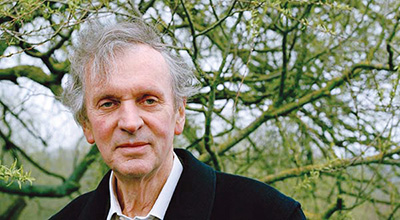
    British biologist Dr Rupert Sheldrake

    In the early 1980s, I met British biologist Dr Rupert Sheldrake and produced a radio documentary, as well as writing the first American reviews and articles about his ground-breaking book A New Science of Life. Sheldrake points out the still-unexplained gap between the DNA code and the actual three-dimensional forms, developmental stages and habits of living organisms. He proposes that the gap might be bridged by an as-yet unacknowledged field phenomenon, which he termed morphogenetic or simply morphic. Morphicfields, Sheldrake suggests, retain and pass on information from previously existing forms and situations. In this view, the DNA acts as a sort of “tuning device” that invokes the morphic fields appropriate to the particular developmental stages of an organism.

    Sheldrake also speculated that such fields, rather than fixed laws, might be responsible for a broad spectrum of other patterns in nature.

    So revolutionary were Sheldrake’s insights that the editor of the prestigious British journal Nature suggested that Sheldrake’s book should be burned! 

    This motivated me to write “Zen.. .and the Art of Debunkery” (www.bit.ly/debunkery) – a lengthy, tongue-in-cheek essay that skewers some of the absurdly unscientific sceptical attitudes that can prevail within our academic and nominally scientific establishments. Later I produced a short computer-animated film, I’M A SKEPTIC (www.bit.ly/imaskept), which pokes a different kind of fun at the thoughtless rhetoric and arrogance of self-styled debunkers and nay-sayers.

    In the early 1990s, I discovered the books of Robert Monroe. Monroe had been a mainstream New York radio producer back in the 1950s who began spontaneously experiencing out-of-body states. Eventually, he mastered the art of “astral travel” and founded the Monroe Institute, which offers practical training in this intriguing ability of the inner self.

    This then led me to the work of other explorers in what had become known as the “New Science” movement. This included research into the Crop Circle mysteries, ET contact experiences, and breakthroughs in Remote Viewing. It also encompassed afterlife studies and a host of other practical and visionary pursuits at the borderline where the physical and metaphysical meet in an increasingly comfortable embrace.

    My particular fascination with afterlife communication came to a sharp focus when, in 1995, I met Mark Macy. Mark had been one of the pioneering investigators and practitioners of Instrumental Trans-Communication, in which voices and images from the afterlife are received via modern electronic systems. 

    At first, I was a tad sceptical of Mark’s claims, but after meeting enough ITC practitioners – from ordinary folks to scientists and academics – and collecting and analysing enough samples of their work, I became convinced that this mode of communication across the veil was indeed a reality. It was, and is, a practice that apparently can be pursued and developed by folks with keen desire, some simple recording equipment, and perhaps a strong emotional bond with someone who has passed over to the other side of life.
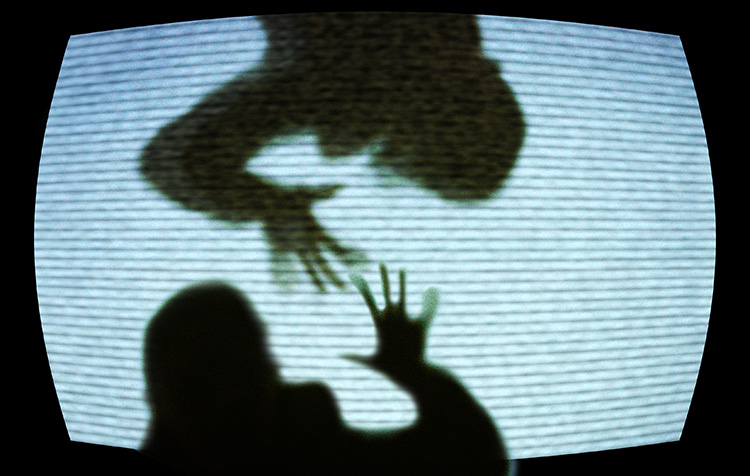
    In the early 2000s I teamed up with co-producer Tim Coleman to produce a series of independent documentary films about modern afterlife research and communications. Over a decade later, having crisscrossed the US and visited five European countries, we had at last completed a pair of unique feature documentaries that can be viewed for free on Vimeo.

    CALLING EARTH (www.bit.ly/callearth) runs for 95 minutes and focuses on electronic communications from the other side – both audio and visual. It includes dozens of examples of this form of afterlife communication and includes conversations with some of its pioneering developers and most successful practitioners. It rebuts the popular sceptical arguments against ITC point by point, documents an international conference devoted to ITC, and reports on a group of mothers who use electronic devices to receive communications from their deceased children. The film also provides basic instructions on how to do one’s own ITC experimentation and includes a short sequence on the Scole Experiment, which is elaborated on in our second documentary.

    SCOLE: THE AFTERLIFE EXPERIMENT (www.bit.ly/scolemovie) is an 85-minute film documenting the most extraordinary experiment in physical mediumship ever attempted. (The practice of physical mediumship goes far beyond simple communication with the other side and seeks to produce physical evidence that can be recorded or preserved for study and analysis.) Conducted in the tiny English hamlet of Scole over a five-year period in the late 1990s, the Scole Experiment is widely acknowledged as the most fruitful and most rigorously controlled and meticulously documented exercise in the history of physical mediumship [you can read more about this experiment on pages 8-9 of New Dawn 196].

    My involvement in these film projects pointed me to other influential sources of afterlife-focused information, notably including the works of Dr Julia Assante, Dr Kenneth Ring, and the International Association of Near Death Studies. Soon IANDS chapters in the San Francisco Bay Area and across the US in Chicago and Atlanta invited me to present screenings of these documentaries, which were followed by lively Q&A sessions.

    These, in turn, directed my attention toward modern reincarnation research, which has been pursued over a half-century at the University of Virginia Medical School’s Department of Perceptual Studies. Perhaps the most compelling, exhaustively researched and widely known reincarnation case of modern times is that of a young American, James Leininger, who recalled in considerable detail his life and death as an American fighter pilot who was shot down by the Japanese during World War II.

    In 2018 I made the acquaintance of a remarkable team of mediums. Together we created a website, Cosmic Voices Network (www.bit.ly/covoice), which posts extraordinarily inspiring and thought-provoking channelled messages from dozens of individuals, both well-known and obscure, who now reside in the Greater Reality.

    By 2019 I had begun pulling together these seemingly disparate threads into a series of essays that eventually became the core of my 2023 book, A New Science of the Afterlife. My purpose was to encourage a more relaxed, comfortable and rational conversation about what awaits us all sooner or later on the other side.

    A New Science of the Afterlife

    The book’s introduction asks why a new understanding of the afterlife is important in these times. It suggests that many of our mounting planetary challenges (notably including those caused directly or indirectly by the compulsive accumulation of wealth) spring partly from a universal undercurrent of fear that ultimately comes down to a fear of death. 

    As religious doctrines about life and death prove increasingly unsatisfying, mainstream science (our modern world’s “gold standard of truth”) has largely failed to step in and fill this yawning gap in our understanding… though that has begun to change.

    I hope, in concert with so many other such efforts now underway, to contribute to a conscious course correction in our individual and collective priorities and, ultimately, in our very experience of life.

    My new book is divided into three main parts.

    Part I: Getting Oriented. This opening part points out that, while science is often equated with materialism, they are entirely separate concepts: Science is basically a method of inquiry – essentially “organised curiosity.” Materialism, on the other hand, is a belief system about reality

    It also points out that our popular belief in a “material” world tends to be based on an overriding focus on matter that ignores the other three indispensable ingredients of physical reality: energy, space, and time

    As well, it touches on the problem of pseudoscientific scepticism and argues that a paradigm shift into post-materialist thinking is already underway.

    I survey the landscape of afterlife research, including Near-Death Experience research, reincarnation research, Instrumental Trans-Communication research and practice, mental mediumship research and practice, physical mediumship research and practice, Out-of-Body Experience research and practice, and diverse avenues of research represented by the twenty-nine award-winning essays in an unusual contest established by the Bigelow Institute in 2022.

    Examining a range of supportive studies in related phenomena, including the abilities of autistic savants, Terminal Lucidity, the Shared-Death Experience, psychedelics, the placebo effect, lucid dreaming, precognition and pre-sentiment, Remote Viewing, map dowsing and telepathy.

    It asks, “What is the consciousness Code?” (Spoiler alert: The answer hides in plain sight!) Finally, it takes a deep dive into the problem of language, which tends to frame our worldview in terms dictated by the traditions of our culture rather than enabling fresh perspectives.

    PART II: Some of the Best Evidence for the Continuity of Consciousness. This section is based on the two documentaries mentioned above – CALLING EARTH and SCOLE: THE AFTERLIFE EXPERIMENT, as well as an extensive report on the contemporary American reincarnation case of young James Leininger.

    PART III: The Nature of the Afterlife. Part III offers some answers to five questions: What’s the afterlife made of? Where’s it located? How does it work? What’s it like? and What’s it for? Sorry, no spoilers here. To find out the answers, you’ll have to read the book! 

    But here’s a consolation prize: The complete Epilogue.
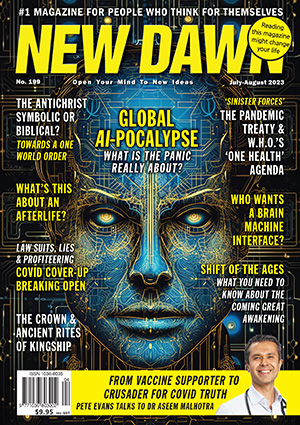
    Get the issue this article appears in

    What Do We Know, and Where Do We Go from Here? 

    If the evidence offered in this book is valid, the existence of a Greater Reality – a matrix in which our awareness and sense of self apparently dwell between our physical lives and in which our entire physical universe may itself be embedded – appears to be beyond question. 

    The fact that this matrix exists beyond the reach of our narrow senses, our current scientific instruments, and our language, does not rule it out. Meanwhile, mounting objective evidence for its existence rattles the gates – and gatekeepers – of our academic, scientific, and cultural institutions.

    Breakthroughs are being made in psychic and electronic communication with the “other side.” Stringent academic research is being conducted into reincarnation, mediumship, terminal lucidity, and other previously neglected fields of inquiry. Newly developed or rediscovered techniques and practices are building bridges between this world and the next. All these and more are inexorably forcing the question of an afterlife into the light of day, following centuries of passive neglect and active avoidance or suppression by our dominant academic, scientific, and religious institutions. 

    This book is only one small contribution to the emerging flood of science-based afterlife-related literature… 

    And if you are so inclined, gently broach the subject to others. You may be surprised at how many will welcome sharing their own thoughts and experiences relating to the afterlife. 

    I hope this rising tide of awareness maintains its momentum toward a courageous, responsible approach to answering the eternal questions surrounding the deeper experience and meaning of birth, life and death.

    Readers can obtain Daniel Drasin’s new book A New Science of the Afterlife: Space, Time, and the Consciousness Code from all good bookstores.

    [alert type=”general” dismiss=”no”]This article was published in New Dawn 199.[/alert]

    [alert type=”success” dismiss=”no”]If you appreciate this article, please consider subscribing to help maintain this website.[/alert]

    © New Dawn Magazine and the respective author.
    For our reproduction notice, click here.
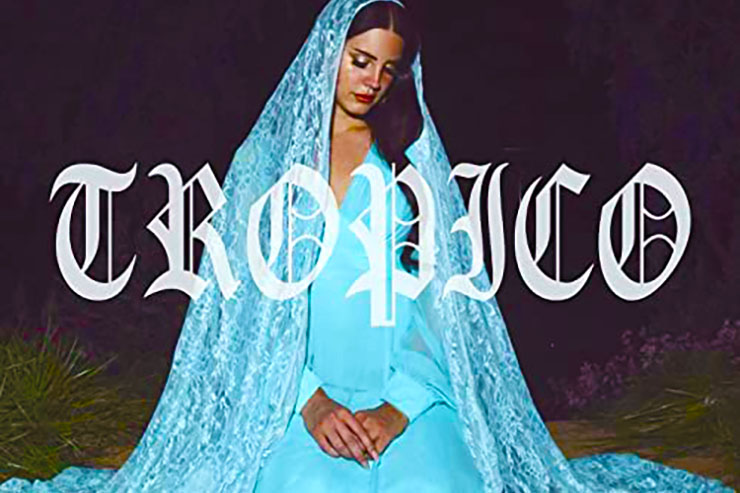
  • ‘Most of my friends are dead – & many of  them I have never met before…’

    ‘Most of my friends are dead – & many of  them I have never met before…’

    From New Dawn Special Issue Vol 14 No 4 (Aug 2020)

    Thought is energy. Active thought is active energy; concentrated thought is a concentrated energy. Thought concentrated on a definite purpose becomes power.
    – Charles F Haanel (1866–1949), New Thought teacher known for his book The Master Key System

    Through the faculty of creative imagination, many great artists, musicians, writers, inventors and poets became great because they cultivated and developed the habit of listening to their inner guidance that speaks from within. They learned to trust guidance and endeavoured to keep in touch with its stream, which could come and go based on who really knows. 

    The ultimate source of this stream is quite mysterious. Its quality is, of course, the logical outcome of tremendous hard work – study, concentration, practice, accumulation of knowledge and experiences, contemplation, experimentation, etc. The creative faculty of Mind synthesises new expressions that take the form of music, art, superior ideas, inventions – across the multitude of fields of human endeavour. On occasion, the spirit moves and inner guidance delivers brilliant original and useful breakthroughs into the world of humanity. 

    A large body of work exists on afterlife communications, channelling and even messages from aliens. We also have long-maintained traditions around the world of seeking advice from ancestral spirits. The former category of communications is usually unexpected, unpredictable and delivered to the individual, often out of context. The latter form of seeking advice is a more controlled exercise conducted by experienced shamans using tested rituals. 

    To the outrage of sceptics and diehard materialists, there are numerous recorded instances of people dialoguing with the spirits of the deceased, especially famous people. Author Frank DeMarco has actively engaged in an ongoing series of conversations with various non-physical beings, including historical individuals and a group he calls “the guys upstairs.” DeMarco’s conversations with Ernest Hemingway led to the publication of his book Afterlife Conversations with Hemingway. DeMarco’s accompanying article tells you how it can be done.

    The Ancient Greeks believed that inspiration or “enthusiasm” came from one of the nine muses of Greek mythology, each goddess assigned expertise in a particular domain of the arts. 

    Great musicians know the power of that sudden stream of inspiration pouring into their mind, the sound of the music sometimes accompanied by lyrics – where does that come from? Child music prodigies include Mozart and Chopin, and there are plenty of other cases of child geniuses. The truth of this phenomenon confounds logic.

    The imagination collects the material with which the mind weaves the canvas that will dress your future.
    – Charles F Haanel

    An example from modern-day pop music is Lady Gaga. She has admitted in interviews that the source of some of the catchy tunes on her debut album ‘The Fame’, which shot her to worldwide fame, had mysteriously appeared in her mind. The same thing happened with her second studio album ‘Born this Way’, another major hit. In a 2011 interview, speaking about the song ‘Bloody Mary’ which she says was inspired by her fascination with Mary Magdalene, Gaga said, “I wrote it pretty quickly. I mean I wrote it in fifteen minutes! Actually all the songs on the album were written in fifteen minutes! It’s just the process of putting it all together takes much longer. But the lyrics and the melodies come to me very quickly, and if they don’t I usually move on.” (Source: www.popjustice.com/articles/an-interview-with-lady-gaga)

    Imagination is the light by which we can penetrate new worlds of thought and experience.
    – Charles F Haanel

    We now refer to the mysterious title of this article… who said that? The self-made American singer-songwriter and poet Lana Del Rey (birth name Elizabeth Grant) broke into stardom with her debut 2012 album ‘Born to Die’. As of 2020, Del Rey had sold 19.1 million albums, over 13 million singles worldwide, and received numerous accolades. Did she do it all by herself or get some help from “the guys upstairs?”

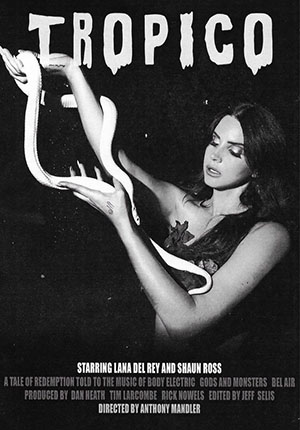
    Del Rey let some of us into a secret, in a rare and little-known admission she made at the premiere of her short film Tropico in 2013, with its underlying surreal spiritual messages. This was the message on the flyer handed out to guests:

    “Most of my friends are dead – and many of them I have never met before. In my private life, I live quietly, and with all the choice of living at hand, I prefer to bask in the legend of people I’ve only heard about. To me – they are as real as the people sitting in this theatre. I learned from Charles Haanel, through his experimentations with imagination that through actively honouring the memories of your choice historical figures, and in consulting with them as though they were real, you are eventually able to receive true guidance from them as though they were really here. True, it is a strange way to live – but it is magic, and I’ve found my magical thinking has lead to miraculous results. So, this video is my homage to the legends I’ve learned from as well as a nod to my colourful past. I hope you like it. It was the best I could do with my limited ability to translate my inner visions into pictures. On that note, I’d like to thank everyone who made that possible!”
    – LANA

    [alert type=”general” dismiss=”no”]This article was published in New Dawn Special Issue Vol 14 No 4.[/alert]

    [alert type=”success” dismiss=”no”]If you appreciate this article, please consider subscribing to help maintain this website.[/alert]

    © New Dawn Magazine and the respective author.
    For our reproduction notice, click here.

  • Allan Kardec and the Way of the Spirit

    Allan Kardec and the Way of the Spirit

    From New Dawn Special Issue No 5 (Winter 2008)

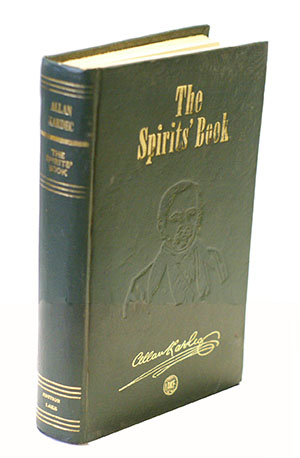
    In Allan Kardec’s The Spirits’ Book, which is considered by many to be the bible of Spiritism, the characteristics of “impure spirits” are listed. They are “inclined to evil,” it says, and “give to men perfidious counsels, stir up discord and distrust, and assume every sort of mask in order the more effectually to deceive.” According to Spiritist doctrine, moreover, “imposition is one of the distinctive characteristics of bad spirits. They command and want to be obeyed. The good never impose.” 

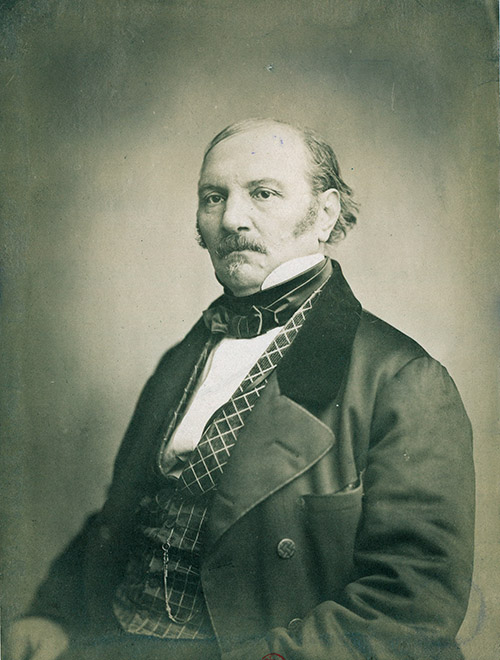
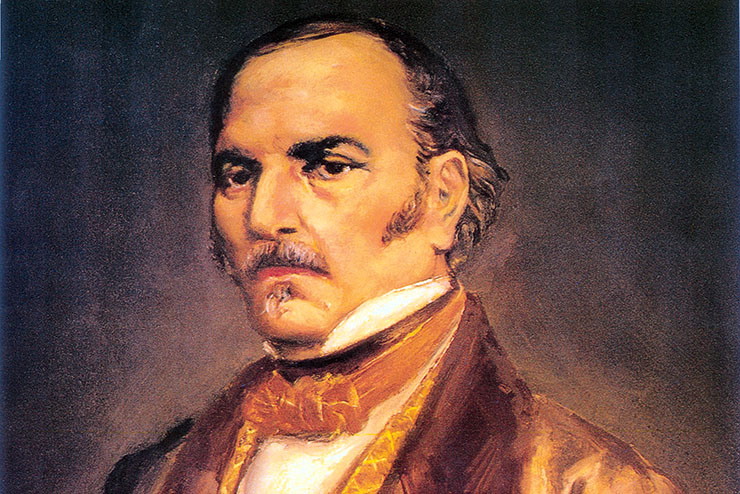
    Most people know about the religious movement Spiritualism, which flourished in Europe and America from the 1840s to the 1920s, and whose followers believed, and still believe, that the spirits of the dead can be contacted by mediums. But few of us in the English speaking world are familiar with the philosophical doctrine Spiritism, which was established in France in the mid-nineteenth century. An offshoot of Spiritualism, Spiritism began with the aforementioned Frenchman Allan Kardec, whose real name was Hippolyte Leon Denizard Rivail. 

    Allan Kardec was the pseudonym of the French teacher and educator Hippolyte Leon Denizard Rivail (1804 – 1869), who is known today as the ‘codifier’ of Spiritism.

    Universal Educator

    Born in Lyon, France, in 1804, Rivail was educated at the distinguished Yverdon Institute in Switzerland, a school founded and run by the famous educational reformer J.H. Pestalozzi. Rivail was so influenced by Pestalozzi and his revolutionary teaching methods that he decided to become a teacher too, eventually establishing his own school in Paris, which, unfortunately, he was forced to close down after just eight years, due to financial reasons. But Rivail’s career as an educator didn’t end there. He wrote textbooks on French grammar, mathematics and educational reform, and also taught free courses in the sciences. Possessed of a great intellect, he apparently spoke six languages. By the early-1850s, writes British parapsychologist Guy Lyon Playfair, Rivail had become “well-established as a progressive, free-thinking writer and educator.” British author Colin Wilson describes him as “a kind of universal educator, willing to dispense knowledge on any and every topic.”

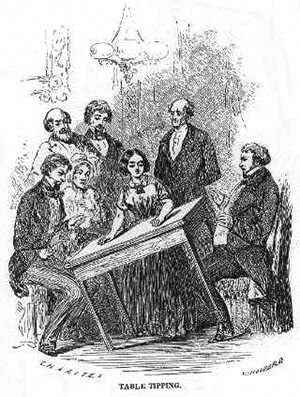
    Rivail’s initial reaction to the Spiritualist ‘table-turning’ craze was one of scepticism. Originating in 1848 with the Fox sisters in Hydesville, New York, the exciting phenomenon quickly spread to Europe. 

    Being, in Anna Blackwell’s words, “unimaginative almost to coldness” and “a close, logical reasoner,” it’s little surprise that Rivail’s initial reaction to the Spiritualist ‘table-turning’ craze was one of scepticism. Originating in 1848 with the Fox sisters in Hydesville, New York, the exciting phenomenon quickly spread to Europe. Almost everyone, it seems, were conducting séances in their homes, communicating with the spirits of the dead with the use of a table. 

    In 1854, while discussing the subject with a friend, Rivail remarked, “I will believe it when I see it.” He attended his first séance about a year later, and was greatly impressed by what he witnessed, which not only included table-turning, but also a demonstration of automatic writing. “I glimpsed,” he explains, “beneath the apparent frivolities and entertainment associated with these phenomena something serious, perhaps the revelation of a new law, which I promised myself I would explore.”

    Questioning the Spirits

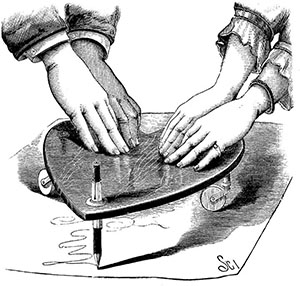
    Rivail was later introduced to a Mr. Baudin, who held weekly séances at his home. Present at these sessions were his two daughters, both of them excellent mediums. The methods they used to communicate with the ‘spirit world’ were that of table-turning and planchette writing. Because the girls were frivolous and not the sharpest crayons in the box, so to speak, and because mediumship works on the principal that ‘like attracts like’, nothing particularly special was obtained from these communications – except, of course, when Rivail was present, who appeared to have acted as a ‘beacon’ for wise and knowledgeable spirits. 

    A planchette is used to assist automatic writing. The board is used to hold a pencil and is supported on small wheels that allow for easy movement. The medium simply places his or her hand on the board, which is then manipulated by a spirit. Some sceptical researchers attribute the movement to the subconscious. 

    No longer were the spirit communications of a banal and superficial nature. The spirits began to talk philosophy of “a very grave and serious character,” and Rivail used the opportunity to ask them the most penetrating questions he could think of. He came to each session with a list of new questions. Examples include, “What is God?”, “Do spirits foresee the future?”, and “Is it possible for man to enjoy perfect happiness upon the earth?” Their answer to the first question was simple yet elegant. God, they said, is “the Supreme Intelligence – First Cause of all things.” Rivail, by the way, was not a medium himself, and thus he relied on others to act as his ‘telephone line’ with ‘the other side’.

    Another group of researchers, no doubt as earnest and sincere as Rivail and his colleagues, also conducted numerous ‘question and answer sessions’ with apparently wise and knowledgeable spirits, collecting, in the end, over fifty notebooks full of compelling material, which they ended up handing to Rivail. He added it to the other communications he had obtained himself. Overall, the information seemed entirely logical, and possessed an impressive inner-consistency. That it had a profound impact on Rivail, spiritually, intellectually and philosophically, is proven by the following statement, which he made to his wife: “My conversations with the invisible intelligences have completely revolutionised my ideas and convictions. The instructions thus transmitted constitute an entirely new theory of human life, duty, and destiny, that appears to me to be perfectly rational and coherent, admirably lucid and consoling, and intensely interesting.” 

    The Spirits’ Book

    After two years of scrutinising the material, Rivail decided that it might be a good idea to collate, edit, and publish it. When he asked his ‘spirit communicators’ what they thought of the notion, they replied in the affirmative, giving him specific instructions as to how he should go about it: “To the book… you will give, as being our work rather than yours, the title of Le Livre des Espirits (The Spirits’ Book); and you will publish it, not under your own name, but under the pseudonym of Allan Kardec.” (‘Kardec’ was an old Breton name in his mother’s family.)

    Rivail spent a considerable amount of time organising and verifying the communications. He only wanted to publish the best and most credible material – credible in the sense that the information could be confirmed by a number of different ‘sources’, and that it fitted in with the overall ‘theme’ of the work. If he wasn’t satisfied with the answer to a question – perhaps because it conflicted with the rest of the information he had collected – he would submit the question again, sometimes to a different medium than the one he had originally consulted. Rivail’s method, although not perfect, was certainly far more credible than that of most people who receive communications from the ‘spirit world’, who are often willing to believe almost anything they’re told. 

    The Spirits’ Book was finally published in 1857, causing quite a stir. It was so successful, in fact, that a second edition, containing additional material, was printed the following year, and the name Allan Kardec became known all over France. That its ‘author’ was a respected intellectual – and not the sort of person one would expect to publish such material – astonished the public. Almost everyone was able to find something of value in the book, even those of a scientific disposition, as it deals with such a wide range of topics, and in a very intelligent and enlightening manner. According to Steve Hume in an article that appeared in The Noah’s Ark Review, the French working classes took to Spiritism the most, “perhaps for the simple reason that the spirits had nothing good to say about the inequity that was, and still is, inherent in human society.” He points out, for instance, that the Spiritist teachings utterly condemn selfishness; proof of this can be found in The Spirits’ Book, which reads, “it is from selfishness that everything evil proceeds. Study all the vices, and you will see that selfishness is at the bottom of them all.” 

    Few can deny that The Spirits’ Book is an impressive piece of work, and that much food for thought can be found within its pages. One might describe it as an attempt to answer many of the ‘big questions’. As well as the nature of God, some of the topics it covers include ‘reincarnation’, ‘spirits and their relations with man’, ‘spiritual advancement’, and ‘the structure of the universe’. Some of the information is ahead of its time. On the topic of ‘universal space’, for instance, we are told than an absolute void does not exist in any part of space, but that “what appears like a void to you is occupied by matter in a state in which it escapes the action of your senses and of your instruments.” It’s exciting to think that ‘quantum field theory’ (QFT), which postulates the existence of a ‘quantum vacuum’, did not originate until the 1920s – more than half-a-century after the publication of The Spirits’ Book. According to QFT, in article available on Wikipedia, “the vacuum state is not truly empty but instead contains fleeting electromagnetic waves and particles that pop into and out of existence.” 

    Get the issue this article appears in

    Reincarnation

    In addition to The Spirits’ Book, also written – or, in Rivail’s words, “compiled and set in order” – under the name of Allan Kardec are four other fundamental works. They include The Mediums’ Book, The Gospel According to Spiritism, Heaven and Hell, and The Genesis According to Spiritism. All five books – known collectively as The Spiritist Codification – were published before Rivail’s death in 1869. Playfair describes them as “the clearest and most comprehensive survey of the invisible world yet written.” 

    The major difference between Spiritualist doctrine and Spiritist doctrine is that the latter advocates reincarnation, while the former does not. This had the effect of dividing the two movements. Automatic writing was the type of mediumship most favoured by Rivail, who considered it among the most safe, describing it as a method “by which the spirits best reveal their nature, and the degree of their perfection or inferiority.” The Spiritualists, on the other hand, were, and still are, fond of practising trance mediumship, while most of their mediums – or, rather, the spirits speaking through them – mentioned nothing at all about reincarnation. For this reason, explains Wilson in his book Poltergeist!, “Rivail was inclined to be critical about trance mediums, while the trance mediums and their followers denounced Rivail as a dogmatic old man.” 

    Buried in Paris’ famous Père Lachaise Cemetery Allan Kardec’s tomb, which features a large dolma, annually draws more visitors than any other.

    Following Rivail’s death, interest in Spiritism almost completely died out in France and other parts of Europe. It eventually spread to Brazil, attracting millions of followers. According to the last IBGE census data, in Brazil more than 4 million people declare themselves “Kardecist Spiritists.” Much like the Salvation Army volunteers, Brazilian Spiritists are known for their inspiring humanitarian efforts, and, according to Playfair, “have carried out some of the most impressive social welfare projects to be found anywhere.”

    When approaching the world of the spirits, it is worth keeping in mind what is said in The Mediums’ Book by one of its non-physical authors: 

    “Repel all spirits who counsel exclusiveness, division, isolation. Such spirits are always vain and shallow; they impose on the weak and credulous by exaggerated praises, in order to fascinate and to domineer over them. They are generally spirits who, having been public or private despots while on earth, still desire to have victims to tyrannise over after their death.”

    [alert type=”general” dismiss=”no”]This article was published in New Dawn Special Issue No 5.[/alert]

    [alert type=”success” dismiss=”no”]If you appreciate this article, please consider subscribing to help maintain this website.[/alert]

    REFERENCES

    Steve Hume, The Career of ‘Allan Kardec’ (originally published in The Noah’s Ark Society Review)
    Allan Kardec, The Spirits’ Book, Brotherhood of Life, USA, 1989
    Allan Kardec, The Book of Mediums, Samuel Weiser, Inc., USA, 1970
    Guy Lyon Playfair, The Way of the Spirit, The Unexplained magazine, vol. 3, issue 26, 1981
    Colin Wilson, Poltergeist!, Caxton Editions, UK, 1981

    © New Dawn Magazine and the respective author.
    For our reproduction notice, click here.
  • Life, Death & Gnosis: The Gnostics on the Afterlife

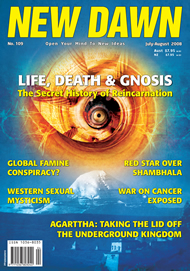
    Life, Death & Gnosis: The Gnostics on the Afterlife

    From New Dawn 109 (Jul-Aug 2008)

    The possibilities for life after death come down to a mere three:
    1. There is no life after death. Death is the total extinction of consciousness. 2. Life after death continues on earth (through reincarnation). 3. Life continues after death on another plane than that of earthly reality (such as in heaven or hell).

    If we’re going to talk about this subject at all, we can rule out the first option categorically, especially since practically every culture and religion teaches that there is some form of life after death. There are many discussions of the evidence for the afterlife, and while this is a fascinating subject, it’s out of the scope of this article.

    Which, then, of the two remaining options is most likely? Usually these are simplistically conceived. You reincarnate: depending on your karma, you come back down to earth to live again as a sage or a stockbroker. Or you are judged before the heavenly throne and are sent up to heaven or down to hell once and for all.

    The Gnostics, the mysterious esoteric teachers of the early centuries of the Common Era, had their own perspective on the afterlife. Although their teachings have been all but lost, enough material remains so that we can reconstruct them. If we do, we will reach some valuable insights not only about some elements of the later Western occult traditions but about the project of spiritual liberation.

    The Gnostic texts speak very little about reincarnation. We do, however, find some references to this concept in the Corpus Hermeticum (“Hermetic body” of writings). Probably written in the first to third centuries CE, they largely consist of dialogues between a divine figure named Hermes Trismegistus and his son Tat (or Thoth, the Egyptian god that most resembled the Greek Hermes). Their origin is suggested by the title of the leading treatise: Poimandres (from which I’ll quote below). This is a Grecization of p-eime-n-re, “illumined mind” in Egyptian. The Hermetic texts were descriptions of ancient Egyptian esoteric knowledge recast in the language and thought of the Greeks, who were culturally dominant in the Mediterranean world of that time. The Hermetic texts aren’t usually considered to be Gnostic per se, although their ideas were extremely similar to those of the Gnostics and can be taken as part of the same milieu.1

    The Hermetic texts speak of reincarnation, but not in the sense familiar from New Age versions of the doctrine. The Hermetic writings generally portray reincarnation as a punishment. One treatise tells us that a person who dies childless “is sentenced to a body that has neither a man’s nature nor a woman’s – a thing accursed under the sun.” And a text known as the Asclepius says that “those who live faithfully under god” will ascend to become divine beings, but “for the unfaithful it goes differently: return to heaven is denied them, and a vile migration unworthy of a holy soul puts them in other bodies.”2

    Both the Hermeticists and the Gnostics were much more interested in the spirit’s ascent after death. In order to understand their views, we have to set aside one background assumption that we may have received from conventional Christianity: that heaven is all good, that, as it were, all the evil is down below. As a matter of fact, the Gnostics say little about hell as such. To them the dangers encountered by the spirit after death took a very different form.

    Meet the Archons

    If you read even a small amount about Gnosticism, you will come across references to the archons, whose name comes from a Greek word meaning “rulers.” Malign spiritual powers, they stand in the celestial realms interposed between us and the true, good God far above. Who are these archons?

    Although it’s sometimes forgotten, the Gnostics took much of their inspiration from the apostle Paul. One key verse appears in Ephesians (an epistle that, most scholars today agree, was not actually written by Paul, although it was attributed to him): “For we wrestle not against flesh and blood, but against principalities, against powers, against the rulers of the darkness of this world, against spiritual wickedness in high places” (Eph. 6:12).3 Although the verse does not use the word archons (in the Greek New Testament, this word usually refers to human rulers; cf. Luke 12:58, John 3:1), the word translated as “principalities” is arkhas, which comes from the same root. The writer of Ephesians is saying that these “rulers of the darkness of this world” are in the celestial spheres that are interposed between the earth and the realms of the true heaven far above. For the Gnostics, this meant that there are two heavens: one a sinister, intermediary realm of the archons, the other the realm of the true, good God above. To reach the true heaven (sometimes called the Pleroma or “fullness”) after death, the spirit has to pass through the spheres of the archons.

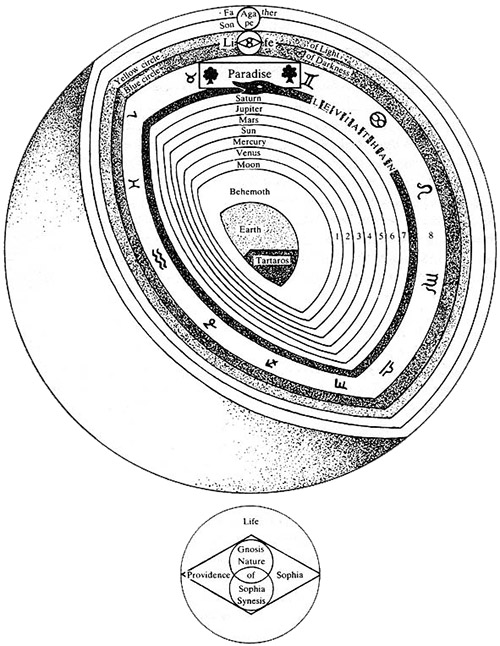
    There were many Gnostic systems, and their critics sometimes complained that they changed their teachings every day. But in essence both Gnosticism and Hermeticism envisaged the journey of the spirit in the afterlife as an ascent through the realms of the concentric spheres surrounding the earth. Often these were associated with the seven planets as understood by the ancients: the moon, Mercury, Venus, the sun, Mars, Jupiter, and Saturn (in that order), each of which had its own ruler or archon. The clearest and most concise description of this process appears in the Poimandres, which describes the bad qualities the spirit must shed after death in each planetary zone:

    Thence the human being rushes up through the cosmic framework, at the first zone [the moon] surrendering the energy of increase and decrease; at the second [Mercury] evil machination, a device now inactive; at the third [Venus] the illusion of longing, now inactive; at the fourth [the sun] the ruler’s arrogance, now freed from excess; at the fifth [Mars] unholy presumption and daring recklessness; at the sixth [Jupiter] the evil impulses that come from wealth, now inactive; and at the seventh zone [Saturn] the deceit that lies in ambush. And then, stripped of the effects of the cosmic framework, the human enters the region of the ogdoad [the spiritual realm]; he has his own proper power, and along with the blessed he hymns the father.4

    Another portrait of the soul’s ascent appears in Contra Celsum (“Against Celsus”), a polemical work written by the Church Father Origen (c.185–c.254 CE). Origen at one point describes the teachings of a Gnostic sect called the Ophites. Not much is known about them, but they were so called from the Greek word ophis (“serpent”). Unlike orthodox Christianity, they regarded the serpent of Genesis as a positive figure, bringing Adam and Eve gnosis or knowledge.

    Ophite Gnostic cosmology symbolising the structure of Reality.
    The world serpent Leviathan encircles the planetary realm, with Saturn on the boundary. After death the soul/spirit attempts to ascend through the spheres of the archons that are identified with the planets.

    The Ophites, Origen tells us, believe that after death the soul has to pass through a “barrier of evil.” Then it has to confront a series of archons, who are associated with the planets. In ascending order from the earth, they are:

    • 1. Moon: Horaeus
    • 2. Mercury: Ailoaeus or Eloaeus
    • 3. Venus: Astaipheus
    • 4. Sun: Adonai
    • 5. Mars: Sabaoth
    • 6. Jupiter: Iao
    • 7. Saturn: Ialdabaoth

    (Note that the order is the same as in the Poimandres.) In order to pass through these spheres, the Gnostic initiate was taught what to say to the archons and which symbol to present to them as a kind of passkey. To Ialdabaoth, for example, one is supposed to say:

    And thou, Ialdabaoth, first and seventh, born to have power with boldness, being ruling Word of a pure mind, a perfect work for Son and Father, I bear a symbol marked with a picture of life, and having opened to the world the gate which thou didst close for thine eternity, I pass by thy power free again. May grace be with me, father, let it be with me.5

    Irenaeus of Lyons, the second-century Church Father whose work Against the Heresies is one of our chief primary sources about Gnosticism, describes another view of this process. Speaking of one school of Gnostics, he writes:

    These hold that the knowledge of the unspeakable Greatness is itself perfect redemption. For since both defect and passion flowed from ignorance, the whole substance of what was thus formed is destroyed by knowledge; and therefore knowledge is the redemption of the inner man. This, however, is not of a corporeal nature, for the body is corruptible; nor is it animal, since the animal soul is the fruit of a defect, and is, as it were, the abode of the spirit. The redemption must therefore be of a spiritual nature; for they affirm that the inner and spiritual man is redeemed by means of knowledge, and that they, having acquired the knowledge of all things, stand thenceforth in need of nothing else. This, then, is the true redemption.6

    Soul, Spirit & the Afterlife

    Irenaeus indicates that the Gnostics believed in a tripartite division of the human entity: the physical body, the soul (what Irenaeus calls the “animal soul”), and the spirit. Orthodox Christianity originally had the same teaching, although it would be lost over the centuries. Today you will have great difficulty finding a churchman of any denomination who can explain to you the difference between the soul and the spirit.7 But the Gnostics thought these two things were very different indeed, and this fact provides the key to their views of the afterlife.

    When you read a standard version of the New Testament and come across the word “soul,” it is almost always translating the Greek word psyche. That’s what “soul” originally meant. It is the psyche – the constellation of thoughts and feelings, conscious and unconscious, that constitute your inner life. It also includes the vital principle, or life force (the “animal soul”). As the passage from Irenaeus suggests, the Gnostics knew that this soul was not immortal and was not meant to be.

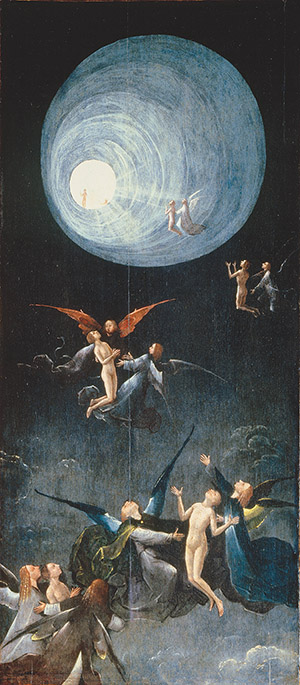
    ‘The Ascent into the Empyrean or Highest Heaven’ by Hieronymus Bosch

    The spirit is another matter. It is that in you which, at the deepest level, says “I.” It is the principle of pure consciousness that looks out of your body and psyche as through a telescope. There are many names for it: Atman, the Self, the kingdom of heaven, ruach in Hebrew and pneuma in Greek. This principle is immortal and indestructible; it will remain long after both body and soul have disintegrated. 

    In fact the soul is supposed to disintegrate. It is made up of planetary influences (hence it is sometimes given the name “astral body”), which are as temporary and transitory as the combinations of molecules that make up the physical body. The Gnostics conceived of incarnation as a descent from the supernal realms through the spheres of the seven planets down to earth. As the spirit made its way through these spheres, it takes on the colouration of each of these planets. Conversely, at the time of death, the spirit ascends and (at least ideally) shakes off the influence of each planet in turn, since these influences are the shackles that bind the soul to materiality. That’s why the Hermetic text quoted above tells us that “the human being rushes up through the cosmic framework, at the first zone [the moon] surrendering the energy of increase and decrease” and so on. Some of the Gnostics, such as the Ophites, thought it was necessary to know the occult names of each of the archons guarding these tiers as a way of getting through (in ancient magic, to know the name of something is to have power over it). Others, like the ones described by Irenaeus, apparently believed that the mere knowledge of the situation was enough for liberation.

    For individuals who do not have access to this salvific knowledge in one form or another, “it goes differently,” as we read in the Hermetic text quoted above: “return to heaven is denied them, and a vile migration unworthy of a holy soul puts them in other bodies.”

    Reincarnation Undesirable

    Reincarnation today is an increasingly popular belief. Surveys show that about 20–25% of the population of the Western countries (and as many as a third of the people in Russia) believe in it. It has the advantage of being more reassuring than the conventional Christian view that you could fry in hell for an infinite amount of time as punishment for sins committed for an extremely finite amount of time on earth. And there is a considerable body of work attesting to past-life memories (Ian Stevenson is a pioneer in this field), so that reincarnation is far better-validated than scientistic materialism would have us believe.

    Nonetheless, practically all the traditions that teach reincarnation view it as undesirable. We can come back, but if we do, it is the result of a problem or a mistake on our part. The ideal fate for an individual in Hinduism is moksha or liberation from the chain of incarnation; nirvana has the same position in Buddhism. The celebrated Tibetan Book of the Dead consists of step-by-step instructions for the newly deceased in how to avoid reincarnating. The Gnostics and Hermeticists portrayed this liberation as the ascent of the spirit through the realm of the hostile archons into the Pleroma. 

    Even the position of reincarnation in conventional Christianity is not quite what you might expect. Astonishingly, the doctrine of reincarnation has never been explicitly repudiated by the Catholic Church, even though most of its theologians have dismissed or derided it. Today some people claim that the doctrine was rejected either by the First Council of Nicaea in 325 CE or by the Second Council of Constantinople in 553, but as a matter of fact neither of these dealt with the topic; instead they were concerned with the nature of Christ. One source of this misconception is Shirley MacLaine, the actress and New Age author, who introduced these ideas in her highly popular books, adding further to the confusion by mixing up the two councils.8

    At any rate, reincarnation sits ambiguously on the edge of the Christian tradition. Valentin Tomberg (1900-73), a Baltic German convert to Roman Catholicism whose Meditations on the Tarot, published anonymously, remains one of the great modern classics of esoteric Christianity, observes:

    The Church was hostile to the doctrine of reincarnation, although the fact of repeated incarnations was known – and could not remain unknown – to a large number of people faithful to the Church with authentic spiritual experience. The deeper reason is the danger of reincarnation by way of the ghost, where one avoids the path of purification (in purgatory), illumination and celestial union. For humanity could succumb to the temptation of preparing for a future terrestrial life, instead of preparing for purgatory and heaven, in earthly life.9

    If you set aside the Catholic term of “purgatory” in this passage, you end up with a view very much like that of the Gnostics. The spirit is purified and illumined in its ascent, and eventually enters the realm of the Father. The “ghost” of which Tomberg speaks is a soul – that is, an astral body – that has not properly disintegrated. It either lurks around the earth, causing ghostly phenomena, or becomes entrapped in yet another physical body. 

    Curiously, the Gnostic teachings also survived in Eastern Orthodoxy, which owes more to Gnosticism than it cares to admit. Orthodox Christianity uses the quaint but vivid metaphor of “aerial tollhouses” to speak of the spirit’s perilous ascent after death. The number of these tollhouses is usually said to be twenty. Here is one account, attributed to Taxiotes, a soldier in antiquity who had a near-death experience:

    When I was dying, I saw Ethiopians who appeared before me. Their appearance was very frightful; my soul beholding them was disturbed. Then I saw two splendid youths, and my soul leaped out into their arms. We began slowly to ascend in the air to the heights, as if flying, and we reached the toll-houses that guard the ascent and detain the soul of each man. Each toll-house tested a special form of sin: one lying, another envy, another pride; each sin has its own testers in the air. And I saw that the angels held all my good deeds in a little chest; taking them out, they would compare them with my evil deeds. Thus we passed by all the toll-houses. And when, reaching the gates of the heavens, we came to the toll-house of fornication, those who guard the way there detained me and presented to me all my fleshly deeds of fornication, committed from my childhood up to now. The angels who were leading said to me, “All the bodily sins which you committed in the city, God has forgiven, because you repented of them.” To this my adversaries said to me, “But when you left the city, in the village you committed adultery with a farmer’s wife.” The angels, hearing this and finding no good deed which could be measured out for my sin, left me and went away. Then the evil spirits seized me, and overwhelming me with blows, led me down to earth. The earth opened, and I was let down by narrow and foul-smelling descents into the underground prison of hell.10

    It’s easy to find resemblances in this passage to the Gnostic and Hermetic texts we’ve already examined. The basic process is the same: the soul ascends through the aerial region toward heaven but encounters sentinels that bar its way. The Gnostic texts saw the way through in esoteric terms: it was necessary to know the name of the archon guarding each one and to know how to address him, or at any rate to understand the truth of the situation. Here, in an Orthodox Christian context, it is a matter of purity from sin. (As a matter of fact, the seven planets are associated with the seven deadly sins: the moon, with envy; Mercury, with sloth; Venus, lust; the sun, pride; Mars; anger; Jupiter, gluttony. The seventh, covetousness, is associated with the earth, but as we can see from the Poimandres, the seventh is sometimes taken to be deceit, and is associated with Saturn.) Like the Gnostics, the Orthodox regard these aerial tollkeepers as evil spirits. Their leader is the Devil, “the prince of the power of the air, the spirit that now worketh in the children of disobedience” (Eph. 2:2). 

    Echoes of Gnostic ideas resonate in other forms of esotericism. Here is one passage from the Zohar, the central text of the Kabbalah, the mystical tradition of Judaism. A rabbi tells of his encounter with some “children of the East” and their books of sacred wisdom, which, he says, resemble the teachings of the Jewish Torah. These books from the East said that:

    It is by his acts, by his words, and by his fervency and devotion that [the worshipper] can draw to himself that spirit from on high. They further said that if a man follows a certain direction in this world, he will be led further in the same direction when he departs this world; as that to which he attaches himself in this world, so is that to which he will find himself attached in the other world; if holy, holy, and if defiled, defiled. If he cleaves to holiness he will on high be drawn to that side and be made a servant to minister before the Holy One among the angels…. Similarly if he clings here to uncleanness, he will be drawn there towards that side and be made one of the unclean company and be attached to them. These are called “pests of mankind,” and when a man leaves this world they take him up and cast him down into Gehinnom [i.e., hell].11

    The rabbi also says that these books also have “rites and ceremonies pertaining to the worship of the stars, with the requisite formulas and the directions for concentrating the thoughts upon them, so as to draw them near the worshipper.” These would seem to resemble the Gnostic formulas and directions for encountering and passing through the gates of the archons, who are associated with the planets. But the rabbi discourages this kind of practice, saying that Jews are to worship the Holy One alone.

    It would be possible to trace the threads of these Gnostic ideas in many more directions, certainly in the Kabbalah. Gershom Scholem, the greatest twentieth-century scholar of the Kabbalah, emphasised that “it was Gnosticism, one of the last great manifestations of mythology in religious thought… which lent figures of speech to the Jewish mystic.”12

    Such is the view of the scholar. He sees affinities and resemblances between texts and traditions, and naturally assumes that the earlier ones must have influenced the later ones. But someone who wants to transcend the limits of mere academic scholarship has to ask another question: are these similarities the result of influence in a conventional sense, or is it rather that these mystics and illuminates of different traditions saw the same reality and tried to express it in terms of their own language and thought? I myself suspect that both of these things are true.

    What, then, is the mystical reality to which all these teachings point? I would suggest that it is something like this: The psyche, the soul, is made up not only of planetary influences (which is why the natal horoscope is believed to give the key to your character) but of the concepts and conditioning that were attached to it over the course of an incarnation. The Tibetan Book of the Dead, which describes this process in Tibetan Buddhist terms, calls this complex “the thought-body of propensities.”13 The ascent through the realms of the archons or the aerial tollhouses represent the stripping away of these influences, including concepts and conditioning of a religious nature. If the break is more or less complete, the unconditioned spirit can make its way to the “true heaven” – that is, other realms of existence where it will continue to be perfected. If not, it is thrown back down to earth (or perhaps to still darker realms) for another round. The Tibetan Book of the Dead says that the way to penetrate through the bardos (the Tibetan equivalent of the tollhouses) is to “know these apparitions to be thine own thought-forms.”14

    What practical conclusions can we draw from all this? Personally I would point back to the passage from the Zohar quoted just above: “If a man follows a certain direction in this world, he will be led further in the same direction when he departs this world.” The future of the divine monad, the spark of pure consciousness that lies at the centre of our being like a jewel in a lotus and whose refinement and perfection is perhaps the sole purpose of human existence, will be determined by how we cultivate it in this life. For all of the archons and celestial tollkeepers that may appear to face us after death, the responsibility for our evolution – or, if you like, salvation – continues to rest with ourselves.

    [alert type=”general” dismiss=”no”]This article was published in New Dawn 109.[/alert]

    [alert type=”success” dismiss=”no”]If you appreciate this article, please consider subscribing to help maintain this website.[/alert]

    Footnotes

    1. For further discussion of this topic, see my Forbidden Faith, 32–35.
    2. Asclepius 12, in Brian P. Copenhaver, ed. and trans., Hermetica: The Greek Corpus Hermeticum and the Latin Asclepius in a New English Translation, with Notes and an Introduction (Cambridge: Cambridge University Press, 1992), 74; Corpus Hermeticum II, 17, in Copenhaver, 12.
    3. Biblical quotations are from the Authorised (King James) Version.
    4. Corpus Hermeticum I, 25–26; in Copenhaver, 6.
    5. Origen, Contra Celsum, 6.31; in Henry Chadwick, ed. and trans., Contra Celsum, rev. ed. (Cambridge: Cambridge University Press, 1965), 347.
    6. Irenaeus, 1.21.4; www.ccel.org/ccel/schaff/anf01.ix.ii.xxii.html; May 24, 2008.
    7. For more on this subject, see my article “Christianity: The Ultimate Secret,” New Dawn No. 84 (May-June 2004), 27–32; also my Inner Christianity, 19–20, 70–71 et passim.
    8. See Wouter J. Hanegraaff, New Age Religion and Western Culture (Albany: State University of New York Press, 1998), 321-22.
    9. Meditations on the Tarot: A Journey into Christian Hermeticism, trans. Robert A. Powell (Warwick, N.Y.: Amity House, 1985), 361. Emphasis in the original.
    10. Quoted in Seraphim Rose, The Soul after Death (Platina, Calif.: St. Herman of Alaska Brotherhood, 1980), 84.
    11. Zohar 1, 99b; in The Zohar, Harry Sperling and Maurice Simon (London: Soncino, 1934), vol. 1, 324–25.
    12. Gershom Scholem, Major Trends in Jewish Mysticism, 3d ed. (New York: Schocken, 1961), 35.
    13. The Tibetan Book of the Dead, W.Y. Evans-Wentz, ed. and trans., 3d ed. (New York: Oxford University Press, 1957), 104.
    14. Ibid.

    © New Dawn Magazine and the respective author.
    For our reproduction notice, click here.
  • Will I Survive? A Look at the Afterlife

    Will I Survive? A Look at the Afterlife

    From New Dawn Special Issue Vol 11 No 6 (Dec 2017)

    What happens when we die? Human beings have asked this question probably more than any other, with “Does God exist?” and “What is the meaning of life?” coming in as close seconds. All three, of course, are intertwined, but while the reality of the deity and the solution to life’s riddle may be grasped in the here and now, what happens when we give up the ghost seems to be something we can know only by doing just that. It seems that the only way we can know for certain what happens after death is by dying. And while the attraction of that ultimate mystery is strong, the means of solving it appear, to most of us at least, somewhat less attractive.

    But is it really the case that the answer to what happens after death lies beyond a threshold which, once crossed, cannot be uncrossed? While messages from the dead fill folklore, myth, and séances, and religions around the world and through the ages have in different ways assured their devotees of the reality of an afterlife, many of us are nevertheless not entirely certain that anything awaits us beyond the grave – except perhaps annihilation, which is, of course, the standard modern view. In recent times, however, assurances of a continuity of consciousness beyond the brain have come, not from the camp of religion, mysticism, or the occult, but from that of their often sworn enemy, science.

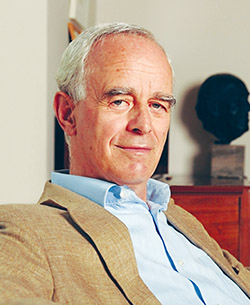
    Dutch cardiologist Pim van Lommel

    In 2001 a paper appeared in the prestigious medical journal The Lancet purporting to show evidence supporting the reality of Near-Death Experiences, or NDEs. In “Near-death experiences in survivors of cardiac arrest: a prospective study in the Netherlands,” the Dutch cardiologist Pim van Lommel and his research team presented the results of a twenty-year long study of the strange experiences reported by patients who survived heart failure. That these patients reported being aware of anything during cardiac arrest was strange enough. The standard view is that when the heart and lungs stop so do the brain and consciousness. What should have happened was that they experienced nothing at all. Nevertheless they did.

    The patients Lommel studied reported that during the period of unconsciousness brought on by their seizure, they experienced some very remarkable things indeed. Many recounted feelings of bliss and intense happiness; many spoke of a bright white light, of a tunnel, of seeing deceased relatives and of going through a kind of “life review,” in which their entire lives, as the cliché goes, “passed before their eyes.” Many spoke of having an “out-of-the-body experience,” of seeing themselves and their nurses and doctors from some vantage point near the ceiling. Many spoke of guides, angels and spirits, come to comfort them. Many also assured Lommel that the experience was entirely beneficial, that it relieved them of their fear of death, that it had transformed them in some way, and that it gave them the certainty that the life we know here on earth is not the only one.

    Lommel’s Lancet paper understandably caused an uproar, yet the research was impressive. The statistics Lommel and his team provided seem to show that the usual explanations given to account for NDEs – from the mainstream scientific view – did not, at least in these cases, work. Lommel studied some 562 survivors of cardiac arrest and he discovered that up to 18% of them reported having had a NDE. Of these, none could be chalked up to oxygen deficiency to the brain, the effects of drugs, or the other physiological or psychological reasons usually offered as a way of explaining the phenomenon. Lommel and his team concluded the NDE was an actual, objective event and that it argued in favour of some kind of ‘post-death’ survival. 

    Perhaps even more controversial, the findings also seemed to offer proof that consciousness can exist outside or even without the brain. While most mainstream scientists will merely snort at the idea of an afterlife, they will positively bellow at the suggestion consciousness is anything more than a by-product of that three-pound mass of grey matter. According to a number of prestigious neuroscientists and philosophers of mind – I talk about some of them in my book A Secret History of Consciousness – consciousness is absolutely, positively, 100% produced by the brain.

    Lommel was unrepentant and in 2007 he produced a book, Consciousness Beyond Life [available from New Dawn, see page 79], based on his paper, presenting his case studies in greater depth and bringing his research to a wider public. The results were encouraging. The book was a bestseller in the Netherlands, then repeated its success in Germany, the UK and the US. Lommel has presented his ideas in interviews and videos and on television. Lommel’s work has, of course, attracted criticism. Yet his findings seem to stand and for the open-minded provide the kind of ‘hard’ evidence that scientists dismissive of any non-materialist accounts of consciousness demand, in order for them to consider changing their minds in any way about the matter.

    A Neurosurgeon Visits “Heaven”

    Lommel was not the only medical practitioner to take NDEs seriously and to subject them to study. Even more controversial than Lommel’s findings was the account by the American neurosurgeon Eben Alexander of his own NDE. Alexander had twenty-five years’ experience studying the brain and teaching others how to study it, at institutions such as the Harvard Medical School. Like most of his colleagues, he accepted the dogma that the brain produces consciousness. Then, in 2008, a bacterial infection – a rare form of meningitis – had him in a coma for a week and taught him otherwise. His chances of recovery were slim at best, and his family was advised that if he did survive, he would be little more than a vegetable: the infection had caused irreparable brain damage. Yet on the seventh day under a ventilator Alexander opened his eyes and came to. This was miracle enough. But the story Alexander had to tell was even more remarkable.

    The white light was there, and also beautiful melodies, angelic choirs, fantastic landscapes with strange plant life, waterfalls, crystal pools, and thousands of beings, dancing, and a girl who came to him on a butterfly wing. During the week of his coma, when his brain shouldn’t have produced the slightest hallucination – should have produced no consciousness at all – Alexander went on a journey to “higher realms” and eventually to what he calls the “Core,” a centre of reality “filled with the infinite healing power of the all-loving deity,” the source of everything. He was privy to fundamental realities, for which “God seemed too puny a little human word.” He speaks of experiencing a “higher dimensional multiverse” and an “oversphere” and that his notions of time, space, and everything else were radically changed. During his coma he underwent a kind of spiritual evolution, from what he calls the “Earthworm’s Eye View” to the Core, many times, learning truths about the nature of existence and our part in it. One truth was about the reality of the afterlife, knowledge of which Alexander has tried to pass on to his many readers in his bestselling books Proof of Heaven and Maps of Heaven.

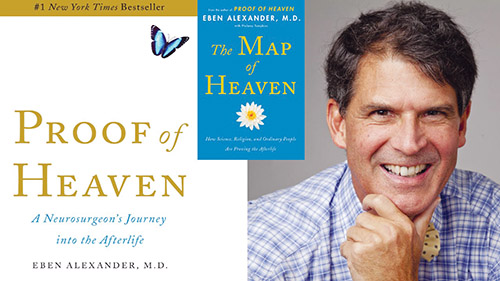
    American neurosurgeon Eben Alexander and the covers of his best-selling books.

    Like Pim van Lommel, Alexander came to believe that human beings are much more than their physical bodies and consciousness is something more than a by-product of the brain. They disagree with the philosopher John Searle who argues that the brain produces consciousness as the liver does bile. Consciousness, they argue, is not localised in or produced by the brain because consciousness itself is the ultimate reality, not the physical world – an insight echoed down the ages by mystics and visionaries, but which in recent times it seems some scientists are cottoning on to as well. They see it as a way out of the cul-de-sac reached by trying to solve the ‘hard problem’ in mainstream neuroscience: how does a neuron, a physical phenomenon, become a thought, a mental one? The answer is it doesn’t. It’s the other way around.

    Filtering Reality

    Whatever we might think of Alexander’s account of the afterlife and his ideas about mankind’s spiritual evolution – he has since become a popular advocate of the union of science and spirituality with appearances on ‘Oprah Winfrey’ and other talk shows – the notion of a non-local consciousness has a history. What was remarkable about the cases Lommel studied and Alexander’s own, was that they reported vivid inner, transformative experience during a time when the brains involved should have been incapable of ‘producing’ anything. If brains ‘produce’ consciousness, this should have been impossible, rather like a flashlight shining without the battery. Some studies done in the 1960s suggest consciousness may not need much brains at all. In 1965 John Lorber, a specialist in hydrocephalus – “water on the brain” – published a paper as remarkable as Lommel’s. In “Hydranencephaly with Normal Development,” published in Developmental Medicine and Child Psychology for December 1965, Lorber presented several case studies in which people with little or no cerebral cortex functioned normally. In one case the subject had an IQ of 126 and an honours degree in mathematics. Two girls born in the 1960s had fluid where their cerebrums should have been, with no evidence of a cerebral cortex, yet both had perfectly normal intelligence. Unlike ‘The Wizard of Oz’s Scarecrow, they, and the other cases Lorber studied seemed to get on perfectly well without a brain.

    Such cases, though well documented, may push the believability barrier, but we need not resort to these extremes to argue the brain does not ‘produce’ consciousness. In the late nineteenth century the philosopher Henri Bergson argued eloquently that, rather than produce consciousness, the brain served an eliminatory function, acting as a reducing valve, filtering reality and allowing only what was necessary for survival to reach conscious awareness. Rather than produce consciousness, the brain edits it down to something manageable, otherwise we would be overwhelmed by reality’s complexity, a condition common to many mystics. Aldous Huxley resorted to Bergson’s idea when, in The Doors of Perception, he tried to account for the effects of the drug mescaline on his consciousness. The mystical effects of the drug, Huxley believed, were due to its ‘opening’ the filters of the brain, allowing more consciousness than needed for mere survival to flood into awareness. The fact that in the cases Lommel studied and in Alexander’s own, the brain was out of commission, seems to support the Bergson/Huxley thesis. With the filters off, much more of Reality – what Huxley called “Mind at Large” – became available. If the brain “mutes” reality, allowing, as Huxley said, only a “thin trickle” to enter consciousness, in the NDE the taps seem to be on full blast. The analogy is apt as our kitchen taps do not ‘produce’ the water in our sinks, but quite the opposite, they stop it from running. It’s already there in the pipes.

    Some variant of Bergson’s idea is popular among ‘alternative’ scientists, such as the biologist Rupert Sheldrake who speaks of the brain acting as a kind of “tuner,” “selecting” different “wavelengths” of reality, rather as a radio works by cutting out all transmissions except the one you wish to hear, or as a television that picks up a broadcast but is not responsible for it. Neither my radio nor my television ‘produces’ the programs they play. They ‘receive’ them from the broadcaster, and Sheldrake and other scientists and philosophers like him, see the brain as a kind of inner TV, picking out different ‘channels’, broadcast by – well, we’re not quite sure. The general idea is that consciousness is the fundamental reality; rather than being stuffed into the cramp confines of our skulls, it pervades the universe. This is the “panpsychism” that philosopher David Chalmers advocates, following in the philosophical footsteps of Bergson and his contemporary Alfred North Whitehead, who, in different ways, envisioned some version of Mind at Large. Needless to say – or perhaps not – such an idea as an all-pervasive consciousness or mind is, of course, a staple part of many pre-modern worldviews.

    Another who accepted the idea of Mind at Large was, oddly enough, an early investigator into NDEs, although in his aptly posthumous Human Personality and Its Survival of Bodily Death (1903), the first “scientific” study of the afterlife, F.W.H. Myers did not call them that. Myers spoke of the “subliminal mind,” by which he meant something different than Freud’s “unconscious,” which Myers’ coinage preceded by some years. It was Huxley who in his foreword to Myers’ classic compared his “subliminal mind” to an “upstairs” in the “house of the soul,” rather than Freud’s “garbage-littered basement.” This upstairs had some unusual characteristics and in the late nineteenth century Myers and his fellows in the Society for Psychical Research devoted their lives to studying them. Take, for example, the remarkable experience of Dr A. S. Wiltse who in 1889 “died” from typhoid fever. Wiltse was pronounced dead but found himself “waking up” inside his body, and gradually being “released” from it. He felt himself emerge from his body and found that he could walk away from it. No one noticed him and, stranger still, he found that he could walk through people. Wiltse then found himself confronting huge rocks standing beneath storm clouds. A voice told him that if he continued past them he would enter eternity but if desired he could return to life, a common choice in many modern NDEs. He then “woke up,” four hours after being pronounced dead, and told of what he saw. 

    Myers’ account of Dr Wiltse’s experience was preceded by an even earlier one. In 1871 Albert Heim, a professor of geology, fell some seventy metres while climbing in the Alps. During the few seconds of his fall, Heim experienced a panoramic “life review,” seeing his whole past “take place in many images, as though on a stage at some distance from me.” Like many who have experienced an NDE, he saw a “heavenly light” and was free from fear and anxiety. Conflict was “transmuted into love” and he found himself moving “painlessly and softly” into a “splendid blue heaven.” Heim survived his fall but the experience so moved him that he began to collect accounts of similar experiences by other climbers. Forgotten for years, Heim’s work was re-discovered when what we might call the “NDE and afterlife boom” of the 1970s and 80s, in the work of Elizabeth Kübler-Ross, Raymond Moody, Kenneth Ring and others, brought it back to light. Another fairly well-known account of a NDE is that of C. G. Jung, who, in 1944, following a heart attack, found himself orbiting the earth and confronting a strange temple and Hindu floating in space. Jung was about to cross the threshold like Dr Wiltse when he found himself whisked back to earth, disappointed at the prospect of coming back to life.

    Do Lommel and Alexander bring anything new to this study? Their scientific and medical credentials certainly bring new attention to it, although to be sure, not all of it is positive, and the claims and expertise of both have come under heavy scrutiny and criticism. But part of what makes their and other studies convincing – at least to the open-minded – is the similarity between the accounts they study and older reports on what happens when we die. As Ptolemy Tompkins in The Modern Book of the Dead makes clear, there is much overlap between accounts of the afterlife found in the Egyptian Book of the Dead and the Tibetan Book of the Dead, to speak of only the two most famous earlier reports on the beyond. And these two share much with recent investigations, such as the insights about the “life between death and rebirth” gleaned by the “spiritual scientist” Rudolf Steiner through his access to the “Akashic Record.” For instance, Steiner too makes the “life review” a central part of the process of dying, in preparation for reincarnation. 

    But, as Tompkins makes clear, there are also differences. The Swedish scientist and religious philosopher Emanuel Swedenborg, who wrote much about the brain, journeyed to heaven, hell, and also to an intermediary realm he called the “spirit world,” not through a NDE but through inducing visionary states. He gave his own “proof” of the higher spheres in his book Heaven and Hell, yet his account is somewhat different from Eben Alexander’s, while both Swedenborg’s and Alexander’s differ considerably from Steiner’s. 

    Enough similarities exist among these accounts to suggest that in some way they and other voyagers were encountering different parts of the same inner landscape. And if the ‘proofs’ of heaven we have glanced at here are at all reliable, it is one that, at some point, we all will have an opportunity to journey through, in this life and the next.

    [alert type=”general” dismiss=”no”]This article was published in New Dawn Special Issue Vol 11 No 6.[/alert]

    [alert type=”success” dismiss=”no”]If you appreciate this article, please consider subscribing to help maintain this website.[/alert]

    Footnotes

    1. www.ebenalexander.com

    2. John Searle The Mystery of Consciousness, Granta Books, 1997, 6

    3. Gary Lachman A Secret History of Consciousness, Lindisfarne Books, 2003, xxv-xxvi

    4. Aldous Huxley, Foreword, F. W. H. Myers, Human Personality and Its Survival of Bodily Death, Dover Publications, 2005, 7

    5. Ibid. 212-217

    6. The “life review” has a solid basis in the brain, as the neurosurgeon Wilder Penfield discovered. While operating on a patient who was conscious – the brain feels no pain – Penfield discovered that when certain parts of the brain were stimulated, the patient “relived” experiences of his past with what we would call “total recall.” It seems the brain in some way stores every experience we’ve ever had and, with the requisite trigger, can “replay” them. The “life review” seems a more intense and total experience of this.

    7. Quoted in Colin Wilson, Afterlife, Doubleday, 1987, 215-16

    8. Gary Lachman, Jung the Mystic, Tarcher/Penguin, 2010, 186-88

    9. Gary Lachman, Swedenborg, Tarcher/Penguin, 2012, 87-98

    © New Dawn Magazine and the respective author.
    For our reproduction notice, click here.