New Dawn – World's Most Unusual Magazine

Category: Afterlife

  • Camille Flammarion & the Mystery of Death

    Camille Flammarion & the Mystery of Death

    From New Dawn 123 (Nov-Dec 2010)

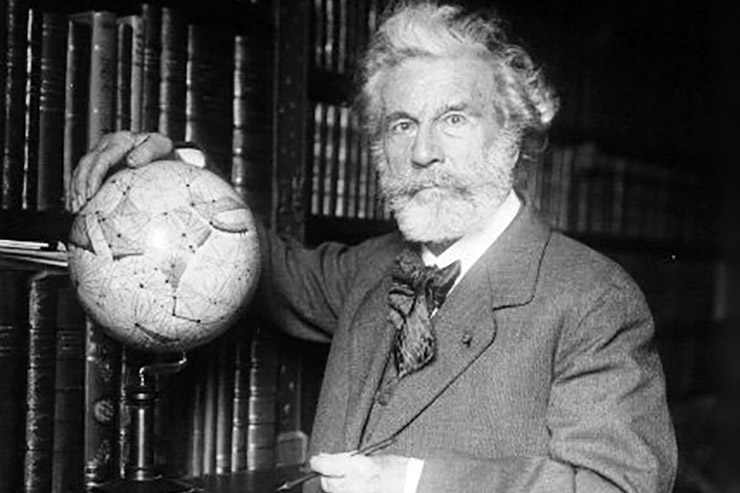
    In late nineteenth- and early twentieth-century France, a famous, and favourite, personality was the astronomer, science populariser, and science fiction writer Camille Flammarion (1842-1925).1 It is difficult today to gauge the celebrity status that Flammarion held. Men, at least some men, admired and emulated Flammarion, and many a woman swooned over him. As the saying goes, some would “give their right arm” to be in any way associated with the great Flammarion – indeed, in a bizarre but true story, Flammarion received a body part from a deceased young female admirer. How this may have influenced his serious scientific interest in the possibility of life after death is unclear.

    The Skin Off Her Back

    A young French Countess became amorously infatuated with Flammarion. She is reported to have had an image of Flammarion tattooed on her body. She came down with tuberculosis and, before dying prematurely, she instructed her physician, upon her death, to cut a large piece of skin from her back and deliver it to Flammarion with the request that he have it tanned and use the leather as the binding of his latest book, in honour of her (and thus she would always be close to him, at least in some sense). The desires of the Countess were carried out, and the skin delivered to Flammarion. He duly had it prepared and used to bind a copy of his book Les Terres du Ciel (The Land of the Sky), which he kept in the library of his private observatory in Juvisy-sur-Orge, France. On the cover in gold he placed the following inscription: “Pious fulfilment of an anonymous wish. Binding in human skin (woman) 1882.”2

    The basic truth of this story has been confirmed (the skin was received and the book bound with it), but there are tantalising details and variations that may or may not be true. In one version, before her death the beautiful Countess invites Flammarion to her chateau, he compliments her on her shoulders, and as a way to ensure that he will never forget her, she arranges for the macabre gift upon her death. In another variation which Flammarion stated was the real truth of the matter, he had never met the Countess in life, and may not have known her name.3

    The Mystery of Death

    Apart from his anthropodermic adventures, Flammarion had a long and continuing fascination with psychical studies (in modern terms, we would call them parapsychological studies) and the question of what, if anything, lies beyond bodily death. Indeed, this was apparently one of the consuming passions of his life.

    By his own account, Flammarion’s serious researches into psychical studies began in 1861 and continued until his death some six and a half decades later. In his lifetime he published such works as The Unknown (1902) and Mysterious Psychic Forces (1907), but his masterpiece and grand synthesis was the three-volume work Death and Its Mystery (1921-1923) – volume 1, Before Death; volume 2, At the Moment of Death; and volume 3, After Death.4

    Death and Its Mystery is a massive compilation of evidence, with Flammarion’s analyses, bearing on psychical phenomena and the evidence for an afterlife. In many ways it encapsulates the work of the first generation of serious afterlife researchers, beginning in 1882 with the founding of the Society for Psychical Research (SPR) in London. Yet despite the wealth of case studies it contains, many modern investigators of the afterlife have not cited Flammarion’s opus.5 I find this situation rather strange, even inexplicable, unless it is possibly due to Flammarion’s style, which can be rather opinionated, to the point of perhaps alienating the modern reader. Be that as it may, here I will briefly introduce some of Flammarion’s main themes, and also place his work into historical context.

    A Plurality of Worlds, in this Life and the Next

    One reason Flammarion was so popular with the public is that he was not afraid to speculate. He was not satisfied with simply recounting data and hard facts, but would extrapolate from those facts, mixing in his own speculations. This is seen in his astronomical work from the start. His first book, La Pluralité des Mondes Habités (The Plurality of Inhabited Worlds),6 originally published in 1862 (Flammarion had barely reached adulthood), was a bestseller, going through dozens and dozens of editions. Part of its amazing success was no doubt due to the stance taken by Flammarion, namely that the universe is teaming with life, exotic species, and even intelligent beings on other worlds. Extraterrestrial life, at least according to Flammarion, undoubtedly exists. Such themes were followed up in many of the dozens of books, both nonfiction and fiction, that Flammarion authored during his lifetime.7

    Given this “speculative” and “open” attitude of Flammarion, many of his devoted readers expected him to also be open, even supportive of, the concept that there may be more to life than simple material existence – more than the physicists’ matter and energy, as we know it. That is, if there is life on other planets out there in the universe, could not there be the continued existence of life, or something, in some “dimension” or “space” after the dissolution of our material bodies? As Flammarion wrote,

    When the first editions of my book “La Pluralité des Mondes habités” were published (1862-64), a certain number of readers seemed to expect the natural sequel: “La Pluralité des existences de l’âme” [The Plurality of the Existence of the Soul]. If the first problem has been considered solved by my succeeding books…, the second has remained an open question, and the survival of the soul, either in space or on other worlds or through earthly reincarnations, still confronts us as the most formidable of problems.8

    But, though they may have had to wait nearly sixty years, ultimately Flammarion’s readers received their answer with publication of Death and Its Mystery.

    Spiritualism & Psychical Research

    The nineteenth century saw the rise of modern Spiritualism, essentially the belief in both survival after death and the ability to communicate with the deceased, for instance during a séance.9 Flammarion was not the only person of the educated classes to take a serious interest in the subject. The SPR was established by a group of Cambridge scholars to seriously and scientifically investigate, among other subjects, spiritualist claims and the possibility of an afterlife.10

    Before addressing the question of life beyond the grave directly, the SPR first explored the issue of the reality of telepathic (direct mind-to-mind) interactions. This was seen as important both in its own right and as a possible way that discarnate spirits might communicate with living body-bound individuals. The initial study, spearheaded by SPR member Edmund Gurney (1847-1888), polled 5,705 people concerning possible telepathic experiences and resulted in the two-volume 1886 work titled Phantasms of the Living.11 The evidence in Phantasms of the Living supported the reality of telepathy, but not everyone was convinced, so more data were collected, resulting in a truly massive study.

    Between April 1889 and May 1892, 17,000 sane and healthy people were polled as to whether they had ever had any hallucinatory experiences (the vast majority had not), and if so, the details of their experiences. The large number of people polled for the Census of Hallucinations was necessary in order to develop meaningful statistical analyses of the data.12 As the authors of the study realised, given the labour it involved, it was unlikely that such an extensive study would ever be undertaken again. So far, this is true.

    While information on all kinds of hallucinations was collected, a special focus of the study was to collect data that could add to the “examination of the evidence for telepathy.”13 In particular, there was a special examination of death coincidences. Here is an example, which I have paraphrased, collected as part of the Census:

    Mr. S. Walker-Anderson was living in Australia, while an aunt of his, Mrs. P., was in England. During the night of 17 November 1890 Mr. Walker-Anderson woke up from his sleep and saw his aunt standing near the foot of his bed. He watched her lips move, and although he could hear no sound, he understood that she meant to say “good bye.” The figure of his aunt then gradually vanished. Early the next morning he told his wife about the incident, being convinced that his aunt had died. Both Mr. Walker-Anderson and his wife made written notes of the time and date of the hallucination (or apparition). Some weeks later they learned from first an English newspaper, and later via a personal letter, that the aunt died on the same day and about the same time as Mr. Walker-Anderson’s hallucination (within a few hours, taking the time difference between England and Australia into account).14

    This, like all material collected for the study, was carefully examined and cross-examined by the researchers, so that no false evidence would be included.

    The authors analysed 65 attested death coincidences collected as part of the Census. A death coincidence was defined as a hallucination, similar to the case described above, occurring within twelve hours before or after the death of an individual. Eliminating all questionable cases, for the purposes of statistical calculations, only 30 of these death coincidences were accepted. These death coincidences were compared to other hallucinations found among the Census participants, the probability of a person dying on any particular day, and various other factors.

    Ultimately, the result was that even though death coincidences are very rare, they occur at least 300 to 400 times more often than should due to chance alone! The authors wrote,

    Between deaths and apparitions of the dying person a connexion [connection] exists which is not due to chance alone. This we hold as a proved fact.15

    The authors of the Census were less sanguine concerning possible evidence for postmortem existence. Although they had received some tantalising suggestions of possible communication from the dead, they did not regard the evidence as conclusive.

    Frederic W.H. Myers (1843-1901), who had helped author both Phantasms of the Living and the Census of Hallucinations, continued to study the issue of the afterlife until his own death. In his massive, posthumous, two-volume work Human Personality and Its Survival of Bodily Death, Myers assembled the best evidence up to his time for life after death.16 His conclusions are summarised as follows:

    I hold that certain manifestations of central individualities, associated now or formerly with certain definite organisms, have been observed in operation apart from those organisms, both while the organisms were still living, and after they had decayed.17

    Thus, in a limited and somewhat circumspect way, Myers asserted that there is an afterlife, at least to some degree for at least some people (and possibly other organisms). This was farther than Phantasms or the Census had taken the subject, but still did not match either spiritualistic or everyday conceptions of an afterlife. Enter Camille Flammarion.
    The Psychic Soul

    The first task that Flammarion set for himself was to prove the existence of the soul independent of the material body. The second task was to demonstrate that the soul persists even after the dissolution of the physical organism. Let us see how he approached each issue.

    Flammarion devotes much of the first volume of his trilogy, Before Death, to a discussion of the evidence for, in his terminology, “supra-normal faculties.” These include the ability to receive information psychically at a distance, classic telepathy, and precognition. Like the SPR studies, Flammarion is absolutely convinced of the reality of telepathy.18 He also argues strongly for the reality of precognition. Flammarion essentially equates the “psychic element differing from the material organism”19 with the concept of the soul. As he states at the end of volume one,

    To solve the mystery of death, to establish the survival of the soul, we first had to prove that the soul does exist, individually, an existence proved by special, extra-corporeal faculties, which cannot be included among the properties of the material brain, or among chemical or mechanical reactions; faculties essentially spiritual, such as the will, acting without the spoken word; …telepathy; …the sight by the spirit of a far-off country, of a future scene or event – all phenomena outside the sphere of our physical organism, lacking any common measure with our organic sensations and proving that the soul is a substance which exists in itself.20

    Flammarion discusses the possibility that at least some psychic phenomena might be due to unknown, but nonetheless physical or material or energetic causes, for instance something analogous to radio waves as the mode of telepathic transmission, but essentially dismisses such arguments as unrealistic.21 In particular, Flammarion places great importance on the fact that precognition can occur. Even if there is some chance that other “psychic” phenomena, such as telepathy, might ultimately be explainable by some sort of matter or energy phenomena, currently not understood, in Flammarion’s opinion there is no conceivable manner by which precognition – seeing or knowing the future – will ever be explainable by “conventional” physics. (I am not so sure this is actually true given recent developments in physics.22) For Flammarion the reality of precognition proves incontrovertibly that the “psychic element,” the soul, is real and distinct from the physical, mechanical, and chemical organism.

    Given its importance to Flammarion’s reasoning, what evidence is there for the reality of precognition? Flammarion cites several examples to make his case, but perhaps the best can be summarised as follows.

    On June 27, 1894, at nine a.m. Dr. Gallet (at the time a medical student) was absorbed in studying for an examination in Lyons, France, when he was suddenly obsessed with a sentence that came to his mind: “Monsieur Casimir-Perier is elected President of the republic by four hundred and fifty-one votes.” He not only wrote down the sentence, but told a fellow student. After lunch the two students met a couple of other friends, and all had a good laugh at the “prophecy” since Casimir-Perier was not considered a serious candidate. The election took place at Versailles at two p.m., and that afternoon the students heard a newsboy shouting “Monsieur Casimir-Perier is elected President of the republic by four hundred and fifty-one votes!”23

    Given the fact (at least as established to Flammarion’s satisfaction) that the soul can somehow access the future, Flammarion posits that the soul, as an independent being, can survive into the future after the dissolution of the physical body. Volume 3 of Death and Its Mystery is devoted to the supposed occurrences or manifestations of the once living at time periods that clearly fall well after physical death. (The second volume is devoted to manifestations of the dying, death coincidences, that may be explainable by telepathy among the living, even if some of the “living” are about to die or in the throes of death.)

    Flammarion cites numerous reputed manifestations and apparitions of the dead. Here is one, which for the sake of space, I have paraphrased.

    On September 2, 1916, Madame A. Clarinval suddenly and inexplicably “knew” that her son, a pilot with the French air forces, was in danger. Two days later she was informed that at that very day and hour her son had disappeared behind German lines. After the end of the war, the family found out that the son had died and was buried in a soldiers’ graveyard at Dieppe, France. Madame Clarinval and her husband made four trips to the graveyard, but were unsuccessful in locating their son’s body. Then, on May 25, 1920, Madame Clarinval had a vision. She saw the face of her son in a group of trees, and on either side of him were the faces of two young men, a Russian and a German. It was subsequently discovered that her vision happened when, to the day, bodies were being exhumed from the graveyard and moved. Ultimately she and her husband went back to the cemetery area and found the body of their son buried between that of a Russian soldier and a German soldier. Madame Clarinval was convinced that her son had come back from the grave to direct her to the location of his bodily remains.24

    As Flammarion acknowledged, the issue is whether or not such cases necessarily require the manifestation of the dead to explain all the details.

    In general we can eliminate only with great difficulty the possibility of influence exerted by living persons’ minds.25

    In the incident of Madame Clarinval, everything could conceivably be explained by telepathy (between her and her son when he died, and possibly between her and grave workers, although she did not know the grave workers), perhaps combined with her own precognition of the future – namely a precognition of finding her son’s grave. However, if we are to posit a precognition on her part of finding the grave, that precognition also seems to be the very factor that allows her to find the grave. How can this be? Flammarion and like-minded thinkers find the argument that the son is actually communicating from the beyond more convincing.

    Reincarnation on Venus and Mars

    Flammarion, like Myers before him, concluded that apparitions or manifestations of the dead are real, but they decline sharply with time after death.26 The vast majority occur within the first days and weeks after death, and by the end of the first year, manifestations of the dead are exceedingly rare, although Flammarion contends that some have occurred up to decades after death.

    What do we make of this pattern? Do the deceased, perhaps occasionally, remain in our everyday terrestrial realm for a short period of time, before leaving? The longer the temporal duration after bodily death, perhaps the more likely it is that the deceased will have left the terrestrial realm? Such a hypothesis would account for the rapid drop off of apparitions as we become farther removed temporally from the death incident. But what happens to the deceased? Where do they go? I will conclude this article with Flammarion’s speculations:

    In our total ignorance, from a scientific point of view, of the conditions of ultra-terrestrial life, we can only make conjectures as to this life. We know, and shall know henceforth, that the soul exists. To admit this survival leads us to admit preëxistence. Earthly life is but a phase in the life of the spirit. The doctrine of reincarnation is, moreover, the only one which remains admissible after we have pondered all metaphysical considerations, and it is the oldest of definite religious beliefs. There must be both a previous existence and an after life.27

    Ever the astronomer, Flammarion adds,

    There is no reason for thinking that the reincarnations of the human soul are limited to our planet. Nor is it unscientific to attribute to psychic monads the faculty of voyaging through the immensities of space, of passing from one planet to another – from the earth to Mars, Venus, or some other world.28


    [alert type=”general” dismiss=”no”]This article was published in New Dawn 123.[/alert]

    [alert type=”success” dismiss=”no”]If you appreciate this article, please consider subscribing to help maintain this website.[/alert]

    Footnotes

    1. His full name was Nicolas Camille Flammarion, but he went by Camille Flammarion.
    2. The original French reads, Exécution pieuse dun voeu anonyme. Reliure en peau humaine (femme) 1882; see, Steven Connor, The Book of Skin, Ithaca, New York: Cornell University Press, 2004, 45. See also, Dan Alban, “Books Bound in Human Skin; Lampshade Myth?”, Harvard Law Recored, article dated 11 November 2005, updated 29 September 2009, posted at: www.hlrecord.org/2.4462/books-bound-in-human-skin-lampshade-myth-1.579032?pagereq=2 (Accessed 18 September 2010); David Darling, “Flammarion, (Nicolas) Camille (1842–1925)”, posted at: www.daviddarling.info/encyclopedia/F/Flammarion.html (Accessed 18 September 2010).
    3. With regard to the bookbinding incident, Flammarion wrote to Dr. Cabanès, editor of a French medical journal: “My Dear Doctor: The story has been somewhat elaborated. I don’t know the name of the person whose dorsal skin was delivered to me by a physician to use for binding. It was a matter of carrying out a pious vow. Some newspapers, especially in America, published the portrait, the name, and even the photograph of the chateau where ‘The Countess’ dwelt. All of that is pure invention. The binding was successfully executed by Engel, and from then on the skin was unchanging. I recollect I had to carry this relic to a tanner in the Rue de la Reine-Blanche, and three months were required for the job. Such an idea was assuredly bizarre. However, in point of fact, this vestige of a beautiful body is all that survives of it today, and it can endure lastingly in a perfect state of respectful preservation. The desire of the unknown woman was to have my last book published at the time of her death bound in this skin: the octavo edition of the Terres du ciel, published by Didier enjoys this honor. Your reader and admirer, Flammarion.” Note that even though Flammarion supposedly did not know the name of the person who left him her skin, he considered it a “vestige of a beautiful body.” My instinct is that he may well have known what she looked like, and may have admired her physically, or else he would have written something to the effect of “a beautiful soul,” especially in the light of his studies, even in the early 1880s, of the distinction between the material body and the immaterial soul. I suspect he had an eye for the young, beautiful, intelligent woman. His second wife, astronomer Gabrielle Renaudot (1876–1962; they married in 1919), was over thirty years younger. [English translation of Flammarion’s letter quoted from: Kathy Lechuga, “Flesh and Ink: A Brief Overview of Books Bound in Human Skin”, paper dated Fall 2007. Posted at: www.ischool.utexas.edu/~klechuga/human%20skin%20bindings%20paper.pdf (Accessed 18 September 2010).]
    4. Here I am here citing the American versions of his books: Camille Flammarion, The Unknown, New York: Harper and Bros., 1902; Camille Flammarion, Mysterious Psychic Forces, Boston: Small, Maynard and Co., 1907; Camille Flammarion, Death and Its Mystery: Before Death: Proofs of the Existence of the Soul (Translated by E. S. Brooks), New York: The Century Co, 1921 [there was also a 1922 Century Co. edition]; Camille Flammarion, Death and Its Mystery: At the Moment of Death: Manifestations and Apparitions of the Dying; ‘Doubles;’ Phenomena of Occultism (Translated by Latrobe Carroll), New York: The Century Co, 1922; Camille Flammarion, Death and Its Mystery: After Death: Manifestations and Apparitions of the Dead; The Soul after Death (Translated by Latrobe Carroll), New York: The Century Co, 1923. Death and Its Mystery was originally published in France under the title La Mort et son Mystère, in three volumes, 1) La Mort et son Mystère: Avant la Mort, 2) La Mort et son Mystère: Autour de la Mort, and 3) La Mort et son Mystère: Après la Mort, Paris, Ernest Flammarion [Camille Flammarion’s brother], 1920-1922. In France tens of thousands of copies of La Mort et son Mystère were printed in the first few years after initial publication, and Flammarion revised and added to subsequent printings.
    5. For instance, I failed to find any discussion of Flammarion in: Stephen E. Braude, Immortal Remains: The Evidence for Life after Death, Lanham, Maryland: Rowman and Littlefield, 2003; David Fontana, Is There An Afterlife?, Ropley, Hants, UK: O Books, 2005 [reprinted 2007]; Gary Doore, editor, What Survives? Contemporary Explorations of Life After Death, Los Angeles: Jeremy P. Tarcher, 1990.
    6. Camille Flammarion, La Pluralité des Mondes Habités: Étude où l’on expose les conditions d’habiabilité des Terres célestes (septieme edition), Paris: Didier, 1865.
    7. For examples of his fictional work, see: Camille Flammarion, Omega: The Last Days of the World, New York: The Cosmopolitan Company, 1894; Camille Flammarion, Urania, Boston: Estes and Lauriat, 1890.
    8. Flammarion, 1921, 3-4.
    9. According to Latrobe Carroll, translator of volumes 2 and 3 of Death and Its Mystery into English, Flammarion considered Spiritualism to be “the general doctrine that departed spirits hold intercourse with mortals” while Spiritism refers to “mediumistic research” (footnote to Flammarion, 1923, 319). Mediumistic research is basically the concept of using a person, a medium, as the go-between for communication between this world and the next.
    10. See: Robert M. Schoch and Logan Yonavjak, editors and compilers, The Parapsychology Revolution: A Concise Anthology of Paranormal and Psychical Research, New York: Jeremy P. Tarcher/Penguin, 2008, 15; William G. Roll, “My Search for the Soul,” Chapter 2 (50-67) in Body, Mind, Spirit: Exploring the Parapsychology of Spirituality, edited by Charles T. Tart, Charlottesville, Virginia: Hampton Roads Publishing Company, 1997, 52; Charles E. Tart, “World Parliament of Superstition? Scientific Evidence for a Basic Reality to the Spiritual,” Chapter 1 (33-49) in Body, Mind, Spirit: Exploring the Parapsychology of Spirituality, edited by Charles T. Tart, Charlottesville, Virginia: Hampton Roads Publishing Company, 1997, 44.
    11. Edmund Gurney, Frederic W. H. Myers, and Frank Podmore, Phantasms of the Living, two volumes, London: Rooms of the Society for Psychical Research and Trübner and Co., 1886.
    12. Henry Sidgwick, Alice Johnson, Frederic W. H. Myers, Frank Podmore, and Eleanor Mildred Sidgwick, “Report of the Census of Hallucinations”, Proceedings of the Society for Psychical Research, vol. 10, part 26, 25-422 (1894).
    13. Sidgwick, et. al., 1894, 26.
    14. Sidgwick, et. al., 1894, 211-213.
    15. Sidgwick, et. al., 1894, 394, italics in the original.
    16. Frederic W. H. Myers, Human Personality and Its Survival of Bodily Death, two volumes, New York: Longmans, Green and Co., 1903 [1954 reprint].
    17. Frederic W. H. Myers, Human Personality and Its Survival of Bodily Death (edited and abridged by his son Leopold Hamilton Myers), New York: Longmans, Green, and Co., 1907, 27.
    18. In my opinion, any open and unbiased thinker, after carefully reviewing all of the evidence, will conclude that telepathy can genuinely occur; see Schoch and Yonavjak, 2008.
    19. Flammarion, 1922, 12.
    20. Flammarion, 1921, 321, italics in the original.
    21. See Chapter 1, “The Positive Method”, in Flammarion, 1922, 3-33.
    22. For discussions of precognition, see: Robert Schoch, “Can We See into the Future? A Scientist Looks for Evidence of Precognition”, Atlantis Rising, no. 71, 40, 67-69 (September/October 2008); Robert M. Schoch, “Grasping the Future: Can We Change It or Is Free Will an Illusion?”, Atlantis Rising, no. 73, 23, 59-61 (January/February 2009); Robert M. Schoch, “E’ possibile prevedere il futuro? La realtà della precognizione”, Hera, no. 123, 80-81 (April 2010).
    23. Flammarion was particularly impressed by this case, and he cites it both in volume 1 (pages 270-272) and volume 2 (pages 11-12) of Death and Its Mystery.
    24. Flammarion, 1923, 282-290.
    25. Flammarion, 1923, 282.
    26. Flammarion, 1923, 299; Myers, 1903/1954, vol. 2, 14.
    27. Flammarion, 1923, 388.
    28. Flammarion, 1923, 391.

    © New Dawn Magazine and the respective author.
    For our reproduction notice, click here.
  • The Cathars and Reincarnation: The Strange Revelations of Arthur Guirdham

    The Cathars and Reincarnation: The Strange Revelations of Arthur Guirdham

    From New Dawn 145 (Jul-Aug 2014)

    The Cathars remain an enigma. An austere, world-denying sect, they were nevertheless associated with a remarkable cultural renascence in the southern France of the twelfth and early thirteenth centuries. Beloved in the regions that supported them, they were popularly known as the bonshommes, the “good men.” Labelled by the Catholics as “the great heresy,” Catharism was so formidable a rival that the church formed the Inquisition to crush it.

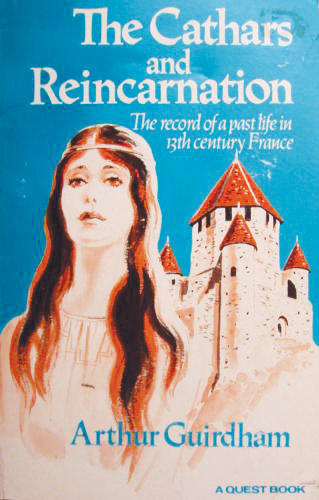
    Arthur Guirdham’s story is told in his book The Cathars and Reincarnation

    Who were the Cathars, and where did they come from? The name comes from the Greek katharós, meaning “pure” or “clean.” Their origins are obscure, but they appear to have some connection with sects that stretched back at least to the time of Christ, with exotic names such as the Bogomils, Paulicians, Massalians, and most famously the Manichaeans. I cannot sketch out this history here (I have tried to do so in my book Forbidden Faith: The Secret History of Gnosticism), but it is probably safe to say that some kind of continuous link connects all these groups spanning the first millennium of the Common Era.

    The chief feature these sects all shared was dualism. This word has many meanings. Here it means the belief in a cosmos that is made up of two opposing and more or less equipotent forces: good and evil, light and dark. This polarity is cosmic: it began with the universe and will end only when the universe ends. Our world, the world of matter, is the creation of the dark forces; the light is imprisoned and alien here.

    Note how this differs from conventional Christianity, which teaches that the world, including the world of matter, is fundamentally good. Its evil arises from the Fall of man in the garden, prompted by that old serpent, the Devil. By the old Catholic axiom, natura vulnerata, non deleta – “nature was wounded but not destroyed” by the Fall.

    But the differences are not quite as clear-cut as they may seem. Mainstream Christianity – by which I mean practically all of the churches that call themselves Catholic, Orthodox, or Protestant – has its own strain of pessimism and world-denial. One obvious example is the pathological hatred of the body that Christianity has shown almost since its earliest days. Conventional Christianity may not teach that the world is evil, but it frequently acts as if it is. And while Christianity claims that the sole and ultimate power is good, it also makes the Devil and his minions seem very nearly as powerful. Some scholars even say that Christianity is semidualistic.

    Moreover, if Catholic Christianity and its offspring teach that this world is fundamentally good, why have they so often cast shadows of fear, gloom and barbarism? And if the Cathars were so gloomy and world-renouncing, why was the culture they influenced the most – Languedoc in the twelfth and thirteenth centuries – the most prosperous, open, tolerant, and cultivated society of medieval Europe? What did the Cathar have to do with this efflorescence?

    You can read a great deal about the subject and still be left groping for an answer. The scholarly books, however serious and exhaustive, offer no real clue to this puzzle; the authors themselves often seem baffled by it.

    A Psychiatrist’s Past-Life Memories

    The most vivid and plausible picture of the Cathars comes from an extremely strange source: past-life memories as assembled by a twentieth-century British psychiatrist.

    Arthur Guirdham (1905-92)

    Arthur Guirdham (1905-92) was born in Cumbria, England, the son of a steelworker. By sacrificing the education of his sisters, his parents were able to give him a decent enough education so that he was able to attend the University of Oxford. Eventually he qualified as a psychiatrist. He was practicing in this capacity in 1962 when he met a patient that he calls Mrs. Smith. His first words to her (as he would be reminded later, to his own surprise) were “Have I seen you before?”

    Mrs. Smith, an otherwise normal woman in her early thirties, came to him with a complaint about a recurring dream that had been disturbing her: “A man entered her room from the right side. She was lying on the floor. His approach filled her with terror.” Although in itself “the dream was not of any particular interest,” it struck a chord in Guirdham. He had been having a similar recurring nightmare in which “a tall man approached the place I was sleeping. He came from behind me on the left. Sometimes he bent over me. I felt rigid and speechless with panic.” Although he could not remember exactly when his nightmares had started, he was certain about when they ended: it was around the time he encountered Mrs. Smith. Moreover, as he later learned, her dreams of this kind stopped as well. “Is this significant?” he wrote. “Not in itself but… I feel that my nocturnal visitor was the same man who disturbed Mrs. Smith’s dreams.”

    For the next year, curious coincidences and synchronicities continued to occur linking Guirdham, Mrs. Smith and the Cathars. Then, in a session in December 1964, Mrs. Smith made a remark to the effect that “love was an immensely creative force and that through it mankind would be bound together.” She attributed this statement to Guirdham himself, even though he was sure he had never said any such thing.

    A member of Dr. Guirdham’s circle made this drawing when she was seven years old. It is said to depict two Inquisitors killed by the Cathars, as well as an English child’s attempt to render “Avignonnet” – a site were Cathars were massacred – in her own language.

    Mrs. Smith then revealed a startling fact. When she was a teenager she had written a novel, which she later destroyed, about life in a medieval women’s community and a man she loved named Roger.

    Two months later, in February 1965, Mrs. Smith told Guirdham something still more astounding: he himself had been Roger, the man she loved, in a past life. “We were from a very poor family but you were of noble birth. I fell in love with you then, and my father said I must never meet you again – you were not of our class and what was more important to him, you were not of our faith. I refused to be parted from you, and was eventually excommunicated. I went to live with you. We weren’t married. You told me that if anything should happen I should go to Fabrissa.” But she was not sure whether this was a person or a place.

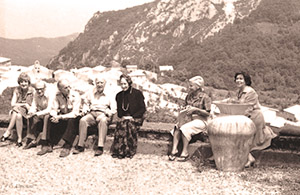
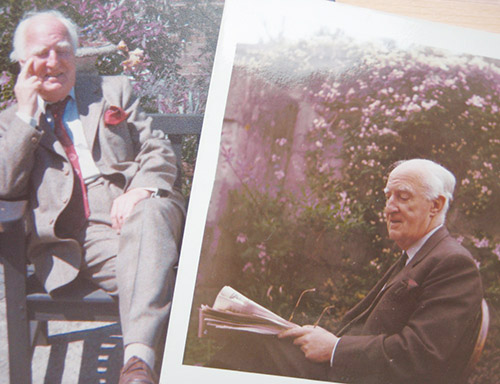
    Soon after Mrs. Smith’s revelations about her past life as a Cathar, other women started coming forward with similar flashbacks and detail, leading Dr. Arthur Guirdham to believe he was witnessing an unbelievable occurrence – mass reincarnation. The above photo of Dr. Guirdham with some of his incarnated soul group was taken at Montségur, France in the 1970s.

    Thus began a strange series of revelations, dreams and encounters, combined with serious historical research into the Cathar saga. It developed that a certain Fabrissa de Mazerolles was a well-known protector of heretics (i.e., Cathars) in early thirteenth-century Languedoc. The identity of the man in Guirdham’s and Mrs. Smith’s dreams also became clear: he was Pierre de Mazerolles, Fabrissa’s nephew. Although Mrs. Smith, or her previous incarnation (named Peirone or Puerilia), was frightened by her memory of Pierre, he had not meant to harm her. He had come to announce gleefully that he had committed murder.

    This crime, which took place in Avignonnet in 1242, is well-documented. It was of two Inquisitors who had been sent by Rome to ferret out Cathars. This did not signal the start of the great persecution launched by the papacy (which had begun in 1209). But it did provoke a reprisal that ended in the climactic siege of Montségur in 1244, the most famous episode in the Cathar epic, which ended with two hundred parfaits being burned alive, and marked the beginning of the end for Catharism as a movement. (Pierre de Mazerolles, incidentally, was not a Cathar; he was motivated by greed and by the sheer joy of murder.)

    Guirdham’s story, told in his book The Cathars and Reincarnation, continues with many ramifications. He does not tell it well. His narrative lurches back and forth between Mrs. Smith’s revelations, his own experiences, actual historical events, the love story of Roger and Peirone, and the teachings of Catharism. Many other characters are introduced, a number of whom can be identified from historical records but who begin to blur together in the narrative.

    Of the two main characters we learn that Roger was imprisoned and died, probably of tuberculosis, while awaiting interrogation by the Inquisition. Peirone suffered a more dramatic fate, and one of the most memorable passages of Guirdham’s books gives her first-person recollection of being burned at the stake:

    The pain was maddening. You should pray to God when you’re dying, if you can pray when you’re in agony… I didn’t pray to God. I thought of Roger and how dearly I loved him. The pain of those wicked flames was not half so bad as the pain I felt when I knew he was dead. I felt suddenly glad to be dying. I didn’t know when you were burnt to death you’d bleed. I thought the blood would all dry up in the terrible heat. But I was bleeding heavily. The blood was dripping and hissing in the flames. I wished I had enough blood to put the flames out. The worst part was my eyes. I hate the thought of going blind… I tried to close my eyelids but I couldn’t. They must have been burnt off, and now those flames were going to pluck my eyes out with their evil fingers.

    As compelling as this is, does it stem from an overactive imagination? The answer lies in the historical veracity of many details in this bizarre story. Mrs. Smith knew many things that she could not have known from her conventional education; indeed some of them were not discovered until after her experiences.

    Active Imagination or Real Memories?

    One example is the colour worn by the Cathar parfaits (“perfect ones”). The parfaits were the elite, the few who had received the initiation known as the Consolamentum and who served more or less as a clergy. Most of the books say they always wore black robes. But Mrs. Smith remembers that Roger’s were dark blue. It was only several years after these revelations that Guirdham came across a statement in La vie quotidienne des Cathares du Languedoc au XIIIe siècle (“The Daily Life of the Cathars in Languedoc in the Thirteenth Century”) by the well-known scholar René Nelli that, although the parfaits had originally worn black, they often switched to dark blue as a disguise in times of persecution. Since Mrs. Smith’s memories were of those days of persecution, this would make sense. This detail had not appeared in print when she had her dreams. Nelli, whom Guirdham consulted, was so struck by the accuracy of her recollections that he told him that when in doubt about some detail he should trust the memory of the patient.

    And the memory was considerable. Like many people of the era, Peirone/Mrs. Smith had a facility for remembering songs and verses that was much better developed than that of people today. She wrote down some of the songs she remembered that Roger had sung. She had transcribed them when she was a teenager. Moreover, some of her verses strongly resemble those in anthologies of medieval French poetry. She only knew a little French, which she had studied at school, and had no knowledge of Languedoc (the Romance dialect spoken in that region) or of medieval French. But, for example, in her verses she uses the word foliete for “foliage.” The French equivalent, which she would have learned at school, is verdure, but the word in Provençal, a language close to that of Languedoc, is folhet.

    Behind all this is a background of detail that brings a lost age vividly to life. Of Peirone’s house, she recalls, “It was little more than a hovel. One room, that’s all… I am sure there was no upstairs. The only furniture was a rough bench and a table. It was almost as dark inside as out, for the small window had no glass in it and was covered with a crude wooden shutter to keep out the elements.” She and her family slept in their clothes on the floor. Frequently she gives details about medieval life that Mrs. Smith knew nothing about, such as the custom of drinking diluted wine.

    Beyond a certain point it is useless to argue about whether these are genuine past-life memories or not. Our age has forgotten that scepticism is not in and of itself a sign of intelligence. It would be more interesting to see what we can learn from these accounts, and how they supplement conventional sources on Catharism.

    The Cathars: New Revelations

    Let us begin with a question already asked: how, if the Cathars were such a dour sect, did they thrive in the free, open, joyous atmosphere of the Languedoc of the period? Guirdham’s answer is clear and sensible. The Cathar parfaits were extremely strict with themselves: they wore robes like monks, they ate no meat, they were celibate, and they fasted often. Those demands were only made of the parfaits. Unlike the Catholic priests of the time, the parfaits actually lived up to their vows; thus they won the affection of the people, and the nickname bonshommes. But ordinary believers – the croyants – were under no such obligations. The demands made on them were light.

    Nor was Catharism as gloomy and world-denying as it has been painted. The Cathars, it is true, believed in covalent forces of good and evil, which existed from the beginning and would last until the end of the universe. They also believed that the world of matter was fundamentally evil (a case that is easy to make). But unlike the Catholics, they did not cling to the gloomy and improbable doctrine of eternal damnation. Guirdham writes:

    In the Middle Ages people were dominated by the fear of Hell. Catharism to some extent dissipated this fear. If the world was regarded as being made by, or under the domination of Satan, it followed that one was entitled to regard this life as Hell. Considering that one got through it somehow, and that there were many compensations in the sunshine of the Languedoc and the Midi, the idea that the world was Hell was really an optimistic one. If this world is the worst Hell one has to put up with, it must have been, even at its lowest, vastly preferable to the perpetual damnation of the orthodox Christians of that epoch.

    This view helps explain how the supposedly sombre Cathars were able to thrive in, and foster, the lively and cheerful civilisation of Languedoc. The world is evil, so one does not need to take it too seriously, and certainly there is no point in making things worse than they already are.

    Another detail casts some light on the cultural impact of the Cathars: they put little stock in marriage. There was no Cathar wedding ceremony, and many Cathar couples lived in what the Catholics would call sin. It is clear from Mrs. Smith’s evidence that Roger and Peirone were not married either.

    Courtly Love

    This point explains another strange fact about the Cathar milieu: it was when the curious tradition of courtly love came into being. (Actually this was in the eleventh and twelfth centuries, earlier than the time of persecution that we have been discussing, in the thirteenth century.) Courtly love, a kind of intense love from afar that was usually unconsummated, was the inverse of marriage: it was often practiced between a man and a woman of divergent social classes, it was not for the purpose of having children, and it was, at least ostensibly, chaste.

    Courtly love was also associated with the poetry of the troubadours, which had Cathar echoes of its own. Guirdham mentions the tradition that says the troubadour poets would wear a rose when singing songs with esoteric themes; when they did not, the songs were about ordinary human love. Denis de Rougemont, in his influential book Love in the Western World, argues that the troubadours invented what we now call romantic love. This view is hard to sustain. Greek lyric and Roman elegiac poetry show people in love much as they are today. But de Rougemont may be right to this extent: the troubadours, and the courtly love they celebrated, were the first (at least since Plato) to connect human love with divine love.

    The Cathars’ indifference to marriage resembles the attitude of another religion that may be called world-denying. The Buddhists have no marriage ceremony as such. Monks do not marry a couple; the couple marry each other; a monk may bless the ceremony, but he does not perform it. This peculiar fact may have something to teach about world-denying religions and their fate in the world, particularly in the West.

    Religion, whose name originates in Latin roots meaning “to bind back” or “to connect,” plays more than one role in society. It attempts to connect man with God, but it also has a social function. Religion holds society together; at least that is how it worked in the past. If, however, religion is to do this, it must take society’s concerns somewhat seriously. A religion that regards the world as ultimately rather unimportant is not likely to be enthusiastic about taking on the role of guarantor of the social order. This attitude may help explain why dualistic movements such as the Cathars and the Manichaeans never established any long-lasting dominance in societies and nations. It is true that Buddhism, which is also somewhat world-denying, has managed to establish itself, but it is striking that a number of Buddhist nations have continued to use native traditions – Shinto in Japan, Confucianism and Taoism in China – to continue to fill some social functions.

    Bodywork, Herbal Healing & Plant Auras

    Guirdham has much more to say about the Cathars in their context, informed by both Mrs. Smith and a woman he calls Miss Mills, who had similar past-life memories. But at this point we may turn to another dimension of Guirdham’s portrait: his own contact with discarnate entities who in their last lives on Earth had been Cathar adepts, including the important and much-honoured Cathar bishop Guilhabert de Castres (c.1165-1240).

    These teachings, assembled in the final section of Guirdham’s book The Great Heresy, deal with subjects ranging from the properties of plants to reincarnation and intercourse with divine beings. These things do not, on the face of it, strike one as part of Catharism. On the other hand, they do not contradict what we know about the Cathars either. In their way, like the rest of Guirdham’s work, they serve to fill out its portrait.

    The Cathar parfaits were, as we have seen, a kind of clergy; they administered the Consolamentum (the only sacrament they acknowledged), taught doctrine, and led services. But they had another important function: they were healers. Guirdham points out that one of Christ’s original commands to his followers was to heal the sick. The parfaits did this using a number of techniques, including what we today would call bodywork and administering herbs and tinctures. Guirdham also discusses the use of jewels in healing, although he acknowledges that they are not as useful for this purpose as they were in bygone ages, when people were more psychically sensitive.

    Guilhabert also told Guirdham a great deal about plants. Plants have auras like human beings, and when, in certain instances, a person finds a certain plant, like a tree, to give off a healing quality, it is the result of this aura. Guirdham himself recalled the case of an old miner who was subject to periodic bouts of depression. At these times he would go off and sit under a particular roadside tree, and afterwards he felt better. But plants can have negative properties as well; some thrive on maleficent vibrations, including perhaps toadstools and fungi that thrive in dank underground cellars. Guilhabert makes the arresting remark that evil can insert itself in nature, citing as an example the lurid aniline-dye colours of recently developed varieties of roses. “The harsh colours bred into the roses were a flamboyant challenge to reinforce their attractiveness to man,” according to Guilhabert.

    Some of these remarks are reminiscent of the ideas of the Austrian visionary Rudolf Steiner, who also spoke of the etheric bodies and auras of plants. This may not be a complete coincidence. Steiner laid claim to the heritage of the Rosicrucian brotherhood of the seventeenth century, and Guirdham suggests that the Rosicrucians may have been the spiritual descendants of the Cathars. “It is traditional,” he observes, “that the Rosicrucian movement arose in Germany in a family where a monk from Narbonne [in Languedoc] had been a tutor.”

    A Secret Cathar Lineage?

    Did the Cathars survive in any other form after finally vanishing from history in the early fourteenth century? Conventional scholarship says they did not. But there may be some evidence of underground Cathar survivals. In a persuasive book called The Secret Heresy of Hieronymus Bosch, author Lynda Harris suggests that the great Netherlandish painter and forerunner of surrealism may have been secretly a Cathar two hundred years after the faith supposedly perished. Harris’s argument is too intricate to go into here, but the facts that Bosch’s ancestral home was the town of Aachen, a former Cathar centre, and that many of his bizarre images have curiously heterodox implications, suggests the Cathars may not have perished as thoroughly as the Inquisitors wished.

    The question keeps presenting itself to the minds of those who think about these subjects. These lost, half-forgotten faiths – the Cathars, the Manichaeans, the Gnostics – did they really die out completely? Did they survive sub rosa under other names, handed down through lineages of secret and untraceable initiations? Or do they reflect something that continually arises out of the depths of human experience? Guirdham suggests as much, writing, “Perhaps it is best to regard Dualism as analogous to a repressed impulse. It passes from memory but continues to exert its influence in different directions below the conscious level.” Perhaps, too, there is another answer, suggested in his books: the religions may vanish, but their adherents do not, and as they return in later centuries and in other bodies, the teachings and truths of those ancient faiths may return as well.

    [alert type=”general” dismiss=”no”]This article was published in New Dawn 145.[/alert]

    [alert type=”success” dismiss=”no”]If you appreciate this article, please consider subscribing to help maintain this website.[/alert]

    Sources

    Arthur Guirdham, The Cathars and Reincarnation, C.W. Daniel, 1990 [1970]

    Arthur Guirdham, The Great Heresy: The History and Beliefs of the Cathars, C.W. Daniel, 1990 [1977]

    Arthur Guirdham, We Are One Another, C.W. Daniel, 1991 [1974]

    Lynda Harris, The Secret Heresy of Hieronymus Bosch, Floris, 1995

    Denis de Rougemont, Love in the Western World, Translated by Montgomery Belgion, Rev ed. Princeton University Press, 1983

    © New Dawn Magazine and the respective author.
    For our reproduction notice, click here.
  • Princess Diana, the Priest, & Messages from the Spirit World

    Princess Diana, the Priest, & Messages from the Spirit World

    This article was published in New Dawn Special Issue Vol 11 No 6 (Dec 2017)

    I was introduced to Diana, Princess of Wales, through one of my parishioners at St Mary Abbots Parish Church, Kensington. A personal friend, he was employed by the Royal Family. Diana was technically a parishioner of mine as her London residence, Kensington Palace, was just around the corner from my church, where I had been Curate since my return from being Chaplain of St Nicholas Church, British Embassy, in Ankara, Turkey. ‘Curate’ means a priest entrusted to cure souls. Caring for the spiritual health of his people. I felt that being concerned for Diana’s soul was an integral part of my priestly duties.

    Before being formally introduced to the Princess via my friend, I had seen Diana once inside St Mary Abbots. She never came to church on Sunday, or indeed to weekday services like Holy Communion or Even Song, but she would sometimes sneak in at other times and sit at the back of the church in quiet contemplation. It was a rainy afternoon when I noticed her sitting there, her bodyguards discreetly hovering nearby. I did not want to impose on her so I pretended to be reading my prayer book until she actually got up and came towards me. She wore what looked like a kind of tracksuit as if she had just been for a jog. We exchanged a few pleasantries. She asked about my accent. “Italian,” I told her. “You are very tall for an Italian!” she exclaimed. I smilingly agreed. I was bowled over by her. She was so sexy. (Well, a priest is only human!) Her face, especially. I have a feeling for faces. Her eyes, her nose… her nose, particularly. Loved it. Anyway, after a few more polite exchanges she left. Sometime later my parishioner friend let me know the Princess would like to meet me.

    That was the beginning of an extraordinary relationship. Diana shared with me that she was in love with Dodi al-Fayed. “I want you to meet him,” she said. That took place at Dodi’s apartment, near Marble Arch. He struck me as a very pleasant, unstuffy fellow. A young Egyptian who could easily have been an Italian. The way the two of them interacted left me in no doubt that they were passionately in love. The amorous sparkle in the Princess’ eyes, the way he held her hand, how she beamed… things like that. She privately questioned me about whether the Church of England permitted marriage between a Christian and a Muslim. I reassured her. As a resident parishioner, she was entitled to be married in the parish church. (“Could you marry us?” she asked.) Had she still been a member of the Royal Family, she would have required permission from the monarch. Of course, she had been cruelly stripped of the title of ‘Princess of Wales’ after her divorce from Prince Charles, so she was no longer a formal member of that gang. Anyhow, I have no doubt that had the two lovers not died in Paris on that terrible Sunday of 31 August 1997, today they would be husband and wife.

    I vividly recall hearing the news of the fatal car crash on the BBC while I was shaving and getting ready for church on that morning. Could not believe it. ‘A hoax!’ I first thought. Alas, it was true, all too true. I walked down to St Mary’s for the 9.30 Eucharist Service with a sense of unreality, silently praying for the repose of her soul and Dodi’s. I preached my sermon amidst a great hush. The congregation was still and recollected. The news had already got to them.

    The possibility of foul play did not occur to me at the time. My primary concern was praying for the couple’s eternal salvation. Then doubts began to arise. I distrust conspiracy theories, but some of the murky aspects that emerged later troubled me. They still do. Later I got to know Dodi’s father, Mohamed al-Fayed, and I fully appreciated that much was still to be explained. A Chief Superintendent from Scotland Yard visited me. My house was burgled and some papers vanished. Buckingham Palace inquired about me. Some very powerful people didn’t like what I knew about the Princess – that was obvious to me. (I can say no more than that.) However, I would not let anyone intimidate me.

    Twenty years have gone by since Diana and Dodi died. “She will not go quietly,” the Princess had said in an interview. Indeed, she hasn’t. She is still with us. She haunts the universal imagination now as much as she did when alive – witness the huge interest in stories and putative revelations about her. The media are full of them. It is like an endless stream. Her unquiet soul, like the ghost in Hamlet, will not go away. That is partly why I decided to publish my book, Princess Diana: Letters from a Soul, available on Amazon Kindle. It was a labour of love but also a duty. I wanted her not to be silenced forever, as her detractors would like, but to go on speaking. To empower her voice to continue being heard. In the first person. From where she is now. The Beyond. More precisely, from a state, a condition – not necessarily a place – called Purgatory. A locus of purification, prior to a soul being allowed to enter into the perfect bliss of Heaven. That is from where Diana speaks to me in her Letters.

    While writing I sought spiritual inspiration from Dante, the immortal poet author of the Divine Comedy. I studied him in my school days – all Italian students have to read Dante, he is the father of Italian literature – and I constantly come back to his great work. Apart from the beauty of his verse, I gain all sorts of new insights from Dante. Particularly about the world to come. The figures of Diana and Dodi perhaps could be compared to Paolo and Francesca, two unforgettable doomed lovers in the Comedy. Or, as I suggest in my book, to the pathetic figure of Pia de’ Tolomei, a woman from Siena murdered by her husband. While meditating on lines from Dante’s Comedy I received great encouragement towards completing my book. Another major influence was the great Islamic mystic Muhyiddin Ibn Arabi. A fountainhead of Sufi wisdom. I got to know of him in Turkey where he has a large following amongst mystics, some of whom taught me their spiritual techniques. Ibn Arabi postulated the existence of an intermediate world between this one and the next, called Alam al-Mithal. A supernal dimension where the spirits of the living mingle and dialogue with the souls of the departed.

    The third influence on me was Carl Gustav Jung. His idea of the archetypes as well as his own visions. Diana in a way was an embodiment of the ‘eternal feminine’ archetype, I feel. Unlike the materialist Freud, Jung believed in transcendence. His conception of the unconscious was not as negative, as pessimistic as Freud’s. The unconscious must be integrated into the conscious personality, not regarded as a wild beast inside us. I learnt much from Jung. And I am still learning.

    Speaking as a Christian and a priest, I don’t think I should apologise for being interested in the next world. Christ talked and made promises about it. The Church affirms her belief in the world beyond the grave in the Creeds and prays regularly for the dead. Why is it wrong in having an interest in what goes on in the invisible world? We should not leave that only to spiritualist and Gnostic sects. It is part of Christian doctrine. Moreover, when confronted with the fearful climate of secularisation, atheism and indifference which obtain in the West, I regard it as imperative for a priest to draw attention to eternity, to the values of transcendence and their implications for the life of man.

    The Anglican Church often gets caricatured as consisting either of wishy-washy liberals or evangelical fundamentalists. Both kinds certainly exist, but there are also serious-minded and devout persons who cling to the historical teachings of the Book of Common Prayer. A crisp and compact text filled with wisdom, still offering valuable guidance and spiritual and moral orientation to priests and laity alike. When at theological college near Oxford, I was impressed by the writings of Alan Watts, an Englishman who was ordained as an episcopal priest in the States and composed a book urging that Christianity should become mystical. Watts also wrote about Zen and that was another influence on me.

    When I was writing my book I dreamt of the Princess three times. Gloriously transfigured, yet as adorable as ever. Like an angel. She spoke about William and Harry. Asked for some corrections to be made in what I was writing. She told me to keep praying for her. Every day. “You have no idea how much it helps,” she said. She also expressed concern about an aspect of my life but that I cannot go into here. Once or twice she seems to be in some discomfort. That saddened me, but I recalled that the flames of purgatory are a necessity. No purification, no salvation.

    As a young man in Italy, I was for some years a close disciple of the traditionalist guru and writer Julius Evola. A man of tremendous depth and esoteric knowledge about whom I have written another e-book, Julius Evola: The Sufi of Rome. (Although an Anglophobe, Evola took a special interest in the mystery of Stonehenge and much regretted not having seen it.) He knew all about Italian and international shadowy intelligence operations and repeatedly warned me about them, because the far right, then as well as today, crawled with police spies and agent provocateurs. He himself had been the object of many attacks by sinister forces, visible and invisible. What would Evola say about Diana and the circumstances of her death? Although a believer in occult warfare, Evola was the very opposite of credulous. Despite what some people might think, his frame of mind could be critical and sceptical. I see him sitting in his wheelchair, smiling sardonically at me and cautioning: “Vedremo, caro Franco, vedremo.” We shall see, dear Franco, we shall see.

    To conclude, where is Princess Diana now? She certainly has not perished. I like to imagine that, had I been by her in Paris where she died twenty years ago, I would have beheld her before closing her eyes to this mortal life, turning her lovely face confidently to that inexhaustible force and grace that Dante in the Paradiso calls “l’eterna fontana.”

    Father Frank Julian Gelli’s e-book Princess Diana: Letters from a Soul is available on Amazon Kindle.

    [alert type=”general” dismiss=”no”]This article was published in New Dawn Special Issue Vol 11 No 6.[/alert]
    [alert type=”success” dismiss=”no”]If you appreciate this article, please consider subscribing to help maintain this website.[/alert]

    © New Dawn Magazine and the respective author.
    For our reproduction notice, click here.
  • A Neurosurgeon’s Journey to Worlds Beyond: An Interview with Dr. Eben Alexander

    A Neurosurgeon’s Journey to Worlds Beyond: An Interview with Dr. Eben Alexander

    From New Dawn Special Issue Vol 9 No 3 (June 2015)

    Today the intellectual world is facing an insurrection. It has nothing to do with politics or economics. It is about worldviews. Contemporary intellectual thought is hidebound by a materialistic view of the universe that automatically shuts out anything of the “spiritual,” or, God forbid, “mystical.” More and more evidence is coming to light that refutes this narrow view of reality. And more and more intellectuals are standing up against it.

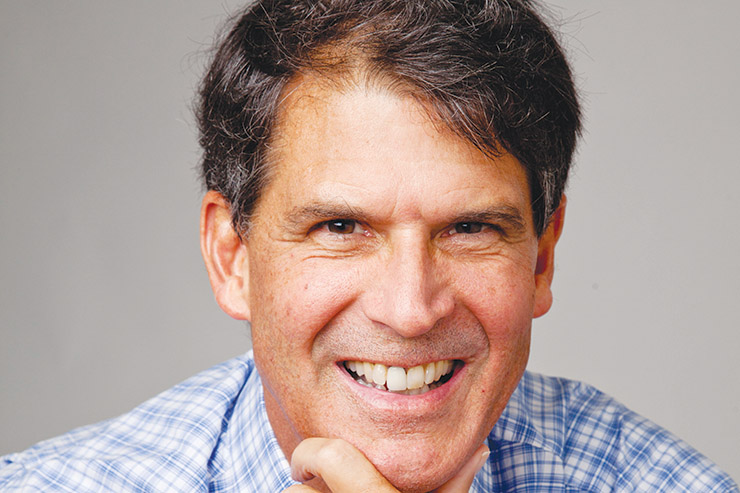
    Eben Alexander is one of the most famous examples. An American neurosurgeon, in 2008, he fell into a coma during a case of severe meningitis and – at a time when, from the conventional point of view, he should have had no consciousness whatsoever – he had a profound and inspiring vision of worlds beyond this one.

    Alexander describes this journey in the best-selling Proof of Heaven: A Neurosurgeon’s Journey into the Afterlife. The book sent a shock through the United States, and gained Alexander a place on the cover of Newsweek as well as the usual attempts at debunking. Since then he has travelled and given lectures to many audiences. His latest book, The Map of Heaven: How Science, Religion, and Ordinary People Are Proving the Afterlife, co-authored with my good friend and Quest contributor Ptolemy Tompkins, was published last November.

    In July 2014, at the invitation of the Theosophical Society in America, Alexander spoke to an audience of some 450 people in Glen Ellyn, Illinois, and later addressed the TS’s Summer National Convention. He also did the following interview. Karen Newell was also present. She is his associate in Sacred Acoustics, a company that creates audio meditations combining various kinds of sound to stimulate higher states of consciousness.

    This interview originally appeared in Quest: Journal of the Theosophical Society in America, in the Winter 2015 issue.

    Richard Smoley (RS): Perhaps you could start by telling us a little bit about your journey. 

    Eben Alexander (EA): I’ve spent more than twenty years in academic neurosurgery and thought I had some idea of how brain-mind consciousness worked. I fully logged into the reductive materialistic mindset of neuroscience of the twentieth century, which says there is something about the neurons of the brain and their firing that gives you consciousness. Even though nobody had a clue of how that worked, I thought we just needed to study it more and figure it out.

    That’s why my illness, which came on in November 2008, was so revolutionary to my thinking. I had to go back and question everything I ever thought I knew about reality. I had a very severe case of bacterial meningitis. Only in looking back, months and months later, did I start to realise what a perfect model for human death meningitis is, especially the severe form that I had: it basically dissolves the neocortex.

    Modern neuroscience says the neocortex – the whole outer surface of the brain – is the part that gives rise to all the details of conscious experience. As this disease wipes out your neocortex, what is the next step? It would have been very clear to me as a neuroscientist that the next step is nothingness. Any doctor who knows anything about gram-negative bacterial meningitis and the details of my illness would realise that people don’t go in that state and come back with hallucinations, dreams, or exotic stories – they come back with nothing. In fact the reality is they usually don’t come back at all. Just the opposite happened, and that part was a mind-bender.

    The extraordinary odyssey that I went through, and that I describe in my book Proof of Heaven, should not have happened at all, according to all the modern notions saying that the brain creates consciousness. And yet I was left with this absolutely astonishing ultra-real experience and an odyssey that seemed to go on for months or years, although it fit within seven earth days.

    To me that was the central mystery. How is it that when you destroy the neocortex, you actually take the blinders off and allow consciousness of a far richer and more real and comprehensive knowing to come into existence? That was what drove me to come to some explanation.

    RS: How do you now view that relation between brain and mind?

    EA: Before the coma, as a neuroscientist who felt that the brain creates consciousness, I paid no attention to near-death experiences, because I would have said that they’re a flickering of a dying brain.

    But they’re far more than that. In fact, they are not created by a dying brain at all, they’re linked to a much more substantial, conscious, eternal spiritual being. Near-death experiencers have been telling us for decades about a reality that is much more real than this one. So has the afterlife literature going back thousands of years.

    I give talks around the world about all this. And I’ll have people who come up to me who know nothing about any of this literature but who share with me their own stunning personal stories of near-death experiences, after-death communications, past-life memories in children, and reincarnation stories. There’s just no way to pretend that it’s some mass hysteria, that it’s all some trick of the brain. This is something far more profound.

    So I’ve come to realise that consciousness, soul, or spirit is the thing that truly exists at the core of all that is. Before my coma I would have been tempted to try and tell you that, as conventional scientific teaching says, the brain, the chemistry, the biology creates an illusion of reality, an illusion of free will. In fact that is absolutely backwards. What truly exists is consciousness, soul, or spirit.

    Even modern physics is in a headlong rush to tell us that there is no material to the material world. It’s vibrating strings of energy and higher-dimensional space-time. And it is consciousness that is essential to emerging reality. The only thing we know exists is our own consciousness. But we’re so immersed in this consciousness that it’s very difficult to separate ourselves from it.

    Any possible model, or any kind of scientific explanation of the nature of reality, must begin with a far more robust explanation of what consciousness is, because it is not created by the brain. The brain is a reducing valve or filter. That idea was gaining in popularity in the late nineteenth century with very brilliant thinkers – William James, Carl Jung, Frederic Myers – and yet it lost its attraction during the heyday of the twentieth century, when science got sucked into purely materialistic explanations.

    [alert type=”info” dismiss=”no”]If you appreciate this article, please consider a subscription to New Dawn magazine.[/alert]

    RS: So what is consciousness?

    EA: Consciousness, I would say, at its core level, is the observer, the awareness. We’re so consumed with this worship of the ego, the self, the linguistic brain, and rational thought that we lose sight of the fact that our own consciousness is actually something far deeper and more mysterious. It is that awareness part of us, the part that knows of its own existence and of the existence of a universe.

    The little voice in my head, that linguistic human brain, which is so tightly tied to rational thought and also to ego and self, can make a request, state an intention, offer up some gratitude, but there is far greater wisdom as one gets deeper and deeper into consciousness. This is something that meditators, Tibetan monks, those who have been deeply into consciousness study over millennia, have been trying to tell us. And yet only now is science beginning to recognise that deep within consciousness itself we can find the evidence that we can be linked to something far, far greater than we are told by that minuscule view that the brain creates consciousness. In fact, when you realise it works the other way around, we can come in touch through deep meditation with consciousness. We come to realise consciousness is not local.

    Before my coma I was a conventional neuroscientist who believed that we can only know things through our physical senses. Since then I’ve come to realise that things like telepathy, precognition, near-death experiences, after-death communications, past-life memories in children, the tremendous scientific literature on reincarnation, are proving to us that consciousness is not local.

    It’s important to understand nonlocal consciousness. In the scientific community I steer people to that wonderful book from the University of Virginia, Irreducible Mind: Toward a Psychology for the Twenty-First Century by Edward Kelly. It’s 800 pages of hard-core scientific data and analysis showing very clearly that the brain does not create consciousness. As I said earlier, it’s more of a reducing valve or a filter. This helps us to understand that mystery of quantum mechanics, which was proving, a hundred years ago, that consciousness is fundamental in the existence of any part of reality emergent in this universe. Consciousness is filtered in through the brain; it is not created by the brain.

    RS: You say that the materialistic model of the brain and mind is being increasingly challenged within science itself. Do you see much evidence of this, particularly in psychology and neurology?

    EA: A number of respected scientists around the world, some of whom have their training in psychiatry, some in psychology, are realising that the “hard problem” of consciousness is the most vexing conundrum known to all of human thought. This is saying that, in spite of the increasing devotion of study to the brain, no neuroscientist on earth can offer the first sentence about how the physical brain might create consciousness.

    A lot of the neuroscientists who study this problem realise that the more we know about the physical brain, the more we realise it’s not the creator of consciousness. It’s very clearly related to consciousness, but again it’s more of a reducing valve or filter.

    Often colleagues will challenge me and say, “Wait a minute! You’re saying this whole mystery of being deep in your coma as your brain was being destroyed by bacterial meningitis actually was the blinders coming off – when your awareness was getting more crisp and real.” They say that makes no sense.

    I would reply by pointing out two commonly observed clinical phenomena. Neurologists and neuroscientists are aware of some of these examples. One is “terminal lucidity,” which I point out in my book Proof of Heaven. Often when they get closer to death, elderly and demented patients can have these oases of very clear thinking, memory, interaction, great clarity of thought that completely defies any kind of explanation.

    The other commonly observed phenomena have to do with what is called the idiot savant or acquired savant syndrome, where some kind of brain damage, like a stroke or head trauma, uncovers some oasis of superhuman mental functioning. These savant syndromes are very, very common. I had many of them when I was active in neurosurgery. I would see where people would have some kind of brain damage, and it actually uncovered this incredible superhuman ability – of memory, calculation, ability to graphically represent things, musical creativity – that emerged out of nowhere.

    Wilder Penfield, one of the most renowned neuroscientists of the twentieth century, probably still holds the record for electrical stimulation of the brain in awake patients – tens of thousands of episodes in his work on epilepsy. He worked in Montreal and wrote a book in 1975 called Mystery of the Mind: A Critical Study of Consciousness and the Human Brain. In the book, he gets clearly into his conclusions that never once, in all those tens of thousands of stimulations, did he uncover an event that seemed to be a free-will event of conscious experience. The patients always felt like they were puppets on a string, no matter what the memory, experience, whatever they went through – they always knew it was something “triggered.” Never once was there anything that resembled a free-will type event.

    To Penfield it was very clear. To me, the evidence for this is completely consistent with my journey as described in Proof of Heaven and my conclusions and understandings about consciousness. If you’re trying to find free-will and consciousness, or soul, or spirit, they’re just not created in the brain at all. In fact, the brain is basically shackles. That’s essentially what near-death experiencers have been trying to tell us for millennia. Mystics who have had similar spiritually transformative experiences have been trying to put it out there that in fact, when we’re freed from shackles of the physical brain and released from that illusion of here and now, we actually come into a much higher knowing.

    RS: My understanding of most near-death experiences is that they are overwhelmingly positive. But there are some negative experiences, where people encounter hells or devils or demons. How does this fit with your picture?

    EA: When you look at a large number of NDEs, say somewhere around 95-98 percent of them seem to be very positive, very loving. This can be quite independent of the circumstances around the demise of a given patient. They often are shown beautiful scenes of unconditional love, love of an infinitely powerful spiritual being, often messages conveyed by the souls and spirits of departed loved ones that are very positive and loving.

    As for the experiences that are negative: those who have read the book Proof of Heaven realise that I started out in a very dark, foreboding, underground realm, which I call the earthworm’s eye view. If I had come back from my near-death experience having only been to the earthworm’s eye view, I probably would have had what people describe as a hellish near-death experience.

    Talking with other near-death experiencers and reviewing thousands of near-death cases, I believe that in many ways the hellish ones are incomplete. They are not going in with the power and the oomph to blast through to those higher realms. To me it was very clear that unconditional love has tremendous power – to heal at all levels, to heal the individual soul, to heal soul groups, to heal all of humanity, to heal all of life on earth, to heal all of consciousness existent in this material universe.

    There can be dark forces, but by knowing that connection to the divine, the infinite power and love of that divine, we are able to bring that light and love into any realm we exist in. That includes this material realm; that includes the lower spiritual realms, including that earthworm’s eye view.

    In my journey, as I describe in Proof of Heaven, I would cycle through and ascend through higher and higher levels through a gateway realm with a beautiful idyllic valley, butterfly wings, and angelic choirs, with lots of spiritual beauty, but with earth-like features. I would then ascend to higher and higher realms all the way to the core: infinite inky blackness, but filled to overflowing with the divine, that power of unconditional love in its healing capacity and also the brilliant light of that orb, brighter than a million stars. I knew that completely outside of our duality.

    But then I would tumble back into that earthworm’s eye view. And very quickly in that journey I came to realise the importance of sound, music, vibration, which is part of the work I do now with Sacred Acoustics, with Karen Newell: using sound to enhance these abilities of our souls to transcend. That’s why the work of Sacred Acoustics has so much to do with meditation and getting into deep meditative states.

    All of that is coming to realise that love has infinite power to heal. And I came to see in my journey that this is not a battle between good and evil, where they are equal and counterbalanced and maybe good and love will win out or maybe evil and darkness. Evil and darkness are the absence of that love and that light. By remembering our divine connection to that oneness and to the infinite healing power of that creative source, we can bring that light and that love into any aspect of the material realm and the lower spiritual realms.

    RS: Could you say more about your work with Sacred Acoustics? What do you recommend for people who want to have a sense of that unconditional love while being connected with this earthly realm?

    EA: You don’t have to die, or almost die, to get this. As a conscious being, you have all the tools you need to go within consciousness to come to see much deeper truth. I recommend meditation, Centering Prayer – sometimes it comes to us as a gift of desperation through the hardships of life, because in fact those hardships and difficulties, even illness or injury, are often a beautiful gift. That is often how we get a revelation about our deep connectedness with each other and with the divine.

    About two years after my coma, I was introduced to the Monroe Institute and the work of Robert Monroe, who wrote three wonderful books on his journeys. He was a pretty straight-laced guy who ended up having spontaneous out-of-body experiences. Over four decades he came to realise that you can use sound – specifically slight differences in the frequency of sound presented to the two ears – to do some very interesting things with consciousness. I was attracted to it two years or so after my coma, when people approached me who knew a bit about hemispheric synchronisation, brain entrainment, what Monroe called hemi-sync. And they suggested to me that maybe I could revisit some of the realms that I had experienced in coma, when my neocortex was being ravaged by the meningitis. But I could do it in a reversible fashion by using two differential frequencies to the two ears.

    There’s a particular circuit in the brain that is a very accurate timing circuit. That circuit is right next door to a circuit in the brain stem that modern neuroscience would tell you (with our very primitive notions about consciousness) seems be an ignition system for all of consciousness. My idea was that with this synchronisation of electrical activity to the hemispheres using differential sound inputs to the two ears, I might synchronise the electrical activity. This would take away the information processing aspect of the neocortex and allow my consciousness to be set free, just as it was when meningitis was destroying my neocortex.

    This is the work that I now do in conjunction with Sacred Acoustics; those that are interested should visit sacredacoustics.com. It has to do with a sophisticated use of patterning of these sound inputs to the two ears to enable consciousness to be set free. 

    RS: Which spiritual figures have you found most inspiring?

    EA: I grew up in a Methodist church in Winston-Salem, North Carolina. My father was very influential in my life, and he had a very strong religious belief in his own right. He had grown up in eastern Tennessee during the Depression. He had been a combat surgeon in the Pacific during the Second World War, and then he went on to head up a neurosurgery training program. So he was very scientific, but also deeply religious and truly spiritual. And I had grown up trying to follow, as best I could, in his footsteps.

    Of course, being a child of the ’60s and ’70s, I realised that science is the pathway to truth. And as much as I wanted to believe what I was taught in my Methodist church, through those years of working in academic neurosurgery I found it more and more difficult to explain the survival of consciousness after the death of the brain and the body. As I said earlier, I bought into the modern twentieth-century neuroscientific view that the brain creates consciousness. And that, of course, means that it’s birth, death, and nothing more, and none of us has free will, and consciousness is an illusion.

    My coma journey showed me that every bit of that is false. As I started to study more and more about NDEs and was led into the afterlife literature and into the writings of mystics and prophets going back thousands of years, what struck me was their similarity: they all converge on a much deeper truth. It turns out that the linguistic brain is in many ways our enemy in trying to come to a much deeper understanding. We can actually communicate in deeper ways, too, that have to do with a much purer form of consciousness. This is why I’m such a tremendous fan of meditation and encourage people to develop a daily practice of meditation.

    The more I started giving talks about my experience, the more I started hearing back from Kabbalists, from Christian mystics, Sufis, Buddhists, Hindus, and atheists who had a very deep spiritual awareness through some experience. They were all talking about the same thing.

    RS: Is there anything you’d like to add?

    EA: A central message in Proof of Heaven is that consciousness is at the core of all existence. I think the most important aspect of that lesson, which is brought back by so many near-death experiencers and other spiritual journeyers, is that we are all eternal spiritual beings, and in fact our very consciousness is a direct link to the infinitely loving creative source at the core of all being. As so many who have had these experiences will tell you that unconditional love is infinitely healing.

    It’s important for all of us to realise that we’re eternal, spiritual beings, that we come back in multiple reincarnations in our ascendance toward that oneness, and that we’re all in this together. Consciousness binds us all, not just as humans, not just as all life on earth – all of conscious life throughout the universe.

    My journey showed me that the human brain and mind will never have a theory of everything. We can never possibly understand the grand workings of this universe in its greatest sense, the workings of that great creator. Never! But the journey is absolutely wonderful beyond description, and that is what we are all a part of, and we are all doing it as eternal spiritual beings bound together as one.

    Any frictions between schools of religious thought, frictions between science, philosophy, and religion and spirituality, are false boundaries that have to do with the linguistic brain trying to define and to limit. Whereas we really have to take a top-down approach. We can all do that by exploring our consciousness through prayer and meditation.

    [alert type=”general” dismiss=”no”]This article was published in New Dawn Special Issue Vol 9 No 3.[/alert]

    [alert type=”success” dismiss=”no”]If you appreciate this article, please consider subscribing to help maintain this website.[/alert]

    © New Dawn Magazine and the respective author.
    For our reproduction notice, click here.
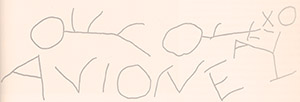
  • Vietnam: Encounters with the Spirit World

    Vietnam: Encounters with the Spirit World

    From New Dawn 148 (Jan-Feb 2015)

    A medium is an individual who has a connection with the spiritual world, or the “other side” as some people call it. The spirits on the other side of the veil between life and death can communicate with them. In the West, there is a long tradition of mediums relaying messages from the deceased to family and friends left behind. This is known as “mental mediumship.” Another more intriguing form of mediumship known as “physical mediumship” prospered in the 19th century. In this form, mediums would sometimes go into a trance and spirit controls would subsequently speak through them. These controls would harness subtle forces as well as the medium’s own energies to levitate objects and produce materialisations. These displays stunned great men of science like Alfred Russell Wallace and William Crookes.

    In Vietnam, mediumship has been turned into an art form. Far from the table tipping and communication with deceased loved ones in the West, Vietnamese mediumship more resembles divinely inspired performance art. These spirit possession rituals are known as Lên đồng. With an array of beautiful glittering costumes, heavenly music, and dancing, watching a mediumship ritual in Vietnam is akin to visiting Broadway. However, mediumship in Vietnam is not completely uniform.

    There are two basic camps of mediums – those affiliated with St Tran Hung Dao and those associated with the goddesses, princesses, princes, and mandarins of the Four Palaces. The latter mediums are associated with elaborate performance rituals. The former don’t often give elaborate performances, but play a key role in protecting people via the power of St Tran.

    Four Palace mediums accept the existence of four realms: Heaven, Mountains and Forest, Waters, and Earth. Each realm is presided over by a goddess, the highest being Liễu Hạnh, who is the goddess of Heaven. Under each of these goddesses there lies a pantheon of warrior heroes (called Great Mandarins), Holy Ladies who are the royal representatives of the mother goddesses, and stately Princes and Princesses.1 A mythology associated with each of the spirits grants them their defining characteristics. Mediums of the Four Palaces may actively incarnate each spirit in the pantheon except for the mother goddesses at the top of the hierarchy. They are said to make only brief appearances with no accompanying performance or speech.

    To get a feel for the setting, cultural anthropologist Kirsten Endres reports:

    Lên đồng rituals are undoubtedly symphonic in character, as they tease the senses with a complex blend of sights, scents and sounds: the magnificent temple interior, the artfully arranged trays of offerings, the intoxicating smell of incense and flowers, the sumptuous robes and accessories that transform the medium into a deity, the entrancing rhythm of the liturgical music, and, ideally, the virtuosity of the ritual performance.2

    The first key ingredient in a successful Lên đồng ritual is distinctive costumes. Each spirit sports its own unique blend of costume and accessories. For this reason, a contemporary medium requires upwards of “20 different brocade tunics, wrap-around skirts and blouses, as well as various headdresses and a range of trinkets and jewellery.”3 Male spirits often require accessories such as swords, spears and sticks with bells. Female spirits, on the other hand, require things like fans, rowing oars, combs, flowers, bracelets, and makeup.4 Once the medium is adorned in the right attire, they must then put on a great performance.

    Each spirit has a particular style of dance. A good mediumistic performance is one in which the medium’s heart and soul is divested in the ritual. They must lose themselves as any great actor would and truly embody the spirits. During the performance, the spirits are said to act upon the medium and guide his or her movements, but in order for this to happen, a total and wholehearted submission to the spirits’ guidance is required.5

    Most mediums do not actually enter a full trance state during the rituals. However, they are aware of the spirits presence through various sensations such as a feeling of lightness for female spirits, or, conversely, heaviness in the head and shoulders, or “hotness of the guts” for male spirits. In some instances, especially if the medium has a close affinity with a particular spirit in the pantheon, they may become fully entranced and lose all awareness of their surroundings.6 In any event, the spirit is said to be incarnated in the medium during the performance.

    A typical possession ritual begins with food offerings to the various spirits at the main altar. The medium then sits in front of the altar surrounded by ritual assistants who help them change into the appropriate dress for each spirit who he or she embodies during the performance, which can last for several hours due to the great number of spirits the medium may embody. Next, the medium covers his or her head with a red veil, sometimes shaking or swaying as the spirit descends into him or her. Then, by a hand gesture, the medium signals which spirit has descended, and throws off the red veil once the spirit has embodied him or her. The assistants then act quickly to dress the medium and hand them the accessories. The medium next performs a ritual dance, the movements, postures and gestures of which reflect the deity’s rank, gender and personality. Depending on the spirit, they may dance with rope candles, oars, fans, swords or other items. After the dance, the deity might speak through the medium expressing words of thanks, blessings, or wishes to the participants. Afterwards, the deity may bless the altar offerings, and participants can come forward to present offerings and request a favour from the deity, such as advice, divination, healing, prosperity or protection.7 Granting a specific favour will depend on which deity is currently ‘possessing’ the medium. The Seventh Prince was a gambler in life, so devotees will ask for his blessing on their next gambling venture. The Tenth Prince, associated with talent and knowledge, may help devotees with studies.8

    When a medium’s spirit embodiment is complete, they will replace the red veil over their head until a different spirit in the pantheon embodies them, and the process is repeated. During each incarnation, a band of musicians plays specific musical pieces for each of the different spirits. In these songs, traditional instruments play a melody appropriate for the spirit, and a vocalist sings a song that tells the history, merits, and amazing powers of that spirit.9 Finally, when the ritual is finished, the offerings (gifts presented to the deities during the ritual) are redistributed among the participants as lộc, meaning ‘blessed gifts’. Since these items now have the blessings of the spirits, they are thought to be imbued with power and are prized by all. Each participant receives a bag of gifts to take home. These may include food, beverages, and money.10

    Becoming a Medium

    Mediums enter their trade because they have a heavy spirit root (căn), meaning their fate is tied to one or more of the spirits in the pantheon. This usually means they owe a karmic debt to the spirit(s) incurred during a previous incarnation.11 A medium thus has close affinity with a pantheon spirit who shares a strong spirit root with him or her. This particular spirit may influence the medium’s personality and habits. If a male medium has a female spirit root, they may act effeminately and, vice versa, a female medium with a male spirit root may act hot-tempered and masculine.12 Even clothing style can be traced back to a medium’s spirit root. One medium, Mrs Duoc, has a fetish for pink clothes because she has the root of the Ninth Young Lady, who always wore pink.13

    Besides having a spirit root, there are other reasons to be a medium as well. Sometimes a person will become a medium as a debt of gratitude for a service provided by the spirits.14 The biggest reason for entering mediumship is to relieve suffering. Anthropologists Karen Fjelstad and Lisa Maiffret explain:

    Several individuals become mediums in response to life crises – such as the loss of a loved one, financial problems, or interpersonal conflicts. These crises caused grief, mental and physical illness, stress, and generalised anxiety.15

    Mediumship in this context is a way to connect with a support group of fellow mediums (and spirits) and find greater meaning in life through spiritual practice. Another interpretation, however, is these misfortunes are caused by the spirits in order to drive people into mediumship.

    Illness & the Supernatural

    Vietnamese mediums recognise two kinds of illness, yin and yang. A yin illness is one caused by supernatural forces, whereas a yang illness is physical in nature. A person afflicted with a yin illness may indicate they are destined for mediumship. The spirits will cause misfortune and sometimes mental illness until the person enters mediumship. Other times, of course, they are not destined for mediumship, but are simply afflicted by an angry ghost and must make offerings at a temple or drink healing water. One example of the former is described by Fjelstad and Maiffret:

    Hung’s life was full of difficulty before he became a spirit medium. He worked on a lunch truck from two in the morning until six in the evening every day of the week… During this time, Hung’s son was imprisoned for a shooting, and his eighteen-year-old daughter tried to commit suicide. Full of stress and anxiety, Hung said he wandered the streets “like a water buffalo,” roaming here and there. Physically ill for three months before he attended his first possession ceremony, Hung said he had intense stomach pain and vomited everything he ate. Everything changed when he became a spirit medium. His physical health improved, he stopped wandering the streets, he found a better job, and his daughter began feeling better.16

    The above story and many others hint at the belief that spirits in the other world have control over people and worldly affairs. Kirsten Endres describes a woman who was told she must become a medium or her husband would die. Not believing this, she ignored the advice and a few months later her husband suddenly became ill and died. She was subsequently told that if she did not enter mediumship her son would begin behaving badly. This time, she did not want to take the risk, so went ahead and organised an initiation ceremony and is now a medium.17

    Besides relieving hardship, mediumship has other rewards. The Mother Goddesses of the Four Palace religion are said to bring prosperity and good fortune to their adherents.18 This is why mediums spend lavishly on Lên đồng rituals. In essence, Four Palace mediumship is said to bring material success to the medium and his or her devotees. Researcher Pham Quynh Phuong writes:

    For spirit mediums, mediumship is an endless circle: working hard to earn money in order to spend generously in possession rituals, hoping to be more successful and luckier in business, then using part of the profits earned from doing business to thank spirits by performing more rituals. In Hanoi, middle-class mediums who host Four Palaces rites often spend between two and ten million dong (US$150 to 700) [for a single ritual], six to fifteen times the monthly salary of the average civil servant…19

    Mediums believe the more they spend, the more the spirits will appreciate and help them further to succeed in life. As one medium told Phuong, “Many people who calculate carefully are quite willing to spend money to serve spirits because after they perform the rituals their business becomes more successful and they gain more money than they spend.” Phuong says he is struck by the wealth of some master mediums and their disciples. He is awed by the opulent shrines some master mediums own, with dozens of gold-inlaid statues. He describes leaving one Lên đồng ceremony with his bag of blessed gifts containing “not only a ‘green rice’ cake and some apples, but also a note worth one-fifth of my monthly salary as a researcher.”20

    Not only do the spirits of the Four Palaces provide material success, they also help mediums feel more at ease and confident in their daily lives. One medium explains: “Firstly, when I serve the spirits, I am very happy, I like it. Secondly, when I return home after a Lên đồng, living is easier and more prosperous, and the children study well.”21 Many mediums speak this way and say their mind is at ease after performing a spirit ritual. They “have something to trust in” and “don’t have to worry anymore.” They feel confident in their activities, knowing the spirits will look out for them.22

    Another controversial view of mediumship in Vietnam is that it allows both males and females to transgress gender boundaries.23 In a country where homosexuality is still taboo, being a medium of the Four Palaces is a way for men to openly act in an effeminate manner – wearing women’s clothing, makeup, and other accessories during possession by a female spirit, as well as acting and speaking like a woman. Not only during the rituals, but also in their daily lives, it is not looked down upon for male mediums to act effeminately. It is communally accepted because of the male’s spirit root with a female member of the pantheon. Likewise, this interpretation vindicates a female medium’s masculine behaviour, an embodiment by a male spirit.

    Interpreting personality via a spirit affinity can give license to all sorts of behaviours. One medium, Rose, traces not only her hot-temperedness back to the influence of the Prince spirits, but also her love of gambling, smoking cigarettes, and having love affairs. Furthermore, she traces her unforgiving nature to the spirit root of the Third Princess who, legend has it, never forgives. Finally, she says she has a very sharp tongue and will not concede an argument because of her affinity with the Little Princess.24 We see here that mediums can claim karmic ties to multiple spirits of the pantheon, and by doing so almost any behaviour can be justified. Even drug addiction could be said to be due to the influence of the Seventh Prince, who was addicted to opium in his earthly incarnation.25

    Mediumship of St Tran

    The other main form of mediumship in Vietnam is the mediumship of Tran Hung Dao and his family. Tran Hung Dao is a national hero in Vietnam who is best known for defeating the Mongol-Chinese army in the thirteenth century.26 As commander-in-chief of the Vietnamese military at the time, his multiple victories over the much larger Mongol-Chinese army are seen as being due to his “sound and creative military tactics.”27 Held by many as an exalted warrior, his spirit is now called upon for protection. He protected the Vietnamese territory physically during his earthly incarnation, and now from the afterlife he provides spiritual protection against ghosts and demons.28

    The mediumship of St Tran is said to be a polar opposite of the Four Palaces’ mediumship. While Four Palace mediumship is theatrical, beautifully performative, and meant to confer prosperity and good fortune upon its participants, St Tran mediumship is violent and intended to protect one from worldly and spiritual dangers. Phuong details his experiences at a St Tran possession ceremony:

    Four men of the Nguyen lineage, dressed in the red and white costumes of Saint Tran’s sons and generals, repeatedly throttled themselves with white cloths, pierced their cheeks with skewers, and used a small knife to cut their tongues, smearing their blood on sheets of paper to distribute. The last man… held a sword in one hand, shouted at the top of his voice, and jumped forwards and backwards before cutting his tongue…. Blood was smeared on two kinds of papers on which were written, in Sino-Vietnamese characters, “Trừ tà sát quỉ” (expel ghosts, kill devils)…. People excitedly vied with each other for them, groaning, even laughing, while attempting to grab the bloody sheets.29

    These sheets of paper, marked with the blood of St Tran or one of his generals or family members, are thought to have the power to keep evil spirits away and protect one from yin, or supernaturally caused illness. In the past, these bloody sheets were burnt to ashes and then the ashes were mixed with water for drinking. Nowadays people make amulets out of them and carry them around their necks, in their wallets, or even under their pillows.30

    You would think these two completely different forms of mediumship will always exist in total separation, but in recent times there has been an integration of sorts. Four Palace mediums have started to adopt St Tran as part of their pantheon of spirits. Mediums of the Four Palaces will embody St Tran just like they embody other spirits of the pantheon, performing a beautiful dance and delivering messages to the participants. This is, however, extremely controversial. One medium explains: “A ‘great hero’ like Saint Tran ‘never appeared to dance like others’ or ‘deliver nonsense messages’.”31 Even so, it is often the case that mediums serve both the spirits of St Tran and his family, and the spirits of the Four Palaces. This is because each has its own set of benefits. By serving St Tran, one affords oneself good health and protection from ghosts. On the other hand, by serving the spirits of the Four Palaces, one gains material success and prosperity. As was told to Phuong: “A pagoda [temple] that has no mother goddess altar has no wealth,” and “Saint Tran’s altar is essential for every shrine to protect the shrine from harassment by evil spirits.”32

    It seems Vietnam has a spiritual marketplace rivalling Thailand in its immensity.33 There is a cultural heritage in both places for worshipping spirits. In the past, Vietnamese kings and high-ranking civil and military court officials would make offerings and pray to St Tran at a temple before conducting important national business or going into battle.34 Today, though a lot has changed in the world, the situation is much the same. You can see company directors attending spirit possession rituals before signing or bidding for a contract. Likewise, government officials sometimes make generous offerings to the spirits at these same rituals before and/or after an important election.35 In Vietnam, the power of the spirits in the minds of the people is still very much alive.

    [alert type=”general” dismiss=”no”]This article was published in New Dawn 148.[/alert]

    [alert type=”success” dismiss=”no”]If you appreciate this article, please consider subscribing to help maintain this website.[/alert]

    Footnotes

    1. K.W. Endres, Performing the Divine: Mediums, Markets and Modernity in Urban Vietnam, NIAS Press, 2011, 16
    2. Ibid., 64
    3. Ibid., 95
    4. Ibid., 95-97; K. Fjelstad & Hien, (eds.), Possessed by the Spirits: Mediumship in Contemporary Vietnamese Communities, Cornell University, 2006, 60-61
    5. Endres, 85
    6. Fjelstad, 90
    7. Ibid., 27-28, 40; Endres, 3-4
    8. Endres, 101-102
    9. Fjelstad, 62, 65
    10. Ibid., 28; Endres 114
    11. Endres, 31, 52
    12. Fjelstad, 67-68
    13. Pham Quynh Phuong, Hero and Deity: Tran Hung Dao and the Resurgence of Popular Religion in Vietnam, Mekong Press, 2009, 104
    14. Fjelstad, 120-121
    15. Ibid., 112-113
    16. Ibid., 115
    17. Endres, 45
    18. Phuong, 131
    19. Ibid., 138
    20. Ibid., 138-139
    21. Fjelstad, 69
    22. Ibid., 84, 88
    23. Endres, 98
    24. Ibid., 50
    25. Ibid., 100-101
    26. Phuong, 21
    27. Ibid., 24
    28. Ibid., 74
    29. Ibid., 85
    30. Ibid., 86
    31. Ibid., 111
    32. Ibid., 131-132
    33. ‘Living With Spirits: Magic & the Supernatural in Thailand’ by Daniel Neiman, New Dawn 141 (Nov-Dec 2013); ‘Mystery Thailand: Monks, Magic & the Spirit World’ by Daniel Neiman, New Dawn 140 (Sept-Oct 2013)
    34. Ibid., 27
    35. Ibid., 135

    © New Dawn Magazine and the respective author.
    For our reproduction notice, click here.