New Dawn – World's Most Unusual Magazine

Category: Ancient Mysteries

  • Goddess of Time in the Sky: The Forgotten Divine Science of the Female Priesthood

    Goddess of Time in the Sky: The Forgotten Divine Science of the Female Priesthood

    From New Dawn 204 (May-June 2024)

    Time appears to march on at what seems a constant rate. In this way, time has two opposite directions, the somewhat known past and the largely unknown future. However, events in the sky repeat and so they can be predicted as seasons within a year or lunar phases within a month. Even before modern calendars, Stone Age humans counted the days in a month to understand the recurrence of the menstrual period and know when moonlight would be strong again at night. 

    Stone Age Origins of Time

    Two months happen to equal 59 whole days: a lunar month is 29.53 days long, just over twenty-nine and a half, which is half of 59. In the artefact shown at the top of Figure 2, each day was carved upon a flat bone, each mark appearing varied in shape and depth to show the Moon’s changed phase on a given day. The flat bone enabled a cyclic shape to be used, of 59 marks, which “ate its own tail,” showing there was always the same number of days in two “moons.” This sameness emerges from dividing the recurring time of the solar day into the time of the month’s phases over two months to give the recurring whole number of 59, then forever useful as a knowledge object.
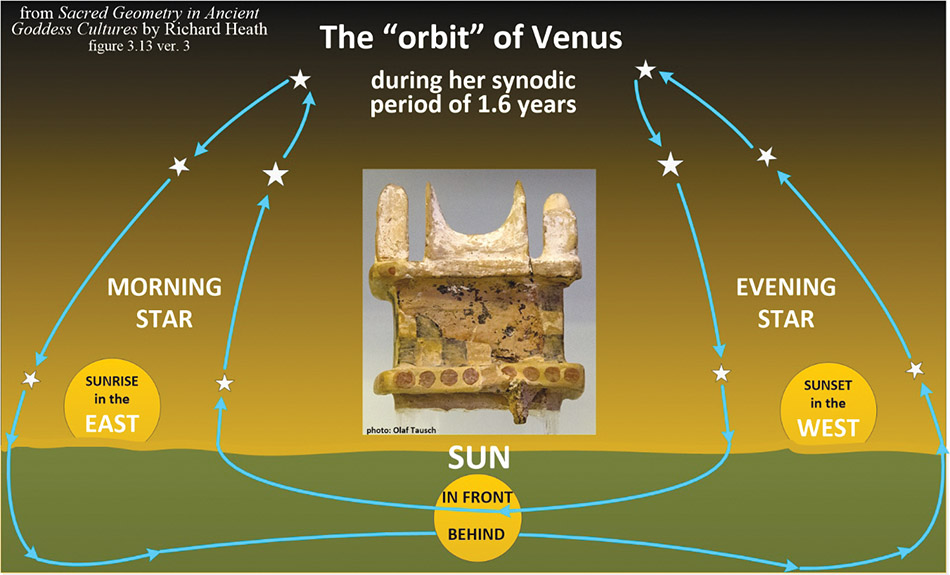
    FIGURE 1:  The form of the Minoan “horns of consecration”, on the island of Crete, followed (outside) the form of the manifestations of Venus in her synodic period.

    The solar day clearly has the same duration every day, and two lunar months clearly repeat twice after 59 days. But our modern life is the extended straight line of day numbers belonging to unequal months of the Sun so that the loops that recur are lost in the framework of man-made time. The Stone Age “lesson from nature” was that events in the sky largely run according to a definite schedule along cyclic paths, most of these being along the path of the Sun, along which the Sun, Moon, and planets follow their own cyclicities, seen from the Earth. 
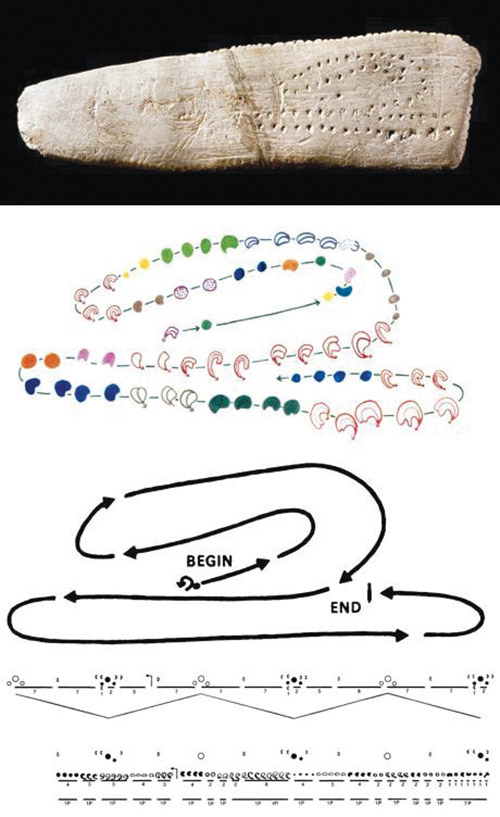
    FIGURE 2:   (Top) L’Abri Blanchard Tally Bone 30,000 BP with (bottom) Alexander Marshack’s interpretation, showing marks as days shaped to express the Moon’s phase, over 59 whole days or two lunar months.

    This reliable cyclicity shaped our notion of an unchanging realm of Eternity, different to Life upon the Earth as our ever-developing present moments within Existence. In this way, knowledge from the sky came to be considered sacred and interconnected through numbers when counted as days and months, especially through counting the often identically sized discs of the Sun and Moon and their respective years.

    While astronomy started as a Stone Age hobby, it later became a tribal science quite unlike our own astrophysics. Only later would farmers support city specialists who assimilated this prehistoric science by forming religious sciences and cosmologies in the East, such as Egypt, Babylonia, India, China, and so on. 

    Millennia later, the 16th century altogether discarded this geocentric view-from-the-Earth and adopted a new heliocentric view of the solar system, which enabled the planetary orbits of the Sun to be clearly seen as mathematical ellipses by Kepler. This system was soon seen to be held together by Newton’s newly intuited force, gravity, of the central Sun’s large mass.

    If counting the Moon had synchronised both female fertility and male hunting, then this shaped the format we call the hunter-gatherer who foraged for food before there was farming. Their women formed a naturally less-mobile core for the tribe and its children, the men hunting over extensive ranges. All adults worked together for the greater good, and since they were in-common descended from the women, a matrilineal society was an effective format for problems requiring larger groups. 

    Stone Age art of the goddess seems to have been varied and geometrical (see Language of the Goddess by Marija Gimbutas). In Sacred Geometry in Ancient Goddess Cultures, myexperience in analysing megalithic sites caused me to question whether the megalithic monuments were the work of Neolithic or a New Stone Age farming revolution moving west from the Middle East where it started. Because the farming revolution only advanced slowly through central Europe and towards the Atlantic coast (see Figure 3), it pretty much avoided the Mediterranean. 

    The megalithic revolution largely took place within the islands and hinterlands of the Mediterranean and Atlantic Coast of Europe between 5000 BCE and 2500 BCE. It was, therefore, much more likely to have been carried out by the late middle Stone Age (Mesolithic) people before the farming way of life arrived. The indigenous culture of old Europe was Mesolithic – well-established and centred around women, foraging, and matrilineage (using your mother’s name) rather than the neolithic norm, led by men – farming and patrilineage (using your father’s name). 
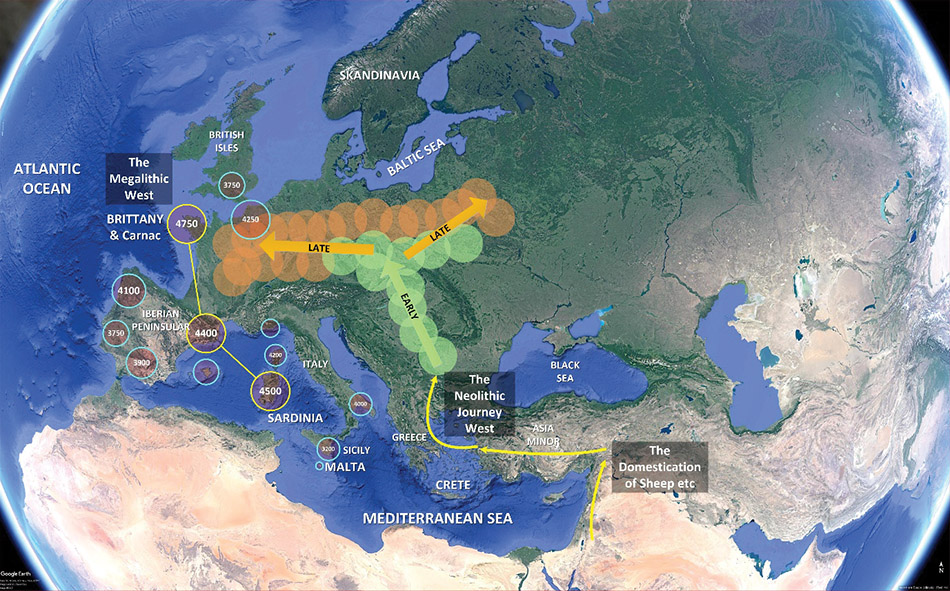
    FIGURE 3:   The journey of the Neolithic from the Middle East (see coloured circles), via central Europe, was in stark contrast to the dating (dark circles) of megalithic sites on the Mediterranean and Atlantic coasts. The neolithic were patriarchal farmers using the seasonal year while the late middle Stone Age were matriarchal foragers, truly interested in the sacred time world of the celestial objects, and hence building and using the megalithic observatories. [Globe by Google Earth, data from Barry Cunliffe and Bettina Schulz Paulsson.]

    Clash of the Titans

    Being indigenous, matrilineal tribes were far more likely and able to innovate megalithic astronomy, which was effectively inherited from the long tradition of day counting seen on Stone Age tallies like the Blanchard plaque. 

    This continuity of interest in the sky conflicts with today’s model of history and our foundation myth for modern science – as the grandchild of ancient Near Eastern civilisations and exact sciences, fuelled by farming on fertile soils using irrigation. 

    By comparing day counts, sky time could be given geometrical forms such as circles, squares, and rectangles/triangles, and these were rightfully considered sacred by the coherent megalithic culture on Europe’s shores. The civilisation was numerate and intelligent, but not Stone Age in the vernacular sense, of having no ability to reason. 

    Having an extended family of adults and no urgent need to seasonally grow crops, conserve seeds or tend their animals, nature already provided food through foraging. There was a natural collaborative workforce, perhaps explaining the dearth of neolithic settlements alongside the earliest megalithic monuments. 
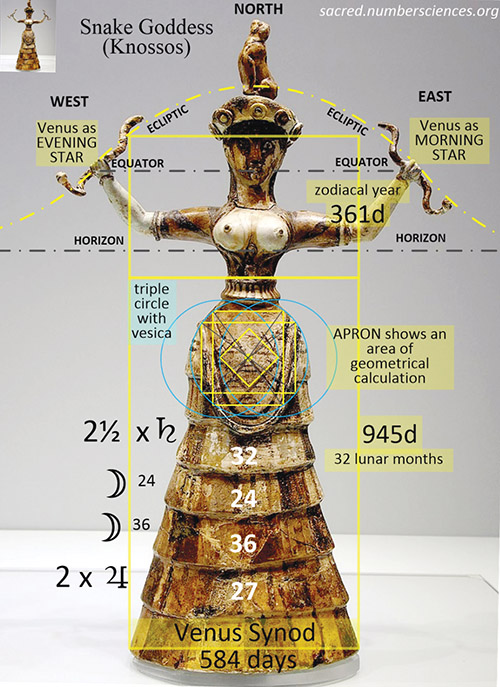
    FIGURE 4:   Fibonacci Phi: 1.618 is found in the Fibonacci approximation of 8/5 = 1.6 of the practical year of 365 days to the Venus Synod 584 days. Venus was seen as the youthful goddess, Earth as the mother of all that lives and the Moon as the wise older goddess, these together forming the ancient Triple Goddess. [photo by C. Messier for Wikipedia.]

    Having overcome this misnomer that megaliths were automatically neolithic, further work is required to see why modern science cannot understand sky phenomena like the Stone Age did. Today, we do not study the synodic periods of the planets because they are seen as merely an incidental composite of the planetary orbits and our solar year. 

    Quite unexpectedly, the view from the Earth is supremely important since the structure of time on Earth is a phenomenon reflecting the form and structure of the numerical world. This suggests that the Earth was, in some way, influenced by the abstract world of numbers to form this type of time environment. It might also suggest that the evolution of Life was an intended outcome for the third planet. 

    Having discarded the Earth-centred model of the universe and ridding ourselves of the religions and gods proposed to explain this phenomenon, modern humans are free to live in an accidental universe where one is simply alive on an existential line-of-time with no end except for death, and without any appreciation of the deeper structural recurrences implicate within the sky. Instead, there is a hotch-potch Roman calendar whose roots were largely man-made.

    The Greek myths referred to women but in ways designed to put matrilineage norms in a bad light. The patriarchal farmers of Jupiter-Zeus had defeated the religion of the Goddess whose representatives had snakes (perhaps the dreadlocks of the Medusa or knowledge of the snake-shaped ecliptic) or had kept men sexually enslaved on an island (as in the Odyssey) or sacrificed a sacred king after “a year…” (of 364 days) “…and a day” (making 365 in all). Our 7-day week derives from this Saturnian year of 364 days (52 weeks), named because the synod of Saturn is exactly 378 days (54 weeks) while the synod of Jupiter is 57 weeks. 

    In this, one is seeing through a series of invisible filters – the ancient Greeks were against the tribal age that preceded farming and cities, when women rather than men were most important to that way-of-life. 

    The Enlightenment adopted the heliocentric planets as a binary, removing the foundations of a vast past cultural corpus of religious and pre-scientific thought that had quite reasonably shown something special about the world that modern science never chooses to see. 

    If we fathom megalithic astronomy, its uniquely powerful discoveries reveal what the religious texts were about: Earth’s favourable environment is no accident; it is a planet for the evolution of Life

    Megalithic discoveries were transmitted subconsciously into the cultural subconscious of later civilisations. This impulse still informs and infects our arts and the classical form of numeracy called mathematics. 

    This diffusion benefited from the clash of the Titans, namely between the matriarchal and patriarchal ways of life in the Eastern Mediterranean and Levant. It was recorded in the intellectual life of the Greeks and Hebrews, thus informing the Islamic and Christian world views as a code of numbers and stories often agreeing with those of the East. 
    Get the issue this article appears in

    Continuity in Sacred Building 

    If you know how to look, one finds the units of measure and geometries of the megalithic repeated in later sacred buildings, built under disparate religions, as if the design of sacred buildings had some sort of megalithic origin. 

    The Chinese, Indian, Buddhist, Minoan, Classical Greek, Romanesque, Islamic, South Asian, Amerindian, Gothic, Sufi, and Renaissance buildings draw upon common geometric and metrological blueprints relating, for example, to the relative size of the Earth and Moon, and the sophisticated celestial time cycles such as eclipse phenomena, as if to celebrate the cosmic environment even though many religions conceptualised the heavens as if not found in the sky. 
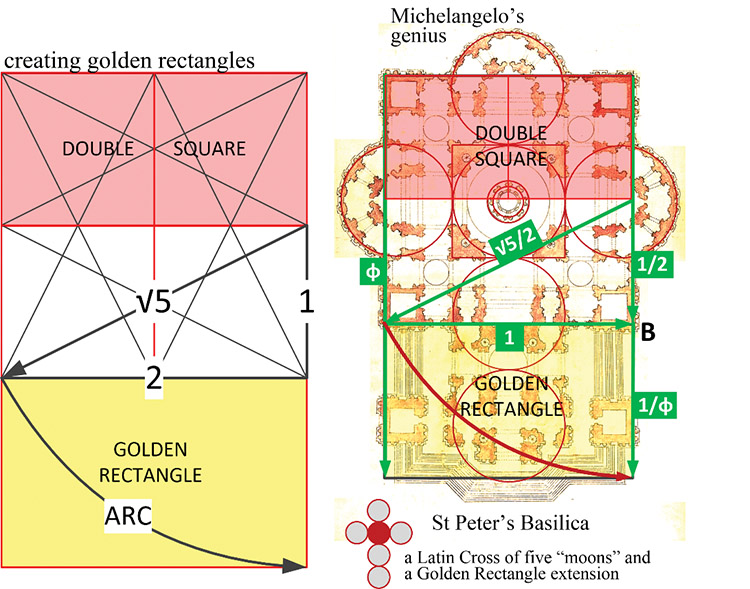
    FIGURE 5:   St Peter’s Basilica: Sacred buildings followed geometrical and numerical rules that reflect both the cycles of the sky and the geometrical methods and numerical results of the megalithic.

    For this reason, my books explore buildings of the historical period in the same way as megalithic buildings to demonstrate this continuity of an invisible language, as if there are people with megalithic knowledge behind the construction of buildings without the outer religion officially acknowledging this fact. 

    In some strange way, others and I are recapitulating ancient works in terms of their meaning by employing skills belonging to the past. For example,

    In Cappadocia, Turkey, stone-cut churches inexplicably contain high levels of meaning in their dimensions and definition of circular apse and rectangular naos occupied by hermit monks. 

    Angkor Wat is shown to be a massive statement of astronomical cyclicities alongside an outer meaning of Vedic mythological carving and Indian temple design. 

    St Peter’s Basilica was a Renaissance rebuilding involving many great architects, including Michaelangelo, who displayed sacred geometrical skill in translating a Greek square-cross basilica design into a Latin cross cathedral design through the golden mean relationship of a square to such a rectangle (see Figure 5). St Peter’s tomb is in the centre of a model of the Earth and Moon.
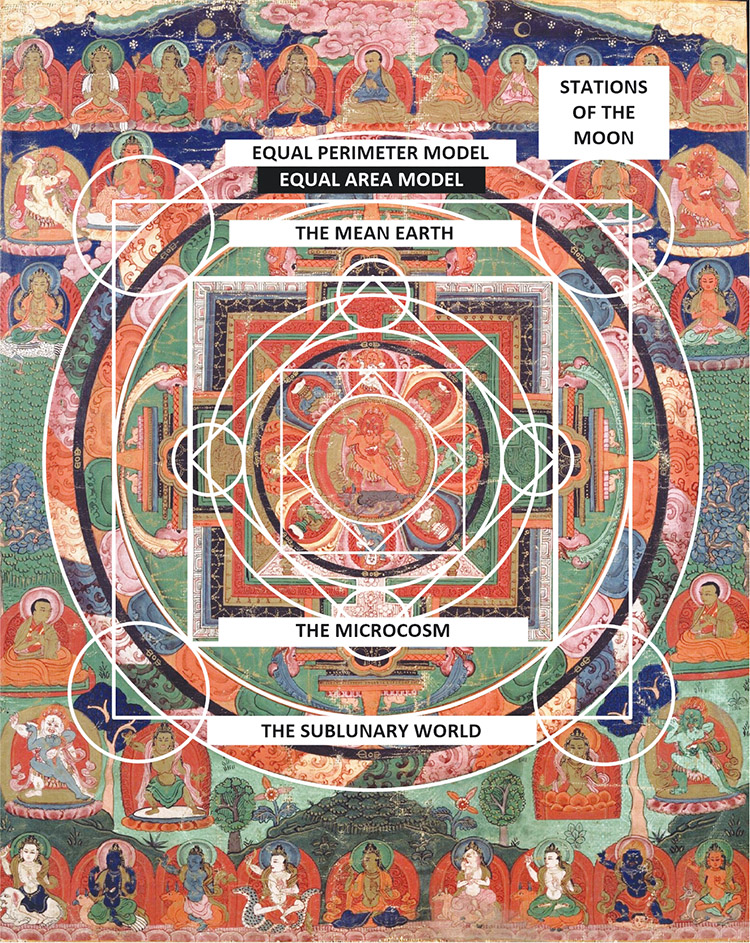
    FIGURE 6:   The geometry of Equal Perimeter circle and square, with Moon circles, showing the influence of the time world of the Earth and Moon, as the true basis for the designs called mandalas. [from Sacred Number: Language of the Angels, Fig 7.20.]

    Chapter 11 of my 2024 book Sacred Geometry in Ancient Goddess Cultures: The Divine Science of the Female Priesthood demonstrates that the equal perimeter model of the Earth and Moon had been related to the now-abandoned geocentric model. 

    The Earth is at the centre, and a system of growing square areas for each planet’s synod grows to embrace the whole figure, revealing that it was the archetypal form taken as the norm for Buddhist Mandalas. Jungian therapists and others use Mandalas to enable interaction with the subconscious mind. This suggests that our very being, as microcosmos, is part of the Earth and its planetary Sky environment of time. 

    Celestial time appears to be a carrier wave for reality, not just a straight line.

    The author’s book Sacred Geometry in Ancient Goddess Cultures: The Divine Science of the Female Priesthood is available to purchase.

    Images courtesy of Richard Heath and the publisher Inner Traditions International. 

    [alert type=”general” dismiss=”no”]This article was published in New Dawn 204.[/alert]

    [alert type=”success” dismiss=”no”]If you appreciate this article, please consider subscribing to help maintain this website.[/alert]

    References

    Barry Cunliffe, Europe Between the Oceans: 9000 BC to AD 1000, Yale 2008. 
    Marija Gimbutas, The Language of the Goddess, Thames & Hudson 1989.
    Richard Heath, Sacred Geometry in Ancient Goddess Cultures, Inner Traditions 2024. 
    Richard Heath, Sacred Geometry: Language of the Angels, Inner Traditions 2021. 
    Richard Heath, Tragic Loss of the Geocentric Arts and Sciences: When Poetry was the Language of Cosmology, New Dawn #185 (Mar-Apr 2021), sacred.numbersciences.org/2023/06/03/tragic-loss-of-the-geocentric-arts-and-sciences.
    Alexander Marshack, The Roots of Civilization: The Cognitive Beginnings of Man’s first Art, Symbol and Notation, Weidenfeld and Nicolson 1972.
    Bettina Schulz Paulsson, Time and Stone. The Emergence and Development of Megaliths and Megalithic Societies in Europe, Archaeopress 2017. 

    © New Dawn Magazine and the respective author.
    For our reproduction notice, click here.
  • A Traveller’s Guide to Anomalies on Mars: Evidence of Lost  Civilisations?

    A Traveller’s Guide to Anomalies on Mars: Evidence of Lost  Civilisations?

    From New Dawn Special Issue Vol 18 No 6 (Dec 2024)

    I am the founder and premier investigator of the Mars research group known as The Cydonia Institute and a member of the Society for Planetary SETI Research (SPSR). My research encompasses over 30 years of study and analysis of NASA and ESA images of the planet Mars.

    I have coauthored two books and six peer-reviewed science papers that discuss anomalous formations on the surface of Mars. Over the past two decades, I have attended various science conferences and seminars as an invited speaker and appeared on numerous radio, podcasts and television programs, such as Beyond Belief and Coast to Coast with George Noory. I also appeared on the History Channel’s Ancient Aliens, The Proof is Out There and The UnXplained with William Shatner.

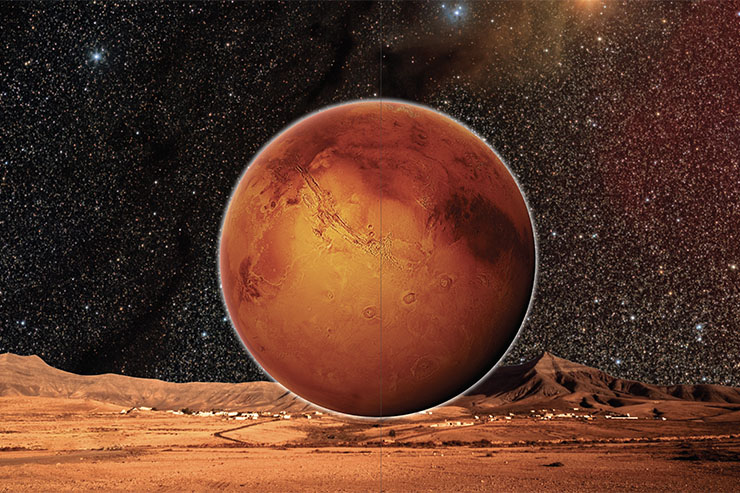
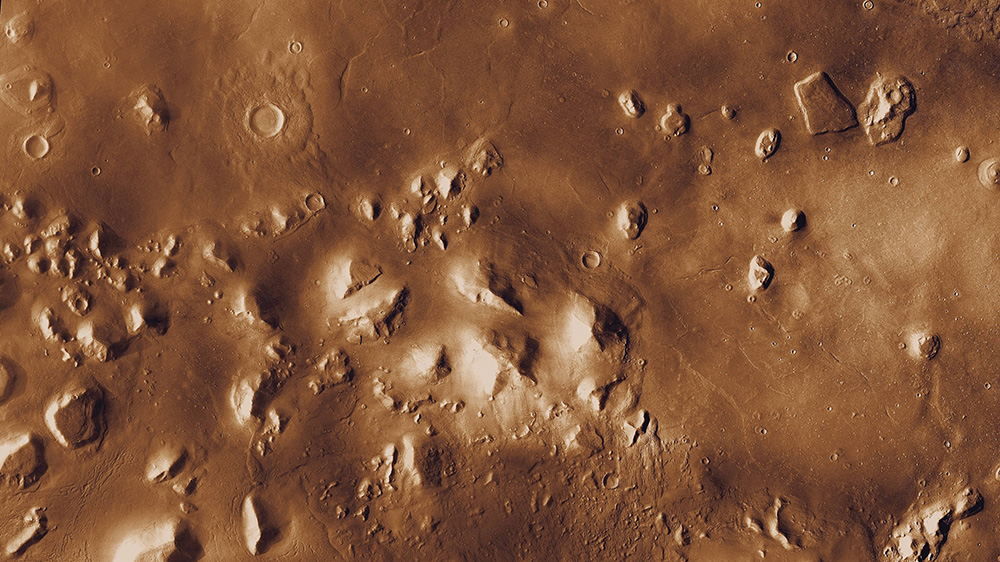
    Discussion of artificial objects on Mars first began with the discovery of the “Face on Mars” back in 1976. Later, other intriguing and anomalous objects in the same region were found to display geometrically interesting characteristics. The above picture of the Cydonia region shows the famous “Face on Mars” top centre. The landscape is scattered with other intriguing images including pyramid shapes.

    From Artist to Investigator: A Journey into Mars’ Anomalies

    Before I continue, I would like to make a very clear point. I am not a scientist. I am an artist. My early schooling was in the visual arts. I am a sculptor, painter, art instructor, writer, curator, and the former director of the Sculptors’ Association of New Jersey. I have exhibited extensively throughout the New Jersey and New York area and was represented by the Grace Harkin Gallery in New York’s East Village. By the close of the 1980s, my work was recognised by one of the most influential art dealers of the twentieth century, Ivan Karp, and I had a one-man show at his gallery, the OK Harris Gallery of Art in SoHo. I was on top of the world.

    Outside my short art career, I had a great interest in archaeology and studied the artwork of the Olmec, Maya, Aztec and Native American cultures. I attended glyph workshops at the University of Pennsylvania and learned to read Maya hieroglyphs. I also joined the Pre-Columbian Society, holding membership with the University of Pennsylvania and its affiliate in Washington D.C.

    After finding a book by Randolfo Pozos titled The Face on Mars, Evidence for a Lost Civilization? my studies quickly turned to Mars. The structural formations presented in his book were truly remarkable. Around this time, a friend informed me about a new video by Richard C. Hoagland featuring his UN Briefings titled The Moon/Mars Connection. Hoagland was one of the first researchers to promote the discovery of the famous Face on Mars and expose evidence of artefacts on the moon.

    Moving forward with the eyes of an artist, over the next thirty years, I acquired a vast collection of images from the ever-growing NASA archives. I found numerous formations with a high degree of geometric form and symmetry and others with pictographic design. Shuffling through my best-of-list, I decided to present some of these discoveries as a traveller’s guide to these anomalous structures on Mars.

    My investigation opens with a short history of aerial photography, from the innovative use of hot air balloons and aeroplanes to the current use of high-tech satellites and LiDAR. I scrutinise its ‘bird’s eye view” advantage for military reconnaissance and explore the creation of Google Earth, which has enabled armchair archaeologists to travel the world. They have discovered everything from giant bird and deer geoglyphs to the ruins of long-lost ancient cities submerged by the sands of time.

    Exploring Elysium Planitia: The Pyramids of Mars

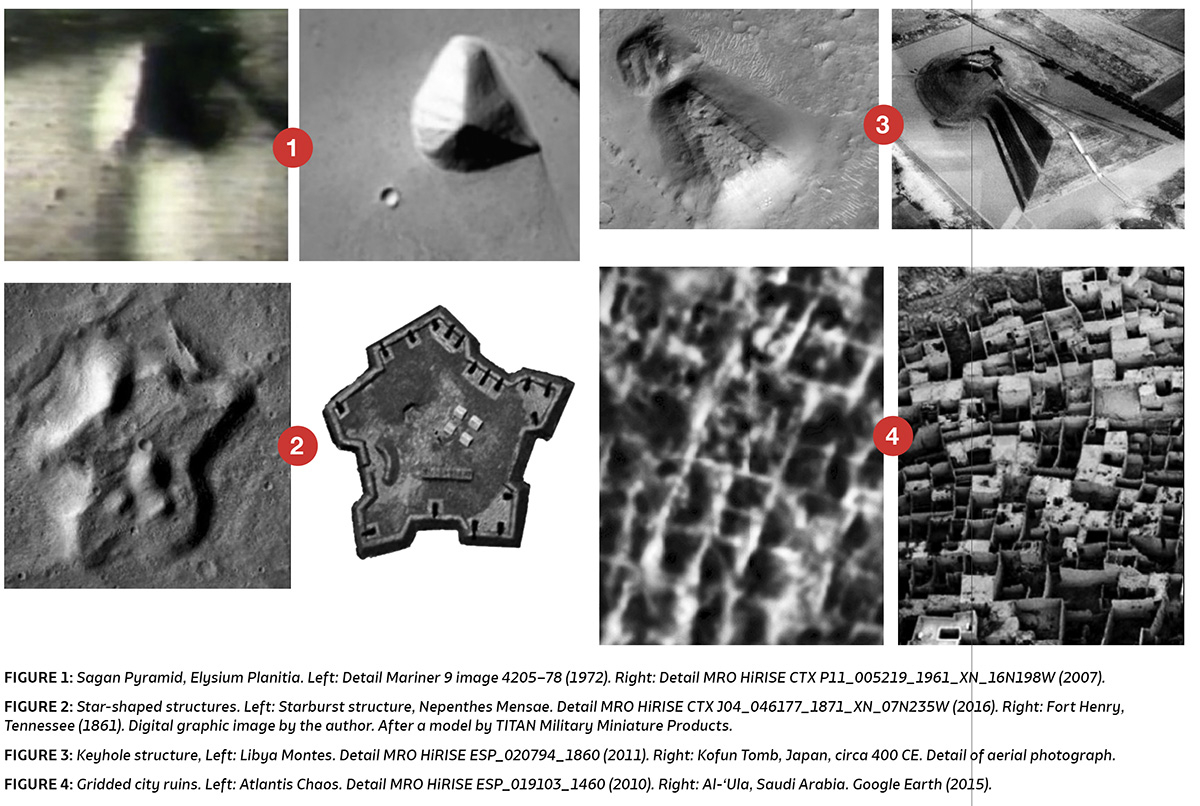
    My tour of Martian structures begins in the northeastern quadrant of the red planet in an area known as Elysium Planitia. There, I provide the reader with the opportunity to take another look at a set of enormous pyramidal formations that were once made famous by the world-renowned astronomer Carl Sagan (Figure 1). He was so intrigued by one of these pyramidal formations that he included it in his early lectures and his 1980 book and television series Cosmos. Unfortunately, Sagan never had the opportunity to examine better images. Five years after his death, the European Space Agency released a high-resolution image of the area that showed the pyramids to be real and captured an entire complex of additional pyramidal structures.

    Mysteries of Nepenthes Mensae: The City of Symbols

    From there, the reader travels to west and is confronted with a pair of city complexes occupying the planet’s Nepenthes Mensae region. The pair of settlements includes over 20 pictographic and geometrically shaped structures nestled within a small and condensed area. The first settlement consists of a small group of highly symmetrical and geometrically shaped structures that include a Hexagonal Pyramid, a U-shaped Delta, and a Five-sided Star formation (Figure 2). The complex also features pictographic formations representing a full-bodied Dove, Killer Whale and the head of a Bulldog Bat. The second Nepenthes Mensae settlement consists of a connective train of four aligning platforms, each containing an assortment of highly symmetrical and geometric structures such as ovals, squares, triangles and rectangles.

    Another mysterious feature is below this pair of city settlements within the same area of the Nepenthes Mensae region of Mars. Both NASA and The European Space Association (ESA) released a set of images showing an elongated hexagonal structure that is highly symmetrical. The six-sided structure has a thick, relatively flat platform with a central mound formation. After doing a quick Google search of ancient ruins around the world, much to my amazement, I found the remains of an identical elongated hexagonal mound in the southern region of central Turkey. Known as Araban Hoyuk, the six-sided mound has a similar flat platform design with a central mound formation, just like the structure on Mars. I sat staring at the screen in disbelief; I was looking at its terrestrial companion, a true doppelganger.

    Libya Montes and the Keyhole Enigma

    Continuing my tour on a westward trek, I take the reader to a well-known area of the planet just above Isidis Planitia known as Libya Montes. It is here that NASA proudly proclaimed to have photographed an odd formation that resembles an “exclamation mark” on the surface of Mars. The isolated formation appears to sit alone in the middle of nowhere. Although the highly symmetrical structure can also be seen as a keyhole and screams of artificiality, NASA scientists quickly dismissed it as a natural phenomenon.

    Taking on the challenge, my colleagues and I delved into a comprehensive analysis of the keyhole-shaped structure and produced a science paper which shows this geometrically precise structure to not only be highly symmetrical but also match the design of the keyhole-shaped tombs found in Japan (Figure 3).

    As a result of our studies, the Martian Keyhole structure can now be found all over the World Wide Web in news reports, blog articles and YouTube videos. It was also featured on the History Channel’s Ancient Aliens and the UnXplained program with William Shatner.

    Pushing further west, across this once thriving planet, the reader travels down below Valles Marineris and into the Atlantis Chaos region of Mars. Once there, the reader is exposed to an extensive investigation of the remains of an ancient city nestled along the vast edge of a dead lake. The city consists of a gridded network of broken walls and shattered foundations that bring to mind the compartmentalised city of Al-‘Ula in Saudi Arabia (Figure 4) or the shell-shocked remains of Dresden after World War II.

    Directly below the remains of this gridded city in Atlantis Chaos are two neighbouring settlements. Both settlements contain a set of five large geometrically shaped formations that include squares, triangles, and other polygonal forms. They are all very similar in size and have almost identical dimensions.

    Parrotopia: A City Under the Wings

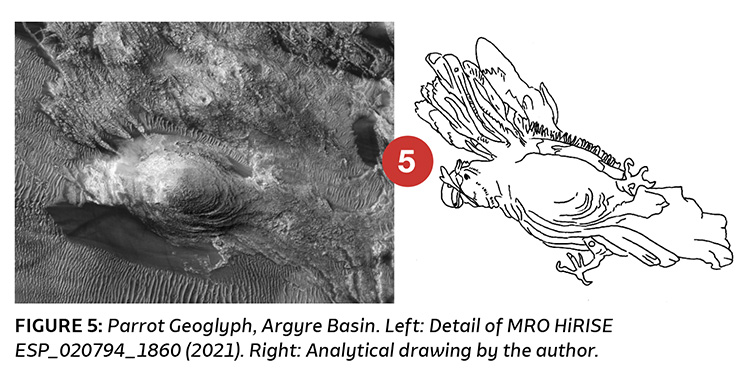
    The tour concludes in a large-impact crater located within the southwestern quadrant of the planet known as Argyre Basin. Setting on the western side of this massive basin, the reader will experience a real “bird’s eye view” of a parrot-shaped formation over a mile long (Figure 5). The sculpted parrot formation has clear and recognisable features in the appropriate size and shape of a real parrot. It has a head, eye, beak, body, and wing. Additional anatomical components include two legs with feet and toes. When two geologists and four veterinarians examined the formation, they all confirmed that this parrot geoglyph on Mars has over twenty-two points of anatomical correctness. Yes, that’s right, over twenty-two points of anatomical correctness!

    Beyond the mind-blowing accuracy of the parrot formation, the wing area above the main body contains the remains of an entire city. Dubbed Parrotopia, the city includes a port jetty, a towering lighthouse and other shoreline-related structures. Hidden within the wings streets and gridded infrastructure, we find the pictographic imprints of the Maya Rain God in his various mythological incarnations.

    Before the Parrot geoglyph’s inclusion in my new book, it was the subject of two papers published in peer-reviewed science journals. It featured on the History Channel’s Ancient Aliens and The Proof is Out There programs. It was also mentioned on the front page of the Wall Street Journal and, most importantly, as a “tip of the hat” to its discover Wil Faust, an anthropologist and city planner from Pennsylvania, NASA officially titled the area Parrotopia.

    Get the issue this article appears in

    Ancient Wars Between Mars & Earth?

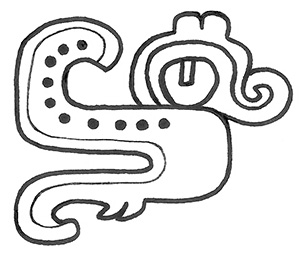
    The reader is left with a little-known Mayan story that records what archaeologists read as a Star-War. The conflict was between the ancient cities of Naranjo and Tikal with the occupants of the planet Mars. Maya records show that Naranjo was founded around 896,000 years ago by a group of unknown people related to Mars and worshipped a primordial creature known as the Zip Monster, the patron god of Mars (Figure 6). It appears that just as the 13 colonies of America fought a revolutionary war with their homeland, England, to acquire independence 22,000 years ago, the colonies of Naranjo and Tikal fought a similar battle for independence with the occupants of Mars.

    Figure 6: Zip Monster. Detail of page from the Dresden Codex. Drawing by the author.

    This New World story sounds quite similar to the Sumerian stories of the Anunnaki wars between Earth and Mars with Enlil and Marduk, as interpreted by Zecharia Sitchin. In both versions, all life on Mars is extinguished by some kind of nuclear war. This dim scenario is supported by NASA’s detection of high levels of Xenon 129 within the Martian atmosphere, which was recently revealed by theoretical plasma physicist and astrophysicist Dr. John Brandenburg.

    The current evidence of structures and ruined cities presented in official NASA and ESA images of Mars suggests that they were built after their original occupants were destroyed. Therefore, it is speculated that what we see today are the abandoned remains of that second occupation, which was only partially destroyed.

    When this collection of structures is examined, you will find that they exhibit a direct correlation between the architecture and iconography of many of the cultures found on Earth, most notably within North and South America. These findings are supported by image specialist James S. Miller, geomorphologist William R. Sanders and geologist Michael Dale. They offer pro and con arguments for the artificial and natural origins of these unusual formations. Side-by-side comparisons of Martian structures are presented with their terrestrial counterparts, offering evidence of a shared aesthetic achieved in two opposing worlds.

    In the foreword to The Great Architects of Mars, Dr John Brandenburg says that the evidence presented would appeal to anyone interested in the mysteries of Mars and our ancient past or if we entertain the idea that Mars and the Earth share a common point of origin. He states: “This is a unique and extremely important book, which provides the clearest and most precise evidence, ever compiled, to support the existence of artificial structures on the surface of Mars.”

    As an artist, I have an eye for art and architecture, and my book, The Great Architects of Mars, results from those observations. I invite you to take another look at Mars with clear eyes and remember that through NASA’s own pictures, the truth will be revealed. 

    George J. Haas’s book The Great Architects of Mars: Evidence for the Lost Civilizations on the Red Planet (with a foreword by John E. Brandenburg, PhD) is available from Inner Traditions.

    [alert type=”general” dismiss=”no”]This article was published in New Dawn Special Issue Vol 18 No 6.[/alert]

    [alert type=”success” dismiss=”no”]If you appreciate this article, please consider subscribing to help maintain this website.[/alert]

    © New Dawn Magazine and the respective author.
    For our reproduction notice, click here.
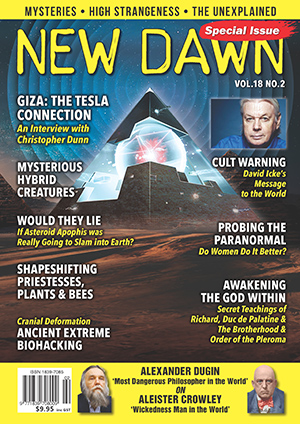
  • Giza – The Tesla Connection: An Interview with Christopher Dunn

    Giza – The Tesla Connection: An Interview with Christopher Dunn

    From New Dawn Special Issue Vol 18 No 2 (April 2024)

    Unlimited, inexhaustible, clean energy – free for everyone. Fantasy or real? According to Christopher Dunn, ‘free energy’ is not only possible but was a reality for the Ancient Egyptians.

    Christopher Dunn

    A lifelong master craftsman, machinist, and engineer with experience in aerospace and a focus on precision and laser application, Dunn became fascinated with the Great Pyramid at Giza after reading Peter Tompkins’ iconic book The Secrets of the Great Pyramid. He spent more than 20 years studying the Great Pyramid and other Egyptian sites.

    Due to his engineering background, Dunn saw things in the Pyramid’s construction that others missed. Most people marvelled at the Pyramid’s size and asked, “How did they do it?” Dunn examined its precision and asked, “Why was it necessary?”

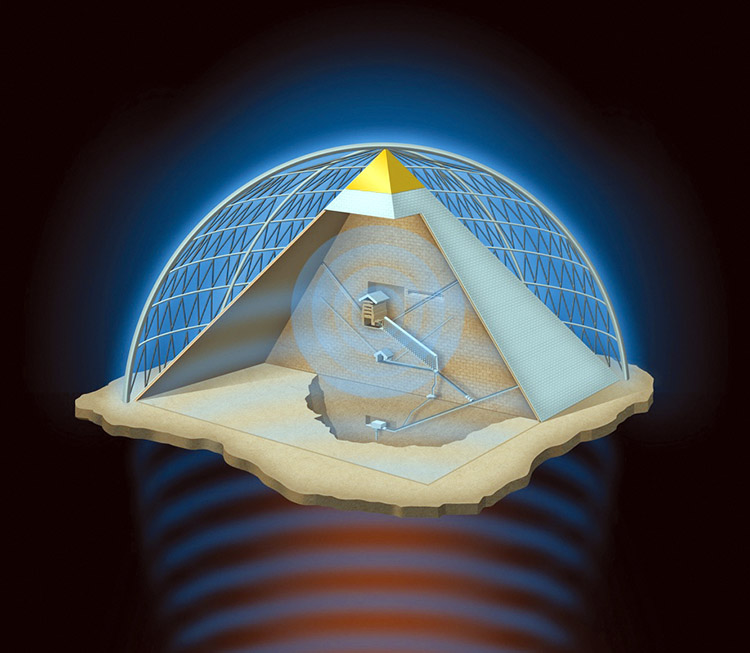
    Dunn burst into the limelight with the 1998 publication of The Giza Power Plant: Technologies of Ancient Egypt. Dunn revealed that the Great Pyramid was a giant power generator – an acoustical device that created harmonic resonance with the Earth and converted the planet’s natural vibrations into usable energy for an ancient civilisation. He showed that the Pyramid’s numerous chambers and passageways were positioned with deliberate precision to maximise acoustical qualities.

    In 2010, he followed up with Lost Technologies of Ancient Egypt: Advanced Engineering in the Temples of the Pharaohs, a unique study of the engineering and tools used to create Egyptian monuments, proving beyond a shadow of a doubt that advanced knowledge and machining was utilised.

    Dunn’s new 2024 book, Giza: The Tesla Connection: Acoustical Science and the Harvesting of Clean Energy, expands his hypothesis that the Great Pyramid at Giza was built as an advanced energy-harvesting machine.

    Dunn proposes that the Ancient Egyptians used the Great Pyramid to generate clean free energy, similar to what genius inventor Nikola Tesla later envisioned, as indicated in the title of his new book.

    Today, the world is suffering an energy crisis. The solution to our woes might be literally staring us in the face – on the Giza plateau. Will anyone listen? New Dawn recently spoke to Christopher Dunn.

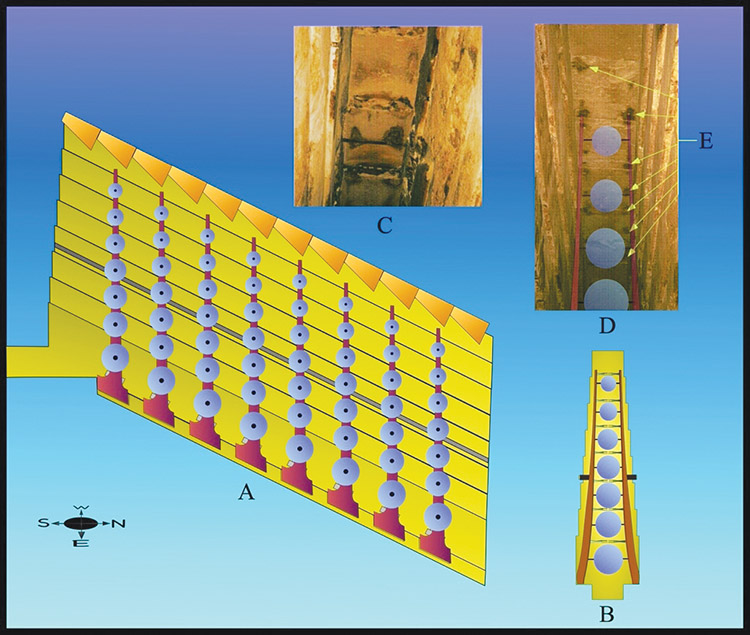
    A: East to West cross section of Grand Gallery with 8 of 27 installed resonators. B: North to South view along the length of the Grand Gallery. C: Close up of ceiling showing scorch marks. D: Ceiling scorch marks with resonator frame illustrating its correlation.

    NEW DAWN (ND): What discoveries have been made since the publication of The Giza Power Plant?

    CHRIS DUNN (CD): For those not familiar with the book, The Giza Power Plant: Technologies of Ancient Egypt is a reverse engineering exercise that began in 1977. The objective was to find a reason why every feature discovered in and around the pyramid exists. In a nutshell, it describes the Great Pyramid as a machine, the function of which was to draw energy from the Earth and distribute it to the inhabitants at that time. This ultimately led to the publication of the book in 1998.

    While there has been a lot of discussion about lost civilisations and ancient cataclysms, my intention while writing the book was to focus primarily on the physical evidence inside and around the Great Pyramid. Having said that, it is becoming clearer now, with the fine work of other investigators and their introduction of new evidence, that a cataclysm occurred in antiquity and the Great Pyramid, along with everything else existing in physical form that sustained a sophisticated society, was damaged beyond repair, as was the civilisation that built it.

    Since The Giza Power Plant was published, quite a few discoveries have been made in and around the Great Pyramid that support and allow refinements and strength to the theory. In chronological order, they are:

    • In 2001, while being filmed for a documentary on the Giza Plateau near Cairo, Egypt, I received permission from Zahi Hawass [Egypt’s Minister of State for Antiquities Affairs at that time] to go inside the Great Pyramid, which had been closed for cleaning. While inside the Grand Gallery, I noticed and photographed scorch marks on the ceiling. The pattern matched my theorised design of the frames that held a series of acoustic resonators. In The Giza Power Plant, I posited there was a hydrogen explosion inside the King’s Chamber that pushed out the walls and cracked the ceiling beams. I did not believe that evidence to support this theory would exist in the Grand Gallery, but in consideration of all other evidence, it would have been perfectly reasonable to do so. I just didn’t think of it at the time.

    • In 2002, the Queen’s Chamber South Shaft was explored by a robot named Pyramid Rover, designed and built by iRobot in Massachusetts, USA. The hydrogen that exploded, I theorised, was created in the Queen’s Chamber. This conclusion was reached by examining evidence that had been discovered related to the chamber and its North and South Shafts.

    With much fanfare and an audience that had been primed to be glued to their televisions for the intended broadcast of new pyramid discoveries, the Pyramid Rover prepared to climb the shaft and drill through a limestone block at the end. This blockage was first discovered by robotics engineer Rudolph Gantenbrink in 1993 and subsequently labelled “Gantenbrink’s Door.” While preparing to drill through the blockage, the thickness of the door was measured using an impact-echo probe and determined to be 3.25 inches thick. My illustration of this “door” showed a thickness of 3.6 inches.

    The image captured by an endoscopic camera inserted through the hole showed another blockage approximately 10 inches from the “door.” Not much else that was remarkable was revealed in the South Shaft at this time. No other theory offered at the time regarding what would be revealed was correct. However, what was revealed did not negate my theory, but for it to be proven 100% correct, more information was needed.

    Little did I know at the time that further validation of the theory was discovered after the iRobot team completed their work in the South Shaft and the documentary production crew departed. Before packing up their equipment and exiting the pyramid, the iRobot crew sent the Pyramid Rover robot up the North Shaft. Gantenbrink had attempted to explore the North Shaft in 1993, but could not navigate beyond two long exploratory rods that had somehow become stuck where the shaft turns on an angle to the left. Using a different tactic, by turning their robot 90 degrees so that it gripped the walls instead of the floor and ceiling, the Pyramid Rover was able to ride over these obstructions.

    Evidence of chemical inlet shaft.

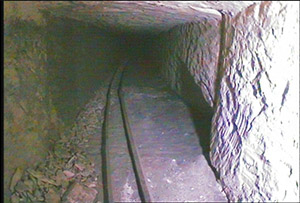
    Pyramid Rover revealed two pieces of evidence supporting my theory about using these shafts. One was an opening in the East wall near one of the bends approximately 90 feet up the shaft from the Queen’s Chamber. I theorise that chemicals were introduced into the shaft behind the blockage, but this evidence showed that the entrance for the chemicals was lower down.

    The other evidence revealed was the existence of another blockage, similar to the South Shaft, but with electrodes that were not corroded and with one that was recessed and showed signs of electroplating.

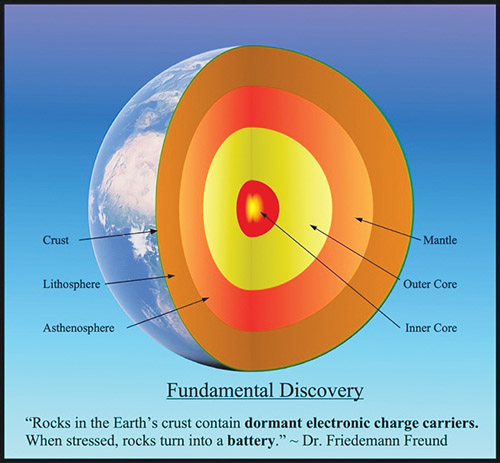
    Dr. Friedemann Freund’s discovery.

    • In 2006, Dr. Friedemann Freund, a NASA physicist, completed his laboratory experiment confirming his theory that earthquake lights were the result of electron flow propagating through the lithosphere when peroxy defects in their minerals were subjected to stress. His conclusion was that under certain conditions, igneous rock beneath our feet turns into a giant battery.

    • In 2010, another robot team from Leeds University in the UK, and headed by Chinese dentist Dr. TC Ng, fashioned a different style of robot which Dr Zahi Hawass named Djedi, the name of Khufu’s magician [in reference to Pharaoh Khufu of the 4th Dynasty who is said to have commissioned the Great Pyramid]. The Djedi robot was equipped with a snake camera that was able to look around the small space and even look behind Gantenbrink’s “door.” The images it captured allowed me to slightly modify my engineering design, but overall supported my proposed function for these features.

    • In 2017, the Scan Pyramid Mission released the muography images taken inside the Great Pyramid. Muons passing through the Great Pyramid would impinge on special plates set up inside the Queen’s Chamber and Grand Gallery. The image that resulted from the interaction identified voids inside the pyramid. Of particular interest was a large void above the Grand Gallery. Discussing this with aerospace engineer Eric Wilson, he offered the idea that it would have been used to pre-amplify microwaves travelling down the shaft before they entered the King’s Chamber. In association with that, drawings made available by Rudolph Gantenbrink of the King’s Chamber’s North Shaft have made it possible in my new book Giza: The Tesla Connection to illustrate this shaft with greater accuracy and point out features that are consistent with waveguide design.

    • On 20 July 2018, the Journal for Applied Physics published an article entitled “Electromagnetic Properties of the Great Pyramid: First Multipole Resonances and Energy Concentration” by Mikhail Balezin, Kseniia V. Baryshnikova, Polina Kapitanova, and Andrey B. Evlyukhin. In this article they reveal the results of their findings of the electromagnetic nature of the pyramids: “Electromagnetic field distributions inside the Pyramid at the resonant conditions are demonstrated and discussed for two cases, when the Pyramid is located in a homogeneous space or on a substrate. It is revealed that the Pyramid’s chambers can collect and concentrate electromagnetic energy for both surrounding conditions. In the case of the Pyramid on the substrate, at the shorter wavelengths, the electromagnetic energy accumulates in the chambers providing local spectral maxima for electric and magnetic fields.” (doi.org/10.1063/1.5026556 124, 034903)

    ND: Of those, which do you think is the most significant discovery?

    CD: Without hesitation, I would say the most significant discovery was Dr. Friedemann Freund’s. While Dr. Freund was only focused on developing the means to predict when an earthquake was about to happen, his proven lab experiments demonstrating his physics correct provide confidence that his discovery has the potential to solve the world’s energy needs.

    Moreover, when it comes to the reason behind building pyramids around the world – knowing that an abundant supply of electrons can be stimulated to rush to the surface as well as the new research showing that pyramids focus electromagnetic energy – there is solid proof that the Great Pyramid was part of a larger global system. For alerting me to Freund’s work, I must thank researcher Robert Vawter, who recently passed away.

    ND: Did The Giza Power Plant anticipate or predict this discovery?

    CD: The Giza Power Plant discussed earthquake lights, ball lightning and other natural phenomena but focused more on the piezoelectric effect of quartz crystals. Freund identified a new physics more related to semiconductors that does not rely on the piezo-effect. In fact, Freund found that one igneous rock called Gabbro has no silicon quartz crystals in it and was more effective in producing electron flow than other igneous rocks.

    ND: What discoveries could have been or were predicted since the publication of The Giza Power Plant?

    CD: All the evidence discovered in the Queen’s Chamber shafts was predicted to exist. The only difference is between my engineering design and that subsequently discovered. Scorch marks in the Grand Gallery could have been, but were not, predicted. Eric Wilson had stressed to me that the MASER needed a preamp to function properly. The “Big Void” may eventually be proven to have functioned in this way.

    Electron Harvester with Tesla Connection.

    ND: How would such an advanced power system shape our society?

    CD: Considering that we have been burning fossil fuels to produce electricity for over 100 years, reducing this method can only benefit the environment. In 2021, America burnt enough coal to build a pyramid that would be 76 times the size of the Great Pyramid. Current methods are highly inefficient and expensive compared to drawing electricity from directly beneath our feet. From a psychosocial perspective, the mental health of humans would improve if we were not depleting the Earth’s natural resources and polluting the atmosphere.

    ND: What other areas of science and engineering do you envision will evolve from this system?

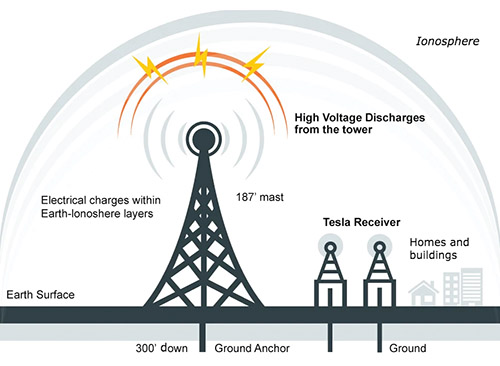
    Graphical representation of Wardencliffe Tower (Source: allaboutcircuits.com/technical-articles/teslas-towers-pikes-peak-wardenclyffe-and-wireless-power-transmission)

    CD: One area of improvement is the transmission of electricity. Electric vehicles are gaining in capabilities and efficiency. I envision a delivery system that transmits electricity without wires, as Nikola Tesla proposed with his Wardencliffe Tower project. I believe car companies could benefit from developing this technology by building their own electron harvesters that would wirelessly deliver power to vehicles and reduce, or eliminate, the need for batteries.

    The recent disclosure of UAPs navigating our airspace and displaying capabilities that we can only dream of possessing provides an indication of what is physically possible. It would seem, though, that breakthroughs in physics, as demonstrated by Freund, for example, are necessary before reaching this level of technological competence. One hundred years of technological advancement has resulted in a world that looks nothing like the world I lived in 78 years ago. If technology improves at the same pace into the future, our children and grandchildren will see a world that looks nothing like the world we live in today.

    ND: How are the Egyptian people reacting to your theories about their monuments?

    CD: Many Egyptians are now abandoning the pyramids as tombs theory and seeing their monuments in a different light. After the publication of The Giza Power Plant, it became clear to me that Western scholars were not accepting the evidence I presented that elevated the capabilities of the ancient Egyptians. After 10 years, I decided to appeal directly to Egyptian engineers with my book Lost Technologies of Ancient Egypt. In the book, I identified and analysed artefacts to conclude they must have been machined and challenged Egyptian engineers to inspect the artefacts themselves. I’m happy to report that an Egyptian engineer, Ahmed Adly, took up the challenge and created a series of YouTube videos where he presented his results.

    An important artefact he inspected was one of the boxes in the Serapeum. He concluded that I was right and provided me with a Foreword for Giza: The Tesla Connection. In his Foreword, Adly reports on a meeting he had with Dr. Ashraf Sherbini, a physicist at Cairo University, who agreed with my theory that the Great Pyramid was a machine. Adly’s videos have been well-received in the Arabic-speaking world, especially among Egypt’s youth. I believe that if Egypt’s history is to be rewritten, that task should be performed by the Egyptians, not outsiders.

    A chapter in Giza: The Tesla Connection is devoted to the Serapeum and also introduces new revelations on pre-dynastic vases that have recently been subject to modern inspection methods.

    Get the issue this article appears in

    ND: Has there been any interest expressed by energy companies?

    CD: An energy company from Malaysia has expressed a keen interest in developing the technology. My philosophy is that any entity wishing to develop it should be free to do so without barriers or exclusivity.

    ND: Is there more to reveal in the Great Pyramid?

    CD: Yes. Further research is ongoing. Of some I am aware, and I’m sure there are others I do not know about.

    ND: Are you currently working on any other writing project?

    CD: I do not plan on writing any more books. However, the recent metrological inspection of pre-dynastic vases has created quite a stir. Several have been inspected using conventional mechanical inspection methods, as well as structured light and CT scanning. The results are simply mind-blowing. STL files are available on UnchartedX.com and have been downloaded and analysed by engineers around the world. The mechanical inspection of the vases can be viewed at youtube.com/watch?v=QzFMDS6dkWU&t=425s. One analysis was performed by cryptographer and mathematician Mark Qvist and his colleague. His article can be read at unsigned.io/granite-artifact. This research, which now involves the Egyptians, is ongoing and articles targeting specific audiences need to be written. 

    Diagram images courtesy of Chris Dunn and Inner Traditions International. There are more images inside the published version of this article.
    Read the full story and contemplate all the convincing evidence in Chris Dunn’s new book Giza The Tesla Connection: Acoustical Science and the Harvesting of Clean Energy. Order your copy from all good bookstores.

    [alert type=”general” dismiss=”no”]This article was published in New Dawn Special Issue Vol 18 No 2.[/alert]

    [alert type=”success” dismiss=”no”]If you appreciate this article, please consider subscribing to help maintain this website.[/alert]

    References

    Freund, Friedemann. “Rocks that Crackle and Glow: Predicting Earthquakes.” Filmed at the 33rd annual Society for Scientific Exploration (SSE) Conference in 2014 at the Hyatt Regency San Francisco Airport, Burlingame, California, USA, youtube.com/watch?v=aRXlk26TcGc
    Freund, Friedemann. 2016. “Using Semiconductor Physics to Forecast Earthquakes.” TEDx Talk Christchurch, NZ. youtube.com/watch?v=B1yno8RjaFE
    Freund, Friedemann, Ouillon G., Scoville J., and Sornette D. 2018. “Earthquake precursors in the light of peroxy defects theory: critical review of systematic observations,” European Physical Journal (EPJ)
    Pyramid Rover exploration of the Queen’s Chamber North Shaft. Ancient Architects YouTube channel, youtube.com/watch?v=Ki0405ulvIY

    © New Dawn Magazine and the respective author.
    For our reproduction notice, click here.
  • Who Killed Mars: Did a Nuclear War Destroy the Red Planet?

    Who Killed Mars: Did a Nuclear War Destroy the Red Planet?

    From New Dawn 150 (May-June 2015)

    Now I am become Death, the destroyer of worlds.
    – Vishnu in the Bhagavad-Gita, 5th Century BCE

    Art is sometimes prophetic. A case in point is the Hollywood movie, Rocketship X-M, starring Lloyd Bridges and Noah Berry, Jr. Credible by the standards of its time, this first science-fiction film of the postwar era postulated a manned expedition to Mars. When the crewmembers arrive, they find an illimitable desert of “pitchblende, immense deposits of pitchblende,” a form of crystalline uranium oxide associated with nuclear explosions. 

    Digging in the sand of the Red Planet, the explorers uncover a metallic, finely-crafted sculpture roughly resembling a human head. “The mind that conceived this must have been of a high order of intelligence,” the expedition leader concludes, “at least the equal of Earth’s, perhaps considerably above ours.” 

    In the distance are the ruins of huge, strange buildings, but they are too radioactive for investigation.

    “To think that a complex, organised society existed here once.” 

    “Yes, and from all indications, thousands of years ago.” 

    “I wonder how it happened.” 

    “There’s always the possibility of a meteor, but then it would have created a depression, like a moon crater.” 

    “No, this wasn’t caused by a meteor. This is definitely blast effect coupled with intense heat… Ironic, isn’t it, the mind of Man, wherever you encounter it, Earth or Mars? The highest attainments of human intellect always diverted to self-destruction. Perhaps the entire surface of the planet is one, vast ruin like this… What a lesson here for our world: One blast, thousands of years of civilisation – wiped out.” 

    When Rocketship X-M was premiered in 1950, its basic premise was exclusively confined within the realm of science fiction. Long before then, astronomers deemed the Red Planet incapable of ever sustaining life of any kind, an impression apparently confirmed by numerous, robotic surveyors and landers that have explored our Martian neighbour since the first successful fly-by of Mariner IV, nearly fifty years ago. It was with more than some amazement then, that I heard Dr. John Brandenburg declare in a radio interview in April 2014 that Mars was long ago the home of a civilisation destroyed by a nuclear attack that killed off all life. 

    Had such a statement been made by just about anyone else, I would have turned off the radio and gone to sleep. But I knew Dr. Brandenburg as long ago as 2000, when he and I shared the speakers’ table at an alternative science conference in the American Northwest, where he spoke knowledgeably and engagingly, but not about extraterrestrial warfare. 

    John E. Brandenburg, Ph.D., is a plasma physicist at Orbital Technologies in the US at Madison, Wisconsin, where he works on space plasma technologies and space propulsion. He researches Microwave Electro-Thermal plasma thrusters for space propulsion. Previously, he investigated air plasmas and plasma propulsion at Florida Space Institute at America’s Kennedy Space Center.  

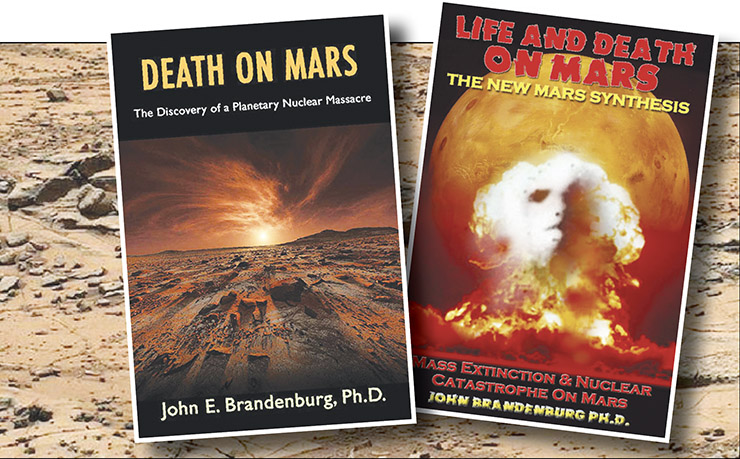
    Co-authored with Monica Rix Paxson, his book Dead Mars, Dying Earth (Crossing Press, 1999) won the Silver Medal in the Ben Franklin awards for books on science and environment. His other books include Life and Death on Mars: The New Mars Synthesis (Adventures Unlimited Press, 2011), and Beyond Einstein’s Unified Field: Gravity & Electro-Magnetism Redefined (Adventures Unlimited Press, 2011). As such, Dr. Brandenburg’s deductions from Martian geology and topography are not the fantasies of a science fiction writer, but scientific conclusions from one of the most important scholars in the world today.

    His April radio interview certainly got my attention, but provoked more questions than answers. To learn them first hand from their original source, I contacted Dr. Brandenburg directly by email, and he took time out from his busy life of scientific investigation to generously share with us some of his truly mind-boggling discoveries:

    FRANK JOSEPH (FJ): What first alerted you to possibilities of a nuclear attack on Mars in the ancient past?

    DR. JOHN BRANDENBURG (JB): A comment by a nuclear physicist at Sandia labs, where I worked, in 1984. I mentioned the excess of Xenon 129 in Mars atmosphere to him, and he became curious, and looked at the data, and then commented flatly, “someone nuked Mars.” He then refused to discuss the matter any further. It took a long time for me to reconstruct the reasons for him saying this from the “open literature.”

    FJ: What evidence exists for atomic warfare on the Red Planet?

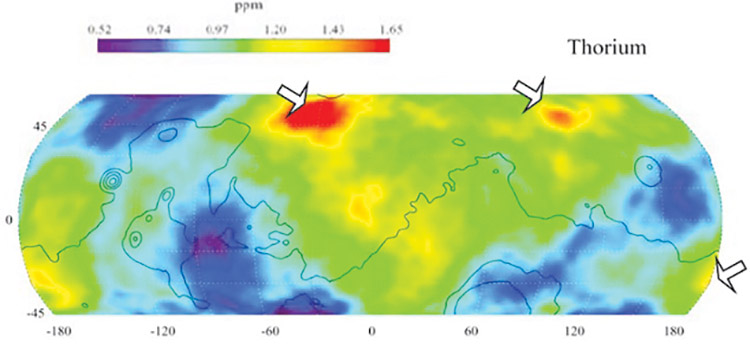
    JB: The spectrum of krypton and xenon isotopes found in the Mars atmosphere, particularly Xenon 129 and Krypton 80. Both are produced by nuclear explosions, the Xenon 129 directly from fission of Uranium 238, and thorium by high energy fusion neutrons, and the Krypton 80 by intense neutron bombardment of the soil. The Mars meteorites, which are samples of sub-surface rock from Mars, are depleted in Uranium, Thorium, and Potassium, all radioactive elements, relative to Earth rocks. 

    But gamma rays from the Mars surface measured by Russian and American probes show much higher levels spread over the Mars surface; radiation from two hot spots. Thus, space craft measurements of Mars atmosphere, and surface radioactivity, plus measurements of Mars meteorites, show this evidence. The fission of Uranium 238 and Thorium can only be done by fusion neutrons from a hydrogen bomb reaction, so, in my opinion, this cannot be explained naturally. Data taken by the Mars Science Laboratory’s Radiation Assessment Detector (RAD) from Curiosity’s interplanetary journey to Mars shows large exposures to radiation, as confirmed and published in Science Magazine in the 31 May 2013 issue. 

    A thin layer of radioactive substances including uranium, thorium (shown in graphic) and radioactive potassium on the surface provide evidence for Dr. Brandenburg’s theory.

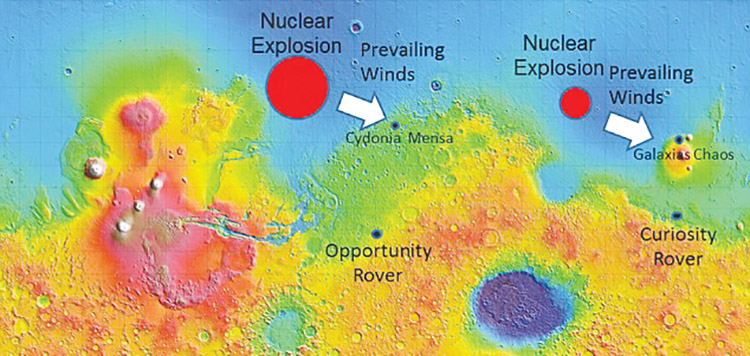
    A thin layer of radioactive substances including uranium, thorium and radioactive potassium covers the Martian surface in a pattern radiating from a hot spot, as indicated by recent maps showing gamma rays in a radiating debris pattern. What may have been an airburst the equivalent of one million, one-megaton hydrogen bombs occurred over the northern Mare Acidalium region of Mars, where there is a heavy concentration of radioactivity. The terrible truth: Mars was actually Earth-like for most of its geologic history. Mars held a massive and evolving biosphere, but was wracked by a mysterious and astonishing nuclear catastrophe.

    FJ: What was the Martians’ cultural level immediately prior to the attack?

    JB: It appears, from examining several possible sites of archaeology, that it was roughly Bronze Age. But that is only an impression from orbit. We must land there and find out.

    FJ: Can you identify the attacker? 

    JB: No. The only way to do that is to go to Mars and investigate. Possibly, the Martians knew who did this from prior contact and recorded it.

    FJ: Have any ruins or cultural debris from the Martian nuclear attack been found, or do you anticipate their discovery in future explorations?

    JB: We have seen, in space-probe images at several sites, what looks like archaeological ruins. I think we must dispatch astronaut teams to Mars as soon as possible to dig at the principle sites, that is the best way to maximise knowledge of what happened and when it happened.

    FJ: When do you believe such an event took place?

    JB: It was long ago, perhaps two hundred to three hundred million years ago. Not even dinosaurs were present then. Only long lived and stable isotopes record this event. 

    FJ: Is there any contemporaneous or corresponding evidence on Earth of the Martian catastrophe?

    JB: It corresponds approximately to the Great Permian Extinction on Earth, the most terrible of all the mass extinctions, and whose cause is a mystery. (The Permian Period ended with the largest mass extinction in Earth’s history, during which nearly ninety per cent of marine species and seventy per cent of terrestrial species died out – FJ.)

    FJ: Why would some military power want to carry out an atomic attack on Mars? 

    JB: It is difficult to conceive of it, but we have seen such things on Earth. I suspect they were targeting a civilisation there, we are of course aware of the “face” and pyramid in Cydonia Mensa, near the major hot spot of gamma rays on Mars in Mare Acidalium, (forming a quadrangle located in the northeastern portion of Mars’ western hemisphere, covering 300° to 360° east longitude [0° to 60° west longitude] and 30° to 65° north latitude – FJ.)

    FJ: Were there any possibilities for Martian survivors – then or now (i.e., their living descendants) – of the nuclear blast? 

    JB: I do not think so. I believe this destroyed all advanced Martian life.

    Nuclear isotopes in the atmosphere resemble hydrogen bomb tests – which Dr. Brandenburg says occurred in two places on Mars, Cydonia Mensa and Galaxias Chaos.

    FJ: How have your scientific colleagues reacted to your statements concerning an artificial nuclear event on Mars?

    JB: I have showed this to many experts in defence nuclear science. They agree with my interpretation, but cannot be quoted publicly. The reaction of my colleagues… where I presented this work was astonishment. However, none disagreed with my basic analysis.

    FJ: Modern Earthly civilisation has reached the capability of putting nuclear weapons into space, and at least one of our probes has already left our solar system; is this level of technology analogous to what the Martians may have achieved and consequently provoked a preemptive strike from a worried or threatened outside power? 

    JB: The possible archaeology at Cydonia Mensa and Elysium on Mars looks like a primitive civilisation. So if this was a nuclear attack, it appears it was preemptive, to prevent future competition. We know the universe is dangerous to life, with asteroid impacts and supernova. Now a new danger has become apparent.

    Get the issue this article appears in

    FJ: Could we Earthlings expect the same kind of intervention, given our developing space technologies? 

    JB: We have no choice but to become space-faring, since we have already alerted the cosmos to our presence by many radio broadcasts and nuclear tests. Becoming space-faring as quickly as possible is the only way to maximise our future safety, in my opinion. 

    Dr. Brandenburg’s discoveries comprise the most astounding, even alarming news we could ever hope to learn; namely, that a non-human civilisation flourished on Mars many millions of years before our species evolved on Earth – a civilisation that was utterly annihilated and all life on its world deliberately killed by some superior power with nuclear weapons. 

    Dr. Brandenburg presents compelling evidence that the Red Planet is more appropriately named after the Roman god of war than subsequent generations ever suspected. 

    John E. Brandenburg contributed the Foreword to George J. Haas‘s 2024 book The Great Architects of Mars: Evidence for the Lost Civilizations on the Red Planet. Brandenburg’s books Life and Death on Mars and Dead Mars, Dying Earth are available from online bookstores.

    [alert type=”general” dismiss=”no”]This article was published in New Dawn 150.[/alert]

    [alert type=”success” dismiss=”no”]If you appreciate this article, please consider subscribing to help maintain this website.[/alert]

    © New Dawn Magazine and the respective author.
    For our reproduction notice, click here.
  • Yuga Shift: The End of the Age & the Impending Planetary Transformation

    Yuga Shift: The End of the Age & the Impending Planetary Transformation

    From New Dawn Special Issue Vol 18 No 1 (Feb 2024)

    In the years leading up to 2012, when there was considerable global consternation over the approaching end of the Mayan Calendar, I became interested in the Yuga Cycle doctrine of ancient India.

    I decided to take a closer look at the available data and philosophical speculations to determine the possible ending of the Kali Yuga or Iron Age – the current age of greed and lies, discord and violence, that we live in.

    When I dove into the details, however, I realised that a few errors and omissions had crept into the ancient texts over time during our long passage through the darkness of the Kali Yuga. The original formulation of the Yuga Cycle was completely forgotten.

    Most ancient cultures subscribed to the belief that human civilisation and consciousness move in grand cycles, from the Golden Ages of illumination and harmony to the Dark Ages of ignorance and strife.

    The guiding principle that I adopted to help me work out the Yuga Cycle framework was that there could not have been different Yuga Cycles for different cultures. There was only one Yuga Cycle for the entire world that governed the periodic rise and fall of consciousness. To stitch together the original framework, delineating the common threads that run through the different traditions was of utmost importance. I also figured that I needed to keep tabs on the latest archaeological, anthropological and historical findings, for any Yuga Cycle framework needs to be backed up with as much scientific data as possible.

    In July 2012, I published an article in which I put forward what, in my opinion, was the original Yuga Cycle timeline, that indicated the Kali Yuga was due to end in 2025. I discussed the rationale for the proposed timeline in the article, and I have treated the matter with a lot more rigour in my new book.

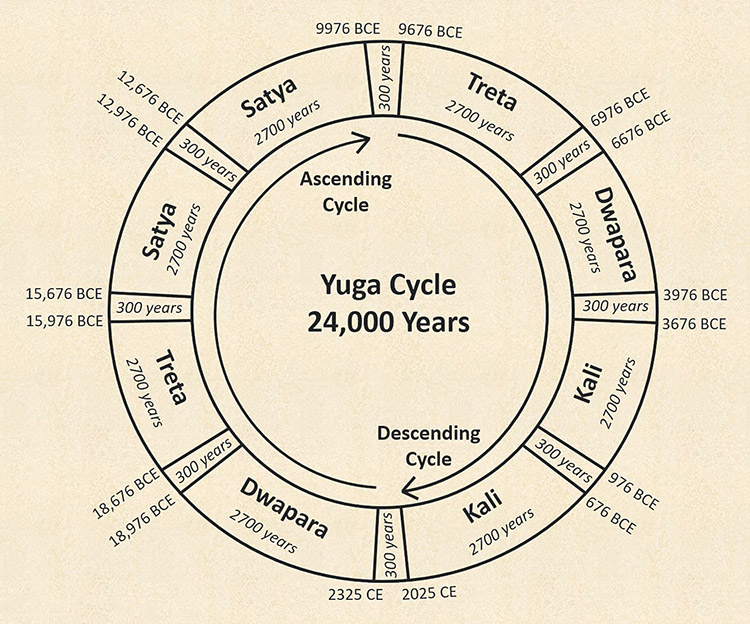
    The 24,000-year Yuga Cycle based on the Saptarshi Calendar. Credit: Bibhu Dev Misra

    Without going into the nitty-gritty, let me present some of the essential building blocks of this framework.

    • The complete Yuga Cycle is 24,000 years in duration and is comprised of an ascending cycle of 12,000 years, when human consciousness, in tandem with our lifespan and physical size, gradually increases, followed by a descending cycle of 12,000 years when such qualities gradually diminish.
    • Each 12,000-year half-cycle is comprised of four Yugas of equal duration of 3,000-years each. The actual duration of a Yuga is 2,700 years, and it is followed by a transitional period of 300 years before the qualities of the subsequent Yuga are manifested. The Yuga Cycle was tracked using the “Calendar of the Seven Sages” or “Saptarshi Calendar” of ancient India, which has a 2,700-year cycle called a “Saptarshi Yuga.”
    • As per the historical records, one of the starting points of the Saptarshi Calendar was in 6676 BCE, which denotes the beginning of the Dwapara Yuga (Bronze Age) in the descending cycle. Using this date as an anchor point, the entire Yuga Cycle timeline gets unravelled, as shown below. For those who are not familiar with the Sanskrit terms: Satya Yuga is Golden Age, Treta Yuga is Silver Age, Dwapara Yuga is Bronze Age and Kali Yuga is Iron Age.

    The Yuga Cycle framework reveals that the descending cycle of consciousness began in 9676 BCE, around the same time that the last Ice Age came to a rather abrupt end. The same date has been indicated in the ancient texts as the time when Atlantis sank into the ocean, and Ahura Mazda re-created the world and initiated the World Cycle of 12,000 years. Over the past 5,700-odd years, we have been living in two back-to-back Kali Yugas – the descending Kali Yuga followed by the ascending Kali Yuga. These two Yugas of ignorance and discord span most of recorded history, starting with the Bronze Age civilisations in Egypt, Mesopotamia and the Indus Valley.

    We now approach the end of ascending Kali Yuga in the year 2025. The term “ascending” tends to convey the wrong impression that we are in a “higher Yuga,” and that our civilisation may be on an upward trajectory of virtue and progress. Far from it. In the ascending Kali Yuga, only the material circumstances of life begin to improve, along with an increase in our lifespan and physical stature, but the degradation of human consciousness and the proliferation of vices in society continues unabated throughout the entire duration of the Kali Yuga.

    This is why we have ended up with an out-of-balance society characterised by a massive “matter-spirit gap” that is highly destabilising and responsible for much of the misery and injustices we see around us. The need of the hour is to reduce our attachment to material acquisitions and focus our energies on the other dimensions of life, particularly on cultivating mental and spiritual awareness to restore the much-needed balance, harmony and sanity in our lives.

    There is no doubt that we are living in times of momentous changes, which will begin to unfold as we get closer to 2025 and enter the period of transition. Not only are we about to emerge from the dense, materialistic vibrations of the Kali Yuga, but we are also at the cusp of the entire descending cycle of consciousness that began in 9676 BCE.

    The events of the past few years have revealed that human consciousness has plunged into utter depravity, and all means, however despicable, are now considered legitimate for the acquisition of money and influence and the enslavement of the people. The spectre of hatred, war and unrestrained violence is spreading across the world, while the frequency and ferocity of extreme weather phenomena such as floods, landslides and wildfires have dramatically increased over the past few years. All of these are precursors of the planetary-scale changes that lie ahead of us.

    Every time we go through the periods of transition between the Yugas, there is a cataclysmic obliteration of the existing civilisations (pralaya, in Sanskrit), which is followed by the re-emergence of a new wave of civilisations with different artistic, technological and cultural traits. The purging events purify our consciousness and restore all of nature to its original pristine state to support another round of evolution. The archaeological and geological evidence shows that every 3,000-odd years, a new wave of civilisations appears to miraculously emerge all over the world, built on the ashes of the previous civilisations.

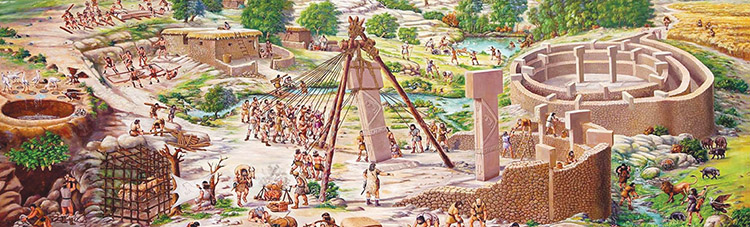
    It happened in c.9600 BCE, with the establishment of the settlements at Gobekli Tepe. We can be quite certain that similar settlements were springing up elsewhere at the same time, the evidence of which we have yet to uncover. In c.6500 BCE, new settlements emerged in Anatolia and Southeastern Europe with distinct cultural traits, but we don’t have much of an idea about what was happening in other parts of the world then. In c.3600 BCE, a bunch of new civilisations arose almost simultaneously in Egypt, Mesopotamia, India, Malta, and other places, while in c.600 BCE, the Iron Age cultures emerged at around the same time in the Eastern Mediterranean region, Persia, India, Mesoamerica etc.

    Artist recreation of the Gobekli Tepe settlement, modern-day Turkey, c.9600 BCE.

    The trend is distinct and unmistakable. The Yuga Cycle is not an article of faith but an important scientific doctrine that captures the cyclical nature of human civilisation. Not only does it give us a clear perspective of what had happened in the past, but it also tells us where our own decadent civilisation of the Kali Yuga is headed. In my new book, I take a closer look at the events of the last four Yuga-transitional periods, revealing that comet and meteor impacts inevitably play a crucial role in the periodic process of destruction and renewal.

    The Degradation of the Human Race

    One of the important topics I explore is an important tenet of the Yuga cycle doctrine. In tandem with the decline in our consciousness in the descending cycle, our lifespan and physical size also decline, and the environment becomes less favourable to us. You may be surprised to know that a host of scientific data published in reputed academic journals supports all of these contentions! Yet, how many times have you heard about this ongoing degradation of the human race being talked about in mainstream media?

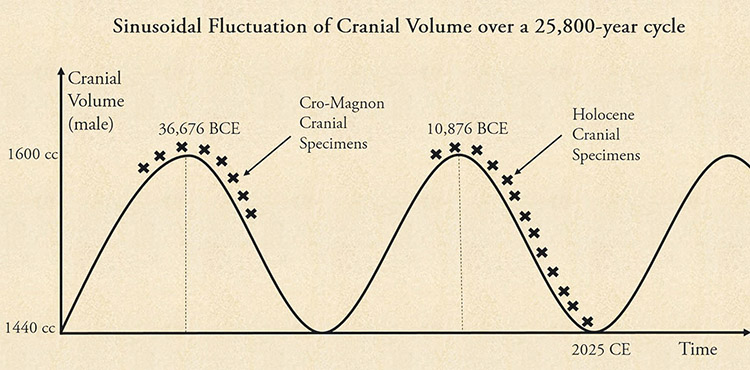
    The cranial volume fluctuates over a 25,800-year Yuga Cycle. The Cro-Magnon lived in an earlier Golden Age, which explains their very high cranial volume. Credit: Bibhu Dev Misra.

    On average, humans today are roughly 10% smaller than their Golden Age counterparts who lived in the late Palaeolithic period. Scientific studies reveal there was no food scarcity or diseases in the late Palaeolithic period (i.e. Golden Age), but throughout the Holocene period (i.e. descending Yuga Cycle), sources of food became increasingly scarce, many kinds of diseases became endemic, and incidences of violent deaths increased significantly.1

    In addition, all over the world, human beings have lost nearly 10% of their cranial volume over the past 12,000-odd years, which is equivalent to the difference between the average cranial volume of Homo erectus and Homo sapiens!2 How do you explain that? When science writer Kathleen McAuliffe spoke to Christopher Stringer, a palaeoanthropologist at the Natural History Museum in London, about the 10% reduction in our cranial volume since the late Palaeolithic period, Stringer told her something quite stunning: “Scientists haven’t given the matter the attention it deserves. Many ignore it or consider it an insignificant detail.”3

    Can you imagine that? This absolutely jaw-dropping piece of scientific data, which turns the Darwinian theory of gradual evolution on its head, is treated as an “insignificant detail.” If this is insignificant, what really is significant? Have our cranial volumes shrunk so much that we can no longer distinguish between what is truly important and what is not? That, unfortunately, is precisely what seems to be going on. Because of our declining cranial volume, most of us can no longer discriminate between the truth and the lies or determine what is harmful to us and what truly serves our evolution and happiness. Our declining cranial volume is the primary cause of the misery, injustices and violence of the Kali Yuga.

    Population geneticists tell us that the progressive degeneration of the human race is happening due to the accumulation of harmful genetic mutations over the past 10,000-odd years. My proposition is that the Darwinian theory of linear evolution is patently wrong, and what is really happening is that both our physical size and cranial volume are fluctuating in a sinusoidal manner over the 25,800-year precession cycle or Yuga Cycle. This is why the cranial specimens of the Cro-Magnon, who had extremely large cranial volumes paralleling those of our Golden Age ancestors, straddle the peak of an earlier Golden Age at around 36,676 BCE!

    Even though genetic mutations seem to be driving the sinusoidal fluctuation in physical size and cranial volume in tandem with the earth’s precession cycle, there must be an external electromagnetic source behind this, which is triggering the harmful and advantageous genetic mutations in a cyclical manner. What could be this source?

    I tried to ascertain what Sri Yukteswar really meant when he wrote in The Holy Science that it is the creative power “Brahma” – located at the grand centre called “Vishnunabhi,” around which our sun revolves – who regulates the fluctuation of dharma or virtue in the course of the Yuga Cycle. Interestingly, the Buddhist and Chaldean philosophers of antiquity spoke of the “Great Central Sun” or “Hypercosmic Sun” located beyond the circle of fixed stars, which radiated “intellectual light” or “Inner Light.”

    WATCH OUT! The Taurid Meteor Stream

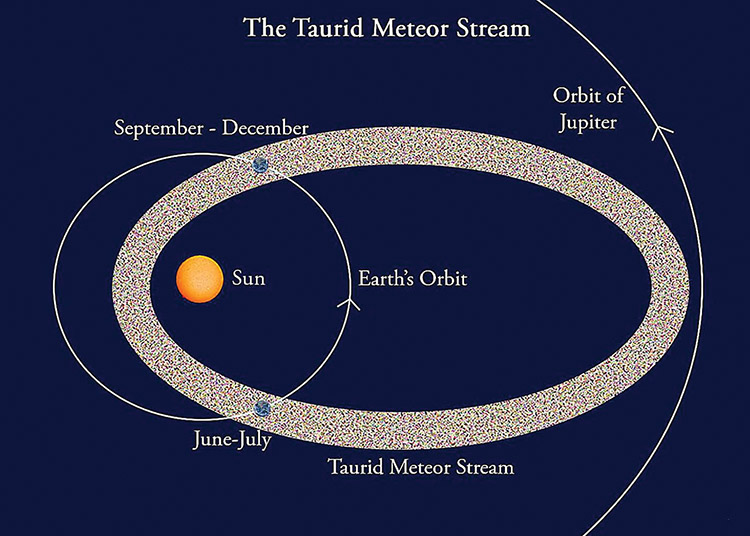
    Finally, I come to the big question, and that is, what causes the cataclysmic obliteration of civilisation during the periods of Yuga transition? My study of the ancient texts and investigations into the events of the last four Yuga-transitions had already alerted me to the role played by comet and meteor impacts in the periodic reboot of civilisation. The work of astronomers Clube, Napier, Steel and their colleagues indicate that the Yuga-ending catastrophes, which occur like clockwork every 2,700 years, are caused by the passage of the earth through the “dense core” of the Taurid meteor stream – known as the “Taurid Resonant Swarm” – which contains a number of massive, dormant, comets and full-size asteroids, formed from the break-up of the Taurid progenitor comet. In an article in National Geographic, Australian astronomer Duncan Steel was quoted saying something that really made me sit up and take notice:

    The earth crosses the Taurid meteor stream twice a year, in course of its orbit around the sun. Credit: Bibhu Dev Misra

    Every 2,500 to 3,000 years or so, the core of the Taurid stream passes near Earth and produces much more intense meteor showers for a few centuries…. A gap of a few centuries separates the era of intensity between Northern Taurids and Southern Taurids.4

    This is an almost perfect explanation for the periodic Yuga-ending cataclysms! What I found most astonishing is that two of the giant comets hidden within the Taurid Resonant Swarm were known to the ancients and revered by them as the messengers or animal mounts (vahanas in Sanskrit) of their gods. The sacred texts and symbols of our ancestors provide specific information about the location, structure, and function of these two comets! The ancients seemed to believe that this periodic destruction and renewal of civilisation does not occur randomly but is divinely guided by inter-dimensional beings whom they regarded as their gods.

    Since the Earth is due to pass through the centre of the Taurid Resonant Swarm in the years 2032 and 2036, it has ominous implications for our civilisation. These are likely to be events that finally pull down the curtains on the Kali Yuga.

    Get the issue this article appears in

    Without going into too many details, let me just say there are strong indications that the years from 2025 to 2040 are the “end-times” the ancient texts tell us of. We are living in times of the fulfilment of the prophecies when our reality will be drastically altered, and we will be forced to introspect about our patterns of thought and our way of life.

    We are standing at the doorstep of an extraordinary transformation that will change our life and our planet beyond our wildest imagination. The writing is on the wall: the Kali Yuga party is over and we need to sober up. The old ways will not work anymore, and the planetary vibrations are going to change very quickly post-2025.

    As the Kali Yuga energies wane after 2025, the tyrants who control the affairs of the world may begin to find that their evil plans are no longer coming to fruition as easily as before, and they may face increasing opposition from people around the world. Humanity may become more polarised than ever before, leading to greater social and economic instability, taking us closer to the next World War. An eruption of insanity and large-scale violence typically happens during a Yuga-ending period, and it is unlikely to be any different this time. In tandem with the outbreak of wars and revolutions on a global scale, the intensity of various natural catastrophes – floods, cyclones, landslides, wildfires, earthquakes, tsunamis, volcanic eruptions etc. – may also increase exponentially.

    So, it’s not just one thing that we have to reckon with, but a dreadful cocktail of wars, environmental catastrophes and comet impacts, all dished out to us while the fabric of society is torn apart by tyrannical governments and mega corporations bent on global enslavement, propped up by relentless media propaganda designed to brainwash the masses.

    It’s going to be a tough challenge for any person to retain his sanity in the midst of this unfolding. But, if we reorient our thoughts and lifestyle and keep our psyche rooted in our soul vibrations, we can protect ourselves from the greatest suffering. In my new book, I share some thoughts on how we can deal with and navigate the chaos of the end times, although this is something that will probably become clearer with time as more and more people realise the enormity of the changes that are on the way and chime in with their intuitive feelings.

    YUGA SHIFT: The End of the Kali Yuga & the Impending Planetary Transformation provides much-needed clarity and guidance to those who already sense this momentous shift. I trust you will join me on this epic journey across time and space to understand the significance of the Yuga Cycle and the coming Shift in the Ages – and how we can prepare for it. 

    Bibhu Dev Misra’s important book, YUGA SHIFT: The End of the Kali Yuga & the Impending Planetary Transformation, is available on Amazon.com in Kindle and paperback editions.

    [alert type=”general” dismiss=”no”]This article was published in New Dawn Special Issue Vol 18 No 1.[/alert]

    [alert type=”success” dismiss=”no”]If you appreciate this article, please consider subscribing to help maintain this website.[/alert]

    Footnotes

    1. Michael Hermanussen, “Stature of early Europeans”, Hormones, 2003, Vol.2, No.3, 175-178, hormones.gr/pdf/Stature_europeans.pdf
    2. Maciej Henneberg, “Decrease of Human Skull Size in the Holocene”, Human Biology, June 1988, Vol.60, No.3, 395-405, digitalcommons.wayne.edu/humbiol/vol60/iss3/5/
    3. Kathleen McAuliffe, “If Modern Humans Are So Smart, Why Are Our Brains Shrinking?” Discover Magazine, 20 January 2011, discovermagazine.com/the-sciences/if-modern-humans-are-so-smart-why-are-our-brains-shrinking
    4. John Roach, “Meteor Shower Promises Seven Shooting Stars an Hour”, National Geographic News, 7 November 2003, news.nationalgeographic.com/news/2003/11/1107_031107_taurids.html

    © New Dawn Magazine and the respective author.
    For our reproduction notice, click here.