New Dawn – World's Most Unusual Magazine

Category: Ancient Mysteries

  • The End of the Kali Yuga in 2025: Unravelling the Mysteries of the Yuga Cycle

    The End of the Kali Yuga in 2025: Unravelling the Mysteries of the Yuga Cycle

    From New Dawn Special Issue Vol 11 No 3 (June 2017)

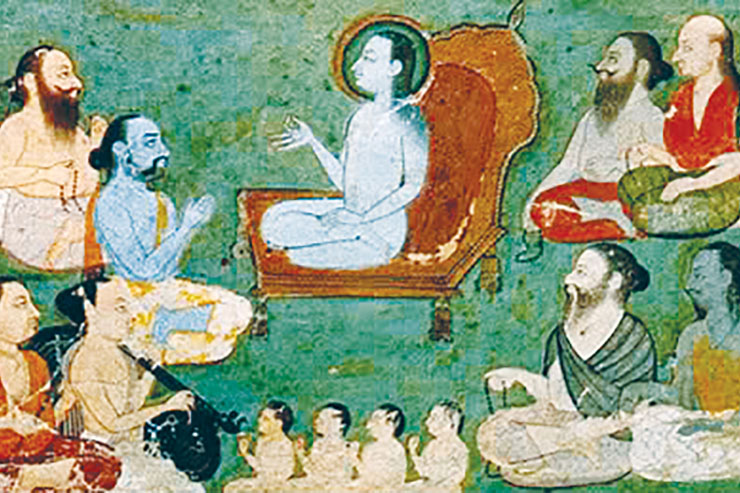
    A number of ancient cultures believed in a Cycle of World Ages in which we gradually descend from a state of spiritual perfection and material abundance to one of ignorance and scarcity. In ancient India, this was called the Yuga Cycle. The Yuga Cycle doctrine tells us that we are now living in the Kali Yuga; the age of darkness, when moral virtue and mental capabilities reach their lowest point in the cycle. 

    The Mahabharata describes the Kali Yuga as the period when the “World Soul” is Black in hue; only one quarter of virtue remains, which slowly dwindles to zero at the end of the Kali Yuga. Men turn to wickedness; disease, lethargy, anger, natural calamities, anguish and fear of scarcity dominate. Penance, sacrifices and religious observances fall into disuse. All creatures degenerate. Change passes over all things, without exception.

    The Kali Yuga (Iron Age) was preceded by three other Yugas: Satya or Krita Yuga (Golden Age), Treta Yuga (Silver Age) and the Dwapara Yuga (Bronze Age). In the Mahabharata, Hanuman gives the following description of the Yuga Cycle to the Pandava prince Bhima:

    The Krita Yuga was so named because there was but one religion, and all men were saintly: therefore they were not required to perform religious ceremonies… Men neither bought nor sold; there were no poor and no rich; there was no need to labour, because all that men required was obtained by the power of will… The Krita Yuga was without disease; there was no lessening with the years; there was no hatred, or vanity, or evil thought whatsoever; no sorrow, no fear. All mankind could attain to supreme blessedness. The universal soul was White… the identification of self with the universal soul was the whole religion of the Perfect Age. In the Treta Yuga sacrifices began, and the World Soul became Red; virtue lessened a quarter. Mankind sought truth and performed religious ceremonies; they obtained what they desired by giving and by doing. In the Dwapara Yuga the aspect of the World Soul was Yellow: religion lessened one-half. The Veda was divided into four parts, and although some had knowledge of the four Vedas, others knew but three or one. Mind lessened, Truth declined, and there came desire and diseases and calamities; because of these men had to undergo penances. It was a decadent Age by reason of the prevalence of sin.1

    Now we are living in the dark times of the Kali Yuga, when goodness and virtue has all but disappeared from the world. When did the Kali Yuga begin, and when does it end? 

    In spite of the elaborate theological framework of the Yuga Cycle, the start and end dates of the Kali Yuga remain shrouded in mystery. The popularly accepted date for the beginning of the Kali Yuga is 3102 BCE, thirty-five years after the conclusion of the battle of the Mahabharata. This date is believed to be based on a statement made by the noted astronomer Aryabhatta in the Sanskrit text Aryabhatiya, where he writes that:

    When sixty times sixty years (i.e. 3,600 years) and three quarter Yugas had elapsed, twenty-three years had then passed since my birth.2

    This means that Aryabhatta had composed the text when he was 23 years old and 3,600 years of the current Yuga had elapsed. The problem here is that we do not know when Aryabhatta was born, or when he composed the Aryabhatiya. He does not even mention the Kali Yuga by name, and simply states that 3,600 years of the Yuga had elapsed. Scholars generally assume that the Kali Yuga had started in 3102 BCE, and then use this statement to justify that the Aryabhatiya was composed in 499 CE. However, we cannot use the reverse logic, i.e. we cannot say that the Kali Yuga must have started in 3102 BCE since the Aryabhatiya was composed in 499 CE, for we do not know when Aryabhatta lived or completed his work.

    Another important source is the Aihole inscription of Pulakesin II of Badami, which was incised on the expiry of 3,735 years after the Bharata war and 556 years of the Saka kings.3 If we take the beginning of the Saka Era as 78 CE, then the Bharata War took place in 3102 BCE, then the Kali Yuga, which started 35 years after the Bharata War, began on 3067 BCE. But we must remember there is an Old Saka Era as well, whose beginning date is disputed, and for which various dates have been proposed by scholars ranging from 83 BCE – 383 BCE.4 If the Aihole inscription refers to the Old Saka Era, then the Kali Era starts a few hundred years before 3102 BCE.

    The truth is that there is no text or inscription which gives us an unambiguous date for the beginning of the Kali Yuga. Although the popularly accepted date is 3102 BCE, there is no astronomical basis for it. There is a claim that the computation was based on the conjunction of the five ‘geocentric planets’ (i.e. the planets visible to the naked eye) – Mercury, Venus, Mars, Jupiter and Saturn – at 0° Aries at the beginning of the Kali Yuga as mentioned in the Surya Siddhanta. But the Surya Siddhanta explicitly states that this conjunction of planets at 0° Aries takes place at the end of the Golden Age.5 Besides, modern simulations indicate that on 17/18 February 3102 BCE, the five geocentric planets occupied an arc of roughly 42° in the sky, which cannot be considered as a conjunction by any means. Therefore, neither is there any astronomical basis for the start date, nor do we have any evidence that Aryabhatta or any other astronomer had calculated the date. Before the 6th century CE, the date does not occur in any Sanskrit text or inscription. It could have been invented by later day astronomers or adopted from some other calendar. The vagueness surrounding the origin of this very important chronological marker makes its validity highly suspect.

    The task of figuring out the start date of the Kali Yuga from the ancient Sanskrit texts, however, is fraught with difficulties, since a number of inaccuracies have crept into the Yuga Cycle information contained within them. In many Sanskrit texts the 12,000-year duration of the Yuga Cycle was artificially inflated to an abnormally high value of 4,320,000 years by introducing a multiplication factor of 360, which was represented as the number of ‘human years’ which constitutes a ‘divine year’. In the book, The Arctic Home in the Vedas (1903), B.G. Tilak wrote that: 

    The writers of the Puranas, many of which appear to have been written during the first few centuries of the Christian, era, were naturally unwilling to believe that the Kali Yuga had passed away… An attempt was, therefore, made to extend the duration of the Kali Yuga by converting 1,000 (or 1,200) ordinary human years thereof into as many divine years, a single divine year, or a year of the gods, being equal to 360 human years… this solution of the difficulty was universally adopted, and a Kali of 1,200 ordinary years was at once changed, by this ingenious artifice, into a magnificent cycle of as many divine, or 360 × 1200 = 432,000 ordinary years.6

    Yuga Cycle of 24,000 Years

    However, certain important Sanskrit texts such as the Mahabharata7 and the Laws of Manu,8 which scholars believe were composed earlier than the Puranas, still retain the original value of the Yuga Cycle as 12,000 years. The Mahabharata explicitly mentions that the Yuga Cycle duration is based on the days and nights of human beings. The Zoroastrians also believed in a Cycle of the Ages of 12,000 years’ duration. The Great Year or Perfect Year of the Greeks was variously represented as being of 12,954 years (Cicero) or 10,800 years (Heraclitus) duration. Surely, the Yuga Cycle cannot be of different durations for different cultures.

    In the book The Holy Science (1894)Sri Yukteswar clarified that a complete Yuga Cycle takes 24,000 years, and is comprised of an ascending cycle of 12,000 years when virtue gradually increases and a descending cycle of another 12,000 years, in which virtue gradually decreases. Hence, after we complete a 12,000-year descending cycle from Satya Yuga -> Kali Yuga, the sequence reverses itself, and an ascending cycle of 12,000 years begins which goes from Kali Yuga -> Satya Yuga. Yukteswar states that, “Each of these periods of 12,000 years brings a complete change, both externally in the material world, and internally in the intellectual or electric world, and is called one of the Daiva Yugas or Electric Couple.”9 

    The 24,000-year duration of the complete Yuga Cycle closely approximates the Precessional Year of 25,765 years, which is the time taken by the sun to ‘precess’, i.e. move backwards, through the 12 Zodiac constellations. Interestingly, the Surya Siddhanta specifies a value of 54 arc seconds per year for precession, as against the current value of 50.29 arc seconds per year. This translates into a Precessional Year of exactly 24,000 years! This means that the current observed value of precession may simply be a temporary deviation from the mean.

    The concept of an ascending and descending cycle of Yugas is still prevalent among the Buddhists and Jains. The Jains believe that a complete Time Cycle (Kalachakra) has a progressive and a regressive half. During the progressive half of the cycle (Utsarpini), there is a gradual increase in knowledge, happiness, health, ethics, and spirituality, while during the regressive half of the cycle (Avasarpini) there is a gradual reduction in these qualities. These two half cycles follow each other in an unbroken succession for eternity, just like the cycles of day and night or the waxing and waning of the moon. 

    The ancient Greeks also appear to have believed in an ascending and descending Cycle of Ages. The Greek poet Hesiod (c. 750 BCE – 650 BCE) had given an account of the World Ages in Works and Days, in which he inserted a fifth age called the ‘Age of Heroes’, between the Bronze Age and the Iron Age. In Hesiod’s Cosmos, Jenny Strauss Clay writes:

    Drawing on the myth in Plato’s Statesman, Vernant also claimed that the temporal framework of Hesiodic myth, that is, the succession of races, is not linear but cyclical; at the end of the age of iron, which he divides into two, the cycle of races starts again with a new golden age or, more likely, a new age of heroes, as the sequence reverses itself…Vernant himself offers a solution when he remarks that “there is not in reality one age of iron but two types of human existence.”10

    This is very interesting. Jean-Pierre Vernant, who is a highly-acclaimed specialist in ancient Greek culture, believes that the Cycle of the Ages reverses itself as per Hesiod’s account. Not only that, he states the Iron Age has two parts, which corresponds to Yukteswar’s interpretation in which the descending Kali Yuga is followed by the ascending Kali Yuga. We can surmise, in this context, that the ‘Age of Heroes’, which immediately followed the Bronze Age in Hesiod’s account, must be the name ascribed by Hesiod to the descending Kali Yuga.

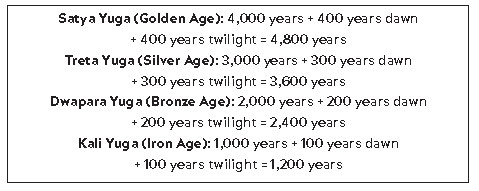
    The evidence from different sources supports the notion of a complete Yuga Cycle of 24,000 years, comprised of an ascending and descending cycle of 12,000 years each. This brings us to the question of the relative durations of the different Yugas in the Yuga Cycle, and the transitional periods, which occur at the beginning and end of each Yuga, and are known as Sandhya (dawn) and Sandhyansa (twilight) respectively. The values in the following table are provided in the Sanskrit texts for the duration of the Yugas and their respective dawns and twilights:
    Yugas of Equal Duration?

    Since so many inaccuracies crept into the Yuga Cycle doctrine, as pointed out by Yukteswar and Tilak, we also need to question the accuracy of the relative durations of the Yugas mentioned in the Sanskrit texts. Although the Yuga Cycle is mentioned in the mythic accounts of around thirty ancient cultures, as described by Giorgio de Santillana, professor of the history of science at MIT, in the book Hamlet’s Mill (1969), we find very little information regarding the relative durations of the different ages within this cycle. 

    In the few accounts where the durations of the Yugas are specified, we find that each age in the Yuga Cycle is of the same duration. For instance, the Zoroastrians believe that the world lasts for 12,000 years, which is divided into four equal ages of 3,000 years each. A Mexican source known as the Codex Rios (also referred to as Codex 3738 and Codex Vaticanus A) states that each age lasts for 4,008, 4,010, 4,801 and 5,042 years respectively for a total of 17,861 years. We can see that in this case also the duration of each age is nearly the same. 

    Therefore, the durations of the four Yugas mentioned in the Sanskrit texts (i.e. 4,800, 3,600, 2,400, and 1,200 years) deviate from the norm. The duration of each Yuga, in this sequence, decreases by 1,200 years from the previous one. This is an arithmetic progression which is rarely, if ever, found in natural cycles. Could it be that the Yuga durations were deliberately altered at some point in the past in order to give the impression that the duration of each Yuga decreases in tandem with the decrease in virtue from one Yuga to the next?

    Here is the most startling fact: Two of the most famous astronomers of ancient India, Aryabhatta and Paulisa, believed that the Yuga Cycle is comprised of Yugas of equal duration! In the 11th century, the medieval scholar Al-Beruni had compiled a comprehensive commentary on Indian philosophy, sciences and culture titled Alberuni’s India, in which he mentions that the Yuga Cycle doctrine was based on the derivations of the Indian astronomer Brahmagupta, who in turn derived his knowledge from the Sanskrit Smriti texts. He makes an interesting statement in this regard:

    Further, Brahmagupta says that “Aryabhatta considers the four yugas as the four equal parts of the caturyuga (Yuga Cycle). Thus he differs from the doctrine of the book Smriti, just mentioned, and he who differs from us is an opponent.”11

    The fact that Aryabhatta believed the four Yugas to be of equal duration is extremely pertinent! Al-Beruni reasserts this in no uncertain terms: “Therefore, according to Aryabhatta, the Kali Yuga has 3,000 divya years…. each two yugas has 6,000 divya years… each three years has 9,000 divya years.” Why would Aryabhatta subscribe to such a belief? Did he have access to sources of information that are lost to us now?

    Paulisa, another celebrated astronomer of ancient India, also subscribed to the idea of Yugas of equal duration. Alberuni says that, while presenting the calculations for the duration of a kalpa, “he (Pulisa) has not changed the caturyugas into exact yugas, but simply changed them into fourth parts, and multiplied these fourth parts by the number of years of a single fourth part.”12

    Thus, two of the most respected astronomers of ancient India, Aryabhatta and Paulisa, believed in a Yuga Cycle that comprised of 4 Yugas of equal duration of 3,000 divine-years each. However, their opinion was overshadowed by the contradictory view held by Brahmagupta. He railed against Aryabhatta and the other astronomers who held differing opinions, and even abused them. Al-Beruni says about Brahmagupta: 

    He is rude enough to compare Aryabhatta to a worm which, eating the wood, by chance describes certain characters in it without understanding them and without intending to draw them. “He, however, who knows these things thoroughly, stands opposed to Aryabhatta, Srishena, and Vishnucandra like the lion against gazelles. They are not capable of letting him see their faces.” In such offensive terms he attacks Aryabhatta and maltreats him.13 

    We can now understand why Brahmagupta’s opinion finally prevailed over that of the other astronomers of his time, and it certainly did not have anything to do with the inherent soundness of his logic, or the authenticity of his sources.

    It is time for us to stop standing in opposition to Aryabhatta, Paulisa, Srishena, Vishnucandra and others like the “lion against gazelles,” and instead take cognizance of the very real possibility that the Yugas in the Yuga Cycle are of equal duration, and the 4:3:2:1 sequence of the Yugas may have been a mathematical manipulation that crept into the Yuga Cycle doctrine sometime prior to 500 CE. It is possible this manipulation was introduced because people were inclined to believe that the duration of a Yuga should decrease in tandem with the decrease in virtue and human longevity from one Yuga to the next. A neat formula was devised in which the total duration of the Yugas added up to 12,000 years. However, there was one problem. If the Kali Yuga is of 1,200 years duration, then it should have been completed many times over, since its proposed beginning in 3102 BCE. In order to circumvent this potentially embarrassing situation, another complexity was introduced. Each ‘year’ of the Yuga Cycle became a ‘divine year’ comprised of 360 human years. The Yuga Cycle became inflated to 4,320,000 years (12,000×360) and the Kali Yuga became equal to 432,000 years (1,200×360). Humanity became consigned to an interminable duration of darkness. 
    Original Yuga Cycle Encoded into Saptarshi Calendar 

    The original Yuga Cycle doctrine appears to have been very simple: A Yuga Cycle duration of 12,000 years, with each Yuga lasting for 3,000 years. This cycle is encoded in the Saptarshi Calendar which has been used in India for thousands of years. It was used extensively during the Maurya period in the 4th century BCE, and is still in use in some parts of India. The term Saptarshi refers to the ‘Seven Rishis’ or the ‘Seven Sages’ representing the seven stars of the Great Bear constellation (Ursa Major). They are regarded as the enlightened rishis who appear at the beginning of every Yuga to spread the laws of civilisation. The Saptarshi Calendar used in India had a cycle of 2,700 years; it is said that the Great Bear constellation stays for 100 years in each of the 27 Nakshatras (lunar asterisms) which adds up to a cycle of 2,700 years.14 The 2,700-year cycle was also referred to as a Saptarshi Era or a Saptarshi Yuga. 
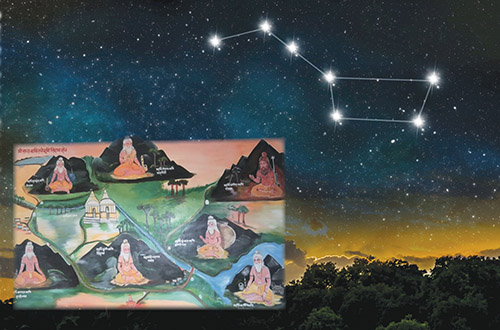
    The Great Bear constellation (Ursa Major) is clearly visible in the northern sky throughout the year. The seven prominent stars represent the Seven Sages (Saptarshi), each one depicted in the painting.

    If the 2,700 year cycle of the Saptarshi Calendar represents the actual duration of a Yuga, then the remaining 300 years out of the total Yuga duration of 3,000 years automatically represents the ‘transitional period’, before the qualities of the subsequent Yuga are fully manifested. The total duration of the Yuga Cycle, excluding the transitional periods, is equal to (2,700×4), i.e. 10,800 years, the same as the duration of the ‘Great Year of Heraclitus’ in Hellenic tradition! This clearly indicates the underlying basis of the Cycle of the World Ages in both India and Greece was the 2,700 year Saptarshi Cycle.

    It is agreed by historians that the Saptarshi Calendar, in use during the Maurya period in the 4th century BCE, started in 6676 BCE. In the book Traditions of the Seven Rsis, Dr. J.E. Mitchiner confirms this: 

    We may conclude that the older and original version of the Era of the Seven Rsis commenced with the Seven Rsis in Krttika in 6676 BCE… This version was in use in northern India from at least the 4th century BCE, as witnessed by the statements of Greek and Roman writers; it was also the version used by Vrddha Garga, at around the start of the Christian era.15 

    In fact, the recorded chronology of Indian kings goes back further than 6676 BCE as documented by the Greek and Roman historians Pliny and Arrian. Pliny states that, “From Father Liber [Roman Bacchus or Greek Dionysus] to Alexander the Great (d. 323 BCE), Indians reckon 154 kings, and they reckon (the time as) 6,451 years and 3 months.”16 Arrian puts 153 kings and 6,462 years between Dionysus and Sandrokottos (Chandragupta Maurya), to whose court a Greek embassy was sent in 314 BCE.17 Both indications add up to a date of roughly c.6776 BCE, which is a 100 years prior to the beginning of the Saptarshi Calendar in 6676 BCE. 

    It is obvious from the accounts of Pliny and Arrian that they must have identified a specific king in the Indian kings list who corresponded to the Greek Dionysus or Roman Bacchus, and whose reign had ended at around c.6776 BCE. Who could that have been? According to the renowned scholar and Orientalist Sir William Jones, Dionysus or Bacchus was none other than the Indian monarch Rama. In his essay “On the Gods of Greece, Italy and India” (1784), Sir William Jones 

    deems Rama to be the same as the Grecian Dionysos, who is said to have conquered India with an army of satyrs, commanded by Pan; and Rama was also a mighty conqueror, and had an army of large monkeys or satyrs, commanded by Maruty (Hanuman), son of Pavan. Rama is also found, in other points, to resemble the Indian Bacchus.18 

    Sir William Jones also points out that, 

    Meros is said by the Greeks to have been a mountain of India, on which their Dionysus was born, and that Meru is also a mountain near the city of Naishada, or Nysa, called by the Grecian geographers Dionysopolis, and universally celebrated in the Sanskrit poems.19

    The identification of Dionysus with Rama provides us with fresh perspectives. According to the Indian tradition, Rama lived towards the end of the Treta Yuga (Silver Age), and the Dwapara Yuga (Bronze Age) had started soon after his demise. This implies that the 6676 BCE date for the beginning of the Saptarshi Calendar, which is 100 years after Dionysus, i.e. Rama, indicates the beginning of the Dwapara Yuga in the descending cycle.

    A later Saptarshi Calendar, still in use in India, began from 3076 BCE. But, as Dr. Subhash Kak points out, “the new count that goes back to 3076 BCE was started later to make it as close to the start of the Kali era as possible.”20 In the book Traditions of the Seven Rsis, Dr. Mitchiner says that the Saptarshi Calendar for the Kali Yuga (the Kashmir Laukika Abda) started when the Saptarshis were in Rohini. Since the Saptarshis were in Rohini in 3676 BCE, it implies the Kali Yuga cycle must have commenced in 3676 BCE. 

    Tracking Down the True End Date of Current Kali Yuga

    Now this is where it gets interesting. A Saptarshi Era began in 6676 BCE, and another cycle started exactly 3,000 years later in 3676 BCE. But the Saptarshi Cycle is of 2,700 years’ duration. Why did the Saptarshi Era for the Kali Yuga start 3,000 years after the previous cycle? This means a 300-year ‘transitional period’ must have been added to the end of the previous cycle! It clearly proves the hypothesis that the 2,700 year Saptarshi Cycle, along with a 300-year transitional period, was the original calendrical basis of the Yuga Cycle. 

    If we use the 6676 BCE date as the beginning of the Dwapara Yuga in the descending cycle, and the 2,700 year Saptarshi Cycle along with a 300-year transitional period as the basis for the Yuga Cycle, then the entire timeline of the Yuga Cycle is unravelled.

    This Yuga Cycle timeline takes the beginning of the Golden Age to 12676 BCE, more than 14,500 years before present, when the Great Bear was in the Shravana nakshatra (the Great Bear will advance by 3 nakshatras in every Yuga because of the 300-year transitional period). This agrees very well with the Indian tradition, since the Mahabharata mentions that in the ancient tradition the Shravana nakshatra was given the first place in the nakshatra cycle. 
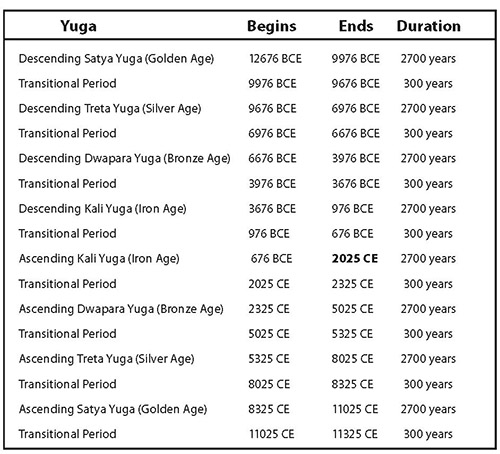
    Yuga Cycle timeline based on the Saptarshi Calendar. According to
    this interpretation, the Kali Yuga ends in 2025, to be followed by a 300
    year transitional period leading up to the Ascending Dwapara Yuga.

    The timeline also indicates that the ascending Kali Yuga, which is the current epoch in which we are living, will end in 2025 CE. The full manifestation of the next Yuga – the ascending Dwapara – will take place in 2325 CE, after a transitional period of 300 years. The ascending Dwapara Yuga will then be followed by two more Yugas: the ascending Treta Yuga and the ascending Satya Yuga, which completes the 12,000 year ascending cycle. 

    The Sanskrit text Brahma-vaivarta Purana describes a dialogue between Lord Krishna and the Goddess Ganges. Here, Krishna says that after 5,000 years of Kali Yuga there will be a dawn of a new Golden Age that lasts for 10,000 years (Text 50, 59). This can be immediately understood in the context of the Yuga Cycle timeline described here. We are now ending the Kali Yuga, nearly 5,700 years since its beginning in 3676 BCE. And the end of the Kali Yuga will be followed by three more Yugas spanning 9,000 years, before the ascending cycle ends. 

    Archaeological & historical evidence

    According to the Yuga Cycle doctrine, the transitional periods between the Yugas are associated with a collapse of civilisations and environmental catastrophes (pralaya), which wipe out virtually every trace of any human civilisation. The new civilisation that emerges in the new Yuga is guided by a few survivors of the cataclysm, who carry with them the technical and spiritual knowledge of the previous epoch. Many ancient sources tell us of the enigmatic group of ‘Seven Sages’ (‘Saptarshi’) who are said to appear at the beginning of every Yuga and promulgate the arts of civilisation. We find them in myths across the world – in Sumeria, India, Polynesia, South America and North America. They possessed infinite wisdom and power, could travel over land and water, and took on various forms at will. The Saptarshi Calendar of ancient India appears to have been based on their periodic appearance at the beginning of every Yuga.

    As we shall see, the Yuga Cycle timeline proposed here correlates very strongly with the major cataclysmic events that periodically impact our planet, and with a number of important dates recorded in various ancient calendars and scriptures. 
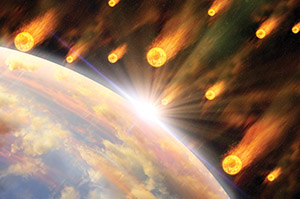
    The planet was subjected to sudden and destructive, deep-water, oceanic comet impacts during the 300-year transitional period at the end of the last Golden Age, circa 9600 BCE.

    The first transitional period in the 12,000-year descending Yuga Cycle is the 300-year period at the end of the Golden Age from 9976 BCE – 9676 BCE. This is the time when the last Ice Age came to a sudden end; the climate became very warm quite abruptly, and there was a catastrophic global flooding. Many ancient legends refer to this time period. In the Timaeus, Plato tells us of the mythical island of Atlantis which was swallowed up by the sea in a “single day and night of misfortune” in c.9600 BCE. The Zoroastrians believe the world was created by Ahura Mazda at around 9600 BCE, (i.e. 9,000 years before the birth of their prophet Zoroaster in c.600 BCE).

    This event has also been recorded in the flood myths of many ancient cultures, which almost uniformly talk of enormous walls of water that submerged the entire land to the highest mountain tops, along with heavy rain, fireballs from the sky, intense cold and long periods of darkness. Archaeologist Bruce Masse of the Los Alamos National Laboratory in New Mexico examined a sample of 175 flood myths from different cultures around the world and concluded that the environmental aspects described in these events, which is also consistent with the archaeological and geophysical data, could have only been precipitated by a destructive, deep-water, oceanic comet impact.21 

    In recent years, a team of international scientists found compelling evidence that the Earth was bombarded by multiple fragments of a giant comet nearly 12,800 years ago, triggering the start of a rapid and intense cooling period called Younger Dryas, which lasted for nearly 1,200 years till c.9700 BCE. The force of the comet impact, combined with the vicious cold snap that followed, brought about the extinction of a large number of North American megafauna including woolly mammoths and giant ground sloths, and ended a prehistoric civilisation called the Clovis culture – the first human inhabitants of the New World.22
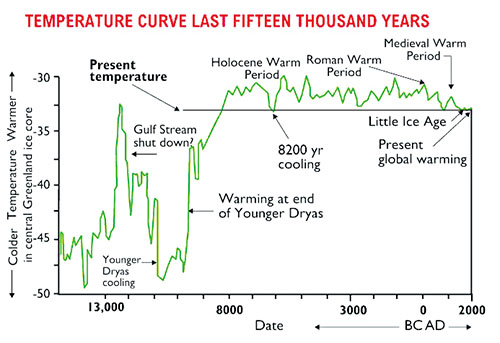
    This temperature graph shows the sudden cooling at the beginning of the Younger Dryas and an equally sudden warming at the end of the Younger Dryas.

    The Younger Dryas ended as abruptly as it started, for reasons not fully understood. Geologists from the Niels Bohr Institute (NBI) in Copenhagen studied the Greenland ice core data and concluded that the Ice Age ended exactly in 9703 BCE. Researcher Jorgen Peder Steffensen said that, “in the transition from the ice age to our current warm, interglacial period the climate shift is so sudden that it is as if a button was pressed.”23 The 9703 BCE date for the sudden climate shift falls within the 300-year transitional period at the end of the Golden Age from 9976 BCE – 9676 BCE, and as such it provides the first important validation of the Yuga Cycle timeline identified here.

    Black Sea Catastrophe & Global Floods

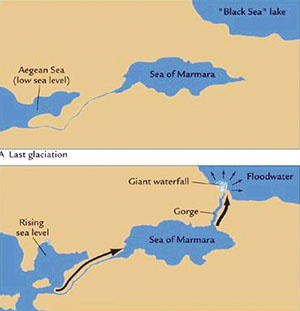
    The 300-year transitional period between the Treta Yuga (Silver Age) and the Dwapara Yuga (Bronze Age) from 6976 BCE – 6676 BCE also coincides with a significant environmental event – the Black Sea Catastrophe – recently dated to 6700 BCE. The Black Sea once used to be a freshwater lake. That is, until the Mediterranean Sea, swollen with melted glacial waters, breached a natural dam, and cut through the narrow Bosphorous Strait, catastrophically flooding the Black Sea. This raised the water levels of the Black Sea by several hundred feet, flooded more than 60,000 square miles of land, and significantly expanded the Black Sea shoreline (by around 30%).24 This event fundamentally changed the course of civilisation in Southeastern Europe and western Anatolia. Geologists Bill Ryan and Walter Pitman of Lamont-Doherty Earth Observatory in New York, who first proposed the Black Sea Catastrophe hypothesis, have gone to the extent of comparing it to Noah’s Flood

    The Black Sea catastrophe, before and after. The water from the Aegean Sea cut through a narrow Gorge (Bosphorous Strait) and plunged into the Black Sea creating a gigantic waterfall. 

    Similar major flooding events took place in many parts of the world, as massive glacial lakes, swelled by the waters of the melting ice, breached their ice barriers, and rushed into the surrounding areas. Sometime between 6900 BCE – 6200 BCE the Laurentide ice-sheet disintegrated in the Hudson Bay and an enormous quantity of glacial waters from the inland Lake Agassiz/Ojibway discharged into the Labrador Sea. This was possibly the “single largest flood of the Quaternary Period,” which may have single-handedly raised the global sea level by half a meter.25 The period between 7000 BCE – 6000 BCE was also characterised by the occurrences of gigantic earthquakes in Europe. In northern Sweden, some of these earthquakes caused ‘waves on the ground’, 10 metres high, referred to as ‘rock tsunamis’. It is possible that the global chain of cataclysmic events during this transitional period may have been triggered by a single underlying cause, which we are yet to find out.

    The transitional period between the Dwapara Yuga and Kali Yuga, from 3976 BCE – 3676 BCE, was again marked by a series of environmental cataclysms, whose exact nature remains a mystery. It is referred to in geology as the 5.9 kiloyear event, and is considered one of the most intense aridification events during the Holocene period. It occurred around 3900 BCE, ending the Neolithic Sub-pluvial and initiated the most recent desiccation of the Sahara Desert. At the same time, between 4000 BCE – 3500 BCE, the coastal plains of Sumer experienced severe flooding, which “was the local effect of a worldwide episode of rapid, relatively short-term flooding known as the Flandrian Transgression – which had a significant impact not only along the shores of the Gulf but in many other parts of Asia as well.”26 This catastrophic flooding event led to the end of the Ubaid period in Mesopotamia, and triggered a worldwide migration to river valleys. Soon afterwards, we find the emergence of the first river valley settlements in Egypt, Mesopotamia and the Indus Valley in c. 3500 BCE.

    This transitional period between the Yugas is also recorded in ancient calendars. For a very long time there was a prevalent belief in the Western world that the world was created in 4004 BCE. This date comes to us from the genealogies of the Old Testament. The date is just 28 years prior to the end of the Dwapara and the beginning of the transitional period. The year of world creation in the Jewish religious calendar is 3761 BCE, which is in the middle of the transitional period.

    Greek Dark Ages & Great Upheavals

    As per the ancient traditions, the descending Kali Yuga, which was referred to by Hesiod as the ‘Age of Heroes’, came to an end with the battle fought on the plains of Troy. The Yuga Cycle timeline indicates that the 300-year intervening period between the descending and ascending Kali Yuga extended from 976 BCE – 676 BCE; and very interestingly, this overlaps with the 300-year period from 1100 BCE to 800 BCE which is referred to by historians as the Greek Dark Ages

    Historians regard the Greek Dark Ages as a period of transition from the Late Bronze Age to the Early Iron Age. Robert Drews writes that: 

    Within a period of forty to fifty years at the end of the thirteenth and the beginning of the twelfth century (c.1200 – 1100 BCE) almost every significant city in the eastern Mediterranean world was destroyed, many of them never to be occupied again.27
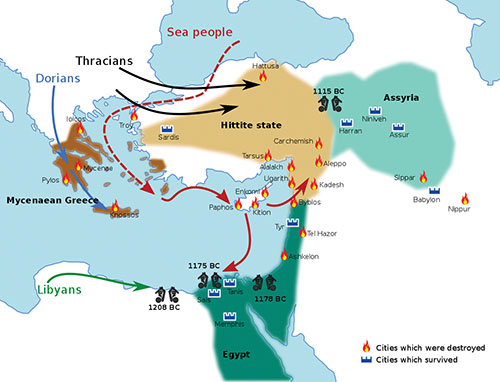
    Map of the Late Bronze Age collapse in the Eastern Mediterranean along with movements of people. 

    This sudden and violent disruption plunged the entire Near East, North Africa, Caucasus, Aegean, and Balkan regions into a Dark Age that lasted for three hundred years, and was characterised by great upheavals, famine, depopulation, and mass movements of people. Almost every city between Pylos and Gaza was violently destroyed, and many abandoned. The palace economies of Mycenae and Anatolia collapsed, and people lived in isolated, small settlements. 

    In Egypt, the period from 1070 BCE – 664 BCE is known as the ‘Third Intermediate Period’ during which time Egypt was overrun by foreign rulers. There was political and social disintegration and chaos, accompanied by a series of crippling droughts. In India, the Indus Valley civilisation finally ended around 1000 BCE, and after a gap of nearly 400 years we see the emergence of the 16 Great Kingdoms (Mahajanapadas) in the Gangetic Plains at around 600 BCE. Catastrophe also struck the Olmec civilisation of Mesoamerica at this time. A wholesale destruction of many San Lorenzo monuments occurred in c.950 BCE and the site was abandoned in c.900 BCE. Scholars believe drastic environmental changes may have been responsible for this shift in Olmec centres, with certain important rivers changing course.

    When the ascending Kali Yuga began in 676 BCE, much of the knowledge, traditions, and skills from the descending Kali Yuga were forgotten. Possibly in response to this grave social crisis, a number of philosophers and prophets appeared at this time, trying to re-discover the lost wisdom, and spread it amongst the ignorant masses. Among them were Buddha (623 BCE), Thales (624 BCE), Pythagoras (570 BCE), Confucius (551 BCE), Zoroaster (600 BCE), and Mahavir Jain (599 BCE). But much sacred knowledge was irretrievably lost. For instance, the original Vedas were comprised of 1,180 sakhas (i.e. branches), of which only 7 or 8 sakhas (less than 1%) are remembered now. Various errors, omissions, and interpolations also crept into the ancient texts as they were being revised and written down. The mistakes in the Yuga Cycle doctrine were some of them. 

    The Yuga Cycle timelines proposed here accurately mirrors the worldwide environmental catastrophes that accompany transitional periods between Yugas. Every 2,700 years our planet is impacted by a series of cataclysmic events for a period of a few hundred years, which brings about a total or near total collapse of civilisations across the world. In every case, however, civilisation restarts immediately after the period of destruction. The four key transitional periods, since the end of the Golden Age, are summarised in the above table.

    It is evident that the Yuga Cycle used to be tracked using the Saptarshi Calendar. It was of 12,000 years duration, comprised of four Yugas of equal duration of 2,700 years each, separated by transitional periods of 300 years. The complete Yuga Cycle of 24,000 years was comprised of an ascending and descending Yuga cycle, which followed each other for eternity like the cycles of day and night. For the past 2,700 years we have been passing through the ascending Kali Yuga, and this Yuga is coming to an end in 2025. 
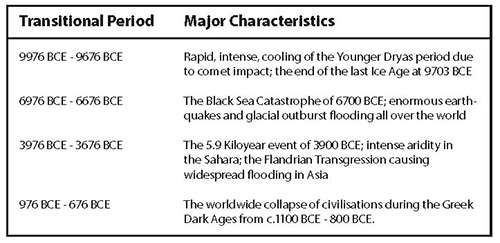
    The Transitional Periods between Yugas

    In accordance with convention, the 300-year transitional period following 2025 can be broken into two periods of 150 years each. The first 150-year period – the ‘Twilight of Kali’ – is when the Kali Yuga structures may collapse due to a combination of wars, environmental catastrophes, and cosmic changes, while the second 150-year period – the ‘Dawn of Dwapara’ – is the time when the spiritually evolved systems and philosophies of the Dwapara Yuga may begin to emerge. It is likely, though, that the twin processes of collapse and emergence will progress simultaneously throughout the entire 300-year transitional period, albeit at different intensities. 

    The current upswing in tectonic activities and extreme weather phenomena on one hand, and the initial signs of the awakening of a higher consciousness amongst humanity on the other, may be indicative of the fact that the effects of the transitional period are already underway. We need to be aware of these greater cycles of time that govern human civilisation, and the changes that are looming in the horizon.

    [alert type=”general” dismiss=”no”]This article was published in New Dawn Special Issue Vol 11 No 3.[/alert]

    [alert type=”success” dismiss=”no”]If you appreciate this article, please consider subscribing to help maintain this website.[/alert]

    Footnotes

    1. Krishna-Dwaipayana Vyasa, The Mahabharata, trans. Kisari Mohan Ganguli (1883-1896) book 3, chapter CXLVIII, from Internet Sacred Texts Archive, www.sacred-texts.com 
    2. Aryabhatiya, Kalakriyapada, verse 10
    3. D.C. Sircar, Indian Epigraphy, Motilal Banarsidass Publ., 1965, 318
    4. Richard Salomon, Indian Epigraphy: A Guide to the Study of Inscriptions in Sanskrit, Prakrit, and the other Indo-Aryan Languages, Oxford University Press, 1998, 181
    5. Surya-Siddhanta: A Text-Book of Hindu Astronomy, tr. Ebenezer Burgess, Phanindralal Gangooly, Motilal Banarsidass Publ., 1989, Chapter 1, 41
    6. Lokamanya Bâl Gangâdhar Tilak, The Arctic Home in the Vedas, Messrs. TILAK BROS, 1903
    7. The Mahabharata, tr.Kisari Mohan Ganguli, Book 12: Santi Parva, Section CCXXXI
    8. Laws of Manu, tr. G. Buhler, Chapter 1 verses 69, 70, 71
    9. Sri Yukteswar, The Holy Science, 1894, xi
    10. Jenny Strauss Clay, Hesiod’s Cosmos, Cambridge University Press, 2003, 83
    11. Alberuni’s India (AD 1030), trans. Dr. Edward C. Sachau, London, 1910, Chapter XLII 373-374
    12. Ibid, 375
    13. Ibid, 376
    14. Subhash Kak, “On the Chronological Framework for Indian Culture”, Indian Council of Philosophical Research (2000), 1-24
    15. J.E. Mitchiner, Traditions of the Seven Rishis, Motilal B, 1982, 163
    16. Pliny, Naturalis Historia, 6.59-60
    17. Arrian, Indica 9.9
    18. Encyclopaedia Londinensis Vol 21 (1826) 677
    19. Sir William Jones, “On the Gods of Greece, Italy and India”, Asiatic Researches vol. 1 (1788), 221-75
    20. Subhash Kak, “On the Chronological Framework for Indian Culture”, Indian Council of Philosophical Research (2000), 1-24
    21. Luigi Piccardi and Bruce Masse, Myth and Geology, Geological Society of London Special Publication, 2007, 273 
    22. “Nanodiamond-Rich Layer across Three Continents Consistent with Major Cosmic Impact at 12,800 Cal BP”, The Journal of Geology, 2014, volume 122, 475–506
    23. “Danish Arctic research dates Ice Age”, 11 Dec. 2008, http://politiken.dk/newsinenglish/article611464.ece
    24. “Geologists Link Black Sea Deluge To Farming’s Rise”, New York Times, 17 Dec. 1996
    25. Graham Hancock, Underworld: The Mysterious Origins of Civilization, Three Rivers Press, 2002, 82-83
    26. Ibid, 31
    27. Robert Drews, The End of the Bronze Age: Changes in Warfare and the Catastrophe ca. 1200 B.C., Princeton University Press, 1993, 4

    © New Dawn Magazine and the respective author.
    For our reproduction notice, click here.

  • America Before: The Key to Earth’s Lost Civilisation

    America Before: The Key to Earth’s Lost Civilisation

    From New Dawn 175 (Jul-Aug 2019)

    Humans were in America long before we’ve been told, and the Australian Aborigines have a genetic connection to the Amazon which once had great cities. FRANK JOSEPH looks at the fresh discoveries in Graham Hancock’s latest book.

    As the former editor-in-chief (1993 to 2007) and ongoing writer for Ancient American – a US magazine examining Old World impact on the New World before 1492 – recently released materials regarding pre-Columbian possibilities often come my way. I was surprised, however, to find that Graham Hancock’s latest tome, America Before, compares remarkably with Before Atlantis (2013), my own book, published six years earlier, in more than title. 

    Both works go into the Bering land-bridge Theory, megalithic alignments with the Cygnus constellation, Easter Island’s moai, Gobekli Tepe, the discoveries of Albert Goodyear, Brazil’s Stonehenge, the Meadowcroft Rock shelter, Neanderthals, the Clovis First Controversy, Pedra Furada, etc., etc. Other topics tackled in America Before – Ohio’s Great Serpent Mound, North American earthworks, the Piasu Bird, Cahokia, et al. – were likewise described at length in my earlier releases: Discovering the Mysteries of Ancient America (2006), Atlantis and Other Lost Worlds (2008), Unearthing Ancient America (2009), Advanced Civilizations of Prehistoric America (2010), Lost Worlds of Ancient America (2012), Lost Colonies of Ancient America (2014), and Lost History of Ancient America (2016). 

    Independent research that arrives at common conclusions tends to validate disparate investigators at work in the same field. Of them all, Graham Hancock is certainly the best known, thanks to his early association with such prestigious periodicals as The Times, The Independent, The Economist, and The Guardian, which granted him access to major book publishers with international distribution, such as St. Martin’s Press, publisher of his latest work. His Fingerprints of the Gods was a worldwide bestseller. At the time of its release in 1995, critics – even those sympathetic to the author’s belief in ancient catastrophism – faulted him for merely reworking long-known if not well-publicised information. But they were forced to admit that Hancock acquainted millions of readers with otherwise neglected information about the deep past. 

    America Before is not unlike Fingerprints of the Gods in that it introduces an international audience to a version of antiquity not otherwise available in schools or mainstream publications. America Before also joins Before Atlantis in highlighting “a global cataclysm that occurred near the end of the Ice Age around twelve thousand eight hundred years ago. A disintegrating comet crossed the orbit of the Earth and bombarded our planet with a ‘swarm’ of fragments.” Familiar language to readers already familiar with The Destruction of Atlantis (2002) and its sequel. Survivors of Atlantis (2004) similarly tells how an abundance of physical proof for worldwide destruction left by comets during the Bronze Age was offered by scientists meeting at Fitzwilliam College in Cambridge, England. 

    In 1997 they presented undeniable evidence in the form of annual growth rings at Irish bogs and oak forests, ash-fall deposits from Greenland ice-cores, impact lines made by colossal waves along the shores of Morocco, abrupt lake level changes from Western Europe to South America, and small, glassy spherules that result specifically from cometary collisions subjecting rock to intense heat. Earth’s periodic brushes with celestial upheaval belong to a pattern of astronomical interface with our planet that abruptly terminated the Ice Age, as described in America Before and earlier in Before Atlantis.

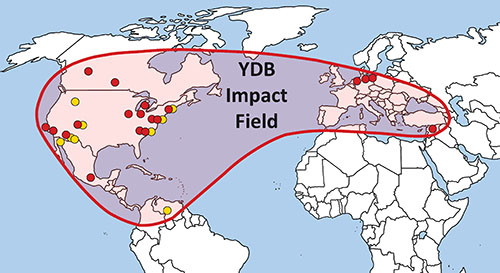
    Buried in the floor of Lake Cuitzeo was a thin, dark layer containing unequivocal evidence for a large, cosmic body that struck central Mexico just when the Younger Dryas period opened with such violence. Virtually identical sediment strata dated to the same period have been previously located at numerous locations throughout North America, Greenland, and Western Europe. According to Science Daily, “The data suggest that a comet or asteroid – likely a large, previously fragmented body, greater than several hundred meters in diameter – entered the atmosphere at a relatively shallow angle. The heat at impact burned biomass, melted surface rocks, and caused major environmental disruption.” The resulting crater became Lake Cuitzeo, measuring twelve and one-half miles across, with an average depth of ninety feet. 

    Dr James Kennett, professor of earth science at the University of California (Santa Barbara), told the Proceedings of the National Academy of Sciences: “These results are consistent with earlier reported discoveries throughout North America of abrupt ecosystem change, megafaunal extinction, and human cultural change and population reduction. These changes were large, abrupt and unprecedented, and had been recorded and identified by earlier investigators at a ‘time of crisis’. The timing of the impact coincided with the most extraordinary biotic and environmental changes over Mexico and Central America during the last approximately twenty thousand years, as recorded by others in several regional lake deposits.” 

    Professor of earth science Dr James Kennett and other researchers postulate from the evidence that a fragmented comet slammed into the Earth close to 12,800 years ago, causing rapid climatic changes, megafaunal extinctions, sudden human population decrease and cultural shifts and widespread wildfires (biomass burning). They studied the impact spherules in 18 sites in nine countries on four continents for their study. (Graphic credit: YDB Research Group)

    The floor of Lake Cuitzeo is rich in spherules formed when they collided with each other at high velocities during the whirling chaos of an extraterrestrial impact. They are joined by numerous specimens of lonsdaleite – an identifiable configuration nanodiamonds assume when they are pressured by large meteorite collisions – and aciniform soot, the acne-like appearance of dust residue resulting from the same cause. “These materials form only through cosmic impact,” Kennett explained, not through volcanic or other natural terrestrial processes. In the entire geologic record, the only other known continental layer with abundant peaks in lonsdaleite, impact spherules and aciniform soot is in the sixty-five-million-year-old Cretaceous-Paleogene boundary layer that coincided with the extinction of the dinosaurs. 

    Evidence for Early Human Settlement

    “Recent discoveries show that North America was first peopled at least one hundred thirty thousand years ago,” according to Hancock, “many tens of thousands of years before human settlements were established in Europe and Asia.” Homo sapiens-sapiens? Yes, but the European continent was actually settled one hundred seventy thousand years earlier by Neanderthals. In fact, the oldest evidence for proto-humans in Europe goes back 1.3 million years. “At least” is a bit of an understatement for human settlement in the New World, because Before Atlantis describes how prehistorian Juan Armena Camacho discovered lithic implements at Hueyatlaco, seventy miles south-east of Mexico City. According to US geologist Dr Virginia Steen-McIntyre, “radiometric dates using methods identical to those used in Africa to date the early sites there place Hueyatlaco’s stone tools to slightly over a quarter of a million years ago.” 

    Some thirty years prior to Camacho’s find, a still older site came to light one mile north from the Oklahoma town of Frederick, at a ten-mile-long, half-mile-wide ridge. Ten to twenty-five feet beneath the surface of this gravel deposit occur dozens of well-crafted stone implements cemented in place in common strata with the bones of extinct animals firmly dated to seven hundred fifty thousand years ago. C.N. Gould, Director of the Oklahoma Geological Survey, reported: “There can be no doubt that the artifacts occur in the pit near the basal portion, on the same level as the fossil remains. An examination of the undisturbed face of the pit, immediately above the position of the finds, showed unbroken, nearly horizontal strata above it. As the case stands, it looks very much as though the artifacts are of the same antiquity as the fossil animals. At the same time, it would be well to reserve final judgment until we are certain that the artifacts are not secondary inclusions.” 

    Since Gould released his report in 1929, subsequent investigations of the Holoman Pit, as it is locally known, repeatedly confirmed that the stone tools are not later inclusions but were indeed laid down at the same time the animal bones were stratified, three quarters of a million years ago. As recently as 2005, archaeologist Silvia Gonzalez of Liverpool’s John Moore’s University in England discovered a line of human footprints dating back forty thousand years ago near Puebla, in Mexico. Conventional scholars, convinced no human set foot in Middle America before twelve thousand years ago, sought to debunk the heretical period she assigned the evidence by dispatching a team of leading geologists led by Paul R. Renne, director of California’s Berkeley Geochronology Center, to the site. 

    Once there, they took repeated argon testing to investigate the magnetic imprint of the foot-printed, magmatic rock, together with other state-of-the-art procedures. Renne announced their results in the scientific journal Nature, stating that the rock featuring the footprints was not forty thousand years old after all. It was, instead, 1.3 million years old

    During the early 20th century, archaeologist Carlos Ameghino (1865 to 1936) led teams of excavators along the Argentine coast south of Buenos Aires after detecting clues to an early habitation site at Miramar. By 1914, he discovered numerous stone tools cemented within Pliocene Era strata. As Silvia Gomez experienced in the following century, Ameghino’s critics commissioned a group of professional geologists to debunk his assertion. Instead, they verified it, stating that the artefacts had been laid down between two million and three million years ago. Although their analysis was released by the prestigious Anales del Museo de Historica Natural de Buenos Aires, it has since been ignored by archaeologists in the outside world. 

    Australia-Amazon: An Unexpected Discovery

    “Certain tribes of the Amazon jungle,” states America Before’s back cover blurb, “are closely related to Australian Aborigines. How did this extraordinary, unexpected, and extremely ancient DNA signal get to the Amazon?” This question elevates Hancock’s new book with fresh discoveries that threaten to shake the scientific establishment to its core by opening an entirely new and revolutionary archaeological theatre of operations. 

    The vast Amazon region has long been dismissed by mainstream scholars as anciently under-populated and barren of all but the most backward, native cultures, hermetically sealed off by nature from the outside world. Hancock writes, “in September 2015, Pontus Skoglund, his senior colleague Professor David Reich of the Department of Genetics at Harvard Medical School, and other leading experts in the field, announced in the pages of Nature that they had found new evidence in South America, and specifically in the Amazon rainforest, that called for a rethink.” 

    Researchers mapped similarities in genes, mutations and random pieces of DNA of Central and South American tribes with groups in other parts of the world including Australia. Warmer colours indicate the strongest affinities. Researcher Skoglund said “a statistically clear signal linking Native Americans in the Amazonian region of Brazil to present-day Australo-Melanesians and Andaman Islanders” was confirmed. (Graphic credit: Pontus Skoglund, Harvard Medical School)

    He quotes Skoglund’s “genome-wide data to show that some Amazonian Native Americans descend partly from a Native American founding population that carried ancestry more closely related to indigenous Australians, New Guineans and Andaman Islanders than to present-day Eurasians or Native Americans,” and are, in Hancock’s words, “more closely related to Melanesian Papuans and Australian Aborigines than to any other Native American population.” “We spent a really long time trying to make this result go away,” Skoglund explained, “but it just got stronger.” In the end, “a statistically clear signal linking Native Americans in the Amazonian region of Brazil to present-day Australo-Melanesians and Andaman Islanders” was confirmed. 

    “We also know it has to be pre-Columbian,” added Professor Eske Willerslev of Denmark’s Center for GeoGenetics at the University of Copenhagen. Further studies by Willerslev and his colleagues “found Australian DNA already present in skeletal remains from Lagoa Santa, Brazil, dated to 10,400 years ago, and confirmed the suspicion of the researchers that the anomalous genetic signal must have reached South America in the Late Pleistocene – that is, near the end of the last Ice Age, [when] a group of people carrying Australo-Melanesian genes settled in what is now the Amazon jungle.” 

    The headline of the Oct/Nov 2010 edition of Cosmos magazine and accompanying by-line, augmented by a photograph of an American skull (Luczia) exhibiting morphology that closely resembles Australian Aboriginal people. The oldest human skull unearthed in the Americas has cranial features similar to those of Australian Aborigines. Another piece of anomalous evidence pointing to an early human story, but largely ignored because it contradicts official scientific theory.

    This is undoubtedly one of the most striking revelations ever made in the entire history of archaeology, as inexplicable as it is astounding. It does not mean that a few Australoid castaways accidentally washed ashore on Peruvian shores, then somehow traversed the formidable Andes Mountains and descended into Brazil’s totally different, but no less forbidding jungle, where they cohabited with a few, indigenous individuals.

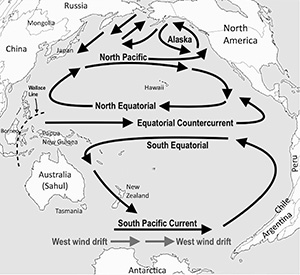
    Rather, DNA evidence signifies a mass-migration of Australo-Melanesians to Amazonia, where they interbred with native peoples on such a broad scale some ten and a half centuries ago, the genetic imprint is still discernible. Their epic, 12,940–kilometre, trans-Pacific voyage to coastal Peru and subsequent 1,890–kilometre trek to Brazilian rain forest were successfully achieved at a time when Western European Man was struggling to survive the challenging Upper Paleolithic, or Late Stone Age. Australia’s contemporaneous material culture was itself far too underdeveloped for undertaking anything even approaching an oceanic crossing of such magnitude, not only in terms of the extreme distances concerned, but especially regarding the large number of persons participating in the expedition, or expeditions. 

    The maritime technological requirements necessary for conducting an operation of transpacific scope alone rule out all possibilities for Australoid responsibility. Moreover, what conceivable motivation could have possessed them to attempt such a huge enterprise? Hancock wonders if a third party was involved – a different, unrelated, unknown, though far higher culture that, for reasons even more obscure, transported Australo-Melanesians to Amazonia. 

    Speculation like this begins to conjure ‘legendary’ Lemuria, the pre-Polynesian civilisation that rose to ancient heights of technological greatness and imperialist domination of the Pacific realm, before succumbing to a natural catastrophe sufficiently powerful enough to shake the very foundations of the Earth itself. Hancock, however, shies away from any Lemurian connotations. 

    Ancient Amazonia Rises Out of the Cleared Forests

    Even so, America Before’s most valuable and original contribution to our deepening grasp of antiquity is its investigation of Amazonia, an area of the world hitherto neglected by conventional and alternative researchers alike. They traditionally laboured under the assumption that Brazil’s rain forest was always far too environmentally hostile for civilisation to have taken root there. Hancock cites the academic view “that the Amazon could only have been inhabited for about 1,000 years, and then only by very small groups of hunter-gatherers, since the jungle was ‘resource poor’.” 

    Among the very few archaeologists who personally challenged this dominant paradigm was Percy Harrison Fawcett. His disappearance in search of the lost city of Z during 1925 seemed to confirm consensus opinion that no such place could possibly exist in the Brazilian jungle, and America Before is remiss in failing to properly credit or even mention in passing the British Colonel, whose self-sacrificial, if percipient effort foreshadowed the very discoveries Hancock describes in Chapters 11 through 17. 

    Together with the two previous chapters detailing Amazonia’s genetic connection with Ice Age Australia, they combine to represent the book’s highest worth. Nowhere else may readers learn more about the Amazon Basin’s otherwise unknown archaeological wealth. 

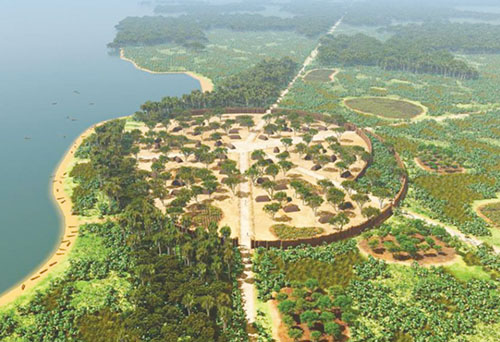
    An artist’s conception shows a Xinguano village of the Brazilian Amazon as it might have appeared before 1492. An example of how the Amazon was once likely inhabited by hundreds of thousands of people in numerous well-managed cities, towns and villages. Archaeologists have found traces of wide, curbed roads and managed parklands. 

    He tells how the first modern Europeans travelling the Amazon River from Ecuador to its estuary on the Atlantic coast of Brazil saw “great cities” that “glistened in white” (suggesting limestone construction, like that favoured by Maya construction engineers) during their 7,000-kilometre, seventeen-month journey. Some of these urban centres were “more than twenty kilometres from end to end, roughly the length of Manhattan… enormous expanses were given over to productive agriculture, and there were signs everywhere of large and well-organised political and economic systems linked to centralised states that were capable of fielding disciplined armies thousands strong.” 

    Hancock quotes the mid-16th century expedition’s Spanish chronicler, Dominican friar Gaspar de Carvajal, concerning an abandoned, native “villa, in which were a great deal of porcelain ware of various makes, both jars and pitchers, very large, with a capacity of more than twenty-five arrobas [one hundred gallons] and other small pieces such as plates and bowls and candelabra of this porcelain of the best that has ever been seen in the world, for that of Malaga [Spain’s centre for pottery production] is not its equal, because this porcelain which we found is all glazed and embellished with all colours, and so bright, that these colours astonish, and, more than this, the drawings and paintings which they make on them are so accurately worked out that one wonders how with only natural skill they manufacture and decorate all these things making them look just like Roman articles.” Native porcelain of such high quality does not appear in Brazilian archaeology. 

    The largest native city Carvajal and his companions saw was greater than twenty kilometres in extent, with a population of twenty thousand or more residents. Their chieftain, Machiparo, also ruled over “many settlements and very large ones, which together contribute for fighting purposes fifty thousand men…” 

    Two, subsequent expeditions, twenty years later and 1637-38, respectively, supported Carvajal’s report. Hancock quotes UCLA Professor David Wilkinson, “an authority on long-term and large-scale phenomena in world politics [who] has made a special study of the level of civilisation in the Amazon prior to European contact.” Based on a late 17th-century report that one of Brazil’s native cities could field 60,000 warriors, Wilkinson found “comparative-civilisational standards have implied an urban population of 300,000 to 360,000.” 

    He goes on to describe “more than 30 epidemics – smallpox, measles, and other outbreaks – some on a massive scale – in 16th-18th century South America.” With fatal consequences in the upper ninety percentile, the Amazonian metropolitan areas literally died out though depopulation. “Once left deserted,” Hancock explains, “the great cities and monuments and other public works of any hypothetical Amazonian civilisation would quickly have been encroached upon and soon completely hidden by the jungle…” They only began re-emerging in 1977, “when giant, geometrical earthworks were discovered in the Rio Branco area of the Brazilian state of Acre, in the southwestern Amazon.”

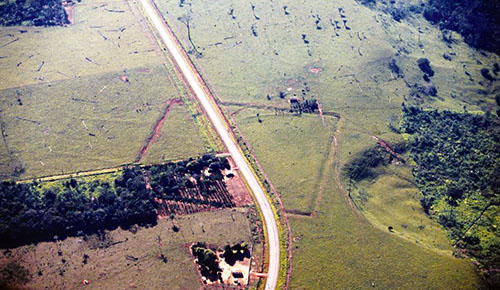
    It was the first of many related sites that have since come to light, including a pair of perfect squares – 200 metres and 100 metres wide – connected by a 20-metre-wide, 100-metre-long causeway. Archaeologists estimate “that as many as 1,500 geoglyphs might ultimately be found.” Severino Calazans, the largest Amazonian structure of its kind so far surveyed, “defined by an enclosure ditch twelve metres wide, measures 920 metres.” This particular location and other, outsized designs “have since been revealed by mass clearing of the forest for the cattle industry, thus becoming visible, especially from the sky, over the past 30 years. Indeed, the enormous size of the geoglyphs makes it easier to distinguish their shape and configuration from an aerial perspective, than at ground level…” 

    Groups are composed chiefly of circles, ellipses and rectangles, suggesting possible celestial orientations. Hancock writes that “because they offer an unobstructed view of the horizon, such locations are also very often what ancient astronomers looked for when they set out monuments on the ground – aligned, say, to the June solstice sunset or to the March equinox sunrise. Without a full-scale archaeo-astronomical survey of the Amazonian geoglyphs,” however, their suspected celestial significance remains unproven. 

    Their resemblance to Old World Stone Age sites nevertheless inspires provocative comparisons. Hancock tells how “the square enclosure ditch at Severino Calazans shares the ground plan, base diameter and cardinality [orientation to the Four Cardinal Directions] of the Great Pyramid of Egypt. That epoch, moreover, around 2500 BC, coincides and overlaps with the megalithic epoch in Europe, so another curiosity is the way that the circular geoglyphs of Amazonia resemble henges – the circular embankments with deep, internal ditches that surround the great, stone circles of the British Isles. The scale is very similar and the resemblance is so obvious that even the most sober archaeologists, usually wary of cross-cultural comparisons, are willing to remark upon it.” 

    The Severino Calazans site, formed by a single square-shaped ditch, is cut and partially destroyed by Highway BR-317. A farm has been built inside the area enclosed by the ditch. Indigenous people consider the earthworks sites as sacred and do not use them for housing. (Photograph by Sanna Saunaluoma)

    Whatever critics may make of America Before, they cannot deny that its unique discussion of the lost civilisation of the Amazon, plus revelations concerning the mind-boggling heritage of its present-day descendants from 9th millennium BCE Australia, opens new vistas of antiquity, as trailblazing, as they are intriguing. 

    America Before is available from all good bookstores.

    [alert type=”general” dismiss=”no”]This article was published in New Dawn 175.[/alert]

    [alert type=”success” dismiss=”no”]If you appreciate this article, please consider subscribing to help maintain this website.[/alert]

    © New Dawn Magazine and the respective author.
    For our reproduction notice, click here.
  • The Denisovans at the Gates of Dawn: An Interview with Andrew Collins

    The Denisovans at the Gates of Dawn: An Interview with Andrew Collins

    From New Dawn 177 (Nov-Dec 2019)

    Many New Dawn readers are familiar with Andrew Collins, the British writer and researcher specialising in books that “challenge the way we perceive the past.” He is a pioneer in the study of archaeoastronomy – ‘the science of stars and stones’ – the designed correspondences between prehistoric monuments and celestial patterns. In fact, Andrew Collins has become a leading player in the continually evolving field of the origins of civilisation

    A central theme of his books is that the Watchers and Nephilim of Enochian literature, as well as the biblical ‘fallen’ angels and Anunnaki of Mesopotamian mythology, are memories of an elite group that helped forge the foundations of civilisation in Anatolia and the Near East. He asserts that this same region, particularly eastern Turkey, was the site of the biblical Garden of Eden and terrestrial Paradise. 

    In this exclusive interview for New Dawn magazine, Andrew Collins talks about his new book, co-written with Gregory L. Little, Denisovan Origins: Hybrid Humans, Göbekli Tepe, and the Genesis of the Giants of Ancient America, and lots more. 

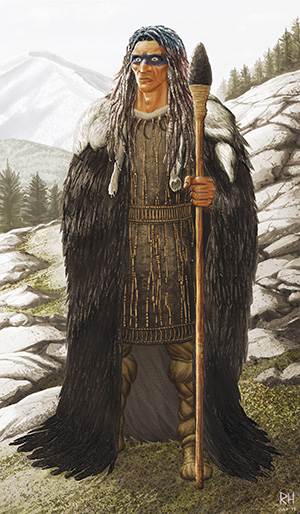
    Reconstruction of a Denisovan-modern human hybrid. Artist credit/copyright: Russell M. Hossain

    BRETT LOTHIAN (BL): In your new book Denisovan Origins: Hybrid Humans, Göbekli Tepe, and the Genesis of the Giants of Ancient America, you quite aptly begin with the paradigm-shattering findings at Göbekli Tepe. Can you explain Göbekli Tepe and how it changes our understanding of human history?

    ANDREW COLLINS (AC): Göbekli Tepe is arguably one of the most important archaeological discoveries of the twenty-first century. It is a series of stone enclosures with rings of carved T-shaped pillars facing two large monoliths standing at their centres, like twin gateways into some invisible liminal realm. Located on a mountain top in SE Turkey, Göbekli Tepe was built enclosure by enclosure between 11,600-10,000 years ago. Thereafter the site was abandoned, its inhabitants spreading out across Anatolia and the Near East, and eventually into Europe, creating what is known as the Neolithic revolution.

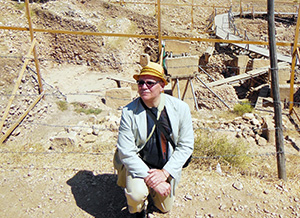
    Andrew Collins at Göbekli Tepe (copyright: Andrew Collins)

    Göbekli Tepe’s importance is its immense sophistication and the fact that it constitutes the world’s earliest known monumental architecture. Of even greater importance is that it shows us that, even by this age, modern humans had tiered hierarchical societies able to pull off incredible feats of engineering. The question then becomes: Who built it and why?

    For me, it existed as part of a response to the cataclysmic events surrounding the Younger Dryas comet impact event of approximately 10,800 BCE. Caused most likely by multiple fragments of Comet Enke entering the upper atmosphere, air blasts triggered unimaginable wildfires across the Northern Hemisphere. The ash, smoke and debris rising into the air brought about a nuclear winter that instigated a 1,200-year long mini-ice age that gripped both the American and Eurasian continents and did not end until 9600 BCE, the very time frame of the construction of Göbekli Tepe.

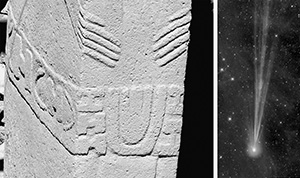
    Göbekli Tepe’s Pillar 18 showing its three-tailed comet motif as a belt buckle, next to which is a comet with three tails. (Copyright: Andrew Collins)

    There is very clear comet imagery on one of the standing monoliths at Göbekli Tepe which tells us that its purpose was to create a place of easy access to the sky world, which was thought to lie in the northern part of the heavens. Here the supernatural creatures thought to be responsible for such cataclysms were seen to roam, their arrival in the skies marked by the appearance of comets.

    These were ideas I first proposed in my 2014 book Göbekli Tepe: Genesis of the Gods. I am now pretty sure they are correct as they have now been adopted by other researchers in this field, who also see the construction of Göbekli Tepe as a response to the Younger Dryas comet impact event.

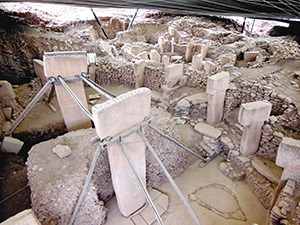
    Göbekli Tepe’s Enclosure D with Enclosure C behind. (Copyright: Andrew Collins)

    BL: The enigmatic Denisovans are the most recently discovered additions to the Homo genus. Can you tell us what we know about these mysterious archaic hominids?

    AC: The Denisovans were not even known about before 2010. It was in this year that a small fragment of finger bone, found two years earlier during excavations at the Denisova Cave in the Altai Mountains of Siberia, was sequenced. It was determined the bone came from a girl of around 13 years old who lived approximately 50,000 years ago. The uniqueness of the individual’s genome made it clear she belonged to a previously unknown hominin group that would thereafter be known as the Denisovans after the place of their discovery (incidentally, ‘Denisovans’ is correctly pronounced dee-niss-o-vans and not denis-o-vans). The exact status of the Denisovans does, however, remain undecided since some scholars are convinced they are simply an early form of Homo sapiens, and not a unique human type, the reason why they have so far not been given their own species name.

    What the so-called Altai Denisovan genome also made clear was that this unique human group shared more gene alleles with Neanderthals than they did with modern humans, leading to the surmise that the Denisovans must have been a sister group of the Neanderthals. This conclusion was backed up in 2016 with the discovery during excavations at the Denisova Cave of two fragments of a Denisovan skull that was particularly robust like that of Neanderthals and other early hominins. Even earlier, the discovery, again at the Denisova Cave, of two enormous molars had also suggested the Denisovans would be found to be particularly robust in nature. However, this is now known to be only part of the story, for a recent examination of the finger bone of the 13-year-old Denisovan girl who lived 50,000 years ago makes it clear that the Denisovans had long, gracile fingers like those of modern humans. This means there is every chance they looked more like us, and also perhaps thought more like modern humans that they did Neanderthals.

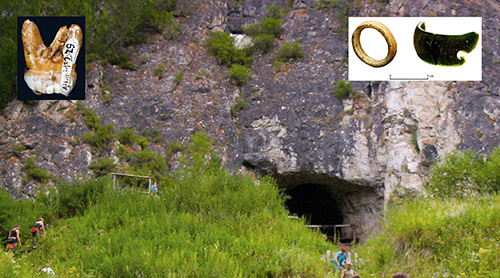
    The Denisova Cave in southern Siberia with inset, left, one of the large Denisovan molars found there and, right, the so-called Denisovan bracelet found in the same occupational layer. 

    What is more, evidence of a sophisticated mindset existing in connection with the Denisova Cave’s Denisovan layer had already been noted. This stems from the discovery of the beautiful choritolite (chlorite) arm bangle dubbed the Denisovan bracelet, which shows evidence of sophisticated drilling, sawing and polishing, along with the earliest known bone needles used to make tailored clothing. In addition to this, fragments of a bone whistle or flute were found in the cave’s Denisovan layer, telling us that the Denisovans must have had an understanding of music, while more recently archaeologists working at the cave found an ochre “pencil” with evidence of usage. This suggests that the Denisovans were able to write and draw. The discovery of horse bone fragments and equine DNA suggested to some scholars that the Denisovans might even have domesticated and ridden horses. 

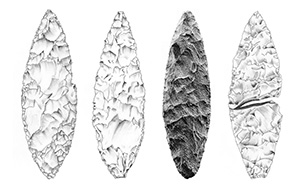
    All this implies that certainly by 45,000 years, and arguably earlier, the Denisovans displayed immense technological capability and advanced human behaviour. It is also now thought they developed what is known as blade tool technology, which is the product of a complicated process known as pressure flaking. This is where a handle-like instrument, usually made of bone, antler or wood, is applied to a prepared stone core to literally prise off long, slim blades or bladelets.

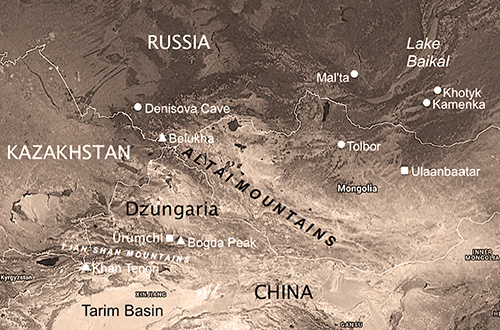
    This blade tool technology, which started its life in southern Siberia and northern Mongolia, was then carried westwards across the Ural Mountains into Europe, as well as into southwestern Asia, where it was introduced to the Pre-Pottery Neolithic world of southeastern Anatolia around the same time that Göbekli Tepe came into existence. This recorded path of blade tool production suggests that the ancestors of those who built Göbekli Tepe came not just from the north, beyond the Caucasus Mountains on the Russian steppe, but from much farther east – beyond the Ural Mountains in western Siberia somewhere. It is even possible they came from as far away as the Altai Mountains of southern Siberia, where the Denisova Cave is located, or even northern Mongolia, close to the great inland sea called Lake Baikal. 

    Map of Siberia and Mongolia showing the location of the Denisova Cave and other sites mentioned in this article. (Copyright: Andrew Collins)

    Archaeologists now believe our earliest ancestors first encountered Denisovans and Denisovan-Neanderthal hybrids somewhere in northern Mongolia around 45,000 years ago. Sites in this region such as Tolbor-16 show evidence of modern human occupation, and yet they also have the same high culture associated with the Denisovan layer in southern Siberia’s Denisova Cave. This, then, is where our own slow rise to civilisation began at the beginning of the Upper Palaeolithic epoch.

    BL: DNA evidence reveals that ancient modern humans interbred with not only the Denisovans but the Neanderthals and as yet unidentified archaic hominids. Can you explain this complex web of interactions and how modern humans have benefitted from this gene flow?

    AC: What becomes clear is that both the Denisovans and modern humans must have gained their gracile fingers from the same source, a common ancestor of both populations from whom we split around 700,000 years ago. If correct, then it means that the stubby, blunt-ended fingers displayed by Neanderthals only developed after they split from the Denisovans some 400,000 years ago (and arguably earlier still).

    All this gave every branch of hominin – Denisovans, Neanderthals and modern humans – the chance to develop their own unique genome, which helped engineer their physical appearance, capabilities, and material culture. By around 45,000 years ago, the Denisovans were out in front with an acute level of human development, suggesting that as we encountered them in places like northern Mongolia, we not only interbred with them but also at the same time gained their technologies and understanding of our relationship to the cosmos. This, then, would have been the legacy passed down through their hybrid descendants to the founders of human civilisation.

    Girl from Papua New Guinea. It has been found that six per cent of the Papuan population contains Denisovan DNA. Other groups categorised under the Australo-Melanesian genome, such as Australia’s Aborigines, also have higher amounts of Denisovan DNA.

    After this time the Denisovans disappear from the scene, in Siberia and Mongolia at least. However, one recent genetic study suggests that some Denisovan groups might have survived in Island Southeast Asia and Melanesia through till as late as 15,000 years ago. This tells us that the sophisticated Denisovan mindset might well have been behind the spread of Australo-Melanesian ancestry from Island Southeast Asia all the way across South America, where both Australo-Melanesian and Denisovan DNA has been found among certain tribes of the Amazon.

    BL: A key theme of Denisovan Origins is how cultural and technological exchange – the interaction and hybridising of archaic hominids such as the Denisovans – influenced modern humans. In your opinion, how did this flower human civilisation?

    AC: What the evidence is beginning to tell us is that the Denisovans were truly sophisticated in many ways – they created beautiful jewellery, almost certainly wore tailored clothing, used musical instruments, and may even have ridden horses. On top of this, there is every possibility that they were sea voyagers, and might well have travelled between Island Southeast Asia and the Americas, South America especially. All of these technologies were thereafter passed on to their hybrid descendants, who carried them out to the farthest reaches of the Eurasian continent. Yet it is the Denisovans’ apparent invention of blade tool technology that becomes crucial in telling us exactly how far their legacy reached and which cultures benefitted from it.

    The westward pulses of Denisovan technology would eventually flower among the Eastern Gravettians of central-western Russia at key sites such as Kostenki and Sungir. From these sites, as well other settlement areas in places like the Czech Republic, the Denisovan legacy was carried westward in western Europe by Proto-Solutrean groups, from whom emerged the Solutreans of southwestern Europe. Also benefitting from the Denisovans’ blade tool technology were the much later Swiderian and Post-Swiderian groups, who thrived just before, during and immediately after the Younger Dryas impact event of circa 10,800 BCE. 

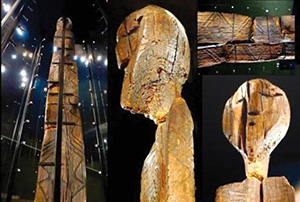
    The 11,600-year-old Shigir idol found in a peat bog in the Middle Urals in 1894, which has been linked to the contemporary Pre-Pottery Neolithic culture of Göbekli Tepe in southeastern Anatolia. 

    It is the Swiderians who I believe came to bear on the Pre-Pottery Neolithic peoples of southeastern Anatolia, resulting in the rapid emergence of Göbekli Tepe circa 9600 BCE. You can see clear similarities between the carved art of Göbekli Tepe and that being produced around the same time by Mesolithic peoples of the Ural Mountains. The 11,600-year-old Shigir Idol best exemplifies this connection. This is a carved wooden totem pole that was found alongside other fragments of similar idols in a peat bog in the Middle Urals in 1894. It is fashioned from an enormous tree trunk and was originally around 5.3 metres in height. The style of carving, particularly of the human heads it displays, bears striking similarities to some of the carved human heads unearthed at Göbekli Tepe. It is surely no coincidence then that the same blade tool technology found at Mesolithic sites in the Ural Mountains is also found at Pre-Pottery Neolithic sites like Göbekli Tepe. There was clearly a connection between these two very distant worlds as early as 9600 BCE.

    Also see The Suppression of Alternative Researchers & the Work of Andrew Collins

    BL: To this day, legends such as the destruction of Atlantis, floods of astonishing proportions and of the very sky itself falling, persist all over the world about a cataclysm on a scale we can barely imagine, which you date to around 10,800 BCE. Can you explain what happened and the evidence to support this?

    AC: The Younger Dryas comet impact event occurred around 10,800 BCE. It was a devastating cataclysm that ignited as much as 10 percent of the world’s biomass. However, the cosmic events just kept coming, with further fragments hitting the Northern Hemisphere periodically for around 11 years, with some estimates suggesting they continued through until around 11,340 BCE; this being at least 500 years after the initial impact event.

    What we can say is that the termination of the Younger Dryas around 9600 BCE coincides almost perfectly with Plato’s proposed date for the destruction of Atlantis, and also the emergence of Göbekli Tepe in southeastern Anatolia.

    BL: After the Earth-shattering events of the Younger Dryas impact, the way humans think – our social organisation and how we interact with the environment – was forever altered in many parts of the world. Can you explain these drastic changes and how they still impact us today?

    AC: Understanding why Göbekli Tepe was built so soon after the Younger Dryas episode can be shown to relate to the state of mind prevailing among indigenous populations in the wake of this terrible human tragedy. Those that did survive would have feared it would happen again, and next time the world really would come to an end. Paranoia of this kind would have been widespread.

    Visionary writer Barbara Hand Clow has aptly termed this fragile state of mind catastrophobia, the fear of further catastrophes. I think she is entirely right in not only predicting the existence of catastrophobia, but also in the way it would have affected generations of humanity for many thousands of years afterward.

    How could you prevent catastrophobia from eating at the heart of a community every time a comet appeared in the skies? There were no psychoanalysts or counsellors back then who could offer advice on how best to overcome this problem. There were, however, go-to people who would have been considered able to allay the fear of further catastrophes. These were the complex individuals known as shamans. They can act as human interfaces between the world of the living and a perceived otherworld existing beyond the normal senses, and accessible only through dreams, visions, and the achievement of altered states of consciousness.

    Shamans are able to induce trance-like states to propitiate, appease or negotiate deals with, among other things, the supernatural creatures seen as responsible for malefic intrusions into the physical world. This includes the appearance in our skies of comets, which in many ancient societies were seen as harbingers of death and destruction. Supernatural creatures of this type were generally considered animistic in form, most obviously monstrous canines (dogs), lupines (wolves), and vulpines (foxes). Comets were also associated with snakes, which in myth and legend are occasionally seen as responsible for natural catastrophes associated with impact events. 

    BL: Of particular interest to our more esoterically minded readers is the belief system, cosmology and spiritual practices of the “shamanic elite” that are central to your theories – the enigmatic bird shamans? 

    AC: From the Upper Paleolithic age through till Neolithic times, there appear to have been certain universal principles in cosmology that were reflected not only in shamanic beliefs and practices but also in ideas regarding both the origin of the soul and its destination in death. They featured the Milky Way as a kind of road or river along which the souls both of the deceased and those of shamans would take to reach an afterlife among the stars. Such beliefs were universal in both the Eurasian continent and in North America. For these beliefs to have existed simultaneously on both continents means they must be at least 12,000 years old, and arguably much older still, for it was shortly after this time that the Beringia land bridge linking the Russian Far East with North America was drowned beneath the waters of the Beringia Sea. After this time there would have been no widespread contact between the two continents.

    Orion as a double hand symbol as seen on a ceramic platter in the museum at Moundville, Alabama. The “eye” in the centre of the hand is almost certainly the M42 nebula in the sword of Orion. This was seen as an “ogee” or portal onto the Milky Way. (Copyright: Andrew Collins)

    As many as 30 to 40 Native American tribes of North America share a belief in what can only be described as the Path of Souls death journey. This involved a leap of faith at the time of death (either for the deceased or the shaman in a death trance) towards a portal located where the ecliptic, the sun’s path, crosses the Milky Way on one side of the sky. This portal was located generally in the Orion constellation, with the Messier object named M42 in the ‘sword’ of Orion being singled out for this purpose, or in the Pleiades star cluster located in the constellation of Taurus, the bull. The first appearance of the Pleiades following a period of absence each year signalled the beginning of a new year or season on both the American and Eurasian continents. It was a perfect timekeeper, and so must have become important to ancient peoples at a very early date.

    From here the soul was thought to travel along the Milky Way sometimes going to the south, and even directly beneath the earth until it would eventually turn northward and reach a point where the starry stream split into two separate branches. Each branch symbolised one of two possible outcomes for the soul: one led to the afterlife, while the other led only to oblivion (or at best reincarnation). A supernatural figure standing at the fork in the Milky Way would pass judgment on the soul. It could be male or female, although most usually it was a supernatural bird or birdman, which went by the appealing name of Brain Smasher or Skull Crusher. Its purpose was, we believe, to liberate the spirit of the person trapped inside the soul in its form as a skull or head. This enabled the freed spirit to enter the afterlife proper. As Graham Hancock points out in his new book America Before, a very similar skull crushing figure stood at the same position in the soul’s journey in ancient Egyptian tradition.

    These ideas are connected with the age-old belief that the seat of the soul was located in the head, the reason why the skulls of deceased peoples were revered during the prehistoric age as points of contact, not just with its former owner, but also with any ancestor associated with the person’s familial line.

    Mississippian era shaman dressed as a birdman representing the character Brain Smasher encountered on the Path of Souls cosmic death journey. In the sky, Brain Smasher is identified with the constellation of Cygnus, the celestial bird. (Copyright: Andrew Collins)

    Brain Smasher in Native American tradition was almost certainly identified with the Cygnus constellation, which is positioned exactly where the Milky Way splits into two separate branches. Almost universally, Cygnus is seen as a sky bird. What species it takes varies from country to country. Across most of the Eurasian continent it is usually seen as a swan or goose flying down the Milky Way. In southwestern Asia (Armenia and ancient Greece in particular) it was the vulture, while in North America it was very often a large raptor or vulture. Among the Algonquian-speaking peoples of the Great Lakes-St Lawrence River region, it was a crane, goose, as well as the Thunderbird.

    The one thing these birds have in common is that they were all considered soul birds – vehicles for the soul to travel from this world to the next, and then, when required, back again to the world of the living. It is most likely for this reason that bird-related paraphernalia, such as bones, skulls, feathers and talons have been incorporated into the ritual clothes of shamans since the age of the Neanderthals.

    BL: A large part of Denisovan Origins focuses on the peopling of the Americas, where you and your co-writer Gregory L. Little propose a radical re-thinking of the established paradigm. Using both archaeological and DNA evidence, you both skilfully paint an entirely new and far more interesting picture of America’s ancient past, even explaining the mysterious finds of giants that the mainstream continually ignores. Can you give us a brief outline of this radical reinterpretation?

    AC: Until recently North American anthropologists, palaeogeneticists and archaeologists all perpetuated the view that the First Americans came across from the Russian Far East some 15,000 years ago. They created what are known as Pre-Clovis bi-points, which with the emergence of the Clovis culture around 13,200 years ago would evolve eventually into the highly distinguishable Clovis Point.

    This view has now changed. Firstly, a large number of Pre-Clovis sites have yielded types of stone tools and projectile points that have nothing to do with the later Clovis culture. Many of these sites are in the American Southwest suggesting a point of foundation in this region and not in the American Northwest, close to the former Beringia land bridge. Secondly, there is now overwhelming evidence from various genetic studies telling us that the picture is even more complicated, with migrations across the Beringia land bridge taking place as early as 24,000 years ago, while the presence of Australo-Melanesian DNA in South American tribes suggests further migrations to South America no later than 10,000 years ago.

    Palaeogeneticists and archaeologists are unwilling to accept that peoples carrying Australo-Melanesian ancestry arrived in South America directly from Island Southeast Asia and Melanesia. Instead, they propose that Australo-Melanesian peoples must have embarked on an extremely arduous coast-hopping journey all around the rim of the Pacific until they reached the Aleutian Islands off Alaska, where Australo-Melanesian DNA has also been found among the indigenous Aleuts. From here they would have travelled down the Pacific coast of North America, finally entering South America.

    Map showing the ocean currents and prevailing winds that may well have determined transpacific journeys bringing both Denisovan and Australo-Melanesian ancestry to the Americas. (Copyright: Andrew Collins)

    Such a theory can certainly explain the presence of at least some Australo-Melanesian ancestry in the Americas, although it makes far more sense to assume direct transpacific journeys as well, perhaps using the ocean currents and prevailing winds that would take a vessel from the northern coast of Sahul, the former continent embracing Papua New Guinea, Australia and Tasmania, past New Zealand and down to the Antarctic continent. From here the ocean currents would have carried a vessel toward the southern tip of South America, from where it would have been an easy journey northwards along the continent’s west coast, making landfall in what is today Chile, or along the continent’s east coast, making landfall in Argentina, Uruguay, or Brazil. Navigable rivers would then have permitted a vessel entry into the interior of South America, accounting perhaps for the presence of Australo-Melanesian ancestry among certain tribes of the Amazon. With all these journeys Denisovans or, more likely, Denisovan hybrids, would no doubt have been present, explaining the presence of Denisovan DNA in some South American tribes and populations.

    Solutrean points and Pre-Clovis points side-by-side. a) Upper Solutrean laurel leaf point from Fourneau-du-Diable, Dordogne, France; b) Solutrean laurel leaf point from Les Jean-Blancs, Dordogne, France; c) Cinmar point found on the Outer Continental Shelf off Chesapeake Bay, Virginia, in 1970, and, d) the point, fashioned from a stone type only found in France, discovered on Eppes Island, Virginia, in 1971. (Copyright: Andrew Collins)

    Then there is the likelihood also of Solutrean peoples from southwestern Europe crossing the ice flows that spanned the entire Atlantic Ocean from northern Spain across to the area of the Chesapeake Bay on the Atlantic coast of the United States at the height of the last ice age circa 22,000-20,000 years ago. This might explain why a large number of Pre-Clovis bi-points have been found in the Chesapeake Bay area that closely resemble very similar so-called leaf points manufactured by the Solutreans of southwestern Europe between 22,000-17,000 years ago. One particular example of a Pre-Clovis projectile point found in the Chesapeake Bay area is even made of a type of stone only available in France.

    The presence of Solutreans in North America is backed up by genetic evidence, particularly in the fact that a particular mutation of mitochondrial DNA (mtDNA) found extensively among the Algonquian-speaking peoples of the Great Lakes-St Lawrence River and known as haplogroup X is found also among the indigenous peoples of southwestern Europe, this being the former territories of the Solutreans. It is not found anywhere in the eastern half of the Eurasian continent, telling us that it did not enter North America from the Russian Far East.

    In the book, I show that the Proto-Solutrean ancestors of the Solutreans came originally from as far east as Siberia and Mongolia and were most likely North Asian in origin. This is important since there is every reason to suspect they were carrying at least some Denisovan ancestry, as well as haplogroup X. Such a surmise makes perfect sense of the fact that the Algonquian-speaking peoples with the highest incidence of haplogroup X, the Ojibwa and Cree, also have the highest incidence in North America of Denisovan DNA, something that surely cannot be coincidence. 

    Also see Invoking the Chinese Immortals on Mount Tai

    BL: In Denisovan Origins, you explain how the minds of the Denisovan and the Neanderthal hominids likely worked differently to that of our own. How do you think these hominids differed from us mentally and what advantages did this give them?

    AC: There is good reason to suspect that the Denisovans had a completely different mindset to that of modern humans – one that acted almost like that of someone who would today form part of the autistic spectrum. If so, then some of their number might well have displayed what is known as savant syndrome, enabling them to advance quicker than their western counterparts, the Neanderthals. This is suggested by the fact that the Denisovans are known to have possessed two genes – ADSL and CNTNAP2 – that have been linked to autism in modern human populations. Is it possible that autism, and the savant-like qualities that often accompany autism, were responsible for the rise of the shamanic civilisation at the start of the Upper Palaeolithic age? This is the theory outlined in both Denisovan Origins and my previous book The Cygnus Key.

    BL: Finally, I have no doubt you are already working on your next book following the truly outstanding Denisovan Origins and the central themes that make up so much of your work. What can we expect to see from you in your next work? 

    AC: We shall have to wait and see! At the moment I can think of nothing more beyond promoting Denisovan Origins, something that will continue for a good few months yet! However, people can keep up with my adventures on social media and also via my website at www.andrewcollins.com.

    [alert type=”general” dismiss=”no”]This article was published in New Dawn 177.[/alert]

    [alert type=”success” dismiss=”no”]If you appreciate this article, please consider subscribing to help maintain this website.[/alert]

    © New Dawn Magazine and the respective author.
    For our reproduction notice, click here.
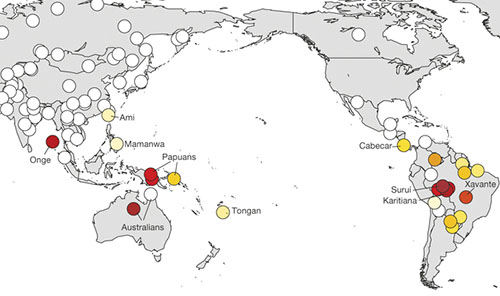
  • Ancient Cosmology: A Path to the Future?

    Ancient Cosmology: A Path to the Future?

    From New Dawn 135 (Nov-Dec 2012)

    We all know the two celestial motions that have a profound effect on life and consciousness. The first, the diurnal motion or Earth rotating on its axis, causes mankind to move from a waking state to a subconscious sleep state and back again every 24 hours. Our bodies have adapted to the Earth’s rotation so well that it produces these regular changes in consciousness without us even thinking the process remarkable. 

    The second celestial motion as defined by Copernicus – the Earth’s revolution around the Sun – has an equally significant effect, prompting trillions of life forms to spring out of the ground, bloom, fruit, and then decay while billions of other species hibernate, spawn, or migrate en mass. Our visible world literally springs to life, completely changes its colour and stride, and then reverses with every waxing and waning of this second celestial motion.

    The third celestial motion, the precession of the equinox, is less understood than the first two, but if we are to believe ancient cultures from around the world, it is equally transformative in its effect. What disguises the impact of this motion is its timescale. Like the mayfly that lives but one day a year and knows nothing of the seasons, so the average lifespan of a human being comprises just one 360th of the roughly 24,000-year precessional cycle. And as the mayfly born on an overcast windless day might have no idea that there is anything as splendid as sunshine or a breeze, so might we, born in an era of materialistic rationality, have little knowledge of a Golden Age or higher states of consciousness, yet that is the ancestral message.

    Giorgio de Santillana, the former professor of the history of science at MIT, tells us that most ancient cultures believed consciousness and history were not linear but cyclical, meaning they would rise and fall over long periods of time. In his landmark work, Hamlet’s Mill, de Santillana and co-author Hertha von Dechend, showed that the myth and folklore of over 30 ancient cultures around the world spoke of a vast cycle of time with alternating Dark and Golden Ages that move with the precession of the equinox. Plato called this the Great Year. 

    Although the idea of a great cycle linked to the slow precession of the equinox was common to multiple cultures before the Christian era, most of us were taught that this is just a fairytale; there was no Golden Age. However, an increasing body of new astronomical and archaeological evidence suggests the cycle may have a basis in fact. More importantly, understanding the cycle might provide insight into where society is headed at this time and why consciousness may be expanding at an exponential rate in the not-too-distant future. If this is so, then concepts like 2012 may have real significance. Understanding the cause of precession is key to understanding the cycle.

    Precession Observed

    The observation of the Earth’s three motions is really quite simple. In the first rotation we see the Sun and stars rise in the east and set in the west every 24 hours. And if we looked at the stars just once a day, we would see a similar pattern over a year: they rise in the east and set in the west, with all twelve constellations of the zodiac (those ancient markers of time that lie along the ecliptic – the Sun’s path) passing overhead at the rate of about one per month until we return to our starting point in the sky at the end of the year. And if we looked just once a year, say on the autumnal equinox, we would notice the stars move retrograde (opposite to the first two motions) at the rate of about one degree every 70 years. At this pace, the equinox falls on a different constellation approximately once every 2,000 years, taking about 24,000 years to complete its cycle through the twelve constellations. This is called the precession (backward motion) of the equinox, relative to the fixed stars.

    The standard theory of precession says it is principally the Moon’s gravity acting upon the oblate Earth that must be the cause of the Earth’s changing orientation to inertial space, a.k.a. “precession.” However, this theory was developed at a time before astronomers knew the solar system could move and has now been found by the International Astronomical Union to be “inconsistent with dynamical theory.” Ancient oriental astronomy teaches that the observable of an equinox slowly moving or “precessing” through the twelve constellations of the zodiac is simply due to the motion of the Sun curving through space around another star (changing our viewpoint of the stars from Earth). Here at the Binary Research Institute, we have modelled a moving solar system and found it does indeed better produce the precession observable while resolving a number of solar system anomalies. This strongly suggests the ancient explanation may be the most plausible, even though astronomers have not yet discovered a companion star to the Sun.

    Beyond the technical considerations, a moving solar system appears to provide a logical reason why we might have a Great Year with alternating Dark and Golden Ages. That is, if the solar system carrying the Earth actually moves in a huge orbit, subjecting the Earth to the electromagnetic (EM) spectrum of another star or EM source along the way, we could expect this would affect our magnetosphere, ionosphere, and indirectly all life in a pattern commensurate with that orbit. Just as the Earth’s smaller diurnal and annual motions produce the cycles of day and night and the seasons of the year (both due to the Earth’s changing position in relation to the EM spectrum [light] of the Sun), so might the larger celestial motion be expected to produce a cycle that affects life and consciousness on a grand scale.

    A hypothesis for how consciousness might be affected in such a celestial cycle can be built on the work of Dr. Valerie Hunt, the former professor of physiology at UCLA. In a number of studies she has found that changes in the ambient EM field (that surrounds us all the time) can dramatically affect human cognition and performance. In short, consciousness appears to be affected by subtle fields of light. Or as quantum physicist Dr. Amit Goswami would say, “Consciousness prefers light.” Consequently, the concept behind the Great Year or cyclical model of history, consistent with myth and folklore, is based on the Sun’s motion through space, subjecting the Earth to waxing and waning stellar fields (all stars are huge generators of EM spectrum), resulting in the legendary rise and fall of the ages over great epochs of time.

    Historical Perspective

    Current theories of history generally ignore myth and folklore and do not consider any macro external influences on consciousness. For the most part, modern history theory teaches that consciousness (or history) moves in a linear pattern from primitive to modern with few exceptions. Its tenets include:

    • Mankind evolved out of Africa.
    • People were hunter-gatherers until about 5,000 years ago.
    • Tribes first banded together for protection from other warring parties.
    • Written communication must precede any large engineered structures or populous civilisations.

    The problem with this widely accepted paradigm is that it is not consistent with the evolving interpretation of recently discovered ancient cultures and anomalous artefacts. In the last hundred years, major discoveries have been made in Mesopotamia, the Indus Valley, South America, and many other regions that break the rules of history theory and push back the time of advanced human development. Specifically, they show that ancient man was, in many ways, far more proficient and civilised nearly 5,000 years ago than he was during the more recent Dark Ages of just five hundred to a thousand years ago.

    In Caral, an ancient complex of unknown origin on the west coast of Peru, we find six pyramids that are carbon dated to 2700 BCE, a date contemporaneous with Egyptian pyramids and rivalling the time of the first major structures found in the so called “Cradle of Civilisation” in Mesopotamia. However, Caral is an ocean away from the “cradle,” and we find no evidence of any writing or weaponry, two of the so-called necessities of civilisation. What we do find is beautiful musical instruments, astronomically aligned structures, and evidence of commerce with distant lands, all signs of a peaceful and prosperous culture.

    Gobekli Tepe presents an even greater challenge to current accounts of history. This site in Turkey, dated to 9000 BCE, contains dramatic architecture including carved pillars of huge proportions. To find something so large and complex long before the dates accepted for the invention of agriculture and pottery is an archaeological enigma. These sites defy the standard historical paradigm. But what is stranger still is that so many of these civilisations seemed to decline en mass.

    In ancient Mesopotamia, Pakistan, Jiroft, and adjacent lands we see knowledge of astronomy, geometry, advanced building techniques, sophisticated plumbing and water systems, incredible art, dyes and fabrics, surgery, medicine, and many other refinements of a civilised culture that seemed to arise from nowhere yet were completely lost over the next few thousand years. By the time of the worldwide Dark Ages, every one of these civilisations including the big ones, Egypt and the Indus Valley, had largely turned to dust or nomadic ways of life. Near the depths of the downturn there were ruins and little else, while the local populace knew nothing of the builders except through legend. And in some areas where larger populations still remained, such as throughout parts of Europe, poverty, plague, and disease were often rampant and the ability to read, write, or duplicate any of the earlier engineering or scientific feats had essentially disappeared. What happened?

    While records of this period are still very spotty, the archeological evidence indicates that consciousness, reflected as human ingenuity and capability, was greatly diminished. We seemed to have lost the ability to do the things we used to do. Ironically, this is just what many ancient cultures predicted. The world’s foremost Assyrianologist, Stefan Maul, shed light on this phenomenon in his Stanford Presidential Lecture where he tells us that the Akkadians knew they lived in a declining era; they revered the past as a higher time and tried to hang on to it but at the same time lamented and predicted the Dark Ages that would follow. His etymological studies of cuneiform tablets show the ancient words for “past” have now become our words for “future,” whereas their words for the “future” have now become our words for the “past.” It is almost as if mankind orients his motion through time depending on whether he is going towards or away from the Golden Age.

    This principle of waxing and waning epochs of time is depicted in numerous bas-reliefs found in ancient Mithraic “mystery school” temples. The famed Tauroctany, or bull-slaying scene, is usually surrounded by two boys, Cautes and Cautopetes, with one holding a torch up on the ascending side of the zodiac, indicating it is a time of light; the other holds a torch down on the descending side of the zodiac, indicating it is a time of darkness (see example on page 48). As the chart on the opposite page shows, these time periods correspond with the Greek description of when the Earth goes through periods of rising and falling consciousness.

    Mithras and the Bull. This fresco from the mithraeum at Marino, Italy (third century) shows the Tauroctony and the celestial lining of Mithras’ cape. On Mithras’ left and right are the two boys Cautes and Cautopetes, with one holding a torch up on the ascending side of the zodiac, indicating it is a time of light; the other holds a torch down on the descending side of the zodiac, indicating it is a time of darkness.

    Jarred Diamond, the well-known historian-anthropologist and author of Guns, Germs and Steel, makes a good case that it is primarily local geographic and environmental advantages on the planet Earth that determine which group of humans succeeds or fails versus another. Those that have the steel, guns, and bad germs win. While this helps explain many regional differences of the last few thousand years, it does not address the macro trends that seemed to have affected all cultures (including China and the Americas) as they collectively slipped into the last worldwide Dark Age. The cyclical or Great Year model overlays and augments Diamond’s observations, giving a reason for the widespread downturn. It suggests that it is not just the geography and environment of man on Earth that determines his relative success but also the geography and environment of the Earth in space that affects mankind on a macroscopic scale. Just as small celestial motions dramatically affect life over the short term so it appears that large celestial motions colour life over the long term, resulting in the seasons of the Great Year. 

    Understanding that consciousness may indeed rise and fall with the motions of the heavens gives meaning to ancient myth and folklore and puts anomalous cultures and artefacts (such as the Antikythera device and the Babylon battery) into an historical context that makes sense. It speaks to why so many ancient cultures might have been fascinated with the stars and it provides us with a workable paradigm in which to understand history. It could also help us identify the forces that propelled the renaissance and that may be accelerating consciousness in the current era. Myth and folklore, the scientific language of yore, provide a deeper look at consciousness throughout the different ages.

    [alert type=”success” dismiss=”no”]If you appreciate this article, please consider subscribing to help maintain this website.[/alert]

    An Ancient Look at the Future

    The Greek historian Hesiod tells us of the wonderful nature of the last Golden Age when “peace and plenty” abounded. Hopi myths tell us of cities on the bottom of the sea. Typically ancient peoples broke the great cycle into an ascending and descending phase, each with four periods. The Vedic culture tells us that when the Autumnal Equinox moves from Virgo to Aires, we go through the ascending Kali, Dwapara, Treta, and Satya “Yugas” (the latter being their Golden Era) before slowly declining in reverse order as the equinox completes its journey. The Greeks and other early Mediterranean civilisations used like periods and labelled them the Iron, Bronze, Silver, and Golden Ages. More distant cultures such as the Maya or Hopi used still other names such as “worlds” or “Suns” and numbered them to identify specific epochs.

    Whatever the language used, the concept is the same. The sage, Swami Sri Yukteswar, in his book The Holy Science (1894), illustrates that when our solar system is at a point farthest from its companion star, mankind’s consciousness is at its lowest point (last occurring around 500 CE), and when the Sun is at its closest point (next occurring in 12,500 CE) consciousness will reach its highest point of this cycle. The points are seen in the sky by where the autumnal equinox Sun intersects one of the twelve constellations of the zodiac (the celestial clock). When the AE Sun is in Aries, which is almost always placed in the 12 o’clock position of the zodiac, then the Earth is in the best possible stellar environment, making it easy for many people to experience an awakened state of consciousness. And when the AE Sun is in the constellation Libra, conditions are at their worst and a Dark Age, a period of deluded consciousness, prevails. 

    Presently we are just a few hundred years into the ascending age, crossing over from what the Greeks would call the Age of Man (Iron) to the Age of the Hero (Bronze), yet still very far from the Age of the Demigods (Silver) or the Age of the Gods (Gold), which are utterly inconceivable to us at this time. This means we are now awakening from a time when individual consciousness perceives itself as purely a physical form living in a strictly physical universe to a time when we begin to see ourselves and the universe as more transparent mostly made up of subtle energy. This began with the discoveries of the Renaissance (principles of electricity, laws of gravitation, microscopes, telescopes, and other inventions that expand our awareness) and has accelerated since with quantum physics that teach us that matter and energy are interchangeable, and Einstein’s concepts that even time and space are relative. In short, we are back on the upswing just beginning to “re-member” ourselves as pure consciousness living in a world of undreamed possibilities.

    According to Paramahansa Yogananda, the author of Autobiography of a Yogi, by the year 4100 CE (when we cross into the Treta yuga proper) “telepathy and clairvoyance will once again be common knowledge.” It may seem far-fetched but according to myth and folklore there was such a time on Earth before, in about 3100 BCE, the last Treta yuga. That is what Genesis would call the pre-Babel age, when mankind communed freely with nature before God “confused the tongues.”

    People often forget what the world was like just 500 years ago when every nation was at war with one another, plagues and poverty regularly decimated large populations of the Earth, lifespans were half what they are today, individual rights were nonexistent, and justice was doled out by torture, inquisition or burning at the stake. Yes, the world still has problems but consciousness is now expanding rapidly. According to Time magazine over 17 million people are now meditating in the US alone. Increasing awareness manifests in many ways, most visibly as technology, with many believing we are now approaching a point of singularity, but it is so much more. Can there be any doubt our improvements across all areas of society over the next 500 years will be off the charts compared to the last 500?

    [alert type=”general” dismiss=”no”]This article was published in New Dawn 135.[/alert]

    [alert type=”success” dismiss=”no”]If you appreciate this article, please consider subscribing to help maintain this website.[/alert]

    © New Dawn Magazine and the respective author.
    For our reproduction notice, click here.

  • God’s Forgotten Wife

    God’s Forgotten Wife

    From New Dawn 123 (Nov-Dec 2010)

    Is God a man or a woman? Put baldly, this question seems ridiculous. And yet over the centuries it has proved almost impossible to keep from imagining the Supreme Being in a human form, and a human form immediately implies gender.

    Most pantheons have had no trouble accommodating male and female deities. Or, like the Chinese, they have envisaged the masculine and the feminine principles, the yang and the yin, as the warp and woof of the universe. But the Abrahamic faiths – Judaism, Christianity, and Islam – offer us a weird paradox. God is unique and supreme – and God is male. While theologians equivocate about this fact, and the subtler of them remind us that this is only a metaphor, it has proved a powerful one.

    And yet the Hebrew Bible, the source and origin of all three of these faiths, is not quite so clear about this point. Genesis 1:27 is frequently quoted: “God created man in his own image,” but the second part of this verse is usually left out: “In the image of God created he him; male and female created he them.” An androgynous God may not be as alien to the religion of the Hebrew Bible as we may think.

    Indeed the iconography of the God of ancient Israel is in its way androgynous as well. Descriptions of the First Temple (c.940-586 BCE) in Jerusalem say that its innermost chamber, the Holy of Holies, contained two cherubim (im is the masculine plural ending in Hebrew) made of olive wood overlaid with gold, and each of them “ten cubits high” (1 Kings 7:23). In the ancient Near East, cherubim were not fat little babies but fully grown winged human figures, often with the body of a lion. While there are no remnants of Solomon’s Temple left, the surviving image that comes closest in time and place is taken from the palace of King Ahab in Samaria (see the previous article, “The Bible: Myth or History?”). It is made of ivory and, characteristically, shows winged female figures.

    The cherubim in the actual Temple may have been, like the God described in Genesis, both male and female. And while the biblical account describes these cherubim as chastely touching their wings, some rabbinical traditions say they were locked in embrace. One Talmudic sage, Rabbi Qetina, who lived in the late third and early fourth centuries CE, said, “When Israel used to make the pilgrimage, they [i.e., the priests] would roll up for them the Parokhet [the Veil separating the Holy from the Holy of Holies], and show them the Cherubim which were intertwined with one another, and say to them: ‘Behold! your love before God is like the love of male and female!’”1 Flavius Josephus, a Jewish historian of the first century CE, gives an eyewitness picture of the Second Temple (destroyed by the Romans in 70 CE) but is rather equivocal in describing the Holy of Holies. In some passages he insists that it contained nothing at all, but in others he says that what was in it “we are not at liberty to reveal to other nations.”2

    But the story of the feminine face of the Hebrew God is even more intricate than this. Archaeological findings and extrabiblical texts again show a reality that is at variance with the theology of the Hebrew Scriptures. And again, this reality was rooted in the religion of the Canaanites, Israel’s neighbours and relatives.

    Yahweh’s Consort?

    The supreme high god in the Canaanite pantheon is named El. This is a proper name, although in later Hebrew usage the word came to mean “god” in a generic sense. Like many pagan gods, El had a wife, a female consort, whose name was Asherah. Her name is probably derived from a phrase from the Ugaritic language spoken in Syria in biblical times: atiratyammi, “she who treads upon Sea,” “Sea” being a personified chaos monster.3 Her role in the ancient Hebrew religion is a nebulous and controversial one.

    As we have seen already, some scholars believe that Yahweh was originally a manifestation of El, and rarely in the Hebrew Bible is a radical distinction drawn between the two; sometimes they are explicitly identified.4 And contrary to what the Bible would have us believe, archaeological remains indicate that Asherah was sometimes viewed as Yahweh’s consort as well. A number of artefacts have been found that link the two: one inscription, dating from the eighth or ninth century BCE, reads, “I [b]lessed you by (or ‘to’) Yahweh of Samaria and by his Asherah.” Another inscription reads, “To [Y]ahweh of Teiman (Yemen) and to his Ashera[h].”5 Teiman, or Teman, is interesting here because some Bible texts portray Yahweh as being revealed in this region, the southern part of the Transjordan (also connected with Midian): “God came out of Teman” (Habakkuk 3:3). If so, Asherah might have been with him from the beginning.

    These texts are puzzling, partly because of the reference to “his Asherah.” In Hebrew, possession is indicated by a suffix (-hu) added to the word for the thing possessed, and some scholars insist that this is not grammatically possible for a proper name. They would say that “Asherah” is not to be read here as the proper name of a goddess, but as kind of a manifestation of Yahweh.

    This argument is hard to sustain, because it presupposes a theological sophistication that a folk religion in the first millennium BCE is unlikely to have had. But it is true that asherah, in the Hebrew of the Bible, can serve either as a proper name for the goddess or as a common noun for a cult object representing the goddess, possibly a wooden image. One ancient Jewish tradition says that the asherah was either a tree or a tree with a cult object beneath it. Hence translators have rendered asherah variously as “tree” and “grove.” The Bible invariably characterises these “trees” or “groves” as abominations. In the Deuteronomic account, the priests in the Temple discover a lost scroll of the Law of Moses and read it to the young King Josiah (2 Kings 22:8–11). Shocked by his nation’s infidelity, Josiah orders a purge of the Temple artefacts. He “commanded Hilkiah the high priest, and the priests of the second order, and the keepers of the door, to bring forth out of the temple of the Lord all the vessels that were made for Baal, and for the grove, and for all the host of heaven: and he burned them without Jerusalem in the fields of Kidron” (2 Kings 23:4).

    The “grove” here was almost certainly an image of Asherah. Certainly she was connected with a tree motif. The biblical archaeologist William G. Dever contends that this was partly because (especially in a semiarid climate) a tree is a symbol of life. But he also points out that some images portray Asherah with a tree growing out of her pubic triangle. Hence Asherah and the tree symbolise life in this sense too.6

    What was her connection with Yahweh in the Hebrew religion of the First Temple? Raphael Patai, whose book The Hebrew Goddess is one of the most important works on this subject, sums up the picture from the Bible’s point of view: “It appears that, of the 370 years during which the Solomonic Temple stood in Jerusalem, for no less than 236 years (or almost two-thirds of the time) the statue of Asherah was present in the Temple, and her worship was a part of the legitimate religion approved and led by the king, the court, and the priesthood and opposed by only a few prophetic voices crying out against it at relatively long intervals.”7 Saul M. Olyan, a professor at Brown University in the US, writes that Asherah “was an acceptable and legitimate part of Yahweh’s cult in non-deuteronomistic circles. The association of the asherah and the cult of Yahweh suggests that Asherah was the consort of Yahweh in circles both in the north and the south.”8

    Rise of the “Yahweh Alone” Movement

    Where, then, did the opposition to Asherah arise? The remarks by the scholars quoted above tell us: Asherah’s foes were the prophets and the Deuteronomic circle, which eventually produced the long historical saga that comprises Deuteronomy, Joshua, Judges, 1 and 2 Samuel, and 1 and 2 Kings. Where did this Deuteronomic history come from? Remember that Josiah initiated his purge of the Temple after hearing a rediscovered scroll of the Law read by the priests. The standard view today is that this scroll was an early version of the book of Deuteronomy, and that it was not rediscovered but had been written specifically for the occasion: it was forged by the priests to prove to Josiah that their version of monotheism went back to Moses. And Deuteronomy condemns Asherah worship. This is how it tells the children of Israel to deal with the Canaanites: “Ye shall destroy their altars, and break down their images, and cut down their groves, and burn their graven images with fire” (Deuteronomy 7:5; emphasis added). The “groves,” again, are asherim, images of Asherah. But, as we see in 1 and 2 Kings, even the Deuteronomist has to admit that Asherah was welcome in the Temple throughout most of the period of the monarchy (c.1000-586 BCE).

    Distilling all this evidence, biblical and nonbiblical, into a comprehensive picture, we come up with something like this. The worship of Asherah in Canaan goes back far beyond the arrival of Israel on the historical scene in the thirteenth century BCE. And in Israel and Judah up to the end of the monarchy in 586 BCE, Asherah was worshipped alongside Yahweh, often as his consort, both in the popular religion and for the most part in the Temple itself. At some point in the history of Israel – and we do not know exactly what this point was – there arose a “Yahweh alone” movement, as some biblical historians have dubbed it: Yahweh was to be worshipped as the sole god, the lord of the universe – without a consort. This “Yahweh alone” movement was associated with the prophets in particular. It is the prophet Elijah who condemns the worship of foreign gods at Ahab’s capital in Samaria. It is prophets such as Amos, Hosea, and Micah that shape the theology that was later to be codified in the Deuteronomic history.

    The kings were more equivocal. The rulers of the northern kingdom of Israel apparently had little use for the “Yahweh alone” movement; that is why, according to the Deuteronomist, every last one of them “did evil in the eyes of the Lord.” Indeed the prophets said that the northern kingdom was destroyed because it had abandoned the true worship of Yahweh. The rulers of the smaller southern kingdom of Judah were more sympathetic to the nascent monotheism: some of them, notably Hezekiah and (as we have seen) Josiah, tried to purge these supposedly alien elements from Yahweh’s cult, with uneven success.

    As for the priests, who administered the sacred cult of Yahweh at the Jerusalem Temple, they too were not quite so firmly on the side of Yahwistic monotheism as we might believe. As Raphael Patai has shown, the images of Asherah were worshipped in the First Temple for about two-thirds of its lifespan, so the priests of this period could not have had too much difficulty with her. It is only around the time of Josiah in the late seventh century BCE that the picture changes. The priesthood becomes dominated by the monotheistic Yahwists, who write up a scroll of the Law and convince Josiah to purge the Temple.

    Josiah died in 609 BCE, and the Temple was sacked by the Babylonians only a couple of decades later, in 586 BCE, so the worship of the goddess probably did not return in the meantime. The book of Jeremiah has an interesting passage on this score. After the Temple’s destruction, people who “had burned incense to other gods” tell Jeremiah: “We will certainly do whatsoever thing goeth forth out of our own mouth, to burn incense to the queen of heaven and to pour out drink offerings unto her, as we have done, we, and our fathers, our kings, and our princes, in the cities of Judah, and in the streets of Jerusalem: for then had we plenty of victuals, and were well, and saw no evil. But since we left off to burn incense to the queen of heaven, and to pour out drink offerings unto her, we have wanted all things, and have been consumed by the sword and by the famine” (Jeremiah 44:17-18). This passage indicates that some, perhaps many, in Judah believed that the Temple was destroyed not because it had been profaned by the worship of the goddess (as Jeremiah said) but because her worship had been abandoned.9 The “queen of heaven” may in fact be Astarte, another Canaanite goddess, who was worshipped as well as Asherah – but then the two were sometimes conflated even by the worshippers themselves.

    Get the issue this article appears in

    The subsequent history was written by the monotheists. When the Jews returned from exile in Babylonia and rebuilt the Temple (after 539 BCE), the priests and the prophets were now all the “Yahweh alone” party. It was they who were responsible, not only for completing the Deuteronomic history, but for editing and compiling previous sources to create the books of the Pentateuch as well as the writings of the prophets. This is the core of the Hebrew Bible as we now know it, and it explains why we see biblical history the way we do.

    But the goddess was not completely expunged from the Jewish faith. Later parts of the Bible, such as the book of Proverbs, as well as apocryphal works mention a personified figure of “Wisdom,” who has a female form. (The Hebrew word for wisdom, hokhmah, is grammatically feminine.) Still later, the mystics of Judaism speak of the Shekhinah, the “presence” of God. In the Bible, this word does not seem to mean much more than its face value, but in later Judaism, the Shekhinah herself is personified as a kind of feminine aspect of God, and she is spoken of almost as a separate being. The medieval Kabbalists spoke of the Matronit (a name derived from the Latin matrona, “matron”), a divine feminine figure who resembles not only the Virgin Mary as conceived by the Catholics, but the now-forgotten goddesses of the Near East. The divine feminine has long survived the demise of Asherah – just as Christianity adopted the doctrine of Mary as “Mother of God” almost immediately after the pagan temples were closed. No matter how much the authorities and the scriptures insist on their concept of the Supreme Being as a male, there is something in the human mind and heart that refuses to assent completely.

    Current times have seen a resurgent fascination with the divine feminine both in Judaism and Christianity, and there is a widespread sense that these long-forgotten archetypes are reappearing to claim their rightful place in the spiritual consciousness of humanity. That may be the case, but it is more likely that they had never really gone away.

    [alert type=”general” dismiss=”no”]This article was published in New Dawn 123.[/alert]

    [alert type=”success” dismiss=”no”]If you appreciate this article, please consider subscribing to help maintain this website.[/alert]

    Sources

    Margaret Barker, The Great Angel: A Study of Israel’s Second God, Louisville, Kentucky: Westminster John Knox Press, 1992.

    Frank Moore Cross, Canaanite Myth and Hebrew Epic: Essays in the History of Religion of Israel, Cambridge, Massachusetts: Harvard University Press, 1973.

    William G. Dever, Did God Have a Wife? Archaeology and Folk Religion in Ancient Israel, Grand Rapids, Michigan: Eerdmans, 2005.

    Leah Novick, On the Wings of Shekhinah: Rediscovering Judaism’s Divine Feminine, Wheaton, Illinois: Quest, 2008.

    Raphael Patai, The Hebrew Goddess, 3d ed., Detroit, Michigan: Wayne State University Press, 1990.

    Footnotes

    1. This is from the Talmudic treatise B. Yoma 54a, quoted in Patai, 84. Bracketed insertions are Patai’s.
    2. Flavius Josephus, Against Apion, 2:7, 8. Quoted in Patai, 82.
    3. Cross, 15, 37, 66–67.
    4. Cross, 44.
    5. Dever, Did God Have a Wife?, 162. Bracketed insertions are Dever’s.
    6. Dever, Did God Have a Wife?, 225–28.
    7. Patai, 50.
    8. Quoted in Dever, Did God Have a Wife?, 201.
    9. Barker, 51.

    © New Dawn Magazine and the respective author.
    For our reproduction notice, click here.