New Dawn – World's Most Unusual Magazine

Category: Ancient Mysteries

  • The Empires of Atlantis

    The Empires of Atlantis

    From New Dawn Special Issue Vol 16 No 2 (Apr 2022)

    Most people will be familiar with Plato’s story of Atlantis. Written in the 4th Century BCE, it is the wonderful account of a mighty and splendid empire whose island homeland sunk beneath the waves of the Atlantic Ocean 11,600 years ago. It is truly one of the foundational myths of western civilisation and one that does not cease to fascinate and prompt questions about the reality and location of the fabled lost continent.

    Plato’s story, however, is also a cautionary tale about how even the most splendid civilisation that the world had ever known could fall prey to vice and corruption, eventually leading to its downfall. At its core, it is the story of the fall of a primeval, golden and divine humanity into the depths of materialism. The metaphysical idea of the “Fall” of man from an original divine state is projected against the idea of cyclical time and the myth of a lost Golden Age.
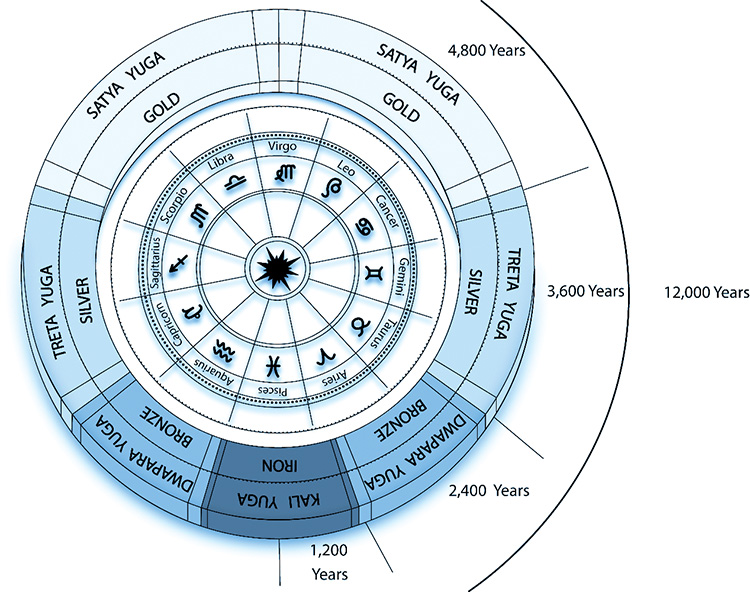

    The sequence of the four Yugas or World Ages according to metaphysical cosmologies.

    Esoteric Atlantology & the Ages of Man

    Three hundred years before Plato, the Greek poet Hesiod spoke of the five Ages of Man, tracing the descent of Mankind through five different Ages or “Races.” A primeval Golden Age gave way to the Silver Age, the Bronze Age, the Age of Heroes and, finally, the dreaded Iron Age in which we now live, representing the lowest point of the cycle. A similar worldview probably inspired the system of the Hindu Yugas and the Mesoamerican Legend of the Suns, according to which the world has already undergone four previous cycles of creation or Suns.

    This is a view radically different from that of contemporary evolutionary theory, which is based on the idea of a constant progression of humanity in the arts of civilisation since the appearance of the first anatomically modern humans in East Africa about two hundred thousand years ago.

    Ancient worldviews maintain the idea of a descent of Man, a process of spiritual and material degradation from an original divine state. It is to these ancient worldviews that Plato conforms himself when he describes the fall of Atlantis as the result of the “divine portion” of its inhabitants fading away and becoming “diluted too often and too much with the mortal admixture.” According to Esoteric Tradition, this is the fate of every civilisation. However, there is hope because the end of a cycle invariably marks the beginning of a new cycle. This whole system can also be described by the idea of cosmic seasons in which the Golden Age, Silver Age, Bronze Age and Iron Age follow each other in cyclical repetition. One only needs to know the starting point of the present cycle to draw a complete chronology and predict the beginning of a new Golden Age.
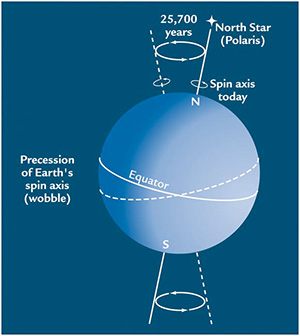
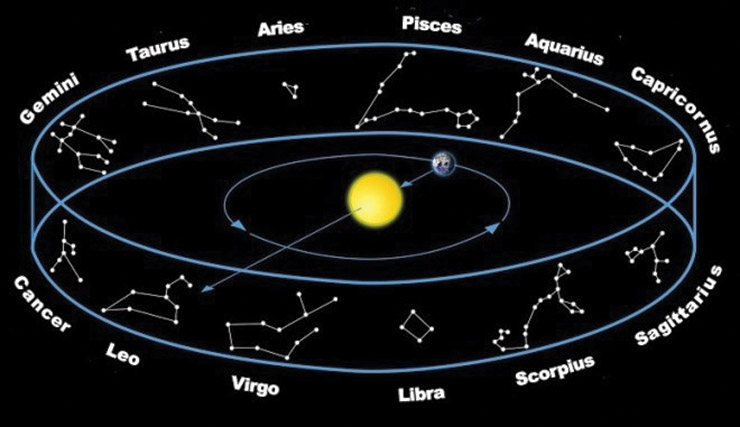
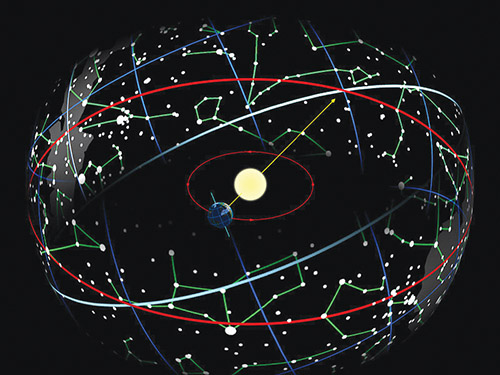
    Ancient sources assign a fixed duration to the entire cycle and each of the cosmic seasons that together make up the Great Year. The critical number is 25,920 years, a duration all but identical to the fabled period of the revolution of the zodiac (see graphic on right), known as the Precession of the Equinoxes.

    How exactly a tiny wobble in the Earth’s axis, causing its tilt to change slightly over thousands of years, could have such deep effects on the cycles of life and civilisation on our planet is a question that few in the modern scientific community will consider. Yet it was paramount to ancient cosmologies and worldviews, as shown by the great interest that nearly every ancient civilisation on the planet placed on the movements of the sky – an interest certainly going beyond the basic needs of planting and agriculture.

    It was only with the advent of Christianity that ancient worldviews based on the concept of cyclical time and multiple cycles of creation were replaced by linear time, the belief in a single revelation and a single divine incarnation leading uniformly toward salvation. In the much shorter Christian and biblical chronology, the totality of human experience was effectively limited to the span of the present Iron Age or Kali Yuga. According to Puranic sources, this began in the year 3102 BCE, leaving no space for previous cycles of creation, least for the idea of a lost world ruled by the gods. It was based on the authority of the Bible that the Archbishop of Ireland, James Ussher, famously stated in 1650 that “the world was created at nightfall, preceding Sunday, October 3, 4004 BCE.

    Thousands of years before Ussher, the Brahmins of India had realised time computations covering the enormous period of 4.32 billion years, while the Chaldean priests could boast of keeping accurate astronomical observations dating back 720,000 years. Ancient Egyptian records similarly spoke of primeval dynasties of gods and demigods ruling for tens of thousands of years before the beginning of recorded history.

    The Calendars of Atlantis

    When comparing these ancient chronologies and king lists, a most interesting pattern emerges. Despite all their internal inconsistencies, gaps in information and incredibly long durations of time, these documents – some of which date back almost to the beginning of modern recorded history in ancient Mesopotamia and Sumer – appear to be in substantial agreement when it comes to portraying a sequence of world ages related to astronomical cycles and the consecutive rule of divine, semi-divine, and finally purely human dynasties. This makes it possible to reconstruct a tentative picture of the origins of the present cycle and the succession of different world ages through the last 432,000 years.

    A fascinating feature of these ancient chronologies is the reference to not just one but multiple cataclysms periodically befalling human civilisation, forcing the survivors, just like Plato’s Atlanteans, to “begin over again as children, knowing nothing of what had happened in ancient times.

    In order of time, the last of these cataclysms would have occurred about thirteen thousand years ago, in 10,961 BCE, following an even earlier cataclysm in 35,335 BCE – the two being separated by almost precisely an entire precessional cycle. While the date of 10,961 BCE may be fixed astronomically, over half a dozen ancient chronologies point to at least one major cataclysm between 11,500 and 9,200 BCE.

    It is undoubtedly a remarkable coincidence that this set of dates, derived from ancient chronologies, also remarkably agree not only with the date assigned by Plato to the final sinking and destruction of Atlantis but also with the timescale of a mysterious cold spell accompanied by megafaunal extinctions known as the Younger Dryas.

    It is now widely believed that a massive cometary impact triggered the Younger Dryas about thirteen thousand years ago. A second impact was possibly responsible for its abrupt ending almost 1,500 years later. The memory of the cataclysm was preserved in hundreds of myths worldwide that describe a fiery conflagration followed by a Great Flood and a sudden cooling of the Earth’s climate.

    A Lost Mid-Atlantic Continent

    Unlike previous mass extinction events, the Younger Dryas cataclysm was not without witnesses, for modern humans had already been walking the planet for thousands of years by then. This cataclysm may have been responsible for destroying an advanced Ice Age society whose survivors would later spread their civilisation and culture throughout the world.
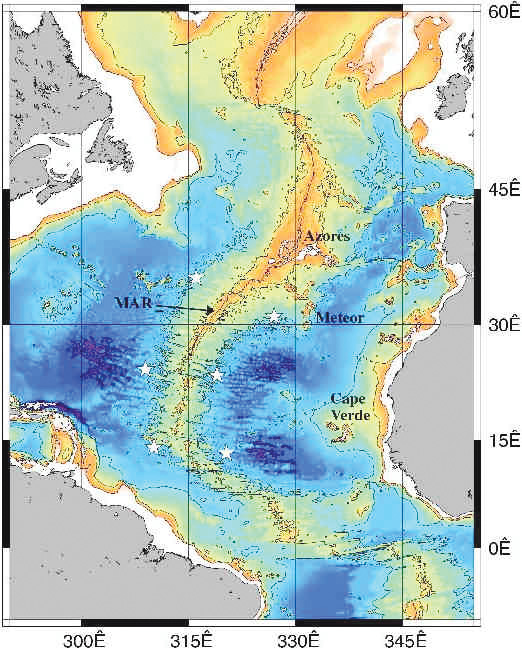
    Bathymetric chart of the Mid-Atlantic Ridge (Image courtesy of NOAA – PMEL Acoustic Program)

    Geological and oceanographic evidence from the bottom of the Atlantic Ocean confirms the possibility that a sizeable landmass may have existed above water in the region of the Mid-Atlantic Ridge and near the present-day Azores until comparatively recent times, in the same approximate location suggested by Plato and the Esoteric Tradition for Atlantis.

    Excluding the recent hypotheses of a polar location of Atlantis either in Greenland or Antarctica, the Mid-Atlantic Ridge has been the most frequently proposed location for the Lost Continent. Drained of the ocean’s waters, the Mid-Atlantic Ridge would appear as a continuous mountain range stretching nearly from Pole to Pole, extending for a length comparable to that of the combined Andes and Rocky Mountains and with heights similar to the Himalayas.

    The present-day Azores and Madeiras represent but the highest peaks above water of this submerged mountain range. Evidence collected from the Atlantic seafloor reveals the presence of extinct riverbeds continuing underwater for over 300 kilometres off the coast of Sao Miguel Island in the Azores, at a time when this portion of the Atlantic seafloor was still dry land. This evidence alone suggests the cataclysmic sinking of a large landmass measuring at least 450 miles across from East to West and 300 miles from North to South, by at least 3,300 meters in the recent geological past.
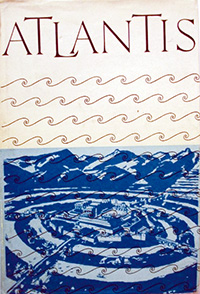
    Atlantis, Atlantology: Basic Problems by Nikolai Zhirov (front cover).

    In his monumental tome Atlantis, Atlantology: Basic Problems, Russian scientist Nikolai Zhirov collected hundreds of pages of geological, climatological and botanical evidence pointing to the former existence above water of a sizeable Mid-Atlantic landmass, certainly as late as the end of the last Ice Age, and possibly also much later during the European Bronze Age, in the third and second millennium BCE. The rising and subsidence of the Mid-Atlantic Ridge over tens of thousands of years may also explain the cycles of glaciation and deglaciation in the northern hemisphere, as well as the abrupt ending of the Younger Dryas in about 9,600 BCE. According to Zhirov and other scientists, the sinking of the Mid-Atlantic Ridge, an event possibly triggered by a cometary impact, effectively ended the last Ice Age by allowing the warm Gulf Current to reach the coasts of western and northern Europe.

    The Neo-Atlantean Empires

    If Zhirov is correct, Atlantis did not sink in a single day and night. Rather, the subsidence of the Mid-Atlantic Ridge spanned hundreds of thousands of years, alternating long periods of gradual subsidence with truly cataclysmic episodes of sinking by hundreds or even thousands of metres.

    The events of the Younger Dryas and the end of the last Ice Age may have been catastrophic, but Atlantean civilisation did not vanish overnight. Evidence shows that Atlantean civilisation did, in fact, survive the cometary impacts at the beginning of the Younger Dryas. During what I call the Neo-Atlantean period between 10,961 and 9,600 BCE, Atlantean missionaries visited virtually every corner of the world in an attempt to re-establish pre-cataclysmic civilisation.

    Two main centres of Neo-Atlantean civilisation emerged around this time, in Egypt and South America. From these two primary centres and their various colonial outposts, a colossal building program was undertaken, aimed at no less than reconstructing the lost world of the gods. This is the essence of many mythical accounts describing the arrival in various parts of the planet of seemingly divine beings, possessing a civilisation and culture far in advance of the local indigenous populations.
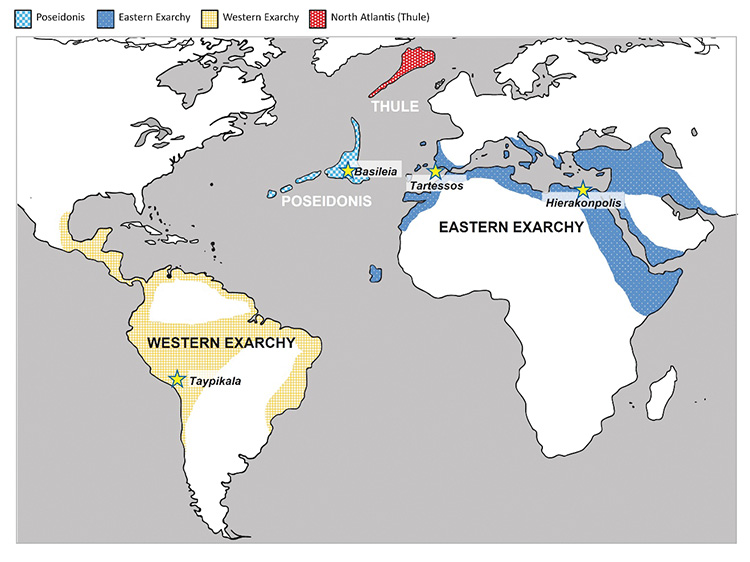
    The extent of Atlantean colonisation and main centres of culture of the Neo-Atlantean period.

    The Edfu Building texts, a set of cosmological records covering the walls of the Temple of Edfu in Upper Egypt, describe how after a great and terrible cataclysm that plunged the world into darkness and destroyed the primeval island-homeland of the gods, a new generation of gods sailed from the primeval island, eventually settling in Egypt, where they became known as the Shemsu-Hor, the “Companions of Horus.” These semi-divine beings were responsible for the rise of the first Egyptian civilisation of the prehistoric period and may have been the original builders of the Great Pyramid and many other colossal megalithic structures of unknown date whose ruins are found throughout Egypt and the Middle East. Very similar accounts can be gathered throughout Mexico, Central and South America to explain the origin of sacred sites and other mysterious structures.

    The immense surge of construction and accelerated technological evolution that characterised the Neo-Atlantean period was short-lived. Within a few centuries, the grand edifice of Neo-Atlantean civilisation lay in ruins, plunging the world again into the depths of a new Dark Age. The causes of the collapse are unclear. Whether a result of climatic and environmental factors, the pressures of an expanding population against a small, albeit technologically advanced elite, or a second cometary impact at the end of the Younger-Dryas, the main centres of Neo-Atlantean civilisation were abandoned. In many cases, it is as if the builders simply dropped their tools and left, leaving behind only the shells of their unfinished structures, like a great Tower of Babel.

    Over the following centuries, global sea levels rose by an estimated 120 metres, submerging an area of land roughly equivalent to the combined extent of Europe and the continental United States. The consequence of this rise in global sea levels would have been particularly severe for any coastal maritime civilisation, submerging its major cities and trade centres under rising waters within the span of just a few generations.

    The Atlantean Diaspora

    The events of the end of the last Ice Age would have caused a massive diaspora and exodus of people from the now doomed islands of Atlantis and the coastal centres of Neo-Atlantean civilisation towards higher ground and the interior of continents. But it was the disintegration and fragmentation of Neo-Atlantean civilisation that triggered one of the most remarkable stages of accelerated cultural and technological evolution in the whole of human history.

    As Atlantean survivors scattered through vast areas of the Middle East, western Europe, central and South America, they brought an extensive knowledge of agriculture, architecture, and astronomy, which effectively gave rise to the Neolithic Revolution. At this time, we witness the sudden emergence of agriculture and sophisticated lithic technology in places like Göbekli Tepe, Jericho and Çatal Höyük, as well as in the highlands of Mexico, Bolivia and Peru.
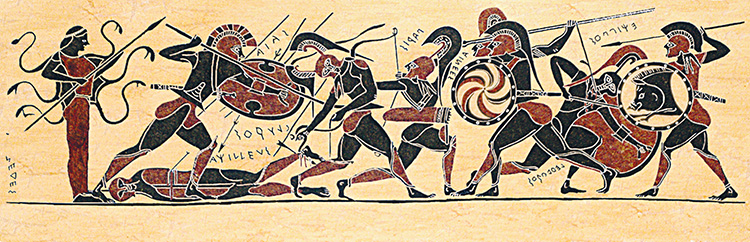
    Classical Greek writers referred to their ancestors as the Pelasgians. Researcher Marco M. Vigato suggests they formed the Atlantean diaspora. 

    At the same time, the sinking of the last islands of Atlantis, a process that extended well into the European Bronze Age, sent wave after wave of “Sea Peoples” to the coasts of Europe and Africa. These peoples were the originators of what has since become known as the Atlantic megalithic culture, through at least three different waves of migration in approximately 5,000 BCE, 3,500 BCE and 1,200 BCE. These post-Atlantean “Sea Peoples,” or Pelasgians, as they would be known to the classical authors, penetrated as far as the western and eastern Mediterranean, where they remained a powerful force until at least the second millennium BCE, leaving evidence of their distinctive megalithic architecture over a very large area extending from the Orkney Islands in the north to western France, southern Spain, Italy and Greece in the south and east. The last of the “Sea Peoples” invasions in the 12th century BCE became memorialised in contemporaneous Egyptian records from the Temple of Medinet Habu.
    Get the issue this article appears in

    The Legacy

    Despite their decadence and the loss of much of their civilisation and culture, Atlantean survivors were nevertheless able to preserve the principles of a specific type of sacred knowledge that still forms the basis of many esoteric and religious traditions throughout the world.

    Monuments as far away as the great Egyptian temples of the Pharaonic period, the mountain temples of Angkor in Cambodia and the Gothic cathedrals of medieval Europe all testify to the survival of a Sacred Science of Atlantean origin through countless millennia. It is difficult to speak of fortuitous coincidences when, throughout the millennia and on entirely separate continents, one finds the same images and symbols used repeatedly to convey the same esoteric truths and designate the same abstractions.
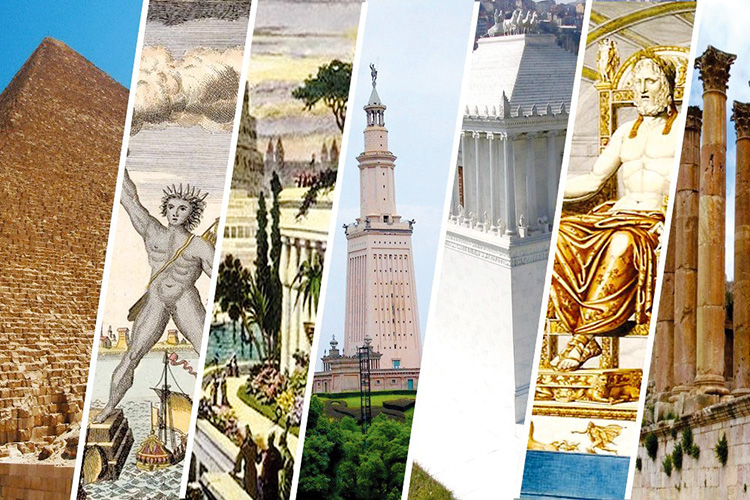
    The technological know-how to build the Seven Wonders of the Ancient World may have derived from Atlantis, transmitted by the survivors of the lost continent before it met its end.

    Moreover, this vast body of knowledge appears complete and fully-formed since the earliest dynasties, knowing no period of development or evolution. It must have thus existed at some point as a preconceived plan, directed by powerful masterminds whose only purpose seems to have been the unadulterated transmission of knowledge through the ages that separate us from the fall of the last Atlantean Empire.

    Ultimately, this very long chain of transmission appears to be the continuation of the Neo-Atlantean project, which was left interrupted by the events of the end of the last Ice Age and the Atlantean diaspora. This project calls for no less than the resurrection of the lost world of the gods, which alone will bring forth a new Golden Age for Mankind.

    The author Marco M. Vigato has written a book that establishes the historical and geological reality of Atlantis and reveals its continuing influence worldwide. Readers can obtain The Empires of Atlantis: The Origins of Ancient Civilizations and Mystery Traditions throughout the Ages from all good bookstores.

    [alert type=”general” dismiss=”no”]This article was published in New Dawn Special Issue Vol 16 No 2.[/alert]

    [alert type=”success” dismiss=”no”]If you appreciate this article, please consider subscribing to help maintain this website.[/alert]

    © New Dawn Magazine and the respective author.
    For our reproduction notice, click here.
  • The Bible, The Myths & The Zodiac Wheel: Understanding the Secret System of the Ancients

    The Bible, The Myths & The Zodiac Wheel: Understanding the Secret System of the Ancients

    From New Dawn 147 (Nov-Dec 2014)

    If it could be demonstrated that substantially all the sacred traditions of the world – from the myths of the ancient Egyptians to those of the Norse, from the stories of the Olympian gods and goddesses of Greece to the Vedas of ancient India, to the legends of the Maori and of the Inca and the Maya and the shamanic cultures of Asia, and even to the ‘Bible stories’ found in the scriptures which made their way into the canon of the Old and New Testaments and influenced ‘Western civilisation’ for almost two thousand years – share an identical system of celestial allegory, designed to convey a similar esoteric message about the nature of human existence and the nature of the universe we inhabit, that fact would instantly become one of the most important discoveries of our time.

    The ramifications of such a discovery would be profound. 

    First, it would raise the important question of how such an intimate kinship among cultures spanning essentially the entire globe, reaching to the most remote tribes in some of the world’s most isolated jungles, mountains, and steppes, and existing in time across a gulf of centuries (from the earliest ancient Sumerians and Egyptians to cultures which survived into the nineteenth and even twentieth centuries with their traditional belief-systems largely intact), ever came to be. Nearly every possible explanation for a common esoteric system across so many cultures would overturn or radically upset the conventional historical paradigm, which is generally staunchly ‘isolationist’ and dead-set against theories positing ancient contact across oceans between cultures, and which denies the possibility of an advanced ancient civilisation or civilisations predating the known civilisations of history.

    Second, a discovery showing that the original intention of the scriptures of the Old and New Testaments, and the esoteric technique of celestial allegory they employ, is either very similar or identical to the intention and technique of the Greek, Norse, Maya, Maori and Egyptian myths, would immediately subvert the wall of separation which has been erected between the religions patterned on those Old and New Testament scriptures and the sacred systems of all the world’s ‘pagans’. 

    We have been led to believe, for at least the past seventeen centuries, that the faiths which sprang from the biblical texts were based upon historical events and historical figures, in contrast to the pagan mythologies peopled by deities and entities which personify forces of nature, and that this difference set the biblical faiths completely apart from the nature-worshipping pagan systems. Even those who deny the supernatural aspects of the biblical stories tend to fall into this trap (including the most up-to-date academics), searching for evidence of a ‘historical Jesus’ and wondering whether he might have had a ‘secret wife’, or asking questions about who Moses really might have been (perhaps Akhenaten?), when they would never dream of trying to discover the ‘historic’ Hercules or Horus or Aztec god Tezcatlipoca, or whether any of them might have had a ‘secret wife’ and descendants who are still alive today.

    Third, such a discovery arouses the question of why such an unusual method of transmission and preservation was selected, and what exactly that message might be. And finally (for now at least – there are many other profitable questions which could be raised), there is the important question of how the esoteric understanding of ancient scriptures and myths was so thoroughly lost. This question is especially important when it comes to the interpretation of the scriptures of the Old and New Testaments, because the literalist interpretation (as opposed to the esoteric interpretation that the texts themselves invite) has played so dominant a role in world history – and continues to do so to this day.

    In fact, it can be demonstrated quite convincingly that the myths of the world’s sacred traditions – including those in the biblical scriptures – consist almost entirely of celestial allegory. The system of celestial allegory is complex, and multi-layered, but a strong sense of its basic workings can be obtained through the consideration of the stories related to the zodiac wheel, one of the central aspects of the entire system. 

    A suspicion that the stories in the Old and New Testament might be celestial in nature can be raised by the simple fact that the tribes of Old Testament Israel, and the disciples called by Jesus in the New Testament gospels, are twelve in number. Indeed, it can be satisfactorily demonstrated that the scriptures of the Old Testament clearly indicate the twelve ‘tribes’ of Israel are intended to describe the twelve constellations (groupings of stars – ‘tribes’ of stars, if you will) of the zodiac, and the same for the twelve disciples of the New Testament. 

    The Esoteric Meaning of the Story of Samson

    The demonstration of the connection (especially to someone sceptical of the theory) requires some extended discussion and diagrams, and it is much easier to examine some other well-known biblical stories, where the connection is immediately obvious and difficult to deny.

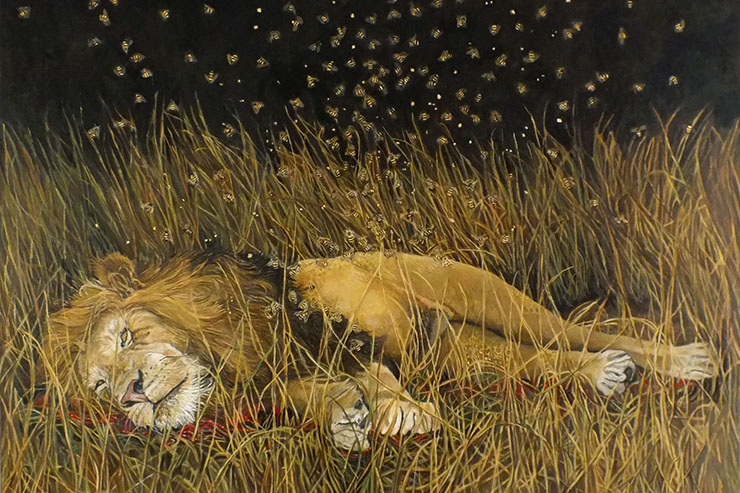
    One of these is the story of Samson, the famous strong-man of the book of Judges, who is described in chapter fourteen as taking a trip “down” to Timnath to meet a woman “who pleased him well,” encountering a lion on the way down and slaying it with his bare hands. After a time he returned and found that the carcass of the lion was now buzzing with a swarm of bees and honey (presumably the bees built a hive in the carcass of the dead lion). 

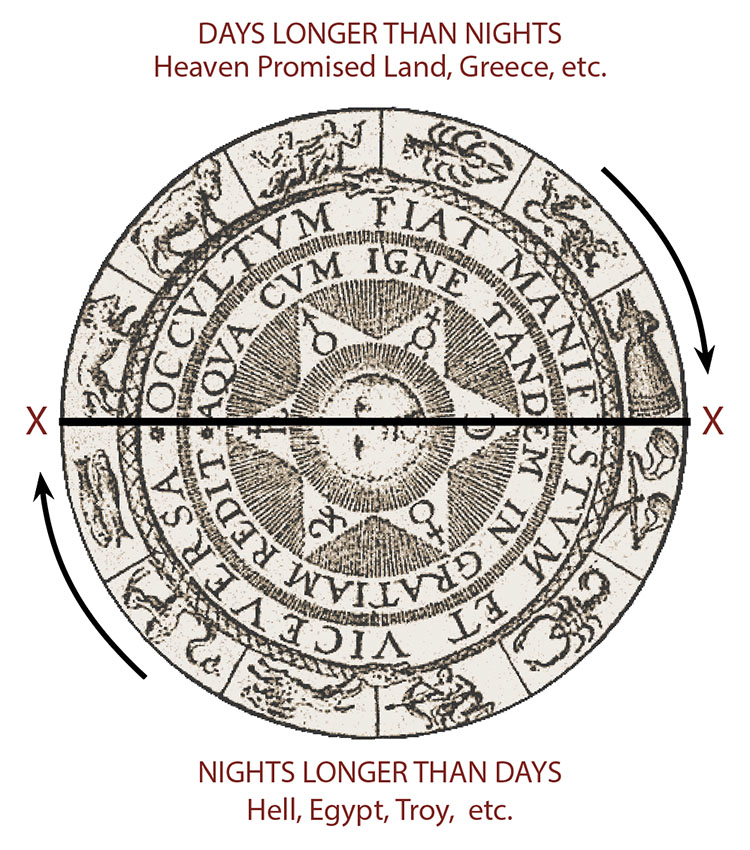
    This event provides the material for a “riddle” which Samson puts to the Philistines, and they are unable to answer it. The fact that it is described as a riddle should cause us to consider it very closely – the text is practically inviting us to ask of the hidden meaning to this puzzle, and one is soon found if we consider the zodiac wheel. In the zodiac wheel (left), the sun’s progress through the year is indicated with the signs shown as they would have been during the ‘Age of Aries’ (for good and cogent reasons which lie outside the scope of this particular article). 

    Each year, due to the obliquity of the ecliptic (the earth’s tilt upon its axis), the path of the sun during the day traces an arc that is either above or below the line of the celestial equator. The celestial equator is the imaginary great circle which can be said to encircle the inside of the ‘heavenly sphere’ at a distance of ninety arc-degrees down from the north pole, or up from the south pole for observers in the southern hemisphere, although the rest of this discussion will take a northern-hemisphere-centric perspective, since the biblical texts (and the land of Egypt from whence they almost certainly originated) come to us from lands situated in the northern hemisphere. The sun’s ecliptic path crosses above this line at the point of the spring equinox each year (the March equinox for the northern hemisphere), after which days are longer than nights as the sun progresses towards the ‘summit’ of the summer solstice in June, and then the path crosses back down below that line at the point of the fall equinox, and the onset of the part of the year in which nights are longer than days.

    In the above diagram, the line of the celestial equator is indicated as a horizontal line, above which are the months with days longer than nights, and below which are the months with nights longer than days. The direction of the sun’s progress throughout the year is indicated by arrows, and the points at which the sun crosses the line are marked each with a large ‘X’ indicating the two equinoxes. 

    From the point of summer solstice, at the top of the zodiac wheel, if the sun is going down towards the autumn equinox (the way Samson in Judges 14 is initially going down towards Timnath), he will first encounter the zodiac sign of Leo the Lion (just as Samson encountered a young lion on his way). Next, he will encounter the sign of Virgo the Virgin, who obviously corresponds to that beautiful woman of Timnath. 

    But what about the swarm of bees?  As it happens, if Samson continued around the wheel and came back again to the point of Leo the Lion, the sign he would encounter just prior to reaching Leo would be Cancer the Crab (indicated in the somewhat archaic zodiac used above by a design that looks more like the animal we would call a lobster).  It is an indisputable fact that the constellation of Cancer contains a shimmering cluster of stars known as the Beehive Cluster (and for this reason, ancient depictions of lions sometimes show them as having a bee coming out of their mouth or having a bee flying just in front of their dignified leonine visage).

    Clearly, all of these zodiac correspondences in the event which furnished the material for the ‘riddle of Samson’ are unlikely to be sheer coincidence. It is difficult to argue that the events of the book of Judges involving Samson (and there are many more of them which have similar celestial correspondences) took place in the historical life of a literal human being, and just happened to match up perfectly with the constellations of the zodiac between Cancer and Virgo (with the directions ‘up’ and ‘down’ matching perfectly as well).

    While it may be – just barely – possible to argue these events could be the accurate record from the life experiences of a literal, historical human being named Samson, the fact this same pattern of celestial allegory (often involving zodiac signs) is repeated over and over throughout the scriptures of the Old and New Testaments (and the myths of the world) effectively puts the ‘coincidence’ argument to rest.

    The Story of Abraham & Isaac

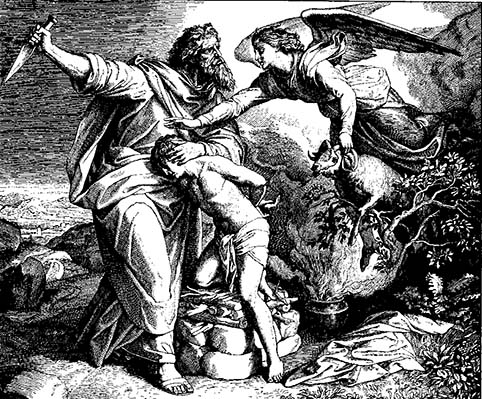
    To see another example which argues strongly for a celestial and allegorical approach to the events of Old and New Testament scripture, it is first important to understand that the ‘crossing’ points of the equinoxes, where the sun’s daily path crosses the celestial equator (once upward at the spring equinox and once downward at the fall or autumnal equinox) were anciently allegorised as places of sacrifice. In the New Testament stories, of course, these ‘crossings’ would involve an actual sacrifice upon a cross. But in the Old Testament, we see a famous sacrificial scene in the near-sacrifice of Isaac by his father Abraham upon Mount Moriah.

    The story is found in the book of Genesis, in the 22nd chapter. There, we are told that God directs Abraham to take his beloved and only son Isaac up a mountain in the land of Moriah and offer him up for a burnt offering. Abraham and Isaac dutifully trudge up the mountain, and Isaac makes note of the fire and the wood for the sacrifice, and asks his father, “but where is the lamb for a burnt offering?” (verse 7). 

    The famous sacrificial scene involving Abraham and son Isaac, as outlined in the book of Genesis, encodes an esoteric narrative not apparent to the casual reader. Woodcut engraving “The Sacrifice of Isaac” by Julius Schnorr von Carolsfeld, 1860.

    Here again we clearly have the elements which point to an esoteric rather than a literal interpretation of the text. The fact that the characters in the story are trudging up the mountain indicates we should suspect the story involves the sun’s path up towards the summer solstice. Since equinoxes are often indicated with a sacrifice, the equinox on the way up towards the summit of the year would be the spring equinox, not the fall equinox. 

    The mention of ‘fire’ in the text is also indicative of the ancient symbology of the sun’s path or the ecliptic: in ancient Mithraic symbology, for instance, the equinoxes are indicated by two distinctive characters who each carry a torch, with one of them carrying his torch pointing upwards to indicate the spring equinox (sun climbing up towards summer solstice) and one of them carrying it pointing downwards to indicate the autumnal equinox (in which the sun is declining downwards towards winter). The identification of the sun’s ecliptic, and especially the equinox, with the symbol of fire is amply supported by the discussion and evidence presented by Giorgio de Santillana and Hertha von Dechend in their magnum opus Hamlet’s Mill (1969).

    Having identified some clues indicating this story may depict events at an equinox, and specifically at the spring equinox when the sun is “ascending the mount” which culminates at summer solstice, we read on to see if there are any confirming symbols which might correspond to a zodiac sign. Sure enough, as Abraham is in the very act of stretching forth his hand and taking the knife to slay his son, we are told that an angel of the LORD directs Abraham to stay his hand, and as Abraham “lifted up his eyes, and looked,” behold, he saw “a ram caught in a thicket by his horns” (verse 13). This miraculous appearance of a ram caught in a thicket is confirmatory evidence that the story of Abraham and Isaac ascending Mount Moriah is actually an esoteric allegory pointing to the sun’s passage through the spring equinox, which takes place right at the beginning of the sign of Aries, the Ram.

    Goddess at the Gates of the Underworld

    Such celestial allegories can be found throughout the scriptures of the Old Testament, as well as in the sacred traditions of other cultures the world over. We know that the crucifixion of Christ in the New Testament is also surrounded by equinoctial imagery, but in this case the primary imagery is autumnal. Some evidence includes the presence of Mary (or more than one Mary) at or near the base of the cross during the crucifixion – representative of the zodiac sign of Virgo the Virgin. 

    The constellation Virgo is associated with a sheaf of wheat and harvest season (marking as she does the autumnal equinox), with the star Spica traditionally associated with wheat. Virgo’s outstretched arm is marked by a star anciently designated Vindemiatrix, which literally means ‘grape-gatherer’, as if she is plucking the fruit of the vine. These two symbols, of grapes and of wheat, are representative of the autumnal activities of the harvest season, and we find them prominently repeated in the Last Supper meal of bread and wine, immediately prior to the crucifixion. 

    CONSTELLATION VIRGO

    The constellation Virgo stands just at the edge of the autumnal equinox, the gateway to the lower half of the year, allegorised in sacred traditions around the globe as ‘the underworld’, or Hades, Sheol, and Hell. Appropriately enough, we see the ancient Apostles’ Creed asserts that immediately after Christ died, he “descended into hell,” although this assertion has confused some literalist Christian theologians who do not realise the scriptures encode the motions of the starry heavens. 

    In many myths around the world there is the figure of a maiden or a virgin or a goddess who stands at the gates of the underworld. This confirms that the esoteric pattern being described is extremely ancient – probably traceable to an ancient advanced civilisation prior to the dawn of any known historical civilisation – or at least to advanced or ascended sages from that pre-historic time. Often, this maiden or goddess greets the souls of the newly deceased or (in some cases) living heroes who are embarking upon a trip to the underworld, and in many cases she offers them wine or mead. All of this is in keeping with the pattern we are examining, and can be explained by the fact Virgo is located at the very ‘gates of the underworld’, and that she is associated with both grapes and the sheaf of wheat.

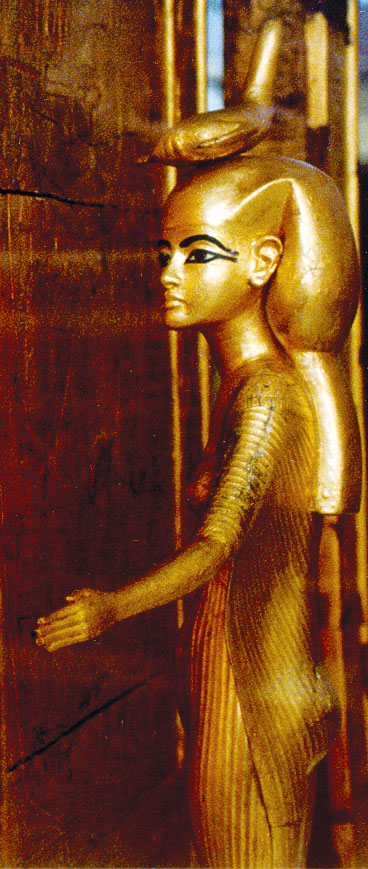
    This gilt statue of the scorpion-goddess Selket from ancient Egypt was discovered standing guard over the canopic chest in the tomb of King Tutankhamun. This example of Selket (with Scorpion on her head) has Virgo’s outstretched arm.

    We see her as Medea directing Odysseus on his quest to the realm of the dead, in the Odyssey of Homer. We see her as the ‘old goddess with the scorpion tail’ who greets the souls of the dead and gives them drink, found in the mythology of the Maya and many other Native American cultures according to de Santillana and von Dechend (Hamlet’s Mill, 243-244). The addition of a scorpion tail, of course, comes from the fact that the constellation Scorpio or Scorpius is found not far from Virgo, just beyond Libra and below the line of the celestial equator on the ‘underworld side’ of the fall equinox. 

    De Santillana and von Dechend note that this scorpion-goddess at the gateway to the realm of the dead and found in the mythology of the Americas is very reminiscent of the scorpion-goddess Selket from ancient Egypt, a beautiful gilt statue of whom was discovered standing guard over the canopic chest in the tomb of King Tutankhamun. Of course, the conventional historians assure us there could have been no contact between the cultures of ancient Egypt and the civilisations of Central or South America, and yet each has a scorpion-goddess associated with the entry of souls into the realm of the dead.

    A maiden with mead at the edge of the underworld is also present in Norse mythology, as discovered by Maria Kvilhaug and detailed in her important Masters’ dissertation The Maiden with the Mead (2004). All of these myths, from cultures found around the globe, undoubtedly allegorise the sign of Virgo at the gate of the autumnal equinox and the lower half of the year (the half which was depicted in ancient myth as Hell, Hades, or the underworld). Most of them involve the offering of mead or wine, beverages made from wheat or from grapes, both of which were associated with the constellation Virgo. Some of the goddesses incorporate the sign of Scorpio as well.

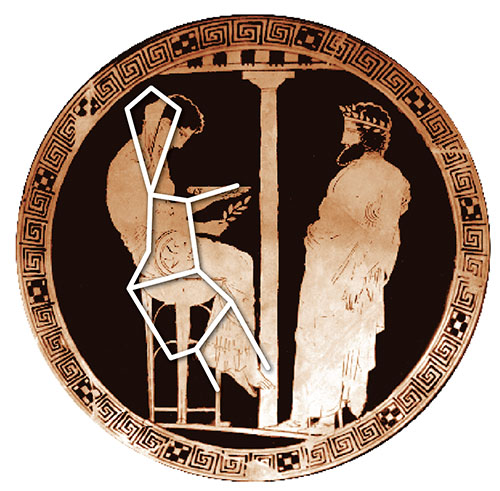
    An outline of the priestess of Delphi (the Pythia) showing that she is directly related to the constellation Virgo.  

    We also see a Virgo-like figure in the Pythia of the important ancient Greek oracle at Delphi, who was depicted as being seated on a tripod near a great rift leading to the underworld containing the body of the dragon-serpent Python: the fumes which proceeded from that rift caused the Pythia to go into a trance-state in which she could relay knowledge from the realm of the gods. In the ancient art, this maiden was often depicted as holding a sacred laurel branch and a plate of sacred water from the nearby spring – both characteristics that can be associated with the outline of the constellation Virgo, as is the seated posture of the constellation. The circle of water corresponds to the dim outline of stars that can be seen in the Virgo constellation chart above the outstretched arm of the maiden, which is sometimes depicted in other myths as a tambourine, or other circular instrument.

    Why Encrypt Esoteric Teachings?

    The foregoing examples should suffice to establish the fact that the ancient mythologies of the world (of which the scriptures of the Old and New Testament were originally part) were intended to be understood allegorically and esoterically, rather than literally. This immediately triggers the question of why? Why would the ancients ascribe such importance to the motions of the heavens and the heavenly bodies, the rising and setting of the sun, moon, planets and stars each day and throughout the year?

    The answer to that question is multi-layered, and it is profound. Essentially, the ancient sages wished to convey truths esoterically, truths so deep that they would tend to ‘trip up’ the logical intellect, the aspect of our thinking usually described as ‘left-brained’. 

    To illustrate the power of esoteric teaching, perhaps the best example is the famous scene from the original Karate Kid movie (1984), in which a frustrated Danny is finally fed up with waxing cars, sanding the floor, painting the fence (up, down), and painting the house (side-side). He confronts his teacher, Mr. Miyagi, and demands to know when he is going to finally be permitted to learn martial arts. The ensuing scene is so powerful that it has become world-famous: Mr. Miyagi demonstrates to Daniel-San that he has already been learning the secret art, in the motions of all his chores. Mr. Miyagi shows Daniel-San the ‘hidden teaching’ inside the motions of waxing the car, or painting the fence, and by unexpectedly launching ferocious attacks on Danny (accompanied by terrifying shouts), makes Daniel-San experience for himself that the martial art will actually work as advertised.

    This is the essence of the esoteric: it is not designed to keep knowledge secret, but rather to impart knowledge. If Mr. Miyagi had tried to explain various blocks to Danny, Danny would probably have had all kinds of questions, and doubts, and ‘what if’s’. By first giving Danny the motions in a ‘disguised’ format (and ensuring that Daniel-San internalised those motions), Mr. Miyagi enabled Danny to experience them for himself, achieving what the ancients called gnosis – a type of knowledge that comes not from the intellect or from ‘believing’ but rather from experience.

    It is quite possible – in fact it is almost certain – that the esoteric myth-systems of the world were designed to convey gnosis in much the same way. In fact, there is evidence these metaphors were not just a bunch of “stories built to hide the teachings about the motions of the stars,” but that the motions of the stars themselves were also allegories which convey profound teachings about the nature of human existence, and about the nature of the universe. Like the martial art Mr. Miyagi wanted to impart to Daniel-San, these profound teachings are of the sort that the intellectual ‘left-brain’ mind will choke upon. 

    There is evidence they teach a ‘holographic universe’ and a cosmology anticipating the discoveries of modern quantum physics by many thousands of years. Anyone who has encountered quantum physics knows it is very difficult to accept, and elicits the kind of incredulous questions that Mr. Miyagi would probably have gotten from Daniel-San had he tried to teach karate using ‘left-brain explanations’ instead of his esoteric ‘wax on, wax off’ method. 

    In brief, they were using the motions of the stars to teach about the existence of a spiritual realm which interpenetrates and coexists with the material realm, and to which one could travel using shamanic techniques in order to effect changes which would impact the material world or to gain knowledge that could otherwise not be accessed using strictly material or even ‘scientific’ methods.

    If the ancient sages, or the ancient civilisation or civilisations which preceded the earliest-known civilisations of history such as Sumer and Egypt, possessed such an advanced cosmography, it may go a long way towards explaining their incredible architectural achievements, achievements which conventional historical paradigms are at a loss to explain. 

    How Did We Lose Access to the Ancient Wisdom?

    This possibility brings us to the final question this incredible information raises: what happened to it? How did a large portion of humankind lose access to this ancient wisdom? Much of it seems to have been lost before the dawn of the earliest-known historical civilisations, although it is clear some portion of it survived in the ancient cultures of the world – in large part, perhaps, because of the exquisitely-crafted esoteric myths we have been discussing.

    But somewhere along the line, the esoteric understanding of these myths was replaced by a literalist approach, and it appears this process was a deliberate subversion carried out by the originators of literalist Christianity in the case of the scriptures of the Old and New Testaments. There, the literalists were able to wage a successful campaign to silence, marginalise, or eliminate the gnostic teachers and the texts which taught a gnostic approach (the Nag Hammadi texts, found in the twentieth century buried beneath a cliff along the Nile River in Egypt, testify to this ancient campaign). Then, allied with the power of the Roman Empire, the literalists expanded their campaign against esotericism and the shamanic to other cultures of Europe. 

    Literalist Christianity later took this campaign across the oceans, to eradicate the ancient wisdom in the cultures of the Americas, and later into Polynesia and even into Asia, including the civilisations of India, China, Tibet, and others.

    There is much more to this story, and it is one whose ending has yet to be written. There is no doubt the ancient wisdom entrusted to the human race is esoteric in nature, and attempts to suppress this truth – often through violence, threats, and deliberate falsehood – have caused tragic loss and suffering throughout human history since at least the rise of literalism during the first through fourth centuries CE. Stemming that violence, and healing that damage, will require courage, and it will require wisdom. The first steps, perhaps, include understanding this ancient esoteric system, and the profound wisdom the sages of pre-history intended it to convey to us and to future generations.

    Virtually all the world’s sacred traditions are built upon a common esoteric system of celestial allegory. David Warner Mathisen’s book The Undying Stars: The Truth That Unites the World’s Ancient Wisdom and the Conspiracy to Keep It from You, reveals how that system works and why the ancients thought it was so important. The book is available from www.amazon.com. For further information go to the author’s website: Star Myths of the World

    [alert type=”general” dismiss=”no”]This article was published in New Dawn 147.[/alert]

    [alert type=”success” dismiss=”no”]If you appreciate this article, please consider subscribing to help maintain this website.[/alert]

    © New Dawn Magazine and the respective author.
    For our reproduction notice, click here.
  • Sacred Geography & the Legend of Agartha: A Spiritual Journey Between History & Mystery

    Sacred Geography & the Legend of Agartha: A Spiritual Journey Between History & Mystery

    From New Dawn Special Issue Vol 15 No 4 (Aug 2021)

    The history of peoples is made by the unwritten history of great travels and world travellers – a history that began long before Herodotus or Marco Polo, in the Neolithic or even earlier, in some fantastical age of mankind. Perhaps even at the dusk of the primordial Golden Age, with glaciation or flood, and with the first in a series of catastrophes faced by the human species. Then followed eras of the migrations of peoples and races. If we believe Plato, then the Atlanteans were the first colonists in the world, and they came from the West. Others say that their ancestors were the Hyperboreans, who fled snow and ice in the Far North of the continent. 

    Over the course of subsequent history, peoples would move from North to South and from East to West – and not otherwise. This constitutes their course through history – a path of aging, degeneration and, at times faster, at times slower, of inexorable decline. This is how great conquests began, those that encompass immense regions, entire continents, and this is how great wars start, like the one that raged under the walls of Ilium – or was this only a shadow of some mythical war waged in the far deeper past, during the mythical age of the Earth? Perhaps at the beginning of time, “in illo tempore.” 

    They did not rush towards unknown and exotic lands, but towards their lost homelands, towards mythical lands of the beginning, towards the riches of the Golden Age. Towards primordial, Edenic abundance. Towards Paradise Lost, such as the biblical one, which we have not stopped searching for here on Earth even today. 

    One Islamic mystic, Suhrawardi, claimed that after death the soul returns to the homeland, for merciful Allah himself commanded this, and this would not be possible if he had not previously resided in it. This mythical homeland is to be found somewhere in the “spiritual East.” In order to find the strength for this, we must start from the spiritual West, the “Western wells of exile.” 

    The true journey, true adventures of the spirit, this Sheikh taught, start in the West. This is a place like a grave, a stockade of the burial-place. Arriving on the soil of an unknown continent, Christopher Columbus thought he had discovered the New Earth mentioned in the Apocalypse of St. John. The famous seafarer believed he was in the Gulf of Paria, and in its fresh currents had discovered the origin of the four rivers of the lost heavenly garden, Eden itself. “God made me the messenger of the new heaven and the new earth, of which he spoke in the Apocalypse of St. John, and before that through the mouth of Isaiah,” Columbus proclaimed to King Juan, “and he showed me the place where to find it.” 

    There is no single land, island, or continent in the world that is a mere geographical certainty. The whole  Earth is a sacred text, a holy book written in special signs – or at least this is what mystics and esotericists believe. The words of this text, it is thought, were written by God himself. Every journey is, in fact, a pilgrimage, for we are always walking on sacred ground. Every land and landscape, far and near, possesses hidden meaning and secret significance – spiritual, symbolic, eschatological, and even profoundly mystical. A landscape is at once both a physical and spiritual reality. This is the domain of a secret, mysterious science – mystical and sacred geography – whose knowledge, as happens, has been lost forever over the course of centuries or millennia. 

    The King of the World 

    Legend claims that somewhere, in the depths of the Earth, in dark caves and secret passages, there still lives one such sacred land inhabited by a secret, mysterious people, one hidden from the sight of others, that this is known to only a few chosen ones on the surface, and that this knowledge is a strictly guarded secret. Or maybe it was until recently. This secret kingdom is called Agartha. This legend is ancient and comes from remote prehistory. Agartha is spoken of in the legends of diverse peoples – white, red, and yellow – in both East and West. Agartha is a kingdom hidden underground, populated by a people gifted with miraculous powers, a people that lives in wisdom and immense wealth. But Agartha is even more than that: it is the spiritual centre of mankind ruled by a hidden ruler, the head of its initiatic hierarchy. His title is “King of the World.” 

    Legend holds that this supreme spiritual and metaphysical centre of mankind, Agartha, has not always been hidden underground, nor will it stay there forever. This condition corresponds to the fallen state of humanity, the age of darkness and confusion which, it is said, has lasted for the past 6,000 years. In 1890, the King of the World allegedly issued the following prophecy in the monastery of Narabanchi: “The time will come when the peoples of Agarthi will come up from their subterranean caverns to the surface of the earth.”

    Travellers who have set their minds to find it have whispered about it. Caravan merchants have told exhilarating tales of it in inns and on mountain trails, in deserts and in remote corners. It is known to Tibetan sages whose teachings nourish monks and lamas. The common crowds, meanwhile, ridicule and laugh at such tales as the superstitions of the uneducated and gullible.

    The tale of Agartha reached the West from two independent sources. In a book published posthumously in 1910, The Mission of India (or The Mission of India in Europe), the French esotericist Saint-Yves d’Alveydre introduced the West to Agartha as a Buddhist myth of a secret centre of the world hidden somewhere in the depths of the Himalayas, India, or Afghanistan. 

    French esotericist René Guénon focused on Agartha as a spiritual centre of the world in his 1927 book The Lord of the World (reissued in 1983)

    D’Alveydre’s account was commented upon by another French esotericist, the founding thinker of Traditionalism, René Guénon. Traditionalist thought, through the works of René Guénon, provided an exegesis of this myth: at its deepest root is the idea of the supreme spiritual centre, the spiritual centre of humanity during the last time-cycle of humanity, i.e., the Iron Age in the traditions of the peoples of the West. 

    As Guénon observed, numerous parallels and analogies of this Buddhist myth of the King of the World can be found across the most diverse traditions, from the Hindu and Jewish through the Islamic and Christian to the Celtic myth of the Holy Grail which was subsequently, superficially Christianised. The very name “Aggartha” or “Agarttha,” Guénon writes, means “imperceptible” and “inaccessible” – “and also ‘inviolable’, since it is Salem, the ‘Abode of Peace’” – but the name of the spiritual centre before the present time-cycle was Paradesha (“supreme country” in Sanskrit), whence the Chaldean Pardes or the Paradisus (“paradise”) known to the Western traditions. Moreover, Guénon drew a connection between Agartha and the “Light of the East” of Islamic esotericism. 

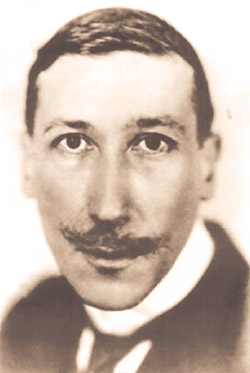
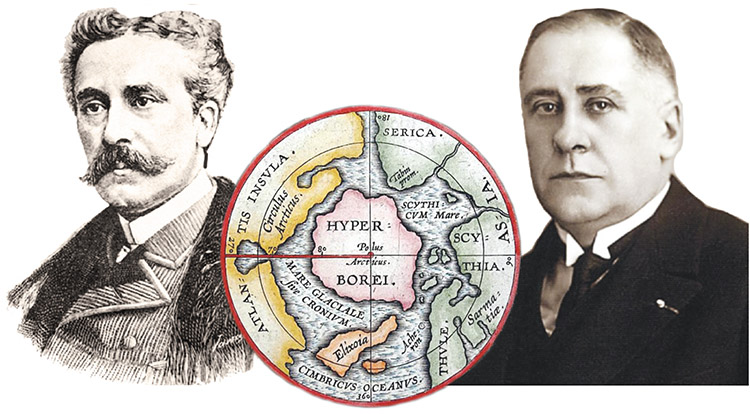
    Legendary Agartha is spoken of in the same breath as forgotten lands such as Hyperborea. Two key figures helped bring the tale of Agartha to the West: French esotericist Saint-Yves d’Alveydre (left) and Polish traveller and author Ferdynand Ossendowski (right). 

    Absolute Pole 

    The “Light of the East” is none other than the “Light of the North,” the “Gold of the North” mentioned by classical writers. In other words, Agartha is only one of many projections of the Pole, the North Pole, Hyperborea or Paradise, which has shifted over the course of history from the North to the West and from the South to the East. There exists, to name it, the Absolute Pole. Agartha is an Eastern projection of the Absolute Pole. We cannot seek this mystical Pole above the surface of the Earth, at the top of Mount Meru as it was in the Golden Age or in the Hyperborean cycle, but only underground – not in the polar ice of the Arctic, but in the East of the Eurasian continent. Emanuel Swedenborg issued the mysterious pronouncement that in our age the “lost word” is to be found only among the wisemen of Tatary and Tibet, i.e., in the East. 

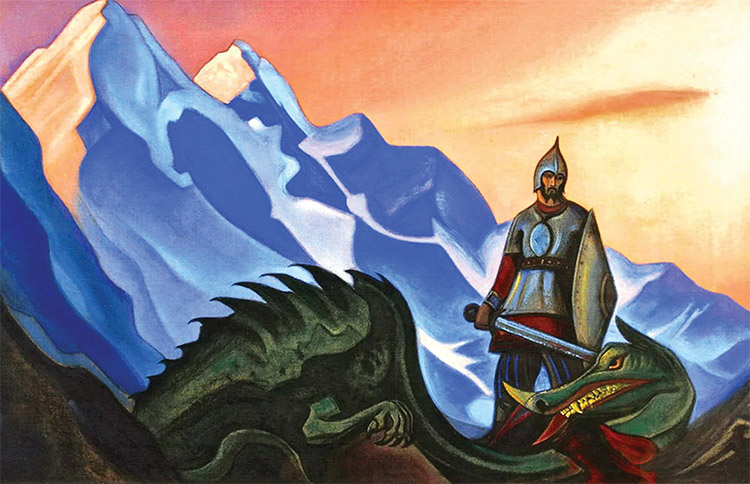
    Svyatogor (giant-warrior) by Nicholas Roerich, 1942

    Some authors claim that contact has been maintained with this centre during almost all of the historical cycle of the West. This contact was at all times direct and realistic. But the final projection of the North Pole – the sanctuary of the sacred King of the World in the East – has become more and more inaccessible and mystified. It was interrupted only in late historical times. Guénon states that this happened soon after the Thirty Years War, more precisely in 1648, when the “real Rosicrucians,” 12 in total, left Europe and withdrew to Asia, to Agartha.

    The second Western source on Agartha was the Polish traveller and author Ferdynand Ossendowski, who in his book Beasts, Men and Gods, published in 1924, reported on his tumultuous trip throughout Central Asia during the years 1921-1922. There is a moment, Ossendowski claims, when stillness overcomes the world, when wild animals stop in their run, horses stop to listen, birds stop flying, and travellers stop in their tracks. Hordes of sheep and cattle and yaks crouch down to the ground, and dogs cease their barking. The wind subsides into a slow trembling of air, and the Sun stops in its motion. For a moment, the whole world sinks into silence. An unfamiliar song penetrates the hearts of animals and people. This is the moment when the King of the World in Agartha speaks with God himself, when tongues of flame in the letters of the Vattan alphabet erupt from his altar. 

    Ossendowski’s account also received the commentary of Guénon. Guénon explains that Ossendowski wrote the name of this underground kingdom as “Agharti,” whereas Saint-Yves d’Alveydre used the form “Agartha,” “the latter being known to have been in contact with at least two Hindus.” The fact that this mysterious legend from the East reached the peoples of the West in two different versions is explained by the fact that d’Alveydre was inspired by Hindu sources, while Ossendowski was informed by Lamaist ones.

    The accounts of d’Alveydre, Ossendowski, and Guénon do not, however, exhaust the traces and hints of “Agartha.” A book published in the 17th century in Leiden mentions a city by the name of “Agartus Oppidum” reportedly located in the Nile Delta of Egypt. This fact was unknown to Guénon. Lucius Ampelius, a Latin author from the third century, claimed that in this city stood a statue with hands of ivory and a bright emerald on its brow. This statue, it is written, incites panic and fear among animals and people, and especially among barbarians. The word oppidum in Latin means elevation, fort, or hill. The meaning of the word Agartus is unknown and has no meaning in Latin. 

    It is also recorded that long ago, in Medeia, near the southern coast of the Caspian Sea stood a city called Asagarta. Ptolemy added that the inhabitants of this land called themselves Sargartians, and Herodotus claims that 8,000 Sargartians (inhabitants of this lost land) were present in the army of the Persian King Darius. Asgard, the mythical city of the Aesir, was the capital of the Sarmatians and Roxalana. Some researchers equate Asgard with Agartha. Others think that Agartha was exactly that city mentioned by the Roman Lucius as lying on the banks of the Nile. This is a mistake – the very same mistake committed by some in regards to Atlantis or Thule. Agartha is in fact Thule, or rather one in a chain of Thules which appear at different times in different meridians. The same is true of its mysterious inhabitants, who at times come out onto the surface of the Earth. Thus, the name Agartha has been known since ancient times, since the very beginning of history, and it can be found everywhere, from ancient Egypt to Bactria, in its projections, in its representation on Earth, in its secondary variations, just as every Thule, including even Atlantis, is only a projection of the primordial and original Hyperborean Thule, the one erected by the hands of man-gods at the dawn of time. 

    Victory (Gorynych the Serpent) by Nicholas Roerich, 1942

    Agartha and America 

    The fact that all the known names of sacred-geographical centres corresponding to cosmic cycles and events – Hyperborea, Thule, Atlantis, etc. – come up in investigations of Agartha, and that this is happening in the modern age, especially since the “discovery” of America, is no coincidence. If the discovery of America, or rather the return of America to history, triggered such unrest among peoples, then what will happen if the prophecy of the end of the world is fulfilled and the secret Agartha becomes known to all of humanity? It is prophesied that the people of Agartha will once more come out onto the surface of the Earth. And likewise, Paradise, the Garden of Eden, is hidden somewhere in the East. It is in the East of the “wise sages of Tatary,” Swedenborg claimed, that we should search for the “long forgotten word.”

    What is the link between Agartha and America? Is it the same thread that interconnects all continents? Could their appearance, or rather re-appearance, on the horizon of world history represent a sign of the “final times,” the “End Times?” The “secret” of America was known to the Vikings, the Egyptians, and the Phoenicians even thousands of years before the Portuguese and Spanish seafarers. 

    Esotericists and the adepts of secret societies, mystics and conjurers, astrologers and neophytes, the followers of secret cults and obscure conspirators – all are still weaving their dark webs around Agartha and the deep mysteries that hide this underground kingdom. 

    Get the issue this article appears in

    America is not only the land of the Apocalypse – a story that speaks about the end of the world and the last revelation. The first newcomers identified America with paradise, where even the trees and plants spoke the “hieroglyphic language of our Adamic or primitive state.” The New World was for them a projection of paradise on Earth, by which God baptised his chosen people – the New Israel. Others identified America, on no lesser grounds, with Atlantis, whose downfall was described by Plato. Failing to observe that the Greek philosopher was precise in the details he gave, and that, besides the island of Atlantis, he also mentioned a “land in the West surrounded by ocean on all sides.” This, there can be no doubt, is the North American continent. America is only its shadow, its projection in the Far West, the “false Atlantis.” 

    America is, of course, not the mythical island of Atlantis that vanished in the Atlantic Ocean at the very dawn of history. It is actually the Green Land, the Land of the Dead, the “Kingdom of Shadows” in the West that is mentioned in the legends and myths of many peoples. America is Trans-Atlantis. What is the meaning of the reappearance of a dead, sunken continent, on the horizon of world history? In the same way, Agartha is also a “land of the dead” which, as prophecy holds, is still to be discovered in the depths of the underground. In historical times, this reportedly was realised by some travellers and seekers. One of them was a Mongolian hunter who could not keep his secret, and thus had his tongue cut out by lamas. The Lama Djamsrap spoke of this in his book. Another was an illiterate Norwegian sailor who claimed to have lived in Agartha for several years. The reader will see that these fleeting mentions are not without grounds, and that America and Atlantis are closely connected without the topic of Agartha, the mysterious kingdom hidden in the everlasting dark, deep underground, and deep in the past. It is closely connected with the worlds of the dead and the past – with the past that refuses to die. And it verily conceals many secret histories of the human race.

    And yet, the idea of an underground hiding place of the incarnation of the sacred, celestial principle is in itself contradictory. According to sacred logic, the seats of spiritual authority are to be found in mountains, not in the underworld, which is logically and naturally connected with the chthonic, the infernal, and the hellish. Moreover, archetypes and ideas themselves choose their bearers throughout history, and it is not always possible to accurately distinguish between “real” and symbolic continents, lands, and cities mentioned in sacred texts, from the Vedas to the Bible. In sacred texts, the sacred and earthly planes, physical and sacred geography, physics and metaphysics, constantly intersect. But, overall, these fabulous lands are not the product of mere fantasy: rather, the matter is one of a fragile memory for which it is still necessary to find the appropriate keys. 

    In this sense and according to this logic, the “Light of the North” or “Light of the East,” indeed the “Light of Agartha,” is not strictly localisable on the terrestrial plane. Likewise, journeys to and accounts of Agartha are not only or not mainly travels in geography and history, but travels of the spirit, travels whose “interior centre” is that within man. As the Chandogya Upanishad says, “Now, the light which shines higher than this heaven, on the backs of all, on the backs of everything, in the highest worlds, than which there are no higher – verily, that is the same as this light which is here within a person.” The chains of “Agarthas” lead along and are the chains of spiritual journey. In journeying to Agartha, we are travelling into the light of myth. The reawakening of myth is a reawakening of that hidden, mysterious, inner light within ourselves. In this dimension, “lost and found” lands, islands, continents, and kingdoms like Agartha have something to tell us that is quite different from the “positive geographical discoveries” and “research” of recent history. 

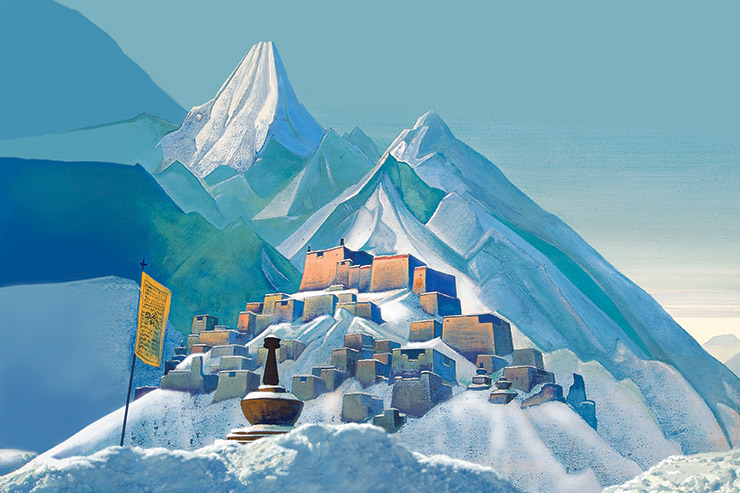
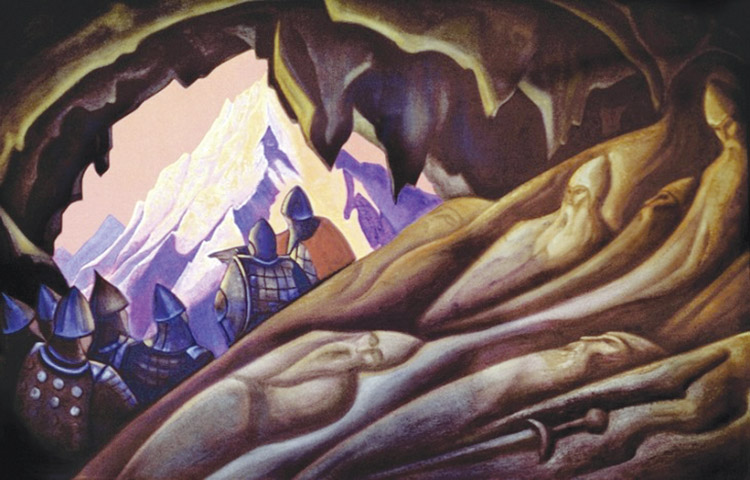
    Bogatyrs (Heroes) Have Risen by Nicholas Roerich, 1940

    The above text is based on passages from Boris Nad’s first volume of selected works in English, The Reawakening of Myth (PRAV Publishing, 2020), particularly the second part, A Tale of Agartha. The book can be ordered via PravPublishing.com.

    [alert type=”general” dismiss=”no”]This article was published in New Dawn Special Issue Vol 15 No 4.[/alert]

    [alert type=”success” dismiss=”no”]If you appreciate this article, please consider subscribing to help maintain this website.[/alert]

    © New Dawn Magazine and the respective author.
    For our reproduction notice, click here.
  • What is the End of an Age? Understanding the Precession of the Equinoxes

    What is the End of an Age? Understanding the Precession of the Equinoxes

    From New Dawn Special Issue Vol 15 No 6 (Dec 2021)

    Timing is everything. Everything moves in cycles. Our days are defined by the turning of the earth, our weeks and months by the cycle of the moon, while the seasons of the year are caused by the relationship between the earth and the sun.

    The monthly cycle of a woman’s body, upon which the conception and birth of every child depends, has been associated with the cycle of the moon from ancient times. Despite a condescending denial of this ancient association in recent decades by proponents of “modern science” – who argue that there is no way heavenly bodies such as the moon impact biological functions in women or men – recently published findings from a long-term study over fifteen years revealed that the moon does indeed impact that monthly cycle (see “Women temporarily synchronize their menstrual cycles with the luminance and gravimetric cycles of the Moon,” Science Advances, January 2021, www.science.org/doi/10.1126/sciadv.abe1358).

    For the past twelve years, I have been exploring and presenting evidence that the world’s ancient myths are based on the stars and heavenly cycles – that ancient stories and all the characters and figures described in them correspond directly to constellations and celestial features. This is an esoteric system stretching around the globe and forming the foundation for myths from every inhabited continent and island, including the myths of the cultures of the Americas, Africa, Australia, the islands of the Pacific, as well as ancient India, China, Mesopotamia, Egypt, Japan, and Greece. This system forms the foundation for the Norse myths and for the stories contained in the scriptures of the Bible, from Genesis all the way to the Revelation of John.

    The myths use the heavenly cycles, including the cycles of the moon and the planets, but most especially the annual cycle with its effect on the hours of darkness and light as we move through the equinoxes and solstices. They are part of an esoteric language in which different parts of the cycle are understood to represent specific aspects of our experience in this incarnate life and thus convey powerful truths for our understanding and benefit.

    In addition to the cycles with which we are familiar from our own experience, such as the annual cycle with its changing seasons and lengths of the day, the ancient myths also use the less obvious and far more gradual cycle known as precession. This is a cycle unfamiliar to most people and rarely taught in formal schooling or mentioned in anything we see on television or in the movies. It proceeds at such a slow pace that even an entire human lifetime of carefully observing the heavens will barely reveal its subtle action.

    Indeed, the motion of precession is so subtle and gradual that it was not even articulated by any writers of whose work we are today aware, until the work of the astronomer Hipparchus who lived between the years we today designate as 190 to 120 BCE. Many centuries passed before astronomers could narrow down estimates of the rate of the motion of precession with any degree of accuracy.

    Understanding Precession

    To understand why precession is so difficult to detect, let’s examine its effect on what we see in the sky from our vantage point on earth. If we spend any amount of time looking at the stars at night, we will soon observe that the position of the constellations slowly changes as we go throughout the year.

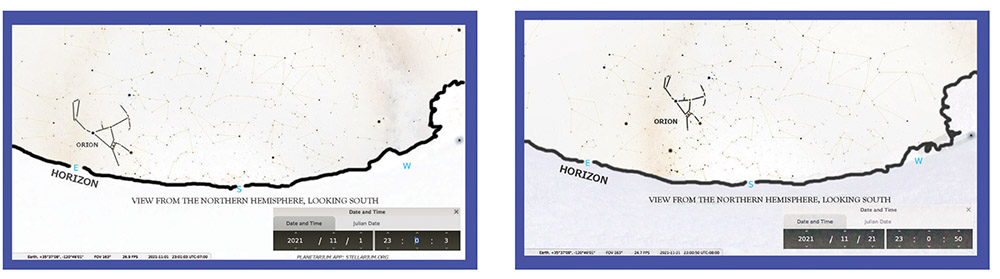
    FIGURE 1 (left):  Date and time box show that at one hour before midnight, on 1st November, all the stars of Orion have now risen in the east and are above the horizon. FIGURE 2 (right):  As we move through the year, the stars rise a few minutes earlier each night. Thus, they are farther along their journey from the east to the west at the same time on successive nights. Here we see that by the 21st of November, the stars of Orion have moved much higher by the same hour shown above: one hour before midnight. 

    For example, as I write this at the very end of October and beginning of November, the majestic constellation we call Orion is rising above the eastern horizon in the hours after dark, such that the entire constellation clears the hills to the east of where I live about one hour before midnight (see Figure 1). However, as we continue through the year, the stars of the constellation Orion will rise just a little bit earlier each night (about four minutes earlier per night, at the latitude where I live), such that in just a few weeks the entire form of Orion will be above the eastern horizon two hours before midnight, and thus even higher in the sky later on (see Figure 2). In a few months, the constellation will be high in the sky nearing its zenith.

    This change in the position of the constellations as we go from one night to another is a result of the changing relationship between the earth and the sun as we move through the year. Orion dominates the night sky during November through April (the winter months for the northern hemisphere), but as the year goes on and the stars of Orion continue rising earlier and earlier each night, the constellation will be farther and farther along its journey from east to west as the sun goes down, until at last we will observe that at nightfall, when the stars start to become visible, the familiar form of Orion is all the way over at the western horizon. As the year progresses even further, into the end of May and the beginning of June, Orion will already be below the western horizon when night falls and the stars appear.

    Because this movement is a function of our annual dance with the sun, the position of any given star (say, for example, the centre star in Orion’s famous three-star belt) will be back in its same position when we on earth get back to the same point relative to the sun in our annual cycle. Of course, to measure this phenomenon precisely, we need to stand in exactly the same spot from one year to the next. In fact, we have to rest our chin (or our telescope) in exactly the same location. If we do, we should find that the star in question is in its expected position when we get back to the exact same point in our annual cycle.

    How do we know when we get back to the exact same point in our annual cycle? We cannot simply use an ordinary calendar and pick the exact same calendar date (such as November 1st) and assume that we are back to the same point relative to the sun. As we know, the calendar “slips” around a little bit from one year to the next due to the fact that our earth’s daily turning does not match up evenly with our annual cycle. The earth turns on its axis 365 times and a little bit more each year, which means that we have to come up with corrections such as the concept of the “leap year” to keep the calendar from slipping to the point that January 1st falls in the summertime instead of the wintertime (for the northern hemisphere) due to that little extra bit of turning each year.

    So, if we want to know when we are back to the exact same point in our relationship with the sun, it is much easier to observe the great station points of the year that we call the solstices and the equinoxes. If we use the winter solstice, for example, to measure some specific star, we will know we have returned to the exact same point in our annual cycle. We can see if that star is in the same place that it was the prior winter solstice (keeping in mind that we will need to take our measurement at the exact same time and with our chin or our telescope in the exact same place as when we measured that star’s location the year before).

    If we are very careful with our measurements, then we should find that the same star is in its appointed place the following year. That is what we, in fact, do find because when we get back to the exact same point in relation to the sun, we should be able to look up into the sky at exactly midnight (for example) and trust that the scene in the heavens is the same it was when we crossed midnight at this exact same point in the annual cycle the year before.

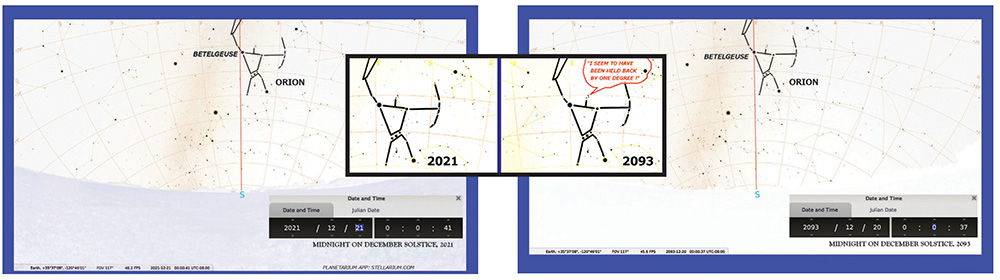
    FIGURE 3 (left):  Position of the stars of Orion midnight on December solstice, 2021. Compare this to the position of the same stars 72 years later, shown in Figure 4: the “delaying” action of precession will “hold the stars back” ever so slightly after 72 years, but only by a single degree of arc. FIGURE 4 (right):  Position of the stars of Orion midnight on December solstice, 2093. The gears of precession grind very slowly, but after 72 years, the stars have been “held back” by one degree of arc. Observe, for example, the position of the star Betelgeuse, at Orion’s shoulder just below the upraised arm: it has ben “delayed” by about one degree over 72 years on the December solstice. 

    But there is another motion going on which throws a twist into the orderly round of the march of the stars from one year to the next. It is so subtle that we will not be able to measure it very easily with standard equipment unless we take the same measurements every year for a very long time. Over the course of many years, the expected star will keep returning to its expected spot on the expected day, but if we measure its position each year for many decades (keeping careful records each year, of course), we will begin to see it “struggling” to make it to its appointed spot in the heavens – as if some force is very slowly “delaying” that star or “holding it back” from one year to the next.

    This action is so slow and subtle that it takes 72 years for that star to be held back by a single degree of arc (about the width of your littlest finger, held at arm’s length from your face). Due to that very slow delay, after 72 years the star will be delayed by a whole degree on the appointed day and time from the place that you measured it at the exact same place and time, 72 years before. Indeed, this delay holds back all of the stars. It is as if the entire fabric of the heavens is held back ever so slightly over decades so that Orion is one degree lower 72 years from now on the night of (let’s say) the December solstice than Orion will be this year on the December solstice at the same hour – and so will the stars of Taurus, and the Pleiades, and all the rest of them.

    Of course, very few astronomers can make 72 successive annual measurements of the same star as we’ve just described, even if they start at the early age of 10 years old. For the ancients to even perceive the motion of precession would require meticulous record-keeping for more than one human lifetime – not to mention a system for ensuring that all the observers rested their chins in precisely the same spot when taking annual measurements.

    Even after 72 years of observation, the delay is very slight – just one degree! And for the stars to be delayed by two degrees would take another 72 years, or a total of 144 years to get the two-degree displacement. After thousands of years, this “delaying action” will have a real impact. 

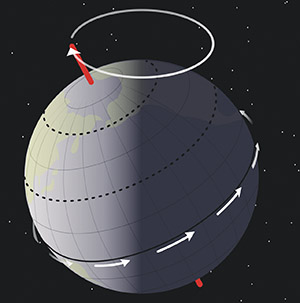
    FIGURE 5:  Precession appears to “hold back” the night sky by one degree every 72 years due to a 23.5° wobble of Earth’s axis as shown here. One cycle of the wobble takes approximately 25,920 years, which is 12 x 2,160 years.

    The reason this motion is called “The Precession of the Equinoxes” is that, after thousands of years, this slight delaying action changes the background of stars such that the constellation expected above the horizon before sunrise on the significant morning of the March equinox (the spring equinox for the northern hemisphere) will be delayed so much that it will still be below the horizon – and the constellation that normally precedes it in the march across the sky and through the year will be above the horizon instead.

    We know there are 360 degrees in a complete circle, so if the motion of precession delays the background of stars by one degree every 72 years, we can determine how many years it takes to delay the constellation expected to be just ahead of the sun on the morning of the March equinox (or even the constellation in which the sun is located on the March equinox, although we obviously can’t see the stars once the sun clears the horizon) due to the action of precession.

    FIGURE 6:  Another way of seeing the action of precession. Earth in its orbit around the sun causes the sun to appear on the celestial sphere moving along the ecliptic (red), which is tilted 23.5° with respect to the celestial equator (blue-white). Over very large spans of time, different zodiac constellations appear behind the sun as it rises at the March equinox. Image credit: Wikipedia/Tau’olunga

    The constellations along the plane of our solar system, the plane between the earth and sun, is known as the “ecliptic.” The background constellations along this ecliptic plane are known as the zodiac constellations. Although the constellations are not all exactly the same size, if there are 12 zodiac constellations and 360 degrees in a full circle, then we can calculate that each constellation in the zodiac should occupy a space of that circle totalling 30 degrees (since 360 degrees in a circle, divided by 12 zodiac constellations, gives us 30 degrees per zodiac constellation). Thus, if precession “holds back” the night sky by one degree every 72 years, then it would take 2,160 years for this motion of precession to delay the sky so much that the expected zodiac sign above the eastern horizon on the morning of the March equinox is “held down” completely below the horizon, such that the preceding zodiac constellation would be above the horizon instead.

    The same is true for the zodiac constellation forming the background for the sun itself on the March equinox – after 2,160 years of delaying action, the sun will be in the “preceding” constellation instead of the “expected” constellation. In other words, the sun will have “precessed” into the preceding constellation of the zodiac due to the inexorable motion of precession.

    Understanding the End of an Age

    This replacement of one entire zodiac constellation by another is what is meant by the “End of an Age.” An “Age” is a precessional Age and is generally identified with the constellation in which the sun rises on the March equinox during that entire Age. The Age of Taurus eventually gave way (due to the delaying motion of precession) to the Age of Aries (Aries being the zodiac constellation that precedes Taurus across the sky), and after another 2,160 years or so, the Age of Aries in turn gave way to the Age of Pisces, which is now giving way to the Age of Aquarius.

    The authors of the seminal 1969 book Hamlet’s Mill, Professors Giorgio de Santillana and Hertha Von Dechend, made the brilliant observation that this subtle motion of one constellation taking over the special position in the sky from a preceding constellation could be allegorised in myth. For example, in the usurpation of the throne of the rightful ruler by a jealous brother, as in the story of Osiris and his usurping brother Set, in the mythology of ancient Egypt.

    They went on to observe that all “End of the World” imagery common in myths (not only in the Bible where we find the apocalyptic scenes described in the Revelation of John and some of the sermons of Jesus in the gospels, but also in other myth-systems such as the Norse myths with their prophesies of Ragnarokk), must be allegorisations of the “End of a Precessional Age.” One “world” is (figuratively speaking) destroyed and replaced with a new one. The heavenly arrangement of the Age of Taurus, for example, was replaced by the arrangement of the Age of Aries, in which the sun rose in the new sign on the March equinox and also in the new sign on the other important stations of the annual cycle, including the June solstice, September equinox and December solstice.

    To support their argument, the authors of Hamlet’s Mill found “precessional numbers” relating to the cycle operating in myths around the globe, particularly in myths having to do with these themes of “usurpation” and the “End of the World.” For example, they point out that the ancient philosopher Plutarch tells us quite specifically that in the myths of ancient Egypt, the rightful king Osiris is killed by his jealous brother Set along with seventy-two henchmen!

    It should be noted that the actual rate of precession is not one degree every seventy-two years exactly, but rather one degree every 71.6 years – but we should be able to understand why the myths “round up” to 72 for a metaphorical story.

    Similarly, as the authors of Hamlet’s Mill also note, the Norse myths tell us (in the Poetic Edda also known as the Elder Edda) that when the final dreadful day of Ragnarokk arrives, the heroes of Odin’s hall of Valhalla will march out to do battle. The verses declare that Valhalla has 540 doors, through each of which will march eight hundred warriors on the day and that they must go to battle with the Wolf on the last day, for a total of 432,000 warriors (which, of course, relates to the precessional number of 72 and to the 2,160 years of a precessional Age, in that 432 is double 216 and six times 72).

    These numbers constitute a powerful argument in favour of their theory. Moreover, in the intervening years since Hamlet’s Mill was published, I found abundant evidence to support their theory in that the imagery in these apocalyptic battles and cataclysms (whether we are talking about the scenes described in the Book of Revelation or in the descriptions of Ragnarokk, or in other apocalyptic battles from other mythologies, such as the great Battle of Kurukshetra in the Mahabharata of ancient India) can be shown to correspond to specific constellations – proving beyond any doubt that these “End of the World” scenes are celestial metaphor.

    Get the issue this article appears in

    What is the purpose of such metaphor? That can be debated, although it stands to reason that if the cycle of the moon has an impact on the time of month that a woman can conceive a new life, then the other cycles up to the slow and inexorable turning of the cycle of precession can have an impact on our lives.

    I am also quite convinced that the myths use these heavenly cycles as an esoteric code to convey to us powerful messages about subjects we should understand in this life. The “displacing” motion of precession (by which one constellation’s place is “usurped” by another) relates to themes of displacement in our own life, including the theme of alienation, which I have found to be a central theme in the myths – alienation, indeed, from our own Self, which some pioneering modern psychologists connect to psychological trauma. The myths appear to have a dominant central theme about alienation from our Self and the path towards recovery. A subject that should interest all of us, very deeply.

    For an introduction to the ancient system of understanding the stars, read David Warner Mathisen’s Star Myths of the World Volumes One through Four, available from all good bookstores. His most-recently published books are The Ancient World-Wide System (2019) and Myth and Trauma (2020). Book previews are available at www.starmythworld.com.

    [alert type=”general” dismiss=”no”]This article was published in New Dawn Special Issue Vol 15 No 6.[/alert]

    [alert type=”success” dismiss=”no”]If you appreciate this article, please consider subscribing to help maintain this website.[/alert]

    © New Dawn Magazine and the respective author.
    For our reproduction notice, click here.
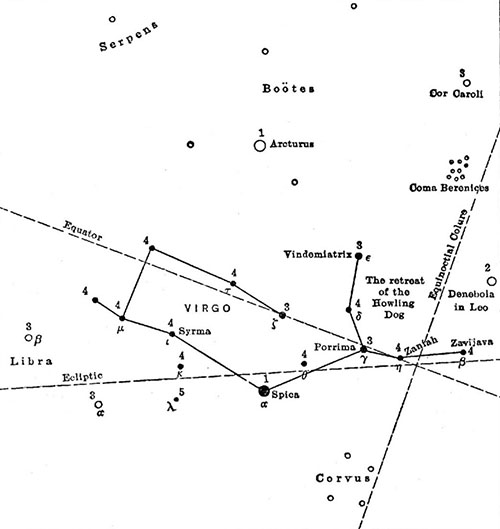
  • The Astonishing Achievements of our Ancient Ancestors

    The Astonishing Achievements of our Ancient Ancestors

    From New Dawn Special Issue Vol 14 No 3 (June 2020)

    Like other New Dawn readers, I had heard something about Roman road-builders, Mayan mathematicians and Babylonian astronomers. But I was subsequently surprised to discover that these and other peoples achieved levels of applied science in the deep past equal to and occasionally surpassing similar material accomplishments taken for granted today. Some important innovations first conceived during antiquity were lost when the civilisation associated with their creation collapsed and were completely forgotten, only to be independently re-invented thousands of years later by modern developers utterly unaware of their ancient precursors. 

    Yet more remarkably, a time very long ago, when mainstream historians and conventional archaeologists assure us that superstition and ignorance alone ruled the world, human genius attained certain levels of technology still beyond our grasp. So many, in fact, that hundreds of collected specimens fill the pages of my new book until their superfluity overflowed its printed limitations. How grateful I am, then, to New Dawn for this opportunity to share with you some of the truly extraordinary instances of Ancient High Tech that missed being included in the volume so entitled! 

    Five hundred and more years ago, Inca medical practitioners treated serious heart ailments with extracts of foxglove, a procedure only now acknowledged for its efficacy by 21st century health care professionals. 

    Among the most startling examples belonged to Inca medical practitioners, whose advanced healing agents were revered as part of a larger, cultural legacy inherited from Kon-Tiki-Viracocha, “Sea Foam,” pre-Columbian South America’s founding father and flood-survivor from an island kingdom of unique power, overwhelmed in prehistory by a catastrophic deluge. After establishing himself in the Andes Mountains, Inca tradition explained that he schooled their ancestors in the use of plant extracts from Digitalis lanata, a flower known today as “foxglove,” for the successful treatment of serious heart conditions. After the Conquistadors overthrew Inca Civilisation, its culture was entirely demonised, along with all traditional medical knowledge, which fell into oblivion for the next four centuries. 

    Not until 1930 were botanists able to extract digoxin from the leaves of the foxglove plant and discovered (re-discovered) its effective properties for treating atrial flutter and heart failure. Its resulting compound is rated today on the World Health Organization’s List of Essential Medicines as among the safest and most effective measures necessary for any health system. But teasing digoxin from Digitalis lanata demands careful precision and observant skill because the slightest error in determining the correct amount can mean the difference between strengthening the heart or inducing cardiac arrest. This life-and-death discrepancy signifies that Inca physicians not only recognised its critically narrow parameters, but themselves possessed sufficient expertise to properly act upon such a distinction. 

    They also applied the secrets of Matricaria chamomilla to effectively deal with gastrointestinal problems, particularly irritable bowel syndrome and intestinal cramps, when taken as a mild laxative for its anti-inflammatoryand bactericidal effects. Only within the last thirty years has research with animals demonstrated the antispasmodic, anxiolytic (anxiety-reducing), anti-inflammatory, antimutagenic (mutation reducing), and cholesterol-lowering effects of “wild chamomile,” which is additionally included in many of today’s sleep aid products. While all this is relatively new to us, the ancient Andeans were familiar with Matricaria chamomilla and its soothing benefits long before the last Inca emperor was killed in 1533. His culture likewise treated hyperlipidemia, an acquired or genetic disorder that results in high levels of lipids; these are fats, cholesterol, or triglycerides circulating in the blood. 

    The condition was addressed in pre-Conquest South America with extracts of plantago paralias, some forms of which additionally predispose to acute pancreatitis, and may be useful for glycaemic control in patients with type 2 diabetes. The anti-cancer effects of plantago paralias are only now being gradually appreciated. It is clear that Inca pharmaceutical and pharmacological knowledge not only far outdistanced the contemporaneous quackery of European physicians in the 16th century, but still has much to offer modern medical developments. On the other side of the Ancient World, Nile Valley practitioners similarly undertook quantum advances in the healing arts only now coming to light. 

    Imagined reconstruction of scene from ancient Egyptian civilisation. The ruins on display today in modern day Egypt – although still impressive – are a pale representation of how it really would have looked.

    Just ten years ago, archaeologists analysing the skeletal remains of Roman Era inhabitants of Upper Egypt and adjacent Nubia during the early 1st century CE found the presence of tetracycline, an antibiotic in use today for treating bacterial infections. The Egyptians ingested tetracycline with a special beer concoction not unlike sour porridge. Further investigation revealed that retrieved Roman Era samples were identical in substance to the same beverage dating to the advent of Pharaonic Civilisation, more than three thousand years before. 

    Egyptian girls at a 19th Dynasty party (around 1290 BCE) give each other different-flavoured breath mints.

    Related evidence in the form of surviving medical papyri revealed how dynastic physicians and brewers deliberately contaminated their beer with streptomyces, tetracycline-producing soil bacteria that thrives in the arid conditions of the Egyptian desert. Their grain thus laced with tetracycline, the Egyptians observed how it cured them of various bacterial ailments, five thousand years before the discovery of penicillin by Alexander Fleming, in 1928. Their high level of medical science helps explain why many residents of the Nile Valley experienced healthy longevity, such as the famous Pharaoh Ramses II, who lived to celebrate his ninety-seventh birthday. 

    A toothbrush from the time of Cleopatra, last ruler of Egypt’s Ptolemaic Kingdom, circa 40 BCE.

    Advances in Egyptian dentistry were constantly stimulated by the country’s persistent problem of sand blown by desert winds into food consumption, a dilemma that occasioned the world’s oldest known recipe for toothpaste. The 4th century CE papyrus is a Greek-language copy of a traditional Egyptian invention already in common use at the outset of the 1st Dynasty, thirty-four hundred years earlier. The original formula calls for one drachma (one-hundredth of an ounce) of rock salt, another drachma of mint, and one more drachma of dried iris, plus twenty grains of pepper. 

    Dentists only recently re-discovered the beneficial properties of the iris flower, which has been found effective against gum disease and is now in commercial use again after the passage of sixteen centuries – yet another example of an ancient innovation reaching out from the deep past to influence modern technology. According to the sixteen hundred-year-old papyrus, all its specified ingredients should be crushed and mixed together into a “powder for white and perfect teeth.” It was discovered by Dr Hermann Harrauer, in charge of the papyrus collection at Vienna’s National Library, in 2002, atop a rubbish dump outside the modern Egyptian town of Al-Mahamid Qibly, the dynastic Imiotru, known to the Greeks as Crocodilopolis because it housed the most prominent Early-Middle Kingdom sanctuary (2050 BCE–1652 BCE) of the crocodile-god Sobek. 

    His name is a participial form of the verb sbq, “to unite,” or “create wholeness,” i.e., “health,” and therefore appropriate to the discovery of a toothpaste recipe, especially given Sobek’s abundant and powerful teeth. “It was written,” observed Dr Harrauer, “by someone who obviously had some medical knowledge as he used abbreviations for medical terms.” The ancient Nile Valley cleaning agent was faithfully replicated by an Austrian dentist, Dr Heinz Neuman. “Nobody in the dental profession,” he declared, “had any idea that such an advanced toothpaste formula of this antiquity existed.” A colleague volunteered to personally test the recreation. “I found that it was not unpleasant,” said Dr Neuman. “It was painful on my gums and made them bleed, as well, but that’s not a bad thing, and afterwards my mouth felt fresh and clean. I believe that this recipe would have been a big improvement on some of the soap toothpastes used much later.” 

    Anglo-American soap industrialist William Colgate began marketing the first commercial toothpaste in 1873, but it was hygienically inferior to its pharaonic forerunner, which had been lost since the Ancient Old World collapsed. Egyptian dental care even extended to the invention of breath mints made, as recounted in a 16th Dynasty papyrus, from combining cinnamon, frankincense and myrrh, boiled together into a honey base, then shaped as small pellets for easy consumption. Myrrh, a natural gum extracted from tree resin, is analgesic – a pain killer. The Ancients’ greatest contribution to general health, however, was their institution of general hygiene. 

    The city of Mohenjo Daro in late 4th Millennium BCE India was a model urban centre of ingenious water management for communal sanitation and public hygiene.

    While the Roman baths are famous, they were preceded three thousand years by the lesser-known public water facilities of 4th Millennium BCE Mesopotamia and India. In describing the Indus Valley’s earliest urban centres, US researcher David Hatcher Childress writes that “the plumbing sewage system throughout the large cities is so sophisticated that it is superior to that found in many Pakistani (and other) towns today. Sewers were covered and most homes had toilets with running water. Furthermore, the water and sewage systems were kept well separated.” Near Baghdad, homes and sacred structures in the Sumerian city of Eshnunna (modern Tell Asmar in Iraq) featured elaborate arrangements for personal sanitation. 

    “One excavated temple,” according to Childress, “had six toilets and five bathrooms.” He goes on to quote the July 1935 issue of Scientific American magazine, explaining that the temple’s plumbing equipment “connected to drains which discharged into a main sewer, one meter high and fifty meters long. In tracing one drain, the investigators came upon a line of earth ware pipes. One end of each section was about eight inches in diameter, while the other end was reduced to seven inches, so that the pipes could be coupled into each other, just as is done with drainpipes in the 20th century.” 

    Very old as Sumerian plumping may have been, its age pales compared to a series of anomalous lead pipes inadvertently discovered inside three caves at Báigōngshān, the “White Mountain,” earlier this century by palaeontologists visiting China from the United States. With an eighteen-foot-high ceiling, the largest cave features two reddish-brown pipes sixteen inches in diameter. Outside and above its entrance, dozens of hollow pipes, some likewise sixteen inches in diameter, with others down to four inches in width, protrude horizontally from the rock face. About two hundred sixty feet from the cave’s mouth, similarly hollow formations appear on the beach of and within Lake Tuosu, protruding vertically from the water or lie just below its surface, although they differ in ranging from 0.8 to 1.8 inches diameter, and have an east-west orientation. After the American palaeontologists shared their discovery with local authorities in the city of Delingha, the Báigōngshān and Lake Tuosu sites were written up in a six-part series of articles published by Henan Dahe Bao, the “Henan Great River News,” in June 2002. 

    These reports attracted the attention of state geologists and geophysicists, who visited and studied White Mountain, returning to the Beijing Institute of Geology with sample fragments which were subjected to standard examination procedures. These dated the objects to circa 150,000 Years Before Present. Additional testing with different chronological methods consistently repeated the same time parameter, until even stubborn disbelievers, such as Brian Dunning of Skeptoid.com, in the US, were forced to concede the pipes’ Middle Palaeolithic provenance, tens of thousands of years before homo sapiens arrived in Asia. 

    Interviewed by a prominent, state-run newspaper, The People’s Daily, in 2007, Zheng Jiandong, a geology research fellow from the China Earthquake Administration, half-heartedly proposed a natural explanation. He wondered if iron-rich magma may have arisen from deep within the Earth, elevating iron into fissures, where it may have solidified into tubes. He admitted his speculation was apparently negated by not only the pipes own, decidedly artificial appearance, but by their physical connection to nearby Tuosu, more convincingly suggesting a manmade function as part of some water supply system. Moreover, their non-random, uniformly east-west alignment on the lakeshore contradicts a magmatic hypothesis. Additional samples were further analysed at a local smelter, where eight per cent of their material composition could not be identified. “There is indeed something mysterious about these pipes,” Jiandong said. 

    Artistic recreation of Mexica-Tenochtitlan, the capital of the expanding Aztec Empire in the 15th century until it was captured by the Spanish in 1521. The following comment from Bernal Díaz del Castillo in his The Conquest of New Spain leaves no doubt as to the impressive achievements made by the Aztecs: “When we saw so many cities and villages built in the water and other great towns on dry land we were amazed and said that it was like the enchantments… on account of the great towers and cues and buildings rising from the water, and all built of masonry. And some of our soldiers even asked whether the things that we saw were not a dream?… I do not know how to describe it, seeing things as we did that had never been heard of or seen before, not even dreamed about.”

    There is also something mysterious about an object found in January 2019 by former Massachusetts Institute of Technology professor Dr Michael Torres while sweeping his metal-detector over Melbourne Beach, on the east coast of Florida, in the United States. Brushing the concealing sand aside brought to light what appears to be an Inca “funeral mask” embossed with an anthropomorphic figure surrounded by geometric designs. Dr Torres convincingly speculates that it was part of South American riches taken by 18th century Spaniards who packed their looted treasure aboard a galleon that sank in a storm. Since then, pieces driven by wave action continue to wash up onshore. 

    The mask’s humanoid image is similar to other native representations of Kon-Tiki-Viracocha, the flood-hero described in our above discussion of Andean herbal medicine. What most sets the object apart from other such artefacts, however, is its construction from iridium, supposedly first discovered by London chemist Smithson Tennant in 1803. It took ten more years for another British scientist, John George Children, to melt a very small sample of iridium with the aid of the most galvanic battery available at the time. The first melting of iridium in appreciable quantity was finally accomplished by 1860 when blast furnaces had become powerful enough for the job. 

    Evidence of lost high technology – this 10th century BCE Andean mask is made of iridium, the earth’s second-hardest mineral, which was historically unknown until 1803 and only melted for the first time nearly sixty years later.

    Yet, the same achievement was successfully undertaken nearly three thousand years before at the hands of a nameless pre-Inca people, whose surviving copper slag heap at Wankarani, in the Bolivian highlands, is a likely site for the mask’s creation between 900 BCE and 700 BCE when artisans there were known to have been the premiere metal smiths of pre-Columbian South America. 

    The Melbourne Beach find comprises a copper base upon which extraordinarily high temperatures have fused an iridium surface covered with melted silver and gold. As the most corrosion-resistant material known, iridium is the second-densest metal after osmium, with which it is sometimes combined in an alloy for pen tips and compass bearings. Iridium is one of the rarest elements in Earth’s crust, with annual production and consumption of only three tons. Most of it comes from outer space, delivered to our planet’s surface in meteor, asteroids and comet collisions over the course of millions of years. 

    How the Wankarani could have found, let alone identify scarce iridium – much less sufficiently melt this very high density, nearly immalleable and exceptionally hard mineral for artistic workmanship – is made all the more impossible by archaeologists’ insistence that furnaces operated by pre-Spanish Bolivians never approached the extraordinarily high temperatures required to melt iridium. Indeed, that was only achieved, as history tells us, as recently as the 19th century. Yet, there is the Andean mask, material proof to the contrary, and physical evidence of a technological level unequalled for some twenty-seven hundred years. 

    It is haunted by even more intriguing and difficult questions to answer: What was the artefact’s purpose? Why was so challenging a metal chosen for its medium of creation? Iridium’s stellar melting point makes it among the most heat-resistant minerals known. Was the Melbourne Beach object really a “funeral mask” as some observers believe? Or was it a face plate of some kind to protect someone, very long ago, from an encounter with a dangerous heat source? Its further study may tell.

    Learn more by reading Frank Joseph’s book Ancient High Tech: The Astonishing Scientific Achievements of Early Civilizations (Bear & Company), which explores the advanced technology, science, and medicine achieved by ancient civilisations hundreds and thousands of years ago.

    [alert type=”general” dismiss=”no”]This article was published in New Dawn Special Issue Vol 14 No 3.[/alert]

    [alert type=”success” dismiss=”no”]If you appreciate this article, please consider subscribing to help maintain this website.[/alert]

    © New Dawn Magazine and the respective author.
    For our reproduction notice, click here.