New Dawn – World's Most Unusual Magazine

Category: Behind the News

  • Neocon Revival? How the US-Israel War on Iran Targets China, BRICS & the Multipolar Future

    Neocon Revival? How the US-Israel War on Iran Targets China, BRICS & the Multipolar Future

    From New Dawn Special Issue Vol 19 No 4 (Aug 2025)

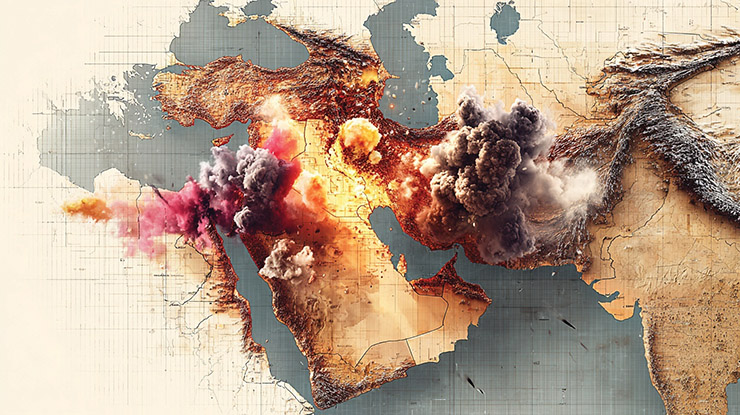
    Political analysts claim that beneath the surface, a grand strategy is being reactivated – originally conceived by the neoconservatives in the 1990s – to reshape the Middle East in the image of America and Israel. However, this time, the stakes are much higher: the future of a multipolar world order, the Belt and Road Initiative, the BRICS bloc, and China’s access to vital energy routes.

    A Clean Break Revisited

    In 1996, a strategy paper titled A Clean Break: A New Strategy for Securing the Realm laid out a blueprint for destabilising and redrawing the Middle East. Authored by American neocons for then-Israeli Prime Minister Benjamin Netanyahu, the plan called for the weakening or destruction of powerful regional states.

    Syria, Iraq, and Iran were marked for “rollback,” with Israel positioned as the dominant force in a new regional order. Israel would “secure the realm” after its adversaries accepted their diminished role in this Netanyahu-crafted Middle East.
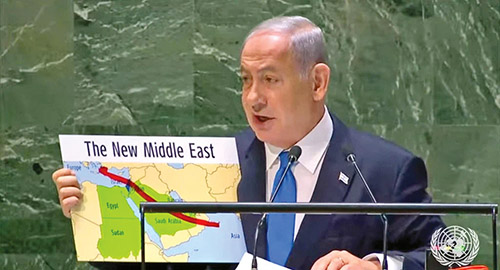
    Israeli Prime Minister Benjamin Netanyahu presented a map depicting the “New Middle East” when he addressed the 78th session of the UN General Assembly in Sept 2023.

    In 2006, US General Wesley Clarke famously received a classified memo outlining a new military strategy of toppling seven countries over five years – Iraq, Syria, Lebanon, Libya, Somalia, Sudan and Iran. The Syrian regime of Bashar Al Assad fell in December 2024, Col. Muammar Qadhafi’s Libya was destroyed in 2011, and Iraq under Saddam Hussein was taken out in 2003.

    During the years of the US invasion of Iraq, a popular saying circulated in neocon circles, reportedly first uttered by a senior British official: “Everyone wants to go to Baghdad. Real men want to go to Tehran.”

    As Hussein Askary of the Schiller Institute observes, Netanyahu is now “making sure that the original plan handed over to him more than 20 years ago – called ‘A Clean Break’ and ‘Securing the Realm’ – is followed, to ensure that there is no other power in the region… other than Israel.”

    That vision is now reemerging with terrifying clarity, facilitated by what analysts describe as a revived neocon coalition operating under the guise of national security, counter-terrorism, and anti-nuclear proliferation.

    Their ultimate aim, as journalist and geopolitical expert Pepe Escobar bluntly states, is regime change in Tehran: “That is the Holy Grail, dreamed of since the late 1990s… the ultimate dream of the neocons, the ziocons, and the wider Zionist axis.”

    Turning Points
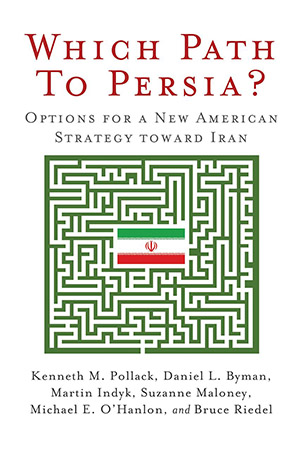
    Even nonpartisan US think tanks, such as the Brookings Institution, have outlined how regime change in Iran might be orchestrated. In 2009, Brookings published Which Path to Persia?, explicitly exploring military strikes, covert operations, and exploiting Israel’s position as a US “proxy” to neutralise Iran’s nuclear capabilities.

    That option is no longer theoretical. As Israeli airspace domination increased after the collapse of Syria’s Assad regime, a secure corridor through Syria and Iraq opened up for strikes on Iran. Washington strategists, previously cautious, were emboldened.

    Roberto Iannuzzi, an independent analyst of international affairs, pinpoints the moment when hesitation in Washington gave way to bold escalation.

    “The turning point that helped dispel the doubts of many American strategists and several members of the Biden administration,” he writes, “was the stunning operation carried out by the Israeli army in Lebanon on September 27, 2024, which led to the elimination of Hezbollah’s Secretary General, Hassan Nasrallah, and the decapitation of the group’s entire leadership.”

    That strike – “built upon a chilling level of intelligence penetration that allowed Israel to reconstruct with extreme precision the movements of the main leaders of the Lebanese movement, and to strike at the decisive moment with devastating results” – shocked Washington into action.

    From that point forward, Iannuzzi observes, US policymakers increasingly viewed Israel as a viable “battering ram” to dismantle the “Axis of Resistance,” piece by piece.

    With Syria now under a new Western-approved regime, Hezbollah’s leadership decapitated, and Iraq’s skies routinely breached by Israeli warplanes with impunity, the strategic corridor to Tehran stands exposed.

    Geoeconomics: IMEC vs BRI

    The geopolitical map is not the only battlefield. The current war is also an economic war – specifically, a war over corridors, infrastructure, and the future shape of global trade.

    In 2023, the Biden administration revived US plans to return to the Middle East by announcing the India-Middle East-Europe Economic Corridor (IMEC) – a thinly veiled attempt to undermine China’s Belt and Road Initiative (BRI). The corridor aimed to stitch together India, Gulf states, Israel, and Europe into a new trading bloc, excluding Iran entirely.

    But as Iannuzzi observed, “An economic corridor could never take shape in a region wracked by conflict,” adding that the genocide in Gaza made Arab-Israeli normalisation – especially with Saudi Arabia – “unthinkable.”

    Hussein Askary argues the IMEC is “political fiction,” a “fraud” without substance, devised to derail real infrastructure already being laid by China and its partners. Iran, critically, is a keystone of that infrastructure. It links China’s overland BRI to Central Asia, the Gulf, the Caucasus, Turkey, and Europe through both rail and maritime routes. As Askary points out, “Iran is a key element of the BRI,” not just geographically, but strategically – connecting East and West through the International North–South Transport Corridor.

    Just weeks before the Israeli strikes on Iran, a direct freight train from Xi’an in China arrived at a logistics hub in northern Iran on May 25. The new rail link integrates Iran into the trillion-dollar BRI and lays the groundwork for deeper political and economic ties. As Pepe Escobar reported, this route bypasses “every US-controlled chokepoint… Hormuz, Malacca, the Suez Canal.” In effect, the train symbolised the success of emerging multipolarity on the Eurasian landmass.

    Iran’s Integration with Eurasia

    Iran is no longer an isolated theocracy under siege. It is a full member of the Shanghai Cooperation Organisation (SCO), the Russian-led Eurasian Economic Union, and BRICS, which recently expanded to 11 countries. In 2023, Beijing brokered the normalisation of ties between Iran and Saudi Arabia. In truth, Iran is a pariah only in the eyes of the West; across much of the Global South, it remains a legitimate state actor and strategic partner.

    Michael Hudson, the veteran economist, sees the recent US-Israeli attack on Iran as part of a broader American effort to prevent the emergence of an independent Eurasian trade bloc.

    “What we have seen… is the culmination of the long strategy that America has had ever since World War II, to take complete control of the Near Eastern oil lands and make them proxies of the United States,” Hudson told Scheerpost.

    If Iran falls, it will sever the link between China, Russia, and India. Hudson adds: “If the United States could put a client regime in Iran… you have boxed in Russia, you have boxed in China, and you have managed to isolate them.”

    Hormuz: The Chokepoint of Civilisation
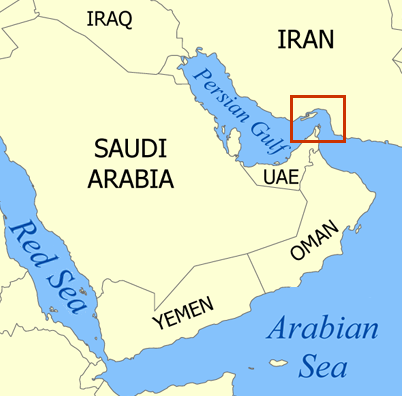
    Over one-third of China’s oil and natural gas imports pass through the Strait of Hormuz – a narrow bottleneck that Iran controls. US General Erik Kurilla of US CENTCOM testified before Congress in 2023 that this made China dependent and exposed. “That makes them vulnerable,” he emphasised.

    Indeed, a former Deep State source confirmed to Pepe Escobar that “the CIA advised the Trump administration that China was resolutely against the shutting down of the Strait of Hormuz, so Trump went ahead with the bombing.”

    If the Strait were closed – whether by open war, covert sabotage, or a false flag – China would be severed from its primary energy artery. The fallout, some analysts warn, could be catastrophic: oil prices could spike uncontrollably, and the fragile $2 quadrillion global derivatives bubble might implode, triggering a chain reaction that plunges the world into economic depression.

    The Bernard Lewis Plan: Divide and Dismember

    Plans to redraw the Middle East are older than IMEC or even A Clean Break. The Bernard Lewis Plan – a Cold War-era concept still echoed in neocon think tanks – proposed fragmenting the Middle East along ethnic lines. Iran would be broken into Baloch, Kurdish, Azeri, Arab, and Persian states.
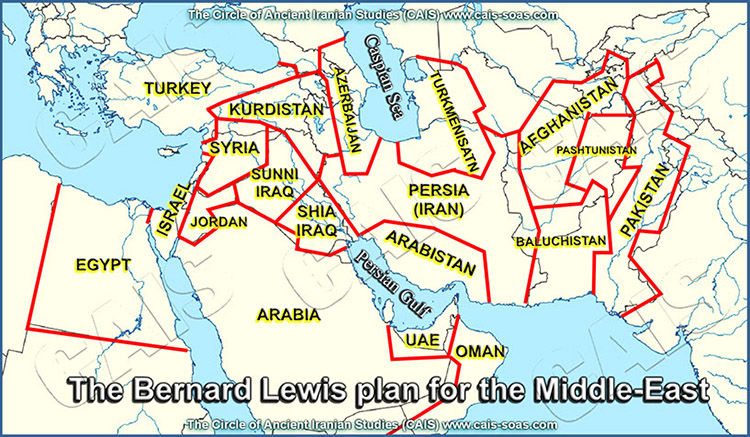
    Askary believes this strategy has been revived: “The plan is to achieve regime change in Iran… and implement long-standing plans like the Bernard Lewis Plan, which envisions dividing countries like Iran into multiple ethnic entities.”

    From there, the same strategy could be applied to Pakistan, Central Asia, and even Russia itself. The final goal? As Askary plainly states: “The ultimate goal is regime change in China.”
    Get the issue this article appears in

    Target: Emerging Multipolar World

    All roads now lead east. The attack on Iran has little to do with nuclear weapons or ‘human rights’ – it’s about shattering the backbone of Eurasian integration and halting China’s ascent before the shift to a multipolar world becomes unstoppable.
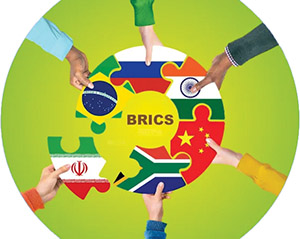
    As Pepe Escobar puts it, this would be “a decisive trifecta strike… to three top BRICS – Iran, Russia, China; to Eurasia integration; and to the drive towards a multi-nodal, multipolar system of international relations.”

    Escobar describes Iran as the “privileged guardian” of West Asia – a civilisational state fulfilling its historic role at a pivotal moment. For BRICS, he asserts, “Iran must not be allowed to fall.” The stakes, he implies, are nothing less than the balance of power in the emerging world order.

    Despite the escalation, momentum is shifting. At summits in Kuala Lumpur, St. Petersburg, and Rio de Janeiro (where they convened on July 6–7), BRICS and Global South leaders are beginning to forge a unified front. Discussions are moving beyond polite communiqués – there is now open talk of forging real mechanisms for collective defence and mutual strategic deterrence.

    As Escobar notes, “It’s unlikely – under the Brazilian presidency – but BRICS sooner or later will have to make the strategic transition… to become the unbreakable spine of the Global South.”

    As bombs fall and propaganda intensifies, one truth cuts through the noise: the war on Iran is not truly about Tehran. It’s a proxy assault on Beijing, Moscow, New Delhi – and on the very idea of a post-Western, multipolar world.

    Whether this new world survives depends on what happens next – on the battlefields of West Asia, behind the closed doors of high-stakes diplomacy, and in the hybrid war over rail lines, ports, and pipelines.

    History may remember this moment not as the fall of Iran – if the neocons have their way – but as the crucible from which a new Eurasian order rises, signalling the end of Western dominance and the start of a multipolar world.

    [alert type=”general” dismiss=”no”]This article was published in New Dawn Special Issue Vol 19 No 4.[/alert]

    [alert type=”success” dismiss=”no”]If you appreciate this article, please consider subscribing to help maintain this website.[/alert]

    Sources

    thomasfazi.com/p/israel-the-us-and-iran-the-war-has
    sputnikglobe.com/20250617/iran-now-first-line-of-defense-of-brics-and-the-global-south-1122272733.html
    scheerpost.com/2025/06/28/war-on-iran-is-part-of-us-plan-for-global-domination-economist-michael-hudson-explains/
    youtube.com/watch?v=dGL4IfmI3Uk

    © New Dawn Magazine and the respective author.
    For our reproduction notice, click here.
  • The Nexus of Intelligence Agencies & Terror Networks

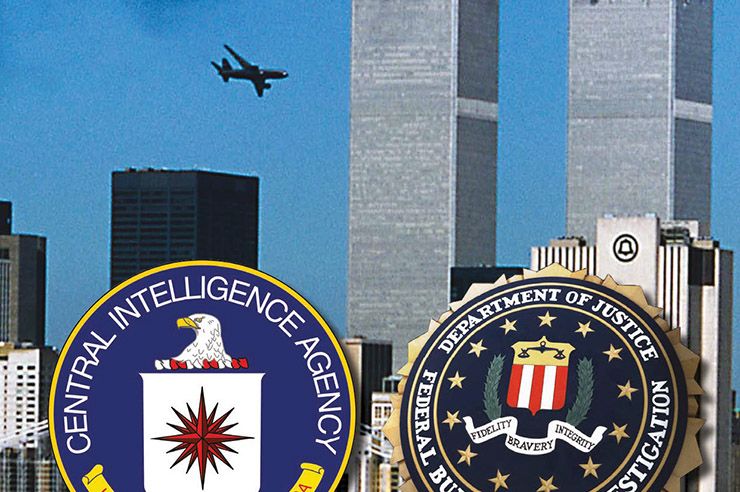
    The Nexus of Intelligence Agencies & Terror Networks

    From New Dawn Special Issue Vol 16 No 6 (Dec 2022)

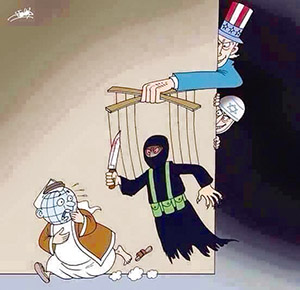
    In the book Devil’s Game, Robert Dreyfuss documents how the US and Britain have created, organised, and enabled terrorist networks, most of them purporting to be Islamic, for over a century. The aims are to crush domestic dissidents, use the groups as proxies to fight enemies, and outrage Western audiences with terrorism to get them to support wars for oil in the Middle East.

    Today, we may ask: Whatever happened to the ‘war on terror’, which seems to have disappeared when COVID came along? We are left with a legacy of ‘war on terror’ legislation.

    MANUFACTURING TERRORISM

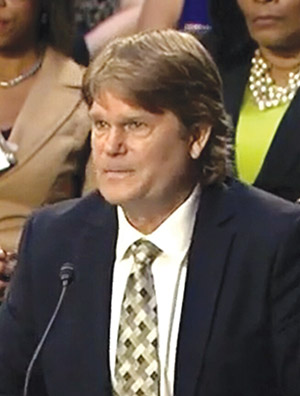
    Michael German testifying before the Senate Judiciary Committee in 2022.

    A few years ago, former FBI agent Michael German said that the agency was “manufacturing terrorism cases” to justify its existence. The FBI does this, says German, by taking vulnerable Arab Americans and other Americans from ethnic and religious minorities, and guiding them via agents (called handlers) to commit terrorism. Often, just before the given act of terror occurs, the FBI steps in to save the day. Journalist and author Trevor Aaronson says:

    more than 150 people… caught in sting operations never had the means and, in some cases, never had the idea for the terrorism plot… [I]t was the FBI that provided them with everything – the bomb, the transportation, everything they needed to move forward in a terrorism plot that on their own, they never would have been able to do. And certainly evidence suggests that in most of these cases, they never had any specific connections to terrorism.

    In 2011, the University of California-Berkeley’s Investigative Reporting Program teamed up with Mother Jones magazine to report on criminal prosecution statistics involving terrorism and other charges. They found that by that year, of the 508 defendants brought to court by the FBI, 48% were targeted by informants, 31% were arrested in sting operations and 10% were provoked by a handler/informant. Amazingly, 41% were not connected to a terrorist group, raising questions about how and why they came to allegedly want to commit terrorism. Only 21% were linked to ‘al-Qaeda’. Twenty-nine per cent were linked to other Islamic groups, and 9% to non-Islamic groups.

    Likewise, in the UK, by 2013, 18% of British terrorism cases were connected to the group al-Muhajiroun (the Emigrants), according to the Henry Jackson Society (HJS). The HJS doesn’t bother reporting that al-Muhajiroun’s co-founder, Omar Bakri, was an MI5 informant. Bakri’s partner was Anjem Choudary. By August 2016, 850 Britons were fighting for the Islamic State in Libya, Syria and elsewhere. Commander Dean Haydon, head of the Metropolitan Police’s counterterrorism unit, confirmed to the media that Choudary had recruited Britons for the Islamic State. Choudary, who was jailed, was connected to 500 of the 850 jihadis.

    For years, the Metropolitan Police were prevented from acting against Choudary by MI5. A source told the Telegraph: “While the police might have had lots of evidence they were pulled back by the security service because he [Choudary] was one of the people they were monitoring. It was very frustrating and did cause some tension but we were told we had to consider the bigger picture.” The ‘bigger picture’ was that the secret services wanted to create a jihadi network in Libya and Syria to overthrow the regimes of Muammar Qadhafi and Bashar al-Assad, respectively, as they had in Afghanistan and Pakistan to fight the Soviets beginning 1978.

    Back in 2002 after the 9/11 attacks, the George W. Bush administration’s Defense Science Board recommended establishing a $100m per year sub-agency called the Proactive Pre-emptive Operations Group (P2OG). Under the heading “Aggressive Proactive, Preemptive Operations,” the report describes influence warfare and information operations (‘IW/IO’), “Covert action,” “Cover & Deception,” psychological operations (‘PSYOPS’) and the use of special operations forces (‘SOF’). The doctrine “[i]mproves information collection by stimulating reactions,” i.e., provoking terrorists and setting traps, as the FBI has done for decades. It recommends: “Vest responsibility and accountability for the P20G to a ‘Special Operations Executive’ in the NSC [National Security Council].”

    North Africa specialist and hostage negotiator Professor Jeremy Keenan writes:

    The first P2OG operation was in the Algerian Sahara in 2003, when Algeria’s security and intelligence service, the Département du Renseignement et de la Sécurité (DRS), now working with the Pentagon and US intelligence services, kidnapped and took hostage 32 European tourists. Although the operation was managed by a DRS agent, the Bush administration was able to proclaim that the kidnap had been carried out by “Bin Laden’s man in the Sahara,” justifying the US’s launch in 2004 of a second front or Sahara-Sahel front in the GWOT [global ‘war on terror’].

    CASE STUDY

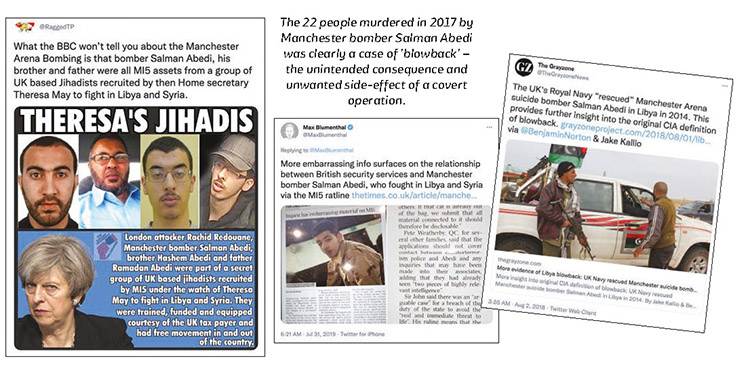
    In May 2017, 22 people were reportedly murdered when one, Salman Abedi, allegedly detonated a suicide bomb in the foyer of the Manchester Arena as people were leaving a pop concert. Abedi’s father, Ramadan, was a paid MI6 operative who was allowed to live in the UK under successive governments, including under then-Home Secretary Theresa May, who was PM when the bombing occurred. He left the UK in 2011, the same year that MI6 had helped organise a terrorist takeover of Libya.

    In 1994, after fighting in Afghanistan, one Abd al-Baset Azzouz left Libya, his home country, to live in London, where the British government protected him. In 1995, MI6 learned of a coup plot against Libya’s leader, Muammar Qadhafi. The plot appears to have been readied for February 1996 and devised by secular colonels within Qadhafi’s military circle. A leaked MI6 report says: “It would begin with attacks on a number of military and security installations including the military installation at Tarhuna. There would also be orchestrated civil unrest in Benghazi, Misratah and Tripoli.” The report notes that “[c]oup plotters are not associated with Islamic fundamentalists,” like Azzouz, “who were fermenting unrest in Benghazi.” However, the coup plotters “had had some limited contact with the fundamentalists, whom [MI6 informant ‘Tunworth’] described as a mix of Libya veterans who served in Afghanistan,” i.e., old CIA-MI6 contacts, “and Libyan students.”

    There were two coup plots: a secular one led by Qadhafi’s inner circle and an Islamic one led by extremists in Benghazi. The MI6 report on the 1996 coup said that the plotters wanted to see Libya decentralised and federally run.

    Richard Bartlett and David Watson were MI6 agents involved in the operations. Watson worked with the Libya contact, ‘Tunworth’, who provided information from within the Libyan Islamic Fighting Group (LIFG), the organisation referred to in the MI6 report as the Benghazi-based extremist group. Manchester bomber Abedi’s father was associated with the LIFG. In 1995, MI6 chose to work with the extremists in Benghazi, who had close connections with Osama bin Laden through their leaders, Abu Abdullah al-Sadiq (a.k.a. Belhaj) and Anas al-Liby. The British government protected al-Liby, who is described by the US Congress as “the builder of al-Qaeda’s network in Libya.”In 1992, al-Liby trained with a CIA operative, Ali Mohamed, in Osama bin Laden’s house in Hyatabad, Pakistan. In 1996, MI6 financed the anti-Qadhafi LIFG to the tune of £100,000.

    In 2013, Salman Abedi – the 2017 Manchester bomber – travelled to Libya and met the Islamic State-linked Katibat al-Battar al-Libi. The KBL was indirectly getting money from MI5 via informants. It quickly emerged that Abedi was Ramadan’s son. It later transpired that British police did not believe he acted alone; America’s FBI had warned the UK about Abedi; that Abedi had been on a MI5 watch list as he travelled from Manchester to Libya and back; and that police very quickly dropped investigations into co-conspirators.

    SOCIAL CONTROL

    After 9/11, the Bush administration imposed upon Americans the Patriot Act 2001. The Act criminalises providing “material support” to terrorists, including “expert advice or assistance.” Section 215 made it easier for agencies (notably the FBI) to gather internet users’ metadata in a boon to the hi-tech industry which won more contracts. Patriot made it easier for the FBI to break into suspects’ homes and copy their computer files and take DNA samples. Section 411 allows the government to expel or refuse entry to non-citizens on the grounds of their use of prominence “to endorse or espouse terrorist activity” or persuade others to do so. Dr Tariq Ramadan’s teaching visa was revoked under the Act, despite him being a well-known moderate. Presumably, the aim was to silence other prominent Muslims living in America from criticising the “war on terror.”

    Britain’s Labour government (1997-2010) was one of the worst offenders when it came to using counterterror legislation to control society. The Terrorism Act 2000 made it an offence to supply material to individuals accused of property damage. When then-82-year-old German-Jewish Labour supporter and later National Executive Committee-member, Walter Wolfgang, heckled the Foreign Secretary Jack Straw at the party conference in Brighton (2005), Wolfgang was forcibly removed by security guards and prevented from re-entering under the Terrorism Act. Section 44 ballooned the number of arbitrary stops and searches by police of innocent citizens (many of them ethnic minorities, of course). Lord Carlile’s annual review concluded that Section 44 actions “could be cut by at least 50 per cent without significant risk to the public or detriment to policing.” In 2003, peace protestors were prevented from demonstrating under the Act against an arms fair in London.

    The post-9/11 Anti-Terrorism Crime and Security Act 2001 sought to allow for extended detention of non-citizens in the country. The Law Lords declared it unlawful, with Lord Hoffmann telling media: “The real threat to the life of the nation… comes not from terrorism but from laws such as these.” The Terrorism Bill sought to extend detention from 14 to 90 days. It was rejected by MPs. The Serious Organised Crime and Police Act 2005 banned political protest within 1km of Parliament. Max Hill QC is the Independent Reviewer of Terrorism Legislation. Following the vehicle rammings in Barcelona in 2017, Hill warned against “thought crime” and said that many counterterrorism laws were “unnecessary.”

    Under General Franco, Spain was a terror state. When the country transitioned to parliamentary representation, degrees of freedom were won. However, terrorist groups including GRAPO (First of October Anti-Fascist Resistance Groups, inactive since 2007) and ETA (Basque Homeland Liberty, now disarmed,) led to antiterrorism measures being included in the Penal Code. Controversially, Article 18.1 potentially criminalises “apology” for terrorism, which could include anything from giving legal advice to terrorists to making satirical observations. As of 2007, “apology” was criminalised only after a judge deemed the offence to constitute “direct incitement.”

    Organic Law No. 7/2000 penalised “glorification of terrorism,” which includes actions “to discredit, demean or humiliate the victims of terrorist offences or their families.” This is important because genuine efforts to determine if a given attack was a false flag by the state or a simulated event that the media believe to be real could be punished as glorifying terrorism.

    Even more important than persecuting people who believe in false flags and hoaxes, the Spanish government has suppressed freedom of thought and expression and, ultimately, criticism of government policy. Amnesty International writes of Spain: “An exponential increase in the number of people falling foul of [the] draconian law banning the ‘glorification of terrorism’ or ‘humiliating victims of terrorism’ is part of a sustained attack on freedom of expression.” Under Article 578, the definitions were broadened to the point where charges jumped from three in 2011 to 38 in 2017. Terror attacks in one country, like the Hebdo killings in Paris in 2015, have knock-on effects in that Spain, in this case, responded by further broadening the definitions of incitement. Musicians César Strawberry (of Def Con Dos) and Valtonyc (a rapper) were sentenced under Article 578: Strawberry for tweeting a joke about a cake bomb and Valtonyc for insulting the crown, threatening a politician and glorifying violence.

    In addition to attacking freedom, the Spanish government has bolstered its cyber security and budget and aided the hi-tech security sector with programmes like the Spider Operations, which were a series of arrests of social media users, many of them had simply tweeted bad-taste jokes. For example, the niece of a man who died in a terror attack defended the woman tried for making a sick joke about her late uncle, but astonishingly the court ruled that the law is effective regardless of what alleged victims think!

    [alert type=”general” dismiss=”no”]This article was published in New Dawn Special Issue Vol 16 No 6.[/alert]

    [alert type=”success” dismiss=”no”]If you appreciate this article, please consider subscribing to help maintain this website.[/alert]

    Footnotes

    1. Eric Lichtblau (2016), ‘F.B.I. steps up use of stings in ISIS cases’, www.nytimes.com/2016/06/08/us/fbi-isis-terrorism-stings.html?_r=0
    2. Quoted in Heather Maher (2013), ‘How the FBI helps terrorists succeed’, www.theatlantic.com/international/archive/2013/02/how-the-fbi-helps-terrorists-succeed/273537
    3. Mother Jones (2011), ‘Terror trials by the numbers’, www.motherjones.com/politics/2011/08/terror-trials-numbers
    4. Tom Whitehead (2013), ‘Woolwich attack: Al Muhajiroun linked to one in five terrorist convictions’, www.telegraph.co.uk/news/uknews/terrorism-in-the-uk/10079827/Woolwich-attack-Al-Muhajiroun-linked-to-one-in-five-terrorist-convictions.html
    5. www.telegraph.co.uk/news/2016/08/16/radical-preacher-anjem-choudary-behind-bars-after-drumming-up-su
    6. www.telegraph.co.uk/news/2016/08/21/mi5-stopped-scotland-yard-taking-choudary-down-sources-claim
    7. Federation of American Scientists (2002), ‘DOD examines “preemptive” intelligence operations’, Secrecy News, Issue 107, https://fas.org/sgp/news/secrecy/2002/10/102802.html
    8. Defense Science Board (2002), DSB Summer Study on Special Operations and Joint Forces in Support of Countering Terrorism, p. 21, https://fas.org/irp/agency/dod/dsbbrief.ppt
    9. Jeremy H. Keenan (2017), ‘Review: T. J. Coles, Britain’s Secret Wars… ’, State Crime 6(2): 286-94. See also Jeremy H. Keenan (2009), The Dark Sahara: America’s War on Terror in Africa, Pluto Press
    10. Sam Webb (2014), ‘Al-Qaeda leader in Libya was detained by British police on suspicion of ter-ror offences – but later released and fled the UK to train bombers’, www.dailymail.co.uk/news/article-2772495/Al-Qaeda-leader-Libya-detained-British-police-suspicion-terror-offences-later-released-fled-UK-train-bombers.html. See also ‘Freed UK prisoner is al-Qaeda ringleader’, www.telegraph.co.uk/news/uknews/terrorism-in-the-uk/11125944/Freed-UK-prisoner-is-al-Qaeda-ringleader.html
    11. Cryptome.org (2000), ‘The Qadahfi Assassination Plot’, http://cryptome.org/qadahfi-plot.htm
    12. Martin Bright (2002), ‘MI6 “halted bid to arrest bin Laden”’, www.theguardian.com/politics/2002/nov/10/uk.davidshayler. See also, Annie Machon, ‘“Spies, Lies and Whistleblowers” – The Gaddafi Plot Chapters’, http://anniemachon.ch/spies-lies-and-whistleblowers-the-gaddafi-plot-chapters
    13. http://fas.org/irp/world/para/aq-libya-loc.pdf
    14. https://ctc.usma.edu/app/uploads/2011/06/Ali-Mohammed.pdf
    15. www.theguardian.com/uk-news/2017/jul/06/manchester-bombing-police-believe-salman-abedi-did-not-act-alone
    16. Ben Kentish (2017), ‘FBI “warned MI5 in January that Salman Abedi was planning terror attack in UK”’, www.independent.co.uk/news/uk/home-news/fbi-warned-mi5-january-manchester-attack-bomber-salman-abedi-manchester-arena-a7760756.html
    17. Samuel Osborne (2017), ‘Salman Abedi: Manchester suicide bomber was known to MI5 but not under active investigation’, www.independent.co.uk/news/uk/home-news/salman-abedi-manchester-suicide-bomber-known-to-mi5-not-under-active-investigation-latest-updates-a7761156.html
    18. www.theguardian.com/uk-news/2017/may/31/police-believe-manchester-bomber-salman-abedi-acted-largely-alone
    19. www.aclu.org/other/myths-and-realities-about-patriot-act
    20. Michael Saward (2016), ‘The State and Civil Liberties in the Post-9/11 World’, Open University, http://oro.open.ac.uk/16198/1/StateAndCivil.pdf
    21. Philip Johnston (2005), ‘The police must end their abuse of anti-terror legislation’, www.telegraph.co.uk/comment/personal-view/3620110/The-police-must-end-their-abuse-of-anti-terror-legislation.html
    22. Johnston, op. cit.
    23. www.legislation.gov.uk/ukpga/2005/15/pdfs/ukpga_20050015_en.pdf
    24. Lizzie Dearden (2017), ‘Terror laws should be scrapped, says Government’s independent re-viewer of terrorism legislation’, www.independent.co.uk/news/uk/home-news/terror-laws-uk-offences-abolish-max-hill-interview-independent-reviewer-legislation-isis-attack-a7883836.html
    25. www.refworld.org/pdfid/46de9f8c16.pdf
    26. www.amnesty.org/en/latest/news/2018/03/spain-counter-terror-law-used-to-crush-satire-and-creative-expression-online
    27. www.theguardian.com/world/2018/mar/13/spanish-anti-terror-law-has-chilling-effect-on-satire-says-amnesty-international.
    28. Amnesty op. cit.

    © New Dawn Magazine and the respective author.
    For our reproduction notice, click here.
  • The Mahdi’s Shadow: Eschatology’s Role in Iran’s Modern Geopolitical Strategy

    The Mahdi’s Shadow: Eschatology’s Role in Iran’s Modern Geopolitical Strategy

    From New Dawn Special Issue Vol 18 No 4 (Aug 2024)

    In the West, there’s a common misconception that ‘all Muslims are the same’. In reality, Islam comprises distinct branches, primarily Sunni and Shi’a, each with unique theological and eschatological beliefs. These eschatological views, which relate to end times and final events, significantly influence global politics and conflicts, despite often being overlooked.

    The differing Sunni and Shi’a conceptions of a messiah, or saviour figure, often provoke anxiety among Jewish and Christian Messianists, as well as their more secular counterparts in the armed forces and governments of Israel and the USA. Regardless of whether these beliefs are taken literally, the perception of them plays a crucial role in international relations.

    Historically, colonial powers faced fierce opposition from those who believed they were under divine protection, often manifesting as a belief in invincibility in battle. For example, the Sudanese Mahdi, Muhammad Ahmad, led a successful revolt against the British in the late 19th century, claiming divine support and inspiring his followers to believe they were invincible. Similarly, during the South Asian resistance to Western colonialism, various leaders and groups invoked religious and messianic beliefs to bolster their opposition to British rule, fostering a sense of divine mission and protection among their followers.

    The signs of the times in which we live have prompted many in the Islamic world to wonder if al-Mahdi will arrive soon.

    In Islam, there is an expectation of the coming of the Mahdi, a descendant of Muhammad, who will appear at the end times to eradicate evil. This event is anticipated to occur just before the return of Jesus, esteemed in Islam as a Prophet. The Mahdi is expected to lead Muslims in establishing a righteous world order. Christianity and Judaism have analogous figures in the militant, conquering Jesus of Revelations and the Jewish melekh mashiach, respectively. The Mahdi is referenced in Sunni hadith literature, with the first mention dating back to the 7th century.

    Judaism has had multiple messianic claimants over the centuries. Historical figures such as Simon bar Kokhba and Sabbatai Zevi have had significant followings. While bar Kokhba’s revolt against the Romans ended in failure, Zevi’s legacy persisted through his followers, despite his eventual conversion to Islam. Zevi’s influence continued through his successor Jacob Frank, who led the Frankist movement in 18th-century Europe, promoting a syncretic blend of Judaism, Christianity and Islam. Additionally, the Donmeh, a group of crypto-Jews in Turkey who outwardly practice Islam while maintaining Judaic beliefs in secret, trace their origins to Zevi’s followers. Various esoteric sects keep Sabbatean ideas alive, blending them with mysticism and other spiritual practices. In contemporary times, the Chabad Lubavitch movement venerates the seventh Rebbe, Menachem Schneerson (d. 1994), with some adherents believing he will resurrect as the long-awaited Messiah.

    In Shi’a Islam, the Mahdi, also known as al-Qa’im (Arabic, meaning ‘he who will rise’), is synonymous with the personage of the ‘Hidden Imam’, who is the Twelfth Imam, Muhammad ibn Hasan al-Mahdi. According to Shi’a belief, this Imam entered occultation (ghayba) in the 9th century to escape persecution. Despite being hidden, he is believed to continue guiding and protecting the faithful.

    Shi’a doctrine holds that the Hidden Imam will reappear as the Mahdi in the end times to usher in an era of justice and peace. This belief underscores the importance of continuous, divinely guided leadership in Shi’a Islam. In contrast, Sunni Islam also acknowledges the Mahdi but does not emphasise occultation and generally believes the Mahdi has not yet been born. Sunni views on the Mahdi’s lineage and role vary, and he is not as central a figure as in Shi’a Islam.

    They Seek Him Here, They Seek Him There…

    The search for the Mahdi, specifically the Hidden Imam of Shi’ite tradition, has taken on an intriguing dimension involving espionage and international politics. According to former Iranian President Mahmoud Ahmadinejad, American academics conducted detailed studies in 2015 to locate this elusive figure. Ahmadinejad claimed these efforts were part of a broader plan by US intelligence to prepare a case for the Mahdi’s arrest.1

    Mojtaba Zolnour

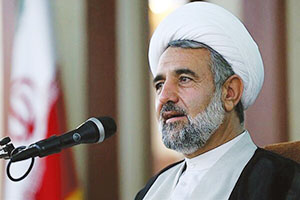
    In 2009, Ahmadinejad made similar claims, echoed the following year by Mojtaba Zolnour, deputy representative of Iran’s supreme leader in the Revolutionary Guard. Zolnour stated, according to Radio Free Europe: “Zionists have security plans for Muslim sites including Mecca, Karbala, and other sites where he said it was likely that the Hidden Imam could appear. The Hidden Imam or the Promised Mahdi is the 12th Imam of Shi’ite Islam, who [Shia] Muslims believe will appear to bring peace and justice on Earth and put an end to tyranny. ‘They’ve told their soldiers to kill immediately whomever they see with the characteristics [of the Hidden Imam] and not even take the risk to arrest him because he is a very awesome and dangerous person’.”2

    Reports from Middle Eastern sources indicate that Muslim prisoners held by the US military had been subjected to harsh interrogation methods in an effort to find the Mahdi. The Shi’a News Association reported in 2015 that: “During the US occupation of Iraq, it was routine to torture Iraqis in prisons like Abu Ghraib whose prison guards were using tactics learnt in Israeli training camps as Robert Fisk pointed out in ‘Abu Ghraib torture trail leads to Israel’; one of the most baffling questions asked during interrogation was ‘Where is the man called Imam Mahdi, where is he hiding?’”3

    The intense focus on locating a figure central to Shi’ite eschatology underscores the complex interplay between Messianic beliefs and geopolitical strategies.

    High-Level Analysis of Mahdism in Iran

    Is this Muslim conspiracism run amok? Numerous reports highlight the Mahdi’s influence on Iran. The long-running think tank, the Middle East Institute, issued a report prepared by two senior analysts at the Tony Blair Institute for Global Change about the growth of Mahdism among the Iranian Revolutionary Guard Corps. The think tank states that “one fundamental aspect of [Iran’s] ideology that until now has been overlooked is the doctrine of Mahdism.”4

    “There are signs today that the preparations for the return of the 12th divinely ordained Shi’a imam are becoming of pivotal importance to the IRGC’s lens on the world. The rise of a militaristic Mahdist cult among the senior ranks of the IRGC is now not inconceivable and the repercussions far-reaching.”

    “Mahdism in the IRGC remains a complete blind spot for Western policymakers and experts, and yet its implications could have major consequences.”

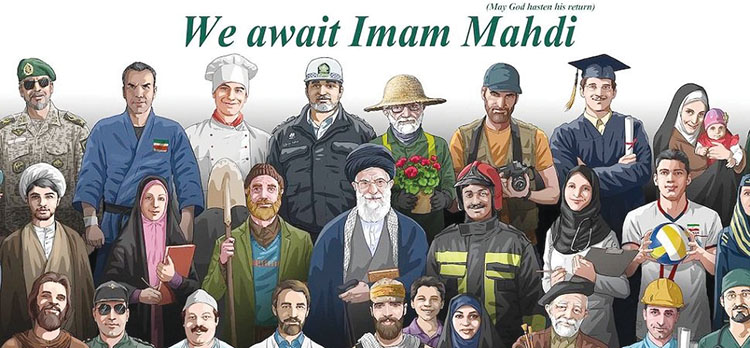
    The official website of Ayatollah Khamenei has a special page devoted to answering questions about “Imam Mahdi” and displays this collage representing people from all sectors of Iranian society with the Ayatollah in the centre.

    An entire section of the report is entitled “What is Mahdism?” The report explains that: “As a Shi’a Islamist force, the IRGC’s worldview hinges on Mahdism: the return of the 12th divinely ordained Shi’a imam, Muhammad al-Mahdi (or the Hidden Imam), whom Shi’a Muslims believe was withdrawn into a miraculous state of occultation (hiddenness) by God in 874 CE. The concept of Mahdism is rooted in the belief that Imam Mahdi will one day return to rid the world of evil and injustice. His coming will bring about ‘one final apocalyptic battle’ between two armies, in which Shi’as believe that Mahdi and his forces will prevail over evil.”

    Since 1990, Iran is said to have become a “society based on Mahdism.” The Iranian government declares that it is in a caretaker role until the return of the Mahdi. Ahmadinejad, elected president in 2005, is quoted as stating: “We have a mission – to turn Iran into the country of the Hidden Imam.” The report adds: “Ahmadinejad would give special importance to the Jamkaran Mosque, which hosts the Well of Jamkaran, where some Shi’a Muslims believe the 12th Imam will return. Ahmadinejad’s administration would allocate $17 million in state funds to Jamkaran Mosque as well as expand its facilities, transforming it from a small mosque to a multimillion-dollar shrine.”

    The Revolutionary Guard is accorded a special mission, according to the report, to prepare the way for the Mahdi. In 2012, Hojatoleslam Ali Saeedi, the supreme leader’s representative to the IRGC, asserted: “The IRGC is one of the tools for paving the way for the emergence of the Imam of the Age (Mahdi) in the field of a regional and international awakening.” Saeedi is cited as stating that the continuing US presence in Iraq is an impediment to the appearance of the Mahdi.

    Support for the Houthis in Yemen is regarded as significant in preparing for the Mahdi, as is the fight against not only Zionism but also against the Wahhabist Islam of terrorist organisations such as ISIS, which serve the USA’s and Israel’s interests. Consequently, many Iranians fought against ISIS in Syria. Iran also sees Russia’s fight with Ukraine in terms of the end times that prelude the Mahdi’s return, Iran taking a pro-Russian position.

    Get the issue this article appears in

    ‘End Times’ Prophecy & Politics

    The blend of Messianic beliefs and geopolitical strategies in Iran, particularly regarding the return of the Mahdi, shows how deeply ‘End Times’ prophecies and today’s politics can intertwine. Although controversial, Ahmadinejad’s claims reveal the significant role Messianic ideas can play in shaping national and international policies. Preparing for the Mahdi’s return has become a key focus for some Iranian leaders.

    While Ahmadinejad was criticised by the Western media for not citing specific examples of the alleged US intelligence reports on the Mahdi, these reports are readily locatable. For instance, Lieutenant Colonel Kurt Crytzer’s publication, “Mahdi and the Iranian Nuclear Threat” by the US Army War College in 2007, questions: “Is the Iranian Government attempting to set conditions for the return of the 12th Imam in accordance with Shi’ite beliefs? If so, what threats are associated with these actions and how can the West counter these threats?”5

    The fusion of Mahdist beliefs and Iran’s political manoeuvres is a captivating blend of geopolitics and eschatology. As Iran positions itself as a nation in waiting for the Mahdi, it’s crucial to understand the deep spiritual and political layers of this issue. This unique mix of prophecy and power offers fresh insights into Iran’s bold actions on the global stage. The way these ancient beliefs drive modern strategies could reshape international relations in ways no one ever imagined. Prepare for a world where ‘End Times’ prophecy and politics are intertwined like never before.

    Additional material for the above was contributed by New Dawn editors.

    [alert type=”general” dismiss=”no”]This article was published in New Dawn Special Issue Vol 18 No 4.[/alert]

    [alert type=”success” dismiss=”no”]If you appreciate this article, please consider subscribing to help maintain this website.[/alert]

    Footnotes

    1. Toi Staff, Ahmadinejad: US is after Hidden Imam, Times of Israel, June 23, 2015
    2. Golnaz Esfandiari, Zionists Waiting to Kill Hidden Imam, Says Iranian Cleric, Radio Free Europe/Radio Liberty, September 1, 2010
    3. Are the Mossad and Western powers looking for Imam Mahdi?, Shia News Association, June 3, 2015
    4. Saeid Golkar and Kasra Aarabi, Iran’s Revolutionary Guard and the Rising Cult of Mahdism: Missiles and Militias for the Apocalypse, Middle East Institute, May 2022
    5. Lieutenant Colonel Kurt S. Crytzer, Mahdi and the Iranian Nuclear Threat, Strategy Research Project, U.S. Army War College, March 2007

    © New Dawn Magazine and the respective author.
    For our reproduction notice, click here.
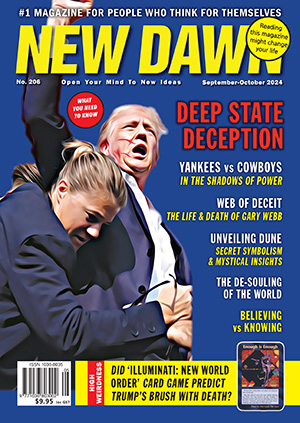
  • Yankees vs Cowboys

    Yankees vs Cowboys

    From New Dawn 206 (Sept-Oct 2024)

    Most talk you hear these days about the deep state – the interlocking network of multinational corporations, government bureaucracies, and nongovernmental institutions that holds the reins of political and economic power in today’s industrial societies – treats it as a monolithic presence with the discipline of a Nazi division goosestepping past the review stand at a Nuremberg rally. Most of that talk also treats the deep state as omniscient and omnipotent, possessed of knowledge and power so all-encompassing that all its opponents can do is grumble on online forums. 

    There are plenty of reasons why the deep state wants to project these images of itself into the collective conversation of our time. I trust nobody is naïve enough to think, however, that an interest in factual accuracy has any place among those reasons. No ruling class in all human history has ever been that unified, that well-informed, or that powerful – though every ruling class in all human history has tried to make its opponents think that all these things are true. 

    Let’s begin with the obvious. The people who make up the interwoven hierarchies of the deep state aren’t robots or mindless minions. Nor are they nice people. They have clawed their way to their current positions of power in the savagely Darwinian environment of a modern bureaucratic state, in which backstabbing and betrayal are a way of life and a moment’s weakness or kindness is usually fatal. They have climbed a ladder in which each rung is reached by trampling on the faces of less successful rivals. 

    Those at the summit of the deep state are constantly intriguing against each other while fending off attempts by those immediately below them to unseat them and take their place. Those below them face the same struggle with peers and subordinates while simultaneously trying to climb the ladder to the next level. Will they set aside their rivalries to defend the system against its enemies? Yes, but only when this works out to their personal advantage. Give them a chance to better their position at the expense of their superiors or the system as a whole, and they’ll take it. This is one of the reasons that systems like theirs always eventually fall. 

    They face another lethal vulnerability, one that counterculture philosopher Robert Anton Wilson traced out mordantly in his writings: communication is only possible between equals. It’s worth taking a moment to see how this works. Imagine a hierarchy, like any of those that make up the deep state. At every level, you have a superior who lords it over a number of subordinates and whose job tenure and prospects for promotion depend on pleasing his own superiors and keeping his subordinates in line. 

    Now suppose that a piece of information has to make its way up the hierarchy from the people at the bottom, who have direct experience of what is happening, to the people at the top, who have the power to make decisions. At every level, the subordinates have a strong incentive to tell the superior what the superior wants to hear, whether or not it happens to be true. If one subordinate suffers from a sudden lapse of self-interest and tries to pass on an unpalatable truth, the others can be counted on to treat this mistake as a vulnerability to exploit, tell the superior what he wants to hear, and undercut the erring subordinate. Repeat this same process ten or twenty times as the piece of information makes its way from the bottom to the top, and the chance of any of it coming through intact is minimal at best. 

    Now imagine what happens when a piece of information has to go in the other direction, from the top to the bottom. At every level, a similar dynamic applies because the superior has a strong incentive to tell the subordinates what the superior wants the subordinates to believe, whether or not it happens to be true. Apply both these processes at the same time – and they’re both constantly in operation in every hierarchy – and you end up with a situation in which the upper levels of the hierarchy are serenely detached from the actual state of affairs and the orders that come down from above display a more than schizophrenic detachment from reality. 

    If this reminds you of life in today’s Western industrial societies, that’s no accident. The weird disconnect between the pronouncements of politicians and business leaders and the realities that the rest of us encounter is not just a matter of dishonesty on the part of the ruling class. (Of course, they’re lying through their teeth, but it’s more than that.) The people at the summit of the deep state have no clue what’s happening in the world. All they know is what they’re told in their elaborate daily or weekly briefings, which are massaged by whole armies of subordinates who have every incentive to tell them nothing except what they want to hear. 

    These two factors – the constant struggles for power within the ruling classes and the toxic effect of power relationships on communication – form the realities of life in any hierarchical society. They are among the core reasons why empires fall and civilisations crumble, and they explain the explosive political realities surrounding the rise of Donald Trump in today’s America. 

    The Yankee-Cowboy War

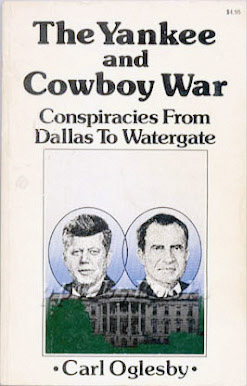
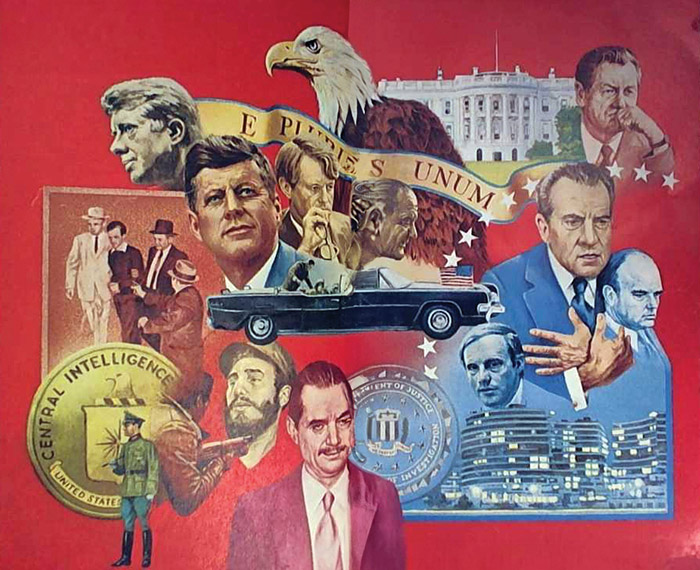
    The crucial role of conflict within the deep state was the central thesis of one of the forgotten classics of alternative politics, The Yankee and Cowboy War: Conspiracies from Dallas to Watergate (1976) by Carl Oglesby. The first president of Students for a Democratic Society (SDS), the most influential American radical group in the mid-1960s, Oglesby was forced out of the group because he rejected Marxism and argued instead for an alliance between radical youth and democratic populists. After his expulsion, he devoted time to researching the assassination of John F. Kennedy (JFK) and the deep structure of political and economic power in the United States. 

    In The Yankee and Cowboy War, Oglesby mapped out the hidden terrain of American power from the Second World War to the election of Jimmy Carter. He showed that beneath the apparent unity of the deep state in those years, a bitter conflict raged between two factions of the ruling class – the old east coast establishment (“Yankees”), oriented toward Europe and drawing their power and wealth from control over international finance, and the new rich of the Florida-Texas-California corridor (“Cowboys”), more interested in Asia than in Europe, and drawing their power and wealth from fossil fuels and the military-industrial complex. 

    Carl Oglesby (1935-2011)

    Oglesby argued that the war in Vietnam was a Cowboy project. When Yankee scion JFK edged out Californian Richard Nixon in the 1960 election and began to move against Cowboy interests, reorienting US foreign policy away from the Pacific Basin, the Cowboy faction treated this as an existential threat. JFK’s assassination, which put the Texan Lyndon Johnson in power, was their response: a coup d’etat against the Yankee faction that handed the levers of power to the Cowboys and signalled full speed ahead for the Vietnam adventure. Yet the Cowboys had no realistic grasp of conditions on the ground in Vietnam. Meanwhile, the Yankee faction responded by fostering antiwar activism on college campuses and using the mainstream media to trip up the Cowboys at every turn. The turmoil of the Sixties was one inevitable result. Another was the coup against Richard Nixon.

    That was the story as far as Oglesby traced it in his book. The rest of the tale is easy enough to outline. Ronald Reagan’s two terms as president marked the triumph of the Cowboys. From that point until the rise of Donald Trump, every US president had a close connection to the Cowboy faction. Notice, however, that the Bush family was an old Yankee family which had relocated to Texas and made connections with the Cowboy elite. This same pattern was underway across the Yankee faction as the old aristocracy cut deals with the new. Meanwhile, the fossil fuel and defence industries became fully integrated with international finance as Cowboy families made their own journeys in the other direction. 

    Frontispiece of the 1977 edition of Carl Oglesby’s book The Yankee and Cowboy War, which dissects a clandestine struggle within America’s power elite, spotlighting the rivalry between the “Yankees” and the “Cowboys.” Written with a particular focus on the role of intelligence agencies, Oglesby’s work connected the JFK assassination and Watergate, framing them as part of this broader elite conflict. His concept of “clandestinism” suggests that conspiracy is an intrinsic part of political power. Oglesby’s theories remain relevant today, reflecting the ongoing tensions between globalism and nationalism in US politics.

    Hillary Clinton was one more interchangeable part from the same bin, raised in an east coast political family but married to a rising Sun Belt politician. Her two terms in the White House were expected to continue policies that had been welded in place for forty years. What neither she nor anyone else in the ruling class had noticed, however, was that the United States was lurching toward an explosion. 

    A Time For Caesars

    Writing more than a century ago, German historian Oswald Spengler anatomised the way that this crisis is playing out. In the history of every high culture, there comes a point at which the ruling class sinks into a kleptocratic stupor in which the last traces of effective leadership give way to a blind pursuit of personal enrichment while the hierarchies through which the ruling class enforces its will become so baroquely complex that no meaningful information can make its way to the top at all. Even if the society is swarming with secret police, that does little since the information gathered by the ordinary working Joes who staff the secret police has less than a tossed coin’s chance of getting to decision-makers. 

    A society in this condition can no longer cope with the challenges that it faces. This is what drives the process that Spengler called Caesarism. Julius Caesar was a high-ranking member of the Roman Republic’s deep state, as insanely rich, financially corrupt, and morally depraved as any of his peers – it was a running joke in Rome during his time that he was every woman’s husband and every man’s wife. Unlike the other members of the senatorial class, however, he realised four things. The first was that the entire Roman system faced disaster if its ruling class continued its kleptocratic feeding frenzy; the second was that ordinary Romans would rally around anyone who took the levers of power away from the ruling class; the third was that some elements of the ruling class would do the same; and the last was that if he took advantage of these things, he could seize unparalleled power. 

    As history shows, he was right. This is why after a cabal of senators assassinated Caesar, the Roman people rose up and drove the assassins and their allies out of Rome. It is why Caesar’s nephew Octavian and his close ally Mark Antony crushed the senatorial party in the war that followed. It is also why, once Octavian and Mark Antony turned on each other and Octavian won, he had himself installed as Augustus, first emperor of Rome, to the wild cheering of Roman crowds. 

    Donald Trump is not Julius Caesar. Nevertheless, the same pattern that put Caesar in power gave Trump his first term in the White House and seems likely to give him a second. The American ruling class, Yankee and Cowboy factions alike, long ago forfeited the trust and respect of the American people. More recently, they have become hated, and in the last few years, they have come to be despised. That opens the way for the same overturning of the political establishment that Caesar began and Augustus completed. 

    A very large number of Americans – quite possibly a majority at this point – are sufficiently disgusted by the antics of their self-anointed leaders that anyone who takes the levers of power away from them can count on robust public support. Significant figures among the rich and influential can be expected to rally around any such project. If Trump did not exist, in other words, someone else would have done the same thing he did – and if he is removed, there’s no shortage of others ready to take his place. 

    The End of Empire

    The revolution from within that Julius Caesar and Augustus carried out in ancient Rome is even more likely in today’s America because the American empire that emerged out of the Second World War is running on fumes. Dependent on distant countries for essential resources, burdened with a vast bureaucratic sector and an economy so riddled with graft and incompetence that it can no longer accomplish such basic tasks as providing munitions for its proxy wars, the United States is stumbling toward terminal crisis. 

    The ongoing war in Ukraine is a glaring example. When that began in February 2022, the United States and its allies placed their trust in punitive economic sanctions, which were expected to cripple the Russian economy and force Russia to its knees. Apparently, nobody in Washington DC considered the possibility that other nations interested in undercutting the US empire might have something to say about that. Of course, that was what happened. China, which has the largest economy on Earth in terms of purchasing power, extended a middle finger in the direction of Washington DC and upped its imports of Russian oil, gas, grain, and other products. So did India, currently the third largest economy on Earth, as well as more than a hundred other countries. 

    For many decades, the threat of being cut out of international trade by US sanctions was the big stick Washington DC used to threaten unruly nations that weren’t small enough for a US invasion or fragile enough for a CIA-backed regime change operation. Two years ago, that big stick turned out to be made of balsa wood and snapped off in Joe Biden’s hand. The result is the first shockwave of a massive rebalancing of global wealth that is already transforming the world. 

    Until the era of the European global empire, the economic heart of the world was in East and South Asia. India and China were the richest countries on the planet, and half a dozen other nations, from Japan to Iran, were also major economic powers. The great age of European conquest temporarily diverted much of that wealth to Europe, impoverishing Asia in the process. That began to break down with the collapse of European colonial empires after the Second World War, but some of the same arrangements were propped up by the United States thereafter. Now, those are coming apart, and Asia is rising in response. By next year, in terms of purchasing power, four of the five largest economies on the planet will be Asian. The fifth is the United States, and it may not be on that list for much longer. 

    The consequences will reshape the lives of everyone on the planet, but their impact will be especially harsh here in the United States. Roughly five per cent of the human race currently live in the United States of America. That very small fraction of humanity, until quite recently, got to enjoy about a third of the world’s energy resources and manufactured products and about a quarter of its raw materials. That didn’t happen because nobody else wanted these things. It happened because America’s global empire funnelled a disproportionate share of the planet’s wealth to one nation. 

    As those arrangements break down, the five per cent of us in the United States will have to go back to living on about five per cent of the planet’s wealth, as we did before 1945. If we still had the factories, the trained workforce, the abundant natural resources, and the thrifty habits we had back then, that would have been a wrenching transition but not a debacle. The difficulty, of course, is that we no longer have those things. The factories were shut down in the offshoring craze of the 1970s and 1980s, when the imperial economy slammed into overdrive, and the trained workforce was handed over to malign neglect after that. 

    Get the issue this article appears in

    We still have some natural resources, but nothing like what we once had. The thrifty habits? Those went whistling down the wind a long time ago. In the late stages of an empire, exploiting flows of wealth from abroad is much more profitable than trying to produce wealth at home, and most people direct their efforts accordingly. The result is the typical late imperial economy, with a governing class that flaunts absurd levels of paper wealth, a parasite class of hangers-on that thrive by catering to the very rich or staffing the bureaucracies of the deep state, and the vast majority of the population impoverished, sullen, and unwilling to lift a finger to save their so-called leaders from the consequences of their own actions. 

    It is still possible for the United States to pull out of its current power dive. “Possible,” however, is not the same thing as “easy.” Our government, most of our corporations, and a great many of our wealthier citizens have run up debts so gargantuan that they can never be paid off. A federal debt default is a certainty sooner or later. So is the bankruptcy of most large American corporations, especially in the FIRE (finance, insurance, and real estate) sector. US troops will have to come home from the hundreds of overseas bases where they currently prop up proxy regimes of various kinds. US allies in Europe and the island fringes of East Asia will have to make their own arrangements for defence. Very little in global affairs will remain unchanged. 

    There is no evidence that Donald Trump, the circle of upper-class dissidents that surrounds him, or the cheering crowds that attend his rallies understand all this. Trump seems to realise, however, that the United States can no longer afford its global military footprint, its gargantuan government bureaucracies, or the attitudes that justify these and cater to the vast lumbering dinosaur of the deep state. Such policies are inevitable sooner or later – and the sooner they take place, the more it will be possible to salvage from the smoking rubble of the American experiment. 

    [alert type=”general” dismiss=”no”]This article was published in New Dawn 206.[/alert]

    [alert type=”success” dismiss=”no”]If you appreciate this article, please consider subscribing to help maintain this website.[/alert]

    © New Dawn Magazine and the respective author.
    For our reproduction notice, click here.
  • The Countdown Begins: Two Years to Transform or Be Transformed

    The Countdown Begins: Two Years to Transform or Be Transformed

    In honour of John L. Petersen – founder of the Arlington Institute – who passed away in August 2025, we are posting his article which recently appeared in New Dawn Special Issue Vol 19 No 2.

    It’s like a movie – for example, Star Wars – where suddenly we find ourselves in an existential situation with a very short time to respond… and it’s for the whole game. Everything. It’s almost surreal – the stuff they make movies of! That’s where we are. Right now.

    There’s a lot about the world these days that is surreal. Honesty, integrity, logic, commonsense – all suddenly seemed to walk away within less than a decade. The underpinnings of how we understood reality to work – our paradigm – made their way to the door and departed. Now we can’t even tell what’s real for sure. Technology can duplicate every major characteristic of an individual within a digital environment with such fidelity that you don’t know for sure if it’s Donald Trump or Elon Musk (or anyone) really saying or doing what you just saw them say and do.

    It’s one thing to fixate on the extraordinary eruption of information technologies with all of the nano, bio, genetic, cogno, AI and social subsets of the explosion; they’re all clearly the major driving force of this planetary upheaval. But it’s more than that. Much more than that.

    AN ANCIENT STAGE HAS BEEN SET

    The stage for these present months and years was systematically set throughout the last century – if not longer. Some three hundred thousand years ago (say the Pleiadians by way of Barbara Marciniak), a major force (reptilians or archons, see the Gnostic Gospels) captured this planet. The humans, with their then 12 strands of DNA, were extraordinarily capable, connected and on their way to greatness. The controller reptilians felt it was inevitable that the humans would overtake them and become a threat.

    Something had to be done. The solution was to genetically disable ten of the dozen DNA strands. Break them up, but leave the broken strands in there such that they can’t operate – and be sure to manipulate the genetics to generate fear, pain, hate and terror – all of which produce the negative energy (loosh) that nourishes the reptilians/archons.

    Why have humans constantly killed each other and produced extraordinary injustices to each other for millennia? That’s why. It’s been designed into us to sustain the vitality of the controller/suppressor force that coexists with us on this planet.

    Those controllers have spent the last millennia working to incrementally shape this 3D reality so that we humans, exercising our “free will,” decision-by-decision, increasingly choose or “allow” the growth of conditions and initiatives designed to systematically constrain and suppress us to the point where these non-human forces can completely subsume humans into Matrix-like power sources (perhaps even housed in cells). At the very least, they want us to be afraid, powerless, dependent, docile, obedient and certainly amused and uninformed. Nothing sovereign or powerful here.

    It’s literally the elimination of humanity as we have known it.

    How is it working? Quite well, actually.

    We don’t think of all the antagonists as non-human. The names and terms are well known: Microsoft, Gates, Musk, quantum computing, AI, Google, Starlink, CIA, NSA, NSF, Amazon, ChatGPT, large language models, etc. It’s just not generally clear what they’re all up to or how far along in their plan they have progressed.

    The current conditions were spawned after WWII: they put fluoride into the water. And then came injections, cancer-causing chemicals in the soil, genetically modified seeds (and who knows what else) and chemicals, particles and nanobots in the skies.

    They began working on the electromagnetic spectrum of the space we inhabit that now includes towers everywhere, broadcasting radio signals that influence how our bodies operate and, in some applications, resonate specifically with the cells in our brains.

    A BRILLIANT 360-DEGREE STRATEGY

    It’s almost like they sat down and said, “What are all of the major external inputs that affect human well-being? Let’s target each of them so that when we’re finished, we control every aspect of their lives.”

    Let’s start working on child education to ensure conformity and make sure they only learn what we want them to learn. Don’t teach them to think for themselves, be creative in solving problems and question any aspects of “reality.” No, let’s produce workers for the industrial economy. Make sure they don’t know how powerful and capable they are. Tell them why they need to conform and what will happen if they don’t. Make sure the reward system enforces their obedience.

    How do we control their health? Well, we could introduce devices (like nanobots, for instance) into their bodies that would respond to outside signals to monitor and influence how their bodies operate. Let’s think about having them ingest it from the air or food or injections. That way, these sensors would be everywhere in their bodies: heart, brain and immune system. We could then tell how they’re doing and influence their health.

    Oh, and then there’s their money. Let’s design a monetary system that causes their money to decrease in value – guaranteed – every month, and we’ll make it so that our banks (but not the people) can manufacture money out of thin air so that WE can flourish even though surrounded by never-ending poverty.

    Even better, we’ll take the money out of their pockets and convert it to intangible digits that reside on computers (that can be manipulated) so that if we need to, we can shut off anyone’s access to money.

    Let’s figure out how their brains work, where and how they derive satisfaction, what engenders fear, etc. (by the way, let’s do love while we’re at it) so that we can influence them with the media (that’s a good idea, we need to control all of the media), and orchestrate their perceived reality to make sure they’re docile good citizens. Make sure there are plenty of sports, entertainment and drugs (of all kinds) that will keep their minds from wandering.

    You know, we’ll need some individuals who will do exactly what we want them to do that otherwise might be “unsavoury” to them, like killing a bunch of people, setting off a bomb, or something. For these select people, let’s learn how to fragment human minds and access and control one of the personalities of these people’s brains such that they’ll be available to us when we need them for a particular operation. And let’s be sure they don’t remember what they did.

    Better yet, if we could identify each human’s unique electromagnetic signature, we could monitor it in real time using all these towers we’re putting up. Oh, yeah, we could also do it from satellites if we had enough to cover every place on the planet. (Note to self: Contact Elon and see if we can do that with Starlink.)

    Hey, this is a good idea. Maybe that research that shows how you can extract the thoughts that individuals are thinking and insert desired thoughts from afar would be useful here. If we could do that from satellites, then we’d be able to know where they are, what they’re thinking, how their body is functioning (we should think about how we can control that from a distance). Come to think of it, you could control their access to money and what they buy (things like food) – and whether their car runs or not – from this kind of system. How about universal IDs? Maybe chips in bodies or digital passports? Now we’re getting somewhere!

    Now, this is opening doors to great opportunities! Let’s fund a capability (at, say, Purdue University) and call it the Sentient World Simulation, where we can build an extraordinary computer-based capability that has identified and describes every individual on the planet and aggregates everything we know about each person: their interests, desires, habits, friends, problems, inclinations, etc. and use a quantum computer system to model all of this behaviour (talk to DWave) and all of the possible/likely ways in which all these people might behave. We could call it the big effort, the Human Mind Project.

    Where can we get all of that information? Oh yeah, there are those new things called search engines and social media – and pornography. Let’s fund them and extract all of that behaviour (Note to self: call NSA and see if we can use their telephone and internet communication data for this) and feed it to the Purdue facility. If we can pull this off, we could run all kinds of scenarios about how individuals, organisations, governments, and countries would likely respond to any given situation – and what could be done to encourage or discourage those responses.

    You know, we can really utilise Artificial Intelligence (AI) in this scenario. We can integrate AI decision making into key points in the systems and processes such that much of the whole thing becomes automated – the machines make the decisions. They evaluate on the fly what you write, see, say and where you go and decide if it’s acceptable. We can write algorithms that do all of this without any oversight. Who knows where that could go!

    You know, at some point, if we’re lucky, we’d have complete control of the whole planet! Wow! That would be a significant accomplishment!

    REALITY CHECK

    This is not a game or a sci-fi movie concept. All of this is real. And most certainly, there is more that we don’t know about. What can they do with all of this? This all-digital system would allow “them” to know everything about you and your behaviour, who all of your friends and acquaintances are, where you are specifically located, and control where you can go and what you can buy. They have the ability to insert thoughts into your brain and extract what you are thinking. At will, they can decide whether you live or die – or are sick or well – anonymously from a distance.

    The rate of progression of all this is exponential. Eric Schmidt, former president of Google, recently said that AI could effectively eliminate humans in ten years. About six to seven years ago, he predicted that within ten years, 85 per cent of jobs then in existence would be obsolete. Clearly, the comfortable, familiar world we all were raised in is ending. But how soon?

    THE FINAL NAILS

    The final nails in the coffin are CBDC – Central Bank Digital Currency and universal digital identification. CBDCs and digital IDs provide the keys for collapsing the dollar and issuing a new digital currency and knowing who is trying to access money, services, travel, buy things, etc. – and control all of those from a distance. Once these are in place, there will be nowhere for anyone to hide. The system will absolutely control every aspect of your life… if “they” want to.

    Both are on a fast track for global implementation. Certainly by the end of 2026.

    The incentive driving this is the sovereign debt crisis, the huge amounts owned by governments ($36 trillion in the US alone) that will never be repaid, coupled with the looming certainty that countries will not be able to service the debt for the underlying obligations. The system will hit the wall in two or fewer years, at which time the US will not be able to pay Social Security, Medicare, and pensions, to say nothing about funding the continued operation of the government. (Think national revolution.)

    If they are not able to launch WWIII and use it as a pretext for collapsing the dollar and issuing the new currency, there is a direct path toward a revolution. The problem is common in countries across the planet.

    Couple that with the very high probability that all the converging technological capabilities mentioned above are on a clear trajectory of integration within about two years and you now have an inbound freight train on the track on which we are camped.

    There are also wildcards associated with incoming events of huge significance – like connecting with extraterrestrial life, a potential earth-facing solar flare, the planet’s magnetosphere flipping and attendant major earth changes – all in the context of the planet rapidly growing colder. It’s an epochal recipe for extraordinary disruption.

    We don’t have much time at all.

    WHAT CAN WE DO?

    What can those of us who believe there must be an alternative to the direction of this digital, dystopian, technocratic world do about this?

    In concept, it is clear – and obvious. Whether you’re camped on a train track (for whatever strange reason) and can hear the whistle of the now visible locomotive, or you’re at a party with some friends and you’re not having a good time, the solution is the same: Move – go somewhere else.

    We need to leave this game and play another one. In this case, we need to design and launch a new playing field – an alternative to the civilisation that has given us these looming, existential problems.

    This may sound logically coherent but wildly impossible. I know. But I’d suggest it’s doable. We just need to get at it. Soon.

    One note. More than anything else, what is needed for those of us who resonate with these ideas is a framework – a path forward – that engenders hope in the middle of some of the most uncertain and chaotic times that humans have seen. We all need a vision that instantaneously generates the response, “That’s a good idea – and we can do it.”

    MAKING IT HAPPEN

    If we wanted to manifest a new world – or a new country, for that matter – then we should probably utilise the principles that underpin the process of manifestation in all other aspects of life. Build a clear vision of what it is that you’d like to manifest, then put a lot of intention behind that vision, coupled with a major sense of urgency.

    If we could mount a vision – held by many people from around the world – the compounding effect of entrainment of all of those minds, focused on a common goal, would activate the Law of Attraction, generating the precipitation of many synchronistic, contributing solutions for achieving the goal.

    The process should be a grassroots one – not primarily driven by a small group of self-selected “visionaries.” With today’s technology we can do that – it could literally be a global, crowd-sourced solution.

    The purpose of the project would include three goals:

    Generate a worldwide active effort to develop the framework for a new world.

    Encourage the international development of local community groups significantly committed to the emergence of a new world.

    Encourage local cultures to flourish underneath a new set of human organising ideas.

    This approach would not only produce a great deal of focused thinking about an alternative world but would result in a necessary critical mass of people who would be ready to “build” the new world and certainly live in it, starting in their own communities.

    Here’s how it might work.

    Warning: We are building a NEW world here. It is not a variation of the old world. It assumes that this new place is populated by denizens who are themselves NEW humans and do not see themselves and this emergent world in the terms from whence they came.

    THE IDEA

    The basic idea is to initiate a curated, global conversation focused specifically on developing the intellectual and functional architecture of a prospective new world. We think it should be a global, grass-roots initiative by organised an international network of groups focusing on a specific existing country or culture, but with locally-coloured conversations having the same basic principles and objectives, generating a common conversation from different perspectives.

    To accomplish this, we would implement a global collaboration platform – a custom-built virtual space that manages an international conversation around a new set of values, principles, assumptions, and objectives, ultimately adapted to local traditions and cultures. The platform – we call it TransitionNet– would connect an international network of local “chapters,” all contributing to a central model core that manages and aggregates inputs from around the world.

    The centre node would house the rapidly evolving model and the support staff required to “care and feed” it. They would also task the chapters with generating specific ideas and solutions needed to grow and develop the model through its lifetime through a series of specific exercises.

    There would be a built-in recursive function in the process that would allow regular reassessment of the direction that the model was going and take into consideration the necessarily changing external environment.

    The model would be a very sophisticated integration of all of the collected ideas related to major sectors of human activity, e.g., healthcare, government, energy, etc. It would use advanced visualisation and communication capabilities to generate a necessarily complex image of the whole new world idea network.

    We see it as a multi-coloured network with a great many nodes, each related to one or more of the major sectors. One sector – coloured green, perhaps – would be, say, the global environment; another, perhaps transportation, would be a collection of blue nodes, etc.

    Each node would be an idea, solution or issue integral to the larger sector (or subsector). As a viewer navigated through the model, it could be expanded, rotated, drilled into, etc., allowing one to see all of the contributing ideas related to a particular subject, like “air transportation,” for example. Clicking on a node would open up all of the supporting docs, videos and source material related to that idea.

    Oversight of the project would be under the guidance of a Global Futures Network composed of perhaps 50 carefully selected individuals from around the world who were accomplished, thoughtful, open-minded, cross-disciplined and able to work effectively with others in this very important project. Their role would be to oversee the model-building project, assess the progress and shape the global conversation to ensure that major and critical issues were addressed on a day-to-day basis.

    Get the issue this article appears in

    THE PROCESS

    First, there needs to be a commonly agreed-upon understanding of the principles, values, assumptions and objectives that will animate the new world. These are the fundamentals that will provide the lens through which all of the citizens of this emergent civilisation will operate. In practice, they may not all be explicit, but they are the fabric from which the new world is constructed.

    Objectives would hopefully be dominated by the vision of the desired new world – how it works, what is needed to manifest it, how it is designed to deal with incoming issues of great significance, etc. Thinking through how this new world would be organised (how does it work, how does it effectively integrate inputs from different areas and cultures, etc.) would be a part of this.

    Once these are worked out, they could probably be integrated into local constitutions (or similar types of documents) that guide, shape, and colour all further conceptual and design work for the new world and would provide an interconnected framework for living that was logically understood and agreed to across the planet.

    What would follow would be a series of sequential projects to crowdsource the operating frameworks for the essential functional sectors of the new world – energy, education, transportation, science, healthcare, government, etc. Each of these projects would be conducted such that the contributions to the model were consistent with the Principles, Values, Assumptions and Objectives.

    In each case, an extended, curated, planet-wide conversation would be facilitated within an international network of local groups focused around each sector. The education groups in Berlin, San Francisco and Tokyo, for example, would work together on specific issues related to the design of the educational system in the new world. The transportation groups, etc., would also collaborate similarly.

    In the end, this process would result in an intellectual framework for understanding the basic structure of an integral concept for evolving a new world while allowing many cultures to operate within the larger structure. It would also generate a significant support population that would deeply understand the organising concepts as they relate to local cultures and would be primed to translate the vision into reality.

    Most of the world will obviously not resonate with these ideas. The majority of the planet’s denizens are headed in a significantly different direction. What we would need to do is gather up a small but critical mass of like-minded individuals who were ready to actively contribute to designing a new world and take advantage of the extraordinary leverage that many people with a common vision would generate.

    We are at a place where the tools that would enable this type of project exist (and will become increasingly capable). The urgency of the situation is obvious and pressing, the current environment is collapsing, and there is a significant, growing awareness that a new world is required.

    So, let’s go build it.

    Start your journey to a new world by visiting arlingtoninstitute.org/transitionnet. The Arlington Institute (founded by John L. Petersen) offers talks on the transition to a new world. See transitiontalks.org.

    [alert type=”general” dismiss=”no”]This article was published in New Dawn Special Issue Vol 19 No 2.[/alert]

    [alert type=”success” dismiss=”no”]If you appreciate this article, please consider subscribing to help maintain this website.[/alert]

    © New Dawn Magazine and the respective author.
    For our reproduction notice, click here.