New Dawn – World's Most Unusual Magazine

Category: Behind the News

  • What the Technocratic Elitists Plan for Your Future

    What the Technocratic Elitists Plan for Your Future

    From New Dawn Special Issue Vol 17 No 6 (Dec 2023)

    We are currently living through one of the most important periods in human history, as the ruling class biofascists move to transform the world into something out of a science fiction novel.

    The following piece looks at some of the most pressing world-altering agendas currently on the horizon for the future of society – and what we can do to fight back.

    The End of Cash?

    The world is changing and changing quickly. Most of society remains blissfully unaware – through targeted propaganda campaigns – of the reality that awaits them (if allowed) across this decade.

    Perhaps the most pressing transition that countries will see in the foreseeable future is major shakeups to our financial institutions and economies.

    The collapses in March 2023 of Silicon Valley Bank and Signature Bank in the US led some to wonder if the world may be headed for a new widespread banking crisis.

    Switzerland’s Credit Suisse also collapsed in March and was purchased shortly by UBS in a deal approved by Swiss regulators without shareholder approval.

    As a result, Australian financial regulators recently called for an urgent review of the nation’s preparedness and management for “future banking turmoil” following the speed of lender runs.1

    Experts put the odds of a recession before July 2024 at 59 per cent. Emergency meetings held by regulators of late show they are keeping a keen eye on any further instability.

    The timing couldn’t come at a more ‘convenient’ moment for those in power.

    As they say, ‘never let a good crisis go to waste’, and to combat this ‘turmoil’, the state is already looking to transition from this financial model into a new, centralised, digital dystopia.

    For years, Australia has been phasing out cash. In 2021, financial experts forecasted that this country would become “functionally cashless” in 2024.2

    Now, as we enter this crucial timeframe, we see many changes begin to unfold.

    In July 2023, it was announced that cash is no longer available over the counter at a number of Commonwealth Bank locations, with a move to focus on “more complex banking needs.”3

    This was soon followed by Macquarie Bank, our fifth largest, announcing it will “phase out” cash, cheque and phone payments for customers from 2024.

    In a policy notice update, the bank stated that by November 2024, customers will be unable to write or deposit cheques (including bank cheques), deposit or withdraw cash over the counter at branches, or make a super contribution or payment with a cheque.4

    The changes come after Australia’s Federal Treasurer Jim Chalmers announced in June 2023 that cheques will be phased out nationwide by 2030 in a government shake-up of Australia’s payments system.5

    It is not only at the cashless point where they intend to stop with this vision. The removal of cash is just one piece of an even bigger puzzle that will slowly emerge afterwards.

    Bank branches are becoming a thing of the past – disappearing at “alarming” rates – with ATMs also being removed nationwide.6

    The ‘Big 4’ banks are already following the Reserve Bank’s plan to introduce Central Bank Digital Currencies (CBDCs), with pilots currently being tested in the industry.7

    Cases are being researched to see how a CBDC future can ‘enhance’ digital payments.

    Let’s not forget that COVID-19 lockdowns helped accelerate the shift away from cash in a social environment trained to accept and desire such ‘convenience’.

    Pandemic Treaty

    The upheaval of society is not set to end there, however, with several moves being made (and predictions propagated) that suggest more ‘crises’ are on the way.

    The ‘pandemic’ changed the world in ways we are yet to realise fully, and governments across the globe are now coming together to form a unified response to prepare for any future ‘outbreaks’.

    In September 2023, the Australian government released a consultation paper detailing their adherence to a “global accord” on “pandemic prevention, preparedness and response.”8

    As was the concern, this will come from negotiating an international agreement to “protect nations and communities from future pandemic emergencies.”

    To date, member states of the World Health Organization (WHO) have met to discuss priorities for a new worldwide “pandemic instrument,” as well as changes to International Health Regulations (IHR). 

    The new paper details two “important processes” being worked on to “strengthen the international community” as a means to “prevent, prepare for, and respond to pandemics.”

    Implementing a pandemic treaty would make any future ‘pandemic’ responses faster and more efficient, allowing for a seamless, centralised international process.

    What is the timeline? The consultation paper says member states have agreed to establish an Intergovernmental Negotiating Body (INB) to draft the final instrument for consideration by May 2024 [Editor’s Note: As of May 30, negotiations were ongoing].

    The concern by many since word broke of these discussions is that any finalised treaty will likely include the condition that international ‘health troops’ can be quickly deployed to any nation to assist outbreak responses in a unified fashion.

    Such a treaty will effectively bypass our national sovereignty and decision-making processes.

    What raises even more eyebrows is the news that Bill Gates has proposed setting up a “pandemic prevention team” called ​​Global Epidemic Response and Mobilization or GERM!9

    This has left many wondering what may be lying around the corner in the not-too-distant future, with the Big Pharma monopoly enjoying record profits during the recent COVID period.

    If signed, future ‘outbreaks’ would be managed entirely by offshore entities rather than at home in the face of scrutiny from the taxpaying public.

    But, if that doesn’t work, one thing also being discussed heavily is the potential for a manufactured ‘water crisis’ that could transform how we consume this resource over the coming decades.

    Water ‘Crisis’

    By 2025, the United Nations says that two-thirds of the world may face water shortages as unelected world bodies again look to step in with ‘solutions’.10

    Researchers suggest that combinations of drought, environmental pollution and population growth have the potential to create instability in the Indo-Pacific region by 2030.

    Sydney’s drinking water is unlikely to remain healthy over the coming decade, according to a report handed to the New South Wales government.11

    After a three-year audit, the scathing assessment of the city’s water supply found seven of the 18 key indicators for the water system’s health were “worsening.” The audit also found there is a risk that the city’s main water catchment will be unable to continue providing adequate, good-quality water to the greater Sydney area.
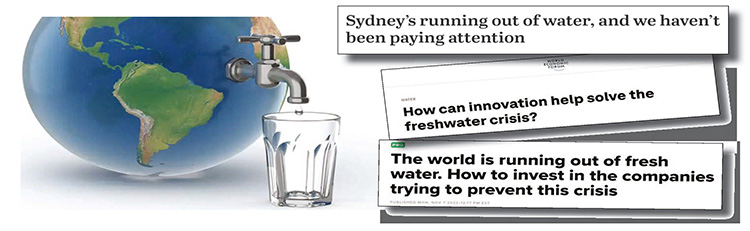
    Here’s the thing: are we really facing a ‘shortage’ of water? Or is it just a shortage of ‘free water’?

    Massive corporate behemoths have bought and privatised much of the world’s freshwater over the past few decades, including in Australia.

    We witnessed a glimpse of this during the 2019-20 bushfire season, when water from Tamborine Mountain in Queensland was unable to be used to assist firefighting efforts due to it being owned by Coca-Cola Amatil.12

    If we look at the Register of Foreign Ownership of Water Entitlements, Australia has spawned a massive water marketplace, with more than $3 billion worth of rights at play.

    One report shows the proportion of total water entitlements with a level of foreign ownership is 10.4 per cent, making up a total volume of 4,035 gigalitres across Australia (as of 2018).

    So, it’s not the fact that there isn’t any water. The concern is over the water allocated to us.

    World Economic Forum contributor Mariana Mazzucato recently indicated this is the direction the global elites are turning. The Italian economist noted that the coming water crisis is something that everyone could get on board with.13

    We must all keep our eyes on this evolving story on the road to Agenda 2030.

    mRNA Expansion

    Vaccines have become one of the most polarising topics in recent years, and following record profits during the COVID-19 era, biopharmaceutical giants look to expand their mRNA product catalogue.

    It seems the vision is to eventually transition all vaccines to this experimental technology.

    Last year, Moderna announced the construction of a new state-of-the-art mRNA manufacturing facility to be based in Melbourne, which will act as the ‘central hub’ for their products.14

    Following suit, the Queensland government – one of the “world’s largest vaccine innovators” – partnered with two Australian universities to collectively commit $280 million towards establishing the ‘Translational Science Hub’.15

    This ‘science hub’ will be a biomedical research centre focused on developing mRNA technology.

    Paris-based Sanofi will connect Australian scientists with researchers in France and the United States to focus on developing mRNA vaccines for all sorts of health conditions including sexually transmissible diseases.

    In addition, the University of Queensland has struck a critical deal with Atlanta’s Emory University to develop “groundbreaking” next-generation vaccines at home.16

    CSL, a group that knowingly released millions of contaminated polio vaccines to the Australian public in the 1960s,17 is also looking to bring mRNA flu vaccines to Australia.18

    Flu has become a major focus of the mRNA community, with the US National Institutes of Health (NIH) currently undertaking trials for a “universal” vaccine.19

    And it’s not just humans set to ‘benefit’ from the technology, either. Scientists also want mRNA vaccines to replace traditional vaccines for Australian livestock.20

    No wonder Moderna is popping up on our screens yet again with their new TV spot, “Welcome to the mRNAge,” designed to let people know that mRNA vaccines are “not just a one-trick pony.”

    This promotional piece is a 90-second TV ad created that “artfully showcases some of the possibilities mRNA has to offer.” Let’s just say it is pretty eerie!21 Throughout the video, young children are frequently highlighted as the company describes how mRNA is the “code of life,” pondering “endless possibilities” when “unlocked.”

    Full steam ahead for the biofascists, despite the trail of destruction left in their wake already.

    Representatives from Pfizer and Moderna were recently called before a Federal Senate hearing and handed a number of serious questions surrounding the COVID-19 vaccination program.22

    These companies also face legal action by one Victorian MP who alleges that genetically modified organisms (GMOs) can be found in the vaccines that the national regulator did not pick up.23

    In addition, a class action has been launched in the NSW Federal Court against the Therapeutic Goods Administration (TGA), the Health Department and public servants by those claiming vaccine harm.24

    The class action, organised and crowd-funded by Queensland GP Dr Melissa McCann, alleges negligence, breach of statutory duty, and misfeasance in public office.

    The Victorian government also faces a class action lawsuit from more than 1,300 businesses over COVID-19 lockdowns. They are seeking damages for being forced to shut their doors for an extra 112 days due to the mishandling of the hotel quarantine system.25

    Accountability doesn’t matter to these people, nor our government ‘representatives’.

    In August, the combined force of the Labor-Greens Federal Senate majority defeated a vote for a Royal Commission into government handling of the COVID ‘pandemic’.26

    What will we see when a new mRNA vaccine wave is unleashed onto humanity?

    Synthetic Food & Milk

    Returning to natural resources – our food (plus the supply chains that support them) is also at risk of being fundamentally altered in the near future as part of the ‘sustainable’ push.

    Many have heard about the push for ‘bug protein’ (eat ze’ bugs), but this is just the tip of the iceberg.

    Cultivated meat, also known as lab-grown meat, has been cleared for sale in the United States.

    Two companies that make what they call ‘cultivated chicken’ have received approval from the US Department of Agriculture to start producing “cell-based proteins” for the marketplace.27

    Many may scoff at the notion of lab-grown meat replacing traditional meat industries, but now scientists have figured out ways to compete with them at scale.

    Companies already have patent applications for genetically modified fruit flies engineered to grow animal cells at scales to rival agricultural meat production.28
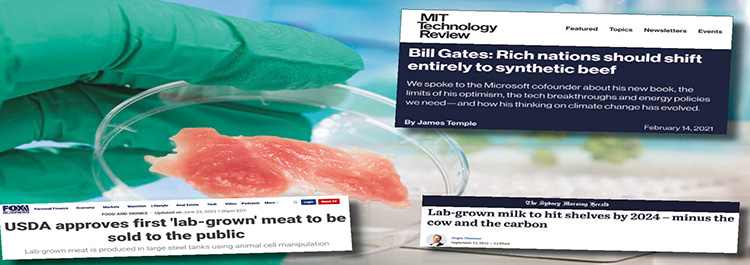
    Technology powered by the new CRISPR-Cas has allowed this to occur. We should not be surprised to see the industry rapidly expand in the future as a ‘solution’ to resource depletion.

    In response, the Italian government recently approved a bill banning the use of laboratory-produced food and animal feed as it aims to safeguard the country’s agricultural heritage.29

    Italian industry will not be permitted to produce food or feed “from cell cultures or tissues derived from vertebrate animals,” according to reports.

    Italy is just one country, practically alone, in a sea of emerging support for ‘Frankenstein foods’.

    The biotech industry is waging an ongoing battle to get its newly advanced methods of genetic modification excluded from European GMO regulations.30

    This would mean that plants, animals and micro-organisms artificially created using genome-editing techniques like CRISPR-Cas would not be subject to safety checks, monitoring or consumer labelling.

    One report shows that 64 per cent of the members of the EPSO working group on Agricultural Technologies and 32 per cent of EU-SAGE members have a vested interest in the commercialisation of GM plants.

    Bill Gates has been the funder and public shaper behind the push to move the world towards synthetic meat production for years, pouring resources into initiatives in hopes of it spreading.31

    To this end, Australians have recently been told we need to give up our steaks and turn ‘flexitarian’ to ‘meet climate change targets’ and hit net zero by 2050, according to academics.

    Can we expect to see similar approvals in this country shortly?

    If the CSIRO has anything to say about it, which they inevitably will, we can bet on this being the case.

    CSIRO-backed start-up Eden Brew has worked out how to “brew” milk in a lab in a way that “emulates the natural fermentation process that happens in cows” and is working on industrialising the process. They expect to have their products on the market by 2024.32

    The government organisation also released the report, Reshaping Australian Food Systems, which sets a new path for how Australia can “secure a more sustainable, productive, and resilient future for its food, environment, and people.”33

    Food supply chains, already transformed by decades-long globalisation in the move away from national production, became heavily disrupted by the impacts of COVID-19 lockdowns.

    What would happen if, say, another ‘virus’ or ‘water crisis’ soon emerged? Would this lay the foundation for laboratory-based diets as a ‘solution’?

    Indeed, there has never been a more crucial time to become food independent and break free of corporate chains, networking with other like-minded people to make this happen.

    But, if you have anything to say in opposition to the plans, just be mindful of the ‘eyes and ears’ that may be watching when you do. This brings us to another key agenda that has almost arrived.

    Digital ID Systems

    In my previous pieces for New Dawn, I heavily focused on the biometric surveillance dystopia creeping across Australia in the post-9/11 world.

    In recent years, smart cities and mass-tracking systems have emerged in all facets of life. As we move forward, digital identity profiles are the ‘natural’ progression to link all this together.

    What was once called a ‘conspiracy’ is almost a done deal here in Australia.

    In 2021, the federal government moved behind the scenes to establish an oversight body to ‘regulate’ plans for a national digital identity system.34

    In August 2023, a detailed strategy was released explaining the rollout of this digital ID framework, both in the near future and long-term, and the challenges it will face.35

    The National Strategy for Identity Resilience outlines the “seamless integration” of commonwealth, state, and territory digital ID systems, “inclusivity” in accessing services, and the roles of individuals, industry, and government in “building resilience” in a future world.

    The strategy states there will be a “need” for new identity management systems to “evolve alongside emerging risks,” considering “the importance of privacy and strong security measures.” It also praises the role of digital credentials and biometrics in “enhancing identity resilience.”

    The strategy aligns with the nation’s ambition to become “the most cyber-secure nation by 2030.”36

    Other Australian industries, particularly the banking sector, are also moving to introduce digital identity frameworks, with “secure checking services” set to be rolled out.

    State governments are incorporating these plans into their services apps, following the federal myGov framework that lets users create their digital ID for “easy login.”

    Australian job seekers will soon be able to “store and share verified job skills and qualifications with employers” through a newly announced “National Digital Skills Passport.”37

    This passport would function as a digital ID for job qualifications.

    Together, state systems will merge with the federal government’s oversight body and national strategy of implementation, centralising the data of millions of Australians in the name of ‘security’.

    Australians once rallied in the tens of thousands to resist a national ID card, understanding how the move could become a track-and-trace gateway to total control.

    It may be time for citizens to again take to the streets to resist such Orwellian moves.

    WEF’s Own Forecasts

    It is worth looking at the World Economic Forum’s (WEF) list of emerging technologies developed in 2023 that will “benefit society in three-to-five years.”

    The views of more than 90 ‘experts’ from 20 countries were sought for this year’s ‘Top 10 Emerging Technologies’ report, assessing “the impact on people, the planet, prosperity, industry and equity.”38

    WEF expects these trends to “revolutionise the world” over the coming few years:

    • AI-facilitated healthcare
    • Sustainable computing
    • Flexible neural electronics (brain-machine interfaces)
    • Wearable plant sensors
    • Metaverse for mental health
    • Designer phages (the engineering of microbiomes for human, animal and plant health)
    • Sustainable aviation fuel
    • Generative artificial intelligence (AI)
    • Flexible batteries

    Some interesting predictions here with many transhumanist undertones, including the merging of man-and-machine and the mechanical symbiosis with nature.

    Artificial intelligence, tipped to decimate many jobs and becoming more advanced with each passing day, is predicted to play a pivotal role in the future.

    In a note posted online, Greta Keenan, WEF’s lead for strategic communications, said that ‘experts’ behind previous reports had been “spot on” with impact forecasting.

    Given the final direction these mad scientists plan to take humanity, we should have no reason to suspect these technologies won’t continue their current trajectory. A trajectory that has been generations in the making.

    The ‘Final Revolution’

    In my important feature piece for New Dawn #194 (September-October 2022), I detailed what I describe as The Epsilon Agenda – the intergenerational creation of a posthuman slave class.

    This article covered ‘natural selection’ and the influence of the Huxley family, the modernisation of eugenics through social programs, birthing technologies, and much more.

    Beginning in the in-utero stages of development, human beings are being targeted like never before, combined with systematic programs of mass somatisation, chemical poisoning (food and environment), social engineering and more, in a bid to ‘transform’ the species forever.
    A ‘Brave New World’ indistinguishable from the 1932 novel written by Aldous Huxley himself.

    Here, I will provide some updates that expand upon that analysis, and trust me, the bizarre news stories keep coming.

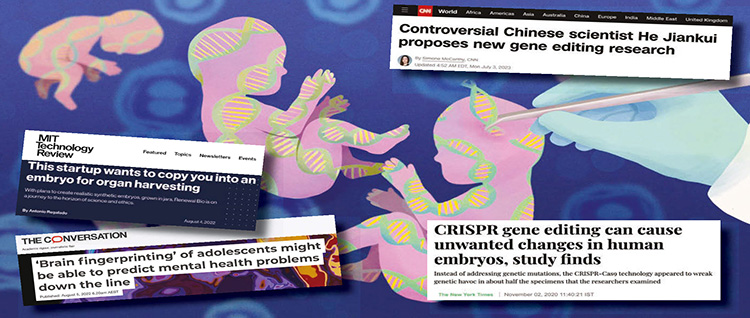
    Scientists are now going public with their plans to genetically engineer human embryos.

    Following his release from prison, controversial Chinese scientist He Jiankui re-emerged into the public eye to call for the “modifying of embryos” to “help the process of aging” in future populations.39

    In addition, just recently, it was revealed that a team of doctors were able to successfully perform brain surgery in-utero on a foetus to “repair a potentially fatal developmental condition.”40

    Back at home, we have seen Queensland researchers publish a new study that highlights the “need” to “map the brains of children” as a way to “identify and intervene” early in mental health problems.41

    It all sounds nice, but the consequences of such actions could be devastating.

    One 2020 study warned that using CRISPR technologies to gene-edit human embryos can cause “unwanted changes” in them, including cell damage so great they will lose entire chromosomes.42

    The Epsilons are the dumbed-down slave class of Huxley’s novel.

    But it doesn’t end there.

    Perhaps the most dystopian news to emerge since our last examination is that synthetic embryo-like structures with intestinal tracts, beginnings of a brain, and a beating heart have already arrived.

    Using what they call “post-gastrulation ex-utero” methods, scientists claim to have created “the world’s first synthetic embryo.” Yes, synthetic embryo.43

    Going forward, ‘health experts’ claim techniques like this may “give a chance to kids who would otherwise have very little possibility of survival.”

    It seems future generations may not have a choice in the matter, either.

    The latest data to be released shows that one in 18 babies born in Australia are conceived via IVF. 102,157 cycles of IVF were performed in 2021, a 17 per cent increase from 2020, with an average of two cycles needed for each woman.44

    In addition, the number of babies born in public hospitals has dropped to its lowest level in more than a decade in some states, highlighting our plummeting national fertility rates.45

    Once again, this is not some distant science fiction vision – this is the here and now.

    Indeed, the future – even in their own words – is set to become an environment almost unrecognisable to previous generations. But only if it is allowed.

    Will the bio-fascists have enough ‘gas left in the tank’ to get this vision over the ‘finish line’?

    Get the issue this article appears in

    You Don’t Have to Fall Victim

    As you read this, we sit at a pivotal crossroads in human history: One that sees our species prosper free and long into the future or one that conjures visions of the worst forms of tyranny.

    We are not ‘there’ just yet, and free-thinking individuals have identified how the ruling classes hope to fulfil their totalitarian visions. They are pushing back, protesting, petitioning.

    There is still time to turn this around, or at the very least, ensure in your own personal reality that these agendas don’t significantly impact you, your friends, and your family.

    Ensuring you have like-minded networks for food and water is the first key priority. From seed banks to farmers and everything in between, you have the power to disconnect from corporate chains.

    Privacy is also the next step that every concerned individual must familiarise themselves with, arming oneself with knowledge on the best ways to avoid a biometric surveillance state.

    If everyone focuses on refining their skills and resources in both of these areas, combined with the communities formed in the bizarre pandemic period, we will be ready for whatever is thrown at us.

    To understand this, we need only look to history to learn how others survived.

    During the Great Depression, people lived hand-to-mouth, unemployment skyrocketed, and inflation became a big problem. However, although much of society could be considered ‘poor’ during this period, the reality shows a nation of street food banks, community spirit, and mateship.

    In her latest book, Australia’s Great Depression, Joan Beaumont offers a deeply conservative history animated by the neo-liberal transition of our age.46

    Beaumont’s powerful book tells the story of a “resilient nation,” a people whose values of “stoicism, independence, self-reliance and personal responsibility” defined their response to the worst economic crisis of the 20th century.

    “Their endurance and survival,” Beaumont writes, “provides one of the most impressive narratives of resilience in the nation’s history.”

    Noting that “starvation did not stalk the streets of Depression Australia,” Beaumont draws heavily on David Potts’ earlier analysis, The Myth of the Great Depression (2006), to discuss the concept of a “positive culture of poverty” where people “knew how to value simpler things.”

    Although they had ‘nothing’, Australians who lived through this period discovered they had everything they needed inside their neighbourhoods and networks.

    And, although communities and family networks are no longer the same (by design), the connectivity of the internet has allowed us to find our new ‘tribe’ in ways they never could have imagined.

    So, much like these individuals – who similarly lived through financial changes, war and inflation – we need to break ourselves away from the centralisation of power creeping to take control.

    We are in a fantastic position because unlike most we can see what is coming and adequately prepare for it. That is a better place to be than blissfully unaware and taken off guard.

    The choice is yours, Australians. I know readers of this magazine will choose wisely. 

    [alert type=”general” dismiss=”no”]This article was published in New Dawn Special Issue Vol 17 No 6.[/alert]

    [alert type=”success” dismiss=”no”]If you appreciate this article, please consider subscribing to help maintain this website.[/alert]

    Footnotes

    1.tottnews.com/2023/06/14/financial-regulators-banking-turmoil/
    2. news.com.au/finance/economy/australian-economy/australia-to-be-functionally-cashless-by-2025/news-story/be06a51f917fe42d5fc2f49f23df6d02
    3. 7news.com.au/business/banking/cash-no-longer-available-over-the-counter-at-some-commonwealth-bank-branches-in-sydney-melbourne-and-brisbane-c-11320293
    4. tottnews.com/2023/09/24/macquarie-bank-cashless-2024/
    5. tottnews.com/2023/06/12/cheques-to-be-phased-out/
    6. tottnews.com/2023/01/12/australian-banks-closing/
    7. tottnews.com/2023/03/08/reserve-bank-australia-cbdc/
    8. consultations.health.gov.au/health-systems-policy-division/preparing-for-pandemics-and-health-emergencies/user_uploads/consultation-paper_3-august-upload-version.pdf
    9. tottnews.com/2022/09/11/bill-gates-rapid-response-team/
    10. press.un.org/en/2016/sgsm17610.doc.htm
    11. tottnews.com/2023/09/05/water-crisis-sydney/
    12. theguardian.com/australia-news/2019/dec/24/tamborine-mountain-residents-in-queensland-told-they-cannot-access-emergency-water
    13. twitter.com/wideawake_media/status/1708082741370139037
    14. tottnews.com/2023/10/15/welcome-to-the-mrnage/
    15. statements.qld.gov.au/statements/96732
    16. tottnews.com/2023/06/09/uq-home-grown-vaccine-deal/
    17. tottnews.com/2020/04/16/infected-polio-vaccine-australia/
    18. tottnews.com/2022/11/03/csl-mrna-flu-jabs-australia/
    19. tottnews.com/2023/05/16/universal-mrna-flu-vaccine-trials/
    20. theland.com.au/story/8095119/big-step-towards-vaccine/
    21. tottnews.com/2023/10/15/welcome-to-the-mrnage/
    22. tottnews.com/2023/08/05/pfizer-moderna-grilled-senate/
    23. tottnews.com/2023/08/30/covid-vaccines-gmo-court-case/
    24. ausdoc.com.au/news/gp-spearheads-covid-19-vaccine-injury-class-action/
    25. tottnews.com/2023/02/07/victoria-lockdown-class-action-lawsuit/
    26. tottnews.com/2023/08/09/royal-commission-covid-response/
    27. tottnews.com/2023/06/24/lab-grown-meat-cleared-for-sale/
    28. tottnews.com/2023/03/10/gm-fruit-flies-fake-meat/
    29. reuters.com/world/europe/italy-moves-ban-lab-grown-meat-drive-protect-home-products-2023-03-28/
    30. corporateeurope.org/en/2023/07/eu-commission-proposes-deregulate-new-gmos-spectacular-submission-biotech-industry
    31. technologyreview.com/2021/02/14/1018296/bill-gates-climate-change-beef-trees-microsoft/
    32. smh.com.au/business/entrepreneurship/lab-grown-milk-to-hit-shelves-by-2024-minus-the-cow-and-the-carbon-20220905-p5bfji.html
    33. csiro.au/en/work-with-us/services/consultancy-strategic-advice-services/csiro-futures/agriculture-and-food/reshaping-australian-food-systems
    34. tottnews.com/2021/10/11/australia-digital-id-oversight-body/
    35. tottnews.com/2023/08/14/revealed-australias-national-digital-id-strategy/
    36. homeaffairs.gov.au/about-us/our-portfolios/cyber-security/strategy/2023-2030-australian-cyber-security-strategy
    37. tottnews.com/2023/09/29/australia-national-skills-passport/
    38. weforum.org/agenda/2023/06/emerging-technologies-innovation-2023/
    39. edition.cnn.com/2023/07/03/china/he-jiankui-gene-editing-proposal-china-intl-hnk-scn/index.html
    40. advisory.com/daily-briefing/2023/05/10/brain-surgery
    41. tottnews.com/2022/08/08/brain-fingerprinting-children/
    42. nytimes.com/2020/10/31/health/crispr-genetics-embryos.html
    43. technologyreview.com/2022/08/04/ 1056633/startup-wants-copy-you-embryo-organ-harvesting/
    44. theguardian.com/australia-news/2023/sep/22/babies-born-via-ivf-australia-how-many-stats-data
    45. 9news.com.au/national/australia-birth-rate-pregnancy-statistics-births-average-age-of-mothers-caesarean/57707065-54ea-4a6b-a0e8-9ad84650e759
    46. allenandunwin.com/browse/book/Joan-Beaumont-Australia’s-Great-Depression-9781761068874

    © New Dawn Magazine and the respective author.
    For our reproduction notice, click here.
  • The Palestinian Revolution Spoke to Jean Genet as It Speaks to the Globe Today

    The Palestinian Revolution Spoke to Jean Genet as It Speaks to the Globe Today

    From New Dawn 203 (Mar-Apr 2024)

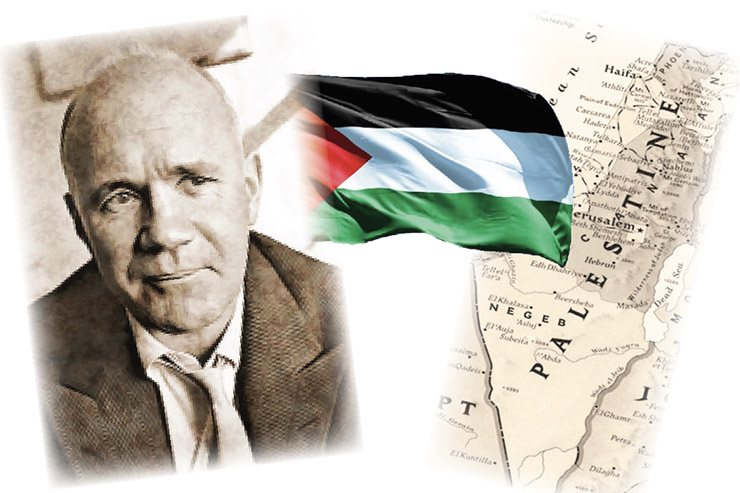
    “If I were to be asked why I support the Palestinian revolution,”1 remarked French novelist Jean Genet in a piece for the autumn 1973 issue of the Journal of Palestine Studies, “I would recall that…. I realised that it had not only changed the Palestinians but also changed me.”

    A member of the Palestine Liberation Organisation asked Genet in Paris to “visit the Palestinian camps and bases in Jordon” circa 1970, as did the Black Panther Party ask him, around that same time, to travel to the United States to join in a nationwide speaking tour2 promoting its social revolution.

    Over five novels penned in the 1940s, Genet served as a voice for those living on the margins of French society – prisoners, thieves, sex workers, beggars – and in exposing a divergent moral order, he brought a humanity to the streets in his exposition of a literary Nietzschean revaluation of values.3

    Following his US trip, Genet spent the six months to March 19714 in Palestinian refugee camps in Jordan, and it was there, amongst the Palestinian fedayeen fighters, that the writer found a social order, like that of French inmates, in which to revel and challenge the dominant paradigm.

    Indeed, the themes traversed by the writer, who spent much of his early days imprisoned by the French state, in the three pieces he produced on the dispossessed indigenous people of Palestine, are similar to those being triggered by the Free Palestine movement challenging Israel right now.

    Dispossessed by Europe

    This article is being written on the hundredth day of the wholesale massacre that the settler colonial state of Israel has been perpetrating upon the 2.3 million Palestinians of Gaza. More than 23,000 mainly civilian Palestinians5 have been slaughtered, and those numbers include over 10,000 children.6

    The state of Israel was founded in 1948 on the lands of the Palestinians after the British officially promised the region to the Zionist movement within the terms of the 1917 Balfour Declaration.7 This handover was to occur after Britain secured a mandate over Palestine following World War I.

    Zionism is a nationalist movement, developed in the 19th century, that asserts a Jewish state be established in the land of Palestine and that nation, today’s Israel, is sanctioned by the authority of the Hebrew Bible. In fact, the current assault on Gaza is understood to be part of the Zionist project.

    Early last century, the British, too, promised the Palestinians their land in exchange for their support against the Ottoman Empire, but as European powers carved up the region and established the League of Nations post-WWI, the Zionist deal was honoured, and the Palestinians were betrayed.

    This set of circumstances was mirrored post-WWII when the League of Nations was replaced by the United Nations. In 1948, the Israeli state was founded, and the Nakba – the catastrophe – unfolded with around 750,000 Palestinians forcibly removed from their lands to make way for Israeli settlers.

    As Genet describes it in his 1973 article ‘The Palestinians’,8 “the Jews had bought all the land in Palestine or driven out the population by terrorism – as if the Jews, arriving as they did with the support of European finance, had pulled away the land from beneath the Palestinians’ feet like a carpet.”

    “Visit to the banks of the Jordan”

    The ongoing genocide in Gaza has been termed the second Nakba or the continuing Nakba. The number of Palestinian casualties involved in the new catastrophe has now far surpassed the death toll9 of the 1948 Nakba, and, with this, the desire for further Israeli expansion is exposed.

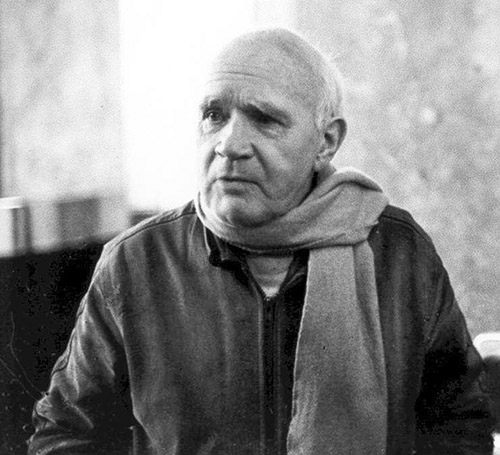
    Genet visiting a Palestinian refugee camp near Amman, Jordan, 1971. Photo by Bruno Barbey.

    Genet arrived to stay in the Palestinian guerrilla camps at Jerash and Ajloun in Jordan in October 1970, straight after Black September, which was an armed conflict that broke out between Jordan’s King Hussein and the Palestinian Liberation Organisation (PLO), then chaired by Yasser Arafat.

    Genet’s ‘The Palestinians’ covers discussions he had with a group of Palestinians in Paris in 1972. But his greater work on his experiences in the camps, 1986’s Prisoner of Love,10 is said to have been loosely commissioned by Arafat11 as he supposedly asked the author, “Why don’t you write a book?”

    “Not long after, in September 1970, when Hussein of Jordan was in danger of being beaten by the fedayeen, America came to his aid,” Genet recalls in his posthumously published memoir, Un Captif Amoureux in the French, which covers his time in Jordan, during a conflict that lasted until mid-1971.

    “What made the fedayeen supermen was that they put the predicament of all before their own individual wishes,” the novelist wrote of the fighters he so admired. “They would set out for victory or death, even though each still remained a man alone with his own sensibilities and desires.”

    Sabra and Shatila

    On the invitation of a Palestinian friend, Genet visited Lebanon in 1982, which coincided with the Israeli invasion of the south of that country, which began in June and was based on the pretext of preventing PLO cross-border attacks on Israel and it included laying siege to West Beirut.

    In 1982, the three-day massacre of thousands of Palestinian and Lebanese people in the residential neighbourhood of Sabra and the refugee camp of Shatila shocked the globe in a similar manner to the current genocide in Gaza. Genet was one of the first foreigners allowed to enter the Shatila massacre site. 

    Ending on 18 September 1982, the three-day massacre of thousands of Palestinian and Lebanese people in the residential neighbourhood of Sabra and the refugee camp of Shatila shocked the globe in a similar manner to the current genocide in Gaza, yet on a much smaller scale.

    The killing operation was perpetrated by right-wing Christian Lebanese groups sponsored by the Israeli Defence Force.

    Genet was one of the first foreigners allowed to enter the Shatila massacre site. As Egyptian writer Ahdaf Soueif recounts in the introduction to Prisoner of Love, the Lebanese army took him into custody upon learning of his visit in an effort to ensure that he did not write about what he’d witnessed.

    This reflects the western media coverage of the Gaza genocide, which has seen mainstream outlets producing sanitised Israeli-slanted versions of events since October, at the same time as Tel Aviv perpetrates multiple crimes against humanity, with western allies dismissing them as self-defence.

    The French writer entered the refugee camp in order to capture the horror of the massacre, which isn’t usually captured by other means. The novelist described the dead bodies strewn across the refugee camp using the floral prose language that he employs across all of his works.

    “A photograph doesn’t show the flies nor the thick white smell of death,” Genet writes in his 1982 essay ‘Four Hours in Shatila’.12 “Neither does it show how you must jump over bodies as you walk along from one corpse to the next.”

    Confessions of a Thief

    French society criminalised Genet at birth, even though it was not then apparent that the baby would grow up to be gay, with the writer having become aware of his sexuality in his early teens, as, at this time in Europe, if a person wasn’t heterosexual, they were breaking the law.

    Having never known his father, Genet was abandoned by his mother at seven months old and then placed into foster care via a system of the day that saw adopted children dressed in a different uniform to that of their carers’ kids.

    As Genet recounted to the BBC in 1985,13 at the age of 15 he was sent to the Mettray Penal Colony after having taken the train to Paris without a ticket. It was within the strict system of the reform facility that Jean found himself to thrive amongst the all-male cast of young “toughs.”

    As was common for a boy in his situation, at the age of 18, Genet joined the French Foreign Legion, and during his years stationed in Syria and Morocco, he developed a deep affinity with Arab culture.

    On being dishonourably discharged over having been discovered partaking in homosexual acts, the writer then spent several years as a vagabond travelling across Europe, supporting himself via sex work, begging and stealing.

    On arrival in Paris in 1937, Genet was again arrested and sent to prison. He then spent the next twelve years in and out of jail whilst he wrote a series of books along the way. And in 1949, as he notched up his 15th conviction, he was served a life sentence as the local law of the day required.

    However, a group of French intellectuals led by Jean-Paul Sartre and Jean Cocteau petitioned the French president, insisting that Genet was a literary genius, and, therefore, he should not remain in prison. This saw him freed, and he never returned to jail.

    Over the 1940s, Genet wrote and published five novels. Notable titles include Our Lady of the Flowers, The Miracle of the Rose and The Thief’s Journal. The figures occupying the pages of his novels are sex workers, transgender people, queer people, pimps and murderers.

    Genet then went on to become one of the four key playwrights of the post-World War II Theatre of the Absurd movement, penning titles such as The Maids and The Blacks. In a rush to beat the final hour, the French novelist pushed out Prisoner of Love just prior to his death from throat cancer.

    A Seismic Shift

    For Genet, the Palestinian revolution is the coalescing of Palestinian consciousness and resistance in the face of the Israeli invasion, takeover and occupation.

    This brought about a personal revolution because he realised that in Europe, he viewed the function and not the person. An example of this was his viewing waiters as their function and not people. And the function of a waiter could easily be replaced by someone else if they were sick. 

    This iconic photo of Genet is courtesy of Dr Hans Koechler, President of the International Progress Organization, who received the writer at a documentary exhibition on Sabra and Shatila at the Imperial Hotel in Vienna in 1983.

    But “in the Palestinian bases the opposite happened,” Genet wrote in his 1973 journal article. “No man was exchangeable as a man. We noticed the man only regardless of the function, and the function was not a service to maintain a system, but a fight to smash a system.”

    These social relations that existed within the Palestinian camps turned the French system of capital on its head, and this association formed part of Genet’s lifelong search for meaning outside of the mainstream. And it’s this drive for new meaning that’s being evoked by the current crisis in Gaza.

    As the scale of Netanyahu’s extermination program became apparent months ago, much of the planet’s commentariat, starting with Palestinian scholars,14 found that the complete disregard Israel is showing for global norms likely marks the beginning of the end of the international rules-based order.

    Indeed, the Global South has been looking on in disbelief as US President Joe Biden and western allied leadership lined up beside him to frame Israel’s crimes as self-defence. This stance reveals the naked hypocrisy of those who consider themselves the holders of the moral high ground.

    Get the issue this article appears in

    In Our Thousands, In Our Millions…

    In the face of ongoing Israeli atrocities, millions of pro-Palestinians have been rallying on the streets of urban centres globally. These outpourings of humanity have been persistently staged across the planet since October, despite western governments opposing them early on.

    Much has been made by older antiwar activists at these rallies, and in the media that accompanies them, in regard to the massive anti-Vietnam war demonstrations of the 1960s, as they took much longer to mobilise than the pro-Palestinian movement of the present, which appeared in an instant.

    Soueif recalls in her introduction that Genet was captivated by the Palestinian movement as it was the “antithesis of rigidity” and marked by “flexibility of… identity.” It was a campaign that could embrace all: “Cuban doctors, a French priest, a nun… a young Israeli who had renounced Zionism.”

    This is another clear similarity with the current humanitarian crisis in the Gaza Strip, as the grassroots movement opposing this Israeli-perpetrated mass killing against Palestinians living within what is a walled-in region is not just made up of Palestinian agitators.

    The Free Palestine Movement is supported by non-Zionist Jewish people the world over, as well as by the same types of left-wing, multicultural, multifaith, antifascist dissenters that filled the streets during the 2020 Black Lives Matter uprisings.

    Indeed, this movement of today is the symbol of diversity, whether that be cultural, religious or in relation to sexual identity.

    “A revolution which does not aim at changing me by changing the relations between people does not interest me,” Genet wrote in 1973 – fifty years prior to the current genocide in Gaza, which is serving to generate a massive social justice movement that incorporates diverse identities.

    “The Palestinian revolution has established new kinds of relations which have changed me,” Genet said in a line that could serve to describe many in the present, “and in this sense, the Palestinian revolution is my revolution.”

    [alert type=”general” dismiss=”no”]This article was published in New Dawn 203.[/alert]

    [alert type=”success” dismiss=”no”]If you appreciate this article, please consider subscribing to help maintain this website.[/alert]

    Footnotes

    1. The Palestinians by Jean Genet, Journal of Palestine Studies, Vol. 3, No. 1 (Autumn, 1973), 3-34, jstor.org/stable/2535526
    2. Jean Genet and the Black Panther Party by Robert Sandarg, Journal of Black Studies, Vol. 16, No. 3 (Mar 1986), 269-282, jstor.org/stable/2784171
    3. Nietzsche and the Re-Evaluation of Values by Aaron Ridley, Proceedings of the Aristotelian Society, New Series, Vol. 105 (2005), 155-175, Oxford University Press, jstor.org/stable/4545433
    4. youtube.com/watch?v=Cn7LWdmdyTU
    5. middleeasteye.net/news/gaza-war-100-days-more-than-23000-dead-society-ruins
    6. savethechildren.net/news/gaza-10000-children-killed-nearly-100-days-war
    7. youtube.com/watch?v=vLIBZ1Fewco&t=619s
    8. jstor.org/stable/2535526
    9. vox.com/world-politics/23921529/israel-palestine-timeline-gaza-hamas-war-conflict
    10. goodreads.com/book/show/85373.Prisoner_of_Love
    11. radicalphilosophyarchive.com/issue-files/rp56_article3_writingtherevolution_critchley.pdf
    12. Four Hours in Shatila by Jean Genet, Journal of Palestine Studies, Vol. 12, No. 3 (Spring, 1983), 3-22, jstor.org/stable/2536147
    13. youtube.com/watch?v=Cn7LWdmdyTU
    14. sydneycriminallawyers.com.au/blog/why-are-we-killing-children-gazas-horror-will-collapse-the-international-rules-based-order/

    © New Dawn Magazine and the respective author.
    For our reproduction notice, click here.

  • ‘All I Know is What is on the Internet’: The Emergence of the Post-Truth Age

    ‘All I Know is What is on the Internet’: The Emergence of the Post-Truth Age

    From New Dawn 199 (Jul-Aug 2023)

    It must be said that postmodern philosophy has not received the best PR. As soon as people hear the names Foucault, Deleuze, Derrida and Debord, they predictably roll their eyes, expecting some pretentious spiel about the relative nature of truth, knowledge and morality. 

    However, post-modern discourse provides valuable insight into the ‘high weirdness’ of contemporary culture, where nothing truly seems real and traditional systems of social order have begun to crumble away. 

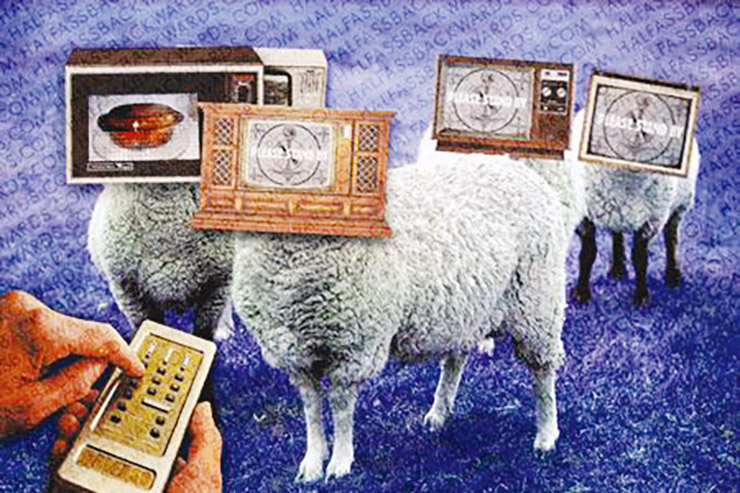
    As the mainstream media ideologically distorts and occludes reality, and big-tech companies rigorously censor alternative information (while ‘hilarious’ videos of cats falling over accumulate millions of views), it appears that there is no reality beyond that which we see through our television screens, mobiles and tablets – a world of artificial simulation and dissimulation. 

    Even the politicians, in whom we blindly place our faith and trust, have no regard for the truth since the very concept of ‘truth’ has become redundant in an age of fake news, viral marketing and social algorithms. In a telling interview, when US presidential candidate Donald Trump was confronted about an error in the statistics he presented about race-based violent crimes, he merely replied, “all I know is what is on the internet.”1

    As Dr Kane X. Faucher observes, “This kind of chamber or echo-effect of selective exposure is highly problematic for a variety of reasons, not least of which being that confirmation bias has an impact on decision-making and the possibly narrow or distorted worldview one may embrace. When it comes to what people choose to believe, this may also be on account of the narrow selective process of hidden algorithms. The tautological nature of the spectacle’s ‘truth’ forecloses the possibility of seeking beyond it to mount a significant or resonant challenge.”2 

    As social media sites subtly manipulate our political opinions, biases and assumptions, recommending certain content based on algorithmic prediction and selection, it becomes increasingly difficult to distinguish fact from fiction, truth from illusion, particularly when information has become the most priceless commodity – a substitution for the real itself. 

    How did we find ourselves in this hallucinatory, post-truth world where representation has replaced reality? Can the very notion of truth ever be resuscitated in a technocratic society where the boundary between the real and the imaginary has dissolved into thin air? 

    By turning to the postmodern thinkers of the 21st century, we can better understand why we now find ourselves in an uncanny world of simulation and simulacra – a world where the map precedes the territory.3 

    Baudrillard, Debord & the Society of the Spectacle

    Since the late nineteenth century, with the rise of mass production and industrialism, the symbolic value of commodities has superseded their functionality as consumers invest in a particular identity or lifestyle. For example, when I purchase a Mercedes car, I am not only investing in a functional object which will transport me from one place to another but a status symbol associated with ideas of luxury, comfort and innovation. 

    As the French sociologist, philosopher and poet Jean Baudrillard observed, modern society is characterised by the emergence of a sign economy, in which commodities become increasingly disconnected from the physical world: 

    …use value is itself produced as a sign (and is not a fundamental truth) to help keep consumption going and the consumer society in business. In the fetishised realm of consumption, objects are misrecognised everywhere as being endowed with forces like “happiness, health, security, etc.” We see this so much that we forget that “what we are dealing with first is signs: a generalised codes of signs, a totally arbitrary code of differences, and it is on this basis, and not on account of their use values or their innate ‘virtues’, that objects exercise their fascination.”4

    In other words, a commodity only acquires value through its differential relation to other signs rather than its intrinsic usefulness. The Mercedes car is no more luxurious than other vehicles on the market, but the company has distinguished itself by creating a brand image of luxury, comfort and innovation – social concepts which have no existence beyond their symbolic differentiation. In this sense, the sign economy functions as an entirely self-referential (or tautological) system (similar to the structure of language, where words are defined by other words, in a prison of the referential) in which consumers exchange capital (which in itself has no intrinsic value) for a particular sign or symbol, which has no instrumental function beyond the symbolic system which produces it. 

    As Baudrillard explained in Simulation and Simulacrum (1981), ever since the emergence of photography, radio, cinema, television and other replicative technologies, reality has been incrementally replaced by the representational to the point that we can no longer distinguish between original and copy

    As modern consumers are force-fed images of violence, sex and celebrity, they become so divorced from the physical world that they enter a virtual reality – that which Baudrillard terms the hyperreal

    Today, the history that is “given back” to us (precisely because it was taken from us) has no more of a relation to a “historical real” than neofiguration in painting does to the classical figuration of the real. Neofiguration is an invocation of resemblance, but at the same time the flagrant proof of the disappearance of objects in their very representation: hyperreal.5 

    The German philosopher Walter Benjamin, in The Work of Art in the Age of Mechanical Reproduction, similarly suggests that mass production not only replicates the physical but replaces it, transforming reality into hyper-mimetic simulacra: 

    What shrinks in an age where the work of art can be reproduced by technological means is its aura. The process is symptomatic; its significance points beyond the realm of art. Reproductive technology… removes the thing reproduced from the realm of tradition. In making many copies of the reproduction, it substitutes for its unique incidence a multiplicity of incidences.6 

    The copy is duplicated so many times that we cannot even speak of an original since reality itself has become the reconstruction of a reconstruction, without beginning or end, existing in a timeless present. 

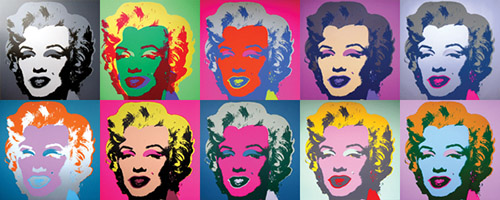
    Take Andy Warhol’s infamous Marilyn Monroe print. The public has a certain perception of the actress based on the iconography of cinema and television, and she was photographed in such a manner as to maintain this two-dimensional stereotype. This photograph is then transformed into an artistic (or aesthetic) image and sold for millions of dollars, never once leaving the realm of symbolic representation. In a sense, there is no Marilyn Monroe, only the replicated images we see of her plastered across posters, keyrings, coffee cups and other fetishistic memorabilia, where she becomes the copy of a copy, the replica of a replica, entirely disembodied from the real. 

    Andy Warhol, Marilyn Monroe (Marilyn) 1967 FS II.22-31

    However, in the age of post-modernity, where information is the most priceless commodity, the sign economy becomes uncannily spectral (and even phantasmagoric) in its non-being – an empty vacuum in which texts, images and videos endlessly circulate as if they were physical objects, even when they have no external phenomenality or dasein

    As the social media machine steadily encroaches upon our daily lives and so-called ‘influencers’ dominate the cultural zeitgeist, we become passive spectators, gawping over the latest Instagram image with 100,000 likes. While technology provides the illusion of active participation and social collaboration, in actuality, it turns us into informational consumers, entirely disconnected from the physical world. 

    As Faucher notes, “Digital representation becomes the active process and product of this milieu, a hyperreal environment that subordinates the now impoverished value of the non-digital to the production of images that are destined for digital re-production of images that are destined for digital re-production. The network spectacle is presented as unassailably good, perfect, and the primary source of the positively represented values decanted from neoliberalism such as efficiency, speed and connectivity. However, it is those very values that not only speak directly to issues of exchange value and commodity fetishism, but also physically impoverishes those who labour to support the spectacle.”7 

    As we docilely gaze at Instagram images of photoshopped models standing next to lavish sports cars with pseudo-philosophical quotes about ‘living your dreams’, we forget that a multinational infrastructure based on the exploitation of the poorest countries has been set up in order to feed our insatiable technological addiction. When we stare into the black mirror of our iPhones, we rarely think about the raw materials, sweatshop manufacture and precarious work required to keep this system in motion. The exploitation remains firmly hidden from view, keeping us ignorant as to its true economic and environmental effects. The Spectacle becomes the only knowable ‘reality’. 

    The French philosopher, film-maker and Situationist, Guy Debord, foresaw the emergence of spectacular society in which the general public passively consumes texts and images with detached fascination rather than actively participating in a vibrant culture. As he observes, in Society of the Spectacle (1967), everything “that was directly lived has moved away into representation.”8 

    Guy Debord: “When Poetry Ruled the Streets”

    In regard to political history, we remain barred from the past since time itself has entered the realm of the representational, and these representations are manufactured, designed and assembled by the Spectacle itself. The mainstream media functions as nothing more than a tautological system of informational input and output, continually referencing its own self-fabricated mythologies, narratives and constructions. 

    Debord stated: “The Spectacle proves its arguments simply by going round in circles: by coming back to the start, by repetition, by constant reaffirmation in the only space left where anything can be publicly affirmed, and believed, precisely because that is the only thing to which everyone is a witness.”9 

    Our understanding of the past has no existence outside the lens of the media, distorting, fabricating and occluding reality as we know it. Take a film like Apocalypse Now. Here, we see the cinematic representation (not to be mistaken for mere replication) of a historical event, manufactured for mass consumption, which in itself is the reconstruction of a reconstruction – a war that was televised, cinematised and narrativized to present a certain version (or model) of history. This is not to suggest that the Vietnam War never happened. On the contrary, it was a bloody and detestable conflict in which thousands upon thousands of innocent people were killed in the name of capitalist economics. But since the public’s perception of the war was always interfaced through the eye of the camera, it had no meaning beyond the screen and therefore could be replicated as replica without the real ever rearing its ugly head. 

    Online Petitions, Virtue Signalling & the Politics of the Spectacle

    In our societies of the Spectacle, political engagement becomes increasingly tokenistic, a way of providing the public with a false sense of autonomy, even as the techno-industrial machine subtly silences voices of dissidence, subversion and resistance. 

    Politics is nothing more than a theatrical drama in which public and private actors take to the stage, ‘looking good’ for the cameras, making reference to abstract ideals such as the ‘national interest,’ ‘international cooperation’ and ‘economic growth’ in order to win the hearts and minds of voters. 

    It is no coincidence that many politicians – including most famously the 40th president of the US, Ronald Reagan – have close ties to Hollywood. As Paul Virilio observes in War and Cinema, politics is now a form of entertainment and vice versa – a circus act designed to keep the masses in a state of docile complacency, with no real way of changing the system.10 

    Social media has ‘spectacularised’ political engagement in new and even more dangerous ways since it digitally empowers online users yet alienates them from the physical world, becoming nothing more than the simulation of a simulation. 

    Anyone can go on Twitter and post a 140-character tweet about Jeffrey Epstein’s ‘suicide’ or the Prince Andrew scandal, but what is the result of such anger and frustration? It merely exists inside an empty vacuum – an artificial reality – where information endlessly circulates, generating more and more content, while the dominant cultural paradigm remains untouched, unharmed and unscarred. 

    Thus, we now see the rise of the ‘virtue-signalling’ culture in which individuals openly criticise corporate exploitation, media misrepresentation and governmental corruption, even as they support the very institutional systems they verbally disparage. The proliferation of virtue signalling – in which people attempt to win praise for showing support for a social cause without actually doing anything meaningful to advance it – is a predictable outcome of the Spectacle.

    Of course, it would be inaccurate to suggest that online discourse has no impact on the real world. When the Black Lives Matter Movement urged disenfranchised minorities to take to the streets and protest against police brutality, the internet was key in organising local demonstrations, rallies and marches. Yet, even then, the movement became a mere spectacle – a televised form of entertainment – reappropriated by the mainstream media in order to maximise its informational output. 

    As Baudrillard astutely observed, that which begins in the world of simulacra inevitably ends in the world of simulacra since there is no external reality to even reference.

    This is why today we see the emergence of a ‘petition culture’ in which a disillusioned public tries to bring about meaningful change by signing online petitions, many of which never even reach the ears of the political establishment. 

    In the United Kingdom, Parliament is obliged to discuss a petition if it receives enough signatures, however these political processes are entirely theatrical – a psychodrama ritual – designed to give the illusion of democratic engagement (while the puppet masters pulling the strings remain occluded in the shadows). Thousands of people could sign a petition requesting a public inquiry into the many documents which have gone missing that implicate prominent British politicians in cases of child abuse and sex trafficking, but it would not make any difference – the game has ended before it even began. 

    Furthermore, many of the political issues which are brought before Parliament, such as the ‘energy crisis’ and the ‘cost of living’, are carefully engineered by the mainstream media in order to create problems to which the state has a solution, establishing a pretext for further governmental intervention and control. 

    Get the issue this article appears in

    Take the ‘living crisis’. Many people are urging national governments to take immediate action and implement a universal basic income, which supports the poorest in our society. However, while there is no denying that the global economy is in big trouble, the economy itself (which never leaves the hermetic realm of sign, symbol and simulation) is never brought under scrutiny – it remains a constant a priori. Moreover, there is no discussion on how a universal income would be implemented, who would control it, or whether it would lead to new forms of economic regulation (such as a social credit scoring system). 

    This is exactly how the simulacra functions – it provides ‘false’ solutions to ‘false’ problems within a ‘false’ system based on a ‘false’ currency, blurring the boundary between the real and the representational to the extent that the latter replaces the former. The modern Spectacle is so overwhelming in its hyper-mimetic power that we cannot even speak of an external reality where meaningful political change can be actualised – the medium has now become the message. 

    The profound sense of alienation, disillusionment and unreality that many of us experience in today’s ‘post-truth’ culture cannot be understood as a historically isolated phenomenon but an eschatological climax – a technological singularity – where the simulation has finally replaced the real. 

    Even a film like The Matrix does not encapsulate the hallucinatory nightmare of modern civilisation, since at least there was the possibility of escaping Plato’s cave, a division between reality and illusion; in today’s digital age, we awake from the simulacra only to find ourselves in another simulation, unable to break free from the prison of the referential. 

    Our culture will only become stranger once virtual reality technologies become increasingly advanced in their power to deceive and replace a world that never existed in the first place. As everything that is solid melts into thin air, all that remains is a dream inside a dream – a holographic universe where reality itself is but a spectral ghost of the past. 

    [alert type=”general” dismiss=”no”]This article was published in New Dawn 199.[/alert]

    [alert type=”success” dismiss=”no”]If you appreciate this article, please consider subscribing to help maintain this website.[/alert]

    Footnotes

    1. K. Faucher, (2018), Social Capital Online, University of Westminster Press, 115
    2. Ibid. 
    3. J. Baudrillard, (1994), Simulacra and Simulation, Michigan University Press
    4. J. Baudrillard, (2019), For a Critique of the Political Economy of the Sign, Verso, 90 
    5. J. Baudrillard, (1994), 45 
    6. Counterfeit Castles: The Age of Mechanical Reproduction in Bram Stoker’s “Dracula” and Jules Verne’s “Le Chateau des Carpathes”, Texas Studies in Literature and Language, Winter 2014, Volume 46, Issue 4, 428-471
    7. K. Faucher, (2018), 110
    8. G. Debord, (1970), The Society of the Spectacle, Black & Red 
    9. Ibid. 
    10. P. Virilio, (1989), War and Cinema: The Logistics of Perception, Verso

    © New Dawn Magazine and the respective author.
    For our reproduction notice, click here.

  • The Men Who Run the World: Inside the Global Power Elite’s Quest for Domination

    The Men Who Run the World: Inside the Global Power Elite’s Quest for Domination

    From New Dawn 196 (Jan-Feb 2023)

    On the surface, the men who rule the world are central and investment bankers: those who print money and create money from thin air in the form of loans. I say “men” because almost all of them are male. In addition, the men who run the world are law and private enforcement agencies. The central and private bankers cannot survive without the judges, police, and hired goons that enable their system: arrest for non-compliance, fines for failure to pay debts, etc.

    The men who run the world are, on the surface, also the founders, CEOs, and majority-shareholders of multibillion-dollar monopolies, including the internet monolith Alphabet, the tech behemoth Apple, the software monopoly Microsoft, the drug giant Pfizer, and BlackRock – the asset manager that owns the bulk of those firms’ shares. The CEOs of these companies meet several times a year at the Bilderberg Group and the World Economic Forum.

    Many of these elites operate in the even-smaller circles of secret societies and fraternal orders. In 2011, BlackRock’s co-founder and current CEO, Larry Fink, sat in the United Grand Lodge of England’s Freemasonic Hall and urged the European Union, of which Britain was then a member, to inject $2 trillion worth of central bank money into the global economy to head off recession.1 Fink’s colleagues in Wall Street and the City of London Corporation had crashed the economy in 2007-08 with their reckless gambling. Their intervention led to more than a decade of low-growth, low-wages and enormous top-down profits.

    The men who rule the world control thought with their privately-owned media. CNN and other broadcasters are owned by Warner Bros Discovery, which in turn is owned by BlackRock and other asset managers. Amazon founder Jeff Bezos owns The Washington Post (WashPo), eBay billionaire Pierre Omidyar owns The Intercept, and centibillionaire Elon Musk owns Twitter.

    With campaign donations and propaganda, these and other rich men own politicians. A record-breaking one billion dollars in lobbying in the US was spent in the first quarter of 2022 alone.2

    I say these men run the world “on the surface” because, as we shall see, an enormous secret apparatus operates in the name of national security which seeks to control the direction of these men and their investments.

    CENTIBILLIONAIRES

    In 2018, Jeff Bezos’s estimated wealth surpassed $100 billion, making him the world’s first centibillionaire for two decades. Bezos made his money, in part, by enjoying US federal government subsidies in the form of tax breaks – literally paying nothing in some years3 – and basing his business on computers and the internet, both of which were developed with public money after WWII. Generally, Amazon is notorious for not paying staff a living wage, hiring corporate spies, busting potential unions, and controlling warehouse staff with CCTV-linked to algorithms that punish transgressions, such as going to the toilet. In 2000, Bezos founded his space venture arm, Blue Origin, which in 2021 won millions of dollars worth of taxpayer money from the Pentagon’s Space Force to develop cryogenic fluid management systems for the New Glenn rocket – a heavy-lift orbit vehicle.

    Technically, Microsoft founder and CEO Bill Gates became a centibillionaire briefly in 1999, with the so-called “.com” bubble, before seeing his wealth dip below that figure. All that changed in 2019 when his wealth surpassed $100 billion, where it has remained ever since. Like Bezos, Gates enjoyed handouts from the nanny state in the form of procurement contracts, low taxes, and early dibs on innovations in non-computing fields, like geo- and genetic engineering, and particularly injectable products. Under cover of saving black children from malaria and other diseases, Gates’s Foundation has made a fortune pedalling genetically-modified crops and alleged vaccines, which need to be cooled in order to “work.” The lucrative, patented cooling technology is the most profitable part of the new jab technology, which interests Gates the most.

    Like Bezos and the rest of them, government responses to the pandemic led Gates to double his wealth4 as people were locked down and used his Microsoft products. Gates also bet on various “vaccine stocks.”5

    The world’s richest man, at the time of writing, is Elon Musk: a person born into wealth6 and who, through his Neuralink company, thinks it’s “cool” to torture primates by snatching them from their mothers, raising them in cages, and forcing them to participate in experiments that include wiring their brains to microchips, which will one day be implanted into humans. Musk’s lithium battery firm, Tesla, relies on minerals acquired from Third World countries. In the style of the more right-wing elements of the US Central Intelligence Agency, Musk tweeted about the US-backed putsch in Bolivia: “We will coup whoever we want! Deal with it.”7 Like Bezos’s Blue Origin, Musk’s SpaceX has enjoyed Pentagon contracts to save it from ruination. Musk recently supplied satellites to Ukraine in its war with Russia. Like Bill Gates buying favourable media coverage of himself and Bezos purchasing WashPo, Musk has taken over Twitter, branding himself as a saviour of the kind of speech that the neoliberal elite has gradually censored over the last few years.

    But these men are not free to do as they wish, despite the godlike status they try to portray.

    Melinda Gates implied during a TV interview that she left her husband partly because of his association with the child rapist and trafficker, Jeffrey Epstein, who was part of an intelligence agency plot to entrap and blackmail wealthy and influential people. US intelligence has had to deny plausible rumours that it is investigating Musk as a threat to national security because he reinstated former US President Trump’s Twitter account.

    SHADOW GOVERNMENT

    The men with the most influence over national politics and economics are those who work in the shadows. For instance, the “magic wall” of CNN gives Americans the supposed results of democratic elections. But not only are the candidates of elections bought by lobbyists, the “magic wall” that purports to show election results was the product of the company Perceptive Pixel, a start-up funded by the Central Intelligence Agency’s venture capital firm, In-Q-Tel.8 CNN’s then-head of politics, David Bohrman, first saw the “magic wall” at a military-intelligence event.9 In other words, CNN viewers receive their election data indirectly from the CIA. Bill Gates’s Microsoft acquired Perceptive Pixel in 2012. (In-Q-Tel is named after Q in the James Bond movies. The original Bond novels were written by the British Naval officer, Ian Fleming. Bond’s cypher was 007: the real-life cypher of the occultist and cryptologist, John Dee, a spy for Queen Elizabeth I.)

    Unlike CEOs and corporate co-founders who have their own private intelligence units and investigators,10 the military and intelligence apparatus can and does murder and threaten to murder whoever it deems a threat to “national security” – a vague phrase that, in reality, does not mean the security of you or me, but rather, the given elite’s grip on power. The controlled media complex is quick to say that the Russian state murders rival politicians and dissident journalists but claims “accident” or “suicide” when Western states do the same to irksome citizens.

    For instance, after the journalist Gary Webb exposed CIA cocaine trafficking in the 1980s, he supposedly killed himself with two bullets to the head. Agencies rely on a gullible culture and media plants to tell the public that any investigation into foul play is crazy conspiracy theorising.

    During his stint at the LA Times, Ken Dilanian worked closely with the CIA, asking for their approval for stories and to suggest stories.11 In mid-2021, Dilanian, then at NBC, downplayed the lab-leak theory of SARS-CoV-2.12 It turns out that the US had outsourced dangerous gain-of-function experiments to China via a non-profit called the EcoHealth Alliance [for more on this, see the interview with Prof. Jeffrey Sachs in New Dawn Special Issue Vol 16 No 6].

    In part, intelligence agents also rule the world by taking over local investigations. After 9/11, for example, New York police arrested Israelis who were seen appearing to celebrate the attacks. The case was transferred to the FBI, then run by the longest-serving director Robert Mueller, who let them flee to Israel.

    Intelligence agencies and their political supporters compel judges to drop certain cases. In 1989, US Attorney General Dick Thornburgh prevented evidence against a former CIA station chief from being heard in a federal court under the Classified Information Procedures Act. This led the judge to dismiss all charges.13 The agencies can do anything they like while protecting their agents from exposure under legislation like the Intelligence Identities Protection Act. Even if the higher-ups disagree with a particular operation, they protect the given agency’s reputation by shielding the rogue agents from public scrutiny.

    But agents and officers are not all-powerful. They merely exert influence by having a de facto license to kill. The public execution of John F. Kennedy in 1963 was a display of who runs the United States. In those days, it was Freemasonic networks operating in the CIA, FBI, and military intelligence. Freemasonry as an institution did not necessarily condone or have anything to do with the murder, but rather, the agents and individuals involved in the assassination happened to be high-ranking Masons: FBI Director J. Edgar Hoover, Kennedy’s replacement Lyndon B. Johnson, and Abraham Zapruder who captured the killing on camera.

    Today, multimillion-dollar companies and the people running them are already powerful, so it does not take much for agents to threaten non-compliant CEOs into doing the bidding of the intelligence agencies. This mafia form of politics makes agents operating in intelligence circles more powerful than CEOs, who become those agents’ puppets. It has been five decades since the Church Committee of the US Congress attempted to launch a serious investigation into agencies’ structures and operations.

    Ex-agents hope to become – or have become – politicians: for example, in the US, Matt Castelli (Democrat), Will Hurd (Republican), Elissa Slotkin (Democrat), and Abigail Spanberger (Democrat).

    In an interview with the multimillionaire podcaster Joe Rogan, the billionaire Facebook (Meta) co-founder Mark Zuckerberg said that his company’s decision to limit information favourable to US President Donald Trump was due to pressure from the intelligence agencies, which claimed that Trump and his supporters were a threat to US national security – again, meaning to the interests of certain elites. “Liberal” legacy media ignored the story, and the right wing focused upon it as proof of a political agenda against Trump.

    Zuckerberg was saying nothing new. In December 2020, weeks before the 6 January events, he had testified to Congress and made the same remarks. Zuckerberg: “In the weeks leading up to the election, the Director of National Intelligence, the Head of the FBI, and the bipartisan leaders of the Senate Select Committee on Intelligence reminded Americans about the threat posed by foreign influence operations… Along with their public warnings, and as part of the ongoing cooperation that tech companies established with government partners following the 2016 election…”14 Hardly anybody noticed. Twitter co-founder and billionaire Jack Dorsey said virtually the same thing during his Congressional question and answer session.

    In addition, Meta has hired ex-CIA and FBI agents to police content. Here is a small sample: CIA contractor Hagan Barnett; US Army Officer Joey Chan; CIA analyst Cameron Harris; Department of Defense project manager Sherif Kamal; DoD Intelligence Officer Suzanna Morrow; FBI threat investigator Ellen Nixon; Marine Corps Intelligence Officer Neil Potts; CIA targeting officer Scott Stern; CIA senior analyst Mike Torrey; FBI supervisory special agent Emily Vacher; and CIA counterintelligence specialist Bryan Weisbard.15

    This tells us several things. First, no matter how wealthy and powerful somebody may be, in this case Zuckerberg and Dorsey, they are usually afraid of intelligence agencies and bend to their will, even when doing so is economically harmful to the corporation (in this case downgrading and limiting content). Second, the given President’s power depends on whether or not the media support him (“him,” because at the time of writing, no women have entered this office in the US). Third, major influence can be wrought upon an election by politically-motivated intelligence agencies – in this case, killing a damaging story about the opposition candidate’s son (Hunter Biden). Fourth, their influence over corporations often involves having words with the CEOs. This is usually sufficient to push them in the desired direction.

    There is an entire network of corporate-intelligence operatives influencing business and politics.

    A few years ago, the business press reported that Deutsche Bank, HSBC, and JPMorgan were hiring former intelligence and military operatives, ostensibly to stop rogue traders. These include employees of Britain’s spy agency, GCHQ (which the NSA allegedly used as a conduit to spy on Trump), and the CIA. Big banks buy politicians with campaign donations and intelligence agencies work for those banks and influence politics.16

    BlackRock is the biggest asset manager and institutional investor in the world. Together with State Street, Vanguard, and others like Fidelity, it has a controlling institutional stake in Alphabet (which owns Google and YouTube), Amazon, Facebook (Meta), and America’s other giant corporate monopolies, as well as big pharma, big oil, big real estate, and much more. President Obama selected Tom Donilon as National Security Advisor. Donilon went on to chair the BlackRock Investment Institute. President-elect Biden even considered picking him to head the CIA.17

    Biden also filled the Treasury with BlackRockers. “BlackRock is becoming one of Wall Street’s key D.C. conduits,” says the business journal Bloomberg. Biden’s Treasury choice as senior advisor on Russia and Ukraine is Eric Van Nostrand, former BlackRock managing director. Biden already wanted former BlackRock “Sustainability” head, Brian Deese, to head his National Economic Council. Vice President Kamala Harris’s Chief Economic Advisor was another ex-Obama flunky, namely Mike Pyle who before working for Harris was BlackRock’s Chief Investment Strategist.18

    Get the issue this article appears in

    •  •  •

    These are the kind of people who meet annually at the World Economic Forum, Bilderberg Group, and other exclusive dining clubs to chat, off the record, about the direction of the world they are trying to impose on the rest of us in the name of democracy and security.

    They have already succeeded in undermining real democracy, in injecting billions of people with an experimental product under the guise of countering a global health emergency, and are now using taxpayer money and the cloak of national security to create a new era of biological manipulation to shift from the data economy to the biotech economy.

    In addition to the multitude of behind-the-scenes players like intelligence agents, the men who rule the world have some public faces, too, like Bill Gates – the so-called philanthropist buying America’s farmland and openly using “charity” as a way of making more money for himself.

    [alert type=”general” dismiss=”no”]This article was published in New Dawn 196.[/alert]

    [alert type=”success” dismiss=”no”]If you appreciate this article, please consider subscribing to help maintain this website.[/alert]

    Footnotes

    1. www.fnlondon.com/articles/blackrock-larry-fink-financial-news-awards-for-excellence-asset-management-2011-20111013.
    2. www.opensecrets.org/news/2022/05/unprecedented-1-billion-first-quarter-lobbying-haul-puts-2022-on-track-for-record-year/.
    3. www.cnbc.com/2020/02/04/amazon-had-to-pay-federal-income-taxes-for-the-first-time-since-2016.html
    4. www.oxfam.org/en/press-releases/ten-richest-men-double-their-fortunes-pandemic-while-incomes-99-percent-humanity.
    5. www.fool.com/investing/2020/09/24/4-coronavirus-vaccine-stocks-the-bill-melinda-gate/.
    6. https://sites.imsa.edu/acronym/2021/03/04/elon-musk-is-not-an-entrepreneur-hes-a-rich-deceitful-hack/.
    7. https://twitter.com/panoparker/status/1318157559266762752?lang=en.
    8. www.businessinsider.com/25-cutting-edge-companies-funded-by-the-central-intelligence-agency-2012-8?r=US.
    9. www.nytimes.com/2008/04/22/arts/television/22king.html.
    10. https://truthout.org/articles/corporate-spies-are-watching-organized-labor/.
    11. https://theintercept.com/2014/09/04/former-l-times-reporter-cleared-stories-cia-publication/.
    12. www.nbcnews.com/news/us-news/fauci-s-emails-don-t-prove-wuhan-conspiracy-raise-further-n1269650.
    13. www.latimes.com/archives/la-xpm-1989-11-25-mn-226-story.html.
    14. https://web.archive.org/web/20210329134044/https://www.judiciary.senate.gov/imo/media/doc/Zuckerberg%20Responses%20to%20QFRs.pdf.
    15. www.mintpressnews.com/meet-ex-cia-agents-deciding-facebook-content-policy/281307/.
    16. www.businessinsider.com/banks-hire-former-spies-to-try-and-prevent-misconduct-2016-2.
    17. www.politico.com/news/2020/11/25/biden-leans-toward-donilon-as-cia-chief-440669
    18. www.bloomberg.com/news/articles/2022-08-11/biden-ties-to-blackrock-deepen-with-latest-treasury-hire.

    © New Dawn Magazine and the respective author.
    For our reproduction notice, click here.
  • Lies of Our Times: Fake News & the Weaponisation of (Dis)Information

    Lies of Our Times: Fake News & the Weaponisation of (Dis)Information

    From New Dawn 173 (Mar-Apr 2019)

    According to an aphorism attributed to Benjamin Disraeli and later popularised by Mark Twain, there were three kinds of lies: lies, damn lies and statistics. To this might be added a fourth category: the lie by omission.

    They may, of course, be linked. An initial lie is told, but when information later comes to hand that discredits the initial untruth, that information is concealed or withheld from publication, or alluded to, but discredited with some epithet such as ‘it’s just a conspiracy theory’.

    The past 100 years have seen multiple examples of this form of information management. So prevalent has it become that ‘news organisations’ are no longer properly labelled as such, but rather more accurately referred to as ‘news management’.

    The first Great War, 1914-18, owed more to the machinations of the British and the French seeking to thwart Germany as a competitor to their colonial ambitions, as McGregor and Docherty1 comprehensively reveal, than it did to any assassination of a minor royal in an obscure Bosnian city. Yet we are still regaled with folk mythology, variously blaming the Turks, the Germans and even the Russians. Military disasters, such as Gallipoli, are lauded as a colonial coming of age.

    The Bolshevik Revolution in 1917 gave rise to a ‘Red Scare’ campaign that persists to this day. One early illustration of this, which as we will see has contemporary echoes, was the Zinoviev letter. This was a letter allegedly written by Gregory Zinoviev, the head of the Comintern (Communist International) in 1924, outlining a Bolshevik plot to paralyse the UK Army and Navy and plunge the UK into civil war.

    The faked Zinoviev letter was published in the Daily Mail on 25 October 1924.

    The UK Daily Mail, to this day a regular source of fake news, released the letter four days before the UK general election in October 1924. The aim was clearly to discredit the minority Labour government of Ramsay MacDonald. The letter was a fake, most likely written by Ivan Pokrovsky, an anti-Bolshevik former Tsarist officer with connections to British Intelligence.

    According to a new book by British scholar Gill Bennett,2 the most likely leakers of the letter to the Daily Mail were Desmond Morton and Joseph Ball, the then heads of what were to become MI6 and MI5 respectively. Again, there are echoes with relevance to the present day.

    UK intelligence agencies made similar attempts against Harold Wilson (UK Prime Minister 1964-70 and 1974-76), Michael Foot (prominent Labour frontbencher) and Jeremy Corbyn ([former] UK Labour leader), all smeared as “Russian agents,” “puppets of the Kremlin” or, ironically borrowing Lenin’s phrase, “useful idiots.”

    The Big Lies of the 60s

    The 1960s provided a number of classic examples of the big lie, the illicit involvement of State agencies, and an extended cover-up of the truth in which the so-called mainstream media were more than willing accomplices.

    On 22 November 1963 US President John F. Kennedy was shot by multiple gunmen. The fatal shot was fired from in front of Kennedy, blowing out the back of his skull.4 The evidence is now overwhelming that the CIA was the chief plotter against Kennedy, although multiple others were involved, and none of them by the name of Lee Harvey Oswald.5

    All of this is now well documented in many scholarly studies,6 yet those books are not reviewed in the mainstream media, and the forensic, medical and other proofs established are never discussed in the mainstream media. Although most of the principals involved are now long dead, the cover-up continues, including the blatant refusal of the CIA to release documents mandated for release under the JFK Records Act.

    Five years later, on 5 June 1968, JFK’s younger brother Bobby was also assassinated in Los Angeles while celebrating his victory in the California primary race. As with his brother, a patsy was readily identified and languishes in jail to this day.

    On 5 June 1968, US presidential candidate Robert F. Kennedy was mortally wounded shortly after midnight at the Ambassador Hotel in Los Angeles. 

    Sirhan Sirhan was in front of Kennedy, and it is not disputed that he fired several shots. He was certainly influenced by some external forces, a classic Manchurian candidate. More shots were fired than Sirhan’s gun was capable of firing. The fatal wound was from a bullet of a different calibre than Sirhan’s gun.

    The LA County Coroner, Thomas Naguchi, concluded from the post mortem examination that the fatal shot to Senator Kennedy’s head was from behind at a distance of less than 5 cm. The firer of that fatal shot was identified as Thane Eugene Cesar, a security guard and right-wing extremist with known CIA ties.7 His gun was recovered from a lake some years later and forensically matched with Kennedy’s fatal head wound.

    Naguchi’s report with its damning evidence has never received the attention it deserved. Neither has the fact that the LAPD destroyed the crime scene, including removal of the evidence of multiple gunshots from different guns.

    Two months before Bobby Kennedy’s death, civil rights leader Martin Luther King was assassinated in Memphis, Tennessee. Again, a patsy, James Earl Ray, was blamed.

    Thane Eugene Cesar

    Thanks to the efforts of the King family and a British barrister William Pepper, a civil trial (King v Jowett) was held in Memphis, Tennessee in 1999. After a three-week trial, which heard from 70 witnesses, the jury took less than three hours to find for the King family as plaintiffs. They effectively exonerated Ray and found that a conspiracy existed that included agents of the city of Memphis, the State of Tennessee and the US government.

    Only two news media representatives attended the trial. One was Wendell Stacey, the local Memphis anchorman. None of his reports from the trial were broadcast or published. The other was James Douglass, later the author of the seminal book on the JFK assassination.8 The mainstream media, which ignored the trial, immediately attacked the verdict, criticising the judge, the defence counsel and the jury. Well-known apologists for the government such as Gerald Posner were given huge air and TV time. It was yet another classic example of news management at the expense of the truth. In this case, yet again, the government had violently removed a troublesome critic or threat to its agenda.9

    The pattern was repeated in the attacks on 11 September 2001 (‘9/11’). The government expounded a fantastic tale. That key elements of the official conspiracy theory10 were literally impossible was ignored. When the FBI gave evidence at the trial of Zachariah Moussaoui, the so-called 20th hijacker, that evidence destroyed key parts of the government’s version, especially the alleged phone calls from the planes that formed a substantial portion of the 9/11 Commission Report.11 That evidence was not reported.

    This false flag attack was used to justify the ‘war on terror’ that thus far has resulted in the invasion and destruction of at least four countries (Afghanistan, Iraq, Syria and Libya); the creation of terrorist groups (many as proxies of the US and its allies) and the deaths and injuring of millions; as well as creating a refugee crisis of unprecedented proportions.

    But the official mythology lives on. The mainstream media refuse to publish anything that contradicts the government’s version of what happened on 9/11 and belittle and denigrate those who raise well-founded objections. This cannot be by chance.

    Dangerous Statecraft Plots & Lies

    Double agent Sergei Skripal was once a colonel in Russian military intelligence.

    In March 2018, former Russian spy and traitor Sergei Skripal and his daughter Yulia were found in an incapacitated state on a park bench in Salisbury, England. Within a very short time, UK Prime Minister Theresa May was making a statement in the House of Commons that the Skripals were the victims of a dastardly Russian plot involving the use of nerve agent Novichok.

    As a result of these allegations, for which there is no evidence that would withstand examination, sanctions were applied to Russia, and the already substantial vilification of that country was stepped up, following the reabsorption of Crimea into the Russian Federation.12

    More than 20 countries allied to the UK (including lapdog Australia) expelled Russian diplomats. Each and every element of the UK government’s allegations against Russia has collapsed. The story itself has descended to farcical proportions. The UK government continues to offer different and conflicting versions of what allegedly happened.

    As with the Kennedy and King assassinations, and 9/11, the absurdities and impossibilities in the official stories were simply ignored by the mainstream media.13

    The significance of one event, the prompt issuing of a D Notice by the British government suppressing the naming of one of the parties involved, Pablo Miller, was only appreciated in the light of subsequent revelations.

    Miller was a friend and neighbour of Skripal. He was the link man to Skripal for MI6 when Skripal worked for Russian intelligence and betrayed his country. Miller worked on the Skripal betrayal with his friend and colleague Christopher Steele. Steele is the supposed author of the dossier commissioned (through cut-outs) by the Hillary Clinton campaign to discredit Trump in the unlikely event – so they thought – that he would win the 2016 US presidential election.

    Far from being retired and living quietly in Salisbury (where he went after a spy swap with the Russians), Skripal appears to have been actively working for MI6. According to at least one scholar, a native Russian speaker wrote the “Steele dossier.”14 That person may have been Skripal who was undoubtedly linked with all the principals involved in that dossier, as well as having contacts in and knowledge of Russian intelligence. Russian sources were used for some of the more lurid allegations made in the dossier.

    That much is no more than informed speculation and is likely to remain so as the Skripals have in essence been kidnapped and remain incommunicado, not least to Russian consular authorities, a breach of international law.15

    There continue to be further twists to the Skripal tale. In January 2019 it was revealed that a person described as a “nurse” who “happened” to be at the scene where the Skripals were found incapacitated, was not just a “nurse.” She was, in fact, Colonel Alison McCourt, the head of the Nursing Unit of the British Army and a senior consultant to the Ministry of Defence.16

    Colonel McCourt is the holder of an OBE, awarded for services in combatting the Ebola epidemic in Sierra Leone. In that role, she had regular contact with the biological unit at Porton Down, the British facility for chemical and biological warfare research, which just happens to be close to both Salisbury and Larkhill where McCourt lives.

    Sunday Mail newspaper story about leaked documents that revealed the Integrity Initiative – which is funded by the UK Foreign Office and run by military intelligence specialists – led a disinformation attack on UK Labour Party leader Jeremy Corbyn.

    At about the same time as these revelations came to light, an anonymous leaker disclosed details of a hitherto unknown organisation called the Institute for Statecraft (“I for S”), and its subsidiary arm the “Integrity Initiative.” The “I for S” is a charity registered in Scotland, although its address in official records is an abandoned derelict building in Fife. The real headquarters are in Temple Place, the Embankment district of London, a decidedly more expensive piece of real estate.

    The “I for S” and the Integrity Initiative claim to be set up to promote “western values” and to counter Russian and other unfriendly countries’ “propaganda and disinformation.” In a written reply in the House of Commons, a Foreign Office Minister, Sir Ian Duncan, admitted that the “I for S,” “whose work seeks to improve governance and national security,”was financed in part by the Foreign Office to the tune of just under two million pounds sterling in the 2018-2019 financial year.

    We now know that this Institute has other sources of income, including from NATO, the US Department of State, and the Lithuanian government. The Director of the Institute is Christopher Donnelly who holds the rank of Colonel in British Intelligence. Members of the advisory board include Howard Body, Assistant Head of Scientific Support at Porton Down; Helen Boaden, a senior executive with the BBC; Duncan Allen from the Foreign Office; Zachary Harkenrider (likely CIA station chief in London), and no less a person than Pablo Miller.

    In the Bond film ‘Goldfinger’, based on Ian Fleming’s book of the same name, the eponymous villain says to Bond: “In Chicago they have a saying: once is happenstance, twice is coincidence, the third time is enemy action.”

    The interplay of various characters, only some of whom are named here,17 definitely puts the events into the realm of enemy action.

    Contrary to its protestations, the “I for S” is not just seeking “to improve governance and national security.” As admitted by its head Donnelly,18 it relies on “clusters” of individuals in various countries, including academics, journalists, military personnel and politicians, to conduct campaigns.

    These campaigns include the blocking of dissenting voices, overt attacks on critics of government policy (including smearing people such as Jeremy Corbyn as noted above), promoting anti-Russian propaganda, and what Donnelly refers to as “waging a new kind of warfare in which everything becomes a weapon, including disinformation which gives conflict a third dimension.”19

    The Institute for Statecraft also has links with a US company with similar aims, the Rendon Group, which played a prominent role in ‘selling’ the Iraq war.20

    Get the issue this article appears in

    A Catastrophe “to wake people up”

    A further extraordinary coincidence is found in a briefing paper prepared for the Institute in early 2015 in which they called for “a catastrophe to wake people up and demand a response.”21 This is reminiscent of the 2001 Project for the New American Century (PNAC) paper, ‘Rebuilding America’s Defences’, which called for a New Pearl Harbor. That paper was immediately followed by 9/11.

    The 2015 Institute paper called for steps to be taken in the event of this “catastrophe” occurring, including the mass expulsion of Russian diplomats and other actions against the Russian government. An attack on individuals or institutions in the UK was seen as a possible trigger.

    Those steps were taken following the “catastrophe” of an alleged nerve agent attack on persons in the UK by or at the instigation of the Russian government. That those steps were taken without a shred of evidence that Russia was indeed involved (as seems the remotest of possibilities) is as telling as the fact that immediately before the Skripal incident then Australian Prime Minister Malcolm Turnbull was in the UK.

    Notwithstanding the legal training both he and the (then) Foreign Minister Julie Bishop have, they were remarkably quick to condemn Russia for its alleged involvement. Their disregard for basic legal principles such as the presumption of innocence, and the requirement of admissible evidence to a high standard as prerequisites for conviction, is on a par with their alleged adherence to international law when joining illegal ventures such as attacking Afghanistan, Iraq and Syria.

    The Institute for Statecraft is far from benign. Its agenda, personnel, its connections and its modus operandi, all point to it being a malign influence on the flow of information, respect for international law, and the proper conduct of relations between nations.

    A Google search in the Guardian Australia, ABC, SBS, News Corporation and Fairfax Media websites reveal not a single mention of the Institute for Statecraft or the Integrity Institute. This is unlikely to be a coincidence. This is an important story, the surface of which has barely been scratched. As with the long history of the suppression of vital information, some examples of which are cited above, this is another illustration of that fourth type of lie: the lie by omission.

    If the current remnants of our democracy are not to be completely demolished, this latest version of Operation Mockingbird22 – where the mainstream media were thoroughly infiltrated by ‘journalists’ whose primary role was to faithfully reflect whatever version the government of the day proffered – must be exposed for the insidious danger that it is – and destroyed.

    [alert type=”general” dismiss=”no”]This article was published in New Dawn 173.[/alert]

    [alert type=”success” dismiss=”no”]If you appreciate this article, please consider subscribing to help maintain this website.[/alert]

    Footnotes

    1. G. Docherty & J. Macgregor, Hidden History: The Secret Origins of the First World War,MainstreamPublishing 2014
    2. G. Bennett, The Zinoviev Letter, Oxford University Press 2018
    3. S. Cohen, War with Russia?, Hot Books 2018
    4. C. Crenshaw, JFK: A Conspiracy of Silence, Mass Market 1992; J. de Eugenio, Reclaiming Parkland, Skyhorse 2013
    5. J. Armstrong, Harvey & Lee, Quasar 2003
    6. J. De Eugenio, Destiny Betrayed, 2nd ed., Skyhorse 2011
    7. www.maryferrell.org for copious citations
    8. J. Douglass, JFK and the Unspeakable, Simon & Schuster 2010
    9. W. Pepper, The Plot to Kill King,Skyhorse 2016
    10. www.ae911truth.org
    11. D Griffin & E. Woodworth, 9/11 Unmasked: An International Review Panel Investigation, Olive Branch Press 2018
    12. M Kramer, ‘The Transfer of Crimea from Soviet Russia to Soviet Ukraine’, www.wilson
    center.org, 19 March 2014
    13. R. Slane, ‘Summing Up the Official Claims in the Salisbury Poisonings’, www.theblogmire.com, 9 January 2019
    14. J. Gilbert & J Cashill, ‘Did Christopher Steele Write His Dossier or did a Russian Associate’, www.americanthinker.com, 19 January 2019
    15. Vienna Convention on Consular Relations, 1963
    16. ‘Coincidence?’ www.moonofalabama.org, 19 January 2019
    17. For a comprehensive listing, see P. McKeigue, et al., ‘Briefing Note on the Integrity Initiative’, www.syriapropagandamedia.org, 21 December 2018
    18. T. Kevin, ‘Dad’s Army’s Cover Blown’, www.off-guardian.org, 8 January 2019
    19. Ibid
    20. www.private-eye.co.uk, 10 January 2019
    21. K. Klarenberg, ‘Anonymous Exposes UK Hybrid Warfare Project’, www.sputniknews.com, 4 January 2019; T. Secker, ‘Was the Integrity Initiative Behind the Salisbury Poisoning’, www.themindrenewed.com, 4 January 2019
    22. C. Bernstein, ‘The CIA and the Media’, www.rollingstone.com, 20 October 1977

    © New Dawn Magazine and the respective author.
    For our reproduction notice, click here.