New Dawn – World's Most Unusual Magazine

Category: Behind the News

  • Global Terror: The British Connection

    Global Terror: The British Connection

    From New Dawn 92 (Sept-Oct 2005)

    The 2024 collapse of the Assad government in Syria happened not by accident but by design, the ultimate result of forces unleashed in the wake of the West’s so-called war on terrorism, which was a response to terrorist incidents such as the July 5, 2005, London bombings and the September 11, 2001 attacks in the USA (the official narratives of these events are now seriously challenged). The following article is a backgrounder on the secret wars and mass manipulation to engineer a new reality for the Middle East and impose laws that restrict freedom.

    “There are powers at work in this country about which we have no knowledge.”
    – Britain’s Queen Elizabeth II speaking to Paul Burrell, former butler to the late Princess Diana

    On July 7, 2005 bombings on the London subway system and a bus killed 52 people and injured 700. As the list of unanswered questions and inconsistencies about the attacks continued to grow, blame was quickly laid on ‘al Qaeda’.

    The effects of the London bombings were immediate: There was a renewed commitment by Western leaders to the ‘war on terror’. Most other stories and scandals were wiped off newspaper front pages, including UK Prime Minister Tony Blair’s plummeting popularity.

    The bombings occurred while the G8 Summit was going on in nearby Gleneagles, Scotland. It was here the topic of terrorism was beginning to seem tired amid broadening demands for debt cancellation for impoverished countries. US President George Bush’s priority – the ‘war on terror’ – was moving out of the limelight.

    Afterwards, with London smoking and bleeding, Bush and Blair were able to stand up tall and look strong as they declared the ‘war on terror’ would be won: “we will prevail and they will not,” and, “we alone are fighting” to defend “the values of Western civilisation.” Terror returned to front and centre and further debt cancellation was forgotten.The bombings were the green light for Tony Blair to introduce draconian anti-terrorism legislation which had previously been thwarted by judicial rulings designed to protect human rights.
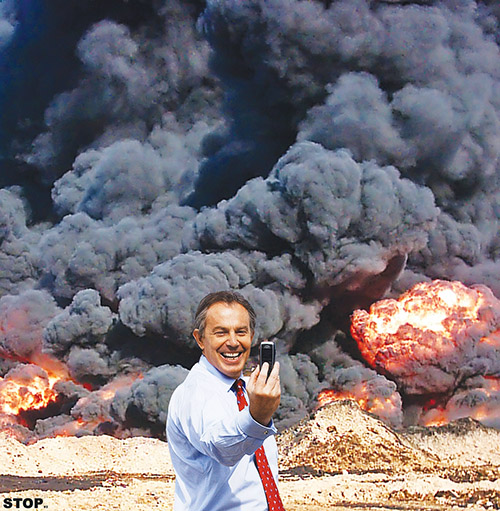
    Blair said he plans policies for deportation of people who “foster hatred.” Parliament will also be asked to pass a law against “condoning” or “glorifying terrorism” anywhere in the world, and giving the government the power to close places of worship. Lists are to be drawn up of ‘extremist’ websites, bookshops and centres.

    A clampdown on words or actions likely to be seen as ‘glorifying terrorism’ could affect groups and individuals unconnected to ‘Islamic extremism’ – animal rights activists, for example, may have to change much of what they write if they are not to fall foul of the legislation. British MP George Galloway, a vocal supporter of the Iraqi resistance movement, could be charged under the new law because the government has demonised the resistance as ‘terrorists’.

    Australian Prime Minister John Howard also announced a similar review to ‘tighten up’ anti-terrorism legislation.

    Who was ultimately responsible for the July 7 bombings remains a mystery. But authorities seemed to know who was behind it soon after the attack. London Metropolitan Police Commissioner Sir Ian Blair had already made up his mind when he said the investigation into the bombs will uncover a “clear al Qaeda link.”

    Responding to news of the July 7 bombings, Ayatollah Ahmad Jannati, who heads Iran’s top legislative watchdog the Guardian Council, said the British had themselves to blame.

    “One possible set of culprits is al Qaeda. But al Qaeda is Bush and Blair. Who launched al Qaeda? You must be tried, you who are the mothers of al Qaeda,” he told worshippers at Friday prayers in Tehran.

    “The other likelihood is that the British regime may have carried out the attack itself… because it benefits most… They want to justify their presence in Iraq and Afghanistan,” he added.

    July 7 Anomalies

    Independent researchers across the world have uncovered information which contradicts the official version of events and points to the involvement of intelligence agencies in the bombings.

    Hardly any mainstream media picked up the news that ‘bombing exercises’ were being conducted in the London Underground at the same time as the actual attack.

    Only hours after the July 7 bombings, in an interview on BBC radio, Peter Power, Managing Director of Visor Consultants, made the extraordinary admission that at precisely the time the London bombings took place, his company was running an exercise which drilled the London Underground being bombed at the exact same locations, at the exact same times, as happened in real life on July 7. Visor Consultants is a “crisis management advice company” or PR firm.

    Power said the drill focused around “simultaneous bombings.” Originally the London bombings were thought to have been spread over an hour, but later it was revealed they were in fact simultaneous. Also, they were easier to execute as Britain’s terror alert level had just been lowered.

    “We had to suddenly switch an exercise from fictional to real,” said Power who is a former Scotland Yard official, working at one time with the Anti Terrorist Branch.

    Responding to a deluge of emails after his admission, Power strenuously denies any truth to “conspiracy theories” tying his company to the attacks, but he does confirm the exercise involved a “short number of ‘walk through’ scenarios for a private company in London as part of a wider project that remains confidential.”

    Some investigators suspicious of Visor Consultants suggest the company might have released information to the media that the bombings were a power surge. For the first hour this was the explanation given, and one that would give authorities time to manage the release of information about the explosions. Power has been hired by the British government before and has on previous occasions released information after terrorist incidents in London. This is all too close to dismiss as simply coincidence.

    A news report which almost went unnoticed hints intelligence agencies had prior knowledge of the attacks.

    Arutz Sheva, pegged as Israel’s national news Internet site, stated on the day of the July 7 bombing: “Army Radio quoting unconfirmed reliable sources reported a short time ago that Scotland Yard had intelligence warnings of the attacks a short time before they occurred. The Israeli Embassy in London was notified in advance, resulting in Finance Minister Binyamin Netanyahu remaining in his hotel room rather than make his way to the hotel adjacent to the site of the first explosion, a Liverpool Street train station, where he was to address an economic summit.”

    This report was subsequently refuted and changed to say Netanyahu was warned after the first blast.

    The importance of Visor Consultant’s training exercise cannot be understated because the exact same scenario played out in the United States on the morning of September 11, 2001.

    The Pentagon and the North American Aerospace Defense Command (NORAD) conducted drills involving multiple hijacked planes on the morning of September 11, 2001. And in what the US government called “a bizarre coincidence,” the US National Reconnaissance Office had planned an exercise for September 11 in which an errant aircraft would crash into an office tower. American Airlines Flight 77, which crashed into the Pentagon, took off from Dulles at 8:10 AM on September 11 – 50 minutes before the exercise was said to begin.

    On the morning of 9-11, NORAD radar screens showed as many as 22 hijacked airliners at the same time, but they had been briefed this was part of the exercise drill and therefore normal reactive procedure was forestalled and delayed. The two scenarios are comparable in that it is a tried and tested method of navigating around everyday security services, and, more importantly, if the perpetrators get caught during the attack or after with any incriminating evidence, they can just claim they were taking part in an exercise.

    What are the odds of coincidental ‘drills’ going on at the exact same time real life events were taking so many human lives in two terrorist attacks?

    We are also faced with the scenario of four men, one of whom had a new family, and another whose wife was pregnant, carrying bombs set on timers and calmly waiting for them to explode.

    A statement issued by the family of the so-called “fourth suicide bomber”, Jamaican-born British resident Germaine Lindsay, said he “had a kind, caring and calming presence about him.”

    “He was a good and loving husband and a brilliant father, who showed absolutely no sign of doing this atrocious crime. We as a family had no idea of his plans and are as horrified as the rest of the world.”

    The incongruities of the case have already prompted even some official investigators to suggest the men were not ‘suicide bombers’ but may have been duped by their “al Qaeda handler” into believing they would only place the explosive devices and not be killed in the blast. But it also makes sense if the men thought they were carrying fake bombs as part of a terror drill.

    Lending weight to this theory is the fact all four men had paid up their parking tickets before boarding a train at Luton for King’s Cross and they all bought return tickets to the capital.

    The lack of video taped evidence revealing the alleged bombers’ movements is also suspicious. Every London bus and Underground train carriage is said to have multiple video cameras, but the one on the bombed bus apparently “malfunctioned.” Videos of the other men have not been made available, only a few grainy images of the men at the start of their journey boarding the train at Luton.

    Another piece of the jigsaw being pieced together by independent investigators is the testimony of 32 year-old dance instructor Bruce Lait, who was just metres away when a bomb ripped through his train carriage. He miraculously escaped with only minor injuries.

    Speaking from his hospital bed in an interview with the British newspaper Cambridge Evening News of July 25, Lait recounts what happened after the bomb went off and how a policeman helped him out of the carriage, adding that, “The policeman said ‘mind that hole, that’s where the bomb was’. The metal was pushed upwards as if the bomb was underneath the train. They seem to think the bomb was left in a bag, but I don’t remember anybody being where the bomb was, or any bag.”

    Then on July 21, two weeks after the July 7 bombings, four attempted bomb attacks disrupted part of London’s public transport system. By July 29, police had arrested all four of the main bombing suspects and numerous other people.

    The July 21 attacks were immediately linked to the previous bombings, however it is has now been established there was no connection between the men involved in both attacks.

    The police operation that quickly rounded up all the suspects of the copycat July 21 attack succeeded in monopolising media coverage and taking attention away from growing doubts about the official version of the July 7 bombings.

    Hamdi Issac, one of the July 21 bomb suspects held in custody in Rome, says his backpack contained only flour and was designed merely to frighten. This explains why the so-called bombs let off a small bang followed by some smoke smouldering from their backpacks. According to Italian daily La Repubblica, he claims not to have planned to kill anybody in the attack, “let alone myself.” He added that the July 7 bombings in London, “happens every day in Iraq.”

    The difference between the two bomb attacks could not be starker. The bombers of July 7 are all dead and police have made no arrests of significance in connection with it. The attacks of July 21 led to the arrest of all those directly involved including dozens of people who supposedly are ‘connected’.

    Perhaps one of the biggest indicators of an intelligence agency link to the July 7 bombings is the revelation that Haroon Rashid Aswat – allegedly the “mastermind” of the attacks – is controlled by MI6, Britain’s external security service.

    Speaking on July 29 to Fox News channel, former US Justice Department prosecutor and terrorism expert John Loftus discussed Aswat’s relationship to British and US intelligence, through a British based organisation Al Muhajiroun.

    Loftus added that, “the entire British police are out chasing him [Aswat], and one wing of the British government, MI6 or the British Secret Service, has been hiding him…” Loftus adds that Aswat’s role as an informer or a ‘double agent’ had protected him from being arrested by the CIA because he “was working for British intelligence.”

    Arresting and putting Aswat on trial in a secret tribunal for organising the July 7 attacks could be turned into a two fold victory for the intelligence agencies: al Qaeda is proved to be responsible, and a blowback remnant and potential whistleblower from their past operations is taken out of circulation.

    Londonistan

    Space does not permit a full accounting of Britain’s creation and manipulation of certain so-called ‘Islamic’ organisations in the late 19th and early 20th century. Close to a century ago the British began cultivating Islamic groups to counter the rising tide of Arab nationalism which demanded independence from colonialism. Suffice to say, as masters of political manoeuvring and intrigue, British geostrategists have for many years struggled to control events in the oil rich Middle East.

    Up until recently, this strategy allowed a flood of ‘Islamists’ from Egypt, Saudi Arabia, Afghanistan, Pakistan and Palestine, to live in Britain, a safe haven where they could further promote their various causes.

    By the 1980s and 90s, foreign intelligence services were complaining about the policy. The French were particularly incensed, tracing the origin of the 1995 bombings of the Paris Metro to cells operating, with apparent impunity, from London.

    The Russians repeatedly expressed displeasure over Britain providing asylum for Chechen separatists, which they say is a double standard in the fight against terrorism. Two of the terrorists behind the massacre of 300 people, half of them children, in Beslan, Russia in 2004, were British citizens.

    It is well known that for more than two centuries, the West has been engaged in breaking up – or thwarting – the presence and extension of Russian influence southward to the Black Sea and beyond. Destabilising the Russian republic of Chechnya is a key aspect of this strategy, part of the ‘New Great Game’.

    The New Statesman revealed in December 2002 that, even a year after September 11, Britain was still seen as excessively tolerant. In a cover piece entitled ‘Londonistan’, the Statesman quoted European and American officials as suggesting the UK “had come to a non-aggression pact with Islamist oppositionists dating back to the mujahedin rebellion against the Soviet-backed regime in Afghanistan”: a deal that might explain British immunity from ‘Islamic’ attacks.

    Years before September 11 there were calls for Britain to give up harbouring certain groups, but these pleas fell on deaf ears.

    Malaysian Prime Minister Dr. Mahathir Mohamad, at the 1997 summit of the Organisation of Islamic Conference decried “Western democracies,” meaning in this case, Britain, which “give refuge to those of our people who promote disruptive activities in our countries,” even while accusing Islamic nations of promoting “terrorism.”

    The ‘Islamic Group’ that claimed credit for the November 1997 shootings in Luxor, Egypt which killed over 60 people, mostly foreign tourists, had its international headquarters in London.

    Al Ahram, the Egyptian government daily, in a feature entitled ‘How Can We Surround and Extradite London’s Lords of Terror?’ published on December 7, 1997, documents how London became an “Islamic” terrorist haven following the war in Afghanistan, when “legions” of unemployed mujahideen, who had been drawn to Afghanistan from all over the Muslim world, flocked to London for protection, and for new assignments.

    Al Ahram quotes an unnamed security source, in its analysis of British motives in making London the “world’s terror capital,” which partially describes the thinking of British intelligence. “The British expect to reap a great advantage through controlling the most dangerous terrorists on its soil,” it quotes the source as saying.

    “Through this logic,” the source continues, “British intelligence works contrary to all its counterparts in the world. The information British intelligence has acquired about these groups and its members, is an invaluable card, which it can use to either negotiate, or put pressure on, Middle East states.”

    Al Ahram adds that part of the purpose is to manipulate these groups and take them over, on behalf of British geopolitical aims.

    Al Ahram’s source concludes: “London’s ‘permanent interests’ have always converged with the lords of terrorism who live in Britain, and who never underestimate what their existence represents for British interests.’’

    After September 11, French intelligence officials again angrily accused Britain’s internal security agency MI5 of failing to cooperate in stifling ‘Islamic’ terrorist groups. The level of assistance received from British intelligence in tracking down terror cells was described as being worse than before September 11.

    The mid-1990s witnessed a series of vicious wars that led to the break up of Yugoslavia. The Pakistan-based militant group Harkat-ul-Mujahideen (HUA) was one of the many organisations to send a contingent to help Bosnian Muslims in their fight against the Serbs. They were sent by the Pakistan government of Benazir Bhutto at the request of the US administration under Bill Clinton.

    The contingent, which was raised and trained by Lieutenant General (retired) Hamid Gul, former director general of Pakistan’s Inter-Services Intelligence (ISI), included a large number of British Muslims of Pakistani origin.

    According to estimates, about 200 Muslims of Pakistani origin living in the UK went to Pakistan, received training in the camps of the HUA, and joined the HUA in Bosnia with the blessings of London and Washington. Among them was Omar Sheikh, who went on to mastermind the murder of US journalist Daniel Pearl in 2002.

    In the late 1990s, the Kosovo Liberation Army (KLA) also attracted many foreign fighters, encouraged by an outpouring of Western support to help defeat an alleged Serbian genocide. One of those fighters was David Hicks, who is now locked up in the Guantanamo Bay prison camp.

    In Crossing The Rubicon, investigative journalist Mike Ruppert notes: “Great Britain – one of the major players supporting the KLA in Kosovo – also maintained secret relationships with bin Laden… In 1996, Britain’s exterior intelligence, MI6, actually funded and worked with al Qaeda in a plot to assassinate and overthrow Libya’s Muammar Qadhafi. Details of the relationship emerged after a British domestic intelligence (MI5) officer, David Shayler, went public with documents detailing the relationship between Britain and bin Laden.”

    A decade before Bosnia and Kosovo, the West had raised and funded a large corps of fighters – including Osama bin Laden – to help the mujahideen in their jihad against Soviet troops in Afghanistan in the 1980s. Most of these ‘Freedom Fighters’ returned home, but many remained under Western intelligence agency control. Some were soon redeployed to North Africa and the Middle East, to carry out terrorist actions ascribed to ‘Islamic terrorist groups’, on behalf of Western geopolitical aims.

    Question is: Are some of these fighters participating in the ‘war on terrorism’, and who do they work for?

    Who Benefits?

    After September 11, terrorism suddenly became enemy number one. The threat was conflated into the proportions of an alien invasion. However, whether it was real or not, the powers-that-be promptly took advantage of the terrorist bogeyman.

    Armies could be mobilised against any country alleged to be ‘harbouring’ the new terrorist enemy (ie. Afghanistan and Iraq). An elusive enemy could strike anywhere at anytime, which meant sacrifices at home (anti-terrorism laws).

    Such an enemy of vague and ambiguous proportions could be easily stage-managed. It is now irrelevant whether Osama bin Laden is alive or dead, or that he controls an actual organisation with certain objectives. The myth is born. And now those with real power – military force and ‘informational dominance’ – easily direct the outcome of the new game.

    With ‘jihadists’ on the loose worldwide, we would expect to see many attacks. Instead, despite the mainstream media’s duplicity, since September 11 the Western world has witnessed only a few spectacular attacks supposedly carried out by small groups ‘connected’ to ‘al Qaeda’.

    With great fanfare in the corporate controlled press, large numbers of Muslims have been rounded up in raids across Britain, Europe, the US, and Australia. But most were later released and no one has been proven to be an ‘al Qaeda’ operative. For example, following the well publicised ‘ricin affair’ in the UK in January 2003, it was later established there was no ‘ricin’, no ‘cell’, and no ‘al Qaeda’ connection.

    The independent British journalist William Bowles notes that, “with hundreds arrested under anti-terror laws but not a single conviction of anyone actually proved as being a member of al Qaeda or even being caught red-handed with a bomb, it’s safe to assume that it’s unlikely al Qaeda actually exists as an effective organisation, let alone operates an ‘international terror network’.”

    Statements of responsibility made in the name of ‘al Qaeda’ or the fact an individual claims to be acting on behalf of it (after being ‘softened up’ at a secret prison camp), does not prove such an organisation exists.

    Official briefings about terrorism, often unverified or unverifiable by journalists, have become dramatic press stories. Few of these ominous announcements are retracted if they turn out to be baseless. Almost no one questions the myth of ‘al Qaeda’ because so many people have got an interest in keeping it alive.

    It is not too difficult to understand the relative ease in which intelligence agencies, with all their financial and information resources, can manipulate data (as we saw in the recent WMD justification for war on Iraq) and people to achieve objectives.

    Is the ‘war on terror’ running a little flat? Let’s raid the homes of some Muslims and then leak to the press that ‘Muslim extremists’ were planning ‘terrorist attacks’ on Australia’s Sydney’s Opera House and Harbour Bridge (such raids actually occurred in Melbourne on June 22). What’s even better, the families whose homes were raided are prevented from speaking out by new anti-terrorism laws.

    Thus, we never know if the raids prevented a terrorist plot or they were a publicity stunt for the ‘war on terror’. But headlines have the desired effect, the not so subtle reminder there’s a ‘war’ going on and it might one day come to your home, your office, or your child’s school – just as it did to commuters in London on July 7.

    Can we say the cause of Islam benefits from terrorist attacks that kill civilians? No, of course not. The beneficiaries are governments who can ‘justifiably’ continue to support Bush’s ‘war on terror’ (which enriches the military-industrial complex) and introduce long sought laws that curtail civil liberties and limit dissent.

    In London today they are now implementing intrusive surveillance and policing of Muslims and the Muslim community. The attacks have justified the introduction of ID cards, which will hold substantial personal information.

    New ‘anti-terror’ laws being rushed through the UK Parliament include rules allowing the government to impose curfews and the electronic tagging of people suspected of terrorism.

    A Phoney ‘War on Terror’

    It goes without saying that the overwhelmingly majority of Muslim organisations are entirely legitimate and also it cannot be assumed that all groups cited in this article are simply the products of Western intelligence. What the evidence reveals is that intelligence agencies have tirelessly worked to infiltrate groups of all political and religious persuasions in an effort to achieve their objectives.

    The use of agent provocateurs is a well established method that many states still use against their perceived enemies. It would be child’s play for well established spy agencies such as Britain’s MI6, America’s CIA, and Israel’s Mossad to control ‘al Qaeda’, which barely exists at all, except as an idea or a myth about cleansing a corrupt world through religious violence.

    Much of the currently perceived threat from international terrorism, argues the recent TV documentary ‘The Power of Nightmares: The Rise of the Politics of Fear’, “is a fantasy that has been exaggerated and distorted by politicians. It is a dark illusion that has spread unquestioned through governments around the world, the security services, and the international media.”

    “In an age when all the grand ideas have lost credibility, fear of a phantom enemy is all the politicians have left to maintain their power,” it says. A perpetual war against an invisible and entirely fictitious enemy.

    Five continuous years of a ‘war on terrorism’ past the point of no return have left the line between fabricated (intelligence agency-orchestrated) terrorism and any ‘real’ terrorism (a response to the provocations and policies) irrevocably blurred.

    As a willing partner in this enterprise, the mainstream media has distorted the truth by ‘pre-packaging’ language in a way that paints the world into black (‘terrorist’) and white (‘us’). Shades of grey (where truth and reality normally reside) are difficult to describe in just a few words. Terms such as ‘terrorist’, ‘act of terror’, ‘fundamentalism’ or ‘threat’ act as familiar signposts for the public, to be regurgitated in social discourse without any knowledge of the semantic meaning of the language being employed.

    George Orwell warned that an individual’s thought processes were undermined by what he disparaging termed ‘journalese’ or ‘officialese’. When an individual becomes a slave to official jargon they are, in a sense, gagged. Individuals are prone to use ‘officialese’ and follow the ‘mindless thought grooves’ which, in Orwell’s opinion, could easily be replaced with more accurate and thoughtful terms.

    In George Orwell’s classic novel 1984, the totalitarian state of Oceania is perpetually at war with either Eurasia or Eastasia. Although the enemy changes periodically, the war is permanent; its true purpose is to control dissent and sustain dictatorship by nurturing popular fear and hatred.

    Newspeak, the “official language” of Oceania, reduced the number and variety of words in use to render dissenting thought obsolete. Closely related to Newspeak is Doublethink, in which someone is conditioned to either say the opposite of what he thinks or think the opposite of what is true.

    By the devious abuse of language and spreading the fear of more terrorist attacks, the government and the corporate media are numbing us into blindly accepting the emerging totalitarian state.

    [alert type=”general” dismiss=”no”]This article was published in New Dawn 92.[/alert]

    [alert type=”success” dismiss=”no”]If you appreciate this article, please consider subscribing to help maintain this website.[/alert]

    © New Dawn Magazine and the respective author.
    For our reproduction notice, click here.
  • Mind Benders: Hollywood & Predictive Programming

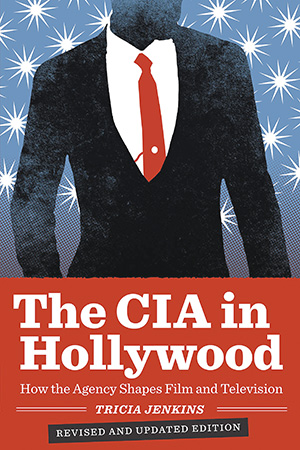
    Mind Benders: Hollywood & Predictive Programming

    From New Dawn 189 (Nov-Dec 2021)

    The Millennium was a time of spiritual reflection for many people. Objectively, it was an arbitrary date on the calendar, but psychologically people invested the occasion with hope and caution about the future. 

    Media cited pseudo-science about Y2K, the fictional Millennium Bug painted as real that would shut down everything run by computers as soon as the digits exceeded 99 and reset to zero. Evangelicals preached doomsday, pointing to the Apocalypse foretold in the Book of Revelation. The prophecies of Nostradamus (Michel de Nostredame, 1503-66) were interpreted as such that the world would end. 

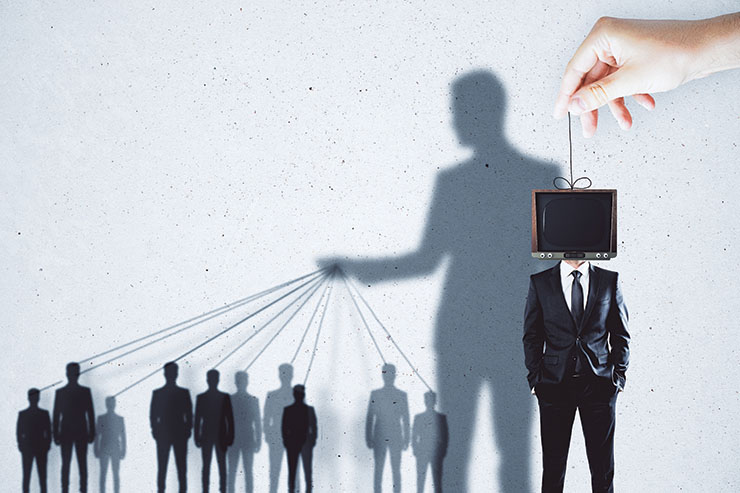
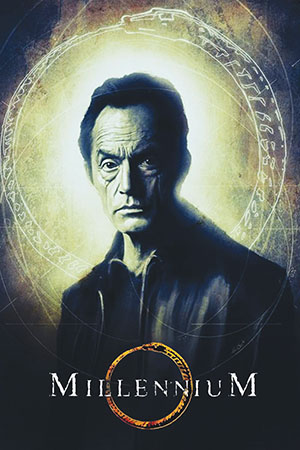
    In the mid-1990s, the creators of The X Files introduced Millennium, a dark detective show about an investigator connected to a secret society, whose symbol was the ouroboros: the serpent eating its own tail, signifying eternal destruction and rebirth. In “Destination Eschaton,” a pop band, The Shamen, sang to a disposable beat that “Up out of the turbulence/A better order shall emerge.” A series of movies, including Ed TV (1999) and The Truman Show (1999), gave unthinking audiences their first taste of Gnosticism: that perhaps their “reality” is not real at all. Perhaps forces outside their immediate perception orchestrate their fate: secret societies, intelligence agencies, aliens, demons, or even gods. 

    WHAT IS PREDICTIVE PROGRAMMING?

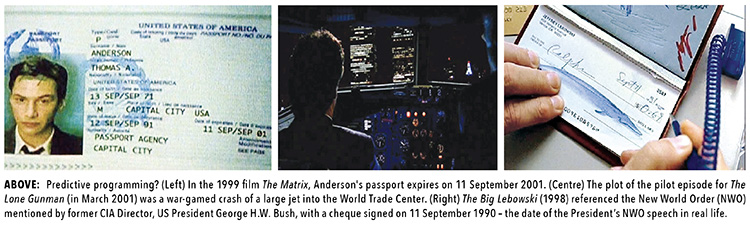
    By far the most financially successful movie in the “waking up” triptych was The Matrix (1999), written and directed by the Wachowski brothers (now sisters). In the film, the protagonist Thomas Anderson learns that “reality” is a computer simulation and that humans are actually kept in vats so that machines can feed off their energy. Born on either 11 March 1962 or 13 September 1971, depending on which of Anderson’s records are viewed by the agents, his passport was first acquired on 12 September 1991 and expires on 11 September 2001. The odds of that date being a coincidence in the context of the millenarianism surrounding the film are astronomical. Passports typically need renewing every decade, so even sticking to the year 2001, the odds are 364 to 1 that that date was randomly selected. But why 1991 for Anderson’s first passport? Why not two, three, four years prior or later? 

    Similarly, in the Coen Brothers’ classic The Big Lebowski (1998), the film consciously references the New World Order (NWO) first proposed by former CIA Director, President George H.W. Bush. In the movie, the protagonist watches Bush on a store TV talking about Iraq’s aggression against Kuwait, the context in which he mentioned a NWO in real life. The soundtrack is Bob Nolan’s “Tumbling Tumbleweeds,” performed by Sons of Pioneers. Foreshadowing the collapse of the Twin Towers, it begins: “See them tumbling down/Pledging their love to the ground.” The second verse is cut so the third is prioritised in the movie: “I know when night has gone/That a new world’s born at dawn.” The date on the cheque the protagonist gives to the clerk is 11 September 1990: the date of the President’s NWO speech in real life. 

    Shortly before the actual 9/11, an X Files spinoff called The Lone Gunman piloted (no pun intended) with an episode in which elements with the federal government turn a war-gamed crash of a large jet into the World Trade Center (“Scenario 12-D”) into the real thing to blame a Middle East country and boost the arms market. The only red herring in the script is that the real 9/11 was motivated by world domination, not just boosting arms sales. 

    The conspiracy researcher Alan Watt, who died recently, popularised the above as “predictive programming.” In his theory, the elite (whom he believed to be members of ancient cults) socially engineer society by introducing shocking new concepts into the public psyche through entertainment, i.e., when the critical guard is down, so that social responses to the impending shock are lessened and do not result in revolutionary rejection. 

    Others have taken Watt’s ideas further and suggested that occult groups operating at high levels of the entertainment industry and intelligence services reveal their plans to the uninitiated in order to attain spiritual “permission” and consent for their crimes. The theory goes that if the masses are too stupid to realise what is coming, that is their fault. They have been warned through entertainment. 

    The later trajectory of the predictive programming theory has descended into lunacy and outright lying. For instance, proponents of the theory (perhaps “trolling” as people say these days) re-edited an episode of Family Guy (a Simpsons rip-off) to make it seem as if the show had predicted the Boston Marathon bombing in 2013. 

    What can be proven, however, and is the subject of this article, is that when the state starts the slow drumbeats of war, including new cold wars, elements of the entertainment industry – which are inexorably tied to the military – produce films and TV shows that demonise the future enemy and prime domestic audiences for conflict with the new “other”: Latin American revolutionaries in ‘80s action movies, Islamic terrorists in ‘90s blockbusters, evil Russian gangsters in millennium-era thrillers, and increasingly Asians, as China becomes the new theatre of battle. 

    PROJECTING POWER: HOLLYWOOD’S WAR MACHINE

    Corporate news media have by far the greatest influence in shaping public perceptions of foreign governments and peoples. Every day, millions of people are bombarded with negative messaging about “others” in countries that are strategically significant to the US Department of Defense (DoD, a.k.a. Pentagon). But the general cultural hegemony of mass media propaganda is boosted by popular television shows and cinema.

    US military assistance to film producers dates back to at least 1915 when the Home Guard loaned equipment to D.W. Griffith for his racist silent movie, The Birth of a Nation (1915). The Hollywood-Pentagon alliance was cemented during the Second World War and Cold War. Communications expert Professor Tricia Jenkins noted more than a decade ago: “The Federal Bureau of Investigation, the Secret Service, the National Institute of Health and the Department of Homeland Security are just a few bureaus that hire entertainment industry liaisons, and some have worked with Hollywood for over 50 years.”

    In 1942, with the US entering the War, the Pentagon opened the Motion Picture Liaison Office. Hollywood producer Walter Wanger summarised the power of propaganda by describing his industry’s 120,000 movies as “American ambassadors.” As early as the 1920s, the US State Department’s Bureau of Foreign and Domestic Commerce Motion Picture Section was using American embassies to facilitate Hollywood movies, but the practice really took off during the War. US President Roosevelt’s Office of Wartime Information, founded in 1942, acted as a censor. A 1944 State Department memo, “American Motion Pictures in the Post-War World,” offered assistance to Hollywood studios for shaping the pro-American world order, assuming that the Nazis would be defeated. 

    In 1943, a memo by the Office of Strategic Services (the CIA forerunner) described cinema as “one of the most powerful propaganda weapons at the disposal of the United States.” OSS agents funded director John Ford’s company Argosy Pictures. In addition, Frank Wisner of the Office of Policy Coordination recruited the MGM agent producer Carlton Alsop. Part of his job included countering the Soviet narrative of racist America by placing into films “well dressed Negroes as a part of the American scene, without appearing too conspicuous or deliberate.” The western, Charles Marquis’s Arrowhead (1953), originally had realistic scenes of US officials abusing indigenous Americans. To make America look good, Alsop rewrote the script and even redubbed scenes. Alsop part acquired the rights to Animal Farm so that when the animated movie was made, critiques of capitalism could be minimised by the CIA’s Psychological Strategy Board. 

    A December 1955 Joint Chiefs of Staff (JCS) meeting sought to use Hollywood as a way of informing the public about “the true conditions existing under Communism in simple terms and to explain the principles upon which the Free World way of life is based.” The culture war would “awaken free peoples to an understanding of the magnitude of the danger confronting the Free World; and to generate a motivation to combat this threat.” A year later, the JCS held meetings with director John Ford, producer Colonel Merian C. Cooper, actors Ward Bond and John Wayne. 

    The OSS/CIA operative and US Air Force Officer Edward Lansdale developed a personal friendship with the South Vietnam puppet President, Ngô Đình Diệm. Graham Greene’s novel, The Quiet American, was rumoured to be based on the life of Lansdale. When director Joseph Mankiewicz wanted to adapt the novel, Lansdale suggested script rewrites omitting OSS/CIA involvement in aspects of the story. Robert Lantz, Vice President of the film production company Figaro Inc., met with CIA director Allen Dulles to secure the assistance of the South Vietnamese government in the production.

    Was this predictive programming? Not in the strict sense of The Matrix etc., noted above, but radio host and academic Pearse Redmond says: “In a broader sense, the film achieved success in preparing the American public for what soon became one of their longest and bloodiest wars.”

    In 1965, John Wayne wrote to US President Lyndon B. Johnson about his intention to make a Vietnam movie, Ray Kellogg’s The Green Berets (1968). “[It is] extremely important that not only the people of the United States but those all over the world should know why it is necessary for us to be there” in Vietnam, wrote Wayne. “The most effective way to accomplish this is through the motion picture medium.” Johnson’s adviser, Jack Valenti, later President of the Motion Picture Association of America, persuaded the President: “If [Wayne] made the picture he would say the things we want said.” The buried lead here is that the President green-lighted a film, rather like in the Soviet Union where art was approved or rejected by committee. The spate of Vietnam movies began as late as 1975 at War’s end, making Wayne a pioneer of propaganda.

    HOLLYWOOD’S WAR ON TERROR 

    Valenti later said: “[I]f things get tough [for the pro-war US image], the Democrats and Republicans know precisely what to do: Call Steven Spielberg or Arnold Schwarzenegger.” The first Hollywood movie depicting Arabs as terrorists was Sirocco (1951). The theme continues to the present and has been documented by Jack Shaheen in his book, Reel Bad Arabs (2003).

    “Circa 1995,” the CIA created a new position: the Entertainment Industry Liaison (EIL), first headed by ex-covert operations officer Chase Brandon whose work is credited in Tony Scott’s Enemy of the State (1998), Tim Matheson’s In the Company of Spies (1999), Roger Donaldson’s The Recruit (2003), and Phil Alden Robinson’s Sum of All Fears (2003). Brandon’s cousin is actor Tommy Lee Jones. The EIL follows the CIA’s Strategic Intent doctrine: to project its professed values and drive recruitment. Jenkins interviewed Brandon’s successor, Paul Barry (also ex-special ops), who explained that the Agency had a public image problem that Hollywood could fix. Barry says: “In most instances, Hollywood is the only way the public learns about the Agency and Americans frequently shape their judgments about us based on films.” He added: “The problem is compounded when we are depicted as killers and rogues in the movies.”

    Established in 1999, California University’s Institute for Creative Technology was funded by the US Army. After 9/11, a three-day summit was held in which 30 anonymous directors, screenwriters, and producers “brainstormed” ideas. Leaked names included Danny Bilson, David Engelbach, David Fincher, Spike Jonze, Randal Kleiser, Mary Lambert, Paul De Meo, and Steven E. de Souza. Supposedly, the Pentagon wanted to cull the ideas of storytellers to see if any scenarios might happen in real life. In October 2001, the State Department’s Office of Public Diplomacy and Public Affairs was given $15 million to create entertainment that counters the “poor perception” of the US in the third world.

    Today, the DoD has a Film Liaison Office. Its former head, Colonel Phil Strub (ret.), describes the relationship with Hollywood as one of “mutual exploitation.” Typically, a producer seeking access to military hardware or personnel to include in a movie will approach the DoD Project Office and sign a Production Assistance Agreement to lease tanks, aircraft, or even soldiers. Films that have been turned down for portraying the DoD in a bad light include Oliver Stone’s Platoon (1987, too antiwar), Rob Rainer’s A Few Good Men (1992, internal killing and cover-up), Robert Zemeckis’s Forrest Gump (1994, implies that only idiots join the military), Terrence Malick’s Thin Red Line (1998, too antiwar), David O. Russell’s Three Kings (1999, negative portrayal of soldiers), and Kathryn Bigelow’s The Hurt Locker (2008, makes bomb disposal units seem unprofessional).

    Following exposure that the Pentagon was “controlling” Hollywood, the Liaison Office developed a 10 percent doctrine: if just 10 percent of the script is questionable from the military’s viewpoint, the Defense Department will assist the filmmakers. After 9/11, the Defense Department’s PR manager Victoria Clarke pioneered embedding producers with soldiers for the show Profiles from the Frontline. The technique was later adopted, infamously, by journalists; a practice that led to many doubting the independence of war correspondents. 

    Professor Tom Pollard noted the Obama administration’s planned “pivot” to Asia and examined the Hollywood stereotypes of peoples from the region as a form of predictive programming. WWII and post-WWII Asian stereotypes included the yellow peril (criminals), perpetual foreigners (unassimilated), geishas (sex objects), and model citizens (polite nerds). Pollard gives no indication that he believes in a predictive programming conspiracy, but in the context of anti-Japan propaganda, notes that Michael Bay’s Pearl Harbor (2001) “arrived in theatres just weeks before the terrorist attacks on September 11, 2001. Although produced before the 9/11 attacks,” says Pollard, “Bay’s film epitomises post-9/11 movie making and anticipates the Asian/Pacific pivot in US foreign policies.” In 2012, MGM changed the villains in Dan Bradley’s Red Dawn (2012) from Chinese to North Koreans as not to alienate the potentially lucrative Chinese market. Anti-China hawks saw this as a conspiracy: that the Chinese Communist Party (CCP) had taken over Hollywood.

    THE NEW YELLOW PERIL

    The state typically targets intellectuals who shape doctrines and inform the culture. The US consulate in Shanghai screened several US films to university students. Embassy officials also met with Nanjing University students to discuss Lu Chuan’s Nanjing! Nanjing! (2009), the movie about Japanese atrocities committed in the eponymous province. In addition, the US Embassy in Beijing’s Center for Educational Exchange ran a Q&A session with Li Yang, director of Mang Shan (2007), a film controversial in China because it exposes human trafficking in the country and highlights the weakness of the CCP. 

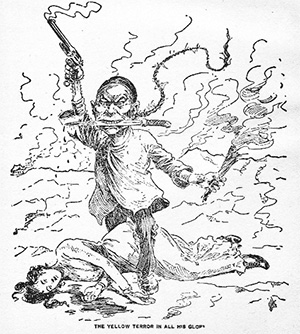
    “Yellow Terror,” an editorial
    cartoon from 1899.

    The Yellow Peril is a racist anti-Asian slur that had its origin in late-19th century European imperialism that sought to portray those in the rival region of the world as a danger to white Christians. Novelist Arthur Henry Ward (Sax Rohmer, 1883-1959) first published his Fu-Manchu series in 1912. The eponymous character is a criminal who seeks to assassinate British diplomats in Burma. The stories and books were pro-British imperial propaganda that portrayed Asians as threats to English “values.” In the 1970s, writer Steve Englehart and artist Jim Starlin adapted the character Fu Manchu into a Marvel comic book character, Shang-Chi, the Master of Kung Fu. Marvel was seeking to profit from the Bruce Lee movies trend in the ‘70s. “The Shang-Chi series harked back to Yellow Peril comics of the Cold War 1950s,” says cultural historian Christopher Frayling.

    Produced by Marvel Studios, distributed by Disney, and directed by the American Destin Daniel Cretton, the new movie Shang-Chi and the Legend of the Ten Rings revives Yellow Peril propaganda, only this time avoiding accusations of blatant racism by making both the protagonists and antagonists Asian, as well as having a director of Japanese-European heritage. Although the name has been changed, Fu Manchu is a character in the movie. Film critic Shi Wenxue says: “Chinese audiences cannot accept a prejudiced character from 100 years ago is still appearing in a new Marvel film.” In addition, the protagonist is played by Simu Liu, a Chinese-born Canadian who has been vocally critical of the CCP. The political context in which this anti-CCP film is released is America’s ongoing military “pivot” to Asia. 

    Get the issue this article appears in

    Setting the Stage from the Top Down

    Quoting anti-China right-wingers in the US, the BBC publicised a report by PEN International, claiming that China has increasing control over Hollywood. The report appeared in the context of the global pandemic, to which those seeking to blame China refer to as the “CCP virus.” 

    Prior to the outbreak of SARS-CoV-2, US television in particular produced a number of shows priming audiences for a pandemic. Many conspiracy researchers believe these to be examples of “predictive programming.” In recent times, they point to the Netflix documentary, Pandemic: How to Prevent an Outbreak, released in January 2020 just before Covid was internationally recognised. 

    Whether predictive programming is real or not, and regardless of the extent to which it is real, we can be certain that those who dominate the culture do so as part of a nexus of control that includes economics and foreign policy.  

    [alert type=”general” dismiss=”no”]This article was published in New Dawn 189.[/alert]

    [alert type=”success” dismiss=”no”]If you appreciate this article, please consider subscribing to help maintain this website.[/alert]

    Footnotes

    1. For instance: Michael S. Hyatt (1998) The Millennium Bug: How to Survive the Coming Chaos, Regnery.
    2. Darrell L. Bock, Stanley N. Gundry and Kenneth L. Gentry (1999) Three Views on the Millennium and Beyond, Zondervan Academic.
    3. John Hogue (1987) Nostradamus and the Millennium, Doubleday.
    4. Sean Martin (2006) The Gnostics: The First Christian Heretics, Pocket Essentials.
    5. Hans Jonas (2015) The Gnostic Religion: The Message of the Alien God and the Beginnings of Christianity, Beacon Press.
    6. The Hollywood Reporter, “Boston Marathon Bombing: Seth MacFarlane Calls ‘Family Guy’ Hoax ‘Abhorrent’,” 16 April 2013, www.hollywoodreporter.com/tv/tv-news/boston-bombing-seth-macfarlane-calls-440456
    7. Matthew Alford and Tom Secker (2017) National Security Cinema: The Shocking New Evidence of Government Control in Hollywood, Drum Roll Books.
    8. Quoted in Tricia Jenkins (2009) “How the Central Intelligence Agency works with Hollywood: An interview with Paul Barry, the CIA’s new Entertainment Industry Liaison,” Media, Culture and Society, 31(3): 489–95.
    9. Quoted in Paul Moody (2017) “Embassy cinema: what WikiLeaks reveals about US state support for Hollywood,” Media, Culture and Society, 39(7): 1063-77.
    10. Moody, op. cit. 
    11. Pearse Redmond (2017) “The Historical Roots of CIA-Hollywood Propaganda,” American Journal of Economics and Sociology, 76(2): 280-331. 
    12. Ibid. 
    13. Ibid. 
    14. Quoted in Lawrence Suid, “Hollywood and Vietnam,” Film Comment, 15(5): 20-25. 
    15. Quoted in Ali Serdouk (2021) “Hollywood, American Politics, and Terrorism: When Art Turns into a Political Tool,” Arab Studies Quarterly, 43(1): 26-37. 
    16. Jenkins, op. cit. 
    17. Michael C. Frank (2015) “At War with the Unknown: Hollywood, Homeland Security, and the Cultural Imaginary of Terrorism after 9/11,” Amerikastudien, 60(4): 485-504. 
    18. Sebastian Kaempf (2019) “‘A relationship of mutual exploitation’: the evolving ties between the Pentagon, Hollywood, and the commercial gaming sector,” Social Identities, 25(4): 542-58.
    19. Quoted in Lawrence Suid, “Hollywood and Vietnam,” Film Comment, 15(5): 20-25. 
    20. Kaempf, op. cit.
    21. Tom Pollard (2017) “Hollywood’s Asian-Pacific Pivot: Stereotypes, Xenophobia, and Racism,” Perspectives on Global Development and Technology, 16: 131-44.
    22. Moody, op. cit. 
    23. Jenny Clegg (1994) Fu Manchu and the Yellow Peril: The Making of a Racist Myth, Trentham. 
    24. Christopher Frayling (2014) The Yellow Peril: Dr Fu Manchu and The Rise of Chinaphobia, Thames and Hudson.
    25. Quoted in Rhea Mogul, “Marvel’s ‘Shang-Chi’ was made with China in mind. Here’s why Beijing doesn’t like it,” NBC, 3 October 2021, www.nbcnews.com/news/china/marvel-s-shang-chi-was-made-china-mind-here-s-n1280571
    26. BBC, “Hollywood censors films to appease China, report suggests,” 6 August 2020, www.bbc.com/news/entertainment-arts-53676789

    © New Dawn Magazine and the respective author.
    For our reproduction notice, click here.

  • Graham Hancock, Ancient Apocalypse & The Vast, Incredible Sausage Machine of Groupthink

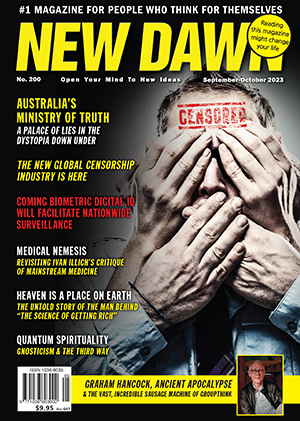
    Graham Hancock, Ancient Apocalypse & The Vast, Incredible Sausage Machine of Groupthink

    From New Dawn 200 (Sept-Oct 2023)

    I would rather have questions that can’t be answered than answers that can’t be questioned.
    – Richard Feynman

    November 2022 saw the release of Graham Hancock’s controversial documentary series Ancient Apocalypse on streaming giant Netflix.

    The backlash was immediate, hysterical and, perhaps, even insightful.

    Now that the dust has settled, what can be discerned from the vilification, defenestration and immolation of Hancock and his theories?

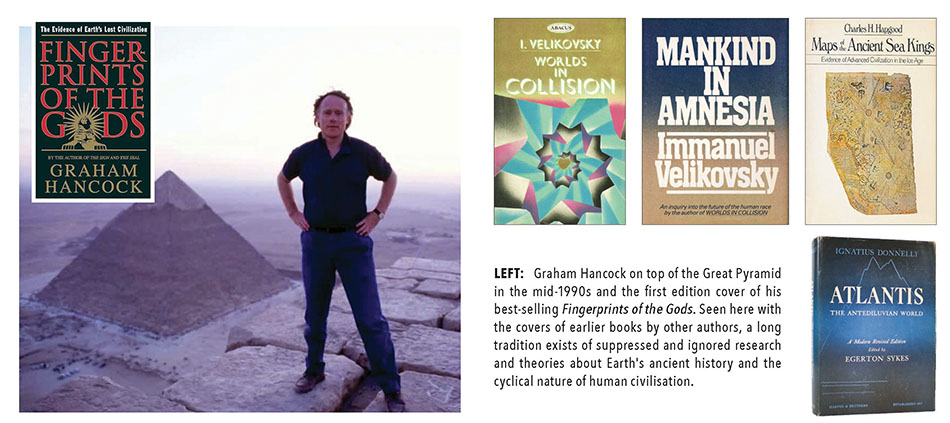
    Starting with his 1995 book Fingerprints of the Gods, Graham Hancock has carved a sizeable career casting doubt, asking questions and proposing alternate theories in opposition to the mainstream consensus on archaeology and ancient history.

    More recent volumes like the 2002 Underworld: The Mysterious Origins of Civilization (which focused on alleged evidence of cities and civilisations lost in the roughly 400-foot sea level rise since the end of the last Ice Age, approximately 12,000 years ago) or the 2015 tome Magicians of the Gods: The Forgotten Wisdom of Earth’s Lost Civilization (which explores the hypothesis that around 12,000 years ago [and more recently] large fragments of a comet struck the North American and European ice caps, resulting in massive, almost species destroying, deluges of melted glacial water).

    Both books (and many others from Hancock) present large caches of fascinating, incongruous and unconventional evidence that question the foundations of conventional views and academic assumptions about pre-history and the acceptable framework of archaeology. But Graham Hancock is hardly alone in questioning the received structure of mainstream history.

    There is, in fact, a long subterranean tradition of ‘catastrophism’, hypotheses and beliefs about the cyclical nature of human civilisation and the greater history of Earth itself. 

    Immanuel Velikovsky’s 1950 book Worlds in Collision created a firestorm of controversy upon initial release. Velikovsky proposed a mythic reconstruction of Earth’s ancient past, whereby the legends and fables of the Bible and other scriptural and cultural accounts might be compared, reconciled, and evaluated to illuminate our periodically unstable world. 

    Velikovsky has been credited as having founded modern ‘catastrophism’, the study of Earth and civilisation’s cyclical nature. Worlds in Collision was a bestseller upon release, but it was alleged that the scientific community had attempted to suppress the book and refused Velikovsky any forum to debate his detractors in the scientific world. Five years later he published Earth in Upheaval to respond to the outcry from those in the orthodox camp.

    Mankind in Amnesia was published in 1982 (posthumous to Velikovsky’s 1979 death) and proposed a kind of species-wide post-traumatic amnesia in response to our cataclysmic past – the author linking mankind’s history of war, aggression and barbarism to his turbulent mindset.

    In 1966, Velikovsky associate Alfred De Grazia published The Velikovsky Affair, a detailed and compelling recounting of all the controversies that swirled around the ‘catastrophic school’ of scientific and historical revisionism.

    Concurrently, Charles H. Hapgood advanced his theory of catastrophic shifts in the Earth’s poles and crust in 1958’s Earth’s Shifting Crust: A Key to Some Basic Problems of Earth Science (which came with a foreword by Albert Einstein). Later, in 1966, Hapgood wrote Maps of the Ancient Sea Kings: Evidence of Advanced Civilization in the Ice Age in which he studied anomalous maps (like the Piri Reis map of 1513) that appeared to suggest ancient knowledge of lower sea levels and an ice-free Antarctica.

    Indeed, across the late-1960s and 1970s, a multitude of writers (prolific scribes like Rene Noorbergen and Andrew Tomas come to mind) questioned orthodox history and sketched antediluvian relics and societies in one form or another.

    Perhaps the earliest, in the modern era, had been Ignatius Donnelly’s 1882 classic Atlantis: The Antediluvian World. 

    In fact, beliefs in a cycle of cataclysm and renewal, of hubris and arrogance leading to a catastrophic downfall, are at least as old as Plato’s ‘Republic’ (circa 375 BCE) – which records the oldest ‘legend’ of Atlantis that survives to this day. 

    So, while undermining the constructions and institutions of conventional history and archaeology may not be new, what was it about Graham Hancock’s Ancient Apocalypse that triggered such a violent, fire-breathing response?

    Ancient Apocalypse – “Dangerous”

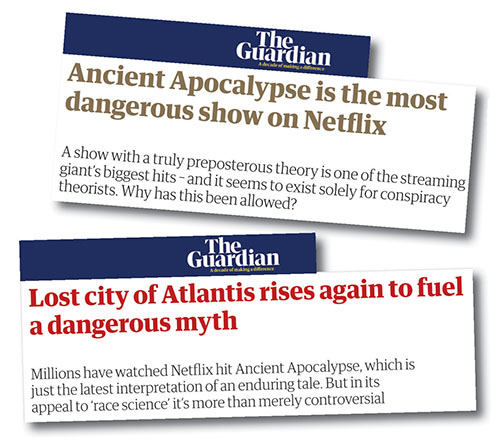
    Examples of that hyperventilating media scorn are plentiful, but the UK’s The Guardian so often serves as a convenient temperature-check on fevered, delirious outrage and posturing, radical establishmentarianism. Handily, The Guardian printed not one but two howling tirades against Ancient Apocalypse in the space of one week.

    The most darkly entertaining was penned unironically by media critic Stuart Heritage, whose headline screamed: “Ancient Apocalypse is the most dangerous show on Netflix.”

    Dangerous? It might be easy to describe Graham Hancock as ‘studious’, ‘reasonable’, ‘professorial’ even ‘bookish’ but ‘dangerous’ (i.e., ‘deadly’, ‘fatal’ or ‘threatening’)? Really?

    One is, of course, entirely free to view Hancock’s thesis as fanciful, unlikely or even wrong, but to ascribe ‘danger’ to an alternative archaeological hypothesis seems to be the most delirious kind of mania and absurdity.

    It actually gets worse. The Guardian sub-headline continues: “A show with a truly preposterous theory is one of the streaming giant’s biggest hits – and it seems to exist solely for conspiracy theorists. Why has this been allowed?”

    “Allowed.” Yes, he actually said it.

    How dare this bespectacled destroyer of academic smugness and media comfort zones, this avenging angel, this soulless wrecker of echo chambers and laptop-class talking points be “allowed?” 

    Here, presumably, Heritage appeals to parental authorities, kindergarten teachers, high school prefects, yard monitors (anybody!) to do something… anything. Indeed, Heritage seems to be demanding Hancock be ‘blacklisted,’ ‘cancelled,’ ‘removed,’ ‘deleted’ or even ‘disappeared’ for his crime of heresy.

    Astounding.

    An infantile scream for bloody ideological revenge.

    Heritage’s penultimate paragraph makes it clear that Graham Hancock is guilty of Thoughtcrime:

    “That’s the danger of a show like this. It whispers to the conspiracy theorist in all of us. And Hancock is such a compelling host that he’s bound to create a few more in his wake. Believing that ultra-intelligent creatures helped to build the pyramids is one thing, but where does it end? Believing that election fraud is real? Believing 9/11 was an inside job? Worse?”

    Stuart Heritage and The Guardian are such prisoners of dogma, such willing inmates of the propaganda panopticon, that they dare not see their violent hypocrisies in the damning black mirror. ‘Election fraud’ is a delusion (except when Authority says Russia did it). ‘False flag’ attacks a mirage (except when The Media declares The Enemy guilty). In their view, every mainstream narrative should be unassailable, questions or criticisms never to be “allowed.”

    Just a few days later, on 27 November, Robin McKie, ‘Science Editor’ at The Guardian, swooped down for the kill with his piece entitled, “Lost city of Atlantis rises again to fuel a dangerous myth.”

    “Millions have watched Netflix hit Ancient Apocalypse, which is just the latest interpretation of an enduring tale. But in its appeal to ‘race science’ it’s more than merely controversial.”

    Shamelessly, McKie continues, accusing Graham Hancock of “white supremacist” ideas and “racism” recklessly unaware or uncaring (as the media so often is) that such defamatory claims have real world implications and effects on real people. While media behemoths may indeed be untouchable, real people are not.

    Indeed, in subsequent interviews, Hancock has spoken of the personal hurt and professional damage such vilification caused him. It’s hard to imagine The Guardian would care.

    McKie produces some convenient cookie-cutter academic to intone gravely, “They strip indigenous people of their rich heritage and instead give credit to aliens or white people” while never noting that throughout its eight episodes Ancient Apocalypse never once actually mentions ‘aliens’ or race. Such is the sloppiness and disregard on display in The Guardian’s ‘journalism’ that basic ‘fact-checking’ or simple respect for your subject is essentially non-existent.

    Finally, Robin McKie can’t help but go for the low blow:

    “Then there were the Nazis. Many swore by the idea that a white Nordic superior race – people of ‘the purest blood’ – had come from Atlantis. As a result, Himmler set up an SS unit, the Ahnenerbe – or Bureau of Ancestral Heritage – in 1935 to find out where people from Atlantis had ended up after the deluge had destroyed their homeland.”

    As JR Leach points out in his humorous piece on Off-Guardian:

    “Of course, going by this logic, we should really do away with Christianity as well. God in general, in fact. Perhaps we should cancel Volkswagen and Wagner too. Nazis also brushed their teeth and wore shoes, I believe, neither of which shall I be taking part in from this day onwards, just to be sure.”

    Indeed, we should probably identify Plato as a retrospective proto-National Socialist if we were to follow McKie ‘argument’ to its logical endpoint.

    For another example, one need simply return to the second paragraph of Stuart Heritage’s hit piece where he asserted (falsely) that the opening moments of Ancient Apocalypse featured Hancock in conversation with gatekeeping bad-boy Jordan Peterson (it was actually an entirely different legacy media pariah/competitor, Joe Rogan). But seriously. Any ‘heretic’ will do. The edit and correction were so slapdash that they still bear the signs of faulty syntax. It now reads: “In quick succession, during the pre-show sizzle reel, we are treated to a clip of the show’s host Graham Hancock being interviewed by Joe Rogan.” ‘In quick succession’ implies a plural of ‘clips’ where there is now only one, such was the haste and contempt of this yellow ‘journalism’.

    Media Mass Formation Psychosis

    Across establishment rags, hipster organs and boutique bourgeois bromides alike – from Slate, The Conversation and Scientific American to The New Republic, The Nation, The Independent and Australia’s anaemic ABC network – spewed a unified chorus of Two Minute Hate.

    Hancock was mugged and dragged kicking into the Culture Wars.

    But why?

    Graham with my his wife Santha Hancock, August 2019, inside the long and steep entrance corridor to the “Bent Pyramid” (attributed to Pharaoh Sneferu) at Dashur, about 30 kilometres south of the Great Pyramid of Giza, Egypt. Photo credit: facebook.com/Author.GrahamHancock

    Why the mild-mannered Graham Hancock? And why now?

    That is the sixty-four-million-dollar question.

    Like some cornered, enraged beast, desperate to defend its turf, desperate even for survival: the legacy media and its sycophants spat bilious globules of venom. Of course, they did.

    Whether co-ordinated or reflexive (we’ll likely never know), that fevered monster, the giant octopus of consensus reality, marshalled all its antibodies (dare I say – its white-blood cells) to ward off infection of the body ideological.

    While ‘The Hancock Affair’ is just one of many examples, it is a particularly instructive one. The hysteria, the untethering from any kind of objective reality, the bile and scorn uniformly directed toward an innocent scholar, simply asking questions and poking conventions, can tell us a great deal.

    Reminiscent of the theories of Mattias Desmet (as expounded in his book The Psychology of Totalitarianism), the last three years (in particular) have seen a mass traumatic event that drove segments of a frightened population even further into the arms of authority. People prone to ‘free-floating anxiety’ (arguably, partially, or even wholly, a result of incessant media weaponization of fear and confusion) are liable (generally unknowingly) to engage in what Desmet calls “mass formation” – a kind of totalitarian mass psychosis that identifies dissent or disagreement as a ‘dangerous’ ‘pernicious’ foreign influence that must be attacked and destroyed to preserve the righteous social organism.

    Individuals such as Heritage and McKie (unknowingly, or at least with minimal bidding from their editors) respond precisely as ‘mass formation’ dictates, in spasms of frothing anger and blind rage. Emotionally, they have committed themselves to the ‘mass’ and see ‘the other’ as an existential threat. In this case, the ‘mass’ is conventional history and ‘social justice’ as supported, indoctrinated and embodied by all the ‘respectable’ and conventional instruments of state, media and education.

    Writing in a New Republic piece entitled, “The Strange and Dangerous Right-Wing Freakout Over Ancient Apocalypse” from December 2022, Jason Colavito inadvertently illuminates his own, and his group, mass formation:

    Ancient Apocalypse sits alongside Tucker Carlson, Joe Rogan, and the so-called ‘intellectual dark web’ in casting doubt on expertise, privileging emotion over evidence, and bending history to ideological ends – in this case, making common cause with the right against academia, science, and the very idea of shared reality. That it did so on one of the biggest media platforms in the world should give us all pause.”

    Hancock is no longer just a journalist, presenting different theories and unconsidered evidence, now he is a heretic who joined other heretics (Carlson, Rogan et. al.) in threatening the body with danger. Colavito identifies emotionally and practically with the ‘mass’ (or ‘The Blob’ as James Howard Kunstler calls it) and instinctively rises to battle, just as the body’s antibodies attack infectious threats.

    Indeed, he continues: “History isn’t just about what happened in the past. It’s also about whose stories get told and how we think about them.” Colavito speaks about “shared reality” as if there is only one correct and acceptable vision of the past and present, one party or ‘mass’ definition of what is appropriate to think and to verbalise.

    It is, unfortunately, witheringly totalitarian language delivered with all the confidence and righteousness of someone who does not know history at all. Colavito has simply internalised the desires and dictates of the ‘mass’ so completely that they are entirely invisible to himself and his peers. He is a loud, proud foot soldier for control and Groupthink. 

    What we are witnessing appears to be a kind of ‘Project Year Zero’ – the purging of traditions, history, debate, discussion, dissent and dialogue and its replacement with a new unassailable framework of history and ideology – a ‘Great Reset’ if you will. And those who question or resist are identified, shamed and un-personed by the ‘mass’. 

    This totalitarian mindset has, essentially, overwhelmed almost all organs of the state and culture. In essence, it appears we have a ‘collaborator class’ throughout the institutions of the media, academia and politics. Confident, well-rewarded and secure in their superannuated echo chambers, ‘the collaborators’ march forth, the ‘Red Guards’ of the 21st century, like busy bees animated by ‘struggle sessions’, ‘purity tests’ and ‘purges’.

    Pure in doctrine and safe in the group.

    But if the ‘collaborator class’ are indeed collaborators, who, exactly, are they collaborating with?

    Get the issue this article appears in

    The Caligula Class & Their Collaborators 

    Reading, again, Robert Graves’ masterful I, Claudius, I was struck by how oddly familiar the historical figure of Caligula was. A paragon of power, madness, delusion and depravity, Caligula has become a byword for power without responsibility, action without consequences, bloodlust and corruption without end. But Caligula was just one man – he was nothing and would have been entirely impotent without a class of collaborators, a stratum who milked his madness and power while they could – who laughed and celebrated his crimes, deluded that they were forever immune from his wrath and mania.

    Today, we do not have one Caligula. We have, perhaps, a thousand. Most of them likely unknown to the public and popular culture – but their frontmen are obvious – and often, unsurprisingly, immune for their crimes and corruptions, at least for decades. Harvey Weinstein, Jeffrey Epstein and his long-time best buddy (tech billionaire and ‘philanthropist’) Bill Gates, are simply the most visible pus to escape the boil – pillars of depravity, the platinum-plated flotsam that has floated to the surface of a vast, dank pond. Captains of industrial scale abuse that masquerades (with almost complete media fealty) as ‘philanthropy’ and ‘expertise’.

    The scab hides an entire ‘Caligula class’.

    Their ill-gotten, manufactured fortunes washing through foundations and think tanks, grants and gratuities, funding opportunities and photo ops – animating an entire media and political class to do their bidding. There were always plenty glad to seek Caligula’s favour, marshalled by fear or ambition. Today is essentially the same.

    Though the Caligula class and their collaborators are indeed powerful, with almost all the present levers of state and media at their command, now is not a time for despair. Their power is transitory and illusory, magnified by technology and modern magics – their grasp fragile as evidenced by their hysteria when a ‘heretic’ appears on one of ‘their’ platforms, in ‘their’ terrain, ‘their’ backyard.

    Perhaps, ‘their’ day is almost done. The final, ear-bursting shrieks of outrage and mendacity almost over.

    Meanwhile, a humble scholar, a gentleman journalist – Graham Hancock – recently caught in the cultural crossfire, is now gone on a six-month research sabbatical. Preparing, quietly and methodically, to face again the dragon of power, depravity and ignorance.

    Good luck, fair Graham… 

    [alert type=”general” dismiss=”no”]This article was published in New Dawn 200.[/alert]

    [alert type=”success” dismiss=”no”]If you appreciate this article, please consider subscribing to help maintain this website.[/alert]

    © New Dawn Magazine and the respective author.
    For our reproduction notice, click here.
  • Manufacturing Enemies: The Slide Toward War With China

    Manufacturing Enemies: The Slide Toward War With China

    From New Dawn 189 (Nov-Dec 2021)

    It’s an unthinkable scenario, one which no one in their right mind would want. And yet, we sit on the precipice of the unthinkable: a war with China.

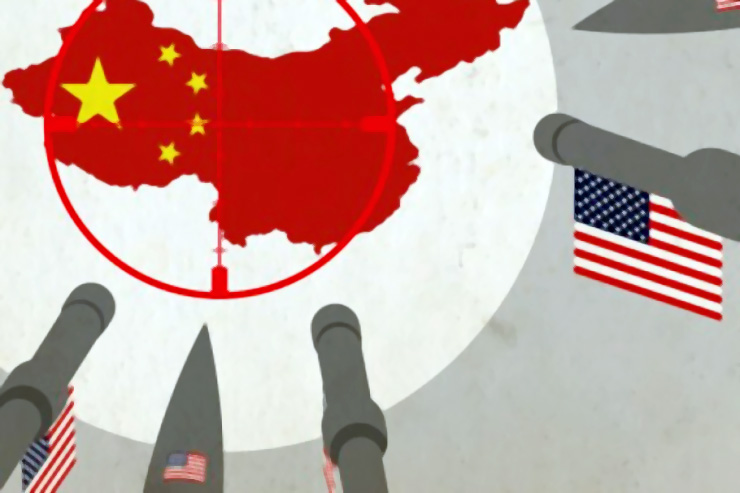
    The bellicose rhetoric became more noticeable during the Trump presidency and has since elevated to another level after the Covid crisis. The US and its allies have been steadily building up military capabilities for years in preparation for a major confrontation in the Pacific.

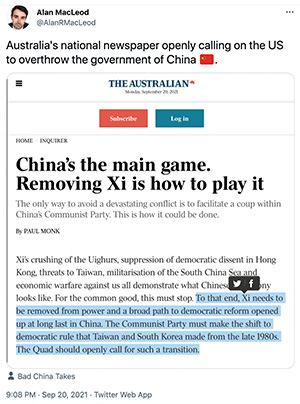
    One gets the distinct feeling that China is being groomed for “Axis of Evil” membership, right alongside North Korea and Iran. With ever-increasing frequency, western media dutifully portray Chinese leader Xi Jinping as a ruthless and cunning autocrat. Aside from familiar accusations of ‘Chinese bullying’ in the South China Sea, there is also western charges of ‘genocide’ against the Muslim Uyghur population in China’s Xinjiang Province. 

    More recently, Western politicians and media blame a “reckless” Chinese Communist Party for unleashing the Covid-19 pandemic on the world. The latter charge may seem hyperbolic, but it’s been most effective in sharply increasing Western hostility towards China.

    There is a real fear all this fighting talk will eventually reach a crescendo that sets the two opposing powers on a collision course that could radically transform the global system for the next century and beyond.

    It’s no surprise that China would like to see the US out of Asia, but at what cost?

    Similarly, in its desire to maintain global hegemony, the United States aims to knock China’s economy and global influence down a peg or two. Would they wage a world war to do it?

    At the very least, this has initiated new international arms and cyber warfare races. Will it escalate into an intense hot conflict or a new cold war with lower intensity operations and proxy wars stretching out over decades? 

    Can this apparent drift towards conflict be averted, or will history repeat itself as superpowers from different hemispheres with two different political and economic visions are drawn into a world war?

    Thucydides Trap

    Unlike previous US target nations, China is a permanent UN Security Council member and set to surpass the United States as the world’s largest economy and all the global influence that comes with it.

    Yet, more than ever, there is a pervading sense that a confrontation between the incumbent western superpower and the emerging power in the east is becoming unavoidable.

    This geopolitical phenomenon has been referred to as “The Thucydides Trap,” a term popularised by American political scientist Graham Allison that describes an apparent tendency towards war when one emerging power threatens to displace an existing great power as a regional or international hegemon.

    In Ancient Greece, Thucydides was an Athenian historian and military general who believed that the underlying cause of the Peloponnesian Wars was a fait accompli. “It was the rise of Athens and the fear that this instilled in Sparta that made war inevitable,” he explained.

    In other words, opposing superpowers invariably find themselves in competition with one another, either in trade or over ideological and cultural supremacy, creating an unavoidable spiral towards confrontation.

    This concept implies there are inescapable psychological realities of human dynamics in a world of competing nations. Realist scholar Ken Waltz, the author of Man, The State and War (published in 1959), posited that behind the facade of diplomacy and international relations exists a Hobbesian “state of nature” that is always in a perpetual state of anarchy.

    Waltz’s theoretical work is credited with helping form the “bipolar” world order paradigm that dominated intellectual and academic thinking in the West through the Cold War era (1948-1991) and beyond. The bipolar world order was succeeded by a unipolar world order led by the United States and its allies following the rapid collapse of the Soviet Union and its satellite network of countries.

    Speaking to the question of the foundational motivation behind the Thucydides Trap, Waltz wrote: “States in the world are like individuals in the state of nature. They are neither perfectly good nor are they controlled by law.”

    “Each state pursues its own interests, however defined, in ways it judges best. Force is a means of achieving the external ends of states because there exists no consistent, reliable process of reconciling the conflicts of interest that inevitably arise among similar units in a condition of anarchy.”

    “With many sovereign states, with no system of law enforceable among them, with each state judging its grievances and ambitions according to the dictates of its own reason or desire – conflict, sometimes leading to war, is bound to occur.”

    As for judging the outcome of any conflict between great powers, Waltz did not hide his cynicism to the point of ambivalence, as he famously remarked:

    “Asking who won a given war, someone has said, is like asking who won the San Francisco earthquake. That in war there is no victory but only varying degrees of defeat is a proposition that has gained increasing acceptance in the twentieth century.”

    Waltz’s harsh realist worldview never sat well with liberal internationalists and true believers in the United Nation’s global governance system who believe that world peace can one day be achieved through cooperation among nations and interdependency. In many ways, these are two irreconcilable worldviews.

    Still, in the absence of that Kantian vision of an international utopia, Waltz does speak to some fundamental truths: why people and nations do what they do, and insights to help us better understand history that may save nations from sliding into undesirable wars.

    2025: A Limited Window of Opportunity

    A 2016 RAND Corporation document commissioned by the US Army, “War with China: Thinking Through the Unthinkable,”1 outlines likely scenarios with war planners stressing there is a limited window of opportunity to confront China, beginning close in 2025. 

    After that, they argue China will achieve an irreversible level of global dominance and capability. They state:

    “We postulate that a war would be regional and conventional. It would be waged mainly by ships on and beneath the sea, by aircraft and missiles of many sorts, and in space (against satellites) and cyberspace (against computer systems). We assume that fighting would start and remain in East Asia, where potential Sino-US flashpoints and nearly all Chinese forces are located.”

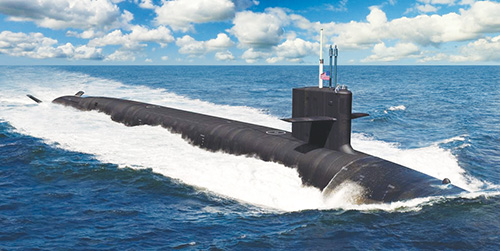
    The recently announced UK-Australia-US (AUKUS) defence pact was designed to do just this. Using Australian bases to increase their nuclear submarine capabilities, the US and UK can submerge for more extended periods to threaten the Chinese Navy and ultimately disrupt Chinese shipping lanes and international trade through the Southeast Asian and Pacific region.

    As for the nuclear question, geopolitical analyst Brian Berletic explained this polarity in Thucydidean terms in a recent interview: “It’s concerning because these are two nuclear-armed countries… While it’s unprecedented for the US to start an armed conflict directly with a peer, or near-peer competitor, it is also unprecedented that China is now in a position to pass the West.”2

    The RAND analysis states that even if nuclear weapons were not used, China would resort to other ways of attacking the United States proper, mainly through space and cyberspace, meaning the public or commercial use of both domains would be severely curtailed during a protracted period of hostilities. However, the US is prepared to deploy smaller lower-yield tactical or ‘battlefield’ nuclear weapons. With a sizeable arsenal already, this would still be a step below high-yield nukes, which both sides would be reluctant to deploy. In such a scenario, whoever struck first would have the upper hand and significant leverage for setting a higher risk threshold than their opponent. Unlike the US, China would want to avoid using any nuclear weapons near its shores. 

    For the globalists, all this might be a worthwhile sacrifice to make, especially if by the end of a long and costly war a global outcry emerges – clamouring for a One World Government as the final solution to keeping the peace and curing all of our planetary woes.

    Target: Belt and Road

    The US plan to contain China is nothing new. You can go back to a State Department document from 1965 entitled “189. Draft Memorandum From Secretary of Defense McNamara to President Johnson”:

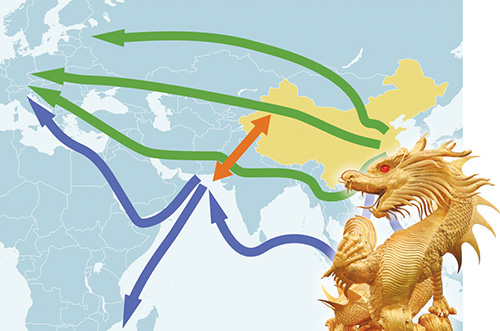
    Beijing’s Belt and Road Initiative is a massive infrastructure project stretching from East Asia to Europe with interconnections across the entire globe.

    “The February decision to bomb North Vietnam and the July approval of Phase I deployments make sense only if they are in support of a long-run United States policy to contain Communist China. China – like Germany in 1917, like Germany in the West and Japan in the East in the late 30’s, and like the USSR in 1947 – looms as a major power threatening to undercut our importance and effectiveness in the world and, more remotely but more menacingly, to organise all of Asia against us.”3

    More than anything else, China’s New Silk Road project, known as the Belt and Road Initiative, worries the Anglo-American world order. Through their ambitious project, China is attempting to develop a vast network of interconnected land and sea transport trade routes to facilitate its future growth.

    Western plans like AUKUS are meant to thwart Belt and Road shipping lanes, while other destabilisation operations would be carried out at crucial land access points like Pakistan’s Gwadar port in Balochistan, as well as covert operations in Afghanistan, disruptions in the Persian Gulf, and instability in Africa’s Sahel region, to name just a few. 

    Interestingly, McNamara’s old memo foreshadowed many of these disruptive operations: 

    There are three fronts to a long-run effort to contain China (realising that the USSR “contains” China on the north and northwest): (a) the Japan-Korea front; (b) the India-Pakistan front; and (c) the Southeast Asia front.

    Myanmar is also a key node in the Belt and Road map with a pipeline transporting fuel from the Bay of Bengal to the Chinese mainland. Operationally speaking, the US views any location that could potentially supply China with resources as a place of interest.

    Australia: Deep Port One

    In George Orwell’s classic novel 1984, Great Britain was disparagingly referred to as Air Strip One, presumably for functioning as Oceania’s (likely representing a US-led Anglo-American hemispheric order) “unsinkable aircraft carrier” parked on the European fringe.

    Similarly, the AUKUS defence pact formalises Australia’s position as an Anglo-American outpost to project power across the Indo-Pacific. Henceforth, Australia becomes Deep Port One, a platform to launch future naval and submarine operations against the People’s Republic of China. This would see an expansion of military operations in Australia’s Northern Territory with ports located around Darwin and possible plans to develop a new facility in Exmouth Gulf in Western Australia.

    Former Australian PM Paul Keating vehemently opposed the pact, telling off [the then] PM Scott Morrison, warning in a public statement that it “will amount to a lock-in of Australian military equipment and thereby forces, with those of the US with only one objective: the ability to act collectively in any military engagement by the US against China.”4

    The fact that this also makes Australia a bona fide target in an armed conflagration between two nuclear powers is of little concern to the United States, who are set to bill Australia a cool $66 billion for building its new group of nuclear-powered submarines – hardware which will no doubt be managed and staffed by US personnel. 

    It should be noted this scenario of Australia obtaining nuclear-powered submarines – which is now coming under heavy scrutiny as to its practicability – could be a disinformation ploy to cover up the real strategy.

    A report in The Times on 21 September, ‘Britain’s nuclear submarines to use Australia as base for Indo-Pacific presence’, indicates what might be in the works.

    “Senior [UK[ government sources said that the AUKUS pact could lead to the Royal Navy’s 1.4 billion pound Astute-class attack submarines undergoing deep maintenance in the region so that they can stay deployed for longer rather than returning to the Faslane naval base in Scotland.”

    The Times quoted James Peddell, a former defence technology attache in Washington with experience in submarine technology, who said that a base in Australia could “bring the power of a submarine right up to the doorstep of China… You can bring it in closer, in a stealthy way. You can do intelligence and surveillance, you can project power… and give protection [to surface warships].”

    Britain would get to use facilities in Australia to house its nuclear-powered submarines. London is hailing the deal as a victory for its new ‘Global Britain’ brand, but it’s just the latest instalment of Perfidious Albion having another go at the Great Game. If history is any guide, it’s sure to leave a trail of chaos and destruction in its wake. 

    It’s no secret Australia has always been regarded by Washington and London as a convenient Asia-Pacific backwater colony for its Five Eyes network and global military-industrial complex, most notably its NSA signals intelligence and satellite surveillance base located at Pine Gap, along with joint military bases around the country’s coastal map. This provides the Atlanticist power bloc with a valuable foothold at the gateway to both Southeast Asia and the South Pacific – so the chances they ever release Australia from their political grip is slim to none. Due to its strategic importance, Washington and London always wield influence and power behind the scenes of Australian politics and will orchestrate regime change when the people elect a potentially unfriendly government in Canberra, such as the case of the joint CIA-MI6-ASIO operation in 1975 to remove Labor Prime Minister Gough Whitlam. Award-winning journalist John Pilger recalled, “Australia briefly became an independent state during the Whitlam years.” Since that coup, Washington has determined the whip-line in Canberra.

    This controlling influence continued into the Hawke years, confirmed after the declassified release of secret US embassy cables in 2021. A paper by Federation University’s Cameron Coventry on the cables said the Americans valued Hawke because he “helped protect [US] defence installations, provided information about union disputes and warned officials that installations could be targeted.”

    Covering the period 1973 to 1979, the cables revealed that Hawke worked intimately with US officials, notably Ambassador Marshall Green, on every key aspect of trade union and Labor policy. Their other preoccupation was how to muzzle rising opposition to the US alliance as a result of the Vietnam War and to protect highly strategic American military-intelligence bases in Australia.

    It’s also worth noting that should the US and Britain wish to drag Australia into a war with China, the electorate will have no say in the matter. Nor would there be any debate in Parliament. To declare war, the Prime Minister only needs to notify the Minister of Defence of his plans. Democracy at work.

    Taiwan

    If a full-blown conflict between the US and China is initiated, the trigger will be over the island of Taiwan, located off the coast of the Chinese mainland.

    Along with US allies Japan and South Korea, Taiwan would make the ideal tripartite partner to countering Chinese power in the Pacific. Such an alliance has been discussed but remains a remote fantasy under Beijing’s enormous shadow.

    China maintains that Taiwan is rightfully part of the mainland under its “One China” doctrine. Officially named the “Republic of China” with a population of 24 million, Taiwan is a diplomatic conundrum, no longer recognised as an official entity by the United Nations, but receives substantial political, trade and military support from the US, which uses it as the key chess piece on its geopolitical board in the Asia Pacific region.

    Many experts believe that by 2025 China plans to seize control over Taiwan, a move that would effectively signal the end of Washington’s predominance in the Pacific and maybe the world. At that point, there would be little the US could do to stem the tide of Beijing. 

    When America first pledged its support to Taiwan, China was not today’s emerging global superpower. So, has Washington written a cheque which it can no longer cash?

    Historian Niall Ferguson writes: “As a student of history, to quote Kissinger, I see a very dangerous situation. The US commitment to Taiwan has grown verbally stronger even as it has become militarily weaker.”5

    “Perhaps Taiwan will turn out to be to the American empire what Suez was to the British Empire in 1956: the moment when the imperial lion is exposed as a paper tiger.”

    Has the US placed Taiwan in the firing line to realise and protect its own global ambitions? Either way, this part of the puzzle remains complicated but extremely important. 

    ASEAN is with China

    The residents of Southeast Asia, also known as the ASEAN bloc, are not keen on the prospect of a US-led war on China.

    Former Malaysian Prime Minister Dr Mahathir Mohamad, interviewed by The Australian Financial Review, commented on the new AUKUS deal: “This agreement indicates you openly regard China as a possible enemy and that, if it comes to the crunch, you might even go to war. Just imagine what war would do to Southeast Asia.”6

    Dr Mohamad’s sentiments are likely shared by the rest of the ASEAN neighbourhood – all major trading partners with China and most enjoying cordial relations with Beijing given their very long history of managing China.

    As far as Washington and London are concerned, if war is on the cards, then a lack of enthusiasm from ASEAN is a mere inconvenience to be managed. 

    The Anglo-American tag team would likely fall back on its tried and true methods of creating subservient client states by first sowing chaos and instability, preparing the way for the usual Soros-style colour revolutions, followed by regime change operations. This seems to be the case in Myanmar, with US-backed militants active on the ground and the usual human rights outcry from the media and Western NGOs condemning the government. 

    With China’s current socio-economic and political trajectory, at best the US and its allies can only hope to play a ‘spoiler’ and disruptor role in the region. Berletic agrees, explaining: “It’s incredibly insecure, it’s paranoid, and it’s pressed for time… It’s a world order trying to project confidence but everything they’re doing is done out of paranoia and done out of fear of being surpassed by China, and they’re inflicting damage on themselves in the process.”

    Perhaps America now realises one of the great paradoxes of hegemony. Its biggest advantage during its rise to global dominance in the 20th century was that, unlike its allies, it was prepared to sacrifice a significant amount of blood and treasure to achieve national or corporatist interests, accruing the spoils and kudos of empire required to sustain its dominance over the last 80 years. 

    This strength became its most significant liability. The current public and political appetite for costly endless wars and interventions is now wearing thinner than at any point since its brief isolationist era in the late 19th and early 20th century. In reality, that political doomsday clock began counting down after the Vietnam War and went further into the red when America invaded and occupied Iraq.

    Certainly, the Western public’s appetite for war is not what it was, and in the information age, Western governments are also having a much more difficult time controlling the narrative. In the age of the internet, blogs, and social media, governments can no longer rely on the controlled legacy press to serve up the usual narrow, unchallenged version of events.

    Maybe the narrative writers at the new Ministry of Truth can fit up China to fill the role of the new Soviet Union, as per Orwell’s classic line: “The enemy of the moment always represented absolute evil, and it followed that any past or future agreement with him was impossible.” 

    Hybrid Warfare: A Constant State of War

    In his speech to the 2019 Land Warfare Conference, hosted by the Royal United Services Institute (RUSI), Chief of the General Staff of the British Armed forces, General Mark Carleton Smith, unveiled NATO’s new approach to “securing competitive advantage” in an Anglo-American led New World Order.

    The General lamented how the rules of warfare are changing and need updating or risk being relegated to a position of outdated “dominant irrelevance” on the global stage.

    “The geometry of the battlespace is changing, to the detriment of our conventional military advantage,” he said, referring to “that hybrid space that exists between those two increasingly redundant states, binary concepts, peace and war – artificial and binary characterisations of a strategic context that no longer exists today.”7

    In other words, there is no longer such a thing as peacetime or wartime. Instead, reality is redefined as a permanent state of alertness and threat against an amorphous foe known as “the enemy.” This new undefined and constantly evolving hybrid warfare spectrum eerily echoes the constant conflict characterised by Orwell in 1984 as “Oceania was at war with Eastasia. Oceania had always been at war with Eastasia.” 

    Presumably, these state actor enemies would be Russia and China, with others to be named later. 

    In their Integrated Operating Concept document, the UK Ministry of Defence further refined its new tactic as “offensive” in nature, rather than traditional defensive and assisting roles. 

    The new language of war feigns imperial bluster and seems laced with paranoia and doublespeak, protruding through militaristic rhetoric. On these new enemies of the realm, it claims:

    “Their strategy of ‘political warfare’ is designed to undermine cohesion, to erode economic, political and social resilience, and to challenge our strategic position in key regions of the world. Their goal is to win without fighting: to achieve their objectives by breaking our willpower, using attacks below the threshold that would prompt a warfighting response. These attacks on our way of life, from assertive authoritarian rivals and extremist ideologies, are remarkably difficult to defeat without undermining the very freedoms we want to protect. We are exposed through our openness.”8

    They essentially admit how they’ve lost the battle for ‘hearts and minds’ both at home and abroad. Rather than pause and take a moment for self-reflection on why this happened, the military mindset instead reflexively blames ‘the enemy’ for confusing the unsuspecting electorate in the ‘free’ ‘democratic’ West. You can’t help but notice fascist impulses, yearning to break the tedium of democracy while lamenting how “we” in the West are “exposed through our openness.” 

    One of the solutions rolled out in response to this new omnipresent “challenge” is to treat free speech, expression, and independent journalism as a threat to their supposed political ‘consensus’ across the Western bloc. 

    The persecution of Julian Assange and targeting of WikiLeaks can be viewed as the top end of their plan to control the global information commons, but the broader imperative includes everyone – right down to bloggers and individual social media users. Of chief concern is information shared by the general public, questions they are posing to their governments, and independent analysis and opinion that threatens the legacy media monopoly over opinion-forming in the West.

    To combat supposed ‘disinformation’ and ‘fake news’, the UK government launched a gaggle of new cyber warfare units like the notorious 77th Brigade and other cyber regiments like the 13th Signal Regiment. Recently, the UK government announced £5 billion to build a new digital warfare centre for “offensive cyber operations.”9 You can’t help but view all this as preparation for a new globalised war.

    The authoritarian language is subtle but chilling nonetheless: “The old distinction between foreign and domestic defence is increasingly irrelevant. When ‘fake news’ appears to originate not abroad but at home, it gains credibility and reach, stoking confusion, disagreement, division and doubt in our societies. This has been particularly evident with the significant uptick in disinformation and misinformation during the coronavirus crisis.”10

    You can translate “doubt in our societies” to mean targeting everyday dissenting speech or investigative journalism that exposes government and institutional corruption. The state and its military arm are attempting to bracket normal domestic opposition and debate in a democratic society as something in league with ‘malign foreign influences’, an approach not unlike that of Nazi Minister of Propaganda Joseph Goebbels when his political party moved to gain control over press and information in 1930s Germany.

    Under the direction of the state, the military is turning its sights on its own population as they attempt to repurpose the heavily politicised ‘fake news’ trope as a pretext to deploy information warfare resources in a domestic theatre and internationally.

    More importantly, note how the response to Covid sought to constantly remind the public that we are on a ‘war footing’ in the battle against the virus. Military assets were routinely deployed in public spaces across NATO countries to help with Covid testing, vaccinations, and delivering fuel. In New York, the military backfilled vacancies caused by thousands of medical staff fired for refusing to take the experimental Covid jab. 

    This is a gradual militarisation of society – during peacetime. Through the construction of a ‘global pandemic’ state of emergency, governments have already established a ‘state of war,’ and so transitioning to an actual hot, warm, or cold war will be seamless; the economic shock has already occurred, expectations of comfort lowered, supply chain severed, travel restricted, borders shut, and rights and freedoms suspended at home, including criminalisation of public gatherings and political protests. Undoubtedly, this would diminish the natural opposition governments expect to encounter when war is declared and things suddenly come to a grinding halt.

    The Integrated Operating Concept document continues: “‘Home’ is no longer a secure sanctuary whence we may choose to launch interventions unhindered. ‘Away’ is no longer a regional horizon but a global one, involving space and the electromagnetic spectrum. Similarly, the ‘front’ no longer lies in some distant theatre of operations, but is within the port, airfield, or barracks.” 

    In true Orwellian fashion, the state’s biggest fear is not some foreign military power but mere information, even at the barracks level, with military brass and civil servants worried that their personnel might be corrupted by something they’ve seen or read online. This is not the rhetoric of a ‘free and open society’ but rather that of highly paranoid totalitarian regimes.

    Lurking in the UK National Security Capability Review (2015) are concerns about “the erosion of the rules-based international order, making it harder to build consensus and tackle global threats.”11

    Their radical new national security pretext will be backed up by legislation. The government hurriedly implemented its new UK Online Public Safety Bill,12 supposedly designed to protect people from ‘online harms’ like abuse and hate speech by deputising social media firms with new authority to remove ‘harmful’ or ‘illegal’ content. Buried inside the legislation is a move to designate official state narratives as “democratically protected” speech, which means anything challenging official narratives will be removed from parts of the internet they control. How quickly they arrive at this totalitarian determination depends on the ‘emergency’ of the moment, but we already see government directing Big Tech to remove political posts or anything critical of the government or ruling party as they did during and after the 2020 US Presidential Election to protect “public confidence in our election integrity.” At the time, US Democrats and the corporate media painted this as a national security issue.

    Invariably, this wide legislative net will further expand to deal with extreme ‘right-wing and leftwing speech’, dangerous ‘conspiracy theories,’ ‘anti-vaxxers’ and ‘medical misinformation’ – all of which is already being judiciously scrubbed from YouTube, Google, Facebook and Twitter. The list of potential ‘harmful’ speech is virtually endless.

    The danger cannot be overstated as this type of legislation not only formalises state-corporate censorship but gives carte blanche to unfettered official corruption by shutting down public or journalistic opposition. This is classic fascism. 

    This ‘threat’ is also used to justify offensive cyber operations to bolster the ‘consensus’ across the NATO bloc. The consensus can be translated as the propaganda de jour propped-up by the government-media complex. Anything threatening is a national security threat. This is precisely what was established at the 2018 G7 Summit in Canada when then-UK PM Theresa May announced the G7 Rapid Response Mechanism, an agreement between member states to streamline public messaging on any issue that might have national security implications. Think the manufactured narratives on the Skripal Novichok attack in the UK, the Douma chemical attack in Syria, or ‘Russian interference’ in western elections. And notice how there was no deviation in the positions of G7 governments on these stories.

    This same level of political and informational continuity would become paramount in a time of war and signal the end of sovereign independence for those individual countries. It is pure power politics, complete with entangling alliances and an inability to think and act independently. These were some of the perilous conditions leading to the catastrophic First World War. 

    The West: Trending Away From Democracy

    There is a new and disturbing school of thought creeping into Western discourse. That is, if the West is to defeat or overcome China’s dominance, it needs to become more like China. Since the onset of the Covid crisis and the push to implement draconian new systems like Vaccine Passports, it’s clear that Western governments are embarking on a path towards authoritarian technocracy.

    Interestingly, the RAND Corporation’s wargaming exercise troubleshoots antiwar and pro-peace influences in the West, characterising it as a threat to the war effort, or at least something to be overcome or neutralised to prosecute a more successful war. Without explicitly stating it, the tone suggests that war planners view inconvenient features of democratic society as a potential hindrance to realising strategic goals. It’s almost as if they’re saying, ‘If only we could be more like China’, including all necessary domestic systems of social control firmly in place to run a long and unimpeded campaign, at home and abroad.

    From a Western wargaming point of view, the current disparity between Chinese ‘totalitarianism’ and Western ‘democracy’ or constitutional republican forms of government gives China a distinct advantage in the ability to control its own population.

    The question is finally on the table: how might the West address this issue and still maintain its moral and political high ground as the global standard-bearer for democratic values in their “rules-based international order”?

    The signs are indeed worrying as we see a rapid transition by western governments away from democracy and towards establishing rigid totalitarian systems at home. No doubt the ‘global pandemic’ accelerated this transition – the evidence is all around us now.

    Get the issue this article appears in

    Heeding the Warning Signs

    Just as the Roman legions eventually lost the will to fight and would no longer give their blood for the glory of Rome, so too are America’s warriors approaching that twilight ebb of imperial lineage. Now money and security take precedence over flag and country. As with Rome, the wars fought on the outer rim became increasingly cumbersome and expensive.

    Historically, the issue of money has been at the core of sustaining global military dominance. In a long war with China, one of the US-led coalition’s comparative advantages is that the business of war is a much more profitable racket than for China and Russia – as long as the fiat magic money tree is kept fed and watered. Which financial engine will hold up to allow government to maintain an arms race while keeping populations content at home?

    Historians typically focus on military status as a metric for an empire in decline rather than the country’s internal societal failings as a prognostic for sovereign decay. For the NATO bloc, and the West in general, the signs are clear: a near exponential growth in the size of government in the last 50 years, a failing and overinflated fiat money system, an increasingly opaque and bloated surveillance state, a more militarised society, an intelligence agency leviathan and entrenched deep state, an increased deference to globalist institutions and governance, the fetishism of identity politics and culture wars, a sinking education system, an incredible wealth gap, the capture of government by industry lobbyists, a corrupt Fourth Estate, and the rise of Silicon Valley’s privatised censorship farms that are subverting and eliminating free speech. Additionally, America is more divided politically now than at any time since the Civil War era, and a divided house cannot stand, let alone fight and win a world war.

    Western nations are currently locked into an unforgiving ‘Green’ Great Reset globalist overhaul of their economy and society. It’s a scientific dictatorship by any other name and never voted on or debated in the vaunted parliamentary halls of democracy.

    Lastly, should a military showdown occur, China has a home-field advantage which means that while the US and its allies could make life extremely difficult for an extended period on the Chinese mainland, the West will not be able to prosecute a war halfway across the globe forever. With its size, human resources, infrastructure, and food production capacity (near 90% food self-sufficient), China can withstand long-term trade disruptions and the diversion of resources. Moreover, if the West attacks China, this will galvanise domestic support behind the government of Xi Jinping, boosting resilience to China’s defensive posture throughout a protracted conflict. Another important factor is the Anglo-Americans would be waging war on the other side of the globe. This is a fundamental lesson the US coalition should have learned from Afghanistan and the decade-long dirty war against Syria. But have they? 

    What if the US cannot prevail by conventional means and resorted to unconventional methods to bring its opponent to heel, as they did with Japan during the waning moments of WWII? If conflict commences, there will be those in the US who demand the nuclear option, and like with WWII, the longer the war, the louder the calls from ‘humanitarian’ war hawks to “just drop the bomb and bring this war to an end.” One can only hope that the threat of nuclear retaliation by multiple countries and the grave human and environmental toll to ensue would be enough of a deterrent to Oppenheimer’s “destroyer of worlds.”

    As the ascendant power of the moment, China appears to have a slight advantage should a confrontation arise, at least for the time being. But that could change if the US succeeds in fomenting domestic unrest and instability within China’s borders.

    For all the reasons cited above, and not lack of military prowess or exotic weaponry, we can expect to see the gradual devouring of America and its allies, and one day, western civilisation too. History also tells us this will likely be a long, painful, drawn-out process, sometimes lasting centuries. 

    Time will tell, but we would be naïve not to heed the many glaring warning signs at this turning point in history.

    [alert type=”general” dismiss=”no”]This article was published in New Dawn 189.[/alert]

    [alert type=”success” dismiss=”no”]If you appreciate this article, please consider subscribing to help maintain this website.[/alert]

    Footnotes

    1. War with China: Thinking the Unthinkable, www.rand.org/content/dam/rand/pubs/research_reports/RR1100/RR1140/RAND_RR1140.pdf
    2. Sunday Wire, Episode 390, https://21stcenturywire.com/2021/10/03/episode-390-major-realignments-with-dr-mark-changizi-and-brian-berletic/
    3. Draft Memorandum From Secretary of Defense McNamara to President Johnson, https://history.state.gov/historicaldocuments/frus1964-68v03/d189
    4. Why the US-led ‘Aukus’ security pact leaves Australia exposed, Greg Barns, www.scmp.com/comment/opinion/article/3148983/why-us-led-aukus-security-pact-leaves-australia-exposed
    5. A Taiwan Crisis May Mark the End of the American Empire, www.bloomberg.com/opinion/articles/2021-03-21/niall-ferguson-a-taiwan-crisis-may-end-the-american-empire
    6. ‘You have escalated the threat’: Mahathir blasts Australia on subs, www.afr.com/world/asia/mahathir-aukus-makes-armed-conflict-with-china-more-likely-20210921-p58ti7
    7. 2019 Land Warfare Conference, www.youtube.com/watch?v=eoazo5C5My8
    8. Integrated Operating Concept (2021), https://assets.publishing.service.gov.uk/government/uploads/system/uploads/attachment_data/file/1014659/Integrated_Operating_Concept_2025.pdf
    9. UK to build £5bn digital warfare centre to mount ‘offensive’ cyber attacks, www.standard.co.uk/news/uk/ben-wallace-cheltenham-boris-johnson-government-lancashire-b958504.html
    10. Integrated Operating Concept (2021)
    11. 2015 National Security Capability Review, https://assets.publishing.service.gov.uk/government/uploads/system/uploads/attachment_data/file/705347/6.4391_CO_National-Security-Review_web.pdf
    12. Online Safety Bill ‘catastrophic for free speech’, www.bbc.co.uk/news/technology-57569336

    © New Dawn Magazine and the respective author.
    For our reproduction notice, click here.

  • Permacrisis: The New Normal 

    Permacrisis: The New Normal 

    From New Dawn Special Issue Vol 17 No 6 (Dec 2023)

    What are the main characteristics of this “new normal” of enduring crisis? First and foremost, a generalised acceptance of the idea that we can no longer afford to organise our societies around a stable set of rules, norms and laws. Rather, the constant stream of new threats – terrorism, disease, war, natural disasters – means that we must be constantly ready to rapidly adapt to an ever-changing scenario of permanent instability.
    – Thomas Fazi

    Permacrisis signals not only a loss of faith in progress but also a new realism in relation to what people can cope with and achieve. Our crises have become so complex and deep-seated that they can transcend our capacity to understand them. Any decision to tackle them risks only making things worse.
    – Neil Turnbull

    Never let a good crisis go to waste.
    – Attributed to Winston Churchill

    There has never been a time in history free from crisis. But the last several years have introduced a relentless parade of crises, one after another, with less and less time to recover, in an all-out snowballing assault on the mind, body, and spirit that leaves people drained, depressed, exhausted, and in a permanent state of high-cortisol fight-or-flight.

    Welcome to the new normal of “permacrisis.”

    Energy crisis. Financial crisis. Housing crisis. Drug crisis. Unemployment crisis. Homelessness crisis. Disaster crisis. Food crisis. Climate crisis. Geopolitical crisis. Immigration crisis….

    If it’s not one thing, it’s another.

    Permacrisis

    The Cambridge English dictionary defines permacrisis as, “A long period of great difficulty, confusion, or suffering that seems to have no end.” Permacrisis was voted the ‘2022 Word of the Year’ by Collins Dictionary to recognise that year’s numerous challenges. Although there have always been difficult times, recent years have seen more of them occurring more often, and the toll on humanity is physical and psychological.

    Each crisis also appears to be a means to an end for some group of power players. Mass shootings in the United States predictably lead to pushes to disarm the public. Virus outbreaks lead to forced lockdowns, vaccine mandates, and the suppression and censoring of information that questions official narratives to protect key government and corporate players. Geopolitical conflicts lead to governments overtly and covertly plotting against other countries – and using your tax dollars to do so – while ignoring national issues. Natural disasters lead to cries of horrific climate change and a push for zero carbon footprints and programs that benefit the elites more than the environment.

    Never – ever – let a good crisis go to waste, especially when the public is now conditioned to the “new normal” of permacrisis that cannot be put back into the Genie’s bottle. It’s the Hegelian Dialectic on steroids, with the cycle of problem, reaction, solution on an exponentially snowballing loop. They create the problem, engineer the reaction, and force their solution. We have little to no say in it all.

    It’s a permanent state of suffering made up of a bubbling cauldron of ingredients, a recipe for disaster for everyone except the powerful elites behind what many say are manufactured crises or who take advantage of every natural disaster they can milk something out of.

    They feast from the cauldron while we slowly starve.

    Crisis: Why Choose Just One?

    • COVID-19
    • Ukraine/Russia
    • Natural disasters
    • Energy squeeze for net zero
    • Interest rates/financial instability
    • China/Taiwan
    • Mass immigration/migration
    • Climate change fear-mongering
    • Animal viruses, mass cullings & food shortages
    • Trump on trial in the US
    • Mass shootings
    • War between Israel and Palestine

    Add a complicit mainstream media, including social media platforms, acting in lockstep as mouthpieces for an agenda that seems hell-bent on total destruction, with crises piling on top of each other and burying the populace beneath the weight.

    It’s no longer just one natural disaster, geopolitical conflict, or viral outbreak with a few months or years for recovery before the next thing hits.

    Polycrisis

    “Polycrisis” is when several events occur in tandem with much less time in between for people to catch their breath. Nothing will ever return to normal because these crises happen so often that the public is already immersed in the next one by the time the truth seeps out.

    Who cares if COVID was leaked from a lab or that the “safe and effective vaccines” are causing untold injuries and death? Who cares if the World Health Organisation has a 10-year pandemic plan, of which COVID is part of their quest for global health domination?

    COVID was “so yesterday’s news.” We are too busy now fearing for our lives from this, that, and the other thing and virtue signalling our support for the crisis du jour on social media to pay attention to new facts and information or demand justice be served for the sins of the past.

    Bye-bye Ukraine/Russia, hello Israel/Palestine. Epstein’s client list? Who’s Epstein?

    Two Types of Crisis

    There are two main types of permacrisis/polycrisis.

    Events that may be engineered for a specific outcome – think of the 9/11 terrorist attacks in the United States. Information that contradicted the official narrative, with revelations about Building 7’s mysterious collapse, passports found unscathed in the rubble, CIA connections to the terrorists, covered-up connections to Saudi Arabia, no weapons of mass destruction in Iraq, and much more. The clear evidence that US President George Bush and VP Dick Cheney – following the strategy of the neoconservative think tank The Project for the New American Century (PNAC) – used the horrific attacks to invade not only Afghanistan but also Iraq to take down Saddam Hussein despite his total lack of involvement in the 9/11 attacks. There were so many unanswered questions to suggest the US government knew of the attacks and may have been complicit in allowing them to happen.

    9/11 ushered in an unprecedented period of surveillance, curtailing of freedoms, and a push for tyranny in the United States with The Patriot Act, which never would have passed into law had the public not first been terrorised and traumatised – so much so that they willingly begged for their freedoms to be restricted to keep them safe and secure. That push for tyranny is only getting worse, and on a global scale, simply because the public accepted it the first time.

    Israel and Palestine are currently doing the war dance after the brutal attack by Hamas on 7 October. As the leaders of Western nations rushed to defend Israel, massive pro-Palestine protests were occurring in every city across the globe. Both sides have been wrapped in a long-range conflict. Few understand it was the Israeli government and Mossad (their version of the CIA) that helped create Hamas in the late 1980s to fight their primary threat at the time, the Palestine Liberation Organization (PLO). While there is no excuse whatsoever for the horrific October 2023 attacks, Israeli Prime Minister Benjamin Netanyahu spent years bolstering up Hamas in the Gaza Strip to cripple the power of Palestinian Authority President Mahmoud Abbas or anyone else in the Palestinian Authority’s West Bank government from succeeding in establishing a Palestinian state.

    In this case, a problem (Abbas et al.) created a response (empower Hamas) that led to a solution (Hamas turns against you) that drastically backfired for Israel – and the end result may be World War III and no doubt a boon to the coffers of the military-industrial complex.

    The only difference between this and 9/11 may be the intention. While 9/11 felt engineered with a specific intention in mind, the Israeli/Palestinian conflict seems rooted in a domino effect of terrible past power plays and decisions pitting one enemy against another, proving that “the enemy of my enemy” isn’t always my friend… for long.

    Writing in his Badlands Media Substack, Erik Carlson wrote of the recent Hamas attacks: “Some believe no one has been killed and it is all fake. Some believe all of it is real. Others believe some of it is real and some is propaganda. While yet others, like me, believe some is real, some is propaganda, and all of it is a contrived effort to create a bigger war.” Add into this mix the onset of new artificial intelligence-generated fake images and videos, which will make it doubly hard in the future to decipher the truth of events in faraway places.

    Another type of permacrisis is when events unfold naturally but are taken advantage of for a specific end goal. These are the natural disasters used to forward a not-so-green agenda or global pandemics that bring about forced vaccination and lockdowns to curtail freedoms.

    Sadly, larger crises outweigh smaller crises when governments point the propaganda machine at threats to their long-term interests. Who cares about a small-town chemical spill that poisoned an entire town (which recently happened in the US), when China – we are told – might invade Taiwan? Local, regional, and national instability takes a back seat to global instability, not because our leaders are looking out for the population at large, but because they are looking out for vested economic, military, political, and corporate interests.

    It’s this exact instability that keeps people sick, stressed, and distracted from the World Economic Forum’s attempts to force upon us their Great Reset with its digital wallets, CBDCs, total surveillance, climate lockdowns, forced vaccinations, SMART city prisons, social media censorship, mass media lies and deceptions, and landgrabs so that we will own nothing and need them for everything.

    Crises that concurrently impact us at the same time leave people reeling and drained, emotionally and physically. People lose loved ones, lose livelihoods, and suffer the fight-or-flight stress of always being hypervigilant and at the ready. With non-stop surges of cortisol and adrenaline, it’s a wonder we can still function. This may be why depression, anxiety, and other stress-related diseases like heart attacks, strokes, cancers, and auto-immune disorders have skyrocketed in the last few years.

    We are at the precipice with nothing to do but jump or perish. Our psyches are taxed to the point of no return. We cannot take much more until we are forced, and the cycle repeats.

    They want us divided and angry. They purposely ratchet up the violent rhetoric between two sides and push us to choose one, even if both are awful choices. Then, they can swoop in to save the day and claim they are “uniters, not dividers,” even though they divided us all in the first place.

    If there is peace and quiet for too long, they fear we might regroup, restrengthen, and revolt. If we have ample time to gather our thoughts and enough of us share notes, the danger for the powers that be is that we will wake up, en masse, when too many of us have worked out how we are manipulated by this insidious cycle.

    Historical Examples

    It’s not hard to look back at historical events and see the problem, the reaction, and the solution and how it all played out for a certain goal or agenda of the involved parties. Given enough time and water under the bridge – and if we care to scrutinise the facts when they eventually come out – we can clearly see how crises are engineered for some goal.

    Operation Northwoods

    Operation Northwoods is a perfect example of how a crisis is used as a means to an end, in this case, in the form of a false flag event.

    False flags are often at the heart of permacrisis because they work so well to fool the public into complicit behaviour and acceptance of acts by their own governments that they might never otherwise have gone along with. For example, a terrorist attack coordinated by a country’s leaders against their own citizens to place blame on a country they want to trigger a war with.

    According to PublicIntelligence.net, Operation Northwoods involved a US government plan in 1962 to stage false flag terrorist attacks inside the United States and abroad to justify military intervention in Cuba.

    “The plan called for Central Intelligence Agency (CIA) or other operatives to commit genuine acts of terrorism in US cities and elsewhere. These acts of terrorism were to be blamed on Cuba in order to create public support for a war against that nation, which had recently become communist under Fidel Castro. One part of the Operation Northwoods plan was to ‘develop a Communist Cuban terror campaign in the Miami area, in other Florida cities and even in Washington’,” explains PublicIntelligence.net.

    The document was signed by Chairman of the Joint Chiefs of Staff Lyman Lemnitzer and presented to US Secretary of Defense Robert S. McNamara on 13 March 1962, who then presented it to President John F. Kennedy, who promptly shot the entire plan down. Kennedy was assassinated some months later. Decades later, the top-secret report was declassified as part of the John F. Kennedy Assassinations Records Review Board in 1997.

    (Top left) The US Joint Chiefs of Staff 1962 memorandum outlining Operation Northwoods which was rejected by President John F Kennedy. (Top right) Cuban President Fidel Castro. (Above) US Secretary of Defense Robert S. McNamara during the Vietnam War. 

    Vietnam War

    While Northwoods was not given the go ahead to trigger war with Cuba, Vietnam was a different story.

    US Secretary of Defense Robert S. McNamara was in charge of the Pentagon during the Vietnam War. He wrote about US foreign policy decisions in his book, In Retrospect: The Tragedy and Lessons of Vietnam, admitting that the dangers the Vietnamese presented were exaggerated and that the loss of South Vietnam never truly threatened US interests. McNamara also explained that the theory about the fall of Vietnam causing a domino effect of countries falling prey to communism was entirely false.

    “We of the Kennedy and Johnson administrations who participated in the decisions on Vietnam acted according to what we thought were the principles and traditions of this nation. We made our decisions in light of those values. Yet we were wrong, terribly wrong,” wrote McNamara.

    Those wrong decisions altered US strategy in late 1967, but it was too late for President Lyndon Johnson’s presidency to overcome the damage.

    McNamara also referenced a false flag incident that took place in the Gulf of Tonkin, which gave him a blank check for the escalation of US involvement in the war, an escalation that would send tens of thousands of young American soldiers to fight, only to return home dead and wounded.

    The question remains: did McNamara and others know they were “terribly wrong” at the time and let the crisis unfold anyway because war is always good for the pocketbook? And was the fact that Kennedy wanted to pull US forces out of Vietnam, not get more involved, the reason why the CIA had him assassinated?

    At the time, anyone questioning the official narratives about the Vietnam War was labelled a communist sympathiser, and later a “conspiracy theorist.” Decades later, with all the new information coming out, it makes a lot more sense that conspiratorial forces did work behind the scenes to make sure the war continued – no matter what lies and manipulation were forced upon the public. In his dying days, McNamara had the guts to admit it. Of course, we also now know the CIA was running Operation Mockingbird, a large-scale program that began in the early years of the Cold War to manipulate domestic news media organisations for propaganda purposes.

    The Power of Instability

    The state of permacrisis and polycrisis create conditions of fear and instability that undermine a person’s physical, emotional, and economic security. There is no firm ground beneath our feet when we are rocking and reeling from one horrible situation after another. This leads to heightened hyper-vigilance and fear-based responses, a constant state of fight-or-flight from some external threat we have zero control over. The result is a compliant and submissive populace who will do just about anything to feel safe and secure again.

    One of the most powerful ways permacrisis controls the masses is through reinforcement, which encourages particular behaviours. Positive reinforcement alone may be too nice to get the job done, and negative reinforcement, such as punishment, is too harsh for controlling people who might otherwise rebel. Intermittent reinforcement works like a charm by putting its victims in a sort of hypnotic ‘spell’, creating cognitive dissonance using doubt, fear, anxiety, expectation, and hope as weapons against the mind.

    By mixing a tiny bit of positive reinforcement in with the negative, the person is kept unbalanced. Those small periods of general peace between crises, where we celebrate returning to normal, give us hope and breathing room again before the next round of negative reinforcement in the form of more fear, anxiety, and instability. This give-take and push-pull is what creates things like cult mentality, mob behaviour of going along to get along, trauma bonding with our ‘captors’, and Stockholm Syndrome.

    The pain and suffering during each crisis leave us begging for just one crumb of relief to the point where we begin to side with our captors and abusers, even making excuses for their actions. In this manner, we accept even more abuse and crises if we can just get them to toss us a crumb of normalcy now and then.

    This coercive persuasion creates a population of mindless zombies, numb yet holding onto a tiny sliver of hope deep inside that things will level off and get better. It succeeds in modifying human behaviour on a grand scale so that it is far easier for the powers behind the crises to execute their plans and reap the rewards without too much of a fight.

    Until it doesn’t work anymore.

    Stepping Out of the Crisis Matrix

    Using the Hegelian Dialectic (thesis, antithesis, synthesis, or problem, reaction, solution), we can see that the problem is the collective of puppet masters behind the permacrisis: the central bankers, too big-to-fail corporations like Blackrock and Vanguard, the royal families and old money with its privileges and power, the military-industrial complex, billionaire oligarchs like Bill Gates and George Soros, Klaus Schwab and his WEF minions, and the complicit mainstream media and the Deep States of all governments. The usual suspects.

    The reaction is our succumbing to the fear they impose upon us, and the loss of freedoms as the elites push their thumbs down hard upon our heads. One only has to turn on the news to see how we are reacting to the problem of looming tyranny, fascism, and total control of our lives. We turn against each other instead of the ones oppressing us.

    The solution to the problem we are reacting to is in our hands. It really is, and they know it. We are not powerless against the permacrisis agenda. We can do much to keep ourselves sane, healthy, and empowered. We can step outside the crisis matrix and create a new reality. We can demand our leaders remember who they work for and vote out those who have forgotten. We can boycott and protest and put our money where our mouths are.

    We can spend less time on our mobile phones and social media exchanging barbs with those who think differently and more time cultivating our dreams and fulfilling our goals.

    Hating and fighting those different from us or who hold different opinions keeps us weak and distracted. This is their plan. Right vs. left, black vs. white, male vs. female. The key is to learn to observe what is going on and take right action when needed, but not to engage in the emotional drainsuck – to be in the world but not of it. Instead of fighting against something, find out what you stand for. Instead of engaging in word and meme warfare, spread humour and happiness.

    Staying healthy is the most revolutionary act we can partake in. When we care better for our bodies and minds and love ourselves and the people around us, we empower the world. We can do spiritual work like prayer and meditation, eat healthier, move our bodies, laugh more, volunteer, and create stronger communities. The elites hate it when we build community and support local businesses, farms, programs, and services because it means we don’t need them as much. They hate when we strengthen our human bonds. That’s why they tested us with COVID-19 lockdowns and hint at doing it again in the name of climate change. Locking us down in isolation makes us miserable, scared, and compliant.

    Get the issue this article appears in

    Another Perspective

    There is another way to look at permacrisis. What if it’s more like the labour pains of a pregnant woman that get stronger and more frequent just before the baby moves down the birth canal to be born? The permacrisis/polycrisis we are dealing with might be intensifying labour pains of the dying of the old guard and the pending birth of a new world – not the one the elites dream of but the one that we, the people, know is possible when we take back our power and sovereignty.

    Maybe we are already winning, and they know it. As Thomas Fazi writes, “Our desperate rulers are clinging on to a dying world…. aside from being a ‘method of government’, permacrisis neatly encapsulates the panic of the Western elite: it is their global order, their dominant position in the global food chain, that is under threat.”

    While imprisoned in 1930 after speaking out against Mussolini, Italian philosopher and journalist Antonio Gramsci famously wrote: “The crisis consists precisely in the fact the old is dying and the new cannot be born; in this interregnum a great variety of morbid symptoms appear. The old world is dying away, and the new world struggles to come forth. Now is the time of monsters.”

    It is up to us to slay the monsters.

    [alert type=”general” dismiss=”no”]This article was published in New Dawn Special Issue Vol 17 No 6.[/alert]

    [alert type=”success” dismiss=”no”]If you appreciate this article, please consider subscribing to help maintain this website.[/alert]

    Sources

    badlands.substack.com/p/the-hitler-or-obama-youth
    cnet.com/culture/dont-stress-but-permacrisis-is-the-2022-word-of-the-year
    ft.com/content/937c4eb1-7240-481d-9775-71de7b8bb171
    Marie D. Jones, Disinformation and You: Identify Propaganda and Manipulation, Visible Ink Press, 2021
    Marie D. Jones & Larry Flaxman, Mind Wars: A History of Mind Control, Surveillance, and Social Engineering by the Government, Media, and Secret Societies, New Page Books, 2015
    mckinsey.com/mgi/overview/in-the-news/is-the-world-on-the-brink-of-a-new-era
    Robert S. McNamara, In Retrospect: The Tragedy and Lessons of Vietnam, Vintage Books, 1996.
    publicintelligence.net/operation-northwoods
    resilience.org/stories/2023-01-03/from-polycrisis-to-permacrisis
    theconversation.com/permacrisis-what-it-means-and-why-its-word-of-the-year-for-2022-194306
    tfazi.substack.com/p/challenging-the-permacrisis-paradigm
    timesofisrael.com/for-years-netanyahu-propped-up-hamas-now-its-blown-up-in-our-faces
    unherd.com/2023/09/why-the-wests-elites-invented-a-permacrisis

    © New Dawn Magazine and the respective author.
    For our reproduction notice, click here.