New Dawn – World's Most Unusual Magazine

Category: Articles

  • The Curse of the Cocaine Mummies

    The Curse of the Cocaine Mummies

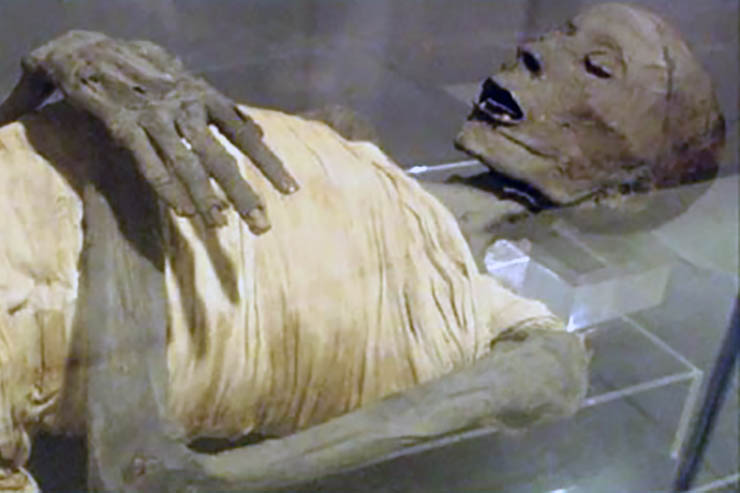
    In the movie, Contact, Jodie Foster plays an astronomer who establishes communication with a civilisation beyond our solar system. In the television program, The Curse of the Cocaine Mummies, a different, but equally fascinating, contact is established between ancient Egypt and ancient Peru. A German forensic scientist busted the Egyptian mummy Ramses II for possession of cocaine. Cocaine, as most people know, grows only in the Andes. How did Ramses II get his dope?

    The idea of ancient transoceanic contact between the Old and New Worlds before Columbus (other than the Vikings) is simply not acceptable within the tightly controlled halls of academia. Professor John Baines, an Egyptologist at Oxford is a typical case. He calls the idea of ancient transoceanic trade “absurd” and bolsters his “argument” by noting that he doesn’t know any professional Egyptologists, anthropologists or archaeologists who are “seriously” researching the idea. This is because, he says, the idea is not “perceived” to have “any real meaning for the subjects.”

    Professor Baines’ view reminds us of the priests who refused to look through Galileo’s telescope to see the blemishes on the Moon because this revelation did not conform to their preconceived ideas of reality. Academia is geared to not looking at the problem. This ostrich approach has predictable results: results that do not necessarily have any bearing upon the quest for truth and in fact, impede the search.

    The simple fact that we find sun-worshiping civilisations building pyramids, obelisks and preserving their dead by wrapping them in cloth (mummies) on both sides of the Atlantic is rarely even discussed within the archaeological and anthropological journals despite the fact that every child when first confronted with the facts raises the obvious question “why?” For four hundred of the past five hundred years scholars have puzzled over the facts. Three theories emerged yet only one survives today.

    Cortes’s secretary was one of the first to put forward the idea that both Old and New Worlds were remnants of an even older “lost” civilisation. The “Aztlan” of ancient Mexico and the “Atlantis” of ancient Egypt, he argued, were one and the same. With this simple idea the commonalities between buildings, culture and mythologies of the ancient people of Mexico, Peru and Egypt could all be explained as “echoes” of a lost world.

    The second theory presented was the idea that Mexico and Peru were settled by people from the Old World who already possessed the skills needed to build pyramids and preserve bodies. Most argued that they came from ancient Egypt but others suggest the Sumerians, people of ancient India, the Phoenicians and even the Templars from France. Again, a simple idea was used to explain an obvious problem.

    The third theory, was the idea of “separate development.” Here the focus is upon “how” people arrived in the Americas rather than upon the impressions of the Europeans following Columbus’ “discovery” of the New World. Although this is the more complicated of the theories — thus violating the scientific principle of Occum’s Razor (so beautifully articulated in Contact) that when confronted by conflicting theories for an unexplained phenomena one should prefer the simpler explanation, it is, nevertheless, the only theory that is considered scholarly in today’s universities.

    It is within this context that we must watch The Curse of the Cocaine Mummies. Cocaine and tobacco are plants that originated in America and were unknown to the Old World if we are to believe the traditional paradigm. The first tear in the fabric of the dogma came on the 16th of September 1976 when the mummified remains of Ramses II arrived at the Museum of Mankind in Paris. To repair the damage to the mummy, a scientific team was assembled which included Dr. Michelle Lescot of the Natural History Museum (Paris). She received fragments from the bandages and found a plant fragment ensnared within the fibres. When she looked at it under a microscope she was amazed to discover that the plant was tobacco. Fearing that she had made some mistake she repeated her tests again and again with the same result every time: a New World plant had been found on an Old World mummy. The results, little known in North America, caused a sensation in Europe.

    Professor Nasri Isk-ander, the Chief Curator at the Cairo Museum thought he had an explanation. As an avid pipe smoker he argued that “maybe a piece of tobacco dropped by haphazard” from the pipe of some forgotten archaeologist. Dr. Lescot responded to this charge of “contamination” by carefully extracting new samples from Ramses II’s abdomen, all the while having others photograph the process. These samples which could not possibly be “droppings” were then tested and once again were established to be tobacco.

    The discovery of tobacco fragments in the mummified body of Ramses II should have had a profound influence upon our whole understanding of the relationship between ancient Egypt and America but this piece of evidence was simply ignored. Then, sixteen years later, again quite by accident, more evidence emerged. In 1992, toxicologist, Dr. Svetla Balabanova of the Institute of Forensic Medicine in Ulm (Germany) tested the ancient Egyptian mummified remains of Henut-Tawy, Lady of the Two Lands. The results came as a “shock” to this scientist who regularly used the identical testing methods to convict people of drug consumption. She had not expected to find nicotine and cocaine in an ancient Egyptian mummy. She repeated the tests and sent out fresh samples to three other labs. When the results came back positive she published a paper with two other scientists. (Balabanova, S., F. Parsche and W. Pirsig, “First Identification of Drugs in Egyptian Mummies”, Naturwissenschaften 79, 358 (1992) Springer-Verlag 1992.)

    If Balabanova was surprised by the results of her tests she was even more surprised at the vitriolic response to her publication. She received a flood of letters threatening, insulting and accusing her of fraud. When she reminded her critics that she was simply applying the very same techniques that she had used for years in police work where her results were considered “proof positive” her critics didn’t seem to care. She was condemned as a “fraud.”

    Dr. Rosalie David, Keeper of Egyptology, Manchester Museum took up the challenge of investigating the “cocaine mummies” which she thought “seemed quite impossible.” She began by sending tissue and hair samples from her museum out to labs. She was working on the dual assumption that one of two things are true: 1. Balabanova’s tests were compromised; or 2. The mummy was not truly ancient” (i.e. it was fake). Dr. David flew to Munich to review the techniques and excavation records to see if the body, which had originally been purchased by King Ludwig I of Bavaria was genuine or not.

    Dr. Alfred Grimm, the Curator of The Egyptian Museum in Munich said that “the Munich mummies are real Egyptian mummies. No fakes. No modern mummies. They came from ancient Egypt.” After spending days pouring over the docum-entation associated with the “cocaine mummy” Dr. David relented saying: “it seems evident that they are probably genuine…”

    When she returned to Manchester she discovered that her own Museum’s mummies had traces of tobacco. Dr. David said: “I’m really very surprised at this.”

    Dr. Balabanova’s work had been validated by the test results from Manchester but she was now hooked on the problem and began collecting samples of naturally preserved bodies housed in museums all around Europe. She obtained 134 separate bodies taken from ancient Sudan dating to a time long before Columbus or the Vikings. One third of these bodies contained both nicotine and cocaine.

    The exciting realisation that there was certainly contact between ancient Peru and ancient Egypt has now been established. The cocaine mummies from Egypt and Sudan have changed the rules of this controversial game. There is no longer a warrant to exclude the hypothesis of transoceanic trade in ancient times.

    Is the principle of Occum’s Razor only to be applied when the outcome is safely assured to confirm to traditional dogma about theories of the past? It appears so. The cocaine mummies jumped the tracks of long established views. Despite overwhelming evidence we still find ourselves in the last decade of the twentieth century dealing with a ‘scientific’ establishment that ridicules its own members and refuses to look at the results of its own principles if the results don’t confirm the favourite views of the reigning orthodoxy.

    One step forward. Two back.
    [alert type=”general” dismiss=”no”]This article was published in New Dawn 47.[/alert]

    [alert type=”success” dismiss=”no”]If you appreciate this article, please consider subscribing to help maintain this website.[/alert]

    © New Dawn Magazine and the respective author.
    For our reproduction notice, click here.

  • The Message of Evita

    The Message of Evita

    From New Dawn 41 (Mar-Apr 1997)

    “Evita is untouchable…. Children are born today saying Peron! Evita! Not even the military governments were able to erase that.”
    – Mayor Manolo Quindimil (1996)

    Evita, the name by which Argentina’s beloved first lady Eva Duarte Peron (1919-1952) was known to the world, is again back in the international media spotlight. Her legendary life now the basis of the film Evita. But the Hollywood production met with national controversy in the land of her birth. “The script by this Englishman attacks our history, offends our dignity and is an insult to the Peronist people,” said Peronist legislator Marta Rivadera. “I am in favour of freedom of expression but am against this lie which will distort the figure of our saint.”

    “Evita holds a place in Argentine history equivalent to that of Abraham Lincoln in the United States,” explains Enrique Pavon Pereyra, who knew Evita personally.

    During her short life the Argentine working people revered Evita, while the wealthy oligarchs despised her and spread all manner of hateful slanders. Today, some circles still fear the memory of a woman who died forty-five years ago.

    Who really was Evita? The message, some say, is important, not the messenger. Today, the life of the messenger Evita Peron is shrouded in myth and legend. What we can know for certain are her thoughts and words recorded for posterity in books and published speeches. By understanding the tremendous vision she shared with her remarkable husband Juan Peron we can grasp something of her timeless greatness.

    EVA & JUAN PERON

    “When I chose to be Evita, I chose the path of my people.”
    – Eva Peron

    Evita was born Eva Maria Duarte on May 7 1919 in Los Toldos, Argentina, the fifth and youngest illegitimate child of Juana Ibarguren. Struggling free from a life of grinding poverty she moved to the Argentine capital to find work as a radio soap opera actress.

    1943 saw the young Colonel Juan Peron appointed Argentina’s Secretary of Social Welfare and Labour in the military junta of General Farrell. His leadership abilities and determination to radically empower the Argentine working class soon became obvious to all. Peron single-handedly transformed the labour movement and strengthened the unions. As his popularity grew – he was appointed vice president and Minister of War – opposition from reactionary elements in the armed forces and the wealthy land-owning class also grew.

    1944 found Evita working as a radio actress and commentator on Argentina’s leading radio station in Buenos Aires. A year earlier she had reached the top of her profession and was among the highest paid radio actresses in the country. Evita later described her work on radio as a combination of singer, disc-jockey, actress and lady commentator all in one. These were the glory days of radio when people relied on the airwaves to deliver news and comment along with entertainment.

    On Saturday, January 15 1944, an earthquake destroyed the ancient Argentine town of San Juan, claiming the lives of over ten thousand people. Col. Peron distinguished himself in organising the relief effort. Evita, already greatly interested in social welfare, attended a meeting of artists called by Peron to raise funds for the rebuilding of the town.

    Peron described the meeting at which a young woman, then unknown to him, boldly spoke out:

    “I remember that she wasn’t seated in the first row; that she was wearing a very simple dress; that she was thin, that she had blonde hair, and that she had a little hat, like they wore in those days. ‘We don’t need festivals,’ she replied to proposals that had been made, ‘we should go directly to ask, without offering anything….Let’s go to the streets, to the public places, to the hippodrome, to the theatre, to all the important places, and say to the people, our brothers are stricken, we have to help them! We have to get money from those that have it, because those that don’t have it can’t give it.’

    “I liked the way this woman thought and worked. I thought she wasn’t like the others. She had something very superior to the others in the way she talked and in her suggestions. She was practical and had new ideas.

    “‘Good, very well,’ I said to her then, ‘it’s your idea, organize it.’ And that’s the way it was. She organized everything.”

    In another recollection, Peron told how he was struck by Evita’s zeal and conviction. “I looked at her and felt that her words were overpowering me….I saw in Evita an exceptional woman. A true passion, animated by will and by a faith comparable to that of any of the early Christians.”

    Evita shared Juan Peron’s commitment to social justice. Peron saw in Evita a kindred spirit and co-worker in the struggle for a revitalised Argentine nation. “When I first knew Evita what attracted me to her was not the beautiful woman but the good woman,” Peron later wrote. “It’s true that she combined those two things: beauty and goodness. Instinctively I perceived that the collaboration of a woman of this kind would be invaluable for the social task I had in mind….I had to prepare a woman who would be the feminine leader of my political movement: a capable woman with enough basic culture, natural talents of intuition, with dedication…”

    On her daily radio programmes Evita dramatically recounted Peron’s welfare reforms. They were a passionate mix of radio drama and current affairs. One of her most popular broadcasts went on at seven in the evening, when men and women were together after work. Evita explained to her listeners all about “that newcomer in the Ministry of Social Welfare”. She obtained records from Peron’s deputies and office secretaries and brought the story of the fast rising military officer and his vision, to the masses.

    Looking back on this hectic period Peron recalled “…our private life [was] totally subordinated to the political and social calling…a veritable tyranny to which we submitted ourselves as if it were a mission. Evita, in those first days, didn’t care much about her appearance, or want to be taken for an elegant woman. She went to work, and working all day didn’t leave much time to care for herself.”

    As Peron’s influence and mass support grew, Argentina’s reactionary ruling class started a campaign of vilification aimed at undermining his popularity. He was openly living with Evita, and in a staunchly Catholic country, this provided ammunition for his enemies. Professor Robert D. Crassweller in his book on Peron, points out:

    “Evita’s image as a prostitute, strongly held in some quarters, was one consequence although it had no basis in fact. But it served well the sense of class antipathy and division that was growing up around Peron, and in a society so deeply fragmented and so hotly personalized any weapon that came to hand was welcome.”1

    By 1945 the forces of U.S. imperialism, alarmed at the course of developments in Argentina, formulated a policy to derail the growing anti-Yankee, anti-British, nationalist-labour coalition inspired by Juan Peron. Spruille Braden, whose family made their fortune exploiting Chile’s natural resources, became United States ambassador to Argentina. A protege of Nelson Rockefeller, Braden’s job was to guarantee Argentina’s compliance with the goals of U.S. imperialism in South America.

    The U.S. ambassador had several explosive meetings with Peron. Unable to persuade the Argentine vice president to accept Washington’s demands, Braden openly intervened in Argentina’s internal affairs, giving speeches to audiences of Peron’s opponents, and publicly criticizing Peron. Part of this U.S. instigated disinformation campaign smeared Peron as a fascist and ‘Nazi agent’. “North Americans are the greatest criminals and thieves in the history of the world”, wrote Juan Peron.

    Events came to ahead in October. Reactionary army officers led by an insignificant general insanely jealous of Peron, staged a coup. On October 12th, Peron was ousted from all his government posts and arrested by the pro-U.S. clique. With Peron exiled to an island prison, the self-appointed cabinet officers set about organising their own regime. They had reckoned without Evita, and they underrated the support of the working people for Peron.

    On the boat to the prison island, Col. Peron turned to the officer guarding him. “Well, I lost,” he said. “But, you know, there is only one person for whom I need to care. I am your prisoner but I am also your fellow army officer. May I ask you a favour?”

    “What is it, Colonel Peron?” the officer asked. “Give a pistol to Evita for me – to defend herself or to kill herself if someone touches her. Tell her I will not live after her….”

    When word spread of Peron’s imprisonment, Evita started organising their bands of working class supporters, the descamisados or “shirtless ones”, with furious speed.

    Evita rallied the labour unions and all who listened in a popular uprising that would forever change Argentina. Evita told the union leaders: “Look, this is not just our chance, it is your last chance to create a new social order, or we can all go back to the old social order.”

    As the Argentine masses realised what had happened to Peron, riots broke out all over Buenos Aires and other provincial cities. By October 17 the Argentine capital was almost in the hands of organised bands of descamisados. More than half a million people, led by over fifty thousand labourers, gathered in front of Government House, demanding “our leader, Peron.”

    Fearing bloody civil war, the military promptly released Peron and he appeared before the crowds on the Government House balcony. On October 23 he secretly married Evita. Then began his campaign for the presidency.

    In a desperate attempt to destroy Peron’s presidential bid, the U.S. State Department issued the notorious “Blue Book,” a scandalous report officially entitled Consultation among the American Republics with Respect to the Argentine Situation. Containing all the false charges generated by Ambassador Braden, the “Blue Book” was a vicious piece of propaganda. The agents of U.S. imperialism went to work massively publicising its charges. Half the space of many newspapers – with newsprint scarce – was devoted to reprints from it.

    PERON’S VICTORY

    “The reign of the bourgeoisie has terminated throughout the world. The government of the peoples begins. With that, demi-liberalism and its consequence, capitalism, has ended its cycle; the future belongs to the people.”
    – Juan Peron

    Despite the calculated disinformation of the U.S. State Department’s “Blue Book” and Ambassador Braden’s intrigues, Peron emerged victorious, following the first honest election in Argentina in decades. There was rejoicing in the streets that night of February 24 1946, as Peronist representatives gained an overwhelming majority in the Chamber of Deputies and almost all the seats in the Senate.

    In a direct move against the iniquitous Anglo-American financial interests, Peron nationalised the Central Bank of Argentina one day before the election. Two years later he referred to this move in a speech: “Nationalisation has been, without doubt, the most transcendent financial measure of the last fifty years.”

    “Is it true that you represent a new doctrine?” the Associated Press reporter asked Peron after the 1946 election. To which Peron replied, “Yes, in effect, but not so new as forgotten for a long time, because it is already 2,000 years old: Christianity.” His new government immediately launched a “social programme of a revolutionary nature.”

    The new Argentine president enacted legislation establishing labour councils to protect workers from arbitrary dismissal, reduced the working week to forty-four hours, raised wages, nationalised the British owned railway system and established free health clinics for the poor.

    Evita’s total devotion to the ideals of Peronism impressed all who heard her spell-binding, stirring oratory. From her quiet opening, modestly referring to herself as Peron’s little echo, she told her audience: “I was no better off than you not long ago. Now I exist only to interpret Peron’s great crusade to you – his people. I am only here to save his energy, to explain his ideals, to carry out his glorious programme….”

    The new government granted women the right to vote in 1947 and eighteen months later Evita organised the Peronist Women’s Party. Meaningless feminist theories did not interest her. Her actions did more, in the words of one observer, “to bring women into public life in Argentina than a large army of feminists could have done.” In an early speech, Juan Peron paid tribute to the many women, inspired by Evita, who joined the Peronist ranks:

    “This Revolution has been echoed by Argentine womanhood as few events in history have ever been. This is indeed auspicious, for if man is a rationalist, woman possesses what is above masculine rationalism; an intuition which is always superior to the success we men may be able to attain. For this reason I render homage to the women of my country in whom the men of the Revolution found an echo that fills us with satisfaction and pride.”

    Evita Peron was a legend well before her death. Her autobiographical La Razon de Mi Vida (“My Mission in Life”), written in late 1951, after she learned that she had cancer, was a best seller in Argentina and abroad. Some 50 million copies were printed, 150 000 copies selling on the first day of publication. An Arabic edition was distributed in Egypt and throughout the Mediterranean. Wherever people were rising up to confront imperialism, Evita’s book appeared.

    In La Razon de Mi Vida she vents her anguish at the injustice suffered by the poor at the hands of the oligarchs. A strong sense of the evils of bourgeois capitalism and crusading zeal for social justice were inseparable from Evita’s personality. She wrote:

    “I remember well that I was sad for many days when I discovered there were wealthy people as well as poor people in the world; and the strange fact is that I didn’t resent so much the existence of poor people as I did to discover there were also rich. The theme of rich against the poor, has been, since then, my sole concern in my deepest solitude.” Throughout her years with the Argentine president, Evita always scrutinised all government policies regarding worker’s rights and social welfare.

    “It is distressing to compel men to live in an unjust world,” Juan Peron once lamented. With Evita by his side, he tirelessly laboured to build a new nation “in which every part of Argentine society should contribute its share for the benefit of the community: the worker, his muscles; the middle class, its intelligence and activity; the rich, their money….”2

    The Argentine leader exposed the principle of unbridled liberty in the economic sphere, remarking: “We do not favour unilateral liberty where the rich are free to do whatever they like while the poor have but one liberty: to die of hunger.

    “It is necessary to end the economy of exploitation and replace it by a social economy without exploiters or exploited and where each one receives a just payment in accordance with his capacity and effort. Capital must be at the service of economy and not economy at the service of international capitalism as has occurred up to now.”

    The 1949 Argentine National Constitution, inspired by Peron’s ideas, stipulated that it is the duty of the State to supervise the distribution and use of land and intervene in order to develop and increase its yield for the good of the community. The State must give each peasant or his family the possibility of becoming the owner of the land he cultivates. Capital must be at the service of national economy and its main object must be social welfare. The different forms of exploitation cannot oppose the ends of public welfare of the Argentine people.

    EVA PERON FOUNDATION

    “…Peronism, which perhaps at times doesn’t respect the forms but which tries to assimilate and comply with the principles, is an effective, real, and deep way of practising Christianity…”
    – Juan Peron

    Evita made part of her grand vision a reality through the Eva Peron Foundation, a charity organisation that distributed over $50 million a year to the poor and needy. The foundation avoided the quagmire of government bureaucracy by relating directly to the people. As Evita explained:

    “It was Peron himself who told me: ‘The people who have been deeply punished by injustice have more confidence in people than in institutions. In this, more than in anything else, I fear the bureaucracy. In government it is necessary to have a lot of patience and to know how to wait for everything to move. But in the works of social assistance you cannot ask anybody to wait.’”3

    In the first eleven months of Peron’s presidency, Evita gave away close to $4,500,000 worth of school books, clothes, shoes, furniture, toys, and food, to those in need. Prof. Crassweller explains:

    “With such singleness of direction, the foundation flourished as none other. By the end of the 1940s it exceeded, in size, in influence, and in general significance, most of the ministries of the government. Its assets exceeded $200 million. It had 14,000 permanent employees, including thousands of construction workers and a staff of priests. It acquired for distribution to the poor fantastic amounts of supplies….Its flood of revenues came from many sources. Labor unions donated cash and goods made in the factories where members worked.”4

    Evita built more schools, orphanages, hospitals and retirement homes than all previous Argentine governments combined. Prof. Crassweller conveys the sheer enormity and range of the foundation’s work:

    “Twelve hospitals, with the best equipment available anywhere, were built. A thousand new schools appeared. There were clinics, medical centers, homes for the aged, convalescent centers, a home for girls who had come to Buenos Aires looking for work, transit homes for those needing temporary shelter, student cities, children’s homes, including a famous Children’s City built to the scale of its inhabitants, with small markets, a church, public buildings, a bank that issued script, streets, houses, and dormitories for four hundred and fifty particularly disadvantaged children. The foundation also built the Barrio Presidente Peron, a development with six hundred new houses just west of Buenos Aires, and it built Evita City, a planned community with 15,000 homes. Many of the public structures were notable for a tone of luxury unfamiliar in such places, a touch of brocade and damask and crystal, and this was deliberate, a form of social recompense.”

    As if painfully conscious of her own mortality, Evita was “working through the day and through much of the night, at a pace the human body cannot long tolerate.” She did not smoke. Like her husband she drank no alcohol, only water. Just as the Christians in ancient Rome died for Christ, Evita reminded the Peronist faithful, “We, who love Peron more than anything, are going to die for Peron, because we are not defending a personal thing, but a national cause.”5

    Juan Peron, after only three years in office, had made Argentina the fourth industrial power in the world. Land reforms boosted agricultural production and the Argentine Institute for Trade Promotion set the price of Argentina’s booming exports. The development of a national economy resulted in vast public works projects, bringing economic prosperity. By 1949, Peron’s doctrine was summed up in the word Justicialismo, a term coined from the Spanish words for “social” and “justice”. Justicialismo, the ideology of Peronism, being officially defined as “a doctrine whose object is the happiness of man within the society of mankind through the harmonizing of material, spiritual, individual and collective forces, appraised from the Christian standpoint.”

    JUSTICE & CHRISTIAN SOCIALISM

    “I have always thought that above all material values are the permanent values of spirit, which are the only eternal things.”
    – Juan Peron

    “Justicialism”, Peron proclaimed, “is nothing but national Christian socialism.” Above all, the goal of Justicialismo was to transform the Argentine masses into an “organised community” in which conflicting interests would be brought into harmony.

    Evita Peron clearly defined the difference between an organised community and a dispersed mass by comparing Spartans with Helots. The former constituted a great people with conscience, personality and social organisation, while the latter lacked those three qualities and lived as slaves.

    “The history of Peronism,” said Evita, “is already a long battle of seven years to have a suffering and sweating mass – as General Peron many times called it – become a people with social conscience, personality and organisation.

    “You must remember how many times General Peron addressed workers, industrialists, merchants, professionals, everybody, asking them to organise themselves.

    “Peron wants a people which feels and thinks, which acts properly guided. For this reason he set three objectives: social justice, economic independence and political sovereignty.

    “Peron wants a united people, because then nobody will exploit it, nor will it be defeated by any other force in the world. Peron wants a people where everybody is privileged.”6

    The United States faced the problem of what to do about Peron. His legally won 1946 election, after the publication and distribution of the “Blue Book”, was an open defeat of United States diplomacy in Latin America. The U.S. could not afford to openly oppose Peron, at the possible cost of Latin American solidarity. Washington chose instead to try to publicly live with the “Peron problem”, while simultaneously carrying on covert operations designed to undermine and discredit the Peronist revolution.

    Peron understood the real nature of the international forces arrayed against him. He saw how the British and U.S. imperialists had actually used the Argentine Communist Party to oppose his labour-nationalist coalition. The Communists broke up strikes in the railways and meat packing plants (owned by Anglo-American interests) and strenuously fought the anti-imperialist descamisados. “For capitalist oligarchy a communist party is better than a Justicialist enemy,” declared a popular Peronist slogan of the era.

    The globalist forces, so hostile to nationalism and responsible for the division of the world between capitalism and communism, Peron termed: “the Great Internationals of Sinarchy.”7

    Sinarchy is a type of collective shadow world government that brings together the highest leaders of the big imperialist powers. The Argentine leader said that “Masonry, Zionism, international societies of different kinds are but a consequence of the globalisation of the present world. They are the hidden forces of imperialist domination.”8

    “Capitalism and Soviet Communism are but two of them,” Peron observed, “seemingly opposed but in reality perfectly united and co-ordinated.

    “Everything can be summarized by saying that the capitalist regime has abused property and is to blame for communism because it has given it a reason to exist. Without the exaggerated exploitation of the old capitalist regime, communism would never have existed. That is the cause, and communism is the effect. In order to remove the effect, it is necessary to remove the cause.”9

    Re-elected by an even greater margin in 1951, Peron continued to reshape Argentina. Reviewing the achievements of his presidency in the face of opposition from Britain and the U.S., Peron wrote:

    “During the ten years of Justicialist Government [1945-55] Argentina was free and sovereign. Nobody poked their noses with impunity. But at the end of those ten years, international sinarchy, together with vernacular politicians at the service of foreign interests and colonialism, treaded on us.”

    A NATION MOURNS

    “I pray God that He should not allow these madmen to lift their hand against Peron, for on that day, woe to them! I shall go forth with the working people, I shall go forth with the women of the people, I shall go forth with the descamisados, and I shall leave no brick standing that is not Peronist.”
    – Evita Peron, May 1 1952

    Evita tirelessly carried on her work at the foundation, but now she was dying of cancer. At first resistant to treatment of any kind, she accepted the inevitability of surgery.

    On May 7 1951, a little more than twelve months before her death, Evita declared:

    “Peron is the air we breathe; Peron is our sun, Peron is life. I want nothing but to be the heart of Peron. Because, though I do my best to understand him and learn his marvellous ways, whenever he makes a decision, I barely mumble. Whenever he speaks, I hardly utter a single word. Whenever he gives advice, I scarcely dare make a suggestion. What he sees I hardly glimpse. But I see him with the eyes of my soul….And I have pledged myself to collect the hopes of the Argentine people and empty them in the marvellous heart of Peron so that he may turn them into realities.

    “The humble people, my general, have come here to prove, as they have always done, that the miracle that happened 2,000 years ago is occurring again. The rich, the learned, the men in power never understood Christ. It was the humble and the poor who understood, because their souls, unlike the souls of the rich, are not sealed up with avarice and selfishness.”

    Argentina’s powerful Catholic Church, traditionally aligned with Peron’s enemies the oligarchs, did not approve. The Church hierarchy was already upset by Peron and Evita’s interest in the esoteric sciences and the intrusion of the Eva Peron Foundation into education and youth affairs.

    Evita responded to the Church’s disapproval explaining: “Once I read in a book by Leon Bloy, about Napoleon, that he could not conceive heaven without his Emperor. This appealed to me and in a speech I said that I also could not conceive heaven without Peron.

    “Some people thought that this was almost a heresy. Nevertheless, every time I think of it, it seems more logical to me.

    “I know that God alone will fill heaven.

    “But God, who could not conceive heaven without His mother, whom He liked so much, will forgive me because my heart cannot conceive it without Peron.

    “I shall not commit the heresy to compare him (Peron) to Christ…but I am certain that, by imitating Christ, Peron feels a deep love for humanity and that this, more than anything else, makes him great, magnificently great.”10

    Evita continued to decline. On June 4 1952 she rallied for a last appearance in public at Peron’s inauguration for a second term. She now weighed only eighty pounds. Later in June, she endured radiotherapy, was burned, and suffered much.

    To the end Evita’s concern was for her beloved General. “As she lay in bed on a bad day toward the end, more dead than alive, Peron walked by in the corridor beyond her door, coughing as he passed. ‘Did you hear that?’ she said to her doctor. ‘General Peron is coughing, because he smokes too much. Please, tell him not to smoke. Examine him. See that he doesn’t get sick.’”11

    During her last weeks, Evita wrote her public will. When she died on July 26 1952, at age 33, the nation was in shock. She never held any official post but had become the most famous and beloved woman in the world. The largest funeral in the history of the Argentine was held with millions of mourners lining the streets as her coffin passed with full military honours.

    On October 17, the anniversary of her 1945 mass rallies to free Peron, a day set aside to honour “Evita, Spiritual Chief of the Nation,” Evita’s public will was read to the people. It began: “I wish to live eternally with Peron and with my people. This is my absolute and permanent desire, and therefore my last will. Where Peron is and where my descamisados are, there will my heart ever be, to love them with all the forces of life and all the fanaticism that burns my soul.”

    She continued: “I will be with them, with Peron, to fight against the traitorous and perfidious oligarchy, against the cursed race of exploiters and the dealers in humanity….if I have committed errors, I have committed them out of love and I hope that God, who has always seen into my heart, will judge me not for my errors, nor for my defects, nor for my guilt, but for the love that consumes my life.

    “I…was born of the people and suffered with them. I have the body and the soul and the blood of the people. I can do nothing other than to surrender myself to my people.”

    Evita passed from the scene of history, a great and truly unique woman for whom no counterpart can be discerned.

    In 1955 Juan Peron was overthrown by pro-Anglo-American military officers and forced to leave the country. As one commentator wrote of his years away from Argentina: “In exile, Peron had continued to espouse the basic tenets of his political creed: hatred of bourgeois capitalism and all forms of imperialism; advocacy of the Third World causes (such as economic independence), which he so early championed and of which he now calls himself the father; and government with and for, if not by, the people.”12

    Returning in 1973 to an Argentina in political and economic chaos, Peron was reelected to the presidency with 67% of the vote. After only nine months in office Peron died and joined his beloved Evita.

    “Yes. I confess I have an ambition, one sole and great personal ambition: I would like that the name of Evita would appear someday in the history of my country. I would like that it would say of Evita, even if it would not be more than a small footnote, at the end of the wonderful chapter which history will certainly dedicate to Peron, something approximately like this: ‘There was, by the side of Peron, a woman who dedicated herself to take to the President the hopes of the people, which Peron would promptly convert into realities.’ And I would feel properly and fully repaid if the footnote would end like this: ‘Of that woman we only know that the people used to call her, caressingly, EVITA.’”13

    [alert type=”general” dismiss=”no”]This article was published in New Dawn 41.[/alert]

    [alert type=”success” dismiss=”no”]If you appreciate this article, please consider subscribing to help maintain this website.[/alert]

    REFERENCES

    1. Peron and the Enigmas of Argentina, Robert D. Crassweller, 1987, W.W. Norton & Company, New York

    2. Doctrina Peronista, Juan Domingo Peron, 1952, Republica Argentina, Buenos Aires

    3. La Razon de Mi Vida. English translation: My Mission in Life, Eva Peron, 1952, Vantage Press, New York

    4. Peron and the Enigmas of Argentina, Robert D. Crassweller, 1987, W.W. Norton & Company, New York

    5. Historia del Peronismo, Eva Peron, 1951, Subsecretaria de Informaciones, Buenos Aires

    6. Historia del Peronismo, Eva Peron, 1951, Subsecretaria de Informaciones, Buenos Aires

    7. La Hora de los pueblos, Juan Domingo Peron, 1968, Madrid

    8. La Hora de los pueblos, Juan Domingo Peron, 1968, Madrid

    9. Catecismo de Doctrina National Justicialista, Buenos Aires

    10. La Razon de Mi Vida. English translation: My Mission in Life, Eva Peron, 1952, Vantage Press, New York

    11. Peron and the Enigmas of Argentina, Robert D. Crassweller, 1987, W.W. Norton & Company, New York

    12. The New Encyclopedia Britannica, 15th Edition

    13. La Razon de Mi Vida. English translation: My Mission in Life, Eva Peron, 1952, Vantage Press, New York

    © New Dawn Magazine and the respective author.

    For our reproduction notice, click here.
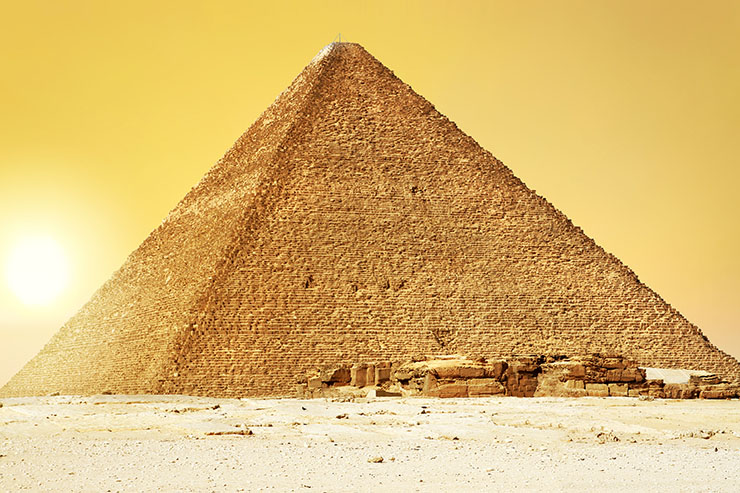
  • Wonders of the Great Pyramid Revealed

    Wonders of the Great Pyramid Revealed

    From New Dawn 39 (Nov-Dec 1996)

    The Pharaohs themselves are now but phantasms, thin vaporous spirits who dwell in Amenti, the Hidden Land, but the Pyramids are with us still; solid, bulky memorials which have become an enduring part of the rocky stone plateau upon which they were built. Ancient Egypt continues to hold the attention and to grip the interest of the modern world, chiefly because it has left us these stupendous testimonies to its existence, testimonies which are more tangible and more visible than any which have been left by other dead empires of the East.

    Alongside the famous Sphinx lies Egypt’s other famous monument – the Great Pyramid of Giza – the most distinct and massive structure of Egypt’s hazy landscape. The Great Pyramid of Giza, unrivalled by the achievements of later builders and architects, stands today a monumental testimony to a past and great civilisation.

    The mathematical and astronomical precision of the Great Pyramid – “discovered” recently by the modern world – has fascinated and intrigued scholars and travellers alike. People ask: “How can this pyramid be explained in the light of modern thought? Modern thought tells us that history is the development of cave-man to modern-man. How, then, could primitive men build this fabulous super-structure, unmatched in its precision and vastness; this impervious testimony to their existence?” Modern “thought” and “history” may tell it very simply, but in essence, the very opposite is probably true; civilisation is not a new phenomena, it has existed at various times throughout mankind’s long past.

    The Great Pyramid’s Position and Age

    The Great Pyramid of Giza is situated about ten miles to the south-west of Cairo, the capital of Egypt. Known as the Pyramid of Cheops (Khufu), it stands on the northern edge of the Giza Plateau, 198 feet above sea level, in the eastern extremity of the Libyan section of the Great Sahara Desert. The Great Pyramid is the most northerly of a group of nine pyramids compromising the “Giza Complex”. To the south-east of the Great Pyramid lies the Sphinx, carved out of the rock, with its gaze directed towards the rising sun.

    While archeologists generally contend that the Great Pyramid was built during the reign of Pharaoh Cheops (Khufu) of the IVth dynasty (erection period circa 2623 B.C.), this is questioned by various written accounts and recent discoveries.

    The Egyptian Copts, who claim to be the descendants of ancient Egyptian stock, hold a tradition that declares the Great Pyramid was there for many centuries before Khufu, thereby inferring that Khufu may have repaired it and then took credit for its construction.

    According to a history of ancient Egypt written by Masoudi, a medieval Coptic historian, the two greatest pyramids (Cheops and Chephren) were built by Surid, one of the kings of Egypt. The king is reported to have had a prophetic dream where “the sky came down and the stars fell upon the earth.”

    The king’s interpreter of dreams consequently predicted a great flood and fire that would burn up the world. The king then ordered the construction of the two pyramids so that all the secret sciences together with knowledge of the stars as well as all they knew of geometry and mathematics could be stored within. All their collected knowledge would thus survive and be available for future generations.

    Other accounts of who built the Great Pyramid have also been brought down to us by Church historians.

    Archbishop Ussher, the noted Church historian, in his Biblical chronology, refers to the migration of the Shepherd Kings from Arabia into Egypt. Ussher believed that some “Shepherd-Prince coming from Arabia or Palestine was enabled to exert such an amount of mental control over King Cheops as to induce the King to shut up the idolatrous temples and compel his subjects to labor in the erection of the Great Pyramid.”

    The famous Greek historian, Herodotus, who conversed with Egyptian priests regarding the builders of the Great Pyramid, was also told the builders were strangers to Egypt.

    Such theories telling of strangers and foreigners that came to build the Great Pyramid were taken up by several Biblical scholars. One theory had it that the prophet Enoch and Job built the Great Pyramid long before the flood of Noah, which would mean that it was constructed well before the modern date of 2623 B.C., probably during Enoch’s believed life-span circa 4300 B.C. to 4000 B.C.

    Other Bible scholars, while accepting the modern date of construction, contend that it was built by either Shem (or his immediate descendants). They proclaim that the Great Pyramid is the “Bible in Stone,” embodying a prophetic chronology, listing all events of history, from the beginning to the end. They saw scriptural basis for this in the Prophet Isaiah’s statement that “In that day shall there be a alter to Yahweh in the midst of the land of Egypt, and a pillar at the border thereof to Yahweh.” (Isaiah 19:19)

    Not a Tomb

    In the face of available evidence, it does appear to be the case that the Great Pyramid is a unique structure in the context of that period in Egypt. It is plausible that it may have been built by outsiders or strangers to the land of Egypt. But why and what for? One thing is certain, it was not built to be a tomb as all later pyramids were.

    Three clear reasons why the Great Pyramid was not built to be a tomb are:

    1) Nothing whatsoever was found in the Great Pyramid when it was opened for the first time in 820 A.D. – not even the smallest resemblance of anything pertaining to the dead.

    2) The departed need no air for breathing or any other purpose. The Great Pyramid, however, has ventilating tubes in both the Queen’s and King’s Chambers.

    3) Most convincing of all, is the tightly fitting granite plug, fifteen feet long, at the entrance of the Ascending passage. All engineers agree that it was placed in its present position when construction had reached that level – not after. Thus, with the Ascending passage sealed when built, no mummy or coffin could have been taken into the upper chambers.

    Amazing Features

    A review of the extraordinary discoveries made concerning the Great Pyramid of Giza is appropriate in the light of this modern age of ‘enlightenment’; our so-called ‘great achievements’ of contemporary times fall into the background when one appreciates the marvellous design and spiritual aurora of the Great Pyramid. The Great Pyramid is an eternal structure and storehouse of valuable knowledge and wisdom. The grand purpose behind the creation of the Great Pyramid is in stark contrast to the current period of gross selfishness and rampant materialism.

    The Great Pyramid’s position is central to all the land area of the earth. The men who placed this ancient monument must have had the worldwide knowledge of a skilled surveyor, for lines drawn through the pyramid to the four cardinal points of the compass divide equally the earth’s terrain. It is therefore the logical and geographical zero of longitude, rather than Greenwich, England. Since the Earth has enough land area to provide three billion possible building sites for the Pyramid, the odds of it having been built where it is are 1 in 3 billion.

    Today, seen at a distance, the Great Pyramid looks like a great pile of rock. Nearer at hand, it is seen that the stones, composing the structure, are roughly cut and laid in even courses, one upon another. These courses, or layers, form a series of gigantic steps, sloping back from the base on all four sides, to a level platform on top. Because it is the oldest building of its kind in the world and because of its immense size, the ancients conferred upon it the predominant distinction of being the first of the Seven Wonders of the World.

    Modern scientific investigations have shown, with the exception of the comparatively small space occupied by the passages and chambers, the Great Pyramid is a solid mass of stone blocks having a square base and four tapering sides that rise 454 and a half feet to a small platform on top. Its original designed height is 484 feet, equal to a modern 48 story skyscraper. The length of each side of the Pyramid’s base is 755? feet and the entire structure covers slightly over 13 acres. In sheer bulk, the Great Pyramid is the largest man-made building in the world.

    The yellow limestone (nummulitic) blocks making up the bulk of the Pyramid average two and a half tons each and are estimated to number about 2,300,000. This equals nearly 90,000,000 cubic feet of masonry and enough to build 30 Empire State buildings.

    In its original state, each of the four sides of the Great Pyramid had an area of five and a half acres, thus totalling 22 acres of highly polished limestone blocks. In the brilliant sunshine of Egypt, the sides acted as gigantic mirrors, reflecting the sun’s rays and could be seen for many miles around. Seen from the moon, the Great Pyramid would have been seen as a bright star on earth. Appropriately, the ancient Egyptians called the Great Pyramid “Ikhet,” meaning the “Glorious Light.”

    Amazingly, the outside surface stones were cut within 0.01 (1/100th) inch of perfectly straight and at nearly perfect right angles for all six sides. They were placed together with an intentional gap between them of 0.02 inch, a feat difficult to duplicate with modern technology. The 0.02-inch gap allowed space for glue to seal and hold the stones together. A white cement that connected the casing stones and made them watertight is still intact and stronger than the blocks that it joins.

    By means of its reflections and shadows, the Great Pyramid became the great sundial of Egypt, not only for the days and hours, but for the seasons of the year. Exactly as a modern chronometer gives the hours, say, of midnight, 6 a.m., noon, and 6 p.m., so the reflections from the Pyramid gave accurately the days upon which the Winter Solstice, the Spring Equinox, the Summer Solstice and the Autumnal Equinox occurred. This precisely defined the Solar Astronomical Year.

    The orientation of the Great Pyramid in relationship to true north is such as to cause it to be declared the “most accurately oriented edifice on earth.” That is to say, its four sides are directed to the four cardinal points of the compass with less than 3 minutes of one degree off true north. By comparison, the Paris Observatory is 6 minutes of one degree off true north. It is possible that originally the Great Pyramid was absolutely perfectly orientated and the slight error measured today is the result of centuries of contraction or expansion of the earth’s crust or from earthquakes, which seismography records as not being infrequent in the territory contiguous to the Great Pyramid.

    Such nearly perfect orientation is exceedingly hard to secure, even with modern astronomical equipment, and seemingly impossible without it. If the knowledge of the magnetic needle was known, it would have been of little value. It points to the magnetic north, not to the true north. The magnetic north is also constantly moving. The celestial pole (true north) is a point, usually defined by a star, through which the polar axis of the earth would pass were it projected to the star sphere.

    From its physical appearance, the Great Pyramid stands at the head of the world in vastness of dimensions. For over forty centuries it has been enshrouded in the deepest mystery but now it is beginning to yield up its secrets. Modern research is finding it to have been constructed in perfection of workmanship and in the practical mastery of problems that would tax the ingenuity of modern engineers. It was built for permanence and for surviving all the commotions of nature and all the vandalism of men.

    Historical Record

    The earliest record of the Great Pyramid is found in the writings of the Greek historian, Herodotus, who is often referred to as the “Father of History.” He was born around 484 B.C. at Halicarnassus, a Greek colony on the coast of Asia Minor, and died around 425 B.C. Herodotus visited Egypt to gather information from the scholar-priests for his books. From an Egyptian priest, through an interpreter, Herodotus gathered traditional accounts of the erection of the Great Pyramid. Although evidence goes to show he accurately recorded what he saw and heard, he did believe some things that were not true. In Herodotus’s day, the Pyramid was already very ancient so it is not surprising, therefore, that all sorts of legends and fanciful theories had grown up around the Great Pyramid.

    Like Herodotus, Diodorus Silculus, who lived during the first century before Christ, wrote that the Great Pyramid was not used for burial purposes as was the case for the later pyramids. Cheops (the pharaoh believed responsible for the construction of the Great Pyramid) and Chephren (the pharaoh believed responsible for the construction of the Second Pyramid of Giza adjacent to the Great Pyramid) were not buried in these two pyramids. In fact, the sarcophagi in these two Pyramids are both undecorated and uninscribed, thus indicating that no royalty was ever placed in them. There are indications, however, that at some time later, someone else used Chephren’s sarcophagus, for the lid shows that it had been fixed down and then forced off.

    No record has been found to indicate the upper chambers of the Great Pyramid were penetrated before 820 A.D., when Caliph Al Mamoun of Baghdad came to Egypt to seek the wealth reportedly hidden within its secret recesses.

    Al Mamoun directed Arab workmen to excavate near the base of the middle of the north side of the pyramid. After much laborious work, and on the point of giving up, the workers broke through to the descending passage that started from the original entrance. To their great disappointment, they didn’t find any treasure. Such records of this forced entrance are extant today.

    Shortly before the thirteenth century A.D., the Arab physician, philosopher and traveller Abdul Latif, whose work, On the Human Body, became a classic in the Arab world for centuries, wrote that engraved on the white casing stones were strange hieroglyphs.

    “The stones were inscribed with ancient characters, now unintelligible. I never met with a person in all of Egypt who understood them. The inscriptions are so numerous that copies of those alone which may be seen upon the surface of the two Pyramids would occupy above six thousand pages.”

    Two years after Abdul Latif’s visit a great earthquake hit this area, dislodging many of the white casing stones that covered the surface of the Great Pyramid and made it shine so brightly. These events subsequently led to the stripping of the beautiful casing stones for use in other buildings in the Middle East.

    John Greaves (Professor of Astronomy at the University of Oxford, England) was the earliest Western scholar to make a thorough study of the Great Pyramid. He visited Egypt in 1637 in order to explore the pyramids. He afterwards wrote the first book devoted entirely to the Great Pyramid. The publication of his book triggered major interest in the pyramids and in the following years many travellers went to Egypt in search of treasure and hidden secrets.

    Science of the Pyramid

    Sir Isaac Newton (1642-1727) is credited with the discovery that the Great Pyramid was constructed on two different units of measurements called cubits. One he called the “profane” and the other he called “sacred.” His original cubit measurements were slightly in error, being based on inaccurate measurements of the base of the pyramid by John Greaves due to insufficient clearance of rubble.

    Further research did find that Newton’s “profane” cubit was equal to 20.6284 British inches and is now known as the “Egyptian Royal Cubit.” This Royal Cubit was the unit of measurement employed by the designers of the Great Pyramid. The other and longer “sacred” cubit was found to be equal to 25.0265 British inches and is called today the “Sacred Cubit.” This cubit predominates in the design of the Great Pyramid and through its application the pyramid reveals its scientific features.

    The Sacred Cubit is designated in the form of a horseshoe projection, known as the “Boss” on the face of the Granite Leaf in the Ante-Chamber of the Great Pyramid. By application of this unit of measurement it was discovered to be subdivided into 25 equal parts, the subdivisions being known as “Pyramid inches.” (P. inches) One Pyramid inch equals 1.00106 British (and American) inches.

    In 1859 John Taylor, author of The Great Pyramid: Why was it built?, proposed that the Pyramid inch was also a Polar Diameter inch. The theory was adopted by Piazzi Smyth in 1864-5. Subsequent scientific calculations confirmed that the Pyramid inch is a 500,000,000 part of the earth’s Polar Diameter.

    Surely, at the time the Great Pyramid was built, no man on earth knew the precise dimensions of the spheroid called the Earth. So the question is naturally raised, how was that knowledge incorporated in the measure of the Sacred Cubit?

    Geometric Construction

    In geometric form, the Great Pyramid is what is called a true pyramid. Its base is a perfect square. Each of its four sides form perfect equilateral triangles. These triangles slant evenly inward and upward from the base, until they meet at an apex situated perpendicularly over the centre of its base where the two base-diagonals intersect. The last stone (the apex stone) laid in place is also a true pyramid in form. This unique feature of a cornerstone is found in no other form of a building.

    It is noteworthy that the Great Pyramid is completely geometric – internally and externally – in its design and conception. A close examination of the Great Pyramid may reveal absolutely nothing unless a knowledge of geometry and mathematics is employed. Valuable insights into the purpose of the Great Pyramid is possible from an independent non-biased viewpoint. Therefore, the secrets of the Great Pyramid, its symbol, measure and angle, can be more appreciated by an engineer than an Egyptologist.

    Scientific directed surveys have furnished the actual geometric measurements of the Pyramid. From these measurements calculated data has been obtained which reveal the Great Pyramid to constitute a geometric representation, on a vast scale, of mathematical and astronomical knowledge not to be known, again, for over 4500 years. The remarkable manner in which this knowledge is geometrically expressed, relative to certain simple mathematical formulae, surpasses in every way, any similar undertaking of man.

    It is worthy of special note that the entire geometric structure of the Great Pyramid is designed on the basis of Pi – 3.14159 – the mathematical ratio upon which the whole physical universe is designed, (Archimedes 287-212 B.C., the Greek mathematician, never came closer than 3.1428) and the value of “y” – 365.242 – the number of days in the earth’s solar year (the time interval in days between two successive vernal equinoxes in the earth’s journey around the sun).

    In mathematics, Pi is the ratio between the circumference of a circle and its diameter (the straight line through its centre). That is to say, the circumference of any size circle is always 3.14159 +, times its diameter. This sign has been adopted because of the fact that the ratio in question has never been ascertained to its finality. It has, however, been calculated to an exceedingly high degree of precision, namely, to over 5,000 decimal places.

    The amazing fact that this geometric ratio Pi, which pervades the whole universe, from the vast solar systems to the tiniest atoms, and is incorporated in the Great Pyramid, was first revealed by the angle of the slope of the Pyramid’s sides. This angle results in the Pyramid’s vertical height bearing the same ratio to the perimeter of its base that the radius of a circle bears to the circumference.

    In other words, if the height of the Pyramid to its apex is taken as the radius of a circle, the distance around the base of the Pyramid is found to be exactly equal to the circumference of that circle. The required angle of the slope of the Pyramid’s sides to produce this result is consequently known as the pyramidic Pi angle and is 51? 51′ 14.3″. No other pyramid in the world is built at this exact angle.

    Nearly all of the dimensions of the interior (King and Queens Chambers, Grand Gallery, etc.), and the Architect’s design of the exterior are expressible in terms of the length of the solar year. Some examples are:

    (1) The square base of the Pyramid (four sides) equals 36,524,235 P. inches.

    (2) Take the length of the King’s Chamber as the diameter of a circle, then compute, by the best methods of modern science, the area of that circle. Throw that circle into a square shape the length of a side of that square will be 365.2423 P. inches.

    (3) Twice the length of the King’s Chamber, (in P. inches) taken in conjunction with the angle of the passages which lead up to it, also indicates the period of the earth’s revolution around the sun. In other words, if the length of the King’s Chamber (412.132 P. inches x 2) is marked off on the floor of the First Ascending Passage, and a right-angled triangle be formed drawing a perpendicular and base-line from the upper and lower extremities respectively of this portion of the floor, the perpendicular will be found to measure exactly the number of days in a solar year, or 365.2423 P. inches.

    Also, we should not forget that the King’s Chamber is covered by five layers of large, 70-ton stone beams, each one the equivalent weight of a modern railroad locomotive!

    The dimensions of the Ante-Chamber also relate to the solar year. Some examples are:

    (1) The length of the Ante-Chamber (116.2603 P. inches) is equal to the diameter of a circle whose circumference is 365.24235 P. inches.

    (2) From the centre of the Ante-Chamber to the end wall of the King’s Chamber is 365.242353 P. inches.

    (3) From the same plane to the far end of the Coffer in the King’s Chamber is 365.2423 P. inches.

    (4) From the front wall of the Ante-Chamber to the back face of the Granite Leaf is 36.524 P. inches.

    These few examples should suffice to indicate representational functions of the solar year. The scientific facts monumentalised in the Great Pyramid did not emerge accidentally; a superior knowledge of geometry, mathematics and astronomy would have been essential notwithstanding the means and will-power to express them in structural form.

    Mathematical Proportions

    Ever since the Great Pyramid was first constructed, using a proportionate mathematical system of numbers, all other subsequent pyramids, with a perfect model before them, showed a marked deterioration in standard of construction.

    An example of the symmetry of mathematical proportions in the Great Pyramid is found in the measurements of the King’s Chamber and Ante-Chamber. Their dimensions show that:

    (1) The width of the King’s Chamber equals half of its length.

    (2) The height of the King’s Chamber, equals half of the diagonal of its floor.

    (3) If the length of the granite portion of the Ante-Chamber is multiplied by an even 100, and this length is taken to express the diameter of a circle, the arc of that circle will be found to equal the arc of the square base of the Pyramid.

    (4) The height of the Ante-Chamber, multiplied by an even 100, equals the base side length, plus the vertical height, of the Pyramid.

    (5) The Ante-Chamber length, multiplied by 50, equals the vertical height of the Pyramid.

    Astronomical Significance

    Through the work of Sir Flinders Petrie, author of The Pyramids and Temples of Gizeh (1883), the remarkable discovery was made that the base circuit of the Great Pyramid was constructed in such a manner as to represent the Earth’s three separate lengths of years: The solar tropical year, the sidereal year, and the anomalistic year. These different cycles relate directly to the Earth’s relationship with the sun and the stars.

    It also appears that the Great Pyramid was placed as near as possible to latitude 30 degrees. Star observations from this placement would have simplified the pyramid’s geometrical construction.

    That the Great Pyramid was built according to extremely accurate astronomical observations is a tribute to the great architects who used this knowledge over 4500 years ago. Clearly, the creators of the Great Pyramid were no ordinary men.

    Distances, Weights & Measures

    All of the evidence in the Great Pyramid shows that thousands of years ago someone knew a great deal about the Earth:

    1) The sun’s distance from the Earth: Modern astronomical distance – 92,900,000 miles. The four lines from the corner sockets of the Great Pyramid to it’s apex slopes inward 10 feet for every 9 feet of elevation. This suggests an equation: Multiplying the height of the Pyramid by 10, nine times, and reduce to miles, gives the astonishing result of 91,856,060 miles.

    2) The weight of the Earth: Modern estimate – (53+20 noughts) tons. The pyramid’s weight of approximately 5,300,000 tons happens to be (1 + 15 noughts, or one thousand trillionth) the weight of the Earth. Therefore it can safely be assumed that the architects used this proportion to indicate the weight of the Earth.

    3) The mean temperature of the Earth: Modern scientific figure: 68 degrees Fahrenheit. When the air channels were cleaned of sand, the King’s Chamber was found to be at 68 degrees Fahrenheit permanently and unvaryingly.

    The Pyramid’s Greatness

    The above selection of geometrical and astronomical relationships represent only a portion of the scientific data contained in the Great Pyramid; much more could be told if space permitted. Of course, individual discoveries taken alone could be labelled coincidence. The use of Pi and Copernican astronomy in the Great Pyramid over and over again cannot be simply brushed off as coincidence. The facts are such that important scientific and mathematical information was expressed in the solid and enduring form of the Great Pyramid for reasons unbeknownst to us now.

    Modern science does not, and indeed cannot, deal with the mysteries of the Great Pyramid. The basic tenets of modern science are based on materialism. Foolish arguments that the Great Pyramid was a tomb, a grand monument to a ruler, or a water-pump, are the product of the gross and materialistic interpretation of history. And we know from the small amount of evidence examined so far that this colossal monument could not have been embarked upon for mere material gain or selfish glorification.

    Our spiritually dead ‘modern world’ is not the crowning point of the evolutionary curve, but the end of a cycle of decay and putrification. The Great Pyramid stands aloof as a symbol of a glorious past and a higher spiritual reality.

    Another theme that must be examined is the symbolism of the Great Pyramid – the missing capstone, the inner chambers and their meanings, it’s spiritual significance; symbology is another study in itself.

    Manley P. Hall in The Secret Teaching of All Ages concludes his chapter on the pyramids:

    “As the passing sands bury civilisation upon civilisation beneath their weight, the Great Pyramid shall remain as the visible covenant between the Eternal Wisdom and the world…”

    The Grand Plan at Giza

    For many years classical Egyptologists maintained that the Pyramids were merely grandiose tombs to commemorate dead Pharaohs, built by slave labour and laid out in a relatively unstructured manner. However, recent work by Robert Bauval has shed an intriguing new light on the issue.

    He realised that the relative sizes, and detailed positioning of the Giza pyramids and the river Nile were a faithful mimicry of the stars forming the ‘belt’ in the constellation of Orion and the Milky Way. In addition, it transpired that the supposed ‘air shafts’ in the pyramids actually pointed directly towards Orion, apparently with the aim of projecting the soul of the deceased king out towards the constellation. A special religious ceremony called the ‘Opening of the Mouth’ was conducted in the Great Pyramid on the body of the dead Pharoah that sought to release the soul and bring about his astral rebirth as an actual star in Orion. Therefore, the Great Pyramid is more rightly called a Temple, rather than a tomb.

    These momentous discoveries, fraught with implications for both Egyptologists and ancient astronaut theorists alike, indicates a grand plan at Giza far beyond even the Egyptian dynasties.

    Robert Bauval in his book The Orion Mystery (co-authored by Adrian Gilbert) demonstrates that the best fit for the Giza Pyramids/Nile pattern with the Orion’s belt/Milky Way pattern occurred when the sky was pushed back in time (i.e. precessed) to the epoch of 10,500 BC.

    Bauval writes in AA&ES magazine (August 1996), “The ancient Egyptians, for example, constantly refer to a remote golden age they called Zep Tepi, ‘The First Time’ of Osiris, which they believed had long predated the Pyramid Age. Osiris was Orion, and the Great Pyramid had a shaft directed to Orion at the meridian…”

    Bauval found that by reading through the allegorical ‘language’ of the ancients via symbolic architecture and the related Pyramid Texts, new light was shed on the real purpose of the Giza complex.

    It can be shown the ancient Egyptians knew of the astronomical phenomenon of Precession. The two tips of the Earth’s axis wobble slightly over a period of approximately 26,000 years (or one precessional cycle) causing them to perfectly aim at the same points in the celestial sphere as when they began.

    Bauval found that the stars of Orion can be said to have a starting point or ‘beginning’ at the nadir of their precessional cycle. Simple calculations show that this occurred in 10,500 BC. Therefore, Bauval proposes, “Could the ancient astronomers of the Pyramid Age have used their very clever ‘silent language’ combined with Precession to freeze the ‘First Time’ of Osiris – somewhat like the gifted architects of gothic cathedral froze in its allegorical stonework the ‘time of Christ’?”

    These discoveries alone are re-writing our understanding of the motivations for building the pyramids and the state of technological advance of ancient cultures.

    [alert type=”general” dismiss=”no”]This article was published in New Dawn 39.[/alert]

    [alert type=”success” dismiss=”no”]If you appreciate this article, please consider a contribution to help maintain this website.[/alert]

    © New Dawn Magazine and the respective author.

    For our reproduction notice, click here.

  • The Truth is Out There

    The Truth is Out There

    This article was published in New Dawn 31 (Jul-Aug 1995)
    “A paranoid is someone who knows a little of what’s going on. ”
    William S. Burroughs

    “Ignorance…brought about anguish and terror. And the anguish grew solid like a fog and no one was able to see.”
    – The Gospel of Truth, 17:10, Nag Hammadi Texts

    “Humanity is asleep, concerned only with what is useless, living in a wrong world….Do not prattle before the People of the Path, rather consume yourself. You have an inverted knowledge and religion if you are upside down in relation to Reality. Man is wrapping his net around himself. A lion (the man of the Way) bursts his cage asunder.”
    – The Sufi Master Sanai, teacher of Rumi, in The Walled Garden of Truth (1131 C.E.).

    What role does conspiracy and cover-up play in the multifarious facets of life in the closing years of this twentieth century? Are powerful groups manipulating events as part of a long-range strategy to bring about a totally controlled global society? Does recognition of conspiracies lead to paranoia and delusion? Or does it actually explain events and thereby empower people?

    It is not the purpose of this short article to examine the range of crimes, cabals and secret plots broadly covered by the word conspiracy. Nor do we intend to prove the existence of some international conspiracy at work in the crisis torn world of the 90s. What we want to touch on is the implications of conspiracy theories for personal transformation. What we want to explore here is a different way of seeing the world.

    First let us define the meaning of that seemingly disturbing word: “conspiracy”. Webster’s International dictionary gives, as one connotation, “a combination of men for an evil purpose; a plot”. The Oxford Dictionary of English agrees, defining conspiracy as “a combination of persons for an evil or unlawful purpose; an agreement between two or more to do something criminal, illegal or reprehensible; a plot”.

    If, as a significant number of researchers claim, it can be shown that influential – largely hidden – elites have knowingly combined their efforts in a plot(s) to manipulate and control people and events, then on the basis of the standard definition just cited, a conspiracy does indeed exist.

    Readers who are accustomed (or is it conditioned?) to automatically regard any mention of conspiracy as irrational paranoia, will find this very subject a ‘problem’.

    Jonathon Vankin, the author of two excellent books exploring a host of conspiracy theories, observes that, “The word ‘conspiracy’ may be a ‘problem’ for some, but only because it represents the unknown, mystery, and risk. Those are the things that grip the human mind and bring it to life. These ideas can only be a problem for those who wish to keep our minds under control.”

    Last century the British politician, Benjamin Disraeli, a man of wide political experience, declared that “the world is governed by very different personages from what is imagined by those who are not behind the scenes.” This century U.S. President Franklin D. Roosevelt has been quoted as saying: “In politics, nothing happens by accident. If it happens, it was planned that way.”

    “Ruling elites will use conspiracy,” states political scientist and activist Dr. Michael Parenti. “They will finance elections, publicity campaigns, publishing houses, wire services, and academic studies. They will use surveillance, mobsters, terrorists, assassins and death squads.”

    Conspiracy researchers ‘look behind the dark curtain’ that shrouds history and the sacrosanct assumptions reinforcing contemporary society.

    There really are, as investigative author Jim Hougan says, two kinds of history, the safe, sanitized “‘Disney version,’ so widely available as to be unavoidable…and a second one that remains secret, buried, and unnamed.”

    This “second” version of history, Jonathon Vankin and John Whalen argue, does indeed have a name: “conspiracy theory.” According to the co-authors of 50 Greatest Conspiracies of All Time the official, safe “Disney” version of history “could just as easily be called the ‘New York Times version’ or the ‘TV news version’ or the ‘college textbook version.’ The main resistance to conspiracy theories comes not from people on the street, but from the media, academia, and government – people who manage the national and global economy of information.”

    The structure of the modern world demands mass adherence to faith in the institutions that maintain the existing order and make it run. These institutions are innumerable: government, business, science, education, politics…and their survival is dependent on people’s faith in authority.

    “We have to believe the institutions are functioning in our best interests,” wrote Vankin in his 1991 ground-breaking book Conspiracies, Cover-Ups and Crimes. “We have to believe what the people within those institutions assure us to be true.”

    This is why ‘conspiracy theories’ are universally anathema to the Establishment. They directly challenge the status quo, undermining the blind faith of the ‘brainwashed’ masses in society’s machiavellian ‘leaders’!

    Vankin quotes anthropologist Jules Henry as saying that “our civilization is a tissue of contradictions and lies.” Henry used the term “sham” for the everyday deceptions that reinforce this malignant society. “Sham gives rise to coalitions because usually sham cannot be maintained without confederates.” In other words, to keep the system afloat requires a conspiracy. “In sham,” Henry continues, “the deceiver enters into an inner conspiracy against himself.”

    Acknowledging the conspiracies and cover-ups behind history and contemporary events means we can no longer lie to ourselves, like Colin Wilson’s “Outsider” who “cannot live in the comfortable insulated world of the bourgeois, accepting what he sees and touches as reality.”

    Modern civilisation is a conspiracy against Reality.

    R.D. Laing explains in The Politics of Experience how people are ‘conditioned’ and ‘brainwashed’ by modern society. Beginning with the children, Laing says, “It is imperative to catch them in time. Without the most thorough and rapid brainwashing their dirty minds would see through our dirty tricks. Children are not yet fools, but we shall turn them into imbeciles like ourselves, with high IQs if possible.

    “From the moment of birth, when the Stone Age baby confronts the Twentieth century mother, the baby is subjected to these forces of violence, called love, as its mother and father, and their parents and their parents before them, have been. These forces are mainly concerned with destroying most of its potentialities, and on the whole this enterprise is successful. By the time the new human being is fifteen or so, we are left with a being like ourselves, a half-crazed creature more or less adjusted to a mad world. This is normality in our present age.”

    In our conditioned environment we accept what we are told, largely without question. Society, or more precisely the ruling elites, define reality.

    Central to every conspiracy is the suppression of specific information or the deliberate avoidance of certain key facts. Control of information is a mechanism of social control. If information is used by the ruling elites to programme and mentally enslave people, then information can be used to deprogramme and liberate them. Knowledge is the key to freedom.

    According to the Sufis, the potential for clear, direct perception in man in his everyday life is largely frustrated by a distorting complex of sociopsychological conditioning factors. Often these appear in the seemingly innocuous forms of unfounded assumptions and expectations. Consequently man is ready mental putty in the hands of powerful manipulators. Conspiracies are detected only by the exercise of unfettered perception and thinking. Thus, conspirators must propagate a necessary level of confusion in those whom they seek to deceive and control.

    The mere realisation of the existence and activities of various ‘conspiracies’ orchestrated by powerful ruling elites, has a largely liberating effect on a thinking individual, disclosing to him as it does the vast magnitude of the lies and deception incorporated in the various layers of official culture. The whole social structure, educational structure, economic and political structures are directly challenged.

    Once a person realises that there is a ‘hidden history’ behind our so-called history, they invariably start to want to break away from the futile human pattern of seeing reality as it is not and thereby living a lie. They want to abandon the anaesthetic of ignorance and suppression within which man cocoons himself and to embrace the intensity of reality – as it is.

    Conspiracies and cover-ups do exist. However, their underlying root cause is our own irresponsibility, ignorance and inactivity. The world tells us what we want to hear, giving us justifications for different states of irresponsibility. Civilization may well be destroying itself, but individuals don’t have to destroy themselves with it.

    The modern world with its phobias, neurosis, contradictions and conflicts, is what we must overcome. We must break our links, sever our ties; plumb the depths of our unconsciousness, and cut the bonds with which we’ve bound ourselves.

    Confronted by the intrigue of conspiracy and cover-up, we don’t react to the sham by constructing an equally dogmatic, paranoid worldview. Nor do we become down-cast, depressed or consumed with red-hot anger. There is no point in hiding away or running wildly in the street. Just be AWARE. From the inner certainty, clarity and calm of AWARENESS proceeds right and constructive action. Channel your anger, your fear, your hopes and dreams into TOTAL AWARENESS. By discerning society’s true condition you are free from the bonds of ignorance and no longer a pawn in the game. Awakening from the sleep of conditioned existence we can appreciate the words of the Sufi teacher Al Ghazzali: “The higher one ascends a mountain, the farther one sees.”

    Some radical students of the Bible identify the existing social, political and economic order as “Babylon”. A name synonymous with a system of total oppression and exploitation, taken from the Book of Revelation. The government, the bureaucracy, indeed all worldly authorities are mere instruments of Babylon. Babylon, built on falsehood and sustained by ignorance, will one day come crashing down because of fundamental untruths. Awakened to the actual nature of this world, one’s life is that of exile. A stranger in a strange land. Conspiracy and cover-up is what we first encounter when we begin to perceive real life in Babylon.

    “It may be that mankind has been invited to participate in a bizarre kind of contest with some undeclared cosmic opponents,” says Brad Steiger, a writer on the paranormal. “Man may have been challenged to play the Reality Game; and if he can once apprehend the true significance of the preposterous clues, if he can but master the proper moves, he may obtain a clearer picture of his true role in the cosmic scheme of things.”

    [alert type=”success” dismiss=”no”]If you appreciate this article, please consider subscribing to help maintain this website.[/alert]

    © New Dawn Magazine and the respective author.
    For our reproduction notice, click here.