New Dawn – World's Most Unusual Magazine

Category: Articles

  • The Out-of-Body Experience As Dimensional Translocation

    The Out-of-Body Experience As Dimensional Translocation

    From New Dawn 74 (Sept-Oct 2002)

    Pause for a moment and try to imagine four-dimensional space. It is right next to you, but in a direction you can’t point to. No matter how well hidden you may be, a four-dimensional creature can see you perfectly well, inside and outside.
    – Rudy Rucker, The Fourth Dimension

    How might these beings be even dimly aware of our presence, if we normally don’t have an inkling of theirs? Once more, we’re treading on extraordinarily thin ice by even thinking about explanations for this phenomenon. The mere need to attempt an understanding shows us how far afield our thinking has come.
    – Rick Strassman, M.D., DMT, The Spirit Molecule

    If these men are correct, then physics is the study of the structure of consciousness.
    – Gary Zukav, The Dancing Wu Li Masters

    Consensus reality in the “real world” is founded upon corporeal entities beholding three-dimensional space. When out-of-body explorers or UFO abductees claim that they passed through solid walls during their experiences, they are contradicting perhaps the most fundamental perceptions of human observers.

    Scientism condemns such assertions as either fraudulent or hallucinatory because if they were accepted as legitimate, our entire conception of reality would collapse – an appalling prospect, challenging the credibility of all self-appointed official observers. Nevertheless, when faced with such an abundance of anomalous data any fearless spectator might suggest that our concepts of dimensional location need to be re-evaluated and clarified.

    At its simplest, the experience of three-dimensional space is the awareness of three perpendicular axes: North-South, East-West and Up-Down (e.g., a cube). Two-dimensional space (a flat plane) contains only two of these axes, and one-dimensional space consists of only one axis – a single line.

    Time is also a dimension, though not a spatial one; however, it is a necessary extension to our awareness of space, and so we normally describe our reality as three dimensions of space, plus one dimension of time – the so-called “four-dimensional space-time continuum.” Even small children can understand this because we spend all our lives living within its confines: it’s an experience so commonplace and taken-for-granted that we never really think about it. (It is, after all, our consensus reality).

    Four-dimensional space, on the other hand, though mathematically describable, is a concept virtually impossible to visualise. That’s because progression from one spatial dimension to another follows a logical sequence of perpendicular extension: a plane is merely the extension of a line in a direction at right-angles (“perpendicular”) to that line’s axis; a cube is created when a plane is extended at right-angles to that plane’s axis. This is easy enough to portray as long as we’re dealing with three dimensions or lower, but in what perpendicular direction would a cube have to move to create four-dimensional space? Even if you know the secret, the mind boggles and goes into spasms while trying to visualise it.

    The reason for this is because we are multi-dimensional entities “serving time” in a three-dimensional spatial prison and brainwashed into believing it’s a life sentence without parole or any hope of escape.

    To switch metaphors, consider for a moment a Zen Koan – an existential test of your ability to transcend your perceptual situation:

    You are standing on a spot where (judging by the rumbling sounds and trembling beneath your feet), a volcano the size of Krakatoa is just about to erupt. Immediately above your head an enormous fireball, a meteor as big as Manhattan, is only seconds away from crashing exactly where you’re standing. A few metres to your front, a tidal wave (over a kilometre high!) is cresting and about to break. Six metres behind you (at Ground Zero), a hydrogen bomb test is in its final few seconds of countdown; to your immediate right, the entire Nazi army from World War II is bearing down upon you with distinctly murderous intentions. And finally, coming up fast on the left, a charging herd of ten thousand enraged bull elephants is about to stomp you into the dirt.

    Koan: In what direction lies escape? (Hint: it’s the only “perpendicular” direction available to you, and given the above circumstances you are about to take it whether you want to or not!)

    There are other ways of visualising this: consider the “black hole” or “singularity.” A black hole is created when a largeish star (about 50 times bigger than our sun) consumes all its nuclear fuel and implodes into its own intense gravity. Anything, including light, approaching within a given critical distance of a black hole is sucked into its whirlpool, never to be seen again. Physicists postulate that such imploding singularities depart from our own space-time to create new parallel-universe/space-time dimensions. (The connections between them constitute the familiar “worm holes” so necessary for Captain Kirk’s navigation of the Starship Enterprise.) What appears to us as a black hole implosion in this universe becomes a “white hole” explosion somewhere else – creating a whole new universe, a whole new dimensional reality:

    “Relativists realized that there is nothing to stop the material that falls into a singularity in our three dimensions of space and one of time from being shunted through a kind of space-time warp and emerging as an expanding singularity in another set of dimensions – another space-time. Mathematically, this ‘new’ space-time is represented by a set of four dimensions, just like our own, but with all the dimensions at right angles to all the familiar dimensions of our own space-time. Every singularity, on this picture, has its own set of space-time dimensions, forming a bubble universe within the framework of some ‘super’ space-time, which we can refer to simply as ‘superspace’.”1

    Notice that the rule of perpendicular extension is maintained in the creation of these new universes and that any observers within them would perceive an analogy of our own familiar four-dimensional space-time continuum. (Should they be practitioners of Scientism, let us forgive them for believing that theirs is the only reality that exists!)

    Now imagine that you are standing outside on a clear summer’s night – all the stars above the horizon are visible to your sight. Assume (for the purpose of illustration) that the hypothetical XYZ-123 galaxy (one-hundred million light years from Earth) is shining brightly. The photons (waves or particles, take your pick) which were emitted from the XYZ-123 galaxy during earth’s dinosaur days, are just now arriving on our planet; they implode through the pupils of your eyes to explode within your brain: “Ah-ha – yes, there it is! Just above Orion, the familiar old XYZ-123 galaxy,” says your mind-observer.

    Koan: Where do these photons (after their exhausting one-hundred million year journey through interstellar space) go upon entering your own personal black holes (eye-pupils)? The radiation from an entire galaxy registers on your brain, is interpreted by your mind, and then what? And then where? Surely those photons can’t just “wink out” after going to all that trouble to get here! Can they?

    “The matter [falling into a black hole] cannot escape back into the universe we know, yet if it does not disappear at a singularity it must pass into a region of spacetime that we do not know. Sometimes such unknown regions are called other universes, the effect of gravitational collapse being to establish a bridge or tunnel into these enigmatic ‘parallel’ worlds. The collapsing star, or whatever matter falls in after it, falls on through the tunnel and out into, presumably, a cosmos much like our own.”2

    Look at it another way: Imagine a point existing in some kind of pre-spatial “void” – the Tao, perhaps (whatever that is). Mathematically, a point has zero dimensions, but it exists anyway because consciousness defines it that way. A zero-dimensional point existing in “non-space” probably comes as close to “nothing” as we can imagine, but quantum cosmologists say that our universe was created out of just such a “singularity.” They also tell us that nothing can take place without an observer:

    “The universe is supposed to be everything that there is, and if all is quantized, including spacetime, what can collapse the cosmos into reality without invoking consciousness?”3

    The implications of this concept are astounding! If the zero-dimensional point is all that exists, and if it “decides” to “extend itself” and become the universe, by the rules of quantum physics it can’t be anything but Consciousness itself! Some might be tempted to define this Primordial Awareness as “God,” but let’s not, since Scientism insists (regardless of the implications of quantum theory), that the concept of “God” is unnecessary to explain the Cosmos. (Whether you regard this as a non sequitur or not depends on which belief system you use to define your illusions.)

    Anyway, the rules of dimensional extension tell us that movement in any direction from a point is perpendicular, so one dimension (a line) is created if the point moves at all. Should it turn from there, two dimensional space is defined; and of course all it has to do next is make one more right- angle turn and we have three spatial dimensions. Should all of these movements happen simultaneously, we have a passable description of an explosion:

    “The evidence suggests that the Universe was born out of a singularity – a point of infinite density occupying zero volume – and that in the first split second the tiny seed containing all the mass and energy in the observable Universe went through a period of exponential expansion, known as inflation.”4

    This “inflation” is the Big Bang that became our universe – a point of infinite density occupying zero volume (a mind-numbing concept!) “explodes,” creating space, time, matter, energy, and anything else we haven’t discovered yet. Unfortunately, when most people imagine the Big Bang they visualise it as a three-dimensional event, forgetting that all other possible dimensions must also be factored into the equation. Which is to say: the primordial point explodes (the Big Bang), but because this is a multi-dimensional affair, it is also imploding (the Big Whimper, perhaps), creating all of multidimensional space in one event. If our point is indeed conscious, as quantum theory demands, it follows that consciousness is a priori to any and all phenomena, and anything created by it is by definition part of it: hence everything that exists is in some way conscious, just as the Theosophists tell us. (More about them later.)

    Our point’s simultaneous explosion/implosion would create a bare minimum of six spatial dimensions: three of space and three of hyperspace, and certainly many more than that. What would they look like “objectively?” Wouldn’t dimensions created out of Consciousness have to be “Mind Stuff” – perhaps a Super Collective Unconscious at least as infinite as the physical universe? Out-of-body shamans do indeed describe Locale-II (hyperspace; see previous parts of this article) as a kind of Supermind, a realm where thought (consciousness) creates mass and energy out of itself:

    “Superseding all appears to be one prime law. Locale-II is a state of being where that which we label thought is the wellspring of existence. It is the vital creative force that produces energy, assembles ‘matter’ into form, and provides channels of perception and communication. I suspect that the very self or soul in Locale-II is no more than an organized vortex or warp in this fundamental. As you think, so you are.”5

    This empirical out-of-body observation is echoed in quantum theory, which of course is based upon solid, self-consistent, repeatable, scientific experimentation:

    “To the naive realist the universe is a collection of objects. To the quantum physicist it is an inseparable web of vibrating energy patterns in which no one component has reality independently of the entirety; and included in the entirety is the observer… In the absence of an observation a quantum system will evolve in a certain way. When an observation is made, an entirely different type of change occurs. Just what produces this different behavior is not clear, but at least some physicists insist that it is explicitly caused by the mind itself.”6

    Physicists describe matter at the subatomic level as a “wave function,” and tell us that it is more “idea-like” (i.e. related to awareness) than it is “matter-like.” In fact, at the subatomic level, there is no substantive physical world at all – it’s just a vibrating dance of energy, or Consciousness, which must in some sense be the same thing! We can deduce this as follows:

    Einstein’s famous E = MC squared equation demonstrates that matter and energy are two versions of a single phenomenon. Unfortunately, Einstein left himself (as observer) out of his equation. It might more accurately be written as: E = MC squared, divided by X – “X” symbolising consciousness (i.e., an observer) which is demanded by quantum theory for anything to exist. If this is at all accurate (and the implications of quantum physics seem to require it), then the lowest common denominator to which reality can be reduced is Consciousness itself.

    If Consciousness (what else?) created an infinity of four-dimensional space-time “bubble” universes, each of which is perpendicular to (i.e. “perceived by”) that Consciousness, then Consciousness has to be the “Super-Space” surrounding and permeating them all. Since time and consciousness can’t be separated from each other without logical absurdity, time could be thought of as a one-dimensional function of Consciousness projected into three-dimensional space. (Thus, the four-dimensional space-time continuum, since without duration, space would be, if not unperceivable, at least very boring.)

    This time-consciousness interface is what sets space “in motion” and is the only way a differentiated point-of-view can experience dimensional reality. Outside of the dimensional bubble-universes (i.e. in the superspatial realm of Consciousness-without-an-object), time does not exist, a fact attested to by psychonauts and mystics since “time out of mind.” (Pun intended.)

    Each differentiated point is a potential “free agent” which may be arbitrarily assigned to any position in any dimension. Being conscious, they become attitudes or points-of-view within multidimensional space (“God’s observers,” if you will). Your individual human consciousness is essentially the interface of a point-singularity (“you”), linking our particular spacetime bubble with Super-Space, or perhaps more accurately, the Objective Psyche: which is Jung’s revised, much better, label for the “Collective Unconscious.”

    “What Jung calls the objective psyche may then be likened to an encompassing energy stratum from which arise varying field activities discernable to the experienced observer through the patterning of image, emotion and drive configurations. These psychic field expressions Jung has called complexes and archetypes of the objective psyche… The objective psyche exists independently of the ego, but can be experienced and comprehended to a limited extent by the ego.”7

    These complexes and archetypes within the Objective Psyche have traditionally been regarded as “gods,” but not as “God” (i.e., as the Objective Psyche per se). The difference between you (or any other differentiated point-of-view) and the Objective Psyche, as such, is the difference between man and “God.” The purpose of our incarnations as “points-of-view” is to return to the pool from which we emerged with full gnosis of where we’ve been and what we’ve done. (We’ll examine the traditions informing this concept in our next article.)

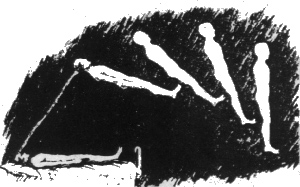
    Because our unconscious mind is a two-way wormhole connecting subjective perception with the infinite realms of the Objective Psyche, it is not uncommon for profound insights to emerge from those dimensions into human awareness – often before their time. Figure 1 is taken from Rene Descartes’ posthumous 1667 work, Traite de l’Homme, which illustrates his theory of perception. He regarded the pineal gland as the “gateway to the soul,” and in this drawing he hypothesises how visual perception is concentrated therein. Most of Descartes’ theories have been disproved by modern research, but his fundamental intuition in this case is still valid. All that is missing is the concept of the DMT-synthesising pineal gland (discussed in our last article) as a singularity linking spacetime awareness with the Objective Psyche to complete the hypothesis being proposed here.

    And I hope my hypothesis is beginning to make sense: Since we experience ourselves as a conscious centre (a “point”) inhabiting a physical body, which perceives itself as part of a three-dimensional “outside” reality, it is obvious that all external sensory input is perpendicular to our subjective awareness. Which, if you follow the right-angle rule, is to say that consciousness itself must be in some sense dimensional! The only direction of escape in Koan-1, then is within. The only place that the radiation from the XYZ-123 galaxy can go after entering the black-holes of your eyes is inside. This mandates that both Locale-I and Locale-II are inner dimensions which to varying degrees mirror our familiar, externalised space-time. We have the empirical testimony of out-of-body explorer William Buhlman that this is so:

    “For two years I had believed that I was moving laterally from one area to another within the same dimension, but now the startling truth was apparent. I was not moving laterally but inwardly within the universe from one energy environment to another.”8

    Buhlman goes on to describe what can only be a kind of singularity of consciousness imploding into itself, into a dimension of many dimensions. Here he is, out-of-body, in the Locale-I version of his bedroom, about to enter a typical Locale-II environment, perhaps one of Robert Monroe’s “upper rings”:

    “Feeling centered, I stand at the foot of my bed and say aloud, ‘I move inward.’ I feel an immediate sensation of rapid inner motion – I’m being drawn into a vacuum deep within myself. The sensation of motion is so intense that I shout ‘Stop!’ Instantly I stop moving and realize that I’m in a new environment. I am outdoors in a beautiful parklike setting.”9

    Although admittedly rare, this perception is neither new nor unique. The Tibetan Book of the Dead tells us explicitly that all of the bardo realms are “inside of us”:

    “O nobly-born, these realms are not come from somewhere outside [thyself]. They come from within the four divisions of thy heart, which, including its center, make the five directions. They issue from within there, and shine upon thee. The deities, too, are not come from somewhere else: they exist from eternity within the faculties of thine own intellect.”10

    Although the idea that “The Kingdom of Heaven is within you” is a cliche familiar to everybody, when entertained at all, it is usually understood metaphorically. Seldom do we perceive “inside” literally: as a real, honest-to-god dimension of reality. Here’s another version of this ancient idea from the Vedic tradition of India:

    “The seat for the Gods is indeed within, in the inner being which is wider and far greater and subtler and supple and enlightened and distinguished from the physical being.”11

    Come on! Gimmie a break! (The logical mind wants to know how a vessel can be smaller than its contents.) Although an impossibility in any three-dimensional context, four-dimensional space is obviously not bound by such provincial illusions. Actually, instead of an absurdity to be dismissed out of hand, initiated awareness recognises immediately that it is dealing with a legitimate dimensional interface when such “impossibilities” are depicted. For example, it is not at all uncommon for UFO abductees to describe the inside of the spacecraft as much larger than the outside:

    “As strange as it sounds, this bigger-on-the-inside-than-out impression is exactly what a three dimensional creature like… any one of us might expect to experience when confronted with a four dimensional space. An analysis of the geometry by Stan Kulikowski in the MUFON UFO Journal concluded: ‘Whether this inside-too-big phenomenon is actual alien technology or deliberate fraud or a subconscious psychological trick of perception, it is nevertheless based on good mathematics and related to the fundamental physics of our universe’.”12

    All of the confusion surrounding OOBEs (Out-Of-Body Experiences), NDEs (Near-Death Experiences), alien abductions (and life itself, for that matter), is directly attributable to the difficulty that a consciousness hypnotised by three dimensions has in perceiving “beyond” that illusion. Thus, we project these spaces “outside” of ourselves, and regard our bodies as “vessels” which must be “gotten out of” in order to “ascend” to “higher” realms. (Notice that we can’t even discuss the subject without using three-dimensional, “external” concepts.)

    Because the imploded dimensions are generally believed to be difficult to visualise, authentic mystical (i.e. hyperdimensional) awareness is greatly handicapped in its attempt to translate what it experiences into terms that three-dimensional chauvinists can understand. Here’s another description of this interior reality from the Chandogya Upanishad. Note that it describes the “heart” as the centre of awareness. That could be poetic license – the pineal gland might make a better candidate:

    “As large as the universe outside, even so large is the universe within the lotus of the heart. Within it are heaven and earth, the sun, the moon, the lightning, and all the stars. What is in the macrocosm is in this microcosm.”13

    This is an unambiguous description of consciousness as four-dimensional space! If we superimpose our observation of the hypothetical XYZ-123 galaxy onto this picture, we have photons imploding from spacetime into mindspace: inner and outer galaxies connecting, interacting and evolving within the matrix of Consciousness itself. Since we know that the pineal gland (a singularity within the human brain) is associated with out-of-body perception, it’s a fair hypothesis that some kind of eye-pineal connection constitutes the focal “point” linking these two realms. “External” images implode into our “eye-pupil-wormholes” to instantly explode via the pineal singularity into interior dimensions of infinite Mind Stuff.

    “The eye is [the Self’s] dwelling place while we wake, the mind [pineal gland?] is his dwelling place while we dream, the lotus of the heart is his dwelling place while we sleep the dreamless sleep.”14

    I won’t quarrel about where the pineal gland fits into the above scheme, because if Descartes is correct in his intuition, the pineal is the dimensional aperture that processes sensory input from everywhere in the body. In connection with this, it is highly significant that theorists studying our spacetime universe postulate the existence of tunnels, tubes, or wormholes, yoking the dimensions together (see Figure 2).

    “Cosmologists have even proposed the startling possibility that our universe is just one among an infinite number of parallel universes. These universes might be compared to a vast collection of soap bubbles suspended in air. Normally, contact between these bubble universes is impossible, but, by analyzing Einstein’s equations, cosmologists have shown that there might exist a web of wormholes, or tubes, that connect these parallel universes… The Einstein-Rosen bridge acts like a tunnel connecting two regions of space-time; it is a wormhole.”15

    By now it shouldn’t surprise us that the experience of passing through a “tunnel” is one of the most universally reported characteristics of out-of-body travel. Later in his career, Robert Monroe founded The Monroe Institute, a non-profit corporation, to scientifically study and induce the out-of-body experience in a wide-range of subjects. Here’s one of the first things he found:

    “As the induction of the OOBE state was examined further, one key element did repeat consistently… In slow motion it ‘felt as if one were going through a tunnel to get to the light,’ a classic description that has been brought forth by many who performed the OOBE inadvertently or in a near-death situation.”16

    “Classical description,” indeed! Can there be any doubt that the following accounts are portrayals of interior-dimensional “wormhole-analogs” which mirror their spacetime counterparts? Here is Oliver Fox, describing a visit to some indeterminate realm in Locale-II:

    “And now it seemed to me there was a sort of hole or break formed in the continuity of the astral matter; and through this, in the distance – as though viewed through a very long tunnel – I could see something indistinct which might have been the entrance to a temple, with a statue still further away showing through it… I was falling, with seemingly tremendous velocity, down a dark, narrow tunnel or shaft.”17

    Subjects undergoing a DMT-induced out-of-body experience commonly describe an identical phenomenon. (DMT: N,N-dimethyltriptamine, a product of pineal synthesis, was discussed in the previous article of this series):

    “First I saw a tunnel or channel of light off to the right. I had to turn to go into it. Then the whole process repeated on the left. It was intentional that way. It was as if it had a source, further away. It got bigger farther away, like a funnel. It was bright and pulsating… I had a sense of great speed. Everything was unimportant relative to this. Things were flashing, flashing by, as if from a different perspective. It was so much more real than life. The left and right tunnels joined in front of me.”18

    Dr. John Mack, in his study of the UFO Abduction Syndrome, also describes the tunnel as a common experience among his abductee-informants. These are apparently inter-dimensional doorways through which the Aliens both enter our space and convey their victims into hyperspace.

    “A forty-one year old health care executive spoke to me of large tubes through which he passed during one of his abductions ‘into the next plane where there was this light’… Catherine [another abductee]… also spoke of a tube or tunnel through which she and others passed from a spirit plane outside space/time back to the embodied physical state on earth.”19

    Then of course, there is the Near-Death Experience (NDE) as described by Dr. Raymond Moody, the pioneer investigator of this unique form of out-of-body projection. In fact, the “tunnel phenomenon” is so ubiquitous that he lists it as one of fifteen symptoms considered definitive of an NDE.

    “Often concurrently with the occurrence of the noise, people have the sensation of being pulled very rapidly through a dark space of some kind. Many different words are used to describe this space. I have heard the space described as a cave, a well, a trough, an enclosure, a tunnel, a funnel, a vacuum, a void, a sewer, a valley, and a cylinder. Although people use different terminology here, it is clear that they are all trying to express some one idea.”20

    In a later article we will examine the phenomenon of “Remote Viewing,” a tactic used by both United States and Soviet intelligence agencies to spy on each other during the Cold War. We will then determine if these specially-trained psychics were actually “out-of-body” travellers in the classical sense of the term as we’ve defined it so far, but for now it is instructive to examine some representative descriptions of Remote Viewing in light of the tunnel phenomenon under discussion. Here are some excerpts from the remote viewings of Captain David Morehouse:

    “My phantom body fell through the tunnel of light again… I began plummeting down the tunnel of light… I made the long fall down the tube of light and passed through the membrane into the target area… The fall through the tunnel seemed longer this time and I never hit the membrane at all… I found myself falling into a tunnel of light and passing into another world.”21

    Here is a description by Captain F. Holmes Atwater, the Intelligence and Security Command (INSCOM) officer who founded the US Army’s Remote Viewing unit at Fort Meade, Maryland. (As described in his book, this particular event was almost certainly a classic “astral projection” OOBE):

    “My kinesthetic sense of motion (like the feeling you get when flying in an airplane) was accompanied by a strange visual perception. I seemed to be moving through a white tube or tunnel, its walls lined with crystalline forms.”22

    And finally, here is another observance by William Buhlman, the out-of-body explorer who (even more than Robert Monroe), defined his experiences within the context of modern quantum theory:

    “The tunnel experience is much more significant than most people recognize. Not only does it provide substantial evidence of a logical transitional method for consciousness after physical death, but it directly relates to the modern physics theories concerning parallel universes and energy wormholes, as well as to my observations concerning the multidimensional universe.”23

    Yeah, but what about Locale-I (the Sidpa Bardo), which Monroe describes as our own familiar world, though perceived while out-of-body? How could that be regarded as an “inside” dimension?

    Imagine consciousness as a dimensional “double mirror” with back-to-back reflective surfaces: one facing outward to space-time, the other facing inward to hyperspace. The evidence suggests that when someone goes “out-of-body” into Locale-I, they are not actually interfacing with the physical world that we touch when “in-body,” but with the “etheric double” of the physical world on the other side of the mirror. (Technically, of course, we’re not going “out-of-body” at all, but “in-our-body,” but for now at least, let’s not complicate the nomenclature.) Here’s Buhlman again:

    “Slowly I came to understand that the environment I was observing was not the physical world, as I had assumed. I realized that the structures I normally observed when out-of-body were nonphysical structures… Now I finally understood why there were slight variations between the nonphysical and physical furniture and other objects. For example, the nonphysical walls were often a different color, and the shapes and styles of some of the furniture and rugs were different. Much of this was minor but nevertheless noticeable… It appears that we are not observing the physical world from a different perspective, as many believe, but are interacting in a separate but parallel dimension of energy.”24

    In the spring of 1902, Oliver Fox had his first out-of-body experience when his consciousness “woke up” within what he called a “dream of knowledge,” but what would today be labelled a lucid dream. It was an anomaly such as Buhlman describes above that shifted his awareness from semi-conscious dreaming to conscious perception of Locale-I:

    “I dreamed that I was standing on the pavement outside my home… Now the pavement was not of the ordinary type, but consisted of small, bluish-grey rectangular stones, with their long sides at right-angles to the white kerb. I was about to enter the house when, on glancing casually at these stones, my attention became riveted by a passing strange phenomenon, so extraordinary that I could not believe my eyes – they had seemingly all changed their position in the night, and the long sides were now parallel to the kerb! Then the solution flashed upon me: though this glorious summer morning seemed as real as real could be, I was dreaming!”25

    If Locale-I is the other side of our spacetime looking glass, then further extension of consciousness into Locale-II with its hierarchies of astral and mental matter is even more difficult to visualise except perhaps as a funhouse hallway of imploding-exploding, wormhole mirrors. For the sake of comprehension it is not improper to retain familiar three-dimensional terminology (e.g., “rings,” “planes,” etc.) as long as we remember that it is probably only accurate in a metaphorical sense. Since OOBE explorers perceive these other realms in “external” three-dimensional terms we can assume that any inner differentiated realm appears to awareness as a three-dimensional construct.

    What seems clear is that the out-of-body experience is the projection of a subjective observer into the Objective Psyche: mind imploding into Mind. The perpendicular rule of dimensional progression mandates that realms numerically “higher” than the observer are always perceived as “inside” – which is to say, related to “Consciousness” rather than to “matter” (whatever that is). This explains why entities existing in numerically higher dimensions can always observe those in numerically lower realms, though normally not the other way around – unless the observer is “out-of-body.”

    For example, we could easily contemplate two-dimensional beings dwelling in a plane. (Imagine flat creatures moving back and forth within a sheet of cellophane.) To them, however (if they became aware of us at all), we would seem to be “supernatural” entities appearing magically within their midst. (Touch the sheet with your finger: they’d regard it as the sudden apparition of a mystery out of “nowhere.” Remember, our concept of “above” can only be comprehended by them as “within.”)

    If this rule holds, we can hypothesise with reasonable certainty that dwellers in numerically higher dimensions are normally experienced by dimensionally lower entities as inner ephemera: as voices in the head, spirit guides, channelled entities, and so-forth. (The possible exceptions would be temporary fourth-dimensional “holographic inserts” or “shamanic projections” into three-dimensional space – such as UFOs, apparitions, ghosts, etc.)

    Although seemingly ghost-like or discarnate to us, there is no reason to believe that these ephemeral beings don’t experience themselves as anything but “physical” within their own space. Since quantum physics tells us that our own seemingly solid reality is actually energetic or “idea-like,” it should come as no surprise that the higher dimensions must also be experienced by their inhabitants as “physical.” That means that what we regard as “thought” is perceived as “matter” in the higher dimensions.

    As Robert Monroe and other out-of-body explorers have attested, the “non-material” realms have an ascending order of abstraction which can be divided into an indeterminate number of levels, planes, rings, spheres, or bubbles. Those closest to our physical Earth are most like Earth: those further removed fade off into zones so ethereal that they become almost impossible to portray. Denizens of the nearest realms are described as experiencing their environments pretty much the same way that we experience our physical space-time dimension – some are even said to believe that theirs is the only reality: for them, Earth cannot exist.

    When we read the monotonously repetitive data on UFO abductions – how abductees are routinely transported through solid walls, beamed into spaceships, communicate telepathically with aliens, etc., we have to ponder what kinds of dimensional interfaces must be involved. Almost all serious researchers are now in substantial agreement that the UFO phenomenon is transdimensional in nature, though how higher-dimensional entities can “physically” introject themselves into three dimensional space remains maddeningly unresolved.

    “I believe that the UFO phenomenon represents evidence for other dimensions beyond spacetime; the UFOs may not come from ordinary space, but from a multiverse which is all around us, and of which we have stubbornly refused to consider the disturbing reality in spite of the evidence available to us for centuries… The UFOs are physical manifestations that simply cannot be understood apart from their psychic and symbolic reality. What we see here is not an alien invasion. It is a spiritual system that acts on humans and uses humans… They are part of the environment, part of the control system for human evolution. But their effects, instead of being just physical, are also felt in our beliefs. They influence what we call our spiritual life. They affect our politics, our history, our culture.”26

    Everything we have examined so far suggests that these intruders from a fourth-spatial-dimension constitute the “angels, devils, fairies and elves” who’ve been interfacing with humankind since the dawn of time. The fact that they accommodate themselves to prevailing cultural illusions tells us immediately that (just like us), they are Ideas (spirits, points-of-view) evolving on some frequency within the Objective Psyche. They and we may even be co-creations – when fairies fade from credence in spacetime, the ideas they represent morph into space aliens to keep pace with current belief systems. Who creates whom?

    By now it should be clear that the out-of-body experience (including its near-death variant) and the UFO Abduction Syndrome are but two linked components of a larger underlying reality, the structure of which is quite “alien” to anything granted by general cultural consensus. We are now ready to examine these concepts as they are described by the “traditional counter-culture” – that ancient body of wisdom comprising what is known as the Perennial Philosophy. This will be covered in the next instalment of this series.
    [alert type=”general” dismiss=”no”]This article was published in New Dawn 74.[/alert]

    [alert type=”success” dismiss=”no”]If you appreciate this article, please consider subscribing to help maintain this website.[/alert]

    Recommended Reading:

    Ultimate Journey by Robert Monroe, Perils of the Soul by John Haule.

    Footnotes:

    1. Gribben, John, “Is The Universe Alive?,” Whole Earth Review, No. 84, Winter 1994, Pg 31-33
    2. Davies, Paul (1982). The Edge of Infinity, Touchstone (Simon and Schuster), NY, Pg 87
    3. Davies, Paul (1980). Other Worlds, Simon & Schuster, NY, Pg 135
    4. Gribben, op. cit.
    5. Monroe, Robert A. (1977). Journeys Out Of The Body, Anchor Press/Doubleday, Garden City, NY, Pg 74
    6. Davies, Paul (1984). Superforce, Simon & Schuster, NY, Pg 49
    7. Whitmont, Edward C. (1969, 1978). The Symbolic Quest, Princeton University Press, Princeton, NJ, Pg 42
    8. Buhlman, William (1996), Adventures Beyond the Body, Harper SanFrancisco, Pg 30
    9. Ibid, Pg 31
    10. Evans-Wentz, W.Y. (1960). The Tibetan Book of the Dead, Oxford University Press, NY, Pg 121
    11. Pandit, M.P. (1970). Aditi and Other Deities in the Veda, Dipti Publications, Sri Aurobindo Ashram, Pondicherry- 2, India, Pg 23
    12. Stacy, D. and Huyghe, P. (2000). The Field Guide to UFOS, Harper-Collins, NY, Pg 145
    13. Prabhavananda/Manchester translation (1948, 1957). The Upanishads, Breath of the Eternal, Mentor Books, NY, Pg 74
    14. Ibid, Aitareya Upanishad, Pg 62
    15. Kaku, Michio (1994). Hyperspace, Oxford University Press, Oxford, Pg x., 226
    16. Monroe, Robert A. (1985). Far Journeys. Doubleday, NY, Pg 19
    17. Fox, Oliver (1962). Astral Projection: A Record of Out- of-the-Body Experiences, University Books, New Hyde Park, NY, Pg 98, 106
    18. Subject, “Willow,” in: Strassman, Rick, M.D., (2001). DMT, The Spirit Molecule, Park Street Press, Rochester, VT, Pg 224-5
    19. Mack, John E., M.D. (1994), Abduction: Human Encounters with Aliens, Chas. Scribner’s Sons, NY, Pg 419
    20. Moody, R. A. (1976), Life After Life, Bantam, NY, Pg 29
    21. Moorehouse, David (1996), Psychic Warrior, St. Martin’s Press, NY, Pgs 139, 142, 150, 162, 201
    22. Atwater, F. Holmes (2001). Captain of my Ship, Master of my Soul, Hampton Roads Publishing Co., Charlottesville, VA, Pg 8
    23. Buhlman, op. cit., Pg 87
    24. Ibid, Pg 16, 18
    25. Fox, op. cit., Pg 33
    26. Jacques Vallee – “Excerpts from Dimensions: A Casebook of Alien Contact,” ReVison, Vol. 11, No. 4 (Spring 1989), Pg 39, passim.

    Bibliography:

    Rucker, Rudy (1984). The Fourth Dimension, Houghton Mifflin
    Zukav, Gary (1979). The Dancing Wu Li Masters, Morrow, NY

    © New Dawn Magazine and the respective author.

    For our reproduction notice, click here.
  • Mystery of Shambhala

    Mystery of Shambhala

    From New Dawn 72 (May-June 2002)

    I believe the idea of Shambhala has not yet come to full flower, but that when it does it will have enormous power to reshape civilisation. It is the sign of the future. The search for a new unifying principle that our civilisation must now undertake will, I am convinced, lead it to this source of higher energies, and Shambhala will become the great icon of the new millennium.
    – Victoria LePage, Shambhala

    For thousands of years rumours and reports have circulated that somewhere beyond Tibet, among the icy peaks and secluded valleys of Eurasia, there lies an inaccessible paradise, a place of universal wisdom and ineffable peace called Shambhala – although it is also known by other names.

    James Hilton wrote about it in the 1933 book Lost Horizon, Hollywood portrayed it in the 1960s film ‘Shangri-la’, and recent films such as ‘Kundun’, ‘Little Buddha’ and ‘Seven Years in Tibet’ allude to the magical utopia. Even author James Redfield, noted for his New Age best seller The Celestine Prophecy, has written a book called The Secret of Shambhala: In Search of the Eleventh Insight.

    Shambhala, which in Sanskrit means “place of peace, of tranquillity,” is thought of in Tibet as a community where perfect and semi-perfect beings live and are guiding the evolution of humanity. Shambhala is considered to be the source of the Kalachakra, which is the highest and most esoteric branch of Tibetan mysticism.

    Legends say that only the pure of heart can live in Shambhala, enjoying perfect ease and happiness and never knowing suffering, want or old age. Love and wisdom reign and injustice is unknown. The inhabitants are long-lived, wear beautiful and perfect bodies and possess supernatural powers; their spiritual knowledge is deep, their technological level highly advanced, their laws mild and their study of the arts and sciences covers the full spectrum of cultural achievement, but on a far higher level than anything the outside world has attained.

    By definition Shambhala is hidden. Of the numerous explorers and seekers of spiritual wisdom who attempt to locate Shambhala, none can pinpoint its physical location on a map, although all say it exists in the mountainous regions of Eurasia. Many have also returned believing that Shambhala lies on the very edge of physical reality, as a bridge connecting this world to one beyond it.

    The Sanskrit and Tibetan Shambhala has also been identified by no less an authority than Alexandra David-Neel, who spent years in Tibet, with Balkh – in the far north of Afghanistan – the ancient settlement known as “the mother of cities”. Present day folklore in Afghanistan asserts that after the Muslim conquest, Balkh was known as the “Elevated Candle” (“Sham-i-Bala”), a Persianisation of the Sanskrit Shambhala.

    Tibetan lamas spend a great deal of their lives in spiritual development before attempting the journey to Shambhala. Perhaps deliberately, the guidebooks to Shambhala describe the route in terms so vague that only those already initiated into the teachings of the Kalachakra can understand them.

    As Edwin Bernbaum says in The Way to Shambhala:

    As the traveller draws near the kingdom, their directions become increasingly mystical and difficult to correlate with the physical world. At least one lama has written that the vagueness of these books is deliberate and intended to keep Shambhala concealed from the barbarians who will take over the world.1

    The lama’s reference to the barbarians “who will take over the world” is directly connected to the prophecy of Shambhala. This prophecy tells of the gradual deterioration of mankind as the ideology of materialism spreads over the earth. When the “barbarians” who follow this ideology are united under an evil king and think there is nothing left to conquer, the mists will lift to reveal the snowy mountains of Shambhala. The barbarians will attack Shambhala with a huge army equipped with terrible weapons. Then the 32nd king of Shambhala, Rudra Cakrin, will lead a mighty host against the invaders. In a last great battle, the evil king and his followers will be destroyed.

    As the cultures of the East and West collide, the myth of Shambhala rises out of the mists of time. We now have access to numerous Buddhist texts on the subject, along with reports by Western explorers who set out on the arduous journey in search of Shambhala. There is much we can learn for our own individual journey of spiritual understanding.

    The Lost World of Agharta

    The idea of a hidden world beneath the surface of the planet is a very ancient one indeed. There are innumerable folk tales and oral traditions found throughout many countries speaking of subterranean people who have created a kingdom of harmony, contentment and spiritual power.

    The early European travellers to Tibet consistently told the same tale of a hidden spiritual centre of power. Adventurers recounted fantastic tales of a hidden kingdom near Tibet. This special place is known by numerous local and regional names, which no doubt caused much confusion among early travellers as to the kingdom’s true identity. These early travellers knew it as Agharta (sometimes spelt Agharti, Asgartha or Agarttha), although it is now commonly known as Shambhala.

    Taking the legend in its most basic form, Agharta is said to be a mysterious underground kingdom situated somewhere beneath Asia and linked to the other continents of the world by a gigantic network of tunnels. These passageways, partly natural formations and partly the handiwork of the race which created the subterranean nation, provide a means of communication between all points, and have done so since time immemorial. According to the legend, vast lengths of the tunnels still exist today; the rest have been destroyed by cataclysms. The exact location of these passages, and the means of entry, are said to be known only to certain high initiates, and the details are most carefully guarded because the kingdom itself is a vast storehouse of secret knowledge. Some claim that the stored knowledge is derived from the lost Atlantean civilisation and of even earlier people who were the first intelligent beings to inhabit the earth.

    The first Westerner to popularise the legend of Agharta was a gifted French writer named Joseph-Alexandre Saint-Yves (1842-1910). Saint-Yves was a self-educated occultist and political philosopher who promoted in his books the establishment of a form of government called ‘Synarchy’. He taught that the body politic should be treated like a living creature, with a ruling spiritual and intellectual elite as its brain.

    In his quest for universal understanding, he decided in 1885 to take lessons in Sanskrit, the classical and philosophical language of India. He learnt far more than he expected. Saint-Yves’s tutor was a certain Haji Sharif, who was believed to be an Afghan prince. Through this mysterious personage, Saint-Yves learnt a good deal about Oriental traditions including Agharta.

    The manuscripts of Saint-Yves’ Sanskrit lessons are preserved in the library of the Sorbonne, written in exquisite script by Haji. According to Joscelyn Godwin, writing in Arktos:

    Haji signed his name with a cryptic symbol and styled himself “Guru Pandit of the Great Agarthian School.” Elsewhere he refers to the “Holy Land of Agarttha”… In due course he informed Saint-Yves that this school preserves the original language of mankind and its 22-lettered alphabet: it is called Vattan, or Vattanian.2

    Saint-Yves soon discovered his training enabled him to receive telepathic messages from the Dalai Lama in Tibet, as well as make astral journeys to Agharta. The detailed reports of what he found there became the crowning volume of his series of politico-hermetic “Missions”: Mission des Souverains, Mission des Ouvriers, Mission de Juifs, and finally Mission de l’Inde (The Mission of India).

    In The Mission of India we learn that Agharta is a hidden land somewhere in the East, below the surface of the earth, where a population of millions is ruled by a “Sovereign Pontiff”, who is assisted by two colleagues, the “Mahatma” and the “Mahanga”. His realm, Saint-Yves explains, was transferred underground and concealed from the surface-dwellers at the start of the Kali Yuga, which he dates around 3200 BCE. According to Saint-Yves, the “mages of Agarttha” had to descend into the infernal regions below them in order to work at bringing the earth’s chaos and negative energy to an end. “Each of these sages,” Saint-Yves wrote, “accomplishes his work in solitude, far from any light, under the cities, under deserts, under plains or under mountains.”3 Now and then Agharta sends emissaries to the upper world, of which it has perfect knowledge.

    Agharta also enjoys the benefits of a technology advanced far beyond our own. Not only the latest discoveries of modern man, but the whole wisdom of the ages is enshrined in its libraries. Among its many secrets are those of the relationship of soul to body, and of the means to keep departed souls in communication with incarnate ones.

    To Saint-Yves, these superior beings were the true authors of Synarchy, and for thousands of years Agharta had “radiated” Synarchy to the rest of the world, which in modern times has chosen foolishly to ignore it. When the world adopts Synarchical government the time will be ripe for Agharta to reveal itself.

    Much of what Saint-Yves reveals in his books about Agharta, to the modern reader, appears of a bizarre nature. His writings are in a similar vein to the reports of strange worlds visited by numerous out-of-body explorers over the ages. After his own investigation of Saint-Yves, the respected historian of esotericism Joscelyn Godwin wrote:

    I believe Saint-Yves did ‘see’ what he described, and that he did not consider himself, to the slightest degree, to be writing fiction or deriving anything from anyone else. The proof is in his utter seriousness of character, and in the publications and correspondence of the rest of his life, which take Agartha… for unquestionable realities. But it is quite another matter to accept his Agartha in all the actuality and physicality that he attributed to it.4

    Until the start of the twentieth century, the legend of Agharta remained very much… a legend. Stories of Agharta had widely spread in Europe since the publication of Saint-Yves’s books, but evidence to support the claims remained as elusive as ever. Indeed, it might well have been expected that in the rational and materialistic new century, such stories would finally be confined to the realms of fantasy: a colourful tradition to be ranked alongside other ancient mysteries such as the lost continents of Atlantis and Mu.

    But such a supposition did not allow for the remarkable discoveries of two intrepid explorers who in the 1920s went into the vastness of Asia and there unearthed evidence about Agharta which far exceeded that of any previous reports. Their accounts, indeed, became the cornerstone of our present knowledge of the secret kingdom.

    Strangely, neither man knew each other, yet both were of Russian extraction. One made his discoveries about Agharta while fleeing for his life from the Bolsheviks in Russia; the other came shortly after from self-imposed exile in America, seeking to penetrate the mysteries of Tibet. Their names were Ferdinand Ossendowski and Nicholas Roerich.

    The King of the World

    Writing in the early part of last century, Russian traveller Ferdinand Ossendowski said he noticed there were times in his Mongolian travels when men and beasts paused, silent and immobile, as though listening. The herds of horses, the sheep and cattle, stood fixed to attention or crouched close to the ground. The birds did not fly, and marmots did not run and the dogs did not bark. “Earth and sky ceased breathing. The wind did not blow and the sun did not move…. All living beings in fear were involuntarily thrown into prayer and waiting for their fate.”5

    “Thus it has always been,” explained an old Mongol shepherd and hunter, “whenever the King of the World in his subterranean palace prays and searches out the destiny of all peoples on the earth.”6 For in Agharta, he said, “live the invisible rulers of all pious people, the King of the World or Brahatma, who can speak with God as I speak with you, and his two assistants: Mahatma, knowing the purposes of future events, and Mahinga, ruling the causes of those events…. He knows all the forces of the world and reads all the souls of mankind and the great book of their destiny.”7

    Ferdinand Ossendowski (1876-1945), a polish scientist who spent most of his life in Russia, was as intrigued with legends and with the occult as he was with politics. As he fled through “Mysterious Mongolia… the Land of Demons,” he paused frequently to speak with Buddhist monks and lamas about the traditions associated with lakes, caves and monasteries. There was one story he said he encountered everywhere in Eurasia: he called it the “Kingdom of Agharti”, regarding it as nothing less than “the mystery of mysteries.”8

    Ossendowski’s knowledge of the hidden kingdom came about after he fell into the company of a remarkable fellow Russian speaker, a priest named Tushegoun Lama, who had also fled the Russian Revolution, and could claim personal friendship with the Dalai Lama, then the supreme ruler of Tibet.

    It was from Tushegoun Lama that Ossendowski heard the first hints about Agharta and be inspired to investigate the stories and ultimately produce the first detailed modern report on the subterranean kingdom. He called this report, Beasts, Men and Gods (1922), and it is now a rare and much sought-after book.

    During their journeying, Tushegoun Lama told Ossendowski of the miraculous powers of the Tibetan monks, and the Dalai Lama in particular – powers, he said, that foreigners could scarcely begin to appreciate. Then, he went on: “But there also exists a still more powerful and more holy man… The King of the World in Agharti.”9

    At that point, according to Ossendowski’s account, the Lama did not wait around to answer questions, but rode off on his horse. The poor Russian was left standing in the settling dust with a series of whirling questions rushing through his head. He had to wait several months before he began to get any answers to these questions.

    Later, another Tibetan called Prince Chultun Beyli told Ossendowski that sixty thousand years ago a holy man had led a tribe of his followers deep into the earth. They settled there, beneath Central Asia, and through the use of the holy man’s incredible wisdom and power, and the labours of his people, Agharta became a paradise. Its population now numbered in the millions, and all were happy and prosperous.

    The Prince also added the following details:

    The kingdom is called Agharti. It extends throughout all the subterranean passages of the whole world…. These subterranean peoples and spaces are governed by rulers owing allegiance to the ‘King of the World’… You know that in the two greatest oceans of the east and the west there were formerly two continents. They disappeared under the water but their people went into the subterranean kingdom. In underground caves there exists a peculiar light which affords growth to the grains and vegetables and long life without disease to the people.10

    Ossendowski, understandably, found much that was puzzling as well as confusing in these accounts. Nonetheless he was convinced that he had come across something more than just a legend – or even an example of hypnosis or mass vision – but more likely a powerful ‘force’ of some kind, evidently capable of influencing the course of life on planet earth.

    Interestingly, Ossendowski reports that the enormous powers the people of Agharta were believed to control could be used to destroy whole areas of the planet, but equally could be harnessed as the means of propulsion of the most amazing vehicles of transport. It has been suggested that this could be a prediction of nuclear energy and flying saucers! (Beasts, Men and Gods was, of course, published in 1922, long before such topics were even being discussed).

    Ossendowski closes off his book with the prophecy of the King of the World (see “A Prophecy From the Inner Earth!”, page 33), in which it is stated materialism will devastate the earth, terrible battles will engulf the nations of the world, and at the climax of the bloodshed in 2029, the people of Agharta will rise out of their cavern world.

    Emissary of Shambhala

    It would be easy to dismiss Agharta/Shambhala as pure fantasy, were it not for a very credible explorer who searched for, found and returned to tell us something about his experiences.

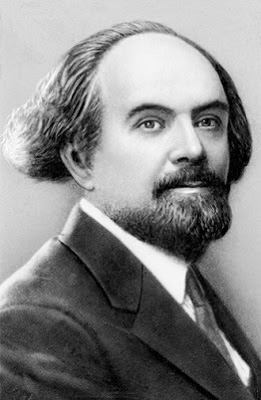
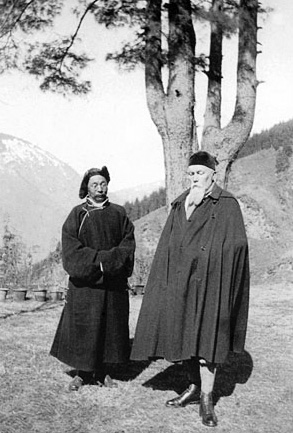
    Nicholas Roerich (1874-1947), a Russian born artist, poet, writer, mystic and distinguished member of the Theosophical Society, led an expedition across the Gobi Desert to the Altai mountain range from 1923 to 1928, a journey which covered 15,500 miles across thirty-five of the world’s highest mountain passes.

    As Victoria LePage puts it in her book Shambhala:

    Roerich was a man of unimpeachable credentials: a famous collaborator in Stravinsky’s Rite of Spring, a colleague of the impresario Diaghilev and a highly talented and respected member of the League of Nations.11

    He was also influential in the Franklin Delano Roosevelt United States administration, and was the pivotal force behind placing the Great Seal of the United States on the dollar bill.

    Nicholas Roerich was first exposed to Buddhism and heard of Shambhala in St. Petersburg, Russia during his involvement with the construction of the Buddhist temple under the guidance of Lama Agvan Dordgiev.12

    One of the reasons for Roerich’s expedition may have been to return a stone said to be part of a much larger meteorite possessing occult properties called the Chintamani Stone, alleged to have come from a solar system in the constellation of Orion. The stone, says LePage, “was capable of giving telepathic inner guidance and effecting a transformation of consciousness to those in contact with it.”13

    According to Lamaist legend, a fragment of this Chintamani Stone is sent forth to help establish spiritual missions vital to humanity, and is returned, when missions are completed, to its rightful home in the King’s Tower in the centre of Shambhala.14 Such a stone was said to be in the possession of the failed League of Nations, its return being entrusted to Roerich. Though it is not known whether he was able to return the fragment or not, his expedition helped those who believed that Shambhala was more than a myth.

    Roerich believed in the transcendental unity of religions – in the notion that one day the Buddhist, the Muslim, and the Christian would realise their separate dogmas were husks obscuring the kernel of truth within. All his works embraced the belief that all faiths awaited a new age in which this chaff of dogma would be stripped away, humanity would toss aside its discords, and all would come together in a paradise of universal brotherhood. His symbol for the coming paradise was Shambhala.

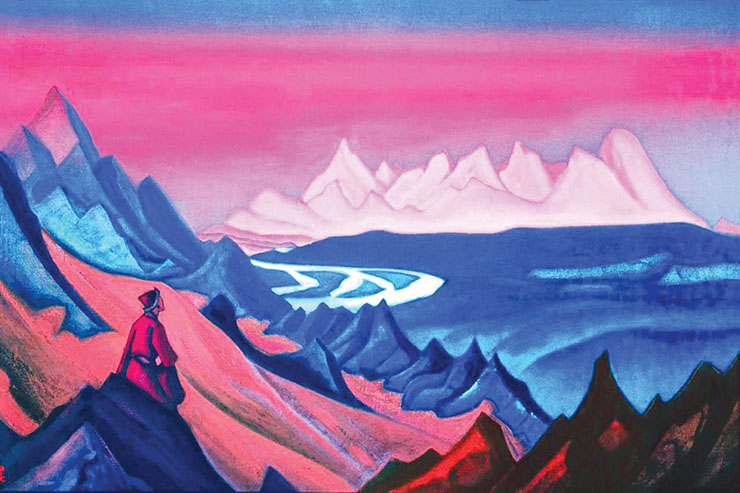
    Roerich kept a diary during the trip (published as Altai-Himalaya: A Travel Diary)15 and, while in Mongolia, noted that, “belief in the imminence of the era of Shambhala was very strong.” In his book, Heart of Asia, Roerich describes both his scientific observations and his personal spiritual quest. Although he was ready to listen to tales of underground cities as part of the adventure, his main interest centred on the spiritual dynamics of Shambhala and its importance as a symbol of the coming age of peace and enlightenment. This blending of the scientific and the spiritual is also present in the hundreds of paintings Roerich made throughout the expedition.

    “His eye captured the shapes and colours of the mountains, monasteries, rock carvings, stupas, cities and peoples of Asia,” writes Jaqueline Decter inNicholas Roerich. “His soul understood their spirit; and his brush forged a synthesis of beauty.” Throughout his life, Roerich strove to link all scientific and creative disciplines to advance true culture and international peace, citing the power of art and beauty to accomplish such a feat.

    The Roerich Peace Pact, which obligated nations to respect museums, cathedrals, universities and libraries as they did hospitals, was established in 1935 and became part of the United Nations organisational charter. The connection between Shambhala and the Peace Pact is clearly evident in the following speech given at the Third International Roerich Peace Banner Convention in 1933:

    The East has said that when the Banner of Shambhala would encircle the world, verily the New Dawn would follow. Borrowing this Legend of Asia, let us determine that the Banner of Peace shall encircle the world, carrying its word of Light, and presaging a New Morning of human brotherhood.16

    “Today,” notes LePage, “every major Russian city has a Roerich organisation that expresses his ideas for a new type of enlightened civilisation based on the utopian principles of Shambhala.”17

    The Sign of Shambhala

    Shambhala itself is the Holy Place, where the earthly world links with the highest states of consciousness. In the East they know that there exists two Shambhalas – an earthly and an invisible one.
    – Nicholas Roerich, The Heart of Asia

    Nicholas Roerich and party set out in 1924 to explore India, Mongolia and Tibet. Like Ossendowski before him, Roerich soon encountered stories about a secret underground kingdom. He jotted down his thoughts on this hidden kingdom and these notes were later published in a remarkable record of the expedition entitled Altai-Himalaya: A Travel Diary.18

    In the summer of 1926, Roerich reported a strange event in his travel diary. He was encamped with his son, Dr. George Roerich, and a retinue of Mongolian guides in the Sharagol valley near the Humboldt mountain chain between Mongolia and Tibet. At the time of the event in question, Roerich had returned from a trip to Altai and built a stupa, “a stately white structure,” dedicated to Shambhala.

    In August the shrine was consecrated in a solemn ceremony by a number of notable lamas invited to the site for the purpose, and after the event, writes Roerich, the Buriat guides forecast something auspicious impending. A day or two later, a large black bird was observed flying over the party. Beyond it, moving high in the cloudless sky, a huge, golden, spheroid body, whirling and shining brilliantly in the sun, was suddenly espied. Through three pairs of binoculars the travellers saw it fly rapidly from the north, from the direction of Altai, then veer sharply and vanish towards the southwest, behind the Humboldt mountains.

    One of the lamas told Roerich that what he had seen was “the sign of Shambhala,” signifying that his mission had been blessed by the Great Ones of Altai, the lords of Shambhala. They had also been witness to a classic UFO, twenty years before the “official” beginning of the phenomenon with Kenneth Arnold’s sighting in 1947.

    Roerich’s account of such a sighting aroused great interest in Europe and, corroborated as it was by George Roerich, brought to the West the first concrete evidence that there might be something present in Eurasia that defied understanding. Victoria LePage describes its significance as such:

    In its vivid colour and factuality, its bizarre but unarguable reference to an unknown golden aircraft that behaved as no ordinary airplane could, the Roerich story could rightly be called the first reliable intimation that the kingdom of Chang Shambhala was perhaps knowable as more than an intellectual curiosity, a popular Asian fable… and from about 1927 onward the world centre in the northern mountains exerted on Western occult circles the fascination of an idea whose time has come.19

    Which brings us to the very nature of reality. Paranormal experiences, including UFO sightings, are always indicative of an altered state of consciousness that allows the witness to see other realities. Often the experience is similar to a lucid dream, where ordinary space-time physics no longer applies.

    The Eastern mystical view of the world can be quite different from the Western scientific view of it. It maybe that the guidebooks to Shambhala are describing a landscape transformed by the visions of a yogi taking the journey there: Where we would see a mountaintop gleaming with snow, he would see a golden temple with a shining god. In that case, we might be able to travel the same path, but with a different view of reality.

    To travel to Shambhala, as Nicholas Roerich journeyed, is to undertake at one and the same time an inner mystical journey and an outer physical one through desolate and mountainous territory to a cosmic powerhouse.

    An old Tibetan story tells of a young man who set off on the quest for Shambhala. After crossing many mountains, he came to the cave of an old hermit, who asked him, “Where are you going across these wastes of snow?”

    “To find Shambhala,” the youth replied.

    “Ah, well then, you need not travel far,” the hermit said. “The kingdom of Shambhala is in your own heart.”20

    [alert type=”general” dismiss=”no”]This article was published in New Dawn 72.[/alert]

    [alert type=”success” dismiss=”no”]If you appreciate this article, please consider subscribing to help maintain this website.[/alert]

    Footnotes:

    1. Edwin Bernbaum, The Way to Shambhala: A Search for the Mythical Kingdom Beyond the Himalayas, 2001, p.25.
    2. Joscelyn Godwin, Arktos: The Polar Myth in Science, Symbolism and Nazi Survival, 1993, p.83.
    3. Subterranean Worlds: 100,000 Years of Dragons, Dwarfs, the Dead, Lost Races & UFOs from Inside the Earth, Walter Kafton-Minkel, 1989, p.188.
    4. Joscelyn Godwin, Arktos: The Polar Myth in Science, Symbolism and Nazi Survival, 1993, p.85.
    5. Ferdinand Ossendowski, Beast, Men and Gods, 1922, p.300.
    6. Ibid, p.300.
    7. Ibid, p.303.
    8. Ibid, p.300.
    9. Ibid, p.118.
    10. Alec Maclellan, The Lost World of Agharti, The Mystery of Vril Power, 1982, p. 66.
    11. Victoria LePage, Shambhala: The Fascinating Truth Behind the Myth of Shangri-la, 1996, p.11.
    12. See New Dawn No. 68, p. 85.
    13. Victoria LePage, Shambhala: The Fascinating Truth Behind the Myth of Shangri-la, 1996, p.10.
    14. Andrew Tomas, Shambhala: Oasis of Light, 1976, p.32.
    15. Nicholas Roerich, Altai-Himalaya: A Travel Diary (1929); Other books by Roerich: The Heart of Asia (1930); Shambhala (1930)
    16. Speech by Francis Grant in The Roerich Pact and Banner of Peace, 1947
    17. Victoria LePage, Shambhala: The Fascinating Truth Behind the Myth of Shangri-la, 1996, p.12.
    18. Nicholas Roerich, Altai-Himalaya: A Travel Diary (1929).
    19. Victoria LePage, Shambhala: The Fascinating Truth Behind the Myth of Shangri-la, 1996, p.12.
    20. As quoted in Edwin Bernbaum, The Way to Shambhala: Jacques Bacot, Introduction a l’histoire du Tibet, 1962, p.92N.

    © New Dawn Magazine and the respective author.
    For our reproduction notice, click here.
  • Nothing’s Shadow: Ethics, Education and the Contemporary Relevance of the Samurai

    Nothing’s Shadow: Ethics, Education and the Contemporary Relevance of the Samurai

    In the West and the Near East the game of Chess is regarded as a war game, and its adepts as masters of strategy. In Japan, however, among the Samurai, this game was perceived as vulgar, a diversion for traders and merchants. The Samurai had a very different idea of conflict from that in the West.Victory in chess is obtained by calculation, by trading off your own pieces in exchange for success. Winning is through deception, and always taking advantage of the other’s mistakes. Megalomaniacal in its grasp of conflict, cruel, mechanical, hierarchical, and heartless in its application, and deluded in its victory, chess was, for the Samurai, hollow and meaningless as a game of strategy. It was a clever device, a game without honour.

    Honour is an unexamined concept in our contemporary culture, a frozen medieval ideal, a moral or social artefact. Nevertheless honour is a vital aesthetic with immense relevance to our situation.

    Never written down, Bushido, the code of honour in Japan, the ‘chivalry’ of the Samurai, was nonetheless the most important consideration in their life. There are very good reasons for this. To stop viewing the world as right or wrong and to examine it sincerely as honourable or dishonourable is a way to distinguish the world in quite a different light.

    When a Samurai boy was 5 years, 5 months, and 5 days old, he was given his first sword in a sacred ritual, dressed as a warrior, and placed on a Go board, just like a Go stone. Go is the true game of warriors and philosophers among the Samurai, who didn’t make the two arenas distinct from each other. It is the beautiful game of territory, where the highest excellence was not through wiping the opponent off the board, but by the understated beauty of winning by only one stone.

    Power emanates from our perception of the true nature of our position and possibilities. It is better to know you are a sheep than imagine you are a tiger. The Samurai ethic gives us a perspective.

    We are placed on the planet just like a Go stone on a board. We are all the same. We cannot control the game, and we cannot change our location. We may be placed in a pivotal time and position, or we may not. We may have a lifetime of peace, or of disturbance. We can be wiped off the board at any time. We have no control over the patterns of the higher game.

    The best we can attain in the great game of life, the Samurai considered, is to be a very good stone; to be present, to have integrity, and to endure. Then we may serve the higher strategy well. This would be revealed in the future peace and prosperity of society. To be a good stone is also to rule absolutely over the tiny area actually allotted to us, to realise that we are the god of our own tiny domain.

    The Samurai ethic is very much misunderstood in the West, and what little is known often derives from the later Edo period, when a rich merchant could purchase the right to wear two swords and be a knight for prestige and vanity.

    “Death before Dishonour” is probably the most penetrating Samurai image, yet the least understood. It gives us the idea of the Samurai as a paragon of stoicism and righteousness, willing to die, rather than have his or her reputation besmirched, or dignity abased. The ritual act of suicide seems to epitomise this maxim. However, this is far from the truth.

    Central to the Samurai ethic was the realisation that every human death has dignity, regardless of the circumstances surrounding it. Every death weakens us all, and we cannot conceptualise a useless death without demeaning life itself.

    Whether it is an AIDS-ridden infant, a sick old pensioner, a suicide bomber, a death row inmate, an elderly statesman, a crime or traffic victim, an overdosing junkie, all death has the same dignity. To see it otherwise is to peer through the mesmerising fog of life.

    The Samurai existed to preserve and make apparent this realisation, not to hold themselves apart from it. No death is in vain. They were not there to look after themselves; they were there to look after others. As warriors, they were even committed to dying for one purpose, to help others. Their ultimate power and protest was only to remove themselves from the board, a potent act affecting the higher game. This was power exercised at the highest level of ahimsa, harmlessness. The ritual suicide essential to their culture was an exercise in courage and humility, not in pride and arrogance.

    Only from courage and humility does true honour arise. When we fail to perceive this we make an enormous mistake, for the clever mind cannot do anything but assess the usefulness of death, and by default, that of life itself.

    This is the slipperiest slope of all human reasoning and it is a fundamental cause of war and violence, poverty and oppression. It allows us to kill the ‘baddies’ and starve children for a just cause. It lets us have mega-death wars and plagues, trade embargoes, the militarisation of space, yet remain “honourable,” engaged in just pursuit. It lets us lie, vacillate, and deceive others, and yet think we’re cool, compassionate, that we’re doing it for them. If the situation were not so tragic, it would be hilarious. It is certainly farcical.

    True versus False Honour

    “Killing is not Heaven’s way,” emphasised Musashi, “yet Heaven must employ the sword.” It is never right to kill; the finest sword is seldom drawn. But in life killing happens, and mindless, endless, pointless slaughter is everywhere, ritual sacrifices to atone for our greed and ignorance. There will always be psychopaths, greedy righteous madmen without compassion, for whom violence is an option, who take profit and pleasure in the slavery and oppression of others. To protect ourselves without enslaving ourselves we need many individuals rigorously engaged on a path of honour.

    In Scotland there is a saying that honour is the sun of the mind, and one thing that must be recognised about honour is that it varies in intensity. It may be a candle or a flaming torch. Even what we consider ‘honourable’ people today are hardly honourable in the presence of such a diseased, enslaved, starved, alienated, oppressed, violent, and war-torn world.

    Honourable human beings are as rare as hen’s teeth. The shrewd mind eradicates the presence of honour. The idea, the formula of a honourable person is commonplace. “Honourable” people, all doing the ‘right thing’, often act out the worst fears and prejudice of humanity. We fill our governments, courts and institutions with ‘honourable’ people. This is like filling the fire service with arsonists. Easily offended, mistaking moral outlook, learning, pride, irreproachability, and cultural predilection for honour, they are rigid, selfish, superior, self-important, lying, and judgemental, and keep our world full of dissonance so they can justify their bigotry and righteousness.

    Often too, they are scurrilous criminals. The concept of honour has slipped so far from view that being seen not to be dishonourable is regarded as being unquestioningly honourable, and no one will exploit this fact more than the thoroughly disreputable.

    Almost everyone considers that they are honourable, yet if one death seems to you more justified than another, there is no space for real honour within. There is only pride, and self-importance.

    Honour has no place in the calculating mind of contemporary humanity. It is now an idea for living people to estimate and capitalise on their imagined worth, a means to trade for esteem. “On my Honour,” has become a vocal invoice, fly-buy points for trade deals. It keeps politicians and powerbrokers unassailable and litigious. This is not Honour.

    Honour depends on your next move, not your last move. It is an intense and potent means to examine and refine self, life and relationship to others. It is a means of moving into the future with respect and intent. Honour forms the intent, the motive behind an action, and imbues that act with a higher order of significance. A good action is not necessarily a honourable act and a wrong act is not necessarily dishonourable. Honour is a new level of relationship to the world, a way of looking at our domain that allows us to examine the components of life in quite a different fashion. Now let us examine a few of these components through the lens of Bushido.

    Dictatorship of ‘Calculating Men’

    In the dominant culture of today, education is highly valued. The Samurai, too, held education with the awe and fervour of a dark ages scholar, they idealised a life of the higher senses, a life of learning. But they were contemptuous of all bookish erudition and regarded intellectualism as a child’s game. They were extremely dismissive of what was known as ‘calculating men.’

    This does not mean sly or deceitful, but any endeavour or profession where calculation was intrinsic. Scientists, doctors, academics, lawyers, musicians, engineers, intellectuals, economists, and psychologists are all ‘calculating men’ – technicians – and they were all viewed in quite a different light from today.

    In today’s society, where science has become a religion, ‘calculating men’ have a position of much greater importance than the Samurai would ever have allowed them. We have faith in their spreadsheets, hope for their discoveries, we rely on their research. We presently live in a technocracy, a world dictated and managed by experts, by specialists. Academia has cloistered all centres of power. Like infants in a gigantic school, we have learned to do what “teacher” says without question.

    The cramming in of information and the capacity to manipulate and regurgitate it was regarded in the Samurai worldview as an abuse of the spirit, the reduction of a person to a function. It was certainly not education.

    The Samurai had a different view of education, a vast, profound, and certain insight. True intelligence arrives as realisation. What we learn is only what we consider our life depends on. Learning is a survival mechanism, almost identical to bladder control, calming the existential panic of our true ignorance. It is essential, as it is with bladder control, that we learn. Yet to take refuge in our learning is like treating our urine as wine. We are far more than what we’ve learned as we are also far more than what we have drunk.

    In life there is only one true teacher, and that is Death, the sword. Only the continuous awareness of death gives us the sobriety we require to assess the circumstances of life, to truly know anything for its own sake. This is a distinction of true knowledge that we find in many great traditions from Don Juan to Gurdjieff.

    Gurdjieff, who declared that the purpose of his work was that people would not “die like dogs,” dramatised the situation succinctly. In Gurdjieff’s All and Everything, Beelzebub’s Tales To His Grandson, Hassein asks Beelzebub how humanity could be saved. Beelzebub replied that Man would only be saved by implanting an organ that continually reminded him that everything and everyone passing in front of his eyes would, one day, die.

    The warrior implants this organ, “teaches his body strategy,” and lives in an environment of sincerity and compassion.

    If we could do each thing as if it was our last act on earth, say each sentence as though it was the final thing we would ever say, know always of the transience of every moment, then we would live a life worthy of our humanity. Unless we are present to death as our teacher, we have no context to think in, no perspective; we cannot see what is important about what we are doing.

    Instead, the calculating mind of the ‘expert’ tries to survive, to live forever, to be right, to win, and always has an added argument, more evidence, a new theory, another angle. They are dishonest, irresponsible, selfish and cowardly, only interested to prove and support their own notions, to remain intact. They take refuge in their cleverness, yet as humans they must be worthless, as they have made themselves this way, subservient to their own lists and statistics, trapped in the webs they weave. Indeed, the greatest stupidity of the intellectual is that ultimately they deceive themselves. They restrict themselves to their own thinking, and fail to examine their own ambition.

    Education in the West is now a scratching of the itch of our vanities. Any information can be invalidated by different information. We can choose our speciality to suit our personality. It is a lyrical, coffee table learning, vain and capricious, pretentious, reckless and pusillanimous. It does not transform us. It does not humble us, make us more aware of our ignorance, deepen our experience of the great mystery, or make us more modest and compassionate, as any real education must.

    Instead, it makes us an ‘authority,’ gives us power over others. Experts exert more power over our freedom than a medieval archbishop over his flock, within a reality even more bizarre. We live in a tyranny, nebulous and unassailable, masterminded by the cowardice, violence and cleverness of people with lists. Education is now a career ticket. We are proud of our acquired information with which we strut and pose, demand respect, and claim a superior position.

    The calculating mind confuses subjectivity and philosophy. “I know, therefore It Is.” The objectivity of science is an illusion. What the thinker thinks, the prover proves. Masquerading as truth, the expert displays the lie of a world as dead as a clock.

    The quandary is that these same intellectuals are engaged in serious pursuit. They have been trained to be cunning, cowardly, factional, irresponsible, and narcissistic, the last kind of people who should be destroying atoms, playing with genes, or designing home or foreign policy. Any expert who has got the answer, who knows what’s best, is from a Samurai perspective either a lunatic or a liar. Nobody knows the best thing to do.

    Intellectuals are dangerous little creatures to the ethic of the Samurai. Why? Scholars are not intellectual enough. Inflated by an infantile self-importance, the fuel for their achievements, there is one thing they do not know, and without that there is only the cowardliness, selfishness and deceit of logic and calculation, the empty arrogance and selective broadcasting of acquired information. They must be right in order to exist. They have information without enlightenment, without commitment, without responsibility, and without perspective.

    According to the Samurai ethic, they are irredeemably timid and stupid, institutionalised in a dishonourable way of being, and thoroughly dangerous in their selfish approach to conflict. They are not free to think, or even able to be free to think. They are slaves to the information they have, without which they’d be nothing at all. Any specialist or expert has sold their birthright, become a function rather than a being.

    “A skill or art leads to a debasement of awareness. Anyone especially accomplished in a particular ability is a technician, not a Samurai,” declared Jocho. For the Samurai, knowledge had a vast palette and broadening our vision rather than narrowing it was the way to increase and refine our realisation.

    Art and Science

    In the East, traditional education was an ancient and very different phenomenon. One of the major differences that convinced the early Chinese of the barbarity of Western culture is that we have no language for our arts and sciences to communicate. In Western education, which is now also extant in the East, each science invents its own terminology. The word ‘stress’, for example, means one thing to an engineer, another to a doctor, yet something else to a musician, a geologist, a priest or an ecologist.

    This was probably unnoticed as Latin, the lingua franca of Church and University, gave the illusion of a shared terminology. Now, even this has degenerated to a ‘fitting’ system for the sciences.

    The result of this failure of our arts and sciences to communicate and cooperate has led to an explosion of chaos. For example, in the Eastern tradition, medicine and cookery share a language. The most delicious food and the healthiest food must ultimately be the same. In the West, however, the most delicious inventions of Escoffier are, from a medical perspective, a nutritional disaster, and our nutritional ideals are often inedible.

    Our arts and sciences do not communicate. They contradict and invalidate each other. Subjectivity, the great demon of the ‘scientific method’, must encroach when there is no means for communication between areas of expertise. There is no holism; each science is discrete, each has a separate agenda, hidden to the other.

    The East had two major tools for cognition. There was the Eight Conditions/Yin Yang theory, one of the best known and least comprehended doctrines of Oriental science. Nevertheless, in the hands of ‘calculating men,’ it becomes almost identical to Greek Logic. There are many who think they know all about yin and yang, but those who actually do are rare, East or West. The eight conditions is not logical, and is actually more similar in its nature to Quantum physics, a peerless tool of relativity.

    The other pillar of Oriental science is the Five Elements, a tool for what cannot be measured by physics, a means to determine quality, not quantity.

    In the East communication was intrinsic between all arts and sciences. The five Rings of Musashi’s treatise, the five elements of medicine, the five flavours of cookery, the five tones of music, the five spies of the Art of War – they are all part of the same web, singing a harmonious song, allowing each to examine the other. These two tools allow a much greater accessibility, transparency and connectedness between disciplines.

    In this paradigm, the most sublime knowledge, the most occult, the most difficult to learn and to realise, was the sword. The sword is the ultimate in intellectual attainment, transcending calculating mentality, the forging and polishing of the soul, the release of the spirit into the world, freed from the bondage of thought, and it imbued a knowledge that was sublime, inviolate, eternal, unalterable, profound and wise as a basis, a context for knowing everything else.

    It is the education and empowerment of our spirit, the embodiment of knowledge, the blending of everything known into a perfect action. It supplies a keystone of knowledge, which is the foundation of education, without which nothing else can be truly known.

    The sword is the art of the Universe, the unique expression, not of what we know, but an expression of who we are, who we can possibly be. Swordplay is not a function, something we can do, it is something we embody. It requires the totality of our existence.

    The Samurai ethic is not a political theory, nor is it some moral standard for policing countries, or the justification of some “Might is Right” reasoning. Instead, it is a living philosophy in action, a perennial flower for humanity to cherish, a means to the highest intellect enlightened. Its insight is more valid today than ever before.

    The Samurai ethic is intimately connected to others, to the peace of society. The health, strength, and power of the individual is without meaning outside society.

    Spiritual illumination is not derived from a personal relationship with God, although many schools claimed a divine inspiration, but from relationship and service both to others and to the “way of the Bushi.” The word Samurai means servant, and as Dylan noted, “You’ve got to serve somebody.”

    Feminisation of Men

    Before we can look at the spiritual realm of the Samurai, it is useful to see the contemporary situation through their eyes. Where is a honourable life to be found? If we look at the modern ideal of human beings, what do we find? Who are the good guys?

    The ideal man of today is gentle, diffident, sincere, thoughtful, and pleasant. He is well educated or trained, and is quietly or overtly ambitious. Oleaginous, adaptable and amorphous, he lies mellifluously and unabashedly to keep the peace, presents an agreeable façade to everyone, keeps his hostility covert, and unhesitatingly hands over his injustices to the authorities. He tries to entertain everyone, and never raises his voice, except perhaps occasionally and politely in righteous indignation, for correct causes. He is, as the great Japanese poet Mishima damningly observed, a “cool opportunist.”

    The ideal woman is, in addition, a little more aggressive, self interested, untrammelled by children, and, if we accept the current paradigm, smarter, more sober, and in charge.

    Unfortunately, our ideal individuals don’t appear to help us create a harmonious society. We have male suicide rates that have gone through the roof. We have wife, husband, and child beatings, as frustrated angry people, like animals in cages, turn on their dearest. We have packs of alienated youth, violent and criminal, directionless and confused by the world they find themselves in, caught between struggle and submission. We have an epidemic of drug addiction, as people resort to chemistry to escape an empty, unfulfilling life that brings them little but pain. Even without any obvious drama, there are millions of lives filled with hubris, waiting around to catch cancer.

    On a larger scale we have a pandemic of war, oppression, poverty, slavery and violence that no country escapes. We presently live in a society that is far from ideal, a sort of Samurai worst-case scenario. A world ruled by traders, executed by technicians, must inexorably become vicious and nasty. From the Samurai point of view, we have great chaos in society, deep sickness in people’s hearts, a world without honour.

    One of the greatest tragedies of recorded history has been the feminisation of the male. Men have been increasingly trained in a fashion that is alien to their nature. De-fanged and emasculated by a cowardly society terrified of virility, men have been brainwashed into a position of benign subservience to all, or else.

    They are cuddly and accessible, pleasant, self-effacing, hard working, fashion conscious consumers, problem fixers, and maintenance men. They are deodorant splashed, designer-labelled, mummy pleasing, keep fitters and sport players, thoughtful and inoffensive, snaggy, sincere and reasonable. They are concerned to portray themselves in an attractive light. They keep their hostility covert. They try to look good, to “do the right thing,” whatever that may be. They also consider this to be virile behaviour. At best the highest accolade is to be “really nice.” An evening watching television is enough to adequately examine this nauseating ideal from every angle.

    Jocho Yamamoto, a Samurai who became a Buddhist priest when forbidden by the Emperor to end his existence, emphasised the fragility of masculinity. He said, “Contemporary Samurai set their sights very low. They have the furtive glance of thieves. They consider only themselves, act flamboyantly, and think they are smart. Although they appear to have nerves of iron, they are all front, worthless braggarts. That attitude will never do.”

    We have mislaid our models for male behaviour. We have even enthusiastically buried them. For example, the Latin concept of honourable masculine behaviour, to be ‘macho,’ has completely reversed its meaning and come to signify misogynistic, aggressive, and insensitive idiots who fart, belch and boast loudly.

    Some men today are acutely aware of this emptiness in their being, and attempt to recover their vital male temperament through success or seduction, through “men’s groups,” initiations or such, anything to try to feel like a man. Drumming, ‘relating,’ blaming and hugging, tend to reinforce this alienation. It is a symptom, not a cure.

    We know more about what a Silverback Gorilla is like than what a man is like, and there are even fewer places nowadays where we may hope to get a glimpse of a fully developed man. But one thing people are not is “really nice.” Chocolate is really nice, people are more complex.

    Tamed, virtually gelded, trained like donkeys, and counted like cattle, men are hardly allowed to exist, not encouraged to live a responsible life. This feminisation of men turns all humans into slaves. It is very hazardous.

    Society now greatly disapproves of what it labels male “boastfulness,” “arrogance,” and “immaturity,” yet perhaps it is only these unpredictable qualities that may currently prevent our total enslavement. “Stupid” and “aggressive” men are perhaps a bulwark against a world that the greasy speech of merchants and technicians would fashion to their whim.

    The problem is that violence works, it is the bottom line of any negotiation, and any government or institution wishes to control who gets violated, where and when. All governments reserve the power to violate, and rule only through fear and violence, with police and army, even if a silk glove adorns the iron fist.

    Authority in our world equates with the capacity to destroy, to oppress, to incarcerate, and invalidate. It requires everyone to be quiet, keep off the streets, to protest only in an impotent fashion.

    Only institutions, entertainment, salesmen, cowards, thieves and bullies need a foggy calm to spin their webs, and require a dazed and receptive audience. The rest of us can be vastly entertained, informed, and brought into communication by any sincere person who doesn’t mind rocking a leaky boat. Wildness and outrageousness are freedoms granted by courage and humility, ruffling only the feathers of the fearful.

    To accomplish great things one must be extreme, push the comfort zones a little. I am not entering any debate on sexuality here. The Samurai expected women and men to be at full potential. Rather, I am indicating a peculiarity of the male that I’m sure we can all agree on. Men are impulsive, boastful, idiotic, immature and reckless, even violent.

    This is intolerable to all institutions. No establishment can factor it into any of the equations they develop for our ideal society, except as cannon fodder. The world unites to abolish the reality of men. We shouldn’t be like that. All science, all politics, all statecraft, all education, all government, claims “this is not impulsive, immature, reckless, boastful, idiotic or violent.” But it is often just like that. Men are exactly like that.

    What it is very important to discern is that this unattractive aspect of male conduct is not inevitably dishonourable behaviour. It is quite possible to be impulsive and hot-blooded, stupid, immature, even violent, yet still be honourable. It is possible even to ascend to a honourable position by being this way. Great change is brought about through enormous energy, by standing against the tide.

    The Samurai recognised that beyond all our personal judgements there was a way to view others with more acceptance, more reality. Only dishonourable, selfish and ignorant behaviour truly damages society, and behaviour like that is not necessarily visible, improper or unreasonable.

    Rather than viewing others from the rights and wrongs of our assessments, we can see them for their humanity, their will, their unselfishness, and their contribution. Beyond our personal notions of how people should behave, there is the recognition of a honourable existence that eclipses our assessment.

    This puts men in a more precarious position than women, a position that requires a particular restraint. As men are more reckless, boastful and impetuous, honour is a more essential component of Manhood. Only honour supplies the compassion, dignity, generosity, humility and unselfishness to polish the impetuosity and recklessness that is a wonderful part of being a man. Only a honourable existence redeems and completes a man.

    This feminisation has an innocuous and innocent genesis. A man only is truly a man to the extent that he does not act to be attractive. This is the Black Hole of male consciousness from which masculinity can never emerge.

    When a man does something, even a good thing, in order to be attractive, he creates the invisible antagonist to a honourable existence that intrinsically must be selfless. He instantly becomes dishonourable, living in a lower domain. It sucks the life out of him like salt on a snail. It is acting from the outside rather than the inside.

    The inner sincerity of masculine behaviour is paramount. No one else is there to see his intent but himself, and only the intent gives the action meaning. It is the most terrible empty perversion of power when it is employed in trying to look good, which is looking after yourself, rather than doing good, looking after others.

    This is not so for a woman. Being much more level headed, they are free to sometimes act to be attractive.

    While the Samurai ethic and spirituality is particularly unconcerned with sexuality, it is certainly concerned with having both sexes at maximum potential. At full strength, men and woman would be more distinct. The androgynous and self-absorbed nature of society with its ‘pleasing men and plucky women’ is only a sign of a great weakness and danger in society.

    Life is Now a Show Performed by Actors

    In contemporary life we also have massive amounts of entertainment. Everyone wants to be famous. We give great attention to movie stars, swimmers, singers and footballers. Yet famous people, like technicians, have become a function. They are famous not for who they are, but for being involved in something that fascinates an audience. They sacrifice their ideal of humanness for the adoration of the masses and hide behind their skill. They have great power and wealth. They form dynasties and expect adulation. They are the royalty of the new millennium. The ‘Willow World’ now permeates every aspect of life.

    Stars dictate fashions and trends, advertise products and participate in performances. But they are mere puppets, saying lines they were told to say, playing tunes, jumping and posing to order. Because someone can, for example, run fast or wiggle their bottom in an attractive fashion, they are accredited with special insight and access to social situations or politics. Suppressing freedom through distraction, fascination and suggestion, they are the inedible part of the government of Bread and Circuses.

    Scientists, experts, technicians, stars and virtuosos, are now running the world. They are all, from the Samurai ethic, identical. They are all Performing Artists.

    Jocho Yamamoto recognised the bizarre and nihilistic certainty that the world was now a show performed by actors, a Heyokah, a contrary world of puppets, where everything is the wrong way round.

    The difference we see between a prime minister and a cute pop singer, a genetic scientist and a juggler, is an illusion. There is no difference. They are all technicians. They have all learned a skill; all become identified with it, and use it for their own profit, while professing it to be for someone else’s benefit.

    Life is now truly a mad house where a real human being now has no place or function whatsoever. It is a useless quality for society to be a human. Society needs machines. Those who are less courageous, those who have surrendered to being their job, to exploiting their function, have displaced essential humanity. The world has been spirited out from under the feet of honourable humans. They are disenfranchised from a society that now requires functions, not complete people.

    There are many refugees of the spirit, displaced in this borderless, theory-driven world.

    Technology Blinding Us From Our Devolution

    We tend to assume that we are evolving. This is not necessarily a well-examined assumption. In fact, we can gather evidence that we are getting more dimwitted, that we are actually devolving.

    P.D. Ouspensky uses the Australian bull ant as an example of these forces of devolution. This primitive ant lives in a small simple community of about 20 to 40. They cooperate to defend their nest. Unlike modern ants, bull ants have a highly developed sense of self-preservation. While they will defend their nest fiercely, they will abandon it if that is more expedient. They will not give up their life for their nest.

    The modern ant is much more predictable. Fine technicians, they build great cities. Many thousands live there. But they will die relentlessly for their nest if it is attacked. The community is preserved at the expense of the individual. A house is more important than the creatures that build it.

    Modern ants have lost the instinct for self-preservation, the capacity for self-reliance, and have therefore become less intelligent than ‘primitive ants,’ although their cities appear more evolved. They have devolved from a self-responsible creature, to a mere function of the nest.

    The modern ant has devolved, has become less intelligent. “But look at our city”, the modern ant would say, if we suggested it was getting dumber. So, too, does our technology blind modern humans who imagine that we are more intelligent today than in the past.

    Now here’s the difference between the bull ant and the modern ant. When I encounter them, the modern ant can see of me only my finger, and that is only if I stick my finger in front of it.

    The bull ant, however, even from some distance can see all of me. It watches and responds to my entire body. The bull ant sees more than my finger, more than what is in front of its nose.

    Intelligence changes what we can perceive within our environment. True intelligence is not about knowing more stuff. It does not transform our thinking; it alters our perception, what we can see in every situation.

    True education is not learning about things. Real education increases our intelligence, and this changes what we are able to notice.

    We, too, have fine cities and an immensely complex social structure. In the process we are destroying our capacity to see what is around us unless, and only when, a piece of it is stuck in front of our face.

    By devolving into a social matrix where every move is pre-ordained, suggested to us, we blind ourselves to an unimaginably larger view of life that is our right and within our nature to behold. We remove an entire domain of intelligence from our being. Like moles, we shuffle through the dark little tunnels of our life, seeing nothing.

    The feminisation of men, and the ascendance of technocracy and entertainment, is a part of this devolution.

    So, too, is the pursuit of wealth. Greed is not good. It is a cowardly, insane response to the world. The Samurai code of honour emphasised an indifference to wealth, to not acting for profit, an aesthetic of shibumi, understatement, frugality and poverty. On his sword he carried a toothpick that he would pull out and use when invited to eat, demonstrating his unbending intent, his unwillingness to exploit others, his self-reliance, and incorruptibility.

    Wealth is the tooth decay of honour, a blasphemy of our real abundance, stashing away for old age, for more stuff to fill the inner emptiness, quiet the anxious spirit.

    Again Yamamoto says,
    “A man with a mercenary spirit is a coward. The reason being he is always thinking about gain or loss. To him, dying is loss, and living is gain. He becomes a coward because he does not want to die. He camouflages with eloquence his real character of timidity and greed. People often fail to recognise this type of man.”

    Greed and cowardliness are inseparable components of the clever mind, intent on calculation and control.

    Our Perception of the World is the Greatest Gift

    Since the very earliest days of our history we have recognised the concept of a “fair fight”. It is a simple notion, the ‘Rules of Engagement,’ for dealing with conflict. Even as a child, we recognise that there must be convention.

    “No kicking or biting, no ganging up, and no hitting girls, even when they’re asking for it,” can allow a child to retain honour in playground disagreements. Honour is still essential to peace keeping.

    Now getting around the rules of engagement is the major concern of most conflicts, from street riots to United Nations peacekeeping forces. Today, the nature of conflict is not quite the same as only a few years ago, when a war went on in a field, when oppression was regional, where running away was an option.

    Now, in the culture of cowardice and calculation which we have developed, that ironically we refer too as free, peace loving, and fair, conflict is more pernicious, more insidious. In our technocratic society, there is no means for a ‘fair fight’ against issues important to us. You are only free to do what you are told. Your opinion, like your vote, is a joke.

    What you think, for example, about scientists messing with the genetic makeup of the food you eat doesn’t make any difference. We must conform to what the “experts” think, even though it is perfectly clear that an informed opinion or a “proof” is no less subjective, self-interested, or prejudiced than an uninformed opinion, or belief.

    Indeed, Bushido indicates that expertise and specialisation is the last refuge of the coward and scoundrel, and they are more able and more likely to exercise selfishness, subjectivity and deceit. Like rats in the wainscotings they scurry through the halls of power, debasing the foundations of truth and justice that genuine authority requires.

    Today we fail to examine the divergence between subjectivity and philosophy. This is a grave mistake. Just because an expert thinks so does not make it a more correct opinion, only a more ‘expert’ opinion. Yet we run to the specialist. No one has courage any more. Everyone wants a ‘consultant’ to justify their own attitude, to back up their prejudice, to do it for them. We invent, encourage and employ our own thought police.

    To the Native American warrior we come into this world with only one gift that we can present to the world. That gift is how we perceive the world.

    No one sees things as you do. Your view is unique, irreplaceable, and when and if you can communicate it, you give to the world the greatest gift, indeed the only gift a human can; the gift of how you see it. Only you can be you. This is a most wonderful aspect of a Human Being.

    We are creative creatures. A human being is the only place in our universe from where novelty may emit. We can be the creative force of the universe.

    Einstein communicated exactly how he saw it, and for humanity, the universe changed, the planet changed, new substances and forces were created, our past, present, and future was rewritten. Not bad for a patent clerk.

    What you think has equal value to what anyone else thinks. Your thoughts and feelings cannot be ‘wrong’ or ‘right.’ How you feel cannot be taken from you, and is not for others to evaluate.

    It is how you see it, and for that fact alone it demands respect. You think this, but I think that. What lies between is the affair of strategy.

    Expert opinion or calculation can only reduce the world to formulae, reduce a human to cipher. The world is not a machine, does not conform itself to equations. It is unpredictable and wild. Quality cannot equate to quantity. Only honour lets us touch the pulse of life directly.

    The warrior finds a great beauty in pride. Not in false pride, the arrogance of imagined or certificated superiority, but the genuine, acquired, sensitive, pride (Haragei) of being a spirit materialised into this time and place for a purpose. A pride in our own thoughts, feelings and sensations is required to engage with another mind powerfully and respectfully. It is not courteous to daydream, to be impressionable when others speak. It is important to be sincere and brave in speech as well as action.

    Much of life’s communication is presently full of expert opinions, persuasive advertisements, chitchat, justifications, exaggerations, omissions, explanations, and propaganda, which, like mosquitoes, disturb the tranquillity of our atmosphere. People have become immunised to this assault, yet it is not being treated in a honourable fashion. If we had a little more honour we wouldn’t find having our eyes, minds and ears filled with other people’s disrespectful nonsense so harmless. Perhaps we would even be offended by institutions trying to win us over, to persuade, to tell us what’s important, to allude, to suggest, treating us as idiots, aiming below the belt at our signal responses. No one likes being treated like a fool, yet every advertisement and news broadcast does just that.

    We currently live in a world where deceit, greed, expediency and self-interest have become normal, even commendable. As a result, our view of human ideals has become twisted. In contemporary society how you see it is up for grabs by any advertiser politician, or social architect.

    To die for what you think or believe, in our greedy and cowardly age, is seen as a useless death. However, there is no such thing as a useless death. The essential thing to realise is that to die for how you see it is not a dishonourable end.

    To live your life willing to die for how you see it, however, is to live an energetic unpredictable, hearty, magical, joyous and even a honourable life. It is after all the only thing you have. Examine the compromises, the deceit, the greed and self-interest of your own life. Have they not made you a little less? How fluidly we lie, hint, omit, assume and exaggerate. Normal conversation requires it. We go with the flow, certain we never lie, hint, omit, assume or exaggerate, which allows us to do just that. Yet it is cowardly. To lie is to say to the other, “You are stronger than me. You have the power to make me lie.”

    Doing nothing only assists evil. Honour acknowledges an imperative to repair what we find wrong. If you don’t fix it, who will? Be courageous! It is in the last analysis very simple. Are you a human or a mouse?

    As Jocho advised, “Bushido is realised in the presence of death. Given a choice between life and death, choose death. Just brace yourself and proceed.”

    Life is risk. When we choose death we choose to fully live. A counterfeit life, predicated by the fears and ambitions, the clever arguments, the compromises, the calculations and ignorance of specialists, experts, and authorities is the sad alternative.

    Choosing death is not easy, and does not come naturally. It requires long and intense training, a steeling of the nerves, to be ready for that moment. We may imagine when we are sitting around drinking coffee that we could and would choose death, but when we are required to take the plunge, these considerations are absent. We have been deeply trained to be scared and cowardly, and in a risky situation we play safe, reduce our options, we become a little less, dying in spirit to survive the onslaught of life.

    The ethic of the Samurai is pro-active towards the healing of society. It is an extremely tolerant and respectful principle which, lived to its fullest extent, dissolves all the restrictions of our world into an existentialist’s paradise, our life into a voyage of serendipitous delights.

    “To treat your enemy like a honoured guest,” was for Miyamoto Musashi simultaneously the highest level of realisation into the nature of conflict, and the most potent certain method of dispatching an enemy, where the highest strategy becomes “no strategy.”

    Nothing defines your spiritual stature in life more than the stature of your enemy. Even God first had to make the Devil. Like the Tango, it takes two to have an enemy.

    Some people make their neighbours, the weather, their old car, the new world order or their backache an enemy. We make up most of our enemies and then suffer under their tyranny. What can defeat us, defines our stature. Like paper tiger masks, these petty demons must be cut through.

    We trivialise and demean our enemies, and in the process we make ourselves even lower than that, conquered by mean trivia. Enemies may be transformed or defeated, but they must first be revered. Putting others down does not elevate us. We must exalt our enemies, because they represent our limits in breaking through to the formless freedom of the warrior’s path. If it weren’t for the great enemy, the great warrior would have no purpose or means to existence. The enemy is a gift directly from God, and if we are sincere, the door to go beyond ourselves.

    Miyamoto Musashi discovered in his lifelong examination of conflict that truly, deep down in our very being, when we energetically follow a path of honour to its conclusion, “Love conquers all.”

    The Samurai ethic is committed to ecstasy. We all have a right to feel wonderful, to continually sense our power. Indeed, it is only when we feel wonderful that we view the world aright. We should be healthy and strong for others.

    It is committed to energy. If we don’t feel wonderful we must do something about that. It is committed to transformation. A conflict revealed in its true nature becomes a source of energy and ecstasy. The only way to transform our sad society is when each of us starts to grow, when we individually “shatter this box of our un-enlightenment.”

    There are many essentially brave and courageous people, but in our present society they are taught to fear, to doubt, to be cowardly. They have no means to become truly courageous. Much has to be unlearned.

    The sword, like the sculptor’s knife, like the words that come out of our mouth, shapes the future to come. We need to form society from our soul and spirit, not from our cleverness and evidence. A healthy honourable society will not make sense, and will not be predictable. It will make experts cringe. It will be, for the self-reliant, a joyous, mysterious and abundant adventure.

    Perhaps the great Musashi gave the most revealing insight for action. Just the day before he died, Musashi wrote for his pupils a guide for this adventure. The first instruction was, “Do nothing that will oppose your Splendid Future.”
    [alert type=”general” dismiss=”no”]This article was published in New Dawn 69.[/alert]

    [alert type=”success” dismiss=”no”]If you appreciate this article, please consider subscribing to help maintain this website.[/alert]

    © New Dawn Magazine and the respective author.
    For our reproduction notice, click here.

  • The Secret of Eurasia: The Key to Hidden History and World Events

    The Secret of Eurasia: The Key to Hidden History and World Events

    From New Dawn 68 (Sept-Oct 2001)

    Beneath the broad tide of human history there flow the stealthy undercurrents of the secret societies, which frequently determine in the depths the changes that take place upon the surface.
    – A.E. Waite1

    Have secret societies and occult brotherhoods been active behind the scenes of world events for thousands of years? Do these guardians of secret wisdom shape the growth of human consciousness and influence the destiny of nations? Are hidden masters of occult knowledge empowering and infiltrating certain political, cultural, spiritual and economic movements, in fulfilment of an ancient plan? Could it be that man’s great upheavals, wars, and revolutions, as well as his pioneering discoveries in science, literature, philosophy and the arts, are the result of a ‘hidden hand’? Can we decode history and find the mysterious interface between politics and occultism, thereby uncovering the real movers and shakers in our modern world?

    The German philosopher Oswald Spengler warned of a “mighty contest” between groups of men of “immense intellect” who the “simple citizen neither observes nor comprehends.” Back in 1930 Ralph Shirley, the editor of the London Occult Review, Britain’s leading journal of esoteric sciences, endorsed “the suspicion that the ranks of occultism are secretly working for disintegration and revolution. Positive proof in the shape of a group of occultists working with this objective in view recently came under the notice of the present writer.”

    This article appeared in New Dawn 68 which significantly was released over the period Sept-Oct 2001.

    Major-General Fuller, a former disciple of Aleister Crowley, who had links to British military intelligence, wrote about an insidious force using “Magic and Gold” striving “to gain world domination under an avenging Messiah as foretold by Talmud and Qabalah.” Fuller’s former chief Crowley worked as a secret agent for both Britain and Germany, although his British handlers noted his ‘unreliability’ warning he should only be used in espionage operations with the utmost care. During the First World War the German Foreign Office secretly requested the occultist Gustav Meyrink to write a novel blaming the Freemasons of France and Italy for the outbreak of war.

    Madame Blavatsky believed the Catholic society of Jesuits had transferred their headquarters from the continent to England where they plotted to plunge man into passive ignorance and institute “Universal Despotism”. The founder of the Theosophical Society, a woman of immense intellect and first hand experience of secret societies, warned:

    Students of Occultism should know that while the Jesuits have by their devices contrived to make the world in general, and Englishmen in particular think there is no such thing as Magic and laugh at Black Magic, these astute and wily schemers themselves hold magnetic circles and form magnetic chains by the concentration of theircollective WILL, and when they have any special object to effect or any particular and important person to influence.2

    The French Revolution, one of Europe’s most important political upheavals, was largely the work of Masonic lodges dedicated to the overturning of the monarchy and an end of the established Catholic religion. In Proofs of a Conspiracy (1798), John Robison showed that the political clubs and correspondence committees during the revolution, including the famous Jacobin Club, sprang from these Masonic lodges.

    The influence on history of mysticism, the occult and secret societies is generally dismissed by Western academics. Mainstream historians choose to ignore this aspect because they believe it has no real significance to world politics. In fact it is only through acknowledging the role and influence of the ‘occult underground’ that important world events can be fully understood and placed in their real historical perspective.

    Atlantism Verses Eurasianism

    Secret societies and the teachers of occult wisdom consistently trace their origins back to the very dawn of civilisation. Within Judeo-Christian culture, the secret schools speak of Adam, Seth, Moses and the Patriarchs as initiates of a divine wisdom carefully passed from one generation to the next. Other occult groups look back beyond ancient Egypt and the Mystery schools of Greece, to the lost continent of Atlantis. Still others trace their lineage to Sumeria or Babylon and the mysterious plains of Tartary.

    Examining mankind’s myths, legends and arcane stories we encounter countless references to a vanished primordial civilisation. The brilliant French metaphysician Rene Guenon wrote of a great Hyperborean culture that flourished around the Arctic Circle and of its outposts Shambhala in the East and Atlantis in the West. Plato wrote of Atlantis, describing it as the heart of a great and powerful empire which, due to the indiscriminate mixing of “the sons of God” with “the children of men,” suffered “violent earthquakes and floods” and “disappeared beneath the sea”. According to occult tradition, Atlantis came to an end after a lengthy period of chaos and disaster brought about, in the words of Madame Blavatsky, because the “Atlantis-race became a nation of wicked magicians.” Atlantis was destroyed by a conspiracy of evil magicians who had seized control of the mighty continent.

    Long before the final end of Atlantis, great migrations took place to different centres of the earth. In one legend we are told of a righteous remnant journeying from the Arctic Circle to Shambhala, in the remote fastness of Central Asia. Other legends suggest Atlantean survivors established the ancient Egyptian civilisation.

    Victoria LePage, the author of one of the most comprehensive studies of Shambhala explains how Atlantis and Shambhala are more than mere geographic locations:

    In folklore Atlantis and Shambhala are implicitly linked together as charismatic images of heart’s desire, two shining mirages that lie on the farthest horizon of human longing, unattainable, always receding as we reach for them; at best no more than ideal states of consciousness never realized. But their association seems to have a far more real and historically concrete basis than that. Initiatic tradition affirms they have both genuinely existed, one in the western sea, the other in the eastern mountains, as lynchpins of what was once a network of Wisdom centers located on a great power-grid extending around the globe. Further, Shambhala still exists within a framework that awaits reactivation.3

    In order to identify the historical activities of secret societies we need to appreciate the origin of a most powerful idea. Occult lore speaks of Shambhala as the positive centre of the Brotherhood of Light, and Atlantis the negative centre of the evil magicians, the Brothers of the Shadow. Wherever we look we see the division of secret societies and occult endeavours into these two opposing ‘Orders’. All occult movements and teachings inevitably serve either the “Order of Eurasia” or the “Order of Atlantism”, with their respective symbolic centres of Shambhala and Atlantis. Concealed behind a multitude of different forms and represented by an array of unsuspecting agents of influence, these two centres – Shambhala and Atlantis – represent two different impulses in human evolution.

    Viewed from the perspective of sacred geography, in our present historical cycle, Atlantism is the triumph of the most destructive and diabolical elements in the civilisation of the West. One modern authority on sacred geography and geopolitics observes:

    Sacred geography on the basis of “space symbolism” traditionally considers the East as “the land of Spirit”, the paradise land, the land of a completeness, abundance, the Sacred “native land” in its fullest and most perfect kind. In particular, this idea is mirrored in the Bible text, where the eastern disposition of “Eden” is treated.

    Precisely such understanding is peculiar also to other Abrahamic traditions (Islam and Judaism), and also to many non-Abrahamic traditions – Chinese, Hindu and Iranian. “East is the mansion of the gods”, states the sacred formula of the ancient Egyptians, and the same word “east” (“neter” in Egyptian) meant at the same time “god”. From the point of view of natural symbolism, East is the place where the sun rises, Light of the World, material symbol of Divinity and Spirit.

    The West has the opposite symbolical meaning. It is the “country of death”, the “lifeless world”, the “green country” (as the ancient Egyptians called it). West is “the empire of exile”, “the pit of the rejected”, according to the expression of Islamic mystics. West is “anti-East”, the country of decay, degradation transition from the manifest to the non-manifest, from life to death, from completeness to need, etc. West is the place where the sun goes, where it “sinks down”.4

    Russia & the Magical Universe

    Russia, geographically the largest country on earth, occupies a unique position in the study of human history furnishing us with a window into the world of secret societies, occult teachers, and subterranean political currents.

    Ideas and practices drawn from magic and the occult have always been a part of Russian life. In the sixteenth century Tsar Ivan IV consulted magicians and was aware of the occult significance of the precious stones set in his staff. His reign was the culmination of the dream of building a prophetic, religious civilisation in the Eastern Christian tradition of Byzantium. Surrounded by secret orders of apocalyptical monks, Ivan saw himself as heir to the Israelite kings and attempted to transform Russian life in accord with his magical view of reality. Ivan was convinced the Russian nation had a special mission to accomplish, nothing short of the redemption of the world.

    In 1586, Tsar Boris Godunov offered the huge salary of 2000 English pounds a year, with a house and all provisions free, to John Dee, the English magus and spy master, to enter his service. Dee’s son Dr. Arthur Dee, who like his father was an alchemist and Rosicrucian, went to Moscow to work as a physician. Mikhail Romanov, the first Tsar of the Romanov dynasty, allegedly ascended the throne with the help of Dr. Arthur Dee and British agents. Before their rise to power the Romanovs were accused by their enemies of practising magic and possessing occult powers.

    Saint Germain

    The legendary Count of Saint Germain, described as an alchemist, spy, industrialist, diplomat and Rosicrucian, became involved in several political intrigues in Russia and was, according Nicholas Roerich, “a member of the Himalayan brotherhood.” In 1755 he traveled throughout Eurasia to study occult teachings, and may even have visited Tibet. It is said that while studying occultism in Central Asia the Count was introduced to the secret rites of Tantric sex magic which provided him with a technique to prolong his youth. He also engaged in spying operations against the notorious British India Company. Saint Germain founded two secret societies called the Asiatic Brethren and the Knights of Light. As early as 1780 he warned Marie Antoinette that the French throne was in danger from an international conspiracy of ‘Brothers of the Shadow’. Rumours continued to circulate for many years after his alleged death that Saint Germain was still alive working behind the scenes in European politics or studying occult doctrines in Central Asia.

    West Meets East

    Occult powers seem to be a matter of national temperament… Russia tends to produce mages – men or women who impress by their spiritual authority; no other nation has a spiritual equivalent of Tolstoy and Dostoevsky, or even of Rozanov, Merezhkovsky, Soloviev, Fedorov, Berdaev, Shestov. Certainly no other nation has come near to producing anyone like Madame Blavatsky, Gregory Rasputin or George Gurdjieff. Each is completely unique.
    – Colin Wilson, The Occult

    The process of synthesis of the occult traditions of East and West is seen in the work of Helena Petrovna Blavatsky, founder of the Theosophical Society and the author of the magnus opus The Secret Doctrine. Born Helena von Hahn, the daughter of a Russian military family and cousin to the future Russian Prime Minister Count Witte, she is a true emissary of the Eurasian Order. Nevill Drury says of the Russian occultist:

    Her main contribution to mystical thought was the manner in which she sought to synthesise Eastern and Western philosophy and religion, thereby providing a framework for understanding universal occult teaching.5

    Helena Petrovna Blavatsky

    Madame Blavatsky traveled throughout Asia and Europe, joined Garibaldi’s national revolutionary militia, fighting in the battle of Mentana, in which she was severely wounded. In the late 1870s, shortly after the publication of her first book Isis Unveiled, a compelling indictment of contemporary Western religion as spiritually bankrupt, she moved from the United States to India where the headquarters of the Theosophical Society remains until this day.

    In 1891 the future Tsar Nicholas II, in the company of the mystic Eurasian scholar Prince Ukhtomsky, visited the headquarters of the Theosophical headquarters at Adyar. Prince Ukhtomsky’s description of the society is revealing:

    At the insistence of H.P. Blavatsky, a Russian lady who knew and had seen much, the idea sprang up of the possibility, and even the necessity, of founding a society of theosophists, of searchers for the truth in the broadest sense of the word, for the purpose of enlisting adepts of all creeds and races, of penetrating deeper into the most secret doctrines of oriental religions, of drawing Asiatics into true spiritual communion with educated foreigners in the West, of keeping up secret relations with different high priests, ascetics, magicians, and so on.6

    Madame Blavatsky wanted to unite Central Asia, India, Mongolia, Tibet and China, in order – with the involvement of Russia – to create a grand Eurasian power able to oppose British ambitions. Traveling across India Blavatsky agitated against British rule and found herself accused by the colonial authorities of being a Russian spy. Prince Ukhtomsky saw support for Eurasia in the “readiness of the Indians to group themselves under the banner of the strange northern woman.” He believed Madame Blavatsky had been forced to leave India by “the suspiciousness of the English.”

    As early as 1887 H.P. Blavatsky had become a topic of debate in “mystic Petersburg” and received the prestigious support of Ukhtomsky’s friend the mysterious Tibetan Dr. Badmaev, soon to become notorious for the favour he received at the Russian imperial court and his relationship with Rasputin. Madame Blavatsky’s sister insisted that the Russian Orthodox Metropolitan of Kiev had recognised the young Helena’s psychic gift, and admonished her to use her powers with discretion, as he felt sure they were given her for some higher purpose.

    Dr. Stephan A. Hoeller, a scholar of comparative religion and a Gnostic Bishop, reminds us that Blavatsky,

    was a true daughter of Mother Russia. Some feel that her life and character correspond strongly to the archetype of the traditional Russian wandering holy person, known as the staretz (literally ‘old one’), denoting a wandering, non-clerical ascetic, or pilgrim, who travels about the countryside, exhorting people concerning spiritual matters, sometimes in a decidedly unorthodox manner.7

    After H.P. Blavatsky’s death in London in 1891, the Theosophical Society came under the firm control of the English occultists Annie Besant and C.W. Leadbeater, a confirmed British imperialist. The Eurasian orientation given to early Theosophy by H.P. Blavatsky was compromised by the influence of British Masonry and Leadbeater’s esoteric High Anglicanism. In the great struggle of the magicians the Eurasian impulse found new historical agents in the West, among them the celebrated French magus Papus.

    Grand Battle of the Magicians

    When the 19th century will have come to an end, one of the Brothers of Hermes will come from Asia to unite humanity again.
    – Nostradamus

    Papus

    Papus, together with Oswald Wirth and De Guaita, dreamed of uniting occultists everywhere into a revived Rosicrucian brotherhood, an international occult order in which they hoped the Russian Empire would play a leading role as the bridge between East and West.

    Papus was the pseudonym of Dr. Gerard Encausse (1865-1916), a disciple of Joseph Saint-Yves d’Alveydre (1842-1910), an initiate of the French Gnostic Church and often the instigator of many of the occult groups of his time. One of the most famous turn-of-the century occultists, he was the founder of the Hermetic School in Paris, which attracted many Russian students, and directed the leading French occult review, L’Initiation. Papus was also the head of two secret societies, the L’Ordre du Martinisme and the L’Ordre Kabbalistique de la Rose-Croix.

    When the Russian Tsar and Tsarina visited France in 1896, it was Papus who sent them a greeting on behalf of “the French Spiritualists,” hoping that the Tsar would “immortalise his Empire by its total union with Divine Providence.” This greeting was reminiscent of the hopes of mystics at the time of Tsar Alexander I’s Holy Alliance.

    Tsar Nicholas II

    Papus made his first visit to Russia in 1901 and was introduced to the Tsar. He quickly set up a lodge of his Martinist Order in St. Petersburg with the Tsar as the president of the “Unknown Superiors” who controlled it. The historian James Webb says Papus “was merely reviving a devotion to a philosophy that had flourished in Russia at the turn of the 18th and 19th centuries before being suppressed.”

    As the foremost student of Saint-Yves d’Alveydre, Papus knew of the key role to be played by Russia in unifying Eurasia and her occult destiny as the Empire of the End, the outward manifestation of the enigmatic power of ‘Northern Shambhala’.

    Through Papus the Imperial family became acquainted with his friend and spiritual mentor Master Philippe (Nizier Anthelme Philippe). A sincere Christian mystic, he was given rank and honours by the Russian Tsar, and maintained contact with the imperial court until his death in 1905.

    Papus returned to St. Petersburg in 1905 where it was rumoured he, in the presence of the Imperial couple, evoked the spirit of the Tsar’s father, Alexander III, who offered practical advise on handling a political crisis.

    Both Master Philippe and Papus played an important political role at the Russian court. They not only advised the Tsar on affairs of state but maintained contact with influential Russian initiates of the Martinist Order, among them two of the Tsar’s uncles and numerous relatives. The German occultist Rudolf Steiner, who had his own disciples among the German General Staff, followed the mission of the two Frenchmen, disturbed by Papus’ “extensive influence in Russia”. A strong advocate of the alliance between France and Russia, Papus warned the Tsar of an international conspiracy aimed at world domination.

    He believed that the vast Russian Empire was the only power capable of thwarting the conspiracy of the ‘Shadow Brothers’. He also urged the Tsar to prepare for the coming war with Germany, then being engineered by sinister forces in Berlin. According to one account, he promised the imperial family that, the Romanov monarchy would be protected as long as he, Papus, was alive. When the news of his death reached Alexandra in 1916, she sent a note to her husband (at the time commanding the Russian armies at the front in World War I) containing the words ‘Papus is dead, we are doomed!’8

    Papus promoted his Martinist Order as a counter to the Masonic lodges which, he believed, were in the service of British imperialism and the international financial syndicates. From his papers it is known that he furnished documentation to the Russian authorities about Masonic activities in Russia and Europe. Papus condemned Freemasonry as atheistic in contrast to the esoteric Christianity of the Martinist Order. He castigated “our epoch of scepticism, adoration of material forms, so vitally in need of a frankly Christian reaction, independent of all priesthoods.” Shortly after returning from his first visit to Russia in 1901, a series of articles appeared in the French press for which Papus was largely responsible. They warned of a “hidden conspiracy” the existence of which the public was totally unaware and of the machinations of a sinister financial syndicate trying to disrupt the Franco-Russian alliance. The public is blind to the real forces of history:

    It does not see that in all conflicts whether arising within or between nations, there are at the side of the apparent actors hidden movers who by their self-interested calculations make these conflicts inevitable….

    Everything which happens in the confused evolution of nations is thus prepared in secret with the goal of securing the supremacy of a few men; and it is these few men, sometimes famous, sometimes unknown, who must be sought behind all public events.

    Now, today, supremacy is ensured by the possession of gold. It is the financial syndicates who hold at this moment the secret threads of European politics…

    A few years ago there was thus founded in Europe a financial syndicate, today all-powerful, whose supreme aim is to monopolise all the markets of the world, and which in order to facilitate its activities has to acquire political influence.

    The Papus inspired articles in Echo de Paris revealed the role of the British Secret Service, which was exposed as being behind British Freemasonry, to isolate and weaken Russia. In France British agents concentrated on anti-Russian propaganda, while in Russia they used “financial trickery” to infiltrate all levels of society. Every effort was required “to preserve the Russian Emperor – so loyal and so generous – from the evils… [of ] the syndicate of financiers… which at present controls the destinies of Europe and the world.”

    The Mysterious Tibetan

    St. Petersburg… in 1905 was probably the mystical centre of the world.
    – Colin Wilson, The Occult

    Shamzaran (Pyotr) Badmaev was a Buriat Mongol who had grown up in Siberia and converted to Russian Orthodoxy with Alexander III acting as his godfather. He gained considerable influence at the Ministry of Foreign Affairs and the Tsar granted him the title of Privy Councillor. Badmaev was renowned as a doctor of Tibetan medicine, herbalist, and healer, who treated high society patients at his fashionable ‘Oriental Medicine’ clinic in St. Petersburg. Described by a Russian historian as “one of the most mysteries personalities of the day,” and a “master of intrigue”, Badmaev enjoyed a close association with the mystic healer Rasputin.

    Shamzaran (Pyotr) Badmaev

    Known as ‘the Tibetan’, Badmaev dreamed of the unification of Russia with Mongolia and Tibet. He involved himself in endless projects aimed at the creation of a great Eurasian empire. Russia’s historic mission, he believed, lay in the East, where she was destined to unite the Buddhist and Muslim peoples, as a counter to Western colonialism. Badmaev outlined his vision in a 1893 report to Tsar Alexander III entitled ‘The Tasks of Russia in the Asiatic East’. His considerable political expertise secured the support of the Mongol tribes in the Russo-Japanese War.

    In a letter of 19 December 1896, Badmaev wrote to Tsar Nicholas II: “…my activities have the aim that Russia should have greater influence than other powers upon the Mongolian-Tibetan-Chinese East.” Badmaev expressed particular concern over the influence of England in the East, stating in a special memorandum:

    Tibet, which – as the highest plateau of Asia – rules over the Asiatic continent, must without doubt be in the hands of Russia. By commanding this point, Russia will surely be able to make England more compliant.

    Badmaev knew of the legend, popular in Mongolia, China and Tibet, about the ‘White Tsar’ who would come from the North (from ‘Northern Shambhala’) and restore the now decadent traditions of true Buddhism. He reported to Tsar Nicholas II how “Buryats, Mongols and especially lamas… were always repeating that the time had come to extend the frontiers of the White Tsar in the east….”

    Badmaev had a close association with a highly placed Tibetan, the lama Agvan Dordzhiyev, the tutor and confidant of the 13th Dalai Lama. Dordzhiyev equated Russia with the coming Kingdom of Shambhala anticipated in the Kalachakra texts of Tibetan Buddhism. The lama opened the first Buddhist temple in Europe, in St. Petersburg, significantly dedicated to the Kalachakrateaching. One of the Russian artists who worked on the St. Petersburg temple was Nicholas Roerich, who had been introduced to the legend of Shambhala and Eastern thought by lama Dordzhiyev. George Gurdjieff, another man of mystery who had an impact on Western mysticism, knew Prince Ukhtomsky, Badmaev, and lama Dordzhiyev. Was Gurdjieff, accused by the British of being a Russian spy in Central Asia, a pupil of the mysterious Tibetans?

    “I am training young men in two capitals – Peking and Petersburg – for further activities,” Dr. Badmaev had written to Tsar Nicholas II.

    Mystical Anarchism

    The sway of ‘the Tibetan’ reached beyond the Imperial court into the Russian intelligentsia and further still to the subterranean world of espionage and revolutionary politics. One of the intellectual movements at the time of the 1905 political upheavals was called “Mystical Anarchism”. Two of its leading exponents were the poet and writer Viacheslav Ivanov and George Chulkov, both associates of Dr. Badmaev. Chulkov, like ‘the Tibetan’, is described as an unconscious medium transmitting mysterious forces.

    A radical political doctrine aimed at reconciling individual freedom and social harmony, Mystical Anarchism drew on the ideas of Friedrick Nietzsche. This is not surprising when we consider Nietzsche’s positive view of Russia as the antithesis of the decadent West, and the German philosopher’s appreciation of Buddhism and Oriental culture.

    According to the historian Bernice Glatzer Rosenthal, Mystical Anarchists, convinced “that unseen forces are guiding events here on earth, believed that political revolution reflected realignments in the cosmic sphere, and that a new world of freedom, beauty, and love was imminent.”

    Advocating the abolition of all external authorities and all constraints on the individual – government, law, morality, social custom – they were indifferent to legal rights as merely “formal freedoms” and opposed constitutions and parliaments in favor of sobornost’. By sobornost’ they meant a free community united by love and faith whose members retain their individuality (as distinct from individualism, self-affirmation apart from or against the community)….

    They grounded this ideal in their notion of the “mystical person,” the soul or the psyche, which seeks union with others and recognizes itself as a microcosm of the macrocosm, as distinct from the “empirical person,” the I or the ego, which asserts itself apart from or against others. Evoking and developing this “mystical person” would make feasible a “new organic society” united by invisible inner ties of love (eros, not agape), “mystical experience,” and sacrifice – the very opposite of liberal society, based on the social contract and mutual self-interest and characterized by rational discourse.9

    Mystical Anarchism is a thoroughly Eurasian sociopolitical idea. Here we have a most arcane motif in a modern form: The great struggle of the empirical, plutocratic Western civilisation, against the mystical, sacrificial culture of Eurasia. In occult terms it is the conflict of the impulse of ‘Shambhala’ with the renegades of ‘Atlantean civilisation’. The Brotherhood of the Northern Light battling it out with the Brothers of the Shadow, external manifestation of the long war between the agents of Being and Non-Being.

    Nicholas Berdyaev, Dmitri Merezhkovsky, Zenaida Hippius, Valerri Briusov, Mikhail Kuzmin, Alexandre Blok, Vasili Rozanov, along with a host of other Russian poets, writers and artists, transmitted different aspects of Mystical Anarchism and the Eurasian vision. When in the years before the Revolution the Sufi Master Inayat Khan visited Russia, he found much to commend in “the Eastern type of discipleship which is natural to the nation.”

    Merezhkovsky saw the possibility of evolving a “new religious consciousness” from the two peculiarly Russian types represented by Tolstoy and Dostoievsky. Tolstoy stood for a pantheistic mysticism of the flesh, and Dostoievsky for the more ascetic spiritual values. “In this Russia the ‘Man-God’ shall be manifested to the Western world, and the ‘God-man’ for the first time to the Eastern, and shall be, for those whose thinking already reconciles both hemispheres the ‘One in Two.’”

    After the Bolshevic Revolution, Blok contrasted the new Russia with the West. He called Russia the “Scythian,” i.e., the young, fresh nation whose destiny it was to challenge the decaying West:

    We are the Scythians, we are the Asians… Centuries of your days are but an hour to us, Yet like obedient slaves, We’ve held a shield between two hostile races – Europe, and the Mongol hordes… From war and horror come to our open arms, The embrace of kin, Put the old sword away while there’s time, Hail us brothers… Ah, Old World, before you have perished, join our fraternal banquet.

    The poet Nikolai Kliuev and his young friend Sergei Esenin featured occult images and Eurasian themes in their work. At the end of 1917 Kliuev (1887-1937), a prophet and emissary of Eurasia, wrote:

    We are the host of sunbearers.
    On the hub of the universe
    we will erect a hundred-story, fiery house.
    China and Europe, the North and the South
    Will come to the chamber in a round-dance of playmates
    to match together Abyss and Zenith.
    Their godfather is God Himself and their Mother
    is Russia.

    Kliuev’s protege, Esenin (1895-1925), longed for the end of the old world and its replacement by a new one, and even proclaimed a new religious trend called “Aggelism,” with clear roots in Russian Gnosticism. He hailed both Christ and Gautama the Buddha as geniuses because they were men of “word and deed”. In a letter to a friend, Esenin wrote:

    People, look at yourselves, did not Christs emerge from you, and can you not be Christs? Can I with will-power not be a Christ…? How absurd all our life is. It distorts us from the cradle, and instead of truly real people some kind of monster emerges.

    Nikolai Kliuev (left) and Sergei Esenin in Petrograd. 1915

    He warned the United States, to him the symbol of all non-Russian and rationalist sources, not to commit the mistake of “unbelief” and ignore the new “message” from Russia, as the way to the new life is only through Russia. A friend wrote how Esenin and his fellow ‘Scythian’ poets wanted a “deepening of the political revolution to the social” and came to regard Russian Marxism as “coarse”. Before his death Esenin became convinced ‘evil forces’ had usurped the Revolution and the Bolshevics betrayed Russia’s mission.

    The famed poet Nikolai Kliuev knew both Dr. Badmaev and Grigory Rasputin, and like the latter had been initiated into a secret school of Christian sexual mysticism with similarities to Tibetan Tantra and Indian Shivaism. “They called me a Rasputin,” Kliuev wrote in a 1918 poem. Kliuev’s spirituality was deeply rooted in the tradition of the Russian religious dissidents like the Old Believers, the Khlysty and Skoptsy, who formed a veritable subterranean river among the common people. Kliuev admitted how challenged by a Khlyst elder to “become a Christ,” he was introduced to the secret community of “Dove brethren”. With the help of “various people of secret identity”, Kliuev traveled all over Russia participating in secret rituals and imbibing the occult traditions of the Russian East.

    In his poems Kliuev sought to convey the mystic spirit of Eurasia. He was a prophet of Belovodia, the name given by Russian Old Believers to the awaited earthly paradise similar to Shambhala. Kliuev envisioned a radical transformation of Russia that would bring about a classless society where peasant culture would triumph over industrialism, capitalism, and the general mechanisation of life. He expressed his concern about the dangers of soulless Western civilisation in a 1914 letter to a friend:

    Every day I go into the grove – and sit there by a little chapel – and the age-old pine tree, but an inch to the sky, I think about you… I kiss your eyes and your dear heart… O, mother wilderness! Paradise of the spirit… How hateful and black seems all the so-called civilised world and what I would give, what Golgotha I would bear – so that America should not encroach upon the blue-feathered dawn… upon the fairy tale hut.

    Nicholas Berdyaev

    The Russian philosopher Nicholas Berdyaev articulated the vision shared by pre-revolution Russian thinkers as well as the cultural elite, when he wrote of the end of Western rationalism and the birth of a new era of the spirit which would witness the struggle of Christ and Antichrist. He saw the popularity of mystical and occult doctrines as proof of the approach of this New Era, and called for a “new knighthood”. “Man is not a unit in the universe, forming part of an unrational machine, but a living member of an organic hierarchy, belonging to a real and living whole.” Berdyaev’s attacks on Western materialist values only reflected a view widely held by Russian society. Writing in exile in the early 1930s he observed:

    Individualism, the ‘atomisation’ of society, the inordinate acquisitiveness of the world, indefinite over-population and the endlessness of people’s needs, the lack of faith, the weakening of the spiritual life, these and other are the causes which have contributed to build up that industrial capitalist system which has changed the face of human life and broken its rhythm with nature.

    Journey to Shambhala

    Nicholas Roerich was a man who brought glory to our [Russian] people; he is a representative of our civilisation and of its culture, one of its pillars.
    – Mikhail Gorbachev

    Nikolai Roerich with a lama, 1933.

    Nikolai Konstantinovitch Roerich (1874-1947) had been introduced to the idea of Shambhala while working on the construction of the first Buddhist temple ever to be built in Europe. Personally acquainted with Russia’s pre-revolution intelligentsia, Roerich became a highly respected and prolific artist. A student of Madame Blavatsky’s works, Roerich believed in the transcendent unity of religions – in the notion that one day the Buddhist, the Muslim, and the Christian would realise their separate dogmas were husks concealing the truth within. Between 1925 and 1928, Roerich undertook five remarkable expeditions through Central Asia, focusing on the mysterious region between the Urals and the Himalayas, the area regarded as the heart of Eurasia. The traditions and legends encountered by Roerich in his travels are described in the books Altai-HimalayaHeart of Asia and Shambhala.

    In the tradition of Tibetan Buddhism, Shambhala is the hidden land in which the teachings of the Kalachakra (‘Wheel of Time’) Tantric school are kept in their purest form. Roerich discovered that the Shambhala of Tibetan Buddhism is not too different from the legend of Belovodia preserved by Russian Christian mystics. An elder of the Old Believer sect confided to Roerich:

    In distant lands, beyond the great lakes, beyond the highest mountains, is a sacred place where all truth flourishes. There one may find the supreme knowledge and the future salvation of mankind. And this place is called Belovodia, meaning the white waters.10

    Nicholas Roerich wrote how on a visit to the Mongolian capital Ulan-Bator in the 1920s, he heard soldier-revolutionaries singing:

    The war of Northern Shambhala.
    Let us die in this war
    To be reborn again
    As Knights of the Ruler of Shambhala.

    By ‘Northern Shambhala’ is meant Russia-Eurasia. In his book Heart of Asia, Roerich defined Shambhala not so much as a coming kingdom but an event – a new epoch for humanity of which Shambhala and Belovodia are timeless symbols:

    You have noted the concept of Shambhala corresponds to the aspirations of our most serious Western scientific research…. In their striving, the Eastern disciplines of Shambhala and the best minds of the West, which do not fear to look beyond the outworn methods, are uniting.

    Roerich never doubted the crucial role Russia would play in bringing together the noblest wisdom of both the East and the West. In Russia a new synthesis would emerge and a new day dawn for humanity, neither exclusively Western nor wholly Eastern, but truly Eurasian. In 1940, as the world found itself plunged into war, Roerich discerned the first glimpses of a New Era and wrote:

    The Russian people have piled together great stones. To the admiration of everyone they have built no tower of Babel but a Russian tower. A Kremlin of Sun-bearers with a hundred towers!… Listen – that is the future, and how radiant it is!”

    A year later in 1941 he commented:

    The whole world is rushing towards Armageddon. Everyone is confused. Everyone is unsure about the future. But the Russian people have found their course and with a mighty flood are streaming towards their radiant future.

    ‘You Must Pay Attention to Me, In Order to See Me’

    Humanity’s radiant future, like Shambhala, stands at the threshold. An invisible college of men and women in every age and nation have glimpsed it and responded to the impulse. Living in the first years of a new millennium we are witnessing the unfolding of an ancient plan. Just as there is no day without night, so too there is no authentic New Era without its counterfeit. And as the darkness must give way to the new dawn, so our present Dark Era will pass away in the great light of ‘Northern Shambhala’.

    Behind the tangle of present day events the ancient battle is being concluded. “In wartime,” said the emissary of Atlantism Winston Churchill, “truth is so precious that she should always be attended by a bodyguard of lies.” Empowered by the wicked Magicians of Atlantis, Western secret societies are in a state of occult warfare with the Order of Eurasia.

    We await the arrival of the New Era of Shambhala, the casting out of the Brothers of the Shadow from the governmental and financial centres of the earth, and the end of the evil karma inherited from the darkness of Atlantis.

    Alice Bailey, who described Shambhala as “the vital centre in the planetary consciousness” and related it to the Second Coming of the Christ, also prophesied Russia’s special role in bringing in the true New Era:

    Out of Russia… will emerge that new and magical religion about which I have so often told you. It will be the product of the great and imminent Approach which will take place between Humanity and the Hierarchy. From these two centres of spiritual force, in which the light which ever shineth in and from the East will irradiate the West; the whole world will be flooded with the radiance of the Sun of Righteousness. I am not here referring, in connection with Russia, to the imposition of any political ideology, but to the appearance of a great and spiritual religion, which will justify the crucifixion of a great nation and which will demonstrate itself and be focused in a great and spiritual Light which will be held aloft by a vital Russian exponent of true religion – that man for whom many Russians have been looking, and who will be the justification of a most ancient prophecy.11

    [alert type=”general” dismiss=”no”]This article was published in New Dawn 68.[/alert]

    [alert type=”success” dismiss=”no”]If you appreciate this article, please consider subscribing to help maintain this website.[/alert]

    Footnotes:

    1. Arthur Waite, The Real History of the Rosicrucians
    2. Letters of H. P. Blavatsky as quoted in The Occult Establishment by James Webb
    3. Victoria Le Page, Shambhala: The Fascinating Truth Behind the Myth of Shangri-la
    4. Alexander Dugin
    5. Nevill Drury, Dictionary Of Mysticism And The Esoteric Traditions, 1992
    6. As quoted in The Harmonious Circle by James Webb
    7. Stephan A. Hoeller, “H.P. Blavatsky: Woman of Mystery and Hero of Consciousness,” The Quest, Autumn 1991
    8. Stephan A. Hoeller, “Esoteric Russia”, Gnosis Magazine, No.31, Spring 1994
    9. The Occult in Russian And Soviet Culture, edited by Bernice Glatzer Rosenthal
    10. Nicholas Roerich, Heart of Asia
    11. Alice Bailey, Prophecies by D.K.

    © New Dawn Magazine and the respective author.

    For our reproduction notice, click here.
  • The Human Radiation Experiments

    The Human Radiation Experiments

    This article was published in New Dawn 68 (Sept-Oct 2001)

    In preparing America for nuclear attack during the Cold War years following World War II, thousands of US citizens became the innocent victims of over 4,000 secret and classified radiation experiments conducted by the Atomic Energy Commission (AEC) and other government agencies, such as the Department of Defense, the Department of Health, Education and Welfare, the Public Health Service (now the CDC), the National Institutes of Health, the Veterans Administration (VA), the CIA, and NASA.

    Millions of people were exposed to radioactive fallout from the continental testing of more than 200 atmospheric and underground nuclear weapons, and from the hundreds of secret releases of radiation into the environment. Over 200,000 “atomic vets” who worked closely with nuclear detonations at the Nevada test site during the 1950s and 1960s were especially vulnerable to radiation fallout.

    Also affected were the thousands of so-called “downwinders”, who lived in nearby small towns in Nevada, Utah, Colorado and New Mexico. These downwinders (along with the animal populations) suffered the worst cumulative radioactive effects of fallout, along with a contaminated environment teeming with radioactive food and farm products. The plight of these poor country people exposed to government-induced radiation sickness has been recorded in Carole Gallagher’s remarkable photo-essay American Ground Zero: The Secret Nuclear War (The Free Press, 1993).

    In reviewing declassified AEC records (now the Department of Energy) from the 1950s, Gallagher was shocked to discover one document that described the people downwind of the Nevada Test Site as “a low use segment of the population.” Her shock at such callous bigotry caused her to eventually move West to research, investigate and document those who lived closest to the Test Site, as well as workers at the site, and soldiers repeatedly exposed to nuclear bombs during the military tests.

    Disinformation and Nuclear Fallout

    In the nuclear arms race, government doctors and scientists brainwashed the public into believing low dose radiation was not harmful. Some officials even tried to convince people that “a little radiation is good for you.” Totally ignored was the knowledge that the radiation from nuclear fallout could lead to an increased risk of cancer, heart disease, neurological disorders, immune system disease, reproductive abnormalities, sterility, birth defects, and genetic mutations which could be passed on from generation to generation. The full extent of this radiation damage to the American public during the Cold War years will never be known.

    A secret AEC document, dated 17 April 1947, reveals that physicians were aware of these radiation hazards but simply ignored them. Under the title “Medical Experiments in Humans,” the memorandum read: “It is desired that no document be released which refers to experiments with humans that might have an adverse effect on public opinion or result in legal suits. Documents covering such field work should be classified ‘Secret’.”

    According to Gallagher, many downwinders testified that the Public Health Service officials told them that their ‘neurosis’ about the fallout was the only thing that would give them cancer, particularly if they were female. Women with severe radiation illness, hair loss, and badly burned skin, were clinically diagnosed in hospitals as “neurotic.” Other severely ill women were diagnosed with “housewife syndrome.” When Gallagher’s investigation led her to ask a Department of Energy spokesperson about the AEC/DOE’s practice of waiting until the wind blew towards Utah before testing nuclear bombs or venting radiation in order to avoid contaminating Las Vegas or Los Angeles, the unabashed and unconcerned official actually said on tape, “Those people in Utah don’t give a shit about radiation.”

    Secret Radiation Experiments

    Only recently, with the forced release of Top Secret documents, have details been revealed about the unethical and inhumane radiation studies conducted during the Cold War years from 1944 to 1974. The initial story broke in November 1993 in a series of articles in the Albuquerque Tribunewhich identified the names of 18 Americans secretly injected with plutonium, a key ingredient of the atomic bomb and one of the most toxic substances known to man. Some, but not all, of the patients were terminally ill. This horrifying story by journalist Eileen Welsome (who later won a Pulitzer Prize) unleashed a storm of nationwide protest prompting Department of Energy Secretary Hazel O’Leary to order the release of secret files and documents pertaining to these Cold War experiments.

    The extremely dangerous plutonium experiment was performed under the auspices of the government’s Manhattan Project, which brought together a revered group of distinguished scientists to develop and test the atom bomb. The purpose of these secret experiments was to establish occupational standards for workers who would be producing plutonium and other radioactive ingredients for the nuclear energy industry.

    Some of the classified government experiments included:

    * Exposing more than 100 Alaskan villagers to radioactive iodine during the 1960s.

    * Feeding 49 retarded and institutionalised teenagers radioactive iron and calcium in their cereal during the years 1946-1954.

    * Exposing about 800 pregnant women in the late 1940s to radioactive iron to determine the effect on the fetus.

    * Injecting 7 newborns (six were Black) with radioactive iodine.

    * Exposing the testicles of more than 100 prisoners to cancer-causing doses of radiation. This experimentation continued into the early 1970s.

    * Exposing almost 200 cancer patients to high levels of radiation from cesium and cobalt. The AEC finally stopped this experiment in 1974.

    * Administering radioactive material to psychiatric patients in San Francisco and to prisoners in San Quentin.

    * Administering massive doses of full body radiation to cancer patients hospitalised at the General Hospital in Cincinnati, Baylor College in Houston, Memorial Sloan-Kettering in New York City, and the US Naval Hospital in Bethesda, during the 1950s and 1960s. The experiment provided data to the military concerning how a nuclear attack might affect its troops.

    * Exposing 29 patients, some with rheumatoid arthritis, to total body irradiation (100-300 rad dose) to obtain data for the military. This was conducted at the University of California Hospital in San Francisco.

    The Atomic Energy Commission

    In 1995 the Energy Department admitted to over 430 radiation experiments conducted by the Atomic Energy Commission between the years 1944 and 1974. Over 16,000 people were radiated, some of whom did not know the health risks or did not give consent.

    These experiments were designed to help atomic scientists understand the human hazards of nuclear war and radiation fallout. Because the entire nuclear arms buildup was classified secret, these experiments were all stamped secret and allowed to take place under the banner of protecting “national security.”

    Amazingly, these clandestine studies were conducted at the most prestigious medical institutions and colleges, including the University of Chicago, the University of Washington, the Massachusetts Institute of Technology, Vanderbilt University in Nashville, and the previously mentioned universities.

    Uranium Mine Workers

    In addition to these radiation experiments, workers who mined uranium for the AEC in the Four Corners area of Arizona, Utah, Colorado and New Mexico, were exposed to radioactive dust during the 1940s up to the 1960s. Although AEC scientists and epidemiologists knew the dust in these poorly ventilated mines was contaminated with deadly radon gas which could easily cause death from lung cancer, this lifesaving information was never passed on to the miners, many of whom were Native Americans. As a result, many miners died prematurely of cancer of the lung.

    Stewart Udall, an Arizona Congressman and lawyer who also served as Secretary of the Interior during the Kennedy and Johnson administrations, represented the miners and their families in a class action lawsuit against the federal government for radiation injuries. In The Myths of August, Udall writes that some physicians who defended the decisions of the atomic establishment sought to justify these experiments by contending that little was known about the health risks associated with the various exposures. Others tried to put a positive face on tests conducted without obtaining informed consent by maintaining that these experiments nevertheless produced advances in medical knowledge. Some physicians argued that the conduct of the AEC doctors should be condoned because they were merely following the ‘prevailing ethics’ of the postwar period. When the miners’ case finally came to trial in 1983, the federal court in Arizona dismissed the case by declaring the US government was immune from lawsuit.

    Medical Ethics of the Cold War

    How could these physician-experimenters ignore the sworn Hippocratic Oath promising that doctors will not harm their patients? Did they violate the Nuremberg Code of justice developed in response to the Nazi war crimes trials after World War II?

    The Nuremberg Code includes 10 principles to guide physicians in human experimentation. In actuality, prior to the Nazi war crime tribunals, there was no written code for doctors; and lawyers defending the Nazi doctors tried to argue that similar wartime experiments were conducted with prisoners at the Illinois State Penitentiary, who were deliberately infected with malaria.

    During the Nuremberg trials the AMA came up with its own ethical standards, which included three requirements: 1) voluntary consent of the person on whom the experiment is to be performed must be obtained; 2) the danger of each experiment must be previously investigated by animal experimentation; and 3) the experiment must be performed under proper medical protection and management.

    The records now show that many victims of the government’s radiation experiments did not voluntarily consent as required by the Code. As late as 1959, Harvard Medical School researcher Henry Beecher viewed the Code “as too extreme and not squaring with the realities of clinical research.” Another physician said the Code had little effect on mainstream medical morality and “doubted the ability of the sick to understand complex facts of their condition in a way to make consent meaningful.”

    Writing in the Journal of the American Medical Association in 1996, Jay Katz recalls an argument at Harvard Medical School in 1961 suggesting that the Code was not necessarily pertinent to or adequate for the conduct of research in the United States. Katz writes: “The medical research community found, and still finds, the stringency of the NC’s first principle all too onerous.” But patients in medical experiments expect the experiment to help them in some way – not to harm them! Patients also are often inclined to totally trust their physicians not to harm them. In The Nazi Doctors and the Nuremberg Code, Katz concludes that many doctors view the Code as “a good code for barbarians but an unnecessary code for ordinary physicians.”

    The President’s Advisory Committee

    In January 1994 President Clinton convened an Advisory Committee to investigate the accusations surrounding the human radiation experiments. In their final report presented to the president on 3 October, 1995, the Committee found that up to the early 1960s it was common for physicians to conduct research on patients without their consent.

    The Committee’s harshest criticism was reserved for those cases in which physicians used patients without their consent in experiments in which the patients could not possibly benefit medically. These cases included the 18 people injected with plutonium at Oak Ridge Hospital in Tennessee, the University of Rochester in New York, the University of Chicago, and the University of California at San Francisco, as well as two experiments in which seriously ill patients were injected with uranium, six at the University of Rochester and eleven at Massachusetts General Hospital in Boston. The plutonium and uranium experiments undoubtedly put the subjects at increased risk for cancer in ten or twenty years’ time.

    The Final Report of the President’s Advisory Committee is now available in The Human Radiation Experiments, published in 1996 by Oxford Press. Although the Committee studied the experiments in depth, there was no attempt to assess the damage done to individuals. In many cases, the names and records of the patients were no longer available, nor was there any easy way to identify how many experiments had been conducted, where they took place, and which government agencies sponsored them. The Department of Health and Human Services, the primary government sponsor of research, had long since discarded files on experiments performed decades ago.

    The Committee discovered “the records of much of the nation’s recent history had been irretrievably lost or simply could not be located” and “only the barest description remained” for the majority of the experiments.

    The Department of Energy also claimed all the pertinent records of its predecessor, the AEC, had been destroyed during the 1970s, but in some cases as late as 1989. All CIA records are classified. When records of the top secret MKULTRA program (in which unwitting subjects were experimented upon with a variety of mind-altering drugs) were requested, the CIA explained that all pertinent records had been destroyed during the 1970s when the program became a national scandal.

    Keeping Government Secrets

    The Committee made clear that its story could not have been told if the government did not keep some records that were eventually retrieved and made public. However, federal records management law also provides for the routine destruction of older records. Thus, in the great majority of cases the loss or destruction of requested documents was a function of normal record-keeping practices.

    The Committee was dismayed to report: “At the same time, however, the records that recorded the destruction of documents, including secret documents, have themselves been lost or destroyed.” Thus, the circumstances of destruction (and indeed, whether documents were destroyed or simply lost) is often hard to ascertain.

    In the Committee’s judgment the AEC had repeatedly deceived the public by denying it had engaged in human experimentation, and by issuing cover stories to cover-up secret investigations, and by deliberately supplying incomplete information to people who participated in government-sponsored biomedical research. It was clear that once government information was “born secret” it often remained that way.

    The Committee concludes: “The government has the power to create and keep secrets of immense importance to us all.” Yet, without documents how can historians and other researchers uncover the truth about the government’s clandestine activities? Where is the ‘smoking gun’ when secret records are systematically shredded or reported as ‘lost’? We now know that many people were damaged during the government’s Cold War period of secrets and lies. But how can we uncover the medical and scientific secrets that remain hidden in the still classified documents from 1974 up to the present?

    In the absence of medical records and follow-up, the ultimate fate of individuals who willingly or unwillingly “volunteered” for these experiments is not known. The Committee simply did not have the time or the resources to review individual files and histories. In many instances only fragmentary information survives about these experiments; whether people were harmed in these experiments could not be ascertained.

    Current Secret Biomedical Experimentation

    The US has the world’s largest arsenal of chemical and biological weapons. However, few people are aware of the covert biowarfare experiments conducted by various government agencies, particularly the military and the CIA.

    For example, in August 1977 the CIA admitted to no less than 149 subprojects, including experiments to determine the effects of different drugs on human behaviour; work on lie-detectors, hypnosis, and electric shock; and the surreptitious delivery of drug-related materials. Forty-four colleges and universities were involved, along with fifteen research foundations, twelve hospitals or clinics, and three penal institutions. In the infamous MKULTRA mind-altering experiments, the victims were lured to hotel rooms for sexual encounters with prostitutes and were then drugged and monitored by CIA agents.

    Military biowarfare attacks against unsuspecting Americans in the 1950s and 60s are a documented reality. The most notorious was a six-day US military bioattack on San Francisco in which clouds of potentially harmful bacteria were sprayed over the city. Twelve people developed pneumonia due to these infectious microbes, and one elderly man died from the bioattack.

    In other secret attacks, bacteria were sprayed into New York City subway tunnels; into crowds at a Washington, D.C. airport; and onto highways in Pennsylvania. Biowarfare testing also took place in military bases in Virginia, in Key West, Florida, and off the coasts of California and Hawaii.

    For 50 years the shameful details of the government’s radiation experiments were kept secret from the public. In The Plutonium Files, Eileen Welsome notes the ethical horror that resulted from the melding of military and medical agendas during the Cold War. She credits the atomic bomb project’s public relations machine for downplaying the fallout controversy, the illnesses of the atomic veterans, and the diseases of the downwinders. The government propagandists simply placed the blame on sudden wind shifts, misinformed scientists, the overactive imagination of aging soldiers, and even Communist propagandists.

    Welsome concludes: “The web of deception and denial looks in retrospect like a vast conspiracy, but in actuality it was simply a reflection of the shared attitudes and beliefs of the scientists and the bureaucrats who were inducted into the weapons program at a time of national urgency and never abandoned their belief that nuclear war was imminent.” She worries if what we have learned from the thousands of radiation experiment documents made public over the last several years will be remembered. Like the Holocaust and the Nazi crimes against humanity, the radiation experiments should never be forgotten.

    In reviewing Welsome’s book for the Los Angeles Times (2 January, 2000), Thomas Powers asks: “If the government lied about the danger of nuclear testing, can we trust them to tell us the truth about acid rain, global warming or the safety of deep storage for nuclear waste?”

    Does Secret Medical Experimentation Continue?

    To this day there are no adequate safeguards to protect people from secret government experimentation. Since the mid-1970s we have witnessed the spectacular rise of genetic engineering and molecular biology, as well as the concomitant outbreak of new and mysterious diseases like AIDS, chronic fatigue syndrome, the peculiar “Four Corners” lung disease discovered on Navajo land, and the appearance of unprecedented “emerging” viruses never before seen on the planet.

    Investigators linking the possible origin of these diseases to the dangerous engineering of new microbes are often dismissed as paranoids and crackpots. The mysterious Persian Gulf War syndrome is yet another recent illness clouded in military and biologic secrecy, with the origin and cause still debated and the medical records of sick veterans often “lost” or otherwise unavailable. Not surprisingly, the same government institutions that funded the radiation experiments now largely control the research, the funding, and the cover stories pertaining to all these new diseases and viruses.

    What is clear from studying the Committee’s Final Report is that the medical and scientific professions collaborated with the government and the military to abuse and harm US citizens. In the process, the nuclear establishment literally got away with murder. And there is simply no end to the secrets that still emerge from the Cold War years that began 58 years ago with the Manhattan Project.

    In January 2000, the government presented the results of a statistical study showing that atomic workers employed in the nuclear weapons industry during the Cold War were more likely to suffer a higher rate of cancer, due to their exposure to cancer-causing radiation and chemicals.

    From the 1940s up to the present time, government lawyers and scientists have repeatedly rejected the claims of workers who became sick as result of nuclear radiation and exposure to deadly uranium, plutonium, and fluorine. As many as 600,000 workers in 14 nuclear weapons plants are now affected by the government’s final admission of wrongdoing in exposing these people to cancer and other chronic illnesses.

    According to a Los Angeles Times report, “workers told of spending years trying to get compensation payments from the state, of having to hire attorneys to get disability pay, of going to clinics that forced them to sign away rights to a portion of any future disability payment before they could be treated.”

    Kay Sutherland, a worker at the Hanford plutonium plant in central Washington State, told a hearing that “the people in this area have been forced into poverty because they’ve had to retire in their 30s, 40s, and 50s, too young to get a retirement, and too young to get Social Security. They fall through the cracks and they die.” Sutherland has lost four of her five family members to disease, and has an enlarged liver and multiple tumours. She considers herself “a Holocaust survivor for the American Cold War.”

    How can we stop these nuclear and biological horrors, which have condemned thousands of innocent people to disease and death? Why must decades of government-sanctioned medical abuse be kept secret and covered-up by scientists and physicians who claim to be concerned about the health of the public?

    One way to prevent abuse might be to bring the physician-scientist perpetrators of these experiments to justice in a court of law. However, unless the public is aroused, this is unlikely to happen.

    Writing in the Columbia Journalism Review, Geoffrey Sea notes: “A startling fact about the experiments is that, despite the documentation of hundreds of cases of unethical conduct resulting in lasting damage to thousands of people, not a single physician or nurse, scientist or technician, policy maker or administrator has yet come forward to admit wrongdoing.”

    For over twenty years the law allowed the US Department of Defense (DoD) to use Americans as “guinea pigs.” This law (the US code annotated Title 50, Chapter 32, Section 1520, dated 30 July, 1977) remained on the books until it was repealed under public pressure in 1998. The new and revised bill prohibits the DoD from conducting tests and experiments on humans, but allows “exceptions.” One of the exceptions is that a test or experiment can be carried out for “any peaceful purpose that is related to a medical, therapeutic, pharmaceutical, agricultural, industrial, or research activity.” Thus, the 1998 law has obvious loopholes which allow secret testing to continue. For details on the restrictions (and exceptions) for human testing for chemical and biological agents, consult the Gulf War Vets website at http://www.gulfwarvets.com/1520a.htm.

    Unethical and dangerous experimentation undoubtedly continues in secret up to the present time, ostensibly under the guise of “national security.” Thus, it would seem prudent for patients to think twice before signing-up for government-sponsored medical studies, particularly at leading medical institutions. Enlightened patients might also view doctors (and scientists) with a healthy dose of skepticism, and a touch of paranoia.

    As weird as all this sounds, it could save your life!

    [alert type=”general” dismiss=”no”]This article was published in New Dawn 68.[/alert]

    [alert type=”success” dismiss=”no”]If you appreciate this article, please consider subscribing to help maintain this website.[/alert]

    References:

    Cantwell AR Jr: Queer Blood: The Secret AIDS Genocide Plot. Aries Rising Press. Los Angeles, 1993.

    Declassified: Human Experimentation (Video, 1999). A&E Television. Distributed by New Video, 126 Fifth Avenue, New York, NY 10011.

    Faden RR, Lederer SE, Moreno JD: “U.S. medical researchers, the Nuremberg Doctors Trial, and the Nuremberg Code: A review of findings of the Advisory Committee on human radiation experiments.” JAMA 276:1667-1671, 1996.

    Faden R; “The Advisory Committee on human radiation experiments: Reflections on a presidential committee.” Hastings Center Report 26 (no.5): 5-10, 1996

    Gallagher C: American Ground Zero: The Secret Nuclear War. The Free Press, New York, 1993.

    Harris R and Paxman J: A Higher Form of Killing: The Secret Story of Chemical and Biological Warfare. Hill and Wang, New York, 1982.

    Katz J: The Nazi Doctors and the Nuremberg Code. Oxford University Press, New York, 1993.

    Katz J: “The Nuremberg Code and the Nuremberg trial.” JAMA 276: 1663-1666, 1996.

    Murphy K: “Government finally hears a nuclear town’s horrors.” Los Angeles Times, February 5, 2000.

    Sea G: “The radiation story no one would touch.” Columbia Journalism Review, March/April 1994.

    The Human Radiation Experiments: Final Report of the Advisory Committee on Human Radiation Experiments. Oxford University Press, New York, 1996.

    Udall SL: The Myths of August: A Personal Exploration of Our

    Tragic Cold War Affair with the Atom. Pantheon Books, New York, 1994.

    Watts ML: “U.S. acknowledges radiation caused cancers in workers.” New York Times, January 29, 2000.

    Welsome E: The Plutonium Files: America’s Secret Medical Experiments in the Cold War. The Dial Press, New York, 1999.

    © New Dawn Magazine and the respective author.

    For our reproduction notice, click here.