New Dawn – World's Most Unusual Magazine

Category: Paranormal

  • How to Make a Ghost: Magic and Mysticism in Tibet

    How to Make a Ghost: Magic and Mysticism in Tibet

    This article was published in New Dawn 96 (May-June 2006)

    Authors note that fictional characters have a tendency to take on a life of their own. But few readers realise just how literally they mean it. A friend of mine, engaged in writing a romantic novel, called me in a panic just a year ago to complain that two of her characters had just run off and got married… thus ruining her carefully-crafted plot.

    In theory this should not have been a problem. From her god-like perspective, the writer could surely have deleted the relevant passage and written a new one that put her creation back on track. In practice, any attempt to rein in characters like that will produce an almost unreadable novel, full of wooden dialogue and contrived situations. The only viable answer is to let them go their own way, abandon any preconceived plot notions, and see what ‘really’ happens.

    The popular American science-fiction writer, Ray Bradbury, was so intrigued by the phenomenon that he wrote it into one of his own books. The Martian Chronicles describes how visitors to the red planet are confronted by characters from classical fiction who had somehow taken on corporeal existence in the alien environment.

    Curiously, Bradbury’s idea – that fictional characters might, in certain circumstances, take on solid form – had widespread currency in Tibet. Such creatures were known as tulpas and at least one European traveller claimed to have seen them.

    Madame Alexandra David-Neel, a distinguished French academic and explorer who died in 1969, reported that while camped in the Tibetan highlands, she was visited by a young painter she knew vaguely from a previous stay in Lhasa. The man had a particular obsession with one of the many Tibetan gods. For years he had meditated daily on the deity and painted its image many times. As he entered the camp, Madame David-Neel claimed she saw a misty representation of the god hovering behind him.

    She was so intrigued by this phenomenon that she studied Tibetan teachings about tulpas and eventually decided to create one for herself. To this end, she visualised a cheerful brown-robed monk, based loosely on Friar Tuck in the Robin Hood legends. After weeks of effort, the imaginary monk became so vivid that he appeared to her as if he were physically present – an induced hallucination.

    But then, says Madame David-Neel, the monk began to turn up when she was not trying to visualise him. Furthermore, his appearance was changing: he grew thinner and developed a sly expression. When other members of her camp asked about the ‘strange little lama’ she decided the time had come to destroy her creation… and battled for weeks before finally managing to do so.

    Could such a thing really be possible?

    During the early 1970s, a group from the Toronto Society for Psychical Research set out to see if they could make a ghost. First they dreamed up a fictional character, then invented a background to go with him. The character was named Philip and lived at the time of Cromwell, in a house called Diddington Manor. He fell in love with a beautiful Gypsy woman named Margo and subsequently had an affair with her. When his wife found out, she took her revenge by accusing Margo of witchcraft. Margo was tried, convicted and burned at the stake. Philip, mad with grief, committed suicide.

    There actually was a Diddington Manor and pictures of it were obtained by the group. The rest of the story was fiction. Philip never really existed. But that didn’t stop him haunting.
    The group held a series of séances with photographs of the manor placed around the room while they concentrated on the fictional Philip. For several months nothing happened. Then a rap was heard. The group set up a code and communication was established. Sure enough, the communicating ‘spirit’ turned out to be Philip, claiming the life history they had invented for him.

    As the séances continued, the fictional Philip continued to behave exactly as séance room spirits have always behaved. He caused raps and brought through such a richly detailed description of the Cromwellian period that the group actually double checked to make sure they’d not somehow based Philip on a real life character. (They hadn’t.) Later, the Toronto experiment was duplicated by other groups. One of them dispelled any lingering doubts about the fictional nature of the spirit by communicating with a talking dolphin.

    Although Philip was a step removed from the sort of visible ‘spirit’ appearance reported by Alexandra David-Neel, he did manage to produce physical phenomena like raps and table turning, which suggests the psychological mechanics of the two experiments may not have been all that different. But if certain persistent accounts are to be believed, the techniques used for creating ghosts went far further in Tibet than they ever did in Canada – and generated a valuable spiritual lesson in the process.

    One of the most fascinating stories involves a mythic creature called a Yidam, a tutelary deity in the Tibetan pantheon.

    In Tibet, many young men (and some young women) suffering from a spiritual itch, apprenticed themselves to a single guru rather than follow the traditional monastic route. A few of them who showed real spiritual promise would eventually reach the point where their guru would admit he had nothing more to teach them. If they wanted to go further, they would need a far more advanced guide. To that end, the guru would advise them to meditate on the Yidam and study pictures of it in the sacred scriptures. These showed the creature to have a fearful, almost demonic aspect.

    When the student was saturated in Yidam lore, he would typically be advised to find a remote cave and there create a magic circle (known as a kylkhor) using powdered chalk. The purpose of the circle was to encourage the visible appearance of the Yidam.

    In order to achieve this, the pupil was instructed to visualise the Yidam within the circle. Over a period of weeks, or months, the pupil had to continue the exercise until a full-scale hallucination resulted and the Yidam appeared. At this point, the pupil would be told he was obviously favoured by the god.

    But for his next step, he would have to persuade it to leave the circle.

    The process might take several more months, but eventually the pupil would report that the god had stepped out of the kylkhor. He would be congratulated, then told to see if he could manage to get the Yidam to speak to him.

    Once this was achieved, the goal-posts were moved again. The pupil was required to receive the Yidam’s blessing, a process that, in Tibet, involved the laying of hands on the pupil’s head.

    Once the pupil reported positively on this latest task, the guru would typically tell him he had only one more step to take. He had achieved conversation with and blessing from the Yidam, but it was still confined to the cave. In order to establish the deity as his personal guru, the pupil had to persuade the Yidam to leave its circle and accompany him wherever he went. Off went the pupil to his Himalayan cave again.

    With the benefit of our tulpa studies, we might suspect that the pupil was creating a fictional character, albeit one based on scriptural authority. While the appearance of the Yidam is a matter of visualisation, any conversations must require essentially the same creative input as an author writing dialogue.

    The gurus who developed the exercise clearly recognised its tulpa aspect as well, for the whole experience was actually a test. If the pupil succeeded in creating a Yidam that would walk and talk with him, his teacher would tell him his studies were ended since he now had the wisest and most powerful teacher possible. But the pupil who accepted this evaluation was deemed to be a failure – and sent off to spend the rest of his life locked into a comforting hallucination.

    There were, however, a few pupils who expressed doubts. They might begin to wonder if the Yidam was the god they believed it to be, or an aberration of their own perceptions. Often the guru would feign anger and send them back to the cave to redouble their efforts. But if the doubts persisted, then came the crunch.

    “Do you not see the god? Do you not hear the god? Do you not feel the god when he lays his hands upon your head to impart his blessing? Is not the Yidam as real as the mighty Himalayas?” asks the guru.

    The pupil agrees that he sees, hears and feels. He agrees that the Yidam seems as real and solid as the Himalayas. And yet he doubts.

    At which point the guru springs his trap. The experience of the Yidam is not simply a lesson in tulpa creation. According to the insights of Tibetan spirituality, human perception of the ‘real’ world is fundamentally flawed. Not just its politics and values, not just its preconceptions and ideas, but its very structure is something other than what it appears. The world as we know it – from our friends to ourselves to the mountains above and the valleys below – ismaya, a word imported from India that translates as ‘illusion.’ What happens in the creation of a Yidam proves that absolutely.

    An eerily similar theme underlay a popular Hollywood movie called The Matrix. The premise of The Matrix was that at some point in the distant future, humanity fought an apocalyptic battle against intelligent machines… and lost. With commendable efficiency, the machines decided to use captive humans as a power source. (The human body generates a measurable amount of electricity.)

    To avoid any possibility of a resistance, the machines wired their captives’ brains into a central computer running a complex program that created the illusion of day-to-day reality. Although actually stored neatly in nourishment tanks, the population of our defeated planet slept on, convinced that the world of offices and jet planes functioned exactly as it always had.

    The idea is not a new one, even in our materialistic West:

    “And then…?” the Emperor Claudius asks of the Sibyl in Robert Graves’ I Claudius, on discovering he is dead.

    “Then you shall dream a very different dream,” the Oracle replies, referring to Claudius’s next life.

    Among spiritually-enlightened Tibetans, the notion that we all live in aMatrix-style illusion is widespread. But the illusion is not maintained by rogue machines – it is generated by our own minds. When I first came across the doctrine, I was forcibly reminded of a saying you hear every day in Haiti: What you see… it’s not what you think.

    At least one (American) Buddhist attempted to convince me the Tibetan doctrine was purely philosophical. She believed it to be essentially a question of emphasis, in the way that a handful of American deaths might seem more real (to Americans) than a million famine victims in distant China.

    Her stance was sophisticated, her arguments psychologically enlightened, but even our own Western physicists know better. Investigations of the quantum world of sub-atomic particles reveals a universe founded on no more than statistical probabilities and built with little bits of something that appear out of nowhere, exist momentarily before vanishing again… and are profoundly influenced by human observation.

    Physicists have now become accustomed to thinking mathematically about an 11-dimensional space-time continuum that looks nothing like the world we live in.

    The only difference is Tibetan mystics seem to experience it directly.
    [alert type=”general” dismiss=”no”]This article was published in New Dawn 96.[/alert]

    [alert type=”success” dismiss=”no”]If you appreciate this article, please consider subscribing to help maintain this website.[/alert]

    © New Dawn Magazine and the respective author.

    For our reproduction notice, click here.

  • Who Built the Moon? An Interview With Christopher Knight

    Who Built the Moon? An Interview With Christopher Knight

    From New Dawn 96 (May-June 2006)

    Many New Dawn readers will know of British writer Christopher Knight from his first book The Hiram Key, which he co-authored with Robert Lomas and published in 1996.

    Quickly becoming a best seller, The Hiram Key was acclaimed a classic in the field of alternative history, going on to influence a generation of researchers among them The Da Vinci Code’s Dan Brown.

    In the last ten years Knight has written six books, four with Robert Lomas and two, including his latest Who Built the Moon?, with Alan Butler. In Who Built the Moon?, Knight and Butler raise some fascinating and challenging questions, foremost: Could it be that the Moon is artificial? Could it even be hollow? And does the Moon really exist through some happy accident, or is a blueprint apparent – and if so, who was the architect? New Dawn recently spoke with Christopher Knight about his controversial new book and his astonishing conclusions.
    – New Dawn

    NEW DAWN: All of mankind’s visits to the Moon have not answered some of the most basic questions about its origin and importance. Your new book Who Built the Moon? (co-authored with Alan Butler) brings to light some extraordinary facts about the Moon, and comes to a mind-blowing conclusion about its origin. Could you briefly outline some of these little known and ignored facts?

    CHRISTOPHER KNIGHT: The Moon sits very close to the Earth yet it is widely regarded as the strangest object in the known universe. It is a bit like knowing that every person in the world is completely normal except the person you live next door to, who has three heads and lives on a diet of broken razor blades.

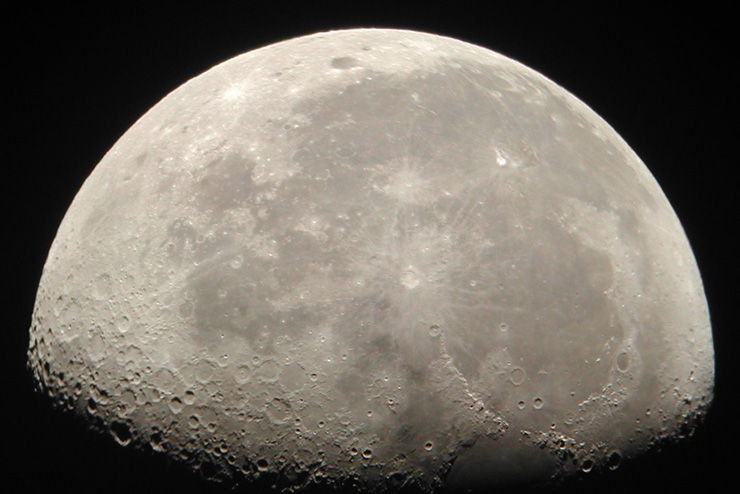
    The book lists the strangeness of the Moon, which includes the fact that it does not have a solid core like every other planetary object. It is either hollow or has a very low-density interior. Bizarrely, its concentration of mass are located at a series of points just under its surface – which caused havoc with early lunar spacecraft. The material the Moon is made from came from the outer surface of the Earth and left a shallow hole that filled with water and we now call the Pacific. This rock left the Earth to produce the Moon very quickly after our planet had formed around 4,6 billion years ago.

    The Moon is not only extremely odd in its construction; it also behaves in a way that is nothing less than miraculous. It is exactly four hundred times smaller than the Sun but four hundred times closer to the Earth so that both the Sun and the Moon appear to be precisely the same size in the sky – which gives us the phenomenon we call a total eclipse. Whilst we take this for granted it has been called the biggest coincidence in the universe.

    Furthermore, the Moon mirrors the movement of the Sun in the sky by rising and setting at the same point on the horizon as the Sun does at opposite solstices. For example, this means the Moon rises at midwinter at the same place the Sun does at midsummer. There is no logical reason why the Moon mimics the Sun in this way and it is only meaningful to a human standing on the Earth.

    ND: What led you to write Who Built the Moon? And does this latest book relate to your earlier research when writing Civilization One and Uriel’s Machine?

    CK: All of the six books I have had published over the last ten years are part of a continued single piece of research. I came to write Who Built the Moon?with Alan Butler after we had finished Civilization One, because our research led us to study the Moon very closely.

    We had found that the superbly advanced measuring system in use over 5,000 years ago was based on the mass, dimensions and movements of the Earth.

    However, for thoroughness we checked every planet and moon in the solar system to see if there was any pattern. Amazingly, it worked perfectly for every aspect of the Moon but did not apply at all to any other known body – except the Sun.

    It was as though we had found a blueprint where the Moon had been ‘manufactured’ using very specific units taken from Earth’s relationship with the Sun. The more we looked, everything fitted – and fitted perfectly in every conceivable way.

    ND: Most astoundingly, you found that an ancient system of geometry and measurement used in the Stone Age works perfectly on the Moon. What exactly is this system and how could the ancients have attained this knowledge?

    CK: It is not possible to describe the greatness of this ancient system of geometry and measurement without repeating the content of Civilization One.

    The work of Alexander Thom, a brilliant professor of engineering from Oxford University, was our starting point. He identified the existence of what he called the Megalithic Yard. This was a precise unit of measurement that was the basis of late Stone Age structures across Western Europe – such as Stonehenge. Most archaeologists have written his work off as a mistake but when one looks coldly at their objections they are baseless.

    Alan and I were able to show how they made these highly precise linear units based on the rotation of the Earth and how they were also the basis of all time, capacity and weight units in use today. Once again these are exact – not approximations or close fits.

    Where the ancients got such knowledge is quite baffling. All we can be certain of is that they were way ahead of us today! It’s easy to check out by anyone with a calculator.

    ND: Your conclusion is there are more than enough anomalies about the Moon to suggest it is not a naturally occurring body and was quite possibly engineered to sustain life on Earth. How did you reach this conclusion?

    CK: Not only is the Moon an apparently impossible object, it has some unique benefits for us humans. It has been nothing less than an incubator for life. If the Moon was not exactly the size, mass and distance that it has been at each stage of the Earth’s evolution – there would be no intelligent life here. Scientists are agreed that we owe everything to the Moon.

    It acts as a stabiliser that holds our planet at just the right angle to produce the seasons and keep water liquid across most of the planet. Without our Moon the Earth would be as dead and solid as Venus.

    Get the issue this article appears in

    ND: If the Moon is an artificial construct, what are your theories on who or what built it, and why?

    CK: In Who Built the Moon? we explain that we could not come to any other conclusion than the Moon is artificial. Because it is certain that it is 4.6 billion years old that raises some interesting points. Another factor was the obvious message that has been built into the Moon to tell us it’s artificial. The language of the message is base ten arithmetic so it looks as though it is directed to a ten digit species that is living on Earth right now – which seems to mean humans.

    The question of why the Moon had to be built is easy to answer: To produce all life, especially humans. As to who did it – well that’s a lot tougher! We give the three possibilities we can think of, namely: God, aliens or humans. The only one of these that is 100% scientifically possible is the last one. Time travel is universally accepted as being physically possible and a number of scientists are close to sending matter back in time. We can envisage that machines could be built in the future that could be sent back to remove matter from the young Earth to construct the Moon – probably using mini black hole technology.

    [alert type=”general” dismiss=”no”]This article was published in New Dawn 96.[/alert]

    [alert type=”success” dismiss=”no”]If you appreciate this article, please consider subscribing to help maintain this website.[/alert]

    © New Dawn Magazine and the respective author.
    For our reproduction notice, click here.
  • Synchronicity: The Key of Destiny

    Synchronicity: The Key of Destiny

    From New Dawn 88 (Jan-Feb 2005)

    Synchronicity is the most mysterious thing in the world. Synchronicity is the term parapsychologists use for “meaningful coincidence.” It happens to everyone, more often than we realise. But synchronicities are not “mere” coincidences, random accidents without significance.

    Going through a half-forgotten collection of old photographs, you’re surprised to find the snap-shot of a friend you lost contact with years ago. Just then the telephone rings and the voice on the other end of the line belongs to the same person in the photo.

    You’re desperate to find a parking place because you’ve got to be on time for a crucial appointment. There’s not an open spot as far as the eye can see. Suddenly, a car pulls out in front of you, leaving you a space right in front of the address where you’re expected.

    You’ve just finished reading a book about rare birds, when the first humming-bird you’ve ever seen in your back yard is drinking nectar from a nearby flower.

    These are typical incidents of synchronicity. And while most people brush them aside as insignificant happenstance, some of the greatest minds in history have grappled with this universal enigma. “Synchronicity” was coined by last century’s leading psychologist, Carl Gustav Jung. Fascinated as he was by it, even Albert Einstein could not understand how it worked.

    A synchronous event of my own in 1991 prompted me to interview, over the next six years, eventually 100 persons about their feelings on this elusive enigma. The meaningful coincides they shared with me proved more illuminating than anything I ever read on the subject.

    Collecting them into a loose order, I was somewhat astounded to see that these synchronous events experienced by my friends and acquaintances arranged themselves into repeating categories. Although many of the persons interviewed differed widely in age, spiritual beliefs or education, the meaningful coincidences they recounted all belonged to specific groups of common experience.

    Widening my research, I found that persons belonging to other cultures, sometimes long dead – often many hundreds of years ago – fell into the same seventeen categories which emerged from the men and women who told me of their own fortuitous occurrences. Their often dramatic, occasionally funny, always numinous testimony formed the basis for a book I wrote, Synchronicity & You, Understanding the Role of Meaningful Coincidence in your Life. Synchronicity is fundamentally a form of guidance that enters into the personal lives of every human being. Even if we knowingly discard it, at least part of its influence enters our subconscious.

    Some guiding synchronicities form a category best described as “Warnings.” A representative incidence of admonitory synchronicity not included in my book was recounted by the California poet, Miriam Hohf:

    “Many years ago, when I was a small child living in the Pennsylvania countryside, I took long walks by myself across the fields and into the forest, listening to the birds and talking to the rabbits and squirrels. I never felt afraid and deeply loved all the trees and animals. But on one otherwise beautiful, sunny day, my surroundings felt different somehow.

    “Everything was absolutely calm and motionless. Just when I approached the edge of the forest, however, a gust of wind suddenly arose, loudly rustling the leaves. I stopped and listened to them, because I felt they were speaking to me. They seemed to be saying, ‘Go away! Do not come into the woods today! There is danger here! Danger! Not safe to play here today! Go away!’ For the first time, a chill of fear ran through me and I fled, almost in tears. I did not visit the forest again, too afraid to return.

    “About a week after my experience, mother told me about a terrible story just published in the local paper. It seems that on the same day the leaves spoke to me the body of another little girl was found by the police. She had been brutally raped before being murdered. Did the spirits of the forest warn me in the rustle of their leaves?”

    Another prominent category of synchronicity falls under the heading of Numbers, which thread together mystical human experience, often with surprising results. The number 57, for example, is an intimate characteristic of the American Revolution, as investigator Arthur Finnessey abundantly demonstrates in his well-researched book, History Computed.

    Among the outstanding examples he cites is the last time the Liberty Bell rang, in tribute to George Washington, before it cracked on February 22, 1846 – 57 years after his 57th birthday. Together with his titles and signature, the closing paragraph of the US Constitution, following its original seven articles, makes up 57 words. It was ratified by 57 yes-votes from New Hampshire, and all Constitutional law begins with the Constitution’s 57th word – that word being, “All.” On February 6, 1777, 57 weeks to the day after the pivotal Battle of Princeton, another turning-point took place when the French joined the American cause. They fought off 19 British warships, making it possible for Washington to defeat Cornwallis on October 19, 1781, in a war which began on the 19th of April, 1775 – 57 is the sum of these three significant 19s.

    Washington’s only two victories over British Commander Cornwallis were 57 days apart. So too, 57 days separated the other decisive battles of the war, at Cowpens and the Guilford Courthouse. The final anniversary of Lexington and Concord celebrated during the Revolutionary War was precisely 57 months, 57 weeks and 57 days after they were fought. In South Carolina’s most famous assault at “Fort Ninety Six”, 57 Americans were killed. Interestingly, “96” is the sum total of the number of men who signed the Declaration of Independence (57) and the Constitution (39). The American Revolution’s 57th month concluded on 19 January, 1780; the Redcoats took Charleston exactly twice times 57 (114) days later. Twelve times 57 (684) days before, the decisive Battle of Monmouth was fought.

    In numerical symbolism, 57 is the combination of two numerals, 5 and 7. Five is associated with male energy (i.e., war), while seven signifies the completion of cycles. Together they form a symbolic concept perfectly reflecting the completion of major military cycles running like inter-linking themes throughout the history of the Revolutionary War. Isodore Kozminsky refers to any number from 55 to 64 as “the Sword,” associated with military victory (Numbers, Their Meaning & Magic, NY: Samuel Weiser, 1977, page 51).

    These ancient interpretations of 57 make its frequent recurrence throughout the War of Independence very appropriate. Yet, we stand in awe of its historical significance: Was it somehow an out-growth or expression of America’s violent struggle for freedom, or did it from the beginning (from before the beginning) determine historical events?

    The outstanding feature of 57, around which acausal incidents revolved, was a major rift in the fabric of history – the American Revolution. All other, similarly powerful historical events likewise produce extraordinary high levels of meaningful coincidence. In fact, the more dramatic, even traumatic, the event, the greater the intensity and sheer number that appear.

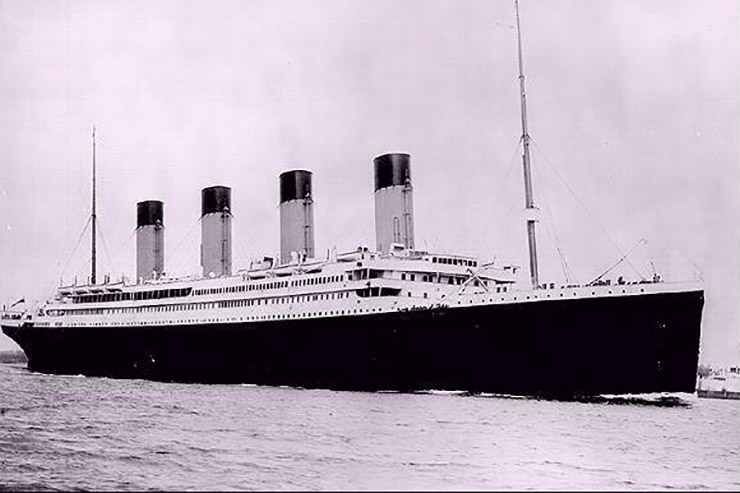
    An outstanding example was the Titanic disaster. Hardly any other single occurrence in the 20th century generated such a large collection of impressive examples. So many, in fact, they embraced all 17 categories of synchronicity. The meaningful significance of particular numerals played its part in the Titanic disaster, too – in that classic bad-luck symbol, Number 13.

    That this traditionally unfortunate number was factually associated with the most infamous of unlucky ocean liners should come as no surprise. Two, separate examples serve to illustrate. A British journalist, W.T. Stead, demonstrated his contempt for superstition by deliberately concluding a story on the 13th of April, 1912. Further tempting fate, his narration described the discovery of an ancient Egyptian sarcophagus and the curse of violent death alleged to overtake anyone who verbally translated its inscription. The next day, R.M.S. Titanic met the disaster in which Stead perished.

    A fellow passenger who lightheartedly challenged the deadly number was from Youngstown, Ohio. George Wick had been traveling with his family through Europe for several months and booked homeward voyage on Titanic. While in transit to Cherbourg, where the doomed ship would make final docking before attempting her transatlantic crossing, he stopped at Paris. There he purchased a Grand Prix sweepstakes ticket, choosing Number 13 on purpose, just to prove to everyone that he was not superstitious. “Watch and see what it does for me!,” he exclaimed. Several days later, Wick went down with the vessel.

    The “Warnings” cited in Miriam Hohf’s childhood experience proliferated around the Titanic before she sailed. A White Star insignia crumbled to pieces in the hands of Mrs. Arthur Lewis while she was pinning it to her husband’s cap. He was just about to board R.M.S. Titanic, where he was a steward. At the time, she regarded the incident as a bad “omen,” although he dismissed her expressed anxiety as foolishness, until the ship foundered a few days later. Fortunately, Mr. Lewis survived.

    In another Titanic-related warning, Colonel John Weir, a mining engineer with a worldwide reputation, almost canceled his first class ticket because of distressful feelings about the voyage. Staying at London’s prestigious Waldorf Astoria, he awoke on the morning of April 10th to find that the water pitcher atop his dresser had unaccountably shattered, soaking his clothes. He seriously expressed his premonitory feelings to the hotel manager, who allayed the Colonel’s “superstitions” enough for him to reluctantly board the great ocean liner. While at sea, Weir told his secretary about the burst water pitcher, could not shake his sense of foreboding, and said he must get off Titanic at the next opportunity, when it docked in Queenstown, Ireland. Again dissuaded, he remained aboard, only to go down with the ship he intuited was doomed.

    As some measure of the magnitude of synchronous phenomena associated with the disaster, no less than 899 persons who initially booked passage for Titanic’s maiden voyage eventually refused to board her because of warnings they experienced in the forms of various omens, premonitions, dreams and precognitive events. An additional 4,066 would-be passengers either missed the boat or canceled their reservations, usually under apparently normal circumstances, but sometimes through unusual coincidences that prevented them from sailing.

    Blanche Marshall suffered a hysterical outbreak on April 10th, 1912, as she and her family watched the Titanic steam past the Isle of Wight from the roof of their home overlooking the River Solent. In a virtual panic, she said the liner would sink before it reached New York and railed against her husband, daughters and servants for being blind to her vision of masses of people drowning in the freezing waters of the North Atlantic.

    While neither Mrs. Marshall nor anyone she knew sailed aboard the Titanic, she was prevented from boarding another doomed liner just three years later by similar precognition. In 1915, her husband had booked tickets for their return trip to England from America aboard the Lusitania. She thought nothing of it until she saw the May 1st date of the tickets. Convinced the ship would be torpedoed and sunk on that passage, Blanche convinced him to change their booking. Interestingly, she felt safe traveling on Lusitania at any other time. It was only the prospect of the May 1st crossing that alarmed her. True to her sense of foreboding, the vessel was torpedoed and sunk with heavy loss of life on the same voyage she refused to take.

    A sub-category of “Premonitions” is synchronous literature. Published in 1892, From the Old World to the New described the sinking of an ocean liner after colliding with an iceberg in the North Atlantic. The “fictional” name of its captain, E.J. Smith, likewise belonged to the man who commanded R.M.S. Titanic, twenty years later. Interestingly, the author of From the Old World to the New, W.T. Stead, lost his own life on board the same ship.

    While Titanic was being readied for her maiden voyage, the May issue of Popular Magazine was coming off the presses with the story of Admiral, an 800 foot-long ocean liner crossing the North Atlantic through calm seas at 22 1/2 knots. She strikes an iceberg and sinks, leaving the survivors among her thousand passengers to be rescued by a steamer. Similarities to the real-life tragedy convinced readers the story was based on Titanic’s particulars. But author Mayn Clew Garnett was said to have received the details for his novelette in a dream he had while sailing on the Titanic’s sister ship, Olympic. While he may have been influenced by physical parallels noticed during his passage aboard the virtually look-a-like vessel, Garnett’s selection of 43 north latitude for Admiral’s collision with the iceberg was virtually the same position at which Titanic met her identical fate.

    Literature is not alone among the arts which figure into synchronous events. More in black humour than conscious precognition, a crewman and his wife made recordings for each other, the husband singing “Only To See Her Face Again” to her “True Til Death,” on April 7, 1912, prior to his service about the world’s greatest ocean liner. Three days later, he sailed on the Titanic, never to return.

    Animal interaction in human experience forms its own, distinct category of synchronicity, and was not missing in the fate of R.M.S. Titanic. The age-old sailor’s belief that rats leave ships long before any apparent danger of sinking was exemplified aboard R.M.S. Titanic, when two crewmen in a forward boiler room saw panic-stricken rodents scampering aft, away from the starboard bow. Next day, an iceberg struck that very spot. Both men escaped the disaster with their lives, because the rats’ sudden appearance had made them uneasy enough to station themselves, as often as possible, in the immediate vicinity of the lifeboats.

    Another incident of animal synchronicity associated with Titanic concerns Bess, a thorough-bred horse belonging to Isadore Straus, the co-founder of Macy’s Department Store. The same night he and his wife were killed in the sinking, six-year-old Bess suddenly died of causes the veterinarian was unable to determine.

    Tactile sensations comprise a sub-heading of “Death” in synchronicity. The unaccountable perfume of flowers associated with someone close and recently deceased is not uncommon. Another example belongs to May de Witt Hopkins, who experienced the fragrance of roses in her London home one day after R.M.S. Titanic sank. Although word of the disaster had spread by that time, names of those on board were not yet published. But with the flowery scent filling her room from no apparent source, Hopkins suddenly felt that someone she knew was trying to make her aware of his or her death. She later learned that a friend, who was, unbeknownst to her, a passenger on the ship, had indeed perished when it went down. Interestingly, her own mother, during the late 19th century, had been similarly alerted to the death of a loved one by a mysterious, flowery odour.

    “Inanimate Objects,” like the White Star insignia that fatefully disintegrated in the hands of Mrs. Lewis, comprise a wide-ranging group of synchronous experiences. The Managing Director of the White Star Line, Joseph Bruce Ismay, survived the Titanic, but thereafter resigned his post, because he was publicly, although unfairly, blamed for the tragedy. He spent the next 25 years of his life in virtual seclusion, dying on October 17, 1937. That same Sunday afternoon, a framed, oval mirror that hung in Ismay’s office during his tenure at the White Star Line suddenly crashed from its hook, scattering broken pieces across the floor.

    Two weeks after Titanic was lost, a large wooden crate left unclaimed at Pier 61, in New York harbour, was opened by port authorities. They were surprised to see that it contained a meticulously detailed model of the sunken vessel. It had originally been sent to the US for promotional purposes on behalf of the White Star Line and was supposed to be returned to the London offices on the doomed ship’s return voyage. But the 30 foot-long representation was accurate in more particulars than anyone could explain. Although it presented a full compliment of 20 davits, there were only a dozen miniature lifeboats. Moreover, the bow was partially ruined and a long crack appeared from the keel toward the upper deck, mimicking the actual damage sustained by Titanic.

    As might be expected, “Dreams” are an important category of synchronicity. While traveling in Europe during the spring of 1912, a New York lawyer, Isaac C. Frauenthal, dreamt of being aboard a large ship which collided with some floating object and began to sink. His was a long, vivid nightmare, in which he clearly recalled the sights and sounds of calamity. Several nights later, the identical psycho-drama repeated itself, and he told his brother and sister-in-law that it must be a warning against their up-coming voyage on R.M.S. Titanic.

    But they laughed at his dream and convinced him to go through with their return trip to America aboard the doomed White Star liner. All three survived the sinking foretold in Isaac’s recurring nightmare.

    Perhaps the most inexplicable aspects of synchronicity are those more infrequent instances of “Parallel Lives.” When Lucien P. Smith narrowly escaped death during the terrible fire on Viking Princess, in 1966, it was his second, major disaster at sea. A survivor of the Titanic, he was in his mother’s womb when that ship sank, just as Mrs. Astor, also aboard, was pregnant with her son, John Jacob. Both children were born eight months after the sinking, in which their fathers perished. Their mothers died in the same year, 1940.

    Individual lives and major conflicts are events sometimes so powerful they echo beyond their own time and appear to replay themselves in the future. Such an extraordinary case of parallel history began to unfold when William C. Reeves went aboard the tramp steamer, Titanian, as an ordinary seaman, departing Scotland for New York on April 13, 1935. Ten days later, at 2300 hours, he was ordered into the foc’s’le head to stand watch.

    Although the sea was calm, the darkness was moonless and impenetrable. Reeves began to feel increasingly uneasy, not only because of the very poor visibility conditions he now faced as ship’s look-out. He thought, too, of the premonitory novel he had been reading in his cabin, Morgan Robertson’s Futility. Reeves was unable to keep his mind from drifting back to a dramatic moment in the book when Titan’s look-out missed seeing an iceberg in time to avoid disaster. Also, he could not help but notice the ironic similarity of his ship’s name, Titanian, and Robertson’s Titan with Titanic.

    As his sense of irony deepened into anxiety, he realised that the time was now 23:35, just five minutes before the hour Titanic struck the iceberg. Reeves knew that penalties were severe for raising a false alarm, the darkness ahead showed no sign of danger, and for some moments he hesitated to act. But at last his feelings of imminent collision overwhelmed him and he ordered the bridge to stop engines, “Iceberg ahead!”

    No sooner had the ship’s speed dropped off, than she smashed into several large fragments of ice, which twisted her bow and disabled her propeller. Slowing to full stop, Titanian’s crew were astonished to behold an enormous iceberg looming directly ahead out of the darkness. The floating mountain appeared at 23:40, the same hour of Titanic’s collision.

    Doubtless, had the Titanian not stopped in time, she would have followed her predecessor to the bottom. An SOS sent to Cape Race, Newfoundland, brought rescue to the stranded crew.

    The multiple synchronicities of this parallel event – the similar ships’ names, Reeves’ powerful premonition, his reading of Robertson’s book, precisely the same hour for meeting with a deadly iceberg – far out-strip all considerations on behalf of mere chance. Instead, they clearly define the operative principle of meaningful coincidence as a legitimate phenomenon.

    [alert type=”general” dismiss=”no”]This article was published in New Dawn 88.[/alert]

    [alert type=”success” dismiss=”no”]If you appreciate this article, please consider subscribing to help maintain this website.[/alert]

    © New Dawn Magazine and the respective author.

    For our reproduction notice, click here.
  • Psychic Protection: Immunise Yourself Against Negative Energy

    Psychic Protection: Immunise Yourself Against Negative Energy

    Have you ever entered an empty room, or office, and felt “uncomfortable”? Feeling perhaps quite happy to get out of that room, or office, as soon as possible? Maybe you have found somewhere that feels “bad” at one time yet feels “okay” at another time? This could be where we work, live, or somewhere we are visiting or passing through.

    What about people? Do you know anyone who seems to have a “negative” aura? When­ever you are near them you feel more depressed, angry or fearful, than you normally do? How about the opposite? Do you know anyone who seems to make you feel better just by being around you, not even needing to say anything to you to improve things?

    Apart from feeling worse around certain people and/or in certain places, do you find that you sometimes lose a lot of energy (psychic draining) in these circumstances? Do you have a problem with such things as insomnia, poor sleep, nightmares or low energy levels? Perhaps you are constantly lacking in energy? Maybe being diagnosed as having chronic fatigue? Or maybe you always seem to be getting colds, illnesses or other problems?

    If the answer is “yes” then chances are you may be under intentional, or unintentional, negative psychic influence. What some people call being under psychic attack. Can anything be done about such situations? Yes, psychic protection is what one can learn to counter such things. Before talking about psychic protection however, we may wonder what it is and how it works.

    To better understand this we need to understand these negative influences. Put simply they are usually categorised into two types. Thought energies (or if they have a shape – thoughtforms) and negative spirit influence. Now, you may instantly think I am talking about dead people. I am not. We are all “spirits”. Some of us are physically alive and some of us aren’t. We do notbecome a spirit when we physically die. We are already one.

    One may also say, “But I cannot see/hear spirits. This is proof they don’t exist”. Well, I cannot see radio, or television waves in this room. Does that mean they aren’t here? I wouldn’t think so. Much the same as hearing. I cannot hear a dog whistle. But dogs can! It would be rather foolish for me to conclude such a whistle made no noise simply on the grounds that “I didn’t hear it.”

    Negative thought energies are created by someone (dead or alive) thinking negative thoughts, e.g. anger, hatred, fear etc. If the person is thinking these thoughts about us then they are automatically projected in our direction. In addition, as negative spirits are attracted to negative energy these people will often accompany the energies. Particularly if this is done “formally”, i.e., a spell.

    Fortunately there is defence against these things. Positive energies will dissolve negative ones and we can arrange for positive spirits to help protect us against negative ones. There is nothing particularly profound about it. To cancel out a fire, water is a good response. The principle of using the opposite response to a spell is along the same lines.

    The negative thought content of a spell, or any other form of psychic attack, can be “cancelled out” by directing a positive thoughtform of the same, or greater, strength at it. When they meet, the negative thoughtform will dissolve. This can be achieved by such things as prayer, visualisation, etc. A common example of the latter is to imagine you are surrounded by a “protective” bubble of light. One can also imagine oneself being a hot ball of light. Like the sun. Radiating a hot, bright, light outwards.

    The effect of negative entities can be “can­celled out” by positive entities of the same, or greater, strength. If the positive spirits predominate then many of the negative entities can be “cleared” (permanently) to spirit worlds.

    Getting help from positive spirits is arranged by requesting it. Prayer in other words. It should be remembered we can do more than arrange “protection” this way. A good wording for such a prayer, and a list of recommended approaches is at http://home.vicnet.net.au/~johnf/aprayer.htm For those without internet access here is a way of arranging this, say/think:

    “I ask the Divine Light Forces (Forces of God) for…

    (1) Protection against all that is not of the light (alive and dead).

    (2) Healing on all levels

    (3) Guidance with my life. Especially in the area of ____________________ e.g. knowing what I should be doing spiritually, help with becoming a channel for love, light, healing, guidance and inspiration. Preparing for meetings and/or seminars etc.

    (4) Divine love, light and healing en­ergies to go to __________________ (people we live/work with) as well as all who are working against our spiritual progression.

    Other points worth noting :

    (1) There are some interesting books that can be purchased on this topic in­cluding a booklet I have written. The authors range from psychics to medical doctors, psychologists, psychiatrists, etc. There is a list of some of the books primarily related to the topic of psychic protection on my web site. Those with internet access might find http://home.vicnet.net.au/~johnf/bookprot.htm a help.

    (2) Light coloured clothes tend to en­courage light coloured energies. For best health never wear dark colours.

    (3) If someone is currently sending you negative effects, as in a spell, then you need to direct light, etc. to them constantly until you feel they have stopped. If you “clear” yourself today then there is no reason why they cannot dump you with new discordant energies tomorrow!

    (4) Negative thinking/emotions such as anger, fear, etc. weakens our aura and reduces our “protection”. Positive thinking/emotions such as love, etc. strengthen our aura and improves our “protection”.

    (5) Keep in mind that things take time. Some people think praying for one night and imagining white light around them for five minutes will solve all their problems. This is unlikely. Suppose discordant effect had built up around you and/or your house for ten years. Do you think it reasonable to expect it to go in five minutes? Think of it this way. If you had a blow torch could you melt an ice­berg? The answer is, of course, yes, but it would take more than five minutes!
    [alert type=”general” dismiss=”no”]This article was published in New Dawn 80.[/alert]

    [alert type=”success” dismiss=”no”]If you appreciate this article, please consider subscribing to help maintain this website.[/alert]

    © New Dawn Magazine and the respective author.

    For our reproduction notice, click here.
  • The Out-of-Body Experience As Dimensional Translocation

    The Out-of-Body Experience As Dimensional Translocation

    From New Dawn 74 (Sept-Oct 2002)

    Pause for a moment and try to imagine four-dimensional space. It is right next to you, but in a direction you can’t point to. No matter how well hidden you may be, a four-dimensional creature can see you perfectly well, inside and outside.
    – Rudy Rucker, The Fourth Dimension

    How might these beings be even dimly aware of our presence, if we normally don’t have an inkling of theirs? Once more, we’re treading on extraordinarily thin ice by even thinking about explanations for this phenomenon. The mere need to attempt an understanding shows us how far afield our thinking has come.
    – Rick Strassman, M.D., DMT, The Spirit Molecule

    If these men are correct, then physics is the study of the structure of consciousness.
    – Gary Zukav, The Dancing Wu Li Masters

    Consensus reality in the “real world” is founded upon corporeal entities beholding three-dimensional space. When out-of-body explorers or UFO abductees claim that they passed through solid walls during their experiences, they are contradicting perhaps the most fundamental perceptions of human observers.

    Scientism condemns such assertions as either fraudulent or hallucinatory because if they were accepted as legitimate, our entire conception of reality would collapse – an appalling prospect, challenging the credibility of all self-appointed official observers. Nevertheless, when faced with such an abundance of anomalous data any fearless spectator might suggest that our concepts of dimensional location need to be re-evaluated and clarified.

    At its simplest, the experience of three-dimensional space is the awareness of three perpendicular axes: North-South, East-West and Up-Down (e.g., a cube). Two-dimensional space (a flat plane) contains only two of these axes, and one-dimensional space consists of only one axis – a single line.

    Time is also a dimension, though not a spatial one; however, it is a necessary extension to our awareness of space, and so we normally describe our reality as three dimensions of space, plus one dimension of time – the so-called “four-dimensional space-time continuum.” Even small children can understand this because we spend all our lives living within its confines: it’s an experience so commonplace and taken-for-granted that we never really think about it. (It is, after all, our consensus reality).

    Four-dimensional space, on the other hand, though mathematically describable, is a concept virtually impossible to visualise. That’s because progression from one spatial dimension to another follows a logical sequence of perpendicular extension: a plane is merely the extension of a line in a direction at right-angles (“perpendicular”) to that line’s axis; a cube is created when a plane is extended at right-angles to that plane’s axis. This is easy enough to portray as long as we’re dealing with three dimensions or lower, but in what perpendicular direction would a cube have to move to create four-dimensional space? Even if you know the secret, the mind boggles and goes into spasms while trying to visualise it.

    The reason for this is because we are multi-dimensional entities “serving time” in a three-dimensional spatial prison and brainwashed into believing it’s a life sentence without parole or any hope of escape.

    To switch metaphors, consider for a moment a Zen Koan – an existential test of your ability to transcend your perceptual situation:

    You are standing on a spot where (judging by the rumbling sounds and trembling beneath your feet), a volcano the size of Krakatoa is just about to erupt. Immediately above your head an enormous fireball, a meteor as big as Manhattan, is only seconds away from crashing exactly where you’re standing. A few metres to your front, a tidal wave (over a kilometre high!) is cresting and about to break. Six metres behind you (at Ground Zero), a hydrogen bomb test is in its final few seconds of countdown; to your immediate right, the entire Nazi army from World War II is bearing down upon you with distinctly murderous intentions. And finally, coming up fast on the left, a charging herd of ten thousand enraged bull elephants is about to stomp you into the dirt.

    Koan: In what direction lies escape? (Hint: it’s the only “perpendicular” direction available to you, and given the above circumstances you are about to take it whether you want to or not!)

    There are other ways of visualising this: consider the “black hole” or “singularity.” A black hole is created when a largeish star (about 50 times bigger than our sun) consumes all its nuclear fuel and implodes into its own intense gravity. Anything, including light, approaching within a given critical distance of a black hole is sucked into its whirlpool, never to be seen again. Physicists postulate that such imploding singularities depart from our own space-time to create new parallel-universe/space-time dimensions. (The connections between them constitute the familiar “worm holes” so necessary for Captain Kirk’s navigation of the Starship Enterprise.) What appears to us as a black hole implosion in this universe becomes a “white hole” explosion somewhere else – creating a whole new universe, a whole new dimensional reality:

    “Relativists realized that there is nothing to stop the material that falls into a singularity in our three dimensions of space and one of time from being shunted through a kind of space-time warp and emerging as an expanding singularity in another set of dimensions – another space-time. Mathematically, this ‘new’ space-time is represented by a set of four dimensions, just like our own, but with all the dimensions at right angles to all the familiar dimensions of our own space-time. Every singularity, on this picture, has its own set of space-time dimensions, forming a bubble universe within the framework of some ‘super’ space-time, which we can refer to simply as ‘superspace’.”1

    Notice that the rule of perpendicular extension is maintained in the creation of these new universes and that any observers within them would perceive an analogy of our own familiar four-dimensional space-time continuum. (Should they be practitioners of Scientism, let us forgive them for believing that theirs is the only reality that exists!)

    Now imagine that you are standing outside on a clear summer’s night – all the stars above the horizon are visible to your sight. Assume (for the purpose of illustration) that the hypothetical XYZ-123 galaxy (one-hundred million light years from Earth) is shining brightly. The photons (waves or particles, take your pick) which were emitted from the XYZ-123 galaxy during earth’s dinosaur days, are just now arriving on our planet; they implode through the pupils of your eyes to explode within your brain: “Ah-ha – yes, there it is! Just above Orion, the familiar old XYZ-123 galaxy,” says your mind-observer.

    Koan: Where do these photons (after their exhausting one-hundred million year journey through interstellar space) go upon entering your own personal black holes (eye-pupils)? The radiation from an entire galaxy registers on your brain, is interpreted by your mind, and then what? And then where? Surely those photons can’t just “wink out” after going to all that trouble to get here! Can they?

    “The matter [falling into a black hole] cannot escape back into the universe we know, yet if it does not disappear at a singularity it must pass into a region of spacetime that we do not know. Sometimes such unknown regions are called other universes, the effect of gravitational collapse being to establish a bridge or tunnel into these enigmatic ‘parallel’ worlds. The collapsing star, or whatever matter falls in after it, falls on through the tunnel and out into, presumably, a cosmos much like our own.”2

    Look at it another way: Imagine a point existing in some kind of pre-spatial “void” – the Tao, perhaps (whatever that is). Mathematically, a point has zero dimensions, but it exists anyway because consciousness defines it that way. A zero-dimensional point existing in “non-space” probably comes as close to “nothing” as we can imagine, but quantum cosmologists say that our universe was created out of just such a “singularity.” They also tell us that nothing can take place without an observer:

    “The universe is supposed to be everything that there is, and if all is quantized, including spacetime, what can collapse the cosmos into reality without invoking consciousness?”3

    The implications of this concept are astounding! If the zero-dimensional point is all that exists, and if it “decides” to “extend itself” and become the universe, by the rules of quantum physics it can’t be anything but Consciousness itself! Some might be tempted to define this Primordial Awareness as “God,” but let’s not, since Scientism insists (regardless of the implications of quantum theory), that the concept of “God” is unnecessary to explain the Cosmos. (Whether you regard this as a non sequitur or not depends on which belief system you use to define your illusions.)

    Anyway, the rules of dimensional extension tell us that movement in any direction from a point is perpendicular, so one dimension (a line) is created if the point moves at all. Should it turn from there, two dimensional space is defined; and of course all it has to do next is make one more right- angle turn and we have three spatial dimensions. Should all of these movements happen simultaneously, we have a passable description of an explosion:

    “The evidence suggests that the Universe was born out of a singularity – a point of infinite density occupying zero volume – and that in the first split second the tiny seed containing all the mass and energy in the observable Universe went through a period of exponential expansion, known as inflation.”4

    This “inflation” is the Big Bang that became our universe – a point of infinite density occupying zero volume (a mind-numbing concept!) “explodes,” creating space, time, matter, energy, and anything else we haven’t discovered yet. Unfortunately, when most people imagine the Big Bang they visualise it as a three-dimensional event, forgetting that all other possible dimensions must also be factored into the equation. Which is to say: the primordial point explodes (the Big Bang), but because this is a multi-dimensional affair, it is also imploding (the Big Whimper, perhaps), creating all of multidimensional space in one event. If our point is indeed conscious, as quantum theory demands, it follows that consciousness is a priori to any and all phenomena, and anything created by it is by definition part of it: hence everything that exists is in some way conscious, just as the Theosophists tell us. (More about them later.)

    Our point’s simultaneous explosion/implosion would create a bare minimum of six spatial dimensions: three of space and three of hyperspace, and certainly many more than that. What would they look like “objectively?” Wouldn’t dimensions created out of Consciousness have to be “Mind Stuff” – perhaps a Super Collective Unconscious at least as infinite as the physical universe? Out-of-body shamans do indeed describe Locale-II (hyperspace; see previous parts of this article) as a kind of Supermind, a realm where thought (consciousness) creates mass and energy out of itself:

    “Superseding all appears to be one prime law. Locale-II is a state of being where that which we label thought is the wellspring of existence. It is the vital creative force that produces energy, assembles ‘matter’ into form, and provides channels of perception and communication. I suspect that the very self or soul in Locale-II is no more than an organized vortex or warp in this fundamental. As you think, so you are.”5

    This empirical out-of-body observation is echoed in quantum theory, which of course is based upon solid, self-consistent, repeatable, scientific experimentation:

    “To the naive realist the universe is a collection of objects. To the quantum physicist it is an inseparable web of vibrating energy patterns in which no one component has reality independently of the entirety; and included in the entirety is the observer… In the absence of an observation a quantum system will evolve in a certain way. When an observation is made, an entirely different type of change occurs. Just what produces this different behavior is not clear, but at least some physicists insist that it is explicitly caused by the mind itself.”6

    Physicists describe matter at the subatomic level as a “wave function,” and tell us that it is more “idea-like” (i.e. related to awareness) than it is “matter-like.” In fact, at the subatomic level, there is no substantive physical world at all – it’s just a vibrating dance of energy, or Consciousness, which must in some sense be the same thing! We can deduce this as follows:

    Einstein’s famous E = MC squared equation demonstrates that matter and energy are two versions of a single phenomenon. Unfortunately, Einstein left himself (as observer) out of his equation. It might more accurately be written as: E = MC squared, divided by X – “X” symbolising consciousness (i.e., an observer) which is demanded by quantum theory for anything to exist. If this is at all accurate (and the implications of quantum physics seem to require it), then the lowest common denominator to which reality can be reduced is Consciousness itself.

    If Consciousness (what else?) created an infinity of four-dimensional space-time “bubble” universes, each of which is perpendicular to (i.e. “perceived by”) that Consciousness, then Consciousness has to be the “Super-Space” surrounding and permeating them all. Since time and consciousness can’t be separated from each other without logical absurdity, time could be thought of as a one-dimensional function of Consciousness projected into three-dimensional space. (Thus, the four-dimensional space-time continuum, since without duration, space would be, if not unperceivable, at least very boring.)

    This time-consciousness interface is what sets space “in motion” and is the only way a differentiated point-of-view can experience dimensional reality. Outside of the dimensional bubble-universes (i.e. in the superspatial realm of Consciousness-without-an-object), time does not exist, a fact attested to by psychonauts and mystics since “time out of mind.” (Pun intended.)

    Each differentiated point is a potential “free agent” which may be arbitrarily assigned to any position in any dimension. Being conscious, they become attitudes or points-of-view within multidimensional space (“God’s observers,” if you will). Your individual human consciousness is essentially the interface of a point-singularity (“you”), linking our particular spacetime bubble with Super-Space, or perhaps more accurately, the Objective Psyche: which is Jung’s revised, much better, label for the “Collective Unconscious.”

    “What Jung calls the objective psyche may then be likened to an encompassing energy stratum from which arise varying field activities discernable to the experienced observer through the patterning of image, emotion and drive configurations. These psychic field expressions Jung has called complexes and archetypes of the objective psyche… The objective psyche exists independently of the ego, but can be experienced and comprehended to a limited extent by the ego.”7

    These complexes and archetypes within the Objective Psyche have traditionally been regarded as “gods,” but not as “God” (i.e., as the Objective Psyche per se). The difference between you (or any other differentiated point-of-view) and the Objective Psyche, as such, is the difference between man and “God.” The purpose of our incarnations as “points-of-view” is to return to the pool from which we emerged with full gnosis of where we’ve been and what we’ve done. (We’ll examine the traditions informing this concept in our next article.)

    Because our unconscious mind is a two-way wormhole connecting subjective perception with the infinite realms of the Objective Psyche, it is not uncommon for profound insights to emerge from those dimensions into human awareness – often before their time. Figure 1 is taken from Rene Descartes’ posthumous 1667 work, Traite de l’Homme, which illustrates his theory of perception. He regarded the pineal gland as the “gateway to the soul,” and in this drawing he hypothesises how visual perception is concentrated therein. Most of Descartes’ theories have been disproved by modern research, but his fundamental intuition in this case is still valid. All that is missing is the concept of the DMT-synthesising pineal gland (discussed in our last article) as a singularity linking spacetime awareness with the Objective Psyche to complete the hypothesis being proposed here.

    And I hope my hypothesis is beginning to make sense: Since we experience ourselves as a conscious centre (a “point”) inhabiting a physical body, which perceives itself as part of a three-dimensional “outside” reality, it is obvious that all external sensory input is perpendicular to our subjective awareness. Which, if you follow the right-angle rule, is to say that consciousness itself must be in some sense dimensional! The only direction of escape in Koan-1, then is within. The only place that the radiation from the XYZ-123 galaxy can go after entering the black-holes of your eyes is inside. This mandates that both Locale-I and Locale-II are inner dimensions which to varying degrees mirror our familiar, externalised space-time. We have the empirical testimony of out-of-body explorer William Buhlman that this is so:

    “For two years I had believed that I was moving laterally from one area to another within the same dimension, but now the startling truth was apparent. I was not moving laterally but inwardly within the universe from one energy environment to another.”8

    Buhlman goes on to describe what can only be a kind of singularity of consciousness imploding into itself, into a dimension of many dimensions. Here he is, out-of-body, in the Locale-I version of his bedroom, about to enter a typical Locale-II environment, perhaps one of Robert Monroe’s “upper rings”:

    “Feeling centered, I stand at the foot of my bed and say aloud, ‘I move inward.’ I feel an immediate sensation of rapid inner motion – I’m being drawn into a vacuum deep within myself. The sensation of motion is so intense that I shout ‘Stop!’ Instantly I stop moving and realize that I’m in a new environment. I am outdoors in a beautiful parklike setting.”9

    Although admittedly rare, this perception is neither new nor unique. The Tibetan Book of the Dead tells us explicitly that all of the bardo realms are “inside of us”:

    “O nobly-born, these realms are not come from somewhere outside [thyself]. They come from within the four divisions of thy heart, which, including its center, make the five directions. They issue from within there, and shine upon thee. The deities, too, are not come from somewhere else: they exist from eternity within the faculties of thine own intellect.”10

    Although the idea that “The Kingdom of Heaven is within you” is a cliche familiar to everybody, when entertained at all, it is usually understood metaphorically. Seldom do we perceive “inside” literally: as a real, honest-to-god dimension of reality. Here’s another version of this ancient idea from the Vedic tradition of India:

    “The seat for the Gods is indeed within, in the inner being which is wider and far greater and subtler and supple and enlightened and distinguished from the physical being.”11

    Come on! Gimmie a break! (The logical mind wants to know how a vessel can be smaller than its contents.) Although an impossibility in any three-dimensional context, four-dimensional space is obviously not bound by such provincial illusions. Actually, instead of an absurdity to be dismissed out of hand, initiated awareness recognises immediately that it is dealing with a legitimate dimensional interface when such “impossibilities” are depicted. For example, it is not at all uncommon for UFO abductees to describe the inside of the spacecraft as much larger than the outside:

    “As strange as it sounds, this bigger-on-the-inside-than-out impression is exactly what a three dimensional creature like… any one of us might expect to experience when confronted with a four dimensional space. An analysis of the geometry by Stan Kulikowski in the MUFON UFO Journal concluded: ‘Whether this inside-too-big phenomenon is actual alien technology or deliberate fraud or a subconscious psychological trick of perception, it is nevertheless based on good mathematics and related to the fundamental physics of our universe’.”12

    All of the confusion surrounding OOBEs (Out-Of-Body Experiences), NDEs (Near-Death Experiences), alien abductions (and life itself, for that matter), is directly attributable to the difficulty that a consciousness hypnotised by three dimensions has in perceiving “beyond” that illusion. Thus, we project these spaces “outside” of ourselves, and regard our bodies as “vessels” which must be “gotten out of” in order to “ascend” to “higher” realms. (Notice that we can’t even discuss the subject without using three-dimensional, “external” concepts.)

    Because the imploded dimensions are generally believed to be difficult to visualise, authentic mystical (i.e. hyperdimensional) awareness is greatly handicapped in its attempt to translate what it experiences into terms that three-dimensional chauvinists can understand. Here’s another description of this interior reality from the Chandogya Upanishad. Note that it describes the “heart” as the centre of awareness. That could be poetic license – the pineal gland might make a better candidate:

    “As large as the universe outside, even so large is the universe within the lotus of the heart. Within it are heaven and earth, the sun, the moon, the lightning, and all the stars. What is in the macrocosm is in this microcosm.”13

    This is an unambiguous description of consciousness as four-dimensional space! If we superimpose our observation of the hypothetical XYZ-123 galaxy onto this picture, we have photons imploding from spacetime into mindspace: inner and outer galaxies connecting, interacting and evolving within the matrix of Consciousness itself. Since we know that the pineal gland (a singularity within the human brain) is associated with out-of-body perception, it’s a fair hypothesis that some kind of eye-pineal connection constitutes the focal “point” linking these two realms. “External” images implode into our “eye-pupil-wormholes” to instantly explode via the pineal singularity into interior dimensions of infinite Mind Stuff.

    “The eye is [the Self’s] dwelling place while we wake, the mind [pineal gland?] is his dwelling place while we dream, the lotus of the heart is his dwelling place while we sleep the dreamless sleep.”14

    I won’t quarrel about where the pineal gland fits into the above scheme, because if Descartes is correct in his intuition, the pineal is the dimensional aperture that processes sensory input from everywhere in the body. In connection with this, it is highly significant that theorists studying our spacetime universe postulate the existence of tunnels, tubes, or wormholes, yoking the dimensions together (see Figure 2).

    “Cosmologists have even proposed the startling possibility that our universe is just one among an infinite number of parallel universes. These universes might be compared to a vast collection of soap bubbles suspended in air. Normally, contact between these bubble universes is impossible, but, by analyzing Einstein’s equations, cosmologists have shown that there might exist a web of wormholes, or tubes, that connect these parallel universes… The Einstein-Rosen bridge acts like a tunnel connecting two regions of space-time; it is a wormhole.”15

    By now it shouldn’t surprise us that the experience of passing through a “tunnel” is one of the most universally reported characteristics of out-of-body travel. Later in his career, Robert Monroe founded The Monroe Institute, a non-profit corporation, to scientifically study and induce the out-of-body experience in a wide-range of subjects. Here’s one of the first things he found:

    “As the induction of the OOBE state was examined further, one key element did repeat consistently… In slow motion it ‘felt as if one were going through a tunnel to get to the light,’ a classic description that has been brought forth by many who performed the OOBE inadvertently or in a near-death situation.”16

    “Classical description,” indeed! Can there be any doubt that the following accounts are portrayals of interior-dimensional “wormhole-analogs” which mirror their spacetime counterparts? Here is Oliver Fox, describing a visit to some indeterminate realm in Locale-II:

    “And now it seemed to me there was a sort of hole or break formed in the continuity of the astral matter; and through this, in the distance – as though viewed through a very long tunnel – I could see something indistinct which might have been the entrance to a temple, with a statue still further away showing through it… I was falling, with seemingly tremendous velocity, down a dark, narrow tunnel or shaft.”17

    Subjects undergoing a DMT-induced out-of-body experience commonly describe an identical phenomenon. (DMT: N,N-dimethyltriptamine, a product of pineal synthesis, was discussed in the previous article of this series):

    “First I saw a tunnel or channel of light off to the right. I had to turn to go into it. Then the whole process repeated on the left. It was intentional that way. It was as if it had a source, further away. It got bigger farther away, like a funnel. It was bright and pulsating… I had a sense of great speed. Everything was unimportant relative to this. Things were flashing, flashing by, as if from a different perspective. It was so much more real than life. The left and right tunnels joined in front of me.”18

    Dr. John Mack, in his study of the UFO Abduction Syndrome, also describes the tunnel as a common experience among his abductee-informants. These are apparently inter-dimensional doorways through which the Aliens both enter our space and convey their victims into hyperspace.

    “A forty-one year old health care executive spoke to me of large tubes through which he passed during one of his abductions ‘into the next plane where there was this light’… Catherine [another abductee]… also spoke of a tube or tunnel through which she and others passed from a spirit plane outside space/time back to the embodied physical state on earth.”19

    Then of course, there is the Near-Death Experience (NDE) as described by Dr. Raymond Moody, the pioneer investigator of this unique form of out-of-body projection. In fact, the “tunnel phenomenon” is so ubiquitous that he lists it as one of fifteen symptoms considered definitive of an NDE.

    “Often concurrently with the occurrence of the noise, people have the sensation of being pulled very rapidly through a dark space of some kind. Many different words are used to describe this space. I have heard the space described as a cave, a well, a trough, an enclosure, a tunnel, a funnel, a vacuum, a void, a sewer, a valley, and a cylinder. Although people use different terminology here, it is clear that they are all trying to express some one idea.”20

    In a later article we will examine the phenomenon of “Remote Viewing,” a tactic used by both United States and Soviet intelligence agencies to spy on each other during the Cold War. We will then determine if these specially-trained psychics were actually “out-of-body” travellers in the classical sense of the term as we’ve defined it so far, but for now it is instructive to examine some representative descriptions of Remote Viewing in light of the tunnel phenomenon under discussion. Here are some excerpts from the remote viewings of Captain David Morehouse:

    “My phantom body fell through the tunnel of light again… I began plummeting down the tunnel of light… I made the long fall down the tube of light and passed through the membrane into the target area… The fall through the tunnel seemed longer this time and I never hit the membrane at all… I found myself falling into a tunnel of light and passing into another world.”21

    Here is a description by Captain F. Holmes Atwater, the Intelligence and Security Command (INSCOM) officer who founded the US Army’s Remote Viewing unit at Fort Meade, Maryland. (As described in his book, this particular event was almost certainly a classic “astral projection” OOBE):

    “My kinesthetic sense of motion (like the feeling you get when flying in an airplane) was accompanied by a strange visual perception. I seemed to be moving through a white tube or tunnel, its walls lined with crystalline forms.”22

    And finally, here is another observance by William Buhlman, the out-of-body explorer who (even more than Robert Monroe), defined his experiences within the context of modern quantum theory:

    “The tunnel experience is much more significant than most people recognize. Not only does it provide substantial evidence of a logical transitional method for consciousness after physical death, but it directly relates to the modern physics theories concerning parallel universes and energy wormholes, as well as to my observations concerning the multidimensional universe.”23

    Yeah, but what about Locale-I (the Sidpa Bardo), which Monroe describes as our own familiar world, though perceived while out-of-body? How could that be regarded as an “inside” dimension?

    Imagine consciousness as a dimensional “double mirror” with back-to-back reflective surfaces: one facing outward to space-time, the other facing inward to hyperspace. The evidence suggests that when someone goes “out-of-body” into Locale-I, they are not actually interfacing with the physical world that we touch when “in-body,” but with the “etheric double” of the physical world on the other side of the mirror. (Technically, of course, we’re not going “out-of-body” at all, but “in-our-body,” but for now at least, let’s not complicate the nomenclature.) Here’s Buhlman again:

    “Slowly I came to understand that the environment I was observing was not the physical world, as I had assumed. I realized that the structures I normally observed when out-of-body were nonphysical structures… Now I finally understood why there were slight variations between the nonphysical and physical furniture and other objects. For example, the nonphysical walls were often a different color, and the shapes and styles of some of the furniture and rugs were different. Much of this was minor but nevertheless noticeable… It appears that we are not observing the physical world from a different perspective, as many believe, but are interacting in a separate but parallel dimension of energy.”24

    In the spring of 1902, Oliver Fox had his first out-of-body experience when his consciousness “woke up” within what he called a “dream of knowledge,” but what would today be labelled a lucid dream. It was an anomaly such as Buhlman describes above that shifted his awareness from semi-conscious dreaming to conscious perception of Locale-I:

    “I dreamed that I was standing on the pavement outside my home… Now the pavement was not of the ordinary type, but consisted of small, bluish-grey rectangular stones, with their long sides at right-angles to the white kerb. I was about to enter the house when, on glancing casually at these stones, my attention became riveted by a passing strange phenomenon, so extraordinary that I could not believe my eyes – they had seemingly all changed their position in the night, and the long sides were now parallel to the kerb! Then the solution flashed upon me: though this glorious summer morning seemed as real as real could be, I was dreaming!”25

    If Locale-I is the other side of our spacetime looking glass, then further extension of consciousness into Locale-II with its hierarchies of astral and mental matter is even more difficult to visualise except perhaps as a funhouse hallway of imploding-exploding, wormhole mirrors. For the sake of comprehension it is not improper to retain familiar three-dimensional terminology (e.g., “rings,” “planes,” etc.) as long as we remember that it is probably only accurate in a metaphorical sense. Since OOBE explorers perceive these other realms in “external” three-dimensional terms we can assume that any inner differentiated realm appears to awareness as a three-dimensional construct.

    What seems clear is that the out-of-body experience is the projection of a subjective observer into the Objective Psyche: mind imploding into Mind. The perpendicular rule of dimensional progression mandates that realms numerically “higher” than the observer are always perceived as “inside” – which is to say, related to “Consciousness” rather than to “matter” (whatever that is). This explains why entities existing in numerically higher dimensions can always observe those in numerically lower realms, though normally not the other way around – unless the observer is “out-of-body.”

    For example, we could easily contemplate two-dimensional beings dwelling in a plane. (Imagine flat creatures moving back and forth within a sheet of cellophane.) To them, however (if they became aware of us at all), we would seem to be “supernatural” entities appearing magically within their midst. (Touch the sheet with your finger: they’d regard it as the sudden apparition of a mystery out of “nowhere.” Remember, our concept of “above” can only be comprehended by them as “within.”)

    If this rule holds, we can hypothesise with reasonable certainty that dwellers in numerically higher dimensions are normally experienced by dimensionally lower entities as inner ephemera: as voices in the head, spirit guides, channelled entities, and so-forth. (The possible exceptions would be temporary fourth-dimensional “holographic inserts” or “shamanic projections” into three-dimensional space – such as UFOs, apparitions, ghosts, etc.)

    Although seemingly ghost-like or discarnate to us, there is no reason to believe that these ephemeral beings don’t experience themselves as anything but “physical” within their own space. Since quantum physics tells us that our own seemingly solid reality is actually energetic or “idea-like,” it should come as no surprise that the higher dimensions must also be experienced by their inhabitants as “physical.” That means that what we regard as “thought” is perceived as “matter” in the higher dimensions.

    As Robert Monroe and other out-of-body explorers have attested, the “non-material” realms have an ascending order of abstraction which can be divided into an indeterminate number of levels, planes, rings, spheres, or bubbles. Those closest to our physical Earth are most like Earth: those further removed fade off into zones so ethereal that they become almost impossible to portray. Denizens of the nearest realms are described as experiencing their environments pretty much the same way that we experience our physical space-time dimension – some are even said to believe that theirs is the only reality: for them, Earth cannot exist.

    When we read the monotonously repetitive data on UFO abductions – how abductees are routinely transported through solid walls, beamed into spaceships, communicate telepathically with aliens, etc., we have to ponder what kinds of dimensional interfaces must be involved. Almost all serious researchers are now in substantial agreement that the UFO phenomenon is transdimensional in nature, though how higher-dimensional entities can “physically” introject themselves into three dimensional space remains maddeningly unresolved.

    “I believe that the UFO phenomenon represents evidence for other dimensions beyond spacetime; the UFOs may not come from ordinary space, but from a multiverse which is all around us, and of which we have stubbornly refused to consider the disturbing reality in spite of the evidence available to us for centuries… The UFOs are physical manifestations that simply cannot be understood apart from their psychic and symbolic reality. What we see here is not an alien invasion. It is a spiritual system that acts on humans and uses humans… They are part of the environment, part of the control system for human evolution. But their effects, instead of being just physical, are also felt in our beliefs. They influence what we call our spiritual life. They affect our politics, our history, our culture.”26

    Everything we have examined so far suggests that these intruders from a fourth-spatial-dimension constitute the “angels, devils, fairies and elves” who’ve been interfacing with humankind since the dawn of time. The fact that they accommodate themselves to prevailing cultural illusions tells us immediately that (just like us), they are Ideas (spirits, points-of-view) evolving on some frequency within the Objective Psyche. They and we may even be co-creations – when fairies fade from credence in spacetime, the ideas they represent morph into space aliens to keep pace with current belief systems. Who creates whom?

    By now it should be clear that the out-of-body experience (including its near-death variant) and the UFO Abduction Syndrome are but two linked components of a larger underlying reality, the structure of which is quite “alien” to anything granted by general cultural consensus. We are now ready to examine these concepts as they are described by the “traditional counter-culture” – that ancient body of wisdom comprising what is known as the Perennial Philosophy. This will be covered in the next instalment of this series.
    [alert type=”general” dismiss=”no”]This article was published in New Dawn 74.[/alert]

    [alert type=”success” dismiss=”no”]If you appreciate this article, please consider subscribing to help maintain this website.[/alert]

    Recommended Reading:

    Ultimate Journey by Robert Monroe, Perils of the Soul by John Haule.

    Footnotes:

    1. Gribben, John, “Is The Universe Alive?,” Whole Earth Review, No. 84, Winter 1994, Pg 31-33
    2. Davies, Paul (1982). The Edge of Infinity, Touchstone (Simon and Schuster), NY, Pg 87
    3. Davies, Paul (1980). Other Worlds, Simon & Schuster, NY, Pg 135
    4. Gribben, op. cit.
    5. Monroe, Robert A. (1977). Journeys Out Of The Body, Anchor Press/Doubleday, Garden City, NY, Pg 74
    6. Davies, Paul (1984). Superforce, Simon & Schuster, NY, Pg 49
    7. Whitmont, Edward C. (1969, 1978). The Symbolic Quest, Princeton University Press, Princeton, NJ, Pg 42
    8. Buhlman, William (1996), Adventures Beyond the Body, Harper SanFrancisco, Pg 30
    9. Ibid, Pg 31
    10. Evans-Wentz, W.Y. (1960). The Tibetan Book of the Dead, Oxford University Press, NY, Pg 121
    11. Pandit, M.P. (1970). Aditi and Other Deities in the Veda, Dipti Publications, Sri Aurobindo Ashram, Pondicherry- 2, India, Pg 23
    12. Stacy, D. and Huyghe, P. (2000). The Field Guide to UFOS, Harper-Collins, NY, Pg 145
    13. Prabhavananda/Manchester translation (1948, 1957). The Upanishads, Breath of the Eternal, Mentor Books, NY, Pg 74
    14. Ibid, Aitareya Upanishad, Pg 62
    15. Kaku, Michio (1994). Hyperspace, Oxford University Press, Oxford, Pg x., 226
    16. Monroe, Robert A. (1985). Far Journeys. Doubleday, NY, Pg 19
    17. Fox, Oliver (1962). Astral Projection: A Record of Out- of-the-Body Experiences, University Books, New Hyde Park, NY, Pg 98, 106
    18. Subject, “Willow,” in: Strassman, Rick, M.D., (2001). DMT, The Spirit Molecule, Park Street Press, Rochester, VT, Pg 224-5
    19. Mack, John E., M.D. (1994), Abduction: Human Encounters with Aliens, Chas. Scribner’s Sons, NY, Pg 419
    20. Moody, R. A. (1976), Life After Life, Bantam, NY, Pg 29
    21. Moorehouse, David (1996), Psychic Warrior, St. Martin’s Press, NY, Pgs 139, 142, 150, 162, 201
    22. Atwater, F. Holmes (2001). Captain of my Ship, Master of my Soul, Hampton Roads Publishing Co., Charlottesville, VA, Pg 8
    23. Buhlman, op. cit., Pg 87
    24. Ibid, Pg 16, 18
    25. Fox, op. cit., Pg 33
    26. Jacques Vallee – “Excerpts from Dimensions: A Casebook of Alien Contact,” ReVison, Vol. 11, No. 4 (Spring 1989), Pg 39, passim.

    Bibliography:

    Rucker, Rudy (1984). The Fourth Dimension, Houghton Mifflin
    Zukav, Gary (1979). The Dancing Wu Li Masters, Morrow, NY

    © New Dawn Magazine and the respective author.

    For our reproduction notice, click here.