New Dawn – World's Most Unusual Magazine

Category: Paranormal

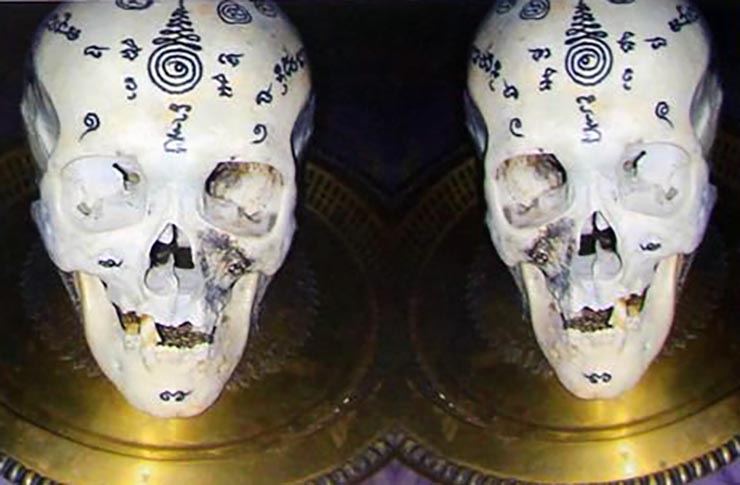
  • Building Magical Power: The Secret of Occult Thailand

    Building Magical Power: The Secret of Occult Thailand

    From New Dawn 180 (May-June 2020)

    The Thais call it Samathi, the crucial element when constructing magical items or using magic to influence events and people. Pronounced sa-ma-tee, Samathi is sharply focused intention, and a major contributing factor in the efficiency of all forms of magic as it facilitates access to various sources of power.

    Samathi is acquired and enhanced through dedicated practice and rigorous training using some or all of the techniques discussed in this article. In some individuals, it manifests innately.

    A controlled, highly focused but calm mind can access further magical power by harnessing a spirit – such as a stillborn child or person who died a violent death. These spirits then act as a spirit familiar to aid magical tasks. One branch of Thai magic trains practitioners to directly manipulate the intimate products of a target person, such as sperm, hair, fingernails and even clothing – to harm, bind in love, bring good fortune, or remove spirit attachments. Additionally, Samathi aids magic with the utterance of spells and kata (mantra). In general, there is a combination of some, if not all, of these elements. But Samathi is essential for each of these available sources of power. 

    The practices within Buddhism in the pursuit of enlightenment in this lifetime can also bestow various magical abilities. Many of the Buddha’s disciples attained these powers even though the Buddha himself rejected the practice of magic as a distraction.

    • Telepathy – the ability to know the thoughts of others.
    • Clairaudience – the ability to hear across long distances.                                                 
    • Clairvoyance – the ability to see the imperceptible.
    • Astral Travel – the ability to travel to celestial realms.
    • Telekinesis – the ability to move items from a distance.

    There are accounts of these abilities manifesting to varying degrees in most of the famous Thai monks and Ajarns (lay practitioners). The powers are perceived both as a boon to their followers and evidence of a heightened state of being. Possessing such magic is also seen as a measure of a person’s dedication to their studies and their moral goodness. Many monks and Ajarns exemplify the quality of Metta (loving-kindness), which in turn attracts more devotees. There are Ajarns considered to be an old magician on their latest cycle of life; they bring with them enhanced abilities and an uncanny speed of learning. Many Ajarns come from a familial lineage of sorcerers dedicated to following the magical path, committing themselves to the study of occult magic that requires the use of numerous written scripts, the ability to perceive the supernatural, and an encyclopaedic knowledge of spells, rituals, plants, woods and kata. 

    The system of magic in Thailand intertwines with knowledge accumulated by an ancient culture. It is considered one of the few complete systems in the world today, and a system that absorbed numerous influences over the centuries. At its core, it is pure Animism, with the magician working with supernatural products, spirits and ghosts.

    The supernatural products come from both nature and the remains of people who died in what is known as a ‘Prai Death’ which grants their body products magical potency. These types of death are related to dying before one’s time through violence, accident, suicide or killed by nature. This system existed before the introduction of Buddhism, but without the influence of that great philosophy, it would appear to be akin to Haitian Vodou and some of the traditional African practices. The influx of Buddhism brought control to magic through its associated practices, acting as a refuge when needing protection from some of the violent supernatural forces existing within the Thai Occult. Buddhism also brought mantras (kata) and the written language, which helped preserve the knowledge and practices of the magical path.

    It is not the purpose of this article to outline meditation techniques as there are many teachers for that. Instead, here are some of the techniques used by the Thai people who choose a spiritual path to build their Samathi to extraordinary levels.

    Tudong – A ‘shaking off’ of mental defilement, derived from a Pali word meaning ‘ascetic practices’

    “It does not matter how strong or good is the magic from any tattoo or amulet that you may possess; if you are not a good person, these things will not help you. When you have an amulet or a Sak Yant tattoo you should keep the five precepts and say the kata with the aim of improving yourself.”
    – Ajarn Suea, Chiang Mai, Thailand

    Buddhism flourished in Asia by accommodating the native beliefs of the cultures with which it came into contact. Regional differences within Thailand resulted in a vast number of sects, with eighteen in Chiang Mai alone. A process of reform was undertaken that resulted in the Tammayut sect which drew heavily from the strict discipline of a Burmese monastery. The aim was one Buddhism within the country that overrode local traditions. One of the features of the Tammayut sect is the tradition of wandering in the wilds, where hardship leads to self-knowledge – the first great monk to practice this was the legendary Ajarn Man. 

    Until relatively recently, Thailand was a wild place. Dangerous animals ruled the wilderness, roads were few, and the fear of ghosts and spirits was intense. In Buddhism, fear is considered a defilement that needs rooting out. Perilous places acted as a training ground for the monks of the Tammayut sect, the aim being spiritual liberation. Samathi is an important component of this process as the mind’s energies are focused for great strength and the ability to uproot attachments, cleansing it so that it is bright and clear.

    These monks often stayed in cemeteries, but in those times, unlike today, there were rotting and relatively fresh unburied bodies everywhere. The monks would have encounters with ghosts and local spirits. Experienced monks sought these places to practice meditation undisturbed. For monks who were afraid of ghosts, the experience was transformative. The dead were carried to the grounds on a bamboo platform. To overcome fear, monks on Tudong – ‘shaking off’ mental defilement – often chose these platforms to rest for the night. During such trials, monks confronted these fears in the process of uprooting the cause, understanding death and the realms of ghosts and spirits. These monks were tough and resilient with a magical potency that we can only hanker for in the modern world.

    Ajarn Perm Rung in meditation. Meditation builds Samathi and with enough practice it fills the body. Meditation also brings merit, which raises our worth and at high levels becomes like honey to ghosts and spirits, enabling the Ajarn to easily work with them.

    Through his training, Ajarn Man possessed the ability to communicate directly with beings from different realms of existence. He was said to be in continual contact with beings from the higher and lower celestial realms, the spirits of the terrestrial realms, ghosts of many sorts, and even the denizens of hell through his inner psychic faculties. Ajarn Man’s training included a period where he used the image of a bloated, seeping corpse. He contemplated it at all times until it changed into a translucent disc that appeared suspended before him. As he focused on the disc, it continued to change, and he followed these changes for three months. It was a seemingly endless series of developing images, permanently in flux. Ajarn Man eventually realised that he was not attaining the beneficial results of calmness and peace which would have convinced him this was the correct method to attain an iron Samathi – so he changed it. Instead of travelling with the mind, he focused internally, on his own body, to investigate every part, and bring everything within. It worked.

    Ajarn Man possessed a mastery of psychic skills. Over the years, his proficiency grew to the point where the monks living with him took great care to be mentally self-controlled at all times. They couldn’t let their minds wander lest their wanderings became the subject of a Dharma talk that evening, and they had to hold extreme focus when meeting him because he made an issue of any stray thoughts. It became the subject of much joy for his disciples, always waiting to hear who got caught.

    Students of Ajarn Man continued his teachings after he passed away, giving rise to such remarkable monks as Luang Phor Pina, and what is termed the great generation of magical Thai monks, almost all of whom have now passed away.

    Although the tradition of wandering meditator ascetics eventually fell victim to Thailand’s relentless modernisation and rampant deforestation, Tudong is still undertaken in the more remote parts of the country. A period for Tudong continues to be part of training for some monks, Ajarns and Lersi (seers) who observe the thirteen ascetic practices mentioned in the Buddha’s discourses. These include eating only one meal per day, sleeping outdoors in a forest or cemetery, and being content with the fewest possessions. The ascetic life tests their skills and offers the chance to hone the piercing focus that comes with such practices. All this can then be put to use in any aspect of the Thai Occult.

    The 32 Parts of the Body Meditation

    A significant form of meditation undertaken in Thailand is the exploration of the “32 parts” of the body for building Samathi and an understanding of impermanence. As with many techniques discussed here, this form of meditation also has an occult usage. This practice aids in the knowledge of the true nature of the body, eventually bringing a comprehension that the body consists of the four elements earth, water, air and fire. The idea is for the devotee to use their Samathi to discover their own body, every single component of it. The practice also aids the understanding that there is no self – there is just a body with all its frailties. The levels of sensitivity attained through this system can be astonishing. As the meditation develops, some parts of the body begin to break down, in the practitioner’s mind, into the primary elements of solidity, liquidity, motion and temperature, expressing the link between this and the use of the four elements in Thai Occult practices. 

    The Thai Ajarns, through their knowledge and understanding of the 32 parts, worked out a way to construct a spirit akin to reversing engineering from their study of the body parts in themselves. This is the first thing studied in the process of making talismans. The 32 parts of a body can be divided into sections depending on the associated element. The four elements in Thai are Na Ma Pa Ta or earth, water, wind and fire stated in the Western way. This knowledge and practice applies when making amulets, combining the four elements with the 32 parts of the body to create a spirit that works for the benefit of the devotee. Some Ajarns even give the spirit an outward image.

    A combination of the four elements creates everything. A human being consists of these four elements – breath is the wind, blood is the water and flesh is the earth, etc. Na is the earth element, Ma is the water element, Pa is the wind element, and Ta is fire. When combining these, elemental Kata can be used to assist in raising the power of an amulet. The water element is used for Metta because water is the coolness, the ease, the comfort. If an Ajarn wants to add attraction, the wind element is needed to help pass the power to the person and carry the message of attraction. The earth element is vital for invincibility magic. Combining the earth and water element helps with protection, i.e., if fire was the danger, water puts it out. If a person needs protection from black magic, the fire element is used to burn away dangerous forces.

    Get the issue this article appears in
    Ajarn Apichai of Chiang Mai blessing amulets, using his acquired Samathi.

    Kata (mantras) are an integral part of the processes mentioned above and carry a power of their own. They are normally assembled from Buddhist passages, although some kata are older than Buddhism and others are condensed forms of magic for a specific purpose. All deities, spirits and Buddhist entities have kata associated with them, and each act as the key to bringing out their assigned magic. Kata are also associated with the actual properties of Thai magic, be it for charm and attraction, good fortune or authority. The practice and understanding of kata is another of the core elements undertaken by the magician, to eventually become the magic itself, to embody kata, which is why entering the monkhood for a period of time is highly valued by the members of the Thai Occult community. Being a monk is the best practice to rise above the mundane and to raise Samathi because it powers every other practice.

    The final element of this discussion on available sources of power in Thai magic is the power of lineage. Most Thai magicians come from lineages, long lines of astute occultists who embodied their form of magical knowledge known as Wicha. No one knows the extent of the Wicha of Thailand (and yes, it comes from the same root word for Wicca). These lineages hold great power, and the living magician can call on this power to help with any work he is undertaking. Some occultists in these lineages are incredibly powerful, and there are instances where they cannot be named, else they ‘come’. The magic available from this source cannot be underestimated.

    Peter Jenx is the author of a series of books on Thailand’s occult/magical practices. The Thai Occult 2 – Regions of Power is available here. The Thai Occult Appendix, is available from Timeless Editions of France (limited to 399 copies) at www.timeless-shop.com/product/appendix-jenx/. A previous edition is available in PDF from www.thethaioccult.com. Through the website you can also obtain a range of Thai-produced occult items including amulets.

    [alert type=”general” dismiss=”no”]This article was published in New Dawn 180.[/alert]

    [alert type=”success” dismiss=”no”]If you appreciate this article, please consider subscribing to help maintain this website.[/alert]

    © New Dawn Magazine and the respective author.
    For our reproduction notice, click here.
  • Primal Vision &  ‘Active Seeing’

    Primal Vision & ‘Active Seeing’

    From New Dawn Special Issue Vol 9 No 3 (June 2015)

    It is almost impossible for modern man to understand how he can be ‘blind’. We see what is in front of our noses, and we could not see more even if we opened our eyes as far as they will go.

    But there is another kind of blindness, which American philosopher and psychologist William James describes in his essay ‘On a Certain Blindness in Human Beings’. James recounts how he was being driven, in a buggy, through the mountains of North Carolina, and looking with revulsion at the newly-cultivated patches of land (called coves) and reflecting how ugly they were. He asked the driver what kind of people lived here, and the driver replied cheerfully: “We ain’t happy unless we’re getting one of these coves under cultivation.” And James suddenly woke up to the fact that these homesteaders regarded each cove as a personal victory, and saw it as beautiful.

    We become blind to things by imposing our concepts on them and looking at them with a kind of indifference, which arises from our conviction that we know what they are already. James was quite sure that the coves were ugly, without seeing that the ugliness lay in his own eyes.

    But even when we know this, it is still very difficult for us to grasp just how the ancient Egyptians – or our Cro-Magnon ancestors – somehow saw the world quite differently, and might consequently have developed their own ‘high levels of science’. The following example should make it clearer.

    One of the few men to whom this ‘ancient seeing’ came quite naturally was the German poet [Johann Wolfgang von] Goethe. And Goethe’s vision of science can enable us to grasp what it is all about.

    It would simplify what follows if I explain how I happened to stumble on Goethe’s vision of science.

    I had been an admirer of his work ever since my teens, when I first read Faust in the old Everyman edition. His vision of a scholar rendered miserable by his sense of the meaninglessness of life struck a deep chord with me at the age of sixteen. Good English translations of his work are rare, but over the years, I went on to collect every volume I could lay my hands on.

    The qualitative, holistic way of viewing nature was expressed by Johann Wolfgang von Goethe (1749-1832).

    A few years ago, I came across a translation of Goethe’s Theory of Colour, but was of two minds whether to buy it. I knew Goethe was an enthusiastic amateur scientist, but felt that basically he was no more than that – an amateur. All the same, I bought the book – and it stayed unread on my shelf.

    I should have been aware of the risk of dismissing any aspect of Goethe. For example, I knew that he had finally been proved correct about the intermaxillary bone. This is a bone in the upper jaw that holds the incisors, and all animals possess it. But in the 1780s, a famous Dutch anatomist named Peter Camper announced that what makes man quite unique is that he has no intermaxillary bone in his jaw. And Goethe, who was an evolutionist long before Darwin or Lamarck, was sure this had to be nonsense. So he proceeded to search through piles of animal and human skulls, and found signs of the intermaxillary bone in man, although it was now little more than a seam uniting the halves. But when he announced this to Camper and other scientists, they dismissed him as an amateur. By the time of Darwin, Goethe was recognised to be right, and Camper wrong.

    However, where colour was concerned, I simply could not see how Goethe could question the accepted theory. We were all taught at school that white light actually consists of the seven colours of the rainbow – red, orange, yellow, green, blue, indigo, violet. And Newton proved this by a simple experiment. He made a small hole in his blind, to admit a narrow beam of light, and then passed this through a prism. And the light split into the seven colours. Surely that is quite conclusive?

    Goethe borrowed a prism and set about repeating Newton’s experiment. And he immediately came upon an anomaly. If he looked at a white tabletop through the prism, it did not turn into a rainbow-coloured table. It stayed white, and the only rainbow colours were around its edges. And this proved to be generally true. Colours only appeared when there was one kind of boundary or edge.

    Goethe took a sheet of paper in which the top half was white and the bottom half black. When he looked through a prism at the halfway line, he saw that the colours red, orange and yellow run up into the white half. But when he stared intently at the black boundary, he saw that the darker colours of the spectrum are there – light blue closest to the boundary, then dark blue (indigo) and violet. So the order of the colours does not run in the proper rainbow sequence: red, orange, yellow, green, blue, indigo, violet, but yellow, orange, red, blue, indigo, violet, apparently defying Newton’s law.

    All this led Goethe to what will seem to us a strange conclusion. If you look at the sky on a hot day, it is deep blue overhead, and becomes lighter as your gaze travels towards the horizon, where the atmosphere – loaded with light – is thicker. But if you could travel upwards in a rocket, the sky would become steadily bluer and darker until it turned into the blackness of space.

    On the other hand, when the sun is directly overhead, it is yellow. As it moves down to the horizon, its light turns to red. So where the sun’s light is concerned, the atmosphere produces the three light colours, yellow, orange and red. Where darkness is concerned (outer space), the atmosphere creates the three dark colours, blue, indigo and violet.

    To express this crudely, Goethe is suggesting that the dark colours – blue, indigo, violet – are made by diluting blackness, while the light colours – yellow, orange, red – are made by thickening the light.

    My own reaction, when I read all this, was a desire to tear my hair and throw the book out of the window. Where, I wanted to know, was Goethe’s theory superior to Newton’s? And anyway, what did it matter?

    At that point, my friend Eddie Campbell lent me a copy of The Wholeness of Nature: Goethe’s Way of Science by Henri Bortoft, a scientist who had been a pupil of the physicist David Bohm. It looked so difficult that I decided it would take years to read, and I had better buy my own copy – which I then allowed to sit on my shelf for over a year. But when I finally came to read it, I realised that it is among the most important books I had ever bought.

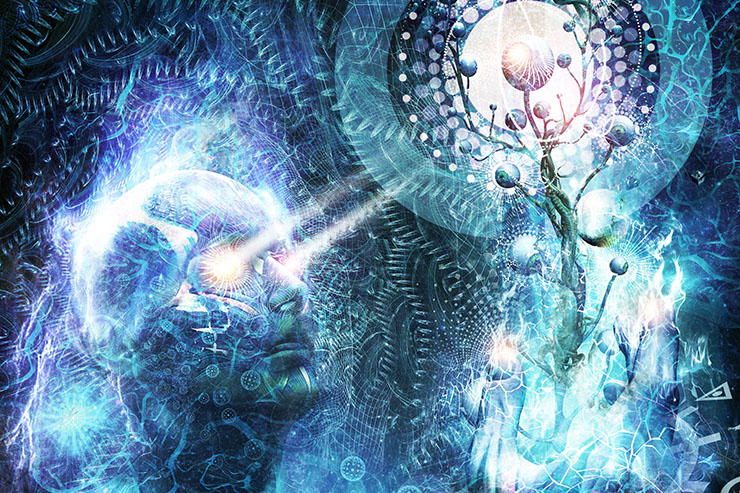
    Bortoft’s book offered some interesting new facts. To begin with, when Goethe had been observing the colours, he would close his eyes, and envisage what he had just seen. He would try to see the colours, in their right order, inside his head, and would do this until he could conjure it up with as much reality as the actual colours.

    He was practising what I described as ‘eidetic vision’. (German philosopher Edmund Husserl, who established the school of phenomenology, introduced the term ‘eidetic vision’ to describe the ability to observe without “prior beliefs and interpretations” influencing understanding and perception.)

    For what purpose? Let Bortoft explain:

    “When observing the phenomenon of colour in Goethe’s way it is necessary to be more active in seeing than we are usually. The term ‘observation’ is in some ways too passive. We tend to think of an observation as just a matter of opening our eyes in front of the phenomenon… Observing the phenomenon in Goethe’s way requires us to look as if the direction of seeing were reversed, going from ourselves towards the phenomenon instead of vice versa. This is done by putting attention into seeing, so that we really do see what we are seeing instead of just having a visual impression. It is as if we plunged into seeing. In this way we can begin to experience the quality of the colours.”

    And after describing Goethe’s way of re-creating the colours in his imagination, Bortoft explains:

    “The purpose is to develop an organ of perception which can deepen our contact with the phenomenon…”

    Goethe called this “active seeing.”

    And this, I would suggest, is the difference between modern man and ancient man. Ancient man, because of his closer contact with nature, was far more accustomed to active seeing.

    I happened to be sitting in bed at about 6.30 on a bright summer morning as I read Bortoft on Goethe. Suddenly I understood what he meant. I looked out of my window at the garden, with its trees and shrubs, and deliberately did what Goethe recommends: that is, I tried to see it actively.

    This made me aware that when I normally look out at the garden, I am seeing it passively, taking it for granted, feeling I know every inch of it. Instead I tried to suspend all ideas, all preconceptions, and simply to look as if it was somebody else’s garden and I was seeing it for the first time. The immediate effect was a feeling of being drawn into nature. The grass, the trees, the shrubs, suddenly seemed more real and alive. Moreover, they seemed to be communicating with me. There was an odd sense of being among old friends, as if I belonged to a club in which I felt perfectly at home.

    I also realised that Goethe, like many poets, possessed this kind of perception naturally. In Faust he talks about nature as “God’s living garment.” In his lyric poetry there is a tremendous, surging vitality that reminds me of certain of Van Gogh’s later paintings – ‘The Road With Cypresses’ and ‘The Starry Night’ – in which the trees seemed to have turned into green flames roaring upwards towards the sky.

    There is a well-known story about how Goethe and the poet Schiller left a rather dull scientific lecture in Jena, and Goethe remarked that there ought to be some other way of presenting nature – not in bits and pieces, but as a living actuality, striving from the whole to the parts. And Schiller shrugged and remarked: “Oh, that’s just an idea.”

    But he was wrong. For Goethe it was not just an idea; it was something he saw when he looked at trees and flowers and grass. They looked alive, as if nature was, in some way, a single organism.

    As an exercise, try looking at a garden with ‘active seeing’. Instead of seeing it as a kind of still life, like a painting, make an effort to recognise that it is in continual motion – very slow motion, but motion nevertheless – and that plants are as alive as insects or birds or bees.

    No doubt this was not true all the time; like the rest of us, Goethe must have had his periods of fatigue in which he saw things mechanically. But in his wide awake moments, he seems to have seen nature as Van Gogh painted it.

    And, as Bortoft recognised, this is not just a matter of making more effort. It is a matter of developing an organ of perception.

    William Blake said: “If the doors of perception were cleansed, every thing would appear to man as it is, infinite.” Aldous Huxley quoted it in his book The Doors of Perception, in which he recorded his experiences with the psychedelic drug mescalin, during which everything suddenly appeared far more real. This is clearly the kind of thing Bortoft is talking about.

    This ‘organ’ is what the German writer Gottfried Benn called “primal vision.”

    How did we lose it? By developing a kind of mechanical perception to cope with the complications of our crowded lives. Wordsworth understood all about it, as he shows in the ‘Intimations of Immortality’ ode. For a child everything seems new and exciting, “the glory and the freshness of a dream.” This is because he lives in the present, and everything appears sharp and clear. Then “shades of the prison house begin to close” upon the growing youth, as life becomes more difficult and demanding. And by the time he reaches adulthood, he is always in a hurry, and the “glory” has faded into the light of common day.

    All that this means, of course, is that he no longer puts the effort into seeing things. When a child sits in front of his favourite television programme, he turns his full attention on it – so much so that he often fails to hear when you speak to him. And everyone can remember that delightful feeling of listening to the rain pattering on the windows – one girl I knew told me she used to roll herself into a ball and say: “Isn’t it nice to be me?” And indeed, it is nice to be you – provided you turn your full attention on it, and don’t permit any ‘leakage’. But this is precisely what we do as we grow up – we spread our attention too thin, and then accept that diluted version of reality as the real thing. And so the ‘certain blindness’ sets in.

    Animals don’t do that. They live comfortably in the present, and turn their total attention to anything that interests them. We ‘civilised’ humans have forgotten how to do this. And we are not even aware we are short-changing ourselves, because we think this is the way things are.

    One of the worst effects of this diluted and degraded consciousness is that it fills us with stress, and causes us to direct attention at worries that don’t deserve it. And when we occasionally experience a breath of real consciousness – for example, setting out on holiday – we assume that it is simply due to the holiday, and fail to draw the lesson that we habitually misuse our powers of attention. The problem is rather like breathing too shallowly until you begin to suffer from oxygen starvation.

    Now according to Princeton psychologist Julian Jaynes, all this began to happen fairly recently. In The Origin of Consciousness in the Breakdown of the Bicameral Mind (1976), Jaynes offers the evidence of “split-brain research” to argue that the consciousness of modern man has contracted so much that he now lives in only one half of his brain – the left hemisphere (which is devoted to language, logic, and ‘coping’ with everyday life). The right half, he claims (which deals with intuitions, insights and feelings) has become a stranger. And Jaynes suggests that man became a ‘left brainer’ as recently as 1250 BCE.

    During the great wars that convulsed the Mediterranean during the second millennium BCE, the old child-like mentality could no longer cope; man had to become more narrow, more obsessive – and at the same time, more brutal and ruthless. (Tension tends to make us cruel.) And in this new state of mind, man lost touch with the gods, and with his own deeper self. About 1230 BCE, the Assyrian tyrant Tukulti-Ninurti had a stone altar built, which shows the king kneeling before the empty throne of the god. But all earlier kings had portrayed themselves sitting beside the god on his throne. Now the god has vanished, and man is ‘on his own’.

    It is an interesting theory, and Jaynes argues it very convincingly; but of course, we have no way of knowing whether it is correct. All we can say is that something of the sort must have happened to us at some point during our evolution.

    All this raises another interesting point. Since it is the left hemisphere of the brain that deals with calculation, we tend to assume that this is the mathematical hemisphere. But any good mathematician will tell you that mathematics requires the same kind of intuition as poetry or art. This would explain how Oliver Sacks’s subnormal twins could exchange enormous prime numbers. They must have been able to see them, in the same way that Michelangelo could ‘see’ the statue inside a block of marble while it was still in the quarry, or Nikola Tesla could ‘see’ a machine he had not yet even committed to paper. The strange implication would seem to be that, in becoming a ‘left brainer’, modern man actually lost an important part of his rational faculty.

    All of which seems to offer interesting glimpses into how our remote ancestors might have possessed ‘high levels of science’ without inventing the concrete mixer.

    Everything seems to indicate that high levels of science require intuition rather than reason. Any good scientist would agree. But it also seems to suggest that intuition might be able to create higher levels of science than most scientists would be willing to concede.

    Get the issue this article appears in

    Eddie Campbell, the friend who introduced me to the work of Henri Bortoft, offered the following advice:

    “Shut the door where you work then sit, bent over your computer keyboard. Put your hands edge-wise on the sides of your head so your line of vision is inside of a tunnel. Stare at the keyboard and let your eyes drift in and out of focus. With a bit of luck you will suddenly find the same sort of ‘shift’ which you get when trying these three-dimensional ‘dazzle pictures’ sold in books. If you are lucky, you’ll suddenly find a strange new version of the familiar keyboard. It satisfies Goethe’s description of active seeing – ‘the perception of an object standing in its own depth’.”

    Its aim is the disappearance of normal subject-object perception. Subject and object somehow become one.

    Eddie Campbell speculates that “there was a line of transmission from a German school, which used active seeing as a means of scientific discovery, perhaps from the early Middle Ages onwards…. Copernicus ‘saw’ his version of the universe in 1543, some three hundred years before the observational data to support it became available.”

    If he is correct, then it might offer us a clue to how ‘high levels of science’ could be possessed by societies that we would regard as primitive.

    Excerpted with permission of the publisher from Atlantis and the Kingdom of the Neanderthals: 100,000 Years of Lost History by Colin Wilson (published by Bear & Co, © 2006 Inner Traditions International, www.InnerTraditions.com).

    [alert type=”general” dismiss=”no”]This article was published in New Dawn Special Issue Vol 9 No 3.[/alert]

    .

    [alert type=”success” dismiss=”no”]If you appreciate this article, please consider subscribing to help maintain this website.[/alert]

    © New Dawn Magazine and the respective author.
    For our reproduction notice, click here.
  • Steiner & the Blood Demons

    Steiner & the Blood Demons

    From New Dawn 191 (Mar-Apr 2022)

    Is the human race under spiritual attack? And did the esoteric philosopher and clairvoyant Rudolf Steiner warn about it over a century ago when he said a ‘vaccine’ would be the delivery system for the defeat of humanity?

    For many, the overly-authoritarian response by governments worldwide to COVID-19 pointed to some deeper, more sinister driving force. But it hasn’t just been the governments that seemed to be acting strange. Over the last two years, we’ve witnessed people across a broad spectrum of society meekly submit to draconian attacks on their freedoms, many even fiercely defending the assault. In the same way, we’ve seen politicians and parties who once ran on platforms of personal freedom and economic autonomy almost overnight turn into overbearing control freaks, intent on micromanaging every aspect of our lives. How has this happened?

    Recently, the term ‘mass formation psychosis’ has been on everybody’s lips. It’s defined as a psychological phenomenon whereby a mass of people voluntarily go through a process of deindividuation, and a herd mentality forms. Due to their contagious nature, the thoughtforms affecting these deindividuated people, catalysed by the positive feedback loops of news programmes, social media and peer interaction, spread like wildfire throughout the population. In the past, this used to be called mob psychology, or more plainly, the madness of crowds.

    Psychology: from Science to the Occult

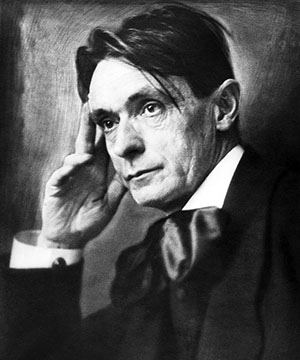
    Rudolf Steiner (1861–1925)

    Someone for whom the events of the past couple of years would not have been so surprising was the Austrian esoteric philosopher and mystic Rudolf Steiner, who died almost a century ago. Throughout his life, Steiner wrote numerous books and delivered thousands of lectures on his theories, contributing greatly to diverse spheres from architecture to education and agriculture to beekeeping. His highly unique – and sometimes controversial – insights and methods led to the founding of the spiritual movement known as Anthroposophy, which emphasises the existence of a boundless potential for human beings.

    Unlike some esoteric thinkers, Steiner saw the great importance of materialistic science but argued that it was vital to see it as only a single aspect of reality which should ideally be combined with what he called ‘spiritual science’ – gained by mystical experience – in order to present the full picture. After all, breakthroughs often occur when scientists receive insights from beyond the material realm, as in the famous case of James Watson, credited with the discovery of the double helix shape of DNA which came to him in a dream featuring two intertwined serpents. Similarly, Dmitri Mendeleev created the periodic table after a dream of “… a table where all the elements fell into place as required.” These cases go to show that not all scientific discoveries are the result of logical deduction and experimentation.

    In fact, Steiner, who had been on the receiving end of mystical insights since childhood, honed his clairvoyant skills to such an extent that the information he received from non-conventional sources became more than the occasional flash of insight. His quest became the establishment of methods for obtaining objective extrasensory perception – a task he considered of paramount importance, for he believed an epic battle was being fought in the spiritual realm that would have disastrous consequences for humankind unless it was addressed head-on.

    Spirits of Darkness

    His clearest warnings about the future fate of humanity came in a series of lectures delivered towards the end of his life in Dornach, Switzerland; these lectures are reproduced in the book The Fall of the Spirits of Darkness. Although Steiner’s detractors say his prose can be leaden, his lectures meandering, and his concepts difficult to grasp, he is remarkably clear and straightforward when it comes to the fate that awaits humanity if our obsession with scientific materialism is allowed to reign free without being pulled back into balance by the counterbalancing forces of spirituality.

    This is most clearly illustrated in the final two lectures in the series – 13 and 14 – which are respectively titled The Fallen Spirits’ Influence in the World and Into the Future. Steiner posits that an unseen battle took place in the early 19th century which certain ‘spirits of darkness’ lost. These spirits were duly ejected from their heavenly realms and cast down into a more material plane of existence, i.e. here. He is remarkably precise about when this occurred: autumn 1879.

    These newly arrived spirits joined those who were already here – the ones that have been existing alongside and influencing humanity since the mythological times associated with the Fall. Given that it takes time for these malign spirits to work their way through human societies, it wasn’t until 1914 that their malign influence manifested in human society in the form of the First World War – a disastrous event the cause of which still puzzles secular historians.

    Lucifer and Ahriman – the Leaders of the Pack

    The spirits Ahriman and Lucifer have been hacking humanity for thousands of years, says Steiner, with Lucifer being the ‘light bringer’ intent on making us more spiritual and granting us more free will, and Ahriman doing the opposite and making us more materialistic and easier to control. In simplistic terms, Lucifer is an ascending influence, while Ahriman is a descending one.

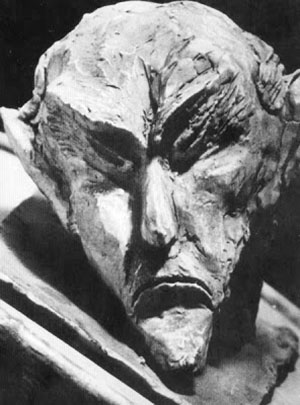
    Steiner’s carving of the face of Ahriman

    Why should they want to do this? Well, we just don’t know – it’s difficult for our human minds to figure out what makes angels and demons tick. But whenever there’s one of those periodic battles in the spirit world, Steiner said, it tends to result in a new batch of reinforcements being thrown down into the material realm to join forces with those already here.

    Steiner told us that Ahriman – a demon first identified by the Zoroastrians in ancient Persia – has the upper hand right now. He had a personal beef with Ahriman and had seen his face in vision – in fact, he was still carving a likeness of it out of wood at the time of his death. Ahriman’s main aim seems to be to drag humankind into a purely materialistic state devoid of any form of spirituality, removing even the impulse to connect with our souls. The method of attack would be through science and technology, and by taking possession of the minds of powerful and influential people in order to push through this agenda. These controlled people could be scientists, politicians, religious leaders, or anyone with any influence. Thus, demonic forces would work through these people, and the people themselves, blinded by all-too-human failings such as greed or a lust for power, would lack the basic awareness to recognise what was occurring.

    A New Religion for a New Age

    The background to this power grab was the rise of atheism and the worship of science and progress. Now, we have a situation in which a purely materialist perspective is presented as the only explanation for all creation. Atheism has become a de facto religion for some, while the rich traditions of native spirituality have been side-lined and crushed under its heel. People, animals and all life is regarded in the same cold manner; merely receptacles of proteins and genetic code that can be exploited. The endgame of this play is presented as a bleak, monochrome world expunged of spirit and light, where humans – their minds and spirits broken – are herded together and monitored like lab animals.

    We can see how this scenario is being expedited. The CEOs of tech corporations are viewed almost as saints or Bodhisattvas, dangling the carrot of eternal life in the form of uploading the ‘data’ contained within our brains onto microchips. At the same time, politicians, corporate scientists, civil servants and economists are regarded as technocratic engineers tasked with ensuring the smooth functioning of the juggernaut of the material economy. Free will? The implicit assumption is that this will be unnecessary once the AI-powered algorithms – which know us better than we do – reach escape velocity. At this stage, human life would have no intrinsic value, and the shells of our former selves would be occupied by the demonic army that Steiner warned us was waiting for its moment.

    In the Blood

    Some people say that Rudolf Steiner predicted a vaccine would appear which would be the delivery system for the final defeat of humankind. In light of the clandestine efforts made over the last two years to inject almost everybody on the planet with a gene-editing treatment, his prescience seems remarkable – but how true is it? 

    Amazingly, Steiner was remarkably clear (by his own standards) about the physical process by which this takeover would occur. In his final lecture in The Fall of the Spirits of Darkness, he states that the spiritual world where entities such as angels, demons, and archangels dwell is within the human blood. He meant this quite literally, saying:

    “Both the Archangels and the Angels had their dwelling place in the blood, as it were. Truly, the blood is not something merely for chemists to analyse; it is also the dwelling place of entities from higher worlds.”

    To that end, he speculated that the delivery mechanism would be in the form of a vaccine injected directly into our bodies.

    “Today [in 1917] bodies are vaccinated against one thing and another; in future, children will be vaccinated with a substance which it will certainly be possible to produce, and this will make them immune so that they do not develop foolish inclinations connected with spiritual life – ‘foolish’ here, of course, in the eyes of the materialists.”

    This ‘vaccine’, he goes on to say, would block off any communication from the spirit world, meaning no messages or impulses would be able to get through from the ‘spirits of light’ whose aim is always to help humanity progress and fulfil our destiny. The vaccine would permanently lock out positive impulses which were once transmitted to us, and instead the hapless victims would only be able to receive the impulses coming to them from disruptive sources, which we can imagine today might include the media, the education system and even established religion. He says there would be great confusion, and Ahrimanic forces will turn people’s thoughts upside down and inside out. Everything that once was good and sensible will appear evil and crazy, while everything that was once considered insane and evil will be presented as sensible and good.

    Squid Games: From Wetiko to The Matrix

    Does this sound implausible, the ramblings of a long-dead mystic? Many will no doubt say that it does and that there are more earthly and plausible explanations for the psychic epidemic that has gripped the world. Perhaps Steiner was speaking metaphorically, after all, some may reason. Nevertheless, the phenomenon to which Steiner alluded bears striking similarities to the Native American concept of wetiko. The author Paul Levy has written extensively about this, defining it as “a contagious psychospiritual disease of the soul, a parasite of the mind that is currently being acted out en masse on the world stage via a collective psychosis of titanic proportions.”

    Listening to a recent Legalise Freedom podcast entitled ‘COVID-19: War on Humanity’, Emma Farrell, a plant healer who uses shamanic techniques to access inner realms, observed that she and others in the same field had seen a veritable horde of spiritual parasitic entities attached to people over the last two years – as if a floodgate had been opened and they had poured through it. These entities, she says, come in all shapes and sizes, but there are two very common and recognisable ones, one of which is squid-like. These squid-like beings, she says, attach themselves to unprotected people and harvest their spiritual energy by causing division and discord among us.

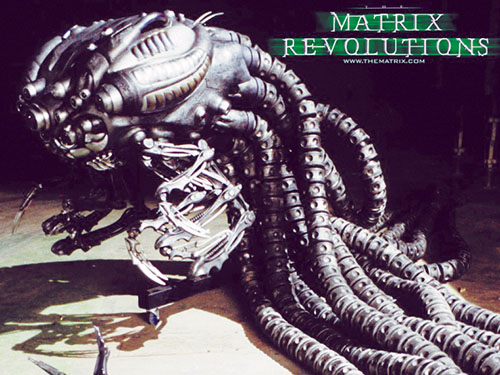
    ABOVE:  Promotional graphic depicts the squid-like robot which appears in the 2003 film The Matrix Revolutions.   TOP:  Netflix’s hit series of 2021, Squid Game, is a grim and violent survival thriller that posits human nature as intrinsically barbaric.

    This struck me as interesting as we’ve seen this squid archetype move into human consciousness over the past few years, not least becoming apparent through popular culture. Many people have reported having dreams of octopus or squid-like creatures, and artists such as Peter Yankowski have painted pictures of these visions. Indeed, the villainous machines that control humans and harvest their energies in the Matrix movies look like robotic squids, while one of the top Netflix series of 2021 was Squid Game, a grim and violent survival thriller that posits human nature as intrinsically barbaric. What’s more, the resurgence in popularity of H.P. Lovecraft’s supernatural tales of horrors from the deep adds another tentacled layer to this rugose cake.

    And let’s not forget when Goldman Sachs, one of the world’s largest investment banks, was memorably described by Rolling Stone journalist Matt Taibbi as a “great vampire squid wrapped around the face of humanity, relentlessly jamming its blood funnel into anything that smells like money.” The description is apt; after all, what is the purpose of an investment bank other than to turn every aspect of the sacred world into a monetised asset that can be traded, exploited and leveraged?

    Get the issue this article appears in

    The Path Back to Sanity

    Could this manifestation of a squid/octopus archetype into human consciousness be what Steiner warned us about? Are there really spiritual entities within our blood that could account for billionaire technocrats’ obsession with injecting substances into us that are said to contain nanoparticles we know very little about? And how does this sit with the psychospiritual disease of wetiko outlined by Paul Levy and the concept of ‘mass formation psychosis’ being discussed in alternative media?

    Perhaps the truth lies somewhere in the nexus of these concepts, with the implicit suggestion that we should not rest in our deep enquiry into the manner of the affliction that is currently so prevalent across the world. Only by doing so can we hope to find the necessary tools and weapons for fighting back against it.

    Or maybe the Ahrimanic demons that Steiner warned us about, the wetiko mind parasites Paul Levy writes of, and the tentacled entities that have squirmed into our collective consciousness via popular culture, are all playing on the same team. If so, what does our team look like? And how do we win this game? Perhaps the fight is a necessary one at this juncture in human development, and that by defeating these ‘spirits of darkness’ we can progress to a higher level.

    Whatever the case, referring back to the old adage alluded to earlier… people, it’s said, might go mad in crowds, but the path back to sanity happens one person at a time.

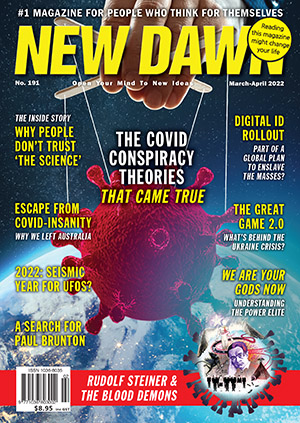
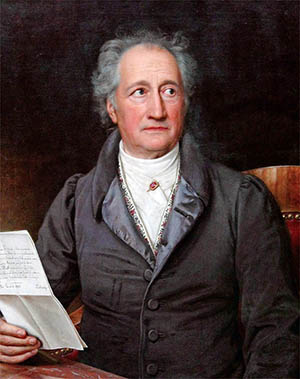
    Original artwork ‘Blood Demons’ by Michael Cox. See his art on Instagram, www.instagram.com/michaelcoxart.

    [alert type=”general” dismiss=”no”]This article was published in New Dawn 191.[/alert]

    [alert type=”success” dismiss=”no”]If you appreciate this article, please consider subscribing to help maintain this website.[/alert]

    © New Dawn Magazine and the respective author.
    For our reproduction notice, click here.
  • Haunted by Hungry Ghosts: The Joe Fisher Story

    Haunted by Hungry Ghosts: The Joe Fisher Story

    From New Dawn Special Issue No 5 (Winter 2008)

    Of those of us who do take mediumship and channelling seriously, and believe wholeheartedly in the existence of discarnate entities, very few of us are willing to concede that such beings may be liars and manipulators – and not just that, but purposely malevolent. There is, acknowledges the novelist Michael Prescott, “a dark side to the paranormal. It is not all benevolent angels and comforting words from deceased relatives. There can be obsession, deterioration of rational thought, shared fantasy, even a descent into madness. There can be hungry ghosts.”

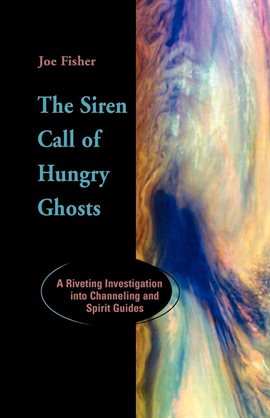
    When it comes to encounters with ‘hungry ghosts’, no story is more disturbing and tragic than that of Canadian journalist and best-selling author Joe Fisher. Fisher committed suicide at age 53 on May 9, 2001, throwing himself off a limestone cliff at Elora Gorge, Canada. One newspaper suggested he may have been murdered. Shortly before his death, Fisher’s final book, The Siren Call of Hungry Ghosts, an investigation into channelling and spirit guides – described by its publisher as “his gripping journey into a realm of darkness and deception” – was republished by Paraview Press. What gives this story a strange twist is that, in one of his last communications with his editor-in-chief Patrick Huyghe, Fisher stated that the spirits he had allegedly angered as a result of writing the book were still causing him trouble. 

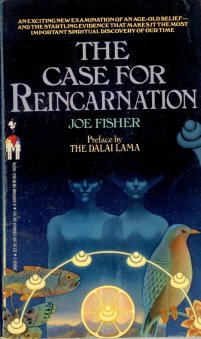
    Fisher’s works include the metaphysical classics Life Between Life, Predictions and The Case for Reincarnation, the last of which includes a preface by the 14th Dalai Lama. 

    In an article on the topic of ‘spirit possession’, famous British author Colin Wilson, who acknowledges Fisher as a friend, mentions that he “had been cheerful and normal, and no one, including myself, could believe that he had killed himself.” He mentions, moreover, that Fisher believed in life after death, and subscribed to the theory of reincarnation. “What baffled me was that he must have been convinced that suicide would only leave him with another set of problems.” Wilson has a point, because in The Case for Reincarnation, Fisher had written: 

    “Those who learn that they have killed themselves in past lives are quickly brought to the realisation that suicide, far from being an answer to life’s problems is (instead) the violent breaking of the lifeline. If the (suicide) could only realise the resulting intensification of difficulty which must enter the life to come, (suicide) would never be (attempted).”

    That Fisher’s death was caused by a group of malevolent discarnate entities – who perhaps influenced his mind – might sound far-fetched and sensational to some. It is, however, a possibility that cannot be ignored, as anyone who’s read Hungry Ghosts would probably agree. Unable to accept that an optimistic, spiritually-minded man like Fisher would want to take his own life, Wilson writes: “I find myself speculating whether his suicide had anything to do with a weird experience he had in the 1980s.”

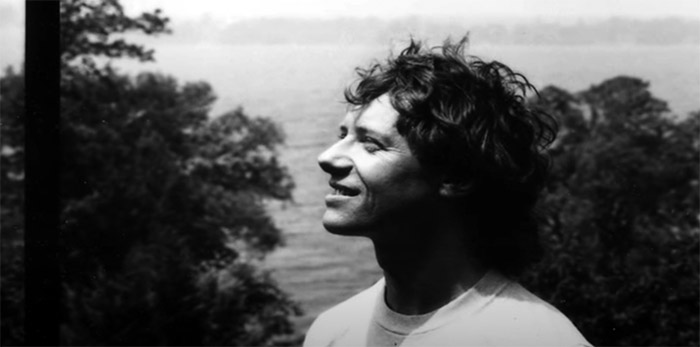
    Canadian journalist and best-selling author Joe Fisher in his younger days.

    FISHER MEETS HIS ‘SPIRIT GUIDE’ 

    That “weird experience” began in 1984, when Fisher met an Australian-Canadian medium named Aviva Nuemann, who suffered from chronic leukaemia. Aviva had contacted Fisher, suggesting he attend a channelling session at her house, because, she said, she did not feel entirely comfortable being a ‘mouthpiece’ for discarnate entities, and was hoping that he, an expert on metaphysics, might be able to shed some light on the matter. When they first met, Aviva, a laboratory technologist, stressed the point that she had “never believed in the so-called psychic world. I think astrology is absolute crap, and I’ve got no time for anything that’s supposed to be paranormal…” She told him the remarkable story of how she became a channeler for ‘the guides’. 

    It all started, she said, when she agreed to allow her friend and neighbour, Roger Belancourt, to try to heal her under hypnosis. His aim was to administer positive medical suggestions to her subconscious mind, such as “Your bone-marrow will start immediately to manufacture the extra red blood cells needed by your body.” These hypnotic sessions took an experimental turn when Roger began probing Aviva’s mind for past-life memories. In an emotionless voice, and in the third-person, Aviva described having been a peasant woman named Svetlana who lived through the Russian revolution, as well as a Punjabi infant who died of malnutrition before his first birthday. Other ‘past lives memories’ were described as well. 

    Probing deeper still, Roger managed to contact another part of Aviva’s mind, even more knowledgeable than her subconscious. It referred to itself as the ‘alter-consciousness’. Roger discovered that every organ of Aviva’s body, and every aspect of her personality, appeared to possess its own alter-consciousness, each with its own voice. He used the ‘voices’ to monitor Aviva’s health. By communicating with the blood’s alter-consciousness, for instance, Roger was able to tell whether Aviva’s red blood cell count had increased or decreased. This higher aspect of Aviva’s mind – what one might term her ‘superconsciousness’ – proved to be very knowledgeable about spiritual matters. The aim of reincarnation is “forward development,” it said, which is “understanding of oneself.” When brought back to full consciousness, Aviva had no memory of what had transpired while in trance. It was as though she had been deeply asleep. 

    Seeing as her alter-consciousness seemed to know just about everything, Roger decided to ask it if ‘spirit guides’ actually existed, for he had long suspected that he was watched over by a deceased Tibetan Lama named Jai-Lin. Roger found to his delight that he could communicate with Jai-Lin via Aviva’s alter-consciousness, which, in Fisher’s words, “acted as intermediary, relaying messages from the next world.” Roger was told by his ‘guide’ that he “must always think positive thoughts,” and that “you have much to learn in self-discipline.” 

    Annoyed by the fact that Roger was unable to control his negative emotions, Jai-Lin told Roger that he must move on to meet fresh challenges elsewhere. Jai-Lin was eventually replaced by another ‘guide,’ an affectionate entity named Hanni, who claimed to have been Roger’s mother in a previous life in the Netherlands. Every incarnate individual was administered a spirit guide, Roger was told. But this did not necessarily mean that one had the same guide throughout the whole course of their life – or, for that matter, several life times. Sometimes a guide would leave their ‘charge’ – the incarnate person whom they were required to ‘watch over’ – and another guide would fill their place. 

    Having mastered the ability to manipulate Aviva’s vocal cords – a process that was said to take some time – Hanni was able to speak through the entranced Aviva. Fisher describes Hanni’s voice as “soft and tenderly,” and totally dissimilar to Aviva’s. While channelling her own guide – a Yorkshire farmer named Russell who claimed to have last lived on earth during the 19th century – the voice that issued from Aviva’s mouth was also unlike her own, so much so that it left Fisher stunned. “Gone was the high-pitched jocularity with the pronounced Australian lilt,” he says. “Her enunciation was now unequivocally masculine; the English accent was unmistakable.” 

    Speaking to Russell, Fisher was not only surprised by Aviva’s change in voice, but by her change in personality too. “This was an entirely different Aviva,” he says, “strangely assertive and uncompromising.” Fisher felt as though he were talking to a separate being, and not, for instance, a fragment of Aviva’s unconscious mind.  

    Fisher was told by Russell that humanity was divided into two groups – souls and entities. Souls were said to be “created from desire,” and entities “born of knowledge.” Neither one of the groups was superior, said Russell. Although he found the concept difficult to accept, Fisher was glad to be hailed as an entity – clearly the more appealing of the two groups. Entities were classified as individuals, while souls were said to have more of a group mentality.

    Fisher’s guide turned out to be a young Greek woman named Filipa Gavrilos. Three centuries earlier, said Russell, she and Fisher had been lovers in a little Greek village called Theros. Apparently they had been together over many lifetimes. The news blew Fisher away, for he had always been strongly drawn to Greece, and, as a child, the name Phillipa had appealed to him. Russell described Filipa as an “excitable young lady.” Eventually, he said, she would be able to speak through Aviva. In the meantime, Fisher tried to develop mind-to-mind contact with Filipa. Each day, Fisher would close his eyes and will Filipa to communicate with him, a regimen he followed religiously for the next three years. 

    In late-1984, Filipa spoke through Aviva for the very first time. Initially, admits Fisher, he was rather unimpressed with Filipa, and had “serious doubts about her intelligence… Her initial responses were almost juvenile, prompting me to remark to Roger and Aviva that I had attracted a ‘disco queen’ for a guide.” As the sessions continued, however, Filipa quickly became “an advisor, a best friend. And my ideal lover.” He adds: “Filipa and I seemed to think alike, feel alike and see the world from a near-identical perspective.”

    The guides said they could read the minds of their charges, which seemed to be true. They knew certain things about their charges that only their charges knew. They could, for instance, describe what their charge had been doing or thinking on a particular day, and at a particular time – information that could only have been gained psychically. 

    Fisher’s daily attempts to communicate with Filipa on a mind-to-mind basis began to yield some interesting results. Whenever contact had been successfully established, “a loud buzzing would reverberate in my ears, a sound that could be likened to an internal droning of cicadas.” During these meditative sessions, images would sometimes appear in his mind. One time he saw the image of woman walking towards him. She was wearing sandals and a long white wrap, her face partially hidden by a garment. He knew the woman was Filipa. “Within seconds, my body was racked with the most profound and unrestrained emotion. I wept out of joy and sadness and loss and anguish, yet to this day I don’t really know why.” It was, he says, “one of the most moving experiences of my life.” 

    Joe Fisher (1947-2001)

    Mind-to-mind contact could best be achieved when Fisher was in a particularly relaxed mood, with very few thoughts running through his head. Sometimes he’d imagine himself hugging Filipa, and this she appreciated greatly. Fisher could tell that she longed for a physical body. Filipa and the other guides disliked nothing more than to be referred to as ‘spirits’, and to be reminded of the fact that they no longed occupied physical bodies. To call one of the guides a spirit was to make them annoyed, even angry. “We’re not spirits!” Russell once shouted. “We’re people just like you. It’s just that we don’t have bodies any more.” Fisher found it a little dubious that the guides were so attached to the ‘physical plane’, even though they stressed that they were no more ‘spiritually evolved’ than their charges. 

    Occasionally, said Fisher, conversations with Filipa “would erupt in my head.” Once, while running up a steep hill, Fisher heard “a voice or implanted thought-form.” So as to make the climb much easier, the ‘voice’ told him to imagine that his feet were not touching the ground. The technique had a positive effect. When next at Aviva’s house, Fisher asked Filipa if she had spoken to him while he was out running. She answered yes, and was able to relate exactly what she had told him. “Somehow,” explains Fisher, “Filipa had to be either living inside me or hovering perpetually close by, picking up via some otherworldly antenna my organism’s every twitch and shudder.” 

    SUSPICIONS ARISE

    The guides appeared to have access to an almost unlimited amount of information. They even claimed to know “the nature of God.” However, they said, the amount of time required to explain it would take some three hundred sessions; for this reason, the project was never attempted. Fisher admits to being impressed by the teachings and advice offered by the guides. They were taught, among other things, about the history of Atlantis and Lemuria; about the workings of the mind; about reincarnation, karma and spiritual development. And so on and so forth. “So rich and so abundant were the insights and observations that there were times when I felt overwhelmed by the veritable geyser of information,” he says. Communicating with the guides was an addictive and thrilling experience. 

    As time went on, Fisher grew slightly suspicious of the guides. When, during one session, Filipa said she was aware of every thought he ever had about her, “the remark left me weak with ardent appreciation. Every time I thought of her, she knew. How attentive, I asked myself, can you get?” The guides gave long lectures about the importance of peace and love, but in many ways their teachings rang empty, and possessed little substance. Also worrying is that they intervened, both physically and emotionally, in the lives of their charges, while at the same time stressing the importance of free will. Such a massive contradiction was impossible to explain. 

    In his book The Paranormal, Stan Gooch describes the teachings of ‘spirit guides’ as “a kind of intellectual candy-floss… when you chew on these utterances, there is nothing there. The mouth is empty.” The late D. Scott Rogo, a prolific writer and researcher of parapsychological phenomena, was of much the same opinion as Gooch. “I find that most channelled discourses possess the spiritual and philosophical sophistication of a Dick-and-Jane book,” he explains in The Infinite Boundary.  

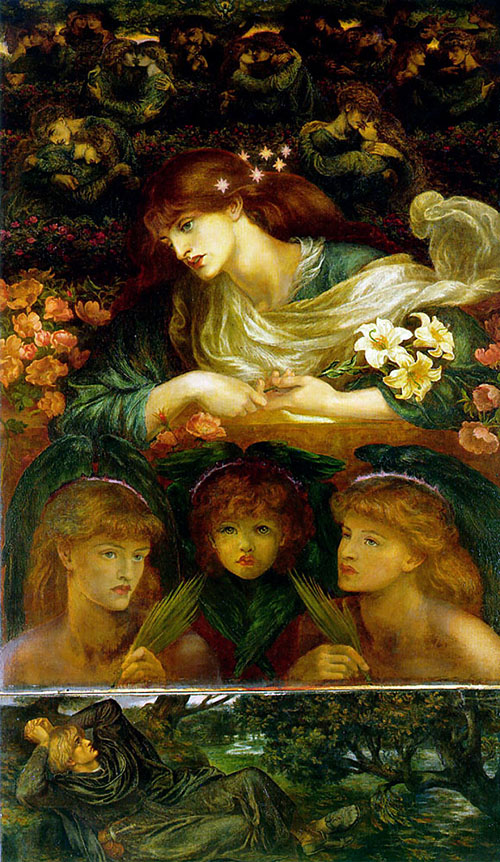
    In 1871, more than a century before Joe Fisher’s contact with “Filipa,” the Italian poet-painter Rossetti was commissioned to paint this illustration of his poem “The Blessed Damozel,” about lovers separated by death, waiting to be reunited. By 1879 Rossetti added a predella showing the earthbound lover gazing up at the heavens.

    Mischievous Spirits  

    “The more I loved Filipa,” writes Fisher, “the more I hungered for tangible proof of her existence.” For this reason, and because he wished to write a book about discarnate beings and life in the ‘next dimension’, Fisher set about trying to prove the identities of the guides. He wanted to know if they had lived the lives they said they had. Fisher knew enough about spirits to realise that they were rarely who they claimed to be. He had, in fact, been warned about this by Russell, who, during one of their first conversations, clearly stated that mischievous spirits sometimes like to pose as wise and knowledgeable spirit guides.

    The guides were more than happy with Fisher’s desire to prove their identities, and were eager to offer him specific details about their lives on earth. First of all, decided Fisher, he would try to follow up on the information given by ex-RAF bomber pilot William Alfred Scott, the guide of a man named Tony. Scott said he had been born in Bristol in 1917, had started his RAF career in 99 Squadron at Mildenhall, Suffolk, and, ironically, had not been killed in the air, but in a German bombing raid on Coventry in 1944. Scott knew everything about the squadron, its operations, and his fellow officers. However, discovered Fisher, there had been no Flying Officer William Scott in the Squadron, as proven by a visit to the Public Record Office at Kew. Numerous other details were found to be bogus too.  

    When, back in Canada, and in a bitter mood, Fisher confronted Scott as to why he had lied, the once calm and polite entity became peevish and irritable. “I do not wish for my privacy to be violated,” he said. “I have given you all the information you need and, as such, it will stand.” Worming his way out of the situation, Scott claimed that he was unable to stick around for very much longer, because he had made plans to reincarnate soon. A suitable “bodily vehicle” had been located in Southern England, he said. After saying farewell, Scott departed for the ‘physical plane’. Much later on, Russell provided details of Scott’s ‘new incarnation’ – his name, DOB, place of birth, and the names of his parents. Surprisingly, the information checked out, and Fisher managed to obtain a birth-certificate for the infant. Fisher contacted the parents, who, although intrigued by the matter, were unwilling to get involved. He respected their decision. 

    If the guides had wanted to be believed, thought Fisher, wouldn’t they have claimed to have been people who had actually existed? Were they, perhaps, drawing on the knowledge and memories of other people – either living or dead – to create their identities? 

    As for his beloved Filipa, she too was found to be a liar and deceiver – or, in Fisher’s words, “a master of deception.” During his travels through Greece, Fisher was unable to find the ruins of Theros, let alone any evidence that the village had actually existed. And not only that, the city of Alexandroupolis, which Filipa had mentioned visiting during the eighteenth century, had not even existed at that point in history. In fact, discovered Fisher, the city had been named after a twentieth-century monarch!  

    During the remainder of his stay in Greece, while lying in bed late at night and brooding on Filipa’s betrayal, “her buzzing returned to plague me. Once so comforting and reassuring, the noise in my ears took on a shrill and sinister aspect, leaving me sleepless.” At that point, says Fisher, he began to grow afraid of Russell, Filipa and the other guides. “If they knew us all so intimately – as they had demonstrated on countless occasions – who could say what power they wielded over our lives?” 

    After the guides had been unmasked, only one or two members left the group. Overall, their faith in the guides had hardly been shaken. Fisher describes Russell – clearly the leader of the guides – as “devious, manipulative and potentially dangerous,” and “as slippery as the proverbial eel and a master psychologist to boot.” Fisher was unable to talk to Filipa, because, said Russell, “You’ve quite completely shut her out.” They never spoke again. In an article on the Joe Fisher story, the philosopher and paranormal investigator Jonathan Zap suggests that the guides may have actually been one entity – “a single shape-shifting entity who, like the devil, ‘hath power to assume a pleasing shape’ and was capable of performing a whole cast of characters of both genders.” 

    An-ex member of the group, Sandford Ellison, told Fisher how the guides had almost ruined his life. During private sessions with the guides, particularly with Russell, Ellison was told that if he didn’t leave his wife – a soul, not an entity – he would die. They even said “that she was trying to kill me by projecting powerful negative energies my way.” While working with the guides, who were teaching him to channel ‘healing energies’, Ellison suffered from “fierce emotional fluctuations and bouts of muddled thinking.” When no longer in their presence, he felt much better. During his final conversation with Russell, whereby he explained that he wanted nothing further to do with the guides, Ellison was told “that I would commit suicide in a fit of depression.” Before splitting with the guides, Fisher, like Ellison, had felt poorly. “I was more jittery than usual,” he says, “more susceptible to insomnia and nervous tension… I could not shrug off a cloying sense of contamination which could neither be pinpointed nor explained.”

    Having spent years listening to, and talking intimately with, the entities channelled through Aviva, and having spoken with a number of other channelled entities, Fisher was forced to accept, somewhat ruefully, that these ostensibly wise and benevolent beings – “who have wormed their way into that juicy apple of spiritual regeneration known as The New Age” – were nothing more than ‘lower astral entities’ or ‘hungry ghosts’. Fisher defines these vampiric beings, these poor, wretched souls, as “individuals whose minds, at the point of physical death, have been incapable of disentangling from desire. Thus enslaved, the personality becomes trapped on the lower planes even as it retains, for a while, its memory and individuality. Hence the term ‘lost soul,’ a residual entity that is no more than an astral corpse-in-waiting. It has condemned itself to perish; it has chosen a ‘second death’.” 

    Get the issue this article appears in

    SUICIDED BY HUNGRY GHOSTS?

    In his aforementioned article on ‘spirit possession’, Colin Wilson asks the question: “Was his suicide an attempt to rejoin Filipa?” To support this theory, Wilson explains how Fisher’s involvement with Filipa had “spoiled him for a normal sex life,” as revealed in the following quote, taken from Hungry Ghosts: “My terrestrial love life was doomed. No woman of flesh and blood could hope to emulate Filipa’s love and concern. No incarnate female could ever begin to understand me in the fashion to which I had become accustomed. In a sense, I was lost to the world, living in a limbo land…”

    Wilson offers another compelling theory:

    “I talked about the mystery of Joe’s suicide to Suzanna McInerny, who is the president of the College of Psychic Studies in South Kensington. Suzanna confirmed that long-term involvement with ‘hungry ghosts’ can cause difficult inner problems. A kind of dirt sticks to the medium’s ‘aura’ (or vital energies), which has to be cleaned off by another medium, like a window cleaner polishing off grime. This dirt can cause depression and a sense of unreality. And sometimes, Suzanna said, a ‘hungry ghost’ can even hang around inside somebody, quite unsuspected, and can only be evicted by a medium who understands such matters. She agreed with me that this could well be the explanation of Joe’s suicide.”

    Fisher was of the opinion “that no highly-evolved, spiritual being would ever speak through a medium.” He quotes the late Tibetan Buddhist lama Namgyal Rinpoche, founder of the Dharma Centre of Canada, who makes the same point: “As a general spiritual law, no enlightened being would speak through an ordinary human. The discarnate spirits who are making themselves known through channelling are united in their desperate need for love. Their audience is a generation that is also hungry for love.” 

    In light of Fisher’s unfortunate story, it would be easy to form the opinion that all channelled entities are troublesome – possibly even malevolent – lower astral entities, and that, as is written in 2 Corinthians 14, “Satan himself masquerades as an angel of light.” For a fundamentalist Christian – which your author is not – such a facile view would be deeply satisfying. But nothing in life is that black and white. Perhaps the last word should go to Zap, who warns, “We need to consider the subtle ways that discarnates may influence our thoughts, emotions, sexuality and behaviour. Joe Fisher’s apparent suicide adds an ominous implication that these entities are not to be underestimated…”

    Dedicated to the memory of Joe Fisher (1947 – 2001)

    [alert type=”general” dismiss=”no”]This article was published in New Dawn Special Issue No 5.[/alert]

    [alert type=”success” dismiss=”no”]If you appreciate this article, please consider subscribing to help maintain this website.[/alert]

    REFERENCES

    Loren Coleman, The Anomalist, The Sudden Death of Joe Fisher, www.anomalist.com/milestones/fisher.html
    Jonathan Zap, The Siren Call of Hungry Ghosts, 2006, www.zaporacle.com/textpattern/article/110/the-siren-call-of-hungry-ghosts
    Suhotra Swami, Channeling – Extrasensory Deception?, 1998, http://krishnascience.com/Vaisnava%20Library/Philosophy/Articles%20from%20Suhotra%20Swami/Channeling.htm
    Emanuel Swedenborg, The Heavenly Doctrines, www.heavenlydoctrines.org
    Joe Fisher, The Siren Call of Hungry Ghosts, Paraview Press, USA, 2001
    Stan Gooch, The Origins of Psychic Phenomena, Rider & Co, UK, 1984
    Stan Gooch, The Paranormal, Wildwood House, Ltd, 1978
    Jon Klimo, Channeling: Investigations on Receiving Information from Paranormal Sources, Jeremy P. Tarcher, Inc., USA, 
    D. Scott Rogo, The Infinite Boundary, Dodd, Mead & Co, USA, 1987
    Wilson Van Dusen, The Natural Depth in Man, Harper & Row, USA, 1972

    © New Dawn Magazine and the respective author.
    For our reproduction notice, click here.
  • Encounters with Unseen Worlds: A Personal Journey of Discovery

    Encounters with Unseen Worlds: A Personal Journey of Discovery

    From New Dawn Special Issue Vol 13 No 5 (Oct 2019)

    He has been very ill and that afternoon he realises he is dying. He’s confused for a moment as he is plucked up and out of his pain-racked body. He looks down and can see his body lying there a couple of hundred meters below him.

    When he looks upwards he finds himself inside a small cabin, a monorail car perhaps. Eight or ten others sit comfortably side-by-side. A black man, opposite him, is gently playing a trumpet. It comes to him that this little group are all dying at the same time.

    A bright, yet not blinding, light appears to his left, at the end of the cabin. There is a suggestion of a form within the light. A male voice comes to him, intimate and entirely nonjudgmental. He doesn’t know whether it is inside his head, or whether the others have heard it, too. The “voice” assures him that he is indeed dying, however in this case he is being given the choice to continue, or to return to his previous life. Then, to his continuing astonishment, he is told that he has completed what he has come to do. He is 33 years old. He is free to choose.

    After a few moments of deep lucidity he decides to return to life. Upon which the cabin dissolves until his whole visual field is filled with singing, celebrating angels. He is escorted by his two companion angels, across a wide plain and taken into a large structure to be healed.

    Sometime later, after being shown around and told that he’d not recall what he is seeing, he is returned to his body to find himself fully healthy once again.

    He is walking on a beach in Israel as dusk is starting to fall. Sitting for a moment on a large rock, he stares into the surf. It is at that point during sunset when the air can turn almost violet. The waves roll in with the surf throwing up sheets of spray that hang in the air before the next wave replaces them.

    His mind is empty as he gazes idly into the violet haze. Yet his whole body jolts when he suddenly becomes aware that he is watching a group of ten or twelve beings, very tall – about twice the height of humans – with a couple of children amongst them, plodding slowly in single file up a slight incline.

    This strange scenario, as real as anything he has ever seen on a cinema screen, persists in the violet mist as long as the waves replace the spray. As the light changes and the spray no longer refracts a violet glow, the figures dissolve and disappear.

    It is no more a hallucination than the moving images of a film. The beings move. They walk slowly and deliberately for at least 20 seconds.

    He is lying in his bathtub after a physically strenuous day. Looking up he sees two figures standing in his bathroom, just inside the door.

    The taller of the two is definitely female, dark-haired, well over six-feet-tall, and very beautiful. In front of her is a far more curious affair. He can’t tell what gender it is. It’s bipedal, certainly, small, perhaps four feet tall and seemingly more crystalline than organic.

    The tall one speaks. He learns the pair are extraterrestrials and that they have a large mothership parked in the fifth dimension over the mountains he can see out of his bathroom window. She explains how very different intergalactic races will often adopt one another, and she gestures at the small angular figure, when they are ready to move into the larger Universe community. She speaks of the star-system Arcturus, again gesturing at the small figure in front of her, and tells him how a planet in that system is a couple of thousand years in advance of Earth and wanted to be here to observe and advise when asked.

    The language she uses is correct, fluid and sung more than spoken. A detailed and lucid 20-minute conversation follows before the pair appear to fade before his eyes.

    Three encounters with unseen worlds. All entirely unprovable, with no evidence whatsoever, except how they might have influenced the consciousness of the protagonist. And isn’t that just the problem with this kind of anecdote? Until something like that happens to us individually, these experiences can seem outlandish or self-delusional. Might they simply be made up? Perhaps our poor protagonist is crazy? Anyone who has tried to tell the wrong person of their encounters with the unseen worlds will have come across these reactions. Try writing about them publicly!

    Well, crazy perhaps in some peoples’ eyes, but at least I can vouch for the authenticity of all three events. They happened as reported. They were amongst the encounters I had with the unseen worlds, which led me to believe there is much more going on, as it were, than meets the eye.

    Like many others who have had these sorts of experiences, I’ve never felt any need to prove to others these strange events happened. They did. I know. I was there. And for the scientific materialist, who might dismiss a Near-Death Experience as some random firing of dying neurons, I can only say, wait until you have a full-blown NDE! Whatever a Near-Death Experience is, it is not random. It can be an astonishingly lucid affair.

    The problem is that such an experience doesn’t fit into the current scientific or materialist paradigm. There is no language to accurately describe what can’t be easily sensed and measured. Thus, science has little time for the possibility of other realms of existence. The creeping realisation there may be other inhabited planets in the Universe is only now starting to intrude on the leading-edge thinkers.

    Physicists have flirted with the concepts of multiple worlds and parallel universes; the different String theories suggest the existence of other dimensions; and quantum mechanics, if nothing else, shows us the nature of matter is a lot weirder and more improbable than we had any idea.

    Yet little of this has opened up the contemporary scientific mind to the possible reality of other realms of existence. Apart from the CIA’s faltering explorations of remote viewing and some more detailed psychic research in the Soviet Union, there has been little advance in the study of parapsychological phenomena over the course of the last half-century. Apparently, it hasn’t been cost-effective. Besides, it’s a little scary.

    Since this stultified approach so clearly denies the persistent reality of the transcendent in human experience, we are left to work it out for ourselves if we are so inclined. Movies, TV and horror novels titillate us with imaginative stories of ghosts and vampires. Some find themselves turning to astrology, numerology or the I Ching; perhaps it’s Tarot cards or crystal balls, or any other system of divination, to peer for a moment into the unseen realms. Just as people from the dawn of the historical record attempted to talk to the dead through mediums and sibyls, flick on the TV on any evening and you might find mediums passing on messages from dead relatives to a thrilled audience.

    Others, throughout history and in many cultures, have sought to speak with their angels, their ancestral spirits, or spirit guides. Whole systems have been created categorising and attempting to order the angelic realms. These were no fly-by-night operations. Kabbalah, Jewish mysticism, for example, traditionally doesn’t allow a person to study angels unless they are mature males over 50 years old. For Sufism, too, angels came to play an essential part in the spiritual lives of its devotees.

    While we can be grateful that modern scientific scepticism cleared away the superstitions of earlier eras, there is no denying that throughout human history there has been, and continues to be, a deep intuitive acceptance of other levels of reality.

    A BRIEF HISTORY OF THE UNSEEN

    There is little doubt that early humans must have been a jittery lot. If it wasn’t a tiger behind every tree, it was thunder and lightning or the terrifying and unexpected darkness of a total eclipse. Evil spirits lurked in the flickering darkness, outside the safety of the fire. Natural events had to be controlled somehow; invisible forces behind them needed to be mollified. Ghost worship surely emerged to placate the evil spirits.

    Then, as the millennia passed into recorded human history and humanity started to cluster into larger communities and then cities, it can be seen in their records that something profound was changing. As if the ghosts and spirits of earlier eras had resolved into the more defined pantheons of Sumerian and early Egyptian cultures, gods and goddesses became the central feature of the peoples’ lives.

    Easy, of course, to dismiss as mere superstition; as hallucinations, or some sort of internally generated archetypes. But hold on a moment. Our forefathers and mothers weren’t stupid. They had to make their way through life just as we do, facing and dealing with many of the same issues. If we are to credit our ancient forebears with any reasonable degree of intelligence, we have to admit that whoever these gods and goddesses were, they were very real indeed to our ancestors. They profoundly influenced the lives of individuals as well as whole cultures. They gave men their identities and appear to have had children with mortal women. Cities rose and fell as warring quasi-divinities goaded their human worshippers into vengeful killing sprees.

    Gods and goddesses, we are told, came and went at will. One moment they were visible – the next, they had disappeared. They demanded worship and sacrifice. They were cunning, often cruel and uncaring and, to the modern mind, all too human in their attributes. 

    It is condescending to dismiss our forebears’ concern with these apparent divinities as delusional. Or, as merely the hallucinated “voices” of their non-dominant hemispheres, as Julian Jaynes attempts to show in his elegantly written, The Origins of Consciousness in the Breakdown of the Bicameral Mind. Dr Jaynes, a Princeton psychologist, bases much of his reasoning on observations made of the hallucinations of schizophrenic patients and yet never quite makes the case as to how an individual’s personal hallucination can manifest to whole groups of people. And while his research is encyclopaedic and his writing is gorgeous and persuasive, Jaynes never appears to consider the possibility that the non-dominant hemisphere of the brain may be where we process telepathic input, rather than it simply being the generator of hallucinated voices.

    We have to look elsewhere for a deeper understanding as to what might have been going on in those early days of human history.

    Returning to Julian Jaynes’s book; he makes a solid case that it was indeed the removal, or at least the gradual absence, of the hallucinated voices of these gods and goddesses that directly threw the great civilisations of the second millennium before Christ into such chaos. Humans, always vulnerable to giving away our power to those we think of as more powerful, had apparently come to rely on their deceitful divinities for every decision, large and small.

    Then, gradually, the gods no longer spoke to them. It must have been a desperately confused time.

    We move into the modern era, with the racial memory of these creatures as very real and demanding of worship and obedience. The disappearance of the gods and goddesses then led to the worship of empty thrones and statues that no longer spoke; then again, in an increasingly desperate attempt to stir up the absentee voices of the gods, there was more and more emphasis on diviners and auguries, on oracles and astrology.

    By the 6th century BCE, human beings were starting to replace the unavailable voices of the Midwayers as they are described in The Urantia Book (see story on page 7). Prophets and priests, kings and queens, all claiming to represent God, or the gods, contributed directly to Western culture swinging wildly between dark ages of superstition and brief times of enlightenment.

    As the major Western religions became more formalised, they all claimed an omnipotent, invisible Deity at the centre of their creeds and theologies. With priests taking over as interpreters of Divine will and the voices of the gods no longer guiding the way, human beings were left on their own to puzzle out the mysteries of the Universe. Inspired individuals, men and women who have themselves peered into the unseen worlds and returned, emerged over the next two millennia to remind humans of a transcendent reality.

    Over the last two centuries we have prided ourselves of having explained away the superstitions of the previous eras. Yet for all our down-to-earth materialism, it is somewhat ironic that it is these same inspired individuals, with their claims of the unseen dimensions of life, whom we most revere.

    CHALLENGING HUMAN SENSES

    Events occur in the course of life which appear to happen at the edge of our ability to perceive them. People will often know, for example, the precise moment a loved one dies when they are far away. Authentic crop circles question our understanding of how the material world works. The alien abduction phenomenon, with its reports of floating through walls, pushes at the very limits of our assumed relationship to physical reality. An Out-of-Body experience, if it doesn’t occur in a dream state and thus can be easily dismissed, challenges what it means to be in a physical vehicle. A Near-Death Experience will not only convince the subject that consciousness survives death, but also that the Multiverse is peopled on its many levels and dimensions with other intelligent beings. Angels have appeared in virtually all cultures throughout recorded history, under different names, yet with surprisingly similar characteristics. The very continuity of these reports down through time suggests they are more than mere superstition.

    All these reports and experiences likely will be explained away, or dismissed as fantasy, by the sceptic or the scientific materialist, and yet the conviction that life has a spiritual dimension continues, with personal experience increasingly becoming the yardstick of belief.

    A WORKING MODEL OF THE UNSEEN DIMENSIONS

    No one can say with any degree of evidential certainty how the mysterious unseen worlds actually function, or even how they come to be. All that has really emerged from the probing and testing is that human potential is far more substantial than anyone had thought. Scientists risk the derision of their peers and a sudden dearth of funding if they attempt to seriously research these enigmatic areas of human reality.

    I suspect that this level of excessive scepticism cloaks not only a terror of ridicule but perhaps a more legitimate fear that there might be something to it. If angels actually exist; if mediums really do talk to the dead; if dolphins are telepathic; if extraterrestrials are visiting our planet; if Midwayers are actively involved in shaping our lives; if all these things are true, then what ever would it mean for the way scientists conduct their researches?

    To underline this suspicion is the courageous research of the celebrated professor of psychology at the University of Arizona, Gary E. Schwartz, and his associates. Reported in The Afterlife Experiments, they demonstrated in double-blind studies, that selected mediums can often achieve an 80% to 90% accuracy rate when passing on messages from deceased relatives or friends, or describing their personalities to the subject.

    However consoling it might be for a person to know that Granny lives on and still loves them, almost nothing of general, or lasting, value has been communicated through the mouths of mediums. For the researchers, what little information has surfaced over the years has been rendered arbitrary by its very unprovability.

    All of which throws us once again back on our own resources. There really is nothing to trust but our own intuitions and that inner sense we all possess, of knowing the truth if we experience it.

    Get the issue this article appears in

    THE UNSEEN: A PERSONAL APPROACH

    I now regard it as fortunate that I started off my journey as a sceptic, as hard-headed as they come. As a kid I’d been thoroughly turned off the Anglican religion by the boredom of their services and a priest’s angry inability to answer my perfectly reasonable questions. It set me up nicely as an arrogant young sceptic by the time I was in my teens.

    Over the years, however, it was as though the invisible world was provoked by my thickheadedness to break through my shell. A series of powerful entheogenic experiences in my early twenties tore apart my materialist view of the world to demonstrate unequivocally that there was much more going on behind the scrim of reality than I had any idea.

    Much of what I saw and felt I found impossible to rationalise, but what I soon understood was these strange experiences that were blowing my rational mind wide open weren’t there to be explained or proved. They were there to be experienced and learned from, not to be overly probed and picked apart.

    Trained as an architect, I thought of myself as fairly down-to-earth and practical, so when these experiences occurred I focussed on bringing as many of my senses to the events as possible; that, and recording the essentials of the events afterwards as honestly as I could. It’s such a subtle, ephemeral, area of research that I knew that if my accounts were to be of any value to others I would have to record them as perceptively and as accurately as possible.

    This approach, I soon discovered, allowed me to appreciate that I had embarked on what I now know were a series of initiations, each one leading on an invisible thread to the next opening.

    The Near-Death Experience I relate at the beginning of this essay occurred at the midpoint of my life to date, and it was this event that initiated what has become an overriding interest in non-human intelligences; in dolphins, nature spirits, angels and extraterrestrials.

    What can be learned from all this? A terrestrial lifetime can seem puzzling and complex enough, some would say, without having to factor in the possibility of unseen realities. However, if these are authentic personal experiences, that happen for a reason and clearly have spiritual integrity, then surely there is value to be derived from explorations into the unseen realms.

    To compress a great deal of hard-won experiential information into a series of bullet-points risks their being dismissed merely as New Age clichés. I can only hope my words will resonate with the reader’s experience sufficiently to reaffirm the authenticity of their own glimpses into the unseen world.

    Bearing in mind that all true knowledge has to be experienced personally, these are some of the things, and in no particular order, that I have learnt for myself from my own encounters with other realms of being.

    • It really helps to deepen and enliven the quality of terrestrial life to know, to really know, that life continues after death.
    • To understand the mechanics of belief; to know that belief systems are but rungs in the ladder of knowledge.
    • To know what it feels like to step outside the ego-centred structure of my personal mind and step into the collective mind.
    • To know that all matter is to some degree animate at its most basic subatomic level.
    • To know that the Multiverse is teeming with intelligent life, both on the inner and outer realms.
    • To know that being in contact with my companion angels is to launch out on one of life’s most intriguing and challenging adventures.
    • To know I can heal myself by the focussed intention to communicate with the organising principle of my body – my body deva – that which knows intimately how my physical vehicle works.
    • To trust my intuition. It’s not always right, but at least I make my own mistakes.
    • To take into account that in general, the world appears to be upside down. Almost everything the world believes is opposite to the truth. This is a convenient formula for deconstructing the many confusions of consensus reality.
    • To realise that most of what is forbidden contains essential truths.
    • That trusting in the authenticity of a transcendent experience encourages further synchronicities.
    • That doubt is healthy in its place; yet to know how to leave it behind in the heat of the moment. Doubt can always be picked up later.
    • To know that from the angels’ point of view, they regard it as perfectly natural to talk to us. It is our doubt and lack of self-confidence that blocks the communication.
    • To understand that emotional intelligence is distributed throughout the natural world, each species possessing it to the extent of its needs.
    • To appreciate viscerally that in consensus reality we are all swimming in a sea of fear.
    • To know that every moment presents each of us with the choice of responding to life with fear or with love.
    • To know that angels are powerful and intelligent beings and not the whimsical flying babies of Victorian iconography.
    • To have observed that surrounding every sacred space there is a ring of demons. To know that demons can be defused by focussed love from the heart centre.
    • To know that we get what we deserve if we don’t listen; and we get what we need if we do.
    • To know if I meet a flaming angel, to embrace him.
    • To know that, in spite of appearances, all is deeply well; that what appears to be the chaos of a frantic world is well-understood and guided by unseen hands towards a truly extraordinary destiny.
    • To know that for reasons that have little to do with humans, this planet is regarded as being of extreme importance to the larger Universe context.
    • To know to take the time and attention to delve as deeply as possible into the true nature of dolphins and whales; that they are a key to the nature of non-human intelligences.
    • To know the joy of sharing the planet with another species of comparable or higher intelligence.

    Not an exhaustive list by any means, yet with few exceptions I don’t believe I would have had a chance to know these things without the access I have been given over the years to the subtle realms.

    I don’t believe that as a human being I am out of the ordinary, merely enthused, or curious enough, to have thrown myself wholeheartedly and with as much of an open mind as I could summon into exploring what I was being shown. In fact, I have come to believe that access to these unseen realms is actually our rightful spiritual heritage that was blocked, through no cause of ours. The unseen realms are there for the seeing. With a little focussed intention on our part, and an open heart and mind, they are as close as a heartbeat.

    The above article, slightly abridged, originally appeared in New Dawn Special Issue Vol 6 No 2. 

    Timothy Wyllie’s series of books on his interactions with a rebel angel are available from https://www.innertraditions.com/author/timothy-wyllie.

    [alert type=”general” dismiss=”no”]This article was published in New Dawn Special Issue Vol 13 No 5.[/alert]

    [alert type=”success” dismiss=”no”]If you appreciate this article, please consider subscribing to help maintain this website.[/alert]

    © New Dawn Magazine and the respective author.
    For our reproduction notice, click here.