New Dawn – World's Most Unusual Magazine

Category: Secret History

  • Ascended Masters, Mahatmas and Political Agitation

    Ascended Masters, Mahatmas and Political Agitation

    From New Dawn 74 (Sept-Oct 2002)

    There is more to this movement that you have yet had an inkling of, and the work of the T.S. [Theosophical Society] is linked with similar work that is secretly going on in all parts of the world… know you anything of the whole brotherhood and its ramifications? The old woman [Madame Blavatsky] is accused of untruthfulness and inaccuracy in her statements. “Ask no questions and you will receive no lies”. She is forbidden to say what she knows. You may cut her to pieces and she will not tell. Nay – she is ordered in cases of need to mislead people…
    – Mahatma Morya1

    One of the more bizarre facets of the New Age movement is the belief in Ascended Masters. While this doctrine seems modern in its diverse applications, its origins are in the earliest machinations of Theosophical history.

    The original advent of the Mahatmas was within the framework of the system developed by Madame Blavatsky. Later this system was modified, transformed and many would say distorted by various factional movements that developed within Theosophy. Certainly the Theosophy of Charles Leadbeater and Annie Besant seems at odds with the esotericism found in the Secret Doctrine (Blavatsky’s major theosophical treatise). The problem was that the “Ascended Masters” mythos which began with Blavatsky took on a life of its own; when confronted with the egalitarian democracy of the USA, the Masters became democratic. And so, the Masters began to speak to everyone.
    With the early “I AM” movements the Masters changed from “high and mighty” Hindu Supermen to homely religious figures, even including Jesus and Buddha. They also partook of American commercialism and the value of good marketing. Consumer culture and middle-class values became coupled with a lollie-pop version of the perennial wisdom. This reached its “nth” extent in such modern sects as the Church Universal and Triumphant of Elizabeth Claire Prophet. In some sense these Masters are also found in the more anarchistic experience of channelling, spiritualism and UFO cults. The Masters of the Aetherius Society, where Jesus comes from a sector on Mars, is a further extension of this weltanschauung.

    What is the origin of this “Ascended Master” mythos? The traditional way of appraising this myth is to either accept it at face (faith) value or reject it totally as a construct of a mad Russian psychic who has seen just one too many spirits.
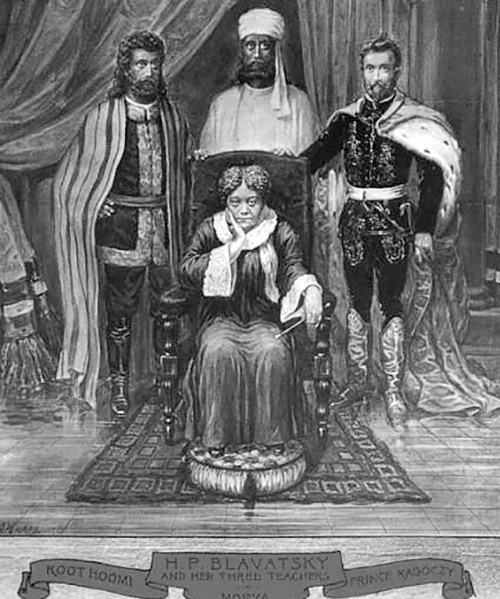
    A painting of Madame Blavatsky and her masters Koot Hoomi, Morya and Prince Ragoczy.

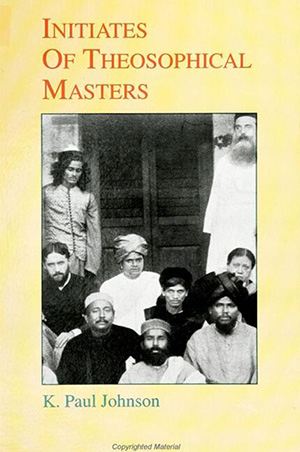
    However, the work of K. Paul Johnson (as found in such titles as The Masters Revealed and Initiates of the Theosophical Masters, State University of New York Press), offers an appealing alternative. By deconstructing Blavatsky’s life and work, Johnson has been able to decode her Master mythos as referring not to ethereal spectres but to living religious, political and esoteric figures.

    He proves from her work that these figures (many of them at least) were involved in political agitation of various forms (including the liberation of India from the British), thus the cloaking of their identities was necessary. Blavatsky commandeered the earlier Freemasonic concept of Unknown Superiors or Secret Chiefs and used it as a gloss to cover the identities of her “comrades” in revolution.

    While Blavatsky certainly understood the use of the Masters as metaphor, her followers did not. In a letter to Franz Hartmann, Blavatsky says:

    …where you speak of the “army” of the deluded – and the “imaginary” Mahatmas of Olcott – you are absolutely and sadly right. Have I not seen the thing for nearly eight years? Have I not struggled and fought against Olcott’s ardent and gushing imagination and tried to stop him every day of my life.2

    Throughout her works there are hints to the observant that the Mahatmas she had “created” were myths and figureheads to hide real figures. If we were to trace the development of the Master mythos within her work, we can clearly see it changing from “spirit” guides that appeared in her earlier spiritualistic period, to figures which are ambivalent, withdrawn and seem to be “more than human”.
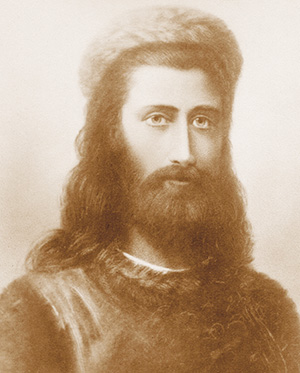
    Mahatma Koot Hoomi

    These figures were coupled with obvious slight of hand tricks (in Adyar), which the more critical might see as “camp” additions to a sideshow, a sideshow that was in some way meant to be seen through by those who possessed the perception. Blavatsky couldn’t tell you that the Masters were metaphors, but her behaviour, erratic descriptions and illusionist tricks would have done the job. These figures should not be seen as spiritual alone. Blavatsky’s view of “manipulating reality” was not that of an outside observer.
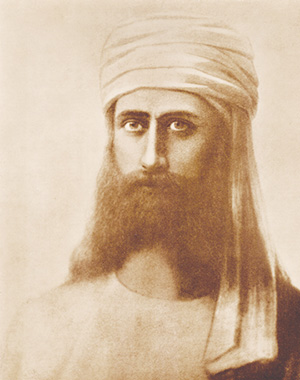
    Mahatma Morya

    Today, Theosophy may wish to paint her as a “saint”, however the available records show that she smoked (tobacco and hashish), swore and had a hell of a temper. Her political views were untempered and many of the “so-called” Mahatmas would not have been offended if we labelled them as terrorists. Many of the secret societies she worked with battled using every possible means to destroy what they saw as the “imperialist and capitalist” monster. They were revolutionaries or terrorists.

    Accordingly, as time progressed real revolutionary spiritual figures were replaced with ethereal nonsense. The sad fact is that from this nonsense a whole “Ascended Master” movement developed, melding itself with spiritualism, channelling and other superficial spiritual forms. It has resulted in the counter-initiatory tradition of this time. When we see the original meaning behind the Master metaphor we start to appreciate the shallow vision of modern spirituality.

    While there is truth in the original “Secret Chief” or “Unknown Superiors” teaching, this is very different from the egalitarian American package of “McDonald” Masters and apple pie wisdom.

    Madame Blavatsky

    The sources of light were seen as transmitting wisdom through a traditional hierarchical structure to those prepared to receive truth in both an experiential and cognitive form. It had little in common with political foment, eastern guruism or spiritualistic practice.

    In a world where hierarchy is a dirty word and intellectual prowess is confused with elitism, it becomes difficult to expound the real ethos of Unknown Superiors in juxtaposition to the easy going, yet facile and vacuous messages of Ascended Masters, Extra Terrestrials and age-old spirits.

    The most dangerous aspect of these new Masters is that they are not all benign; they do not all give “spiritualist” candy and meaningless cliches from the other side. Many of these UFO, Masters and Spirit guides are offering messages and encouragement which seem aligned to the development of a New World Order and collective forms of mind control.

    We may accept that the Mahatmas of Blavatsky were metaphors alone, but it is a terrifying possibility that “principalities and dominions” may be using the Ascended Master mythos as a means of mass mind control. If leaders of modern spiritual movements are more than willing to open their minds and souls to any being who calls itself “Jesus”, or any spirit than seems benign, or any extraterrestrial who says it comes in peace, then the minds of their followers are surely in jeopardy.

    In recent years various UFO cults have come to untimely ends and many others seem to be moving towards fascistic forms of social structure. It is possible that as the Kali Yuga accelerates the Ascended Master mythos will become more and more a mechanism of control.

    The New Age is perhaps a little different than we thought. The age of Aquarius is dawning, however, Aquarius is ruled by Uranus (or Saturn in more ancient astrological forms). These planets are not those of enlightenment, but forces of dispersion, destruction and crisis. Saturn itself being the glyph on which the legends of Satan and Set were grafted.

    The above article originally appeared on the (now defunct) Living Traditions website. 

    [alert type=”general” dismiss=”no”]This article was published in New Dawn 74 (Sept-Oct 2002.[/alert]

    [alert type=”success” dismiss=”no”]If you appreciate this article, please consider subscribing to help maintain this website.[/alert]

    Footnotes

    1. The Mahatma Letters to A.P. Sinnett, p. 271-2
    2. Blavatsky’s Collected Writings, Volume 3

    © New Dawn Magazine and the respective author.
    For our reproduction notice, click here.
  • The End of Time or the Time of the End? The Armageddon Agenda Exposed

    The End of Time or the Time of the End? The Armageddon Agenda Exposed

    From New Dawn Special Issue Vol 17 No 6 (Dec 2023)

    I recall many years ago looking through an old Catholic missal. It was one from the halcyon days of the Tridentine Mass and contained a variety of colour plates designed to help the faithful believer better understand the Mass and the sacraments.

    Of the more memorable images from that book was a colour plate illustrating the meaning and origin of the seven sacraments of the Roman Catholic Church. It was a collage of images depicting Jesus Christ administering each sacrament: Jesus baptising someone, Jesus hearing confessions, Jesus confirming a young boy and girl, that sort of thing.

    Now, I am sure the authors of that missal did not actually believe that Jesus of Nazareth really did those things, but I am certain that millions of faithful Catholics probably did believe it. And they believed Jesus directly instituted each of the seven sacraments because of what they saw in that missal and because of what their Church taught them.1

    One of the problems inherent within traditional Christian orthodoxy is a kind of myopia.

    Those with the ocular medical condition known as myopia typically can see nearby objects clearly but distant objects appear blurred.

    In terms of Christianity, as illustrated from the missal story above, there is a tendency to think that what a person believes now as “true Christianity” is precisely what Jesus taught, what the apostles taught, and what every faithful and true Christian has ever believed.

    This way of thinking blurs the vision when it attempts to look down the corridors of time, back to the distant past and into cultures very different from those of modern times.

    Christianity has never been “one thing” or “one true set of doctrines,” as much as some may wish to comfort themselves with such beliefs.

    Even in modern times and among the strictest of traditionalist Christian denominations, there are varieties of theological and doctrinal positions, even if those positions are made to look less diverse by institutional unity, as with Roman Catholicism, or by a kind of cultural unity, as with Protestant fundamentalism.

    From the earliest days of Christianity, diversity, not uniformity, characterised the movement.2 So, for example, there never was, and is not today, one “official” view of such matters as prophecy, the “end times.”

    But not everyone understands or believes this and so, for example, there are many evangelical and fundamentalist Christians who cannot conceive of anyone being a Christian and not believing in the “rapture” or end-of-the-world scenarios of the Left Behind book series.

    Someone wisely observed that ideas have consequences. The consequences of ideas are especially evident in the field of religion.

    If supporting evidence for such a claim is required, one need only consider how the world today has been affected by the religious ideals of solitary individuals such as Moses, Jesus, or Muhammad.

    Religious ideals and the movements they inspire do not have to be pervasive or widespread to have far-reaching consequences.

    This is nowhere more obvious than in the strange beliefs of a relatively small sect of Christians who teach a form of Protestant Christianity generally known as “dispensationalism.”3

    John Nelson Darby

    Originating from the work of John Nelson Darby, an Anglican clergyman of the 19th century, and systematised by American followers such as C.I. Scofield, dispensationalism had a tremendous influence on English-speaking Protestant Christianity.4

    Dispensationalism is best known for its literalist interpretation of highly symbolic verses of the Bible, its emphasis on the immediacy of the second coming of Christ, the distinction it makes between ethnic Israel and the largely Gentile church, and its belief that God’s ultimate goal of history is the restoration of the Jews as a kingdom nation ruling the world from Jerusalem.

    In the way they interpret the Bible, God has divided human history into seven ages or dispensations, and we now find ourselves on the verge of entering into the last age, an age that will, according to them, witness the literal physical return of Jesus to the Earth.

    Cyrus I. Scofield, the father of dispensationalism, has been described as a self-taught lawyer, convicted forger, wife deserter, and alcohol abuser turned preacher who became the world’s most published Bible commentator.

    Indeed, in their theological system, Jesus Christ cannot return until the Jews are gathered in their ancestral homeland.

    And so, according to them, the founding of the modern state of Israel in 1948 was part of a larger, prophetic plan revealed in the Bible.

    All of this would be nothing more than an adventure in religious doctrinal trivia were it not for the fact that the dispensational worldview has, like all ideas, consequences for the rest of us.

    There is perhaps no better example of this than the United States’ constant support for the state of Israel.

    To be sure, no US president has been an open believer in dispensational Christianity, but many of them have recognised that a large bloc of voters are such believers and have therefore patterned US foreign policy to cater to that bloc.

    Leaving aside the improprieties of US foreign policy, the fact is dispensationalism is bad theology. This can be seen in both its history of fear-mongering and end-of-the-world predictions and in the way it misreads the Bible.

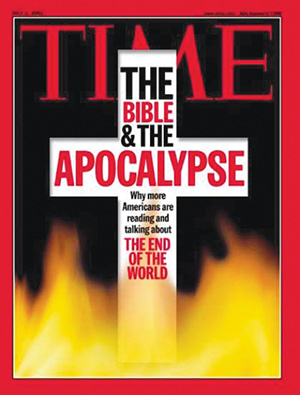
    On 1 July 2003, TIME magazine’s cover story was “The Bible and the Apocalypse: Why more Americans are reading about the end of the world.”

    Back in the early 1970s, dispensational prophecy author Hal Lindsey predicted the second coming of Christ would occur in 1988 since that was forty years (in biblical chronology, forty years equals a generation) from the time the modern state of Israel came into existence.

    Hal Lindsey was wrong, but that has not stopped him from writing many more prophecy books, and it has not stopped Christians and non-Christians from reading them.

    From 1998-99, dispensationalists poured over their Bibles for evidence of the “rapture” and the end of all things as the year 2000 dawned. Many books, tapes, and videos were written, produced, recorded, and bought by millions of people, many of whom were convinced the end was at hand.

    But, as with the year 1988, so too with the year 2000, the dispensationalists were wrong again.

    The events of 11 September 2001 again saw people wondering about the end of all things, and Tim LaHaye’s popular Left Behind book series (the first volume of which was originally published in 1995) profited immensely from both the Y2K hysteria and a year later, from the events of 9-11.

    Indeed, the Left Behind book series has sold over 40 million copies. That doesn’t include the motion picture adaptation of the Left Behind novel or the many other spin-offs, such as “Left Behind for Kids,” the “Left Behind” board game, music, movies, etc.

    The Left Behind series by Tim LaHaye helped revive dispensationalism or ‘rapture theology’.

    Fear-mongering about the end of the world and the return of Christ have made millions of dollars for men like LaHaye, Lindsey, and John Hagee.5 These men quote many, many Bible verses to support their claims. Quoting Bible verses does not, however, make something a true biblical doctrine.

    Historically, large numbers of Christians have believed that all of the events dispensationalists have pointed to as evidence we are “closer than ever” to the end times were events that the Bible itself says were to take place in the generation of the apostles and the First Century church. For most of the history of Christianity, such prophetic statements were looked upon as either being fulfilled in the past or applying not to a restored Israeli state but to the church.

    Consider these passages and notice that in every case, the words and predictions are addressed not to people living in the 21st century but exclusively to the people to whom Jesus was speaking at the time, the people of that generation, and notice that for them, these things were near, at hand, soon to come (note: I have used italics to emphasise this in the text):

    Matthew 10:23: When they persecute you in one town, flee to the next, for truly, I say to you, you will not have gone through all the towns of Israel before the Son of Man comes (ESV).6

    Matthew 16:27-28: ‘For, the Son of Man is about to come in the glory of his Father, with his messengers, and then he will reward each, according to his work. Verily I say to you, there are certain of those standing here who shall not taste of death till they may see the Son of Man coming in his reign.’(Young’s Literal Translation of the Bible)

    Matthew 26:63-64: But Jesus remained silent. And the high priest said to him, “I adjure you by the living God, tell us if you are the Christ, the Son of God.” Jesus said to him, “You have said so. But I tell you, from now on you will see the Son of Man seated at the right hand of Power and coming on the clouds of heaven.”(ESV)

    Matthew 24:34: Truly, I say to you, this generation will not pass away until all these things take place.(ESV)

    James 5:7-8: Now be patient, brothers, until the Lord’s coming. Think of a farmer: how patiently he waits for the precious fruit of the ground until it has had the autumn rains and the spring rains! You too must be patient; do not lose heart, because the Lord’s coming will be soon. (New Jerusalem Bible)

    1 John 2:18: Children, it is the last hour, and as you have heard that antichrist is coming, so now many antichrists have come. Therefore we know that it is the last hour. (ESV)

    Get the issue this article appears in

    Notice the verb tenses, notice the immediacy and the urgency in these exhortations, and notice, most importantly, that they were addressed to specific people at a specific time and place!

    For Christians who believe in the infallible truth of the Bible, logically, there are only two possibilities for correctly understanding these statements.

    Either Jesus was right, and all the things that the dispensational/Christian Zionists claim are to happen in our immediate future have, in fact, already happened, or Jesus, as he speaks from the pages of the New Testament, was wrong!

    So, then, “all the things” that the dispensationalists claim are to happen in the future have been misunderstood and misinterpreted by them.

    They have managed to find everything from helicopters and atomic bombs to computer chips lurking below the surface of the words of Scripture, but the one thing they seem not to be able to find is the ability to interpret things like “coming on the clouds,” “the moon not giving its light,” and “wars and rumours of wars” in light of what the Bible itself says about those things.

    The biblical evidence and especially the time indicators associated with these prophetic statements all show that both Jesus and the authors of the New Testament were all expecting the “Last Days” and the “coming of the Lord” to occur in their generation.

    Reading the Bible in its cultural and historical context will show that such concepts, themes and ideas as “the Day of the Lord,” the “Last Days,” and the “coming of the Lord” are usually not associated at all with what has come to be known in our time as “the end of the world and the return of the Lord” but rather with the covenantal judgment of God against the nation of Israel.

    According to this traditional Christian interpretation of the Bible, that judgment did occur in CE 70 with the fall of Jerusalem at the hands of the Roman armies of Titus and Vespasian.7

    From this Christian perspective, the “last days” were the last days of the Old Covenant era with its Temple sacrifices in the city of Jerusalem and with its High Priests and Scribes.

    According to this view, the covenantal judgment of God against Israel was manifest in the destruction of Jerusalem and the Temple. Hence, it was to the Jewish mind of that time “the end of all things,” and it was, as Jesus himself said in Luke 21:23, “…the days of vengeance, that all things which are written may be fulfilled.”

    Vengeance? Vengeance against who?

    According to those Christians who argue for the past fulfilment of these prophecies, it was against Israel for rejecting the Messiah and for saying that they had no King but Caesar and for saying that they would not have “this man [Jesus] to rule over us!”

    According to the Gospel accounts, Jesus claimed in CE 30 that within a generation all of those things mentioned in Matthew 24, Mark 13, and Luke 21 would come to pass.

    And so, from this perspective, it is obvious why the prophecy pundits and end-of-the-world rapture specialists are, and will always be, wrong.

    They are projecting into the future things that have long since passed. 

    [alert type=”general” dismiss=”no”]This article was published in New Dawn Special Issue Vol 17 No 6.[/alert]

    [alert type=”success” dismiss=”no”]If you appreciate this article, please consider subscribing to help maintain this website.[/alert]

    Footnotes

    1. Similar examples among Protestant evangelicals or fundamentalists would be envisioning the apostles as speaking only in King James English or thinking of Jesus as a “Christian” in the same sense they think of themselves as Christians. Jesus was, of course, a very devout Jew and not a Baptist, Anglican, or Roman Catholic!
    2. The classic study that proved this to be the case was German historian Walter Bauer’s Orthodoxy and Heresy in Earliest Christianity.
    3. Most of the world’s 2.1 billion Christians are Roman Catholic, Eastern Orthodox, Anglican, or mainline (i.e. theologically liberal) Protestant. Most of these Christians do not hold to the dispensationalist form of fundamentalist Christianity.
    4. For an excellent analysis and history, see George Marsden, Fundamentalism and American Culture, Oxford University Press, 1980.
    5. Hagee, an independent fundamentalist pastor, has even articulated what he calls “Christian Zionism” and has formed an organisation called “Christians United for Israel.” At one of that organisation’s events, Hagee and his group gave 7 million dollars to Israeli officials for various causes in support of the state of Israel. One wonders if Hagee has been as concerned to support his fellow Christians living in Israel. For more information, see the group’s website at www.cufi.org.
    6. ESV is the English Standard Version of the Bible.
    7. This is known as the “preterist” view, from the Latin term meaning “past.”

    © New Dawn Magazine and the respective author.
    For our reproduction notice, click here.

  • The ‘Fourth Turning’ in an Ages-Long Struggle

    The ‘Fourth Turning’ in an Ages-Long Struggle

    From New Dawn Special Issue Vol 15 No 6 (Dec 2021)

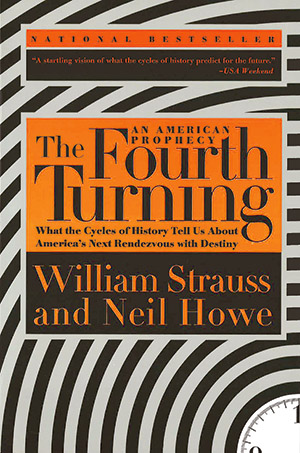
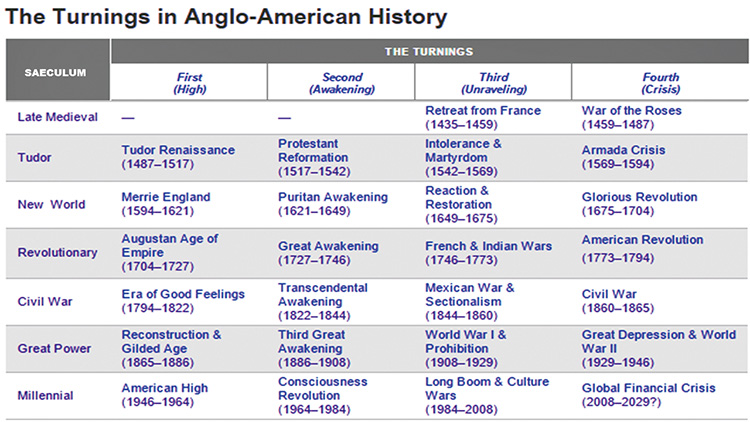
    The remarkable 1997 book The Fourth Turning: An American Prophecy by William Strauss and Neil Howe argues that the familiar linear approach to history taught in most western education and academia is a fairly recent paradigm containing dangerous flaws. They argue, instead, that seeing history in terms of recurring cycles provides insights that modern linearity obscures – “one year’s (or one saeculum’s) winter is more like the prior winter than like the autumn that came right before it,” they explain.1

    The authors state that by perceiving these cycles, we can perhaps become more aware of impending change. On the contrary, linear or straight-line thinking often causes its adherents to be completely blindsided. Using American history as an example, they point out that as late as December 1773, the idea that the American Revolution would begin in the near future seemed nearly impossible. The same can be said about November 1859 regarding the impending start of the American Civil War that broke out in 1861. Or early October 1929 when virtually nobody expected the sudden end to the Roaring Twenties caused by a catastrophic crash of the stock market that started on October 24 (“Black Thursday”), accelerating from October 29 (“Black Tuesday”).2

    Building upon their observation of generational cycles occurring every four generations going back through history for millennia, Strauss and Howe predicted that the current mood of pessimism and disillusionment is typical of a specific point in the cycle. This inevitably precipitates a major crisis which the authors, writing in 1997, predicted would arrive sometime between 2005 and 2025:

    Around the year 2005, a sudden spark will catalyse a Crisis mood. Remnants of the old social order will disintegrate. Political and economic trust will implode. Real hardship will beset the land, with severe distress that could involve questions of class, race, nation, and empire. Yet this time of trouble will bring seeds of social rebirth. Americans will share a regret about recent mistakes – and a resolute new consensus about what to do. The very survival of the nation will feel at stake. Sometime before the year 2025, America will pass through a great gate in history, commensurate with the American Revolution, Civil War, and twin emergencies of the Great Depression and World War II.3

    In 2011, I wrote an essay regarding these pronouncements of Strauss and Howe, in the process of my reflecting on the tenth anniversary of September 11, 2001. At that time, I said:

    It is clear that many of these predictions are coming true, particularly the prediction that “political and economic trust will implode.” It would appear, however, that so far, no “great Crisis” as momentous as the Revolution or the Second World War has yet been sparked. The two authors’ warnings that those living in 1929 or 1859 or 1773 did not see the impending Crisis of their age should give us cause for concern that such a Crisis may yet be around the corner, and cause to pay attention to the cycles that the authors outline in their book.4

    Almost exactly ten years later, it certainly feels as though the Crisis that Strauss and Howe predicted has either arrived or very much “around the corner.” The way we choose to act over the coming months and years will be critical for our future and that of generations to come.

    Descent into Linearity

    Whether you agree with all the conclusions and predictions in The Fourth Turning, one of the most noteworthy features of the book is the authors’ demonstration that the peculiar modern faith in linear progress is a historical anomaly. They find evidence that “nearly all non-Western cultures accept the periodic regularity of time” – meaning by “periodic regularity” the view that time operates in cycles, with a kind of circular rhythm, in contrast to the view that time is linear, which is a relatively modern development in their analysis.5

    Strauss and Howe argue that this modern linear view of time is a product of the Enlightenment that dominated the eighteenth century, during which this approach grew into “a complementary secular faith… – the belief in indefinite scientific, economic, and political improvement.”6 They posit that this faith in linear progress reached its height at the end of the nineteenth century, and that it has always been strongest in America where a widespread belief developed that mankind had finally broken away from “any risk of cyclical regress.”7

    Strauss and Howe state: 

    Triumphal linearism has shaped the very style of Western and (especially) American civilisation. Before, when cyclical time reigned, people valued patience, ritual, the relatedness of parts to the whole, and the healing power of time-within-nature. Today, we value haste, iconoclasm, the disintegration of the whole into parts, and the power of time-outside-nature.8 

    These are broad generalisations, and any book of this nature will test the reader’s patience with such sweeping categorisations, but these overviews do appear to capture some truths worth considering.

    Interestingly, this very belief in unbroken linear progress that has gripped western thought since the Enlightenment is reinforced by the dogmas of Darwinism and modern official teachings on our ancient history. It theorises that we have supposedly evolved in a generally unbroken upward line from the “ape-like progenitors” Darwin describes in Descent of Man9 all the way to modern humans, who then progressed from early hunter-gatherers to pastoral herders living a nomadic life, to basic planters and harvesters capable of organising simple villages, and who then made it in a linear fashion to create increasingly complex civilisations.

    Although virtually all academia today still enforces some version of the above linear paradigm of humanity’s ancient history, the evidence overwhelmingly suggests this view of the ancient past cannot possibly be correct. Instead, compelling evidence supports the conclusion that humanity was highly advanced in the distant past (long before ancient Greece and Rome) and, for some reason, fell into relative ignorance for millennia thereafter – a very nonlinear view of ancient history.

    Cycling Back to the Ancient World

    Archaeological evidence around the world points to advanced capabilities which even today we barely understand, including the quarrying and transportation of massive blocks weighing over a hundred tons at sites such as Pumapunku in South America, the Osirion in Egypt, or blocks weighing well over a thousand tons at Baalbek in modern-day Lebanon, and the remarkable level of precision displayed on certain ancient artefacts (including on some of the massive blocks at Pumapunku).

    Author Christopher Dunn, a professional engineer and craftsman with extensive experience in the aerospace industry, compiled an overwhelming amount of evidence demonstrating beyond any possible dispute that archaeological artefacts found throughout Egypt and available for detailed examination today exhibit evidence of advanced precision machining. These could not have been manufactured any other way, certainly not with hand tools such as the chisels and pounding-stones on display in many museums, right next to the amazing artwork supposedly produced with such crude implements. 

    He explores several examples in his groundbreaking 2010 book, Lost Technologies of Ancient Egypt: Advanced Engineering in the Temples of the Pharaohs, establishing beyond doubt that artefacts in Egypt display manufacturing precision built on a knowledge base which was later completely lost for thousands of years. Modern engineers would, in many cases, have a difficult time duplicating these artefacts today (in fact, they could not have done this with tools available just fifty years ago, before advances of recent decades).

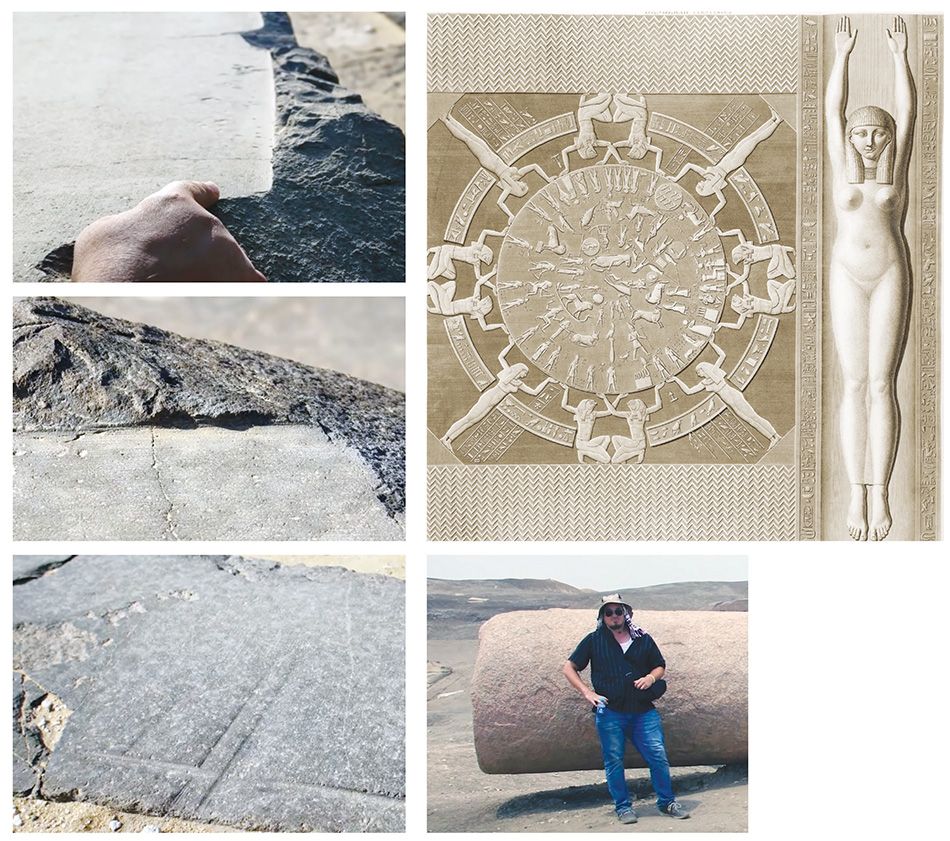
    (Above right) Cyclical time in ancient Egypt. Rendition of the Dendera zodiac on the ceiling of the temple of Hathor in Dendera, Egypt. (Other images) Researcher and documentary film-maker Ben Van Kerkwyk of UnchartedX has filmed hundreds of hours of footage of marks made by ‘high tech’ circular saws on hard stone in ancient Egypt. See www.youtube.com/channel/UC2Stn8atEra7SMdPWyQoSLA

    Building on the work of Christopher Dunn, and in some instances travelling to Egypt with him, as well as travelling on his own to other ancient sites around the globe, researcher and documentary film-maker Ben Van Kerkwyk of UnchartedX has filmed hundreds of hours of footage allowing viewers of his videos to see with their own eyes these ancient artefacts and ancient tool-marks. Dunn and Van Kerkwyk’s research demonstrates undeniable evidence of advanced technologies, suggesting that sophisticated civilisation existed before dynastic Egypt, capable of producing artwork and objects that even the ancient Egyptians could not duplicate.

    The interested reader (or the sceptic who still doubts the existence of advanced technologies that upend the conventional timeline of human history taught in academia) is strongly encouraged to visit Ben’s website at www.unchartedx.com and his associated YouTube channel. Watch two or three of his videos and see the evidence which speaks for itself. The most compelling proof involves ‘mistakes’ where marks and cuts on ancient artefacts reveal that the person operating a cutting tool made an error. Judging by the cuts that can be seen today, the tool continued its incision further than would have been the case with simple hand tools. These ‘mistakes’ show that some kind of high-powered equipment was employed that carried on with the cut before the operator stopped it.

    Our Shared Body of Myth

    In addition to the physical archaeological evidence scattered around the globe, which we can still examine today, there is another amazing body of evidence in the world’s surviving myths, from cultures on every inhabited continent and island of our earth. As I have been documenting for over a decade, this body of myth can be shown to be based on a common system of celestial metaphor and closely related in a way that explodes the conventional paradigm of humanity’s ancient history.

    The very existence of a worldwide system of this nature, in which specific mythical characters are associated with specific constellations – and in which certain characteristics accompany constellations and the mythical figures associated with those constellations across mythologies in cultures separated by enormous distances and by vast oceans – cannot be explained within the timeline of history promoted by conventional academia. 

    How can we explain obvious parallels in sacred stories preserved among the cultures of the Americas as well as in well-known myths of ancient Greece, for example, or between biblical stories and the myths of the cultures of the Pacific Islands, the civilisations of ancient Mesopotamia, the Ko-Ji-Ki of early Japan, and the Sanskrit epics of ancient India?

    These connections suggest the existence of some predecessor culture (or cultures), now completely ignored or denied by today’s official paradigm, prior to the most ancient civilisations known to academia. This system of celestial metaphor in myth was already fully developed in the earliest surviving texts of ancient Egypt, ancient India, and ancient Mesopotamia.

    Even beyond those connections, which cannot be explained using the conventional paradigm of human history, the myths of cultures around the world preserve evidence of an extremely sophisticated understanding of celestial mechanics, including an understanding of the rate of precession (whose mythological importance is discussed in my accompanying article on page 51). 

    Conventional history holds that precession (a very subtle celestial phenomenon, and one that requires many years and even centuries of careful observation and record-keeping and analysis to even detect) was not discovered until the time of the Greek astronomer Hipparchus (190–120 BCE). The rate of precession of one degree every approximately 72 years was not even known when Ptolemy wrote his Almagest in the second century CE. Yet, the precessional number 72 and its multiples (including 108, 216, and 432) appear over and over in ancient myths and sacred stories around the world – and in contexts which can be shown to metaphorically relate to the observable effects that precession has on the constellations of the night sky!

    The myths, in other words, demonstrate that precession was understood in the distant past, long before it was ‘discovered’ (actually re-discovered) by Hipparchus. Far from a linear progression, humanity realised enormous levels of understanding and achievement in very ancient times (more ancient than any civilisation known to conventional history), only to lose that knowledge for thousands of years. The evidence indicates we have yet to come close to regaining those levels of understanding and ability – a shocking proposition for the adherents of the linear model of human progress!

    Although this evidence (both mythical and archaeological) is easy to examine, abundant, and very difficult to dispute, conventional academia has – in remarkable lockstep – roundly rejected anyone arguing that the current paradigm is gravely flawed and in need of radical revision. Instead, they have continued to cling to the dogmas of linear progress. In my 2011 article exploring The Fourth Turning and the tenacity of the linear dogma, I wrote:

    It is quite likely that the faith in linearity that Strauss and Howe detail in their book has blinded scholars and others to the possibility of an ancient advanced civilisation and created a bias towards the acceptance of Darwinian biological theories, which in turn lead to linear anthropological theories as well.10

    Re-visiting the question after ten more years of work, and after the discovery of much more evidence showing beyond doubt the existence of a worldwide system of metaphor operating at the foundation of the world’s ancient myths, I am less inclined to take such a charitable view in describing the ongoing propagation of historical paradigms that cannot possibly be true, and which are roundly refuted by overwhelming evidence. 

    Indeed, there is now plenty of evidence that the truth of our ancient history has been actively suppressed as part of a conspiracy reaching back thousands of years to empower some at the expense of the vast majority of humanity. Keeping this history secret makes it easier to keep us divided and from the ancient wisdom preserved in the myths.

    Cyclical Time & Patterns

    Interestingly enough, in The Fourth Turning, Strauss and Howe note that ignorance of the cyclical nature of time, or even massive attempts to deny these cycles and live as though cycles do not exist, does not free us from the cyclical nature of time at all. On the contrary, their findings suggest that cultures embracing cyclical time are less buffeted by the waves of the changing cycles, while cultures ignoring cycles exacerbate their effects so that they experience even greater volatility – all the more painful because it is unexpected (unlike the cycles experienced by cultures that expect and respect the cyclical nature of time).

    The analysis of Alsatian scholar R.A. Schwaller de Lubicz uncovered numerous cyclical patterns and harmonies between generations living hundreds or even thousands of years apart (at similar distances from precessional turning points). He points this out in his books such as Sacred Science:

    R.A. Schwaller de Lubicz  (1887-1961)

    Since the Middle Ages, our Occident [the West] has been blinded, particularly by the cerebration of the Greek Eleatics who preferred reasoning to experimentation. The beginning of this disquieting period of “arguers” can be situated with the Eleatic school around 550 or 500 BC, a school founded at about the same time as the Pythagorean order, of mystico-religious character. Those five centuries before the precessional passage from Aries to Pisces stand in curious correspondence with our sixteenth century, also five centuries before the next precessional passage from Pisces to Aquarius: Toward the year 1500, with the Renaissance, ancient Greece was again raised to honour in the West.11

    Later in the same book he writes:

    Their [the Stoics’] champion was Zeno of Citium, who lived from 362 to 260 BC, which is about two hundred years before the precessional transition from the vernal point of the sign of Aries to that of Pisces. In the Stoic pursuit of freedom, we find a curious similarity to the ideal of the revolutionaries of 1789, a revolution which was also situated about two centuries before the new precessional transition of the vernal point from the sign of Pisces to that of Aquarius. This brings to mind a similar great revolution which took place at the end of the Old Empire of the Pharaohs, about 2400 BC, two centuries before the passage of the vernal point of the sign of Taurus into that of Aries.12

    In light of these and other apparent harmonies, de Lubicz declared, “The history of the world is strangely cyclical.”13

    Get the issue this article appears in

    Facing the next ‘Crisis’

    While Strauss and Howe seem to indict the European Enlightenment for starting the modern dogmatic cult of unbroken linear progress, it should be noted that the Enlightenment was at its core a virulent rejection of the stifling institutions of feudalism dominating Europe throughout the Middle Ages. It was an attempt to free Europe, intellectually and economically, from those ongoing feudal patterns – patterns that grew directly out of the destruction of the ancient ways by the proponents of literalist Christianity, by whom the Roman Empire was taken over and then broken apart, ushering in centuries of brutal oligarchy supported by the teachings of the Church.

    As I have demonstrated in my examination of the stories of the Bible totalling many hundreds of pages, overwhelming evidence proves that those stories are based on the same system of ancient metaphor that formed the foundations for the myths and stories of other cultures around the world. Literalistic interpretations of the Bible are mistaken and only leads to misinterpretation of the scriptures. Thus, the rejection of lingering remnants of feudalism – and oppressive literalistic religious dogmas abetting feudal oppression – appears to have led to a (perhaps understandable) mistake when this rejection of the literalist Church and its flawed teachings offered in its place the ‘secular faith’ described by Strauss and Howe, with uncritical belief in unending and inevitable “scientific, economic, and political improvement.”

    As American economist Michael Hudson, author of numerous books and essays including the newly-revised third edition of his original 1972 book Super Imperialism – now subtitled in this current edition The Economic Strategy of the American Empire – has explained at length, the oligarchical beneficiaries of the feudalist system did not passively accept the philosophical, political, and economic attacks on the structures of oligarchy launched during the eighteenth century and which gained ground throughout most of the nineteenth: they struck back quite forcefully and managed to erect numerous powerful neo-feudal structures to preserve their exploitative racket.

    Moving into the danger zone. US presidential elections in 2024 and 2028 are certain to exacerbate
    geopolitical tensions across the globe and further societal division in the United States.

    I suggest that the Crisis predicted by Strauss and Howe, which may now be unfolding before our very eyes, along with virtually all other “Crisis” examples offered by these authors (including the American and French Revolutions, the American Civil War, the Great Depression and Second World War), can best be understood in light of this centuries-old struggle against the proponents of feudalism (and, in the modern era, neo-feudalism – complete, it seems, with draconian restrictions on movement and travel reminiscent of the condition of serfs in Medieval Europe).

    Feudalism can be seen to be the system established by those opponents of the ancient wisdom preserved in the myths – myths testifying (along with overwhelming archaeological evidence) to the cyclical nature of the human story, and to the existence of a now-forgotten predecessor culture (or cultures) whose very existence is vehemently denied by academia and by the proponents of the modern ‘science’ cult and unending linear ‘progress’.

    We find ourselves in the midst of one battle in a very, very old war.

    [alert type=”general” dismiss=”no”]This article was published in New Dawn Special Issue Vol 15 No 6.[/alert]

    [alert type=”success” dismiss=”no”]If you appreciate this article, please consider subscribing to help maintain this website.[/alert]

    Footnotes

    1. William Strauss and Neil Howe, The Fourth Turning: An American Prophecy, Crown, 1997, 21 
    2. Ibid., 5-6
    3.Ibid., 6
    4. David Warner Mathisen, “The Fourth Turning and cyclical time and history,” Mathisen Corollary blog, 11 September, 2011
    5. Fourth Turning, 32
    6. Ibid., 9
    7. Ibid., 10
    8. Ibid.
    9. Charles Darwin, The Descent of Man and Selection in Relation to Sex, Volume One of Two Volumes, Appleton, 1871, 94, 133
    10. Mathisen, “The Fourth Turning and cyclical time and history.”
    11. R. A. Schwaller de Lubicz, Sacred Science: The King of Pharaonic Theocracy, Inner Traditions, 1982, 18
    12. Ibid., 43
    13. Ibid., 30

    © New Dawn Magazine and the respective author.
    For our reproduction notice, click here.
  • The Ex-Nazis Who Helped the CIA & Mossad

    The Ex-Nazis Who Helped the CIA & Mossad

    From New Dawn Special Issue Vol 13 No 3 (June 2019)

    You’re unlikely to find him featured front and centre in high school history textbooks, but Reinhard Gehlen was an important and complex historical figure who had a surprisingly large impact on the history of the 20th century. He’s also the key to unlocking a very unsettling trend in history: supposedly sworn enemies working together on a dime if the benefits outweigh the costs. 

    Reinhard Gehlen was recruited by the United States after WWII.

    Gehlen was a storied historical figure of the Cold War and a man – to be precise, a former Nazi – of many talents. He headed intelligence gathering on the Eastern Front during his career as a major general in the Wehrmacht during the Second World War, which ironically turned out to be exceedingly useful to the West.

    It took Gehlen only three months after the total defeat of the Third Reich in June 1945 to land a job in America. He was a consummate risk-taker and successfully pitched himself as the perfect man to help the United States stand up to the USSR after the war because of his trove of knowledge on Stalin’s state. What he offered was a vast network of former Nazi spies and intelligence assets that would fill America’s arrow quiver in fighting the looming Soviet empire.

    Gehlen was flown out of Germany to Fort Hunt, Virginia, in contravention of Allied promises at the Yalta Conference that they would hand over any German officers they got hold of to the Soviets if those officers had worked in the eastern theatre of the war. The next year, in 1946, Gehlen returned to Germany and headed up “the Org,” or Gehlen Organisation. He boosted US spy operations and NATO in their covert operations and information war against the USSR. The Org included numerous former Nazis and SS men, some of whom were war criminals like Alois Brunner who sent hundreds of thousands of Jews to their death in the concentration camps, and SS major general and Jew-killer Emil Augsburg who was listed in 1952 internal CIA documents as an aficionado of “good food and wine” with an “unprejudiced mind” and honest temperament.

    Reinhard Gehlen as a Wehrmacht Major General in 1945.
    After the war, Gehlen convinced the Americans to build a spy service from his old team. He was given the new name “Hans Holbein” and this ID card.

    Gehlen later became the first president of West Germany’s spy agency, the BND, from 1956 to 1968. The BND employed an estimated minimum of 100 former Gestapo and SS officers, including former SS head Heinrich Himmler’s daughter and lifelong Nazi supporter Gudrun Burwitz from 1961 to 1963. They also hired “Butcher of Lyon” SS torturer Klaus Barbie who had already been working for the US as an anti-communist spy from his hiding place in Bolivia by the late 1940s. Moral scruples were not exactly the order of the day at this juncture of history, to put it mildly.

    Operation Paperclip

    More broadly, the US initiative to quietly import legions of former Nazi scientists into the US was going on behind-the-scenes and became instrumental in the success of many American endeavours, including the NASA space program. Some may be aware of Operation Paperclip, depicted in films such as The Good German, which was a key initiative of the US intelligence community for recruiting top Nazi scientists and relocating them stateside. Its purpose was to give the United States the edge over the Soviet Union militarily and in the Space Race – including the development of lethal chemical and biological weapons. Around 1,600 Nazi scientists and engineers – as well as their families – were brought over. The United States working with the Nazis is not the stuff of wild-eyed theories, but a matter of historical fact.

    Dr Werner von Braun at White Sands, New Mexico, November 1946.

    After the war, Americans ransacked Germany to find intelligence and came across research and plans that they desperately wanted to possess and master, including a weaponised form of the bubonic plague that Hitler’s scientists had been developing. Paperclip started slow, with under 100 scientists brought in, but steadily picked up steam as coveted Nazi scientists had their records of atrocities wiped clean by highly-placed figures in the US intelligence community. It was a top-secret program run by the Joint Intelligence Objectives Agency (JIOA), hidden even from the US Department of Justice’s special investigations office, who were deceived by their own government as they tried to pursue Nazi war criminals.

    The most famous Paperclip alumnus is Werner von Braun who helped develop the V-2 rockets that terrorised Britain. Von Braun went on to become the head of NASA’s Marshall Space Flight Centre and spearheaded the construction of the Saturn V launch vehicle that eventually took Americans to the moon. The full extent of technology and weaponry gleaned from Nazi minds may never be fully known or released, but it’s clear that the US benefited enormously from its cynical partnership with Third Reich bigwigs.

    Nazis & Zionists

    Rather unsettlingly, Israel was also a key partner of ex-Nazi war criminals.

    Nazi SS officer Otto “Scarface” Skorzeny.

    Indeed, Gehlen’s organisation of ex-Nazis helped Israel plan and succeed in its devastating surprise attack on Egypt and ensuing victory during the Six Day War in 1967. Using ex-Nazis to reach out and appeal to German scientists working for Egypt, Israel intimidated and killed off its enemies who were helping the Arabs mount a threat against them. The Mossad certainly had no scruples about working with war criminals, for example enlisting the help of former SS Commando and apple of Hitler’s eye Otto Skorzeny to kill scientists who were helping Egypt develop a missile program in the 1960s. 

    The Mossad got Skorzeny to work for them in a masterful recruitment operation, playing on his need for adventure and risk and – some think – on some lingering feelings of guilt about persecution of Jews which he may have held from his war years. Interestingly, the Americans and British were flabbergasted and angry when Israel captured Adolf Eichmann in Argentina in 1960. The CIA, who reportedly knew Eichmann’s whereabouts and alias years before Mossad, panicked after he was taken. They were worried Eichmann could expose various agents working for the Gehlen Organisation who had been his accomplices, including Otto Albrecht von Bolschwing. More generally, the Americans were very worried about having their dealings with Nazis brought into the limelight – and it’s still not exactly the highlight of history textbooks.

    Strange bedfellows. After the war, Nazi SS officer Otto “Scarface” Skorzeny was recruited by Mossad to carry out assassinations.

    The scope of the United States involvement with officials from the Third Reich may seem mere historical trivia to some, but it points to a deeper and more fundamental truth about history and realpolitik. It also uncovers some alternate views of history which have long been strictly verboten.

    Hardcore Zionist leaders and elites in early 1930s Germany had one big point of agreement with Adolf Hitler. Both wanted Jews to leave Germany. The Haavara Agreement (haavara means “transfer” in Hebrew) whereby the Nazis agreed to help financially support Jewish exodus to Palestine is a matter of historical fact. The agreement, signed in August of 1933 between Jewish Agency political secretary Chaim Arlosoroff and German officials, let tens of thousands of German Jews keep their assets if they agreed to leave for Palestine. It accomplished the Nazi goal of getting rid of Jews, supported German industry, and boosted Zionist ambitions. German Jews put their money in an account which was then used to buy German-made equipment exported to Palestine and then sold by the Haavara corporation in Tel Aviv. Proceeds from the company were given to Jews to recompense them for the money they had deposited back in Germany. Although some Zionists believed the agreement could undermine the worldwide Jewish boycott of Nazi Germany, those supporting the agreement won out and the agreement continued until the outbreak of the Second World War. Estimates hold that approximately ten percent of Germany’s 1933 Jewish population (some 60,000 individuals) emigrated to Palestine between 1933 and 1941 aided by agreements like Haavara and other German-Zionist arrangements.

    The commemorative coin of the Haavara transfer agreement of 1933 between Zionists and the Third Reich.

    Zionist groups helped set up around 40 agricultural work centres around Germany in the 1930s and cooperated with the Nazis to train and prepare Jewish Germans for a new life in Palestine. 

    Although German opinion began to turn against the formation of a Jewish state in the late 1930s, under the claim that it would just be a bastion for international communism and Jewish interests, Hitler himself supported the emigration of Jews to Palestine in 1938 after reviewing plans. The British, who controlled the Palestine mandate, were increasingly opposed to Jews trying to migrate into the area and shift the balance of power. Accordingly, the SS made a deal with Mossad le-Aliya Bet to help Jews illegally immigrate to Palestine in ship convoys prior to the outbreak of war in 1939, but continuing with less intensity under the radar until March 1942. It’s also worth noting that the Israeli terrorist group the Stern Gang attempted to make an alliance with Nazi Germany in January 1941, considering them a lesser evil compared to Britain who controlled Palestine and at that time opposed the formation of a Jewish state. The proposal, as quoted by Avishai Margalit in ‘The Violent Life of Yitzhak Shamir’ appearing in the 1992 New York Review of Books reads partly:

    “The establishment of the historical Jewish state on a national and totalitarian basis, and bound by treaty with the German Reich, would be in the interest of maintaining and strengthening the future German position of power in the Near East…

    “The indirect participation of the Israel Freedom Movement in the New Order of Europe, already in the preparatory stage, combined with a positive-radical solution of the European Jewish problem on the basis of the national aspirations of the Jewish people mentioned above, would greatly strengthen the moral foundation of the New Order in the eyes of all humanity.

    “The cooperation of the Israel Freedom Movement would also be consistent with a recent speech by the German Reich Chancellor, in which Hitler stressed that he would utilise any combination and coalition in order to isolate and defeat England.”

    More than 70 years since the defeat of the Third Reich, mainstream media is only now  beginning to report the involvement of former Nazis with the Israeli Mossad and the American CIA. 

    Fast-forward to the present day, and you have a bizarre world order dominated by Twitter tyrant Donald Trump and a bevy of autocratic hyper-capitalist stuffed suits. Even though Trump associates like Roger Stone may find it funny to joke about the revitalisation of NASA and Trump’s “Space Force” as a Nazi program and them as Nazis, when you study NASA’s roots and the US government’s extensive work with Nazis, it’s far from humorous. Whenever he is accused of racism, Trump pivots to his strong support of Israel whose own far right government is currently allying with Europe’s far right. 

    Moreover, what exactly was the deal with naming a small object NASA discovered ‘Ultima Thule’? When you study the Third Reich’s use of Thule as a mythological Aryan homeland, the name starts to seem truly bizarre.

    Today you have Bibi Netanyahu and his Likudniks openly allying with fascists worldwide from Brazil to Hungary. [Former] Brazilian President Jair Bolsonaro said the Holocaust could be “forgiven,” for example, and the leaders of Hungary, Poland, and other central and eastern European states regularly buddy up with Bibi over their shared hate of Muslims and desire to partner on military and economic issues. 

    Get the issue this article appears in

    Europe is becoming less and less comfortable for ordinary Jews to live in – a majorly scaled down version of what happened in the 1930s. This creates precisely the do-or-die scenario which motivates everyday Jewish Europeans (and Americans) to seriously consider moving permanently to Israel. By cynically allying with the far right, Israel creates and enhances a scenario that’s untenable to Jews but very helpful to their “us versus them” paradigm of world conflict as they pursue the Greater Israel project.

    There’s no reason to believe the world has become less cynical or cutthroat than it was during Operation Paperclip and the formation of the Gehlen Organisation. The neo-Darwinist, materialistic fascist ideology that underlay Nazism is alive and well in various forms throughout the world today and exerts enormous influence on US policy as the “good guys” continue to break down the world and move towards a one-world technocratic order of subdued, house-trained slaves who learn to never question the facile narratives foisted upon them. 

    [alert type=”general” dismiss=”no”]This article was published in New Dawn Special Issue Vol 13 No 3.[/alert]

    [alert type=”success” dismiss=”no”]If you appreciate this article, please consider subscribing to help maintain this website.[/alert]

    © New Dawn Magazine and the respective author.
    For our reproduction notice, click here.
  • The Secret History & Modern Legacy of HP Lovecraft

    The Secret History & Modern Legacy of HP Lovecraft

    From New Dawn 198 (May-June 2023)

    As an example of militant action in favour of the greatest possible degree of open-mindedness, and as an initiation into the cosmic consciousness, the works of Charles Fort have been a direct source of inspiration for the greatest poet and champion of the theory of parallel Universes, H.P. Lovecraft…
    – Louis Pauwels & Jacques Bergier, The Morning of the Magicians

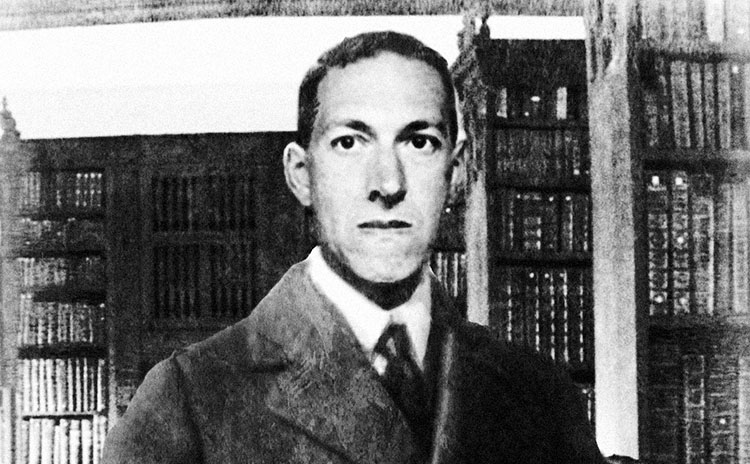
    Many people know of Howard Phillips Lovecraft’s (1890–1937) existential and otherworldly horror stories – or at least have seen some adaptation. Lovecraft’s influence across fiction, film, gaming, and beyond is vast and immeasurable, and celebrated artists cite the author as a major creative inspiration, from novelist Stephen King (IT, The Shining), graphic novelist Alan Moore (V For VendettaWatchmen), and author Jorge Luis Borges, Japanese writer Chiaki J. Konaka (Serial Experiments Lain, Marebito), manga artist Junji Ito (UzumakiTomie), and directors Guillermo Del Toro (Pan’s LabyrinthThe Shape of Water) and John Carpenter (The ThingHalloweenThey Live) – the list goes on and on.

    Despite his influence, few people know that HP Lovecraft was a prolific political writer who railed against both the soulless greed of American capitalism and the culture-destroying wrecking ball of Soviet communism.

    In Lovecraft’s early political writings, published in his amateur journal The Conservative, the primary target of his tirades was bolshevism. This ‘aristocrat of the soul’ feared communism would destroy high art and culture by demolishing the aristocratic (or, in the case of the United States, WASP pseudo-aristocratic) hierarchy.

    Howard Phillips Lovecraft (1890–1937)

    Lovecraft also criticised the concept of democracy, making similar observations to those that the Italian philosopher and occultist Julius Evola offered more than a decade later in his 1934 book Revolt Against the Modern World.

    “There is no such thing – there will never be such a thing – as good and permanent government among the crawling, miserable vermin called human beings,” Lovecraft declared in an October 1921 article titled Nietzscheism and Realism

    “Aristocracy and monarchy are the most efficient in developing the best qualities of mankind as expressed in achievements of taste and intellect; but they lead to unlimited arrogance,” he continued. “That arrogance in turn leads inevitably to their decline and overthrow. On the other hand, democracy and ochlocracy [‘mob rule’] lead just as certainly to decline and collapse through their lack of any stimulus to individual achievement. They may perhaps last longer, but that is because they are closer to the primal animal or savage state from which civilised man is supposed to have partly evolved.”

    In the same article, Lovecraft called for a Roman-style aristocracy that would accept any man who could prove himself “aesthetically and intellectually fitted for membership,” before channelling Schopenhauer and the future works of nihilist philosopher Emil Cioran with the line: “Universal suicide is the most logical thing in the world – we rejected it only because of our primitive cowardice and childish fear of the dark. If we were sensible we would seek death – the same blissful blank which we enjoyed before we existed.”

    Later, as the Great Depression crippled Americans and Lovecraft became increasingly ill and destitute, he altered his worldview – ridiculing the out-of-touch laissez-faire mentality of politicians and industrialists and warning that some form of American socialism would be necessary to prevent the rise of communism in the US.

    In a 1933 piece, Lovecraft criticised the “artificial finance-and-business tradition” which had become dominant in the US and argued that the capitalist class was willing to do anything – including kill off the masses through war – to “save the sacred cultural principles of ‘sound business’, ‘rugged individualism’, and bigger profits for people who do not need them.”

    “It is by this time virtually clear to everyone save self-blinded capitalists and politicians that the old relation of the individual to the needs of the community has utterly broken down under the impact of intensively productive machinery,” Lovecraft observed before warning that America would have to make radical changes – including guaranteed work for every American and the limitation of private property – to deter a revolution he claimed would start with good intentions, but ultimately result in “ruthless destruction of cultural values which such an upheaval would bring.”

    In another article, dated November 1933, Lovecraft complained that industrial laissez-faire capitalism had led only to America’s resources becoming concentrated in the hands of an increasingly small few.

    On the “pompous financiers” and politicians who had caused such a state of affairs, Lovecraft said that the “Americanism” and “freedom” they spoke of no longer meant anything more than “certain technical business principles” which “enable 2% of the population to corral 80% of the national resources and condemn an ever-increasing minority to unemployment and starvation.”1

    He lambasted the “capitalistic class” for regarding “the now-passing economic order” – as the Great Depression ended – to be “a good one.” 

    Lovecraft attacked: “All our smug ‘solid men’ and ‘best citizens’ have habitually condemned thousands to slow starvation and hundreds to actual death through industrial policies designed to give a few luxurious stockholders the added profits enabling them to keep three motor cars instead of two.”

    Many of Lovecraft’s observations and criticisms are eerily relevant today, nearly a hundred years on. With the ongoing decline of the US empire, the same out-of-touch cliches and policies that Lovecraft cited as responsible for the destruction of the American community back in his day still repeat today.

    Politicians on both the left and right use the same calls for “freedom” and “Americanism” as they did in the early 20th century, only this time to justify expensive, far-away wars while ordinary Americans suffer the effects of inflation and plummeting quality of life.

    Although Lovecraft started out politically conservative and later advocated some socialist positions in response to the devastation wrought by the Great Depression, for the most part, he remained a social conservative and continuously supported the concepts of aristocracy and hierarchy throughout his life.

    Lovecraft believed that the “old aristocracy” – which still held sway in 1930s America – would ultimately support the necessary changes to avoid communism due to their indifference to the “moneyed bourgeois element” with the most to lose. Ironically, he cited the British fascist leader Oswald Mosley and US President Franklin D. Roosevelt as two examples of aristocrats “who actively lead the quest for a workable social order.”

    Lovecraft laid out his vision for men like Mosley and Roosevelt:

    Indeed, the salvation of society really depends on the faithful and diligent services of disinterested gentlemen – since the inflamed masses without leaders can only tear down without building up. The people as a whole are densely and hopelessly ignorant – mere blind forces either cowed to silent suffering or bursting into resistless fury under too much goading – hence democracy is and always has been and will be a joke… or a tragedy. Salvation rests wholly with the trained man of vision and cultivation without the profit motive – namely, the fascistic leader.

    At the time of Lovecraft’s article, Mosley had recently launched the British Union of Fascists and – despite his aristocratic connections – was interned in 1940 in a British concentration camp for more than three years due to his beliefs. Roosevelt led America into World War 2 before passing away just months before the detonation of two atomic bombs on Hiroshima and Nagasaki.

    Ultimately, Lovecraft never saw the war or the era of prosperity that the US would experience in the decades following. He would never see the fall of fascism or the fall of the Soviet Union, and he would never see American capitalism reach new levels of horror. Even his own creative mind would have struggled to foresee it. He would never see his work – widely ignored and maligned during his lifetime – become some of the most popular stories in horror and science fiction history.

    Get the issue this article appears in

    Lovecraft died in his native Providence, Rhode Island, from intestinal cancer on 15 March 1937, age 46. He left this world in poverty and in severe pain.

    While Lovecraft died more than 86 years ago, his work and the intricate world he created continue to inspire and fascinate new generations. Despite the fact that the bulk of Lovecraft’s legacy can be seen in the cinema, comic books, video games, and other entertainment, it also appears in more serious fields such as the occult and even the military.

    In a September 2022 article for 19FortyFive titled “Read H. P. Lovecraft To Understand War,” James Holmes – chairman of Maritime Strategy at the US Naval War College and a former US Navy officer – argued that reading Lovecraft and other weird fiction “primes military practitioners and analysts to notice weird or eerie anomalies in the profession of arms.”2

    “Detecting a phenomenon is the first step toward adapting to it or turning it to advantage,” he wrote, adding that Lovecraft’s stories could help military strategists “make sense of the past, survey the world around us, and potentially glimpse the future.”

    Could that same argument be made for the study of conspiracies, cover-ups, and Fortean activity? Could this also be why Lovecraft’s ideas are so ingrained in much of the modern occult?

    Charles Fort and his investigations into the paranormal influenced Lovecraft, who was also obsessed with the unknown, the unexplained, and the concept of forbidden knowledge. Lovecraft referenced “the extravagant books of Charles Fort with their claims that voyagers from other worlds and outer space have often visited the earth” in his 1931 science-fiction horror story The Whisperer in Darkness.

    In his article, Holmes cites examples of how Lovecraft’s work could help NATO and Ukraine in their conflict against Russia – an interesting observation since Russia is among the countries where Lovecraft’s tales are most widely read.

    Shelf of Lovecraft titles in a Moscow bookstore.

    Russian translations of Lovecraft can be found in abundance in Moscow bookstores, with some outlets holding dedicated shelves to his weird fiction – a rare sight in even English-speaking countries. Remarkably, Russian President Vladimir Putin himself addressed the topic of Cthulhu, the fictional cosmic entity that appears in several of Lovecraft’s stories, after questions about the apocalyptic awakening of the sleeping, underwater tentacle god were the fourth most popular at a Q&A in 2006!

    While some critics of the Russian president have accused him of holding a “dark pact” with Cthulhu, Putin told Lovecraft-mad Russian youth: “I am generally suspicious of any otherworldly forces. If someone wants to turn to true values, then it is better to read the Bible or the Koran. It will be more useful.”3

    [alert type=”general” dismiss=”no”]This article was published in New Dawn 198.[/alert]

    [alert type=”success” dismiss=”no”]If you appreciate this article, please consider subscribing to help maintain this website.[/alert]

    Footnotes

    1. hplovecraft.hu/index.php?page=library_etexts&id=771&lang=angol
    2. 19fortyfive.com/2022/09/read-h-p-lovecraft-to-understand-war/
    3. majikthise.typepad.com/majikthise_/2006/07/vladimir_putin_.html

    © New Dawn Magazine and the respective author.
    For our reproduction notice, click here.