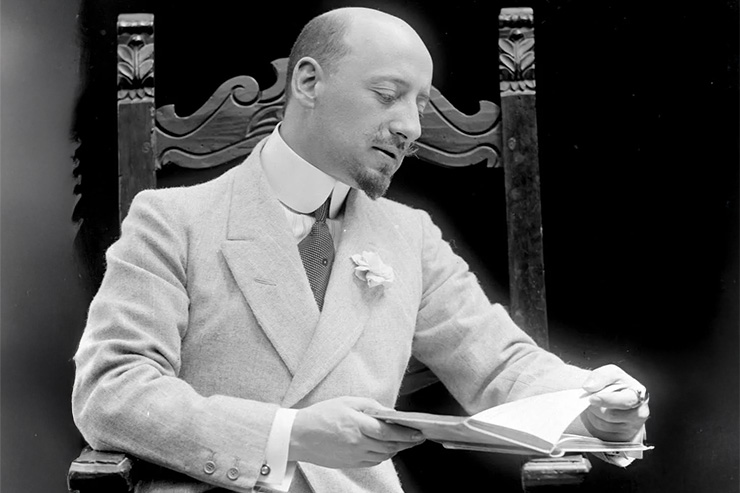
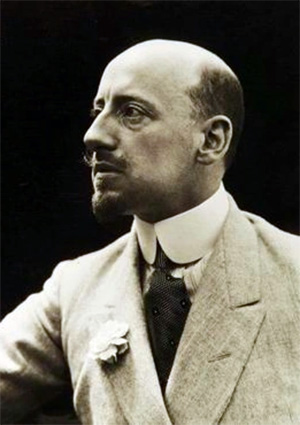
When pressed about his political allegiance, Gabriele D’Annunzio (1863-1938) refused to commit himself. “My undertaking may seem rash and alien to my art and style of life,” he wrote to his publisher, “but… people must realise that I am capable of doing anything.” After his election to Italy’s Chamber of Deputies he showed his contempt for the parliamentary circus by rarely attending the sessions, and behaving unpredictably when he did. Nicknamed “the deputy of beauty”, D’Annunzio watched the parliamentary debates as an artist rather than a participant. Originally elected to the Chamber as a ‘rightwing’ nationalist, he had no trouble crossing the floor to vote — and sit with — members of the ‘extreme left’.
Plagued by creditors, D’Annunzio settled in France in 1910 to concentrate on his writing and art. Since the 1890s he had enjoyed mass appeal and on returning to Italy in 1915 he was greeted by some one hundred thousand admirers. A strong supporter of Italy’s involvement in the First World War, D’Annunzio, aged fifty-two, volunteered for active service in the trenches. A daring aviator, he led bombing raids, losing an eye in an aeroplane accident. In a final act of heroism, as the war drew to a close, he flew as far as Vienna and there dropped propaganda pamphlets from his aeroplane.
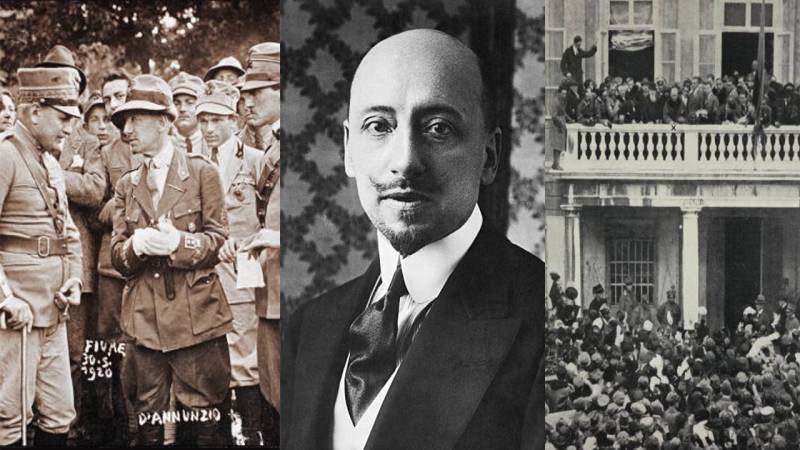
At the Peace Conference of 1919, Italy claimed the port of Fiume on the grounds of self-determination. Little aroused the indignation of so many Italians as much as the question of Fiume. The US, Britain and France argued that Fiume be included in Yugoslavia and occupied the port. A group of young army officers begged the war hero D’Annunzio to seize Fiume for Italy. On September 12 he marched from Rome at the head of a thousand black shirted legionaries; the Allied troops withdrew and D’Annunzio, who announced his intention of remaining in the city until it was annexed by Italy, assumed control of the port city as the ‘Commandante’.
Within a few weeks some seven thousand legionaries and four hundred sailors had joined him. They saw in D’Annunzio a heroic alternative to the sedentary parliamentarians they despised. For them the Commandante’s Fiume became “the symbol of a moral, political and social rejection of the entire established order.” The legionaries called for the freedom of all oppressed people and viewed with interest the Soviet experiment in Russia. They were open to an alliance with the syndicalists, anarchists and Socialists. D’Annunzio established contacts with Sean O’Kelly, the future President of Ireland, who then represented Sinn Fein in Paris; with the Egyptian nationalists; and with the Soviet government. Lenin referred to D’Annunzio as one of the only revolutionaries in Italy.
In asserting the independence of Fiume, Gabriele D’ Annunzio denounced the big powers, especially British imperialism:
“Fiume is as invincible as she has ever been. True, we may all perish beneath her ruins, but from these same ruins the spirit will rise again strong and vigorous. From the indomitable Sinn Fein of Ireland to the Red Flag which unites cross and crescent in Egypt, rebellions of the spirit, catching fire from our sparks, will burn afresh against the devourers of raw flesh, and the oppressors of unarmed nations. The voracious Empire which has possessed itself of Persia, Mesopotamia, New Arabia and a greater part of Africa, and yet is never satisfied, can, if it so wishes, send its aviator-murderers against us, just as in Egypt it was not ashamed to massacre insurgents, who were armed with nothing more than sticks.”
Many of D’Annunzio’s emblems were later taken over by Mussolini. The legionaries’ black shirts derived from the tunics of first world war shock troops. Garibaldi, the father of modern Italy, had made all Italians familiar with the idea of a coloured shirt as a symbol of a liberating cause. Even the word Fascio, from which is derived Fascism, meaning “group” or “association” (literally “bundle”), had long been used by the Italian leftwing. In 1872 Garibaldi had founded a Fascio Operaio, and in 1891 an extreme leftwing group was set up known as Fascio dei Lavoratori.
For fifteen months the Commandante held out against Allied protests and an Italian government blockade. Then on 24 December 1920, “the Christmas of Blood” as D’Annunzio called it, 20,000 troops moved against D’Annunzio’s 3,000.
While it lasted, the short lived Free State of Fiume, under the direction of Commandante D’Annunzio, stood as a heroic, passionate revolt against mediocrity. For in the words of D’Annunzio:
“Blessed are the youths who hunger and thirst for glory, for they shall be satisfied.”
Gabriele D’Annunzio
By HAKIM BEY
“Everything in life depends upon the eternally new. Man musteither renew himself or die.” – D’Annunzio
Gabriele D’Annunzio, Decadent poet, artist, musician, aesthete, womanizer, pioneer daredevil aeronautist, black magician, genius and cad, emerged from World War I as a hero with a small army at his beck and command: the “Arditi.” At a loss for adventure, he decided to capture the city of Fiume from Yugoslavia and give it to Italy. After a necromantic ceremony with his mistress in a cemetery in Venice he set out to conquer Fiume, and succeeded without any trouble to speak of. But Italy turned down his generous offer; the Prime Minister called him a fool.
In a huff, D’Annunzio decided to declare independence and see how long he could get away with it. He and one of his anarchist friends wrote the Constitution, which declared music to be the central principle of the State. The Navy (made up of deserters and Milanese anarchist maritime unionists) named themselves the Uscochi, after the long-vanished pirates who once lived on local offshore islands and preyed on Venetian and Ottoman shipping. The modern Uscochi succeeded in some wild coups: several rich Italian merchant vessels suddenly gave the Republic a future: money in the coffers! Artists, bohemians, adventurers, anarchists (D’Annunzio corresponded with Malatesta), fugitives and Stateless refugees, homosexuals, military dandies (the uniform was black with pirate skull-&-crossbones — later stolen by the SS), and crank reformers of every stripe (including Buddhists, Theosophists and Vedantists) began to show up at Fiume in droves. The party never stopped. Every morning D’Annunzio read poetry and manifestos from his balcony; every evening a concert, then fireworks. This made up the entire activity of the government. Eighteen months later, when the wine and money had run out and the Italian fleet finally showed up and lobbed a few shells at the Municipal Palace, no one had the energy to resist.
D’Annunzio, like many Italian anarchists, later veered toward fascism — in fact, Mussolini (the ex-Syndicalist) himself seduced the poet along that route. By the time D’Annunzio realized his error it was too late: he was too old and sick. But Il Duce had him killed anyway — pushed off a balcony — and turned him into a “martyr.” As for Fiume, though it lacked the seriousness of the free Ukraine or Barcelona, it can probably teach us more about certain aspects of our quest. It was in some ways the last of the pirate utopias (or the only modern example) — in other ways, perhaps, it was very nearly the first modern TAZ [Temporary Autonomous Zone].
I believe that if we compare Fiume with the Paris uprising of 1968 (also the Italian urban insurrections of the early seventies), as well as with the American countercultural communes and their anarcho-New Left influences, we should notice certain similarities, such as: — the importance of aesthetic theory (cf. the Situationists) — also, what might be called “pirate economics,” living high off the surplus of social overproduction — even the popularity of colorful military uniforms — and the concept of music as revolutionary social change — and finally their shared air of impermanence, of being ready to move on, shape-shift, re-locate to other universities, mountaintops, ghettos, factories, safe houses, abandoned farms — or even other planes of reality. No one was trying to impose yet another Revolutionary Dictatorship, either at Fiume, Paris, or Millbrook. Either the world would change, or it wouldn’t. Meanwhile keep on the move and live intensely.
Excerpted from Hakim Bey’s T.A.Z. The Temporary Autonomous Zone, Ontological Anarchy, Poetic Terrorism
[alert type=”general” dismiss=”no”]This article was published in New Dawn No. 21 (Sept-Oct 1993).[/alert]
[alert type=”success” dismiss=”no”]If you appreciate this article, please consider subscribing to help maintain this website.[/alert]
Ernst Jünger isn’t a name on many English speakers’ lips, although in his home country of Germany he is recognised as one of that nation’s greatest literary figures, if not one of Europe’s. Evidence of this esteem is the Goethe prize Jünger was awarded in 1982 by the city of Frankfurt, which caused something of an uproar, for reasons that will become clear. For English speakers, this would be rather like receiving a Shakespeare prize, if there was an equivalent.
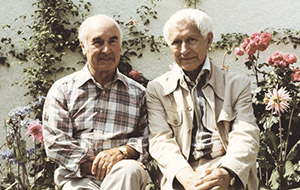
Swiss chemist Albert Hofmann (left), the discoverer of LSD, with Ernst Jünger (right). Photo credit: www.dla marbach.de
The one area of English language literature in which Jünger’s name might not be entirely unfamiliar is in the annals of psychedelia. In the 1950s and 60s, Jünger tripped a few times with Albert Hofmann, the Swiss discoverer of lysergic acid diethylamide, or LSD. Hofmann was a fan of Jünger’s writing; his unclassifiable work The Adventurous Heart, first published in 1929 and then in a heavily revised edition in 1938, literally changed Hofmann’s life. Every page of Jünger’s jewelled and gnomic prose in that unusual work made the “miracle of creation” evident to Hofmann, well before his celebrated psychedelic bicycle ride in 1943, which is generally acknowledged as the first consciously taken “acid trip.” In Jünger’s kaleidoscopic collection of observations, dreams, descriptions of flowers, meditations on colour, ruminations on chance, and other seemingly disconnected jottings, Hofmann believed that “the uniqueness and imperishable in every human being was touched upon.” “No other writer has thus opened my eyes.”
In 1951, Hofmann had the opportunity to return the favour, opening Jünger’s eyes to the effects of LSD. Jünger later transmuted his experience with Hofmann into literary expression in the elliptic and allusive Visit to Godenholm (1958), which, I suspect, is unique in drug literature in being a fictional account of a psychedelic experience in which no mention of drugs or intoxication appears. In 1970, Jünger’s non-fiction account of his own drug experiences, collected over many years and with many substances, Approaches: Drugs and Intoxication,was published. Like much of Jünger’s huge body of work, it is still awaiting translation into English. Something else that Jünger shared with Hofmann was a long life. Jünger died in 1998 at the age of 102, having been, with other rare distinctions, among the few who could say they saw Halley’s comet twice, a fact he enshrined in his book Twice Halley (1987). Ten years later, Hofmann died at the same age, passing away in 2008.
The Adventurous Heart introduced two of Jünger’s central themes, which he was to refine and deepen throughout his later work. These were what he called, borrowing from the French, désinvolture, which does not have an exact English translation, and “stereoscopy.” Dictionaries give “disinterest,” “casualness,” and “offhand manner,” as English equivalents of désinvolture, all of which suggest something of what Jünger means. It is for him a detached, disinterested – but not uninterested; the distinction is crucial – perception of phenomena, rather in the way that the philosophical method known as phenomenology approaches its subjects. Fundamentally, it is a way of getting the “self” or ego out of the way, with all its biases and subjectivity, and perceiving things as they appear, in all their complexity, and not simply as agents of our desires. Such an attitude leads, Jünger claims, to a perception of things that is dual, revealing surface and depth, the outer skin and inner heart, simultaneously, hence stereoscopically.
One element of stereoscopy is an experience of synaesthesia when the senses seem to trade places, and one hears colours and sees sounds. Arthur Rimbaud, a poet whose work influenced Jünger, was prone to this, as evidenced in his poem “Vowels,” in which A is black, E white, I red, O blue, and U green. Not to be outdone, Jünger developed his own colour scheme for vowels, spelled out in his essay “In Praise of the Vowels,” where he argues for a primal correspondence between language and the world, a kind of ur-sprache at the heart of Being.
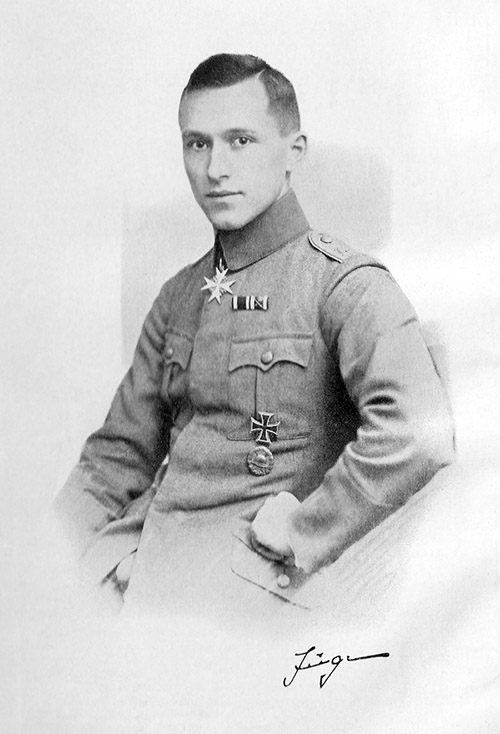
Ernst Jünger in uniform as depicted in the frontispiece of the 3rd edition of In Stahlgewittern (Storm of Steel) (1922)
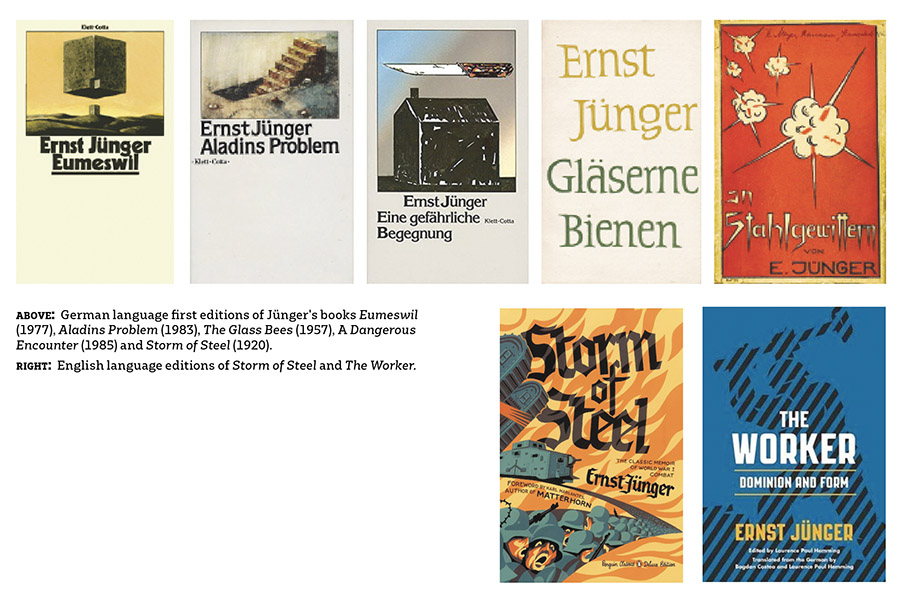
Another central theme to emerge from Jünger’s désinvolture, but in a more political – or really apolitical – sense, was his notion of “the anarch.” This is an individual who, while ostensibly accommodating the demands of society, in essence follows his own laws and values and aims. Unlike the anarchist who openly fights against authority – and hence is still in an “enabling” relationship with it – the anarch works invisibly, under cover, making the minimal surface obeisance, while secretly preparing, if necessary, his escape, a tactic that Jünger portrayed in his major fictional work, Eumeswil (1977). In this admittedly at times obscure dystopian fable – like his contemporary and friend the philosopher Martin Heidegger, Jünger does not make things easy for his readers, although Jünger’s style is nothing like Heidegger’s. Jünger’s protagonist, a historian, observes the currents of power under a future benevolent dictatorship following the collapse of a world state. The kind of cool, detached but engaged observation characteristic of désinvolture is here brought to bear on the machinations of tyrants and the revolutionaries opposed to them. Neither receives Martin Venator’s – Jünger’s protagonist – assent, but he recognises that until things change, they are realities through which he must manoeuvre.
To say that Jünger’s name isn’t known outside of odd eccentric circles is, of course, an exaggeration. The problem, at least in the English-speaking world, is that the reputation he does have among English critics is based on his earliest work. Jünger’s first book, The Storm of Steel, self-published in 1920, and subsequently released to wide acclaim by a Berlin publisher, is a blistering, gripping, aptly explosive and disturbingly graphic account of his experiences in WWI. It made Jünger famous at twenty-four and became a best-seller and is the work he is still most known for today. Jünger emerged from the war a highly decorated hero, receiving the Iron Cross and the Pour le Mérite, the prized “Blue Max.” He was wounded seven times and can be seen as a German Sgt York, the American infantryman who was equally honoured in the Great War.
Living Dangerously
Yet while most literature to emerge from the “war to end war” focused on its absurdity, loss of life, pain and suffering – think of Erich Maria Remarque’s All Quiet on the Western Front (1929) Henri Barbusses’ Under Fire (1916), and the poetry of Wilfrid Owen, who died in 1918, just before the armistice – Jünger’s account was a celebration of it. Not, as one might think, as a militarist or a nationalist, although to be sure Jünger took a professional interest in military strategy and was indeed a nationalist with a great love of Germany. Jünger’s perspective on war was epic, Homeric, and what a reader finds in his still riveting account is how combat brings out the heroic virtues and intensifies consciousness. It is an account of how, as Ernest Hemingway, another war writer, expresses it, the war made Jünger “feel cool and clear inside,” “when he had done the one thing, the only thing for a man to do, easily and naturally…” Combat, like other “limit conditions,” can free man from, in Colin Wilson’s term, “the robot,” that mechanical part of us that has us live life automatically. Danger, threat, crisis, can loosen the robot’s grip. This is why someone like Jean-Paul Sartre, as ideologically opposed to Jünger as one could get, confessed that he never felt as free as when he was in danger of being arrested by the Gestapo – oddly, he and Jünger were in Paris at the same time. It is also why many Londoners remembered the Blitz as the happiest time of their lives. A paradox, perhaps, but true. Crisis can make us feel more alive – hence the predilection of Wilson’s Outsiders to, in Nietzsche’s words, “live dangerously.”
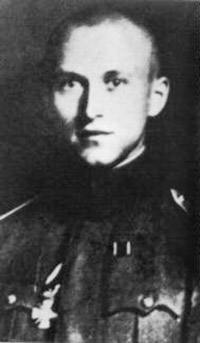
Jünger during World War I, wearing the House Order of Hohenzollern.
“Living dangerously,” we can say, is something Jünger did, in different ways. It was a way of embracing “adventure,” something Jünger wanted to do from early on. In his early teens, he joined the Wandervogel, “wandering birds,” a German youth movement that rejected urban life and headed to the country, getting back to nature and off the grid a century before today’s eco-warriors, who are among his readers. More than one historian has noted the similarities between the “wandering birds” and the hippies of the 1960s. Before enlisting at the start of WWI, in 1913, at the age of eighteen, Jünger ran away from his affluent middle-class family to join the Foreign Legion. Travel to exotic lands always excited him – again Rimbaud – and his plan was to abandon the Legion and head for equatorial Africa. He made it to North Africa but was found by legionnaires soon after he went AWOL. Remarkably, his father, a successful chemist, was understanding and promised him a proper “African diversion” – the title of Jünger’s fictional account of his exotic jaunt – upon completion of his studies. Jünger’s youthful excursion set the tone for much of his later life; adult journeys took him around the globe. Yet before his father’s promise could be kept, the adventure of Jünger’s life began. In 1914 the guns of August blazed and Europe was at war.
After the war the now famous and heavily decorated Lieutenant Jünger studied zoology at Leipzig and Naples and continued his lifelong fascination with entomology; an amateur in the best sense, there are, in fact, more than one species of beetle named after him; his collection later numbered some 40,000 specimens, some of them gathered from the trenches. Around the same time Jünger began writing political journalism, mostly for right-wing, conservative and military journals, among them the Völkischer Beobachter, the Nazi daily newspaper; he later accused its editor of plagiarism when they published an excerpt from his work without permission or credit. Jünger was a stern critic of the Weimar Republic and of democracy in general – too susceptible to demagogues – and was a part of what was known as the Conservative Revolution which included the jurist Carl Schmidt and the historian Oswald Spengler (Schmidt was a Nazi; Spengler poked fun at Hitler). The mechanisation of war he had experienced convinced Jünger that a new age had begun, that of the technological Titans. These were twentieth-century upgrades of dark archaic forces which, like the genie of Aladdin’s lamp, would soon get out of control – a metaphor Jünger unpacked in his disturbing funereal parable Aladdin’s Problem (1983). This meant the end of any cosy bourgeois dream of liberalism and progress. Jünger’s The Worker (1932) envisions a mechanised, technologically driven coming totalitarian state, something along the lines of the dystopian dictatorship of his contemporary Fritz Lang’s film Metropolis (1927).
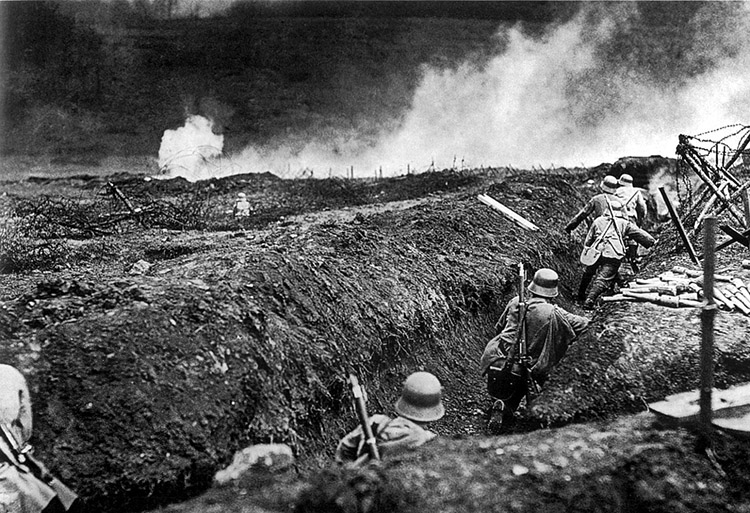
German Stormtroopers during a trench assault in 1917 France.
The dictatorship that did come to power had its eye on Jünger. Although he was approached twice by the Nazis and offered a seat on the Reichstag and membership in the gleichgeschaltet (“conformed”) German Academy of Writers, Jünger declined. His political sympathies were on the right, but they did not include thugs and rabble like the Nazis, whom the aristocratic Jünger saw as little more than criminals. During this time Jünger’s acquaintances included Bertolt Brecht and Ernst Toller, two left-wing playwrights, as well as figures on the right, like Schmidt. His friendship with the anarchist Erich Mühsam led to the Gestapo searching his rooms for correspondence. They found nothing – Jünger always covered his tracks – but Mühsam died in a concentration camp in 1934. Jünger’s internal opposition to Hitler took the form of his lapidary political fantasy, On the Marble Cliffs (1939), an exquisitely polished parable of how the serene, contemplative existence of two poetic botanists – Jünger and his brother Friedrich – is destroyed by the dark forces of the Chief Ranger – read Goering – and the tragedy of the ineffectual opposition’s inability to stop his rampage. Although Jünger dismissed the idea that the work was a strict allegory of Nazi Germany – rather of totalitarianism in general, he said – the parallels are too obvious to ignore. The book sold as well as The Storm of Steel, and it is remarkable it was allowed to remain in print.
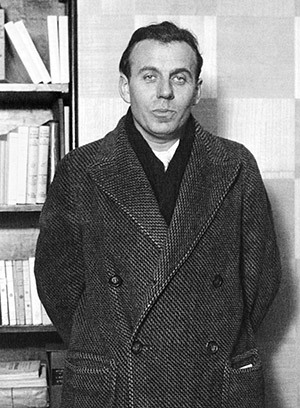
Louis-Ferdinand Céline (1894–1961)
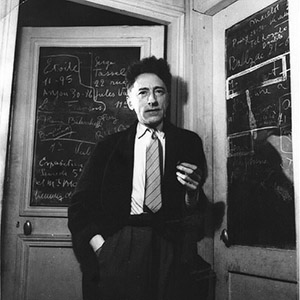
With the outbreak of WWII, Jünger was called back to service and promoted to captain. Aside from a gruelling visit to the Eastern Front, for the most part Jünger sat the war out as part of the general staff in Paris where his duties as censor left him with much free time. (This was how he came to be there at the same time as Sartre. Interestingly, another inhabitant of Paris at the time was the Greek-Armenian esoteric teacher G.I. Gurdjieff, whom Jünger mentions more than once in his work.) Jünger became acquainted with many artists and writers living in the occupied city, figures like Picasso, Braque, Cocteau, the anti-Semite Louis-Ferdinand Céline and the fascist writer Robert Brasillach, later executed as a collaborator. Jünger recorded his Parisian adventure in his extraordinary journals, where accounts of treasonous conversation share space with those of his erotic encounters, his dreams, his long solitary walks, and meetings with artists and literati, as well as his attempts to help Jews and others subject to Nazi terror. This work alone confirms that Jünger was a born diarist; the short, aphoristic note or thought was his real metier, not the novel or even the essay.
Jean Cocteau (1889–1963)
Jünger also found himself orbiting close to the circle of high-ranking military men who were opposed to Hitler and plotted the failed assassination attempt on 20 July 1944. He kept his distance, sceptical of its success. His intuition proved right, and Jünger was supposedly saved from sharing the gruesome fate of the conspirators by Hitler himself, who reportedly said: “Nothing happens to Jünger.” The war hero had exchanged books with the future führer years before, and Hitler respected him; the only other writer to stand up to Hitler, as it were, was the Norwegian Knut Hamsun, although Hamsun, unlike Jünger, was a fan of the Nazis. As we’ve seen, Jünger was also meticulous about evidence. As Jean Cocteau said of him, “Some had clean hands, some had dirty hands, but Jünger had no hands.” Nevertheless, Jünger was forced to retire from service, and the death of his son, sent on a suicide mission in Italy, was felt as retaliation.
Toward the end of the war, Jünger circulated a curious utopian text, The Peace (1945), in which he argues for the need of a new Christian age to heal the world’s ills. Throughout WWII, Jünger read the Bible cover to cover, twice, and although it was not until shortly before his death that he converted to Catholicism, here a kind of millenarianism seems to enter his work. Alongside this was the figure of the anarch, who he presages in the character of the “forest fleer,” the theme of The Forest Passage (1951). This is a philosophical excursion diametrically opposed to the ethos of The Worker, a volte-face that Jünger acknowledges divides his work into two periods, what he ironically calls the Old Testament and the New. No longer celebrating the advent of a highly efficient, automated technological dystopia, Jünger now looks to the self-sufficient, incorrigibly independent individual to claim the freedom that is his birthright and which is quickly being absorbed by what Nietzsche, an influence on Jünger, called “the monster, the State.”
Like others troubled by the growing pervasiveness of technology into all aspects of life, Jünger turned to science fiction as a means of communicating his concerns; he was, in fact, a great reader of Aldous Huxley, and Brave New World especially. In Heliopolis (1949) – sadly yet to see an English translation – Jünger depicts the political gangsterism and feudal violence of rival powers battling over dominance in a future city of indefinite location. As the “forest fleer” does in The Forest Passage, Lucius de Greer, the protagonist, finally lights out for parts unknown, escaping the authoritarian state. Jünger’s distrust of technology doesn’t prevent him from predicting developments. The “phonophore” that appears in Eumeswil – a kind of sequel to Heliopolis – is a remarkably accurate anticipation of the iPhone. It is, like the iPhone, a multiple-use device, and the possessors of its highest grades have access to functions the lower ones do not. The “luminar” seems a kind of combination internet, Wikipedia, and virtual reality machine, a device that allows its user to “replay” events in history in a kind of 3D, HD display, with which one can participate.
Another disturbing anticipation is the kind of animatronics at the heart of The Glass Bees (1957). Here, Captain Richard, a former cavalry officer down on his luck – there is no place for him in the modern world – is forced to take a job at the Zapparoni Works, where a Walt Disney-like techno-savant outdoes nature by creating automated creatures that are superior to the “real thing.” The glass bees of the title extract nectar more efficiently than the originals, who, like many feeling the effect of automation, are put out of business by them. Disney may seem too innocuous an allusion for this usurpation of the real by the simulation, so perhaps Dr Robert Ford of Westworld is more apt.
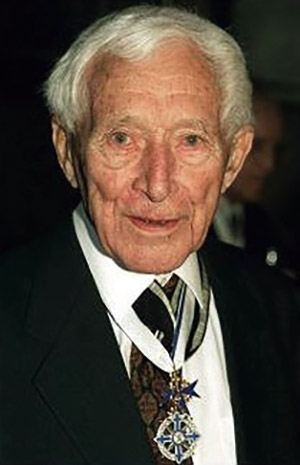
An elderly Ernst Jünger (1895–1998), wearing both the Pour le Mérite and the Bavarian Maximilian Order.
Jünger’s defence of personal liberty, nature and the environment, has gained him a younger readership in recent years, especially among the ecological minded generation, as well as among those fascinated by his fastidious articulation of the importance of dreams, myths, poetic and mystical experiences, and other forms of an ancient wisdom sadly in need of a renaissance. He has acquired readers around the world and counted German Chancellor Helmut Kohl and French President François Mitterrand among his fans. He is not to everyone’s taste. As mentioned, controversy broke out in democratic Germany over a right-wing nationalist receiving the Goethe prize. The late literary scholar George Steiner, while calling for more English translations of Jünger’s work, also chides his lapidary sangfroid, his dandy-like aestheticizing of danger, and mandarin unconcern about messy humanity, such expressions of désinvolture serving, for Steiner, as evidence of “an atrophy at the vital centre.” And the attitude of many remains that however Jünger may have opposed Hitler “internally,” his disavowals do not dispel the received misperception that he was a Nazi fellow-traveller, or that his youthful celebration of “battle as inner experience,” the title of a version of The Storm of Steel, prepared a generation for war and inspired it to go to war. His later work, full of mystical significance, poetic insight and an advocacy of a free humanity participating in a living nature, is often conveniently forgotten, while the old accusations are dutifully trotted out, often by leftist critics, unconcerned about their own doubtful ideological heritage.
A short essay such as this can only introduce Jünger to readers unaware of him, and unless one reads German, a great deal of his writing – on travel, culture, philosophical and psychological questions, and unusual fauna and flora – will remain unavailable to them. What there is in English is limited, but the major works are there. For readers interested in an unbuttoned Jünger, the series of dialogues he held with his French translator Julien Hervier are also in English. They are a fascinating read, if only for getting a sense of the perspective of a man who survived two world wars, saw Halley’s comet twice, and has a prize in entomology named after him. Not bad for a centenarian anarch.
[alert type=”success” dismiss=”no”]If you appreciate this article, please consider subscribing to help maintain this website.[/alert]
Footnotes
1. There is in fact a Shakespeare prize, but it leans more toward performance than writing; ironically, it was started in 1937 by the Hamburg merchant Alfred Toepfer as an expression of his love for England and his advocacy of a united Europe, incidentally a dream of Jünger’s as well. WWII scotched that idea, and the next prize wasn’t awarded until 1967.
2. Oddly enough, I started writing this article on 16 April and put the finishing touches on it today, the 18th. Tomorrow, the 19th, is “Bicycle Day,” a worldwide celebration of Hoffman’s original wigged out ride. https://blogs.scientificamerican.com/cross-check/tripping-in-lsds-birthplace-a-story-for-e2809cbicycle-daye2809d/
3. Albert Hofmann, LSD: My Problem Child, Tarcher Books, 1983, 145-46
4. Ernst Jünger Visit to Godenholm (Edda Publishing, 2015) translated by Annabel Moynihan. This edition contains remarkable illustrations by the artist Fredrik Söderberg.
5. I write about Jünger’s stereoscopy in Lost Knowledge of the Imagination.
6. For an interesting discussion of Jünger’s ideas about language, especially the alphabet, see Richard Firmage The Alphabet Abecedarium, Bloomsbury, 2000.
7. Although they are radically different books written by very different writers – who nonetheless share several common interests – Jünger’s first book shares with that of Colin Wilson, The Outsider, the status of being the one that superficial critics know and which coloured the subsequent reception of their later works. In both cases, negative assessments of their first and most well-known work led to most of their later work being misrepresented or ignored.
8. Ernest Hemingway, “Soldier’s Home,” quoted in Colin Wilson, The Outsider, Tarcher Perigee, 2016, 36
9. The unorthodox Marxist-Kabbalist Walter Benjamin, Jünger’s contemporary and ideological opponent, was also associated with the Wandervogel.
10. Ernst Jünger African Diversion, John Lehmann, 1954, translated by Stuart Hood.
11. Recently translated into English. Ernst Jünger A German Officer in Occupied Paris The War Journals 1941-1945 (Columbia University Press, 2019), translated by Thomas S. Hansen and Abby J. Hansen.
12. George Steiner, Introduction to Ernst Jünger, On the Marble Cliffs (Penguin Modern Classics, 1983), translated by Stuart Hood, 14
13. Julien Hervier, The Details of Time: Conversation with Jünge, Marsilio Publishers, 1995.
I can’t help but think of how it all began. As I write at my desk, I have in front of me the first printed copy of Gods of the Bible, first on top of a tall pile of books, block notes, and paper sheets. Such crumbling towers take up most of the desk. My books and those of others form a chaos of overlapping memories and voices while the rays of the afternoon sun filter through the window and light some of the covers up.
One of these volumes always holds special meaning for me – a pink notebook with my first interlinear translation of the Book of Genesis, written in pencil. Even today, every time I write, I can’t help but think of how it all began. It was more than twenty years ago, twenty-five, almost. I was just a lover of ancient languages, Latin, Greek, and Hebrew. At this same desk, much emptier, I translated the Bible day and night. Then, as in all stories, adventure was born of a mistake, a small, insignificant typo. It was a rather trivial typo that I might have discovered in the edition of the Hebrew Interlinear Bible of the most famous Italian religious publisher: Edizioni San Paolo. That’s how it all started – with a mistake.
It’s worth telling the reader that Edizioni San Paolo is Italy’s most prominent Catholic publishing house. Its Vatican-approved publications are used in graduate and post-graduate Biblical Hebrew and Bible studies courses in Catholic universities and departments. I was just a self-taught translator of the Bible. And yet, it was I who caught an error. At first, I questioned my skills. I tend not to jump to conclusions too soon. I have a background in Classics, and my mindset is that of a philologist. I double-checked my grammar books and compared different translations; I read and reread many times the same passage until I was convinced I had found a mistake.
Finding errors, flaws, and typos in books is hardly surprising. In mine, they are there. And in the books of others, too. But we are human beings. The Bible, on the other hand, is a book “inspired by God.” That is what we have been taught. It contains the absolute truth – so say the theologians. More than half of humanity bases its existence and life values directly or indirectly on the Bible. As a result, the Bible has become the basis of an immense power structure. Any mistake could raise the suspicion that this monstrous giant was, in reality, a giant on clay feet.
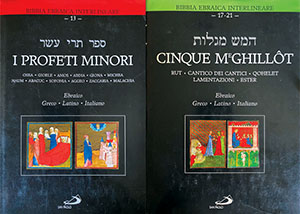
And yet I was there looking at this mistake, like an engineer who finds a small crack in a dam. Little did I know then that that error was the first of many I was about to discover. But at that moment, I shrugged my shoulders without thinking much about it. I wrote a short note to the publisher saying, “Hey, I think I found a mistake; you might want to fix it.” A few weeks later, out of the blue, they contacted me and said: “May we see some of your translations?” I sent them my Genesis, a copy of the pink block note I now observe from my chair. It was the turning point. A decade-long collaboration began. Following this partnership, I published seventeen books of the Old Testament in Edizioni San Paolo’s Hebrew Interlinear Bible.1
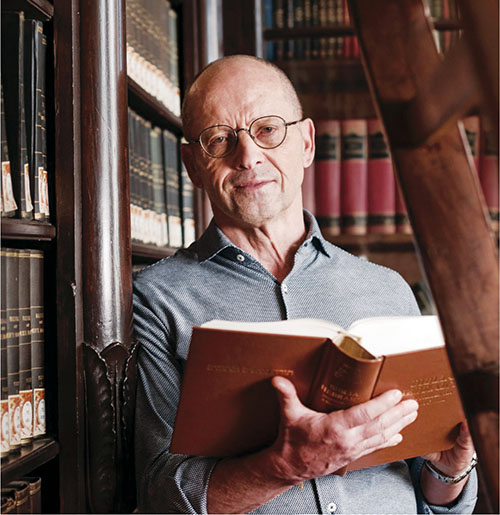
Italian author, translator and scholar Mauro Biglino discovered that a literal reading of the Bible opened an avenue to the more obvious meaning of the text which in turn revealed secrets.
Since the beginning of my professional career as a Bible translator, I have never stopped finding errors in the Bible, particularly in the Old Testament. Not just minor typos and mistakes but downright forgeries and tendentious mistranslations. My last work, Gods of the Bible, just came from print and smells of glue and fresh paper. It’s my latest effort in this twenty-five years long research, but I still feel that the fil rouge with that first pink block note was never broken. The same spirit moved me. Understanding how such a fragile text as the biblical one could become the foundation of a monstrous power system and religions followed by billions of people.
Few books in the history of humanity have been written, rewritten, added to, corrected, changed, and censored as often as the Bible. The text of the Bible, mainly fixed after the sixth century BC, but based on older oral and written traditions, is one of the most fragile, unreliable texts in human history. What should surprise us is not so much that someone is looking in it for traces of an ancient advanced civilisation, but the fact that someone – theologians – could build absolute truths on such text, with a dogmatic approach that has often become in history and often still becomes fanaticism.
The Bible is Not a Holy Book
I may have anticipated a theme that could frighten more cautious readers. Still, there is no way to prepare a traditional readership for the hypothesis I seek to test in Gods of the Bible, starting precisely from the Hebrew translations and the demystification of theological, spiritualising readings. But I have to start somewhere, and I have no better option than playing cards face up. Therefore, let me declare right off that the Bible is not a holy book. In antiquity, the term “holy” was understood as everything “reserved” for the deity. This term has by no means the spiritual value we ascribe to it today. The protagonists of the biblical accounts all move within a materialistic and immanentist horizon, very concrete and tangible.
The Old Testament is just the story of the alliance/relationship between Yahweh and the family of Jacob-Israel, and such a tale is deprived of any universalistic perspectives (a later invention of Christianity). This alliance, which did not even involve all the descendants of Abraham’s family but only one of its branches, that of Jacob-Israel, is not a universal but a particular account of events that happened at a specific time in history in a specific place: today we would perhaps label it as a local history book. Yahweh, the protagonist of the Old Testament, was just the leader of the family of Jacob.
Other families, peoples, and nations had their leaders; only they did not take the pain to write an accurate account of such relationships. Or maybe they did, and the books were lost. But the question is: who were these “leaders” that the ancient people considered “deities” and referred to by different but equivalent names? The Sumerians called them “Anunnaki,” the Egyptians called them “Neteru,” and the Babylonians called them “Ilanu.” The Bible calls them “Elohim.” Who were the Elohim, then?
Ten or so years ago, when I started voicing my doubts about the correctness of translating the term “Elohim” with “God,” Edizioni San Paolo’s bosses began to worry about my heterodox ideas, and our collaboration came to a halt after seventeen books were published together. What made them so mad? The extraterrestrial hypothesis, to be fair, was not the main problem, as the Catholic Church does admit the possibility of extraterrestrial intelligence. Rev. Jose Gabriel Funes, ex-Vatican’s chief astronomer, avers that there is no conflict between believing in God and the possibility of “extraterrestrial brothers,” perhaps more evolved than humans.2
Front covers of books translated and published by Biglino of sections of the Old Testament in Edizioni San Paolo’s Hebrew Interlinear Bible.
Literal Reading of the Bible
The main problem was my methodology and its profound implications. To be clear, I propose a literal interpretation that allows me, and all those who adhere to it, to read the Bible, and particularly the Old Testament, from the vantage point of distancing myself from the theological filters that have buried the “sacred text” for thousands of years, making it unreachable and unusable.
Monotheistic theology has deprived us of the possibility of treating the Bible like any other ancient source to be studied objectively. If treated as any other ancient source, the Bible could say much about the history of humankind before saying anything about God. But here lies the problem. Nobody knows anything about God, yet priests and theologians claim the right to interpret the Bible according to their theological schemes. It is frankly unbelievable that the literal reading of the Bible could represent such a Copernican revolution in biblical and anthropological studies. This circumstance says much about theology’s deforming, obscurantist power when applied to an ancient book.
As is well known, at least until the 16th century, the Catholic Church forbade reading the Bible without the mediation of an official interpreter. The reason behind this prohibition is apparent today to anyone. If you read what is written without interpretative filters, without theological lenses on your nose, the Bible becomes an exciting source of knowledge, not about God, but about human history. The readers of the Bible will experiment with the regenerating feeling of discovering something left unseen in plain sight. This is what I experienced when I started translating the Bible. The literal reading is as subversive as it is simple. A new reality, at the same time revolutionary and familiar, materialises in front of the reader in the same way a small child discovers a unique gelato flavour and realises that the world is an inexhaustible source of surprises.
I certainly am not the first one to endorse such methods. With appropriate differences, this is the same methodological approach that Heinrich Schliemann (1822-1890) successfully adopted. The history of archaeology has taught us that much good can come from questions asked by independent researchers who view reality with a divergent thinking approach. One must ask how Schliemann, who was not a professional archaeologist, succeeded in finding the lost city of Troy, whereas professional archaeologists, firmly entrenched in academic circles, failed in the task.
Free of preconceived notions, Schliemann believed that the story of the Trojan War, as told in the Iliad, was true, or at least contained much truth, and was not merely a product of Homer’s imagination. Schliemann decided to believe the ancient sources. The groundbreaking premise of his work was to “pretend” that the Iliad contained actual historical events. He took Homer’s account as a starting point for his research. Accompanied by sarcastic ridicule from the academic world, he pursued his research with extraordinary tenacity and eventually found Troy on Hissarlik Hill in western Turkey.3
Using this method, Schliemann made some of the most significant discoveries in the history of archaeology. For any unbiased observer, this method is logical; still, the archaeologists of his time amazingly could not see its value. Not because their eyesight was weak but because they wore blinders and did not even know it.
I pretend that the Bible is true in its literal sense. I say, “Let us pretend that the Bible is true.” Opinable as it can be, this methodology has the advantage of not arbitrarily resorting to hermeneutical categories (allegories, symbols, metaphors, and so forth) to explain “difficult” passages. The Bible is straightforward and can be understood easily through literal reading. When I see theologians and biblical exegetes swim in a sea of confused and confusing interpretative devices, to which they inevitably must resort to making sense of problematic passages, I wonder how they could reconcile their arbitrary interpretative method with the claim that the Bible is the “word of God.” However, I know the answer. How can you explain Yahweh’s craving for the smell of burnt flesh, if not allegorically?
If you read the Bible, literally everything becomes understandable and plain because the biblical authors did not feel the need, as we do, to advocate for a precise monotheistic theological perspective or a moral authority of religious order.
The biblical authors wrote what they experienced, saw with their eyes, or heard with their ears, even when the image of Yahweh from those reports was all but flattering. As a theologian of a loving God, how do you explain that Yahweh orders the extermination of men, women, and children and claims for himself 675 sheep, 72 oxen, 61 donkeys, and 32 virgins after a battle against the Midianites (Numbers 31:32-40)? This portion of the spoils was not for the service of the tabernacle as Numbers 31 explains, it was for Yahweh’s personal use. One only wonders why a spiritual and transcendent “God” would need 32 virgins – or 61 donkeys, for that matter.
Such disturbing passages were not intended as metaphors or allegories to be interpreted 2,000 years later by some theologians in their Vatican libraries but reflected what the writer had heard or seen. Similar examples are found throughout the Bible, and I don’t want to assume that the authors of the biblical text misrepresented their ideas or the facts they wanted to convey and describe. I take the text seriously.
From the necessity of harmonising the biblical text with the theological and monotheistic conception of God in Western culture arises a whole series of falsifications and mistranslations, in view of which that first innocent printing typo I had discovered twenty-five years ago really seems like a “speck in the eye of the brother.” Instead, here we talk about massive logs that have remained in our eyes for hundreds and thousands of years, so long that we even ignore our blindness. In Gods of the Bible, I have tried to remove at least some of these logs, addressing subjects such as the story of creation, the origins, and evolution of humankind, the existence of angels, the nature of cherubim, the identity of Satan, the meaning of the name of Yahweh and many more.
Decoding the “Elohim”
Mainly I focused on the identity and character of Yahweh and the meaning of the term “Elohim.” To make a long story short, when we read the term “God” in the Bible, this usually comes from the Hebrew term “Elohim.” However, at least when I worked for Edizioni San Paolo, the term “Elohim” was left untranslated into the interlinear edition of the Bible that we prepared for scholars and academia. In the Bibles available to the public, the same term was translated as “God.” Therefore, where people read “God” and believe that the biblical authors wrote the equivalent of the word “God,” scholars read the term “Elohim.” This was to alert them that this word is problematic, to say the least, for the unbiased translator.
Elohim in the Hebrew text of Genesis 1:1.
Furthermore, Yahweh is just one of the many individuals who comprise the group of the “Elohim.” As shown, this term is the equivalent of the Sumerian “Anunnaki” or the Egyptian “Neteru,” which described a pantheon of a multiplicity of deities. Monotheism arose quite late on the roots of a previously widespread polytheism that affected all the peoples of the ancient Near East, including the Israelites. This fact is now recognised even in Bible study circles. Professor Mark Smith of Princeton Theological Seminary has written extensively on the polytheistic roots of the Bible and the long development of monotheism from an earlier polytheism.4
Often, however, these findings remain isolated. They certainly do not penetrate the realm of doctrine, except in a form purified of its most radical consequences, and therefore do not influence popular piety and practised religion. Scholars in this field tend to defuse their most controversial results to avoid conflicts between theology and biblical scholarship. On the contrary, I think one of the greatest hindrances to reading the Bible is theology. In 2016, I held a conference in Milan with four theologians of different backgrounds: Ariel Di Porto, Chief Rabbi of the Jewish Community of Turin; Mons. Avondios, Archbishop of the Orthodox Church of Milan; Daniele Garrone, biblical scholar, Protestant pastor and Old Testament expert; Don Ermis Segatti, priest and professor of Theology and History of Christianity at the Theological Faculty of Northern Italy – this was at times a very heated meeting.5
At any rate, nobody who is intellectually honest can be sure of what “Elohim” means, but there is substantial evidence that “Elohim” does not mean “God” at all. Our very idea of God as a transcendental, omniscient, omnipotent being has nothing to do with the idea the ancient biblical authors had in mind when employing the term “Elohim.” The Bible mentions several other “Elohim” besides Yahweh, of whom we even know the names, such as Chamosh, Milcom, Astarte, Hadad, Melqart, and many others. The “Elohim” was thus a group.
We could also add that the Old Testament tells the story of how Elyon, the most powerful of the Elohim, the commander-in-chief, would divide the lands and peoples of the earth among all the various Elohim leaving some of them satisfied and others dissatisfied.6 Yahweh was one of them, and he received only the people of Israel, who were still landless. As the Bible says, “Yahweh alone led him; no foreign El was with him” (Deuteronomy 32:12). In a very significant passage, the Bible also describes an “assembly” of the “Elohim.” To be an assembly, they must have been more than one.
Traditional translators argue that “Elohim” here means “judges,” but they are contradicted by the Bible itself, which always uses a different word for “judges.” Also, this is an entirely arbitrary affirmation. I wonder on what ground can we say that “Elohim” at times means “God” and at times mean “judges.” What criteria are we following? In Psalm 82, Elyon rebukes the assembly of the gathered “Elohim” and reminds them that although more powerful than humans, they also “die like Adam,” thus emphasising a clear distinction between the “Adamites,” the descendants of Adam, and the group of the “Elohim.”
It won’t be surprising that the term “Elohim” has a grammatical plural ending. Translating “Elohim” in the singular as “God” would be nothing more than a simplification of monotheistic theology. Therefore I think it should be left, to be safe, untranslated.
Yahweh’s Bizarre Behaviour
Yahweh’s character is also worth investigating. When not violent, Yahweh’s behaviour often seems bizarre, extravagant, and arbitrary. Yahweh’s words demonstrate his eagerness for the smell of the smoke of burnt flesh, prescribing elaborate rituals for holocausts and commanding that violation of pedantic rules for the sacrifices be punished by death. Yahweh also moves and intervenes in human businesses in peculiar ways; for example, at times, he literally arrives “flying riding on a cherub” (Psalm 18:10) or aboard flying machines called “ruach” or “kavod,” which I discuss extensively in Gods of the Bible. Yahweh destroys cities with terrifying weapons, crushes villages, and demands his share of the spoils.
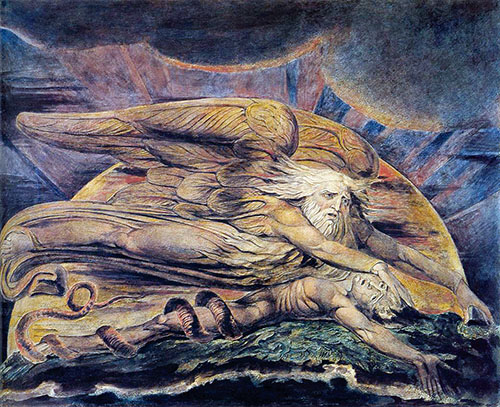
“Elohim Creating Adam” by William Blake.
In my view, biblical scholarship and theology hopelessly oppose each other. However, I don’t deny the existence of God in general; I only say that God is not present in the Bible. Luckily so! This supposedly loving God theologians have come up with shows himself in the Old Testament as a cruel, sadistic, manipulative, and narcissistic individual.
Yahweh was undoubtedly endowed with unique qualities that made him superior to man in power and knowledge, but he was not superior in morals and ethics. It is enough to remember Yahweh’s exterminations, cruel rules, and bizarre behaviours, like sniffing the smoke of burned flesh, which he needed to relax. This matter was so important that any violation of the ritual could result in the death of the sacrificer. I detail this in Gods of the Bible and propose my interpretation of the sacrificial rituals occurring in all ancient religions, including Greek and Roman cults.7
The Bible does not speak about the origin of the Elohim. There is no hard evidence about the provenance of this group. Still, the comparison with the Adamites points to their clear and overwhelming biological and technological superiority. I, however, suggest and discuss in my book the possibility that something like the “cargo cults” might have occurred in the ancient past, not only among the people of Israel but among all the peoples of the world, from the Middle East to the Far East and the Americas.
Cargo Cult of Biblical Proportions
During World War II, the inhabitants of Melanesia in the Pacific Ocean first encountered the white man and saw aeroplanes. The US Army occupied their islands scattered across the Pacific as logistical bases for war operations. The natives saw the American soldiers coming from the sky and taking off from the ground with their aircraft. They saw them equipped with powerful weapons, high-speed air vehicles, and means of communication that defied understanding. They thus started considering them as deities. The natives began to develop rituals, prayers, and cults in anticipation of the return of the American soldiers.
I use the paradigm of “cargo cults” to speculate on the arrival in antiquity of civilisations that were much more advanced than ours. Our ancestors would then develop rituals, myths, and narratives that today we consider fairy tales but perhaps hide a very different reality, the reality of an extraordinary encounter with a superior civilisation.
All the people of the Earth tell us the same thing. They tell us about superior beings who came from the sky, who created humankind and gave them knowledge, teaching them how to grow crops, write, predict the course of the stars, build incredible structures, and work metals. Is it possible that all the peoples of the Earth, independently from each other, developed the same stories, the same narratives about their past?
Gods of the Bible is my last attempt to bring some light to our ancient past through the narrative found in the Bible. I aim to narrate, understand, and describe in detail the reasons and habits of that group of individuals called “Elohim,” of whom Yahweh was part, one of many. Yahweh was the Elohim of the family of Israel – and only of them and their descendants. I deny the universality of the Bible. The Old Testament records Israel’s covenant and relationship with Yahweh. Other Elohim, as we have seen above, had inherited other peoples, families, and nations.
The Elohim of other peoples are mentioned and addressed several times in the Old Testament. These passages suggest that these “foreign Elohim” were similar to Yahweh and had identical abilities and habits. The Elohim had advanced technology unavailable to our ancestors; lived longer than humans but were mortal; had weapons and tools that could do wonders; they were more powerful and knowledgeable, and yet they could be abandoned, betrayed, and deceived, just like humans, because they knew a lot but were not omniscient.
The space of a short article would only allow for briefly summarising some of the aspects of the Elohim that I have detailed in the new book and all my previous works.8
Decoding “Ruach”
Still, perhaps it is not superfluous to end by mentioning something about the fascinating biblical term “ruach.” This term has always been translated as “spirit” through the influence of the Greek culture and the so-called Septuagint version of the Bible, which renders it with “pneuma.” The Ancient Hebrew term “ruach” actually had a very definite and concrete meaning as it stood for “wind,” “breath,” “moving air,” “storm wind,” and, in a broader sense, “that which moves quickly through the air space.” In modern biblical translations, the term “ruach” is always rendered as “spirit” because it responds to monotheistic theology’s spiritual needs.
In the Old Testament, however, this “ruach” appears to be flying through the air, making noise, and taking people from one place to another, with a loud clangour and visible manifestations, taking off and landing in specific geographical locations – in very concrete ways.
The two following passages illustrate what has just been said.
“The [ruach] lifted me and brought me to the gate of the house of Yahweh that faces East. There at the entrance of the gate were twenty-five men, and I saw among them Jaazaniah, son of Azzur, and Pelatiah, son of Benaiah.” (Ezekiel 11:1)
“Look,” they said, “we, your servants, have fifty able men. Let them go and look for your master. Perhaps, the [ruach] of Yahweh has picked him up and set him down on some mountain or valley.” “No,” Elisha replied, “do not send them.” But they persisted until he was too embarrassed to refuse. So he said, “Send them.” And they sent fifty men, who searched for three days but did not find him. (2 Kings 2:16-17)
I left the word “ruach” untranslated, as the reader can see. If you follow monotheistic exegesis and replace “ruach” with “spirit,” the passages become incomprehensible. But it is difficult to interpret the term “ruach” spiritually without distorting the text’s meaning. I give countless similar examples about “ruach” and other words and biblical passages in Gods of the Bible, always underlining the concreteness and realism of the Ancient Hebrew language and the ancient Semitic culture, which was the culture of a pastoral people that Yahweh had found in the desert, landless.
I began and ended Gods of the Bible with the same spirit that moved me twenty-five years ago when I first picked up my pink notebook and discovered the little mistake that began my professional career as a translator of the Old Testament with Edizioni San Paolo. Since then, I have found many more errors in the Bible – and not all were done in good faith. The list is long and cannot be continued here. But I hope at least to have been able to open a dialogue with all those who, with an open mind, are interested in learning more about humankind.
I am not looking for absolute truths but for a glimmer of reality. As I gaze into the impending sunset, the peaks of the Alps, silhouetted against the evening sky, glow pink. A mountain peak is all I hope for. I leave the climb to heaven to others.
I take Gods of the Bible from its stack and open it in the last light of day. I find the best summary of what has been said on the page that opens before me. It is good never to ignore the authoritative voices of the past whose intentions are free from the controversies of the present. I find the voice of a great historian of antiquity who had no reason to lie or embellish. And I realise it is not for heretics like me to explain the meaning of such words, but for the “guardians of the discourse” that exclude a priori hypotheses they cannot accept. I pretend what I read is true.
“Armies clashed in the sky, swords blazed, and the temple shone with sudden flashes. The doors of the sanctuary were suddenly torn open, and a superhuman voice cried out that the gods were fleeing, and at the same time, there was a great uproar as if men were fleeing.” (C. Tacitus, Histories, V 13)
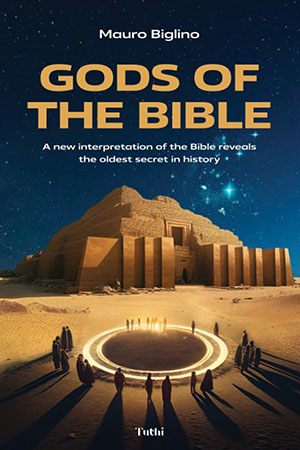
Gods of the Bible: A New Interpretation of the Bible Reveals the Oldest Secret in History by Mauro Biglino (Tuthi, 2023) is available from all good bookstores and online retailers such as Amazon.com.au.
[alert type=”general” dismiss=”no”]This article was published in New Dawn 200.[/alert]
[alert type=”success” dismiss=”no”]If you appreciate this article, please consider subscribing to help maintain this website.[/alert]
Footnotes
1. Biglino, Mauro. Cinque Meghillôt. Rut, Cantico Dei Cantici, Qohelet, Lamentazioni, Ester. Edited by Pier Carlo Beretta, Cinisello Balsamo (Milan), San Paolo Edizioni, 2008; See also Il Libro Dei Dodici, San Paolo Edizioni, 2009.
3. Cfr. Ceram, C. W., Gods, Graves and Scholars: The Story of Archaeology. Revised, Vintage, 2012. Ceram provides a brief but very clear account of how Schliemann came to the greatest archaeological discovery of the century.
4. Mark S. Smith, The Origins of Biblical Monotheism: Israel’s Polytheistic Background and the Ugaritic Texts. Oxford University Press, 2003. Mark Smith’s presentation of his work can be found at youtu.be/8FZ2BdHmCNw
5. The meeting between Mauro Biglino and the theologians can be found youtu.be/nCEG9Znl6Lc
6. “When Elyon gave the nations their inheritance, when he divided all mankind, he set up boundaries for the peoples according to the number of the sons of Israel. For Yahweh’s portion is his people, Jacob his allotted inheritance. In a desert land he found him, in a barren and howling waste.” (Deuteronomy 32:8-9)
7. Cfr G. M. Corrias, Prima della fede. Antropologia e teologia del culto romano arcaico, Tuthi, 2022.
8. Many of Mauro Biglino’s conferences and videos can be found on his youtube channel youtube.com/@MauroBiglinoOfficialChannel. Available books in Italian and English are: Biglino, Mauro, and Lorena Forni. La Bibbia non l’ha mai detto. Mondadori, 2017. Biglino, Mauro, and Giorgio Cattaneo. La Bibbia nuda. Tuthi, 2021. Biglino, Mauro, and Giorgio Cattaneo. The Naked Bible. Tuthi, 2022. Biglino, Mauro. La Bibbia non parla di Dio. Uno studio rivoluzionario sull’Antico Testamento. Mondadori, 2016. Biglino, Mauro. Il Falso Testamento. Creazione, miracoli, patto d’allenza: l’altra verità dietro la Bibbia. Mondadori, 2017.
I do not put my eyes on men, but on God who gives me the power to get wealth. – Robert Tilton
God wants you well. God wants you prosperous. God wants you a whole person. – Oral Roberts
When you focus on being a blessing, God makes sure that you are always blessed in abundance. – Joel Osteen
The Judeo-Christian Bible is full of contradictions, especially when it comes to the pursuit of wealth. Some passages tell us we cannot enter Heaven if we have wealth, such as Luke 18: 24-25: “Jesus looked at him and said, ‘How hard it is for the rich to enter the kingdom of God!Indeed, it is easier for a camel to go through the eye of a needle than for someone who is rich to enter the kingdom of God’.”
We are also told to ask and we shall receive, and that God wishes for us the abundant life. In Proverbs 3:9-10 we are encouraged to tithe for increased wealth.
Honour the Lord with your wealth, with the first fruits of all your crops; then your barns will be filled to overflowing, and your vats will brim over with new wine.
Does God want Christians to be rich and prosper or to be poor and downtrodden? Does the Bible promise Christians wealth, luxury, fabulous health, perfect relationships, and spiritual healing if they keep their covenant with God? Does the Kingdom of Heaven include all that a Christian could ever desire?
It depends on how one interprets biblical teachings, but for Prosperity Gospel and Word of Faith Christians, a prosperous and abundant life might only be a prayer or two away.
The Gospel of Prosperity
A New Thought movement called Unity blends traditional Christian concepts with older New Thought ideals. Its founder, Charles Fillmore, once rewrote Psalm 23 to read, “The Lord is my banker/my credit is good.” It focuses on teachings of abundance and on asking and receiving.
New Thought encourages people to use forms of prayer to “align with the divine” and the power of belief, faith, and consistent visualisation of a desire or goal to make it a physical reality (for more on this, see my article ‘New Thought Movement Revolution 2.0’ in New Dawn 197). These teachings tell us that we have access to the same ‘source’ materials that create worlds and that we connect to this source to co-create our reality. Source has been equated with God, the divine, and the Universe, among other names, and is the invisible field of potentiality and possibility from which physical reality manifests. That manifestation depends on our desires, beliefs, and attitudes and on properly using the power of our minds when connecting with Source.
Perhaps it was only a matter of time before New Thought concepts were integrated into biblical teachings. The love of money is universal, after all. But that integration has not always been a smooth one.
We are told in the Old Testament’s Deuteronomy 8:17-18 that God gives us the ability to produce wealth, so how can it be bad?
8:17 You may say to yourself, “My power and the strength of my hands have produced this wealth for me.”
8:18 But remember the Lord your God, for it is he who gives you the ability to produce wealth, and so confirms his covenant, which he swore to your ancestors, as it is today.
Like New Thought teachings that encourage us to see ourselves aligned with Source, the Bible suggests that if we work on the side of God, we can be rich. Yes, it would appear that God wants good for us in this material realm, but it gets a bit more complicated than just believing and receiving.
A whole breed of Christian pastors, ministers, and teachers have created their own evangelical version of Christianity that sounds more like New Thought/New Age ‘Law of Attraction’ but immersed in Pentecostal and charismatic beliefs. This ‘Bible-based’ ‘Prosperity Gospel’ promises lavish financial abundance to those who follow it and has made more than a few millionaires out of those who teach it.
The Prosperity Gospel movement, led by mega-preachers of mega-churches, has caused much controversy among traditional Christians who see the focus on money and wealth as contradicting Christ’s teachings.
According to historian Kate Bowler, author of Blessed: A History of the American Prosperity Gospel, these teachings formed from three different streams: Pentecostalism, the New Thought movement, and “an American gospel of pragmatism, individualism, and upward mobility.”
The commonalities with New Thought are not coincidental, as these teachings have been in circulation since the 1880s, promoting the power of the mind to achieve prosperity. These concepts served as a foundation for Christian movements to come.
Word of Faith
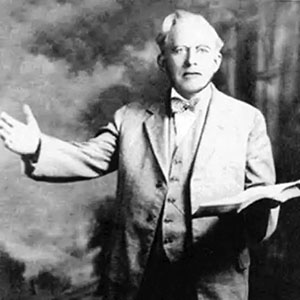
The theology of E.W. Kenyon (1867–1949) was heavily influenced by New Thought ideas.
Word of Faith is a neo-charismatic prosperity theology with roots in the writings and teachings of Baptist minister E.W. Kenyon (1867–1949). He influenced Kenneth Hagin (1917–2003), who later became known as the father of the Word of Faith movement in the United States. Kenyon attended the Emerson College of Oratory, where he was immersed in older New Thought teachings and later wrote about positive declarations and the power of the mind. He denied his New Thought origins, but they were obvious. He taught that to receive the blessings of God, one must use positive, faith-filled speech. He also taught his followers to demand healing and prosperity because it was their divine right. They were entitled to it.
Hagin took these teachings and founded the Kenneth H. Hagin Evangelistic Association, started a magazine in 1966 called Word of Faith, and built a seminary for Word of Faith ministers to train, teach, and spread the prosperity gospel. This claims that if a person keeps their covenant or word with God in full faith, they will be blessed with healing – physical, emotional, spiritual, and/or financial. One could also achieve this promise of total healing by simply becoming a believer and asking for atonement.
Interestingly, as in New Thought teachings of affirmative prayer and using intention to speak of desires as if one already has it (all New Thought prayers end with “And so it is”), Word of Faith teaches that healing should be prayed for and accepted as if it is already done. Doubt and fear that it will not manifest only serves to delay the healing and manifestation. Anything negative such as illness, death, pain, or suffering, is considered an attempt by Satan to prevent or deny total healing in believers. The fix? Praying and strengthening one’s faith even more.
Word of Faith preaches that those who follow these teachings must “decree and declare” their faith in order to create what they seek to gain. Again, this mirrors the New Thought and Law of Attraction teachings that rely on visualising and speaking only of what is desired, not of what is not desired, and demanding the Universe/Source/God fulfil their personal order like someone dining out at a restaurant. One’s order is put in writing or spoken aloud to give it more ‘power’.
The spoken word has creative, generative power in both movements through prayer, affirmations, spiritual mind treatments (intensive, structured affirmative prayer), and the stating of intentions. This spoken declaration in prosperity theology is known as a “faith confession” or “positive confession” and is the key to claiming and affirming healing as already fulfilled.
Kenneth Hagin believed that because God spoke the universe into existence (“In the beginning was the Word”), God’s believers have been given this same creative power, even going so far as to call believers “little gods.”
Prosperity Theology
Kate Bowler writes that the movement was also influenced by mesmerists, faith healers, business oracles, revivalists, Pentecostal healers, and metaphysical sages. This variety can be seen in the different styles of those who have risen in its ranks. Modern Christians may call it the “Name It and Claim It” movement or Health and Wealth, but it is all under the umbrella of prosperity theology, which is today embraced by millions of adherents all over the world.
Bowler argues that the central thesis of the New Thought movement is present in Christian prosperity theology: “People shaped their own worlds by their thinking, just as God had created the world using thought. Positive thoughts yielded positive circumstances, and negative thoughts yielded negative circumstances.”
Historical events such as World War II prompted a spread of these prosperity teachings and caught on quickly as evangelicals sought miraculous healings and money blessings as a way to appeal to those struggling with post-war problems such as homelessness, poverty, and joblessness.
Oral Roberts
Modern proponents such as Oral Roberts (1918–2009), the famous American Charismatic televangelist – considered one of the first propagators of prosperity theology – pull their beliefs from a host of Bible passages to back up their claims. They also tend to interpret these passages to support their teachings. Some of the more widely used are:
I am come that they might have life, and that they might have it more abundantly. (John 10:10)
Ask, and it shall be given you; seek, and ye shall find; knock, and it shall be opened unto you:For every one that asketh receiveth; and he that seeketh findeth; and to him that knocketh it shall be opened. (Matthew 7:7-8)
Beloved, I wish above all things that thou mayest prosper and be in health, even as they soul prospereth. (3 John 1:2)
My God shall supply all your needs according to his riches in glory by Christ Jesus. (Philippians 4:19)
Roberts amassed a huge following with his televised ministry that helped introduce Pentecostalism into the mainstream. He pioneered the use of television to reach millions and founded the Oral Roberts Evangelistic Association and Oral Roberts University.
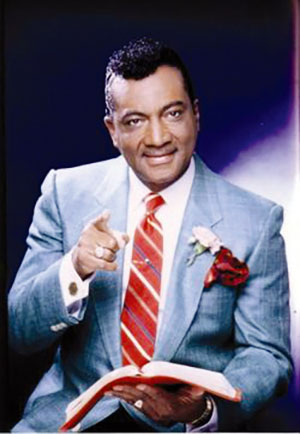
Reverend Ike
Other Word of Faith and prosperity theology preachers who took to the airwaves include Juanita Bynum with “Weapons of Power” on the Trinity Broadcasting Network; Kenneth and Gloria Copeland with “Believer’s Voice of Victory;” Jan and Paul Crouch, who founded Trinity Broadcasting Network (TBN); Creflo Dollar with “Changing Your World;” Benny Hinn with “This is Your Day,” currently seen in almost 200 countries; Marilyn Hickey with “Today with Marilyn” on TBN and Black Entertainment Television; Robert Tilton who has shows on Black Entertainment Television; T.D. Jakes with “The Potter’s House;” Joyce Meyer with “Enjoying Everyday Life;” and New York’s Reverend Ike (Frederick J. Eikerenkoetter II), who preached up a storm in the US before his death in 2009 with his motto, “You can’t lose with the stuff I use!”
Then there was Jim and Tammy Faye Bakker, who took television evangelism to a whole new level with their flamboyant looks and extravagant lifestyles. Their Heritage USA theme park was a hugely popular destination for Christians and non-Christians alike, and their Praise the Lord (PTL) Ministries incredibly successful. Many will remember that scandals eventually brought down the Bakkers.
Jim and Tammy Faye Bakker, at the peak of theirsuccess.
Television allowed these prosperity preachers to reach new audiences far beyond the confines of just one church in one town or city, and many started running ‘megachurches’ with thousands of followers. Today, the internet and social media offer even more outlets for profitable preaching to extend beyond national borders. Although the prosperity gospel has its origins in the United States, there are now many multimillionaire preachers and pastors benefitting from its teachings all over the world.
Criticisms of Prosperity Theology
What if these promised money miracles do not occur? What if someone follows these teachings and remains poor? Dr. Andrew Spencer in “What is the Prosperity Gospel?” for the Institute for Faith Works and Economics, says these failings are “blamed on the lack of faith in those seeking the miracles.” They were at fault for unfulfilled prayers, not the preachers promising them that miracles would manifest. “If wealth and health are a result of the degree of faith a person has, this leads to the conclusion that the poor are poor because they are spiritually deficient,” writes Spencer.
People often refer to one of the Beatitudes of Christ’s Sermon on the Mount, blessed are the poor, for theirs is the kingdom of heaven, as a way to validate being poor, but Jesus actually said, “Blessed are the poor in spirit” (emphasis added) (Matthew 5:3). The statement has nothing to do with money but with the spirit, implying that the sad, depressed, and downtrodden will be given the keys to the heavenly kingdom. Even rich people can be sad, depressed, and spiritually downtrodden.
This clearly contradicts where prosperity preachers like to place the blame – on the person asking for help. This victim-shaming and blaming is one of the key criticisms many people have of religious leaders pushing material and financial wealth. They can never seem to explain why it doesn’t work for everyone else, so they blame… everyone else.
Baptist preacher Russell H. Conwell is famously quoted as telling his poor congregation in 1915, “I say you ought to be rich; you have no right to be poor.” This same line about the rich and poor has been repeated, ad nauseam, in prosperity gospel preaching for over 100 years, implying that Jesus placed emphasis on this when he clearly did not focus his teachings on material riches. Rather than blame society or inequality in the workplace, the blame is shifted to the failures of the poor, who very well may be hard-working individuals with good hearts.
Crimes & Misdemeanours
In 2007, United States Senator Chuck Grassley probed the financials of televangelism ministries that promote prosperity theology, including Kenneth Copeland Ministries, Creflo Dollar Ministries, Benny Hinn Ministries, Bishop Eddie Long Ministries, Joyce Meyer Ministries, and Paula White Ministries. The probe concluded in 2011, with Grassley stating that self-regulation was preferable to government oversight of these ministries. All six televangelists insisted they would comply with tax regulations for religious non-profits. Only Joyce Meyer Ministries and Benny Hinn Ministries told Grassley they had changed how they govern their ministries or set compensation. The other four refused to provide full information to Grassley, and a few accused Grassley of violating their religious freedom.
In the early 1990s, Jim Bakker asked for forgiveness for his prosperity teachings from a prison cell after being convicted for mail and wire fraud associated with his ministry’s various fundraising activities. He was also involved with a highly publicised sex scandal involving a woman named Jessica Hahn that eventually brought down his powerful PTL Ministries.
There have been numerous media hit pieces on the extravagant lifestyles of these preachers, suggesting that they fell prey to the materialism the Bible teaches against. Not all flaunt their lavish possessions and massive bank accounts. Mainstream evangelicals such as Rick Warren and Jerry Falwell have come out opposing prosperity theology as heretical to the true teachings of Christ.
“Capitalism Christianity” has been called an abuse of faith as well as a way for the preachers to become rich at the hands of their congregants who want to believe so badly that they, too, can be rich if they have faith or tithe ten per cent or more of their income to the men and women making those grand promises from atop a gaudy stage. There are many sad stories of people giving all of their money over to their church leaders, only to be left destitute while the preachers buy mansions and expensive toys or run off to another country, never to be heard from again.
As noted by Cathleen Falsani in her 2013 piece “The Worst Ideas of the Decade” for The Washington Post, these teachings conflict with the basic tenets of Christianity. “Jesus was born poor, and he died poor. During his earthly tenure, he spoke time and again about the importance of spiritual wealth and health. When he talked about material wealth, it was usually part of a cautionary tale.”
Is it spiritual to be poor? Do Christians have to give up everything they own and be homeless on the streets in order to achieve the grace and abundance of God?
Those who prosper can easily become ego-maniacs and materialists, using their money to buy power and influence over others, or they can be meek, merciful, and pure in heart. They are, after all, human. Some might argue that millionaire preachers who become rich off their much poorer congregants will have one hell of a time, pun intended, threading the needle and getting into Heaven.
Money itself is not the root of all evil, although lust, greed, and how someone makes all that money can play a big role. It’s not wealth that makes the person, but what they do with it and whether or not it changes them for better or worse.
Those who are blessed can no doubt bless many others in ways being poor cannot. Money can bring happiness and it can bring despair. It favours no one. It’s neutral.
Prosperity preachers and their eager adherents might remember that acquiring true wealth may be more about getting right in spirit first. Whatever comes after that is just icing on the cake.
[alert type=”general” dismiss=”no”]This article was published in New Dawn 202.[/alert]
[alert type=”success” dismiss=”no”]If you appreciate this article, please consider subscribing to help maintain this website.[/alert]
Sources
“5 Errors of the Prosperity Gospel” by David W. Jones, thegospelcoalition.org/article/5-errors-of-the-prosperity-gospel
Katie Bowler, Blessed: A History of the American Prosperity Gospel, Oxford University Press, 2018
“Prosperity Gospel” by Bryn Donovan, britannica.com/topic/prosperity_gospel
“The Prosperity Gospel, Explained: Why Joel Osteen Believes that Prayer Can Make You Rich” by Tara Isabella Burton, vox.com/identities/2017/9/1/15951874/prosperity-gospel-explained-why-joel-osteen-believes-prayer-can-make-you-rich-trump
“The Worst Ideas of the Decade” by Cathleen Falsani, washingtonpost.com/wp-srv/special/opinions/outlook/worst-ideas/prosperity-gospel.html
“What is the Prosperity Gospel?” by Dr. Andrew Spencer, tifwe.org/what-is-the-prosperity-gospel
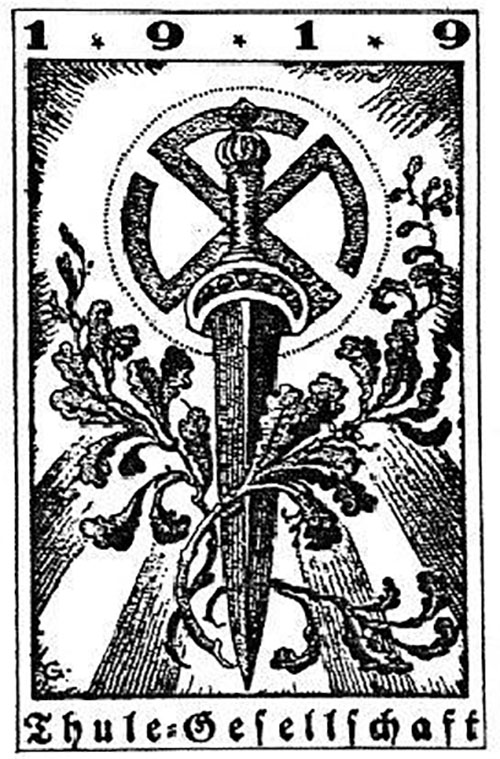
Thule people are the ones to whom Hitler first came. – Rudolf von Sebottendorff
Rudolf von Sebottendorff (1875-1945) was a man of mystery. Much remains unknown about his life and his death. He is shrouded in legend and surrounded by misinformation. The true nature and motive of his life and work remain in question. That much of this obscurity was of his own manufacture is one thing that seems certain.
The first mystery of Baron Rudolf von Sebottendorff ’s life lies in the fact that he was not born a baron, nor was his name Sebottendorff. He obtained the name and title later in life. He was born Adam Alfred Rudolf Glauer in Hoyerswerda, near Dresden, on November 9, 1875. His father was a locomotive driver and veteran of the Prussian army, who fought in the Austro-Prussian campaign (1866) and the Franco-Prussian War (1871). Rudolf ’s father died in 1893 leaving enough money for his son to finish his formal education.
Bust of Rudolf von Sebottendorff (1875-1945)
Glauer began training as a mechanical engineer, but never finished his studies. Instead he lived a life of adventure in exotic locales and on the high seas until 1900. In Australia, after attempting to prospect for gold, he received a letter of introduction from a Parsi (Zoroastrian) to a wealthy Turkish landowner, Hussain Pasha. He managed an estate at Bursa for this landowner, who was a practitioner of Sufism. He was also introduced there to the Termudi family. The patriarch of this Jewish family, originally from Greece, was a student of the Kabbalah and Rosicrucianism. Glauer was initiated into a Freemasonic lodge of which the Termudis were members. He remained in Turkey, learned Turkish, and studied occultism until 1902. Then he returned to Germany, but around 1908 some legal misadventures in Germany caused him to return to Turkey.
The next two years were pivotal for the adventurer. In 1910 he founded a mystical lodge in Constantinople – which is a tariqat of the Bektashi Order of Sufis. The next year he is legally adopted by the German expatriate Heinrich von Sebottendorff and also becomes a legal citizen of Turkey. This adoption was later repeated twice more by other Sebottendorff family members, all of which indicates just how important the acquisition of the noble title was to him.
During the Balkan War (1912–1913) he was on duty with the Red Crescent, the Islamic version of the Red Cross. He was actually wounded in battle and for a time a POW. After this he returned once more to Europe and lived in Berlin and Austria.
First World War
It was in the midst of the First World War (1914–1918) that Sebottendorff joined the Germanen Order (GO), at first by correspondence only. In September of 1916 he personally visited Hermann Pohl, who was the head of the order in Berlin. Subsequently Sebottendorff was elected master of the Bavarian province of the order and became the publisher of the GO publications.
The true nature and scope of the Germanen Order remains shadowy. Ostensibly it was formed as a sort of mystical lodge within the more politically oriented Reichshammerbund (Imperial Hammer League). The mastermind behind these groups was the notorious anti-Semite Theodor Fritsch (1852–1933).1 Fritsch was instrumental in the invention of a biologically based anti-Semitism to appeal to those who had become disenchanted with the mass appeal of the age-old religion based anti-Semitism, with its origins in the medieval church. The GO was essentially a pseudo-Masonic order with ritual based on Wagnerian imagery.2
Symbol of the Thule-Gesellschaft
As 1918 was drawing to a close, the fortunes of war and politics had turned against the Germans. The Great War was being lost and in Munich left-wing revolutionaries were clamouring for political power, inspired by recent success in the Russian Revolution (1917). The name Thule-Gesellschaft (Thule Society) was adopted by the Germanen Order as a cover identity (The word Thule comes from the Greek explorer and geographer Pythias, who made a journey to the far northern regions of the world around 310 BCE. He gave the name Thule to the land in the northernmost region.) The society met weekly in rented rooms at the Hotel Vierjahreszeiten (Four Seasons) in Munich. But it began to take on a life and identity of its own under Sebottendorff ’s leadership. Occult topics were the subject of lectures given by the baron – this in the midst of open revolution in the streets of Munich.
Sebottendorff only led the Thule Society from April 1918 to July 1919. During this time he formed a militia to fight the Communists, was instrumental in the formation of the German Workers’ Party, and acquired a newspaper, the Münchner Beobachter (Munich Observer). In April of 1919, Communists seized power in Bavaria. In this process they took seven members of the Thule Society hostage and subsequently executed them. This atrocity became a rallying point for the right-wing militias. The militias were eventually successful in turning back the left-wing revolution. The German Workers’ Party was soon thereafter reformed by charismatic leader Adolf Hitler into the National Socialist German Workers’ Party (National-Sozialistische Deutsche Arbeiter Partei – NSDAP), called Nazis by their detractors. The newspaper was bought by that party and transformed into its mouthpiece – Der völkische Beobachter (The Nationalist Observer).
Obviously all of these facts point to Sebottendorff’s deep involvement with what was to become the Nazi movement in post-WWI Germany. It also seems clear that Sebottendorff and others were guided and financed in their efforts. What is less certain is how much these men were engineers of these efforts and how much they were mere pawns.
The chronology of Sebottendorff’s life shows that he was mostly involved in personal adventure and spiritual or magical pursuits – with a short, active career (1916–1919) as a political operative under the cover of occult organisations. After he left Munich in July of 1919, he returned to esoteric studies and writing. For fifteen years he continued in his esoteric pursuits and it is during this period that he wrote and published most of his major works, including, Die Praxis der alten türkischen Freimauerei (recently translated to English by this author and published as The Secret Practices of the Sufi Freemasons).
‘Before Hitler Came’
In 1933, after Hitler took power in Germany, Sebottendorff published a book Bevor Hitler kam (Before Hitler Came) which appeared to take credit for getting the National Socialist movement started from within the Thule Society.
Astoundingly, Sebottendorff returned to Germany after Hitler took power in 1933, tried to revive the Thule Society, and published a book, which seemed to try to take credit for getting the National Socialist movement started from within the Thule Society. The book was entitled Bevor Hitler kam (Before Hitler Came). The Nazis were not pleased. Sebottendorff was arrested twice; the book was banned, confiscated, and destroyed in 1934. He returned to Turkey. This whole adventure appeared to be simply an attempt to cash in on the success of the Nazis, an attempt that failed. Or perhaps it did not fail entirely. The post-1934 life of the baron is quite mysterious. He was put on the payroll of the German Intelligence Service in Istanbul. His handler was Herbert Rittlinge. Turkey had been an ally of Germany in World War I, but in World War II it remained neutral until the very end of the war, when it joined the Allied side. In 1944 the German embassy was closed in Turkey, and Sebottendorff was given his severance pay of one year’s support. On May 8, 1945, Germany surrendered unconditionally. Sebottendorff died that same day.
Some controversy surrounds the death of Sebottendorff. The usual story is that he committed suicide by jumping off a bridge in Istanbul right after hearing of Germany’s surrender.
If this is true it was probably more out of the desperation of a septuagenarian man with no prospects for the future than out of any loyalty to the Nazis. On the other hand the possibility exists that he was assassinated either by loyal Nazis who wanted to keep him quiet, or by their enemies who took a final measure of revenge.
Works & Ideas
The life and legend of the adventurer known as the Baron Rudolf von Sebottendorff von der Rose is so fascinating and compelling that the more important and useful information about his teachings and thoughts are usually glossed over. We do not want to let that happen here. However, it must be admitted that discovering what the baron really thought can be a difficult task. This is because his did not write that much when compared to his contemporaries. Also what he wrote tended to be from different genres – for example, novels, histories of astrology, technical astrological texts, and the book on Sufi exercises.
When we look at Sebottendorff’s written output we discover that most of it concerned aspects of the practice of astrology. His works include: Die Hilfshoroskopie (1921), Stunden- und Frage-Horoskopie (1921), Sterntafeln (ephemeriden) von 1838–1922 (Star Tables [Ephemeris] from 1838 to 1922) (1922), and Astrologisches Lehrbuch (Astrological Textbook) (1927). Perhaps to be counted as his masterpiece in astrological studies is Geschichte der Astrologie (History of Astrology), vol. I (1923). No second volume appeared. Besides these astrological works, three others stand out.
An early meeting of the National Socialist German Workers’ Party. Adolf Hitler is in the centre.
The first of these is Die Praxis der alten türkischen Freimauerei (1924). Second is a novel, Der Talisman des Rosenkreuzers (The Talisman of the Rosicrucian) (1925). This is said to be a thinly veiled autobiographical account from which many events in his life are discernible. Finally there is the ill-fated Bevor Hitler kam (1933). The latter two books are in one way or another attempts to manipulate the reader’s views of the author. Only in the Praxis does Sebottendorff really speak to the reader about his own philosophy – if only vaguely.
Sebottendorff, the man, remains an enigma. Some of his writings were probably produced to achieve some specific political agenda that was not necessarily a creation of his own thoughts. However, if we read his words carefully we can arrive at some general ideas about the intellectual and spiritual cosmos in which he lived. In many respects Sebottendorff was the typical German of his time – a man with a split character: one part fierce nationalist, the other a lover of the exotic. In Sebottendorff’s lifetime he had reason to be proud of being German – Germans were the best educated, most technologically advanced and economically developed of all European peoples. At the same time they loved exotic ideas and exotic cultures; they studied them, and travelled to them at an enormous rate. Even now, more Germans travel outside their own borders per year than any other nation, and it is no coincidence that the German word wanderlust, “a strong and irresistible impulse to travel,” had to be borrowed into English.3 All this accounts for Sebottendorff’s German nationalism coupled with his love of Turkey. To understand his ideology, we must divide the political dimension from the occult aspect; although we will see some common ground between the two.
Political Ideology
Most of Sebottendorff’s written output would not indicate much of an interest in politics. It is far more oriented toward occult matters. However, both his biography and one book in particular, Bevor Hitler kam (1933), show his involvement in founding and directing insurgent political operations. Where and how he came by these skills and interests remain mysterious.
In introductory sections of his 1933 book he describes his devotion to two ideas Deutschtum (Germanism) and socialism. The idea of Deutschtum had been current in Europe for many decades.4 On the one hand it can be understood as simply nationalism. But German nationalism, as with other forms of this idea elsewhere in the Old World, is heavily tinged with racial ideas. German (or English or French or Russian) nationalism meant more than fanatically supporting a political state. It meant a belief that the culture of the nation, its language, ethnicity, customs, and aesthetics, were to be promoted to the exclusion of foreign or outside elements. It also was bound up with concepts of antimodernism. Antimodernists saw industrialisation, commercialism, and democracy as destructive to the nation and to Deutschtum.
Rudolf von Sebottendorff, the man, remains an enigma.
To some extent these ideas were rooted in the esoteric teachings of men such as Guido von List (1848–1919) who coined and popularised a good deal of the terminology connected with this idea. Clearly Sebottendorff was steeped in the teachings of von List and others. But he was far from being alone in this. In fact List was himself merely another product of a larger neo-Romantic wave of ideology championed by Richard Wagner and others decades earlier.
The other political idea that moved Sebottendorff was socialism. Mainstream historical revisionism quickly moved to ignore the socialistic aspects of Hitler’s National Socialism. It really should not be surprising therefore to see immediate precursors to Hitler extolling the idea of socialism, which most today think of in terms of left-wing politics. The essential theoretical factor that separates Hitler from Stalin was that the former saw biology or race as the decisive factor, while the latter saw economics and economic class as paramount. In practice, however, both essentially practiced nationalistic socialism under a dictatorship or oligarchy.
Certainly Sebottendorff, like many of his German and European contemporaries, envisioned a kinder and gentler form of socialism; one that wisely and benevolently collected the wealth and privilege of the nation and redistributed it to the benefit of the whole of society. Such dreams always lead immediately to a Hitler or Stalin, when applied on a national scale. National socialism would attempt to apply socialistic concepts and methods to the benefit of a single race or nationality – the Germans – rather than to an economic class – the proletariat – as is the case with the Marxists.
Der Talisman des Rosenkreuzers (The Talisman of the Rosicrucian) (1925) by Sebottendorff.
The occult encompasses ideas of a secret or hidden nature, which represent rejected patterns of thought (e.g., paganism, astrology, alchemy, magic) or concepts that have not been accepted by mainstream and established intellectual authorities (e.g., UFOs, ESP, orgone). Such ideas may be entirely taboo in a society and forced into secret societies, or they may simply be marginalised. Despite its outsider status the realm of the occult often becomes the breeding ground for revolutionary ideas.
Sebottendorff’s occult ideology can be partially reconstructed from his works. One factor of great importance to him was a sort of unified field of reality that connected things such as the stars with the fate and character of individual humans. Here we see an echo of the Islamic insistence on the essential unity of being (the Arabic wahdat-al-wujûd). This also provides Sebottendorff with the rationale for his focus on tradition and national traditions – whether in Germany or Turkey. Such a unity of being also provides for the plausibility of alchemy. The base and the noble are, after all, parts of the same whole, or substance. Therefore the transmutation of one thing to another is theoretically possible, without changing the nature of reality.
Bevor Hitler kam (Before Hitler Came) (1933) by Sebottendorff.
One of Sebottendorff’s chief themes is the idea of the perfectibility of the individual. This is the root concept behind the exercises belonging to the science of the key, as the ancient practice of Freemasonry is sometimes known. The fruits of this labour should, however, be transferred to the larger society in which the individual lives and this doctrine of perfectibility spread throughout the country. The individual can, in a manner of speaking, become something akin to a philosopher’s stone. His presence can act as a catalyst for widespread transformation. Is this the secret of Sebottendorff? So much power and influence has been ascribed to him, yet the facts of his life do not reflect such a man. How could a relatively unknown occultist and adventurer exert such historical influence and fade from the scene years before the results of his operation were manifest? Why then did he come back to make a conspicuous return at the moment of the operation’s dark triumph, before once more fading into obscurity?
Certainly another of Sebottendorff’s principal ideas was that individuals are capable of creating and re-creating their own environment. This concept was juxtaposed to the modernistic idea that individuals are products of their environments. All of this again brings forth Sebottendorff’s essentially magical and alchemical view of man’s capacity. The human being, and especially the individual who has been empowered by the secret practices revealed in the science of the key, can take active control of life and environment – but only in accordance with the will and direction of God.
Abridged with permission from Chapter 1 of Secret Practices of the Sufi Freemasons: The Islamic Teachings at the Heart of Alchemy by Baron von Sebottendorff (translation & Introduction by Stephen E. Flowers, Ph.D.). Inner Traditions, Rochester, VT 05767 USA. This book is available from all good bookstores or visit www.InnerTraditions.com.
[alert type=”success” dismiss=”no”]If you appreciate this article, please consider subscribing to help maintain this website.[/alert]
Footnotes
1. For more information on Theodor Fritsch, see Goodrick-Clarke, The Occult Roots of Nazism, 123-28
2. A historical description of the Germanen-Order is provided in Goodrick-Clarke, The Occult Roots of Nazism, 123-34
3. See The American Heritage Dictionary (1975), s.v. “wanderlust.”
4. The whole topic of nineteenth- and early-twentieth-century Germanentum, especially in esoteric circles, is discussed by Goodrick-Clarke, The Occult Roots of Nazism.