New Dawn – World's Most Unusual Magazine

Category: Secret History

  • The Political Gnosis of Philip K. Dick

    The Political Gnosis of Philip K. Dick

    This article was published in New Dawn 74 (Sept-Oct 2002)

    It seems hard to imagine that it has been nearly twenty years since Bladerunner was released. That riveting and influential film was the first movie to be inspired by the writings of science-fiction author, Philip K. Dick. Other films, of varying success, have followed, including Total Recall and Screamers, but the until now the most Dickian movies have been those that copped his dystopian and paranoid sensibility without directly basing themselves on one of his books or short stories. The Truman ShowThey Live!,Pleasantville, and most notably, The Matrix, were all Dick films at heart, despite his absence from their credits.

    The recently released Spielberg film, Minority Report, returns to directly dipping from PKD’s deep well of inspiration, and despite the inevitably Spielbergian ending, succeeds in evoking one of Dick’s favourite themes: how does one elude the suffocation of an encroaching police state? In Minority Report, this trope takes the form of the local Department of Precrime in Washington D.C., which has succeeded in eliminating murders by arresting and incarcerating the perpetrators before they commit their crimes. This is accomplished by drawing on the abilities of three precogs (for precognitives), who have the involuntary talent of seeing into the near future and glimpsing the murders-to-be in progress. As the film unfolds, in the year 2054, a national referendum is about to occur on whether to expand precrime prevention to a national policy.

    Given the recent moves by the Bush Administration in the US to indefinitely detain those who have committed no crimes, but who may have planned to, the timeliness of Minority Report is almost uncanny. Dick’s original short story appeared in 1956, and the script for the film was written well in advance of the shock of 9/11. But somehow, Dick’s intuitions of precrime enforcement have been brought to the big screen at just the moment when their analog is being enacted in real life. PKD, who died in 1982, would savour the irony, were he still with us.

    Gnosis

    Gnosticism is a name commonly applied to numerous early Christian sects who emphasised the necessity of receiving “gnosis” (divine knowledge of true reality) in order to be saved. While they considered themselves to be Christian, the Gnostics diverged from both Judaism and Catholic Christianity in their belief that this world was a flawed and ensnaring creation of a despotic Demiurge who had usurped the position of God. Through the agency of a redeemer Christ and his bride, Sophia (Wisdom), the Gnostics hoped to return, upon death, to the most high realm of the Pleroma (Fullness) to unite with the true Unknown God.

    The Penultimate Truth (1964)
    “Most humans live in tank cities far below the surface of the Earth, believing themselves to be safe from the ongoing nuclear war above their heads. In fact, the war has been over for ten years, and instead of a radioactive ruin, the planet is a vast park, ruled by feudal barons who are playing power politics with the buried masses of their fellow men.”1


    That, at least, is the standard potted summary of Gnosticism. If one takes a broader view, there have been many gnosticisms, and many “gnosi” – some predating the Christian Era and some quite independent of Christianity. Gnosis, as a synonym for illumination or mystical union, is equivalent to marifah(Arabic) or irfan (Persian) in esoteric Islam, for example. However, while we might assume that the state of consciousness signified by the term “gnosis” is universally accessible (or at least potentially so), it is not at all certain that those using the term were always referring to the same thing.

    For instance, the gnosis of the Sufi mystics of Islam includes no admission of the existence of a Demiurge or false, lower God. Indeed, tawhid, the Unity of God and Creation, is such a fundamental assumption of Islam, that a spiritual realisation pointing to a Higher God than that of the Creator would be immediately rejected as a delusion. On the other hand, Hindu yogis might readily agree with many Gnostics that this world is a veil or delusion (maya in Sanskrit), and that there is an Absolute God behind or above lesser gods. But few yogis would share the Gnostic assessment that this indicates a moral flaw in the universe.

    What exactly is the nature of the divine knowledge that the Gnostics and other mystics have sought? It is impossible to describe precisely, because of the non-discursive nature of that knowledge. Frithjof Schuon refers to gnosis as “our participation in the ‘perspective’ of the divine Subject which, in turn, is beyond the separative polarity, ‘subject-object’….”3 G.E.H. Palmer refers to it as “Wisdom made up of Knowledge and Sanctity,” and underscores the distinction “between knowledge acquired by the ordinary discursive mind and the higher Knowledge which comes of intuition by the Intellect, the term Intellect having the same sense as in Plotinus or Eckhart.”4

    In other words, gnosis, according to this definition, is an experiential “knowing” that results from the expansion of the Gnostic’s consciousness to the level of the divine Intellect, where the illusion of the separate self (ego) is obliterated – at least temporarily – in the vast perspective of the higher Self. Such a state cannot, of course, be sustained indefinitely. What goes up must come down. But having risen to such heights, the ego that is reassembled upon its descent, is permanently affected. It now “knows” its own place in the cosmic scheme of things.

    Such “knowledge” is not easily communicated to others, in part because shared reference points are few, and because any attempt at describing the experience is bound to diminish and reify it. Thus, those who have been blessed with gnosis have used oblique strategies to impart the ineffable: poetry instead of prose; myths instead of clear-cut analysis; paradoxical statements instead of declarations.

    There is still another factor contributing to the proliferation of gnosi and gnosticisms: while the experience of gnosis may be ahistorical, i.e., beyond time and place, the gnostic himself is obviously not. A Tibetan Buddhist in the recesses of the Himalayas, who takes reincarnation for granted and believes in numerous gods, is not going to clothe his gnosis in the garments of a Muslim Sufi in Andalucia, who believes in one lifetime and one God. And vice versa.
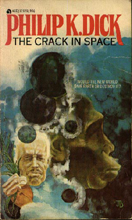
    The Crack in Space (1966)
    “Frozen sleep seems like a humane way to end unemployment and over-population pressures: Send the excess citizens to the future. The government warehouses are filled with bibs when a political fight erupts over whether or not to dispose of them through a space-warp. Then some unknown outside agency helps the sleepers to awake.”2


    A gnostic whose historical era and cultural milieu is one of war and persecution is likely to have his circumstances seep into his post-gnosis explication of reality. There may still be a higher Reality beyond conflict and violence that he experiences in gnosis, but his mythic version of the journey to the Truth may feature a harsher struggle to get there than would otherwise be the case.

    Finally, there is the personality and psychological condition of the gnostic to be considered. Contrary to contemporary holistic assumptions that assume that the combination of a good diet, a good life, and a good attitude are most likely to lead one to higher spiritual consciousness, this is not always so. Higher states may also be triggered by asceticism, psychoactive substances, disciplined practice, or sheer happenstance. True, an absence of cravings and obsessions may make meditative practice easier, but gnosis can also erupt in someone who is by no means a saint. In such a case, his post-gnosis understanding of the Real may well be tinged with his neurotic predisposition.

    The Divine Invasion

    Which brings us back to Philip K. Dick.

    In February, 1974, Dick was living in Fullerton, California, an undistinguished city in Orange County. He’d fled his long-time residency in Northern California out of fear for his life and his sanity. He’d been mixed up in long-time illicit drug use, tax refusal in protest against the Vietnam War, and chronic poverty. In 1971, his previous home in San Rafael, north of San Francisco, had been broken into by persons unknown, his safe blasted open, and things taken. He’d attempted suicide, checked himself into drug rehab in Vancouver, and in 1972 had flown from there to Fullerton.5

    By 1974, he’d married his fifth wife, Tessa, and had a new child, Christopher. But most immediately, in February, he’d just had two impacted wisdom teeth removed and was awaiting the delivery of prescribed medicine from the drug store.6

    The doorbell rang and Dick answered the door. The delivery girl from the drug store stood before him, wearing a delicate necklace from which hung a golden fish, a symbol of Christ often worn by evangelical Christians.

    As Dick later recounted it – possibly in mythologised form – a laser-like pink beam shot from the fish to Dick’s third eye. It had an extraordinary effect:

    I suddenly experienced what I later learned is called anamnesis – a Greek word meaning, literally, ‘loss of forgetfulness.’ I remembered who I was and where I was. In an instant, in the twinkling of an eye, it all came back to me. And not only could I remember it but I could see it. The girl was a secret Christian and so was I. We lived in fear of detection by the Romans. We had to communicate in cryptic signs. She had just told me all this, and it was true.7

    There was plenty more to follow. For the next year or so, Dick felt his psyche invaded by a “transcendentally rational mind, as if I had been insane all my life, and suddenly had become sane.”8 He experienced hypnagogic visions, auditions, tutelary dreams, and an eight hour all night vision of thousands of coloured graphics resembling “the nonobjective paintings of Kandinsky and Klee.”9

    Dick came to nickname the invasive rational mind as VALIS (for Vast Active Living Intelligence System), which became the name of his 1981 novel recounting his mind-boggling experience in fictional form.

    Perhaps most significantly, he perceived that “real time had ceased in 70 C.E. with the fall of the temple at Jerusalem. It began again in 1974 C.E. The intervening period was a perfect spurious interpolation aping the creation of the Mind….”10

    PKD’s life-long preoccupation with the questions of “what is reality?” and “what is man?” wouldn’t allow him to resolve his 1974 experiences into a single easy explanation. He variously explained them to himself as communications from God or from a satellite orbiting Earth, or most baroquely as psychic invasions courtesy of Soviet Academy of Sciences psychotronic transmitters. They provided fodder for several more novels before his untimely death at age 53 in 1982.

    The question might be fairly asked whether Philip K. Dick’s 1974 experiences constituted a form of gnosis. Judging from his many stories and novels, Dick operated throughout his life from a gut feeling that reality, as we commonly perceive it, is a façade. He sensed that there was something morally wrong in a universe where a friend’s innocent cat could walk across the street and be blithely run over by a passing car. His novels returned, time and again, to the theme of the little man caught in the machinations of powers beyond his kin or control. Dick may have nominally been an Episcopalian, but he was constitutionally a gnostic.

    VALIS (1981)
    “A coterie of religious seekers forms to explore the revelatory visions of one Horelover Fat; a semi-autobiographical analogue of PKD. The group’s hermeneutical research leads to a rock musician’s estate where they confront the Messiah; a two-year old named Sophia. She confirms their suspicions that an ancient, mechanical intelligence orbiting the Earth has been guiding their discoveries.”11


    But, here’s the paradox: not every gnostic receives complete gnosis. Some Gnostics, such as the Cathars of southern France, recognised this in dividing their members between mere believers and the elect (perfecti), and it is safe to assume that not every perfecti had achieved full mystical awareness.13

    The Gnostics taught that there are several planes or spheres between our material world and the purely spiritual realm of the Pleroma, “home” of the Unknown God. These planes were ruled by Archons, and part of the challenge for the Gnostic’s soul, at death, was to navigate past these cosmic authorities without becoming ensnared.

    The Gnostic who realised complete gnosis prior to his own death, (an awareness referred to in Sufi terminology as “to die before you die,”) was blessed with the key to safely make that post-death journey. But not every gnosis is complete and some experiences might provide only a partial realisation – perhaps of an intermediate Archonic realm that more resembles our veiled world than it does the Pleroma.

    Although incomplete, this Archonic gnosis could still be useful in shedding light on our present predicament – as long as its insights were not taken as the final word or the total picture.

    Philip K. Dick’s gnosis, I’d suggest, was of this partial sort: troubling, compelling, ambiguous, and as political as it was spiritual. His predisposition towards paranoia – exacerbated by amphetamine abuse, and the temper of the McCarthy era and the political upheaval of the ’60s – led him to write dozens of novels prior to 1974 that were broadly gnostic in their exploration of hallucinogenic realities, the individual’s struggle with hostile higher authorities, and in their questioning of conventional morality.

    Dick’s February-March ’74 gnosis – which he experienced in a dissociated manner as the intrusion of a higher rational mind into his consciousness – came to be understood by him as a revelation of profound political implications. Given his political preoccupations, which were already in place, this is hardly a surprise.

    Human history might seem to be an endless series of recurring cycles: power held by the few consolidates itself, corruption ensues, the regime falls and is replaced, and so on. PKD, however, in the thralls of his pink beam gnosis, arrived at an urgently mythic conclusion: real time stopped in 70 C.E., a spurious dream-time was thrust upon us for nineteen centuries, and then, through external intervention, real time was begun again. Beneath the ordinary appearance of our modern world, Dick (and select others) were really early Christians in conflict with the Roman Empire, which was still in power.

    Is this really a grand cosmic truth? I think not. Even in the 1970s it had its trivial side, such as Dick’s notion that President Nixon’s resignation after Watergate was an event of cosmic significance.

    But in a metaphorical, and even archetypal, manner, PKD’s gnosis did unveil a politico-spiritual reality that is increasingly relevant to us, twenty years after his death. “The Empire never ended,” wrote Dick, and who would argue with that, as we watch the reigning Superpower rattling its sabres at its minions and designated foes. The cultural collossi of the media conglomerates and Hollywood have spun a dreamlike fog that subsumes the past and future into an everlasting present of novelty and distraction. An effort to merely think clearly, free of clichés, cant, and consumables, takes a heroic effort, akin to dodging the Archons at every turn.

    The Divine Invasion (1981)
    “An air collision jeopardized the successful conclusion of the Second Coming. Emmanuel’s Appolonian and Dionysian selves are divided by partial amnesia. Their reintegration is opposed by Belial’s forces of decay, which control the Earth. The Paraclete’s foster father, Herb Asher, faces problems with his own redemption. Herb finds allies in the prophet Elijah, his partner in a retail audio store; and in singer Linda Fox, his own true love, and a construct energized by VALIS.”12


    Dick thought that 1974 was a turning point – a time when Truth was beginning anew to penetrate the veil of appearances. One wishes that this were really true, but the shock of 9/11 and the subsequent psyops war, lead one to conclude that there is plenty of veiling still in place – perhaps more than ever.

    To the degree that it slightly parts the veil, Minority Report imparts a whiff of Philip K. Dick’s political gnosis. Despite all the hypnotic baffling in place, sometimes a liberating signal makes it through. But no movie – and no book – is a substitute for one’s own rendezvous with the Unknown God.

    Any genuine gnosis – whether partial or complete, whether political or spiritual – is more valuable than all the words that have been written about it. Above all, stay alert, and when that knock comes at the door, say a quick prayer that it’s the girl with the fish necklace and not the police from the Department of Precrime.

    [alert type=”success” dismiss=”no”]If you appreciate this article, please consider subscribing to help maintain this website.[/alert]

    Recommended Reading:

    Gospel of Thomas; The Gnostic Gospels by Elaine Pagels.

    Footnotes:

    1. Summary from Daniel J.H. Levack, PKD: A Philip K. Dick Bibliography (San Francisco, CA: Underwood/Miller, 1981), p. 24.
    2. Ibid, p. 53.
    3. Frithjof Schuon, Gnosis: Divine Wisdom (Bedfont, Middlesex: Perennial Books, 1990) p. 76.
    4. Ibid, G.E.H. Palmer, “Translator’s Forward,” p. 8.
    5. For a full account of Dick’s life, see: Larry Sutin, Divine Invasions: A Life of Philip K. Dick (New York, NY: Harmony Books, 1989).
    6. Dick’s own account has him eagerly awaiting pain medicine. His wife’s account suggests he was already on codeine and was awaiting medicine for his blood pressure.
    7. From “How to Build a Universe that Doesn’t Fall Apart Two Days Later,” published as an introduction to I Hope I Shall Arrive Soon (New York, NY: Doubleday, 1985.)
    8. From interview in Charles Platt, Editor, Dream Makers: The Uncommon People Who Write Science Fiction (New York, NY: Berkeley Books, 1980) p. 155.
    9. PKD letter to Peter Fitting, June 1974.
    10. Philip K. Dick, VALIS (New York, NY: Bantam Books, 1981) p. 228.
    11. Levack, p. 70.
    12. Ibid, p. 27.
    13. Yuri Stoyanov, The Hidden Tradition in Europe (London: Penguin/Arkana, 1994) p. 162.

    © New Dawn Magazine and the respective author.

    For our reproduction notice, click here.

  • The Secret of Eurasia: The Key to Hidden History and World Events

    The Secret of Eurasia: The Key to Hidden History and World Events

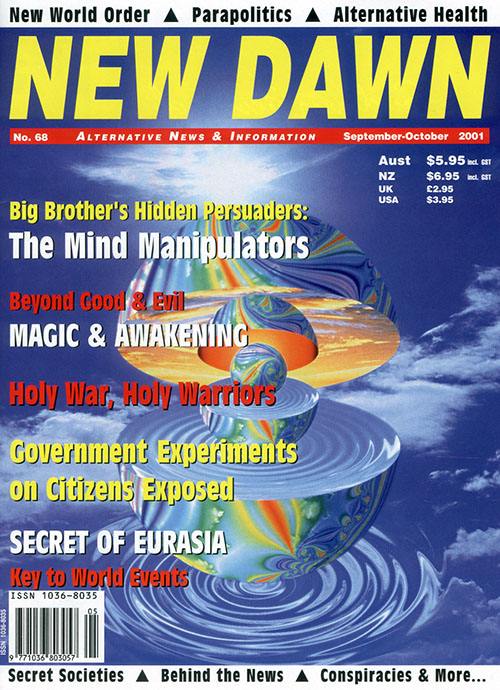
    From New Dawn 68 (Sept-Oct 2001)

    Beneath the broad tide of human history there flow the stealthy undercurrents of the secret societies, which frequently determine in the depths the changes that take place upon the surface.
    – A.E. Waite1

    Have secret societies and occult brotherhoods been active behind the scenes of world events for thousands of years? Do these guardians of secret wisdom shape the growth of human consciousness and influence the destiny of nations? Are hidden masters of occult knowledge empowering and infiltrating certain political, cultural, spiritual and economic movements, in fulfilment of an ancient plan? Could it be that man’s great upheavals, wars, and revolutions, as well as his pioneering discoveries in science, literature, philosophy and the arts, are the result of a ‘hidden hand’? Can we decode history and find the mysterious interface between politics and occultism, thereby uncovering the real movers and shakers in our modern world?

    The German philosopher Oswald Spengler warned of a “mighty contest” between groups of men of “immense intellect” who the “simple citizen neither observes nor comprehends.” Back in 1930 Ralph Shirley, the editor of the London Occult Review, Britain’s leading journal of esoteric sciences, endorsed “the suspicion that the ranks of occultism are secretly working for disintegration and revolution. Positive proof in the shape of a group of occultists working with this objective in view recently came under the notice of the present writer.”

    This article appeared in New Dawn 68 which significantly was released over the period Sept-Oct 2001.

    Major-General Fuller, a former disciple of Aleister Crowley, who had links to British military intelligence, wrote about an insidious force using “Magic and Gold” striving “to gain world domination under an avenging Messiah as foretold by Talmud and Qabalah.” Fuller’s former chief Crowley worked as a secret agent for both Britain and Germany, although his British handlers noted his ‘unreliability’ warning he should only be used in espionage operations with the utmost care. During the First World War the German Foreign Office secretly requested the occultist Gustav Meyrink to write a novel blaming the Freemasons of France and Italy for the outbreak of war.

    Madame Blavatsky believed the Catholic society of Jesuits had transferred their headquarters from the continent to England where they plotted to plunge man into passive ignorance and institute “Universal Despotism”. The founder of the Theosophical Society, a woman of immense intellect and first hand experience of secret societies, warned:

    Students of Occultism should know that while the Jesuits have by their devices contrived to make the world in general, and Englishmen in particular think there is no such thing as Magic and laugh at Black Magic, these astute and wily schemers themselves hold magnetic circles and form magnetic chains by the concentration of theircollective WILL, and when they have any special object to effect or any particular and important person to influence.2

    The French Revolution, one of Europe’s most important political upheavals, was largely the work of Masonic lodges dedicated to the overturning of the monarchy and an end of the established Catholic religion. In Proofs of a Conspiracy (1798), John Robison showed that the political clubs and correspondence committees during the revolution, including the famous Jacobin Club, sprang from these Masonic lodges.

    The influence on history of mysticism, the occult and secret societies is generally dismissed by Western academics. Mainstream historians choose to ignore this aspect because they believe it has no real significance to world politics. In fact it is only through acknowledging the role and influence of the ‘occult underground’ that important world events can be fully understood and placed in their real historical perspective.

    Atlantism Verses Eurasianism

    Secret societies and the teachers of occult wisdom consistently trace their origins back to the very dawn of civilisation. Within Judeo-Christian culture, the secret schools speak of Adam, Seth, Moses and the Patriarchs as initiates of a divine wisdom carefully passed from one generation to the next. Other occult groups look back beyond ancient Egypt and the Mystery schools of Greece, to the lost continent of Atlantis. Still others trace their lineage to Sumeria or Babylon and the mysterious plains of Tartary.

    Examining mankind’s myths, legends and arcane stories we encounter countless references to a vanished primordial civilisation. The brilliant French metaphysician Rene Guenon wrote of a great Hyperborean culture that flourished around the Arctic Circle and of its outposts Shambhala in the East and Atlantis in the West. Plato wrote of Atlantis, describing it as the heart of a great and powerful empire which, due to the indiscriminate mixing of “the sons of God” with “the children of men,” suffered “violent earthquakes and floods” and “disappeared beneath the sea”. According to occult tradition, Atlantis came to an end after a lengthy period of chaos and disaster brought about, in the words of Madame Blavatsky, because the “Atlantis-race became a nation of wicked magicians.” Atlantis was destroyed by a conspiracy of evil magicians who had seized control of the mighty continent.

    Long before the final end of Atlantis, great migrations took place to different centres of the earth. In one legend we are told of a righteous remnant journeying from the Arctic Circle to Shambhala, in the remote fastness of Central Asia. Other legends suggest Atlantean survivors established the ancient Egyptian civilisation.

    Victoria LePage, the author of one of the most comprehensive studies of Shambhala explains how Atlantis and Shambhala are more than mere geographic locations:

    In folklore Atlantis and Shambhala are implicitly linked together as charismatic images of heart’s desire, two shining mirages that lie on the farthest horizon of human longing, unattainable, always receding as we reach for them; at best no more than ideal states of consciousness never realized. But their association seems to have a far more real and historically concrete basis than that. Initiatic tradition affirms they have both genuinely existed, one in the western sea, the other in the eastern mountains, as lynchpins of what was once a network of Wisdom centers located on a great power-grid extending around the globe. Further, Shambhala still exists within a framework that awaits reactivation.3

    In order to identify the historical activities of secret societies we need to appreciate the origin of a most powerful idea. Occult lore speaks of Shambhala as the positive centre of the Brotherhood of Light, and Atlantis the negative centre of the evil magicians, the Brothers of the Shadow. Wherever we look we see the division of secret societies and occult endeavours into these two opposing ‘Orders’. All occult movements and teachings inevitably serve either the “Order of Eurasia” or the “Order of Atlantism”, with their respective symbolic centres of Shambhala and Atlantis. Concealed behind a multitude of different forms and represented by an array of unsuspecting agents of influence, these two centres – Shambhala and Atlantis – represent two different impulses in human evolution.

    Viewed from the perspective of sacred geography, in our present historical cycle, Atlantism is the triumph of the most destructive and diabolical elements in the civilisation of the West. One modern authority on sacred geography and geopolitics observes:

    Sacred geography on the basis of “space symbolism” traditionally considers the East as “the land of Spirit”, the paradise land, the land of a completeness, abundance, the Sacred “native land” in its fullest and most perfect kind. In particular, this idea is mirrored in the Bible text, where the eastern disposition of “Eden” is treated.

    Precisely such understanding is peculiar also to other Abrahamic traditions (Islam and Judaism), and also to many non-Abrahamic traditions – Chinese, Hindu and Iranian. “East is the mansion of the gods”, states the sacred formula of the ancient Egyptians, and the same word “east” (“neter” in Egyptian) meant at the same time “god”. From the point of view of natural symbolism, East is the place where the sun rises, Light of the World, material symbol of Divinity and Spirit.

    The West has the opposite symbolical meaning. It is the “country of death”, the “lifeless world”, the “green country” (as the ancient Egyptians called it). West is “the empire of exile”, “the pit of the rejected”, according to the expression of Islamic mystics. West is “anti-East”, the country of decay, degradation transition from the manifest to the non-manifest, from life to death, from completeness to need, etc. West is the place where the sun goes, where it “sinks down”.4

    Russia & the Magical Universe

    Russia, geographically the largest country on earth, occupies a unique position in the study of human history furnishing us with a window into the world of secret societies, occult teachers, and subterranean political currents.

    Ideas and practices drawn from magic and the occult have always been a part of Russian life. In the sixteenth century Tsar Ivan IV consulted magicians and was aware of the occult significance of the precious stones set in his staff. His reign was the culmination of the dream of building a prophetic, religious civilisation in the Eastern Christian tradition of Byzantium. Surrounded by secret orders of apocalyptical monks, Ivan saw himself as heir to the Israelite kings and attempted to transform Russian life in accord with his magical view of reality. Ivan was convinced the Russian nation had a special mission to accomplish, nothing short of the redemption of the world.

    In 1586, Tsar Boris Godunov offered the huge salary of 2000 English pounds a year, with a house and all provisions free, to John Dee, the English magus and spy master, to enter his service. Dee’s son Dr. Arthur Dee, who like his father was an alchemist and Rosicrucian, went to Moscow to work as a physician. Mikhail Romanov, the first Tsar of the Romanov dynasty, allegedly ascended the throne with the help of Dr. Arthur Dee and British agents. Before their rise to power the Romanovs were accused by their enemies of practising magic and possessing occult powers.

    Saint Germain

    The legendary Count of Saint Germain, described as an alchemist, spy, industrialist, diplomat and Rosicrucian, became involved in several political intrigues in Russia and was, according Nicholas Roerich, “a member of the Himalayan brotherhood.” In 1755 he traveled throughout Eurasia to study occult teachings, and may even have visited Tibet. It is said that while studying occultism in Central Asia the Count was introduced to the secret rites of Tantric sex magic which provided him with a technique to prolong his youth. He also engaged in spying operations against the notorious British India Company. Saint Germain founded two secret societies called the Asiatic Brethren and the Knights of Light. As early as 1780 he warned Marie Antoinette that the French throne was in danger from an international conspiracy of ‘Brothers of the Shadow’. Rumours continued to circulate for many years after his alleged death that Saint Germain was still alive working behind the scenes in European politics or studying occult doctrines in Central Asia.

    West Meets East

    Occult powers seem to be a matter of national temperament… Russia tends to produce mages – men or women who impress by their spiritual authority; no other nation has a spiritual equivalent of Tolstoy and Dostoevsky, or even of Rozanov, Merezhkovsky, Soloviev, Fedorov, Berdaev, Shestov. Certainly no other nation has come near to producing anyone like Madame Blavatsky, Gregory Rasputin or George Gurdjieff. Each is completely unique.
    – Colin Wilson, The Occult

    The process of synthesis of the occult traditions of East and West is seen in the work of Helena Petrovna Blavatsky, founder of the Theosophical Society and the author of the magnus opus The Secret Doctrine. Born Helena von Hahn, the daughter of a Russian military family and cousin to the future Russian Prime Minister Count Witte, she is a true emissary of the Eurasian Order. Nevill Drury says of the Russian occultist:

    Her main contribution to mystical thought was the manner in which she sought to synthesise Eastern and Western philosophy and religion, thereby providing a framework for understanding universal occult teaching.5

    Helena Petrovna Blavatsky

    Madame Blavatsky traveled throughout Asia and Europe, joined Garibaldi’s national revolutionary militia, fighting in the battle of Mentana, in which she was severely wounded. In the late 1870s, shortly after the publication of her first book Isis Unveiled, a compelling indictment of contemporary Western religion as spiritually bankrupt, she moved from the United States to India where the headquarters of the Theosophical Society remains until this day.

    In 1891 the future Tsar Nicholas II, in the company of the mystic Eurasian scholar Prince Ukhtomsky, visited the headquarters of the Theosophical headquarters at Adyar. Prince Ukhtomsky’s description of the society is revealing:

    At the insistence of H.P. Blavatsky, a Russian lady who knew and had seen much, the idea sprang up of the possibility, and even the necessity, of founding a society of theosophists, of searchers for the truth in the broadest sense of the word, for the purpose of enlisting adepts of all creeds and races, of penetrating deeper into the most secret doctrines of oriental religions, of drawing Asiatics into true spiritual communion with educated foreigners in the West, of keeping up secret relations with different high priests, ascetics, magicians, and so on.6

    Madame Blavatsky wanted to unite Central Asia, India, Mongolia, Tibet and China, in order – with the involvement of Russia – to create a grand Eurasian power able to oppose British ambitions. Traveling across India Blavatsky agitated against British rule and found herself accused by the colonial authorities of being a Russian spy. Prince Ukhtomsky saw support for Eurasia in the “readiness of the Indians to group themselves under the banner of the strange northern woman.” He believed Madame Blavatsky had been forced to leave India by “the suspiciousness of the English.”

    As early as 1887 H.P. Blavatsky had become a topic of debate in “mystic Petersburg” and received the prestigious support of Ukhtomsky’s friend the mysterious Tibetan Dr. Badmaev, soon to become notorious for the favour he received at the Russian imperial court and his relationship with Rasputin. Madame Blavatsky’s sister insisted that the Russian Orthodox Metropolitan of Kiev had recognised the young Helena’s psychic gift, and admonished her to use her powers with discretion, as he felt sure they were given her for some higher purpose.

    Dr. Stephan A. Hoeller, a scholar of comparative religion and a Gnostic Bishop, reminds us that Blavatsky,

    was a true daughter of Mother Russia. Some feel that her life and character correspond strongly to the archetype of the traditional Russian wandering holy person, known as the staretz (literally ‘old one’), denoting a wandering, non-clerical ascetic, or pilgrim, who travels about the countryside, exhorting people concerning spiritual matters, sometimes in a decidedly unorthodox manner.7

    After H.P. Blavatsky’s death in London in 1891, the Theosophical Society came under the firm control of the English occultists Annie Besant and C.W. Leadbeater, a confirmed British imperialist. The Eurasian orientation given to early Theosophy by H.P. Blavatsky was compromised by the influence of British Masonry and Leadbeater’s esoteric High Anglicanism. In the great struggle of the magicians the Eurasian impulse found new historical agents in the West, among them the celebrated French magus Papus.

    Grand Battle of the Magicians

    When the 19th century will have come to an end, one of the Brothers of Hermes will come from Asia to unite humanity again.
    – Nostradamus

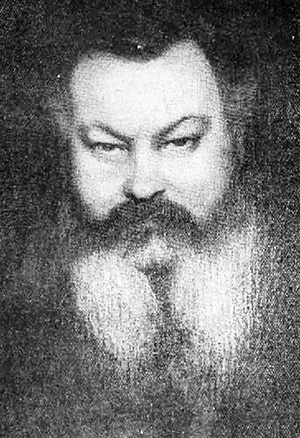
    Papus

    Papus, together with Oswald Wirth and De Guaita, dreamed of uniting occultists everywhere into a revived Rosicrucian brotherhood, an international occult order in which they hoped the Russian Empire would play a leading role as the bridge between East and West.

    Papus was the pseudonym of Dr. Gerard Encausse (1865-1916), a disciple of Joseph Saint-Yves d’Alveydre (1842-1910), an initiate of the French Gnostic Church and often the instigator of many of the occult groups of his time. One of the most famous turn-of-the century occultists, he was the founder of the Hermetic School in Paris, which attracted many Russian students, and directed the leading French occult review, L’Initiation. Papus was also the head of two secret societies, the L’Ordre du Martinisme and the L’Ordre Kabbalistique de la Rose-Croix.

    When the Russian Tsar and Tsarina visited France in 1896, it was Papus who sent them a greeting on behalf of “the French Spiritualists,” hoping that the Tsar would “immortalise his Empire by its total union with Divine Providence.” This greeting was reminiscent of the hopes of mystics at the time of Tsar Alexander I’s Holy Alliance.

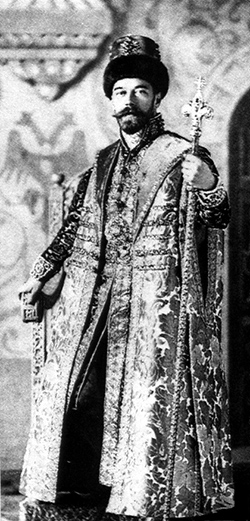
    Tsar Nicholas II

    Papus made his first visit to Russia in 1901 and was introduced to the Tsar. He quickly set up a lodge of his Martinist Order in St. Petersburg with the Tsar as the president of the “Unknown Superiors” who controlled it. The historian James Webb says Papus “was merely reviving a devotion to a philosophy that had flourished in Russia at the turn of the 18th and 19th centuries before being suppressed.”

    As the foremost student of Saint-Yves d’Alveydre, Papus knew of the key role to be played by Russia in unifying Eurasia and her occult destiny as the Empire of the End, the outward manifestation of the enigmatic power of ‘Northern Shambhala’.

    Through Papus the Imperial family became acquainted with his friend and spiritual mentor Master Philippe (Nizier Anthelme Philippe). A sincere Christian mystic, he was given rank and honours by the Russian Tsar, and maintained contact with the imperial court until his death in 1905.

    Papus returned to St. Petersburg in 1905 where it was rumoured he, in the presence of the Imperial couple, evoked the spirit of the Tsar’s father, Alexander III, who offered practical advise on handling a political crisis.

    Both Master Philippe and Papus played an important political role at the Russian court. They not only advised the Tsar on affairs of state but maintained contact with influential Russian initiates of the Martinist Order, among them two of the Tsar’s uncles and numerous relatives. The German occultist Rudolf Steiner, who had his own disciples among the German General Staff, followed the mission of the two Frenchmen, disturbed by Papus’ “extensive influence in Russia”. A strong advocate of the alliance between France and Russia, Papus warned the Tsar of an international conspiracy aimed at world domination.

    He believed that the vast Russian Empire was the only power capable of thwarting the conspiracy of the ‘Shadow Brothers’. He also urged the Tsar to prepare for the coming war with Germany, then being engineered by sinister forces in Berlin. According to one account, he promised the imperial family that, the Romanov monarchy would be protected as long as he, Papus, was alive. When the news of his death reached Alexandra in 1916, she sent a note to her husband (at the time commanding the Russian armies at the front in World War I) containing the words ‘Papus is dead, we are doomed!’8

    Papus promoted his Martinist Order as a counter to the Masonic lodges which, he believed, were in the service of British imperialism and the international financial syndicates. From his papers it is known that he furnished documentation to the Russian authorities about Masonic activities in Russia and Europe. Papus condemned Freemasonry as atheistic in contrast to the esoteric Christianity of the Martinist Order. He castigated “our epoch of scepticism, adoration of material forms, so vitally in need of a frankly Christian reaction, independent of all priesthoods.” Shortly after returning from his first visit to Russia in 1901, a series of articles appeared in the French press for which Papus was largely responsible. They warned of a “hidden conspiracy” the existence of which the public was totally unaware and of the machinations of a sinister financial syndicate trying to disrupt the Franco-Russian alliance. The public is blind to the real forces of history:

    It does not see that in all conflicts whether arising within or between nations, there are at the side of the apparent actors hidden movers who by their self-interested calculations make these conflicts inevitable….

    Everything which happens in the confused evolution of nations is thus prepared in secret with the goal of securing the supremacy of a few men; and it is these few men, sometimes famous, sometimes unknown, who must be sought behind all public events.

    Now, today, supremacy is ensured by the possession of gold. It is the financial syndicates who hold at this moment the secret threads of European politics…

    A few years ago there was thus founded in Europe a financial syndicate, today all-powerful, whose supreme aim is to monopolise all the markets of the world, and which in order to facilitate its activities has to acquire political influence.

    The Papus inspired articles in Echo de Paris revealed the role of the British Secret Service, which was exposed as being behind British Freemasonry, to isolate and weaken Russia. In France British agents concentrated on anti-Russian propaganda, while in Russia they used “financial trickery” to infiltrate all levels of society. Every effort was required “to preserve the Russian Emperor – so loyal and so generous – from the evils… [of ] the syndicate of financiers… which at present controls the destinies of Europe and the world.”

    The Mysterious Tibetan

    St. Petersburg… in 1905 was probably the mystical centre of the world.
    – Colin Wilson, The Occult

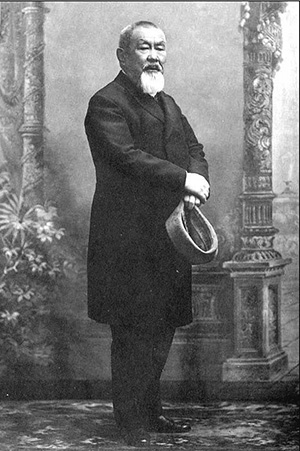
    Shamzaran (Pyotr) Badmaev was a Buriat Mongol who had grown up in Siberia and converted to Russian Orthodoxy with Alexander III acting as his godfather. He gained considerable influence at the Ministry of Foreign Affairs and the Tsar granted him the title of Privy Councillor. Badmaev was renowned as a doctor of Tibetan medicine, herbalist, and healer, who treated high society patients at his fashionable ‘Oriental Medicine’ clinic in St. Petersburg. Described by a Russian historian as “one of the most mysteries personalities of the day,” and a “master of intrigue”, Badmaev enjoyed a close association with the mystic healer Rasputin.

    Shamzaran (Pyotr) Badmaev

    Known as ‘the Tibetan’, Badmaev dreamed of the unification of Russia with Mongolia and Tibet. He involved himself in endless projects aimed at the creation of a great Eurasian empire. Russia’s historic mission, he believed, lay in the East, where she was destined to unite the Buddhist and Muslim peoples, as a counter to Western colonialism. Badmaev outlined his vision in a 1893 report to Tsar Alexander III entitled ‘The Tasks of Russia in the Asiatic East’. His considerable political expertise secured the support of the Mongol tribes in the Russo-Japanese War.

    In a letter of 19 December 1896, Badmaev wrote to Tsar Nicholas II: “…my activities have the aim that Russia should have greater influence than other powers upon the Mongolian-Tibetan-Chinese East.” Badmaev expressed particular concern over the influence of England in the East, stating in a special memorandum:

    Tibet, which – as the highest plateau of Asia – rules over the Asiatic continent, must without doubt be in the hands of Russia. By commanding this point, Russia will surely be able to make England more compliant.

    Badmaev knew of the legend, popular in Mongolia, China and Tibet, about the ‘White Tsar’ who would come from the North (from ‘Northern Shambhala’) and restore the now decadent traditions of true Buddhism. He reported to Tsar Nicholas II how “Buryats, Mongols and especially lamas… were always repeating that the time had come to extend the frontiers of the White Tsar in the east….”

    Badmaev had a close association with a highly placed Tibetan, the lama Agvan Dordzhiyev, the tutor and confidant of the 13th Dalai Lama. Dordzhiyev equated Russia with the coming Kingdom of Shambhala anticipated in the Kalachakra texts of Tibetan Buddhism. The lama opened the first Buddhist temple in Europe, in St. Petersburg, significantly dedicated to the Kalachakrateaching. One of the Russian artists who worked on the St. Petersburg temple was Nicholas Roerich, who had been introduced to the legend of Shambhala and Eastern thought by lama Dordzhiyev. George Gurdjieff, another man of mystery who had an impact on Western mysticism, knew Prince Ukhtomsky, Badmaev, and lama Dordzhiyev. Was Gurdjieff, accused by the British of being a Russian spy in Central Asia, a pupil of the mysterious Tibetans?

    “I am training young men in two capitals – Peking and Petersburg – for further activities,” Dr. Badmaev had written to Tsar Nicholas II.

    Mystical Anarchism

    The sway of ‘the Tibetan’ reached beyond the Imperial court into the Russian intelligentsia and further still to the subterranean world of espionage and revolutionary politics. One of the intellectual movements at the time of the 1905 political upheavals was called “Mystical Anarchism”. Two of its leading exponents were the poet and writer Viacheslav Ivanov and George Chulkov, both associates of Dr. Badmaev. Chulkov, like ‘the Tibetan’, is described as an unconscious medium transmitting mysterious forces.

    A radical political doctrine aimed at reconciling individual freedom and social harmony, Mystical Anarchism drew on the ideas of Friedrick Nietzsche. This is not surprising when we consider Nietzsche’s positive view of Russia as the antithesis of the decadent West, and the German philosopher’s appreciation of Buddhism and Oriental culture.

    According to the historian Bernice Glatzer Rosenthal, Mystical Anarchists, convinced “that unseen forces are guiding events here on earth, believed that political revolution reflected realignments in the cosmic sphere, and that a new world of freedom, beauty, and love was imminent.”

    Advocating the abolition of all external authorities and all constraints on the individual – government, law, morality, social custom – they were indifferent to legal rights as merely “formal freedoms” and opposed constitutions and parliaments in favor of sobornost’. By sobornost’ they meant a free community united by love and faith whose members retain their individuality (as distinct from individualism, self-affirmation apart from or against the community)….

    They grounded this ideal in their notion of the “mystical person,” the soul or the psyche, which seeks union with others and recognizes itself as a microcosm of the macrocosm, as distinct from the “empirical person,” the I or the ego, which asserts itself apart from or against others. Evoking and developing this “mystical person” would make feasible a “new organic society” united by invisible inner ties of love (eros, not agape), “mystical experience,” and sacrifice – the very opposite of liberal society, based on the social contract and mutual self-interest and characterized by rational discourse.9

    Mystical Anarchism is a thoroughly Eurasian sociopolitical idea. Here we have a most arcane motif in a modern form: The great struggle of the empirical, plutocratic Western civilisation, against the mystical, sacrificial culture of Eurasia. In occult terms it is the conflict of the impulse of ‘Shambhala’ with the renegades of ‘Atlantean civilisation’. The Brotherhood of the Northern Light battling it out with the Brothers of the Shadow, external manifestation of the long war between the agents of Being and Non-Being.

    Nicholas Berdyaev, Dmitri Merezhkovsky, Zenaida Hippius, Valerri Briusov, Mikhail Kuzmin, Alexandre Blok, Vasili Rozanov, along with a host of other Russian poets, writers and artists, transmitted different aspects of Mystical Anarchism and the Eurasian vision. When in the years before the Revolution the Sufi Master Inayat Khan visited Russia, he found much to commend in “the Eastern type of discipleship which is natural to the nation.”

    Merezhkovsky saw the possibility of evolving a “new religious consciousness” from the two peculiarly Russian types represented by Tolstoy and Dostoievsky. Tolstoy stood for a pantheistic mysticism of the flesh, and Dostoievsky for the more ascetic spiritual values. “In this Russia the ‘Man-God’ shall be manifested to the Western world, and the ‘God-man’ for the first time to the Eastern, and shall be, for those whose thinking already reconciles both hemispheres the ‘One in Two.’”

    After the Bolshevic Revolution, Blok contrasted the new Russia with the West. He called Russia the “Scythian,” i.e., the young, fresh nation whose destiny it was to challenge the decaying West:

    We are the Scythians, we are the Asians… Centuries of your days are but an hour to us, Yet like obedient slaves, We’ve held a shield between two hostile races – Europe, and the Mongol hordes… From war and horror come to our open arms, The embrace of kin, Put the old sword away while there’s time, Hail us brothers… Ah, Old World, before you have perished, join our fraternal banquet.

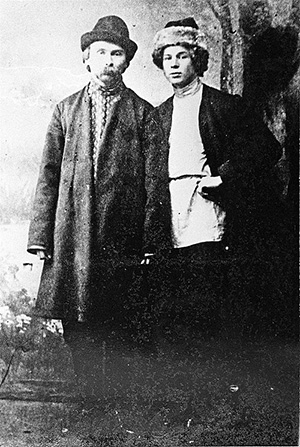
    The poet Nikolai Kliuev and his young friend Sergei Esenin featured occult images and Eurasian themes in their work. At the end of 1917 Kliuev (1887-1937), a prophet and emissary of Eurasia, wrote:

    We are the host of sunbearers.
    On the hub of the universe
    we will erect a hundred-story, fiery house.
    China and Europe, the North and the South
    Will come to the chamber in a round-dance of playmates
    to match together Abyss and Zenith.
    Their godfather is God Himself and their Mother
    is Russia.

    Kliuev’s protege, Esenin (1895-1925), longed for the end of the old world and its replacement by a new one, and even proclaimed a new religious trend called “Aggelism,” with clear roots in Russian Gnosticism. He hailed both Christ and Gautama the Buddha as geniuses because they were men of “word and deed”. In a letter to a friend, Esenin wrote:

    People, look at yourselves, did not Christs emerge from you, and can you not be Christs? Can I with will-power not be a Christ…? How absurd all our life is. It distorts us from the cradle, and instead of truly real people some kind of monster emerges.

    Nikolai Kliuev (left) and Sergei Esenin in Petrograd. 1915

    He warned the United States, to him the symbol of all non-Russian and rationalist sources, not to commit the mistake of “unbelief” and ignore the new “message” from Russia, as the way to the new life is only through Russia. A friend wrote how Esenin and his fellow ‘Scythian’ poets wanted a “deepening of the political revolution to the social” and came to regard Russian Marxism as “coarse”. Before his death Esenin became convinced ‘evil forces’ had usurped the Revolution and the Bolshevics betrayed Russia’s mission.

    The famed poet Nikolai Kliuev knew both Dr. Badmaev and Grigory Rasputin, and like the latter had been initiated into a secret school of Christian sexual mysticism with similarities to Tibetan Tantra and Indian Shivaism. “They called me a Rasputin,” Kliuev wrote in a 1918 poem. Kliuev’s spirituality was deeply rooted in the tradition of the Russian religious dissidents like the Old Believers, the Khlysty and Skoptsy, who formed a veritable subterranean river among the common people. Kliuev admitted how challenged by a Khlyst elder to “become a Christ,” he was introduced to the secret community of “Dove brethren”. With the help of “various people of secret identity”, Kliuev traveled all over Russia participating in secret rituals and imbibing the occult traditions of the Russian East.

    In his poems Kliuev sought to convey the mystic spirit of Eurasia. He was a prophet of Belovodia, the name given by Russian Old Believers to the awaited earthly paradise similar to Shambhala. Kliuev envisioned a radical transformation of Russia that would bring about a classless society where peasant culture would triumph over industrialism, capitalism, and the general mechanisation of life. He expressed his concern about the dangers of soulless Western civilisation in a 1914 letter to a friend:

    Every day I go into the grove – and sit there by a little chapel – and the age-old pine tree, but an inch to the sky, I think about you… I kiss your eyes and your dear heart… O, mother wilderness! Paradise of the spirit… How hateful and black seems all the so-called civilised world and what I would give, what Golgotha I would bear – so that America should not encroach upon the blue-feathered dawn… upon the fairy tale hut.

    Nicholas Berdyaev

    The Russian philosopher Nicholas Berdyaev articulated the vision shared by pre-revolution Russian thinkers as well as the cultural elite, when he wrote of the end of Western rationalism and the birth of a new era of the spirit which would witness the struggle of Christ and Antichrist. He saw the popularity of mystical and occult doctrines as proof of the approach of this New Era, and called for a “new knighthood”. “Man is not a unit in the universe, forming part of an unrational machine, but a living member of an organic hierarchy, belonging to a real and living whole.” Berdyaev’s attacks on Western materialist values only reflected a view widely held by Russian society. Writing in exile in the early 1930s he observed:

    Individualism, the ‘atomisation’ of society, the inordinate acquisitiveness of the world, indefinite over-population and the endlessness of people’s needs, the lack of faith, the weakening of the spiritual life, these and other are the causes which have contributed to build up that industrial capitalist system which has changed the face of human life and broken its rhythm with nature.

    Journey to Shambhala

    Nicholas Roerich was a man who brought glory to our [Russian] people; he is a representative of our civilisation and of its culture, one of its pillars.
    – Mikhail Gorbachev

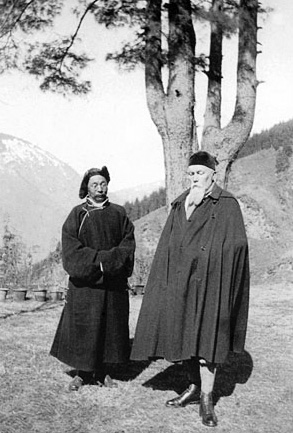
    Nikolai Roerich with a lama, 1933.

    Nikolai Konstantinovitch Roerich (1874-1947) had been introduced to the idea of Shambhala while working on the construction of the first Buddhist temple ever to be built in Europe. Personally acquainted with Russia’s pre-revolution intelligentsia, Roerich became a highly respected and prolific artist. A student of Madame Blavatsky’s works, Roerich believed in the transcendent unity of religions – in the notion that one day the Buddhist, the Muslim, and the Christian would realise their separate dogmas were husks concealing the truth within. Between 1925 and 1928, Roerich undertook five remarkable expeditions through Central Asia, focusing on the mysterious region between the Urals and the Himalayas, the area regarded as the heart of Eurasia. The traditions and legends encountered by Roerich in his travels are described in the books Altai-HimalayaHeart of Asia and Shambhala.

    In the tradition of Tibetan Buddhism, Shambhala is the hidden land in which the teachings of the Kalachakra (‘Wheel of Time’) Tantric school are kept in their purest form. Roerich discovered that the Shambhala of Tibetan Buddhism is not too different from the legend of Belovodia preserved by Russian Christian mystics. An elder of the Old Believer sect confided to Roerich:

    In distant lands, beyond the great lakes, beyond the highest mountains, is a sacred place where all truth flourishes. There one may find the supreme knowledge and the future salvation of mankind. And this place is called Belovodia, meaning the white waters.10

    Nicholas Roerich wrote how on a visit to the Mongolian capital Ulan-Bator in the 1920s, he heard soldier-revolutionaries singing:

    The war of Northern Shambhala.
    Let us die in this war
    To be reborn again
    As Knights of the Ruler of Shambhala.

    By ‘Northern Shambhala’ is meant Russia-Eurasia. In his book Heart of Asia, Roerich defined Shambhala not so much as a coming kingdom but an event – a new epoch for humanity of which Shambhala and Belovodia are timeless symbols:

    You have noted the concept of Shambhala corresponds to the aspirations of our most serious Western scientific research…. In their striving, the Eastern disciplines of Shambhala and the best minds of the West, which do not fear to look beyond the outworn methods, are uniting.

    Roerich never doubted the crucial role Russia would play in bringing together the noblest wisdom of both the East and the West. In Russia a new synthesis would emerge and a new day dawn for humanity, neither exclusively Western nor wholly Eastern, but truly Eurasian. In 1940, as the world found itself plunged into war, Roerich discerned the first glimpses of a New Era and wrote:

    The Russian people have piled together great stones. To the admiration of everyone they have built no tower of Babel but a Russian tower. A Kremlin of Sun-bearers with a hundred towers!… Listen – that is the future, and how radiant it is!”

    A year later in 1941 he commented:

    The whole world is rushing towards Armageddon. Everyone is confused. Everyone is unsure about the future. But the Russian people have found their course and with a mighty flood are streaming towards their radiant future.

    ‘You Must Pay Attention to Me, In Order to See Me’

    Humanity’s radiant future, like Shambhala, stands at the threshold. An invisible college of men and women in every age and nation have glimpsed it and responded to the impulse. Living in the first years of a new millennium we are witnessing the unfolding of an ancient plan. Just as there is no day without night, so too there is no authentic New Era without its counterfeit. And as the darkness must give way to the new dawn, so our present Dark Era will pass away in the great light of ‘Northern Shambhala’.

    Behind the tangle of present day events the ancient battle is being concluded. “In wartime,” said the emissary of Atlantism Winston Churchill, “truth is so precious that she should always be attended by a bodyguard of lies.” Empowered by the wicked Magicians of Atlantis, Western secret societies are in a state of occult warfare with the Order of Eurasia.

    We await the arrival of the New Era of Shambhala, the casting out of the Brothers of the Shadow from the governmental and financial centres of the earth, and the end of the evil karma inherited from the darkness of Atlantis.

    Alice Bailey, who described Shambhala as “the vital centre in the planetary consciousness” and related it to the Second Coming of the Christ, also prophesied Russia’s special role in bringing in the true New Era:

    Out of Russia… will emerge that new and magical religion about which I have so often told you. It will be the product of the great and imminent Approach which will take place between Humanity and the Hierarchy. From these two centres of spiritual force, in which the light which ever shineth in and from the East will irradiate the West; the whole world will be flooded with the radiance of the Sun of Righteousness. I am not here referring, in connection with Russia, to the imposition of any political ideology, but to the appearance of a great and spiritual religion, which will justify the crucifixion of a great nation and which will demonstrate itself and be focused in a great and spiritual Light which will be held aloft by a vital Russian exponent of true religion – that man for whom many Russians have been looking, and who will be the justification of a most ancient prophecy.11

    [alert type=”general” dismiss=”no”]This article was published in New Dawn 68.[/alert]

    [alert type=”success” dismiss=”no”]If you appreciate this article, please consider subscribing to help maintain this website.[/alert]

    Footnotes:

    1. Arthur Waite, The Real History of the Rosicrucians
    2. Letters of H. P. Blavatsky as quoted in The Occult Establishment by James Webb
    3. Victoria Le Page, Shambhala: The Fascinating Truth Behind the Myth of Shangri-la
    4. Alexander Dugin
    5. Nevill Drury, Dictionary Of Mysticism And The Esoteric Traditions, 1992
    6. As quoted in The Harmonious Circle by James Webb
    7. Stephan A. Hoeller, “H.P. Blavatsky: Woman of Mystery and Hero of Consciousness,” The Quest, Autumn 1991
    8. Stephan A. Hoeller, “Esoteric Russia”, Gnosis Magazine, No.31, Spring 1994
    9. The Occult in Russian And Soviet Culture, edited by Bernice Glatzer Rosenthal
    10. Nicholas Roerich, Heart of Asia
    11. Alice Bailey, Prophecies by D.K.

    © New Dawn Magazine and the respective author.

    For our reproduction notice, click here.
  • The Human Radiation Experiments

    The Human Radiation Experiments

    This article was published in New Dawn 68 (Sept-Oct 2001)

    In preparing America for nuclear attack during the Cold War years following World War II, thousands of US citizens became the innocent victims of over 4,000 secret and classified radiation experiments conducted by the Atomic Energy Commission (AEC) and other government agencies, such as the Department of Defense, the Department of Health, Education and Welfare, the Public Health Service (now the CDC), the National Institutes of Health, the Veterans Administration (VA), the CIA, and NASA.

    Millions of people were exposed to radioactive fallout from the continental testing of more than 200 atmospheric and underground nuclear weapons, and from the hundreds of secret releases of radiation into the environment. Over 200,000 “atomic vets” who worked closely with nuclear detonations at the Nevada test site during the 1950s and 1960s were especially vulnerable to radiation fallout.

    Also affected were the thousands of so-called “downwinders”, who lived in nearby small towns in Nevada, Utah, Colorado and New Mexico. These downwinders (along with the animal populations) suffered the worst cumulative radioactive effects of fallout, along with a contaminated environment teeming with radioactive food and farm products. The plight of these poor country people exposed to government-induced radiation sickness has been recorded in Carole Gallagher’s remarkable photo-essay American Ground Zero: The Secret Nuclear War (The Free Press, 1993).

    In reviewing declassified AEC records (now the Department of Energy) from the 1950s, Gallagher was shocked to discover one document that described the people downwind of the Nevada Test Site as “a low use segment of the population.” Her shock at such callous bigotry caused her to eventually move West to research, investigate and document those who lived closest to the Test Site, as well as workers at the site, and soldiers repeatedly exposed to nuclear bombs during the military tests.

    Disinformation and Nuclear Fallout

    In the nuclear arms race, government doctors and scientists brainwashed the public into believing low dose radiation was not harmful. Some officials even tried to convince people that “a little radiation is good for you.” Totally ignored was the knowledge that the radiation from nuclear fallout could lead to an increased risk of cancer, heart disease, neurological disorders, immune system disease, reproductive abnormalities, sterility, birth defects, and genetic mutations which could be passed on from generation to generation. The full extent of this radiation damage to the American public during the Cold War years will never be known.

    A secret AEC document, dated 17 April 1947, reveals that physicians were aware of these radiation hazards but simply ignored them. Under the title “Medical Experiments in Humans,” the memorandum read: “It is desired that no document be released which refers to experiments with humans that might have an adverse effect on public opinion or result in legal suits. Documents covering such field work should be classified ‘Secret’.”

    According to Gallagher, many downwinders testified that the Public Health Service officials told them that their ‘neurosis’ about the fallout was the only thing that would give them cancer, particularly if they were female. Women with severe radiation illness, hair loss, and badly burned skin, were clinically diagnosed in hospitals as “neurotic.” Other severely ill women were diagnosed with “housewife syndrome.” When Gallagher’s investigation led her to ask a Department of Energy spokesperson about the AEC/DOE’s practice of waiting until the wind blew towards Utah before testing nuclear bombs or venting radiation in order to avoid contaminating Las Vegas or Los Angeles, the unabashed and unconcerned official actually said on tape, “Those people in Utah don’t give a shit about radiation.”

    Secret Radiation Experiments

    Only recently, with the forced release of Top Secret documents, have details been revealed about the unethical and inhumane radiation studies conducted during the Cold War years from 1944 to 1974. The initial story broke in November 1993 in a series of articles in the Albuquerque Tribunewhich identified the names of 18 Americans secretly injected with plutonium, a key ingredient of the atomic bomb and one of the most toxic substances known to man. Some, but not all, of the patients were terminally ill. This horrifying story by journalist Eileen Welsome (who later won a Pulitzer Prize) unleashed a storm of nationwide protest prompting Department of Energy Secretary Hazel O’Leary to order the release of secret files and documents pertaining to these Cold War experiments.

    The extremely dangerous plutonium experiment was performed under the auspices of the government’s Manhattan Project, which brought together a revered group of distinguished scientists to develop and test the atom bomb. The purpose of these secret experiments was to establish occupational standards for workers who would be producing plutonium and other radioactive ingredients for the nuclear energy industry.

    Some of the classified government experiments included:

    * Exposing more than 100 Alaskan villagers to radioactive iodine during the 1960s.

    * Feeding 49 retarded and institutionalised teenagers radioactive iron and calcium in their cereal during the years 1946-1954.

    * Exposing about 800 pregnant women in the late 1940s to radioactive iron to determine the effect on the fetus.

    * Injecting 7 newborns (six were Black) with radioactive iodine.

    * Exposing the testicles of more than 100 prisoners to cancer-causing doses of radiation. This experimentation continued into the early 1970s.

    * Exposing almost 200 cancer patients to high levels of radiation from cesium and cobalt. The AEC finally stopped this experiment in 1974.

    * Administering radioactive material to psychiatric patients in San Francisco and to prisoners in San Quentin.

    * Administering massive doses of full body radiation to cancer patients hospitalised at the General Hospital in Cincinnati, Baylor College in Houston, Memorial Sloan-Kettering in New York City, and the US Naval Hospital in Bethesda, during the 1950s and 1960s. The experiment provided data to the military concerning how a nuclear attack might affect its troops.

    * Exposing 29 patients, some with rheumatoid arthritis, to total body irradiation (100-300 rad dose) to obtain data for the military. This was conducted at the University of California Hospital in San Francisco.

    The Atomic Energy Commission

    In 1995 the Energy Department admitted to over 430 radiation experiments conducted by the Atomic Energy Commission between the years 1944 and 1974. Over 16,000 people were radiated, some of whom did not know the health risks or did not give consent.

    These experiments were designed to help atomic scientists understand the human hazards of nuclear war and radiation fallout. Because the entire nuclear arms buildup was classified secret, these experiments were all stamped secret and allowed to take place under the banner of protecting “national security.”

    Amazingly, these clandestine studies were conducted at the most prestigious medical institutions and colleges, including the University of Chicago, the University of Washington, the Massachusetts Institute of Technology, Vanderbilt University in Nashville, and the previously mentioned universities.

    Uranium Mine Workers

    In addition to these radiation experiments, workers who mined uranium for the AEC in the Four Corners area of Arizona, Utah, Colorado and New Mexico, were exposed to radioactive dust during the 1940s up to the 1960s. Although AEC scientists and epidemiologists knew the dust in these poorly ventilated mines was contaminated with deadly radon gas which could easily cause death from lung cancer, this lifesaving information was never passed on to the miners, many of whom were Native Americans. As a result, many miners died prematurely of cancer of the lung.

    Stewart Udall, an Arizona Congressman and lawyer who also served as Secretary of the Interior during the Kennedy and Johnson administrations, represented the miners and their families in a class action lawsuit against the federal government for radiation injuries. In The Myths of August, Udall writes that some physicians who defended the decisions of the atomic establishment sought to justify these experiments by contending that little was known about the health risks associated with the various exposures. Others tried to put a positive face on tests conducted without obtaining informed consent by maintaining that these experiments nevertheless produced advances in medical knowledge. Some physicians argued that the conduct of the AEC doctors should be condoned because they were merely following the ‘prevailing ethics’ of the postwar period. When the miners’ case finally came to trial in 1983, the federal court in Arizona dismissed the case by declaring the US government was immune from lawsuit.

    Medical Ethics of the Cold War

    How could these physician-experimenters ignore the sworn Hippocratic Oath promising that doctors will not harm their patients? Did they violate the Nuremberg Code of justice developed in response to the Nazi war crimes trials after World War II?

    The Nuremberg Code includes 10 principles to guide physicians in human experimentation. In actuality, prior to the Nazi war crime tribunals, there was no written code for doctors; and lawyers defending the Nazi doctors tried to argue that similar wartime experiments were conducted with prisoners at the Illinois State Penitentiary, who were deliberately infected with malaria.

    During the Nuremberg trials the AMA came up with its own ethical standards, which included three requirements: 1) voluntary consent of the person on whom the experiment is to be performed must be obtained; 2) the danger of each experiment must be previously investigated by animal experimentation; and 3) the experiment must be performed under proper medical protection and management.

    The records now show that many victims of the government’s radiation experiments did not voluntarily consent as required by the Code. As late as 1959, Harvard Medical School researcher Henry Beecher viewed the Code “as too extreme and not squaring with the realities of clinical research.” Another physician said the Code had little effect on mainstream medical morality and “doubted the ability of the sick to understand complex facts of their condition in a way to make consent meaningful.”

    Writing in the Journal of the American Medical Association in 1996, Jay Katz recalls an argument at Harvard Medical School in 1961 suggesting that the Code was not necessarily pertinent to or adequate for the conduct of research in the United States. Katz writes: “The medical research community found, and still finds, the stringency of the NC’s first principle all too onerous.” But patients in medical experiments expect the experiment to help them in some way – not to harm them! Patients also are often inclined to totally trust their physicians not to harm them. In The Nazi Doctors and the Nuremberg Code, Katz concludes that many doctors view the Code as “a good code for barbarians but an unnecessary code for ordinary physicians.”

    The President’s Advisory Committee

    In January 1994 President Clinton convened an Advisory Committee to investigate the accusations surrounding the human radiation experiments. In their final report presented to the president on 3 October, 1995, the Committee found that up to the early 1960s it was common for physicians to conduct research on patients without their consent.

    The Committee’s harshest criticism was reserved for those cases in which physicians used patients without their consent in experiments in which the patients could not possibly benefit medically. These cases included the 18 people injected with plutonium at Oak Ridge Hospital in Tennessee, the University of Rochester in New York, the University of Chicago, and the University of California at San Francisco, as well as two experiments in which seriously ill patients were injected with uranium, six at the University of Rochester and eleven at Massachusetts General Hospital in Boston. The plutonium and uranium experiments undoubtedly put the subjects at increased risk for cancer in ten or twenty years’ time.

    The Final Report of the President’s Advisory Committee is now available in The Human Radiation Experiments, published in 1996 by Oxford Press. Although the Committee studied the experiments in depth, there was no attempt to assess the damage done to individuals. In many cases, the names and records of the patients were no longer available, nor was there any easy way to identify how many experiments had been conducted, where they took place, and which government agencies sponsored them. The Department of Health and Human Services, the primary government sponsor of research, had long since discarded files on experiments performed decades ago.

    The Committee discovered “the records of much of the nation’s recent history had been irretrievably lost or simply could not be located” and “only the barest description remained” for the majority of the experiments.

    The Department of Energy also claimed all the pertinent records of its predecessor, the AEC, had been destroyed during the 1970s, but in some cases as late as 1989. All CIA records are classified. When records of the top secret MKULTRA program (in which unwitting subjects were experimented upon with a variety of mind-altering drugs) were requested, the CIA explained that all pertinent records had been destroyed during the 1970s when the program became a national scandal.

    Keeping Government Secrets

    The Committee made clear that its story could not have been told if the government did not keep some records that were eventually retrieved and made public. However, federal records management law also provides for the routine destruction of older records. Thus, in the great majority of cases the loss or destruction of requested documents was a function of normal record-keeping practices.

    The Committee was dismayed to report: “At the same time, however, the records that recorded the destruction of documents, including secret documents, have themselves been lost or destroyed.” Thus, the circumstances of destruction (and indeed, whether documents were destroyed or simply lost) is often hard to ascertain.

    In the Committee’s judgment the AEC had repeatedly deceived the public by denying it had engaged in human experimentation, and by issuing cover stories to cover-up secret investigations, and by deliberately supplying incomplete information to people who participated in government-sponsored biomedical research. It was clear that once government information was “born secret” it often remained that way.

    The Committee concludes: “The government has the power to create and keep secrets of immense importance to us all.” Yet, without documents how can historians and other researchers uncover the truth about the government’s clandestine activities? Where is the ‘smoking gun’ when secret records are systematically shredded or reported as ‘lost’? We now know that many people were damaged during the government’s Cold War period of secrets and lies. But how can we uncover the medical and scientific secrets that remain hidden in the still classified documents from 1974 up to the present?

    In the absence of medical records and follow-up, the ultimate fate of individuals who willingly or unwillingly “volunteered” for these experiments is not known. The Committee simply did not have the time or the resources to review individual files and histories. In many instances only fragmentary information survives about these experiments; whether people were harmed in these experiments could not be ascertained.

    Current Secret Biomedical Experimentation

    The US has the world’s largest arsenal of chemical and biological weapons. However, few people are aware of the covert biowarfare experiments conducted by various government agencies, particularly the military and the CIA.

    For example, in August 1977 the CIA admitted to no less than 149 subprojects, including experiments to determine the effects of different drugs on human behaviour; work on lie-detectors, hypnosis, and electric shock; and the surreptitious delivery of drug-related materials. Forty-four colleges and universities were involved, along with fifteen research foundations, twelve hospitals or clinics, and three penal institutions. In the infamous MKULTRA mind-altering experiments, the victims were lured to hotel rooms for sexual encounters with prostitutes and were then drugged and monitored by CIA agents.

    Military biowarfare attacks against unsuspecting Americans in the 1950s and 60s are a documented reality. The most notorious was a six-day US military bioattack on San Francisco in which clouds of potentially harmful bacteria were sprayed over the city. Twelve people developed pneumonia due to these infectious microbes, and one elderly man died from the bioattack.

    In other secret attacks, bacteria were sprayed into New York City subway tunnels; into crowds at a Washington, D.C. airport; and onto highways in Pennsylvania. Biowarfare testing also took place in military bases in Virginia, in Key West, Florida, and off the coasts of California and Hawaii.

    For 50 years the shameful details of the government’s radiation experiments were kept secret from the public. In The Plutonium Files, Eileen Welsome notes the ethical horror that resulted from the melding of military and medical agendas during the Cold War. She credits the atomic bomb project’s public relations machine for downplaying the fallout controversy, the illnesses of the atomic veterans, and the diseases of the downwinders. The government propagandists simply placed the blame on sudden wind shifts, misinformed scientists, the overactive imagination of aging soldiers, and even Communist propagandists.

    Welsome concludes: “The web of deception and denial looks in retrospect like a vast conspiracy, but in actuality it was simply a reflection of the shared attitudes and beliefs of the scientists and the bureaucrats who were inducted into the weapons program at a time of national urgency and never abandoned their belief that nuclear war was imminent.” She worries if what we have learned from the thousands of radiation experiment documents made public over the last several years will be remembered. Like the Holocaust and the Nazi crimes against humanity, the radiation experiments should never be forgotten.

    In reviewing Welsome’s book for the Los Angeles Times (2 January, 2000), Thomas Powers asks: “If the government lied about the danger of nuclear testing, can we trust them to tell us the truth about acid rain, global warming or the safety of deep storage for nuclear waste?”

    Does Secret Medical Experimentation Continue?

    To this day there are no adequate safeguards to protect people from secret government experimentation. Since the mid-1970s we have witnessed the spectacular rise of genetic engineering and molecular biology, as well as the concomitant outbreak of new and mysterious diseases like AIDS, chronic fatigue syndrome, the peculiar “Four Corners” lung disease discovered on Navajo land, and the appearance of unprecedented “emerging” viruses never before seen on the planet.

    Investigators linking the possible origin of these diseases to the dangerous engineering of new microbes are often dismissed as paranoids and crackpots. The mysterious Persian Gulf War syndrome is yet another recent illness clouded in military and biologic secrecy, with the origin and cause still debated and the medical records of sick veterans often “lost” or otherwise unavailable. Not surprisingly, the same government institutions that funded the radiation experiments now largely control the research, the funding, and the cover stories pertaining to all these new diseases and viruses.

    What is clear from studying the Committee’s Final Report is that the medical and scientific professions collaborated with the government and the military to abuse and harm US citizens. In the process, the nuclear establishment literally got away with murder. And there is simply no end to the secrets that still emerge from the Cold War years that began 58 years ago with the Manhattan Project.

    In January 2000, the government presented the results of a statistical study showing that atomic workers employed in the nuclear weapons industry during the Cold War were more likely to suffer a higher rate of cancer, due to their exposure to cancer-causing radiation and chemicals.

    From the 1940s up to the present time, government lawyers and scientists have repeatedly rejected the claims of workers who became sick as result of nuclear radiation and exposure to deadly uranium, plutonium, and fluorine. As many as 600,000 workers in 14 nuclear weapons plants are now affected by the government’s final admission of wrongdoing in exposing these people to cancer and other chronic illnesses.

    According to a Los Angeles Times report, “workers told of spending years trying to get compensation payments from the state, of having to hire attorneys to get disability pay, of going to clinics that forced them to sign away rights to a portion of any future disability payment before they could be treated.”

    Kay Sutherland, a worker at the Hanford plutonium plant in central Washington State, told a hearing that “the people in this area have been forced into poverty because they’ve had to retire in their 30s, 40s, and 50s, too young to get a retirement, and too young to get Social Security. They fall through the cracks and they die.” Sutherland has lost four of her five family members to disease, and has an enlarged liver and multiple tumours. She considers herself “a Holocaust survivor for the American Cold War.”

    How can we stop these nuclear and biological horrors, which have condemned thousands of innocent people to disease and death? Why must decades of government-sanctioned medical abuse be kept secret and covered-up by scientists and physicians who claim to be concerned about the health of the public?

    One way to prevent abuse might be to bring the physician-scientist perpetrators of these experiments to justice in a court of law. However, unless the public is aroused, this is unlikely to happen.

    Writing in the Columbia Journalism Review, Geoffrey Sea notes: “A startling fact about the experiments is that, despite the documentation of hundreds of cases of unethical conduct resulting in lasting damage to thousands of people, not a single physician or nurse, scientist or technician, policy maker or administrator has yet come forward to admit wrongdoing.”

    For over twenty years the law allowed the US Department of Defense (DoD) to use Americans as “guinea pigs.” This law (the US code annotated Title 50, Chapter 32, Section 1520, dated 30 July, 1977) remained on the books until it was repealed under public pressure in 1998. The new and revised bill prohibits the DoD from conducting tests and experiments on humans, but allows “exceptions.” One of the exceptions is that a test or experiment can be carried out for “any peaceful purpose that is related to a medical, therapeutic, pharmaceutical, agricultural, industrial, or research activity.” Thus, the 1998 law has obvious loopholes which allow secret testing to continue. For details on the restrictions (and exceptions) for human testing for chemical and biological agents, consult the Gulf War Vets website at http://www.gulfwarvets.com/1520a.htm.

    Unethical and dangerous experimentation undoubtedly continues in secret up to the present time, ostensibly under the guise of “national security.” Thus, it would seem prudent for patients to think twice before signing-up for government-sponsored medical studies, particularly at leading medical institutions. Enlightened patients might also view doctors (and scientists) with a healthy dose of skepticism, and a touch of paranoia.

    As weird as all this sounds, it could save your life!

    [alert type=”general” dismiss=”no”]This article was published in New Dawn 68.[/alert]

    [alert type=”success” dismiss=”no”]If you appreciate this article, please consider subscribing to help maintain this website.[/alert]

    References:

    Cantwell AR Jr: Queer Blood: The Secret AIDS Genocide Plot. Aries Rising Press. Los Angeles, 1993.

    Declassified: Human Experimentation (Video, 1999). A&E Television. Distributed by New Video, 126 Fifth Avenue, New York, NY 10011.

    Faden RR, Lederer SE, Moreno JD: “U.S. medical researchers, the Nuremberg Doctors Trial, and the Nuremberg Code: A review of findings of the Advisory Committee on human radiation experiments.” JAMA 276:1667-1671, 1996.

    Faden R; “The Advisory Committee on human radiation experiments: Reflections on a presidential committee.” Hastings Center Report 26 (no.5): 5-10, 1996

    Gallagher C: American Ground Zero: The Secret Nuclear War. The Free Press, New York, 1993.

    Harris R and Paxman J: A Higher Form of Killing: The Secret Story of Chemical and Biological Warfare. Hill and Wang, New York, 1982.

    Katz J: The Nazi Doctors and the Nuremberg Code. Oxford University Press, New York, 1993.

    Katz J: “The Nuremberg Code and the Nuremberg trial.” JAMA 276: 1663-1666, 1996.

    Murphy K: “Government finally hears a nuclear town’s horrors.” Los Angeles Times, February 5, 2000.

    Sea G: “The radiation story no one would touch.” Columbia Journalism Review, March/April 1994.

    The Human Radiation Experiments: Final Report of the Advisory Committee on Human Radiation Experiments. Oxford University Press, New York, 1996.

    Udall SL: The Myths of August: A Personal Exploration of Our

    Tragic Cold War Affair with the Atom. Pantheon Books, New York, 1994.

    Watts ML: “U.S. acknowledges radiation caused cancers in workers.” New York Times, January 29, 2000.

    Welsome E: The Plutonium Files: America’s Secret Medical Experiments in the Cold War. The Dial Press, New York, 1999.

    © New Dawn Magazine and the respective author.

    For our reproduction notice, click here.
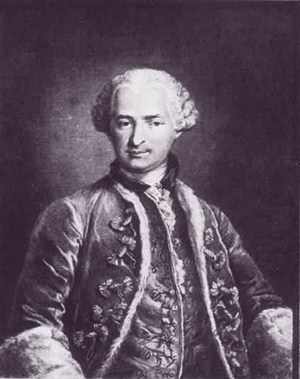
  • Jonestown: Dismantling the Disinformation

    Jonestown: Dismantling the Disinformation

    From New Dawn 53 (Mar-Apr 1999)

    Do you know how or why close to a thousand people died at Jonestown, Guyana on November 18, 1978? Has anyone ever told you a remotely coherent story? In the following, Laurie Kahalas, a People’s Temple survivor, presents us with an account of the events from an insider’s perspective. Her book, Snake Dance: Unravelling the Mysteries of Jonestown, is one of the most significant works on the subject published on the subject.

    My name is Laurie Efrein Kahalas, and I was with the Peoples Temple for eight-and-a-half years. I was living in the Temple building in San Francisco when tragedy struck, along with a tiny crew left back in the States for organisational work. While others were wildly shredding documents, I quietly saved them, squireling away documents and files for a later, brighter day. There was nothing there that could incriminate us (for indeed, we were not criminals at all, we were humanitarians); and I realised I held in my hands the keys to some day exculpate my friends. As if such a thing could be possible! But I vowed to try.

    I am here to humanise the events at Jonestown, or as the Preface of Snake Dance: Unravelling the Mysteries of Jonestown, says: “To be fully human in the face of infamy.” The world spent so much time demonising Jim Jones, there was none left to humanise the people of Jonestown, or to comprehend the terror of their plight.

    What was the real story? Were the elements human, political, circumstantial? Preventable, not preventable? Were there demons, villains, heroes?

    In fairness to researchers, it has been next to impossible to research, in thatJonestown was one of the worst cases of yellow journalism in the entire history of the American media. It all began with the power of the press.

    All “research” goes back to the “original sources,” an unseemly amalgam of three components: 1) Ex-member plants in the group; 2) their non-member government-based handlers; and 3) the tiniest handful of aggrieved ex-members who were used as pawns. Of the ex-member group who did not have the earmarks of being government plants, most lost relatives in the tragedy.

    The horrendous mass death at Jonestown burst onto the world press in November, 1978, complete with gory details and fingers of blame. Although it was breaking news, all the background, the analyses, the witnesses, the media heroes, were ready-made for the press; nor was there any other candidate for blame but Jim Jones. The people at Jonestown were “brainwashed”; their defenders “apologists”; the only “credible sources” were the people who had “exposed” Peoples Temple a year and more prior to the tragedy.

    We say we know the crushing power of the press, but no one knows that in full measure until you experience a Jonestown. So intense and widespread was the deluge, that it never even occurred to those within the press to question whether it may have been the very same people so intent upon destroying the church’s reputation, who had moved to destroy Jonestown physically.

    The most notorious precursor of such methods was the Nazi propaganda minister Goebbels, who advised laying down a barrage of bad press to indoctrinate the Germans into exterminating the Jews. “Repeat a lie often enough and people will believe it.” With Peoples Temple, it was rendered all too easy, for the group had virtually relocated thousands of miles away, leaving no viable voice to defend the church.

    At first, it seemed a great shock, for the church had been “the toast of the town,” for its humanitarian service work. A mere six months before Jim Jones’ exodus to Guyana, a Testimonial Dinner featured plaques of commendation from the Mayor of San Francisco, the City Council, the State Senate, and accolades from the Lieutenant Governor, the Police Commissioner, Assemblyman Willie Brown (now Mayor of San Francisco) and many others. Yet in the very first smear, in New West, a fledgling Murdoch publication, a 25-year record of humanitarian service was merely held up, then dumped in the trash, in favour of “What is going on behind closed doors”?

    Although Jonestown was the church’s crown jewel accomplishment, an acclaimed breakaway from the inner cities of the United States, with their racism, unemployment, drugs, crimes, substandard housing and more, the destroyers merely used people who had never even been to Jonestown as “sources,” and began with “Jonestown: Paradise or Prison?” From that time forward, until the arrival of reporters at the end, no reporter had ever visited Jonestown, yet horror stories from the most suspect people were all the mainstream press would print. By the time the reporters arrived, they had been so manipulated to suspect the worst, they actually wrote that they thought it “odd” that black and white, young and old, were singing and swaying together, and that “I wondered if they had been drugged or hypnotised”! Another reporter broke into a senior women’s residence, saw bunk beds (for building individual cottages was ongoing for a large exodus), and concluded “It looked like a slave ship.”

    Who lay the groundwork for the Congressman and the press to come to Jonestown? Who led Congressman Ryan into what turned out to be a death trap? More pointedly, who was it who set that trap for him, and how can we be sure?

    Jonestown Targeted by Agent Provocateurs

    It is time to examine the “valiant crusaders” who “exposed” Peoples Temple in the press and forced the investigatory visit to Jonestown.

    Their leaders were a combination of agency plants and provocateurs, as directed by their non-member government handlers. A year-and-a-half smear campaign preceded the tragedy, destroying an acclaimed church in absentia, during which time the Murdoch and Hearst presses blacked out any dissent.

    Moreover, no one was who they said they were, and their stated motives were “cover stories,” not fact. The story was not “courageous ex-members who dared to step forward,” but rather the tiniest handful of vindictive ex-members with suspect personal motives, being used by people with a far-right-wing political agenda.

    The leaders of the parade, Elmer and Deanna Mertle (a/k/a Jeannie and Al Mills), were right-wing extremists,veterans of the notorious John Birch Society; and Timothy Stoen, veteran of clandestine spying missions into East Berlin in the early sixties. The Mertles were murdered in February 1980 in their home in Berkeley, California, by people the police surmised “they knew,” for there were no signs of forced entry or burglary. The killings of these two, and their daughter Daphene were done very professionally – dum-dum bullets, “execution style,” and leaving no traceable clues.

    Most tellingly, they were murdered a mere five days after announcing they no longer wanted to speak out against Peoples Temple! Their murders prevented them from posing a life-long liability… but for whom?

    Timothy Stoen, former top attorney for the church, and founder of the “Concerned Relatives” group, had no relatives in Jonestown, but aggressively pushed his slander factory to bring Congressman Ryan to Jonestown on false pretences. He deliberately and knowingly pressed a false paternity claim to Jim Jones’ own child, repeatedly threatening to send in mercenaries, as recorded in newspaper editorials and State Department logs. A previous mercenary attack against the community came within a few days after his attorneys had travelled to Jonestown to serve legal papers, with the implicit threat: “Release the child or else violence will ensue.” To justify ongoing threats of violence against defenceless families, Stoen meanwhile persuaded Deborah Layton, an ex-member who swore to many lies, to claim that she had personally seen “hundreds of guns,” although both Guyanese and American authorities later discovered all of thirty-nine – .22 calibre and none automatic. These people were transparently defenceless.

    Within two weeks of the tragedy, Stoen bragged that he would “destroy Jonestown,” and specifically that he was “counting on Jim [Jones] to overreact.” As America viewed on screen through one of its major networks, ABC, Congressman Ryan addressed the community of Jonestown saying, “I hear many of you saying that this is the best thing that’s ever happened to you!”, leaving any motive for assassinating him quite thin. It seems quite unbelievable that a Congressional visit alone, much less a positive one, could possibly create such an “overreaction.” Stoen surely knew that his “concentration camp” charges could not stick, so to what would Jim Jones “overreact”? A mere visit? Or an assassination?

    It was also Stoen who was later exposed as the one who had continually tried to pushed a non-violent church onto a terrorist course (called an “agent provocateur”), it was Stoen who made all the threats against Jonestown, and it was Stoen who led Congressman Ryan into Jonestown on false pretenses. More tellingly even, Stoen had secretly been a far-right-wing zealot all along, and Congressman Leo Ryan was known to be the most vocal anti-CIA Congressman in the entire United States Congress! We want to bear this in mind when we ponder what is known about the assassination.

    Stoen, who had been living communally and was now visibly unemployed, spent huge sums of money on lobbying in Washington, cross-continent travel, and it was discovered that he had several secret bank accounts in foreign countries where the church had done no banking at all.

    Other key movers and shakers in the ongoing campaign had never been members at all – not of Peoples Temple, anyway. More like “membership” in the Treasury Department, Interpol, and some deadringers for ties with both FBI and CIA. Most notable were two shadowy characters by the names of David Conn and Joseph Mazor.

    David Conn admitted being close friends with the Mertles all the years they were members, and moreover, of “investigating” the church throughout that time. He claimed he was concerned about “black people being ripped off.” (Note: In point of fact, Jim Jones was such a careful steward of the people’s money, Tim Stoen never even made such a charge). Yet he went to Native American leader Dennis Banks, and tried to blackmail him into turning against Jim Jones, or be sent back to his death in a South Dakota prison! So the cover story about caring about minorities was definitely false! Moreover, Conn had bragged to Banks about his ties to the US Treasury Department, which works closely with the Federal Bureau of Investigation, and two other sources confirmed Conn as a Treasury Department agent.

    Joseph Mazor, who was discovered to be a member of Interpol, housed adjacent to the Federal Bureau of Investigation in Washington, was an admitted felon, who was mysteriously granted a State investigator’s license fresh out of prison for passing bogus checks – just in time to investigate Peoples Temple! He admitted orchestrating the smear campaign against the church, stating that his employers were outsiders, never members of the church, and he refused to reveal their identities or the source of his funding. Mazor was later to “claim credit for” the mercenary attack against Jonestown, and travelled there to announce that the original plan of the attack had beenmass extermination. A community which was already isolated and defenceless now feared the worst – and just weeks before the Congressman arrived!

    Influential & Powerful Voice for the Oppressed

    What were the motives behind the smears in the press? Peoples Temple Christian Church performed all the work of the church, caring for the poor, the needy, and the disadvantaged. But we were also interracial. We were socialist. Our leader had a powerful, influential voice. Although we had become a political forum for every left-wing leader, advocate, or cause of the day, we were gaining ground in the mainstream. We were even planning to re-relocate to the then-Soviet Union during the Cold War. We “had to be stopped.”

    Following the tragedy, Joseph Mazor who, like the others, had never revealed any political motivation for opposing the church, now stated flatly, “It was considered that Jim Jones would become a major political force in the Caribbean within five years.” It was patently clear that despite the church’s ongoing non-violence, they feared a new Castro in the Caribbean. An American Castro, with citizens free to enter and exit the States at will. Was it possible for the CIA to not be interested in such an international scenario?

    And who else might the CIA have an interest in wanting to “stop”? The CIA’s main gadfly at that time was one Leo Ryan, the slain Congressman, who had passed the Hughes/Ryan Bill of 1974, requiring the CIA to report all covert operations to Congress. Indeed, both Jim Jones and Leo Ryan, both threats to the CIA, wound up dead? “Coincidence”?

    In any case, we were indeed “stopped” from either any proliferation in the Caribbean, or a move to the then-Soviet Union, in the most tragic manner possible. Yet all the public was ever told was that Peoples Temple was a bizarre violent cult with an insane leader. “Bizarre murder/suicide ritual” was the mantra of the day. Politics was never mentioned.

    But it was more. If the story had been exactly as told, it could be left alone. But it never was. Cover-ups and disinformation were, of necessity, rampant. This is, indeed, what has most complicated the present-day task of telling what really happened at Jonestown. The rumour mill has been so widespread, one has to contend with not just facts, but an ingrained belief system, that has all the earmarks of itself being a “cult.” People who want to believe that “Jim Jones was CIA,” or “Jonestown was a secret CIA mind control experiment,” or “Jonestown was MK Ultra,” have been more daunting to contend with than people who have simply been uninformed.

    No one has ever considered that the disinformation pervading the aftermath of the Jonestown tragedy was perpetuated because Leo Ryan was so known to his aides to be anti-CIA, that to ward off a direct investigation of the CIA for assassinating Ryan, they have to concoct Jim Jones must have been CIA! If even madness has method, here is the simple key to the false and unverified barrage of accusations about Jonestown being a secret CIA mind control experiment and the like. Just blame Jim Jones and call it CIA. If the CIA really did it, no one given that absolutely false clue could ever trace it to the source. It was deliberately designed by dead-end specialists to lead nowhere.

    This is what has led to the current approach of dismantling the disinformation. It has not been possible to speak the truth without first dismantling the fabric of lies spread to date, and clarifying whythose lies have been spread: their origin, their rationale, their intended purpose. One must first strip awaydisinformation before having any capacity to see.

    Jonestown NOT a CIA Experiment

    I want to dismantle the most rampant disinformation first: the absolute lie that “Jim Jones was CIA.” Jim Jones would have rather had his eyes gouged out. It was both the measure of, and admittedly, the danger of his character, that rather than do that, he would die. He was the most mission-driven individual I have ever met in my entire life.

    Jonestown was NOT a mind control experiment in the mould of “MK Ultra.” I personally do not doubt that the CIA might have been glad to use Jonestown as such had they the chance. I am not attempting, understand, to exonerate the CIA! Indeed, I see their footprints all over this disaster. But the mind control experiment story is disinformation 100%.

    Jonestown was a beautiful, productive, thriving interracial community, acclaimed as a “paradise,” which was the happiest and most fulfilling life that most of its largely-inner city residents had ever known. It was a shining model of how inner city dwellers can thrive and excel on a worldwide stage. It was described by visitors as “a paradise,” “a superior society,” “like coming to another planet,” and ” a credit to humanity.”

    The media who were so eager to smear Jonestown had not even visited! When Congressman Ryan finally did visit, his commentary to the assemblage was that “I hear many of you saying that this is the best thing that has ever happened to you. What is being done here is of great significance, even on a worldwide basis.” Obviously, their was no motive for Jonestown residents to assassinate someone who intended to bring back a good report.

    Events Leading Up to the Tragedy

    I want to approach the catastrophe in two stages: first the assassination at the Port Kaituma airstrip, then the deaths at Jonestown.

    First, the reader must realise that this matter was never brought to a court of law. Members of the Jonestown community were convicted of the assassination in the press, naming Jim Jones as the mastermind who “ordered” the assassination. This was accomplished not only with no incriminating evidence, but with considerable exculpatory evidence that was never considered. These were the many factors:

    There were no forensics done on the Congressman; no match-up of bullets against guns. Indeed, the assassination was reportedly done with dum-dum bullets, which explode upon impact, rendering them untraceable, and which were beyond the technical capabilities of anyone at Jonestown to manufacture.

    The so-called “eyewitness identifications” were bogus – made by (according to the Congressional investigators) Jim Cobb, a man who was not only suing us for millions of dollars at the time, but who did not even know many of the alleged attackers (they had joined the church after he left), admitted being “on the other side of the plane when the shooting started,” and then fled for his own life in the other direction! He never even had the shooters in his line of vision!

    There were virtually no autopsies done – all of seven, and of even those, the bodies were embalmed before being shipped back to the medical team in the United States! An American doctor lamented that they had not even verified poisoning in a single case! That it would have been very simple – just a little blood or urine, but that with all the hundreds of bodies, it was not done on a single one. Shipments of the dead were nearly not accepted because there had been no death certificates prepared. No one even went to collect the bodies until they had been laying out three days in the tropical sun.

    A key piece of evidence did emerge unexpectedly: an on-site film of the assassination had been taken by Bob Brown, an NBC photojournalist who was then himself shot. I first saw this film at the first anniversary of the tragedy in 1979. I was alarmed to see a sophisticated military formation, identified for me as “a squad diamond”, not at all within the capability of Peoples Temple. The killings looked very professional, and indeed, Bob Flick, a reporter on site, described the killings as “calm, silent, brutal, methodical” and that the attack had been “carefully planned and mercilessly executed.”

    At the time, I went to the Congressional investigating committee to demand they blow up the film to confirm that it was not anyone from Jonestown who killed the Congressman. They refused, deliberately botched my transcript, and when I tried to mail the information to the 34 Congressmen on the committee in Washington, only two of my return mailing receipts came back stamped!

    I had neither the clout nor the connections to obtain the film at the time, but now at the twentieth anniversary, it has resurfaced, as have other pieces of evidence perhaps considered less dangerous by this late date. I currently have a source in possession of the film, and confirming military opinion that this was a “diamond formation,” and a thoroughly professional “hit.”

    Yet the bias in the United States press continues to the degree that snippets of that film have been played on several television stations, and no one even commented that the shooters were all dressed alike – in Army uniforms!Perhaps the truth, flagrant as it is, may yet surface through the simple channels of common sense.

    Next is that the assassins did not arrive on the Temple truck. They barrelled on in a second vehicle, as all eyewitnesses confirmed. They were somehow able to rapidly and skilfully disarm the Guyanese police on site before opening fire on the Congressman and his party.

    What of the charge that “Jim Jones ordered the assassination”? What was released publicly of “the final tape” made at Jonestown, however severely spliced and abbreviated it was, is unequivocal on that point again and again. Indeed, the identity of the killers was completely unknown to Jim Jones:

    1) “I didn’t order the shooting”;

    2) “I don’t know who shot the Congressman.”;

    3) “I can’t control these people [who did].”;

    4) “I waited against all evidence… I tried to prevent all this from happening.”;

    5) “I wish I could call it back.”;

    6) “I never wanted to kill anybody.”;

    7) “How many are dead?… Oh, God Almighty, God help them…”

    A letter written to Congress and the President months earlier, had predicted exactly what would happen:

    “All that has been done is to get people to believe in society… Our people had been so alienated. All that they can see in this is a set-up, a classic scenario: first muddy our name… whip up attacks in the press, and then: by the time you reach the classic ending, the frame-ups, the ‘kill,’ no one even cares. …And they think that the press has already done its job with slander and smears, and so no-one will care about the frame-ups…”

    Yet when the moment of truth was upon the people of Jonestown, the chaos and confusion was so thick, that panic about an invading force had taken over. Tragically, contingencies had been discussed long since, following the mercenary attack in September, 1977. This was a community that was geographically trapped, militarily defenceless, and so remote and isolated, it did not even have a phone to alert the world or call in help. The great majority of residents had vowed to never be forced back to the inner cities of the United States. The previous military attack had happened in broad daylight, when they were peaceably going about their daily business. Now it was the wake of the assassination of a Congressman, heading towards the middle of the night. How much greater the peril! Thus, when Jim Jones told his assembled community that forces would be closing in for a slaughter, it seemed all too real.

    Moreover, Port Kaituma, the location of the airstrip assassination, was seven miles from Jonestown, so no one reported the men in Army uniforms had assassinated the Congressman! But even had they known, that would have heightened the danger, not diminished it.

    In my book, Snake Dance: Unravelling the Mysteries of Jonestown, I lay out all the possible post-assassination scenarios whose perpetrators must at all cost cover up. Although I was horrified at the suicides, I am still haunted to this day, what might have happened had they simply waited out the night. Life is precious, and any life that could have been saved would be precious, whatever the overall carnage. But carnage there would have been. There would have to have been carnage to cover their tracks and eliminate anyone with an alibi, differing version, or questions about a frame.

    As for the people of Jonestown, they would have been thrilled to survive and live on. They took their own lives not because they were drugged or brainwashed or robots. They genuinely and legitimately feared a slaughter from outside forces.

    I know what happened will be controversial forever; and I wept, especially over the loss of children, more times over more years than I can easily admit. But I loved these people, and what has bruised my heart along with the deaths, is the injustice of what happened, that the truth was never told, and that no one has ever spoken on their behalf. They were a role model for how inner city dwellers could thrive and excel on a worldwide stage. They were brave, wonderful pioneers, who deserve far better than to be labelled as “brainwashed,” “robots,” or even “psychopaths.”

    Moreover, who will ever dare another Jonestown? Who will break away in self-empowerment and overcome the many social problems which beset minorities in the United States? More than those people were killed. They killed off a hope.

    Many people do not care that a thousand people, largely minority and poor, died in some remote jungle. Yet in pressing this matter in the States, I have to assume that people care that the assassination of a United States Congressman was a frame-up, blamed on the wrong people, done to provoke mass death, and that there are many ways this can be proven. We do have an unfortunate record in tracking down the truth about assassinations. Witness John F. Kennedy, Martin Luther King, Malcom X, Bobby Kennedy, and others. But life has put me here, and I take it as a commitment, even an honour, that I can speak for my fallen friends. I have never doubted that it is the right thing to do.

    These were people who lived with good cause. From radiant health to beautiful cottages, to a wonderful community school, burgeoning medical facilities, fabulous home-grown food, creative, fulfilling employment, self-empowerment, freedom from all the scourges of poverty, drugs and crime…. and most especially, to harmony between the races, ages, genders, economic classes, the people of Jonestown had an incredible life, a “future life” they treasured. Next to you or me, most of us, and certainly society as a whole, they lived with good, even valiant cause. That is much of why they were put in that position – “that position” being their backs up against the wall! Whether the world will ever comprehend how they met their deaths, it is time to honour the example and sacrifice of their lives.

    As for me, I vowed not to live my life as a victim over this, and I am not. I do not live in shame. And in my heart, if not in the eyes of the world all these years, my friends who died at Jonestown do not live on in shame either. Jim Jones? I knew him when he was strong and vibrant, before the deteriorations of illness. He was the most passionate, committed champion for racial and economic equality that I have ever seen or known. He was by nature a pacifist, and only slowly, through extreme trials, did his mettle snap. Was he unbalanced? Of course! How do you live under such threats, and the descent of such a doom (not to mention terminal illness!), without extreme reactions? I am brutally honest in my book about organisational problems, my own conflicts, and Jim Jones’ overbearing, sometimes ruthless personality. But I know he loved those people, and that his very heart would burst rather than wilfully inflict that kind of pain.

    The final words on “the final tape” were perhaps as redeeming for a community that was unfailingly peace-loving, as they were tragic:

    “They are not taking our lives. We are not taking their lives. We are laying down our lives in protest against conditions of an inhumane world. We are a thousand people who don’t like the way the world is.”

    I don’t much like the way the world is either, though perhaps not in quite the same way, and certainly not with the same remedy. It does not make me want to die. It makes me want to live. To create a future where such travesties as what was done to Jonestown never again happen. Where it is not only accepted, but nurtured and encouraged, for people to live together in peace – all races, all religions, all ages, all backgrounds, in harmony and acceptance of one another. Let us do it, and not have to face a slaughter for the trying. I don’t want to see any more “Jonestowns of death.” But I would be thrilled to see more communities in this, our troubled world, with that calibre of life. Let us, Humanity, learn from experience. Finally. Please.

    Laurie Efrein Kahalas’ book is Snake Dance: Unravelling the Mysteries of Jonestown.

    [alert type=”general” dismiss=”no”]This article was published in New Dawn 53.[/alert]

    [alert type=”success” dismiss=”no”]If you appreciate this article, please consider subscribing to help maintain this website.[/alert]

    © New Dawn Magazine and the respective author.

    For our reproduction notice, click here.
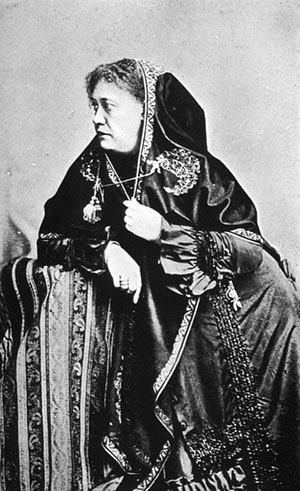
  • The Message of Evita

    The Message of Evita

    From New Dawn 41 (Mar-Apr 1997)

    “Evita is untouchable…. Children are born today saying Peron! Evita! Not even the military governments were able to erase that.”
    – Mayor Manolo Quindimil (1996)

    Evita, the name by which Argentina’s beloved first lady Eva Duarte Peron (1919-1952) was known to the world, is again back in the international media spotlight. Her legendary life now the basis of the film Evita. But the Hollywood production met with national controversy in the land of her birth. “The script by this Englishman attacks our history, offends our dignity and is an insult to the Peronist people,” said Peronist legislator Marta Rivadera. “I am in favour of freedom of expression but am against this lie which will distort the figure of our saint.”

    “Evita holds a place in Argentine history equivalent to that of Abraham Lincoln in the United States,” explains Enrique Pavon Pereyra, who knew Evita personally.

    During her short life the Argentine working people revered Evita, while the wealthy oligarchs despised her and spread all manner of hateful slanders. Today, some circles still fear the memory of a woman who died forty-five years ago.

    Who really was Evita? The message, some say, is important, not the messenger. Today, the life of the messenger Evita Peron is shrouded in myth and legend. What we can know for certain are her thoughts and words recorded for posterity in books and published speeches. By understanding the tremendous vision she shared with her remarkable husband Juan Peron we can grasp something of her timeless greatness.

    EVA & JUAN PERON

    “When I chose to be Evita, I chose the path of my people.”
    – Eva Peron

    Evita was born Eva Maria Duarte on May 7 1919 in Los Toldos, Argentina, the fifth and youngest illegitimate child of Juana Ibarguren. Struggling free from a life of grinding poverty she moved to the Argentine capital to find work as a radio soap opera actress.

    1943 saw the young Colonel Juan Peron appointed Argentina’s Secretary of Social Welfare and Labour in the military junta of General Farrell. His leadership abilities and determination to radically empower the Argentine working class soon became obvious to all. Peron single-handedly transformed the labour movement and strengthened the unions. As his popularity grew – he was appointed vice president and Minister of War – opposition from reactionary elements in the armed forces and the wealthy land-owning class also grew.

    1944 found Evita working as a radio actress and commentator on Argentina’s leading radio station in Buenos Aires. A year earlier she had reached the top of her profession and was among the highest paid radio actresses in the country. Evita later described her work on radio as a combination of singer, disc-jockey, actress and lady commentator all in one. These were the glory days of radio when people relied on the airwaves to deliver news and comment along with entertainment.

    On Saturday, January 15 1944, an earthquake destroyed the ancient Argentine town of San Juan, claiming the lives of over ten thousand people. Col. Peron distinguished himself in organising the relief effort. Evita, already greatly interested in social welfare, attended a meeting of artists called by Peron to raise funds for the rebuilding of the town.

    Peron described the meeting at which a young woman, then unknown to him, boldly spoke out:

    “I remember that she wasn’t seated in the first row; that she was wearing a very simple dress; that she was thin, that she had blonde hair, and that she had a little hat, like they wore in those days. ‘We don’t need festivals,’ she replied to proposals that had been made, ‘we should go directly to ask, without offering anything….Let’s go to the streets, to the public places, to the hippodrome, to the theatre, to all the important places, and say to the people, our brothers are stricken, we have to help them! We have to get money from those that have it, because those that don’t have it can’t give it.’

    “I liked the way this woman thought and worked. I thought she wasn’t like the others. She had something very superior to the others in the way she talked and in her suggestions. She was practical and had new ideas.

    “‘Good, very well,’ I said to her then, ‘it’s your idea, organize it.’ And that’s the way it was. She organized everything.”

    In another recollection, Peron told how he was struck by Evita’s zeal and conviction. “I looked at her and felt that her words were overpowering me….I saw in Evita an exceptional woman. A true passion, animated by will and by a faith comparable to that of any of the early Christians.”

    Evita shared Juan Peron’s commitment to social justice. Peron saw in Evita a kindred spirit and co-worker in the struggle for a revitalised Argentine nation. “When I first knew Evita what attracted me to her was not the beautiful woman but the good woman,” Peron later wrote. “It’s true that she combined those two things: beauty and goodness. Instinctively I perceived that the collaboration of a woman of this kind would be invaluable for the social task I had in mind….I had to prepare a woman who would be the feminine leader of my political movement: a capable woman with enough basic culture, natural talents of intuition, with dedication…”

    On her daily radio programmes Evita dramatically recounted Peron’s welfare reforms. They were a passionate mix of radio drama and current affairs. One of her most popular broadcasts went on at seven in the evening, when men and women were together after work. Evita explained to her listeners all about “that newcomer in the Ministry of Social Welfare”. She obtained records from Peron’s deputies and office secretaries and brought the story of the fast rising military officer and his vision, to the masses.

    Looking back on this hectic period Peron recalled “…our private life [was] totally subordinated to the political and social calling…a veritable tyranny to which we submitted ourselves as if it were a mission. Evita, in those first days, didn’t care much about her appearance, or want to be taken for an elegant woman. She went to work, and working all day didn’t leave much time to care for herself.”

    As Peron’s influence and mass support grew, Argentina’s reactionary ruling class started a campaign of vilification aimed at undermining his popularity. He was openly living with Evita, and in a staunchly Catholic country, this provided ammunition for his enemies. Professor Robert D. Crassweller in his book on Peron, points out:

    “Evita’s image as a prostitute, strongly held in some quarters, was one consequence although it had no basis in fact. But it served well the sense of class antipathy and division that was growing up around Peron, and in a society so deeply fragmented and so hotly personalized any weapon that came to hand was welcome.”1

    By 1945 the forces of U.S. imperialism, alarmed at the course of developments in Argentina, formulated a policy to derail the growing anti-Yankee, anti-British, nationalist-labour coalition inspired by Juan Peron. Spruille Braden, whose family made their fortune exploiting Chile’s natural resources, became United States ambassador to Argentina. A protege of Nelson Rockefeller, Braden’s job was to guarantee Argentina’s compliance with the goals of U.S. imperialism in South America.

    The U.S. ambassador had several explosive meetings with Peron. Unable to persuade the Argentine vice president to accept Washington’s demands, Braden openly intervened in Argentina’s internal affairs, giving speeches to audiences of Peron’s opponents, and publicly criticizing Peron. Part of this U.S. instigated disinformation campaign smeared Peron as a fascist and ‘Nazi agent’. “North Americans are the greatest criminals and thieves in the history of the world”, wrote Juan Peron.

    Events came to ahead in October. Reactionary army officers led by an insignificant general insanely jealous of Peron, staged a coup. On October 12th, Peron was ousted from all his government posts and arrested by the pro-U.S. clique. With Peron exiled to an island prison, the self-appointed cabinet officers set about organising their own regime. They had reckoned without Evita, and they underrated the support of the working people for Peron.

    On the boat to the prison island, Col. Peron turned to the officer guarding him. “Well, I lost,” he said. “But, you know, there is only one person for whom I need to care. I am your prisoner but I am also your fellow army officer. May I ask you a favour?”

    “What is it, Colonel Peron?” the officer asked. “Give a pistol to Evita for me – to defend herself or to kill herself if someone touches her. Tell her I will not live after her….”

    When word spread of Peron’s imprisonment, Evita started organising their bands of working class supporters, the descamisados or “shirtless ones”, with furious speed.

    Evita rallied the labour unions and all who listened in a popular uprising that would forever change Argentina. Evita told the union leaders: “Look, this is not just our chance, it is your last chance to create a new social order, or we can all go back to the old social order.”

    As the Argentine masses realised what had happened to Peron, riots broke out all over Buenos Aires and other provincial cities. By October 17 the Argentine capital was almost in the hands of organised bands of descamisados. More than half a million people, led by over fifty thousand labourers, gathered in front of Government House, demanding “our leader, Peron.”

    Fearing bloody civil war, the military promptly released Peron and he appeared before the crowds on the Government House balcony. On October 23 he secretly married Evita. Then began his campaign for the presidency.

    In a desperate attempt to destroy Peron’s presidential bid, the U.S. State Department issued the notorious “Blue Book,” a scandalous report officially entitled Consultation among the American Republics with Respect to the Argentine Situation. Containing all the false charges generated by Ambassador Braden, the “Blue Book” was a vicious piece of propaganda. The agents of U.S. imperialism went to work massively publicising its charges. Half the space of many newspapers – with newsprint scarce – was devoted to reprints from it.

    PERON’S VICTORY

    “The reign of the bourgeoisie has terminated throughout the world. The government of the peoples begins. With that, demi-liberalism and its consequence, capitalism, has ended its cycle; the future belongs to the people.”
    – Juan Peron

    Despite the calculated disinformation of the U.S. State Department’s “Blue Book” and Ambassador Braden’s intrigues, Peron emerged victorious, following the first honest election in Argentina in decades. There was rejoicing in the streets that night of February 24 1946, as Peronist representatives gained an overwhelming majority in the Chamber of Deputies and almost all the seats in the Senate.

    In a direct move against the iniquitous Anglo-American financial interests, Peron nationalised the Central Bank of Argentina one day before the election. Two years later he referred to this move in a speech: “Nationalisation has been, without doubt, the most transcendent financial measure of the last fifty years.”

    “Is it true that you represent a new doctrine?” the Associated Press reporter asked Peron after the 1946 election. To which Peron replied, “Yes, in effect, but not so new as forgotten for a long time, because it is already 2,000 years old: Christianity.” His new government immediately launched a “social programme of a revolutionary nature.”

    The new Argentine president enacted legislation establishing labour councils to protect workers from arbitrary dismissal, reduced the working week to forty-four hours, raised wages, nationalised the British owned railway system and established free health clinics for the poor.

    Evita’s total devotion to the ideals of Peronism impressed all who heard her spell-binding, stirring oratory. From her quiet opening, modestly referring to herself as Peron’s little echo, she told her audience: “I was no better off than you not long ago. Now I exist only to interpret Peron’s great crusade to you – his people. I am only here to save his energy, to explain his ideals, to carry out his glorious programme….”

    The new government granted women the right to vote in 1947 and eighteen months later Evita organised the Peronist Women’s Party. Meaningless feminist theories did not interest her. Her actions did more, in the words of one observer, “to bring women into public life in Argentina than a large army of feminists could have done.” In an early speech, Juan Peron paid tribute to the many women, inspired by Evita, who joined the Peronist ranks:

    “This Revolution has been echoed by Argentine womanhood as few events in history have ever been. This is indeed auspicious, for if man is a rationalist, woman possesses what is above masculine rationalism; an intuition which is always superior to the success we men may be able to attain. For this reason I render homage to the women of my country in whom the men of the Revolution found an echo that fills us with satisfaction and pride.”

    Evita Peron was a legend well before her death. Her autobiographical La Razon de Mi Vida (“My Mission in Life”), written in late 1951, after she learned that she had cancer, was a best seller in Argentina and abroad. Some 50 million copies were printed, 150 000 copies selling on the first day of publication. An Arabic edition was distributed in Egypt and throughout the Mediterranean. Wherever people were rising up to confront imperialism, Evita’s book appeared.

    In La Razon de Mi Vida she vents her anguish at the injustice suffered by the poor at the hands of the oligarchs. A strong sense of the evils of bourgeois capitalism and crusading zeal for social justice were inseparable from Evita’s personality. She wrote:

    “I remember well that I was sad for many days when I discovered there were wealthy people as well as poor people in the world; and the strange fact is that I didn’t resent so much the existence of poor people as I did to discover there were also rich. The theme of rich against the poor, has been, since then, my sole concern in my deepest solitude.” Throughout her years with the Argentine president, Evita always scrutinised all government policies regarding worker’s rights and social welfare.

    “It is distressing to compel men to live in an unjust world,” Juan Peron once lamented. With Evita by his side, he tirelessly laboured to build a new nation “in which every part of Argentine society should contribute its share for the benefit of the community: the worker, his muscles; the middle class, its intelligence and activity; the rich, their money….”2

    The Argentine leader exposed the principle of unbridled liberty in the economic sphere, remarking: “We do not favour unilateral liberty where the rich are free to do whatever they like while the poor have but one liberty: to die of hunger.

    “It is necessary to end the economy of exploitation and replace it by a social economy without exploiters or exploited and where each one receives a just payment in accordance with his capacity and effort. Capital must be at the service of economy and not economy at the service of international capitalism as has occurred up to now.”

    The 1949 Argentine National Constitution, inspired by Peron’s ideas, stipulated that it is the duty of the State to supervise the distribution and use of land and intervene in order to develop and increase its yield for the good of the community. The State must give each peasant or his family the possibility of becoming the owner of the land he cultivates. Capital must be at the service of national economy and its main object must be social welfare. The different forms of exploitation cannot oppose the ends of public welfare of the Argentine people.

    EVA PERON FOUNDATION

    “…Peronism, which perhaps at times doesn’t respect the forms but which tries to assimilate and comply with the principles, is an effective, real, and deep way of practising Christianity…”
    – Juan Peron

    Evita made part of her grand vision a reality through the Eva Peron Foundation, a charity organisation that distributed over $50 million a year to the poor and needy. The foundation avoided the quagmire of government bureaucracy by relating directly to the people. As Evita explained:

    “It was Peron himself who told me: ‘The people who have been deeply punished by injustice have more confidence in people than in institutions. In this, more than in anything else, I fear the bureaucracy. In government it is necessary to have a lot of patience and to know how to wait for everything to move. But in the works of social assistance you cannot ask anybody to wait.’”3

    In the first eleven months of Peron’s presidency, Evita gave away close to $4,500,000 worth of school books, clothes, shoes, furniture, toys, and food, to those in need. Prof. Crassweller explains:

    “With such singleness of direction, the foundation flourished as none other. By the end of the 1940s it exceeded, in size, in influence, and in general significance, most of the ministries of the government. Its assets exceeded $200 million. It had 14,000 permanent employees, including thousands of construction workers and a staff of priests. It acquired for distribution to the poor fantastic amounts of supplies….Its flood of revenues came from many sources. Labor unions donated cash and goods made in the factories where members worked.”4

    Evita built more schools, orphanages, hospitals and retirement homes than all previous Argentine governments combined. Prof. Crassweller conveys the sheer enormity and range of the foundation’s work:

    “Twelve hospitals, with the best equipment available anywhere, were built. A thousand new schools appeared. There were clinics, medical centers, homes for the aged, convalescent centers, a home for girls who had come to Buenos Aires looking for work, transit homes for those needing temporary shelter, student cities, children’s homes, including a famous Children’s City built to the scale of its inhabitants, with small markets, a church, public buildings, a bank that issued script, streets, houses, and dormitories for four hundred and fifty particularly disadvantaged children. The foundation also built the Barrio Presidente Peron, a development with six hundred new houses just west of Buenos Aires, and it built Evita City, a planned community with 15,000 homes. Many of the public structures were notable for a tone of luxury unfamiliar in such places, a touch of brocade and damask and crystal, and this was deliberate, a form of social recompense.”

    As if painfully conscious of her own mortality, Evita was “working through the day and through much of the night, at a pace the human body cannot long tolerate.” She did not smoke. Like her husband she drank no alcohol, only water. Just as the Christians in ancient Rome died for Christ, Evita reminded the Peronist faithful, “We, who love Peron more than anything, are going to die for Peron, because we are not defending a personal thing, but a national cause.”5

    Juan Peron, after only three years in office, had made Argentina the fourth industrial power in the world. Land reforms boosted agricultural production and the Argentine Institute for Trade Promotion set the price of Argentina’s booming exports. The development of a national economy resulted in vast public works projects, bringing economic prosperity. By 1949, Peron’s doctrine was summed up in the word Justicialismo, a term coined from the Spanish words for “social” and “justice”. Justicialismo, the ideology of Peronism, being officially defined as “a doctrine whose object is the happiness of man within the society of mankind through the harmonizing of material, spiritual, individual and collective forces, appraised from the Christian standpoint.”

    JUSTICE & CHRISTIAN SOCIALISM

    “I have always thought that above all material values are the permanent values of spirit, which are the only eternal things.”
    – Juan Peron

    “Justicialism”, Peron proclaimed, “is nothing but national Christian socialism.” Above all, the goal of Justicialismo was to transform the Argentine masses into an “organised community” in which conflicting interests would be brought into harmony.

    Evita Peron clearly defined the difference between an organised community and a dispersed mass by comparing Spartans with Helots. The former constituted a great people with conscience, personality and social organisation, while the latter lacked those three qualities and lived as slaves.

    “The history of Peronism,” said Evita, “is already a long battle of seven years to have a suffering and sweating mass – as General Peron many times called it – become a people with social conscience, personality and organisation.

    “You must remember how many times General Peron addressed workers, industrialists, merchants, professionals, everybody, asking them to organise themselves.

    “Peron wants a people which feels and thinks, which acts properly guided. For this reason he set three objectives: social justice, economic independence and political sovereignty.

    “Peron wants a united people, because then nobody will exploit it, nor will it be defeated by any other force in the world. Peron wants a people where everybody is privileged.”6

    The United States faced the problem of what to do about Peron. His legally won 1946 election, after the publication and distribution of the “Blue Book”, was an open defeat of United States diplomacy in Latin America. The U.S. could not afford to openly oppose Peron, at the possible cost of Latin American solidarity. Washington chose instead to try to publicly live with the “Peron problem”, while simultaneously carrying on covert operations designed to undermine and discredit the Peronist revolution.

    Peron understood the real nature of the international forces arrayed against him. He saw how the British and U.S. imperialists had actually used the Argentine Communist Party to oppose his labour-nationalist coalition. The Communists broke up strikes in the railways and meat packing plants (owned by Anglo-American interests) and strenuously fought the anti-imperialist descamisados. “For capitalist oligarchy a communist party is better than a Justicialist enemy,” declared a popular Peronist slogan of the era.

    The globalist forces, so hostile to nationalism and responsible for the division of the world between capitalism and communism, Peron termed: “the Great Internationals of Sinarchy.”7

    Sinarchy is a type of collective shadow world government that brings together the highest leaders of the big imperialist powers. The Argentine leader said that “Masonry, Zionism, international societies of different kinds are but a consequence of the globalisation of the present world. They are the hidden forces of imperialist domination.”8

    “Capitalism and Soviet Communism are but two of them,” Peron observed, “seemingly opposed but in reality perfectly united and co-ordinated.

    “Everything can be summarized by saying that the capitalist regime has abused property and is to blame for communism because it has given it a reason to exist. Without the exaggerated exploitation of the old capitalist regime, communism would never have existed. That is the cause, and communism is the effect. In order to remove the effect, it is necessary to remove the cause.”9

    Re-elected by an even greater margin in 1951, Peron continued to reshape Argentina. Reviewing the achievements of his presidency in the face of opposition from Britain and the U.S., Peron wrote:

    “During the ten years of Justicialist Government [1945-55] Argentina was free and sovereign. Nobody poked their noses with impunity. But at the end of those ten years, international sinarchy, together with vernacular politicians at the service of foreign interests and colonialism, treaded on us.”

    A NATION MOURNS

    “I pray God that He should not allow these madmen to lift their hand against Peron, for on that day, woe to them! I shall go forth with the working people, I shall go forth with the women of the people, I shall go forth with the descamisados, and I shall leave no brick standing that is not Peronist.”
    – Evita Peron, May 1 1952

    Evita tirelessly carried on her work at the foundation, but now she was dying of cancer. At first resistant to treatment of any kind, she accepted the inevitability of surgery.

    On May 7 1951, a little more than twelve months before her death, Evita declared:

    “Peron is the air we breathe; Peron is our sun, Peron is life. I want nothing but to be the heart of Peron. Because, though I do my best to understand him and learn his marvellous ways, whenever he makes a decision, I barely mumble. Whenever he speaks, I hardly utter a single word. Whenever he gives advice, I scarcely dare make a suggestion. What he sees I hardly glimpse. But I see him with the eyes of my soul….And I have pledged myself to collect the hopes of the Argentine people and empty them in the marvellous heart of Peron so that he may turn them into realities.

    “The humble people, my general, have come here to prove, as they have always done, that the miracle that happened 2,000 years ago is occurring again. The rich, the learned, the men in power never understood Christ. It was the humble and the poor who understood, because their souls, unlike the souls of the rich, are not sealed up with avarice and selfishness.”

    Argentina’s powerful Catholic Church, traditionally aligned with Peron’s enemies the oligarchs, did not approve. The Church hierarchy was already upset by Peron and Evita’s interest in the esoteric sciences and the intrusion of the Eva Peron Foundation into education and youth affairs.

    Evita responded to the Church’s disapproval explaining: “Once I read in a book by Leon Bloy, about Napoleon, that he could not conceive heaven without his Emperor. This appealed to me and in a speech I said that I also could not conceive heaven without Peron.

    “Some people thought that this was almost a heresy. Nevertheless, every time I think of it, it seems more logical to me.

    “I know that God alone will fill heaven.

    “But God, who could not conceive heaven without His mother, whom He liked so much, will forgive me because my heart cannot conceive it without Peron.

    “I shall not commit the heresy to compare him (Peron) to Christ…but I am certain that, by imitating Christ, Peron feels a deep love for humanity and that this, more than anything else, makes him great, magnificently great.”10

    Evita continued to decline. On June 4 1952 she rallied for a last appearance in public at Peron’s inauguration for a second term. She now weighed only eighty pounds. Later in June, she endured radiotherapy, was burned, and suffered much.

    To the end Evita’s concern was for her beloved General. “As she lay in bed on a bad day toward the end, more dead than alive, Peron walked by in the corridor beyond her door, coughing as he passed. ‘Did you hear that?’ she said to her doctor. ‘General Peron is coughing, because he smokes too much. Please, tell him not to smoke. Examine him. See that he doesn’t get sick.’”11

    During her last weeks, Evita wrote her public will. When she died on July 26 1952, at age 33, the nation was in shock. She never held any official post but had become the most famous and beloved woman in the world. The largest funeral in the history of the Argentine was held with millions of mourners lining the streets as her coffin passed with full military honours.

    On October 17, the anniversary of her 1945 mass rallies to free Peron, a day set aside to honour “Evita, Spiritual Chief of the Nation,” Evita’s public will was read to the people. It began: “I wish to live eternally with Peron and with my people. This is my absolute and permanent desire, and therefore my last will. Where Peron is and where my descamisados are, there will my heart ever be, to love them with all the forces of life and all the fanaticism that burns my soul.”

    She continued: “I will be with them, with Peron, to fight against the traitorous and perfidious oligarchy, against the cursed race of exploiters and the dealers in humanity….if I have committed errors, I have committed them out of love and I hope that God, who has always seen into my heart, will judge me not for my errors, nor for my defects, nor for my guilt, but for the love that consumes my life.

    “I…was born of the people and suffered with them. I have the body and the soul and the blood of the people. I can do nothing other than to surrender myself to my people.”

    Evita passed from the scene of history, a great and truly unique woman for whom no counterpart can be discerned.

    In 1955 Juan Peron was overthrown by pro-Anglo-American military officers and forced to leave the country. As one commentator wrote of his years away from Argentina: “In exile, Peron had continued to espouse the basic tenets of his political creed: hatred of bourgeois capitalism and all forms of imperialism; advocacy of the Third World causes (such as economic independence), which he so early championed and of which he now calls himself the father; and government with and for, if not by, the people.”12

    Returning in 1973 to an Argentina in political and economic chaos, Peron was reelected to the presidency with 67% of the vote. After only nine months in office Peron died and joined his beloved Evita.

    “Yes. I confess I have an ambition, one sole and great personal ambition: I would like that the name of Evita would appear someday in the history of my country. I would like that it would say of Evita, even if it would not be more than a small footnote, at the end of the wonderful chapter which history will certainly dedicate to Peron, something approximately like this: ‘There was, by the side of Peron, a woman who dedicated herself to take to the President the hopes of the people, which Peron would promptly convert into realities.’ And I would feel properly and fully repaid if the footnote would end like this: ‘Of that woman we only know that the people used to call her, caressingly, EVITA.’”13

    [alert type=”general” dismiss=”no”]This article was published in New Dawn 41.[/alert]

    [alert type=”success” dismiss=”no”]If you appreciate this article, please consider subscribing to help maintain this website.[/alert]

    REFERENCES

    1. Peron and the Enigmas of Argentina, Robert D. Crassweller, 1987, W.W. Norton & Company, New York

    2. Doctrina Peronista, Juan Domingo Peron, 1952, Republica Argentina, Buenos Aires

    3. La Razon de Mi Vida. English translation: My Mission in Life, Eva Peron, 1952, Vantage Press, New York

    4. Peron and the Enigmas of Argentina, Robert D. Crassweller, 1987, W.W. Norton & Company, New York

    5. Historia del Peronismo, Eva Peron, 1951, Subsecretaria de Informaciones, Buenos Aires

    6. Historia del Peronismo, Eva Peron, 1951, Subsecretaria de Informaciones, Buenos Aires

    7. La Hora de los pueblos, Juan Domingo Peron, 1968, Madrid

    8. La Hora de los pueblos, Juan Domingo Peron, 1968, Madrid

    9. Catecismo de Doctrina National Justicialista, Buenos Aires

    10. La Razon de Mi Vida. English translation: My Mission in Life, Eva Peron, 1952, Vantage Press, New York

    11. Peron and the Enigmas of Argentina, Robert D. Crassweller, 1987, W.W. Norton & Company, New York

    12. The New Encyclopedia Britannica, 15th Edition

    13. La Razon de Mi Vida. English translation: My Mission in Life, Eva Peron, 1952, Vantage Press, New York

    © New Dawn Magazine and the respective author.

    For our reproduction notice, click here.