New Dawn – World's Most Unusual Magazine

Category: Secret History

  • Gnosticism: Ancient and Modern

    Gnosticism: Ancient and Modern

    From New Dawn 85

    Every dog has its day, so they say, and it looks like Gnosticism, an ancient approach to spiritual experience, may be having its day, once again. Of course, despite the best efforts of the early Catholic Church, Gnosticism never really disappeared, but its reappearance over the centuries has been fleeting and sporadic. Why, as we march into a new millennium, is this hidden stream of quasi-Christian mysticism triggering a fresh interest among both spiritual seekers and readers of popular novels?

    Dan Brown’s mega-bestseller, The Da Vinci Code, surely shares part of the credit. This publishing phenomenon, which sold over 6 million copies, took a simmering interest in the Knights Templar, the Divine Feminine, alleged secret societies such as the Priory of Sion, the Holy Grail, and the question of the historical Jesus, and stirred these ingredients together with a generous dollop of Gnosticism.

    The result was a blockbuster thriller that unexpectedly caught the popular imagination. Despite the fact that at least two other previous thrillers, The Da Vinci Legacy by Lewis Perdue (1983), and Kingdom Come (2000) by Jim Hougan, had overlapped much of the same territory, lightning struck Brown’s novel and sparked innumerable dinner-table discussions of heretofore-arcane topics such as Mary Magdalene’s real relationship to Jesus.

    But the success of The Da Vinci Code is just the culminating phase of a gradual public awareness of Gnostic matters that extends back at least a century to the great Occult Revival of the late 19th century. At that time, Gnosticism slowly re-emerged from the shadows, nudged by the French occultist Eliphas Lévi, and propelled along by Madame Blavatsky’s Theosophical Society, French neo-gnostics such as Papus and Jean Bricaud, and researchers such as G.R.S. Mead (whose pioneering discussion of the Gnostics, Fragments of a Faith Forgotten, was for many decades one of the few sourcebooks on the subject for general readers).

    However, it was the discovery of a cache of ancient Gnostic scriptures at Nag Hammadi in the Egyptian desert in 1945 that really set off the modern phase of the Gnostic revival. Although their translation into English was not complete until the late 1970s, early access to some of the writings inspired the great psychologist Carl Jung to draw parallels between the ancient Gnostics and modern depth psychology. The publication in 1977 of the Nag Hammadi Librarytranslations, followed in 1978 by religious scholar Elaine Pagels’ best-selling exposition, The Gnostic Gospels, guaranteed that Gnosticism would not go away anytime soon. But before we take a further look at the burgeoning phenomenon of modern Gnosticism, a review of the ancient Gnostic teachings is in order.

    Gnosis and the Church

    Though scholars argue there were Gnostic teachings that predated the early Christian era, what is most commonly thought of as Gnosticism consisted of numerous Christian sects that thrived in the immediate centuries after the ministry of Jesus. These sects, often gathered around charismatic mystics, certainly thought of themselves as Christian, and it was only their emphasis ongnosis, or divine knowledge, that later earned them the sweeping label of Gnostic.

    As Christianity spread outside the confines of a specifically Jewish faith, it was perhaps inevitable that some gentile Christians would reinterpret their conception of God to distinguish Him from the tribal “G-d of Israel” Whose Covenant with His people seemed anchored to their particular identity as Jews. Christian aspirations to a universal faith, applicable to anyone with ears to hear, led many Gnostics to posit that God the Father, of whom Jesus spoke, must be a different God altogether: a hitherto Unknown God Who existed far above the earthly realm and was free of ethnic contracts or favouritism. Christ functioned as the messenger from this remote and impartial God, and some Gnostic scriptures downgraded the Jealous God of the Old Testament to the role of Demiurge, a lesser creator-god who brought a flawed Creation into existence and mistakenly ruled it with a heavy hand as if he were the True God.1

    Thus, in the Gnostic view, salvation from this diminished material realm of suffering and injustice depended less on one’s mere beliefs or on the following of religious laws that the Demiurge put in place, than on the individual’s inner experience of gnosis – a divine knowledge of the cosmic order and one’s true identity. The Gnostic scriptures alluded to Christ’s secret teachings, which would aid the Gnostic to embrace gnosis, and armed with this knowledge, to escape the illusory realm of the Demiurge at the time of death.

    There are any number of reasons why Gnosticism was bound to come into conflict with that portion of the Church which was consolidating into an institutional monolith. Gnosis, by its very nature, was an individual experience that eluded systematisation. While the Gnostics had priests and even bishops, their leadership derived from their mystical bonafides, not from a bureaucratic position of authority. Furthermore, the canonical Gospels portrayed Jesus as the fulfillment of Old Testament prophecy and the Messiah promised to the Hebrews. The Gnostics’ break with what they considered the Demiurge was at cross purposes with this historical reading and undermined the working mythos of the institutional Church.

    In another example of scriptural reversal, some Gnostic versions of the Creation story of Adam and Eve portrayed the Serpent as Liberator, offering the apple as a means to knowledge unfairly denied to humankind by the despotic Demiurge. There was obviously no way to accept this counter-version and the traditional version at the same time.

    Divine Feminine

    The most common Gnostic revision of the Creation story spoke of Sophia (Wisdom), an extension of the True God, venturing forth from the Pleroma (the fullness of the ineffable divine realm), producing an aborted spiritual being, Ialdobaoth (the Demiurge), who in turn created the flawed material world. Sophia, seeing sparks of the divine entrapped in matter, descended to try and free them and was herself entrapped. It took the efforts of the Christ (pre-existing in the Pleroma) to extricate her and return her, past the Archons presiding over intermediate planes, to her rightful place beside Him: a tale symbolic of the plight of the soul enmeshed in illusion.

    Finally, the indications in Gnostic scriptures, such as the Gospel of Philip and the Gospel of Mary, that Mary Magdalene was closer to Jesus than the other disciples and received secret teachings denied to them, undercut both St. Paul’s misogynist version of Christianity and the Catholic Church’s claim to legitimacy based on St. Peter’s supposed selection as the “rock” on which the Church would be built. The prominent role given to the Divine Feminine via the Gnostic veneration of the Magdalene and Sophia was partly recuperated by the Roman Church through the significance it later afforded the Virgin Mary, but this status was subsumed within the overall supremacy of a Church run by celibate males.

    Whatever Gnosticism’s virtues as an effective path to gnosis and to unconditioned consciousness, it was simply too idiosyncratic and contrarian to make the grade as a stabilising component of Roman power. Its subversive counter-myths stood little chance of being integrated into a social order based on top-down power relations emanating from Rome and Constantinople. The prevailing Church absorbed those elements of the Gnostic worldview that best served its own ends and scuttled the rest, consigning the Gnostics to the oblivion of heresy and their scriptures to the bonfires of proscribed texts.

    Of course attempts to obliterate ideas or spiritual currents that remain attractive to some are never wholly successful. Pockets of Gnostic alienation persisted among the Eastern European Bogomils, and eventually influenced the Cathars of Languedoc (southern France). The scourge of the Inquisition originated as a response to the growing influence of the Cathars, whose 12th century challenge to the Catholic Church could no longer be tolerated. The Albigensian Crusade in the 13th century effectively wiped out the Cathars.2  Subsequent Gnostic impulses and teachings survived as heavily-cloaked myths and symbol systems within marginal esoteric currents of the West.

    It was only once the religious and social hegemony of the Church was diminished by the succeeding blows of the Protestant Reformation, the Renaissance, and the scientific rationalism of the Enlightenment, that there was sufficient elbow room for Gnosticism to re-emerge into the light of day.

    Yet, the question remains why Gnosticism should prove of special interest to increasing numbers today. Are there particular characteristics of today’s society that resonate with the Gnostic worldview? One answer is provided if we consider the popularity of “The Matrix” movies and the influential ideas of science fiction author Philip K. Dick.

    The Illusion of Daily Life

    Central to both the Matrix and to Dick is the creeping perception that things are not as they seem: our perception of reality, both individual and collective, is an artificial construct masking the unnerving truth. In ripping away the façade of normality, we come face to face with our true dilemma – we live in a maze of illusions and self-delusions from which we must extricate ourselves. This is, of course, a fundamentally Gnostic worldview.

    The ancient Gnostics were aware that material existence is, at its root, a beguiling and temporary illusion. (Hindus called this “Maya.”) Modern physics has confirmed this at the sub-molecular level, where one can see that apparently solid objects are, in fact, composed of moving bits of energy that are neither wholly particle nor wave. The closer one looks, the less there is to see. The vast emptiness of outer space is mirrored by the vast emptiness within matter itself.

    Esoteric traditions around the world teach that consciousness can exist independent of the body, and that the ability to deliver our consciousness from its addiction to sensory input and compulsive thought patterns can lead to an experience of divine consciousness (gnosis). The message of the Christ of the Gnostics was not that he considered himself the unique and only Son of God, but that each person has the potential to expand their consciousness across the vast emptiness to the level of godhood or Self-realisation.

    If the illusoriness of daily life was self-evident in the relatively simple world of two millennia ago, it is becoming even more so, for those with the eyes to see, in the present world of cybernetic virtual realities, Hollywood dream-worlds, instant messaging, corporate branding campaigns, and information warfare. The ancient Gnostics were resigned to the fact that the majority of humans were fatally caught in the illusion, and for this they were called elitists.  Similarly, modern Gnostics perceive that most people around them are inextricably locked into a delusory existence in which their potential consciousness is siphoned off in exchange for corporate profit and material survival. This, too, is a minority perception, but it is steadily growing.

    The Gnostic rush many of us felt upon first seeing the Wachowski Brothers’ “The Matrix” was the heady sensation that somehow a deprogramming meme had made it through the corporate maze of AOL-Time-Warner, and that the dream factory itself had been tricked into promulgating a flash of gnosis. Millions responded and suddenly there was much more money on the table. All too predictably, the second and third Matrix films smothered the first film’s spark of insight under tons of ever more dazzling special effects, violence, and pretentious symbolism. The still small voice of the wake-up call embedded in film one was drowned out by the din of its own success. The series’ degeneration was an uncanny recapitulation of the suppression of ancient Gnosticism by the early Church. In the end, the Matrix – like the Church before it – emerged triumphant.

    Of course, it is a bit of a leap from perceiving daily life as delusory to embracing an ancient cosmology that specifies a false god, a True God, a malevolent pantheon of Archons, and a hieros gamos (divine marriage) of Christ and Sophia. Unless one is in the market for a ready-made dramatic cast of spiritual entities to believe in, the Gnostic myths best serve as metaphors for one’s dilemma – and, in fact, that may have been the role they played for the early Gnostics, as well.

    There are two ways to view the Gnostic myths as potent metaphors: one inner and one outer. The inner way is to see the Gnostic cosmology as a visionary description of the hurdles one must leap in meditation. In trying to ascend to a contemplative state of pure consciousness, one must move beyond the incessant activity of the mind (the Demiurge), and past one’s fears and compulsions (the Archons), before one can arrive at a consciousness beyond time and space (the Pleroma). The successful achievement of this gnosis while still “in the body” prepares one for the similar passage that one’s consciousness must take after death.

    An outer reading of the Gnostic cosmology, on the other hand, might consider the Demiurge to be anyone’s flawed and limited image of God, which must be seen through and surpassed on the way to true spiritual insight. The Archons would be the many social laws, institutions, and corporate entities that hamstring one’s existence. On this level, a kind of external gnosis would be one’s realisation of the ultimate inability of these earthly captors to imprison our higher self. In this reading, Christ’s crucifixion and resurrection serve as metaphors for our own daily immolation and extrication. In this instance, a Gnostic motto might be: “Don’t let the bastards get you down!”

    Wandering Bishops

    Reading The Da Vinci Code or The Gnostic Gospels or watching “The Matrix” are all very well, but such books and movies do not by themselves constitute a Gnostic revival. Revivals or movements require actual social vehicles to engage and embody people’s interests. One place this is happening – albeit on a small scale – is in the low-profile milieu of small independent Gnostic churches. An examination of this phenomenon leads us to the quirky turf of “wandering bishops” – a curious subculture of purported Catholic, Orthodox, and Gnostic bishops who usually (and painstakingly) trace their lines of apostolic succession back to (wait for it) St. Peter or one of the other apostles. This requires some explaining.

    The mainstream Roman Catholic Church hangs its legitimacy on unbroken lines of consecration from bishop to bishop, extending all the way back to St. Peter. Only bishops (or higher clergy) can ordain priests or consecrate other bishops – a form of organisational quality-control, as well as a narrow conduit for the divine grace that is said to be conveyed in the sacrament of ordination. Since an ordination or a consecration makes the recipient “a priest forever unto the order of Melchizadek,” a priest or bishop who later turns heretic, or otherwise runs afoul of the Church’s hierarchy, retains legitimate Orders – even if forbidden to celebrate Mass or excommunicated from the Church.

    Employing a liberal interpretation of this curious rule, schismatic churches such as the Jansenist Dutch Church, which broke with Rome in 1723, could claim legitimate apostolic succession despite their status outside the Roman Church’s umbrella.  Taking this logic one step further, some bishops consecrated by bishops of the Dutch Church (later the Old Catholic Church, following an alignment with other “national” churches in 1889) claimed the right to start their own churches and pass on the line of “valid” consecration. For instance, Bishop James Ingall Wedgewood was consecrated a bishop in the Old Catholic Church in 1916 and within two years had founded the Liberal Catholic Church, which became a kind of esoteric house church for the Theosophical Society.3

    One of the most influential of these independent bishops was Joseph René Vilatte, an Old Catholic missionary in Wisconsin, who sought and received consecration as bishop from the Syrian Jacobite Church in 1892 in Ceylon and subsequently consecrated several other bishops in North America and France who consecrated numerous other bishops in turn.

    Needless to say, notions of doctrinal fidelity or consistency – which were understandably a key concern of Rome – were lost in the shuffle, with the result that independent bishops, who were often “more Catholic than the Pope,” sometimes shared the same apostolic lines as esoterically inclined bishops with Gnostic leanings. Over time, this led to a new generation of Gnostic bishops who could now claim apostolic succession. Exactly why apostolic succession would matter to latter-day Gnostics is something of a mystery, particularly since whatever legitimacy the original Gnostics claimed derived from gnosis itself, not from institutional standing. One suspects that even heretics desire approval, and in the absence of Gnostic lines of succession, most latter-day Gnostic bishops are quite happy to gain succession from St. Peter, illicit though it may be – especially if it tweaks the nose of the Vatican.4

    One Gnostic “Patriarch” in France, Jules Doinel (Tau Valentin II), sidestepped the issue altogether by receiving “a double spiritual consecration; the first by Jesus in person, the second during a spiritualist séance by two Bogomile bishops.”5  Doinel, who founded the Universal Gnostic Church, went on to consecrate the noted French occultists Papus and Sédir, thus empowering further Gnostic lines, some of which have continued to the present. Another Gnostic group of French origin, the elusive Holy Order of Miriam of Magdala, has cited traditions of a female apostolic line extending back to Mary Magdalene, but has attached no importance to providing verification of such traditions. The spurious Priory of Sion, celebrated in The Da Vinci Code and hyped in Holy Blood, Holy Grail – and likely of no earlier origin than 1956 – avoided ecclesiastical trappings altogether, preferring to concoct a lineage based on the supposed bloodline of Jesus and Mary Magdalene which the Priory claimed to guard.6

    Perhaps representative of the Gnostic branch of bishops in the English-speaking world was one Richard Duc de Palatine, an Australian originally named Ronald Powell, who was initially ordained in the Liberal Catholic Church and, in 1953, consecrated a bishop by Mar Georgius I (Hugh George de Willmott Newman), Patriarch of Glastonbury, one of the most fecund independent bishops. Palatine then founded his own Pre-Nicene Gnostic Catholic Church. Palatine, whose penchant for organising esoteric orders was second to none, also founded the Order of the Pleroma, the Brotherhood of the Pleroma, the Disciplina Arcani, and the Hermetic Brotherhood of Light. These appear to have led a largely mail-order existence.7  Palatine’s episcopal concerns were intermingled with esoteric, magical, and even Freemasonic preoccupations, but in spite of this – or perhaps due to it – some serious modern Gnostics became associated with him. The most notable is Bishop Stephan Hoeller, arguably the foremost proponent of a contemporary Gnosticism.

    Hoeller was consecrated by Palatine in 1967 and for a number of years worked within the fold of his Church and other groups. His Los Angeles-based Ecclesia Gnostica (Church of Gnosis) grew out of his work with the Pre-Nicene Church, and Hoeller has been an indefatigable author and synthesizer, drawing upon ancient Gnostic sources, Jungian psychology, and esoteric Christian concepts, in an effort to construct a modern Gnostic presence.

    Secret Teachings of Jesus

    As a diligent search of the Web will show, there are an ever increasing number of fledgling Gnostic churches, most of them situated in, or derived from, the “wandering bishop” milieu. Many of them consist of little more than a bishop and a local congregation, if that. This is not, in and of itself, a bad thing. After all, the ancient Gnostic sects amounted to the same thing: scattered groups with little uniformity between them. But it also presents the would-be seeker of gnosis with a certain dilemma: Can gnosis be taught? And if it can, who is qualified to teach it?

    The ancient Gnostics claimed to be guardians of the secret teachings of Jesus, teachings that were lost when Gnosticism was defeated. Formal issues of apostolic succession aside, no modern Gnostics can claim to perpetuate those teachings in unaltered form, because the chains of transmission have been lost. Even the scriptures that have been recovered – as fascinating as they may be – retain an opaque quality, because the original interpretive keys are absent.

    Thus, any modern Gnostic group or teacher must be carefully evaluated, based on subtle qualities that evidence real spiritual depth and understanding. Impressive lists of titles, degrees, and credentials mean little if there is no indication of a voice that speaks from the experience of gnosis. While it may be too much to expect that any given Gnostic teacher is going to be the embodiment of divine illumination, one still has the right to expect that those who talk the talk can walk the walk.

    Divine knowledge may be gained in a variety of ways – after all, it was not the exclusive possession of the Gnostics, any more than the True God is the possession of any single religion. If teachers of real attainment choose to use the metaphors of ancient Gnosticism to encourage self-discovery, then the Gnostic revival may fulfill its promise. But if the rekindled interest in Gnosticism is going to amount to anything besides a few books and movies and an unsatisfied hunger for enlightenment, we need to see a growing indication of the true discovery of inner godhood, not a fruitless scramble to decipher a few fragments of someone else’s gnosis.

    [alert type=”general” dismiss=”no”]This article was published in New Dawn 85.[/alert]

    [alert type=”success” dismiss=”no”]If you appreciate this article, please consider subscribing to help maintain this website.[/alert]

    Footnotes:

    1. Some scholars have suggested that this reframing of G-d was first done by Jewish intellectuals who were themselves dissatisfied with the Torah’s portrayal of the deity. Thus early Christian Gnosticism may have been influenced by, or may have been an extension of, a Jewish Gnosticism intent on reinterpreting the Jewish religious traditions. See: Birger A. Pearson, “The Problem of ‘Jewish Gnostic’ Literature,” in Nag Hammadi, Gnosticism, and Early Christianity, edited by Charles W. Hedrick and Robert Hodgson, Jr. (Peabody, Mass: Hendrickson Publishers, 1986), pp. 15-35.
    2. Yuri Stoyanov, The Hidden Tradition in Europe (London: Penguin/Arkana, 1994).
    3. The premiere exposition of this milieu is Peter F. Anson’s Bishops at Large (London: Faber & Faber, 1964), which is both droll and exhaustively detailed. It is, sadly, long out of print. A more recent (and apologetic) discussion of the phenomenon can be found in Lewis Keizer’s The Wandering Bishops: Apostles of a New Spirituality (2000), available in PDF format at:www.hometemple.org/WanBishWeb%20Complete.pdf.
    4. The Vatican, for its part, seems to have nothing encouraging to say about independent bishops. One of the more common claims of Vatican recognition for the sacraments and orders of the Liberal Catholic Church, for instance – a supposed positive ruling by the Roman Congregation of Rites – has been exposed as a hoax. (See: “Rome and Liberal Catholic Orders,” by Rev. L. K. Langley at: www.lcc.cc/tlc/lxvi1/rome.htm) The Vatican’s stance appears to be that so-called valid orders are worthless without the Church’s recognition.
    5. Anson, p. 307.
    6. See: Robert Richardson, “The Priory of Sion Hoax,” GNOSIS Magazine #51, pp. 49-55, (www.gnosismagazine.com). Reprinted in New Dawn No. 61 (July-August 2000).
    7. Anson, pp. 492-495, and J. Gordon Melton, The Encyclopedia of American Religions, Second Edition (Detroit, Mich: Gale Research, 1987), pp. 612, 618.

    © New Dawn Magazine and the respective author.

    For our reproduction notice, click here.
  • The Masons and the Moors

    The Masons and the Moors

    This article was published in New Dawn 86 (Sept-Oct 2004)

    The origins of Freemasonry – as would be expected of such a “venerable secret society” – are shrouded in myth, legend and almost impenetrable obscurity. Since at least the late 18th century Masonic writers have sought to establish a link between the Knights Templar and the Freemasons. Freemasonic lore and symbols have been traced to ancient Egypt and Phoenicia. Yet, despite all the books and articles exploring Freemasonry published over the last hundred years, there is one area that has not received attention. It concerns Freemasonry’s debt to Islamic mysticism and a shadowy tradition connecting the Masons with the Moors of North Africa.

    Moorish Science

    The involvement of Freemasons in the establishment of the United States of America is well documented. In fact Masons featured so prominently in drafting the American Declaration of Independence that many people believed it a thoroughly ‘Masonic project’. Not only George Washington but also the US founding fathers Benjamin Franklin and Thomas Jefferson were high-degree Masons. Masonry had a profound influence on the formation of American society, but there was also another secret power which has gone completely unnoticed.

    The Kingdom of Morocco under the leadership of Sidi Mohammed Ben Abdullah, known as King Mohammed III, was the first country in the world to recognise the United States of America as an independent nation in 1777. This historic act by the North African Muslim kingdom highlights the relationship then existing between America’s Masonic leaders and the Moors. Before exploring this strange connection further we need to understand the part played by the Moors in the transmission of knowledge to Europe.

    Moor is the classical name in Europe of the Muslim people of North Africa. In Spain, where Muslims ruled for over five hundred years, Arabs are still called Moros. The term “Moor” came to be synonymous with “Muslim” in many contexts, for example the Muslim communities in the Philippines are known to this day as Moros. The Supreme Wisdom of the Moors, much of it derived from ancient Egypt, has come to be known as “Moorish Science”.

    The Moors provided the vital link between ancient and modern civilisation. The light of knowledge which illuminated the Moorish lands of Spain and Sicily was instrumental in dispelling the gloom of ignorance that enveloped mediaeval Europe.

    “It was under the influence of Arabian and Moorish revival of culture,” writes Robert Briffault in The Making of Humanity, “and not in the 15th century, that the real renaissance took place. Spain and not Italy, was the cradle of the rebirth of Europe. After sinking lower and lower in barbarism, it had reached the darkest depths of ignorance and degradation when the cities of the Saracenic world Baghdad, Cairo, Cordova, Toledo, were growing centres of civilisation and intellectual activity. It was there that the new life arose which was to grow into a new phase of human evolution. From the time when the influence of their culture made itself felt, began the stirring of a new life.”

    The Orientalist Stanley Lane-Poole acknowledged the great impact Moorish civilisation had on Europe when he wrote:

    For nearly eight centuries under her Muslim rulers Spain set to all Europe a shining example of a civilized and enlightened state. Art, literature and science prospered as they then prospered nowhere else in Europe. Students flocked from France and Germany and England to drink from the fountains of learning which flowed only in the cities of the Moors. The surgeons and doctors of Andalusia were in the vanguard of science; women were encouraged to devote themselves to serious study, and a lady doctor was not unknown among the people of Cordova.1

    The 19th century French writer on the esoteric sciences, Gerard Encausse, known as “Papus”, noted how “the Gnostic sects, the Arabs, Alchemists, Templars” form a chain transmitting ancient wisdom to the West. This explains why within the Ritual of Freemasonry there is the admission “we came from the East and proceeded to the West.” A Masonic author Bernard H. Springett says:

    The plain fact that much of what we now look upon almost entirely as Freemasonry has been practised as part and parcel of the religions of the Middle East for many thousands of years, lies open for anyone who cares to stop and read, instead of running by. But it is frequently and scornfully rejected by the average Masonic student…2

    So we find that just as Europe borrowed considerably from the learning of the Moors, European Freemasonry took its “secret wisdom” from the Muslim East.

    With the end of Moorish rule in Spain, the Europeans began to colonise Africa, Asia and the Americas. In time European Christians conquered Muslim territories and the great debt Western civilisation owed to the Moors was quickly forgotten. By the 18th century European Christians saw themselves as the predestined rulers of the world with a divine mission to “civilise” the heathen. Western historians conveniently ignored the immense contribution of the brilliant and energetic Moorish civilisation in delivering Europe from mediaeval barbarism. We can only conclude this is a result of the pride and presumption of Westerners, which prevent them from recognising the truth or importance of their debts to the East.

    Seekers of Truth

    The founders of the American republic, as high-degree Freemasons, were aware of the importance of Moorish wisdom and culture to the birth of Western civilisation. This may explain why Morocco was the first nation in history to recognise the United States, and what’s really behind the story of George Washington being presented with a Moorish flag. Some researchers believe this flag consisted of a red background with a green five-pointed star in the centre of it. The star or pentagram, which the Moors called the Seal of Sulaiyman and coloured green to honour Islam, also figures prominently in Masonic art and architecture. The layout of the city of Washington D.C. – designed by Freemasons – incorporates the pentagram.

    When Freemasons travelling in the Moorish lands encountered Sufis, the mystics of Islam, they soon recognised a common bond. “Sufi-ism,” said Sir Richard Burton, was “the Eastern parent of Freemasonry.” John Porter Brown, an American diplomat in Turkey in the mid 1800s, was a Freemason who wrote sympathetically of the Sufi path. In The Darvishes, he admits finding it “rather strange that the Dervishes of the Bektashi Order consider themselves quite the same as the Freemasons, and are disposed to fraternize with them.” Brown commented how in Turkey Freemasonry had come to be generally regarded as “atheism of the most condemnable character.” A position not unlike the one held by Papus, the celebrated French occultist and Gnostic bishop, who tried to counter the Masonic lodges which, he believed, were in the service of British imperialism and the international financial syndicates. Papus also viewed Freemasonry as a diabolical perversion of the ancient secret tradition and atheistic at heart.

    When Madame Blavatsky (1831-1891) set out in search of hidden wisdom it was to the Moorish land of Egypt that she journeyed. Blavatsky claimed to be a disciple of the Masters Morya and Koot Hoomi. The researcher K. Paul Johnson convincingly shows her tales of the “Masters” to be modelled on real people, many genuine occult adepts. Prominent among them Jamal ad-Din al-Afghani, a Sufi scholar, tireless political intriguer, and the leader of radical movements throughout the Muslim world, whose travels enigmatically paralleled those of Madame Blavatsky for more than thirty years. Best remembered for co-founding the Theosophical Society and helping to popularise Buddhism and Hinduism in the West, Blavatsky also proudly wrote of “living with the whirling dervishes, with the Druze of Mount Lebanon, with the Bedouin Arabs and the marabouts of Damascus.”

    Madame Blavatsky’s “Masters” are very close to the Sufi tradition of Khwajagan (Persian: “Masters”). Ernest Scott states “the Khwajagan teachers are entirely corporeal and literal, having been physically located in the Hindu Kush area since the 10th century. The Hindu Kush range is in Afghanistan: geographically, it forms the Western extreme of the Himalayas.”3 Scott quotes from a paper by a Turkish writer who describes how members of the Khwajagan:

    …intervene from time to time in human affairs. They do this, not as leaders or teachers of mankind, but unobtrusively by introducing certain ideas and techniques. This intervention works in such a way as to rectify deviations from the predestined course of human history. This inner circle, it is claimed, concentrates its activities in those areas and at those times when the situation is critical for mankind.”4

    Certainly Madame Blavatsky’s teacher Jamal ad-Din al-Afghani, who was raised in Afghanistan, fits the description of a Master Adept. His life is described as a mysterious odyssey that led through lands as far apart as India and America. Received by heads of state in Cairo and Istanbul, he moved in both underground radical circles and the highest centres of power in European and Oriental capitals.

    The idea of living ‘spiritual guides’ or masters is central to Sufism. In the words of Sir John Glubb Pasha: “Sufism cannot be defined in words, nor can it be comprehended by the human intellect. It can only be imperceptibly ‘caught’ or imbibed by association with a Sufi master.” The Sufi master is revered by his disciples for being in contact with a level of higher consciousness, his mission on Earth directed by higher powers. Studying the lives of some of the greatest Sufi masters we often find them to be wandering holy men (& women) whose actions are usually misunderstood by orthodox believers. The shrines of Sufi masters are centres of trance dancing, exorcism, and miraculous healings.

    The Sufi tradition is integral to Moorish Science.

    Sufi masters are also renowned for communicating with their followers through dreams. There are numerous stories of Sufi saints appearing in a disciple’s dreams and using telepathy to direct followers to undertake a special mission.

    Mission to America

    A few years after Madame Blavatsky founded the Theosophical Society in New York in 1875, the Master Adept Jamal ad-Din al-Afghani turned up in America around 1882. Two Americans of African descent, who are rumoured to have studied under al-Afghani, were the parents of the man who would one day establish Moorish Science in the United States.

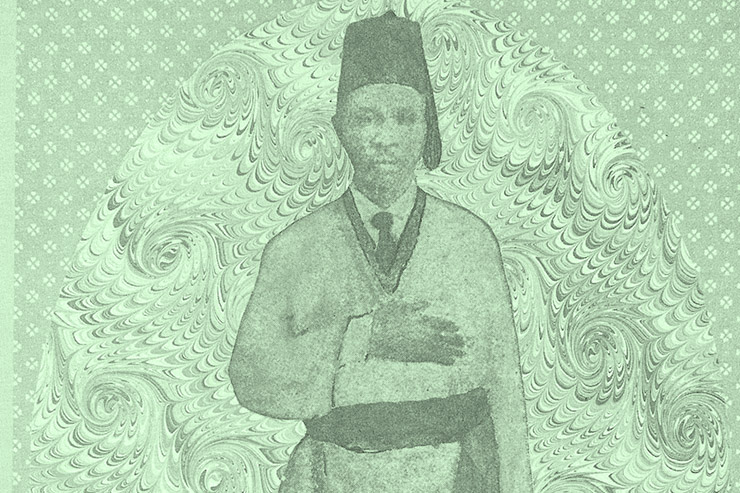
    Noble Drew Ali (born Timothy Drew) early in the 20th century took a job as a merchant seaman and found himself in Egypt. According to one legend, Noble Drew Ali made a pilgrimage to North Africa where he studied with Moorish scholars and received a mandate from the king of Morocco to instruct Americans of African descent in Islam. His association with the ruler of Morocco is significant when we recall the historic relationship between this Moorish country and the early United States.

    At the Pyramid of Cheops his followers believe he received initiation and took the Muslim name Sharif [Noble] Abdul Ali; in America he would be known as Noble Drew Ali. On his return to the United States in 1913 he had a dream in which he was ordered to found a movement “to uplift fallen humanity by returning the nationality, divine creed and culture to persons of Moorish descent in the Western Hemisphere.” He organised the Moorish Science Temple along lines similar to Masonic lodges, with local temple branches and “Adept Chambers” teaching the esoteric wisdom derived from the secret circle of Eastern Sages, the Master Adepts of Moorish Science.

    Noble Drew Ali is said to have made a historic visit to Washington, D.C. in order to reclaim the Moorish flag and obtain official recognition to call his people to their true faith, “Al Islam”. The US president, believing that African Americans would not embrace Islam, gave Noble Drew Ali full authority to teach Moorish Science in America.

    By the end of the 1920s, membership in the Moorish Science Temple had grown substantially. With increasing numbers of African Americans rallying behind Noble Drew Ali the Moorish movement soon came under the scrutiny of the FBI. In 1929 several Moors, including Noble Drew Ali, where detained for questioning by the Chicago police. Released from custody, Noble Drew Ali fell ill and never recovered. Many Moors suspected his death the result of a severe police beating.

    Following the inexplicable ‘death’ of Noble Drew Ali, the Moorish Science Temple continued and gave rise to unique Islamic groups among the African American community. Much of the known history of Moorish Science in North America is extremely complex and obscure.

    By the 1950s some white American poets and jazz musicians came into contact with Moorish Science. The North African cities of Tangiers and Marrakech held a magic attraction for the leaders of America’s counterculture, with writers like William S. Burroughs spending years living in the Moorish lands. The Moorish Orthodox Church of America was formed by white Americans who held Moorish Science passports and had ties with certain “Wandering Bishops” of the Old Catholic and Eastern Orthodox churches.

    Joseph Matheny, the American author and media theorist, first encountered Moorish Science when he was researching time travel and quantum consciousness. In his book Ong’s Hat The Beginning, the Moorish Orthodox Church is called “one of the most secretive and mysterious religious organisations ever known to man” and:

    a revolutionary and heretical sect of Islam that carries on an ancient tradition which sought to counterbalance the forces of orthodox Islam. Despite the controversial and dubious nature of the MOC, part of their tradition has been to serve as the torch bearers of freedom against the tyrannical and repressive aspects of the Earth’s patriarchal power structure as our planetary consciousness shifts to the Age of Aquarius and sets its site on unlimited freedom and the expression of life in all of its true wonder and beauty.

    Years before the “War on Terror” and Bush’s invasion of Afghanistan and Iraq, this writer attended a lecture organised by people associated with the Moorish Orthodox Church. The speaker, a Moorish Sheik returned from a long sojourn in the East, claimed Freemasonry is built on a twisting of the truth of Moorish Science. It is the secret power behind the West based on the Supreme Wisdom derived from esoteric Islam. The European colonisers usurped the knowledge of the Moors and created a nefarious system of control that blinds man to his true identity. Freemasonry was identified as a chief player in the world “Babylonian” system, the mastermind of the institutions of indoctrination that prevent the full knowledge of the True God to be known. Moorish Science is the effective counter to the Freemasonic imposters and a force for Truth, Love, Peace, Freedom and Justice. The Sheik also revealed how Afghanistan and Iraq figure in sacred geography and numerology, and mentioned a secret war between the Anglo-American and Asiatic powers.

    Is there a struggle between occult brotherhoods to influence human destiny? Are the dramatic events taking place in the world, from the continuing strife in Palestine, Iraq and Afghanistan, to the rivalry between the forces of Atlanticism (Britain and the USA) and Eurasia (Russia and China), just surface manifestations of a deeper conflict? Certainly the strange saga of Moorish Science and the Moorish Orthodox Church adds weight to the observation made by one of the 20th century’s most controversial mystics:

    …There is a history behind our so-called history that you cannot even conceive of. History has a deeper base. The periphery that we know as history is not the reality. Behind our so-called history continues another history, a deeper one about which we know nothing.5

    [alert type=”general” dismiss=”no”]This article was published in New Dawn 86.[/alert]

    [alert type=”success” dismiss=”no”]If you appreciate this article, please consider subscribing to help maintain this website.[/alert]

    Footnotes:

    1. Stanley Lane-Poole, Studies in a Mosque

    2. Bernard H. Springett, Secret Sects of Syria and the Lebanon

    3. Ernest Scott, People of the Secret

    4. Ibid.

    5. Bhagwan Shree Rajneesh, I AM THE GATE: The Meaning of Initiation and Discipleship

    © New Dawn Magazine and the respective author.
    For our reproduction notice, click here.
  • The Gospel of Mary Magdalene

    The Gospel of Mary Magdalene

    From New Dawn 84 (May-June 2004)

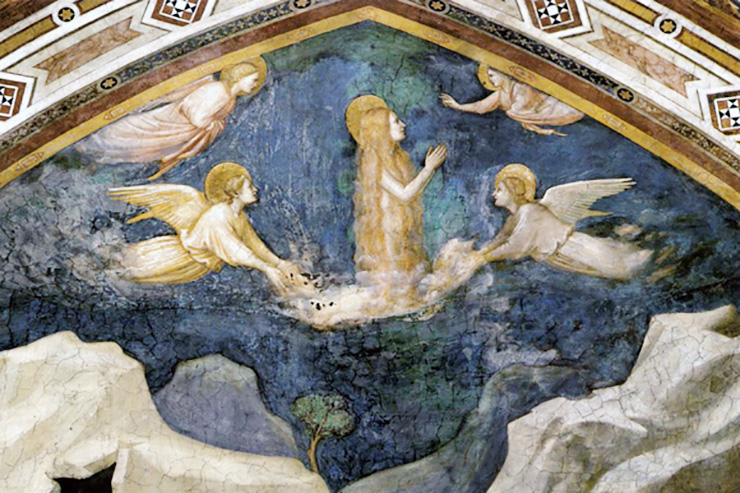
    Of all the earliest followers of Christ, none has sparked the level of interest generated by one particular woman – the biblical figure known as Mary Magdalene. Revered as a saint, maligned as a prostitute, imagined as the literal bride of Christ, Mary of Magdala stands apart as an enigmatic individual about whom little is actually known, despite centuries of scholarly scrutiny and wild conjecture.

    All that most Western Christians know about her is presented in the New Testament Gospels, and even that information is disputed. But there is some general agreement: She was a faithful disciple of Jesus Christ whom he had delivered from “evil spirits and infirmities.” Along with several other women, she ministered to Christ and witnessed his death on the Cross. She was there when his body was placed in the tomb, when the stone was rolled away to reveal an empty chamber, when an angel announced that Christ had risen from the dead – and when he made his first post-Resurrection appearance to the living. She brought the news of his Resurrection to the other disciples.

    For 1,500 years, Mary Magdalene was portrayed, in art and theology, as a prostitute whose life was transformed by Jesus’ forgiveness. This notion, based on Luke 7:38, was the result of an erroneous sermon preached in 591 by Pope Gregory the Great. Noted French author Jean-Yves Leloup states that “only in 1969 did the Catholic Church officially repeal Gregory’s labeling of Mary Magdalene as a whore, thereby admitting their error.”

    The stain of immorality attached to the figure of Mary Magdalene averted attention away from the significant role she plays in the unfolding of Christ’s teachings. The importance of Mary is especially apparent in Gnostic texts – some among the earliest accounts of Jesus’ ministry – which have been largely suppressed and ignored by Church authorities.

    The Gnostic picture of Mary departs – in some ways, dramatically – from the historical and biblical image of perhaps the most significant female follower of Jesus.

    The second-century Gospel of Mary was found in the late 19th century by archaeologists but remained largely ignored and untranslated for 50 years. It is the only account named for a woman and offers a different view of Christianity – one that describes an “interior spirituality,” says Karen L. King, author of The Gospel of Mary of Magdala: Jesus and the First Woman Apostle.

    In the Mary Magdalene account, “salvation is not something that comes from an external saviour,” says King. “One has to seek salvation within.” Thus, the Magdalene gospel depicts Jesus as a teacher rather than as a saviour who dies to atone for humanity’s sins.

    In her introduction in The Complete Gospels, King says:

    …the Gospel of Mary communicates a vision that the world is passing away, not toward a new creation or a new world order, but toward the dissolution of an illusory chaos of suffering, death, and illegitimate domination. The Saviour has come so that each soul might discover its own true spiritual nature, its ‘root’ in the Good, and return to the place of eternal rest beyond the constraints of time, matter, and false morality.

    Another Gnostic text – the Gospel of Thomas – reveals that women were disciples of Christ. However the New Testament only includes gospels written by men and distinguishes between the women of Christ’s life, and the ‘disciples’ – who are all male.

    “You find in the [Gnostic] Gospel of Thomas that six disciples are named: Matthew and Thomas, James and Peter, Mary Magdalene and Salome,” says Prof. Elaine Pagels, professor of religion at Princeton University, and author of The Gnostic Gospels and Beyond Belief: The Secret Gospel of Thomas.

    “Here, explicitly, Mary Magdalene is Jesus’ disciple. In the Gospel of Thomas and also the Gospel of Mary Magdalene, she is seen as an evangelist and a teacher, somebody who is gifted with revelations and teachings from Jesus which are very powerful and which enable her to be a spiritual inspiration to others.”

    The Gnostics honoured equally the feminine and masculine aspects of nature, and Prof. Pagels argues Christian Gnostic women enjoyed a far greater degree of social and ecclesiastical equality than their orthodox sisters.

    For Jean Yves-Leloup, the founder of the Institute of Other Civilisation Studies and the International College of Therapists, Mary Magdalene is the intimate friend of Jesus and the initiate who transmits his most subtle teachings.

    His translation of the Gospel of Mary is presented in his book The Gospel of Mary Magdalene along with a commentary on the text which was discovered in 1896, nearly 50 years before the Gnostic Gospels at Nag Hammadi were found.

    The Gospel of Mary can easily be divided into two parts. The first section (7,1-9,24) describes the dialogue between the risen Christ and the disciples. He answers their questions concerning matter and sin.

    “Christ teaches that sin is not a problem of moral ignorance so much as a manifestation of imbalance of the soul,” says James Robinson, Professor Emeritus of Religion at Claremont Graduate University in The Nag Hammadi Library in English. “Christ then encourages the disciples to spread his teachings and warns them against those who teach of spirituality as an external concept rather than as an internal, Gnostic experience,” says Robinson.

    After he departs, however, the disciples are grieved and in considerable doubt and consternation. Mary Magdalene comforts them and turns their hearts toward the Good and a consideration of Christ’s words.

    The second section of the text (10,1-23; 15,1-19,2) contains a description by Mary of special revelation given to her by Christ. At Peter’s request, she tells the disciples about things that were hidden from them. The basis for her knowledge is a vision of the Lord and a private dialogue with Him. Unfortunately four pages of the text are missing here so only the beginning and end of Mary’s revelation are available.

    This fragment of the gospel describes Mary’s vision of the soul’s ascent beyond the “powers” including the powers of fear. For the Gnostics, these “powers” are the Archons which act as cosmic prison wardens, attempting to prevent souls ascending to the True God. “It (the soul) has to overcome the powers of fear and the powers that threaten it as it proceeds into a life beyond death,” Prof. Elaine Pagels explains.

    After Mary finishes recounting her vision to the disciples, Andrew and then Peter challenge her on two grounds. First of all, Andrew says, these teachings are strange. Secondly, Peter questions, would Christ really have told such things to a woman and kept them from the male disciples. Levi admonishes Peter for contending with the woman as against their adversaries and acknowledges that Christ loved her more than the other disciples. He entreats them to be ashamed, to put on the “perfect man”, and to go forth and preach as Christ had instructed them to do. They immediately go forth to preach and the text ends.

    This confrontation between Mary and Peter is well documented in a number of Gnostic scriptures. Mary exposes the small mindedness and superficiality of Peter and Andrew who find it difficult to comprehend, let alone accept, the deeper spiritual understanding Mary acquired through her personal experience and closer relationship with Christ.

    James Robinson observes:

    Indeed Peter and Andrew seem to prefer the very thing against which Christ warned them – a religion based on arbitrary ideas (in this case represented by Peter’s male chauvinism and Andrew’s ignorance). And yet many of their ideas have shaped modern Christianity while, paradoxically, Mary Magdalene’s spirituality, which here seems more consistent with the teachings of Christ, is unheard of today.

    [alert type=”general” dismiss=”no”]This article was published in New Dawn 84.[/alert]

    [alert type=”success” dismiss=”no”]If you appreciate this article, please consider subscribing to help maintain this website.[/alert]

    © New Dawn Magazine and the respective author.

    For our reproduction notice, click here.
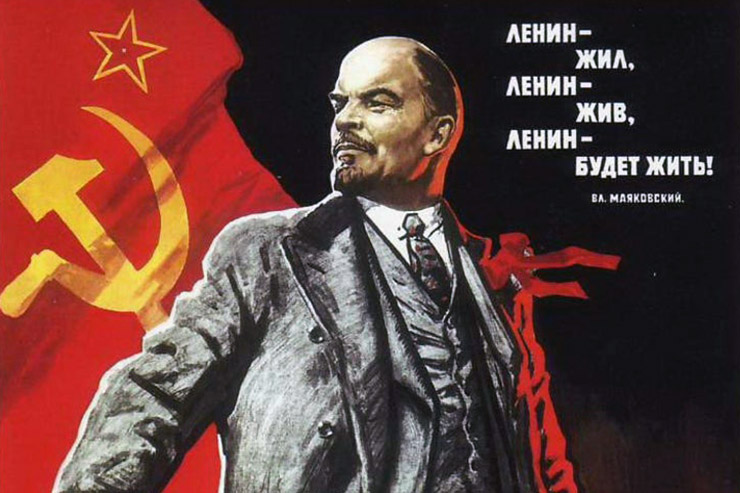
  • Lenin, the Red Avatar of Rage

    Lenin, the Red Avatar of Rage

    From New Dawn 84 (May-June 2004)

    I didn’t like [Vladimir Ilyich] Lenin (1870–1924) before. Everyone around me was saying: “Lenin, Lenin….” The majority is always wrong. During the Soviet Era, I used to take my small son out to spit on Ilyich statues. At the time, I read Evola and Malynsky and believed that Lenin was a main counter-initiatic agent of the “modern world,” who destroyed the last stronghold of Tradition: the Russian Orthodox Empire.

    I scoffed at Lenin and despised Leninists, and on seeing citations from his works, I felt like pouring boiling water on the authors who used these citations. Let us remember that, in those days, the overwhelming majority of present-day liberal reformists were enthusiastic Leninists, glorifying Ilyich with their always ready little tongues, coiling in their jackets, wriggling and squealing as in a damp, cozy hole.

    I was born too late to witness a period when people sincerely believed in Lenin (and Stalin) as a divinity. I came to live in a sickening decomposing Sovdepia, where no one knew or believed in anything any longer, bending over to whomever was in power at the moment. I thought that Lenin was a dark idol (tagut), raping the later-day Soviet Untermenschen while they grunted with pleasure.

    I was mistaken. I too was completely seized by the general atmosphere of decomposition, but came to a conclusion (absolutely inadequate, though) opposite of the conformist crap. I thought Leninism was the name of the anti-traditionalist hypnosis. Simply put, I hadn’t been to the West, and I couldn’t imagine that humanity could have degraded so much even without any Leninism. I assumed that the fourth proletarian estate was below the third, the bourgeois estate (as asserted by Evola), and, therefore, treating the far-away and unknown capitalism as an evil (but of the second order). I sincerely believed that Lenin was one of the faces of the Antichrist, a Russophobe, Westerner, and enemy of Traditionalism.

    My attitude towards Lenin changed during perestroika. I was particularly shocked during my first trips to Europe. The picture I saw was so repellent, so degenerative, stiff, totalitarian, untermenschist, only with the untermenschism of the people in the West, as opposed to that of the Soviets. It was not passive and absurd, but rather so triumphant, conceited and optimistic, complete and aggressive that I began to reconsider my attitude to the Soviet Fatherland.

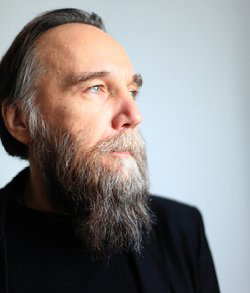
    Prof. Alexander Dugin, Russian philosopher

    At the same time in Russia itself, the most repulsive scum that most exasperated me physiognomically and typologically in the Later Sovdepia turned into “democrats” and “reformists”. The more vile and ugly the person was, for example, Yegor Yakovlev, the author of the most mendacious “Leniniana” of them all, or his namesake Alexander “Small Shoe” Yakovlev, of the CPSU Political Bureau, the “architect of perestroika,” the more shamelessly and harshly he abused and destroyed the Soviet system. On the contrary, in the position of diehard Soviet conservatives, one could definitely discern hardly expected dignity, ethics, stoicism, and fidelity.

    Gradually, these emotions became stronger through my research of common geopolitical themes. A distance, although small, from the Later Soviet period allowed me to view the situation all the more dispassionately, and then a concept began to grow on me that the Soviet society was by no means an expression of the modern spirit and anti-traditionalist Western plague, but a special, confused, and muddy, but nevertheless violent, thrust of a great people to break free from the dark clutches of the present-day Antichrist. In other words, I perceived in Soviet society a paroxysmal attempt to defend certain fundamental principles of traditional society against Western liberal-capitalist entropy.

    The Marxist model cannot be called “traditional” in the normal sense of the word, but in comparison with the liberal model, it has far more features of a traditional society. When it comes to a historical choice, this distinction acquires a special great meaning.

    At this stage, the pro-Soviet positions of Eurasianists and National-Bolsheviks became quite clear and close to me. They turned out to be the only positions sustained by history, whereas the narrow communist constructions or white-guard myths were obviously untenable and disproved by history.

    Incidentally, political history has also disproved Evola’s predictions about the triumph of Soviets as the fourth caste. Evolaism required a revision. The theoretical basis of such a revision was put forward in my speech at the academic conference in Rome devoted to the twentieth anniversary of Evola’s death. Today, it has become an integral part of traditionalist research (my theses “Evola: A View From The Left” is quoted in new Italian reissues of Evola, in professor Giorgio Galli’s works, and is focused on in discussions in many traditionalist circles). I expanded on this theme in my article “Julius Evola E Tradizionalismo Russo,” which is available in French and Italian versions.

    Thus, the name Lenin has changed its meaning. I think that simply history has occurred in such a way that this new meaning has appeared all by itself. It is indicative that even such a fierce hyper-reactionary and anticommunist as Geidar Jemal has recently devoted some heartfelt lines to Lenin.

    The mutation of the metaphysical quality of Vladimir Lenin is an objective fact. When his skull ceased to be sucked at, as some profitable candy, by dirty crowds who have gone (at last) into the sewerage expanses of “liberal reforms,” the features of a continental Titan began to appear on the horizon of the secret line of things.

    A Titan who lost his way, a strange Titan possessed by a great force, Starke von Oben, a magic Eurasian dwarf who declared an unthinkable, impossible jihad on the web of global percentage, the world of exploiters of financial entropy and oppressive vice, and… and… triumphantly won the great fight.

    Lenin smashed the brain of the philistine, razed to the ground the stock exchange and banks, completely exterminated the persistent pre-revolutionary worms (the Gusinskis and Berezovskis of the time), turned upside down the stratified, alienated Later Romanov Russia built on Old-Believers’ corpses, pawned and re-pawned to European nonentities, etc.

    Lenin mobilized the nation for a total upheaval. Yes, it was bloody, but blood is inherent to the birth of all things. Yes, it was allegorical, but the ideological discourse of Tradition has already been for many centuries compelled to disguise itself in dubious formulas of compromise, otherwise the kali-yugical mankind simply would not understand anything, as it has grown dull and bestialized beyond measure.

    However, a new perception of Lenin and Leninism is not an easy job. The vulgarity of plain nostalgia or non-reflexive dogmatism would be out of place as much as the hackneyed preaching of anti-Sovietchiks (incidentally, today’s anti-Sovietchiks are the most disgusting of yesterday’s Sovietchiks; it is not accidental that true dissidents and real fighters against the regime never managed to occupy any position of significance in the political hierarchy). New Leninism should be perceived magically, euroasiatically, eschatologically, and geopolitically.

    His is a solemn and mournful figure, a subtle maniac, through whom the unrestrained winds of the Continent were blowing. Burring, restless, mobile, cunning, stunned, rapaciously carnal, with half a brain and piercing little eyes, he is more vital and perfect than any athlete or orator, more vivid, lofty, and idealistic than any demagogue of “idealism” or “traditionalism.” In Europe I met many Guenonians and Evolians. Some of them were sloppy schizophrenics, others obedient and politically correct Philistines (many work in banks, while others teach the basics of marketing). They are a bunch of misfits, incapable of original thinking, deeds, terrorist acts, or any effective historical action of the slightest importance. The only thing they do is whine, squabble over some trivia, and grumble at the world around, which they do not understand at all and are pathologically afraid of.

    Any halfwit terrorist from the Red Brigades or RAF is a hundred times more attractive then the majority of European “traditionalists.”

    Lenin is a tragic and powerful Angel, one of the Angels of Apocalypse, pouring out the dreadful contents of the final goblet on the insane Earth. The angel of the last winds… The angel of blood and pain…

    I think that Vladimir Ilyich Lenin was a little Eurasian Avatar. He wanted to stop time and open the cycle of Eternal Recurrence. He was our Lenin. But he is dead. You killed him. You and I.

    [alert type=”general” dismiss=”no”]This article was published in New Dawn 84.[/alert]

    [alert type=”success” dismiss=”no”]If you appreciate this article, please consider subscribing to help maintain this website.[/alert]

    Translator’s notes: This article was first published in LENIN electronic weekly run by Misha Verbitsky. http://imperium.lenin.ru/LENIN/. Emmanuel Malynski, the Polish Catholic conspiracy theorist, together with Leon de Poncine, have issued several strong anti-Semitic brochures. Tagut in Arabic. Alexander Yakovlev, the so-called architect of Perestroika, cult figure in Russian liberal circles. The name ‘small shoe’ was given to him because of his lameness. Vladimir Gusinski, notable banker and media tycoon. Boris Berezovski, notable banker, the so-called Usurer of the Family (Yeltsin’s family). Starke von Oben, “the strong one from the skies”, term primarily used by Guido von List. The collective spirit of the perished heroes later embodied in the new generations or certain persons.

    © New Dawn Magazine and the respective author.

    For our reproduction notice, click here.
  • Unfolding the Secrets of the Copper Scroll of Qumran

    Unfolding the Secrets of the Copper Scroll of Qumran

    Qumran lies close to the Dead Sea at its north western end, some 40 km east of Jerusalem. Here, in an incredibly dry and sun bleached area there is, strangely enough, no need for zinc oxide protective blocker, or life guards. Lying some 1200 feet below sea level at the lowest point on earth, the damaging rays of the sun are screened out by the extra layer of atmosphere, and the concentration of salts in the Dead Sea is so high that anyone falling in immediately pops to the surface and cannot sink.

    If a settlement is ever reached between Israel and the Palestinian Arabs, under the so-called Road Map for Peace, due to reach its conclusion in 2005, it is likely Qumran will fall into the area of a new Palestinian State and one of the most important of all the Jewish historical sites will no longer be under Israeli jurisdiction. Prior to 1967 the area around Qumran was controlled by the Jordanians and had been since the end of the war which saw Israel established as an independent State in 1948.

    So why is Qumran so important in historical and biblical terms?

    Part of our modern awareness of its significance derives from a day back in the Spring of 1947 when the first of some 85,000 textual items, ranging from tiny fragments to almost complete scrolls were discovered in hillside caves behind Qumran. They turned out to contain biblical texts, written in ancient Hebrew, Aramaic, and Greek from virtually every book of the Old Testament, and as such, predated any previously found Hebrew material by over 1,000 years. For the first time scholars and theologians had the astounding opportunity to look at parts of the Bible in its original language, rather than from handed down versions copied, and re-copied, and altered over the intervening millennium.

    In essence these biblical texts, which comprise part of what are known as the Dead Sea Scrolls, showed we received most of the Old Testament in its authentic ancient form – but there were significant differences. These variations are now being incorporated into modern translations of the Bible. There are also commentaries amongst the scrolls which help explain and enhance, not only parts of the Old Testament but also the New Testament.

    A third group of texts describes the peculiar monastic like sect that lived at Qumran between about 150 BCE and 68 CE, who wrote and collected the Dead Sea Scrolls.

    Generally understood to be part of the Essene movement of the Second Temple period, the community at Qumran had a strong hierarchical structure with the ‘right teacher’ as its leader. He was backed by priests aided by Levites, who dictated the doctrine of the group. At any one time there were about 200 members living near Qumran and all members could vote in an assembly on other non doctrinal matters, whilst general day-to-day administration was in the hands of a triumvirate of three priests and 12 helpers. Everyone had a ‘pecking order’ in relation to their level of learning and holiness, as determined by their peers.

    The Qumran Essenes considered themselves ‘Sons of Light’ destined to fight the ‘Sons of Darkness’ – those who did not believe in their ultra-strict code of Judaism. They thought of themselves as the keepers of the original Covenant of Moses and as part of a direct line of priests that attended the Tabernacle during the Exodus from Egypt. For them the Second Temple, reconstructed by Herod the Great, who ruled Judaea on behalf of the Roman conquerors, from 37 to 4 BCE, was a corrupt place they would not visit.

    One of the most startling of their beliefs related to the calendar, which for them had to be solar based, giving a year containing 364 days. The intriguing thing about this practice is the Essene calendar differs from the Rabbinic Jewish calendar, which was based, and still is based, on lunar movement giving a year of 354 days. This meant the Essenes celebrated religious festivals at different times to the rest of their Jewish counterparts.

    Discovery of the Copper Scroll

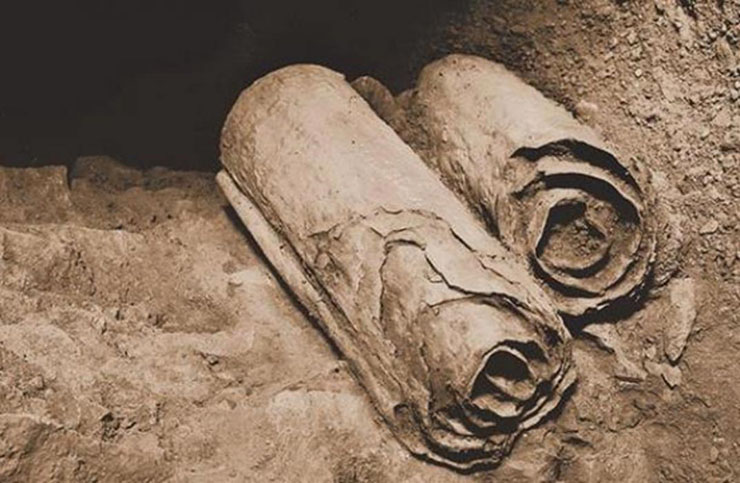
    In March 1952, Henri de Contenson, an archaeologist seconded from France to work with the team at the École Biblique in East Jerusalem, was leading a team of ten Bedouin, when he discovered two lumps of what is now known as the Copper Scroll, in a hillside cave, some 2 km from Qumran.

    The Copper Scroll was in an highly oxidised condition, and had broken into two separate rolled up sections. In its original state it measured 0.3 m in width, 2.4 m in length, and was about 1 mm thick. No one knew quite how to open it up without damaging the text. One lunatic suggestion was to try to reduce the copper oxides with hydrogen, or even electrolysis, to recover the copper! After considerable preparatory research, John Allegro of Oxford University, a member of the original international translation team working on the Dead Sea Scrolls in Jerusalem, persuaded the École Biblique team to let him take one of the copper pieces to England. There the first piece of scroll was finally ‘opened’ by Professor H. Wright Baker at Manchester College of Science and Technology (now UMIST) in 1955, followed by the second piece in 1956. The technique Wright Baker used was to coat the outside of the scroll with Araldite adhesive and then slice the scroll, using a 4,000th/inch thick saw, into 23 separate sections. Ever since that time Manchester has retained a special interest in the Copper Scroll.

    Language of the Scroll

    In academic circles the Copper Scroll is known as 3Q15, the 3Q indicating it was found in Cave 3 at Qumran. It was written in an early form of Hebrew – a square form script – and has been shown to have linguistic affinities to pre-Mishnaic Hebrew and Aramaic, with some terms only comprehensible through study of Arabic and Akkadian. Other Dead Sea Scrolls were written in square form Aramaic script, or the so-called ‘Paleo-Hebrew’ script, derived from ‘Proto-Canaanite’ – itself an evolution from ‘Ugarit’, Egyptian hieroglyphs and ‘Phoenician’.

    The language was a major puzzles for scholars. The Hebrew palaeography (style of script) and orthography (spelling) in the Copper Scroll is quite unlike anything found in other texts of the time, from Qumran or from elsewhere. It has, nevertheless, been almost unanimously classified as one of the Dead Sea Scrolls, and now resides in the Archaeological Museum of Amman, in Jordan.

    John Allegro, a religious renegade, amongst a team of predominantly Catholic members, must have been the first person to translate the ancient Hebrew of the Copper Scroll into English. What he read, started a controversy that has raged for over 50 years amongst scholars. It contained a list of some 64 locations where fabulous treasures had been hidden, over a wide geographical area, including large quantities of gold, silver, jewellery, precious perfumes, ritual clothing, and other scrolls.

    The Jerusalem team refused to let him publish his findings, nervous that treasure hunters would come swarming down to disturb their work at the Qumran site. They had also already made up their minds the Qumran Essenes were essentially uninterested in worldly goods and shared their possessions amongst themselves.

    This mind set attitude runs throughout the academic and theological community studying the Dead Sea Scrolls, and as we shall see later on, they have preconceived ideas on what many of the scrolls ought to say and dare not entertain new ideas that conflict with long established dictums. New Dawn’s approach of trying to free up these types of entrenched views is highly pertinent to this particular field of study.

    The mixture of frustration and excitement soon became too much for Allegro as he began to realise there were other more sinister reasons for the strictures being put on him. He relieved his excitement about the prospect of rolling in treasure by mounting two archaeological expeditions to Jordan, in December 1959 and again in March 1960. Like many who get lost in the desert, he wandered around in a circle eventually coming back to where he started from, having found absolutely nothing.

    His frustration was, in the end, vented when Allegro disregarded his ‘masters orders’ and published his English version of the translation in 1960, under the title The Treasure of the Copper Scroll.

    Scholars, notably Father P’ere de Vaux, Head of the École Biblique et Archéologique Française de Jerusalem, and Father Joseph Milik, members of the original Dead Sea Scrolls translation team, denounced Allegro’s translation as defective and even cast doubts on the authenticity of the Copper Scroll’s contents, assigning them to folklore. Others were not so sure, and today the generally accepted view is the Copper Scroll contains a genuine list of real treasures.

    The Jerusalem team’s translation came out in 1962, entitled ‘Les “Petites Grottes” de Qumran, in the Discoveries in the Judaean Desert series. Although it is the ‘official’ version there is no accepted ‘definitive’ translation of the Copper Scroll to date, and all of the numerous editions published have many significant variants.

    In conventional translations of the Copper Scroll the weight of gold mentioned in various locations is generally given as adding up to a staggering 26 tonnes and silver 65 tonnes.

    When the weights of the treasures itemised in the Copper Scrolls are totalled, we come to the following:

    Gold – 1285 Talents
    Silver – 666 Talents
    Gold and Silver – 17 Talents
    Gold and silver vessels – 600 Talents
    Mixed precious metals – 2,088 Talents

    Items with unspecified weights are as follows:

    Gold ingots – 165
    Silver bars – 7
    Gold and Silver vessels – 609

    In Biblical Talent terms the sheer weight of the gold and silver is enormous. One Talent is estimated to be about 76 lb or 34.47 kg.

    The Copper Scroll seems to be referring to precious metals worth around $2 billion at current prices, but whose intrinsic historic value would be many times this figure!

    Where Did the Treasures Come From?

    The Scroll does not reveal by whom, or when, the treasures were buried, let alone why. But from some of the recognisable place names mentioned, the treasures are generally assumed to have been hidden within Judaea or near to Mount Gerizim, in Samaria (parts of modern Israel) and to relate to treasures of the Second, or possibly First Temple of Jerusalem. Both temples were known to be places where considerable wealth was accumulated through the donation of sacrificial gifts and ‘tithes’ by the general community.

    Controversy over the origins of the treasures listed in the Copper Scroll has led to the proposition of almost as many ‘conspiratorial’ theories as those promulgated for the President Kennedy assassination.

    There are over-riding problems with all of the current theories which, until now, have not been resolved. Scholars have puzzled over how so much gold could have come from the First or Second Temples of Jerusalem, let alone come into the ownership of an ascetic, relatively impoverished sect like the Qumran Essenes. More significant is the fact none of the conventional theories have led to the discovery of any of the treasures listed in the Copper Scroll.

    My own view is rather different. Whilst part of the treasures may well have come from the First or Second Temples at Jerusalem, as descriptions in the Copper Scroll certainly refer to Temple associated objects, when the secrets of the Copper Scroll are unravelled it becomes patently clear that another Temple is involved in the descriptions – and the Qumran Essenes were guardians, not just of treasure.

    Although, from palaeographic studies, the Copper Scroll is now thought to have been copied at a date between 150 BCE and 70 CE, there are enigmatic passages which correspond to early Biblical Hebrew, dating back to 700 or 800 BCE, and it contains many unique word constructions not in use in mainstream Judaism at the time of its production.

    The presence of Greek letters interspersed at the end of sections of the text aroused my curiosity, as their meaning was not understood and they appeared to be some kind of cryptic code. Many theories have been put forward to try to explain these apparently random Greek letters. They are variously considered to be made by scribes as reference marks of some sort, initials of place names, entry dates, or location directions, but none of these explanations is accepted as conclusive and they remain a puzzle.

    The numbering units given in the text, which relate to the amounts of treasure, are also not clearly understood by modern translators. The numerals are in an unsophisticated long-hand form involving apparently unnecessary duplication.

    There were other ‘anomalies’ for which there appeared to be no satisfactory answers. No other Dead Sea Scroll was engraved on copper, nor any known Hebrew texts from anywhere else, prior to the period.

    Why should this be? Why should a non materialistic community go to such trouble to preserve the information on the Copper Scroll? Where did they get the extremely pure copper (99%) from? How could they afford its very high cost ?

    When my metallurgical background attracted me to the subject, these questions were not being confronted.

    When I looked closely at the numbering units and weights used in the scroll, it soon became clear they were not of Canaanite or Judaean origin, where the Qumran Essenes resided, but Egyptian! Indeed, the numbering system in the Copper Scroll is typical of that in use in Egypt around 1300 BCE. The Egyptian system used repetitive single vertical strokes, up to the number 9, combined with repetitive decimal units for larger numbers.

    If the numbering system was Egyptian, why not the weight terms also? The ancient Egyptians had developed a system of weights specifically designed for weighing precious metals, and this system was based on the ‘Kite’, a unit weighing approximately 10g, but sometimes used as a double unit (KK) of 20.4g. I believe it is no coincidence the ‘hard ch’ sound of the weight term used in the Copper Scroll text equates to the Egyptian ‘K’ in ‘Kite’! When these ancient Egyptian weight units are applied, typical of the period prior to 1000 BCE, to calculate the quantities of gold, silver and jewellery mentioned in the Scroll, rather more realistic weights are obtained than those given earlier. The approximate totals of precious metals mentioned in the scroll now become:

    Gold – 26 kg
    Silver – 13.6 kg
    Mixed precious metals – 55.2 kg

    We were now looking at weights which are a fraction of those given in modern translations of the Copper Scroll, but they are at least plausible values, quite consistent with the amounts of gold and silver in circulation for the period. For example, if we look at the Harris Papyrus, an ancient text in the British Museum, dating to about 1180 BCE, it gives the total gold holdings accumulated over a 31 year period by Egypt (by far the most wealthy country in the ancient Middle East), as 387 kg. The downside is that the value of our treasure has diminished somewhat! However, we are still talking about hundreds of millions of dollars in real terms.

    The strange thing is that, although the type of numbering system used in the Copper Scroll might have persisted in Egyptian temple writing for some time after the Greek conquest of Egypt (in 330 BCE), its use was always specific to Egypt and it was not in use outside Egypt, except in the period of Egypt’s campaigns in Canaan from 1400 to 1100 BCE. The use of the ancient Egyptian system for weighing metals died out around 500 BCE and had previously always been specific to Egypt.

    Why would a document, ostensibly written by a devout, unorthodox Jewish community living near the Dead Sea in Judaea around the time of Jesus, have so many Egyptian characteristics? And why would the writing material, numbering system and system of weights used, be typical of Egyptian usage from a period at least 1,000 years earlier?

    Egyptian Influences

    From as early as 3000 BCE right up to 1200 BCE, Egypt had maintained an armed presence in Canaan, often as a stepping stone to further conquests to the east. Egypt’s shadow had obviously been cast over the early Hebrew’s experience, and yet, like other blind spots, modern theology shies away from considering the Egyptian connection too closely. Yet, all the major characters of the Bible, from Abraham and Sarah, to Jesus and Mary, had strong links to Egypt. Joseph, Jacob, all the founders of the 12 tribes of Israel, as well as Moses, Aaron and Miriam, Joshua, Jeremiah and Baruch, all lived for long periods in Egypt and were influenced by its culture and religions.

    After a lengthy analysis I came to the conclusion that Joseph had interacted with a pharaoh by the name of Akhenaten – a monotheistic pharaoh – and many of the basic tenets of Judaism, and by extension Christianity and Islam, came out of Egypt. The river that branches from the Nile at Amarna (ancient Akhetaten), Pharaoh Akhenaten’s capital city, is to this day know as ‘Bahr Yusuf’, ‘Joseph’s River’, and there are many other clues.

    When I started comparing descriptions of the treasure locations given in the Copper Scroll with sites at Amarna, it soon became apparent there were many close parallels. Not only that, some of the locations have already yielded archaeological finds of treasures that match very closely the descriptions and weights given in the Copper Scroll. Many of these treasures can be seen in Museums in Britain and Egypt. Having made a connection for the Copper Scroll to Akhenaten’s Holy city in middle Egypt, it was not surprising a most powerful piece of evidence emerged when I looked again at the strange Greek letters scattered in the Scroll. When the first 10 are put together they spell out the name Akhenaten!

    The validity of this conclusion is re-enforced by the opinion of Professor John Tait, of University College London, who considers the reading of the Greek letters as quite plausibly the name of the Pharaoh in question.

    Academic Responses

    Since publication of the first edition of my book, The Copper Scroll Decoded, in 1999, the main theory has been tested against a broad spectrum of academic and scholarly opinion, and in many instances response to the main thrust of the theory has been favourable and enthusiastic. Where there has been a negative response, it has been in the form of guarded scepticism, particularly as the theory presents a radically new view of religious evolution which strongly conflicts with enshrined orthodoxy.

    Response from academics, on specific areas of their own expertise, has generally been supportive. On alternative interpretations of the meaning of the Copper Scroll, for example, particularly in the context of the weight and number terms given in the Scroll, there has been a considerable consensus of acknowledgement that previous interpretations have not been correct. Amongst those scholars conceding previous translations are deficient, one of the world’s experts on the Copper Scroll, Judah Lefkovits, of New York, has reiterated the Scroll is much more problematic than some scholars would allow. He has written a number of books on the subject, including a recent classic work The Copper Scroll 3Q15: A Reevaluation; A New Reading, Translation, and Commentary, and now does not think the conventional translation of the weight term as a Biblical talent is necessarily correct. He has suggested it might be a much smaller weight, such as the Persian karsch. In supporting my claim, against the views of previous researchers, he now believes the total precious metal weights have been greatly exaggerated.

    One eminent scholar, Professor Harold Ellens, of the University of Michigan, has come out strongly in favour of the generalised theory, which he says is almost certainly basically correct.

    If there is a partial acceptance of the possibility of a connection between the Qumran Essenes and the Jacob-Joseph-Pharaoh Akhenaten period, it is in demonstrating the detailed historical links that most hesitancy arises.

    In the Kingdom of the Blind….

    Ben Zion Wacholder is a partially blind Professor of the Hebrew University in Cincinnati, but he has the ability to see through the tangled undergrowth of intertwined scrolls and is a king and much respected father figure in the land of his peers. In the celebratory 50th anniversary conference of the finding of the first of the Dead Sea Scrolls, held in Jerusalem, he created a major sensation by going against his colleagues in claiming Ezekiel as the first Essene.

    He perceives many of the sectarian Dead Sea Scrolls of the Qumran Essenes, such as the Temple Scroll, New Jerusalem Scroll, the Aramaic Testament of Levi, Qahat, and Amran, Jubilees, and the Cairo-Damascus documents, as derivative of Ezekiel’s thinking in refusing to recognise the legitimacy of the Second Temple and standing outside normative Judaistic authority. In a sense he recognises two quite separate sets of biblical texts – Ezekielian and non-Ezekielian.

    One of the most interesting aspects of this theory relates to Ezekiel descriptions of a Temple, which is generally taken to be a visionary Temple that would one day be built in Jerusalem. However, when you compare the descriptions Ezekiel gives in the Old Testament to those of the archaeological reconstructions of the Great Temple that stood in Akhenaten’s Holy City, it is quite clear he was talking about that actual Temple and not one which would one day stand in Jerusalem.

    Other Dead Sea Scrolls confirm this finding in incontrovertible detail. The New Jerusalem Scroll, for example, which by the way never mentions Jerusalem, ties its descriptions to Akhenaten’s Holy Temple. Recently Michael Chyutin, and Shlomo Margalit, Israeli architects, have conducted independent studies on the Scroll and come to the conclusion it is almost certainly describing Akhenaten’s city at modern day Amarna. Without the explanation I have put forward, for a link from Amarna down to the possessors and authors of the New Jerusalem Scroll, conventional history has no answer to the problem.

    Incidentally these studies show that two other Egyptian cities also exhibited similar characteristics to those described in the New Jerusalem Scroll – namely Sesebi, a city located between the second and third cataract of the Nile, and the Hebrew settlement on the Island of Elephantine, near Aswan in southern Egypt. A connection to Sesebi is not so surprising as it was, like Akhetaten, built by Akhenaten. Why the strange pseudo-Hebrew settlement on Elephantine Island, which is dated to at least the 7th century BCE, should show similarities is more intriguing. The people there worshipped Yahwe, the Israelite name for God, and built a temple as a place of worship. The explanation of how this isolated community came into existence has never been satisfactorily resolved.

    My own theory is they were a residual enclave that formed after the destruction of Akhenaten’s Holy City when survivors, mainly the earliest monotheistic Hebrews, fled south for safety. An Australian scholar, E. Maclaurin, of the University of Sydney, adds weight to my theory in a paper entitled Date of the Foundation of the Jewish Colony at Elephantine’, published in The Journal of Near Eastern Studies, Volume 27, 1968. He concluded that the style of worship at Elephantine, “…was of a form which could not have existed in a Hebrew group which had been exposed to the influences of Sinai and Canaan after the settlement.”

    In other words Maclaurin rules out any possibility of the community at Elephantine having derived from outside Egypt after the Exodus (c. 1200 BCE) let alone at the time of Solomon or the kings of Israel. Another Australian scholar, Ian Wilson, seems to date the Exodus to around 1500 BCE, but the general consensus is it took place some time in the 13th century BCE. These are not the only students of Dead Sea Scroll study with an Australian connection. I, too, have a warm affection for the country, having spent seven years of my early life in Sydney, where my mother was born!

    Another scroll, the Temple Scroll, spells out the dimensions of the longest Temple wall as 1600 cubits, equivalent to 800 m. Conventional scholarship has nowhere to go in Jerusalem to accommodate the Qumran Essenes’ concept of this building. The Temple Mount in Jerusalem measure only 550 m x 185 m. So they conclude it must be the description of a fictitious temple. The length of the longest wall of the Great Temple at Amarna has been measured, from detailed archaeological excavations, as being 800 m.

    The logical conclusion is the information in the Temple Scroll, in its original form, existed before Moses, and it described the plan of a real temple that was not the Temple at Jerusalem. The details must have been handed down in secret through a distinct line of Levitical priests, to the Qumran Essenes, who based their copy on the original version.

    When the Qumran Essenes built their main settlement building at Qumran in ‘exact’ alignment to the main walls of Akhenaten’s Temple, and constructed 10 ritual washing pools, they were echoing a recorded memory of that Temple. Uniquely, and unknown from anywhere else in Israel, one of the ritual washing ‘Mikvaot’ has four divisions  just as one of the ritual washing basins in the Temple at Akhetaten exhibited.

    That the name of Aten or Aton, the name by which Akhenaten knew his God, is embedded throughout the Old Testament, has many attesters, from Sigmund Freud onwards. Many Egyptian names are read with the letter ‘D’ or the letter ‘T’  Touchratta or Douchratta, Taphne or Daphne, and in Egyptian Coptic the letter D can be pronounced ‘D’ or ‘T’ . Thus, Aton could well be written ‘Adon -ai’ where ‘ai’ relates God to the Hebrews in the sense of ‘my master’.

    Earlier in this article the question was posed as to why Qumran was so important to historical and biblical history. Part of the explanation has now been outlined in this article, and is described in more detail in my latest book The Mystery of the Copper Scroll of Qumran, published by Bear & Co, part of Inner Traditions, in June 2003. However, as yet there is no complete answer to the question as the modern story of Qumran is still being written. There are more secrets to be revealed and I hope to do that in a sequel book now in preparation.
    [alert type=”general” dismiss=”no”]This article was published in New Dawn 80.[/alert]

    [alert type=”success” dismiss=”no”]If you appreciate this article, please consider subscribing to help maintain this website.[/alert]

    © New Dawn Magazine and the respective author.

    For our reproduction notice, click here.